EP1111972A2 - Flexible printed substrate - Google Patents
Flexible printed substrate Download PDFInfo
- Publication number
- EP1111972A2 EP1111972A2 EP00127809A EP00127809A EP1111972A2 EP 1111972 A2 EP1111972 A2 EP 1111972A2 EP 00127809 A EP00127809 A EP 00127809A EP 00127809 A EP00127809 A EP 00127809A EP 1111972 A2 EP1111972 A2 EP 1111972A2
- Authority
- EP
- European Patent Office
- Prior art keywords
- imidazolyl
- diamino
- triazine
- ethyl
- flexible printed
- Prior art date
- Legal status (The legal status is an assumption and is not a legal conclusion. Google has not performed a legal analysis and makes no representation as to the accuracy of the status listed.)
- Granted
Links
- 239000000758 substrate Substances 0.000 title claims abstract description 34
- 229920001721 polyimide Polymers 0.000 claims abstract description 54
- 239000004642 Polyimide Substances 0.000 claims abstract description 48
- 229920005575 poly(amic acid) Polymers 0.000 claims abstract description 42
- 239000011888 foil Substances 0.000 claims abstract description 28
- 239000002966 varnish Substances 0.000 claims abstract description 26
- 238000006358 imidation reaction Methods 0.000 claims abstract description 15
- JUJWROOIHBZHMG-UHFFFAOYSA-N Pyridine Chemical compound C1=CC=NC=C1 JUJWROOIHBZHMG-UHFFFAOYSA-N 0.000 claims description 18
- RYGMFSIKBFXOCR-UHFFFAOYSA-N Copper Chemical compound [Cu] RYGMFSIKBFXOCR-UHFFFAOYSA-N 0.000 claims description 15
- 239000011889 copper foil Substances 0.000 claims description 15
- DRQWQDPSMJHCCM-UHFFFAOYSA-N 6-[2-(2-methylimidazol-1-yl)ethyl]-1,3,5-triazine-2,4-diamine Chemical compound CC1=NC=CN1CCC1=NC(N)=NC(N)=N1 DRQWQDPSMJHCCM-UHFFFAOYSA-N 0.000 claims description 3
- PLSUGPPKICCIGM-UHFFFAOYSA-N 6-(2-ethyl-1h-imidazol-5-yl)-1,3,5-triazine-2,4-diamine Chemical compound N1C(CC)=NC=C1C1=NC(N)=NC(N)=N1 PLSUGPPKICCIGM-UHFFFAOYSA-N 0.000 claims description 2
- GZTCPJLJDXWFIT-UHFFFAOYSA-N 6-(2-ethyl-5-methyl-1h-imidazol-4-yl)-1,3,5-triazine-2,4-diamine Chemical compound N1C(CC)=NC(C=2N=C(N)N=C(N)N=2)=C1C GZTCPJLJDXWFIT-UHFFFAOYSA-N 0.000 claims description 2
- ZOYLONYWQRUNNR-UHFFFAOYSA-N 6-(2-imidazol-1-ylethyl)-1,3,5-triazine-2,4-diamine Chemical compound NC1=NC(N)=NC(CCN2C=NC=C2)=N1 ZOYLONYWQRUNNR-UHFFFAOYSA-N 0.000 claims description 2
- NSMDSOXGYAUULI-UHFFFAOYSA-N 6-(4-ethyl-2-methylimidazol-1-yl)-1,3,5-triazine-2,4-diamine Chemical compound CC1=NC(CC)=CN1C1=NC(N)=NC(N)=N1 NSMDSOXGYAUULI-UHFFFAOYSA-N 0.000 claims description 2
- XABZAWHCMOHUPM-UHFFFAOYSA-N 6-[1-(2-methylimidazol-1-yl)propan-2-yl]-1,3,5-triazine-2,4-diamine Chemical compound N=1C(N)=NC(N)=NC=1C(C)CN1C=CN=C1C XABZAWHCMOHUPM-UHFFFAOYSA-N 0.000 claims description 2
- PLLAQCBFZUTMHI-UHFFFAOYSA-N 6-[2-(1h-imidazol-2-yl)ethyl]-1,3,5-triazine-2,4-diamine Chemical compound NC1=NC(N)=NC(CCC=2NC=CN=2)=N1 PLLAQCBFZUTMHI-UHFFFAOYSA-N 0.000 claims description 2
- NHANUEMZKFWPIB-UHFFFAOYSA-N 6-[2-(2,4-dimethylimidazol-1-yl)ethyl]-1,3,5-triazine-2,4-diamine Chemical compound CC1=NC(C)=CN1CCC1=NC(N)=NC(N)=N1 NHANUEMZKFWPIB-UHFFFAOYSA-N 0.000 claims description 2
- WECYHVWRSVBKGR-UHFFFAOYSA-N 6-[2-(2,5-dimethylimidazol-1-yl)ethyl]-1,3,5-triazine-2,4-diamine Chemical compound CC1=CN=C(C)N1CCC1=NC(N)=NC(N)=N1 WECYHVWRSVBKGR-UHFFFAOYSA-N 0.000 claims description 2
- QKCRGKWVRITBFH-UHFFFAOYSA-N 6-[2-(2-ethyl-4-methylimidazol-1-yl)ethyl]-1,3,5-triazine-2,4-diamine Chemical compound CCC1=NC(C)=CN1CCC1=NC(N)=NC(N)=N1 QKCRGKWVRITBFH-UHFFFAOYSA-N 0.000 claims description 2
- JSUCEVOILQPNGT-UHFFFAOYSA-N 6-[2-(2-ethylimidazol-1-yl)ethyl]-1,3,5-triazine-2,4-diamine Chemical compound CCC1=NC=CN1CCC1=NC(N)=NC(N)=N1 JSUCEVOILQPNGT-UHFFFAOYSA-N 0.000 claims description 2
- XKRQEJOELRUAHS-UHFFFAOYSA-N 6-[2-(2-methylimidazol-1-yl)propyl]-1,3,5-triazine-2,4-diamine Chemical compound C1=CN=C(C)N1C(C)CC1=NC(N)=NC(N)=N1 XKRQEJOELRUAHS-UHFFFAOYSA-N 0.000 claims description 2
- BSSQEQYWLCLQFN-UHFFFAOYSA-N 6-[2-(4-methylimidazol-1-yl)ethyl]-1,3,5-triazine-2,4-diamine Chemical compound C1=NC(C)=CN1CCC1=NC(N)=NC(N)=N1 BSSQEQYWLCLQFN-UHFFFAOYSA-N 0.000 claims description 2
- OXOBVNGWNSIOJB-UHFFFAOYSA-N 6-[3-(2-methylimidazol-1-yl)propyl]-1,3,5-triazine-2,4-diamine Chemical compound CC1=NC=CN1CCCC1=NC(N)=NC(N)=N1 OXOBVNGWNSIOJB-UHFFFAOYSA-N 0.000 claims description 2
- LPGULAZWCQCRIH-UHFFFAOYSA-N 6-[4-(1h-imidazol-2-yl)butyl]-1,3,5-triazine-2,4-diamine Chemical compound NC1=NC(N)=NC(CCCCC=2NC=CN=2)=N1 LPGULAZWCQCRIH-UHFFFAOYSA-N 0.000 claims description 2
- GTDPSWPPOUPBNX-UHFFFAOYSA-N ac1mqpva Chemical compound CC12C(=O)OC(=O)C1(C)C1(C)C2(C)C(=O)OC1=O GTDPSWPPOUPBNX-UHFFFAOYSA-N 0.000 description 14
- 150000004984 aromatic diamines Chemical class 0.000 description 12
- 239000000853 adhesive Substances 0.000 description 10
- 230000001070 adhesive effect Effects 0.000 description 10
- 239000002904 solvent Substances 0.000 description 10
- SECXISVLQFMRJM-UHFFFAOYSA-N N-Methylpyrrolidone Chemical compound CN1CCCC1=O SECXISVLQFMRJM-UHFFFAOYSA-N 0.000 description 9
- 238000005530 etching Methods 0.000 description 9
- 125000002947 alkylene group Chemical group 0.000 description 8
- WPYMKLBDIGXBTP-UHFFFAOYSA-N benzoic acid Chemical compound OC(=O)C1=CC=CC=C1 WPYMKLBDIGXBTP-UHFFFAOYSA-N 0.000 description 8
- VLDPXPPHXDGHEW-UHFFFAOYSA-N 1-chloro-2-dichlorophosphoryloxybenzene Chemical compound ClC1=CC=CC=C1OP(Cl)(Cl)=O VLDPXPPHXDGHEW-UHFFFAOYSA-N 0.000 description 7
- JYEUMXHLPRZUAT-UHFFFAOYSA-N 1,2,3-triazine Chemical group C1=CN=NN=C1 JYEUMXHLPRZUAT-UHFFFAOYSA-N 0.000 description 5
- CBCKQZAAMUWICA-UHFFFAOYSA-N 1,4-phenylenediamine Chemical compound NC1=CC=C(N)C=C1 CBCKQZAAMUWICA-UHFFFAOYSA-N 0.000 description 5
- IJGRMHOSHXDMSA-UHFFFAOYSA-N Atomic nitrogen Chemical compound N#N IJGRMHOSHXDMSA-UHFFFAOYSA-N 0.000 description 5
- 238000012644 addition polymerization Methods 0.000 description 5
- 230000000052 comparative effect Effects 0.000 description 5
- 125000005331 diazinyl group Chemical group N1=NC(=CC=C1)* 0.000 description 5
- 125000002883 imidazolyl group Chemical group 0.000 description 5
- 125000000217 alkyl group Chemical group 0.000 description 4
- 239000012298 atmosphere Substances 0.000 description 4
- WKDNYTOXBCRNPV-UHFFFAOYSA-N bpda Chemical compound C1=C2C(=O)OC(=O)C2=CC(C=2C=C3C(=O)OC(C3=CC=2)=O)=C1 WKDNYTOXBCRNPV-UHFFFAOYSA-N 0.000 description 4
- 150000001875 compounds Chemical class 0.000 description 4
- LFBALUPVVFCEPA-UHFFFAOYSA-N 4-(3,4-dicarboxyphenyl)phthalic acid Chemical compound C1=C(C(O)=O)C(C(=O)O)=CC=C1C1=CC=C(C(O)=O)C(C(O)=O)=C1 LFBALUPVVFCEPA-UHFFFAOYSA-N 0.000 description 3
- HLBLWEWZXPIGSM-UHFFFAOYSA-N 4-Aminophenyl ether Chemical compound C1=CC(N)=CC=C1OC1=CC=C(N)C=C1 HLBLWEWZXPIGSM-UHFFFAOYSA-N 0.000 description 3
- 239000000654 additive Substances 0.000 description 3
- XAGFODPZIPBFFR-UHFFFAOYSA-N aluminium Chemical compound [Al] XAGFODPZIPBFFR-UHFFFAOYSA-N 0.000 description 3
- 229910052782 aluminium Inorganic materials 0.000 description 3
- 230000015572 biosynthetic process Effects 0.000 description 3
- 229910001873 dinitrogen Inorganic materials 0.000 description 3
- 125000001495 ethyl group Chemical group [H]C([H])([H])C([H])([H])* 0.000 description 3
- 238000000034 method Methods 0.000 description 3
- VZSRBBMJRBPUNF-UHFFFAOYSA-N 2-(2,3-dihydro-1H-inden-2-ylamino)-N-[3-oxo-3-(2,4,6,7-tetrahydrotriazolo[4,5-c]pyridin-5-yl)propyl]pyrimidine-5-carboxamide Chemical compound C1C(CC2=CC=CC=C12)NC1=NC=C(C=N1)C(=O)NCCC(N1CC2=C(CC1)NN=N2)=O VZSRBBMJRBPUNF-UHFFFAOYSA-N 0.000 description 2
- RTZKZFJDLAIYFH-UHFFFAOYSA-N Diethyl ether Chemical compound CCOCC RTZKZFJDLAIYFH-UHFFFAOYSA-N 0.000 description 2
- -1 Methylene, ethylene, propylene Chemical group 0.000 description 2
- 239000002253 acid Substances 0.000 description 2
- 230000000996 additive effect Effects 0.000 description 2
- IYABWNGZIDDRAK-UHFFFAOYSA-N allene Chemical group C=C=C IYABWNGZIDDRAK-UHFFFAOYSA-N 0.000 description 2
- 125000003277 amino group Chemical group 0.000 description 2
- 150000004985 diamines Chemical class 0.000 description 2
- KZTYYGOKRVBIMI-UHFFFAOYSA-N diphenyl sulfone Chemical compound C=1C=CC=CC=1S(=O)(=O)C1=CC=CC=C1 KZTYYGOKRVBIMI-UHFFFAOYSA-N 0.000 description 2
- 238000004090 dissolution Methods 0.000 description 2
- 238000001035 drying Methods 0.000 description 2
- 238000005187 foaming Methods 0.000 description 2
- 238000010438 heat treatment Methods 0.000 description 2
- 125000002496 methyl group Chemical group [H]C([H])([H])* 0.000 description 2
- 239000000203 mixture Substances 0.000 description 2
- 239000002243 precursor Substances 0.000 description 2
- ODLMAHJVESYWTB-UHFFFAOYSA-N propylbenzene Chemical compound CCCC1=CC=CC=C1 ODLMAHJVESYWTB-UHFFFAOYSA-N 0.000 description 2
- 230000000930 thermomechanical effect Effects 0.000 description 2
- SXGMVGOVILIERA-UHFFFAOYSA-N (2R,3S)-2,3-diaminobutanoic acid Natural products CC(N)C(N)C(O)=O SXGMVGOVILIERA-UHFFFAOYSA-N 0.000 description 1
- RAXXELZNTBOGNW-UHFFFAOYSA-N 1H-imidazole Chemical group C1=CNC=N1 RAXXELZNTBOGNW-UHFFFAOYSA-N 0.000 description 1
- XPAQFJJCWGSXGJ-UHFFFAOYSA-N 4-amino-n-(4-aminophenyl)benzamide Chemical compound C1=CC(N)=CC=C1NC(=O)C1=CC=C(N)C=C1 XPAQFJJCWGSXGJ-UHFFFAOYSA-N 0.000 description 1
- VQVIHDPBMFABCQ-UHFFFAOYSA-N 5-(1,3-dioxo-2-benzofuran-5-carbonyl)-2-benzofuran-1,3-dione Chemical compound C1=C2C(=O)OC(=O)C2=CC(C(C=2C=C3C(=O)OC(=O)C3=CC=2)=O)=C1 VQVIHDPBMFABCQ-UHFFFAOYSA-N 0.000 description 1
- ZHBXLZQQVCDGPA-UHFFFAOYSA-N 5-[(1,3-dioxo-2-benzofuran-5-yl)sulfonyl]-2-benzofuran-1,3-dione Chemical compound C1=C2C(=O)OC(=O)C2=CC(S(=O)(=O)C=2C=C3C(=O)OC(C3=CC=2)=O)=C1 ZHBXLZQQVCDGPA-UHFFFAOYSA-N 0.000 description 1
- XGFWXQZHGJOLER-UHFFFAOYSA-N 6-[1-(2-undecylimidazol-1-yl)ethyl]-1,3,5-triazine-2,4-diamine Chemical compound CCCCCCCCCCCC1=NC=CN1C(C)C1=NC(N)=NC(N)=N1 XGFWXQZHGJOLER-UHFFFAOYSA-N 0.000 description 1
- 229910021591 Copper(I) chloride Inorganic materials 0.000 description 1
- JPVYNHNXODAKFH-UHFFFAOYSA-N Cu2+ Chemical compound [Cu+2] JPVYNHNXODAKFH-UHFFFAOYSA-N 0.000 description 1
- 239000004952 Polyamide Substances 0.000 description 1
- 239000006087 Silane Coupling Agent Substances 0.000 description 1
- 239000013522 chelant Substances 0.000 description 1
- 238000006243 chemical reaction Methods 0.000 description 1
- 229910001431 copper ion Inorganic materials 0.000 description 1
- OXBLHERUFWYNTN-UHFFFAOYSA-M copper(I) chloride Chemical compound [Cu]Cl OXBLHERUFWYNTN-UHFFFAOYSA-M 0.000 description 1
- 238000005260 corrosion Methods 0.000 description 1
- 230000007797 corrosion Effects 0.000 description 1
- 229940045803 cuprous chloride Drugs 0.000 description 1
- 238000002845 discoloration Methods 0.000 description 1
- 230000000694 effects Effects 0.000 description 1
- 238000007730 finishing process Methods 0.000 description 1
- PCHJSUWPFVWCPO-UHFFFAOYSA-N gold Chemical compound [Au] PCHJSUWPFVWCPO-UHFFFAOYSA-N 0.000 description 1
- 125000004435 hydrogen atom Chemical group [H]* 0.000 description 1
- ZHDTXTDHBRADLM-UHFFFAOYSA-N hydron;2,3,4,5-tetrahydropyridin-6-amine;chloride Chemical compound Cl.NC1=NCCCC1 ZHDTXTDHBRADLM-UHFFFAOYSA-N 0.000 description 1
- 230000005012 migration Effects 0.000 description 1
- 238000013508 migration Methods 0.000 description 1
- 229910052757 nitrogen Inorganic materials 0.000 description 1
- 125000004433 nitrogen atom Chemical group N* 0.000 description 1
- 238000007747 plating Methods 0.000 description 1
- 229920002647 polyamide Polymers 0.000 description 1
- 229910052703 rhodium Inorganic materials 0.000 description 1
- 239000007787 solid Substances 0.000 description 1
- XLYOFNOQVPJJNP-UHFFFAOYSA-N water Substances O XLYOFNOQVPJJNP-UHFFFAOYSA-N 0.000 description 1
Classifications
-
- H—ELECTRICITY
- H05—ELECTRIC TECHNIQUES NOT OTHERWISE PROVIDED FOR
- H05K—PRINTED CIRCUITS; CASINGS OR CONSTRUCTIONAL DETAILS OF ELECTRIC APPARATUS; MANUFACTURE OF ASSEMBLAGES OF ELECTRICAL COMPONENTS
- H05K3/00—Apparatus or processes for manufacturing printed circuits
- H05K3/38—Improvement of the adhesion between the insulating substrate and the metal
-
- H—ELECTRICITY
- H05—ELECTRIC TECHNIQUES NOT OTHERWISE PROVIDED FOR
- H05K—PRINTED CIRCUITS; CASINGS OR CONSTRUCTIONAL DETAILS OF ELECTRIC APPARATUS; MANUFACTURE OF ASSEMBLAGES OF ELECTRICAL COMPONENTS
- H05K1/00—Printed circuits
- H05K1/02—Details
- H05K1/03—Use of materials for the substrate
- H05K1/0313—Organic insulating material
- H05K1/032—Organic insulating material consisting of one material
- H05K1/0346—Organic insulating material consisting of one material containing N
-
- C—CHEMISTRY; METALLURGY
- C08—ORGANIC MACROMOLECULAR COMPOUNDS; THEIR PREPARATION OR CHEMICAL WORKING-UP; COMPOSITIONS BASED THEREON
- C08G—MACROMOLECULAR COMPOUNDS OBTAINED OTHERWISE THAN BY REACTIONS ONLY INVOLVING UNSATURATED CARBON-TO-CARBON BONDS
- C08G73/00—Macromolecular compounds obtained by reactions forming a linkage containing nitrogen with or without oxygen or carbon in the main chain of the macromolecule, not provided for in groups C08G12/00 - C08G71/00
- C08G73/06—Polycondensates having nitrogen-containing heterocyclic rings in the main chain of the macromolecule
- C08G73/10—Polyimides; Polyester-imides; Polyamide-imides; Polyamide acids or similar polyimide precursors
- C08G73/1085—Polyimides with diamino moieties or tetracarboxylic segments containing heterocyclic moieties
-
- Y—GENERAL TAGGING OF NEW TECHNOLOGICAL DEVELOPMENTS; GENERAL TAGGING OF CROSS-SECTIONAL TECHNOLOGIES SPANNING OVER SEVERAL SECTIONS OF THE IPC; TECHNICAL SUBJECTS COVERED BY FORMER USPC CROSS-REFERENCE ART COLLECTIONS [XRACs] AND DIGESTS
- Y10—TECHNICAL SUBJECTS COVERED BY FORMER USPC
- Y10S—TECHNICAL SUBJECTS COVERED BY FORMER USPC CROSS-REFERENCE ART COLLECTIONS [XRACs] AND DIGESTS
- Y10S428/00—Stock material or miscellaneous articles
- Y10S428/901—Printed circuit
-
- Y—GENERAL TAGGING OF NEW TECHNOLOGICAL DEVELOPMENTS; GENERAL TAGGING OF CROSS-SECTIONAL TECHNOLOGIES SPANNING OVER SEVERAL SECTIONS OF THE IPC; TECHNICAL SUBJECTS COVERED BY FORMER USPC CROSS-REFERENCE ART COLLECTIONS [XRACs] AND DIGESTS
- Y10—TECHNICAL SUBJECTS COVERED BY FORMER USPC
- Y10T—TECHNICAL SUBJECTS COVERED BY FORMER US CLASSIFICATION
- Y10T428/00—Stock material or miscellaneous articles
- Y10T428/24—Structurally defined web or sheet [e.g., overall dimension, etc.]
- Y10T428/24802—Discontinuous or differential coating, impregnation or bond [e.g., artwork, printing, retouched photograph, etc.]
- Y10T428/24917—Discontinuous or differential coating, impregnation or bond [e.g., artwork, printing, retouched photograph, etc.] including metal layer
-
- Y—GENERAL TAGGING OF NEW TECHNOLOGICAL DEVELOPMENTS; GENERAL TAGGING OF CROSS-SECTIONAL TECHNOLOGIES SPANNING OVER SEVERAL SECTIONS OF THE IPC; TECHNICAL SUBJECTS COVERED BY FORMER USPC CROSS-REFERENCE ART COLLECTIONS [XRACs] AND DIGESTS
- Y10—TECHNICAL SUBJECTS COVERED BY FORMER USPC
- Y10T—TECHNICAL SUBJECTS COVERED BY FORMER US CLASSIFICATION
- Y10T428/00—Stock material or miscellaneous articles
- Y10T428/31504—Composite [nonstructural laminate]
- Y10T428/31678—Of metal
- Y10T428/31681—Next to polyester, polyamide or polyimide [e.g., alkyd, glue, or nylon, etc.]
-
- Y—GENERAL TAGGING OF NEW TECHNOLOGICAL DEVELOPMENTS; GENERAL TAGGING OF CROSS-SECTIONAL TECHNOLOGIES SPANNING OVER SEVERAL SECTIONS OF THE IPC; TECHNICAL SUBJECTS COVERED BY FORMER USPC CROSS-REFERENCE ART COLLECTIONS [XRACs] AND DIGESTS
- Y10—TECHNICAL SUBJECTS COVERED BY FORMER USPC
- Y10T—TECHNICAL SUBJECTS COVERED BY FORMER US CLASSIFICATION
- Y10T428/00—Stock material or miscellaneous articles
- Y10T428/31504—Composite [nonstructural laminate]
- Y10T428/31721—Of polyimide
Definitions
- the present invention pertains to flexible printed substrates with insulating layers and cover layers formed from a polyamic acid varnish.
- Flexible printed substrates wherein as insulating layers or cover layers polyimide layers are formed directly on metallic foil such as copper foil without using an adhesive, are made by applying a polyamic acid varnish, which is obtained by addition-polymerization of an aromatic diamine such as para-phenylene diamine and an aromatic acid dianhydride such as pyromellitic dianhydride in a solvent such as N-methyl-2-pyrrolidone, to copper foil and drying to make a polyamic acid layer (polyimide precursor layer), followed by imidating this layer by heating to 300 to 400°C to form a polyimide layer.
- a polyamic acid varnish which is obtained by addition-polymerization of an aromatic diamine such as para-phenylene diamine and an aromatic acid dianhydride such as pyromellitic dianhydride in a solvent such as N-methyl-2-pyrrolidone
- a object of the present invention is to solve the above-mentioned problems with prior art. Specifically it is to provide a flexible printed substrate having a polyimide layer with good adhesive strength to the metallic foil and with which there is no curling before or after etching of the metallic foil.
- the present inventors completed the present invention upon discovering that the above-mentioned object can be accomplished by using a polyimide layer with a linear expansion coefficient within a specific range and a softening point not more than the imidation temperature as the polyimide layer of a flexible printed substrate in which this polyimide layer is provided as the insulating layer or cover layer on metallic foil.
- the present invention provides a flexible printed substrate, comprising metallic foil and provided thereon a polyimide layer which is produced by forming a film of a polyamic acid varnish on the metallic foil, followed by imidating, wherein the polyimide layer has a linear expansion coefficient of 10 ⁇ 10 -6 to 30 ⁇ 10 -6 (1/K) and a softening point not more than the imidation temperature.
- the flexible printed substrate of the present invention has a structure in which a polyimide layer is provided on metallic foil, the polyimide layer being formed by forming a film of a polyamic acid varnish, followed by imidating.
- the polyimide layer of the present invention must have a linear expansion coefficient of 10 ⁇ 10 -6 to 30 ⁇ 10 -6 (1/K).
- the range of the linear expansion coefficient of the polyimide layer can correspond with the range of the linear expansion coefficient of the metallic foil and curling of the flexible printed substrate can be easily prevented.
- the linear expansion coefficient of the polyimide layer is preferably set at 18 ⁇ 10 -6 to 23 ⁇ 10 -6 (1/K).
- the softening temperature of the polyimide layer must be not more than the imidation temperature upon imidation of a film of a polyamic acid varnish (usually 300 to 400°C, preferably 330 to 370°C). As a result, residual stress upon film formation of the polyamic acid varnish can be alleviated.
- Determination of the "linear expansion coefficient" and "softening point” of the polyimide layer in the present invention can be performed using a thermomechanical analyzer (TMA, Seiko Denshi Co., Ltd.) For instance, TMA properties are determined within a temperature range of 30°C to 400°C under conditions of a temperature elevation speed of 5°C/minute in tensile mode under a 5 g load using a polyimide film with a thickness of 20 ⁇ m, width of 4 mm, and length of 20 mm as the sample, and the linear expansion coefficient can be found from the TMA curve that has been obtained.
- TMA thermomechanical analyzer
- Examples of a specific measure for obtaining a polyimide film having a linear expansion coefficient of 10 ⁇ 10 -6 to 30 ⁇ 10 -6 (1/K) and a softening point not more than the imidation temperature includes a measure in which imidazolyl-diamino azine is externally added to a polyamic acid varnish used for the formation of polyimide layers (that is, a mixture containing polyamic acid obtained by addition polymerization of aromatic diamine and aromatic acid dianhydride in a solvent); and a measure in which the types and mixture ratios of the aromatic diamine component and aromatic acid dianhydride component constituting the polyamic acid are selected. These two measures can also be combined.
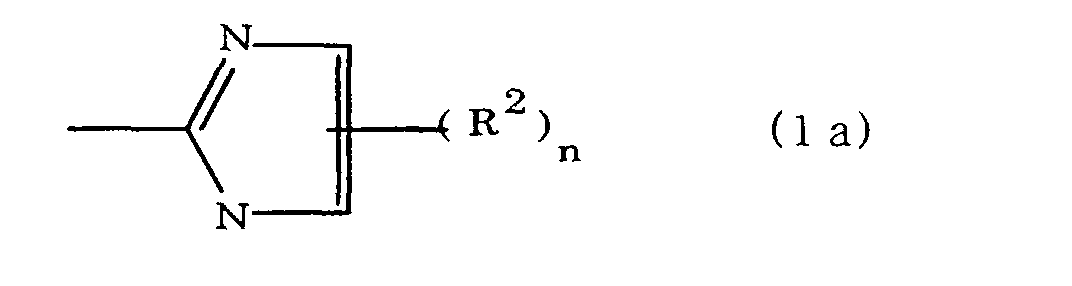
- R 1 is an alkylene group and m is 0 or 1.
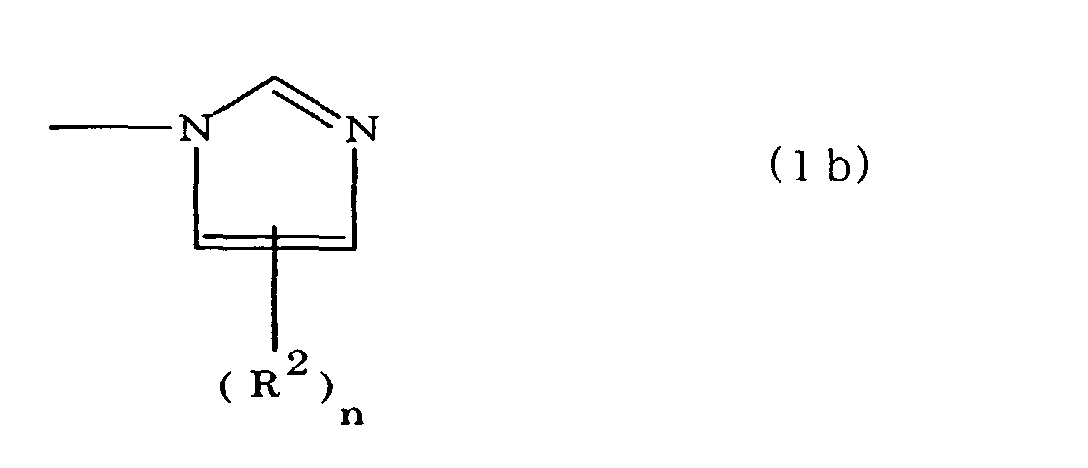
- R 2 is an alkyl group and n is 0, 1 or 2.
- R 3 and R 4 are alkylene groups and p and q are each 0 or 1.
- B is an azine residue, diazine residue, or triazine residue.
- the alkylene group of R 1 is not present and the azine residue, diazine residue or traizine residue is directly bonded to the imidazole ring.
- Methylene, ethylene, propylene and the like can be given as examples of alkylene groups of R 1 when m is 1.
- the alkyl group of R 2 is not present and the hydrogen atom is bonded with the imidazole ring.
- Methyl, ethyl can be given as examples of alkyl groups of R 2 when n is 1.
- Two R 2 groups are bonded to the imidazole ring when n is 2 and methyl, ethyl and the like can be given independently as examples of alkyl groups of each R 2 .
- R 2 may also be directly bonded with the nitrogen atoms of the imidazole ring.
- the alkylene group of R 3 is not present and the amino group is bonded directly with the azine residue, diazine residue, or triazine residue.
- Methylene, ethylene and the like can be given as examples of the alkylene group of R 3 when p is 1.
- the alkylene group of R 4 When q is 0, the alkylene group of R 4 is not present and the amino group is directly bonded to the azine residue, diazine residue, or triazine residue.
- Methylene, ethylene and the like can be given as examples of the alkylene group of R 4 when q is 1.
- B is an azine residue, diazine residue or triazine residue.
- diamines with triazine residues are preferred because they can be easily synthesized or easily procured industrially.
- the amount of imidazolyl-diamino azine of formula (1) mixed in the polyamic acid varnish is too little or too much, the adhesive strength of the polyimide layer will be insufficient, while if it is too much, there will be a reduction in mechanical strength and heat resistance. Therefore, it should be preferably 0.1 to 10 parts by weight, more preferably 0.1 to 5 parts by weight, per 100 parts by weight polyamic acid, which is the solid content.
- Aromatic diamines selected from 4,4'-diaminophenyl ether, para-phenylene diamine, 4,4'-diaminobenzanilide, 4,4'-bis(p-aminophenoxy)diphenylsulfone and 2,2-bis[4-(4-aminophenoxy)phenyl propane can be given as preferred examples.
- aromatic acid dianhydrides can be used as the aromatic acid dianhydride for the polyamic acid.
- aromatic dianhydrides selected from pyromellitic dianhydride (PMDA), 3,4,3',4'-biphenyl tetracarboxylic dianhydride (BPDA), 3,4,3',4'-benzophenonetetracarboxylic dianhydride (BTDA), or 3,4,3',4'-diphenylsulfonetetracarboxylic dianhydride (DSDA) can be given as preferred examples.
- PMDA pyromellitic dianhydride
- BPDA 3,4,3',4'-biphenyl tetracarboxylic dianhydride
- BTDA 3,4,3',4'-benzophenonetetracarboxylic dianhydride
- DSDA 3,4,3',4'-diphenylsulfonetetracarboxylic dianhydride
- aromatic diamine component and aromatic acid dianhydride component constituting the polyamic acid can be such that there is excess aromatic diamine or excess aromatic acid dianhydride, it is preferred that they are used at the equimolar ratio.
- a solvent that is conventionally used for a polyamic acid varnish can be used as the solvent in the polyamic acid varnish, and N-methyl-2-pyrrolidone can be given as a preferred example.
- the thickness of the polyimide layer that is used is normally 10 to 50 ⁇ m.
- metallic foils can be used as the metallic foil for the flexible printed substrate of the present invention, and aluminum foil, copper foil, gold foil, are preferred.
- Mat treatment, plating treatment, aluminum alcoholate treatment, aluminum chelate treatment, silane coupling agent treatment, can be performed on these metallic foils as needed.
- the metallic foil There are no particular restrictions to thickness of the metallic foil, but it is normally 5 to 35 ⁇ m.
- the flexible printed substrate of the present invention can be produced as described below:
- aromatic diamine and aromatic acid dianhydride are addition-polymerized in a solvent.
- the conditions of addition-polymerization can be set as needed in accordance with the conditions of conventional addition-polymerization of polyamic acid.
- the aromatic diamine is first heated and dissolved in a solvent (for instance, N-methyl-2-pyrrolidone) and acid dianhydride is gradually added at 0 to 90°C, preferably 5 to 50°C, under an inert ambient atmosphere, such as nitrogen gas.
- a solvent for instance, N-methyl-2-pyrrolidone
- acid dianhydride is gradually added at 0 to 90°C, preferably 5 to 50°C, under an inert ambient atmosphere, such as nitrogen gas.
- addition-polymerization is performed for several hours.
- polyamic acid is obtained in a state of dissolution in a solvent.
- the polyamic acid varnish is obtained by adding imidazolyl-diamino azine of formula (1) to this solution and mixing to
- the a polyamic acid varnish to which imidazolyl-diamino azine has been externally added is applied to the metallic foil using a comma coater, and dried to obtain a polyamic acid layer as the polyimide precursor layer.
- a residual volatile amount in the polyamic acid film is 70% or less so that foaming will not occur during imidation of the following process.
- Imidation of the polyamic acid layer that has been obtained is performed by heating to 300 to 400°C under an inert ambient atmosphere (for instance, nitrogen ambient atmosphere) to form the polyimide layer.
- an inert ambient atmosphere for instance, nitrogen ambient atmosphere
- the imidazolyl-diamino azine that has been externally added reacts with the polyamic acid and part [of this] is taken up inside the polyimide molecules.
- the flexible printed substrate obtained in this way has good adhesive strength between the metallic foil (copper foil) and polyimide layer. Moreover, curling will not occur before and after etching of the metallic foil. In addition, imidazol residues that show rust-proofing effects are present in the polyimide layer and therefore, no corrosion or discoloration of the surface (surface where polyimide is formed) of the metallic foil, such as copper foil, and no electric migration by copper ions, even when the flexible printed substrate is a circuit board, can be expected.
- TMA thermomechanical analyzer
- the entire surface of the copper foil of the flexible printed substrate that was made in the same way was etched with cuprous chloride etching solution to obtain polyimide film only and the curled status of the flexible printed substrate before etching and the polyimide film obtained after etching was investigated.
- the flexible printed substrate and polyimide film were placed on a flat plate under conditions of 23°C and 60% Rh, and average distance beween the surface of the flat plane and each of four corners of the surface of the films was determined. The results are shown in Table 2.
- Example Comparative Example 1 1 2 Adhesive strength(kg/cm) 1.43 0.74 0.82 Linear expansion coefficient ( ⁇ 10 -6 (1/K)) 21 35 24 Softening point (°C) 310 ⁇ 320 350 ⁇ 360 ⁇ 400 Curling: (mm) Substrate 4.0 Tubular curling Tubular curling Film 0.75 Tubular curling Tubular curling
- the flexible printed substrate having a polyimide layer formed from a polyamic acid varnish containing a specific imidazolyl-diamino azine as external additive has a linear expansion coefficient of the polyimide layer of 21 ⁇ 10 -6 (1/K), which is within the range of 10 ⁇ 10 -6 to 30 ⁇ 10 -6 (1/k) and it begins to show a softening point at 310 to 320°C, which is less than the imidation temperature (400°C). Therefore, it is clear that it has good adhesive strength between the polyimide layer and copper foil and there is very little curling before and after etching.
- the flexible printed substrates having a polyimide layer formed from a polyamic acid varnish that did not contain a specific imidazolyl-diamino azine as external additive either had a linear expansion coefficient of the polyamide layer outside the range of 10 ⁇ 10 -6 to 30 ⁇ 10 -6 (1/K) or a softening point more than the imidation temperature (400°C), and therefore, adhesive strength between the polyimide layer and copper foil was poor and there was remarkable curling before and after etching.
- the flexible printed substrate of the present invention shows good adhesive strength of its polyimide layer to the metallic foil and curling before and after etching is kept to a level that does not pose a problem in terms of practical use.
- a flexible printed substrate is constituted of metallic foil and provided thereon a polyimide layer which is produced by forming a film of a polyamic acid varnish on the metallic foil, followed by imidating.
- the polyimide layer has a linear expansion coefficient of 10 ⁇ 10 -6 to 30 ⁇ 10 -6 (1/K) and a softening point not more than the imidation temperature.
Landscapes
- Chemical & Material Sciences (AREA)
- Engineering & Computer Science (AREA)
- Microelectronics & Electronic Packaging (AREA)
- Health & Medical Sciences (AREA)
- Chemical Kinetics & Catalysis (AREA)
- Medicinal Chemistry (AREA)
- Polymers & Plastics (AREA)
- Organic Chemistry (AREA)
- Manufacturing & Machinery (AREA)
- Laminated Bodies (AREA)
- Macromolecular Compounds Obtained By Forming Nitrogen-Containing Linkages In General (AREA)
- Manufacturing Of Printed Wiring (AREA)
Abstract
Description


- BPDA:
- 3,4,3',4'-biphenyl tetracarboxylic dianhydride
- PMDA:
- pyromellitic dianhydride (Aromatic diamine)
- PDA:
- para-phenylene diamine
- DPE:
- 4,4'-diaminodiphenyl ether
Example Comparative Example 1 1 2 Acid dianhydride BPDA PMDA PMDA Diamine (a) PDA PDA PDA (b) DPE DPE DABA Molar ratio (a)/(b) 75/25 75/25 50/50 Compound of formula (1) 2.5wt parts - -
Specifically, the flexible printed substrate and polyimide film were placed on a flat plate under conditions of 23°C and 60% Rh, and average distance beween the surface of the flat plane and each of four corners of the surface of the films was determined. The results are shown in Table 2.
| Example | Comparative Example | ||
| 1 | 1 | 2 | |
| Adhesive strength(kg/cm) | 1.43 | 0.74 | 0.82 |
| Linear expansion coefficient (×10-6 (1/K)) | 21 | 35 | 24 |
| Softening point (°C) | 310 · 320 | 350 · 360 | <400 |
| Curling: (mm) | |||
| Substrate | 4.0 | Tubular curling | Tubular curling |
| Film | 0.75 | Tubular curling | Tubular curling |
Claims (6)
- A flexible printed substrate, comprising metallic foil and provided thereon a polyimide layer which is produced by forming a film of a polyamic acid varnish on the metallic foil, followed by imidating, wherein the polyimide layer has a linear expansion coefficient of 10× 10-6 to 30×10-6 (1/K) and a softening point not more than the imidation temperature.
- The flexible printed substrate according to Claim 1, wherein the metallic foil is copper foil and the linear expansion coefficient of the polyimide layer is 18× 10-6 to 23×10-6(1/K).
- The flexible printed substrate according to Claim 1, wherein the imidation temperature is 300 to 400°C.
- The flexible printed substrate according to Claim 1, wherein the polyimide layer is formed from the polyamic acid varnish to which imidazolyl-diamino azine has been externally added.
- The flexible printed substrate according to Claim 4, wherein the imidazolyl-diamino azine is selected from the group consisting of:2,4-diamino-6-[2-(2-methyl-1-imidazolyl)ethyl]-s-triazine;2,4-diamino-6-[2-(2-ethyl-1-imidazolyl)ethyl]-s-triazine;2,4-diamino-6-[1-(2-undecyl-1-imidazolyl)ethyl-s-triazine;2,4-diamino-6-[2-(2-imidazolyl)ethyl]-s-triazine;2,4-diamino-6-[2- (1-imidazolyl)ethyl]-s-triazine;2,4-diamino-6-(2-ethyl-4-imidazolyl)-s-triazine;2,4-diamino-6-[2-(4-methyl-1-imidazolyl)ethyl]-s-triazine;2,4-diamino-6-(2-ethyl-5-methyl-4-imidazolyl)-s-triazine;2,4-diamino-6-(4-ethyl-2-methyl-1-imidazolyl)-s-triazine;2,4-diamino-6-[3-(2-methyl-1-imidazolyl)propyl]-s-triazine;2,4-diamino-6-[4-(2-imidazolyl)butyl]-s-triazine;2,4-diamino-6-[2-(2-methyl-1-imidazolyl)propyl]-s-triazine;2,4-diamino-6-[1-methyl-2-(2-methyl-1-imidazolyl)ethyl]-s-triazine;2,4-diamino-6-[2-(2,5-dimethyl-1-imidazolyl)ethyl]-s-triazine;2,4-diamino-6-[2-(2,4-dimethyl-1-imidazolyl)ethyl]-s-triazine; and2,4-diamino-6-[2-(2-ethyl-4-methyl-1-imidazolyl)ethyl]-s-triazine.
- The flexible printed substrate according to Claim 4, wherein the imidazolyl-diamino azine is used in an amount of 0.1 to 10 parts by weight per 100 parts by weight polyamic acid.
Applications Claiming Priority (2)
| Application Number | Priority Date | Filing Date | Title |
|---|---|---|---|
| JP36182199A JP3494098B2 (en) | 1999-12-20 | 1999-12-20 | Flexible printed circuit board |
| JP36182199 | 1999-12-20 |
Publications (3)
| Publication Number | Publication Date |
|---|---|
| EP1111972A2 true EP1111972A2 (en) | 2001-06-27 |
| EP1111972A3 EP1111972A3 (en) | 2004-12-08 |
| EP1111972B1 EP1111972B1 (en) | 2007-05-23 |
Family
ID=18474976
Family Applications (1)
| Application Number | Title | Priority Date | Filing Date |
|---|---|---|---|
| EP00127809A Expired - Lifetime EP1111972B1 (en) | 1999-12-20 | 2000-12-19 | Flexible printed substrate |
Country Status (6)
| Country | Link |
|---|---|
| US (1) | US6395399B2 (en) |
| EP (1) | EP1111972B1 (en) |
| JP (1) | JP3494098B2 (en) |
| KR (1) | KR100769512B1 (en) |
| CN (1) | CN1242658C (en) |
| DE (1) | DE60034923T2 (en) |
Families Citing this family (9)
| Publication number | Priority date | Publication date | Assignee | Title |
|---|---|---|---|---|
| JP3494098B2 (en) | 1999-12-20 | 2004-02-03 | ソニーケミカル株式会社 | Flexible printed circuit board |
| JP3952196B2 (en) * | 2003-06-25 | 2007-08-01 | 信越化学工業株式会社 | Method for producing flexible metal foil polyimide laminate |
| JP4731107B2 (en) * | 2003-10-17 | 2011-07-20 | 日本メクトロン株式会社 | Flexible metal foil laminate |
| JP2006068920A (en) * | 2004-08-31 | 2006-03-16 | Shin Etsu Chem Co Ltd | Method for producing flexible copper foil polyimide laminate |
| JP2006269558A (en) * | 2005-03-22 | 2006-10-05 | Nippon Steel Chem Co Ltd | Method for manufacturing flexible laminated substrate |
| JP4951513B2 (en) * | 2005-08-04 | 2012-06-13 | 株式会社カネカ | Flexible metal-clad laminate |
| KR100813502B1 (en) * | 2006-03-28 | 2008-03-13 | 주식회사 코오롱 | Manufacturing method of flexible copper foil polyimide laminate |
| CN102790279A (en) * | 2011-05-20 | 2012-11-21 | 深圳光启高等理工研究院 | Metamaterial |
| JP7114983B2 (en) * | 2017-03-29 | 2022-08-09 | 荒川化学工業株式会社 | Adhesives, film-like adhesives, adhesive layers, adhesive sheets, resin-coated copper foils, copper-clad laminates, printed wiring boards, multilayer wiring boards, and methods for producing the same |
Family Cites Families (10)
| Publication number | Priority date | Publication date | Assignee | Title |
|---|---|---|---|---|
| JPS60157286A (en) | 1984-01-27 | 1985-08-17 | 株式会社日立製作所 | Manufacturing method of flexible printed circuit board |
| JPH0563322A (en) * | 1984-01-27 | 1993-03-12 | Hitachi Ltd | Flexible printed circuit board manufacturing method |
| JPS60206639A (en) * | 1984-03-31 | 1985-10-18 | 日東電工株式会社 | Manufacture of polyimide-metallic foil composite film |
| JPS62136275A (en) * | 1985-12-09 | 1987-06-19 | Hitachi Chem Co Ltd | Preparation of flexible metal lining plate |
| JPH0632351B2 (en) * | 1986-05-30 | 1994-04-27 | 日東電工株式会社 | Flexible printed circuit board |
| US5326643A (en) * | 1991-10-07 | 1994-07-05 | International Business Machines Corporation | Adhesive layer in multi-level packaging and organic material as a metal diffusion barrier |
| US5290909A (en) * | 1993-05-28 | 1994-03-01 | Industrial Technology Research Institute | Polyimide composition for polyimide/copper foil laminate |
| WO1998008216A1 (en) * | 1996-08-19 | 1998-02-26 | Nippon Steel Chemical Co., Ltd. | Laminate for hdd suspension and its manufacture |
| US6355357B1 (en) * | 1998-12-21 | 2002-03-12 | Sony Chemicals Corp. | Flexible printed board, polyamic acid and polyamic acid varnish containing same |
| JP3494098B2 (en) | 1999-12-20 | 2004-02-03 | ソニーケミカル株式会社 | Flexible printed circuit board |
-
1999
- 1999-12-20 JP JP36182199A patent/JP3494098B2/en not_active Expired - Lifetime
-
2000
- 2000-12-07 US US09/730,805 patent/US6395399B2/en not_active Expired - Lifetime
- 2000-12-19 DE DE60034923T patent/DE60034923T2/en not_active Expired - Lifetime
- 2000-12-19 EP EP00127809A patent/EP1111972B1/en not_active Expired - Lifetime
- 2000-12-20 KR KR1020000079127A patent/KR100769512B1/en not_active Expired - Lifetime
- 2000-12-20 CN CNB001373404A patent/CN1242658C/en not_active Expired - Lifetime
Also Published As
| Publication number | Publication date |
|---|---|
| US20010004496A1 (en) | 2001-06-21 |
| US6395399B2 (en) | 2002-05-28 |
| CN1242658C (en) | 2006-02-15 |
| JP3494098B2 (en) | 2004-02-03 |
| EP1111972A3 (en) | 2004-12-08 |
| KR20010062548A (en) | 2001-07-07 |
| DE60034923T2 (en) | 2008-01-24 |
| JP2001177201A (en) | 2001-06-29 |
| CN1316873A (en) | 2001-10-10 |
| DE60034923D1 (en) | 2007-07-05 |
| KR100769512B1 (en) | 2007-10-23 |
| EP1111972B1 (en) | 2007-05-23 |
Similar Documents
| Publication | Publication Date | Title |
|---|---|---|
| EP1355518B1 (en) | Flexible printed wiring board | |
| EP1014765B1 (en) | Flexible printed board, polyamic acid and polyamic acid varnish containing same | |
| US4731287A (en) | Process for producing polyimide/metallic foil composite film | |
| EP1014766B1 (en) | Flexible board | |
| KR960007934B1 (en) | Resins of low thermal expansibility | |
| US20050112362A1 (en) | Polyimide resin and cast-on-copper laminate | |
| EP1111972B1 (en) | Flexible printed substrate | |
| EP1108762B1 (en) | Polyamic acid varnish composition and a flexible printed board | |
| JP3379459B2 (en) | Flexible printed circuit board | |
| EP1667501A1 (en) | Substrate for flexible printed wiring board and method for manufacturing same | |
| JP2021141108A (en) | Adhesives, adhesive sheets and flexible copper-clad laminates | |
| JP3389870B2 (en) | Polyamic acid and polyamic acid varnish containing the same | |
| KR100522003B1 (en) | Flexible copper-clad laminate and manufacturing method thereof | |
| JP2002265918A (en) | Insulating adhesive | |
| JPH06333994A (en) | TAB tape and manufacturing method thereof | |
| KR840001489B1 (en) | Process for preparing amide based prepolymer | |
| JPH05148458A (en) | TAB tape | |
| JPH0359090B2 (en) | ||
| JPH0457388B2 (en) |
Legal Events
| Date | Code | Title | Description |
|---|---|---|---|
| PUAI | Public reference made under article 153(3) epc to a published international application that has entered the european phase |
Free format text: ORIGINAL CODE: 0009012 |
|
| AK | Designated contracting states |
Kind code of ref document: A2 Designated state(s): AT BE CH CY DE DK ES FI FR GB GR IE IT LI LU MC NL PT SE TR |
|
| AX | Request for extension of the european patent |
Free format text: AL;LT;LV;MK;RO;SI |
|
| PUAL | Search report despatched |
Free format text: ORIGINAL CODE: 0009013 |
|
| AK | Designated contracting states |
Kind code of ref document: A3 Designated state(s): AT BE CH CY DE DK ES FI FR GB GR IE IT LI LU MC NL PT SE TR |
|
| AX | Request for extension of the european patent |
Extension state: AL LT LV MK RO SI |
|
| 17P | Request for examination filed |
Effective date: 20050304 |
|
| AKX | Designation fees paid |
Designated state(s): DE FR GB |
|
| GRAP | Despatch of communication of intention to grant a patent |
Free format text: ORIGINAL CODE: EPIDOSNIGR1 |
|
| RAP1 | Party data changed (applicant data changed or rights of an application transferred) |
Owner name: SONY CHEMICAL & INFORMATION DEVICE CORPORATION |
|
| GRAS | Grant fee paid |
Free format text: ORIGINAL CODE: EPIDOSNIGR3 |
|
| GRAA | (expected) grant |
Free format text: ORIGINAL CODE: 0009210 |
|
| AK | Designated contracting states |
Kind code of ref document: B1 Designated state(s): DE FR GB |
|
| REG | Reference to a national code |
Ref country code: GB Ref legal event code: FG4D |
|
| REF | Corresponds to: |
Ref document number: 60034923 Country of ref document: DE Date of ref document: 20070705 Kind code of ref document: P |
|
| ET | Fr: translation filed | ||
| PLBE | No opposition filed within time limit |
Free format text: ORIGINAL CODE: 0009261 |
|
| STAA | Information on the status of an ep patent application or granted ep patent |
Free format text: STATUS: NO OPPOSITION FILED WITHIN TIME LIMIT |
|
| 26N | No opposition filed |
Effective date: 20080226 |
|
| REG | Reference to a national code |
Ref country code: FR Ref legal event code: PLFP Year of fee payment: 16 |
|
| REG | Reference to a national code |
Ref country code: FR Ref legal event code: PLFP Year of fee payment: 17 |
|
| REG | Reference to a national code |
Ref country code: FR Ref legal event code: PLFP Year of fee payment: 18 |
|
| PGFP | Annual fee paid to national office [announced via postgrant information from national office to epo] |
Ref country code: DE Payment date: 20191203 Year of fee payment: 20 |
|
| PGFP | Annual fee paid to national office [announced via postgrant information from national office to epo] |
Ref country code: FR Payment date: 20191115 Year of fee payment: 20 |
|
| PGFP | Annual fee paid to national office [announced via postgrant information from national office to epo] |
Ref country code: GB Payment date: 20191219 Year of fee payment: 20 |
|
| REG | Reference to a national code |
Ref country code: DE Ref legal event code: R071 Ref document number: 60034923 Country of ref document: DE |
|
| REG | Reference to a national code |
Ref country code: GB Ref legal event code: PE20 Expiry date: 20201218 |
|
| PG25 | Lapsed in a contracting state [announced via postgrant information from national office to epo] |
Ref country code: GB Free format text: LAPSE BECAUSE OF EXPIRATION OF PROTECTION Effective date: 20201218 |