EP1111504A2 - Kompilerverarbeitungssystem zum Erzeugen von Assemblerprogrammkode für einen Rechner mit mehreren Arithmetik-Einheiten - Google Patents
Kompilerverarbeitungssystem zum Erzeugen von Assemblerprogrammkode für einen Rechner mit mehreren Arithmetik-Einheiten Download PDFInfo
- Publication number
- EP1111504A2 EP1111504A2 EP00125377A EP00125377A EP1111504A2 EP 1111504 A2 EP1111504 A2 EP 1111504A2 EP 00125377 A EP00125377 A EP 00125377A EP 00125377 A EP00125377 A EP 00125377A EP 1111504 A2 EP1111504 A2 EP 1111504A2
- Authority
- EP
- European Patent Office
- Prior art keywords
- instruction
- substitutional
- available
- arithmetic unit
- inspected
- Prior art date
- Legal status (The legal status is an assumption and is not a legal conclusion. Google has not performed a legal analysis and makes no representation as to the accuracy of the status listed.)
- Withdrawn
Links
Images




Classifications
-
- G—PHYSICS
- G06—COMPUTING OR CALCULATING; COUNTING
- G06F—ELECTRIC DIGITAL DATA PROCESSING
- G06F8/00—Arrangements for software engineering
- G06F8/40—Transformation of program code
- G06F8/41—Compilation
- G06F8/44—Encoding
- G06F8/443—Optimisation
- G06F8/4441—Reducing the execution time required by the program code
-
- G—PHYSICS
- G06—COMPUTING OR CALCULATING; COUNTING
- G06F—ELECTRIC DIGITAL DATA PROCESSING
- G06F8/00—Arrangements for software engineering
- G06F8/40—Transformation of program code
- G06F8/41—Compilation
- G06F8/44—Encoding
- G06F8/445—Exploiting fine grain parallelism, i.e. parallelism at instruction level
Definitions
- the present invention relates to a compile processing system for converting an input program (source program) into an output program (object program) executed on an execution processing device.
- the conversion is executed through an instruction selecting process and an instruction scheduling process.
- the execution processing device has the following features a and b:
- the intermediate language instruction codes are converted into assembly instruction codes (in other words, assembly instruction codes corresponding to intermediate language codes are selected).
- the "optimizing process of compiler” includes “scheduling of instructions (or rearranging of instructions)” so as to generate a high performance object program executed on an execution processing apparatus having a plurality of arithmetic units that execute a plurality of instructions at the same time.
- instructions of the intermediate language instruction codes that are scheduled and instructions of the assembly instruction codes have the one-to-one relation in most cases.
- the execution processing apparatus has a plurality of arithmetic units that execute instructions
- the compile processing system that generates an program (object program) executed on the execution processing apparatus
- a high performance program that allows a sequence of instructions to be properly rearranged and a plurality of instructions to be executed at the same time should be generated so as to minimize the idling states or (waiting states) of the arithmetic units.
- the conventional compiler processing system does not take into consideration changes of instructions when performing instruction scheduling, even in case of generating an object program which is executed by a processing apparatus in which there are a plurality of instructions which achieve the equivalent function and also an arithmetic unit that executes the plurality of instructions is not determined uniquely. Therefore, there was a disadvantage that an object program which achieves overall high-performance was not obtained.
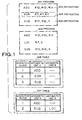
- a program 601 is an example of a program that is executed on an execution processing apparatus for which there are a plurality of instructions that accomplish the equivalent function.
- the execution processing apparatus that executes the program 601 can use any one of the following three instructions a to c as a function for clearing a value in a register.
- the execution processing apparatus has two arithmetic units A and B.
- the arithmetic unit A executes arithmetic operation instructions such as an XOR instruction and a SUB instruction.
- the arithmetic unit B executes instructions for accessing a memory (load and store instructions) and an LDI instruction.
- the program 601 is composed of three instructions 602, 603, and 604.
- the instruction 602 is an addition instruction (ADD instruction) for storing the sum of a value in a register R10 and a value in a register R11 to a register R12.
- the instruction 603 is an exclusive OR instruction for exclusively ORing a value in a register R7 and the value in the register R7 and storing the result thereof to the register R7.
- the instruction 604 is a subtraction instruction (SUB instruction) for subtracting a constant of "5" from a value in register R12 and storing the result thereof to a register R13.
- Arithmetic unit A In the execution processing apparatus that executes the program 601, the arithmetic unit A can execute only one instruction per clock. Thus, when an object program from the program 601 is executed, three clocks are required.
- a table 605 shows the operation sets of both the arithmetic units A and B at individual execution clocks. Thus, according to the table 605, it is apparent that the arithmetic unit A is used at each execution clock, whereas the arithmetic unit B is in the idling state at each execution clock.
- the LDI instruction of the program 606 is a constant load instruction for storing the constant "0" to the register R7.
- the program 606 includes two instructions executed by the arithmetic unit A and one instruction executed by the arithmetic unit B.
- the instruction scheduling process is executed for the program 606
- the operation states of both the arithmetic units A and B at individual execution clocks becomes as shown in a table 607.
- the arithmetic unit B executes the LDI instruction, the number of clocks required for executing the program 606 is two.
- the table 607 shown in Fig. 1 describes that the LDI instruction uses the arithmetic unit B at the second execution clock. That description is only for explaining a first embodiment (that will be described later). Thus, the LDI instruction may use the arithmetic unit B at the first execution clock.
- the present invention has been made to overcome the above-mentioned disadvantages. It has an object to provide a compile processing system which generates a program executed by a execution processing apparatus for which there are a plurality of instructions for realizing the equivalent function and in which arithmetic units for performing the plurality of instructions are not always the same, wherein the compile processing system generates high-performance codes (or an object program which enhances an overall execution ability) by changing instructions in parallel instruction scheduling.
- a compiler processing system for generating assembly program codes from a source program for a computer comprising a plurality of arithmetic units, the system comprising: a front end which analyzes syntax and semantics of the source program; a machine ⁇ independent optimization portion which performs machine-independent optimization for the source program; a code generating portion which generates the assembly program codes from the source program which has been optimized in the machine-independent optimization portion; and a machine-dependent optimization portion which performs machine-dependent optimization for the assembly program codes which have been generated by the code generating portion; wherein the machine-dependent optimization portion comprises: a non-instruction scheduling portion which performs optimization other than instruction scheduling; an instruction scheduling portion which performs optimization including the instruction scheduling, the instruction scheduling portion comprising: means for determining whether or not an arithmetic unit is available for an inspected instruction at an execution clock concerned; means for determining whether or not there is a substitutional instruction which performs the equivalent function as the inspected instruction if an
- a compiler processing system for generating assembly program codes from a source program for a computer comprising a plurality of arithmetic units, the system comprising: a front end which analyzes syntax and semantics of the source program; a machine-independent optimization portion which performs machine-independent optimization for the source program; a machine-dependent optimization portion which performs machine-dependent optimization for intermediate language codes obtained from the source program; and a code generating portion which generates the assembly program codes from the intermediate language codes which have been optimized in the machine-dependent optimization portion; wherein the machine-dependent optimization portion comprises: a non-instruction scheduling portion which performs optimization other than instruction scheduling; an instruction scheduling portion which performs optimization including the instruction scheduling, the instruction scheduling portion comprising: means for determining whether or not an arithmetic unit is available for an inspected instruction at an execution clock concerned; means for determining whether or not there is a substitutional instruction which performs the equivalent function as the inspected instruction if an arithmetic unit is
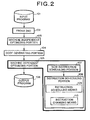
- Fig. 2 is a block diagram showing the structure of a compile processing system according to a first embodiment of the present invention.
- a compile processing system comprises a front end 102, a machine independent optimizing portion 103, a code generating portion 104, and a machine dependent optimizing portion 105.
- the front end 102 reads an input program (source program) 101 and analyzes the syntax and semantics thereof.
- the machine independent optimizing portion 103 performs machine-independent-optimization for the input program 101.
- the code generating portion 104 generates a program containing assembly program codes for the execution processing apparatus.
- the machine dependent optimizing portion 105 performs machine-dependent-optimization for the assembly program codes to generate the output program (object program) 106.
- the machine dependent optimizing portion 105 comprises a non-instruction scheduling portion 107 and an instruction scheduling portion 108.
- the non-instruction scheduling portion 107 performs machine-dependent optimization for the assembly program codes except for the instruction scheduling process.
- the instruction scheduling portion 108 performs an instruction scheduling process including a function for analyzing the operation states of arithmetic units and changing an instruction when necessary.
- the instruction scheduling portion 108 comprises an instruction scheduling means 109 and an instruction changing means 110.
- the instruction scheduling means 109 performs an instruction scheduling process when performing optimization dependent on the execution processing apparatus for the assembly instruction codes.
- the instruction scheduling means 109 determines in the instruction scheduling process whether an arithmetic unit which is used for a certain instruction is available in a certain execution clock. If the arithmetic unit is not available, instruction changing means 110 determines whether the two conditions are satisfied. The two conditions are: there is a substitutional instruction which performs the equivalent function as the relevant instruction, and an arithmetic unit which is used for the substitutional instruction is available in the relevant execution clock. If the two conditions are satisfied, the instruction changing means 110 changes the relevant instruction to the substitutional instruction.
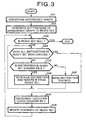
- Fig. 3 is a flow chart showing the instruction scheduling process of the machine dependent optimizing portion 105 in the compile processing system according to the first embodiment.
- the instruction scheduling process is a conventional list scheduling process.
- the instruction scheduling process shown in Fig. 3 comprises step 201 of "structuring dependency graph", step 202 of "designating bottom nodes of dependency graph to ready set", step 203 of "determining whether or not the ready set is null", step 204 of "determining whether or not all the instructions in the ready set have been checked”, step 205 of "determining whether a current instruction in the ready set is schedulable", step 206 of "scheduling the current instruction and removing it from the ready set", step 207 of "making the current instruction checked”, step 208 of "decrementing execution clock counter by 1", and step 209 of "updating contents of the ready set”.
- Fig. 4 is a flow chart showing a detail of the step 205 of "determining whether or not an instruction in the ready set is schedulable".
- the step 205 comprises step 301 of "determining whether or not all the later instructions have been scheduled", step 302 of "determining whether or not distances between a current instruction and scheduled later instructions is sufficient", step 303 of "determining availability of an arithmetic unit for the current instruction", step 304 of "determining availability of an arithmetic unit for a substitutional instruction", step 305 of "determining that the current instruction is schedulable”, and step 306 of "determining that current instruction is not schedulable".
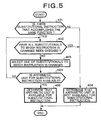
- Fig. 5 is a flow chart showing a detail of the step 304 of "determining availability of an arithmetic unit for a substitutional instruction".
- the step 304 comprises step 401 of "determining whether or not there is a substitutional instruction accomplishing the equivalent function as an inspected instruction", step 402 "determining whether or not all the substitutional instructions have been checked", step 403 of "selecting one of substitutional instructions", step 404 of "determining whether or not an arithmetic unit is available for the selected substitutional instruction", step 405 of "changing the current instruction to the selected substitutional instruction and determining that an arithmetic is available for the selected substitutional instruction", and step 406 "determining that an arithmetic is not available for a substitutional instruction".
- Fig. 6 is a flow chart showing a detail of the step 205 of "determining whether or not an instruction in the ready set is schedulable" shown in Fig. 3. This detail is of the prior art and for reference against the present invention as shown in Fig. 4.
- the step 205 according to the prior art comprises step 501 of "determining whether or not all the later instructions have been scheduled", step 502 of "determining whether or not distances between the current instruction and the later instructions is sufficient”, step 503 of "determining availability of an arithmetic unit for the current instruction", step 504 of "determining that the current instruction is schedulable”, and step 505 of "determining that the current instruction is not schedulable".
- Fig. 1 is a schematic diagram for explaining a practical operation of the compile processing system according to the first embodiment of the present invention.
- the compile processing system features the operation of the instruction scheduling portion 108 in the machine dependent optimizing portion 105.
- the operation of the instruction scheduling portion 108 will be mainly described.
- a list scheduling method is used as an example of instruction scheduling methods for simplicity. However, it should be understood that instruction scheduling methods other than the list scheduling method may be used.
- the front end 102 reads an input program 101 and analyzes the syntax and semantics thereof, the machine independent optimizing portion 103 performs machine-independent-optimization, the code generating portion 104 generates a program containing assembly instruction codes for the execution processing apparatus.
- non-instruction scheduling portion 107 in the machine dependent optimizing portion 105 performs machine-dependent-optimization for the program that is supplied from the code generating portion 104, except for the instruction scheduling process.
- the instruction scheduling portion 108 in the machine dependent optimizing portion 105 performs the process shown in Fig. 3.
- Fig. 3 is a flow chart for explaining the list scheduling process performed by the instruction scheduling portion 108.
- the list scheduling process will be described corresponding to the list scheduling method disclosed in section 10. 4. 2 "List Scheduling" of "Super Scalar Processor", by Mike Johnson, Nikkei BP Publication Center, 1994 (referred to as reference 2).
- the instruction scheduling means 109 in the instruction scheduling portion 108 performs the following process.
- the instruction scheduling means 109 checks presence of dependency, for example, dependency caused by referring to data stored by an instruction by a later instruction, with respect to all the instructions. Thereafter, the instruction scheduling means 109 structures a dependency graph (at step 201).
- the instruction scheduling means 109 After structuring the dependency graph, the instruction scheduling means 109, while referring to situation regarding use of arithmetic units at each time, schedules instructions which belongs to a ready set and are able to be scheduled.
- the ready set is defined as a set of instructions which constitute the basic block and satisfy a certain conditions.
- the instruction scheduling means 109 schedules the instruction which is performed at the final execution clock and continues the scheduling retroactively.
- the instruction scheduling means 109 designates bottom nodes of the dependency graph to the ready set (at step 202).
- a bottom node is a node of which an outward graph edge does not go out.
- the instruction scheduling means 109 checks whether all the instructions in the ready set have been checked (at step 204). If NO at step 204, the instruction scheduling means 109 schedules a schedulable instruction and removes it from the ready set (at steps 205 and 206) and returns to step 204. If NO at step 204, the instruction scheduling means 109 makes a non-schedulable instruction checked (at steps 205 and 207) and returns to step 204.
- the instruction scheduling means 109 decrements the execution clock counter by "1" so as to schedule instructions at an earlier clock (at step 208). Thereafter, the instruction scheduling means 109 adds instructions that come to satisfy the condition to be inculded in the ready set to the ready set (at step 209) and return to step 203.
- the instruction scheduling means 109 repeats the process until all the instructions of the basic block are scheduled. Thereafter, the instruction scheduling means 109 completes the list scheduling process.
- the instruction scheduling means 109 successively decrements the execution clock counter, it is assured that even an inspected instruction that does not satisfy a condition to be included in the ready set for the first time will finally satisfies the condition.
- step 205 of "determining whether or not an instruction in the ready set is schedulable" is important.
- step 205 of "determining whether or not an instruction is schedulable" in the list scheduling method according to the prior art reference will be described with reference to Fig. 6.
- a conventional instruction scheduling means determines whether or not instructions corresponding to nodes which are end points of graph edges starting from a node of the inspected instruction have been already scheduled (at step 501).
- the instructions corresponding to nodes which are end points of graph edges starting from a node of an inspected instruction are referred to as later instructions with respect to the inspected instruction.
- the conventional instruction scheduling means determines that the current instruction is not schedulable (at step 505).
- the conventional instruction scheduling means determines whether or not necessary clock distances between the later instructions and the current instruction is sufficient for a supposed case where the current instruction is executed at the present execution clock counter (at step 502).
- the necessary clock distances are usually the same as the number of clocks necessary for executing the current instruction.
- the conventional instruction scheduling means determines that the current instruction is not schedulable at the current execution clock counter (at step 505).
- the conventional instruction scheduling means determines whether or not an arithmetic unit used for the current instruction is available (at step 503).
- the conventional instruction scheduling means determines that the current instruction is schedulable (at step 504).
- the conventional instruction scheduling means determines that the current instruction is not schedulable (at step 505).
- the instruction scheduling means 109 in the instruction scheduling portion 108 not only uses the list scheduling method as shown in Fig. 3 but also performs the step for determining whether or not an instruction in the ready set is schedulable as shown in Fig. 4 instead of Fig. 6.
- the step of "determining whether an instruction is schedulable" is different from that shown in Fig. 6.
- a detail of the step of "determining whether or not an instruction is schedulable" will be described with reference to a flow chart shown in Fig. 4.
- the instruction scheduling means 109 in the instruction scheduling portion 108 performs the following steps in step 205 of "determining whether or not an instruction in the ready set is schedulable" as shown in Fig. 3.
- the detailed process as shown in Fig. 5 is the same as the detailed process as shown in Fig. 6 except for step 304.
- the other steps will be described besides step 304, though a part of the description will duplicates.
- the instruction scheduling means 109 determines whether or not all the later instructions with respect to the inspected instruction on the dependency graph have been already scheduled (at step 301).
- the instruction scheduling means 109 determines that the current instruction is not schedulable (at step 306).
- the instruction scheduling means 109 determines whether or not necessary clock distances between the later instructions and the current instruction is sufficient for a supposed case where the current instruction is executed at the present execution clock counter (at step 302).
- the instruction scheduling means 109 determines that the current instruction is not schedulable at the current execution clock counter (at step 306).
- the instruction scheduling means 109 determines whether or not an arithmetic unit used for the current instruction is available (at step 303).
- the instruction scheduling means 109 determines that the current instruction is schedulable (at step 305).
- the instruction scheduling means 109 when the arithmetic unit for the current instruction is not available, the instruction scheduling means 109 immediately determines that the current instruction is not schedulable. In contrast, according to the first embodiment of the present invention, when the arithmetic unit for the current instruction is not available, the instruction scheduling means 109 further determines whether or not the current instruction can be changed to a substitutional instruction and an arithmetic unit for the substitutional instruction at the current execution clock (at step 304). When the determined result at step 304 is Yes, the instruction scheduling means 109 changes the current instruction to the substitutional instruction and determines the current instruction is schedulable (at step 305).
- the instruction scheduling means 109 determines that the current instruction is not schedulable (at step 306).
- the instruction scheduling means 109 passes the control to the instruction changing means 110.
- the instruction changing means 110 performs a process for changing an instruction as shown in Fig. 5.
- the instruction changing means 110 determines whether or not there is at least a substitutional instruction that accomplishes the equivalent function as the current instruction (at step 401).
- the instruction changing means 110 determines that an arithmetic unit is not available for a substitutional instruction at the current execution clock (at step 406). Such determination is equivalent to determination that there is no substitutional instruction.
- the instruction changing means 110 determines whether or not all the substitutional instructions have been checked (at steps 402). Thereafter, the instruction changing means 110 selects one of the substitutional instructions (at step 403). Thereafter, the instruction changing means 110 determines whether or not the arithmetic unit is available for the selected substitutional instruction at the current execution clock (at step 404).
- the instruction changing means 110 determines that the current instruction can be changed to a substitutional instruction and an arithmetic unit is available for the substitutional instruction (at step 405).
- the instruction changing means 110 determines that an arithmetic is not available for a substitutional instruction (step 406).
- the instruction changing means 110 determines whether or not the instruction 604 and the instruction 603 (XOR instruction) that are elements in a ready set are schedulable. Although the instruction changing means 110 can inspect the elements in the ready set in any order, the instruction changing means 110 inspects the instruction 604 firstly and the instruction 603 secondly because the instruction 604 references the calculated result of the instruction 602.
- the instruction 604 Since the arithmetic unit A is available for the instruction 604 (SUB instruction), the instruction 604 is schedulable. On the other hand, the arithmetic unit A is already used for the instruction 604 at the current execution clock, the instruction 603 (XOR instruction) is not schedulable if the instruction is not changed.
- the conventional instruction scheduling means determines that the instruction 603 is not schedulable at the same current execution clock as the instruction 604.
- the instruction scheduling means 109 does not schedule the instruction 603 (XOR instruction) at the same execution clock as the instruction 604.
- the program 601 is scheduled as shown in the table 605.
- the instruction scheduling means 109 determines whether there is at least a substitutional instruction which is equivalent to the instruction 603 (XOR instruction), that is, has the equivalent function as the instruction 603. Thereafter, the instruction scheduling means 109 determines whether or not there is among all the substitutional instructions at least a substututional instruction for which an arithmetic unit is available in the condition of the use of arithmetic units by other instructions at the current execution clock.
- the instruction scheduling means 109 determines that an LDI instruction which achieves the equivalent function as the instruction 604 (the XOR instruction) is executable on the arithmetic B available therefor at the same execution clock as the instruction 604. Therefore, the instruction scheduling means 109 makes a schedule in which the LDI instruction is executed at the same execution clock as the instruction 604 (the SUB instruction). Therefore, the program 601 is modified to the program 606 and the scheduling becomes as represented by table 607 (shown in Fig. 6).
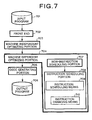
- Fig. 7 is a block diagram showing the structure of a compile processing system according to a second embodiment of the present invention.
- the compile processing system comprises a front end 702, a machine independent optimizing portion 703, a machine dependent optimizing portion 704, and a code generating portion 705.
- the front end 702 reads an input program 701 and analyzes the syntax and semantics thereof.
- the machine independent optimizing portion 703 performs machine-independent-optimization for the input program 701.
- the machine dependent optimizing portion 704 optimizes intermediate language instruction codes dependent on the execution processing apparatus.
- the code generating portion 705 generates the output program (assembly program codes) 706 for the execution processing apparatus.
- the code generating portion 705 comprises a non-instruction scheduling portion 707 and an instruction scheduling portion 708.
- the non-instruction scheduling portion 707 performs an optimizing process dependent on the execution processing apparatus except for an instruction scheduling process.
- the instruction scheduling portion 708 performs an instruction scheduling process including a function for analyzing the operation states of arithmetic units and changing an instruction when necessary.
- the instruction scheduling portion 708 comprises an instruction scheduling means 709 and an instruction changing means 710.
- the instruction scheduling means 709 performs an instruction scheduling process while optimizing the intermediate language instruction codes dependent on the execution processing apparatus.
- the instruction changing means 710 changes an inspected instruction to a substitutional instruction in the instruction scheduling process of the instruction scheduling means 709 when three conditions are satisfied.
- the three conditions are: there is no available arithmetic unit for the inspected instruction, there is a substitutional instruction which performs the equivalent function as the relevant instruction, and an arithmetic unit which is used for the substitutional instruction is available in the relevant execution clock.
- the second embodiment is different from the first embodiment in that the machine dependent optimizing portion 704 is disposed upstream of the code generating portion 705.
- the machine dependent optimizing portion 704 optimizes the intermediate language instruction codes rather than the assembly instruction codes.
- the intermediate language instruction codes and the assembly instruction codes have the one-to-one relation in most cases.
- the assembly instruction codes according to the first embodiment and the intermediate language instruction codes according to the second embodiment have the one-to-one relation in most cases.
- the instruction scheduling process and the instruction changing process according to the second embodiment are the same as those according to the first embodiment.
- Fig. 8 is a block diagram showing the structure of a compile processing system according to a third embodiment of the present invention.
- the compile processing system according to the third embodiment is different from that according to the first embodiment in that a record medium 800 is used for recording a program for realizing the function of the computer comprising the front end 102, the machine independent optimizing portion 103, the code generating portion 104, and the machine dependent optimizing portion 105.
- the computer reads the program from the record medium 800 and executes the program to realize the function of the computer.
- Fig. 9 is a block diagram showing the structure of a compile processing system according to a third embodiment of the present invention.
- the compile processing system according to the fourth embodiment is different from that according to the second embodiment in that a record medium 900 is used for recording a program for realizing the function of the computer comprising the front end 702, the machine independent optimizing portion 703, the machine dependent optimizing portion 704, and the code generating portion 705.
- the computer reads the program from the record medium 900 and executes the program to realize the function of the computer.
Landscapes
- Engineering & Computer Science (AREA)
- General Engineering & Computer Science (AREA)
- Theoretical Computer Science (AREA)
- Software Systems (AREA)
- Physics & Mathematics (AREA)
- General Physics & Mathematics (AREA)
- Devices For Executing Special Programs (AREA)
- Advance Control (AREA)
Applications Claiming Priority (2)
| Application Number | Priority Date | Filing Date | Title |
|---|---|---|---|
| JP34671899A JP2001166947A (ja) | 1999-12-06 | 1999-12-06 | コンパイル処理方式 |
| JP34671899 | 1999-12-06 |
Publications (1)
| Publication Number | Publication Date |
|---|---|
| EP1111504A2 true EP1111504A2 (de) | 2001-06-27 |
Family
ID=18385354
Family Applications (1)
| Application Number | Title | Priority Date | Filing Date |
|---|---|---|---|
| EP00125377A Withdrawn EP1111504A2 (de) | 1999-12-06 | 2000-12-01 | Kompilerverarbeitungssystem zum Erzeugen von Assemblerprogrammkode für einen Rechner mit mehreren Arithmetik-Einheiten |
Country Status (3)
| Country | Link |
|---|---|
| US (1) | US20010039654A1 (de) |
| EP (1) | EP1111504A2 (de) |
| JP (1) | JP2001166947A (de) |
Cited By (1)
| Publication number | Priority date | Publication date | Assignee | Title |
|---|---|---|---|---|
| WO2022267638A1 (en) * | 2021-06-23 | 2022-12-29 | Huawei Technologies Co.,Ltd. | Method and apparatus for functional unit balancing at program compile time |
Families Citing this family (27)
| Publication number | Priority date | Publication date | Assignee | Title |
|---|---|---|---|---|
| US7752419B1 (en) | 2001-03-22 | 2010-07-06 | Qst Holdings, Llc | Method and system for managing hardware resources to implement system functions using an adaptive computing architecture |
| US7653710B2 (en) | 2002-06-25 | 2010-01-26 | Qst Holdings, Llc. | Hardware task manager |
| US7962716B2 (en) | 2001-03-22 | 2011-06-14 | Qst Holdings, Inc. | Adaptive integrated circuitry with heterogeneous and reconfigurable matrices of diverse and adaptive computational units having fixed, application specific computational elements |
| US20040133745A1 (en) | 2002-10-28 | 2004-07-08 | Quicksilver Technology, Inc. | Adaptable datapath for a digital processing system |
| US7489779B2 (en) | 2001-03-22 | 2009-02-10 | Qstholdings, Llc | Hardware implementation of the secure hash standard |
| US6836839B2 (en) | 2001-03-22 | 2004-12-28 | Quicksilver Technology, Inc. | Adaptive integrated circuitry with heterogeneous and reconfigurable matrices of diverse and adaptive computational units having fixed, application specific computational elements |
| US7400668B2 (en) | 2001-03-22 | 2008-07-15 | Qst Holdings, Llc | Method and system for implementing a system acquisition function for use with a communication device |
| US6577678B2 (en) | 2001-05-08 | 2003-06-10 | Quicksilver Technology | Method and system for reconfigurable channel coding |
| US7046635B2 (en) | 2001-11-28 | 2006-05-16 | Quicksilver Technology, Inc. | System for authorizing functionality in adaptable hardware devices |
| US6986021B2 (en) | 2001-11-30 | 2006-01-10 | Quick Silver Technology, Inc. | Apparatus, method, system and executable module for configuration and operation of adaptive integrated circuitry having fixed, application specific computational elements |
| US8412915B2 (en) | 2001-11-30 | 2013-04-02 | Altera Corporation | Apparatus, system and method for configuration of adaptive integrated circuitry having heterogeneous computational elements |
| US7602740B2 (en) | 2001-12-10 | 2009-10-13 | Qst Holdings, Inc. | System for adapting device standards after manufacture |
| US7215701B2 (en) | 2001-12-12 | 2007-05-08 | Sharad Sambhwani | Low I/O bandwidth method and system for implementing detection and identification of scrambling codes |
| US7403981B2 (en) * | 2002-01-04 | 2008-07-22 | Quicksilver Technology, Inc. | Apparatus and method for adaptive multimedia reception and transmission in communication environments |
| US7493375B2 (en) | 2002-04-29 | 2009-02-17 | Qst Holding, Llc | Storage and delivery of device features |
| US7328414B1 (en) | 2003-05-13 | 2008-02-05 | Qst Holdings, Llc | Method and system for creating and programming an adaptive computing engine |
| US7660984B1 (en) | 2003-05-13 | 2010-02-09 | Quicksilver Technology | Method and system for achieving individualized protected space in an operating system |
| US8108656B2 (en) | 2002-08-29 | 2012-01-31 | Qst Holdings, Llc | Task definition for specifying resource requirements |
| US7937591B1 (en) | 2002-10-25 | 2011-05-03 | Qst Holdings, Llc | Method and system for providing a device which can be adapted on an ongoing basis |
| US8276135B2 (en) | 2002-11-07 | 2012-09-25 | Qst Holdings Llc | Profiling of software and circuit designs utilizing data operation analyses |
| US7478031B2 (en) | 2002-11-07 | 2009-01-13 | Qst Holdings, Llc | Method, system and program for developing and scheduling adaptive integrated circuity and corresponding control or configuration information |
| US7225301B2 (en) | 2002-11-22 | 2007-05-29 | Quicksilver Technologies | External memory controller node |
| US7609297B2 (en) | 2003-06-25 | 2009-10-27 | Qst Holdings, Inc. | Configurable hardware based digital imaging apparatus |
| US7437719B2 (en) * | 2003-09-30 | 2008-10-14 | Intel Corporation | Combinational approach for developing building blocks of DSP compiler |
| US8448130B1 (en) * | 2007-08-20 | 2013-05-21 | The Mathworks, Inc. | Auto-generated code validation |
| JP5990466B2 (ja) | 2010-01-21 | 2016-09-14 | スビラル・インコーポレーテッド | ストリームに基づく演算を実装するための汎用複数コアシステムのための方法および装置 |
| JP6642738B2 (ja) * | 2016-06-02 | 2020-02-12 | 日本電気株式会社 | コンパイラのための命令選択に関連する、情報処理装置、情報処理方法及びプログラム |
-
1999
- 1999-12-06 JP JP34671899A patent/JP2001166947A/ja active Pending
-
2000
- 2000-12-01 EP EP00125377A patent/EP1111504A2/de not_active Withdrawn
- 2000-12-05 US US09/730,213 patent/US20010039654A1/en not_active Abandoned
Cited By (2)
| Publication number | Priority date | Publication date | Assignee | Title |
|---|---|---|---|---|
| WO2022267638A1 (en) * | 2021-06-23 | 2022-12-29 | Huawei Technologies Co.,Ltd. | Method and apparatus for functional unit balancing at program compile time |
| US11755299B2 (en) | 2021-06-23 | 2023-09-12 | Huawei Technologies Co., Ltd. | Method and apparatus for functional unit balancing at program compile time |
Also Published As
| Publication number | Publication date |
|---|---|
| US20010039654A1 (en) | 2001-11-08 |
| JP2001166947A (ja) | 2001-06-22 |
Similar Documents
| Publication | Publication Date | Title |
|---|---|---|
| EP1111504A2 (de) | Kompilerverarbeitungssystem zum Erzeugen von Assemblerprogrammkode für einen Rechner mit mehreren Arithmetik-Einheiten | |
| JP3311462B2 (ja) | コンパイル処理装置 | |
| US6718541B2 (en) | Register economy heuristic for a cycle driven multiple issue instruction scheduler | |
| JP2921190B2 (ja) | 並列実行方式 | |
| US6817013B2 (en) | Program optimization method, and compiler using the same | |
| JP4042604B2 (ja) | プログラム並列化装置,プログラム並列化方法およびプログラム並列化プログラム | |
| US6760906B1 (en) | Method and system for processing program for parallel processing purposes, storage medium having stored thereon program getting program processing executed for parallel processing purposes, and storage medium having stored thereon instruction set to be executed in parallel | |
| US5850552A (en) | Optimization apparatus for removing hazards by arranging instruction order | |
| US7882498B2 (en) | Method, system, and program of a compiler to parallelize source code | |
| US20110119660A1 (en) | Program conversion apparatus and program conversion method | |
| US20010047511A1 (en) | Method of reducing unnecessary barrier instructions | |
| JPH01108638A (ja) | 並列化コンパイル方式 | |
| CA2321018A1 (en) | Optimizing compilation by forward store movement | |
| JPH11306026A (ja) | コード最適化装置、コード最適化方法、及び、コード最適化プログラムを記録したコンピュータ読み取り可能な記録媒体 | |
| JP2009524866A (ja) | プログラムの並列実行のためのシステム及び方法 | |
| JP3664478B2 (ja) | コンパイラ、変換プログラム、例外処理プログラム及びこれらを用いたコンピュータ装置 | |
| JP5576605B2 (ja) | プログラム変換装置およびプログラム変換方法 | |
| US20030208749A1 (en) | Method and apparatus for multi-versioning loops to facilitate modulo scheduling | |
| US7111288B2 (en) | Method and system for minimizing the cycle time when compiling a program in a processing system | |
| JP3032030B2 (ja) | ループ最適化方法及び装置 | |
| Hong et al. | Rapid prototyping of DSP algorithms on VLIW TMS320C6701 DSP | |
| US20220413818A1 (en) | Method and apparatus for functional unit balancing at program compile time | |
| US5437035A (en) | Method and apparatus for compiling a program incending a do-statement | |
| JP3648402B2 (ja) | コンパイル方法及びコンパイラ装置 | |
| JP2004152204A (ja) | 並列化コンパイラ装置 |
Legal Events
| Date | Code | Title | Description |
|---|---|---|---|
| PUAI | Public reference made under article 153(3) epc to a published international application that has entered the european phase |
Free format text: ORIGINAL CODE: 0009012 |
|
| AK | Designated contracting states |
Kind code of ref document: A2 Designated state(s): AT BE CH CY DE DK ES FI FR GB GR IE IT LI LU MC NL PT SE TR |
|
| AX | Request for extension of the european patent |
Free format text: AL;LT;LV;MK;RO;SI |
|
| RAP1 | Party data changed (applicant data changed or rights of an application transferred) |
Owner name: NEC ELECTRONICS CORPORATION |
|
| STAA | Information on the status of an ep patent application or granted ep patent |
Free format text: STATUS: THE APPLICATION HAS BEEN WITHDRAWN |
|
| 18W | Application withdrawn |
Effective date: 20030731 |