EP1108758A2 - Polymeric binders for ink jet inks - Google Patents
Polymeric binders for ink jet inks Download PDFInfo
- Publication number
- EP1108758A2 EP1108758A2 EP00310630A EP00310630A EP1108758A2 EP 1108758 A2 EP1108758 A2 EP 1108758A2 EP 00310630 A EP00310630 A EP 00310630A EP 00310630 A EP00310630 A EP 00310630A EP 1108758 A2 EP1108758 A2 EP 1108758A2
- Authority
- EP
- European Patent Office
- Prior art keywords
- weight
- parts
- monomer
- mixture
- ethylenically unsaturated
- Prior art date
- Legal status (The legal status is an assumption and is not a legal conclusion. Google has not performed a legal analysis and makes no representation as to the accuracy of the status listed.)
- Granted
Links
Classifications
-
- C—CHEMISTRY; METALLURGY
- C09—DYES; PAINTS; POLISHES; NATURAL RESINS; ADHESIVES; COMPOSITIONS NOT OTHERWISE PROVIDED FOR; APPLICATIONS OF MATERIALS NOT OTHERWISE PROVIDED FOR
- C09D—COATING COMPOSITIONS, e.g. PAINTS, VARNISHES OR LACQUERS; FILLING PASTES; CHEMICAL PAINT OR INK REMOVERS; INKS; CORRECTING FLUIDS; WOODSTAINS; PASTES OR SOLIDS FOR COLOURING OR PRINTING; USE OF MATERIALS THEREFOR
- C09D11/00—Inks
- C09D11/30—Inkjet printing inks
Definitions
- This invention concerns polymeric binders which are suitable for use in ink jet inks. More specifically, this invention relates to polymeric binders formed by polymerization of a monomer mixture comprising a polymerizable surfactant monomer.
- Certain ink jet inks comprise a liquid medium, a colorant, such as a pigment or dye, a binder or resin to aid in dispersing the pigment in the medium and to affix the colorant to the print surface.
- a colorant such as a pigment or dye
- a binder or resin to aid in dispersing the pigment in the medium and to affix the colorant to the print surface.
- the colorant is an insoluble pigment, rather than a water soluble dye.
- the latter are generally absorbed to some degree by the paper or other print medium, but due to their inherent water-solubility do not offer good waterfastness.
- Pigment-based inks are generally deposited on the surface of the print medium, making them susceptible to removal by water or abrasion.
- pigment based ink compositions have a tendency to have a low wet-rub resistance and low highlighter resistance.
- print quality means an accumulative evaluation of the overall performance of an ink jet ink as measured by the appearance of a printed page of combined text and graphics, including edge sharpness, bleed, feathering, optical density, wet-rub resistance, highlighter resistance and print operability.
- print operability means an accumulative evaluation of printer performance, including print appearance and uniformity, page after page longevity of print quality and uniformity, nozzle drop outs, print head maintenance problems, and the ability to stop and restart printing.
- Polymer binders have been added to ink jet ink compositions to improve durability, to improve print quality and to reduce color bleeding and feathering.
- the inclusion of such binders can result in increased printhead maintenance problems, including clogging of the nozzles and kogation, i.e. formation of film on or about the heater.
- polymers may tend to form films on the nozzle plate.
- the addition of polymers to ink jet ink compositions also may cause decreased pigment dispersion stability and interference with bubble formation.
- EP-A-0869 160 discloses an inkjet ink formulation with colorant, vehicle and resin emulsion containing ionic carboxylic groups on the surface of resin emulsion particles to cause disassociation of the colorant and resin particles.
- the resin has 1 to 40 wt.% "carboxylic acid groups", and Tg of 0 to 120°C.
- Exemplified embodiments of the resin include copolymers of butyl acrylate, methyl methacrylate and (meth)acrylic acid, with 3 to 20 wt.% acid, Tg of 53 to 95°C and particle size of 63 to 235 nm, utilizing high Tgs and low particle sizes.
- EP-A-0747456 discloses a method for providing a waterborne coating composition, such as a paint, having improved color acceptance.
- the coating composition contains an emulsion-polymerized addition polymer formed from a mixture of monomers including a polymerizable surfactant monomer. There is no disclosure of the use of the addition polymer in an ink.
- an emulsion-polymerized addition copolymer formed from a monomer mixture comprising ethylenically unsaturated monomers including from more than 4 to 15 wt % based on the weight of said mixture of at least one ethylenically unsaturated carboxylic acid functional monomer and from 0.05 to 5 wt % based on the weight of said mixture of at least one polymerizable surfactant monomer comprising hydrophobic and hydrophilic functional groups, wherein said hydrophobic functional group comprises a polymerizable group within it, as a polymeric binder in an ink composition, preferably an ink jet composition, to improve the print quality of said ink composition.
- ink jet inks comprising a binder of the present invention demonstrate improved print quality over binders of similar composition but which do not comprise a polymerized surfactant monomer.
- ink jet inks of the present invention may demonstrate an improved optical density.
- Polymerizable surfactant monomers are known in the art. They are surface active compounds having a polymerizable group, such as an allyl, acryl, methallyl or methacryl group (herein also referred to as (meth)acryl or (meth)allyl group), and which may be used as an emulsifier in an emulsion polymerization.
- the polymerizable surfactant functions as both a surfactant and as a comonomer.
- the polymerizable surfactant may be cationic, anionic or nonionic.
- Suitable polymerizable surfactant monomers comprising hydrophobic and hydrophilic functional groups, wherein said hydrophobicfunctional group comprises a polymerizable group within it include, for example, anionic surfactant monomers such as sulphates, phosphates, sulphosuccinate half esters, and sulphosuccinate diesters bearing copolymerizable reactive groups and nonionic surfactant monomers such as nonylphenoxy propenyl polyethoxylated alcohols (for example as Noigen RN-20 from Dai-ichi Corp).
- anionic surfactant monomers such as sulphates, phosphates, sulphosuccinate half esters, and sulphosuccinate diesters bearing copolymerizable reactive groups
- nonionic surfactant monomers such as nonylphenoxy propenyl polyethoxylated alcohols (for example as Noigen RN-20 from Dai-ichi Corp).
- Preferred polymerizable surfactant monomers are nonylphenoxy propenyl polyethoxylated sulphate (for example as Hitenol from Dai-ichi Corp); sodium alkyl allyl sulphosuccinate (for example as Trem LF-40 from Henkel Corp); ammonium di-(tricyclo(5.2.1.0 2,6) dec-3-en-(8 or 9)oxyethyl) sulfosuccinate; and ammonium di-(tricyclo(5.2.1.0 2,6) dec-3-en-(8 or 9) sulfosuccinate.
- nonylphenoxy propenyl polyethoxylated sulphate for example as Hitenol from Dai-ichi Corp
- sodium alkyl allyl sulphosuccinate for example as Trem LF-40 from Henkel Corp
- ammonium and metal salts of unsaturated C6 to C30 organic acids may be suitable, these may be used alone or in combination with the above surfactants.
- these acids are: alpha methyl cinnamic acid, alpha phenyl cinnamic acid, oleic acid, lineolic acid (as described in US-A-5362832), rincinoleic acid, the unsaturated fraction of Tall oil rosin and fatty acids, disproportionated rosin acid, soybean oil fatty acids, olive oil fatty acids, sunflower oil fatty acids, linseed oil fatty acids, safflower oil fatty acids, sorbitan mono-oleate, abietic acid, poly(oxyethylene) sorbitol sesquioleate, and Empol 1010 Dimer Acid.
- Suitable polymerizable surfactant monomers also include, for example, maleate derivatives (as described in US-A-4246387), and allyl derivatives of alkyl phenol ethoxylates (as described in JP-62227435).
- the amount of polymerizable surfactant monomer in the monomer mix is preferably from 0.075 to 2 wt %, more preferably 0.075 to 0.5 wt %, based on the weight of said mixture.
- the ethylenically unsaturated carboxylic acid functional monomers are preferably C 3 to C 20 ethylenically unsaturated carboxylic acids, more preferably monomers selected from the group consisting of acrylic acid, methacrylic acid, itaconic acid, fumaric acid, maleic acid and anhydrides of such acids; their basic salts e.g. the ammonium, quaternary alkyl ammonium, lithium, sodium and potassium salts thereof; and mixtures of such monomers.
- the ethylenically unsaturated carboxylic acid monomer may be an oligomer of acrylic or methacrylic acid, preferably having a molecular weight of no more than 5000 Daltons.
- the amount of ethylenically unsaturated carboxylic acid monomer in the monomer mix is preferably from more than 4 to 10 wt %, more preferably from 4.5 to 9 wt %, based on the weight of said mixture.
- ethylenically unsaturated monomers suitable for use in said monomer mix include one or more monomers selected from, but not limited to: substituted e.g. hydroxy- or acetoacetoxy-substituted and unsubstituted (C 1 to C 50 , preferably C 1 -C 22 , most preferably C 1 to C 18 ) alkyl (meth) acrylates, styrene and substituted styrenes, vinyl acrylates, vinyl acetates, fluoromethacrylates, acrylamide, substituted acrylamides, methacrylamides, substituted methacrylamides, and combinations thereof.
- substituted e.g. hydroxy- or acetoacetoxy-substituted and unsubstituted C 1 to C 50 , preferably C 1 -C 22 , most preferably C 1 to C 18 alkyl (meth) acrylates, styrene and substituted styrenes
- preferred monomers include methyl acrylate, ethyl acrylate, propyl acrylate, butyl acrylate, ethylhexyl acrylate, lauryl acrylate, methyl methacrylate, ethyl methacrylate, propyl methacrylate, butyl methacrylate, lauryl methacrylate, isobutylene methacrylate, hydroxyethyl (meth)acrylate and acetoacetoxy (meth)acrylate.
- the monomers are selected from the group consisting of methyl acrylate, ethyl acrylate, propyl acrylate, butyl acrylate, ethylhexyl acrylate, lauryl acrylate, methyl methacrylate, ethyl methacrylate, propyl methacrylate, butyl methacrylate, lauryl methacrylate, isobutylene methacrylate, styrene, acrylamide, vinyl acrylate, vinyl acetate, hydroxyethyl acrylate and hydroxyethyl methacrylate.
- the binder comprises an addition copolymer of ethylhexyl acrylate, methyl methacrylate, methacrylic acid and sodium alkyl allyl sulphosuccinate.
- the binder comprises an addition polymer with a glass transition temperature, Tg, of at least -40°C, more preferably in the range from-35 to about 120°C, yet more preferably in the range from -35 to 20°C, and even more preferably in the range from -30 to 10°C.
- Tg can be determined by the Fox equation.
- the polymer binder comprises a single stage addition polymer with an average diameter in the range from about 100 to 400 nm. More preferably, the average diameter is in the range 200 to 350 nm.
- the average particle diameter may be determined by a light scattering technique, such as by employing a Brookhaven Instruments Corporation, "BI-90 Particle Sizer" analyzer.
- the particle size distribution of the binder polymer may be unimodal, bimodal or polymodal, but modality is not considered important to the practice of this invention.
- the molecular weight of the polymeric binder is not critical. However, it has been found that the binder polymers preferably has a molecular weight in the range from about 10,000 to about 2,000,000 Daltons; more preferably, 50,000 to 1,000,000 Daltons.
- the molecular weight as used herein is defined as the weight average molecular weight and may be determined by gel permeation chromatography in THF as solvent.
- the ink composition of the present invention may further comprise additional components including without limitation process aids such as other (free) surfactants, protective colloids, and other stabilizers known to those skilled in the art.
- Suitable surfactants include sodium lauryl sulfate, sodium dodecylbenzene sulfonate, sodium dioctyl sulfosuccinate, and ammonium perfluroralkyl sulfonates, Triton X-100, Triton X-405, and polyoxyethylenated polyoxypropylene glycols.
- the addition polymer may be prepared by a conventional persulfate-initiated thermal process known in the art such as batch, semi-batch, gradual addition or continuous, for example as described in EP-A-0747456.
- the monomers are polymerized to preferably greater than 99% conversion and then the reaction is cooled to room temperature (20-25°C) after the addition of the appropriate amount of neutralizing base to control pH.
- the pH is adjusted to between pH 7-10, more preferably between pH 8-9, with neutralizer such as, for example, ammonia, lithium hydroxide, sodium hydroxide, potassium hydroxide or combinations of these neutralizers.
- the binder may be incorporated in an ink composition, preferably an ink jet ink composition, comprising, for example, pigment, binder and an aqueous medium.
- the binder is present at a level of 0.1 to 10 weight percent, preferably, 0.5 to 8 weight percent, more preferably 1 to 5 weight percent relative to the total weight of the ink composition.
- the aqueous carrier may be water; preferably, deionized water. In one embodiment, the aqueous carrier is present at from about 40% to about 95%, preferably from about 55% to about 80%, most preferably, from about 70% to about 80% by weight of the ink composition.
- Selection of a suitable mixture for the ink composition using the binder of the present invention depends upon the requirements of the specific ink being formulated, such as the desired surface tension and viscosity, the pigment used, the drying time required for the pigmented ink and the type of paper onto which the ink will be printed.
- the ink composition using the binder of the present invention may also include water miscible materials such as humectants, dispersants, penetrants, chelating agents, co-solvents, defoamers, buffers, biocides, fungicides, viscosity modifiers, bactericides, surfactants, anti-curling agents, anti-bleed agents and surface tension modifiers, all as is known in the art.
- water miscible materials such as humectants, dispersants, penetrants, chelating agents, co-solvents, defoamers, buffers, biocides, fungicides, viscosity modifiers, bactericides, surfactants, anti-curling agents, anti-bleed agents and surface tension modifiers, all as is known in the art.
- Useful humectants include ethylene glycol, 1,3 propanediol, 1,4 butanediol, 1.4 cyclohexanedimethanol, 1,5 pentanediol, 1,6 hexanediol, 1,8 octanediol, 1,2 propanediol, 1,2 butanediol, 1,3 butanediol, 2,3 butanediol, diethylene glycol, triethylene glycol, tetraethylene glycol, polyethylene glycol with average molecular weight of 200, 300, 400, 600, 900, 1000, 1500 and 2000, dipropylene glycol, polyproylene glycol with average molecular weight of 425, 725, 1000, and 2000, 2-pyrrolidone, 1-methyl-2-pyrrolidone, 1-methyl-2-piperidone, N-ethylacetamide, N-methlpropionamide, N-acetyl ethanolamine, N-methylacetamide
- Preferred humectants are polyethylene glycol with average molecular weight of 400 to 1000, 2-pyrrolidone 2,2 thiodiethanol, and 1,5 pentanediol.
- Preferred penetrants include n-propanol, isopropyl alcohol, 1,2 hexanediol, and hexyl carbitol.
- Examples of colorants useful in the method of the present invention are selected from the group of pigments and dyes generally useful in ink jet printing.
- Suitable organic pigments include carbon black, azo compounds, phthalocyanine pigments, quinacridone pigments, anthraquinone pigments, dioxazine pigments, indigo, thioindigo pigments, perynone pigments, perylene pigments, and isoindolene.
- Suitable inorganic pigments include titanium dioxide, iron oxide, and other metal powders. The amount of pigment is generally determined by the desired properties of the ink to be made. Generally, the amount of pigments used is less that 10% and is typically from 3-8% by weight based on the total weight of all the components of the ink.
- the amount of humectant used is determined by the properties of the ink and may range from 1-30%, preferably from 5-15% by weight, based on the total weight of all the components in the ink.
- Examples of commonly used humectants useful in forming the ink are: glycols, polyethylene glycols, glycerol, ethanolamine, diethanolamine, alcohols, and pyrrolidones. Other humectants known in the art may be used as well.
- suitable penetrants will depend on the specific application of the ink.
- Useful examples include pyrrolidone, and N-methyl-2-pyrrolidone.
- the amount of defoaming agent in the ink, if used, will typically range from 0.05-0.5% by weight, and is more typically 0.1 wt.%. The amount required depends on the process used in making the pigment dispersion component of the ink.
- Defoaming agents useful in forming aqueous dispersions of pigments are well known in the art and commercially available examples include Surfynol 104H and Surfynol DF-37 (Air Products, Allentown, PA).
- One method for preparation is as follows: Mix the aqueous carrier, humectant(s), surfactant(s) and penetrant(s) for 10 minutes, or until homogenous.
- Prepare pigment-dispersant mixture by milling a 5 to 1 ratio of pigment to dispersant to a total of 20% solids in water.
- An addition polymer was prepared in accordance with the following general procedure: A three liter flask was charged with 960g of deionized water, placed under a nitrogen atmosphere, and heated to 85°C. A monomer emulsion consisting of 275g 2-ethylhexyl acrylate (52parts), 227 g methyl methacrylate (43parts), 27 g methacrylic acid (5parts), 1.5 g of TREM LF-40 solution (36 %, Henkel Corp.), and 177 g deionized water was separately prepared.
- ammonia 24g of a 4.8%-9.6% aqueous solution
- ammonium persulfate llg of a 9.6% solution
- a 54nm acrylic polymer seed 22.5g of a 22.8% solution
- the monomer emulsion was then fed to the kettle with stirring at a rate of 3.9g/min. for 20 min. along with a solution of 24.6g of 2.24% aqueous ammonium persulfate at a rate of 0.2 g/min., followed by 100 minutes at 6.4 and 0.20 g/min., respectively, and a hold period of 20 min.
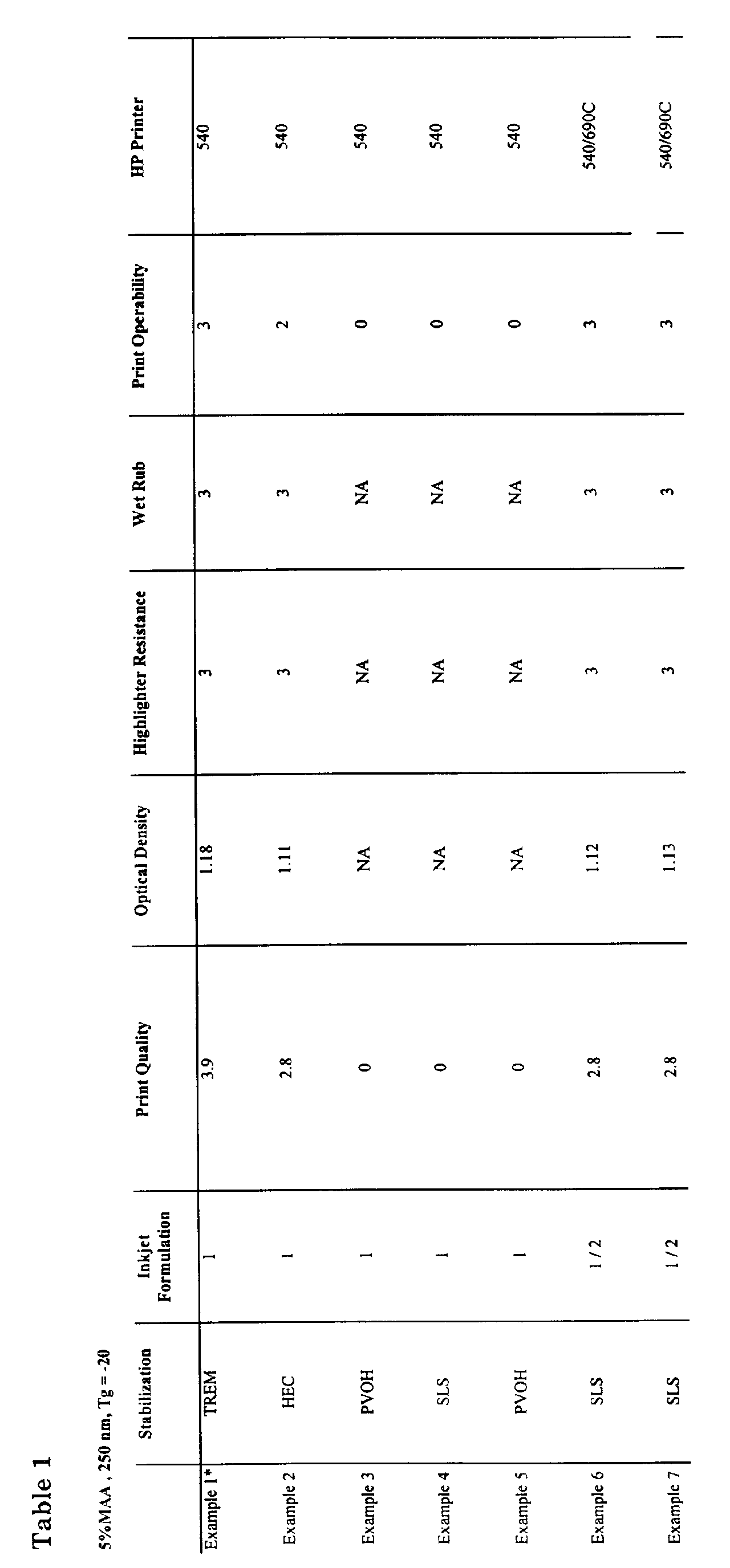
- Tg has little effect on print operability.
- OD appears to improve with higher Tg
- HR and WR appear to improve with lower Tg.
- the WR and HR performance improves as Tg is lowered to somewhere between -6C and -20C (between ca. 15 and 40C degrees below ambient temperature). Below this point, the WR and HR do not improve.
- Hydrophilic monomers HEA and HEMA were added to the polymer backbone composition in an attempt to improve print quality. The expectation was that a more hydrophilic composition would improve the rewet of material encrusted on the printhead and possibly improve the latex particle dispersion as well. Our data in Table 7 shows that WR, HR, OD and print quality all become poorer as the level of hydrophilic monomer is increased. However, acceptable performance can be obtained in the presence of these monomers.
Landscapes
- Chemical & Material Sciences (AREA)
- Life Sciences & Earth Sciences (AREA)
- Engineering & Computer Science (AREA)
- Materials Engineering (AREA)
- Wood Science & Technology (AREA)
- Organic Chemistry (AREA)
- Inks, Pencil-Leads, Or Crayons (AREA)
- Ink Jet Recording Methods And Recording Media Thereof (AREA)
- Ink Jet (AREA)
- Addition Polymer Or Copolymer, Post-Treatments, Or Chemical Modifications (AREA)
- Graft Or Block Polymers (AREA)
Abstract
Description
It is expected that the ink compositions using the binders of the present invention would include any additives necessary to obtain the desired physical properties required for the end use of the ink composition such additives include chelating agents, buffers, biocides, fungicides, antioxidants, rheology modifiers, thickeners, bacteriocides, surfactants, anti-curling agents, anti-bleed agents and surface tension modifiers, all as discussed above.
| Ink Jet Ink Formulation 1 | |
| Weight | |
| n-MethylPyrollidone | 6.5g |
| PolyEthyleneGlycol | 4.0g |
| Dispersion | 25.0g |
| Propanediol | 10.2g |
| Polymer Binder | 20.0g |
| Water | 54.3g |
| Total | 120.0g |
| Ink Jet Ink Formulation 2 | |
| Weight | |
| n-MethylPyrollidone | 6.4g |
| PolyEthyleneGlycol | 4.0g |
| Dispersion | 24.8g |
| Propanediol | 4.8g |
| Liponics EG-1 | 2.0g |
| Surfynol 104E | 0.4g |
| Polymer Binder | 20.0g |
| Water | 57.6g |
| Total | 120.0g |
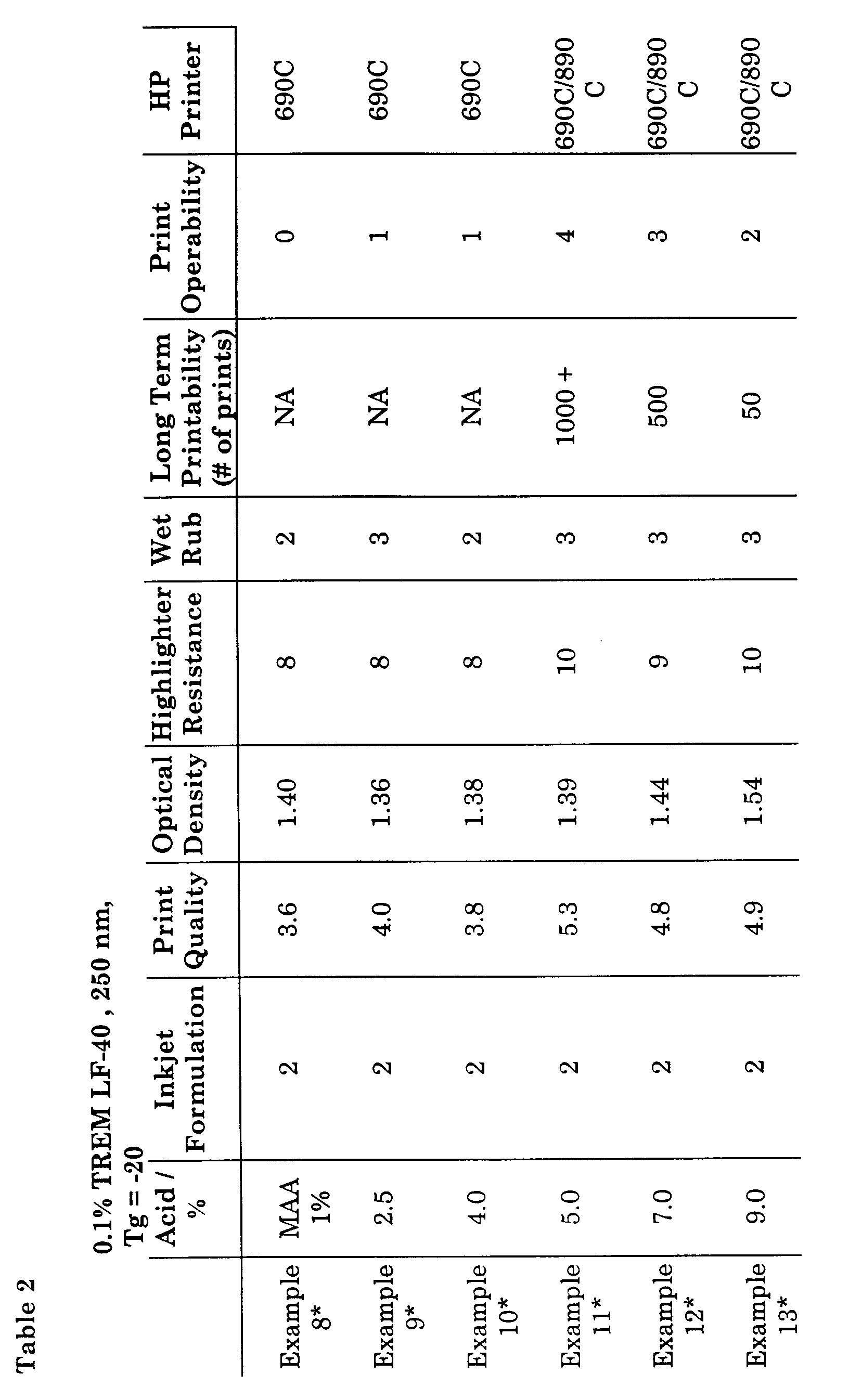
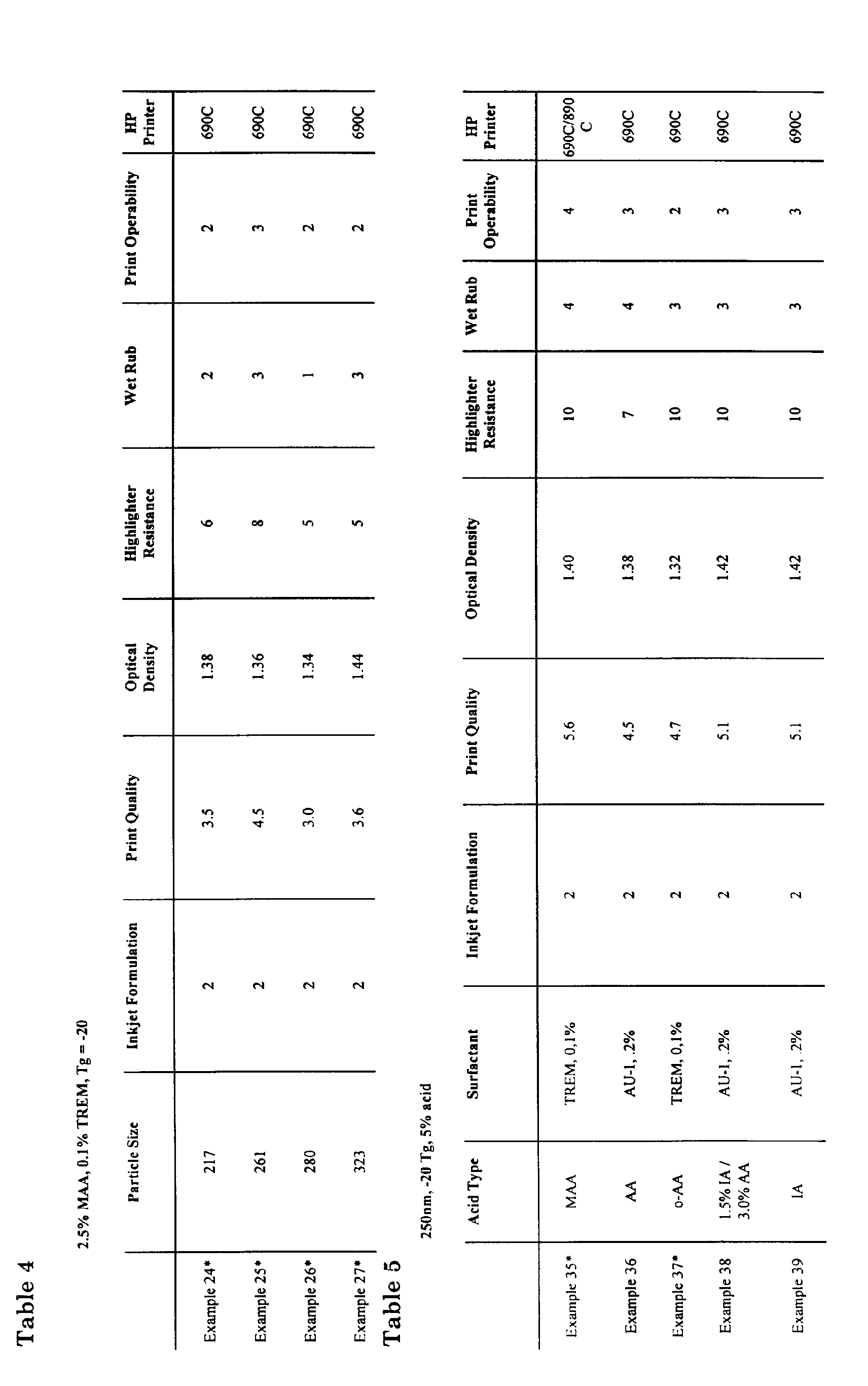
Print quality was rated by judging the appearance of a printed page of combined text and graphics. Edge sharpness, bleed, feathering, wet-rub resistance, highlighter resistance and print operability were accumulated into this evaluation. The scale is the linear combination of 3 times the optical density, the highlighter performance, the wet rub performance and the print operability rating.
Print operability was rated by judging the printer performance. Print appearance and uniformity, page after page longevity of print quality and uniformity, nozzle drop outs, print head maintenance problems and the ability to stop and restart were accumulated into this evaluation. The scale ranges from 0 to 5 where 0 was inoperable, 1 was poor and 5 was excellent.
A three liter flask was charged with 960g of deionized water, placed under a nitrogen atmosphere, and heated to 85°C. A monomer emulsion consisting of 275g 2-ethylhexyl acrylate (52parts), 227 g methyl methacrylate (43parts), 27 g methacrylic acid (5parts), 1.5 g of TREM LF-40 solution (36 %, Henkel Corp.), and 177 g deionized water was separately prepared. Prior to addition of this emulsion to the kettle, ammonia (24g of a 4.8%-9.6% aqueous solution), ammonium persulfate (llg of a 9.6% solution), and a 54nm acrylic polymer seed (22.5g of a 22.8% solution) were added to the kettle. The monomer emulsion was then fed to the kettle with stirring at a rate of 3.9g/min. for 20 min. along with a solution of 24.6g of 2.24% aqueous ammonium persulfate at a rate of 0.2 g/min., followed by 100 minutes at 6.4 and 0.20 g/min., respectively, and a hold period of 20 min. The mixture was then cooled to 60°C, and a mixture of 2.6g of 0.15% ferrous sulfate followed by 3.2g of 4.4% t-butyl hydroperoxide and 6.1g of 1.6% sodium formaldehyde sulfoxylate was added and held for 20 min., followed by a second identical portion of tBHP and SFS. The mixture was then cooled, filtered, and sufficient 29% aqueous ammonia was added to adjust the pH to a range of 8.0-9.0 (final polymer binder = 30% by weight polymer solids, average diameter 270nm, Tg = -20°C, and pH 8.2).
261nm, Tg = +60°C, and pH 8.8).
261nm, Tg = +60°C, and pH 8.8).



Claims (11)
- A polymeric binder suitable for use in an ink composition, comprising a colorant and a polymeric binder, wherein the polymeric binder is an emulsion-polymerized addition copolymer formed from a monomer mixture comprising ethylenically unsaturated monomers including from more than 4 to 15 wt % based on the weight of said mixture of at least one ethylenically unsaturated carboxylic acid functional monomer, and from 0.05 to 5 wt % based on the weight of said mixture of at least one polymerizable surfactant monomer comprising hydrophobic and hydrophilic functional groups, wherein said hydrophobic functional group comprises a polymerizable group within it.
- A polymeric binder as claimed in claim 1, wherein the polymerizable surfactant comprises a polymerizable group selected from (meth)acryl and (meth)allyl.
- A polymeric binder as claimed in claim 2, wherein the polymerizable surfactant is selected from the group of polymerizable surfactant monomers consisting of nonylphenoxy propenyl polyethoxylated sulphate; sodium alkyl allyl sulphosuccinate; ammonium di-(tricyclo(5.2.1.0 2,6) dec-3-en-(8 or 9)oxyethyl) sulfosuccinate; and ammonium di-(tricyclo(5.2.1.0 2,6) dec-3-en-(8 or 9) sulfosuccinate.
- A polymeric binder as claimed in claim 1, wherein the acid functional monomer is one or more monomers selected from the group consisting of C3to C20 ethylenically unsaturated carboxylic acids, their basic salts, and mixtures of such monomers.
- A polymeric binder as claimed in claim 1, wherein said monomer mixture comprises one or more monomers selected from the group of monomers consisting of substituted and unsubstituted (C1 to C50) alkyl (meth) acrylates, styrene and substituted styrenes, vinyl acrylates, vinyl acetates, fluoromethacrylates, acrylamide, substituted acrylamides, and methacrylamides, substituted methacrylamides.
- An ink composition comprising a colorant and a polymeric binder wherein the polymeric binder is an emulsion-polymerized addition copolymer formed from a monomer mixture comprising ethylenically unsaturated monomers including from more than 4 to 15 wt % based on the weight of said mixture of at least one ethylenically unsaturated carboxylic acid functional monomer, and from 0.05 to 5 wt % based on the weight of said mixture of at least one polymerizable surfactant monomer comprising hydrophobic and hydrophilic functional groups, wherein said hydrophobic functional group comprises a polymerizable group within it..
- An ink composition as claimed in claim 6, wherein said ink composition is an ink jet ink.
- A method of improving the print quality of an ink composition, which method comprises formulating said composition by incorporating therein a polymeric binder formed by polymerizing a monomer mixture comprising ethylenically unsaturated monomers including from more than 4 to 15 wt % based on the weight of said mixture of at least one ethylenically unsaturated carboxylic acid functional monomer, and from 0.05 to 5 wt % based on the weight of said mixture of at least one polymerizable surfactant monomer comprising hydrophobic and hydrophilic functional groups, wherein said hydrophobic functional group comprises a polymerizable group within it..
- A method as claimed in claim 8, wherein said ink composition is an ink jet ink.
- Use in the preparation of an ink composition of a polymeric binder formed by polymerizing a monomer mixture comprising ethylenically unsaturated monomers including from more than 4 to 15 wt % based on the weight of said mixture of at least one ethylenically unsaturated carboxylic acid functional monomer, and from 0.05 to 5 wt % based on the weight of said mixture of at least one polymerizable surfactant monomer comprising hydrophobic and hydrophilic functional groups, wherein said hydrophobic functional group comprises a polymerizable group within it, to improve the print quality of said ink composition.
- Use as claimed in claim 10, wherein said ink composition is an ink jet ink composition.
Applications Claiming Priority (2)
| Application Number | Priority Date | Filing Date | Title |
|---|---|---|---|
| US17055599P | 1999-12-14 | 1999-12-14 | |
| US170555P | 1999-12-14 |
Publications (3)
| Publication Number | Publication Date |
|---|---|
| EP1108758A2 true EP1108758A2 (en) | 2001-06-20 |
| EP1108758A3 EP1108758A3 (en) | 2001-06-27 |
| EP1108758B1 EP1108758B1 (en) | 2006-07-19 |
Family
ID=22620331
Family Applications (2)
| Application Number | Title | Priority Date | Filing Date |
|---|---|---|---|
| EP00310630A Expired - Lifetime EP1108758B1 (en) | 1999-12-14 | 2000-11-30 | Polymeric binders for ink jet inks |
| EP00310631A Expired - Lifetime EP1108759B1 (en) | 1999-12-14 | 2000-11-30 | Polymeric binders for ink jet inks |
Family Applications After (1)
| Application Number | Title | Priority Date | Filing Date |
|---|---|---|---|
| EP00310631A Expired - Lifetime EP1108759B1 (en) | 1999-12-14 | 2000-11-30 | Polymeric binders for ink jet inks |
Country Status (4)
| Country | Link |
|---|---|
| US (3) | US6541590B1 (en) |
| EP (2) | EP1108758B1 (en) |
| JP (2) | JP4772956B2 (en) |
| DE (2) | DE60031076T2 (en) |
Cited By (2)
| Publication number | Priority date | Publication date | Assignee | Title |
|---|---|---|---|---|
| US7371273B2 (en) * | 2003-12-19 | 2008-05-13 | Hewlett-Packard Development Company, L.P. | Latexes and ink-jet inks prepared using blocked acid monomers |
| CN104387838A (en) * | 2014-12-08 | 2015-03-04 | 蓝思科技股份有限公司 | Screen printing protective ink composition and screen printing method |
Families Citing this family (45)
| Publication number | Priority date | Publication date | Assignee | Title |
|---|---|---|---|---|
| DK1214470T3 (en) * | 1999-09-08 | 2004-09-27 | Clariant Finance Bvi Ltd | Surface treatment of paper or cardboard and agents for this purpose |
| US6541590B1 (en) * | 1999-12-14 | 2003-04-01 | Rohm And Haas Company | Polymeric binders from copolymers of unsaturated carboxylic acids and surfactant monomers |
| US6956082B1 (en) * | 1999-12-14 | 2005-10-18 | Rohm And Haas Company | Inkjet ink composition |
| EP1333072A3 (en) * | 2002-01-30 | 2003-11-12 | Rohm And Haas Company | Ink composition |
| JP4078849B2 (en) * | 2002-02-28 | 2008-04-23 | セイコーエプソン株式会社 | Ink composition |
| US7361699B2 (en) * | 2002-12-27 | 2008-04-22 | Kao Corporation | Water-based ink |
| US7030175B2 (en) * | 2003-02-06 | 2006-04-18 | Hewlett-Packard Development Company, L.P. | Ink jet latex having reactive surfactant stabilization |
| US7411011B2 (en) * | 2003-03-31 | 2008-08-12 | Hewlett-Packard Development Company, L.P. | Latex-based overcoat for ink-jet printing applications |
| US20050137282A1 (en) * | 2003-12-19 | 2005-06-23 | Cagle Phillip C. | Liquid vehicle systems for improving latex ink-jet ink frequency response |
| JP4875834B2 (en) * | 2003-12-24 | 2012-02-15 | ローム・アンド・ハース・エレクトロニック・マテリアルズ,エル.エル.シー. | mask |
| US20050197419A1 (en) * | 2004-03-03 | 2005-09-08 | Graziano Louis C. | Radiation curable aqueous binders for ink jet inks |
| US20050282931A1 (en) | 2004-06-22 | 2005-12-22 | Chao-Jen Chung | Polymeric binders for ink jet inks |
| US7354476B2 (en) * | 2004-06-22 | 2008-04-08 | Lexmark International, Inc. | Inkjet ink composition |
| US7677714B2 (en) * | 2004-10-01 | 2010-03-16 | Hewlett-Packard Development Company, L.P. | Inkjet inks providing improved wet smudge on porous print media |
| TW200628566A (en) * | 2004-10-12 | 2006-08-16 | Rohm & Haas | Polymeric emulsions for ink jet inks |
| US7717992B2 (en) | 2004-11-03 | 2010-05-18 | Basf Corporation | Color enhancing emulsions |
| WO2006080984A2 (en) * | 2005-01-25 | 2006-08-03 | Lexmark International, Inc. | Inkjet ink binder and inkjet ink composition |
| WO2006092736A2 (en) * | 2005-03-02 | 2006-09-08 | Mondi Packaging South Africa (Proprietary) Limited | Preparation of polymer latexes |
| JP4695530B2 (en) * | 2005-03-08 | 2011-06-08 | 花王株式会社 | Water-based ink for inkjet recording |
| JP2007254502A (en) * | 2006-03-20 | 2007-10-04 | Fuji Xerox Co Ltd | Ink set for ink jet, ink tank for ink jet, method for ink-jet recording and apparatus for ink-jet recording |
| US7910649B2 (en) * | 2006-10-10 | 2011-03-22 | Hewlett-Packard Development Company, L.P. | Maleimide-containing latex dispersions |
| US8336481B2 (en) * | 2009-05-13 | 2012-12-25 | Basf Corporation | Printed indicator compositions |
| JP5581815B2 (en) * | 2009-06-05 | 2014-09-03 | 東洋インキScホールディングス株式会社 | Binder resin composition for aqueous inkjet ink and inkjet ink using the same |
| EP2514771A4 (en) * | 2009-12-16 | 2014-01-22 | Kao Corp | Resin modifier |
| WO2011159306A1 (en) * | 2010-06-17 | 2011-12-22 | Hewlett-Packard Development Company, L.P. | Polyurethane-containing inkjet ink |
| DE102013219259A1 (en) * | 2013-09-25 | 2015-03-26 | Koenig & Bauer Aktiengesellschaft | Printing machine, printing ink and method for printing a printing substrate |
| EP3049252B1 (en) | 2013-09-25 | 2018-03-07 | Koenig & Bauer AG | Web-fed inkjet printing press, printing ink and method for printing a printing material |
| EP3112429B1 (en) * | 2014-03-26 | 2018-06-06 | Nippon Kayaku Kabushiki Kaisha | Ink composition, ink jet recording method, and colored substance |
| AR100280A1 (en) * | 2014-05-22 | 2016-09-21 | Rohm & Haas | POLYMER BINDERS FOR INK JET PRINTERS |
| JP7046065B2 (en) * | 2017-06-30 | 2022-04-01 | 富士フイルム株式会社 | Pretreatment liquid for printing, manufacturing method of printing substrate, ink set, and image recording method |
| US12043678B2 (en) | 2020-11-24 | 2024-07-23 | Xerox Corporation | Monodisperse latexes |
| US11708504B2 (en) | 2020-11-24 | 2023-07-25 | Xerox Corporation | Aqueous inkjet ink compositions made from monodisperse latexes |
| US12110402B2 (en) | 2020-11-24 | 2024-10-08 | Xerox Corporation | Aqueous inkjet ink compositions made from high viscosity latexes |
| US11608403B2 (en) | 2020-11-24 | 2023-03-21 | Xerox Corporation | High viscosity latexes |
| US11781025B2 (en) | 2021-05-06 | 2023-10-10 | Xerox Corporation | Aqueous inkjet ink compositions |
| US11643540B2 (en) | 2021-05-25 | 2023-05-09 | Xerox Corporation | Seeded emulsion polymerization process for latexes and aqueous inkjet ink compositions made therefrom |
| US11952451B2 (en) | 2021-07-27 | 2024-04-09 | Xerox Corporation | Latexes with pH responsive resin particles |
| US11952448B2 (en) | 2021-07-27 | 2024-04-09 | Xerox Corporation | Organic additives and compositions containing the same |
| US11714361B2 (en) | 2021-07-27 | 2023-08-01 | Xerox Corporation | Toner |
| US11834580B2 (en) | 2021-07-27 | 2023-12-05 | Xerox Corporation | Ink composition with pH responsive resin particles |
| US12379677B2 (en) | 2021-07-27 | 2025-08-05 | Xerox Corporation | Latexes and related compositions |
| US11919982B2 (en) | 2021-12-09 | 2024-03-05 | Xerox Corporation | Latexes with phosphoric acid functional resin particles |
| US12359079B2 (en) | 2021-12-09 | 2025-07-15 | Xerox Corporation | Aqueous inkjet ink compositions with phosphoric acid functional resin particles |
| US12492316B2 (en) | 2023-01-09 | 2025-12-09 | Xerox Corporation | Inkjet primer compositions containing nanocellulose |
| US12281233B2 (en) | 2023-01-09 | 2025-04-22 | Xerox Corporation | Inkjet primer compositions |
Family Cites Families (26)
| Publication number | Priority date | Publication date | Assignee | Title |
|---|---|---|---|---|
| US4246387A (en) | 1978-11-13 | 1981-01-20 | Stepan Chemical Company | Emulsion polymerization with sulfonated alkoxylated alkyl arylol maleates |
| DE2946465A1 (en) * | 1979-11-17 | 1981-06-11 | Agfa-Gevaert Ag, 5090 Leverkusen | NEW POLYMERS, METHOD FOR THEIR PRODUCTION AND THEIR USE FOR THE PRODUCTION OF PHOTOGRAPHIC EMULSIONS AND PHOTOGRAPHIC MATERIALS |
| NL8001928A (en) * | 1980-04-02 | 1981-11-02 | Synres Internationaal Nv | METHOD FOR MAKING POLYMER DISPERSIONS |
| JPS62227435A (en) | 1986-03-31 | 1987-10-06 | Dai Ichi Kogyo Seiyaku Co Ltd | Novel surface-active agent |
| JPH02165466A (en) | 1988-12-19 | 1990-06-26 | Ricoh Co Ltd | Optical disc cartridge replacement device |
| JPH0889779A (en) * | 1994-09-20 | 1996-04-09 | Nitto Chem Ind Co Ltd | Cationic dispersant and method for producing the same |
| DE19512882A1 (en) * | 1995-04-06 | 1996-10-10 | Basf Ag | Aqueous polymer dispersion |
| US5962580A (en) | 1995-06-07 | 1999-10-05 | Rohm And Haas Company | Method for providing a waterborne coating composition with improved color acceptance |
| JP3859260B2 (en) * | 1996-04-09 | 2006-12-20 | 三菱化学株式会社 | Aqueous colored resin dispersion, aqueous ink, and inkjet recording liquid |
| JPH09299782A (en) * | 1996-05-17 | 1997-11-25 | Mitsui Toatsu Chem Inc | Water-dispersible resin composition containing amphiphilic polymer as dispersant |
| US5965634A (en) | 1996-06-19 | 1999-10-12 | Mitsubishi Pencil Kabushiki Kaisha | Water base ink composition |
| JPH10176130A (en) * | 1996-06-19 | 1998-06-30 | Mitsubishi Pencil Co Ltd | Aqueous ink composition |
| JP3904674B2 (en) * | 1996-09-02 | 2007-04-11 | 三菱鉛筆株式会社 | Colored resin fine particle aqueous dispersion for water-based ink |
| US5942560A (en) | 1996-09-02 | 1999-08-24 | Mitsubishi Pencil Kabushiki Kaisha | Colored resin fine particle water base dispersion liquid for water base ink |
| JPH1077435A (en) | 1996-09-02 | 1998-03-24 | Mitsubishi Pencil Co Ltd | Aqueous ink composition for writing implements |
| JPH10120957A (en) * | 1996-10-16 | 1998-05-12 | Mitsubishi Pencil Co Ltd | Ink composition for ink jet recording device |
| AU747565B2 (en) * | 1997-01-28 | 2002-05-16 | Stepan Company | Novel ethylenically unsaturated amine salts of sulfonic, phosphoric and carboxylic acids |
| DE69821337T2 (en) * | 1997-01-28 | 2004-12-02 | Stepan Co., Northfield | EMULSION POLYMERIZATION METHOD USING ETHYLENICALLY UNSATURATED AMINESALPES OF SULPHONIC ACID, PHOSPHORIC ACID AND CARBOXYLIC ACID |
| JP3839894B2 (en) * | 1997-03-10 | 2006-11-01 | 東洋インキ製造株式会社 | Inkjet recording fluid |
| CA2229253C (en) | 1997-03-31 | 2001-10-09 | Xerox Corporation | Ink compositions |
| JPH10316909A (en) | 1997-05-20 | 1998-12-02 | Mitsubishi Chem Corp | Aqueous dispersion and method for producing the same |
| JPH1112512A (en) | 1997-06-20 | 1999-01-19 | Toyo Ink Mfg Co Ltd | Inkjet recording liquid |
| US5969032A (en) * | 1998-03-09 | 1999-10-19 | National Starch And Chemical Investment Holding Corporation | Latex binders for coatings incorporating a polymerizable surfactant having a terminal allyl amine moiety |
| JP2000204123A (en) * | 1999-01-12 | 2000-07-25 | Dainippon Ink & Chem Inc | Aqueous resin emulsion and thermosensitive recording material using the same |
| JP2001019886A (en) * | 1999-07-12 | 2001-01-23 | Sanyo Chem Ind Ltd | Aqueous printing ink binder for wall paper |
| US6541590B1 (en) * | 1999-12-14 | 2003-04-01 | Rohm And Haas Company | Polymeric binders from copolymers of unsaturated carboxylic acids and surfactant monomers |
-
2000
- 2000-11-22 US US09/718,586 patent/US6541590B1/en not_active Expired - Lifetime
- 2000-11-30 DE DE60031076T patent/DE60031076T2/en not_active Expired - Lifetime
- 2000-11-30 DE DE60029410T patent/DE60029410T2/en not_active Expired - Lifetime
- 2000-11-30 EP EP00310630A patent/EP1108758B1/en not_active Expired - Lifetime
- 2000-11-30 EP EP00310631A patent/EP1108759B1/en not_active Expired - Lifetime
- 2000-12-14 JP JP2000380583A patent/JP4772956B2/en not_active Expired - Fee Related
- 2000-12-14 JP JP2000380568A patent/JP4781524B2/en not_active Expired - Fee Related
-
2003
- 2003-01-16 US US10/345,747 patent/US6693147B2/en not_active Expired - Lifetime
- 2003-01-16 US US10/345,748 patent/US6743875B2/en not_active Expired - Lifetime
Cited By (2)
| Publication number | Priority date | Publication date | Assignee | Title |
|---|---|---|---|---|
| US7371273B2 (en) * | 2003-12-19 | 2008-05-13 | Hewlett-Packard Development Company, L.P. | Latexes and ink-jet inks prepared using blocked acid monomers |
| CN104387838A (en) * | 2014-12-08 | 2015-03-04 | 蓝思科技股份有限公司 | Screen printing protective ink composition and screen printing method |
Also Published As
| Publication number | Publication date |
|---|---|
| JP2001240621A (en) | 2001-09-04 |
| US6693147B2 (en) | 2004-02-17 |
| JP4772956B2 (en) | 2011-09-14 |
| US6743875B2 (en) | 2004-06-01 |
| US20030171516A1 (en) | 2003-09-11 |
| EP1108759A3 (en) | 2001-06-27 |
| US6541590B1 (en) | 2003-04-01 |
| EP1108759B1 (en) | 2006-10-04 |
| JP2001240622A (en) | 2001-09-04 |
| EP1108758A3 (en) | 2001-06-27 |
| DE60031076D1 (en) | 2006-11-16 |
| DE60031076T2 (en) | 2007-06-06 |
| JP4781524B2 (en) | 2011-09-28 |
| EP1108758B1 (en) | 2006-07-19 |
| DE60029410D1 (en) | 2006-08-31 |
| EP1108759A2 (en) | 2001-06-20 |
| DE60029410T2 (en) | 2007-02-22 |
| US20030171517A1 (en) | 2003-09-11 |
Similar Documents
| Publication | Publication Date | Title |
|---|---|---|
| EP1108758B1 (en) | Polymeric binders for ink jet inks | |
| JP3257391B2 (en) | Inkjet recording liquid | |
| EP1268688B1 (en) | Ink compositions | |
| EP1108760B2 (en) | Polymeric binder | |
| US20050282931A1 (en) | Polymeric binders for ink jet inks | |
| JP2004211089A (en) | Specified core-shell polymer additive for improving durability of inkjet ink | |
| JPH1087768A (en) | Aqueous dispersion containing graft copolymer as dispersing agent | |
| JP2003183557A (en) | Inkjet ink | |
| US7354476B2 (en) | Inkjet ink composition | |
| US20070066711A1 (en) | Binder and inkjet ink compositions | |
| CN1740244B (en) | Water-based inks for ink-jet printing | |
| US20060167135A1 (en) | Inkjet ink binder and inkjet ink composition | |
| JP2003176434A (en) | Colored inkjet ink | |
| US6956082B1 (en) | Inkjet ink composition | |
| US20060079602A1 (en) | Polymeric emulsions for ink jet inks |
Legal Events
| Date | Code | Title | Description |
|---|---|---|---|
| PUAI | Public reference made under article 153(3) epc to a published international application that has entered the european phase |
Free format text: ORIGINAL CODE: 0009012 |
|
| PUAL | Search report despatched |
Free format text: ORIGINAL CODE: 0009013 |
|
| 17P | Request for examination filed |
Effective date: 20001211 |
|
| AK | Designated contracting states |
Kind code of ref document: A2 Designated state(s): DE FR GB IT NL |
|
| AX | Request for extension of the european patent |
Free format text: AL;LT;LV;MK;RO;SI |
|
| AK | Designated contracting states |
Kind code of ref document: A3 Designated state(s): AT BE CH CY DE DK ES FI FR GB GR IE IT LI LU MC NL PT SE TR |
|
| AX | Request for extension of the european patent |
Free format text: AL;LT;LV;MK;RO;SI |
|
| AKX | Designation fees paid |
Free format text: DE FR GB IT NL |
|
| 17Q | First examination report despatched |
Effective date: 20041214 |
|
| GRAP | Despatch of communication of intention to grant a patent |
Free format text: ORIGINAL CODE: EPIDOSNIGR1 |
|
| GRAS | Grant fee paid |
Free format text: ORIGINAL CODE: EPIDOSNIGR3 |
|
| GRAA | (expected) grant |
Free format text: ORIGINAL CODE: 0009210 |
|
| AK | Designated contracting states |
Kind code of ref document: B1 Designated state(s): DE FR GB IT NL |
|
| PG25 | Lapsed in a contracting state [announced via postgrant information from national office to epo] |
Ref country code: IT Free format text: LAPSE BECAUSE OF FAILURE TO SUBMIT A TRANSLATION OF THE DESCRIPTION OR TO PAY THE FEE WITHIN THE PRESCRIBED TIME-LIMIT;WARNING: LAPSES OF ITALIAN PATENTS WITH EFFECTIVE DATE BEFORE 2007 MAY HAVE OCCURRED AT ANY TIME BEFORE 2007. THE CORRECT EFFECTIVE DATE MAY BE DIFFERENT FROM THE ONE RECORDED. Effective date: 20060719 Ref country code: NL Free format text: LAPSE BECAUSE OF FAILURE TO SUBMIT A TRANSLATION OF THE DESCRIPTION OR TO PAY THE FEE WITHIN THE PRESCRIBED TIME-LIMIT Effective date: 20060719 |
|
| REG | Reference to a national code |
Ref country code: GB Ref legal event code: FG4D |
|
| REF | Corresponds to: |
Ref document number: 60029410 Country of ref document: DE Date of ref document: 20060831 Kind code of ref document: P |
|
| NLV1 | Nl: lapsed or annulled due to failure to fulfill the requirements of art. 29p and 29m of the patents act | ||
| ET | Fr: translation filed | ||
| PLBE | No opposition filed within time limit |
Free format text: ORIGINAL CODE: 0009261 |
|
| STAA | Information on the status of an ep patent application or granted ep patent |
Free format text: STATUS: NO OPPOSITION FILED WITHIN TIME LIMIT |
|
| 26N | No opposition filed |
Effective date: 20070420 |
|
| REG | Reference to a national code |
Ref country code: FR Ref legal event code: PLFP Year of fee payment: 16 |
|
| REG | Reference to a national code |
Ref country code: FR Ref legal event code: PLFP Year of fee payment: 17 |
|
| REG | Reference to a national code |
Ref country code: FR Ref legal event code: PLFP Year of fee payment: 18 |
|
| PGFP | Annual fee paid to national office [announced via postgrant information from national office to epo] |
Ref country code: FR Payment date: 20171012 Year of fee payment: 18 Ref country code: DE Payment date: 20171121 Year of fee payment: 18 |
|
| PGFP | Annual fee paid to national office [announced via postgrant information from national office to epo] |
Ref country code: GB Payment date: 20171129 Year of fee payment: 18 Ref country code: IT Payment date: 20171123 Year of fee payment: 18 |
|
| REG | Reference to a national code |
Ref country code: DE Ref legal event code: R119 Ref document number: 60029410 Country of ref document: DE |
|
| GBPC | Gb: european patent ceased through non-payment of renewal fee |
Effective date: 20181130 |
|
| PG25 | Lapsed in a contracting state [announced via postgrant information from national office to epo] |
Ref country code: FR Free format text: LAPSE BECAUSE OF NON-PAYMENT OF DUE FEES Effective date: 20181130 Ref country code: IT Free format text: LAPSE BECAUSE OF NON-PAYMENT OF DUE FEES Effective date: 20181130 Ref country code: DE Free format text: LAPSE BECAUSE OF NON-PAYMENT OF DUE FEES Effective date: 20190601 |
|
| PG25 | Lapsed in a contracting state [announced via postgrant information from national office to epo] |
Ref country code: GB Free format text: LAPSE BECAUSE OF NON-PAYMENT OF DUE FEES Effective date: 20181130 |