EP1106852A2 - Verfahren zum Herstellen eines Gleitgabelgelenk - Google Patents
Verfahren zum Herstellen eines Gleitgabelgelenk Download PDFInfo
- Publication number
- EP1106852A2 EP1106852A2 EP00310540A EP00310540A EP1106852A2 EP 1106852 A2 EP1106852 A2 EP 1106852A2 EP 00310540 A EP00310540 A EP 00310540A EP 00310540 A EP00310540 A EP 00310540A EP 1106852 A2 EP1106852 A2 EP 1106852A2
- Authority
- EP
- European Patent Office
- Prior art keywords
- yoke
- slip yoke
- slip
- transmission
- burnishing
- Prior art date
- Legal status (The legal status is an assumption and is not a legal conclusion. Google has not performed a legal analysis and makes no representation as to the accuracy of the status listed.)
- Withdrawn
Links
- 238000004519 manufacturing process Methods 0.000 title claims abstract description 9
- 230000005540 biological transmission Effects 0.000 claims abstract description 47
- 238000000034 method Methods 0.000 claims abstract description 32
- 239000000463 material Substances 0.000 abstract description 6
- 238000005260 corrosion Methods 0.000 abstract description 4
- 230000007797 corrosion Effects 0.000 abstract description 4
- 238000005555 metalworking Methods 0.000 abstract description 4
- 238000005266 casting Methods 0.000 abstract description 3
- 238000005242 forging Methods 0.000 abstract description 3
- 239000000356 contaminant Substances 0.000 description 3
- 239000012530 fluid Substances 0.000 description 3
- XLYOFNOQVPJJNP-UHFFFAOYSA-N water Substances O XLYOFNOQVPJJNP-UHFFFAOYSA-N 0.000 description 3
- 230000000712 assembly Effects 0.000 description 1
- 238000000429 assembly Methods 0.000 description 1
- 238000005516 engineering process Methods 0.000 description 1
Images


Classifications
-
- F—MECHANICAL ENGINEERING; LIGHTING; HEATING; WEAPONS; BLASTING
- F16—ENGINEERING ELEMENTS AND UNITS; GENERAL MEASURES FOR PRODUCING AND MAINTAINING EFFECTIVE FUNCTIONING OF MACHINES OR INSTALLATIONS; THERMAL INSULATION IN GENERAL
- F16D—COUPLINGS FOR TRANSMITTING ROTATION; CLUTCHES; BRAKES
- F16D3/00—Yielding couplings, i.e. with means permitting movement between the connected parts during the drive
- F16D3/02—Yielding couplings, i.e. with means permitting movement between the connected parts during the drive adapted to specific functions
- F16D3/06—Yielding couplings, i.e. with means permitting movement between the connected parts during the drive adapted to specific functions specially adapted to allow axial displacement
-
- B—PERFORMING OPERATIONS; TRANSPORTING
- B24—GRINDING; POLISHING
- B24B—MACHINES, DEVICES, OR PROCESSES FOR GRINDING OR POLISHING; DRESSING OR CONDITIONING OF ABRADING SURFACES; FEEDING OF GRINDING, POLISHING, OR LAPPING AGENTS
- B24B39/00—Burnishing machines or devices, i.e. requiring pressure members for compacting the surface zone; Accessories therefor
- B24B39/04—Burnishing machines or devices, i.e. requiring pressure members for compacting the surface zone; Accessories therefor designed for working external surfaces of revolution
- B24B39/045—Burnishing machines or devices, i.e. requiring pressure members for compacting the surface zone; Accessories therefor designed for working external surfaces of revolution the working tool being composed of a plurality of working rolls or balls
Definitions
- This invention relates in general to drive train assemblies for transferring rotational power from an engine to an axle assembly in a vehicle.
- this invention relates to an improved method for manufacturing a yoke, such as a slip yoke, for use in such a vehicle drive train assembly.
- a drive train assembly for transmitting rotational power from an output shaft of an transmission to an input shaft of an axle assembly so as to rotatably drive one or more wheels of the vehicle.
- a typical vehicular drive train assembly includes a hollow cylindrical driveshaft tube.
- a first universal joint is connected between the output shaft of the transmission and a first end of the driveshaft tube, while a second universal joint is connected between a second end of the driveshaft tube and the input shaft of the axle assembly.
- the universal joints provide a rotational driving connection from the output shaft of the transmission through the driveshaft tube to the input shaft of the axle assembly, while accommodating a limited amount of angular misalignment between the rotational axes of these three shafts.
- the output shaft of the transmission is formed as a generally cylindrical member including an end having an externally splined outer surface.
- a slip yoke is provided to connect the first universal joint to the output shaft of the transmission.
- a typical slip yoke includes a generally hollow cylindrical body portion having a smooth outer surface and an internally splined inner surface. The internally splined inner surface of the body portion of the slip yoke cooperates with the externally splined outer surface of the output shaft of the transmission to provide a rotatable driving connection therebetween, while allowing a limited amount of relative axial movement to occur.
- the slip yoke further includes a yoke portion having a pair of arms extending therefrom. The arms of the yoke portion having aligned openings formed therethrough that are adapted to receive portions of the first universal joint therein.
- the transmission is contained within a housing, and the output shaft of the transmission extends through an opening formed through the transmission housing.
- an annular seal is usually provided in the opening of the transmission housing.
- the annular seal includes an outer circumferential surface that is fixed within the opening formed through the transmission housing and an inner circumferential surface that bears against the outer cylindrical surface of the slip yoke as it rotates during use.
- the annular seal prevents the entry of dirt, water, and other contaminants into the transmission housing, and further prevents transmission fluid contained within the transmission housing from leaking outwardly therefrom.
- the outer surface of the slip yoke be formed having an extremely smooth finish.
- this has been accomplished by grinding the outer surface of the slip yoke. Grinding is a metal working process wherein a tool is moved into engagement with the outer surface of the slip yoke as it is rotated at a relatively high speed, thereby causing the removal of material therefrom to form a smooth finish.
- grinding the outer surface of the slip yoke has been an effective method of forming a smooth finish on the outer surface of the slip yoke, it has been found to have several limitations.
- the grinding process imparts certain dimensional and surface characteristics to the outer surface of the slip yoke that limit the useful life span of the annular seal bearing thereagainst.
- This invention relates to an improved method for manufacturing a yoke, such as a slip yoke, for use with a transmission or other component in a vehicle drive train assembly.
- a yoke such as a slip yoke
- an unfinished slip yoke is near net formed using any conventional process, such as forging or casting. Portions of the slip yoke may be finished machined, if necessary.
- an outer cylindrical surface of the slip yoke is subjected to a burnishing process. Burnishing is a metal working process wherein one or more rollers are moved into engagement with the outer surface of the slip yoke as it is rotated. The pressure generated by the rollers re-shapes the outer surface of the slip yoke to a very smooth surface without the removal of material.
- Fig. 1 is a fragmentary sectional elevational view of a portion of a vehicle transmission including a slip yoke that has been manufactured in accordance with the method of this invention.
- Fig. 2 is an elevational view, partially in cross section, of an apparatus for burnishing the outer cylindrical surface of the body portion of the slip yoke illustrated in Fig. 1.
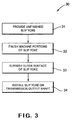
- Fig. 3 is a flow chart of a method in accordance with this invention for manufacturing the slip yoke illustrated in Figs. 1 and 2.
- Fig. 1 a portion of a vehicle transmission, indicated generally at 10, that is generally conventional in the art.
- the structure and method of operation of the transmission 10 are well known and form no part of this invention. Thus, only those portions of the transmission 10 that are necessary for a full understanding of this invention are described and illustrated.
- the illustrated transmission 10 includes a housing 11 having an opening 12 formed therethrough.
- An annular seal 13 is mounted in the opening 12 of the transmission housing 11.
- a bearing 14 is also provided in the opening 12 of the transmission housing 11. The purposes for the annular seal 13 and the bearing 14 will be explained below.
- the transmission 10 also includes an output shaft 15 having a first end (not shown) that is supported for rotation in a conventional manner within the transmission housing 11.
- the output shaft 15 has a second end 16 that extends through the opening 12 and outwardly from the transmission housing 11.
- the second end 16 of the output shaft 15 has a plurality of splines formed on the exterior surface thereof for a purpose that will be described below.
- the transmission 10 further includes an input shaft (not shown) and a plurality of gears (not shown), all of which are contained within the transmission housing 11.
- the input shaft is usually connected to a source of rotational power, such as an engine of a vehicle, so as to be rotatably driven thereby.
- a conventional shifting mechanism (not shown) is provided for selectively connecting certain ones of the plurality of gears between the input shaft and the output shaft 12. As a result, the output shaft 12 can be selectively driven at any one of a plurality of speed reduction gear ratios relative to the rotational speed of the input shaft.
- a slip yoke is provided to connect the output shaft 15 of the transmission 10 to a first universal joint (not shown) carried on a first end of the driveshaft tube of a vehicle drive train assembly.
- the slip yoke 20 includes a generally hollow cylindrical body portion 21 having a smooth outer cylindrical surface 22 and an internally splined inner surface 23 (see Fig. 2).
- the internally splined inner surface 23 of the body portion 21 of the slip yoke 20 cooperates with the externally splined outer surface of the second end 16 of the output shaft 15 of the transmission 10 to provide a rotatable driving connection therebetween, while allowing a limited amount of relative axial movement to occur.
- the slip yoke 20 further includes a yoke portion 24 having a pair of arms 25 and 26 extending therefrom.
- the arms 25 and 26 of the yoke portion 24 having respective aligned openings 25a and 26a formed therethrough that are adapted to receive portions of the first universal joint therein in a known manner.
- the slip yoke 20 can be installed on the transmission 10 by inserting the hollow cylindrical body portion 21 through the annular seal 13 and the bearing 14 provided in the opening 12 formed through the transmission housing 11.
- the cylindrical body portion 21 of the slip yoke 20 is rotatably supported on the transmission housing 11 by the bearing 14.
- the annular seal 13 sealingly engages the cylindrical outer surface 22 of the body portion 21 of the slip yoke 20.
- the annular seal 13 prevents the entry of dirt, water, and other contaminants into the transmission housing 11, and further prevents transmission fluid contained within the transmission housing 11 from leaking outwardly therefrom.
- Fig. 3 is a flow chart of a method, indicated generally at 30, in accordance with this invention for manufacturing the slip yoke 20 illustrated in Figs. 1 and 2.
- the method 30 includes a first step 31, wherein an unfinished slip yoke 20 is initially provided.
- the unfinished slip yoke 20 may be formed in any conventional manner, such as by forging or casting.
- the unfinished slip yoke 20 is near net formed to approximately its desired final shape.
- portions of the unfinished slip yoke 20 are finished machined if necessary.
- a third step 33 is performed wherein the outer cylindrical surface 22 of the unfinished slip yoke 20 is subjected to a burnishing process.
- Burnishing is a metal working process wherein one or more rollers are moved into engagement with the outer cylindrical surface 22 of the unfinished slip yoke 20 as it is rotated. The pressure generated by the rollers re-shapes the outer cylindrical surface 22 of the slip yoke 20 to a very smooth surface without the removal of material.
- the burnished slip yoke 20 is installed on the second end 16 of the output shaft 15 of the transmission 10 as described above.
- Fig. 2 schematically illustrates an apparatus, indicated generally at 40, for performing the burnishing step 33 of the method 30 illustrated in Fig. 3.
- the illustrated apparatus 40 is intended to be representative of any machine that can perform the burnishing step 33 described above.
- the illustrated burnishing apparatus 40 is an outside surface, carbide roller apparatus, such as is available from Elliot Tool Technologies Ltd. of Dayton, Ohio.
- the burnishing operation is performed by mounting the unfinished slip yoke 20 on a fixture (not shown) and causing it to rotate at a relatively high speed. Then, one or more rollers 41 or other burnishing tools are caused to move into engagement with the outer cylindrical surface 22 of the unfinished slip yoke 20.
- the rollers 41 are preferably formed from a relatively hard material and exert a relatively high pressure against the outer cylindrical surface 22 of the unfinished slip yoke 20.
- the pressure generated by the rollers 41 re-shapes the material at the outer cylindrical surface 22 of the unfinished slip yoke 20 to have an extremely smooth finish.
- the resulting burnished outer cylindrical surface 22 of the slip yoke 20 is tough, work-hardened, wear-resistant, and corrosion-resistant, having a mirror-like finish.
- Burnishing the outer cylindrical surface 22 of the slip yoke 20 in accordance with this invention has been found to provide significant advantages over the prior art method of grinding such outer cylindrical surface 22. Specifically, testing has indicated that slip yokes 20 manufactured in accordance with the burnishing process of this invention provide significantly better results than slip yokes manufactured using the prior art grinding method.
- a typical vehicular drive train assembly includes a driveshaft having a first end that is connected to the output shaft 15 of the transmission 10 (by means of the slip yoke 20) and a second end that is connected to an input shaft (not shown) of an axle assembly.
- An end yoke (not shown) is connected to the input shaft of the axle assembly to facilitate this connection.
- Such an end yoke is quite similar to the slip 20 described above, including a cylindrical body portion having a smooth outer cylindrical surface that extends through an opening formed through the housing of the axle assembly and that is sealingly engaged by an annular seal.
- the end yoke of the axle assembly is typically restrained from axial movement relative to the input shaft of the axle assembly.
- the cylindrical body portion ofthe end yoke can be burnished to provide a smooth outer cylindrical surface in accordance with this invention.
Landscapes
- Engineering & Computer Science (AREA)
- Mechanical Engineering (AREA)
- General Engineering & Computer Science (AREA)
- Shafts, Cranks, Connecting Bars, And Related Bearings (AREA)
- Forging (AREA)
- Mechanical Operated Clutches (AREA)
- General Details Of Gearings (AREA)
Applications Claiming Priority (2)
| Application Number | Priority Date | Filing Date | Title |
|---|---|---|---|
| US45256899A | 1999-12-01 | 1999-12-01 | |
| US452568 | 1999-12-01 |
Publications (2)
| Publication Number | Publication Date |
|---|---|
| EP1106852A2 true EP1106852A2 (de) | 2001-06-13 |
| EP1106852A3 EP1106852A3 (de) | 2003-10-29 |
Family
ID=23796993
Family Applications (1)
| Application Number | Title | Priority Date | Filing Date |
|---|---|---|---|
| EP00310540A Withdrawn EP1106852A3 (de) | 1999-12-01 | 2000-11-28 | Verfahren zum Herstellen eines Gleitgabelgelenk |
Country Status (4)
| Country | Link |
|---|---|
| EP (1) | EP1106852A3 (de) |
| BR (1) | BR0005630A (de) |
| CA (1) | CA2326620A1 (de) |
| MX (1) | MXPA00011777A (de) |
Cited By (1)
| Publication number | Priority date | Publication date | Assignee | Title |
|---|---|---|---|---|
| KR101006746B1 (ko) | 2008-06-26 | 2011-01-10 | 효림산업 주식회사 | 차량 추진축용 슬립요크의 제작방법 |
Family Cites Families (4)
| Publication number | Priority date | Publication date | Assignee | Title |
|---|---|---|---|---|
| US3400558A (en) * | 1965-04-09 | 1968-09-10 | Dana Corp | Low friction sliding and torque transmitting connection |
| US3367142A (en) * | 1966-05-31 | 1968-02-06 | Dana Corp | Slip spline assembly |
| IL36945A (en) * | 1971-05-28 | 1974-11-29 | Abrahamer S | Sliding coupling for propeller shafts |
| IT975212B (it) * | 1971-10-13 | 1974-07-20 | Hegenscheidt Kg Wilhelm | Procedimento e dispositivo per la pullatura di materiale cilindrico in barre in passata continua |
-
2000
- 2000-11-23 CA CA 2326620 patent/CA2326620A1/en not_active Abandoned
- 2000-11-28 EP EP00310540A patent/EP1106852A3/de not_active Withdrawn
- 2000-11-29 MX MXPA00011777 patent/MXPA00011777A/es unknown
- 2000-11-30 BR BR0005630A patent/BR0005630A/pt active Search and Examination
Non-Patent Citations (1)
| Title |
|---|
| None |
Cited By (1)
| Publication number | Priority date | Publication date | Assignee | Title |
|---|---|---|---|---|
| KR101006746B1 (ko) | 2008-06-26 | 2011-01-10 | 효림산업 주식회사 | 차량 추진축용 슬립요크의 제작방법 |
Also Published As
| Publication number | Publication date |
|---|---|
| BR0005630A (pt) | 2001-07-17 |
| MXPA00011777A (es) | 2002-07-09 |
| CA2326620A1 (en) | 2001-06-01 |
| EP1106852A3 (de) | 2003-10-29 |
Similar Documents
| Publication | Publication Date | Title |
|---|---|---|
| CN114729688B (zh) | 用于车辆的驱动装置 | |
| US6176152B1 (en) | Housing for a differential mechanism of an automotive vehicle | |
| US7891879B2 (en) | Hub wheel of a wheel bearing apparatus and a manufacturing method thereof | |
| EP0979959B1 (de) | Herstellungsverfahren für Kraftfahrzeug- Ausgleichsgetriebe | |
| EP0979960A1 (de) | Ausgleichsgetriebe für Kraftfahrzeug | |
| US20250271053A1 (en) | Method of making an interaxle differential unit and an annular case | |
| WO2009070450A1 (en) | Method for making vehicle axle differential casing and resultant product | |
| MXPA01010781A (es) | Mecanismo de cambio de diferencial de ruedas. | |
| US20030108384A1 (en) | Polygonal interface between driving and driven components | |
| CA1289431C (en) | Clutch for a cooling fan of a motor vehicle and method of making the same | |
| US7115059B2 (en) | Pinion housing with contaminant deflector | |
| US5983497A (en) | Method for forming a vehicle driveshaft tube | |
| US20020065138A1 (en) | Method for reducing hard machining time of a constant velocity joint | |
| EP1106852A2 (de) | Verfahren zum Herstellen eines Gleitgabelgelenk | |
| US6497027B1 (en) | Method for controlling axle shaft endplay in differential assembly | |
| US7290987B1 (en) | Impeller hub for torque converter | |
| CN109681536A (zh) | 使用压配来组装多个部件的产品和方法 | |
| EP1038715A2 (de) | Freilaufmechanismus- Motor mit Untersetzungsgetriebe | |
| US5545104A (en) | Automotive sun gear/planetary housing assembly | |
| EP1555459A1 (de) | Differentialgetriebe für fahrzeug | |
| US11242897B2 (en) | Coupling assembly having angled fastener holes | |
| JP2006026697A (ja) | 中空状動力伝達シャフト | |
| EP1473476A2 (de) | Kopplungsvorrichtung und -Methode zwischen zwei Zahnrädern | |
| US20050137022A1 (en) | Apparatus and method for friction welded tripod interconnecting shaft | |
| JPH11201172A (ja) | 円すいころ軸受 |
Legal Events
| Date | Code | Title | Description |
|---|---|---|---|
| PUAI | Public reference made under article 153(3) epc to a published international application that has entered the european phase |
Free format text: ORIGINAL CODE: 0009012 |
|
| AK | Designated contracting states |
Kind code of ref document: A2 Designated state(s): AT BE CH CY DE DK ES FI FR GB GR IE IT LI LU MC NL PT SE TR |
|
| AX | Request for extension of the european patent |
Free format text: AL;LT;LV;MK;RO;SI |
|
| PUAL | Search report despatched |
Free format text: ORIGINAL CODE: 0009013 |
|
| AK | Designated contracting states |
Kind code of ref document: A3 Designated state(s): AT BE CH CY DE DK ES FI FR GB GR IE IT LI LU MC NL PT SE TR |
|
| AX | Request for extension of the european patent |
Extension state: AL LT LV MK RO SI |
|
| 17P | Request for examination filed |
Effective date: 20040426 |
|
| AKX | Designation fees paid |
Designated state(s): DE GB SE |
|
| 17Q | First examination report despatched |
Effective date: 20040921 |
|
| STAA | Information on the status of an ep patent application or granted ep patent |
Free format text: STATUS: THE APPLICATION IS DEEMED TO BE WITHDRAWN |
|
| 18D | Application deemed to be withdrawn |
Effective date: 20070531 |