EP1106711A2 - Method for recovery of aqueous wash in phosphate chemical conversion and apparatus for metal surface treatment - Google Patents
Method for recovery of aqueous wash in phosphate chemical conversion and apparatus for metal surface treatment Download PDFInfo
- Publication number
- EP1106711A2 EP1106711A2 EP00403454A EP00403454A EP1106711A2 EP 1106711 A2 EP1106711 A2 EP 1106711A2 EP 00403454 A EP00403454 A EP 00403454A EP 00403454 A EP00403454 A EP 00403454A EP 1106711 A2 EP1106711 A2 EP 1106711A2
- Authority
- EP
- European Patent Office
- Prior art keywords
- filtrate
- chemical conversion
- acid
- reverse osmosis
- aqueous wash
- Prior art date
- Legal status (The legal status is an assumption and is not a legal conclusion. Google has not performed a legal analysis and makes no representation as to the accuracy of the status listed.)
- Granted
Links
Images

Classifications
-
- C—CHEMISTRY; METALLURGY
- C23—COATING METALLIC MATERIAL; COATING MATERIAL WITH METALLIC MATERIAL; CHEMICAL SURFACE TREATMENT; DIFFUSION TREATMENT OF METALLIC MATERIAL; COATING BY VACUUM EVAPORATION, BY SPUTTERING, BY ION IMPLANTATION OR BY CHEMICAL VAPOUR DEPOSITION, IN GENERAL; INHIBITING CORROSION OF METALLIC MATERIAL OR INCRUSTATION IN GENERAL
- C23C—COATING METALLIC MATERIAL; COATING MATERIAL WITH METALLIC MATERIAL; SURFACE TREATMENT OF METALLIC MATERIAL BY DIFFUSION INTO THE SURFACE, BY CHEMICAL CONVERSION OR SUBSTITUTION; COATING BY VACUUM EVAPORATION, BY SPUTTERING, BY ION IMPLANTATION OR BY CHEMICAL VAPOUR DEPOSITION, IN GENERAL
- C23C22/00—Chemical surface treatment of metallic material by reaction of the surface with a reactive liquid, leaving reaction products of surface material in the coating, e.g. conversion coatings, passivation of metals
- C23C22/05—Chemical surface treatment of metallic material by reaction of the surface with a reactive liquid, leaving reaction products of surface material in the coating, e.g. conversion coatings, passivation of metals using aqueous solutions
- C23C22/06—Chemical surface treatment of metallic material by reaction of the surface with a reactive liquid, leaving reaction products of surface material in the coating, e.g. conversion coatings, passivation of metals using aqueous solutions using aqueous acidic solutions with pH less than 6
- C23C22/07—Chemical surface treatment of metallic material by reaction of the surface with a reactive liquid, leaving reaction products of surface material in the coating, e.g. conversion coatings, passivation of metals using aqueous solutions using aqueous acidic solutions with pH less than 6 containing phosphates
-
- C—CHEMISTRY; METALLURGY
- C23—COATING METALLIC MATERIAL; COATING MATERIAL WITH METALLIC MATERIAL; CHEMICAL SURFACE TREATMENT; DIFFUSION TREATMENT OF METALLIC MATERIAL; COATING BY VACUUM EVAPORATION, BY SPUTTERING, BY ION IMPLANTATION OR BY CHEMICAL VAPOUR DEPOSITION, IN GENERAL; INHIBITING CORROSION OF METALLIC MATERIAL OR INCRUSTATION IN GENERAL
- C23C—COATING METALLIC MATERIAL; COATING MATERIAL WITH METALLIC MATERIAL; SURFACE TREATMENT OF METALLIC MATERIAL BY DIFFUSION INTO THE SURFACE, BY CHEMICAL CONVERSION OR SUBSTITUTION; COATING BY VACUUM EVAPORATION, BY SPUTTERING, BY ION IMPLANTATION OR BY CHEMICAL VAPOUR DEPOSITION, IN GENERAL
- C23C22/00—Chemical surface treatment of metallic material by reaction of the surface with a reactive liquid, leaving reaction products of surface material in the coating, e.g. conversion coatings, passivation of metals
- C23C22/86—Regeneration of coating baths
-
- C—CHEMISTRY; METALLURGY
- C23—COATING METALLIC MATERIAL; COATING MATERIAL WITH METALLIC MATERIAL; CHEMICAL SURFACE TREATMENT; DIFFUSION TREATMENT OF METALLIC MATERIAL; COATING BY VACUUM EVAPORATION, BY SPUTTERING, BY ION IMPLANTATION OR BY CHEMICAL VAPOUR DEPOSITION, IN GENERAL; INHIBITING CORROSION OF METALLIC MATERIAL OR INCRUSTATION IN GENERAL
- C23C—COATING METALLIC MATERIAL; COATING MATERIAL WITH METALLIC MATERIAL; SURFACE TREATMENT OF METALLIC MATERIAL BY DIFFUSION INTO THE SURFACE, BY CHEMICAL CONVERSION OR SUBSTITUTION; COATING BY VACUUM EVAPORATION, BY SPUTTERING, BY ION IMPLANTATION OR BY CHEMICAL VAPOUR DEPOSITION, IN GENERAL
- C23C22/00—Chemical surface treatment of metallic material by reaction of the surface with a reactive liquid, leaving reaction products of surface material in the coating, e.g. conversion coatings, passivation of metals
Definitions
- the present invention relates to a method for recovery of aqueous wash in a phosphate chemical conversion and an apparatus for metal surface treatment.
- the phosphate chemical conversion has been frequently used in the pretreatment of shaped metal products prior to coating.
- the shaped metal product must be cleaned with water after the chemical conversion treatment. This cleaning involves multi-stage washing with water and in the final stage of cleaning, fresh aqueous wash is used. The overflow of this water is recycled serially to the preceding stages and a portion of the washes from the first stage is discharged from the system, whereby the contaminant concentration of water in each stage is controlled so as to maintain a steady chemical conversion treatment.
- the aqueous wash from the first stage contain metal ions such as zinc, nickel and manganese ions, as well as ingredients of the phosphate chemical conversion such as phosphate ions, nitrate ions, hydrofluoric acid, hydrosilicofluoric acid, fluoroboric acid, etc., which, if discharged as they are, cause pollution of river and other water. Therefore, it is common practice to pool these washes with other plant effluents and subject the pooled water to flocculation-sedimentation or biological treatment before disposal.
- metal ions such as zinc, nickel and manganese ions
- ingredients of the phosphate chemical conversion such as phosphate ions, nitrate ions, hydrofluoric acid, hydrosilicofluoric acid, fluoroboric acid, etc.
- the filtrate may be recycled to the first reverse osmosis module to thereby reduce the ion concentration of the aqueous wash to the first reverse osmosis module.
- Japanese Kokai Publication Hei-9-206749 discloses a method which comprises supplying an antiscaling agent to the water to be treated and adding an acid to the concentrate obtained in the first module before feeding it to the second reverse osmosis module.
- this method is disadvantageous in that a filtrate of good quality cannot be obtained, for instance.
- neither of these methods offers a solution to the problem of said build-up of precipitates on the membrane-fluid interface.
- the object of the present invention is to provide a method and an apparatus for efficient recovery of a useful component and production of a filtrate of improved quality by means of reverse osmosis membranes from the aqueous wash produced in a phosphate process for surface chemical conversion of a shaped metal product.
- the present invention is related to a method for recovery of aqueous wash in a phosphate chemical conversion of a shaped metal product involving carrying out chemical conversion and subsequent cleaning with water,
- phosphoric acid may be used as the acid and the pH is adjusted to 2.0 to 3.0.
- the apparatus for metal surface treatment according to the present invention is for use in a phosphate chemical conversion of a shaped metal product, which comprises
- a concentrate from said first reverse osmosis membrane module may be recycled for said phosphate chemical conversion and a filtrate from said second reverse osmosis membrane module may be recycled as aqueous wash for aqueous cleaning.
- the aqueous wash mentioned just above may be from the last stage of aqueous cleaning.
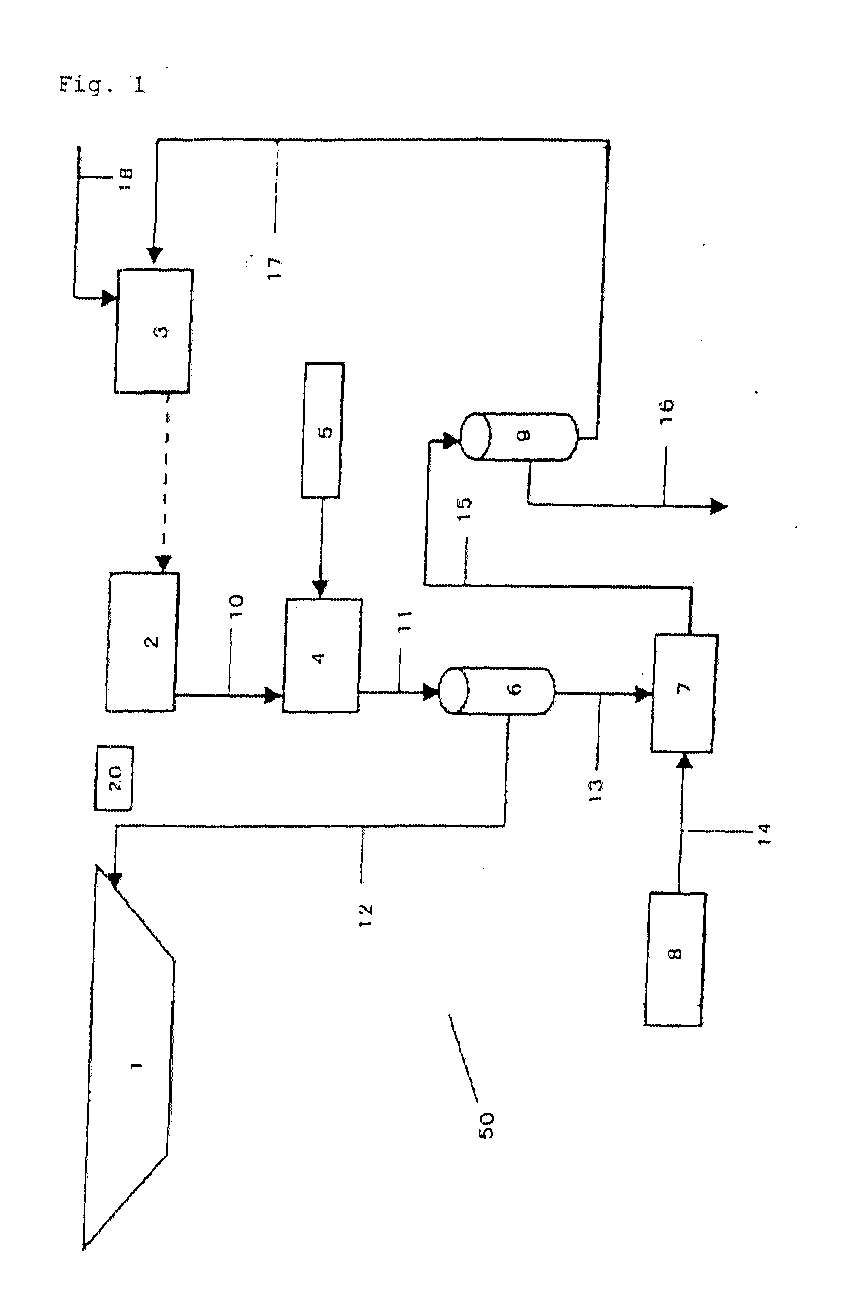
- Fig. 1 is a flow diagram showing an embodiment of the apparatus for metal surface treatment in accordance with the present invention.
- the product is transported by conveyer means serially through the degreasing stage, aqueous cleaning stage, surface conditioning stage, chemical conversion stage, and post-conversion aqueous cleaning stage.
- the method for recovery of aqueous wash and the apparatus for metal surface treatment both in accordance with the present invention, pertain to said chemical conversion treatment stage and post-conversion aqueous cleaning stage.
- Fig. 1 shows an example of the apparatus for metal surface treatment according to the invention.
- a shaped metal product undergoing the conventional degreasing, post-degreasing aqueous cleaning and surface conditioning is dipped in a chemical conversion solution in a boat-shaped chemical conversion tank 1, in which said chemical conversion is carried out.
- the chemical conversion reagent solution for use in this process is not particularly restricted as far as it contains a phosphate but may for example be a zinc phosphate agent.
- the shaped metal product 20 subjected to this chemical conversion treatment is transported by conveyer means to an aqueous cleaning stage comprising a plurality of cleaning tanks, namely a first cleaning tank 2 ⁇ a last cleaning tank 3, where it is invariably cleaned with water.
- This cleaning can be carried out by the full-dip method, the spray method, or a combination thereof.
- the last cleaning tank may be provided with a mist sprayer or the like.
- the last cleaning tank 3 is supplied with a predetermined amount of fresh cleaning water through a pipe 18 and the water so supplied overflows to the preceding cleaning tank and finally reaches the first cleaning tank 2 (indicated by the dot line in the figure).
- the amount of fresh aqueous wash is so selected that the concentration of the chemical conversion agent in said first cleaning tank 2 will be equivalent to a 10-fold dilution of the original chemical conversion agent.
- the cleaning water overflowing the first cleaning tank 2 is fed through a piping 10 to a pH adjusting tank 4.
- the water is adjusted to a pH value within the range of, preferably, 2.0 to 3.0 with an acid stored in a pH control agent reservoir 5. Adjusting the pH to less than 2.0 is objectionable for the water exerts a deleterious effect on the reverse osmosis membrane. Exceeding pH 3.0 is also objectionable, for zinc phosphate and other precipitates are deposited on the reverse osmosis membrane.
- the acid mentioned above may be an aqueous solution of at least one of phosphoric acid, nitric acid, hydrofluoric acid, hydrosilicofluoric acid, and hydrofluoroboric acid, although an aqueous solution of phosphoric acid is preferred.
- the pH-adjusted water is fed through a piping 11 to the first reverse osmosis membrane module 6.
- the pH-adjusted water is subjected to reverse osmosis to give a first filtrate and a first concentrate.
- the first concentrate is withdrawn through a concentrate withdrawal pipe 12 connected at one end to the concentrate outlet of the first reverse osmosis membrane module 6 and fed to the chemical conversion tank 1, whereby it is reutilized as a chemical conversion agent.
- the first filtrate is fed to an alkaline neutralizing tank 7 through a first filtrate withdrawal line 13 connected at one end to the filtrate outlet of said first reverse osmosis membrane module.
- the reverse osmosis membrane of said first module has a sodium chloride rejection rate of not less than 50% as determined under the conditions of pressure 1.47 MPa, 1500 ppm NaCl in water and pH 6.5.
- the upper limit if imposed, may be not more than 99.5%. When this limit is exceeded, nitrate and sodium ions hardly permeate through the membrane.
- an aqueous solution of the alkali stored in the alkali reservoir 8 is introduced through a pipeline 14 to neutralize the first filtrate to pH 6.0 to 8.0.
- the alkali may for example be sodium hydroxide or potassium hydroxide, and is preferably sodium hydroxide.
- the first filtrate neutralized in the alkali neutralizing tank 7 is fed to a second reverse osmosis membrane module 9 through a pipeline 15.
- the neutralized first filtrate is fractionated by the second reverse osmosis membrane of the module 9 into a second concentrate and a second filtrate.
- the second concentrate is discarded from the system through a discharge line 16.
- This second concentrate to be discarded is the water obtained by the neutralization and concentration of the acidic filtrate available from the first reverse osmosis membrane treatment, thus being water substantially free of the heavy metal and other substances derived from the main components of the chemical conversion reagent and its volume having been reduced to only as small as about one-tenth, at most, of the volume of the washes withdrawn. Therefore, this water can be pooled with other plant effluents and easily treated together without imposing any substantial burden on waste disposal.
- the second filtrate has an electrical conductivity of about several tens of ⁇ S/cm and can be utilized as cleaning water without an untoward effect.
- This second filtrate is fed to a an arbitrary stage-cleaning tank, preferably said last cleaning bath tank 3 as fresh aqueous wash through a second filtrate withdrawal pipeline 17 connected at one end to the filtrate outlet of said second reverse osmosis membrane module 9.
- the second filtrate may be optionally pooled once, subjected to a higher-order treatment such as ion exchange treatment, and reused.
- the method for recovery of aqueous wash according to the present invention utilizes the first concentrate and the second filtrate and the recovery rate may be as high as not less than 90% of the volume of the cleaning water.
- the useful components in the washes can be efficiently recovered and, at the same time, a filtrate water of high quality could be obtained by adjusting the pH of the washes and of the filtrate.
- a zinc phosphate chemical conversion solution (5 L) of the ion composition shown in Table 1 was diluted with 45 L of industrial water (pH 6.8) having an electrical conductivity of 234 ⁇ S/cm and the dilution was used as a model water overflowing the first cleaning tank.
- This model aqueous wash was adjusted to pH 2.5 with phosphoric acid and subjected to a first reverse osmosis membrane treatment with Membrane Master RUW-5A (Nitto Denko) using a commercial LF10 membrane module under the conditions of treating temperature: 25 to 30 °C, pressure: 1.0 to 1.1 MPa, concentrate recycling flow rate: 6.2 to 6.3 L/min, filtrate flow rate 0.3 to 0.6 L/min to give 5 L of a first concentrate and 45 L of a first filtrate.
- the first filtrate thus obtained was adjusted to pH 6.2 with an aqueous solution of sodium hydroxide and subjected to a second reverse osmosis membrane treatment using Membrane Master RUW-5A (Nitto Denko) having a commercial ES20 membrane module as the second reverse osmosis membrane module under the conditions of treating temperature: 25 to 30 °C, pressure: 1.1 to 1.2 MPa, concentrate recycling flow rate: 6.1 to 6.2 L/min, and filtrate flow rate: 1.2 to 1.4 L/min to give 4.5 L of a second concentrate and 40.5 L of a second filtrate.
- the analyzed ion compositions of the first filtrate, first concentrate, second filtrate and second concentrate are shown in Table 1.
- the first concentrate obtained could be reused as the chemical conversion agent and the second filtrate could be reused as aqueous wash.
- the electrical conductivity was measured with Conductivity Meter DS-12 (Horiba) and the ion concentration was measured with Ion Chromatograph Series 4000 (Dionex) or Atomic Absorption Spectrometer 3300 (Perkin Elmer).
- the phosphate chemical conversion agents (5 L each) of the ion compositions indicated in Tables 2 and 3 were respectively diluted with 45 L of the same industrial water as used in Example 1 and the dilutions were used as model waters overflowing the first cleaning tank. Except that each model water was adjusted and neutralized to the pH value indicated in Table 2 or 3, the procedure of Example 1 was otherwise repeated.
- the ion compositions are shown in Tables 2 and 3. As in Example 1, a concentrate which could be reused as a chemical conversion agent and a filtrate which could be reused as an aqueous wash were obtained.
- Example 2 The same model water as used in Example 1 was adjusted to the pH values shown in Table 4 and subjected to the first reverse osmosis membrane treatment in the same manner as in Example 1. The results are shown in Table 4. pH as adjusted 3.1 3.0 2.9 pH of the first concentrate 3.4 3.3 3.3 pH of the second concentrate 2.8 2.7 2.5 Formation of crystalline precipitates Some None None
- Example 1 The first filtrate in Example 1 was adjusted to the pH values indicated in Table 5 and subjected to the second reverse osmosis membrane treatment as in Example 1. The results are shown in Table 5. pH as adjusted Electrical conductivity ( ⁇ S/cm) Relative electrical conductivity, filtrate/aqueous wash (%) Aqueous wash Filtrate water 2.5 1046 655 39.2 3.0 609 390 37.2 4.0 451 106 79.2 6.0 453 43 91.8 7.0 471 21.9 96.0 8.0 479 8.7 98.2
Landscapes
- Chemical & Material Sciences (AREA)
- General Chemical & Material Sciences (AREA)
- Chemical Kinetics & Catalysis (AREA)
- Engineering & Computer Science (AREA)
- Materials Engineering (AREA)
- Mechanical Engineering (AREA)
- Metallurgy (AREA)
- Organic Chemistry (AREA)
- Separation Using Semi-Permeable Membranes (AREA)
- Chemical Treatment Of Metals (AREA)
- Cleaning And De-Greasing Of Metallic Materials By Chemical Methods (AREA)
Abstract
said second concentrate being discarded from the system.
Description
and a filtrate from said second reverse osmosis membrane module may be recycled as aqueous wash for aqueous cleaning.


| pH as adjusted | 3.1 | 3.0 | 2.9 |
| pH of the first concentrate | 3.4 | 3.3 | 3.3 |
| pH of the second concentrate | 2.8 | 2.7 | 2.5 |
| Formation of crystalline precipitates | Some | None | None |
| pH as adjusted | Electrical conductivity (µS/cm) | Relative electrical conductivity, filtrate/aqueous wash (%) | |
| Aqueous wash | Filtrate water | ||
| 2.5 | 1046 | 655 | 39.2 |
| 3.0 | 609 | 390 | 37.2 |
| 4.0 | 451 | 106 | 79.2 |
| 6.0 | 453 | 43 | 91.8 |
| 7.0 | 471 | 21.9 | 96.0 |
| 8.0 | 479 | 8.7 | 98.2 |
Claims (5)
- A method for recovery of aqueous wash in a phosphate chemical conversion of a shaped metal product involving carrying out chemical conversion and subsequent cleaning with water,wherein said cleaning with water is performed in one or more stages and comprisesa step of withdrawing aqueous wash from a first cleaning stage and adjusting the pH of the wash with at least one acid selected from the group consisting of phosphoric acid, nitric acid, hydrofluoric acid, hydrosilicofluoric acid and fluoroboric acid,a step of treating said pH-adjusted aqueous wash with a first reverse osmosis membrane to separate it into a first filtrate and a first concentrate, anda step of neutralizing said first filtrate with an alkali and treating the alkali-neutralized filtrate with a second reverse osmosis membrane to separate it into a second filtrate and a second concentrate,said first concentrate being recycled for said phosphate chemical conversion,said second filtrate being recycled as aqueous wash for said aqueous cleaning, andsaid second concentrate being discarded from the system.
- The method for recovery of aqueous wash in a phosphate chemical conversion according to Claim 1wherein, in said pH adjusting step, phosphoric acid is used as the acidand the pH is adjusted to 2.0 to 3.0.
- An apparatus for metal surface treatment for use in a phosphate chemical conversion of a shaped metal product, which comprisesa phosphate chemical conversion means,a means for performing aqueous cleaning in one or more stages,a means for withdrawing aqueous wash from a first stage of said aqueous cleaning means and adjusting the pH of aqueous wash with an acid selected from the group consisting of phosphoric acid, nitric acid, hydrofluoric acid, hydrosilicofluoric acid and fluoroboric acid,a first reverse osmosis membrane module for treating the pH-adjusted aqueous wash,a means for alkaline neutralization of a filtrate from said first reverse osmosis membrane module, anda second reverse osmosis membrane module for treating the alkaline-neutralized filtrate.
- The apparatus for metal surface treatment according to Claim 3wherein a concentrate from said first reverse osmosis membrane module is recycled for said phosphate chemical conversionand a filtrate from said second reverse osmosis membrane module is recycled as aqueous wash for aqueous cleaning.
- The apparatus for metal surface treatment according to Claim 4
wherein said aqueous wash recycled is from the last stage of aqueous cleaning.
Applications Claiming Priority (2)
| Application Number | Priority Date | Filing Date | Title |
|---|---|---|---|
| JP35052499 | 1999-12-09 | ||
| JP35052499A JP3742264B2 (en) | 1999-12-09 | 1999-12-09 | Flushing water recovery method and metal surface treatment apparatus for phosphate coating conversion treatment |
Publications (4)
| Publication Number | Publication Date |
|---|---|
| EP1106711A2 true EP1106711A2 (en) | 2001-06-13 |
| EP1106711A3 EP1106711A3 (en) | 2002-07-17 |
| EP1106711A9 EP1106711A9 (en) | 2002-11-20 |
| EP1106711B1 EP1106711B1 (en) | 2004-04-14 |
Family
ID=18411091
Family Applications (1)
| Application Number | Title | Priority Date | Filing Date |
|---|---|---|---|
| EP00403454A Expired - Lifetime EP1106711B1 (en) | 1999-12-09 | 2000-12-08 | Method for recovery of aqueous wash in phosphate chemical conversion and apparatus for metal surface treatment |
Country Status (7)
| Country | Link |
|---|---|
| US (1) | US6391206B2 (en) |
| EP (1) | EP1106711B1 (en) |
| JP (1) | JP3742264B2 (en) |
| KR (1) | KR100738270B1 (en) |
| CN (1) | CN1184350C (en) |
| CA (1) | CA2328039C (en) |
| DE (1) | DE60009841T2 (en) |
Cited By (3)
| Publication number | Priority date | Publication date | Assignee | Title |
|---|---|---|---|---|
| WO2002101115A1 (en) * | 2001-06-08 | 2002-12-19 | Henkel Kommanditgesellschaft Auf Aktien | Preventing a membrane from blocking up during the treatment of waste water during phosphatization |
| WO2004063424A3 (en) * | 2003-01-13 | 2004-12-02 | Henkel Kgaa | Two-stage or multi-stage method for treating phosphated rinsing water using a membrane |
| WO2020192843A3 (en) * | 2019-03-22 | 2020-11-19 | Dürr Systems Ag | Method for operating a treatment system, treatment system, and use of a treatment system |
Families Citing this family (13)
| Publication number | Priority date | Publication date | Assignee | Title |
|---|---|---|---|---|
| JP3742264B2 (en) * | 1999-12-09 | 2006-02-01 | 日本ペイント株式会社 | Flushing water recovery method and metal surface treatment apparatus for phosphate coating conversion treatment |
| US20030168406A1 (en) * | 2000-06-30 | 2003-09-11 | Kouryo Itoh | Method and apparatus for treatment of waste water from cationic electrodeposition coating process |
| JP4490565B2 (en) * | 2000-09-19 | 2010-06-30 | 日本ペイント株式会社 | Method for recovering treatment agent components in metal surface treated rinse water |
| JP4728503B2 (en) * | 2001-05-07 | 2011-07-20 | 日本ペイント株式会社 | Washing water treatment method and treatment apparatus for phosphate film chemical conversion treatment |
| EP1293589A3 (en) * | 2001-09-17 | 2004-10-13 | Nissan Motor Company, Limited | Apparatus for pretreatment prior to painting |
| JP4630157B2 (en) * | 2005-08-23 | 2011-02-09 | 日本パーカライジング株式会社 | Method of recovering chemical conversion liquid components in chemical conversion treatment |
| JP5041700B2 (en) * | 2005-11-28 | 2012-10-03 | 日本パーカライジング株式会社 | Method for producing material with phosphate coating |
| US8206592B2 (en) * | 2005-12-15 | 2012-06-26 | Siemens Industry, Inc. | Treating acidic water |
| US7510654B2 (en) * | 2005-12-29 | 2009-03-31 | Spf Innovations, Llc | Method and apparatus for the filtration of biological samples |
| JP5277559B2 (en) * | 2007-03-30 | 2013-08-28 | 栗田工業株式会社 | Method and apparatus for recovering phosphoric acid from phosphoric acid-containing water |
| KR101621835B1 (en) * | 2008-03-26 | 2016-05-31 | 쿠리타 고교 가부시키가이샤 | Process and equipment for recovering phosphoric acid from phosphoric acid-containing water |
| CN104099607A (en) * | 2014-07-29 | 2014-10-15 | 安徽省宁国市东波紧固件有限公司 | Steel wire workpiece phosphatizing system |
| WO2019018387A1 (en) * | 2017-07-18 | 2019-01-24 | Ecolab USA, Inc. | Recycling automotive phosphate rinse water stream |
Family Cites Families (9)
| Publication number | Priority date | Publication date | Assignee | Title |
|---|---|---|---|---|
| JPS5910430B2 (en) * | 1976-04-19 | 1984-03-08 | 日本ペイント株式会社 | Phosphate film chemical conversion treatment method |
| JPH0783872B2 (en) * | 1990-12-14 | 1995-09-13 | 株式会社メイシン | Wastewater treatment method |
| US5348558A (en) * | 1992-04-23 | 1994-09-20 | Mitsubishi Denki Kabushiki Kaisha | Layout pattern generating apparatus |
| US5776351A (en) * | 1994-04-20 | 1998-07-07 | Mcginness; Michael P. | Method for regeneration and closed loop recycling of contaminated cleaning solution |
| US5766479A (en) * | 1995-08-07 | 1998-06-16 | Zenon Environmental Inc. | Production of high purity water using reverse osmosis |
| JPH09206749A (en) * | 1996-02-02 | 1997-08-12 | Japan Organo Co Ltd | Fresh water production device and method thereof |
| DE19743933B4 (en) * | 1997-10-04 | 2009-11-19 | Volkswagen Ag | Process for the surface treatment of solid bodies, in particular motor vehicle bodies |
| US6284059B1 (en) * | 1998-08-06 | 2001-09-04 | Trn Business Trust | Cleaning and conversion coating of hot rolled steel articles |
| JP3742264B2 (en) * | 1999-12-09 | 2006-02-01 | 日本ペイント株式会社 | Flushing water recovery method and metal surface treatment apparatus for phosphate coating conversion treatment |
-
1999
- 1999-12-09 JP JP35052499A patent/JP3742264B2/en not_active Expired - Fee Related
-
2000
- 2000-12-08 CN CNB001349686A patent/CN1184350C/en not_active Expired - Fee Related
- 2000-12-08 KR KR1020000074455A patent/KR100738270B1/en not_active Expired - Fee Related
- 2000-12-08 CA CA002328039A patent/CA2328039C/en not_active Expired - Fee Related
- 2000-12-08 EP EP00403454A patent/EP1106711B1/en not_active Expired - Lifetime
- 2000-12-08 DE DE60009841T patent/DE60009841T2/en not_active Expired - Fee Related
- 2000-12-11 US US09/732,867 patent/US6391206B2/en not_active Expired - Lifetime
Cited By (3)
| Publication number | Priority date | Publication date | Assignee | Title |
|---|---|---|---|---|
| WO2002101115A1 (en) * | 2001-06-08 | 2002-12-19 | Henkel Kommanditgesellschaft Auf Aktien | Preventing a membrane from blocking up during the treatment of waste water during phosphatization |
| WO2004063424A3 (en) * | 2003-01-13 | 2004-12-02 | Henkel Kgaa | Two-stage or multi-stage method for treating phosphated rinsing water using a membrane |
| WO2020192843A3 (en) * | 2019-03-22 | 2020-11-19 | Dürr Systems Ag | Method for operating a treatment system, treatment system, and use of a treatment system |
Also Published As
| Publication number | Publication date |
|---|---|
| CA2328039C (en) | 2008-04-29 |
| CN1184350C (en) | 2005-01-12 |
| DE60009841T2 (en) | 2005-03-31 |
| EP1106711A9 (en) | 2002-11-20 |
| JP3742264B2 (en) | 2006-02-01 |
| US6391206B2 (en) | 2002-05-21 |
| KR20010062232A (en) | 2001-07-07 |
| KR100738270B1 (en) | 2007-07-12 |
| EP1106711A3 (en) | 2002-07-17 |
| CA2328039A1 (en) | 2001-06-09 |
| CN1309193A (en) | 2001-08-22 |
| US20010017282A1 (en) | 2001-08-30 |
| EP1106711B1 (en) | 2004-04-14 |
| JP2001164389A (en) | 2001-06-19 |
| DE60009841D1 (en) | 2004-05-19 |
Similar Documents
| Publication | Publication Date | Title |
|---|---|---|
| EP1106711B1 (en) | Method for recovery of aqueous wash in phosphate chemical conversion and apparatus for metal surface treatment | |
| DE102016115393A1 (en) | Method and device for the treatment of organically polluted wastewater and / or organically contaminated wet waste, in particular for the treatment of Sanitärabwasser in trains | |
| CN114075011B (en) | Treatment method and system for clean wastewater of coal-to-methanol process | |
| DE10256884A1 (en) | Process for phosphating metal surfaces with improved phosphate recovery | |
| DE2527853B2 (en) | Process for improving the water balance in the phosphating of metals | |
| JP4728503B2 (en) | Washing water treatment method and treatment apparatus for phosphate film chemical conversion treatment | |
| US4812240A (en) | Process for treating waste water contaminated with manganese | |
| EP1392887B1 (en) | Preventing a membrane from blocking up during the treatment of waste water during phosphatization | |
| JP4098669B2 (en) | Recovery and reuse of phosphate chemical conversion solution | |
| DE4229061C2 (en) | Process for the recovery of aqueous process liquids from surface treatment baths | |
| EP3487639A1 (en) | Method for cleaning a synthetic surface | |
| KR20010106235A (en) | Metal surface-treating method | |
| DE4200849A1 (en) | Conditioning of rinse water from chemical and/or electrolytic surface treatment - includes passing rinse water from 1st tank of multistage rinse to electrodialysis unit and concentrate to treatment bath via selective ion exchanger and/or evaporator | |
| DE19743933B4 (en) | Process for the surface treatment of solid bodies, in particular motor vehicle bodies | |
| CN114230050B (en) | Cold rolling pickling wastewater treatment method and system | |
| DE3822953A1 (en) | Process for regenerating an iron- and/or zinc-containing hydrochloric acid bath | |
| DE2256965A1 (en) | PROCESS FOR MULTI-STAGE SURFACE TREATMENT OF METALS | |
| DE102018130593A1 (en) | Surface treatment plant, preconditioning device and method for processing process medium and / or rinsing medium | |
| CN119080347A (en) | A method for purifying and recycling pickling wastewater | |
| WO2003078684A1 (en) | Method for the phosphating of metal surfaces with improved recovery of valuable substances | |
| CN110777371B (en) | Surface treatment device, pretreatment device and method for treating working and/or rinsing medium | |
| GB1563480A (en) | Method for decontaminating the aqueous effluents | |
| DE10236293A1 (en) | Process for phosphating metal surfaces with improved recovery of valuable materials | |
| DE10341232A1 (en) | Process for phosphate coating metal surfaces comprises treating a part of the cleaning solution and/or rinsing water with a cation exchanger and regenerating the exchanger after charging with acid | |
| JPS58193378A (en) | Treatment of hydrochloric acid pickling liquid for special steel |
Legal Events
| Date | Code | Title | Description |
|---|---|---|---|
| PUAI | Public reference made under article 153(3) epc to a published international application that has entered the european phase |
Free format text: ORIGINAL CODE: 0009012 |
|
| AK | Designated contracting states |
Kind code of ref document: A2 Designated state(s): AT BE CH CY DE DK ES FI FR GB GR IE IT LI LU MC NL PT SE TR |
|
| AX | Request for extension of the european patent |
Free format text: AL;LT;LV;MK;RO;SI |
|
| PUAL | Search report despatched |
Free format text: ORIGINAL CODE: 0009013 |
|
| AK | Designated contracting states |
Kind code of ref document: A3 Designated state(s): AT BE CH CY DE DK ES FI FR GB GR IE IT LI LU MC NL PT SE TR |
|
| AX | Request for extension of the european patent |
Free format text: AL;LT;LV;MK;RO;SI |
|
| RIC1 | Information provided on ipc code assigned before grant |
Free format text: 7C 23C 22/86 A, 7C 23C 22/00 B, 7C 02F 1/44 B, 7B 01D 61/04 B, 7B 01D 61/02 B |
|
| RIN1 | Information on inventor provided before grant (corrected) |
Inventor name: TOSHIYUKI, KAWASHIMA Inventor name: NAOKI, TADA Inventor name: HIDEAKI, MORITA Inventor name: SEHCHIRO, SHIRAHATA Inventor name: YUTAKA, OHASHI Inventor name: SYOJI, SHIRAISHI Inventor name: HIROSHI, CHIHARA |
|
| RIN1 | Information on inventor provided before grant (corrected) |
Inventor name: TOSHIYUKI, KAWASHIMA Inventor name: NAOKI, TADA Inventor name: SYOJI, SHIRAISHI Inventor name: HIROSHI, CHIHARA Inventor name: SEIICHIRO, SHIRAHATA Inventor name: HIDEAKI, MORITA Inventor name: YUTAKA, OHASHI |
|
| 17P | Request for examination filed |
Effective date: 20021206 |
|
| AKX | Designation fees paid |
Designated state(s): DE FR GB IT |
|
| GRAP | Despatch of communication of intention to grant a patent |
Free format text: ORIGINAL CODE: EPIDOSNIGR1 |
|
| GRAS | Grant fee paid |
Free format text: ORIGINAL CODE: EPIDOSNIGR3 |
|
| GRAA | (expected) grant |
Free format text: ORIGINAL CODE: 0009210 |
|
| AK | Designated contracting states |
Kind code of ref document: B1 Designated state(s): DE FR GB IT |
|
| REG | Reference to a national code |
Ref country code: GB Ref legal event code: FG4D |
|
| REF | Corresponds to: |
Ref document number: 60009841 Country of ref document: DE Date of ref document: 20040519 Kind code of ref document: P |
|
| REG | Reference to a national code |
Ref country code: IE Ref legal event code: FG4D |
|
| ET | Fr: translation filed | ||
| PLBE | No opposition filed within time limit |
Free format text: ORIGINAL CODE: 0009261 |
|
| STAA | Information on the status of an ep patent application or granted ep patent |
Free format text: STATUS: NO OPPOSITION FILED WITHIN TIME LIMIT |
|
| 26N | No opposition filed |
Effective date: 20050117 |
|
| PGFP | Annual fee paid to national office [announced via postgrant information from national office to epo] |
Ref country code: DE Payment date: 20061130 Year of fee payment: 7 |
|
| PGFP | Annual fee paid to national office [announced via postgrant information from national office to epo] |
Ref country code: GB Payment date: 20061206 Year of fee payment: 7 |
|
| PGFP | Annual fee paid to national office [announced via postgrant information from national office to epo] |
Ref country code: IT Payment date: 20061231 Year of fee payment: 7 |
|
| GBPC | Gb: european patent ceased through non-payment of renewal fee |
Effective date: 20071208 |
|
| PG25 | Lapsed in a contracting state [announced via postgrant information from national office to epo] |
Ref country code: DE Free format text: LAPSE BECAUSE OF NON-PAYMENT OF DUE FEES Effective date: 20080701 |
|
| PG25 | Lapsed in a contracting state [announced via postgrant information from national office to epo] |
Ref country code: GB Free format text: LAPSE BECAUSE OF NON-PAYMENT OF DUE FEES Effective date: 20071208 |
|
| PG25 | Lapsed in a contracting state [announced via postgrant information from national office to epo] |
Ref country code: IT Free format text: LAPSE BECAUSE OF NON-PAYMENT OF DUE FEES Effective date: 20071208 |
|
| REG | Reference to a national code |
Ref country code: FR Ref legal event code: PLFP Year of fee payment: 16 |
|
| REG | Reference to a national code |
Ref country code: FR Ref legal event code: PLFP Year of fee payment: 17 |
|
| PGFP | Annual fee paid to national office [announced via postgrant information from national office to epo] |
Ref country code: FR Payment date: 20161111 Year of fee payment: 17 |
|
| REG | Reference to a national code |
Ref country code: FR Ref legal event code: ST Effective date: 20180831 |
|
| PG25 | Lapsed in a contracting state [announced via postgrant information from national office to epo] |
Ref country code: FR Free format text: LAPSE BECAUSE OF NON-PAYMENT OF DUE FEES Effective date: 20180102 |