EP1106705B1 - Stainless steel for brake disc excellent in resistance to temper softening - Google Patents
Stainless steel for brake disc excellent in resistance to temper softening Download PDFInfo
- Publication number
- EP1106705B1 EP1106705B1 EP00118240A EP00118240A EP1106705B1 EP 1106705 B1 EP1106705 B1 EP 1106705B1 EP 00118240 A EP00118240 A EP 00118240A EP 00118240 A EP00118240 A EP 00118240A EP 1106705 B1 EP1106705 B1 EP 1106705B1
- Authority
- EP
- European Patent Office
- Prior art keywords
- hardness
- resistance
- brake disc
- temper softening
- steel
- Prior art date
- Legal status (The legal status is an assumption and is not a legal conclusion. Google has not performed a legal analysis and makes no representation as to the accuracy of the status listed.)
- Expired - Lifetime
Links
Images
Classifications
-
- C—CHEMISTRY; METALLURGY
- C22—METALLURGY; FERROUS OR NON-FERROUS ALLOYS; TREATMENT OF ALLOYS OR NON-FERROUS METALS
- C22C—ALLOYS
- C22C38/00—Ferrous alloys, e.g. steel alloys
- C22C38/18—Ferrous alloys, e.g. steel alloys containing chromium
- C22C38/40—Ferrous alloys, e.g. steel alloys containing chromium with nickel
- C22C38/58—Ferrous alloys, e.g. steel alloys containing chromium with nickel with more than 1.5% by weight of manganese
-
- C—CHEMISTRY; METALLURGY
- C21—METALLURGY OF IRON
- C21D—MODIFYING THE PHYSICAL STRUCTURE OF FERROUS METALS; GENERAL DEVICES FOR HEAT TREATMENT OF FERROUS OR NON-FERROUS METALS OR ALLOYS; MAKING METAL MALLEABLE, e.g. BY DECARBURISATION OR TEMPERING
- C21D6/00—Heat treatment of ferrous alloys
- C21D6/002—Heat treatment of ferrous alloys containing Cr
-
- C—CHEMISTRY; METALLURGY
- C22—METALLURGY; FERROUS OR NON-FERROUS ALLOYS; TREATMENT OF ALLOYS OR NON-FERROUS METALS
- C22C—ALLOYS
- C22C38/00—Ferrous alloys, e.g. steel alloys
- C22C38/001—Ferrous alloys, e.g. steel alloys containing N
-
- C—CHEMISTRY; METALLURGY
- C22—METALLURGY; FERROUS OR NON-FERROUS ALLOYS; TREATMENT OF ALLOYS OR NON-FERROUS METALS
- C22C—ALLOYS
- C22C38/00—Ferrous alloys, e.g. steel alloys
- C22C38/18—Ferrous alloys, e.g. steel alloys containing chromium
- C22C38/40—Ferrous alloys, e.g. steel alloys containing chromium with nickel
- C22C38/42—Ferrous alloys, e.g. steel alloys containing chromium with nickel with copper
-
- C—CHEMISTRY; METALLURGY
- C22—METALLURGY; FERROUS OR NON-FERROUS ALLOYS; TREATMENT OF ALLOYS OR NON-FERROUS METALS
- C22C—ALLOYS
- C22C38/00—Ferrous alloys, e.g. steel alloys
- C22C38/18—Ferrous alloys, e.g. steel alloys containing chromium
- C22C38/40—Ferrous alloys, e.g. steel alloys containing chromium with nickel
- C22C38/44—Ferrous alloys, e.g. steel alloys containing chromium with nickel with molybdenum or tungsten
-
- C—CHEMISTRY; METALLURGY
- C22—METALLURGY; FERROUS OR NON-FERROUS ALLOYS; TREATMENT OF ALLOYS OR NON-FERROUS METALS
- C22C—ALLOYS
- C22C38/00—Ferrous alloys, e.g. steel alloys
- C22C38/18—Ferrous alloys, e.g. steel alloys containing chromium
- C22C38/40—Ferrous alloys, e.g. steel alloys containing chromium with nickel
- C22C38/48—Ferrous alloys, e.g. steel alloys containing chromium with nickel with niobium or tantalum
Definitions
- the present invention relates to a stainless steel, for a brake disc, excellent in resistance to temper softening and, more specifically, to a martensitic stainless steel having excellent resistance to softening resulting from heat generation caused by braking, as well as satisfying the hardness, hardenability and rusting resistance required of a material for a brake disc of a two-wheeled vehicle, a snowmobile or the like.
- a material for a brake disc of a two-wheeled vehicle, etc. is required to have properties such as abrasion resistance, rusting resistance and toughness and a JIS SUS410 type martensitic stainless steel has been mainly used for such applications.
- abrasion resistance is generally improved as hardness is increased, so-called brake noise is generated, by the contact between brake and pads, when the hardness is too high.
- the hardness of a brake disc is, therefore, controlled to within a prescribed range.
- An object of the present invention is to provide a stainless steel for a brake disc less susceptible to deterioration of material properties, especially the deterioration of hardness, when heated to a temperature exceeding 500°C during braking, while maintaining the abrasion resistance, rusting resistance and toughness of a conventional steel.
- the present inventors investigated and experimentally studied chemical compositions and additive elements which do not impair the original properties required of a brake disc and do not significantly increase the cost.
- the present inventors found that the temper softening temperature for lowering the hardness to below 30 HRC (Rockwell hardness C scale) can be increased by 30° to 100°C or more by restricting the range of chemical composition so as to maintain the hardness after quenching, which relates to the abrasion resistance, in the range of 30 to 40 HRC, preferably 32 to 38 HRC and so as not to deteriorate rusting resistance and toughness, and then by adding an appropriate amount of Nb which suppresses temper softening.
- HRC Rockwell hardness C scale
- C is an indispensable element to obtain a prescribed hardness after quenching and, hence, is added in combination with N so that the desired hardness level is achieved.
- the upper limit is set at 0.1%.
- the lower limit is set at 0.01%.
- N is, like C, an indispensable element to obtain a prescribed hardness after quenching and, hence, is added in combination with C so that the desired hardness level is achieved.
- the upper limit is set at 0.03%.
- Si which is inevitably included in steel, is effective as a deoxidizing agent.
- its addition beyond 1% markedly lowers toughness after quenching heat treatment and therefore the upper limit is set at 1%.
- Mn which is also inevitably included in steel, is an element effective to secure the austenite phase at a high temperature and to ensure hardenability.
- its addition above 2% deteriorates rusting resistance and therefore the upper limit is set at 2%.
- Ni which is inevitably included in a small quantity in steel during an industrial smelting process, is an element effective, like Mn, to secure the austenite phase at a high temperature and to ensure hardenability.
- the addition amount is set at less than 0.5%.
- Cr is one of the fundamental elements necessary for maintaining rusting resistance required of a brake disc for a two-wheeled vehicle, and if its content is less than 10% the required rusting resistance cannot be obtained. If more than 15% of Cr is added, on the other hand, the temperature range for forming the austenite phase narrows at a high temperature causing the formation of a ferrite phase, which does not transform into a martensite phase in the quenching temperature range, and thus the required hardness after quenching cannot be obtained. For that reason, the range of the Cr content is set at 10 to 15%.
- Nb is an important element for suppressing temper softening resulting from heat generation caused by braking and thus is an indispensable addition element to achieve the object of the present invention.
- it is necessary to add at least 0.02% of Nb, but an addition exceeding 0.5% results in the deterioration of toughness. For that reason, the upper limit is set at 0.5%.
- Nb suppresses the recovery phenomenon where the steel matrix softens due to the disappearance by heating of many dislocations formed during martensitic transformation and also, by forming fine Nb carbonitrides, suppresses softening due to the formation of coarse Cr carbonitrides.
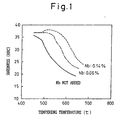
- Figure 1 shows the relationship between the tempering temperature and the hardness of the steels with the Nb addition of 0.06% and 0.14%, respectively (the steels are designated as D and E in Table 1 of Example 1), in comparison with a conventional steel without Nb addition (the steel is designated as X in Table 1 of Example 1). From the figure, it is confirmed that Nb addition in a small amount remarkably raises the temper softening temperature.
- the amount of C+N relates directly to hardness after quenching and, in order to control the hardness to a prescribed level, it is necessary to keep the amount in the range of 0.04% to 0.1%.
- Cu is, like Mn or Ni, an element effective to secure the austenite phase at a high temperature and to ensure hardenability, and significant effect is demonstrated with the addition of at least 0.1%.
- the addition amount exceeds 2%, however, the steel hardens during heating for tempering, resulting in a marked decrease in toughness. For this reason, the upper limit is set at 2%.
- Mo is, like Cr, an element which improves rusting resistance and further enhances the quality of a brake disc since it suppresses a decrease in toughness during tempering. To obtain these effects, it is necessary to add at least 0.1% of Mo. However, if more than 1% of Mo is added, like Cr, the temperature range for forming the austenite phase narrows at a high temperature causing formation of a ferrite phase, which does not transform into a martensite phase in a quenching temperature range, and thus the required hardness after quenching cannot be obtained.
- Ti, V or B do not have so remarkable effect on suppressing temper softening as Nb does.
- the effect of suppressing temper softening can be enhanced further.
- toughness deteriorates markedly, and thus these figures are determined to be the upper limits for these elements, respectively.
- ⁇ p expressed by the equation shown below is effective.
- the temperature range for forming the austenite phase at a high temperature can be secured by controlling the chemical composition so that ⁇ p calculated by the equation is 70 or higher.
- ⁇ p 420 x [%C] + 470 x [%N] + 23 x [%Ni] + 9 x [%Cu] + 7 x [%Mn] - 11.5 x [%Cr] - 11.5 x [%Si] - 12 x [%Mo] - 47 x [%Nb] - 52 x [%Al] - 49 x [%Ti] - 23 x [%V] - 500 x [%B] + 189
- the content of P be 0.05% or less since it deteriorates toughness during quenching and heating for tempering.
- Al is effective as a deoxidizing agent, if added excessively, it reacts with slag during smelting, resulting in the increase of CaS type inclusions in steel and causing rust generation. For this reason, it is desirable to control the content to 0.03% or less.
- Ingots having the chemical compositions shown in Table 1 were produced and hot rolled to a thickness of 5 mm. Then, after being heated to 850°C and subjected to heat treatment for softening by slow cooling, steel sheets were cut out for a variety of heat treatments. Each sheet was subsequently heated to 950°C by high frequency heating and was held for 10 min., and then was subjected to quenching heat treatment by water-cooling. Test pieces for hardness measurement, evaluation of rusting resistance and JIS No. 4 sub-size impact test were cut out from some of the as-quenched sheets. Other as-quenched sheets were further heated to 400° to 700°C, held for 1 hour and then subjected to heat treatment by air-cooling. Test pieces for hardness measurement to examine softening properties, evaluation of rusting resistance and JIS No. 4 sub-size impact test were, likewise, cut out from them.
- the softening properties were evaluated by the tempering temperature to soften the steel to less than 30 HRC by measuring hardness with the Rockwell hardness test method (JIS Z 2245).
- the rusting resistance was evaluated by polishing the surface of the test pieces to a roughness of No. 400 and subjecting them to a 100-hour salt spray test (JIS Z 2371).
- the toughness was evaluated by the Charpy impact value obtained from the Charpy impact test of the test pieces at a temperature of 25°C (JIS Z 2242). The results are shown in Table 2.
- every steel according to the present invention has a high temper softening temperature and the temper softening temperature for retaining the hardness of at least 30 HRC exceeds 530°C for every steel. Also, it can be seen that impact values and rusting resistance are excellent. In case of the comparative steels not containing Nb, the temper softening temperature is as low as around 580°C. Further, the other comparative steels with inappropriate addition amounts of Nb or inappropriate other components are not suitable as materials for brake discs because of insufficient hardness after quenching, low toughness, etc.
- the present invention can provide a steel having excellent resistance to temper softening resulting from heat generation caused by braking and, further, can provide the hardenability, rusting resistance and toughness required of a material for a brake disc, and thus is applicable to a brake disc for a two-wheeled vehicle for which a high braking capacity is required.
Landscapes
- Chemical & Material Sciences (AREA)
- Engineering & Computer Science (AREA)
- Mechanical Engineering (AREA)
- Materials Engineering (AREA)
- Metallurgy (AREA)
- Organic Chemistry (AREA)
- Physics & Mathematics (AREA)
- Thermal Sciences (AREA)
- Crystallography & Structural Chemistry (AREA)
- Braking Arrangements (AREA)
- Heat Treatment Of Articles (AREA)
- Heat Treatment Of Steel (AREA)
Description
- The present invention relates to a stainless steel, for a brake disc, excellent in resistance to temper softening and, more specifically, to a martensitic stainless steel having excellent resistance to softening resulting from heat generation caused by braking, as well as satisfying the hardness, hardenability and rusting resistance required of a material for a brake disc of a two-wheeled vehicle, a snowmobile or the like.
- A material for a brake disc of a two-wheeled vehicle, etc., is required to have properties such as abrasion resistance, rusting resistance and toughness and a JIS SUS410 type martensitic stainless steel has been mainly used for such applications. Although abrasion resistance is generally improved as hardness is increased, so-called brake noise is generated, by the contact between brake and pads, when the hardness is too high. The hardness of a brake disc is, therefore, controlled to within a prescribed range.
- In order to stably control the hardness to within a prescribed range after quenching heat treatment and to ensure sufficient toughness and rusting resistance, the chemical compositions of steels with regulated amounts of Mn, Cu, etc., as well as C+N, are disclosed in Japanese Unexamined Patent Publications No. 57-198249 (US-A-4 452 649), No. 59-70748 and No. 10-152760 (US-A-5 979 614) and Japanese Published Patent No. 2-7390 (JP-A-61-174 361). Namely, these represent methods to obtain desired hardness after quenching by controlling the contents of C and N, preceded by sufficiently ensuring the austenite phase at a high temperature by controlling the contents of Mn and Cu in steel. Owing to these chemical compositions, it has been possible to provide materials for brake discs for two-wheeled vehicles satisfying abrasion resistance, rusting resistance and toughness.
- In the meantime, the performance of recent two-wheeled vehicles calls for higher braking force at higher speed and it is required that the material properties, especially hardness, of a brake disc do not deteriorate when the disc is heated to a temperature exceeding 500°C during braking. Since the above-mentioned steels have a matrix of martensitic phase, however, they undergo temper softening when heated to a temperature exceeding 500°C. And thus the development of a material for a brake disc satisfying the above requirements has been sought.
- An object of the present invention is to provide a stainless steel for a brake disc less susceptible to deterioration of material properties, especially the deterioration of hardness, when heated to a temperature exceeding 500°C during braking, while maintaining the abrasion resistance, rusting resistance and toughness of a conventional steel.
- In order to attain the above-mentioned object, the present inventors investigated and experimentally studied chemical compositions and additive elements which do not impair the original properties required of a brake disc and do not significantly increase the cost. As a result, the present inventors found that the temper softening temperature for lowering the hardness to below 30 HRC (Rockwell hardness C scale) can be increased by 30° to 100°C or more by restricting the range of chemical composition so as to maintain the hardness after quenching, which relates to the abrasion resistance, in the range of 30 to 40 HRC, preferably 32 to 38 HRC and so as not to deteriorate rusting resistance and toughness, and then by adding an appropriate amount of Nb which suppresses temper softening.
- The object is achieved with the features of the claims.
- The invention is further described with reference to the drawings, in which:
- Figure 1 is a graph showing the relationship between the tempering temperature and the hardness of the steels in which 0.06% and 0.14% of Nb is added, respectively, in comparison with a conventional steel in which Nb is not added.
-
- The embodiments and the restricting conditions of the present invention will be described in detail.
- C is an indispensable element to obtain a prescribed hardness after quenching and, hence, is added in combination with N so that the desired hardness level is achieved. However, since its addition beyond 0.1% raises the hardness excessively and causes drawbacks such as brake noise and the deterioration of toughness, the upper limit is set at 0.1%. On the other hand, when its amount is below 0.01% an excessive amount of N is required for obtaining the desired hardness and, for this reason, the lower limit is set at 0.01%.
- N is, like C, an indispensable element to obtain a prescribed hardness after quenching and, hence, is added in combination with C so that the desired hardness level is achieved. However, since its addition beyond 0.03% significantly deteriorates toughness due to the precipitation of fine Nb nitrides during heat generation caused by braking, the upper limit is set at 0.03%.
- Si, which is inevitably included in steel, is effective as a deoxidizing agent. However, its addition beyond 1% markedly lowers toughness after quenching heat treatment and therefore the upper limit is set at 1%.
- Mn, which is also inevitably included in steel, is an element effective to secure the austenite phase at a high temperature and to ensure hardenability. However, its addition above 2% deteriorates rusting resistance and therefore the upper limit is set at 2%.
- Ni, which is inevitably included in a small quantity in steel during an industrial smelting process, is an element effective, like Mn, to secure the austenite phase at a high temperature and to ensure hardenability. However, since its addition at 0.5% or more excessively stabilizes the austenite phase, quench hardening takes place even when slow cooling is applied after heat treatment making it difficult to realize temper softening during working into a brake disc. Therefore, the addition amount is set at less than 0.5%.
- Cr is one of the fundamental elements necessary for maintaining rusting resistance required of a brake disc for a two-wheeled vehicle, and if its content is less than 10% the required rusting resistance cannot be obtained. If more than 15% of Cr is added, on the other hand, the temperature range for forming the austenite phase narrows at a high temperature causing the formation of a ferrite phase, which does not transform into a martensite phase in the quenching temperature range, and thus the required hardness after quenching cannot be obtained. For that reason, the range of the Cr content is set at 10 to 15%.
- Nb is an important element for suppressing temper softening resulting from heat generation caused by braking and thus is an indispensable addition element to achieve the object of the present invention. In order to demonstrate the effect, it is necessary to add at least 0.02% of Nb, but an addition exceeding 0.5% results in the deterioration of toughness. For that reason, the upper limit is set at 0.5%.
- It is considered that the effect of Nb on suppressing temper softening is obtained in the way that Nb suppresses the recovery phenomenon where the steel matrix softens due to the disappearance by heating of many dislocations formed during martensitic transformation and also, by forming fine Nb carbonitrides, suppresses softening due to the formation of coarse Cr carbonitrides.
- Figure 1 shows the relationship between the tempering temperature and the hardness of the steels with the Nb addition of 0.06% and 0.14%, respectively (the steels are designated as D and E in Table 1 of Example 1), in comparison with a conventional steel without Nb addition (the steel is designated as X in Table 1 of Example 1). From the figure, it is confirmed that Nb addition in a small amount remarkably raises the temper softening temperature.
- The amount of C+N relates directly to hardness after quenching and, in order to control the hardness to a prescribed level, it is necessary to keep the amount in the range of 0.04% to 0.1%.
- Cu is, like Mn or Ni, an element effective to secure the austenite phase at a high temperature and to ensure hardenability, and significant effect is demonstrated with the addition of at least 0.1%. When the addition amount exceeds 2%, however, the steel hardens during heating for tempering, resulting in a marked decrease in toughness. For this reason, the upper limit is set at 2%.
- Mo is, like Cr, an element which improves rusting resistance and further enhances the quality of a brake disc since it suppresses a decrease in toughness during tempering. To obtain these effects, it is necessary to add at least 0.1% of Mo. However, if more than 1% of Mo is added, like Cr, the temperature range for forming the austenite phase narrows at a high temperature causing formation of a ferrite phase, which does not transform into a martensite phase in a quenching temperature range, and thus the required hardness after quenching cannot be obtained.
- Ti, V or B do not have so remarkable effect on suppressing temper softening as Nb does. However, when a proper quantity is added in combination with Nb, the effect of suppressing temper softening can be enhanced further. To demonstrate the effect, it is necessary to add not less than 0.01% of Ti or V or not less than 0.0005% of B. However, if more than 0.5% of Ti or V or more than 0.01% of B is added, toughness deteriorates markedly, and thus these figures are determined to be the upper limits for these elements, respectively.
- The range of addition amount of each of the constituent elements and the reason for restricting the range are as described above.
- For stably retaining hardness after quenching within the prescribed range, in addition to the prescription of each of the constituent elements, it is necessary to control the balance of the chemical composition which influences the austenite range at a high temperature. As an index which determines the austenite range, γp expressed by the equation shown below is effective. The temperature range for forming the austenite phase at a high temperature can be secured by controlling the chemical composition so that γp calculated by the equation is 70 or higher. However, it is preferable to maintain the value of γp at 80 or higher for ensuring a sufficient quenching temperature range in industrial heat treatment and for stably retaining hardness after quenching within the prescribed range.
- As for other unavoidable impurities, it is desirable to control them within the following ranges:
- It is desirable that the contents of S and O be 0.02% or less since they cause rust by forming sulfides in the case of S and oxides in the case of O.
- It is desirable that the content of P be 0.05% or less since it deteriorates toughness during quenching and heating for tempering.
- Although Al is effective as a deoxidizing agent, if added excessively, it reacts with slag during smelting, resulting in the increase of CaS type inclusions in steel and causing rust generation. For this reason, it is desirable to control the content to 0.03% or less.
- Ingots having the chemical compositions shown in Table 1 were produced and hot rolled to a thickness of 5 mm. Then, after being heated to 850°C and subjected to heat treatment for softening by slow cooling, steel sheets were cut out for a variety of heat treatments. Each sheet was subsequently heated to 950°C by high frequency heating and was held for 10 min., and then was subjected to quenching heat treatment by water-cooling. Test pieces for hardness measurement, evaluation of rusting resistance and JIS No. 4 sub-size impact test were cut out from some of the as-quenched sheets. Other as-quenched sheets were further heated to 400° to 700°C, held for 1 hour and then subjected to heat treatment by air-cooling. Test pieces for hardness measurement to examine softening properties, evaluation of rusting resistance and JIS No. 4 sub-size impact test were, likewise, cut out from them.
- The softening properties were evaluated by the tempering temperature to soften the steel to less than 30 HRC by measuring hardness with the Rockwell hardness test method (JIS Z 2245). The rusting resistance was evaluated by polishing the surface of the test pieces to a roughness of No. 400 and subjecting them to a 100-hour salt spray test (JIS Z 2371). The toughness was evaluated by the Charpy impact value obtained from the Charpy impact test of the test pieces at a temperature of 25°C (JIS Z 2242). The results are shown in Table 2.
- From Table 2, it can be seen that every steel according to the present invention has a high temper softening temperature and the temper softening temperature for retaining the hardness of at least 30 HRC exceeds 530°C for every steel. Also, it can be seen that impact values and rusting resistance are excellent. In case of the comparative steels not containing Nb, the temper softening temperature is as low as around 580°C. Further, the other comparative steels with inappropriate addition amounts of Nb or inappropriate other components are not suitable as materials for brake discs because of insufficient hardness after quenching, low toughness, etc.
- The present invention can provide a steel having excellent resistance to temper softening resulting from heat generation caused by braking and, further, can provide the hardenability, rusting resistance and toughness required of a material for a brake disc, and thus is applicable to a brake disc for a two-wheeled vehicle for which a high braking capacity is required.


Claims (2)
- A martensitic stainless steel for a brake disc excellent in resistance to temper softening said steel contains, in terms of wt%,
C: 0.01 to 0.1%,
N: 0.03% or less,
C+N: 0.04 to 0.1%,
Si: 1% or less,
Mn: 2% or less,
Ni: less than 0.5%,
Cr: 10 to 15%,
Nb: 0.02 to 0.5%, and optionally at least one of the following elements:
Cu : 0.1 to 2%,
Mo: 0.1 to 1%,
Ti: 0.01 to 0.5%,
V: 0.01 to 0.5%, and
B: 0.0005 to 0.01%
with the balance Fe and unavoidable impurities; wherein the hardness after quenching heat treatment is in the range of 30 to 40 HRC; and the temper softening temperature for lowering the hardness to below 30 HRC is at least 530°C. - A stainless steel for a brake disc excellent in resistance to temper softening according to claim 1, characterized in that the value of γp calculated from steel chemical composition as expressed below is at least 70%.
Applications Claiming Priority (2)
| Application Number | Priority Date | Filing Date | Title |
|---|---|---|---|
| JP33966799 | 1999-11-30 | ||
| JP33966799 | 1999-11-30 |
Publications (2)
| Publication Number | Publication Date |
|---|---|
| EP1106705A1 EP1106705A1 (en) | 2001-06-13 |
| EP1106705B1 true EP1106705B1 (en) | 2003-12-03 |
Family
ID=18329675
Family Applications (1)
| Application Number | Title | Priority Date | Filing Date |
|---|---|---|---|
| EP00118240A Expired - Lifetime EP1106705B1 (en) | 1999-11-30 | 2000-09-01 | Stainless steel for brake disc excellent in resistance to temper softening |
Country Status (5)
| Country | Link |
|---|---|
| US (1) | US6464803B1 (en) |
| EP (1) | EP1106705B1 (en) |
| KR (1) | KR100382212B1 (en) |
| CN (1) | CN1109119C (en) |
| DE (1) | DE60006923T2 (en) |
Families Citing this family (19)
| Publication number | Priority date | Publication date | Assignee | Title |
|---|---|---|---|---|
| DE10014856A1 (en) * | 2000-03-24 | 2001-10-04 | Buderus Edelstahlwerke Ag | Car brake disc and steel alloy and process for their manufacture |
| KR100765661B1 (en) | 2000-08-31 | 2007-10-10 | 제이에프이 스틸 가부시키가이샤 | Low Carbon Martensitic Stainless Steel Sheet and Manufacturing Method Thereof |
| JP3491030B2 (en) * | 2000-10-18 | 2004-01-26 | 住友金属工業株式会社 | Stainless steel for disk shakers |
| JP4144283B2 (en) * | 2001-10-18 | 2008-09-03 | 住友金属工業株式会社 | Martensitic stainless steel |
| DE10152293B4 (en) * | 2001-10-23 | 2004-04-08 | Stahlwerk Ergste Westig Gmbh | Use a chrome steel alloy |
| DE10237446B4 (en) * | 2002-08-16 | 2004-07-29 | Stahlwerk Ergste Westig Gmbh | Use of a chrome steel and its manufacture |
| JP3920185B2 (en) * | 2002-09-27 | 2007-05-30 | 日新製鋼株式会社 | Stainless steel tire rim material and motorcycle frame material with excellent flexibility |
| EP1621644B1 (en) * | 2003-04-28 | 2012-08-08 | JFE Steel Corporation | Martensitic stainless steel for disc brake |
| JP5191679B2 (en) * | 2006-05-01 | 2013-05-08 | 新日鐵住金ステンレス株式会社 | Martensitic stainless steel for disc brakes with excellent weather resistance |
| RU2417272C2 (en) * | 2006-10-05 | 2011-04-27 | ДжФЕ СТИЛ КОРПОРЕЙШН | Disk brake with perfect resistance to softening and with impact resilience |
| CN102144041B (en) * | 2008-09-04 | 2014-05-14 | 杰富意钢铁株式会社 | Seamless pipe of martensitic stainless steel for oil well pipe and process for producing same |
| US8607941B2 (en) * | 2009-06-01 | 2013-12-17 | Jfe Steel Corporation | Steel sheet for brake disc, and brake disc |
| JP5501795B2 (en) * | 2010-02-24 | 2014-05-28 | 新日鐵住金ステンレス株式会社 | Low-chromium stainless steel with excellent corrosion resistance in welds |
| US9620468B2 (en) | 2012-11-08 | 2017-04-11 | Tongfu Microelectronics Co., Ltd. | Semiconductor packaging structure and method for forming the same |
| JP5714185B2 (en) * | 2013-02-08 | 2015-05-07 | 新日鐵住金ステンレス株式会社 | Stainless steel brake disc and its manufacturing method |
| EP2947170B1 (en) * | 2013-03-19 | 2019-02-13 | JFE Steel Corporation | Stainless steel sheet |
| CN106399862B (en) * | 2016-09-28 | 2017-12-29 | 睿智钢业有限公司 | A kind of high-intensity corrosion steel and its preparation method and application |
| CN108127357A (en) * | 2017-12-29 | 2018-06-08 | 重庆全茂合渝科技有限公司 | A kind of motorbike brake disc processing technology |
| CN118813926B (en) * | 2024-06-24 | 2026-01-13 | 大冶特殊钢有限公司 | 9Cr stainless steel quenched and tempered material for oil gas, and manufacturing method and application thereof |
Family Cites Families (12)
| Publication number | Priority date | Publication date | Assignee | Title |
|---|---|---|---|---|
| US2469387A (en) | 1949-05-10 | Conversion unit for fire finders | ||
| US2469887A (en) * | 1945-10-02 | 1949-05-10 | Gen Electric | Forgeable high-temperature alloys |
| US4261739A (en) | 1979-08-06 | 1981-04-14 | Armco Inc. | Ferritic steel alloy with improved high temperature properties |
| SU954492A1 (en) | 1981-03-09 | 1982-08-30 | Научно-Исследовательский Институт Тяжелого Машиностроения Производственного Объединения "Уралмаш" | Steel |
| JPS602380B2 (en) | 1981-05-30 | 1985-01-21 | 川崎製鉄株式会社 | Low carbon martensitic stainless steel motorcycle disc brake material |
| JPS60149744A (en) * | 1984-01-13 | 1985-08-07 | Nippon Kokan Kk <Nkk> | High-chromium steel having superior toughness |
| JPS60230961A (en) * | 1984-04-28 | 1985-11-16 | Nippon Steel Corp | Disk material for disk brake |
| ATE49240T1 (en) * | 1985-07-09 | 1990-01-15 | Mitsubishi Heavy Ind Ltd | HIGH TEMPERATURE ROTOR FOR A STEAM TURBINE AND PROCESS FOR ITS MANUFACTURE. |
| JPS63100105A (en) * | 1986-10-14 | 1988-05-02 | Hitachi Metals Ltd | Magnetic alloy powder |
| JPH0830251B2 (en) * | 1989-02-23 | 1996-03-27 | 日立金属株式会社 | High temperature strength ferritic heat resistant steel |
| WO1994025636A1 (en) | 1993-04-27 | 1994-11-10 | Nisshin Steel Co., Ltd. | Ferritic stainless steel excellent in high-temperature oxidation resistance and scale adhesion |
| US5979614A (en) | 1996-09-25 | 1999-11-09 | Nippon Steel Corporation | Brake disc produced from martensitic stainless steel and process for producing same |
-
2000
- 2000-08-31 US US09/652,191 patent/US6464803B1/en not_active Expired - Lifetime
- 2000-09-01 EP EP00118240A patent/EP1106705B1/en not_active Expired - Lifetime
- 2000-09-01 DE DE60006923T patent/DE60006923T2/en not_active Expired - Lifetime
- 2000-09-20 KR KR10-2000-0055215A patent/KR100382212B1/en not_active Expired - Lifetime
- 2000-09-28 CN CN00129202A patent/CN1109119C/en not_active Expired - Lifetime
Also Published As
| Publication number | Publication date |
|---|---|
| KR20010050538A (en) | 2001-06-15 |
| EP1106705A1 (en) | 2001-06-13 |
| CN1109119C (en) | 2003-05-21 |
| DE60006923D1 (en) | 2004-01-15 |
| DE60006923T2 (en) | 2004-10-28 |
| CN1298034A (en) | 2001-06-06 |
| KR100382212B1 (en) | 2003-05-01 |
| US6464803B1 (en) | 2002-10-15 |
Similar Documents
| Publication | Publication Date | Title |
|---|---|---|
| EP1106705A1 (en) | Stainless steel for brake disc excellent in resistance to temper softening | |
| CN100371487C (en) | Martensitic stainless steel for disc brake | |
| JP5191679B2 (en) | Martensitic stainless steel for disc brakes with excellent weather resistance | |
| JP6786418B2 (en) | Martensitic stainless steel for brake discs and brake discs | |
| JP3315974B2 (en) | Stainless steel for disc brakes with high tempering softening resistance | |
| JP2009256787A (en) | Martensitic stainless steel for disk brake with excellent non-rusting property | |
| JP4496908B2 (en) | Brake disc excellent in tempering softening resistance and manufacturing method thereof | |
| JP4846916B2 (en) | Hot rolled steel with extremely high elastic limits and mechanical strength, especially useful for manufacturing automotive vehicle parts | |
| JP3477108B2 (en) | Martensitic stainless steel for disc brakes with excellent corrosion resistance | |
| CN101258255B (en) | Martensitic stainless steel sheet for heat-resistant disc brake having excellent hardenability | |
| JPH08176737A (en) | Low decarburizing spring steel | |
| JP2001192779A (en) | Martensitic stainless steel for disc brakes | |
| US5979614A (en) | Brake disc produced from martensitic stainless steel and process for producing same | |
| JP4182865B2 (en) | Stainless steel plate for disc brakes with excellent temper softening resistance | |
| JP2001003142A (en) | Martensitic stainless steel for disc brakes | |
| JP3477040B2 (en) | Martensitic stainless steel for disc brakes | |
| JP2001192780A (en) | Martensitic stainless steel for disc brakes | |
| JPH07278747A (en) | Low decarburizing spring steel | |
| JP2003147491A (en) | Steel sheet for disk brake having improved warpage resistance, and disk | |
| JPH0762212B2 (en) | High carbon thin steel sheet with high toughness and heat crack resistance | |
| KR100376927B1 (en) | Manufacturing method of medium carbon steel and medium carbon steel with excellent hardening heat treatment and fine blanking workability | |
| JP3911254B2 (en) | Martensitic stainless steel for disc brakes | |
| JP4188328B2 (en) | Martensitic stainless steel plate for motorcycle disc brakes | |
| JPH01198447A (en) | High toughness and high carbon thin steel plate | |
| JPH0873931A (en) | Production of precipitation hardening type stainless steel for spring excellent in strength and twisting characteristic |
Legal Events
| Date | Code | Title | Description |
|---|---|---|---|
| PUAI | Public reference made under article 153(3) epc to a published international application that has entered the european phase |
Free format text: ORIGINAL CODE: 0009012 |
|
| 17P | Request for examination filed |
Effective date: 20000929 |
|
| AK | Designated contracting states |
Kind code of ref document: A1 Designated state(s): DE FR IT |
|
| AX | Request for extension of the european patent |
Free format text: AL;LT;LV;MK;RO;SI |
|
| AKX | Designation fees paid |
Free format text: DE FR IT |
|
| 17Q | First examination report despatched |
Effective date: 20020816 |
|
| GRAH | Despatch of communication of intention to grant a patent |
Free format text: ORIGINAL CODE: EPIDOS IGRA |
|
| GRAS | Grant fee paid |
Free format text: ORIGINAL CODE: EPIDOSNIGR3 |
|
| GRAA | (expected) grant |
Free format text: ORIGINAL CODE: 0009210 |
|
| AK | Designated contracting states |
Kind code of ref document: B1 Designated state(s): DE FR IT |
|
| REF | Corresponds to: |
Ref document number: 60006923 Country of ref document: DE Date of ref document: 20040115 Kind code of ref document: P |
|
| ET | Fr: translation filed | ||
| PLBE | No opposition filed within time limit |
Free format text: ORIGINAL CODE: 0009261 |
|
| STAA | Information on the status of an ep patent application or granted ep patent |
Free format text: STATUS: NO OPPOSITION FILED WITHIN TIME LIMIT |
|
| 26N | No opposition filed |
Effective date: 20040906 |
|
| REG | Reference to a national code |
Ref country code: DE Ref legal event code: R081 Ref document number: 60006923 Country of ref document: DE Owner name: NIPPON STEEL SUMIKIN STAINLESS STEEL CORP., JP Free format text: FORMER OWNER: NIPPON STEEL CORP., TOKIO/TOKYO, JP Effective date: 20130227 Ref country code: DE Ref legal event code: R081 Ref document number: 60006923 Country of ref document: DE Owner name: NIPPON STEEL & SUMITOMO METAL CORPORATION, JP Free format text: FORMER OWNER: NIPPON STEEL CORP., TOKIO/TOKYO, JP Effective date: 20130227 Ref country code: DE Ref legal event code: R082 Ref document number: 60006923 Country of ref document: DE Representative=s name: VOSSIUS & PARTNER, DE Effective date: 20130227 Ref country code: DE Ref legal event code: R081 Ref document number: 60006923 Country of ref document: DE Owner name: NIPPON STEEL & SUMIKIN STAINLESS STEEL CORP., JP Free format text: FORMER OWNER: NIPPON STEEL CORP., TOKIO/TOKYO, JP Effective date: 20130227 Ref country code: DE Ref legal event code: R082 Ref document number: 60006923 Country of ref document: DE Representative=s name: VOSSIUS & PARTNER PATENTANWAELTE RECHTSANWAELT, DE Effective date: 20130227 |
|
| REG | Reference to a national code |
Ref country code: DE Ref legal event code: R082 Ref document number: 60006923 Country of ref document: DE Representative=s name: VOSSIUS & PARTNER, DE |
|
| REG | Reference to a national code |
Ref country code: DE Ref legal event code: R081 Ref document number: 60006923 Country of ref document: DE Owner name: NIPPON STEEL SUMIKIN STAINLESS STEEL CORP., JP Free format text: FORMER OWNER: NIPPON STEEL SUMITOMO METAL CORPORATION, TOKYO, JP Effective date: 20140203 Ref country code: DE Ref legal event code: R081 Ref document number: 60006923 Country of ref document: DE Owner name: NIPPON STEEL & SUMIKIN STAINLESS STEEL CORP., JP Free format text: FORMER OWNER: NIPPON STEEL & SUMITOMO METAL CORPORATION, TOKYO, JP Effective date: 20140203 Ref country code: DE Ref legal event code: R082 Ref document number: 60006923 Country of ref document: DE Representative=s name: VOSSIUS & PARTNER, DE Effective date: 20140203 Ref country code: DE Ref legal event code: R082 Ref document number: 60006923 Country of ref document: DE Representative=s name: VOSSIUS & PARTNER PATENTANWAELTE RECHTSANWAELT, DE Effective date: 20140203 |
|
| REG | Reference to a national code |
Ref country code: FR Ref legal event code: TP Owner name: NIPPON STEEL & SUMIKIN STAINLESS STEEL CORPORA, JP Effective date: 20150707 |
|
| REG | Reference to a national code |
Ref country code: FR Ref legal event code: PLFP Year of fee payment: 17 |
|
| REG | Reference to a national code |
Ref country code: FR Ref legal event code: PLFP Year of fee payment: 18 |
|
| REG | Reference to a national code |
Ref country code: FR Ref legal event code: PLFP Year of fee payment: 19 |
|
| PGFP | Annual fee paid to national office [announced via postgrant information from national office to epo] |
Ref country code: FR Payment date: 20190815 Year of fee payment: 20 Ref country code: DE Payment date: 20190820 Year of fee payment: 20 Ref country code: IT Payment date: 20190917 Year of fee payment: 20 |
|
| REG | Reference to a national code |
Ref country code: DE Ref legal event code: R071 Ref document number: 60006923 Country of ref document: DE |