EP1104897A2 - Garbagesammlungsverfahren für verteilte zeitbeschränkte Anwendungen - Google Patents
Garbagesammlungsverfahren für verteilte zeitbeschränkte Anwendungen Download PDFInfo
- Publication number
- EP1104897A2 EP1104897A2 EP00309324A EP00309324A EP1104897A2 EP 1104897 A2 EP1104897 A2 EP 1104897A2 EP 00309324 A EP00309324 A EP 00309324A EP 00309324 A EP00309324 A EP 00309324A EP 1104897 A2 EP1104897 A2 EP 1104897A2
- Authority
- EP
- European Patent Office
- Prior art keywords
- time interval
- call
- device server
- garbage collection
- hibernation
- Prior art date
- Legal status (The legal status is an assumption and is not a legal conclusion. Google has not performed a legal analysis and makes no representation as to the accuracy of the status listed.)
- Withdrawn
Links
Images


Classifications
-
- G—PHYSICS
- G06—COMPUTING OR CALCULATING; COUNTING
- G06F—ELECTRIC DIGITAL DATA PROCESSING
- G06F12/00—Accessing, addressing or allocating within memory systems or architectures
- G06F12/02—Addressing or allocation; Relocation
- G06F12/0223—User address space allocation, e.g. contiguous or non contiguous base addressing
- G06F12/023—Free address space management
- G06F12/0253—Garbage collection, i.e. reclamation of unreferenced memory
- G06F12/0269—Incremental or concurrent garbage collection, e.g. in real-time systems
-
- Y—GENERAL TAGGING OF NEW TECHNOLOGICAL DEVELOPMENTS; GENERAL TAGGING OF CROSS-SECTIONAL TECHNOLOGIES SPANNING OVER SEVERAL SECTIONS OF THE IPC; TECHNICAL SUBJECTS COVERED BY FORMER USPC CROSS-REFERENCE ART COLLECTIONS [XRACs] AND DIGESTS
- Y10—TECHNICAL SUBJECTS COVERED BY FORMER USPC
- Y10S—TECHNICAL SUBJECTS COVERED BY FORMER USPC CROSS-REFERENCE ART COLLECTIONS [XRACs] AND DIGESTS
- Y10S707/00—Data processing: database and file management or data structures
- Y10S707/99941—Database schema or data structure
- Y10S707/99944—Object-oriented database structure
-
- Y—GENERAL TAGGING OF NEW TECHNOLOGICAL DEVELOPMENTS; GENERAL TAGGING OF CROSS-SECTIONAL TECHNOLOGIES SPANNING OVER SEVERAL SECTIONS OF THE IPC; TECHNICAL SUBJECTS COVERED BY FORMER USPC CROSS-REFERENCE ART COLLECTIONS [XRACs] AND DIGESTS
- Y10—TECHNICAL SUBJECTS COVERED BY FORMER USPC
- Y10S—TECHNICAL SUBJECTS COVERED BY FORMER USPC CROSS-REFERENCE ART COLLECTIONS [XRACs] AND DIGESTS
- Y10S707/00—Data processing: database and file management or data structures
- Y10S707/99941—Database schema or data structure
- Y10S707/99944—Object-oriented database structure
- Y10S707/99945—Object-oriented database structure processing
-
- Y—GENERAL TAGGING OF NEW TECHNOLOGICAL DEVELOPMENTS; GENERAL TAGGING OF CROSS-SECTIONAL TECHNOLOGIES SPANNING OVER SEVERAL SECTIONS OF THE IPC; TECHNICAL SUBJECTS COVERED BY FORMER USPC CROSS-REFERENCE ART COLLECTIONS [XRACs] AND DIGESTS
- Y10—TECHNICAL SUBJECTS COVERED BY FORMER USPC
- Y10S—TECHNICAL SUBJECTS COVERED BY FORMER USPC CROSS-REFERENCE ART COLLECTIONS [XRACs] AND DIGESTS
- Y10S707/00—Data processing: database and file management or data structures
- Y10S707/99951—File or database maintenance
- Y10S707/99952—Coherency, e.g. same view to multiple users
- Y10S707/99953—Recoverability
Definitions
- the present invention relates to memory management in distributed systems, and more particularly, to garbage collection in such systems.
- microprocessors which necessarily use memory locations for storing data and instructions.
- the contents of memory are changing over time such that, at different times, a memory location is said to be allocated, i.e., used, or unallocated, i.e., unused.
- allocated memory locations are those locations that contain data or instructions that are referenced by other allocated memory locations during normal program execution.
- an "object” is data that share a particular attribute and occupy a contiguous region of memory. If all objects in a given computer system are permanent, there is no real concern with regard to memory management. That is, the memory space assigned to each object at the start of program execution never changes. However, in most conventional object oriented systems, objects have varying lifetimes that cannot be predicted in advance such that memory locations will transition between allocated and unallocated states. In order to promote the efficient use of memory, unallocated memory locations must be "reclaimed” so that they may be later allocated as required.
- Garbage is a well-known term in the computer science arts which refers to memory storage locations which contain data that is no longer being used, e.g., in the execution of an application program.
- Garbage collection is another well-known term of art used in describing automatic techniques for identifying garbage and reclaiming those memory locations for future allocation.
- garbage collection routines shoulder the error-prone task of memory allocation and deallocation for the computer programmer. In freeing computer programmers from such low-level detail, garbage collection at a minimum can improve the quality of program code, increase programmer productivity, and reduce program development costs.
- garbage collection techniques such as “stop & copy”, “mark & sweep” and “reference counting” are described by, for example, Paul R. Wilson, “Uniprocessor Garbage Collection Techniques", In International Workshop on Memory Management, Springer-Verlag, 1992, and Richard Jones et al., Garbage Collection Algorithms for Automatic Dynamic Memory Management, John Wiley & Sons, 1996.
- the costs associated with such traditional garbage collection techniques manifest themselves, for example, as combinations of increased memory usage, run-time overheads on data accesses, and disruptive latencies in a program's execution.
- stop & copy garbage collectors require a substantial amount of additional storage for making copies of live, i.e., allocated, data. This is due to the fact that such collectors periodically copy all reachable objects into a second memory space so the first memory space can be reclaimed in its entirety.
- concurrent garbage collection techniques fall generally into one of two classes: (1) variations on mark & sweep - collectors, see, for example, E. W. Dijkstra et al., "On-the-fly garbage collection: An exercise in cooperation", Communications of the ACM , 21(11):966-975, November 1978, and G. L. Steele, Jr., "Multiprocessing compactifying garbage collection", Communications of the ACM , 18(9):495-508, September 1975; and (2) incremental generational collectors, see, for example, H.G.
- Such platform independence stems from the use of a special format for compiled Java programs called "bytecodes" which are a set of instructions which look similar to conventional machine code, but are not specific to any one processor.
- bytecodes are a set of instructions which look similar to conventional machine code, but are not specific to any one processor.
- a Java bytecode can be read and executed by any computer system that has a Java interpreter.
- Java bytecodes are generated by a Java compiler which are executed by a Java interpreter, i.e., a bytecode interpreter, which in turn executes the Java program.
- placing the Java program in bytecode form enables the execution of such programs across any platform, operating system, or windowing system so long as the Java interpreter is available.
- the capability of having a single binary file, i.e., Java bytecode file, executable across multiple platforms is a key attribute which is making Java bytecode, particularly in the form of applets, a common way of executing programs across the World Wide Web.
- class file (it will be noted that the terms "class file(s)” and “bytecode file(s)” are used interchangeably herein) is typically obtained by compiling a Java file and is a stream of bytes representing a single class in a form suitable for the well-known Java Virtual Machine ("JVM").
- JVM Java Virtual Machine
- the Java Virtual Machine executes bytecodes and provides Java with certain fundamental capabilities such as object creation and garbage collection.
- Java as a virtual machine based language, automatically handles all aspects of memory management thereby alleviating the necessity of the programmer having to write specific code modules to perform such tasks, e.g., garbage collection.
- garbage collection because objects are automatically garbage-collected in Java, programmers do not have to (and are barred from) manually freeing memory allocated to an object when use of that object is no longer required by a process. More specifically, the JVM implements parallel garbage collection by executing a separate thread, silently and in the background, dedicated to cleaning up the Java environment of garbage.
- the JVM implements this parallel garbage collection in at least three conventional manners: (1) the JVM examines the current process execution level and if the execution level is relatively "low” the JVM spins off the separate garbage collection thread to collect unused memory objects; or (2) the JVM determines that it is close to exhausting all available memory and spins off the separate garbage collection thread to collect unused memory objects; or (3) the program developer can request the JVM to commence garbage collection.
- Java's parallel garbage collection scheme is effective in implementing garbage collection and shielding the memory management operations from the programmer in almost all applications.
- Java's garbage collection operations severely impacts its use in such applications (e.g., telephony communication systems) due to certain processing delays.
- the garbage collection process consumes a significant amount of processor time, i.e., CPU cycles, and locks certain memory regions thereby preventing other currently running threads in the same JVM from executing.
- the garbage collection process introduces certain non-deterministic processing delays into the currently executing threads in the JVM. Such delays severely impact time-critical, real-time applications which impose stringent timing requirements for application processing.
- An aspect of the present invention is directed to a method for executing distributed processes on garbage collecting virtual machines. More particularly, garbage collection is delivered to distributed processes, i.e., applications, such that the garbage collection process does not run concurrently with real-time processing.
- a distributed architecture employs a collection of resources each of which exposes a hierarchical namespace executing on garbage collecting virtual machines.
- the architecture of the preferred embodiment is directed to providing telephony services and includes two fundamental resource types, namely, i) the device server and ii) the call coordinator, which are interconnected by a network employing a common - protocol, e.g., transmission control protocol/Internet protocol ("TCP/IP").
- TCP/IP transmission control protocol/Internet protocol
- Each resource can participate in more than one call, i.e., each resource acts as a distributed file system that can arbitrate various requests presented to it.
- TCP/IP transmission control protocol/Internet protocol
- a call coordinator functions in the role of the "client” of the conventional "client-server” architecture, e.g., it initiates requests for services to the various device servers. Since the call coordinator is the client, it is able to request service from various ones of the servers, i.e., device servers or gateway servers, as is appropriate for the service being provided on a particular call.
- the device servers are unaware of so-called communication state, which is the interaction among multiple device servers. Instead, communication state is maintained by the call coordinator, which exposes the communication state as a hierarchical namespace.
- a hierarchical namespace is analogous to a computer disk-based hierarchical file system except that what appears in the nodes and leaves of the hierarchy may not be actual directories and files but instead may be other data structures in memory which are presented in the form of a file system.
- the call coordinator treats the processing of a call as a sequence of steps each of which can be implemented by a small piece of computer executable code called a "feature applet".
- typical device servers represent physical/logical telephone devices, which include end-point device servers and gateway device servers.
- End-point device servers represent controls for communication, such as keypads, indicator lamps, and displays, and perform media rendering, e.g., voice digitization, transport, and reconstruction.
- End-point device servers may include phone device servers.
- Gateway device servers have two so-called “sides". One side is implemented to appear to a call coordinator as if it were a device server, and the other side has an interface adapted to interwork with a preexisting island of telephone service.
- Gateway device servers may include line device servers.
- “device server” "server” is used in the conventional manner of the "client-server” architecture, where the server processes requests from the clients and does not take action unless it is in response to a client request.
- garbage collection is provided such that n call coordinators can simultaneously process k calls thereby yielding an effective call processing capacity of ( n x k) calls.
- a group of at least two call coordinators are deployed in a load share mode. That is, in accordance with the preferred embodiment, the device servers send call requests to any of the active call coordinators as decided by the call coordinators in the group (i.e., the active status of any particular call coordinator is decided by the call coordinator group). Further, when any particular call coordinator reaches a certain threshold, T I , that call coordinator enters into a so-called "hibernation" state.
- T I is a measure of total call processing time allocable to the call coordinator before garbage collection is required.
- a hibernating call coordinator indicates to the device servers that its current status is inactive. The device servers thereby refrain from using that particular call coordinator until further notice and choose an available active call coordinator from the call coordinator group for routing new call requests.
- the call coordinator which has entered into hibernation initiates garbage collection and after completing the garbage collection cycle indicates to the device servers that it can now begin to receive new call processing requests. As such, the call coordinator is now marked active by the device servers.
- garbage collection on the virtual machine is governed, at a minimum, by T I (i.e., the measure of total call processing time allocable to the call coordinator before garbage collection is required), process hibernation time, T H , and the total garbage collection time required for a process, T GCI . More particularly, in accordance with the preferred embodiment invention, garbage collection on the virtual machine occurs in accordance with the relationship: ( n -1) T I > T H + T GCI , where n is the total number of call coordinators.
- T I i.e., the measure of total call processing time allocable to the call coordinator before garbage collection is required
- T H process hibernation time
- T GCI total garbage collection time required for a process
- distributed application programs are executed on garbage collecting virtual machines without any adverse processing impact resulting from garbage collection.
- a hierarchical namespace is analogous to a computer disk-based hierarchical file system, which may be represented as a tree structure, except that what appears in the nodes and leaves of the hierarchy may not be actual directories and files but instead may be other data structures in memory which are presented in the form of a file system.
- a hierarchical namespace is comparable to a so-called "RAM-disk", except that the namespace can be bound to a disk file system.
- seamless telephony can be provided across the various islands of telephony functionality by supplying telephone service using a distributed architecture that employs a collection of resources each of which exposes a hierarchical namespace to at least one other resource.
- a distributed architecture that employs a collection of resources each of which exposes a hierarchical namespace to at least one other resource.
- the architecture of the preferred embodiment includes two fundamental resource types, namely, i) the device server and ii) the call coordinator, which are interconnected by a network employing a common protocol, e.g., TCP/IP.
- Each resource can participate in more than one call, i.e., each resource acts as a distributed file system that can arbitrate various requests presented to it.
- the interaction between the various resources that are available, which are substantially independent, follows conventional "client-server" architecture principles to implement end-to-end communication. As such, by using the hierarchical namespace, all communications among the resources of the distributed architecture appear to be file system communications.
- server in the conventional manner of the "client-server” architecture, where the server operates on requests from clients and does not take action unless it is in response to a client request.
- the device server maintains protocol state information for the protocol that it uses to communicate with the call coordinator.
- Each device server exposes itself as a hierarchical namespace so that any client that wants to make use of the services provided by the device server, accesses the device server as if it is accessing a distributed file system.
- Typical device servers represent physical/logical telephone devices, which include end-point device servers and gateway device servers.
- End-point device servers represent controls for communication, such as keypads, indicator lamps, and displays, and perform media rendering, e.g., voice digitization, transport, and reconstruction.
- End-point device servers may include phone device servers; an autoattendant (e.g., voice messaging) server; servers for intelligent personal communications, so-called intelligent agents; and the like.
- An end-point device server is a phone device server.
- a phone device server typically models a telephone set which consists of a) a control surface which is employed by a user for call initiation, termination, and control operations, and b) a media rendering engine, e.g., a speaker and/or microphone for audio applications, a display screen for video applications, and the like.
- control surface and media rendering details may be different for various particular embodiments, i.e., for different telephone sets or communication devices.
- POTS plain old telephone service
- PC personal computer
- menus/windows as control surface, with audio rendering done through the PC's sound card.
- Another type of phone device is a PC running a standard H.323 protocol client.
- a phone device server may be implemented in the form of a PC with a POTS interface card for connection to a POTS telephone set and a network card for TCP/IP connectivity.
- the network card may be any type of communications device that can be used to obtain TCP/IP connectivity, such as network interface cards ("NIC"), conventional analog modems, optical fiber interface cards, integrated services digital network (“ISDN”) modems, any form of digital subscriber loop (“DSL”), or the like.
- the phone device server may be implemented in the form of a subscriber loop carrier or private branch exchange (“PBX”) that have been outfitted with an interface, such as a TCP/IP interface card, for connecting to the network used by the call coordinator and other device servers.
- PBX subscriber loop carrier or private branch exchange
- Gateway device servers have two so-called “sides". One side is implemented to appear to a call coordinator as if it were a device server, and is for connecting the gateway device server to the network used by the call coordinator and other device servers. The other side of the gateway device server has an interface adapted to interface with, as well as control and operate, elements of a preexisting island of telephone service.
- An exemplary gateway device server is a line device server.
- a line device server typically models a legacy network interface which is capable of supporting one or more telephone calls through a preexisting island of telephone service, such as the well-known public switched telephone network ("PSTN").
- the legacy network interface may include both call control and media rendering aspects.
- Exemplary legacy network interfaces include: a) a telephony card supporting one or more analog loop start interfaces for a POTS network connection; b) a telephony card supporting one or more ISDN primary rate interfaces ("PRI") interfaces for use with ISDN network connections; c) a standard PBX which can be controlled via an accessible interface; d) a proxy line device server which exchanges H.323 protocol with H.323 gateways; and e) a proxy phone/line device server which implements a Session Initiation Protocol (“SIP”) server.
- SIP Session Initiation Protocol
- a primary function of a gateway device server is to act as a gateway between the network connecting the device servers and call coordinators and some other external network, e.g., a network which is one of the islands of telephony.
- the gateway device server is a valid entity in the network and employs the appropriate protocol of that network.
- individual gateway device servers shield the call coordinator from specific signaling protocols of the network. This is achieved by maintaining protocol specific state in the gateway device server.
- Device servers can handle multiple calls from a single call coordinator, as well as handle multiple such call coordinators. To handle such multiple interactions and multiplexing, device servers maintain a local state.
- a call coordinator accomplishes communications among various device servers.
- the call coordinator may be implemented as a software module that is executed by a computer connected to the network to which the device servers are attached.
- the computer executing the call coordinator may be separate from the computer(s) of the device servers, or it may share processing power with one or more of the device server computers, or other computers attached to the network.
- the functionality of the call coordinator may be distributed over several computers, which may be separate from, or shared with, the computers of the device servers, in any combination.
- a single network may have more than one call coordinator attached to it.
- the various processes executing on or with the above-described features will require the application of garbage collection within the processing system to ensure proper execution.
- the present invention is directed at various aspects of delivering such garbage collection to time-constrained applications.
- the notion of call/communication, and any associated management tasks, is entirely handled by the call coordinator.
- the call coordinator functions in the role of the "client” of the conventional "client-server” architecture, e.g., it initiates requests for services to the various device servers. Typically, such requests are in response to a so-called “event” that is detected by the call coordinator. Since the call coordinator is the client, it is able to request service from various ones of the servers, i.e., device servers or gateway servers, as is appropriate for the service being provided on a particular call and consistent with stored rules or registrations.
- the device servers are unaware of communication state, which is the interaction among multiple device servers. Instead, communication state is maintained by the call coordinator, which exposes the communication state as a hierarchical namespace. As a client of the device servers, the call coordinator manipulates the device servers to accomplish communications. The call coordinator furthermore captures and exports such an interaction, known as a "call session", as a hierarchical namespace.
- the call coordinator treats the processing of a call as a sequence of steps each of which can be implemented by a small piece of computer executable code called a "feature applet".
- Feature applets perform a specific step in call processing and typically manipulates the call tree of the namespace exposed by the call coordinator. That is, apart from loading the feature applets, the call coordinator and the feature applets communicate entirely through the call tree.
- Feature applets can be dynamically loaded and executed by the call coordinator.
- the feature applet code can be located anywhere in the network and can be loaded on-the-fly from the network, or the feature applet itself can even be executed somewhere else in the network. Since the session state is manipulated using the call tree which is exposed by the call coordinator as a hierarchical namespace, the location of the feature applet itself or its execution, as part of processing the current call session is irrelevant.
- the call coordinator supports an explicit user model. That is, users of the system are authenticated by the call coordinator and are bound to specific devices. Users of the system may also dictate what feature applets are executed by the call - coordinator while processing a call on their behalf. To accomplish this, feature applets may be logically grouped for every user of the system.
- the call coordinator provides a facility for incrementally evolving the system for each user.
- the various processes executing on or with the above-described features e.g., applets, call coordinators, device servers, etc., will require the application of garbage collection within the processing system to ensure proper execution.
- the present invention is directed at various aspects of delivering such garbage collection to time-constrained applications as will now be discussed in greater detail.
- FIG. 1 shows an exemplary communications service architecture for delivering garbage collection in accordance with the principles of the invention.
- the exemplary architecture includes: POTS telephones 105 and 110, phone device server 115, call coordinators 120 and 125, line device server 130, data network 135, PSTN 140, and data links 145-160.
- POTS telephone 105 is connected via a POTS interface to phone device server 115.
- Phone device server 115, call coordinator 120 and line device server 130 are connected by data links, e.g., data links 150-160, to data network 135, which is, for example, an Internet-like network or a so-called intranet.
- Line device server 130 is also connected to PSTN 140, e.g., by a conventional tip-ring line, as is POTS telephone 110.
- PSTN 140 e.g., by a conventional tip-ring line
- POTS telephone 105 When the telephone call is originated by POTS telephone 105, POTS telephone 105 is taken offhook, e.g., by a calling party, in the usual manner. This sends a signal to phone device server 115, which supplies, or causes the supplying of, dial tone, to POTS telephone 105. In response to dialing taking place at POTS telephone 105, phone device server 115, removes, or causes the removal of, the dial tone and obtains the dialed digits. Thereafter, phone device server 115 raises an event, which may be achieved by writing to the event-control file of the tree representing the hierarchical namespace of phone device server 115. As previously noted, the hierarchical namespace of phone device server 115 may be represented as a tree data structure.
- FIG. 2 shows simplified namespace tree 200 for a device server, e.g., phone device server 115.
- root node 210 of namespace tree 200 is designated "#/".
- Event-control 220 is the file into which events that are to be indicated to the call coordinator 120 are written, and into which service requests from call coordinator 120 are written. Thus, an indicator that a call is to be originated and the dialed digits are placed in event-control 220.
- Node data 230 is used for negotiation of media once a call is set up. While FIG. 2 illustratively shows event-control 220 and node data 230 as separate entities accessible through node 240, it will be understood that in alternative embodiments of the invention these two entities may be combined into a single node. While the above discussion focused on call coordinator 120, it will also be understood that the same principles and discussion apply to call coordinator 125 as well.
- FIG. 3 shows an exemplary namespace 300 of the call coordinators, e.g., call coordinator 120 or 125.
- root node 310 of the namespace is "#/".
- global event-control file 320 holds all events that pertain to all of the calls, e.g., globally related billing information, such as a change of billing rate schedule because of a change of time.
- global event-control file 320 can be opened and read by programs, such as event detail recording, that desire to learn about all the call processing events that are taking place in a particular call coordinator.
- Calltree node 330 also under root node 310, contains all the calls currently active under the jurisdiction of the active call coordinator, e.g., call coordinator 120. Thus, for each active call there is an active call node 340. In FIG. 3, for clarity of discussion, only one active call is shown but it will be noted that multiple call coordinators and active calls may exists in accordance with the principles of the invention. Under each active call node 340 there is a call wide event-control file 350 and a number node 360 for each device on the call. Call wide event-control file 350 is used for events that pertain to the call as a whole. Call wide event-control file 350 provides all the call processing events relevant to this particular call. The call coordinator and the feature applets may communicate through call wide event-control file 350.
- Each number node 360 is identified by the network routable address of the device that it represents.
- the number node actually represents the entire namespace exposed by the identified device.
- the number node is not actually a single node but instead is itself a tree of the namespace of a device server, with the root node of the tree being located in the location of number node 360.
- call coordinator 120 (as well as call coordinator 125) is aware of the configuration or topology of data network 135, including the location, e.g., the addresses of, the device servers as well as the particular devices behind those servers.
- call coordinator 120 may have stored the identities of the owners of telephones served by phone device servers, the telephone numbers, if any, of such telephones, and the lines served directly, or the telephones reachable, by line device servers.
- call coordinator 120 may be preprogrammed into call coordinator 120, may be dynamically discovered by call coordinator 120 using known processes, or may be achieved using a combination of the foregoing.
- call coordinators 120 and 125 respectively, have the aforementioned features when serving as the active call coordinator and/or when serving as a backup call coordinator for delivering garbage collection to the executing processes as discussed in more detail below.
- call coordinator 120 undertakes to determine what event has taken place and what action, if any, is required. In the particular example described above, call coordinator 120 determines that a user at POTS telephone 105 desires to make a call to the telephone number indicated by the dialed digits. To achieve this in the manner desired by the caller, call coordinator 120 causes the necessary applets to execute. Again, while the above discussion focused on call coordinator 120, it will be understood that the same principles and discussion throughout this disclosure apply to call coordinator 125 as well.
- the particular applets executed for establishing a call may be: a single applet custom for the calling party; a generic applet for the calling party; a sequence of applets that are custom to the calling party; a generic sequence of applets for the calling party; a single applet custom for the called party; a generic applet for the called party; a sequence of applets that are custom to the called party; a generic sequence of applets for the called party; any combination of the foregoing; and/or other applets that may be written for such applications.
- the applets may all be located within call coordinator 120, they may be located external to call coordinator 120, or a combination of both. Also, the applets may all be executed by call coordinator 120 or they may be executed by other resources, e.g., servers or call coordinators, connected to data network 135.
- the caller may have specified a feature that permits the caller to identify a multiple telephone number sequence for contacting called parties as a function of the telephone number dialed. If so, call coordinator 120 executes the applet for this feature, which would determine if the dialed number was associated with a multiple telephone number sequence. In the event that the dialed telephone number was not associated with a multiple telephone number sequence, call coordinator 120 executes the default call placement applet. In the event that the dialed telephone number was associated with a multiple telephone number sequence, call coordinator 120 obtains the first telephone number of the sequence and executes the default call placement applet. If the call was not completed, control is returned to the sequence applet, which obtains the next number, if any, and again executes the default call placement applet. If a call could not be completed to any of the telephone numbers in the sequence, the sequence applet transfers control back to call coordinator 120, which executes another applet, e.g., play a message to inform the calling party that the called party could not be reached.
- call coordinator 120 execute
- call coordinator 120 determines, for data network 135, the network routable address of the called party that corresponds to the obtained digits. This is performed by a mapper within, or associated with, call coordinator 120.
- the mapper is, essentially, a routing engine.
- the function of the mapper is to supply to an applet, e.g., the currently executing applet, a restricted list of addresses for gateway device servers or phone device servers which are likely to be able to complete the call.
- the mapper returns the address of line device server 130.
- Call coordinator 120 requests, as a client, service from line device server 130.
- call coordinator 120 requests that line device server 130 establish a connection to the telephone number obtained from POTS telephone 105. This is achieved by writing an appropriate command, e.g., an establish connection command, into the event-control file of the namespace tree of line device server 130.
- line device server 130 In response to the request for service from call coordinator 120, e.g., via its TCP/IP interface, line device server 130 begins the process of establishing the requested connection from itself to POTS telephone 110. This is accomplished by using conventionally available protocols of PSTN 140, and is completely transparent to call coordinator 120.
- call coordinator 120 Upon achieving a connection to POTS telephone 110, or at least to a point in PSTN 140 for which it is worth establishing a media connection with POTS telephone 105 ⁇ e.g., when ringback or busy signals are being supplied by PSTN 140 to line device server 130 ⁇ call coordinator 120 causes the establishment of a media path between phone device server 115 and line device server 130. This is achieved by call coordinator 120 writing service requests for media connectivity into the event-control file of the namespace tree of each of phone device server 115 and line device server 130.
- call coordinator 120 monitors the call in the event further service is required on the call. For example, call takedown may be requested in response to one of telephones 105 or 110 going on-hook. Alternatively, additional feature processing, such as call waiting, call transfer, or bill sharing, may be requested. As with call setup, the need to provide such service is indicated by requests placed into the event-control file of the namespace tree of the relevant one of phone device server 115 and line device server 130. Call coordinator 120 reads the event-control file, runs the appropriate applets, and, as client, issues service requests to the appropriate servers.
- POTS telephone 105 goes on-hook. This event is written into the event-control file of the namespace tree of phone device server 115, and call coordinator 120 becomes aware of the event. In response to the event, an applet is run by call coordinator 120. In one embodiment of the invention, the applet may request disconnect service from phone device server 115 and line device server 130, by writing a disconnect command into each of their event-control files, along with specifying the respective telephone number to be disconnected.
- call coordinator 120 executes the associated applet.
- the applet may request disconnect service from phone device server 115 and line device server 130, by writing a disconnect command into each of their event-control files, along with specifying the telephone number to be disconnected.
- the delivery of the exemplary telephony service involves the execution of several processes or threads, e.g., the call coordinators, the phone device server, the line device server, and the feature applets.
- the preferred embodiment is executed using systems employing virtual machines, e.g., the Java Virtual Machine.
- the delivery of garbage collection is crucial to the effective execution of the processes, and further, the delivery of the real-time, time-constrained application, e.g., the exemplary telephony service embodiment described herein.
- garbage collection is provided such that n call coordinators can simultaneously process k calls thereby yielding an effective call processing capacity of ( n x k) calls.
- a group of at least two call coordinators are deployed in a load share mode. That is, in accordance with the preferred embodiment, the device servers send call requests to any of the active call coordinators as decided by the call coordinators in the group (i.e., the active status of any particular call coordinator is decided by the call coordinator group). Further, when any particular call coordinator reaches a certain threshold, T I , that call coordinator enters into a so-called "hibernation" state.
- T I is a measure of total call processing time allocable to the call coordinator before garbage collection is required.
- a hibernating call coordinator indicates to the device servers that its current status is inactive. The device servers thereby refrain from using that particular call coordinator until further notice and choose an available active call coordinator from the call coordinator group for routing new call requests.
- the call coordinator which has entered into hibernation initiates garbage collection and after completing the garbage collection cycle indicates to the device servers that it can now begin to receive new call processing requests. As such, the call coordinator is now marked active by the device servers.
- garbage collection on the virtual machine is governed, at a minimum, by T I (i.e., the measure of total call processing time allocable to the call coordinator before garbage collection is required), process hibernation time, T H , and the total garbage collection time required for a process, T GCI . More particularly, in accordance with the preferred embodiment invention, garbage collection on the virtual machine occurs in accordance with the relationship: ( n -1) T I > T H + T GCI , where n is the total number of call coordinators.
- garbage collection is delivered on the virtual machine with no significant processing impact on the currently executing processes.
- garbage collection is delivered to distributed processes, i.e., applications, such that the garbage collection process does not run concurrently with real-time processing.
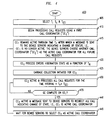
- FIG. 4 is a flowchart of illustrative operations 400 for providing garbage collection in accordance with the principles of the invention. More particularly, timing values are selected (block 405) for the timing variables T I , T H , and T GCI , respectively, as detailed above. For example, in the illustrative embodiment of the invention shown in FIG. 1 containing two call coordinators, empirical results have shown that timing values 4 seconds, 1 second, and 2 seconds, for the timing variables T I , T H , and T GCI , respectively, provide for the effective delivery of garbage collection.
- T GCI is specific to the processor, system architecture (e.g., the number available processors, memory, operating system, etc.) and the virtual machine version number (e.g., JVM 1.1.6).
- T GCI can be empirically computed.
- T H is dependent upon expected network latency. Therefore, as will be readily understood by those skilled in the art, such latency values are easily computable given the specific network.
- T I is dependent upon the virtual machine settings, in particular, the available memory. Given the amount of memory available this value can be computed as the memory consumed by the call coordinator process. For example, if the processing of an event produces 100 bytes of garbage and the available memory is 1000 bytes, the total number of events that can be processed without incurring garbage collection is 10.
- Selection of the subject timing variables is important as call processing requests are generated (block 410) by the device servers, e.g., line device sever 130, and processed by a first call coordinator ("CC 1 "), e.g., call coordinator 120.
- the first, i.e., active, call coordinator will continue to process call requests through the interval T I , i.e., the empirical time that call processing can occur on the call coordinator until garbage collection is required.
- T I i.e., the empirical time that call processing can occur on the call coordinator until garbage collection is required.
- a message is delivered to all device servers (block 415) indicating a change of state, i.e., CC 1 is inactive. Therefore, the device servers will choose a second call coordinator ("CC 2 "), e.g., call coordinator 125, as the active call coordinator for all future call requests.
- CC 2 second call coordinator
- FIG. 5 shows an exemplary garbage collection scenario 500, in accordance with the principles of the invention, for delivering garbage collection in the context of the exemplary architecture of FIG. 1.
- Exemplary scenario 500 shows CC 1 timeline 570 and CC 2 timeline 580 for the two respective call coordinators of the FIG. 1 embodiment, as discussed above.
- Exemplary scenario 500 begins at T 0 510 at which time call processing requests begin.
- the time interval T I 520 illustratively shown as four seconds, defines the interval during which the active call coordinator, e.g., CC 1 , will process call requests from device servers without requiring garbage collection.
- garbage collection is to be initiated for the active call coordinator.
- the active coordinator e.g., CC 1
- enters a hibernation stage for time T H (see, FIG. 4, block 420, and FIG. 5, T H 530, illustratively shown as 1 second) during which time a message is sent to the device drivers (see, FIG. 5, message m 1 550) indicating a change of state, i.e., CC 1 is inactive. Therefore, the device servers will choose a second call coordinator, e.g., CC 2 , (see, e.g., CC 2 timeline 580) as the active call coordinator for all future call requests.
- the hibernation interval i.e., T H 530
- garbage collection is initiated (see, FIG.
- garbage collection is complete (see, FIG. 4, block 435) for the first call coordinator, and that call coordinator is ready to begin processing incoming call processing requests from the device drivers.
- a message is sent to the device drivers (see, illustratively, FIG. 5, message m 2 560) which indicates to the device servers a change of state, i.e., CC 1 is active (see, FIG. 4, block 440).
- CC 1 waits for the device servers to select it as the active call coordinator (see, FIG. 4, block 445).
- CC 1 remains active (see, FIG. 5, T I 505) and begins the cycle again.
- CC 2 enters hibernation (see, FIG. 5, T H 590) and garbage collection (see, FIG. 5, T GCI 595) in the same fashion as detailed above with respect to CC 1 .
- garbage collection is delivered on the virtual machine with no significant processing impact on the currently executing processes.
- garbage collection is delivered to distributed processes, i.e., applications, such that the garbage collection process does not run concurrently with real-time processing.
- distributed application programs are executed on garbage collecting virtual machines without any adverse processing impact resulting from the garbage collection process.
- the present invention can be embodied in the form of methods and apparatuses for practicing those methods.
- the invention can also be embodied in the form of program code embodied in tangible media, such as floppy diskettes, CD-ROMs, hard drives, or any other machine-readable storage medium, wherein, when the program code is loaded into and executed by a machine, such as a computer, the machine becomes an apparatus for practicing the invention.
- the invention can also be embodied in the form of program code, for example, in a storage medium, loaded into and/or executed by a machine, or transmitted over some transmission medium, such as over electrical wiring or cabling, through fiber optics, or via electromagnetic radiation, wherein, when the program code is loaded into and executed by a machine, such as a computer, the machine becomes an apparatus for practicing the invention.
- program code segments When implemented on a general-purpose processor, the program code segments combine with the processor to provide a unique device that operates analogously to specific logic circuits.
Landscapes
- Engineering & Computer Science (AREA)
- Theoretical Computer Science (AREA)
- Physics & Mathematics (AREA)
- General Engineering & Computer Science (AREA)
- General Physics & Mathematics (AREA)
- Telephonic Communication Services (AREA)
- Memory System (AREA)
- Computer And Data Communications (AREA)
Applications Claiming Priority (2)
| Application Number | Priority Date | Filing Date | Title |
|---|---|---|---|
| US434931 | 1999-11-05 | ||
| US09/434,931 US6611858B1 (en) | 1999-11-05 | 1999-11-05 | Garbage collection method for time-constrained distributed applications |
Publications (1)
| Publication Number | Publication Date |
|---|---|
| EP1104897A2 true EP1104897A2 (de) | 2001-06-06 |
Family
ID=23726296
Family Applications (1)
| Application Number | Title | Priority Date | Filing Date |
|---|---|---|---|
| EP00309324A Withdrawn EP1104897A2 (de) | 1999-11-05 | 2000-10-23 | Garbagesammlungsverfahren für verteilte zeitbeschränkte Anwendungen |
Country Status (4)
| Country | Link |
|---|---|
| US (1) | US6611858B1 (de) |
| EP (1) | EP1104897A2 (de) |
| JP (1) | JP2001188704A (de) |
| CA (1) | CA2323371A1 (de) |
Cited By (3)
| Publication number | Priority date | Publication date | Assignee | Title |
|---|---|---|---|---|
| WO2005045683A1 (en) * | 2003-11-05 | 2005-05-19 | Electronics And Telecommunications Research Institute | Apparatus and method for garbage collection |
| DE102006038877A1 (de) * | 2006-08-18 | 2008-04-03 | Giesecke & Devrient Gmbh | Manipulationsgesicherte Einheit, Verfahren für eine manipulationsgesicherte Einheit sowie Speichermedium |
| EP1635264A3 (de) * | 2004-09-10 | 2009-03-25 | Microsoft Corporation | Erhöhung der Datenlokalität von kürzlich zugegriffenen Ressourcen |
Families Citing this family (22)
| Publication number | Priority date | Publication date | Assignee | Title |
|---|---|---|---|---|
| US6324685B1 (en) | 1998-03-18 | 2001-11-27 | Becomm Corporation | Applet server that provides applets in various forms |
| CA2273657C (en) * | 1999-05-05 | 2010-09-21 | Nortel Networks Corporation | Telephony and data network services at a telephone |
| US6502111B1 (en) * | 2000-07-31 | 2002-12-31 | Microsoft Corporation | Method and system for concurrent garbage collection |
| US6701464B2 (en) * | 2001-03-01 | 2004-03-02 | International Business Machines Corporation | Method and system for reporting error logs within a logical partition environment |
| US7000102B2 (en) * | 2001-06-29 | 2006-02-14 | Intel Corporation | Platform and method for supporting hibernate operations |
| US6959309B2 (en) * | 2002-01-31 | 2005-10-25 | Freescale Semiconductor, Inc. | Interface between programming languages and method therefor |
| US7596788B1 (en) * | 2004-05-11 | 2009-09-29 | Platform Computing Corporation | Support of non-trivial scheduling policies along with topological properties |
| US8060543B1 (en) * | 2005-04-29 | 2011-11-15 | Micro Focus (Ip) Limited | Tracking software object use |
| US20070033240A1 (en) * | 2005-08-04 | 2007-02-08 | International Business Machines Corporation | Scheduling garbage collection |
| JP2007086838A (ja) * | 2005-09-20 | 2007-04-05 | National Institute Of Advanced Industrial & Technology | ゼロガベージコレクション通信仲介装置 |
| US7467278B2 (en) * | 2006-05-08 | 2008-12-16 | International Business Machines Corporation | Memory tuning for garbage collection and central processing (CPU) utilization optimization |
| US20090316688A1 (en) * | 2006-07-13 | 2009-12-24 | Venkat Srinivas Meenavalli | Method for controlling advanced multimedia features and supplemtary services in sip-based phones and a system employing thereof |
| US20080162709A1 (en) * | 2006-12-27 | 2008-07-03 | International Business Machines Corporation | System for processing application protocol requests |
| US8868623B2 (en) * | 2007-10-30 | 2014-10-21 | International Business Machines Corporation | Enhanced garbage collection in a multi-node environment |
| KR101355193B1 (ko) * | 2007-12-11 | 2014-01-27 | 삼성전자주식회사 | 실시간 임베디드 시스템의 메모리 관리 장치 및 메모리할당/해제/관리 방법 |
| US20090228537A1 (en) * | 2008-03-07 | 2009-09-10 | Branda Steven J | Object Allocation System and Method |
| US7870257B2 (en) * | 2008-06-02 | 2011-01-11 | International Business Machines Corporation | Enhancing real-time performance for java application serving |
| US8527558B2 (en) | 2010-09-15 | 2013-09-03 | Sepation, Inc. | Distributed garbage collection |
| KR102053865B1 (ko) * | 2013-03-15 | 2019-12-09 | 삼성전자주식회사 | 호스트-주도 가비지 컬렉션 방법과 상기 방법을 수행할 수 있는 시스템 |
| WO2016003412A1 (en) * | 2014-06-30 | 2016-01-07 | Hewlett-Packard Development Company, L.P. | Concurrent dead actor collection |
| US10642663B2 (en) * | 2014-09-10 | 2020-05-05 | Oracle International Corporation | Coordinated garbage collection in distributed systems |
| US9971683B1 (en) * | 2014-10-20 | 2018-05-15 | Sprint Communications Company L.P. | Automatic computer memory management coordination across a group of servers |
Family Cites Families (12)
| Publication number | Priority date | Publication date | Assignee | Title |
|---|---|---|---|---|
| US4914586A (en) * | 1987-11-06 | 1990-04-03 | Xerox Corporation | Garbage collector for hypermedia systems |
| US5088036A (en) * | 1989-01-17 | 1992-02-11 | Digital Equipment Corporation | Real time, concurrent garbage collection system and method |
| US5293614A (en) * | 1991-04-08 | 1994-03-08 | Texas Instruments Incorporated | System and method for hard real-time garbage collection requiring a write barrier but no read barrier |
| US5355483A (en) * | 1991-07-18 | 1994-10-11 | Next Computers | Asynchronous garbage collection |
| US5485613A (en) * | 1991-08-27 | 1996-01-16 | At&T Corp. | Method for automatic memory reclamation for object-oriented systems with real-time constraints |
| US5535390A (en) * | 1994-07-22 | 1996-07-09 | Hildebrandt; Thomas H. | Method for reusing temporaries and reclaiming shared memory |
| US5832529A (en) * | 1996-10-11 | 1998-11-03 | Sun Microsystems, Inc. | Methods, apparatus, and product for distributed garbage collection |
| US5842016A (en) * | 1997-05-29 | 1998-11-24 | Microsoft Corporation | Thread synchronization in a garbage-collected system using execution barriers |
| US6199075B1 (en) * | 1997-05-30 | 2001-03-06 | Sun Microsystems, Inc. | Method and apparatus for generational garbage collection of a heap memory shared by multiple processors |
| US6256637B1 (en) * | 1998-05-05 | 2001-07-03 | Gemstone Systems, Inc. | Transactional virtual machine architecture |
| US6223202B1 (en) * | 1998-06-05 | 2001-04-24 | International Business Machines Corp. | Virtual machine pooling |
| US6381735B1 (en) * | 1998-10-02 | 2002-04-30 | Microsoft Corporation | Dynamic classification of sections of software |
-
1999
- 1999-11-05 US US09/434,931 patent/US6611858B1/en not_active Expired - Lifetime
-
2000
- 2000-10-16 CA CA002323371A patent/CA2323371A1/en not_active Abandoned
- 2000-10-23 EP EP00309324A patent/EP1104897A2/de not_active Withdrawn
- 2000-11-02 JP JP2000335299A patent/JP2001188704A/ja active Pending
Cited By (8)
| Publication number | Priority date | Publication date | Assignee | Title |
|---|---|---|---|---|
| WO2005045683A1 (en) * | 2003-11-05 | 2005-05-19 | Electronics And Telecommunications Research Institute | Apparatus and method for garbage collection |
| GB2423172A (en) * | 2003-11-05 | 2006-08-16 | Korea Electronics Telecomm | Apparatus and method for garbage collection |
| GB2423172B (en) * | 2003-11-05 | 2007-02-28 | Korea Electronics Telecomm | Apparatus and method for garbage collection |
| US7797498B2 (en) | 2003-11-05 | 2010-09-14 | Electronics And Telecommunications Research Institute | Apparatus and method for garbage collection |
| EP1635264A3 (de) * | 2004-09-10 | 2009-03-25 | Microsoft Corporation | Erhöhung der Datenlokalität von kürzlich zugegriffenen Ressourcen |
| US7769974B2 (en) | 2004-09-10 | 2010-08-03 | Microsoft Corporation | Increasing data locality of recently accessed resources |
| DE102006038877A1 (de) * | 2006-08-18 | 2008-04-03 | Giesecke & Devrient Gmbh | Manipulationsgesicherte Einheit, Verfahren für eine manipulationsgesicherte Einheit sowie Speichermedium |
| DE102006038877B4 (de) * | 2006-08-18 | 2018-01-25 | Giesecke+Devrient Mobile Security Gmbh | Manipulationsgesicherte Einheit, Verfahren für eine manipulationsgesicherte Einheit sowie Speichermedium |
Also Published As
| Publication number | Publication date |
|---|---|
| JP2001188704A (ja) | 2001-07-10 |
| CA2323371A1 (en) | 2001-05-05 |
| US6611858B1 (en) | 2003-08-26 |
Similar Documents
| Publication | Publication Date | Title |
|---|---|---|
| US6611858B1 (en) | Garbage collection method for time-constrained distributed applications | |
| US6502109B1 (en) | Distributed communications system having garbage collecting virtual processes | |
| US6584186B1 (en) | Protecting communications network integrity | |
| US5551035A (en) | Method and apparatus for inter-object communication in an object-oriented program controlled system | |
| EP0963096B1 (de) | Verteiltes Anrufsystem | |
| US5485613A (en) | Method for automatic memory reclamation for object-oriented systems with real-time constraints | |
| WO2001090886A2 (en) | Local transaction management | |
| EP0405829B1 (de) | Objektorientierte Softwaresystembauweise | |
| JP2004503178A (ja) | 通信システム | |
| KR100815666B1 (ko) | 이동통신 교환 시스템에서 재시동시 과금 관리 방법 | |
| CN100454827C (zh) | 一种防止收号丢失的方法 | |
| CN1092901C (zh) | 一个灵活的呼叫记录机制 | |
| CN1082320C (zh) | 构成呼叫处理的方法和电话呼叫处理的交换系统 | |
| GB2358988A (en) | New feature implementation without code base modification | |
| CN120448138B (zh) | 一种用于管理目标应用并发请求的方法及系统 | |
| KR100277099B1 (ko) | 교환기에서의과금데이터의수집및전송방법 | |
| MXPA97001999A (en) | A method for structuring the processing of calls and a transmission system of processing calls for telefo | |
| JP2000137605A (ja) | 交換機サービス制御方法、交換機、及び交換機サービス制御プログラムを記録した記録媒体 | |
| JP3936172B2 (ja) | 交換システム | |
| KR0136505B1 (ko) | 교환기 호처리 프로그램의 라이브러리화 방법 및 재이용 방법 | |
| JPH056275A (ja) | オブジエクトの動的機能拡張方法 | |
| JP2001268229A (ja) | 電話サービス装置、電話サービス方法及びその記録媒体 | |
| Ramming | PML: A Language Interface to Distributed | |
| Bonetti et al. | Distribution of RFC 1327 mapping rules via the Internet DNS: the INFNet distributed gateway system | |
| JP2002222091A (ja) | 接続管理方式及び方法並びに接続管理プログラムを記録した記録媒体 |
Legal Events
| Date | Code | Title | Description |
|---|---|---|---|
| PUAI | Public reference made under article 153(3) epc to a published international application that has entered the european phase |
Free format text: ORIGINAL CODE: 0009012 |
|
| AK | Designated contracting states |
Kind code of ref document: A2 Designated state(s): AT BE CH CY DE DK ES FI FR GB GR IE IT LI LU MC NL PT SE |
|
| AX | Request for extension of the european patent |
Free format text: AL;LT;LV;MK;RO;SI |
|
| STAA | Information on the status of an ep patent application or granted ep patent |
Free format text: STATUS: THE APPLICATION HAS BEEN WITHDRAWN |
|
| 18W | Application withdrawn |
Effective date: 20050708 |