EP1104816A1 - High-tension steel material with excellent suitability for welding with high-energy-density heat source and welded structure thereof - Google Patents
High-tension steel material with excellent suitability for welding with high-energy-density heat source and welded structure thereof Download PDFInfo
- Publication number
- EP1104816A1 EP1104816A1 EP00935529A EP00935529A EP1104816A1 EP 1104816 A1 EP1104816 A1 EP 1104816A1 EP 00935529 A EP00935529 A EP 00935529A EP 00935529 A EP00935529 A EP 00935529A EP 1104816 A1 EP1104816 A1 EP 1104816A1
- Authority
- EP
- European Patent Office
- Prior art keywords
- less
- inclusive
- steel material
- welding
- tensile strength
- Prior art date
- Legal status (The legal status is an assumption and is not a legal conclusion. Google has not performed a legal analysis and makes no representation as to the accuracy of the status listed.)
- Withdrawn
Links
Classifications
-
- C—CHEMISTRY; METALLURGY
- C22—METALLURGY; FERROUS OR NON-FERROUS ALLOYS; TREATMENT OF ALLOYS OR NON-FERROUS METALS
- C22C—ALLOYS
- C22C38/00—Ferrous alloys, e.g. steel alloys
- C22C38/16—Ferrous alloys, e.g. steel alloys containing copper
-
- B—PERFORMING OPERATIONS; TRANSPORTING
- B23—MACHINE TOOLS; METAL-WORKING NOT OTHERWISE PROVIDED FOR
- B23K—SOLDERING OR UNSOLDERING; WELDING; CLADDING OR PLATING BY SOLDERING OR WELDING; CUTTING BY APPLYING HEAT LOCALLY, e.g. FLAME CUTTING; WORKING BY LASER BEAM
- B23K35/00—Rods, electrodes, materials, or media, for use in soldering, welding, or cutting
- B23K35/22—Rods, electrodes, materials, or media, for use in soldering, welding, or cutting characterised by the composition or nature of the material
- B23K35/24—Selection of soldering or welding materials proper
- B23K35/30—Selection of soldering or welding materials proper with the principal constituent melting at less than 1550°C
- B23K35/3053—Fe as the principal constituent
-
- C—CHEMISTRY; METALLURGY
- C22—METALLURGY; FERROUS OR NON-FERROUS ALLOYS; TREATMENT OF ALLOYS OR NON-FERROUS METALS
- C22C—ALLOYS
- C22C38/00—Ferrous alloys, e.g. steel alloys
- C22C38/004—Very low carbon steels, i.e. having a carbon content of less than 0,01%
-
- C—CHEMISTRY; METALLURGY
- C22—METALLURGY; FERROUS OR NON-FERROUS ALLOYS; TREATMENT OF ALLOYS OR NON-FERROUS METALS
- C22C—ALLOYS
- C22C38/00—Ferrous alloys, e.g. steel alloys
- C22C38/02—Ferrous alloys, e.g. steel alloys containing silicon
-
- C—CHEMISTRY; METALLURGY
- C22—METALLURGY; FERROUS OR NON-FERROUS ALLOYS; TREATMENT OF ALLOYS OR NON-FERROUS METALS
- C22C—ALLOYS
- C22C38/00—Ferrous alloys, e.g. steel alloys
- C22C38/04—Ferrous alloys, e.g. steel alloys containing manganese
-
- C—CHEMISTRY; METALLURGY
- C22—METALLURGY; FERROUS OR NON-FERROUS ALLOYS; TREATMENT OF ALLOYS OR NON-FERROUS METALS
- C22C—ALLOYS
- C22C38/00—Ferrous alloys, e.g. steel alloys
- C22C38/06—Ferrous alloys, e.g. steel alloys containing aluminium
-
- C—CHEMISTRY; METALLURGY
- C22—METALLURGY; FERROUS OR NON-FERROUS ALLOYS; TREATMENT OF ALLOYS OR NON-FERROUS METALS
- C22C—ALLOYS
- C22C38/00—Ferrous alloys, e.g. steel alloys
- C22C38/08—Ferrous alloys, e.g. steel alloys containing nickel
-
- B—PERFORMING OPERATIONS; TRANSPORTING
- B23—MACHINE TOOLS; METAL-WORKING NOT OTHERWISE PROVIDED FOR
- B23K—SOLDERING OR UNSOLDERING; WELDING; CLADDING OR PLATING BY SOLDERING OR WELDING; CUTTING BY APPLYING HEAT LOCALLY, e.g. FLAME CUTTING; WORKING BY LASER BEAM
- B23K15/00—Electron-beam welding or cutting
-
- C—CHEMISTRY; METALLURGY
- C21—METALLURGY OF IRON
- C21D—MODIFYING THE PHYSICAL STRUCTURE OF FERROUS METALS; GENERAL DEVICES FOR HEAT TREATMENT OF FERROUS OR NON-FERROUS METALS OR ALLOYS; MAKING METAL MALLEABLE, e.g. BY DECARBURISATION OR TEMPERING
- C21D2211/00—Microstructure comprising significant phases
- C21D2211/002—Bainite
Definitions
- the present invention relates to a high tensile strength steel material for welding structures which is suitable for ships, tanks, pipelines and the like.
- the present invention specifically relates to a steel material which has excellent welding properties (weldability) suitable for welding by a high energy density heat source such as laser beam welding and electron beam welding (such weldability suitable for welding by a high energy density-heat source will be referred to as "high energy density heat source weldability" herein after).
- the present invention also specifically relates to welding structures using the same steel material.
- the steel material of the present invention includes steel pipes, steel plates and steel sections.
- the electron beam which is one of the high energy density heat sources is also now widening the application range thereof in use, as compared with the state in the past, due to the progress of the partial vacuum technique.
- application of the electron beam welding to a pipeline constructing method is being studied, so as to achieve highly efficient construction of line pipes using common practical steel of relatively low strength.
- welding by the high energy density heat source causes melting in an extremely localized manner, the welding is performed as welding having a relatively large depth of penetration as compared with the conventional arc welding (the deep penetration welding). Therefore, welding by the high energy density heat source is what is called “small heat input welding" in which the penetrating welding is easy and the amount of heat to be inputted per plate thickness is significantly smaller than that of the conventional arc welding. In short, the welding by the high energy density heat source is the small heat input welding per plate thickness.
- the welding by the high energy density heat source being different from the small heat input welding by the conventional arc welding as a multilayer welding, forms a welded zone in which a weld metal (in what is called the "as weld” state) and a welding heat-affected zone (which will be referred to as "HAZ" hereinafter) coexist and which does not experience the tempering by subsequent passes. Due to this, there arises a problem that the welded zone, at which the cooling rate is relatively high, is subjected to significant hardening and thus the toughness of the welded zone tends to deteriorate.
- JP-A 62-64486 Laid-Open for example, there is proposed a technique in which the hardening of the welded zone in the super low heat input welding by electron beams is suppressed by increasing the amount of oxygen in steel and decreasing the degree of hardenability of the steel.
- an increase in the amount of oxygen in the steel may significantly deteriorate the toughness of the base material in some cases.
- the welding is performed by a means other than electron beam, the hardenability of the welded zone may rather deteriorate too much, so as to cause softening of the welded zone.
- JP-A 62-64486 does not consider at all the toughness of the HAZ, to which properties the present invention is directed.
- JP-A 2-282446 points out the deterioration of toughness due to the upper bainite structure (it is known that this structure is generated in carbon steel), and discloses that the toughness of the electron beam welded zone can be remarkably enhanced by adjusting the hardenability of the steel plate such that the lower bainite (different from the upper bainite) or a mixed structure of the lower bainite and martensite is easily generated.
- JP-A 2-282446 the base material is limited to a high strength steel whose yield strength is 60kgf/mm 2 or higher and whose mechanical proparties can be maintained due to the lower bainite or the mixed structure of the lower bainite and martensite.
- the toughness of the HAZ, to which the present invention is directed is hardly considered.
- the present invention aims at solving the aforementioned problems of the prior art, and has an object of providing a high tensile strength steel material, which is excellent in the high energy density heat source welding properties, whose tensile strength is in the range of 490 to 700 or so MPa (inclusive of 490) and suitable for welding in which high energy density heat source such laser beam or electron beam is utilized.
- the inventors of the present invention as a result of assiduous studies, in order to improve the high energy density heat source welding properties, discovered that it is important that a steel material has stable hardenability, without experiencing excessive hardening of the weld metal and HAZ thereof, in a relatively wide range of the cooling rate (ranging from a super high cooling rate to a relatively low cooling rate).
- a steel material which does not harden even at the super high cooling rate is obtained by: reducing the C (carbon) content to an ultra low carbon range of 0.025 mass% or less; adding B (boron) as an essential element; and reducing the S (sulfur) content to 0.003 mass% or less and the N (nitrogen) content to 0.0035 mass% or less, wherein the structures of the base material, the weld metal and the HAZ are each mainly in the ultra low carbon bainite phase in which extremely small amounts of carbides are contained.
- the inventors also discovered that, in such a steel material, not only the properties of the base material but also the toughness of the welded zone produced by the welding by the high energy density heat source, the toughness of the HAZ in particular, is improved and thus the weld crack thereof is suppressed.
- the toughness of the welded zone can be improved by controlling the structure of the weld metal and the HAZ so as not to be changed, as compared with that of the base material, after being welded by the high energy heat source.
- the present invention has been completed by further studying and supplementing the aforementioned discoveries.
- the present invention can be summarized by following features (1)-(7).
- the welded structure of the present invention represents a structure which includes a base material and a welded zone in an integrated manner, and may be a member or a finished product.
- the presence ratio of the ultra low carbon bainite and carbides of the present invention represents the average value of area ratio obtained as a result of observations by an optical microscope or a scanning electron microscope.
- the steel material of the present invention has a structure in the ultra low carbon bainite phase.
- the structure of a base material and the structure of a welded zone have the ultra low carbon bainite, independent of the cooling rate thereof.
- the "ultra low carbon bainite” represents quasi-polygonal ⁇ ( ⁇ q ), granular Zw- ⁇ ( ⁇ B ), bainitic ferrite ( ⁇ ° B ) and a mixed structure thereof.
- ⁇ q , ⁇ B , ⁇ ° B represent the same structures as described in page 8, Table 1 of "(Goku)Teitansoko no Beinaito Soshiki to Hentaikyodo ni kansuru Saikin no Kenkyu” (Recent Research concerning Bainitic Structure and Transformation Behavior of (Ultra) Low Carbon Steel) as the final report by Bainite research/study group of Nippon Tekko Kyokai Kiso Kyodo Kenkyukai (Corporation), issued on July 30, 1994.
- the content of ultra low carbon bainite contained in the steel material of the present invention is, by presence ratio, 90% or more.
- the ultra low carbon bainite content is less than 90%, ferrite is generated and thus the strength of the base material deteriorates, or coarse upper bainite containing carbides and/or island-like martensite is generated thereby deteriorating the toughness of the base material and the HAZ. Therefore, in the present invention, the content of the ultra low carbon bainite is limited to 90% or more.
- the content of carbides contained in the steel material of the present invention is, by presence ratio, 5% or less.
- the toughness of the welding heat-affected zone deteriorates. Due to this, the content of carbides in the present invention is limited to 5% or less.
- the toughness of the steel material is deteriorated, not only by the toughness of the ultra low carbon bainite of the base structure, but also by the influence of the hard phase contained in the steel material.
- the island-like martensite is one typical example of the hard phase. The larger the difference in hardness between the base structure and the hard phase is, the more significantly the hard phase affects the toughness properties of the steel material.
- the steel material of the present invention contains no less than 90% of the ultra low carbon bainite (the present steel material is quite different from the conventional steel material in this feature) and is substantially a single-phase structure steel, the steel is susceptible to the influence by the base structure and the carbides of the hard phase, as compared with the conventional steel. Accordingly, it is necessary that the amount of carbides of the hard phase is restricted in order to achieve an excellent toughness properties of the present steel. It should be noted that phases other than the ultra low carbon bainite and carbides do not have, if these phases are present at the presence ratio of less than 10%, particularly strong adverse effects, because these phases are not as hard as the carbides.
- the present steel may contain less than 10% of the structures such as granular/needle-like ferrite, pearlite, upper bainite, lower bainite, martensite, which are often observed in the conventional steel. It should be noted, however, that the content of the island-like martensite is preferably 6% or less.
- the content of C is an important element which determines the structures of the base material, the weld metal and the HAZ of the steel material.
- the content of C must be 0.0050% or more.
- the content of C is preferably 0.025% or less (i.e., ultra low carbon) in order to keep the base material, the weld metal and the HAZ altogether in the equilibrated state so as to prevent generation of cementite (one of the carbides), and to suppress generation of hard martensite, which deteriorates the toughness properties, in the welding by the high energy density heat source.
- the ultra low carbon bainite structure can be obtained, independent of the cooling rate. That is, a steel material having relatively high strength, whose tensile strength is 490 MPa or more, can be obtained. Further, by reducing the C content to the ultra low carbon level, the structure of the weld metal of the welded zone and the structure of the HAZ, resulted from the high energy density heat source welding, can be made to be the ultra low carbon bainite which contains an extremely small amount of carbides. As a result, the toughness of the welded zone, resulted from the high energy density heat source welding, can be significantly improved.
- the carbon content of the present invention is preferably 0.020% or less. Si; 0.1-0.5%
- Si is an essential element which serves as a deoxidizing element during the refining process.
- the content of Si is preferably 0.1% or more, in order to act sufficiently as the deoxidizing element.
- Si is a ferrite-forming element, when the Si content exceeds 0.5%, the ultra low carbon bainite structure is likely to become the granular ferrite (polygonal ferrite ( ⁇ p )), thereby resulting in lower strength and significant deterioration of toughness of the base material. Due to this, the Si content is restricted to 0.5% or less in the present invention.
- the Si content is preferably 0.30% or less.
- Mn 2.5% or less
- Mn is an element which significantly affects the continuous cooling transformation behavior of the steel material in the ultra low carbon range.
- the Mn content is preferably 0.5% or more.
- the Mn content is preferably 0.8-1.8% in terms of the strength and toughness. S: 0.003% or less
- the weld crack during welding (the solidification cracking, in particular) must be suppressed in welding by the high energy density heat source, as is in other cases.
- the weld metal in the welding by the high energy density heat source has substantially the same composition as that of the base material.
- the base material has a composition in which no solidification crack is likely to occur.
- S is an element which forms sulfides and thus deteriorates ductility and solidification crack resistance properties. Due to this, the content of S of the base material is to be reduced as much as possible.
- the S content is restricted to 0.003% or less in the present invention.
- the S content is preferably 0.001% or less.
- Al acts as an deoxidizing agent. However, when Al is added too much, the concentration of Al 2 O 3 in the inclusions increases and large-size cluster inclusions may be generated. Therefore, the content of Al is 0.05% or less in the present invention.
- B is an element which enhances hardenability and thus is one of the important elements in the present invention. B suppresses generation of the soft ferrite which is produced when the cooling rate is relatively small and the coarse needle-like ferrite which is produced in the HAZ or the welded zone of electron beam welding when the cooling rate is relatively high. Accordingly, B is effectively used for reliably obtaining the ultra low carbon bainite which has uniform and fine structures.
- the content of B In order that the structure of the steel material be the ultra low carbon bainite which is excellent in toughness, the content of B must be at least 0.0003% or more. However, when the content of B exceeds 0.0040%, Fe-B based precipitates are generated and the effect of increasing the strength of the steel material will not be obtained any more. Due to this, the content of B is restricted to the range of 0.0003-0.0040%.
- the content of B is preferably 0.0010-0.0025% (exclusive of 0.0010% and inclusive of 0.0025%). N: 0.0035% or less
- N is reacted with B so as to form BN, thereby decreasing the effective B content.
- N becomes solid-solved N, facilitates generation of micro hard phase such as island-like martensite due to the stabilization of austenite, and thus deteriorates the toughness.
- B is made to act most effectively. Accordingly, the content of N is reduced as much as possible in the present invention. However, reducing the content of N to an ultra low level is likely to increase the production cost. Therefore, the acceptable upper limit of the N content is set at 0.0035% in the present invention.
- the content of Cu is preferably 0.05% or more.
- the content of Cu exceeds 2.0%, the concentration of the solid-solved C in the matrix is decreased, thereby facilitating the formation of the island-like martensite, increasing hardness and deteriorating the toughness properties. Due to this, the content of Cu is preferably restricted to 0.05-2.0%. Ni: 0.05-3.0%
- Ni has effects of increasing the strength of the steel and adjusting the bainite transformation temperature, in a manner similar to Cu.
- the content of Ni is preferably 0.05% or more.
- the content of Ni exceeds 3.0%, the concentration of the solid-solved C in the matrix is decreased, thereby facilitating the formation of the island-like martensite and deteriorating the toughness properties. Due to this, the content of Ni is preferably restricted to the range of 0.05-3.0%. Cr: 1.0% or less
- Cr is an element which increases the strength of the steel. However, when the content of Cr exceeds 1.0%, the effect of increasing strength reaches the plateau and the toughness of the steel material rather deteriorate. Thus, the content of Cr is preferably 1.0% or less. More preferably, the content of Cr is 0.1-0.8%. Mo: 1.0% or less
- Mo is an element which increases the strength of the steel. However, when the content of Mo exceeds 1.0%, the effect of increasing strength reaches the plateau and the toughness of the steel material rather deteriorate. Thus, the content of Mo is preferably 1.0% or less. More preferably, the content of Mo is 0.1-0.8%. V: 0.08% or less
- V is an element which is solid-solved or forms carbides and nitrides so as to increase the strength of the steel, and may be contained in the steel material according to necessity. However, when the content of V exceeds 0.08%, ferrite is likely to be formed. Accordingly, the content of V is preferably 0.08% or less. Nb: 0.08% or less
- Nb is an element which is important for facilitating accumulation of plastic strain of austenite in the rolling process of the steel material and thus for facilitating increase in strength of the steeL
- the content of Nb is preferably 0.01% or more.
- carbides are formed and thus the inter granular strength, as well as the toughness properties, are deteriorated.
- the content of Nb is preferably restricted to 0.08% or less. It should be noted that the content of Nb is more preferably 0.010-0.05% in terms of the strength and the toughness properties of the base material and the toughness properties of the weld metal and the HAZ. Ti: 0.1% or less
- Ti has effects similar to those of Nb. However, Ti is more strongly bound to N, facilitates the effective use of B and thus increases the strength of the steeL In addition, Ti is precipitated as TiN and thus has an effect of suppressing the grain growth at a relatively high temperature. In order to obtain such an effect, the content of Ti is preferably 0.005% or more. However, when the content of Ti exceeds 0.1%, the intergranular strength is decreased and the toughness properties are reduced. Due to this, the content of Ti is preferably restricted to 0.1% or less. It should be noted that the content of Ti is more preferably 0.005-0.08% in terms of securing the appropriate amount of solid-solved B. Ti also acts as a deoxidizing agent In order to make Ti act sufficiently as an deoxidizing agent, the content of Ti is preferably 0.025% or more.
- Both Ca and REM have an effect of suppressing grain growth in the HAZ.
- At least one selected from a group consisting of Ca, REM may be contained in the steel according to necessity.
- Both Ca and REM form inclusions (deposits) and have an effect of suppressing grain growth. Such an effect is observed when the content of Ca is 0.0005% or more and the content of REM is 0.0020% or more.
- the content of Ca exceeds 0.0040% or the content of REM exceeds 0.0080%, the inclusions are generated too much and cluster-like inclusions, which rather acts as the starting point of fracture, are formed, thereby adversely affecting the toughness properties.
- it is preferable that the content of Ca is restricted to 0.0005-0.0040% and the content of REM is restricted to 0.0020-0.0080%.
- the balance other than the aforementioned components includes Fe and unavoidable impurities.
- the impurities may include: 0.0050% or less of P; and 0.035% or less of O.
- a molten steel having the aforementioned composition is produced by melting, by applying the conventional known melt-production methods such as a converter, an electric furnace and a vacuum melting furnace.
- the molten steel is then cast into a rolled base material such as slub by utilizing the conventional known casting methods such as the continuous casting process, the ingot casting and the like.
- the rolled base material is reheated to a temperature in the range between the Ac 3 transformation point and 1250°C or is subjected to the hot rolling process without being reheated, so as to be formed to a steel material such as a thick steel plate, a steel pipe, a steel section and the like.
- the heating temperature is preferably restricted to the range between the Ac 3 transformation point and 1250°C.
- the heating temperature is more preferably 1050-1150°C.
- the amount of reduction in the temperature range of no higher than 980° C i.e., in the unrecrystallized gamma phase temperature region
- the size of bainite which has been transformed from the austenite grain is made fine and the toughness properties of the bainite structure is improved.
- the austenite grains are made to extend and the dislocation density accumulated in the austenite grains is increased. Accordingly, during the transformation a part of dislocation is taken over by the bainite structure after the transformation and the strength of the steel is further enhanced.
- the accumulative amount of reduction in the temperature range of no higher than 980°C is preferably 50% or more.
- Hot rolling process finishing temperature 700°C or more
- the hot rolling process finishing temperature decreases, the rate at which the strain (dislocation) introduced into the austenite grains by the rolling process is accumulated in the grains is increased, and thus the amount of dislocation taken over by the structure after the transformation is significantly increased. Accordingly, the strength of the steel material is enhanced.
- the hot rolling process finishing temperature is below 700°C, the increase in strength reaches the plateau stage, the resistance against deformation increases and the rolling efficiency is deteriorated.
- the rolling process finishing temperature is preferably 700°C or more in the present invention.
- the hot rolling process may be followed by the air-cooling process and optionally by the accelerated cooling process.
- the bainite structure formed therein is made fine and thus the toughness properties of the steel are still more improved.
- the cooling rate in the accelerated cooling conditions is not particularly limited, but is preferably 0.01-50°C/s.
- the cooling-stop temperature is preferably 600°C or lower.
- the cooling rate of the accelerated cooling is preferably in the range of 0.01-50°C/s.
- the cooling-stop temperature exceeds 600°C, the recover/growth occurs during the air-cooling period thereafter. As a result, the effect of the accelerated cooling is decreased and the effect of improving the toughness properties are also decreased.
- the cooling-stop temperature is preferably 600°C or less in the present invention.
- a welded structure having a desired shape can be produced by welding the high tensile strength steel material described above by using the high energy density heat source.
- the welding by the high energy density heat source includes welding by laser beam or electron beam and plasma welding.
- the present invention can be applied to any of such welding methods by using the high energy density heat source.
- the present invention includes adjusting the composition of the weld metal by using a filler metal. Examples of the welded structures include pipelines, ships, tanks and the like.
- the electrolytic two-stage etching was carried out, SEM photos ( ⁇ 1000) were taken at random for five fields, the area ratio was obtained with respect to each filed, and the average value of the observed fields was calculated as the presence ratio of the carbides.
- welded joints were produced from the obtained steel plates by the electron beam welding (output: 15kW). Testing pieces were collected from these welding joints and the presence/absence of weld crack therein was observed.
- the toughness properties (the Charpy absorption energy vE -30 (J) at the testing temperature of -30°C) of the weld metal (collected from the center portion of the weld metal portion) and the welded bond (collected such that the notch was positioned at the melt line) were analyzed by a Charpy impact test using JIS No. 4 testing pieces.
- the HAZ structures were analyzed in a manner similar to that employed for the base material.
- the electron beam welding in the present example was carried out as laterally-penetrating welding.
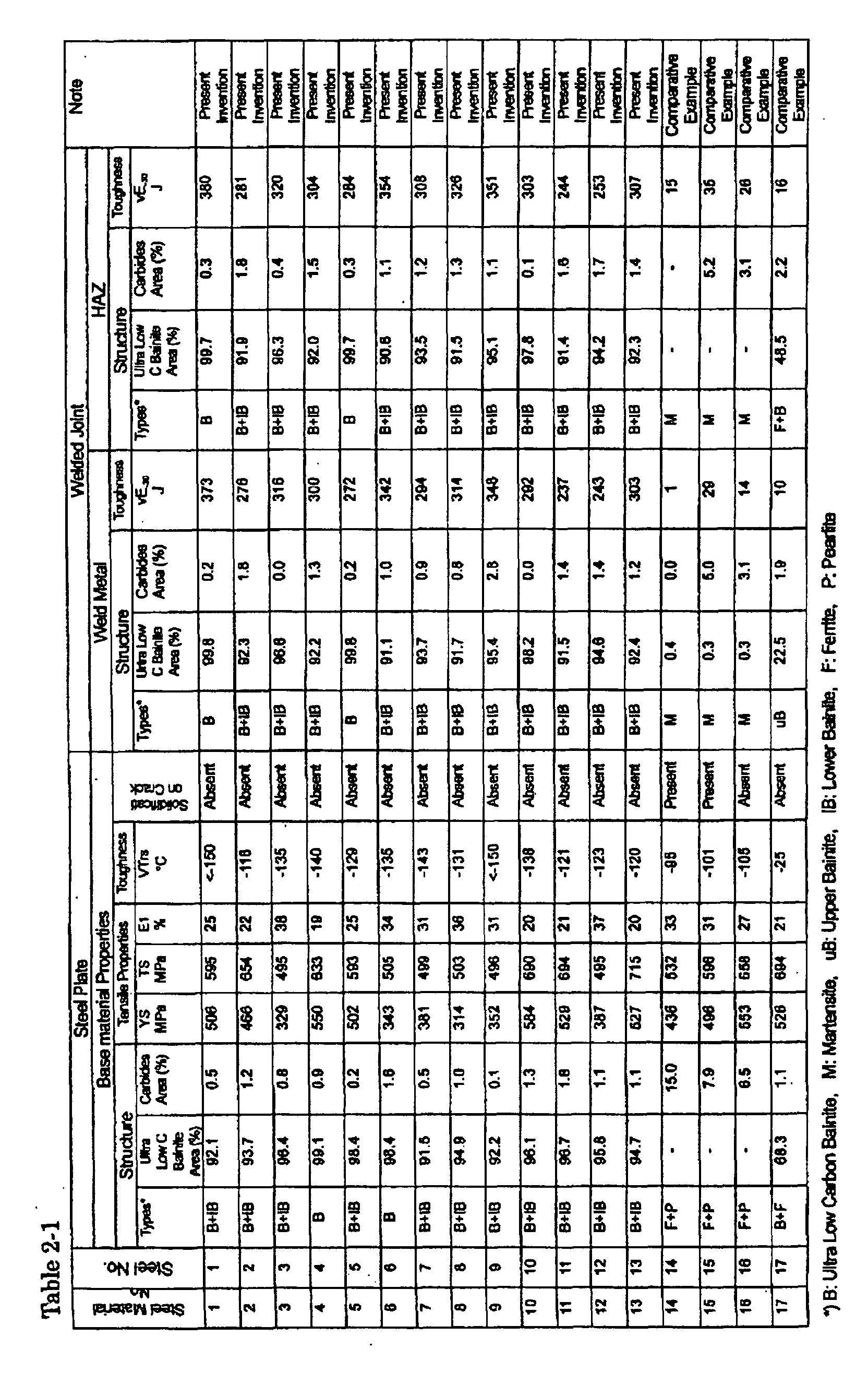
- the results of the present examples all show the tensile strength of 490 Mpa or more of the base material, as well as the excellent toughness properties at a relatively low temperature in which the fracture appearance transition temperature is -110°C or less.
- no weld crack was observed in the electron beam welded zone and the toughness properties of the weld metal and the HAZ are excellent (vE -30 is 250J or more), indicating that the steel material of the present invention exhibits excellent welding properties when welding is performed by the high energy density heat source. That is, form the results shown in Table 2, it is understood that the steel material of the present invention exhibits excellent weldability in high energy density heat sources welding.
- the tensile strength of the base material are below 490 Mpa in some cases and the toughness properties at a relatively low temperature also deteriorate.
- the structures of the weld metal and the HAZ became hardened structures (such as martensite, the upper bainite) or rather soft structures (due to precipitates of ferrite), failing to obtain stable toughness properties at the welded zone.
- some comparative examples show generation of welding solidification cracking, indicating deterioration of the welding properties.
- a thick steel plate having plate thickness of 16 mm was produced in the substantially same manner as Example 1.
- steel pipes having outer diameter of 660 mm were produced by the UOE producing method.
- Sets of two steel pipes were welded cicrumferentially by the electron beam welding without using any filler-solved metal, to obtain steel pipe welded joints.
- the presencelabsence of weld crack was analyzed by using supersonic. No cracking was observed.
- Charpy impact testing pieces JIS No.
- high tensile strength steel-welded structures which does not experience solidification cracking when welding is performed by using the high energy density heat sources such as laser beam, electron beam or the like and whose weld metal and HAZ have excellent toughness properties, can be produced.
- the highly efficient welding of high quality is reliably made possible, thereby achieving a significantly excellent effect in industrial terms.
Landscapes
- Chemical & Material Sciences (AREA)
- Engineering & Computer Science (AREA)
- Mechanical Engineering (AREA)
- Materials Engineering (AREA)
- Metallurgy (AREA)
- Organic Chemistry (AREA)
- Heat Treatment Of Steel (AREA)
Abstract
Description
C: 0.0050-0.025%
Si; 0.1-0.5%
Mn: 2.5% or less
S: 0.003% or less
Al: 0.05% or less
B: 0.0003-0.0040%
N: 0.0035% or less
Cu: 0.05-2.0%
Ni: 0.05-3.0%
Cr: 1.0% or less
Mo: 1.0% or less
V: 0.08% or less
Nb: 0.08% or less
Ti: 0.1% or less



Claims (14)
- A high tensile strength steel material which is excellent weldability in high energy density heat source welding, comprising, by mass%:0.0050-0.025% (inclusive of both 0.0050% and 0.025%) of C;0.1-0.5% of Si (inclusive of both 0.1% and 0.5%);2.5% or less of Mn;0.003% or less of S;0.05% or less ofAl;0.0003-0.0040% of B (inclusive of both 0.0003% and 0.0040%);0.0035% or less of N; andthe balance of Fe and unavoidable impurities,wherein the high tensile strength steel material has a structure which contains, by presence ratio, 90% or more of ultra low carbon bainite and 5% or less of carbides.
- A high tensile strength steel material which is excellent weldability in high energy density heat source welding of claim 1, wherein the high tensile strength steel material further comprises, by mass%, at least one element selected from a group consisting of:0.05-2.0% (inclusive of both 0.05% and 2.0%) of Cu;0.05-3.0% (inclusive of both 0.05% and 3.0%) of Ni;1.0% or less of Cr;1.0% or less of Mo;0.08% or less of Nb;0.08% or less of V;0.1% or less of Ti.
- A high tensile strength steel material which is excellent weldability in high energy density heat source welding of claim 1 or 2, wherein the high tensile strength steel material further comprises, by mass%, at least one element selected a group consisting of: 0.0005-0.0040% (inclusive of both 0.0005% and 0.0040%) of Ca; 0.0020-0.0080% (inclusive of both 0,0020% and 0.0080%) of REM.
- A high tensile strength steel material which is excellent weldability in high energy density heat source welding of any of claims 1 to 3, wherein the content of C is 0.0050-0.020 mass% (inclusive of 0,0050% and exclusive of 0.020%).
- A high tensile strength steel material which is excellent weldability in high energy density heat source welding of any of claims 1 to 4, wherein the content of B is 0.0010-0.0025 mass% (exclusive of 0.0010% and inclusive of 0.0025%).
- A welded structure in which the high tensile strength steel material described in any of claims 1 to 5 is used and welded by high energy density heat source.
- A welded structure of claim 6, wherein the high energy density heat source is electron beam.
- A welded structure in which the high tensile strength steel material described in claim 1 is used and welded by high energy density heat source, the welded structure comprising:a weld metal: anda welding heat affected zone (HAZ),wherein the weld metal and the HAZ each contain, by mass%:0.0050-0.025% (inclusive of both 0.0050% and 0.025%) of C;0.1-0.5% of Si (inclusive of both 0.1% and 0.5%);2.5% or less of Mn;0.003% or less of S;0.05% or less of Al;0.0003-0.0040% of B (inclusive of both 0.0003% and 0.0040%);0.0035% or less of N; andthe balance of Fe and unavoidable impurities,wherein the high tensile strength steel material has a structure which contains, by presence ratio, 90% or more of ultra low carbon bainite and 5% or less of carbides.
- A welded structure in which the high tensile strength steel material described in claim 2 is used and welded by high energy density heat source, the welded structure comprising:a weld metal: anda welding heat affected zone (HAZ),wherein the weld metal and the HAZ each contain, by mass%:0.0050-0.025% (inclusive of both 0.0050% and 0.025%) of C;0.1-0.5% of Si (inclusive of both 0.1% and 0.5%);2.5% or less of Mn;0.003% or less of S;0.05% or less of Al;0.0003-0.0040% of B (inclusive of both 0.0003% and 0.0040%);0.0035% or less of N;at least one element selected from a group consisting of: 0.05-2.0% (inclusive of both 0.05% and 2.0%) of Cu; 0.05-3.0% (inclusive of both 0.05% and 3.0%) of Ni; 1.0% or less of Cr; 1.0% or less of Mo; 0.08% or less of Nb; 0.08% or less of V; 0.1% or less of Ti; andthe balance of Fe and unavoidable impurities,whrein the high tensile strength steel material has a structure which contains, by presence ratio, 90% or more of ultra low carbon bainite and 5% or less of carbides.
- A welded structure in which the high tensile strength steel material described in claim 3 is used and welded by high energy density heat source, the welded structure comprising:a weld metal: anda welding heat affected zone (HAZ),wherein the weld metal and the HAZ each contain, by mass%:0.0050-0.025% (inclusive of both 0.0050% and 0.025%) of C;0.1-0.5% of Si (inclusive of both 0.1% and 0.5%);2.5% or less of Mn;0.003% or less of S;0.05% or less ofAl;0.0003-0.0040% of B (inclusive of both 0.0003% and 0.0040%);0.0035% or less of N;at least one element selected from 0.0005-0.0040% (inclusive of both 0.0005% and 0.0040%) of Ca; 0.0020-0.0080% (inclusive of both 0.0020% and 0.0080%) of REM; andthe balance of Fe and unavoidable impurities,wherein the high tensile strength steel material has a structure which contains, by presence ratio, 90% or more of ultra low carbon bainite and 5% or less of carbides.
- A welded structure in which the high tensile strength steel material described in claim 3 is used and welded by high energy density heat source, the welded structure comprising:a weld metal: anda welding heat affected zone (HAZ),wherein the weld metal and the HAZ each contain, by mass%:0.0050-0.025% (inclusive of both 0.0050% and 0.025%) of C;0.1-0.5% of Si (inclusive of both 0.1% and 0.5%);2.5% or less of Mn;0.003% or less of S;0.05% or less ofAl;0.0003-0.0040% of B (inclusive of both 0.0003% and 0.0040%);0.0035% or less of N;at least one element selected from a group consisting of: 0.05-2.0% (inclusive of both 0.05% and 2.0%) of Cu; 0.05-3.0% (inclusive of both 0.05% and 3.0%) of Ni; 1.0% or less of Cr; 1.0% or less of Mo; 0.08% or less of Nb; 0.08% or less of V; 1.0% or less of Ti;further comprising at least one element selected from 0.0005-0.0040% (inclusive of both 0.0005% and 0.0040%) of Ca; 0.0020-0.0080% (inclusive of both 0.0020% and 0.0080%). of REM; andthe balance of Fe and unavoidable impurities,wherein the high tensile strength steel material has a structure which contains, by presence ratio, 90% or more of ultra low carbon bainite and 5% or less of carbides.
- A welded structure described in any of claims 8 to 11, wherein the content of C is 0.0050-0.020 mass% (inclusive of 0.0050% and exclusive of 0.020%).
- A welded structure described in any of claims 8 to 12, wherein the content of B is 0.0010-0.0025 mass% (exclusive of 0.0010% and inclusive of 0.0025%).
- A welded structure described in any of claims 8 to 13, wherein a tensile strength (TS) of a base material of the welded structure is 490 Mpa or more, a fracture appearance transition temperature is -110°C or less, and an absorbed energy (vE-30) of a welded metal and a HAZ is 250J or more.
Applications Claiming Priority (3)
| Application Number | Priority Date | Filing Date | Title |
|---|---|---|---|
| JP15865899 | 1999-06-04 | ||
| JP15865899 | 1999-06-04 | ||
| PCT/JP2000/003593 WO2000075388A1 (en) | 1999-06-04 | 2000-06-02 | High-tension steel material with excellent suitability for welding with high-energy-density heat source and welded structure thereof |
Publications (2)
| Publication Number | Publication Date |
|---|---|
| EP1104816A1 true EP1104816A1 (en) | 2001-06-06 |
| EP1104816A4 EP1104816A4 (en) | 2005-01-26 |
Family
ID=15676532
Family Applications (1)
| Application Number | Title | Priority Date | Filing Date |
|---|---|---|---|
| EP00935529A Withdrawn EP1104816A4 (en) | 1999-06-04 | 2000-06-02 | High-tension steel material with excellent suitability for welding with high-energy-density heat source and welded structure thereof |
Country Status (2)
| Country | Link |
|---|---|
| EP (1) | EP1104816A4 (en) |
| WO (1) | WO2000075388A1 (en) |
Cited By (3)
| Publication number | Priority date | Publication date | Assignee | Title |
|---|---|---|---|---|
| EP1026277A4 (en) * | 1998-06-17 | 2002-08-21 | Kawasaki Steel Co | Weatherable steel material |
| US7686898B2 (en) | 2004-10-29 | 2010-03-30 | Alstom Technology Ltd | Creep-resistant maraging heat-treatment steel |
| CN103602889A (en) * | 2013-11-25 | 2014-02-26 | 天津理工大学 | Strengthening and toughening process for ultra-low carbon steel with relatively high carbon and manganese contents |
Families Citing this family (3)
| Publication number | Priority date | Publication date | Assignee | Title |
|---|---|---|---|---|
| JP5132019B2 (en) * | 2001-02-16 | 2013-01-30 | Jfeスチール株式会社 | Method for manufacturing ultra-low carbon steel welded joint with excellent weld joint toughness |
| JP5092427B2 (en) * | 2006-01-31 | 2012-12-05 | Jfeスチール株式会社 | High-tensile steel plate with excellent laser weldability |
| JP5096088B2 (en) * | 2007-09-13 | 2012-12-12 | 株式会社神戸製鋼所 | Welded joints with excellent toughness and fatigue cracking suppression properties |
Family Cites Families (6)
| Publication number | Priority date | Publication date | Assignee | Title |
|---|---|---|---|---|
| JPS54132421A (en) * | 1978-04-05 | 1979-10-15 | Nippon Steel Corp | Manufacture of high toughness bainite high tensile steel plate with superior weldability |
| JPH0625392B2 (en) * | 1989-04-21 | 1994-04-06 | 新日本製鐵株式会社 | High-toughness and high-strength steel with a yield strength of 60 kgf / ▲ mm2 ▼ and above with excellent electron beam weldability |
| EP0730042B1 (en) * | 1994-09-20 | 2002-12-11 | Kawasaki Steel Corporation | Bainite steel material of little scatter of quality and method of manufacturing the same |
| KR100257900B1 (en) * | 1995-03-23 | 2000-06-01 | 에모토 간지 | Hot rolled sheet and method for forming hot rolled steel sheet having low yield ratio high strength and excellent toughness |
| JP3465494B2 (en) * | 1996-03-18 | 2003-11-10 | Jfeスチール株式会社 | Method for manufacturing high-strength, high-toughness thick steel with low material variability and excellent weldability |
| JPH10152749A (en) * | 1996-09-27 | 1998-06-09 | Kawasaki Steel Corp | Non-heat treated steel |
-
2000
- 2000-06-02 EP EP00935529A patent/EP1104816A4/en not_active Withdrawn
- 2000-06-02 WO PCT/JP2000/003593 patent/WO2000075388A1/en not_active Ceased
Cited By (3)
| Publication number | Priority date | Publication date | Assignee | Title |
|---|---|---|---|---|
| EP1026277A4 (en) * | 1998-06-17 | 2002-08-21 | Kawasaki Steel Co | Weatherable steel material |
| US7686898B2 (en) | 2004-10-29 | 2010-03-30 | Alstom Technology Ltd | Creep-resistant maraging heat-treatment steel |
| CN103602889A (en) * | 2013-11-25 | 2014-02-26 | 天津理工大学 | Strengthening and toughening process for ultra-low carbon steel with relatively high carbon and manganese contents |
Also Published As
| Publication number | Publication date |
|---|---|
| WO2000075388A1 (en) | 2000-12-14 |
| EP1104816A4 (en) | 2005-01-26 |
Similar Documents
| Publication | Publication Date | Title |
|---|---|---|
| EP2484791B1 (en) | Steel plate having low yield ratio, high strength and high uniform elongation and method for producing same | |
| EP2484792B1 (en) | Steel plate with low yield ratio, high strength, and high toughness and process for producing same | |
| EP2505682B1 (en) | Welded steel pipe for linepipe with superior compressive strength, and process for producing same | |
| EP2434027B1 (en) | Steel material for high heat input welding | |
| US11505841B2 (en) | High-strength steel product and method of manufacturing the same | |
| CN110114494B (en) | High-strength steel with enhanced brittle crack propagation resistance and fracture initiation resistance at low temperature and method of making the same | |
| CN110114496B (en) | High strength steel material with enhanced brittle crack propagation resistance and fracture initiation resistance at low temperature and method of making the same | |
| EP1870484B1 (en) | High-strength steel plate and process for production thereof, and high-strength steel pipe | |
| EP2990498A1 (en) | H-shaped steel and method for producing same | |
| EP3276025B1 (en) | Steel plate for structural pipe, method for producing steel plate for structural pipe, and structural pipe | |
| JP7440740B2 (en) | Steel plate for tanks | |
| JP4547944B2 (en) | Manufacturing method of high strength and high toughness thick steel plate | |
| JP2015190010A (en) | Tempered high tensile steel plate and method for producing the same | |
| JP2005232513A (en) | High-strength steel sheet and its manufacturing method | |
| JP6237681B2 (en) | Low yield ratio high strength steel plate with excellent weld heat affected zone toughness | |
| JP4951997B2 (en) | A method for producing a high-tensile steel sheet having a tensile strength of 550 MPa or more. | |
| WO2011043287A1 (en) | Steel for linepipe having good strength and malleability, and method for producing the same | |
| JP2002339037A (en) | High-strength steel excellent in low-temperature joint toughness and SSC resistance and method for producing the same | |
| WO2000075388A1 (en) | High-tension steel material with excellent suitability for welding with high-energy-density heat source and welded structure thereof | |
| JP2002180181A (en) | Manufacturing method of ultra-low carbon high strength steel welded joint and welded steel structure | |
| JP4066897B2 (en) | Steel for construction used after thickening | |
| EP4502220A1 (en) | High-strength steel sheet for sour-resistant line pipe and method for manufacturing same, and high-strength steel pipe using high-strength steel sheet for sour-resistant line pipe | |
| JPH07179987A (en) | High-strength steel with excellent hydrogen-induced cracking resistance and sulfide stress corrosion cracking resistance | |
| JPWO2000075388A1 (en) | High-tensile steel with excellent high-energy density heat source weldability and welded structures |
Legal Events
| Date | Code | Title | Description |
|---|---|---|---|
| PUAI | Public reference made under article 153(3) epc to a published international application that has entered the european phase |
Free format text: ORIGINAL CODE: 0009012 |
|
| 17P | Request for examination filed |
Effective date: 20010213 |
|
| AK | Designated contracting states |
Kind code of ref document: A1 Designated state(s): AT BE CH CY DE DK ES FI FR GB GR IE IT LI LU MC NL PT SE |
|
| AX | Request for extension of the european patent |
Free format text: AL;LT;LV;MK;RO;SI |
|
| RAP1 | Party data changed (applicant data changed or rights of an application transferred) |
Owner name: JFE STEEL CORPORATION |
|
| RBV | Designated contracting states (corrected) |
Designated state(s): DE FR GB SE |
|
| RIC1 | Information provided on ipc code assigned before grant |
Ipc: 7C 22C 38/06 B Ipc: 7C 22C 38/00 A Ipc: 7C 22C 38/04 B Ipc: 7C 22C 38/16 B Ipc: 7C 22C 38/08 B Ipc: 7C 22C 38/02 B Ipc: 7C 22C 38/58 B |
|
| A4 | Supplementary search report drawn up and despatched |
Effective date: 20041215 |
|
| STAA | Information on the status of an ep patent application or granted ep patent |
Free format text: STATUS: THE APPLICATION IS DEEMED TO BE WITHDRAWN |
|
| 18D | Application deemed to be withdrawn |
Effective date: 20070102 |