EP1103481A1 - Emballage présentant des moyens de maintien courbes - Google Patents
Emballage présentant des moyens de maintien courbes Download PDFInfo
- Publication number
- EP1103481A1 EP1103481A1 EP99402477A EP99402477A EP1103481A1 EP 1103481 A1 EP1103481 A1 EP 1103481A1 EP 99402477 A EP99402477 A EP 99402477A EP 99402477 A EP99402477 A EP 99402477A EP 1103481 A1 EP1103481 A1 EP 1103481A1
- Authority
- EP
- European Patent Office
- Prior art keywords
- packaging
- panel
- blank
- panels
- side panels
- Prior art date
- Legal status (The legal status is an assumption and is not a legal conclusion. Google has not performed a legal analysis and makes no representation as to the accuracy of the status listed.)
- Granted
Links
- 238000004806 packaging method and process Methods 0.000 title claims description 130
- 230000000295 complement effect Effects 0.000 claims description 11
- 238000004026 adhesive bonding Methods 0.000 claims description 9
- 239000000463 material Substances 0.000 description 6
- 235000013305 food Nutrition 0.000 description 2
- 238000004519 manufacturing process Methods 0.000 description 2
- 238000004064 recycling Methods 0.000 description 2
- 230000002787 reinforcement Effects 0.000 description 2
- 238000012550 audit Methods 0.000 description 1
- 238000005452 bending Methods 0.000 description 1
- 235000013361 beverage Nutrition 0.000 description 1
- 230000006835 compression Effects 0.000 description 1
- 238000007906 compression Methods 0.000 description 1
- 230000000694 effects Effects 0.000 description 1
- 239000011521 glass Substances 0.000 description 1
- 230000005484 gravity Effects 0.000 description 1
- 239000007788 liquid Substances 0.000 description 1
- 229920000642 polymer Polymers 0.000 description 1
- 238000007493 shaping process Methods 0.000 description 1
Images






Classifications
-
- B—PERFORMING OPERATIONS; TRANSPORTING
- B65—CONVEYING; PACKING; STORING; HANDLING THIN OR FILAMENTARY MATERIAL
- B65D—CONTAINERS FOR STORAGE OR TRANSPORT OF ARTICLES OR MATERIALS, e.g. BAGS, BARRELS, BOTTLES, BOXES, CANS, CARTONS, CRATES, DRUMS, JARS, TANKS, HOPPERS, FORWARDING CONTAINERS; ACCESSORIES, CLOSURES, OR FITTINGS THEREFOR; PACKAGING ELEMENTS; PACKAGES
- B65D71/00—Bundles of articles held together by packaging elements for convenience of storage or transport, e.g. portable segregating carrier for plural receptacles such as beer cans or pop bottles; Bales of material
- B65D71/06—Packaging elements holding or encircling completely or almost completely the bundle of articles, e.g. wrappers
- B65D71/12—Packaging elements holding or encircling completely or almost completely the bundle of articles, e.g. wrappers the packaging elements, e.g. wrappers being formed by folding a single blank
- B65D71/14—Packaging elements holding or encircling completely or almost completely the bundle of articles, e.g. wrappers the packaging elements, e.g. wrappers being formed by folding a single blank having the shape of a tube, without, or not being characterised by, end walls
- B65D71/16—Packaging elements holding or encircling completely or almost completely the bundle of articles, e.g. wrappers the packaging elements, e.g. wrappers being formed by folding a single blank having the shape of a tube, without, or not being characterised by, end walls with article-locating elements
- B65D71/20—Slits or openings along the fold line of the tubular body
-
- B—PERFORMING OPERATIONS; TRANSPORTING
- B65—CONVEYING; PACKING; STORING; HANDLING THIN OR FILAMENTARY MATERIAL
- B65D—CONTAINERS FOR STORAGE OR TRANSPORT OF ARTICLES OR MATERIALS, e.g. BAGS, BARRELS, BOTTLES, BOXES, CANS, CARTONS, CRATES, DRUMS, JARS, TANKS, HOPPERS, FORWARDING CONTAINERS; ACCESSORIES, CLOSURES, OR FITTINGS THEREFOR; PACKAGING ELEMENTS; PACKAGES
- B65D2571/00—Bundles of articles held together by packaging elements for convenience of storage or transport, e.g. portable segregating carrier for plural receptacles such as beer cans, pop bottles; Bales of material
- B65D2571/00123—Bundling wrappers or trays
- B65D2571/00129—Wrapper locking means
- B65D2571/00135—Wrapper locking means integral with the wrapper
- B65D2571/00141—Wrapper locking means integral with the wrapper glued
-
- B—PERFORMING OPERATIONS; TRANSPORTING
- B65—CONVEYING; PACKING; STORING; HANDLING THIN OR FILAMENTARY MATERIAL
- B65D—CONTAINERS FOR STORAGE OR TRANSPORT OF ARTICLES OR MATERIALS, e.g. BAGS, BARRELS, BOTTLES, BOXES, CANS, CARTONS, CRATES, DRUMS, JARS, TANKS, HOPPERS, FORWARDING CONTAINERS; ACCESSORIES, CLOSURES, OR FITTINGS THEREFOR; PACKAGING ELEMENTS; PACKAGES
- B65D2571/00—Bundles of articles held together by packaging elements for convenience of storage or transport, e.g. portable segregating carrier for plural receptacles such as beer cans, pop bottles; Bales of material
- B65D2571/00123—Bundling wrappers or trays
- B65D2571/00246—Locating elements for the contents
- B65D2571/00253—Locating elements for the contents integral with the wrapper
- B65D2571/00277—Slits or openings formed along a fold line
-
- B—PERFORMING OPERATIONS; TRANSPORTING
- B65—CONVEYING; PACKING; STORING; HANDLING THIN OR FILAMENTARY MATERIAL
- B65D—CONTAINERS FOR STORAGE OR TRANSPORT OF ARTICLES OR MATERIALS, e.g. BAGS, BARRELS, BOTTLES, BOXES, CANS, CARTONS, CRATES, DRUMS, JARS, TANKS, HOPPERS, FORWARDING CONTAINERS; ACCESSORIES, CLOSURES, OR FITTINGS THEREFOR; PACKAGING ELEMENTS; PACKAGES
- B65D2571/00—Bundles of articles held together by packaging elements for convenience of storage or transport, e.g. portable segregating carrier for plural receptacles such as beer cans, pop bottles; Bales of material
- B65D2571/00123—Bundling wrappers or trays
- B65D2571/00432—Handles or suspending means
- B65D2571/00438—Holes
- B65D2571/00444—Holes for fingers
-
- B—PERFORMING OPERATIONS; TRANSPORTING
- B65—CONVEYING; PACKING; STORING; HANDLING THIN OR FILAMENTARY MATERIAL
- B65D—CONTAINERS FOR STORAGE OR TRANSPORT OF ARTICLES OR MATERIALS, e.g. BAGS, BARRELS, BOTTLES, BOXES, CANS, CARTONS, CRATES, DRUMS, JARS, TANKS, HOPPERS, FORWARDING CONTAINERS; ACCESSORIES, CLOSURES, OR FITTINGS THEREFOR; PACKAGING ELEMENTS; PACKAGES
- B65D2571/00—Bundles of articles held together by packaging elements for convenience of storage or transport, e.g. portable segregating carrier for plural receptacles such as beer cans, pop bottles; Bales of material
- B65D2571/00123—Bundling wrappers or trays
- B65D2571/00648—Elements used to form the wrapper
- B65D2571/00654—Blanks
- B65D2571/0066—Blanks formed from one single sheet
-
- B—PERFORMING OPERATIONS; TRANSPORTING
- B65—CONVEYING; PACKING; STORING; HANDLING THIN OR FILAMENTARY MATERIAL
- B65D—CONTAINERS FOR STORAGE OR TRANSPORT OF ARTICLES OR MATERIALS, e.g. BAGS, BARRELS, BOTTLES, BOXES, CANS, CARTONS, CRATES, DRUMS, JARS, TANKS, HOPPERS, FORWARDING CONTAINERS; ACCESSORIES, CLOSURES, OR FITTINGS THEREFOR; PACKAGING ELEMENTS; PACKAGES
- B65D2571/00—Bundles of articles held together by packaging elements for convenience of storage or transport, e.g. portable segregating carrier for plural receptacles such as beer cans, pop bottles; Bales of material
- B65D2571/00123—Bundling wrappers or trays
- B65D2571/00709—Shape of the formed wrapper, i.e. shape of each formed element if the wrapper is made from more than one element
- B65D2571/00722—Shape of the formed wrapper, i.e. shape of each formed element if the wrapper is made from more than one element tubular with end walls, e.g. walls not extending on the whole end surface
- B65D2571/00759—Shape of the formed wrapper, i.e. shape of each formed element if the wrapper is made from more than one element tubular with end walls, e.g. walls not extending on the whole end surface the end walls having a part tucked between side, top or bottom wall and contents or between two articles
Definitions
- the invention relates to the technical field of packaging.
- the invention relates to a packaging obtained by placing volume of a blank made of cardboard or an equivalent material, and intended for group and wrap objects such as cylindrical containers for food products: bottles, cans, or the like.
- the invention also relates to a blank whose volume setting leads to this packaging, as well as a packaging assembly comprising such a packaging, in which objects are grouped and wrapped.
- corner panels have a flat surface which cannot follow the shape of a cylindrical object. Each corner panel is therefore in punctual contact with an article.
- the invention aims to solve these drawbacks in particular, by proposing a packaging that is at the same time resistant, thin, light and easy to shape, while ensuring a firm hold of the objects.
- a first object of the invention is a packaging intended to group and wrap cylindrical objects such as bottles or cans, formed by setting up a blank cut from a cardboard sheet or equivalent, this packaging comprising closure means and means grip, as well as a bottom intended to support the objects, bordered by two side panels folded from the bottom along the first two lines articulation, the packaging further comprising means for holding the objects in the packaging, which have a rim connected to the bottom and to the panels lateral by a flap line substantially coincident with an outer edge common at the bottom and side panels.
- the rim has a projecting central part of the bottom folded up substantially perpendicular to the bottom, extended by two protruding end portions of each of the side panels, each end part being folded against an internal face of the side panel corresponding and connected to the central part by a panel which has a surface curve capable of substantially matching the shape of one of the objects, said face being on the one hand connected to the central part by a fold line located substantially in the extension of the first line of articulation, and extending between a end of the latter and a free edge of the rim, the panel being on the other hand connected to the terminal part and separated from it by a curvilinear fold line suitable for give the pan its curved shape.
- the objects are held firmly inside the packaging, the sides conforming to the cylindrical shape of the objects to limit their movements to inside the package.
- the packaging according to the invention has a grammage of about 25% less than that of known packaging.
- said curvilinear fold line extends substantially between a point of intersection between the fold line and the line of flap, and a point located on the free edge of the rim at a distance from the line of folding.
- the packaging may include so-called lower wedging means, of a lower portion of the objects.
- the closure means comprise a first and second panels connected to the side panels and folded by compared to these along two second lines of articulation, the second top panel overlapping the first covering at least partially, the upper panels being associated with each other by fastening means, such as gluing, stapling, snap-fastening or the like, for close the packaging.
- each second window may include a movable flap substantially complementary to said window, and which removably closes the latter, the movable flap being connected to the second upper panel and articulated around it by a fold line, the movable flap being able to be retracted towards the inside of the packaging when passing a finger to through windows.
- the packaging comprises a single panel upper forming the packaging cover, connected to the two side panels and bent relative to these along two second lines of articulation, and can include means for gripping the packaging.
- the gripping means comprise two windows made in the upper panel, and able to allow the passage of at least one finger for gripping the packaging.
- each window includes a movable flap substantially complementary to said window, and which closes so removable the latter, the movable flap being connected to the upper panel and articulated around it by a fold line, the movable flap being able to be retracted towards the inside of the packaging when passing a finger to across the window for gripping the packaging.
- the bottom of the package can be in at least two parts, and can comprise a first bottom panel connected to one of the side panels, as well as a second bottom panel connected to the other side panel, which overlaps the first bottom panel by covering it at least partially, the bottom panels being associated with each other by the fixing means, such as gluing, stapling, snapping, or the like.
- the rim is then also in two parts, the central part comprising first and second main parts, respectively connected to first and second bottom panels along the fold line, and folded upwards from the bottom panels, the first main part overlapping the second main part by covering it at least partially, the main parts being associated with each other by fixing means such as gluing, stapling, snap-fastening, or the like.
- a second object of the invention is a blank cut from a cardboard sheet or equivalent, intended to form, by its volume setting, a package such as the one described above.
- the blank may include at least two side panels intended to form chamfer of the packaging during the setting up of the blank, said sides being arranged on either side of the central panel, between it and the panels side, and being on the one hand, connected to the central panel by the first lines of articulation, and on the other hand connected to the side panels by two thirds articulation lines substantially parallel to the first articulation lines, and located at a distance from them.
- the blank may also include first openings, made from on either side of the central panel, between it and the side panels, substantially between the first and third lines of articulation.
- each second window includes a substantially movable flap complementary to said window, and which removably closes it, the movable flap being connected to the second panel by a fold line.
- the blank may include second openings, made in each side panel along the second articulation lines, close to end panels.
- the blank may include at least two side panels intended to form chamfer of the packaging during the setting up of the blank, said sides being disposed between the end panels and the side panels, and being of a part connected to the end panels by the first articulation lines, and on the other hand connected to the side panels by two third lines articulation substantially parallel to the first, and located at a distance from these.
- each window comprises a substantially movable flap complementary to said window, and which removably closes it, the movable flap being connected to the central panel by a fold line.
- the blank may also include second openings made in each side panel along the second articulation lines, close to of the central panel.
- two second legs can also be provided adjacent to each second opening, separated by a second cutting line, each second leg being connected to a side panel by a line of folding.
- a third object of the invention is a packaging assembly comprising a packaging as described above, in which are arranged cylindrical objects such as bottles or cans.
- a blank 1 is shown in Figures 1 and 9. This blank 1 is cut from a sheet made of cardboard or an equivalent material such as a polymer, and is intended to form, by its volume, a package 2 ( Figures 5, 10).
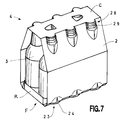
- this packaging 2 are arranged cylindrical objects 3 such as bottles or cans, to form a packaging set 4 ( Figures 6, 7), intended for sale.
- the blank 1 is now described, according to a first embodiment, with reference in Figures 1 to 4, the blank 1 being unfolded and laid flat.
- the blank 1 has two perpendicular axes of symmetry which intersect in a point P substantially coincident with the center of gravity of the blank 1, and which define respectively two longitudinal X and transverse Y directions, the term "lateral" being defined in relation to the latter.
- a location near the center P of the blank 1 is said central or interior, while a location remote from the center P of the blank 1 is said to be external.
- the blank 1 comprises a central panel 5, which is intended to form the bottom of packaging 2, for example of substantially rectangular shape, bordered by two side panels 6, which are connected to the central panel 5 by two first longitudinal articulation lines 7, substantially rectilinear and parallel to each other.
- the side panels 6, are themselves bordered outwards, along two second longitudinal articulation lines 8, substantially parallel between them and at the first articulation lines 7, by a first and a second end panels 9, 10.
- the end panels 9, 10 are intended to form closing means and covered with packaging.
- the blank 1 further comprises two flaps 11 intended to form means of retaining objects in the package, which extend transversely along of the central panel 5 on either side thereof.
- the flaps 11 for example of substantially rectangular shape, extend also, transversely, at least partly along the side panels 6, the flaps 11 being connected to the central panel 5 and to the side panels 6 by two transverse flap lines 12.
- the flap lines 12, which are substantially rectilinear and parallel to one another, are for example each confused with an edge 13 common to the central panel 5 and the side panels 6.
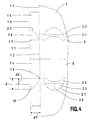
- Each flap 11 comprises a central part 14 which projects longitudinally from the central panel 5, extended by two end portions 15 which project longitudinally of each of the side panels 6, each end portion 15 being connected to the central part 14 by a panel 16.
- Each panel 16 is on the one hand connected to the central part 14 and separated from the latter by a substantially straight fold line 17, located substantially in the extension of one of the first articulation lines 7, and which extends between one end 18 of the latter and a free edge 19 of the flap.
- Each flap 11 has a longitudinal dimension d1, substantially equal to the distance between the flap line 12 and the edge 19 of the flap 11.
- Each panel 16 is on the other hand connected to the terminal part 15 and separated from the latter. by a curvilinear fold line 20, which is capable of giving the pan 16 a curved shape when the blank 1 is put into volume to form the packaging 2.
- each side panel 6 can be bordered inwards by at minus a side panel 21, which connects the side panel 6 to the central panel 5 ( Figures 1, 4).
- the side panels 21 are intended to form the chamfer of the package 2 during setting up the blank 1.
- the side panels 21, which are arranged on the side and on the other side of the central panel 5, between the latter and the side panels 6, are on the one hand connected to the central panel 5 by the first articulation lines 7, and on the other hand connected to the side panels 6 by two third lines of longitudinal articulation 22, substantially rectilinear and parallel to first lines of articulation 7, and located at a distance therefrom.
- Each side panel 21 has a transverse dimension d2, substantially equal to the distance between the first and third articulation lines 7, 22.
- each side panel 6 is bordered inwardly by a plurality of side panels 21 which connect the side panel 6 to central panel 5.
- the blank 1 may also include first openings 23, made on either side of the central panel 5, between it and the side panels 6, substantially between the first and second articulation lines 7, 22.
- Each first opening 23 is intended to receive, during the setting in volume of the blank 1 to form the package 2, at least part of a portion lower 24 of the object 3 of which it is substantially complementary, of so as to limit the movement of the object 3 inside the packaging 2.
- the blank 1 may also include at least two first legs 25, adjacent to each first opening 23.
- the first legs 25 are for example separated by a first line of cutout 26, and are each connected to the side panel 6 by a line of curved folding 27.
- the packaging 2 can best match the shape of the objects 3, whose lower portions 24 push the first legs 25, which bend so along their curved fold lines 27 outward from packaging 2.
- the blank 1 may include second openings 28, made in each side panel 6 along the second articulation lines 8, at near the end panels 9, 10.
- Each second opening 28 is intended to receive, when the volume of the blank 1 to form the package 2, at least part of a portion upper 29 of object 3.
- Each second opening 28 has for example a shape of a lunula whose the concavity is turned towards the outside of the blank 1, substantially complementary of the upper portion 29 of the object 3, so as to limit the movement of the latter inside the package 2.
- the blank 1 may also include two second legs 30, adjacent to each second opening 28, separated by a second cutting line 31, each second tab 30 being connected to a side panel 6 by a line folding 32.
- the first two windows 33 can be made in the first end panel 9, the area of each first window 33 being sufficient to allow the swipe of a finger.
- Two second windows 34 can also be used in the second end panel 10, the surface of each second window 34 being sufficient to also allow the passage of a finger.
- each second window 34 includes a movable flap 35 substantially complementary to window 34, and which removably closes the latter, the movable flap 35 being connected to the second end panel 10 by a fold line 36, for example substantially rectilinear and transverse.
- the package 2 as obtained by setting up the blank 1 described above, as well as all of packaging 4 including this packaging 2, which groups and envelops 3 cylindrical objects such as bottles, cans or boxes containing beverages.
- the packaging comprises a substantially flat bottom F, coincident with the panel central 5 of the blank 1, and intended to support the objects 3.
- the term "horizontal" is defined relative to the bottom F of the package.
- FIG. 5 is shown an axis Z merged with a direction of elevation, substantially perpendicular to the bottom F and to the longitudinal directions X and transverse Y.
- the bottom F is bordered by the two side panels 6, folded upwards by relative to the bottom F, substantially at right angles.
- the packaging also comprises means 37 for holding objects 3 in the package 2, which has a rim R merged with the flap 11, and obtained by folding the latter relative to the bottom F, upwards and substantially at right angle.
- the rim R which has an elevation dimension substantially equal to the longitudinal dimension d1 of the flap 11, is connected to the bottom F and to the panels side 6 by the flap line 12, substantially coincident with the edge 13 exterior, common to bottom F and side panels 6.
- the central part 14 of the rim 11, which projects from the bottom F, is folded upwards substantially perpendicular to the bottom F, while each of the two end parts 15, projecting from each of the side panels 6, is folded down against an internal face 38 of the corresponding side panel 6.
- the pan 16, which connects each end portion to the central portion 14, has a curved surface capable of substantially matching the cylindrical shape of one of the objects 3, due to the curvilinear shape of the fold line 20.
- the fold line 17, which connects the pan 16 to the central part 14 of the rim R is located substantially in the extension of a first articulation line 7, extends between one end 18 thereof and a free edge 19 of the rim R, and is extended upward substantially parallel to the direction Z of elevation.
- the curvilinear fold line 20 extends substantially between a point of intersection between the fold line 17 and the flap line 12, substantially merged with the end 18 of the first articulation line 7, and a point M located on the free edge 19 of the rim R, at a distance d from the fold line 17.
- the curvilinear fold line 20 has a shape in an arc, the diameter of which is greater than the diameter of objects 3 cylindrical arranged in the package 2.
- the rim R keeps the objects 3 firmly at inside the packaging 2, the sides 16 conforming to the cylindrical shape of the objects 3 to limit their movements inside the packaging 2.
- the latter may include so-called lower wedging means 39, lower portions 24 of the objects 3.
- These lower wedging means 39 comprise on the one hand the side panels 21 arranged on either side of the bottom F, between the latter and the side panels 6.
- These side panels 21 are folded upwards relative to the bottom F of the packaging 2, along the first articulation lines 7, and form with the bottom F an angle, for example about 45 degrees.
- While the side panels 6 are folded relative to the side panels 21 up along the second fold lines 8, and form with the sides lateral angles, for example about 45 degrees.
- the chamfer thus created during the blanking of the blank spreads the panels side 6 of the bottom F, so that the distance between their internal faces 38 is greater than a transverse dimension of the bottom F of the package 2.
- the pan 16 extends substantially transversely between the central part 14 of the rim R and the terminal part 15, and takes a curved shape imposed by the curvilinear fold line 20.
- the ability of the pan 15 to take its curved shape depends on the one hand on the shape of the curvilinear fold line 20, and on the other hand of the distance d, which separates the point M of the fold line 17.
- the distance d is defined as follows: d ⁇ d1 + d2 ⁇ (1 - 1 / ⁇ 2)
- the wedging means 39 further comprise the first openings 23 and the first legs 25 also called lower.
- the lower legs 25 are articulated around their curved fold lines 27 to adapt to the shape of the lower portions 24 of the objects 3, intended to protrude, at least in part, out of the package 2.
- the packaging also includes a cover C which includes the panels end 9, 10, also called upper panels which form means of closure 40 of the packaging.
- the packaging also comprises gripping means 41 formed by the windows 33, 34 made in these end panels 9, 10.
- the upper panels 9, 10 are connected to the side panels 6 and folded by relative to these along the two third articulation lines 22, forming with the side panels 6 an angle, for example of about 90 degrees.
- the upper panels 9, 10, substantially cover the objects 3, and are substantially parallel to the bottom F, the package closing from the top.
- the second upper panel 10 overlaps the first 9, by covering at least partially, the upper panels 9, 10 being associated with each other by fixing means 42, such as gluing, stapling, snap or similar, to close the packaging 2.
- the gripping means 41 can comprise both first windows 33, formed in the first upper panel 9, thus that the two second windows 34, made in the second panel higher 10.
- the second windows 34 are for example arranged substantially facing each other first windows 33, so as to allow the passage of a finger simultaneously through the first and second windows 33, 34 for the gripping the packaging 2.
- the movable flaps 35 which can be provided to substantially close the second windows 34 in order to guarantee the inviolability of the packaging 2, are then retracted towards the interior of the latter.
- the packaging 2 may also include so-called wedging means. upper 43, upper portions 29 of the objects 3, in order to maintain these in a substantially fixed position in the package 2.
- the upper wedging means 43 include the second openings 28, also called superior, already described above, so as to allow to the upper portions 29 of the objects 3 to protrude, at least in part, out of packaging 2.
- each opening upper 28 overcomes two second legs 30 also called upper, described above.
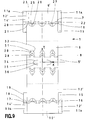
- the blank 1 comprises a central panel 5 'intended to form the cover C of the packaging, bordered by two side panels 6, themselves bordered by a first and second end panels 9 ', 10' also called panels bottom which are intended to form by association the bottom F of the packaging.
- the end panels 9 ', 10' are connected to the side panels 6 by two first articulation lines 7, the side panels 6 being themselves connected to the central panel 5 ′ by two second articulation lines 8, substantially longitudinal and parallel to the first.
- the blank 1 further comprises four flaps 11a, 11b intended to form means holding 37 of the objects 3 in the package 2, extending transversely the along the end panels 9 ', 10' and at least partly along the side panels 6.
- Two first flaps 11a are connected to the first end panel 9 'and to one side panels 6 by two respective flap lines 12 ', each substantially coincident with an edge 13 'common to the first panel end 9 'and to the side panels 6.
- While two second flaps 11b are connected to the second panel end 10 'and to the other side panel 6 by two flap lines 12' common to the second end panel 11b and to the side panel 6.
- the first and second flaps 11a, 11b respectively comprise a first and second main parts 14a, 14b projecting from the first and second end panels 9 ', 10', extended by an end portion 15 already described above, protruding from the side panel 6, and connected to the part main 14a, 14b by a pan 16.
- the pan 16, already described above, is on the one hand connected to the main part 14a, 14b and separated from it by a fold line 17 already described.
- the pan 16 is on the other hand connected to the terminal part 15 and separated by the latter by a curvilinear fold line 20 capable of giving the pan 16 a shape curve when the blank 1 is put into volume to form the package 2.
- the blank 1 may include at least two side panels 21 intended to forming the chamfer of the packaging 2 when the blank 1 is set into volume.
- the side panels 21 have already been described, and are here arranged between the end panels 9 ', 10' and side panels 6.
- the side panels are connected on the one hand to the end panels 9 ′, 10 ′ by the first two articulation lines 7, and on the other hand to the side panels 6 by two third articulation lines 22 substantially parallel to the first, and located at a distance from them.
- the first openings 23 are here made between the side panels 6 and the end panels 9 ′, 10 ′, substantially between the first and third articulation lines 7, 22.
- the blank 1 comprises at least two first legs 25 adjacent to each first opening 23, separated by a first line cutting 26, each tab 25 being connected to the side panel 6 by a line bending curve 27.
- each window 34 comprises a movable flap 35 (already described above).
- the second openings 28, described above, are for example practiced in each side panel 6, near the central panel 5 ', the along the second articulation lines 8 which separate the central panel 5 ' side panels 6.
- two second legs 30 can also be provided, adjacent to each second opening 28, separated by a second line cutting 31, each tab being connected to a side panel 6 by a line folding 32.
- the packaging 2 formed by setting up the blank 1 which has just been described, comprises a single upper panel 44 forming a cover C of the package 2, confused with the central panel 5 'of the blank.
- the upper panel 44 is connected to the two side panels 6 and folded by relative to these, for example substantially at right angles, along the first and / or third articulation lines 7.22.
- the bottom F of the package 2 is in two parts at the minus, and includes a first bottom panel 45 confused with the first end panel 9 'of the blank.
- the bottom F also includes a second bottom panel 46 merged with the second end panel 10 'of the blank 1, which overlaps the first bottom panel 45 by covering it at least partially (FIG. 10).
- the bottom panels 44, 45 are associated with each other by the means of fixing, such as gluing, stapling, snap-fastening, or the like.
- the means 41 for holding the objects 3 in the packaging 2 comprise a rim R in two parts, obtained by combining flaps 11 '.
- the rim R comprises a central part 14 ′ formed by association of the main parts 14a, 14b of the two flaps 11a, 11b arranged opposite one of the other when the packaging is closed 2.
- the main parts are folded upwards in relation to the bottom, for example substantially at right angles, the first main part 14a overlapping the second main part 14b by covering it at least partially.
- the main parts 14a, 14b are associated with each other by means fasteners such as gluing, stapling, snap-fastening, or the like.
Landscapes
- Engineering & Computer Science (AREA)
- Mechanical Engineering (AREA)
- Cartons (AREA)
- Insertion Pins And Rivets (AREA)
- Packaging For Recording Disks (AREA)
- Packages (AREA)
Abstract
Description
- au moins deux pans latéraux formant chanfrein, disposés de part et d'autre du fond, entre ce dernier et les panneaux latéraux, lesdits pans formant chanfrein étant d'une part reliés au fond et articulés autour de celui-ci le long des premières lignes d'articulation, et d'autre part reliés aux panneaux latéraux et articulés autour de ceux-ci le long de deux troisièmes lignes d'articulation, sensiblement parallèles aux premières et situées à distance de celles-ci.
- des premières ouvertures, pratiquées de part et d'autre du fond, entre celui-ci et les panneaux latéraux, sensiblement entre les premières et deuxièmes lignes d'articulation inférieures, de manière à permettre à une portion inférieure des objets de saillir, au moins en partie, hors de l'emballage.
- au moins deux premières pattes, qui surmontent chaque première ouverture, et séparées par une première ligne de découpe, chaque première patte étant reliée au panneau latéral par une ligne de pliage courbe autour de laquelle ladite patte s'articule pour s'adapter à la forme d'une portion inférieure de l'objet destinée à saillir, au moins en partie, hors de l'emballage.
- deux premières fenêtres pratiquées dans le premier panneau supérieur, et dont la surface est suffisante pour permettre le passage d'un doigt lors de la préhension de l'emballage.
- deux secondes fenêtres pratiquées dans le second panneau supérieur, disposées sensiblement au regard des premières fenêtres, et dont la surface est suffisante pour permettre le passage d'un doigt.
- des deuxièmes ouvertures, pratiquées dans chaque panneau latéral le long des deuxièmes lignes d'articulation, à proximité des panneaux supérieurs, de sorte à permettre à une portion supérieure des objets de saillir, au moins en partie, hors de l'emballage.
- au moins deux deuxièmes pattes, adjacentes à chaque deuxième ouverture et surmontées par celles-ci, séparées par une deuxième ligne de découpe, chaque deuxième patte étant reliée à un panneau latéral, par une ligne de pliage autour de laquelle elle s'articule pour s'adapter à la forme d'une portion supérieure de l'objet, destinée à saillir hors de l'emballage.
- d'une part relié à la partie centrale par une ligne de pliage, située sensiblement dans le prolongement d'une des premières lignes d'articulation et qui s'étend entre une extrémité de celle-ci et un bord libre de du volet ;
- d'autre part relié à la partie terminale par une ligne de pliage curviligne apte à conférer audit pan une forme courbe lors de la mise en volume du flan pour former l'emballage.
- au moins deux premières pattes, adjacentes à chaque première ouverture, et séparées par une ligne de découpe, chaque première patte étant reliée au panneau latéral par une ligne de pliage courbe ;
- deux premières fenêtres pratiquées dans le premier panneau d'extrémité, et dont la surface est suffisante pour permettre le passage d'un doigt.
- deux secondes fenêtres pratiquées dans le second panneau d'extrémité, et dont la surface est suffisante pour permettre le passage d'un doigt.
- d'une part relié à la partie principale par une ligne de pliage située sensiblement dans le prolongement de la première ligne d'articulation, et s'étendant entre une extrémité de celle-ci et un bord libre du volet ;
- d'autre part relié à la partie terminale par une ligne de pliage curviligne apte à conférer au dit pan une forme courbe lors de la mise en volume du flan pour former l'emballage.
- des ouvertures pratiquées entre les panneaux latéraux et les panneaux d'extrémité, sensiblement entre les premières et troisièmes lignes d'articulation ;
- au moins deux premières pattes adjacentes à chaque première ouverture, et séparées par une première ligne de découpe, chaque première patte étant reliée au panneau latéral par une ligne de pliage courbe ;
- deux fenêtres pratiquées dans le panneau central, et dont la surface est suffisante pour permettre le passage d'un doigt ;
- La figure 1 est une vue en plan de dessus d'un flan conforme à l'invention, selon un premier mode de réalisation ;
- La figure 2 est une vue en plan de dessus d'un premier détail II du flan de la figure 1 ;
- La figure 3 est une vue en plan de dessus d'un deuxième détail IIIdu flan de la figure 1 ;
- La figure 4 est une vue en plan de dessus d'un troisième détail IV du flan de la figure 1 ;
- La figure 5 est une vue en perspective d'un emballage réalisé par mise en forme du flan de la figure 1 ;
- La figure 6 est une vue en perspective d'un ensemble de conditionnement comprenant un emballage tel que celui de la figure 5, dans lequel sont disposés des objets, ici des bouteilles ;
- La figure 7 est une vue en perspective de l'ensemble de conditionnement de la figure 6, selon un angle de vue différent.
- La figure 8 est une vue en perspective d'un détail VIII de l'emballage de la figure 6 ;
- La figure 9 est une vue en plan de dessus d'un flan conforme à l'invention, selon un deuxième mode de réalisation ; et
- La figure 10 est une vue en perspective d'un un emballage obtenu par mise en volume d'un flan tel que celui de la figure 9.
Claims (37)
- Emballage (2) destiné à grouper et envelopper des objets (3) cylindriques tels que des bouteilles ou des canettes, formé par mise en volume d'un flan (1) découpé dans une feuille en carton ou équivalent, cet emballage (2) comprenant des moyens de fermeture (40) et des moyens de préhension (41), ainsi qu'un fond (F) destiné à supporter les objets (3), bordé par deux panneaux latéraux (6) pliés par rapport au fond (F) le long de deux premières lignes d'articulation (7), l'emballage (2) comprenant en outre des moyens de maintien (37) des objets (3) dans l'emballage (2), qui comportent un rebord (R) relié au fond (F) et aux panneaux latéraux (6) par une ligne de rabat (12, 12') sensiblement confondue avec un bord extérieur (13, 13') commun au fond (F) et aux panneaux latéraux (6), caractérisé en ce que le rebord (R) comporte une partie centrale (14, 14') saillant du fond (F), repliée vers le haut sensiblement perpendiculairement au fond (F), prolongée par deux parties terminales (15) saillant de chacun des panneaux latéraux (6), chaque partie terminale (15) étant rabattue contre une face interne (38) du panneau latéral (6) correspondant, et reliée à la partie centrale (14, 14') par un pan (16) qui présente une surface courbe apte à épouser sensiblement la forme de l'un des objets (3), ledit pan (16) étant d'une part relié à la partie centrale (14, 14') par une ligne de pliage (17) située sensiblement dans le prolongement de la première ligne d'articulation (7), et s'étendant entre une extrémité (18) de celle-ci et un bord libre (19) du rebord R, le pan (16) étant d'autre part relié à la partie terminale (15) et séparé de celle-ci par une ligne de pliage curviligne (20) apte à conférer audit pan (16) sa forme courbe.
- Emballage (2) selon la revendication 1, caractérisé en ce que ladite ligne de pliage curviligne (20) s'étend sensiblement entre un point d'intersection entre la ligne de pliage (17) et la ligne de rabat (12), et un point (M) situé sur le bord libre (19) du rebord (R) à distance de la ligne de pliage (17).
- Emballage (2) selon la revendication 1 ou la revendication 2, caractérisé en ce qu'il comprend des moyens de calage (39) dits inférieurs, d'une portion inférieure (24) des objets (3).
- Emballage (2) selon la revendication 3, caractérisé en ce que lesdits moyens de calage inférieurs (39) comprennent au moins deux pans latéraux (21) formant chanfrein, disposés de part et d'autre du fond (F), entre ce dernier et les panneaux latéraux (6), lesdits pans (21) formant chanfrein étant d'une part reliés au fond (F) et articulés autour de celui-ci le long des premières lignes d'articulation (7), et d'autre part reliés aux panneaux latéraux (6) et articulés autour de ceux-ci le long de deux troisièmes lignes d'articulation (22), sensiblement parallèles aux premières et situées à distance de celles-ci.
- Emballage (2) selon la revendication 4, caractérisé en ce que les moyens de calage inférieurs (39) comprennent des premières ouvertures (23), pratiquées de part et d'autre du fond (F), entre celui-ci et les panneaux latéraux (6), sensiblement entre les premières et troisièmes lignes d'articulation (7, 22), de manière à permettre à une portion inférieure (24) des objets (3) de saillir, au moins en partie, hors de l'emballage (2).
- Emballage (2) selon la revendication 5, caractérisé en ce que les moyens de calage inférieurs (39) comprennent au moins deux premières pattes (25), qui surmontent chaque première ouverture (23), et séparées par une première ligne de découpe (26), chaque première patte (25) étant reliée au panneau latéral (6) par une ligne de pliage courbe (27) autour de laquelle ladite patte (25) s'articule pour s'adapter à la forme d'une portion inférieure (24) de l'objet (3) destinée à saillir, au moins en partie, hors de l'emballage (2).
- Emballage (2) selon l'une des revendications 1 à 6, caractérisé en ce que les moyens de fermeture (40), comprennent un premier et un second panneaux (9, 10) supérieurs reliés aux panneaux latéraux (6) et pliés par rapport à ceux-ci le long de deux deuxièmes lignes d'articulation (8), le second panneau supérieur (10) chevauchant le premier (9) en le recouvrant au moins partiellement, les panneaux supérieurs (9, 10) étant associés l'un à l'autre par des moyens de fixation (42), tels que collage, agrafage, encliquetage ou analogue, pour fermer l'emballage (2).
- Emballage (2) selon la revendication 7, caractérisé en ce que lesdits moyens de préhension (41) comprennent deux premières fenêtres (33) pratiquées dans le premier panneau supérieur (9), et dont la surface est suffisante pour permettre le passage d'un doigt lors de la préhension de l'emballage (2).
- Emballage (2) selon l'une des revendications 7 ou 8, caractérisé en ce que les moyens de préhension (41) comprennent deux secondes fenêtres (34) pratiquées dans le second panneau supérieur (10), disposées sensiblement au regard des premières fenêtres (33), et dont la surface est suffisante pour permettre le passage d'un doigt.
- Emballage (2) selon la revendication 9, caractérisé en ce que chaque seconde fenêtre (34) comprend un volet mobile (35) sensiblement complémentaire de ladite fenêtre (34), et qui obture de façon amovible cette dernière, le volet mobile (35) étant relié au second panneau supérieur (10) et articulé autour de celui-ci par une ligne de pliage (36), le volet mobile (35) étant apte à être escamoté vers l'intérieur de l'emballage (2) lors du passage d'un doigt au travers des fenêtres (33, 34).
- Emballage (2) selon l'une des revendications 1 à 10, caractérisé en ce qu'il comprend des moyens de calage (43) dit supérieurs, d'une portion supérieure des objets.
- Emballage (2) selon la revendication 11, caractérisé en ce que lesdits moyens de calage supérieurs (43) comprennent des deuxièmes ouvertures (28), pratiquées dans chaque panneau latéral (6) le long des deuxièmes lignes d'articulation (8), à proximité des panneaux supérieurs (9, 10), de sorte à permettre à une portion supérieure (29) des objets (3) de saillir, au moins en partie, hors de l'emballage (2).
- Emballage (2) selon la revendication 12, caractérisé en ce que les moyens de calage supérieurs (43) comprennent au moins deux deuxièmes pattes (30), adjacentes à chaque deuxième ouverture (28) et surmontées par celles-ci, séparées par une deuxième ligne de découpe (31), chaque deuxième patte (30) étant reliée à un panneau latéral (6), par une ligne de pliage (32) autour de laquelle elle s'articule pour s'adapter à la forme d'une portion supérieure (29) de l'objet (3), destinée à saillir hors de l'emballage.
- Emballage (2) selon l'une des revendications 1 à 6, caractérisé en ce qu'il comprend un unique panneau supérieur (44) formant couvert (C) de l'emballage (2), relié aux deux panneaux latéraux (6) et plié par rapport à ceux-ci le long de deux deuxièmes lignes d'articulation (8).
- Emballage (2) selon l'une des revendications 14, caractérisé en ce que ledit panneau supérieur (44) comprend des moyens de préhension (41) de l'emballage (2).
- Emballage (2) selon la revendication 15, caractérisé en ce que les moyens de préhension (41) comprennent deux fenêtres (34) pratiquées dans le panneau supérieur (44), et aptes à permettre le passage d'au moins un doigt pour la préhension de l'emballage (2).
- Emballage (2) selon la revendication 16, caractérisé en ce que chaque fenêtre (34) comprend un volet mobile (35) sensiblement complémentaire de ladite fenêtre (34), et qui obture de manière amovible cette dernière, le volet mobile (35) étant relié au panneau supérieur (44) et articulé autour de celui-ci par une ligne de pliage (36), le volet mobile (35) étant apte à être escamoté vers l'intérieur de l'emballage (2) lors du passage d'un doigt au travers de la fenêtre (34) pour la préhension de l'emballage (2).
- Emballage (2) selon l'une des revendications 14 à 17, caractérisé en ce que le fond (F) de l'emballage (2) est en deux parties au moins, et comprend un premier panneau de fond (9', 45) relié à l'un des panneaux latéraux (6), ainsi qu'un deuxième panneau de fond (10', 46) relié à l'autre panneau latéral (6), et qui chevauche le premier panneau de fond (9', 45) en le recouvrant au moins partiellement, les panneaux de fond (9', 45, 10', 46) étant associés l'un à l'autre par les moyens de fixation (42), tels que collage, agrafage, encliquetage, ou analogue.
- Emballage (2) selon la revendication 18, caractérisé en ce que ledit rebord (R) est en deux parties, la partie centrale (14') comprenant une première et une deuxième parties principales (14a, 14b), reliées respectivement aux premier et deuxième panneaux de fond (9', 45, 10', 46) le long de la ligne de rabat (12), et pliées vers le haut par rapport aux panneaux de fond (9', 45, 10', 46), la première partie principale (14a) chevauchant la deuxième partie principale (14b) en la recouvrant au moins partiellement, les parties principales (14a, 14b) étant associées l'une à l'autre par des moyens de fixation (42) tels que collage, agrafage, encliquetage, ou analogue.
- Flan (1) découpé dans une feuille en carton ou équivalent, destiné à former, par sa mise en volume, un emballage (2) selon l'une des revendications 1 à 13, ce flan comprenant un panneau central (5') destiné à former le fond (F) de l'emballage (2), bordé par deux panneaux latéraux (6), reliés au panneau central (5') par deux premières lignes d'articulation (22), et bordés eux-mêmes, le long de deux troisièmes lignes d'articulation (22), par un premier et un second panneaux d'extrémités (9', 10') destinés à former moyens de fermeture (40) et couvert (C) de l'emballage, le flan (1) comprenant en outre deux volets (11a, 11b) destinés à former moyens de maintien (37) des objets (3) dans l'emballage (2), s'étendant le long du panneau central (5') et au moins en partie le long des panneaux latéraux (6), les volets (11a, 11b) étant reliés au panneau central (5') et aux panneaux latéraux (6) par deux lignes de rabat (12'), chacune confondue avec un bord (13') commun au panneau central (5') et aux panneaux latéraux (6), chaque volet (11a, 11b) comprenant une partie centrale (14) saillant du panneau central (5'), prolongée par deux parties terminales (15) saillant de chacun des panneaux latéraux (6), chaque partie terminale (15) étant reliée à la partie centrale (14) par un pan (16) qui est :d'une part relié à la partie centrale (14) par une ligne de pliage (17), située sensiblement dans le prolongement de la première ligne d'articulation (7) et qui s'étend entre une extrémité (18) de celle-ci et un bord libre (19) du volet (11a, 11b) ;d'autre part relié à la partie terminale (15) par une ligne de pliage curviligne (20) apte à conférer audit pan (16) une forme courbe lors de la mise en volume du flan (1) pour former l'emballage (2).
- Flan (1) selon la revendication 20, caractérisé en ce qu'il comprend au moins deux pans latéraux (21) destinés à former chanfrein de l'emballage (2) lors de la mise en volume du flan (1), lesdits pans (21) étant disposés de part et d'autre du panneau central (5), entre celui-ci et les panneaux latéraux (6), et étant d'une part, reliés au panneau central (5) par les premières lignes d'articulation (7), et d'autre part reliés aux panneaux latéraux (6) par deux troisièmes lignes d'articulation (22) sensiblement parallèles aux premières lignes d'articulation (7), et situées à distance de celles-ci.
- Flan (1) selon la revendication 21, caractérisé en ce qu'il comprend des premières ouvertures (23), pratiquées de part et d'autre du panneau central (5), entre celui-ci et les panneaux latéraux (6), sensiblement entre les premières et troisièmes lignes d'articulation (7, 22).
- Flan (1) selon la revendication 22, caractérisé en ce qu'il comprend au moins deux premières pattes (25), adjacentes à chaque première ouverture (23), et séparées par une première ligne de découpe (26), chaque première patte (25) étant reliée au panneau latéral (6) par une ligne de pliage courbe (27).
- Flan (1) selon l'une des revendications 20 à 23, caractérisé en ce qu'il comprend deux premières fenêtres (33) pratiquées dans le premier panneau d'extrémité (9), et dont la surface est suffisante pour permettre le passage d'un doigt.
- Flan (1) selon l'une des revendications 20 à 24, caractérisé en ce qu'il comprend deux secondes fenêtres (34) pratiquées dans le second panneau d'extrémité (10), et dont la surface est suffisante pour permettre le passage d'un doigt.
- Flan (1) selon la revendication 25, caractérisé en ce que chaque seconde fenêtre (34) comprend un volet mobile (35) sensiblement complémentaire de ladite fenêtre (34), et qui obture de façon amovible celle-ci, le volet mobile (35) étant relié au second panneau d'extrémité (10) par une ligne de pliage (36).
- Flan (1) selon l'une des revendications 20 à 26, caractérisé en ce qu'il comprend des deuxièmes ouvertures (28), pratiquées dans chaque panneau latéral (6) le long des deuxièmes lignes d'articulation (8), à proximité des panneaux d'extrémité (9,10).
- Flan (1) selon la revendication 27, caractérisé en ce qu'il comprend en outre deux deuxièmes pattes (30), adjacentes à chaque deuxième ouverture (28), séparées par une deuxième ligne de découpe (31), chaque deuxième patte (30) étant reliée à un panneau latéral (6) par une ligne de pliage (32).
- Flan (1) découpé dans une feuille de carton ou équivalent, destiné à former, par sa mise en volume, un emballage (2) selon l'une des revendications 14 à 19, qui comprend un panneau central (5) destiné à former le couvert (C) de l'emballage (2), bordé par deux panneaux latéraux (6), eux-mêmes bordés par deux panneaux d'extrémité (9', 10') qui sont reliés aux panneaux latéraux (6) par deux premières lignes d'articulation (7), les panneaux d'extrémité (9', 10') étant destinés à former par association le fond (F) de l'emballage (2), le flan (1) comprenant en outre quatre volets (11a, 11b) destinés à former moyens de maintien (37) des objets (3) dans l'emballage (2), s'étendant le long des panneaux d'extrémité (9', 10') et au moins en partie le long des panneaux latéraux (6), les volets (11a, 11b) étant reliés aux panneaux d'extrémité (9', 10') et aux panneaux latéraux par quatre lignes de rabat (12'), chacune sensiblement confondue avec un bord (13') commun aux panneaux d'extrémité (9', 10') et aux panneaux latéraux (6), chaque volet (11a, 11b) comprenant une partie principale (14a, 14b) saillant du panneau d'extrémité (9', 10'), prolongée par une partie terminale (15) saillant du panneau latéral (6), et relié à la partie principale (14a, 14b) par un pan (16) qui est :d'une part relié à la partie principale (14a, 14b) par une ligne de pliage (17) située sensiblement dans le prolongement de la première ligne d'articulation (7), et s'étendant entre une extrémité (18) de celle-ci et un bord libre (19) du volet (11a, 11b) ;d'autre part relié à la partie terminale (15) par une ligne de pliage curviligne (20) apte à conférer au dit pan (16) une forme courbe lors de la mise en volume du flan (1) pour former l'emballage (2).
- Flan (1) selon la revendication 29, caractérisé en ce qu'il comprend au moins deux pans latéraux (21) destinés à former chanfrein de l'emballage (2) lors de la mise en volume du flan, lesdits pans (21) étant disposés entre les panneaux d'extrémité (9', 10') et les panneaux latéraux (6), et étant d'une part reliés aux panneaux d'extrémité (9', 10') par les premières lignes d'articulation (7), et d'autre part reliés aux panneaux latéraux (6) par deux troisièmes lignes d'articulation (22) sensiblement parallèles aux premières, et situées à distance de celles-ci.
- Flan selon la revendication 30, caractérisé en ce qu'il comprend des ouvertures pratiquées entre les panneaux latéraux (6) et les panneaux d'extrémité (9', 10'), sensiblement entre les premières et troisièmes lignes d'articulation (7, 22).
- Flan (1) selon la revendication 31, caractérisé en ce qu'il comprend au moins deux premières pattes (25) adjacentes à chaque première ouverture (23), et séparées par une première ligne de découpe (26), chaque première patte (25) étant reliée au panneau latéral (6) par une ligne de pliage courbe (27).
- Flan (1) selon l'une des revendications 29 à 32, caractérisé en ce qu'il comprend deux fenêtres (34) pratiquées dans le panneau central (5'), et dont la surface est suffisante pour permettre le passage d'un doigt.
- Flan (1) selon la revendication 33, caractérisé en ce que chaque fenêtre (34) comprend un volet mobile (35) sensiblement complémentaire de ladite fenêtre (34), et qui obture de façon amovible celle-ci, le volet mobile (35) étant relié au panneau central (5') par une ligne de pliage (36).
- Flan (1) selon l'une des revendications 29 à 34, caractérisé en ce qu'il comprend des deuxièmes ouvertures (28) pratiquées dans chaque panneau latéral (6) le long des deuxièmes lignes d'articulation (8), à proximité du panneau central (5').
- Flan (1) selon la revendication 35, caractérisé en ce qu'il comprend en outre deux deuxièmes pattes (30) adjacentes à chaque deuxième ouverture (28), séparées par une deuxième ligne de découpe (31), chaque deuxième patte (30) étant reliée à un panneau latéral (6) par une ligne de pliage (32).
- Ensemble de conditionnement (4) comprenant un emballage (2) selon l'une des revendications 1 à 19, dans lequel sont disposés des objets (3) cylindriques tels que des bouteilles ou des canettes.
Priority Applications (5)
| Application Number | Priority Date | Filing Date | Title |
|---|---|---|---|
| DE69919176T DE69919176T2 (de) | 1999-10-08 | 1999-10-08 | Verpackung mit gebogener Haltevorrichtung |
| AT99402477T ATE272549T1 (de) | 1999-10-08 | 1999-10-08 | Verpackung mit gebogener haltevorrichtung |
| DK99402477T DK1103481T3 (da) | 1999-10-08 | 1999-10-08 | Emballage med krumme fastholdelsesmidler |
| EP99402477A EP1103481B1 (fr) | 1999-10-08 | 1999-10-08 | Emballage présentant des moyens de maintien courbés |
| ES99402477T ES2226308T3 (es) | 1999-10-08 | 1999-10-08 | Envase que presenta medios curvados de retencion. |
Applications Claiming Priority (1)
| Application Number | Priority Date | Filing Date | Title |
|---|---|---|---|
| EP99402477A EP1103481B1 (fr) | 1999-10-08 | 1999-10-08 | Emballage présentant des moyens de maintien courbés |
Publications (2)
| Publication Number | Publication Date |
|---|---|
| EP1103481A1 true EP1103481A1 (fr) | 2001-05-30 |
| EP1103481B1 EP1103481B1 (fr) | 2004-08-04 |
Family
ID=8242135
Family Applications (1)
| Application Number | Title | Priority Date | Filing Date |
|---|---|---|---|
| EP99402477A Expired - Lifetime EP1103481B1 (fr) | 1999-10-08 | 1999-10-08 | Emballage présentant des moyens de maintien courbés |
Country Status (5)
| Country | Link |
|---|---|
| EP (1) | EP1103481B1 (fr) |
| AT (1) | ATE272549T1 (fr) |
| DE (1) | DE69919176T2 (fr) |
| DK (1) | DK1103481T3 (fr) |
| ES (1) | ES2226308T3 (fr) |
Cited By (3)
| Publication number | Priority date | Publication date | Assignee | Title |
|---|---|---|---|---|
| EP1655234A1 (fr) * | 2004-11-03 | 2006-05-10 | MM Packaging Europe GmbH | Emballage en carton |
| US10399719B2 (en) | 2011-10-19 | 2019-09-03 | Graphic Packaging International, Llc | System and method for activating article protection features of a carton |
| USD993016S1 (en) | 2021-04-22 | 2023-07-25 | Graphic Packaging International, Llc | Carton |
Families Citing this family (8)
| Publication number | Priority date | Publication date | Assignee | Title |
|---|---|---|---|---|
| BR112013028448B1 (pt) | 2011-05-06 | 2020-07-21 | Graphic Packaging International, Llc | método de formar uma caixa de papelão |
| US9022217B2 (en) | 2011-05-06 | 2015-05-05 | Graphic Packaging International, Inc. | Carton with article protection feature |
| AU2013290750B2 (en) | 2012-07-17 | 2017-02-09 | Graphic Packaging International, Llc | Carton with article protection feature |
| US9840358B2 (en) | 2013-03-14 | 2017-12-12 | Graphic Packaging International, Inc. | Carton with article protection feature |
| US9701436B2 (en) | 2013-04-10 | 2017-07-11 | Graphic Packaging International, Inc. | Carton with article protection feature |
| BR112015025302B1 (pt) | 2013-04-10 | 2022-06-07 | Graphic Packaging International, Llc | Embalagem para alojar pelo menos um artigo, matriz para formar uma embalagem para alojar pelo menos um artigo, embalagem para alojar pelo menos um artigo, matriz para formar uma embalagem, e método para formar uma embalagem |
| MX2016008773A (es) | 2014-01-07 | 2016-09-08 | Graphic Packaging Int Inc | Portador para recipientes. |
| EP4514708A4 (fr) | 2022-04-28 | 2026-04-15 | Graphic Packaging Int Llc | Carton pour articles |
Citations (5)
| Publication number | Priority date | Publication date | Assignee | Title |
|---|---|---|---|---|
| US3121523A (en) * | 1962-10-31 | 1964-02-18 | Container Corp | Two piece bottle carton |
| US3963121A (en) * | 1975-07-21 | 1976-06-15 | Container Corporation Of America | Carrier carton with display panel |
| US5311984A (en) * | 1993-06-29 | 1994-05-17 | Riverwood International Corporation | Wrap-around carrier with end restraints |
| WO1996028354A1 (fr) * | 1995-03-15 | 1996-09-19 | Assidomän Packaging Uk Limited | Emballages multipacks compatibles avec des caisses |
| US5558213A (en) | 1994-11-08 | 1996-09-24 | Riverwood International Corporation | Wrap-around carrier with bar code blocker |
-
1999
- 1999-10-08 DK DK99402477T patent/DK1103481T3/da active
- 1999-10-08 AT AT99402477T patent/ATE272549T1/de not_active IP Right Cessation
- 1999-10-08 DE DE69919176T patent/DE69919176T2/de not_active Expired - Lifetime
- 1999-10-08 ES ES99402477T patent/ES2226308T3/es not_active Expired - Lifetime
- 1999-10-08 EP EP99402477A patent/EP1103481B1/fr not_active Expired - Lifetime
Patent Citations (6)
| Publication number | Priority date | Publication date | Assignee | Title |
|---|---|---|---|---|
| US3121523A (en) * | 1962-10-31 | 1964-02-18 | Container Corp | Two piece bottle carton |
| US3963121A (en) * | 1975-07-21 | 1976-06-15 | Container Corporation Of America | Carrier carton with display panel |
| US5311984A (en) * | 1993-06-29 | 1994-05-17 | Riverwood International Corporation | Wrap-around carrier with end restraints |
| US5558213A (en) | 1994-11-08 | 1996-09-24 | Riverwood International Corporation | Wrap-around carrier with bar code blocker |
| US5558212A (en) | 1994-11-08 | 1996-09-24 | Riverwood International Corporation | Wrap-around carrier with bar code blocker |
| WO1996028354A1 (fr) * | 1995-03-15 | 1996-09-19 | Assidomän Packaging Uk Limited | Emballages multipacks compatibles avec des caisses |
Cited By (3)
| Publication number | Priority date | Publication date | Assignee | Title |
|---|---|---|---|---|
| EP1655234A1 (fr) * | 2004-11-03 | 2006-05-10 | MM Packaging Europe GmbH | Emballage en carton |
| US10399719B2 (en) | 2011-10-19 | 2019-09-03 | Graphic Packaging International, Llc | System and method for activating article protection features of a carton |
| USD993016S1 (en) | 2021-04-22 | 2023-07-25 | Graphic Packaging International, Llc | Carton |
Also Published As
| Publication number | Publication date |
|---|---|
| ATE272549T1 (de) | 2004-08-15 |
| DE69919176D1 (de) | 2004-09-09 |
| DE69919176T2 (de) | 2005-07-07 |
| ES2226308T3 (es) | 2005-03-16 |
| EP1103481B1 (fr) | 2004-08-04 |
| DK1103481T3 (da) | 2004-12-13 |
Similar Documents
| Publication | Publication Date | Title |
|---|---|---|
| EP1103481B1 (fr) | Emballage présentant des moyens de maintien courbés | |
| US5620134A (en) | Closable carton | |
| EP1281622B1 (fr) | Corps d'emballage en un matériau semi-rigide, pour le conditionnement et l'exposition en vente d'articles divers. | |
| EP0323354B1 (fr) | Emballage pour le conditionnement sous film plastique rétractable d'au moins un objet | |
| FR2664239A1 (fr) | Emballage-presentoir et pack de groupage. | |
| WO2001028871A1 (fr) | Emballage en carton a ouverture dechirable | |
| FR3105972A1 (fr) | Porte-article et son ébauche | |
| EP0865384B1 (fr) | Boite d'emballage pour produits alimentaires | |
| FR2805801A1 (fr) | Emballage en deux parties en un materiau semi-rigide, pour le conditionnement d'articles divers et pour leur exposition en vente | |
| EP0223623B1 (fr) | Croisillon pour la formation de cases dans une caisse d'emballage | |
| EP1221415B1 (fr) | Boíte en carton convertible en emballage de présentation d'articles | |
| FR2490186A1 (fr) | Caisse palette de transport premontee et depliable pouvant etre utilisee comme presentoir | |
| EP0776833B1 (fr) | Etui d'emballage pour objet proposé à la vente, en particulier pour objet de petite dimension | |
| FR2471923A1 (fr) | Barquette pour le conditionnement de produits alimentaires | |
| EP0669257B1 (fr) | Boíte en carton ou analogue, notamment destinée à contenir des pots pour produits laitiers, et flan pour la réalisation d'une telle boíte | |
| EP1705125B1 (fr) | Conditionnement en deux parties pour le transport et l'exposition en vente d'articles divers | |
| EP0872426B1 (fr) | Conditionnement portable, en un matériau semi-rigide, notamment pour bouteilles | |
| FR2545062A1 (fr) | Emballage-presentoir pliable | |
| FR2719564A1 (fr) | Nouvelle caisse pour le conditionnement de bouteilles ou produits analogues. | |
| EP0297013B1 (fr) | Boite pliante à faces incurvées stockable à plat et à mise en forme par simple pression | |
| FR2777259A1 (fr) | Conditionnement en deux parties en materiau semi-rigide, pour le transport et l'exposition en vente d'articles divers | |
| FR2950031A1 (fr) | Emballage pour le transport et l'expedition d'objets notamment postale | |
| EP1090851B1 (fr) | Suremballage formant un etui ouvert | |
| EP4552987A1 (fr) | Etui destine au conditionnement d'articles pharmaceutiques et/ou cosmetiques | |
| EP0853046A1 (fr) | Suremballage en un matériau semirigide pour un lot de conditionnements |
Legal Events
| Date | Code | Title | Description |
|---|---|---|---|
| PUAI | Public reference made under article 153(3) epc to a published international application that has entered the european phase |
Free format text: ORIGINAL CODE: 0009012 |
|
| AK | Designated contracting states |
Kind code of ref document: A1 Designated state(s): AT BE CH CY DE DK ES FI FR GB GR IE IT LI LU MC NL PT SE |
|
| AX | Request for extension of the european patent |
Free format text: AL;LT;LV;MK;RO;SI |
|
| AKX | Designation fees paid |
Free format text: AT BE CH CY DE DK ES FI FR GB GR IE IT LI LU MC NL PT SE |
|
| 17P | Request for examination filed |
Effective date: 20010614 |
|
| GRAP | Despatch of communication of intention to grant a patent |
Free format text: ORIGINAL CODE: EPIDOSNIGR1 |
|
| GRAS | Grant fee paid |
Free format text: ORIGINAL CODE: EPIDOSNIGR3 |
|
| GRAA | (expected) grant |
Free format text: ORIGINAL CODE: 0009210 |
|
| AK | Designated contracting states |
Kind code of ref document: B1 Designated state(s): AT BE CH CY DE DK ES FI FR GB GR IE IT LI LU MC NL PT SE |
|
| PG25 | Lapsed in a contracting state [announced via postgrant information from national office to epo] |
Ref country code: CY Free format text: LAPSE BECAUSE OF FAILURE TO SUBMIT A TRANSLATION OF THE DESCRIPTION OR TO PAY THE FEE WITHIN THE PRESCRIBED TIME-LIMIT Effective date: 20040804 |
|
| REG | Reference to a national code |
Ref country code: GB Ref legal event code: FG4D Free format text: NOT ENGLISH |
|
| REG | Reference to a national code |
Ref country code: CH Ref legal event code: EP |
|
| REG | Reference to a national code |
Ref country code: IE Ref legal event code: FG4D Free format text: FRENCH |
|
| REF | Corresponds to: |
Ref document number: 69919176 Country of ref document: DE Date of ref document: 20040909 Kind code of ref document: P |
|
| PG25 | Lapsed in a contracting state [announced via postgrant information from national office to epo] |
Ref country code: LU Free format text: LAPSE BECAUSE OF NON-PAYMENT OF DUE FEES Effective date: 20041008 |
|
| PG25 | Lapsed in a contracting state [announced via postgrant information from national office to epo] |
Ref country code: MC Free format text: LAPSE BECAUSE OF NON-PAYMENT OF DUE FEES Effective date: 20041031 Ref country code: LI Free format text: LAPSE BECAUSE OF NON-PAYMENT OF DUE FEES Effective date: 20041031 Ref country code: CH Free format text: LAPSE BECAUSE OF NON-PAYMENT OF DUE FEES Effective date: 20041031 |
|
| PG25 | Lapsed in a contracting state [announced via postgrant information from national office to epo] |
Ref country code: GR Free format text: LAPSE BECAUSE OF FAILURE TO SUBMIT A TRANSLATION OF THE DESCRIPTION OR TO PAY THE FEE WITHIN THE PRESCRIBED TIME-LIMIT Effective date: 20041104 |
|
| REG | Reference to a national code |
Ref country code: SE Ref legal event code: TRGR |
|
| REG | Reference to a national code |
Ref country code: DK Ref legal event code: T3 |
|
| GBT | Gb: translation of ep patent filed (gb section 77(6)(a)/1977) |
Effective date: 20050104 |
|
| REG | Reference to a national code |
Ref country code: ES Ref legal event code: FG2A Ref document number: 2226308 Country of ref document: ES Kind code of ref document: T3 |
|
| PLBE | No opposition filed within time limit |
Free format text: ORIGINAL CODE: 0009261 |
|
| STAA | Information on the status of an ep patent application or granted ep patent |
Free format text: STATUS: NO OPPOSITION FILED WITHIN TIME LIMIT |
|
| REG | Reference to a national code |
Ref country code: CH Ref legal event code: PL |
|
| 26N | No opposition filed |
Effective date: 20050506 |
|
| PG25 | Lapsed in a contracting state [announced via postgrant information from national office to epo] |
Ref country code: PT Free format text: LAPSE BECAUSE OF NON-PAYMENT OF DUE FEES Effective date: 20050104 |
|
| PGFP | Annual fee paid to national office [announced via postgrant information from national office to epo] |
Ref country code: IE Payment date: 20081027 Year of fee payment: 10 Ref country code: DK Payment date: 20081030 Year of fee payment: 10 |
|
| PGFP | Annual fee paid to national office [announced via postgrant information from national office to epo] |
Ref country code: FI Payment date: 20081030 Year of fee payment: 10 Ref country code: AT Payment date: 20080919 Year of fee payment: 10 |
|
| PGFP | Annual fee paid to national office [announced via postgrant information from national office to epo] |
Ref country code: SE Payment date: 20081029 Year of fee payment: 10 |
|
| PGFP | Annual fee paid to national office [announced via postgrant information from national office to epo] |
Ref country code: ES Payment date: 20091026 Year of fee payment: 11 Ref country code: DE Payment date: 20091028 Year of fee payment: 11 |
|
| PGFP | Annual fee paid to national office [announced via postgrant information from national office to epo] |
Ref country code: NL Payment date: 20091024 Year of fee payment: 11 |
|
| PGFP | Annual fee paid to national office [announced via postgrant information from national office to epo] |
Ref country code: IT Payment date: 20091027 Year of fee payment: 11 Ref country code: GB Payment date: 20091026 Year of fee payment: 11 Ref country code: FR Payment date: 20091029 Year of fee payment: 11 |
|
| EUG | Se: european patent has lapsed | ||
| REG | Reference to a national code |
Ref country code: DK Ref legal event code: EBP |
|
| PGFP | Annual fee paid to national office [announced via postgrant information from national office to epo] |
Ref country code: BE Payment date: 20091201 Year of fee payment: 11 |
|
| REG | Reference to a national code |
Ref country code: IE Ref legal event code: MM4A |
|
| PG25 | Lapsed in a contracting state [announced via postgrant information from national office to epo] |
Ref country code: FI Free format text: LAPSE BECAUSE OF NON-PAYMENT OF DUE FEES Effective date: 20091008 Ref country code: AT Free format text: LAPSE BECAUSE OF NON-PAYMENT OF DUE FEES Effective date: 20091008 |
|
| PG25 | Lapsed in a contracting state [announced via postgrant information from national office to epo] |
Ref country code: IE Free format text: LAPSE BECAUSE OF NON-PAYMENT OF DUE FEES Effective date: 20091008 |
|
| PG25 | Lapsed in a contracting state [announced via postgrant information from national office to epo] |
Ref country code: DK Free format text: LAPSE BECAUSE OF NON-PAYMENT OF DUE FEES Effective date: 20091031 |
|
| BERE | Be: lapsed |
Owner name: *ARIES PACKAGING Effective date: 20101031 |
|
| REG | Reference to a national code |
Ref country code: NL Ref legal event code: V1 Effective date: 20110501 |
|
| PG25 | Lapsed in a contracting state [announced via postgrant information from national office to epo] |
Ref country code: SE Free format text: LAPSE BECAUSE OF NON-PAYMENT OF DUE FEES Effective date: 20091009 |
|
| GBPC | Gb: european patent ceased through non-payment of renewal fee |
Effective date: 20101008 |
|
| PG25 | Lapsed in a contracting state [announced via postgrant information from national office to epo] |
Ref country code: FR Free format text: LAPSE BECAUSE OF NON-PAYMENT OF DUE FEES Effective date: 20101102 |
|
| REG | Reference to a national code |
Ref country code: FR Ref legal event code: ST Effective date: 20110630 |
|
| PG25 | Lapsed in a contracting state [announced via postgrant information from national office to epo] |
Ref country code: BE Free format text: LAPSE BECAUSE OF NON-PAYMENT OF DUE FEES Effective date: 20101031 Ref country code: NL Free format text: LAPSE BECAUSE OF NON-PAYMENT OF DUE FEES Effective date: 20110501 Ref country code: GB Free format text: LAPSE BECAUSE OF NON-PAYMENT OF DUE FEES Effective date: 20101008 |
|
| REG | Reference to a national code |
Ref country code: DE Ref legal event code: R119 Ref document number: 69919176 Country of ref document: DE Effective date: 20110502 |
|
| REG | Reference to a national code |
Ref country code: ES Ref legal event code: FD2A Effective date: 20111118 |
|
| PG25 | Lapsed in a contracting state [announced via postgrant information from national office to epo] |
Ref country code: IT Free format text: LAPSE BECAUSE OF NON-PAYMENT OF DUE FEES Effective date: 20101008 |
|
| PG25 | Lapsed in a contracting state [announced via postgrant information from national office to epo] |
Ref country code: ES Free format text: LAPSE BECAUSE OF NON-PAYMENT OF DUE FEES Effective date: 20101009 |
|
| PG25 | Lapsed in a contracting state [announced via postgrant information from national office to epo] |
Ref country code: DE Free format text: LAPSE BECAUSE OF NON-PAYMENT OF DUE FEES Effective date: 20110502 |