EP1101788A1 - Preparation of organoxy-terminated organopolysiloxane - Google Patents
Preparation of organoxy-terminated organopolysiloxane Download PDFInfo
- Publication number
- EP1101788A1 EP1101788A1 EP00310171A EP00310171A EP1101788A1 EP 1101788 A1 EP1101788 A1 EP 1101788A1 EP 00310171 A EP00310171 A EP 00310171A EP 00310171 A EP00310171 A EP 00310171A EP 1101788 A1 EP1101788 A1 EP 1101788A1
- Authority
- EP
- European Patent Office
- Prior art keywords
- organopolysiloxane
- organoxy
- general formula
- reaction
- parts
- Prior art date
- Legal status (The legal status is an assumption and is not a legal conclusion. Google has not performed a legal analysis and makes no representation as to the accuracy of the status listed.)
- Granted
Links
- 229920001296 polysiloxane Polymers 0.000 title claims abstract description 36
- 238000002360 preparation method Methods 0.000 title description 2
- 125000004432 carbon atom Chemical group C* 0.000 claims abstract description 16
- 125000001183 hydrocarbyl group Chemical group 0.000 claims abstract description 9
- 125000000962 organic group Chemical group 0.000 claims abstract description 5
- OKKJLVBELUTLKV-UHFFFAOYSA-N Methanol Chemical compound OC OKKJLVBELUTLKV-UHFFFAOYSA-N 0.000 claims description 60
- 238000006243 chemical reaction Methods 0.000 claims description 20
- 239000000203 mixture Substances 0.000 claims description 15
- 238000000034 method Methods 0.000 claims description 12
- 125000000217 alkyl group Chemical group 0.000 claims description 10
- 229920005601 base polymer Polymers 0.000 claims description 4
- 238000002156 mixing Methods 0.000 claims description 4
- 150000001875 compounds Chemical class 0.000 claims description 3
- 239000000413 hydrolysate Substances 0.000 claims 2
- XGZNHFPFJRZBBT-UHFFFAOYSA-N ethanol;titanium Chemical compound [Ti].CCO.CCO.CCO.CCO XGZNHFPFJRZBBT-UHFFFAOYSA-N 0.000 claims 1
- 238000004519 manufacturing process Methods 0.000 claims 1
- 239000002199 base oil Substances 0.000 description 27
- WMFOQBRAJBCJND-UHFFFAOYSA-M Lithium hydroxide Chemical compound [Li+].[OH-] WMFOQBRAJBCJND-UHFFFAOYSA-M 0.000 description 24
- 230000000052 comparative effect Effects 0.000 description 13
- JMXKSZRRTHPKDL-UHFFFAOYSA-N titanium ethoxide Chemical compound [Ti+4].CC[O-].CC[O-].CC[O-].CC[O-] JMXKSZRRTHPKDL-UHFFFAOYSA-N 0.000 description 13
- HQYALQRYBUJWDH-UHFFFAOYSA-N trimethoxy(propyl)silane Chemical compound CCC[Si](OC)(OC)OC HQYALQRYBUJWDH-UHFFFAOYSA-N 0.000 description 13
- 239000003054 catalyst Substances 0.000 description 10
- 238000001879 gelation Methods 0.000 description 10
- VXUYXOFXAQZZMF-UHFFFAOYSA-N titanium(IV) isopropoxide Chemical compound CC(C)O[Ti](OC(C)C)(OC(C)C)OC(C)C VXUYXOFXAQZZMF-UHFFFAOYSA-N 0.000 description 8
- 150000001412 amines Chemical class 0.000 description 7
- 230000000903 blocking effect Effects 0.000 description 7
- SCPYDCQAZCOKTP-UHFFFAOYSA-N silanol Chemical compound [SiH3]O SCPYDCQAZCOKTP-UHFFFAOYSA-N 0.000 description 7
- 239000004205 dimethyl polysiloxane Substances 0.000 description 6
- 229920000435 poly(dimethylsiloxane) Polymers 0.000 description 6
- 239000010936 titanium Substances 0.000 description 6
- NKSJNEHGWDZZQF-UHFFFAOYSA-N ethenyl(trimethoxy)silane Chemical compound CO[Si](OC)(OC)C=C NKSJNEHGWDZZQF-UHFFFAOYSA-N 0.000 description 5
- 125000002496 methyl group Chemical group [H]C([H])([H])* 0.000 description 5
- VTYYLEPIZMXCLO-UHFFFAOYSA-L Calcium carbonate Chemical compound [Ca+2].[O-]C([O-])=O VTYYLEPIZMXCLO-UHFFFAOYSA-L 0.000 description 4
- RTAQQCXQSZGOHL-UHFFFAOYSA-N Titanium Chemical compound [Ti] RTAQQCXQSZGOHL-UHFFFAOYSA-N 0.000 description 4
- 239000000853 adhesive Substances 0.000 description 4
- 230000001070 adhesive effect Effects 0.000 description 4
- 125000003342 alkenyl group Chemical group 0.000 description 4
- 125000003118 aryl group Chemical group 0.000 description 4
- 239000000565 sealant Substances 0.000 description 4
- 229910052719 titanium Inorganic materials 0.000 description 4
- 238000005133 29Si NMR spectroscopy Methods 0.000 description 3
- -1 for example Chemical group 0.000 description 3
- BFXIKLCIZHOAAZ-UHFFFAOYSA-N methyltrimethoxysilane Chemical compound CO[Si](C)(OC)OC BFXIKLCIZHOAAZ-UHFFFAOYSA-N 0.000 description 3
- 125000001997 phenyl group Chemical group [H]C1=C([H])C([H])=C(*)C([H])=C1[H] 0.000 description 3
- 230000035484 reaction time Effects 0.000 description 3
- 238000003860 storage Methods 0.000 description 3
- VYPSYNLAJGMNEJ-UHFFFAOYSA-N Silicium dioxide Chemical compound O=[Si]=O VYPSYNLAJGMNEJ-UHFFFAOYSA-N 0.000 description 2
- 239000000654 additive Substances 0.000 description 2
- XAGFODPZIPBFFR-UHFFFAOYSA-N aluminium Chemical compound [Al] XAGFODPZIPBFFR-UHFFFAOYSA-N 0.000 description 2
- 229910052782 aluminium Inorganic materials 0.000 description 2
- 125000003710 aryl alkyl group Chemical group 0.000 description 2
- YHWCPXVTRSHPNY-UHFFFAOYSA-N butan-1-olate;titanium(4+) Chemical compound [Ti+4].CCCC[O-].CCCC[O-].CCCC[O-].CCCC[O-] YHWCPXVTRSHPNY-UHFFFAOYSA-N 0.000 description 2
- 229910000019 calcium carbonate Inorganic materials 0.000 description 2
- 239000011248 coating agent Substances 0.000 description 2
- 230000000694 effects Effects 0.000 description 2
- 229920001971 elastomer Polymers 0.000 description 2
- 239000000806 elastomer Substances 0.000 description 2
- 238000010438 heat treatment Methods 0.000 description 2
- 238000006386 neutralization reaction Methods 0.000 description 2
- 229920000642 polymer Polymers 0.000 description 2
- SCVFZCLFOSHCOH-UHFFFAOYSA-M potassium acetate Chemical compound [K+].CC([O-])=O SCVFZCLFOSHCOH-UHFFFAOYSA-M 0.000 description 2
- 125000000725 trifluoropropyl group Chemical group [H]C([H])(*)C([H])([H])C(F)(F)F 0.000 description 2
- 125000000391 vinyl group Chemical group [H]C([*])=C([H])[H] 0.000 description 2
- 229920002554 vinyl polymer Polymers 0.000 description 2
- SZIFAVKTNFCBPC-UHFFFAOYSA-N 2-chloroethanol Chemical compound OCCCl SZIFAVKTNFCBPC-UHFFFAOYSA-N 0.000 description 1
- 125000001731 2-cyanoethyl group Chemical group [H]C([H])(*)C([H])([H])C#N 0.000 description 1
- 125000000094 2-phenylethyl group Chemical group [H]C1=C([H])C([H])=C(C([H])=C1[H])C([H])([H])C([H])([H])* 0.000 description 1
- 125000003903 2-propenyl group Chemical group [H]C([*])([H])C([H])=C([H])[H] 0.000 description 1
- 229910020175 SiOH Inorganic materials 0.000 description 1
- BLRPTPMANUNPDV-UHFFFAOYSA-N Silane Chemical compound [SiH4] BLRPTPMANUNPDV-UHFFFAOYSA-N 0.000 description 1
- XUIMIQQOPSSXEZ-UHFFFAOYSA-N Silicon Chemical group [Si] XUIMIQQOPSSXEZ-UHFFFAOYSA-N 0.000 description 1
- UKLDJPRMSDWDSL-UHFFFAOYSA-L [dibutyl(dodecanoyloxy)stannyl] dodecanoate Chemical compound CCCCCCCCCCCC(=O)O[Sn](CCCC)(CCCC)OC(=O)CCCCCCCCCCC UKLDJPRMSDWDSL-UHFFFAOYSA-L 0.000 description 1
- 239000002253 acid Substances 0.000 description 1
- 230000002378 acidificating effect Effects 0.000 description 1
- 150000007513 acids Chemical class 0.000 description 1
- 125000001931 aliphatic group Chemical group 0.000 description 1
- 125000005907 alkyl ester group Chemical group 0.000 description 1
- 150000005215 alkyl ethers Chemical class 0.000 description 1
- SMZOGRDCAXLAAR-UHFFFAOYSA-N aluminium isopropoxide Chemical compound [Al+3].CC(C)[O-].CC(C)[O-].CC(C)[O-] SMZOGRDCAXLAAR-UHFFFAOYSA-N 0.000 description 1
- 125000001797 benzyl group Chemical group [H]C1=C([H])C([H])=C(C([H])=C1[H])C([H])([H])* 0.000 description 1
- 239000002981 blocking agent Substances 0.000 description 1
- 125000004369 butenyl group Chemical group C(=CCC)* 0.000 description 1
- 125000000484 butyl group Chemical group [H]C([*])([H])C([H])([H])C([H])([H])C([H])([H])[H] 0.000 description 1
- 150000004657 carbamic acid derivatives Chemical class 0.000 description 1
- 150000001735 carboxylic acids Chemical class 0.000 description 1
- 239000003795 chemical substances by application Substances 0.000 description 1
- 125000004218 chloromethyl group Chemical group [H]C([H])(Cl)* 0.000 description 1
- 238000009833 condensation Methods 0.000 description 1
- 230000005494 condensation Effects 0.000 description 1
- 238000013005 condensation curing Methods 0.000 description 1
- 238000010924 continuous production Methods 0.000 description 1
- 238000004132 cross linking Methods 0.000 description 1
- 238000001723 curing Methods 0.000 description 1
- 125000004093 cyano group Chemical group *C#N 0.000 description 1
- 239000012975 dibutyltin dilaurate Substances 0.000 description 1
- PKTOVQRKCNPVKY-UHFFFAOYSA-N dimethoxy(methyl)silicon Chemical compound CO[Si](C)OC PKTOVQRKCNPVKY-UHFFFAOYSA-N 0.000 description 1
- PYBNTRWJKQJDRE-UHFFFAOYSA-L dodecanoate;tin(2+) Chemical compound [Sn+2].CCCCCCCCCCCC([O-])=O.CCCCCCCCCCCC([O-])=O PYBNTRWJKQJDRE-UHFFFAOYSA-L 0.000 description 1
- 125000001495 ethyl group Chemical group [H]C([H])([H])C([H])([H])* 0.000 description 1
- SBRXLTRZCJVAPH-UHFFFAOYSA-N ethyl(trimethoxy)silane Chemical compound CC[Si](OC)(OC)OC SBRXLTRZCJVAPH-UHFFFAOYSA-N 0.000 description 1
- 239000000945 filler Substances 0.000 description 1
- 125000005843 halogen group Chemical group 0.000 description 1
- 125000004051 hexyl group Chemical group [H]C([H])([H])C([H])([H])C([H])([H])C([H])([H])C([H])([H])C([H])([H])* 0.000 description 1
- 125000004435 hydrogen atom Chemical group [H]* 0.000 description 1
- 238000007654 immersion Methods 0.000 description 1
- 229910052809 inorganic oxide Inorganic materials 0.000 description 1
- 238000012986 modification Methods 0.000 description 1
- 230000004048 modification Effects 0.000 description 1
- 230000007935 neutral effect Effects 0.000 description 1
- 230000003472 neutralizing effect Effects 0.000 description 1
- 150000002894 organic compounds Chemical class 0.000 description 1
- 150000002923 oximes Chemical group 0.000 description 1
- 238000006116 polymerization reaction Methods 0.000 description 1
- 235000011056 potassium acetate Nutrition 0.000 description 1
- KVIKMJYUMZPZFU-UHFFFAOYSA-N propan-2-ol;titanium Chemical compound [Ti].CC(C)O.CC(C)O KVIKMJYUMZPZFU-UHFFFAOYSA-N 0.000 description 1
- 125000001436 propyl group Chemical group [H]C([*])([H])C([H])([H])C([H])([H])[H] 0.000 description 1
- 239000000376 reactant Substances 0.000 description 1
- FZHAPNGMFPVSLP-UHFFFAOYSA-N silanamine Chemical compound [SiH3]N FZHAPNGMFPVSLP-UHFFFAOYSA-N 0.000 description 1
- 229910000077 silane Inorganic materials 0.000 description 1
- 239000000377 silicon dioxide Substances 0.000 description 1
- LFQCEHFDDXELDD-UHFFFAOYSA-N tetramethyl orthosilicate Chemical compound CO[Si](OC)(OC)OC LFQCEHFDDXELDD-UHFFFAOYSA-N 0.000 description 1
- 230000008719 thickening Effects 0.000 description 1
- 150000003608 titanium Chemical class 0.000 description 1
- 125000003944 tolyl group Chemical group 0.000 description 1
- ZNOCGWVLWPVKAO-UHFFFAOYSA-N trimethoxy(phenyl)silane Chemical compound CO[Si](OC)(OC)C1=CC=CC=C1 ZNOCGWVLWPVKAO-UHFFFAOYSA-N 0.000 description 1
- PZJJKWKADRNWSW-UHFFFAOYSA-N trimethoxysilicon Chemical compound CO[Si](OC)OC PZJJKWKADRNWSW-UHFFFAOYSA-N 0.000 description 1
- 125000000026 trimethylsilyl group Chemical group [H]C([H])([H])[Si]([*])(C([H])([H])[H])C([H])([H])[H] 0.000 description 1
- XLYOFNOQVPJJNP-UHFFFAOYSA-N water Substances O XLYOFNOQVPJJNP-UHFFFAOYSA-N 0.000 description 1
- 238000004383 yellowing Methods 0.000 description 1
Classifications
-
- C—CHEMISTRY; METALLURGY
- C08—ORGANIC MACROMOLECULAR COMPOUNDS; THEIR PREPARATION OR CHEMICAL WORKING-UP; COMPOSITIONS BASED THEREON
- C08L—COMPOSITIONS OF MACROMOLECULAR COMPOUNDS
- C08L83/00—Compositions of macromolecular compounds obtained by reactions forming in the main chain of the macromolecule a linkage containing silicon with or without sulfur, nitrogen, oxygen or carbon only; Compositions of derivatives of such polymers
- C08L83/04—Polysiloxanes
-
- C—CHEMISTRY; METALLURGY
- C08—ORGANIC MACROMOLECULAR COMPOUNDS; THEIR PREPARATION OR CHEMICAL WORKING-UP; COMPOSITIONS BASED THEREON
- C08G—MACROMOLECULAR COMPOUNDS OBTAINED OTHERWISE THAN BY REACTIONS ONLY INVOLVING UNSATURATED CARBON-TO-CARBON BONDS
- C08G77/00—Macromolecular compounds obtained by reactions forming a linkage containing silicon with or without sulfur, nitrogen, oxygen or carbon in the main chain of the macromolecule
- C08G77/04—Polysiloxanes
- C08G77/06—Preparatory processes
- C08G77/08—Preparatory processes characterised by the catalysts used
-
- C—CHEMISTRY; METALLURGY
- C08—ORGANIC MACROMOLECULAR COMPOUNDS; THEIR PREPARATION OR CHEMICAL WORKING-UP; COMPOSITIONS BASED THEREON
- C08G—MACROMOLECULAR COMPOUNDS OBTAINED OTHERWISE THAN BY REACTIONS ONLY INVOLVING UNSATURATED CARBON-TO-CARBON BONDS
- C08G77/00—Macromolecular compounds obtained by reactions forming a linkage containing silicon with or without sulfur, nitrogen, oxygen or carbon in the main chain of the macromolecule
- C08G77/04—Polysiloxanes
- C08G77/14—Polysiloxanes containing silicon bound to oxygen-containing groups
- C08G77/18—Polysiloxanes containing silicon bound to oxygen-containing groups to alkoxy or aryloxy groups
Definitions
- This invention relates to methods for preparing organox terminated organopolysiloxanes, for example such as are usef as base polymers in one-part organopolysiloxane elastomer compositions of the type which is generally stable during storage in the absence of moisture but crosslinkable by airborne moisture at substantially ambient temperature.
- organoxy-terminated organopolysiloxanes by reacting di-, tri- or tetraalkoxysilanes with hydrosilyl groups attached to silicon atoms at molecular ends in the presence of catalysts.
- amine catalysts has many problems including a reaction time as long as about 15 to 30 minutes at a heating temperature of 60°C, a low percent end blockage, an increased amount of residual SiOH, yellowing and storage instability due to the residual amine which is difficult to remove.
- USP 4,111,890 describes the use of organic titanium derivatives
- British Patent No. 2,133,758 describes the use of alkoxyaluminum chelates.
- the aluminum and titanium chelates used therein are adequate as the condensation curing catalyst, but not for end blockage because they promote crosslinking during reaction, resulting in gelation and substantial thickening.
- an object of the invention is to provide new and useful methods for preparing organoxy-terminated organopolysiloxanes.
- Preferred aims include efficiency, the avoidance of gelation and other troubles and the avoidance of the need for neutralisation.
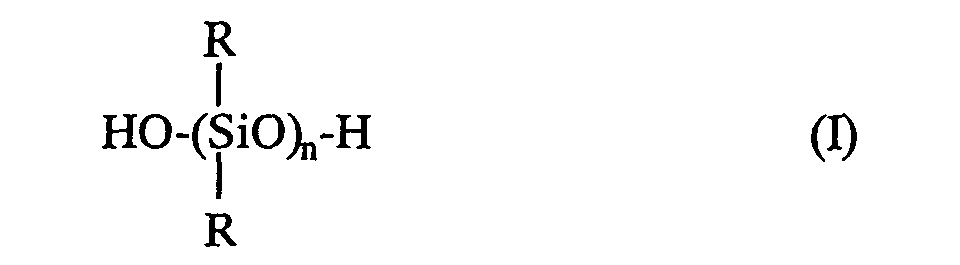
- the invention provides a method for preparing an organoxy-terminated organopolysiloxane, comprising the step of reacting (1) an organopolysiloxane of the following general formula (I): wherein R is a monovalent hydrocarbon group and n is such an integer that the organopolysiloxane has a viscosity of 10 to 100,000 centistokes at 25°C, with (2) an organoxysilane of the following general formula (II): wherein "a” is an integer of 0, 1 or 2, R 1 is a substituted or unsubstituted monovalent hydrocarbon group of 1 to 18 carbon atoms, and R 2 is an organic group of 1 to 18 carbon atoms, or a partial hydrolyzate thereof, to form an organoxy-terminated organopolysiloxane of the general formula (A): wherein R, R 1 , R 2 , "a" and n are as defined above.
- the invention is characterized in that the reaction of components (1) and (2) is effected in the presence of (3) a tetraalkoxytitanium of the following general formula (III): Ti(OR 3 ) 4 wherein R 3 is an alkyl group as a catalyst.
- a tetraalkoxytitanium of the following general formula (III): Ti(OR 3 ) 4 wherein R 3 is an alkyl group as a catalyst tetraalkoxytitanium of the following general formula (III): Ti(OR 3 ) 4 wherein R 3 is an alkyl group as a catalyst.
- the method is advantageous in that since neither basic nor acidic catalysts need be used, the resulting organoxy-terminated organopolysiloxane is suited to electric and electronic applications. In the presence of moisture, this organopolysiloxane will readily cure into a rubbery elastomer.
- a room temperature curable composition comprising such organopolysiloxane as a base polymer is useful in a wide variety of applications such as adhesives, coating agents, electrically insulating sealants, and building sealants.
- the method for preparing an organoxy-terminated organopolysiloxane according to the invention starts with (1) an organopolysiloxane and (2) an organoxysilane.
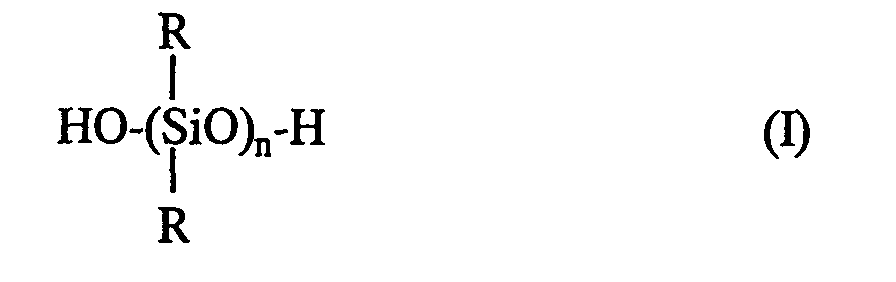
- Component (1) is an organopolysiloxane of the following general formula (I).
- R is a monovalent hydrocarbon group and n is such an integer that the organopolysiloxane has a viscosity of 10 to 100,000 centistokes at 25°C.
- R is selected from substituted or unsubstituted monovalent hydrocarbon groups preferably of 1 to 10 carbon atoms, and more preferably 1 to 8 carbon atoms, for example, alkyl groups such as methyl, ethyl, propyl, butyl and hexyl, aryl groups such as phenyl and tolyl, alkenyl groups such as vinyl, allyl and butenyl, aralkyl groups such as benzyl and 2-phenylethyl, Substituted ones of the foregoing groups, e.g.
- n representative of the degree of polymerization is such an integer that the organopolysiloxane has a viscosity of 10 to 100,000 centistokes at 25°C and preferably 500 to 100,000 centistokes at 25°C for ease of working.
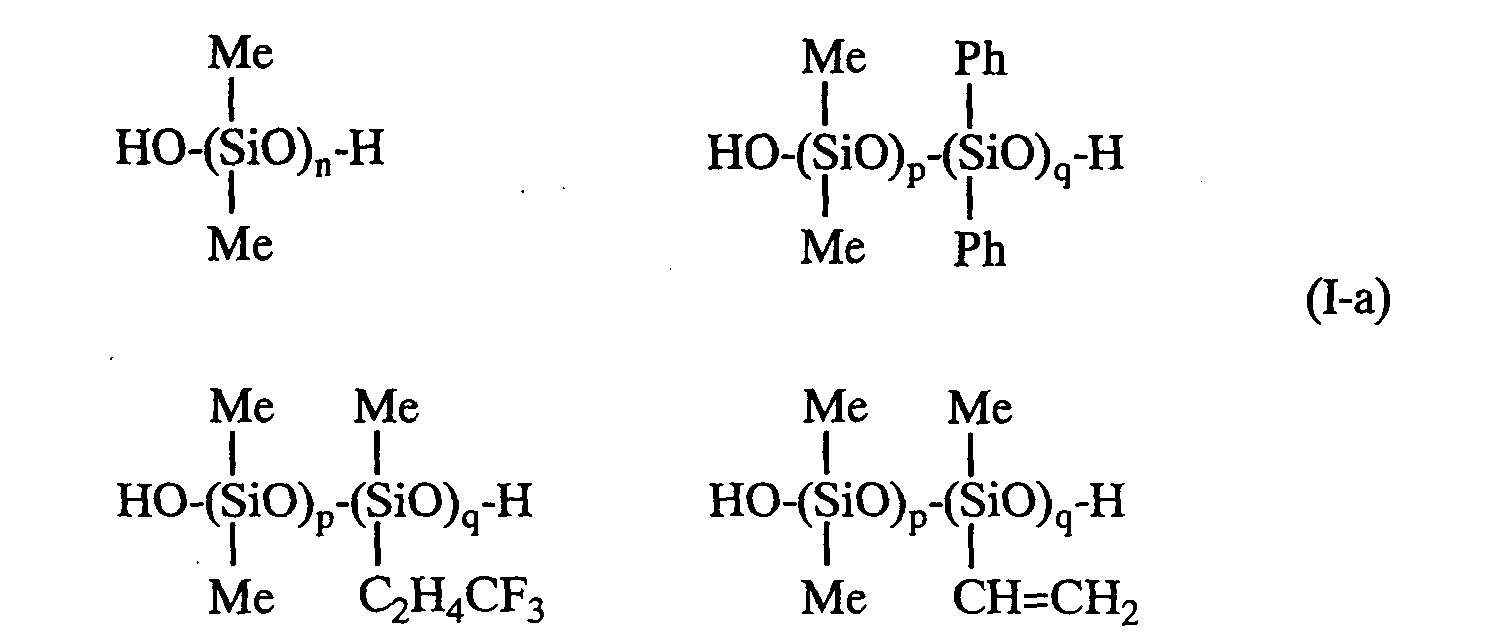
- organopolysiloxane of formula (I) is given below.
- Me is methyl
- Ph is phenyl
- p and q are positive integers
- p+q is an integer corresponding to n.
- the compounds of formula (I-a) are preferred.
- the polymer may include a structure which is blocked at one end with 0 to 10 mol% of trimethylsilyl groups. Also the polymer may contain 0 to 3 mol% based on its molecular weight of a branched structure as shown by the following structural formula.
- component (2) serves as an end blocking agent for component (1) and is an organoxysilane of the following general formula (II) or a partial hydrolyzate thereof.
- a is an integer of 0, 1 or 2, and preferably 0 or 1
- R 1 is a substituted or unsubstituted monovalent hydrocarbon group of 1 to 18 carbon atoms
- R 2 is an organic group of 1 to 18 carbon atoms.
- R 1 examples are alkyl, alkenyl, aryl and aralkyl groups and halo- and cyano-substituted groups thereof as exemplified above for R, with alkyl, alkenyl and aryl groups being preferred.
- R 2 is preferably selected from aliphatic organic groups of 1 to 18 carbon atoms, for example, alkyl, alkenyl, aryl, alkyl ether, alkyl ester, alkyl ketone and alkylcyano groups.
- R2 is preferably an alkyl group, more preferably alkyl group of 1 to 4 carbon atoms, and most preferably methyl.
- the preferred organoxysilane is an alkoxysilane of the following general formula (II-a): R 1 b Si(OCH 3 ) 4-b wherein R 1 is as defined above and b is equal to 0 or 1, or a partial hydrolyzate thereof.
- organoxysilane examples include n-propyltrimethoxysilane, methyltrimethoxysilane, vinyltrimethoxysilane, tetramethoxysilane, ethyltrimethoxysilane, and phenyltrimethoxysilane.
- vinyltrimethoxysilane and n-propyltrimethoxysilane are especially preferred.
- n-propyltrimethoxysilane is especially preferred because of its low volatility.
- components (1) and (2) are used in such amounts that the moles of component (2) is at least equal to the moles of component (1) or silanol. More preferably the ratio of the moles of component (1) to the moles of component (2) is from 1:1 to 1:100 and especially from 1:1 to 1:20. Using component (2) in excess is usually effective for reducing the time for ends to be blocked and yielding a high percent end blockage. A molar ratio within the above range permits a continuous process to be employed with better results.
- organoxy-terminated organopolysiloxane of the general formula (A): wherein R, R 1 , R 2 , "a" and n are as defined above.
- reaction of components (1) and (2) is effected in the presence of (3) a tetraalkoxytitanium or titanium tetraalkoxide catalyst of the following general formula (III): Ti(OR 3 ) 4 wherein R 3 is alkyl group.
- the alkyl groups have 2 or more carbon atoms. Preferably they have not more than 19 carbon atoms, more preferably not more than 4 carbon atoms.
- any titanium tetraalkoxide may be used only for end blocking purposes.
- the end blocking rate is faster in the order of titanium tetraethoxide > titanium tetra-n-propoxide > titanium tetraisopropoxide > titanium tetrabutoxide.
- titanium tetraethoxide is most preferred although titanium tetraisopropoxide is most readily available in the industry.
- component (3) is preferably used in such amounts that the ratio of the moles of component (3) to the moles of silanol (1) is at least 0.001, more preferably at least 0.01, especially at least 0.05.
- the ratio is up to 20, more preferably up to 10, especially up to 5.
- Components (1) to (3) are admitted into a suitable reactor whereupon reaction may proceed at room temperature or elevated temperature.
- the reaction is effected under pressure.
- a reactor capable of tight closure so that pressure is naturally applied is preferred because the reaction is promoted thereby.
- an upper limit of up to 10 atm. and especially up to 5 atm. is recommended for safety.
- the lower limit is not critical for a pressure higher than atmospheric; typically it is at least 1.05 atm. and especially at least 1.1 atm.
- Reaction is effected by mixing components (1) to (3) under atmospheric pressure or under applied pressure. More specifically, component (1) first reacts with component (3) and thus thickens. Then component (2) substitutes for component (3) whereupon the desired organoxy-terminated organopolysiloxane is obtained. Although the viscosity is once increased, the product generally resumes the original or desired viscosity at this point.
- methanol is added to the reaction system after it has thickened by reaction of component (1) with component (3).
- the time for end blockage with organoxy groups can be significantly reduced. If methanol is added at the initial, there is a potential for methanol to stop the end blocking reaction. It is therefore preferred to add methanol after component (1) has reacted with component (3) to incur a viscosity increase and before the end blocking reaction with component (3) proceeds to completion. Even when methanol is added at the substantial end of reaction, the percent end blockage can be further increased.
- An appropriate amount of methanol added is about 0.1 to 20 parts, and especially about 0.2 to 10 parts by weight per 100 parts by weight of component (1). Less amounts of methanol have little effect whereas excessive amounts may rather restrain the end blocking reaction. Since there is a situation where the viscosity changes a little even after the completion of reaction, mixing for deaeration under vacuum or atmospheric pressure is recommended.
- Organopolysiloxanes of formula (A) are usually useful as a base polymer in a room temperature curable organopolysiloxane composition of the one part type.
- a filler for example, surface treated or untreated silica, heavy calcium carbonate, surface treated or untreated colloidal calcium carbonate
- a curing agent for example, a compound having at least two hydrolyzable groups
- an adhesive aid as typified by aminosilane
- a condensation catalyst and other additives.
- the room temperature curable organopolysiloxane composition comprising the organoxy-terminated organopolysiloxane according to the invention remains stable during storage, is strongly adhesive to adherends, especially surface treated aluminum members, and cures into a product maintaining a firm bond against water immersion and heating.
- the room temperature curable composition is thus useful in a wide variety of applications such as adhesives, coating agents, electrically insulating sealants, and building sealants.
- a base oil was prepared as in Example 1 except that 0.1 part of titanium tetra-n-propoxide was used instead of 0.1 part of titanium tetraethoxide.
- a base oil was prepared as in Example 1 except that 0.1 part of titanium tetraisopropoxide was used instead of 0.1 part of titanium tetraethoxide.
- a base oil was prepared as in Example 1 except that 0.1 part of titanium tetra-n-butoxide was used instead of 0.1 part of titanium tetraethoxide.
- a base oil was prepared as in Example 1 except that 0.1 part of titanium tetra-2-ethylhexyloxide was used instead of 0.1 part of titanium tetraethoxide.
- a base oil was prepared as in Example 1 except that the amount of titanium tetraethoxide was changed to 0.25 part, and 2 parts of methanol was added after the mixture thickened.
- a base oil was prepared as in Example 6 except that the amount of methanol was changed to 5 parts.
- a base oil was prepared as in Example 1 except that 6.5 parts of vinyltrimethoxysilane was used instead of 7 parts of n-propyltrimethoxysilane.
- a base oil was prepared as in Example 1 except that 6 parts of methyltrimethoxysilane was used instead of 7 parts of n-propyltrimethoxysilane.
- a base oil was prepared as in Example 1 except that the amount of n-propyltrimethoxysilane was changed to 3.5 parts.
- a base oil was prepared as in Example 1 except that the amount of n-propyltrimethoxysilane was changed to 10.5 parts.
- a base oil was prepared as in Example 1 except that the amount of titanium tetraethoxide was changed to 1 part.
- a base oil was prepared as in Example 1 except that 10 parts of y-(methacryloxypropyl)trimethoxysilane was used instead of 7 parts of n-propyltrimethoxysilane.
- a base oil was prepared as in Example 1 except that 7 parts of vinyltri(3-methoxypropyleneglycoxy)silane was used instead of 7 parts of n-propyltrimethoxysilane.
- a base oil was prepared as in Example 1 except that 10 parts of ⁇ -(methacryloxypropyl)methyldimethoxysilane was used instead of 7 parts of n-propyltrimethoxysilane.
- a base oil was prepared as in Comparative Example 1 except that 0.5 part of a 10% methanol solution of lithium hydroxide was added.
- a base oil was prepared as in Comparative Example 1 except that 0.2 part of aluminum isopropoxide di(ethylacetoacetonato) was added instead of the 10% methanol solution of lithium hydroxide. Gelation occurred.
- a base oil was prepared as in Comparative Example 1 except that 0.2 part of titanium diisopropoxide di(ethylacetoacetonato) was added instead of the 10% methanol solution of lithium hydroxide. Gelation occurred.
- a base oil was prepared as in Comparative Example 1 except that 0.2 part of dibutyltin dilaurate was added instead of the 10% methanol solution of lithium hydroxide. Gelation occurred.
- a base oil was prepared as in Comparative Example 1 except that 0.2 part of tin dilaurate was added instead of the 10% methanol solution of lithium hydroxide. Gelation occurred.
- a base oil was prepared as in Comparative Example 1 except that the 10% methanol solution of lithium hydroxide was omitted and no catalyst was added.
- End blockage (%) Reaction time (min) Terminal monomethoxide content (%)
- Example 1 94.5 30 0.52
- Example 2 93.8 30 0.58
- Example 3 93.3 30 0.60
- Example 4 92.4 30 0.80
- Example 5 90.8 30 0.88
- Example 6 95.7 30 0.12
- Example 7 92.8 30 0.12
- Example 8 93.0 30 0.59
- Example 10 91.1 30 0.57
- Example 12 89.9 30 1.02
- Example 13 93.4 30 0.62
- Example 14 97.8 30 0.34
- Example 16 97.1 30 0.21
- Example 18 99.0 3 0.15
- Example 19 97.5 5 0.20
- End blockage (%) Reaction time (min) Terminal monomethoxid
- organoxy-terminated organopolysiloxanes were prepared within about one hour while maintaining a good end blocking rate of about 85 to 99%.
Landscapes
- Chemical & Material Sciences (AREA)
- Health & Medical Sciences (AREA)
- Chemical Kinetics & Catalysis (AREA)
- Medicinal Chemistry (AREA)
- Polymers & Plastics (AREA)
- Organic Chemistry (AREA)
- Silicon Polymers (AREA)
Abstract

Description
- This invention relates to methods for preparing organox terminated organopolysiloxanes, for example such as are usef as base polymers in one-part organopolysiloxane elastomer compositions of the type which is generally stable during storage in the absence of moisture but crosslinkable by airborne moisture at substantially ambient temperature.
- It is well known in the art to prepare organoxy-terminated organopolysiloxanes by reacting di-, tri- or tetraalkoxysilanes with hydrosilyl groups attached to silicon atoms at molecular ends in the presence of catalysts.
- The use of amine catalysts is disclosed in USP 3,542,901, USP 4,489,191, French Patent No. 2,597,876, and French Patent No. 2,597,877. USP 3,504,051 discloses the use of potassium acetate, French Patent No. 1,495,011 discloses the use of inorganic oxides, USP 3,647,846 discloses the combination of titanates and amines, French Patent No. 2,604,713 discloses the combination of carboxylic acids and amines, EP 0210402 discloses the use of carbamates, French Patent No. 2,597,875 discloses the use of oxime functional group-containing organic compounds, and JP-B 6-45698 discloses the use of lithium hydroxide.
- However, the use of amine catalysts has many problems including a reaction time as long as about 15 to 30 minutes at a heating temperature of 60°C, a low percent end blockage, an increased amount of residual SiOH, yellowing and storage instability due to the residual amine which is difficult to remove.
- The foregoing methods use acids or bases and need a neutralizing step. Although the products are now required to be neutral, the use of amine catalysts suffers from a high probability of leaving amines in the products.
- Additionally, USP 4,111,890 describes the use of organic titanium derivatives, and British Patent No. 2,133,758 describes the use of alkoxyaluminum chelates. The aluminum and titanium chelates used therein are adequate as the condensation curing catalyst, but not for end blockage because they promote crosslinking during reaction, resulting in gelation and substantial thickening.
- Therefore, an object of the invention is to provide new and useful methods for preparing organoxy-terminated organopolysiloxanes. Preferred aims include efficiency, the avoidance of gelation and other troubles and the avoidance of the need for neutralisation.
- The invention provides a method for preparing an organoxy-terminated organopolysiloxane, comprising the step of reacting (1) an organopolysiloxane of the following general formula (I):wherein R is a monovalent hydrocarbon group and n is such an integer that the organopolysiloxane has a viscosity of 10 to 100,000 centistokes at 25°C, with (2) an organoxysilane of the following general formula (II):
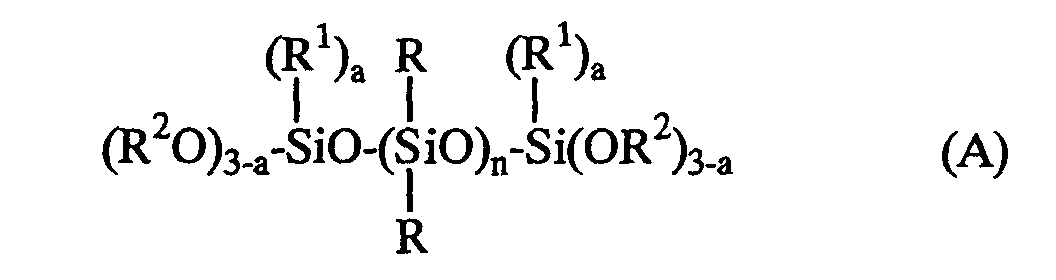
 wherein "a" is an integer of 0, 1 or 2, R1 is a substituted or unsubstituted monovalent hydrocarbon group of 1 to 18 carbon atoms, and R2 is an organic group of 1 to 18 carbon atoms, or a partial hydrolyzate thereof, to form an organoxy-terminated organopolysiloxane of the general formula (A):
 wherein R, R1, R2, "a" and n are as defined above. The invention is characterized in that the reaction of components (1) and (2) is effected in the presence of (3) a tetraalkoxytitanium of the following general formula (III):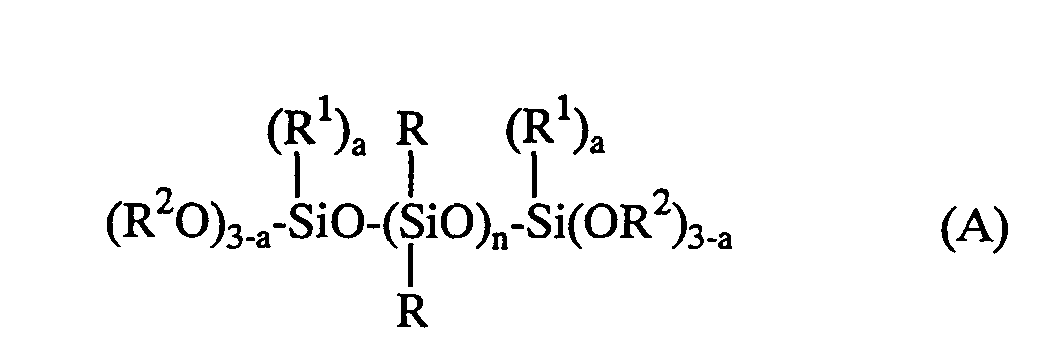
- The method is advantageous in that since neither basic nor acidic catalysts need be used, the resulting organoxy-terminated organopolysiloxane is suited to electric and electronic applications. In the presence of moisture, this organopolysiloxane will readily cure into a rubbery elastomer. A room temperature curable composition comprising such organopolysiloxane as a base polymer is useful in a wide variety of applications such as adhesives, coating agents, electrically insulating sealants, and building sealants.
- The method for preparing an organoxy-terminated organopolysiloxane according to the invention starts with (1) an organopolysiloxane and (2) an organoxysilane. Component (1) is an organopolysiloxane of the following general formula (I).Herein R is a monovalent hydrocarbon group and n is such an integer that the organopolysiloxane has a viscosity of 10 to 100,000 centistokes at 25°C.
- R is selected from substituted or unsubstituted monovalent hydrocarbon groups preferably of 1 to 10 carbon atoms, and more preferably 1 to 8 carbon atoms, for example, alkyl groups such as methyl, ethyl, propyl, butyl and hexyl, aryl groups such as phenyl and tolyl, alkenyl groups such as vinyl, allyl and butenyl, aralkyl groups such as benzyl and 2-phenylethyl, Substituted ones of the foregoing groups, e.g. in which some or all of the hydrogen atoms attached to carbon atoms are replaced by halogen atoms or cyano groups, such as chloromethyl, trifluoropropyl and cyanoethyl, are useful in line with established knowledge. Of these, methyl, phenyl, vinyl and trifluoropropyl are preferred, with methyl being most preferred.
- The letter n representative of the degree of polymerization is such an integer that the organopolysiloxane has a viscosity of 10 to 100,000 centistokes at 25°C and preferably 500 to 100,000 centistokes at 25°C for ease of working.
- Illustrative, non-limiting examples of the organopolysiloxane of formula (I) are given below.In the formulas, Me is methyl, Ph is phenyl, p and q are positive integers, p+q is an integer corresponding to n. Of these, the compounds of formula (I-a) are preferred.
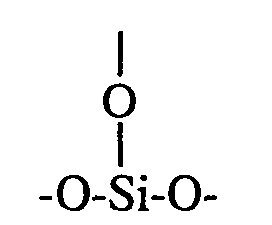
- In addition to the above-described structure, the polymer may include a structure which is blocked at one end with 0 to 10 mol% of trimethylsilyl groups. Also the polymer may contain 0 to 3 mol% based on its molecular weight of a branched structure as shown by the following structural formula.
- The other starting reactant, component (2) serves as an end blocking agent for component (1) and is an organoxysilane of the following general formula (II) or a partial hydrolyzate thereof.Herein "a" is an integer of 0, 1 or 2, and preferably 0 or 1, R1 is a substituted or unsubstituted monovalent hydrocarbon group of 1 to 18 carbon atoms, and R2 is an organic group of 1 to 18 carbon atoms.

- Examples of R1 are alkyl, alkenyl, aryl and aralkyl groups and halo- and cyano-substituted groups thereof as exemplified above for R, with alkyl, alkenyl and aryl groups being preferred.
- R2 is preferably selected from aliphatic organic groups of 1 to 18 carbon atoms, for example, alkyl, alkenyl, aryl, alkyl ether, alkyl ester, alkyl ketone and alkylcyano groups. R2 is preferably an alkyl group, more preferably alkyl group of 1 to 4 carbon atoms, and most preferably methyl.
- The preferred organoxysilane is an alkoxysilane of the following general formula (II-a):
- Illustrative, non-limiting examples of the organoxysilane include n-propyltrimethoxysilane, methyltrimethoxysilane, vinyltrimethoxysilane, tetramethoxysilane, ethyltrimethoxysilane, and phenyltrimethoxysilane. For ease of handling, vinyltrimethoxysilane and n-propyltrimethoxysilane are especially preferred. In the batchwise preparation where reaction heat accumulates, n-propyltrimethoxysilane is especially preferred because of its low volatility.
- Preferably components (1) and (2) are used in such amounts that the moles of component (2) is at least equal to the moles of component (1) or silanol. More preferably the ratio of the moles of component (1) to the moles of component (2) is from 1:1 to 1:100 and especially from 1:1 to 1:20. Using component (2) in excess is usually effective for reducing the time for ends to be blocked and yielding a high percent end blockage. A molar ratio within the above range permits a continuous process to be employed with better results.
- By reacting components (1) and (2), there is prepared an organoxy-terminated organopolysiloxane of the general formula (A):wherein R, R1, R2, "a" and n are as defined above.
- According to the invention, the reaction of components (1) and (2) is effected in the presence of (3) a tetraalkoxytitanium or titanium tetraalkoxide catalyst of the following general formula (III):
- Preferably the alkyl groups have 2 or more carbon atoms. Preferably they have not more than 19 carbon atoms, more preferably not more than 4 carbon atoms.
- Any titanium tetraalkoxide may be used only for end blocking purposes. The end blocking rate is faster in the order of titanium tetraethoxide > titanium tetra-n-propoxide > titanium tetraisopropoxide > titanium tetrabutoxide. Of these, titanium tetraethoxide is most preferred although titanium tetraisopropoxide is most readily available in the industry.
- For best effect component (3) is preferably used in such amounts that the ratio of the moles of component (3) to the moles of silanol (1) is at least 0.001, more preferably at least 0.01, especially at least 0.05. Preferably the ratio is up to 20, more preferably up to 10, especially up to 5.
- Components (1) to (3) are admitted into a suitable reactor whereupon reaction may proceed at room temperature or elevated temperature. Preferably the reaction is effected under pressure. In this regard, a reactor capable of tight closure so that pressure is naturally applied is preferred because the reaction is promoted thereby. Although a higher pressure is preferable, an upper limit of up to 10 atm. and especially up to 5 atm. is recommended for safety. The lower limit is not critical for a pressure higher than atmospheric; typically it is at least 1.05 atm. and especially at least 1.1 atm.
- Reaction is effected by mixing components (1) to (3) under atmospheric pressure or under applied pressure. More specifically, component (1) first reacts with component (3) and thus thickens. Then component (2) substitutes for component (3) whereupon the desired organoxy-terminated organopolysiloxane is obtained. Although the viscosity is once increased, the product generally resumes the original or desired viscosity at this point.
- In the preferred embodiment, methanol is added to the reaction system after it has thickened by reaction of component (1) with component (3). By adding methanol, the time for end blockage with organoxy groups can be significantly reduced. If methanol is added at the initial, there is a potential for methanol to stop the end blocking reaction. It is therefore preferred to add methanol after component (1) has reacted with component (3) to incur a viscosity increase and before the end blocking reaction with component (3) proceeds to completion. Even when methanol is added at the substantial end of reaction, the percent end blockage can be further increased.
- An appropriate amount of methanol added is about 0.1 to 20 parts, and especially about 0.2 to 10 parts by weight per 100 parts by weight of component (1). Less amounts of methanol have little effect whereas excessive amounts may rather restrain the end blocking reaction. Since there is a situation where the viscosity changes a little even after the completion of reaction, mixing for deaeration under vacuum or atmospheric pressure is recommended.
- Organopolysiloxanes of formula (A) are usually useful as a base polymer in a room temperature curable organopolysiloxane composition of the one part type. To the organopolysiloxane, there may be added a filler, for example, surface treated or untreated silica, heavy calcium carbonate, surface treated or untreated colloidal calcium carbonate; a curing agent, for example, a compound having at least two hydrolyzable groups; an adhesive aid as typified by aminosilane; a condensation catalyst, and other additives. By adding these additives during the mixing step for deaeration, there is obtained a room temperature curable organopolysiloxane composition of the one part type. The room temperature curable organopolysiloxane composition comprising the organoxy-terminated organopolysiloxane according to the invention remains stable during storage, is strongly adhesive to adherends, especially surface treated aluminum members, and cures into a product maintaining a firm bond against water immersion and heating. The room temperature curable composition is thus useful in a wide variety of applications such as adhesives, coating agents, electrically insulating sealants, and building sealants.
- Examples of the invention are given below by way of illustration and not by way of limitation. All parts are by weight.
- The base oils obtained in Examples were analyzed by 29Si-NMR, from which a percent end blockage was determined. The results are shown in Tables 1 and 2.
- In a Shinagawa mixer, 100 parts of α,ω-dihydroxy-dimethylpolysiloxane having a viscosity of 50,000 cSt at 25°C, 7 parts of n-propyltrimethoxysilane, and 0.1 part of titanium tetraethoxide were mixed for 30 minutes at room temperature. The mixture was further mixed in vacuum for 30 minutes for deaeration purposes, yielding a base oil which was measured for end blockage by 29Si-NMR.
- A base oil was prepared as in Example 1 except that 0.1 part of titanium tetra-n-propoxide was used instead of 0.1 part of titanium tetraethoxide.
- A base oil was prepared as in Example 1 except that 0.1 part of titanium tetraisopropoxide was used instead of 0.1 part of titanium tetraethoxide.
- A base oil was prepared as in Example 1 except that 0.1 part of titanium tetra-n-butoxide was used instead of 0.1 part of titanium tetraethoxide.
- A base oil was prepared as in Example 1 except that 0.1 part of titanium tetra-2-ethylhexyloxide was used instead of 0.1 part of titanium tetraethoxide.
- A base oil was prepared as in Example 1 except that the amount of titanium tetraethoxide was changed to 0.25 part, and 2 parts of methanol was added after the mixture thickened.
- A base oil was prepared as in Example 6 except that the amount of methanol was changed to 5 parts.
- A base oil was prepared as in Example 1 except that 6.5 parts of vinyltrimethoxysilane was used instead of 7 parts of n-propyltrimethoxysilane.
- A base oil was prepared as in Example 1 except that 6 parts of methyltrimethoxysilane was used instead of 7 parts of n-propyltrimethoxysilane.
- A base oil was prepared as in Example 1 except that the amount of n-propyltrimethoxysilane was changed to 3.5 parts.
- A base oil was prepared as in Example 1 except that the amount of n-propyltrimethoxysilane was changed to 10.5 parts.
- A base oil was prepared as in Example 1 except that the amount of titanium tetraethoxide was changed to 1 part.
- A base oil was prepared as in Example 1 except that 10 parts of y-(methacryloxypropyl)trimethoxysilane was used instead of 7 parts of n-propyltrimethoxysilane.
- A base oil was prepared as in Example 1 except that 7 parts of vinyltri(3-methoxypropyleneglycoxy)silane was used instead of 7 parts of n-propyltrimethoxysilane.
- A base oil was prepared as in Example 1 except that 10 parts of γ-(methacryloxypropyl)methyldimethoxysilane was used instead of 7 parts of n-propyltrimethoxysilane.
- In a Shinagawa mixer, 100 parts of α,ω-dihydroxy-dimethylpolysiloxane having a viscosity of 50,000 cSt at 25°C, 7 parts of n-propyltrimethoxysilane, and 5 parts of methanol were mixed for 5 minutes at room temperature, and 0.2 part of titanium tetraethoxide was added. The mixture was mixed for 30 minutes at room temperature, then mixed in vacuum for 30 minutes for deaeration purposes, yielding a base oil.
- In a Shinagawa mixer, 100 parts of α-ω-dihydroxy-dimethylpolysiloxane having a viscosity of 50,000 cSt at 25°C, 7 parts of n-propyltrimethoxysilane, and 0.1 part of titanium tetraethoxide were mixed for 10 minutes at room temperature and a pressure of 2 atm. The mixture was then mixed for 30 minutes for deaeration purposes, yielding a base oil.
- In a Shinagawa mixer, 100 parts of α-ω-dihydroxy-dimethylpolysiloxane having a viscosity of 20,000 cSt at 25°C, 5 parts of methyltrimethoxysilane, and 0.1 part of titanium tetraethoxide were mixed for 3 minutes at room temperature and a pressure of 5 atm. The mixture was then mixed under atmospheric pressure for 20 minutes for deaeration purposes, yielding a base oil.
- In a Shinagawa mixer, 100 parts of α-ω-dihydroxy-dimethylpolysiloxane having a viscosity of 5,000 cSt at 25°C, 6 parts of vinyltrimethoxysilane, and 0.2 part of titanium tetraethoxide were mixed for 5 minutes at 40°C and a pressure of 2 atm., and 2 parts of methanol was added. The mixture was then mixed under atmospheric pressure for 20 minutes for deaeration purposes, and mixed at 60°C for 30 minutes for deaeration purposes, yielding a base oil.
- In a Shinagawa mixer, 100 parts of α-ω-dihydroxy-dimethylpolysiloxane having a viscosity of 50,000 cSt at 25°C, 6.5 parts of vinyltrimethoxysilane, and 0.2 part of lithium hydroxide were mixed for one hour at room temperature, and 3 parts of ethylene chlorohydrin was added for neutralization. The mixture was then mixed under vacuum at 100°C for deaeration purposes, yielding a base oil which was measured for end blockage by 29Si-NMR.
- A base oil was prepared as in Comparative Example 1 except that 0.5 part of a 10% methanol solution of lithium hydroxide was added.
- A base oil was prepared as in Comparative Example 1 except that 0.2 part of aluminum isopropoxide di(ethylacetoacetonato) was added instead of the 10% methanol solution of lithium hydroxide. Gelation occurred.
- A base oil was prepared as in Comparative Example 1 except that 0.2 part of titanium diisopropoxide di(ethylacetoacetonato) was added instead of the 10% methanol solution of lithium hydroxide. Gelation occurred.
- A base oil was prepared as in Comparative Example 1 except that 0.2 part of dibutyltin dilaurate was added instead of the 10% methanol solution of lithium hydroxide. Gelation occurred.
- A base oil was prepared as in Comparative Example 1 except that 0.2 part of tin dilaurate was added instead of the 10% methanol solution of lithium hydroxide. Gelation occurred.
- A base oil was prepared as in Comparative Example 1 except that the 10% methanol solution of lithium hydroxide was omitted and no catalyst was added.
End blockage (%) Reaction time (min) Terminal monomethoxide content (%) Example 1 94.5 30 0.52 Example 2 93.8 30 0.58 Example 3 93.3 30 0.60 Example 4 92.4 30 0.80 Example 5 90.8 30 0.88 Example 6 95.7 30 0.12 Example 7 92.8 30 0.12 Example 8 93.0 30 0.59 Example 9 92.7 30 0.52 Example 10 91.1 30 0.57 Example 11 98.2 30 0.57 Example 12 89.9 30 1.02 Example 13 93.4 30 0.62 Example 14 97.8 30 0.34 Example 15 88.8 30 0.45 Example 16 97.1 30 0.21 Example 17 98.4 10 0.38 Example 18 99.0 3 0.15 Example 19 97.5 5 0.20 End blockage (%) Reaction time (min) Terminal monomethoxide content (%) CE 1 56.7 60 7.45 CE 2 60.3 60 9.25 CE 3 unmeasurable because of gelation upon admission CE 4 unmeasurable because of gelation upon admission CE 5 unmeasurable because of gelation upon admission CE 6 unmeasurable because of gelation upon admission CE 7 0 60 0 - In the embodiments, therefore, organoxy-terminated organopolysiloxanes were prepared within about one hour while maintaining a good end blocking rate of about 85 to 99%.
- Japanese Patent Application No. 11-327415 is incorporated herein by reference.
- Reasonable modifications and variations are possible from the foregoing disclosure of embodiments in the light of the general teaching herein.
Claims (6)
- A method of preparing organoxy-terminated organopolysiloxane, comprising reacting (1) organopolysiloxane of the following general formula(I):wherein R is monovalent hydrocarbon group and n is an integer such that the organopolysiloxane has a viscosity of from 10 to 100,000 centistokes at 25°C, with (2) organoxysilane of the following general formula (II), or partial hydrolysate thereof:
 wherein a is 0, 1 or 2, R1 is substituted or unsubstituted monovalent hydrocarbon group of from 1 to 18 carbon atoms and R2 is an organic group of from 1 to 18 carbon atoms; to form organoxy-terminated organopolysiloxane of the general formula (A):
 wherein R, R1, R2, a and n are as defined above, characterised in that the reaction of components (1) and (2) is effected in the presence of (3) tetraalkoxytitanium compound of the following general formula (III):
- A method of claim 1 comprising adding methanol during and/or after said reaction.
- A method of claim 1 or claim 2 wherein said reaction is effected under raised pressure.
- A method of claim 1, 2 or 3 wherein component (2) is alkoxysilane of the following general formula (II-a), or partial hydrolysate thereof:
- A method of any one of the preceding claims wherein component (3) is tetraethoxytitanium.
- A method according to any one of the preceding claims, followed by blending the organoxy-terminated organopolysiloxane as base polymer in the manufacture of a room temperature curable organopolysiloxane composition.
Applications Claiming Priority (2)
| Application Number | Priority Date | Filing Date | Title |
|---|---|---|---|
| JP32741599 | 1999-11-17 | ||
| JP32741599A JP4231974B2 (en) | 1999-11-17 | 1999-11-17 | Process for producing organooxy-terminated organopolysiloxane |
Publications (2)
| Publication Number | Publication Date |
|---|---|
| EP1101788A1 true EP1101788A1 (en) | 2001-05-23 |
| EP1101788B1 EP1101788B1 (en) | 2004-05-12 |
Family
ID=18198912
Family Applications (1)
| Application Number | Title | Priority Date | Filing Date |
|---|---|---|---|
| EP00310171A Expired - Lifetime EP1101788B1 (en) | 1999-11-17 | 2000-11-16 | Preparation of organoxy-terminated organopolysiloxane |
Country Status (5)
| Country | Link |
|---|---|
| US (1) | US6403749B1 (en) |
| EP (1) | EP1101788B1 (en) |
| JP (1) | JP4231974B2 (en) |
| KR (1) | KR100611694B1 (en) |
| DE (1) | DE60010624T2 (en) |
Cited By (1)
| Publication number | Priority date | Publication date | Assignee | Title |
|---|---|---|---|---|
| EP2735379A4 (en) * | 2011-07-20 | 2015-03-18 | Nippon Steel & Sumikin Mat Co | METALLIC SHEET COATED WITH INSULATING FILM |
Families Citing this family (6)
| Publication number | Priority date | Publication date | Assignee | Title |
|---|---|---|---|---|
| JP3925604B2 (en) * | 2000-09-29 | 2007-06-06 | 信越化学工業株式会社 | Method for producing (meth) acryloxy group-containing organopolysiloxane |
| JP4590253B2 (en) * | 2004-12-16 | 2010-12-01 | 東レ・ダウコーニング株式会社 | Organopolysiloxane and silicone composition |
| JP2007270055A (en) * | 2006-03-31 | 2007-10-18 | Jsr Corp | Polysiloxane composition containing polyfunctional polysiloxane and metal oxide fine particles, and production method thereof |
| JP2008231400A (en) * | 2007-02-20 | 2008-10-02 | Suzuka Fuji Xerox Co Ltd | Resin composition for optical element and curable resin composition |
| DE102010001588A1 (en) * | 2010-02-04 | 2011-08-04 | Henkel AG & Co. KGaA, 40589 | Curable compositions with improved fire properties |
| JP7579330B2 (en) | 2019-09-09 | 2024-11-07 | ダウ シリコーンズ コーポレーション | Method for preparing alkoxy-functional organosilicon compounds |
Citations (2)
| Publication number | Priority date | Publication date | Assignee | Title |
|---|---|---|---|---|
| US3151099A (en) * | 1960-05-30 | 1964-09-29 | Rhone Poulenc Sa | Water curable organopolysiloxanes containing silicic esters and zirconic or titanic esters |
| US3542901A (en) * | 1968-06-26 | 1970-11-24 | Midland Silicones Ltd | Organosilicon compositions |
Family Cites Families (26)
| Publication number | Priority date | Publication date | Assignee | Title |
|---|---|---|---|---|
| US3294739A (en) * | 1964-11-19 | 1966-12-27 | Dow Corning | Method of making one component room temperature curing siloxane rubbers |
| FR1495011A (en) | 1966-08-10 | 1967-09-15 | Midland Silicones Ltd | Process for the preparation of organopolysiloxanes with alkoxylated substituents linked to silicon |
| US3504051A (en) | 1967-07-24 | 1970-03-31 | Dow Corning | Castable siloxane block copolymers |
| BE759618A (en) | 1969-12-01 | 1971-06-01 | Dow Corning | PROCESS FOR PROMOTING THE REACTION BETWEEN A SILICON-BOUND HYDROXYL RADICAL AND A SILICON-BOUND RADICAL ALCOXY |
| US4111890A (en) | 1977-12-19 | 1978-09-05 | Sws Silicones Corporation | Curable organopolysiloxane compositions containing titanium esters |
| JPS5636521A (en) * | 1979-08-31 | 1981-04-09 | Shin Etsu Chem Co Ltd | Production of alkenyloxy group-containing organopolysiloxane |
| JPS58154766A (en) * | 1982-03-09 | 1983-09-14 | Toagosei Chem Ind Co Ltd | Coating composition |
| GB2133758B (en) | 1983-01-19 | 1987-04-15 | Michael John Stockbridge | Indicator for the instruction of sailing |
| JPS59207922A (en) * | 1983-05-11 | 1984-11-26 | Chisso Corp | Lactone-siloxane block copolymer composition and its production |
| US4528081A (en) * | 1983-10-03 | 1985-07-09 | Loctite Corporation | Dual curing silicone, method of preparing same and dielectric soft-gel compositions thereof |
| US4489191A (en) | 1983-08-31 | 1984-12-18 | General Electric Company | Silane scavengers for hydroxy radicals containing silicon-hydrogen bonds |
| JPH0651774B2 (en) * | 1984-11-28 | 1994-07-06 | ロツクタイト コ−ポレ−シヨン | Curable silicone composition, method for producing the same, and method of using the same |
| DE3523206A1 (en) | 1985-06-28 | 1987-01-02 | Bayer Ag | METHOD FOR PRODUCING POLY (DIORGANOSILOXANES) WITH ALKOXY END GROUPS |
| FR2597875B1 (en) | 1986-04-28 | 1990-10-05 | Rhone Poulenc Chimie | PROCESS FOR THE PREPARATION OF DIORGANOPOLYSILOXANES WITH ALCOXY TERMINAL GROUPS |
| FR2597876B1 (en) | 1986-04-28 | 1990-10-05 | Rhone Poulenc Chimie | SINGLE-COMPONENT COMPOSITION DIORGANOPOLYSILOXANE STABILIZED BY AN ISOCYANATE |
| FR2597877B1 (en) | 1986-04-28 | 1990-10-05 | Rhone Poulenc Chimie | SINGLE-COMPONENT COMPOSITION DIORGANOPOLYSILOXANE STABILIZED BY A DIORGANOPOLYSILOXANE CARRIER OF ISOCYANATE GROUP |
| CA1284544C (en) | 1986-08-22 | 1991-05-28 | General Electric Company | Preparation of high strength, high application rate silicone rtv rubber |
| JPS6393652A (en) * | 1986-10-07 | 1988-04-23 | Nippon Denso Co Ltd | Washer liquid atomizing device |
| US4797445A (en) * | 1986-10-30 | 1989-01-10 | Genesee Polymers Corporation | Non-transferring dry-film mold release agent |
| FR2638752B1 (en) | 1988-11-04 | 1992-07-24 | Rhone Poulenc Chimie | PROCESS FOR THE PREPARATION OF DIORGANOPOLYSILOXANES WITH ALCOXY TERMINAL GROUPS |
| US5352751A (en) * | 1989-11-06 | 1994-10-04 | Rhone-Poulenc Chimie | Preparation of end-alkoxylated diorganopolysiloxanes |
| FR2661680B1 (en) * | 1990-05-02 | 1992-07-24 | Rhone Poulenc Chimie | PROCESS FOR THE PREPARATION OF DIORGANOPOLYSILOXANES WITH ALCOXY TERMINAL GROUPS. |
| US5663269A (en) * | 1992-03-31 | 1997-09-02 | Loctite Corporation | Organosiloxane fluids prepared using organo-lithium reagents |
| JPH0645698A (en) | 1992-03-31 | 1994-02-18 | Matsushita Electric Ind Co Ltd | Semiconductor light emitting element |
| JPH08143674A (en) * | 1994-11-24 | 1996-06-04 | Shin Etsu Chem Co Ltd | Method for producing linear diorganopolysiloxane having alkoxy groups at both ends of the molecular chain |
| JPH11189722A (en) | 1997-12-26 | 1999-07-13 | Toshiba Silicone Co Ltd | Curable conductive organopolysiloxane composition |
-
1999
- 1999-11-17 JP JP32741599A patent/JP4231974B2/en not_active Expired - Fee Related
-
2000
- 2000-11-16 KR KR1020000067897A patent/KR100611694B1/en not_active Expired - Fee Related
- 2000-11-16 EP EP00310171A patent/EP1101788B1/en not_active Expired - Lifetime
- 2000-11-16 DE DE60010624T patent/DE60010624T2/en not_active Expired - Fee Related
- 2000-11-17 US US09/714,142 patent/US6403749B1/en not_active Expired - Fee Related
Patent Citations (2)
| Publication number | Priority date | Publication date | Assignee | Title |
|---|---|---|---|---|
| US3151099A (en) * | 1960-05-30 | 1964-09-29 | Rhone Poulenc Sa | Water curable organopolysiloxanes containing silicic esters and zirconic or titanic esters |
| US3542901A (en) * | 1968-06-26 | 1970-11-24 | Midland Silicones Ltd | Organosilicon compositions |
Non-Patent Citations (1)
| Title |
|---|
| DATABASE HCA CHEMICAL ABSTRACTS SERVICE, COLUMBUS, OHIO, US; XP002160835 * |
Cited By (2)
| Publication number | Priority date | Publication date | Assignee | Title |
|---|---|---|---|---|
| EP2735379A4 (en) * | 2011-07-20 | 2015-03-18 | Nippon Steel & Sumikin Mat Co | METALLIC SHEET COATED WITH INSULATING FILM |
| US9177690B2 (en) | 2011-07-20 | 2015-11-03 | Nippon Steel & Sumikin Materials Co., Ltd. | Insulating film-coated metal foil |
Also Published As
| Publication number | Publication date |
|---|---|
| US6403749B1 (en) | 2002-06-11 |
| JP2001139689A (en) | 2001-05-22 |
| KR100611694B1 (en) | 2006-08-11 |
| DE60010624T2 (en) | 2005-06-02 |
| KR20010051716A (en) | 2001-06-25 |
| EP1101788B1 (en) | 2004-05-12 |
| DE60010624D1 (en) | 2004-06-17 |
| JP4231974B2 (en) | 2009-03-04 |
Similar Documents
| Publication | Publication Date | Title |
|---|---|---|
| JP2577150B2 (en) | Improved room temperature curable silicone composition | |
| US5840794A (en) | Alkoxy functional sealants with rapid development of green strength | |
| CN100432153C (en) | Organic polysiloxane composition and use in low-modulus composition capable of crosslinking in green house | |
| JP5334992B2 (en) | Room temperature vulcanizable polymer | |
| CA1245791A (en) | Method of polymerizing polydiorganosiloxane fluid- filler mixture using sulfuric or sulfonic acids | |
| US12098279B2 (en) | Method for manufacturing room-temperature-curable organopolysiloxane composition, room-temperature-curable organopolysiloxane composition, and article | |
| JPS6365229B2 (en) | ||
| JPH054992A (en) | Aluminum complex | |
| JPH0320148B2 (en) | ||
| US5180771A (en) | Room temperature curable organopolysiloxane composition | |
| JPH0617445B2 (en) | Binary curable silicone composition | |
| JPH0333749B2 (en) | ||
| EP1101788B1 (en) | Preparation of organoxy-terminated organopolysiloxane | |
| JPH0588866B2 (en) | ||
| JPH0645755B2 (en) | Material that crosslinks to an elastomer at room temperature, method for producing the same, and paint-compatible sealant containing the material | |
| JP4395270B2 (en) | Room temperature fast-curing olga polysiloxane composition | |
| US5352751A (en) | Preparation of end-alkoxylated diorganopolysiloxanes | |
| EP3074450A1 (en) | Moisture curable compound with metal-arene complexes | |
| US5545704A (en) | Method for producing alkoxysilalkylene terminated siloxane polymers | |
| JPH0343310B2 (en) | ||
| JP7327212B2 (en) | Two-component room temperature condensation-curable organopolysiloxane composition | |
| EP0520718B1 (en) | Silicone compositions | |
| JPH0320149B2 (en) | ||
| JPH05345888A (en) | Silicone RTV showing quick adhesion | |
| JP2643725B2 (en) | Curable composition |
Legal Events
| Date | Code | Title | Description |
|---|---|---|---|
| PUAI | Public reference made under article 153(3) epc to a published international application that has entered the european phase |
Free format text: ORIGINAL CODE: 0009012 |
|
| AK | Designated contracting states |
Kind code of ref document: A1 Designated state(s): DE FR GB |
|
| AX | Request for extension of the european patent |
Free format text: AL;LT;LV;MK;RO;SI |
|
| 17P | Request for examination filed |
Effective date: 20010824 |
|
| AKX | Designation fees paid |
Free format text: DE FR GB |
|
| 17Q | First examination report despatched |
Effective date: 20030221 |
|
| GRAP | Despatch of communication of intention to grant a patent |
Free format text: ORIGINAL CODE: EPIDOSNIGR1 |
|
| GRAS | Grant fee paid |
Free format text: ORIGINAL CODE: EPIDOSNIGR3 |
|
| GRAA | (expected) grant |
Free format text: ORIGINAL CODE: 0009210 |
|
| AK | Designated contracting states |
Kind code of ref document: B1 Designated state(s): DE FR GB |
|
| REG | Reference to a national code |
Ref country code: GB Ref legal event code: FG4D |
|
| REF | Corresponds to: |
Ref document number: 60010624 Country of ref document: DE Date of ref document: 20040617 Kind code of ref document: P |
|
| PGFP | Annual fee paid to national office [announced via postgrant information from national office to epo] |
Ref country code: FR Payment date: 20041109 Year of fee payment: 5 |
|
| PGFP | Annual fee paid to national office [announced via postgrant information from national office to epo] |
Ref country code: GB Payment date: 20041110 Year of fee payment: 5 |
|
| PGFP | Annual fee paid to national office [announced via postgrant information from national office to epo] |
Ref country code: DE Payment date: 20041111 Year of fee payment: 5 |
|
| ET | Fr: translation filed | ||
| PLBE | No opposition filed within time limit |
Free format text: ORIGINAL CODE: 0009261 |
|
| STAA | Information on the status of an ep patent application or granted ep patent |
Free format text: STATUS: NO OPPOSITION FILED WITHIN TIME LIMIT |
|
| 26N | No opposition filed |
Effective date: 20050215 |
|
| PG25 | Lapsed in a contracting state [announced via postgrant information from national office to epo] |
Ref country code: GB Free format text: LAPSE BECAUSE OF NON-PAYMENT OF DUE FEES Effective date: 20051116 |
|
| PG25 | Lapsed in a contracting state [announced via postgrant information from national office to epo] |
Ref country code: DE Free format text: LAPSE BECAUSE OF NON-PAYMENT OF DUE FEES Effective date: 20060601 |
|
| GBPC | Gb: european patent ceased through non-payment of renewal fee |
Effective date: 20051116 |
|
| PG25 | Lapsed in a contracting state [announced via postgrant information from national office to epo] |
Ref country code: FR Free format text: LAPSE BECAUSE OF NON-PAYMENT OF DUE FEES Effective date: 20060731 |
|
| REG | Reference to a national code |
Ref country code: FR Ref legal event code: ST Effective date: 20060731 |