EP1099753A1 - Procédé de production de Burkholderia cepacia dans un milieu contenant du cobalt et son utilisation pour la dégradation de TBA ou de TAA - Google Patents
Procédé de production de Burkholderia cepacia dans un milieu contenant du cobalt et son utilisation pour la dégradation de TBA ou de TAA Download PDFInfo
- Publication number
- EP1099753A1 EP1099753A1 EP00403042A EP00403042A EP1099753A1 EP 1099753 A1 EP1099753 A1 EP 1099753A1 EP 00403042 A EP00403042 A EP 00403042A EP 00403042 A EP00403042 A EP 00403042A EP 1099753 A1 EP1099753 A1 EP 1099753A1
- Authority
- EP
- European Patent Office
- Prior art keywords
- tert
- tba
- medium
- cip
- taa
- Prior art date
- Legal status (The legal status is an assumption and is not a legal conclusion. Google has not performed a legal analysis and makes no representation as to the accuracy of the status listed.)
- Granted
Links
Images
Classifications
-
- C—CHEMISTRY; METALLURGY
- C02—TREATMENT OF WATER, WASTE WATER, SEWAGE, OR SLUDGE
- C02F—TREATMENT OF WATER, WASTE WATER, SEWAGE, OR SLUDGE
- C02F3/00—Biological treatment of water, waste water, or sewage
- C02F3/34—Biological treatment of water, waste water, or sewage characterised by the microorganisms used
-
- C—CHEMISTRY; METALLURGY
- C12—BIOCHEMISTRY; BEER; SPIRITS; WINE; VINEGAR; MICROBIOLOGY; ENZYMOLOGY; MUTATION OR GENETIC ENGINEERING
- C12N—MICROORGANISMS OR ENZYMES; COMPOSITIONS THEREOF; PROPAGATING, PRESERVING, OR MAINTAINING MICROORGANISMS; MUTATION OR GENETIC ENGINEERING; CULTURE MEDIA
- C12N1/00—Microorganisms; Compositions thereof; Processes of propagating, maintaining or preserving microorganisms or compositions thereof; Processes of preparing or isolating a composition containing a microorganism; Culture media therefor
- C12N1/20—Bacteria; Culture media therefor
-
- C—CHEMISTRY; METALLURGY
- C02—TREATMENT OF WATER, WASTE WATER, SEWAGE, OR SLUDGE
- C02F—TREATMENT OF WATER, WASTE WATER, SEWAGE, OR SLUDGE
- C02F2101/00—Nature of the contaminant
- C02F2101/30—Organic compounds
- C02F2101/34—Organic compounds containing oxygen
-
- C—CHEMISTRY; METALLURGY
- C02—TREATMENT OF WATER, WASTE WATER, SEWAGE, OR SLUDGE
- C02F—TREATMENT OF WATER, WASTE WATER, SEWAGE, OR SLUDGE
- C02F2101/00—Nature of the contaminant
- C02F2101/30—Organic compounds
- C02F2101/38—Organic compounds containing nitrogen
Definitions
- the invention relates to a process for the production of microorganisms, Burkholderia cepacia (ex Pseudomonas cepacia) CIP I-2052, the inoculum produced and its application in a process for degrading the alcohols produced for example during the degradation of ethers known as fuel-ethers when contained in aqueous effluents.
- ethers known as fuel-ethers when contained in aqueous effluents.
- These ethers are: ethyl tert -butyl ether hereinafter referred to as the ETBE run, methyl tert -butyl ether hereinafter referred to as MTBE term or tert -amyl methyl ether hereinafter referred to as the TAME.
- the alcohols produced during their degradation are tert- butanol hereinafter designated by the term TBA or tertiary- amyl alcohol hereinafter designated by the term TAA.
- TBA and TAA are respectively the degradation products of ethers, MTBE and ETBE on the one hand and TAME on the other.
- These ethers are currently used or are likely to be used as additives in gasolines for which they make it possible to increase the octane number. Their use is massive since, for example, MTBE is added to species at a rate of 10 to 15% (v / v).
- MTBE is added to species at a rate of 10 to 15% (v / v).
- the partial biodegradation of these fuel ethers in aquifers due for example to limitations in available oxygen, can therefore lead to the accumulation of TBA and TAA as secondary contaminants.
- TBA and TAA can themselves be used as additives in gasolines to increase their octane number and in this case their use can cause their dispersion in the environment as primary contaminants.
- TBA or TAA in the waters of the aquifers used to the supply of drinking water or waste water arriving at the stations treatment requires the use of specialized microorganisms capable of degrading these alcohols which are relatively resistant to biodegradation due to their structure plugged in.
- bacteria isolated from the soil B. coagulans ATCC 53595, A.globiformis ATCC 53596 and P.stutzeri ATCC 53602, are capable of degrading the TBA added to a minimum mineral medium. Bacterial consortia are also likely to degrade TBA according to US patent 5811010, but the microorganisms constituting them have not been characterized. Furthermore, according to US Pat. No. 5,814,514, different bacteria capable of growing on propane are capable of degrading TBA.
- the Applicant has isolated an aerobic bacterium Burkholderia cepacia CIP I-2052 for its ability to use TBA as a source of carbon and energy by degrading it to carbon dioxide (mineralization). This bacteria was deposited by the Applicant in the collection of the Institut Pasteur (CNCM, 25, rue du Dondel-Roux, F-75724 PARIS).
- This bacterium can be used in mixed culture with bacteria capable of using ETBE as a source of carbon and energy by degrading it up to the stage of TBA which then accumulates in the culture medium; this is why the addition of an inoculum of Burkholderia cepacia CIP I-2052, having the capacity to push on the TBA thus produced, makes it possible to obtain the total degradation of ETBE in effluents.
- the duration of incubation of these microorganisms on this substrate is long, for example it takes 400 h to degrade about 700 mg / L of TBA, and it is essential on an industrial scale to produce biomass in quantity sufficient.
- the object of the present invention is to describe a modification made to the culture medium of the bacterium Burkholderia cepacia CIP I-2052 which makes it possible to very easily improve its growth in the presence of TBA or TAA supplied as the sole source of carbon and energy by adding a cobalt salt, alone or as a mixture, to the culture medium.
- the invention relates to a process for the production of a Burkholderia cepacia CIP I-2052 bacterium in which said bacterium is cultured, in the presence of air or oxygen, in the presence of a medium containing at least one source of nitrogen, tert- butanol (TBA) and / or tert- amyl alcohol (TAA), and an inoculum is recovered, characterized in that said medium contains at least one cobalt salt.
- TSA tert- butanol
- TAA tert- amyl alcohol
- Cobalt is preferably used in its divalent form.
- the cobalt salt can be chosen from the group formed by the chloride ion, the sulfate ion, the nitrate ion and their mixture. It has been observed that cobalt chloride hexahydrate had a significant effect on the biomass produced by bacteria.
- the Burkholderia cepacia CIP I-2052 bacteria can be seeded on a vitamin-enriched salt culture medium to which cobalt chloride is added, alone or in mixture with other trace elements, at the final concentration in the medium from 0.01 to 4 mg / L, advantageously from 0.03 to 2 mg / L and preferably from 0.05 to 0.1 mg / L.
- the carbonaceous substrates of Burkholderia cepacia CIP I-2052 that is to say the TBA or the TAA can be added at a concentration of between 0.001 and 10 g / L of medium and preferably between 0, 2 and 5 g / L.
- an inoculum of greater cell density is produced. than what was previously observed and which is a biomass concentration final, for example, of the order of 0.6 g dry weight / L of culture for a concentration initial in TBA of 1 g / L.
- the inoculum thus prepared can be used alone to treat effluents containing TBA or TAA or it can also be used in mixed culture with bacteria degrading ETBE or MTBE in TBA or TAME in TAA.
- This inoculum thus produced in large quantities by the process according to the invention can also be used directly for purifying aqueous effluents containing TBA or TAA or the mixture of TBA and TAA. More precisely, the invention relates to a process for degrading TBA and / or TAA, contained in aqueous effluents in which an inoculum produced by the process for the production of a Burkholderia cepacia CIP I bacterium is used under aerobic conditions. -2052.
- the TBA can come from the degradation under aerobic conditions, of MTBE or of ETBE contained in aqueous effluents, by at least one bacterium which can be Gordona terrae CIP I -1889 or Rhodococcus equi CIP I-2053. These same bacteria can also degrade TAME to TAA under aerobic conditions.
- the culture obtained after 24 hours of incubation at 30 ° C will be used to inoculate flasks containing 200 ml of MM2 medium supplemented with TBA as a source of carbon and energy at different concentrations and to which a solution of trace elements, containing cobalt chloride hexahydrate, at a rate of 10 mL.L -1 of MM2 medium. For comparison, we do not add in these same vials of trace element solution.
- Each flask is seeded from the preculture obtained at 3% (v / v) and incubated at 30 ° C on a shaken incubator.
- the addition of the solution of trace elements containing cobalt makes it possible to obtain a total degradation of the TBA supplied up to a concentration for example of 1000 mg.L -1 by greatly reducing the duration d incubation required.
- the biomass produced is much larger as shown by the optical density measurements. The preparation of inocula for processes for treating effluents containing TBA in large quantities, for example up to several g / L, is thus more easily carried out.
- a 24 hour inoculum of P.cepacia CIP I-2052 is produced on 200 ml of MM2 medium containing glucose (1 gL -1 ) and supplemented with trace elements (1%, v / v) at 30 ° C with stirring.
- the culture medium of the fermenter was the MM2 medium described in Example 1 supplemented with the solution of trace elements described in Example 1 at a rate of 1% (v / v).
- the initial concentration of TBA in the fermenter was 300 mg.L -1 .
- the OD was 0.05 and the count, carried out by counting the spreads on dishes of Luria medium after successive dilutions, reveals an initial cell density of 2.9 ⁇ 10 6 cfu.mL -1 .
- TBA The degradation of TBA is monitored by assaying CPG on supernatants of the culture and we also follow the evolution of the bacterial population by counting Luria medium boxes as well as by measuring optical density.
- TBA TBA initially supplied was consumed.
- a first addition of TBA is then carried out at a concentration of 450 mg.L -1 then, after consumption, a second addition of 400 mg.L -1 and a third addition of 380 mg.L -1 are carried out.
- the final population obtained is 3.5 x 10 9 cfu.mL -1 for a final OD at 600 nm of 7.0.
- inocula can be used for the treatment of contaminated effluents, for example after fixation of the bacteria thus obtained on a support, for example on a mineral support on which percolates the effluents to be treated, for an implementation of the "biofilter" type, described in patent application FR 2 787 783 of the Applicant.
- the B. cepacia CIP I-2052 strain is inoculated on a saline mineral medium MM2 described in Example 1 and supplemented with glucose (500 mg.L -1 ) as a source of carbon and energy.
- This first culture will be used to seed 200 mL of MM2 medium without the addition of trace elements and supplemented with TBA (750 mg.L -1 ).
- TBA 750 mg.L -1 .
- the preculture thus obtained after 96 hours of incubation at 30 ° C will be used to inoculate vials containing 200 mL of MM2 medium supplemented with TBA as a source of carbon and energy at the concentration of 750 mgL -1 .
- TBA a source of carbon
- Each flask is seeded from the preculture obtained at 3% (v / v) and then incubated at 30 ° C - on a shaken incubator.
- the optical density is measured at 600 nm after 72 hours incubation.
- TAA is used in the same proportion as in l 'Example 3.
- the results obtained are reported in Table 2 and are identical to those already described in the previous example.
- Ex Supplementation carried out Initial TAA (mg.L -1 )
- Duration (h) Initial DO at 600 nm
Landscapes
- Life Sciences & Earth Sciences (AREA)
- Engineering & Computer Science (AREA)
- Chemical & Material Sciences (AREA)
- Microbiology (AREA)
- Organic Chemistry (AREA)
- Health & Medical Sciences (AREA)
- Bioinformatics & Cheminformatics (AREA)
- Zoology (AREA)
- Wood Science & Technology (AREA)
- Genetics & Genomics (AREA)
- Biotechnology (AREA)
- Water Supply & Treatment (AREA)
- Biodiversity & Conservation Biology (AREA)
- Virology (AREA)
- Medicinal Chemistry (AREA)
- Biomedical Technology (AREA)
- Environmental & Geological Engineering (AREA)
- Hydrology & Water Resources (AREA)
- Tropical Medicine & Parasitology (AREA)
- Biochemistry (AREA)
- General Engineering & Computer Science (AREA)
- General Health & Medical Sciences (AREA)
- Micro-Organisms Or Cultivation Processes Thereof (AREA)
- Preparation Of Compounds By Using Micro-Organisms (AREA)
- Purification Treatments By Anaerobic Or Anaerobic And Aerobic Bacteria Or Animals (AREA)
Abstract
Description
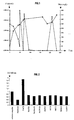
- la figure 1 représente la dégradation du TBA par B. cepacia CIP I-2052 et sa croissance P(ufc.mL-1) en présence de la solution d'oligo-éléments, en fonction du temps
- la figure 2 montre l'effet de certains éléments minéraux sur la production de biomasse par B. cepacia CIP I-2052.
- KH2PO4 1,4 g
- K2HPO4 1,7 g
- NaNO3 1,5 g
- MgSO4, 7H2O 0,5 g
- CaCl2, 2H2O 0,04 g
- FeCl3, 6H2O 0,012 g
- Solution de vitamines 1 mL
- H2O q.s.p.1 litre
- Biotine 200 mg
- Riboflavine 50 mg
- Acide nicotinamique 50 mg
- Panthoténate 50 mg
- Acide p-aminobenzoïque 50 mg
- Acide folique 20 mg
- Thiamine 15 mg
- Cyanocobalamine 1,5 mg
- Acide nitrilotriacétique 1,5 g
- Fe(NH4)2(SO4)2, 6H2O 0,2 g
- Na2SeO3 0,2 g
- CoCl2, 6H2O 0,1 g
- MnSO4, 2H2O 0,1 g
- Na2MoO4, 2H2O 0,1 g
- ZnSO4, 7 H2O 0,1 g
- AlCl3, 6H2O 0,04 g
- NiCl2, 6H2O 0,025 g
- H3BO3 0,01 g
- CuSO4, 5 H2O 0,01 g
| Ex | Supplémentation effectuée | TBA initial (mg.L-1) | TBA final (mg.L-1) | COT final (mg.L-1) | Durée (h) | D.O. initiale à 600 nm | D.O. finale à 600 nm |
| 1A | +oligoéléments | 346,5 | 0 | <10 | 72 | 0,116 | 0,54 |
| +oligoéléments | 720 | 0 | <10 | 139 | 0,117 | 0,95 | |
| +oligoéléments | 1000,5 | 0 | <10 | 139 | 0,122 | 1,1 | |
| 1B | -oligoéléments | 365,5 | 0 | <10 | 150 | 0,1 | 0,156 |
| -oligoéléments | 755,1 | 77,5 | N.D. | 400 | 0,1 | 0,132 | |
| -oligoéléments | 986,8 | 156,2 | N.D. | 400 | 0,1 | 0,076 |
- Température = 30°C.
- Aération = 4L.L-1.
- pH=6,8.
| Ex | Supplémentation effectuée | TAA initial (mg.L-1) | TAA final (mg.L-1) | Durée (h) | D.O. initiale à 600 nm | D.O. finale à 600 nm |
| 4A | +oligoéléments | 700 | 0 | 96 | 0,117 | 0,85 |
| 4B | -oligoéléments | 725 | 90 | 400 | 0,1 | 0,132 |
Claims (10)
- Procédé de production d'une bactérie Burkholderia cepacia CIP I-2052 dans lequel on met en culture ladite bactérie en présence d'un milieu contenant au moins une source d'azote, du tertio-butanol (TBA) et/ou de l'alcool tertio-amylique (TAA) en présence d'air ou d'oxygène, et on récupère un inoculum, caractérisé en ce que ledit milieu contient au moins un sel de cobalt.
- Procédé selon la revendication 1 dans lequel le sel est choisi dans le groupe formé par l'ion chlorure, l'ion sulfate, l'ion nitrate et leur mélange.
- Procédé selon l'une des revendications 1 et 2, dans lequel le sel de cobalt est un chlorure de cobalt hexahydraté.
- Procédé selon l'une des revendications 1 et 2, dans lequel le sel est introduit à une concentration finale dans le milieu de 0,01 à 4 mg/L et de préférence de 0,05 à 0,1 mg/L.
- Procédé selon l'une des revendications 1 à 4, dans lequel le tertio-butanol ou l'alcool tertio-amylique est à une concentration de 0,001 à 10 g/L de milieu.
- Procédé selon l'une des revendications 1 à 5 dans lequel ladite bactérie est utilisée en culture mixte.
- Procédé selon l'une des revendications 1 à 6 dans lequel le cobalt est divalent.
- Inoculum comprenant Burkholderia cepacia CIP I-2052 produit par un procédé selon l'une des revendications 1 à 7.
- Procédé de dégradation de tertio-butanol et/ou d'alcool tertio-amylique contenu dans des effluents aqueux dans lequel on met en culture dans des conditions aérobies un inoculum de Burkholderia cepacia CIP I-2052 selon la revendication 8 ou produit par un procédé selon l'une des revendications 1 à 7.
- Procédé selon la revendication 9 dans lequel le tertio-butanol est le produit de la dégradation du méthyl tertio-butyl éther et de l'éthyl tertio-butyl éther et l'alcool tertio-amylique est le produit de dégradation du tertio-amyl méthyl éther, dans des conditions aérobies, par au moins une bactérie choisie dans le groupe formé par Gordona terrae CIP I-1889 et Rhodococcus equi CIP I-2053.
Applications Claiming Priority (2)
| Application Number | Priority Date | Filing Date | Title |
|---|---|---|---|
| FR9914212A FR2800748B1 (fr) | 1999-11-09 | 1999-11-09 | PROCEDE DE PRODUCTION DE PSEUDOMONAS CEPACIA EN PRESENCE DE tertio-BUTANOL OU D'ALCOOL tertio-AMYLIQUE, L'INOCULUM PRODUIT ET PROCEDE DE DEGRADATION DE CES ALCOOLS |
| FR9914212 | 1999-11-09 |
Publications (2)
| Publication Number | Publication Date |
|---|---|
| EP1099753A1 true EP1099753A1 (fr) | 2001-05-16 |
| EP1099753B1 EP1099753B1 (fr) | 2006-03-01 |
Family
ID=9552036
Family Applications (1)
| Application Number | Title | Priority Date | Filing Date |
|---|---|---|---|
| EP00403042A Expired - Lifetime EP1099753B1 (fr) | 1999-11-09 | 2000-11-02 | Procédé de production de Burkholderia cepacia dans un milieu contenant du cobalt et son utilisation pour la dégradation de TBA ou de TAA |
Country Status (8)
| Country | Link |
|---|---|
| US (1) | US6632649B1 (fr) |
| EP (1) | EP1099753B1 (fr) |
| JP (1) | JP4674657B2 (fr) |
| CA (1) | CA2323635C (fr) |
| DE (1) | DE60026270T2 (fr) |
| ES (1) | ES2259987T3 (fr) |
| FR (1) | FR2800748B1 (fr) |
| MX (1) | MXPA00010968A (fr) |
Families Citing this family (3)
| Publication number | Priority date | Publication date | Assignee | Title |
|---|---|---|---|---|
| FR2800728B1 (fr) * | 1999-11-09 | 2002-01-04 | Inst Francais Du Petrole | Procede de traitement bacterien d'effluents contenant au moins un ether par gordona terrae cip i-2194 |
| FR2830854B1 (fr) | 2001-10-15 | 2004-08-20 | Inst Francais Du Petrole | Procede de traitement d'effluents aqueux contenant du methyl-tert-butyl ether par mycobacterium sp-i-2562 |
| FR2944006B1 (fr) | 2009-04-03 | 2011-04-01 | Inst Francais Du Petrole | Bacteries capables de degrader des composes petroliers multiples en solution dans des effluents aqueux et procede de traitement desdits effluents |
Citations (4)
| Publication number | Priority date | Publication date | Assignee | Title |
|---|---|---|---|---|
| EP0237002A1 (fr) * | 1986-03-10 | 1987-09-16 | Phillips Petroleum Company | Fermentation de bactéries à productivité élevée |
| FR2735497A1 (fr) * | 1995-06-13 | 1996-12-20 | Inst Francais Du Petrole | Procede et milieu de production de gellane en presence de manganese |
| FR2766478A1 (fr) * | 1997-07-23 | 1999-01-29 | Inst Francais Du Petrole | Procede de traitement bacterien d'effluents contenant de l'ethyl-tert-butyl ether |
| DE19962722A1 (de) * | 1998-12-28 | 2000-06-29 | Inst Francais Du Petrole | Verfahren zur bakteriellen Behandlung von wenigstens einen Ether enthaltenden Abflüssen |
Family Cites Families (1)
| Publication number | Priority date | Publication date | Assignee | Title |
|---|---|---|---|---|
| US5814514A (en) * | 1996-07-10 | 1998-09-29 | Envirogen, Inc. | Biodegradation of the gasoline oxygenates |
-
1999
- 1999-11-09 FR FR9914212A patent/FR2800748B1/fr not_active Expired - Lifetime
-
2000
- 2000-11-02 ES ES00403042T patent/ES2259987T3/es not_active Expired - Lifetime
- 2000-11-02 EP EP00403042A patent/EP1099753B1/fr not_active Expired - Lifetime
- 2000-11-02 DE DE60026270T patent/DE60026270T2/de not_active Expired - Lifetime
- 2000-11-06 CA CA2323635A patent/CA2323635C/fr not_active Expired - Lifetime
- 2000-11-08 MX MXPA00010968A patent/MXPA00010968A/es active IP Right Grant
- 2000-11-08 US US09/707,773 patent/US6632649B1/en not_active Expired - Lifetime
- 2000-11-09 JP JP2000341325A patent/JP4674657B2/ja not_active Expired - Lifetime
Patent Citations (4)
| Publication number | Priority date | Publication date | Assignee | Title |
|---|---|---|---|---|
| EP0237002A1 (fr) * | 1986-03-10 | 1987-09-16 | Phillips Petroleum Company | Fermentation de bactéries à productivité élevée |
| FR2735497A1 (fr) * | 1995-06-13 | 1996-12-20 | Inst Francais Du Petrole | Procede et milieu de production de gellane en presence de manganese |
| FR2766478A1 (fr) * | 1997-07-23 | 1999-01-29 | Inst Francais Du Petrole | Procede de traitement bacterien d'effluents contenant de l'ethyl-tert-butyl ether |
| DE19962722A1 (de) * | 1998-12-28 | 2000-06-29 | Inst Francais Du Petrole | Verfahren zur bakteriellen Behandlung von wenigstens einen Ether enthaltenden Abflüssen |
Non-Patent Citations (1)
| Title |
|---|
| CRIDDLE, C. S. ET AL.: "Transformation of Carbon Tetrachloride by Pseudomonas sp. Strain KC under Denitrification Conditions.", APPL. ENVIRON. MICROBIOL., vol. 56, no. 11, November 1990 (1990-11-01), pages 3240 - 3246, XP000929474 * |
Also Published As
| Publication number | Publication date |
|---|---|
| EP1099753B1 (fr) | 2006-03-01 |
| JP2001186873A (ja) | 2001-07-10 |
| DE60026270T2 (de) | 2006-10-12 |
| MXPA00010968A (es) | 2002-05-23 |
| US6632649B1 (en) | 2003-10-14 |
| JP4674657B2 (ja) | 2011-04-20 |
| FR2800748B1 (fr) | 2003-09-26 |
| CA2323635C (fr) | 2011-04-12 |
| DE60026270D1 (de) | 2006-04-27 |
| FR2800748A1 (fr) | 2001-05-11 |
| ES2259987T3 (es) | 2006-11-01 |
| CA2323635A1 (fr) | 2001-05-09 |
Similar Documents
| Publication | Publication Date | Title |
|---|---|---|
| Guo et al. | Application potential of a newly isolated indigenous aerobic denitrifier for nitrate and ammonium removal of eutrophic lake water | |
| Khramenkov et al. | A novel bacterium carrying out anaerobic ammonium oxidation in a reactor for biological treatment of the filtrate of wastewater fermented sludge | |
| Chen et al. | Denitrification characteristics and pathways of a facultative anaerobic denitrifying strain, Pseudomonas denitrificans G1 | |
| Nanninga et al. | Properties of Desulfovibrio carbinolicus sp. nov. and other sulfate-reducing bacteria isolated from an anaerobic-purification plant | |
| Zheng et al. | Substrates removal and growth kinetic characteristics of a heterotrophic nitrifying-aerobic denitrifying bacterium, Acinetobacter harbinensis HITLi7T at 2° C | |
| Izaguirre et al. | Degradation of 2-methylisoborneol by aquatic bacteria | |
| TWI435847B (zh) | An additive for the treatment of waste liquid containing organic substances | |
| CN113913326A (zh) | 一株水稻科萨克氏菌hn05及其应用 | |
| Caumette et al. | Chromatium glycolicum sp. nov., a moderately halophilic purple sulfur bacterium that uses glycolate as substrate | |
| CN114214204B (zh) | 聚氨酯降解真菌菌株及其分离方法和用途 | |
| EP1638897A2 (fr) | Procede de degradation du tbp par une souche bacterienne photosynthetique. | |
| Finster et al. | Desulfospira joergensenii, gen. nov., sp. nov., a new sulfate-reducing bacterium isolated from marine surface sediment | |
| CN109576195A (zh) | 一株假单胞菌及其在降解土霉素上的应用 | |
| CN102634466B (zh) | 一株腐殖质还原陶厄氏菌及应用和微生物制剂 | |
| Tang et al. | DMSP-consuming bacteria associated with the calanoid copepod Acartia tonsa (Dana) | |
| Löser et al. | Growth kinetics of the 4‐nitrophenol degrading strain Pseudomonas putida PNP1 | |
| EP1099753B1 (fr) | Procédé de production de Burkholderia cepacia dans un milieu contenant du cobalt et son utilisation pour la dégradation de TBA ou de TAA | |
| Huang et al. | Pseudomonas fluorescens 2P24: A root beneficial bacterium with an excellent ability to remove multiple nitrogen sources | |
| CN110468066B (zh) | 一种好氧反硝化菌株及其应用 | |
| JP3728721B2 (ja) | 新規微生物及び排水の処理方法 | |
| JPH0824589B2 (ja) | フェノール性化合物の生物分解方法およびそれに用い得る新規菌株 | |
| CN110317752A (zh) | 一种脱氮菌剂及其使用方法 | |
| FR2787783A1 (fr) | Procede de traitement bacterien d'effluents contenant au moins un ether | |
| US7172895B2 (en) | Microorganism and drainage method | |
| Hatami et al. | Enhanced nitrogen removal by a heterotrophic nitrifying-aerobic denitrifying bacterial consortium with potential for the treatment of high-strength ammonium wastewater |
Legal Events
| Date | Code | Title | Description |
|---|---|---|---|
| PUAI | Public reference made under article 153(3) epc to a published international application that has entered the european phase |
Free format text: ORIGINAL CODE: 0009012 |
|
| AK | Designated contracting states |
Kind code of ref document: A1 Designated state(s): DE ES IT NL |
|
| AX | Request for extension of the european patent |
Free format text: AL;LT;LV;MK;RO;SI |
|
| 17P | Request for examination filed |
Effective date: 20011116 |
|
| AKX | Designation fees paid |
Free format text: DE ES IT NL |
|
| 17Q | First examination report despatched |
Effective date: 20040503 |
|
| GRAP | Despatch of communication of intention to grant a patent |
Free format text: ORIGINAL CODE: EPIDOSNIGR1 |
|
| GRAS | Grant fee paid |
Free format text: ORIGINAL CODE: EPIDOSNIGR3 |
|
| GRAA | (expected) grant |
Free format text: ORIGINAL CODE: 0009210 |
|
| AK | Designated contracting states |
Kind code of ref document: B1 Designated state(s): DE ES IT NL |
|
| PG25 | Lapsed in a contracting state [announced via postgrant information from national office to epo] |
Ref country code: IT Free format text: LAPSE BECAUSE OF FAILURE TO SUBMIT A TRANSLATION OF THE DESCRIPTION OR TO PAY THE FEE WITHIN THE PRESCRIBED TIME-LIMIT;WARNING: LAPSES OF ITALIAN PATENTS WITH EFFECTIVE DATE BEFORE 2007 MAY HAVE OCCURRED AT ANY TIME BEFORE 2007. THE CORRECT EFFECTIVE DATE MAY BE DIFFERENT FROM THE ONE RECORDED. Effective date: 20060301 |
|
| REF | Corresponds to: |
Ref document number: 60026270 Country of ref document: DE Date of ref document: 20060427 Kind code of ref document: P |
|
| REG | Reference to a national code |
Ref country code: ES Ref legal event code: FG2A Ref document number: 2259987 Country of ref document: ES Kind code of ref document: T3 |
|
| PLBE | No opposition filed within time limit |
Free format text: ORIGINAL CODE: 0009261 |
|
| STAA | Information on the status of an ep patent application or granted ep patent |
Free format text: STATUS: NO OPPOSITION FILED WITHIN TIME LIMIT |
|
| 26N | No opposition filed |
Effective date: 20061204 |
|
| REG | Reference to a national code |
Ref country code: DE Ref legal event code: R081 Ref document number: 60026270 Country of ref document: DE Owner name: IFP ENERGIES NOUVELLES, FR Free format text: FORMER OWNER: INSTITUT FRANCAIS DU PETROLE, RUEIL-MALMAISON, HAUTS-DE-SEINE, FR Effective date: 20110331 |
|
| PGFP | Annual fee paid to national office [announced via postgrant information from national office to epo] |
Ref country code: NL Payment date: 20191127 Year of fee payment: 20 |
|
| PGFP | Annual fee paid to national office [announced via postgrant information from national office to epo] |
Ref country code: IT Payment date: 20191122 Year of fee payment: 20 Ref country code: ES Payment date: 20191219 Year of fee payment: 20 |
|
| PGFP | Annual fee paid to national office [announced via postgrant information from national office to epo] |
Ref country code: DE Payment date: 20200130 Year of fee payment: 20 |
|
| REG | Reference to a national code |
Ref country code: DE Ref legal event code: R071 Ref document number: 60026270 Country of ref document: DE |
|
| REG | Reference to a national code |
Ref country code: NL Ref legal event code: MK Effective date: 20201101 |
|
| REG | Reference to a national code |
Ref country code: ES Ref legal event code: FD2A Effective date: 20210226 |
|
| PG25 | Lapsed in a contracting state [announced via postgrant information from national office to epo] |
Ref country code: ES Free format text: LAPSE BECAUSE OF EXPIRATION OF PROTECTION Effective date: 20201103 |