EP1098451A2 - Nichtsynchrones Zugriffsverfahren unter Verwendung von CDMA und Turbo-Kodierung - Google Patents
Nichtsynchrones Zugriffsverfahren unter Verwendung von CDMA und Turbo-Kodierung Download PDFInfo
- Publication number
- EP1098451A2 EP1098451A2 EP00203815A EP00203815A EP1098451A2 EP 1098451 A2 EP1098451 A2 EP 1098451A2 EP 00203815 A EP00203815 A EP 00203815A EP 00203815 A EP00203815 A EP 00203815A EP 1098451 A2 EP1098451 A2 EP 1098451A2
- Authority
- EP
- European Patent Office
- Prior art keywords
- data
- turbo
- signals
- signal
- multiple users
- Prior art date
- Legal status (The legal status is an assumption and is not a legal conclusion. Google has not performed a legal analysis and makes no representation as to the accuracy of the status listed.)
- Withdrawn
Links
- 238000000034 method Methods 0.000 claims abstract description 16
- 230000005540 biological transmission Effects 0.000 claims abstract description 14
- 238000004891 communication Methods 0.000 claims description 11
- 230000001360 synchronised effect Effects 0.000 claims description 3
- 230000008054 signal transmission Effects 0.000 claims 1
- 230000001427 coherent effect Effects 0.000 description 4
- 238000013459 approach Methods 0.000 description 2
- 238000013461 design Methods 0.000 description 2
- PCHJSUWPFVWCPO-UHFFFAOYSA-N gold Chemical compound [Au] PCHJSUWPFVWCPO-UHFFFAOYSA-N 0.000 description 2
- 239000010931 gold Substances 0.000 description 2
- 229910052737 gold Inorganic materials 0.000 description 2
- 230000003595 spectral effect Effects 0.000 description 2
- 238000001228 spectrum Methods 0.000 description 2
- 238000009825 accumulation Methods 0.000 description 1
- 238000012545 processing Methods 0.000 description 1
Images


Classifications
-
- H—ELECTRICITY
- H04—ELECTRIC COMMUNICATION TECHNIQUE
- H04L—TRANSMISSION OF DIGITAL INFORMATION, e.g. TELEGRAPHIC COMMUNICATION
- H04L1/00—Arrangements for detecting or preventing errors in the information received
- H04L1/004—Arrangements for detecting or preventing errors in the information received by using forward error control
- H04L1/0056—Systems characterized by the type of code used
- H04L1/0064—Concatenated codes
- H04L1/0066—Parallel concatenated codes
-
- H—ELECTRICITY
- H04—ELECTRIC COMMUNICATION TECHNIQUE
- H04B—TRANSMISSION
- H04B1/00—Details of transmission systems, not covered by a single one of groups H04B3/00 - H04B13/00; Details of transmission systems not characterised by the medium used for transmission
- H04B1/69—Spread spectrum techniques
- H04B1/707—Spread spectrum techniques using direct sequence modulation
- H04B1/7073—Synchronisation aspects
- H04B1/7075—Synchronisation aspects with code phase acquisition
-
- H—ELECTRICITY
- H04—ELECTRIC COMMUNICATION TECHNIQUE
- H04B—TRANSMISSION
- H04B1/00—Details of transmission systems, not covered by a single one of groups H04B3/00 - H04B13/00; Details of transmission systems not characterised by the medium used for transmission
- H04B1/69—Spread spectrum techniques
- H04B1/707—Spread spectrum techniques using direct sequence modulation
- H04B1/709—Correlator structure
- H04B1/7093—Matched filter type
-
- H—ELECTRICITY
- H04—ELECTRIC COMMUNICATION TECHNIQUE
- H04B—TRANSMISSION
- H04B1/00—Details of transmission systems, not covered by a single one of groups H04B3/00 - H04B13/00; Details of transmission systems not characterised by the medium used for transmission
- H04B1/69—Spread spectrum techniques
- H04B1/707—Spread spectrum techniques using direct sequence modulation
- H04B1/7097—Interference-related aspects
- H04B1/7103—Interference-related aspects the interference being multiple access interference
Definitions
- the present invention is related to a novel access scheme for connecting remote terminals to a network.
- the present invention aims to provide a novel access scheme for connecting a remote user to a network.
- a primary aim is to provide a new technique for communication return links, which does not require a complicated return link protocol.
- a further aim is to provide a way to construct remote terminals for such return link transmissions in a cheap way.
- the present invention concerns a method for transmission of data from multiple users and reception on a single base station, said data comprising signals from said multiple users, comprising the following steps:
- Said signal preferably consists of a preamble part for synchronisation and a message part for user data.
- said preamble part consists of spread data
- said message part consists of Turbo encoded and spread data.
- the relative start times of said multiple transmissions can be unsynchronised. Even with unsynchronised transmissions, the number of transmissions can be equal to or exceed the spreading code length, thanks to the combination of the CDMA processing gain and the Turbo coding gain.
- the present invention further relates to the use of the method of the present invention, for realising return links in communication systems.
- the method of of the present invention can be used for realising return links in a satellite communication system with minimal protocol overhead for the remote transmitters.
- Another embodiment of the present invention relates to an apparatus for transmitting a signal from a user to a base station, said apparatus comprising transmitting means, a Turbo encoder and a spreader.
- Another embodiment of the present invention relates to an apparatus for receiving data from multiple users, said apparatus comprising receiving means, multiple instances of a de-spreader and a Turbo decoder, and an acquisition part to perform chip phase and carrier frequency acquisition.
- the invention describes an access scheme using Direct Sequence Spread Spectrum combined with Turbo channel coding. Access by remote terminals to a network is done by asynchronously (at random) transmitting a burst. This burst contains a preamble for acquisition, and a message part.
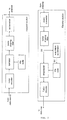
- Multiple users 1 send data to base station 3 via receiver antenna 5.
- Said data are signals that have been Turbo encoded and spread.
- Said base station 3 receives said, performs chip phase and carrier frequency acquisition for each of said signals, de-spreads each transmitted signal to obtain de-spread signals and performing Turbo decoding on said de-spread signals.
- satellite networks the same is applicable except that the data is transmitted through satellite communication (via satellite 7), as can be seen in fig. 2.
- the main advantage is that the Multiple Access Interference (MAI) which is high for a high number of users (one actually has an interference-limited system) is effectively tackled by the coding gain of the Turbo code.
- This high MAI is a consequence of the asynchronous access: when different PN codes are present in the same band, cross-correlations are much higher than when the PN codes would be synchronous.
- this MAI adds up as individual noise sources per chip (in a non-coherent way). The useful energy adds up in a coherent way.
- the drawback is the low Eb/N0 for acquisition at the base station or ground station side; therefore one needs acquisition accelerator support (e.g. using a matched filter approach). However, there is no need for extra complexity at the remote terminal side.
- code shift modulation the acquisition hardware at the base station or the ground station will monitor several autocorrelation peaks of the same code within 1 symbol period.
Landscapes
- Engineering & Computer Science (AREA)
- Computer Networks & Wireless Communication (AREA)
- Signal Processing (AREA)
- Radio Relay Systems (AREA)
- Mobile Radio Communication Systems (AREA)
Applications Claiming Priority (2)
| Application Number | Priority Date | Filing Date | Title |
|---|---|---|---|
| US16310499P | 1999-11-02 | 1999-11-02 | |
| US163104P | 1999-11-02 |
Publications (2)
| Publication Number | Publication Date |
|---|---|
| EP1098451A2 true EP1098451A2 (de) | 2001-05-09 |
| EP1098451A3 EP1098451A3 (de) | 2003-02-19 |
Family
ID=22588496
Family Applications (1)
| Application Number | Title | Priority Date | Filing Date |
|---|---|---|---|
| EP00203815A Withdrawn EP1098451A3 (de) | 1999-11-02 | 2000-11-02 | Nichtsynchrones Zugriffsverfahren unter Verwendung von CDMA und Turbo-Kodierung |
Country Status (1)
| Country | Link |
|---|---|
| EP (1) | EP1098451A3 (de) |
Cited By (1)
| Publication number | Priority date | Publication date | Assignee | Title |
|---|---|---|---|---|
| WO2003079595A1 (en) * | 2002-03-20 | 2003-09-25 | Linkair Communications, Inc. | A method of full speed turbo space-time block coding and the apparatus |
Family Cites Families (1)
| Publication number | Priority date | Publication date | Assignee | Title |
|---|---|---|---|---|
| US5734962A (en) * | 1996-07-17 | 1998-03-31 | General Electric Company | Satellite communications system utilizing parallel concatenated coding |
-
2000
- 2000-11-02 EP EP00203815A patent/EP1098451A3/de not_active Withdrawn
Cited By (1)
| Publication number | Priority date | Publication date | Assignee | Title |
|---|---|---|---|---|
| WO2003079595A1 (en) * | 2002-03-20 | 2003-09-25 | Linkair Communications, Inc. | A method of full speed turbo space-time block coding and the apparatus |
Also Published As
| Publication number | Publication date |
|---|---|
| EP1098451A3 (de) | 2003-02-19 |
Similar Documents
| Publication | Publication Date | Title |
|---|---|---|
| CA2308631C (en) | Rapid signal acquisition and synchronization for access transmissions | |
| JP4081051B2 (ja) | 複数の送信機が1っのcdmチャネルを共用できるようにするための方法及びcdmaシステム | |
| US8576893B2 (en) | Systems and methods for high data rate ultra wideband communication | |
| KR100370746B1 (ko) | 다차원 직교 자원 도약 다중화 통신 방식 및 장치 | |
| CA2305718A1 (en) | Multi-layered pn code spreading in a multi-user communications system | |
| US5638399A (en) | Multi-beam satellite communication system with user terminal frequencies having transceivers using the same set of frequency hopping | |
| EP1434361A2 (de) | Orthogonales Kodesynkronisationssystem und -verfahren für Spreizspektrum CDMA Kommunikation | |
| Scalise et al. | S-MIM: a novel radio interface for efficient messaging services over satellite | |
| US20010021195A1 (en) | Access channel slot sharing | |
| WO1996020538A9 (en) | Reliable, power-efficient, and cost-effective satellite communication system | |
| CN112020830A (zh) | 基于相位非连续r-csk调制的电文信号播发方法及装置 | |
| EP1031196B1 (de) | Gerät und Verfahren zur Teilung eines Zugriffskanalintervalls | |
| EP1205040B1 (de) | Verfahren zu weitreichendem funkruf | |
| US20020122468A1 (en) | Quasi orthogonal hybrid walsh-PN codes for CDMA application in HF modems | |
| EP1098451A2 (de) | Nichtsynchrones Zugriffsverfahren unter Verwendung von CDMA und Turbo-Kodierung | |
| EP0903871A2 (de) | Spreizspektrumsignalerzeugungseinrichtung und -verfahren | |
| EP0999668A2 (de) | Verfahren und Vorrichtung zur Veränderung der Kanalanzahl in Spreizspektrumkommunikationssystemen | |
| Ilcev | Analyses of code division multiple access (CDMA) schemes for global mobile satellite communications (GMSC) | |
| EP1053600B1 (de) | Ein verfahren zum verwenden von kodierten spreizkodes zum erreichen hoher bitdichten in einer direktsequenz | |
| Maggenti et al. | Spread-spectrum multiple access using wideband noncoherent MFSK | |
| McGrath | Coding Applications in Satellite Communication Systems | |
| MXPA00004418A (en) | Rapid signal acquisition and synchronization for access transmissions | |
| HK1010959B (en) | Using orthogonal waveforms to enable multiple transmitters to share a single cdm channel | |
| HK1067002B (en) | Orthogonal code synchronization system and method for spread spectrum cdma communications |
Legal Events
| Date | Code | Title | Description |
|---|---|---|---|
| PUAI | Public reference made under article 153(3) epc to a published international application that has entered the european phase |
Free format text: ORIGINAL CODE: 0009012 |
|
| AK | Designated contracting states |
Kind code of ref document: A2 Designated state(s): AT BE CH CY DE DK ES FI FR GB GR IE IT LI LU MC NL PT SE TR |
|
| AX | Request for extension of the european patent |
Free format text: AL;LT;LV;MK;RO;SI |
|
| PUAL | Search report despatched |
Free format text: ORIGINAL CODE: 0009013 |
|
| AK | Designated contracting states |
Designated state(s): AT BE CH CY DE DK ES FI FR GB GR IE IT LI LU MC NL PT SE TR |
|
| AX | Request for extension of the european patent |
Extension state: AL LT LV MK RO SI |
|
| 17P | Request for examination filed |
Effective date: 20030623 |
|
| 17Q | First examination report despatched |
Effective date: 20030909 |
|
| AKX | Designation fees paid |
Designated state(s): DE FR GB |
|
| RAP1 | Party data changed (applicant data changed or rights of an application transferred) |
Owner name: AGILENT TECHNOLOGIES, INC. |
|
| STAA | Information on the status of an ep patent application or granted ep patent |
Free format text: STATUS: THE APPLICATION IS DEEMED TO BE WITHDRAWN |
|
| 18D | Application deemed to be withdrawn |
Effective date: 20040923 |