EP1098382A2 - Polyelectrolyte gel - Google Patents
Polyelectrolyte gel Download PDFInfo
- Publication number
- EP1098382A2 EP1098382A2 EP00309727A EP00309727A EP1098382A2 EP 1098382 A2 EP1098382 A2 EP 1098382A2 EP 00309727 A EP00309727 A EP 00309727A EP 00309727 A EP00309727 A EP 00309727A EP 1098382 A2 EP1098382 A2 EP 1098382A2
- Authority
- EP
- European Patent Office
- Prior art keywords
- monomer
- linking agent
- cross
- gel
- alkali metal
- Prior art date
- Legal status (The legal status is an assumption and is not a legal conclusion. Google has not performed a legal analysis and makes no representation as to the accuracy of the status listed.)
- Withdrawn
Links
Images


Classifications
-
- H—ELECTRICITY
- H01—ELECTRIC ELEMENTS
- H01M—PROCESSES OR MEANS, e.g. BATTERIES, FOR THE DIRECT CONVERSION OF CHEMICAL ENERGY INTO ELECTRICAL ENERGY
- H01M10/00—Secondary cells; Manufacture thereof
- H01M10/05—Accumulators with non-aqueous electrolyte
- H01M10/052—Li-accumulators
-
- H—ELECTRICITY
- H01—ELECTRIC ELEMENTS
- H01M—PROCESSES OR MEANS, e.g. BATTERIES, FOR THE DIRECT CONVERSION OF CHEMICAL ENERGY INTO ELECTRICAL ENERGY
- H01M10/00—Secondary cells; Manufacture thereof
- H01M10/05—Accumulators with non-aqueous electrolyte
- H01M10/056—Accumulators with non-aqueous electrolyte characterised by the materials used as electrolytes, e.g. mixed inorganic/organic electrolytes
- H01M10/0564—Accumulators with non-aqueous electrolyte characterised by the materials used as electrolytes, e.g. mixed inorganic/organic electrolytes the electrolyte being constituted of organic materials only
- H01M10/0565—Polymeric materials, e.g. gel-type or solid-type
-
- H—ELECTRICITY
- H01—ELECTRIC ELEMENTS
- H01M—PROCESSES OR MEANS, e.g. BATTERIES, FOR THE DIRECT CONVERSION OF CHEMICAL ENERGY INTO ELECTRICAL ENERGY
- H01M2300/00—Electrolytes
- H01M2300/0085—Immobilising or gelification of electrolyte
-
- H—ELECTRICITY
- H01—ELECTRIC ELEMENTS
- H01M—PROCESSES OR MEANS, e.g. BATTERIES, FOR THE DIRECT CONVERSION OF CHEMICAL ENERGY INTO ELECTRICAL ENERGY
- H01M6/00—Primary cells; Manufacture thereof
- H01M6/14—Cells with non-aqueous electrolyte
- H01M6/16—Cells with non-aqueous electrolyte with organic electrolyte
- H01M6/162—Cells with non-aqueous electrolyte with organic electrolyte characterised by the electrolyte
- H01M6/168—Cells with non-aqueous electrolyte with organic electrolyte characterised by the electrolyte by additives
-
- Y—GENERAL TAGGING OF NEW TECHNOLOGICAL DEVELOPMENTS; GENERAL TAGGING OF CROSS-SECTIONAL TECHNOLOGIES SPANNING OVER SEVERAL SECTIONS OF THE IPC; TECHNICAL SUBJECTS COVERED BY FORMER USPC CROSS-REFERENCE ART COLLECTIONS [XRACs] AND DIGESTS
- Y02—TECHNOLOGIES OR APPLICATIONS FOR MITIGATION OR ADAPTATION AGAINST CLIMATE CHANGE
- Y02E—REDUCTION OF GREENHOUSE GAS [GHG] EMISSIONS, RELATED TO ENERGY GENERATION, TRANSMISSION OR DISTRIBUTION
- Y02E60/00—Enabling technologies; Technologies with a potential or indirect contribution to GHG emissions mitigation
- Y02E60/10—Energy storage using batteries
Definitions
- This invention relates to a gel polyelectrolyte for use in electrochemical applications.
- Polymeric electrolytes offer the battery industry increased design flexibility as well as improving the safety of lithium based batteries by largely eliminating the need for liquid organic electrolytes.
- the prospect of "thin film” solid state lithium polymer based batteries has been the driving force behind extensive research.
- Gel electrolytes are usually prepared by adding plasticisers and/or liquid electrolytes to the polymer host.
- Composite electrolytes are formed by adding either active or non-active ceramic material to polymeric electrolytes to improve mechanical stability and ionic conductivity. Gel electrolytes are thus far the most advanced and closest to commercial applications.
- the best known example is a system based on vinylidene fluoride/hexafluoropropylene copolymers described in United States patent specifications US 5,296,318 and US 5,418,091.
- Ionic conductivity of polymeric electrolytes is partially due to transport of anionic species. Cation transference numbers are considerably less than unity, leading to potential concentration gradients when applied in electrochemical systems, adversely affecting electrical performance. It is cation conduction which is of paramount importance in lithium based battery applications.
- One approach to increase cation transference is to attach the anion to the polymer backbone, forming a polyelectrolyte.
- an acidic polymer such as poly 2-acrylamido-2-methyl-propane-1-sulphonic acid (PAMPS), which is neutralized by lithium salts.
- PAMPS poly 2-acrylamido-2-methyl-propane-1-sulphonic acid
- polyelectrolytes usually have very low room temperature conductivity, similar in order of magnitude to dry polymeric electrolytes. Every et al. demonstrated that the addition of water can increase the conductivity of the alkali salts of PAMPS by several orders of magnitude as a direct result of increased ion mobility (Every et al.,
- the application of polyelectrolytes eliminates the need for the addition of lithium salts, such as LiPF 6 , LiBF 4 , LiAsF 6 , LiCIO 4 etc., to the electrolyte as the polymer backbone itself acts as a charge carrier.
- lithium salts such as LiPF 6 , LiBF 4 , LiAsF 6 , LiCIO 4 etc.
- the advantage is twofold, manufacturing cost is reduced substantially as the commonly used lithium salts are expensive, and chemically aggressive by-products such as hydrofluoric acid are avoided extending the cycle life of the lithium based battery.
- a polyelectrolyte gel including a polymer or co-polymer matrix and at least one substantially non-aqueous polar solvent.
- the polymer or co-polymer matrix may include at least one monomer having a side chain carrying an alkali metal and at least one monomer having a polar moiety.
- the at least one monomer having a side chain carrying an alkali metal may have the Formula I, wherein; wherein R 1 represents H or CH 3 and R 2 represents -NH-C(CH 3 ) 2 -CH 2 -SO 3 -M or -O-M wherein M is an alkali metal.
- M is lithium
- the at least one monomer having a polar moiety may have the Formula II, wherein: wherein R 1 represents H or CH 3 and each of R 3 and R 4 is selected from H, CH 3 , CH 2 -CH 3 , CH(CH 3 ) 2 , (CH 2 ) 3 CH 3 or C 6 H 5 .
- the polymer matrix may further include a cross-linking agent.
- cross linking agent may be represented by the formula IV, wherein:
- the at least one monomer having a polar moiety may be represented by the cross-linking agents represented by Formula III or IV.
- At least one substantially non-aqueous solvent may be selected to have a similar chemical structure to at least one of the monomers forming the polymer or co-polymer matrix.
- At least one of the solvents has a high dielectric constant.
- the solvent or solvents may be selected from amides, mono- and/or di-alkyl substituted amides, and/or organic solvents containing one or more carbonyl and/or sulfonyl functionalities.
- a composite electrolyte adapted for use in electrochemical applications, including a polyelectrolyte gel as hereinbefore described and a non-conductive web structure or one or more inorganic additives providing additional dimensional stability.
- the inorganic additives may be selected from SiO 2 , Al 2 O 3 , LiAIO 2 , TiO 2 , ZrO 2 or zeolites.
- a secondary lithium battery including a polyelectrolyte gel, or composite electrolyte as hereinbefore described, a positive electrode and a negative electrode.
- a method of forming a polyelectrolyte gel including the steps of:
- the method may include purging the dissolved mixture with an inert gas.
- the method may further include adding a cross-linking agent.
- a cross-linking agent may be added.
- at least one monomer having a polar moiety may also have cross-linking properties.
- the dewatering step may reduce the water content to ⁇ 100ppm.
- the one or more monomer with a side chain carrying an alkali metal may be formed by neutralizing a charged monomer with an alkali metal sulphonate or carbonate.
- the charged monomer may include a sulphonic acid group.
- the method may further include adding a non-conductive web and/or one or more inorganic additives prior to polymerization.
- the substantially non-aqueous solvent may be selected to have a similar chemical structure to at least one of the monomers.
- At least one of the solvents has a high dielectric constant.
- the invention provides polyelectrolyte networks, which form gels with substantially non-aqueous polar solvents.
- the polyelectrolyte network has the negatively charged ions attached to its backbone and alkali metal ions associated with it, thus the gel acts as a single ion conductor.
- the gels include polymer or co-polymer chains containing polar moieties, such as amides or alkyl substituted amides, and side chain groups carrying the alkali metal, e.g. lithium sulphonate or lithium carboxylates.
- polar moieties such as amides or alkyl substituted amides
- side chain groups carrying the alkali metal e.g. lithium sulphonate or lithium carboxylates.
- the monomer polar moieties may include electronegative heteroatoms, such as nitrogen or oxygen, facilitate the dissociation of the cation from the polymer backbone, thus decreasing ion pairing and increasing ion mobility.
- Cation transference numbers should be substantially equal to one.
- the polymers or co-polymers may be cross-linked to aid mechanical stability, such that the polyelectrolyte may act as a separator/electrolyte in alkali metal batteries.
- the polymer matrix is formed either by polymerization of a monomer represented by Formula I and a monomer represented by Formula II, with the inclusion of an optional cross-linking agent, such as is represented by Formulas III and IV, or by polymerization of a monomer represented by Formula II together with a monomer represented by Formulas III or IV.
- Preferred monomers are N,N-di-substituted acrylamides as non-charged monomers with a sulphonic acid group as a charge carrier. It will be appreciated by those skilled in the art that different acidic polymers may also be employed as the cation bearing component. It is reasonable to expect that using different starting monomers will result in polymer networks with somewhat different mechanical strength which will influence the ionic conductivity of the polyelectrolyte.
- the monomers are preferably selected such that the polyelectrolyte gel is electrochemically stable vs. the Li/Li + couple over a wide potential window (i.e. 0.0 to > 4.0V). Most preferably the polyelectrolyte gel should be stable from 0.0 to 4.5V.
- the solvents of choice are non-aqueous solvents particularly those having similar chemical composition as the monomers, (such as amides and mono- and di-alkyl substituted amides), capable of dissociating the cations from the polyelectrolyte backbones.
- the solvent selected should have a high dielectric constant (>40), or where several solvents are used at least one should have a high dielectric constant.
- the solvent or solvents selected should be electrochemically stable over the potential range of interest (e.g. ethylene carbonate, dimethyl carbonate, propylene carbonate, dimethyl sulphoxide, etc.). These properties improve the mechanical properties and electrochemical stability of the electrolyte.
- a solvent monomer system must be selected such that no phase separation occurs during the polymerization reaction.
- the polymerization/gelation method used to produce the polyelectrolyte materials of the invention involves conventional free radical polymerization.
- a charged monomer (Lisalt), a non-charged monomer and a cross-linking monomer are mixed together, dissolved in appropriate solvent, or mixture of solvents.
- the pre-gel solution is purged with inert gas, preferentially argon, to remove oxygen to avoid termination of the polymerization reaction and kept over a molecular sieve to remove traces of water.
- an appropriate initiator usually from the group of persulphates and azo-compounds is added to the water-free pre gel solution.
- the polymerization is induced thermally, photochemically, with redox reaction or with other irradiation sources.
- glass moulds and PTFE moulds can be used to control the gel thickness using a spacer of appropriate thickness.
- the gel can be polymerized in any shape.
- a non-conductive web (such as a non-woven glass fiber or polymer material, e.g. polyethylene or polypropylene or similar electrically insulating materials) can be placed in the mould prior to gelation, to give better mechanical performance of the polyelectrolyte gel and easier handling. Similar effects can be achieved by adding inorganic additives, such as silica, alumina, zeolites etc., to the pre gel solution. Such composite electrolytes can have improved conductivity, mechanical properties and electrochemical stability. It will be appreciated by those skilled in the art that gel films can also be prepared by casting, coating and printing techniques.
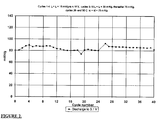
- the gel prepared according to Example 10 has been evaluated by charge/discharge cycling (between 3.1 and 4.18 V) using automated battery testing equipment in standard 2032 lithium button cells.
- Doped lithium manganese oxide of spinel structure (LiMn 2 0 4 ) has been used as the cathode active material.
- the discharge profile is depicted in Figure 2.
- the discharge current was 15 mAg -1 up to cycle 4, 30 mAg -1 cycle 5 to 18 and 75 mAg -1 thereafter. These currents correspond to ca. at C/7, C/3.5 and C/1.4 rate, respectively.
- Cycles 1 to 25 were performed at ambient temperature and cycles 26 and thereafter at 55°C.
- the electrochemical results clearly demonstrate the usefulness of the polyelectrolyte gels in lithium based battery systems.
- a gel was produced by the same method as that of Example 1 except 0.1773 g of methylenebisacrylamide was used instead of 0.1542 g and the monomer solution was kept over molecular sieves for 9 days.
- a N,N'-dimethylacrylamide-based gel was prepared by polymerizing 2.86 ml of N,N'-dimethylacrylamide with 1.6580 g of AMPS neutralized with appropriate amount of Li 2 CO 3 , and 0.67 ml of tetraethyleneglycoldiacrylate. N,N'-dimethylformamide was used as a solvent. The solution was purged with oxygen-free argon and kept over 4A molecular sieves for several days with occasional shaking. Polymerization reaction, performed between two glass plates covered with PTFE sheets was initiated with 20 mg of azobis (cyclohexanecarbonitrile) at 90°C.
- a gel was produced in the same way as in Example 3 except that a PET web was placed in the mould and the gel polymerized on top of it.
- a gel was produced in the same way as in Example 3 except that a mixture of N,N'-dimethylformamide/ethylene carbonate in volume ratio of 4:1 was used as a solvent instead of N,N'-dimethylformamide. A part of the gel film was synthesized over the PET web.
- a gel was produced in the same way as in Example 5 except that a mixture of N,N'-dimethylformamide/ethylene carbonate in volume ratio of 2:1 was used as a solvent instead of the ratio of 4:1, and the gel was synthesized on the PET web.
- a gel was prepared by polymerizing 3.15ml of N,N'-dimethylacrylamide with 1.3679 g of AMPS neutralized with an appropriate amount of Li 2 CO 3 , and 1.20ml of tetraethyleneglycoldiacrylate. N,N'-dimethylacetamide was used as a solvent. The solution was purged with oxygen-free argon and kept over 4A molecular sieves for several days with occasional shaking. Polymerization reaction, performed between two glass plates covered with PTFE sheets was initiated with 30 mg of azobis (cyclohexanecarbonitrile) at 90°C. A part of gel film was synthesized over the PET web.
- a gel was prepared by polymerizing 3.30 ml of N,N'-dimethylacrylamide with 1.2435 g of AMPS neutralized with appropriate amount of Li 2 CO 3 , and 0.60 ml of tetraethyleneglycoldiacrylate. N,N'-dimethylacetamide was used as a solvent. The solution was purged with oxygen-free argon and kept over 4A molecular sieves for several days with occasional shaking. Polymerization reaction, performed between two glass plates covered with PTFE sheets was initiated with 20 mg of azobis (cyclohexanecarbonitrile) at 90oC. A part of gel film was synthesized over the PET web.
- a gel was produced in the same way as in Example 8 except that a mixture of N,N'-dimethylacetamide /ethylene carbonate in volume ratio of 2:1 was used as a solvent instead of N,N'-dimethylacetamide.
- a gel was produced in the same way as in Example 9 except that 10% (w/v) of fumed silica was mixed into the pre-gel solution.
- a secondary lithium polymer battery was constructed using the polyelectrolyte prepared according to this example.
- the "button" cell was assembled as follows: can, cathode, gel, lithium disk, steel disk, spring load and lid. Doped LiMn 2 O 4 on an aluminum foil was used as a positive electrode and Li metal as a negative electrode. The size of cathode and anode was 14 mm and of the gel 15.5 mm. The gel thickness was approximately 200 ⁇ m. The cell was crimp-closed.
- Figure 2 shows an example of the discharge profile for such a button cell.
- Discharge current was 15 mAg -1 for the first four cycles, 30 mAg -1 for cycle 15 to 18 and 75 mAg -1 thereafter.
- Cycles 1 to 25 were performed at ambient temperature and cycles 26 and thereafter at 55°C.
- the polyelectrolyte gels of the invention thus, provide a non-aqueous electrolyte of high conductivity and good mechanical stability suitable for use in electrochemical applications specifically requiring electrochemical stability over a wide potential range, such as alkali metal (and particularly lithium) batteries, electrochromic windows, actuators and the like.
- a gel was prepared by polymerizing 7.932 ml of N,N'-dimethylacrylamide with 4.1450 g of AMPS neutralized with appropriate amount of Li 2 CO 3 , and 0.817 ml of tetraethyleneglycoldiacrylate. 100 ml of N,N'-dimethylacetamide/ ethylene carbonate in volume ratio of 2:1 was used as a solvent. The solution was purged with oxygen-free argon and kept over 4A molecular sieves for several days with occasional shaking. The pre-gel solution contained 5% (w/v) of fumed silica. Polymerization reaction, performed between two glass plates was initiated with 1 mg of azobis (cyclohexanecarbonitrile) per 1 ml of the pre-gel solution at 90°C.
- a gel was prepared by polymerizing 6.418 ml of methyl methacrylate with 2.3316 g of AMPS neutralized with appropriate amount of Li 2 CO 3 , and 1.021 ml of tetraethyleneglycoldiacrylate. 2-methoxyethyl ether/ ethylene carbonate in volume ratio of 1:1 was used as a solvent. The solution was purged with oxygen-free argon and kept over 4A molecular sieves for several days with occasional shaking. Polymerization reaction, performed between two glass plates was initiated with 1 mg of azobis (cyclohexanecarbonitrile) per 1 ml of the pre-gel solution at 92°C.
- a gel was prepared by polymerizing 3.298 ml of N,N'-dimethylacrylamide with 0.4679 g of lithium acrylate and 0.411 ml of tetraethyleneglycoldiacrylate. 20 ml of N,N'-dimethylacetamide/ ethylene carbonate in volume ratio of 3.2 : 1 was used as a solvent. The solution was purged with oxygen-free argon and kept over 4A molecular sieves for several days with occasional shaking. The pre-gel solution contained 7 % (w/v) of fumed silica. Polymerization reaction, performed between two glass plates was initiated with 1 mg of azobis (cyclohexanecarbonitrile) per 1 ml of the pre-gel solution at 90°C.
Landscapes
- Chemical & Material Sciences (AREA)
- Engineering & Computer Science (AREA)
- Manufacturing & Machinery (AREA)
- Chemical Kinetics & Catalysis (AREA)
- Electrochemistry (AREA)
- General Chemical & Material Sciences (AREA)
- Dispersion Chemistry (AREA)
- Condensed Matter Physics & Semiconductors (AREA)
- Physics & Mathematics (AREA)
- General Physics & Mathematics (AREA)
- Inorganic Chemistry (AREA)
- Secondary Cells (AREA)
- Conductive Materials (AREA)
- Compositions Of Macromolecular Compounds (AREA)
- Addition Polymer Or Copolymer, Post-Treatments, Or Chemical Modifications (AREA)
- Macromonomer-Based Addition Polymer (AREA)
Abstract
Description
- conductivity of greater than 10-4 Scm-1 at temperatures between -40 and 70°C;
- good dimensional and thermal stability in this temperature range;
- electrochemical stability window spanning the potentials between 0.0 and 4.0 V versus the Li/Li+ couple;
- chemical compatability with both the anode and cathode over the whole temperature range;
- ability to afford recharge at an efficiency of greater than 99%.


- mixing at least one monomer having a side chain carrying an alkali metal with at least one monomer having a polar moiety,
- dissolving the mixture in at least one substantially non-aqueous polar solvent,
- dewatering to a water content of < 0.1%, and
- inducing polymerization.
55°C (

Claims (27)
- A polyelectrolyte gel for use in an electrochemical device comprising:a polymer or co-polymer matrix and at least one substantially non-aqueous polar solvent.
- The device according to Claim 1, wherein the polymer or co-polymer matrix includes at least one monomer having a side chain carrying an alkali metal and at least one monomer having a polar moiety.
- The device according to Claim 2, wherein the at least one monomer having a side chain carrying an alkali metal has the Formula I, wherein:wherein R1 represents H or CH3 and R2 represents -NH-C(CH3)2-CH2-SO3-M or -0-M wherein M is an alkali metal.

- The device according to Claim 3, wherein M is selected from the group consisting of lithium, sodium and potassium.
- The device according to Claim 2, wherein the at least one monomer having a polar moiety has the Formula II, wherein:wherein R1 represents H or CH3 and each of R3 and R4 is selected from H, CH3, CH2-CH3, CH(CH3)2, (CH2)3CH3 or C 6H5.

- The device according to Claim 1, wherein the polymer matrix includes a cross-linking agent.
- The device according to Claim 6, wherein the cross-linking agent is represented by the Formula III, wherein:wherein n ≥ 1 and R1 is H or CH3.

- The device according to Claim 6, wherein the cross linking agent is represented by the Formula IV, wherein:

- The device according to Claim 7, wherein the at least one monomer having a polar moiety is represented by the cross-linking agent represented by Formula III.
- The device according to Claim 8 wherein the at least one monomer having a polar moiety is represented by the cross-linking agent represented by Formula IV.
- The device according to Claim 2, wherein at least one of the substantially non-aqueous solvents has a similar chemical structure to at least one of the monomers forming the polymer or co-polymer matrix.
- The device according to Claim 1, wherein at least one of the substantially non-aqueous solvents has a high dielectric constant.
- The device according to Claim 1, wherein at least one of the substantially non-aqueous solvents are selected from the group consisting of amides, mono- and/or di-alkyl substituted amides, and or organic solvents containing one or more carbonyl and/or sulfonyl functionalities.
- A composite electrolyte adapted for use in electrochemical applications, comprising:a polyelectrolyte gel according to Claim 1; andmeans for providing dimensional stability.
- The electrolyte according to Claim 14, wherein the dimensional stability means comprises a non-conductive web structure.
- The electrolyte according to Claim 14, wherein the dimensional stability means comprises one or more inorganic additives.
- The electrolyte according to Claim 16, wherein the one or more inorganic additives are selected from the group consisting of SiO2, Al2O3, LiAIO2, TiO2, ZrO2 or zeolites.
- The device according to Claim 14, wherein the electrochemical application comprises a secondary lithium battery having a positive electrode and a negative electrode.
- The device according to Claim 1, wherein the electrochemical device comprises a secondary lithium battery having a positive electrode and a negative electrode.
- A method of forming a polyelectrolyte gel comprising the steps of:mixing at least one monomer having a side chain carrying an alkali metal with at least one monomer having a polar moiety;dissolving the mixture in at least one substantially non-aqueous polar solvent;dewatering to a water content of < 0.1 %; andinducing polymerization.
- The invention according to Claim 20, wherein the method further includes the step of purging the dissolved mixture with an inert gas.
- The invention according to Claim 20, wherein the method further includes the step of adding a cross-linking agent.
- The method according to Claim 22, wherein the step of adding a cross-linking agent comprises the step of adding the cross-linking agent to at least one of the monomers having a polar moiety.
- The method according to Claim 20, wherein the step of dewatering comprises the step of reducing the water content to < 100ppm.
- The invention according to Claim 20, wherein the method further includes the step of forming the at least one monomer with a side chain carrying an alkali metal, wherein the step of forming comprises:neutralizing a charged monomer with at least one of an alkali metal sulphonate or carbonate.
- The method according to Claim 25, wherein the charged monomer includes a sulphonic acid group or carboxylic acid group.
- The invention according to Claim 20, wherein the method further includes the step of adding at least one of a non-conductive web or one or more inorganic additives prior to the step of inducing polymerization.
Applications Claiming Priority (2)
| Application Number | Priority Date | Filing Date | Title |
|---|---|---|---|
| AUPQ3895A AUPQ389599A0 (en) | 1999-11-05 | 1999-11-05 | Polyelectrolyte gel |
| AUPQ389599 | 1999-11-05 |
Publications (2)
| Publication Number | Publication Date |
|---|---|
| EP1098382A2 true EP1098382A2 (en) | 2001-05-09 |
| EP1098382A3 EP1098382A3 (en) | 2003-04-16 |
Family
ID=3818041
Family Applications (1)
| Application Number | Title | Priority Date | Filing Date |
|---|---|---|---|
| EP00309727A Withdrawn EP1098382A3 (en) | 1999-11-05 | 2000-11-02 | Polyelectrolyte gel |
Country Status (3)
| Country | Link |
|---|---|
| EP (1) | EP1098382A3 (en) |
| JP (1) | JP2001176556A (en) |
| AU (1) | AUPQ389599A0 (en) |
Cited By (12)
| Publication number | Priority date | Publication date | Assignee | Title |
|---|---|---|---|---|
| EP1349178A1 (en) * | 2002-03-27 | 2003-10-01 | Hitachi, Ltd. | Cationic polymeric conductors, their monomers and utilisation in lithium secondary batteries |
| US20140004406A1 (en) * | 2011-03-03 | 2014-01-02 | Lg Chem, Ltd. | Unification-typed electrode assembly and secondary battery using the same |
| DE102015224345A1 (en) | 2015-12-04 | 2017-06-08 | Robert Bosch Gmbh | SIC separator and SIC cell |
| CN106876801A (en) * | 2017-04-05 | 2017-06-20 | 旭派电源有限公司 | A kind of lead-acid accumulator colloid mixture electrolyte of chemical crosslinking |
| US9882239B2 (en) | 2013-01-28 | 2018-01-30 | Lg Chem, Ltd. | Composition for gel polymer electrolyte and lithium secondary battery including the same |
| US9951101B2 (en) | 2013-12-12 | 2018-04-24 | Emd Millipore Corporation | Protein separations using an acrylamide containing filter |
| EP3261164A4 (en) * | 2015-02-17 | 2018-07-25 | Jenax Inc. | Gel polymer electrolyte, method for preparing same, and electrochemical device comprising same |
| US10297860B2 (en) | 2013-01-28 | 2019-05-21 | Lg Chem, Ltd. | Lithium secondary battery |
| CN110231742A (en) * | 2018-03-06 | 2019-09-13 | 菲尔齐费尔公司 | For changing the method for the state of electrochromic film |
| CN110957534A (en) * | 2019-12-18 | 2020-04-03 | 昆山宝创新能源科技有限公司 | Solid electrolyte membrane, method for producing same, and solid battery |
| US11694649B2 (en) | 2018-03-06 | 2023-07-04 | Furcifer Inc. | Method for changing states of electrochromic film |
| CN120824420A (en) * | 2025-09-17 | 2025-10-21 | 深圳好电科技有限公司 | Gel electrolyte and battery |
Families Citing this family (8)
| Publication number | Priority date | Publication date | Assignee | Title |
|---|---|---|---|---|
| US7510803B2 (en) * | 2001-08-24 | 2009-03-31 | Sony Corporation | Battery |
| JP4265191B2 (en) * | 2002-09-27 | 2009-05-20 | 住友ベークライト株式会社 | Lithium ion conductive all solid electrolyte and lithium ion conductive gel electrolyte |
| JP4843905B2 (en) * | 2004-03-24 | 2011-12-21 | 住友ベークライト株式会社 | Method for producing polymer solid electrolyte |
| SG10201701224UA (en) * | 2012-03-12 | 2017-04-27 | Merck Patent Gmbh | Removal of protein aggregates from biopharmaceutical preparations in a flowthrough mode |
| KR101545432B1 (en) * | 2013-01-28 | 2015-08-18 | 주식회사 엘지화학 | Lithium secondary battery |
| KR102343691B1 (en) * | 2014-11-28 | 2021-12-27 | 삼성에스디아이 주식회사 | Zinc-air battery and method for preparing the same |
| WO2024232341A1 (en) | 2023-05-08 | 2024-11-14 | 住友化学株式会社 | Electrolyte composition and battery |
| JPWO2024232344A1 (en) | 2023-05-08 | 2024-11-14 |
Family Cites Families (4)
| Publication number | Priority date | Publication date | Assignee | Title |
|---|---|---|---|---|
| DE3136578A1 (en) * | 1981-09-15 | 1983-03-31 | Varta Batterie Ag, 3000 Hannover | GALVANIC ELEMENT WITH INTEGRATED GETTER |
| EP0213985B1 (en) * | 1985-07-12 | 1989-09-13 | Societe Nationale Elf Aquitaine | Macromolecular material with ion conductivity |
| JP3533289B2 (en) * | 1996-06-14 | 2004-05-31 | 松下電器産業株式会社 | Lithium ion conductive solid electrolyte molded body |
| KR100261252B1 (en) * | 1996-07-30 | 2000-07-01 | 윤종용 | Polymer solid electrolyte and lithium secondary battery employing the same |
-
1999
- 1999-11-05 AU AUPQ3895A patent/AUPQ389599A0/en not_active Abandoned
-
2000
- 2000-11-02 EP EP00309727A patent/EP1098382A3/en not_active Withdrawn
- 2000-11-06 JP JP2000337812A patent/JP2001176556A/en active Pending
Cited By (19)
| Publication number | Priority date | Publication date | Assignee | Title |
|---|---|---|---|---|
| EP1349178A1 (en) * | 2002-03-27 | 2003-10-01 | Hitachi, Ltd. | Cationic polymeric conductors, their monomers and utilisation in lithium secondary batteries |
| US7300991B2 (en) | 2002-03-27 | 2007-11-27 | Hitachi, Ltd. | Cationic conductor, its intermediate, and lithium secondary battery using the conductor |
| US7704642B2 (en) | 2002-03-27 | 2010-04-27 | Hitachi, Ltd. | Cationic conductor, its intermediate, and lithium secondary battery using the conductor |
| US20140004406A1 (en) * | 2011-03-03 | 2014-01-02 | Lg Chem, Ltd. | Unification-typed electrode assembly and secondary battery using the same |
| EP2660919A4 (en) * | 2011-03-03 | 2014-09-03 | Lg Chemical Ltd | INTEGRATED ELECTRODE ASSEMBLY AND RECHARGEABLE BATTERY USING THE SAME |
| US9653718B2 (en) | 2011-03-03 | 2017-05-16 | Lg Chem, Ltd. | Unification-typed electrode assembly and secondary battery using the same |
| US9882239B2 (en) | 2013-01-28 | 2018-01-30 | Lg Chem, Ltd. | Composition for gel polymer electrolyte and lithium secondary battery including the same |
| US10297860B2 (en) | 2013-01-28 | 2019-05-21 | Lg Chem, Ltd. | Lithium secondary battery |
| US9951101B2 (en) | 2013-12-12 | 2018-04-24 | Emd Millipore Corporation | Protein separations using an acrylamide containing filter |
| US10570171B2 (en) | 2013-12-12 | 2020-02-25 | Emd Millipore Corporation | Protein separations using an acrylamide containing filter |
| EP3261164A4 (en) * | 2015-02-17 | 2018-07-25 | Jenax Inc. | Gel polymer electrolyte, method for preparing same, and electrochemical device comprising same |
| US10707527B2 (en) | 2015-02-17 | 2020-07-07 | Jenax Inc. | Gel polymer electrolyte, electrochemical device, and methods thereof |
| DE102015224345A1 (en) | 2015-12-04 | 2017-06-08 | Robert Bosch Gmbh | SIC separator and SIC cell |
| CN106876801A (en) * | 2017-04-05 | 2017-06-20 | 旭派电源有限公司 | A kind of lead-acid accumulator colloid mixture electrolyte of chemical crosslinking |
| CN110231742A (en) * | 2018-03-06 | 2019-09-13 | 菲尔齐费尔公司 | For changing the method for the state of electrochromic film |
| US11694649B2 (en) | 2018-03-06 | 2023-07-04 | Furcifer Inc. | Method for changing states of electrochromic film |
| CN110957534A (en) * | 2019-12-18 | 2020-04-03 | 昆山宝创新能源科技有限公司 | Solid electrolyte membrane, method for producing same, and solid battery |
| CN120824420A (en) * | 2025-09-17 | 2025-10-21 | 深圳好电科技有限公司 | Gel electrolyte and battery |
| CN120824420B (en) * | 2025-09-17 | 2026-03-10 | 深圳好电科技有限公司 | Gel electrolyte and battery |
Also Published As
| Publication number | Publication date |
|---|---|
| EP1098382A3 (en) | 2003-04-16 |
| AUPQ389599A0 (en) | 1999-12-02 |
| JP2001176556A (en) | 2001-06-29 |
Similar Documents
| Publication | Publication Date | Title |
|---|---|---|
| EP1098382A2 (en) | Polyelectrolyte gel | |
| JP4503829B2 (en) | Electrolytes containing mixed fluorocarbon / hydrocarbonimide salts and methide salts | |
| KR100804981B1 (en) | Secondary Battery Using Eutectic Mixture and Manufacturing Method Thereof | |
| KR102566405B1 (en) | Polymer electrolyte, preparing method thereof, and lithium metal battery including the same | |
| CN101517809B (en) | Secondary battery containing eutectic mixture and preparation method thereof | |
| KR100759541B1 (en) | Polymer lithium battery and manufacturing method thereof | |
| KR100605075B1 (en) | Sulfonylimides And Their Use As Conductive Salts | |
| KR102675772B1 (en) | Polymer electrolyte, preparing method thereof, and lithium metal battery including the same | |
| KR20010072928A (en) | Cyano-Substituted Methide and Amide Salts | |
| KR101358474B1 (en) | Organic solid electrolyte and secondary battery | |
| US8481215B2 (en) | Electrolyte having eutectic mixture and electrochemical device containing the same | |
| WO2000005774A1 (en) | Block copolymer electrolyte | |
| KR20160079574A (en) | Polymer, electrolyte comprising the polymer, and lithium secondary battery comprising the electrolyte | |
| KR20030032258A (en) | Fluoride copolymer, polymer electrolyte comprising the same and lithium battery employing the polymer electrolyte | |
| US9017879B2 (en) | Electrolyte having eutectic mixture and electrochemical device containing the same | |
| JP5076884B2 (en) | Secondary battery electrode and secondary battery employing the electrode | |
| US20080199778A1 (en) | Electrode for secondary batteries and method for making same, and secondary batteries using the electrode | |
| JP2014139927A (en) | Power storage device, and electrode and porous sheet used for the same | |
| KR101190145B1 (en) | Polymer electrolyte composite containing the amine acrylate compounds and lithium-polymer secondary battery using the same | |
| KR100387393B1 (en) | Composite polymer electrolyte containing room-temperature molten salt | |
| EP0858994A1 (en) | New ionically conductive material with improved conductivity and stability | |
| KR100407485B1 (en) | Polymeric gel electrolyte and lithium battery employing the same | |
| KR100745732B1 (en) | Organic electrolyte and lithium battery employing the same | |
| JP2003303617A (en) | Electrolyte added with electrolytic salt and molecule capable of forming complex and lithium secondary battery using the same | |
| KR100229987B1 (en) | Vinyl Acetate Solid Polymer Electrolyte |
Legal Events
| Date | Code | Title | Description |
|---|---|---|---|
| PUAI | Public reference made under article 153(3) epc to a published international application that has entered the european phase |
Free format text: ORIGINAL CODE: 0009012 |
|
| AK | Designated contracting states |
Kind code of ref document: A2 Designated state(s): AT BE CH CY DE DK ES FI FR GB GR IE IT LI LU MC NL PT SE TR |
|
| AX | Request for extension of the european patent |
Free format text: AL;LT;LV;MK;RO;SI |
|
| 17P | Request for examination filed |
Effective date: 20010605 |
|
| PUAL | Search report despatched |
Free format text: ORIGINAL CODE: 0009013 |
|
| RIC1 | Information provided on ipc code assigned before grant |
Ipc: 7H 01B 1/12 B Ipc: 7H 01M 6/22 B Ipc: 7H 01M 6/18 B Ipc: 7H 01M 10/40 A |
|
| AK | Designated contracting states |
Designated state(s): AT BE CH CY DE DK ES FI FR GB GR IE IT LI LU MC NL PT SE TR |
|
| AX | Request for extension of the european patent |
Extension state: AL LT LV MK RO SI |
|
| STAA | Information on the status of an ep patent application or granted ep patent |
Free format text: STATUS: THE APPLICATION IS DEEMED TO BE WITHDRAWN |
|
| 18D | Application deemed to be withdrawn |
Effective date: 20021104 |