EP1097770A1 - Metallic powder molding material and its re-compression molded body and sintered body obtained from the re-compression molded body and production methods thereof - Google Patents
Metallic powder molding material and its re-compression molded body and sintered body obtained from the re-compression molded body and production methods thereof Download PDFInfo
- Publication number
- EP1097770A1 EP1097770A1 EP00909684A EP00909684A EP1097770A1 EP 1097770 A1 EP1097770 A1 EP 1097770A1 EP 00909684 A EP00909684 A EP 00909684A EP 00909684 A EP00909684 A EP 00909684A EP 1097770 A1 EP1097770 A1 EP 1097770A1
- Authority
- EP
- European Patent Office
- Prior art keywords
- molded body
- graphite
- metallic powder
- preform
- sintering
- Prior art date
- Legal status (The legal status is an assumption and is not a legal conclusion. Google has not performed a legal analysis and makes no representation as to the accuracy of the status listed.)
- Granted
Links
Images













Classifications
-
- B—PERFORMING OPERATIONS; TRANSPORTING
- B22—CASTING; POWDER METALLURGY
- B22F—WORKING METALLIC POWDER; MANUFACTURE OF ARTICLES FROM METALLIC POWDER; MAKING METALLIC POWDER; APPARATUS OR DEVICES SPECIALLY ADAPTED FOR METALLIC POWDER
- B22F3/00—Manufacture of workpieces or articles from metallic powder characterised by the manner of compacting or sintering; Apparatus specially adapted therefor ; Presses and furnaces
- B22F3/02—Compacting only
-
- C—CHEMISTRY; METALLURGY
- C22—METALLURGY; FERROUS OR NON-FERROUS ALLOYS; TREATMENT OF ALLOYS OR NON-FERROUS METALS
- C22C—ALLOYS
- C22C33/00—Making ferrous alloys
- C22C33/02—Making ferrous alloys by powder metallurgy
-
- B—PERFORMING OPERATIONS; TRANSPORTING
- B22—CASTING; POWDER METALLURGY
- B22F—WORKING METALLIC POWDER; MANUFACTURE OF ARTICLES FROM METALLIC POWDER; MAKING METALLIC POWDER; APPARATUS OR DEVICES SPECIALLY ADAPTED FOR METALLIC POWDER
- B22F2998/00—Supplementary information concerning processes or compositions relating to powder metallurgy
-
- B—PERFORMING OPERATIONS; TRANSPORTING
- B22—CASTING; POWDER METALLURGY
- B22F—WORKING METALLIC POWDER; MANUFACTURE OF ARTICLES FROM METALLIC POWDER; MAKING METALLIC POWDER; APPARATUS OR DEVICES SPECIALLY ADAPTED FOR METALLIC POWDER
- B22F2998/00—Supplementary information concerning processes or compositions relating to powder metallurgy
- B22F2998/10—Processes characterised by the sequence of their steps
Definitions
- the present invention relates to a metallic powder-molded body, a re-compacted body of the molded body and a sintered body produced from the re-compacted body, which are suitable for the manufacture of various structural machine parts made of sintered metals, and processes for the production thereof.
- the process for making sintered metals essentially includes mixing of powder as a raw material, compaction, sintering and after-treatment (heat treatment). Although the sintered products can be produced only through these essential steps, in many cases, additional steps or various treatments are performed between or after the essential steps according to requirements.
- Japanese Patent Application First Publication No. 1-123005 discloses a process comprising the steps of compacting a mixed powder to form a preform, provisionally sintering the preform to form a metallic powder-molded body, re-compacting (cold forging) the metallic powder-molded body and then sintering (substantial sintering) the re-compacted body.
- the re-compaction (cold forging) step of the metallic powder-molded body is constituted by a provisional compaction step and a substantial compaction step.
- the metallic powder-molded body is provisionally compacted after applying a liquid lubricant to a surface thereof, and exposed to negative pressure to absorb and remove the lubricant therefrom. Then, the metallic powder-molded body is subjected to substantial compaction step.
- the present inventors have continuously made intense studies for producing various structural machine parts having a high mechanical strength due to the use of sintered metals. As a result, it has been recognized that when machine parts are manufactured by provisionally sintering a preform to form a metallic powder-molded body, re-compacting the molded body and subjecting the re-compacted body to substantial sintering, the metallic powder-molded body bears important factors determinate to qualities of the obtained machine parts. Therefore, it is necessary to obtain a molded body having a predetermined graphite content, a large elongation, a low hardness and an excellent deformability. Based on the above recognition, the present inventors have conducted further researches.
- the properties of the metallic powder-molded body having a predetermined graphite content, especially elongation and hardness thereof which are important properties for facilitating the re-compaction are influenced and determined by a density of the preform prior to the formation of the molded body, a structure of the molded body obtained by provisionally sintering the preform, and the configuration of carbon contained in the molded body.
- An object of the present invention is to provide a metallic powder-molded body having an excellent deformability, a re-compacted body of the molded body, a sintered body produced from the re-compacted body, and processes for the production thereof.
- a metallic powder-molded body produced by a process comprising the steps of:
- the amount of the graphite blended with the metal powder is 0.3% by weight or more.
- said preliminary molding step further comprises the step of pressing the metallic powder mixture filled in a mold cavity of a forming die, by upper and lower punches,
- the amount of the graphite blended with the metal powder is 0.3% by weight or more.
- the amount of the graphite blended with the metal powder is 0.3% by weight or more.
- said preliminary molding step further comprises the step of pressing the metallic powder mixture filled in a mold cavity of a forming die, by upper and lower punches,
- the amount of the graphite blended with the metal powder is 0.3% by weight or more.
- the amount of the graphite blended with the metal powder is 0.3% by weight or more.
- said preliminary molding step further comprises the step of pressing the metallic powder mixture filled in a mold cavity of a forming die, by upper and lower punches,
- the amount of the graphite blended with the metal powder is 0.3% by weight or more.
- the metallic powder mixture of the metallic powder-molded body as claimed in claim 1 is an iron-based alloy steel powder containing at least one alloy element selected from the group consisting of molybdenum (Mo), nickel (Ni), manganese (Mn), copper (Cu), chromium (Cr), tungsten (W), vanadium (V), cobalt (Co) and the like, which element is capable of forming a solid solution with a base material of the metal powder to enhance mechanical properties such as strength and hardenability, or capable of forming a precipitate such as carbide to enhance mechanical properties such as strength and hardness,
- Mo molybdenum
- Ni nickel
- Mn manganese
- Cu copper
- Cr chromium
- W tungsten
- V vanadium
- Co cobalt
- the metallic powder mixture of the metallic powder-molded body as claimed in claim 1 is obtained by diffusing and depositing a powder containing as a main component, an alloy element selected from the group consisting of molybdenum (Mo), nickel (Ni), manganese (Mn), copper (Cu), chromium (Cr), tungsten (W), vanadium (V) ,, cobalt (Co) and the like, which element is capable of forming a solid solution with a base material of the metal powder to enhance mechanical properties such as strength and hardenability, or capable of forming a precipitate such as carbide to enhance mechanical properties such as strength and hardness, onto said iron-based metal powder,
- Mo molybdenum
- Ni nickel
- Mn manganese
- Cu copper
- Cr chromium
- W tungsten
- V vanadium
- Co cobalt
- the metallic powder mixture of the metallic powder-molded body as claimed in claim 1 is obtained by blending a powder containing as a main component, an alloy element selected from the group consisting of molybdenum (Mo), nickel (Ni), manganese (Mn), copper (Cu), chromium (Cr), tungsten (W), vanadium (V), cobalt (Co) and the like, which element is capable of forming a solid solution with a base material of the metal powder to enhance mechanical properties such as strength and hardenability, or capable of forming a precipitate such as carbide to enhance mechanical properties such as strength and hardness, with the iron-based metal powder,
- Mo molybdenum
- Ni nickel
- Mn manganese
- Cu copper
- Cr chromium
- W tungsten
- V vanadium
- Co cobalt
- the amount of the graphite blended with the metal powder is 0.1% by weight or more.
- a re-compacted body produced by re-compacting the metallic powder-molded body as claimed in any one of claims 17-19, wherein the re-compacted body has a dense structure containing substantially no voids.
- the amount of the graphite blended with the metal powder is 0.1% by weight or more.
- a sintered body obtained by re-sintering the re-compacted body as claimed in claim 21 or claim 22 at a predetermined temperature, wherein the sintered body has a graphite-diffused structure and a graphite-remaining structure at a predetermined ratio determined depending on the predetermined re-sintering temperature.
- a sintered body produced by heat-treating the sintered body as claimed in claim 24, wherein the sintered body heat-treated has a hardened structure.
- the amount of the graphite blended with the metal powder is 0.1% by weight or more.
- the amount of the graphite blended with the metal powder is 0.1% by weight or more.
- the amount of the graphite blended with the metal powder is 0.1% by weight or more.
- a sintered body produced by conducting the re-sintering as claimed in any one of claims 7, 12 and 24, wherein the re-sintering temperature is within a range of 700-1300°C.
- the re-compacted body according to the present invention is produced by re-compacting a metallic powder-molded body (hereinafter referred to merely as "molded body").
- the molded body is produced by provisionally sintering a preform obtained by compacting a metallic powder mixture, at a temperature of 700-1000°C.
- the preform has a density of not less than 7.3g/cm 3 .
- the molded body obtained by provisionally sintering the preform can exhibit a large elongation and a low hardness.
- the molded body obtained by provisionally sintering the preform having a density of not less than 7.3g/cm 3 has a structure in which the graphite remains along a grain boundary of the metal powder. This indicates that almost no carbon is diffused into an interior of crystals of the metal powder, or at least there is not caused such a condition that a whole amount of graphite is diffused into crystal grains to form a solid solution therewith or produce a carbide therein. More specifically, the metal powder shows a ferrite structure as a whole, or a structure in which pearlite is precipitated in the vicinity of graphite. For this reason, the above molded body can exhibit a large elongation, a low hardness and an excellent deformability.
- voids between the metal powder particles are not continuous but isolated, thereby obtaining a molded body showing a large elongation after the provisional sintering. That is, when the voids between the metal powder particles are continuous, an atmospheric gas within a furnace is penetrated into an interior of the preform upon the provisional sintering, and a gas generated from graphite contained thereinside is diffused around so as to promote carburization of the provisional sintered preform.
- the voids of the preform used in the present invention are isolated from each other, the above problems can be effectively prevented, thereby obtaining the molded body having a large elongation.
- the preform is substantially free from diffusion of carbon upon the provisional sintering by controlling the density of the preform to not less than 7.3g/cm 3 , the elongation of the obtained molded body is rarely influenced by the content of graphite. Further, it is indicated that since the preform is substantially free from the diffusion of carbon, the molded body obtained by provisionally sintering the preform shows a reduced hardness.
- the sintering due to surface-diffusion or melting extensively occurs at contact surfaces between the metal powder particles, so that the obtained molded body can exhibit a large elongation.
- the metallic powder mixture is produced by blending not less than 0.3% by weight of graphite with an iron-based metal powder. By controlling the amount of graphite blended with the metal powder to not less than 0.3% by weight, the metallic powder mixture capable of producing high-carbon steel can be obtained.
- the re-compacted body according to the present invention is produced by re-compacting the molded body.
- the re-compaction can enhance the mechanical strength of the molded body.
- the obtained re-compacted body can have the substantially same mechanical strength as those of cast/forging materials.
- the preform is produced at the preliminary molding step, and the molded body is produced by provisionally sintering the preform at the provisional sintering step.
- the re-compacted body is produced by re-compacting the molded body at the re-compaction step.
- the preform has a density of not less than 7.3g/cm 3 .
- the molded body obtained by provisionally sintering the preform at the provisional sintering step can exhibit a large elongation and a low hardness.
- the molded body obtained by provisionally sintering the preform having a density of not less than 7.3g/cm 3 at the provisional sintering step has a structure in which the graphite remains along a grain boundary of the metal powder. This indicates that almost no carbon is diffused into an interior of crystals of the metal powder, or at least, there is not caused such a condition that a whole amount of graphite is diffused into crystal grains to form a solid solution therewith or produce a carbide therein.
- the metal powder shows a ferrite structure as a whole, or a structure in which pearlite is precipitated in the vicinity of graphite. For this reason, the above molded body can exhibit a large elongation, a low hardness and an excellent deformability.
- voids between the metal powder particles are not continuous but isolated, thereby obtaining a molded body showing a large elongation after the provisional sintering step. That is, when the voids between the metal powder particles are continuous, an atmospheric gas within a furnace is penetrated into an interior of the preform upon the provisional sintering, and a gas generated from graphite contained thereinside is diffused around so as to promote carburization of the provisionally sintered preform.
- the voids of the preform used in the present invention are isolated from each other, the above problems can be effectively prevented, thereby obtaining the molded body having a large elongation.
- the preform is substantially free from diffusion of carbon upon the provisional sintering by controlling the density of the preform to not less than 7.3g/cm 3 , the elongation of the obtained molded body is rarely influenced by the graphite content. Further, it is indicated that since the preform is substantially free from the diffusion of carbon, the molded body obtained by provisionally sintering the preform shows a reduced hardness.
- the sintering due to surface-diffusion or melting extensively occurs at contact surfaces between the metal powder particles, so that the obtained molded body can exhibit a large elongation.
- the provisional sintering temperature used at the provisional sintering step is within the range of 700-1000°C, so that it is possible to obtain the molded body having a structure in which the graphite remains along a grain boundary of the metal powder which can exhibit an excellent deformability, i.e., an elongation of not less than 10% and a hardness of not more than HRB 60.
- the preliminary molding step of forming the preform is conducted by pressing the metallic powder mixture filled in a mold cavity of a forming die, by upper and lower punches.
- the density of the preform is as high as not less than 7.3g/cm 3 as a whole, so that the friction between the compact and the forming die increases.
- a notch is formed at either one or both of the upper and lower punches, the density of the preform is locally reduced, so that the friction between the compact and the forming die can be reduced.
- the preform is readily released from the forming die by the synergistic effect with the tapered portion formed within the mold cavity, thereby obtaining the preform having a density of not less than 7.3g/cm 3 .
- the re-compaction step is conducted preferably at ordinary temperature.
- the molded body can be readily re-compacted due to an excellent deformability thereof.
- the re-compaction step can be performed by applying a small molding load to the molded body, thereby obtaining a re-compacted body with a high dimensional accuracy.
- the re-compacted body has such a structure in which metal particles of the molded body are largely deformed into a flat shape.
- the molded body itself has the structure in which the graphite remains along a grain boundary of the metal powder, the obtained re-compacted body is excellent in machinability and lubricating ability.
- the metallic powder mixture compacted at the preliminary molding step as recited in claim 4 or 5 is produced by blending graphite with an iron-based metal powder.
- the amount of graphite blended with the metal powder is controlled to not less than 0.3% by weight, the sintered body obtained by re-compacting and re-sintering the molded body can show substantially the same mechanical strength as those of cast/forging materials.
- the sintered body is obtained by re-sintering the re-compacted body at a predetermined temperature.
- the re-compacted body is produced by re-compacting the molded body which is produced by provisionally sintering the preform obtained by compacting the metallic powder mixture, at a temperature of 700-1000°C.
- the preform has a density of not less than 7.3g/cm 3 .
- the molded body obtained by provisionally sintering the preform can exhibit a large elongation and a low hardness.
- the molded body obtained by provisionally sintering the preform having a density of not less than 7.3g/cm 3 has a structure in which the graphite remains along a grain boundary of the metal powder. This indicates that almost no carbon is diffused into an interior of crystals of the metal powder, or at least there is not caused such a condition that a whole amount of graphite is diffused into crystal grains of the metal powder to form a solid solution therewith or produce a carbide therein.
- the metal powder shows a ferrite structure as a whole, or a structure in which pearlite is precipitated in the vicinity of graphite. For this reason, the above molded body can exhibit a large elongation, a low hardness and an excellent deformability.
- voids between the metal powder particles are not continuous but isolated, thereby obtaining a molded body showing a large elongation after the provisional sintering at the provisional sintering step. That is, when the voids between the metal powder particles are continuous, an atmospheric gas within a furnace is penetrated into an interior of the preform upon the provisional sintering, and a gas generated from graphite contained thereinside is diffused around so as to promote carburization of the provisional sintered preform.
- the voids of the preform used in the present invention are isolated from each other, the above problems can be effectively prevented, thereby obtaining the molded body having a large elongation.
- the preform is substantially free from diffusion of carbon upon the provisional sintering by controlling the density of the preform to not less than 7.3g/cm 3 , the elongation of the obtained molded body is rarely influenced by the content of graphite. Further, it is indicated that since the preform is substantially free from the diffusion of carbon, the molded body obtained by provisionally sintering the preform shows a reduced hardness.
- the sintering due to surface-diffusion or melting extensively occurs at contact surfaces between the metal powder particles, so that the obtained molded body can exhibit a large elongation.
- the re-compaction of the molded body obtained by provisionally sintering the preform is preferably conducted at ordinary temperature.
- the molded body can be readily re-compacted by applying a small load thereto, thereby obtaining a re-compacted body having a high dimensional accuracy.
- the re-compacted body is re-sintered to obtain a sintered body.
- the sintered body has a structure in which the graphite retained along a grain boundary of the metal powder is diffused into a ferrite base material (to form a solid solution or a carbide therewith), and a structure in which the graphite is diffused or remains in a ferrite or pearlite structure of the metal powder in a predetermined ratio.
- the predetermined ratio includes no amount of the residual graphite.
- the residual rate of the graphite varies depending upon the re-sintering temperature. The higher the re-sintering temperature is, the smaller the residual rate of the graphite becomes. By controlling the residual rate, the obtained sintered body can show desired mechanical properties such as mecahnical strength.
- the metallic powder mixture is obtained by blending not less than 0.3% by weight of graphite with an iron-based metal powder.
- the sintered body obtained by re-compacting and re-sintering the molded body can show substantially the same mechanical strength as those of cast/forging materials.
- the preform is produced at the preliminary molding step
- the molded body is produced by provisionally sintering the preform at the provisional sintering step
- the re-compacted body is produced by re-compacting the molded body at the re-compaction step
- the sintered body is produced by re-sintering the re-compacted body.
- the preform formed at the preliminary molding step has a density of not less than 7.3g/cm 3 .
- the molded body obtained by provisionally sintering the preform at the provisional sintering step can exhibit a large elongation and a low hardness.
- the molded body obtained by provisionally sintering the preform having a density of not less than 7.3g/cm 3 has a structure in which the graphite remains along a grain boundary of the metal powder. This indicates that almost no carbon is diffused into an interior of crystals of the metal powder, or at least there is not caused such a condition that a whole amount of graphite is diffused into crystal grains of the metal powder to form a solid solution therewith or produce a carbide therein.
- the metal powder shows a ferrite structure as a whole, or a structure in which pearlite is precipitated in the vicinity of graphite. For this reason, the above molded body can exhibit a large elongation, a low hardness and an excellent deformability.
- voids between the metal powder particles are not continuous but isolated, thereby obtaining a molded body showing a large elongation after the provisional sintering at the provisional sintering step. That is, when the voids between the metal powder particles are continuous, an atmospheric gas within a furnace is penetrated into an interior of the preform upon the provisional sintering, and a gas generated from graphite contained thereinside is diffused around so as to promote carburization of the provisional sintered preform.
- the voids of the preform used in the present invention are isolated from each other, the above problems can be effectively prevented, thereby obtaining the molded body having a large elongation.
- the preform is substantially free from diffusion of carbon upon the provisional sintering by controlling the density of the preform to not less than 7.3g/cm 3 , the elongation of the obtained molded body is rarely influenced by the content of graphite. Further, it is indicated that since the preform is substantially free from the diffusion of carbon, the molded body obtained by provisionally sintering the preform shows a reduced hardness.
- the sintering due to surface-diffusion or melting extensively occurs at contact surfaces between the metal powder particles, so that the obtained molded body can exhibit a large elongation.
- the provisional sintering temperature used at the provisional sintering step is selected within the range of 700-1000°C, so that it is possible to obtain the molded body having a structure in which the graphite remains along a grain boundary of the metal powder, and exhibiting an excellent deformability, i.e., an elongation of not less than 10% and a hardness of not more than HRB 60.
- the re-compaction step is preferably conducted at ordinary temperature. In this case, owing to the excellent deformability, the molded body can be readily re-compacted.
- the re-compacted body having a high dimensional accuracy can be obtained by applying a small load to the molded body.
- the re-compacted body is re-sintered to obtain a sintered body.
- the sintered body has a structure in which the graphite retained along a grain boundary of the metal powder is diffused into a ferrite base material (to form a solid solution or a carbide therewith), and a structure in which the graphite is diffused or remains in a ferrite or pearlite structure of the metal powder in a predetermined ratio.
- the predetermined ratio includes no amount of the residual graphite.
- the residual rate of the graphite in the sintered body varies depending upon the re-sintering temperature. The higher the re-sintering temperature is, the smaller the residual rate of the graphite becomes. By controlling the residual rate, the obtained sintered body can show desired mechanical properties such as mechanical strength.
- the preliminary molding step of forming the preform is conducted by pressing the metallic powder mixture filled in a mold cavity of a forming die, by upper and lower punches.
- the density of the obtained preform is as high as not less than 7.3g/cm 3 as a whole, so that the friction between the preform and the forming die increases.
- the density of the preform is locally reduced, so that the friction between the preform and the forming die can be lessened. For this reason, the preform is readily released from the forming die along with the synergistic effect, of the tapered portion formed within the mold cavity, thereby obtaining the preform having a density of not less than 7.3g/cm 3 .
- the metallic powder mixture is obtained by blending not less than 0.3% by weight of graphite with an iron-based metal powder.
- the sintered body obtained by re-compacting and re-sintering the molded body can show substantially the same mechanical strength as those of cast/forging materials.
- the sintered body is produced by heat-treating such a sintered body obtained by re-sintering the re-compacted body, at a predetermined temperature.
- the re-compacted body is produced by re-compacting the molded body.
- the molded body is produced by provisionally sintering the preform obtained by compacting the metallic powder mixture, at a predetermined temperature.
- the preform has a density of not less than 7.3g/cm 3 .
- the molded body obtained by provisionally sintering the preform can exhibit a large elongation and a low hardness.
- the molded body obtained by provisionally sintering the preform having a density of not less than 7.3g/cm 3 has a structure in which the graphite remains along a grain boundary of the metal powder. This indicates that almost no carbon is diffused into an interior of crystals of the metal powder, or at least there is not caused such a condition that a whole amount of graphite is diffused into crystal grains of the metal powder to form a solid solution therewith or produce a carbide therein.
- the metal powder shows a ferrite structure as a whole, or a structure in which pearlite is precipitated in the vicinity of graphite. For this reason, the above molded body can exhibit a large elongation, a low hardness and an excellent deformability.
- voids between the metal powder particles are not continuous but isolated, thereby obtaining a molded body showing a large elongation after the provisional sintering at the provisional sintering step. That is, when the voids between the metal powder particles are continuous, an atmospheric gas within a furnace is penetrated into an interior of the preform upon the provisional sintering, and a gas generated from graphite contained thereinside is diffused around so as to promote carburization of the provisionally sintered preform.
- the voids of the preform used in the present invention are isolated from each other, the above problems can be effectively prevented, thereby obtaining the molded body having a large elongation.
- the preform is substantially free from diffusion of carbon upon the provisional sintering by controlling the density of the preform to not less than 7.3g/cm 3 , the elongation of the obtained molded body is rarely influenced by the content of graphite. Further, it is indicated that since the preform is substantially free from the diffusion of carbon, the molded body obtained by provisionally sintering the preform shows a reduced hardness.
- the sintering due to surface-diffusion or melting extensively occurs at contact surfaces between the metal powder particles, so that the obtained molded body can exhibit a large elongation.
- the re-compaction of the molded body obtained by provisionally sintering the preform is preferably conducted at ordinary temperature. In this case, owing to the excellent deformability, the molded body can be readily re-compacted.
- the re-compacted body is re-sintered to obtain a sintered body.
- the sintered body has a structure in which the graphite retained along a grain boundary of the metal powder is diffused into a ferrite base material (to form a solid solution or a carbide therewith), and a structure in which the graphite is diffused or remains in a ferrite or pearlite structure of the metal powder in a predetermined ratio.
- the predetermined ratio includes no amount of the residual graphite.
- the residual rate of the graphite in the sintered body varies depending upon the re-sintering temperature. The higher the re-sintering temperature is, the smaller the residual rate of the graphite becomes. By controlling the residual rate, the obtained sintered body can show desired mechanical properties such as mechanical strength.
- the sintered body obtained by re-sintering the re-compacted body at a predetermined temperature is then heat-treated.
- the heat treatment may include various treatments such as induction quenching, carburizing and quenching, nitriding and the combination thereof.
- the sintered body obtained by re-sintering the re-compacted body at a predetermined temperature has a less amount of voids and a high density owing to the re-compaction, so that the degree of diffusion of carbon due to the heat treatment is gradually lessened inwardly from the surface of the sintered body. For this reason, the heat-treated sintered body shows an increased hardness in the vicinity of the surface thereof, and a toughness at an inside thereof, thereby allowing the sintered body to have an excellent mechanical properties as a whole.
- the sintered body which is suitable for the manufacture of machine parts having a high mechanical strength due to the use of sintered metals can be obtained by heat-treating the sintered body obtained by re-sintering the re-compacted body of the molded body having an excellent deformability.
- the metallic powder mixture is obtained by blending not less than 0.3% by weight of graphite with an iron-based metal powder.
- the sintered body obtained by re-compacting and re-sintering the molded body can show substantially the same mechanical strength as those of cast/forging materials.
- the molded body obtained by provisionally sintering the preform at the provisional sintering step can exhibit a large elongation and a low hardness.
- the molded body obtained by provisionally sintering the preform having a density of not less than 7.3g/cm 3 at the provisional sintering step has a structure in which the graphite remains along a grain boundary of the metal powder. This indicates that almost no carbon is diffused into an interior of crystals of the metal powder, or at least, there is not caused such a condition that a whole amount of graphite is diffused into crystal grains of the metal powder to form a solid solution therewith or produce a carbide therein.
- the metal powder shows a ferrite structure as a whole, or a structure in which pearlite is precipitated in the vicinity of graphite. For this reason, the above molded body can exhibit a large elongation, a low hardness and an excellent deforambility.
- voids between the metal powder particles are not continuous but isolated, thereby obtaining a molded body showing a large elongation after the provisional sintering at the provisional sintering step. That is, if the voids between the metal powder particles are continuous, an atmospheric gas within a furnace is penetrated into an interior of the preform upon the provisional sintering, and a gas generated from graphite contained thereinside is diffused around so as to promote carburization of the provisionally sintered preform.
- the voids of the preform used in the present invention are isolated from each other, the above problems can be effectively prevented, thereby obtaining the molded body having a large elongation.
- the preform is substantially free from diffusion of carbon upon the provisional sintering by controlling the density of the preform to not less than 7.3g/cm 3 , the elongation of the obtained molded body is rarely influenced by the content of graphite. Further, it is indicated that since the preform is substantially free from the diffusion of carbon, the molded body obtained by provisionally sintering the preform shows a reduced hardness.
- the sintering due to surface-diffusion or melting extensively occurs at contact surfaces between the metal powder particles, so that the obtained molded body can exhibit a large elongation.
- the provisional sintering temperature used at the provisional sintering step is selected within the range of 700-1000°C, so that it is possible to obtain the molded body having a structure in which the graphite remains along a grain boundary of the metal powder, and exhibiting an excellent deformability, i.e., an elongation of not less than 10% and a hardness of not more than HRB 60.
- the re-compaction step is preferably conducted at ordinary temperature. In this case, owing to the excellent deformability, the molded body can be readily re-compacted.
- the re-compacted body having a high dimensional accuracy can be obtained by applying a small load to the molded body.
- the re-compacted body is re-sintered to obtain a sintered body.
- the sintered body has a structure in which the graphite retained along a grain boundary of the metal powder is diffused into a ferrite base material (to form a solid solution or a carbide therewith), and in which the graphite is diffused or remains in a ferrite or pearlite structure of the metal powder in a predetermined ratio.
- the predetermined ratio includes no amount of the residual graphite.
- the residual rate of the graphite in the sintered body varies depending upon the re-sintering temperature. The higher the re-sintering temperature is, the smaller the residual rate of the graphite becomes. By controlling the residual rate, the obtained sintered body can show desired mechanical properties such as mechanical strength.
- the sintered body obtained by re-sintering the re-compacted body at a predetermined temperature is then heat-treated.
- the heat treatment may include various treatments such as induction quenching, carburizing and quenching, nitriding and the combination thereof.
- the sintered body obtained by re-sintering the re-compacted body at a predetermined temperature has a less amount of voids and a high density owing to the re-compaction, so that the degree of diffusion of carbon due to the heat treatment is gradually lessened inwardly from the surface of the sintered body. For this reason, the heat-treated sintered body shows an increased hardness in the vicinity of the surface thereof, and a toughness at an inside thereof, thereby allowing the sintered body to have excellent mechanical properties as a whole.
- the metallic powder mixture filled in a mold cavity of a forming die is pressed by upper and lower punches.
- the density of the obtained preform is as high as not less than 7.3g/cm 3 , so that the friction between the preform and the forming die increases.
- the density of the preform is locally reduced, so that the friction between the preform and the forming die can be lessened. For this reason, the preform is readily released from the forming die along with the synergistic effect of the tapered portion formed within the mold cavity, thereby obtaining the preform having a density of not less than 7.3g/cm 3 .
- the metallic powder mixture compacted at the preliminary molding step as recited in claim 14 or claim 15 is obtained by blending not less than 0.3% by weight of graphite with an iron-based metal powder.
- the amount of graphite blended with the metal powder is not less than 0.3% by weight, the sintered body obtained by re-compacting and re-sintering the molded body can show substantially the same mechanical strength as those of cast/forging materials.
- the preform obtained by the compaction of the metallic powder mixture has a density of not less than 7.3g/cm 3 . Therefore, the molded body obtained by provisionally sintering the preform contains the graphite that surely remains along a grain boundary of the metal powder. As a result, the molded body can show a low hardness, a large elongation, a high lubricating ability along the grain boundary of the metal powder, and a high moldability as a whole.
- the obtained molded body has a structure in which the graphite remains along a grain boundary of the metal powder and almost no precipitates such as carbides of iron or alloy elements are formed.
- the mold preform as recited in claim 17 has a ferrite structure, an austenite structure or such a structure in which a slight amount of pearlite or bainite is precipitated in the vicinity of graphite.
- the molded body as recited in claim 18 or claim 19 has a ferrite structure, an austenite structure, a structure in which at least one undiffused alloy component such as nickel (Ni) is co-present, or a structure in which a slight amount of pearlite or bainite is precipitated in the vicinity of graphite. Therefore, the molded body before subjecting to the re-compaction, is rarely influenced by the diffusion of carbon. As a result, the molded body not only shows a low hardness and a large elongation, but also is further enhanced in moldability since the grain boundary of the metal powder is well lubricated by the residual graphite.
- the sintering due to surface diffusion or melting is extensively caused at contact surfaces between the metal powder particles, thereby obtaining a molded body with a large elongation.
- the metallic powder mixture such as alloy steel powder contains not less than 0.1% by weight of graphite, so that when the preform is provisionally sintered or the obtained molded body is re-sintered, the decarburization of substantially a whole amount of carbon is prevented. Therefore, machine parts obtained by re-compacting and re-sintering the molded body can show a sufficiently enhanced mechanical strength.
- the re-compacted body obtained by subjecting the molded body to re-compaction such as cold forging has a dense structure in which the graphite still remains along a grain boundary of the metal powder, but voids of the molded body are collapsed and almost entirely dissipated.
- the molded body used therein is substantially free from diffusion of carbon, it is possible to re-compact the molded body into a desired shape by applying a small molding load (deformation resistance) thereto. Specifically, if a large amount of carbon is diffused in the molded body (like conventional molded bodies), the molded body shows not only a high hardness and a small elongation, but also a low sliding property between the metal particles, so that it becomes very difficult to re-compact the molded body. On the contrary, the molded body used in the present invention is substantially free from diffusion of carbon.
- the molded body can show a low hardness and a large elongation and surely exhibits a good sliding property between the metal particles due to the graphite remaining along a grain boundary thereof. As a result, it becomes possible to re-compact the molded body. Further, since the re-compaction of the molded body is conducted at ordinary temperature, production of scales or deteriorated dimensional accuracy of the re-compacted body due to transformation thereof can be prevented, thereby enabling the re-compacted body to be processed with an extremely high accuracy.
- the alloy components added to the metallic powder mixture serves for enhancing the degree of work-hardening upon the re-compaction.
- the plastic-worked body produced therefrom shows a higher hardness as compared to the case where no alloy component is added.
- the grain boundary is well lubricated by the residual graphite, the molded body can be re-compacted with a small deformation resistance.
- the diffused alloy components are exposed to the near-surface portion of the metal powder, so that the diffusion of the alloy components is difficult to proceed towards an inside of the metal powder. As a result, it is possible to obtain a plastic-worked body which is work-hardened with a lower deformation resistance.
- the obtained plastic-worked body is applicable to sliding parts requiring a high strength and a high accuracy.
- the metallic powder mixture compacted at the preliminary molding step as recited in claims 17 to 19 is produced by blending not less than 0.1% by weight of graphite with an iron-based metal powder.
- the amount of graphite blended with the metal powder is controlled to not less than 0.1% by weight, the sintered body obtained by re-compacting and re-sintering the molded body can be enhanced in mechanical strength.
- the metallic powder mixture used herein is obtained by blending not less than 0.1% by weight of graphite with an alloy steel powder. Therefore, when the preform is provisionally sintered or the obtained molded body is subsequently re-sintered, the decarburization of substantially a whole amount of carbon can be prevented. Accordingly, the machine parts obtained by re-compacting and re-sintering the molded body can show substantially the same mechanical strength as those of cast/forging materials.
- the molded body obtained by provisionally sintering the preform at the provisional sintering step can exhibit a large elongation and a low hardness.
- the molded body obtained by provisionally sintering the preform having a density of not less than 7.3g/cm 3 at the provisional sintering step has a structure in which the graphite remains along a grain boundary of the metal powder. This indicates that almost no carbon is diffused into an interior of crystals of the metal powder, or at least, there is not caused such a condition that a whole amount of graphite is diffused into crystal grains of the metal powder to form a solid solution therewith or produce a carbide therein.
- the metal powder shows a ferrite structure as a whole, or a structure in which pearlite is precipitated in the vicinity of graphite. For this reason, the above molded body can exhibit a large elongation, a low hardness and an excellent deformability.
- voids between the metal powder particles are not continuous but isolated from each other, thereby obtaining a molded body showing a large elongation after the provisional sintering at the provisional sintering step. That is, if the voids between the metal powder particles are continuous, an atmospheric gas within a furnace is penetrated into an interior of the preform upon the provisional sintering, and a gas generated from graphite contained thereinside is diffused around so as to promote carburization of the provisionally sintered preform.
- the voids of the preform used in the present invention are isolated from each other, the above problems can be effectively prevented, thereby obtaining the molded body having a large elongation.
- the preform is substantially free from diffusion of carbon upon the provisional sintering by controlling the density of the preform to not less than 7.3g/cm 3 , the elongation of the obtained molded body is rarely influenced by the content of graphite. Further, it is indicated that since the preform is substantially free from the diffusion of carbon, the molded body obtained by provisionally sintering the preform shows a reduced hardness.
- the sintering due to surface-diffusion or melting extensively occurs at contact surfaces between the metal powder particles, so that the obtained molded body can exhibit a large elongation.
- the provisional sintering temperature used at the provisional sintering step is selected within the range of 700 to 1,000°C, so that it is possible to obtain the molded body having a structure in which the graphite remains along a grain boundary of the metal powder, and exhibiting an excellent deformability, i.e., an elongation of not less than 10% and a hardness of not more than HRB 60.
- the re-compacted body obtained by subjecting the molded body to re-compaction such as cold forging has a dense structure in which the graphite still remains along a grain boundary of the metal powder, but voids of the molded body are collapsed and almost entirely dissipated.
- the sintering due to surface-diffusion or melting occurs at contact surfaces between the metal powder particles and, at the same time, the graphite retained along a grain boundary of the metal powder is diffused into a ferrite base material of the metal powder (to form a solid solution or a carbide therewith).
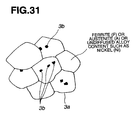
- the metal powder has a ferrite structure, a pearlite structure, an austenite structure or such a structure in which at least one undiffused alloy component such as nickel (Ni) coexists.
- Ni nickel
- the alloy elements capable of forming a solid solution with the base material can produce a more uniform solid solution therewith, and those capable of forming precipitates such as carbides can be formed into precipitates.
- precipitates such as carbides
- the obtained sintered body has a higher strength than that of the re-compacted body, and can exhibit a mechanical strength substantially identical to or higher than those of cast/forging materials which do not particularly require a hardened layer.
- the thus obtained sintered body shows a re-crystallized structure having a crystal grain size of about 20 ⁇ m or smaller due to the re-sintering after the re-compaction. This allows the sintered body to exhibit a high strength, a large elongation, a high impact value and a high fatigue strength.
- the molded body obtained by provisionally sintering the preform at the provisional sintering step can exhibit a large elongation and a low hardness.
- the molded body obtained by provisionally sintering the preform having a density of not less than 7.3g/cm 3 at the provisional sintering step has a structure in which the graphite remains along a grain boundary of the metal powder. This indicates that almost no carbon is diffused into an interior of crystals of the metal powder, or at least, there is not caused such a condition that a whole amount of graphite is diffused into crystal grains of the metal powder to form a solid solution therewith or produce a carbide therein.
- the metal powder shows a ferrite structure as a whole, or a structure in which pearlite is precipitated in the vicinity of graphite. For this reason, the above molded body can exhibit a large elongation, a low hardness and an excellent deformability.
- voids between the metal powder particles are not continuous but isolated from each other, thereby obtaining a molded body showing a large elongation after the provisional sintering at the provisional sintering step. That is, if the voids between the metal powder particles are continuous, an atmospheric gas within a furnace is penetrated into an interior of the preform upon the provisional sintering, and a gas generated from graphite contained thereinside is diffused around so as to promote carburization of the provisionally sintered preform.
- the voids of the preform used in the present invention are isolated from each other, the above problems can be effectively prevented, thereby obtaining the molded body having a large elongation.
- the preform is substantially free from diffusion of carbon upon the provisional sintering by controlling the density of the preform to not less than 7.3g/cm 3 , the elongation of the obtained molded body is rarely influenced by the content of graphite. Further, it is indicated that since the preform is substantially free from the diffusion of carbon, the molded body obtained by provisionally sintering the preform shows a reduced hardness.
- the sintering due to surface-diffusion or melting extensively occurs at contact surfaces between the metal powder particles, so that the obtained molded body can exhibit a large elongation.
- the provisional sintering temperature used at the provisional sintering step is selected without the range of 700-1000°C, so that it is possible to obtain the molded body having a structure in which the graphite remains along a grain boundary of the metal powder, and exhibiting an excellent deformability, i.e., an elongation of not less than 10% and a hardness of not more than HRB 60.
- the re-compaction step is preferably conducted at ordinary temperature. In this case, owing to the excellent deformability, the molded body can be readily re-compacted.
- the re-compacted body having a high dimensional accuracy can be obtained by applying a small load to the molded body.
- the re-compacted body is re-sintered at the re-sintering step to obtain a sintered body.
- the sintered body has a structure in which the graphite retained along a grain boundary of the metal powder is diffused into a ferrite base material (to form a solid solution or a carbide therewith), and a structure in which the graphite is diffused or remains in a ferrite or pearlite structure of the metal powder in a predetermined ratio.
- the predetermined ratio includes no amount of the residual graphite.
- the residual rate of the graphite in the sintered body varies depending upon the re-sintering temperature. The higher the re-sintering temperature is, the smaller the residual rate of the graphite becomes. By controlling the residual rate, the obtained sintered body can show desired mechanical properties such as mechanical strength.
- the sintered body when the sintered body is subjected to the heat treatment such as quenching, the graphite forms a super-saturated solid solution therewith, or is precipitated in the form of fine carbides or nitrides the latter of which produce a hardened layer. Therefore, in the obtained sintered body, the degree of diffusion of carbon caused by the heat treatment becomes lessened towards an inside thereof.
- the obtained sintered body thus shows a high hardness at the near-surface portion, while maintaining a good toughness thereinside.
- the molded body obtained by provisionally sintering the preform at the provisional sintering step can exhibit a large elongation and a low hardness.
- the molded body obtained by provisionally sintering the preform having a density of not less than 7.3g/cm 3 at the provisional sintering step has a structure in which the graphite remains along a grain boundary of the metal powder. This indicates that almost no carbon is diffused into an interior of crystals of the metal powder, or at least, there is not caused such a condition that a whole amount of graphite is diffused into crystal grains of the metal powder to form a solid solution therewith or produce a carbide therein.
- the metal powder shows a ferrite structure as a whole, or a structure in which pearlite is precipitated in the vicinity of graphite. For this reason, the above molded body can exhibit a large elongation, a low hardness and an excellent deformability.
- voids between the metal powder particles are not continuous but isolated from each other, thereby obtaining a molded body showing a large elongation after the provisional sintering of the provisional sintering step. That is, if the voids between the metal powder particles are continuous, an atmospheric gas within a furnace is penetrated into an interior of the preform upon the provisional sintering, and a gas generated from graphite contained thereinside is diffused around so as to promote carburization of the provisionally sintered preform.
- the voids of the preform used in the present invention are isolated from each other, the above problems can be effectively prevented, thereby obtaining the molded body having a large elongation.
- the preform is substantially free from diffusion of carbon upon the provisional sintering by controlling the density of the preform to not less than 7.3g/cm 3 , the elongation of the obtained molded body is rarely influenced by the content of graphite. Further, it is indicated that since the preform is substantially free from the diffusion of carbon, the molded body obtained by provisionally sintering the preform shows a reduced hardness.
- the sintering due to surface-diffusion or melting extensively occurs at contact surfaces between the metal powder particles, so that the obtained molded body can exhibit a large elongation.
- the provisional sintering temperature used at the provisional sintering step is selected within the range of 700-1000°C, so that it is possible to obtain the molded body having a structure in which the graphite remains along a grain boundary of the metal powder, and exhibiting an excellent deformability, i.e., an elongation of not less than 10% and a hardness of not more than HRB 60.
- the re-compaction step is preferably conducted at ordinary temperature. In this case, owing to the excellent deformability, the molded body can be readily re-compacted.
- the re-compacted body having a high dimensional accuracy can be obtained by applying a small load to the molded body.
- the re-compacted body is re-sintered at the re-sintering step to obtain a sintered body.
- the sintered body has a structure in which the graphite retained along a grain boundary of the metal powder is diffused into a ferrite base material (to form a solid solution or a carbide therewith), and a structure in which the graphite is diffused or remains in a ferrite or pearlite structure of the metal powder in a predetermined ratio.
- the predetermined ratio includes no amount of the residual graphite.
- the residual rate of the graphite in the sintered body varies depending upon the re-sintering temperature. The higher the re-sintering temperature is, the smaller the residual rate of the graphite becomes. By controlling the residual rate, the obtained sintered body can show desired mechanical properties such as mechanical strength.
- the sintered body obtained by re-sintering the re-compacted body at a predetermined temperature is then heat-treated.
- the heat treatment may include various treatments such as induction quenching, carburizing-quenching, nitriding and the combination thereof.
- the sintered body obtained by re-sintering the re-compacted body at a predetermined temperature has less amount of voids and a high density owing to the re-compaction, so that the degree of diffusion of carbon due to the heat treatment is lessened inwardly from the surface of the sintered body. For this reason, the heat-treated sintered body shows an increased hardness in the vicinity of the surface thereof, and a good toughness at an inside thereof, thereby allowing the sintered body to have excellent mechanical properties as a whole.
- the sintered body obtained by re-compacting and re-sintering the molded body can show substantially the same mechanical strength as those of cast/forging materials.
- the preform used for forming the molded body has a density as high as not less than 7.3g/cm 3 . Therefore, it is considered that the friction upon releasing the preform from the forming die is considerably increased.
- the density of the preform is locally reduced, so that the friction generated upon the mold-releasing can be reduced. For this reason, the preform is readily released from the forming die along with the synergistic effect of the tapered portion formed within the mold cavity of the forming die, thereby obtaining the preform having a density of not less than 7.3g/cm 3 .
- the molded body obtained by provisionally sintering the preform surely has a high density to thereby contain a sufficient amount of the graphite remaining along the grain boundary of the metal powder and at the same time almost no carbon diffused into the metal particle.
- the subsequent re-compacting can be readily conducted. Accordingly, the re-compacted body has a dense structure containing substantially no voids and a high accuracy because the re-compaction at ordinary temperature is easily performed.
- the re-compacted body as recited in claim 29 is produced by blending not less than 0.1% by weight of graphite with the metal powder.
- the amount of graphite blended with the metal powder is controlled to not less than 0.1% by weight, the sintered body obtained by re-compacting and re-sintering the molded body can be enhanced in mechanical strength substantially as large as cast/forging materials.
- the preform used for forming the molded body has a density as high as not less than 7.3g/cm 3 . Therefore, it is considered that the friction upon releasing the preform from the forming die is considerably increased.
- the density of the preform is locally reduced, so that the friction generated upon the mold-releasing can be reduced. For this reason, the preform is readily released from the forming die along with the synergistic effect of the tapered portion formed within the mold cavity of the forming die, thereby obtaining the preform having a density of not less than 7.3g/cm 3 .
- the molded body obtained by provisionally sintering the preform surely has a high density to thereby contain a sufficient amount of the graphite remaining along the grain boundary of the metal powder and at the same time almost no carbon diffused into the metal particle.
- the subsequent re-compacting can be readily conducted.
- the re-compacted body has a dense structure containing substantially no voids and a high accuracy because the re-compaction at ordinary temperature is easily performed.
- the re-compacted body is re-sintered to obtain a sintered body.
- the sintered body has a structure in which the graphite retained along a grain boundary of the metal powder is diffused into a ferrite base material (to form a solid solution or a carbide therewith), and a structure in which the graphite is diffused or remains in a ferrite or pearlite structure of the metal powder in a predetermined ratio.
- the predetermined ratio includes no amount of the residual graphite.
- the residual rate of the graphite in the sintered body varies depending upon the re-sintering temperature. The higher the re-sintering temperature is, the smaller the residual rate of the graphite becomes.
- the obtained sintered body can show desired mechanical properties such as mechanical strength. Accordingly, the sintered body can be obtained by re-sintering the re-compacted body of the molded body having an excellent deformability, which is suitable for the manufacture of machine parts having a high mechanical strength due to the use of sintered metals.
- the sintered body obtained by re-compacting and re-sintering the molded body can be enhanced in mechanical strength substantially as large as cast/forging materials.
- the re-sintering temperature as recited in claims 7, 12 and 24 is selected within the range of 700-1300°C.
- the re-sintering temperature is selected within the range of 700-1300°C.
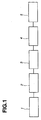
- reference numeral 1 denotes a preliminary molding step
- reference numeral 2 denoting a provisional sintering step
- reference numeral 3 denoting a re-compaction step
- reference numeral 4 denoting a re-sintering step
- reference numeral 5 denoting a heat-treating step.
- a metallic powder mixture 7 is compacted into a preform 8.
- the preform 8 is provisionally sintered to form a metallic powder-molded body 9.
- the metallic powder-molded body 9 is re-compacted into a re-compacted body 10.
- the re-compacted body 10 is re-sintered to form a sintered body 11.
- the sintered body 11 is subjected to a heat treatment.
- the metallic powder mixture 7 is filled into a mold cavity 15 of a forming die 14 and pressed by upper and lower punches 16 and 17 to be formed into the preform 8
- the metallic powder mixture 7 and the forming die 14 are conditioned at ordinary temperature.
- the metallic powder mixture 7 is formed by blending graphite 7b in an amount of not less than 0.3% by weight on the basis of the weight of the metallic powder mixture, with an iron-based metal powder 7a.
- the mechanical strength of the re-compacted body 10 obtained by re-compacting the metallic powder-molded body 9 and the sintered body 11 obtained by re-sintering the re-compacted body 10 can be increased to substantially the same as that of a casted and forged article.
- the mold cavity 15 of the forming die 14 which is filled with the metallic powder mixture 7 includes a greater-diameter portion 19 into which the upper punch 16 is inserted, a smaller-diameter portion 20 into which the lower punch 17 is inserted, and a tapered portion 21 connecting the greater-diameter and smaller-diameter portions 19 and 20 with each other.
- Either one or both of the upper and lower punches 16 and 17 received into the mold cavity 15 of the forming die 14 is formed with a notch 23 so as to increase a volume of the mold cavity 15.
- the upper punch 16 is formed with the notch 23 on an outer circumferential periphery of its end surface 22 opposed to the mold cavity 15 of the forming die 14.
- the notch 23 has an annular shape having a generally hook-shape in section.
- Reference numeral 24 denotes a core that is inserted into the mold cavity 15 of the forming die 14.
- the core 24 defines a generally ellipsoidal cylindrical shape of the preform 8 formed within the mold cavity 15.
- the metallic powder mixture 7 obtained by blending the graphite 7b of not less than 0.3% by weight with the metal powder 7a is packed in the mold cavity 15 of the forming die 14 (see Fig. 2(a)).
- the upper punch 16 and the lower punch 17 are inserted into the mold cavity 15 of the forming die 14 and cooperate to press the metallic powder mixture 7. Specifically, the upper punch 16 is inserted into the greater-diameter portion 19 of the mold cavity 15 and the lower punch 17 is inserted into the smaller-diameter portion 20 of the mold cavity 15 such that they cooperates with each other to press the metallic powder mixture 7. At this time, the upper punch 16 formed with the notch 23 is so constructed as to stop within the greater-diameter portion 19 (see Fig. 2(b)).
- the metallic powder mixture 7 is thus pressed and compacted into the preform 8.
- the upper punch 16 is retarded or upwardly moved and at the same time, the forming die 14 is downwardly moved (see Fig. 2(c)).
- the preform 8 is taken out of the mold cavity 15 (see Fig. 2(d)).
- the tapered portion 21 acts as a so-called draft to facilitate the takeout of the preform 8.
- the notch 23 increasing the volume of the mold cavity 15 on the outer circumferential periphery of the end surface 22 of the upper punch 16 opposed to the mold cavity 15 of the forming die 14, the density of the preform 8 is locally reduced at the notch 23.
- the friction between the preform 8 and the forming die 4 and the springback of the preform 8 can be effectively restricted, serving for easily taking the preform 8 out of the forming die 4.
- the preform 8 having a density of not less than 7.3g/cm 3 can be readily obtained.
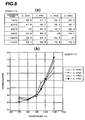
- the metallic powder-molded body 9 obtained by provisionally sintering the preform 8 at the provisional sintering step 2 can have an increased elongation. Namely, as shown in Fig. 3, the density of not less than 7.3g/cm 3 of the preform 8 can cause the elongation of not less than 10% of the metallic powder-molded body 9.
- the preform 8 obtained at the preliminary molding step 1 is provisionally sintered at the provisional sintering step 2.
- the metallic powder-molded body 9 having a structure in which the graphite 7b remains along grain boundaries of the metal powder 7a, is obtained.
- the metal powder 7a may be constituted by ferrite (F) as a whole.
- the metal powder 7a may be constituted by ferrite as a matrix and pearlite (P) precipitated near the graphite 7b.
- the structure of the metallic powder-molded body 9 is not the structure in which a whole amount of the graphite 7b is diffused into the crystal grains of the metal powder 7a to form a solid solution therewith or form carbides.
- the metallic powder-molded body 9 has a large elongation and a low hardness, whereby it has an excellent deformability.
- voids between particles of the metal powder 7a are not continuous but isolated, thereby obtaining a molded body 9 showing a large elongation after the provisional sintering. That is, when the voids between particles of the metal powder 7a particles are continuous, an atmospheric gas within a furnace is penetrated into an interior of the preform 8 upon the provisional sintering, and a gas generated from graphite contained thereinside is diffused around, so as to promote carburization of the preform 8.
- the voids of the preform 8 are isolated from each other, the promotion of carburization can be effectively prevented, thereby obtaining the molded body 9 having a large elongation. It is indicated that the elongation of the obtained molded body 9 is rarely influenced by the content of graphite 7b by controlling the density of the preform 8 to not less than 7.3g/cm 3 . This is because the preform 8 is substantially free from diffusion of carbon upon the provisional sintering. Also, it is indicated that since the preform 8 is substantially free from the diffusion of carbon, the molded body 9 obtained by provisionally sintering the preform 8 shows a reduced hardness.
- the metallic powder-molded body 9 can exhibit a large elongation, preferably the elongation of 10% or more.
- the provisional sintering temperature at the provisional sintering step 2 is selected preferably within a range of 800-1000°C.
- the provisional sintering temperature within the range of 800-1000°C at the provisional sintering step 2
- the metallic powder-molded body 9 obtained at the provisional sintering step 2 can have a good deformability that reduces a deformation resistance of the metallic powder-molded body 9 and facilitates the formation of the re-compacted body 10 upon re-compacting the metallic powder-molded body 9 into the re-compacted body 10.
- the metallic powder-molded body 9 having the elongation of 10% or more can be obtained.
- the metallic powder-molded body 9 having a hardness of not more than HRB60 can be obtained.
- the hardness of not more than HRB60 of the metallic powder-molded body 9 is lower than the hardness exhibitable in the case of annealing a low carbon steel which has a carbon content of approximately 0.2%.
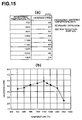
- the yielding stress of the metallic powder-molded body 9 falls in the range of 202-272 MPa in the case of the provisional sintering temperature of the preforms 8 within the range of 800-1000°C.
- the yielding stress in the range of 202-272 MPa is lower than the yielding stress of a low carbon steel having a carbon content of approximately 0.2%.
- the metallic powder-molded body 9 obtained at the provisional sintering step 2 is re-compacted into the re-compacted body 10 at the re-compaction step 3.
- the re-compaction of the metallic powder-molded body 9 is conducted preferably at ordinary temperature. In this case, the metallic powder-molded body 9 can be readily re-compacted and suffer from no scale because of the good deformability.
- the re-compacted body 10 can be obtained with high dimensional accuracy at the re-compacting load applied thereto.
- the re-compacted body 10 has a structure in which the graphite 7b remains along a grain boundary of the metal powder 7a.
- the metal powder 7a has a flattened shape that is determined depending on the degree of re-compaction. That is, in a small degree of re-compaction, the metal powder 7a is slightly flattened to form the structure in which many of voids between the metal powder 7a are eliminated (see Fig. 11(a)). In a large degree of re-compacting greater than the small degree thereof, the metal powder 7a is remarkably flattened to form the structure in which substantially all voids between the metal powder 7a are dissipated (see Fig. 11(b)).
- the re-compacted body 10 has such a structure in which particles of the metal powder 7a of the molded body 9 are largely deformed into a flat shape. However, since the molded body 9 itself has the structure in which the graphite 7b remains along a grain boundary of the metal powder 7a, the obtained re-compacted body 10 is excellent in machinability and lubricating ability.
- the preform 8 having the density of not less than 7.3g/cm 3 can be readily obtained.
- the metallic powder-molded body 9 has the structure in which the graphite 7b remains along the grain boundary of the metal powder 7a, the hardness of HRB60 or less and the elongation of 10% or more.
- the metallic powder-molded body 9 having the thus enhanced deformability can be obtained.
- the re-compacted body 10 obtained at the re-compaction step 3 is re-sintered to form the sintered body 11 at the re-sintering step 4.
- the sintered body 11 has such a structure as shown in Fig. 12, in which the graphite 7b is diffused into the ferrite matrix of the metal powder 7a (to form a solid solution or carbide therewith), or in which the graphite 7b is diffused and remains in the ferrite or pearlite matrix of the metal powder 7a at a predetermined rate.
- the predetermined rate of the residual graphite 7b may be zero.
- the rate of the residual graphite 7b remaining in the sintered body 11 varies depending on the re-sintering temperature. The higher the re-sintering temperature becomes, the lower the rate of the residual graphite 7b becomes (see Fig. 13). Accordingly, the mechanical properties such as predetermined strength of the sintered body 11 can be selectively determined.
- the re-sintering temperature at the re-sintering step 4 is preferably selected in a range of 700-1300°C. Owing to the re-sintering temperature of this range, the diffusion of the graphite 7b can be reduced at the low re-sintering temperature range so that the sintered body 11 having a higher rate of the residual graphite 7b can be obtained. On the other hand, the diffusion of the graphite 7b can be increased at the high re-sintering temperature range, whereby the sintered body 11 having a lower rate of the residual graphite 7b, a less re-growth of the crystal grains and a maximum strength can be obtained.
- the re-sintering temperature is in the relatively low range of 700-1000°C
- the hardness of the re-compacted body work-hardened at the re-compaction step 3 is reduced by the re-sintering, but as the diffusion of the graphite 7b proceeds, the structure containing the fine crystal grains is obtained due to the low-temperature re-sintering.
- the strength and hardness of the obtained sintered body is increased.
- the low-temperature re-sintering causes a large reduction in hardness of the work-hardened re-compacted body. In such a case, the work-hardened re-compacted body is slowly softened and hardened again at approximately 1000°C.
- the re-sintering temperature is in the relatively high range of 1000-1300°C
- the residual rate of the graphite 7b decreases and the graphite 7b is sufficiently diffused in the ferrite matrix (to form the solid solution or carbide therewith). This causes the strength and hardness of the obtained sintered body to increase.
- the re-sintering temperature exceeds 1100°C, there will occur such a tendency that the total amount of carbon contents decreases as the amount of carbon decarburized increases, or the strength and hardness of the sintered body obtained are reduced due to the re-growth of the crystal grains.
- the re-sintering temperature is preferably within the range of 700-1300°C, and more preferably within the range of 900-1200°C in order to obtain a stable structure of the sintered body 11 obtained.
- the sintered body 11 obtained by re-sintering the re-compacted body 10 produced from the metallic powder-molded body 9, which has an excellent deformability suitable for the manufacture of machine parts having an increased mechanical strength caused due to sintered metal, as well as a process for the production thereof.
- the re-sintering temperature of 700-1300°C at the re-sintering step it is possible by selecting the re-sintering temperature within the range to obtain the sintered body 11 having the structure that has the less diffusion of the graphite 7b and the higher rate of the residual graphite 7b, and the sintered body 11 having the structure that has the increased diffusion of the graphite 7b and the lower rate of the residual graphite 7b and at the same time the small re-growth of the crystal and the maximum strength.
- the sintered body 11 is subjected to heat treatment.
- the heat treatment at the heat treatment step 5 is conducted by one selected from various treatments such as induction quenching, carburizing-quenching, nitriding and the combination thereof.
- the graphite 7b forms a super-saturated solid solution with a base material of the metal powder, or is precipitated in the form of fine carbides or nitrides to thereby form a hardened layer. This can impart good mechanical properties to the sintered body 11.
- the heat-treated sintered body 11 has a tensile strength larger than that of the sintered body 11 merely re-sintered because of the presence of the hardened layer formed therein. Further, the sintered body 11 obtained by re-sintering the re-compacted body 10 at a predetermined temperature has less amount of voids and a high density owing to the re-compaction at the re-compaction step 3, so that the degree of diffusion of carbon due to the heat treatment is lessened inwardly from the surface of the sintered body 11. For this reason, as illustrated in Fig. 17, the heat-treated sintered body 11 shows an increased hardness in the vicinity of the surface thereof, and a good toughness at an inside thereof, thereby allowing the sintered body 11 to have excellent mechanical properties as a whole.
- the sintered body 11 obtained by heat-treating the sintered body after re-sintering the re-compacted body produced from the metallic powder-molded body, which has an excellent deformability suitable for the manufacture of machine parts having an increased mechanical strength caused due to sintered metal, as well as a process for the production thereof.
- processes for the production of the metallic powder-molded body, the re-compacted body and the sintered body of the embodiments of the invention are the same as that shown in Fig. 1.
- the step of producing the preform is also the same as that shown in Fig. 2.
- a metallic powder mixture 7 explained later is filled in the mold cavity 15 of the forming die 14 and then pressed by the upper and lower punches 16 and 17 to form the preform 8 having the density of not less than 7.3g/cm 3 .
- the metallic powder mixture 7 and the forming die 14 are conditioned at ordinary temperature.
- the mold cavity 15 of the forming die 14 includes a greater-diameter portion 19 into which the upper punch 16 is inserted, a smaller-diameter portion 20 into which the lower punch 17 is inserted, and a tapered portion 21 connecting the greater-diameter and smaller-diameter portions 19 and 20 with each other.
- Either one or both of the upper and lower punches 16 and 17 received into the mold cavity 15 of the forming die 14 is formed with a notch 23 so as to increase a volume of the mold cavity 15.
- the upper punch 16 is formed with the notch 23 on an outer circumferential periphery of its end surface 22 opposed to the mold cavity 15 of the forming die 14.
- the notch 23 has an annular shape having a generally hook-shape in section.
- Reference numeral 24 denotes a core inserted into the mold cavity 15 of the forming die 14.
- the core 24 defines a generally cylindrical shape of the preform 8 formed within the mold cavity 15.
- the metallic powder mixture 7 is filled in the mold cavity 15 of the forming die 14.
- the filled metallic powder mixture 7 is prepared by blending graphite in amount of not less than 0.1% by weight with the following metal powder.
- the metal powder is a metal powder containing at least one alloy element selected from the group consisting of molybdenum (Mo), nickel (Ni), manganese (Mn), copper (Cu), chromium (Cr), tungsten (W), vanadium (V), cobalt (Co) and the like, and as the remainder, iron and a small amount of inevitable impurities (the metal powder according to claim 17); a metal powder obtained by diffusing and depositing a powder containing an alloy element selected from the above-described alloy elements as a main component onto an iron-based metal powder (the metal powder according to claim 18); or a metal powder obtained by blending a powder containing an alloy element selected from the above-described alloy elements as a main component with the iron-based metal powder (the metal powder according to claim 19).
- Mo molybdenum
- Ni nickel
- Mn manganese
- Cu copper
- Cr chromium
- W tungsten
- V vanadium
- Co cobalt
- the upper punch 16 and the lower punch 17 are inserted into the mold cavity 15 of the forming die 14 and cooperate to press the metallic powder mixture 7.
- the upper punch 16 is inserted into the greater-diameter portion 19 of the mold cavity 15 and the lower punch 17 is inserted into the smaller-diameter portion 20 of the mold cavity 15 such that they cooperate with each other to press the metallic powder mixture 7.
- the upper punch 16 formed with the notch 23 is so constructed as to stop within the greater-diameter portion 19 (see Fig. 2(b)).
- the upper punch 16 After pressing and compacting the metallic powder mixture 7 into the preform 8, the upper punch 16 is retarded or upwardly moved and at the same time, the forming die 14 is downwardly moved (see Fig. 2(c)). The obtained preform 8 is taken out of the mold cavity 15 (see Fig. 2(d)).
- the tapered portion 21 acts as a so-called draft to facilitate the takeout of the preform 8 from the forming die 14.
- the notch 23 increasing the volume of the mold cavity 15 on the outer circumferential periphery of the end surface 22 of the upper punch 16 opposed to the mold cavity 15 of the forming die 14, the density of the preform 8 is locally reduced at the notch 23.
- the friction between the preform 8 and the forming die 4 and the springback of the preform 8 can be effectively restricted, so that the takeout of the preform 8 from the forming die 4 can be facilitated.
- the preform 8 having the density of not less than 7.3g/cm 3 can be readily obtained.
- the preform 8 obtained at the preliminary molding step 1 is provisionally sintered at the provisional sintering step 2.
- the molded body having a structure in which the graphite 3b remains along a grain boundary of the metal powder 3a and there exists substantially no precipitate such as carbides of iron or the alloy element, as shown in Fig. 18.
- the metal powder 3a may be constituted by ferrite (F) or austenite (A) as a whole. If a part of graphite 3b is diffused in the metal powder 3a, the metal powder 3a may contain a less amount of pearlite (P) or bainite (B) precipitated near the graphite 3b.
- the metal powder 3a may be constituted by ferrite (F) or austenite (A) as a whole or may contain the undiffused alloy component such as nickel (Ni). If the metal powder 3a according to claim 18 or claim 19 is used and a part of graphite 3b is diffused in the metal powder 3a, the metal powder 3a may contain a less amount of pearlite (P) or bainite (B) precipitated near the graphite 3b. That is, at least the metal powder 3a may be constituted by pearlite (P) or bainite (B) as a whole. Therefore, the molded body has a low hardness and a large elongation, exhibiting an excellent deformability.
- the preform 8 has the density of not less than 7.3g/cm 3 , voids between the metal powder 3a are not continuous but isolated, thereby obtaining a molded body exhibiting a large elongation after the provisional sintering. That is, if the voids between particles of the metal powder 3a are continuous, an atmospheric gas within a furnace will enter deep an interior of the preform 8 upon the provisional sintering and a gas generated from the graphite contained thereinside will be diffused around so as to promote carburization of the preform 8.
- the voids of the preform 8 are isolated from each other, the promotion of carburization can be effectively prevented so that the molded body 9 can have a low hardness and a large elongation. Accordingly, the hardness and elongation of the obtained molded body is rarely influenced by the content of graphite 3b.
- the sintering extensively occurs by the surface diffusion or melting caused on contact surfaces of particles of the metal powder 3a in the preform 8, whereby the molded body can exhibit a larger elongation.
- the sintering temperature at the provisional sintering step 2 is selected within a range of 700-1000°C. If the sintering temperature is below 700°C, the bonding of the metal powder does not sufficiently proceed. If the sintering temperature is higher than 1000°C, the graphite 3b is excessively diffused in the metal powder to increase the hardness too much.
- the sintering temperature may be normally selected within a range of 800-1000°C. In a case where the metal powder contains the alloy element such as chromium (Cr) which is capable of readily producing carbides, the sintering temperature may be selected within a range of 700-800°C. This is because the precipitate such as carbides of the alloy element will occur at the sintering temperature higher than 800°C to thereby increase the hardness.
- Fig. 19 shows test data and a graph indicating a relationship between the provisional sintering temperature and the elongation of the molded body in Example 1 described later.
- Fig. 20 shows test data and a graph, similar to Fig. 19, but indicating the relationship obtained in Example 2.
- Fig. 21 shows test data and a graph indicating a relationship between the provisional sintering temperature and the hardness of the molded body in Example 1.
- Fig. 22 shows test data and a graph, similar to Fig. 21, but indicating the relationship obtained in Example 2.
- the provisional sintering temperature is selected within the range of 700-1000°C, at least the elongation of 5% or more of the molded body and the hardness of approximately HRB60 thereof can be maintained. Meanwhile, the hardness of HRB60 is substantially the same as the hardness exhibitable in the case of annealing a high-strength cold-forging steel.
- the molded body of the present invention can exhibit the hardness of approximately HRB60 without being subjected to annealing.
- the molded body obtained at the provisional sintering step 2 is subjected to re-compaction (cold forging and the like) to form a plastic-worked body at the subsequent re-compaction step 3.
- the obtained plastic-worked body has a structure having substantially no voids because the molded body containing the graphite 3b retained along the grain boundary of the metal powder 3a has a dense structure with collapsed voids therein.
- the obtained plastic-worked body is substantially free from diffusion of carbon owing to the structure of the molded body in which the graphite 3b remains along the grain boundary of the metal powder 3a, it is possible to considerably decrease a molding load (deformation resistance) applied to the molded body upon the re-compaction as shown in Figs. 23 and 24. Namely, the molded body is substantially free from diffusion of carbon to thereby exhibit a low hardness and a large elongation.
- the graphite remaining along the grain boundary of the metal powder acts to promote the sliding between particles of the metal powder, the molding load applied upon the re-compaction can be reduced and the plastic-worked body can be readily re-compacted into a desired shape.
- Fig. 23 shows the molding load in Example 1
- Fig. 24 shows the molding load in Example 2, respectively.
- the plastic-worked body can exhibit a sufficient tensile strength as shown in Figs. 25 and 26 and a sufficient hardness as shown in Figs. 27 and 28.
- Figs. 25 and 27 illustrate the tensile strength and the hardness in Example 1 and Figs. 26 and 28 illustrate those in Example 2.
- the plastic-worked body can exhibit substantially the same tensile strength and hardness as those of cast/forging materials and therefore the sufficiently increased mechanical strength.
- Fig. 29 illustrates a structure of the plastic-worked body produced by the re-compaction with the relatively small deformation
- Fig. 30 illustrates a structure of the plastic-worked body produced by the re-compaction with the relatively large deformation.
- the graphite 3b remains along a grain boundary of the metal powder 3a.
- the structure thereof is a ferrite (F) structure, an austenite (A) structure or such a structure in which a slight amount of pearlite (P) or bainite (B) is precipitated in the vicinity of the graphite 3b.
- the structure thereof is a ferrite (F) structure, an austenite (A) structure, a structure in which at least one undiffused alloy component such as nickel (Ni) is co-present, or a structure in which a slight amount of pearlite (P) or bainite (B) is precipitated in the vicinity of the graphite 3b.
- F ferrite
- A austenite
- P pearlite
- B bainite
- the re-compaction of the molded body is conducted at ordinary temperature, production of scales or deteriorated dimensional accuracy of the obtained plastic-worked body due to transformation thereof can be prevented. Furthermore, since the molded body can be re-compacted using the lower molding load applied thereto, the springback thereof can be decreased as compared with that of forging materials and the plastic-worked body produced by the re-compaction can exhibit substantially a true density as a whole. As a result, the obtained plastic-worked body exhibits the less dispersion of density and dimensional variation than in the conventional sintered body. Thus, the plastic-worked body obtained by re-compacting the molded body can exhibit a high dimensional accuracy.
- the obtained plastic-worked body is applicable to sliding parts requiring a high strength and a high accuracy.
- the plastic-worked body is re-sintered at the subsequent re-sintering step 4.
- the sintering due to surface-diffusion or melting occurs at contact surfaces between the metal powder particles and, at the same time, the graphite 3b retained along the grain boundary of the metal powder 3a is diffused into a ferrite base material of the metal powder (to form a solid solution or a carbide therewith).
- a ferrite base material of the metal powder to form a solid solution or a carbide therewith.
- the structure thereof is a ferrite (F) structure, an austenite (A) structure, a pearlite (P) structure or a bainite (B) structure
- the structure thereof is a ferrite (F) structure, an austenite (A) structure, a pearlite (P) structure, a bainite (B) structure or a structure in which at least one undiffused alloy component such as nickel (Ni) coexists. If the residual graphite 3b is present, there is obtained such a structure in which the graphite 3b is interspersed inside or along the grain boundary of the metal powder 3a.
- the residual rate of the blended graphite 3b (a rate of an amount of undiffused graphite to the total amount of carbon contents) becomes smaller as the re-sintering temperature raises.
- the re-sintered molded body has a structure in which the graphite 3b is diffused in the metal powder and a structure in which the graphite 3b remains therein, in a predetermined ratio depending on the re-sintering temperature.
- the graphite residual rate is zero as shown in Fig. 32 and the graphite 3b remaining structure is dissipated.
- the alloy elements capable of forming a solid solution with a base material can produce a more uniform solid solution therewith, and those capable of forming precipitates such as carbides can produce precipitates.
- the effect of mechanical properties enhanced due to the added alloy elements can be reflected on the macrostructure of the re-sintered molded body, improving the mechanical properties of the re-sintered molded body as a whole.
- the strength of the re-sintered molded body is sufficiently higher than that of the plastic-worked body.
- by controlling an amount of the diffused graphite 3b it is possible to obtain the re-sintered molded body depending on the desired mechanical properties such as strength and lubricating ability.
- the re-sintered molded body re-sintered at a predetermined temperature has a large tensile strength and a high hardness and can exhibit a mechanical strength substantially identical to or higher than those of cast/forging materials which do not require a specific hardened layer.
- the re-sintered molded body shows a re-crystallized structure having a fine crystal grain size of about 20 ⁇ m or less, which is smaller than the crystal grain size, i.e., 40-50 ⁇ m, of the conventional sintered body. This allows the re-sintered molded body to exhibit a high strength, a large elongation, a high fatigue strength and a high impact value and thus exhibit excellent mechanical properties.
- the re-sintering temperature is selected within a range of 700-1300°C. This is because if the re-sintering temperature is lower than 700°C, the diffusion of the graphite 3b will not proceed, while if the re-sintering temperature is higher than 1300°C, carburization, decarburization or bulky growth of the crystal grains of the re-sintered molded body will occur.
- the re-sintering temperature is in the relatively low range of 700-1000°C
- the hardness of the re-sintered molded body work-hardened upon the re-compaction is reduced by the re-sintering, but as the diffusion of the graphite 3b proceeds, the structure containing the fine crystal grains is obtained due to the low-temperature re-sintering. As a result, the strength and hardness of the obtained re-sintered molded body is increased.
- the low-temperature re-sintering causes a large reduction in hardness of the work-hardened re-sintered molded body is slowly softened and hardened again at approximately 1000°C.
- the re-sintering temperature is in the relatively high range of 1000-1300°C, the residual rate of the graphite 3b is low and the graphite 3b is diffused in the base material of the metal powder. This allows the strength and hardness of the obtained re-sintered molded body to increase.
- the re-sintering temperature exceeds 1100°C, there will occur such a tendency that the total amount of carbon contents decreases as the amount of carbon decarburized increases, or the strength and hardness of the obtained re-sintered molded body are reduced due to the re-growth of the crystal grains.
- the re-sintering temperature is higher than 1300°C, the mechanical properties of the obtained re-sintered molded body is remarkably reduced. Therefore, the re-sintering temperature is preferably within the range of 900-1300°C.
- the re-sintered molded body is subjected to heat treatment at the heat treatment step 105.
- the heat treatment may include induction quenching, carburizing-quenching, nitriding and the combination thereof.
- the graphite 3b forms the super-saturated solid solution with the base material or the precipitate as fine carbides to thereby form a hardened layer in the re-sintered molded body.
- the obtained heat-treated molded body has a tensile strength larger than that of the re-sintered molded body due to the hardened layer produced therein.
- the heat-treated molded body of the present invention since the heat-treated molded body of the present invention has substantially a true density, the degree of diffusion of carbon caused by the heat treatment becomes lessened towards an inside thereof.
- the heat-treated molded body shows a high hardness at the near-surface portion due to the heat treatment, while exhibiting a good toughness thereinside. Accordingly, the heat-treated molded body of the present invention exhibits excellent mechanical properties as a whole.
- the heat-treated molded body produced by the conventional method exhibits diffusion of carbon proceeding to an inside thereof and a high hardness, but it is fragile and lowered in toughness and rigidity due to the presence of voids therein.
- the heat-treated molded body produced by the conventional method is heat-treated as a whole and has the voids therein, it is difficult to obtain high strength and high toughness.
- the heat-treated molded body of the present invention has the strength, toughness and rigidity higher than those of a general sintered body to thereby be capable of being heat-treated depending on a desired mechanical property, similar to cast/forging materials.
- the metal powder contains the alloy element capable of forming a solid solution with a base material of the metal powder to thereby improve a heat-treatment ability such as hardenability, it is possible to produce the heat-treated molded body having better mechanical properties, from the metal powder.
- the obtained heat-treated molded body may be applied to machine parts requiring high strength, high toughness and high sliding property, at a low cost.
- the machine parts include automobile engine components such as a camshaft and a rotor, propeller shaft joints, drive shafts, clutches, drive parts such as transmission, power steering gears, steering parts such as anti-lock device, suspensions, various bearings, pump components and the like.
- the preform 8 can be produced by so-called warm molding in which the preform 8 is formed under condition that the metallic powder mixture 7 and the forming die are heated up to a predetermined temperature to thereby lower a yielding point of the metallic powder mixture 7.
- the upper punch 16 is formed with the notch 23 increasing the volume of the mold cavity 15 in the embodiment, the notch 23 can be formed in the lower punch 17 or both of the upper and lower punches 16 and 17.
- a metallic powder mixture was prepared by blending graphite in an amount of 0.3% by weight with an alloy steel powder containing molybdenum (Mo) In an amount of 0.2% by weight with the balance containing iron (Fe) and a small amount of inevitable impurities.
- the obtained metallic powder mixture was compacted to form a preform having a density of 7.4g/cm 3 .
- the obtained preform was provisionally sintered in a nitrogen atmosphere within a furnace at 800°C for 60 minutes, to form a molded body.
- the elongation of the obtained molded body was 11.2% and the hardness thereof was HRB53.3 (see Figs. 19 and 21).
- the molded body was re-compacted (cold forged) by backward extrusion at a reduction in area (deformation rate) of 60% to form a plastic-worked body having a cup shape.
- the tensile strength (in terms of radial crushing strength) of the obtained plastic-worked body was 692MPa and the hardness thereof was HRB75 (see Figs. 25 and 27).
- the density of the obtained plastic-worked body was 7.71g/cm 3 .
- the plastic-worked body was re-sintered in an atmosphere of a mixed gas of nitrogen and hydrogen within a furnace at 1150°C, to thereby form a re-sintered molded body.
- the tensile strength (in terms of radial crushing strength) of the obtained re-sintered molded body was 676MPa and the hardness thereof was HRB71 (see Figs. 33 and 35).
- the density of the obtained re-sintered molded body was 7.71g/cm 3 .
- the re-sintered molded body was carburized in an atmosphere having a carbon potential of 1.0% within a furnace at the maximum temperature of 860°C, oil-quenched at 90°C, tempered at 150°C, to thereby form a heat-treated molded body.
- the tensile strength (in terms of radial crushing strength) of the obtained heat-treated molded body was 1185MPa (see Fig. 37)
- the surface hardness thereof was HRC59
- the internal hardness (hardness at the portion 2mm-inward from the surface) thereof was HRC33 (HV330).
- a metallic powder mixture was prepared by blending graphite in an amount of 0.3% by weight with an alloy steel powder obtained by diffusing and depositing nickel (Ni) in an amount of 2.0% by weight and molybdenum (Mo) in an amount of 1.0% by weight onto an iron powder containing iron (Fe) and a small amount of inevitable impurities.
- the obtained metallic powder mixture was compacted to form a preform having a density of 7.4g/cm 3 .
- the obtained preform was provisionally sintered in a nitrogen atmosphere within a furnace at 800°C for 60 minutes, to form a molded body.
- the elongation of the obtained molded body was 11.8% and the hardness thereof was HRB52 (see Figs. 20 and 22).
- the molded body was re-compacted (cold forged) by backward extrusion at a reduction in area (deformation rate) of 60% to form a plastic-worked body having a cup shape.
- the tensile strength (in terms of radial crushing strength) of the obtained plastic-worked body was 706MPa and the hardness thereof was HRB96 (see Figs. 26 and 28).
- the density of the obtained plastic-worked body was 7.70g/cm 3 .
- the plastic-worked body was re-sintered in an atmosphere of a mixed gas of nitrogen and hydrogen within a furnace at 1150°C, to thereby form a re-sintered molded body.
- the tensile strength (in terms of radial crushing strength) of the obtained re-sintered molded body was 784MPa and the hardness thereof was HRB100 (see Figs. 34 and 36).
- the density of the obtained re-sintered molded body was 7.70g/cm 3 .
- the re-sintered molded body was carburized in an atmosphere having a carbon potential of 1.0% within a furnace at the maximum temperature of 860°C, oil-quenched at 90°C, tempered at 150°C, to thereby form a heat-treated molded body.
- the tensile strength (in terms of radial crushing strength) of the obtained heat-treated molded body was 1678MPa, the surface hardness thereof was HRC62 and the internal hardness (hardness at the portion 2mm-inward from the surface) thereof was HRC41 (HV400) (see Figs. 38 and 39).
- a metallic powder mixture was prepared by blending copper (Cu) in an amount of 2.0% by weight and graphite in an amount of 0.3% by weight with an iron powder containing iron (Fe) and a small amount of inevitable impurities.
- the obtained metallic powder mixture was compacted to form a preform having a density of 7.4g/cm 3 .
- the obtained preform was provisionally sintered in a nitrogen atmosphere within a furnace at 800°C for 60 minutes, to form a molded body.
- the elongation of the obtained molded body was 12.0% and the hardness thereof was HRB47.
- the molded body was re-compacted (cold forged) by backward extrusion at a reduction in area of 60% to form a plastic-worked body having a cup shape.
- the tensile strength (in terms of radial crushing strength) of the obtained plastic-worked body was 510MPa and the hardness thereof was HRB75.
- the density of the obtained plastic-worked body was 7.70g/cm 3 .
- the plastic-worked body was re-sintered in an atmosphere of a mixed gas of nitrogen and hydrogen within a furnace at 1150°C, to thereby form a re-sintered molded body.
- the tensile strength (in terms of radial crushing strength) of the obtained re-sintered molded body was 735MPa
- the hardness thereof was HRB80
- the density of the obtained re-sintered molded body was 7.75g/cm 3 .
- the re-sintered molded body was carburized in an atmosphere having a carbon potential of 1.0% within a furnace at the maximum temperature of 860°C, oil-quenched at 90°C, tempered at 150°C, to thereby form a heat-treated molded body.
- the tensile strength (in terms of radial crushing strength) of the obtained heat-treated molded body was 980MPa
- the surface hardness thereof was HRC42
- the internal hardness (hardness at the portion 2mm-inward from the surface) thereof was HRB91.
- Examples 4-7 will be explained hereinafter. These Examples are different in components of the alloy steel powder from Example 1 as described above and are the same as Example 1 in the amount of graphite (0.3% by weight) blended with the alloy steel powder, the density (7.4g/cm 3 ) of the preform, the provisional sintering conditions (in the nitrogen atmosphere within the furnace at 800°C for 60 minutes), the re-compaction conditions (at a reduction in area of 60%), the re-sintering conditions (in the atmosphere of the mixed gas of nitrogen and hydrogen within the furnace at 1150°C), and the heat-treatment conditions (in the atmosphere having the carbon potential of 1.0% within the furnace at the maximum temperature of 860°C, the oil-quenching at 90°C, the tempering at 150°C).
- the components of the alloy steel powder and the test results in these Examples are described below.
- An alloy steel powder was constituted by 1.0% by weight of nickel (Ni), 0.3% by weight of molybdenum (Mo), 0.3% by weight of copper (Cu) with the balance containing iron (Fe) and a small amount of inevitable impurities.
- (a) molding load upon re-compaction 2195MPa (b) tensile strength of plastic-worked body 725MPa (c) hardness of plastic-worked body HRB82 (d) density of plastic-worked body 7.74g/cm 3 (e) tensile strength of re-sintered molded body 755MPa (f) hardness of re-sintered molded body HRB85 (g) density of re-sintered molded body 7.74g/cm 3 (h) tensile strength of heat-treated molded body 1235MPa (i) surface hardness of heat-treated molded body HRC60 (j) internal hardness of heat-treated molded body HRC33 (HV326)
- An alloy steel powder was constituted by 1.0% by weight of chromium (Cr), 0.7% by weight of manganese (Mn), 0.3% by weight of molybdenum (Mo) with the balance containing iron (Fe) and a small amount of inevitable impurities.
- An alloy steel powder was constituted by 1.0% by weight of chromium (Cr), 0.3% by weight of molybdenum (Mo), 0.3% by weight of vanadium (V) with the balance containing iron (Fe) and a small amount of inevitable impurities.
- An alloy steel powder was constituted by 6.5% by weight of cobalt (Co), 8.0% by weight of chromium (Cr), 2.0% by weight of tungsten (W), 0.5% by weight of molybdenum (Mo) with the balance containing iron (Fe) and a small amount of inevitable impurities.
- the metallic powder-molded body of the present invention has a predetermined graphite content suitably applied to the production of machine parts having a high mechanical strength, and exhibits the mechanical properties such as a low hardness and a large elongation (deformability), which are advantageous to re-compaction thereof.
- the re-compacted body of the present invention exhibits the enhanced mechanical properties including hardness, fatigue strength and the like, and the increased dimensional accuracy.
- the preform 8 can be produced by so-called warm molding in which the preform 8 is formed under condition that the metallic powder mixture 7 and the forming die are heated up to a predetermined temperature to lower a yielding point of the metallic powder mixture 7.
- the notch 23 can be formed in the lower punch 17 or both of the upper and lower punches 16 and 17.
Landscapes
- Chemical & Material Sciences (AREA)
- Engineering & Computer Science (AREA)
- Mechanical Engineering (AREA)
- Materials Engineering (AREA)
- Metallurgy (AREA)
- Organic Chemistry (AREA)
- Manufacturing & Machinery (AREA)
- Powder Metallurgy (AREA)
Abstract
Description
| (a) | molding load upon re-compaction | 2195MPa |
| (b) | tensile strength of plastic-worked body | 725MPa |
| (c) | hardness of plastic-worked body | HRB82 |
| (d) | density of plastic-worked body | 7.74g/cm3 |
| (e) | tensile strength of re-sintered molded body | 755MPa |
| (f) | hardness of re-sintered molded body | HRB85 |
| (g) | density of re-sintered molded body | 7.74g/cm3 |
| (h) | tensile strength of heat-treated molded body | 1235MPa |
| (i) | surface hardness of heat-treated molded body | HRC60 |
| (j) | internal hardness of heat-treated molded body | HRC33 (HV326) |
| (a) | molding load upon re-compaction | 2333MPa |
| (b) | tensile strength of plastic-worked body | 706MPa |
| (c) | hardness of plastic-worked body | HRB80 |
| (d) | density of plastic-worked body | 7.66g/cm3 |
| (e) | tensile strength of re-sintered molded body | 794MPa |
| (f) | hardness of re-sintered molded body | HRB90 |
| (g) | density of re-sintered molded body | 7.66g/cm3 |
| (h) | tensile strength of heat-treated molded body | 1323MPa |
| (i) | surface hardness of heat-treated molded body | HRC60 |
| (j) | internal hardness of heat-treated molded body | HRC42 (HV418) |
| (a) | molding load upon re-compaction | 2362MPa |
| (b) | tensile strength of plastic-worked body | 725MPa |
| (c) | hardness of plastic-worked body | HRB82 |
| (d) | density of plastic-worked body | 7.65g/cm3 |
| (e) | tensile strength of re-sintered molded body | 804MPa |
| (f) | hardness of re-sintered molded body | HRB88 |
| (g) | density of re-sintered molded body | 7.65g/cm3 |
| (h) | tensile strength of heat-treated molded body molded body | 1333MPa HRC63 |
| (j) | internal hardness of heat-treated molded body | HRC43 (HV421) |
| (a) | molding load upon re-compaction | 2450MPa |
| (b) | tensile strength of plastic-worked body | 696MPa |
| (c) | hardness of plastic-worked body | HRB95 |
| (d) | density of plastic-worked body | 7.60g/cm3 |
| (e) | tensile strength of re-sintered molded body | 784MPa |
| (f) | hardness of re-sintered molded body | HRB100 |
| (g) | density of re-sintered molded body | 7.60g/cm3 |
| (h) | tensile strength of heat-treated molded body | 1176MPa |
| (i) | surface hardness of heat-treated molded body | HRC66 |
| (j) | internal hardness of heat-treated molded body | HRC45 (HV450) |
Claims (35)
- A metallic powder-molded body produced by a process comprising the steps of:compacting a metallic powder mixture obtained by blending graphite with an iron-based metal powder to form a preform having a density of not less than 7.3g/cm3 andprovisionally sintering the preform at a temperature of 700-1000°C to form the metallic powder-molded body,said metallic powder-molded body having a structure in which the graphite remains along a grain boundary of the metal powder.
- The metallic powder-molded body as claimed in claim 1, wherein the amount of the graphite blended with the metal powder is 0.3% by weight or more.
- A re-compacted body produced by re-compacting the metallic powder-molded body as claimed in claim 1 or claim 2.
- A process for producing a re-compacted body, comprising:a preliminary molding step of compacting a metallic powder mixture obtained by blending graphite with an iron-based metal powder to form a preform having a density of not less than 7.3g/cm3;a provisional sintering step of provisionally sintering the preform at a temperature of 700-1000°C to form a metallic powder-molded body having a structure in which the graphite remains along a grain boundary of the metal powder; anda re-compaction step of re-compacting the metallic powder-molded body.
- The process as claimed in claim 4, wherein said preliminary molding step further comprises the step of pressing the metallic powder mixture filled in a mold cavity of a forming die, by upper and lower punches,said mold cavity being formed with a greater-diameter portion into which the upper punch is inserted, a smaller-diameter portion into which the lower punch is inserted, and a tapered portion connecting the greater-diameter and smaller-diameter portions with each other, and either one or both of the upper and lower punches having a notch at an outer circumferential periphery of an end surface thereof facing the mold cavity to increase a volume of the mold cavity.
- The process as claimed in claim 4 or claim 5, wherein the amount of the graphite blended with the metal powder is 0.3% by weight or more.
- A sintered body produced by a process comprising the steps of:compacting a metallic powder mixture obtained by blending graphite with an iron-based metal powder to form a preform having a density of not less than 7.3g/cm3;provisionally sintering the preform at a temperature of 700-1000°C to form a metallic powder-molded body having a structure in which the graphite remains along a grain boundary of the metal powder;re-compacting the metallic powder-molded body to form a re-compacted body; andre-sintering the re-compacted body at a predetermined temperature,said sintered body having a structure in which the graphite particle is diffused or remains in the metal powder and along a grain boundary thereof at a predetermined rate.
- The sintered body as claimed in claim 7, wherein the amount of the graphite blended with the metal powder is 0.3% by weight or more.
- A process for producing a sintered body, comprising:a preliminary molding step of compacting a metallic powder mixture obtained by blending graphite with an iron-based metal powder to form a preform having a density of not less than 7.3g/cm3;a provisional sintering step of provisionally sintering the preform at a temperature of 700-1000°C to form a metallic powder-molded body having a structure in which the graphite remains along a grain boundary of the metal powder;a re-compaction step of re-compacting the metallic powder-molded body to form a re-compacted body; anda re-sintering step of re-sintering the re-compacted body.
- The process as claimed in claim 9, wherein said preliminary molding step further comprises the step of pressing the metallic powder mixture filled in a mold cavity of a forming die, by upper and lower punches,said mold cavity being formed with a greater-diameter portion into which the upper punch is inserted, a smaller-diameter portion into which the lower punch is inserted, and a tapered portion connecting the greater-diameter and smaller-diameter portions with each other, and either one or both of the upper and lower punches having a notch at an outer circumferential periphery of an end surface thereof facing the mold cavity to increase a volume of the mold cavity.
- The process as claimed in claim 9 or claim 10, wherein the amount of the graphite blended with the metal powder is 0.3% by weight or more.
- A sintered body produced by a process comprising the steps of:compacting a metallic powder mixture obtained by blending graphite with an iron-based metal powder to form a preform having a density of not less than 7.3g/cm3;provisionally sintering the preform at a temperature of 700-1000°C to form a metallic powder-molded body having a structure in which the graphite remains along a grain boundary of the metal powder;re-compacting the metallic powder-molded body to form a re-compacted body;re-sintering the re-compacted body at a predetermined temperature to form a sintered body having a structure in which the graphite is diffused or remains in the metal powder and along a grain boundary thereof at a predetermined rate; andheat-treating the sintered body.
- The sintered body as claimed in claim 12, wherein the amount of the graphite blended with the metal powder is 0.3% by weight or more.
- A process for producing a sintered body, comprising:a preliminary molding step of compacting a metallic powder mixture obtained by blending graphite with an iron-based metal powder to form a preform having a density of not less than 7.3g/cm3;a provisional sintering step of provisionally sintering the preform at a temperature of 700-1000°C to form a metallic powder-molded body having a structure in which the graphite particle remains along a grain boundary of the metal powder;a re-compaction step of re-compacting the metallic powder-molded body to form a re-compacted body;a re-sintering step of re-sintering the re-compacted body to form a sintered body; anda heat treatment step of heat-treating the sintered body.
- The process as claimed in claim 14, wherein said preliminary molding step further comprises the step of pressing the metallic powder mixture filled in a mold cavity of a forming die, by upper and lower punches,said mold cavity being formed with a greater-diameter portion into which the upper punch is inserted, a smaller-diameter portion into which the lower punch is inserted, and a tapered portion connecting the greater-diameter and smaller-diameter portions with each other, and either one or both of the upper and lower punches having a notch at an outer circumferential periphery of an end surface thereof facing the mold cavity to increase a volume of the mold cavity.
- The process as claimed in claim 14 or claim 15, wherein the amount of the graphite blended with the metal powder is 0.3% by weight or more.
- A metallic powder-molded body comprising the metallic powder mixture as claimed in claim 1, wherein said metallic powder mixture is an iron-based alloy steel powder containing at least one alloy element selected from the group consisting of molybdenum (Mo), nickel (Ni), manganese (Mn), copper (Cu), chromium (Cr), tungsten (W), vanadium (V), cobalt (Co) and the like, which element is capable of forming a solid solution with a base material of the metal powder to enhance mechanical properties such as strength and hardenability, or capable of forming a precipitate such as carbide to enhance mechanical properties such as strength and hardness,said metallic powder-molded body, when being provisionally sintered, having a structure in which the graphite remains along a grain boundary of the metal powder and which contains substantially no precipitate such as carbides of iron or the alloy elements.
- A metallic powder-molded body comprising the metallic powder mixture as claimed in claim 1, wherein said metallic powder mixture is obtained by diffusing and depositing a powder containing as a main component, an alloy element selected from the group consisting of molybdenum (Mo), nickel (Ni), manganese (Mn), copper (Cu), chromium (Cr), tungsten (W), vanadium (V), cobalt (Co) and the like, which element is capable of forming a solid solution with a base material of the metal powder to enhance mechanical properties such as strength and hardenability, or capable of forming a precipitate such as carbide to enhance mechanical properties such as strength and hardness, onto said iron-based metal powder,said metallic powder-molded body, when being provisionally sintered, having a structure in which the graphite remains along a grain boundary of the metal powder and which contains substantially no precipitate such as carbides of iron or the alloy element.
- A metallic powder-molded body comprising the metallic powder mixture as claimed in claim 1, wherein said metallic powder mixture is obtained by blending a powder containing as a main component, an alloy element selected from the group consisting of molybdenum (Mo), nickel (Ni), manganese (Mn), copper (Cu), chromium (Cr), tungsten (W), vanadium (V), cobalt (Co) and the like, which element is capable of forming a solid solution with a base material of the metal powder to enhance mechanical properties such as strength and hardenability, or capable of forming a precipitate such as carbide to enhance mechanical properties such as strength and hardness, with the iron-based metal powder,said metallic powder-molded body, when being provisionally sintered, having a structure in which the graphite remains along a grain boundary of the metal powder and which contains substantially no precipitate such as carbides of iron or the alloy element.
- The metallic powder-molded body as claimed in any one of claims 17-19, wherein the amount of the graphite blended with the metal powder is 0.1% by weight or more.
- A re-compacted body produced by re-compacting the metallic powder-molded body as claimed in any one of claims 17-19, wherein the re-compacted body has a dense structure containing substantially no voids.
- The re-compacted body claimed in claim 21, wherein the amount of the graphite blended with the metal powder is 0.1% by weight or more.
- A process for producing a re-compacted body, comprising:a preliminary molding step of compacting the metallic powder mixture as claimed in any one of claims 17-19 to form a preform having a density of not less than 7.3g/cm3;a provisional sintering step of provisionally sintering the preform at a temperature of 700-1000°C to form a metallic powder-molded body having a structure in which the graphite remains along a grain boundary of the metal powder; anda re-compaction step of re-compacting the metallic powder-molded body.
- A sintered body obtained by re-sintering the re-compacted body as claimed in claim 21 or claim 22 at a predetermined temperature, wherein the sintered body has a graphite-diffused structure and a graphite-remaining structure at a predetermined ratio determined depending on the predetermined re-sintering temperature.
- A process for producing a sintered body, comprising:a preliminary molding step of compacting the metallic powder mixture claimed in any one of claims 17 to 19 to form a preform having a density of not less than 7.3g/cm3;a provisional sintering step of provisionally sintering the preform at a temperature of 700-1000°C to form a metallic powder-molded body having a structure in which the graphite remains along a grain boundary of the metal powder;a re-compaction step of re-compacting the metallic powder-molded body to form a re-compacted body; anda re-sintering step of re-sintering the re-compacted body.
- A sintered body produced by heat-treating the sintered body as claimed in claim 24, wherein the sintered body heat-treated has a hardened structure.
- A process for producing a sintered body, comprising:a preliminary molding step of compacting the metallic powder mixture as claimed in any one of claims 17 to 19 to form a preform having a density of not less than 7.3g/cm3;a provisional sintering step of provisionally sintering the preform at a temperature of 700-1000°C to form a metallic powder-molded body having a structure in which the graphite remains along a grain boundary of the metal powder;a re-compaction step of re-compacting the metallic powder-molded body to form a re-compacted body; anda re-sintering step of re-sintering the re-compacted body to form a sintered body; anda heat treatment step of heat-treating the sintered body.
- The sintered body claimed in claim 24 or claim 26, wherein the amount of the graphite blended with the metal powder is 0.1% by weight or more.
- A re-compacted body produced by a process comprising the steps of:forming a preform using a device comprising a forming die having a mold cavity to be filled with the metallic powder mixture, and upper and lower punches inserted into the forming die to press the metallic powder mixture, said mold cavity being formed with a greater-diameter portion into which the upper punch is inserted, a smaller-diameter portion into which the lower punch is inserted, and a tapered portion connecting the greater-diameter and smaller-diameter portions with each other, and either one or both of the upper and lower punches having a notch at an end surface thereof facing the mold cavity to increase a volume of the mold cavity;provisionally sintering the preform at a temperature of 700-1000°C to form the metallic powder-molded body as claimed in any one of claims 17-19; andre-compacting the metallic powder-molded body to form a re-compacted body.
- A process for producing a re-compacted body, comprising the steps of:forming a preform using a device comprising a forming die having a mold cavity to be filled with the metallic powder mixture, and upper and lower punches inserted into the forming die to press the metallic powder mixture, said mold cavity being formed with a greater-diameter portion into which the upper punch is inserted, a smaller-diameter portion into which the lower punch is inserted, and a tapered portion connecting the greater-diameter and smaller-diameter portions with each other, and either one or both of the upper and lower punches having a notch at an end surface thereof facing the mold cavity to increase a volume of the mold cavity;provisionally sintering the preform at a temperature of 700-1000°C to form the metallic powder-molded body as claimed in any one of claims 17-19; andre-compacting the metallic powder-molded body to form a re-compacted body.
- The re-compacted body as claimed in claim 29, wherein the amount of the graphite blended with the metal powder is 0.1% by weight or more.
- A sintered body produced by a process comprising the steps of:forming a preform using a device comprising a forming die having a mold cavity to be filled with the metallic powder mixture, and upper and lower punches inserted into the forming die to press the metallic powder mixture, said mold cavity being formed with a greater-diameter portion into which the upper punch is inserted, a smaller-diameter portion into which the lower punch is inserted, and a tapered portion connecting the greater-diameter and smaller-diameter portions with each other, and either one or both of the upper and lower punches having a notch at an end surface thereof facing the mold cavity to increase a volume of the mold cavity;provisionally sintering the preform at a temperature of 700-1000°C to form the metallic powder-molded body as claimed in any one of claims 17-19;re-compacting the metallic powder-molded body to form a re-compacted body; andre-sintering the re-compacted body to form the sintered body.
- A process for producing a sintered body, comprising the steps of:forming a preform using a device comprising a forming die having a mold cavity to be filled with the metallic powder mixture, and upper and lower punches inserted into the forming die to press the metallic powder mixture, said mold cavity being formed with a greater-diameter portion into which the upper punch is inserted, a smaller-diameter portion into which the lower punch is inserted, and a tapered portion connecting the greater-diameter and smaller-diameter portions with each other, and either one or both of the upper and lower punches having a notch at an end surface thereof facing the mold cavity to increase a volume of the mold cavity;provisionally sintering the preform at a temperature of 700-1000°C to form the metallic powder-molded body as claimed in any one of claims 17-19;re-compacting the metallic powder-molded body to form a re-compacted body; andre-sintering the re-compacted body to form the sintered body.
- The sintered body as claimed in claim 32, wherein the amount of the graphite blended with the metal powder is 0.1% by weight or more.
- A sintered body produced by conducting the re-sintering as claimed in any one of claims 7, 12 and 24, wherein the re-sintering temperature is within a range of 700-1300°C.
Applications Claiming Priority (5)
| Application Number | Priority Date | Filing Date | Title |
|---|---|---|---|
| JP11007399A JP3871825B2 (en) | 1999-04-16 | 1999-04-16 | Recompression molded body of metallic powder molding material, sintered body obtained from the recompression molded body, and production method thereof |
| JP11007399 | 1999-04-16 | ||
| JP10905699 | 1999-04-16 | ||
| JP10905699 | 1999-04-16 | ||
| PCT/JP2000/001615 WO2000062960A1 (en) | 1999-04-16 | 2000-03-17 | Metallic powder molding material and its re-compression molded body and sintered body obtained from the re-compression molded body and production methods thereof |
Publications (3)
| Publication Number | Publication Date |
|---|---|
| EP1097770A1 true EP1097770A1 (en) | 2001-05-09 |
| EP1097770A4 EP1097770A4 (en) | 2004-01-02 |
| EP1097770B1 EP1097770B1 (en) | 2006-08-16 |
Family
ID=26448846
Family Applications (1)
| Application Number | Title | Priority Date | Filing Date |
|---|---|---|---|
| EP00909684A Expired - Lifetime EP1097770B1 (en) | 1999-04-16 | 2000-03-17 | Powder metallurgy process |
Country Status (8)
| Country | Link |
|---|---|
| US (2) | US6503443B1 (en) |
| EP (1) | EP1097770B1 (en) |
| KR (1) | KR20010052876A (en) |
| CN (1) | CN1297389A (en) |
| CA (1) | CA2334753A1 (en) |
| DE (1) | DE60030063T2 (en) |
| TW (1) | TW436345B (en) |
| WO (1) | WO2000062960A1 (en) |
Cited By (5)
| Publication number | Priority date | Publication date | Assignee | Title |
|---|---|---|---|---|
| WO2004031429A1 (en) * | 2002-09-30 | 2004-04-15 | Nippon Piston Ring Co., Ltd. | High-precision sintered cam lobe material |
| EP1344840A4 (en) * | 2000-10-25 | 2004-08-25 | Honda Motor Co Ltd | Sintered sprocket |
| EP1201338A3 (en) * | 2000-10-30 | 2005-06-08 | Hitachi, Ltd. | Method of sintering and forging raw material |
| EP1545816A4 (en) * | 2002-09-20 | 2006-11-22 | Scm Metal Products Inc | HIGH DENSITY METAL MATERIALS WITH FRICTION COEFFICIENTS AND LOW RATES OF WEAR |
| AT507913B1 (en) * | 2009-03-02 | 2013-08-15 | Miba Sinter Austria Gmbh | DEVICE FOR COMPRESSING AN SINTER COMPONENT |
Families Citing this family (16)
| Publication number | Priority date | Publication date | Assignee | Title |
|---|---|---|---|---|
| CA2334753A1 (en) * | 1999-04-16 | 2000-10-26 | Unisia Jecs Corporation | Metallic powder molding material and its re-compression molded body and sintered body obtained from the re-compression molded body and production methods thereof |
| SE0401041D0 (en) * | 2004-04-21 | 2004-04-21 | Hoeganaes Ab | Sintered metal parts and method of manufacturing thereof |
| CN101977761B (en) * | 2008-03-19 | 2014-12-10 | 霍加纳斯股份有限公司 | Stator compacted in one piece |
| DE102010021470A1 (en) * | 2010-05-25 | 2011-12-01 | Siemens Aktiengesellschaft | Squirrel cage rotor for an asynchronous machine and method of manufacturing the squirrel cage rotor |
| CN101920720B (en) * | 2010-09-09 | 2013-07-10 | 烟台东一粉末冶金制造有限公司 | Plunger body and manufacturing method thereof |
| EP2511031A1 (en) | 2011-04-12 | 2012-10-17 | Höganäs Ab (publ) | A powder metallurgical composition and sintered component |
| CN102434853B (en) * | 2011-10-25 | 2016-03-16 | 深圳市光峰光电技术有限公司 | Optical wavelength conversion chip, its preparation method and use the light source of this optical wavelength conversion chip |
| CN102433510B (en) * | 2011-12-08 | 2013-09-18 | 东南大学 | Iron-based powder metallurgy alloy with high strength and high toughness and preparation method thereof |
| JP6309215B2 (en) | 2013-07-02 | 2018-04-11 | Ntn株式会社 | Sintered machine part manufacturing method and mixed powder used therefor |
| KR101684858B1 (en) * | 2016-04-12 | 2016-12-12 | (주)하나테크 | A method for manufacturing a lock sleeve |
| CN106270527A (en) * | 2016-08-05 | 2017-01-04 | 海安县鹰球粉末冶金有限公司 | Nickel alloy starting motor of automobile planetary gear and manufacture method thereof |
| JP6645631B1 (en) * | 2018-03-26 | 2020-02-14 | Jfeスチール株式会社 | Alloy steel powder for powder metallurgy and iron-base mixed powder for powder metallurgy |
| WO2019189012A1 (en) * | 2018-03-26 | 2019-10-03 | Jfeスチール株式会社 | Powder metallurgy alloy steel powder and powder metallurgy iron-based powder mixture |
| CN112743079A (en) * | 2019-10-30 | 2021-05-04 | 江苏智造新材有限公司 | Double-clutch transmission mechanical oil pump stator and preparation method thereof |
| KR20220078680A (en) * | 2019-11-18 | 2022-06-10 | 제이에프이 스틸 가부시키가이샤 | Alloy steel powder for powder metallurgy, iron-based mixed powder for powder metallurgy, and sintered compact |
| CN115625308B (en) * | 2021-12-10 | 2025-12-16 | 浙江海马传动科技股份有限公司 | Cast iron shaft sleeve and processing technology thereof |
Family Cites Families (29)
| Publication number | Priority date | Publication date | Assignee | Title |
|---|---|---|---|---|
| BE508993A (en) | ||||
| CH352352A (en) | 1955-12-31 | 1961-02-28 | Cosid Werke Veb | Process for the production of an iron-graphite composite |
| US3992158A (en) * | 1973-08-16 | 1976-11-16 | Eastman Kodak Company | Integral analytical element |
| GB1402660A (en) | 1973-08-17 | 1975-08-13 | Toyo Kohan Co Ltd | Alloy steels |
| JPH01123005A (en) | 1987-11-09 | 1989-05-16 | Mazda Motor Corp | Sintered cold forging method |
| JPH01165702A (en) | 1987-12-23 | 1989-06-29 | Kawasaki Steel Corp | Manufacture of alloy steel sintered compact having high density and high strength |
| US5620845A (en) * | 1988-06-06 | 1997-04-15 | Ampcor, Inc. | Immunoassay diagnostic kit |
| US5340731A (en) * | 1988-07-08 | 1994-08-23 | University Of British Columbia | Method of preparing a B-1,4 glycan matrix containing a bound fusion protein |
| GB8921260D0 (en) | 1989-09-20 | 1989-11-08 | Brico Engineering Company | Sintered materials |
| US5108493A (en) | 1991-05-03 | 1992-04-28 | Hoeganaes Corporation | Steel powder admixture having distinct prealloyed powder of iron alloys |
| US5225328A (en) * | 1991-05-30 | 1993-07-06 | Quidel Corporation | Stable alkaline phosphatase compositions with color enhancement and their use in assays |
| US5866344A (en) * | 1991-11-15 | 1999-02-02 | Board Of Regents, The University Of Texas System | Antibody selection methods using cell surface expressed libraries |
| US5154881A (en) | 1992-02-14 | 1992-10-13 | Hoeganaes Corporation | Method of making a sintered metal component |
| US5368630A (en) | 1993-04-13 | 1994-11-29 | Hoeganaes Corporation | Metal powder compositions containing binding agents for elevated temperature compaction |
| US5496934A (en) * | 1993-04-14 | 1996-03-05 | Yissum Research Development Company Of The Hebrew University Of Jerusalem | Nucleic acids encoding a cellulose binding domain |
| US5571305A (en) | 1993-09-01 | 1996-11-05 | Kawasaki Steel Corporation | Atomized steel powder excellent machinability and sintered steel manufactured therefrom |
| JP3347451B2 (en) * | 1993-10-27 | 2002-11-20 | 株式会社ユニシアジェックス | Molding apparatus for green compaction and molding method |
| JP3250132B2 (en) * | 1994-11-24 | 2002-01-28 | 三菱マテリアル株式会社 | Free graphite precipitated iron-based sintered material with high strength and toughness |
| JP3250131B2 (en) * | 1994-11-24 | 2002-01-28 | 三菱マテリアル株式会社 | Free graphite precipitated iron-based sintered body with high strength and high toughness |
| US5552109A (en) | 1995-06-29 | 1996-09-03 | Shivanath; Rohith | Hi-density sintered alloy and spheroidization method for pre-alloyed powders |
| JPH0949047A (en) * | 1995-08-04 | 1997-02-18 | Mitsubishi Materials Corp | Wear-resistant sintered alloy bearing with low opponent attack |
| JP3094863B2 (en) * | 1995-08-04 | 2000-10-03 | 三菱マテリアル株式会社 | Wear-resistant sintered oil-impregnated bearing with low aggressiveness |
| JP3094864B2 (en) * | 1995-08-07 | 2000-10-03 | 三菱マテリアル株式会社 | Wear resistant sintered alloy bearing with low opponent aggression |
| JPH0949064A (en) * | 1995-08-07 | 1997-02-18 | Mitsubishi Materials Corp | Wear-resistant Fe-based sintered alloy bearings with low opponent attack |
| WO1997043066A1 (en) | 1996-05-13 | 1997-11-20 | The Presmet Corporation | Method for preparing high performance ferrous materials |
| US5872322A (en) | 1997-02-03 | 1999-02-16 | Ford Global Technologies, Inc. | Liquid phase sintered powder metal articles |
| JP3871781B2 (en) * | 1997-10-14 | 2007-01-24 | 株式会社日立製作所 | Metallic powder molding material and manufacturing method thereof |
| CA2334753A1 (en) * | 1999-04-16 | 2000-10-26 | Unisia Jecs Corporation | Metallic powder molding material and its re-compression molded body and sintered body obtained from the re-compression molded body and production methods thereof |
| US6514307B2 (en) * | 2000-08-31 | 2003-02-04 | Kawasaki Steel Corporation | Iron-based sintered powder metal body, manufacturing method thereof and manufacturing method of iron-based sintered component with high strength and high density |
-
2000
- 2000-03-17 CA CA002334753A patent/CA2334753A1/en not_active Abandoned
- 2000-03-17 DE DE60030063T patent/DE60030063T2/en not_active Expired - Lifetime
- 2000-03-17 WO PCT/JP2000/001615 patent/WO2000062960A1/en not_active Ceased
- 2000-03-17 KR KR1020007014215A patent/KR20010052876A/en not_active Ceased
- 2000-03-17 CN CN00800456A patent/CN1297389A/en active Pending
- 2000-03-17 EP EP00909684A patent/EP1097770B1/en not_active Expired - Lifetime
- 2000-03-17 US US09/647,862 patent/US6503443B1/en not_active Expired - Lifetime
- 2000-04-06 TW TW089106336A patent/TW436345B/en not_active IP Right Cessation
-
2002
- 2002-06-27 US US10/180,133 patent/US6905530B2/en not_active Expired - Lifetime
Cited By (5)
| Publication number | Priority date | Publication date | Assignee | Title |
|---|---|---|---|---|
| EP1344840A4 (en) * | 2000-10-25 | 2004-08-25 | Honda Motor Co Ltd | Sintered sprocket |
| EP1201338A3 (en) * | 2000-10-30 | 2005-06-08 | Hitachi, Ltd. | Method of sintering and forging raw material |
| EP1545816A4 (en) * | 2002-09-20 | 2006-11-22 | Scm Metal Products Inc | HIGH DENSITY METAL MATERIALS WITH FRICTION COEFFICIENTS AND LOW RATES OF WEAR |
| WO2004031429A1 (en) * | 2002-09-30 | 2004-04-15 | Nippon Piston Ring Co., Ltd. | High-precision sintered cam lobe material |
| AT507913B1 (en) * | 2009-03-02 | 2013-08-15 | Miba Sinter Austria Gmbh | DEVICE FOR COMPRESSING AN SINTER COMPONENT |
Also Published As
| Publication number | Publication date |
|---|---|
| CA2334753A1 (en) | 2000-10-26 |
| CN1297389A (en) | 2001-05-30 |
| DE60030063T2 (en) | 2007-01-04 |
| DE60030063D1 (en) | 2006-09-28 |
| US6503443B1 (en) | 2003-01-07 |
| TW436345B (en) | 2001-05-28 |
| US20020159908A1 (en) | 2002-10-31 |
| KR20010052876A (en) | 2001-06-25 |
| US6905530B2 (en) | 2005-06-14 |
| EP1097770A4 (en) | 2004-01-02 |
| WO2000062960A1 (en) | 2000-10-26 |
| EP1097770B1 (en) | 2006-08-16 |
Similar Documents
| Publication | Publication Date | Title |
|---|---|---|
| US6503443B1 (en) | Metallic powder molding material and its re-compression molded body and sintered body obtained from the re-compression molded body and production methods thereof | |
| JP5671526B2 (en) | High strength low alloy sintered steel | |
| EP1184476B1 (en) | Use of an iron-based sintered powder metal body and manufacturing method of iron-based sintered component with high strength and high density | |
| EP2235225B1 (en) | Low alloyed steel powder | |
| US10213832B2 (en) | Sintered member, pinion gear for starters, and production method therefor | |
| CN107002210A (en) | Pre-alloyed iron-based powder, the iron-based powder mix containing pre-alloyed iron-based powder and the method that compacting and sintered component are manufactured by the iron-based powder mix | |
| US20030215349A1 (en) | Production method of high density iron based forged part | |
| CN101918162A (en) | Connecting rods forged with pre-alloyed copper powder | |
| EP1500714B1 (en) | Production method for sintered sprocket for silent chain | |
| JP3869620B2 (en) | Alloy steel powder molding material, alloy steel powder processed body, and manufacturing method of alloy steel powder molding material | |
| CN101925683A (en) | Low-alloy steel powder | |
| CN101506398B (en) | High-carbon surface-densified sintered steel product and manufacturing method thereof | |
| JP2007262536A (en) | Sintered gear and its production method | |
| KR20050012161A (en) | Sintering sprocket for silent chain and method thereof | |
| CN110267754B (en) | Mixed powder for powder metallurgy, sintered body and manufacturing method of sintered body | |
| CN110234448B (en) | Mixed powder for powder metallurgy, sintered body and manufacturing method of sintered body | |
| JP4005189B2 (en) | High strength sintered steel and method for producing the same | |
| JP4367133B2 (en) | Iron-based powder mixture for high-strength sintered parts | |
| JP2021154328A (en) | Forging materials, forging members and their manufacturing methods | |
| JPH06212368A (en) | Low alloy sintered steel excellent in fatigue strength and its production | |
| WO2018143088A1 (en) | Mixed powder for powder metallurgy, sintered body, and method for producing sintered body |
Legal Events
| Date | Code | Title | Description |
|---|---|---|---|
| PUAI | Public reference made under article 153(3) epc to a published international application that has entered the european phase |
Free format text: ORIGINAL CODE: 0009012 |
|
| 17P | Request for examination filed |
Effective date: 20010110 |
|
| AK | Designated contracting states |
Kind code of ref document: A1 Designated state(s): DE FR GB IT SE |
|
| RAP1 | Party data changed (applicant data changed or rights of an application transferred) |
Owner name: UNISIA JECS CORPORATION Owner name: JFE STEEL CORPORATION |
|
| A4 | Supplementary search report drawn up and despatched |
Effective date: 20031114 |
|
| RIC1 | Information provided on ipc code assigned before grant |
Ipc: 7B 22F 3/02 A Ipc: 7C 22C 33/02 B |
|
| 17Q | First examination report despatched |
Effective date: 20040218 |
|
| RAP1 | Party data changed (applicant data changed or rights of an application transferred) |
Owner name: JFE STEEL CORPORATION Owner name: HITACHI, LTD. |
|
| GRAP | Despatch of communication of intention to grant a patent |
Free format text: ORIGINAL CODE: EPIDOSNIGR1 |
|
| RTI1 | Title (correction) |
Free format text: POWDER METALLURGY PROCESS |
|
| GRAS | Grant fee paid |
Free format text: ORIGINAL CODE: EPIDOSNIGR3 |
|
| GRAA | (expected) grant |
Free format text: ORIGINAL CODE: 0009210 |
|
| AK | Designated contracting states |
Kind code of ref document: B1 Designated state(s): DE FR GB IT SE |
|
| PG25 | Lapsed in a contracting state [announced via postgrant information from national office to epo] |
Ref country code: IT Free format text: LAPSE BECAUSE OF FAILURE TO SUBMIT A TRANSLATION OF THE DESCRIPTION OR TO PAY THE FEE WITHIN THE PRESCRIBED TIME-LIMIT;WARNING: LAPSES OF ITALIAN PATENTS WITH EFFECTIVE DATE BEFORE 2007 MAY HAVE OCCURRED AT ANY TIME BEFORE 2007. THE CORRECT EFFECTIVE DATE MAY BE DIFFERENT FROM THE ONE RECORDED. Effective date: 20060816 |
|
| REG | Reference to a national code |
Ref country code: GB Ref legal event code: FG4D |
|
| REF | Corresponds to: |
Ref document number: 60030063 Country of ref document: DE Date of ref document: 20060928 Kind code of ref document: P |
|
| PG25 | Lapsed in a contracting state [announced via postgrant information from national office to epo] |
Ref country code: SE Free format text: LAPSE BECAUSE OF FAILURE TO SUBMIT A TRANSLATION OF THE DESCRIPTION OR TO PAY THE FEE WITHIN THE PRESCRIBED TIME-LIMIT Effective date: 20061116 |
|
| ET | Fr: translation filed | ||
| PLBE | No opposition filed within time limit |
Free format text: ORIGINAL CODE: 0009261 |
|
| STAA | Information on the status of an ep patent application or granted ep patent |
Free format text: STATUS: NO OPPOSITION FILED WITHIN TIME LIMIT |
|
| 26N | No opposition filed |
Effective date: 20070518 |
|
| GBPC | Gb: european patent ceased through non-payment of renewal fee |
Effective date: 20070317 |
|
| PG25 | Lapsed in a contracting state [announced via postgrant information from national office to epo] |
Ref country code: GB Free format text: LAPSE BECAUSE OF NON-PAYMENT OF DUE FEES Effective date: 20070317 |
|
| REG | Reference to a national code |
Ref country code: FR Ref legal event code: PLFP Year of fee payment: 17 |
|
| REG | Reference to a national code |
Ref country code: FR Ref legal event code: PLFP Year of fee payment: 18 |
|
| REG | Reference to a national code |
Ref country code: FR Ref legal event code: PLFP Year of fee payment: 19 |
|
| PGFP | Annual fee paid to national office [announced via postgrant information from national office to epo] |
Ref country code: DE Payment date: 20190305 Year of fee payment: 20 |
|
| PGFP | Annual fee paid to national office [announced via postgrant information from national office to epo] |
Ref country code: FR Payment date: 20190213 Year of fee payment: 20 |
|
| REG | Reference to a national code |
Ref country code: DE Ref legal event code: R071 Ref document number: 60030063 Country of ref document: DE |