EP1096810A1 - Procédé de gestion d'un téléphone bimode - Google Patents
Procédé de gestion d'un téléphone bimode Download PDFInfo
- Publication number
- EP1096810A1 EP1096810A1 EP00402729A EP00402729A EP1096810A1 EP 1096810 A1 EP1096810 A1 EP 1096810A1 EP 00402729 A EP00402729 A EP 00402729A EP 00402729 A EP00402729 A EP 00402729A EP 1096810 A1 EP1096810 A1 EP 1096810A1
- Authority
- EP
- European Patent Office
- Prior art keywords
- base
- area
- telephone
- zone
- standby
- Prior art date
- Legal status (The legal status is an assumption and is not a legal conclusion. Google has not performed a legal analysis and makes no representation as to the accuracy of the status listed.)
- Granted
Links
- 238000000034 method Methods 0.000 title claims description 18
- 230000009977 dual effect Effects 0.000 title claims description 12
- 238000001514 detection method Methods 0.000 claims abstract description 6
- 230000015654 memory Effects 0.000 claims description 23
- 230000001960 triggered effect Effects 0.000 claims description 3
- 238000003672 processing method Methods 0.000 abstract 1
- 230000000694 effects Effects 0.000 description 5
- 238000004891 communication Methods 0.000 description 4
- 230000006870 function Effects 0.000 description 3
- 230000004913 activation Effects 0.000 description 2
- 230000007704 transition Effects 0.000 description 2
- 230000003247 decreasing effect Effects 0.000 description 1
- 238000007726 management method Methods 0.000 description 1
- 230000008569 process Effects 0.000 description 1
- 230000009467 reduction Effects 0.000 description 1
- 238000010845 search algorithm Methods 0.000 description 1
- 230000003936 working memory Effects 0.000 description 1
Images

Classifications
-
- H—ELECTRICITY
- H04—ELECTRIC COMMUNICATION TECHNIQUE
- H04W—WIRELESS COMMUNICATION NETWORKS
- H04W88/00—Devices specially adapted for wireless communication networks, e.g. terminals, base stations or access point devices
- H04W88/02—Terminal devices
- H04W88/06—Terminal devices adapted for operation in multiple networks or having at least two operational modes, e.g. multi-mode terminals
Definitions
- the subject of the present invention is a method for managing a dual mode phone. It applies more particularly to the field of telephony grouping together a mobile telephone system and a home phone.
- the DECT standard telephony system is considered to be part of fixed, wireless telephone systems, in meaning that a telephone according to this standard is radio-associated with a base itself connected, by wire, to a fixed telephone network, generally called a switched telephone network.
- a mobile phone of a mobile phone system is connected radio to a mobile phone network itself interconnected with a fixed telephone network.
- the telephone network mobile is used to manage mobile phone roaming in particular.
- a user with a mobile phone can move freely at within a territory covered by the mobile telephone network and be always reachable, a user with a telephone according to the DECT standard being reachable only if it remains within a covered geographical area by the base, later called the domestic zone.
- the expression base station represents a dedicated expression in the field of mobile telephony to designate the transmitting element mobile telephone network receiver serving as a radio interface with a mobile phone.
- the term base represents a dedicated term in the field of telephony according to the DECT standard to designate the transceiver element serving as a radio interface between the telephone and switched telephone network.
- dual-mode phones that is to say telephones with a first telephony device, generally according to the GSM standard, and a second telephony device according to the standard DECT.
- a network of mobile telephony we are connected on the one hand to a network of mobile telephony and secondly to a fixed telephone network.
- One solution to this problem may be to leave both devices in an active state.
- Another problem then appears and relates to autonomy of the dual-mode telephone supply device. Indeed, autonomy of this power supply device is linked to consumption of the first device and the second device. So we can't leave simultaneously activates both devices at all times except to limit very seriously the autonomy of the power supply device. So with the invention, the first device and the second device are active simultaneously only when the dual mode phone is within range of the base.
- the object of the present invention is to remedy these problems by proposing a proposing a method for managing this dual mode telephone.
- the management method according to the invention makes it possible to maintain in an active state the two telephony devices when the dual mode telephone is located in the private area. To do this, we inform the mobile phone on a geographic position of the private area.
- the invention also relates to a dual-mode telephone comprising a first telephony device, connected to a mobile telephone network by a base station, and a second telephony device, connected to a fixed telephone network by a base, characterized in that it comprises means for saving a base station identification code covering an area comprising an area covered by the base and in that it includes a means for putting the second device to sleep when a code received identification is different from a memorized code.
- FIG. 1 shows an example of implementation of the method according to the invention for managing a dual mode telephone 1.
- This phone 1 has a first telephony device 2 and a second telephony device 3.
- the device 2 is connected to a mobile telephone network 4 by a station A basic.
- Station A is connected on the one hand to device 2 by a link 5 radio and secondly to network 4 by a link 6 generally wired.
- the device 3 is connected to a fixed telephone network 7, in general the switched telephone network by a base 8.
- the base 8 is connected by a part to device 3 by a radio link 9 and secondly to the network 7 by a generally wired link 10.
- phone 1 has an antenna 11 for receiving information using the link 5 or link 9.
- Device 2 is controlled and managed by a microprocessor 12 controlled by a program 13 in a memory 14 program, a working memory 15 and a command bus 16, addresses and data to link the different elements of the device 2.
- the device 3 is controlled by a controlled microprocessor 17 by a program 18 in a program memory 19, a memory 20 work and backup, and a bus 21 of commands, addresses and data connecting the different elements of the device 3.
- the memory 20 includes in particular, at a location 22, an identification code of the base 8 thus allowing the device 3 to know that a base with which it communicates is base 8.
- telephone 1 has a connector (not shown) of interfaces between the device 2 and the device 3.
- the device 3 can, via this connector, have access in particular to a microphone 23 and to a speaker 24 of the device 2 as well than to the antenna 11.
- the antenna 11 can be used by the device 2 and by device 3.
- device 2 is a device for GSM type mobile telephony and the device is a telephony device mobile DECT type.
- An operating frequency of the device 3 is of the order of 1900 MHz and an operating frequency of the device 2 is of the order of 1800 MHz, in the case of a DSC system, or of the order of 900 MHz, in the case of a GSM system.
- the link 9 is associated with a radio signal.
- a distance maximum propagation, from base 8, of signal 25 allows define a domestic coverage area 26, that is to say an area inside which the device 3 can communicate with the base 8.
- the station A covers a geographic area 27 within which the device 2 can communicate with the station A.
- the phone is found inside zone 26, it is stored in a memory of backup phone 1, e.g. memory 15, code of identification of station A. This identification code is memorized at a memory location 28 15.
- the device 3 detects a presence of the base 8. In this case, we say that the device 3 is near the base 8 or still within range from base 8.
- the device 3 when an absence of telephone 1 is detected in zone 27, the device 3 is put on standby.
- the device 3 comprises a means 29 of standby, the means 29 comprises for example a switch (not shown) to deactivate the different elements of the device 3, the means 29 being controlled moreover by the program 13 of device 2.
- a sleep can be either a real sleep with stop the function, as in the example above, i.e. a reduction of the activity of the device's search function 3.
- Reducing the activity device 3 research can be expressed as a time report between a base 8 research activity and a radio watch activity, that is to say that we do not broadcast. Instead of searching for the base 8 X seconds every minute, for example, device 3 searches for base 8 X seconds every 10 minutes, for example.
- a common base 8 search algorithm uses a report decreasing from the search time to the radio standby time. For example, the device searches for 1 second every 10 seconds, then 1 second every 20 seconds, then 1 second every 30 seconds, then 1 seconds every minute etc ... In fact the mobile gradually converges the standby state to the standby state without ever reaching it completely.
- the sleep / wake transition can then be described as going back to start of the algorithm, and the transition from standby / standby can be described like switching to a specific search frequency right away, or to authorize a report rest time on research time more tall.
- network 4 includes several base stations such as example station B, station C and station D each covering a geographic areas 30, 31 and 32 respectively.
- zones 30 and 31 are adjacent to zone 27.
- Zone 32 is adjacent to the zone 30 but separate from zone 27.
- Device 2 therefore detects, following this difference in code, an absence of the telephone 1 in zone 26.
- the device 2 when the device 2 receives a code identification of a base station identical to the code memorized at location 28 then it detects a presence of phone 1 inside of the zone 27. Consequently, the means 29 puts the device 3 in a state out of standby after this detection. The device 3 can thus establish again a link 9 with the base 8 of which an identification code corresponds to the code stored in location 22.
- a memory is stored in the memory 15 group of identification codes.
- Each identification code identifies a base station covering an area including all or part of area 26 or covering an area close to zone 26 or rather 27.
- a zone close to of the domestic area corresponds to an area adjacent to area 26.
- zone 30 and zone 31 cover a zone comprising a part of zone 26.
- the first private zone is formed from the zone 27, zone 30 and zone 31. Consequently, the device 2 stores, in addition to the identification code stored in location 28, a station identification code B and station identification code C to memory location 33 and 34 respectively. So when the device 2 receives an identification code identical to one of the identification codes stored in locations 28, 33 and 34 then the means 29 is controlled by the microprocessor 12 to put the device 3 in a state of standby.
- a second one is identified.
- private zone (not shown) by memorizing in memory 15 a second identification group of the base station.
- the first zone private corresponds in one example to a place where the domicile of a phone user 1 and the second private zone corresponds to a place geographic location of the user's workplace.
- the device 3 can be associated with a second base or the user has a second device such as device 3.
- the backup memory is placed in device 2.
- phone 1 includes, in a preferred example, a time delay means (not represented).
- This time delay means can be a counter managed by the means 29 for example or even by microprocessor 12 or any other solution for producing a time delay. So, the means 29 puts the device 3 in a standby state after the expiration of a timer triggered when an absence of telephone 1 in zone 26 has been detected. Likewise, the device 3 is put into a standby state after the expiration of a timer triggered when a presence of the phone 1 inside zone 26 has been detected. This creates an effect hysteresis which prevents untimely switching between a state and a sleep state when the phone 1 goes located at the border of zone 26 for example.
- the device 3 is incorporated into the device for supplying the telephone 1, this supply device generally being removable.
- the memory 20 is therefore a preferably non-volatile memory or else it is equipped with a backup power supply in case the power supply for the memory 20 is cut off during the standby phase of the device 3.
- a default phone operation 1 finds its utility when the device 2 is out of range of stations A, B, C and D and more generally when the network 4 can no longer detect, and therefore locate, device 2 and by the same telephone 1.
- the device 3 is automatically put into a standby state. In Indeed, it can happen, for example, that the base 8 is in a place, or the device 2 cannot establish communication with a base station.
- the device 3 in a standby state as a function of pressing on a key, not shown, of telephone 1 and of information, according to the invention, present in memory 15.
- the device 3 when pressing on a telephone button 1, the device 3 is put into a standby state if it is in zone 27 and or if device 2 is out of reach of stations A, B, C and D.
- network 4 fails to locate device 2 then it is out of range of a based.
- putting into a standby state is inhibited when a absence, in zone 27, of device 2 is detected. In this case, the network 4 manages to locate device 2 and we therefore deduce that the device 3 is out of range of base 8.
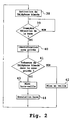
- Figure 2 shows, in the form of an algorithm, an example of operation of the method of the invention. This working example is described from the main steps of the method of the invention. So when the first time you use phone 1, you activate it in a step 38. Activation of the telephone 1 allows the device 2 to be able to establish communication with a base station on network 4 and at device 3 to be able to establish communication with the network 7. A communication with network 7 is subject to the presence of telephone 1 in zone 26.
- the device 3 is on standby, in a step 39, of being in the zone 26 in order to be able to detect a signal from base 8.
- the device 2 stores a code identification of a base station with a coverage area covering therefore all or part of the zone 26.
- the device 2 stores at memory location 28 an identification code of station A covering zone 27. Consequently, an identification of zone 27 allows identify a private zone which indicates the presence of telephone 1 to close to zone 26.
- the device 2 compares an identification code received from a base with the code stored in location 28.
- the microprocessor 12 of device 2 controls means 29 which activates, in a step 42, putting the device on standby 3.
- This standby can be translate by switching off, in a preferred example, the different elements of the device 3 or by an operation in which only the main elements are still activated or even functioning at a reduced frequency. More generally, any process for putting a standby system, which can be integrated into device 3, can be used to put the device to sleep 3.
- the microprocessor 12 controls the means 29 for putting the device 3 in a state of standby, that is to say in a normal operating state.
- the device 3 can achieve, in one step 44, base 8 scanning operations. These scanning operations result in particular in a regular search for a code identification code issued by base 8 identical to the memorized identification code in the memory 20 of the device 3 during the first detection of the base 8 in device 3.
- the latter can receive a call transmitted by base 8 or by station A. In this case, it is up to a user of phone 1 to select a call between the two or even put one on hold while it responds to the other.
Landscapes
- Engineering & Computer Science (AREA)
- Computer Networks & Wireless Communication (AREA)
- Signal Processing (AREA)
- Mobile Radio Communication Systems (AREA)
Abstract
Description
- on détecte une présence de la base à proximité du deuxième dispositif de téléphonie ;
- on identifie une première zone privée avec le premier dispositif, la première zone privée étant une zone de couverture d'une station de base, cette zone de couverture comprenant tout ou partie d'une zone domestique couverte par la base ;
- on mémorise, dans une mémoire de sauvegarde du téléphone bimode, un code d'identification de la station de base lorsque le téléphone est à l'intérieur de la zone domestique ;
- on met en veille le deuxième dispositif, le deuxième dispositif étant mis dans un état hors veille après une détection d'une présence du téléphone bimode à l'intérieur de la première zone privée.
- Figure 1 : un exemple simplifié de mise en oeuvre du procédé de l'invention avec notamment un téléphone bimode de l'invention ;
- Figure 2 : une représentation, sous forme d'un algorithme, d'un exemple de fonctionnement du procédé de l'invention en faisant apparaítre les étapes principales.
Claims (10)
- Procédé de gestion d'un téléphone (1) bimode comportant un premier dispositif (2) de téléphonie, relié à un réseau (4) de téléphonie mobile par une station (A) de base, et un deuxième dispositif (3) de téléphonie, relié à un réseau (7) de téléphonie fixe par une base (8), dans lequel :caractérisé en ce que :on détecte une présence de la base à proximité du deuxième dispositif de téléphonie ;et en ce que lorsqu'on détecte une absence, dans la première zone privée, du téléphone bimode :on identifie une première zone (27) privée avec le premier dispositif, la première zone privée étant une zone de couverture d'une station de base, cette zone de couverture comprenant tout ou partie d'une zone (26) domestique couverte par la base ;on mémorise, dans une mémoire (15) de sauvegarde du téléphone bimode, un code d'identification de la station de base lorsque le téléphone est à l'intérieur de la zone domestique ;on met en veille le deuxième dispositif, le deuxième dispositif étant mis dans un état hors veille après une détection d'une présence du téléphone bimode à l'intérieur de la première zone privée.
- Procédé selon la revendication 1 caractérisé en ce que :on identifie la première zone privée en mémorisant un groupe de codes d'identification, chaque code identifiant une station (A, B, C) de base couvrant une zone (27, 30, 31) comprenant tout ou partie de la zone domestique couverte par la base ou couvrant une zone proche de la zone domestique.
- Procédé selon la revendication 1 ou 2 caractérisé en ce que :on identifie la première zone privée en mémorisant un groupe de codes d'identification, chaque code identifiant une station de base proche de la zone couverte par la base.
- Procédé selon l'une des revendications 1 à 3 caractérisé en ce que:on identifie une deuxième zone privée en mémorisant dans la mémoire de sauvegarde un deuxième groupe de codes d'identification.
- Procédé selon l'une des revendications 1 à 4 caractérisé en ce que:on place la mémoire de sauvegarde dans le premier dispositif.
- Procédé selon l'une des revendications 1 à 5 caractérisé en ce queon met le deuxième dispositif dans un état de veille ou dans un état hors veille après l'écoulement d'une temporisation déclenchée lorsqu'une absence du téléphone bimode, dans la première zone privée, ou une présence du téléphone bimode, à l'intérieur de la première zone privée, respectivement a été détectée.
- Procédé selon l'une des revendications 1 à 6 caractérisé en ce que lorsque le premier dispositif est hors de portée d'une station (A, B, C, D) de base :on met le deuxième dispositif dans un état hors veille.
- Procédé selon l'une des revendications 1 à 7 caractérisé en ce que lors d'un appui sur une touche du téléphone bimode :on met le deuxième dispositif dans un état hors veille si celui-ci se trouve dans la zone privée et ou si le premier dispositif est hors de portée d'une station (A, B, C, D) de base, la mise dans un état hors veille étant inhibée lorsqu'on détecte une absence, dans la première zone privée, du premier dispositif.
- Téléphone (1) bimode comportant un premier dispositif (2) de téléphonie, relié à un réseau (4) de téléphonie mobile par une station (A) de base, et un deuxième dispositif (3) de téléphonie, relié à un réseau (7) de téléphonie fixe par une base (8), caractérisé en ce qu'il comporte des moyens (15) de sauvegarde d'un code d'identification d'une station (A) de base couvrant une zone (27) comprenant une zone (26) couverte par la base et en ce qu'il comporte un moyen (29) de mise en veille du deuxième dispositif lorsqu'un code d'identification reçu est différent d'un code mémorisé.
- Téléphone selon la revendication 9 caractérisé en ce qu'il comporte un moyen de temporisation à la fin de laquelle le moyen de mise en veille est activé pour mettre le deuxième dispositif dans un état de veille ou dans un état hors veille.
Applications Claiming Priority (2)
| Application Number | Priority Date | Filing Date | Title |
|---|---|---|---|
| FR9913442A FR2800553B1 (fr) | 1999-10-27 | 1999-10-27 | Procede de gestion d'un telephone bimode |
| FR9913442 | 1999-10-27 |
Publications (2)
| Publication Number | Publication Date |
|---|---|
| EP1096810A1 true EP1096810A1 (fr) | 2001-05-02 |
| EP1096810B1 EP1096810B1 (fr) | 2003-12-03 |
Family
ID=9551424
Family Applications (1)
| Application Number | Title | Priority Date | Filing Date |
|---|---|---|---|
| EP20000402729 Expired - Lifetime EP1096810B1 (fr) | 1999-10-27 | 2000-10-04 | Procédé de gestion d'un téléphone bimode |
Country Status (4)
| Country | Link |
|---|---|
| EP (1) | EP1096810B1 (fr) |
| DE (1) | DE60006921T2 (fr) |
| ES (1) | ES2209785T3 (fr) |
| FR (1) | FR2800553B1 (fr) |
Citations (5)
| Publication number | Priority date | Publication date | Assignee | Title |
|---|---|---|---|---|
| DE19605019A1 (de) * | 1996-01-31 | 1997-08-07 | Raimondo Jakoby | Kombiniertes Mobil - und schnurloses Telefon |
| US5732360A (en) * | 1995-09-08 | 1998-03-24 | At & T Wireless Services And Atmel Corp | Mobile telecommunication device and method used for changing wireless communication between base stations of different kinds |
| GB2321162A (en) * | 1997-01-08 | 1998-07-15 | Nec Technologies | Dual Mode Mobile Radio Telecommunications Device |
| US5870673A (en) * | 1996-08-30 | 1999-02-09 | Telefonaktiebolaget Lm Ericsson | Methods and systems for concurrent receipt of incoming calls from a wide area cellular network and a private radio communications network |
| US5911120A (en) * | 1995-09-08 | 1999-06-08 | At&T Wireless Services | Wireless communication system having mobile stations establish a communication link through the base station without using a landline or regional cellular network and without a call in progress |
-
1999
- 1999-10-27 FR FR9913442A patent/FR2800553B1/fr not_active Expired - Lifetime
-
2000
- 2000-10-04 DE DE2000606921 patent/DE60006921T2/de not_active Expired - Lifetime
- 2000-10-04 ES ES00402729T patent/ES2209785T3/es not_active Expired - Lifetime
- 2000-10-04 EP EP20000402729 patent/EP1096810B1/fr not_active Expired - Lifetime
Patent Citations (5)
| Publication number | Priority date | Publication date | Assignee | Title |
|---|---|---|---|---|
| US5732360A (en) * | 1995-09-08 | 1998-03-24 | At & T Wireless Services And Atmel Corp | Mobile telecommunication device and method used for changing wireless communication between base stations of different kinds |
| US5911120A (en) * | 1995-09-08 | 1999-06-08 | At&T Wireless Services | Wireless communication system having mobile stations establish a communication link through the base station without using a landline or regional cellular network and without a call in progress |
| DE19605019A1 (de) * | 1996-01-31 | 1997-08-07 | Raimondo Jakoby | Kombiniertes Mobil - und schnurloses Telefon |
| US5870673A (en) * | 1996-08-30 | 1999-02-09 | Telefonaktiebolaget Lm Ericsson | Methods and systems for concurrent receipt of incoming calls from a wide area cellular network and a private radio communications network |
| GB2321162A (en) * | 1997-01-08 | 1998-07-15 | Nec Technologies | Dual Mode Mobile Radio Telecommunications Device |
Also Published As
| Publication number | Publication date |
|---|---|
| ES2209785T3 (es) | 2004-07-01 |
| DE60006921D1 (de) | 2004-01-15 |
| DE60006921T2 (de) | 2004-10-28 |
| EP1096810B1 (fr) | 2003-12-03 |
| FR2800553A1 (fr) | 2001-05-04 |
| FR2800553B1 (fr) | 2002-05-31 |
Similar Documents
| Publication | Publication Date | Title |
|---|---|---|
| CA2311113C (fr) | Dispositif de communication influence par un accelerometre | |
| US7007177B2 (en) | Extended power savings for electronic devices | |
| US7096045B2 (en) | Portable communication terminal apparatus | |
| FR2753034A1 (fr) | Dispositif de communication et procede de commande d'occultation de l'affichage destine a celui-ci | |
| US5426690A (en) | Cordless telephone apparatus which restores radio channels after power loss | |
| FR2683409A1 (fr) | Dispositif radio dont les modes de fonctionnement sont fonction de la position d'une antenne mobile, et procede associe. | |
| FR2796795A1 (fr) | Procede et appareil pour reduire la consommation d'energie d'un dispositif de communication | |
| US6535752B1 (en) | Radio receiver with power saving during synchronization retries | |
| FR2765431A1 (fr) | Dispositif de communication a volet de fermeture et procede de mise en oeuvre de ce dispositif | |
| JP2004356798A (ja) | 携帯通信端末及びそのアンテナ切替方法 | |
| KR20060056968A (ko) | 지능형 통신 관리를 구비한 통신 장치 및 그를 위한 방법 | |
| EP1124392B1 (fr) | Terminal de télécommunication mobile mixte pour l'exploitation avec un premier réseau collectif et un second réseau local préferentiel | |
| EP1096810B1 (fr) | Procédé de gestion d'un téléphone bimode | |
| US8228207B2 (en) | Autolocation of gray goods | |
| WO2011080491A1 (fr) | Gestion d'une interface de communications sans fil d'un terminal | |
| US20080220811A1 (en) | System and method for obtaining location of wireless telephone from internet server | |
| JP2826522B2 (ja) | 無線移動局 | |
| JP2004015312A (ja) | 携帯電話機 | |
| EP1376994A1 (fr) | Radiotéléphone portable et système de radiocommunication comportant un tel radiotéléphone | |
| KR20010010527A (ko) | 단말기에서 스피커 폰 모드 자동 절환 방법 | |
| JP2000201093A (ja) | 携帯電話装置 | |
| FR3099571A1 (fr) | Appareil de mesure mobile et procédé pour une application de sécurité | |
| JP2007028370A (ja) | 無線通信端末及び無線通信端末制御方法 | |
| JP2002335547A (ja) | 電話機端末の着信切り替え方式 | |
| CA2616017C (fr) | Commande de mode de puissance pour un dispositif de communication |
Legal Events
| Date | Code | Title | Description |
|---|---|---|---|
| PUAI | Public reference made under article 153(3) epc to a published international application that has entered the european phase |
Free format text: ORIGINAL CODE: 0009012 |
|
| AK | Designated contracting states |
Kind code of ref document: A1 Designated state(s): DE ES FI GB IT SE |
|
| AX | Request for extension of the european patent |
Free format text: AL;LT;LV;MK;RO;SI |
|
| 17P | Request for examination filed |
Effective date: 20010514 |
|
| RAP1 | Party data changed (applicant data changed or rights of an application transferred) |
Owner name: SAGEM S.A. |
|
| AKX | Designation fees paid |
Free format text: DE ES FI GB IT SE |
|
| 17Q | First examination report despatched |
Effective date: 20020121 |
|
| GRAH | Despatch of communication of intention to grant a patent |
Free format text: ORIGINAL CODE: EPIDOS IGRA |
|
| GRAS | Grant fee paid |
Free format text: ORIGINAL CODE: EPIDOSNIGR3 |
|
| GRAA | (expected) grant |
Free format text: ORIGINAL CODE: 0009210 |
|
| AK | Designated contracting states |
Kind code of ref document: B1 Designated state(s): DE ES FI GB IT SE |
|
| PG25 | Lapsed in a contracting state [announced via postgrant information from national office to epo] |
Ref country code: FI Free format text: LAPSE BECAUSE OF FAILURE TO SUBMIT A TRANSLATION OF THE DESCRIPTION OR TO PAY THE FEE WITHIN THE PRESCRIBED TIME-LIMIT Effective date: 20031203 |
|
| REG | Reference to a national code |
Ref country code: GB Ref legal event code: FG4D Free format text: NOT ENGLISH |
|
| REF | Corresponds to: |
Ref document number: 60006921 Country of ref document: DE Date of ref document: 20040115 Kind code of ref document: P |
|
| REG | Reference to a national code |
Ref country code: SE Ref legal event code: TRGR |
|
| GBT | Gb: translation of ep patent filed (gb section 77(6)(a)/1977) |
Effective date: 20040324 |
|
| REG | Reference to a national code |
Ref country code: ES Ref legal event code: FG2A Ref document number: 2209785 Country of ref document: ES Kind code of ref document: T3 |
|
| PG25 | Lapsed in a contracting state [announced via postgrant information from national office to epo] |
Ref country code: SE Free format text: LAPSE BECAUSE OF NON-PAYMENT OF DUE FEES Effective date: 20041005 |
|
| PLBE | No opposition filed within time limit |
Free format text: ORIGINAL CODE: 0009261 |
|
| STAA | Information on the status of an ep patent application or granted ep patent |
Free format text: STATUS: NO OPPOSITION FILED WITHIN TIME LIMIT |
|
| 26N | No opposition filed |
Effective date: 20040906 |
|
| EUG | Se: european patent has lapsed | ||
| REG | Reference to a national code |
Ref country code: GB Ref legal event code: 732E Free format text: REGISTERED BETWEEN 20090319 AND 20090325 |
|
| REG | Reference to a national code |
Ref country code: GB Ref legal event code: 732E Free format text: REGISTERED BETWEEN 20090326 AND 20090401 |
|
| REG | Reference to a national code |
Ref country code: DE Ref legal event code: R082 Ref document number: 60006921 Country of ref document: DE Representative=s name: , |
|
| REG | Reference to a national code |
Ref country code: DE Ref legal event code: R081 Ref document number: 60006921 Country of ref document: DE Owner name: SAGEMCOM SAS, FR Free format text: FORMER OWNER: SAGEM S.A., PARIS, FR Effective date: 20120120 |
|
| REG | Reference to a national code |
Ref country code: DE Ref legal event code: R081 Ref document number: 60006921 Country of ref document: DE Owner name: SAGEMCOM SAS, FR Free format text: FORMER OWNER: SAGEM TELECOMMUNICATIONS S. A., PARIS, FR Effective date: 20130129 |
|
| PGFP | Annual fee paid to national office [announced via postgrant information from national office to epo] |
Ref country code: IT Payment date: 20190918 Year of fee payment: 20 |
|
| PGFP | Annual fee paid to national office [announced via postgrant information from national office to epo] |
Ref country code: GB Payment date: 20190923 Year of fee payment: 20 |
|
| PGFP | Annual fee paid to national office [announced via postgrant information from national office to epo] |
Ref country code: DE Payment date: 20190918 Year of fee payment: 20 |
|
| PGFP | Annual fee paid to national office [announced via postgrant information from national office to epo] |
Ref country code: ES Payment date: 20191104 Year of fee payment: 20 |
|
| REG | Reference to a national code |
Ref country code: DE Ref legal event code: R071 Ref document number: 60006921 Country of ref document: DE |
|
| REG | Reference to a national code |
Ref country code: GB Ref legal event code: PE20 Expiry date: 20201003 |
|
| REG | Reference to a national code |
Ref country code: ES Ref legal event code: FD2A Effective date: 20210126 |
|
| PG25 | Lapsed in a contracting state [announced via postgrant information from national office to epo] |
Ref country code: GB Free format text: LAPSE BECAUSE OF EXPIRATION OF PROTECTION Effective date: 20201003 |
|
| PG25 | Lapsed in a contracting state [announced via postgrant information from national office to epo] |
Ref country code: ES Free format text: LAPSE BECAUSE OF EXPIRATION OF PROTECTION Effective date: 20201005 |