EP1096514A2 - Composite magnetic material and inductor element - Google Patents
Composite magnetic material and inductor element Download PDFInfo
- Publication number
- EP1096514A2 EP1096514A2 EP00123144A EP00123144A EP1096514A2 EP 1096514 A2 EP1096514 A2 EP 1096514A2 EP 00123144 A EP00123144 A EP 00123144A EP 00123144 A EP00123144 A EP 00123144A EP 1096514 A2 EP1096514 A2 EP 1096514A2
- Authority
- EP
- European Patent Office
- Prior art keywords
- magnetic material
- composite magnetic
- ferrite
- inductor element
- material according
- Prior art date
- Legal status (The legal status is an assumption and is not a legal conclusion. Google has not performed a legal analysis and makes no representation as to the accuracy of the status listed.)
- Granted
Links
Images


Classifications
-
- H—ELECTRICITY
- H01—ELECTRIC ELEMENTS
- H01F—MAGNETS; INDUCTANCES; TRANSFORMERS; SELECTION OF MATERIALS FOR THEIR MAGNETIC PROPERTIES
- H01F1/00—Magnets or magnetic bodies characterised by the magnetic materials therefor; Selection of materials for their magnetic properties
- H01F1/01—Magnets or magnetic bodies characterised by the magnetic materials therefor; Selection of materials for their magnetic properties of inorganic materials
- H01F1/03—Magnets or magnetic bodies characterised by the magnetic materials therefor; Selection of materials for their magnetic properties of inorganic materials characterised by their coercivity
- H01F1/12—Magnets or magnetic bodies characterised by the magnetic materials therefor; Selection of materials for their magnetic properties of inorganic materials characterised by their coercivity of soft-magnetic materials
- H01F1/34—Magnets or magnetic bodies characterised by the magnetic materials therefor; Selection of materials for their magnetic properties of inorganic materials characterised by their coercivity of soft-magnetic materials non-metallic substances, e.g. ferrites
-
- H—ELECTRICITY
- H01—ELECTRIC ELEMENTS
- H01F—MAGNETS; INDUCTANCES; TRANSFORMERS; SELECTION OF MATERIALS FOR THEIR MAGNETIC PROPERTIES
- H01F1/00—Magnets or magnetic bodies characterised by the magnetic materials therefor; Selection of materials for their magnetic properties
- H01F1/01—Magnets or magnetic bodies characterised by the magnetic materials therefor; Selection of materials for their magnetic properties of inorganic materials
- H01F1/03—Magnets or magnetic bodies characterised by the magnetic materials therefor; Selection of materials for their magnetic properties of inorganic materials characterised by their coercivity
- H01F1/12—Magnets or magnetic bodies characterised by the magnetic materials therefor; Selection of materials for their magnetic properties of inorganic materials characterised by their coercivity of soft-magnetic materials
- H01F1/34—Magnets or magnetic bodies characterised by the magnetic materials therefor; Selection of materials for their magnetic properties of inorganic materials characterised by their coercivity of soft-magnetic materials non-metallic substances, e.g. ferrites
- H01F1/36—Magnets or magnetic bodies characterised by the magnetic materials therefor; Selection of materials for their magnetic properties of inorganic materials characterised by their coercivity of soft-magnetic materials non-metallic substances, e.g. ferrites in the form of particles
- H01F1/37—Magnets or magnetic bodies characterised by the magnetic materials therefor; Selection of materials for their magnetic properties of inorganic materials characterised by their coercivity of soft-magnetic materials non-metallic substances, e.g. ferrites in the form of particles in a bonding agent
-
- H—ELECTRICITY
- H01—ELECTRIC ELEMENTS
- H01F—MAGNETS; INDUCTANCES; TRANSFORMERS; SELECTION OF MATERIALS FOR THEIR MAGNETIC PROPERTIES
- H01F1/00—Magnets or magnetic bodies characterised by the magnetic materials therefor; Selection of materials for their magnetic properties
- H01F1/01—Magnets or magnetic bodies characterised by the magnetic materials therefor; Selection of materials for their magnetic properties of inorganic materials
- H01F1/03—Magnets or magnetic bodies characterised by the magnetic materials therefor; Selection of materials for their magnetic properties of inorganic materials characterised by their coercivity
- H01F1/12—Magnets or magnetic bodies characterised by the magnetic materials therefor; Selection of materials for their magnetic properties of inorganic materials characterised by their coercivity of soft-magnetic materials
- H01F1/34—Magnets or magnetic bodies characterised by the magnetic materials therefor; Selection of materials for their magnetic properties of inorganic materials characterised by their coercivity of soft-magnetic materials non-metallic substances, e.g. ferrites
- H01F1/342—Oxides
- H01F1/344—Ferrites, e.g. having a cubic spinel structure (X2+O)(Y23+O3), e.g. magnetite Fe3O4
-
- H—ELECTRICITY
- H01—ELECTRIC ELEMENTS
- H01F—MAGNETS; INDUCTANCES; TRANSFORMERS; SELECTION OF MATERIALS FOR THEIR MAGNETIC PROPERTIES
- H01F17/00—Fixed inductances of the signal type
- H01F17/04—Fixed inductances of the signal type with magnetic core
-
- Y—GENERAL TAGGING OF NEW TECHNOLOGICAL DEVELOPMENTS; GENERAL TAGGING OF CROSS-SECTIONAL TECHNOLOGIES SPANNING OVER SEVERAL SECTIONS OF THE IPC; TECHNICAL SUBJECTS COVERED BY FORMER USPC CROSS-REFERENCE ART COLLECTIONS [XRACs] AND DIGESTS
- Y10—TECHNICAL SUBJECTS COVERED BY FORMER USPC
- Y10T—TECHNICAL SUBJECTS COVERED BY FORMER US CLASSIFICATION
- Y10T428/00—Stock material or miscellaneous articles
- Y10T428/11—Magnetic recording head
- Y10T428/115—Magnetic layer composition
-
- Y—GENERAL TAGGING OF NEW TECHNOLOGICAL DEVELOPMENTS; GENERAL TAGGING OF CROSS-SECTIONAL TECHNOLOGIES SPANNING OVER SEVERAL SECTIONS OF THE IPC; TECHNICAL SUBJECTS COVERED BY FORMER USPC CROSS-REFERENCE ART COLLECTIONS [XRACs] AND DIGESTS
- Y10—TECHNICAL SUBJECTS COVERED BY FORMER USPC
- Y10T—TECHNICAL SUBJECTS COVERED BY FORMER US CLASSIFICATION
- Y10T428/00—Stock material or miscellaneous articles
- Y10T428/32—Composite [nonstructural laminate] of inorganic material having metal-compound-containing layer and having defined magnetic layer
Definitions
- the present invention relates to a composite magnetic material comprising a ferrite powder and a resin, and an inductor element constructed by using it. More specifically, it relates to a composite magnetic material and an inductor element advantageous for use in the electronic parts for high-frequency applications.
- an inductor element with a coil structure for covering the frequencies up to several GHz such as a chip inductor, is used for the purposes of impedance matching, resonance or for a choke.
- the coil was prepared by winding a wire around a core made of a non-magnetic material or by forming a coil pattern on a non-magnetic material, and thus it was necessary to have a large number of coil winding turns so as to obtain a desired impedance, resulting in a restraint toward the development of miniaturization. Since the resistance of the winding increases with increasing number of winding turns, there was also a problem that an inductor with a high Q (gain) could not be obtained.
- inductors having, as a core, a ferrite for high-frequency use have been also investigated.
- a ferrite core By using a ferrite core, it is possible to decrease the number of coil winding turns in accordance with the permeability of the core material, and to realize miniaturization.
- a ferrite sintered body has a frequency relaxation phenomenon derived from magnetic domain wall motion, and a high Q can be maintained only when the frequency is restricted to a value up to about 300 MHz at the most, even if a ferrox planer type ferrite sintered body (which is believed to have the most excellent high-frequency properties) is used.
- Another object of the present invention is to provide an inductor element which can be miniaturized and still can provide a high Q, by using the magnetic material described above.
- the composite magnetic material comprises a ferrite powder and a resin, and the said ferrite powder comprises a spinel type ferrite including at least Ni and Co.
- the ferrite is a spinel type ferrite having a composition represented by (NiO) x (CoO) y (MeO) Z (Fe 2 O 3 ) 1-x-y-z , wherein Me is at least one selected from the group consisting of Mg, Cu and Zn, and x, y and z each satisfy the following conditions:
- the composite magnetic material is suitably applied to an inductor element.
- a composite magnetic material can be obtained which can provide a relatively large permeability in the frequency band of from several MHz to several GHz, and which can maintain a high gain Q up to a GHz range.
- an inductor element constructed by using this composite magnetic material as a magnetic member can realize miniaturization as well as a high Q.
- a ferrite sintered member material has a magnetization mechanism that it passes through the stage of magnetic domain wall motion relaxation to reach the stage of rotational magnetization resonance starting from a low frequency to a high frequency in the AC magnetic field. From the viewpoint of frequency characteristics of Q of magnetic materials, Q decreases sharply at a frequency in which magnetic domain wall motion relaxation occurs, and further decreases toward the rotational magnetization resonance point.
- the inventors of the present invention noticed that properties favorable for a core for a high-frequency inductor can be obtained by combining the above-described elements and by dispersing a NiCo ferrite powder in a resin at a high concentration to make a composite ferrite material, and found the present invention.
- the present invention is directed at a composite magnetic material.
- This composite magnetic material is characterized in that it contains a ferrite powder and a resin, the ferrite powder comprising a spinel type ferrite including at least Ni and Co.
- the above-described ferrite is desirably a spinel type ferrite having a composition represented by (NiO) x (CoO) y (MeO) Z (Fe 2 O 3 ) 1-x-y-z , wherein Me is at least one selected from the group consisting of Mg, Cu and Zn, and x, y and z each satisfy the following conditions: 0.10 ⁇ x ⁇ 0.550; 0.025 ⁇ y ⁇ 0.200; 0 ⁇ z ⁇ 0.200; and 0.400 ⁇ (x+y+z) ⁇ 0.600 .
- a part of the Ni may be substituted with Be, Ca, Sr, Ba, Ti, V, Cr, Me, etc.
- a part of the Fe may be substituted with Al, Ga, In, Tl, etc., as long as they do not adversely affect on the magnetic properties of the composite magnetic material.
- any type of resin may be used.
- Additives such as a resin dispersant may be added to the resin as long as they do not adversely affect on the magnetic properties of the composite material.
- the composite magnetic material according to the present invention is prepared, different from a ferrite sintered body, by mixing a ferrite powder without magnetic domain wall motion relaxation in a resin.
- This composite magnetic material can maintain a relatively high Q up to several GHz region since the rotational magnetization resonance frequency of a ferrite powder is raised to a frequency higher than several GHz.
- Fig. 1 is a perspective view illustrating the appearance of an inductor element 1 according to an embodiment of the present invention.
- the inductor element 1 is shown as partially broken.
- the inductor element 1 constitutes a chip inductor, and is equipped with a cylindrical core 2.
- a coated winding 3 is wound over the outer periphery of the core 2.
- Each end of the core 2 is covered with a cap type metallic terminal member 4 or 5.
- the coating of both ends of the winding 3 is peeled off and one of the ends with the coating thus peeled off is electrically connected to the terminal member 4, and the other end is electrically connected to the terminal member 5, respectively.
- the composite magnetic material according to the present invention can be used advantageously, for example, as a material for constituting a core 2 for use in the above-described inductor element 1, or as a magnetic member for use in an inductor element of a different structure.
- the composite magnetic material according to the present invention has the above-described composition. The details will be explained below based on the examples.
- the above-described mixed powder was calcined in the air at a temperature of 1,000°C for 2 hours, and then was wet-ground with a ball mill for 24 hours.
- the ferrite powder thus obtained was subjected to a measurement of the real density by the gas substitution method. Using the result, the ferrite powder and a polypropylene resin were compounded in a volume ratio of 50/50 to prepare a composite material.
- the above-described composite material was blended with a hot roll, and then was compression-pressed to make a cylindrical test piece having a diameter of 8 mm and an axial line direction length of 15 mm.
- the test piece was lathed, and then was subjected to the evaluation of magnetic properties at frequencies of 500 MHz, 1 GHz and 2 GHz, respectively, by the S-parameter method.
- a Ni (Mg, Cu) ferrite sintered body was prepared, and was subjected to the evaluation of magnetic properties according to the same methods as the above-described methods.
- Table 2 shows the real number parts ⁇ ' of complex permeabilities and the gain Q values of the composite magnetic materials from the samples in Table 1 for which magnetic properties were evaluated as described above, and a sintered body according to the above-described comparative example, respectively.
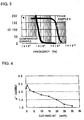
- Fig. 2 shows relationships between the frequencies and permeabilities ⁇ ' of sample 8 and the comparative example to compare them.
- Fig. 3 shows relationships between the frequencies and the gains Q in a similar way.
- Fig. 4 shows a relationship between the CoO amount and the permeability ⁇ ' at a frequency of 2 GHz in a system with 49.5 mol% of Fe 2 O 3 .
- Fig. 5 shows a relationship between the CoO amount and the gain Q at a frequency of 2 GHz in a similar way.
- samples 1 to 25, except for sample 5 which is outside of the present invention as it does not contain Co have a tendency to show, in general, relatively good magnetic properties, that is, a good permeability ⁇ ' and a good gain Q up to the GHz region, without decrease of magnetic properties derived from magnetic wall resonance, though the permeability is decreased by the influence of the resin which is non-magnetic.
- the amount of NiO is changed in the range of 0.050-0.575 mol% in samples 1-4
- the amount of CoO is changed in the range of 0-0.300 mol% in samples 5-13
- a part of the amount of NiO is substituted with MgO, CuO or ZnO in samples 14-19
- the amount of MgO is changed in the range of 0.050-0.300 mol%
- the amount of Fe 2 O 3 is changed in the range of 0.350-0.650 mol% in samples 20-25.
- the ferrite is a spinel type ferrite having a composition represented by (NiO) x (CoO) y (MeO) z (Fe 2 O 3 ) 1-x-y-z , wherein Me is at least one selected from the group consisting of Mg, Cu and Zn, and x, y and z each satisfy the following conditions: 0.10 ⁇ x ⁇ 0.550; 0.025 ⁇ y ⁇ 0.200; 0 ⁇ z ⁇ 0.200; and 0.400 ⁇ (x+y+z) ⁇ 0.600 .
- samples 2 and 3 are within the preferred range, and samples 1 and 4 are out of the preferred range.
- sample 1 with a NiO amount of less than 0.10 in molar ratio and sample 4 with a NiO amount of more than 0.550 in molar ratio have lower permeabilities ⁇ ' than those of samples 2 and 3.
- samples 7-11 are within the preferred range, and samples 5, 6, 12, and 13 are out of the preferred range.
- samples 5-13 are compared with each other, those with CoO having a molar ratio of less than 0.025, such as samples 5 and 6, show a decreased gain Q, though a relatively high permeability ⁇ ' is obtained.
- the amount of CoO exceeds 0.200 in molar ratio as is in the cases of samples 12 and 13, the permeability ⁇ ' decreases, though a relatively high gain Q is obtained.
- samples 14-19 are within the preferred range, and samples 19 is out of the preferred range.
- MgO as a substituent exceeds 0.200 in molar ratio as in the case of sample 19, the gain Q decreases, though a relatively high permeability ⁇ ' is obtained.
Landscapes
- Chemical & Material Sciences (AREA)
- Dispersion Chemistry (AREA)
- Engineering & Computer Science (AREA)
- Power Engineering (AREA)
- Soft Magnetic Materials (AREA)
- Magnetic Ceramics (AREA)
- Compounds Of Iron (AREA)
- Coils Or Transformers For Communication (AREA)
Abstract
Description
| Sample No. | NiO | CoO | MgO | CuO | ZnO | Fe2O3 |
| * 1 | 0.050 | 0.200 | 0 | 0.150 | 0 | 0.600 |
| 2 | 0.100 | 0.200 | 0 | 0.100 | 0 | 0.600 |
| 3 | 0.550 | 0.050 | 0 | 0 | 0 | 0.400 |
| * 4 | 0.575 | 0.025 | 0 | 0 | 0 | 0.400 |
| * 5 | 0.505 | 0 | 0 | 0 | 0 | 0.495 |
| * 6 | 0.495 | 0.010 | 0 | 0 | 0 | 0.495 |
| 7 | 0.480 | 0.025 | 0 | 0 | 0 | 0.495 |
| 8 | 0.455 | 0.050 | 0 | 0 | 0 | 0.495 |
| 9 | 0.405 | 0.100 | 0 | 0 | 0 | 0.495 |
| 10 | 0.355 | 0.150 | 0 | 0 | 0 | 0.495 |
| 11 | 0.305 | 0.200 | 0 | 0 | 0 | 0.495 |
| * 12 | 0.255 | 0.250 | 0 | 0 | 0 | 0.495 |
| * 13 | 0.205 | 0.300 | 0 | 0 | 0 | 0.495 |
| 14 | 0.405 | 0.050 | 0.050 | 0 | 0 | 0.495 |
| 15 | 0.405 | 0.050 | 0 | 0.050 | 0 | 0.495 |
| 16 | 0.405 | 0.050 | 0 | 0 | 0.050 | 0.495 |
| 17 | 0.305 | 0.100 | 0.100 | 0 | 0 | 0.495 |
| 18 | 0.205 | 0.100 | 0.200 | 0 | 0 | 0.495 |
| * 19 | 0.105 | 0.100 | 0.300 | 0 | 0 | 0.495 |
| * 20 | 0.550 | 0.100 | 0 | 0 | 0 | 0.350 |
| 21 | 0.500 | 0.100 | 0 | 0 | 0 | 0.400 |
| 22 | 0.450 | 0.100 | 0 | 0 | 0 | 0.450 |
| 23 | 0.350 | 0.100 | 0 | 0 | 0 | 0.550 |
| 24 | 0.300 | 0.100 | 0 | 0 | 0 | 0.600 |
| * 25 | 0.250 | 0.100 | 0 | 0 | 0 | 0.650 |
| Sample No. | µ' | Q | ||||
| 500MHz | 1GHz | 2GHz | 500MHz | 1GHz | 2GHz | |
| * 1 | 1.2 | 1.2 | 1.2 | 200 | 200 | 190 |
| 2 | 1.5 | 1.5 | 1.5 | 190 | 190 | 190 |
| 3 | 1.8 | 1.8 | 1.7 | 190 | 190 | 170 |
| * 4 | 1.3 | 1.3 | 1.3 | 190 | 190 | 180 |
| * 5 | 2.5 | 2.5 | 2.2 | 18 | 8 | 4 |
| * 6 | 2.5 | 2.8 | 2.4 | 80 | 10 | 2 |
| 7 | 2.2 | 2.2 | 2.1 | 150 | 150 | 80 |
| 8 | 2.0 | 2.0 | 2.0 | 180 | 180 | 150 |
| 9 | 1.8 | 1.8 | 1.8 | 180 | 180 | 160 |
| 10 | 1.7 | 1.7 | 1.7 | 180 | 180 | 160 |
| 11 | 1.5 | 1.5 | 1.5 | 190 | 190 | 170 |
| * 12 | 1.2 | 1.2 | 1.2 | 200 | 200 | 190 |
| * 13 | 1.1 | 1.1 | 1.1 | 200 | 200 | 200 |
| 14 | 1.8 | 1.8 | 1.8 | 180 | 180 | 160 |
| 15 | 1.8 | 1.8 | 1.8 | 180 | 180 | 150 |
| 16 | 2.2 | 2.2 | 2.2 | 100 | 100 | 80 |
| 17 | 2.0 | 2.0 | 2.0 | 160 | 160 | 150 |
| 18 | 2.2 | 2.2 | 2.1 | 160 | 160 | 140 |
| * 19 | 2.6 | 2.6 | 2.5 | 100 | 10 | 4 |
| * 20 | 1.3 | 1.3 | 1.3 | 200 | 200 | 200 |
| 21 | 1.7 | 1.7 | 1.6 | 190 | 190 | 180 |
| 22 | 1.8 | 1.8 | 1.8 | 180 | 180 | 160 |
| 23 | 1.8 | 1.8 | 1.8 | 180 | 180 | 170 |
| 24 | 1.6 | 1.6 | 1.6 | 190 | 190 | 190 |
| * 25 | 1.2 | 1.2 | 1.2 | 200 | 200 | 200 |
| Comparative example | 7.6 | 4.9 | 2.6 | 2 | <1 | <1 |
Claims (16)
- A composite magnetic material comprising a ferrite powder and a resin, wherein said ferrite powder comprises a Ni and Co containing spinel ferrite.
- A composite magnetic material according to claim 1, wherein said ferrite comprises at least one of Be, Ca, Sr, Ba, Ti, V, Cr, Mg, Cu, Zn, Ga, In and Tl.
- A composite magnetic material according to claim 2, wherein said ferrite is a spinel type ferrite having a composition represented bywherein(NiO)x(CoO)y(MeO)Z(Fe2O3)1-x-y-z
Me is at least one selected from the group consisting of Mg, Cu and Zn,0.10 ≤x ≤0.550;0.025 ≤y ≤0.200;0 ≤z ≤0.200; and - A composite magnetic material according to claim 3, wherein x is 205-480, y is 0.5-0.1 and
- A composite magnetic material according to claim 4, wherein z is 0.
- A composite magnetic material according to claim 3, wherein Me is Mg.
- A composite magnetic material according to claim 3, wherein Me is Cu.
- A composite magnetic material according to claim 3, wherein Me is Zn.
- An inductor element equipped with a magnetic member comprising a composite magnetic material according to claim 8.
- An inductor element equipped with a magnetic member comprising a composite magnetic material according to claim 7.
- An inductor element equipped with a magnetic member comprising a composite magnetic material according to claim 6.
- An inductor element equipped with a magnetic member comprising a composite magnetic material according to claim 5.
- An inductor element equipped with a magnetic member comprising a composite magnetic material according to claim 4.
- An inductor element equipped with a magnetic member comprising a composite magnetic material according to claim 3.
- An inductor element equipped with a magnetic member comprising a composite magnetic material according to claim 2.
- An inductor element equipped with a magnetic member comprising a composite magnetic material according to claim 1.
Applications Claiming Priority (2)
| Application Number | Priority Date | Filing Date | Title |
|---|---|---|---|
| JP30501299 | 1999-10-27 | ||
| JP30501299A JP3449322B2 (en) | 1999-10-27 | 1999-10-27 | Composite magnetic material and inductor element |
Publications (3)
| Publication Number | Publication Date |
|---|---|
| EP1096514A2 true EP1096514A2 (en) | 2001-05-02 |
| EP1096514A3 EP1096514A3 (en) | 2002-01-09 |
| EP1096514B1 EP1096514B1 (en) | 2005-08-03 |
Family
ID=17940036
Family Applications (1)
| Application Number | Title | Priority Date | Filing Date |
|---|---|---|---|
| EP00123144A Expired - Lifetime EP1096514B1 (en) | 1999-10-27 | 2000-10-25 | Composite magnetic material and inductor element |
Country Status (6)
| Country | Link |
|---|---|
| US (1) | US6803130B1 (en) |
| EP (1) | EP1096514B1 (en) |
| JP (1) | JP3449322B2 (en) |
| KR (1) | KR100385122B1 (en) |
| CN (1) | CN1149593C (en) |
| DE (1) | DE60021677T2 (en) |
Cited By (1)
| Publication number | Priority date | Publication date | Assignee | Title |
|---|---|---|---|---|
| FR2841372A1 (en) * | 2002-06-25 | 2003-12-26 | Thales Sa | LOW-LOSS AND PERMEABLE ARRANGEMENTS ADJUSTMENT FOR HIGH POWER AND BROADBAND APPLICATIONS IN RADIOFREQUENCIES (0.5-600 MHz) |
Families Citing this family (3)
| Publication number | Priority date | Publication date | Assignee | Title |
|---|---|---|---|---|
| JP2003168611A (en) | 2001-09-18 | 2003-06-13 | Murata Mfg Co Ltd | High-frequency common mode choke coil |
| JP4591700B2 (en) * | 2005-10-27 | 2010-12-01 | 戸田工業株式会社 | Spinel type ferrimagnetic fine particle powder and method for producing the same |
| CN107077948A (en) * | 2014-11-06 | 2017-08-18 | 株式会社村田制作所 | Multilayer coil component |
Family Cites Families (21)
| Publication number | Priority date | Publication date | Assignee | Title |
|---|---|---|---|---|
| US3609083A (en) * | 1970-03-17 | 1971-09-28 | Bell Telephone Labor Inc | Heat treatment of nickel zinc cobalt ferrite |
| JPS6036082B2 (en) * | 1978-10-27 | 1985-08-19 | ティーディーケイ株式会社 | Ferrite powder for electrophotographic magnetic toner and method for producing the same |
| JPS55103705A (en) * | 1979-01-31 | 1980-08-08 | Kanegafuchi Chem Ind Co Ltd | Ferrite composition with high initial permeability and method of manufacturing its compact |
| US4485162A (en) * | 1982-02-12 | 1984-11-27 | Tdk Electronics Co., Ltd. | Magnetic carrier powder having a wide chargeable range of electric resistance useful for magnetic brush development |
| JPS59213628A (en) * | 1983-05-18 | 1984-12-03 | Fuji Elelctrochem Co Ltd | Soft magnetic material |
| US5603983A (en) * | 1986-03-24 | 1997-02-18 | Ensci Inc | Process for the production of conductive and magnetic transitin metal oxide coated three dimensional substrates |
| US5206620A (en) * | 1987-07-01 | 1993-04-27 | Tdk Corporation | Sintered ferrite body, chip inductor, and composite LC part |
| JPH03163805A (en) * | 1989-11-22 | 1991-07-15 | Three Bond Co Ltd | Super paramagnetic compound material |
| US5698336A (en) * | 1991-06-28 | 1997-12-16 | Kabushiki Kaisha Toshiba | Magnetic recording medium |
| JPH06140229A (en) * | 1992-09-11 | 1994-05-20 | Tokin Corp | Inductor and oxide magnetic material |
| JPH0737711A (en) | 1993-07-20 | 1995-02-07 | Tokin Corp | Oxide magnetic material and inductor using the same |
| JP3474948B2 (en) | 1993-11-22 | 2003-12-08 | 呉羽化学工業株式会社 | Forming method of inductance adjustment member |
| JP3590454B2 (en) * | 1995-06-16 | 2004-11-17 | Necトーキン株式会社 | Oxide core material for high frequency |
| JP2897871B2 (en) * | 1995-08-11 | 1999-05-31 | ティーディーケイ株式会社 | Magnet powder, sintered magnet, bonded magnet and magnetic recording medium |
| US5906768A (en) * | 1996-04-03 | 1999-05-25 | Tdk Corporation | Ferrite magnetic material, and ferrite core |
| FR2747228B1 (en) * | 1996-04-05 | 1998-07-17 | Thomson Csf | LOW-LOSS FERRITE BETWEEN 1 MHZ AND 100 MHZ AND METHOD FOR PRODUCING THE SAME |
| JP3838730B2 (en) * | 1997-02-13 | 2006-10-25 | 株式会社メイト | Soft magnetic composite material |
| JP3469429B2 (en) * | 1997-05-28 | 2003-11-25 | 太陽誘電株式会社 | Oxide magnetic material |
| JP3672161B2 (en) * | 1997-07-16 | 2005-07-13 | Tdk株式会社 | Ferrite manufacturing method and inductor manufacturing method |
| JP4216917B2 (en) * | 1997-11-21 | 2009-01-28 | Tdk株式会社 | Chip bead element and manufacturing method thereof |
| US6127296A (en) * | 1998-04-24 | 2000-10-03 | Tdk Corporation | Ceramic-glass composite material and method for the preparation thereof |
-
1999
- 1999-10-27 JP JP30501299A patent/JP3449322B2/en not_active Expired - Fee Related
-
2000
- 2000-10-25 DE DE60021677T patent/DE60021677T2/en not_active Expired - Lifetime
- 2000-10-25 EP EP00123144A patent/EP1096514B1/en not_active Expired - Lifetime
- 2000-10-26 US US09/697,542 patent/US6803130B1/en not_active Expired - Fee Related
- 2000-10-26 CN CNB001330063A patent/CN1149593C/en not_active Expired - Fee Related
- 2000-10-27 KR KR10-2000-0063466A patent/KR100385122B1/en not_active Expired - Fee Related
Cited By (2)
| Publication number | Priority date | Publication date | Assignee | Title |
|---|---|---|---|---|
| FR2841372A1 (en) * | 2002-06-25 | 2003-12-26 | Thales Sa | LOW-LOSS AND PERMEABLE ARRANGEMENTS ADJUSTMENT FOR HIGH POWER AND BROADBAND APPLICATIONS IN RADIOFREQUENCIES (0.5-600 MHz) |
| WO2004000755A1 (en) * | 2002-06-25 | 2003-12-31 | Thales | Low-loss ferrite materials with adjustable permeability |
Also Published As
| Publication number | Publication date |
|---|---|
| JP2001126913A (en) | 2001-05-11 |
| DE60021677D1 (en) | 2005-09-08 |
| JP3449322B2 (en) | 2003-09-22 |
| KR100385122B1 (en) | 2003-06-18 |
| KR20010070172A (en) | 2001-07-25 |
| EP1096514A3 (en) | 2002-01-09 |
| US6803130B1 (en) | 2004-10-12 |
| DE60021677T2 (en) | 2006-05-04 |
| CN1294391A (en) | 2001-05-09 |
| EP1096514B1 (en) | 2005-08-03 |
| CN1149593C (en) | 2004-05-12 |
Similar Documents
| Publication | Publication Date | Title |
|---|---|---|
| EP1096513B1 (en) | Composite magnetic material and inductor element | |
| KR101210772B1 (en) | Hexagonal ferrite, and antenna and communication equipment using the same | |
| JP5853381B2 (en) | Magnetic material for antenna, and antenna and wireless communication device | |
| US9123460B2 (en) | Ferrite composition for high frequency bead and chip bead comprising the same | |
| JP2003146739A (en) | Magnetic material for high frequency and high frequency circuit element using the same | |
| US6669861B2 (en) | Y-type hexagonal oxide magnetic material and inductor element | |
| JP3422709B2 (en) | Radio wave absorber | |
| EP1661869A2 (en) | Ferrite material and electronic component using same | |
| KR100359263B1 (en) | Magnetic ceramic composition and inductor component using the same | |
| EP1096514B1 (en) | Composite magnetic material and inductor element | |
| CN1321938C (en) | Low-temperature burnt ferrite material and ferrite parts using the same | |
| EP1801820B1 (en) | NiCuZn-base ferrites and electronic parts using the same | |
| JP4279393B2 (en) | Plate-like soft magnetic ferrite particle powder and soft magnetic ferrite particle composite using the same | |
| JP3683680B2 (en) | Magnetic material for high frequency multilayer inductors | |
| JP3457576B2 (en) | Magnetic material for high frequency | |
| US20170215308A1 (en) | Component For Electromagnetic Interference Suppression And Method For Producing A Component For Electromagnetic Interference Suppression | |
| JP4436493B2 (en) | High frequency low loss ferrite material and ferrite core using the same | |
| KR20010089994A (en) | Oxide magnetic materials, chip components using the same, and method for producing oxide magnetic materials and chip components | |
| JP3550258B2 (en) | Ferrite material | |
| US6798329B2 (en) | Inductor | |
| JP2002141214A (en) | Magnetic material and coil part formed of the same | |
| JP3739977B2 (en) | Magnetic materials and bulk and laminated coil parts using the same | |
| JP3120816B2 (en) | Oxide magnetic material | |
| KR100298890B1 (en) | Ferrite composition for high impeder | |
| JP3887211B2 (en) | High frequency magnetic materials |
Legal Events
| Date | Code | Title | Description |
|---|---|---|---|
| PUAI | Public reference made under article 153(3) epc to a published international application that has entered the european phase |
Free format text: ORIGINAL CODE: 0009012 |
|
| 17P | Request for examination filed |
Effective date: 20001025 |
|
| AK | Designated contracting states |
Kind code of ref document: A2 Designated state(s): DE FR GB Kind code of ref document: A2 Designated state(s): AT BE CH CY DE DK ES FI FR GB GR IE IT LI LU MC NL PT SE |
|
| AX | Request for extension of the european patent |
Free format text: AL;LT;LV;MK;RO;SI |
|
| PUAL | Search report despatched |
Free format text: ORIGINAL CODE: 0009013 |
|
| AK | Designated contracting states |
Kind code of ref document: A3 Designated state(s): AT BE CH CY DE DK ES FI FR GB GR IE IT LI LU MC NL PT SE |
|
| AX | Request for extension of the european patent |
Free format text: AL;LT;LV;MK;RO;SI |
|
| RIC1 | Information provided on ipc code assigned before grant |
Free format text: 7H 01F 1/37 A, 7H 01F 3/08 B, 7H 01F 17/04 B |
|
| AKX | Designation fees paid |
Free format text: DE FR GB |
|
| 17Q | First examination report despatched |
Effective date: 20040816 |
|
| GRAP | Despatch of communication of intention to grant a patent |
Free format text: ORIGINAL CODE: EPIDOSNIGR1 |
|
| GRAS | Grant fee paid |
Free format text: ORIGINAL CODE: EPIDOSNIGR3 |
|
| GRAA | (expected) grant |
Free format text: ORIGINAL CODE: 0009210 |
|
| AK | Designated contracting states |
Kind code of ref document: B1 Designated state(s): DE FR GB |
|
| REG | Reference to a national code |
Ref country code: GB Ref legal event code: FG4D |
|
| REF | Corresponds to: |
Ref document number: 60021677 Country of ref document: DE Date of ref document: 20050908 Kind code of ref document: P |
|
| PG25 | Lapsed in a contracting state [announced via postgrant information from national office to epo] |
Ref country code: GB Free format text: LAPSE BECAUSE OF NON-PAYMENT OF DUE FEES Effective date: 20051103 |
|
| ET | Fr: translation filed | ||
| PLBE | No opposition filed within time limit |
Free format text: ORIGINAL CODE: 0009261 |
|
| STAA | Information on the status of an ep patent application or granted ep patent |
Free format text: STATUS: NO OPPOSITION FILED WITHIN TIME LIMIT |
|
| 26N | No opposition filed |
Effective date: 20060504 |
|
| GBPC | Gb: european patent ceased through non-payment of renewal fee |
Effective date: 20051103 |
|
| PGFP | Annual fee paid to national office [announced via postgrant information from national office to epo] |
Ref country code: DE Payment date: 20141023 Year of fee payment: 15 Ref country code: FR Payment date: 20141008 Year of fee payment: 15 |
|
| REG | Reference to a national code |
Ref country code: DE Ref legal event code: R119 Ref document number: 60021677 Country of ref document: DE |
|
| PG25 | Lapsed in a contracting state [announced via postgrant information from national office to epo] |
Ref country code: DE Free format text: LAPSE BECAUSE OF NON-PAYMENT OF DUE FEES Effective date: 20160503 |
|
| REG | Reference to a national code |
Ref country code: FR Ref legal event code: ST Effective date: 20160630 |
|
| PG25 | Lapsed in a contracting state [announced via postgrant information from national office to epo] |
Ref country code: FR Free format text: LAPSE BECAUSE OF NON-PAYMENT OF DUE FEES Effective date: 20151102 |