EP1094531A2 - Polymer secondary cell electrode production method - Google Patents
Polymer secondary cell electrode production method Download PDFInfo
- Publication number
- EP1094531A2 EP1094531A2 EP00122609A EP00122609A EP1094531A2 EP 1094531 A2 EP1094531 A2 EP 1094531A2 EP 00122609 A EP00122609 A EP 00122609A EP 00122609 A EP00122609 A EP 00122609A EP 1094531 A2 EP1094531 A2 EP 1094531A2
- Authority
- EP
- European Patent Office
- Prior art keywords
- powder
- active material
- electrode
- polymer active
- polymer
- Prior art date
- Legal status (The legal status is an assumption and is not a legal conclusion. Google has not performed a legal analysis and makes no representation as to the accuracy of the status listed.)
- Withdrawn
Links
- 229920000642 polymer Polymers 0.000 title claims abstract description 63
- 238000004519 manufacturing process Methods 0.000 title claims description 21
- 239000000843 powder Substances 0.000 claims abstract description 55
- 239000011149 active material Substances 0.000 claims abstract description 43
- 239000003795 chemical substances by application Substances 0.000 claims abstract description 40
- 239000000126 substance Substances 0.000 claims abstract description 21
- 230000001747 exhibiting effect Effects 0.000 claims abstract description 17
- 239000000203 mixture Substances 0.000 claims abstract description 14
- 238000006479 redox reaction Methods 0.000 claims abstract description 13
- OKTJSMMVPCPJKN-UHFFFAOYSA-N Carbon Chemical compound [C] OKTJSMMVPCPJKN-UHFFFAOYSA-N 0.000 claims description 33
- 239000002184 metal Substances 0.000 claims description 21
- 229910052751 metal Inorganic materials 0.000 claims description 21
- 239000000463 material Substances 0.000 claims description 15
- 229910052799 carbon Inorganic materials 0.000 claims description 12
- 238000002156 mixing Methods 0.000 claims description 11
- 238000000034 method Methods 0.000 claims description 8
- -1 polypyrol Polymers 0.000 claims description 8
- 239000011888 foil Substances 0.000 claims description 7
- 229920000767 polyaniline Polymers 0.000 claims description 7
- 229910001220 stainless steel Inorganic materials 0.000 claims description 7
- 239000010935 stainless steel Substances 0.000 claims description 7
- 239000012298 atmosphere Substances 0.000 claims description 6
- 238000000465 moulding Methods 0.000 claims description 6
- 239000002245 particle Substances 0.000 claims description 6
- 238000006116 polymerization reaction Methods 0.000 claims description 6
- 238000003825 pressing Methods 0.000 claims description 6
- 229910052802 copper Inorganic materials 0.000 claims description 5
- 239000000835 fiber Substances 0.000 claims description 5
- 229910052737 gold Inorganic materials 0.000 claims description 5
- 239000000178 monomer Substances 0.000 claims description 5
- 229910052759 nickel Inorganic materials 0.000 claims description 5
- 229910052758 niobium Inorganic materials 0.000 claims description 5
- 239000002904 solvent Substances 0.000 claims description 5
- FWLHAQYOFMQTHQ-UHFFFAOYSA-N 2-N-[8-[[8-(4-aminoanilino)-10-phenylphenazin-10-ium-2-yl]amino]-10-phenylphenazin-10-ium-2-yl]-8-N,10-diphenylphenazin-10-ium-2,8-diamine hydroxy-oxido-dioxochromium Chemical compound O[Cr]([O-])(=O)=O.O[Cr]([O-])(=O)=O.O[Cr]([O-])(=O)=O.Nc1ccc(Nc2ccc3nc4ccc(Nc5ccc6nc7ccc(Nc8ccc9nc%10ccc(Nc%11ccccc%11)cc%10[n+](-c%10ccccc%10)c9c8)cc7[n+](-c7ccccc7)c6c5)cc4[n+](-c4ccccc4)c3c2)cc1 FWLHAQYOFMQTHQ-UHFFFAOYSA-N 0.000 claims description 4
- 239000006230 acetylene black Substances 0.000 claims description 4
- 229910052782 aluminium Inorganic materials 0.000 claims description 4
- 229920002678 cellulose Polymers 0.000 claims description 4
- 239000001913 cellulose Substances 0.000 claims description 4
- 239000011248 coating agent Substances 0.000 claims description 4
- 238000000576 coating method Methods 0.000 claims description 4
- 239000003273 ketjen black Substances 0.000 claims description 4
- 239000005011 phenolic resin Substances 0.000 claims description 4
- 239000011295 pitch Substances 0.000 claims description 4
- 229910052718 tin Inorganic materials 0.000 claims description 4
- IJGRMHOSHXDMSA-UHFFFAOYSA-N Atomic nitrogen Chemical compound N#N IJGRMHOSHXDMSA-UHFFFAOYSA-N 0.000 claims description 3
- HSFWRNGVRCDJHI-UHFFFAOYSA-N alpha-acetylene Natural products C#C HSFWRNGVRCDJHI-UHFFFAOYSA-N 0.000 claims description 3
- 229910001873 dinitrogen Inorganic materials 0.000 claims description 3
- 229920003227 poly(N-vinyl carbazole) Polymers 0.000 claims description 3
- 229920000327 poly(triphenylamine) polymer Polymers 0.000 claims description 3
- 229920001197 polyacetylene Polymers 0.000 claims description 3
- 229920000323 polyazulene Polymers 0.000 claims description 3
- 229920000414 polyfuran Polymers 0.000 claims description 3
- 229920000123 polythiophene Polymers 0.000 claims description 3
- 230000008961 swelling Effects 0.000 claims description 3
- 230000009477 glass transition Effects 0.000 claims description 2
- 238000002844 melting Methods 0.000 claims description 2
- 230000008018 melting Effects 0.000 claims description 2
- 238000001035 drying Methods 0.000 claims 2
- 239000007787 solid Substances 0.000 claims 2
- 230000000052 comparative effect Effects 0.000 description 16
- 239000011230 binding agent Substances 0.000 description 13
- QAOWNCQODCNURD-UHFFFAOYSA-N Sulfuric acid Chemical compound OS(O)(=O)=O QAOWNCQODCNURD-UHFFFAOYSA-N 0.000 description 12
- 239000002002 slurry Substances 0.000 description 11
- ZMXDDKWLCZADIW-UHFFFAOYSA-N N,N-Dimethylformamide Chemical compound CN(C)C=O ZMXDDKWLCZADIW-UHFFFAOYSA-N 0.000 description 9
- 238000012360 testing method Methods 0.000 description 9
- 239000007864 aqueous solution Substances 0.000 description 6
- 239000003792 electrolyte Substances 0.000 description 6
- 239000007772 electrode material Substances 0.000 description 5
- 239000004014 plasticizer Substances 0.000 description 5
- 230000015572 biosynthetic process Effects 0.000 description 4
- 239000007788 liquid Substances 0.000 description 4
- 239000004570 mortar (masonry) Substances 0.000 description 4
- 230000033116 oxidation-reduction process Effects 0.000 description 4
- 239000000243 solution Substances 0.000 description 4
- 238000007796 conventional method Methods 0.000 description 3
- 239000011261 inert gas Substances 0.000 description 3
- 239000007773 negative electrode material Substances 0.000 description 3
- 238000007254 oxidation reaction Methods 0.000 description 3
- 239000007774 positive electrode material Substances 0.000 description 3
- 238000007669 thermal treatment Methods 0.000 description 3
- 239000002033 PVDF binder Substances 0.000 description 2
- 239000004698 Polyethylene Substances 0.000 description 2
- 239000004743 Polypropylene Substances 0.000 description 2
- 239000002131 composite material Substances 0.000 description 2
- 238000011161 development Methods 0.000 description 2
- 239000006185 dispersion Substances 0.000 description 2
- 230000000694 effects Effects 0.000 description 2
- VNWKTOKETHGBQD-UHFFFAOYSA-N methane Chemical class C VNWKTOKETHGBQD-UHFFFAOYSA-N 0.000 description 2
- XNGIFLGASWRNHJ-UHFFFAOYSA-N phthalic acid Chemical compound OC(=O)C1=CC=CC=C1C(O)=O XNGIFLGASWRNHJ-UHFFFAOYSA-N 0.000 description 2
- 229920000573 polyethylene Polymers 0.000 description 2
- 229920001155 polypropylene Polymers 0.000 description 2
- 229920002981 polyvinylidene fluoride Polymers 0.000 description 2
- 239000011347 resin Substances 0.000 description 2
- 229920005989 resin Polymers 0.000 description 2
- SECXISVLQFMRJM-UHFFFAOYSA-N N-Methylpyrrolidone Chemical compound CN1CCCC1=O SECXISVLQFMRJM-UHFFFAOYSA-N 0.000 description 1
- 230000010802 Oxidation-Reduction Activity Effects 0.000 description 1
- 229910000831 Steel Inorganic materials 0.000 description 1
- 239000012190 activator Substances 0.000 description 1
- 230000002411 adverse Effects 0.000 description 1
- 239000003990 capacitor Substances 0.000 description 1
- 238000007599 discharging Methods 0.000 description 1
- 238000011156 evaluation Methods 0.000 description 1
- 230000004927 fusion Effects 0.000 description 1
- 238000005470 impregnation Methods 0.000 description 1
- 229910010272 inorganic material Inorganic materials 0.000 description 1
- 239000011147 inorganic material Substances 0.000 description 1
- 230000003647 oxidation Effects 0.000 description 1
- 229920002239 polyacrylonitrile Polymers 0.000 description 1
- 238000012545 processing Methods 0.000 description 1
- 238000007711 solidification Methods 0.000 description 1
- 230000008023 solidification Effects 0.000 description 1
- 239000010959 steel Substances 0.000 description 1
Images

Classifications
-
- H—ELECTRICITY
- H01—ELECTRIC ELEMENTS
- H01M—PROCESSES OR MEANS, e.g. BATTERIES, FOR THE DIRECT CONVERSION OF CHEMICAL ENERGY INTO ELECTRICAL ENERGY
- H01M4/00—Electrodes
- H01M4/02—Electrodes composed of, or comprising, active material
- H01M4/13—Electrodes for accumulators with non-aqueous electrolyte, e.g. for lithium-accumulators; Processes of manufacture thereof
- H01M4/139—Processes of manufacture
- H01M4/1399—Processes of manufacture of electrodes based on electro-active polymers
-
- H—ELECTRICITY
- H01—ELECTRIC ELEMENTS
- H01M—PROCESSES OR MEANS, e.g. BATTERIES, FOR THE DIRECT CONVERSION OF CHEMICAL ENERGY INTO ELECTRICAL ENERGY
- H01M4/00—Electrodes
- H01M4/02—Electrodes composed of, or comprising, active material
- H01M4/04—Processes of manufacture in general
- H01M4/0402—Methods of deposition of the material
- H01M4/0416—Methods of deposition of the material involving impregnation with a solution, dispersion, paste or dry powder
-
- H—ELECTRICITY
- H01—ELECTRIC ELEMENTS
- H01M—PROCESSES OR MEANS, e.g. BATTERIES, FOR THE DIRECT CONVERSION OF CHEMICAL ENERGY INTO ELECTRICAL ENERGY
- H01M4/00—Electrodes
- H01M4/02—Electrodes composed of, or comprising, active material
- H01M4/04—Processes of manufacture in general
-
- H—ELECTRICITY
- H01—ELECTRIC ELEMENTS
- H01M—PROCESSES OR MEANS, e.g. BATTERIES, FOR THE DIRECT CONVERSION OF CHEMICAL ENERGY INTO ELECTRICAL ENERGY
- H01M4/00—Electrodes
- H01M4/02—Electrodes composed of, or comprising, active material
- H01M4/04—Processes of manufacture in general
- H01M4/0402—Methods of deposition of the material
-
- H—ELECTRICITY
- H01—ELECTRIC ELEMENTS
- H01M—PROCESSES OR MEANS, e.g. BATTERIES, FOR THE DIRECT CONVERSION OF CHEMICAL ENERGY INTO ELECTRICAL ENERGY
- H01M4/00—Electrodes
- H01M4/02—Electrodes composed of, or comprising, active material
- H01M4/04—Processes of manufacture in general
- H01M4/0402—Methods of deposition of the material
- H01M4/0404—Methods of deposition of the material by coating on electrode collectors
-
- H—ELECTRICITY
- H01—ELECTRIC ELEMENTS
- H01M—PROCESSES OR MEANS, e.g. BATTERIES, FOR THE DIRECT CONVERSION OF CHEMICAL ENERGY INTO ELECTRICAL ENERGY
- H01M4/00—Electrodes
- H01M4/02—Electrodes composed of, or comprising, active material
- H01M4/04—Processes of manufacture in general
- H01M4/043—Processes of manufacture in general involving compressing or compaction
-
- H—ELECTRICITY
- H01—ELECTRIC ELEMENTS
- H01M—PROCESSES OR MEANS, e.g. BATTERIES, FOR THE DIRECT CONVERSION OF CHEMICAL ENERGY INTO ELECTRICAL ENERGY
- H01M4/00—Electrodes
- H01M4/02—Electrodes composed of, or comprising, active material
- H01M4/04—Processes of manufacture in general
- H01M4/043—Processes of manufacture in general involving compressing or compaction
- H01M4/0433—Molding
-
- H—ELECTRICITY
- H01—ELECTRIC ELEMENTS
- H01M—PROCESSES OR MEANS, e.g. BATTERIES, FOR THE DIRECT CONVERSION OF CHEMICAL ENERGY INTO ELECTRICAL ENERGY
- H01M4/00—Electrodes
- H01M4/02—Electrodes composed of, or comprising, active material
- H01M4/04—Processes of manufacture in general
- H01M4/0438—Processes of manufacture in general by electrochemical processing
- H01M4/0464—Electro organic synthesis
- H01M4/0466—Electrochemical polymerisation
-
- H—ELECTRICITY
- H01—ELECTRIC ELEMENTS
- H01M—PROCESSES OR MEANS, e.g. BATTERIES, FOR THE DIRECT CONVERSION OF CHEMICAL ENERGY INTO ELECTRICAL ENERGY
- H01M4/00—Electrodes
- H01M4/02—Electrodes composed of, or comprising, active material
- H01M4/36—Selection of substances as active materials, active masses, active liquids
- H01M4/60—Selection of substances as active materials, active masses, active liquids of organic compounds
-
- H—ELECTRICITY
- H01—ELECTRIC ELEMENTS
- H01M—PROCESSES OR MEANS, e.g. BATTERIES, FOR THE DIRECT CONVERSION OF CHEMICAL ENERGY INTO ELECTRICAL ENERGY
- H01M4/00—Electrodes
- H01M4/02—Electrodes composed of, or comprising, active material
- H01M4/62—Selection of inactive substances as ingredients for active masses, e.g. binders, fillers
- H01M4/624—Electric conductive fillers
-
- Y—GENERAL TAGGING OF NEW TECHNOLOGICAL DEVELOPMENTS; GENERAL TAGGING OF CROSS-SECTIONAL TECHNOLOGIES SPANNING OVER SEVERAL SECTIONS OF THE IPC; TECHNICAL SUBJECTS COVERED BY FORMER USPC CROSS-REFERENCE ART COLLECTIONS [XRACs] AND DIGESTS
- Y02—TECHNOLOGIES OR APPLICATIONS FOR MITIGATION OR ADAPTATION AGAINST CLIMATE CHANGE
- Y02E—REDUCTION OF GREENHOUSE GAS [GHG] EMISSIONS, RELATED TO ENERGY GENERATION, TRANSMISSION OR DISTRIBUTION
- Y02E60/00—Enabling technologies; Technologies with a potential or indirect contribution to GHG emissions mitigation
- Y02E60/10—Energy storage using batteries
Definitions
- the present invention relates to a polymer secondary cell electrode production method and in particular, to a polymer secondary cell electrode production method using a high molecular material exhibiting an electro-chemical oxidation-reduction reaction and an conductivity assisting agent.
- the battery element has technical problems of (1) low energy density, (2) low power density, and (3) low cycle characteristic.
- the solution (3) can be realized by increasing the electrode film thickness to increase the film thickness ratio of the electrode/collector, thus improving the energy density.
- an electrode active material, binder, conductivity assisting agent, and solvent are mixed into a slurry, which is applied to a collector using a doctor blade or the like.
- the electrode film thus prepared has a thickness not greater than 200 micrometers and the film thickness ratio of the electrode against the collector is as low as 10. This is because the binder is solved in a solvent and the binder shrinks when dried, which in turn brings shrinkage of the electrode itself. This causes cracks and breakage of the electrode and peeling off of the electrode from the collector. This phenomenon becomes more remarkable as the electrode film thickness becomes thicker.
- the binder content is increased to prevent cracks of the electrode, there arises a problem that the binder molecules cover the electrode active material, lowering the cell performance.
- Japanese Patent Publication 8-64200 [1] discloses an electrode made from a high molecular material exhibiting an electro-chemical oxidation-reduction added by a plasticizer such as phthalic acid. This electrode increases the flexibility by adding the plasticizer to the high molecular material.
- Japanese Patent Publication 61-214418 [2] discloses an electrode prepared from activated carbon fiber which is formed into a paper shape using a thermal fusion binder medium such as polyethylene and polypropylene and subjected to a thermal press or thermal calendar processing so that the activated carbon fiber and the binder medium are thermally fused.
- a thermal fusion binder medium such as polyethylene and polypropylene
- the aforementioned conventional techniques have problems as follows.
- the plasticizer increases the flexibility of the electrode, since film formation is performed by using the high molecule exhibiting an electro-chemical oxidation-reduction and the plasticizer solved in a solvent, the high molecule shrinks when dried and cracs are easily caused in the electrode when a thick film electrode is formed even when the plasticizer is added. Accordingly, the electrode film thickness should be limited to a range of 20 to 100 micrometers.
- a high molecular binder such as polyethylene and polypropylene not exhibiting oxidation-reduction is used and the binder molecule covers the electrode active material, lowering the cell performance.
- the polymer secondary cell electrode production method comprises steps of: mixing a polymer active material powder exhibiting an electro-chemical oxidation-reduction reaction and a conductivity assisting agent powder; and molding the mixture by thermal press into a predetermined thickness.
- the polymer secondary cell electrode production method comprises steps of: coating a conductivity assisting agent with a polymer active material exhibiting a electro-chemical oxidation-reduction reaction into a coated powder; and molding the coated powder by a thermal press into a predetermined thickness.
- the polymer active material may be selected from a group consisiting of polyaniline, polypyrol, polythiophen, polyacetylene, polyvinyl carbazole, polytriphenylamine, polypyridine, polyopyrimidine, polyquinoxaline, polyphenylquinoxaline, polyisothianaphten, polypyridinezeal, polythienylene, polyparapffinylene, polyfluran, polyacen, polyfuran, polyazulene, polyindol, and polydiaminoantraquinon.
- the temperature of the thermal press should be not lower than the glass transition point or the melting temperature of the polymer active material. At this temperature, the polymer active material is made into a rubber state partially or melted. When the polymer active material in this state is pressed, high molecules adhere to each other or a high molecule and the conductivity assisting agent adhere to each other. Thus, the melted high molecules adhere to one another and the electrode is molded into a unitary block. When this electrode is cooled, the high molecule shrinkage is small because the high molecules are melted only partially. Accordingly, cracks will not be caused easily when the electrode film is made thick.
- the conductivity assisting agent powder may be one or more than one in combination selected from a group consisting of acetylene black, Ketjen black, epitaxial carbon, graphite powder, aniline black, activated carbon powder and other conductive carbon powder, polyacrylonitirile, pitch, cellulose, phenol resin, or sintered carbon powder formed from palm shells, oxide powder of Ti, Sn, or In, metal powder such as stainless steel, Ni, Au, Ag, Ta, Nb, Cu, and Al.
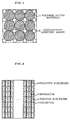
- Fig. 1 is a cross sectional view of an essential portion of an electrode for explaining a cell electrode production method according to a first embodiment of the present invention.
- power of polymer active material 1 and powder of a conductivity assisting agent 2 are mixed and thermally pressed and molded into a predetermined thickness of electrode.
- polyaniline polyaniline
- polypyrol polythiophen
- polyacetylene polyvinyl carbazole
- polytriphenylamine polypyridine
- polyopyrimidine polyquinoxaline
- polyphenylquinoxaline polyisothianaphten
- polypyridinezeal polythienylene
- polyparapffinylene polyfluran, polyacen, polyfuran, polyazulene, polyindol, polydiaminoantraquinon, and the like.
- the conductivity assisting agent 2 there can be exemplified acetylene black, Ketjen black, epitaxial carbon, graphite powder, aniline black, activated carbon powder and other conductive carbon powder, polyacrylonitirile, pitch, cellulose, phenol resin, or sintered carbon powder formed from palm shells, oxide powder of Ti, Sn, or In, metal powder such as stainless steel, Ni, Au, Ag, Ta, Nb, Cu, or Al. It should be noted these conductivity assisting agents may also be used in combination with the others.
- Example 1 the cell electrode production method according to the first embodiment of the present invention will be detailed through Example 1 and Example 2.
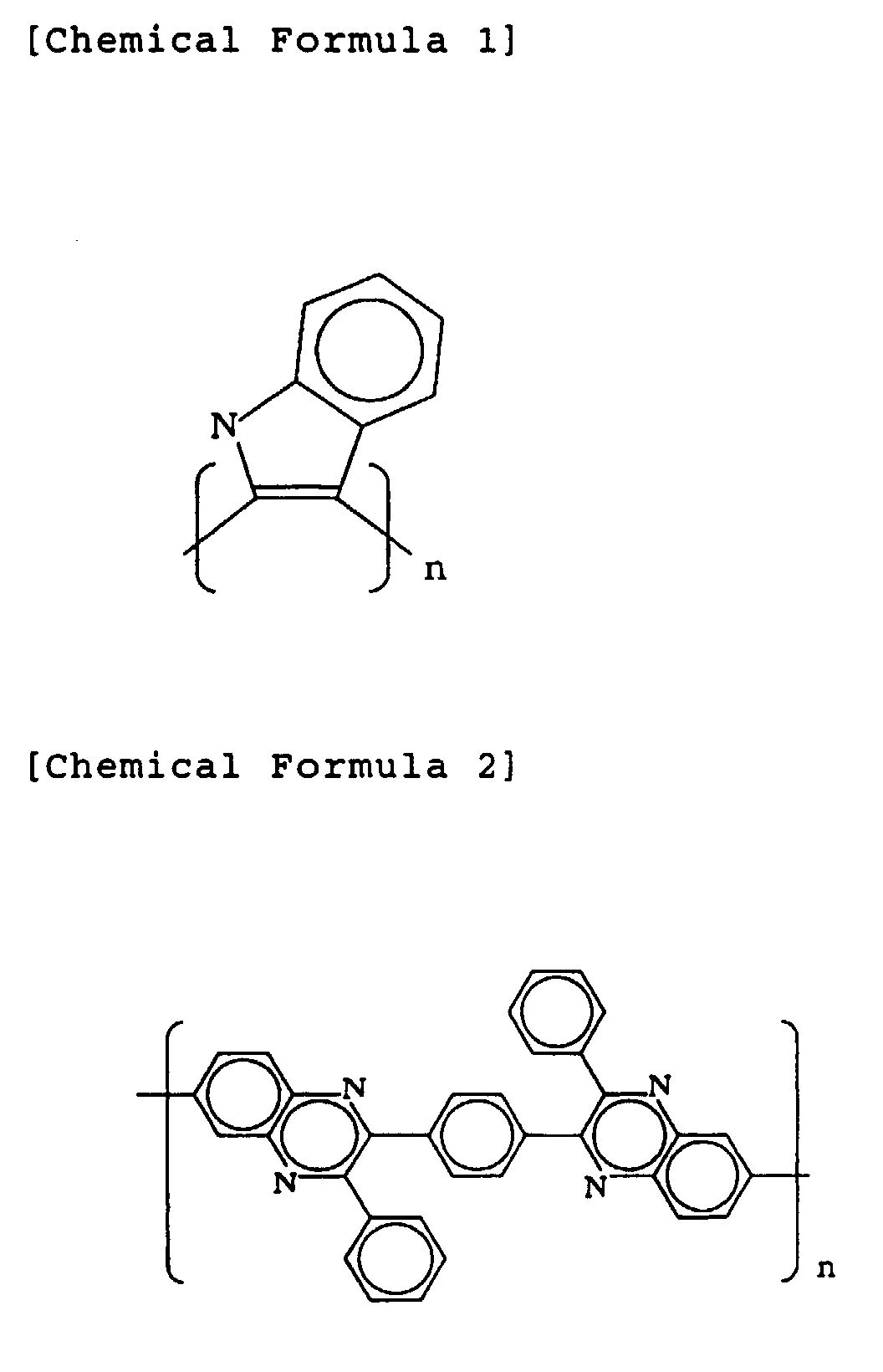
- the polymer active material exhibiting an electro-chemical oxidation-reduction reaction to be used as the electrode active material is polyindole expressed by Chemical Formula 1 (used for the positive electrode) and polyphenylquinoxaline expressed by Chemical Formula 2 (used for the negative electrode).
- polyindole and epitaxial carbon as the conductivity assisting agent were mixed with a mixing ratio of 90 : 10 by weight % and uniformly dispersed in an automatic mortar.
- the polyindole has an average particle diameter not greater than 10 micrometers and more preferably not greater than 5 micrometers, and the maximum particle diameter not greater than 100 micrometers and more preferably not greater than 30 micrometers.
- the dispersed powder mixture was put into a thermal press mold of stainless steel having an external size of 90 x 70 mm, an internal size of 70 x 50 mm, and depth of 10 mm, so that the powder is placed with a uniform thickness, and pressed with a pressure of 100 kg/cm 2 using a press plate having an external size of 70 x 50 mm.
- an electrode was molded.
- the molded electrode was subjected to a thermal treatment in the air at temperature of 25 degrees for 1 hour.
- Polyphenylguinoxaline as the polymer active material exhibiting an electro-chemical oxidation-reduction reaction was mixed with an epitaxial carbon as the conductivity assisting agent with a mixing ratio of 90 : 10 by weight % and the mixture was uniformly dispersed in an automatic mortar.
- the polyphenylquinoxaline used her has an average particle diameter not greater than 10 micrometers and more preferably, not greater than 5 micrometers, and the maximum particle diameter not greater than 100 micrometers and more preferably not greater than 30 micrometers.
- the dispersed powder was put into a thermal press mold of stainless steel having an external size of 90 x 70 mm, internal size of 70 x 50 mm, and depth of 10 mm, so that the powder is placed with a uniform thickness and then pressed with a pressure of 100 kg/cm 2 using a press plate having an external size of 70 x 50 mm.
- the pressed electrode was subjected to a thermal treatment in the air at temperature of 250 degrees C for 1 hour. It was possible to obtain a negative electrode having a uniform film thickness of 0.5 mm and density of 0.8 g/cm 3 .
- the positive and negative electrodes obtained are subjected to vacuum impregnation in 40 weight % of sulfuric acid aqueous solution.
- the positive and the negative electrodes arranged to oppose to each other via a separator (trace name: Cell Guard) having a thickness of 25 micrometers were layered on a collector made from a conductive rubber having a thickness of 100 micrometers.
- a separator trace name: Cell Guard
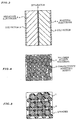
- Fig. 2 shows a configuration of the polymer cell thus obtained.
- symbol 3 denotes the collector, 4, the positive electrode, 5, the negative electrode, and 6, a porous separator for electrically separating the positive electrode from the negative electrode.
- the polymer cell was charged up to 1.2 V with a constant current 10 mA/cm 2 and then discharged with a constant current of 10 mA/cm 2 down to the capacitance of 0.8 V.
- the cell was evaluated by defining 20 mm for the electrode film thickness sum of the positive electrode and the negative electrode. Table 1 shows the results. It should be noted that Table 1 shows capacitance after a 10-cycle test. The capacitance obtained was 2.3 Wh and 27 Wh/l per cell volume.
- the thickness of the positive electrode and the thickness of the negative electrode were increased to 10 mm.
- the number of layers of the collector was reduced, so as to increase the capacitance per cell volume.
- a positive electrode and a negative electrode were prepared by using polyindole and polyphenylquinoxaline like in Example 1.
- the powder amount was adjusted so that the electrode after thermal press had a film thickness of 10 mm.
- FIG. 3 shows a configuration of the polymer cell.
- symbol 4a denotes a positive electrode
- 5a a negative electrode
- like symbols as in Fig. 2 denote like members.
- the total film thickness of the cell electrodes is 20 mm.
- This cell was charged up to 1.2 V with a constant current of 10 mA/cm 2 and then discharged down to 0.8 V with a constant current of 10 mA/cm 2 , so as to test the charge/discharge characteristics.
- the test results are shown in Table 1.
- the capacitance obtained was 2.3 Wh and 32.1 Wh per cell volume.
- the capacitance was increased by 1.2 as compared to Example 1.
- the conductivity assisting agent in this Example may be the same powder as in the aforementioned Example 1.
- the conductivity assisting agent may be coated by a polymer active material as follows.
- the polymer active material powder and the conductivity assisting agent powder are mixed with a solvent in which a polymer activator is solved and then dried and re-crushed.
- the conductivity assisting agent powder is dispersed in a monomer solution for chemical polymerization of the polymer active material and the polymerized material is crushed into powder.
- the conductivity assisting agent powder is dispersed in a monomer solution for electrolytic polymerization of the polymer active material to form an electrolytic polymerized film containing the conductivity assisting agent and this film is peeled and crushed into powder.
- the high molecular material having an adverse adhesion capability is adhered to a conductive inorganic material, so that it can be thermally pressed at a low temperature. This has an effect to prevent lowering of electro-chemical activeness of the electrode high molecular material by the thermal oxidization.
- Polyindole as the positive electrode active material was mixed with the epitaxial carbon as the conductivity assisting agent with a mixing ratio of 90 : 10 and the mixture was uniformly dispersed in an automatic mortar.
- the positive electrode powder dispersed was added by dimethylformamide (DMF) for swelling or ving and dispersed by a homoginizer at 15000 rpm for 15 minutes. After the dispersion, the mixture was dried in a vacuum drier under 10 Torr and 60 degrees C. After dried, the composite lump was crushed using an analytical mill at 20000 rpm for 3 minutes to obtain a powder.
- DMF dimethylformamide
- the powder was put into a thermal press mold of stainless steel having an external size of 90 x 70 mm, internal size of 70 x 50 mm, and depth of 10 mm, so that the powder is placed with a uniform thickness.
- the powder was pressed using a press plate of external size of 70 x 50 mm with a pressure of 100 kg/cm 2 .
- the pressed electrode was subjected to a thermal treatment in the air at 200 degrees C for 30 minutes to obtain a positive electrode.
- the electrode obtained had a film thickness of 10 mm and density of 0.9 g/cm 3 .
- polyphenylquinoxaline as the negative electrode active material was mixed with the epitaxial carbon as the conductivity assisting agent with a mixing ratio of 90 : 10 and the mixture was uniformly dispersed in an automatic mortar.
- the dispersed negative electrode powder was added by methacresol for swelling or solving and dispersed by using a homoginizer at 15000 rpm for 15 minutes. After the dispersion, the mixture was dried using a vacuum drier under 10 Torr and 10 degrees C. After dried, the composite lump was crushed by an analytical mill at 20000 rpm for 3 minutes.
- the crushed powder was the thermally pressed like the positive electrode to form a negative electrode having a uniform film thickness of 10 mm and density of 0.9 g/cc.
- the positive electrode and the negative electrode thus obtained were used to form a cell in the same way as Example 2.
- the polymer cell thus completed was charged up to 1.2 V with a constant current of 10 mA/cm 2 and then discharged down to 0.8 V with a constant current of 10 mA/cm 2 .
- the cell was evaluated by defining 20 mm for the total electrode film thickness of the positive electrode and the negative electrode. The evaluation results are shown in Table 1.
- the capacitance obtained was 2.8 Wh and 40.1 Wh/l per cell volume. Thus, the capacitance was increased by 1.5 as compared to Example 1.
- the thermal press of Example 3 was performed in an inert gas atmosphere.
- the thermal press in the inert gas atmosphere it was possible to suppress the oxidization reaction of the high molecular material (polymer active material) and suppress lowering of electro-chemical activeness of the high molecular material.
- the method of thermal pressing in an inert gas atmosphere can also be applied to the cell electrode production method of the aforementioned Example 1.
- the positive electrode and the negative electrode were prepared in the same way as Example 3 and the thermal press was performed in a nitrogen gas atmosphere.
- the cell was produced in the same way as Example 3. It was possible to obtain an electrode having a uniform film thickness of 10 mm and density of 0.9 g/cm 3 . By using the electrodes, a cell was prepared in the same way as Example 2.
- the polymer cell obtained was charged up to 1.2 V with a constant current of 10 mA/cm 2 and then discharged down to 0.8 V with a constant current of 10 mA/cm 2 to test charge/discharge characteristics.
- the test results are shown in Table 1. It was possible to obtain a capacitance of 3.1 Wh and 44.1 Wh/l per cell volume. The capacitance was increased by 1.6 as compared to Example 1.
- this example used 40 weight % sulfuric acid aqueous solution as the cell electrolyte liquid and polyindole and polyphenylquinoxaline as the high molecular materials.
- the present invention is not to be limited to this example.
- the thermal press of Example 4 was performed under an increased pressure.
- by increasing the pressure of the thermal press it was possible to improve the electrode density and increase the energy density.
- the positive electrode and the negative electrode were prepared in the same way as Example 4 and the thermal press was performed under a pressure of 200 kg/cm 2 . It was possible to obtain an electrode having a uniform film thickness of 10 mm and density of 1.1 g/cm 3 . By using the electrodes, a cell was prepared in the same way as Example 2.
- the polymer cell obtained was charged up to 1.2 V with a constant current of 10 mA/cm 2 and then discharged down to 0.8 V with a constant current of 10 mA/cm 2 to test charge/discharge characteristics.
- the test results are shown in Table 1. It was possible to obtain a capacitance greater than that of Example 3 and Example 4 and doubled as compared to Example 1: 3.8 Wh and 54 Wh/l per cell volume.
- this example used 40 weight % sulfuric acid aqueous solution as the cell electrolyte liquid and polyindole and polyphenylquinoxaline as the high molecular materials.
- the present invention is not to be limited to this example.
- the conductivity assisting agent 2 used was a conductive carbon powder such as acetylene black, Ketjen black, epitaxial carbon, graphite powder, aniline black, or activated carbon; polyacrylonitrile, pitch, cellulose, phenol resin, or sintered carbon powder obtained from palm shells; oxide fine powder containing Ti, Sn, or In; stailess steel, Ni, Au, Ag, Ta, Nb, Cu, Al, or other metal powder.
- the conductivity assisting agent may also be a metal foil, metal mesh, or metal fiber.
- the polymer active material powder is adhered onto the metal foil by a thermal press, so that the metal foil serves also as a collector.
- the metal mesh or metal fiber is used, like the case of metal foil, it is possible to form an electrode by adhering the polymer active material powder onto the surface of the metal mesh or metal fiber by the thermal press.
- Fig. 5 is a cross sectional view of cell electrode of a conventional technique.
- symbol 1 denotes a polymer active material, 2, a conductivity assisting agent, and 10, binder.
- the electrode has a configuration in which the polymer active material 1 is connected via the binder to the conductivity assisting agent 2.
- Polyindole as the positive electrode active material, epitaxial carbon as the conductivity assisting agent, and polyvinylidene fluoride as the binder resin were mixed with a mixing ratio of 85 : 10 : 5 by weight % and added by N-methylpyrrolidone to obtain a slurry.
- the mixture in the slurry state was dispersed by using a homoginizer at 15000 rpm for 15 minutes.
- the slurry was applied to a conductive rubber collector sheet using a doctor blade to form a film.
- the film was adjusted to be 500 micrometers after dried.
- the collector having the film was cut into a predetermined shape to obtain a positive electrode.
- Polyphenylquinoxaline as the negative electrode active material, epitaxial carbon as the conductivity assisting agent, and polyvinylidene fluoride as the binder resin were mixed with a mixing ratio of 85 : 10 : 5 by weight % and added by methacresole to obtain a slurry, which was dispersed using a homoginizer at 15000 rpm for 15 minutes.
- This slurry was applied onto a conductive rubber collector sheet using a doctor blade so as to form a film.
- the film was adjusted so as to be 500 micrometers after dried.
- the collector rubber having the film was cut into a predetermined shaped to obtain a negative electrode.
- the positive electrode and the negative electrode thus obtained had a film thickness of 0.5 mm and density of 0.35 g/cm 3 , which was less than half of the values of Example 1. Moreover, the electrode had a center portion lower than the end portion.
- the cell was produced in the same way as Example 1.
- the polymer cell thus completed was charged up to 1.2 V with a constant current of 10 mA/cm 2 and then discharged down to 0.8 V with a constant current of 10 mA/cm 2 to test the charge/discharge characteristics.
- the cell was evaluated by defining 20 mm for the total thickness of the electrode films of the positive electrode and the negative electrode.
- the capacitance obtained was 0.9 Wh and 11.2 Wh/l per cell volume, which was less than half of Example 1.
- Comparative Example 2 the electrode film thickness of Comparative Example 1 was increased to 10 mm.
- the positive electrode and the negative electrode were prepared in the same way as Comparative Example 1 and the film was formed so as to have a thickness of 10 mm. However, it was impossible to obtain an electrode having a thickness of 10 mm because of cracks and breakage in the positive electrode and the negative electrode, causing electrode peeling off.
- the active material in the negative and the positive electrodes was solved for film formation.
- Polyindole as the positive electrode active material and epitaxial carbon as the conductivity assisting agent were mixed with a mixing ratio of 90 : 10 : 5 by weight % and added by DMF to obtain a slurry.
- the mixture in the slurry state was dispersed by using a homoginizer at 15000 rpm for 15 minutes.
- the slurry was applied to a conductive rubber collector sheet using a doctor blade to form a film.
- the film was adjusted to be 500 micrometers after dried.
- the collector having the film was cut into a predetermined shape to obtain a positive electrode.
- Polyquinoxaline as the negative electrode active material and epitaxial carbon as the conductivity assisting agent were mixed with a mixing ratio of 90 : 10 by weight % and added by methacresole to obtain a slurry, which was dispersed using a homoginizer at 15000 rpm for 15 minutes.
- This slurry was applied onto a conductive rubber collector sheet using a doctor blade so as to form a film.
- the film was adjusted so as to be 500 micrometers after dried.
- the collector rubber having the film was cut into a predetermined shaped to obtain a negative electrode.
- the positive electrode and the negative electrode thus obtained had a film thickness of 0.5 mm and density of 0.4 g/cm 3 , which was half of the values of Example 1. Moreover, the electrode had a center portion lower than the end portion.
- the cell was produced in the same way as Example 1.
- the polymer cell thus completed was charged up to 1.2 V with a constant current of 10 mA/cm 2 and then discharged down to 0.8 V with a constant current of 10 mA/cm 2 to test the charge/discharge characteristics.
- the cell was evaluated by defining 20 mm for the total thickness of the electrode films of the positive electrode and the negative electrode.
- the capacitance obtained was 1.1 Wh and 13.5 Wh/l per cell volume.
- the capacitance was slightly increased as compared dto Comparative Example 1 but smaller as compared to Examples 1 to 5.
- Comparative example 4 was produced in the same way as Comparative example 3 except for that the electrode film thickness was 10 mm.
- the positive electrode and the negative electrode were prepared in the same way as Comparative example 3 but the film thickness was made 10 mm. However, cracks, breakage, and electrode peeling off were cased in the positive and the negative electrode and it was impossible to obtain an electrode of 10 mm thickness.
- Electrode Film Thickness (mm) Film Formation Electrode Density (g/cm 3 ) Electrode Capacitance (Wh/l) Capacitance Per Electrode 10 mm Thickness Example 1 0.5 ⁇ 0.8 32.4 27 Example 2 10 ⁇ 0.8 32.4 32.1 Example 3 10 ⁇ 0.9 40.5 40.1 Example 4 10 ⁇ 0.9 44.6 44.1 Example 5 10 ⁇ 1.1 54.5 54 Comparative Example 1 0.5 ⁇ 0.35 13.4 11.2 Comparative Example 2 10 X - - - Comparative Example 3 0.5 ⁇ 0.4 16.2 13.5 Comparative Example 4 10 X - - - 1)Collector Film Thickness : 0.1 mm 2)Film Formation ⁇ :No Crack or Pealing Off ⁇ :Crack and Pealing Off X:Film not Formed
- a mixture of a polymer active material powder exhibiting an oxidation-reduction reaction and a conductivity assisting powder, or a powder including a conductivity assisting material coated by polymer active material is thermally pressed and molded into a cell electrode, which has the following effects.
Landscapes
- Chemical & Material Sciences (AREA)
- Chemical Kinetics & Catalysis (AREA)
- Electrochemistry (AREA)
- General Chemical & Material Sciences (AREA)
- Engineering & Computer Science (AREA)
- Manufacturing & Machinery (AREA)
- Dispersion Chemistry (AREA)
- Materials Engineering (AREA)
- Battery Electrode And Active Subsutance (AREA)
Abstract
Description
| Electrode Film Thickness (mm) | Film Formation | Electrode Density (g/cm3) | Electrode Capacitance (Wh/l) | | |
| Example 1 | 0.5 | ○ | 0.8 | 32.4 | 27 |
| Example 2 | 10 | ○ | 0.8 | 32.4 | 32.1 |
| Example 3 | 10 | ○ | 0.9 | 40.5 | 40.1 |
| Example 4 | 10 | ○ | 0.9 | 44.6 | 44.1 |
| Example 5 | 10 | ○ | 1.1 | 54.5 | 54 |
| Comparative Example 1 | 0.5 | ○ | 0.35 | 13.4 | 11.2 |
| Comparative Example 2 | 10 | X | - | - | - |
| Comparative Example 3 | 0.5 | ▵ | 0.4 | 16.2 | 13.5 |
| Comparative Example 4 | 10 | X | - | - | - |
| 1)Collector Film Thickness : 0.1 mm 2)Film Formation ○:No Crack or Pealing Off ▵:Crack and Pealing Off X:Film not Formed |
Claims (10)
- A polymer secondary cell electrode production method comprising steps of:mixing a polymer active material powder exhibiting an electro-chemical oxidation-reduction reaction and a conductivity assisting agent powder; andmolding the mixture by thermal pressing to a predetermined thickness.
- A polymer secondary cell electrode production method comprising steps of:coating a conductivity assisting agent with a polymer active material exhibiting a electro-chemical oxidation-reduction reaction, to obtain a coated powder; andmolding the coated powder by a thermal pressing to a predetermined thickness.
- A method as claimed in Claim 1 or 2, wherein the polymer active material is selected from a group consisting of polyaniline, polypyrol, polythiophen, polyacetylene, polyvinyl carbazole, polytriphenylamine, polypyridine, polyopyrimidine, polyquinoxaline, polyphenylquinoxaline, polyisothianaphten, polypyridinezeal, polythienylene, polyparapffinylene, polyfluran, polyacen, polyfuran, polyazulene, polyindol, and polydiaminoantraquinon.
- A method as claimed in Claim 1 or 2, wherein the thermal pressing is performed at a temperature not lower than the glass transition point or the melting temperature of the polymer active material.
- A method as claimed in Claim 1 or 2, wherein the thermal pressing is performed in a nitrogen gas atmosphere.
- A method as claimed in Claim 2, wherein the step of coating the conductivity assisting agent with the polymer active material exhibiting an electro-chemical oxidation-reduction reaction includes steps of:mixing the polymer active material powder and the conductivity assisting agent powder with a solvent swelling or solving the polymer active material for predetermined period of time;drying in vacuum the mixture into a mixed solid lump of the polymer active material and the conductivity assisting material; andcrushing the mixed solid lump into powder of a predetermined particle diameter, so as to obtain powder of the conductivity assisting agent coated with the polymer active material.
- A method as claimed in Claim 2, wherein the step of coating the conductivity assisting agent with the polymer active material exhibiting an electro-chemical oxidation-reduction reaction includes steps of:dispersing the conductivity assisting agent powder in a solution containing monomer capable of chemical polymerization or electrolytic polymerization of the polymer active material;performing chemical polymerization or electrolytic polymerization of the monomer; anddrying the polymerized monomer into powder of a predetermined particle diameter, so as to obtain powder of the conductivity assisting agent coated with the polymer active material.
- A method as claimed in Claim 1 or 2 or 6 or 7, wherein the conductivity assisting agent powder is one or more than one in combination selected from a group consisting of acetylene black, Ketjen black, epitaxial carbon, graphite powder, aniline black, activated carbon powder an other conductive carbon powder, polyacrylonitirile, pitch, cellulose, phenol resin, or sintered carbon powder formed from palm shells, oxide powder of Ti, Sn, or In, metal powder such as stainless steel, Ni, Au, Ag, Ta, Nb, Cu and Al.
- A polymer secondary cell electrode production method comprising a step of attaching by thermal pressing a polymer active material powder exhibiting an electro-chemical oxidation-reduction reaction onto a metal foil, a metal mesh, or metal fiber made of or coated with a conductivity assisting agent, so as to be molded into a predetermined thickness.
- A method as claimed in Claim 9, wherein the metal foil, metal mesh, or metal fiber is selected from a group consisting of stainless steel, Ni, Au, Ag, Ta, Nb, Cu and Al.
Priority Applications (1)
| Application Number | Priority Date | Filing Date | Title |
|---|---|---|---|
| EP06006871A EP1699098A1 (en) | 1999-10-19 | 2000-10-17 | Polymer secondary cell electrode production method |
Applications Claiming Priority (2)
| Application Number | Priority Date | Filing Date | Title |
|---|---|---|---|
| JP29690399A JP2001118570A (en) | 1999-10-19 | 1999-10-19 | Method for manufacturing electrode for polymer secondary battery |
| JP29690399 | 1999-10-19 |
Related Child Applications (1)
| Application Number | Title | Priority Date | Filing Date |
|---|---|---|---|
| EP06006871A Division EP1699098A1 (en) | 1999-10-19 | 2000-10-17 | Polymer secondary cell electrode production method |
Publications (2)
| Publication Number | Publication Date |
|---|---|
| EP1094531A2 true EP1094531A2 (en) | 2001-04-25 |
| EP1094531A3 EP1094531A3 (en) | 2005-07-27 |
Family
ID=17839659
Family Applications (2)
| Application Number | Title | Priority Date | Filing Date |
|---|---|---|---|
| EP06006871A Withdrawn EP1699098A1 (en) | 1999-10-19 | 2000-10-17 | Polymer secondary cell electrode production method |
| EP00122609A Withdrawn EP1094531A3 (en) | 1999-10-19 | 2000-10-17 | Polymer secondary cell electrode production method |
Family Applications Before (1)
| Application Number | Title | Priority Date | Filing Date |
|---|---|---|---|
| EP06006871A Withdrawn EP1699098A1 (en) | 1999-10-19 | 2000-10-17 | Polymer secondary cell electrode production method |
Country Status (4)
| Country | Link |
|---|---|
| US (1) | US6641759B1 (en) |
| EP (2) | EP1699098A1 (en) |
| JP (1) | JP2001118570A (en) |
| KR (1) | KR100407917B1 (en) |
Cited By (1)
| Publication number | Priority date | Publication date | Assignee | Title |
|---|---|---|---|---|
| WO2014189385A3 (en) * | 2013-05-22 | 2015-01-29 | Multivector As | A method and a device for making a multi-components product material |
Families Citing this family (8)
| Publication number | Priority date | Publication date | Assignee | Title |
|---|---|---|---|---|
| JP3471304B2 (en) | 2000-09-18 | 2003-12-02 | Necトーキン株式会社 | Secondary battery and capacitor using indole compound |
| EP1388906A3 (en) * | 2002-08-05 | 2006-10-11 | Nec Tokin Corporation | Cell electrode and electrochemical cell therewith |
| CA2534243A1 (en) * | 2006-01-25 | 2007-07-25 | Hydro Quebec | Coated metal oxide particles with low dissolution rate, methods for their preparation and use in electrochemical systems |
| CN101595580B (en) * | 2007-01-25 | 2011-11-30 | 日本电气株式会社 | Polyradical compound-conductive material composite body, method for producing the same, and battery using the same |
| JP5196555B2 (en) * | 2008-08-06 | 2013-05-15 | 独立行政法人産業技術総合研究所 | Method for producing electrode material precursor and method for producing electrode material using the obtained electrode material precursor |
| FR3072214A1 (en) * | 2017-10-09 | 2019-04-12 | Hutchinson | ELECTRODE COMPOSITION AND PREPARATION METHOD FOR LITHIUM-ION BATTERY, ELECTRODE AND BATTERY INCORPORATING THE SAME |
| KR102744303B1 (en) | 2018-11-09 | 2024-12-18 | 삼성전자주식회사 | A polymer, composite positive active material comprising the same, and lithium secondary battery comprising the electrode including the positive active material |
| CN114932695B (en) * | 2022-05-18 | 2025-05-09 | 哈尔滨玻璃钢研究院有限公司 | A mold and forming method of interlayer reinforced composite material energy-absorbing circular tube |
Family Cites Families (21)
| Publication number | Priority date | Publication date | Assignee | Title |
|---|---|---|---|---|
| EP0076119B1 (en) * | 1981-09-25 | 1986-07-23 | Showa Denko Kabushiki Kaisha | Reinforced acetylene high polymers, process for preparing same and battery having same |
| DE3307954A1 (en) * | 1983-03-07 | 1984-09-13 | Basf Ag, 6700 Ludwigshafen | METHOD FOR THE PRODUCTION OF ELECTRICALLY CONDUCTIVE FINE-PARTICLE PYRROL POYLMERISATS |
| JPS61214418A (en) | 1985-03-19 | 1986-09-24 | 松下電器産業株式会社 | Manufacture of polarizing electrode body |
| US4915985A (en) * | 1985-08-05 | 1990-04-10 | Allied-Signal Inc. | Process for forming articles of filled intrinsically conductive polymers |
| JPS62157675A (en) * | 1985-12-28 | 1987-07-13 | Showa Denko Kk | secondary battery |
| US5266177A (en) * | 1986-03-07 | 1993-11-30 | Tanaka Kikinzoku Kogyo K.K. | Process for preparing reaction layer of gas permeable electrode |
| JPS63264865A (en) * | 1987-04-22 | 1988-11-01 | Shin Kobe Electric Mach Co Ltd | Manufacture of negative electrode for secondary battery |
| FR2616809B1 (en) * | 1987-06-19 | 1991-06-14 | Rhone Poulenc Chimie | ELECTROACTIVE MATERIAL BASED ON CONDUCTIVE FIBERS, ITS MANUFACTURE AND ITS USE FOR MAKING CATHODIC ELEMENTS |
| FI82702C (en) * | 1987-07-29 | 1991-04-10 | Neste Oy | Non-conductive plastic composites containing poly (3-alkylthiophene) |
| DE3809758A1 (en) * | 1988-03-23 | 1989-10-05 | Dietrich Dipl Chem Dr Schuster | ORGANIC ELECTRODE MATERIAL, METHOD FOR THE PRODUCTION AND USE THEREOF |
| US5032475A (en) * | 1989-09-18 | 1991-07-16 | Toshiba Battery Co. | Nickel-metal hydride secondary cell |
| FR2697261B1 (en) * | 1992-10-28 | 1995-01-06 | Centre Ntal Detudes Spatiales | Polyacetylene-lithium insertion compound, its use in an electric accumulator, and process for the preparation of insertion compounds of the lithium-conjugated polymer type. |
| US5451476A (en) * | 1992-11-23 | 1995-09-19 | The Trustees Of The University Of Pennsylvania | Cathode for a solid-state battery |
| JPH07130356A (en) | 1993-10-28 | 1995-05-19 | Ricoh Co Ltd | Secondary battery electrode and secondary battery using the electrode |
| JP3082557B2 (en) * | 1994-02-10 | 2000-08-28 | 松下電器産業株式会社 | Manufacturing method of non-aqueous electrolyte secondary battery |
| JPH0864200A (en) | 1994-08-23 | 1996-03-08 | Ricoh Co Ltd | Electrode for secondary battery and secondary battery having the electrode |
| US5698147A (en) * | 1996-05-24 | 1997-12-16 | W. R. Grace & Co.-Conn. | Fabrication methods for low impedance lithium polymer electrodes |
| US6010653A (en) * | 1997-03-19 | 2000-01-04 | Valence Technology, Inc. | Methods of fabricating electrodes for electrochemical cells |
| JP3168962B2 (en) * | 1997-11-04 | 2001-05-21 | 日本電気株式会社 | Battery |
| JP2974012B1 (en) * | 1998-07-10 | 1999-11-08 | 日本電気株式会社 | Polymer secondary battery and method of manufacturing the same |
| JP3348405B2 (en) * | 1999-07-22 | 2002-11-20 | エヌイーシートーキン株式会社 | Secondary battery and capacitor using indole polymer |
-
1999
- 1999-10-19 JP JP29690399A patent/JP2001118570A/en active Pending
-
2000
- 2000-09-22 US US09/668,944 patent/US6641759B1/en not_active Expired - Fee Related
- 2000-10-17 EP EP06006871A patent/EP1699098A1/en not_active Withdrawn
- 2000-10-17 EP EP00122609A patent/EP1094531A3/en not_active Withdrawn
- 2000-10-18 KR KR10-2000-0061159A patent/KR100407917B1/en not_active Expired - Fee Related
Cited By (2)
| Publication number | Priority date | Publication date | Assignee | Title |
|---|---|---|---|---|
| WO2014189385A3 (en) * | 2013-05-22 | 2015-01-29 | Multivector As | A method and a device for making a multi-components product material |
| US10159945B2 (en) | 2013-05-22 | 2018-12-25 | Waister As | Method and a device for making a multi-components product material |
Also Published As
| Publication number | Publication date |
|---|---|
| KR100407917B1 (en) | 2003-12-01 |
| KR20010040111A (en) | 2001-05-15 |
| EP1699098A1 (en) | 2006-09-06 |
| JP2001118570A (en) | 2001-04-27 |
| US6641759B1 (en) | 2003-11-04 |
| EP1094531A3 (en) | 2005-07-27 |
Similar Documents
| Publication | Publication Date | Title |
|---|---|---|
| KR100609862B1 (en) | Lithium Secondary Battery and Manufacturing Method Thereof | |
| US7758998B2 (en) | Lithium ion secondary battery | |
| KR101583120B1 (en) | Process for production of battery electrode | |
| US5604660A (en) | Electrochemical cell having solid polymer electrolyte and asymmetric inorganic electrodes | |
| US6558840B1 (en) | Electrode for use in a non-aqueous battery | |
| US9450232B2 (en) | Process for producing negative plate for lead storage battery, and lead storage battery | |
| JP3078800B1 (en) | Method for producing negative electrode for non-aqueous secondary battery | |
| CN117096255A (en) | Method for forming carbon-silicon composite material on current collector | |
| EP3550646B1 (en) | Undercoat layer for energy storage device, and undercoat foil for energy storage device electrode | |
| EP0848441B1 (en) | An electrochemical cell employing a fine carbon material additive | |
| US20020119371A1 (en) | Method of fabricating electrode foils and galvanic elements fabricated from the method | |
| EP0971433A1 (en) | Lithium secondary battery of flat type | |
| KR101357464B1 (en) | Secondary-battery current collector, secondary-battery cathode, secondary-battery anode, secondary battery and production method thereof | |
| US6641759B1 (en) | Polymer secondary cell electrode production method | |
| JP2001229914A (en) | Negative electrode and secondary battery | |
| EP1137081A1 (en) | Method for manufacturing electrode plates for battery | |
| JP4053657B2 (en) | Lithium secondary battery and manufacturing method thereof | |
| JP3878383B2 (en) | Manufacturing method of negative electrode | |
| KR20220132332A (en) | Composite separator and electrochemical device using same | |
| JPH09237623A (en) | Nonaqueous electrolyte secondary battery | |
| CN100492749C (en) | Method for producing separator/electrode assembly for electrochemical element | |
| JP3619711B2 (en) | Electrode member manufacturing method and battery manufacturing method | |
| EP0721230A1 (en) | Organic electrolyte cell | |
| KR20220132309A (en) | Composite separator and electrochemical device using same | |
| JP4132945B2 (en) | Nonaqueous electrolyte lithium ion battery and separator therefor |
Legal Events
| Date | Code | Title | Description |
|---|---|---|---|
| PUAI | Public reference made under article 153(3) epc to a published international application that has entered the european phase |
Free format text: ORIGINAL CODE: 0009012 |
|
| AK | Designated contracting states |
Kind code of ref document: A2 Designated state(s): AT BE CH CY DE DK ES FI FR GB GR IE IT LI LU MC NL PT SE |
|
| AX | Request for extension of the european patent |
Free format text: AL;LT;LV;MK;RO;SI |
|
| RAP1 | Party data changed (applicant data changed or rights of an application transferred) |
Owner name: NEC TOKIN CORPORATION |
|
| RIC1 | Information provided on ipc code assigned before grant |
Ipc: 7H 01M 4/02 B Ipc: 7H 01M 4/04 A |
|
| PUAL | Search report despatched |
Free format text: ORIGINAL CODE: 0009013 |
|
| AK | Designated contracting states |
Kind code of ref document: A3 Designated state(s): AT BE CH CY DE DK ES FI FR GB GR IE IT LI LU MC NL PT SE |
|
| AX | Request for extension of the european patent |
Extension state: AL LT LV MK RO SI |
|
| 17P | Request for examination filed |
Effective date: 20050721 |
|
| AKX | Designation fees paid |
Designated state(s): DE GB |
|
| STAA | Information on the status of an ep patent application or granted ep patent |
Free format text: STATUS: THE APPLICATION HAS BEEN WITHDRAWN |
|
| 18W | Application withdrawn |
Effective date: 20060601 |