EP1094055B1 - Novel vinylbenzene derivatives - Google Patents
Novel vinylbenzene derivatives Download PDFInfo
- Publication number
- EP1094055B1 EP1094055B1 EP99921168A EP99921168A EP1094055B1 EP 1094055 B1 EP1094055 B1 EP 1094055B1 EP 99921168 A EP99921168 A EP 99921168A EP 99921168 A EP99921168 A EP 99921168A EP 1094055 B1 EP1094055 B1 EP 1094055B1
- Authority
- EP
- European Patent Office
- Prior art keywords
- compound
- phenyl
- solution
- acid
- added
- Prior art date
- Legal status (The legal status is an assumption and is not a legal conclusion. Google has not performed a legal analysis and makes no representation as to the accuracy of the status listed.)
- Expired - Lifetime
Links
- PPBRXRYQALVLMV-UHFFFAOYSA-N Styrene Chemical class C=CC1=CC=CC=C1 PPBRXRYQALVLMV-UHFFFAOYSA-N 0.000 title description 2
- 150000001875 compounds Chemical class 0.000 claims abstract description 295
- 125000001997 phenyl group Chemical group [H]C1=C([H])C([H])=C(*)C([H])=C1[H] 0.000 claims abstract description 28
- 125000000217 alkyl group Chemical group 0.000 claims abstract description 21
- 125000003178 carboxy group Chemical group [H]OC(*)=O 0.000 claims abstract description 14
- 150000003839 salts Chemical class 0.000 claims abstract description 14
- 229910052736 halogen Inorganic materials 0.000 claims abstract description 13
- 150000002367 halogens Chemical class 0.000 claims abstract description 13
- 125000002887 hydroxy group Chemical group [H]O* 0.000 claims abstract description 8
- 150000002148 esters Chemical class 0.000 claims abstract description 7
- 125000000449 nitro group Chemical group [O-][N+](*)=O 0.000 claims abstract description 7
- 125000003545 alkoxy group Chemical group 0.000 claims abstract description 5
- 125000001476 phosphono group Chemical group [H]OP(*)(=O)O[H] 0.000 claims abstract description 5
- 239000001257 hydrogen Substances 0.000 claims description 21
- 229910052739 hydrogen Inorganic materials 0.000 claims description 21
- WBYWAXJHAXSJNI-VOTSOKGWSA-M .beta-Phenylacrylic acid Natural products [O-]C(=O)\C=C\C1=CC=CC=C1 WBYWAXJHAXSJNI-VOTSOKGWSA-M 0.000 claims description 13
- -1 4-biphenylyl Chemical group 0.000 claims description 11
- UFHFLCQGNIYNRP-UHFFFAOYSA-N Hydrogen Chemical compound [H][H] UFHFLCQGNIYNRP-UHFFFAOYSA-N 0.000 claims description 11
- 125000004432 carbon atom Chemical group C* 0.000 claims description 10
- 150000002431 hydrogen Chemical group 0.000 claims description 10
- 210000001742 aqueous humor Anatomy 0.000 claims description 9
- WBYWAXJHAXSJNI-SREVYHEPSA-N Cinnamic acid Chemical compound OC(=O)\C=C/C1=CC=CC=C1 WBYWAXJHAXSJNI-SREVYHEPSA-N 0.000 claims description 6
- 229930016911 cinnamic acid Natural products 0.000 claims description 6
- 235000013985 cinnamic acid Nutrition 0.000 claims description 6
- WBYWAXJHAXSJNI-UHFFFAOYSA-N methyl p-hydroxycinnamate Natural products OC(=O)C=CC1=CC=CC=C1 WBYWAXJHAXSJNI-UHFFFAOYSA-N 0.000 claims description 6
- 239000004480 active ingredient Substances 0.000 claims description 4
- TVKGZODXYCZNBD-UHFFFAOYSA-N 2-methyl-3-[4-(2-phenylprop-2-enoyl)phenyl]prop-2-enoic acid Chemical compound C1=CC(C=C(C)C(O)=O)=CC=C1C(=O)C(=C)C1=CC=CC=C1 TVKGZODXYCZNBD-UHFFFAOYSA-N 0.000 claims description 3
- KCQLGLQQAZLWTF-UHFFFAOYSA-N 3-[4-(2-phenylprop-2-enoyl)phenyl]prop-2-enoic acid Chemical compound C1=CC(C=CC(=O)O)=CC=C1C(=O)C(=C)C1=CC=CC=C1 KCQLGLQQAZLWTF-UHFFFAOYSA-N 0.000 claims description 3
- ZOQMRTCFTNVYRP-UHFFFAOYSA-N 3-[4-[2-(4-nitrophenyl)prop-2-enoyl]phenyl]prop-2-enoic acid Chemical compound C1=CC(C=CC(=O)O)=CC=C1C(=O)C(=C)C1=CC=C([N+]([O-])=O)C=C1 ZOQMRTCFTNVYRP-UHFFFAOYSA-N 0.000 claims description 3
- 125000003647 acryloyl group Chemical group O=C([*])C([H])=C([H])[H] 0.000 claims description 3
- 239000003795 chemical substances by application Substances 0.000 claims description 3
- 125000002496 methyl group Chemical group [H]C([H])([H])* 0.000 claims description 3
- 125000000636 p-nitrophenyl group Chemical group [H]C1=C([H])C(=C([H])C([H])=C1*)[N+]([O-])=O 0.000 claims description 3
- XDPRURLYNCIVTD-UHFFFAOYSA-N 3-[4-(2-phenylprop-2-enoyl)phenyl]but-2-enoic acid Chemical compound C1=CC(C(=CC(O)=O)C)=CC=C1C(=O)C(=C)C1=CC=CC=C1 XDPRURLYNCIVTD-UHFFFAOYSA-N 0.000 claims description 2
- 150000007942 carboxylates Chemical class 0.000 claims description 2
- 125000000538 pentafluorophenyl group Chemical group FC1=C(F)C(F)=C(*)C(F)=C1F 0.000 claims description 2
- 239000008194 pharmaceutical composition Substances 0.000 claims description 2
- 125000004429 atom Chemical group 0.000 claims 1
- 239000003814 drug Substances 0.000 abstract description 28
- 208000010412 Glaucoma Diseases 0.000 abstract description 8
- 229940124597 therapeutic agent Drugs 0.000 abstract description 5
- 239000000243 solution Substances 0.000 description 92
- WYURNTSHIVDZCO-UHFFFAOYSA-N Tetrahydrofuran Chemical compound C1CCOC1 WYURNTSHIVDZCO-UHFFFAOYSA-N 0.000 description 47
- 239000000203 mixture Substances 0.000 description 42
- XLYOFNOQVPJJNP-UHFFFAOYSA-N water Chemical compound O XLYOFNOQVPJJNP-UHFFFAOYSA-N 0.000 description 42
- XEKOWRVHYACXOJ-UHFFFAOYSA-N Ethyl acetate Chemical compound CCOC(C)=O XEKOWRVHYACXOJ-UHFFFAOYSA-N 0.000 description 39
- 230000004410 intraocular pressure Effects 0.000 description 36
- 210000004027 cell Anatomy 0.000 description 35
- 230000000694 effects Effects 0.000 description 34
- 239000011541 reaction mixture Substances 0.000 description 34
- 238000012360 testing method Methods 0.000 description 33
- RTZKZFJDLAIYFH-UHFFFAOYSA-N Diethyl ether Chemical compound CCOCC RTZKZFJDLAIYFH-UHFFFAOYSA-N 0.000 description 32
- VEXZGXHMUGYJMC-UHFFFAOYSA-N Hydrochloric acid Chemical compound Cl VEXZGXHMUGYJMC-UHFFFAOYSA-N 0.000 description 28
- 238000001816 cooling Methods 0.000 description 27
- 238000000034 method Methods 0.000 description 27
- 239000012044 organic layer Substances 0.000 description 25
- HPALAKNZSZLMCH-UHFFFAOYSA-M sodium;chloride;hydrate Chemical class O.[Na+].[Cl-] HPALAKNZSZLMCH-UHFFFAOYSA-M 0.000 description 25
- KRKNYBCHXYNGOX-UHFFFAOYSA-N citric acid Chemical compound OC(=O)CC(O)(C(O)=O)CC(O)=O KRKNYBCHXYNGOX-UHFFFAOYSA-N 0.000 description 24
- 229940079593 drug Drugs 0.000 description 23
- YLQBMQCUIZJEEH-UHFFFAOYSA-N tetrahydrofuran Natural products C=1C=COC=1 YLQBMQCUIZJEEH-UHFFFAOYSA-N 0.000 description 22
- 210000001585 trabecular meshwork Anatomy 0.000 description 22
- CSNNHWWHGAXBCP-UHFFFAOYSA-L Magnesium sulfate Chemical compound [Mg+2].[O-][S+2]([O-])([O-])[O-] CSNNHWWHGAXBCP-UHFFFAOYSA-L 0.000 description 20
- IAZDPXIOMUYVGZ-UHFFFAOYSA-N Dimethylsulphoxide Chemical compound CS(C)=O IAZDPXIOMUYVGZ-UHFFFAOYSA-N 0.000 description 18
- 239000012299 nitrogen atmosphere Substances 0.000 description 17
- CURLTUGMZLYLDI-UHFFFAOYSA-N Carbon dioxide Chemical compound O=C=O CURLTUGMZLYLDI-UHFFFAOYSA-N 0.000 description 16
- HEMHJVSKTPXQMS-UHFFFAOYSA-M Sodium hydroxide Chemical compound [OH-].[Na+] HEMHJVSKTPXQMS-UHFFFAOYSA-M 0.000 description 15
- 239000013078 crystal Substances 0.000 description 15
- 238000010898 silica gel chromatography Methods 0.000 description 15
- 150000001732 carboxylic acid derivatives Chemical class 0.000 description 14
- YMWUJEATGCHHMB-UHFFFAOYSA-N Dichloromethane Chemical compound ClCCl YMWUJEATGCHHMB-UHFFFAOYSA-N 0.000 description 12
- ZMXDDKWLCZADIW-UHFFFAOYSA-N N,N-Dimethylformamide Chemical compound CN(C)C=O ZMXDDKWLCZADIW-UHFFFAOYSA-N 0.000 description 12
- 235000011089 carbon dioxide Nutrition 0.000 description 12
- AVOLMBLBETYQHX-UHFFFAOYSA-N etacrynic acid Chemical compound CCC(=C)C(=O)C1=CC=C(OCC(O)=O)C(Cl)=C1Cl AVOLMBLBETYQHX-UHFFFAOYSA-N 0.000 description 12
- 229960003199 etacrynic acid Drugs 0.000 description 12
- 239000002244 precipitate Substances 0.000 description 11
- 238000002360 preparation method Methods 0.000 description 11
- LFQSCWFLJHTTHZ-UHFFFAOYSA-N Ethanol Chemical compound CCO LFQSCWFLJHTTHZ-UHFFFAOYSA-N 0.000 description 10
- FYSNRJHAOHDILO-UHFFFAOYSA-N thionyl chloride Chemical compound ClS(Cl)=O FYSNRJHAOHDILO-UHFFFAOYSA-N 0.000 description 10
- ZMANZCXQSJIPKH-UHFFFAOYSA-N Triethylamine Chemical compound CCN(CC)CC ZMANZCXQSJIPKH-UHFFFAOYSA-N 0.000 description 9
- 210000001508 eye Anatomy 0.000 description 9
- 239000003981 vehicle Substances 0.000 description 9
- 239000006196 drop Substances 0.000 description 8
- 230000004660 morphological change Effects 0.000 description 8
- NGNBDVOYPDDBFK-UHFFFAOYSA-N 2-[2,4-di(pentan-2-yl)phenoxy]acetyl chloride Chemical compound CCCC(C)C1=CC=C(OCC(Cl)=O)C(C(C)CCC)=C1 NGNBDVOYPDDBFK-UHFFFAOYSA-N 0.000 description 7
- 241000282567 Macaca fascicularis Species 0.000 description 7
- PMZURENOXWZQFD-UHFFFAOYSA-L Sodium Sulfate Chemical compound [Na+].[Na+].[O-]S([O-])(=O)=O PMZURENOXWZQFD-UHFFFAOYSA-L 0.000 description 7
- 229940114081 cinnamate Drugs 0.000 description 7
- QTBSBXVTEAMEQO-UHFFFAOYSA-N Acetic acid Chemical compound CC(O)=O QTBSBXVTEAMEQO-UHFFFAOYSA-N 0.000 description 6
- HEDRZPFGACZZDS-UHFFFAOYSA-N Chloroform Chemical compound ClC(Cl)Cl HEDRZPFGACZZDS-UHFFFAOYSA-N 0.000 description 6
- PEDCQBHIVMGVHV-UHFFFAOYSA-N Glycerine Chemical compound OCC(O)CO PEDCQBHIVMGVHV-UHFFFAOYSA-N 0.000 description 6
- SJRJJKPEHAURKC-UHFFFAOYSA-N N-Methylmorpholine Chemical compound CN1CCOCC1 SJRJJKPEHAURKC-UHFFFAOYSA-N 0.000 description 6
- 238000010171 animal model Methods 0.000 description 6
- 210000002159 anterior chamber Anatomy 0.000 description 6
- 239000003889 eye drop Substances 0.000 description 6
- 229940012356 eye drops Drugs 0.000 description 6
- RYHBNJHYFVUHQT-UHFFFAOYSA-N 1,4-Dioxane Chemical compound C1COCCO1 RYHBNJHYFVUHQT-UHFFFAOYSA-N 0.000 description 5
- 241000282693 Cercopithecidae Species 0.000 description 5
- 125000001495 ethyl group Chemical group [H]C([H])([H])C([H])([H])* 0.000 description 5
- 238000002474 experimental method Methods 0.000 description 5
- 239000002609 medium Substances 0.000 description 5
- 238000003756 stirring Methods 0.000 description 5
- 238000010189 synthetic method Methods 0.000 description 5
- XTHFKEDIFFGKHM-UHFFFAOYSA-N Dimethoxyethane Chemical compound COCCOC XTHFKEDIFFGKHM-UHFFFAOYSA-N 0.000 description 4
- MZRVEZGGRBJDDB-UHFFFAOYSA-N N-Butyllithium Chemical compound [Li]CCCC MZRVEZGGRBJDDB-UHFFFAOYSA-N 0.000 description 4
- ABLZXFCXXLZCGV-UHFFFAOYSA-N Phosphorous acid Chemical compound OP(O)=O ABLZXFCXXLZCGV-UHFFFAOYSA-N 0.000 description 4
- UIIMBOGNXHQVGW-UHFFFAOYSA-M Sodium bicarbonate Chemical compound [Na+].OC([O-])=O UIIMBOGNXHQVGW-UHFFFAOYSA-M 0.000 description 4
- FAPWRFPIFSIZLT-UHFFFAOYSA-M Sodium chloride Chemical compound [Na+].[Cl-] FAPWRFPIFSIZLT-UHFFFAOYSA-M 0.000 description 4
- 150000008065 acid anhydrides Chemical class 0.000 description 4
- 125000002915 carbonyl group Chemical group [*:2]C([*:1])=O 0.000 description 4
- 239000012141 concentrate Substances 0.000 description 4
- 238000009472 formulation Methods 0.000 description 4
- 238000010438 heat treatment Methods 0.000 description 4
- 238000010191 image analysis Methods 0.000 description 4
- HQKMJHAJHXVSDF-UHFFFAOYSA-L magnesium stearate Chemical compound [Mg+2].CCCCCCCCCCCCCCCCCC([O-])=O.CCCCCCCCCCCCCCCCCC([O-])=O HQKMJHAJHXVSDF-UHFFFAOYSA-L 0.000 description 4
- 238000005259 measurement Methods 0.000 description 4
- 239000012046 mixed solvent Substances 0.000 description 4
- BWHMMNNQKKPAPP-UHFFFAOYSA-L potassium carbonate Chemical compound [K+].[K+].[O-]C([O-])=O BWHMMNNQKKPAPP-UHFFFAOYSA-L 0.000 description 4
- 0 *CC(c1ccc(C=C(*)*)cc1)O Chemical compound *CC(c1ccc(C=C(*)*)cc1)O 0.000 description 3
- SFTKNJDGRMJALZ-UHFFFAOYSA-N 4-(3-ethoxy-3-oxoprop-1-enyl)benzoic acid Chemical compound CCOC(=O)C=CC1=CC=C(C(O)=O)C=C1 SFTKNJDGRMJALZ-UHFFFAOYSA-N 0.000 description 3
- GOUHYARYYWKXHS-UHFFFAOYSA-N 4-formylbenzoic acid Chemical compound OC(=O)C1=CC=C(C=O)C=C1 GOUHYARYYWKXHS-UHFFFAOYSA-N 0.000 description 3
- 241000283690 Bos taurus Species 0.000 description 3
- OYPRJOBELJOOCE-UHFFFAOYSA-N Calcium Chemical compound [Ca] OYPRJOBELJOOCE-UHFFFAOYSA-N 0.000 description 3
- 229930040373 Paraformaldehyde Natural products 0.000 description 3
- YXFVVABEGXRONW-UHFFFAOYSA-N Toluene Chemical compound CC1=CC=CC=C1 YXFVVABEGXRONW-UHFFFAOYSA-N 0.000 description 3
- 125000002777 acetyl group Chemical group [H]C([H])([H])C(*)=O 0.000 description 3
- 239000002585 base Substances 0.000 description 3
- UORVGPXVDQYIDP-BJUDXGSMSA-N borane Chemical class [10BH3] UORVGPXVDQYIDP-BJUDXGSMSA-N 0.000 description 3
- 239000011575 calcium Substances 0.000 description 3
- 229910052791 calcium Inorganic materials 0.000 description 3
- 208000037265 diseases, disorders, signs and symptoms Diseases 0.000 description 3
- FEVRNWIDSQLRLD-UHFFFAOYSA-N ethyl 3-[4-(2-phenylacetyl)phenyl]prop-2-enoate Chemical compound C1=CC(C=CC(=O)OCC)=CC=C1C(=O)CC1=CC=CC=C1 FEVRNWIDSQLRLD-UHFFFAOYSA-N 0.000 description 3
- 238000001914 filtration Methods 0.000 description 3
- 235000011187 glycerol Nutrition 0.000 description 3
- VLKZOEOYAKHREP-UHFFFAOYSA-N n-Hexane Chemical compound CCCCCC VLKZOEOYAKHREP-UHFFFAOYSA-N 0.000 description 3
- 229920002866 paraformaldehyde Polymers 0.000 description 3
- 230000000144 pharmacologic effect Effects 0.000 description 3
- LCPDWSOZIOUXRV-UHFFFAOYSA-N phenoxyacetic acid Chemical class OC(=O)COC1=CC=CC=C1 LCPDWSOZIOUXRV-UHFFFAOYSA-N 0.000 description 3
- 125000006239 protecting group Chemical group 0.000 description 3
- 125000000999 tert-butyl group Chemical group [H]C([H])([H])C(*)(C([H])([H])[H])C([H])([H])[H] 0.000 description 3
- 125000003396 thiol group Chemical group [H]S* 0.000 description 3
- GQHTUMJGOHRCHB-UHFFFAOYSA-N 2,3,4,6,7,8,9,10-octahydropyrimido[1,2-a]azepine Chemical compound C1CCCCN2CCCN=C21 GQHTUMJGOHRCHB-UHFFFAOYSA-N 0.000 description 2
- YOETUEMZNOLGDB-UHFFFAOYSA-N 2-methylpropyl carbonochloridate Chemical compound CC(C)COC(Cl)=O YOETUEMZNOLGDB-UHFFFAOYSA-N 0.000 description 2
- UPXRTVAIJMUAQR-UHFFFAOYSA-N 4-(9h-fluoren-9-ylmethoxycarbonylamino)-1-[(2-methylpropan-2-yl)oxycarbonyl]pyrrolidine-2-carboxylic acid Chemical compound C1C(C(O)=O)N(C(=O)OC(C)(C)C)CC1NC(=O)OCC1C2=CC=CC=C2C2=CC=CC=C21 UPXRTVAIJMUAQR-UHFFFAOYSA-N 0.000 description 2
- VHYFNPMBLIVWCW-UHFFFAOYSA-N 4-Dimethylaminopyridine Chemical compound CN(C)C1=CC=NC=C1 VHYFNPMBLIVWCW-UHFFFAOYSA-N 0.000 description 2
- FPSGKXYHJQKBKN-MDZDMXLPSA-N 4-[(e)-2-diethoxyphosphorylethenyl]benzoic acid Chemical compound CCOP(=O)(OCC)\C=C\C1=CC=C(C(O)=O)C=C1 FPSGKXYHJQKBKN-MDZDMXLPSA-N 0.000 description 2
- BZUPIVMMIUZGDI-RMKNXTFCSA-N 4-[(e)-3-[(2-methylpropan-2-yl)oxy]-3-oxoprop-1-enyl]benzoic acid Chemical compound CC(C)(C)OC(=O)\C=C\C1=CC=C(C(O)=O)C=C1 BZUPIVMMIUZGDI-RMKNXTFCSA-N 0.000 description 2
- IKHGUXGNUITLKF-UHFFFAOYSA-N Acetaldehyde Chemical compound CC=O IKHGUXGNUITLKF-UHFFFAOYSA-N 0.000 description 2
- NLXLAEXVIDQMFP-UHFFFAOYSA-N Ammonia chloride Chemical compound [NH4+].[Cl-] NLXLAEXVIDQMFP-UHFFFAOYSA-N 0.000 description 2
- APKFDSVGJQXUKY-KKGHZKTASA-N Amphotericin-B Natural products O[C@H]1[C@@H](N)[C@H](O)[C@@H](C)O[C@H]1O[C@H]1C=CC=CC=CC=CC=CC=CC=C[C@H](C)[C@@H](O)[C@@H](C)[C@H](C)OC(=O)C[C@H](O)C[C@H](O)CC[C@@H](O)[C@H](O)C[C@H](O)C[C@](O)(C[C@H](O)[C@H]2C(O)=O)O[C@H]2C1 APKFDSVGJQXUKY-KKGHZKTASA-N 0.000 description 2
- XKRFYHLGVUSROY-UHFFFAOYSA-N Argon Chemical compound [Ar] XKRFYHLGVUSROY-UHFFFAOYSA-N 0.000 description 2
- 229920002134 Carboxymethyl cellulose Polymers 0.000 description 2
- 229910021595 Copper(I) iodide Inorganic materials 0.000 description 2
- CEAZRRDELHUEMR-URQXQFDESA-N Gentamicin Chemical compound O1[C@H](C(C)NC)CC[C@@H](N)[C@H]1O[C@H]1[C@H](O)[C@@H](O[C@@H]2[C@@H]([C@@H](NC)[C@@](C)(O)CO2)O)[C@H](N)C[C@@H]1N CEAZRRDELHUEMR-URQXQFDESA-N 0.000 description 2
- 229930182566 Gentamicin Natural products 0.000 description 2
- 239000007818 Grignard reagent Substances 0.000 description 2
- 229920002153 Hydroxypropyl cellulose Polymers 0.000 description 2
- VQTUBCCKSQIDNK-UHFFFAOYSA-N Isobutene Chemical compound CC(C)=C VQTUBCCKSQIDNK-UHFFFAOYSA-N 0.000 description 2
- GUBGYTABKSRVRQ-QKKXKWKRSA-N Lactose Natural products OC[C@H]1O[C@@H](O[C@H]2[C@H](O)[C@@H](O)C(O)O[C@@H]2CO)[C@H](O)[C@@H](O)[C@H]1O GUBGYTABKSRVRQ-QKKXKWKRSA-N 0.000 description 2
- 239000012359 Methanesulfonyl chloride Substances 0.000 description 2
- PCLIMKBDDGJMGD-UHFFFAOYSA-N N-bromosuccinimide Chemical compound BrN1C(=O)CCC1=O PCLIMKBDDGJMGD-UHFFFAOYSA-N 0.000 description 2
- 229910019142 PO4 Inorganic materials 0.000 description 2
- NQRYJNQNLNOLGT-UHFFFAOYSA-N Piperidine Chemical compound C1CCNCC1 NQRYJNQNLNOLGT-UHFFFAOYSA-N 0.000 description 2
- JUJWROOIHBZHMG-UHFFFAOYSA-N Pyridine Chemical compound C1=CC=NC=C1 JUJWROOIHBZHMG-UHFFFAOYSA-N 0.000 description 2
- KEAYESYHFKHZAL-UHFFFAOYSA-N Sodium Chemical compound [Na] KEAYESYHFKHZAL-UHFFFAOYSA-N 0.000 description 2
- DKGAVHZHDRPRBM-UHFFFAOYSA-N Tert-Butanol Chemical compound CC(C)(C)O DKGAVHZHDRPRBM-UHFFFAOYSA-N 0.000 description 2
- CVDWLCDHKHXQMY-VAWYXSNFSA-N [(e)-2-[4-(2-phenylprop-2-enoyl)phenyl]ethenyl]phosphonic acid Chemical compound C1=CC(/C=C/P(O)(=O)O)=CC=C1C(=O)C(=C)C1=CC=CC=C1 CVDWLCDHKHXQMY-VAWYXSNFSA-N 0.000 description 2
- 239000002253 acid Substances 0.000 description 2
- 125000005907 alkyl ester group Chemical group 0.000 description 2
- APKFDSVGJQXUKY-INPOYWNPSA-N amphotericin B Chemical compound O[C@H]1[C@@H](N)[C@H](O)[C@@H](C)O[C@H]1O[C@H]1/C=C/C=C/C=C/C=C/C=C/C=C/C=C/[C@H](C)[C@@H](O)[C@@H](C)[C@H](C)OC(=O)C[C@H](O)C[C@H](O)CC[C@@H](O)[C@H](O)C[C@H](O)C[C@](O)(C[C@H](O)[C@H]2C(O)=O)O[C@H]2C1 APKFDSVGJQXUKY-INPOYWNPSA-N 0.000 description 2
- 229960003942 amphotericin b Drugs 0.000 description 2
- 239000012298 atmosphere Substances 0.000 description 2
- 230000015572 biosynthetic process Effects 0.000 description 2
- 239000002775 capsule Substances 0.000 description 2
- 239000001569 carbon dioxide Substances 0.000 description 2
- 229910002092 carbon dioxide Inorganic materials 0.000 description 2
- 239000001768 carboxy methyl cellulose Substances 0.000 description 2
- 235000010948 carboxy methyl cellulose Nutrition 0.000 description 2
- 239000008112 carboxymethyl-cellulose Substances 0.000 description 2
- 238000006243 chemical reaction Methods 0.000 description 2
- 230000000052 comparative effect Effects 0.000 description 2
- 229940125904 compound 1 Drugs 0.000 description 2
- 238000007796 conventional method Methods 0.000 description 2
- LSXDOTMGLUJQCM-UHFFFAOYSA-M copper(i) iodide Chemical compound I[Cu] LSXDOTMGLUJQCM-UHFFFAOYSA-M 0.000 description 2
- IROCKIXOCYAUJR-LCYFTJDESA-N diethyl (z)-2-(4-formylphenyl)but-2-enedioate Chemical compound CCOC(=O)\C=C(/C(=O)OCC)C1=CC=C(C=O)C=C1 IROCKIXOCYAUJR-LCYFTJDESA-N 0.000 description 2
- BNYUNSXLQDFUCK-RAXLEYEMSA-N diethyl (z)-2-(4-methylphenyl)but-2-enedioate Chemical compound CCOC(=O)\C=C(/C(=O)OCC)C1=CC=C(C)C=C1 BNYUNSXLQDFUCK-RAXLEYEMSA-N 0.000 description 2
- ZUGQJDYKGCAXCF-CYVLTUHYSA-N diethyl (z)-2-[4-(1-hydroxy-2-phenylethyl)phenyl]but-2-enedioate Chemical compound C1=CC(C(/C(=O)OCC)=C/C(=O)OCC)=CC=C1C(O)CC1=CC=CC=C1 ZUGQJDYKGCAXCF-CYVLTUHYSA-N 0.000 description 2
- DONWAGBOYKILDD-CYVLTUHYSA-N diethyl (z)-2-[4-(2-phenylacetyl)phenyl]but-2-enedioate Chemical compound C1=CC(C(/C(=O)OCC)=C/C(=O)OCC)=CC=C1C(=O)CC1=CC=CC=C1 DONWAGBOYKILDD-CYVLTUHYSA-N 0.000 description 2
- XHFGWHUWQXTGAT-UHFFFAOYSA-N dimethylamine hydrochloride Natural products CNC(C)C XHFGWHUWQXTGAT-UHFFFAOYSA-N 0.000 description 2
- IQDGSYLLQPDQDV-UHFFFAOYSA-N dimethylazanium;chloride Chemical compound Cl.CNC IQDGSYLLQPDQDV-UHFFFAOYSA-N 0.000 description 2
- 208000035475 disorder Diseases 0.000 description 2
- 239000002552 dosage form Substances 0.000 description 2
- STQGCFNNGLNAHB-OUKQBFOZSA-N ethoxy-[(e)-2-[4-(2-phenylacetyl)phenyl]ethenyl]phosphinic acid Chemical compound C1=CC(/C=C/P(O)(=O)OCC)=CC=C1C(=O)CC1=CC=CC=C1 STQGCFNNGLNAHB-OUKQBFOZSA-N 0.000 description 2
- ATJHMUBDJHPCQY-BUHFOSPRSA-N ethoxy-[(e)-2-[4-(2-phenylprop-2-enoyl)phenyl]ethenyl]phosphinic acid Chemical compound C1=CC(/C=C/P(O)(=O)OCC)=CC=C1C(=O)C(=C)C1=CC=CC=C1 ATJHMUBDJHPCQY-BUHFOSPRSA-N 0.000 description 2
- ZGHJACPCSQNDGB-UHFFFAOYSA-N ethyl 2-(4-methylphenyl)-2-oxoacetate Chemical compound CCOC(=O)C(=O)C1=CC=C(C)C=C1 ZGHJACPCSQNDGB-UHFFFAOYSA-N 0.000 description 2
- QJTZYVVKIASHOY-UHFFFAOYSA-N ethyl 3-[4-(3-hydroxy-2-phenylbutanoyl)phenyl]prop-2-enoate Chemical compound C1=CC(C=CC(=O)OCC)=CC=C1C(=O)C(C(C)O)C1=CC=CC=C1 QJTZYVVKIASHOY-UHFFFAOYSA-N 0.000 description 2
- BDGUAOXCKSCBBF-UHFFFAOYSA-N ethyl 3-[4-(3-methylsulfonyloxy-2-phenylbutanoyl)phenyl]prop-2-enoate Chemical compound C1=CC(C=CC(=O)OCC)=CC=C1C(=O)C(C(C)OS(C)(=O)=O)C1=CC=CC=C1 BDGUAOXCKSCBBF-UHFFFAOYSA-N 0.000 description 2
- 239000007789 gas Substances 0.000 description 2
- 229960002518 gentamicin Drugs 0.000 description 2
- 239000008187 granular material Substances 0.000 description 2
- 150000004795 grignard reagents Chemical class 0.000 description 2
- IXCSERBJSXMMFS-UHFFFAOYSA-N hydrogen chloride Substances Cl.Cl IXCSERBJSXMMFS-UHFFFAOYSA-N 0.000 description 2
- 229910000041 hydrogen chloride Inorganic materials 0.000 description 2
- 230000007062 hydrolysis Effects 0.000 description 2
- 238000006460 hydrolysis reaction Methods 0.000 description 2
- 239000001863 hydroxypropyl cellulose Substances 0.000 description 2
- 235000010977 hydroxypropyl cellulose Nutrition 0.000 description 2
- 229960004184 ketamine hydrochloride Drugs 0.000 description 2
- 239000008101 lactose Substances 0.000 description 2
- 239000003589 local anesthetic agent Substances 0.000 description 2
- 235000019359 magnesium stearate Nutrition 0.000 description 2
- SCEZYJKGDJPHQO-UHFFFAOYSA-M magnesium;methanidylbenzene;chloride Chemical compound [Mg+2].[Cl-].[CH2-]C1=CC=CC=C1 SCEZYJKGDJPHQO-UHFFFAOYSA-M 0.000 description 2
- 125000005905 mesyloxy group Chemical group 0.000 description 2
- QARBMVPHQWIHKH-UHFFFAOYSA-N methanesulfonyl chloride Chemical compound CS(Cl)(=O)=O QARBMVPHQWIHKH-UHFFFAOYSA-N 0.000 description 2
- HWWLGTBDARZGMA-ZHACJKMWSA-N methyl 4-[(e)-2-diethoxyphosphorylethenyl]benzoate Chemical compound CCOP(=O)(OCC)\C=C\C1=CC=C(C(=O)OC)C=C1 HWWLGTBDARZGMA-ZHACJKMWSA-N 0.000 description 2
- FEIOASZZURHTHB-UHFFFAOYSA-N methyl 4-formylbenzoate Chemical compound COC(=O)C1=CC=C(C=O)C=C1 FEIOASZZURHTHB-UHFFFAOYSA-N 0.000 description 2
- KJIFKLIQANRMOU-UHFFFAOYSA-N oxidanium;4-methylbenzenesulfonate Chemical compound O.CC1=CC=C(S(O)(=O)=O)C=C1 KJIFKLIQANRMOU-UHFFFAOYSA-N 0.000 description 2
- PRGUDWLMFLCODA-UHFFFAOYSA-N oxybuprocaine hydrochloride Chemical compound [Cl-].CCCCOC1=CC(C(=O)OCC[NH+](CC)CC)=CC=C1N PRGUDWLMFLCODA-UHFFFAOYSA-N 0.000 description 2
- SEVSMVUOKAMPDO-UHFFFAOYSA-N para-Acetoxybenzaldehyde Natural products CC(=O)OC1=CC=C(C=O)C=C1 SEVSMVUOKAMPDO-UHFFFAOYSA-N 0.000 description 2
- NBIIXXVUZAFLBC-UHFFFAOYSA-K phosphate Chemical compound [O-]P([O-])([O-])=O NBIIXXVUZAFLBC-UHFFFAOYSA-K 0.000 description 2
- 239000010452 phosphate Substances 0.000 description 2
- 239000002504 physiological saline solution Substances 0.000 description 2
- 239000000244 polyoxyethylene sorbitan monooleate Substances 0.000 description 2
- 235000010482 polyoxyethylene sorbitan monooleate Nutrition 0.000 description 2
- 229920000053 polysorbate 80 Polymers 0.000 description 2
- 229910000027 potassium carbonate Inorganic materials 0.000 description 2
- 239000000376 reactant Substances 0.000 description 2
- SQGYOTSLMSWVJD-UHFFFAOYSA-N silver(1+) nitrate Chemical compound [Ag+].[O-]N(=O)=O SQGYOTSLMSWVJD-UHFFFAOYSA-N 0.000 description 2
- 235000017557 sodium bicarbonate Nutrition 0.000 description 2
- 229910000030 sodium bicarbonate Inorganic materials 0.000 description 2
- 239000011780 sodium chloride Substances 0.000 description 2
- 239000012312 sodium hydride Substances 0.000 description 2
- 229910000104 sodium hydride Inorganic materials 0.000 description 2
- 230000001954 sterilising effect Effects 0.000 description 2
- 125000003011 styrenyl group Chemical group [H]\C(*)=C(/[H])C1=C([H])C([H])=C([H])C([H])=C1[H] 0.000 description 2
- 125000001424 substituent group Chemical group 0.000 description 2
- QAOWNCQODCNURD-UHFFFAOYSA-N sulfuric acid Substances OS(O)(=O)=O QAOWNCQODCNURD-UHFFFAOYSA-N 0.000 description 2
- 238000003786 synthesis reaction Methods 0.000 description 2
- 239000003826 tablet Substances 0.000 description 2
- CJDBHWUJTSAKCB-UHFFFAOYSA-N tert-butyl 2-(2,3,4,5,6-pentafluorophenyl)acetate Chemical compound CC(C)(C)OC(=O)CC1=C(F)C(F)=C(F)C(F)=C1F CJDBHWUJTSAKCB-UHFFFAOYSA-N 0.000 description 2
- DKOWKAJYSFAWIZ-UHFFFAOYSA-N tert-butyl 4-(4-ethoxy-4-oxobut-2-en-2-yl)benzoate Chemical compound CCOC(=O)C=C(C)C1=CC=C(C(=O)OC(C)(C)C)C=C1 DKOWKAJYSFAWIZ-UHFFFAOYSA-N 0.000 description 2
- QXQXBZLXIAUIBG-UHFFFAOYSA-N tert-butyl 4-acetylbenzoate Chemical compound CC(=O)C1=CC=C(C(=O)OC(C)(C)C)C=C1 QXQXBZLXIAUIBG-UHFFFAOYSA-N 0.000 description 2
- VZGDMQKNWNREIO-UHFFFAOYSA-N tetrachloromethane Chemical compound ClC(Cl)(Cl)Cl VZGDMQKNWNREIO-UHFFFAOYSA-N 0.000 description 2
- GGUBFICZYGKNTD-UHFFFAOYSA-N triethyl phosphonoacetate Chemical compound CCOC(=O)CP(=O)(OCC)OCC GGUBFICZYGKNTD-UHFFFAOYSA-N 0.000 description 2
- 238000005303 weighing Methods 0.000 description 2
- UWGWQGQPCBDJGT-QPJJXVBHSA-N (e)-3-(4-acetylphenyl)prop-2-enoic acid Chemical compound CC(=O)C1=CC=C(\C=C\C(O)=O)C=C1 UWGWQGQPCBDJGT-QPJJXVBHSA-N 0.000 description 1
- HHTHXCRIDONWOF-PTNGSMBKSA-N (z)-2-[4-(2-phenylacetyl)phenyl]but-2-enedioic acid Chemical compound C1=CC(C(/C(O)=O)=C/C(=O)O)=CC=C1C(=O)CC1=CC=CC=C1 HHTHXCRIDONWOF-PTNGSMBKSA-N 0.000 description 1
- PXLLFVDDYFBLBP-WJDWOHSUSA-N (z)-2-[4-(2-phenylprop-2-enoyl)phenyl]but-2-enedioic acid Chemical compound C1=CC(C(/C(O)=O)=C/C(=O)O)=CC=C1C(=O)C(=C)C1=CC=CC=C1 PXLLFVDDYFBLBP-WJDWOHSUSA-N 0.000 description 1
- LMDZBCPBFSXMTL-UHFFFAOYSA-N 1-Ethyl-3-(3-dimethylaminopropyl)carbodiimide Substances CCN=C=NCCCN(C)C LMDZBCPBFSXMTL-UHFFFAOYSA-N 0.000 description 1
- OOSZCNKVJAVHJI-UHFFFAOYSA-N 1-[(4-fluorophenyl)methyl]piperazine Chemical compound C1=CC(F)=CC=C1CN1CCNCC1 OOSZCNKVJAVHJI-UHFFFAOYSA-N 0.000 description 1
- STJWVOQLJPNAQL-UHFFFAOYSA-N 1-[diethoxyphosphorylmethyl(ethoxy)phosphoryl]oxyethane Chemical compound CCOP(=O)(OCC)CP(=O)(OCC)OCC STJWVOQLJPNAQL-UHFFFAOYSA-N 0.000 description 1
- IGKCQDUYZULGBM-UHFFFAOYSA-N 2,2,2-trifluoroethyl 4-methylbenzenesulfonate Chemical compound CC1=CC=C(S(=O)(=O)OCC(F)(F)F)C=C1 IGKCQDUYZULGBM-UHFFFAOYSA-N 0.000 description 1
- LGCODSNZJOVMHV-UHFFFAOYSA-N 2-(2,3,4,5,6-pentafluorophenyl)acetic acid Chemical compound OC(=O)CC1=C(F)C(F)=C(F)C(F)=C1F LGCODSNZJOVMHV-UHFFFAOYSA-N 0.000 description 1
- OZAIFHULBGXAKX-UHFFFAOYSA-N 2-(2-cyanopropan-2-yldiazenyl)-2-methylpropanenitrile Chemical compound N#CC(C)(C)N=NC(C)(C)C#N OZAIFHULBGXAKX-UHFFFAOYSA-N 0.000 description 1
- AMOYMEBHYUTMKJ-UHFFFAOYSA-N 2-(2-phenylethoxy)ethylbenzene Chemical compound C=1C=CC=CC=1CCOCCC1=CC=CC=C1 AMOYMEBHYUTMKJ-UHFFFAOYSA-N 0.000 description 1
- XNWFRZJHXBZDAG-UHFFFAOYSA-N 2-METHOXYETHANOL Chemical compound COCCO XNWFRZJHXBZDAG-UHFFFAOYSA-N 0.000 description 1
- XUNUQBHUSSEYCD-UHFFFAOYSA-N 2-methyl-3-[4-(2-phenylacetyl)phenyl]prop-2-enoic acid Chemical compound C1=CC(C=C(C)C(O)=O)=CC=C1C(=O)CC1=CC=CC=C1 XUNUQBHUSSEYCD-UHFFFAOYSA-N 0.000 description 1
- LITFWXDGDVOFME-UHFFFAOYSA-N 3-(4-prop-2-enoylphenyl)prop-2-enoic acid Chemical compound OC(=O)C=CC1=CC=C(C(=O)C=C)C=C1 LITFWXDGDVOFME-UHFFFAOYSA-N 0.000 description 1
- XLSSLIFYWBFOCW-UHFFFAOYSA-N 3-(4-propanoylphenyl)prop-2-enoic acid Chemical compound CCC(=O)C1=CC=C(C=CC(O)=O)C=C1 XLSSLIFYWBFOCW-UHFFFAOYSA-N 0.000 description 1
- FPQQSJJWHUJYPU-UHFFFAOYSA-N 3-(dimethylamino)propyliminomethylidene-ethylazanium;chloride Chemical compound Cl.CCN=C=NCCCN(C)C FPQQSJJWHUJYPU-UHFFFAOYSA-N 0.000 description 1
- MQVTUDRSQJJVGT-UHFFFAOYSA-N 3-[3-methyl-4-(2-phenylprop-2-enoyl)phenyl]prop-2-enoic acid Chemical compound CC1=CC(C=CC(O)=O)=CC=C1C(=O)C(=C)C1=CC=CC=C1 MQVTUDRSQJJVGT-UHFFFAOYSA-N 0.000 description 1
- AKCVHHLKFYTUCT-UHFFFAOYSA-N 3-[4-(2-methylidenebutanoyl)phenyl]prop-2-enoic acid Chemical compound CCC(=C)C(=O)C1=CC=C(C=CC(O)=O)C=C1 AKCVHHLKFYTUCT-UHFFFAOYSA-N 0.000 description 1
- LSIGJVDZMWICFH-UHFFFAOYSA-N 3-[4-(2-methylprop-2-enoyl)phenyl]prop-2-enoic acid Chemical compound CC(=C)C(=O)C1=CC=C(C=CC(O)=O)C=C1 LSIGJVDZMWICFH-UHFFFAOYSA-N 0.000 description 1
- TZEYKBSPXPVGFU-UHFFFAOYSA-N 3-[4-(2-phenylacetyl)phenyl]but-2-enoic acid Chemical compound C1=CC(C(=CC(O)=O)C)=CC=C1C(=O)CC1=CC=CC=C1 TZEYKBSPXPVGFU-UHFFFAOYSA-N 0.000 description 1
- NNXUZOWQQYHJRT-UHFFFAOYSA-N 3-[4-(2-phenylacetyl)phenyl]prop-2-enoic acid Chemical compound C1=CC(C=CC(=O)O)=CC=C1C(=O)CC1=CC=CC=C1 NNXUZOWQQYHJRT-UHFFFAOYSA-N 0.000 description 1
- OHSAHHBVMTZDEQ-UHFFFAOYSA-N 3-[4-(3,3-difluoro-2-phenylprop-2-enoyl)phenyl]prop-2-enoic acid Chemical compound C1=CC(C=CC(=O)O)=CC=C1C(=O)C(=C(F)F)C1=CC=CC=C1 OHSAHHBVMTZDEQ-UHFFFAOYSA-N 0.000 description 1
- ATWFOILZFAXOTC-UHFFFAOYSA-N 3-[4-(3-methyl-2-methylidenebutanoyl)phenyl]prop-2-enoic acid Chemical compound CC(C)C(=C)C(=O)C1=CC=C(C=CC(O)=O)C=C1 ATWFOILZFAXOTC-UHFFFAOYSA-N 0.000 description 1
- JPGAPEQMHKIZAH-UHFFFAOYSA-N 3-[4-(3-methylbutanoyl)phenyl]prop-2-enoic acid Chemical compound CC(C)CC(=O)C1=CC=C(C=CC(O)=O)C=C1 JPGAPEQMHKIZAH-UHFFFAOYSA-N 0.000 description 1
- VAWNGPJAGLRKJG-UHFFFAOYSA-N 3-[4-[2-(2,3,4,5,6-pentafluorophenyl)acetyl]phenyl]prop-2-enoic acid Chemical compound C1=CC(C=CC(=O)O)=CC=C1C(=O)CC1=C(F)C(F)=C(F)C(F)=C1F VAWNGPJAGLRKJG-UHFFFAOYSA-N 0.000 description 1
- LWCZNXRGTQVPCJ-UHFFFAOYSA-N 3-[4-[2-(4-chlorophenyl)acetyl]phenyl]prop-2-enoic acid Chemical compound C1=CC(C=CC(=O)O)=CC=C1C(=O)CC1=CC=C(Cl)C=C1 LWCZNXRGTQVPCJ-UHFFFAOYSA-N 0.000 description 1
- LJXJBTLEDPDJMP-UHFFFAOYSA-N 3-[4-[2-(4-chlorophenyl)prop-2-enoyl]phenyl]prop-2-enoic acid Chemical compound C1=CC(C=CC(=O)O)=CC=C1C(=O)C(=C)C1=CC=C(Cl)C=C1 LJXJBTLEDPDJMP-UHFFFAOYSA-N 0.000 description 1
- MKEMWEXSPWTCCC-UHFFFAOYSA-N 3-[4-[2-(4-fluorophenyl)acetyl]phenyl]prop-2-enoic acid Chemical compound C1=CC(C=CC(=O)O)=CC=C1C(=O)CC1=CC=C(F)C=C1 MKEMWEXSPWTCCC-UHFFFAOYSA-N 0.000 description 1
- IMQVTBIJRLZLHB-UHFFFAOYSA-N 3-[4-[2-(4-fluorophenyl)prop-2-enoyl]phenyl]prop-2-enoic acid Chemical compound C1=CC(C=CC(=O)O)=CC=C1C(=O)C(=C)C1=CC=C(F)C=C1 IMQVTBIJRLZLHB-UHFFFAOYSA-N 0.000 description 1
- OYXFPXVXOLBJKD-UHFFFAOYSA-N 3-[4-[2-(4-methylphenyl)acetyl]phenyl]prop-2-enoic acid Chemical compound C1=CC(C)=CC=C1CC(=O)C1=CC=C(C=CC(O)=O)C=C1 OYXFPXVXOLBJKD-UHFFFAOYSA-N 0.000 description 1
- KDLZAJHGQMVGSG-UHFFFAOYSA-N 3-[4-[2-(4-methylphenyl)prop-2-enoyl]phenyl]prop-2-enoic acid Chemical compound C1=CC(C)=CC=C1C(=C)C(=O)C1=CC=C(C=CC(O)=O)C=C1 KDLZAJHGQMVGSG-UHFFFAOYSA-N 0.000 description 1
- HOSMBDQSKRIBEF-UHFFFAOYSA-N 3-[4-[2-(4-phenylphenyl)acetyl]phenyl]prop-2-enoic acid Chemical compound C1=CC(C=CC(=O)O)=CC=C1C(=O)CC1=CC=C(C=2C=CC=CC=2)C=C1 HOSMBDQSKRIBEF-UHFFFAOYSA-N 0.000 description 1
- NXBLKVXHAOTGEA-UHFFFAOYSA-N 3-[4-[2-(4-phenylphenyl)prop-2-enoyl]phenyl]prop-2-enoic acid Chemical compound C1=CC(C=CC(=O)O)=CC=C1C(=O)C(=C)C1=CC=C(C=2C=CC=CC=2)C=C1 NXBLKVXHAOTGEA-UHFFFAOYSA-N 0.000 description 1
- NETDOUBUHNEYKP-UHFFFAOYSA-N 4-(3-ethoxy-2-methyl-3-oxoprop-1-enyl)benzoic acid Chemical compound CCOC(=O)C(C)=CC1=CC=C(C(O)=O)C=C1 NETDOUBUHNEYKP-UHFFFAOYSA-N 0.000 description 1
- NTZPQWBCSREBSO-UHFFFAOYSA-N 4-(4-ethoxy-4-oxobut-2-en-2-yl)benzoic acid Chemical compound CCOC(=O)C=C(C)C1=CC=C(C(O)=O)C=C1 NTZPQWBCSREBSO-UHFFFAOYSA-N 0.000 description 1
- QBHDSQZASIBAAI-UHFFFAOYSA-N 4-acetylbenzoic acid Chemical compound CC(=O)C1=CC=C(C(O)=O)C=C1 QBHDSQZASIBAAI-UHFFFAOYSA-N 0.000 description 1
- FJKROLUGYXJWQN-UHFFFAOYSA-N 4-hydroxybenzoic acid Chemical compound OC(=O)C1=CC=C(O)C=C1 FJKROLUGYXJWQN-UHFFFAOYSA-N 0.000 description 1
- ZCYVEMRRCGMTRW-UHFFFAOYSA-N 7553-56-2 Chemical compound [I] ZCYVEMRRCGMTRW-UHFFFAOYSA-N 0.000 description 1
- 108091003079 Bovine Serum Albumin Proteins 0.000 description 1
- WKBOTKDWSSQWDR-UHFFFAOYSA-N Bromine atom Chemical compound [Br] WKBOTKDWSSQWDR-UHFFFAOYSA-N 0.000 description 1
- VMLZXCGUDMBOQZ-CSKARUKUSA-N CCOC(/C=C(\C)/C(C(C)C1)=CC=C1C(O)=O)=O Chemical compound CCOC(/C=C(\C)/C(C(C)C1)=CC=C1C(O)=O)=O VMLZXCGUDMBOQZ-CSKARUKUSA-N 0.000 description 1
- JOZPHTFJLKPLJE-DHZHZOJOSA-N CCOC(/C=C/c(cc1)ccc1C(C(C(OC(C)(C)C)=O)c(c(F)c(c(F)c1F)F)c1F)=O)=O Chemical compound CCOC(/C=C/c(cc1)ccc1C(C(C(OC(C)(C)C)=O)c(c(F)c(c(F)c1F)F)c1F)=O)=O JOZPHTFJLKPLJE-DHZHZOJOSA-N 0.000 description 1
- ZAMOUSCENKQFHK-UHFFFAOYSA-N Chlorine atom Chemical compound [Cl] ZAMOUSCENKQFHK-UHFFFAOYSA-N 0.000 description 1
- 229920002261 Corn starch Polymers 0.000 description 1
- ZAFNJMIOTHYJRJ-UHFFFAOYSA-N Diisopropyl ether Chemical compound CC(C)OC(C)C ZAFNJMIOTHYJRJ-UHFFFAOYSA-N 0.000 description 1
- 239000006144 Dulbecco’s modified Eagle's medium Substances 0.000 description 1
- KCXVZYZYPLLWCC-UHFFFAOYSA-N EDTA Chemical compound OC(=O)CN(CC(O)=O)CCN(CC(O)=O)CC(O)=O KCXVZYZYPLLWCC-UHFFFAOYSA-N 0.000 description 1
- ZGTMUACCHSMWAC-UHFFFAOYSA-L EDTA disodium salt (anhydrous) Chemical compound [Na+].[Na+].OC(=O)CN(CC([O-])=O)CCN(CC(O)=O)CC([O-])=O ZGTMUACCHSMWAC-UHFFFAOYSA-L 0.000 description 1
- LYCAIKOWRPUZTN-UHFFFAOYSA-N Ethylene glycol Chemical compound OCCO LYCAIKOWRPUZTN-UHFFFAOYSA-N 0.000 description 1
- PXGOKWXKJXAPGV-UHFFFAOYSA-N Fluorine Chemical compound FF PXGOKWXKJXAPGV-UHFFFAOYSA-N 0.000 description 1
- 108010010803 Gelatin Proteins 0.000 description 1
- DGAQECJNVWCQMB-PUAWFVPOSA-M Ilexoside XXIX Chemical compound C[C@@H]1CC[C@@]2(CC[C@@]3(C(=CC[C@H]4[C@]3(CC[C@@H]5[C@@]4(CC[C@@H](C5(C)C)OS(=O)(=O)[O-])C)C)[C@@H]2[C@]1(C)O)C)C(=O)O[C@H]6[C@@H]([C@H]([C@@H]([C@H](O6)CO)O)O)O.[Na+] DGAQECJNVWCQMB-PUAWFVPOSA-M 0.000 description 1
- 238000006683 Mannich reaction Methods 0.000 description 1
- 241001465754 Metazoa Species 0.000 description 1
- HSHXDCVZWHOWCS-UHFFFAOYSA-N N'-hexadecylthiophene-2-carbohydrazide Chemical compound CCCCCCCCCCCCCCCCNNC(=O)c1cccs1 HSHXDCVZWHOWCS-UHFFFAOYSA-N 0.000 description 1
- VAWNGPJAGLRKJG-ZZXKWVIFSA-N OC(/C=C/c(cc1)ccc1C(Cc(c(F)c(c(F)c1F)F)c1F)=O)=O Chemical compound OC(/C=C/c(cc1)ccc1C(Cc(c(F)c(c(F)c1F)F)c1F)=O)=O VAWNGPJAGLRKJG-ZZXKWVIFSA-N 0.000 description 1
- 229920003171 Poly (ethylene oxide) Polymers 0.000 description 1
- 229920002701 Polyoxyl 40 Stearate Polymers 0.000 description 1
- ZLMJMSJWJFRBEC-UHFFFAOYSA-N Potassium Chemical compound [K] ZLMJMSJWJFRBEC-UHFFFAOYSA-N 0.000 description 1
- VYPSYNLAJGMNEJ-UHFFFAOYSA-N Silicium dioxide Chemical compound O=[Si]=O VYPSYNLAJGMNEJ-UHFFFAOYSA-N 0.000 description 1
- VMHLLURERBWHNL-UHFFFAOYSA-M Sodium acetate Chemical compound [Na+].CC([O-])=O VMHLLURERBWHNL-UHFFFAOYSA-M 0.000 description 1
- 229920002472 Starch Polymers 0.000 description 1
- 102000004142 Trypsin Human genes 0.000 description 1
- 108090000631 Trypsin Proteins 0.000 description 1
- 150000001299 aldehydes Chemical class 0.000 description 1
- 229910052783 alkali metal Inorganic materials 0.000 description 1
- 150000001340 alkali metals Chemical class 0.000 description 1
- 229910052784 alkaline earth metal Inorganic materials 0.000 description 1
- 150000001342 alkaline earth metals Chemical class 0.000 description 1
- 235000019270 ammonium chloride Nutrition 0.000 description 1
- 229910052786 argon Inorganic materials 0.000 description 1
- 239000007640 basal medium Substances 0.000 description 1
- 229960000686 benzalkonium chloride Drugs 0.000 description 1
- AGEZXYOZHKGVCM-UHFFFAOYSA-N benzyl bromide Chemical compound BrCC1=CC=CC=C1 AGEZXYOZHKGVCM-UHFFFAOYSA-N 0.000 description 1
- CADWTSSKOVRVJC-UHFFFAOYSA-N benzyl(dimethyl)azanium;chloride Chemical compound [Cl-].C[NH+](C)CC1=CC=CC=C1 CADWTSSKOVRVJC-UHFFFAOYSA-N 0.000 description 1
- 239000011230 binding agent Substances 0.000 description 1
- 238000009530 blood pressure measurement Methods 0.000 description 1
- GDTBXPJZTBHREO-UHFFFAOYSA-N bromine Substances BrBr GDTBXPJZTBHREO-UHFFFAOYSA-N 0.000 description 1
- 229910052794 bromium Inorganic materials 0.000 description 1
- IYYIVELXUANFED-UHFFFAOYSA-N bromo(trimethyl)silane Chemical compound C[Si](C)(C)Br IYYIVELXUANFED-UHFFFAOYSA-N 0.000 description 1
- 239000000872 buffer Substances 0.000 description 1
- 210000005252 bulbus oculi Anatomy 0.000 description 1
- 125000000484 butyl group Chemical group [H]C([*])([H])C([H])([H])C([H])([H])C([H])([H])[H] 0.000 description 1
- 150000001728 carbonyl compounds Chemical class 0.000 description 1
- 125000002843 carboxylic acid group Chemical group 0.000 description 1
- 239000004359 castor oil Substances 0.000 description 1
- 235000019438 castor oil Nutrition 0.000 description 1
- 238000004113 cell culture Methods 0.000 description 1
- 239000001913 cellulose Substances 0.000 description 1
- 229920002678 cellulose Polymers 0.000 description 1
- 239000000460 chlorine Substances 0.000 description 1
- 229910052801 chlorine Inorganic materials 0.000 description 1
- ZPEIMTDSQAKGNT-UHFFFAOYSA-N chlorpromazine Chemical compound C1=C(Cl)C=C2N(CCCN(C)C)C3=CC=CC=C3SC2=C1 ZPEIMTDSQAKGNT-UHFFFAOYSA-N 0.000 description 1
- 229960001076 chlorpromazine Drugs 0.000 description 1
- 239000011248 coating agent Substances 0.000 description 1
- 230000001427 coherent effect Effects 0.000 description 1
- 239000008120 corn starch Substances 0.000 description 1
- 229940099112 cornstarch Drugs 0.000 description 1
- 238000011161 development Methods 0.000 description 1
- YNHIGQDRGKUECZ-UHFFFAOYSA-N dichloropalladium;triphenylphosphanium Chemical compound Cl[Pd]Cl.C1=CC=CC=C1[PH+](C=1C=CC=CC=1)C1=CC=CC=C1.C1=CC=CC=C1[PH+](C=1C=CC=CC=1)C1=CC=CC=C1 YNHIGQDRGKUECZ-UHFFFAOYSA-N 0.000 description 1
- OAIZPUZHWLFOJB-XFXZXTDPSA-N diethyl (z)-2-[4-(dibromomethyl)phenyl]but-2-enedioate Chemical compound CCOC(=O)\C=C(/C(=O)OCC)C1=CC=C(C(Br)Br)C=C1 OAIZPUZHWLFOJB-XFXZXTDPSA-N 0.000 description 1
- 125000004177 diethyl group Chemical group [H]C([H])([H])C([H])([H])* 0.000 description 1
- WYACBZDAHNBPPB-UHFFFAOYSA-N diethyl oxalate Chemical compound CCOC(=O)C(=O)OCC WYACBZDAHNBPPB-UHFFFAOYSA-N 0.000 description 1
- 239000003085 diluting agent Substances 0.000 description 1
- 201000010099 disease Diseases 0.000 description 1
- 238000003379 elimination reaction Methods 0.000 description 1
- ZENGWHBUYJFBQT-UHFFFAOYSA-N ethyl 3-(4-acetylphenyl)prop-2-enoate Chemical compound CCOC(=O)C=CC1=CC=C(C(C)=O)C=C1 ZENGWHBUYJFBQT-UHFFFAOYSA-N 0.000 description 1
- UHGOOCIJRUHTIE-UHFFFAOYSA-N ethyl 3-(4-propanoylphenyl)prop-2-enoate Chemical compound CCOC(=O)C=CC1=CC=C(C(=O)CC)C=C1 UHGOOCIJRUHTIE-UHFFFAOYSA-N 0.000 description 1
- GNGKJDBQDCGVDJ-UHFFFAOYSA-N ethyl 3-[4-(3-methylbutanoyl)phenyl]prop-2-enoate Chemical compound CCOC(=O)C=CC1=CC=C(C(=O)CC(C)C)C=C1 GNGKJDBQDCGVDJ-UHFFFAOYSA-N 0.000 description 1
- 125000004494 ethyl ester group Chemical group 0.000 description 1
- 230000001747 exhibiting effect Effects 0.000 description 1
- 239000012091 fetal bovine serum Substances 0.000 description 1
- 239000000706 filtrate Substances 0.000 description 1
- 229910052731 fluorine Inorganic materials 0.000 description 1
- 239000011737 fluorine Substances 0.000 description 1
- 239000008273 gelatin Substances 0.000 description 1
- 229920000159 gelatin Polymers 0.000 description 1
- 235000019322 gelatine Nutrition 0.000 description 1
- 235000011852 gelatine desserts Nutrition 0.000 description 1
- ZEMPKEQAKRGZGQ-XOQCFJPHSA-N glycerol triricinoleate Natural products CCCCCC[C@@H](O)CC=CCCCCCCCC(=O)OC[C@@H](COC(=O)CCCCCCCC=CC[C@@H](O)CCCCCC)OC(=O)CCCCCCCC=CC[C@H](O)CCCCCC ZEMPKEQAKRGZGQ-XOQCFJPHSA-N 0.000 description 1
- GNOIPBMMFNIUFM-UHFFFAOYSA-N hexamethylphosphoric triamide Chemical compound CN(C)P(=O)(N(C)C)N(C)C GNOIPBMMFNIUFM-UHFFFAOYSA-N 0.000 description 1
- 125000004051 hexyl group Chemical group [H]C([H])([H])C([H])([H])C([H])([H])C([H])([H])C([H])([H])C([H])([H])* 0.000 description 1
- 150000004677 hydrates Chemical class 0.000 description 1
- 239000001866 hydroxypropyl methyl cellulose Substances 0.000 description 1
- 235000010979 hydroxypropyl methyl cellulose Nutrition 0.000 description 1
- 229920003088 hydroxypropyl methyl cellulose Polymers 0.000 description 1
- 238000001727 in vivo Methods 0.000 description 1
- 239000007924 injection Substances 0.000 description 1
- 238000002347 injection Methods 0.000 description 1
- 239000011630 iodine Substances 0.000 description 1
- 229910052740 iodine Inorganic materials 0.000 description 1
- INQOMBQAUSQDDS-UHFFFAOYSA-N iodomethane Chemical compound IC INQOMBQAUSQDDS-UHFFFAOYSA-N 0.000 description 1
- 230000001678 irradiating effect Effects 0.000 description 1
- 125000000959 isobutyl group Chemical group [H]C([H])([H])C([H])(C([H])([H])[H])C([H])([H])* 0.000 description 1
- 125000004491 isohexyl group Chemical group C(CCC(C)C)* 0.000 description 1
- 125000001972 isopentyl group Chemical group [H]C([H])([H])C([H])(C([H])([H])[H])C([H])([H])C([H])([H])* 0.000 description 1
- 125000001449 isopropyl group Chemical group [H]C([H])([H])C([H])(*)C([H])([H])[H] 0.000 description 1
- 239000007951 isotonicity adjuster Substances 0.000 description 1
- YNESATAKKCNGOF-UHFFFAOYSA-N lithium bis(trimethylsilyl)amide Chemical compound [Li+].C[Si](C)(C)[N-][Si](C)(C)C YNESATAKKCNGOF-UHFFFAOYSA-N 0.000 description 1
- 239000000314 lubricant Substances 0.000 description 1
- 229960003511 macrogol Drugs 0.000 description 1
- BVUQKCCKUOSAEV-UHFFFAOYSA-M magnesium;methylbenzene;bromide Chemical compound [Mg+2].[Br-].CC1=CC=[C-]C=C1 BVUQKCCKUOSAEV-UHFFFAOYSA-M 0.000 description 1
- VZCYOOQTPOCHFL-UPHRSURJSA-N maleic acid Chemical compound OC(=O)\C=C/C(O)=O VZCYOOQTPOCHFL-UPHRSURJSA-N 0.000 description 1
- 210000004962 mammalian cell Anatomy 0.000 description 1
- 150000004702 methyl esters Chemical class 0.000 description 1
- 239000002547 new drug Substances 0.000 description 1
- 238000005580 one pot reaction Methods 0.000 description 1
- 230000003287 optical effect Effects 0.000 description 1
- 230000003204 osmotic effect Effects 0.000 description 1
- 239000007800 oxidant agent Substances 0.000 description 1
- 229940099429 polyoxyl 40 stearate Drugs 0.000 description 1
- 229940068968 polysorbate 80 Drugs 0.000 description 1
- 239000001267 polyvinylpyrrolidone Substances 0.000 description 1
- 229920000036 polyvinylpyrrolidone Polymers 0.000 description 1
- 235000013855 polyvinylpyrrolidone Nutrition 0.000 description 1
- 229910052700 potassium Inorganic materials 0.000 description 1
- 239000011591 potassium Substances 0.000 description 1
- IUBQJLUDMLPAGT-UHFFFAOYSA-N potassium bis(trimethylsilyl)amide Chemical compound C[Si](C)(C)N([K])[Si](C)(C)C IUBQJLUDMLPAGT-UHFFFAOYSA-N 0.000 description 1
- WVUCPRGADMCTBN-UHFFFAOYSA-M potassium;3-ethoxy-3-oxopropanoate Chemical compound [K+].CCOC(=O)CC([O-])=O WVUCPRGADMCTBN-UHFFFAOYSA-M 0.000 description 1
- 239000003755 preservative agent Substances 0.000 description 1
- 239000000651 prodrug Substances 0.000 description 1
- 229940002612 prodrug Drugs 0.000 description 1
- 125000001436 propyl group Chemical group [H]C([*])([H])C([H])([H])C([H])([H])[H] 0.000 description 1
- 239000008213 purified water Substances 0.000 description 1
- UMJSCPRVCHMLSP-UHFFFAOYSA-N pyridine Natural products COC1=CC=CN=C1 UMJSCPRVCHMLSP-UHFFFAOYSA-N 0.000 description 1
- 230000005855 radiation Effects 0.000 description 1
- 239000003507 refrigerant Substances 0.000 description 1
- 229920006395 saturated elastomer Polymers 0.000 description 1
- 150000003335 secondary amines Chemical class 0.000 description 1
- 229920002050 silicone resin Polymers 0.000 description 1
- 229910001961 silver nitrate Inorganic materials 0.000 description 1
- 229910052708 sodium Inorganic materials 0.000 description 1
- 239000011734 sodium Substances 0.000 description 1
- 239000001632 sodium acetate Substances 0.000 description 1
- 235000017281 sodium acetate Nutrition 0.000 description 1
- 239000001509 sodium citrate Substances 0.000 description 1
- NLJMYIDDQXHKNR-UHFFFAOYSA-K sodium citrate Chemical compound O.O.[Na+].[Na+].[Na+].[O-]C(=O)CC(O)(CC([O-])=O)C([O-])=O NLJMYIDDQXHKNR-UHFFFAOYSA-K 0.000 description 1
- 229940074545 sodium dihydrogen phosphate dihydrate Drugs 0.000 description 1
- 239000001488 sodium phosphate Substances 0.000 description 1
- 229910000162 sodium phosphate Inorganic materials 0.000 description 1
- 235000011008 sodium phosphates Nutrition 0.000 description 1
- 239000012453 solvate Substances 0.000 description 1
- 239000003381 stabilizer Substances 0.000 description 1
- 239000008107 starch Substances 0.000 description 1
- 235000019698 starch Nutrition 0.000 description 1
- 239000000126 substance Substances 0.000 description 1
- UDYFLDICVHJSOY-UHFFFAOYSA-N sulfur trioxide-pyridine complex Substances O=S(=O)=O.C1=CC=NC=C1 UDYFLDICVHJSOY-UHFFFAOYSA-N 0.000 description 1
- 239000004094 surface-active agent Substances 0.000 description 1
- 239000000725 suspension Substances 0.000 description 1
- 208000024891 symptom Diseases 0.000 description 1
- 239000007916 tablet composition Substances 0.000 description 1
- 239000000454 talc Substances 0.000 description 1
- 229910052623 talc Inorganic materials 0.000 description 1
- MFMAPHDQBSYDBV-UHFFFAOYSA-N tert-butyl 2-(4-chlorophenyl)-3-[4-(3-ethoxy-3-oxoprop-1-enyl)phenyl]-3-oxopropanoate Chemical compound C1=CC(C=CC(=O)OCC)=CC=C1C(=O)C(C(=O)OC(C)(C)C)C1=CC=C(Cl)C=C1 MFMAPHDQBSYDBV-UHFFFAOYSA-N 0.000 description 1
- CVXMKJURRKNXKA-UHFFFAOYSA-N tert-butyl 2-(4-chlorophenyl)acetate Chemical compound CC(C)(C)OC(=O)CC1=CC=C(Cl)C=C1 CVXMKJURRKNXKA-UHFFFAOYSA-N 0.000 description 1
- RYZCRXLOOKIYPC-UHFFFAOYSA-N tert-butyl 2-(4-fluorophenyl)acetate Chemical compound CC(C)(C)OC(=O)CC1=CC=C(F)C=C1 RYZCRXLOOKIYPC-UHFFFAOYSA-N 0.000 description 1
- JNXWYJWBRZOTAF-UHFFFAOYSA-N tert-butyl 2-(4-methylphenyl)acetate Chemical compound CC1=CC=C(CC(=O)OC(C)(C)C)C=C1 JNXWYJWBRZOTAF-UHFFFAOYSA-N 0.000 description 1
- DQXJXWHNSVKMAT-UHFFFAOYSA-N tert-butyl 2-(4-nitrophenyl)acetate Chemical compound CC(C)(C)OC(=O)CC1=CC=C([N+]([O-])=O)C=C1 DQXJXWHNSVKMAT-UHFFFAOYSA-N 0.000 description 1
- HTHZRYPZRUHROF-UHFFFAOYSA-N tert-butyl 2-(4-phenylphenyl)acetate Chemical compound C1=CC(CC(=O)OC(C)(C)C)=CC=C1C1=CC=CC=C1 HTHZRYPZRUHROF-UHFFFAOYSA-N 0.000 description 1
- OEIRQCRDWFVVMV-UHFFFAOYSA-N tert-butyl 3-[4-(3,3-difluoro-2-phenylprop-2-enoyl)phenyl]prop-2-enoate Chemical compound C1=CC(C=CC(=O)OC(C)(C)C)=CC=C1C(=O)C(=C(F)F)C1=CC=CC=C1 OEIRQCRDWFVVMV-UHFFFAOYSA-N 0.000 description 1
- SNLXTXVHRAUCHS-UHFFFAOYSA-N tert-butyl 3-[4-(3-ethoxy-3-oxoprop-1-enyl)phenyl]-2-(4-fluorophenyl)-3-oxopropanoate Chemical compound C1=CC(C=CC(=O)OCC)=CC=C1C(=O)C(C(=O)OC(C)(C)C)C1=CC=C(F)C=C1 SNLXTXVHRAUCHS-UHFFFAOYSA-N 0.000 description 1
- JOFSSKOGNUDHCS-UHFFFAOYSA-N tert-butyl 3-[4-(3-ethoxy-3-oxoprop-1-enyl)phenyl]-2-(4-methylphenyl)-3-oxopropanoate Chemical compound C1=CC(C=CC(=O)OCC)=CC=C1C(=O)C(C(=O)OC(C)(C)C)C1=CC=C(C)C=C1 JOFSSKOGNUDHCS-UHFFFAOYSA-N 0.000 description 1
- GOAXUIXJJVJZMW-UHFFFAOYSA-N tert-butyl 3-[4-(3-ethoxy-3-oxoprop-1-enyl)phenyl]-2-(4-nitrophenyl)-3-oxopropanoate Chemical compound C1=CC(C=CC(=O)OCC)=CC=C1C(=O)C(C(=O)OC(C)(C)C)C1=CC=C([N+]([O-])=O)C=C1 GOAXUIXJJVJZMW-UHFFFAOYSA-N 0.000 description 1
- JOZPHTFJLKPLJE-UHFFFAOYSA-N tert-butyl 3-[4-(3-ethoxy-3-oxoprop-1-enyl)phenyl]-3-oxo-2-(2,3,4,5,6-pentafluorophenyl)propanoate Chemical compound C1=CC(C=CC(=O)OCC)=CC=C1C(=O)C(C(=O)OC(C)(C)C)C1=C(F)C(F)=C(F)C(F)=C1F JOZPHTFJLKPLJE-UHFFFAOYSA-N 0.000 description 1
- LVDKTRXBMAUBPC-UHFFFAOYSA-N tert-butyl 3-[4-(3-ethoxy-3-oxoprop-1-enyl)phenyl]-3-oxo-2-(4-phenylphenyl)propanoate Chemical compound C1=CC(C=CC(=O)OCC)=CC=C1C(=O)C(C(=O)OC(C)(C)C)C1=CC=C(C=2C=CC=CC=2)C=C1 LVDKTRXBMAUBPC-UHFFFAOYSA-N 0.000 description 1
- VZCYOOQTPOCHFL-UHFFFAOYSA-N trans-butenedioic acid Natural products OC(=O)C=CC(O)=O VZCYOOQTPOCHFL-UHFFFAOYSA-N 0.000 description 1
- MXSVLWZRHLXFKH-UHFFFAOYSA-N triphenylborane Chemical compound C1=CC=CC=C1B(C=1C=CC=CC=1)C1=CC=CC=C1 MXSVLWZRHLXFKH-UHFFFAOYSA-N 0.000 description 1
- RYFMWSXOAZQYPI-UHFFFAOYSA-K trisodium phosphate Chemical compound [Na+].[Na+].[Na+].[O-]P([O-])([O-])=O RYFMWSXOAZQYPI-UHFFFAOYSA-K 0.000 description 1
- 239000012588 trypsin Substances 0.000 description 1
- 235000015112 vegetable and seed oil Nutrition 0.000 description 1
- 239000008158 vegetable oil Substances 0.000 description 1
- 230000004382 visual function Effects 0.000 description 1
- 150000003751 zinc Chemical class 0.000 description 1
Classifications
-
- C—CHEMISTRY; METALLURGY
- C07—ORGANIC CHEMISTRY
- C07F—ACYCLIC, CARBOCYCLIC OR HETEROCYCLIC COMPOUNDS CONTAINING ELEMENTS OTHER THAN CARBON, HYDROGEN, HALOGEN, OXYGEN, NITROGEN, SULFUR, SELENIUM OR TELLURIUM
- C07F9/00—Compounds containing elements of Groups 5 or 15 of the Periodic Table
- C07F9/02—Phosphorus compounds
- C07F9/28—Phosphorus compounds with one or more P—C bonds
- C07F9/38—Phosphonic acids [RP(=O)(OH)2]; Thiophosphonic acids ; [RP(=X1)(X2H)2(X1, X2 are each independently O, S or Se)]
- C07F9/40—Esters thereof
- C07F9/4003—Esters thereof the acid moiety containing a substituent or a structure which is considered as characteristic
- C07F9/4015—Esters of acyclic unsaturated acids
-
- C—CHEMISTRY; METALLURGY
- C07—ORGANIC CHEMISTRY
- C07C—ACYCLIC OR CARBOCYCLIC COMPOUNDS
- C07C205/00—Compounds containing nitro groups bound to a carbon skeleton
- C07C205/49—Compounds containing nitro groups bound to a carbon skeleton the carbon skeleton being further substituted by carboxyl groups
- C07C205/56—Compounds containing nitro groups bound to a carbon skeleton the carbon skeleton being further substituted by carboxyl groups having nitro groups bound to carbon atoms of six-membered aromatic rings and carboxyl groups bound to acyclic carbon atoms of the carbon skeleton
-
- C—CHEMISTRY; METALLURGY
- C07—ORGANIC CHEMISTRY
- C07C—ACYCLIC OR CARBOCYCLIC COMPOUNDS
- C07C309/00—Sulfonic acids; Halides, esters, or anhydrides thereof
- C07C309/63—Esters of sulfonic acids
- C07C309/64—Esters of sulfonic acids having sulfur atoms of esterified sulfo groups bound to acyclic carbon atoms
- C07C309/65—Esters of sulfonic acids having sulfur atoms of esterified sulfo groups bound to acyclic carbon atoms of a saturated carbon skeleton
- C07C309/66—Methanesulfonates
-
- C—CHEMISTRY; METALLURGY
- C07—ORGANIC CHEMISTRY
- C07C—ACYCLIC OR CARBOCYCLIC COMPOUNDS
- C07C59/00—Compounds having carboxyl groups bound to acyclic carbon atoms and containing any of the groups OH, O—metal, —CHO, keto, ether, groups, groups, or groups
- C07C59/40—Unsaturated compounds
- C07C59/76—Unsaturated compounds containing keto groups
- C07C59/84—Unsaturated compounds containing keto groups containing six membered aromatic rings
-
- C—CHEMISTRY; METALLURGY
- C07—ORGANIC CHEMISTRY
- C07C—ACYCLIC OR CARBOCYCLIC COMPOUNDS
- C07C59/00—Compounds having carboxyl groups bound to acyclic carbon atoms and containing any of the groups OH, O—metal, —CHO, keto, ether, groups, groups, or groups
- C07C59/40—Unsaturated compounds
- C07C59/76—Unsaturated compounds containing keto groups
- C07C59/88—Unsaturated compounds containing keto groups containing halogen
-
- C—CHEMISTRY; METALLURGY
- C07—ORGANIC CHEMISTRY
- C07C—ACYCLIC OR CARBOCYCLIC COMPOUNDS
- C07C69/00—Esters of carboxylic acids; Esters of carbonic or haloformic acids
- C07C69/66—Esters of carboxylic acids having esterified carboxylic groups bound to acyclic carbon atoms and having any of the groups OH, O—metal, —CHO, keto, ether, acyloxy, groups, groups, or in the acid moiety
- C07C69/73—Esters of carboxylic acids having esterified carboxylic groups bound to acyclic carbon atoms and having any of the groups OH, O—metal, —CHO, keto, ether, acyloxy, groups, groups, or in the acid moiety of unsaturated acids
- C07C69/738—Esters of keto-carboxylic acids or aldehydo-carboxylic acids
-
- C—CHEMISTRY; METALLURGY
- C07—ORGANIC CHEMISTRY
- C07F—ACYCLIC, CARBOCYCLIC OR HETEROCYCLIC COMPOUNDS CONTAINING ELEMENTS OTHER THAN CARBON, HYDROGEN, HALOGEN, OXYGEN, NITROGEN, SULFUR, SELENIUM OR TELLURIUM
- C07F9/00—Compounds containing elements of Groups 5 or 15 of the Periodic Table
- C07F9/02—Phosphorus compounds
- C07F9/28—Phosphorus compounds with one or more P—C bonds
- C07F9/38—Phosphonic acids [RP(=O)(OH)2]; Thiophosphonic acids ; [RP(=X1)(X2H)2(X1, X2 are each independently O, S or Se)]
- C07F9/3804—Phosphonic acids [RP(=O)(OH)2]; Thiophosphonic acids ; [RP(=X1)(X2H)2(X1, X2 are each independently O, S or Se)] not used, see subgroups
- C07F9/3826—Acyclic unsaturated acids
Definitions
- the present invention relates to novel compounds which are useful as therapeutic agents for glaucoma.
- glaucoma is a disease wherein visual functions suffer disorders caused by a rise of intraocular pressure.
- Aqueous humor outflow is closely related to the rise of intraocular pressure. When the aqueous humor outflow is disturbed, the intraocular pressure rises.
- the aqueous humor flows mainly from trabecular meshwork through a Schlemm's canal outside an eyeball.
- the aqueous humor outflow can be increased by reducing resistance of the aqueous humor outflow in this trabecular meshwork.
- Cells which form the trabecular meshwork have sulfhydryl groups.
- the method of lowering the intraocular pressure by causing the morphological change in the trabecular meshwork cells is very interesting as a method of treating glaucoma.
- drugs having such a function mechanism yet.
- a study of creating new drugs in development of therapeutic agents for glaucoma is a very interesting subject.
- ethacrynic acid which is a phenoxyacetic acid derivative having an ⁇ , ⁇ -unsaturated carbonyl group
- the present inventors synthesized various novel compounds and studied their effects on morphology of the trabecular meshwork cells and intraocular pressure-lowering effects thereof.
- novel vinylbenzene derivatives which have vinylbenzene structure as a basic structure and wherein an ⁇ , ⁇ -unsaturated carbonyl group is further introduced into their benzene ring have excellent effects.
- the present invention has been completed.
- the present invention relates to compounds represented by the following general formula
- the lower alkyl is straight-chain or branched alkyl having one to six carbon atoms such as methyl, ethyl, propyl, butyl, hexyl, isopropyl, isobutyl, isopentyl, isohexyl, t-butyl or 3,3-dimethylbutyl
- the lower alkoxy is straight-chain or branched alkoxy having one to six carbon atoms such as methoxy, ethoxy, propoxy, butoxy, hexyloxy, isopropoxy or t-butoxy.
- the halogen is fluorine, chlorine, bromine or iodine.
- the ester is lower alkyl ester such as methyl ester, ethyl ester, isopropyl ester or hexyl ester, phenyl ester, or phenyl-lower alkyl ester such as benzyl ester or phenethyl ester.
- the salts in the present invention can be any pharmaceutically acceptable salts. Examples thereof are salts with an alkali metal or an alkaline earth metal such as sodium, potassium or calcium. When geometrical isomers or optical isomers are present in the present compounds, these isomers are also included in the present invention.
- the present compounds can be in the form of solvates such as hydrates.
- Preferred examples of the present compound are compounds wherein the group(s) are the followings in the compounds represented by the general formula [I]:
- More preferred examples of the present compound are compounds wherein the group(s) are the followings in the compounds represented by the general formula [I]:
- the most preferred specific examples of the present compound are the following compounds and salts thereof.
- the present compound [I] can be synthesized by various synthesis routes, for example, as shown in the above reaction route scheme. Each route of this synthetic method is shown below. However, these routes exemplify typical routes and do not represent all methods. Details of specific synthetic methods are described in later Examples.
- Route A) [II] - [XVI] - [III] - [IV] - [I] Route B) [II] - [XVI] - [VI] - [I] Route C) [V] - [VI] - [IV] - [I] Route D) [IV] - [VII] - [VIII] - [I] Route E) [II] - [XVII] - [I]
- the carboxylic acid derivative [II] is treated with thionyl chloride to convert it into the acid chloride [XVI]. This is reacted with the t-butyl ester derivative [IX] in the presence of a base to convert it into the compound represented by the formula [III].
- the compound [III] is converted into a carboxylic acid in the presence of an acid, and the carboxylic acid is decarboxylated to give the compound represented by the formula [IV].
- the compound [IV] is condensed with paraformaldehyde in the presence of a secondary amine by Mannich reaction, and the present compound [I] (wherein R 2 and R 1 are hydrogen) is obtained by elimination reaction.
- the carboxylic acid derivative [II] is treated with thionyl chloride in the same manner as the route A) to convert it into the acid chloride [XVI]. This is condensed with the Grignard reagent [X] to give the compound [IV]. Then, the present compound [I] (wherein R 2 and R 3 are hydrogen) is obtained by the same method as the route A).
- the aldehyde derivative [V] is condensed with the Grignard reagent [X] to convert it into the hydroxy derivative [VI].
- the hydroxy derivative is reacted with an oxidizing agent (for example, dimethyl sulfoxide (DMSO)) to give the compound represented by the formula [IV].
- an oxidizing agent for example, dimethyl sulfoxide (DMSO)
- DMSO dimethyl sulfoxide
- the carboxylic acid derivative [II] is treated with isobutyl chloroformate [XII] to convert it into the mixed acid anhydride [XVII]. Then, the present compound [I] is obtained from this by using a one-pot synthetic method (Tetrahedron Lett, 33 . 337-340 (1992)). Namely, the 2, 2, 2-trihaloethyl tosylate [XIII] is treated with n-butyllithium and then reacted with the organoboron compound [XIV] to give the 2, 2-dihalovinylborane derivative [XV].
- the borane derivative [XV] is reacted with the above-mentioned mixed acid anhydride [XVII] in the presence of copper(I) iodide without isolating the borane derivative [XV] to give the present compound [I] (wherein R 2 and R 3 are halogen).
- the group can be protected with a suitable protecting group, if necessary, and the protecting group can also be removed by a conventional method after the reaction.
- the carboxyl group or the phosphono group can be esterified, if necessary, and the ester can also be converted into a carboxylic acid or a phosphonic acid by hydrolysis.
- the present compounds are novel compounds which are unknown in literatures, and are characterized in that the present compounds have a vinylbenzene structure, of which benzene ring has a double bond substituent, as basic structure, and the benzene ring is further substituted by an ⁇ , ⁇ -unsaturated carbonyl group.
- Ethacrynic acid has an effect of lowering intraocular pressure by making a morphological change in trabecular meshwork cells and increasing the rate of aqueous humor outflow (Japanese Examined Patent Publication No. 13013/1995).
- Ethacrynic acid is a phenoxyacetic acid derivative having an ⁇ , ⁇ -unsaturated carbonyl group. Focusing attention on this chemical structure of ethacrynic acid, the present inventors studied precisely and found that novel compounds exhibiting higher effects are obtained by introducing one more double bond as a substituent of a benzene ring of ethacrynic acid.
- Administration methods of drugs can be a method of administering active compounds themselves or a method of administering the drugs in the form to be decomposed in vivo and to be converted into the active compounds, namely in the form of prodrugs. Both are widely used.
- the present compounds also have a carboxylic acid group or a phosphonic acid group in their molecule.
- the present compounds can be administered in the form of the carboxylic acid or the phosphonic acid and also in the form of an ester which can be converted into the carboxylic acid or the phosphonic acid by hydrolysis.
- the present compounds can be administered with the hydroxy group protected with a suitable protecting group
- intraocular pressure-lowering effects of the present compounds were directly studied. Namely, effects of the present compounds on intraocular pressure were studied by injecting it into anterior chambers of normal animals and by instillation using laser-induced high intraocular pressure animal models. As a result, the present compounds exhibited excellent intraocular pressure-lowering effects.
- the present compound is mainly administered parenterally and can also be administered orally.
- dosage forms are eyedrops, injections, tablets, capsules, granules and the like.
- the present compound can be formulated into preparations by conventional methods.
- eyedrops can be produced, if necessary, by adding isotonic agents such as sodium chloride and concentrated glycerine; buffers such as sodium phosphate and sodium acetate; surfactants such as polyoxyethylenesorbitan monooleate, polyoxyl 40 stearate and polyoxyethylene hardened castor oil; stabilizers such as sodium citrate and disodium edetate; preservatives such as benzalkonium chloride and paraben; and the like, pH can be in a range acceptable for ophthalmic preparations, and it is preferably in a range of 4 to 8.
- Oral preparations such as tablets, capsules and granules can be produced, if necessary, by adding diluents such as lactose, starch, crystalline cellulose and vegetable oil: lubricants such as magnesium stearate and talc; binders such as hydroxypropylcellulose and polyvinyl pyrrolidone; disintegrators such as calcium carboxymethylcellulose; coating agents such as hydroxypropylmethylcellulose, macrogol and silicone resin: and gelatin film-forming agents.
- diluents such as lactose, starch, crystalline cellulose and vegetable oil: lubricants such as magnesium stearate and talc; binders such as hydroxypropylcellulose and polyvinyl pyrrolidone; disintegrators such as calcium carboxymethylcellulose; coating agents such as hydroxypropylmethylcellulose, macrogol and silicone resin: and gelatin film-forming agents.
- the dosage of the present compound can be selected suitably depending on symptoms, age, dosage form and the like.
- the concentration is 0.001 to 3% (w/v), and one to several drops can be instilled per day.
- the usual daily dosage is 1 to 1000 mg, which can be given in one or a few divided doses.
- a 0.5 M solution of potassium bis(trimethylsilyl)amide in toluene (18 ml) is added dropwise to a solution of t-butyl (2, 3, 4, 5, 6-pentafluorophenyl)acetate (Reference compound No. 1-1, 2.17 g) in tetrahydrofuran (20 ml) under a nitrogen atmosphere and dry ice cooling. After five minutes, furthermore, a solution of the above-mentioned acid chloride in tetrahydrofuran (20 ml) is added dropwise thereto. Twenty minutes after completing the addition, the mixture is stirred at room temperature for 1.5 hours. A 10% aqueous citric acid solution is added to the reaction mixture, and the whole is extracted with ether.
- Thefollowing compounds are obtained by a method similar to Example 2.
- Triethylamine (0.53 ml) ml is added to a solutiun of diethyl 2-[-4-[(1RS)-1-hydroxy-2-phenylethyl]phenyl]maleate (Compound No 5-1, 280 mg) in dimethyl sulfoxide (3 ml) at room temperature with stirring, and further a solution of a sulfur trioxide-pyridine complex (484 mg) in dimethyl sulfoxide (5 ml) is added thereto. The mixture is stirred at room temperature for 2.5 hours. 0.1 N hydrochloric acid (50 ml) is added to the reaction mixture, and the whole is extracted with ether. The organic layer is washed with water and saturated brine successively, dried over anhydrous magnesium sulfate and concentrated under reduced pressure. The precipitate is filtered off to give 85 mg (31%) of the titled compound (Compound No. 6-1) as crystals.
- Ethyl 4-(phenylacetyl)cinnamate (Compound No. 3-1, 2.0 g) is dissolved in a mixed solvent of ethanol (14 ml)-tetrahydrofuran (34 ml). To the solution are added water (14 ml), acetaldehyde (1.9 ml) and potassium carbonate (1.9 g), and the mixture is stirred at room temperature for three hours. To the reaction mixture is added 1 N hydrochloric acid to acidify it, and the whole is extracted with ethyl acetate. The organic layer is washed with saturated brine, dried over anhydrous magnesium sulfate and concentrated under reduced pressure. The resulting residue is purified by silica gel column chromatography to give 1.75 g (76%) of the titled compound (Compound No. 9-1).
- Triethylamine (1.05 ml) and mesyl chloride (0.6 ml) are added to a solution of ethyl 4-[(2RS, 3RS)-3-hydroxy-2-phenylbutyryl]cinnamate (Compound No. 9-1, 1.70 g) in anhydrous methylene chloride (25 ml) under ice cooling, and the mixture is stirred for 2.5 hours A 10% aqueous citric acid solution is added to the reaction mixture to acidify it, and the whole is extracted with ether. The organic layer is washed with water and saturated brine successively, dried over anhydrous magnesium sulfate and concentrated under reduced pressure to give 1.75 g (84%) of the titled compound (Compound No. 10-1).
- Ethyl 4-[(E, Z)-2-phenyl-2-butenoyl]cinnamate (Compound No. 11-1, 260 mg) is dissolved in a mixed solvent of tetrahydrofuran (4 ml)-ethanol (4 ml). To the solution are added water (3 ml) and a 1 N aqueous sodium hydroxide solution (0.32 ml), and the mixture is stirred at room temperature for 4.5 hours. To the reaction mixture is added 1 N hydrochloric acid to acidify it, and the whole is extracted with ethyl acetate. The organic layer is washed with saturated brine, dried over anhydrous magnesium sulfate and concentrated under reduced pressure. The precipitate is filtered off to give 115 mg (49%) of the titled compound (Compound No. 12-1) as crystals.
- N-Methylmorpholine (0.29 ml) is added to a solution of t-butyl 4-carboxycinnamate (Reference compound No. 2-3, 1.9 g) in anhydrous tetrahydrofuran (38 ml) under a nitrogen atmosphere and ice-salt refrigerant cooling. Then, isobutyl chloroformate (0.99 ml) is added dropwise to the solution, and the mixture is stirred for 16 minutes to give the corresponding mixed acid anhydride.
- Bromotrimethylsilane (0.28 ml) is added dropwise to a solution of monoethyl (E)-2-[4-(2-phenylacryloyl)phenyl]vinylphosphonate (Compound No. 16-1, 180 mg) in anhydrous methylene chloride (1.3 ml) under a nitrogen atmosphere at room temperature, and the mixture is stirred for one hour. Ethyl acetate is added to the reaction mixture. The organic layer is washed with water and saturated brine successively, dried over anhydrous sodium sulfate and concentrated under reduced pressure.
- Formulation examples of and oral preparation using the present compound are shown below.
- Eyedrops Formulation L in 10 ml Present compound 1 mg Concentrated glycerin 250 mg Polysorbate 80 200 mg Sodium dihydrogenphosphate dihydrate 20 mg 1 N Sodium hydroxide q.s. 1 N Hydrochloric acid q.s. Sterile purified water q.s. 2) Tablet Formulation 1 in 100 mg Present compound 1 mg Lactose 66.4 mg Cornstarch 20 mg Calcium carboxymethylcellulose 6 mg Hydroxypropylcellulose 6 mg Magnesium stearate 0.6 mg
- Morphological changes in bovine cultured trabecular meshwork cells by adding the present compounds were quantitatively evaluated by image analysis.
- Bovine trabecular meshwork cells (passage number 2 to 5) cultured in a basal medium for mammalian cell culture D-MEM (Dulbecco's Modified Eagle Medium, manufactured by Gibco Co.. Ltd.) containing fetal bovine serum (10%), amphotericin B (2.5 ⁇ g/ml) and gentamicin (50 ⁇ g/ml) were treated with a trypsin-EDTA solution (0.05% trypsin, 0.53 mM EDTA ⁇ 4Na) 24 hours before the later drug treatment and seeded in a 24-well plate (10 1 cells/well).
- the cells were washed with phosphate-buffered physiological saline, and then the medium was replaced by D-MEM containing amphotericin B (2.5 ⁇ g/ml) and gentamicin (50 ⁇ g/ml) (hereinafter referred to as "medium A").
- medium A D-MEM containing amphotericin B (2.5 ⁇ g/ml) and gentamicin (50 ⁇ g/ml)
- test compound was dissolved in dimethyl sulfoxide (DMSO), and the medium A was added to the solution, followed by sterilizing the solution by filtration. The medium A was further added to the solution to dilute it at a prescribed concentration. This diluted solution was maintained isothermally under a 5% carbon dioxide gas atmosphere at 37°C for one hour, from one hour before the later drug treatment to prepare a test compound solution.
- DMSO dimethyl sulfoxide
- Photographed cell images were incorporated from the photographs into an image analysis system with a CCD camera (manufactured by HAMAMATU Co., Ltd.). Outlines of the incorporated cell images were traced, and areas were measured.
- Rate of change in area ( % ) [ ( A - B ) / A ] ⁇ 100
- Table 1 shows concentrations required to reduce the cell area of the trabecular meshwork cells by 50%, i.e., EC 30 , as examples of test results. Table 1 shows also a result using ethacrynic acid as a control drug. Table 1 Test compound EC 50 (M) Compound No. 8-1 6.6 ⁇ 10 -7 Compound No. 8-2 1.7 ⁇ 10 -6 Compound No. 8-7 8.1 ⁇ 10 -7 Compound No. 8-9 3.9 ⁇ 10 -6 Compound No. 8-10 2.9 ⁇ 10 -6 Ethacrynic acid 6.2 ⁇ 10 -5
- the present compounds were recognized to have excellent cell morphological change effects on the trabecular meshwork cells These effects were over ten times higher than that of ethacrynic acid, which was a well-known comparative control drug.
- test compound to be used was dissolved in dimethyl sulfoxide (DMSO), and then phosphate-buffered physiological saline was added to the solution to dilute it at a prescribed concentration (10 -3 M. 1% DMSO), followed by sterilizing the solution by filtration to prepare a test compound solution.
- DMSO dimethyl sulfoxide
- test compound solution (10 ⁇ l) was administered with a micro syringe and a 30G needle into an anterior chamber of one eye of a cynomolgus monkey anesthetized generally by administering ketamine hydrochloride (5 to 10 mg/kg) intramuscularly. Only vehicle was administered into the other eye.
- the intraocular pressure was measured with an applanation tonometer immediately before and prescribed periods after administering the test compound. Before measuring the intraocular pressure, the cynomolgus monkey was anesthetized generally with ketamine hydrochloride (5 to 10 mg/kg), and then one drop of a 0.4% oxybuprocaine hydrochloride eyedrops, which is a local anesthetic, was instilled into the cynomolgus monkey.
- Intraocular pressure - lowering value Pa (mmHg ) [ IOP ( V - t ) - IOP ( D - t ) ] - [ IOP ( V - 0 ) - IOP ( D - 0 ) ]
- Table 2 shows a maximum intraocular pressure-lowering value Pa (mmHg) after injecting the test compound solution (Compound No. 8-7) into the anterior chamber as one example of a test result.
- Table 2 shows also a result using ethacrynic acid as a control drug.
- Table 2 Compound No. 8-7*) Ethacrynic acid**)
- the value is an average value of six samples. **) The value is an average value of five samples.
- the present compound exhibited an excellent intraocular pressure-lowering effect.
- the present compound exhibited also a higher intraocular pressure-lowering effect than ethacrynic acid, which was a comparative control drug.
- test compound was dissolved in purified water, then concentrated glycerin and sodium chloride were added to the solution to adjust osmotic pressure to 1, and a 0.1 M aqueous sodium hydroxide solution was added thereto to adjust pH to 7.4 and to prepare a 0.3% solution. Then, the solution was sterilized by filtration to prepare a test compound solution.
- Intraocular pressure was measured with an applanation tonometer before administering the drug and a prescribed period after the instillation.
- Chlorpromazine (1 mg/kg) was administered intramuscularly to the cynomolgus monkey one hour before the measurement to sedate the monkey, one drop of a 0.4% oxybuprocaine hydrochloride eyedrops, which is a local anesthetic, was instilled into the monkey, and then the intraocular pressure was measured.
- Intraocular pressure - change difference Pa ( mmHg ) [ IOP ( D - 6 ) - IOP ( D - 0 ) ] - [ IOP ( V - 6 ) - IOP ( V - 0 ) ]
- Table 3 shows a change with days in the intraocular pressure change difference exhibited after instilling the test compound (Compound No. 8-7) solution as one example of test results.
- Table 3 Intraocular pressure measurement day (Compound No. 8-7) Intraocular pressure change difference Pa (mmHg) 1st day + 773 (+5.8) 2nd day - 1010 (-7.6) 3rd day - 880 (-6.6) 4th day - 160 (-1.2) 5th day - 880 (-6.6) 6th day - 1150 (-8.6) 7th day - 373 (-2.8)
- the values in the table are averages of five eyes.
- test compound Compound No. 8-7
- Table 3 the test compound (Compound No. 8-7) exhibited an excellent intraocular pressure-lowering effect. No disorder was recognized in an anterior segment of the eye throughout all instillation periods.
- the present compound was recognized to have the excellent intraocular pressure-lowering effect and to be useful as a therapeutic agent for glaucoma.
- the present invention provides novel compounds which are useful as therapeutic agents for glaucoma and has great applicability in an ophthalmological field.
Landscapes
- Chemical & Material Sciences (AREA)
- Organic Chemistry (AREA)
- Health & Medical Sciences (AREA)
- Life Sciences & Earth Sciences (AREA)
- Biochemistry (AREA)
- General Health & Medical Sciences (AREA)
- Molecular Biology (AREA)
- Organic Low-Molecular-Weight Compounds And Preparation Thereof (AREA)
- Acyclic And Carbocyclic Compounds In Medicinal Compositions (AREA)
- Pharmaceuticals Containing Other Organic And Inorganic Compounds (AREA)
- Addition Polymer Or Copolymer, Post-Treatments, Or Chemical Modifications (AREA)
Abstract
Description
- The present invention relates to novel compounds which are useful as therapeutic agents for glaucoma.
- In general, glaucoma is a disease wherein visual functions suffer disorders caused by a rise of intraocular pressure. Aqueous humor outflow is closely related to the rise of intraocular pressure. When the aqueous humor outflow is disturbed, the intraocular pressure rises. The aqueous humor flows mainly from trabecular meshwork through a Schlemm's canal outside an eyeball. The aqueous humor outflow can be increased by reducing resistance of the aqueous humor outflow in this trabecular meshwork. Cells which form the trabecular meshwork (trabecular meshwork cells) have sulfhydryl groups. A method of lowering the intraocular pressure has been reported, in which a compound capable of reacting with the sulfhydryl groups is administered so as to make a morphological change in the trabecular meshwork cells and increase the rate of aqueous humor outflow. (Japanese Examined Patent Publication No. L3013/1995, WO 86/07259). This patent Publication discloses phenoxyacetic acid derivatives, preferably ethacrynic acid as compounds capable of reacting with the sulfhydryl groups.
- The method of lowering the intraocular pressure by causing the morphological change in the trabecular meshwork cells is very interesting as a method of treating glaucoma. However, there have not been so many studies of drugs having such a function mechanism yet. A study of creating new drugs in development of therapeutic agents for glaucoma is a very interesting subject.
- Accordingly, noting that ethacrynic acid, which is a phenoxyacetic acid derivative having an α, β-unsaturated carbonyl group, has an effect of causing the morphological change in the trabecular meshwork cells and lowering the intraocular pressure, the present inventors synthesized various novel compounds and studied their effects on morphology of the trabecular meshwork cells and intraocular pressure-lowering effects thereof. As a result, the present inventors found that novel vinylbenzene derivatives which have vinylbenzene structure as a basic structure and wherein an α, β-unsaturated carbonyl group is further introduced into their benzene ring have excellent effects. Thus, the present invention has been completed.
- The present invention relates to compounds represented by the following general formula |I| and salts thereof and pharmaceutical compositions containing them as active ingredients.

- [wherein R1 is hydrogen, lower alkyl or phenyl, and the phenyl can be substituted by lower alkyl, hydroxy, lower alkoxy, halogen, nitro or phenyl.
- R2 and R3, being the same or different, are hydrogen, halogen or lower alkyl.
- R4 and R5, being the same or different, are hydrogen, lower alkyl or carboxyl or carboxylate thereof.
- R6 is carboxyl or phosphono or ester thereof.]
- The groups defined above are described in detail hereinafter.
- The lower alkyl is straight-chain or branched alkyl having one to six carbon atoms such as methyl, ethyl, propyl, butyl, hexyl, isopropyl, isobutyl, isopentyl, isohexyl, t-butyl or 3,3-dimethylbutyl
- The lower alkoxy is straight-chain or branched alkoxy having one to six carbon atoms such as methoxy, ethoxy, propoxy, butoxy, hexyloxy, isopropoxy or t-butoxy.
- The halogen is fluorine, chlorine, bromine or iodine.
- The ester is lower alkyl ester such as methyl ester, ethyl ester, isopropyl ester or hexyl ester, phenyl ester, or phenyl-lower alkyl ester such as benzyl ester or phenethyl ester.
- The salts in the present invention can be any pharmaceutically acceptable salts. Examples thereof are salts with an alkali metal or an alkaline earth metal such as sodium, potassium or calcium. When geometrical isomers or optical isomers are present in the present compounds, these isomers are also included in the present invention. The present compounds can be in the form of solvates such as hydrates.
- Preferred examples of the present compound are compounds wherein the group(s) are the followings in the compounds represented by the general formula [I]:
- (1a) R1 is hydrogen, lower alkyl or phenyl, and the phenyl can be substituted by a group selected from lower alkyl, halogen, nitro and phenyl; and/or
- (2a) R1 and R3, being the same or different, are hydrogen, lower alkyl or carboxyl.
- Namely,
- Compounds defined by above (1a) in the compounds represented by the general formula [I].
- Compounds defined by above (2a) in the compounds represented by the general formula [I].
and - Compounds defined by a combination of above (1a) and above (2a) in the compounds represented by the general formula [I].
- More preferred examples of the present compound are compounds wherein the group(s) are the followings in the compounds represented by the general formula [I]:
- (1b) R1 is phenyl, and the phenyl can be substituted by a group selected from halogen, nitro and phenyl:
- (2b) Both R2 and R1 are hydrogen;
- (3b) R4 and R5. being the same or different, are hydrogen or lower alkyl; and/or
- (4b) R6 is carboxyl.
- Namely,
- Compounds defined by above (1b) in the compounds represented by the general formula [I],
- Compounds defined by above (2b) in the compounds represented by the general formula [I].
- Compounds defined by above (3b) in the compounds represented by the general formula [I].
- Compounds defined by above (4b) in the compounds represented by the general formula [I],
and - Compounds defined by any combinations of two or more of above (1b). (2b), (3b) and (4b) in the compounds represented by the general formula [I].
- Further preferred examples of the present compound are compounds wherein the group(s) are the followings in the compounds represented by the general formula |I|:
- (1c) R1 is phenyl, pentafluorophenyl, 4-nitrophenyl or 4-biphenylyl; (2c) Both R2 and R1 are hydrogen:
- (3c) R1 and R3, being the same or different, are hydrogen or methyl; and/or
- (4c) R4 is carboxyl.
- Namely,
- Compounds defined by above (1c) in the compounds represented by the general formula [I].
- Compounds defined by above (2c) in the compounds represented by the general formula [I],
- Compounds defined by above (3c) in the compounds represented by the general formula [I],
- Compounds defined by above (4c) in the compounds represented by the general formula [I],
and - Compounds defined by any combinations of two or more of above (1c), (2c), (3c) and (4c) in the compounds represented by the general formula [I].
- The most preferred specific examples of the present compound are the following compounds and salts thereof.
- 1) -4-[2-(2, 3, 4, 5, 6-Pentafluorophenyl)acryloyl]cinnamate acid

- 2) 4-[2-(4-Nitrophenyl)acryloyl]cinnamic acid

- 3) 4-(2-Phenylacryloyl)cinnamic acid

- 4) α-Methyl-4-(2-phenylacryloyl)cinnamic acid

- 5) β-Methyl-4-(2-phenylacryloyl)cinnamic acid

- A typical synthesis route scheme of the present compound is shown below.

- The present compound [I] can be synthesized by various synthesis routes, for example, as shown in the above reaction route scheme. Each route of this synthetic method is shown below. However, these routes exemplify typical routes and do not represent all methods. Details of specific synthetic methods are described in later Examples.
Route A) [II] - [XVI] - [III] - [IV] - [I]
Route B) [II] - [XVI] - [VI] - [I]
Route C) [V] - [VI] - [IV] - [I]
Route D) [IV] - [VII] - [VIII] - [I]
Route E) [II] - [XVII] - [I]
- Synthetic methods of these routes are described in detail beluw.

- The carboxylic acid derivative [II] is treated with thionyl chloride to convert it into the acid chloride [XVI]. This is reacted with the t-butyl ester derivative [IX] in the presence of a base to convert it into the compound represented by the formula [III]. The compound [III] is converted into a carboxylic acid in the presence of an acid, and the carboxylic acid is decarboxylated to give the compound represented by the formula [IV]. Then, the compound [IV] is condensed with paraformaldehyde in the presence of a secondary amine by Mannich reaction, and the present compound [I] (wherein R2 and R1 are hydrogen) is obtained by elimination reaction.

- The carboxylic acid derivative [II] is treated with thionyl chloride in the same manner as the route A) to convert it into the acid chloride [XVI]. This is condensed with the Grignard reagent [X] to give the compound [IV]. Then, the present compound [I] (wherein R2 and R3 are hydrogen) is obtained by the same method as the route A).

- The aldehyde derivative [V] is condensed with the Grignard reagent [X] to convert it into the hydroxy derivative [VI]. The hydroxy derivative is reacted with an oxidizing agent (for example, dimethyl sulfoxide (DMSO)) to give the compound represented by the formula [IV]. Then, the present compound [I] (wherein R2 and R1 are hydrogen) is obtained by the same method as the route A).

- The compound [IV] obtained according to the method of the route A). B) or C) is reacted with the carbonyl compound [XI] in the presence of a base to give the compound represented by the formula [VII]. Then, this is reacted with mesyl chloride to convert it into the mesyloxy derivative [VII]. The mesyloxy derivative [VII] is created in the presence of a strong base (for example, 1. 8-diazabicyclo[5.4.0]-7-undecene (DBU)) to give the present compound [I].
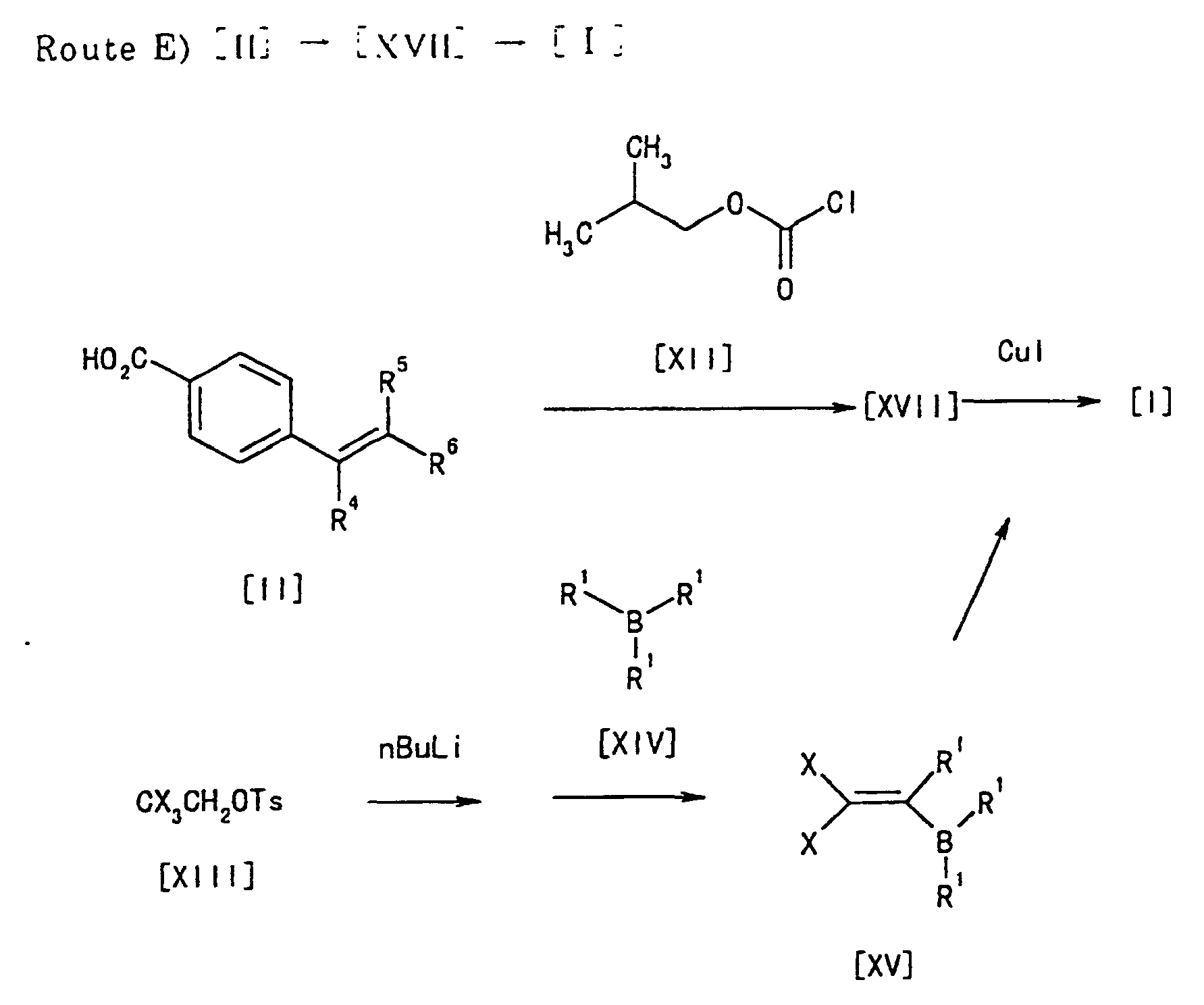
- The carboxylic acid derivative [II] is treated with isobutyl chloroformate [XII] to convert it into the mixed acid anhydride [XVII]. Then, the present compound [I] is obtained from this by using a one-pot synthetic method (Tetrahedron Lett, 33. 337-340 (1992)). Namely, the 2, 2, 2-trihaloethyl tosylate [XIII] is treated with n-butyllithium and then reacted with the organoboron compound [XIV] to give the 2, 2-dihalovinylborane derivative [XV]. The borane derivative [XV] is reacted with the above-mentioned mixed acid anhydride [XVII] in the presence of copper(I) iodide without isolating the borane derivative [XV] to give the present compound [I] (wherein R2 and R3 are halogen).
- When the reactants have a hydroxy group in their molecule in the above-mentioned synthetic methods, the group can be protected with a suitable protecting group, if necessary, and the protecting group can also be removed by a conventional method after the reaction. When the reactants have a carboxyl group or a phosphono group in their molecule, the carboxyl group or the phosphono group can be esterified, if necessary, and the ester can also be converted into a carboxylic acid or a phosphonic acid by hydrolysis.
- The present compounds are novel compounds which are unknown in literatures, and are characterized in that the present compounds have a vinylbenzene structure, of which benzene ring has a double bond substituent, as basic structure, and the benzene ring is further substituted by an α, β-unsaturated carbonyl group.
- As described above in the part of "Background Art", it was reported that ethacrynic acid has an effect of lowering intraocular pressure by making a morphological change in trabecular meshwork cells and increasing the rate of aqueous humor outflow (Japanese Examined Patent Publication No. 13013/1995). Ethacrynic acid is a phenoxyacetic acid derivative having an α, β-unsaturated carbonyl group. Focusing attention on this chemical structure of ethacrynic acid, the present inventors studied precisely and found that novel compounds exhibiting higher effects are obtained by introducing one more double bond as a substituent of a benzene ring of ethacrynic acid.
- Administration methods of drugs can be a method of administering active compounds themselves or a method of administering the drugs in the form to be decomposed in vivo and to be converted into the active compounds, namely in the form of prodrugs. Both are widely used. The present compounds also have a carboxylic acid group or a phosphonic acid group in their molecule. The present compounds can be administered in the form of the carboxylic acid or the phosphonic acid and also in the form of an ester which can be converted into the carboxylic acid or the phosphonic acid by hydrolysis. When the present compounds have a hydroxy group in their molecule, the present compounds can be administered with the hydroxy group protected with a suitable protecting group
- In order to study utility of the present compounds, effects of the present compounds on morphology of the trabecular meshwork cells and effects of the present compounds on intraocular pressure were investigated. Details will be described later in the part of "Pharmacological Test", and morphological changes of the trabecular meshwork cells by adding the present compounds were studied by image analysis. As a result, the present compounds exhibited excellent cell morphology change effects on the trabecular meshwork cells.
- Furthermore, intraocular pressure-lowering effects of the present compounds were directly studied. Namely, effects of the present compounds on intraocular pressure were studied by injecting it into anterior chambers of normal animals and by instillation using laser-induced high intraocular pressure animal models. As a result, the present compounds exhibited excellent intraocular pressure-lowering effects.
- The present compound is mainly administered parenterally and can also be administered orally. Examples of dosage forms are eyedrops, injections, tablets, capsules, granules and the like. The present compound can be formulated into preparations by conventional methods. For example, eyedrops can be produced, if necessary, by adding isotonic agents such as sodium chloride and concentrated glycerine; buffers such as sodium phosphate and sodium acetate; surfactants such as polyoxyethylenesorbitan monooleate, polyoxyl 40 stearate and polyoxyethylene hardened castor oil; stabilizers such as sodium citrate and disodium edetate; preservatives such as benzalkonium chloride and paraben; and the like, pH can be in a range acceptable for ophthalmic preparations, and it is preferably in a range of 4 to 8. Oral preparations such as tablets, capsules and granules can be produced, if necessary, by adding diluents such as lactose, starch, crystalline cellulose and vegetable oil: lubricants such as magnesium stearate and talc; binders such as hydroxypropylcellulose and polyvinyl pyrrolidone; disintegrators such as calcium carboxymethylcellulose; coating agents such as hydroxypropylmethylcellulose, macrogol and silicone resin: and gelatin film-forming agents.
- The dosage of the present compound can be selected suitably depending on symptoms, age, dosage form and the like. In the case of the eyedrops, the concentration is 0.001 to 3% (w/v), and one to several drops can be instilled per day. In the case of the oral preparation, the usual daily dosage is 1 to 1000 mg, which can be given in one or a few divided doses.
- Preparations, formulations and results of pharmacological tests of the present compounds are shown below.
- t-Butyl (2, 3, 4, 5, 6-pentafluorophenyl)acetate (Reference compound No. 1-1)

- To isobutene (4 ml) are added (2, 3, 4, 5, 6-pentafluorophenyl)acetic acid (30 g), ether (1 ml) and concentrated sulfuric acid (0.07 ml) under a nitrogen atmosphere and dry ice cooling, and the mixture is stirred in a pressure tube at room temperature for three days. The reaction mixture cooled with dry ice is added to a mixture of a 10% aqueous sodium hydrogencarbonate solution and ice. The whole is stirred and then extracted with ether. The organic layer is washed with saturated brine, dried over anhydrous magnesium sulfate and concentrated under reduced pressure to give 3.10 g (83%) of the titled compound (Reference compound No. 1-1). (Reference compound No. 1-1)
[R (Film, cm-1) 2983, 2940, 1740, 1658, 1510, 1371, 1307, 1159, 981 - The following compounds are obtained by a method similar to Reference Example 1.
- t-Butyl (4-nitrophenyl)acetate (Reference compound No. 1-2)
IR (Film, cm-1) 2979, 1731, 1607, 1521, 1369, 1347, 1231, 1147 - t-Butyl (4-biphenylyl)acetate (Reference compound No. 1-3) mp 44.5-48.5 C
IR (KBr, cm-1) 3028, 2976, 1730, 1602. 1486 - t-Butyl (4-tolyl)acetate (Reference compound No. 1-4)
- t-Butyl (4-fluorophenyl)acetate (Reference compound No. 1-5)
- t-Butyl (4-chlorophenyl)acetate (Reference compound No. 1-6)
- Ethyl 4-carboxycinnamate (Reference compound No 2.1)

- To a solution of 4-formylbenzoic acid (10 g) in pyridine (68 ml) are added ethyl malonate monopotassium salt (23 g), p-toluenesulfonic acid monohydrate (25 g) and piperidine (0.99 ml). The mixture is heated gradually and then stirred at 120°C for 1.5 hours. Under ice cooling, 2 N hydrochloric acid is added to the reaction mixture to acidify it, and the resulting precipitate is filtered off to give 11.7 g (79%) of the titled compound (Reference compound No. 2-1) as crystals.
- mp 194 5-197.0 C
IR (KBr, cm-1) 2981, 1711, 1687, 1609, 1569, 1511, 847 - The following compounds are obtained by a method similar to Reference Example 2.
- Ethyl 4-carboxy-α-methylcinnamate (Reference compound No. 2-2)
mp 145-149 C
[R (KBr. cm-1) 2985, 1707, 1678, 1425, 1293, 1259, 1203, 1125). 771 - t-Butyl 4-carboxycinnamate (Reference compound No. 2-3)
mp 210 C (decomp.)
IR (KBr, cm-1) 2979, 1707, 1678, 1639,1608, 1567, 1294, 1254, 1202, 1156, 964 - Ethyl 4-carboxy-β-methylcinnamate (Reference compound No. 3-1)

- 1) To a solution of 4-acetylbenzoic acid (3.9 g) in anhydrous methylene chloride (120 ml) are added 4-dimethylaminopyridine (1.5 g), t-butyl alcohol (4.6 ml), N-methylmorpholine (3.4 ml) and 1-ethyl-3-(3-dimethylaminopropyl)carbodiimide hydrochloride (6.0 g) under ice cooling. The mixture is stirred under ice cooling for six hours and under water cooling overnight. The reaction mixture is concentrated under reduced pressure, water is added to the concentrate, and the whole is extracted with ether. The organic layer is washed with saturated brine, dried over anhydrous magnesium sulfate and concentrated under reduced pressure. The residue is purified by silica gel column chromatography to give 3.13 g (59%) of t-butyl 4-acetylbenzoate as crystals.
mp 37.5-58.8 C
IR (KBr, cm-1) 3350, 2986, 2934, 1708, 1682, 1503 - 2) A solution of triethyl phosphonoacetate (0.98 ml) in anhydrous tetrahydrofuran (4 ml) is added dropwise to a solution of sodium hydride (60%, oily) (220 mg) in anhydrous tetrahydrofuran (15 ml) under a nitrogen atmosphere and ice cooling, and the mixture is stirred under ice cooling for 10 minutes. Then, a solution of t-butyl 4-acetylbenzoate (1.0 g) in anhydrous tetrahydrofuran (4 ml) is added dropwise to the mixture, stirring it at room temperature overnight. Ether is added to the reaction mixture under ice cooling, and the whole is extracted. The organic layer is washed with a 10% aqueous citric acid solution, water and saturated brine successively, dried over anhydrous magnesium sulfate and concentrated under reduced pressure. The residue is purified by silica gel column chromatography to give 0.76 g (58%) of ethyl 4-(t-butoxycarbonyl)-β-methylcinnamate.
IR (Film, cm-1) 2979, 2934, 1713, 1631, 1567, 1455, 1169, 1115 - 3) Ethyl 4-(t-butoxycarbonyl)-β-methylcinnamate (755 mg) is dissolved in a 4 N solution of hydrogen chloride in ethyl acetate (6.5 ml), and the solution is stirred at room temperature for 18 hours. The reaction mixture is concentrated under reduced pressure, isopropyl ether is added to the concentrate, and the resulting precipitate is filtered off to give 550 mg (90%) of the titled compound (Reference compound No 3-1) as crystals.
- mp 160.0-161.7 C
[R (KBr. cm-1) 2979, 2668, 2543, 1712, 1689, 1626, 1565, 1424, 1367 - Diethyl2-(4-formylphenyl)maleate (Reference compound No 4-1)

- 1) A 1.0 M solution of 4-tolylmagnesium bromide in ether (20.5 ml) is added dropwise to a solution of diethyl oxalate (6.5 g) in anhydrous tetrahydrofuran (41 ml) under a nitrogen atmosphere and ice cooling. Five minutes after completing the addition, the mixture is stirred at room temperature for 1.5 hours. To the reaction mixture is added 1 N hydrochloric acid, and the whole is extracted with ether. The organic layer is washed with water and saturated brine successively, dried over anhydrous magnesium sulfate and concentrated under reduced pressure. The resulting residue is purified by silica gel column chromatography to give 2.99 g (76%) of ethyl 4-tolylglyoxylate.
[R (Film, cm-1) 2984, 1736, 1684, 1606, 1307, 1203, 1176, 1015 - 2) A solution of diethyl ethoxycarbonylmethylphosphonate (33 g) in anhydrous tetrahydrofuran (20 ml) is added dropwise to a suspension of sodium hydride (60%, oily) (676 mg) in anhydrous tetrahydrofuran (30 ml) under a nitrogen atmosphere and ice cooling, and further a solution of ethyl 4-tolylglyoxylate (2.96 g) in anhydrous tetrahydrofuran (22 ml) is added dropwise thereto. The mixture is stirred at room temperature for 30 minutes, a 10% aqueous citric acid solution is added to the reaction mixture, and the whole is extracted with ether. The organic layer is washed with water and saturated brine successively, dried over anhydrous magnesium sulfate and concentrated under reduced pressure. The resulting residue is purified by silica gel column chromatography to give 3.57 g (88%) of diethyl 2-(4-tolyl)maleate.
IR (Film, cm-1) 2982, 1732, 1714, 1623, 1608, 1372, 1288, 1205, 1176, 1033 - 3) To a solution of diethyl 2-(4-tolyl)maleate (1.5 g) in carbon tetrachloride (29 ml) are added N-bromosuccinimide (3.1 g) and 2, 2'-azobis(isobutyronitrile) (45 mg), and the mixture is refluxed for two days. The reaction mixture is concentrated under reduced pressure, a 10% aqueous sodium hydrogencarbonate solution is added to the concentrate, and the whole is extracted with ether. The organic layer is washed with water and saturated brine successively, dried over anhydrous magnesium sulfate and concentrated under reduced pressure. The residue is purified by silica gel column chromatography to give 1.15 g (56%) of diethyl 2-[4-(dibrumomethyl)phenyl]maleate as crystals.
mp 89.0-92.5 C
[R (KBr, cm-1) 3029, 2991, 1714, 1626, 1372, 1342, 1295, 118G, 1026, 847 - 4) A solution of silver nitrate (607 mg) in water (5 ml) is added to a solution of diethyl 2-[4-(dibromomethyl)phenyl]maleate (500 mg) in 2-methoxyethanol (15 ml) under a nitrogen atmosphere, and the mixture is stirred for 25 minutes while heating it at 95°C. Under ice cooling, 0.1 N hydrochloric acid is added to the reaction mixture, and the whole is extracted with ethyl acetate. The organic layer is washed with water and saturated brine successively, dried over anhydrous magnesium sulfate and concentrated under reduced pressure. The residue is purified by silica gel column chromatography to give 280 mg (85%) of the titled compound (Reference compound No. 4-1).
- IR (Film, cm-1) 2983. 1722. 1626. 1372. 1343. 1283, 1209, 1180
- Diethyl (E)-2-(4-carboxyphenyl)vinylphosphonate (Reference compound No. 5-1)

- 1) Anhydrous potassium carbonate (4.7 g) is added to a solution of terephthalaldehydic acid (5.1 g) in anhydrous dimethylformamide (110 ml), and the mixture is stirred at room temperature for 10 minutes. Then, methyl iodide (2.5 ml) is added thereto, and the mixture is stirred overnight. Water is added to the reaction mixture, and the whole is extracted with ethyl acetate. The organic layer is washed with water and saturated brine successively, dried over anhydrous sodium sulfate and concentrated under reduced pressure. The resulting residue is purified by silica gel column chromatography to give 4.7 g (84%) of methyl 4-formylbenzoate as crystals.
mp 58.9-60.5°C
IR (KBr. cm-1) 3021, 1728, 1684, 1578, 1435, 1392 - 2) A 1.0 M solution of lithium bis(trimethylsilyl)amide in tetrahydrofuran (17 ml) is diluted with anhydrous tetrahydrofuran (81 ml) under a nitrogen atmosphere and dry ice cooling, and then a solution of tetraethyl methylenebis(phosphonate) (4.6 g) in anhydrous tetrahydrofuran (8 ml) is added dropwise thereto. The mixture is stirred under dry ice cooling for 30 minutes, and then a solution of methyl 4-formylbenzoate (2.64 g) in anhydrous tetrahydrofuran (12 ml) is added dropwise thereto. The mixture is stirred under dry ice cooling for 1.5 hours and further under ice cooling for 2.5 hours. Ethyl acetate is added to the reaction mixture. The organic layer is washed wath water and saturated brine successively, dried over anhydrous sodium sulfate and concentrated under reduced pressure. The resulting precipitate is filtered off to give 4.1 g (86%) of diethyl (E)-2-[4-(methoxycarbonyl)phenyl]vinylphosphonate as crystals.
mp 60-65°C
IR (KBr. cm-1) 3003, 1720, 1620, 1568, 1433, 1236 - 3) Diethyl (E)-2-[4-(methoxycarbonyl)phenyl]vinylphosphonate (4.0 g) is dissolved in a mixed solvent of ethanol (26 ml)-tetrahydrofuran (13 ml). Then, a 1 N aqueous sodium hydroxide solution (15 ml) is added thereto, and the mixture is stirred at room temperature for 24 hours. A 10% aqueous citric acid solution is added to the reaction mixture to acidify it, and the whole is extracted with ethyl acetate. The organic layer is washed with water and saturated brine successively, dried over anhydrous sodium sulfate and concentrated under reduced pressure. The resulting precipitate is filtered off to give 3.4 g (89%) of the titled compound (Reference compound No. 5-1) as crystals.
- mp 135.0-136.5 C
IR Kbr, cm-1) 2990, 1707, 1570, 1480, 1240 -

- Thionyl chloride (2.8 ml) is added dropwise to a solution of ethyl 4-carboxycinnamate (Reference compound No. 2-1, 1.7 g) in chloroform (5 ml) under a nitrogen atmosphere. Then, dimethylformamide (one drop) is added thereto, and the mixture is refluxed for 30 minutes. The reaction mixture is concentrated under reduced pressure to give the corresponding acid chloride.
- A 0.5 M solution of potassium bis(trimethylsilyl)amide in toluene (18 ml) is added dropwise to a solution of t-butyl (2, 3, 4, 5, 6-pentafluorophenyl)acetate (Reference compound No. 1-1, 2.17 g) in tetrahydrofuran (20 ml) under a nitrogen atmosphere and dry ice cooling. After five minutes, furthermore, a solution of the above-mentioned acid chloride in tetrahydrofuran (20 ml) is added dropwise thereto. Twenty minutes after completing the addition, the mixture is stirred at room temperature for 1.5 hours. A 10% aqueous citric acid solution is added to the reaction mixture, and the whole is extracted with ether. The organic layer is washed with water and saturated brine successively, dried over anhydrous magnesium sulfate and concentrated under reduced pressure. The resulting residue is purified by silica gel column chromatography to give 526 mg (12%) of the titled compound (Compound No. 1-1) as crystals.
- mp 87.5-88.5 C
IR (KBr, cm-1) 2979, 1716,1637, 1522, 1496, 13731177 - The following compounds are obtained by a method similar to Example 1.
- Ethyl 4-[(2RS)-2-(t-butoxycarbonyl)-2-(4-nitrophenyl)acetyl]cinnamate (Compound No. 1-2)
IR (Film, cm-1) 2980, 1715, 1639, 1603, 1523, 1368, 1348, 1278, 1148 - Ethyl 4-[(2RS)-2-(t-butoxycarbonyl)-2-(4-biphenylyl)acetyl]cinnamate (Compound No. 1-3)
IR (Film, cm-1) 2980, 1713, 1639, 1603, 1486 - Ethyl 4-[(2RS)-2-(t-butoxycarbonyl)-2-(4-tolyl)acetyl]cinnamate
-
- Ethyl 4-[(2RS)-2-(t-butoxycarbonyl)-2-(4-fluorophenyl)acetyl]cinnamate (Compound No. 1-5)
- Ethyl 4-[(2RS)-2-(t-butoxycarbonyl)-2-(4-chlorophenyl)acetyl]cinnamate (Compound No. 1-6) Example 2
- 4-[(2, 3, 4, 5, 6-Pentafluoropheyl)acetyl]cinnamic acid
-

- Into a pressure tube is introduced a solution of ethyl 4-[(2RS)-2-(t-butoxycarbonyl)-2-(2, 3, 4, 5, 6-pentafluorophenyl)acetyl)cinnamate (Compound No. 1-1, 500 mg) in dioxane (2 ml), and concentrated sulfuric acid (2 ml) is added thereto The mixture is stirred for four hours while heating it at 130 C. The reaction mixture is cooled with ice, and the resulting precipitate is filtered off to give 256 mg (70%) of the titled compound (Compound No. 2-1) as crystals.
- mp 228-234 C
IR (KBr. cm-1) 2975, 1673, 1526, 1502, 1307, 1280 - Thefollowing compounds are obtained by a method similar to Example 2.
- 4[(4-Nitrophenyl)acetyl]cinnamic acid (Compound No. 2-2) mp 247.231C
IR (KBr. cm-1) 2895, 1683, 1628, 1601, 1518, 1343, 1228, 991 - 4-[(4-Biphenylyl)acetyl]cinnamic acid (Compound No. 2-3) mp 250 C or higher
IR (KBr. cm-1) 3030, 1682, 1631, 1600, 1558, 1487 - 4-[(4-Tolyl)acetyl]cinnamic acid (Compound No. 2-4)
- 4-[(4-Fluorophenyl)acetyl]cinnamic acid (Compound No. 2-5)
- 4-[(4-Chlorophenyl)acetyl]cinnamic acid (Compound No. 2-6) Example 3
- Ethyl 4-(phenylacetyl)cinnamate (Compound No. 3-1)

- Thionyl chloride (3.3 ml) is added dropwise to a solution of ethyl 4-carboxycinnamate (Reference compound No. 2-1, 2.0 g) in chloroform (4 ml) under a nitrogen atmosphere, then dimethylformamide (one drop) is added to the solution, and the mixture is refluxed for 30 minutes. The reaction mixture is concentrated under reduced pressure to give a residue of the corresponding acid chloride The residue is dissolved in tetrahydrofuran (30 ml) under a nitrogen atmosphere, and the solution is cooled with dry ice. A 2.0 M solution of benzylmagnesium chloride in tetrahydrofuran (45 ml) is added dropwise thereto. Twelve minutes after completing the addition a 10% aqueous citric acid solution is added to the reaction mixture under dry ice cooling, then the temperature is raised to room temperature, and the whole is extracted with ether. The organic layer is washed with water and saturated brine successively, dried over anhydrous magnesium sulfate and concentrated under reduced pressure. The resulting residue is purified by silica gel column chromatography to give 685 mg (26%) of the titled compound (Compound No. 3-1) as crystals.
- mp 110.5-111.3°C
IR (KBr, cm-1) 2986, 1690, 1410, 1330, 1206, 970, 704 - The following compounds are obtained by a method similar to Example 3.
- Ethyl 4-(n-butyryl)cinnamate (Compound No. 3-2) mp 51.7-53.9°C
IR (KBr, cm-1) 2963, 1770, 1680, 1603, 1561, 1472, 1371, 999 - Ethyla -methyl-4-(phenylacetyl)cinnamate (Compound No. 3-3) mp 35.5-37.8°C
IR (KBr, cm-1) 2983, 1706, 1683, 1602, 1452, 1254, 1112 - Ethyl β-methyl-4-(phenylacetyl)cinnamate (Compound No. 3-4) mp 81.7-83.0 C
IR (KBr, cm-1) 3040, 2982, 1713, 1683, 1624, 1601, 1478, 1268, 1225 - Ethyl 4-propionylcinnamate (Compound No. 3-5)
- Ethyl 4-isovalerylcinnamate (Compound No. 3-6)
- Ethyl 4-acetylcinnamate (Compound No. 3-7) Example 4
4-(Phenylacetyl)cinnamic acid (Compound No. 4-1)
- A 1 N aqueous sodium hydroxide solution (2.3 ml) and water (4 ml) are added to a solution of ethyl 4-(phenylacetyl)cinnamate (Compound No. 3-1, 675 mg) in a mixed solvent of ethanol (6 ml)-tetrahydrofuran (6 ml) under a nitrogen atmosphere, and the mixture is stirred at room temperature for 6.5 hours. To the reaction mixture is added 1 N hydrochloric acid to acidify it, and the whole is extracted with ethyl acetate. The organic layer is washed with saturated brine, dried over anhydrous magnesium sulfate and concentrated under reduced pressure. The resulting precipitate is filtered off to give 553 mg (91%) of the titled compound (Compound No. 4-1) as crystals.
- mp 232-236 C (decomp.)
IR (KBr, cm-1) 3036, 2389, 1684, 1630, 1337, 1230, 993 - The following compounds are obtained by a method similar to Example 4.
- 4-(n-Butyryl)cinnamic acid (Compound No. 4-2) mp 204-210 C (decomp.)
IR (KBr. cm-1) 2965, 1689, 1630, 1601, 1560, 992 - α-Methyl-4-(phenylacetyl)cinnamic acid (Compound No. 4-3) mp 148.0-149.3C
IR (KBr, cm-1) 2968, 1685, 1621, 1409, 1266, 728 - β-Methyl-4-(phenylacetyl)cinnamic acid (Compound No. 4-4) mp 143-149°C
IR (KBr, cm-1) 2898, 1684, 1623, 1559, 1499 - 4-Propionylcinnamic acid (Compound No. 4-5)
- 4-Isovalerylcinnamic acid (Compound No 4-6)
- 4-Acetylcinnamic acid (Compound No. 4-7)
-

- A 2.0 M solution of benzylmagnesium chloride in tetrahydrofuran (0.45 ml) is added dropwise to a solution of diethyl 2-(4-formylphenyl)maleate (Reference compound No. 4-1. 250 mg) in anhydrous tetrahydrofuran (4.5 ml) under a nitrogen atmosphere and dry ice cooling with stirring. Ten minutes after completing the addition, the mixture is stirred at room temperature for one hour. A saturated aqueous ammonium chloride solution is added to the reaction mixture, and the whole is extracted with ether. The organic layer is washed with water and saturated brine successively, dried over anhydrous magnesium sulfate and concentrated under reduced pressure. The resulting residue is purified by silica gel column chromatography to give 100 mg (30%) of the titled compound (Compound No. 5-1).
- IR (Film, cm-1) 3512. 2983, 1719, 1624, 1372, 1342, 1290, 1180, 1032,701
- Diethyl 2-[4-(phenylacetyl)phenyl]maleate (Compound No. 6-1)

- Triethylamine (0.53 ml) ml) is added to a solutiun of diethyl 2-[-4-[(1RS)-1-hydroxy-2-phenylethyl]phenyl]maleate (Compound No 5-1, 280 mg) in dimethyl sulfoxide (3 ml) at room temperature with stirring, and further a solution of a sulfur trioxide-pyridine complex (484 mg) in dimethyl sulfoxide (5 ml) is added thereto. The mixture is stirred at room temperature for 2.5 hours. 0.1 N hydrochloric acid (50 ml) is added to the reaction mixture, and the whole is extracted with ether. The organic layer is washed with water and saturated brine successively, dried over anhydrous magnesium sulfate and concentrated under reduced pressure. The precipitate is filtered off to give 85 mg (31%) of the titled compound (Compound No. 6-1) as crystals.
- mp 111-120°C
IR (KBr, cm-1) 2985, 1716, 1691, 1627, 1412, 1374, 1183, 1024, 728 - 2-[4-(Phenylacetyl)phenyl]maleic acid (Compound No. 7-1)

- Into a pressure tube is introduced a solution of diethyl 2-[4-(phenylacetyl)phenyl]maleate (Compound No. 6-1. 80 mg) in dioxane (3 ml), concentrated hydrochloric acid (2 ml) is added thereto, and the mixture is stirred at 120 C for one hour. The reaction mixture is concentrated under reduced pressure to give 90 mg (quantitatively) of the titled compound (Compound No. 7-1).
- 4-[2-(2, 3, 4. 5, 6-Pentafluorophenyl)acryloyl]cinnamic acid (Compound No. 8-1)

- Into a pressure tube is introduced a solution of 4-[(2, 3, 4, 5, 6-pentafluorophenyl)acetyl]cinnamic acid (Compound No. 2-1, 230 mg) in dioxane (13 ml). To the solution are added paraformaldehyde (78 mg), dimethylamine hydrochloride (210 mg), acetic acid (one drop) and anhydrous magnesium sulfate (q.s.), and the mixture is stirred overnight while heating it at 1:30°C. Under ice cooling. 0.1 N hydrochloric acid is added to the reaction mixture to acidify it and the whole is extracted with ethyl acetate. The organic layer is washed with saturated brine, dried over anhydrous magnesium sulfate and concentrated under reduced pressure. The precipitate is filtered off to give 222 mg (93%) of the titled compound (Compound No. 8-1) as crystals
- mp 218-220 C
IR (KBr, cm-1) 2837, 1691, 1668, 1518, 1494, 1283, 994 - The following compounds are obtained by a method similar to Example 8
- 4-[2-(4-Nitrophenyl)acryloyl]cinnamic acid (Compound No. 8-2) mp 224.2-225.5°C
IR (KBr, cm-1) 2841, 1689, 1656, 1508, 1426, 1344, 1313, 848 - 4-[2-(4-Biphenylyl)acryloyl]cinnamic acid (Compound No. 8-3) mp 239°C (decomp.)
IR (KBr, cm-1) 2989, 1688, 1655, 1632, 1601, 1562, 982 - 4-[2-(4-Tolyl)acryloyl]cinnamic acid (Compound No. 8-4)
- 4-[2-(4-Fluorophenyl)acryloyl]cinnamic acid (Compound No. 8-5)
- 4-[2-(4-Chlorophenyl)acryloyl]cinnamic acid (Compound No. 8-6)
- 4-(2-Phenylacryloyl)cinnamic acid (Compound No. 8-7) mp 175.3-177.8 C
IR (KBr, cm-1) 2969, 1690, 1667, 1631, 1600, 1561, 1493, 1412, 914, 858 - 4-(2-Ethylacryloyl)cinnamic acid (Compound No. 8-8) mp 174.5-175.0 C
IR (KBr, cm-1) 2968, 1689, 1650, 1627, 1601, 1361, 989 - α-Methyl-4-(2-phenylacryloyl)cinnamic acid (Compound No. 8-9) mp 134.5-136.5 C
IR (KBr. cm-1) 2966, 1666, 1600, 1411, 1265, 1215, 980 - 3-Methyl-4-(2-phenylacryloyl)cinnamic acid (Compound No. 8-10)
mp 116.2-118.8 C
IR (KBr, cm-1) 2924, 1684, 1627, 1600, 1495, 1415, 981, 855 - 4-(2-Methylacryloyl)cinnamic acid (Compound No. 8-11)
- 4-(2-Isopropylacryloyl)cinnamic acid (Compound No. 8-12)
- 4-Acryloylcinnamic acid (Compound No. 8-13)
- 2-[4-(2-Phenylacryloyl)phenyl]maleic acid (Compound No. 8-14)
IR (Film, cm-1) 2928, 1769, 1718, 1622, 1416, 1226, 1123, 759 -

- Ethyl 4-(phenylacetyl)cinnamate (Compound No. 3-1, 2.0 g) is dissolved in a mixed solvent of ethanol (14 ml)-tetrahydrofuran (34 ml). To the solution are added water (14 ml), acetaldehyde (1.9 ml) and potassium carbonate (1.9 g), and the mixture is stirred at room temperature for three hours. To the reaction mixture is added 1 N hydrochloric acid to acidify it, and the whole is extracted with ethyl acetate. The organic layer is washed with saturated brine, dried over anhydrous magnesium sulfate and concentrated under reduced pressure. The resulting residue is purified by silica gel column chromatography to give 1.75 g (76%) of the titled compound (Compound No. 9-1).
- IR (Film, cm-1) 3484. 2977, 1712. 1677. 1637. 1603. 1562. 1492, 1312, 1209, 1177
-

- Triethylamine (1.05 ml) and mesyl chloride (0.6 ml) are added to a solution of ethyl 4-[(2RS, 3RS)-3-hydroxy-2-phenylbutyryl]cinnamate (Compound No. 9-1, 1.70 g) in anhydrous methylene chloride (25 ml) under ice cooling, and the mixture is stirred for 2.5 hours A 10% aqueous citric acid solution is added to the reaction mixture to acidify it, and the whole is extracted with ether. The organic layer is washed with water and saturated brine successively, dried over anhydrous magnesium sulfate and concentrated under reduced pressure to give 1.75 g (84%) of the titled compound (Compound No. 10-1).
- IR (Film, cm-1) 3030, 1713, 1681. 1353, 1174, 906
- Ethyl 4-[(E. Z)-2-phenyl-2-butenoyl]cinnamate (Compound No. 11-1)

- 1, 8-Diazabicyclo[5.4.0]-7-undecene (0.32 ml) is added to a solution of ethyl 4-[(2RS, 3RS)-3-(mesyloxy)-2 phenylbutyryl]cinnamate (Compound No. 10-1, 800 mg) in tetrahydrofuran (10 ml), and the mixture is stirred at room temperature for one hour. A 10% aqueous citric acid solution is added to the reaction mixture to acidify it, and the whole is extracted with ether. The organic layer is washed with water and saturated brine successively, dried over anhydrous magnesium sulfate and concentrated under reduced pressure. The resulting oily matter is purified by silica gel column chromatography to give 535 mg (87%) of the titled compound (Compound No. 11-1).
- IR (Film, cm-1) 2980, 1713, 1639, 1602, 1366, 1312, 1270, 1204, 1175
- 4-[(E, Z)-2-Phenyl-2-butenoyl]cinnamic acid (Compound No. 12-1)
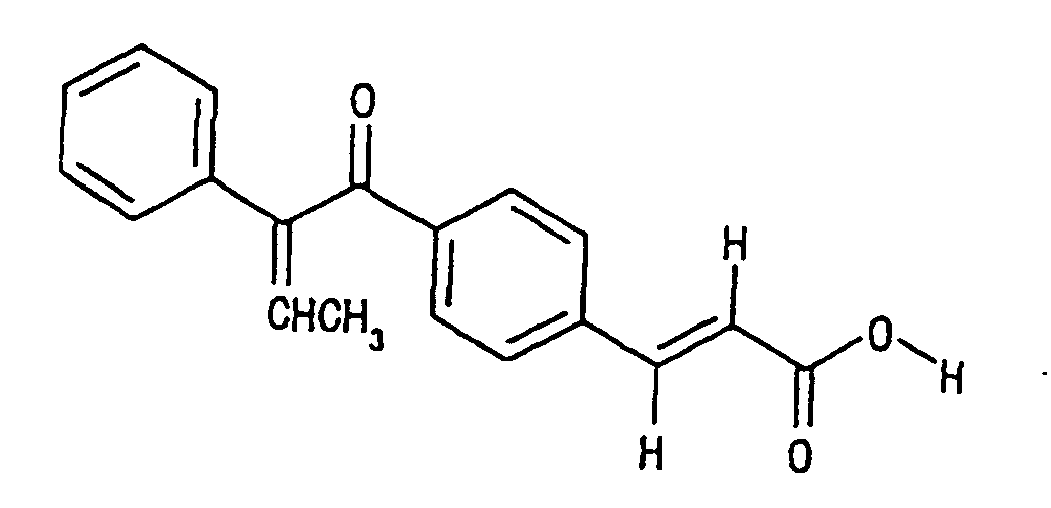
- Ethyl 4-[(E, Z)-2-phenyl-2-butenoyl]cinnamate (Compound No. 11-1, 260 mg) is dissolved in a mixed solvent of tetrahydrofuran (4 ml)-ethanol (4 ml). To the solution are added water (3 ml) and a 1 N aqueous sodium hydroxide solution (0.32 ml), and the mixture is stirred at room temperature for 4.5 hours. To the reaction mixture is added 1 N hydrochloric acid to acidify it, and the whole is extracted with ethyl acetate. The organic layer is washed with saturated brine, dried over anhydrous magnesium sulfate and concentrated under reduced pressure. The precipitate is filtered off to give 115 mg (49%) of the titled compound (Compound No. 12-1) as crystals.
- mp 153-156 C
IR (KBr, cm-1) 2974, 1690, 1630, 1425, 1265, 700 - t-Butyl 4-(3, 3-difluoro-2-phenylacryloyl)cinnamate
-

- N-Methylmorpholine (0.29 ml) is added to a solution of t-butyl 4-carboxycinnamate (Reference compound No. 2-3, 1.9 g) in anhydrous tetrahydrofuran (38 ml) under a nitrogen atmosphere and ice-salt refrigerant cooling. Then, isobutyl chloroformate (0.99 ml) is added dropwise to the solution, and the mixture is stirred for 16 minutes to give the corresponding mixed acid anhydride.
- A 1.6 M solution of n-butyllithium in hexane (10 ml) is added dropwise to a solution of 2, 2, 2-trifluoroethyl tosylate (1.95 g) in anhydrous tetrahydrofuran (18 ml) under a nitrogen atmosphere and dry ice cooling, and the mixture is stirred for 35 minutes. Then, a solution of triphenylborane (2.0 g) in anhydrous tetrahydrofuran (20 ml) is added dropwise to the mixture under dry ice cooling, and the whole is stirred under dry ice cooling for one hour and further at room temperature for three hours. To the reaction mixture are added hexamethylphosphoramide (12 ml) and copper(I) iodide (2.9 g) under ice cooling, and the mixture is stirred for 45 minutes. Then, the above-mentioned mixed acid anhydride solution is added dropwise to the mixture, stirring it at room temperature overnight. A 10% aqueous citric acid solution is added to the reaction mixture to acidify it, and the whole is extracted with ether. The organic layer is washed with water and saturated brine successively, dried over anhydrous magnesium sulfate and concentrated under reduced pressure. The resulting oily matter is purified by silica gel column chromatography to give 442 mg (16%) of the titled compound (Compound No. 13-1).
- mp 88-94°C
IR (KBr, cm-1) 3006, 1740, 1709, 1637, 1608, 1569, 1271, 1192, 1151 - 4-(3, 3-Difluoro-2-phenylacryloyl)cinnamic acid (Compound No. 14-1)

- t-Butyl 4-(3. 3-difluoro-2-phenylacryloyl)cinnamate (Compound No. 13-1, 302 mg) is dissolved in a 4 N solution of hydrogen chloride in dioxane (2.45 ml) under a nitrogen atmosphere, and the solution is stirred at room temperature for 19.5 hours. Ether is added to the reaction mixture, and the resulting precipitate is filtered off to give 116 mg (45%) of the titled compound (Compound No. 14-1).
- mp 235-248 C
- [R(KBr,cm-1) 2833, 1724, 1689, 1631, 1605, 1369, 1278, 922
-

- Thionyl chloride (5.0 ml) is added dropwise to a solution of diethyl (E)-2-(4-carboxyphenyl)vinylphosphonate (Reference compound No. 5-1, 3.27 g) in chloroform (5 ml), then dimethylformamide (one drop) is added to the solution, and the mixture is refluxed for 24 hours. The reaction mixture is concentrated under reduced pressure to give the corresponding acid chloride.
- To anhydrous 1, 2-dimethoxyethane (33 ml) are added activated zinc (1.6 g) and a palladium (II) chloride-bis(triphenylphosphine) complex (0,89 g) under a nitrogen atmosphere, and benzyl bromide (1.5 ml) is added dropwise thereto under ice cooling with stirring. Further, a solution of the above-mentioned acid chloride in anhydrous 1, 2-dimethoxyethane (25 ml) is added dropwise thereto, and the mixture is stirred at room temperature for three days. The reaction mixture is filtered with Celite, and the filtrate is concentrated under reduced pressure. To the concentrate is added 1 N hydrochloric acid, and the whole is extracted with ethyl acetate. The organic layer is washed with saturated brine, dried over anhydrous sodium sulfate and concentrated under reduced pressure. The resulting residue is purified by silica gel column chromatography to give 1.96 g (52%) of the titled compound (Compound No. 15-1).
- IR (Film, cm-1) 3030, 1681, 1603, 1561, 1496, 1454, 1269, 1200, 945
- Monoethyl (E)-2-[4-(2-phenylacryloyl)phenyl]vinylphosphonate (Compound No. 16-1)

- Into a pressure tube is introduced a solution of monoethyl (E)-2-[4-(phenylacetyl)phenyl]vinylphosphonate (Compound No. 15-1, 1.96 g) in dioxane (11 ml). To the solution are added paraformaldehyde (0.66 g), dimethylamine hydrochloride (1.8 g), acetic acid (one drop) and anhydrous magnesium sulfate (q.s.), and the mixture is stirred for five hours while heating it at 130 C. Under ice cooling, 1 N hydrochloric acid is added to the reaction mixture to acidify it, and the whole is extracted with ethyl acetate. The organic layer is washed with saturated brine, dried over anhydrous sodium sulfate and concentrated under reduced pressure. The resulting oily matter is purified by silica gel column chromatography to give 0.55 g (29%) of the titled compound (Compound No. 16-1).
- IR (Film, cm-1) 2983, 2904, 1719, 1665, 1618, 1410, 1214, 984, 856, 833
- (E)-2-[4-(2-Phenylacryloyl)phenyl]vinylphosphonic acid (Compound No. 17-1)

- Bromotrimethylsilane (0.28 ml) is added dropwise to a solution of monoethyl (E)-2-[4-(2-phenylacryloyl)phenyl]vinylphosphonate (Compound No. 16-1, 180 mg) in anhydrous methylene chloride (1.3 ml) under a nitrogen atmosphere at room temperature, and the mixture is stirred for one hour. Ethyl acetate is added to the reaction mixture. The organic layer is washed with water and saturated brine successively, dried over anhydrous sodium sulfate and concentrated under reduced pressure.
- The resulting oily matter is dissolved in methylene chloride (4.7 ml), triethylamine (0.20 ml) is added to the solution, and the mixture is stirred at room temperature for one hour. Ethyl acetate is added to the reaction mixture. The organic layer is washed with 0.1 N hydrochloric acid and saturated brine successively, dried over anhydrous sodium sulfate and concentrated under reduced pressure. The precipitate is filtered off to give 22 mg (13%) of the titled compound (Compound No. 17-1) as crystals.
- mp 137-147 C
IR (KBr, cm-1) 3025, 1654, 1602, 1495, 1409, 1216, 929 - Formulation examples of and oral preparation using the present compound are shown below.
1) Eyedrops Formulation L in 10 ml Present compound 1 mg Concentrated glycerin 250 mg Polysorbate 80 200 mg Sodium dihydrogenphosphate dihydrate 20 mg 1 N Sodium hydroxide q.s. 1 N Hydrochloric acid q.s. Sterile purified water q.s. 2) Tablet Formulation 1 in 100 mg Present compound 1 mg Lactose 66.4 mg Cornstarch 20 mg Calcium carboxymethylcellulose 6 mg Hydroxypropylcellulose 6 mg Magnesium stearate 0.6 mg - In order to study utility of the present compounds to glaucoma, 1) effects on morphology of trabecular meshwork cells, 2) intraocular pressure-lowering effects by anterior chamber administration and 3) intraocular pressure-lowering effects by instillation using laser-induced high intraocular pressure animal models were investigated.
- A possibility has been reported that drugs having effects of increasing aqueous humor outflow can be found by evaluating effects of drugs on morphology of cultured trabecular meshwork cells (Invest. Ophthalmol. Vis. Sci., 33, 2631 -2640 (1992)). Accordingly, effects of the present compounds on morphology of bovine cultured trabecular meshwork cells were studied in the similar manner to the method described in the above-mentioned literature.
- Morphological changes in bovine cultured trabecular meshwork cells by adding the present compounds were quantitatively evaluated by image analysis.
- Bovine trabecular meshwork cells (passage number 2 to 5) cultured in a basal medium for mammalian cell culture D-MEM (Dulbecco's Modified Eagle Medium, manufactured by Gibco Co.. Ltd.) containing fetal bovine serum (10%), amphotericin B (2.5 µg/ml) and gentamicin (50 µg/ml) were treated with a trypsin-EDTA solution (0.05% trypsin, 0.53 mM EDTA · 4Na) 24 hours before the later drug treatment and seeded in a 24-well plate (101 cells/well). Twelve hours before the later drug treatment, the cells were washed with phosphate-buffered physiological saline, and then the medium was replaced by D-MEM containing amphotericin B (2.5 µg/ml) and gentamicin (50 µg/ml) (hereinafter referred to as "medium A"). One hour before the later drug treatment, cells which did not contact each other were selected from the cells prepared as mentioned above and used for experiment.
- A test compound was dissolved in dimethyl sulfoxide (DMSO), and the medium A was added to the solution, followed by sterilizing the solution by filtration. The medium A was further added to the solution to dilute it at a prescribed concentration. This diluted solution was maintained isothermally under a 5% carbon dioxide gas atmosphere at 37°C for one hour, from one hour before the later drug treatment to prepare a test compound solution.
- First, cells were photographed using a well-scanner one hour before the drug treatment. Next, the medium of the cells was replaced by the test compound solution, and the cells were treated with the drug and incubated under a 5% carbon dioxide gas atmosphere at 37 C for three hours. Then, the same cells as those photographed one hour before the drug treatment were photographed using the well-scanner.
- Photographed cell images were incorporated from the photographs into an image analysis system with a CCD camera (manufactured by HAMAMATU Co., Ltd.). Outlines of the incorporated cell images were traced, and areas were measured.
- Degrees of the morphological changes made by the test compounds on the trabecular meshwork cells are expressed by the following rates of changes in areas (%).

- A: Cell area before drug treatment
- B: Cell area after drug treatment
- Table 1 shows concentrations required to reduce the cell area of the trabecular meshwork cells by 50%, i.e., EC30, as examples of test results. Table 1 shows also a result using ethacrynic acid as a control drug.
Table 1 Test compound EC50 (M) Compound No. 8-1 6.6 × 10⁻⁷ Compound No. 8-2 1.7 × 10⁻⁶ Compound No. 8-7 8.1 × 10⁻⁷ Compound No. 8-9 3.9 × 10⁻⁶ Compound No. 8-10 2.9 × 10⁻⁶ Ethacrynic acid 6.2 × 10⁻⁵ - As shown in Table 1, the present compounds were recognized to have excellent cell morphological change effects on the trabecular meshwork cells These effects were over ten times higher than that of ethacrynic acid, which was a well-known comparative control drug.
- A method of evaluating intraocular pressure-lowering effects of the drugs by administering them into anterior chambers of cynomolgus monkeys has been reported (Am. J. Ophthalmol., 113, 706-711 (1992)). Accordingly, effects of the present compound on intraocular pressure were studied in the similar manner to the method described in the above-mentioned literature.
- Healthy male cynomolgus monkeys weighing 4.0 to 7.0 kg and being four to seven years old were used as experimental animals.
- A test compound to be used was dissolved in dimethyl sulfoxide (DMSO), and then phosphate-buffered physiological saline was added to the solution to dilute it at a prescribed concentration (10-3 M. 1% DMSO), followed by sterilizing the solution by filtration to prepare a test compound solution.
- The test compound solution (10 µl) was administered with a micro syringe and a 30G needle into an anterior chamber of one eye of a cynomolgus monkey anesthetized generally by administering ketamine hydrochloride (5 to 10 mg/kg) intramuscularly. Only vehicle was administered into the other eye.
- The intraocular pressure was measured with an applanation tonometer immediately before and prescribed periods after administering the test compound. Before measuring the intraocular pressure, the cynomolgus monkey was anesthetized generally with ketamine hydrochloride (5 to 10 mg/kg), and then one drop of a 0.4% oxybuprocaine hydrochloride eyedrops, which is a local anesthetic, was instilled into the cynomolgus monkey.
- An effect of the test compound on the intraocular pressure exhibited (t) hours after administering the test compound is expressed by the following intraocular pressure-lowering value Pa (mmHg).

- IOP(D-t): Intraocular pressure of the eye into which the test compound was administered, measured (t) hours after administering the test compound
- IOP(D-0): Intraocular pressure of the eye into which the test compound was administered, measured immediately before administering the test compound
- [OP(V-t): Intraocular pressure of the eye into which the vehicle was administered, measured (t) hours after administering the vehicle
- IOP(V-0): Intraocular pressure of the eye into which the vehicle was administered, measured immediately before administering the vehicle
- Table 2 shows a maximum intraocular pressure-lowering value Pa (mmHg) after injecting the test compound solution (Compound No. 8-7) into the anterior chamber as one example of a test result. Table 2 shows also a result using ethacrynic acid as a control drug.
Table 2 Compound No. 8-7*) Ethacrynic acid**) Maximum intraocular pressure-lowering value Pa (mmHg) 933 (7.0) 267 (2.0) *) The value is an average value of six samples. **) The value is an average value of five samples. - As shown in Table 2, the present compound exhibited an excellent intraocular pressure-lowering effect. The present compound exhibited also a higher intraocular pressure-lowering effect than ethacrynic acid, which was a comparative control drug.
- A method of evaluating intraocular pressure-lowering effects of the drugs by instilling them into laser-induced high intraocular pressure monkey models has been reported (Arch. Ophthalmol., 105, 249-252 (1987)). Accordingly, intraocular pressure-lowering effects by instilling the present compound were studied in the similar manner to the method described in the above-mentioned literature.
- Male cynomolgus monkeys weighing 5 to 6 kg were used for experiment. Five eyes of four monkeys of which intraocular pressure had been elevated by irradiating trabecular meshwork of the monkeys at 100 to 150 spots every one week with an argon laser (Coherent Radiation, Models 800) were used. Laser irradiation conditions were set at 1000 mW and 0.2 sec.
- A test compound was dissolved in purified water, then concentrated glycerin and sodium chloride were added to the solution to adjust osmotic pressure to 1, and a 0.1 M aqueous sodium hydroxide solution was added thereto to adjust pH to 7.4 and to prepare a 0.3% solution. Then, the solution was sterilized by filtration to prepare a test compound solution.
- First, in order to study effects of a vehicle on intraocular pressure, only vehicle was instilled twice a day (at 10 a.m. and 5 p.m.) for one week continuously. Then, the test compound solution was instilled twice a day (at 10 a.m. and 5 p.m.) for one week continuously.
- Intraocular pressure was measured with an applanation tonometer before administering the drug and a prescribed period after the instillation. Chlorpromazine (1 mg/kg) was administered intramuscularly to the cynomolgus monkey one hour before the measurement to sedate the monkey, one drop of a 0.4% oxybuprocaine hydrochloride eyedrops, which is a local anesthetic, was instilled into the monkey, and then the intraocular pressure was measured.
- Effects of the test compound solution on intraocular pressure exhibited six hours after the morning instillation are expressed by intraocular pressure change differences Pa (mmHg) determined by the following equation.

- [OP(D-6): Intraocular pressure measured six hours after the morning instillation of the test compound solution
- IOP(D-0): Intraocular pressure measured before administering the test compound solution
- [OP(V-6): Intraocular pressure measured six hours after the morning instillation of the vehicle
- [OP(V-0): Intraocular pressure measured before administering the vehicle
- Table 3 shows a change with days in the intraocular pressure change difference exhibited after instilling the test compound (Compound No. 8-7) solution as one example of test results.
Table 3 Intraocular pressure measurement day (Compound No. 8-7) Intraocular pressure change difference Pa (mmHg) 1st day + 773 (+5.8) 2nd day - 1010 (-7.6) 3rd day - 880 (-6.6) 4th day - 160 (-1.2) 5th day - 880 (-6.6) 6th day - 1150 (-8.6) 7th day - 373 (-2.8) - The values in the table are averages of five eyes.
- As shown in Table 3, the test compound (Compound No. 8-7) exhibited an excellent intraocular pressure-lowering effect. No disorder was recognized in an anterior segment of the eye throughout all instillation periods.
- From the above-mentioned results, the present compound was recognized to have the excellent intraocular pressure-lowering effect and to be useful as a therapeutic agent for glaucoma.
- The present invention provides novel compounds which are useful as therapeutic agents for glaucoma and has great applicability in an ophthalmological field.
Claims (8)
- A compound represented by the following general formula [I] or a salt thereof.
 wherein R1 is hydrogen, lower alkyl of 1 to 6 carbon atoms or phenyl, and the phenyl can be substituted by lower alkyl of 1 to 6 carbon atoms, hydroxy, lower alkoxy of 1 to 6 carbon atoms, halogen, nitro or phenyl.R2 and R3, being the same or different, are hydrogen, halogen or lower alkyl of 1 to 6 carbon atoms.R1 and R3, being the same or different are hydrogen, lower alkyl of 1 to 6 carbon atoms or carboxyl or carboxylate thereof.R6 is carboxyl or phosphono or ester thereof.
 - The compound or a salt thereof as claimed in claim 1, wherein1) R1 is hydrogen, lower alkyl of 1 to 6 carbon atoms or phenyl, and the phenyl can be substituted by a group selected from lower alkyl of 1 to 6 carbon atoms, halogen, nitro and phenyl; and/or2) R1 and R7, being the same or different, are hydrogen, lower alkyl of 1 to 6 carbon atoms or carboxyl.
- The compound or a salt thereof as claimed in claim 1, wherein1) R1 is phenyl, and the phenyl can be substituted by a group selected from halogen, nitro and phenyl;2) both R2 and R3 are hydrogen:3) R1 and R5, being the same or different, are hydrogen or lower of 1 to 6 carbons atoms alkyl of 1 to 6 carbons atoms; and/or4) R6 is carboxyl.
- The compound or a salt thereof as claimed in claim 1, wherein1) R1 is phenyl, pentafluorophenyl, 4-nitrophenyl or 4-biphenylyl;2) both R2 and R3 are hydrogen;3) R1 and R3, being the same or different, are hydrogen or methyl; and/or4) R6 is carboxyl.
- A compound as claimed in claim 1 selected from the group consisting of 4-[2-(2, 3, 4. 5. 6-pentafluorophenyl)acryloyl]cinnamic acid, 4-[2-(4-nitrophenyl)acryloyl]cinnamic acid. 4-(2-phenylacryloyl)cinnamic acid, α-methyl-4-(2-phenylacryloyl)cinnamic acid and β-methyl-4-(2-phenylacryloyl)cinnamic acid or a salt thereof.
- A pharmaceutical composition comprising the compound or a salt thereof as claimed in claim 1 as an active ingredient.
- An aqueous humor outflow improving agent comprising the compound or a salt thereof as claimed in claim 1 as an active ingredient.
- An intraocular pressure-lowering agent comprising the compound or a salt thereof as claimed in claim 1 as an active ingredient.
Applications Claiming Priority (3)
| Application Number | Priority Date | Filing Date | Title |
|---|---|---|---|
| JP14330798 | 1998-05-25 | ||
| JP14330798 | 1998-05-25 | ||
| PCT/JP1999/002601 WO1999061403A1 (en) | 1998-05-25 | 1999-05-19 | Novel vinylbenzene derivatives |
Publications (3)
| Publication Number | Publication Date |
|---|---|
| EP1094055A1 EP1094055A1 (en) | 2001-04-25 |
| EP1094055A4 EP1094055A4 (en) | 2005-03-02 |
| EP1094055B1 true EP1094055B1 (en) | 2006-04-26 |
Family
ID=15335728
Family Applications (1)
| Application Number | Title | Priority Date | Filing Date |
|---|---|---|---|
| EP99921168A Expired - Lifetime EP1094055B1 (en) | 1998-05-25 | 1999-05-19 | Novel vinylbenzene derivatives |
Country Status (5)
| Country | Link |
|---|---|
| US (1) | US6329547B1 (en) |
| EP (1) | EP1094055B1 (en) |
| AT (1) | ATE324362T1 (en) |
| DE (1) | DE69931051D1 (en) |
| WO (1) | WO1999061403A1 (en) |
Families Citing this family (19)
| Publication number | Priority date | Publication date | Assignee | Title |
|---|---|---|---|---|
| CA2443918C (en) | 2001-04-11 | 2012-06-05 | Senju Pharmaceutical Co., Ltd. | Visual function disorder improving agents containing rho kinase inhibitors |
| KR101076638B1 (en) * | 2003-04-18 | 2011-10-27 | 센주 세이야꾸 가부시키가이샤 | Agent for repairing corneal perception |
| WO2006047466A2 (en) * | 2004-10-21 | 2006-05-04 | Duke University | Ophthamological drugs |
| WO2008078762A1 (en) * | 2006-12-26 | 2008-07-03 | Santen Pharmaceutical Co., Ltd. | Novel n-(2-aminophenyl)benzamide derivative having an urea structure |
| KR20240045364A (en) | 2007-08-29 | 2024-04-05 | 센주 세이야꾸 가부시키가이샤 | Agent for promoting corneal endothelial cell adhesion |
| TR201903889T4 (en) | 2011-12-06 | 2019-04-22 | Astellas Inst For Regenerative Medicine | Method for directed differentiation producing corneal endothelial cells. |
| US20150044178A1 (en) | 2011-12-28 | 2015-02-12 | Kyoto Prefectural Public University Corporation | Normalization of culture of corneal endothelial cells |
| CN103739482B (en) * | 2012-06-29 | 2015-08-26 | 常州大学 | Acyl group phenoxy carboxylic acid derivatives herbicide and preparation method thereof |
| US10908161B2 (en) | 2013-07-30 | 2021-02-02 | Kyoto Prefectural Public University Corporation | Corneal endothelial cell marker |
| CA2927898C (en) | 2013-10-31 | 2021-11-16 | Kyoto Prefectural Public University Corporation | Therapeutic drug for diseases related to endoplasmic reticulum cell death in corneal endothelium |
| EP3416658B1 (en) | 2016-02-15 | 2023-03-22 | Kyoto Prefectural Public University Corporation | Human functional corneal endothelial cell and application thereof |
| JPWO2020045642A1 (en) | 2018-08-31 | 2021-08-12 | 学校法人同志社 | Compositions and Methods for Preserving or Culturing Eye Cells |
| CN113015429A (en) | 2018-10-02 | 2021-06-22 | 学校法人同志社 | Method and container for preserving corneal endothelial cells |
| US20230257700A1 (en) | 2020-02-27 | 2023-08-17 | Kyoto Prefectural Public University Corporation | Functional human corneal endothelial cells and application thereof |
| EP4234682A4 (en) | 2020-10-22 | 2024-11-27 | Kyoto Prefectural Public University Corporation | PRESERVATION METHODS FOR HUMAN CORNEAL ENDOTHELIAL CELLS AND/OR HUMAN CORNEAL ENDOTHELIAL PRECURSOR CELLS |
| AU2022270611A1 (en) | 2021-05-03 | 2023-10-12 | Astellas Institute For Regenerative Medicine | Methods of generating mature corneal endothelial cells |
| CA3238227A1 (en) | 2021-11-11 | 2023-05-19 | The Doshisha | Cryopreservation preparation for corneal endothelial cells and method for producing said cryopreservation preparation |
| WO2026128800A1 (en) | 2024-12-13 | 2026-06-18 | Aurion Biotech, Inc. | Stable corneal endothelial cell (cec) compositions and methods of use |
| US20260166089A1 (en) | 2024-12-17 | 2026-06-18 | Aurion Biotech, Inc. | Treatment of corneal endothelial disease |
Family Cites Families (5)
| Publication number | Priority date | Publication date | Assignee | Title |
|---|---|---|---|---|
| JPS6032048A (en) * | 1983-08-01 | 1985-02-19 | Matsushita Electric Ind Co Ltd | Formation of pattern |
| US4757089A (en) | 1985-06-14 | 1988-07-12 | Massachusetts Eye And Ear Infirmary | Increasing aqueous humor outflow |
| EP0228415B1 (en) * | 1985-06-14 | 1993-05-26 | MASSACHUSETTS EYE & EAR INFIRMARY | Increasing aqueous humor outflow |
| JPH0713013A (en) | 1993-06-29 | 1995-01-17 | Casio Comput Co Ltd | Method of forming color filter and black mask |
| DE69713582T2 (en) * | 1996-03-29 | 2003-01-09 | G.D. Searle & Co., Chicago | Cinnamic acid derivatives and their use as integrin antagonists |
-
1999
- 1999-05-19 EP EP99921168A patent/EP1094055B1/en not_active Expired - Lifetime
- 1999-05-19 DE DE69931051T patent/DE69931051D1/en not_active Expired - Fee Related
- 1999-05-19 AT AT99921168T patent/ATE324362T1/en not_active IP Right Cessation
- 1999-05-19 US US09/701,112 patent/US6329547B1/en not_active Expired - Fee Related
- 1999-05-19 WO PCT/JP1999/002601 patent/WO1999061403A1/en not_active Ceased
Also Published As
| Publication number | Publication date |
|---|---|
| DE69931051D1 (en) | 2006-06-01 |
| EP1094055A4 (en) | 2005-03-02 |
| EP1094055A1 (en) | 2001-04-25 |
| US6329547B1 (en) | 2001-12-11 |
| ATE324362T1 (en) | 2006-05-15 |
| WO1999061403A1 (en) | 1999-12-02 |
Similar Documents
| Publication | Publication Date | Title |
|---|---|---|
| US6329547B1 (en) | Vinylbenzene derivatives | |
| DE69716619T2 (en) | PHOSPHINIC ACID AMIDES AS A MATRIX METALLOPROTEASE INHIBITOR | |
| CA2484512C (en) | Treatment of cataracts and other ophthalmic diseases | |
| JP2943089B2 (en) | Isoprenoid phospholipase (A2) inhibitors and preparations containing them | |
| JPS62103052A (en) | Novel hydroxamic acid | |
| NL8204611A (en) | ESTER AND AMIDE DERIVATIVES OF 13,4-DIDEHYDROPROSTAGLANDINES. | |
| KR20010085301A (en) | Anthranilic acid derivatives | |
| EP0499882A1 (en) | Pharmaceutical compositions containing N-acetyl-cysteine derivatives useful for the treatment of cataracts | |
| AU653240B2 (en) | Ocular hypotensive 2-decarboxyl-2-acylthioalkyl prostaglandin derivatives | |
| CA2127066A1 (en) | .alpha.-amino acids derivatives, their preparation process and pharmaceutical compositions containing them | |
| EP0019440B1 (en) | Benzimidazolone derivatives, process for their preparation and pharmaceutical compositions containing them | |
| JPH1036259A (en) | Cataract prevention or treatment agent | |
| JP3616867B2 (en) | New vinylbenzene derivatives | |
| US5698585A (en) | Pharmaceutical preparation for prevention and/or treatment for cataract | |
| US7799830B2 (en) | Cinnamic acid dimers, their preparation and the use thereof for treating neurodegenerative disease | |
| US4820837A (en) | 1-hydroxy-oxo-5H-pyrido(3,2-a)phenoxazine-3-carboxylic acid esters | |
| JP3733457B2 (en) | Novel cyclohexyl fatty acid derivatives | |
| US20050009909A1 (en) | Carboxylic compound and medicine comprising the same | |
| DE69504305T2 (en) | INHIBITORS OF HUMAN LEUKOCYTE ELASTASE (HLE), PHARMACEUTICAL COMPOSITIONS CONTAINING THEM AND METHOD FOR USE THEREOF | |
| JPH0358922A (en) | Treatment of genuine diabetes with bisphenol derivative | |
| EP1142865B1 (en) | Novel 1,2-diphenyl-2-propen-1-one derivatives | |
| KR100501843B1 (en) | New Anti-carcinogenic Vitamin D3 Analogs | |
| JPS62205043A (en) | 9,10-dihydro-phenanthrene derivative and its production method | |
| US4381304A (en) | 4,9-Dihydro-4,9-dioxo-1H-cyclohepta[b]pyridine derivatives | |
| AU713581B2 (en) | Thiazolidine-4-carboxylic acid derivatives as cytoprotective agents |
Legal Events
| Date | Code | Title | Description |
|---|---|---|---|
| PUAI | Public reference made under article 153(3) epc to a published international application that has entered the european phase |
Free format text: ORIGINAL CODE: 0009012 |
|
| 17P | Request for examination filed |
Effective date: 20001218 |
|
| AK | Designated contracting states |
Kind code of ref document: A1 Designated state(s): AT BE CH CY DE DK ES FI FR GB GR IE IT LI LU MC NL PT SE |
|
| A4 | Supplementary search report drawn up and despatched |
Effective date: 20050113 |
|
| GRAP | Despatch of communication of intention to grant a patent |
Free format text: ORIGINAL CODE: EPIDOSNIGR1 |
|
| GRAS | Grant fee paid |
Free format text: ORIGINAL CODE: EPIDOSNIGR3 |
|
| GRAA | (expected) grant |
Free format text: ORIGINAL CODE: 0009210 |
|
| AK | Designated contracting states |
Kind code of ref document: B1 Designated state(s): AT BE CH CY DE DK ES FI FR GB GR IE IT LI LU MC NL PT SE |
|
| PG25 | Lapsed in a contracting state [announced via postgrant information from national office to epo] |
Ref country code: NL Free format text: LAPSE BECAUSE OF FAILURE TO SUBMIT A TRANSLATION OF THE DESCRIPTION OR TO PAY THE FEE WITHIN THE PRESCRIBED TIME-LIMIT Effective date: 20060426 Ref country code: LI Free format text: LAPSE BECAUSE OF FAILURE TO SUBMIT A TRANSLATION OF THE DESCRIPTION OR TO PAY THE FEE WITHIN THE PRESCRIBED TIME-LIMIT Effective date: 20060426 Ref country code: IT Free format text: LAPSE BECAUSE OF FAILURE TO SUBMIT A TRANSLATION OF THE DESCRIPTION OR TO PAY THE FEE WITHIN THE PRESCRIBED TIME-LIMIT;WARNING: LAPSES OF ITALIAN PATENTS WITH EFFECTIVE DATE BEFORE 2007 MAY HAVE OCCURRED AT ANY TIME BEFORE 2007. THE CORRECT EFFECTIVE DATE MAY BE DIFFERENT FROM THE ONE RECORDED. Effective date: 20060426 Ref country code: FI Free format text: LAPSE BECAUSE OF FAILURE TO SUBMIT A TRANSLATION OF THE DESCRIPTION OR TO PAY THE FEE WITHIN THE PRESCRIBED TIME-LIMIT Effective date: 20060426 Ref country code: CH Free format text: LAPSE BECAUSE OF FAILURE TO SUBMIT A TRANSLATION OF THE DESCRIPTION OR TO PAY THE FEE WITHIN THE PRESCRIBED TIME-LIMIT Effective date: 20060426 Ref country code: BE Free format text: LAPSE BECAUSE OF FAILURE TO SUBMIT A TRANSLATION OF THE DESCRIPTION OR TO PAY THE FEE WITHIN THE PRESCRIBED TIME-LIMIT Effective date: 20060426 Ref country code: AT Free format text: LAPSE BECAUSE OF FAILURE TO SUBMIT A TRANSLATION OF THE DESCRIPTION OR TO PAY THE FEE WITHIN THE PRESCRIBED TIME-LIMIT Effective date: 20060426 |
|
| REG | Reference to a national code |
Ref country code: GB Ref legal event code: FG4D |
|
| PG25 | Lapsed in a contracting state [announced via postgrant information from national office to epo] |
Ref country code: IE Free format text: LAPSE BECAUSE OF NON-PAYMENT OF DUE FEES Effective date: 20060519 |
|
| PG25 | Lapsed in a contracting state [announced via postgrant information from national office to epo] |
Ref country code: MC Free format text: LAPSE BECAUSE OF NON-PAYMENT OF DUE FEES Effective date: 20060531 |
|
| REG | Reference to a national code |
Ref country code: IE Ref legal event code: FG4D |
|
| REF | Corresponds to: |
Ref document number: 69931051 Country of ref document: DE Date of ref document: 20060601 Kind code of ref document: P |
|
| PG25 | Lapsed in a contracting state [announced via postgrant information from national office to epo] |
Ref country code: SE Free format text: LAPSE BECAUSE OF FAILURE TO SUBMIT A TRANSLATION OF THE DESCRIPTION OR TO PAY THE FEE WITHIN THE PRESCRIBED TIME-LIMIT Effective date: 20060726 Ref country code: GB Free format text: LAPSE BECAUSE OF NON-PAYMENT OF DUE FEES Effective date: 20060726 Ref country code: DK Free format text: LAPSE BECAUSE OF FAILURE TO SUBMIT A TRANSLATION OF THE DESCRIPTION OR TO PAY THE FEE WITHIN THE PRESCRIBED TIME-LIMIT Effective date: 20060726 |
|
| PG25 | Lapsed in a contracting state [announced via postgrant information from national office to epo] |
Ref country code: PT Free format text: LAPSE BECAUSE OF FAILURE TO SUBMIT A TRANSLATION OF THE DESCRIPTION OR TO PAY THE FEE WITHIN THE PRESCRIBED TIME-LIMIT Effective date: 20060926 |
|
| REG | Reference to a national code |
Ref country code: CH Ref legal event code: PL |
|
| NLV1 | Nl: lapsed or annulled due to failure to fulfill the requirements of art. 29p and 29m of the patents act | ||
| PG25 | Lapsed in a contracting state [announced via postgrant information from national office to epo] |
Ref country code: DE Free format text: LAPSE BECAUSE OF NON-PAYMENT OF DUE FEES Effective date: 20061201 |
|
| GBPC | Gb: european patent ceased through non-payment of renewal fee |
Effective date: 20060726 |
|
| PLBE | No opposition filed within time limit |
Free format text: ORIGINAL CODE: 0009261 |
|
| STAA | Information on the status of an ep patent application or granted ep patent |
Free format text: STATUS: NO OPPOSITION FILED WITHIN TIME LIMIT |
|
| 26N | No opposition filed |
Effective date: 20070129 |
|
| EN | Fr: translation not filed | ||
| PG25 | Lapsed in a contracting state [announced via postgrant information from national office to epo] |
Ref country code: GR Free format text: LAPSE BECAUSE OF FAILURE TO SUBMIT A TRANSLATION OF THE DESCRIPTION OR TO PAY THE FEE WITHIN THE PRESCRIBED TIME-LIMIT Effective date: 20060727 Ref country code: FR Free format text: LAPSE BECAUSE OF FAILURE TO SUBMIT A TRANSLATION OF THE DESCRIPTION OR TO PAY THE FEE WITHIN THE PRESCRIBED TIME-LIMIT Effective date: 20070309 |
|
| PG25 | Lapsed in a contracting state [announced via postgrant information from national office to epo] |
Ref country code: LU Free format text: LAPSE BECAUSE OF NON-PAYMENT OF DUE FEES Effective date: 20060519 |
|
| PG25 | Lapsed in a contracting state [announced via postgrant information from national office to epo] |
Ref country code: FR Free format text: LAPSE BECAUSE OF FAILURE TO SUBMIT A TRANSLATION OF THE DESCRIPTION OR TO PAY THE FEE WITHIN THE PRESCRIBED TIME-LIMIT Effective date: 20060531 |
|
| PG25 | Lapsed in a contracting state [announced via postgrant information from national office to epo] |
Ref country code: FR Free format text: LAPSE BECAUSE OF FAILURE TO SUBMIT A TRANSLATION OF THE DESCRIPTION OR TO PAY THE FEE WITHIN THE PRESCRIBED TIME-LIMIT Effective date: 20060426 Ref country code: CY Free format text: LAPSE BECAUSE OF FAILURE TO SUBMIT A TRANSLATION OF THE DESCRIPTION OR TO PAY THE FEE WITHIN THE PRESCRIBED TIME-LIMIT Effective date: 20060426 |
|
| PG25 | Lapsed in a contracting state [announced via postgrant information from national office to epo] |
Ref country code: ES Free format text: LAPSE BECAUSE OF NON-PAYMENT OF DUE FEES Effective date: 20060531 |