EP1093997A2 - Seat for vehicles - Google Patents
Seat for vehicles Download PDFInfo
- Publication number
- EP1093997A2 EP1093997A2 EP00122729A EP00122729A EP1093997A2 EP 1093997 A2 EP1093997 A2 EP 1093997A2 EP 00122729 A EP00122729 A EP 00122729A EP 00122729 A EP00122729 A EP 00122729A EP 1093997 A2 EP1093997 A2 EP 1093997A2
- Authority
- EP
- European Patent Office
- Prior art keywords
- vehicle seat
- layer
- surface layer
- bottom plate
- seat according
- Prior art date
- Legal status (The legal status is an assumption and is not a legal conclusion. Google has not performed a legal analysis and makes no representation as to the accuracy of the status listed.)
- Granted
Links
- 239000002344 surface layer Substances 0.000 claims abstract description 39
- 239000010410 layer Substances 0.000 claims abstract description 34
- -1 polypropylene Polymers 0.000 claims abstract description 31
- 239000004743 Polypropylene Substances 0.000 claims abstract description 21
- 229920001155 polypropylene Polymers 0.000 claims abstract description 21
- 239000006260 foam Substances 0.000 claims abstract description 18
- 239000004698 Polyethylene Substances 0.000 claims abstract description 10
- 239000004744 fabric Substances 0.000 claims abstract description 10
- 229920000573 polyethylene Polymers 0.000 claims abstract description 10
- 239000000758 substrate Substances 0.000 claims abstract description 10
- 229920001169 thermoplastic Polymers 0.000 claims abstract description 10
- 239000004416 thermosoftening plastic Substances 0.000 claims abstract description 10
- 229920006285 olefinic elastomer Polymers 0.000 claims abstract description 9
- 239000000835 fiber Substances 0.000 claims abstract description 7
- 239000000463 material Substances 0.000 claims description 14
- 238000010276 construction Methods 0.000 claims description 3
- 238000005187 foaming Methods 0.000 claims description 3
- 239000004088 foaming agent Substances 0.000 claims description 3
- 239000008188 pellet Substances 0.000 claims description 3
- 239000000843 powder Substances 0.000 claims description 3
- 239000002759 woven fabric Substances 0.000 claims description 2
- 229920001971 elastomer Polymers 0.000 claims 1
- 239000000806 elastomer Substances 0.000 claims 1
- 238000004049 embossing Methods 0.000 description 6
- XLYOFNOQVPJJNP-UHFFFAOYSA-N water Substances O XLYOFNOQVPJJNP-UHFFFAOYSA-N 0.000 description 6
- 238000000034 method Methods 0.000 description 5
- 239000004800 polyvinyl chloride Substances 0.000 description 4
- 229920000915 polyvinyl chloride Polymers 0.000 description 4
- 239000000446 fuel Substances 0.000 description 3
- 238000004519 manufacturing process Methods 0.000 description 3
- 229920005830 Polyurethane Foam Polymers 0.000 description 2
- 239000000853 adhesive Substances 0.000 description 2
- 230000001070 adhesive effect Effects 0.000 description 2
- 230000005484 gravity Effects 0.000 description 2
- 239000010985 leather Substances 0.000 description 2
- 239000002649 leather substitute Substances 0.000 description 2
- 230000002093 peripheral effect Effects 0.000 description 2
- 239000011496 polyurethane foam Substances 0.000 description 2
- 238000004064 recycling Methods 0.000 description 2
- 239000011347 resin Substances 0.000 description 2
- 229920005989 resin Polymers 0.000 description 2
- 229920002397 thermoplastic olefin Polymers 0.000 description 2
- 229920000742 Cotton Polymers 0.000 description 1
- JOYRKODLDBILNP-UHFFFAOYSA-N Ethyl urethane Chemical compound CCOC(N)=O JOYRKODLDBILNP-UHFFFAOYSA-N 0.000 description 1
- 240000004752 Laburnum anagyroides Species 0.000 description 1
- 239000004677 Nylon Substances 0.000 description 1
- 229920000297 Rayon Polymers 0.000 description 1
- 230000001154 acute effect Effects 0.000 description 1
- 230000015572 biosynthetic process Effects 0.000 description 1
- 238000007596 consolidation process Methods 0.000 description 1
- 238000007796 conventional method Methods 0.000 description 1
- 238000001723 curing Methods 0.000 description 1
- 238000006731 degradation reaction Methods 0.000 description 1
- 230000006866 deterioration Effects 0.000 description 1
- 239000000428 dust Substances 0.000 description 1
- 230000001747 exhibiting effect Effects 0.000 description 1
- 238000010438 heat treatment Methods 0.000 description 1
- 230000007062 hydrolysis Effects 0.000 description 1
- 238000006460 hydrolysis reaction Methods 0.000 description 1
- 238000005259 measurement Methods 0.000 description 1
- 229920001778 nylon Polymers 0.000 description 1
- 229920000728 polyester Polymers 0.000 description 1
- 238000003825 pressing Methods 0.000 description 1
- 239000002964 rayon Substances 0.000 description 1
- 238000011084 recovery Methods 0.000 description 1
- 238000009958 sewing Methods 0.000 description 1
- 229920002725 thermoplastic elastomer Polymers 0.000 description 1
- 238000007666 vacuum forming Methods 0.000 description 1
- 238000004078 waterproofing Methods 0.000 description 1
- 238000003466 welding Methods 0.000 description 1
Images
Classifications
-
- B—PERFORMING OPERATIONS; TRANSPORTING
- B62—LAND VEHICLES FOR TRAVELLING OTHERWISE THAN ON RAILS
- B62J—CYCLE SADDLES OR SEATS; AUXILIARY DEVICES OR ACCESSORIES SPECIALLY ADAPTED TO CYCLES AND NOT OTHERWISE PROVIDED FOR, e.g. ARTICLE CARRIERS OR CYCLE PROTECTORS
- B62J1/00—Saddles or other seats for cycles; Arrangement thereof; Component parts
-
- B—PERFORMING OPERATIONS; TRANSPORTING
- B62—LAND VEHICLES FOR TRAVELLING OTHERWISE THAN ON RAILS
- B62J—CYCLE SADDLES OR SEATS; AUXILIARY DEVICES OR ACCESSORIES SPECIALLY ADAPTED TO CYCLES AND NOT OTHERWISE PROVIDED FOR, e.g. ARTICLE CARRIERS OR CYCLE PROTECTORS
- B62J1/00—Saddles or other seats for cycles; Arrangement thereof; Component parts
- B62J1/12—Box-shaped seats; Bench-type seats, e.g. dual or twin seats
Definitions
- the present invention relates to a seat for vehicles (hereinafter referred to as a vehicle seat), and more particularly to a lightweight seat which can be conveniently recycled.
- a vehicle seat 100 typically includes a surface layer 110, a cushion layer 120, and a bottom plate 130.
- various materials have been employed to form the respective layers and plate.
- the surface layer 110 has been formed of a laminate consisting of polyvinyl chloride layer (such as an artificial leather made of polyvinyl chloride) 111 laminated onto a substrate cloth 112 made of material such as nylon, polyester, rayon, or cotton.
- Polyurethane foam has been employed to form the cushion layer 120
- polypropylene has been employed to form the bottom plate 130.
- urethane foam that constitutes the cushion layer 120 of the seat may absorb moisture, causing hydrolysis. Consequently, the moisture-absorbed portion of the cushion layer may become deformed or stiff, making the seat uncomfortable.
- a vehicle seat covered with a polyvinyl chloride layer has drawbacks in that the surface produces a vinyl-like gloss and fails to give a luxurious impression.
- An object of the present invention is to provide a lightweight vehicle seat which can be easily recycled. Another object of the present invention is to provide a vehicle seat having good appearance and exhibiting excellent waterproofing properties.
- examples of the vehicle seat include seats used for motorcycles, scooters, snowmobiles, jet skis, beach buggies, mountable-type vehicles, and construction machinery.
- the present invention provides a vehicle seat comprising a bottom plate formed of polypropylene foam; a cushion layer formed of polyethylene foam and disposed on the bottom plate; and a surface layer covering the cushion layer and formed of a laminate containing a layer of thermoplastic olefinic elastomer and a substrate cloth made of polypropylene fiber.
- the vehicle seat of the present invention is constituted such that the surface layer is formed of a laminate containing a layer of thermoplastic olefinic elastomer and a substrate cloth made of polypropylene fiber; that the cushion layer is formed of polyethylene foam; and that the bottom plate is formed of polypropylene foam. Accordingly, employment of olefinic resin for all of the surface layer, the cushion layer, and the bottom plate allows less laborious recovery, easy refuse consolidation, and thus easy recycling of the material.
- the aforementioned materials which are employed for forming the surface layer, the cushion layer, and the bottom plate have a low specific gravity as compared with conventional materials; i.e., polyvinyl chloride for the surface layer, and polyurethane foam for the cushion layer.
- the vehicle seat of the present invention comprises a bottom plate formed of polypropylene foam, the seat is lightweight and fuel economy is improved.
- the polyethylene foam employed in the cushion layer has excellent waterproof properties. Therefore, even when the surface layer is torn and water (e.g. rain water) invades the seat, the cushion layer is neither deformed nor hardened and the seat remains comfortable to sit upon. Thus, in the present invention, since there is no need to provide waterproof film on the cushion layer, it is possible to solve the aforementioned problems; such as an increase in production cost and in the number of production steps caused by the increased number of components.
- thermoplastic olefinic elastomer serving as the material for the surface layer, has excellent imprinting properties, fine embossment patterns formed on an embossing plate are transferred clearly onto the surface layer.
- the surface layer exhibits the luxurious appearance of genuine leather.
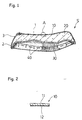
- FIGs. 1 and 2 show a vehicle seat according to one embodiment of the present invention.
- FIG. 1 is a cross-sectional view of the vehicle seat; and
- FIG. 2 is an enlarged view of the portion denoted by "A" in FIG. 1.
- the vehicle seat S comprises a surface layer 10, a cushion layer 20, and a bottom plate 30.
- the cushion layer 20 is placed on the bottom plate 30 and covered with the surface layer 10.
- the surface layer 10 is composed of a layer 11 of thermoplastic olefinic elastomer and a substrate cloth 12 of polypropylene fiber.
- the present embodiment employs an artificial leather of thermoplastic olefinic elastomer leather whose resin portion is constituted by polypropylene.
- thermoplastic elastomers olefinic thermoplastic elastomers are suited for the purposes of the present invention in that they are endowed with low specific gravity, excellent resistance to heat-degradation, resistance to coldness, weatherability, and excellent electrical properties.
- an embossing plate is used. Since thermoplastic olefinic elastomer used as the material for the surface layer 10 has excellent impressing properties, fine patterns formed on the embossing plate are transferred clearly onto the surface layer 10.
- the substrate cloth 12 is formed of a woven fabric of polypropylene yarns made of polypropylene fiber.
- the substrate cloth 12 is laminated with the layer 11 of olefinic thermoplastic elastomer through a known method comprising pressing, heating, and curing.
- the substrate cloth 12 is sandwiched between the surface layer 10 and the cushion layer 20. Therefore, sliding of the surface layer 10 on the cushion layer 20 is prevented. Further, even when the surface layer is torn or scratched, dust or rain water does not invade the cushion layer.
- the outer surface of the surface layer 10 can be embossed with any chosen pattern, to thereby impart a leather-like texture and appearance.
- Embossing can be performed by use of a known machine such as a lithographic press or a roll-embossing machine. By use of such a machine, the pattern of an embossing plate is transferred under heat or pressure to the surface of the surface layer.
- the surface layer 10 is formed by two portions which are sewed into a three-dimensional shape.
- the two portions are sewed at a ridge line 3 located between a seat surface portion 1 and a side surface portion 2.
- any other jointing method such as vacuum forming or welding, other than the above-described method of sewing two portions of the surface layer 10 may be used to form the surface layer 10 into a three-dimensional shape.
- the peripheral edge of the surface layer 10 is fixed to the bottom plate 30. Specifically, the edge of the surface layer 10 is fixed to the peripheral edge of the bottom plate 30 by use of staples 40 or the like, and, if necessary, by use of an adhesive.
- the cushion material 20 is formed of polyethylene foam.
- the polyethylene foam is fabricated through foaming of pellets or powder of polyethylene containing a foaming agent.
- the cushion material 20 is formed into a seat shape having a predetermined contour. This step can be performed in advance and the resultant mold is then bonded to the surface layer by use of an adhesive or the like.
- the cushion material 20 may be integrated with the surface layer during formation of the surface layer, which eliminates the bonding work.
- the bottom plate 30 is formed of polypropylene foam.
- the polypropylene foam is fabricated through foaming of polypropylene pellets or powder in the presence of a foaming agent. Since the bottom plate 30 is a member serving as a base portion of the vehicle seat, the bottom plate 30 is formed of hard foam.
- the present embodiment has been described with reference to the structure of a seat for a motorcycle in which a cushion material is placed on the bottom plate.
- the cushion material 20 is placed on a frame serving as a bottom plate.
- the frame is formed of polypropylene foam.
- a seat (for a scooter) having a conventional structure has a weight of 1,100 to 1,500 g
- a similar vehicle seat manufactured to have the structure of the present embodiment has a weight of 800 to 1,100 g.
Landscapes
- Engineering & Computer Science (AREA)
- Mechanical Engineering (AREA)
- Laminated Bodies (AREA)
- Mattresses And Other Support Structures For Chairs And Beds (AREA)
Abstract
Description
- The present invention relates to a seat for vehicles (hereinafter referred to as a vehicle seat), and more particularly to a lightweight seat which can be conveniently recycled.
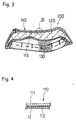
- As shown in FIG. 3, a
vehicle seat 100 typically includes asurface layer 110, acushion layer 120, and abottom plate 130. Conventionally, various materials have been employed to form the respective layers and plate. For example, thesurface layer 110 has been formed of a laminate consisting of polyvinyl chloride layer (such as an artificial leather made of polyvinyl chloride) 111 laminated onto a substrate cloth 112 made of material such as nylon, polyester, rayon, or cotton. Polyurethane foam has been employed to form thecushion layer 120, and polypropylene has been employed to form thebottom plate 130. - In recent years, with demands to protect the global environment and the necessity for effective utilization of resources becoming more acute, fuel economy and improved recycling have become issues of great concern in the area of transportation. Thus, there has been growing demands for lightweight components that can improve fuel economy and for components which can be easily recycled.
- When the
surface layer 110 of aconventional vehicle seat 100 is torn and water (e.g., rain water) invades the seat, urethane foam that constitutes thecushion layer 120 of the seat may absorb moisture, causing hydrolysis. Consequently, the moisture-absorbed portion of the cushion layer may become deformed or stiff, making the seat uncomfortable. - In order to prevent the above-described deterioration in the
cushion layer 120 caused by the absorbed water, as shown in FIGs. 3 and 4, there has been known a conventional technique such that awaterproof film 113 is sandwiched between thesurface layer 110 and thecushion layer 120. However, this technique has the disadvantage of involving a high production cost and an increased number of process steps, due to an increased number of components. - Further, a vehicle seat covered with a polyvinyl chloride layer has drawbacks in that the surface produces a vinyl-like gloss and fails to give a luxurious impression.
- An object of the present invention is to provide a lightweight vehicle seat which can be easily recycled. Another object of the present invention is to provide a vehicle seat having good appearance and exhibiting excellent waterproofing properties. As used herein, examples of the vehicle seat include seats used for motorcycles, scooters, snowmobiles, jet skis, beach buggies, mountable-type vehicles, and construction machinery.
- In order to achieve the above object, the present invention provides a vehicle seat comprising a bottom plate formed of polypropylene foam; a cushion layer formed of polyethylene foam and disposed on the bottom plate; and a surface layer covering the cushion layer and formed of a laminate containing a layer of thermoplastic olefinic elastomer and a substrate cloth made of polypropylene fiber.
- As described above, the vehicle seat of the present invention is constituted such that the surface layer is formed of a laminate containing a layer of thermoplastic olefinic elastomer and a substrate cloth made of polypropylene fiber; that the cushion layer is formed of polyethylene foam; and that the bottom plate is formed of polypropylene foam. Accordingly, employment of olefinic resin for all of the surface layer, the cushion layer, and the bottom plate allows less laborious recovery, easy refuse consolidation, and thus easy recycling of the material.
- The aforementioned materials which are employed for forming the surface layer, the cushion layer, and the bottom plate have a low specific gravity as compared with conventional materials; i.e., polyvinyl chloride for the surface layer, and polyurethane foam for the cushion layer. In addition, because the vehicle seat of the present invention comprises a bottom plate formed of polypropylene foam, the seat is lightweight and fuel economy is improved.
- The polyethylene foam employed in the cushion layer has excellent waterproof properties. Therefore, even when the surface layer is torn and water (e.g. rain water) invades the seat, the cushion layer is neither deformed nor hardened and the seat remains comfortable to sit upon. Thus, in the present invention, since there is no need to provide waterproof film on the cushion layer, it is possible to solve the aforementioned problems; such as an increase in production cost and in the number of production steps caused by the increased number of components.
- Since thermoplastic olefinic elastomer, serving as the material for the surface layer, has excellent imprinting properties, fine embossment patterns formed on an embossing plate are transferred clearly onto the surface layer. Thus, the surface layer exhibits the luxurious appearance of genuine leather.
- FIG. 1 is a sectional view of a vehicle seat according to the present invention;
- FIG. 2 is an enlarged view of portion A in FIG. 1;
- FIG. 3 is a sectional view of a conventional vehicle seat; and
- FIG. 4 is an enlarged view of portion B in FIG. 3.
-
- FIGs. 1 and 2 show a vehicle seat according to one embodiment of the present invention. FIG. 1 is a cross-sectional view of the vehicle seat; and FIG. 2 is an enlarged view of the portion denoted by "A" in FIG. 1.
- As shown in FIG. 1, the vehicle seat S comprises a
surface layer 10, acushion layer 20, and abottom plate 30. Thecushion layer 20 is placed on thebottom plate 30 and covered with thesurface layer 10. - First, the material for the
surface layer 10 will be described. As shown in FIG. 2, thesurface layer 10 is composed of alayer 11 of thermoplastic olefinic elastomer and asubstrate cloth 12 of polypropylene fiber. The present embodiment employs an artificial leather of thermoplastic olefinic elastomer leather whose resin portion is constituted by polypropylene. Among a variety of thermoplastic elastomers, olefinic thermoplastic elastomers are suited for the purposes of the present invention in that they are endowed with low specific gravity, excellent resistance to heat-degradation, resistance to coldness, weatherability, and excellent electrical properties. In order to impress patterns onto thesurface layer 10, an embossing plate is used. Since thermoplastic olefinic elastomer used as the material for thesurface layer 10 has excellent impressing properties, fine patterns formed on the embossing plate are transferred clearly onto thesurface layer 10. - The
substrate cloth 12 is formed of a woven fabric of polypropylene yarns made of polypropylene fiber. Thesubstrate cloth 12 is laminated with thelayer 11 of olefinic thermoplastic elastomer through a known method comprising pressing, heating, and curing. Thesubstrate cloth 12 is sandwiched between thesurface layer 10 and thecushion layer 20. Therefore, sliding of thesurface layer 10 on thecushion layer 20 is prevented. Further, even when the surface layer is torn or scratched, dust or rain water does not invade the cushion layer. - The outer surface of the
surface layer 10 can be embossed with any chosen pattern, to thereby impart a leather-like texture and appearance. Embossing can be performed by use of a known machine such as a lithographic press or a roll-embossing machine. By use of such a machine, the pattern of an embossing plate is transferred under heat or pressure to the surface of the surface layer. - In the present embodiment, as shown in FIG. 1, the
surface layer 10 is formed by two portions which are sewed into a three-dimensional shape. The two portions are sewed at aridge line 3 located between aseat surface portion 1 and aside surface portion 2. Needless to say, any other jointing method, such as vacuum forming or welding, other than the above-described method of sewing two portions of thesurface layer 10 may be used to form thesurface layer 10 into a three-dimensional shape. - The peripheral edge of the
surface layer 10 is fixed to thebottom plate 30. Specifically, the edge of thesurface layer 10 is fixed to the peripheral edge of thebottom plate 30 by use ofstaples 40 or the like, and, if necessary, by use of an adhesive. - The
cushion material 20 is formed of polyethylene foam. The polyethylene foam is fabricated through foaming of pellets or powder of polyethylene containing a foaming agent. Thecushion material 20 is formed into a seat shape having a predetermined contour. This step can be performed in advance and the resultant mold is then bonded to the surface layer by use of an adhesive or the like. Alternatively, thecushion material 20 may be integrated with the surface layer during formation of the surface layer, which eliminates the bonding work. - The
bottom plate 30 is formed of polypropylene foam. The polypropylene foam is fabricated through foaming of polypropylene pellets or powder in the presence of a foaming agent. Since thebottom plate 30 is a member serving as a base portion of the vehicle seat, thebottom plate 30 is formed of hard foam. - The present embodiment has been described with reference to the structure of a seat for a motorcycle in which a cushion material is placed on the bottom plate. However, with a seat having a different structure; e.g., a seat for construction machinery, the
cushion material 20 is placed on a frame serving as a bottom plate. In such a case, the frame is formed of polypropylene foam. - Measurement of the weight of a vehicle seat having the above-described structure reveals that the weight is reduced 25 to 35% as compared with the case of seats of conventional types. Specifically, a seat (for a scooter) having a conventional structure has a weight of 1,100 to 1,500 g, whereas a similar vehicle seat manufactured to have the structure of the present embodiment has a weight of 800 to 1,100 g.
Claims (8)
- A vehicle seat comprising:a bottom plate (30) formed of polypropylene foam;a cushion layer (20) formed of polyethylene foam and disposed on the bottom plate (30); anda surface layer (10) covering the cushion layer (20) and formed of a laminate containing a layer of thermoplastic olefinic elastomer (11) and a substrate cloth (12) made of polypropylene fiber.
- The vehicle seat according to claim 1, wherein the thermoplastic olefinic elastomer is thermoplastic polypropylene elastomer.
- The vehicle seat according to claim 1, wherein the outer surface of the surface layer (10) is embossed.
- The vehicle seat according to claim 1, wherein the surface layer (10) is divided into at least two pieces, which form a three dimensional shape.
- The vehicle seat according to claim 4, wherein the two pieces of the surface layer (10) is jointed together at a ridge line (3) located between a seat surface portion (1) and a side surface portion (2).
- The vehicle seat according to claim 1, wherein the substrate cloth (12) is formed of a woven fabric of a polypropylene yarn made of polypropylene fiber.
- The vehicle seat according to claim 1, wherein the cushion material is formed of a polyethylene foam which is fabricated through foaming of polyethylene pellets or powder in the presence of a foaming agent.
- The vehicle seat according to claim 1, wherein the seat is used for a motorcycle, a scooter, a snowmobile, a jet ski, a beach buggy, a mountable-type vehicle, or construction machinery.
Applications Claiming Priority (2)
| Application Number | Priority Date | Filing Date | Title |
|---|---|---|---|
| JP29629599A JP2001112587A (en) | 1999-10-19 | 1999-10-19 | Vehicle seat |
| JP29629599 | 1999-10-19 |
Publications (3)
| Publication Number | Publication Date |
|---|---|
| EP1093997A2 true EP1093997A2 (en) | 2001-04-25 |
| EP1093997A3 EP1093997A3 (en) | 2003-12-03 |
| EP1093997B1 EP1093997B1 (en) | 2005-01-12 |
Family
ID=17831714
Family Applications (1)
| Application Number | Title | Priority Date | Filing Date |
|---|---|---|---|
| EP20000122729 Expired - Lifetime EP1093997B1 (en) | 1999-10-19 | 2000-10-18 | Seat for vehicles |
Country Status (4)
| Country | Link |
|---|---|
| EP (1) | EP1093997B1 (en) |
| JP (1) | JP2001112587A (en) |
| DE (1) | DE60017332T2 (en) |
| ES (1) | ES2234499T3 (en) |
Cited By (3)
| Publication number | Priority date | Publication date | Assignee | Title |
|---|---|---|---|---|
| EP1792815A1 (en) * | 2005-11-30 | 2007-06-06 | HONDA MOTOR CO., Ltd. | Seat for vehicle and seat for watercraft |
| CN103448837A (en) * | 2013-07-03 | 2013-12-18 | 无锡宇吉科技有限公司 | Bicycle saddle |
| CN110466651A (en) * | 2019-09-10 | 2019-11-19 | 上海钧正网络科技有限公司 | seat cushion |
Families Citing this family (1)
| Publication number | Priority date | Publication date | Assignee | Title |
|---|---|---|---|---|
| CN100450859C (en) * | 2003-12-15 | 2009-01-14 | 欣乐工业股份有限公司 | Seat cushion shell frame |
Family Cites Families (7)
| Publication number | Priority date | Publication date | Assignee | Title |
|---|---|---|---|---|
| NL285812A (en) * | 1962-11-22 | 1900-01-01 | ||
| US3833259A (en) * | 1972-05-30 | 1974-09-03 | Deere & Co | Vehicle seat comprising three foam layers |
| JP2582771B2 (en) * | 1987-04-07 | 1997-02-19 | 三井石油化学工業株式会社 | Thermoplastic elastomer laminated leather |
| JP2905841B2 (en) * | 1988-06-28 | 1999-06-14 | テイ・エステック株式会社 | Manufacturing method of waterproof sheet for snow and water vehicles |
| ES2123585T3 (en) * | 1992-05-12 | 1999-01-16 | Kinkel Werner Helmut | AUTOMOBILE HOOD TEXTILE MATERIAL FROM POLYOLEFIN OR POLYESTER FIBERS, PREDOMINANTLY WITH ADDITIONAL LAYERS OF POLYMER. |
| DE19547971A1 (en) * | 1995-12-21 | 1997-06-26 | Basf Ag | Automobile seat |
| US6116684A (en) * | 1997-06-06 | 2000-09-12 | Bleachercomfort Llc | Ultra lightweight closed cell foam bicycle saddle |
-
1999
- 1999-10-19 JP JP29629599A patent/JP2001112587A/en active Pending
-
2000
- 2000-10-18 EP EP20000122729 patent/EP1093997B1/en not_active Expired - Lifetime
- 2000-10-18 DE DE2000617332 patent/DE60017332T2/en not_active Expired - Fee Related
- 2000-10-18 ES ES00122729T patent/ES2234499T3/en not_active Expired - Lifetime
Non-Patent Citations (1)
| Title |
|---|
| None |
Cited By (4)
| Publication number | Priority date | Publication date | Assignee | Title |
|---|---|---|---|---|
| EP1792815A1 (en) * | 2005-11-30 | 2007-06-06 | HONDA MOTOR CO., Ltd. | Seat for vehicle and seat for watercraft |
| US7980633B2 (en) | 2005-11-30 | 2011-07-19 | Honda Motor Co., Ltd. | Seat for vehicle and seat for watercraft |
| CN103448837A (en) * | 2013-07-03 | 2013-12-18 | 无锡宇吉科技有限公司 | Bicycle saddle |
| CN110466651A (en) * | 2019-09-10 | 2019-11-19 | 上海钧正网络科技有限公司 | seat cushion |
Also Published As
| Publication number | Publication date |
|---|---|
| EP1093997A3 (en) | 2003-12-03 |
| ES2234499T3 (en) | 2005-07-01 |
| EP1093997B1 (en) | 2005-01-12 |
| DE60017332T2 (en) | 2005-06-02 |
| DE60017332D1 (en) | 2005-02-17 |
| JP2001112587A (en) | 2001-04-24 |
Similar Documents
| Publication | Publication Date | Title |
|---|---|---|
| US6832421B2 (en) | Vehicle seat, a skin material for a vehicle seat and a method of manufacturing the vehicle seat | |
| US6030035A (en) | Cushioned bicycle saddle with contoured seat | |
| US5456976A (en) | Resiliently padded laminate construction and injection molded thermoplastic articles faced therewith | |
| US4541885A (en) | Method of manufacturing a vehicle seat cover | |
| US6290794B1 (en) | Method of manufacturing cushioned bicycle saddle | |
| US6409865B1 (en) | Bicycle saddle production method | |
| US6620488B2 (en) | Skin material, skinned cushion, and process for producing skinned cushion | |
| KR101340291B1 (en) | Volume seat cover for motors and method of preparing the same | |
| CN100540210C (en) | Reinforcing plate for lightweight carrying bag, carrying bag assembled therefrom, and methods of manufacture and assembly thereof | |
| US20160176364A1 (en) | Vehicle interior panel with sculpted surface | |
| EP1093997B1 (en) | Seat for vehicles | |
| WO1998054045A1 (en) | Bicycle seat and method of manufacture | |
| JP2005125845A (en) | Vehicular skin material, vehicular seat and vehicular skin material manufacturing method | |
| WO2000007842A1 (en) | Embellishing articles | |
| KR102634842B1 (en) | Substrate for car headrest and manufacturing method thereof | |
| CA2074425C (en) | Multi-layered sheet | |
| JPH11156976A (en) | Skin material for vehicle interior | |
| JP3881538B2 (en) | Seats for motorcycles | |
| JP5236928B2 (en) | Laminated body and method for producing the same | |
| JP3881539B2 (en) | Seats for motorcycles | |
| JPS6330320Y2 (en) | ||
| JP2005124673A (en) | Vehicle skin material and vehicle seat | |
| JP2001114917A (en) | VEHICLE FOAM SUBSTRATE, METHOD FOR MANUFACTURING THE SAME, AND VEHICLE SHEET | |
| US20210023811A1 (en) | Sandwich-Type, Composite Component Having an Injection Molded Backside Protective Covering | |
| JPH10166923A (en) | Vehicle floor mats |
Legal Events
| Date | Code | Title | Description |
|---|---|---|---|
| PUAI | Public reference made under article 153(3) epc to a published international application that has entered the european phase |
Free format text: ORIGINAL CODE: 0009012 |
|
| AK | Designated contracting states |
Kind code of ref document: A2 Designated state(s): AT BE CH CY DE DK ES FI FR GB GR IE IT LI LU MC NL PT SE |
|
| AX | Request for extension of the european patent |
Free format text: AL;LT;LV;MK;RO;SI |
|
| PUAL | Search report despatched |
Free format text: ORIGINAL CODE: 0009013 |
|
| AK | Designated contracting states |
Kind code of ref document: A3 Designated state(s): AT BE CH CY DE DK ES FI FR GB GR IE IT LI LU MC NL PT SE |
|
| AX | Request for extension of the european patent |
Extension state: AL LT LV MK RO SI |
|
| RIC1 | Information provided on ipc code assigned before grant |
Ipc: 7A 47C 7/20 B Ipc: 7B 62J 1/00 A Ipc: 7B 32B 27/12 B |
|
| 17P | Request for examination filed |
Effective date: 20040210 |
|
| 17Q | First examination report despatched |
Effective date: 20040308 |
|
| GRAP | Despatch of communication of intention to grant a patent |
Free format text: ORIGINAL CODE: EPIDOSNIGR1 |
|
| AKX | Designation fees paid |
Designated state(s): DE ES IT |
|
| GRAS | Grant fee paid |
Free format text: ORIGINAL CODE: EPIDOSNIGR3 |
|
| GRAA | (expected) grant |
Free format text: ORIGINAL CODE: 0009210 |
|
| AK | Designated contracting states |
Kind code of ref document: B1 Designated state(s): DE ES IT |
|
| REF | Corresponds to: |
Ref document number: 60017332 Country of ref document: DE Date of ref document: 20050217 Kind code of ref document: P |
|
| REG | Reference to a national code |
Ref country code: IE Ref legal event code: FG4D |
|
| REG | Reference to a national code |
Ref country code: ES Ref legal event code: FG2A Ref document number: 2234499 Country of ref document: ES Kind code of ref document: T3 |
|
| PLBE | No opposition filed within time limit |
Free format text: ORIGINAL CODE: 0009261 |
|
| STAA | Information on the status of an ep patent application or granted ep patent |
Free format text: STATUS: NO OPPOSITION FILED WITHIN TIME LIMIT |
|
| 26N | No opposition filed |
Effective date: 20051013 |
|
| PGFP | Annual fee paid to national office [announced via postgrant information from national office to epo] |
Ref country code: DE Payment date: 20081127 Year of fee payment: 9 |
|
| PGFP | Annual fee paid to national office [announced via postgrant information from national office to epo] |
Ref country code: ES Payment date: 20081015 Year of fee payment: 9 |
|
| PGFP | Annual fee paid to national office [announced via postgrant information from national office to epo] |
Ref country code: IT Payment date: 20081022 Year of fee payment: 9 |
|
| PG25 | Lapsed in a contracting state [announced via postgrant information from national office to epo] |
Ref country code: DE Free format text: LAPSE BECAUSE OF NON-PAYMENT OF DUE FEES Effective date: 20100501 |
|
| REG | Reference to a national code |
Ref country code: ES Ref legal event code: FD2A Effective date: 20110309 |
|
| PG25 | Lapsed in a contracting state [announced via postgrant information from national office to epo] |
Ref country code: IT Free format text: LAPSE BECAUSE OF NON-PAYMENT OF DUE FEES Effective date: 20091018 |
|
| PG25 | Lapsed in a contracting state [announced via postgrant information from national office to epo] |
Ref country code: ES Free format text: LAPSE BECAUSE OF NON-PAYMENT OF DUE FEES Effective date: 20110308 |
|
| PG25 | Lapsed in a contracting state [announced via postgrant information from national office to epo] |
Ref country code: ES Free format text: LAPSE BECAUSE OF NON-PAYMENT OF DUE FEES Effective date: 20091019 |