EP1093572B1 - Improved method for mixing and processing specimen samples - Google Patents
Improved method for mixing and processing specimen samples Download PDFInfo
- Publication number
- EP1093572B1 EP1093572B1 EP99935428A EP99935428A EP1093572B1 EP 1093572 B1 EP1093572 B1 EP 1093572B1 EP 99935428 A EP99935428 A EP 99935428A EP 99935428 A EP99935428 A EP 99935428A EP 1093572 B1 EP1093572 B1 EP 1093572B1
- Authority
- EP
- European Patent Office
- Prior art keywords
- particulate matter
- cover
- container
- sample
- fluid
- Prior art date
- Legal status (The legal status is an assumption and is not a legal conclusion. Google has not performed a legal analysis and makes no representation as to the accuracy of the status listed.)
- Expired - Lifetime
Links
- 238000000034 method Methods 0.000 title claims abstract description 63
- 238000012545 processing Methods 0.000 title claims description 19
- 238000002156 mixing Methods 0.000 title claims description 8
- 239000012530 fluid Substances 0.000 claims abstract description 102
- 239000013618 particulate matter Substances 0.000 claims abstract description 91
- 238000004891 communication Methods 0.000 claims description 8
- 230000003213 activating effect Effects 0.000 claims 2
- 239000007788 liquid Substances 0.000 abstract description 14
- 239000000523 sample Substances 0.000 description 76
- 210000004027 cell Anatomy 0.000 description 67
- 239000002609 medium Substances 0.000 description 23
- 238000002360 preparation method Methods 0.000 description 21
- 238000000926 separation method Methods 0.000 description 19
- 239000012528 membrane Substances 0.000 description 15
- 239000002356 single layer Substances 0.000 description 15
- 239000000834 fixative Substances 0.000 description 13
- 230000033001 locomotion Effects 0.000 description 13
- 238000012360 testing method Methods 0.000 description 13
- 210000002700 urine Anatomy 0.000 description 13
- 239000013060 biological fluid Substances 0.000 description 12
- 230000002380 cytological effect Effects 0.000 description 12
- 206010036790 Productive cough Diseases 0.000 description 11
- 239000000203 mixture Substances 0.000 description 11
- 239000000243 solution Substances 0.000 description 11
- 210000003802 sputum Anatomy 0.000 description 11
- 208000024794 sputum Diseases 0.000 description 11
- CSCPPACGZOOCGX-UHFFFAOYSA-N Acetone Chemical compound CC(C)=O CSCPPACGZOOCGX-UHFFFAOYSA-N 0.000 description 10
- 239000007787 solid Substances 0.000 description 10
- PEDCQBHIVMGVHV-UHFFFAOYSA-N Glycerine Chemical compound OCC(O)CO PEDCQBHIVMGVHV-UHFFFAOYSA-N 0.000 description 9
- OKKJLVBELUTLKV-UHFFFAOYSA-N Methanol Chemical compound OC OKKJLVBELUTLKV-UHFFFAOYSA-N 0.000 description 9
- 238000009826 distribution Methods 0.000 description 9
- WSFSSNUMVMOOMR-UHFFFAOYSA-N Formaldehyde Chemical compound O=C WSFSSNUMVMOOMR-UHFFFAOYSA-N 0.000 description 8
- 238000003556 assay Methods 0.000 description 8
- 230000008569 process Effects 0.000 description 8
- 238000003756 stirring Methods 0.000 description 8
- 239000000463 material Substances 0.000 description 7
- 244000007853 Sarothamnus scoparius Species 0.000 description 6
- 210000001124 body fluid Anatomy 0.000 description 6
- 239000010839 body fluid Substances 0.000 description 6
- 239000010410 layer Substances 0.000 description 6
- 239000011148 porous material Substances 0.000 description 6
- 238000010186 staining Methods 0.000 description 6
- LFQSCWFLJHTTHZ-UHFFFAOYSA-N Ethanol Chemical compound CCO LFQSCWFLJHTTHZ-UHFFFAOYSA-N 0.000 description 5
- 239000002202 Polyethylene glycol Substances 0.000 description 5
- 238000004458 analytical method Methods 0.000 description 5
- 230000005540 biological transmission Effects 0.000 description 5
- 238000003745 diagnosis Methods 0.000 description 5
- 230000007613 environmental effect Effects 0.000 description 5
- 238000009472 formulation Methods 0.000 description 5
- 229920001223 polyethylene glycol Polymers 0.000 description 5
- 238000012800 visualization Methods 0.000 description 5
- KFZMGEQAYNKOFK-UHFFFAOYSA-N Isopropanol Chemical compound CC(C)O KFZMGEQAYNKOFK-UHFFFAOYSA-N 0.000 description 4
- 206010028980 Neoplasm Diseases 0.000 description 4
- 239000000872 buffer Substances 0.000 description 4
- 201000011510 cancer Diseases 0.000 description 4
- 230000001413 cellular effect Effects 0.000 description 4
- 238000007906 compression Methods 0.000 description 4
- 230000006835 compression Effects 0.000 description 4
- 238000011109 contamination Methods 0.000 description 4
- 230000001086 cytosolic effect Effects 0.000 description 4
- -1 paraffins Polymers 0.000 description 4
- 239000013610 patient sample Substances 0.000 description 4
- 239000003755 preservative agent Substances 0.000 description 4
- 239000000126 substance Substances 0.000 description 4
- 241000894006 Bacteria Species 0.000 description 3
- 239000007983 Tris buffer Substances 0.000 description 3
- 238000007605 air drying Methods 0.000 description 3
- 239000008280 blood Substances 0.000 description 3
- 210000004369 blood Anatomy 0.000 description 3
- 238000004587 chromatography analysis Methods 0.000 description 3
- 239000000356 contaminant Substances 0.000 description 3
- 238000001514 detection method Methods 0.000 description 3
- 238000001914 filtration Methods 0.000 description 3
- 239000011521 glass Substances 0.000 description 3
- 230000013011 mating Effects 0.000 description 3
- 244000005700 microbiome Species 0.000 description 3
- 108090000623 proteins and genes Proteins 0.000 description 3
- 102000004169 proteins and genes Human genes 0.000 description 3
- 238000012546 transfer Methods 0.000 description 3
- LENZDBCJOHFCAS-UHFFFAOYSA-N tris Chemical compound OCC(N)(CO)CO LENZDBCJOHFCAS-UHFFFAOYSA-N 0.000 description 3
- BHNQPLPANNDEGL-UHFFFAOYSA-N 2-(4-octylphenoxy)ethanol Chemical compound CCCCCCCCC1=CC=C(OCCO)C=C1 BHNQPLPANNDEGL-UHFFFAOYSA-N 0.000 description 2
- 239000004971 Cross linker Substances 0.000 description 2
- 239000004743 Polypropylene Substances 0.000 description 2
- 230000002159 abnormal effect Effects 0.000 description 2
- 208000003464 asthenopia Diseases 0.000 description 2
- IISBACLAFKSPIT-UHFFFAOYSA-N bisphenol A Chemical compound C=1C=C(O)C=CC=1C(C)(C)C1=CC=C(O)C=C1 IISBACLAFKSPIT-UHFFFAOYSA-N 0.000 description 2
- 230000024245 cell differentiation Effects 0.000 description 2
- 210000001175 cerebrospinal fluid Anatomy 0.000 description 2
- 238000004140 cleaning Methods 0.000 description 2
- 238000000151 deposition Methods 0.000 description 2
- 238000013461 design Methods 0.000 description 2
- 239000003599 detergent Substances 0.000 description 2
- 239000006185 dispersion Substances 0.000 description 2
- 238000001035 drying Methods 0.000 description 2
- 229920001971 elastomer Polymers 0.000 description 2
- 239000000835 fiber Substances 0.000 description 2
- 230000005484 gravity Effects 0.000 description 2
- 238000003365 immunocytochemistry Methods 0.000 description 2
- 150000002576 ketones Chemical class 0.000 description 2
- 239000006194 liquid suspension Substances 0.000 description 2
- 238000000386 microscopy Methods 0.000 description 2
- 238000009595 pap smear Methods 0.000 description 2
- 229920003023 plastic Polymers 0.000 description 2
- 239000004033 plastic Substances 0.000 description 2
- 239000004417 polycarbonate Substances 0.000 description 2
- 229920000515 polycarbonate Polymers 0.000 description 2
- 229920001155 polypropylene Polymers 0.000 description 2
- 230000002829 reductive effect Effects 0.000 description 2
- 230000000717 retained effect Effects 0.000 description 2
- 239000005060 rubber Substances 0.000 description 2
- 238000012216 screening Methods 0.000 description 2
- 239000002904 solvent Substances 0.000 description 2
- 239000000758 substrate Substances 0.000 description 2
- 229920001817 Agar Polymers 0.000 description 1
- 108020003215 DNA Probes Proteins 0.000 description 1
- 239000003298 DNA probe Substances 0.000 description 1
- 239000001856 Ethyl cellulose Substances 0.000 description 1
- ZZSNKZQZMQGXPY-UHFFFAOYSA-N Ethyl cellulose Chemical compound CCOCC1OC(OC)C(OCC)C(OCC)C1OC1C(O)C(O)C(OC)C(CO)O1 ZZSNKZQZMQGXPY-UHFFFAOYSA-N 0.000 description 1
- 241000701806 Human papillomavirus Species 0.000 description 1
- PWKSKIMOESPYIA-BYPYZUCNSA-N L-N-acetyl-Cysteine Chemical compound CC(=O)N[C@@H](CS)C(O)=O PWKSKIMOESPYIA-BYPYZUCNSA-N 0.000 description 1
- 206010058467 Lung neoplasm malignant Diseases 0.000 description 1
- 239000000020 Nitrocellulose Substances 0.000 description 1
- 239000004677 Nylon Substances 0.000 description 1
- 108700020796 Oncogene Proteins 0.000 description 1
- 102000043276 Oncogene Human genes 0.000 description 1
- 241001247287 Pentalinon luteum Species 0.000 description 1
- 239000004698 Polyethylene Substances 0.000 description 1
- 229920002367 Polyisobutene Polymers 0.000 description 1
- 239000004793 Polystyrene Substances 0.000 description 1
- 229920001079 Thiokol (polymer) Polymers 0.000 description 1
- XSTXAVWGXDQKEL-UHFFFAOYSA-N Trichloroethylene Chemical compound ClC=C(Cl)Cl XSTXAVWGXDQKEL-UHFFFAOYSA-N 0.000 description 1
- 229960004308 acetylcysteine Drugs 0.000 description 1
- 230000002411 adverse Effects 0.000 description 1
- 239000008272 agar Substances 0.000 description 1
- 150000001299 aldehydes Chemical class 0.000 description 1
- 229920000180 alkyd Polymers 0.000 description 1
- 210000004381 amniotic fluid Anatomy 0.000 description 1
- 239000003963 antioxidant agent Substances 0.000 description 1
- 230000001580 bacterial effect Effects 0.000 description 1
- 239000011324 bead Substances 0.000 description 1
- 239000007853 buffer solution Substances 0.000 description 1
- 239000002775 capsule Substances 0.000 description 1
- 210000003850 cellular structure Anatomy 0.000 description 1
- 238000005119 centrifugation Methods 0.000 description 1
- 230000002759 chromosomal effect Effects 0.000 description 1
- 239000011248 coating agent Substances 0.000 description 1
- 238000000576 coating method Methods 0.000 description 1
- 230000000295 complement effect Effects 0.000 description 1
- 238000004590 computer program Methods 0.000 description 1
- 238000010276 construction Methods 0.000 description 1
- 238000012258 culturing Methods 0.000 description 1
- 238000004163 cytometry Methods 0.000 description 1
- 230000007423 decrease Effects 0.000 description 1
- 230000001934 delay Effects 0.000 description 1
- 230000001419 dependent effect Effects 0.000 description 1
- 230000001627 detrimental effect Effects 0.000 description 1
- 238000000502 dialysis Methods 0.000 description 1
- 239000003085 diluting agent Substances 0.000 description 1
- 150000002009 diols Chemical class 0.000 description 1
- 239000002270 dispersing agent Substances 0.000 description 1
- VHJLVAABSRFDPM-QWWZWVQMSA-N dithiothreitol Chemical compound SC[C@@H](O)[C@H](O)CS VHJLVAABSRFDPM-QWWZWVQMSA-N 0.000 description 1
- 230000000694 effects Effects 0.000 description 1
- 230000005684 electric field Effects 0.000 description 1
- 238000005516 engineering process Methods 0.000 description 1
- 229920001249 ethyl cellulose Polymers 0.000 description 1
- 235000019325 ethyl cellulose Nutrition 0.000 description 1
- 238000011156 evaluation Methods 0.000 description 1
- 239000003172 expectorant agent Substances 0.000 description 1
- 239000012634 fragment Substances 0.000 description 1
- 238000005469 granulation Methods 0.000 description 1
- 230000003179 granulation Effects 0.000 description 1
- 239000003673 groundwater Substances 0.000 description 1
- 239000001963 growth medium Substances 0.000 description 1
- 239000002920 hazardous waste Substances 0.000 description 1
- 239000004009 herbicide Substances 0.000 description 1
- 229920001903 high density polyethylene Polymers 0.000 description 1
- 239000004700 high-density polyethylene Substances 0.000 description 1
- 238000010191 image analysis Methods 0.000 description 1
- 238000007901 in situ hybridization Methods 0.000 description 1
- 230000001939 inductive effect Effects 0.000 description 1
- 238000012994 industrial processing Methods 0.000 description 1
- 230000000977 initiatory effect Effects 0.000 description 1
- 238000002955 isolation Methods 0.000 description 1
- 230000000670 limiting effect Effects 0.000 description 1
- 201000005202 lung cancer Diseases 0.000 description 1
- 208000020816 lung neoplasm Diseases 0.000 description 1
- 238000012423 maintenance Methods 0.000 description 1
- 230000007246 mechanism Effects 0.000 description 1
- 238000005374 membrane filtration Methods 0.000 description 1
- 230000001394 metastastic effect Effects 0.000 description 1
- 206010061289 metastatic neoplasm Diseases 0.000 description 1
- 230000002906 microbiologic effect Effects 0.000 description 1
- 238000012986 modification Methods 0.000 description 1
- 230000004048 modification Effects 0.000 description 1
- 238000012544 monitoring process Methods 0.000 description 1
- 229940066491 mucolytics Drugs 0.000 description 1
- 229920001220 nitrocellulos Polymers 0.000 description 1
- 108020004707 nucleic acids Proteins 0.000 description 1
- 102000039446 nucleic acids Human genes 0.000 description 1
- 150000007523 nucleic acids Chemical class 0.000 description 1
- 235000015097 nutrients Nutrition 0.000 description 1
- 229920001778 nylon Polymers 0.000 description 1
- 239000002245 particle Substances 0.000 description 1
- 230000007170 pathology Effects 0.000 description 1
- 239000000575 pesticide Substances 0.000 description 1
- 229920003229 poly(methyl methacrylate) Polymers 0.000 description 1
- 229920002239 polyacrylonitrile Polymers 0.000 description 1
- 229920000573 polyethylene Polymers 0.000 description 1
- 229920000139 polyethylene terephthalate Polymers 0.000 description 1
- 229920000642 polymer Polymers 0.000 description 1
- 229920005862 polyol Polymers 0.000 description 1
- 150000003077 polyols Chemical class 0.000 description 1
- 229920001296 polysiloxane Polymers 0.000 description 1
- 229920002223 polystyrene Polymers 0.000 description 1
- 239000005077 polysulfide Substances 0.000 description 1
- 229920001021 polysulfide Polymers 0.000 description 1
- 150000008117 polysulfides Polymers 0.000 description 1
- 239000004814 polyurethane Substances 0.000 description 1
- 229920002635 polyurethane Polymers 0.000 description 1
- 239000004800 polyvinyl chloride Substances 0.000 description 1
- 229920000915 polyvinyl chloride Polymers 0.000 description 1
- 230000002335 preservative effect Effects 0.000 description 1
- 238000003825 pressing Methods 0.000 description 1
- KUAPETJWSCRJET-UHFFFAOYSA-N propane-1,1,3-tricarbaldehyde Chemical compound O=CCCC(C=O)C=O KUAPETJWSCRJET-UHFFFAOYSA-N 0.000 description 1
- 238000011002 quantification Methods 0.000 description 1
- 238000004445 quantitative analysis Methods 0.000 description 1
- 230000005855 radiation Effects 0.000 description 1
- 238000011084 recovery Methods 0.000 description 1
- 238000005057 refrigeration Methods 0.000 description 1
- 238000011160 research Methods 0.000 description 1
- 238000005070 sampling Methods 0.000 description 1
- 238000007790 scraping Methods 0.000 description 1
- 238000007789 sealing Methods 0.000 description 1
- 239000013049 sediment Substances 0.000 description 1
- 239000006152 selective media Substances 0.000 description 1
- 239000003381 stabilizer Substances 0.000 description 1
- 229920001169 thermoplastic Polymers 0.000 description 1
- 239000004416 thermosoftening plastic Substances 0.000 description 1
- 210000000115 thoracic cavity Anatomy 0.000 description 1
- 230000032258 transport Effects 0.000 description 1
- 229910021642 ultra pure water Inorganic materials 0.000 description 1
- 239000012498 ultrapure water Substances 0.000 description 1
- 238000002562 urinalysis Methods 0.000 description 1
- 238000005406 washing Methods 0.000 description 1
- 239000002351 wastewater Substances 0.000 description 1
- XLYOFNOQVPJJNP-UHFFFAOYSA-N water Substances O XLYOFNOQVPJJNP-UHFFFAOYSA-N 0.000 description 1
Images



Classifications
-
- G—PHYSICS
- G01—MEASURING; TESTING
- G01N—INVESTIGATING OR ANALYSING MATERIALS BY DETERMINING THEIR CHEMICAL OR PHYSICAL PROPERTIES
- G01N1/00—Sampling; Preparing specimens for investigation
- G01N1/28—Preparing specimens for investigation including physical details of (bio-)chemical methods covered elsewhere, e.g. G01N33/50, C12Q
- G01N1/40—Concentrating samples
- G01N1/4077—Concentrating samples by other techniques involving separation of suspended solids
-
- B—PERFORMING OPERATIONS; TRANSPORTING
- B01—PHYSICAL OR CHEMICAL PROCESSES OR APPARATUS IN GENERAL
- B01F—MIXING, e.g. DISSOLVING, EMULSIFYING OR DISPERSING
- B01F29/00—Mixers with rotating receptacles
- B01F29/60—Mixers with rotating receptacles rotating about a horizontal or inclined axis, e.g. drum mixers
- B01F29/63—Mixers with rotating receptacles rotating about a horizontal or inclined axis, e.g. drum mixers with fixed bars, i.e. stationary, or fixed on the receptacle
-
- B—PERFORMING OPERATIONS; TRANSPORTING
- B01—PHYSICAL OR CHEMICAL PROCESSES OR APPARATUS IN GENERAL
- B01F—MIXING, e.g. DISSOLVING, EMULSIFYING OR DISPERSING
- B01F35/00—Accessories for mixers; Auxiliary operations or auxiliary devices; Parts or details of general application
- B01F35/30—Driving arrangements; Transmissions; Couplings; Brakes
- B01F35/32—Driving arrangements
- B01F35/32005—Type of drive
- B01F35/3202—Hand driven
-
- B—PERFORMING OPERATIONS; TRANSPORTING
- B01—PHYSICAL OR CHEMICAL PROCESSES OR APPARATUS IN GENERAL
- B01F—MIXING, e.g. DISSOLVING, EMULSIFYING OR DISPERSING
- B01F35/00—Accessories for mixers; Auxiliary operations or auxiliary devices; Parts or details of general application
- B01F35/75—Discharge mechanisms
-
- B—PERFORMING OPERATIONS; TRANSPORTING
- B01—PHYSICAL OR CHEMICAL PROCESSES OR APPARATUS IN GENERAL
- B01F—MIXING, e.g. DISSOLVING, EMULSIFYING OR DISPERSING
- B01F35/00—Accessories for mixers; Auxiliary operations or auxiliary devices; Parts or details of general application
- B01F35/75—Discharge mechanisms
- B01F35/754—Discharge mechanisms characterised by the means for discharging the components from the mixer
- B01F35/75465—Discharge mechanisms characterised by the means for discharging the components from the mixer using suction, vacuum, e.g. with a pipette
-
- B—PERFORMING OPERATIONS; TRANSPORTING
- B01—PHYSICAL OR CHEMICAL PROCESSES OR APPARATUS IN GENERAL
- B01L—CHEMICAL OR PHYSICAL LABORATORY APPARATUS FOR GENERAL USE
- B01L3/00—Containers or dishes for laboratory use, e.g. laboratory glassware; Droppers
- B01L3/50—Containers for the purpose of retaining a material to be analysed, e.g. test tubes
- B01L3/502—Containers for the purpose of retaining a material to be analysed, e.g. test tubes with fluid transport, e.g. in multi-compartment structures
-
- B—PERFORMING OPERATIONS; TRANSPORTING
- B01—PHYSICAL OR CHEMICAL PROCESSES OR APPARATUS IN GENERAL
- B01L—CHEMICAL OR PHYSICAL LABORATORY APPARATUS FOR GENERAL USE
- B01L3/00—Containers or dishes for laboratory use, e.g. laboratory glassware; Droppers
- B01L3/50—Containers for the purpose of retaining a material to be analysed, e.g. test tubes
- B01L3/508—Containers for the purpose of retaining a material to be analysed, e.g. test tubes rigid containers not provided for above
-
- C—CHEMISTRY; METALLURGY
- C12—BIOCHEMISTRY; BEER; SPIRITS; WINE; VINEGAR; MICROBIOLOGY; ENZYMOLOGY; MUTATION OR GENETIC ENGINEERING
- C12M—APPARATUS FOR ENZYMOLOGY OR MICROBIOLOGY; APPARATUS FOR CULTURING MICROORGANISMS FOR PRODUCING BIOMASS, FOR GROWING CELLS OR FOR OBTAINING FERMENTATION OR METABOLIC PRODUCTS, i.e. BIOREACTORS OR FERMENTERS
- C12M33/00—Means for introduction, transport, positioning, extraction, harvesting, peeling or sampling of biological material in or from the apparatus
- C12M33/04—Means for introduction, transport, positioning, extraction, harvesting, peeling or sampling of biological material in or from the apparatus by injection or suction, e.g. using pipettes, syringes, needles
-
- C—CHEMISTRY; METALLURGY
- C12—BIOCHEMISTRY; BEER; SPIRITS; WINE; VINEGAR; MICROBIOLOGY; ENZYMOLOGY; MUTATION OR GENETIC ENGINEERING
- C12M—APPARATUS FOR ENZYMOLOGY OR MICROBIOLOGY; APPARATUS FOR CULTURING MICROORGANISMS FOR PRODUCING BIOMASS, FOR GROWING CELLS OR FOR OBTAINING FERMENTATION OR METABOLIC PRODUCTS, i.e. BIOREACTORS OR FERMENTERS
- C12M33/00—Means for introduction, transport, positioning, extraction, harvesting, peeling or sampling of biological material in or from the apparatus
- C12M33/14—Means for introduction, transport, positioning, extraction, harvesting, peeling or sampling of biological material in or from the apparatus with filters, sieves or membranes
-
- G—PHYSICS
- G01—MEASURING; TESTING
- G01N—INVESTIGATING OR ANALYSING MATERIALS BY DETERMINING THEIR CHEMICAL OR PHYSICAL PROPERTIES
- G01N1/00—Sampling; Preparing specimens for investigation
- G01N1/28—Preparing specimens for investigation including physical details of (bio-)chemical methods covered elsewhere, e.g. G01N33/50, C12Q
- G01N1/38—Diluting, dispersing or mixing samples
-
- B—PERFORMING OPERATIONS; TRANSPORTING
- B01—PHYSICAL OR CHEMICAL PROCESSES OR APPARATUS IN GENERAL
- B01L—CHEMICAL OR PHYSICAL LABORATORY APPARATUS FOR GENERAL USE
- B01L2300/00—Additional constructional details
- B01L2300/04—Closures and closing means
- B01L2300/041—Connecting closures to device or container
- B01L2300/042—Caps; Plugs
-
- B—PERFORMING OPERATIONS; TRANSPORTING
- B01—PHYSICAL OR CHEMICAL PROCESSES OR APPARATUS IN GENERAL
- B01L—CHEMICAL OR PHYSICAL LABORATORY APPARATUS FOR GENERAL USE
- B01L2300/00—Additional constructional details
- B01L2300/04—Closures and closing means
- B01L2300/046—Function or devices integrated in the closure
-
- B—PERFORMING OPERATIONS; TRANSPORTING
- B01—PHYSICAL OR CHEMICAL PROCESSES OR APPARATUS IN GENERAL
- B01L—CHEMICAL OR PHYSICAL LABORATORY APPARATUS FOR GENERAL USE
- B01L2300/00—Additional constructional details
- B01L2300/06—Auxiliary integrated devices, integrated components
- B01L2300/0681—Filter
-
- G—PHYSICS
- G01—MEASURING; TESTING
- G01N—INVESTIGATING OR ANALYSING MATERIALS BY DETERMINING THEIR CHEMICAL OR PHYSICAL PROPERTIES
- G01N1/00—Sampling; Preparing specimens for investigation
- G01N1/28—Preparing specimens for investigation including physical details of (bio-)chemical methods covered elsewhere, e.g. G01N33/50, C12Q
- G01N1/2813—Producing thin layers of samples on a substrate, e.g. smearing, spinning-on
Definitions
- the present invention is directed to an improved method for collecting a uniform layer of cells from body fluids suitable for use in improved cytological protocols.
- the ability and/or facility in separating matter, typically particulate matter, from a fluid is a critical component in the ability to test for the presence of substances in the fluid. Too often, interference associated with sample preparation obscures the target cells to such a degree that the process is not sufficiently reliable, or too costly. Reducing interference is frequently a function of adequately separating and dispersing mucoid clumps and cell aggregates.
- a similar scenario applies to many other fields which involve detection and/or diagnosis, including environmental testing, radiation research, cancer screening, cytological examination, microbiological testing, and hazardous waste contamination, to name just a few.
- a sample of cells be obtained from the patient, which can typically be done by scraping or swabbing an area, as in the case of cervical samples, or by collecting body fluids, such as those obtained from the chest cavity, bladder, or spinal canal, or by fine needle aspiration.
- body fluids such as those obtained from the chest cavity, bladder, or spinal canal, or by fine needle aspiration.
- the cells in the fluid are then transferred onto a glass slide for viewing.
- a filter assembly is placed in the liquid suspension and the filter assembly both disperses the cells and captures the cell on the filter, and the filter is removed and placed in contact with a microscope slide.
- a limiting factor in the sample preparation protocol is adequately separating solid matter from its fluid carrier (e.g., a variety of fluids, such as physiological, biological and environmental), and in easily and efficiently collecting and concentrating the solid matter in a form readily accessible to microscopic examination.
- fluid carrier e.g., a variety of fluids, such as physiological, biological and environmental
- various processing steps for breaking mucoid clumps and breaking cell aggregates are designed to evenly distribute cells in the fluid so that microscopic examination of a portion of the fluid will provide a representative sampling of all of the cells in the particulate matter in the fluid.
- U.S. Patent 5,143,627 opens the sample container, inserts a dispersing element into the liquid suspension, and rotates the dispersing element for several minutes.
- the Saccomanno method is used to process sputum, a process that is time consuming and involves a large number of processing steps.
- U.S. patent 5,471,994 a syringe is used to draw fluid from a sample container through a filter assembly in a housing attached to the cover of the sample container, whereby particulate matter contained in the sample is captured in a uniform layer and thereupon transferred onto a microscopic slide.
- a number of urine or other biological fluid specimen containers have been developed to allow liquid biological specimens to be tested without removing the lid of the urine or biological fluid container.
- cytology specimens collected from the body cavities using a swab, smear, flush or brush are also preserved in special containers with fixatives (e.g., alcohol or acetone fixatives) prior to transferring cells onto the slide or membrane for staining or examination.
- fixatives e.g., alcohol or acetone fixatives
- Diagnostic microbiology and/or cytology particularly in the area of clinical pathology, bases diagnoses on a microscopic examination of cells and other microscopic analyses.
- the accuracy of the diagnosis and the preparation of optimally interpretable specimens typically depends upon adequate sample preparation.
- New methodologies such as immunocytochemistry and image analysis require preparations that are reproducible, fast, biohazard-free and inexpensive.
- Different cell preparation techniques of the present invention address the issues of non-uniform cell densities, uneven cell distribution and air drying artifact. These preparations have resulted in an even distribution of cells that have superior morphology, which has improved light microscopic visualization and has allowed for the use of image cytometry instruments.
- the solid matter preparation techniques of the present invention address the issues of non-uniform matter densities, uneven matter distribution, and sample loss due to the number of steps involved in the sample preparation.
- the preparations of the present invention result in an even distribution of solids that have superior morphology, improved visualization, and are readily positioned and available for light absorbency analysis without the need to further manipulate or prepare the sample.
- the present invention relates to use of an apparatus for collecting matter for detection, analysis, quantification, and/or visualization, and is particularly suitable for separating matter from biological, physiological, and environmental fluids and presenting the particulate matter in an improved manner for cytological examination.
- the present invention is particularly suited to processing sputum or other high mucous content fluids.
- the present invention relates to use of an apparatus that includes structures for engaging a portion of the cover of a collection container, and one or more structures for rotating the collection container.
- the apparatus may be configured to process a single sample container or more than one, and may be operated manually, semi-automatically, or automatically.
- the cover may include an outer stationary cover and an inner rotatable cover.
- the inner and outer covers are not rotatable with respect to each other in a first position, and are freely rotatable with respect to each other in a second position.
- An apparatus used in the present invention includes a structure or element for rotating a sample container and another structure or element for engaging a portion of the sample container, e.g., a portion of the cover, and holding the portion in place.
- the present invention relates to use of an apparatus for collecting a uniform layer of cells from urine or other biological fluid specimen in a cytology collection apparatus or assay module, which can be removably detached from a collection container for application to a slide.
- the patient or medical person handling the collection may seal the separate container.
- the collection of the cells in the cytology collection apparatus allows a uniform cell slide to be obtained without contamination of the cells by preservatives, workers or outside materials.
- the transfer from collection container to the cytology collection apparatus may be carried out without pouring or pipetting the collected specimen.
- the devices do not need to be opened in order to separate the particulate matter from the fluid. That is, an apparatus may be a closed system, and particulate matter may be collected using a closed system.
- the present invention is directed to use of a cell collection and distribution apparatus that is preferably closed from the time the sample is collected to the time that particulate matter is captured on a collection site.
- the apparatus is preferably capable of being disassembled to allow face to face transfer of cells from the device to a slide for microscope examination.
- the present invention provides an improved method for collecting a monolayer of cells that can be transferred to a microscope slide.
- the devices involved in the present invention obviate the need for a trained technician to properly prepare a sample substrate.
- time, expense, and expertise are eliminated or reduced as critical factors in sample preparation protocols.
- the present invention also provides advantages in sample preparation because it is suitable for use with fresh, untreated cells, unmodified cells, and is particularly designed to provide a thin, uniform layer of solid matter (up to approximately 40 microns or more).
- This invention is particularly useful in gynecological processes, e.g., for collecting cells for a pap smear, and for processing fluids such as sputum that have mucous clumps in the fluid.
- the method of the present invention may involve use of a cytology collection and testing kit containing the cytology collection apparatus described above.
- the cytology collection kit may also include replacement filters, replacement disposables, and/or other components or solutions typically used during cytological examinations.
- the present invention has many advantages for conventional microbiology and hematology.
- the collected cells are in a predetermined area, and for some embodiment of the invention, are easily accessible to a radiant light source and to a wavelength absorbency meter. Because cells are concentrated in a single layer, they are almost always in one focal plane, thus eliminating or reducing interference by other particles and virtually eliminating technician time and expertise in establishing a proper reading.
- the minimal matter overlap achieved ensures that all matter can be easily examined with little chance for critical solids to be obscured by clumps of overlapping solids or debris.
- the involved apparatuses even permit the use of automated devices to detect and analyze any solid matter in a given population. It also permits a detailed analysis of the chemical composition of the matter.
- a container cover that has a portion that is rotatable permits particulate matter stirring or dispersion without inserting a stirring mechanism into the sample, thus eliminating a source of contamination that plaques devices that are presently commercially available.
- An apparatus used in the present invention includes a container support for positioning and rotating at least one sample container, and a sleeve or clamp for engaging and fixing a portion of the container that communicates with a dispersing element.
- the sleeve engages an inner cover.
- An embodiment of the invention includes the use of a sample container having a cover; said cover having a first portion that communicates with a dispersing element, said first portion being matingly engaged to a second portion of the cover, said second portion communicating with the sample container and being rotatable in relation to said first portion; a container support for engaging and rotating the sample container; and a sleeve for engaging and fixing the second portion of the cover.
- an exemplary device involved in the present invention may include a cover within a cover, wherein the agitator is fixed to a stationary inner cover and the container and outer cover freely rotate. Such relative motion moves the agitator in relation to the sample, and disperses particulate matter in the fluid.
- An instrument involved in the present invention preferably employs a fresh sample vial, an unused filter assembly, and an unused microscope slide for each individual cell specimen. Moreover, the relatively simple operation, and the multiple functions that the instrument performs, minimize the requirements for operator attendance and time, as well as minimizing maintenance and preparation.
- the sample container is closed throughout the processing, until particulate matter in the sample is collected on a collection site.
- the present invention also includes methods for collecting fluids, such as biological, physiological, or environmental fluids, removing the desired matter from the fluid, without centrifugation, and diagnosing and testing the matter.
- fluids such as biological, physiological, or environmental fluids
- particulate matter is collected on a collection site.
- the particulate matter is collected in a monolayer and in a pre-determined spatial arrangement.
- the present invention also includes an improved method for processing a fluid containing particulate matter.
- the method include dispersing particulate matter in the sample, preferably by rotating the sample container around a fixed agitator or the like.
- the apparatus involved includes one or more structures for engaging and rotating the sample container and one or more structures for engaging and fixing the portion of the cover of the sample container that communicates with or includes an agitator or dispersing element.
- the device involved in the method of for collecting and processing a fluid includes a particulate matter separation chamber having one or more of the following: a collection site; a membrane for separating particulate matter from a liquid; a porous support; a porous support with at least one throughgoing bore, preferably a bore positioned near the circumference of the porous support, said bore providing additional surface tension so that a filter membrane is retained on the porous support when the housing is opened to expose the membrane for further processing; a porous arrangement that establishes at least two fluid flow paths through the separation chamber; a porous arrangement seat that configures the collected particulate matter in a predetermined pattern; a collection chamber having a concentric channel; a channel having one or more resilient members; a chamber seat having one or more resilient members; a chamber seat or base having posts; a chamber seat having one or more pre-determined surface modifications; a seat having one or more elements that promote a pre-determined spatial arrangement of particulate matter on the collection site; and structures that enhance the
- the device may also include structures that are configured for and/or are adapted to mix the specimen collected in the collection container.
- Exemplary structures include but are not limited to a collection container having a rotatable cover, or a portion of the cover that rotates; a cover or cover portion that is moveable in relation to the collection container; and a tube or the like that extends into the collection container, said tube including one or more elements that mix the specimen.
- the cover may also include a portion that fittingly engages a portion of the cover in a liquid tight seal.
- the cover may also include a portion that fittingly engages a portion of the cover in a liquid-tight but not fluid-tight seal.
- the device may also include a pump or syringe portion, said portion optionally including on or more elements configured to permit a pre-determined amount of fluid into the pump or syringe.
- a device according to the invention may also include structures adapted for communication with a vacuum pump or the like for drawing fluid through the filter assembly.
- the methods of the present invention may be configured to use handheld manual system or structure, a partially automated system or structure, or a fully automated system or structure.
- the methods of the present invention make use of the first fully closed system for removing particulate matter such as cells from a fluid such as a biological fluid.
- the container or system does not need to be opened until the particulate matter is collected on the collection site and is ready for transfer to a microscope slide.
- the present invention also includes preparing a fluid for microscopic examination by processing a fluid using a device according to the invention, and collecting particulate matter on a collection site in the device.
- the present invention also includes a method for analyzing matter comprising collecting a sample in a collection container, collecting matter on a collection element, and transferring the matter collected on the collection element to a microscope slide or the like.
- a method for analyzing matter comprising collecting a sample in a collection container, collecting matter on a collection element, and transferring the matter collected on the collection element to a microscope slide or the like.
- both collecting, steps occur within the same housing.
- a device used in the method according to the invention may also include one or more separable elements.
- the device includes a separable porous arrangement housing.
- the device includes a porous arrangement housing having a top portion of the housing configured to retain at least a portion of the porous arrangement.
- the present invention also includes the use of a kit having an assay module, which includes a matter collection element according to the invention, a fluid specimen container, and a pump for inducing fluid flow through the assay module.
- a specimen container used includes a chamber for collecting a liquid specimen, and in fluid communication with the chamber, a particulate matter separation chamber or module for separating particulate matter in the fluid and collecting the separated particulate matter in a collection zone.
- the separated particulate matter is collected in a monolayer on the collection zone.
- a preferred embodiment of the invention also includes the use of a hollow tube in fluid communication with the particulate matter separation chamber. More preferably, the hollow tube includes means for mixing the specimen and/or dispersing the particulate matter in the specimen. Exemplary means include but are not limited to an agitator, fins, brush, swab, broom, spatula, or the like.
- the apparatus involved includes the specimen container and particulate matter separation chamber described above, and a pump or syringe or the like.
- the various structures provide a fluid flow path from the specimen container, through the particulate matter separation chamber, and into the syringe.
- sample refers to any fluid in combination with solid matter, such as particulate matter, and from which it may be desirable to collect the particulate component from the sample for the purpose of establishing its identity or presence in the sample.
- the fluid component of the sample will be a liquid.
- the fluid may also be air or gas.
- exemplary fluids include but are not limited to body fluids, such as blood, spinal fluid, or amniotic fluid; bronchial lavage; sputum; fine needle aspirates; ground water; industrial processing fluids; and electronic or medical dialysis fluids, to identify just a few. It is intended that the invention should not be limited by the type of fluid being processed.
- particulate matter refers to any substance in a fluid that is capable of collection and evaluation, preferably by cytological examination.
- exemplary particulate matter includes, but is not limited to cells or cell fragments, proteins, molecules, polymers, rubbers, stabilizers, antioxidants. accelerators, silicones, alkyds, thiokols, paraffins, thermoplastics, bacteria, pesticides, and herbicides.
- Specific exemplary polymeric matter include, but is not limited to polyethylene, polypropylene, polyisobutylene, polyacrylonitrile, polyethylene glycol, polyvinylchloride, polystyrene, polysulfide, polymethylmethacrylates, polyethyleneterephthalates, bisphenol A (a common environmental contaminant), ethyl cellulose, nitrocellulose, polyurethane, and nylon.
- Specific exemplary biological matter includes cancer cells, including distinguishing between metastatic and normal cancer cells; proteins, nucleic acids, antibodies, or the like. It is intended that the invention should not be limited by the type of matter being processed.
- a cytology collection apparatus involved in the invention can be used for any biological fluid, it is particularly useful for preparing testing samples from urine and its associated cells for Pap smears, or for sputum.
- the most widely used stain for visualization of cellular changes in cytology is the Papanicolaou staining procedure.
- This stain which is used for both gynecologic and non-gynecologic applications, is basically composed of blue nuclear and orange, red and green cytoplasmic counterstains.
- the nuclear stain demonstrates the chromatic patterns associated with normal and abnormal cells, while the cytoplasmic stains help to indicate cell origin.
- the success of this procedure can be attributed to the ability to observe a number of factors, including definition of nuclear detail and cell differentiation.
- This staining procedure also results in a multicolor preparation that is very pleasing to the eye, possibly reducing eyestrain.
- the fluid is urine and particulate matter is a cell.
- the method also permits isolation and collection of fresh cells and/or microorganisms from biological fluids to perform DNA probe and chromosomal analysis once the cells are hemolyzed by the proper buffer.
- adapted for communication refers to any means, structures, or methods for establishing fluid flow through the system, as are well known by practitioners in the art. Exemplary structures are shown in the Figures.
- a conduit may have a connector adapted to receive or connect to a mated connector on another conduit.
- connector refers to any structure used to form a joint or to join itself to another piece. These connectors or connections establish a fluid flow path through various elements of the apparatus, assembly, or system. Typical connections include but are not limited to mating connections, such as Luer-type, screw-type, friction-type, or connectors that are bonded together.
- adapted for engaging refers to complementary structures that may align, mesh, mate or rest near, against, or within each other.
- Exemplary structures include the connectors described above.
- the specimen or sample is collected in a sample container having the design and function as described below.
- the sample container is typically covered, and has a portion that may be suitable for engaging a filter assembly.
- the container or cover includes a central recessed portion adapted to receive the filter assembly.
- the central recessed portion also communicates with or engages a hollow tube that extends into the specimen container.
- a portion of the tube may include a stirring, dispersing element, or agitator.
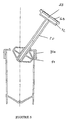
- FIG. 1 An exemplary embodiment of the apparatus used is shown in Figure 1, including a particulate matter separation device 10 including a specimen collection container 20 defining a collection chamber 23, a particulate matter separation housing 30 defining a housing for a porous arrangement 33, and a pump 40 in the form of a syringe.
- Figure 1 also shows hollow tube 50 in the embodiment of the invention that includes an agitator 51.
- Figure 3 shows the complete mixing assembly comprising mixer 80 having a rotatable container support in the form of a platform 41 adapted to receive a bottom portion of container 20.
- Container 20 includes a cover, preferably having a first portion 71 that is rotatable with container 20 and a second portion 72 that is fixed.
- Second portion 72 of the cover includes or engages or communicates with a tube 50 that extends into container 20, and includes a lower portion 32 of the porous arrangement housing. As illustrated, second portion 72 is integrally configured with or adapted to engage an end portion of a pump 40.
- the apparatus also includes a sleeve 64 or the like adapted to cover the syringe-container assembly, preferably maintain the alignment of the container and the syringe on the container support.
- Sleeve 64 preferably includes a gasket 61 or the like for engaging and positioning the pump 40 within the sleeve.
- sleeve 64 may include a cover 62.
- the gasket in the sleeve matingly engages a portion of the cover.
- the specimen collection and processing assembly 10 may be adapted for use with multiple containers multiple container supports, and multiple sleeves, or a single sleeve having multiple gaskets.
- a specimen container may include a chamber for collecting a liquid specimen and a cover that establishes fluid communication between the chamber and a filter assembly for separating particulate matter from the fluid and collecting the particulate matter at a collection site.
- the separated particulate matter is collected in a monolayer on a membrane according to the invention.
- Preferred embodiments of the involved apparatus also include a cover having a hollow tube establishing fluid communication between the sample and the filter assembly. More preferably, the hollow tube includes means for mixing the specimen and/or dispersing the particulate matter in the specimen.
- the container support is rotatable around an axis.
- Bearings may be provided that facilitate movement of the support, and may be rotatable by a transmission such as a belt drive, gears, or the like; and movable vertically using a stepper or the like.
- Platform 41 preferably has one, and optionally a plurality of, sockets 42 adapted to receive a bottom portion of specimen container 20.
- Specimen container 20 may fit snugly in socket 42, or socket 42 may include any of a variety of resilient members that position and hold the specimen container in place.
- An exemplary resilient member includes an O-ring or a rubber gasket.
- a specimen container may be positioned by hand or mechanically on a container support for further processing in an apparatus according to the invention.
- the container support is preferably a substantially planar platform, disc, sheet, shelf, tray, or the like.
- a sample container includes guides suitable for positioning and/or retaining one or more specimen containers.
- the container support includes one or more recesses or cavities adapted to accommodate at least one size of sample container.
- the container support includes at least two recesses for accommodating at least two different size sample containers.
- the container support is preferably movable, i.e., adapted to rotate around an axis, thereby rotating the specimen container.
- platform 41 rests on or forms a portion of housing 44.
- Housing 44 encloses a centrally located drive, sun gear, motor 43, or the like.
- Motor 43 may be adapted to engage a plurality of planet gears adapted to communicate with or corresponding to socket 42 or container 20.
- a portion of the socket may include a gear or teeth adapted to engage a belt or the like so that the platform 41 is rotatable. As noted above, this belt driven rotational movement is transferred to the specimen container so that agitators extending into the container stir the sample.
- connecting rod 45 may include an element that engages and rotates fin 53.
- specimen container 20 includes any container suitable for holding a fluid, preferably a biological fluid.
- the typical container includes sidewalls 21 and bottom wall 22 that, in combination, provide a chamber 23 having an open end 24 for collecting, holding, or storing a fluid.
- Typical fluids include, but are not limited to biological fluids, such as body fluids, wastewater fluids, or the like.
- Typical body fluids include urine or other biological fluids, such as blood, cerebrospinal fluid (CSF), bronchial lavage, sputum or fine needle aspirates.
- CSF cerebrospinal fluid
- bottom wall 22 is a conical member, as shown in Figure 1.
- bottom wall 22 or sidewall 21 may include one or more fins or the like (not shown) extending into the chamber. Such fins may be desirable an embodiment of the invention described in more detail below in which the sample in the container is mixed by rotation of the container.
- a device used in the method of the invention also includes a cover or lid 31.
- the cover is configured or adapted to receive a lower portion 32 of a porous arrangement housing.
- the cover 31 may include a downwardly extending member 71 configured to engage sidewall 21 of container 20. It is intended that cover 31 may be any configuration or shape that closes or seals open end 24 of container 20.
- the cover also includes a top portion 53 having an opening adapted to receive the lower portion 32 of the porous arrangement housing.
- lower portion 32 preferably includes a groove 55 adapted to receive a projection 54 in top portion 53.
- the engagement is a snap fit, with the engagement between porous arrangement housing portion 32 and the projection 54 permitting housing portion 32 to rotate.
- This configuration is preferably liquid tight, and in a most preferred embodiment of the invention, the seal is liquid tight but not fluid (e.g., air) tight.
- cover 31 includes structures and means for allowing an outer portion of the cover to move in relation to an inner portion.
- cover 31 includes outer cover 71 and inner cover 72.
- Inner cover 72 is preferably fixed to or in fluid communication with tube 50.
- cover 71 when tightened to container 23 rotates about inner cover 72 and tube 50. Such relative motion between outer cover 71 and inner cover 72 moves sample in the container 23 in relation to agitator 51.
- the most preferred embodiments of the involved apparatus include a cover having an inner portion or cover and an outer portion or cover, and wherein closing the cover and releasing one of the covers or portions so that it is freely rotatable occurs in a multi-step procedure.
- the inner and outer covers When the inner and outer covers are used to seal the container, it is preferred that the inner and outer covers do not freely rotate in relation to each other. Both covers seal the container up to a first position. In a second position, a catch or seal or the like is broken, e.g., by an additional twist of the outer cover, thus freeing the outer cover from its connection with the inner cover. In the second position, the outer cover rotates freely in relation to the inner cover.
- Figure 5 also illustrates another embodiment of the invention relating to the use of a cover having a slot through which the agitator or brush can be positioned inside the container.
- the slot or opening in the cover can be covered with a removable or penetrable covering that protects the inside of the container from contamination until the container is ready for use.
- a brush or the like can be used to collect a cervical sample, the covering can be removed from the cover, and the brush can be placed in the container.
- a device used in the method according to the invention includes a particulate matter separation housing that may be variously configured. Any housing 30 adapted to receive a porous arrangement 33 may be used.
- the particulate matter separation housing 30 is preferably a two piece housing formed by a top portion 53 and lower portion 32.
- top portion 53 releasably engages lower portion 32; any housing configuration or assembly providing access to the porous arrangement 33 is suitable.
- Top portion 53 and lower portion 32 may be connected or fastened to each other by any mating connection or means that provides a liquid or fluid tight fit, e.g., Luer-type (threaded or not threaded), screw thread-type, friction-type, a tapered mating connection, or snap fit (as illustrated).
- Lower portion 32 includes a side wall and bottom wall suitable for seating a porous arrangement 33. Lower portion 32 may also include a central bore or aperture 34 communicating with a hollow tube 50. In a preferred embodiment of the invention, hollow tube 50 extends into specimen container 20. In a preferred embodiment of the invention, lower portion 32 may be a separate structure that is capable of rotating in the base 31a. In order to achieve ease of centrifugal rotation while maintaining a liquid-tight assembly, lower portion 32 may matingly engage base 31a through a tongue and groove arrangement (see Figures 1 and 3). Alternatively, the cover may include an inner cover and an outer cover ( Figures 2 and 4), or portions that are moveable in relation to each other.
- lower portion 32 of the porous arrangement housing includes a bottom wall or seat 39.
- seat 39 may include one or more spaced apart ribs or projections 60.
- Projections 60 are preferably of a configuration, size, and shape sufficient to prevent porous arrangement 33 from flush contact with seat 39.
- projections 60 are concentric rings.
- projections 60 function in one or more of the following ways: projections 60 may break the surface tension between porous arrangement 33 and seat 39 so that, during use, when porous arrangement 33 is pulled away from seat 39, first porous medium 36 does not remain in contact with seat 39; projections 60 may evenly distribute pressure of the porous arrangement in the housing; projections 60 may prevent or suppress compression of the porous arrangement; and projections 60 may be configured to distribute any collected particulate matter in a pre-determined configuration or spatial distribution.
- the surface of seat 39 may include one or more structures, configurations, or surface textures that promote the ability of the porous arrangement to release from the seat, that promote a pre-determined spatial distribution of particulate matter on the collection site, and/or prevent or suppress compression of the porous arrangement.
- One embodiment of the invention includes concentric projections, such as projections 60 described above.
- the surface of the seat is configured into a sundial or clock face structure. Both of these embodiments, as well as other surface configurations disclosed herein, promote the collection of particulate matter on the collection site in a pre-determined spatial arrangement.
- the seat 39 and/or lower portion 32 may optionally include a channel or the like.
- seat 39 slopes slightly outward toward the channel. The slight slope of the seat and the channel promote enhanced fluid flow through the housing and decreases the surface tension of the seat, both of which promote the capability of the porous arrangement to disengage from the lower portion 32 of the porous arrangement housing.
- This aspect of the invention is another structure(s) that promote release of the porous arrangement.
- the particulate matter separation chamber 30 is configured to receive a porous arrangement 33 having a particulate matter collection site on the first porous medium 36 adapted to collect particulate matter as fluid containing the particulate matter passes through the housing 30.
- first porous medium 36 e.g., a filter membrane
- second porous medium 37 one or more through-going bores 73 may positioned in the second porous medium 37.
- Porous arrangement 33 having a collection site on the first porous medium 36 adapted to collect matter may be positioned across a fluid flow path, the collection site communicating with hollow tube 50.
- the porous arrangement 33 within the matter separation chamber is preferably adapted to define at least one fluid flow path having first and second branches, the first branch extending through the collection site and the second branch bypassing the collection site.
- the nature of the material used to make the porous media, the compatibility of the materials chosen for the porous media with one another and with the liquid to be processed are all factors to be considered in selecting a particular material for a porous medium for a given application.
- the invention includes a porous arrangement 33 having a first porous medium 36, suitable for preventing the passage of matter therethrough, and a second porous medium 37, suitable for allowing fluid to pass therethrough.
- the second porous medium may or may not be capable of removing particulate matter from the fluid, a design choice according to the needs of a particular device.
- the first porous medium is suitable for capturing or collecting particulate matter, and even more preferably, capturing or collecting solid matter in a uniform or single layer.
- a preferred embodiment also Includes a second porous medium that is suitable as a support for the first porous medium.
- the porous arrangement includes a first porous medium comprising a porous polycarbonate membrane, suitable for preventing the passage of cells therethrough.
- the porous arrangement may further include second porous medium comprising a depth filter.
- the depth filter may be made of polypropylene or high-density polyethylene POREX® porous plastics. It is intended that surrounding portion 63 is a structure and configuration that reduces or ameliorates compression of the porous arrangement when it is positioned in the porous arrangement housing.
- porous arrangements can be used interchangeably with that of the present embodiment. While a polycarbonate membrane is especially suitable for use in the cytology collection apparatus of the present invention, other porous membranes are also suitable. Exemplary porous membranes are well known in the art, and are disclosed in U.S. Patents 5,471,994 and 5,301,685.
- the porous membrane preferably has a pore size from about 0.22 microns to about 8 microns, more preferably from about 1 micron to about 6 microns, most preferably about 2 microns, which allows it to trap cells which are more than 3 microns in size.
- the membrane is suitable to allow fluid flow to pass therethrough while preventing the passage of particulate matter.
- the second porous medium is suitable for passing fluid therethrough and may also be capable of removing particulate matter from the fluid.
- the pore size of the second porous medium may range from about 5 microns to about 60 microns, preferably from about 15 microns to about 45 microns, most preferably about 35 microns.
- the pore size of the porous membrane and the porous depth filter in accordance with the type and/or size of matter to be collected permits the collection of the matter on the collection site 14.
- the pore size is chosen so that a uniform layer of matter, preferably a monolayer of matter, is formed on the collection site. For example, from about 3 ⁇ m to about 40 ⁇ m or more has been shown to be effective, but it is intended that the invention should not be limited to a certain range of pore size.
- well 32, tube 50, and fins 51 form an integral unit, and may be separated from base 31a to facilitate removal of the integral structure from container 20.
- An exemplary structure of this embodiment of the invention is shown in Figure 5.
- specimen container 20 includes a pump 40.
- pump 40 is a syringe or the like for altering differential pressure within the apparatus so that fluid can move through the specimen container.
- the pump may be variously configured.
- pump 40 includes an end that forms the top portion 53 of the porous arrangement housing.
- Top portion 53 includes a seat or the like configured to engage a downstream portion of porous arrangement 33.
- the seat positions porous arrangement 33 in the housing so that porous arrangement 33 does not move during use.
- the seat includes a plurality of projections or posts of a size, shape, and number to position the porous arrangement in the particulate matter separation housing 30, to promote substantially even distribution of pressure against the porous arrangement, and to reduce or prevent compression of the porous arrangement that interferes with fluid flow through the porous arrangement.
- top portion 53 removably engages bottom portion 32 to form a porous arrangement housing.
- Top portion 53 may engage. bottom portion 32 in any manner and with any structures that allow top portion 53 to disengage bottom portion 32.
- top portion 53 includes a downwardly extending side wall 56 having a flange 57 or the like adapted to releasably and/or resiliently engage a shoulder 46 or the like on bottom portion 32.
- Any suitable pump type device such as an autovial spunglass filter manufactured by Genex Corporation, could be used. Also included in the scope of the present invention is the use of a flexible, collapsible container, such as a specimen container, which may be squeezed to force fluid through the cytology collection apparatus and into the syringe.
- Movement of a fluid through the system may be effected by maintaining a pressure differential between a source of fluid and a destination of the fluid.
- Exemplary means of establishing this pressure differential may be by applying pressure to any part of the system on the inlet side of the housing (e.g., the collection container); applying a vacuum to any part of the system on the outlet side of the housing (e.g., the syringe); or any form of pump, such as an autovial spunglass filter (manufactured by Genex Corporation); gravity head; or a flexible, collapsible container, such as a specimen container, which may be squeezed to force fluid through the matter collection apparatus and into the syringe.
- a syringe draws fluid from a collection container through the housing.
- specimen container 10 includes a tube 50 or the like for drawing fluid from the collection chamber 23 into the particulate matter separation chamber 30.
- tube 50 will be hollow and open or openable at both ends.
- Tube 50 includes open end 52a near the bottom of the collection chamber 23, and may include one or more apertures 52 into tube 50. Open end 52a and/or apertures 52 permit different fluid layers as well as sediments to be simultaneously tested when the fluid is withdrawn from the collection chamber.
- the connection between the tube and the inner cover may be sealed with a washer, gasket, or the like to seal the connection.
- the seal may comprise a tube-sealing diaphragm that closes around the tube.
- hollow tube 50 includes at least one agitator projection or fin 51 or the like, as shown in Figure 1
- hollow tube 50 is rotatable and agitator fin 51 stirs the liquid specimen, and in a most preferred embodiment, disperse cells and/or particulate matter, and/or to disrupt any large particulate matter such as mucoid bodies.
- the agitator may also include a body that is independent of the tube 50, and that is induced by a magnetic or electric field to stir the sample.
- the agitator may comprise fibers, a brush, swab, or broom or the like.
- fibers or brush is are suitable for dispersing particulate matter in the container when the sample is vortexed in relation to the agitator, brush, or broom.
- the brush or broom is also suitable for use in collecting particulate matter from a patient, e.g., a cervical brush or broom or the like. It is intended that the brush can be fixed to a portion of the cover, or the cover may include a slot or the like for matingly engaging a portion of the handle on the other end of the brush.
- hollow tube 50 and lower portion 32 are of unitary construction, and the lower portion 32, tube 50, and fin 51 are stationary in relation to the rotatable specimen container 20.
- the container is rotated, optional fins in the side and/or bottom walls of the container may create concentric movement of the sample in the container, movement that will be disrupted by the presence of fin 51.
- lower portion 32, tube 50, and fin 51 may be rotated within a stationary container.
- a mixer may include an agitator for stirring each sample in its respective specimen container.
- each head may include a portion that engages a stirring element extending into the sample. This portion of each head is adapted to be connected to a movement transmission, e.g. a motor rotating a belt, or the like that will rotate the portion of each head.
- the movement transmission may engage a single head, or preferably, engage all of the heads.
- the belt of a movement transmission may alternatively be activated by rotation of the specimen container supports around an axis.
- the rotation speed and duration affect the amount of dispersion and the adequacy of breaking clumps or mucoid bodies in the sample. It is well known that the higher the rotation speed, the lower the duration. Using the device and fixative solution described herein, the inventors have found that using high-speed rotation provides optimum cellular distribution in the sample. According to a preferred embodiment of the present invention, the rotation speed should be between 2,000 rpm and 10,000 rpm, and the duration may be as little as one minute. In a most preferred embodiment, for samples having highly mucoid bodies, such as sputum, the rotation speed is about 3,000 rpm and the duration is about 5 minutes. Of course, samples having bodies that are more readily dispersed may require less duration for a given rotation speed.
- kits may a include at least one specimen container, a t least one particulate matter separation assembly, at least one pump, and at least one porous arrangement.
- a kit according to the invention may also include replacement filters, replacement disposables, and/or other components or solutions typically used during particulate matter testing or examination procedures, e.g., cytological examinations.
- a kit might also include washing, fixative, and/or buffer solutions.
- a cervical kit may include a brush or broom, and a fluid suitable for storing the used brush until particulate matter on the brush can be processed through the filter assembly.
- the apparatus may include one or more controllers for selectively moving and positioning an element of the automated apparatus, for initiating or discontinuing an operation of the apparatus, or for monitoring the progress of the operation of the apparatus.
- An example of a preferred controller is a computer and computer program. Other uses of a controller will be evident to one skilled in the art, and are included within the invention.
- the apparatus may also include a variety of movement transmissions including belts, motors, pulleys, anti-friction elements, lifters, transports, and supports, as well as conduits, a rinsing or cleaning head and its source or supply (e.g., container) of a rinsing or cleaning solution, a fixative applicator and its source or supply (e.g., container) of fixative solution, and the like to effect operation of the elements of the apparatus.
- a rinsing or cleaning head and its source or supply e.g., container
- a fixative applicator and its source or supply e.g., container
- a group of specimen containers containing respective samples are arranged on a container support, either manually or by a loader.
- a technician enters into the controller one or more of the following parameters for each specimen container: specimen type (e.g., sputum, blood, urine, spinal fluid, etc.) mixing rate, mixing time, suction level, suction time, fixative (e.g., either a yes or no value), and drying time.
- specimen type e.g., sputum, blood, urine, spinal fluid, etc.
- mixing rate e.g., mixing time, suction level, suction time, fixative (e.g., either a yes or no value)
- fixative e.g., either a yes or no value
- drying time e.g., either a yes or no value
- a technician places or collects a liquid sample in container 20 and closes the container with a cover 31/pump 40 assembly. A bottom portion of container 20 is then positioned in socket 42. The technician may then activate a motor or the like that rotates a sun gear, which in turn rotates planet gears, which in turn rotate container 20 around an axis.
- the plunger is drawn out of the pump body. Movement of the plunger draws sample in the container 20 through the particulate matter separation housing and through the porous arrangement and into the chamber in pump 40. Each of these steps may be repeated as often as desirable.
- the present invention also includes a the method for removing particulate matter from a fluid, and for transferring particulate matter, such as cells, to a microscope slide.
- particulate matter such as cells
- the use of membrane filtration provides a method of depositing cells evenly over a microscope slide with minimal overlap. This allows for clear observation and optimal diagnostic accuracy.
- a method includes collecting a fluid sample containing particulate matter in a collection container 20.
- the container 20 is then capped with an assembly that includes one or more of the following: base 31a, particulate matter separation chamber 30, and pump 40.
- Pump 40 is then activated to pull fluid from container 20 through particulate matter separation chamber 30 into pump 40, e.g., by withdrawing the piston in a syringe.
- the inner and outer covers are adapted to engage each other so that the respective covers do not rotate until the final closing of the cover on the container. It is intended that at least initially, the respective covers act as a unitary cover. When the cover is tightened to a pre-detennined position, however, it is intended that any structures holding inner cover in place in relation to the outer cover be broken or released so that inner and outer covers rotate freely with respect to one another. Such configurations are well known in the art, e.g., a cover that opens to a first partially open position, then with extra pressure, the cover can be moved to a second or completely free position.
- porous arrangement 33 When the fluid is pulled from the collection container 20 to the pump, fluid will flow through porous arrangement 33 so that a monolayer of particulate matter is formed on collection site 36. Once the monolayer of cells is formed, fluid flow is reduced in the center of porous arrangement 33 and increases towards the edges of the porous arrangement. This may be due to the blockage of fluid flow by the collected cells as they form the monolayer on the surface of the porous arrangement. When the monolayer has mostly covered the surface of the porous arrangement, the flow of fluid bypasses the first porous medium and passes through the extended side area of the second porous medium.
- the area of the second porous medium extending beyond an end wall of skirt of the top portion acts as a vent (with low resistance to flow) which prevents cells piling up or collecting in more than a monolayer. Fluid may be passed back and forth through the porous arrangement as many times as desirable.
- Pump 40 may then be disconnected from base 31a, and thereby exposing porous arrangement 33. Once porous arrangement 33 is removed from well 32, easy access is gained to first porous medium 36. Alternatively, removing top portion 53 from pump 40 may include removing porous arrangement 33 from well 32.
- the first porous medium may then be pressed against a microscope slide to allowing particulate matter collection on the collection site to be transferred as they were collected onto the slide. This allows a cytological examination to be performed on the cells by the practitioner without the interference of the pores in the membrane or delay due to processing requirements.
- the monolayer of cells may be fixed directly on the collection site. This may be carried out by first depositing a monolayer of cells on the collection site of the cytology collection apparatus as described above and subsequently passing a solution containing a fixative, such as alcohol or acetone, through the cytology collection apparatus.
- a fixative such as alcohol or acetone
- a process according to the present invention may include one or more of the following steps:
- the inventors have performed steps E through K in about 2 minutes, as compared to the Saccomanno process that takes 15 minutes to prepare the sample without filtering the particulate matter from the fluid.
- the matter collection apparatus involved may also include additional modules, removable or integrated, for treating the fluid.
- the fluid may be treated with a matter collection module, in combination with a debris removal module, a chromatography module, and assay module, or combinations of these and other devices.
- modules or treatment protocols provide features that may be desirable to incorporate into a sample preparation apparatus according to the invention.
- the matter collection apparatus or module described above may be used in combination with other suitable filtration or treatment devices.
- Exemplary devices include other debris and/or assay devices or modules that may be attached to housing 10.
- these additional modules will include a housing having an inlet and an outlet, and will include a filtration, assay, or detection element positioned across the fluid flow path in the housing.
- the apparatus may comprise a housing including inlet and outlet ports defining a flow path between the inlet and the outlet; a filter positioned across the flow path; and a freely movable chromatography/assay element, such as substrate beads, positioned on the outlet side of the filter.
- the chromatography/assay element can freely mix with the matter in the fluid, capture the matter, and can then be assayed for the presence of the matter.
- Suitable devices include those disclosed in U.S. Patents 4,953,561; 5,224,489; 5,016,644; 5,139,031; 5,301,685; 5,042,502; and 5,137,031.
- a patient sample may be processed in a single shot, batch, or continuous manner. Additional slides for other stain applications can be easily prepared. Human papilloma virus testing, for example, by newer methods such as immunocytochemistry or in-situ hybridization can be performed on the additional slides. As oncogene products or other immunocytochemical tests are developed, more slides may be necessary. The different fixations that these tests may need can easily be incorporated into the procedure since the preparation does not require the slides to be fixed in only one way.
- the most widely used stain for visualization of cellular changes in cytology is the Papanicolaou staining procedure.
- This stain which is used for both gynecologic and non-gynecologic applications, is basically composed of blue nuclear and orange, red and green cytoplasmic counterstains.
- the nuclear stain demonstrates the chromatic patterns associated with normal and abnormal cells, while the cytoplasmic stains help to indicate cell origin.
- the success of this procedure can be attributed to the ability to observe a number of factors, including definition of nuclear detail and cell differentiation.
- This staining procedure also results in a multicolor preparation that is aesthetic, possibly reducing eyestrain.
- captured microorganisms can be cultured in culture medium. After a monolayer of cells has been collected in the cytology collection apparatus, fluid may be used to back-flush the collection site, thereby transferring any collected microorganisms from the collection site.
- the first porous medium can be used for culturing with a Qualture device (not shown) to determine the presence of specific bacteria colonies.
- the Qualture device is a plastic capsule containing a filter membrane and four nutrient pads of dehydrated, selective media.
- the Qualture technique is more sensitive than the agar plate method and more rapid in determining a presumptive diagnosis.
- the device screens, isolates and presumptively diagnoses bacterial isolates in one step most often in 4-6 hours. Tests have demonstrated that recovery from fifty milliliters of fluid is excellent and sensitive.
- the method of the invention may be used to process sputum, and in particular, to replace the complex, time-consuming Saccomanno method of processing sputum.
- the method of the invention is thus suitable for screening lung cancer samples and gynecological samples.
- a fixative solution in processing the specimen sample.
- Any commercially available fixative solution may be used with the apparatus and method of the present invention.
- a preferred fixative composition according to the invention includes one or more solvents, preferably an alkanol, between about 35% and about 45% by volume; ketone, between about 2% and about 3% by volume; a diluent, preferably a diol or triol, from about 1% to about 3% by volume; a crosslinker, preferably an aldehyde, from about 0.2% to about 4% by volume; glycerol, from about 0.5% to about 2% by volume; one or more detergents and/or dispersing agents, preferably non-ionic, from about 0.01% to about 0.05% by volume; and a buffer, from about 45 to about 65% by volume.
- the pH of the composition is between about 4 and about 7.
- Table 1 summarizes the range and preferred concentrations of the components of a fixative formulation according to the present invention.
- Component range (by volume, %) preferred (by volume, %) example solvent 35-45 37-42 alcohol ketone 2.0-3.0 2.1-2.4 acetone cell coating 1.0-3.0 1.6-1.9 PEG polyol 0.5-2.0 0.8-1.2 glycerol crosslinker 0.2-4.0 0.6-0.8 Formaldehyde glutaraldehyde detergent 0.01-0.05 0.02
- Tris Mucolytic agent 0.1 - 1.0 (grams %) 0.2-0.5 (grams %) dithiothreitol acetylcysteine
- An exemplary formulation of a composition for a fixative formulation that is useful with the present invention comprises about 40% by volume of alcohol (e.g., isopropanol and methanol), about 2-3% acetone, about 1.0-3.0% polyethylene glycol; about 2% by volume of formaldehyde (e.g., commercially available as formalin, a 3 -37% v/v solution in water, sometimes including methyl alcohol); and about 58% by volume of buffer (e.g., Tris).
- the preferred pH of this formulation is about 5.0 ⁇ 0.5.
- Another useful formulation is 40% alcohol (methanol and isopropanol); 2.2% acetone; 1.8% polyethylene glycol (PEG); 0.7% formaldehyde; 1% glycerol; 0.02% Nonidet P40; and 54% Tris Buffer (pH 7.4 - 7.8). All amounts are approximate percentages by volume.
Landscapes
- Chemical & Material Sciences (AREA)
- Health & Medical Sciences (AREA)
- Life Sciences & Earth Sciences (AREA)
- General Health & Medical Sciences (AREA)
- Chemical Kinetics & Catalysis (AREA)
- Analytical Chemistry (AREA)
- Biochemistry (AREA)
- Zoology (AREA)
- Organic Chemistry (AREA)
- Wood Science & Technology (AREA)
- Engineering & Computer Science (AREA)
- Bioinformatics & Cheminformatics (AREA)
- Physics & Mathematics (AREA)
- General Physics & Mathematics (AREA)
- Immunology (AREA)
- Pathology (AREA)
- Microbiology (AREA)
- Genetics & Genomics (AREA)
- Biomedical Technology (AREA)
- Sustainable Development (AREA)
- Molecular Biology (AREA)
- Hematology (AREA)
- General Engineering & Computer Science (AREA)
- Biotechnology (AREA)
- Clinical Laboratory Science (AREA)
- Sampling And Sample Adjustment (AREA)
- Investigating Or Analysing Biological Materials (AREA)
- Mixers Of The Rotary Stirring Type (AREA)
- Measuring Or Testing Involving Enzymes Or Micro-Organisms (AREA)
- Apparatus Associated With Microorganisms And Enzymes (AREA)
- Physical Or Chemical Processes And Apparatus (AREA)
Applications Claiming Priority (3)
| Application Number | Priority Date | Filing Date | Title |
|---|---|---|---|
| US9202998P | 1998-07-07 | 1998-07-07 | |
| US92029P | 1998-07-07 | ||
| PCT/US1999/015281 WO2000002031A1 (en) | 1998-07-07 | 1999-07-07 | Improved method for mixing and processing specimen samples |
Publications (2)
| Publication Number | Publication Date |
|---|---|
| EP1093572A1 EP1093572A1 (en) | 2001-04-25 |
| EP1093572B1 true EP1093572B1 (en) | 2002-11-27 |
Family
ID=22230970
Family Applications (1)
| Application Number | Title | Priority Date | Filing Date |
|---|---|---|---|
| EP99935428A Expired - Lifetime EP1093572B1 (en) | 1998-07-07 | 1999-07-07 | Improved method for mixing and processing specimen samples |
Country Status (10)
| Country | Link |
|---|---|
| EP (1) | EP1093572B1 (enExample) |
| JP (1) | JP2002519692A (enExample) |
| KR (1) | KR100886264B1 (enExample) |
| CN (1) | CN1136446C (enExample) |
| AT (1) | ATE228650T1 (enExample) |
| AU (1) | AU758047B2 (enExample) |
| CA (1) | CA2336093C (enExample) |
| DE (1) | DE69904179T2 (enExample) |
| MX (1) | MXPA01000222A (enExample) |
| WO (1) | WO2000002031A1 (enExample) |
Cited By (1)
| Publication number | Priority date | Publication date | Assignee | Title |
|---|---|---|---|---|
| WO2021171232A1 (en) * | 2020-02-28 | 2021-09-02 | Agilent Technologies, Inc. | Sample injector with sample fluid filtering |
Families Citing this family (15)
| Publication number | Priority date | Publication date | Assignee | Title |
|---|---|---|---|---|
| GB0211963D0 (en) * | 2002-05-24 | 2002-07-03 | British American Tobacco Co | An exposure device |
| FR2846548B1 (fr) | 2002-11-04 | 2005-01-28 | Sofradim Production | Piece composite intermediaire pour faconnage de protheses de renfort |
| IE20030856A1 (en) * | 2003-11-14 | 2005-06-15 | Enfer Technology Ltd | Sample homogeniser |
| CA2548799C (en) | 2003-12-08 | 2013-02-26 | Blue I Water Technologies Ltd. | A measuring cell |
| US8216528B2 (en) * | 2005-09-29 | 2012-07-10 | Sysmex Corporation | Sample preparation kit, sample preparation container, and sample processing device |
| FR2955458B1 (fr) * | 2010-01-27 | 2014-09-05 | Novacyt | Solution de fixation pour des cellules biologiques |
| KR101157027B1 (ko) | 2011-01-05 | 2012-06-20 | 조윤희 | 배합기 |
| GB2496597B (en) * | 2011-11-14 | 2017-10-04 | Bio-Check(Uk) Ltd | Cartridge for containing a sample |
| CN104677674A (zh) * | 2013-11-29 | 2015-06-03 | 武汉迪艾斯科技有限公司 | 可搅拌取样装置 |
| WO2015119863A1 (en) * | 2014-02-04 | 2015-08-13 | Rarecyte, Inc. | Apparatus, system, and method for collecting a target material |
| CN104297033B (zh) * | 2014-10-20 | 2017-03-29 | 浙江海洋学院 | 非水相液体土壤污染物浓度配制装置及方法 |
| EP3600669A4 (en) * | 2017-03-24 | 2020-12-23 | Universal Biosensors, Pty. Ltd. | DEVICES AND METHODS FOR PRE-TREATMENT OF SAMPLE |
| ES2902704T3 (es) * | 2018-09-06 | 2022-03-29 | Milestone Srl | Sistema y método para llenar un recipiente cerrado con una solución fijadora |
| US20210220817A1 (en) * | 2018-12-08 | 2021-07-22 | Min Wei | Apparatus For Manufacturing Cell Therapy Product |
| JP7444056B2 (ja) | 2019-02-18 | 2024-03-06 | 東洋紡株式会社 | 二軸延伸ポリアミドフィルム及び積層フィルム |
Family Cites Families (5)
| Publication number | Priority date | Publication date | Assignee | Title |
|---|---|---|---|---|
| US5000922A (en) * | 1986-02-19 | 1991-03-19 | Jon Turpen | Sample filtration, separation and dispensing device |
| US4845025A (en) * | 1987-11-10 | 1989-07-04 | Coulter Corporation | Biological sample mixing apparatus and method |
| US5301685A (en) * | 1989-01-10 | 1994-04-12 | Guirguis Raouf A | Method and apparatus for obtaining a cytology monolayer |
| US5356814A (en) * | 1992-09-29 | 1994-10-18 | Hoffmann-La Roche Inc. | Disaggregation device for cytological specimens |
| AU6444094A (en) * | 1993-03-08 | 1994-09-26 | Kvm Technologies, Inc. | Fluid sample receptacle |
-
1999
- 1999-07-07 JP JP2000558376A patent/JP2002519692A/ja active Pending
- 1999-07-07 CN CNB998103918A patent/CN1136446C/zh not_active Expired - Fee Related
- 1999-07-07 EP EP99935428A patent/EP1093572B1/en not_active Expired - Lifetime
- 1999-07-07 AT AT99935428T patent/ATE228650T1/de not_active IP Right Cessation
- 1999-07-07 AU AU50909/99A patent/AU758047B2/en not_active Ceased
- 1999-07-07 DE DE69904179T patent/DE69904179T2/de not_active Expired - Lifetime
- 1999-07-07 WO PCT/US1999/015281 patent/WO2000002031A1/en not_active Ceased
- 1999-07-07 MX MXPA01000222A patent/MXPA01000222A/es not_active IP Right Cessation
- 1999-07-07 KR KR1020017000234A patent/KR100886264B1/ko not_active Expired - Fee Related
- 1999-07-07 CA CA002336093A patent/CA2336093C/en not_active Expired - Fee Related
Cited By (2)
| Publication number | Priority date | Publication date | Assignee | Title |
|---|---|---|---|---|
| WO2021171232A1 (en) * | 2020-02-28 | 2021-09-02 | Agilent Technologies, Inc. | Sample injector with sample fluid filtering |
| US12420215B2 (en) | 2020-02-28 | 2025-09-23 | Agilent Technologies, Inc. | Sample injector with sample fluid filtering |
Also Published As
| Publication number | Publication date |
|---|---|
| WO2000002031A1 (en) | 2000-01-13 |
| CN1316053A (zh) | 2001-10-03 |
| KR100886264B1 (ko) | 2009-02-27 |
| ATE228650T1 (de) | 2002-12-15 |
| WO2000002031A9 (en) | 2000-04-06 |
| EP1093572A1 (en) | 2001-04-25 |
| AU758047B2 (en) | 2003-03-13 |
| CA2336093C (en) | 2008-05-20 |
| KR20010071768A (ko) | 2001-07-31 |
| CN1136446C (zh) | 2004-01-28 |
| DE69904179T2 (de) | 2003-07-24 |
| CA2336093A1 (en) | 2000-01-13 |
| JP2002519692A (ja) | 2002-07-02 |
| MXPA01000222A (es) | 2003-09-10 |
| DE69904179D1 (de) | 2003-01-09 |
| AU5090999A (en) | 2000-01-24 |
Similar Documents
| Publication | Publication Date | Title |
|---|---|---|
| EP1029228B1 (en) | Method and apparatus for mixing and separating particulate matter from a liquid specimen | |
| EP1007937B1 (en) | Method and apparatus for automatically forming monolayers from particulate matter separated from fluid samples | |
| US6830935B1 (en) | Method for mixing and processing specimen samples | |
| EP1093572B1 (en) | Improved method for mixing and processing specimen samples | |
| US6423237B1 (en) | Method and apparatus for manually separating particulate matter from a liquid specimen | |
| JP2002519692A5 (enExample) | ||
| US6149871A (en) | System for processing multiple specimens of biological fluid | |
| MXPA00001286A (en) | Method and apparatus for separating particulate matter from a liquid specimen | |
| HK1032421A (en) | Method and apparatus for separating particulate matter from a liquid specimen |
Legal Events
| Date | Code | Title | Description |
|---|---|---|---|
| PUAI | Public reference made under article 153(3) epc to a published international application that has entered the european phase |
Free format text: ORIGINAL CODE: 0009012 |
|
| 17P | Request for examination filed |
Effective date: 20010205 |
|
| AK | Designated contracting states |
Kind code of ref document: A1 Designated state(s): AT BE CH CY DE DK ES FI FR GB GR IE IT LI LU MC NL PT SE |
|
| GRAG | Despatch of communication of intention to grant |
Free format text: ORIGINAL CODE: EPIDOS AGRA |
|
| 17Q | First examination report despatched |
Effective date: 20020314 |
|
| GRAG | Despatch of communication of intention to grant |
Free format text: ORIGINAL CODE: EPIDOS AGRA |
|
| GRAH | Despatch of communication of intention to grant a patent |
Free format text: ORIGINAL CODE: EPIDOS IGRA |
|
| GRAH | Despatch of communication of intention to grant a patent |
Free format text: ORIGINAL CODE: EPIDOS IGRA |
|
| GRAA | (expected) grant |
Free format text: ORIGINAL CODE: 0009210 |
|
| AK | Designated contracting states |
Kind code of ref document: B1 Designated state(s): AT BE CH CY DE DK ES FI FR GB GR IE IT LI LU MC NL PT SE |
|
| PG25 | Lapsed in a contracting state [announced via postgrant information from national office to epo] |
Ref country code: LI Free format text: LAPSE BECAUSE OF FAILURE TO SUBMIT A TRANSLATION OF THE DESCRIPTION OR TO PAY THE FEE WITHIN THE PRESCRIBED TIME-LIMIT Effective date: 20021127 Ref country code: IT Free format text: LAPSE BECAUSE OF FAILURE TO SUBMIT A TRANSLATION OF THE DESCRIPTION OR TO PAY THE FEE WITHIN THE PRESCRIBED TIME-LIMIT;WARNING: LAPSES OF ITALIAN PATENTS WITH EFFECTIVE DATE BEFORE 2007 MAY HAVE OCCURRED AT ANY TIME BEFORE 2007. THE CORRECT EFFECTIVE DATE MAY BE DIFFERENT FROM THE ONE RECORDED. Effective date: 20021127 Ref country code: GR Free format text: LAPSE BECAUSE OF FAILURE TO SUBMIT A TRANSLATION OF THE DESCRIPTION OR TO PAY THE FEE WITHIN THE PRESCRIBED TIME-LIMIT Effective date: 20021127 Ref country code: FI Free format text: LAPSE BECAUSE OF FAILURE TO SUBMIT A TRANSLATION OF THE DESCRIPTION OR TO PAY THE FEE WITHIN THE PRESCRIBED TIME-LIMIT Effective date: 20021127 Ref country code: CH Free format text: LAPSE BECAUSE OF FAILURE TO SUBMIT A TRANSLATION OF THE DESCRIPTION OR TO PAY THE FEE WITHIN THE PRESCRIBED TIME-LIMIT Effective date: 20021127 Ref country code: BE Free format text: LAPSE BECAUSE OF FAILURE TO SUBMIT A TRANSLATION OF THE DESCRIPTION OR TO PAY THE FEE WITHIN THE PRESCRIBED TIME-LIMIT Effective date: 20021127 Ref country code: AT Free format text: LAPSE BECAUSE OF FAILURE TO SUBMIT A TRANSLATION OF THE DESCRIPTION OR TO PAY THE FEE WITHIN THE PRESCRIBED TIME-LIMIT Effective date: 20021127 |
|
| REF | Corresponds to: |
Ref document number: 228650 Country of ref document: AT Date of ref document: 20021215 Kind code of ref document: T |
|
| REG | Reference to a national code |
Ref country code: GB Ref legal event code: FG4D |
|
| REG | Reference to a national code |
Ref country code: CH Ref legal event code: EP |
|
| REG | Reference to a national code |
Ref country code: IE Ref legal event code: FG4D |
|
| REF | Corresponds to: |
Ref document number: 69904179 Country of ref document: DE Date of ref document: 20030109 |
|
| PG25 | Lapsed in a contracting state [announced via postgrant information from national office to epo] |
Ref country code: SE Free format text: LAPSE BECAUSE OF FAILURE TO SUBMIT A TRANSLATION OF THE DESCRIPTION OR TO PAY THE FEE WITHIN THE PRESCRIBED TIME-LIMIT Effective date: 20030227 Ref country code: PT Free format text: LAPSE BECAUSE OF FAILURE TO SUBMIT A TRANSLATION OF THE DESCRIPTION OR TO PAY THE FEE WITHIN THE PRESCRIBED TIME-LIMIT Effective date: 20030227 Ref country code: DK Free format text: LAPSE BECAUSE OF FAILURE TO SUBMIT A TRANSLATION OF THE DESCRIPTION OR TO PAY THE FEE WITHIN THE PRESCRIBED TIME-LIMIT Effective date: 20030227 |
|
| PG25 | Lapsed in a contracting state [announced via postgrant information from national office to epo] |
Ref country code: ES Free format text: LAPSE BECAUSE OF FAILURE TO SUBMIT A TRANSLATION OF THE DESCRIPTION OR TO PAY THE FEE WITHIN THE PRESCRIBED TIME-LIMIT Effective date: 20030529 |
|
| REG | Reference to a national code |
Ref country code: CH Ref legal event code: PL |
|
| PG25 | Lapsed in a contracting state [announced via postgrant information from national office to epo] |
Ref country code: LU Free format text: LAPSE BECAUSE OF NON-PAYMENT OF DUE FEES Effective date: 20030707 Ref country code: IE Free format text: LAPSE BECAUSE OF NON-PAYMENT OF DUE FEES Effective date: 20030707 Ref country code: CY Free format text: LAPSE BECAUSE OF FAILURE TO SUBMIT A TRANSLATION OF THE DESCRIPTION OR TO PAY THE FEE WITHIN THE PRESCRIBED TIME-LIMIT Effective date: 20030707 |
|
| ET | Fr: translation filed | ||
| PG25 | Lapsed in a contracting state [announced via postgrant information from national office to epo] |
Ref country code: MC Free format text: LAPSE BECAUSE OF NON-PAYMENT OF DUE FEES Effective date: 20030731 |
|
| PLBE | No opposition filed within time limit |
Free format text: ORIGINAL CODE: 0009261 |
|
| STAA | Information on the status of an ep patent application or granted ep patent |
Free format text: STATUS: NO OPPOSITION FILED WITHIN TIME LIMIT |
|
| 26N | No opposition filed |
Effective date: 20030828 |
|
| REG | Reference to a national code |
Ref country code: IE Ref legal event code: MM4A |
|
| REG | Reference to a national code |
Ref country code: HK Ref legal event code: WD Ref document number: 1038610 Country of ref document: HK |
|
| PGFP | Annual fee paid to national office [announced via postgrant information from national office to epo] |
Ref country code: NL Payment date: 20130726 Year of fee payment: 15 Ref country code: DE Payment date: 20130729 Year of fee payment: 15 |
|
| PGFP | Annual fee paid to national office [announced via postgrant information from national office to epo] |
Ref country code: GB Payment date: 20130729 Year of fee payment: 15 Ref country code: FR Payment date: 20130717 Year of fee payment: 15 |
|
| REG | Reference to a national code |
Ref country code: DE Ref legal event code: R119 Ref document number: 69904179 Country of ref document: DE |
|
| REG | Reference to a national code |
Ref country code: NL Ref legal event code: V1 Effective date: 20150201 |
|
| GBPC | Gb: european patent ceased through non-payment of renewal fee |
Effective date: 20140707 |
|
| PG25 | Lapsed in a contracting state [announced via postgrant information from national office to epo] |
Ref country code: NL Free format text: LAPSE BECAUSE OF NON-PAYMENT OF DUE FEES Effective date: 20150201 |
|
| REG | Reference to a national code |
Ref country code: FR Ref legal event code: ST Effective date: 20150331 |
|
| PG25 | Lapsed in a contracting state [announced via postgrant information from national office to epo] |
Ref country code: DE Free format text: LAPSE BECAUSE OF NON-PAYMENT OF DUE FEES Effective date: 20150203 |
|
| REG | Reference to a national code |
Ref country code: DE Ref legal event code: R119 Ref document number: 69904179 Country of ref document: DE Effective date: 20150203 |
|
| PG25 | Lapsed in a contracting state [announced via postgrant information from national office to epo] |
Ref country code: GB Free format text: LAPSE BECAUSE OF NON-PAYMENT OF DUE FEES Effective date: 20140707 Ref country code: FR Free format text: LAPSE BECAUSE OF NON-PAYMENT OF DUE FEES Effective date: 20140731 |