EP1092790A2 - Electroplating of copper from alkanesulfonate electrolytes - Google Patents
Electroplating of copper from alkanesulfonate electrolytes Download PDFInfo
- Publication number
- EP1092790A2 EP1092790A2 EP00309095A EP00309095A EP1092790A2 EP 1092790 A2 EP1092790 A2 EP 1092790A2 EP 00309095 A EP00309095 A EP 00309095A EP 00309095 A EP00309095 A EP 00309095A EP 1092790 A2 EP1092790 A2 EP 1092790A2
- Authority
- EP
- European Patent Office
- Prior art keywords
- acid
- copper
- solution
- free
- alkanesulfonic
- Prior art date
- Legal status (The legal status is an assumption and is not a legal conclusion. Google has not performed a legal analysis and makes no representation as to the accuracy of the status listed.)
- Granted
Links
Images


Classifications
-
- C—CHEMISTRY; METALLURGY
- C25—ELECTROLYTIC OR ELECTROPHORETIC PROCESSES; APPARATUS THEREFOR
- C25D—PROCESSES FOR THE ELECTROLYTIC OR ELECTROPHORETIC PRODUCTION OF COATINGS; ELECTROFORMING; APPARATUS THEREFOR
- C25D7/00—Electroplating characterised by the article coated
- C25D7/12—Semiconductors
- C25D7/123—Semiconductors first coated with a seed layer or a conductive layer
-
- C—CHEMISTRY; METALLURGY
- C25—ELECTROLYTIC OR ELECTROPHORETIC PROCESSES; APPARATUS THEREFOR
- C25D—PROCESSES FOR THE ELECTROLYTIC OR ELECTROPHORETIC PRODUCTION OF COATINGS; ELECTROFORMING; APPARATUS THEREFOR
- C25D3/00—Electroplating: Baths therefor
- C25D3/02—Electroplating: Baths therefor from solutions
- C25D3/38—Electroplating: Baths therefor from solutions of copper
Definitions
- This invention relates to aqueous electrolyte formulations based on alkanesulfonic acids. These electrolyte formulations are intended for the electrodeposition of copper, especially on electronic devices.
- Electrolytic copper plating is a process which deposits a layer of copper on metallic or non-metallic substrates using an external electric current.
- Commercial copper plating solutions include copper sulfate, copper pyrophosphate, copper fluorborate and copper cyanide. Copper sulfate and copper fluorborate solutions are typically used at medium to high current densities whereas copper pyrophosphate and copper cyanide solutions are used to deposit copper at low to medium current densities. Because of the health concerns associated with handling cyanide salts and/or fluorboric acid and because of the waste-treatment concerns with cyanide, fluoborate and pyrophosphate based systems, the most widely used commercial copper plating electrolyte is based on copper sulfate and sulfuric acid.
- Copper sulfate based plating solutions are used to deposit a copper coating on various substrates such as printed circuit boards, automobile parts and household fixtures.
- the copper ion concentration in typical solutions varies from about 10 grams per liter to about 75 grams per liter.
- the sulfuric acid concentration may vary from about 10 grams per liter to about 300 grams per liter.
- Copper solutions intended for the plating of electronic components usually employ low copper metal concentrations and high free acid concentrations.
- Proell In a separate publication (Proell, W. A.; Faust, C. L.; Agruss, B.; Combs, E. L.; The Monthly Review of the American Electroplaters Society 1947, 34, 541-9) Proell describes preferred formulations for copper plating from mixed alkanesulfonic acid based electrolytes. Dahms, W. and Wunderlich, C. in German Patent No. 4,338,148 described an MSA based copper plating system which incorporates organic sulfur compounds as additives. In a Chinese publication (Jiqing, Cai; Diandu Yu Huanbao 1995, 15(2), 20-2) the author shows some of the benefits of using MSA based acid copper plating formulations.
- organic grain refining additives are always added to the copper plating solution.
- Martin, S. in U.S. Patent No. 5,328,589 describes the use of surface active materials including alcohol alkoxylates and nonionic surfactants as additives in copper plating baths.
- Martin, S. also discloses in U.S. Patent No. 5,730,854 the use of alkoxylated dimercaptans as additives in copper plating baths.
- These additives inhibit copper deposition at high current densities resulting in a continuous and smooth deposit. Such additives are consumed during the deposition process, and a portion of these additives may be incorporated into the copper deposit.
- the co-deposition of organic additives in a copper deposit may affect the electrical conductivity of the deposit, and frequent analysis is necessary to ensure a constant organic additive concentration in the copper plating solution.
- the formulation is a solution which contains copper alkanesulfonate salts and free alkanesulfonic acids. It may be suitable for, and intended for, the metallization of micron or sub-micron dimensioned trenches or vias.
- alkanesulfonic acids in place of sulfuric acid may result in one or more of (a) a less corrosive electrolyte with respect to the copper seed layer, (b) a smoother copper deposit, (c) an electrolyte that can be operated at higher pH and still produce commercially acceptable deposits, (d) electrolytes that operate at lower free acid concentrations (e) an electrolyte that deposits copper at more positives voltages than copper sulfate and (f) electrolytes that have lower surface tension.
- the electrolytes are based on alkanesulfonic acids.
- the formulations disclosed are particularly useful for the plating of copper into small trenches or vias of sub-micron dimensions such as occur on the surface of modern electronic devices. They may be free of sulfuric acid or other mineral acid.
- Figs. 1 and 2 are graphs showing surface tensions and conductivities of alkanesulfonic acids; and Fig. 3 shows solubilities of salts of different metals.
- the invention is the use of alkanesulfonic acids as a component of acid copper plating electrolytes.
- the plating electrolytes may be further modified by the addition of various functional additives which may be either novel or known in the art.
- chip metallization by electrodeposition requires certain performance criteria which are different than the criteria required for general plating formulations.
- One unique aspect of chip metallization is the requirement that the deposited metal uniformly fill small sub-micron dimension trenches or vias on the chip surface.
- alkanesulfonate based electrolytes provides for copper plating systems which are ideal for the metallization of chips as well as for the electrodeposition of acid copper in general.
- the copper plating electrolytes described allow for the formulation of copper plating baths which are used to deposit copper into submicron dimensioned trenches such as those which are typically present on the surface of small electronic devices.
- Existing acid copper plating electrolytes employed for the purpose of metallizing such trenches are based on sulfuric acid.
- Preferred electrolytes disclosed herein offer less dissolution of seed layer copper prior to plating, and they result in a smoother copper coating.
- the term "copper plating” includes plating of copper and copper alloys. Copper alloys include metals of Group 1B, 2B, 3B, 4B, 5B, 6B, 7B, 8B and 3A of the periodic table. The term also includes copper composites, such as those including carbon.
- the ethanesulfonic and propanesulfonic acid based solutions operate best at low free acid concentrations, less than 1.75 M free acid. Such low free acid concentrations minimize the corrosion of copper seed layers.
- the sulfonate based solutions also deposit a smoother copper coating as compared to sulfuric acid based solutions. In comparison, trifluormethanesulfonate (triflate) based solutions yield commercially acceptable coatings over a wide free acid concentration range.
- This invention involves the use of C1 through C8, preferably C1 through C3, alkanesulfonic acids as significant constituents of acid copper plating electrolytes.
- the alkanesulfonic acids are distinguished from sulfuric acid by their unique balance of physical properties. For instance, the surface tension lowering capability of the alkanesulfonic acids increases with chain length. However, so also does a general decrease in the aqueous solubility of metal alkanesulfonates go up with chain length. The best balance of copper alkanesulfonate solubility and surface tension lowering capability is obtained for the C1 through C8 alkanesulfonic acids. Surface activity is important for plating into sub-micron dimensioned holes, while metal salt solubility is important for plating in general.
- this invention can be altered by the use of C1 to C8 alkanesulfonic acid derivatives. Also, this invention can be generalized to the plating of numerous copper alloys including tin/copper.
- the copper ion of this invention is preferably also introduced as the salt of an alkanesulfonic acid of formula: wherein a+b+c+y equals 4, R, R' and R" are the same or different and each independently may be hydrogen, Cl, F, Br, I, CF 3 or a lower alkyl group such as (CH 2 ) n where n is from 1 to 7, preferably 1 to 3, and that is unsubstituted or substituted by oxygen, Cl, F, Br, I, CF 3 , -SO 2 OH, or by any of the groups listed in the discussion immediately below.
- R, R' and R" are the same or different and each independently may be hydrogen, Cl, F, Br, I, CF 3 or a lower alkyl group such as (CH 2 ) n where n is from 1 to 7, preferably 1 to 3, and that is unsubstituted or substituted by oxygen, Cl, F, Br, I, CF 3 , -SO 2 OH, or by any of the groups listed
- the alkanesulfonate portion of the alkanesulfonic acid may be composed of substituted or unsubstituted linear or branched chains of 1 to 8 carbon atoms, preferably 1 to 3 carbon atoms, with monosulfonate or polysulfonate fuhctionalization and with the possibility of further functionalization by one or more other heteroatom containing groups.
- alkane portion of the sulfonic acid include, for example, alkyl, hydroxyl, alkoxy, acyloxy, keto, carboxyl, amino, substituted amino, nitro, sulfenyl, sulfinyl, sulfonyl, mercapto, sulfonylamido, disulfonylimido, phosphinyl, phosphonyl, carbocyclic and/or heterocyclic groups.
- Such sulfonic acids preferably include, for example, methanesulfonic acid, ethanesulfonic acid, propanesulfonic acid, butanesulfonic acid, isethionic acid (2-hydroxyethanesulfonic acid), methionic acid (methanedisulfonic acid), 2-aminoethanesulfonic acid and sulfoacetic acid, among others.
- Representative sulfonic acids include the alkyl monosulfonic acids such as methanesulfonic, ethanesulfonic and propanesulfonic acids and the alkyl polysulfonic acids such as methanedisulfonic acid, monochloromethanedisulfonic acid, dichloromethanedisulfonic acid, 1,1-ethanedisulfonic acid, 2-chloro-1,1-ethanedisulfonic acid, 1,2-dichloro-1,1-ethanedisulfonic acid, 1,1-propanedisulfonic acid, 3-chloro-1,1-propanedisulfonic acid, 1,2-ethylene disulfonic acid, 1,3-propylene disulfonic acid, trifluoromethanesulfonic acid, butanesulfonic acid, perfluorobutanesulfonic acid and pentanesulfonic acid.
- alkyl monosulfonic acids such as methanesulf
- the sulfonic acids of choice are methanesulfonic, methanedisulfonic, ethanesulfonic, propanesulfonic, trifluormethanesulfonic and perfluorobutanesulfonic acids.
- the entire copper ion content of the copper plating bath may be supplied in the form of the alkanesulfonic acid salt, or it may be supplied as a mixture of alkanesulfonic acid salt with some other appropriate salt (e.g., copper sulfate).
- the surface tension of copper sulfate and copper alkanesulfonate solutions was measured using a surface goniometer.
- the copper sulfate and copper sulfonate solutions were prepared by mixing copper carbonate, CuCO 3 :Cu(OH) 2 , 57% Cu +2 , into doubly distilled water. After the copper slurry was adequately mixed, concentrated sulfuric acid, 70% methanesulfonic acid, 70% ethanesulfonic acid, 80% propanesulfonic acid or 50% triflic acid was slowly added until all the carbonate was removed. Additional free acid was added so the final free-acid concentrations were 1.75 M. After dilution to volume, each solution was filtered.
- the contact angle for each solution on a freshly prepared copper deposits was: Electrolyte Contact Angle (Degree) Copper Sulfate 33.61 Copper Methanesulfonate 27.47 Copper Ethanesulfonate 26.31 Copper Propanesulfonate 14.44 Copper Triflate 15.8 It can be seen that the copper alkanesulfonate solutions have the smallest wetting angle thus having the lowest surface tensions.
- Copper sulfate and copper alkanesulfonate solutions were prepared as in Example 1. However, in addition to 1.75 M free acid, copper electrolytes were also prepared having 0.25 M and 0.75 M free acid. Accelerated electrochemical corrosion tests on phosphorized copper were done using a three electrode electrochemical cell. The working electrode was a 1cm 2 area of copper-phosphorus (500 ppm phosphorus). The solutions were tested for corrosivity by scanning from -250 mV of the open circuit potential to +1.6 V of the open circuit potential. The corrosion current density was determined from the electrochemical traces.
- the corrosion current densities are (in mA/cm 2 ) : Solution/Free Acid 0.25 M 0.75 M 1.75 M Copper Sulfate 0.205 1.98 6.54 Copper Methanesulfonate 0.786 0.897 0.92 Copper Ethanesulfonate 0.212 0.506 0.837 Copper Propanesulfonate 0.112 0.742 1.54 Copper Trifluoromethane sulfonate 0.751 2.38 3.89
- the most corrosive solutions are the copper sulfate electrolytes. At the high free acid concentration used in today copper plating solutions for electronic devices, 1.75 M, the copper alkanesulfonates are not as corrosive as copper sulfate. The lower corrosivity is important in minimizing copper seed layer corrosion.
- the start of copper plating into narrow trenches is important to minimize copper seed layer corrosion.
- the high free acid concentration of the copper solution increases the propensity for copper seed layer corrosion.
- the current density at the base of the narrow trench and in particular the bottom edges are very low current density areas.
- Copper solutions were prepared as in Example 1 but the free acid concentration was adjusted to 0.25 M free acid.
- Electrochemical studies, cyclic voltammetric (CV) scans, were done to determine the onset of deposition. CV scans were made from +0.3 V were no copper plating occurs and scanning in the cathodic direction until copper plating commenced.
- Brass panels were cathodically cleaned at 4.0 V in a solution containing 50 g/l sodium hydroxide at 50°C. The panels were then rinsed in distilled water and activated by immersion in 5% aqueous propanesulfonic acid. The panels were plated in the above solutions at room temperature for ten minutes.
- Solution 1 The deposits from Solution 1 were dull and coarse grained when plated above 25 A/ft 2 .
- Solution 2 produced commercially acceptable deposits from 1 - 30 A/ft 2 .
- Solution 3 produced commercially acceptable deposits from 1 to >40 A/ft 2 .
- Brass panels were cathodically cleaned at 4.0 V in a solution containing 50 g/l sodium hydroxide at 50°C. The panels were then rinsed in distilled water and activated by immersion in 5% propanesulfonic acid. The panels were plated in the above solutions at room temperature for ten minutes.
- Solution 1 The deposits from Solution 1 were commercially acceptable deposits from 1 - 40 A/ft 2 .
- Solution 2 produced commercially acceptable deposits from 1 - 40 A/ft 2 .
- Solution 3 produced dull and coarse grained when plated above 25 A/ft 2 .
- Copper sulfate solutions were prepared according to the Enthone Technical Data Sheet, CUBATH SC, used for semiconductor application.
- the bath was prepared as follows: 1.
- Concentrated sulfuric acid 7.25 ml was used to dissolve the copper carbonate powder.
- An additional 47 ml of concentrated sulfuric acid was added to the solution and the entire solution was diluted to 500 ml.
- the solution was filtered and 6 mg/l HCl was added to the copper electrolyte.
- Solution contained 18.5 g/1 Cu +2 and 160 g/l free sulfuric acid.
- To this solution was added 2 ml/500 ml of Enthone additive CuBath 70:30.
- a copper sulfonate solution was prepared in a similar manner as follows: 2. Copper Ethanesulfonate: High Free Acid (1.75 M Free Acid); prepared by dissolving 15.12 gm copper carbonate, CuCO 3 :Cu(OH) 2 , 57% Cu +2 , into 300 ml water. Ethanesulfonic acid (ESA 70%), 24.6 ml, was used to dissolve the copper carbonate powder. An additional 75 ml of 70% ESA was added to the solution and the entire solution was diluted to 500 ml. The solution was filtered and 6 mg/l HCl was added to the copper electrolyte. Solution contained 17.24 g/l Cu +2 and 190.8 g/l free ESA. To this solution was added 2 ml/500 ml of Enthone additive CuBath 70:30.
- Brass panels were cathodically cleaned at 4.0 V in a solution containing 50 g/l sodium hydroxide at 50°C. The panels were then rinsed in distilled water and activated by immersion in 5% sulfuric acid. The panels were plated in the above solutions at room temperature for ten minutes.
- the panels from the copper sulfate solution were bright between 1 - 40 A/ft 2 .
- the panels from the copper ethanesulfonate solution were bright from 1 - 30 A/ft 2 and rough above 30 A/ft 2 .
- Copper sulfate solutions were prepared according to the Enthone Technical Data Sheet, CUBATH SC, used for semiconductor application.
- the bath was prepared as follows: Prepared by dissolving 15.15 gm copper carbonate, CuCO 3 :Cu(OH) 2 , 57% Cu +2 , into 300 ml water. Concentrated sulfuric acid, 7.5 ml, was used to dissolve the copper carbonate powder. An additional 7 ml of concentrated sulfuric acid was added to the solution and the entire solution was diluted to 500 ml. The solution was filtered and 6 mg/l HCl was added to the copper electrolyte. Solution contained 17.28 g/l Cu +2 and 23 g/l free sulfuric acid.
- a copper propanesulfonate solution was prepared in a similar manner as follows: Prepared by dissolving 15.16 gm copper carbonate, CuCO 3 :Cu(OH) 2 , 57% Cu +2 , into 300 ml water. Propanesulfonic acid (PSA 93.8%), 37 ml, was used to dissolve the copper carbonate powder. An additional 17 ml of 93.8% PSA was added to the solution and the entire solution was diluted to 500 ml. The solution was filtered and 6 mg/l HCl was added to the copper electrolyte. Solution contained 17.28 g/l Cu +2 and 31.4 g/l free PSA.
- PSA Propanesulfonic acid
- Brass panels were cathodically cleaned at 4.0 V in a solution containing 50 g/l sodium hydroxide at 50°C. The panels were then rinsed in distilled water and activated by immersion in 5% sulfuric acid. The panels were plated in the above solutions at room temperature for ten minutes.
- the panels from the copper sulfate solution were bright between 1 - 25 A/ft 2 and rough above 30 A/ft 2 .
- the panels from the copper propanesulfonate solution were bright from 1 - 40 A/ft 2 .
- Copper triflate plating solutions were prepared as follows:
- Brass panels were cathodically cleaned at 4.0 V in a solution containing 50 g/l sodium hydroxide at 50oC. The panels were then rinsed in distilled water and activated by immersion in 5% propanesulfonic acid. The panels were plated in the above solutions at room temperature for ten minutes.
- Copper sulfate and copper sulfonate solutions were prepared so the pH varied with free acid concentration.
- the copper sulfate and copper sulfonate solutions were prepared by mixing copper carbonate, CuCO 3 :Cu(OH) 2 , 57% Cu +2 , into doubly distilled water. After the copper slurry was adequately mixed, concentrated sulfuric acid, 70% methanesulfonic acid, 70% ethanesulfonic acid, 80% propanesulfonic acid or 50% triflic acid was slowly added until all the carbonate was removed. Additional free acid was added so the final pH varied as shown in the table below. After dilution to volume, each solution was filtered.
- Brass panels were cathodically cleaned at 4.0 V in a solution containing 50 g/l sodium hydroxide at 50°C. The panels were then rinsed in distilled water and activated by immersion in 5% aqueous propanesulfonic acid. The panels were plated in the above solutions at room temperature for ten minutes.
- the higher operating pH of the copper ethanesulfonate and copper propanesulfonate solutions still produce bright deposits at low to intermediate current densities. These current density ranges are used in plating electronic devices today.
- the low free acid and concomitant high pH should help to minimize dissolution of the copper seed layer prior to copper electrodeposition.
- the surface tensions of 1 Molar aqueous solutions of sodium n-alkanesulfonates as a function of chain length are plotted in Fig. 1.
- the surface tensions were measured using a Wilhelmy balance. Note that the surface tension decreases as one goes from C0 (sulfuric acid) through C9 (sodium nonanesulfonate).
- the graph illustrates the superior surface tension lowering capability of the alkanesulfonic acids.
- FIG. 2 A Kohlrausch plot of conductivity for aqueous solutions of hydrochloric acid, sulfuric acid, methanesulfonic acid, ethanesulfonic acid and propanesulfonic is shown in Fig. 2. Note that the conductivity of the C1 through C3 alkanesulfonic acids decreases with chain length. The conductivity of the C1, C2 and C3 alkanesulfonates is sufficient to allow for optimal electroplating, but the chain length related decrease in conductivity becomes an important negative factor for alkanesulfonate chain lengths longer than 3.
- the saturation solubility of a number of metal alkanesulfonates with alkyl chain lengths of 1,2 and 3 is shown in Fig. 3. Note that generally the solubilities of the C1, C2 and C3 metal alkanesulfonates decrease with chain length. The solubility of all the C1, C2 and C3 metal alkanesulfonates are sufficient to allow for optimal electroplating, but the chain length related decrease in solubility becomes an important negative factor for alkyl chain lengths longer than 3.
- the anionic mobilities of sulfate, chloride, methanesulfonate, ethanesulfonate and propanesulfonate are listed below.
- the ionic mobilities were determined using a CE (capillary electrophoresis) technique.
- CE capillary electrophoresis
- the mobility of C1, C2 and C3 alkanesulfonates is sufficient to allow for optimal electroplating, but the chain length related decreased in mobility becomes an important factor for alkanesulfonate chain lengths longer than 3.
Landscapes
- Chemical & Material Sciences (AREA)
- Engineering & Computer Science (AREA)
- Chemical Kinetics & Catalysis (AREA)
- Electrochemistry (AREA)
- Materials Engineering (AREA)
- Metallurgy (AREA)
- Organic Chemistry (AREA)
- Electroplating And Plating Baths Therefor (AREA)
- Electroplating Methods And Accessories (AREA)
Abstract
Description
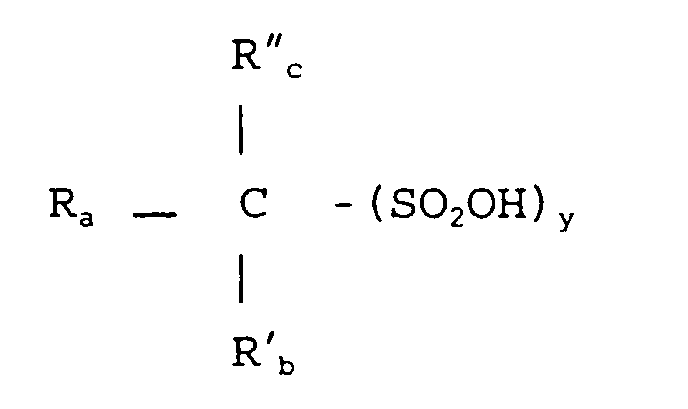
R, R' and R" are the same or different and each independently may be hydrogen, Cl, F, Br, I, CF3 or a lower alkyl group such as (CH2) n where n is from 1 to 7, preferably 1 to 3, and that is unsubstituted or substituted by oxygen, Cl, F, Br, I, CF3, -SO2OH, or by any of the groups listed in the discussion immediately below.
| Electrolyte | Contact Angle (Degree) |
| Copper Sulfate | 33.61 |
| Copper Methanesulfonate | 27.47 |
| Copper Ethanesulfonate | 26.31 |
| Copper Propanesulfonate | 14.44 |
| Copper Triflate | 15.8 |
| Solution/Free Acid | 0.25 M | 0.75 M | 1.75 M |
| Copper Sulfate | 0.205 | 1.98 | 6.54 |
| Copper Methanesulfonate | 0.786 | 0.897 | 0.92 |
| Copper Ethanesulfonate | 0.212 | 0.506 | 0.837 |
| Copper Propanesulfonate | 0.112 | 0.742 | 1.54 |
| Copper Trifluoromethane sulfonate | 0.751 | 2.38 | 3.89 |
| +0.04 V | +0.035 V | +0.030 V | +0.025 V | |
| Copper Sulfate | No Plating | No Plating | No Plating | Start of Copper Plating |
| Copper Methanesul fonate | Start of Copper Plating | Plating of Copper | Plating of Copper | Plating of Copper |
| Copper Ethanesulf onate | No Plating | Start of Copper Plating | Plating of Copper | Plating of Copper |
| Copper Propanesul fonate | No Plating | Start of Copper Plating | Plating of Copper | Plating of Copper |
| Copper Triflate | Start of Copper Plating | Plating of Copper | Plating of Copper | Plating of Copper |
1. Cu Sulfate: High Free Acid (1.75 M,Free Acid); prepared by dissolving 16.1 gm copper carbonate, CuCO3:Cu(OH)2, 57% Cu+2, into 300 ml water. Concentrated sulfuric acid, 7.25 ml was used to dissolve the copper carbonate powder. An additional 47 ml of concentrated sulfuric acid was added to the solution and the entire solution was diluted to 500 ml. The solution was filtered and 6 mg/l HCl was added to the copper electrolyte. Solution contained 18.5 g/1 Cu+2 and 160 g/l free sulfuric acid. To this solution was added 2 ml/500 ml of Enthone additive CuBath 70:30.
2. Copper Ethanesulfonate: High Free Acid (1.75 M Free Acid); prepared by dissolving 15.12 gm copper carbonate, CuCO3:Cu(OH)2, 57% Cu+2, into 300 ml water. Ethanesulfonic acid (
| Electrolyte | Low Free Acid | Intermediate Free | High Free Acid |
| Cu Sulfate | pH = 1.19 Rough Deposit at 30 - 40 ASF; Bright Deposit from 30 to 1 ASF | pH = 1.05 Bright Panel from 40 - 1 ASF | pH 0.72 Bright Panel from 40 - 1 ASF |
| Cu Methanesulfonate | pH 1.40 Rough Deposit at 30 - 40 ASF; | pH = 1.22 Bright Deposit to 10 ASF | pH = 0.96 Bright Panel from 40 - 1 ASF |
| Cu Ethanesulfonate | pH 2.50 Very Slightly Rough Deposit at > 40 ASF;, Bright Deposit from 30 to 1 ASF | pH 1.20 Rough Deposit at > 40 ASF; Bright Deposit from 30 to 1 ASF | 0.66 Rough Deposit at > 40 ASF; Bright Deposit from 30 to 1 ASF |
| Cu Propanesulfonate | pH = 3.40 Very Slightly Rough Deposit at > 40 ASF; Bright Deposit from 30 to 1 ASF | pH = 2.40 Slightly Rough Deposit at > 40 ASF; Bright Deposit from 30 to 1 ASF | pH = 0.86 Rough Deposit at > 40 ASF; Bright Deposit from 30 to 1 ASF |
| Cu Trifluoromethanesulfonate | pH 1.67 Bright Panel from 40 - 1 ASF | pH 1.31 Bright Panel from 40 - 1 ASF | pH 1.02 Bright Panel from 40 - 1 ASF |
| Sulfate | 5.6 x 10⁻⁴ cm2/(volt-sec) |
| Chloride | 6.1 x 10⁻⁴ cm2/(volt-sec) |
| Methanesulfonate | 3.8 x 10⁻⁴ cm2/(volt-sec) |
| Ethanesulfonate | 3.2 x 10⁻⁴ cm2/(volt-sec) |
| Propanesulfonate | 2.9 x 10⁻⁴ cm2/(volt-sec) |
Claims (15)
- A solution for copper electroplating which contains at least one copper alkanesulfonate salt and optionally at least one free alkanesulfonic acid.
- The solution of claim 1 wherein the alkanesulfonic acid of the anionic portion of the copper salt and any free acid are introduced as an alkyl sulfonic acid of formula:wherein a+b+c+y equals 4,

R, R' and R" are the same or different and each independently may be hydrogen, Cl, F, Br, I, CF3 or a lower alkyl group such as (CH2)n where n is from 1 to 7 and that is unsubstituted or substituted by oxygen, Cl, F, Br, I, CF3, -SO2OH. - The solution of claim 1 wherein the alkanesulfonic acid is derived from one or more of alkyl monosulfonic acids and alkyl polysulfonic acids.
- The solution of claim 3 wherein the alkyl sulfonic acid is one or more of methanesulfonic, ethanesulfonic and propanesulfonic acids and the alkyl polysulfonic acids are one or more of methanedisulfonic acid, monochloromethanedisulfonic acid, dichloromethanedisulfonic acid, 1,1-ethanedisulfonic acid, 2-chloro-1,1-ethanedisulfonic acid, 1,2-dichloro-1,1-ethanedisulfonic acid, 1,1-propanedisulfonic acid, 3-chloro-1,1-propanedisulfonic acid, 1,2-ethylene disulfonic acid, 1,3-propylene disulfonic acid, trifluormethanesulfonic acid, butanesulfonic acid, perfluorobutanesulfonic acid and pentanesulfonic acid.
- The solution of claim 1 wherein the alkanesulfonic acid is methanesulfonic acid, ethanesulfonic acid, propanesulfonic acid or trifluormethanesulfonmic acid.
- The solution of claim 1 wherein the acid is a mixture of an alkanesulfonic acid with other acids.
- The solution of claim 1 wherein no free acid is used.
- The solution of any preceding claim wherein the copper salt is supplied as a mixture of a copper alkanesulfonate with other copper salts.
- The solution of any of claims 1-8 which is free of chloride ion.
- A process for the metallization of micron or sub-micron dimensioned trenches or vias which employs an electroplating solution containing one or more copper alkanesulfonate salts and optionally one or more free alkanesulfonic acids.
- The process of claim 10 wherein the alkanesulfonic acid of the anionic portion of the copper salt and any free acid are introduced as an alkyl sulfonic acid of formula:wherein a+b+c+y equals 4,

R, R' and R" are the same or different and each independently may be hydrogen, Cl, F, Br, I, CF3 or a lower alkyl group such as (CH2) n where n is from 1 to 7 and that is unsubstituted or substituted by oxygen, Cl, F, Br, I, CF3, -SO2OH. - The process of claim 10 or 11 wherein the substrate is a semiconductor device with a thinly metallized ceramic surface containing micron or sub-micron dimensioned trenches and vias, and wherein the plating solution effectively plates copper into said trenches and vias.
- The process of claim 10, 11 or 12 wherein direct current, pulsed current or periodic reverse current is used.
- The process of any of claims 10-13 wherein a soluble or an insoluble or inert anode is used.
- A copper composite coating made by the process of any of claims 10-14.
Applications Claiming Priority (6)
| Application Number | Priority Date | Filing Date | Title |
|---|---|---|---|
| US15938199P | 1999-10-14 | 1999-10-14 | |
| US159381 | 1999-10-14 | ||
| US18710800P | 2000-03-06 | 2000-03-06 | |
| US187108 | 2000-03-06 | ||
| US09/667,268 US6605204B1 (en) | 1999-10-14 | 2000-09-22 | Electroplating of copper from alkanesulfonate electrolytes |
| US667268 | 2000-09-22 |
Publications (3)
| Publication Number | Publication Date |
|---|---|
| EP1092790A2 true EP1092790A2 (en) | 2001-04-18 |
| EP1092790A3 EP1092790A3 (en) | 2002-09-11 |
| EP1092790B1 EP1092790B1 (en) | 2013-07-31 |
Family
ID=27388310
Family Applications (1)
| Application Number | Title | Priority Date | Filing Date |
|---|---|---|---|
| EP00309095.8A Expired - Lifetime EP1092790B1 (en) | 1999-10-14 | 2000-10-16 | Electroplating of copper from alkanesulfonate electrolytes |
Country Status (6)
| Country | Link |
|---|---|
| US (1) | US6605204B1 (en) |
| EP (1) | EP1092790B1 (en) |
| JP (1) | JP4588185B2 (en) |
| KR (1) | KR100738824B1 (en) |
| CA (1) | CA2322726A1 (en) |
| TW (1) | TW554084B (en) |
Cited By (5)
| Publication number | Priority date | Publication date | Assignee | Title |
|---|---|---|---|---|
| EP1529126A4 (en) * | 2002-08-16 | 2006-07-05 | Atofina Chem Inc | ELECTROLYTIC COPPER SOLUTIONS |
| EP1897973A1 (en) * | 2006-09-07 | 2008-03-12 | Enthone, Inc. | Deposition of conductive polymer and metallization of non-conductive substrates |
| US8366901B2 (en) | 2006-09-07 | 2013-02-05 | Enthone Inc. | Deposition of conductive polymer and metallization of non-conductive substrates |
| EP2778262A1 (en) * | 2013-03-15 | 2014-09-17 | Omg Electronic Chemicals LLC | Copper plating solutions and method of making and using such solutions |
| TWI720679B (en) * | 2018-11-07 | 2021-03-01 | 首爾大學校產學協力團 | The electrolyte solution containing bromide ion for copper electrodeposition and copper electrodeposition method using the same |
Families Citing this family (13)
| Publication number | Priority date | Publication date | Assignee | Title |
|---|---|---|---|---|
| JP4238051B2 (en) * | 2003-03-11 | 2009-03-11 | 日本ペイント株式会社 | Cationic electrodeposition coating composition and method for stabilizing cationic electrodeposition coating composition |
| DE102004041701A1 (en) * | 2004-08-28 | 2006-03-02 | Enthone Inc., West Haven | Process for the electrolytic deposition of metals |
| JP4704761B2 (en) * | 2005-01-19 | 2011-06-22 | 石原薬品株式会社 | Electro copper plating bath and copper plating method |
| US7575666B2 (en) | 2006-04-05 | 2009-08-18 | James Watkowski | Process for electrolytically plating copper |
| US8522585B1 (en) * | 2006-05-23 | 2013-09-03 | Pmx Industries Inc. | Methods of maintaining and using a high concentration of dissolved copper on the surface of a useful article |
| EP1932953B1 (en) * | 2006-12-11 | 2012-11-14 | Atotech Deutschland GmbH | Galvanic process with analysis of the electrolytic bath through solid phase extraction |
| US7905994B2 (en) | 2007-10-03 | 2011-03-15 | Moses Lake Industries, Inc. | Substrate holder and electroplating system |
| US8262894B2 (en) | 2009-04-30 | 2012-09-11 | Moses Lake Industries, Inc. | High speed copper plating bath |
| EP2483454A2 (en) | 2009-09-28 | 2012-08-08 | Basf Se | Copper electroplating composition |
| KR101329459B1 (en) | 2010-02-22 | 2013-11-15 | 제이엑스 닛코 닛세키 킨조쿠 가부시키가이샤 | High-purity aqueous copper sulfonate solution and method for producing same |
| KR101705734B1 (en) | 2011-02-18 | 2017-02-14 | 삼성전자주식회사 | Copper electroplating solution and method of copper electroplating using the same |
| US9243339B2 (en) | 2012-05-25 | 2016-01-26 | Trevor Pearson | Additives for producing copper electrodeposits having low oxygen content |
| JPWO2016174705A1 (en) * | 2015-04-27 | 2018-02-15 | 株式会社Jcu | Management method of copper sulfate plating solution |
Family Cites Families (16)
| Publication number | Priority date | Publication date | Assignee | Title |
|---|---|---|---|---|
| US2525942A (en) | 1945-06-29 | 1950-10-17 | Standard Oil Co | Electrodepositing bath and process |
| US2525943A (en) | 1947-09-24 | 1950-10-17 | Standard Oil Co | Copper plating bath and process |
| US3715289A (en) * | 1971-02-08 | 1973-02-06 | Stauffer Chemical Co | Brightener composition for acid copper electroplating baths |
| US4396467A (en) * | 1980-10-27 | 1983-08-02 | General Electric Company | Periodic reverse current pulsing to form uniformly sized feed through conductors |
| DE3817722A1 (en) * | 1988-05-25 | 1989-12-14 | Raschig Ag | USE OF 2-SUBSTITUTED ETHANESULPHONE COMPOUNDS AS GALVANOTECHNICAL AUXILIARIES |
| US5051154A (en) | 1988-08-23 | 1991-09-24 | Shipley Company Inc. | Additive for acid-copper electroplating baths to increase throwing power |
| JPH0598488A (en) * | 1991-06-05 | 1993-04-20 | Daiwa Kasei Kenkyusho:Kk | Copper-nickel alloy electroplating bath |
| US5328589A (en) | 1992-12-23 | 1994-07-12 | Enthone-Omi, Inc. | Functional fluid additives for acid copper electroplating baths |
| US5385661A (en) | 1993-09-17 | 1995-01-31 | International Business Machines Corporation | Acid electrolyte solution and process for the electrodeposition of copper-rich alloys exploiting the phenomenon of underpotential deposition |
| DE4338148C2 (en) | 1993-11-04 | 1997-01-30 | Atotech Deutschland Gmbh | Process for the electrolytic deposition of dull and pimple-free copper layers with high elongation at break on substrate surfaces |
| EP0786539A2 (en) * | 1996-01-26 | 1997-07-30 | Elf Atochem North America, Inc. | High current density zinc organosulfonate electrogalvanizing process and composition |
| US5730854A (en) | 1996-05-30 | 1998-03-24 | Enthone-Omi, Inc. | Alkoxylated dimercaptans as copper additives and de-polarizing additives |
| FR2753286B1 (en) * | 1996-09-06 | 1998-11-27 | Corning Inc | ELECTROLYTIC MATERIALS FOR LIGHT MODULATION AND ELECTROCHROMIC DEVICES CONTAINING THEM |
| US6113771A (en) * | 1998-04-21 | 2000-09-05 | Applied Materials, Inc. | Electro deposition chemistry |
| TW577938B (en) * | 1998-11-05 | 2004-03-01 | Uyemura C & Co Ltd | Tin-copper alloy electroplating bath and plating process therewith |
| EP1153430B1 (en) * | 1999-01-21 | 2004-11-10 | ATOTECH Deutschland GmbH | Method for galvanically forming conductor structures of high-purity copper in the production of integrated circuits |
-
2000
- 2000-09-22 US US09/667,268 patent/US6605204B1/en not_active Expired - Lifetime
- 2000-10-10 CA CA002322726A patent/CA2322726A1/en not_active Abandoned
- 2000-10-13 KR KR1020000060340A patent/KR100738824B1/en not_active Expired - Fee Related
- 2000-10-13 JP JP2000313263A patent/JP4588185B2/en not_active Expired - Fee Related
- 2000-10-13 TW TW089121471A patent/TW554084B/en not_active IP Right Cessation
- 2000-10-16 EP EP00309095.8A patent/EP1092790B1/en not_active Expired - Lifetime
Cited By (5)
| Publication number | Priority date | Publication date | Assignee | Title |
|---|---|---|---|---|
| EP1529126A4 (en) * | 2002-08-16 | 2006-07-05 | Atofina Chem Inc | ELECTROLYTIC COPPER SOLUTIONS |
| EP1897973A1 (en) * | 2006-09-07 | 2008-03-12 | Enthone, Inc. | Deposition of conductive polymer and metallization of non-conductive substrates |
| US8366901B2 (en) | 2006-09-07 | 2013-02-05 | Enthone Inc. | Deposition of conductive polymer and metallization of non-conductive substrates |
| EP2778262A1 (en) * | 2013-03-15 | 2014-09-17 | Omg Electronic Chemicals LLC | Copper plating solutions and method of making and using such solutions |
| TWI720679B (en) * | 2018-11-07 | 2021-03-01 | 首爾大學校產學協力團 | The electrolyte solution containing bromide ion for copper electrodeposition and copper electrodeposition method using the same |
Also Published As
| Publication number | Publication date |
|---|---|
| JP2001115294A (en) | 2001-04-24 |
| CA2322726A1 (en) | 2001-04-14 |
| JP4588185B2 (en) | 2010-11-24 |
| TW554084B (en) | 2003-09-21 |
| EP1092790A3 (en) | 2002-09-11 |
| KR20010040084A (en) | 2001-05-15 |
| KR100738824B1 (en) | 2007-07-13 |
| EP1092790B1 (en) | 2013-07-31 |
| US6605204B1 (en) | 2003-08-12 |
Similar Documents
| Publication | Publication Date | Title |
|---|---|---|
| EP1092790B1 (en) | Electroplating of copper from alkanesulfonate electrolytes | |
| US6544399B1 (en) | Electrodeposition chemistry for filling apertures with reflective metal | |
| US20040187731A1 (en) | Acid copper electroplating solutions | |
| US6113771A (en) | Electro deposition chemistry | |
| ES2421189T3 (en) | Process for electrolytic copper galvanizing. | |
| US9506158B2 (en) | Method for copper plating | |
| US20040045832A1 (en) | Electrolytic copper plating solutions | |
| CN103547711B (en) | Aqueous acid bath for the electrolytic deposition of copper | |
| CA2525064C (en) | High purity electrolytic sulfonic acid solutions | |
| JP2005535787A5 (en) | ||
| US20080087549A1 (en) | Additive For Copper Plating And Process For Producing Electronic Circiut Substrate Therewith | |
| JP2003535222A (en) | Electrolyte and method for electrodepositing a tin-silver alloy layer | |
| KR20040073974A (en) | Electroplating composition | |
| US6379522B1 (en) | Electrodeposition chemistry for filling of apertures with reflective metal | |
| KR102943499B1 (en) | Gold electroplating solution and gold electroplating method | |
| KR20070120592A (en) | Plating method of electrolyte and tin-bismuth alloy layer | |
| US20050092616A1 (en) | Baths, methods, and tools for superconformal deposition of conductive materials other than copper | |
| US20230142446A1 (en) | Acidic aqueous composition for electrolytically depositing a copper deposit | |
| US9399618B2 (en) | High purity electrolytic sulfonic acid solutions | |
| EP0025694B1 (en) | Bright nickel plating bath and process and composition therefor | |
| HK1091238B (en) | High purity electrolytic sulfonic acid solutions |
Legal Events
| Date | Code | Title | Description |
|---|---|---|---|
| PUAI | Public reference made under article 153(3) epc to a published international application that has entered the european phase |
Free format text: ORIGINAL CODE: 0009012 |
|
| AK | Designated contracting states |
Kind code of ref document: A2 Designated state(s): AT BE CH CY DE DK ES FI FR GB GR IE IT LI LU MC NL PT SE |
|
| AX | Request for extension of the european patent |
Free format text: AL;LT;LV;MK;RO;SI |
|
| PUAL | Search report despatched |
Free format text: ORIGINAL CODE: 0009013 |
|
| AK | Designated contracting states |
Kind code of ref document: A3 Designated state(s): AT BE CH CY DE DK ES FI FR GB GR IE IT LI LU MC NL PT SE |
|
| AX | Request for extension of the european patent |
Free format text: AL;LT;LV;MK;RO;SI |
|
| RIC1 | Information provided on ipc code assigned before grant |
Free format text: 7C 25D 3/38 A, 7C 25D 7/12 B |
|
| 17P | Request for examination filed |
Effective date: 20030305 |
|
| AKX | Designation fees paid |
Designated state(s): AT BE CH CY DE DK ES FI FR GB GR IE IT LI LU MC NL PT SE |
|
| 17Q | First examination report despatched |
Effective date: 20040205 |
|
| RAP1 | Party data changed (applicant data changed or rights of an application transferred) |
Owner name: ARKEMA INC. |
|
| GRAP | Despatch of communication of intention to grant a patent |
Free format text: ORIGINAL CODE: EPIDOSNIGR1 |
|
| GRAS | Grant fee paid |
Free format text: ORIGINAL CODE: EPIDOSNIGR3 |
|
| GRAA | (expected) grant |
Free format text: ORIGINAL CODE: 0009210 |
|
| AK | Designated contracting states |
Kind code of ref document: B1 Designated state(s): AT BE CH CY DE DK ES FI FR GB GR IE IT LI LU MC NL PT SE |
|
| REG | Reference to a national code |
Ref country code: CH Ref legal event code: EP Ref country code: GB Ref legal event code: FG4D |
|
| REG | Reference to a national code |
Ref country code: AT Ref legal event code: REF Ref document number: 624726 Country of ref document: AT Kind code of ref document: T Effective date: 20130815 |
|
| REG | Reference to a national code |
Ref country code: IE Ref legal event code: FG4D |
|
| REG | Reference to a national code |
Ref country code: DE Ref legal event code: R096 Ref document number: 60048161 Country of ref document: DE Effective date: 20130919 |
|
| REG | Reference to a national code |
Ref country code: AT Ref legal event code: MK05 Ref document number: 624726 Country of ref document: AT Kind code of ref document: T Effective date: 20130731 |
|
| REG | Reference to a national code |
Ref country code: NL Ref legal event code: VDEP Effective date: 20130731 |
|
| PG25 | Lapsed in a contracting state [announced via postgrant information from national office to epo] |
Ref country code: SE Free format text: LAPSE BECAUSE OF FAILURE TO SUBMIT A TRANSLATION OF THE DESCRIPTION OR TO PAY THE FEE WITHIN THE PRESCRIBED TIME-LIMIT Effective date: 20130731 Ref country code: AT Free format text: LAPSE BECAUSE OF FAILURE TO SUBMIT A TRANSLATION OF THE DESCRIPTION OR TO PAY THE FEE WITHIN THE PRESCRIBED TIME-LIMIT Effective date: 20130731 Ref country code: BE Free format text: LAPSE BECAUSE OF FAILURE TO SUBMIT A TRANSLATION OF THE DESCRIPTION OR TO PAY THE FEE WITHIN THE PRESCRIBED TIME-LIMIT Effective date: 20130731 Ref country code: PT Free format text: LAPSE BECAUSE OF FAILURE TO SUBMIT A TRANSLATION OF THE DESCRIPTION OR TO PAY THE FEE WITHIN THE PRESCRIBED TIME-LIMIT Effective date: 20131202 Ref country code: CY Free format text: LAPSE BECAUSE OF NON-PAYMENT OF DUE FEES Effective date: 20130405 |
|
| PGFP | Annual fee paid to national office [announced via postgrant information from national office to epo] |
Ref country code: IE Payment date: 20131010 Year of fee payment: 14 Ref country code: FR Payment date: 20131009 Year of fee payment: 14 Ref country code: DE Payment date: 20131009 Year of fee payment: 14 |
|
| PG25 | Lapsed in a contracting state [announced via postgrant information from national office to epo] |
Ref country code: NL Free format text: LAPSE BECAUSE OF FAILURE TO SUBMIT A TRANSLATION OF THE DESCRIPTION OR TO PAY THE FEE WITHIN THE PRESCRIBED TIME-LIMIT Effective date: 20130731 Ref country code: GR Free format text: LAPSE BECAUSE OF FAILURE TO SUBMIT A TRANSLATION OF THE DESCRIPTION OR TO PAY THE FEE WITHIN THE PRESCRIBED TIME-LIMIT Effective date: 20131101 Ref country code: FI Free format text: LAPSE BECAUSE OF FAILURE TO SUBMIT A TRANSLATION OF THE DESCRIPTION OR TO PAY THE FEE WITHIN THE PRESCRIBED TIME-LIMIT Effective date: 20130731 |
|
| PGFP | Annual fee paid to national office [announced via postgrant information from national office to epo] |
Ref country code: NL Payment date: 20131010 Year of fee payment: 14 |
|
| PG25 | Lapsed in a contracting state [announced via postgrant information from national office to epo] |
Ref country code: CY Free format text: LAPSE BECAUSE OF NON-PAYMENT OF DUE FEES Effective date: 20130731 |
|
| PG25 | Lapsed in a contracting state [announced via postgrant information from national office to epo] |
Ref country code: DK Free format text: LAPSE BECAUSE OF FAILURE TO SUBMIT A TRANSLATION OF THE DESCRIPTION OR TO PAY THE FEE WITHIN THE PRESCRIBED TIME-LIMIT Effective date: 20130731 |
|
| PG25 | Lapsed in a contracting state [announced via postgrant information from national office to epo] |
Ref country code: IT Free format text: LAPSE BECAUSE OF FAILURE TO SUBMIT A TRANSLATION OF THE DESCRIPTION OR TO PAY THE FEE WITHIN THE PRESCRIBED TIME-LIMIT Effective date: 20130731 Ref country code: MC Free format text: LAPSE BECAUSE OF FAILURE TO SUBMIT A TRANSLATION OF THE DESCRIPTION OR TO PAY THE FEE WITHIN THE PRESCRIBED TIME-LIMIT Effective date: 20130731 Ref country code: ES Free format text: LAPSE BECAUSE OF FAILURE TO SUBMIT A TRANSLATION OF THE DESCRIPTION OR TO PAY THE FEE WITHIN THE PRESCRIBED TIME-LIMIT Effective date: 20130731 |
|
| REG | Reference to a national code |
Ref country code: CH Ref legal event code: PL |
|
| PLBE | No opposition filed within time limit |
Free format text: ORIGINAL CODE: 0009261 |
|
| STAA | Information on the status of an ep patent application or granted ep patent |
Free format text: STATUS: NO OPPOSITION FILED WITHIN TIME LIMIT |
|
| GBPC | Gb: european patent ceased through non-payment of renewal fee |
Effective date: 20131031 |
|
| 26N | No opposition filed |
Effective date: 20140502 |
|
| PG25 | Lapsed in a contracting state [announced via postgrant information from national office to epo] |
Ref country code: GB Free format text: LAPSE BECAUSE OF NON-PAYMENT OF DUE FEES Effective date: 20131031 Ref country code: CH Free format text: LAPSE BECAUSE OF NON-PAYMENT OF DUE FEES Effective date: 20131031 Ref country code: LI Free format text: LAPSE BECAUSE OF NON-PAYMENT OF DUE FEES Effective date: 20131031 |
|
| REG | Reference to a national code |
Ref country code: DE Ref legal event code: R097 Ref document number: 60048161 Country of ref document: DE Effective date: 20140502 |
|
| REG | Reference to a national code |
Ref country code: DE Ref legal event code: R119 Ref document number: 60048161 Country of ref document: DE |
|
| REG | Reference to a national code |
Ref country code: IE Ref legal event code: MM4A |
|
| PG25 | Lapsed in a contracting state [announced via postgrant information from national office to epo] |
Ref country code: DE Free format text: LAPSE BECAUSE OF NON-PAYMENT OF DUE FEES Effective date: 20150501 Ref country code: LU Free format text: LAPSE BECAUSE OF NON-PAYMENT OF DUE FEES Effective date: 20131016 |
|
| REG | Reference to a national code |
Ref country code: FR Ref legal event code: ST Effective date: 20150630 |
|
| PG25 | Lapsed in a contracting state [announced via postgrant information from national office to epo] |
Ref country code: FR Free format text: LAPSE BECAUSE OF NON-PAYMENT OF DUE FEES Effective date: 20141031 |
|
| PG25 | Lapsed in a contracting state [announced via postgrant information from national office to epo] |
Ref country code: IE Free format text: LAPSE BECAUSE OF NON-PAYMENT OF DUE FEES Effective date: 20141016 |