EP1091201A2 - Pressure sensor unit - Google Patents
Pressure sensor unit Download PDFInfo
- Publication number
- EP1091201A2 EP1091201A2 EP00304614A EP00304614A EP1091201A2 EP 1091201 A2 EP1091201 A2 EP 1091201A2 EP 00304614 A EP00304614 A EP 00304614A EP 00304614 A EP00304614 A EP 00304614A EP 1091201 A2 EP1091201 A2 EP 1091201A2
- Authority
- EP
- European Patent Office
- Prior art keywords
- pressure sensor
- fluorinated polymer
- housing
- adhesive
- sensor unit
- Prior art date
- Legal status (The legal status is an assumption and is not a legal conclusion. Google has not performed a legal analysis and makes no representation as to the accuracy of the status listed.)
- Granted
Links
Images
Classifications
-
- G—PHYSICS
- G01—MEASURING; TESTING
- G01L—MEASURING FORCE, STRESS, TORQUE, WORK, MECHANICAL POWER, MECHANICAL EFFICIENCY, OR FLUID PRESSURE
- G01L19/00—Details of, or accessories for, apparatus for measuring steady or quasi-steady pressure of a fluent medium insofar as such details or accessories are not special to particular types of pressure gauges
- G01L19/14—Housings
- G01L19/147—Details about the mounting of the sensor to support or covering means
-
- G—PHYSICS
- G01—MEASURING; TESTING
- G01L—MEASURING FORCE, STRESS, TORQUE, WORK, MECHANICAL POWER, MECHANICAL EFFICIENCY, OR FLUID PRESSURE
- G01L19/00—Details of, or accessories for, apparatus for measuring steady or quasi-steady pressure of a fluent medium insofar as such details or accessories are not special to particular types of pressure gauges
- G01L19/0007—Fluidic connecting means
- G01L19/0038—Fluidic connecting means being part of the housing
-
- G—PHYSICS
- G01—MEASURING; TESTING
- G01L—MEASURING FORCE, STRESS, TORQUE, WORK, MECHANICAL POWER, MECHANICAL EFFICIENCY, OR FLUID PRESSURE
- G01L19/00—Details of, or accessories for, apparatus for measuring steady or quasi-steady pressure of a fluent medium insofar as such details or accessories are not special to particular types of pressure gauges
- G01L19/06—Means for preventing overload or deleterious influence of the measured medium on the measuring device or vice versa
- G01L19/0627—Protection against aggressive medium in general
-
- H—ELECTRICITY
- H10—SEMICONDUCTOR DEVICES; ELECTRIC SOLID-STATE DEVICES NOT OTHERWISE PROVIDED FOR
- H10W—GENERIC PACKAGES, INTERCONNECTIONS, CONNECTORS OR OTHER CONSTRUCTIONAL DETAILS OF DEVICES COVERED BY CLASS H10
- H10W72/00—Interconnections or connectors in packages
- H10W72/851—Dispositions of multiple connectors or interconnections
- H10W72/874—On different surfaces
- H10W72/884—Die-attach connectors and bond wires
-
- H—ELECTRICITY
- H10—SEMICONDUCTOR DEVICES; ELECTRIC SOLID-STATE DEVICES NOT OTHERWISE PROVIDED FOR
- H10W—GENERIC PACKAGES, INTERCONNECTIONS, CONNECTORS OR OTHER CONSTRUCTIONAL DETAILS OF DEVICES COVERED BY CLASS H10
- H10W74/00—Encapsulations, e.g. protective coatings
-
- Y—GENERAL TAGGING OF NEW TECHNOLOGICAL DEVELOPMENTS; GENERAL TAGGING OF CROSS-SECTIONAL TECHNOLOGIES SPANNING OVER SEVERAL SECTIONS OF THE IPC; TECHNICAL SUBJECTS COVERED BY FORMER USPC CROSS-REFERENCE ART COLLECTIONS [XRACs] AND DIGESTS
- Y10—TECHNICAL SUBJECTS COVERED BY FORMER USPC
- Y10T—TECHNICAL SUBJECTS COVERED BY FORMER US CLASSIFICATION
- Y10T428/00—Stock material or miscellaneous articles
- Y10T428/31504—Composite [nonstructural laminate]
- Y10T428/31511—Of epoxy ether
-
- Y—GENERAL TAGGING OF NEW TECHNOLOGICAL DEVELOPMENTS; GENERAL TAGGING OF CROSS-SECTIONAL TECHNOLOGIES SPANNING OVER SEVERAL SECTIONS OF THE IPC; TECHNICAL SUBJECTS COVERED BY FORMER USPC CROSS-REFERENCE ART COLLECTIONS [XRACs] AND DIGESTS
- Y10—TECHNICAL SUBJECTS COVERED BY FORMER USPC
- Y10T—TECHNICAL SUBJECTS COVERED BY FORMER US CLASSIFICATION
- Y10T428/00—Stock material or miscellaneous articles
- Y10T428/31504—Composite [nonstructural laminate]
- Y10T428/3154—Of fluorinated addition polymer from unsaturated monomers
-
- Y—GENERAL TAGGING OF NEW TECHNOLOGICAL DEVELOPMENTS; GENERAL TAGGING OF CROSS-SECTIONAL TECHNOLOGIES SPANNING OVER SEVERAL SECTIONS OF THE IPC; TECHNICAL SUBJECTS COVERED BY FORMER USPC CROSS-REFERENCE ART COLLECTIONS [XRACs] AND DIGESTS
- Y10—TECHNICAL SUBJECTS COVERED BY FORMER USPC
- Y10T—TECHNICAL SUBJECTS COVERED BY FORMER US CLASSIFICATION
- Y10T428/00—Stock material or miscellaneous articles
- Y10T428/31504—Composite [nonstructural laminate]
- Y10T428/3154—Of fluorinated addition polymer from unsaturated monomers
- Y10T428/31544—Addition polymer is perhalogenated
-
- Y—GENERAL TAGGING OF NEW TECHNOLOGICAL DEVELOPMENTS; GENERAL TAGGING OF CROSS-SECTIONAL TECHNOLOGIES SPANNING OVER SEVERAL SECTIONS OF THE IPC; TECHNICAL SUBJECTS COVERED BY FORMER USPC CROSS-REFERENCE ART COLLECTIONS [XRACs] AND DIGESTS
- Y10—TECHNICAL SUBJECTS COVERED BY FORMER USPC
- Y10T—TECHNICAL SUBJECTS COVERED BY FORMER US CLASSIFICATION
- Y10T428/00—Stock material or miscellaneous articles
- Y10T428/31504—Composite [nonstructural laminate]
- Y10T428/31652—Of asbestos
- Y10T428/31663—As siloxane, silicone or silane
Definitions
- the present invention relates to a pressure sensor unit and, more particularly, to a pressure sensor unit that is sealed with a fluorinated polymer-containing material for protection to acquire an extended endurance span.
- a gel material having excellent characteristics, including high electric insulation and strong resistances to thermal impact, vibration and both high and low temperatures.
- the gel materials prevailingly used for sealing up the housing are silicone resins, but the silicone resin gel has drawbacks of swelling in solvents, such as toluene, gasoline and gasohol, having high moisture permeability in spite of good water resistance and being subject to deterioration from chemicals, such as a strong acid and a strong alkali.
- the pressure sensor unit used for pressure detection of fuel gas or exhaust gas of the engine in a car undergoes not only changes in pressure and temperature but also exposure to gasoline vapor, water vapor and acidic exhaust gases, so that the gel materials of fluorinated polymer-containing type are used as a suitable sealant for protecting the unit from the foregoing external impacts (Tokkai Hei 11-116685, and the term "Tokkai” as used herein means an "unexamined published Japanese patent application).
- the curable perfluoropolyether resin composition As an example of the material forming such a fluorinated polymer-containing gel sealant, the curable perfluoropolyether resin composition has so far been proposed, which is constituted basically of (A) a straight-chain fluoropolyether compound containing an alkenyl group in each molecule and having a perfluoropolyether structure in the main chain, (B) a fluorine-containing organic silicon compound containing in each molecule a hydrogen atom bonded to a silicon atom and (C) a platinum group compound.
- the endurance span of a pressure sensor unit can be lengthened by covering at least the upper part of terminals with a film of fluorinated polymer-containing adhesive prior to sealing with a gel hitherto employed for pressure sensor units, thereby achieving the present invention.
- an object of the present invention is to provide a pressure sensor unit having sufficient durability even when the pressure sensor unit is used in an environment that it undergoes changes in temperature and pressure, and besides, it is exposed to the atmosphere of gasoline vapor, water vapor and acidic exhaust gases.
- a pressure sensor unit comprising (i) a housing, (ii) pressure sensor members installed therein which include a mount the bottom of which is fixed to the inner base of the housing by means of an adhesive, a sensor chip firmly bonded to the top of the mount, terminals disposed on the inner base of the housing and bonding wires connecting the sensor chip to their respective terminals, and (iii) a sealant filling the housing so that all the pressure sensor members are completely buried therein; with the terminals being covered with a film of fluorinated polymer-containing composition functioning as adhesive (hereinafter referred to as "fluorinated polymer-containing adhesive", too) in at least an upper part thereof, and the sealant being a fluorinated polymer-containing gel material, wherein the composition as adhesive is similar in fluorinated polymer to the gel material.
- fluorinated polymer-containing adhesive a film of fluorinated polymer-containing composition functioning as adhesive
- the terminals are covered with a film of fluorinated polymer-containing adhesive in their respective upper parts, and further entirely buried under the gel sealant. Therefore, they are hard to undergo the influences of gasoline vapor, water vapor and acidic exhaust gasses even when the unit is exposed to the atmosphere containing those vapors and gases. Further, even when the unit is put under a condition to suffer changes in pressure and temperature, the sealant is effectively prevented from producing gas bubbles and generating cracks; as a result, the pressure sensor buried in the sealant can have a substantial improvement in endurance span. Accordingly, the present unit is useful as a pressure sensor unit loaded in cars.
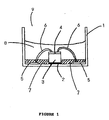
- the numerals 1 to 8 denote the following pressure sensor members respectively, and the numeral 9 denotes a pressure sensor unit;
- Fig. 1 shows a vertical section of an example of the present pressure sensor unit.
- the numeral 1 denotes a housing, the numeral 2 an adhesive, the numeral 3 a mount, the numeral 4 a sensor chip, the numeral 5 a terminal connected to an external electrode, the numeral 6 a bonding wire connecting the sensor chip 4 to one of the terminals 5, the numeral 7 a fluorinated polymer-containing adhesive, and the numeral 8 a fluorinated polymer-containing gel sealant.
- the housing 1 is made from a resin, such as poly(phenylene sulfide) resin (generally abbreviated as "PPS"), and has an open top.
- a resin such as poly(phenylene sulfide) resin (generally abbreviated as "PPS")
- PPS poly(phenylene sulfide) resin
- the mount 3 is fixed to the inner base of the housing 1 by means of an adhesive 2.
- an adhesive 2 it is desirable to use a fluorinated polymer-containing adhesive, such as an adhesive of fluorosilicone or perfluoropolyether type.
- each terminal is connected to the outside, and the other end thereof is connected to the sensor chip 4 via a bonding wire 6.
- the pressure signals detected by the sensor chip 4 can be taken out from each terminal 5 to the outside.
- the adhesive film 7 covering the upper part of the terminals 5 is similar in fluorinated polymer to the gel sealant 8 illustrated below, and can be formed by curing a thermally curable liquid perfluoropolyether resin composition. Examples of a fluorinated polymer-containing adhesive usable for the foregoing purpose include those disclosed in JP-A-9-95615.
- the upper part of the terminals 5 is covered with an adhesive composition and then subjected to heating at a temperature of no higher than 200°C, preferably from 100 to 200°C, for several minutes to several hours.
- the adhesive composition is formed into a film adhering to the surfaces brought into contact therewith.
- the adhesive composition may be cured or may remain uncured before the fluorinated polymer-containing gel composition is cast in the housing.
- a fluorinated polymer-containing gel composition usable herein include those disclosed in JP-A-11-116685.
- the fluorinated polymer-containing adhesive composition in a case where the simultaneous curing is adopted, it is desirable for the fluorinated polymer-containing adhesive composition to contain silica. In particular, it is advantageous that the viscosity of the adhesive composition be significantly different from that of the gel composition.
- the adhesive film it is desirable for the adhesive film to have a hardness of from 5 to 60 degrees (measured in accordance with JIS A). When the hardness of the adhesive film is lower than 5 degrees, the changes in temperature and/or pressure tend to cause the production of air bubbles on the periphery of the terminals, and further give rise to the growth of bubbles to crack the film. When the adhesive film has a hardness higher than 60 degrees, on the other hand, it tends to occur that the adhesive film cannot follow the temperature change to peel off the surfaces with which it was once in close contact.
- the fluorinated polymer-containing gel sealant 8 for the present pressure sensor unit is prepared by curing a thermally curable liquid perfluoropolyether resin composition.
- the gel formed by curing a liquid perfluoropolyether resin composition is well-suited for a pressure sensor unit exposed to an acidic gas/water vapor mixture atmosphere.
- the gel formation is carried out by filling the housing 1 with the foregoing gel composition so that the fluorinated polymer-containing adhesive layer 7, the sensor chip 4 and the bonding wires 6 are all buried in the gel composition, and then heating the gel composition to a temperature of 200°C or below, preferably from 100°C to 200°C, for a period of several minutes to several hours.
- the gel formed by curing the forgoing gel composition prefferably has a penetration number of from 1 to 100, measured according to JIS K 2220.
- the penetration number of the gel is smaller than 1, the gel cannot relieve the stress caused by the temperature and/or pressure change the sensor unit has suffered; as a result, sensor characteristics are subject to fluctuation and, what is worse, breaks tend to occur in bonding wires.
- the gel has a penetration number greater than 100, the liquefaction thereof tends to occur when the gel suffers a change of pressure.
- a pressure sensor unit shown in Fig. 1 was produced, wherein the upper part of each terminal 5 was covered with a film of fluorinated polymer-containing adhesive having a hardness of 25 degrees (SIFEL 611, trade name, a product of Shin-Etsu Chemical Co., Ltd.) and the housing 1 was filled with a fluorinated polymer-containing gel material having a penetration number of 90 (SIFEL 819A/B, trade name, a product of Shin-Etsu Chemical Co., Ltd.) in a condition that the gel material completely covered all of the adhesive film 7, the sensor chip 4 and the bonding wires 6.
- This pressure sensor unit was soaked in gasoline or water for a period of 1 week, and then taken out.
- Each of the thus treated pressure sensor unit was tested on its endurance under a condition that it underwent the following pressure cycle and heating-cooling cycle at the same time. As a result, neither formation of bubbles nor appearance of cracks was detected in the gel sealant of each pressure sensor unit even after the those cycles were repeated 1,000,000 times, based on pressure cycle. By contrast, the pressure sensor unit sealed with the gel alone produced bubbles and had breaks in bonding wires before those cycles were repeated 30,000 times, based on pressure cycle.
Landscapes
- Physics & Mathematics (AREA)
- General Physics & Mathematics (AREA)
- Chemical & Material Sciences (AREA)
- Analytical Chemistry (AREA)
- Measuring Fluid Pressure (AREA)
- Pressure Sensors (AREA)
- Adhesives Or Adhesive Processes (AREA)
- Structures Or Materials For Encapsulating Or Coating Semiconductor Devices Or Solid State Devices (AREA)
Abstract
Description
Claims (3)
- A pressure sensor unit comprising a housing, pressure sensor members installed therein which include a mount the bottom of which is fixed to the inner base of the housing by means of an adhesive, a sensor chip firmly bonded to the top of the mount, terminals disposed on the inner base of the housing and bonding wires connecting the sensor chip to their respective terminals, and an encapsulant filling the housing so that all the pressure sensor members are completely buried therein; characterized in that the terminals are covered with a fluorinated polymer-containing composition functioning as adhesive in at least an upper part thereof, and the encapsulant is a fluorinated polymer-containing gel material, wherein the composition as adhesive is similar in fluorinated polymer to the gel material.
- A pressure sensor unit according to claim 1, wherein said fluorinated polymer is a polymer formed from a thermally curable perfluoropolyether resin composition.
- A pressure sensor unit according to claim 2, wherein said thermally curable perfluoropolyether resin composition comprises (A) a straight-chain fluoropolyether compound containing an alkenyl group in each molecule and having a perfluoropolyether structure in the main chain, (B) a fluorine-containing organic silicon compound containing in each molecule a hydrogen atom bonded to a silicon atom and (C) a platinum group compound.
Applications Claiming Priority (2)
| Application Number | Priority Date | Filing Date | Title |
|---|---|---|---|
| JP28243099 | 1999-10-04 | ||
| JP28243099A JP3640337B2 (en) | 1999-10-04 | 1999-10-04 | Pressure sensor device |
Publications (3)
| Publication Number | Publication Date |
|---|---|
| EP1091201A2 true EP1091201A2 (en) | 2001-04-11 |
| EP1091201A3 EP1091201A3 (en) | 2001-06-13 |
| EP1091201B1 EP1091201B1 (en) | 2003-08-13 |
Family
ID=17652321
Family Applications (1)
| Application Number | Title | Priority Date | Filing Date |
|---|---|---|---|
| EP00304614A Expired - Lifetime EP1091201B1 (en) | 1999-10-04 | 2000-05-31 | Pressure sensor unit |
Country Status (4)
| Country | Link |
|---|---|
| US (1) | US6425294B1 (en) |
| EP (1) | EP1091201B1 (en) |
| JP (1) | JP3640337B2 (en) |
| DE (1) | DE60004454T2 (en) |
Cited By (10)
| Publication number | Priority date | Publication date | Assignee | Title |
|---|---|---|---|---|
| EP1431732A1 (en) * | 2002-12-16 | 2004-06-23 | Toyoda Koki Kabushiki Kaisha | Pressure sensor |
| EP1523035A2 (en) | 2003-10-08 | 2005-04-13 | Shin-Etsu Chemical Co., Ltd. | Semiconductor package |
| EP1440182A4 (en) * | 2001-10-12 | 2006-08-23 | Kavlico Corp | CORROSION RESISTANT PRESSURE TRANSDUCER |
| GB2462822B (en) * | 2008-08-18 | 2011-11-02 | Crombie 123 Ltd | Wire bonding |
| WO2012123054A1 (en) * | 2011-03-15 | 2012-09-20 | Volkswagen Aktiengesellschaft | Pressure sensor |
| US8618420B2 (en) | 2008-08-18 | 2013-12-31 | Semblant Global Limited | Apparatus with a wire bond and method of forming the same |
| US8995146B2 (en) | 2010-02-23 | 2015-03-31 | Semblant Limited | Electrical assembly and method |
| US9055700B2 (en) | 2008-08-18 | 2015-06-09 | Semblant Limited | Apparatus with a multi-layer coating and method of forming the same |
| US9648720B2 (en) | 2007-02-19 | 2017-05-09 | Semblant Global Limited | Method for manufacturing printed circuit boards |
| US11786930B2 (en) | 2016-12-13 | 2023-10-17 | Hzo, Inc. | Protective coating |
Families Citing this family (15)
| Publication number | Priority date | Publication date | Assignee | Title |
|---|---|---|---|---|
| US7252027B2 (en) * | 2001-02-08 | 2007-08-07 | Black & Decker Inc. | Miter saw |
| JP2002310828A (en) * | 2001-04-19 | 2002-10-23 | Hitachi Ltd | Semiconductor pressure sensor |
| US6651319B2 (en) * | 2001-09-07 | 2003-11-25 | Visteon Global Technologies, Inc. | Compliant standoff for low pressure sensing device |
| JP2004045142A (en) | 2002-07-10 | 2004-02-12 | Shin Etsu Chem Co Ltd | Semiconductor pressure sensor device |
| JP2005181065A (en) * | 2003-12-18 | 2005-07-07 | Denso Corp | Semiconductor pressure sensor device |
| JP4784743B2 (en) * | 2005-02-14 | 2011-10-05 | 信越化学工業株式会社 | Curable perfluoropolyether composition, rubber and gel product using the cured product |
| JP2007040772A (en) * | 2005-08-02 | 2007-02-15 | Mitsubishi Electric Corp | Semiconductor pressure sensor |
| JP5008192B2 (en) | 2006-09-08 | 2012-08-22 | 信越化学工業株式会社 | Perfluoropolyether-polyorganosiloxane copolymer and surface treatment agent containing the same |
| DE102008042489B4 (en) * | 2008-09-30 | 2018-07-26 | Robert Bosch Gmbh | Workpiece assembly and use of the workpiece assembly |
| US9345144B2 (en) * | 2013-02-28 | 2016-05-17 | Eastman Kodak Company | Making multi-layer micro-wire structure |
| DE102013017317A1 (en) * | 2013-10-18 | 2015-04-23 | Endress + Hauser Flowtec Ag | Measuring arrangement with a carrier element and a sensor |
| JP6519305B2 (en) * | 2015-05-11 | 2019-05-29 | 富士電機株式会社 | Silicone resin composition for sealing material and power semiconductor module using the composition |
| WO2017141460A1 (en) * | 2016-02-15 | 2017-08-24 | 京セラ株式会社 | Pressure sensor |
| JP6922244B2 (en) * | 2017-02-17 | 2021-08-18 | 富士電機株式会社 | Manufacturing method of semiconductor physical quantity sensor device and test method of semiconductor physical quantity sensor device |
| JP7188692B2 (en) * | 2018-08-24 | 2022-12-13 | 公立大学法人大阪 | temperature sensor |
Family Cites Families (10)
| Publication number | Priority date | Publication date | Assignee | Title |
|---|---|---|---|---|
| JPS62228926A (en) * | 1986-03-31 | 1987-10-07 | Hitachi Ltd | Semiconductor pressure sensor |
| JPS638523A (en) * | 1986-06-30 | 1988-01-14 | Hitachi Ltd | Semiconductor pressure sensor |
| JPH01189539A (en) * | 1988-01-25 | 1989-07-28 | Hitachi Ltd | Semiconductor pressure sensor |
| JP3092307B2 (en) * | 1992-04-16 | 2000-09-25 | 富士電機株式会社 | Semiconductor pressure sensor |
| US5747694A (en) * | 1995-07-28 | 1998-05-05 | Nippondenso Co., Ltd. | Pressure sensor with barrier in a pressure chamber |
| JP3239717B2 (en) * | 1995-09-29 | 2001-12-17 | 信越化学工業株式会社 | Curable composition |
| JP3671563B2 (en) * | 1996-12-09 | 2005-07-13 | 株式会社デンソー | Semiconductor device having a structure in which a mold IC is fixed to a case |
| JP3487744B2 (en) * | 1997-10-09 | 2004-01-19 | 信越化学工業株式会社 | Curable composition |
| JPH11172108A (en) * | 1997-12-12 | 1999-06-29 | Shin Etsu Chem Co Ltd | Conductive fluororesin composition |
| JP3475760B2 (en) * | 1997-12-24 | 2003-12-08 | 信越化学工業株式会社 | Curable composition and cured gel |
-
1999
- 1999-10-04 JP JP28243099A patent/JP3640337B2/en not_active Expired - Fee Related
-
2000
- 2000-05-19 US US09/574,259 patent/US6425294B1/en not_active Expired - Lifetime
- 2000-05-31 DE DE60004454T patent/DE60004454T2/en not_active Expired - Lifetime
- 2000-05-31 EP EP00304614A patent/EP1091201B1/en not_active Expired - Lifetime
Cited By (13)
| Publication number | Priority date | Publication date | Assignee | Title |
|---|---|---|---|---|
| EP1440182A4 (en) * | 2001-10-12 | 2006-08-23 | Kavlico Corp | CORROSION RESISTANT PRESSURE TRANSDUCER |
| EP1431732A1 (en) * | 2002-12-16 | 2004-06-23 | Toyoda Koki Kabushiki Kaisha | Pressure sensor |
| US7096739B2 (en) | 2002-12-16 | 2006-08-29 | Toyoda Koki Kabushiki Kaisha | Pressure sensor containing fluorine-based adhesive |
| EP1523035A2 (en) | 2003-10-08 | 2005-04-13 | Shin-Etsu Chemical Co., Ltd. | Semiconductor package |
| EP1523035A3 (en) * | 2003-10-08 | 2006-05-31 | Shin-Etsu Chemical Co., Ltd. | Semiconductor package |
| US9648720B2 (en) | 2007-02-19 | 2017-05-09 | Semblant Global Limited | Method for manufacturing printed circuit boards |
| US9055700B2 (en) | 2008-08-18 | 2015-06-09 | Semblant Limited | Apparatus with a multi-layer coating and method of forming the same |
| US8618420B2 (en) | 2008-08-18 | 2013-12-31 | Semblant Global Limited | Apparatus with a wire bond and method of forming the same |
| GB2462822B (en) * | 2008-08-18 | 2011-11-02 | Crombie 123 Ltd | Wire bonding |
| US8995146B2 (en) | 2010-02-23 | 2015-03-31 | Semblant Limited | Electrical assembly and method |
| WO2012123054A1 (en) * | 2011-03-15 | 2012-09-20 | Volkswagen Aktiengesellschaft | Pressure sensor |
| US11786930B2 (en) | 2016-12-13 | 2023-10-17 | Hzo, Inc. | Protective coating |
| US12521756B2 (en) | 2016-12-13 | 2026-01-13 | Hzo, Inc. | Protective coating |
Also Published As
| Publication number | Publication date |
|---|---|
| EP1091201A3 (en) | 2001-06-13 |
| JP2001099737A (en) | 2001-04-13 |
| DE60004454D1 (en) | 2003-09-18 |
| US6425294B1 (en) | 2002-07-30 |
| EP1091201B1 (en) | 2003-08-13 |
| DE60004454T2 (en) | 2004-04-15 |
| JP3640337B2 (en) | 2005-04-20 |
Similar Documents
| Publication | Publication Date | Title |
|---|---|---|
| EP1091201B1 (en) | Pressure sensor unit | |
| EP0916801B1 (en) | Insulating glass units and process of making insulating glass units | |
| US6844632B2 (en) | Semiconductor pressure sensor device protected with perfluoropolyether gel | |
| US5686162A (en) | Protecting electronic components in acidic and basic environments | |
| US7216546B2 (en) | Pressure sensor having integrated temperature sensor | |
| CA1146772A (en) | Load-cell balance | |
| KR970004559B1 (en) | Optical fiber composite insulator and method of producing the same | |
| US20050006794A1 (en) | Silicone rubber composition, light-emitting semiconductor embedding/protecting material and light-emitting semiconductor device | |
| JPH07221350A (en) | Light emitting diode performance improvement method | |
| CN104736984A (en) | Pressure sensor device and method for manufacturing pressure sensor device | |
| KR102484047B1 (en) | Encapsulation for mems sense elements and wire bonds | |
| KR100960633B1 (en) | Pressure sensor with sensor chip protected by protective material | |
| JP2007532865A (en) | Corrosion protection for pressure sensors | |
| JP3892065B2 (en) | Sensor device and sensor chip fixing method | |
| JP2001116639A (en) | Semiconductor pressure sensor and method of manufacturing the same | |
| JP2005326338A (en) | Pressure sensor | |
| JP4430422B2 (en) | Temperature sensor | |
| JP2005326395A (en) | Gas sensor | |
| JPH08193899A (en) | Semiconductor pressure sensor | |
| JPH0846093A (en) | Semiconductor device and its manufacturing method | |
| JP4973126B2 (en) | Pressure sensor | |
| JP2003270017A (en) | Sealed structure of thermal flow meter | |
| JP6922244B2 (en) | Manufacturing method of semiconductor physical quantity sensor device and test method of semiconductor physical quantity sensor device | |
| KR0163305B1 (en) | Method of forming passivation layer for protecting electrical connecting part of chip finished wire bond process | |
| JPH11132866A (en) | Thermistor temperature sensor |
Legal Events
| Date | Code | Title | Description |
|---|---|---|---|
| PUAI | Public reference made under article 153(3) epc to a published international application that has entered the european phase |
Free format text: ORIGINAL CODE: 0009012 |
|
| AK | Designated contracting states |
Kind code of ref document: A2 Designated state(s): DE FR GB |
|
| AX | Request for extension of the european patent |
Free format text: AL;LT;LV;MK;RO;SI |
|
| PUAL | Search report despatched |
Free format text: ORIGINAL CODE: 0009013 |
|
| AK | Designated contracting states |
Kind code of ref document: A3 Designated state(s): AT BE CH CY DE DK ES FI FR GB GR IE IT LI LU MC NL PT SE |
|
| AX | Request for extension of the european patent |
Free format text: AL;LT;LV;MK;RO;SI |
|
| RIC1 | Information provided on ipc code assigned before grant |
Free format text: 7G 01L 9/00 A, 7G 01L 23/24 B |
|
| 17P | Request for examination filed |
Effective date: 20011112 |
|
| AKX | Designation fees paid |
Free format text: DE FR GB |
|
| 17Q | First examination report despatched |
Effective date: 20021120 |
|
| GRAH | Despatch of communication of intention to grant a patent |
Free format text: ORIGINAL CODE: EPIDOS IGRA |
|
| GRAH | Despatch of communication of intention to grant a patent |
Free format text: ORIGINAL CODE: EPIDOS IGRA |
|
| GRAA | (expected) grant |
Free format text: ORIGINAL CODE: 0009210 |
|
| AK | Designated contracting states |
Designated state(s): DE FR GB |
|
| REG | Reference to a national code |
Ref country code: GB Ref legal event code: FG4D |
|
| REF | Corresponds to: |
Ref document number: 60004454 Country of ref document: DE Date of ref document: 20030918 Kind code of ref document: P |
|
| ET | Fr: translation filed | ||
| PLBE | No opposition filed within time limit |
Free format text: ORIGINAL CODE: 0009261 |
|
| STAA | Information on the status of an ep patent application or granted ep patent |
Free format text: STATUS: NO OPPOSITION FILED WITHIN TIME LIMIT |
|
| 26N | No opposition filed |
Effective date: 20040514 |
|
| PGFP | Annual fee paid to national office [announced via postgrant information from national office to epo] |
Ref country code: GB Payment date: 20050525 Year of fee payment: 6 |
|
| PG25 | Lapsed in a contracting state [announced via postgrant information from national office to epo] |
Ref country code: GB Free format text: LAPSE BECAUSE OF NON-PAYMENT OF DUE FEES Effective date: 20060531 |
|
| GBPC | Gb: european patent ceased through non-payment of renewal fee |
Effective date: 20060531 |
|
| REG | Reference to a national code |
Ref country code: FR Ref legal event code: PLFP Year of fee payment: 17 |
|
| REG | Reference to a national code |
Ref country code: FR Ref legal event code: PLFP Year of fee payment: 18 |
|
| REG | Reference to a national code |
Ref country code: FR Ref legal event code: PLFP Year of fee payment: 19 |
|
| PGFP | Annual fee paid to national office [announced via postgrant information from national office to epo] |
Ref country code: DE Payment date: 20180515 Year of fee payment: 19 |
|
| PGFP | Annual fee paid to national office [announced via postgrant information from national office to epo] |
Ref country code: FR Payment date: 20180412 Year of fee payment: 19 |
|
| REG | Reference to a national code |
Ref country code: DE Ref legal event code: R119 Ref document number: 60004454 Country of ref document: DE |
|
| PG25 | Lapsed in a contracting state [announced via postgrant information from national office to epo] |
Ref country code: DE Free format text: LAPSE BECAUSE OF NON-PAYMENT OF DUE FEES Effective date: 20191203 |
|
| PG25 | Lapsed in a contracting state [announced via postgrant information from national office to epo] |
Ref country code: FR Free format text: LAPSE BECAUSE OF NON-PAYMENT OF DUE FEES Effective date: 20190531 |