EP1091005A2 - Rust-resistant calcium steel - Google Patents

Rust-resistant calcium steel Download PDF

Info

Publication number
EP1091005A2
EP1091005A2 EP00121691A EP00121691A EP1091005A2 EP 1091005 A2 EP1091005 A2 EP 1091005A2 EP 00121691 A EP00121691 A EP 00121691A EP 00121691 A EP00121691 A EP 00121691A EP 1091005 A2 EP1091005 A2 EP 1091005A2
Authority
EP
European Patent Office
Prior art keywords
steel
oxide
inclusions
concentration
rust
Prior art date
Legal status (The legal status is an assumption and is not a legal conclusion. Google has not performed a legal analysis and makes no representation as to the accuracy of the status listed.)
Granted
Application number
EP00121691A
Other languages
German (de)
French (fr)
Other versions
EP1091005B1 (en
EP1091005A3 (en
Inventor
Seiji Technical Research Laboratories Nabeshima
Yasuo Technical Research Laboratories Kishimoto
Shuji Technical Research Laboratories Takeuchi
Current Assignee (The listed assignees may be inaccurate. Google has not performed a legal analysis and makes no representation or warranty as to the accuracy of the list.)
JFE Steel Corp
Original Assignee
JFE Steel Corp
Kawasaki Steel Corp
Priority date (The priority date is an assumption and is not a legal conclusion. Google has not performed a legal analysis and makes no representation as to the accuracy of the date listed.)
Filing date
Publication date
Family has litigation
First worldwide family litigation filed litigation Critical https://patents.darts-ip.com/?family=17691958&utm_source=google_patent&utm_medium=platform_link&utm_campaign=public_patent_search&patent=EP1091005(A2) "Global patent litigation dataset” by Darts-ip is licensed under a Creative Commons Attribution 4.0 International License.
Application filed by JFE Steel Corp, Kawasaki Steel Corp filed Critical JFE Steel Corp
Publication of EP1091005A2 publication Critical patent/EP1091005A2/en
Publication of EP1091005A3 publication Critical patent/EP1091005A3/en
Application granted granted Critical
Publication of EP1091005B1 publication Critical patent/EP1091005B1/en
Anticipated expiration legal-status Critical
Expired - Lifetime legal-status Critical Current

Links

Images

Classifications

    • CCHEMISTRY; METALLURGY
    • C21METALLURGY OF IRON
    • C21CPROCESSING OF PIG-IRON, e.g. REFINING, MANUFACTURE OF WROUGHT-IRON OR STEEL; TREATMENT IN MOLTEN STATE OF FERROUS ALLOYS
    • C21C7/00Treating molten ferrous alloys, e.g. steel, not covered by groups C21C1/00 - C21C5/00
    • CCHEMISTRY; METALLURGY
    • C22METALLURGY; FERROUS OR NON-FERROUS ALLOYS; TREATMENT OF ALLOYS OR NON-FERROUS METALS
    • C22CALLOYS
    • C22C38/00Ferrous alloys, e.g. steel alloys
    • C22C38/004Very low carbon steels, i.e. having a carbon content of less than 0,01%
    • CCHEMISTRY; METALLURGY
    • C21METALLURGY OF IRON
    • C21CPROCESSING OF PIG-IRON, e.g. REFINING, MANUFACTURE OF WROUGHT-IRON OR STEEL; TREATMENT IN MOLTEN STATE OF FERROUS ALLOYS
    • C21C7/00Treating molten ferrous alloys, e.g. steel, not covered by groups C21C1/00 - C21C5/00
    • C21C7/04Removing impurities by adding a treating agent
    • C21C7/064Dephosphorising; Desulfurising
    • CCHEMISTRY; METALLURGY
    • C22METALLURGY; FERROUS OR NON-FERROUS ALLOYS; TREATMENT OF ALLOYS OR NON-FERROUS METALS
    • C22CALLOYS
    • C22C38/00Ferrous alloys, e.g. steel alloys
    • C22C38/002Ferrous alloys, e.g. steel alloys containing In, Mg, or other elements not provided for in one single group C22C38/001 - C22C38/60

Definitions

  • the present invention relates to a Ca-containing rust-resistant steel, containing Ca at a concentration of about 5 ppm or more.
  • it relates to the concept of effectively reducing the formation of rust on surfaces of steel products, such rust being caused by CaO-containing oxide inclusions in the steel products, thereby solving a problem which is often of concern when Ca or Ca alloy is added to molten steel.
  • This invention further prevents nozzle clogging during the associated continuous casting process, and reduces deformability during hot rolling of sulfide inclusions.
  • the above oxide inclusions mainly containing Al 2 O 3 and Ti oxide, are likely to adhere to and thus form deposits on the internal surfaces of an immersion nozzle of the type usually employed in a continuous casting process for injecting molten steel from a tundish into a mold. As a result, the nozzle is likely to clog, making it impossible to ensure the performance of a stable casting process.
  • MnS steels including HIC resistant steels, and in steels required to possess a desired burring characteristic, and other steels containing MnS. Since the MnS contained in the steel tends to assert harmful influences on the desired HIC resistance and burring properties of the steel, it has also been suggested that Ca be added in order to inhibit the formation of MnS (For example, Japanese Unexamined Patent Application Publication No. 56-9317).
  • the added Ca also reacts with the S contained in the steel, undesirably forming CaS, which causes the subsequent formation of rust on the surfaces of the steel products.
  • Japanese Unexamined Patent Application Publication No. 6-559 has suggested that the Ca content of a steel product be controlled within a range of 5 ppm to less than 10 ppm, so as to prevent the formation of rust on the surface of the steel product.
  • the Ca content is controlled to a value which is less than 10 ppm, if the composition of the oxides remaining in the steel is not specifically controlled, and if the CaO concentration in a resulting inclusion is high, the problem remains that CaS cannot be prevented from forming in the areas around the CaO-containing oxides that remain in the steel, hence forming numerous starting points at which rust will subsequently develop.
  • an improved Ca-containing rust-resistant steel wherein the composition of any oxide inclusions and the concentration of S contained in the steel are controlled so that among CaO-containing oxide inclusions about 80% of the oxide inclusions having particle diameters of at least 2 ⁇ m have an equilibrium S soluble amount (%S inc.) (to be further defined) which is about 0.03 wt% or less.
  • a high frequency melting furnace filled with an Ar atmosphere was used to carry out the Si-deoxidation treatment (Si: 0.01 to 2.0 wt%) to treat an amount of an extremely low carbon steel having the following composition: C: 0.0015 to 0.0025 wt%; Mn: 0.15 to 0.22 wt%; P: 0.008 to 0.015 wt%; S: 0.002 to 0.020 wt%.
  • This was followed by Al-deoxidation treatment or Ti-oxidation treatment or Al-Ti deoxidation treatment.
  • Ca was added (Fe-Ca, CaSi, wherein the amount of Ca was 0.0005 to 0.0040 wt%).
  • the composition of the oxides was altered and controlled to convert the oxides from Al 2 O 3 , Ti oxide, Al 2 O 3 -Ti oxide, or SiO 2 -containing oxide to CaO-containing oxides.
  • the ingredients Al, Ti, Si, and Ca were reacted so as to alter the compositions of the oxides contained in the steel.
  • the molten steel was then cast, whereas the organization and characteristics of the inclusions contained in steel blocks, and having a particle diameter of 2 ⁇ m or larger, were measured by EPMA.
  • the steel block was rolled and a test piece was cut from the steel sheet formed by rolling the steel block.
  • the test piece was then subjected to an exposure test for 24 hours in an experimental apparatus including a chamber having a constant temperature and a constant humidity (temperature: 60°C, humidity: 95%).
  • the organization and characteristics of the inclusions contained in the test piece treated in the above exposure test were also measured by EPMA, thereby determining the relationship between the compositions of the oxides and the probability of rust formation.
  • Fig. 1 of the drawings indicates the EPMA measurement results of inclusions present in the steel blocks.
  • compositions of many other steel blocks were investigated, and research was repeatedly conducted on the compositions of the oxides, the precipitation conditions of the CaS, and the rust formation conditions, thereby clearly demonstrating the discovery that a higher CaO concentration, i.e., a higher optical basicity of oxides, causes easier precipitation of CaS in the areas around the oxides, hence readily forming starting points which will later become points at which rust forms.
  • a higher CaO concentration i.e., a higher optical basicity of oxides
  • the equilibrium S soluble amount (%S inc.) in the steel is the soluble amount of the oxides at the casting temperature, as calculated by the method of D. J. Sosinsky, et al., in accordance with the equation (1) which follows hereinafter.
  • the reference is D. J. Sosinsky and I. D. Sommerville, Met. Trans. B., 1986, Vol. 17B, pp. 331 - 337.
  • %S inc. causes more CaS to form and deposit in areas located around the oxide particles.
  • log aO (-64000/T + 20.57 - 2log[wt%Al] - 0.086[wt%Al] - 0.102 [wt%Si])/3.
  • log aO (-60709/T + 20.97 - 2log[wt%Ti] - 0.084[wt%Ti])/3.
  • 1.0 X(CaO) + 0.605 X(Al 2 O 3 ) + 0.601 X(TiO 2 ) + 0.78 X(MgO) + 0.48 X(SiO 2 ) + 0.55 X(Cr 2 O3) + 0.59 X(MnO), wherein
  • CaS forms at an extremely high rate.
  • the reason for this may be explained.
  • the CaS, formed in the areas around the inclusions, is a hydrolyzable inclusion and is subjected to a hydrolysis reaction in a manner shown in the following chemical reactions (Iron & Steel, 1982, No. 13, p. 301). 2CaS + 2H 2 O ⁇ Ca(OH) 2 + Ca(HS) 2 Ca(HS) 2 + 2H 2 O ⁇ Ca(OH) 2 + 2H 2 S
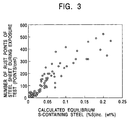
  • the graph Fig. 3 shows a relationship between (a) the equilibrium S soluble amount (%S inc.) of the oxides at a certain casting temperature (the soluble amount being calculated from the average oxide composition of a thin steel sheet prepared for test use) and (b) the number of rust formation points in the thin steel sheet during an indoor exposure test for determining the amount of rust formation (test period: two weeks; average temperature: 18°C; average humidity: 62%).
  • the amount of rust formation in a steel product greatly depends upon the formation of CaS in the areas around the inclusions.
  • the formation of CaS can be evaluated in accordance with the composition of the oxide inclusions, and the equilibrium S soluble amount (calculated from the temperature of the casting process and the oxygen activity of a molten steel) of the oxides at the casting temperature. Furthermore, it has been discovered from many experiments that once the equilibrium S soluble amount exceeds about 0.03 wt%, the amount of CaS formed increases, resulting in a sudden increase in the amount of rust formed.
  • the present invention is beneficial for use in treating all kinds of Ca-containing steels obtained by adding Ca (usually in the form of a Ca alloy) to the molten steel.
  • the present invention is suitable for use in treating any common steel such as high carbon steel, low carbon steel, and extremely low carbon steel; stainless steel such as a ferrite stainless steel, martensite stainless steel, and austenite stainless steel; and steel containing an oxide inclusion having a CaO content of 2 ⁇ m or more.
  • Ca-containing steel herein means a steel whose Ca concentration is 0.0005 wt% or more.
  • an oxide that comprises CaO-Al 2 O 3 as its main component is present in an Al-deoxidized steel.
  • An oxide that comprises CaO-Ti oxide as its main component exists in a Ti-deoxidized steel.
  • An oxide that comprises CaO-Al 2 O 3 -Ti oxide as its main component is present in an Al/Ti-deoxidized steel.
  • a low Al steel and a low Ti steel each of which is an Si-deoxidized steel, also contains an oxide SiO 2; a high Mn steel contains an oxide MnO; a high Cr steel such as stainless steel contains an oxide Cr 2 O 3 ; and an Mn-containing steel contains an Mn-oxide.
  • the present invention is suitable for treating even a complex oxide containing any combination of the above oxides.
  • the present invention is also suitable for use in treating steel containing as much as 5 wt% of other oxides.
  • the present invention is particularly beneficial for use in treating an oxide inclusion having a particle diameter of 2 ⁇ m or larger, since fine particles having a particle diameter of less than 2 ⁇ m are not likely to become starting points for development of rust.
  • the particle diameter is the average diameter obtained by averaging the diameters in both the rolling direction and the width direction of the sheet.
  • the present invention is characterized in that the composition of the inclusions and the S concentration of steel are controlled so that the equilibrium S soluble amount (%S inc.) of oxides, when calculated in the above equation (1) will become about 0.03 wt% or less.
  • the composition of oxides can also be controlled by using a selected deoxidant and controlling the amount of its addition.
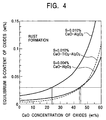
  • Fig. 4 is a graph showing the relationship between the equilibrium S soluble amount (%S inc.) of oxides and their CaO concentration, in relation to rust formation.
  • the oxide inclusions all have low melting points.
  • the melting points of most oxide inclusions must be about 1650°C or less. For this reason, in order to prevent the formation of the large cluster-like inclusions and nozzle clogging during the casting process and to inhibit rust formation on the surface of steel products, it is important to appropriately select the composition of oxides and S concentration of steel.
  • the casting temperature in the continuous casting process is typically controlled to a value about 10 to 80 degrees higher than the solidifying temperature of the steel.
  • Ti-Fe alloy 70 wt% Ti-Fe alloy was added in an amount of 1.2 kg/ton to the molten steel, followed by deoxidation. Subsequently, an alloy wire containing 30 wt% of Ca and 60 wt% of Si was added in an amount of 0.3kg/ton into the molten steel, thereby adjusting the composition of the steel. After completion of the above steps, the Ti concentration was measured and determined to be 0.050 wt%. The Al concentration was measured as 0.002 wt% and the Ca concentration was measured as 15 ppm.
  • the composition of the molten steel in the tundish was such that the Ti concentration was 0.050 wt%, the Al concentration was 0.002 wt%, the Ca concentration was 15 ppm, and the S concentration was 0.010 wt%, and the casting temperature was 1560°C.
  • the composition of the molten steel in the tundish was such that the Ti concentration was 0.050 wt%, the Al concentration was 0.002 wt%, the Ca concentration was 15 ppm, and the S concentration was 0.010 wt%, and the casting temperature was 1560°C.
  • a steel slab having a thickness of 220 mm was hot rolled until its thickness became 3.5 mm. Then, the steel slab was cold rolled to a thickness of 0.8 mm, followed by an annealing treatment at a temperature of 780°C for 45 seconds.
  • the final products were steel coils having a composition of Ti concentration 0.040 wt%, Al concentration 0.001 wt%, Ca concentration 15 ppm, and S concentration 0.010 wt%.
  • the average oxide composition of 30 coils was measured by EPMA, and the measurement results were as follows: CaO 20 wt%, Al 2 O 3 20 wt%, and TiO 2 60 wt%.
  • the coils were subjected to an indoor exposure test for determining susceptibility to rust formation (test period: two weeks; average temperature: 20°C; average humidity: 65%). The number of rust points formed was counted, and it was found that there were 20 rust points/100 cm 2 , which is the same level as that of an Al-deoxidized steel that does not contain Ca.
  • an alloy wire containing 30 wt% of Ca and 60 wt% of Si was added in an amount of 0.4 kg/ton to the molten steel.
  • the Ti concentration was 0.050 wt%
  • the Al concentration was 0.035 wt%
  • the Ca concentration was 20 ppm.
  • the composition of the molten steel within the tundish was investigated and it was found that its Ti concentration was 0.050 wt%, its Al concentration was 0.030 wt%, its Ca concentration was 25 ppm, and its S concentration was 0.010 wt%.
  • the casting temperature was 1560°C. As a result, essentially nothing was found to have adhered to the immersion nozzle after 5 charges of continuous casting (without blowing any Ar gas).
  • a steel slab was hot rolled until its thickness was 3.5 mm. Then, the steel slab was cold rolled to a thickness of 0.8 mm, followed by annealing at a temperature of 780°C for 45 seconds.
  • the final products were steel coils having a Ti concentration of 0.040 wt%, an Al concentration of 0.030 wt%, a Ca concentration of 20 ppm, and an S concentration of 0.010 wt%.
  • the coils were subjected to an indoor exposure test to determine the amount of rust formation (testing period: two weeks; average temperature: 20°C; average humidity: 65%). When the number of rust points formed was counted, it was found that there were 252 rust points/100 cm 2 , indicating that the rust points were substantially more numerous than those of an Al-deoxidized steel not containing Ca, and also more numerous than those of Example 1.

Landscapes

  • Chemical & Material Sciences (AREA)
  • Engineering & Computer Science (AREA)
  • Materials Engineering (AREA)
  • Metallurgy (AREA)
  • Organic Chemistry (AREA)
  • Mechanical Engineering (AREA)
  • Treatment Of Steel In Its Molten State (AREA)
  • Continuous Casting (AREA)

Abstract

The composition of inclusions and the S concentration in steel are controlled in a manner such that, among the CaO-containing oxide inclusions present in a Ca-containing steel, an equilibrium S soluble amount (%S inc.) of at least 80% of the oxide inclusion particles having a particle diameter of 2 mu m or more are about 0.03 wt% or less, thereby inhibiting rust formation due to the inclusions, thus solving a problem which has long been of concern in Ca-containing steels. <IMAGE>

Description

BACKGROUND OF THE INVENTION Field of the Invention
The present invention relates to a Ca-containing rust-resistant steel, containing Ca at a concentration of about 5 ppm or more. In particular, it relates to the concept of effectively reducing the formation of rust on surfaces of steel products, such rust being caused by CaO-containing oxide inclusions in the steel products, thereby solving a problem which is often of concern when Ca or Ca alloy is added to molten steel.
In accordance with this invention, the formation of large cluster-like inclusions, which would otherwise result due to the low melting point of the oxide inclusions, is prevented.
This invention further prevents nozzle clogging during the associated continuous casting process, and reduces deformability during hot rolling of sulfide inclusions.
Description of the Related Art
There has long been a demand for common steels such as low carbon steels and extremely low carbon steels, as well as for various stainless steels, particularly thin steel sheets, to achieve esthetically pleasing exterior surface appearances. These steel products can usually be processed into low carbon steels by deoxidation treatments using Ai, Ti, or Si to combine with oxygen in the steel. However, it is still impossible to avoid the formation of deleterious amounts of oxide inclusions in the steel products treated by Al-deoxidation or Ti-deoxidation. In fact, the oxide inclusions usually contain as their main components Al2O3 and Ti oxide, each in an amount corresponding to an oxygen content of 10 to 80 ppm.
The above oxide inclusions, mainly containing Al2O3 and Ti oxide, are likely to adhere to and thus form deposits on the internal surfaces of an immersion nozzle of the type usually employed in a continuous casting process for injecting molten steel from a tundish into a mold. As a result, the nozzle is likely to clog, making it impossible to ensure the performance of a stable casting process.
Moreover, flakes of deposited materials tend to come off the nozzle and mix into the steel product, resulting in defects in the physical properties of the steel product. Furthermore, due to the clogging of the continuous casting nozzle, the flow of the molten steel becomes deflected within the casting mold, thus resulting in the problem in that particles on the surface of the molten metal within the casting mold will be undesirably mixed into the molten metal. In addition, since Al2O3 and Ti oxide tend to form cluster-like inclusions, which usually remain on the surface of a thin steel sheet, striped defects form on the surface of the steel sheet, making it difficult to achieve a good external appearance.
In order to overcome these problems caused by Al2O3 and Ti oxide, it has been suggested to add Ca to molten steel treated by Al-deoxidation, to form an oxide composition consisting of CaO and Al2O3. Such methods are disclosed in, for example, Japanese Unexamined Patent Application Publication Nos. 61-276756, 58-154447, 6-49523).
However, it has been found that if Ca is added and is caused to react with Al2O3, some oxides having low melting points also form. These low melting oxides contain CaO · Al2O3, 12CaO · 7Al2O3 and 3CaO · Al2O3 as their main components.
However, problems arise in MnS steels, including HIC resistant steels, and in steels required to possess a desired burring characteristic, and other steels containing MnS. Since the MnS contained in the steel tends to assert harmful influences on the desired HIC resistance and burring properties of the steel, it has also been suggested that Ca be added in order to inhibit the formation of MnS (For example, Japanese Unexamined Patent Application Publication No. 56-9317).
However, whenever Ca is added to a molten steel, the added Ca also reacts with the S contained in the steel, undesirably forming CaS, which causes the subsequent formation of rust on the surfaces of the steel products.
In an attempt to solve these complicated problems, Japanese Unexamined Patent Application Publication No. 6-559 has suggested that the Ca content of a steel product be controlled within a range of 5 ppm to less than 10 ppm, so as to prevent the formation of rust on the surface of the steel product. However, even though the Ca content is controlled to a value which is less than 10 ppm, if the composition of the oxides remaining in the steel is not specifically controlled, and if the CaO concentration in a resulting inclusion is high, the problem remains that CaS cannot be prevented from forming in the areas around the CaO-containing oxides that remain in the steel, hence forming numerous starting points at which rust will subsequently develop.
As a result, the time period before rust forms on the surface of a steel product (after the steel product has been produced) is undesirably shortened, thus increasing the amount and speed of rust formation, rendering it impossible to avoid deterioration of the external appearance of the steel products.
SUMMARY OF THE INVENTION
Accordingly, it is an object of the present invention to prevent nozzle clogging, to render Al and Ti oxides harmless, and to control the formation of sulfides, so as to produce an improved Ca-containing steel that is resistant to formation of the rust that is otherwise caused by inclusions formed on the steel surface.
As a result of extensive research, we have found that not every CaO-containing oxide inclusion causes formation of CaS in areas surrounding the oxide inclusions, nor will they all become the starting points for subsequent rust formation.
We have discovered that certain compositions of oxide inclusions actually create a situation in which the solubility of S in the oxides is decreased. We have further discovered that a solidification process conducted at a low temperature, as defined hereinafter, does not cause significant formation of CaS in areas around the oxide inclusions, whereby the oxides on the steel surface do not become effective starting points for future rust formation.
According to the present invention, we have provided an improved Ca-containing rust-resistant steel, wherein the composition of any oxide inclusions and the concentration of S contained in the steel are controlled so that among CaO-containing oxide inclusions about 80% of the oxide inclusions having particle diameters of at least 2 µm have an equilibrium S soluble amount (%S inc.) (to be further defined) which is about 0.03 wt% or less.
Furthermore, according to the present invention, it is preferred to use an equilibrium S soluble amount (%S inc.), determined in accordance with the following equation (1), including as parameters the optical basicity based upon the composition of the oxide inclusions, the casting temperature, and components forming the steel product, wherein: log (%S inc.) = (21920 - 54640Λ)/T + 43.6Λ - 23.9 - log [aO] + log [wt%S] wherein
  • T represents the casting temperature (K) during the continuous casting process,
  • [wt%S] represents the concentration by weight of S in the steel,
  • [aO] represents the oxygen activity of the molten steel at the casting temperature (T) during the continuous casting process, and wherein, during Al-deoxidation of the steel,
  • log aO = (-64000/T + 20.57 - 2log[wt%Al] - 0.086[wt%Al] - 0.102 [wt%Si])/3, and wherein, during Ti-deoxidation of the steel, log aO = (-60709/T + 20.97 - 2log[wt%Ti] - 0.084[wt%Ti])/3, and provided that, when Al and Ti are present in the steel, a smaller aO oxygen activity is provided, wherein
    • Λ represents optical basicity of oxide inclusions according to the following equation (2):
    Λ = 1.0 X(CaO) + 0.605 X(Al2O3) + 0.601 X(TiO2) + 0.78 X(MgO) + 0.48 X(SiO2) + 0.55 X(Cr2O3) + 0.59 X(MnO), and wherein X (MmOn)represents the cation equivalent of the oxide present, according to the following equation (3): X (MmOn) = n × N(MmOn)/Σ (n × N(MmOn)) and wherein N(MmOn)represents the mol fraction of oxide present and
    • n represents the valence of the oxygen contained in said oxide.
    BRIEF DESCRIPTION OF THE DRAWINGS
  • Fig. 1 shows EPMA measurement results of inclusions contained in steel blocks, representing both an example of the present invention and a comparative example.
  • Fig. 2 is a graph showing the relationship between
  • (a) the equilibrium S soluble amount (%S inc.) of oxides at a certain casting temperature and
  • (b) the rust formation developed in areas around the oxides during rust formation testing. This was prepared using an experimental apparatus containing a chamber having a constant temperature of 60°C and a constant humidity of 95%.
  • Fig. 3 is a graph indicating the relationship between
  • (a) the equilibrium S soluble amount (%S inc.) of oxides at a specific casting temperature (the soluble amount being calculated from the average composition of oxides contained in a thin steel sheet) and
  • (b) the number of rust spots formed on the thin steel sheet during a standard indoor exposure test to determine the extent of formation of rust. The test period was two weeks; the average temperature was 18°C; the average humidity was 62%); and
  • Fig. 4 is a graph showing the relationship between
  • (a) the equilibrium S soluble amount (%S inc.) of oxides and
  • (b) the CaO concentration of the oxides.
  • DESCRIPTION OF THE PREFERRED EMBODIMENTS
    The following detailed description explains the Examples and results of the experiments performed. The Examples are not intended to limit or define the scope of the invention, which is defined in the appended claims.
    A high frequency melting furnace filled with an Ar atmosphere was used to carry out the Si-deoxidation treatment (Si: 0.01 to 2.0 wt%) to treat an amount of an extremely low carbon steel having the following composition: C: 0.0015 to 0.0025 wt%; Mn: 0.15 to 0.22 wt%; P: 0.008 to 0.015 wt%; S: 0.002 to 0.020 wt%. This was followed by Al-deoxidation treatment or Ti-oxidation treatment or Al-Ti deoxidation treatment. Afterwards, Ca was added (Fe-Ca, CaSi, wherein the amount of Ca was 0.0005 to 0.0040 wt%). The composition of the oxides was altered and controlled to convert the oxides from Al2O3, Ti oxide, Al2O3-Ti oxide, or SiO2-containing oxide to CaO-containing oxides.
    Accordingly, the ingredients Al, Ti, Si, and Ca were reacted so as to alter the compositions of the oxides contained in the steel.
    The molten steel was then cast, whereas the organization and characteristics of the inclusions contained in steel blocks, and having a particle diameter of 2 µm or larger, were measured by EPMA.
    Furthermore, the steel block was rolled and a test piece was cut from the steel sheet formed by rolling the steel block. The test piece was then subjected to an exposure test for 24 hours in an experimental apparatus including a chamber having a constant temperature and a constant humidity (temperature: 60°C, humidity: 95%). Moreover, the organization and characteristics of the inclusions contained in the test piece treated in the above exposure test were also measured by EPMA, thereby determining the relationship between the compositions of the oxides and the probability of rust formation.
    Fig. 1 of the drawings indicates the EPMA measurement results of inclusions present in the steel blocks.
    As shown in Fig. 1, by observing the left-hand two columns, the presence of a CaO-Al2O3 inclusion had the formula (47wt%CaO-51wt%Al2O3-2wt%Ti2O3). It had a low melting point but a high CaO concentration. It can be seen from the formulation that considerable CaS has been precipitated inside the inclusion and in areas around the inclusion.
    In contrast, by observing the right-hand two columns of Fig. 1, there is noted a CaO-Ti2O3-Al2O3 inclusion (23wt%CaO-28wt%Al2O3-47wt%Ti2O3) having a low CaO concentration. In this case almost no CaS was precipitated inside the inclusion or in areas around the inclusion.
    Furthermore, it has been clearly found that in a thin steel sheet made from a steel block in which CaS has been precipitated together with oxides, a large amount of rust forms. Points at which oxides exist have become rust points, with the points at which oxides exist acting as the rust starting points.
    Furthermore, the compositions of many other steel blocks were investigated, and research was repeatedly conducted on the compositions of the oxides, the precipitation conditions of the CaS, and the rust formation conditions, thereby clearly demonstrating the discovery that a higher CaO concentration, i.e., a higher optical basicity of oxides, causes easier precipitation of CaS in the areas around the oxides, hence readily forming starting points which will later become points at which rust forms. In Fig. 1, 47% CaO resulted in 3% CaS, while 23% CaO resulted in only 1% CaS.
    Moreover, as a result of repeated research, it has been clearly found that the resulting amount of CaS and the amount of rust formed will be further increased if the oxides have a higher sulfide capacity and if the molten steel has a reduced oxygen activity at the casting temperature of the continuous casting process.
    Accordingly, as an important index, we have investigated the equilibrium S soluble amount (%S inc.) by considering both the optical basicity of the oxides and the oxygen activity during the casting process, the oxygen activity being calculated from the Al or Ti concentration.
    Specifically, the equilibrium S soluble amount (%S inc.) in the steel is the soluble amount of the oxides at the casting temperature, as calculated by the method of D. J. Sosinsky, et al., in accordance with the equation (1) which follows hereinafter. The reference is D. J. Sosinsky and I. D. Sommerville, Met. Trans. B., 1986, Vol. 17B, pp. 331 - 337. As a result, it was clearly found that a larger value of the equilibrium S soluble amount (%S inc.) causes more CaS to form and deposit in areas located around the oxide particles.
    However, in the equation (1) which follows, the value of the optical basicity A of each oxide was established by considering the coefficient of each oxide, from the compositions of the oxides, in accordance with the equation (2) which follows. The coefficients of various oxides can be obtained by the method of J. A. Duffy (J. A. Duffy and M.D. Ingram, J. Inor. Nuclear Chem., 1975, Vol. 37, pp, 1203 - 1206). The equations are: log (%S inc.) = (21920 - 54640Λ)/T + 43.6Λ - 23.9 - log [aO] + log [wt%S] wherein
  • T represents the casting temperature (K) during the continuous casing process,
  • [wt%S] represents the concentration of S in the steel, and
  • [aO] represents the oxygen activity of the molten steel at the casting temperature (T) during the continuous casing process.
  • During Al-deoxidation, the log aO is expressed as follows: log aO = (-64000/T + 20.57 - 2log[wt%Al] - 0.086[wt%Al] - 0.102 [wt%Si])/3.
    During Ti-deoxidation, the log aO is expressed as follows: log aO = (-60709/T + 20.97 - 2log[wt%Ti] - 0.084[wt%Ti])/3.
    However, when both Al and Ti are present, a smaller aO value should be applied, as follows: Λ = 1.0 X(CaO) + 0.605 X(Al2O3) + 0.601 X(TiO2) + 0.78 X(MgO) + 0.48 X(SiO2) + 0.55 X(Cr2O3) + 0.59 X(MnO), wherein
  • Λ represents the optical basicity of the oxide inclusions
  • X (MmOn)represents the cation equivalent of the oxide, and
  • X (MmOn) = n × N(MmOn)/Σ (n × N(MmOn)) wherein
    • N(MmOn) represents the mol fraction of the oxide, and
    • n represents the valence of oxygen contained in the oxide.
    However, most of the Ti oxides present in the inclusions are present in the form of Ti2O3, as shown in the above-identified results of the EPMA measurements. On the other hand, when the optical basicity Λ is to be determined in accordance with the equation (2), it is also allowable that Ti2O3 be converted to TiO2 so as to calculate X(TiO2).
    Next, as shown by the graph comprising Fig. 2, it is there shown that a relationship exists between (a) the equilibrium S soluble amount (%S inc.) (calculated in accordance with equations (1) and (2)) of the oxides at the casting temperature, and (b) the amount of rust formation in the areas around the oxides during the standard rust formation tests. The tests were performed using an experimental apparatus including a chamber having a constant temperature and a constant humidity (temperature: 60°C, humidity: 95%).
    As shown in the graph (Fig. 2), as the equilibrium S soluble amount (%S inc.) of the oxides increases, the amount of rust formation in the areas around the oxides also increases. In particular, the amount of rust formation suddenly and rapidly increases when the equilibrium S soluble amount (%S inc.) exceeds about 0.03 wt%.
    In the areas around the inclusions having an equilibrium S soluble amount (%S inc.) (before the rust formation test) which is higher than about 0.03 wt%, CaS forms at an extremely high rate. The reason for this may be explained. The CaS, formed in the areas around the inclusions, is a hydrolyzable inclusion and is subjected to a hydrolysis reaction in a manner shown in the following chemical reactions (Iron & Steel, 1982, No. 13, p. 301). 2CaS + 2H2O → Ca(OH)2 + Ca(HS)2 Ca(HS)2 + 2H2O → Ca(OH)2 + 2H2S
    Furthermore, the corrosion of steel has also been found to be accelerated by dissociation of the resulting H2S.
    The graph Fig. 3 shows a relationship between (a) the equilibrium S soluble amount (%S inc.) of the oxides at a certain casting temperature (the soluble amount being calculated from the average oxide composition of a thin steel sheet prepared for test use) and (b) the number of rust formation points in the thin steel sheet during an indoor exposure test for determining the amount of rust formation (test period: two weeks; average temperature: 18°C; average humidity: 62%).
    As shown in the Fig. 3 graph, as the equilibrium S soluble amount (%S inc.) of the oxides increases, the number of rust points in a steel sheet also increases. In particular, the number of rust points suddenly and rapidly increases when the equilibrium S soluble amount (%S inc.) exceeds about 0.03 wt%.
    Accordingly, it will be understood that the amount of rust formation in a steel product greatly depends upon the formation of CaS in the areas around the inclusions. The formation of CaS can be evaluated in accordance with the composition of the oxide inclusions, and the equilibrium S soluble amount (calculated from the temperature of the casting process and the oxygen activity of a molten steel) of the oxides at the casting temperature. Furthermore, it has been discovered from many experiments that once the equilibrium S soluble amount exceeds about 0.03 wt%, the amount of CaS formed increases, resulting in a sudden increase in the amount of rust formed.
    The present invention is beneficial for use in treating all kinds of Ca-containing steels obtained by adding Ca (usually in the form of a Ca alloy) to the molten steel. In particular, the present invention is suitable for use in treating any common steel such as high carbon steel, low carbon steel, and extremely low carbon steel; stainless steel such as a ferrite stainless steel, martensite stainless steel, and austenite stainless steel; and steel containing an oxide inclusion having a CaO content of 2 µm or more.
    The term "Ca-containing steel" herein means a steel whose Ca concentration is 0.0005 wt% or more.
    With regard to the above-defined Ca-containing steel, an oxide that comprises CaO-Al2O3 as its main component is present in an Al-deoxidized steel. An oxide that comprises CaO-Ti oxide as its main component exists in a Ti-deoxidized steel. An oxide that comprises CaO-Al2O3-Ti oxide as its main component is present in an Al/Ti-deoxidized steel.
    Furthermore, we have found that a low Al steel and a low Ti steel, each of which is an Si-deoxidized steel, also contains an oxide SiO2; a high Mn steel contains an oxide MnO; a high Cr steel such as stainless steel contains an oxide Cr2O3; and an Mn-containing steel contains an Mn-oxide. However, the present invention is suitable for treating even a complex oxide containing any combination of the above oxides. Moreover, the present invention is also suitable for use in treating steel containing as much as 5 wt% of other oxides.
    In addition, the present invention is particularly beneficial for use in treating an oxide inclusion having a particle diameter of 2 µm or larger, since fine particles having a particle diameter of less than 2 µm are not likely to become starting points for development of rust. Here, the particle diameter is the average diameter obtained by averaging the diameters in both the rolling direction and the width direction of the sheet.
    However, not all the oxide inclusions having a particle diameter of 2 µm or larger need necessarily to be within the above described composition ranges. It is only required that at least about 80% of the above oxide particles be within the above described appropriate ranges.
    The present invention is characterized in that the composition of the inclusions and the S concentration of steel are controlled so that the equilibrium S soluble amount (%S inc.) of oxides, when calculated in the above equation (1) will become about 0.03 wt% or less. On the other hand, the composition of oxides can also be controlled by using a selected deoxidant and controlling the amount of its addition.
    Fig. 4 is a graph showing the relationship between the equilibrium S soluble amount (%S inc.) of oxides and their CaO concentration, in relation to rust formation.
    As shown in Fig. 4, the relationship between equilibrium S soluble amount (%S inc.) of oxides and their CaO concentration changes to some extent, depending upon the S concentration in the steel and the kind of deoxidation means that is present. However, if the CaO concentrations of the oxides are controlled so that the equilibrium S soluble amount (%S inc.) becomes about 0.03 wt% or less, it is still possible to effectively control the formation of rust on the steel surface.
    On the other hand, in order to prevent the formation of large cluster-like inclusions and to prevent nozzle clogging during continuous casting, it is necessary that the oxide inclusions all have low melting points. In particular, the melting points of most oxide inclusions must be about 1650°C or less. For this reason, in order to prevent the formation of the large cluster-like inclusions and nozzle clogging during the casting process and to inhibit rust formation on the surface of steel products, it is important to appropriately select the composition of oxides and S concentration of steel.
    Furthermore, the casting temperature in the continuous casting process is typically controlled to a value about 10 to 80 degrees higher than the solidifying temperature of the steel.
    Example 1
    After removal of a molten steel from a converter, 300 tons of the molten steel were subjected to decarburization in an RH vacuum degassing apparatus. The amount of remaining C was adjusted to 0.0020 wt%. Mn was adjusted to 0.20 wt%, P was adjusted to 0.015 wt%, and S was adjusted to 0.010 wt%. The temperature was adjusted to 1600°C. Then, Al was added in an amount of 0.5 kg/ton to the molten steel, thereby reducing the dissolved oxygen content of the molten steel to 150 ppm.
    Next, 70 wt% Ti-Fe alloy was added in an amount of 1.2 kg/ton to the molten steel, followed by deoxidation. Subsequently, an alloy wire containing 30 wt% of Ca and 60 wt% of Si was added in an amount of 0.3kg/ton into the molten steel, thereby adjusting the composition of the steel. After completion of the above steps, the Ti concentration was measured and determined to be 0.050 wt%. The Al concentration was measured as 0.002 wt% and the Ca concentration was measured as 15 ppm.
    Next, casting was carried out in a two-strand continuous slab casting equipment. At this time, the composition of the molten steel in the tundish was such that the Ti concentration was 0.050 wt%, the Al concentration was 0.002 wt%, the Ca concentration was 15 ppm, and the S concentration was 0.010 wt%, and the casting temperature was 1560°C. As a result, substantially nothing was found to have adhered to the immersion nozzle after 5 charges of continuous casting (without blowing any Ar gas).
    Subsequently, a steel slab having a thickness of 220 mm was hot rolled until its thickness became 3.5 mm. Then, the steel slab was cold rolled to a thickness of 0.8 mm, followed by an annealing treatment at a temperature of 780°C for 45 seconds.
    The final products were steel coils having a composition of Ti concentration 0.040 wt%, Al concentration 0.001 wt%, Ca concentration 15 ppm, and S concentration 0.010 wt%. The average oxide composition of 30 coils was measured by EPMA, and the measurement results were as follows: CaO 20 wt%, Al2O3 20 wt%, and TiO 2 60 wt%.
    In this way, the oxygen activity of the molten steel at the casting temperature became [aO] = 0.00076, the optical basicity of the oxide inclusions became Λ = 0.634, and the S concentration in the steel became [wt%S] = 0.010 wt%. The equilibrium S soluble amount (%S inc.) of the oxides, in accordance with the aforementioned equation (1) was 0.0084 wt%.
    The coils were subjected to an indoor exposure test for determining susceptibility to rust formation (test period: two weeks; average temperature: 20°C; average humidity: 65%). The number of rust points formed was counted, and it was found that there were 20 rust points/100 cm2, which is the same level as that of an Al-deoxidized steel that does not contain Ca.
    Comparative Example 1
    After removal of molten steel from a converter, 300 tons of the molten steel was subjected to a decarburization treatment in an RH vacuum degassing apparatus. C was adjusted to 0.020 wt%, Mn was adjusted to 0.20 wt%, P was adjusted to 0.015 wt%, and S was adjusted to 0.010 wt%. The temperature was adjusted to 1600°C. Then, Al was added in an amount of 1.5 kg/ton to the molten steel. Furthermore, an alloy containing 75 wt% of Ti and 25 wt% of Fe was added in an amount of 0.6 kg/ton, followed by deoxidation. Subsequently, an alloy wire containing 30 wt% of Ca and 60 wt% of Si was added in an amount of 0.4 kg/ton to the molten steel. After completion of the above treatment, the Ti concentration was 0.050 wt%, the Al concentration was 0.035 wt% and the Ca concentration was 20 ppm.
    Next, a casting process was conducted in a two-strand continuous slab casting apparatus. At this time, the inclusions in the tundish were examined and were found to be spherical inclusions having a composition represented by the formula 2wt%Ti2O3-52wt%CaO-46wt%Al2O3.
    Further, the composition of the molten steel within the tundish was investigated and it was found that its Ti concentration was 0.050 wt%, its Al concentration was 0.030 wt%, its Ca concentration was 25 ppm, and its S concentration was 0.010 wt%. The casting temperature was 1560°C. As a result, essentially nothing was found to have adhered to the immersion nozzle after 5 charges of continuous casting (without blowing any Ar gas).
    Subsequently, a steel slab was hot rolled until its thickness was 3.5 mm. Then, the steel slab was cold rolled to a thickness of 0.8 mm, followed by annealing at a temperature of 780°C for 45 seconds.
    The final products were steel coils having a Ti concentration of 0.040 wt%, an Al concentration of 0.030 wt%, a Ca concentration of 20 ppm, and an S concentration of 0.010 wt%. The average oxide composition of 30 coils, measured by EPMA, was CaO 50 wt%, Al2O3 48 wt%, and TiO2 2 wt%.
    The oxygen activity of the molten steel at the casting temperature was [aO] = 0.00076, the optical basicity of the oxide inclusions was Λ = 0.6667, and the S concentration in steel was [wt%S] = 0.010 wt%. The equilibrium S soluble amount (%S inc.) of the oxides, in accordance with the aforementioned equation (1), was 0.106 wt%.
    The coils were subjected to an indoor exposure test to determine the amount of rust formation (testing period: two weeks; average temperature: 20°C; average humidity: 65%). When the number of rust points formed was counted, it was found that there were 252 rust points/100 cm2, indicating that the rust points were substantially more numerous than those of an Al-deoxidized steel not containing Ca, and also more numerous than those of Example 1.
    In this way, with the benefit of the present invention, it is possible to effectively inhibit the rust formation which would otherwise be caused due to the oxide inclusions, thereby solving a problem which has long been of concern in Ca-containing steels.

    Claims (4)

    1. A Ca-containing rust-resistant steel having controlled amounts of inclusions and S concentration, said Ca-containing steel comprising Ca at a concentration of 0.0005 wt% or more, characterized in that the composition of said inclusions and said S concentration in said steel are so controlled that the equilibrium S soluble amount (%S inc.) of CaO-containing oxide inclusions contained in said Ca-containing steel is about 0.03 wt% or less.
    2. A Ca-containing rust-resistant steel according to claim 1, wherein the equilibrium S soluble amount (%S inc.) of at least 80% of said oxide inclusion particles, having a particle diameter of 2 µm or larger, is about 0.03 wt% or less.
    3. A Ca-containing rust-resistant steel according to claim 1, wherein said equilibrium S soluble amount (%S inc.) value is determined in accordance with the following equation (1), including as its parameters the inclusions optical basicity calculated from the composition of said oxide inclusions, the casting temperature and the components forming the steel, such equation being log (%S inc.) = (21920 - 54640Λ)/T + 43.6Λ - 23.9 - long [aO] + log [wt%S], wherein
      T represents the casting temperature (K) during the continuous casting process,
      [wt%S] represents the concentration of S contained in said steel,
      [aO] represents the oxygen activity of said molten steel at said casting temperature (T) during a continuous casting process, and wherein during Al-deoxidation,
      log aO = (-64000/T + 20.57 - 2log[wt%Al] - 0.086[wt%Al] - 0.102 [wt%Si])/3, and wherein during Ti-deoxidation, log aO = (-60709/T + 20.97 - 2log[wt%Ti] - 0.084[wt%Ti])/3, and provided that, when Al and Ti are present in said steel a reduced aO oxygen activity is provided according to the following equation (2): Λ = 1.0 X(CaO) + 0.605 X(Al2O3) + 0.601 X(TiO2) + 0.78 X(MgO) + 0.48 X(SiO2) + 0.55 X(Cr2O3) + 0.59 X(MnO) wherein
      Λ represents the optical basicity of oxide inclusions, and
      X (MmOn)represents the cation equivalent of the oxide present, according to the following equation (3):
      X (MmOn) = n × N(MmOn)/Σ (n × N(MmOn)), wherein
      N(MmOn) represents the mol fraction of oxide present and
      n represents the valence of oxygen contained in said oxide.
    4. A method for manufacturing a Ca-containing rust-resistant steel, said steel containing Ca at a concentration of about 5 ppm or more, comprising performing a refining process for refining said steel, wherein the composition of inclusions and the S concentration of steel are so controlled that the equilibrium S soluble amount (%S inc.) of CaO-containing oxide inclusions present in said Ca-containing steel is about 0.03 wt% or less.
    EP00121691A 1999-10-06 2000-10-04 Rust-resistant calcium steel Expired - Lifetime EP1091005B1 (en)

    Applications Claiming Priority (2)

    Application Number Priority Date Filing Date Title
    JP28547199 1999-10-06
    JP28547199A JP2001107178A (en) 1999-10-06 1999-10-06 Ca-containing steel with little increase in rust

    Publications (3)

    Publication Number Publication Date
    EP1091005A2 true EP1091005A2 (en) 2001-04-11
    EP1091005A3 EP1091005A3 (en) 2003-12-10
    EP1091005B1 EP1091005B1 (en) 2007-08-01

    Family

    ID=17691958

    Family Applications (1)

    Application Number Title Priority Date Filing Date
    EP00121691A Expired - Lifetime EP1091005B1 (en) 1999-10-06 2000-10-04 Rust-resistant calcium steel

    Country Status (7)

    Country Link
    US (1) US6841123B1 (en)
    EP (1) EP1091005B1 (en)
    JP (1) JP2001107178A (en)
    KR (1) KR100700249B1 (en)
    CA (1) CA2322146C (en)
    DE (1) DE60035751T2 (en)
    TW (1) TW460590B (en)

    Cited By (2)

    * Cited by examiner, † Cited by third party
    Publication number Priority date Publication date Assignee Title
    WO2003068996A1 (en) * 2002-02-15 2003-08-21 Nucor Corporation Model-based system for determining process parameters for the ladle refinement of steel
    US11578376B2 (en) 2016-12-23 2023-02-14 Posco Co., Ltd Steel for pressure vessels having excellent resistance to hydrogen induced cracking and manufacturing method thereof

    Families Citing this family (3)

    * Cited by examiner, † Cited by third party
    Publication number Priority date Publication date Assignee Title
    US7500840B2 (en) * 2004-03-23 2009-03-10 Sintokogio, Ltd. Apparatus for molding a mold and a metal used therefor
    WO2013058131A1 (en) * 2011-10-20 2013-04-25 新日鐵住金株式会社 Bearing steel and method for producing same
    JP2016065319A (en) * 2015-11-30 2016-04-28 Jfeスチール株式会社 Evaluation method of surface quality of high strength steel sheet and manufacturing method of high strength steel sheet

    Family Cites Families (11)

    * Cited by examiner, † Cited by third party
    Publication number Priority date Publication date Assignee Title
    JPS58154447A (en) 1982-03-10 1983-09-13 Sumitomo Metal Ind Ltd Method for preventing clogging of immersion nozzle
    JPS5935619A (en) * 1982-08-18 1984-02-27 Sumitomo Metal Ind Ltd Production of high tensile steel material having excellent toughness of weld zone
    JP2559692B2 (en) 1985-05-31 1996-12-04 川崎製鉄株式会社 Anti-blurring defect prevention method for ultra low carbon cold rolled steel sheet
    CA2074371C (en) * 1990-11-28 1997-03-04 Nagayasu Bessho Process for continuous casting of ultra low carbon aluminum killed steel
    JPH06559A (en) 1992-06-18 1994-01-11 Omron Corp Press device
    JPH0649523A (en) 1992-07-31 1994-02-22 Kawasaki Steel Corp Smelting method for aluminum killed steel for cold rolling
    CA2123470C (en) * 1993-05-19 2001-07-03 Yoshihiro Yazawa Ferritic stainless steel exhibiting excellent atmospheric corrosion resistance and crevice corrosion resistance
    JP2999671B2 (en) * 1994-06-14 2000-01-17 川崎製鉄株式会社 Melting method of Ca-added steel
    JP3430672B2 (en) * 1994-10-18 2003-07-28 Jfeスチール株式会社 Melting method of ultra-low carbon aluminum killed steel
    JP3626278B2 (en) * 1996-03-25 2005-03-02 Jfeスチール株式会社 Method for producing Al-killed steel without clusters
    TW408184B (en) * 1997-09-29 2000-10-11 Kawasaki Steel Co Manufacturing method for producing Titanium killed steel with smooth surface texture

    Cited By (5)

    * Cited by examiner, † Cited by third party
    Publication number Priority date Publication date Assignee Title
    WO2003068996A1 (en) * 2002-02-15 2003-08-21 Nucor Corporation Model-based system for determining process parameters for the ladle refinement of steel
    US6808550B2 (en) 2002-02-15 2004-10-26 Nucor Corporation Model-based system for determining process parameters for the ladle refinement of steel
    US6921425B2 (en) 2002-02-15 2005-07-26 Nucor Corporation Model-based system for determining process parameters for the ladle refinement of steel
    US7211127B2 (en) 2002-02-15 2007-05-01 Nucor Corporation Model-based system for determining process parameters for the ladle refinement of steel
    US11578376B2 (en) 2016-12-23 2023-02-14 Posco Co., Ltd Steel for pressure vessels having excellent resistance to hydrogen induced cracking and manufacturing method thereof

    Also Published As

    Publication number Publication date
    CA2322146C (en) 2008-12-30
    DE60035751D1 (en) 2007-09-13
    EP1091005B1 (en) 2007-08-01
    KR20010039988A (en) 2001-05-15
    CA2322146A1 (en) 2001-04-06
    EP1091005A3 (en) 2003-12-10
    KR100700249B1 (en) 2007-03-26
    US6841123B1 (en) 2005-01-11
    TW460590B (en) 2001-10-21
    DE60035751T2 (en) 2007-12-06
    JP2001107178A (en) 2001-04-17

    Similar Documents

    Publication Publication Date Title
    KR100309192B1 (en) Titanium killed steel sheet with good surface properties and a method of producing the same
    US20090038439A1 (en) Process for producing steel for high-carbon steel wire material with excellent drawability and fatique characteristics
    JPH09263820A (en) Method for producing Al-killed steel without clusters
    CN113046616B (en) Stainless steel with excellent surface properties and manufacturing method thereof
    EP1091005B1 (en) Rust-resistant calcium steel
    EP3770280A1 (en) Method for manufacturing high-purity steel
    EP0709469B1 (en) Method of producing molten aluminium-killed steel for thin steel sheet
    MXPA02001880A (en) Steel sheet for porcelain enamel excellent in forming property, aging property and enameling characteristics and method for producing the same.
    JP2000001741A (en) Deep drawn enameled steel sheet having good surface properties and excellent toe-tipping resistance and method for producing the same
    CN100476004C (en) Non-oriented silicon steel sheet having excellent core loss and production method thereof
    JP4058809B2 (en) Titanium killed steel with good surface properties and method for producing the same
    JP2008095201A (en) Titanium killed steel with good surface properties and method for producing the same
    JP4055252B2 (en) Method for melting chromium-containing steel
    EP1669471A1 (en) Highly ductile steel sheet and method of manufacturing the same
    JPH04259352A (en) Steel excellent in hydrogen-induced cracking resistance and its manufacture
    CN117165827B (en) A 400MPa grade seismic-resistant steel bar and its preparation method
    CA2147614C (en) Continuous-cast and steel product having dispersed fine particles
    JP2000001745A (en) Deep drawing steel sheet having good surface properties and excellent corrosion resistance and method for producing the same
    JPH01299742A (en) Method for continuously casting bloom or billet by calcium treatment
    KR100336858B1 (en) Manufacturing method of stainless steel with improved cleanliness by suppressing titanium nitride formation
    JP2000129402A (en) Stainless steel slab excellent in workability and method for producing the same
    JP2002030387A (en) Fe-Ni-based alloy sheet excellent in corrosion resistance and method for producing the same
    JP3153967B2 (en) Method for producing high Al stainless steel with excellent rust resistance
    JP3843590B2 (en) Method for producing Ti deoxidized ultra-low carbon steel
    WO2021246208A1 (en) Ferritic stainless steel

    Legal Events

    Date Code Title Description
    PUAI Public reference made under article 153(3) epc to a published international application that has entered the european phase

    Free format text: ORIGINAL CODE: 0009012

    AK Designated contracting states

    Kind code of ref document: A2

    Designated state(s): AT BE CH CY DE DK ES FI FR GB GR IE IT LI LU MC NL PT SE

    AX Request for extension of the european patent

    Free format text: AL;LT;LV;MK;RO;SI

    PUAL Search report despatched

    Free format text: ORIGINAL CODE: 0009013

    RAP1 Party data changed (applicant data changed or rights of an application transferred)

    Owner name: JFE STEEL CORPORATION

    AK Designated contracting states

    Kind code of ref document: A3

    Designated state(s): AT BE CH CY DE DK ES FI FR GB GR IE IT LI LU MC NL PT SE

    AX Request for extension of the european patent

    Extension state: AL LT LV MK RO SI

    RIC1 Information provided on ipc code assigned before grant

    Ipc: 7C 22C 38/00 B

    Ipc: 7C 21C 7/06 B

    Ipc: 7C 21C 7/00 B

    Ipc: 7C 21C 7/10 B

    Ipc: 7C 21C 7/064 A

    17P Request for examination filed

    Effective date: 20040527

    AKX Designation fees paid

    Designated state(s): BE DE FR GB

    17Q First examination report despatched

    Effective date: 20041021

    GRAP Despatch of communication of intention to grant a patent

    Free format text: ORIGINAL CODE: EPIDOSNIGR1

    GRAS Grant fee paid

    Free format text: ORIGINAL CODE: EPIDOSNIGR3

    GRAA (expected) grant

    Free format text: ORIGINAL CODE: 0009210

    AK Designated contracting states

    Kind code of ref document: B1

    Designated state(s): BE DE FR GB

    REG Reference to a national code

    Ref country code: GB

    Ref legal event code: FG4D

    REF Corresponds to:

    Ref document number: 60035751

    Country of ref document: DE

    Date of ref document: 20070913

    Kind code of ref document: P

    ET Fr: translation filed
    PLBI Opposition filed

    Free format text: ORIGINAL CODE: 0009260

    26 Opposition filed

    Opponent name: CORUS STAAL BV

    Effective date: 20080428

    PLAX Notice of opposition and request to file observation + time limit sent

    Free format text: ORIGINAL CODE: EPIDOSNOBS2

    GBPC Gb: european patent ceased through non-payment of renewal fee

    Effective date: 20071101

    PLAF Information modified related to communication of a notice of opposition and request to file observations + time limit

    Free format text: ORIGINAL CODE: EPIDOSCOBS2

    PG25 Lapsed in a contracting state [announced via postgrant information from national office to epo]

    Ref country code: GB

    Free format text: LAPSE BECAUSE OF NON-PAYMENT OF DUE FEES

    Effective date: 20071101

    PLBB Reply of patent proprietor to notice(s) of opposition received

    Free format text: ORIGINAL CODE: EPIDOSNOBS3

    PLCK Communication despatched that opposition was rejected

    Free format text: ORIGINAL CODE: EPIDOSNREJ1

    PLBN Opposition rejected

    Free format text: ORIGINAL CODE: 0009273

    STAA Information on the status of an ep patent application or granted ep patent

    Free format text: STATUS: OPPOSITION REJECTED

    27O Opposition rejected

    Effective date: 20101117

    REG Reference to a national code

    Ref country code: FR

    Ref legal event code: PLFP

    Year of fee payment: 17

    REG Reference to a national code

    Ref country code: FR

    Ref legal event code: PLFP

    Year of fee payment: 18

    REG Reference to a national code

    Ref country code: FR

    Ref legal event code: PLFP

    Year of fee payment: 19

    PGFP Annual fee paid to national office [announced via postgrant information from national office to epo]

    Ref country code: FR

    Payment date: 20190913

    Year of fee payment: 20

    PGFP Annual fee paid to national office [announced via postgrant information from national office to epo]

    Ref country code: BE

    Payment date: 20190917

    Year of fee payment: 20

    PGFP Annual fee paid to national office [announced via postgrant information from national office to epo]

    Ref country code: DE

    Payment date: 20190924

    Year of fee payment: 20

    REG Reference to a national code

    Ref country code: DE

    Ref legal event code: R071

    Ref document number: 60035751

    Country of ref document: DE

    REG Reference to a national code

    Ref country code: BE

    Ref legal event code: MK

    Effective date: 20201004