EP1084942A1 - Structure formant plancher arrière et procédé de fabrication d'un véhicule automobile incorporant une telle structure - Google Patents
Structure formant plancher arrière et procédé de fabrication d'un véhicule automobile incorporant une telle structure Download PDFInfo
- Publication number
- EP1084942A1 EP1084942A1 EP00420192A EP00420192A EP1084942A1 EP 1084942 A1 EP1084942 A1 EP 1084942A1 EP 00420192 A EP00420192 A EP 00420192A EP 00420192 A EP00420192 A EP 00420192A EP 1084942 A1 EP1084942 A1 EP 1084942A1
- Authority
- EP
- European Patent Office
- Prior art keywords
- vehicle
- housing
- wheel
- structure according
- nut
- Prior art date
- Legal status (The legal status is an assumption and is not a legal conclusion. Google has not performed a legal analysis and makes no representation as to the accuracy of the status listed.)
- Granted
Links
Images



Classifications
-
- B—PERFORMING OPERATIONS; TRANSPORTING
- B62—LAND VEHICLES FOR TRAVELLING OTHERWISE THAN ON RAILS
- B62D—MOTOR VEHICLES; TRAILERS
- B62D43/00—Spare wheel stowing, holding, or mounting arrangements
- B62D43/06—Spare wheel stowing, holding, or mounting arrangements within the vehicle body
- B62D43/10—Spare wheel stowing, holding, or mounting arrangements within the vehicle body and arranged substantially horizontally
Definitions
- the invention relates to a floor structure rear of a motor vehicle and a manufacturing process of a motor vehicle.
- a stamped sheet metal floor fixed, for example by welding, on the rear side members of the vehicle.
- this housing is formed by stamping, which limits the shape of this housing because the stamping process requires relatively large clearance and depth relatively weak, especially to avoid tearing sheet metal.
- a sheet metal floor belongs to the general platform of the vehicle and, as such, is not recoverable or interchangeable, especially in the event of an impact on the rear part of the vehicle resulting in a deformation plastic of this floor.
- a sheet metal floor belonging to the general structure of the vehicle cannot be configured modular to accommodate the exact vehicle type and its degree of equipment.
- bins designed to be placed above a sheet metal floor, form a spare wheel receiving housing and / or define the bottom surface of the boot of a vehicle.
- Such bins are added parts in relation to a floor which must, in in any case, be expected. In particular, such bins do not participate in the mechanical strength of the vehicle.
- tanks as known from EP-A-0 270 097 or FR-A-2 773 132, which are intended to be integrated into a recess in the chassis of a vehicle but are not not rigid.
- the bin known from EP-A-0 270 097 is blow molded from plastic, while the FR-A-2 773 132 is truncated forward, in its area of connection to the chassis. Like the previous ones, these bins do not cannot participate in the rigidity of a vehicle.
- the invention aims to propose an alternative solution to sheet metal floors which allow forms of housing adapted to the spare tire of a vehicle, but also to other ancillary or accessory elements, with a high modularity and increased rigidity compared to trays plastic known.
- the invention also aims to avoid untimely movement of the spare wheel.
- the invention relates to a structure produced by plastic molding and forming a floor rear of motor vehicle and housing for receiving a spare tire of the vehicle, said structure being capable of be received in a reception area for said vehicle, characterized in that said structure is self-supporting inside said frame and in that it is provided with centering means and / or immobilizing said wheel in said housing.
- the structure of the invention is self-supporting, in this sense that it is not necessary to provide a sheet metal floor for support it and that it does not risk being deformed with use. As such, it participates in the stiffening of the part rear of the vehicle between the elements of the reception frame, such as stringers and / or metal sleepers.
- This structure is made by molding allows give it a shape precisely adapted to its function, without the inherent limitations of stamping. In particular, the shape of the structure of the invention can be adapted to exact type of vehicle and its degree of equipment.
- the complete function "rear floor and accessories" can be prepared on a ergonomically adapted workstation before integration in a vehicle during manufacture, which prevents a operator to carry out successive operations of lining inside the trunk of a vehicle.
- the preparation of the aforementioned function can be carried out in another workshop, or even at a supplier, depending on vehicle specifications.
- this method also consists insert a spare wheel into the housing after mounting the structure on the chassis and immobilizing this wheel in this housing by snap-fastening of a central pin integral with, or adapted to be integral with, a device wheel locking in the housing.
- the spare wheel is introduced into the housing while the structure is already mounted in the vehicle because this wheel generally depends on the exact type of tires fitted to the vehicle. Wheel can be discharged through a chute into the housing of the structure, in which case it must not be hindered by a pawn central arranged in the accommodation.
- the process of the invention solves this problem by providing for the latching of the central pin after the introduction of the wheel, this snap to immobilize, in one operation fast, the wheel in its housing.
- the structure 1 shown in the figures is intended to be arranged between the rear side members 2 and 3, a front cross member 4 and rear cross member 5 forming a frame at the rear of the chassis of a motor vehicle.
- the elements 2 to 5 are metallic and define between them an opening corresponding to the bottom of the trunk of the vehicle.
- Structure 1 comprises a base shell 10 molded in plastic material, such as, for example, thermosetting resin of the polyester, vinylester, epoxy or polyurethane type, or in thermoplastic resin of the type based on polyolefin, polypropylene or the like, or foam such materials.
- plastic material such as, for example, thermosetting resin of the polyester, vinylester, epoxy or polyurethane type, or in thermoplastic resin of the type based on polyolefin, polypropylene or the like, or foam such materials.
- These mouses have a density of around 160 at 220 g / l and can withstand temperatures between 100 and 200 ° C, which allows them to withstand the vehicle exhaust pipe temperature, the muffler is usually housed nearby.
- Resins used may or may not be loaded with fibers of reinforcement, such as glass fibers, carbon, metallic or vegetable fibers.
- the molding of the shell 10 can be made by injection, compression, injection-compression or extrusion-compression, depending of the tools used and the shape sought
- the shell 10 contributes to the rigidity of the part rear of the vehicle, it is particularly advantageous to realize it in a sheet molding material of the type SMC (Sheet Molding Counpound) which has excellent dimensional stability.
- SMC Sheet Molding Counpound
- plastic allows, using a single tool or mold to obtain complex shapes with surfaces generally perpendicular to the main surface of the shell 10, sparingly stripped and easily integrating fixing devices, in particular by clipping, which do not can hardly be obtained by a technique classic stamping.
- the shell 10 forms a bowl 11 for receiving a wheel spare 6 of the vehicle, this wheel possibly being of width same as other vehicle wheels or width lower, depending on the manufacturer's choices.
- the structure 1 also includes a plate 20 intended to be mounted on the shell 10 by exerting on the wheel 6 a immobilization force inside the bowl 11.
- the structure 10 includes a cover 30 designed to be placed on elements 10 and 20, by masking and constituting the visible surface of the bottom of the vehicle trunk.
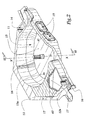
- the shell 10 is more particularly visible in the figure 2 and comprises a substantially horizontal main veil 12 from which the bowl 11 extends downward.
- a substantially horizontal main veil 12 from which the bowl 11 extends downward.
- We note 13 the bottom of the bowl 11 and X-X 'a central axis of this bowl.
- the edges 12 a of the web 12 are provided from the hull of fastening means 10 of the elements 2 to 5, these fastening means can be bolts passing holes, studs or rivets or constitute an area of application '' an adhesive, structural or two-component material or of the polyurethane, epoxy or equivalent mastic type.
- Other fixing methods in particular by self-tapping screws or staples, can also be envisaged, the shell 10 being able to be mounted on the frame formed of the elements 2 to 5 from above or from below.
- a housing 14 for receiving a can of non-oil shown is formed in the shell 10, near the bowl 11 by a depression extending downward from veil 12.
- the bowl 11 is also equipped with two grids 15 of air circulation between the interior volume of the bowl 11 and the outside of the vehicle.
- These grids can be equipped with flaps forming a non-return valve so that the air circulation between the interior volume of the bowl 11 and the ambient atmosphere is only in one direction, by example from inside to outside of the vehicle, grids 15 then constituting air extraction orifices of the passenger compartment of the vehicle more discreet than the orifices provided in the quarter lights of certain vehicles in the state of technique because they are hidden by the rear bumper.
- a tab 16 is molded into the shell 10 or come from material therewith and extends downward from the veil 12. It is provided with an opening for passage of a link flexible or hook and allows stowage or towing of the vehicle.
- Cleats 13a are provided on the bottom 13 and serve local supports for wheel 6, while ribs of stiffening 17 are formed on the underside of the web 12.
- the bottom 13 forms a sleeve 18 more particularly visible in Figure 3.
- This sleeve came integrally with the bottom 13 and defines an internal shoulder 19 in its lower part.
- a pin 40 is provided to be introduced into the sleeve 18 and comprises a cylindrical part 41, of external diameter substantially equal to the internal diameter of the sleeve 18, and means for snap-fastening against the shoulder 19, these means being formed by several tongues 42 in the shape of a harpoon. It is thus possible to fix the pin 40 in the sleeve 18, by passing it from the position in dashed lines to the position in solid lines in FIG. 3, with a translational movement along the axis XX ′, as represented by arrow F 5 .
- the pin 40 also carries a sealing lip 43 intended to bear against the upper surface end 18a of the sleeve 18 when the tabs 42 are engaged against the shoulder 19.
- the pin 40 In its part which protrudes from the sleeve 18, the pin 40 is provided with thread 44 with round thread. This thread is provided to cooperate with the internal thread of a 50 plus nut particularly visible in Figure 4.
- This nut is formed by a flange 51 on which are articulated four tongues 52 1 , 52 2 , 52 3 and 52 4 each forming approximately a quarter of a circle and the internal surface of which reproduces a threaded round thread adapted to cooperate with the thread 44 when the tongues 52 together form a substantially continuous cylindrical surface.
- the nut 50 is designed to be introduced into a central bearing 21 of the plate 20 which includes four longitudinal grooves 22 1 , 22 2 , 22 3 and 22 4 for receiving four radial projections 53 1 , 53 2 53 3 and 53 4 the flange 51. Near each groove 22 is provided a notch 23, so that when the nut 50 is introduced into the bearing 21 in the direction of the arrow F 1 in FIG. 4, then undergoes a rotation in the direction of arrow F 2 , the nut 50 is immobilized in the bearing 21, the bearing playing the role of a hoop for the nut.
- the plate 20 is also provided with stiffening ribs 24 which allow it to rotate in rotation F ′ 2 about its central axis, which can be merged with the axis XX ′, as shown in FIG. 4.
- Retaining fingers 25 are provided near the lower edge of the bearing 21 and can receive bearing 54 surfaces defined on the flange 51, between the tongues 52.
- the fingers 25 have a surface turned downward inclined relative to the axis XX ′, so that they do not oppose the introduction movement represented by the arrow F 1 .
- their upper surface is substantially perpendicular to the axis XX ′, which allows them to effectively retain the nut 50 inside the bearing 21.
- the rotational movements to be printed on the plate 20 are transmitted through the ribs 24 which constitute elements of handling for a user.
- ribs 24 Between these ribs 24 are defined volumes 26 which can be used for the storage of ancillary items or vehicle accessories, such as cables, rags or a tool kit.
- the cover 30 comprises a main veil 31 and defines several recesses 32, 33, 34 and 35 which can also receive ancillary or accessory items, such as a tow rope, disposable clothing rain cover, a tool kit or first aid, a box of ampoules or a washing jack of the vehicle and the associated crank.
- ancillary or accessory items such as a tow rope, disposable clothing rain cover, a tool kit or first aid, a box of ampoules or a washing jack of the vehicle and the associated crank.
- the shape and the layout of housing 32 to 35 depends on the amenities of the vehicle, or even its level of equipment. Indeed, this cover can be produced independently of the elements 10 to 50 and therefore allows great adaptability compared to the intended use of the vehicle.
- Elements 20, 30, 40 and 50 are also produced in plastic and can therefore, just like the shell 10, be mass produced at an acceptable cost and without the constraints inherent in the sheet metal stamping process.
- the same materials as those used for the hull 10 can be used.
- the cover 30 is advantageously coated with a material sound insulation such as carpet, which improves the comfort of the passengers in the passenger compartment of the vehicle.
- lower surface of the web 12 and the outer surface of the bowl 11 can be coated with a layer 60 of a material thermal insulation, for example based on aluminum or light color to create a reflection surface of the heat, in order to avoid any degradation of the shell 10.
- the shell 10 can integrate a reinforcement beam of the rear bumper of the vehicle.
- Elements 10, 20, 30, 40 and 50 of structure 1 can be prepared in the workshop before incorporation into the vehicle and be equipped with ancillary or accessory elements previously cited, so that a structure 1 equipped with such ancillary or accessory elements and forming a almost autonomous "function" can be routed on the line vehicle mounting, which saves time precious on this line.
- the shell 10 can be placed in the boot of a vehicle during manufacture, while the corresponding tailgate 7 is open, thanks to an introduction movement represented by the arrow F 3 .
- a chute 100 makes it possible to route the spare wheel 6 to the immediate vicinity of the shell 10 and to drop this wheel in the bowl 11 as shown by the arrow F 4 . Given the orientation of the arrow F 4 relative to the axis XX ', no obstacle must be present in the bowl 11 at this time.
- the pin 40 is put in place according to a translational movement substantially aligned on the axis XX ′, as represented by the arrow F 5 , which is possible thanks to the method of fixing by snapping the pin 40 into the sleeve 18, such an operation being particularly quick and easy for an operator. It is then possible to quickly set up the plate 20 by a vertical pressure F 6 having the effect of closing the nut 50 and a terminal screwing movement making it possible to exert on the wheel 6 an effective immobilization effort.
- an assembly comprising the plate 20, the pin 40 and the nut 50 can be pre-assembled and mounted in a snap operation in the sleeve 18.
- the cover 30 can then be replaced for give a satisfactory aesthetic appearance to the boot vehicle.
Landscapes
- Engineering & Computer Science (AREA)
- Chemical & Material Sciences (AREA)
- Combustion & Propulsion (AREA)
- Transportation (AREA)
- Mechanical Engineering (AREA)
- Body Structure For Vehicles (AREA)
- Motor Or Generator Cooling System (AREA)
Abstract
Description
- Elle forme des logements de réception d'éléments annexes ou accessoires du véhicule, tels qu'un bidon de lubrifiant, un câble de remorquage, des vêtements de protection, une trousse à outil ou de premiers secours, une boíte à ampoules, et/ou un cric de levage du véhicule. Ces différents logements peuvent être prévus sur l'élément de base formant plancher et/ou sur des parties annexes. Bien entendu, des logements pour d'autres objets peuvent être prévus, notamment pour des effets personnels du propriétaire ou du conducteur du véhicule.
- Le fond du logement est pourvu d'un manchon de réception d'un pion central d'immobilisation de la roue de secours, ce pion pouvant être immobilisé dans ce manchon par coopération de formes et portant des moyens d'encliquetage dans le manchon. Un montage rapide du pion dans le fond du logement est ainsi possible par un mouvement de translation selon l'axe du manchon.
- Un écrou fendu est prévu pour être fretté dans un palier central d'un plateau d'immobilisation de la roue dans le logement. On peut prévoir que cet écrou est pourvu de saillies périphériques reçues dans des rainures internes longitudinales du palier, ces saillies étant déplaçables en translation dans ces rainures et aptes à être verrouillées dans des encoches prolongeant des rainures, par rotation de l'écrou par rapport à un axe central du palier. Ainsi, un montage et un démontage rapide et aisé du plateau par rapport au pion est possible, dans la mesure où l'écrou fendu peut être ouvert sur la majorité de la course de montage ou démontage du plateau, alors qu'il est fermé lors du mouvement final de vissage ou lors du mouvement initial de dévissage du plateau.
- Le plateau est pourvu de nervures de rigidification et de vissage/dévissage définissant entre elles des volumes de réception d'éléments annexes ou accessoires du véhicule.
- Un panneau de fermeture du logement est prévu, ce panneau étant moulé en matière plastique et formant des logements de réception d'éléments annexes ou accessoires du véhicule. Ce panneau constitue en fait le plancher du coffre arrière du véhicule et sa fabrication par moulage de matière plastique permet une grande adaptabilité au type exact et au niveau d'équipement du véhicule.
- La structure est équipée de grilles pourvues de clapets anti-retour de circulation d'air, uniquement entre le volume intérieur de l'habitacle du véhicule et l'atmosphère ambiante, et/ou d'une patte d'arrimage ou de remorquage. Ces éléments annexes sont intégrés à la structure moulée, par exemple par surmoulage, la structure de l'invention étant alors apte à remplir plusieurs fonctions pour le véhicule.
- mouler une structure en matière plastique formant plancher arrière et logement de réception d'une roue de secours du véhicule ;
- équiper cette structure d'éléments annexes ou accessoires du véhicule et
- monter cette structure équipée sur un cadre du châssis du véhicule.
- La figure 1 est une vue en perspective éclatée d'une structure conforme à l'invention et de son environnement d'installation ;
- La figure 2 est une vue en perspective à plus grande échelle avec arrachement partiel de l'élément de base de la structure de la figure 1 et du pion central associé ;
- La figure 3 est une coupe axiale partielle selon la ligne III-III à figure 1 ;
- La figure 4 est une vue en perspective éclatée d'une partie de la structure dédiée au blocage de la roue de secours dans le logement de la structure de la figure 1 ;
- La figure 5 est une représentation schématique de principe d'une première étape de fabrication d'un véhicule automobile ;
- La figure 6 est une vue analogue à la figure 5 pour une seconde étape de fabrication et
- La figure 7 est une vue analogue à la figure 5 pour une troisième étape de fabrication.
Claims (11)
- Structure (1) réalisée par moulage de matière plastique et formant plancher arrière de véhicule automobile et logement (11) de réception d'une roue de secours (6) du véhicule, ladite structure étant apte à être reçue dans un cadre d'accueil (2-5) dudit véhicule, caractérisée en ce que ladite structure (1) est autoportante à l'intérieur dudit cadre et en ce qu'elle est pourvue de moyens (18, 20, 40, 50) de centrage et/ou d'immobilisation de ladite roue (6) dans ledit logement (11).
- Structure selon la revendication 1, caractérisée en ce qu'elle forme des logements (14, 26, 32-35) de réception d'éléments annexes ou accessoires dudit véhicule, tels qu'un bidon de lubrifiant, un câble de remorquage, des vêtements de protection, une trousse à outils ou de premiers secours, une boíte d'ampoules et/ou un cric de levage du véhicule.
- Structure selon l'une des revendications 1 ou 2, caractérisée en ce que le fond (13) dudit logement (11) est pourvu d'un manchon (18) de réception d'un pion central (40) d'immobilisation de ladite roue de secours (6).
- Structure selon la revendication 3, caractérisée en ce que ledit pion (40) est immobilisé dans ledit manchon par coopération de formes (18, 41) et porte des moyens (42) d'encliquetage dans ledit manchon.
- Structure selon l'une des revendications précédentes, caractérisée en ce que lesdits moyens de centrage et/ou d'immobilisation comprennent un écrou fendu (50) prévu pour être fretté dans un palier central (21) d'un plateau (20) d'immobilisation de ladite roue de secours (6) dans ledit logement (11).
- Structure selon la revendication 5, caractérisée en ce que ledit écrou (50) est pourvu de saillies périphériques (53) reçues dans des rainures internes longitudinales (22) dudit palier, lesdites saillies étant déplaçables en translation (F1) dans lesdites rainures et aptes à être verrouillées dans des encoches (23) prolongeant lesdites rainures, par rotation (F2) dudit écrou par rapport à un axe central (X-X') dudit palier.
- Structure selon l'une des revendications 5 ou 6, caractérisée en ce que ledit plateau (20) est pourvu de nervures (24) de rigidification et de vissage/dévissage définissant entre elles des volumes (26) de réception d'éléments annexes ou accessoires du véhicule.
- Structure selon l'une des revendications précédentes, caractérisée en ce qu'elle comprend un panneau (30) de fermeture dudit logement, ledit panneau étant moulé en matière plastique et formant des logements (32-35) de réception d'éléments annexes ou accessoires du véhicule.
- Structure selon l'une des revendications précédentes, caractérisée en ce qu'elle est équipée de grilles (15) pourvues de clapets anti-retour de circulation d'air, uniquement entre le volume intérieur de l'habitacle du véhicule et l'atmosphère ambiante, et/ou d'une patte (16) d'arrimage ou de remorquage.
- Procédé de fabrication d'un véhicule automobile, caractérisé en ce qu'il consiste à :mouler une structure (1) en matière plastique formant plancher arrière et logement (11) de réception d'une roue de secours (6) du véhicule ;équiper ladite structure d'éléments annexes ou accessoires du véhicule etmonter (F3) ladite structure équipée (1) sur un cadre (2-5) du châssis du véhicule.
- Procédé selon la revendication 10, caractérisé en ce qu'il consiste à introduire (F4) une roue de secours (6) dans ledit logement (11) après montage de ladite structure sur le châssis et à immobiliser ladite roue dans ledit logement par encliquetage (F5) d'un pion central (40) solidaire de, ou apte à être solidarisé (F6) avec, un dispositif de blocage (20) de ladite roue de secours dans ledit logement.
Applications Claiming Priority (2)
| Application Number | Priority Date | Filing Date | Title |
|---|---|---|---|
| FR9911797A FR2798640B1 (fr) | 1999-09-16 | 1999-09-16 | Structure formant plancher arriere et procede de fabrication d'un vehicule automobile incorporant une telle structure |
| FR9911797 | 1999-09-16 |
Publications (2)
| Publication Number | Publication Date |
|---|---|
| EP1084942A1 true EP1084942A1 (fr) | 2001-03-21 |
| EP1084942B1 EP1084942B1 (fr) | 2004-08-25 |
Family
ID=9550085
Family Applications (1)
| Application Number | Title | Priority Date | Filing Date |
|---|---|---|---|
| EP00420192A Expired - Lifetime EP1084942B1 (fr) | 1999-09-16 | 2000-09-14 | Structure formant plancher arrière et procédé de fabrication d'un véhicule automobile incorporant une telle structure |
Country Status (5)
| Country | Link |
|---|---|
| EP (1) | EP1084942B1 (fr) |
| AT (1) | ATE274438T1 (fr) |
| DE (1) | DE60013215D1 (fr) |
| ES (1) | ES2223431T3 (fr) |
| FR (1) | FR2798640B1 (fr) |
Cited By (10)
| Publication number | Priority date | Publication date | Assignee | Title |
|---|---|---|---|---|
| FR2827254A1 (fr) * | 2001-07-12 | 2003-01-17 | Faurecia Ind | Procede de construction de l'extremite arriere d'un vehicule automobile |
| WO2004069598A1 (fr) * | 2003-02-06 | 2004-08-19 | Honda Motor Co., Ltd. | Structure de rangement sous plancher destinee a un vehicule |
| EP1470991A2 (fr) | 2003-04-24 | 2004-10-27 | G P Daikyo Corporation | Structure de plancher de coffre en plastique |
| EP1470993A1 (fr) * | 2003-04-24 | 2004-10-27 | G P Daikyo Corporation | Structure de panneau de plancher en résine |
| EP1453699A4 (fr) * | 2001-12-04 | 2005-03-30 | Dow Global Technologies Inc | Compartiment composite pour roue de secours |
| EP1733953A1 (fr) * | 2005-06-13 | 2006-12-20 | GM Global Technology Operations, Inc. | Composant modulaire définissant une cavité dans un véhicule automobile |
| FR2950851A1 (fr) * | 2009-10-05 | 2011-04-08 | Renault Sas | Structure de vehicule automobile comportant un bac pour roue de secours |
| CN103342136A (zh) * | 2013-06-28 | 2013-10-09 | 长城汽车股份有限公司 | 地板结构及具有该地板结构的车辆 |
| CN108819071A (zh) * | 2018-06-14 | 2018-11-16 | 东风佛吉亚汽车外饰有限公司 | 一种smc轻量化高强度塑料备胎仓及其制造方法 |
| WO2022175612A1 (fr) * | 2021-02-19 | 2022-08-25 | Psa Automobiles Sa | Élément de fond de coffre de véhicule automobile |
Citations (3)
| Publication number | Priority date | Publication date | Assignee | Title |
|---|---|---|---|---|
| DE3045071A1 (de) * | 1980-11-29 | 1982-06-03 | Daimler-Benz Ag, 7000 Stuttgart | Abdeckplatte fuer eine ein reserverad o.dgl. aufnehmende mulde im kofferraumboden eines kraftwagens |
| EP0270097A1 (fr) | 1986-12-05 | 1988-06-08 | FIAT AUTO S.p.A. | Carrosserie pour un véhicule à moteur |
| FR2773132A1 (fr) | 1997-12-30 | 1999-07-02 | Renault | Procede d'assemblage et structure de plancher pour vehicules automobiles |
-
1999
- 1999-09-16 FR FR9911797A patent/FR2798640B1/fr not_active Expired - Fee Related
-
2000
- 2000-09-14 EP EP00420192A patent/EP1084942B1/fr not_active Expired - Lifetime
- 2000-09-14 DE DE60013215T patent/DE60013215D1/de not_active Expired - Fee Related
- 2000-09-14 ES ES00420192T patent/ES2223431T3/es not_active Expired - Lifetime
- 2000-09-14 AT AT00420192T patent/ATE274438T1/de not_active IP Right Cessation
Patent Citations (3)
| Publication number | Priority date | Publication date | Assignee | Title |
|---|---|---|---|---|
| DE3045071A1 (de) * | 1980-11-29 | 1982-06-03 | Daimler-Benz Ag, 7000 Stuttgart | Abdeckplatte fuer eine ein reserverad o.dgl. aufnehmende mulde im kofferraumboden eines kraftwagens |
| EP0270097A1 (fr) | 1986-12-05 | 1988-06-08 | FIAT AUTO S.p.A. | Carrosserie pour un véhicule à moteur |
| FR2773132A1 (fr) | 1997-12-30 | 1999-07-02 | Renault | Procede d'assemblage et structure de plancher pour vehicules automobiles |
Cited By (16)
| Publication number | Priority date | Publication date | Assignee | Title |
|---|---|---|---|---|
| FR2827254A1 (fr) * | 2001-07-12 | 2003-01-17 | Faurecia Ind | Procede de construction de l'extremite arriere d'un vehicule automobile |
| CN100358749C (zh) * | 2001-12-04 | 2008-01-02 | 陶氏环球技术公司 | 复合式备胎存放装置 |
| EP1453699A4 (fr) * | 2001-12-04 | 2005-03-30 | Dow Global Technologies Inc | Compartiment composite pour roue de secours |
| US7597372B2 (en) | 2003-02-06 | 2009-10-06 | Honda Motor Co., Ltd. | Underfloor storage structure for vehicle |
| WO2004069598A1 (fr) * | 2003-02-06 | 2004-08-19 | Honda Motor Co., Ltd. | Structure de rangement sous plancher destinee a un vehicule |
| CN1332831C (zh) * | 2003-02-06 | 2007-08-22 | 本田技研工业株式会社 | 用于车辆的地板下收纳结构 |
| EP1470993A1 (fr) * | 2003-04-24 | 2004-10-27 | G P Daikyo Corporation | Structure de panneau de plancher en résine |
| EP1470991A3 (fr) * | 2003-04-24 | 2008-01-23 | DaikyoNishikawa Corporation | Structure de plancher de coffre en plastique |
| US7182382B2 (en) | 2003-04-24 | 2007-02-27 | G P Daikyo Corporation | Resin-made floor panel structure |
| EP1470991A2 (fr) | 2003-04-24 | 2004-10-27 | G P Daikyo Corporation | Structure de plancher de coffre en plastique |
| EP1733953A1 (fr) * | 2005-06-13 | 2006-12-20 | GM Global Technology Operations, Inc. | Composant modulaire définissant une cavité dans un véhicule automobile |
| FR2950851A1 (fr) * | 2009-10-05 | 2011-04-08 | Renault Sas | Structure de vehicule automobile comportant un bac pour roue de secours |
| CN103342136A (zh) * | 2013-06-28 | 2013-10-09 | 长城汽车股份有限公司 | 地板结构及具有该地板结构的车辆 |
| CN108819071A (zh) * | 2018-06-14 | 2018-11-16 | 东风佛吉亚汽车外饰有限公司 | 一种smc轻量化高强度塑料备胎仓及其制造方法 |
| WO2022175612A1 (fr) * | 2021-02-19 | 2022-08-25 | Psa Automobiles Sa | Élément de fond de coffre de véhicule automobile |
| FR3120048A1 (fr) * | 2021-02-19 | 2022-08-26 | Psa Automobiles Sa | Élément de fond de coffre de véhicule automobile |
Also Published As
| Publication number | Publication date |
|---|---|
| FR2798640B1 (fr) | 2001-11-23 |
| EP1084942B1 (fr) | 2004-08-25 |
| ES2223431T3 (es) | 2005-03-01 |
| ATE274438T1 (de) | 2004-09-15 |
| DE60013215D1 (de) | 2004-09-30 |
| FR2798640A1 (fr) | 2001-03-23 |
Similar Documents
| Publication | Publication Date | Title |
|---|---|---|
| EP1127777B1 (fr) | Module arrière pour véhicule automobile | |
| EP1136321B1 (fr) | Module de rangement pour véhicule automobile, fermé à l'arrière par une façade formant un élément de carrosserie | |
| EP1084942B1 (fr) | Structure formant plancher arrière et procédé de fabrication d'un véhicule automobile incorporant une telle structure | |
| CA2470523A1 (fr) | Compartiment composite pour roue de secours | |
| EP0853032B1 (fr) | Pièce de carrosserie destinée à un véhicule automobile et son procédé de fabrication | |
| WO2008099128A2 (fr) | Plancher pour véhicule automobile | |
| EP3007929B1 (fr) | Repose-pied integrant des moyens de rangement d'un equipement de reparation de pneu | |
| EP1044129B1 (fr) | Procede d'assemblage et structure de plancher pour vehicules automobiles | |
| EP1464567A1 (fr) | Elément de faux-plancher de véhicule automobile, faux-plancher comprenant de tels éléments, et véhicule automobile ainsi équipé | |
| EP2042413B1 (fr) | Véhicule automobile a jeux et affleurements réduits. | |
| FR3060514A1 (fr) | Dispositif de rangement d'une roue dans un coffre d'un vehicule automobile et vehicule automobile comportant un tel dispositif | |
| EP4357173B1 (fr) | Agencement comportant une caisse de véhicule, un toit fixe ou un module de toit partiellement amovible | |
| EP4082836B1 (fr) | Ensemble de rangement intégré à un coffre de véhicule automobile | |
| EP2145815B1 (fr) | Ensemble d'une aile et d'une pièce porteuse pour un véhicule automobile | |
| FR2859450A1 (fr) | Vehicule automobile avec un pavillon de toit amovible, tel qu'un coupe-cabriolet, equipe de moyens de rigidification en torsion de la caisse | |
| FR3143464A1 (fr) | Dispositif de neutralisation d’une glissière de siège | |
| FR2852571A1 (fr) | Bac pour roue de secours et structure arriere de vehicule comportant ledit bac. | |
| FR2807991A1 (fr) | Remorque routiere modulaire | |
| FR2828853A1 (fr) | Plaque rigide d'habillage d'une marche et marchepied pourvu de cette plaque | |
| EP3350003B1 (fr) | Hayon de vehicule avec element d'interface renforce | |
| EP2112024B1 (fr) | Dispositif de rangement rotatif et amovible pour une partie supérieure d'une structure de véhicule automobile, et procédé d'assemblage correspondant | |
| FR3154071A1 (fr) | Dispositif de rangement pour véhicule comprenant une boîte à fusible et deux bacs de rangement | |
| KR19990002626U (ko) | 자동차의 스페어 타이어 수납용 함실 | |
| FR2864513A1 (fr) | Remorque bagagere monocoque a extension et amenagements interieurs | |
| FR2890365A1 (fr) | Plancher arriere de vehicule automobile et lot de deux planchers arrieres de vehicule automobile |
Legal Events
| Date | Code | Title | Description |
|---|---|---|---|
| PUAI | Public reference made under article 153(3) epc to a published international application that has entered the european phase |
Free format text: ORIGINAL CODE: 0009012 |
|
| AK | Designated contracting states |
Kind code of ref document: A1 Designated state(s): AT BE CH CY DE DK ES FI FR GB GR IE IT LI LU MC NL PT SE |
|
| AX | Request for extension of the european patent |
Free format text: AL;LT;LV;MK;RO;SI |
|
| 17P | Request for examination filed |
Effective date: 20010712 |
|
| AKX | Designation fees paid |
Free format text: AT BE CH CY DE DK ES FI FR GB GR IE IT LI LU MC NL PT SE |
|
| AXX | Extension fees paid |
Free format text: SI PAYMENT 20010712 |
|
| 17Q | First examination report despatched |
Effective date: 20030728 |
|
| GRAP | Despatch of communication of intention to grant a patent |
Free format text: ORIGINAL CODE: EPIDOSNIGR1 |
|
| GRAS | Grant fee paid |
Free format text: ORIGINAL CODE: EPIDOSNIGR3 |
|
| GRAA | (expected) grant |
Free format text: ORIGINAL CODE: 0009210 |
|
| AK | Designated contracting states |
Kind code of ref document: B1 Designated state(s): AT BE CH CY DE DK ES FI FR GB GR IE IT LI LU MC NL PT SE |
|
| AX | Request for extension of the european patent |
Extension state: SI |
|
| PG25 | Lapsed in a contracting state [announced via postgrant information from national office to epo] |
Ref country code: IT Free format text: LAPSE BECAUSE OF FAILURE TO SUBMIT A TRANSLATION OF THE DESCRIPTION OR TO PAY THE FEE WITHIN THE PRESCRIBED TIME-LIMIT;WARNING: LAPSES OF ITALIAN PATENTS WITH EFFECTIVE DATE BEFORE 2007 MAY HAVE OCCURRED AT ANY TIME BEFORE 2007. THE CORRECT EFFECTIVE DATE MAY BE DIFFERENT FROM THE ONE RECORDED. Effective date: 20040825 Ref country code: IE Free format text: LAPSE BECAUSE OF FAILURE TO SUBMIT A TRANSLATION OF THE DESCRIPTION OR TO PAY THE FEE WITHIN THE PRESCRIBED TIME-LIMIT Effective date: 20040825 Ref country code: NL Free format text: LAPSE BECAUSE OF FAILURE TO SUBMIT A TRANSLATION OF THE DESCRIPTION OR TO PAY THE FEE WITHIN THE PRESCRIBED TIME-LIMIT Effective date: 20040825 Ref country code: AT Free format text: LAPSE BECAUSE OF FAILURE TO SUBMIT A TRANSLATION OF THE DESCRIPTION OR TO PAY THE FEE WITHIN THE PRESCRIBED TIME-LIMIT Effective date: 20040825 Ref country code: FI Free format text: LAPSE BECAUSE OF FAILURE TO SUBMIT A TRANSLATION OF THE DESCRIPTION OR TO PAY THE FEE WITHIN THE PRESCRIBED TIME-LIMIT Effective date: 20040825 Ref country code: CY Free format text: LAPSE BECAUSE OF FAILURE TO SUBMIT A TRANSLATION OF THE DESCRIPTION OR TO PAY THE FEE WITHIN THE PRESCRIBED TIME-LIMIT Effective date: 20040825 Ref country code: GB Free format text: LAPSE BECAUSE OF FAILURE TO SUBMIT A TRANSLATION OF THE DESCRIPTION OR TO PAY THE FEE WITHIN THE PRESCRIBED TIME-LIMIT Effective date: 20040825 |
|
| REG | Reference to a national code |
Ref country code: GB Ref legal event code: FG4D Free format text: NOT ENGLISH |
|
| REG | Reference to a national code |
Ref country code: CH Ref legal event code: EP |
|
| PG25 | Lapsed in a contracting state [announced via postgrant information from national office to epo] |
Ref country code: LU Free format text: LAPSE BECAUSE OF NON-PAYMENT OF DUE FEES Effective date: 20040914 |
|
| REG | Reference to a national code |
Ref country code: IE Ref legal event code: FG4D Free format text: FRENCH |
|
| PG25 | Lapsed in a contracting state [announced via postgrant information from national office to epo] |
Ref country code: LI Free format text: LAPSE BECAUSE OF NON-PAYMENT OF DUE FEES Effective date: 20040930 Ref country code: CH Free format text: LAPSE BECAUSE OF NON-PAYMENT OF DUE FEES Effective date: 20040930 Ref country code: BE Free format text: LAPSE BECAUSE OF NON-PAYMENT OF DUE FEES Effective date: 20040930 Ref country code: MC Free format text: LAPSE BECAUSE OF NON-PAYMENT OF DUE FEES Effective date: 20040930 |
|
| REF | Corresponds to: |
Ref document number: 60013215 Country of ref document: DE Date of ref document: 20040930 Kind code of ref document: P |
|
| PG25 | Lapsed in a contracting state [announced via postgrant information from national office to epo] |
Ref country code: GR Free format text: LAPSE BECAUSE OF FAILURE TO SUBMIT A TRANSLATION OF THE DESCRIPTION OR TO PAY THE FEE WITHIN THE PRESCRIBED TIME-LIMIT Effective date: 20041125 Ref country code: DK Free format text: LAPSE BECAUSE OF FAILURE TO SUBMIT A TRANSLATION OF THE DESCRIPTION OR TO PAY THE FEE WITHIN THE PRESCRIBED TIME-LIMIT Effective date: 20041125 Ref country code: SE Free format text: LAPSE BECAUSE OF FAILURE TO SUBMIT A TRANSLATION OF THE DESCRIPTION OR TO PAY THE FEE WITHIN THE PRESCRIBED TIME-LIMIT Effective date: 20041125 |
|
| NLV1 | Nl: lapsed or annulled due to failure to fulfill the requirements of art. 29p and 29m of the patents act | ||
| REG | Reference to a national code |
Ref country code: ES Ref legal event code: FG2A Ref document number: 2223431 Country of ref document: ES Kind code of ref document: T3 |
|
| GBV | Gb: ep patent (uk) treated as always having been void in accordance with gb section 77(7)/1977 [no translation filed] |
Effective date: 20040825 |
|
| REG | Reference to a national code |
Ref country code: IE Ref legal event code: FD4D |
|
| BERE | Be: lapsed |
Owner name: INOPLAST Effective date: 20040930 |
|
| PG25 | Lapsed in a contracting state [announced via postgrant information from national office to epo] |
Ref country code: DE Free format text: LAPSE BECAUSE OF NON-PAYMENT OF DUE FEES Effective date: 20050401 |
|
| REG | Reference to a national code |
Ref country code: CH Ref legal event code: PL |
|
| PLBE | No opposition filed within time limit |
Free format text: ORIGINAL CODE: 0009261 |
|
| STAA | Information on the status of an ep patent application or granted ep patent |
Free format text: STATUS: NO OPPOSITION FILED WITHIN TIME LIMIT |
|
| 26N | No opposition filed |
Effective date: 20050526 |
|
| BERE | Be: lapsed |
Owner name: *INOPLAST Effective date: 20040930 |
|
| PG25 | Lapsed in a contracting state [announced via postgrant information from national office to epo] |
Ref country code: PT Free format text: LAPSE BECAUSE OF NON-PAYMENT OF DUE FEES Effective date: 20050125 |
|
| REG | Reference to a national code |
Ref country code: FR Ref legal event code: PLFP Year of fee payment: 17 |
|
| PGFP | Annual fee paid to national office [announced via postgrant information from national office to epo] |
Ref country code: ES Payment date: 20160916 Year of fee payment: 17 |
|
| REG | Reference to a national code |
Ref country code: FR Ref legal event code: PLFP Year of fee payment: 18 |
|
| REG | Reference to a national code |
Ref country code: FR Ref legal event code: PLFP Year of fee payment: 19 |
|
| REG | Reference to a national code |
Ref country code: ES Ref legal event code: FD2A Effective date: 20181018 |
|
| PGFP | Annual fee paid to national office [announced via postgrant information from national office to epo] |
Ref country code: FR Payment date: 20180926 Year of fee payment: 19 |
|
| PG25 | Lapsed in a contracting state [announced via postgrant information from national office to epo] |
Ref country code: ES Free format text: LAPSE BECAUSE OF NON-PAYMENT OF DUE FEES Effective date: 20170915 |
|
| PG25 | Lapsed in a contracting state [announced via postgrant information from national office to epo] |
Ref country code: FR Free format text: LAPSE BECAUSE OF NON-PAYMENT OF DUE FEES Effective date: 20190930 |