This invention relates in general to direct write, processless imaging members,
and particularly to heat-sensitive imaging members, that require no wet processing
after imaging. The invention also relates to methods of digital imaging and printing
using these imaging members.
The art of lithographic printing is based upon the immiscibility of oil and
water, wherein an oily material or ink is preferentially retained in certain areas and
the water or fountain solution is preferentially retained in other areas, depending upon
the type of image produced. When a suitably prepared surface is moistened with
water, and ink is then applied, either a positive or negative image is obtained,
depending upon whether the imaged or non-imaged areas are ink-accepting. The ink
is eventually transferred to the surface of a suitable substrate, such as cloth, paper or
metal, thereby reproducing the image.
Very common lithographic printing plates include a metal or polymer support
having thereon an imaging layer sensitive to visible or UV light. Both positive- and
negative-working printing plates can be prepared in this fashion. Upon exposure, and
perhaps post-exposure heating, either imaged or non-imaged areas are removed using
wet processing chemistries.
Thermally sensitive printing plates are less common. Examples of such plates
are described in US-A-5,372,915 (Haley et al). They include an imaging layer
comprising a mixture of dissolvable polymers and an infrared radiation absorbing
compound. While these plates can be imaged using lasers and digital information,
they require wet processing using alkaline developer solutions.
Conventional preparation and use of such printing plates generally involves
multiple processing steps such as exposure to either light or heat (or both) through a
patterned image, and wet processing with an alkaline developer to provide a printing
plate image.
Dry planography, or waterless printing, is well known in the art of
lithographic offset printing and provides several advantages over conventional offset
printing. Dry planography is particularly advantageous for short run and on-press
applications. It simplifies press design by eliminating the fountain solution and
aqueous delivery train. Careful ink water balance is unnecessary, thus reducing
rollup time and material waste. Silicone rubbers (such as poly(dimethylsiloxane) and
other derivatives of poly(siloxanes)) have long been recognized as preferred
waterless-ink repelling materials. The criteria for waterless lithography and the ink
repelling properties of poly(siloxanes) have been extensively reviewed in the TAGA
Proceedings 1975 pages 120, 177 and 195 and 1976 page 174. It was concluded that,
in addition to low surface energy, the ability to swell in long-chain alkane ink
solvents (i.e., its "oleophilic" nature) accounts for silicone's superior ink releasing
characteristics. An important consideration is that siloxane polymers repel ink.
It has been recognized that a lithographic printing plate could be created
containing an IR absorbing layer. Canadian 1,050,805 (Eames) discloses a dry
planographic printing plate comprising an ink receptive substrate, an overlying
silicone rubber layer, and an interposed layer comprised of laser energy absorbing
particles (such as carbon particles) in a self-oxidizing binder (such as nitrocellulose)
and an optional cross-linkable resin. Such plates were exposed to focused near IR
radiation with a Nd++YAG laser. The absorbing layer converted the infrared energy
to heat thus partially loosening, vaporizing or ablating the absorber layer and the
overlying silicone rubber. The plate was developed by applying naphtha solvent to
remove debris from the exposed image areas. Similar plates are described in
Research Disclosure 19201, 1980 as having vacuum-evaporated metal layers to
absorb laser radiation in order to facilitate the removal of a silicone rubber overcoated
layer. These plates were developed by wetting with hexane and rubbing. CO2 lasers
are described for ablation of silicone layers by Nechiporenko & Markova, PrePrint
15th International IARIGAI Conference, June 1979, Lillehammer, Norway, Pira
Abstract 02-79-02834. Typically, such printing plates require at least two layers on a
support, one or more being formed of ablatable materials.
"Direct write" imaging eliminates the use of the pattern of light or heat to
generate an image. When a laser is used for this purpose, the laser can be used to heat
only small regions at a time. Moreover, a computer can be used to produce the high
resolution images pixel by pixel. If the plate is processless, chemical development is
also eliminated.
While the noted printing plates used for digital, processless printing have a
number of advantages over the more conventional photosensitive printing plates,
there are a number of disadvantages with their use. The process of ablation creates
debris and vaporized materials that must be collected. The laser power required for
ablation can be considerably high, and the components of such printing plates may be
expensive, difficult to coat, or unacceptable in resulting printing quality. Typically,
such printing plates require at least two layers on a support, one or more being formed
of ablatable materials.
Thermally switchable polymers have been described for use as imaging
materials in printing plates. By "switchable" is meant that the polymer is rendered
either more hydrophilic (or oleophobic) or hydrophobic (or oleophilic) upon exposure
to heat.
As an alternative method of preparing printing plates, US-A-4,634,659
(Esumi et al) describes imagewise irradiating hydrophobic polymer coatings to render
exposed regions more hydrophilic in nature. While this concept was one of the early
applications of converting surface characteristics in printing plates, it has the
disadvantages of requiring long UV light exposure times (up to 60 minutes).
EP-A 0 652 483 (Ellis et al) describes lithographic printing plates imageable
using IR lasers, and which do not require wet processing. These plates comprise an
imaging layer that becomes more hydrophilic upon the imagewise exposure to heat.
This coating contains a polymer having pendant groups (such as t-alkyl carboxylates)
that are capable of reacting under heat or acid to form more polar, hydrophilic groups.
The problem with such materials is that they are very difficult to manufacture, exhibit
poor shelf life, require a photoacid generator for imaging, and are positive-working
only. Other lithographic printing plates hydrophilic polymers containing pendant
carboxylic acids are described in US-A-4,081,572 (Pacansky).
Positive-working photoresists and printing plates having crosslinked, UV-sensitive
polymers are described in EP-A 0 293 058 (Shirai et al). The polymers
contain pendant iminosulfonate groups that are decomposed upon UV exposure,
generating a sulfonic group and providing polymer solubility.
US-A-5,512,418 (Ma) describes the use of cationic polymers containing
pendant ammonium groups for thermally induced imaging. However, chemical
processing is still required to provide the desired image.
Japanese Kokai 9-197,671 (Aoshima) describes a negative-working printing
plate and imaging method in which the imaging layer includes a sulfonate-containing
polymer, an IR radiation absorber, a novolak resin and a resole resin. Wet processing
with a conventional alkaline developer is required to produce the desired negative
image.
Thus, the graphic arts industry is seeking alternative means for providing a
processless, direct-write, positive-working lithographic printing plate that can be
imaged without ablation and the accompanying problems noted above.
The problems noted above are overcome with a positive-working imaging
member comprising a support having thereon a heat-sensitive surface imageable layer
comprising:
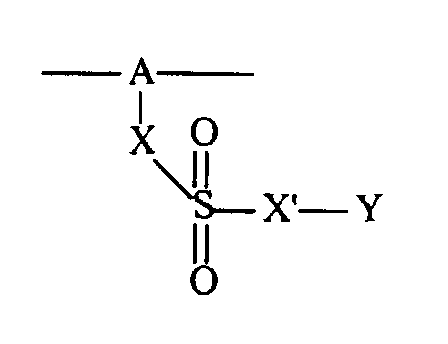
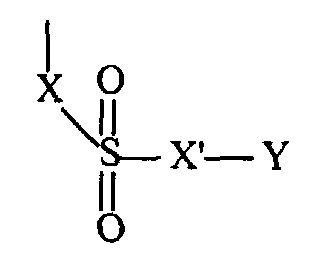
the heat-activatable sulfonate group represented by structure I:
wherein X is a divalent linking group, X' is an oxygen or a sulfur atom, and Y
is an imino, an alkyl group, or an amide group.
This invention also includes a method of imaging comprising the steps of:
Preferably, the method is carried further with the step of:
The positive-working imaging member of this invention has a number of
advantages, thereby avoiding the problems of previous printing plates. Specifically,
the problems and concerns associated with ablation imaging (that is, imagewise
removal of surface layer) are avoided because imaging is accomplished by
"switching" the exposed areas of its printing surface to more hydrophilicity, or oil-repellency.
The resulting imaging members display high ink receptivity in non-exposed
areas, good chemical resistance and excellent ink/water discrimination. No
wet chemical processing (such as processing using an alkaline developer) is needed
with the practice of this invention to remove portions of the surface imageable layer.
These advantages are achieved by using a specific heat-sensitive polymer in
the surface imageable layer. These polymers have heat-activatable sulfonate groups
either in the polymer backbone or pendant thereto. Such heat-activatable groups can
include sulfoimino groups, or sulfoalkyl groups substituted with electron withdrawing
groups that are described in more detail below.
In the lithographic art, materials that release or repel oil-based inks are usually
referred to as having "oleophobic", "hydrophilic" or ink-repelling character and,
conversely, the terms "oleophilic" and "hydrophobic" are used to describe ink
attracting or accepting materials.
The imaging members of this invention comprise a support and a surface
imageable layer thereon that contains a heat-sensitive composition. The support can
be any self-supporting material including polymeric films, glass, metals or stiff
papers, or a lamination of any of these three materials. The thickness of the support
can be varied. In most applications, the thickness should be sufficient to sustain the
wear from printing and thin enough to wrap around a printing form. A preferred
embodiment uses a polyester support prepared from, for example, polyethylene
terephthalate or polyethylene naphthalate, and having a thickness of from about 100
to about 310 µm. Another preferred embodiment uses a metal (such as aluminum)
sheet having a thickness of from about 100 to about 600 µm. The support should
resist dimensional change under conditions of use. The aluminum and polyester
supports are most preferred for lithographic printing plates.
The support may be coated with one or more "subbing" layers to improve
adhesion of the final assemblage. Examples of subbing layer materials include, but
are not limited to, adhesion promoting materials such as alkoxysilanes,
aminopropyltriethoxysilane, glycidoxypropyltriethoxysilane, epoxy functional
polymers and ceramics, as well as conventional subbing layer materials used on
polyester supports in photographic films. One or more IR radiation reflecting layers,
such as layers of evaporated metals can be incorporated between the heat-sensitive
layer and the support. In addition, an anti-IR radiation reflection layer can be
incorporated in the imaging member if desired.
The back side of the support may be coated with antistatic agents and/or
slipping layers or matte layers to improve handling and "feel" of the imaging
member.
The imaging member, however, has a surface layer that is required for
imaging. This surface imageable layer consists essentially of one or more heat-sensitive
polymers as described below, and a photothermal conversion material
(described below), and provides the outer printing surface. Because of the particular
heat-sensitive polymer(s) used in the imageable layer, the thermally exposed (imaged)
areas of the layer are rendered more hydrophilic in nature. The background
(unexposed) areas then remain more oleophilic.
In the heat-sensitive layer of the imaging members of this invention, only the
heat-sensitive polymer and photothermal conversion material are necessary or
essential for imaging. Thus, they are the only essential components of the imageable
layer.
Each of the heat-sensitive polymers useful in this invention has a molecular
weight of at least 5000, and preferably of at least 8000. The polymers can be vinyl
homopolymers or copolymers prepared from one or more ethylenically unsaturated
polymerizable monomers that are reacted together using known polymerization
techniques, or they can be condensation type polymers (such as polyesters,
polyimides, polyamides or polyurethanes) prepared using known polymerization
techniques. Whatever the type of polymers, at least 25 mol % of the total recurring
units comprise the necessary heat-activatable sulfonate groups.
The heat-sensitive polymers useful in the practice of this invention can be
represented by the structure II wherein the sulfonate group is a pendant group:
wherein A represents a polymeric backbone, X is a divalent linking group, X' is an
oxygen or a sulfur atom, and Y is an imino, an alkyl group, or an amide group..
Useful "X" linking groups include substituted or unsubstituted alkylene groups
having 1 to 6 carbon atoms (such as methylene, ethylene,
n-propylene, isopropylene
and butylenes) that can have one or more oxygen, nitrogen or sulfur atoms in the
chain, substituted or unsubstituted arylene groups having 6 to 10 carbon atoms in the
aromatic ring (such as phenylene, naphthalene and xylylene), substituted or
unsubstituted arylenealkylene (or alkylenearylene) having 7 to 20 carbon atoms (such
as
p-methylenephenylene, phenylenemethylenephenylene, biphenylene and
phenyleneisopropylene-phenylene), or the group -COZ(CH
2)
n- wherein Z is an oxy or
-NH- group and n is an integer of 1 to 6 (preferably n is 1 to3).
Most preferably, X is phenylene or -CONH(CH2)3-.
Preferably, X' is an oxygen atom.
a) If Y is an imino group, Y can be represented by -N=CR1R2 wherein R1
and R2 are independently hydrogen, a substituted or unsubstituted alkyl group having
1 to 10 carbon atoms (such as methyl, ethyl, isopropyl, n-hexyl and n-butyl), a
substituted or unsubstituted acyl group having 2 to 10 carbon atoms (such as acetyl),
or a substituted or unsubstituted carbocyclic or heterocyclic aromatic group (such as
phenyl, naphthyl and anthryl). Alternatively, R1 and R2 taken together can provide
the atoms necessary to form a substituted or unsubstituted alicyclic ring having from
5 to 15 carbon, oxygen, nitrogen or sulfur atoms in the ring, such as cyclohexyl,
cyclohexenyl, tetralonyl and fluorenyl. Such ring structures are usually nonaromatic
in character. Preferably, R1 and R2 are taken together to provide the atoms necessary
to form an alicyclic ring having from 5 to 15 carbon atoms in the ring, and more
preferably they form an unsubstituted alicyclic ring having from 6 to 14 carbon atoms
in the ring.
Preferably, Y is an imino group as defined above, and is derived from α-tetralone,
fluorenone or cyclohexenone. b) If Y is an alkyl group, Y can be represented by -CHR3CHR4R5
wherein R5 is an electron withdrawing group, and R3 and R4 are independently
hydrogen or a substituted or unsubstituted alkyl group having 1 to 10 carbon atoms
(as illustrated above).
An electron withdrawing group is generally known to have a positive
Hammett sigma value, and preferably a Hammett sigma value greater than 0.06.
Hammett sigma values can be calculated using standard procedures described for
example, in Steric Effects in Organic Chemistry, John Wiley & Sons, Inc., 1956, pp.
570-574, and in Progress in Physical Organic Chemistry, Vol.2, Interscience
Publishers, 1964, pp. 333-339. Representative useful electron withdrawing groups
include, but are not limited to, cyano, sulfo, carboxy, nitro, halo (for example, fluoro
and chloro), trihaloalkyl (such as trichloromethyl), trialkylammonium, carbamoyl,
sulfamoyl, sulfinyl, pyridinyl, a substituted or unsubstituted aryl group having 6 to 10
carbon atoms in the ring (particularly aryl groups substituted with one or more
electron withdrawing groups), sulfinyl and pyridinyl. Preferably, the electron
withdrawing group used is sulfo, carboxy, nitro, or a substituted or unsubstituted aryl
group, and most preferably, it is sulfo or phenyl. c) If Y is an amide group, Y can be represented by -NHCOR wherein R
represnets an aliphatic group having 1-12 carbon atoms (such as methyl, ethyl,
isopropyl, n-hexyl and n-butyl), an aryl having 6-12 carbon atoms (such as phenyl,
naphthyl, and anthryl), or a heteroaryl group having 4-12 carbon atoms (pyridyl,
thiophyl, and pyrrolyl).
As the sulfonate group is generally pendant to the backbone, preferably it is
part of an ethylenically unsaturated polymerizable monomer that can be polymerized
using conventional techniques to form vinyl homopolymers of the sulfonate-containing
recurring units, or vinyl copolymers when copolymerized with one or
more additional ethylenically unsaturated polymerizable monomers. In all instances,
the sulfonate-containing recurring units comprise at least 25 mol % of all recurring
units in the polymer, and preferably, they comprise from about 40 to 100 mol % of all
recurring units. The polymers can include more than one type of repeating unit
containing a sulfonate group as described herein.
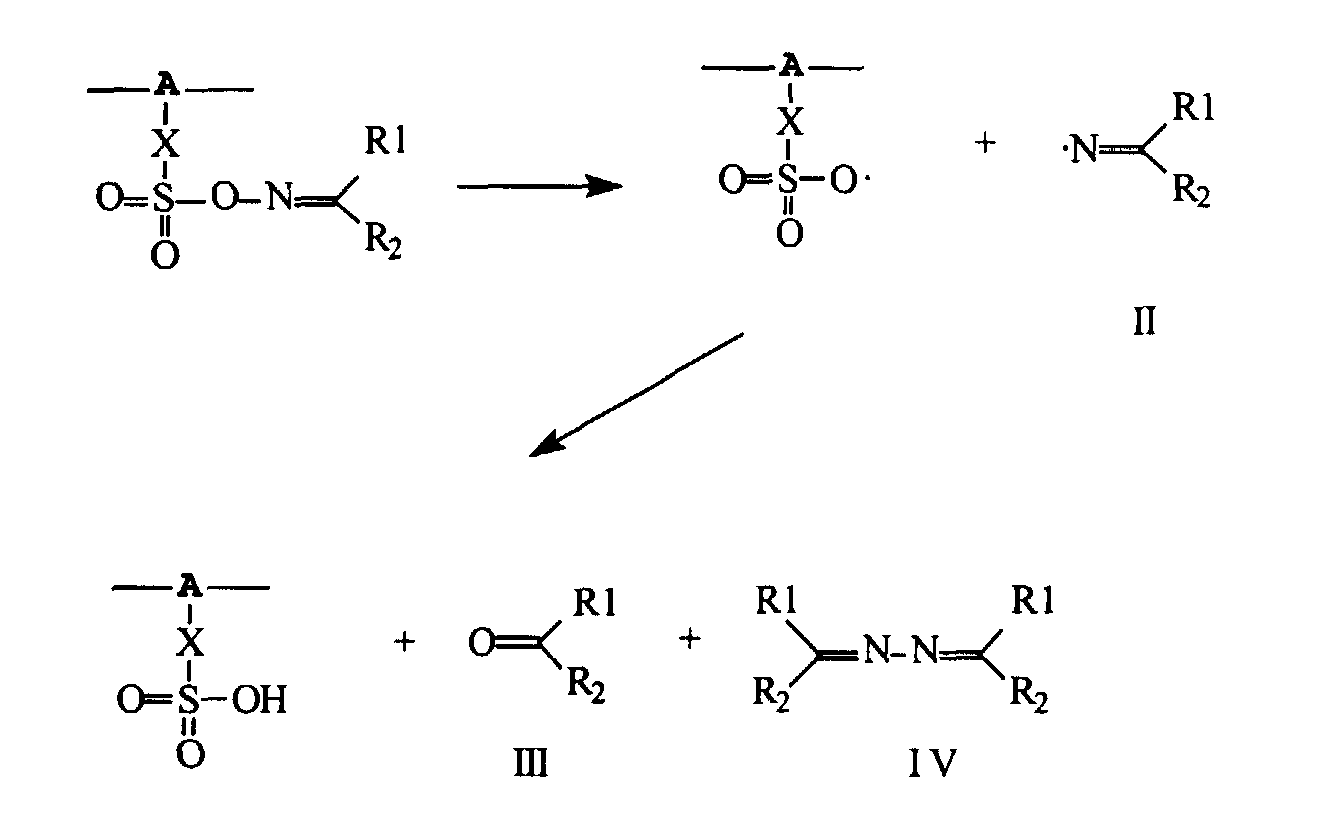
Polymers having the above-described iminosulfonate group are thought to
switch to hydrophilic sulfonic acid under UV irradiation through the following
mechanism, as described in "Microelectronics Technology: Polymers for Advanced
Imaging and Packaging" (Chapter 21, pp. 318-332; Reichmanis, et al, Eds. ACS
614,1995):
The liberated free radical II undergoes further decomposition to generate by-product
ketone III or two radicals combine to form azine IV. The polymer in the exposed
areas is converted to hydrophilic sulfonic acid and rejects ink (in the presence of
water) but the unexposed areas are hydrophobic and more readily accept ink. Hence,
the imaging member is a positive-working imaging member. Some of the useful
sulfoimino groups include:
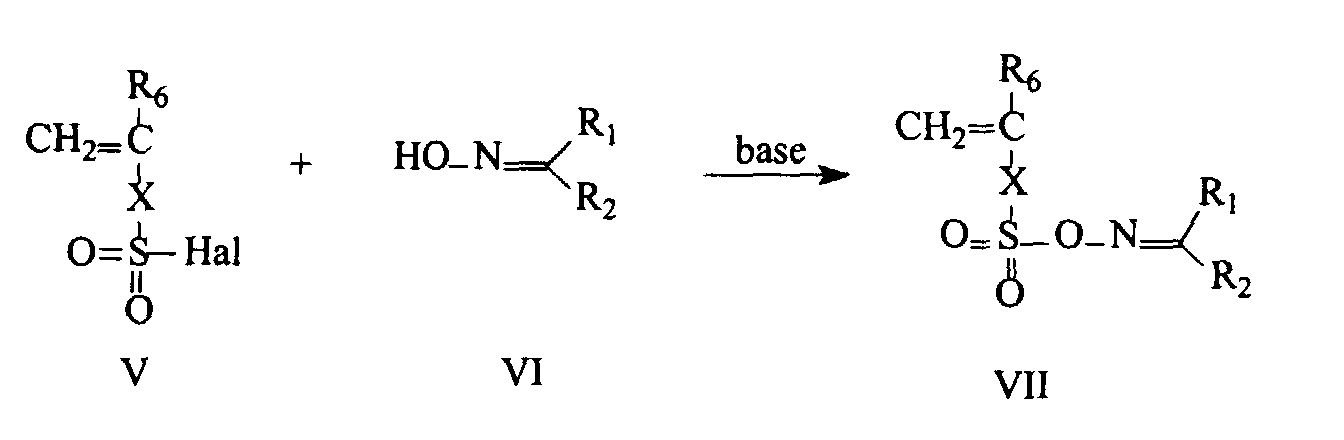
Such monomers can be prepared from a reaction between a sulfonic acid
halide V with an oxime VI in the presence of a base (Shirai et al.
J. Polym. Sci., Part
C: Polym. Lett. 1986, Vol.
24, pp. 119-224) as illustrated below:
wherein R
6 is hydrogen, an aliphatic group having 1 to 6 carbon atoms or halo.
Sulfonic acid halide V may be easily prepared from the corresponding sodium
or potassium salt of sulfonic acid (Kamogawa et al Bull. Chem. Soc. Jpn. 1983, Vol.
56, pp. 762-765) and oxime VI from ketone III (Ballini et al Chem. Lett. 1997, pp.
475-476).
The polymers containing Y as an alkyl group undergo a pyrolytic elimination
as taught in "Advanced Organic Chemistry" (pp. 1006-1010, March, J. John Wiley &
Sons, New York, 1992, 4th ed.), as illustrated below for a representative preferred
pendant sulfoalkyl group:
Hydrophilic sulfonic acid and elimination by-product VIII are generated.
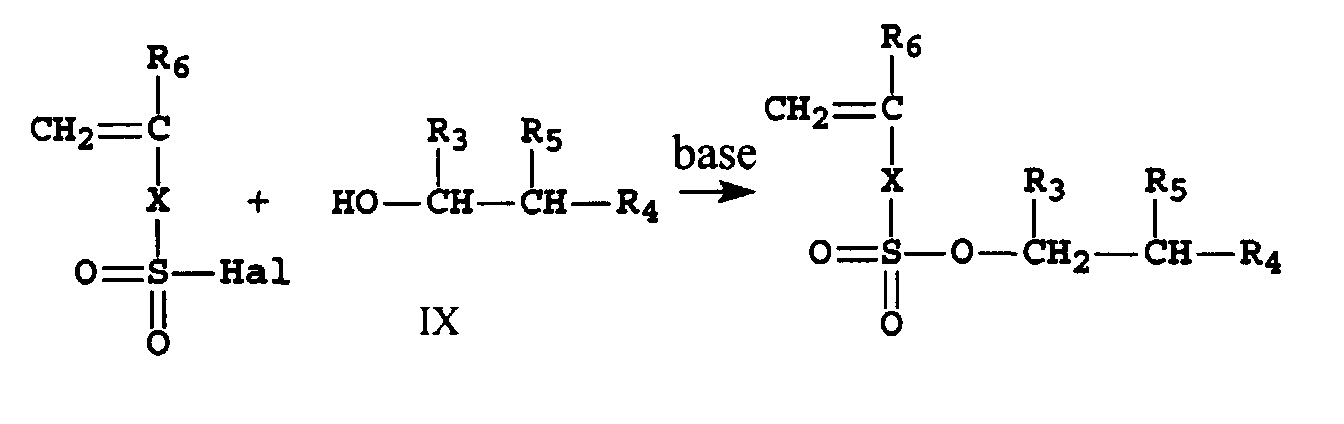
Such polymers can be easily prepared from a monomer containing a sulfonate
group represented by the general formula
This above-said monomers may be prepared from a reaction between a sulfonic acid
halide V with an alcohol X in the presence of a base (Organic Synthesis Collective
Vol. 5, p. 366), illustrated as follows:
Representative synthetic methods for making ethylenically unsaturated
polymerizable monomers and polymers useful in the practice of this invention are
illustrated as follows:
Synthesis Example 1: Synthesis of α-tetralone oxime p-styrene sulfonate (1,2,3,4-tetra-1-naphthylideneamino
p-styrenesulfonate): Monomer 1
α-Tetralone oxime (24 g) was dissolved in 150 ml of dichloromethane in a
500 ml round-bottomed flask, and cooled to 0 °C. Triethylamine (23 ml) was added
first and then p-styrenesulfonyl chloride (30.4 g) was added slowly to the solution to
keep temperature below 5 °C. The reaction mixture was stirred at 0 °C for 5 hours
and then poured into 100 ml of ice-cold 10% HCl solution. The mixture was
extracted with dichloromethane three times (100 ml each) and the combined organic
layer was washed with water and brine and dried over anhydrous magnesium sulfate.
The solvent was removed and the brown solid residue was recrystallized from hexane
to obtain off-white crystalline α-tetralone oxime p-styrene sulfonate.
Synthesis Example 2: Synthesis of poly(methyl methacrylate-co-α-tetralone
oxime p-styrene sulfonate)
Methyl methacrylate (1.4 ml), α-tetralone oxime p-styrene sulfonate (4.5 g)
and azobisisobutylronitrile (hereafter referred to as AIBN, 60 mg) were dissolved in 8
ml of benzene in a 25 ml round-bottomed flask capped with a rubber septum. The
solution was purged with dry nitrogen for 15 minutes and then heated at 60 °C for 14
hours. The product almost solidified and was diluted with 20 ml of
dimethylformamide (hereafter referred to as DMF) and 10 ml of tetrahydrofuran
(hereafter referred to as THF). The polymer was precipitated into 400 ml of methanol
twice. The resulting white powdery polymer was collected by filtration and dried
under vacuum at 40 °C overnight.
Synthesis Example 3: Synthesis of poly(α-tetralone oxime p-styrene sulfonate):
Homopolymer 1
α-Tetralone oxime p-styrene sulfonate (3.7) g) and AIBN (39 mg) were
dissolved in 8 ml of toluene in a 25 ml round-bottomed flask capped with a rubber
septum. The solution was purged with dry nitrogen for 10 minutes and then heated at
60 °C for 20 hours. The solidified product was diluted with 30 ml of DMF and
precipitated into 300 ml of ether. The resulting white powdery polymer was collected
and dried under vacuum at 40 °C overnight.
Synthesis Example 4: Synthesis of poly[methyl methacrylate-co-α-tetralone oxime
p-styrene sulfonate-co-2-(methacryloyloxy)ethyl acetoacetate]: Copolymer 1
Methyl methacrylate (0.52 ml), α-tetralone oxime p-styrene sulfonate (2.0 g),
(methacryloyloxy)ethyl acetoacetate (0.19 ml), and AIBN (39 mg) were dissolved in
4.5 ml of benzene in a 25 ml round-bottomed flask capped with a rubber septum. The
solution was purged with dry nitrogen for 15 minutes and then heated at 60 °C for 15
hours. The product was diluted with 20 ml of DMF and purified by precipitated into
200 ml of methanol. The white powdery polymer was filtered and dried under
vacuum at 40 °C overnight.
Synthesis Example 5: Synthesis of α-tetralone oxime 3-methacryloyl-propane
sulfonate: Monomer 2
A procedure like that described in Synthesis Example 1 was followed. α-Tetralone
oxime (6.0 g) was reacted with 3-methacryloylpropane sulfonyl chloride
(7.8 g) in 17 ml of pyridine to give a white crystalline product which was
recrystallized from mixed solvent of hexane and diethyl ether.
Synthesis Example 6: Synthesis of poly(α-tetralone oxime 3-methacryloyl-propane
sulfonate): Homopolymer 2
α-Tetralone oxime 3-methacryloylpropane sulfonate (1.5 g) and AIBN (14
mg) were dissolved in 3 ml of toluene in a 25 ml round-bottomed flask capped with a
rubber septum. The solution was purged with dry nitrogen for 10 minutes and then
heated at 60 °C for 16 hours. The solidified product was diluted with 15 ml of DMF
and precipitated into 150 ml of methanol. The resulting white powdery polymer was
collected and dried under vacuum at 40 °C overnight.
Synthesis Example 7: Synthesis of (2-methylsulfonyl)ethyl p-styrene sulfonate:
Monomer 3
A procedure like that described in Synthesis Example 1 was followed. 2-(Methylsulfonyl)ethanol
(6 g) was reacted with p-styrenesulfonyl chloride (11.8 g) in
50 ml of pyridine to give a white crystalline product that was recrystallized from
diethyl ether.
Synthesis Example 8: Synthesis of poly[(2-methylsulfonyl)ethyl p-styrene
sulfonate]: Homopolymer 3
2-(Methylsulfonyl)ethanol (4g) and AIBN (14 mg) were dissolved in 15 ml of
DMF in a 25 ml round-bottomed flask capped with a rubber septum. The solution
was purged with dry nitrogen for 10 minutes and then heated at 60 °C for 20 hours.
The viscous product was diluted with 15 ml of DMF and precipitated into 400 ml of
methanol. The resulting white powdery polymer was collected and dried under
vacuum at 40 °C overnight.
Synthesis Example 9: Synthesis of 2-Phenylethyl p-Styrene Sulfonate: Monomer 4
2-Phenylethanol (3.1 g) was reacted with p-styrene sulfonyl chloride (5.3 g)
and triethylamine (2.7 g) in 20 ml of dichloromethane for 3 hours to give the desired
product as a light yellow viscous oil that was purified by passing through basic
aluminum oxide.
Synthesis Example 10: Synthesis of 2-Cyanoethyl p-Styrene Sulfonate: Monomer 5
2-Cyanoethylanol (1.8 g) was reacted with p-styrene sulfonyl chloride (5.1 g)
and triethylamine (2.5 g) in 20 ml of dichloromethane for 3 hours to give the desired
product as a light yellow viscous oil.
Synthesis Example 11: Synthesis of Poly(2-phenylethyl p-styrene sulfonate)
Monomer 4 (1.5 g) and AIBN (16 mg) were dissolved in 4 ml of benzene.
The solution was then purged with dry nitrogen for 10 minutes and heated at 60°C
for 14 hours. The resulting viscous product was diluted to 10 ml with DMF and
precipitated into 100 ml of isopropanol. The resulting desired polymer was collected
and dried under vacuum at 40°C overnight.
Synthesis Example 12: Synthesis of Poly(2-phenylethyl p-styrene sulfonate-co-Methoxymethyl
methacrylamide)
Monomer 4 (2.0 g), methoxymethyl methacrylamide (0.3 g) and AIBN (33
mg) were dissolved in 5 ml of DMF. The solution was purged with dry nitrogen for
10 minutes and heated at 60°C for 14 hours. The resulting viscous product was
diluted to 10 ml with DMF and precipitated into 100 ml of diethyl ether. The
resulting desired polymer was collected and dried under vacuum at 40°C overnight.
Synthesis Example 13: Synthesis of Poly(2-phenylethyl p-styrene sulfonate-co-1-vinyl-2-pyrrolidone)
Monomer 4 (2.0 g), 1-vinyl-2-pyrrolidinone (0.3 g) and AIBN (33 mg) were
dissolved in 5 ml of DMF. The solution was purged with dry nitrogen for 10 minutes
and heated at 60°C for 14 hours. The viscous product was diluted to 10 ml with
DMF and precipitated into 100 ml of diethyl ether. The resulting desired polymer
was collected and dried under vacuum at 40°C overnight.
Useful additional ethylenically unsaturated polymerizable monomers include,
but are not limited to, acrylates (including methacrylates) such as ethyl acrylate, n-butyl
acrylate, methyl methacrylate and t-butyl methacrylate, acrylamides (including
methacrylamides), an acrylonitrile (including methacrylonitrile), vinyl ethers,
styrenes, vinyl acetate, dienes (such as ethylene, propylene, 1,3-butadiene and
isobutylene), vinyl pyridine and vinylpyrrolidone.
A mixture of heat-sensitive polymers described herein can be used in the
imageable layer of the imaging members, but preferably only a single polymer is
used. The polymers can be crosslinked or uncrosslinked when used in the imageable
layer. If crosslinked, the crosslinkable moiety is preferably provided from one or
more of the additional ethylenically unsaturated polymerizable monomers. The
crosslinking cannot interfere with the transformation of the sulfonyl-containing group
into a sulfonic acid group during imaging.
The surface imageable layer of the imaging member can include one or more
of such homopolymers or copolymers, with or without minor (less than 20 weight %
based on total layer dry weight) amounts of additional binder or polymeric materials
that will not adversely affect imaging properties of the imageable layer. However, the
surface imageable layer includes no additional materials that are needed for imaging,
especially those materials conventionally required for wet processing with alkaline
developer solutions.
The amount of heat-sensitive polymer(s) used in the imageable layer is
generally at least 0.8 g/m2, and preferably from about 1 to about 2 g/m2 (dry weight).
This generally provides an average dry thickness of from about 0.1 to about 10 µm.
Greater amounts can be used if desired.
The imageable layer can also include one or more conventional surfactants for
coatability or other properties, or dyes or colorants to allow visualization of the
written image, or any other addenda commonly used in the lithographic art, as long as
the concentrations are low enough so that there is no significant interference with
layer imaging properties.
The heat-sensitive composition in the imageable layer preferably also includes
one or more photothermal conversion materials to absorb appropriate thermal energy
from an appropriate source, such as a laser or thermal head, which radiation is
converted into heat. Thus, such materials convert photons into heat phonons.
Preferably, the radiation absorbed is in the infrared and near-infrared regions of the
electromagnetic spectrum. Such materials can be dyes, pigments, evaporated
pigments, semiconductor materials, alloys, metals, metal oxides, metal sulfides or
combinations thereof, or a dichroic stack of materials that absorb radiation by virtue
of their refractive index and thickness. Borides, carbides, nitrides, carbonitrides,
bronze-structured oxides and oxides structurally related to the bronze family but
lacking the WO2.9 component, are also useful. One particularly useful pigment is
carbon of some form (for example, carbon black). The size of the pigment particles
should not be more than the thickness of the layer. Preferably, the size of the
particles will be half the thickness of the layer or less. Useful absorbing dyes for near
infrared diode laser beams are described, for example, in US-A-4,973,572 (DeBoer),
incorporated herein by reference. Particular dyes of interest are "broad band" dyes,
that is those that absorb over a wide band of the spectrum. Mixtures of pigments,
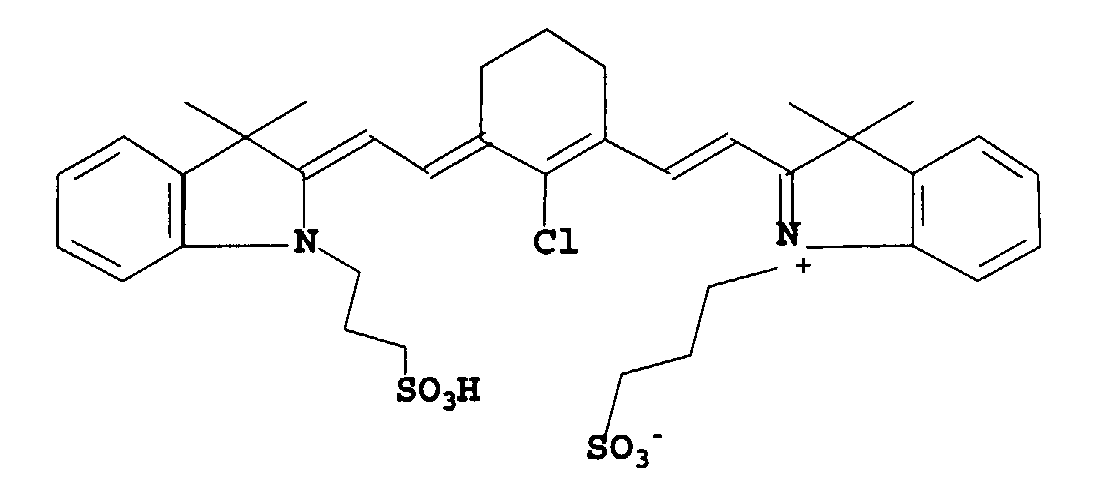
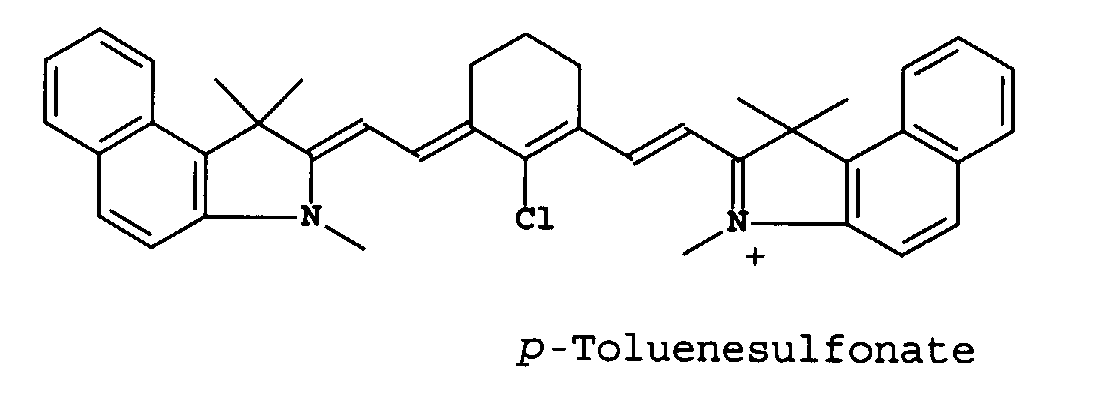
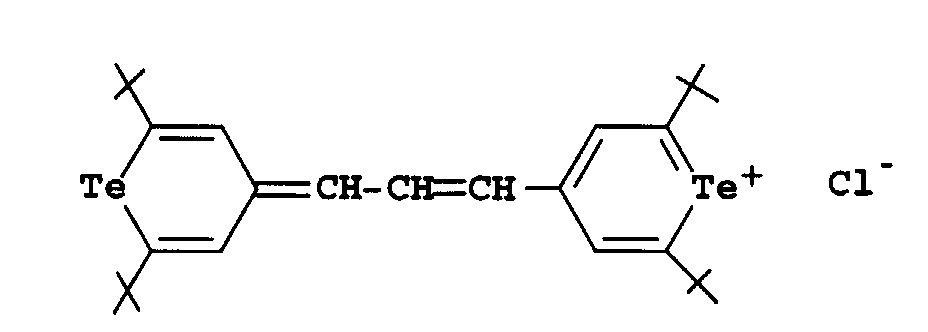
dyes, or both, can also be used. Particularly useful infrared radiation absorbing dyes
include bis(dichlorobenzene-1,2-dithiol)nickel(2:1)tetrabutyl ammonium chloride,
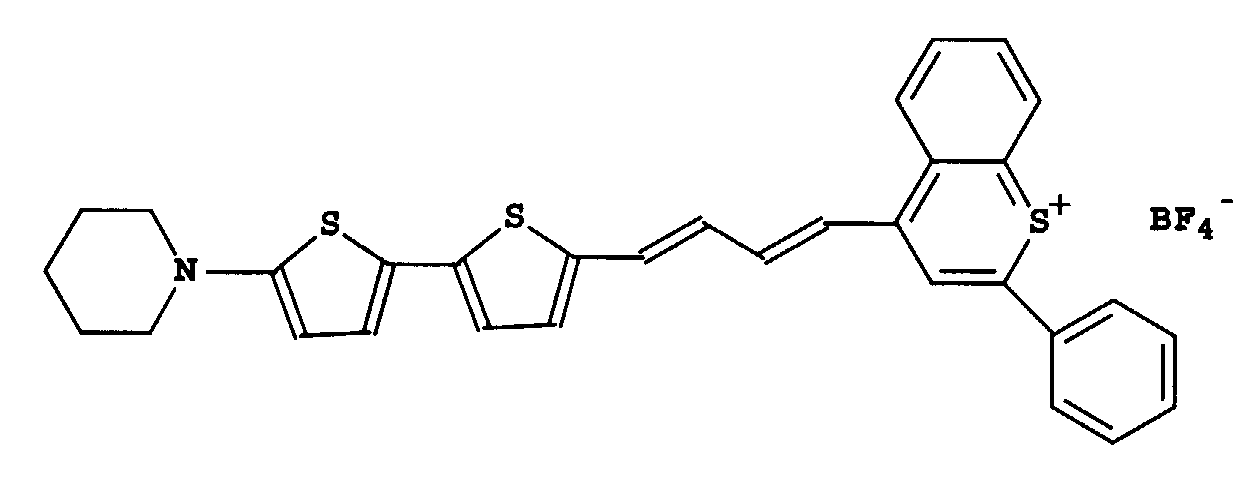
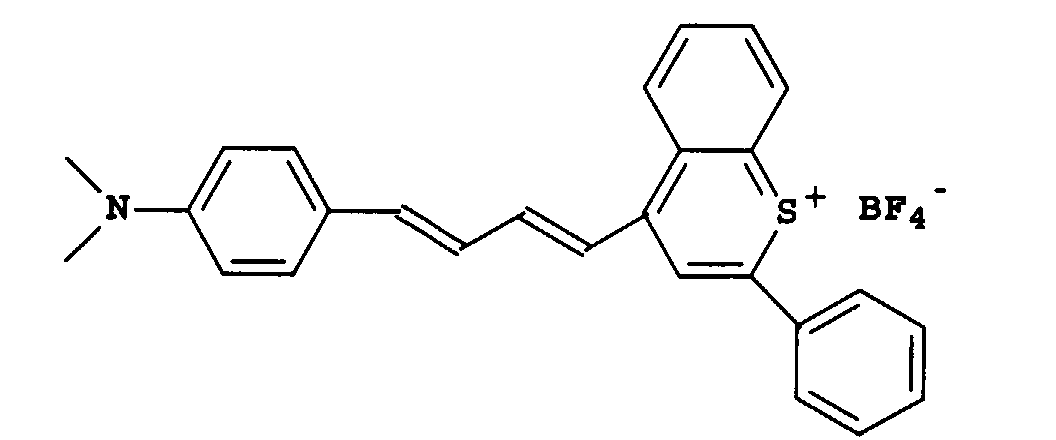
tetrachlorophthalocyanine aluminum chloride, as well as those illustrated as follows:
- IR Dye 1
-
- IR Dye 2
- Same as Dye 1 but with C3F7CO2 - as the anion.
- IR Dye 3
-
- IR Dye 4
-
- IR Dye 5
-
- IR Dye 6
-
The photothermal conversion material(s) are generally present in an
amount sufficient to provide an optical density of at least 0.3, and preferably at least
1.0. The particular amount needed for this purpose would be readily apparent to one
skilled in the art, depending upon the specific material used.
The heat-sensitive composition is coated onto the support using any suitable
equipment and procedure, such as spin coating, knife coating, gravure coating, dip
coating or extrusion hopper coating.
The imaging members of this invention can be of any useful form including,
but not limited to, printing plates, printing cylinders, printing sleeves and printing
tapes (including flexible printing webs). Preferably, the imaging members are
printing plates.
Printing plates can be of any useful size and shape (for example, square or
rectangular) having the requisite heat-sensitive imageable layer disposed on a suitable
support. Printing cylinders and sleeves are rotary printing members having the
support and heat-sensitive layer in a cylindrical form. Hollow or solid metal cores
can be used as substrates for printing sleeves.
During use, the imaging member of this invention can be exposed to any
suitable source of thermal energy, such as a focused laser beam or thermal head, in
the imaged areas, typically from digital information supplied to the imaging device.
No heating, wet processing (such as with an alkaline developer), or mechanical or
solvent cleaning is needed before the printing operation (although wiping or cleaning
can be used if desired). A vacuum dust collector may be useful during the laser
exposure step to keep the focusing lens clean. Such a collector is described in US-A-5,574,493
(Sanger et al). A laser used to expose the imaging member of this
invention is preferably a diode laser, because of the reliability and low maintenance
of diode laser systems, but other lasers such as gas or solid state lasers may also be
used. The combination of power, intensity and exposure time for laser imaging
would be readily apparent to one skilled in the art. Good printing steps are defined as
those having a uniform optical density greater than 1.0. Specifications for lasers that
emit in the near-IR region, and suitable imaging configurations and devices are
described in US-A-5,339,737 (Lewis et al), incorporated herein by reference. A laser
typically emits in the region of maximum responsiveness in the imaging member, that
is where the λmax closely approximates the wavelength were the imaging member
absorbs most strongly.
The imaging apparatus can operate on its own, functioning solely as a
platemaker, or it can be incorporated directly into a lithographic printing press. In the
latter case, printing may commence immediately after imaging, thereby reducing
press set-up time considerably. The imaging apparatus can be configured as a flatbed
recorder or as a drum recorder, with the imaging member mounted to the interior or
exterior cylindrical surface of the drum.
In the drum configuration, the requisite relative motion between the imaging
device (such as a laser beam) and the imaging member can be achieved by rotating
the drum (and the imageable member mounted thereon) about its axis, and moving
the imaging device parallel to the rotation axis, thereby scanning the imageable
member circumferentially so the image "grows" in the axial direction. Alternatively,
the imaging device can be moved parallel to the drum axis and, after each pass across
the imageable member, increment angularly so that the image "grows"
circumferentially. In both cases, after a complete scan, an image corresponding
(positively or negatively) to the original document or picture can be applied to the
surface of the imaging member.
In the flatbed configuration, a laser beam is drawn across either axis of the
imageable member, and is indexed along the other axis after each pass. Obviously,
the requisite relative motion can be produced by moving the imaging member rather
than the laser beam.
Regardless of the manner in which the laser beam is scanned, it is generally
preferable (for on-press uses) to employ a plurality of lasers and to guide their outputs
to a single writing array. This array is then indexed, after completion of each pass
across or along the imaging member, a distance determined by the number of beams
emanating from the array, and by the desired resolution (that is, the number of image
points per unit length). Off-press applications, which can be designed to
accommodate very rapid plate movement and thereby utilize high laser pulse rates,
can frequently utilize a single laser as an imaging source.
While laser imaging is preferred in the practice of this invention, any other
imaging means can be used that provides thermal energy that can be directed in an
imagewise fashion. For example, imaging can be accomplished using a
thermoresistive head (or thermal printing head) in what is known as thermal printing,
as described for example, in US-A- 5,488,025 (Martin et al). Such thermal printing
heads are commercially available (for example as Fujitsu Thermal Head FTP-040
MCS001 and TDK Thermal Head F415 HH7-1089).
Without any wet processing steps (such as processing with an alkaline
developer) after imaging, the imaging member is then used for printing by applying a
lithographic ink to the image on its surface, in the presence of a fountain solution, and
by transferring the ink to a suitable receiving material (such as cloth, paper, metal,
glass or plastic) to provide a desired impression of the image thereon. An
intermediate "blanket" roller can be used in the transfer of the ink from the imaging
member to the receiving material. The imaging members can be cleaned between
impressions, if desired, using conventional cleaning means. Thus, imaging and
printing can be carried out without conventional "wet" processing. Hence, the
imaging members of this invention are considered "processless" imaging members.
The following examples illustrate the practice of the invention, and are not
meant to limit it in any way.
In these examples, a thermal IR-laser platesetter was used to image the
printing plates, the printer being similar to that described in US-A-5,168,288 (Baek et
al), incorporated herein by reference. The printing plates were exposed using
approximately 450 mW per channel, 9 channels per swath, 945 lines/cm, a drum
circumference of 53 cm and an image spot (1/e2) at the image plane of about 25
micrometers. The test image included text, positive and negative lines, half tone dot
patterns and a half-tone image. Images were printed at speeds up to 1100 revolutions
per minute (the exposure levels do not necessarily correspond to the optimum
exposure levels for the tested printing plates).
Examples 1-3: Imaging members incorporating homopolymers
Heat-sensitive imaging formulations were prepared from the following
components:
Each formulation containing 4.21 weight % of solid was coated at 100 mg/ft2
of dry coverage (1.08 g/m2) on a 0.14 mm aluminum support which had been
electrochemically grained and anodized and post treated with poly(vinyl phosphonic
acid-co-acrylamide) at 80:20 weight ratio. The resulting printing plate was dried in a
convection oven at 82 °C for 3 minutes, clamped on the rotating drum of an image
setting machine, and digitally exposed to an 830 nm laser printhead at dosages
ranging from 300 to 660 mJ/cm2. The resulting blue-green coating rapidly discolored
to a typically orange-tan color in the exposed regions. When black lithographic ink
was applied to each exposed plate while under a stream of tap water, the non-exposed
regions were found to readily accept ink whereas the exposed regions remained wet
with water and free of ink.
A sample of each of the laser exposed plate was then mounted on the plate
cylinder of a full page A.B. Dick lithographic duplicator press for actual press run.
Each plate rolled up fast and printed with full density for several hundred printed
sheets. The press results (number of acceptable sheets) are shown in TABLE 1.
| Example | Homopolymer | Press Results( printed sheets) |
| 1 | 1 | 500 |
| 2 | 2 | 500 |
| 3 | 3 | 300 |
Several heat-sensitive imaging formulations were prepared and coated on an
aluminum support and dried as described in Examples 1-3 above, except Copolymers
1-4 were used as the heat-sensitive polymers in the imageable layer. Each resulting
plate was imaged and evaluated as described in Examples 1-3. The results,
summarized in TABLE 2 below, indicate that excellent photospeed and performance
were achieved as long as the iminosulfonate moiety n≥(0.25) and that n, m, and p
satisfy the relationship
n+m+p = 1. Copolymers 2-4 were prepared similarly to
Copolymer 1, using the synthesis noted above.
Two coatings were prepared as described in Examples 1 and 4, except they
were coated on 0.18 mm poly(ethylene terephthalate) film support. They were
exposed by the IR laser platesetter and test on the A.B. Dick press as described in
Examples 1 and 4. Press results, summarized in TABLE 3, show that comparable
performance was achieved whether the support was on hydrophilic aluminum or
oleophilic polyester film, consistent with a processless, thermally switchable plate
chemistry. The fact that the press run was artificially terminated after 200
impressions in these examples, as opposed to 500 in Examples 1 and 4, is not meant
to be an indication of plate durability.
| Example | Polymer | Press Results (printed sheets) |
| 5 | Homopolymer 1 | 200 |
| 6 | Copolymer 2 | 200 |
These examples demonstrate that various photothermal converters can be
utilized in the imaging members of the invention.
Several heat-sensitive imaging formulations were prepared, coated on
aluminum support and dried as described in Examples 1 and 4, except that various IR
radiation absorbing materials, such as IR Dye 2 and carbon black instead of IR Dye 1
were used as photothermal converter. Each resulting plate was imaged and press
tested as described in Examples 1 and 4. The results summarized in TABLE 4 below
indicate comparable photospeed and performance were achieved with various dyes
and carbon black pigment.
| Example | Polymer | Dye or Pigment | Press Results (printed sheets) |
| 7 | Homopolymer 1 | IR Dye 2 | 1000 |
| 8 | Copolymer 2 | IR Dye 2 | 1000 |
| 9 | Homopolymer 1 | carbon black | 500 |
A sample of the laser exposed plates described in Examples 1 and 4 was also
tested for their ability to resist chemical attack by various solvents and press
chemicals. The test requires swabbing a chemical with reasonable pressure over both
exposed and unexposed areas of the plate for 90 seconds. The following solvents and
plate chemicals were used in the tests: isopropanol, xylenes, acetone, 1-methoxy-2-propanol,
KODAK™ Aqua-Image plate cleaner/preserver, KODAK™ MX1589
positive (alkaline) plate developer and an acidic commercial fountain solution. Both
plates (Examples 1 and 4) passed the test for all the above chemicals.
The invention has been described in detail with particular reference to
preferred embodiments thereof, but it will be understood that variations and
modifications can be effected within the spirit and scope of the invention.