EP1083611A2 - Piezoelectric ceramic material and monolithic piezoelectric transducer employing the ceramic material - Google Patents
Piezoelectric ceramic material and monolithic piezoelectric transducer employing the ceramic material Download PDFInfo
- Publication number
- EP1083611A2 EP1083611A2 EP00119590A EP00119590A EP1083611A2 EP 1083611 A2 EP1083611 A2 EP 1083611A2 EP 00119590 A EP00119590 A EP 00119590A EP 00119590 A EP00119590 A EP 00119590A EP 1083611 A2 EP1083611 A2 EP 1083611A2
- Authority
- EP
- European Patent Office
- Prior art keywords
- ceramic material
- piezoelectric ceramic
- compound
- piezoelectric
- containing oxide
- Prior art date
- Legal status (The legal status is an assumption and is not a legal conclusion. Google has not performed a legal analysis and makes no representation as to the accuracy of the status listed.)
- Withdrawn
Links
- 229910010293 ceramic material Inorganic materials 0.000 title claims abstract description 61
- 150000001875 compounds Chemical class 0.000 claims abstract description 66
- VYPSYNLAJGMNEJ-UHFFFAOYSA-N Silicium dioxide Chemical compound O=[Si]=O VYPSYNLAJGMNEJ-UHFFFAOYSA-N 0.000 claims abstract description 59
- 229910052681 coesite Inorganic materials 0.000 claims abstract description 29
- 229910052906 cristobalite Inorganic materials 0.000 claims abstract description 29
- 239000000377 silicon dioxide Substances 0.000 claims abstract description 29
- 229910052682 stishovite Inorganic materials 0.000 claims abstract description 29
- 229910052905 tridymite Inorganic materials 0.000 claims abstract description 29
- NKZSPGSOXYXWQA-UHFFFAOYSA-N dioxido(oxo)titanium;lead(2+) Chemical compound [Pb+2].[O-][Ti]([O-])=O NKZSPGSOXYXWQA-UHFFFAOYSA-N 0.000 claims abstract description 25
- 229910020662 PbSiO3 Inorganic materials 0.000 claims abstract description 18
- 229910003781 PbTiO3 Inorganic materials 0.000 claims abstract description 15
- 239000000919 ceramic Substances 0.000 claims description 62
- 229910052684 Cerium Inorganic materials 0.000 claims description 16
- 229910052779 Neodymium Inorganic materials 0.000 claims description 16
- 229910052746 lanthanum Inorganic materials 0.000 claims description 15
- 229910010252 TiO3 Inorganic materials 0.000 claims description 9
- ZMIGMASIKSOYAM-UHFFFAOYSA-N cerium Chemical compound [Ce][Ce][Ce][Ce][Ce][Ce][Ce][Ce][Ce][Ce][Ce][Ce][Ce][Ce][Ce][Ce][Ce][Ce][Ce][Ce][Ce][Ce][Ce][Ce][Ce][Ce][Ce][Ce][Ce][Ce][Ce][Ce][Ce][Ce][Ce][Ce][Ce][Ce] ZMIGMASIKSOYAM-UHFFFAOYSA-N 0.000 claims description 3
- FZLIPJUXYLNCLC-UHFFFAOYSA-N lanthanum atom Chemical compound [La] FZLIPJUXYLNCLC-UHFFFAOYSA-N 0.000 claims description 3
- QEFYFXOXNSNQGX-UHFFFAOYSA-N neodymium atom Chemical compound [Nd] QEFYFXOXNSNQGX-UHFFFAOYSA-N 0.000 claims description 3
- 238000005204 segregation Methods 0.000 abstract description 26
- 238000005245 sintering Methods 0.000 description 18
- 239000000203 mixture Substances 0.000 description 17
- GWEVSGVZZGPLCZ-UHFFFAOYSA-N Titan oxide Chemical compound O=[Ti]=O GWEVSGVZZGPLCZ-UHFFFAOYSA-N 0.000 description 8
- 230000008878 coupling Effects 0.000 description 8
- 238000010168 coupling process Methods 0.000 description 8
- 238000005859 coupling reaction Methods 0.000 description 8
- 238000001704 evaporation Methods 0.000 description 5
- 230000008020 evaporation Effects 0.000 description 5
- 238000000034 method Methods 0.000 description 5
- 239000011230 binding agent Substances 0.000 description 3
- VASIZKWUTCETSD-UHFFFAOYSA-N manganese(II) oxide Inorganic materials [Mn]=O VASIZKWUTCETSD-UHFFFAOYSA-N 0.000 description 3
- 239000000463 material Substances 0.000 description 3
- 230000010287 polarization Effects 0.000 description 3
- 238000006467 substitution reaction Methods 0.000 description 3
- 229910052721 tungsten Inorganic materials 0.000 description 3
- ZNOKGRXACCSDPY-UHFFFAOYSA-N tungsten(VI) oxide Inorganic materials O=[W](=O)=O ZNOKGRXACCSDPY-UHFFFAOYSA-N 0.000 description 3
- 229910020698 PbZrO3 Inorganic materials 0.000 description 2
- XLOMVQKBTHCTTD-UHFFFAOYSA-N Zinc monoxide Chemical compound [Zn]=O XLOMVQKBTHCTTD-UHFFFAOYSA-N 0.000 description 2
- WMWLMWRWZQELOS-UHFFFAOYSA-N bismuth(iii) oxide Chemical compound O=[Bi]O[Bi]=O WMWLMWRWZQELOS-UHFFFAOYSA-N 0.000 description 2
- 230000000052 comparative effect Effects 0.000 description 2
- 230000007423 decrease Effects 0.000 description 2
- QDOXWKRWXJOMAK-UHFFFAOYSA-N dichromium trioxide Chemical compound O=[Cr]O[Cr]=O QDOXWKRWXJOMAK-UHFFFAOYSA-N 0.000 description 2
- 238000010348 incorporation Methods 0.000 description 2
- 238000009413 insulation Methods 0.000 description 2
- NUJOXMJBOLGQSY-UHFFFAOYSA-N manganese dioxide Chemical compound O=[Mn]=O NUJOXMJBOLGQSY-UHFFFAOYSA-N 0.000 description 2
- 229910052751 metal Inorganic materials 0.000 description 2
- 239000002184 metal Substances 0.000 description 2
- 238000002156 mixing Methods 0.000 description 2
- 239000007858 starting material Substances 0.000 description 2
- BQCADISMDOOEFD-UHFFFAOYSA-N Silver Chemical compound [Ag] BQCADISMDOOEFD-UHFFFAOYSA-N 0.000 description 1
- 239000000654 additive Substances 0.000 description 1
- 229910000421 cerium(III) oxide Inorganic materials 0.000 description 1
- 238000004891 communication Methods 0.000 description 1
- 230000000694 effects Effects 0.000 description 1
- 238000010304 firing Methods 0.000 description 1
- JEIPFZHSYJVQDO-UHFFFAOYSA-N iron(III) oxide Inorganic materials O=[Fe]O[Fe]=O JEIPFZHSYJVQDO-UHFFFAOYSA-N 0.000 description 1
- MRELNEQAGSRDBK-UHFFFAOYSA-N lanthanum oxide Inorganic materials [O-2].[O-2].[O-2].[La+3].[La+3] MRELNEQAGSRDBK-UHFFFAOYSA-N 0.000 description 1
- HTUMBQDCCIXGCV-UHFFFAOYSA-N lead oxide Chemical compound [O-2].[Pb+2] HTUMBQDCCIXGCV-UHFFFAOYSA-N 0.000 description 1
- HFGPZNIAWCZYJU-UHFFFAOYSA-N lead zirconate titanate Chemical compound [O-2].[O-2].[O-2].[O-2].[O-2].[Ti+4].[Zr+4].[Pb+2] HFGPZNIAWCZYJU-UHFFFAOYSA-N 0.000 description 1
- YEXPOXQUZXUXJW-UHFFFAOYSA-N lead(II) oxide Inorganic materials [Pb]=O YEXPOXQUZXUXJW-UHFFFAOYSA-N 0.000 description 1
- 229910052748 manganese Inorganic materials 0.000 description 1
- PLDDOISOJJCEMH-UHFFFAOYSA-N neodymium oxide Inorganic materials [O-2].[O-2].[O-2].[Nd+3].[Nd+3] PLDDOISOJJCEMH-UHFFFAOYSA-N 0.000 description 1
- 229910052758 niobium Inorganic materials 0.000 description 1
- 239000003921 oil Substances 0.000 description 1
- KTUFCUMIWABKDW-UHFFFAOYSA-N oxo(oxolanthaniooxy)lanthanum Chemical compound O=[La]O[La]=O KTUFCUMIWABKDW-UHFFFAOYSA-N 0.000 description 1
- -1 poly(vinyl alcohol) Polymers 0.000 description 1
- 229920002451 polyvinyl alcohol Polymers 0.000 description 1
- 239000000843 powder Substances 0.000 description 1
- 229910052814 silicon oxide Inorganic materials 0.000 description 1
- 229910052709 silver Inorganic materials 0.000 description 1
- 239000004332 silver Substances 0.000 description 1
- 229910002076 stabilized zirconia Inorganic materials 0.000 description 1
- 230000001629 suppression Effects 0.000 description 1
Images

Classifications
-
- C—CHEMISTRY; METALLURGY
- C04—CEMENTS; CONCRETE; ARTIFICIAL STONE; CERAMICS; REFRACTORIES
- C04B—LIME, MAGNESIA; SLAG; CEMENTS; COMPOSITIONS THEREOF, e.g. MORTARS, CONCRETE OR LIKE BUILDING MATERIALS; ARTIFICIAL STONE; CERAMICS; REFRACTORIES; TREATMENT OF NATURAL STONE
- C04B35/00—Shaped ceramic products characterised by their composition; Ceramics compositions; Processing powders of inorganic compounds preparatory to the manufacturing of ceramic products
- C04B35/01—Shaped ceramic products characterised by their composition; Ceramics compositions; Processing powders of inorganic compounds preparatory to the manufacturing of ceramic products based on oxide ceramics
- C04B35/46—Shaped ceramic products characterised by their composition; Ceramics compositions; Processing powders of inorganic compounds preparatory to the manufacturing of ceramic products based on oxide ceramics based on titanium oxides or titanates
- C04B35/462—Shaped ceramic products characterised by their composition; Ceramics compositions; Processing powders of inorganic compounds preparatory to the manufacturing of ceramic products based on oxide ceramics based on titanium oxides or titanates based on titanates
- C04B35/472—Shaped ceramic products characterised by their composition; Ceramics compositions; Processing powders of inorganic compounds preparatory to the manufacturing of ceramic products based on oxide ceramics based on titanium oxides or titanates based on titanates based on lead titanates
-
- H—ELECTRICITY
- H10—SEMICONDUCTOR DEVICES; ELECTRIC SOLID-STATE DEVICES NOT OTHERWISE PROVIDED FOR
- H10N—ELECTRIC SOLID-STATE DEVICES NOT OTHERWISE PROVIDED FOR
- H10N30/00—Piezoelectric or electrostrictive devices
- H10N30/80—Constructional details
- H10N30/85—Piezoelectric or electrostrictive active materials
- H10N30/853—Ceramic compositions
- H10N30/8548—Lead-based oxides
- H10N30/8554—Lead-zirconium titanate [PZT] based
-
- H—ELECTRICITY
- H10—SEMICONDUCTOR DEVICES; ELECTRIC SOLID-STATE DEVICES NOT OTHERWISE PROVIDED FOR
- H10N—ELECTRIC SOLID-STATE DEVICES NOT OTHERWISE PROVIDED FOR
- H10N30/00—Piezoelectric or electrostrictive devices
- H10N30/40—Piezoelectric or electrostrictive devices with electrical input and electrical output, e.g. functioning as transformers
-
- H—ELECTRICITY
- H10—SEMICONDUCTOR DEVICES; ELECTRIC SOLID-STATE DEVICES NOT OTHERWISE PROVIDED FOR
- H10N—ELECTRIC SOLID-STATE DEVICES NOT OTHERWISE PROVIDED FOR
- H10N30/00—Piezoelectric or electrostrictive devices
- H10N30/80—Constructional details
- H10N30/85—Piezoelectric or electrostrictive active materials
- H10N30/853—Ceramic compositions
Definitions
- the present invention relates to a piezoelectric ceramic material, and more particularly, to a piezoelectric ceramic material predominantly containing lead titanate.
- piezoelectric ceramics have been employed in filters used in communication apparatus and also in piezoelectric transducers such as CPU clocks and sensors.
- Such piezoelectric ceramics predominantly comprise a component such as PbTiO 3 or PbTiO 3 -PbZrO 3 .
- piezoelectric ceramics predominantly comprising lead titanate zirconate have a Curie temperature as low as approximately 300°C, although these ceramics have a high electromechanical coupling coefficient.
- the ceramics cannot be employed at temperatures higher than the above Curie temperature.
- the ceramics are not suitably used in piezoelectric transducers which are employed in a high-frequency region, due to their having a dielectric constant as high as approximately 1000.
- Japanese Patent Application Laid-Open ( kokai ) No. 56-2689 discloses a piezoelectric ceramic composition essentially constituted by a binary-component oxide system represented by (1-x)PbTiO 3 -xPb(Me 1/2 Mn 1/2 )O 3 (Me: Ta, Nb) in which 1.0-2.0 at.% of Pb is substituted by Sr, and at least one secondary component selected from among WO 3 , NiO, and Fe 2 O 3 being incorporated in an additional amount of 0.05-2.0 wt.%.
- the composition successfully attains lowering of sintering temperature, suppression of grain growth, improvement of temperature characteristics and time-elapsing characteristics, and improvement of mechanical quality factor.
- an object of the present invention is to provide a piezoelectric ceramic material which can suppress segregation of a W compound or a W oxide in W-containing sintered PbTiO 3 .
- Another object of the invention is to provide a piezoelectric transducer employing the ceramic material.
- the present invention has been made so as to attain the aforementioned objects.
- the present invention provides a piezoelectric ceramic material which comprises lead titanate as a primary component; an Mn-containing oxide or an Mn-containing compound, and a W-containing compound or a W-containing oxide as secondary components; and an Si-containing oxide or an Si-containing compound as an additional component.
- the ceramic material having such a composition provides a piezoelectric ceramic having a high Curie temperature and a low dielectric constant and suppresses segregation of a W-containing oxide or compound in the ceramic.
- incorporation of Mn and W into lead titanate successfully lowers firing temperature and suppresses evaporation of Pb, thereby reducing variation in piezoelectric characteristics and attaining high mechanical quality factor (Qmt), while high Curie temperature and low dielectric constant, which are characteristics of lead titanate, are maintained.
- Qmt mechanical quality factor
- the present inventors have further found that an Si-containing oxide or compound suppresses segregation of a W-containing compound or oxide.
- incorporation of silicon oxide into lead titanate successfully suppresses segregation of a W-containing oxide or compound in piezoelectric ceramics, thereby producing piezoelectric ceramics of excellent reliability and of uniform characteristics.
- the present invention also provides a piezoelectric ceramic material which comprises lead titanate as a primary component; an Mn-containing oxide or an Mn-containing compound, and a W-containing compound or a W-containing oxide as secondary components; and an Si-containing oxide or an Si-containing compound as an additional component, wherein 15 mol% or less (0 mol% excluded) of Pb in the lead titanate is substituted by at least one element selected from among lanthanum, neodymium, and cerium.
- the ceramic material having such a composition provides a piezoelectric ceramic having a high Curie temperature and a low dielectric constant; lowers sintering temperature; and suppresses evaporation of Pb, thereby reducing variation in piezoelectric characteristics and attaining high mechanical quality factor (Qmt).
- the ceramic material also suppresses segregation of a W-containing oxide or compound in a produced ceramic.
- temperature characteristics of piezoelectric ceramics can be enhanced as compared with the case of piezoelectric ceramics produced from a non-substituted similar ceramic material.
- the Mn-containing oxide or compound is incorporated in an amount of 0.1-5.0 wt.% as reduced to MnO, and the W-containing oxide or compound is incorporated in an amount of 0.1-5.0 wt.% as reduced to WO 3 , the weight percentages being on the basis of the primary component.
- the Si-containing oxide or compound is added in an amount of 2.0 wt.% or less (0 wt.% excluded) as reduced to SiO 2 , with respect to the sum of the above primary component and the above secondary components.
- the present invention also provides a piezoelectric ceramic material which comprises a primary component containing PbTiO 3 and Pb(Mn y W (1-y) )O 3 and additionally SiO 2 or PbSiO 3 .
- the ceramic material having such a composition provides a piezoelectric ceramic having a high Curie temperature and a low dielectric constant, and suppresses segregation of a W-containing oxide or compound in a produced ceramic.
- the present invention also provides a piezoelectric ceramic material which comprises a primary component containing (Pb (1-3x/2) M x )TiO 3 and Pb(Mn y W (1-y) )O 3 (M represents at least one species selected from among La, Nd, and Ce; 0 ⁇ x ⁇ 0.1; and 0 ⁇ y ⁇ 1) and additionally SiO 2 or PbSiO 3 .
- the ceramic material having such a composition provides a piezoelectric ceramic having a high Curie temperature and a low dielectric constant; lowers sintering temperature; and suppresses evaporation of Pb, thereby reducing variation in piezoelectric characteristics and attaining high mechanical quality factor (Qmt).
- the ceramic material also suppresses segregation of a W-containing oxide or compound in a produced ceramic.
- temperature characteristics of piezoelectric ceramics can be enhanced as compared with the case of piezoelectric ceramics produced from a non-substituted similar ceramic material.
- the primary component comprises "a” mol of (Pb (1-3x/2) M x )TiO 3 and "(1-a)" mol of Pb(Mn y W( 1-y ))O 3 (0.9 ⁇ a ⁇ 0.99; 1/2 ⁇ y ⁇ 2/3).
- the above piezoelectric ceramic material comprises 100 wt.% of the aforementioned primary component and 2.0 wt.% or less (0 wt.% excluded) of additional SiO 2 or PbSiO 3 as reduced to SiO 2 .
- the present invention also provides a monolithic piezoelectric transducer which comprises a plate formed of the above-recited piezoelectric ceramic material, a vibration electrode, and an external electrode, wherein the vibration electrode is disposed on the piezoelectric ceramic plate to form a laminated body, and the external electrode is electrically connected to the vibration electrode included in the laminated body.
- the monolithic piezoelectric transducer has excellent heat resistance and is suitable for employment in a high-frequency region.
- the piezoelectric ceramic material of the present invention comprises lead titanate as a primary component; an Mn-containing oxide or an Mn-containing compound, and a W-containing compound or a W-containing oxide as secondary components; and an Si-containing oxide or an Si-containing compound as an additional component.
- Pb may be partially substituted with another element. Examples of preferred substituting elements includes La, Nd, and Ce. Temperature characteristics of piezoelectric ceramics produced from the Pb-substituted ceramic material can be enhanced as compared with the case of piezoelectric ceramics produced from a non-substituted similar ceramic material. Since La, Nd, and Ce are trivalent elements, Pb is substituted in an amount of 3/2 the total amount by mol of added elements.
- the aforementioned Mn-containing oxide or compound is added so as to enhance mechanical quality factor (Qmt) of the produced piezoelectric ceramics, and is not particularly limited so long as it contains Mn.
- the Mn-containing oxide or compound is preferably added in an amount of 0.1-5.0 wt.% (as reduced to MnO) with respect to the aforementioned lead titanate.
- the aforementioned W-containing oxide or compound is added so as to lower sintering temperature of the piezoelectric ceramic material, and is not particularly limited so long as it contains W.
- the W-containing oxide or compound is preferably added in an amount of 0.1-5.0 wt.% (as reduced to WO 3 ) with respect to the aforementioned lead titanate.
- the range of mol ratio y which is defined in the formula Pb(Mn y W (1-y) )O 3 , is preferably 1/2 ⁇ y ⁇ 2/3.
- the aforementioned Si-containing oxide or compound is added so as to suppress segregation of a W-containing oxide or compound in the produced piezoelectric ceramic and lower sintering temperature of the piezoelectric ceramic material.
- Examples of Si-containing oxides or compounds include SiO 2 and PbSiO 3 .
- the Si-containing oxide or compound is preferably added in an amount of 2.0 wt.% or less (0 wt.% excluded) as reduced to SiO 2 , more preferably 0.05-1.0 wt.%, with respect to the entirety of the aforementioned lead titanate, Mn-containing oxide or compound, and the W-containing oxide or compound.
- the Si-containing oxide or compound may be added during mixing of starting materials or during blending a binder with a calcined product.
- Fig. 1 shows an energy-trapping piezoelectric transducer 1.
- the piezoelectric transducer 1 comprises a piezoelectric ceramic plate 2, a vibration electrode 3 formed on a main surface of the piezoelectric ceramic plate 2, and an external electrode (not shown) which is electrically connected with the vibration electrode 3.
- the vibration electrode 3 comprises a vibration portion 3a which is disposed in a central portion of the piezoelectric ceramic plate, and a lead portion 3b which electrically connects the vibration portion 3a and the external electrode.
- a plurality of the thus-formed units are layered, to thereby form a laminated body 4, and external electrodes are formed on a vibration electrode-exposed surface, thereby forming the piezoelectric transducer 1.
- the piezoelectric ceramic material of the present invention will next be described in detail by way of examples.
- PbO, TiO 2 , MnO, and WO 3 serving as starting materials were weighed and blended, so as to prepare mixtures having a composition represented by PbTiO 3 + p wt.% of MnO + q wt.% of WO 3 .
- Each mixture was wet-mixed for 16 hours by means of a ball mill employing grinding balls of stabilized zirconia, dehydrated, and calcined at 850°C for two hours.
- the calcined powder product was blended with a poly(vinyl alcohol) binder and a predetermined amount of SiO 2 or PbSiO 3 , to thereby form a binder mixture, which was pressed at 1 tons/cm 2 to form a disk.
- the thus-obtained disk was fired at 1000-1250°C for two hours, thereby forming a sintered disk.
- a silver electrode was vapor-deposited on each main surface of the disk.
- the electrode-equipped disk was immersed in insulating oil at 60-150°C and subjected to polarization treatment by application of a DC voltage of 2.0-8.0 kV/mm, to thereby prepare a sample of Example 1.
- a comparative sample was prepared in a similar manner, except that PbTiO 3 -PbZrO 3 was used instead of PbTiO 3 .
- the above-prepared samples and the comparative sample were evaluated in terms of density of sintered product, segregation of W, specific dielectric constant, Curie temperature, and piezoelectric characteristics.
- the piezoelectric characteristics include electromechanical coupling constant (kt) and mechanical quality factor (Qmt) to perpendicular vibration generated in a thickness direction of the disk samples. These properties are evaluated by means of an impedance analyzer. Resonance frequency was measured in the temperature range of -20°C to 80°C, to thereby obtain temperature coefficient of resonance frequency (/degree) (Fr-TC). The results are shown in Table 1. In all cases, the amount of added PbSiO 3 was reduced to SiO 2 . In Table 1, samples marked with ⁇ fall outside the scope of the invention, and those marked with * fall outside the scopes of claims 3 and/or 4 of the invention.
- Example 1 The procedure of Example 1 was repeated, except that PbO, TiO 2 , La 2 O 3 , Nd 2 O 3 , Ce 2 O 3 , MnO, and WO 3 serving as staring materials were weighed and blended so as to prepare mixtures having a composition represented by (Pb 1-3x/2 (La, Nd, Ce) x )TiO 3 + p wt.% of MnO + q wt.% of WO 3 , to thereby prepare samples.
- PbO, TiO 2 , La 2 O 3 , Nd 2 O 3 , Ce 2 O 3 , MnO, and WO 3 serving as staring materials were weighed and blended so as to prepare mixtures having a composition represented by (Pb 1-3x/2 (La, Nd, Ce) x )TiO 3 + p wt.% of MnO + q wt.% of WO 3 , to thereby prepare samples.
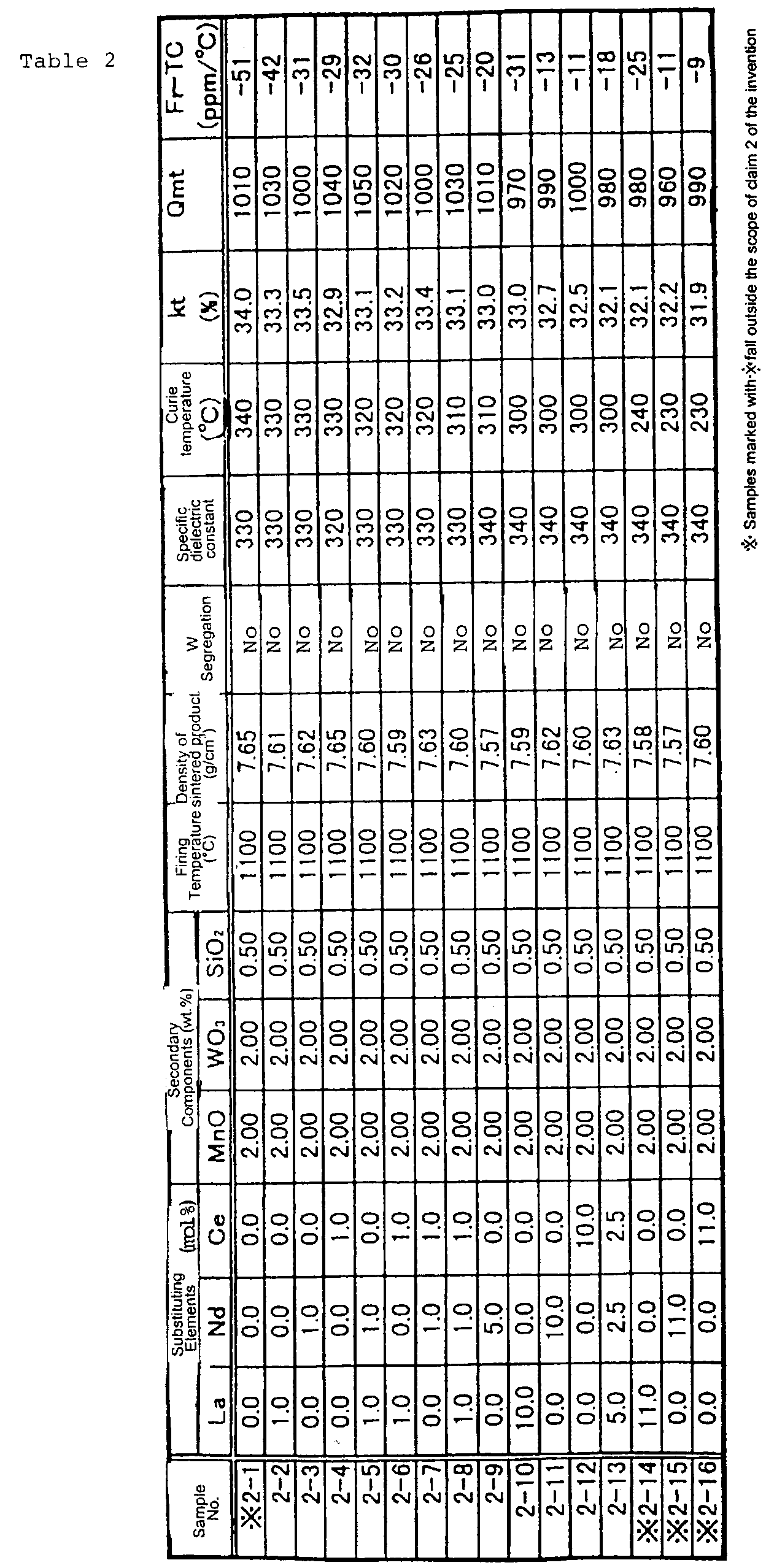
- Example 2 In a manner similar to that of Example 1, the above-prepared samples were evaluated in terms of density of sintered product, segregation of W, specific dielectric constant, Curie temperature, and piezoelectric characteristics. The results are shown in Table 2.
- PbTiO 3 piezoelectric ceramics containing MnO, WO 3 , and SiO 2 or PbSiO 3 show low specific dielectric constant, high Curie temperature, high electromechanical coupling constant (kt), and high mechanical quality factor (Qmt).
- Lead titanate piezoelectric ceramics in which Pb is substituted by at least one metal selected from La, Nd, and Ce in an amount of 15 mol% or less exhibit excellent temperature characteristics as compared with non-substituted lead titanate piezoelectric ceramics.
- Sample Nos. 2-14, 2-15, and 2-16 in Table 2 contain La, Nd, and Ce in a total amount of 11.0 mol%, i.e., substitution of Pb in excess of 15 mol%, exhibit disadvantageously low Curie temperature. Therefore, the substitution of Pb is limited to 15 mol% or less.
- the Mn-containing oxide or compound is added in an amount of 0.1-5.0 wt.% (as reduced to MnO) with respect to the primary component.
- MnO mechanical quality factor
- Qmt mechanical quality factor
- addition of MnO in an amount more than 5.0 wt.% exhibits low insulation resistance and can be polarized only through a particular method and polarization treatment is disadvantageously insufficient.
- the W-containing oxide or compound is added in an amount of 0.1-5.0 wt.% (as reduced to WO 3 ) with respect to the primary component.
- WO 3 is added in an amount less than 0.1 wt.% as in the case of Sample No. 1-17, sintering temperature insufficiently decreases, and such ceramic material must be fired disadvantageously at 1150°C or higher, preferably 1250°C or higher, whereas as in the case of Sample No. 1-23, when WO 3 is contained in an amount more than 5.0 wt.%, a disadvantageously low Curie temperature results.
- the Si-containing oxide or compound is added in an amount of 2.0 wt.% or less as reduced to SiO 2 to 100 wt.% of the sum of the above primary component and the above secondary components.
- SiO 2 is added in an amount more than 2.0 wt.% as in the case of Sample No. 1-7, electromechanical coupling constant is disadvantageously lowered.
- Example 1 The procedure of Example 1 was repeated, except that PbO, TiO 2 , MnO, and WO 3 serving as staring materials were weighed and blended so as to prepare mixtures having a composition represented by aPbTiO 3 + (1-a)Pb(Mn y W (1-y) )O 3 , to thereby prepare samples.
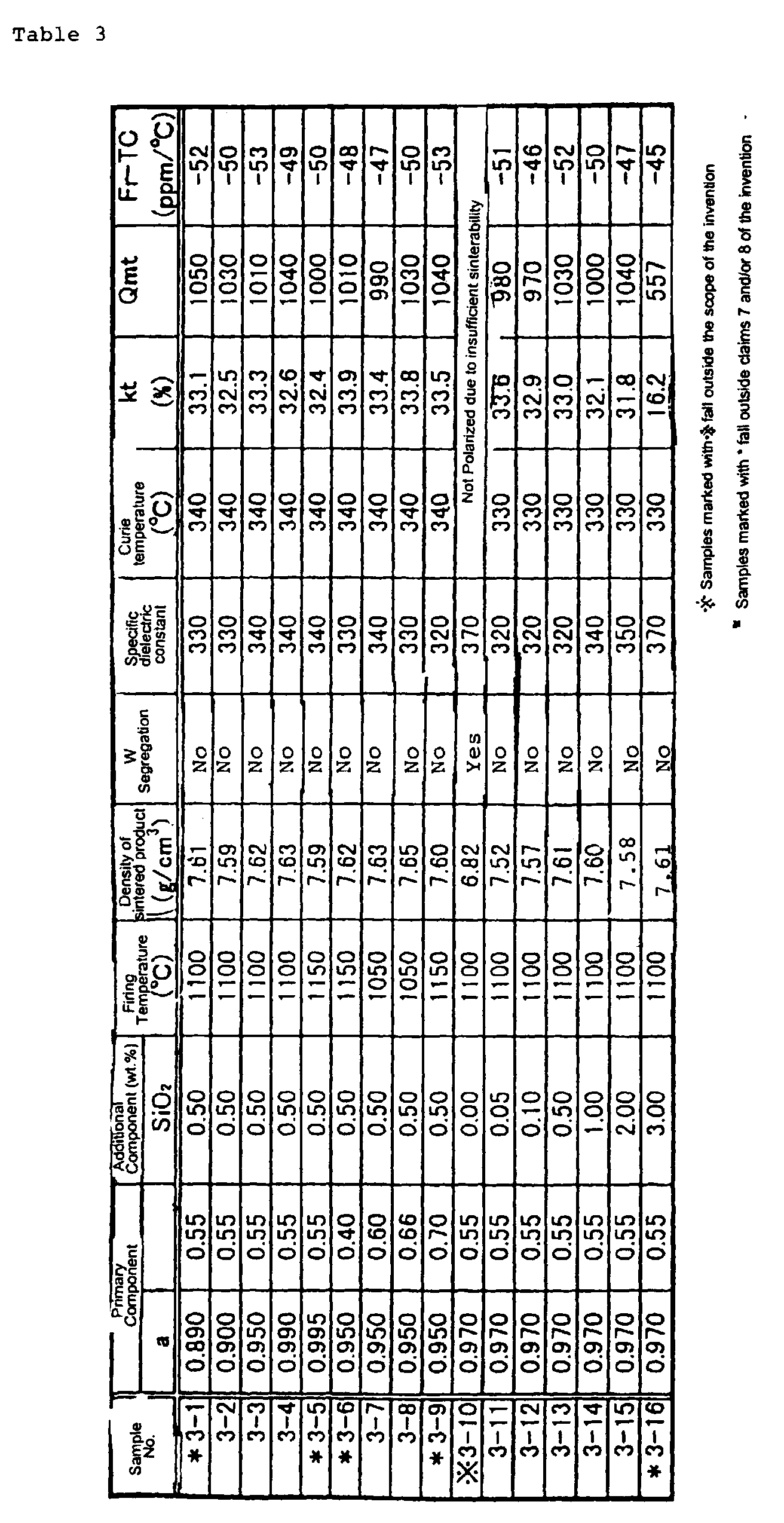
- Example 3 In a manner similar to that of Example 1, the above-prepared samples were evaluated for density of sintered product, segregation of W, specific dielectric constant, Curie temperature, and piezoelectric characteristics. The results are shown in Table 3. In Table 3, samples marked with ⁇ fall outside the scopes of claims 7 and/or 8 of the invention.
- Example 1 The procedure of Example 1 was repeated, except that PbO, TiO 2 , MnO, and WO 3 serving as staring materials were weighed and blended so as to prepare mixtures having a composition represented by a(Pb 1-3x/2 (La, Nd, Ce) x )TiO 3 + (1-a)Pb(Mn y W (1-y) )O 3 , to thereby prepare samples.
- PbO, TiO 2 , MnO, and WO 3 serving as staring materials were weighed and blended so as to prepare mixtures having a composition represented by a(Pb 1-3x/2 (La, Nd, Ce) x )TiO 3 + (1-a)Pb(Mn y W (1-y) )O 3 , to thereby prepare samples.
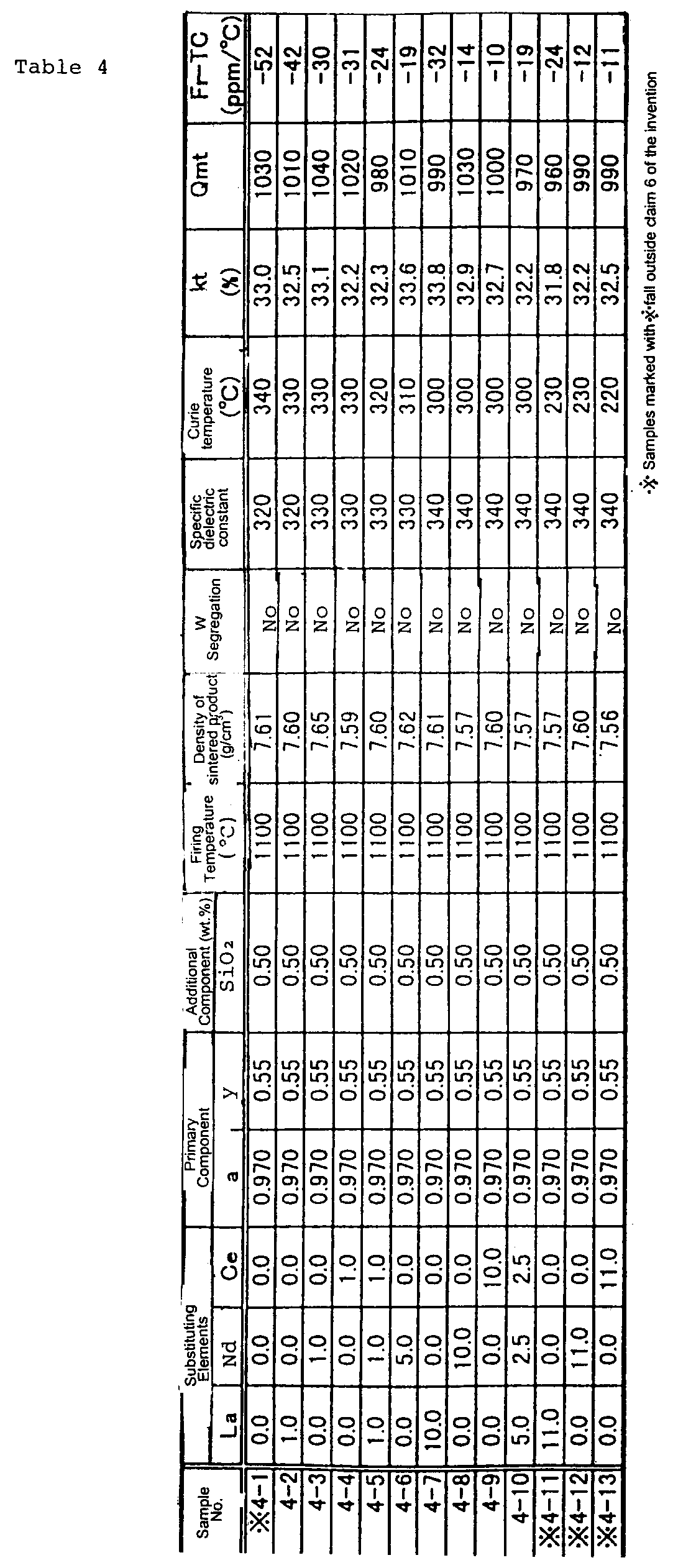
- Example 4 In a manner similar to that of Example 1, the above-prepared samples were evaluated in terms of density of sintered product, segregation of W, specific dielectric constant, Curie temperature, and piezoelectric characteristics. The results are shown in Table 4. In Table 4, samples marked with fall outside the scope of claim 6 of the invention.
- the range of "a” is limited to fall the range 0.9 ⁇ a ⁇ 0.99, wherein “a” represent the amount of PbTiO 3 or (Pb (1-3x/2) M x )TiO 3 and "(1-a)” represents the amount of Pb(Mn y W (1-y) )O 3 .
- Sample No. 3-1 in which "a” is less than 0.9, exhibits low insulation resistance and Curie temperature and can be polarized only through a particular method. Thus, polarization treatment is insufficient. In contrast, when "a” is in excess of 0.99, sintering at low temperature is difficult, and such ceramic material must be fired at 1150°C or higher, preferably 1250°C or higher.
- the range of "y” is limited to 1/2 ⁇ y ⁇ 2/3, wherein "y” represents the amount of Mn and "(1-y)" represents the amount of W.
- y falls outside of the above range as in the case of Sample Nos. 3-6 and 3-9, sintering at low temperature is difficult, and such ceramic material must be fired at 1150°C or higher, preferably 1250°C or higher.
- SiO 2 or PbSiO 3 is added in an amount of 2.0 wt.% or less as reduced to SiO 2 with respect to 100 wt.% of the above primary component. This is because, as in the case of Sample No. 3-16, when SiO 2 is added in an amount more than 2.0 wt.%, electromechanical coupling constant is disadvantageously low.
- the piezoelectric ceramic material of the present invention comprises lead titanate as a primary component; an Mn-containing oxide or an Mn-containing compound and a W-containing compound or a W-containing oxide as secondary components; and an Si-containing oxide or an Si-containing compound as an additional component.
- the ceramic material provides a piezoelectric ceramic having a high Curie temperature and a low dielectric constant and suppresses segregation of a W-containing oxide or compound in the produced ceramic.
- the present invention also provides a piezoelectric ceramic material which comprises lead titanate as a primary component; an Mn-containing oxide or an Mn-containing compound and a W-containing compound or a W-containing oxide as secondary components; and an Si-containing oxide or an Si-containing compound as an additional component, wherein 15 mol% or less (0 mol% excluded) of Pb in the lead titanate are substituted by at least one of lanthanum, neodymium, and cerium.
- the ceramic material provides a piezoelectric ceramic having a high Curie temperature and a low dielectric constant; lowers sintering temperature; and suppresses evaporation of Pb, thereby reducing variation in piezoelectric characteristics and attaining high mechanical quality factor (Qmt).
- the ceramic material also suppresses segregation of a W-containing oxide or compound in the produced ceramic.
- temperature characteristics of piezoelectric ceramics can be enhanced as compared to piezoelectric ceramics produced from a non-substituted similar ceramic material.
- the Mn-containing oxide or compound is incorporated in an amount of 0.1-5.0 wt.% as reduced to MnO and the W-containing oxide or compound is incorporated in an amount of 0.1-5.0 wt.% as reduced to WO 3 into the above primary component.
- sintering temperature is lowered and mechanical quality factor can be enhanced more considerably.
- the Si-containing oxide or compound is added in an amount of 2.0 wt.% or less (0 wt.% excluded) as reduced to SiO 2 to 100 wt.% of the sum of the above primary component and the above secondary components.
- the present invention also provides a piezoelectric ceramic material which comprises a primary component containing PbTiO 3 and Pb(Mn y W (1-y) )O 3 and an additional component of SiO 2 or PbSiO 3 .
- the ceramic material yields a piezoelectric ceramic having a high Curie temperature and a low dielectric constant, and suppresses segregation of a W-containing oxide or compound in the produced ceramic.
- the present invention also provides a piezoelectric ceramic material which comprises a primary component containing (Pb (1-3x/2) M x )TiO 3 and Pb(Mn y W (1-y) )O 3 (M represents at least one species selected from among La, Nd, and Ce; 0 ⁇ x ⁇ 0.1; and 0 ⁇ y ⁇ 1) and additionally SiO 2 or PbSiO 3 .
- the ceramic material having such a composition provides a piezoelectric ceramic having a high Curie temperature and a low dielectric constant; lowers sintering temperature; and suppresses evaporation of Pb, thereby reducing variation in piezoelectric characteristics and attaining high mechanical quality factor (Qmt).
- the ceramic material also suppresses segregation of a W-containing oxide or compound in the produced ceramic.
- temperature characteristics of piezoelectric ceramics can be enhanced as compared to piezoelectric ceramics produced from a non-substituted similar ceramic material.
- the amount by mol of (Pb (1-3x/2) M x )TiO 3 , represented by "a,” and the amount by mol of Pb(Mn y W (1-y) )O 3 , represented by "(1-a)" has the relationship: 0.9 ⁇ a ⁇ 0.99; 1/2 ⁇ y ⁇ 2/3.
- sintering temperature is lowered and mechanical quality factor can be enhanced more considerably.
- the piezoelectric ceramic material of the present invention preferably comprises 100 wt.% of the aforementioned primary component and 2.0 wt.% or less (0 wt.% excluded) of additional SiO 2 or PbSiO 3 as reduced to SiO 2 .
- additional SiO 2 or PbSiO 3 as reduced to SiO 2 .
- the present invention also provides a monolithic piezoelectric transducer which comprises a laminated body including a plate-shaped piezoelectric ceramic prepared from the piezoelectric ceramic material of the present invention, vibration electrodes disposed on both primary surfaces of the piezoelectric ceramic, and lead electrodes each being connected to one of the vibration electrodes and formed to extend to a side face of the piezoelectric ceramic; and external electrodes provided on the side faces containing the lead electrodes.
- the monolithic piezoelectric transducer has excellent heat resistance and suitable for employing in a high-frequency region.
Landscapes
- Engineering & Computer Science (AREA)
- Chemical & Material Sciences (AREA)
- Ceramic Engineering (AREA)
- Manufacturing & Machinery (AREA)
- Materials Engineering (AREA)
- Structural Engineering (AREA)
- Organic Chemistry (AREA)
- Power Engineering (AREA)
- Compositions Of Oxide Ceramics (AREA)
Abstract
Description


Claims (9)
- A piezoelectric ceramic material which comprises lead titanate as a primary component; an Mn-containing oxide or an Mn-containing compound, and a W-containing compound or a W-containing oxide as secondary components; and an Si-containing oxide or an Si-containing compound as an additional component.
- A piezoelectric ceramic material which comprises lead titanate as a primary component; an Mn-containing oxide or an Mn-containing compound, and a W-containing compound or a W-containing oxide as secondary components; and an Si-containing oxide or an Si-containing compound as an additional component, wherein 15 mol% or less (0 mol% excluded) of Pb in the lead titanate is substituted by at least one element selected from among lanthanum, neodymium, and cerium.
- A piezoelectric ceramic material according to claim 1 or 2, wherein the Mn-containing oxide or compound is incorporated in an amount of 0.1-5.0 wt.% as reduced to MnO, and the W-containing oxide or compound is incorporated in an amount of 0.1-5.0 wt.% as reduced to WO3, the weight percentages being on the basis of the primary component.
- A piezoelectric ceramic material according to claim 1 or 2, wherein the Si-containing oxide or compound is added in an amount of 2.0 wt.% or less (0 wt.% excluded) as reduced to SiO2, with respect to the sum of the primary component and the secondary components.
- A piezoelectric ceramic material comprising a primary component containing PbTiO3 and Pb(MnyW(1-y))O3 and additionally SiO2 or PbSiO3.
- A piezoelectric ceramic material comprising a primary component containing (Pb(1-3x/2))Mx)TiO3 and Pb(MnyW(1-y))O3 (M represents at least one species selected from among La, Nd, and Ce; 0 < x ≤ 0.1; and 0 < y < 1) and additionally SiO2 or PbSiO3.
- The piezoelectric ceramic material according to claim 5 or 6, wherein the primary component comprises "a" mol of (Pb(1-3x/2))Mx)TiO3 and "(1-a)" mol of Pb(MnyW(1-y))O3 (0.9 ≤ a ≤ 0.99; 1/2 ≤ y ≤ 2/3).
- The piezoelectric ceramic material according to any one of claims 5 through 7, which comprises 100 wt.% of the primary component and 2.0 wt.% or less (0 wt.% excluded) of the SiO2 or PbSiO3 as reduced to SiO2.
- A monolithic piezoelectric transducer which comprises a laminated body including a plate-shaped piezoelectric ceramic prepared from the piezoelectric ceramic material as recited in any one of claims 1 through 7 and vibration electrodes disposed on the piezoelectric ceramic; and external electrodes electrically connected to the vibration electrodes included in the laminated body.
Applications Claiming Priority (2)
| Application Number | Priority Date | Filing Date | Title |
|---|---|---|---|
| JP25354999 | 1999-09-07 | ||
| JP25354999A JP2001080956A (en) | 1999-09-07 | 1999-09-07 | Piezoelectric ceramic and laminated piezoelectric vibrator using the same |
Publications (2)
| Publication Number | Publication Date |
|---|---|
| EP1083611A2 true EP1083611A2 (en) | 2001-03-14 |
| EP1083611A3 EP1083611A3 (en) | 2004-01-21 |
Family
ID=17252926
Family Applications (1)
| Application Number | Title | Priority Date | Filing Date |
|---|---|---|---|
| EP00119590A Withdrawn EP1083611A3 (en) | 1999-09-07 | 2000-09-07 | Piezoelectric ceramic material and monolithic piezoelectric transducer employing the ceramic material |
Country Status (6)
| Country | Link |
|---|---|
| US (1) | US6379580B1 (en) |
| EP (1) | EP1083611A3 (en) |
| JP (1) | JP2001080956A (en) |
| KR (1) | KR20010039868A (en) |
| CN (1) | CN1167083C (en) |
| TW (1) | TWI241283B (en) |
Families Citing this family (1)
| Publication number | Priority date | Publication date | Assignee | Title |
|---|---|---|---|---|
| EP2624322B1 (en) * | 2012-01-31 | 2014-07-23 | FESTO AG & Co. KG | Method and device for producing piezo transducers |
Family Cites Families (6)
| Publication number | Priority date | Publication date | Assignee | Title |
|---|---|---|---|---|
| US3372121A (en) * | 1965-03-15 | 1968-03-05 | Ngk Spark Plug Co | Piezoelectric and electrostrictive ceramic articles of lead zirconate titanate containing manganese and tungsten oxides |
| GB1199438A (en) * | 1966-10-26 | 1970-07-22 | Fujitsu Ltd | Piezo-Electric Ceramics Composition |
| US3856693A (en) * | 1972-12-18 | 1974-12-24 | Bell Telephone Labor Inc | Method for producing lead zirconate titanate polycrystalline ceramics |
| JPS5747768A (en) * | 1980-09-05 | 1982-03-18 | Murata Manufacturing Co | Piezoelectric ceramic composition |
| JP3384043B2 (en) * | 1993-07-19 | 2003-03-10 | 株式会社村田製作所 | Piezoelectric ceramic |
| JP3198906B2 (en) * | 1995-12-20 | 2001-08-13 | 株式会社村田製作所 | Piezoelectric porcelain composition |
-
1999
- 1999-09-07 JP JP25354999A patent/JP2001080956A/en active Pending
-
2000
- 2000-09-05 TW TW089118127A patent/TWI241283B/en active
- 2000-09-07 EP EP00119590A patent/EP1083611A3/en not_active Withdrawn
- 2000-09-07 US US09/656,778 patent/US6379580B1/en not_active Expired - Fee Related
- 2000-09-07 KR KR1020000053066A patent/KR20010039868A/en not_active Ceased
- 2000-09-07 CN CNB001288393A patent/CN1167083C/en not_active Expired - Fee Related
Also Published As
| Publication number | Publication date |
|---|---|
| US6379580B1 (en) | 2002-04-30 |
| TWI241283B (en) | 2005-10-11 |
| JP2001080956A (en) | 2001-03-27 |
| EP1083611A3 (en) | 2004-01-21 |
| CN1167083C (en) | 2004-09-15 |
| KR20010039868A (en) | 2001-05-15 |
| CN1288238A (en) | 2001-03-21 |
Similar Documents
| Publication | Publication Date | Title |
|---|---|---|
| JP4929522B2 (en) | Piezoelectric ceramic composition | |
| JP2001508753A (en) | Low loss PZT ceramic compositions that can be fired with silver at low sintering temperatures and methods for making the same | |
| US6806625B2 (en) | Piezoelectric ceramic composition and piezoelectric element | |
| JP2001019542A (en) | Piezoelectric ceramics and piezoelectric devices using the same | |
| JP2001240471A (en) | Piezoelectric ceramic composition and piezoelectric resonator | |
| JP3788198B2 (en) | Piezoelectric ceramic composition and piezoelectric ceramic element using the same | |
| JP3671791B2 (en) | Piezoelectric ceramic composition and piezoelectric ceramic element using the same | |
| KR100305167B1 (en) | Piezoelectric ceramic composition and piezoelectric device using the same | |
| JP4493226B2 (en) | Piezoelectric ceramic and piezoelectric element | |
| JP5158516B2 (en) | Piezoelectric ceramic composition and piezoelectric element | |
| EP0780350B1 (en) | Piezoelectric ceramic composition | |
| JP4432969B2 (en) | Piezoelectric ceramic composition and piezoelectric element | |
| JP3791299B2 (en) | Piezoelectric ceramic composition and piezoelectric ceramic element using the same | |
| EP0739866B1 (en) | Piezoelectric ceramics | |
| JP3613140B2 (en) | Piezoelectric ceramic composition and piezoelectric ceramic element using the same | |
| EP1083611A2 (en) | Piezoelectric ceramic material and monolithic piezoelectric transducer employing the ceramic material | |
| JP2004323325A (en) | Piezoelectric ceramic and piezoelectric ceramic element using the same | |
| JP3419679B2 (en) | Piezoelectric ceramics | |
| JP2866986B2 (en) | Piezoelectric ceramic composition | |
| JP4092542B2 (en) | Piezoelectric porcelain composition and piezoelectric element using the same | |
| JP4003920B2 (en) | Piezoelectric ceramic composition, piezoelectric ceramic sintered body and electronic component | |
| JP3912098B2 (en) | Piezoelectric ceramic composition and piezoelectric ceramic element using the same | |
| JP4467168B2 (en) | Piezoelectric ceramic and piezoelectric element | |
| KR100604148B1 (en) | Piezoelectric Ceramics Composition and Manufacturing Method Thereof | |
| JP2737451B2 (en) | Piezoelectric material |
Legal Events
| Date | Code | Title | Description |
|---|---|---|---|
| PUAI | Public reference made under article 153(3) epc to a published international application that has entered the european phase |
Free format text: ORIGINAL CODE: 0009012 |
|
| 17P | Request for examination filed |
Effective date: 20000907 |
|
| AK | Designated contracting states |
Kind code of ref document: A2 Designated state(s): AT BE CH CY DE DK ES FI FR GB GR IE IT LI LU MC NL PT SE |
|
| AX | Request for extension of the european patent |
Free format text: AL;LT;LV;MK;RO;SI |
|
| PUAL | Search report despatched |
Free format text: ORIGINAL CODE: 0009013 |
|
| AK | Designated contracting states |
Kind code of ref document: A3 Designated state(s): AT BE CH CY DE DK ES FI FR GB GR IE IT LI LU MC NL PT SE |
|
| AX | Request for extension of the european patent |
Extension state: AL LT LV MK RO SI |
|
| RIC1 | Information provided on ipc code assigned before grant |
Ipc: 7C 04B 35/472 B Ipc: 7H 01L 41/187 A |
|
| 17Q | First examination report despatched |
Effective date: 20040506 |
|
| AKX | Designation fees paid |
Designated state(s): DE FR GB |
|
| RAP1 | Party data changed (applicant data changed or rights of an application transferred) |
Owner name: MURATA MANUFACTURING CO., LTD. |
|
| STAA | Information on the status of an ep patent application or granted ep patent |
Free format text: STATUS: THE APPLICATION IS DEEMED TO BE WITHDRAWN |
|
| 18D | Application deemed to be withdrawn |
Effective date: 20120403 |