EP1083210A2 - Phosphate treated silicate phosphor - Google Patents
Phosphate treated silicate phosphor Download PDFInfo
- Publication number
- EP1083210A2 EP1083210A2 EP00119007A EP00119007A EP1083210A2 EP 1083210 A2 EP1083210 A2 EP 1083210A2 EP 00119007 A EP00119007 A EP 00119007A EP 00119007 A EP00119007 A EP 00119007A EP 1083210 A2 EP1083210 A2 EP 1083210A2
- Authority
- EP
- European Patent Office
- Prior art keywords
- phosphor
- phosphate
- basi
- surface layer
- treated
- Prior art date
- Legal status (The legal status is an assumption and is not a legal conclusion. Google has not performed a legal analysis and makes no representation as to the accuracy of the status listed.)
- Granted
Links
Images
Classifications
-
- C—CHEMISTRY; METALLURGY
- C09—DYES; PAINTS; POLISHES; NATURAL RESINS; ADHESIVES; COMPOSITIONS NOT OTHERWISE PROVIDED FOR; APPLICATIONS OF MATERIALS NOT OTHERWISE PROVIDED FOR
- C09K—MATERIALS FOR MISCELLANEOUS APPLICATIONS, NOT PROVIDED FOR ELSEWHERE
- C09K11/00—Luminescent materials, e.g. electroluminescent or chemiluminescent
- C09K11/08—Luminescent materials, e.g. electroluminescent or chemiluminescent containing inorganic luminescent materials
- C09K11/59—Luminescent materials, e.g. electroluminescent or chemiluminescent containing inorganic luminescent materials containing silicon
- C09K11/592—Chalcogenides
- C09K11/595—Chalcogenides with zinc or cadmium
-
- C—CHEMISTRY; METALLURGY
- C09—DYES; PAINTS; POLISHES; NATURAL RESINS; ADHESIVES; COMPOSITIONS NOT OTHERWISE PROVIDED FOR; APPLICATIONS OF MATERIALS NOT OTHERWISE PROVIDED FOR
- C09K—MATERIALS FOR MISCELLANEOUS APPLICATIONS, NOT PROVIDED FOR ELSEWHERE
- C09K11/00—Luminescent materials, e.g. electroluminescent or chemiluminescent
- C09K11/02—Use of particular materials as binders, particle coatings or suspension media therefor
- C09K11/025—Use of particular materials as binders, particle coatings or suspension media therefor non-luminescent particle coatings or suspension media
-
- C—CHEMISTRY; METALLURGY
- C09—DYES; PAINTS; POLISHES; NATURAL RESINS; ADHESIVES; COMPOSITIONS NOT OTHERWISE PROVIDED FOR; APPLICATIONS OF MATERIALS NOT OTHERWISE PROVIDED FOR
- C09K—MATERIALS FOR MISCELLANEOUS APPLICATIONS, NOT PROVIDED FOR ELSEWHERE
- C09K11/00—Luminescent materials, e.g. electroluminescent or chemiluminescent
- C09K11/08—Luminescent materials, e.g. electroluminescent or chemiluminescent containing inorganic luminescent materials
- C09K11/59—Luminescent materials, e.g. electroluminescent or chemiluminescent containing inorganic luminescent materials containing silicon
- C09K11/592—Chalcogenides
-
- C—CHEMISTRY; METALLURGY
- C09—DYES; PAINTS; POLISHES; NATURAL RESINS; ADHESIVES; COMPOSITIONS NOT OTHERWISE PROVIDED FOR; APPLICATIONS OF MATERIALS NOT OTHERWISE PROVIDED FOR
- C09K—MATERIALS FOR MISCELLANEOUS APPLICATIONS, NOT PROVIDED FOR ELSEWHERE
- C09K11/00—Luminescent materials, e.g. electroluminescent or chemiluminescent
- C09K11/08—Luminescent materials, e.g. electroluminescent or chemiluminescent containing inorganic luminescent materials
- C09K11/66—Luminescent materials, e.g. electroluminescent or chemiluminescent containing inorganic luminescent materials containing germanium, tin or lead
- C09K11/666—Aluminates; Silicates
-
- H—ELECTRICITY
- H01—ELECTRIC ELEMENTS
- H01J—ELECTRIC DISCHARGE TUBES OR DISCHARGE LAMPS
- H01J61/00—Gas-discharge or vapour-discharge lamps
- H01J61/02—Details
- H01J61/38—Devices for influencing the colour or wavelength of the light
- H01J61/42—Devices for influencing the colour or wavelength of the light by transforming the wavelength of the light by luminescence
- H01J61/46—Devices characterised by the binder or other non-luminescent constituent of the luminescent material, e.g. for obtaining desired pouring or drying properties
Definitions
- This invention relates to silicate-based phosphors, and especially to lead activated barium disilicate (BaSi 2 O 5 :Pb), used in fluorescent lighting applications. More particularly, it relates to improved maintenance of silicate phosphors in fluorescent lamps.
- Typical silicate phosphors used in fluorescent lighting applications include BaSi 2 O 5 :Pb, Zn 2 SiO 4 :Mn and CaSiO 3 :Pb,Mn.
- BaSi 2 O 5 :Pb which is used as the long-wavelength UV (347 nm) phosphor in fluorescent suntanning lamps. Its preparation and use have been described in U.S. Patent Nos. 2,597,631, 3,043,781, and 5,234,625 which are incorporated herein by reference.
- a well-known drawback to the use of this phosphor, and silicate phosphors in general, is that lumen maintenance in fluorescent lamps is poor relative to other fluorescent lamp phosphors. That is, fluorescent lamps employing silicate phosphors exhibit a relatively rapid decrease in brightness over time.
- a phosphate treated silicate phosphor having a protective phosphate-containing surface layer.
- a method for treating a silicate phosphor comprising mixing the phosphor in an aqueous phosphate solution for a time sufficient to induce the formation of phosphate-containing surface layer, separating the phosphor from the solution, and annealing the phosphor to form a protective phosphate-containing surface layer.
- the present invention is a silicate phosphor having a protective phosphate-containing surface layer.
- the phosphate-containing layer may be formed on solid-state silicate phosphors that have been previously prepared by any synthetic technique. Silicate phosphors treated in this way exhibit improved retention of their initial lumen output during operation of a lamp.
- the protective phosphate-containing surface layer refers to a region at the surface of the silicate phosphor particles which contains an amount of a phosphate.
- phosphate means any group of bound oxygen and phosphorus atoms, including but not limited to, phosphate, PO 4 -3 , and pyrophosphate, P 2 O 7 -4 , either alone or in combination with other elements such as hydrogen.
- the protective surface layer is applied by treating the phosphor directly with an aqueous phosphate solution, dried, and annealed to create a phosphor particle which is covered with a phosphate-containing layer.
- the phosphate-containing layer is formed by first leaching the phosphor particle surface of cations (Ba 2+ , Pb 2+ ) with an acid solution, e.g. citric acid, in order to create a reactive silica shell on the particle surface. The leached surface is then treated with the aqueous phosphate solution, dried and annealed.
- the layer can be formed by dry blending a phosphate source with a silicate phosphor and annealing. In the last instance, smaller amounts of phosphate are preferred.
- the protective phosphate-containing layer is applied to the surface of a BaSi 2 O 5 :Pb phosphor which has been previously prepared by conventional solid state synthetic methods and which exhibits luminescence characteristics suitable for application in suntanning lamps.
- the phosphor may or may not be acid washed prior to the treatment.
- the phosphate-containing layer is formed by mixing the phosphor in an aqueous phosphate solution containing from about 2 to about 5 moles/liter phosphorus in a ratio of about 1:1 to about 6:1 moles of phosphorus to moles of phosphor.
- the phosphate solution is a solution of diammonium phosphate (DAP).
- phosphate salts such as sodium tripolyphosphate (Na 5 P 3 O 10 ), or organo-phosphate compounds like triethyl phosphate, could also reasonably be used within the context of the present invention.
- Mixing can be carried out at any reasonable solution temperature for times of 30 minutes or more. Following mixing, the solution is filtered and the treated phosphor dried and annealed at temperatures from about 800°C to about 1100°C for about 2 hours to about 8 hours. The treated phosphor, after washing with water and drying, is ready for use in a fluorescent lamp.
- the phosphor was a BaSi 2 O 5 :Pb phosphor made by OSRAM SYVANIA Products, Inc., Towanda, PA, (Type 2011C).
- the phosphor in this example was treated as in Example 1, except that the annealing was done for 7 hours at 1050°C.
- the surface compositions of the phosphate treated phosphors are compared to that of the untreated phosphor in Table 1.
- the surface compositions were measured using ESCA (Electron Spectroscopy for Chemical Analysis) which probes the outermost 10 to 30 angstroms of the surface.
- the presence of the phosphate-containing surface layer on the treated phosphors is evidenced by the presence of 2.7 - 3.2 percent atomic phosphorus and the reduction in the surface concentrations of barium and silicon.
- Example 2 5.0 22 0.2 2.7
- Example 3 4.5 20 0.2 3.2 Untreated standard 6.5 24 0.3 0.2
- X-ray diffraction and Raman spectroscopy Further evidence for the formation of a protective phosphate-containing surface layer is provided by X-ray diffraction and Raman spectroscopy.
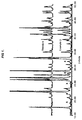
- the X-ray diffraction patterns for a treated phosphor (Example 2) and the untreated standard are compared in Figure 1.
- the untreated standard exhibits reflections for BaSi 2 O 5 , as well as for some excess SiO 2 .
- the treated phosphor exhibits additional 2 ⁇ angle reflections at 18.8°, 25.0°, 28.2° and 32.0° which are shown marked with an "x". These additional reflections most closely match those of Ba 3 (PO 4 ) 2 .
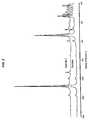
- Raman spectra of the treated phosphor and untreated standard are compared in Figure 2.
- the Raman spectrum of the untreated standard material is characterized by two intense peaks at about 540 and 1075 cm -1 .
- the treated material contains additional peaks at 410, 560, 930 and 1020 cm -1 .
- the peaks at 930 and 1020 cm -1 have been associated with (PO 4 3- ) and (P 2 O 7 4- ) groups in phosphorus doped silicate glasses (e.g., B. Mysen, American Mineralogist 81, pp. 1531-1534, (1996)).
Landscapes
- Chemical & Material Sciences (AREA)
- Engineering & Computer Science (AREA)
- Materials Engineering (AREA)
- Organic Chemistry (AREA)
- Inorganic Chemistry (AREA)
- Luminescent Compositions (AREA)
- Silicates, Zeolites, And Molecular Sieves (AREA)
- Vessels And Coating Films For Discharge Lamps (AREA)
Abstract
Description
| Surface Composition (% atomic) | ||||
| Sample | Ba | Si | Pb | P |
| Example 1 | 4.8 | 23 | 0.2 | 2.8 |
| Example 2 | 5.0 | 22 | 0.2 | 2.7 |
| Example 3 | 4.5 | 20 | 0.2 | 3.2 |
| Untreated standard | 6.5 | 24 | 0.3 | 0.2 |
| Sample | 0 hr. (lumens) | 100 hr. (lumens) | %M |
| Example 1 | 15873 | 13985 | 88.1 |
| Example 2 | 16132 | 14077 | 87.3 |
| Example 3 | 16698 | 14161 | 84.8 |
| Untreated standard | 17109 | 13918 | 81.3 |
Claims (15)
- A phosphate treated silicate phosphor having a protective phosphate-containing surface layer.
- The phosphor of claim 1 wherein the phosphor has a Raman spectrum having peaks at 930 and 1020 cm-1.
- The phosphor of claim 1 wherein the phosphor is selected from the group consisting of BaSi2O5:Pb, Zn2SiO4:Mn and CaSiO3:Pb,Mn.
- The phosphor of claim 3 wherein the phosphor is BaSi2O5:Pb.
- The phosphor of claim 4 wherein the phosphor has an x-ray diffraction pattern having 2 angle reflections at 18.8°, 25.0°, 28.2° and 32.0°.
- The phosphor of claim 4 wherein lumen maintenance of the phosphor in a fluorescent lamp is increased by at least about 4% as compared to the same phosphor without the phosphate treatment.
- A method for treating a silicate phosphor comprising mixing the phosphor in an aqueous phosphate solution for a time sufficient to induce the formation of phosphate-containing surface layer, separating the phosphor from the solution, and annealing the phosphor to form a protective phosphate-containing surface layer.
- The method of claim 7 wherein the phosphor surface is leached with an acid solution prior to mixing with the aqueous phosphate solution.
- The method of claim 8 wherein the acid solution contains citric acid.
- The method of claim 9 wherein the phosphor is BaSi2O5:Pb.
- The method of claim 7 wherein the phosphor is annealed at a temperature from about 800°C to about 1100°C for about 2 hours to about 8 hours.
- The method of claim 7 wherein the aqueous phosphate solution contains a phosphate selected from the group consisting of diammonium phosphate, sodium tripolyphosphate and triethyl phosphate.
- The method of claim 12 wherein the aqueous phosphate solution contains diammonium phosphate.
- The method of claim 13 wherein the phosphor is BaSi2O5:Pb.
- The method of claim 7 wherein the phosphor is selected from the group consisting of BaSi2O5:Pb, Zn2SiO4:Mn and CaSiO3:Pb,Mn.
Applications Claiming Priority (2)
| Application Number | Priority Date | Filing Date | Title |
|---|---|---|---|
| US09/392,891 US6303051B1 (en) | 1999-09-09 | 1999-09-09 | Phosphate treated silicate phosphor |
| US392891 | 1999-09-09 |
Publications (3)
| Publication Number | Publication Date |
|---|---|
| EP1083210A2 true EP1083210A2 (en) | 2001-03-14 |
| EP1083210A3 EP1083210A3 (en) | 2002-01-23 |
| EP1083210B1 EP1083210B1 (en) | 2005-12-14 |
Family
ID=23552440
Family Applications (1)
| Application Number | Title | Priority Date | Filing Date |
|---|---|---|---|
| EP00119007A Expired - Lifetime EP1083210B1 (en) | 1999-09-09 | 2000-09-01 | Phosphate treated silicate phosphor |
Country Status (6)
| Country | Link |
|---|---|
| US (1) | US6303051B1 (en) |
| EP (1) | EP1083210B1 (en) |
| JP (1) | JP2001089761A (en) |
| AT (1) | ATE312894T1 (en) |
| DE (1) | DE60024740T2 (en) |
| HU (1) | HUP0003552A3 (en) |
Cited By (1)
| Publication number | Priority date | Publication date | Assignee | Title |
|---|---|---|---|---|
| CN104350127A (en) * | 2012-06-08 | 2015-02-11 | 电气化学工业株式会社 | Method for treating surface of phosphor, phosphor, light-emitting device, and illumination device |
Families Citing this family (7)
| Publication number | Priority date | Publication date | Assignee | Title |
|---|---|---|---|---|
| CA2590400A1 (en) * | 2004-10-29 | 2006-05-04 | Ifire Ip Corporation | Novel thiosilicate phosphor compositions and deposition methods using barium-silicon vacuum deposition sources for deposition of thiosilicate phosphor films |
| CN101343535B (en) * | 2008-08-19 | 2011-03-16 | 暨南大学 | Method for coating alumine acid strontium long afterglow luminescent powder surface |
| DE102009044255A1 (en) * | 2009-10-15 | 2011-04-28 | Leuchtstoffwerk Breitungen Gmbh | Alkaline earth metal silicate phosphors and methods for improving their long-term stability |
| JP2013040236A (en) * | 2011-08-11 | 2013-02-28 | Sekisui Chem Co Ltd | Method for producing surface-treated phosphor and surface-treated phosphor |
| US20170145306A1 (en) * | 2014-06-18 | 2017-05-25 | Panasonic Intellectual Property Management Co., Ltd. | Method of manufacturing surface-treated phosphor, surface-treated phosphor, wavelength conversion member, and light emission device |
| JP2016027077A (en) * | 2014-06-30 | 2016-02-18 | パナソニックIpマネジメント株式会社 | Method for producing surface-treated phosphor, surface-treated phosphor obtained by this method, wavelength conversion member and light-emitting device using the same |
| CN113285335B (en) * | 2021-05-20 | 2022-07-19 | 深圳市铭创光电有限公司 | Mixed gain semi-open cavity structure 2um optical fiber random laser |
Family Cites Families (9)
| Publication number | Priority date | Publication date | Assignee | Title |
|---|---|---|---|---|
| DE3634886A1 (en) * | 1986-10-14 | 1988-04-21 | Licentia Gmbh | Process for covering luminescent particles |
| JPH07779B2 (en) * | 1987-02-16 | 1995-01-11 | 化成オプトニクス株式会社 | Surface-treated phosphor and its manufacturing method |
| US5039449A (en) * | 1988-11-07 | 1991-08-13 | Gte Laboratories Incorporated | Method for improving a manganese activated zinc silicate phosphor |
| JPH04356584A (en) * | 1990-08-07 | 1992-12-10 | Sumitomo Chem Co Ltd | Stimulable phosphor for el lamp |
| EP0714967B1 (en) * | 1994-12-01 | 1999-03-03 | Philips Patentverwaltung GmbH | Luminescent screen with a luminescent composition |
| JP3758203B2 (en) * | 1995-05-26 | 2006-03-22 | 日亜化学工業株式会社 | Vacuum ultraviolet-excited luminescent phosphor and method for producing the same |
| DE19727607C2 (en) * | 1997-06-28 | 2000-11-23 | Philips Corp Intellectual Pty | Plasma screen with a UV phosphor preparation and UV phosphor preparation |
| EP1047749B1 (en) * | 1998-08-25 | 2005-07-13 | Koninklijke Philips Electronics N.V. | Method of coating a luminescent material |
| JP3977551B2 (en) * | 1999-04-16 | 2007-09-19 | 化成オプトニクス株式会社 | Fluorescent substance for vacuum ultraviolet ray, phosphor paste composition, and vacuum ultraviolet ray excited light emitting device |
-
1999
- 1999-09-09 US US09/392,891 patent/US6303051B1/en not_active Expired - Fee Related
-
2000
- 2000-09-01 AT AT00119007T patent/ATE312894T1/en not_active IP Right Cessation
- 2000-09-01 EP EP00119007A patent/EP1083210B1/en not_active Expired - Lifetime
- 2000-09-01 DE DE60024740T patent/DE60024740T2/en not_active Expired - Lifetime
- 2000-09-08 HU HU0003552A patent/HUP0003552A3/en unknown
- 2000-09-08 JP JP2000272881A patent/JP2001089761A/en active Pending
Cited By (2)
| Publication number | Priority date | Publication date | Assignee | Title |
|---|---|---|---|---|
| CN104350127A (en) * | 2012-06-08 | 2015-02-11 | 电气化学工业株式会社 | Method for treating surface of phosphor, phosphor, light-emitting device, and illumination device |
| CN104350127B (en) * | 2012-06-08 | 2017-02-22 | 电化株式会社 | Method for treating surface of phosphor, phosphor, light-emitting device, and illumination device |
Also Published As
| Publication number | Publication date |
|---|---|
| EP1083210A3 (en) | 2002-01-23 |
| JP2001089761A (en) | 2001-04-03 |
| US6303051B1 (en) | 2001-10-16 |
| DE60024740T2 (en) | 2006-06-29 |
| HU0003552D0 (en) | 2000-09-08 |
| EP1083210B1 (en) | 2005-12-14 |
| DE60024740D1 (en) | 2006-01-19 |
| HUP0003552A3 (en) | 2002-04-29 |
| ATE312894T1 (en) | 2005-12-15 |
| HUP0003552A2 (en) | 2001-05-28 |
Similar Documents
| Publication | Publication Date | Title |
|---|---|---|
| US5382452A (en) | Luminescent materials prepared by coating luminescent compositions onto substrate particles | |
| US5643674A (en) | Luminescent materials prepared by coating luminescent compositions onto substrate particles | |
| EP1083210B1 (en) | Phosphate treated silicate phosphor | |
| GB2034346A (en) | Treating phosphors for low pressue discharge lamps | |
| EP1108772A2 (en) | Rare earth phosphate, its production process and rare earth phosphate phosphor | |
| CN101362945A (en) | blue light emitting phosphor | |
| WO1999041768A1 (en) | Compact, energy-saving lamp | |
| EP0852254B1 (en) | Phosphor with modified surface composition and method for preparation | |
| US5391959A (en) | Fluorescent lamps and improved yytrium-containing phosphors useful therein | |
| DE19730005C2 (en) | Silicate borate phosphors | |
| US5651920A (en) | Small-sized lanthanum cerium terbium phosphate phosphors and method of making | |
| FI92217C (en) | Loisteainehiukkanen | |
| EP1048054B1 (en) | Luminescent material | |
| US7309454B2 (en) | UV-emitting strontium borate phosphor with improved holdover stability | |
| JPH10273654A5 (en) | ||
| JPH11172244A (en) | Phosphor, its manufacturing method and fluorescent lamp | |
| JPS62132990A (en) | Production of fluorescent material | |
| EP0962514B1 (en) | Cation-treated silicate phosphor | |
| KR960000475B1 (en) | Fluorescent material and method for preparing therof | |
| CN1244665C (en) | Coating method of luminescent material | |
| US7232531B2 (en) | Method of removing impurities from a SrB4O7:Eu phosphor | |
| JP2002523550A5 (en) | ||
| Dafinova et al. | Tin as reducing agent in doped alkali-earth fluorophosphates | |
| KR860000940B1 (en) | Phosphor and low pressure mercury vapor discharge lamp using this phosphor | |
| TW385329B (en) | Luminescent powder compositions and processes for preparing same |
Legal Events
| Date | Code | Title | Description |
|---|---|---|---|
| PUAI | Public reference made under article 153(3) epc to a published international application that has entered the european phase |
Free format text: ORIGINAL CODE: 0009012 |
|
| AK | Designated contracting states |
Kind code of ref document: A2 Designated state(s): AT BE CH CY DE DK ES FI FR GB GR IE IT LI LU MC NL PT SE |
|
| AX | Request for extension of the european patent |
Free format text: AL;LT;LV;MK;RO;SI |
|
| PUAL | Search report despatched |
Free format text: ORIGINAL CODE: 0009013 |
|
| RIC1 | Information provided on ipc code assigned before grant |
Free format text: 7C 09K 11/02 A, 7C 09K 11/66 B, 7C 09K 11/59 B, 7H 01J 61/46 B |
|
| AK | Designated contracting states |
Kind code of ref document: A3 Designated state(s): AT BE CH CY DE DK ES FI FR GB GR IE IT LI LU MC NL PT SE |
|
| AX | Request for extension of the european patent |
Free format text: AL;LT;LV;MK;RO;SI |
|
| 17P | Request for examination filed |
Effective date: 20020218 |
|
| AKX | Designation fees paid |
Free format text: AT BE CH CY DE DK ES FI FR GB GR IE IT LI LU MC NL PT SE |
|
| 17Q | First examination report despatched |
Effective date: 20040308 |
|
| GRAP | Despatch of communication of intention to grant a patent |
Free format text: ORIGINAL CODE: EPIDOSNIGR1 |
|
| GRAS | Grant fee paid |
Free format text: ORIGINAL CODE: EPIDOSNIGR3 |
|
| GRAA | (expected) grant |
Free format text: ORIGINAL CODE: 0009210 |
|
| AK | Designated contracting states |
Kind code of ref document: B1 Designated state(s): AT BE CH CY DE DK ES FI FR GB GR IE IT LI LU MC NL PT SE |
|
| PG25 | Lapsed in a contracting state [announced via postgrant information from national office to epo] |
Ref country code: LI Free format text: LAPSE BECAUSE OF FAILURE TO SUBMIT A TRANSLATION OF THE DESCRIPTION OR TO PAY THE FEE WITHIN THE PRESCRIBED TIME-LIMIT Effective date: 20051214 Ref country code: AT Free format text: LAPSE BECAUSE OF FAILURE TO SUBMIT A TRANSLATION OF THE DESCRIPTION OR TO PAY THE FEE WITHIN THE PRESCRIBED TIME-LIMIT Effective date: 20051214 Ref country code: FI Free format text: LAPSE BECAUSE OF FAILURE TO SUBMIT A TRANSLATION OF THE DESCRIPTION OR TO PAY THE FEE WITHIN THE PRESCRIBED TIME-LIMIT Effective date: 20051214 Ref country code: CH Free format text: LAPSE BECAUSE OF FAILURE TO SUBMIT A TRANSLATION OF THE DESCRIPTION OR TO PAY THE FEE WITHIN THE PRESCRIBED TIME-LIMIT Effective date: 20051214 |
|
| REG | Reference to a national code |
Ref country code: GB Ref legal event code: FG4D |
|
| REG | Reference to a national code |
Ref country code: CH Ref legal event code: EP |
|
| REG | Reference to a national code |
Ref country code: IE Ref legal event code: FG4D |
|
| REF | Corresponds to: |
Ref document number: 60024740 Country of ref document: DE Date of ref document: 20060119 Kind code of ref document: P |
|
| PG25 | Lapsed in a contracting state [announced via postgrant information from national office to epo] |
Ref country code: SE Free format text: LAPSE BECAUSE OF FAILURE TO SUBMIT A TRANSLATION OF THE DESCRIPTION OR TO PAY THE FEE WITHIN THE PRESCRIBED TIME-LIMIT Effective date: 20060314 Ref country code: GR Free format text: LAPSE BECAUSE OF FAILURE TO SUBMIT A TRANSLATION OF THE DESCRIPTION OR TO PAY THE FEE WITHIN THE PRESCRIBED TIME-LIMIT Effective date: 20060314 Ref country code: DK Free format text: LAPSE BECAUSE OF FAILURE TO SUBMIT A TRANSLATION OF THE DESCRIPTION OR TO PAY THE FEE WITHIN THE PRESCRIBED TIME-LIMIT Effective date: 20060314 |
|
| PG25 | Lapsed in a contracting state [announced via postgrant information from national office to epo] |
Ref country code: ES Free format text: LAPSE BECAUSE OF FAILURE TO SUBMIT A TRANSLATION OF THE DESCRIPTION OR TO PAY THE FEE WITHIN THE PRESCRIBED TIME-LIMIT Effective date: 20060325 |
|
| PG25 | Lapsed in a contracting state [announced via postgrant information from national office to epo] |
Ref country code: PT Free format text: LAPSE BECAUSE OF FAILURE TO SUBMIT A TRANSLATION OF THE DESCRIPTION OR TO PAY THE FEE WITHIN THE PRESCRIBED TIME-LIMIT Effective date: 20060515 |
|
| REG | Reference to a national code |
Ref country code: CH Ref legal event code: PL |
|
| ET | Fr: translation filed | ||
| PG25 | Lapsed in a contracting state [announced via postgrant information from national office to epo] |
Ref country code: IE Free format text: LAPSE BECAUSE OF NON-PAYMENT OF DUE FEES Effective date: 20060901 |
|
| PG25 | Lapsed in a contracting state [announced via postgrant information from national office to epo] |
Ref country code: MC Free format text: LAPSE BECAUSE OF NON-PAYMENT OF DUE FEES Effective date: 20060930 |
|
| PLBE | No opposition filed within time limit |
Free format text: ORIGINAL CODE: 0009261 |
|
| STAA | Information on the status of an ep patent application or granted ep patent |
Free format text: STATUS: NO OPPOSITION FILED WITHIN TIME LIMIT |
|
| 26N | No opposition filed |
Effective date: 20060915 |
|
| REG | Reference to a national code |
Ref country code: IE Ref legal event code: MM4A |
|
| PG25 | Lapsed in a contracting state [announced via postgrant information from national office to epo] |
Ref country code: LU Free format text: LAPSE BECAUSE OF NON-PAYMENT OF DUE FEES Effective date: 20060901 |
|
| PG25 | Lapsed in a contracting state [announced via postgrant information from national office to epo] |
Ref country code: CY Free format text: LAPSE BECAUSE OF FAILURE TO SUBMIT A TRANSLATION OF THE DESCRIPTION OR TO PAY THE FEE WITHIN THE PRESCRIBED TIME-LIMIT Effective date: 20051214 |
|
| PGFP | Annual fee paid to national office [announced via postgrant information from national office to epo] |
Ref country code: DE Payment date: 20101119 Year of fee payment: 11 |
|
| PGFP | Annual fee paid to national office [announced via postgrant information from national office to epo] |
Ref country code: FR Payment date: 20111005 Year of fee payment: 12 Ref country code: GB Payment date: 20110915 Year of fee payment: 12 |
|
| PGFP | Annual fee paid to national office [announced via postgrant information from national office to epo] |
Ref country code: NL Payment date: 20110913 Year of fee payment: 12 Ref country code: IT Payment date: 20110927 Year of fee payment: 12 |
|
| PGFP | Annual fee paid to national office [announced via postgrant information from national office to epo] |
Ref country code: BE Payment date: 20111013 Year of fee payment: 12 |
|
| BERE | Be: lapsed |
Owner name: *OSRAM SYLVANIA INC. Effective date: 20120930 |
|
| REG | Reference to a national code |
Ref country code: NL Ref legal event code: V1 Effective date: 20130401 |
|
| GBPC | Gb: european patent ceased through non-payment of renewal fee |
Effective date: 20120901 |
|
| REG | Reference to a national code |
Ref country code: FR Ref legal event code: ST Effective date: 20130531 |
|
| REG | Reference to a national code |
Ref country code: DE Ref legal event code: R119 Ref document number: 60024740 Country of ref document: DE Effective date: 20130403 |
|
| PG25 | Lapsed in a contracting state [announced via postgrant information from national office to epo] |
Ref country code: DE Free format text: LAPSE BECAUSE OF NON-PAYMENT OF DUE FEES Effective date: 20130403 Ref country code: GB Free format text: LAPSE BECAUSE OF NON-PAYMENT OF DUE FEES Effective date: 20120901 Ref country code: BE Free format text: LAPSE BECAUSE OF NON-PAYMENT OF DUE FEES Effective date: 20120930 |
|
| PG25 | Lapsed in a contracting state [announced via postgrant information from national office to epo] |
Ref country code: NL Free format text: LAPSE BECAUSE OF NON-PAYMENT OF DUE FEES Effective date: 20130401 Ref country code: IT Free format text: LAPSE BECAUSE OF NON-PAYMENT OF DUE FEES Effective date: 20120901 Ref country code: FR Free format text: LAPSE BECAUSE OF NON-PAYMENT OF DUE FEES Effective date: 20121001 |