BACKGROUND OF THE INVENTION
The present invention relates to a magnetic ferrite
material, particularly to an MnZn-based magnetic ferrite
material for a transformer to be used in the magnetic core of
a switching power supply, and the like.
The MnZn-based magnetic ferrite material has
heretofore been used mainly as a transformer material for a
communication apparatus and a power supply. Different from
other magnetic ferrite materials, the MnZn-based magnetic
ferrite material is characterized in that it has a high
saturation magnetic flux density, permeability is also high,
and power loss is low during the use as the transformer.
In order to realize a highly efficient power suplly,
the development of a transformer material with the low
absolute value of the power loss is indispensable. However,
even with the use of the transformer material with the low
power loss, when the minimum value of the power loss is in
the vicinity of the operation temperature of the power supply
(usually, 50 to 70°C), the temperature of the transformer
core rises with the temperature rise of the transformer
material itself, and the power loss increases by generated
heat. Therefore, the power loss is stably reduced by usually
using the transformer material in which the minimum value of
the power loss is set on the side of a higher temperature
(around 100°C) than the vicinity of the power supply
operation temperature.
However, when the magnetic ferrite material is used
in the power supply, in order to sufficiently fulfill
magnetic properties such as the low power loss of the
magnetic ferrite material, it is intrinsically desired to
realize the lower power loss in the vicinity of the operation
temperature of the power supply. Therefore, when the minimum
value of the power loss is intentionally set to deviate
toward the high temperature from the vicinity of the power
supply operation temperature in order to stabilize the low
power loss as described above, the magnetic properties of the
magnetic ferrite material are not sufficiently fulfilled.
Furthermore, in order to avoid the increase of the power loss
by the above-described heat generated by the transformer
material itself, it is desired that the change of the power
loss be small in a wide temperature range.
To meet the desires, as the technical developments
for a purpose of reducing the power loss change in a wide
temperature range, there are proposed Japanese Patent
Application Laid-Open No. 108109/1986, Japanese Patent
Publication No. 33755/1992, Japanese Patent Application Laid-Open
Nos. 290925/1994, 191011/1996, 2866/1997, 134815/1997,
and the like.
Among the above-described technical developments,
the Japanese Patent Application Laid-Open No. 191011/1996
discloses a ferrite material with a low power loss and a
small power loss change in a wide temperature range.
Moreover, the Japanese Patent Application Laid-Open No.
191011/1996 discloses a ferrite material in which the change
of the power loss is small in a temperature range of 40°C
from a 60°C lower temperature side to a 20°C lower
temperature side than the temperature at which the power loss
is minimized. However, the transformer material for the
power supply is required to have a small power loss change in
a wider temperature range.
Moreover, it is disclosed in the Japanese Patent
Application Laid-Open No. 134815/1997 that the addition of
CoO and Nb2O5 can lower the power loss and flatten the power
loss output minimum value. However, the power loss is not
sufficiently lowered and the power loss change in a wide
temperature range is not sufficiently flattened. As the
transformer material, strongly desired is the magnetic
ferrite material in which a lower power loss is realized and
the change of the power loss is small in a wider temperature
range.
SUMMARY OF THE INVENTION
The present invention has been developed in
consideration of the above-described situation, and an object
thereof is to provide an MnZn-based magnetic ferrite material
in which a power loss is low and a power loss change is small
in a wide temperature range.
To achieve this objects, according to the present
invention, there is provided a magnetic ferrite material
which mainly contains iron oxide, zinc oxide and manganese
oxide, contains zinc oxide in a range of 7.0 to 9.0 mol% in
terms of ZnO, manganese oxide in a range of 36.8 to 39.2 mol%
in terms of MnO, and a residual of iron oxide, and contains
cobalt oxide as a sub component in a range of 2500 to 4500
ppm in terms of Co3O4, and in which a power loss minimum
value in a temperature range of 20 to 100°C is 400 kW/m3 or
less, and a difference between the maximum value and minimum
value of the power loss in the temperature range of 20 to
100°C is 150 kW/m3 or less.
Moreover, in preferable embodiment, the magnetic
ferrite material of the present invention is constituted so
that the minimum value of the power loss in the temperature
range of 20 to 100°C is 350 kW/m3 or less.
Furthermore, in preferable embodiment, the magnetic
ferrite material of the present invention is constituted so
that the difference between the maximum value and minimum
value of the power loss in the temperature range of 20 to
100°C is 50 kW/m3 or less.
Additionally, in preferable embodiment, the magnetic
ferrite material of the present invention is constituted so
that the content of iron oxide is in a range of 53.8 to 54.2
mol% in terms of Fe2O3.
In the magnetic ferrite material of the present
invention, the content of zinc oxide and manganese oxide as
the main components, and the content of cobalt oxide as the
sub component are in predetermined range, the power loss in
the temperature range of 20 to 100°C is peculiarly low, that
is, the power loss minimum value is 400 kW/m3 or less, and
the difference between the maximum value and minimum value of
the power loss is 150 kW/m3 or less. For example, when the
material is used as the power supply transformer material,
the transformer material power loss is maintained at a
remarkably low level from the time when the power supply is
driven (in the vicinity of the room temperature) to the
operation temperature (around 50 to 70°C), so that the
transformer material itself generates little heat and
temperature rise is depressed. Moreover, even when the
temperature of the transformer material rises to a high
temperature range (around 100°C) for some causes, the low
power loss is maintained, and a high-performance power supply
can be realized. Furthermore, since various temperatures at
which the power loss is minimized can be selected, the degree
of freedom in design becomes high with respect to the power
supply operation temperature.
BRIEF DESCRIPTION OF THE DRAWING
Fig. 1 is a diagram showing the measurement result
of power loss in a temperature range of 20 to 100°C in an
embodiment.
DETAILED DESCRIPTION OF THE PREFERRED EMBODIMENT
An embodiment of the present invention will be
described hereinafter.
In the present invention, as a result of a study on
the content of iron oxide, zinc oxide, and manganese oxide as
the main components of a magnetic MnZn ferrite material and
the content of cobalt oxide added as a sub component, it was
possible to obtain a magnetic ferrite material in which power
loss in a wide temperature range of 20 to 100°C is remarkably
reduced and power loss change in a wide temperature range of
20 to 100°C is moderated in the predetermined range of the
content, specifically in which a power loss minimum value is
400 kW/m3 or less and a difference between the maximum value
and minimum value of the power loss is 150 kW/m3 or less.
Specifically, the magnetic ferrite material of the
present invention contains zinc oxide in a range of 7.0 to
9.0 mol% in terms of ZnO, manganese oxide in a range of 36.8
to 39.2 mol% in terms of MnO, and a residual of iron oxide
(preferably in a range of 53.8 to 54.2 mol% in terms of
Fe2O3), and contains cobalt oxide as the sub component in a
range of 2500 to 4500 ppm in terms of Co3O4, preferably 3000
to 4500 ppm. Moreover, the power loss minimum value in the
temperature range of 20 to 100°C is 400 kW/m3 or less,
preferably 350 kW/m3 or less, and the difference between the
maximum value and minimum value of the power loss in the
temperature range of 20 to 100°C is 150 kW/m3 or less,
preferably 50 kW/m3 or less.
Here, the power loss in the present invention means
the value measured on the condition that an alternating
current magnetic field with a frequency of 100 kHz and an
exciting magnetic flux density of 200 mT is applied in a
predetermined temperature.
When the content of iron oxide, zinc oxide and
manganese oxide as the main components of the magnetic
ferrite material of the present invention deviates from the
above-described range, the effect of remarkably reducing the
power loss change in a wide temperature range by the addition
of cobalt oxide cannot be obtained, or the absolute value of
the power loss undesirably increases. Moreover, when the
content of cobalt oxide is less than 2500 ppm, the effect of
moderating the power loss change in a wide temperature cannot
be obtained, and when the content exceeds 4500 ppm, the power
loss, particularly the power loss in the vicinity of the room
temperature remarkably increases.
Additionally, for the magnetic ferrite material of
the present invention, in addition to cobalt oxide, a slight
amount of additives contributing to the low power loss, such
as silicon oxide, calcium oxide, niobium oxide, zirconium
oxide, vanadium oxide, and tantalum oxide, may be added for a
purpose of lowering the power loss. In this case, as the
ranges of the additives, preferable are about 50 to 150 ppm
of silicon oxide in terms of SiO2, about 300 to 1200 ppm of
calcium oxide in terms of CaCO3, about 50 to 1000 ppm of
niobium oxide, vanadium oxide or tantalum oxide in terms of
Nb2O5, V2O5 or Ta2O5, and about 10 to 450 ppm of zirconium
oxide in terms of ZrO2.
The above-described magnetic ferrite material of the
present invention can be manufactured by calcining a raw
material containing iron oxide, zinc oxide, manganese oxide,
and cobalt oxide so that the composition after the sintering
is placed in the above-described range, and forming the
calcined powder into a desired shape to sinter (1200 to
1400°C). Additionally, the time to add cobalt oxide is not
limited, and for example, after calcining the raw material
containing iron oxide, zinc oxide, and manganese oxide,
cobalt oxide may be added and sintered similarly as described
above.
Additionally, in the present invention, the above-described
main component raw material (iron oxide, zinc oxide,
manganese oxide) is not limited, and a compound oxide powder
containing two or more types of metals may be used as the
main component raw material. The compound oxide powder can
usually be manufactured by oxidizing/roasting chloride. For
example, the compound oxide powder containing Fe, Mn and Zn
can be obtained by oxidizing/roasting an aqueous solution
containing iron chloride, manganese chloride and zinc
chloride. The compound oxide usually includes a spinel phase.
Additionally, zinc chloride has a high vapor pressure, and
composition deviation easily occurs. Therefore, the main
component raw material may be prepared by using the aqueous
solution containing iron chloride and manganese chloride to
manufacture the compound oxide powder containing Fe and Mn,
and mixing the powder and the zinc oxide powder or the zinc
ferrite powder.
Concrete examples will next be described to explain
the present invention in more detail.
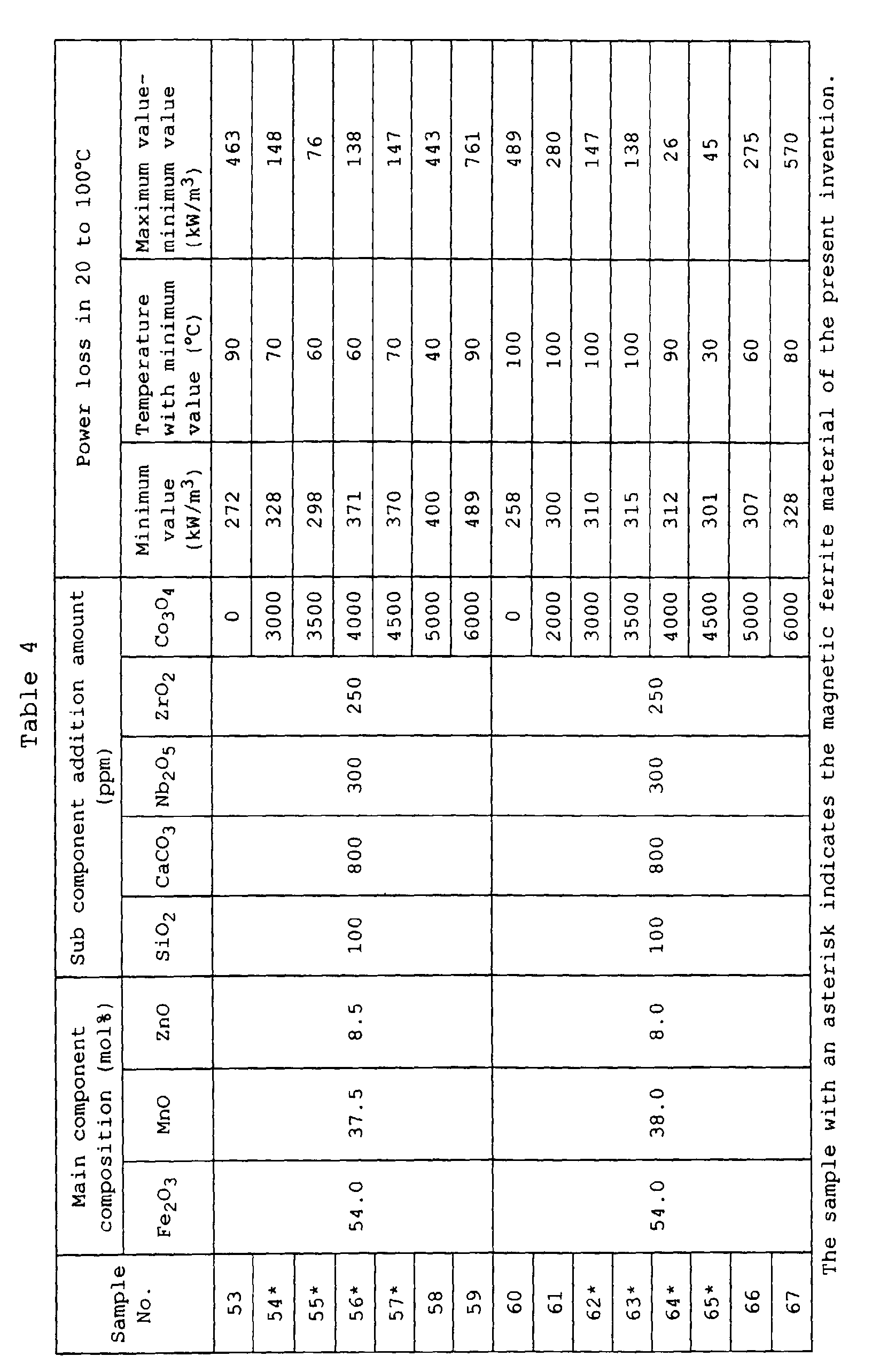
First, Fe2O3, MnO and ZnO were weighed as the main
components to obtain the amounts shown in Tables 1 to 6, and
wet-mixed in a ball mill for 16 hours. Furthermore, the
mixture powder was calcined at 850°C for two hours.
Subsequently, by adding SiO2, CaCO3, Nb2O5, ZrO2,
Co3O4 as the sub components to the above-described calcined
powder to obtain the blend amounts shown in Tables 1 to 6
with respect to the main components, and performing wet
grinding, calcined powders (samples 1 to 95) were obtained.
Subsequently, after adding polyvinyl alcohol as a
binder to the respective obtained calcined powders by a solid
content of 0.8 wt% and performing granulation, press molding
was performed with a pressure of 1 ton/cm2 to form a toroidal
shape (outer diameter of 24 mm, inner diameter of 12 mm,
thickness of 5.5 mm). Subsequently, the molded material was
sintered under an N2-O2 mixture gas atmosphere with a
controlled oxygen partial pressure at 1300°C for five hours
to obtain the magnetic ferrite materials (samples 1 to 95).
Additionally, when a final composition was measured by
fluorescent X ray spectroscopy, the composition corresponded
to a blend composition.
With respect to the respective obtained toroidal
magnetic ferrite materials, the power loss was measured by an
alternating-current B-H analyzer (IWATSU-8232 manufactured by
Iwatsaki Electric Co., Ltd.) at an exciting magnetic flux
density of 200 mT and frequency of 100 kHz. The minimum
value of the power loss in the temperature range of 20 to
100°C, the temperature at which the minimum value is
indicated, and the difference between the maximum value and
the minimum value are shown in the following Tables 1 to 6.
Moreover, for the samples 64, 65 as the magnetic ferrite
materials of the present invention, and the
comparative
samples 60, 61, the measurement result of the power loss in
the temperature range of 20 to 100°C is shown in Fig. 1.
As shown in Tables 1 to 6, it has been confirmed
that the samples 32, 33, 43, 44, 49, 50, 54 to 57, 62 to 65,
69 to 72, 76, 77, 81, 82, 87, 88 as the magnetic ferrite
materials of the present invention contain, as the main
components, ZnO in a range of 7.0 to 9.0 mol%, MnO in a range
of 36.8 to 39.2 mol%, and a residual of Fe2O3, and contain
Co3O4 as the sub component in a range of 2500 to 4500 ppm,
the power loss in the temperature range of 20 to 100°C is
peculiarly low (the minimum value of the power loss is 400
kW/m3 or less, and the difference between the maximum value
and minimum value of the power loss is 150 kW/m3 or less) and
that the power loss change in the temperature range of 20 to
100°C is flattened.
Among these magnetic ferrite materials of the
present invention, for the samples 33, 43, 49, 50, 54, 55, 62
to 65, 69, 71, 72, 81, 87, 88, the minimum value of the power
loss in the temperature range of 20 to 100°C is 350 kW/m3 or
less, and for the samples 32, 64, 65, the difference between
the maximum value and minimum value of the power loss in the
temperature range of 20 to 100°C is 50 kW/m3 or less, so that
the superior low power loss is realized. Furthermore, for
the samples 64, 65, the minimum value of the power loss in
the temperature range of 20 to 100°C is 350 kW/m3 or less,
the difference between the maximum value and minimum value of
the power loss is 50 kW/m3 or less, and the power loss change
in the temperature range of 20 to 100°C is further flattened.
Moreover, it has been confirmed that in the magnetic
ferrite materials of the present invention, there are
materials indicating various temperatures as the temperature
at which the power loss is minimized.
Furthermore, as shown in Fig. 1, for the samples 64,
65 as the magnetic ferrite materials of the present invention,
as compared with the comparative samples 60, 61, the power
loss in the temperature range of 20 to 100°C is low and the
power loss change in the temperature range of 20 to 100°C is
little and flattened.