EP1080774A1 - Procédé d'élimination par perméation des composés fluorés ou fluorosoufres d'un flux de xénon et/ou de krypton - Google Patents
Procédé d'élimination par perméation des composés fluorés ou fluorosoufres d'un flux de xénon et/ou de krypton Download PDFInfo
- Publication number
- EP1080774A1 EP1080774A1 EP00402381A EP00402381A EP1080774A1 EP 1080774 A1 EP1080774 A1 EP 1080774A1 EP 00402381 A EP00402381 A EP 00402381A EP 00402381 A EP00402381 A EP 00402381A EP 1080774 A1 EP1080774 A1 EP 1080774A1
- Authority
- EP
- European Patent Office
- Prior art keywords
- gas
- fluorinated
- krypton
- xenon
- membrane
- Prior art date
- Legal status (The legal status is an assumption and is not a legal conclusion. Google has not performed a legal analysis and makes no representation as to the accuracy of the status listed.)
- Withdrawn
Links
- 229910052743 krypton Inorganic materials 0.000 title claims abstract description 109
- DNNSSWSSYDEUBZ-UHFFFAOYSA-N krypton atom Chemical compound [Kr] DNNSSWSSYDEUBZ-UHFFFAOYSA-N 0.000 title claims abstract description 109
- 229910052724 xenon Inorganic materials 0.000 title claims abstract description 93
- FHNFHKCVQCLJFQ-UHFFFAOYSA-N xenon atom Chemical compound [Xe] FHNFHKCVQCLJFQ-UHFFFAOYSA-N 0.000 title claims abstract description 93
- 150000001875 compounds Chemical class 0.000 title claims description 59
- 238000000034 method Methods 0.000 title claims description 56
- NINIDFKCEFEMDL-UHFFFAOYSA-N Sulfur Chemical class [S] NINIDFKCEFEMDL-UHFFFAOYSA-N 0.000 title description 2
- 239000012528 membrane Substances 0.000 claims abstract description 118
- 238000004519 manufacturing process Methods 0.000 claims abstract description 52
- 239000008246 gaseous mixture Substances 0.000 claims abstract description 9
- 239000007789 gas Substances 0.000 claims description 143
- YNAAFGQNGMFIHH-UHFFFAOYSA-N ctk8g8788 Chemical compound [S]F YNAAFGQNGMFIHH-UHFFFAOYSA-N 0.000 claims description 60
- 239000000203 mixture Substances 0.000 claims description 42
- 239000012535 impurity Substances 0.000 claims description 36
- 238000004821 distillation Methods 0.000 claims description 26
- 239000002699 waste material Substances 0.000 claims description 21
- 238000001179 sorption measurement Methods 0.000 claims description 18
- 239000002912 waste gas Substances 0.000 claims description 17
- 238000004064 recycling Methods 0.000 claims description 14
- 229910052760 oxygen Inorganic materials 0.000 claims description 12
- QVGXLLKOCUKJST-UHFFFAOYSA-N atomic oxygen Chemical compound [O] QVGXLLKOCUKJST-UHFFFAOYSA-N 0.000 claims description 11
- 239000001301 oxygen Substances 0.000 claims description 11
- 238000001816 cooling Methods 0.000 claims description 9
- 229930195733 hydrocarbon Natural products 0.000 claims description 9
- 150000002430 hydrocarbons Chemical class 0.000 claims description 9
- CURLTUGMZLYLDI-UHFFFAOYSA-N Carbon dioxide Chemical compound O=C=O CURLTUGMZLYLDI-UHFFFAOYSA-N 0.000 claims description 8
- 239000003463 adsorbent Substances 0.000 claims description 6
- 230000006835 compression Effects 0.000 claims description 6
- 238000007906 compression Methods 0.000 claims description 6
- 238000009434 installation Methods 0.000 claims description 6
- 239000010457 zeolite Substances 0.000 claims description 6
- 229910002092 carbon dioxide Inorganic materials 0.000 claims description 5
- 238000006555 catalytic reaction Methods 0.000 claims description 5
- 230000001590 oxidative effect Effects 0.000 claims description 5
- VYPSYNLAJGMNEJ-UHFFFAOYSA-N Silicium dioxide Chemical compound O=[Si]=O VYPSYNLAJGMNEJ-UHFFFAOYSA-N 0.000 claims description 4
- 229920000642 polymer Polymers 0.000 claims description 4
- 239000001569 carbon dioxide Substances 0.000 claims description 3
- 238000001035 drying Methods 0.000 claims description 3
- 239000000499 gel Substances 0.000 claims description 3
- 238000009413 insulation Methods 0.000 claims description 3
- 239000003380 propellant Substances 0.000 claims description 2
- 238000011084 recovery Methods 0.000 claims description 2
- 239000000377 silicon dioxide Substances 0.000 claims description 2
- 238000002955 isolation Methods 0.000 abstract 1
- 230000004907 flux Effects 0.000 description 26
- IJGRMHOSHXDMSA-UHFFFAOYSA-N Atomic nitrogen Chemical compound N#N IJGRMHOSHXDMSA-UHFFFAOYSA-N 0.000 description 8
- 239000012466 permeate Substances 0.000 description 8
- XLYOFNOQVPJJNP-UHFFFAOYSA-N water Chemical compound O XLYOFNOQVPJJNP-UHFFFAOYSA-N 0.000 description 8
- 238000000926 separation method Methods 0.000 description 7
- XKRFYHLGVUSROY-UHFFFAOYSA-N Argon Chemical compound [Ar] XKRFYHLGVUSROY-UHFFFAOYSA-N 0.000 description 6
- 238000000746 purification Methods 0.000 description 6
- 230000035699 permeability Effects 0.000 description 5
- 239000012465 retentate Substances 0.000 description 5
- -1 CF 4 Chemical compound 0.000 description 4
- 229910021536 Zeolite Inorganic materials 0.000 description 4
- HNPSIPDUKPIQMN-UHFFFAOYSA-N dioxosilane;oxo(oxoalumanyloxy)alumane Chemical compound O=[Si]=O.O=[Al]O[Al]=O HNPSIPDUKPIQMN-UHFFFAOYSA-N 0.000 description 4
- 235000021183 entrée Nutrition 0.000 description 4
- 229910052757 nitrogen Inorganic materials 0.000 description 4
- 229920005597 polymer membrane Polymers 0.000 description 4
- 229920006926 PFC Polymers 0.000 description 3
- PNEYBMLMFCGWSK-UHFFFAOYSA-N aluminium oxide Inorganic materials [O-2].[O-2].[O-2].[Al+3].[Al+3] PNEYBMLMFCGWSK-UHFFFAOYSA-N 0.000 description 3
- 229910052786 argon Inorganic materials 0.000 description 3
- OYPRJOBELJOOCE-UHFFFAOYSA-N Calcium Chemical compound [Ca] OYPRJOBELJOOCE-UHFFFAOYSA-N 0.000 description 2
- OKTJSMMVPCPJKN-UHFFFAOYSA-N Carbon Chemical compound [C] OKTJSMMVPCPJKN-UHFFFAOYSA-N 0.000 description 2
- LFQSCWFLJHTTHZ-UHFFFAOYSA-N Ethanol Chemical compound CCO LFQSCWFLJHTTHZ-UHFFFAOYSA-N 0.000 description 2
- DGAQECJNVWCQMB-PUAWFVPOSA-M Ilexoside XXIX Chemical compound C[C@@H]1CC[C@@]2(CC[C@@]3(C(=CC[C@H]4[C@]3(CC[C@@H]5[C@@]4(CC[C@@H](C5(C)C)OS(=O)(=O)[O-])C)C)[C@@H]2[C@]1(C)O)C)C(=O)O[C@H]6[C@@H]([C@H]([C@@H]([C@H](O6)CO)O)O)O.[Na+] DGAQECJNVWCQMB-PUAWFVPOSA-M 0.000 description 2
- WHXSMMKQMYFTQS-UHFFFAOYSA-N Lithium Chemical compound [Li] WHXSMMKQMYFTQS-UHFFFAOYSA-N 0.000 description 2
- ZLMJMSJWJFRBEC-UHFFFAOYSA-N Potassium Chemical compound [K] ZLMJMSJWJFRBEC-UHFFFAOYSA-N 0.000 description 2
- HIGRAKVNKLCVCA-UHFFFAOYSA-N alumine Chemical compound C1=CC=[Al]C=C1 HIGRAKVNKLCVCA-UHFFFAOYSA-N 0.000 description 2
- 239000011575 calcium Substances 0.000 description 2
- 229910052791 calcium Inorganic materials 0.000 description 2
- 230000003197 catalytic effect Effects 0.000 description 2
- 150000001768 cations Chemical class 0.000 description 2
- 229920001577 copolymer Polymers 0.000 description 2
- 239000012013 faujasite Substances 0.000 description 2
- 229910052744 lithium Inorganic materials 0.000 description 2
- 229910052751 metal Inorganic materials 0.000 description 2
- 239000002184 metal Substances 0.000 description 2
- VNWKTOKETHGBQD-UHFFFAOYSA-N methane Chemical compound C VNWKTOKETHGBQD-UHFFFAOYSA-N 0.000 description 2
- 235000020004 porter Nutrition 0.000 description 2
- 229910052700 potassium Inorganic materials 0.000 description 2
- 239000011591 potassium Substances 0.000 description 2
- 230000001105 regulatory effect Effects 0.000 description 2
- 229910052708 sodium Inorganic materials 0.000 description 2
- 239000011734 sodium Substances 0.000 description 2
- YSYRISKCBOPJRG-UHFFFAOYSA-N 4,5-difluoro-2,2-bis(trifluoromethyl)-1,3-dioxole Chemical compound FC1=C(F)OC(C(F)(F)F)(C(F)(F)F)O1 YSYRISKCBOPJRG-UHFFFAOYSA-N 0.000 description 1
- MYMOFIZGZYHOMD-UHFFFAOYSA-N Dioxygen Chemical compound O=O MYMOFIZGZYHOMD-UHFFFAOYSA-N 0.000 description 1
- 241001080024 Telles Species 0.000 description 1
- 240000008042 Zea mays Species 0.000 description 1
- 239000003570 air Substances 0.000 description 1
- 150000001298 alcohols Chemical class 0.000 description 1
- 229920006125 amorphous polymer Polymers 0.000 description 1
- 238000005219 brazing Methods 0.000 description 1
- 239000012159 carrier gas Substances 0.000 description 1
- 230000015556 catabolic process Effects 0.000 description 1
- 239000000919 ceramic Substances 0.000 description 1
- 230000002860 competitive effect Effects 0.000 description 1
- 230000001143 conditioned effect Effects 0.000 description 1
- 230000006378 damage Effects 0.000 description 1
- 230000007423 decrease Effects 0.000 description 1
- 238000006731 degradation reaction Methods 0.000 description 1
- 229910001882 dioxygen Inorganic materials 0.000 description 1
- 230000008030 elimination Effects 0.000 description 1
- 238000003379 elimination reaction Methods 0.000 description 1
- 238000005516 engineering process Methods 0.000 description 1
- 239000003344 environmental pollutant Substances 0.000 description 1
- 239000000835 fiber Substances 0.000 description 1
- 125000001153 fluoro group Chemical group F* 0.000 description 1
- NBVXSUQYWXRMNV-UHFFFAOYSA-N fluoromethane Chemical class FC NBVXSUQYWXRMNV-UHFFFAOYSA-N 0.000 description 1
- 238000010438 heat treatment Methods 0.000 description 1
- 239000001307 helium Substances 0.000 description 1
- 229910052734 helium Inorganic materials 0.000 description 1
- SWQJXJOGLNCZEY-UHFFFAOYSA-N helium atom Chemical compound [He] SWQJXJOGLNCZEY-UHFFFAOYSA-N 0.000 description 1
- 239000012510 hollow fiber Substances 0.000 description 1
- 239000001257 hydrogen Substances 0.000 description 1
- 229910052739 hydrogen Inorganic materials 0.000 description 1
- 125000004435 hydrogen atom Chemical class [H]* 0.000 description 1
- 239000000463 material Substances 0.000 description 1
- 229910052754 neon Inorganic materials 0.000 description 1
- GKAOGPIIYCISHV-UHFFFAOYSA-N neon atom Chemical compound [Ne] GKAOGPIIYCISHV-UHFFFAOYSA-N 0.000 description 1
- 229940110728 nitrogen / oxygen Drugs 0.000 description 1
- 150000002894 organic compounds Chemical class 0.000 description 1
- 230000003647 oxidation Effects 0.000 description 1
- 238000007254 oxidation reaction Methods 0.000 description 1
- 238000004806 packaging method and process Methods 0.000 description 1
- 229910052615 phyllosilicate Inorganic materials 0.000 description 1
- 231100000719 pollutant Toxicity 0.000 description 1
- 239000000047 product Substances 0.000 description 1
- 239000004065 semiconductor Substances 0.000 description 1
- 229910052717 sulfur Inorganic materials 0.000 description 1
- 239000011593 sulfur Substances 0.000 description 1
- 150000003464 sulfur compounds Chemical class 0.000 description 1
- 238000011144 upstream manufacturing Methods 0.000 description 1
- 239000003039 volatile agent Substances 0.000 description 1
Images

Classifications
-
- F—MECHANICAL ENGINEERING; LIGHTING; HEATING; WEAPONS; BLASTING
- F25—REFRIGERATION OR COOLING; COMBINED HEATING AND REFRIGERATION SYSTEMS; HEAT PUMP SYSTEMS; MANUFACTURE OR STORAGE OF ICE; LIQUEFACTION SOLIDIFICATION OF GASES
- F25J—LIQUEFACTION, SOLIDIFICATION OR SEPARATION OF GASES OR GASEOUS OR LIQUEFIED GASEOUS MIXTURES BY PRESSURE AND COLD TREATMENT OR BY BRINGING THEM INTO THE SUPERCRITICAL STATE
- F25J3/00—Processes or apparatus for separating the constituents of gaseous or liquefied gaseous mixtures involving the use of liquefaction or solidification
- F25J3/02—Processes or apparatus for separating the constituents of gaseous or liquefied gaseous mixtures involving the use of liquefaction or solidification by rectification, i.e. by continuous interchange of heat and material between a vapour stream and a liquid stream
- F25J3/0228—Processes or apparatus for separating the constituents of gaseous or liquefied gaseous mixtures involving the use of liquefaction or solidification by rectification, i.e. by continuous interchange of heat and material between a vapour stream and a liquid stream characterised by the separated product stream
- F25J3/028—Processes or apparatus for separating the constituents of gaseous or liquefied gaseous mixtures involving the use of liquefaction or solidification by rectification, i.e. by continuous interchange of heat and material between a vapour stream and a liquid stream characterised by the separated product stream separation of noble gases
-
- B—PERFORMING OPERATIONS; TRANSPORTING
- B01—PHYSICAL OR CHEMICAL PROCESSES OR APPARATUS IN GENERAL
- B01D—SEPARATION
- B01D53/00—Separation of gases or vapours; Recovering vapours of volatile solvents from gases; Chemical or biological purification of waste gases, e.g. engine exhaust gases, smoke, fumes, flue gases, aerosols
- B01D53/22—Separation of gases or vapours; Recovering vapours of volatile solvents from gases; Chemical or biological purification of waste gases, e.g. engine exhaust gases, smoke, fumes, flue gases, aerosols by diffusion
-
- B—PERFORMING OPERATIONS; TRANSPORTING
- B01—PHYSICAL OR CHEMICAL PROCESSES OR APPARATUS IN GENERAL
- B01D—SEPARATION
- B01D53/00—Separation of gases or vapours; Recovering vapours of volatile solvents from gases; Chemical or biological purification of waste gases, e.g. engine exhaust gases, smoke, fumes, flue gases, aerosols
- B01D53/22—Separation of gases or vapours; Recovering vapours of volatile solvents from gases; Chemical or biological purification of waste gases, e.g. engine exhaust gases, smoke, fumes, flue gases, aerosols by diffusion
- B01D53/229—Integrated processes (Diffusion and at least one other process, e.g. adsorption, absorption)
-
- B—PERFORMING OPERATIONS; TRANSPORTING
- B01—PHYSICAL OR CHEMICAL PROCESSES OR APPARATUS IN GENERAL
- B01D—SEPARATION
- B01D53/00—Separation of gases or vapours; Recovering vapours of volatile solvents from gases; Chemical or biological purification of waste gases, e.g. engine exhaust gases, smoke, fumes, flue gases, aerosols
- B01D53/34—Chemical or biological purification of waste gases
- B01D53/46—Removing components of defined structure
- B01D53/68—Halogens or halogen compounds
-
- C—CHEMISTRY; METALLURGY
- C01—INORGANIC CHEMISTRY
- C01B—NON-METALLIC ELEMENTS; COMPOUNDS THEREOF; METALLOIDS OR COMPOUNDS THEREOF NOT COVERED BY SUBCLASS C01C
- C01B23/00—Noble gases; Compounds thereof
- C01B23/001—Purification or separation processes of noble gases
- C01B23/0036—Physical processing only
- C01B23/0042—Physical processing only by making use of membranes
-
- B—PERFORMING OPERATIONS; TRANSPORTING
- B01—PHYSICAL OR CHEMICAL PROCESSES OR APPARATUS IN GENERAL
- B01D—SEPARATION
- B01D2256/00—Main component in the product gas stream after treatment
- B01D2256/18—Noble gases
-
- B—PERFORMING OPERATIONS; TRANSPORTING
- B01—PHYSICAL OR CHEMICAL PROCESSES OR APPARATUS IN GENERAL
- B01D—SEPARATION
- B01D2257/00—Components to be removed
- B01D2257/20—Halogens or halogen compounds
- B01D2257/204—Inorganic halogen compounds
-
- B—PERFORMING OPERATIONS; TRANSPORTING
- B01—PHYSICAL OR CHEMICAL PROCESSES OR APPARATUS IN GENERAL
- B01D—SEPARATION
- B01D2257/00—Components to be removed
- B01D2257/20—Halogens or halogen compounds
- B01D2257/206—Organic halogen compounds
- B01D2257/2066—Fluorine
-
- C—CHEMISTRY; METALLURGY
- C01—INORGANIC CHEMISTRY
- C01B—NON-METALLIC ELEMENTS; COMPOUNDS THEREOF; METALLOIDS OR COMPOUNDS THEREOF NOT COVERED BY SUBCLASS C01C
- C01B2210/00—Purification or separation of specific gases
- C01B2210/0029—Obtaining noble gases
- C01B2210/0035—Krypton
-
- C—CHEMISTRY; METALLURGY
- C01—INORGANIC CHEMISTRY
- C01B—NON-METALLIC ELEMENTS; COMPOUNDS THEREOF; METALLOIDS OR COMPOUNDS THEREOF NOT COVERED BY SUBCLASS C01C
- C01B2210/00—Purification or separation of specific gases
- C01B2210/0029—Obtaining noble gases
- C01B2210/0037—Xenon
-
- C—CHEMISTRY; METALLURGY
- C01—INORGANIC CHEMISTRY
- C01B—NON-METALLIC ELEMENTS; COMPOUNDS THEREOF; METALLOIDS OR COMPOUNDS THEREOF NOT COVERED BY SUBCLASS C01C
- C01B2210/00—Purification or separation of specific gases
- C01B2210/0043—Impurity removed
- C01B2210/0068—Organic compounds
-
- F—MECHANICAL ENGINEERING; LIGHTING; HEATING; WEAPONS; BLASTING
- F25—REFRIGERATION OR COOLING; COMBINED HEATING AND REFRIGERATION SYSTEMS; HEAT PUMP SYSTEMS; MANUFACTURE OR STORAGE OF ICE; LIQUEFACTION SOLIDIFICATION OF GASES
- F25J—LIQUEFACTION, SOLIDIFICATION OR SEPARATION OF GASES OR GASEOUS OR LIQUEFIED GASEOUS MIXTURES BY PRESSURE AND COLD TREATMENT OR BY BRINGING THEM INTO THE SUPERCRITICAL STATE
- F25J2205/00—Processes or apparatus using other separation and/or other processing means
- F25J2205/40—Processes or apparatus using other separation and/or other processing means using hybrid system, i.e. combining cryogenic and non-cryogenic separation techniques
-
- F—MECHANICAL ENGINEERING; LIGHTING; HEATING; WEAPONS; BLASTING
- F25—REFRIGERATION OR COOLING; COMBINED HEATING AND REFRIGERATION SYSTEMS; HEAT PUMP SYSTEMS; MANUFACTURE OR STORAGE OF ICE; LIQUEFACTION SOLIDIFICATION OF GASES
- F25J—LIQUEFACTION, SOLIDIFICATION OR SEPARATION OF GASES OR GASEOUS OR LIQUEFIED GASEOUS MIXTURES BY PRESSURE AND COLD TREATMENT OR BY BRINGING THEM INTO THE SUPERCRITICAL STATE
- F25J2205/00—Processes or apparatus using other separation and/or other processing means
- F25J2205/80—Processes or apparatus using other separation and/or other processing means using membrane, i.e. including a permeation step
-
- F—MECHANICAL ENGINEERING; LIGHTING; HEATING; WEAPONS; BLASTING
- F25—REFRIGERATION OR COOLING; COMBINED HEATING AND REFRIGERATION SYSTEMS; HEAT PUMP SYSTEMS; MANUFACTURE OR STORAGE OF ICE; LIQUEFACTION SOLIDIFICATION OF GASES
- F25J—LIQUEFACTION, SOLIDIFICATION OR SEPARATION OF GASES OR GASEOUS OR LIQUEFIED GASEOUS MIXTURES BY PRESSURE AND COLD TREATMENT OR BY BRINGING THEM INTO THE SUPERCRITICAL STATE
- F25J2215/00—Processes characterised by the type or other details of the product stream
- F25J2215/34—Krypton
-
- F—MECHANICAL ENGINEERING; LIGHTING; HEATING; WEAPONS; BLASTING
- F25—REFRIGERATION OR COOLING; COMBINED HEATING AND REFRIGERATION SYSTEMS; HEAT PUMP SYSTEMS; MANUFACTURE OR STORAGE OF ICE; LIQUEFACTION SOLIDIFICATION OF GASES
- F25J—LIQUEFACTION, SOLIDIFICATION OR SEPARATION OF GASES OR GASEOUS OR LIQUEFIED GASEOUS MIXTURES BY PRESSURE AND COLD TREATMENT OR BY BRINGING THEM INTO THE SUPERCRITICAL STATE
- F25J2215/00—Processes characterised by the type or other details of the product stream
- F25J2215/36—Xenon
-
- Y—GENERAL TAGGING OF NEW TECHNOLOGICAL DEVELOPMENTS; GENERAL TAGGING OF CROSS-SECTIONAL TECHNOLOGIES SPANNING OVER SEVERAL SECTIONS OF THE IPC; TECHNICAL SUBJECTS COVERED BY FORMER USPC CROSS-REFERENCE ART COLLECTIONS [XRACs] AND DIGESTS
- Y02—TECHNOLOGIES OR APPLICATIONS FOR MITIGATION OR ADAPTATION AGAINST CLIMATE CHANGE
- Y02C—CAPTURE, STORAGE, SEQUESTRATION OR DISPOSAL OF GREENHOUSE GASES [GHG]
- Y02C20/00—Capture or disposal of greenhouse gases
- Y02C20/30—Capture or disposal of greenhouse gases of perfluorocarbons [PFC], hydrofluorocarbons [HFC] or sulfur hexafluoride [SF6]
-
- Y—GENERAL TAGGING OF NEW TECHNOLOGICAL DEVELOPMENTS; GENERAL TAGGING OF CROSS-SECTIONAL TECHNOLOGIES SPANNING OVER SEVERAL SECTIONS OF THE IPC; TECHNICAL SUBJECTS COVERED BY FORMER USPC CROSS-REFERENCE ART COLLECTIONS [XRACs] AND DIGESTS
- Y02—TECHNOLOGIES OR APPLICATIONS FOR MITIGATION OR ADAPTATION AGAINST CLIMATE CHANGE
- Y02P—CLIMATE CHANGE MITIGATION TECHNOLOGIES IN THE PRODUCTION OR PROCESSING OF GOODS
- Y02P20/00—Technologies relating to chemical industry
- Y02P20/151—Reduction of greenhouse gas [GHG] emissions, e.g. CO2
Definitions
- the present invention relates to a method for purifying a gas stream containing krypton (Kr) and / or xenon (Xe), which gas stream additionally contains fluorinated and / or fluoro-sulfur impurities and possibly other impurities to be separated from said gas stream, such as oxygen and / or hydrocarbons (C n H m ), said gas stream can then be separated by cryogenic distillation to produce high purity krypton or xenon or, with conversely, to be a waste gas from such a cryogenic distillation process.
- Kr krypton
- Xe xenon
- C n H m hydrocarbons
- xenon or krypton is usually carried out from atmospheric air, which air is separated by cryogenic distillation, so as to obtain, on the one hand, the conventionally recovered compounds, namely nitrogen, oxygen and / or argon, and, on the other hand, a gaseous mixture essentially containing xenon, krypton and impurities chosen from hydrocarbons (C n H m ), oxygen and fluorinated or fluorinated compounds sulfur, such as CF 4 , C 2 F 6 or SF 6 , for example.
- hydrocarbons C n H m
- oxygen and fluorinated or fluorinated compounds sulfur such as CF 4 , C 2 F 6 or SF 6 , for example.
- the document EP-A-754 487 proposes a very effective method for eliminating by permeation, by means of one or more polymer membranes, the PFCs contained in a gas flow consisting of a carrier gas, such as air, oxygen, nitrogen, helium, CO 2 , xenon, CO, water vapor, hydrogen, krypton, neon or argon, polluted by PFCs.
- a carrier gas such as air, oxygen, nitrogen, helium, CO 2 , xenon, CO, water vapor, hydrogen, krypton, neon or argon
- WO-A-90/15662 describes the use of a selective permeable membrane to separate a gas mixture, in in particular a membrane made of an amorphous polymer of the type perfluoro-2,2-dimethyl-1,3-dioxole.
- the gas mixture can be air, a nitrogen / oxygen gas mixture, which optionally contains a or several organic compounds, such as fluorocarbon compounds or any other volatile compound, such as Freon TM.
- document EP-A-358915 describes a membrane system for gas separation, in which any degradation of the membrane is minimized or avoided by eliminating impurities such as heavy hydrocarbons by adsorption of these on a bed of activated carbon located upstream of the membrane.
- documents JP-A-61187918 and JP-A-4322716 relate to the use of a membrane formed of a fluoro-copolymer to eliminate water vapor, that is to say to dry, a wet gas, such as HCI, CF4, C 2 F 6 or the like.
- document JP-A-4016213 can also be cited which describes the selective permeation of light alcohols, such as ethanol, contained in a gas mixture through a membrane consisting of a heat resistant polymer; the document JP-A-61187918 teacher the use of a membrane formed from a fluoro-copolymer to separate a gas used in a brazing operation; and document US-A-5,383,957 relating to a membrane system usable for producing nitrogen at from air.
- the object of the present invention is therefore to propose a method improved for efficient removal of impurities fluorinated or fluoro-sulfur contained in a gas stream of xenon and / or krypton, which process is easy to implement and cost industrially acceptable.
- the present invention aims to provide a method for separation and purification of a gas stream containing krypton and xenon, as well as impurities, so as to effectively remove said impurities (fluorinated or fluoro-sulfur compounds).
- the invention also aims to alternatively propose an effective method for separating the mixture krypton / xenon thus obtained and this, to produce, on the one hand, xenon of high purity and, on the other hand, high purity krypton, combined with effective removal of said fluorinated or fluorinated sulfur compounds.
- membrane is any means of permeation, in particular the membranes taken as such, but also membrane modules, in particular fiber membrane modules hollow, or ceramic membranes or the like.
- outlet side means the side of the membrane where the gas produced, i.e. the gas, is recovered substantially purified of fluorinated or fluoro-sulfur impurities.
- the exit side is the retentate side.
- gas-waste side we hear the side of the membrane opposite to that where the gas is recovered product, i.e. the side of the membrane through which a gas enriched in fluorinated or fluoro-sulfur impurities.
- the "gas-waste side” is the retentate side, while in the case of a membrane with reverse permeability, the "gas-waste side” is the permeate side.
- the invention also relates to a process for eliminating at least part of the fluorinated or fluoro-sulfur gaseous compounds, in particular CF 4 , C 2 F 6 and / or SF 6 , present in a gas stream of xenon and / or krypton, preferably a mixture of xenon and krypton, in which at least a portion of said fluorinated compounds is separated by one or more permeation steps, as the case may be, by means of one or more membranes of conventional or reverse type .
- the installation of the invention furthermore comprises at least one membrane connected by its gas-waste outlet, to waste gas recycling means containing xenon and / or krypton and optionally gaseous fluorinated and / or fluoro-sulfur compounds, said waste gas recycling means being connected, in addition, to the supply inlet of said compression means, so as to ability to supply said compression means with at least a portion of said waste gas.
- the fluorosulfur compounds of the SF 6 type and that, on the other hand, the fluorinated compounds, in particular the compounds CF 4 and C 2 F 6 only allow very little , or not at all, through conventional membranes, in particular polymers, it is possible to effectively separate gas mixtures containing krypton and xenon and pollutants of the CF 4 , C 2 F 6 and / or SF 6 type , by taking advantage of the very high selectivity of the membranes, in particular the polymer membranes, for xenon and krypton with respect to fluorinated or fluoro-sulfur impurities.
- xenon and krypton are found and are recovered mainly on the outlet or permeate side of the membrane (s) used, when these are of conventional type.
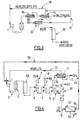
- FIG. 1 illustrates the application of a process according to the invention to the purification of waste gases containing xenon and krypton, and impurities of the CF 4 type resulting from the separation by cryogenic distillation of xenon and krypton from '' a gas mixture Xe / Kr polluted by CF 4 impurities and other impurities, such as oxygen and hydrocarbons.
- a gas mixture Xe / Kr / CF 4 / O 2 / C n H m (total content Xe + Kr> 50%) is compressed (in 1) at a pressure of the order of 6 to 12 bars, before to be subjected to a catalytic oxidation (in 2) intended to oxidize, in the presence of oxygen and at a temperature of at least 120 ° C, the traces of hydrocarbons (C n H m ) to carbon dioxide (CO 2 ) and water vapor (H 2 O).
- the resulting gas flow is dried and decarbonated (in 3) to remove the water vapor and the carbon dioxide formed or initially present, respectively, by means of an adsorption system with two adsorbers operating in alternating fashion and each containing a bed of alumina to remove water vapor and a bed of zeolite to remove CO 2 .
- the gas flow leaving the adsorption zone is cooled to a cryogenic temperature below about -80 ° C in one or several heat exchangers 44, preferably at a temperature between -100 ° C and -150 ° C.
- the Kr / Xe / CF 4 O 2 mixture thus cooled is then subjected to several separation steps by cryogenic distillation in 4, 5 and 6.
- the Kr / Xe / CF 4 mixture containing traces of residual oxygen and possibly other residual volatile impurities, such as traces of nitrogen or argon is first separated in a first distillation column 4 cryogenic, so as to, on the one hand, eliminate (at 7) the oxygen and the other volatile impurities likely to be present in the Kr / Xe / CF 4 mixture and, on the other hand, to recover a mixture constituted essentially krypton, xenon and CF 4 , which is then sent to a second distillation column 5 where it is separated to produce, on the one hand, ultra-pure krypton (at 8) which is recovered and, from on the other hand, a gas mixture containing essentially xenon (Xe) and CF 4 , as well as residual traces of krypton (Kr).
- This mixture Xe / CF 4 (with traces of Kr) is then sent to a third column 6 of cryogenic distillation where it is distilled to produce, on the one hand, pure xenon which is recovered (in 9) and, on the other part, a gaseous mixture containing xenon, krypton and CF 4 in variable proportions, which is conveyed (at 10) to one or more membranes 11 to be purified therein by permeation according to the process of the invention.
- one or more membrane modules are used with hollow fibers as membranes.
- the mixture Kr / Xe / CF 4 feeds the membrane (s) 11 and the gas-waste side is recovered, that is to say here on the retentate side, the fluorinated compounds CF 4 or a non-permeable gas mixture (gas waste) enriched in CF 4 and, on the outlet side, that is to say here on the permeate side, a permeation mixture Xe / Kr possibly containing residual CF 4 , which mixture Xe / Kr possibly containing residual CF 4 can then be re-routed to the supply to compressor 1 where it is mixed with the supply gas to undergo a new purification cycle.
- the CF 4 produced can either be released to the atmosphere, recovered for other uses or to be destroyed.
- FIG. 2 has been shown diagrammatically a process for separating the components of a gaseous feed mixture consisting essentially of krypton and xenon and containing, in addition, fluorinated impurities CF 4 , C 2 F 6 and SF 6 and other impurities (C n H m ) in variable proportions.
- the feed mixture is first compressed (at 1) to a pressure of around 6 to 12 bars, then subjected to an oxidative catalysis step (at 12), as before, to convert any traces of hydrocarbons in water vapor and CO 2 , which are then removed by drying and / or decarbonation (at 13), as explained for FIG. 1.
- the gas flow obtained is then sent to several modules membranes 14, 15 arranged in cascade.
- a mixture of krypton and xenon is recovered which is substantially free of fluorinated compounds, that is to say containing fluorinated compounds only in the trace state ( ⁇ 10 ppm PFC), which mixture Kr / Xe / traces of fluorinated compounds can then, as in FIG. 1, be cooled (at 16) and undergo a cryogenic separation at 17 (not detailed) to produce, from on the one hand, pure krypton and, on the other hand, pure xenon.
- residual oxygen can also be removed by cryogenic distillation.
- This gas mixture enriched in fluorinated compounds is then subjected to a second permeation stage (at 15), so as to obtain, at the outlet sound of a second membrane module 15, a gas containing essentially fluorinated gaseous compounds which can be recycled and / or eliminated, and moreover, at the permeate outlet, a mixed gas containing fluorinated compounds and most of the xenon and krypton which didn't permeated through the first membrane module 14 (see above), which mixed gas is then returned to compressor 1, via line 18, to undergo a new purification cycle by being mixed with the gas feed.
- a second permeation stage at 15
- FIG. 3 represents a variant of FIG. 2 according to which the layering of the membranes has been modified so that, by example, a required purity of the gas flow Kr / Xe entering the unit 16 of cryogenic cooling.
- the gas permeation flow containing mainly krypton and xenon, recovered at the outlet membrane permeate 14 is also subjected to a step additional permeation (in 20) before being sent to unit 16 of cryogenic cooling, commonly called cold box.
- the retrieved output stream can, for example, be recycled as explained above for Figure 2 and returned to the compressor 1, via lines 21 and 18.
- FIG. 4 represents a variant of FIG. 1, in which the pure xenon is recovered (at 9) after distillation of the Xe / CF 4 mixture (with traces of Kr) in the third column 6 of cryogenic distillation and conveyed to a fourth column 50 of cryogenic distillation where it undergoes a new cryogenic separation so as to purify the xenon into its heavy fluorinated and / or fluoro-sulfur impurities such as SF 6 and C 2 F 6 and thus recover even more pure xenon (in 55), on the one hand, and to obtain a flow of pure xenon but which may still contain some fluorinated and / or fluoro-sulfur impurities, on the other hand, which flow is conveyed, via line 51, to one or more other membranes 52 to be purified therein by permeation according to the process of the invention.
- the pure xenon is recovered (at 9) after distillation of the Xe / CF 4 mixture (with traces
- fluorinated and / or fluoro-sulfur impurities produced (in 53) can either be released to the atmosphere or recovered for others uses or to be destroyed.
- membranes sold by MEDAL In the context of the invention, use is preferably made of membranes sold by MEDAL.
- the gases or gaseous mixtures of xenon and / or krypton purified by the process according to the invention are particularly suitable for use as inter-wall insulation gas for waterproof element with multiple glazing or multiple walls separated by insulating gas, especially double glazed windows.
- the gases or gaseous mixtures of xenon and / or krypton purified by the process according to the invention are particularly suitable for use as propellant plasma for a vehicle or for a structure powered by a plasma gas, in particular for plasma-propelled satellite.
Landscapes
- Chemical & Material Sciences (AREA)
- Engineering & Computer Science (AREA)
- Analytical Chemistry (AREA)
- Chemical Kinetics & Catalysis (AREA)
- Oil, Petroleum & Natural Gas (AREA)
- Organic Chemistry (AREA)
- General Chemical & Material Sciences (AREA)
- Mechanical Engineering (AREA)
- Physics & Mathematics (AREA)
- Thermal Sciences (AREA)
- General Engineering & Computer Science (AREA)
- Inorganic Chemistry (AREA)
- Health & Medical Sciences (AREA)
- Environmental & Geological Engineering (AREA)
- Biomedical Technology (AREA)
- Separation Using Semi-Permeable Membranes (AREA)
- Separation By Low-Temperature Treatments (AREA)
- Separation Of Gases By Adsorption (AREA)
Abstract
Description
- soit directement séparé et purifié pour obtenir, d'une part, du xénon et, d'autre part, du krypton,
- soit conditionné et stocké dans des récipients de conditionnement, telles des bouteilles de gaz, avant d'être postérieurement séparé et purifié comme dans le premier cas.
- à l'étape (ii), on récupère, côté gaz-déchet de ladite première membrane, un flux de gaz-déchet contenant au moins une partie desdits composés gazeux fluorés et/ou fluoro-soufrés. Ce flux de gaz-déchet est sensiblement à la même pression que celle du flux de gaz d'alimentation entrant dans ladite première membrane mais contient une proportion supérieure de composés fluorés ou fluoro-soufrés que celle du gaz d'alimentation, c'est-à-dire que le flux de gaz-déchet est enrichi en composés fluorés ou fluoro-soufrés par rapport au flux de gaz d'alimentation.
- le flux gazeux d'alimentation contient au moins 40% de xénon et/ou de krypton, de préférence au moins 50% de xénon et/ou de krypton, de préférence au moins 70% de xénon et/ou de krypton, de préférence au moins 80% de xénon et/ou de krypton, et/ou le flux gazeux d'alimentation contient du xénon et du krypton en une proportion d'au plus 99,999%.
- le flux gazeux d'alimentation contient de 1 ppb à 300 000 ppm de composés fluorés ou fluoro-soufrés, de préférence de 10 ppb à 50000 ppm de composés fluorés ou fluoro-soufrés.
- au moins une partie du flux gazeux d'alimentation est un gaz résiduaire provenant d'une ou plusieurs colonnes de distillation cryogénique, lequel gaz résiduaire a éventuellement fait l'objet d'un prétraitement, d'un conditionnement et/ou d'un stockage.
- les composés fluorés ou fluoro-soufrés à éliminer sont choisis parmi les composés CF4, C2F6, SF6 et leurs mélanges.
- le flux gazeux d'alimentation contient de 0.01 ppm à 1000 ppm de CF4, de 0.01 ppm à 1000 ppm de SF6 et/ou de 0.01 ppm à moins de 200 ppm de C2F6.
- le flux gazeux de production récupéré à l'étape (ii), du côté sortie de ladite première membrane et contenant au moins une partie du xénon et/ou du krypton, est introduit par l'entrée d'alimentation d'au moins une deuxième membrane de perméation.
- le flux de gaz-déchet récupéré à l'étape (ii), du côté gaz-déchet de ladite première membrane et contenant au moins une partie desdits composés gazeux fluorés et/ou fluoro-soufrés est introduit par l'entrée d'alimentation d'au moins une troisième membrane de perméation.
- le flux gazeux d'alimentation est à une température de -10°C à +100°C, de préférence à une température de 0°C à + 60°C. Si nécessaire, la température du flux gazeux d'alimentation peut être régulée ou ajustée pour la porter ou la maintenir dans cette plage de température, par chauffage ou, selon le cas, par refroidissement.
- le flux gazeux d'alimentation est à une pression de 1 bar à 50 bars, de préférence le flux est à une pression de 3 bars à 30 bars, préférentiellement de l'ordre de 6 bars à 12 bars environ, lors de sa mise en contact avec ladite première membrane de perméation. Si nécessaire, la pression du flux gazeux d'alimentation peut être régulée ou ajustée pour la porter ou la maintenir dans cette plage de pression.
- au moins une membrane est en polymère. Par exemple, des membranes susceptibles d'être utilisées dans le cadre de l'invention sont décrites dans le document EP-A-754487 ou dans d'autres documents cités par ledit document EP-A-754487.
- le flux gazeux d'alimentation contient, en outre, des impuretés choisies parmi les hydrocarbures (CnHm), tels le méthane et les hydrocarbures pour lesquels n= 2 ou n=3, et on élimine au moins une partie desdites impuretés par catalyse oxydative desdites impuretés en CO2 et H2O, en présence d'oxygène et à une température comprise entre 80°C et 600°C, de préférence de l'ordre de 150°C à 500°C.
- on élimine, par adsorption ou séchage sur au moins un adsorbant, au moins une partie des impuretés CO2 et H2O produites par catalyse oxydative ou éventuellement présentes dans le flux de gaz d'alimentation, de préférence au moins un adsorbant est choisi parmi les zéolites, les alumines ou les gels de silice.
- l'adsorbant comprend une zéolite de type A ou faujasite, de préférence une zéolite de type X ayant un rapport Si/AI compris entre 1 et 1.10, et/ou une alumine activée, de préférence une alumine activée contenant ou imprégnée par des cations métalliques, en particulier le potassium ou le sodium. Bien entendu, la zéolite peut également être échangée par des cations métalliques, tels le lithium, le calcium ou analogues.
- l'étape d'adsorption est opérée à une température comprise entre environ -40°C et +100°C, de préférence à une température comprise entre +5°C et +50°C, et/ou à une pression d'adsorption comprise entre 1 et 100 bar, de préférence entre 1.1 bar et 50 bar.
- l'étape d'adsorption est opérée selon un cycle PSA (Pressure Swing Adsorption = Adsorption à variation de pression) ou TSA (Température Swing Adsorption = Adsorption à variation de température), de préférence TSA.
- le gaz de production récupéré à l'étape (ii) est soumis à au moins une étape de refroidissement à une température inférieure à -5°C, de préférence à une température de -10°C à -150°C.
- le flux gazeux de production récupéré à l'étape (ii), du côté sortie de la première membrane est introduit par l'entrée d'alimentation d'une deuxième membrane, on récupère, côté gaz-déchet de ladite deuxième membrane, un deuxième gaz-déchet et on introduit ledit deuxième gaz gaz-déchet dans le flux gazeux d'alimentation.
- le flux de gaz-déchet récupéré à l'étape (ii), du côté gaz-déchet de la première membrane est introduit par l'entrée d'alimentation d'une troisième membrane, on récupère, côté sortie de ladite troisième membrane, un deuxième gaz de production et on introduit ledit deuxième gaz de production dans le flux gazeux d'alimentation.
- au moins une source d'un gaz d'alimentation contenant du xénon et/ou du krypton et des composés gazeux fluorés et/ou fluoro-soufrés à éliminer,
- des moyens de compression du gaz d'alimentation, tel un compresseur de gaz,
- au moins une membrane reliée, par sa sortie de production, à des moyens de récupération de gaz de production formé de xénon et/ou de krypton et débarrassé d'au moins une partie desdits composés gazeux fluorés et/ou fluoro-soufrés.
- au moins une source d'un gaz d'alimentation contenant du xénon et/ou du krypton et des composés gazeux fluorés et/ou fluoro-soufrés à éliminer,
- des moyens de compression du gaz d'alimentation,
- au moins une membrane, reliée par sa sortie de production à des moyens de récupération de gaz de production formé de xénon et/ou de krypton et débarrassé d'au moins une partie desdits composés gazeux fluorés et/ou fluoro-soufrés.
- des moyens de refroidissement à température cryogénique du gaz de production situés en aval d'au moins ladite membrane,
- des moyens de distillation cryogénique du gaz de production situés en aval des moyens de refroidissement à température cryogénique,
- des moyens de récupération, situés en aval des moyens de distillation cryogénique, pour récupérer du krypton approximativement exempt desdits composés gazeux fluorés et/ou fluoro-soufrés, et/ou du xénon approximativement exempt desdits composés gazeux fluorés et/ou fluoro-soufrés.
Claims (21)
- Procédé pour éliminer au moins une partie des composés gazeux fluorés et/ou fluoro-soufrés présents dans un flux gazeux d'alimentation contenant du xénon et du krypton, dans lequel :(i) on met en contact le flux gazeux d'alimentation contenant du xénon et du krypton et au moins lesdits composés gazeux fluorés et/ou fluoro-soufrés avec au moins une première membrane,(ii) on récupère, côté sortie d'au moins ladite première membrane, un gaz de production contenant du xénon et du krypton débarrassé d'au moins une partie desdits composés gazeux fluorés et/ou fluoro-soufrés.
- Procédé pour éliminer au moins une partie des composés gazeux fluorés et/ou fluoro-soufrés présents dans un gaz d'alimentation formé d'un mélange de xénon et de krypton, dans lequel :(i) on met en contact le gaz d'alimentation contenant du xénon et du krypton et desdits composés gazeux fluorés et/ou fluoro-soufrés avec au moins une première membrane,(ii) on récupère, côté sortie d'au moins ladite première membrane, un gaz de production formé d'un mélange de xénon et/ou de krypton débarrassé d'au moins une partie desdits composés gazeux fluorés et/ou fluoro-soufrés,(iii) on soumet le gaz de production formé d'un mélange de xénon et/ou de krypton à au moins une étape de distillation cryogénique,(iv) on récupère, après distillation cryogénique, un flux de krypton approximativement exempt desdits composés gazeux fluorés et/ou fluoro-soufrés, et/ou un flux de xénon approximativement exempt desdits composés gazeux fluorés et/ou fluoro-soufrés.
- Procédé pour éliminer au moins une partie des composés gazeux fluorés et/ou fluoro-soufrés présents dans un gaz de recyclage issu d'un procédé générant au moins ledit gaz de recyclage, ledit gaz de recyclage contenant du xénon et/ou du krypton et contenant, en outre, des composés gazeux fluorés et/ou fluoro-soufrés en tant qu'impuretés, dans lequel :(i) on met en contact le gaz de recyclage contenant du xénon et/ou du krypton et desdits composés gazeux fluorés et/ou fluoro-soufrés avec au moins une première membrane,(ii) on récupère, côté sortie d'au moins ladite première membrane, un gaz de production contenant du xénon et/ou du krypton débarrassé d'au moins une partie desdits composés gazeux fluorés et/ou fluoro-soufrés, de préférence au moins une partie dudit gaz de production étant ensuite envoyée vers le procédé générant au moins ledit gaz de recyclage pour y être éventuellement réutilisé.
- Procédé selon l'une des revendications 1 à 3, caractérisé en ce qu'à l'étape (ii), on récupère, côté gaz-déchet de ladite première membrane, un flux de gaz-déchet contenant au moins une partie desdits composés gazeux fluorés et/ou fluoro-soufrés.
- Procédé selon l'une des revendications 1 à 4, caractérisé en ce que le flux gazeux d'alimentation contient au moins 40% de xénon et/ou de krypton, de préférence au moins 70% de xénon et/ou de krypton, et/ou le flux gazeux d'alimentation contient du xénon et du krypton en une proportion d'au plus 99,999% et/ou en ce que le flux gazeux d'alimentation contient de 1 ppb à 300 000 ppm de composés fluorés ou fluoro-soufrés, de préférence de 10 ppb à 50 000 ppm de composés fluorés ou fluoro-soufrés.
- Procédé selon l'une des revendications 1 à 5, caractérisé en ce que les composés fluorés ou fluoro-soufrés à éliminer sont choisis parmi les composés CF4, C2F6, SF6 et leurs mélanges, de préférence le flux gazeux d'alimentation contient de 0.01 ppm à 1000 ppm de CF4, de 0.01 ppm à 1000 ppm de SF6 et/ou de 0.01 ppm à moins de 200 ppm de C2F6.
- Procédé selon l'une des revendications 1 à 6, caractérisé en ce que le flux gazeux de production récupéré à l'étape (ii), du côté sortie de ladite première membrane et contenant au moins une partie du xénon et/ou du krypton, est introduit par l'entrée d'alimentation d'au moins une deuxième membrane.
- Procédé selon l'une des revendications 1 à 7, caractérisé en ce que le flux de gaz-déchet récupéré à l'étape (ii), du côté gaz-déchet de ladite première membrane et contenant au moins une partie desdits composés gazeux fluorés et/ou fluoro-soufrés est introduit par l'entrée d'alimentation d'au moins une troisième membrane.
- Procédé selon l'une des revendications 1 à 8, caractérisé en ce que le flux gazeux d'alimentation est à une température de -10°C à +100°C, de préférence de 0°C à + 60°C, et/ou à une pression de 1 bar à 50 bars, de préférence le flux gazeux d'alimentation est comprimé à une pression de 3 bars à 30 bars.
- Procédé selon l'une des revendications 1 à 9, caractérisé en ce qu'au moins une membrane est en polymère.
- Procédé selon l'une des revendications 1 à 10, caractérisé en ce que le flux gazeux d'alimentation contient, en outre, des impuretés choisies parmi les hydrocarbures (CnHm) et en ce qu'on élimine au moins une partie desdites impuretés par catalyse oxydative, en présence d'oxygène, desdites impuretés en CO2 et H2O, de préférence à une température comprise entre 150°C et 500°C.
- Procédé selon l'une des revendications 1 à 11, caractérisé en ce qu'on élimine, par adsorption ou séchage sur au moins un adsorbant, au moins une partie des impuretés CO2 et H2O produites par catalyse oxydative ou éventuellement présentes dans le flux de gaz d'alimentation, de préférence au moins un adsorbant est choisi parmi les zéolites, les alumines ou les gels de silice.
- Procédé selon l'une des revendications 1 à 12, caractérisé en ce que le gaz de production récupéré à l'étape (ii) est soumis à au moins une étape de refroidissement à une température inférieure à -5°C, de préférence à une température de -10°Cà -150°C.
- Procédé selon l'une des revendications 1 à 13, caractérisé en ce que le flux gazeux de production récupéré à l'étape (ii), du côté sortie de la première membrane est introduit par l'entrée d'alimentation d'une deuxième membrane, en ce qu'on récupère, côté gaz-déchet de ladite deuxième membrane, un deuxième gaz-déchet et en ce qu'on introduit ledit deuxième gaz gaz-déchet dans le flux gazeux d'alimentation.
- Procédé selon l'une des revendications 1 à 14, caractérisé en ce que le flux de gaz-déchet récupéré à l'étape (ii), du côté gaz-déchet de la première membrane est introduit par l'entrée d'alimentation d'une troisième membrane, en ce qu'on récupère, côté sortie de ladite troisième membrane, un deuxième gaz de production et en ce qu'on introduit ledit deuxième gaz de production dans le flux gazeux d'alimentation.
- Procédé pour éliminer au moins une partie des composés gazeux fluorés ou fluoro-soufrés, en particulier CF4, C2F6 et/ou SF6, présents dans un flux gazeux de xénon et/ou de krypton, de préférence un mélange de xénon et de krypton, dans lequel au moins une partie desdits composés fluorés est séparée par une ou plusieurs étapes de perméation.
- Installation pour éliminer les composés gazeux fluorés et/ou fluoro-soufrés présents dans un gaz d'alimentation formé de xénon et/ou de krypton, susceptible de mettre en oeuvre un procédé selon l'une des revendications 1 à 16, comprenant :au moins une source d'un gaz d'alimentation contenant du xénon et/ou du krypton et des composés gazeux fluorés et/ou fluoro-soufrés à éliminer,des moyens de compression du gaz d'alimentation,au moins une membrane reliée, par sa sortie de production, à des moyens de récupération de gaz de production formé de xénon et/ou de krypton et débarrassé d'au moins une partie desdits composés gazeux fluorés et/ou fluoro-soufrés.
- Installation pour éliminer les composés gazeux fluorés et/ou fluoro-soufrés présents dans un gaz d'alimentation formé de xénon et/ou de krypton, susceptible de mettre en oeuvre un procédé selon l'une des revendications 1 à 16, comprenant :au moins une source d'un gaz d'alimentation contenant du xénon et/ou du krypton et des composés gazeux fluorés et/ou fluoro-soufrés à éliminer,des moyens de compression du gaz d'alimentation,au moins une membrane, reliée par sa sortie de production à des moyens de récupération de gaz de production formé de xénon et/ou de krypton et débarrassé d'au moins une partie desdits composés gazeux fluorés et/ou fluoro-soufrés.des moyens de refroidissement à température cryogénique du gaz de production situés en aval d'au moins ladite membrane,des moyens de distillation cryogénique du gaz de production situés en aval des moyens de refroidissement à température cryogénique,des moyens de récupération, situés en aval des moyens de distillation cryogénique, pour récupérer du krypton approximativement exempt desdits composés gazeux fluorés et/ou fluoro-soufrés, et/ou du xénon approximativement exempt desdits composés gazeux fluorés et/ou fluoro-soufrés.
- Installation selon la revendication 17 ou 18, caractérisée en ce qu'elle comporte, en outre, au moins une membrane reliée, par sa sortie gaz-déchet, à des moyens de recyclage de gaz-déchet contenant du xénon et/ou du krypton et éventuellement des composés gazeux fluorés et/ou fluoro-soufrés, lesdits moyens de recyclage de gaz-déchet étant reliés, en outre, à l'entrée d'alimentation desdits moyens de compression, de manière à pouvoir alimenter lesdits moyens de compression avec au moins une partie dudit gaz-déchet.
- Utilisation d'un gaz ou d'un mélange gazeux contenant du xénon et/ou krypton substantiellement exempt de composés gazeux fluorés ou fluoro-soufrés, en particulier CF4, C2F6 et/ou SF6, susceptible d'avoir été purifié par un procédé selon l'une des revendications 1 à 16, en tant que gaz d'isolation inter-parois pour élément étanche à plusieurs vitrages ou à plusieurs parois séparées par un gaz d'isolation, en particulier les fenêtres à double vitrage.
- Utilisation d'un gaz ou d'un mélange gazeux contenant du xénon et/ou krypton substantiellement exempt de composés gazeux fluorés ou fluoro-soufrés, en particulier CF4, C2F6 et/ou SF6, susceptible d'avoir été purifié par un procédé selon l'une des revendications 1 à 16, en tant que gaz de propulsion plasmique pour véhicule ou pour une structure propulsé par plasma de gaz, en particulier pour satellite à propulsion plasmique.
Applications Claiming Priority (2)
| Application Number | Priority Date | Filing Date | Title |
|---|---|---|---|
| FR9911114A FR2798076B1 (fr) | 1999-09-06 | 1999-09-06 | Procede d'elimination par permeation des composes fluores ou fluorosoufres d'un flux de xenon et/ou de krypton |
| FR9911114 | 1999-09-06 |
Publications (1)
| Publication Number | Publication Date |
|---|---|
| EP1080774A1 true EP1080774A1 (fr) | 2001-03-07 |
Family
ID=9549563
Family Applications (1)
| Application Number | Title | Priority Date | Filing Date |
|---|---|---|---|
| EP00402381A Withdrawn EP1080774A1 (fr) | 1999-09-06 | 2000-08-29 | Procédé d'élimination par perméation des composés fluorés ou fluorosoufres d'un flux de xénon et/ou de krypton |
Country Status (7)
| Country | Link |
|---|---|
| US (1) | US6565821B1 (fr) |
| EP (1) | EP1080774A1 (fr) |
| JP (1) | JP2001116450A (fr) |
| KR (1) | KR20010067156A (fr) |
| FR (1) | FR2798076B1 (fr) |
| TW (1) | TW576260U (fr) |
| ZA (1) | ZA200004453B (fr) |
Cited By (3)
| Publication number | Priority date | Publication date | Assignee | Title |
|---|---|---|---|---|
| EP1360985A4 (fr) * | 2001-01-25 | 2005-03-23 | Ube Industries | Appareil et procede de separation et de collection de gaz haloide |
| CN102538393A (zh) * | 2011-07-26 | 2012-07-04 | 上海启元空分技术发展股份有限公司 | 含co2和甲烷的氪氙浓缩物的分离方法 |
| CN116113210A (zh) * | 2023-01-17 | 2023-05-12 | 珠海格力电器股份有限公司 | 一种功率模块的散热系统及其控制方法 |
Families Citing this family (14)
| Publication number | Priority date | Publication date | Assignee | Title |
|---|---|---|---|---|
| US6843973B2 (en) * | 2002-05-01 | 2005-01-18 | Air Products And Chemicals | Krypton and xenon recovery system |
| US20040187683A1 (en) * | 2003-03-28 | 2004-09-30 | Luping Wang | Gas recovery system to improve the efficiency of abatementand/or implement reuse/reclamation |
| KR100845518B1 (ko) | 2004-08-24 | 2008-07-10 | 조건환 | 크립톤가스와 제논가스 분리방법 및 그 장치 |
| US7368000B2 (en) * | 2004-12-22 | 2008-05-06 | The Boc Group Plc | Treatment of effluent gases |
| DE102005037576A1 (de) * | 2005-08-09 | 2007-02-15 | Linde Ag | Verfahren und Vorrichtung zur Gewinnung von Krypton und/oder Xenon |
| EP1752418A1 (fr) * | 2005-08-09 | 2007-02-14 | Linde Aktiengesellschaft | Procédé et dispositif pour la production de krypton et/ou de xenon |
| JP5202836B2 (ja) * | 2006-12-01 | 2013-06-05 | 日本エア・リキード株式会社 | キセノンの回収システムおよび回収装置 |
| MX2010014402A (es) * | 2008-07-04 | 2011-09-06 | South African Nuclear Energy | Recuperacion de un componente gaseoso a partir de una mezcla de compuestos gaseosos. |
| KR101026458B1 (ko) * | 2008-09-18 | 2011-04-01 | (주)트리플코어스코리아 | 공정 가스 처리 방법 및 처리 장치 |
| FR2985437A1 (fr) * | 2012-01-10 | 2013-07-12 | Alstom Technology Ltd | Procede de filtration d'effluents gazeux d'une installation industrielle |
| US11557462B2 (en) * | 2019-03-13 | 2023-01-17 | Kla Corporation | Collecting and recycling rare gases in semiconductor processing equipment |
| US11389766B2 (en) * | 2019-04-09 | 2022-07-19 | Dalian University Of Technology | System and method for separating xenon-krypton mixed gas by hydrate formation process |
| WO2025238466A1 (fr) * | 2024-05-14 | 2025-11-20 | Unisieve Ag | Procédé à membrane à étages multiples pour une séparation efficace de gaz |
| CN119633430B (zh) * | 2024-12-30 | 2025-12-26 | 南京工业大学 | 一种利用精馏-膜分离耦合实现Kr/CF4分离的系统及方法 |
Citations (7)
| Publication number | Priority date | Publication date | Assignee | Title |
|---|---|---|---|---|
| US4078907A (en) * | 1970-02-18 | 1978-03-14 | The United States Of America As Represented By The United States Department Of Energy | Separation and purification of xenon |
| US4400183A (en) * | 1980-10-21 | 1983-08-23 | Kernforschungszentrum Karlsruhe Gmbh | Processes for separating the noble fission gases xenon and krypton from waste gases from nuclear plants |
| EP0754487A1 (fr) * | 1995-07-17 | 1997-01-22 | L'air Liquide, Societe Anonyme Pour L'etude Et L'exploitation Des Procedes Georges Claude | Procédé et dispositif pour séparer et récupérer des composés perfluoriques gazeux |
| WO1998028062A1 (fr) * | 1996-12-23 | 1998-07-02 | L'air Liquide Societe Anonyme Pour L'etude Et, L'exploitation Des Procedes Georges Claude | Procede de recuperation de cf4 et de c2f6 dans un gaz |
| WO1998032521A1 (fr) * | 1997-01-23 | 1998-07-30 | Carbon Membranes Ltd. | Recuperation de composes perfluores et membranes a tamis moleculaire mettant en oeuvre des gaz hydrofluorocarbones |
| EP0863375A1 (fr) * | 1997-03-04 | 1998-09-09 | Linde Aktiengesellschaft | Procédé de séparation du Krypton et Xenon d'impuretés contenant du fluore et/ou du chlore |
| US5919285A (en) * | 1995-07-17 | 1999-07-06 | American Air Liquide, Inc. | Process and system for separation and recovery of perfluorocompound gases |
Family Cites Families (5)
| Publication number | Priority date | Publication date | Assignee | Title |
|---|---|---|---|---|
| JPS5263178A (en) * | 1975-11-17 | 1977-05-25 | Toshiba Corp | Gas separation unit |
| FR2433229A1 (fr) * | 1978-08-11 | 1980-03-07 | Commissariat Energie Atomique | Procede de traitement d'un melange d'air avec des gaz rares |
| US5102432A (en) * | 1990-12-10 | 1992-04-07 | Union Carbide Industrial Gases Technology Corporation | Three-stage membrane gas separation process and system |
| US5626033A (en) * | 1996-07-12 | 1997-05-06 | The Boc Group, Inc. | Process for the recovery of perfluorinated compounds |
| US5976222A (en) * | 1998-03-23 | 1999-11-02 | Air Products And Chemicals, Inc. | Recovery of perfluorinated compounds from the exhaust of semiconductor fabs using membrane and adsorption in series |
-
1999
- 1999-09-06 FR FR9911114A patent/FR2798076B1/fr not_active Expired - Fee Related
-
2000
- 2000-08-28 ZA ZA200004453A patent/ZA200004453B/xx unknown
- 2000-08-29 EP EP00402381A patent/EP1080774A1/fr not_active Withdrawn
- 2000-09-05 US US09/655,911 patent/US6565821B1/en not_active Expired - Fee Related
- 2000-09-05 JP JP2000269027A patent/JP2001116450A/ja active Pending
- 2000-09-06 KR KR1020000052625A patent/KR20010067156A/ko not_active Withdrawn
- 2000-09-06 TW TW091213640U patent/TW576260U/zh not_active IP Right Cessation
Patent Citations (7)
| Publication number | Priority date | Publication date | Assignee | Title |
|---|---|---|---|---|
| US4078907A (en) * | 1970-02-18 | 1978-03-14 | The United States Of America As Represented By The United States Department Of Energy | Separation and purification of xenon |
| US4400183A (en) * | 1980-10-21 | 1983-08-23 | Kernforschungszentrum Karlsruhe Gmbh | Processes for separating the noble fission gases xenon and krypton from waste gases from nuclear plants |
| EP0754487A1 (fr) * | 1995-07-17 | 1997-01-22 | L'air Liquide, Societe Anonyme Pour L'etude Et L'exploitation Des Procedes Georges Claude | Procédé et dispositif pour séparer et récupérer des composés perfluoriques gazeux |
| US5919285A (en) * | 1995-07-17 | 1999-07-06 | American Air Liquide, Inc. | Process and system for separation and recovery of perfluorocompound gases |
| WO1998028062A1 (fr) * | 1996-12-23 | 1998-07-02 | L'air Liquide Societe Anonyme Pour L'etude Et, L'exploitation Des Procedes Georges Claude | Procede de recuperation de cf4 et de c2f6 dans un gaz |
| WO1998032521A1 (fr) * | 1997-01-23 | 1998-07-30 | Carbon Membranes Ltd. | Recuperation de composes perfluores et membranes a tamis moleculaire mettant en oeuvre des gaz hydrofluorocarbones |
| EP0863375A1 (fr) * | 1997-03-04 | 1998-09-09 | Linde Aktiengesellschaft | Procédé de séparation du Krypton et Xenon d'impuretés contenant du fluore et/ou du chlore |
Cited By (4)
| Publication number | Priority date | Publication date | Assignee | Title |
|---|---|---|---|---|
| EP1360985A4 (fr) * | 2001-01-25 | 2005-03-23 | Ube Industries | Appareil et procede de separation et de collection de gaz haloide |
| US6921428B2 (en) | 2001-01-25 | 2005-07-26 | Ube Industries, Ltd. | Device and method for separating and collecting halide gas |
| CN102538393A (zh) * | 2011-07-26 | 2012-07-04 | 上海启元空分技术发展股份有限公司 | 含co2和甲烷的氪氙浓缩物的分离方法 |
| CN116113210A (zh) * | 2023-01-17 | 2023-05-12 | 珠海格力电器股份有限公司 | 一种功率模块的散热系统及其控制方法 |
Also Published As
| Publication number | Publication date |
|---|---|
| FR2798076A1 (fr) | 2001-03-09 |
| US6565821B1 (en) | 2003-05-20 |
| FR2798076B1 (fr) | 2002-05-24 |
| KR20010067156A (ko) | 2001-07-12 |
| JP2001116450A (ja) | 2001-04-27 |
| ZA200004453B (en) | 2001-02-28 |
| TW576260U (en) | 2004-02-11 |
Similar Documents
| Publication | Publication Date | Title |
|---|---|---|
| FR2798076A1 (fr) | Procede d'elimination par permeation des composes fluores ou fluorosoufres d'un flux de xenon et/ou de krypton | |
| US7025803B2 (en) | Methane recovery process | |
| CA2693034C (fr) | Procede de purification d'un gaz contenant du co2 par integration d'unite de purification par adsorption | |
| EP1312406B1 (fr) | Procédé de purification de gaz de synthèse | |
| EP0930089B1 (fr) | Procédé de purification par adsorption de l'air avant distillation cryogenique | |
| US20120085232A1 (en) | Methods for removing contaminants from natural gas | |
| FR2811241A1 (fr) | Procede pour la purification de melanges gazeux a base d'hydrogene utilisant une zeolite x au calcium | |
| UA121224C2 (uk) | Комбінований мембранний спосіб з адсорбцією з коливанням тиску для відновлення гелію | |
| CA2475445A1 (fr) | Procede de traitement d'un melange gazeux comprenant de l'hydrogene et du sulfure d'hydrogene | |
| CN1520333A (zh) | 从可燃物氧化产生的废气或烟中分离和回收二氧化碳的方法 | |
| EP0888807B1 (fr) | Procédé de traitement de flux gazeux | |
| FR2784599A1 (fr) | Procede de purification d'un flux gazeux en ses impuretes n2o | |
| IE80909B1 (en) | An improved process and system for separation and recovery of perfluorocompound gases | |
| RU2768434C2 (ru) | Способ и устройство для очистки гелия | |
| EP1336071A2 (fr) | Procede et installation de purification et recyclage de l'helium, et leur application a la fabrication de fibres optiques | |
| US6032484A (en) | Recovery of perfluorinated compounds from the exhaust of semiconductor fabs with recycle of vacuum pump diluent | |
| CA2206453A1 (fr) | Separation de gaz | |
| EP2964571B1 (fr) | Procédé et appareil de production de dioxyde de carbone et d'hydrogène | |
| EP0678322A1 (fr) | Procédé de redémarrage d'un récipient de purification d'hydrogène par adsorption | |
| FR2766735A1 (fr) | Procede et dispositif pour la production de gaz inerte ultra-pur | |
| FR2789600A1 (fr) | Procede et installation de recuperation et/ou de purification du protoxyde d'azote contenu dans un gaz-dechet | |
| FR2837722A1 (fr) | Procede psa de purification par adsorption d'un gaz pauvre en hydrogene | |
| FR3120232A3 (fr) | Procédé d’ultra-purification d’une fraction de l’hydrogène issu d’un PSA H2 | |
| AU2008267511A1 (en) | Method for the removal of carbon dioxide | |
| AU3919497A (en) | Process for shut-down of a membrane operation |
Legal Events
| Date | Code | Title | Description |
|---|---|---|---|
| PUAI | Public reference made under article 153(3) epc to a published international application that has entered the european phase |
Free format text: ORIGINAL CODE: 0009012 |
|
| AK | Designated contracting states |
Kind code of ref document: A1 Designated state(s): AT BE CH CY DE DK ES FI FR GB GR IE IT LI LU MC NL PT SE |
|
| AX | Request for extension of the european patent |
Free format text: AL;LT;LV;MK;RO;SI |
|
| 17P | Request for examination filed |
Effective date: 20010907 |
|
| AKX | Designation fees paid |
Free format text: AT BE CH CY DE DK ES FI FR GB GR IE IT LI LU MC NL PT SE |
|
| RAP1 | Party data changed (applicant data changed or rights of an application transferred) |
Owner name: L'AIR LIQUIDE, S.A. A DIRECTOIRE ET CONSEIL DE SUR |
|
| STAA | Information on the status of an ep patent application or granted ep patent |
Free format text: STATUS: THE APPLICATION HAS BEEN WITHDRAWN |
|
| 18W | Application withdrawn |
Effective date: 20051013 |