EP1078638A1 - Additive for improving the water resistance of cosmetic or dermatological formulations - Google Patents
Additive for improving the water resistance of cosmetic or dermatological formulations Download PDFInfo
- Publication number
- EP1078638A1 EP1078638A1 EP00116508A EP00116508A EP1078638A1 EP 1078638 A1 EP1078638 A1 EP 1078638A1 EP 00116508 A EP00116508 A EP 00116508A EP 00116508 A EP00116508 A EP 00116508A EP 1078638 A1 EP1078638 A1 EP 1078638A1
- Authority
- EP
- European Patent Office
- Prior art keywords
- cosmetic
- water resistance
- pentanediol
- dermatological
- skin
- Prior art date
- Legal status (The legal status is an assumption and is not a legal conclusion. Google has not performed a legal analysis and makes no representation as to the accuracy of the status listed.)
- Withdrawn
Links
Classifications
-
- A—HUMAN NECESSITIES
- A61—MEDICAL OR VETERINARY SCIENCE; HYGIENE
- A61Q—SPECIFIC USE OF COSMETICS OR SIMILAR TOILETRY PREPARATIONS
- A61Q17/00—Barrier preparations; Preparations brought into direct contact with the skin for affording protection against external influences, e.g. sunlight, X-rays or other harmful rays, corrosive materials, bacteria or insect stings
- A61Q17/04—Topical preparations for affording protection against sunlight or other radiation; Topical sun tanning preparations
-
- A—HUMAN NECESSITIES
- A61—MEDICAL OR VETERINARY SCIENCE; HYGIENE
- A61K—PREPARATIONS FOR MEDICAL, DENTAL OR TOILETRY PURPOSES
- A61K8/00—Cosmetics or similar toiletry preparations
- A61K8/18—Cosmetics or similar toiletry preparations characterised by the composition
- A61K8/19—Cosmetics or similar toiletry preparations characterised by the composition containing inorganic ingredients
- A61K8/26—Aluminium; Compounds thereof
-
- A—HUMAN NECESSITIES
- A61—MEDICAL OR VETERINARY SCIENCE; HYGIENE
- A61K—PREPARATIONS FOR MEDICAL, DENTAL OR TOILETRY PURPOSES
- A61K8/00—Cosmetics or similar toiletry preparations
- A61K8/18—Cosmetics or similar toiletry preparations characterised by the composition
- A61K8/19—Cosmetics or similar toiletry preparations characterised by the composition containing inorganic ingredients
- A61K8/29—Titanium; Compounds thereof
-
- A—HUMAN NECESSITIES
- A61—MEDICAL OR VETERINARY SCIENCE; HYGIENE
- A61K—PREPARATIONS FOR MEDICAL, DENTAL OR TOILETRY PURPOSES
- A61K8/00—Cosmetics or similar toiletry preparations
- A61K8/18—Cosmetics or similar toiletry preparations characterised by the composition
- A61K8/30—Cosmetics or similar toiletry preparations characterised by the composition containing organic compounds
- A61K8/33—Cosmetics or similar toiletry preparations characterised by the composition containing organic compounds containing oxygen
- A61K8/34—Alcohols
- A61K8/345—Alcohols containing more than one hydroxy group
-
- A—HUMAN NECESSITIES
- A61—MEDICAL OR VETERINARY SCIENCE; HYGIENE
- A61K—PREPARATIONS FOR MEDICAL, DENTAL OR TOILETRY PURPOSES
- A61K8/00—Cosmetics or similar toiletry preparations
- A61K8/18—Cosmetics or similar toiletry preparations characterised by the composition
- A61K8/30—Cosmetics or similar toiletry preparations characterised by the composition containing organic compounds
- A61K8/33—Cosmetics or similar toiletry preparations characterised by the composition containing organic compounds containing oxygen
- A61K8/35—Ketones, e.g. benzophenone
-
- A—HUMAN NECESSITIES
- A61—MEDICAL OR VETERINARY SCIENCE; HYGIENE
- A61K—PREPARATIONS FOR MEDICAL, DENTAL OR TOILETRY PURPOSES
- A61K8/00—Cosmetics or similar toiletry preparations
- A61K8/18—Cosmetics or similar toiletry preparations characterised by the composition
- A61K8/30—Cosmetics or similar toiletry preparations characterised by the composition containing organic compounds
- A61K8/33—Cosmetics or similar toiletry preparations characterised by the composition containing organic compounds containing oxygen
- A61K8/37—Esters of carboxylic acids
-
- A—HUMAN NECESSITIES
- A61—MEDICAL OR VETERINARY SCIENCE; HYGIENE
- A61K—PREPARATIONS FOR MEDICAL, DENTAL OR TOILETRY PURPOSES
- A61K8/00—Cosmetics or similar toiletry preparations
- A61K8/18—Cosmetics or similar toiletry preparations characterised by the composition
- A61K8/30—Cosmetics or similar toiletry preparations characterised by the composition containing organic compounds
- A61K8/49—Cosmetics or similar toiletry preparations characterised by the composition containing organic compounds containing heterocyclic compounds
- A61K8/494—Cosmetics or similar toiletry preparations characterised by the composition containing organic compounds containing heterocyclic compounds with more than one nitrogen as the only hetero atom
- A61K8/4966—Triazines or their condensed derivatives
-
- A—HUMAN NECESSITIES
- A61—MEDICAL OR VETERINARY SCIENCE; HYGIENE
- A61K—PREPARATIONS FOR MEDICAL, DENTAL OR TOILETRY PURPOSES
- A61K9/00—Medicinal preparations characterised by special physical form
- A61K9/0012—Galenical forms characterised by the site of application
- A61K9/0014—Skin, i.e. galenical aspects of topical compositions
-
- A—HUMAN NECESSITIES
- A61—MEDICAL OR VETERINARY SCIENCE; HYGIENE
- A61P—SPECIFIC THERAPEUTIC ACTIVITY OF CHEMICAL COMPOUNDS OR MEDICINAL PREPARATIONS
- A61P17/00—Drugs for dermatological disorders
-
- A—HUMAN NECESSITIES
- A61—MEDICAL OR VETERINARY SCIENCE; HYGIENE
- A61P—SPECIFIC THERAPEUTIC ACTIVITY OF CHEMICAL COMPOUNDS OR MEDICINAL PREPARATIONS
- A61P17/00—Drugs for dermatological disorders
- A61P17/16—Emollients or protectives, e.g. against radiation
-
- A—HUMAN NECESSITIES
- A61—MEDICAL OR VETERINARY SCIENCE; HYGIENE
- A61K—PREPARATIONS FOR MEDICAL, DENTAL OR TOILETRY PURPOSES
- A61K47/00—Medicinal preparations characterised by the non-active ingredients used, e.g. carriers or inert additives; Targeting or modifying agents chemically bound to the active ingredient
- A61K47/06—Organic compounds, e.g. natural or synthetic hydrocarbons, polyolefins, mineral oil, petrolatum or ozokerite
- A61K47/08—Organic compounds, e.g. natural or synthetic hydrocarbons, polyolefins, mineral oil, petrolatum or ozokerite containing oxygen, e.g. ethers, acetals, ketones, quinones, aldehydes, peroxides
- A61K47/10—Alcohols; Phenols; Salts thereof, e.g. glycerol; Polyethylene glycols [PEG]; Poloxamers; PEG/POE alkyl ethers
Definitions
- the present invention relates to cosmetic or dermatological formulations, in particular UV radiation protection formulations.
- the skin is an important, but at the same time sensitive, human organ, the care of which is essential for physical and psychological well-being.
- a large number of skin care compositions have been developed, which are supplied as creams, lotions, oils or gels and contain special skin care active ingredients.
- Cosmetic and dermatological skin care compositions are primarily used in order to intensify or restore the natural function of skin as a barrier against environmental influences (for example dirt, chemicals, microorganisms) and against the loss of endogenous substances (for example water, natural fats, electrolytes).
- the aim of cosmetic skin care is furthermore to compensate the loss of fats and water from the skin caused by daily washing. This is important especially if the natural regeneration capacity is inadequate.
- Skin care products furthermore should protect against environmental influences, in particular sun and wind, and delay the signs of ageing of the skin.
- UVC range rays having a wavelength in the range from 200-280 nm
- UVB range rays in the range between 280 nm and 315 nm, the so-called UVB range, cause erythema, simple sunburn or even burns of greater or lesser severity on the skin.
- water resistance is intended the stability, activity or effect over time of the active ingredient(s) of a given cosmetic or dermatological formulation.
- a further object of the invention is the provision of a method for imparting water resistance to or improving water resistance of a cosmetic or dermatological formulation comprising a cosmetic or dermatological agent in a cosmetically and/or pharmaceutically acceptable carrier (this term comprising all kinds of carriers, vehicles, diluents and the like) for application, in particular topical application, to the skin of humans or animals.
- a preferred topical carrier of the compositions of the instant invention is an oil-in-water type emulsion.
- the pH of these oil-in-water emulsion compositions herein is preferably in the range of from about 4.5 to about 9.
- the mean particle size of the dispersed oil phase materials (e.g sunscreen agent, polymer, perfumes, etc.) dispersed in the aqueous phase of these oil-in-water emulsion compositions may be in the range of from about 5 to about 10 microns with greater than about 75% of the particles being less than about 12 microns.
- organic UV filter substances that can be employed within the concept of the present invention are those typical in the art, in particular those mentioned above.
- Sunscreen (or antisun) compositions prepared according to the invention permit retention of sufficient protection factors even in the event of intentional or unintentional wetting of the parts of the body to which they have been applied. This is not only advantageous in economical terms, but further limits or eliminates the risk of accidental "sunburn" for users who forget to reapply the product to the body.
- 1,2-pentanediol is likewise effective in connection with cosmetic or dermatological formulations comprising as cosmetic and/or dermatologically active agent(s):
- a separate water phase comprising the ingredients according to table 1 section 1.2 was prepared by mixing the indicated components in their respective quantities. The aqueous mixture was also heated to about 80 °C.
- Both oil and water phase were then combined in a third step of the process.
- the oil phase was mixed with an Ultra-Turrax stirrer into the water phase for about 5 minutes.
- the resulting oil in water dispersion was then allowed to cool down to ambient temperature (approx. 18 - 25 °C) while being gently stirred.
- a fragrance mixture (see table 1 section 1.3) was added to complete the sunscreen formulation.
- the pH of the dispersions was found to be in the range from 6 to 6.5.
Landscapes
- Health & Medical Sciences (AREA)
- Life Sciences & Earth Sciences (AREA)
- Veterinary Medicine (AREA)
- Public Health (AREA)
- General Health & Medical Sciences (AREA)
- Animal Behavior & Ethology (AREA)
- Epidemiology (AREA)
- Birds (AREA)
- Chemical & Material Sciences (AREA)
- Dermatology (AREA)
- Emergency Medicine (AREA)
- Pharmacology & Pharmacy (AREA)
- Medicinal Chemistry (AREA)
- Inorganic Chemistry (AREA)
- Chemical Kinetics & Catalysis (AREA)
- Bioinformatics & Cheminformatics (AREA)
- Engineering & Computer Science (AREA)
- General Chemical & Material Sciences (AREA)
- Nuclear Medicine, Radiotherapy & Molecular Imaging (AREA)
- Organic Chemistry (AREA)
- Toxicology (AREA)
- Cosmetics (AREA)
Abstract
Description
- The present invention relates to cosmetic or dermatological formulations, in particular UV radiation protection formulations.
- The skin is an important, but at the same time sensitive, human organ, the care of which is essential for physical and psychological well-being. A large number of skin care compositions have been developed, which are supplied as creams, lotions, oils or gels and contain special skin care active ingredients.
- Cosmetic and dermatological skin care compositions are primarily used in order to intensify or restore the natural function of skin as a barrier against environmental influences (for example dirt, chemicals, microorganisms) and against the loss of endogenous substances (for example water, natural fats, electrolytes).
- If this function is impaired, increased absorption of toxic or allergenic substances or attack by microorganisms and, as a consequence, toxic or allergic skin reactions may occur.
- The aim of cosmetic skin care is furthermore to compensate the loss of fats and water from the skin caused by daily washing. This is important especially if the natural regeneration capacity is inadequate. Skin care products furthermore should protect against environmental influences, in particular sun and wind, and delay the signs of ageing of the skin.
- The damaging effect of the ultraviolet part of solar radiation on the skin is generally known. While rays having a wavelength in the range from 200-280 nm (the so-called UVC range) are completely absorbed by the ozone layer in the earth's atmosphere, rays in the range between 280 nm and 315 nm, the so-called UVB range, cause erythema, simple sunburn or even burns of greater or lesser severity on the skin.
- Numerous water-soluble or lipid-soluble organic UV filter substances (chemical sunsreen filter substances) are known for protection against UVB radiation, most of these substances being derivatives of 3-benzylidenecamphor, of 4-aminobenzoic acid, of cinnamic acid, of salicylic acid, of benzophenone and also of 2-phenylbenzimidazole (e.g. 2-phenylbenzimidazole-5-sulfonic acid sodium salt). Other examples of UV filter substances can be found in the literature.
- UV filter substances are also important for the wavelength range between about 315 and 400 nm, the so-called UVA range, since such rays can also cause damage. It has thus been proved that UVA radiation leads to damage to the elastic and collagenic fibers of the connective tissue, which makes the skin age prematurely and is to be regarded as a cause of numerous phototoxic and photoallergic reactions. The damaging influence of UVB radiation may be intensified by UVA radiation.
- UV radiation can also lead to photochemical reactions, the photochemical reaction products then intervening in skin and cell metabolism.
- Such photochemical reaction products are chiefly free radical compounds, for example hydroxyl radicals, hydroperoxy radicals and superoxide ions. Further damage is caused by free radical photo-products which are formed in the skin itself and bear high reactivity. However, even singlet oxygen, an excited state of the oxygen molecule which is not in free radical form, can occur with UV irradiation, as can short-lived epoxides and many others. Singlet oxygen, for example, is distinguished from the triplet oxygen usually present (free radical base state) by an increased reactivity. Nevertheless, excited, reactive (free radical) triplet states of the oxygen molecule also exist.
- To prevent these reactions, antioxidants and/or agents which trap the radicals can be incorporated into the cosmetic or dermatological formulations, typically in addition to organic UV filter substances.
- Furthermore, coated or uncoated inorganic pigments which are known to be used in sunscreen products can help to protect the skin from UV rays. Most inorganic pigments used in cosmetics to protect the skin from UV rays are UV absorbers or UV reflectors. These are oxides of titanium, zinc, iron, zirconium, silicon, manganese, aluminium, cerium and mixtures thereof, as well as modifications. Inorganic pigments are typically used in addition to organic UV filter substances.
- Numerous sunscreen compositions (sun protection products) are known for protection against the detrimental effects of exposure to sunlight (UVA and UVB). For various reasons associated especially with being more pleasant to use (gentleness, emollience, ease of application and the like) the sunscreen compositions currently available are typically (but not always) oil-in-water emulsions (namely, a cosmetically acceptable vehicle, carrier or diluent) comprising an aqueous continuous dispersion phase and an oily discontinuous dispersed phase which contain, at various concentrations, one or more organic UV filter substances which are capable of selectively absorbing harmful UV radiation, these filter substances being selected as a function of the degree of desired protection. However, one of the problems presented by this type of sunscreen composition is, in particular, the fact that, once they have been applied to the skin in the form of a film by the users thereof, they have relatively little resistance to water.
- Light protection formulations are required and used particularly frequently on bathing beaches and in open-air swimming pools. It is in this case desirable for the light protection formulation to be largely water-resistant, that is to say for it to be washed off from the skin to only a small extent, if at all.
- Higher light protection factors, that is to say, for example, those situated above SPF 15, can in general be achieved only by larger amounts of UV filter substances. If a sunscreen product is also still to have a high light protection factor after bathing, the UV filter substance in particular must be retained on the skin.
- It is in itself already troublesome if the sunscreen product has to be applied again after bathing. During bathing itself, under certain circumstances the use of a light protection formulation which can be washed off is even irresponsible and harmful to the skin, since water absorbs light in the UVA and UVB range poorly, and consequently represents no noticeable UV protection, not even for submerged areas of skin.
- Accordingly, a major object of the present invention is the provision of novel cosmetic or dermatological compositions, in particular sunscreen compositions, which have increased water resistance.
- By the term "water resistance" is intended the stability, activity or effect over time of the active ingredient(s) of a given cosmetic or dermatological formulation.
- With respect to sunscreen formulations the term "water resistance" is intended the stability over time of the degree of protection in the UVA and/or UVB ranges of sunscreen composition subjected (after application to the skin) to contact with water. The solar protection associated with a given composition is characterized by assigning it a sun protection factor (or SPF) which is mathematically expressed by the ratio of the exposure time necessary to attain the erythematous threshold (minimal erythemal dose) with the UV screen to the time necessary to attain the erythematous threshold without UV screen.
- With respect to formulations comprising other (non-UV-protective) cosmetic and/or dermatological agent(s) the term "water resistance" refers to the activity or effect over time of the respective agent(s) of a formulation subjected (after application to the skin) to contact with water.
- A further object of the invention is the provision of a method for imparting water resistance to or improving water resistance of a cosmetic or dermatological formulation comprising a cosmetic or dermatological agent in a cosmetically and/or pharmaceutically acceptable carrier (this term comprising all kinds of carriers, vehicles, diluents and the like) for application, in particular topical application, to the skin of humans or animals.
- Surprisingly, it has now been found that by adding an amount of 1,2-pentanediol the water resistance of a (conventional) cosmetic or dermatological formulation comprising at least one cosmetic and/or dermatological active agent in a cosmetically and/or pharmaceutically acceptable carrier for topical application to the skin of humans or animals can be imparted or improved.
- The 1,2-pentanediol preferably represents more than 0.5 % by weight, relative to the total weight of the resulting water resistant composition, more preferably more than 3% and most preferably from 3 to 6%.
- From the European Patent Specification 0 665 904 B1 (Dragoco) it is known that 1,2-pentanediol is suitable as skin-moisture-regulating active ingredient in cosmetic product. However, 1,2-pentanediol is characterized by a virtually unlimited miscibility with water. Thus, it was absolutely unexpected that 1,2-pentanediol can improve the water resistance of a cosmetic or dermatological formulation. It had rather been expected that it would be washed off the skin easily and could therefore have no effect on the water resistance properties of a given formulation. Further-more, 1,2-propanediol and 1,2-hexanediole do not show a water resistance enhancing effect. As shown below in detail, addition of 1,2 hexandiole rather decreases the water resistance of a cosmetic formulation.
- The carrier of the formulations according to the present invention can be in the form of a homogeneous phase formulation or in the form of an emulsion including, but not limited to, oil-in-water, water-in-oil and multiple phase emulsions. These emulsions can cover a broad range of consistencies including thin lotions (which can also be suitable for spray or aerosol delivery), creamy lotions, light creams, heavy creams, and the like. Other suitable topical carriers include anhydrous liquid solvents such as oils and alcohols; aqueous-based single phase liquid solvents (e.g. hydro-alcoholic solvent systems); anhydrous solids and semisolids (such as gels and sticks); and aqueous based gel and mousse systems. Examples of carrier systems useful in the present invention are described in the following four references all of which are incorporated herein by reference in their entirety: "Sun Products Formulary" Cosmetics & Toiletries, vol. 105, pp. 122-139 (December 1990); "Sun Products Formulary", Cosmetics & Toiletries, vol. 102, pp. 117-136 (March 1987); U.S.Pat. No. 4,960,764 to Figueroa et al., issued Oct. 2, 1990; and U.S. Pat. No. 4,254,105 to Fukuda et al., issued Mar. 3, 1981.
- With refererence to sunscreen formulations, the carriers, in total, typically comprise from about 0.1% to about 99.87. by weight of the sunscreen compositions of the present invention (prepared according to the present invention), preferably from about 80% to about 99%, and most preferably from about 85% to about 95%.
- A preferred topical carrier of the compositions of the instant invention is an oil-in-water type emulsion. The pH of these oil-in-water emulsion compositions herein is preferably in the range of from about 4.5 to about 9. Additionally, the mean particle size of the dispersed oil phase materials (e.g sunscreen agent, polymer, perfumes, etc.) dispersed in the aqueous phase of these oil-in-water emulsion compositions may be in the range of from about 5 to about 10 microns with greater than about 75% of the particles being less than about 12 microns.
- The invention is of particular relevance with respect to sunsreen products, i.e. cosmetic or dermatological formulations which comprise, as a cosmetic or dermatological agent, an organic UV filter substance.
- Correspondingly, there is provided a novel method for providing enhanced protection to the skin of humans or animals from the effects of ultraviolet radiation, namely a method comprising topically applying to the skin of the human or animal an effective amount of a sunscreen composition comprising a water resistance improving effective amount of 1,2-pentanediol
- The organic UV filter substances that can be employed within the concept of the present invention are those typical in the art, in particular those mentioned above.
- A formulation suitable for addition of 1,2-pentanediol may, in addition to organic UV filter substances, comprise (a) antioxidants and/or agents which trap radicals or other photochemical reaction products and/or (b) inorganic pigments of the kind mentioned above, i.e. UV absorbers, UV reflectors and the like.
- Sunscreen (or antisun) compositions prepared according to the invention, an example is more fully described below, permit retention of sufficient protection factors even in the event of intentional or unintentional wetting of the parts of the body to which they have been applied. This is not only advantageous in economical terms, but further limits or eliminates the risk of accidental "sunburn" for users who forget to reapply the product to the body.
- Although the present invention is particularly relevant with respect to sunscreen formulations it is not limited to those formulations. The use of 1,2-pentanediol is likewise effective in connection with cosmetic or dermatological formulations comprising as cosmetic and/or dermatologically active agent(s):
- at least one antioxidant like Green Tea catechins, beta Carotene, Polyphenols, Rosemary extract, anti-oxidative Glycosides, Arbutin, Ascorbic Acid and derivatives thereof, Asiaticoside, Caffeic Acid, Ergothioneine, Ferulic Acid, Glucosylrutin, Hydroquinone, Isoquercitrin, Rosmarinic Acid, Rutin, Tocopherol and Tocopheryl Acetate; and/or
- at least one anti-inflammatory compound like Bisabolol, Oat Extract, Willowherb extract, Arnica Montana extract, Indomethacin, steroidal anti-inflammatory agents such as hydrocortisone, non-steriodal anti-inflammatory agents (NSAIDs), polyunsaturated fatty acid compounds such as the amides of 5,8,11-eicosatrienoic acid, or glycyrrhetinic acid and mixtures thereof; and/or
- at least one anti-microbial compound like Farnesol, Triclosan, and mixtures thereof; and/or
- at least one antiperspirant like aluminiumchlorhydrate and/or zirconiumchlorhydrate.
- at least one fragrance compound
- at least one skin whitening compound like hydroquinone or rumex extract.
- In order to further understand the present invention, the following non-limiting example concerned with sunscreen formulations is provided. All percentages are by weight unless the contrary is stated.
- In table 1 is given the composition of four different sunscreen O/W formulations. Formulation 2 is a formulation according to the invention, i.e. comprises 1,2-pentanediol. Formulation 1 is a placebo or control sample. And formulations 3 and 4 comprise 1,2 propanediol and 1,2 hexanediol, respectively, i.e. 1,2 alkandiols with a lower or higher number of C atoms than pentanediol.
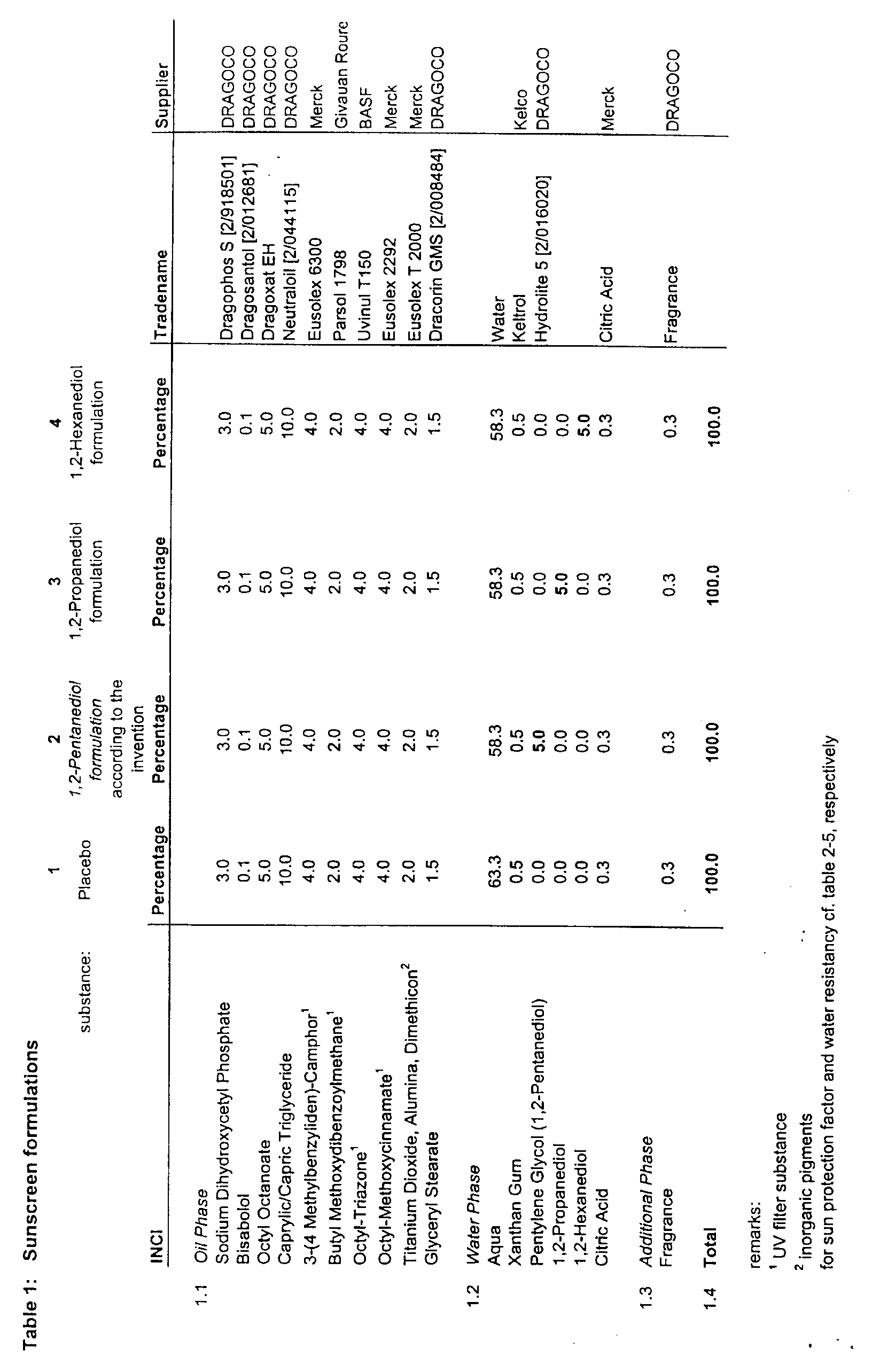
- The preparation of the respective sunscreen formulations 1-4 comprised a four step process: In the first step, an oil phase was composed by mixing the ingredients given in table 1 section 1.1. Care was taken that inorganic pigments like Titanium dioxide, Alumina and Dimethicon were dispersed completely in the oil phase. The dispersion was heated to about 80 °C.
- In an independent second step, a separate water phase comprising the ingredients according to table 1 section 1.2 was prepared by mixing the indicated components in their respective quantities. The aqueous mixture was also heated to about 80 °C.
- Both oil and water phase were then combined in a third step of the process. The oil phase was mixed with an Ultra-Turrax stirrer into the water phase for about 5 minutes. The resulting oil in water dispersion was then allowed to cool down to ambient temperature (approx. 18 - 25 °C) while being gently stirred.
- After the temperature of the dispersion had dropped below 40 °C, a fragrance mixture (see table 1 section 1.3) was added to complete the sunscreen formulation. The pH of the dispersions was found to be in the range from 6 to 6.5.
- For testing the Sun Protection Factor (SPF) of formulations 1-4 the COLIPA method was employed which is described in the follwing references all of which are incorporated herein by reference in their entirety: Dr. Karlheinz Schrader, Skin Care Forum (publisher: Henkel KGaA), No. 10, December 1994, 2-8; M. Rohr et al, Parfümerie und Kosmetik 5/98, pages 12-19, Hüthig GmbH, HeidelberG (Germany); COLIPA SPF Test Method, The Recommendation of the COLIPA Task Force "Sun Protection Measurements", October 1994.
- Average SPF values determined for the formulations 1-4 are given in the respective tables 2-5. For all four formulations, the addition of the alkanedioles tested had only a neglectable effect on the sun protection factor as such.
- For testing the water resistance of a given formulation 1-4 a test method was used which is described in the following references all of which are incorporated herein by reference in their entirety: M. Rohr et al, Parfümerie mid Kosmetik 5/98, pages 12-19, Hüthig GmbH, Heidelberg (Germany); Schrader, K, Schrader, A., Die Sonnenschutzfaktorbestimmung: Prüfung der Wasserresistenz, Aktuelle Dermatologie, 20, 4, 1994. For determining the water resistancy the SPF was first measured under dry conditions ("without sunscreen formulation" vs "with sun-screen formulation") and then under shower conditions ("without sunscreen formulation" vs "with applied sunscreen formulation after immersion") as desribed in the stated references.
- Water resistancies determined for the formulations 1-4 are given in the respective tables 2-5.
- As can be derived from tables 2-5 water resistancy was significantly higher for formulation 2 comprising 1,2-pentanediol than for any other tested formulation.
- Astonishingly, the water resistancy of the 1,2-hexanediol-formulation was not only lower than that of the 1,2-pentanediol but even lower than the water resistancy of the "placebo"-formulation. Formulation 3 comprising 1,2-propanediole showed a water resistancy similar to those of the placebo.
- Thus, in the homologous series 1,2-propanediol, 1,2-pentanediol and 1,2-hexanediol only the 1,2-pentanediol has an water resistance imparting or improving effect.
Sun protection factor and water resistancy:
sunscreen formulation comprising Placebo
according to table 1 col. "1"character of volunteers volunteer age sex skin type ITA water resistancy % without sunscreen formulation with sunscreen formulation after immersion [U/s] [U/s] [U/s] 1 53 f II 55 25 650 25.0 422 16.2 63.5 2 32 f I 61 29 650 22.4 336 11.6 49.4 3 35 m II 43 26 650 25.0 272 10.5 39.4 4 32 m I 59 15 300 20.0 190 12.7 61.4 5 42 f II 43 22 550 25.0 396 18.0 70.8 6 35 f III 38 25 625 25.0 360 14.4 55.8 average SPF2 24 14 water resistancy [%] 56.7 Sun protection factor and water resistancy:
sunscreen formulation comprising 1,2-pentanediol (acc. to the invention)
according to table 1 col. "2"character of volunteers volunteer age sex skin type ITA water resistancy % without sunscreen formulation with sunscreen formulation after immersion [U/s] [U/s] [U/s] 1 19 m II 54 20 500 25.0 400 20.0 79.2 2 20 m II 49 16 325 20.3 208 13.0 62.1 3 20 m I 62 29 725 25.0 583 20.1 79.6 4 52 f III 41 23 475 20.7 304 13.2 62.2 5 53 f I 63 13 325 25.0 205 15.8 61.5 6 35 m III 32 22 450 20.5 350 15.9 76.6 average SPF2 23 16 water resistancy [%] 70.2 Sun protection factor and water resistancy:
sunscreen formulation comprising 1,2-propanediol
according to table 1 col. "3"character of volunteers volunteer age sex skin type ITA water resistancy [%] without sunscreen formulation with sunscreen formulation after immersion [U/s] [U/s] [U/s] 1 25 m II 45 30 600 20.0 390 13.0 63.2 2 24 m II 48 37 740 20.0 373 10.1 47.8 3 58 f II 47 27 660 24.4 429 15.9 63.5 4 38 f I 64 37 740 20.0 481 13.0 63.2 5 42 m III 41 20 480 24.0 312 15.6 63.5 average SPF2 22 14 water resistancy [%] 60.2 Sun protection factor and water resistancy:
sunscreen formulation comprising 1,2-hexanediol
according to table 1 col. "4"character of volunteers volunteer age sex skin type ITA water resistancy [%] without sunscreen formulation with sunscreen formulation after immersion [U/s] [U/s] [U/s] 1 50 f I 61 35 380 25.3 156 10.4 38.6 2 35 m II 33 35 700 20.0 209 6.0 26.2 3 42 f II 39 26 420 16.2 273 10.5 62.7 4 37 m III 32 36 580 16.1 299 8.3 48.3 5 20 m III 29 34 680 20.0 286 8.4 39.0 6 49 f I 57 27 660 24.4 249 9.2 35.1 average SPF2 20 9 water resistancy [%] 41.7
Claims (23)
- Method for imparting water resistance to or improving water resistance of a cosmetic or dermatological formulation comprising at least one cosmetic and/or dermatological active agent in a cosmetically and/or pharmaceutically acceptable carrier for topical application to the skin of humans or animals comprising:adding a water resistance improving effective amount of 1,2-pentanediol to said formulation.
- Method according to claim 1, wherein the cosmetic or dermatological formulation comprises at least one organic UV filter substance, the water resistance of which is improved by the presence of 1,2-pentanediol.
- Method according to claim 2, wherein the organic UV filter substance is selected from the group comprising derivatives of 3-benzylidenecamphor, of 4-aminobenzoic acid, of cinnamic acid, of salicylic acid, of benzophenone and of 2-phenylbenzimidazole.
- Method according to any of claims 1-3, wherein the cosmetic or dermatological formulation comprises coated or uncoated inorganic pigments, the water resistance of which is improved by the presence of 1,2-pentanediol.
- Method according to claim 4, wherein the inorganic pigments comprise pigments of a metal oxide.
- Method according to claim 5, wherein the metal oxide pigments are selected from the group comprising metal oxide pigments of titanium, zinc, iron, zirconium, silicon, manganese, aluminium, cerium, and mixtures thereof.
- Method according to any of claims 1-6, wherein the cosmetic or dermatological formulation comprises at least one antioxidant the water resistance of which is improved by the presence of 1,2-pentanediol.
- Method according to claim 7, wherein the antioxidant is selected from the group comprising Green Tea catechins, beta Carotene, Polyphenols, Rosemary extract, anti-oxidative Glycosides, Arbutin, Ascorbic Acid and derivatives thereof, Asiaticoside, Caffeic Acid, Ergothioneine, Ferulic Acid, Glucosylrutin, Hydroquinone, Isoquercitrin, Rosmarinic Acid, Rutin, Tocopherol and Tocopheryl Acetate, and mixtures therof.
- Method according to any of claims 1-8, wherein the cosmetic or dermatological formulation comprises at least one anti-inflammatory compound the water resistance of which is improved by the presence of 1,2-pentanediol.
- Method according to claim 9, wherein the anti-inflammatory compound is selected from the group comprising Bisabolol, Oat Extract, Willowherb extract, Arnica Montana extract, Indomethacin, steriodal anti-inflammatory agents such as hydrocortisone, non-steriodal anti-inflammatory agents (NSAIDs), polyunsaturated fatty acid compounds such as the amides of 5,8,11-eicosatrienoic acid, or glycyrrhetinic acid and mixtures thereof.
- Method according to any of claims 1-10, wherein the cosmetic or dermatological formulation comprises at least one anti-microbial compound the water resistance of which is improved by the presence of 1,2-pentanediol.
- Method according to claim 11, wherein the anti-microbial compound is selected from the group comprising Farnesol and Triclosan, and mixtures thereof.
- Method according to any of claims 1-12, wherein the cosmetic or dermatological formulation comprises at least one antiperspirant the water resistance of which is improved by the presence of 1,2-pentanediol.
- Method according to claim 13, wherein the antiperspirant is selected from the group comprising aluminiumchlorhydrate, zirconiumchlorhydrate.
- Method according to any of claims 1-14, wherein the cosmetic or dermatological formulation comprises at least one fragrance compound.
- Method according to any of claims 1-15, wherein the cosmetic or dermatological formulation comprises at least one skin whitening compound.
- Method according to claim 16, wherein the skin whitening compound is selected from the group comprising hydroquinone and rumex extract.
- Method according to any of claims 1-17, wherein 1,2-pentanediol is added in an amount of more than 0.5 percent by weight, based on the weight of the resulting formulation.
- Method according to claim 18, wherein 1,2-pentanediol is added in an amount of more than 3 percent by weight, based on the weight of the resulting formulation.
- Method according to claim 19, wherein 1,2-pentanediol is added in an amount in the range from 3 to 6 percent by weight, based on the weight of the resulting formulation.
- Method for providing enhanced protection to the skin of humans or animals from the effects of ultraviolet radiation, said method comprising topically applying to the skin of the human or animal an effective amount of a sunscreen composition comprising a water resistance improving effective amount of 1,2-pentanediol.
- Use of 1,2-pentanediol as water resistance improving or imparting agent in cosmetic or dermatological formulations.
- Method for increasing water resistance and skin residency time of a cosmetic or dermatological formulation comprising at least one cosmetic and/or dermatological active agent in a cosmetically and/or pharmaceutically acceptable carrier for topical application to the skin of humans or animals comprising: adding to said cosmetic or dermatological formulation a water resistance improving effective amount of 1,2-pentanediol.
Applications Claiming Priority (2)
| Application Number | Priority Date | Filing Date | Title |
|---|---|---|---|
| US378402 | 1995-01-26 | ||
| US09/378,402 US6274124B1 (en) | 1999-08-20 | 1999-08-20 | Additive for improving the water resistance of cosmetic or dermatological formulations |
Publications (1)
| Publication Number | Publication Date |
|---|---|
| EP1078638A1 true EP1078638A1 (en) | 2001-02-28 |
Family
ID=23492995
Family Applications (1)
| Application Number | Title | Priority Date | Filing Date |
|---|---|---|---|
| EP00116508A Withdrawn EP1078638A1 (en) | 1999-08-20 | 2000-07-31 | Additive for improving the water resistance of cosmetic or dermatological formulations |
Country Status (10)
| Country | Link |
|---|---|
| US (1) | US6274124B1 (en) |
| EP (1) | EP1078638A1 (en) |
| JP (1) | JP2001072531A (en) |
| AR (1) | AR025071A1 (en) |
| AU (1) | AU5194700A (en) |
| BR (1) | BR0003897A (en) |
| CA (1) | CA2316329A1 (en) |
| ID (1) | ID26948A (en) |
| MY (1) | MY135988A (en) |
| PL (1) | PL341803A1 (en) |
Cited By (12)
| Publication number | Priority date | Publication date | Assignee | Title |
|---|---|---|---|---|
| WO2003002074A1 (en) * | 2001-06-27 | 2003-01-09 | Mandom Corporation | Emulsion compositions |
| WO2003066073A3 (en) * | 2002-02-08 | 2004-01-15 | Johnson & Johnson Gmbh | Compositions containing oat straw and willowherb extract |
| WO2004016236A1 (en) * | 2002-08-14 | 2004-02-26 | Fancl Corporation | Cosmetics |
| WO2005018582A3 (en) * | 2003-08-22 | 2005-07-07 | Oreal | Compositions containing topical active agents and pentylene glycol |
| EP1779839A1 (en) * | 2005-10-25 | 2007-05-02 | Beiersdorf AG | Cosmetic composition comprising 1,2-alkanediol(s)and triazine(s) |
| EP1779835A1 (en) * | 2005-10-25 | 2007-05-02 | Beiersdorf AG | Emulsion comprising 1,2-alkanediols and polar oil components |
| GB2434985A (en) * | 2003-05-29 | 2007-08-15 | Sun Pharmaceuticals Corp | Sunscreen composition |
| GB2437056A (en) * | 2003-05-29 | 2007-10-17 | Sun Pharmaceuticals Corp | Sunscreen composition |
| WO2010043351A3 (en) * | 2008-10-13 | 2010-06-24 | Beiersdorf Ag | Polyamide-5 compounds in cosmetic preparations |
| US8084507B2 (en) | 2005-10-25 | 2011-12-27 | Beiersdorf Ag | Cosmetic O/W emulsion comprising 1,2-hexanediol |
| EP2468362A3 (en) * | 2010-12-21 | 2015-08-12 | Beiersdorf AG | Cosmetic preparation with a UVA-filter and sodium cetearyl sulfate |
| EP2731679A4 (en) * | 2011-07-11 | 2015-08-26 | Jr Chem Llc | Uv protective skin treatment compositions and screening methods |
Families Citing this family (27)
| Publication number | Priority date | Publication date | Assignee | Title |
|---|---|---|---|---|
| JP2001039814A (en) * | 1999-07-27 | 2001-02-13 | Pola Chem Ind Inc | Powder-containing cosmetic |
| JP3730102B2 (en) * | 2000-09-14 | 2005-12-21 | ポーラ化成工業株式会社 | Skin preparation for penetration enhancement |
| ITMI20020756A1 (en) * | 2002-04-09 | 2003-10-09 | Sinclair Pharma S R L | TOPICAL PHARMACEUTICAL COMPOSITIONS FOR THE TREATMENT OF DERMATITIS |
| JP3940633B2 (en) * | 2002-05-28 | 2007-07-04 | 株式会社ノエビア | Topical skin preparation |
| JP3811112B2 (en) * | 2002-09-25 | 2006-08-16 | ポーラ化成工業株式会社 | A skin preparation with minimal transient irritation |
| US20060210500A1 (en) * | 2003-04-18 | 2006-09-21 | Merck Patent Gmbh | Formulations |
| ATE381313T1 (en) * | 2003-06-13 | 2008-01-15 | Procter & Gamble | SKIN CARE DEVICE WITH SKIN BLEACHING PRODUCT |
| US7214391B2 (en) * | 2003-06-30 | 2007-05-08 | Usana Health Sciences, Inc. | Botanical extract compositions and process for preparing same |
| US20050042306A1 (en) * | 2003-08-21 | 2005-02-24 | Christopher Marrs | Stabilized compositions containing an oxygen-labile active agent |
| US20060018852A1 (en) * | 2003-08-22 | 2006-01-26 | L'oreal | Compositions containing topical active agents and pentylene glycol |
| US7199090B2 (en) | 2003-09-29 | 2007-04-03 | Ethena Healthcare Inc. | High alcohol content gel-like and foaming compositions comprising an alcohol and fluorosurfactant |
| DE102004062775A1 (en) | 2004-12-21 | 2006-06-29 | Stockhausen Gmbh | Alcoholic pump foam |
| EP3292757B1 (en) | 2005-03-07 | 2025-09-03 | Deb IP Limited | High alcohol content foaming compositions with silicone-based surfactants |
| US20060204466A1 (en) * | 2005-03-08 | 2006-09-14 | Ecolab Inc. | Hydroalcoholic antimicrobial composition with skin health benefits |
| FR2898808B1 (en) * | 2006-03-27 | 2008-05-02 | Biotechmarine Soc Par Actions | "COSMETIC ACTIVE INGREDIENT COMPOSED OF ARGININE FERRULATE AND A MICROALGUE EXTRACT AND USES THEREOF". |
| WO2008002609A2 (en) * | 2006-06-28 | 2008-01-03 | Applied Genetics Incorporated Dermatics | Hydroquinone compositions for skin lightening |
| ITMI20070689A1 (en) | 2007-04-03 | 2008-10-04 | 3V Sigma Spa | METHOD FOR OBTAINING COSMETIC EMULSIONS OR HIGH WATER RESISTANCE |
| JP5743379B2 (en) * | 2008-07-02 | 2015-07-01 | 株式会社マンダム | Skin cosmetics |
| US7842725B2 (en) | 2008-07-24 | 2010-11-30 | Ecolab USA, Inc. | Foaming alcohol compositions with selected dimethicone surfactants |
| DE102008052520A1 (en) * | 2008-10-21 | 2010-04-22 | Cognis Ip Management Gmbh | Cosmetic and / or pharmaceutical preparations |
| DE102011117364A1 (en) * | 2011-10-29 | 2013-05-02 | Merck Patent Gmbh | Skin whitening in phototherapy |
| EP2985017B1 (en) * | 2013-04-11 | 2020-01-22 | Osaka Organic Chemical Industry Ltd. | 1,2-alkane polyol-containing composition |
| US9439841B2 (en) | 2013-06-06 | 2016-09-13 | Ecolab Usa Inc. | Alcohol based sanitizer with improved dermal compatibility and feel |
| JP7053151B2 (en) * | 2017-02-03 | 2022-04-12 | 株式会社Adeka | How to improve the solubility of poorly water-soluble components |
| US12152220B2 (en) | 2020-07-06 | 2024-11-26 | Ecolab Usa Inc. | PEG-modified castor oil based compositions for microemulsifying and removing multiple oily soils |
| JP2023534927A (en) | 2020-07-06 | 2023-08-15 | エコラボ ユーエスエー インコーポレイティド | Foaming alcohol/water blend composition containing structured alkoxylated siloxane |
| EP4176032A1 (en) | 2020-07-06 | 2023-05-10 | Ecolab USA Inc. | Foaming mixed alcohol/water compositions comprising a combination of alkyl siloxane and a hydrotrope/solubilizer |
Citations (2)
| Publication number | Priority date | Publication date | Assignee | Title |
|---|---|---|---|---|
| DE4320744A1 (en) * | 1993-06-23 | 1995-01-05 | Dragoco Gerberding Co Gmbh | Use of alkane diols in cosmetic products |
| EP0935960A1 (en) * | 1998-02-12 | 1999-08-18 | L'oreal | Use of 1,2-pentanediol in cosmetic or dermatologic composition containing an aqueous dispersion of polymeric film forming particles and cosmetic or dermatologic composition containing these components |
Family Cites Families (2)
| Publication number | Priority date | Publication date | Assignee | Title |
|---|---|---|---|---|
| GB1541463A (en) * | 1975-10-11 | 1979-02-28 | Lion Dentifrice Co Ltd | Process for prparing a multiple emulsion having a dispersing form of water-phase/oil-phase/water-phase |
| US4960764A (en) * | 1987-03-06 | 1990-10-02 | Richardson-Vicks Inc. | Oil-in-water-in-silicone emulsion compositions |
-
1999
- 1999-08-20 US US09/378,402 patent/US6274124B1/en not_active Expired - Fee Related
-
2000
- 2000-07-31 PL PL00341803A patent/PL341803A1/en unknown
- 2000-07-31 EP EP00116508A patent/EP1078638A1/en not_active Withdrawn
- 2000-08-08 JP JP2000240160A patent/JP2001072531A/en active Pending
- 2000-08-08 AR ARP000104081A patent/AR025071A1/en not_active Application Discontinuation
- 2000-08-10 AU AU51947/00A patent/AU5194700A/en not_active Abandoned
- 2000-08-17 BR BR0003897-0A patent/BR0003897A/en not_active IP Right Cessation
- 2000-08-18 MY MYPI20003814A patent/MY135988A/en unknown
- 2000-08-18 CA CA002316329A patent/CA2316329A1/en not_active Abandoned
- 2000-08-21 ID IDP20000696A patent/ID26948A/en unknown
Patent Citations (2)
| Publication number | Priority date | Publication date | Assignee | Title |
|---|---|---|---|---|
| DE4320744A1 (en) * | 1993-06-23 | 1995-01-05 | Dragoco Gerberding Co Gmbh | Use of alkane diols in cosmetic products |
| EP0935960A1 (en) * | 1998-02-12 | 1999-08-18 | L'oreal | Use of 1,2-pentanediol in cosmetic or dermatologic composition containing an aqueous dispersion of polymeric film forming particles and cosmetic or dermatologic composition containing these components |
Cited By (20)
| Publication number | Priority date | Publication date | Assignee | Title |
|---|---|---|---|---|
| WO2003002074A1 (en) * | 2001-06-27 | 2003-01-09 | Mandom Corporation | Emulsion compositions |
| WO2003066073A3 (en) * | 2002-02-08 | 2004-01-15 | Johnson & Johnson Gmbh | Compositions containing oat straw and willowherb extract |
| WO2004016236A1 (en) * | 2002-08-14 | 2004-02-26 | Fancl Corporation | Cosmetics |
| GB2437056B (en) * | 2003-05-29 | 2008-01-23 | Sun Pharmaceuticals Corp | Sunscreen composition |
| GB2434985B (en) * | 2003-05-29 | 2008-01-30 | Sun Pharmaceuticals Corp | Sunscreen composition |
| GB2434985A (en) * | 2003-05-29 | 2007-08-15 | Sun Pharmaceuticals Corp | Sunscreen composition |
| GB2437056A (en) * | 2003-05-29 | 2007-10-17 | Sun Pharmaceuticals Corp | Sunscreen composition |
| WO2005018582A3 (en) * | 2003-08-22 | 2005-07-07 | Oreal | Compositions containing topical active agents and pentylene glycol |
| EP1964545A1 (en) | 2005-10-25 | 2008-09-03 | Beiersdorf AG | Cosmetic preparation with 1.2-alkandiols and triazines |
| EP1779835A1 (en) * | 2005-10-25 | 2007-05-02 | Beiersdorf AG | Emulsion comprising 1,2-alkanediols and polar oil components |
| EP1779839A1 (en) * | 2005-10-25 | 2007-05-02 | Beiersdorf AG | Cosmetic composition comprising 1,2-alkanediol(s)and triazine(s) |
| US7875653B2 (en) | 2005-10-25 | 2011-01-25 | Beiersdorf Ag | Emulsion comprising 1,2-alkanediols and polar oil components |
| US8084507B2 (en) | 2005-10-25 | 2011-12-27 | Beiersdorf Ag | Cosmetic O/W emulsion comprising 1,2-hexanediol |
| DE102005051862B4 (en) | 2005-10-25 | 2018-08-30 | Beiersdorf Ag | Emulsion containing 1,2-alkanediols, emulsifiers and polar oil components and their use |
| WO2010043351A3 (en) * | 2008-10-13 | 2010-06-24 | Beiersdorf Ag | Polyamide-5 compounds in cosmetic preparations |
| US8529921B2 (en) | 2008-10-13 | 2013-09-10 | Beiersdorf Ag | Polyamide-5 compounds in cosmetic preparations |
| EP2468362A3 (en) * | 2010-12-21 | 2015-08-12 | Beiersdorf AG | Cosmetic preparation with a UVA-filter and sodium cetearyl sulfate |
| EP2731679A4 (en) * | 2011-07-11 | 2015-08-26 | Jr Chem Llc | Uv protective skin treatment compositions and screening methods |
| US9707165B2 (en) | 2011-07-11 | 2017-07-18 | Jr Chem, Llc | UV protective skin treatment compositions and screening methods |
| US9737468B2 (en) | 2011-07-11 | 2017-08-22 | Jr Chem, Llc | UV protective skin treatment compositions and screening methods |
Also Published As
| Publication number | Publication date |
|---|---|
| MY135988A (en) | 2008-07-31 |
| AR025071A1 (en) | 2002-11-06 |
| JP2001072531A (en) | 2001-03-21 |
| ID26948A (en) | 2001-02-22 |
| PL341803A1 (en) | 2001-02-26 |
| AU5194700A (en) | 2001-02-22 |
| BR0003897A (en) | 2001-04-03 |
| CA2316329A1 (en) | 2001-02-20 |
| US6274124B1 (en) | 2001-08-14 |
Similar Documents
| Publication | Publication Date | Title |
|---|---|---|
| US6274124B1 (en) | Additive for improving the water resistance of cosmetic or dermatological formulations | |
| EP2501777B1 (en) | Broad spectrum uva stable, non-toxic, zinc oxide based complex | |
| US5208011A (en) | Ultraviolet resistant sunscreen compositions | |
| US20070189993A1 (en) | Stabilized photoprotective composition | |
| HU219127B (en) | Sun protection cosmetics and their use | |
| JP2011506610A (en) | Enhanced photostabilization of abozenzone using phosphate-based emulsifiers in the presence of zinc oxide | |
| WO1994017780A1 (en) | Waterproof cosmetic or dermatological photoprotective preparations | |
| JP2001527032A (en) | Composition having high-efficiency skin protective action against the damaging action of ultraviolet light | |
| JPH07330565A (en) | Antisun cosmetic composition and method of use thereof | |
| US20090232754A1 (en) | Enhanced photostability of suncare compositions containing avobenzone | |
| HU217352B (en) | Sunscreen cosmetic composition and application | |
| JPH07330566A (en) | Photoprotective cosmetic composition and method of using the same | |
| US20060233725A1 (en) | Non-Endocrine Disrupting Cytoprotective UV Radiation Resistant Substance | |
| PL180636B1 (en) | Cosmetic composition for topical use PL PL PL PL PL | |
| US6436374B1 (en) | Light-stable cosmetic formulation containing butylmethoxydibenzoylmethane | |
| US5620680A (en) | Cosmetic and dermatological light protection formulations having an active content of cis-urocaninic acid | |
| US5976510A (en) | Cosmetic tanning and sunscreen agent | |
| ZA200600851B (en) | Metal oxide formulations | |
| EP0814760B1 (en) | SUBSTITUTED o-AMINOCARBONYLBENZOIC ACID SALTS AND THEIR USE AS SUNSCREENS | |
| JPH0532531A (en) | Cosmetic | |
| EP0955036A1 (en) | Sunscreen having disappearing color indicator | |
| JP3518218B2 (en) | Oil-in-water skin external preparation | |
| MXPA00008076A (en) | Additive for improving the water resistance of cosmetic or dermatological formulations | |
| EP1608331B1 (en) | Sunscreen composition comprising a mixture of silicas | |
| JPH01160914A (en) | cosmetics |
Legal Events
| Date | Code | Title | Description |
|---|---|---|---|
| PUAI | Public reference made under article 153(3) epc to a published international application that has entered the european phase |
Free format text: ORIGINAL CODE: 0009012 |
|
| AK | Designated contracting states |
Kind code of ref document: A1 Designated state(s): AT BE CH CY DE DK ES FI FR GB GR IE IT LI LU MC NL PT SE |
|
| AX | Request for extension of the european patent |
Free format text: AL;LT;LV;MK;RO;SI |
|
| 17P | Request for examination filed |
Effective date: 20010828 |
|
| AKX | Designation fees paid |
Free format text: AT BE CH CY DE DK ES FI FR GB GR IE IT LI LU MC NL PT SE |
|
| 17Q | First examination report despatched |
Effective date: 20021212 |
|
| GRAH | Despatch of communication of intention to grant a patent |
Free format text: ORIGINAL CODE: EPIDOS IGRA |
|
| RAP1 | Party data changed (applicant data changed or rights of an application transferred) |
Owner name: SYMRISE GMBH & CO. KG |
|
| STAA | Information on the status of an ep patent application or granted ep patent |
Free format text: STATUS: THE APPLICATION IS DEEMED TO BE WITHDRAWN |
|
| 18D | Application deemed to be withdrawn |
Effective date: 20031028 |