EP1076074B1 - Flexible polyurethane foam containing copper - Google Patents
Flexible polyurethane foam containing copper Download PDFInfo
- Publication number
- EP1076074B1 EP1076074B1 EP20000306718 EP00306718A EP1076074B1 EP 1076074 B1 EP1076074 B1 EP 1076074B1 EP 20000306718 EP20000306718 EP 20000306718 EP 00306718 A EP00306718 A EP 00306718A EP 1076074 B1 EP1076074 B1 EP 1076074B1
- Authority
- EP
- European Patent Office
- Prior art keywords
- foam
- copper
- weight
- polyol
- amount
- Prior art date
- Legal status (The legal status is an assumption and is not a legal conclusion. Google has not performed a legal analysis and makes no representation as to the accuracy of the status listed.)
- Expired - Lifetime
Links
- RYGMFSIKBFXOCR-UHFFFAOYSA-N Copper Chemical compound [Cu] RYGMFSIKBFXOCR-UHFFFAOYSA-N 0.000 title claims description 101
- 239000010949 copper Substances 0.000 title claims description 100
- 229910052802 copper Inorganic materials 0.000 title claims description 93
- 229920005830 Polyurethane Foam Polymers 0.000 title claims description 24
- 239000011496 polyurethane foam Substances 0.000 title claims description 24
- 239000006260 foam Substances 0.000 claims description 122
- 150000003077 polyols Chemical class 0.000 claims description 111
- 229920005862 polyol Polymers 0.000 claims description 87
- 239000002245 particle Substances 0.000 claims description 41
- 125000002887 hydroxy group Chemical group [H]O* 0.000 claims description 38
- QPLDLSVMHZLSFG-UHFFFAOYSA-N Copper oxide Chemical compound [Cu]=O QPLDLSVMHZLSFG-UHFFFAOYSA-N 0.000 claims description 32
- 239000005751 Copper oxide Substances 0.000 claims description 30
- 229910000431 copper oxide Inorganic materials 0.000 claims description 30
- 150000002513 isocyanates Chemical class 0.000 claims description 30
- 239000000203 mixture Substances 0.000 claims description 26
- 239000004744 fabric Substances 0.000 claims description 25
- 239000012948 isocyanate Substances 0.000 claims description 24
- 238000000034 method Methods 0.000 claims description 24
- UPMLOUAZCHDJJD-UHFFFAOYSA-N 4,4'-Diphenylmethane Diisocyanate Chemical group C1=CC(N=C=O)=CC=C1CC1=CC=C(N=C=O)C=C1 UPMLOUAZCHDJJD-UHFFFAOYSA-N 0.000 claims description 15
- 239000000463 material Substances 0.000 claims description 12
- 238000011065 in-situ storage Methods 0.000 claims description 11
- 210000003423 ankle Anatomy 0.000 claims description 10
- 239000004814 polyurethane Substances 0.000 claims description 10
- 229920000742 Cotton Polymers 0.000 claims description 9
- 229920000642 polymer Polymers 0.000 claims description 8
- 229920002635 polyurethane Polymers 0.000 claims description 8
- DVKJHBMWWAPEIU-UHFFFAOYSA-N toluene 2,4-diisocyanate Chemical class CC1=CC=C(N=C=O)C=C1N=C=O DVKJHBMWWAPEIU-UHFFFAOYSA-N 0.000 claims description 8
- 239000000853 adhesive Substances 0.000 claims description 7
- 230000001070 adhesive effect Effects 0.000 claims description 7
- 239000004088 foaming agent Substances 0.000 claims description 7
- 210000003414 extremity Anatomy 0.000 claims description 6
- 229910052751 metal Inorganic materials 0.000 claims description 6
- 239000002184 metal Substances 0.000 claims description 6
- 238000010276 construction Methods 0.000 claims description 5
- 210000003127 knee Anatomy 0.000 claims description 5
- 210000003205 muscle Anatomy 0.000 claims description 5
- 229920001228 polyisocyanate Polymers 0.000 claims description 5
- 239000005056 polyisocyanate Substances 0.000 claims description 5
- 239000002002 slurry Substances 0.000 claims description 5
- 210000000689 upper leg Anatomy 0.000 claims description 5
- 238000005470 impregnation Methods 0.000 claims description 4
- 239000004816 latex Substances 0.000 claims description 4
- 229920000126 latex Polymers 0.000 claims description 4
- 238000002156 mixing Methods 0.000 claims description 4
- 210000000707 wrist Anatomy 0.000 claims description 3
- RUELTTOHQODFPA-UHFFFAOYSA-N toluene 2,6-diisocyanate Chemical compound CC1=C(N=C=O)C=CC=C1N=C=O RUELTTOHQODFPA-UHFFFAOYSA-N 0.000 claims description 2
- HIFVAOIJYDXIJG-UHFFFAOYSA-N benzylbenzene;isocyanic acid Chemical class N=C=O.N=C=O.C=1C=CC=CC=1CC1=CC=CC=C1 HIFVAOIJYDXIJG-UHFFFAOYSA-N 0.000 claims 3
- 229940108928 copper Drugs 0.000 description 69
- IMNIMPAHZVJRPE-UHFFFAOYSA-N triethylenediamine Chemical compound C1CN2CCN1CC2 IMNIMPAHZVJRPE-UHFFFAOYSA-N 0.000 description 25
- 239000004721 Polyphenylene oxide Substances 0.000 description 17
- 229920000570 polyether Polymers 0.000 description 17
- 239000000047 product Substances 0.000 description 16
- 229960004643 cupric oxide Drugs 0.000 description 15
- 239000012973 diazabicyclooctane Substances 0.000 description 15
- 239000004094 surface-active agent Substances 0.000 description 15
- IAYPIBMASNFSPL-UHFFFAOYSA-N Ethylene oxide Chemical class C1CO1 IAYPIBMASNFSPL-UHFFFAOYSA-N 0.000 description 14
- PEDCQBHIVMGVHV-UHFFFAOYSA-N Glycerine Chemical compound OCC(O)CO PEDCQBHIVMGVHV-UHFFFAOYSA-N 0.000 description 12
- XLYOFNOQVPJJNP-UHFFFAOYSA-N water Substances O XLYOFNOQVPJJNP-UHFFFAOYSA-N 0.000 description 12
- 150000001412 amines Chemical class 0.000 description 11
- 238000009472 formulation Methods 0.000 description 10
- 239000000843 powder Substances 0.000 description 9
- 239000003054 catalyst Substances 0.000 description 8
- SZXQTJUDPRGNJN-UHFFFAOYSA-N dipropylene glycol Chemical group OCCCOCCCO SZXQTJUDPRGNJN-UHFFFAOYSA-N 0.000 description 8
- FZZMTSNZRBFGGU-UHFFFAOYSA-N 2-chloro-7-fluoroquinazolin-4-amine Chemical compound FC1=CC=C2C(N)=NC(Cl)=NC2=C1 FZZMTSNZRBFGGU-UHFFFAOYSA-N 0.000 description 7
- 229920002396 Polyurea Polymers 0.000 description 7
- 239000006185 dispersion Substances 0.000 description 7
- 230000000694 effects Effects 0.000 description 7
- 229920001296 polysiloxane Polymers 0.000 description 7
- 230000009257 reactivity Effects 0.000 description 7
- 239000004971 Cross linker Substances 0.000 description 6
- UEEJHVSXFDXPFK-UHFFFAOYSA-N N-dimethylaminoethanol Chemical compound CN(C)CCO UEEJHVSXFDXPFK-UHFFFAOYSA-N 0.000 description 6
- 230000032683 aging Effects 0.000 description 6
- 206010003246 arthritis Diseases 0.000 description 6
- 230000000052 comparative effect Effects 0.000 description 6
- 239000004615 ingredient Substances 0.000 description 6
- 239000007858 starting material Substances 0.000 description 5
- 239000000126 substance Substances 0.000 description 5
- RNFJDJUURJAICM-UHFFFAOYSA-N 2,2,4,4,6,6-hexaphenoxy-1,3,5-triaza-2$l^{5},4$l^{5},6$l^{5}-triphosphacyclohexa-1,3,5-triene Chemical compound N=1P(OC=2C=CC=CC=2)(OC=2C=CC=CC=2)=NP(OC=2C=CC=CC=2)(OC=2C=CC=CC=2)=NP=1(OC=1C=CC=CC=1)OC1=CC=CC=C1 RNFJDJUURJAICM-UHFFFAOYSA-N 0.000 description 4
- GOOHAUXETOMSMM-UHFFFAOYSA-N Propylene oxide Chemical compound CC1CO1 GOOHAUXETOMSMM-UHFFFAOYSA-N 0.000 description 4
- 229920013701 VORANOL™ Polymers 0.000 description 4
- 239000000654 additive Substances 0.000 description 4
- 239000011230 binding agent Substances 0.000 description 4
- 239000003063 flame retardant Substances 0.000 description 4
- 238000010348 incorporation Methods 0.000 description 4
- 239000012974 tin catalyst Substances 0.000 description 4
- KSBAEPSJVUENNK-UHFFFAOYSA-L tin(ii) 2-ethylhexanoate Chemical compound [Sn+2].CCCCC(CC)C([O-])=O.CCCCC(CC)C([O-])=O KSBAEPSJVUENNK-UHFFFAOYSA-L 0.000 description 4
- GTEXIOINCJRBIO-UHFFFAOYSA-N 2-[2-(dimethylamino)ethoxy]-n,n-dimethylethanamine Chemical compound CN(C)CCOCCN(C)C GTEXIOINCJRBIO-UHFFFAOYSA-N 0.000 description 3
- 101000575029 Bacillus subtilis (strain 168) 50S ribosomal protein L11 Proteins 0.000 description 3
- 102100035793 CD83 antigen Human genes 0.000 description 3
- 101000946856 Homo sapiens CD83 antigen Proteins 0.000 description 3
- 241001465754 Metazoa Species 0.000 description 3
- 208000002193 Pain Diseases 0.000 description 3
- 239000007864 aqueous solution Substances 0.000 description 3
- 230000008901 benefit Effects 0.000 description 3
- ZBCBWPMODOFKDW-UHFFFAOYSA-N diethanolamine Chemical compound OCCNCCO ZBCBWPMODOFKDW-UHFFFAOYSA-N 0.000 description 3
- 239000012972 dimethylethanolamine Substances 0.000 description 3
- 238000004519 manufacturing process Methods 0.000 description 3
- -1 muslin Polymers 0.000 description 3
- 230000036407 pain Effects 0.000 description 3
- 229920000728 polyester Polymers 0.000 description 3
- 238000002360 preparation method Methods 0.000 description 3
- 239000011541 reaction mixture Substances 0.000 description 3
- 210000004243 sweat Anatomy 0.000 description 3
- 210000003371 toe Anatomy 0.000 description 3
- 241001425800 Pipa Species 0.000 description 2
- 230000000996 additive effect Effects 0.000 description 2
- 230000003679 aging effect Effects 0.000 description 2
- 230000015572 biosynthetic process Effects 0.000 description 2
- 230000015556 catabolic process Effects 0.000 description 2
- 238000006243 chemical reaction Methods 0.000 description 2
- 150000001879 copper Chemical class 0.000 description 2
- BERDEBHAJNAUOM-UHFFFAOYSA-N copper(I) oxide Inorganic materials [Cu]O[Cu] BERDEBHAJNAUOM-UHFFFAOYSA-N 0.000 description 2
- KRFJLUBVMFXRPN-UHFFFAOYSA-N cuprous oxide Chemical compound [O-2].[Cu+].[Cu+] KRFJLUBVMFXRPN-UHFFFAOYSA-N 0.000 description 2
- 229940112669 cuprous oxide Drugs 0.000 description 2
- 238000006731 degradation reaction Methods 0.000 description 2
- 239000004815 dispersion polymer Substances 0.000 description 2
- 239000003792 electrolyte Substances 0.000 description 2
- 210000002683 foot Anatomy 0.000 description 2
- 238000010438 heat treatment Methods 0.000 description 2
- 210000001503 joint Anatomy 0.000 description 2
- 239000000178 monomer Substances 0.000 description 2
- 239000011505 plaster Substances 0.000 description 2
- 238000006116 polymerization reaction Methods 0.000 description 2
- 230000008569 process Effects 0.000 description 2
- 229920005989 resin Polymers 0.000 description 2
- 239000011347 resin Substances 0.000 description 2
- 239000002904 solvent Substances 0.000 description 2
- 229920002554 vinyl polymer Polymers 0.000 description 2
- LGXVIGDEPROXKC-UHFFFAOYSA-N 1,1-dichloroethene Chemical compound ClC(Cl)=C LGXVIGDEPROXKC-UHFFFAOYSA-N 0.000 description 1
- 239000004114 Ammonium polyphosphate Substances 0.000 description 1
- 208000008035 Back Pain Diseases 0.000 description 1
- 239000004604 Blowing Agent Substances 0.000 description 1
- 241000282472 Canis lupus familiaris Species 0.000 description 1
- OKTJSMMVPCPJKN-UHFFFAOYSA-N Carbon Chemical compound [C] OKTJSMMVPCPJKN-UHFFFAOYSA-N 0.000 description 1
- 239000004970 Chain extender Substances 0.000 description 1
- FBPFZTCFMRRESA-FSIIMWSLSA-N D-Glucitol Natural products OC[C@H](O)[C@H](O)[C@@H](O)[C@H](O)CO FBPFZTCFMRRESA-FSIIMWSLSA-N 0.000 description 1
- FBPFZTCFMRRESA-JGWLITMVSA-N D-glucitol Chemical compound OC[C@H](O)[C@@H](O)[C@H](O)[C@H](O)CO FBPFZTCFMRRESA-JGWLITMVSA-N 0.000 description 1
- VGGSQFUCUMXWEO-UHFFFAOYSA-N Ethene Chemical compound C=C VGGSQFUCUMXWEO-UHFFFAOYSA-N 0.000 description 1
- 239000005977 Ethylene Substances 0.000 description 1
- 241000282412 Homo Species 0.000 description 1
- 206010061218 Inflammation Diseases 0.000 description 1
- 229920000877 Melamine resin Polymers 0.000 description 1
- 208000007101 Muscle Cramp Diseases 0.000 description 1
- 235000010627 Phaseolus vulgaris Nutrition 0.000 description 1
- 244000046052 Phaseolus vulgaris Species 0.000 description 1
- 229920000538 Poly[(phenyl isocyanate)-co-formaldehyde] Polymers 0.000 description 1
- 208000025747 Rheumatic disease Diseases 0.000 description 1
- 206010040829 Skin discolouration Diseases 0.000 description 1
- 208000005392 Spasm Diseases 0.000 description 1
- ZJCCRDAZUWHFQH-UHFFFAOYSA-N Trimethylolpropane Chemical compound CCC(CO)(CO)CO ZJCCRDAZUWHFQH-UHFFFAOYSA-N 0.000 description 1
- 239000012190 activator Substances 0.000 description 1
- WNROFYMDJYEPJX-UHFFFAOYSA-K aluminium hydroxide Chemical compound [OH-].[OH-].[OH-].[Al+3] WNROFYMDJYEPJX-UHFFFAOYSA-K 0.000 description 1
- 235000019826 ammonium polyphosphate Nutrition 0.000 description 1
- 229920001276 ammonium polyphosphate Polymers 0.000 description 1
- 230000000843 anti-fungal effect Effects 0.000 description 1
- 239000002518 antifoaming agent Substances 0.000 description 1
- 239000003963 antioxidant agent Substances 0.000 description 1
- 230000003078 antioxidant effect Effects 0.000 description 1
- 210000000544 articulatio talocruralis Anatomy 0.000 description 1
- 244000309466 calf Species 0.000 description 1
- 239000002775 capsule Substances 0.000 description 1
- 210000004027 cell Anatomy 0.000 description 1
- 210000003850 cellular structure Anatomy 0.000 description 1
- 239000007795 chemical reaction product Substances 0.000 description 1
- 238000002485 combustion reaction Methods 0.000 description 1
- 238000013329 compounding Methods 0.000 description 1
- 150000001875 compounds Chemical class 0.000 description 1
- 229920001577 copolymer Polymers 0.000 description 1
- ARUVKPQLZAKDPS-UHFFFAOYSA-L copper(II) sulfate Chemical compound [Cu+2].[O-][S+2]([O-])([O-])[O-] ARUVKPQLZAKDPS-UHFFFAOYSA-L 0.000 description 1
- 239000006071 cream Substances 0.000 description 1
- 238000004132 cross linking Methods 0.000 description 1
- 230000001419 dependent effect Effects 0.000 description 1
- 150000004985 diamines Chemical class 0.000 description 1
- 201000010099 disease Diseases 0.000 description 1
- 208000037265 diseases, disorders, signs and symptoms Diseases 0.000 description 1
- 239000002270 dispersing agent Substances 0.000 description 1
- 238000001035 drying Methods 0.000 description 1
- 210000001513 elbow Anatomy 0.000 description 1
- 239000000945 filler Substances 0.000 description 1
- 238000011049 filling Methods 0.000 description 1
- 238000005187 foaming Methods 0.000 description 1
- 210000000245 forearm Anatomy 0.000 description 1
- 229910002804 graphite Inorganic materials 0.000 description 1
- 239000010439 graphite Substances 0.000 description 1
- 230000004054 inflammatory process Effects 0.000 description 1
- 239000007788 liquid Substances 0.000 description 1
- 238000011068 loading method Methods 0.000 description 1
- JDSHMPZPIAZGSV-UHFFFAOYSA-N melamine Chemical compound NC1=NC(N)=NC(N)=N1 JDSHMPZPIAZGSV-UHFFFAOYSA-N 0.000 description 1
- 229910001092 metal group alloy Inorganic materials 0.000 description 1
- 239000007769 metal material Substances 0.000 description 1
- 239000012766 organic filler Substances 0.000 description 1
- WXZMFSXDPGVJKK-UHFFFAOYSA-N pentaerythritol Chemical compound OCC(CO)(CO)CO WXZMFSXDPGVJKK-UHFFFAOYSA-N 0.000 description 1
- 230000035699 permeability Effects 0.000 description 1
- 150000003013 phosphoric acid derivatives Chemical class 0.000 description 1
- 230000000704 physical effect Effects 0.000 description 1
- 229920003023 plastic Polymers 0.000 description 1
- 239000004033 plastic Substances 0.000 description 1
- 229920000058 polyacrylate Polymers 0.000 description 1
- 229920005906 polyester polyol Polymers 0.000 description 1
- QQONPFPTGQHPMA-UHFFFAOYSA-N propylene Natural products CC=C QQONPFPTGQHPMA-UHFFFAOYSA-N 0.000 description 1
- 125000004805 propylene group Chemical group [H]C([H])([H])C([H])([*:1])C([H])([H])[*:2] 0.000 description 1
- 230000004044 response Effects 0.000 description 1
- 230000000552 rheumatic effect Effects 0.000 description 1
- 231100000257 skin discolouration Toxicity 0.000 description 1
- 239000000779 smoke Substances 0.000 description 1
- 239000007787 solid Substances 0.000 description 1
- 239000000243 solution Substances 0.000 description 1
- 239000000600 sorbitol Substances 0.000 description 1
- 230000002269 spontaneous effect Effects 0.000 description 1
- 239000003381 stabilizer Substances 0.000 description 1
- 238000003786 synthesis reaction Methods 0.000 description 1
- 229920006250 telechelic polymer Polymers 0.000 description 1
- 239000002562 thickening agent Substances 0.000 description 1
- 125000000391 vinyl group Chemical group [H]C([*])=C([H])[H] 0.000 description 1
- 239000000080 wetting agent Substances 0.000 description 1
- 239000002759 woven fabric Substances 0.000 description 1
Images

Classifications
-
- C—CHEMISTRY; METALLURGY
- C08—ORGANIC MACROMOLECULAR COMPOUNDS; THEIR PREPARATION OR CHEMICAL WORKING-UP; COMPOSITIONS BASED THEREON
- C08J—WORKING-UP; GENERAL PROCESSES OF COMPOUNDING; AFTER-TREATMENT NOT COVERED BY SUBCLASSES C08B, C08C, C08F, C08G or C08H
- C08J9/00—Working-up of macromolecular substances to porous or cellular articles or materials; After-treatment thereof
- C08J9/0066—Use of inorganic compounding ingredients
-
- A—HUMAN NECESSITIES
- A61—MEDICAL OR VETERINARY SCIENCE; HYGIENE
- A61F—FILTERS IMPLANTABLE INTO BLOOD VESSELS; PROSTHESES; DEVICES PROVIDING PATENCY TO, OR PREVENTING COLLAPSING OF, TUBULAR STRUCTURES OF THE BODY, e.g. STENTS; ORTHOPAEDIC, NURSING OR CONTRACEPTIVE DEVICES; FOMENTATION; TREATMENT OR PROTECTION OF EYES OR EARS; BANDAGES, DRESSINGS OR ABSORBENT PADS; FIRST-AID KITS
- A61F13/00—Bandages or dressings; Absorbent pads
- A61F13/06—Bandages or dressings; Absorbent pads specially adapted for feet or legs; Corn-pads; Corn-rings
- A61F13/061—Bandages or dressings; Absorbent pads specially adapted for feet or legs; Corn-pads; Corn-rings for knees
-
- A—HUMAN NECESSITIES
- A61—MEDICAL OR VETERINARY SCIENCE; HYGIENE
- A61F—FILTERS IMPLANTABLE INTO BLOOD VESSELS; PROSTHESES; DEVICES PROVIDING PATENCY TO, OR PREVENTING COLLAPSING OF, TUBULAR STRUCTURES OF THE BODY, e.g. STENTS; ORTHOPAEDIC, NURSING OR CONTRACEPTIVE DEVICES; FOMENTATION; TREATMENT OR PROTECTION OF EYES OR EARS; BANDAGES, DRESSINGS OR ABSORBENT PADS; FIRST-AID KITS
- A61F13/00—Bandages or dressings; Absorbent pads
- A61F13/06—Bandages or dressings; Absorbent pads specially adapted for feet or legs; Corn-pads; Corn-rings
- A61F13/064—Bandages or dressings; Absorbent pads specially adapted for feet or legs; Corn-pads; Corn-rings for feet
- A61F13/066—Bandages or dressings; Absorbent pads specially adapted for feet or legs; Corn-pads; Corn-rings for feet for the ankle
-
- A—HUMAN NECESSITIES
- A61—MEDICAL OR VETERINARY SCIENCE; HYGIENE
- A61F—FILTERS IMPLANTABLE INTO BLOOD VESSELS; PROSTHESES; DEVICES PROVIDING PATENCY TO, OR PREVENTING COLLAPSING OF, TUBULAR STRUCTURES OF THE BODY, e.g. STENTS; ORTHOPAEDIC, NURSING OR CONTRACEPTIVE DEVICES; FOMENTATION; TREATMENT OR PROTECTION OF EYES OR EARS; BANDAGES, DRESSINGS OR ABSORBENT PADS; FIRST-AID KITS
- A61F13/00—Bandages or dressings; Absorbent pads
- A61F13/10—Bandages or dressings; Absorbent pads specially adapted for fingers, hands or arms; Finger-stalls; Nail-protectors
- A61F13/104—Bandages or dressings; Absorbent pads specially adapted for fingers, hands or arms; Finger-stalls; Nail-protectors for the hands or fingers
-
- A—HUMAN NECESSITIES
- A61—MEDICAL OR VETERINARY SCIENCE; HYGIENE
- A61F—FILTERS IMPLANTABLE INTO BLOOD VESSELS; PROSTHESES; DEVICES PROVIDING PATENCY TO, OR PREVENTING COLLAPSING OF, TUBULAR STRUCTURES OF THE BODY, e.g. STENTS; ORTHOPAEDIC, NURSING OR CONTRACEPTIVE DEVICES; FOMENTATION; TREATMENT OR PROTECTION OF EYES OR EARS; BANDAGES, DRESSINGS OR ABSORBENT PADS; FIRST-AID KITS
- A61F13/00—Bandages or dressings; Absorbent pads
- A61F13/10—Bandages or dressings; Absorbent pads specially adapted for fingers, hands or arms; Finger-stalls; Nail-protectors
- A61F13/107—Bandages or dressings; Absorbent pads specially adapted for fingers, hands or arms; Finger-stalls; Nail-protectors for wrist support ; Compression devices for tennis elbow (epicondylitis)
-
- A—HUMAN NECESSITIES
- A61—MEDICAL OR VETERINARY SCIENCE; HYGIENE
- A61F—FILTERS IMPLANTABLE INTO BLOOD VESSELS; PROSTHESES; DEVICES PROVIDING PATENCY TO, OR PREVENTING COLLAPSING OF, TUBULAR STRUCTURES OF THE BODY, e.g. STENTS; ORTHOPAEDIC, NURSING OR CONTRACEPTIVE DEVICES; FOMENTATION; TREATMENT OR PROTECTION OF EYES OR EARS; BANDAGES, DRESSINGS OR ABSORBENT PADS; FIRST-AID KITS
- A61F13/00—Bandages or dressings; Absorbent pads
- A61F13/12—Bandages or dressings; Absorbent pads specially adapted for the head or neck
- A61F13/128—Bandages or dressings; Absorbent pads specially adapted for the head or neck specially adapted for the neck
-
- C—CHEMISTRY; METALLURGY
- C08—ORGANIC MACROMOLECULAR COMPOUNDS; THEIR PREPARATION OR CHEMICAL WORKING-UP; COMPOSITIONS BASED THEREON
- C08J—WORKING-UP; GENERAL PROCESSES OF COMPOUNDING; AFTER-TREATMENT NOT COVERED BY SUBCLASSES C08B, C08C, C08F, C08G or C08H
- C08J9/00—Working-up of macromolecular substances to porous or cellular articles or materials; After-treatment thereof
- C08J9/36—After-treatment
- C08J9/40—Impregnation
-
- C—CHEMISTRY; METALLURGY
- C08—ORGANIC MACROMOLECULAR COMPOUNDS; THEIR PREPARATION OR CHEMICAL WORKING-UP; COMPOSITIONS BASED THEREON
- C08J—WORKING-UP; GENERAL PROCESSES OF COMPOUNDING; AFTER-TREATMENT NOT COVERED BY SUBCLASSES C08B, C08C, C08F, C08G or C08H
- C08J2205/00—Foams characterised by their properties
- C08J2205/06—Flexible foams
-
- C—CHEMISTRY; METALLURGY
- C08—ORGANIC MACROMOLECULAR COMPOUNDS; THEIR PREPARATION OR CHEMICAL WORKING-UP; COMPOSITIONS BASED THEREON
- C08J—WORKING-UP; GENERAL PROCESSES OF COMPOUNDING; AFTER-TREATMENT NOT COVERED BY SUBCLASSES C08B, C08C, C08F, C08G or C08H
- C08J2207/00—Foams characterised by their intended use
- C08J2207/12—Sanitary use, e.g. diapers, napkins or bandages
-
- C—CHEMISTRY; METALLURGY
- C08—ORGANIC MACROMOLECULAR COMPOUNDS; THEIR PREPARATION OR CHEMICAL WORKING-UP; COMPOSITIONS BASED THEREON
- C08J—WORKING-UP; GENERAL PROCESSES OF COMPOUNDING; AFTER-TREATMENT NOT COVERED BY SUBCLASSES C08B, C08C, C08F, C08G or C08H
- C08J2375/00—Characterised by the use of polyureas or polyurethanes; Derivatives of such polymers
- C08J2375/04—Polyurethanes
-
- Y—GENERAL TAGGING OF NEW TECHNOLOGICAL DEVELOPMENTS; GENERAL TAGGING OF CROSS-SECTIONAL TECHNOLOGIES SPANNING OVER SEVERAL SECTIONS OF THE IPC; TECHNICAL SUBJECTS COVERED BY FORMER USPC CROSS-REFERENCE ART COLLECTIONS [XRACs] AND DIGESTS
- Y10—TECHNICAL SUBJECTS COVERED BY FORMER USPC
- Y10T—TECHNICAL SUBJECTS COVERED BY FORMER US CLASSIFICATION
- Y10T428/00—Stock material or miscellaneous articles
- Y10T428/31504—Composite [nonstructural laminate]
- Y10T428/31551—Of polyamidoester [polyurethane, polyisocyanate, polycarbamate, etc.]
Definitions
- This invention relates to flexible polyurethane foam containing copper, to methods of incorporating the copper into the foam and to the use of the foam in articles for alleviating discomfort experienced by people who suffer from an ailment associated with joints, limbs and muscles, such as arthritis and rheumatism.
- GB-A-1581586 discloses a sock having, adhered to its inner surface, a composition comprising a water-insoluble resin binder and, dispersed in the binder, a metal powder.
- the metal may be copper and the binder may be a polyurethane.
- the composition may additionally contain what is referred to as a "foaming agent" to allow foaming of the composition after its application to the sock so as to improve softness and air and moisture permeability.
- a foaming agent is of capsules of a vinylidine chloride /acrylonitrile copolymer which expand on heating. This will not cause the binder to foam. It is suggested that sweat fat and other substances release the metal from the resin and convert it to soluble ionic substances.
- GB-A-2133287 discloses an adhesive plaster having a surface, for contact with the skin, provided with strips of adhesive and between the strips of adhesive a metal or metal alloy, e.g. copper.
- the copper apparently relaxes muscle spasms caused by a wide variety of diseases, including rheumatism; sweat, formed by application of the plaster, serves as an electrolyte between grains of the metallic substance and generates an electrolyte current which intrudes under the skin surface or into the muscles lying underneath.
- cuprous oxide is added to the polyol from which the polyurethane foam is prepared in an amount of 0.072%.
- copper and its compounds display amphoteric properties.
- the addition of copper powder can lead to retardation of foam cure, even at relatively low levels, and especially in low density high water formulations can lead to excessive scorching and, possibly, runaway exothermic conditions which could result in spontaneous combustion of the foam.
- a flexible polyurethane foam having a density of foam 15 to 120 kg/m 3 and having, incorporated therein, particles of copper or copper oxide in an amount, based on metallic copper, of at least 1% by weight of the total weight of the metallized foam.
- the amount of copper or copper oxide particles, on the above weight basis is at least 2%, still more preferably at least 3.5% and especially at least 4%.
- the particles may be in the form of a powder or flake and are preferably of copper.
- the particle size may be from 10-100, preferably 30-60 ⁇ m (microns), e.g. 40-50 ⁇ m (microns).
- the polyurethane is preferably derived from a polyol having a molecular weight of at least 3,500, more preferably at least 4,000, still more preferably from 4,000 - 8,000, especially from 4,500 - 7,000, more especially 4,800 - 6,000.
- the hydroxyl value is preferably 20-60, more preferably 22-45, still more preferably 24-38, mg KOH/g.
- the polyol has an equivalent weight of from 1,000 - 3,000, more preferably from 1,500 - 2,000. This provides improved foam stability, flexibility and resilience.
- the primary hydroxyl content as a % of total hydroxyl content, hereinafter sometimes referred to as the primary : secondary hydroxyl ratio, provided by the hydroxyl groups in the foam be at least 20%, more preferably at least 50%, still more preferably at least 70%, most especially preferably at least 80%.
- polyether polyols or mixtures thereof or polyester polyols (or mixtures thereof), particularly a polyether polyol which is an adduct of at least one low molecular weight polyol having at least 3 hydroxyl groups, such as glycerol, sorbitol, trimethylol propane or pentaerythritol, as polyol starter, with a mixture of propylene and ethylene oxides, which form polyether chains.
- Tipping with ethylene oxide provides primary sites and the greater the proportion of such sites, the greater the reactivity of the polyol.
- polyether polyols are so-called "modified polyether polyols", which contain organic fillers formed by the in-situ polymerization of suitable monomers and which fall into three classes, namely,
- a polymer polyol in addition to the polyether polyol itself, contains at least one other polymer dispersed therein.
- a polymer polyol additionally includes a vinyl polymer dispersion, formed in situ in the polyol, as well as the reaction product of a polyol and a vinyl monomer.
- a PHD polyol contains a dispersion of a polyurea in the polyether polyol, formed in situ by polymerization of a diamine and an isocyanate, while a PIPA (polyisocyanate polyaddition) polyol contains a polymer dispersion formed by reaction of an alkanolamine with an isocyanate.
- polyurethane foams prepared from highly reactive polyols having a high primary : secondary hydroxyl ratio as described above are less susceptible to retardation of foam cure during their preparation and less susceptible to degradation in the heat ageing properties of the final foam.
- High molecular weight, high reactivity polyols such as those described above, allow the production of a lightweight foam which is of an open celled and porous nature, allowing it to breath and reduce the incidence of perspiration.
- the polyurethane of the flexible foam is preferably derived from an isocyanate selected from toluene diisocyanate, diphenylmethane diisocyanate and a modified and polymeric diphenylmethane diisocyanate and mixtures thereof.
- the isocyanate is toluene diisocyanate
- it may be a mixture of 2,4- and 2,6- toluene diisocyanate in a molar ratio of 2,4- : 2,6- of 80 : 20 or of 65 : 35, each of which mixtures is commercially available.
- these respective mixtures may be blended to provide any derived ratio of 2,4- : 2,6- isomers within the range 80 : 20 to 65 : 35 and thereby influence the stability and cell opening effect of the final foam as derived.
- the isocyanate is a diphenylmethane diisocyanate (MDI) or a modified MDI or polymeric MDI.
- MDI type isocyanates are commercially available, e.g. the Voranate series available from Dow and the Lupranate M series available from Elastogran (UK) Ltd.
- the polyurethane foam is preferably prepared using water as the foaming agent, more preferably in an amount of from about 1 to 7 parts by weight per 100 parts by weight of the polyol component.
- foaming agent In addition to the foaming agent, other additives may be present in the reaction mixture and may be incorporated within the foam.
- a reaction mixture can include any one or more of the following components, namely an auxiliary blowing agent, catalyst, surfactant, filler, chain extender, crosslinker, stabilizer, antistatic additive, colourant and antioxidant, and indeed more than one of any such component may be present.
- an auxiliary blowing agent namely an auxiliary blowing agent, catalyst, surfactant, filler, chain extender, crosslinker, stabilizer, antistatic additive, colourant and antioxidant, and indeed more than one of any such component may be present.
- flame retardant additives such as melamine, aluminium trihydroxide, ammonium polyphosphate, expandable graphite, halogenated phosphates, etc, produces foams having increased flame retardant properties.
- the above method can be used to manufacture slabstock foam in a well known manner, using a continuous or discontinuous process. Moulded foams can also be produced.
- the resultant foam has a density of from 15 to 120 kg/m 3 , preferably from 30 to 80 kg/m 2 , inclusive.
- a flexible foam is defined as a cellular structure which will not rupture within 60 secs. when a specimen 200 x 25 x 25 mm is bent around a 25 mm mandrel at a uniform rate of one lap in 5 secs. in the form of a helix at a temperature between 18 and 29°C.
- the amount of copper or copper oxide (expressed as metallic copper) in the metallized foam is at least 1%, preferably at least 2%, more preferably at least 3.5% and especially at least 4%, by weight of the total weight of the foam. However, it may be as high as 40%, 50% or even 60% by weight.
- incorporation of the copper or copper oxide into the foam can be achieved by an in-situ process (where the particles are incorporated in a polyol component of the polyurethane reaction mixture, as later described), while even larger amounts, for example up to 60%, may be achieved by impregnation (which technique is preferred to the in-situ method for amounts of at least 20% by weight).
- the invention provides a method of incorporating, into a flexible polyurethane foam derived from a polyol and a polyisocyanate, particles of copper or copper oxide in an amount of at least 1% by weight of metallic copper, by weight of the total weight of the metallized foam, which method comprises mixing the metal with the polyol and reacting the polyol with the polyisocyanate in the presence of a foaming agent to form the flexible polyurethane foam, whereby copper or copper oxide particles are incorporated in-situ within the foam and the foam has a density of foam 15 to 120 kg/m 3 .
- the invention provides a method of incorporating, into a flexible polyurethane foam, particles of copper or copper oxide in an amount of at least 1% by weight of metallic copper, by weight of the total weight of the metallized foam, which method comprises forming a slurry of the particles of copper or copper oxide in a polymer latex medium and treating the foam with the said slurry to allow impregnation of the copper or copper oxide into the foam.
- the polymer latex is a latex of an acrylic polymer which may contain from 40 to 80%, preferably 50 to 60%, especially about 55%, by weight of solid polymer as well as a dispersing and/or wetting agent, an antifoaming agent and a thickener.
- a preferred product at least in terms of reduced density and improved porosity, can be manufactured more economically by the in-situ method.
- foams loaded with copper are capable of alleviating discomfort associated with, for example, arthritis.
- the invention provides an article for alleviation of discomfort from an ailment associated with a joint, limb or muscle, such as rheumatism or arthritis, which article comprises a flexible polyurethane foam covered by a fabric, which flexible foam has, incorporated therein, particles of copper or copper oxide, in an amount, based on metallic copper, of at least 1% by weight of the total weight of the metallized foam, which foam has a density of foam 15 to 120 kg/m 3 .
- the amount, based on metallic copper is at least 2%, more preferably at least 3.5%, still more preferably at least 4%, by weight of the total weight of the metallized foam.
- amounts of copper and copper oxide, based on metallic copper may be 2 to 60 parts, preferably 2 to 50 parts, more preferably 2 to 40, still more preferably 5 to 30, especially 10 to 20 parts, and typically 12 to 15 parts, by weight per 100 parts of polyol.
- the article is preferably in the form of a garment, which is more preferably in the form of a support for a part of the human or animal body where discomfort is suffered.
- the article may be an item of seating or bedding, for example, a cushion, bean bag (especially suitable for children), pillow, quilt, mattress, sleeping bag, soft-furnishing, office furniture (especially chairs), seats in aircraft, trains and automobiles, slippers and shoes and shoe, slipper and boot insoles.
- a cushion it may, in particular, be used by drivers of motor vehicles who, especially on long journeys, are susceptible to back pains. Considerable relief may be provided by such cushions.
- the article may serve to replace a conventional hot water bottle in view of the warm glow generated by it.
- Garments in accordance with the invention may be constructed not only for treatment of the human body, but also for treating animals suffering from arthritis and rheumatic conditions similar to humans, for example, horses and dogs.
- the garment may be a support for a part of the human or animal body or may be an entire article of clothing, for example, a warmer jacket or vest or gloves.
- any of at least the following can be supported to provide comfort and relief, namely the neck, left and right shoulder, double shoulder (including the centre of the back), elbow, forearm, wrist and palm, wrist, hand and fingers (glove), small of back, hip (left or right), hip and back combined, thigh, knees, calf, ankle joint, whole ankle and foot and separate toes and fingers (e.g. a finger stall).
- the article in accordance with the invention allows the generation of a dry, comforting, heat.
- the articles, especially garments, are especially suitable for use at night, while the user is at rest or in bed.
- the cover is preferably a woven fabric, more preferably of a light breathable fabric such as cotton, muslin, polyester or polyester/cotton blend.
- cover is a lightweight fabric, especially cotton, this allows easy transference of the special heating properties of the copper-laden foam.
- the article may additionally include an additional removable casing of, e.g. muslin, to protect the article and keep it clean.
- Either the cotton cover or the casing may be suitably decorated.
- the amount of relief from pain and inflammation experienced will vary from person to person.
- the other factors which may play a part are the number of consecutive nights that a garment or garments are worn and to some degree the amount of copper incorporated into the foam in terms of weight of copper.
- the article When the article is in the form of a garment, it is preferably constructed from a fabric, covering the foam, which fabric has opposite side regions each having respective fastening means cooperable with one another on folding the fabric to allow the fabric to surround at least a part of the wearer.
- one opposite side region of the fabric has releasable adhesive means on a front surface of the fabric cooperable with releasable adhesive means on a rear surface of the other opposite side region of the fabric.
- a support garment is an ankle or knee support which, at least in use, has a generally tubular construction conforming with the shape of the ankle or knee.
- a neck support which, at least in use, has a generally tubular construction to the shape of the neck.
- a support for the hip adapted to extend from the hip to the thigh on at least one side of the wearer and additionally including bands adapted to be secured, by fastening means, around the waist and thigh respectively, and a support for each shoulder adapted to fit around an upper part of the wearer, over the shoulders, and additionally including respective arm straps depending from an edge of the fabric and adapted to be secured, by fastening means, around respective arms.
- the fastening means preferably comprises respective cooperable strips of hook and loop fastenings, commercially available as "Velcro", one disposed on a front surface along one of opposite side regions of the fabric and another disposed on a rear surface along the other side region.
- the strips may be so located that they cooperate to hold the garment comfortably but securely in position around the wearer.
- the foam in the articles is preferably a high resilience MDI foam. This offers the following advantages:
- SPECFLEX NC635 is a polyol based on glycerol and a higher functionality polyol as polyol starters and capped with ethylene oxide. It has a molecular weight of 6000, a hydroxyl number of 28, an ethylene content of 14% and a primary : secondary hydroxyl ratio of 80%. It is commercially available from Dow. 2.
- DABCO 33LV, 33% Triethylene diamine is dipropylene glycol available from Air Products.
- TEGOSTAB B4690 a silicone surfactant for high resilient type foam available from Th. Goldschmidt. 5.
- the box containing the foam was placed in an oven at 60°C and allowed to cure.
- test block having a tack free surface was obtained in less than 5 minutes.
- a foam (hereinafter referred to as EC20) prepared from a polyol having a molecular weight of only 3,500 and ratio of primary hydroxyl : secondary hydroxyl ratio of less than 2 and a toluene diisocyanate having a 2,4- : 2,6- isomer ratio of 80 : 20 (see Comparative Example 1 later) still had a tacky surface after 20 minutes when loaded with 4 parts of copper per 100 parts polyol.
- DESMOPHEN 7653 - a PHD (polyurea dispersion) polyol which is a 10% dispersion of polyurea particles in a 6000 M.Wt.polyol, with a hydroxyl number of 28 and a primary : secondary hydroxyl ratio ⁇ 50%, commercially available from Bayer.
- SPECFLEX NC635 a polyol based on glycerol and a higher functionality polyol as polyol starters and capped with ethylene oxide. It has a molecular weight of 6000, a hydroxyl number of 28, an ethylene oxide content of 14% and a primary : secondary ratio of 80%. It is commercially available from Dow. 4.
- DABCO 33LV 33% Triethylene diamine in dipropylene glycol available from Air Products. 5.
- TEGOSTAB B4690 a silicone surfactant for high resilient type foam available from Th. Goldschmidt. 7.
- PURE COPPER STANDARD DP M241 5CP50 (Means particle diameter 42-50 ⁇ m (microns)) available from Wolstenholme International Ltd.
- VORANATE M220 a low viscosity polymethylene polyphenylisocyanate of high reactivity, a total isocyanate content of approximately 31% and an average functionality of 2.7, available from Dow.
- UK721 which is a solvent free modified isocyanate based on 4,4'-diphenylmethane di-isocyanate with a functionality of about 2.2 available from BASF.
- the box containing the foam was merely left at ambient temperature and allowed to cure.
- each foam was sufficiently well cured as to allow its removal from the box mould within 10 minutes.
- Respective foam samples based on the low reactivity polyol of Comparative Example 1, were prepared, but with a lower proportion of water as foaming agent, to give a foam of higher density.
- Two samples were prepared, one containing 6 parts by weight of copper particles per 100 parts by weight of polyol and the other being free from copper.
- the formulations given in Table 4 below were used.
- Each foam was heated in an oven at 60°C until cured to provide a foam having a density of about 30kg/m 3 .
- the foam was tested for its resistance to heat ageing. The results are shown in Table 7.
- DESMODUR T80 toluene diisocyanate, available from Bayer. 4.
- DABCO DMEA N,N'-dimethylethanolamine available from Air Products. 5.
- DABCO 33LV 33% Triethylene diamine in dipropylene glycol, available from Air Products. 6. 88% aqueous solution of diethanolamine, available from Whyte Chemicals Ltd. 7.
- L620 a high activity silicone surfactant for conventional polyether foam, available from Witco. 8.
- DABCO T9 stabilised stannous octoate, available from Air Products.
- Respective foam samples were prepared using the formulations given in Table 5 below. Three samples were prepared, one free from copper, one containing 6 parts by weight of copper particles and the other containing 10 parts by weight of copper particles, per 100 parts of polyol. Each foam was heated in an oven at 60°C until cured and then tested for its resistance to heat ageing. The results are shown in Table 7. TABLE 5 - EXAMPLE 3 INGREDIENTS, pph SAMPLE NO.
- DESMOPHEN 7653 a PHD (polyurea dispersion) polyol, which is a 10% dispersion of polyurea particles in a 6000 molecular weight polyol, with a hydroxyl number of 28 and a primary : secondary ratio ⁇ 50%, commercially available from Bayer.
- DESMODUR T80 toluene diisocyanate, available from Bayer.
- PU3229 a preparation of modified aliphatic amines, available from Bayer. 6.
- PU3236 a cross linking additive, available from Bayer.
- Tegostab B8680 a high resilience foam silicone surfactant, available from Th. Goldschmidt Ltd.
- DABCO 33LV 33% Triethylene diamine in dipropylene glycol, available from Air Products.
- DABCO BL11 70% bis (dimethylaminoethyl)ether and 30% dipropylene glycol, available from Air Products.
- DABCO T9 stabilised stannous octoate, available from Air Products.
- Respective foams were prepared using the formulations given in Table 6 below. Three samples were prepared, one free from copper, one containing 6 parts by weight of copper particles and the other containing 10 parts by weight of copper particles, per 100 parts of polyol. The foam was heated in an oven at 60°C until cured and then tested for its resistance to heat ageing. The results are shown in Table 7. TABLE 6 - EXAMPLE 4 INGREDIENTS SAMPLE NO.
- VORANOL 3322 a 3500 molecular weight polyether polyol, hydroxyl number of 48, ethylene oxide content of 12-13% (mixed with propylene oxide), primary : secondary hydroxyl ratio ⁇ 2%, commercially available from Dow. 3. Copper powder-25U mean particle diameter 43-51 ⁇ m (microns) from Wolstenholme International Ltd. 4. DESMODUR T80, toluene diisocyanate, available from Bayer. 5. DABCO DMEA, N,N'-dimethylethanolamine available from Air Products. 6. DABCO 33LV, 33% Triethylene diamine in dipropylene glycol, available from Air Products. 7. L620, a high activity silicone surfactant for conventional polyether foam, available from Witco. 8. DABCO T9, stabilised stannous octoate, available from Air Products.
- Respective foam samples were prepared using the formulation of Sample 1 given in Example 1. Three samples were prepared, one free from copper, one containing 8 parts by weight of copper particles and the other containing 15 parts by weight of copper particles, per 100 parts of polyol.
- the formulations (apart from the respective amounts of copper) are the same as that shown in Table 1 for Sample 1.
- Each foam was heated in an oven at 60°C until cured and then tested for its resistance to heat ageing. The results are shown in Table 7.
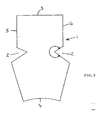
- the blank material comprises a flat sheet of polyurethane foam, prepared as described in Example 2, within a casing of a light cotton material, which can be stretched around the foam, for example, with a neat, small zig-zag stitch, to retain the foam within the casing. Stitching can also be included to show which way up the garment should be worn.
- the upper end of the material is intended, after formation of the support and fitting onto the wearer, to lie above the ankle and the lower end to be just above the toes (see Fig.1).
- Respective "darts” 2 are cut, one into each side of the foam and casing.
- the material is merely folded along a horizontal axis and the edges of each dart 2 stitched to one another. Respective strips of Velcro are then fitted, one along the front surface of the material at one side 5 and the other along the rear surface at the other side 6.
- the material may then be fitted to the wearer by folding around the foot to provide an ankle support as shown in Figs.1 and 2.
Landscapes
- Health & Medical Sciences (AREA)
- Engineering & Computer Science (AREA)
- Chemical & Material Sciences (AREA)
- Life Sciences & Earth Sciences (AREA)
- Vascular Medicine (AREA)
- Heart & Thoracic Surgery (AREA)
- Animal Behavior & Ethology (AREA)
- General Health & Medical Sciences (AREA)
- Public Health (AREA)
- Veterinary Medicine (AREA)
- Biomedical Technology (AREA)
- Materials Engineering (AREA)
- Chemical Kinetics & Catalysis (AREA)
- Medicinal Chemistry (AREA)
- Polymers & Plastics (AREA)
- Organic Chemistry (AREA)
- Otolaryngology (AREA)
- Rheumatology (AREA)
- Inorganic Chemistry (AREA)
- Polyurethanes Or Polyureas (AREA)
Description
- This invention relates to flexible polyurethane foam containing copper, to methods of incorporating the copper into the foam and to the use of the foam in articles for alleviating discomfort experienced by people who suffer from an ailment associated with joints, limbs and muscles, such as arthritis and rheumatism.
- It is known that copper has antifungal properties. Thus, GB-A-1581586 discloses a sock having, adhered to its inner surface, a composition comprising a water-insoluble resin binder and, dispersed in the binder, a metal powder. The metal may be copper and the binder may be a polyurethane. The composition may additionally contain what is referred to as a "foaming agent" to allow foaming of the composition after its application to the sock so as to improve softness and air and moisture permeability. However, the only example given of such a foaming agent is of capsules of a vinylidine chloride /acrylonitrile copolymer which expand on heating. This will not cause the binder to foam. It is suggested that sweat fat and other substances release the metal from the resin and convert it to soluble ionic substances.
- GB-A-2133287 discloses an adhesive plaster having a surface, for contact with the skin, provided with strips of adhesive and between the strips of adhesive a metal or metal alloy, e.g. copper. The copper apparently relaxes muscle spasms caused by a wide variety of diseases, including rheumatism; sweat, formed by application of the plaster, serves as an electrolyte between grains of the metallic substance and generates an electrolyte current which intrudes under the skin surface or into the muscles lying underneath.
- It is known to incorporate very small amounts of copper dust, cupric oxide, cuprous oxide or copper sulphate solution into a polyurethane foam to serve as a flame retardant, as described by B.C. Levin et al in Plastics Compounding (January/February 1990), 13(1), 58-62. In particular, cuprous oxide is added to the polyol from which the polyurethane foam is prepared in an amount of 0.072%.
- It is also known to incorporate, into polyurethane foam, small amounts of copper in the form of copper salts and complexes thereof to achieve certain effects, e.g. as a catalyst during the production of polyurethane and as a smoke suppressant in flame retardant foams; see US-A-4263411, which recommends the incorporation, in-situ, into the foam of the copper salt or complex so as to provide about 0.05 to about 3 parts (based on metallic copper) per 100 parts by weight of the polyol used to prepare the foam.
- However, copper and its compounds display amphoteric properties. Thus, in conventional flexible polyurethane foams, the addition of copper powder can lead to retardation of foam cure, even at relatively low levels, and especially in low density high water formulations can lead to excessive scorching and, possibly, runaway exothermic conditions which could result in spontaneous combustion of the foam.
- Moreover, we have found that even if attempts are made to introduce copper into the foam by impregnation with a slurry of copper, at higher levels of copper, there is a serious degradation in the heat ageing properties of the foam, for example, on drying the foam.
- We find surprisingly that a particular useful application of flexible polyurethane foam, containing copper or copper oxide particles, but especially foam containing relatively large amounts of copper or copper oxide particles lies in the alleviation of discomfort of people suffering from various joint, limb and muscle ailments such as arthritis and rheumatism.
- We also find surprisingly that such relatively larger amounts of copper or copper oxide particles can be incorporated into a flexible polyurethane foam if the polyol used to prepare the polyurethane is of a high reactivity and high molecular weight, as hereinafter defined, so that the resultant flexible foam may be of the "high resilience" or "cold cure" type.
- Thus, according to one aspect of the invention, there is provided a flexible polyurethane foam having a density of foam 15 to 120 kg/m3 and having, incorporated therein, particles of copper or copper oxide in an amount, based on metallic copper, of at least 1% by weight of the total weight of the metallized foam.
- More preferably, the amount of copper or copper oxide particles, on the above weight basis, is at least 2%, still more preferably at least 3.5% and especially at least 4%.
- The particles may be in the form of a powder or flake and are preferably of copper. Typically, the particle size may be from 10-100, preferably 30-60 µm (microns), e.g. 40-50 µm (microns).
- The polyurethane is preferably derived from a polyol having a molecular weight of at least 3,500, more preferably at least 4,000, still more preferably from 4,000 - 8,000, especially from 4,500 - 7,000, more especially 4,800 - 6,000.
- The hydroxyl value is preferably 20-60, more preferably 22-45, still more preferably 24-38, mg KOH/g.
- It is also preferred that the polyol has an equivalent weight of from 1,000 - 3,000, more preferably from 1,500 - 2,000. This provides improved foam stability, flexibility and resilience.
- It is especially preferred that the primary hydroxyl content, as a % of total hydroxyl content, hereinafter sometimes referred to as the primary : secondary hydroxyl ratio, provided by the hydroxyl groups in the foam be at least 20%, more preferably at least 50%, still more preferably at least 70%, most especially preferably at least 80%.
- It is also especially preferred to use polyether polyols (or mixtures thereof) or polyester polyols (or mixtures thereof), particularly a polyether polyol which is an adduct of at least one low molecular weight polyol having at least 3 hydroxyl groups, such as glycerol, sorbitol, trimethylol propane or pentaerythritol, as polyol starter, with a mixture of propylene and ethylene oxides, which form polyether chains.
- Tipping with ethylene oxide provides primary sites and the greater the proportion of such sites, the greater the reactivity of the polyol.
- Thus, in order to provide an especially preferred, highly reactive polyether, either propylene oxide alone (required in any event at least to provide sufficient insolubility in water) or a mixture thereof with ethylene oxide are first reacted with the polyol starter to form polymerized chains which are then end-capped by reaction with further ethylene oxide to increase the reactivity considerably.
- Particularly preferred polyether polyols are so-called "modified polyether polyols", which contain organic fillers formed by the in-situ polymerization of suitable monomers and which fall into three classes, namely,
- (1) polymer polyols;
- (2) PHD polyols; and
- (3) PIPA polyols.
- In such polyols, in addition to the polyether polyol itself, the polyol contains at least one other polymer dispersed therein. Thus, a polymer polyol additionally includes a vinyl polymer dispersion, formed in situ in the polyol, as well as the reaction product of a polyol and a vinyl monomer. A PHD polyol contains a dispersion of a polyurea in the polyether polyol, formed in situ by polymerization of a diamine and an isocyanate, while a PIPA (polyisocyanate polyaddition) polyol contains a polymer dispersion formed by reaction of an alkanolamine with an isocyanate.
- Such modified polymers are described more fully in "Telechelic Polymers : Synthesis and Applications", Ed.E.J. Goethals, CRC Press Inc., Florida, 1989.
- We find surprisingly that the polyurethane foams prepared from highly reactive polyols having a high primary : secondary hydroxyl ratio as described above are less susceptible to retardation of foam cure during their preparation and less susceptible to degradation in the heat ageing properties of the final foam.
- Typical commercially available polyols for use in the incorporation, in situ, of copper into a polyurethane foam during its preparation are
- 1. DESMOPHEN 7653 - a PHD (polyurea dispersion) polyol, which is a 10% dispersion of polyurea particles in a 6000 M.Wt.polyol, with a hydroxyl number 28 and a primary : secondary hydroxyl ratio ≥ 50%, commercially available from Bayer.
- 2. DESMOPHEN TP. PU 44WB03 - a 6000 M.Wt.polyether polyol, having a hydroxyl value of 28 and a primary : secondary hydroxyl ratio ≥ 50%, commercially available from Bayer.
- 3. SPECFLEX NC635 - a polyol based on glycerol and a higher functionality polyol as polyol starters and capped with ethylene oxide. It has a molecular weight of 6000, a hydroxyl number of 28, an ethylene oxide content of 14% and a primary : secondary hydroxyl ratio of 80%. It is commercially available from Dow.
- 4. VORANOL 6008, a polyether polyol having a molecular weight of 6000, an ethylene oxide content of 14-15% (end-capped) and a primary : secondary hydroxyl ratio of 80%. It is commercially available from Dow.
- High molecular weight, high reactivity polyols, such as those described above, allow the production of a lightweight foam which is of an open celled and porous nature, allowing it to breath and reduce the incidence of perspiration.
- The polyurethane of the flexible foam is preferably derived from an isocyanate selected from toluene diisocyanate, diphenylmethane diisocyanate and a modified and polymeric diphenylmethane diisocyanate and mixtures thereof.
- When the isocyanate is toluene diisocyanate, it may be a mixture of 2,4- and 2,6- toluene diisocyanate in a molar ratio of 2,4- : 2,6- of 80 : 20 or of 65 : 35, each of which mixtures is commercially available. Alternatively, these respective mixtures may be blended to provide any derived ratio of 2,4- : 2,6- isomers within the range 80 : 20 to 65 : 35 and thereby influence the stability and cell opening effect of the final foam as derived.
- However, more preferably, the isocyanate is a diphenylmethane diisocyanate (MDI) or a modified MDI or polymeric MDI. Such MDI type isocyanates are commercially available, e.g. the Voranate series available from Dow and the Lupranate M series available from Elastogran (UK) Ltd.
- Highly reactive polyols, as described above, together with MDI type isocyanates react to form so-called high resilience polyurethane foams, an added advantage of which is their greater resistance to ignition.
- The polyurethane foam is preferably prepared using water as the foaming agent, more preferably in an amount of from about 1 to 7 parts by weight per 100 parts by weight of the polyol component.
- In addition to the foaming agent, other additives may be present in the reaction mixture and may be incorporated within the foam.
- Typically a reaction mixture can include any one or more of the following components, namely an auxiliary blowing agent, catalyst, surfactant, filler, chain extender, crosslinker, stabilizer, antistatic additive, colourant and antioxidant, and indeed more than one of any such component may be present.
- In addition, the incorporation of flame retardant additives such as melamine, aluminium trihydroxide, ammonium polyphosphate, expandable graphite, halogenated phosphates, etc, produces foams having increased flame retardant properties.
- The above method can be used to manufacture slabstock foam in a well known manner, using a continuous or discontinuous process. Moulded foams can also be produced.
- The resultant foam has a density of from 15 to 120 kg/m3, preferably from 30 to 80 kg/m2, inclusive.
- According to ASTM D1056-1985, a flexible foam is defined as a cellular structure which will not rupture within 60 secs. when a specimen 200 x 25 x 25 mm is bent around a 25 mm mandrel at a uniform rate of one lap in 5 secs. in the form of a helix at a temperature between 18 and 29°C.
- The amount of copper or copper oxide (expressed as metallic copper) in the metallized foam is at least 1%, preferably at least 2%, more preferably at least 3.5% and especially at least 4%, by weight of the total weight of the foam. However, it may be as high as 40%, 50% or even 60% by weight.
- At least up to amounts of 25% by weight, incorporation of the copper or copper oxide into the foam can be achieved by an in-situ process (where the particles are incorporated in a polyol component of the polyurethane reaction mixture, as later described), while even larger amounts, for example up to 60%, may be achieved by impregnation (which technique is preferred to the in-situ method for amounts of at least 20% by weight).
- Thus, according to another aspect, the invention provides a method of incorporating, into a flexible polyurethane foam derived from a polyol and a polyisocyanate, particles of copper or copper oxide in an amount of at least 1% by weight of metallic copper, by weight of the total weight of the metallized foam, which method comprises mixing the metal with the polyol and reacting the polyol with the polyisocyanate in the presence of a foaming agent to form the flexible polyurethane foam, whereby copper or copper oxide particles are incorporated in-situ within the foam and the foam has a density of foam 15 to 120 kg/m3.
- According to yet another aspect, the invention provides a method of incorporating, into a flexible polyurethane foam, particles of copper or copper oxide in an amount of at least 1% by weight of metallic copper, by weight of the total weight of the metallized foam, which method comprises forming a slurry of the particles of copper or copper oxide in a polymer latex medium and treating the foam with the said slurry to allow impregnation of the copper or copper oxide into the foam.
- Typically, the polymer latex is a latex of an acrylic polymer which may contain from 40 to 80%, preferably 50 to 60%, especially about 55%, by weight of solid polymer as well as a dispersing and/or wetting agent, an antifoaming agent and a thickener.
- Except where particularly high levels of copper are required, a preferred product, at least in terms of reduced density and improved porosity, can be manufactured more economically by the in-situ method.
- As mentioned above, we have found surprisingly that foams loaded with copper are capable of alleviating discomfort associated with, for example, arthritis.
- Thus, according to another aspect, the invention provides an article for alleviation of discomfort from an ailment associated with a joint, limb or muscle, such as rheumatism or arthritis, which article comprises a flexible polyurethane foam covered by a fabric, which flexible foam has, incorporated therein, particles of copper or copper oxide, in an amount, based on metallic copper, of at least 1% by weight of the total weight of the metallized foam, which foam has a density of foam 15 to 120 kg/m3.
- Preferably, the amount, based on metallic copper, is at least 2%, more preferably at least 3.5%, still more preferably at least 4%, by weight of the total weight of the metallized foam.
- When obtained by the in-situ method as described above, amounts of copper and copper oxide, based on metallic copper may be 2 to 60 parts, preferably 2 to 50 parts, more preferably 2 to 40, still more preferably 5 to 30, especially 10 to 20 parts, and typically 12 to 15 parts, by weight per 100 parts of polyol.
- The article is preferably in the form of a garment, which is more preferably in the form of a support for a part of the human or animal body where discomfort is suffered. However, the article may be an item of seating or bedding, for example, a cushion, bean bag (especially suitable for children), pillow, quilt, mattress, sleeping bag, soft-furnishing, office furniture (especially chairs), seats in aircraft, trains and automobiles, slippers and shoes and shoe, slipper and boot insoles. As a cushion, it may, in particular, be used by drivers of motor vehicles who, especially on long journeys, are susceptible to back pains. Considerable relief may be provided by such cushions. As a pillow or cushion, the article may serve to replace a conventional hot water bottle in view of the warm glow generated by it.
- For some applications envisaged where copper foam may be used in cushions, seating and bedding, etc, within the home, then the foam would be required to comply with 'The Furniture and Furnishings (Fire)(Safety) Regulations 1988 (amended in 1989 and 1993)'.
- Garments in accordance with the invention may be constructed not only for treatment of the human body, but also for treating animals suffering from arthritis and rheumatic conditions similar to humans, for example, horses and dogs.
- The garment may be a support for a part of the human or animal body or may be an entire article of clothing, for example, a warmer jacket or vest or gloves.
- When the garment is a support for a part of the human body, any of at least the following can be supported to provide comfort and relief, namely the neck, left and right shoulder, double shoulder (including the centre of the back), elbow, forearm, wrist and palm, wrist, hand and fingers (glove), small of back, hip (left or right), hip and back combined, thigh, knees, calf, ankle joint, whole ankle and foot and separate toes and fingers (e.g. a finger stall).
- It is found surprisingly that a considerable comforting heat is generated by the article, which need not come into contact with the skin of the user and can be separated from the user by, for example, clothing. Thus, in contrast to the principles outlined in GB-A-1581586 and GB-A-2133287, which rely upon generation of sweat (occasioning discomfort in this respect), the article in accordance with the invention allows the generation of a dry, comforting, heat.
- The articles, especially garments, are especially suitable for use at night, while the user is at rest or in bed.
- The cover is preferably a woven fabric, more preferably of a light breathable fabric such as cotton, muslin, polyester or polyester/cotton blend.
- Where the cover is a lightweight fabric, especially cotton, this allows easy transference of the special heating properties of the copper-laden foam.
- However, the article may additionally include an additional removable casing of, e.g. muslin, to protect the article and keep it clean.
- Either the cotton cover or the casing may be suitably decorated.
- The amount of relief from pain and inflammation experienced will vary from person to person. The other factors which may play a part are the number of consecutive nights that a garment or garments are worn and to some degree the amount of copper incorporated into the foam in terms of weight of copper.
- When the article is in the form of a garment, it is preferably constructed from a fabric, covering the foam, which fabric has opposite side regions each having respective fastening means cooperable with one another on folding the fabric to allow the fabric to surround at least a part of the wearer.
- More preferably, one opposite side region of the fabric has releasable adhesive means on a front surface of the fabric cooperable with releasable adhesive means on a rear surface of the other opposite side region of the fabric.
- One example of a support garment is an ankle or knee support which, at least in use, has a generally tubular construction conforming with the shape of the ankle or knee.
- Another example is a neck support which, at least in use, has a generally tubular construction to the shape of the neck.
- Yet other examples are a support for the hip adapted to extend from the hip to the thigh on at least one side of the wearer and additionally including bands adapted to be secured, by fastening means, around the waist and thigh respectively, and a support for each shoulder adapted to fit around an upper part of the wearer, over the shoulders, and additionally including respective arm straps depending from an edge of the fabric and adapted to be secured, by fastening means, around respective arms.
- In each of the above support garments, the fastening means preferably comprises respective cooperable strips of hook and loop fastenings, commercially available as "Velcro", one disposed on a front surface along one of opposite side regions of the fabric and another disposed on a rear surface along the other side region. The strips may be so located that they cooperate to hold the garment comfortably but securely in position around the wearer.
- As previously mentioned, the foam in the articles is preferably a high resilience MDI foam. This offers the following advantages:
- a) good physical properties; and
- b) good index response, i.e. foam hardness, flexibility and comfort can be varied significantly dependent on the amount of MDI isocyanate used.
- Particular advantages associated with garments embodying the invention are as follows:
- (a) The garments can ease, reduce and in some cases remove the pain associated with arthritis, rheumatism and related joint and limb ailments.
- (b) To have this effect, an appropriate copper-foam filled garment is best worn overnight during the sleeping hours. However, the garments may be designed so as to be sufficiently soft and comfortable to be worn throughout night and day, thus allowing the maximum time for the presence of the copper to be effective.
- (c) The copper-foam lends itself to be readily used as a pliable, breathable filling enclosed in light cotton-type fabrics to form various coverings or enclosing garments for joints, limbs and all body parts which are light, soft and comfortable enough to be worn throughout the night while sleeping. In this foam medium, the copper can be taken to any part of the body in the form of a comfortable garment, without any skin discolouration, as is evident when metallic copper is worn next to the skin.
- (d) The copper presence can be spread easily and comfortably around the required area, and the garment creates a warm environment around the area. Thus, the wearing of a copper-foam filled garment also creates a heat where it is worn, which in its own right has a comforting effect.
- (e) Copper-loaded foam can be cut into numerous templates and designs and enclosed in light breathable fabrics such as muslin, cotton or polyester/cotton and made into garments which cover and/or enclose all the various parts of the body.
- Preferred embodiments of the invention will now be described with reference to the following Examples and accompanying drawings, in which
- Fig.1 is a side view of an ankle support in position around an ankle;
- Fig.2 is a front view of the ankle support of Fig.1; and
- Fig.3 is a blank material from which the support is constructed.
- Four foam "bun" samples were prepared, each with different amounts of copper. The formulations are shown in Table 1 below.
TABLE 1 - EXAMPLE 1 INGREDIENTS (pph) SAMPLE NO. 1 2 3 4 POLYOL (1) 100 100 100 100 CATALYST (2) 0.30 0.30 0.30 0.30 CATALYST (3) 0.175 0.175 0.20 0.25 SURFACTANT (4) 1.0 1.0 1.0 1.1 WATER 3.0 3.0 3.0 3.0 Cu POWDER (5) 15 20 30 50 ISOCYANATE (6) 58.5 58.5 58.5 61.3 DENSITY (KG/M3) 46.4 47.1 50.8 61.5 W/W Cu (%) 8.8 11.4 16.2 24.0 Notes to above:
1. SPECFLEX NC635 is a polyol based on glycerol and a higher functionality polyol as polyol starters and capped with ethylene oxide. It has a molecular weight of 6000, a hydroxyl number of 28, an ethylene content of 14% and a primary : secondary hydroxyl ratio of 80%. It is commercially available from Dow.2. DABCO 33LV, 33% Triethylene diamine is dipropylene glycol available from Air Products. 3. DABCO BL11, 70% bis (N,N-dimethylaminoethyl) ether in dipropylene glycol available from Air Products. 4. TEGOSTAB B4690, a silicone surfactant for high resilient type foam available from Th. Goldschmidt. 5. Pure copper standard DP M241 5CP50 (Mean particle diameter 42-501 µm (microns) available from Wolstenholme International Limited. 6. UK 721 which is a solvent free modified isocyanate based on 4,4'-diphenylmethane di-isocyanate (MDI) with a functionality of ca 2.2 available from BASF. - NB: All mixes were based on 400g of polyol.
-
- a) Polyol + catalysts + surfactant + H20 weighed out and then mixed with a stirrer at 2000 rpm for 20 seconds.
- b) Copper powder then added and mixed for 20 seconds.
- c) MDI added, mixed for 8 seconds and poured into an open box mould 29cm x 29cm x 25cm.
- The box containing the foam was placed in an oven at 60°C and allowed to cure.
- For each of the above samples, a test block having a tack free surface was obtained in less than 5 minutes.
- In contrast a foam (hereinafter referred to as EC20) prepared from a polyol having a molecular weight of only 3,500 and ratio of primary hydroxyl : secondary hydroxyl ratio of less than 2 and a toluene diisocyanate having a 2,4- : 2,6- isomer ratio of 80 : 20 (see Comparative Example 1 later) still had a tacky surface after 20 minutes when loaded with 4 parts of copper per 100 parts polyol.
- In this connection, it is pointed out that, even in the absence of copper, EC20 cured more slowly than a foam based on Specflex NC635. However, both still cured within 5 minutes. However, in the presence of copper the EC20 cured considerably more slowly than the foam based on Specflex NC635.
- Foam "buns" of a size larger than those of Example 1 were prepared using the formulations shown in Table 2.
TABLE 2 - EXAMPLE 2 INGREDIENTS (pph) SAMPLE NO. 1 2 3 POLYOL (1) 100 40 30 POLYOL (2) - 60 - POLYOL (3) - - 70 CATALYST (4) 0.30 0.30 0.30 CATALYST (5) 0.175 0.15 0.15 SURFACTANT (6) 1.0 1.0 0.80 WATER 3.0 3.0 3.0 Cu POWDER (7) 10 12 15 ISOCYANATE (8) - 56.0 - ISOCYANATE (9) 55.5 - 57.0 W/W Cu (%) 6.2 7.4 8.9 Notes to above:
1. DESMOPHEN 7653 - a PHD (polyurea dispersion) polyol, which is a 10% dispersion of polyurea particles in a 6000 M.Wt.polyol, with a hydroxyl number of 28 and a primary : secondary hydroxyl ratio ≥ 50%, commercially available from Bayer.2. DESMOPHEN TP. PU 44WB03 - a 6000 M.Wt. polyether polyol, having a hydroxyl value of 28 and a primary : secondary hydroxyl ratio ≥ 50%, commercially available from Bayer. 3. SPECFLEX NC635 - a polyol based on glycerol and a higher functionality polyol as polyol starters and capped with ethylene oxide. It has a molecular weight of 6000, a hydroxyl number of 28, an ethylene oxide content of 14% and a primary : secondary ratio of 80%. It is commercially available from Dow. 4. DABCO 33LV - 33% Triethylene diamine in dipropylene glycol available from Air Products. 5. DABCO BL11 - 70% bis (N,N-dimethylaminoethyl) ether in dipropylene glycol available from Air Products. 6. TEGOSTAB B4690 - a silicone surfactant for high resilient type foam available from Th. Goldschmidt. 7. PURE COPPER STANDARD DP M241 5CP50 (Means particle diameter 42-50 µm (microns)) available from Wolstenholme International Ltd. 8. VORANATE M220 - a low viscosity polymethylene polyphenylisocyanate of high reactivity, a total isocyanate content of approximately 31% and an average functionality of 2.7, available from Dow. 9. UK721 which is a solvent free modified isocyanate based on 4,4'-diphenylmethane di-isocyanate with a functionality of about 2.2 available from BASF. - NB: All mixes were based on 6000g of polyol, i.e. above formulation weights x 60.
-
- a) Polyol/polyols, silicone surfactant and copper powder weighed into a 25 litre capacity pail and mixed for 30 seconds at a stirrer speed of 2000 rpm.
- b) Isocyanate added and mixed for 30 seconds.
- c) Water and catalysts added as an activator blend and mixed until liquid is just starting to rise/cream.
- d) Foam mix poured into an open box mould 70cm x 70cm x 55cm deep.
- The box containing the foam was merely left at ambient temperature and allowed to cure.
- Even with such high loadings of copper, in each case, each foam was sufficiently well cured as to allow its removal from the box mould within 10 minutes.
- Conventional foam samples, based on a low reactivity polyol having a molecular weight of 3,500 and a primary : secondary hydroxyl ratio less than 2% were prepared. Three samples were prepared, two containing 4 parts by weight of copper particles per 100 parts polyol and the other being free from copper. The formulations given in Table 3 below were used. Each foam, which had a density of about 21 kg/m3, was heated in an oven at 60°C until cured and then tested for its resistance to heat ageing. The results are shown in Table 7.
TABLE 3 - COMPARATIVE EXAMPLE 1 INGREDIENTS SAMPLE NO. 1 2 3 POLYOL (1) 100 100 100 Cu POWDER (2) 4 Cu POWDER (3) 4 ISOCYANATE (4) 58.7 58.7 58.7 AMINE (5) 0.3 0.35 0.35 CROSS LINKER (6) 0.5 0.5 SURFACTANT (7) 1.2 1.2 1.2 WATER 4.65 4.65 4.65 TIN CATALYST (8) 0.24 0.35 0.35 Notes:
1. VORANOL 3322, a 3500 molecular weight polyether polyol, hydroxyl number of 48, ethylene oxide content of 12-13% (mixed with propylene oxide), primary : secondary hydroxyl ratio < 2%, commercially available from Dow.2. Copper powder 25U-mean particle diameter 43-51 microns, available from Wolstenholme International Ltd. 3. Copper powder DP M241 5CP50-mean particle diameter 42-50 µm (microns), available from Wolstenholme International Ltd. 4. DESMODUR T80, toluene diisocyanate, available from Bayer. 5. DABCO DMEA, N,N'-dimethylethanolamine, available from Air Products. 6. 88% aqueous solution of diethanolamine, available from Whyte Chemicals Ltd. 7. L620, a high activity silicone surfactant for conventional polyether foam, available from Witco. 8. DABCO T9, stabilised stannous octoate, available from Air Products. - Respective foam samples, based on the low reactivity polyol of Comparative Example 1, were prepared, but with a lower proportion of water as foaming agent, to give a foam of higher density. Two samples were prepared, one containing 6 parts by weight of copper particles per 100 parts by weight of polyol and the other being free from copper. The formulations given in Table 4 below were used. Each foam was heated in an oven at 60°C until cured to provide a foam having a density of about 30kg/m3. The foam was tested for its resistance to heat ageing. The results are shown in Table 7.
TABLE 4 - COMPARATIVE EXAMPLE 2 INGREDIENTS (pph) SAMPLE NO. 1 2 POLYOL (1) 100 100 Cu POWDER (2) 6 - ISOCYANATE (3) 50 49.4 AMINE (4) 0.3 0.20 AMINE (5) 0.17 0.10 CROSS LINKER (6) 0.8 0.50 SURFACTANT (7) 1 1.0 WATER 3.6 3.6 TIN CATALYST (8) 0.25 0.22 Notes:
1. VORANOL 3322, a 3500 molecular weight polyether polyol, hydroxyl number of 48, ethylene oxide content of 12-13% (mixed with propylene oxide), primary : secondary hydroxyl ratio < 2%, commercially available from Dow.2. Copper powder 25U-mean particle diameter 43-51 µm (microns), available from Wolstenholme International Ltd. 3. DESMODUR T80, toluene diisocyanate, available from Bayer. 4. DABCO DMEA, N,N'-dimethylethanolamine available from Air Products. 5. DABCO 33LV, 33% Triethylene diamine in dipropylene glycol, available from Air Products. 6. 88% aqueous solution of diethanolamine, available from Whyte Chemicals Ltd. 7. L620, a high activity silicone surfactant for conventional polyether foam, available from Witco. 8. DABCO T9, stabilised stannous octoate, available from Air Products. - Respective foam samples were prepared using the formulations given in Table 5 below. Three samples were prepared, one free from copper, one containing 6 parts by weight of copper particles and the other containing 10 parts by weight of copper particles, per 100 parts of polyol. Each foam was heated in an oven at 60°C until cured and then tested for its resistance to heat ageing. The results are shown in Table 7.
TABLE 5 - EXAMPLE 3 INGREDIENTS, pph SAMPLE NO. 1 2 3 POLYOL (1) 100 100 100 Cu POWDER (2) 6 10 ISOCYANATE (3) 42.8 45.7 46.4 CROSS LINKER (4) 1.5 1.5 1.5 CROSS LINKER (5) 1 1 CROSS LINKER (6) 2 WATER 3 3 3 SURFACTANT (7) 0.6 0.6 0.6 AMINE (8) 0.15 0.15 0.15 AMINE (9) 0.1 0.1 0.1 TIN CATALYST (10) 0.1 0.25 0.3 Notes:
1. DESMOPHEN 7653, a PHD (polyurea dispersion) polyol, which is a 10% dispersion of polyurea particles in a 6000 molecular weight polyol, with a hydroxyl number of 28 and a primary : secondary ratio ≥ 50%, commercially available from Bayer.2. Copper powder 25U-mean particle diameter 43-51 microns, from Wolstenholme International Ltd. 3. DESMODUR T80, toluene diisocyanate, available from Bayer. 4. 88% aqueous solution of diethanolamine, available from Whyte Chemicals Ltd. 5. PU3229, a preparation of modified aliphatic amines, available from Bayer. 6. PU3236, a cross linking additive, available from Bayer. 7. Tegostab B8680, a high resilience foam silicone surfactant, available from Th. Goldschmidt Ltd. 8. DABCO 33LV, 33% Triethylene diamine in dipropylene glycol, available from Air Products. 9. DABCO BL11, 70% bis (dimethylaminoethyl)ether and 30% dipropylene glycol, available from Air Products. 10. DABCO T9, stabilised stannous octoate, available from Air Products. - Respective foams were prepared using the formulations given in Table 6 below. Three samples were prepared, one free from copper, one containing 6 parts by weight of copper particles and the other containing 10 parts by weight of copper particles, per 100 parts of polyol. The foam was heated in an oven at 60°C until cured and then tested for its resistance to heat ageing. The results are shown in Table 7.
TABLE 6 - EXAMPLE 4 INGREDIENTS SAMPLE NO. 1 2 3 POLYOL (1) 75 75 75 POLYOL (2) 25 25 25 Cu POWDER (3) 0 6 10 ISOCYANATE (4) 36.5 36.5 36.5 AMINE (5) 0.3 0.3 0.3 AMINE (6) 0.55 0.55 0.55 SURFACTANT (7) 1 1 1 WATER 3 3 3 TIN CATALYST (8) 0.05 0.05 0.05 Notes:
1. DESMOPHEN TP PU41WB01, a 4500 molecular weight polyol containing ca. 73% ethylene oxide (in total), hydroxyl number of 38, primary : secondary hydroxyl rations ≥ 50%, commercially available from Bayer.2. VORANOL 3322, a 3500 molecular weight polyether polyol, hydroxyl number of 48, ethylene oxide content of 12-13% (mixed with propylene oxide), primary : secondary hydroxyl ratio ≤2%, commercially available from Dow. 3. Copper powder-25U mean particle diameter 43-51 µm (microns) from Wolstenholme International Ltd. 4. DESMODUR T80, toluene diisocyanate, available from Bayer. 5. DABCO DMEA, N,N'-dimethylethanolamine available from Air Products. 6. DABCO 33LV, 33% Triethylene diamine in dipropylene glycol, available from Air Products. 7. L620, a high activity silicone surfactant for conventional polyether foam, available from Witco. 8. DABCO T9, stabilised stannous octoate, available from Air Products. - Respective foam samples were prepared using the formulation of Sample 1 given in Example 1. Three samples were prepared, one free from copper, one containing 8 parts by weight of copper particles and the other containing 15 parts by weight of copper particles, per 100 parts of polyol. The formulations (apart from the respective amounts of copper) are the same as that shown in Table 1 for Sample 1. Each foam was heated in an oven at 60°C until cured and then tested for its resistance to heat ageing. The results are shown in Table 7.

- 160±1°C for 16 hours.
- Tensile strength and elongation measured according to BS 4443, Part 1, 1988,
Method 3 - Using a foam prepared as in
Sample 2 of Example 2, a blank material as shown in Fig.3 was first prepared. - The blank material comprises a flat sheet of polyurethane foam, prepared as described in Example 2, within a casing of a light cotton material, which can be stretched around the foam, for example, with a neat, small zig-zag stitch, to retain the foam within the casing. Stitching can also be included to show which way up the garment should be worn.
- The upper end of the material is intended, after formation of the support and fitting onto the wearer, to lie above the ankle and the lower end to be just above the toes (see Fig.1).
- Respective "darts" 2 are cut, one into each side of the foam and casing.
- In order to form the support, the material is merely folded along a horizontal axis and the edges of each
dart 2 stitched to one another. Respective strips of Velcro are then fitted, one along the front surface of the material at one side 5 and the other along the rear surface at theother side 6. - The material may then be fitted to the wearer by folding around the foot to provide an ankle support as shown in Figs.1 and 2.
- In a preliminary trial, respective samples of a metallized polyurethane foam embodying the invention (but without a covering) containing as little as 1.3 wt% of copper particles were wrapped around a finger and a toe giving discomfort and found to give a satisfactory level of relief while a support embodying the invention, consisting of a foam, containing 6 wt% of copper particles, within a covering of cotton material gave considerable comfort and relief from pain when applied to the neck of a person suffering from rheumatism. On the other hand, a foam containing no copper particles gave no relief whatsoever.
Claims (36)
- A flexible, metallized, polyurethane foam having a density of foam 15 to 120 kg/m3 and having, incorporated therein, particles of copper or copper oxide in an amount, based on metallic copper, of at least 1% by weight of the total weight of the metallized foam.
- A foam according to claim 1, wherein the said amount of copper or copper oxide is at least 2% by weight.
- A foam according to claim 2, wherein the said amount of copper or copper oxide is at least 3.5% by weight.
- A foam according to claim 3, wherein the said amount of copper or copper oxide is at least 4% by weight.
- A foam according to any preceding claim, wherein the particles are of copper.
- A foam according to any preceding claim, wherein the polyurethane is derived from a polyol having a molecular weight of at least 3,500.
- A foam according to claim 6, wherein the said polyol has a molecular weight of from 4,000 to 8,000 inclusive.
- A foam according to claim 6 or claim 7, wherein the polyol has a primary hydroxyl content, as a % of total hydroxyl groups, of at least 20%.
- A foam according to claim 8, wherein the primary hydroxyl content is at least 70%.
- A foam according to any one of claims 6 to 9, having a hydroxyl value of from 20 to 60 mg KOH/g inclusive.
- A foam according to claim 10, having a hydroxyl value of from 22 to 42 mg KOH/g inclusive.
- A foam according to any preceding claim, wherein the polyurethane is derived from an isocyanate selected from toluene diisocyanates, diphenylmethane diisocyanates and modified and polymeric diphenylmethane diisocyanates and mixtures thereof.
- A foam according to claim 12, wherein the said isocyanate is a mixture of 2,4- and 2,6- toluene diisocyanate in a molar ratio of 2,4- : 2,6- of from 80 :20 to 65 : 35.
- A foam according to claim 12, wherein the said isocyanate is diphenylmethane diisocyanate or a modified diphenylmethane diisocyanate or a polymeric diphenylmethane diisocyanate.
- A method of incorporating, into a low density flexible polyurethane foam derived from a polyol and a polyisocyanate, particles of copper or copper oxide in an amount of at least 1% by weight of metallic copper, by weight of the total weight of the metallized foam, which method comprises mixing the metal with the polyol and reacting the polyol with the polyisocyanate in the presence of a foaming agent to form the flexible polyurethane foam, whereby copper or copper oxide particles are incorporated in-situ within the foam and the foam has a density of foam 15 to 120 kg/m3.
- A method of incorporating, into a low density flexible polyurethane foam, particles of copper or copper oxide in an amount of at least 1% by weight of metallic copper, by weight of the total weight of the metallized foam, which method comprises forming a slurry of particles of copper or copper oxide in a polymer latex medium and treating the foam with the said slurry to allow impregnation of the copper or copper oxide into the foam, whith from has a density of foam 15 to 120 kg/m3.
- A method according to claim 15 or claim 16, wherein the said amount of copper or copper oxide is at least 2% by weight.
- A method according to claim 17, wherein the said amount of copper or copper oxide is at least 3.5% by weight.
- A method according to claim 18, wherein the said amount of copper or copper oxide is at least 4% by weight.
- A method according to claim 15, wherein the said amount of copper or copper oxide is from 2 to 40 parts by weight, based on metallic copper, per 100 parts by weight of polyol.
- A method according to claim 16, wherein the said amount of copper or copper oxide is from 15-60% by weight.
- An article for alleviation of discomfort from an ailment associated with a joint, limb or muscle, which article comprises a flexible polyurethane foam having a density of foam 15 to 130 kg/m3 covered by a fabric, which flexible foam has, incorporated therein, particles of copper or copper oxide, in an amount, based on metallic copper, of at least 1% by weight of the total weight of the metallized foam.
- An article according to claim 22, wherein the amount of copper or copper oxide, based on metallic copper, is at least 3.5% by weight of the total weight of the metallized foam.
- An article according to claim 22 or 23, which is a garment.
- An article according to claim 24, wherein the garment is constructed from a fabric, covering the foam, which fabric has opposite side regions each having respective fastening means cooperable with one another on folding the fabric to allow the fabric to surround at least a part of the wearer.
- An article according to claim 25, wherein one opposite side region of the fabric has releasable adhesive means on a front surface of the fabric cooperable with releasable adhesive means on a rear surface of the other opposite side region of the fabric.
- An article according to any one of claims 24 to 26, wherein the garment is an ankle or knee support which, at least in use, has a generally tubular construction conforming with the shape of the ankle or knee.
- An article according to any one of claims 24 to 26, wherein the garment is a hand support which, at least in use, has a generally tubular construction conforming with the shape of at least the hand and optionally additionally the wrist.
- An article according to any one of claims 24 to 26, which is a neck support which, at least in use, has a generally tubular construction conforming to the shape of the neck.
- An article according to any one of claims 24 to 26, which is a support for the hip adapted to extend from the hip to the thigh on at least one side of the wearer and additionally including bands adapted to be secured, by fastening means, around the waist and thigh respectively.
- An article according to any one of claims 24 to 26, which is a support for each shoulder adapted to fit around an upper part of the wearer, over the shoulders, and additionally including respective arm straps depending from an edge of the fabric and adapted to be secured, by fastening means, around respective arms.
- An article according to claim 22 or claim 23, which is a cushion.
- An article according to claim 22 or claim 23, which is bedding material.
- An article according to claim 22 or claim 23, which is a seating material.
- An article according to any preceding claim, wherein the fabric covering the foam is a cotton fabric.
- An article according to any preceding claim, which additionally includes an additional covering of material covering the covered foam.
Applications Claiming Priority (3)
| Application Number | Priority Date | Filing Date | Title |
|---|---|---|---|
| GBGB9919077.9A GB9919077D0 (en) | 1999-08-12 | 1999-08-12 | Flexible polyurethane foam containing copper |
| GB9919077 | 1999-08-12 | ||
| US09/420,420 US6387973B1 (en) | 1999-08-12 | 1999-10-19 | Flexible polyurethane foam containing copper |
Publications (2)
| Publication Number | Publication Date |
|---|---|
| EP1076074A1 EP1076074A1 (en) | 2001-02-14 |
| EP1076074B1 true EP1076074B1 (en) | 2006-05-10 |
Family
ID=26315843
Family Applications (1)
| Application Number | Title | Priority Date | Filing Date |
|---|---|---|---|
| EP20000306718 Expired - Lifetime EP1076074B1 (en) | 1999-08-12 | 2000-08-07 | Flexible polyurethane foam containing copper |
Country Status (2)
| Country | Link |
|---|---|
| US (1) | US6387973B1 (en) |
| EP (1) | EP1076074B1 (en) |
Families Citing this family (13)
| Publication number | Priority date | Publication date | Assignee | Title |
|---|---|---|---|---|
| WO2004007583A1 (en) * | 2002-07-12 | 2004-01-22 | Jiang, Xueping | Flexible metallized foams and the preparation and use of the same |
| US11690746B2 (en) | 2004-04-02 | 2023-07-04 | Applied Biokinetics Llc | Pre-cut adhesive supports for anatomical support, pain reduction, or therapeutic treatment |
| US8258198B2 (en) * | 2004-05-28 | 2012-09-04 | Air Products And Chemicals, Inc. | Fast demold/extended cream time polyurethane formulations |
| US8505162B2 (en) | 2006-09-11 | 2013-08-13 | Vettec, Inc. | Adherence-aided therapeutic horse hoof packing |
| US10113043B2 (en) | 2010-02-26 | 2018-10-30 | Twin Brook Capital Partners, Llc | Polyurethane gel particles, methods and use in flexible foams |
| US8933140B2 (en) | 2010-02-26 | 2015-01-13 | Peterson Chemical Technology, Inc. | Thermal storage gelatinous triblock copolymer elastomer particles in polyurethane flexible foams |
| US9534098B2 (en) | 2010-02-26 | 2017-01-03 | Peterson Chemical Technology, Llc. | Enhanced thermally conductive cushioning foams by addition of metal materials |
| GB2561573B (en) * | 2017-04-18 | 2023-02-15 | Univ Bath | Air filters |
| IT201700066246A1 (en) * | 2017-06-14 | 2018-12-14 | New Wind Srl | METHOD OF PRODUCTION OF POLYURETHANE FOAM WITH THERMAL CONDUCTIVE PROPERTIES |
| WO2021011306A1 (en) * | 2019-07-12 | 2021-01-21 | Dow Global Technologies Llc | Polyurethane foam with improved combustion behavior |
| US11814566B2 (en) | 2020-07-13 | 2023-11-14 | L&P Property Management Company | Thermally conductive nanomaterials in flexible foam |
| US11597862B2 (en) | 2021-03-10 | 2023-03-07 | L&P Property Management Company | Thermally conductive nanomaterial coatings on flexible foam or fabrics |
| US20240336757A1 (en) * | 2021-07-07 | 2024-10-10 | Cupron, Inc. | Antimicrobial copper based polyurethane |
Family Cites Families (11)
| Publication number | Priority date | Publication date | Assignee | Title |
|---|---|---|---|---|
| DE2113900A1 (en) | 1971-02-23 | 1972-09-07 | Semperit Gmbh | Plastic molded body and method of manufacturing the same |
| JPS5254797A (en) * | 1975-10-30 | 1977-05-04 | Nisshinbo Ind Inc | High-density polyurethane foams having flmae resistant, soundproof and damping properties |
| JPS53748A (en) | 1976-06-23 | 1978-01-06 | Akira Yamauchi | Foot wear member containing metallic fine powder for vesicular eczema |
| US4263411A (en) | 1978-10-30 | 1981-04-21 | Mooney Chemicals, Inc. | Polyurethane compositions and process for preparing polyurethane emitting reduced amounts of toxic fumes on burning using a cobalt, copper, nickel or manganese salt |
| HU184575B (en) | 1982-07-16 | 1984-09-28 | Otto Mallasz | Method for producing preparations fixable on skin generating locally electrolytic and bio currents |
| DE3707238A1 (en) | 1987-03-06 | 1988-09-15 | Claus Kolckmann | Screening device |
| US4931479B1 (en) | 1988-11-07 | 2000-10-10 | Parker Intangibles Inc | Foam in place conductive polyurethane foam |
| US5151222A (en) | 1991-08-26 | 1992-09-29 | Mcdonnell Douglas Corporation | Foam absorber |
| JP3066686B2 (en) * | 1992-12-22 | 2000-07-17 | 金井 宏之 | Synthetic leather |
| US5855818A (en) | 1995-01-27 | 1999-01-05 | Rogers Corporation | Electrically conductive fiber filled elastomeric foam |
| GB2307862A (en) | 1995-12-05 | 1997-06-11 | David Jehan | Patch structures for transdermal therapy |
-
1999
- 1999-10-19 US US09/420,420 patent/US6387973B1/en not_active Expired - Fee Related
-
2000
- 2000-08-07 EP EP20000306718 patent/EP1076074B1/en not_active Expired - Lifetime
Also Published As
| Publication number | Publication date |
|---|---|
| EP1076074A1 (en) | 2001-02-14 |
| US6387973B1 (en) | 2002-05-14 |
Similar Documents
| Publication | Publication Date | Title |
|---|---|---|
| US6387973B1 (en) | Flexible polyurethane foam containing copper | |
| US4193134A (en) | Protective device with integrally molded pad | |
| AU2002358909B2 (en) | Energy absorbing material | |
| US4292263A (en) | Method of producing a foamed polyurethane body-protecting pad | |
| CA1046043A (en) | Deodorizer sheet material | |
| US3839138A (en) | Dimensionally stable hydrophilic foam and method of preparing same | |
| US4828908A (en) | Vandal resistant seat | |
| EP2336223A1 (en) | Process for the preparation of flexible polyurethane foam and foam obtained thereby | |
| EP2141192B1 (en) | Flexible foam and process for producing the same | |
| WO2024212470A1 (en) | Intelligently adjustable bedding based on all-human-body sleeping posture, and method therefor | |
| EP3400251B1 (en) | Polyurethane foam | |
| CN109320678B (en) | Low-heat low-odor polyurethane medical fixing pad material and preparation method thereof | |
| GB2125422A (en) | Polyurethane foam-filled foam resistant to combustion and method of producing same | |
| JP2001502010A (en) | Polyol combination | |
| JP2002306283A (en) | Cushion material | |
| DE60027824T2 (en) | Copper-containing flexible polyurethane foam | |
| KR101582475B1 (en) | Cover material of leather using hyper-soft polyurethane foam and preparation method of the same | |
| JP2000308678A (en) | Functional polyurethane foam and method for producing the same | |
| CN104140519B (en) | Low-bounce ice-cold breathable sponge and preparing process thereof | |
| JP2003003004A (en) | Clothing with shock absorbing pad | |
| JP2002306284A (en) | Cushion material | |
| CN107822418A (en) | A kind of natural emulsion is based on high-comfort pillow made of Ta Lelai | |
| CN100572412C (en) | Low resilience polyurethane foam and method for its manufacture | |
| EP3473666A1 (en) | Flexible foam made of an expanded polymeric material with a bioenergetic effect and method for producing said foam | |
| US5259896A (en) | Method of making vandal resistant seat |
Legal Events
| Date | Code | Title | Description |
|---|---|---|---|
| PUAI | Public reference made under article 153(3) epc to a published international application that has entered the european phase |
Free format text: ORIGINAL CODE: 0009012 |
|
| AK | Designated contracting states |
Kind code of ref document: A1 Designated state(s): AT BE CH CY DE DK ES FI FR GB GR IE IT LI LU MC NL PT SE |
|
| AX | Request for extension of the european patent |
Free format text: AL;LT;LV;MK;RO;SI |
|
| 17P | Request for examination filed |
Effective date: 20010726 |
|
| AKX | Designation fees paid |
Free format text: AT BE CH CY DE DK ES FI FR GB GR IE IT LI LU MC NL PT SE |
|
| 17Q | First examination report despatched |
Effective date: 20040611 |
|
| GRAP | Despatch of communication of intention to grant a patent |
Free format text: ORIGINAL CODE: EPIDOSNIGR1 |
|
| RIN1 | Information on inventor provided before grant (corrected) |
Inventor name: MOORCROFT, IVAN CHARLES Inventor name: SALEH, KIM HENRY Inventor name: MCINTYRE, ALEXANDER |
|
| GRAS | Grant fee paid |
Free format text: ORIGINAL CODE: EPIDOSNIGR3 |
|
| GRAA | (expected) grant |
Free format text: ORIGINAL CODE: 0009210 |
|
| AK | Designated contracting states |
Kind code of ref document: B1 Designated state(s): AT BE CH CY DE DK ES FI FR GB GR IE IT LI LU MC NL PT SE |
|
| PG25 | Lapsed in a contracting state [announced via postgrant information from national office to epo] |
Ref country code: IT Free format text: LAPSE BECAUSE OF FAILURE TO SUBMIT A TRANSLATION OF THE DESCRIPTION OR TO PAY THE FEE WITHIN THE PRESCRIBED TIME-LIMIT;WARNING: LAPSES OF ITALIAN PATENTS WITH EFFECTIVE DATE BEFORE 2007 MAY HAVE OCCURRED AT ANY TIME BEFORE 2007. THE CORRECT EFFECTIVE DATE MAY BE DIFFERENT FROM THE ONE RECORDED. Effective date: 20060510 Ref country code: LI Free format text: LAPSE BECAUSE OF FAILURE TO SUBMIT A TRANSLATION OF THE DESCRIPTION OR TO PAY THE FEE WITHIN THE PRESCRIBED TIME-LIMIT Effective date: 20060510 Ref country code: BE Free format text: LAPSE BECAUSE OF FAILURE TO SUBMIT A TRANSLATION OF THE DESCRIPTION OR TO PAY THE FEE WITHIN THE PRESCRIBED TIME-LIMIT Effective date: 20060510 Ref country code: AT Free format text: LAPSE BECAUSE OF FAILURE TO SUBMIT A TRANSLATION OF THE DESCRIPTION OR TO PAY THE FEE WITHIN THE PRESCRIBED TIME-LIMIT Effective date: 20060510 Ref country code: FI Free format text: LAPSE BECAUSE OF FAILURE TO SUBMIT A TRANSLATION OF THE DESCRIPTION OR TO PAY THE FEE WITHIN THE PRESCRIBED TIME-LIMIT Effective date: 20060510 Ref country code: NL Free format text: LAPSE BECAUSE OF FAILURE TO SUBMIT A TRANSLATION OF THE DESCRIPTION OR TO PAY THE FEE WITHIN THE PRESCRIBED TIME-LIMIT Effective date: 20060510 Ref country code: CH Free format text: LAPSE BECAUSE OF FAILURE TO SUBMIT A TRANSLATION OF THE DESCRIPTION OR TO PAY THE FEE WITHIN THE PRESCRIBED TIME-LIMIT Effective date: 20060510 |
|
| REG | Reference to a national code |
Ref country code: GB Ref legal event code: FG4D |
|
| REG | Reference to a national code |
Ref country code: CH Ref legal event code: EP |
|
| REF | Corresponds to: |
Ref document number: 60027824 Country of ref document: DE Date of ref document: 20060614 Kind code of ref document: P |
|
| REG | Reference to a national code |
Ref country code: IE Ref legal event code: FG4D |
|
| PG25 | Lapsed in a contracting state [announced via postgrant information from national office to epo] |
Ref country code: SE Free format text: LAPSE BECAUSE OF FAILURE TO SUBMIT A TRANSLATION OF THE DESCRIPTION OR TO PAY THE FEE WITHIN THE PRESCRIBED TIME-LIMIT Effective date: 20060810 Ref country code: DK Free format text: LAPSE BECAUSE OF FAILURE TO SUBMIT A TRANSLATION OF THE DESCRIPTION OR TO PAY THE FEE WITHIN THE PRESCRIBED TIME-LIMIT Effective date: 20060810 |
|
| PG25 | Lapsed in a contracting state [announced via postgrant information from national office to epo] |
Ref country code: ES Free format text: LAPSE BECAUSE OF FAILURE TO SUBMIT A TRANSLATION OF THE DESCRIPTION OR TO PAY THE FEE WITHIN THE PRESCRIBED TIME-LIMIT Effective date: 20060821 |
|
| PG25 | Lapsed in a contracting state [announced via postgrant information from national office to epo] |
Ref country code: MC Free format text: LAPSE BECAUSE OF NON-PAYMENT OF DUE FEES Effective date: 20060831 |
|
| PG25 | Lapsed in a contracting state [announced via postgrant information from national office to epo] |
Ref country code: PT Free format text: LAPSE BECAUSE OF FAILURE TO SUBMIT A TRANSLATION OF THE DESCRIPTION OR TO PAY THE FEE WITHIN THE PRESCRIBED TIME-LIMIT Effective date: 20061010 |
|
| NLV1 | Nl: lapsed or annulled due to failure to fulfill the requirements of art. 29p and 29m of the patents act | ||
| REG | Reference to a national code |
Ref country code: CH Ref legal event code: PL |
|
| ET | Fr: translation filed | ||
| PLBE | No opposition filed within time limit |
Free format text: ORIGINAL CODE: 0009261 |
|
| STAA | Information on the status of an ep patent application or granted ep patent |
Free format text: STATUS: NO OPPOSITION FILED WITHIN TIME LIMIT |
|
| 26N | No opposition filed |
Effective date: 20070213 |
|
| PGFP | Annual fee paid to national office [announced via postgrant information from national office to epo] |
Ref country code: IE Payment date: 20070627 Year of fee payment: 8 |
|
| PGFP | Annual fee paid to national office [announced via postgrant information from national office to epo] |
Ref country code: DE Payment date: 20070630 Year of fee payment: 8 |
|
| PG25 | Lapsed in a contracting state [announced via postgrant information from national office to epo] |
Ref country code: GR Free format text: LAPSE BECAUSE OF FAILURE TO SUBMIT A TRANSLATION OF THE DESCRIPTION OR TO PAY THE FEE WITHIN THE PRESCRIBED TIME-LIMIT Effective date: 20060811 |
|
| PGFP | Annual fee paid to national office [announced via postgrant information from national office to epo] |
Ref country code: FR Payment date: 20070625 Year of fee payment: 8 |
|
| PG25 | Lapsed in a contracting state [announced via postgrant information from national office to epo] |
Ref country code: LU Free format text: LAPSE BECAUSE OF NON-PAYMENT OF DUE FEES Effective date: 20060807 |
|
| PG25 | Lapsed in a contracting state [announced via postgrant information from national office to epo] |
Ref country code: CY Free format text: LAPSE BECAUSE OF FAILURE TO SUBMIT A TRANSLATION OF THE DESCRIPTION OR TO PAY THE FEE WITHIN THE PRESCRIBED TIME-LIMIT Effective date: 20060510 |
|
| REG | Reference to a national code |
Ref country code: FR Ref legal event code: ST Effective date: 20090430 |
|
| PG25 | Lapsed in a contracting state [announced via postgrant information from national office to epo] |
Ref country code: IE Free format text: LAPSE BECAUSE OF NON-PAYMENT OF DUE FEES Effective date: 20080807 |
|
| PG25 | Lapsed in a contracting state [announced via postgrant information from national office to epo] |
Ref country code: FR Free format text: LAPSE BECAUSE OF NON-PAYMENT OF DUE FEES Effective date: 20080901 Ref country code: DE Free format text: LAPSE BECAUSE OF NON-PAYMENT OF DUE FEES Effective date: 20090303 |
|
| PGFP | Annual fee paid to national office [announced via postgrant information from national office to epo] |
Ref country code: GB Payment date: 20121010 Year of fee payment: 13 |
|
| GBPC | Gb: european patent ceased through non-payment of renewal fee |
Effective date: 20130807 |
|
| PG25 | Lapsed in a contracting state [announced via postgrant information from national office to epo] |
Ref country code: GB Free format text: LAPSE BECAUSE OF NON-PAYMENT OF DUE FEES Effective date: 20130807 |