EP1075864B1 - Silicone foam control agent - Google Patents
Silicone foam control agent Download PDFInfo
- Publication number
- EP1075864B1 EP1075864B1 EP00306547A EP00306547A EP1075864B1 EP 1075864 B1 EP1075864 B1 EP 1075864B1 EP 00306547 A EP00306547 A EP 00306547A EP 00306547 A EP00306547 A EP 00306547A EP 1075864 B1 EP1075864 B1 EP 1075864B1
- Authority
- EP
- European Patent Office
- Prior art keywords
- foam control
- control agent
- agent according
- group
- foam
- Prior art date
- Legal status (The legal status is an assumption and is not a legal conclusion. Google has not performed a legal analysis and makes no representation as to the accuracy of the status listed.)
- Expired - Lifetime
Links
- 229920002323 Silicone foam Polymers 0.000 title description 4
- 239000013514 silicone foam Substances 0.000 title description 4
- 239000006260 foam Substances 0.000 claims abstract description 185
- 239000003795 chemical substances by application Substances 0.000 claims abstract description 140
- 239000011347 resin Substances 0.000 claims abstract description 87
- 229920005989 resin Polymers 0.000 claims abstract description 87
- 239000003599 detergent Substances 0.000 claims abstract description 66
- -1 siloxane units Chemical group 0.000 claims abstract description 64
- 229920001296 polysiloxane Polymers 0.000 claims abstract description 58
- 239000000463 material Substances 0.000 claims abstract description 46
- 239000000945 filler Substances 0.000 claims abstract description 23
- 230000002209 hydrophobic effect Effects 0.000 claims abstract description 18
- 150000002430 hydrocarbons Chemical class 0.000 claims abstract description 10
- 125000003118 aryl group Chemical group 0.000 claims abstract description 9
- 125000001931 aliphatic group Chemical group 0.000 claims abstract description 8
- 125000002887 hydroxy group Chemical group [H]O* 0.000 claims abstract description 7
- 125000001424 substituent group Chemical group 0.000 claims abstract description 7
- 239000004215 Carbon black (E152) Substances 0.000 claims abstract description 5
- 229930195733 hydrocarbon Natural products 0.000 claims abstract description 5
- 229910020485 SiO4/2 Inorganic materials 0.000 claims abstract description 3
- VYPSYNLAJGMNEJ-UHFFFAOYSA-N Silicium dioxide Chemical compound O=[Si]=O VYPSYNLAJGMNEJ-UHFFFAOYSA-N 0.000 claims description 80
- 239000000203 mixture Substances 0.000 claims description 58
- 239000000377 silicon dioxide Substances 0.000 claims description 32
- 125000004432 carbon atom Chemical group C* 0.000 claims description 18
- 125000000217 alkyl group Chemical group 0.000 claims description 17
- 239000011230 binding agent Substances 0.000 claims description 17
- 239000007788 liquid Substances 0.000 claims description 15
- 239000002245 particle Substances 0.000 claims description 14
- 229920000435 poly(dimethylsiloxane) Polymers 0.000 claims description 14
- 239000004205 dimethyl polysiloxane Substances 0.000 claims description 13
- KPUWHANPEXNPJT-UHFFFAOYSA-N disiloxane Chemical class [SiH3]O[SiH3] KPUWHANPEXNPJT-UHFFFAOYSA-N 0.000 claims description 10
- 229920000642 polymer Polymers 0.000 claims description 10
- 239000010457 zeolite Substances 0.000 claims description 9
- CDBYLPFSWZWCQE-UHFFFAOYSA-L sodium carbonate Substances [Na+].[Na+].[O-]C([O-])=O CDBYLPFSWZWCQE-UHFFFAOYSA-L 0.000 claims description 8
- 229910021536 Zeolite Inorganic materials 0.000 claims description 7
- HNPSIPDUKPIQMN-UHFFFAOYSA-N dioxosilane;oxo(oxoalumanyloxy)alumane Chemical group O=[Si]=O.O=[Al]O[Al]=O HNPSIPDUKPIQMN-UHFFFAOYSA-N 0.000 claims description 7
- 229910052710 silicon Inorganic materials 0.000 claims description 7
- 239000010703 silicon Substances 0.000 claims description 7
- 125000002947 alkylene group Chemical group 0.000 claims description 6
- 125000001997 phenyl group Chemical group [H]C1=C([H])C([H])=C(*)C([H])=C1[H] 0.000 claims description 6
- 229910052799 carbon Inorganic materials 0.000 claims description 5
- 239000008393 encapsulating agent Substances 0.000 claims description 5
- 125000000962 organic group Chemical group 0.000 claims description 5
- 125000005375 organosiloxane group Chemical group 0.000 claims description 5
- 229920005646 polycarboxylate Polymers 0.000 claims description 5
- 150000003839 salts Chemical class 0.000 claims description 5
- PMZURENOXWZQFD-UHFFFAOYSA-L Sodium Sulfate Chemical compound [Na+].[Na+].[O-]S([O-])(=O)=O PMZURENOXWZQFD-UHFFFAOYSA-L 0.000 claims description 4
- GWEVSGVZZGPLCZ-UHFFFAOYSA-N Titan oxide Chemical compound O=[Ti]=O GWEVSGVZZGPLCZ-UHFFFAOYSA-N 0.000 claims description 4
- XLOMVQKBTHCTTD-UHFFFAOYSA-N Zinc monoxide Chemical compound [Zn]=O XLOMVQKBTHCTTD-UHFFFAOYSA-N 0.000 claims description 4
- 125000003545 alkoxy group Chemical group 0.000 claims description 4
- PAFZNILMFXTMIY-UHFFFAOYSA-N cyclohexylamine Chemical class NC1CCCCC1 PAFZNILMFXTMIY-UHFFFAOYSA-N 0.000 claims description 4
- 125000004435 hydrogen atom Chemical class [H]* 0.000 claims description 4
- 238000002844 melting Methods 0.000 claims description 4
- 230000008018 melting Effects 0.000 claims description 4
- 229910000029 sodium carbonate Inorganic materials 0.000 claims description 4
- 229960001922 sodium perborate Drugs 0.000 claims description 4
- 235000019832 sodium triphosphate Nutrition 0.000 claims description 4
- YKLJGMBLPUQQOI-UHFFFAOYSA-M sodium;oxidooxy(oxo)borane Chemical compound [Na+].[O-]OB=O YKLJGMBLPUQQOI-UHFFFAOYSA-M 0.000 claims description 4
- 239000001993 wax Substances 0.000 claims description 4
- 229910020388 SiO1/2 Inorganic materials 0.000 claims description 3
- 229910000323 aluminium silicate Inorganic materials 0.000 claims description 3
- 229920003086 cellulose ether Polymers 0.000 claims description 3
- 239000004200 microcrystalline wax Substances 0.000 claims description 3
- 235000019808 microcrystalline wax Nutrition 0.000 claims description 3
- 239000000126 substance Substances 0.000 claims description 3
- 239000004698 Polyethylene Substances 0.000 claims description 2
- 150000007933 aliphatic carboxylic acids Chemical class 0.000 claims description 2
- PNEYBMLMFCGWSK-UHFFFAOYSA-N aluminium oxide Inorganic materials [O-2].[O-2].[O-2].[Al+3].[Al+3] PNEYBMLMFCGWSK-UHFFFAOYSA-N 0.000 claims description 2
- 229910052681 coesite Chemical class 0.000 claims description 2
- 238000001816 cooling Methods 0.000 claims description 2
- 229910052906 cristobalite Chemical class 0.000 claims description 2
- 229910052736 halogen Inorganic materials 0.000 claims description 2
- 150000002367 halogens Chemical class 0.000 claims description 2
- 239000001257 hydrogen Substances 0.000 claims description 2
- 229910052739 hydrogen Inorganic materials 0.000 claims description 2
- 239000000395 magnesium oxide Substances 0.000 claims description 2
- CPLXHLVBOLITMK-UHFFFAOYSA-N magnesium oxide Inorganic materials [Mg]=O CPLXHLVBOLITMK-UHFFFAOYSA-N 0.000 claims description 2
- AXZKOIWUVFPNLO-UHFFFAOYSA-N magnesium;oxygen(2-) Chemical compound [O-2].[Mg+2] AXZKOIWUVFPNLO-UHFFFAOYSA-N 0.000 claims description 2
- 239000007764 o/w emulsion Substances 0.000 claims description 2
- 150000002894 organic compounds Chemical group 0.000 claims description 2
- 229920000573 polyethylene Polymers 0.000 claims description 2
- 239000010453 quartz Substances 0.000 claims description 2
- 229910052938 sodium sulfate Inorganic materials 0.000 claims description 2
- 235000011152 sodium sulphate Nutrition 0.000 claims description 2
- 229910052682 stishovite Chemical class 0.000 claims description 2
- 229910052905 tridymite Chemical class 0.000 claims description 2
- 239000011787 zinc oxide Substances 0.000 claims description 2
- 125000001183 hydrocarbyl group Chemical group 0.000 claims 2
- 239000000839 emulsion Substances 0.000 abstract description 15
- 125000005389 trialkylsiloxy group Chemical group 0.000 abstract description 2
- 239000011236 particulate material Substances 0.000 abstract 1
- 239000004094 surface-active agent Substances 0.000 description 28
- 229920001577 copolymer Polymers 0.000 description 26
- 238000012360 testing method Methods 0.000 description 26
- 101100226898 Candida albicans (strain SC5314 / ATCC MYA-2876) FCA1 gene Proteins 0.000 description 16
- 239000002904 solvent Substances 0.000 description 15
- 230000000052 comparative effect Effects 0.000 description 13
- 238000000034 method Methods 0.000 description 13
- 239000002518 antifoaming agent Substances 0.000 description 11
- 239000000843 powder Substances 0.000 description 11
- 238000006243 chemical reaction Methods 0.000 description 10
- 235000013870 dimethyl polysiloxane Nutrition 0.000 description 10
- 238000005406 washing Methods 0.000 description 10
- 125000002496 methyl group Chemical group [H]C([H])([H])* 0.000 description 9
- 235000014113 dietary fatty acids Nutrition 0.000 description 8
- 239000000194 fatty acid Substances 0.000 description 8
- 229930195729 fatty acid Natural products 0.000 description 8
- 150000004665 fatty acids Chemical class 0.000 description 8
- 239000000243 solution Substances 0.000 description 8
- XLYOFNOQVPJJNP-UHFFFAOYSA-N water Substances O XLYOFNOQVPJJNP-UHFFFAOYSA-N 0.000 description 8
- IAYPIBMASNFSPL-UHFFFAOYSA-N Ethylene oxide Chemical compound C1CO1 IAYPIBMASNFSPL-UHFFFAOYSA-N 0.000 description 7
- 239000006185 dispersion Substances 0.000 description 7
- 229910021485 fumed silica Inorganic materials 0.000 description 7
- 239000008187 granular material Substances 0.000 description 7
- 238000002156 mixing Methods 0.000 description 7
- KAKZBPTYRLMSJV-UHFFFAOYSA-N Butadiene Chemical group C=CC=C KAKZBPTYRLMSJV-UHFFFAOYSA-N 0.000 description 6
- LFQSCWFLJHTTHZ-UHFFFAOYSA-N Ethanol Chemical compound CCO LFQSCWFLJHTTHZ-UHFFFAOYSA-N 0.000 description 6
- PEDCQBHIVMGVHV-UHFFFAOYSA-N Glycerine Chemical compound OCC(O)CO PEDCQBHIVMGVHV-UHFFFAOYSA-N 0.000 description 6
- KWYUFKZDYYNOTN-UHFFFAOYSA-M Potassium hydroxide Chemical compound [OH-].[K+] KWYUFKZDYYNOTN-UHFFFAOYSA-M 0.000 description 6
- HEMHJVSKTPXQMS-UHFFFAOYSA-M Sodium hydroxide Chemical compound [OH-].[Na+] HEMHJVSKTPXQMS-UHFFFAOYSA-M 0.000 description 6
- 239000002585 base Substances 0.000 description 6
- 239000010730 cutting oil Substances 0.000 description 6
- LYCAIKOWRPUZTN-UHFFFAOYSA-N ethylene glycol Natural products OCCO LYCAIKOWRPUZTN-UHFFFAOYSA-N 0.000 description 6
- 239000004615 ingredient Substances 0.000 description 6
- 238000004900 laundering Methods 0.000 description 6
- 125000005373 siloxane group Chemical group [SiH2](O*)* 0.000 description 6
- 239000007787 solid Substances 0.000 description 6
- OKTJSMMVPCPJKN-UHFFFAOYSA-N Carbon Chemical compound [C] OKTJSMMVPCPJKN-UHFFFAOYSA-N 0.000 description 5
- XUIMIQQOPSSXEZ-UHFFFAOYSA-N Silicon Chemical group [Si] XUIMIQQOPSSXEZ-UHFFFAOYSA-N 0.000 description 5
- PPBRXRYQALVLMV-UHFFFAOYSA-N Styrene Chemical group C=CC1=CC=CC=C1 PPBRXRYQALVLMV-UHFFFAOYSA-N 0.000 description 5
- 125000000129 anionic group Chemical group 0.000 description 5
- 239000001768 carboxy methyl cellulose Substances 0.000 description 5
- 150000002148 esters Chemical class 0.000 description 5
- 238000006459 hydrosilylation reaction Methods 0.000 description 5
- IIGMITQLXAGZTL-UHFFFAOYSA-N octyl octadecanoate Chemical compound CCCCCCCCCCCCCCCCCC(=O)OCCCCCCCC IIGMITQLXAGZTL-UHFFFAOYSA-N 0.000 description 5
- 230000008569 process Effects 0.000 description 5
- 239000007921 spray Substances 0.000 description 5
- 238000003860 storage Methods 0.000 description 5
- RTZKZFJDLAIYFH-UHFFFAOYSA-N Diethyl ether Chemical compound CCOCC RTZKZFJDLAIYFH-UHFFFAOYSA-N 0.000 description 4
- DNIAPMSPPWPWGF-UHFFFAOYSA-N Propylene glycol Chemical compound CC(O)CO DNIAPMSPPWPWGF-UHFFFAOYSA-N 0.000 description 4
- 150000001408 amides Chemical class 0.000 description 4
- 150000001412 amines Chemical class 0.000 description 4
- 239000003054 catalyst Substances 0.000 description 4
- 125000002091 cationic group Chemical group 0.000 description 4
- 238000009833 condensation Methods 0.000 description 4
- 238000004132 cross linking Methods 0.000 description 4
- 125000001495 ethyl group Chemical group [H]C([H])([H])C([H])([H])* 0.000 description 4
- 238000005187 foaming Methods 0.000 description 4
- 238000010438 heat treatment Methods 0.000 description 4
- FFUAGWLWBBFQJT-UHFFFAOYSA-N hexamethyldisilazane Chemical compound C[Si](C)(C)N[Si](C)(C)C FFUAGWLWBBFQJT-UHFFFAOYSA-N 0.000 description 4
- 238000011068 loading method Methods 0.000 description 4
- 238000004519 manufacturing process Methods 0.000 description 4
- 239000002562 thickening agent Substances 0.000 description 4
- VGGSQFUCUMXWEO-UHFFFAOYSA-N Ethene Chemical compound C=C VGGSQFUCUMXWEO-UHFFFAOYSA-N 0.000 description 3
- 239000005977 Ethylene Substances 0.000 description 3
- OKKJLVBELUTLKV-UHFFFAOYSA-N Methanol Chemical compound OC OKKJLVBELUTLKV-UHFFFAOYSA-N 0.000 description 3
- XYLMUPLGERFSHI-UHFFFAOYSA-N alpha-Methylstyrene Chemical compound CC(=C)C1=CC=CC=C1 XYLMUPLGERFSHI-UHFFFAOYSA-N 0.000 description 3
- 239000003945 anionic surfactant Substances 0.000 description 3
- 235000010948 carboxy methyl cellulose Nutrition 0.000 description 3
- 239000008112 carboxymethyl-cellulose Substances 0.000 description 3
- 229940105329 carboxymethylcellulose Drugs 0.000 description 3
- 230000005494 condensation Effects 0.000 description 3
- 239000000975 dye Substances 0.000 description 3
- 150000002191 fatty alcohols Chemical class 0.000 description 3
- 239000012530 fluid Substances 0.000 description 3
- 238000009472 formulation Methods 0.000 description 3
- 238000011065 in-situ storage Methods 0.000 description 3
- 239000002480 mineral oil Substances 0.000 description 3
- 235000010446 mineral oil Nutrition 0.000 description 3
- 239000002736 nonionic surfactant Substances 0.000 description 3
- 239000003755 preservative agent Substances 0.000 description 3
- 239000000344 soap Substances 0.000 description 3
- HFQQZARZPUDIFP-UHFFFAOYSA-M sodium;2-dodecylbenzenesulfonate Chemical compound [Na+].CCCCCCCCCCCCC1=CC=CC=C1S([O-])(=O)=O HFQQZARZPUDIFP-UHFFFAOYSA-M 0.000 description 3
- 239000004753 textile Substances 0.000 description 3
- MYRTYDVEIRVNKP-UHFFFAOYSA-N 1,2-Divinylbenzene Chemical compound C=CC1=CC=CC=C1C=C MYRTYDVEIRVNKP-UHFFFAOYSA-N 0.000 description 2
- LIKMAJRDDDTEIG-UHFFFAOYSA-N 1-hexene Chemical compound CCCCC=C LIKMAJRDDDTEIG-UHFFFAOYSA-N 0.000 description 2
- XMVBHZBLHNOQON-UHFFFAOYSA-N 2-butyl-1-octanol Chemical compound CCCCCCC(CO)CCCC XMVBHZBLHNOQON-UHFFFAOYSA-N 0.000 description 2
- JLBJTVDPSNHSKJ-UHFFFAOYSA-N 4-Methylstyrene Chemical compound CC1=CC=C(C=C)C=C1 JLBJTVDPSNHSKJ-UHFFFAOYSA-N 0.000 description 2
- IJGRMHOSHXDMSA-UHFFFAOYSA-N Atomic nitrogen Chemical compound N#N IJGRMHOSHXDMSA-UHFFFAOYSA-N 0.000 description 2
- RWSOTUBLDIXVET-UHFFFAOYSA-N Dihydrogen sulfide Chemical class S RWSOTUBLDIXVET-UHFFFAOYSA-N 0.000 description 2
- KCXVZYZYPLLWCC-UHFFFAOYSA-N EDTA Chemical compound OC(=O)CN(CC(O)=O)CCN(CC(O)=O)CC(O)=O KCXVZYZYPLLWCC-UHFFFAOYSA-N 0.000 description 2
- 239000004890 Hydrophobing Agent Substances 0.000 description 2
- CTQNGGLPUBDAKN-UHFFFAOYSA-N O-Xylene Chemical compound CC1=CC=CC=C1C CTQNGGLPUBDAKN-UHFFFAOYSA-N 0.000 description 2
- 229910019142 PO4 Inorganic materials 0.000 description 2
- 239000002202 Polyethylene glycol Substances 0.000 description 2
- GOOHAUXETOMSMM-UHFFFAOYSA-N Propylene oxide Chemical class CC1CO1 GOOHAUXETOMSMM-UHFFFAOYSA-N 0.000 description 2
- JUJWROOIHBZHMG-UHFFFAOYSA-N Pyridine Chemical compound C1=CC=NC=C1 JUJWROOIHBZHMG-UHFFFAOYSA-N 0.000 description 2
- 229910008051 Si-OH Inorganic materials 0.000 description 2
- BLRPTPMANUNPDV-UHFFFAOYSA-N Silane Chemical compound [SiH4] BLRPTPMANUNPDV-UHFFFAOYSA-N 0.000 description 2
- 229910006358 Si—OH Inorganic materials 0.000 description 2
- 239000004115 Sodium Silicate Substances 0.000 description 2
- UIIMBOGNXHQVGW-UHFFFAOYSA-M Sodium bicarbonate Chemical compound [Na+].OC([O-])=O UIIMBOGNXHQVGW-UHFFFAOYSA-M 0.000 description 2
- 229920002125 Sokalan® Polymers 0.000 description 2
- 229920002472 Starch Polymers 0.000 description 2
- ULUAUXLGCMPNKK-UHFFFAOYSA-N Sulfobutanedioic acid Chemical class OC(=O)CC(C(O)=O)S(O)(=O)=O ULUAUXLGCMPNKK-UHFFFAOYSA-N 0.000 description 2
- YTPLMLYBLZKORZ-UHFFFAOYSA-N Thiophene Chemical compound C=1C=CSC=1 YTPLMLYBLZKORZ-UHFFFAOYSA-N 0.000 description 2
- DPXJVFZANSGRMM-UHFFFAOYSA-N acetic acid;2,3,4,5,6-pentahydroxyhexanal;sodium Chemical compound [Na].CC(O)=O.OCC(O)C(O)C(O)C(O)C=O DPXJVFZANSGRMM-UHFFFAOYSA-N 0.000 description 2
- 239000000654 additive Substances 0.000 description 2
- 150000001298 alcohols Chemical class 0.000 description 2
- 229910052783 alkali metal Inorganic materials 0.000 description 2
- 150000001340 alkali metals Chemical class 0.000 description 2
- 239000012736 aqueous medium Substances 0.000 description 2
- OGBUMNBNEWYMNJ-UHFFFAOYSA-N batilol Chemical class CCCCCCCCCCCCCCCCCCOCC(O)CO OGBUMNBNEWYMNJ-UHFFFAOYSA-N 0.000 description 2
- 230000008901 benefit Effects 0.000 description 2
- 230000015572 biosynthetic process Effects 0.000 description 2
- 239000006085 branching agent Substances 0.000 description 2
- 150000001721 carbon Chemical group 0.000 description 2
- 239000007795 chemical reaction product Chemical class 0.000 description 2
- IJOOHPMOJXWVHK-UHFFFAOYSA-N chlorotrimethylsilane Chemical compound C[Si](C)(C)Cl IJOOHPMOJXWVHK-UHFFFAOYSA-N 0.000 description 2
- 238000004140 cleaning Methods 0.000 description 2
- 239000007859 condensation product Substances 0.000 description 2
- 239000003431 cross linking reagent Substances 0.000 description 2
- LQZZUXJYWNFBMV-UHFFFAOYSA-N dodecan-1-ol Chemical compound CCCCCCCCCCCCO LQZZUXJYWNFBMV-UHFFFAOYSA-N 0.000 description 2
- 238000004043 dyeing Methods 0.000 description 2
- 229960001484 edetic acid Drugs 0.000 description 2
- 230000000694 effects Effects 0.000 description 2
- RRAFCDWBNXTKKO-UHFFFAOYSA-N eugenol Chemical compound COC1=CC(CC=C)=CC=C1O RRAFCDWBNXTKKO-UHFFFAOYSA-N 0.000 description 2
- 239000004744 fabric Substances 0.000 description 2
- UQEAIHBTYFGYIE-UHFFFAOYSA-N hexamethyldisiloxane Chemical compound C[Si](C)(C)O[Si](C)(C)C UQEAIHBTYFGYIE-UHFFFAOYSA-N 0.000 description 2
- 125000004836 hexamethylene group Chemical group [H]C([H])([*:2])C([H])([H])C([H])([H])C([H])([H])C([H])([H])C([H])([H])[*:1] 0.000 description 2
- 230000007062 hydrolysis Effects 0.000 description 2
- 238000006460 hydrolysis reaction Methods 0.000 description 2
- WGCNASOHLSPBMP-UHFFFAOYSA-N hydroxyacetaldehyde Natural products OCC=O WGCNASOHLSPBMP-UHFFFAOYSA-N 0.000 description 2
- 150000002462 imidazolines Chemical class 0.000 description 2
- 125000005647 linker group Chemical group 0.000 description 2
- GLDOVTGHNKAZLK-UHFFFAOYSA-N octadecan-1-ol Chemical compound CCCCCCCCCCCCCCCCCCO GLDOVTGHNKAZLK-UHFFFAOYSA-N 0.000 description 2
- 239000003921 oil Substances 0.000 description 2
- 235000021317 phosphate Nutrition 0.000 description 2
- 150000004714 phosphonium salts Chemical class 0.000 description 2
- 150000003013 phosphoric acid derivatives Chemical class 0.000 description 2
- 150000003014 phosphoric acid esters Chemical class 0.000 description 2
- 239000000049 pigment Substances 0.000 description 2
- 239000004584 polyacrylic acid Substances 0.000 description 2
- 229920001223 polyethylene glycol Polymers 0.000 description 2
- 229920001451 polypropylene glycol Polymers 0.000 description 2
- 239000002243 precursor Substances 0.000 description 2
- 239000000047 product Substances 0.000 description 2
- 235000013772 propylene glycol Nutrition 0.000 description 2
- 150000003242 quaternary ammonium salts Chemical class 0.000 description 2
- XSCHRSMBECNVNS-UHFFFAOYSA-N quinoxaline Chemical compound N1=CC=NC2=CC=CC=C21 XSCHRSMBECNVNS-UHFFFAOYSA-N 0.000 description 2
- 230000009467 reduction Effects 0.000 description 2
- 230000002829 reductive effect Effects 0.000 description 2
- 229910000077 silane Inorganic materials 0.000 description 2
- SCPYDCQAZCOKTP-UHFFFAOYSA-N silanol Chemical compound [SiH3]O SCPYDCQAZCOKTP-UHFFFAOYSA-N 0.000 description 2
- 125000005372 silanol group Chemical group 0.000 description 2
- 150000004760 silicates Chemical class 0.000 description 2
- 235000019812 sodium carboxymethyl cellulose Nutrition 0.000 description 2
- 229920001027 sodium carboxymethylcellulose Polymers 0.000 description 2
- 239000008234 soft water Substances 0.000 description 2
- 238000001694 spray drying Methods 0.000 description 2
- 239000003381 stabilizer Substances 0.000 description 2
- 239000008107 starch Substances 0.000 description 2
- 235000019698 starch Nutrition 0.000 description 2
- 150000003445 sucroses Chemical class 0.000 description 2
- 125000001273 sulfonato group Chemical group [O-]S(*)(=O)=O 0.000 description 2
- 150000003467 sulfuric acid derivatives Chemical class 0.000 description 2
- HLZKNKRTKFSKGZ-UHFFFAOYSA-N tetradecan-1-ol Chemical compound CCCCCCCCCCCCCCO HLZKNKRTKFSKGZ-UHFFFAOYSA-N 0.000 description 2
- VZCYOOQTPOCHFL-UHFFFAOYSA-N trans-butenedioic acid Natural products OC(=O)C=CC(O)=O VZCYOOQTPOCHFL-UHFFFAOYSA-N 0.000 description 2
- 125000000026 trimethylsilyl group Chemical group [H]C([H])([H])[Si]([*])(C([H])([H])[H])C([H])([H])[H] 0.000 description 2
- 239000008096 xylene Substances 0.000 description 2
- RRKODOZNUZCUBN-CCAGOZQPSA-N (1z,3z)-cycloocta-1,3-diene Chemical compound C1CC\C=C/C=C\C1 RRKODOZNUZCUBN-CCAGOZQPSA-N 0.000 description 1
- WEGYPPGTCWWGTO-FPLPWBNLSA-N (Z)-2,3-bis(2-methoxyethyl)but-2-enedioic acid Chemical compound COCC\C(C(O)=O)=C(C(O)=O)/CCOC WEGYPPGTCWWGTO-FPLPWBNLSA-N 0.000 description 1
- OKIRBHVFJGXOIS-UHFFFAOYSA-N 1,2-di(propan-2-yl)benzene Chemical compound CC(C)C1=CC=CC=C1C(C)C OKIRBHVFJGXOIS-UHFFFAOYSA-N 0.000 description 1
- CORMBJOFDGICKF-UHFFFAOYSA-N 1,3,5-trimethoxy 2-vinyl benzene Natural products COC1=CC(OC)=C(C=C)C(OC)=C1 CORMBJOFDGICKF-UHFFFAOYSA-N 0.000 description 1
- PRBHEGAFLDMLAL-UHFFFAOYSA-N 1,5-Hexadiene Natural products CC=CCC=C PRBHEGAFLDMLAL-UHFFFAOYSA-N 0.000 description 1
- KTZVZZJJVJQZHV-UHFFFAOYSA-N 1-chloro-4-ethenylbenzene Chemical compound ClC1=CC=C(C=C)C=C1 KTZVZZJJVJQZHV-UHFFFAOYSA-N 0.000 description 1
- NVZWEEGUWXZOKI-UHFFFAOYSA-N 1-ethenyl-2-methylbenzene Chemical compound CC1=CC=CC=C1C=C NVZWEEGUWXZOKI-UHFFFAOYSA-N 0.000 description 1
- JZHGRUMIRATHIU-UHFFFAOYSA-N 1-ethenyl-3-methylbenzene Chemical compound CC1=CC=CC(C=C)=C1 JZHGRUMIRATHIU-UHFFFAOYSA-N 0.000 description 1
- QEDJMOONZLUIMC-UHFFFAOYSA-N 1-tert-butyl-4-ethenylbenzene Chemical compound CC(C)(C)C1=CC=C(C=C)C=C1 QEDJMOONZLUIMC-UHFFFAOYSA-N 0.000 description 1
- SMZOUWXMTYCWNB-UHFFFAOYSA-N 2-(2-methoxy-5-methylphenyl)ethanamine Chemical compound COC1=CC=C(C)C=C1CCN SMZOUWXMTYCWNB-UHFFFAOYSA-N 0.000 description 1
- NIXOWILDQLNWCW-UHFFFAOYSA-N 2-Propenoic acid Natural products OC(=O)C=C NIXOWILDQLNWCW-UHFFFAOYSA-N 0.000 description 1
- QIRNGVVZBINFMX-UHFFFAOYSA-N 2-allylphenol Chemical compound OC1=CC=CC=C1CC=C QIRNGVVZBINFMX-UHFFFAOYSA-N 0.000 description 1
- ISRGONDNXBCDBM-UHFFFAOYSA-N 2-chlorostyrene Chemical compound ClC1=CC=CC=C1C=C ISRGONDNXBCDBM-UHFFFAOYSA-N 0.000 description 1
- PDELBHCVXBSVPJ-UHFFFAOYSA-N 2-ethenyl-1,3,5-trimethylbenzene Chemical compound CC1=CC(C)=C(C=C)C(C)=C1 PDELBHCVXBSVPJ-UHFFFAOYSA-N 0.000 description 1
- DBWWINQJTZYDFK-UHFFFAOYSA-N 2-ethenyl-1,4-dimethylbenzene Chemical compound CC1=CC=C(C)C(C=C)=C1 DBWWINQJTZYDFK-UHFFFAOYSA-N 0.000 description 1
- 125000000094 2-phenylethyl group Chemical group [H]C1=C([H])C([H])=C(C([H])=C1[H])C([H])([H])C([H])([H])* 0.000 description 1
- JQZGUQIEPRIDMR-UHFFFAOYSA-N 3-methylbut-1-yn-1-ol Chemical compound CC(C)C#CO JQZGUQIEPRIDMR-UHFFFAOYSA-N 0.000 description 1
- 229920001817 Agar Polymers 0.000 description 1
- 229920002134 Carboxymethyl cellulose Polymers 0.000 description 1
- GXGJIOMUZAGVEH-UHFFFAOYSA-N Chamazulene Chemical group CCC1=CC=C(C)C2=CC=C(C)C2=C1 GXGJIOMUZAGVEH-UHFFFAOYSA-N 0.000 description 1
- NPBVQXIMTZKSBA-UHFFFAOYSA-N Chavibetol Natural products COC1=CC=C(CC=C)C=C1O NPBVQXIMTZKSBA-UHFFFAOYSA-N 0.000 description 1
- 229920002261 Corn starch Polymers 0.000 description 1
- 229920000742 Cotton Polymers 0.000 description 1
- FBPFZTCFMRRESA-FSIIMWSLSA-N D-Glucitol Natural products OC[C@H](O)[C@H](O)[C@@H](O)[C@H](O)CO FBPFZTCFMRRESA-FSIIMWSLSA-N 0.000 description 1
- FBPFZTCFMRRESA-JGWLITMVSA-N D-glucitol Chemical compound OC[C@H](O)[C@@H](O)[C@H](O)[C@H](O)CO FBPFZTCFMRRESA-JGWLITMVSA-N 0.000 description 1
- 102000004190 Enzymes Human genes 0.000 description 1
- 108090000790 Enzymes Proteins 0.000 description 1
- 239000005770 Eugenol Substances 0.000 description 1
- VZCYOOQTPOCHFL-OWOJBTEDSA-N Fumaric acid Chemical compound OC(=O)\C=C\C(O)=O VZCYOOQTPOCHFL-OWOJBTEDSA-N 0.000 description 1
- 108010010803 Gelatin Proteins 0.000 description 1
- WQZGKKKJIJFFOK-GASJEMHNSA-N Glucose Natural products OC[C@H]1OC(O)[C@H](O)[C@@H](O)[C@@H]1O WQZGKKKJIJFFOK-GASJEMHNSA-N 0.000 description 1
- 239000004907 Macro-emulsion Substances 0.000 description 1
- 235000019759 Maize starch Nutrition 0.000 description 1
- BPQQTUXANYXVAA-UHFFFAOYSA-N Orthosilicate Chemical compound [O-][Si]([O-])([O-])[O-] BPQQTUXANYXVAA-UHFFFAOYSA-N 0.000 description 1
- 229920000388 Polyphosphate Polymers 0.000 description 1
- 239000004372 Polyvinyl alcohol Substances 0.000 description 1
- UVMRYBDEERADNV-UHFFFAOYSA-N Pseudoeugenol Natural products COC1=CC(C(C)=C)=CC=C1O UVMRYBDEERADNV-UHFFFAOYSA-N 0.000 description 1
- 229910020447 SiO2/2 Inorganic materials 0.000 description 1
- 229910020487 SiO3/2 Inorganic materials 0.000 description 1
- VMHLLURERBWHNL-UHFFFAOYSA-M Sodium acetate Chemical compound [Na+].CC([O-])=O VMHLLURERBWHNL-UHFFFAOYSA-M 0.000 description 1
- 239000004902 Softening Agent Substances 0.000 description 1
- CZMRCDWAGMRECN-UGDNZRGBSA-N Sucrose Chemical compound O[C@H]1[C@H](O)[C@@H](CO)O[C@@]1(CO)O[C@@H]1[C@H](O)[C@@H](O)[C@H](O)[C@@H](CO)O1 CZMRCDWAGMRECN-UGDNZRGBSA-N 0.000 description 1
- 229930006000 Sucrose Natural products 0.000 description 1
- QAOWNCQODCNURD-UHFFFAOYSA-L Sulfate Chemical compound [O-]S([O-])(=O)=O QAOWNCQODCNURD-UHFFFAOYSA-L 0.000 description 1
- BOTDANWDWHJENH-UHFFFAOYSA-N Tetraethyl orthosilicate Chemical compound CCO[Si](OCC)(OCC)OCC BOTDANWDWHJENH-UHFFFAOYSA-N 0.000 description 1
- 239000002253 acid Substances 0.000 description 1
- 239000011149 active material Substances 0.000 description 1
- 125000005041 acyloxyalkyl group Chemical group 0.000 description 1
- 238000007259 addition reaction Methods 0.000 description 1
- 239000008272 agar Substances 0.000 description 1
- 235000010419 agar Nutrition 0.000 description 1
- 230000001476 alcoholic effect Effects 0.000 description 1
- 150000001336 alkenes Chemical class 0.000 description 1
- 125000003342 alkenyl group Chemical group 0.000 description 1
- 125000004183 alkoxy alkyl group Chemical group 0.000 description 1
- 230000000844 anti-bacterial effect Effects 0.000 description 1
- 239000007864 aqueous solution Substances 0.000 description 1
- 150000001491 aromatic compounds Chemical class 0.000 description 1
- QVGXLLKOCUKJST-UHFFFAOYSA-N atomic oxygen Chemical compound [O] QVGXLLKOCUKJST-UHFFFAOYSA-N 0.000 description 1
- 239000003899 bactericide agent Substances 0.000 description 1
- WQZGKKKJIJFFOK-VFUOTHLCSA-N beta-D-glucose Chemical compound OC[C@H]1O[C@@H](O)[C@H](O)[C@@H](O)[C@@H]1O WQZGKKKJIJFFOK-VFUOTHLCSA-N 0.000 description 1
- FSIJKGMIQTVTNP-UHFFFAOYSA-N bis(ethenyl)-methyl-trimethylsilyloxysilane Chemical compound C[Si](C)(C)O[Si](C)(C=C)C=C FSIJKGMIQTVTNP-UHFFFAOYSA-N 0.000 description 1
- ZPOLOEWJWXZUSP-WAYWQWQTSA-N bis(prop-2-enyl) (z)-but-2-enedioate Chemical compound C=CCOC(=O)\C=C/C(=O)OCC=C ZPOLOEWJWXZUSP-WAYWQWQTSA-N 0.000 description 1
- 239000007844 bleaching agent Substances 0.000 description 1
- 150000004649 carbonic acid derivatives Chemical class 0.000 description 1
- 239000000969 carrier Substances 0.000 description 1
- 229920002678 cellulose Polymers 0.000 description 1
- 239000001913 cellulose Substances 0.000 description 1
- 239000002738 chelating agent Substances 0.000 description 1
- 125000001309 chloro group Chemical group Cl* 0.000 description 1
- 239000004927 clay Substances 0.000 description 1
- 238000000576 coating method Methods 0.000 description 1
- 239000000084 colloidal system Substances 0.000 description 1
- 238000004040 coloring Methods 0.000 description 1
- 150000001875 compounds Chemical class 0.000 description 1
- 125000000753 cycloalkyl group Chemical group 0.000 description 1
- 230000008021 deposition Effects 0.000 description 1
- 238000013461 design Methods 0.000 description 1
- IJKVHSBPTUYDLN-UHFFFAOYSA-N dihydroxy(oxo)silane Chemical compound O[Si](O)=O IJKVHSBPTUYDLN-UHFFFAOYSA-N 0.000 description 1
- 239000003085 diluting agent Substances 0.000 description 1
- 229920005645 diorganopolysiloxane polymer Polymers 0.000 description 1
- 238000004851 dishwashing Methods 0.000 description 1
- 125000003438 dodecyl group Chemical group [H]C([H])([H])C([H])([H])C([H])([H])C([H])([H])C([H])([H])C([H])([H])C([H])([H])C([H])([H])C([H])([H])C([H])([H])C([H])([H])C([H])([H])* 0.000 description 1
- 238000001035 drying Methods 0.000 description 1
- 230000008030 elimination Effects 0.000 description 1
- 238000003379 elimination reaction Methods 0.000 description 1
- 238000004945 emulsification Methods 0.000 description 1
- 239000003995 emulsifying agent Substances 0.000 description 1
- 238000004134 energy conservation Methods 0.000 description 1
- 230000007613 environmental effect Effects 0.000 description 1
- 150000002170 ethers Chemical class 0.000 description 1
- RSIHJDGMBDPTIM-UHFFFAOYSA-N ethoxy(trimethyl)silane Chemical compound CCO[Si](C)(C)C RSIHJDGMBDPTIM-UHFFFAOYSA-N 0.000 description 1
- 229960002217 eugenol Drugs 0.000 description 1
- 238000002474 experimental method Methods 0.000 description 1
- 235000013305 food Nutrition 0.000 description 1
- 239000000499 gel Substances 0.000 description 1
- 239000008273 gelatin Substances 0.000 description 1
- 229920000159 gelatin Polymers 0.000 description 1
- 235000019322 gelatine Nutrition 0.000 description 1
- 235000011852 gelatine desserts Nutrition 0.000 description 1
- 239000008103 glucose Substances 0.000 description 1
- 150000002303 glucose derivatives Chemical class 0.000 description 1
- 229930182478 glucoside Natural products 0.000 description 1
- 150000002334 glycols Chemical class 0.000 description 1
- 125000001188 haloalkyl group Chemical group 0.000 description 1
- 125000000623 heterocyclic group Chemical group 0.000 description 1
- PYGSKMBEVAICCR-UHFFFAOYSA-N hexa-1,5-diene Chemical compound C=CCCC=C PYGSKMBEVAICCR-UHFFFAOYSA-N 0.000 description 1
- 125000004051 hexyl group Chemical group [H]C([H])([H])C([H])([H])C([H])([H])C([H])([H])C([H])([H])C([H])([H])* 0.000 description 1
- 238000010348 incorporation Methods 0.000 description 1
- 239000003112 inhibitor Substances 0.000 description 1
- 230000003993 interaction Effects 0.000 description 1
- 125000000959 isobutyl group Chemical group [H]C([H])([H])C([H])(C([H])([H])[H])C([H])([H])* 0.000 description 1
- 239000012948 isocyanate Substances 0.000 description 1
- 150000002513 isocyanates Chemical class 0.000 description 1
- 239000007791 liquid phase Substances 0.000 description 1
- HCWCAKKEBCNQJP-UHFFFAOYSA-N magnesium orthosilicate Chemical compound [Mg+2].[Mg+2].[O-][Si]([O-])([O-])[O-] HCWCAKKEBCNQJP-UHFFFAOYSA-N 0.000 description 1
- 239000000391 magnesium silicate Substances 0.000 description 1
- 229910052919 magnesium silicate Inorganic materials 0.000 description 1
- 235000019792 magnesium silicate Nutrition 0.000 description 1
- VZCYOOQTPOCHFL-UPHRSURJSA-N maleic acid Chemical compound OC(=O)\C=C/C(O)=O VZCYOOQTPOCHFL-UPHRSURJSA-N 0.000 description 1
- FPYJFEHAWHCUMM-UHFFFAOYSA-N maleic anhydride Chemical compound O=C1OC(=O)C=C1 FPYJFEHAWHCUMM-UHFFFAOYSA-N 0.000 description 1
- 238000005259 measurement Methods 0.000 description 1
- 125000000956 methoxy group Chemical group [H]C([H])([H])O* 0.000 description 1
- 239000004530 micro-emulsion Substances 0.000 description 1
- FTQWRYSLUYAIRQ-UHFFFAOYSA-N n-[(octadecanoylamino)methyl]octadecanamide Chemical compound CCCCCCCCCCCCCCCCCC(=O)NCNC(=O)CCCCCCCCCCCCCCCCC FTQWRYSLUYAIRQ-UHFFFAOYSA-N 0.000 description 1
- RKISUIUJZGSLEV-UHFFFAOYSA-N n-[2-(octadecanoylamino)ethyl]octadecanamide Chemical compound CCCCCCCCCCCCCCCCCC(=O)NCCNC(=O)CCCCCCCCCCCCCCCCC RKISUIUJZGSLEV-UHFFFAOYSA-N 0.000 description 1
- GOQYKNQRPGWPLP-UHFFFAOYSA-N n-heptadecyl alcohol Natural products CCCCCCCCCCCCCCCCCO GOQYKNQRPGWPLP-UHFFFAOYSA-N 0.000 description 1
- 125000001624 naphthyl group Chemical group 0.000 description 1
- MGFYIUFZLHCRTH-UHFFFAOYSA-N nitrilotriacetic acid Chemical compound OC(=O)CN(CC(O)=O)CC(O)=O MGFYIUFZLHCRTH-UHFFFAOYSA-N 0.000 description 1
- 229910052757 nitrogen Inorganic materials 0.000 description 1
- JRZJOMJEPLMPRA-UHFFFAOYSA-N olefin Natural products CCCCCCCC=C JRZJOMJEPLMPRA-UHFFFAOYSA-N 0.000 description 1
- 239000003605 opacifier Substances 0.000 description 1
- 230000003287 optical effect Effects 0.000 description 1
- 125000005702 oxyalkylene group Chemical group 0.000 description 1
- 239000001301 oxygen Substances 0.000 description 1
- 229910052760 oxygen Inorganic materials 0.000 description 1
- 239000003002 pH adjusting agent Substances 0.000 description 1
- 230000036961 partial effect Effects 0.000 description 1
- 239000002304 perfume Substances 0.000 description 1
- 239000012071 phase Substances 0.000 description 1
- 238000005191 phase separation Methods 0.000 description 1
- 125000000843 phenylene group Chemical group C1(=C(C=CC=C1)*)* 0.000 description 1
- 229930015698 phenylpropene Natural products 0.000 description 1
- 229920001515 polyalkylene glycol Polymers 0.000 description 1
- 229920005862 polyol Polymers 0.000 description 1
- 150000003077 polyols Chemical class 0.000 description 1
- 239000001205 polyphosphate Substances 0.000 description 1
- 235000011176 polyphosphates Nutrition 0.000 description 1
- 229920002451 polyvinyl alcohol Polymers 0.000 description 1
- 238000001556 precipitation Methods 0.000 description 1
- 230000002335 preservative effect Effects 0.000 description 1
- 238000002203 pretreatment Methods 0.000 description 1
- POSICDHOUBKJKP-UHFFFAOYSA-N prop-2-enoxybenzene Chemical compound C=CCOC1=CC=CC=C1 POSICDHOUBKJKP-UHFFFAOYSA-N 0.000 description 1
- HJWLCRVIBGQPNF-UHFFFAOYSA-N prop-2-enylbenzene Chemical compound C=CCC1=CC=CC=C1 HJWLCRVIBGQPNF-UHFFFAOYSA-N 0.000 description 1
- BDERNNFJNOPAEC-UHFFFAOYSA-N propan-1-ol Chemical compound CCCO BDERNNFJNOPAEC-UHFFFAOYSA-N 0.000 description 1
- 125000001436 propyl group Chemical group [H]C([*])([H])C([H])([H])C([H])([H])[H] 0.000 description 1
- 230000001681 protective effect Effects 0.000 description 1
- 238000004537 pulping Methods 0.000 description 1
- UMJSCPRVCHMLSP-UHFFFAOYSA-N pyridine Natural products COC1=CC=CN=C1 UMJSCPRVCHMLSP-UHFFFAOYSA-N 0.000 description 1
- 230000000717 retained effect Effects 0.000 description 1
- 238000000926 separation method Methods 0.000 description 1
- 239000010865 sewage Substances 0.000 description 1
- 239000002210 silicon-based material Substances 0.000 description 1
- 125000004469 siloxy group Chemical group [SiH3]O* 0.000 description 1
- 239000001632 sodium acetate Substances 0.000 description 1
- 235000017281 sodium acetate Nutrition 0.000 description 1
- 229910000030 sodium bicarbonate Inorganic materials 0.000 description 1
- 235000017557 sodium bicarbonate Nutrition 0.000 description 1
- 235000017550 sodium carbonate Nutrition 0.000 description 1
- 239000001509 sodium citrate Substances 0.000 description 1
- NLJMYIDDQXHKNR-UHFFFAOYSA-K sodium citrate Chemical compound O.O.[Na+].[Na+].[Na+].[O-]C(=O)CC(O)(CC([O-])=O)C([O-])=O NLJMYIDDQXHKNR-UHFFFAOYSA-K 0.000 description 1
- 235000011083 sodium citrates Nutrition 0.000 description 1
- 239000012418 sodium perborate tetrahydrate Substances 0.000 description 1
- 159000000000 sodium salts Chemical class 0.000 description 1
- NTHWMYGWWRZVTN-UHFFFAOYSA-N sodium silicate Chemical compound [Na+].[Na+].[O-][Si]([O-])=O NTHWMYGWWRZVTN-UHFFFAOYSA-N 0.000 description 1
- 229910052911 sodium silicate Inorganic materials 0.000 description 1
- 235000019351 sodium silicates Nutrition 0.000 description 1
- IBDSNZLUHYKHQP-UHFFFAOYSA-N sodium;3-oxidodioxaborirane;tetrahydrate Chemical compound O.O.O.O.[Na+].[O-]B1OO1 IBDSNZLUHYKHQP-UHFFFAOYSA-N 0.000 description 1
- 239000002689 soil Substances 0.000 description 1
- 239000000600 sorbitol Substances 0.000 description 1
- 238000003892 spreading Methods 0.000 description 1
- 230000007480 spreading Effects 0.000 description 1
- 239000005720 sucrose Substances 0.000 description 1
- 229910021653 sulphate ion Inorganic materials 0.000 description 1
- 239000003760 tallow Substances 0.000 description 1
- 229930192474 thiophene Natural products 0.000 description 1
- 125000003944 tolyl group Chemical group 0.000 description 1
- 239000005051 trimethylchlorosilane Substances 0.000 description 1
- 125000000391 vinyl group Chemical group [H]C([*])=C([H])[H] 0.000 description 1
- 229920002554 vinyl polymer Polymers 0.000 description 1
- 239000004034 viscosity adjusting agent Substances 0.000 description 1
Classifications
-
- C—CHEMISTRY; METALLURGY
- C11—ANIMAL OR VEGETABLE OILS, FATS, FATTY SUBSTANCES OR WAXES; FATTY ACIDS THEREFROM; DETERGENTS; CANDLES
- C11D—DETERGENT COMPOSITIONS; USE OF SINGLE SUBSTANCES AS DETERGENTS; SOAP OR SOAP-MAKING; RESIN SOAPS; RECOVERY OF GLYCEROL
- C11D3/00—Other compounding ingredients of detergent compositions covered in group C11D1/00
- C11D3/16—Organic compounds
-
- C—CHEMISTRY; METALLURGY
- C11—ANIMAL OR VEGETABLE OILS, FATS, FATTY SUBSTANCES OR WAXES; FATTY ACIDS THEREFROM; DETERGENTS; CANDLES
- C11D—DETERGENT COMPOSITIONS; USE OF SINGLE SUBSTANCES AS DETERGENTS; SOAP OR SOAP-MAKING; RESIN SOAPS; RECOVERY OF GLYCEROL
- C11D3/00—Other compounding ingredients of detergent compositions covered in group C11D1/00
- C11D3/16—Organic compounds
- C11D3/37—Polymers
- C11D3/3703—Macromolecular compounds obtained otherwise than by reactions only involving carbon-to-carbon unsaturated bonds
- C11D3/373—Macromolecular compounds obtained otherwise than by reactions only involving carbon-to-carbon unsaturated bonds containing silicones
-
- B—PERFORMING OPERATIONS; TRANSPORTING
- B01—PHYSICAL OR CHEMICAL PROCESSES OR APPARATUS IN GENERAL
- B01D—SEPARATION
- B01D19/00—Degasification of liquids
- B01D19/02—Foam dispersion or prevention
- B01D19/04—Foam dispersion or prevention by addition of chemical substances
-
- B—PERFORMING OPERATIONS; TRANSPORTING
- B01—PHYSICAL OR CHEMICAL PROCESSES OR APPARATUS IN GENERAL
- B01D—SEPARATION
- B01D19/00—Degasification of liquids
- B01D19/02—Foam dispersion or prevention
- B01D19/04—Foam dispersion or prevention by addition of chemical substances
- B01D19/0404—Foam dispersion or prevention by addition of chemical substances characterised by the nature of the chemical substance
-
- C—CHEMISTRY; METALLURGY
- C11—ANIMAL OR VEGETABLE OILS, FATS, FATTY SUBSTANCES OR WAXES; FATTY ACIDS THEREFROM; DETERGENTS; CANDLES
- C11D—DETERGENT COMPOSITIONS; USE OF SINGLE SUBSTANCES AS DETERGENTS; SOAP OR SOAP-MAKING; RESIN SOAPS; RECOVERY OF GLYCEROL
- C11D3/00—Other compounding ingredients of detergent compositions covered in group C11D1/00
- C11D3/0005—Other compounding ingredients characterised by their effect
- C11D3/0026—Low foaming or foam regulating compositions
-
- C—CHEMISTRY; METALLURGY
- C11—ANIMAL OR VEGETABLE OILS, FATS, FATTY SUBSTANCES OR WAXES; FATTY ACIDS THEREFROM; DETERGENTS; CANDLES
- C11D—DETERGENT COMPOSITIONS; USE OF SINGLE SUBSTANCES AS DETERGENTS; SOAP OR SOAP-MAKING; RESIN SOAPS; RECOVERY OF GLYCEROL
- C11D3/00—Other compounding ingredients of detergent compositions covered in group C11D1/00
- C11D3/16—Organic compounds
- C11D3/162—Organic compounds containing Si
-
- C—CHEMISTRY; METALLURGY
- C11—ANIMAL OR VEGETABLE OILS, FATS, FATTY SUBSTANCES OR WAXES; FATTY ACIDS THEREFROM; DETERGENTS; CANDLES
- C11D—DETERGENT COMPOSITIONS; USE OF SINGLE SUBSTANCES AS DETERGENTS; SOAP OR SOAP-MAKING; RESIN SOAPS; RECOVERY OF GLYCEROL
- C11D3/00—Other compounding ingredients of detergent compositions covered in group C11D1/00
- C11D3/16—Organic compounds
- C11D3/37—Polymers
Definitions
- This invention is concerned with silicone-based foam control agents, particularly for use in aqueous compositions, preferably detergent compositions.
- aqueous systems which are used e.g. in food processes, textile dying, paper production, sewage treatment and cleaning applications
- surface active agents are present either as an unwanted ingredient or as deliberately introduced materials to achieve a certain function. Due to the presence of these surface active agents foam is often generated. In certain applications, such as in dish washing by hand, this is a welcome effect but in other applications foam generation can lead to unsatisfactory results. This is for example the case in the dyeing of textiles or in the manufacture of paper. In other applications, for example the use of detergent compositions for domestic laundering, the production of foam needs to be controlled rather than avoided. It is important to keep foam formation to an acceptable level when laundering is performed in automatic washing machines, particularly front loading machines. Excessive foam would cause overflow of the washing liquor onto the floor as well as reduction in the efficiency of the laundering operation itself.
- Silicone-based foam control agents are known and have been incorporated into for example heavy duty detergent powders and liquids for use in automatic washing machines. Silicone foam control agents are regarded as very effective in this application as they can be added in very small quantities and are not affected by e.g. the hardness of water, while traditional foam control compositions, such as soaps, require a certain water hardness for their effectiveness.
- Silicone foam control agents are mostly based on organopolysiloxane materials, which may be linear or branched, and which may contain a variety of silicon-bonded substituents.
- EP 217501 describes a foam control agent wherein a liquid siloxane component is obtained by mixing 100 parts by weight of a polydiorganosiloxane having triorganosiloxane end-groups, 10 to 125 parts of a polydiorganosiloxane having at least one terminal silanol group and at least 40 silicon atoms and 0.5 to 10 parts of an organopolysiloxane resin comprising monofunctional and tetrafunctional siloxane units in a ratio of from 0.5:1 to 1.2:1, and having at least one silanol group per molecule, and there-after heating the mixture.
- US-A-3843558 describes a foam control substance consisting of powdered or granular sodium tripolyphosphate having on the surface thereof an antifoam composition consisting of dimethylpolysiloxane, a diorganopolysiloxane in which the silicon-bonded organic radicals are methyl, ethyl and 2-phenylpropyl, and silica.
- GB2257709 describes a foam control agent which is particularly useful when incorporated in detergent compositions where a high level of high foaming surfactants is present, and comprises a branched polydiorganosiloxane which is prepared through hydrosilylation.
- a foam control agent comprising (A) an organopolysiloxane material having at least one silicon-bonded substituent of the formula X-Ph, wherein X denotes a divalent aliphatic organic group bonded to silicon through a carbon atom and Ph denotes an aromatic group, (B) an organosilicon resin and (C) a hydrophobic filler.
- the aromatic group can be unsubstituted or substituted.
- the foam control agent is free from polydimethylsiloxane or contains less than 20% by weight polydimethylsiloxane based on the organopolysiloxane (A).
- the organopolysiloxane material (A) is preferably a fluid and is preferably a polydiorganosiloxane.
- the polydiorganosiloxane (A) preferably comprises diorganosiloxane units of the formula where Y is an alkyl group having 1 to 4 carbon atoms, preferably methyl.
- These diorganosiloxane units containing a -X-Ph group may comprise substantially all or a majority of the diorganosiloxane units in organopolysiloxane (A), but preferably comprise up to 50 or 60%, most preferably 5 to 40%, of the diorganosiloxane units in (A).
- the group X is preferably a divalent alkylene group having from 2 to 10 carbon atoms, most preferably 2 to 4 carbon atoms, but can alternatively contain an ether linkage between two alkylene groups or between an alkylene group and -Ph, or can contain an ester linkage.
- Ph is preferably a moiety containing at least one aromatic ring -C 6 R 5 , wherein each R independently denotes hydrogen, halogen, hydroxyl, an alkoxy group having 1 to 6 carbon atoms or a monovalent hydrocarbon group having 1 to 12 carbon atoms, or wherein two or more R groups together represent a divalent hydrocarbon group.
- Ph is most preferably a phenyl group, but may be substituted for example by one or more methyl, methoxy, hydroxyl or chloro group, or two substituents R may together form a divalent alkylene group, or may together form an aromatic ring, resulting in conjunction with the Ph group in e.g. a naphthalene group.
- a particularly preferred X-Ph group is 2-phenylpropyl -CH 2 -CH(CH 3 )-C 6 H 5 .
- Ph can be a heterocyclic group of aromatic character such as thiophene, pyridine or quinoxaline.
- the polydiorganosiloxane (A) also preferably comprises at least 50% diorganosiloxane units of the formula where Y' is a hydrocarbon group having 1 to 24 carbon atoms, preferably an aliphatic group of up to 6 carbon atoms, for example ethyl, propyl, isobutyl, methyl, hexyl or vinyl, or lauryl or a cycloalkyl group such as cyclohexylethyl. Mixtures of alkyl groups Y' can be used.
- the enhanced foam control of the antifoam agents of the invention may involve interaction between the Ph groups of (A) and the organosilicon resin (B), and the Ph groups may be more accessible if no long chain alkyl groups are present.
- Other groups can be present as Y', for example haloalkyl groups such as chloropropyl or acyloxyalkyl or alkoxyalkyl groups. At least some of the groups Y' can be phenyl groups or substituted phenyl groups such as tolyl; aromatic groups bonded direct to silicon are not equivalent to the groups -X-Ph but can be present as Y'.
- the organopolysiloxane material (A) may be made by any suitable method, but preferably is made by hydrosilylation reaction between a siloxane polymer having a number of silicon-bonded hydrogen atoms with the appropriate amount of X''-Ph molecules, wherein X'' is as described for X, but has aliphatic unsaturation in the terminal group, allowing addition reaction with the silicon-bonded hydrogen atoms of the siloxane polymer.
- Suitable X''-Ph materials include styrene (which introduces 2-phenylethyl groups), ⁇ -methyl styrene, eugenol, allylbenzene, allyl phenyl ether, 2-allylphenol, 2-chlorostyrene, 4-chlorostyrene, 4-methylstyrene, 3-methylstyrene, 4-t-butylstyrene, 2,4- or 2,5-dimethylstyrene or 2,4,6-trimethylstyrene.
- ⁇ -methyl styrene introduces 2-phenylpropyl groups, which are believed to be mainly 2-phenyl-1-propyl groups but may include 2-phenyl-2-propyl groups.
- Mixtures of X''-Ph materials can be used, for example styrene with ⁇ -methyl styrene.
- Such hydrosilylation reaction is preferably carried out under conditions and in the presence of suitable catalysts as described, for example, in US4741861.
- a radical inhibitor is preferably present to prevent homopolymerisation of X''-Ph.
- the organopolysiloxane material (A) may be a substantially linear polydiorganosiloxane or may have some branching.
- the branching may be in the siloxane chain, brought about e.g. by the presence of some tri-functional siloxane units of the formula ZSiO 3/2 , where Z denotes a hydrocarbon, hydroxyl or hydrocarbonoxy group.
- branching may be caused by a multivalent, e.g. divalent or trivalent, organic or silicon-organic moiety linking siloxane polymer chains.
- the organic moiety can be a divalent linking group of the formula -X'-
- the silicon-organic moiety can be a divalent linking group of the formula X'-Sx-X', where X' denotes a divalent organic group bonded to silicon through a carbon atom and Sx is an organosiloxane group.
- Examples of organic linking (branching) units are C 2-6 alkylene groups, e.g. dimethylene or hexylene, or aralkylene groups of the formula -X'-Ar-X'-, where Ar denotes phenylene.
- Hexylene units can be introduced by reaction of 1,5-hexadiene with Si-H groups and -X'-Ar-X'- units by reaction of divinylbenzene or diisopropylbenzene.
- the residual Si-H groups of the organopolysiloxane can be reacted with an alkene such as ethylene, propylene, isobutylene or 1-hexene, preferably in the presence of a hydrosilylation catalyst, to introduce the groups Y'.
- an alkene such as ethylene, propylene, isobutylene or 1-hexene
- the number of siloxane units (DP or degree of polymerisation) in the average molecule of material (A) is at least 5, more preferably from 10 to 5,000. Particularly preferred are materials (A) with a DP of from 20 to 1000, more preferably 20 to 200.
- the end groups of the organopolysiloxane (A) can be any of those conventionally present in siloxanes, for example trimethylsilyl end groups.
- the organosilicon resin (B) is generally a non-linear siloxane resin and preferably consists of siloxane units of the formula R' a SiO (4-a)/2 wherein R' denotes a hydroxyl, hydrocarbon or hydrocarbonoxy group and wherein a has an average value of from 0.5 to 2.4.
- the resin preferably consists of monovalent trihydrocarbonsiloxy (M) groups of the formula R" 3 SiO 1/2 and tetrafunctional (Q) groups SiO 4/2 wherein R" denotes a monovalent hydrocarbon group.
- the organosilicon resin (B) is preferably a solid at room temperature, but MQ resins having a M/Q ratio of higher than 1.2, which are generally liquid, can be used successfully.
- the resin (B) consists only of M and Q groups as defined above, a resin comprising M groups, trivalent R"SiO 3/2 (T) groups and Q groups can alternatively be used.
- the organosilicon resin (B) can also contain divalent units R'' 2 SiO 2/2 , preferably at no more than 20% of all siloxane units present.
- the group R" is preferably an alkyl group having from 1 to 6 carbon atoms, most preferably methyl or ethyl, or phenyl. It is particularly preferred that at least 80%, and most preferably substantially all of the R" groups present are methyl groups.
- Other hydrocarbon groups may also be present, e.g.
- alkenyl groups present for example as dimethylvinylsilyl units , preferably in small amounts, most preferably not exceeding 5% of all R" groups. Silicon bonded hydroxyl groups and/or alkoxy, e.g. methoxy, groups may also be present.
- Such organosilicon resins are well known. They can be made in solvent or in situ, e.g. by hydrolysis of certain silane materials. Particularly preferred is the hydrolysis and condensation in the presence of a solvent, e.g. xylene, of a precursor of the tetravalent siloxy unit (e.g. tetra-orthosilicate, tetraethyl orthosilicate, polyethyl silicate or sodium silicate) and a precursor of mono-valent trialkylsiloxy units (e.g. trimethylchlorosilane, trimethylethoxysilane, hexamethyldisiloxane or hexamethyldisilazane).
- a solvent e.g. xylene
- a precursor of the tetravalent siloxy unit e.g. tetra-orthosilicate, tetraethyl orthosilicate, polyethyl silicate or sodium silicate
- the organosilicon resin (B) is preferably present in the antifoam at 1-50% by weight based on organopolysiloxane (A), particularly 2-30% and most preferably 4-15%.
- the organosilicon resin (B) may be soluble or insoluble (not wholly dissolved) in the organopolysiloxane (A) when present in the above amounts. Solubility can be measured by observing a mixture of (A) and (B) in an optical microscope. Enhanced foam control in detergent applications has been achieved both by compositions containing dissolved organosilicon resin (B) and by compositions containing dispersed particles of organosilicon resin (B).
- the factors affecting solubility of (B) in (A) include the proportion of X-Ph groups in (A) (more X-Ph groups increase solubility), the degree of branching in (A), the nature of the groups Y and Y' in (A) (long chain alkyl groups decrease solubility), the ratio of M to Q units in MQ resin (B) (higher ratio of M groups to Q groups increases solubility) and the molecular weight of (B).
- the solubility of (B) in (A) at ambient temperature can thus be from 0.01% by weight or less up to 15% or more.
- the organosilicon resin (B) is insoluble in organopolysiloxane (A)
- the average particle size of resin (B), as measured when dispersed in liquid (A) may for example be from 0.5 to 400 ⁇ m, preferably 2 to 50 ⁇ m.
- resins which are soluble in the siloxane copolymer, such as MQ resins having a high M/Q ratio are usually preferred.
- the resin (B) can be added into the foam control agent as a solution in a non-volatile solvent, for example an alcohol such as dodecanol or 2-butyl-octanol or an ester such as octyl stearate.
- a non-volatile solvent for example an alcohol such as dodecanol or 2-butyl-octanol or an ester such as octyl stearate.
- the resin solution prepared in a volatile solvent, eg xylene can be united with the non-volatile solvent and the volatile solvent may be removed by stripping or by other forms of separation. In most cases the non-volatile solvent can be left in the foam control agent. It is preferred that the resin (B) is dissolved in an equal amount of non-volatile solvent or less, more preferably no more than about half its weight of solvent.
- the resin (B) can alternatively be added in solution in a volatile solvent followed stripping off the solvent. If the resin (B) is added as a solution and is insoluble in organopolysiloxane material (A), it will form solid particles with an acceptable particle size on mixing.
- the resin (B) can alternatively be added into the foam control agent in the form of solid particles, for example spray dried particles.
- Spray dried MQ resins are available commercially, for example of average particle size 10 to 200 microns.
- the level of insolubility of resin (B) in organopolysiloxane material (A) may affect its particle size in the composition.
- Organosilicon resins (B) which are partly soluble in organopolysiloxane material (A), that is having a solubility of at least 0.1% by weight, are preferred.
- the molecular weight of the resin (B) can be increased by condensation, for example by heating in the presence of a base.
- the base can for example be an aqueous or alcoholic solution of potassium hydroxide or sodium hydroxide, e.g. a solution in methanol or propanol.
- foam control agents containing the lower molecular weight MQ resins are the most effective at reducing foam but those containing MQ resins of increased molecular weight are more consistent in giving the same reduced foam levels under different conditions, for example at different wash temperatures or in different washing machines.
- the MQ resins of increased molecular weight also have improved resistance to loss of performance over time when stored in contact with the detergent, for example as an emulsion in liquid detergent.
- the reaction between resin and base may be carried out in the presence of the silica, in which case there may be some reaction between the resin and the silica.
- the reaction with base can be carried out in the presence of the organopolysiloxane (A) and/or in the presence of the non-volatile solvent and/or in the presence of a volatile solvent.
- the reaction with base may hydrolyse an ester non-volatile solvent such as octyl stearate but we have found that this does not detract from the foam control performance.
- the third essential ingredient is a hydrophobic filler (C).
- Hydrophobic fillers for foam control agents are well known and may be such materials as silica, preferably with a surface area as measured by BET measurement of at least 50 m 2 /g, titania, ground quartz, alumina, aluminosilicates, organic waxes e.g. polyethylene waxes and microcrystalline waxes, zinc oxide, magnesium oxide, salts of aliphatic carboxylic acids, reaction products of isocyanates with certain materials, e.g. cyclohexylamine, or alkyl amides, e.g. ethylenebisstearamide or methylenebisstearamide. Mixtures of one or more of these are also acceptable.
- fillers mentioned above are not hydrophobic in nature, but can be used if made hydrophobic. This could be done either in situ (i.e. when dispersed in the organopolysiloxane material (A)), or by pre-treatment of the filler prior to mixing with material (A).
- a preferred filler is silica which is made hydrophobic. This can be done e.g. by treatment with a fatty acid, but is preferably done by the use of methyl substituted organo-silicon materials.
- Suitable hydrophobing agents include polydimethylsiloxanes, dimethylsiloxane polymers which are end-blocked with silanol or silicon-bonded alkoxy groups, hexamethyldisilazane, hexamethyldisiloxane and organosilicon resins comprising monovalent groups (CH 3 ) 3 SiO 1/2 and tetravalent groups SiO 2 in a ratio of from 0.5/1 to 1.1/1 (MQ resins). Hydrophobing is generally carried out at a temperature of at least 80°C. Similar MQ resins can be used as the organosilicon resin (B) and as the hydrophobing agent for silica filler (C ).
- Preferred silica materials are those which are prepared by heating, e.g. fumed silica, or by precipitation, although other types of silica such as those made by gel-formation are also acceptable.
- the silica filler may for example have an average particle size of from 0.5 to 50 microns, preferably 2 to 30 ⁇ m, most preferably from 5 to 25 ⁇ m. Such materials are well known and are commercially available, both in hydrophilic form and in hydrophobic form.
- the amount of filler (C) in the foam control agent of the invention is preferably 0.5 to 50% by weight based on organopolysiloxane material (A), particularly from 1 up to 10% or 15% and most preferably 2-8%. It is also preferred that the ratio of the weight of resin (B) to the weight of filler (C) is from 1/10 to 20/1, preferably 1/5 to 10/1 most preferably 1/2 to 6/1.
- the foam control agents according to the invention may be made in any convenient way, but preferably are provided by mixing the different ingredients under shear.
- the amount of shear is preferably sufficient to provide good dispersion of components (B) and (C) in material (A), but not so much that the particles (B) and/or (C) would be broken, thus possibly making them less effective, or re-exposing surfaces which are not hydrophcbic.
- the manufacturing process would include a heating stage, preferably under reduced pressure, in which the filler and the treating agent are mixed together in part or all of organopolysiloxane material (A), possibly in the presence of a suitable catalyst, where required.
- the foam control agents according to the present invention may be provided as a simple mixture of (A), (B) and (C ), but for some applications it may be preferred to make them available in alternative forms.
- the foam control agent for example for use in aqueous media, it may be appropriate to provide the foam control agent in an emulsion form, preferably an oil/in/water emulsion.
- Emulsions may be made according to any of the known techniques, and may be macro-emulsions or micro-emulsions. In general, they comprise the foam control agent as the oil phase, one or more surfactants, water and standard additives, such as preservatives, viscosity modifiers, protective colloids and/or thickeners.
- the surfactants may be selected from anionic, cationic, nonionic or amphoteric materials.
- Suitable anionic organic surfactants include alkali metal soaps of higher fatty acids, alkyl aryl sulphonates, for example sodium dodecyl benzene sulphonate, long chain (fatty) alcohol sulphates, olefin sulphates and sulphonates, sulphated monoglycerides, sulphated esters, sulphonated ethoxylated alcohols, sulphosuccinates, alkane sulphonates, phosphate esters, alkyl isethionates, alkyl taurates and/or alkyl sarcosinates.
- alkali metal soaps of higher fatty acids alkyl aryl sulphonates, for example sodium dodecyl benzene sulphonate, long chain (fatty) alcohol sulphates, olefin sulphates and sulphonates, sulphated monoglycerides, sulphated esters, sulphon
- Suitable cationic organic surfactants include alkylamine salts, quaternary ammonium salts, sulphonium salts and phosphonium salts.
- Suitable nonionic surfactants include silicones such as those described as Surfactants 1-6 in EP 638346, particularly siloxane polyoxyalkylene copolymers, condensates of ethylene oxide with a long chain (fatty) alcohol or (fatty) acid, for example C 14-15 alcohol, condensed with 7 moles of ethylene oxide (Dobanol® 45-7), condensates of ethylene oxide with an amine or an amide, condensation products of ethylene and propylene oxides, esters of glycerol, sucrose or sorbitol, fatty acid alkylol amides, sucrose esters, fluorosurfactants and fatty amine oxides.
- Suitable amphoteric organic detergent surfactants include imidazoline compounds, alkylaminoacid salts and betaines. It is more preferred that the organic surfactants are nonionic or anionic materials. Of particular interest are surfactants which are environmentally acceptable.
- concentration of foam control agent in an emulsion may vary according to applications, required viscosity, effectiveness of the foam control agent and addition system, and ranges on average from 5 to 80% by weight, preferably 10 to 40%.
- a foam control emulsion may also contain a stabilising agent such as a silicone glycol copolymer or a crosslinked organopolysiloxane polymer having at least one polyoxyalkylene group, as described in EP663225.
- the foam control agent can be provided as a water-dispersible composition in which (A), (B) and (C ) are dispersed in a water-dispersible carrier such as a silicone glycol or in another water-miscible liquid such as ethylene glycol, propylene glycol, polypropylene glycol, polyethylene glycol, a copolymer of ethylene and propylene glycols, a condensate of a polyalkylene glycol with a polyol, an alkyl polyglycoside, an alcohol alkoxylate or an alkylphenol alkoxylate or in a mineral oil as described in US 5908891.
- a water-dispersible carrier such as a silicone glycol or in another water-miscible liquid
- ethylene glycol, propylene glycol, polypropylene glycol, polyethylene glycol, a copolymer of ethylene and propylene glycols a condensate of a polyalkylene glycol with a polyol,
- An alternative form of providing a foam control agent according to the present invention is in powdered form. This is particularly useful when the agent is to be used in a powdered product, e.g. a detergent powder.
- a powdered product e.g. a detergent powder.
- Many patents have discussed and disclosed methods of providing powdered or granulated foam control agents, for example EP723795, EP718018, EP831145, EP995473, EP997180, EP636685, EP636684, EP336710, WO99/67354, WO00/11126, WO00/11127, WO98/09701, WO95/04124, WO92/20770, WO99/29816, WO96/06921, WO96/06919, WO93/01269, WO92/13056, WO92/22630, WO93/11752, WO96/34671, GB1407997, GB1492939, GB1523957, GB2009223, EP
- Suggested ingredients of particulate foam control agents include, in addition to the foam control agents itself, a binder or encapsulant and a solid carrier or support for the granule. It is preferred that any carrier or binder material should contribute to the efficiency or activity of the product in which it is to be incorporated.
- a surfactant may be used to aid dispersion of the silicone in the encapsulant or binder.
- other ingredients are incorporated, for example dyes, pigments, preservatives or materials which aid the dispersion in the aqueous medium in which the foam control agent is supposed to be active, such as the surfactants described above in connection with foam control emulsions.
- Granulated foam control agents may be made by a variety of methods, including granulators, spray drying, emulsification followed by drying, spray mixing, spray chilling, compactors, extruders, high shear mixing, low shear mixing and flaking.
- binders and/or encapsulants are polyoxyalkylene polymers such as polyethylene glycol, which can be applied molten or as an aqueous solution and spray dried, reaction products of tallow alcohol and ethylene oxide, or polypropylene glycol, polycarboxylates, for example polyacrylic acid or a partial sodium salt thereof or a copolymer of acrylic acid, for example a copolymer with maleic anhydride, cellulose ethers, particularly watersoluble or water-swellable cellulose ethers such as sodium carboxymethylcellulose, gelatin, agar, microcrystalline waxes, fatty acids or fatty alcohols having 12 to 20 carbon atoms and a melting point in the range 45 to 80°C, a monoester of glycerol and such a fatty acid, a mixture of a water insoluble wax having a melting point in the range from above 55°C to below 100°C and a water-insoluble emulsifying agent, glucose or hydrogenated glucose.
- a binder which is an organic compound having a melting point of from about 40 to 80°C and which in its liquid form is miscible with the organopolysiloxane (A) so as to form a homogeneous liquid which upon cooling forms a monophasic wax-like substance (that is a material which is homogeneous and shows no phase separation during the process or on storage of the granules) has the advantage of producing encapsulated antifoam granules of improved storage stability.
- the surfactant used to disperse the silicone in the binder or encapsulant can be selected from the surfactants described above in connection with foam control emulsions. Silicone glycols are preferred for many binders, or fatty alcohol ether sulphate or linear alkylbenzene sulphonate may be preferred with a polyacrylic acid binder.
- the surfactant can be added to the silicone undiluted or in emulsion before the silicone is mixed with the binder, or the surfactant and silicone can successively be added to the binder.
- carriers and/or supports are zeolites, for example Zeolite A or Zeolite X, other aluminosilicates or silicates, for example magnesium silicate, phosphates, for example powdered or granular sodium tripolyphosphate, sodium sulphate, sodium carbonate, sodium perborate, a cellulose derivative such as sodium carboxymethylcellulose, granulated starch, clay, sodium citrate, sodium acetate, sodium bicarbonate and native starch.
- zeolites for example Zeolite A or Zeolite X
- other aluminosilicates or silicates for example magnesium silicate
- phosphates for example powdered or granular sodium tripolyphosphate
- sodium sulphate sodium carbonate
- sodium perborate sodium sulphate
- a cellulose derivative such as sodium carboxymethylcellulose, granulated starch, clay, sodium citrate, sodium acetate, sodium bicarbonate and native starch.
- the silicone antifoam and the binder can for example be contacted in their liquid phase and deposited on the support, for example by spray-drying onto a fluidised bed of dry powder.
- a solid carrier can be granulated with the silicone-based foam control agent.
- the foam control agents of the invention can contain additional ingredients such as a density adjuster, a colour preservative such as a maleate or fumarate, e.g. bis(2-methoxy-1-ethyl)maleate or diallyl maleate, an acetylenic alcohol, e.g. methyl butynol, cyclooctadiene, or cyclic methyl vinyl siloxane which reacts with any residual Pt catalyst present, a thickening agent such as carboxymethyl cellulose, polyvinyl alcohol or a hydrophilic or partially hydrophobed fumed silica, or a colouring agent such as a pigment or dye.
- a density adjuster e.g. bis(2-methoxy-1-ethyl)maleate or diallyl maleate
- an acetylenic alcohol e.g. methyl butynol, cyclooctadiene, or cyclic methyl vinyl siloxane which reacts with any residual Pt catalyst present
- the foam control agents can contain a spreading agent, for example polydimethylsiloxane or another known silicone antifoam fluid, used at less than 20%, preferably up to 5%, by weight based on organopolysiloxane (A).
- a spreading agent for example polydimethylsiloxane or another known silicone antifoam fluid, used at less than 20%, preferably up to 5%, by weight based on organopolysiloxane (A).
- A organopolysiloxane
- a hydrophobic filler for example hydrophobic silica.
- the formulation of the foam control agent can be adjusted if desired to match the density of a liquid in which it is to be used to reduce any chance of deposition or creaming of the foam control agent.
- heavy duty liquid detergents may have a density of 1.025 to 1.05, whereas emulsions generally have a density just above 1.00.
- a foam control agent comprising 80.7% by weight (A), 13.3% (B), 5% hydrophobic silica filler (C ) and 1% hydrophilic silica thickener has a density of 1.038g/ml , while 81.9% (A), 13.3% (B), 3.25% (C ) and 1% thickener gives density 1.028 and 95.7% (A), 3.3% (B) and 1.0% (C ) gives density 1.005.
- the foam control agents according to this invention are useful for reducing or preventing foam formation in aqueous systems, particularly foam generated by detergent compositions during laundering, and are particularly useful in detergent compositions which have a high foaming characteristic, for example those based on high levels of anionic surfactants, e.g. sodium dodecyl benzene sulphonate, to ensure detergent effectiveness at lower washing temperatures, e.g. 40°C.
- anionic surfactants e.g. sodium dodecyl benzene sulphonate
- they can also be incorporated in other detergent compositions.
- a detergent composition comprising (1) 100 parts by weight of a detergent component and (2) from 0.01 to 5 parts by weight of a foam control agent as defined above.
- Suitable detergent components comprise an active detergent, organic and inorganic builder salts and other additives and diluents.
- the physical form of the detergent composition can for example be a powder such as a high density or low density powder used for heavy duty detergents, a low density powder as often used for light duty detergents, or in tablet or liquid form.
- the active detergent may comprise organic detergent surfactants of the anionic, cationic, non-ionic or amphoteric type, or mixtures thereof.
- Suitable anionic organic detergent surfactants are alkali metal soaps of higher fatty acids, alkyl aryl sulphonates, for example sodium dodecyl benzene sulphonate, long chain (fatty) alcohol sulphates, olefine sulphates and sulphonates, sulphated monoglycerides, sulphated ethers, sulphosuccinates, alkane sulphonates, phosphate esters, alkyl isethionates, sulphated ethoxylated alcohols, alkyl taurates and/or alkyl sarcosinates.
- Suitable cationic organic detergent surfactants are alkylamine salts, quaternary ammonium salts, sulphonium salts and phosphonium salts.
- Suitable non-ionic organic surfactants are condensates of ethylene oxide with a long chain (fatty) alcohol or fatty acid, for example C 14-15 alcohol, condensed with 7 moles of ethylene oxide (Dobanol 45-7), condensates of ethylene oxide with an amine or an amide, condensation products of ethylene and propylene oxides, N-alkyl glucamides, alkyl glucosides, fatty acid alkylol amides, sucrose esters, fluorosurfactants and fatty amine oxides.
- Suitable amphoteric organic detergent surfactants are imidazoline compounds, alkylaminoacid salts and betaines.
- inorganic components are phosphates and polyphosphates, silicates, such as sodium silicates, carbonates, sulphates, oxygen releasing compounds, such as sodium perborate and other bleaching agents and zeolites.
- organic components are anti-redeposition agents such as carboxy-methylcellulose (CMC), brighteners, chelating agents, such as ethylene diamine tetraacetic acid (EDTA) and nitrilotriacetic acid (NTA), enzymes and bacteriostats.
- Liquid detergent compositions may contain solvents, alkanolamines, pH adjusting agents, opacifiers, perfumes, dyes, colour stabilisers, bactericides, brighteners, soil release agents and/or softening agents.
- the foam control agents according to the invention are surprisingly much more effective than prior art foam control agents, especially in surfactant compositions which are more prone to produce high level of foam when agitated. It was found that foam control efficiency is on average at least two times more effective, and in some cases up to 5 or even 10 times. Adequate foam control for use in front loading automatic washing machines has been achieved at levels of 0.05% by weight foam control agent (A+B+C) or even less in detergent compositions where 0.1% of a conventional antifoam allows too much foam.
- the foam control agents are particularly useful in detergent compositions, but may also be employed in such processes and compositions as paper making and pulping processes, textile dyeing processes, cutting oil, coatings and other aqueous systems where surfactants may produce foam.
- the foam control agents of the invention have the added advantage compared to polydimethylsiloxane antifoams of a lower tendency to be deposited on fabric, paper or machine parts and hence a lower risk of blemishes such as spotting.
- a foam control agent according to the invention (FCA 1) was prepared by charging a 1-litre flask equipped with a stirrer with 425g of a copolymer (A) having a degree of polymerisation of 60 and comprising 80 mole% methyl ethyl siloxane groups, 20 mole% methyl ⁇ -methylstyrene siloxane groups and 1 mole% divinyl crosslinking groups, and 25g treated precipitated silica ( Sipernat® D10 supplied by Degussa). The mixture was stirred until complete dispersion of the silica.
- the mixture was homogenised through a high shear mixer.
- the organosilicon resin (B) dissolved in the siloxane copolymer (A).
- a first comparative foam control agent (CFCA 1) was prepared by charging to a one litre flask equipped with a stirrer 425g of mineral oil and 25 g of treated precipitated silica ( Sipernat® D10 supplied by Degussa). The mixture is stirred until complete dispersion of the silica. Then 35g of the organosiloxane resin used in FCA1 were added . The mixture was homogenised through a high shear mixer.
- a second comparative foam control agent (CFCA2) was prepared by charging to a one litre flask equipped with a stirrer 425g of a polymethyl,C 12-14 alkyl siloxane having a degree of polymerisation of 60 and 25 g of treated precipitated silica ( Sipernat® D10 supplied by Degussa). The mixture was stirred until complete dispersion of the silica. Then 35g of the organosiloxane resin used in FCA1 were added. The mixture was homogenised through a high shear mixer.
- CFCA2 comparative foam control agent
- a third comparative foam control agent (CFCA3) was prepared by charging to a one litre flask equipped with a stirrer , thermometer, condenser and nitrogen inlet, 166g of a polydimethylsiloxane having a viscosity at 25°C of 1000mPa.s, 12 g of a silanol end-blocked polydimethylsiloxane and 20 g of untreated precipitated silica (FK 383DS supplied by Degussa) were added. The mixture was homogenized using a high shear mixer until complete dispersion of the silica. Then 0.3g of sodium hydroxide (40% in water) is added. The mixture was heated under vacuum at 180°C for 2 hours to treat the silica.
- CFCA3 comparative foam control agent
- 0A cutting oil was diluted to 5% concentration in soft water.
- One liter of this cutting oil emulsion was circulated in a pump test for 3 hours at 25°C and the foam height was monitored in function of time.
- the minimum concentration required was determined such that the level of foam would not exceed 300ml of foam during the test. It was found that the concentration needed was as follows:
- the different foam control agents were evaluated in two detergent powder formulations, without any foam control agent present.
- the foam control agents were merely mixed within the detergent powder prior to the testing. % in detergent 1 % in detergent 2 CFCA1 0.12 1.2 CFCA2 0.06 0.8 CFCA3 0.2 1.7 FCA1 0.05 0.25 As can be seen, the foam control agent according to the invention performs much better than the prior art agents.
- wash tests were carried out at both 40°C and 95°C in the Miele front loading washing machines on 3.2kg loads of towels using 15 litres softened water per wash.
- the detergent compositions used comprised ABS anionic surfactant, nonionic surfactant (different between compositions C1 to C4), zeolite, sodium carbonate and sodium perborate.
- the foam control agents tested were FCA1 and CFCA5 (a foam control agent according to EP 217501) each used at 0.1% by weight of the detergent composition and CFCA4 (a mineral oil based antifoam according to Example 1 of EP687725) used at 0.2% active material based on the detergent composition. The height of foam was observed every 5 minutes throughout each wash test.
- foam control agent of the invention was effective (low foam, reducing to zero in rinse cycle) in all the detergent compositions at both temperatures.
- FCA2 foam control agent
- B organosilicon resin having a M/Q ratio of 0.5/1.
- the organosilicon resin did not fully dissolve in the siloxane copolymer (A).
- FCA3 foam control agent
- Example 3 A foam control agent (FCA3) was prepared as described in Example 1 but using an organosilicon resin (B) having a M/Q ratio of 0.8/1.
- the organosilicon resin dissolved in the siloxane copolymer (A).
- a foam control agent (FCA 4) was prepared as described in Example 1 but using a siloxane copolymer (A) having a degree of polymerisation of 60 comprising 80 mole% methyl dodecyl siloxane groups, 20 mole% methyl alpha-methylstyrene siloxane groups and 0.1 mole% crosslinking groups.
- the organosilicon resin (B) did not dissolve in this siloxane copolymer.
- Foam control agents FCA 1-4 of Examples 1-4 and comparative foam control agents CFCA1 and CFCA2 were tested in a wash test similar to Test B of Example 1, except that a different detergent powder (Detergent 3) was used and the foam control agents were all tested at a concentration of about 0.05% rather than being tested at different concentrations to determine the minimum concentration.
- a different detergent powder Detergent 3
- FCA1 performed much better (maximum foam well below top of window, reducing to no foam at end of rinse) than both comparative agents CFCA1-2 (foam overflow).
- a foam control agent (FCA 5) was prepared as described in Example 1 but using an organosilicon resin (B) having a M/Q ratio of 1.2/1.
- the organosilicon resin dissolved in the siloxane copolymer (A).
- the foam control agents were formulated as granules based on a zeolite carrier and a polycarboxylate binder and were all tested at a concentration of 0.12% by weight of detergent.
- the detergent comprised 60g sodium tripolyphosphate, 50g sodium perborate tetrahydrate, 21.8g linear alkyl benzenesulphonate anionic surfactant and 4.2g ethoxylated fatty alcohol nonionic surfactant; this detergent was also used for the wash tests relating to Examples 9 to 19 below. The tests were carried out for a wash time of 45 minutes and the results are shown in Table 2 below minutes from start Example Temp.
- FCA2 is highly effective at 95°C and also effective (more effective than CFCA5) at 40°C.
- FCA5 is also highly effective at 95°C but is less effective at 40°C.
- a foam control agent was prepared as described in Example 1 but using an organosilicon resin (B) having a M/Q ratio of 2/1.
- the organosilicon resin dissolved in the siloxane copolymer (A).
- the foam control agent of Example 6 was less effective than the foam control agents of Examples 1 to 5 in laundry foam control using detergent powders, but was effective at defoaming black liquor in a test in which the foaming black liquor sample taken from a pulp mill and the antifoam are shaken together for 10 seconds; the foam control agent of Example 6 was effective at collapsing the foam.
- Foam control agents were prepared according to Example 4, but using organosilicon resins of M/Q ratio 1.2/1 (Example 7) and 2/1 (Example 8).
- Example 7 the organosilicon resin was not fully dissolved in the siloxane copolymer (A).
- Example 8 the organosilicon resin dissolved in the siloxane copolymer (A).
- Foam control agents were prepared by the procedure of Example 1 using different siloxane copolymers (A) as follows:
- the foam control agents were formulated as granules based on a zeolite carrier and a polycarboxylate binder and were all tested at a concentration of 0.12% by weight of detergent. The tests were carried out for a wash time of 45 or 55 minutes and the results are shown in Table 3 below (results up to 45 minutes shown, together with foam levels during 4 rinses) Wash time in minutes Rinse Ex.
- Example 12 was repeated using the siloxane copolymer of Example 10 in place of that of Example 1, to produce foam control agent FCA13.
- Example 12 was repeated using "Cabosil EH-5" untreated fumed silica in place of the treated silica to produce foam control agent FCA15
- Foam control agents FCA12 to FCA15 were tested under the conditions described in Examples 9 to 11. The results are shown in Table 4 below Wash time in minutes Rinse Ex.
- FCA16 to FCA19 were prepared as described in Example 1 but using the following silicas in place of the "Sipernat D10":
- FCA16 to FCA19 were tested under the conditions described in Examples 9 to 11. The results are shown in Table 5 below: Wash time in minutes Rinse Ex. Temp 5 10 15 20 25 30 35 40 45 1 2 3 4 FCA16 40 0 0 0 30 50 50 70 70 80 5 0 5 5 FCA17 40 0 0 0 0 0 0 30 50 50 5 10 5 5 FCA18 40 0 20 40 50 70 70 70 80 80 0 10 5 0 FCA19 40 0 0 10 10 40 60 60 80 80 0 0 5 0 FCA16 95 0 0 0 20 20 30 30 40 20 0 0 5 5 FCA17 95 0 0 0 0 0 10 10 20 0 0 5 5 FCA18 95 0 30 40 40 20 20 20 30 40 0 5 0 5 FCA19 95 0 0 20 40 40 30 40 40 40 40 0 5 0 0 0 0 The results shown in Table 5 are fully comparable with those for CFCA5 and CFCA7 shown in Table 3,
- FCA20 to FCA23 were prepared according to Example using the following siloxane copolymers in place of the siloxane copolymer of Example 1. All the copolymers were trimethylsilyl-terminated and were prepared without the use of any crosslinking or branching agent.
- the foam control agents were formulated as granules based on a zeolite carrier and a polycarboxylate binder and were all tested at a concentration of 0.06% by weight of detergent 3. The tests were carried out for a wash time of 55 minutes at 95°C and the results are shown in Table 6 below.
- a foam control agent comprising 85% by weight organopolysiloxane (A), 5% resin (B) and 5% silica filler (C ). This was mixed with 5% molten stearyl alcohol at 70°C 10% by weight of the resulting hot mix was granulated onto 90% of a carrier. Sodium carbonate was used as carrier to form FCA24a and maize starch was used as carrier to form FCA24b. The resulting granules were added to a commercial detergent formulation at a level of 0.075% by weight active foam control agent. Wash tests were carried out before and after storage for 4 weeks at 35°C and 70% relative humidity. The results are shown in Table 7 below Wash time in minutes Ex.
- FCA24a and FCA24b retained excellent foam control performance after storage.
Landscapes
- Chemical & Material Sciences (AREA)
- Chemical Kinetics & Catalysis (AREA)
- Organic Chemistry (AREA)
- Engineering & Computer Science (AREA)
- Oil, Petroleum & Natural Gas (AREA)
- Wood Science & Technology (AREA)
- Life Sciences & Earth Sciences (AREA)
- Health & Medical Sciences (AREA)
- Toxicology (AREA)
- Dispersion Chemistry (AREA)
- Degasification And Air Bubble Elimination (AREA)
- Detergent Compositions (AREA)
- Silicon Polymers (AREA)
- Compositions Of Macromolecular Compounds (AREA)
- Agricultural Chemicals And Associated Chemicals (AREA)
Abstract
Description
- This invention is concerned with silicone-based foam control agents, particularly for use in aqueous compositions, preferably detergent compositions.
- In many aqueous systems which are used e.g. in food processes, textile dying, paper production, sewage treatment and cleaning applications, surface active agents are present either as an unwanted ingredient or as deliberately introduced materials to achieve a certain function. Due to the presence of these surface active agents foam is often generated. In certain applications, such as in dish washing by hand, this is a welcome effect but in other applications foam generation can lead to unsatisfactory results. This is for example the case in the dyeing of textiles or in the manufacture of paper. In other applications, for example the use of detergent compositions for domestic laundering, the production of foam needs to be controlled rather than avoided. It is important to keep foam formation to an acceptable level when laundering is performed in automatic washing machines, particularly front loading machines. Excessive foam would cause overflow of the washing liquor onto the floor as well as reduction in the efficiency of the laundering operation itself.
- Silicone-based foam control agents are known and have been incorporated into for example heavy duty detergent powders and liquids for use in automatic washing machines. Silicone foam control agents are regarded as very effective in this application as they can be added in very small quantities and are not affected by e.g. the hardness of water, while traditional foam control compositions, such as soaps, require a certain water hardness for their effectiveness.
- The detergent industry is constantly going through an evolution where, due to environmental concern, energy conservation efforts, machine design changes, water conservation and changing laundering habits there is a move towards the use of detergent compositions which will perform at higher efficiency than hitherto. There is a need to control foam from e.g. increased surfactant levels in the detergent compositions, use of surfactants which have a higher foam profile than traditional surfactants, changing laundering conditions. Since silicone foam control agents do not directly contribute to the cleaning power of a detergent composition it is desirable to keep the addition level of such foam control agents to a minimum. There has therefore arisen a need to develop improved foam control agents for incorporation in detergent compositions.
- Silicone foam control agents are mostly based on organopolysiloxane materials, which may be linear or branched, and which may contain a variety of silicon-bonded substituents. EP 217501 describes a foam control agent wherein a liquid siloxane component is obtained by mixing 100 parts by weight of a polydiorganosiloxane having triorganosiloxane end-groups, 10 to 125 parts of a polydiorganosiloxane having at least one terminal silanol group and at least 40 silicon atoms and 0.5 to 10 parts of an organopolysiloxane resin comprising monofunctional and tetrafunctional siloxane units in a ratio of from 0.5:1 to 1.2:1, and having at least one silanol group per molecule, and there-after heating the mixture. The specification describes the need to control the amount of resin used in order to retain a liquid polymer, avoiding a gel structure. This indicates that some branching occurs in the siloxane component of the foam control agent. Although foam control agents according to EP 217501 perform adequately in many applications, there is a continuing search for improved foam control agents.
- JP-A-56-139107 describes a self-emulsifying antifoaming agent comprising an organopolysiloxane oxyalkylene copolymer of the formulawhere G is an oxyalkylene group; Y is -CH2CHR''-R5-D or -CH2CHR''COOR'', where R" is H or alkyl, R5 is divalent hydrocarbon, for example ethylene, propylene, butylene, phenylene or phenethylene, and D is H or OH; a, b and c are each 0,1,2 or 3 and a+b+c=3.

- US-A-3843558 describes a foam control substance consisting of powdered or granular sodium tripolyphosphate having on the surface thereof an antifoam composition consisting of dimethylpolysiloxane, a diorganopolysiloxane in which the silicon-bonded organic radicals are methyl, ethyl and 2-phenylpropyl, and silica.
- GB2257709 describes a foam control agent which is particularly useful when incorporated in detergent compositions where a high level of high foaming surfactants is present, and comprises a branched polydiorganosiloxane which is prepared through hydrosilylation.
- There is still a need to provide more efficient foam control agents. We have now found that if organopolysiloxane materials with certain aromatic substituents are used in the presence of certain organosilicon resins, a more efficient foam control is obtained.
- According to a first aspect of the invention, there is provided a foam control agent, comprising (A) an organopolysiloxane material having at least one silicon-bonded substituent of the formula X-Ph, wherein X denotes a divalent aliphatic organic group bonded to silicon through a carbon atom and Ph denotes an aromatic group, (B) an organosilicon resin and (C) a hydrophobic filler. The aromatic group can be unsubstituted or substituted.
- The foam control agent is free from polydimethylsiloxane or contains less than 20% by weight polydimethylsiloxane based on the organopolysiloxane (A).
- The organopolysiloxane material (A) is preferably a fluid and is preferably a polydiorganosiloxane. The polydiorganosiloxane (A) preferably comprises diorganosiloxane units of the formulawhere Y is an alkyl group having 1 to 4 carbon atoms, preferably methyl. These diorganosiloxane units containing a -X-Ph group may comprise substantially all or a majority of the diorganosiloxane units in organopolysiloxane (A), but preferably comprise up to 50 or 60%, most preferably 5 to 40%, of the diorganosiloxane units in (A). The group X is preferably a divalent alkylene group having from 2 to 10 carbon atoms, most preferably 2 to 4 carbon atoms, but can alternatively contain an ether linkage between two alkylene groups or between an alkylene group and -Ph, or can contain an ester linkage. Ph is preferably a moiety containing at least one aromatic ring -C6R5, wherein each R independently denotes hydrogen, halogen, hydroxyl, an alkoxy group having 1 to 6 carbon atoms or a monovalent hydrocarbon group having 1 to 12 carbon atoms, or wherein two or more R groups together represent a divalent hydrocarbon group. Ph is most preferably a phenyl group, but may be substituted for example by one or more methyl, methoxy, hydroxyl or chloro group, or two substituents R may together form a divalent alkylene group, or may together form an aromatic ring, resulting in conjunction with the Ph group in e.g. a naphthalene group. A particularly preferred X-Ph group is 2-phenylpropyl -CH2-CH(CH3)-C6H5. Alternatively Ph can be a heterocyclic group of aromatic character such as thiophene, pyridine or quinoxaline.

- The polydiorganosiloxane (A) also preferably comprises at least 50% diorganosiloxane units of the formulawhere Y' is a hydrocarbon group having 1 to 24 carbon atoms, preferably an aliphatic group of up to 6 carbon atoms, for example ethyl, propyl, isobutyl, methyl, hexyl or vinyl, or lauryl or a cycloalkyl group such as cyclohexylethyl. Mixtures of alkyl groups Y' can be used. It is believed that the enhanced foam control of the antifoam agents of the invention may involve interaction between the Ph groups of (A) and the organosilicon resin (B), and the Ph groups may be more accessible if no long chain alkyl groups are present. Other groups can be present as Y', for example haloalkyl groups such as chloropropyl or acyloxyalkyl or alkoxyalkyl groups. At least some of the groups Y' can be phenyl groups or substituted phenyl groups such as tolyl; aromatic groups bonded direct to silicon are not equivalent to the groups -X-Ph but can be present as Y'.
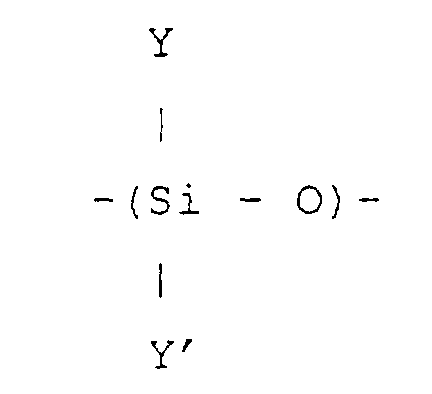
- The organopolysiloxane material (A) may be made by any suitable method, but preferably is made by hydrosilylation reaction between a siloxane polymer having a number of silicon-bonded hydrogen atoms with the appropriate amount of X''-Ph molecules, wherein X'' is as described for X, but has aliphatic unsaturation in the terminal group, allowing addition reaction with the silicon-bonded hydrogen atoms of the siloxane polymer. Examples of suitable X''-Ph materials include styrene (which introduces 2-phenylethyl groups), α-methyl styrene, eugenol, allylbenzene, allyl phenyl ether, 2-allylphenol, 2-chlorostyrene, 4-chlorostyrene, 4-methylstyrene, 3-methylstyrene, 4-t-butylstyrene, 2,4- or 2,5-dimethylstyrene or 2,4,6-trimethylstyrene. α-methyl styrene introduces 2-phenylpropyl groups, which are believed to be mainly 2-phenyl-1-propyl groups but may include 2-phenyl-2-propyl groups. Mixtures of X''-Ph materials can be used, for example styrene with α-methyl styrene. Such hydrosilylation reaction is preferably carried out under conditions and in the presence of suitable catalysts as described, for example, in US4741861. A radical inhibitor is preferably present to prevent homopolymerisation of X''-Ph.
- The organopolysiloxane material (A) may be a substantially linear polydiorganosiloxane or may have some branching. The branching may be in the siloxane chain, brought about e.g. by the presence of some tri-functional siloxane units of the formula ZSiO3/2, where Z denotes a hydrocarbon, hydroxyl or hydrocarbonoxy group. Alternatively branching may be caused by a multivalent, e.g. divalent or trivalent, organic or silicon-organic moiety linking siloxane polymer chains. The organic moiety can be a divalent linking group of the formula -X'-, and the silicon-organic moiety can be a divalent linking group of the formula X'-Sx-X', where X' denotes a divalent organic group bonded to silicon through a carbon atom and Sx is an organosiloxane group. Examples of organic linking (branching) units are C2-6 alkylene groups, e.g. dimethylene or hexylene, or aralkylene groups of the formula -X'-Ar-X'-, where Ar denotes phenylene. Hexylene units can be introduced by reaction of 1,5-hexadiene with Si-H groups and -X'-Ar-X'- units by reaction of divinylbenzene or diisopropylbenzene. Examples of silicon-organic linking units are those of the formula -(CH2)d-(Si(CH3)2-O)e-Si(CH3)2-(CH2)d- wherein d has a value of from 2 to 6 and e has a value of from 1 to 10; for example linking units of the latter formula with d=2 and e=1 can be introduced by reaction of divinyltetramethyldisiloxane with Si-H groups.
- After the hydrosilylation reaction with the aromatic compound X''-Ph and any required reaction with a branching agent, the residual Si-H groups of the organopolysiloxane can be reacted with an alkene such as ethylene, propylene, isobutylene or 1-hexene, preferably in the presence of a hydrosilylation catalyst, to introduce the groups Y'.
- It is preferred that the number of siloxane units (DP or degree of polymerisation) in the average molecule of material (A) is at least 5, more preferably from 10 to 5,000. Particularly preferred are materials (A) with a DP of from 20 to 1000, more preferably 20 to 200. The end groups of the organopolysiloxane (A) can be any of those conventionally present in siloxanes, for example trimethylsilyl end groups.
- The organosilicon resin (B) is generally a non-linear siloxane resin and preferably consists of siloxane units of the formula R'aSiO(4-a)/2 wherein R' denotes a hydroxyl, hydrocarbon or hydrocarbonoxy group and wherein a has an average value of from 0.5 to 2.4. The resin preferably consists of monovalent trihydrocarbonsiloxy (M) groups of the formula R"3SiO1/2 and tetrafunctional (Q) groups SiO4/2 wherein R" denotes a monovalent hydrocarbon group. The number ratio of M groups to Q groups is preferably in the range 0.4:1 to 2.5:1 (equivalent to a value of a in the formula R'aSiO(4-a)/2 of 0.86 to 2.15), and is more preferably 0.4:1 to 1.1:1 and most preferably 0.5:1 to 0.8:1 (equivalent to a=1.0-1.33) for use in laundry detergent applications. The organosilicon resin (B) is preferably a solid at room temperature, but MQ resins having a M/Q ratio of higher than 1.2, which are generally liquid, can be used successfully. Although it is most preferred that the resin (B) consists only of M and Q groups as defined above, a resin comprising M groups, trivalent R"SiO3/2 (T) groups and Q groups can alternatively be used. The organosilicon resin (B) can also contain divalent units R''2SiO2/2 , preferably at no more than 20% of all siloxane units present. The group R" is preferably an alkyl group having from 1 to 6 carbon atoms, most preferably methyl or ethyl, or phenyl. It is particularly preferred that at least 80%, and most preferably substantially all of the R" groups present are methyl groups. Other hydrocarbon groups may also be present, e.g. alkenyl groups present for example as dimethylvinylsilyl units , preferably in small amounts, most preferably not exceeding 5% of all R" groups. Silicon bonded hydroxyl groups and/or alkoxy, e.g. methoxy, groups may also be present.
- Such organosilicon resins are well known. They can be made in solvent or in situ, e.g. by hydrolysis of certain silane materials. Particularly preferred is the hydrolysis and condensation in the presence of a solvent, e.g. xylene, of a precursor of the tetravalent siloxy unit (e.g. tetra-orthosilicate, tetraethyl orthosilicate, polyethyl silicate or sodium silicate) and a precursor of mono-valent trialkylsiloxy units (e.g. trimethylchlorosilane, trimethylethoxysilane, hexamethyldisiloxane or hexamethyldisilazane). The resulting MQ resin can if desired be further trimethylsilylated to react out residual Si-OH groups or can be heated in the presence of a base to cause self-condensation of the resin by elimination of Si-OH groups.
- The organosilicon resin (B) is preferably present in the antifoam at 1-50% by weight based on organopolysiloxane (A), particularly 2-30% and most preferably 4-15%.
- The organosilicon resin (B) may be soluble or insoluble (not wholly dissolved) in the organopolysiloxane (A) when present in the above amounts. Solubility can be measured by observing a mixture of (A) and (B) in an optical microscope. Enhanced foam control in detergent applications has been achieved both by compositions containing dissolved organosilicon resin (B) and by compositions containing dispersed particles of organosilicon resin (B). The factors affecting solubility of (B) in (A) include the proportion of X-Ph groups in (A) (more X-Ph groups increase solubility), the degree of branching in (A), the nature of the groups Y and Y' in (A) (long chain alkyl groups decrease solubility), the ratio of M to Q units in MQ resin (B) (higher ratio of M groups to Q groups increases solubility) and the molecular weight of (B). The solubility of (B) in (A) at ambient temperature can thus be from 0.01% by weight or less up to 15% or more. It may be advantageous to use a mixture of a soluble resin (B) and an insoluble resin (B), for example a mixture of MQ resins having different M/Q ratios. If the organosilicon resin (B) is insoluble in organopolysiloxane (A), the average particle size of resin (B), as measured when dispersed in liquid (A), may for example be from 0.5 to 400µm, preferably 2 to 50 µm. For industrial foam control applications such as defoaming of black liquor in the paper and pulp industry, resins which are soluble in the siloxane copolymer, such as MQ resins having a high M/Q ratio, are usually preferred.
- The resin (B) can be added into the foam control agent as a solution in a non-volatile solvent, for example an alcohol such as dodecanol or 2-butyl-octanol or an ester such as octyl stearate. The resin solution prepared in a volatile solvent, eg xylene, can be united with the non-volatile solvent and the volatile solvent may be removed by stripping or by other forms of separation. In most cases the non-volatile solvent can be left in the foam control agent. It is preferred that the resin (B) is dissolved in an equal amount of non-volatile solvent or less, more preferably no more than about half its weight of solvent. The resin (B) can alternatively be added in solution in a volatile solvent followed stripping off the solvent. If the resin (B) is added as a solution and is insoluble in organopolysiloxane material (A), it will form solid particles with an acceptable particle size on mixing.
- The resin (B) can alternatively be added into the foam control agent in the form of solid particles, for example spray dried particles. Spray dried MQ resins are available commercially, for example of average particle size 10 to 200 microns.
- The level of insolubility of resin (B) in organopolysiloxane material (A) may affect its particle size in the composition. The lower the solubility of the organosilicon resins in organopolysiloxane material (A), the larger the particle size tends to be when the resin is mixed as a solution into (A). Thus an organosilicon resin which is soluble at 1% by weight in organopolysiloxane material (A) will tend to form smaller particles than a resin which is only soluble at 0.01% by weight. Organosilicon resins (B) which are partly soluble in organopolysiloxane material (A), that is having a solubility of at least 0.1% by weight, are preferred.
- The molecular weight of the resin (B) can be increased by condensation, for example by heating in the presence of a base. The base can for example be an aqueous or alcoholic solution of potassium hydroxide or sodium hydroxide, e.g. a solution in methanol or propanol. We have found that for some detergents, foam control agents containing the lower molecular weight MQ resins are the most effective at reducing foam but those containing MQ resins of increased molecular weight are more consistent in giving the same reduced foam levels under different conditions, for example at different wash temperatures or in different washing machines. The MQ resins of increased molecular weight also have improved resistance to loss of performance over time when stored in contact with the detergent, for example as an emulsion in liquid detergent. The reaction between resin and base may be carried out in the presence of the silica, in which case there may be some reaction between the resin and the silica. The reaction with base can be carried out in the presence of the organopolysiloxane (A) and/or in the presence of the non-volatile solvent and/or in the presence of a volatile solvent. The reaction with base may hydrolyse an ester non-volatile solvent such as octyl stearate but we have found that this does not detract from the foam control performance.
- The third essential ingredient is a hydrophobic filler (C). Hydrophobic fillers for foam control agents are well known and may be such materials as silica, preferably with a surface area as measured by BET measurement of at least 50 m2/g, titania, ground quartz, alumina, aluminosilicates, organic waxes e.g. polyethylene waxes and microcrystalline waxes, zinc oxide, magnesium oxide, salts of aliphatic carboxylic acids, reaction products of isocyanates with certain materials, e.g. cyclohexylamine, or alkyl amides, e.g. ethylenebisstearamide or methylenebisstearamide. Mixtures of one or more of these are also acceptable.
- Some of the fillers mentioned above are not hydrophobic in nature, but can be used if made hydrophobic. This could be done either in situ (i.e. when dispersed in the organopolysiloxane material (A)), or by pre-treatment of the filler prior to mixing with material (A). A preferred filler is silica which is made hydrophobic. This can be done e.g. by treatment with a fatty acid, but is preferably done by the use of methyl substituted organo-silicon materials. Suitable hydrophobing agents include polydimethylsiloxanes, dimethylsiloxane polymers which are end-blocked with silanol or silicon-bonded alkoxy groups, hexamethyldisilazane, hexamethyldisiloxane and organosilicon resins comprising monovalent groups (CH3)3SiO1/2 and tetravalent groups SiO2 in a ratio of from 0.5/1 to 1.1/1 (MQ resins). Hydrophobing is generally carried out at a temperature of at least 80°C. Similar MQ resins can be used as the organosilicon resin (B) and as the hydrophobing agent for silica filler (C ).
- Preferred silica materials are those which are prepared by heating, e.g. fumed silica, or by precipitation, although other types of silica such as those made by gel-formation are also acceptable. The silica filler may for example have an average particle size of from 0.5 to 50 microns, preferably 2 to 30µm, most preferably from 5 to 25µm. Such materials are well known and are commercially available, both in hydrophilic form and in hydrophobic form.
- The amount of filler (C) in the foam control agent of the invention is preferably 0.5 to 50% by weight based on organopolysiloxane material (A), particularly from 1 up to 10% or 15% and most preferably 2-8%. It is also preferred that the ratio of the weight of resin (B) to the weight of filler (C) is from 1/10 to 20/1, preferably 1/5 to 10/1 most preferably 1/2 to 6/1.
- The foam control agents according to the invention may be made in any convenient way, but preferably are provided by mixing the different ingredients under shear. The amount of shear is preferably sufficient to provide good dispersion of components (B) and (C) in material (A), but not so much that the particles (B) and/or (C) would be broken, thus possibly making them less effective, or re-exposing surfaces which are not hydrophcbic. Where the filler (C) needs to be made hydrophobic in situ, the manufacturing process would include a heating stage, preferably under reduced pressure, in which the filler and the treating agent are mixed together in part or all of organopolysiloxane material (A), possibly in the presence of a suitable catalyst, where required.
- The foam control agents according to the present invention may be provided as a simple mixture of (A), (B) and (C ), but for some applications it may be preferred to make them available in alternative forms. For example for use in aqueous media, it may be appropriate to provide the foam control agent in an emulsion form, preferably an oil/in/water emulsion.
- Methods of providing silicone-based foam control agents in oil-in-water emulsion form are known and have been described in a number of publications and patent specifications. Examples are EP913,187, EP978,628, WO98-22,196, WO98-00216, GB2,315,757, EP499304 AND EP459,512. Emulsions may be made according to any of the known techniques, and may be macro-emulsions or micro-emulsions. In general, they comprise the foam control agent as the oil phase, one or more surfactants, water and standard additives, such as preservatives, viscosity modifiers, protective colloids and/or thickeners. The surfactants may be selected from anionic, cationic, nonionic or amphoteric materials. Mixtures of one or more of these may also be used. Suitable anionic organic surfactants include alkali metal soaps of higher fatty acids, alkyl aryl sulphonates, for example sodium dodecyl benzene sulphonate, long chain (fatty) alcohol sulphates, olefin sulphates and sulphonates, sulphated monoglycerides, sulphated esters, sulphonated ethoxylated alcohols, sulphosuccinates, alkane sulphonates, phosphate esters, alkyl isethionates, alkyl taurates and/or alkyl sarcosinates. Suitable cationic organic surfactants include alkylamine salts, quaternary ammonium salts, sulphonium salts and phosphonium salts. Suitable nonionic surfactants include silicones such as those described as Surfactants 1-6 in EP 638346, particularly siloxane polyoxyalkylene copolymers, condensates of ethylene oxide with a long chain (fatty) alcohol or (fatty) acid, for example C14-15 alcohol, condensed with 7 moles of ethylene oxide (Dobanol® 45-7), condensates of ethylene oxide with an amine or an amide, condensation products of ethylene and propylene oxides, esters of glycerol, sucrose or sorbitol, fatty acid alkylol amides, sucrose esters, fluorosurfactants and fatty amine oxides. Suitable amphoteric organic detergent surfactants include imidazoline compounds, alkylaminoacid salts and betaines. It is more preferred that the organic surfactants are nonionic or anionic materials. Of particular interest are surfactants which are environmentally acceptable. The concentration of foam control agent in an emulsion may vary according to applications, required viscosity, effectiveness of the foam control agent and addition system, and ranges on average from 5 to 80% by weight, preferably 10 to 40%. A foam control emulsion may also contain a stabilising agent such as a silicone glycol copolymer or a crosslinked organopolysiloxane polymer having at least one polyoxyalkylene group, as described in EP663225.
- Alternatively the foam control agent can be provided as a water-dispersible composition in which (A), (B) and (C ) are dispersed in a water-dispersible carrier such as a silicone glycol or in another water-miscible liquid such as ethylene glycol, propylene glycol, polypropylene glycol, polyethylene glycol, a copolymer of ethylene and propylene glycols, a condensate of a polyalkylene glycol with a polyol, an alkyl polyglycoside, an alcohol alkoxylate or an alkylphenol alkoxylate or in a mineral oil as described in US 5908891.
- An alternative form of providing a foam control agent according to the present invention is in powdered form. This is particularly useful when the agent is to be used in a powdered product, e.g. a detergent powder. Many patents have discussed and disclosed methods of providing powdered or granulated foam control agents, for example EP723795, EP718018, EP831145, EP995473, EP997180, EP636685, EP636684, EP336710, WO99/67354, WO00/11126, WO00/11127, WO98/09701, WO95/04124, WO92/20770, WO99/29816, WO96/06921, WO96/06919, WO93/01269, WO92/13056, WO92/22630, WO93/11752, WO96/34671, GB1407997, GB1492939, GB1523957, GB2009223, EP13028, EP40091, EP71481, EP142910, EP206522, EP210721, EP329842, EP414221, and EP484081. All these methods can be applied to the foam control agents of the present invention.
- Suggested ingredients of particulate foam control agents include, in addition to the foam control agents itself, a binder or encapsulant and a solid carrier or support for the granule. It is preferred that any carrier or binder material should contribute to the efficiency or activity of the product in which it is to be incorporated. A surfactant may be used to aid dispersion of the silicone in the encapsulant or binder. Sometimes other ingredients are incorporated, for example dyes, pigments, preservatives or materials which aid the dispersion in the aqueous medium in which the foam control agent is supposed to be active, such as the surfactants described above in connection with foam control emulsions. Such a surfactant may help in controlling the "foam profile", that is in ensuring that some foam is visible throughout the wash without overfoaming. Granulated foam control agents may be made by a variety of methods, including granulators, spray drying, emulsification followed by drying, spray mixing, spray chilling, compactors, extruders, high shear mixing, low shear mixing and flaking.
- Examples of binders and/or encapsulants are polyoxyalkylene polymers such as polyethylene glycol, which can be applied molten or as an aqueous solution and spray dried, reaction products of tallow alcohol and ethylene oxide, or polypropylene glycol, polycarboxylates, for example polyacrylic acid or a partial sodium salt thereof or a copolymer of acrylic acid, for example a copolymer with maleic anhydride, cellulose ethers, particularly watersoluble or water-swellable cellulose ethers such as sodium carboxymethylcellulose, gelatin, agar, microcrystalline waxes, fatty acids or fatty alcohols having 12 to 20 carbon atoms and a melting point in the range 45 to 80°C, a monoester of glycerol and such a fatty acid, a mixture of a water insoluble wax having a melting point in the range from above 55°C to below 100°C and a water-insoluble emulsifying agent, glucose or hydrogenated glucose. A binder which is an organic compound having a melting point of from about 40 to 80°C and which in its liquid form is miscible with the organopolysiloxane (A) so as to form a homogeneous liquid which upon cooling forms a monophasic wax-like substance (that is a material which is homogeneous and shows no phase separation during the process or on storage of the granules) has the advantage of producing encapsulated antifoam granules of improved storage stability.
- The surfactant used to disperse the silicone in the binder or encapsulant can be selected from the surfactants described above in connection with foam control emulsions. Silicone glycols are preferred for many binders, or fatty alcohol ether sulphate or linear alkylbenzene sulphonate may be preferred with a polyacrylic acid binder. The surfactant can be added to the silicone undiluted or in emulsion before the silicone is mixed with the binder, or the surfactant and silicone can successively be added to the binder.
- Examples of carriers and/or supports are zeolites, for example Zeolite A or Zeolite X, other aluminosilicates or silicates, for example magnesium silicate, phosphates, for example powdered or granular sodium tripolyphosphate, sodium sulphate, sodium carbonate, sodium perborate, a cellulose derivative such as sodium carboxymethylcellulose, granulated starch, clay, sodium citrate, sodium acetate, sodium bicarbonate and native starch.
- The silicone antifoam and the binder can for example be contacted in their liquid phase and deposited on the support, for example by spray-drying onto a fluidised bed of dry powder. Alternatively a solid carrier can be granulated with the silicone-based foam control agent.
- The foam control agents of the invention can contain additional ingredients such as a density adjuster, a colour preservative such as a maleate or fumarate, e.g. bis(2-methoxy-1-ethyl)maleate or diallyl maleate, an acetylenic alcohol, e.g. methyl butynol, cyclooctadiene, or cyclic methyl vinyl siloxane which reacts with any residual Pt catalyst present, a thickening agent such as carboxymethyl cellulose, polyvinyl alcohol or a hydrophilic or partially hydrophobed fumed silica, or a colouring agent such as a pigment or dye. The foam control agents can contain a spreading agent, for example polydimethylsiloxane or another known silicone antifoam fluid, used at less than 20%, preferably up to 5%, by weight based on organopolysiloxane (A). For example a 12500 mPa.s polydimethylsiloxane fluid added at 1% slightly improved the foam reduction for some detergents. If polydimethylsiloxane is present, it can optionally be premixed with a hydrophobic filler, for example hydrophobic silica.
- The formulation of the foam control agent, and in particular the relative proportions of (A), (B) and (C ), can be adjusted if desired to match the density of a liquid in which it is to be used to reduce any chance of deposition or creaming of the foam control agent. For example, heavy duty liquid detergents may have a density of 1.025 to 1.05, whereas emulsions generally have a density just above 1.00. A foam control agent comprising 80.7% by weight (A), 13.3% (B), 5% hydrophobic silica filler (C ) and 1% hydrophilic silica thickener has a density of 1.038g/ml , while 81.9% (A), 13.3% (B), 3.25% (C ) and 1% thickener gives density 1.028 and 95.7% (A), 3.3% (B) and 1.0% (C ) gives density 1.005.
- The foam control agents according to this invention are useful for reducing or preventing foam formation in aqueous systems, particularly foam generated by detergent compositions during laundering, and are particularly useful in detergent compositions which have a high foaming characteristic, for example those based on high levels of anionic surfactants, e.g. sodium dodecyl benzene sulphonate, to ensure detergent effectiveness at lower washing temperatures, e.g. 40°C. However, they can also be incorporated in other detergent compositions.
- In another aspect of the invention there is provided a detergent composition comprising (1) 100 parts by weight of a detergent component and (2) from 0.01 to 5 parts by weight of a foam control agent as defined above.
- Suitable detergent components comprise an active detergent, organic and inorganic builder salts and other additives and diluents. The physical form of the detergent composition can for example be a powder such as a high density or low density powder used for heavy duty detergents, a low density powder as often used for light duty detergents, or in tablet or liquid form. The active detergent may comprise organic detergent surfactants of the anionic, cationic, non-ionic or amphoteric type, or mixtures thereof. Suitable anionic organic detergent surfactants are alkali metal soaps of higher fatty acids, alkyl aryl sulphonates, for example sodium dodecyl benzene sulphonate, long chain (fatty) alcohol sulphates, olefine sulphates and sulphonates, sulphated monoglycerides, sulphated ethers, sulphosuccinates, alkane sulphonates, phosphate esters, alkyl isethionates, sulphated ethoxylated alcohols, alkyl taurates and/or alkyl sarcosinates. Suitable cationic organic detergent surfactants are alkylamine salts, quaternary ammonium salts, sulphonium salts and phosphonium salts. Suitable non-ionic organic surfactants are condensates of ethylene oxide with a long chain (fatty) alcohol or fatty acid, for example C14-15 alcohol, condensed with 7 moles of ethylene oxide (Dobanol 45-7), condensates of ethylene oxide with an amine or an amide, condensation products of ethylene and propylene oxides, N-alkyl glucamides, alkyl glucosides, fatty acid alkylol amides, sucrose esters, fluorosurfactants and fatty amine oxides. Suitable amphoteric organic detergent surfactants are imidazoline compounds, alkylaminoacid salts and betaines. Examples of inorganic components are phosphates and polyphosphates, silicates, such as sodium silicates, carbonates, sulphates, oxygen releasing compounds, such as sodium perborate and other bleaching agents and zeolites. Examples of organic components are anti-redeposition agents such as carboxy-methylcellulose (CMC), brighteners, chelating agents, such as ethylene diamine tetraacetic acid (EDTA) and nitrilotriacetic acid (NTA), enzymes and bacteriostats. Liquid detergent compositions may contain solvents, alkanolamines, pH adjusting agents, opacifiers, perfumes, dyes, colour stabilisers, bactericides, brighteners, soil release agents and/or softening agents.
- The foam control agents according to the invention are surprisingly much more effective than prior art foam control agents, especially in surfactant compositions which are more prone to produce high level of foam when agitated. It was found that foam control efficiency is on average at least two times more effective, and in some cases up to 5 or even 10 times. Adequate foam control for use in front loading automatic washing machines has been achieved at levels of 0.05% by weight foam control agent (A+B+C) or even less in detergent compositions where 0.1% of a conventional antifoam allows too much foam. The foam control agents are particularly useful in detergent compositions, but may also be employed in such processes and compositions as paper making and pulping processes, textile dyeing processes, cutting oil, coatings and other aqueous systems where surfactants may produce foam. The foam control agents of the invention have the added advantage compared to polydimethylsiloxane antifoams of a lower tendency to be deposited on fabric, paper or machine parts and hence a lower risk of blemishes such as spotting.
- The following examples illustrate the invention. All parts and percentages are expressed by weight unless otherwise stated.
- A foam control agent according to the invention (FCA 1) was prepared by charging a 1-litre flask equipped with a stirrer with 425g of a copolymer (A) having a degree of polymerisation of 60 and comprising 80 mole% methyl ethyl siloxane groups, 20 mole% methyl α-methylstyrene siloxane groups and 1 mole% divinyl crosslinking groups, and 25g treated precipitated silica ( Sipernat® D10 supplied by Degussa). The mixture was stirred until complete dispersion of the silica. Then 35g of an organosiloxane resin (B) having trimethyl siloxane units and SiO2 units in a M/Q ratio of 0.65/1, dissolved in octyl stearate (70% solid), was added. The mixture was homogenised through a high shear mixer. The organosilicon resin (B) dissolved in the siloxane copolymer (A).
- A first comparative foam control agent (CFCA 1) was prepared by charging to a one litre flask equipped with a stirrer 425g of mineral oil and 25 g of treated precipitated silica ( Sipernat® D10 supplied by Degussa). The mixture is stirred until complete dispersion of the silica. Then 35g of the organosiloxane resin used in FCA1 were added . The mixture was homogenised through a high shear mixer.
- A second comparative foam control agent (CFCA2) was prepared by charging to a one litre flask equipped with a stirrer 425g of a polymethyl,C12-14alkyl siloxane having a degree of polymerisation of 60 and 25 g of treated precipitated silica ( Sipernat® D10 supplied by Degussa). The mixture was stirred until complete dispersion of the silica. Then 35g of the organosiloxane resin used in FCA1 were added. The mixture was homogenised through a high shear mixer.
- A third comparative foam control agent (CFCA3) was prepared by charging to a one litre flask equipped with a stirrer , thermometer, condenser and nitrogen inlet, 166g of a polydimethylsiloxane having a viscosity at 25°C of 1000mPa.s, 12 g of a silanol end-blocked polydimethylsiloxane and 20 g of untreated precipitated silica (FK 383DS supplied by Degussa) were added. The mixture was homogenized using a high shear mixer until complete dispersion of the silica. Then 0.3g of sodium hydroxide (40% in water) is added. The mixture was heated under vacuum at 180°C for 2 hours to treat the silica.
- 0A cutting oil was diluted to 5% concentration in soft water. One liter of this cutting oil emulsion was circulated in a pump test for 3 hours at 25°C and the foam height was monitored in function of time. For each foam control agent used, the minimum concentration required was determined such that the level of foam would not exceed 300ml of foam during the test.
It was found that the concentration needed was as follows: - CFCA1 was needed at 0.070% by weight based on the cutting oil emulsion
- CFCA2 was needed at 0.110% by weight based on the cutting oil emulsion
- FCA1 was needed at 0.040% by weight based on the cutting oil emulsion This shows that the foam control agent according to the invention is about twice as effecient as the best comparative foam control agent.
-
- In a standard European style front loading washing machine (Miele®), which was loaded with 2.5kg of clean cotton fabric, a standard wash cycle at 95°C was carried out using soft water. The foam performance of each foam control agent (including the comparative foam control agent) was assessed by determining the minimum concentration in the detergent powder required to control the foam(to avoid losing any foam from the washing machine) during the wash cycle.
- The different foam control agents were evaluated in two detergent powder formulations, without any foam control agent present. The foam control agents were merely mixed within the detergent powder prior to the testing.
% in detergent 1 % in detergent 2 CFCA1 0.12 1.2 CFCA2 0.06 0.8 CFCA3 0.2 1.7 FCA1 0.05 0.25 - In this experiment, wash tests were carried out at both 40°C and 95°C in the Miele front loading washing machines on 3.2kg loads of towels using 15 litres softened water per wash. The detergent compositions used comprised ABS anionic surfactant, nonionic surfactant (different between compositions C1 to C4), zeolite, sodium carbonate and sodium perborate. The foam control agents tested were FCA1 and CFCA5 (a foam control agent according to EP 217501) each used at 0.1% by weight of the detergent composition and CFCA4 (a mineral oil based antifoam according to Example 1 of EP687725) used at 0.2% active material based on the detergent composition. The height of foam was observed every 5 minutes throughout each wash test. The maximum height of foam during the wash cycle (50 = half window of foam, 100 = full window of foam, 120 = overflow from the washing machine) is shown in Table 1 below, together with the three observations during the rinse cycle.
Wash at 40°C Wash at 95°C Foam height Foam height Maximum Rinse Maximum Rinse Detergent C1 FCA1 70 40 20 0 20 0 0 0 CFCA5 100 70 40 20 100 20 0 0 CFCA4 100 50 30 10 100 30 10 0 Detergent C2 FCA1 50 10 0 0 0 0 0 0 CFCA5 not tested 90 30 10 0 CFCA4 100 50 30 10 60 50 20 0 Detergent C3 FCA1 80 20 10 0 20 10 0 0 CFCA5 100 40 30 20 100 40 20 10 CFCA4 100 30 20 0 100 50 20 10 Detergent C4 FCA1 80 30 10 0 30 10 0 0 CFCA5 100 50 30 10 100 40 20 0 CFCA4 100 60 30 0 100 60 30 10 - It will be seen that the foam control agent of the invention was effective (low foam, reducing to zero in rinse cycle) in all the detergent compositions at both temperatures.
- A foam control agent (FCA2) was prepared as described in Example 1 but using an organosilicon resin (B) having a M/Q ratio of 0.5/1. The organosilicon resin did not fully dissolve in the siloxane copolymer (A).
- A foam control agent (FCA3) was prepared as described in Example 1 but using an organosilicon resin (B) having a M/Q ratio of 0.8/1. The organosilicon resin dissolved in the siloxane copolymer (A).
- A foam control agent (FCA 4) was prepared as described in Example 1 but using a siloxane copolymer (A) having a degree of polymerisation of 60 comprising 80 mole% methyl dodecyl siloxane groups, 20 mole% methyl alpha-methylstyrene siloxane groups and 0.1 mole% crosslinking groups. The organosilicon resin (B) did not dissolve in this siloxane copolymer.
- Foam control agents FCA 1-4 of Examples 1-4 and comparative foam control agents CFCA1 and CFCA2 were tested in a wash test similar to Test B of Example 1, except that a different detergent powder (Detergent 3) was used and the foam control agents were all tested at a concentration of about 0.05% rather than being tested at different concentrations to determine the minimum concentration.
- In these tests using Detergent 3, FCA1 performed much better (maximum foam well below top of window, reducing to no foam at end of rinse) than both comparative agents CFCA1-2 (foam overflow).
- FCA2 performed equally well or better than FCA1 (slightly lower average foam level).
- FCA3 performed equally well to FCA1.
- FCA4 performed less well than FCA3, but was more effective in controlling foam than CFCA1 or CFCA2.
-
- A foam control agent (FCA 5) was prepared as described in Example 1 but using an organosilicon resin (B) having a M/Q ratio of 1.2/1. The organosilicon resin dissolved in the siloxane copolymer (A).
- Foam control agents FCA2, FCA3 and FCA5, together with a comparative foam control agent CFCA6 comprising a siloxane copolymer (A) and silica as described in Example 1 but no resin (B), were tested in a wash test similar to Test C of Example 1. The foam control agents were formulated as granules based on a zeolite carrier and a polycarboxylate binder and were all tested at a concentration of 0.12% by weight of detergent. The detergent comprised 60g sodium tripolyphosphate, 50g sodium perborate tetrahydrate, 21.8g linear alkyl benzenesulphonate anionic surfactant and 4.2g ethoxylated fatty alcohol nonionic surfactant; this detergent was also used for the wash tests relating to Examples 9 to 19 below. The tests were carried out for a wash time of 45 minutes and the results are shown in Table 2 below
minutes from start Example Temp. 5 10 15 20 25 30 35 40 45 FCA2 40°C 0 0 10 10 40 60 70 70 70 FCA3 40°C 0 30 50 60 60 70 100 100 100 FCA5 40°C 10 70 100 100 100 100 100 100 100 CFCA6 40°C 10 40 90 100 100 100 100 100 100 FCA2 95°C 0 10 30 40 50 30 40 50 40 FCA3 95°C 0 10 30 30 20 10 10 20 20 FCA5 95°c 0 40 60 60 80 60 40 40 60 CFCA6 95°C 20 60 100 100 100 100 100 100 100 - A foam control agent was prepared as described in Example 1 but using an organosilicon resin (B) having a M/Q ratio of 2/1. The organosilicon resin dissolved in the siloxane copolymer (A).
- The foam control agent of Example 6 was less effective than the foam control agents of Examples 1 to 5 in laundry foam control using detergent powders, but was effective at defoaming black liquor in a test in which the foaming black liquor sample taken from a pulp mill and the antifoam are shaken together for 10 seconds; the foam control agent of Example 6 was effective at collapsing the foam.
- Foam control agents were prepared according to Example 4, but using organosilicon resins of M/Q ratio 1.2/1 (Example 7) and 2/1 (Example 8). In Example 7, the organosilicon resin was not fully dissolved in the siloxane copolymer (A). In Example 8, the organosilicon resin dissolved in the siloxane copolymer (A).
- Foam control agents were prepared by the procedure of Example 1 using different siloxane copolymers (A) as follows:
- Example 9 (FCA9) - as Example 1, but the proportion of divinyl crosslinking groups was increased to 1.15 Wt.% (about 1.5 mole%).
- Example 10 (FCA10) - as Example 1, but the ethyl groups were replaced by 12-14C alkyl groups.
- Example 11 (FCA11) - as Example 1, but the proportion of methyl α-methylstyrene siloxane groups was increased to 30 mole% and no divinyl crosslinking agent was used.
-
- Foam control agents FCA1, FCA9, FCA10 and FCA11, together with CFCA5 and a comparative foam control agent CFCA7, similar to FCA1 but wherein the siloxane copolymer contained no methyl α-methylstyrene siloxane groups, were tested in a wash test similar to Test C of Example 1. The foam control agents were formulated as granules based on a zeolite carrier and a polycarboxylate binder and were all tested at a concentration of 0.12% by weight of detergent. The tests were carried out for a wash time of 45 or 55 minutes and the results are shown in Table 3 below (results up to 45 minutes shown, together with foam levels during 4 rinses)
Wash time in minutes Rinse Ex. Temp °C 5 10 15 20 25 30 35 40 45 1 2 3 4 FCA1 40 0 10 40 50 60 70 90 90 90 0 0 5 0 FCA1 95 0 0 10 10 20 20 20 20 40 0 0 5 5 FCA9 40 0 0 10 30 40 40 50 60 70 5 0 0 0 FCA9 95 0 20 30 40 30 30 30 20 20 0 0 0 0 FCA10 40 0 40 40 50 50 60 60 60 70 5 0 0 0 FCA10 95 0 40 40 40 40 30 30 30 20 0 0 0 0 FCA11 40 0 0 0 0 10 10 10 10 10 FCA11 95 0 0 0 10 0 10 0 10 10 CFCA5 40 0 50 90 100 100 100 100 100 100 40 30 40 15 CFCA5 95 0 70 100 100 100 100 100 100 100 15 25 10 0 CFCA7 40 20 90 100 100 100 100 100 100 100 CFCA7 95 60 100 100 120 120 120 120 100 100 - 2% by weight "Cabosil TS720" hydrophobic treated fumed silica was dispersed in 78% of the siloxane copolymer of Example 1 and 12% by weight of the MQ resin used in Example 1 dissolved in 8% octyl stearate was added, followed by 0.5% of a 20% aqueous KOH solution. The mixture was reacted at 80°C for 6 hours then heated under vacuum at 140°C for an hour to form foam control agent FCA12. The reaction promoted resin condensation and possibly some reaction of the resin with the silica.
- Example 12 was repeated using the siloxane copolymer of Example 10 in place of that of Example 1, to produce foam control agent FCA13.
- 2% by weight hydrophobic treated fumed silica was dispersed in 78% of the siloxane copolymer of Example 1, and 12% of the MQ resin used in Example 1 dissolved in 8% octyl stearate was added to form foam control agent FCA14
- Example 12 was repeated using "Cabosil EH-5" untreated fumed silica in place of the treated silica to produce foam control agent FCA15
Foam control agents FCA12 to FCA15 were tested under the conditions described in Examples 9 to 11. The results are shown in Table 4 belowWash time in minutes Rinse Ex. Temp 5 10 15 20 25 30 35 40 45 1 2 3 4 FCA12 40 0 20 40 50 50 60 70 70 70 0 0 5 0 FCA13 40 0 50 60 80 80 90 90 90 90 5 10 0 0 FCA14 40 0 10 40 50 60 70 70 80 80 5 0 0 5 FCA15 40 0 10 30 50 50 50 70 70 70 0 0 0 0 FCA12 95 0 30 50 50 60 50 40 40 30 0 5 0 0 FCA13 95 10 50 60 50 40 30 30 30 20 0 0 0 0 FCA14 95 0 0 20 30 40 30 30 40 20 5 0 0 0 FCA15 95 0 20 30 40 30 30 20 50 50 0 5 5 0 - Foam control agents FCA16 to FCA19 were prepared as described in Example 1 but using the following silicas in place of the "Sipernat D10":
- Example 16 - "Degussa R805" alkyl treated precipitated silica
- Example 17 - "Cabosil TS530" trimethylsilyl-treated fumed silica
- Example 18 - "Sipernat D17" silane-treated precipitated silica
- Example 19 - "HM-253" alkyl-treated fumed silica
-
- Foam control agents FCA16 to FCA19 were tested under the conditions described in Examples 9 to 11. The results are shown in Table 5 below:
Wash time in minutes Rinse Ex. Temp 5 10 15 20 25 30 35 40 45 1 2 3 4 FCA16 40 0 0 0 30 50 50 70 70 80 5 0 5 5 FCA17 40 0 0 0 0 0 0 30 50 50 5 10 5 5 FCA18 40 0 20 40 50 70 70 70 80 80 0 10 5 0 FCA19 40 0 0 10 10 40 60 60 80 80 0 0 5 0 FCA16 95 0 0 0 20 20 30 30 40 20 0 0 5 5 FCA17 95 0 0 0 0 0 0 10 10 20 0 0 5 5 FCA18 95 0 30 40 40 20 20 20 30 40 0 5 0 5 FCA19 95 0 0 20 40 40 30 40 40 40 0 5 0 0 - Foam control agents FCA20 to FCA23 were prepared according to Example using the following siloxane copolymers in place of the siloxane copolymer of Example 1. All the copolymers were trimethylsilyl-terminated and were prepared without the use of any crosslinking or branching agent.
- Example 20 - comprised on average 6 methyl α-methylstyrene siloxane groups and 57 methyl ethyl siloxane groups;
- Example 21 - comprised on average 12 methyl α-methylstyrene siloxane groups and 51 methyl ethyl siloxane groups;
- Example 22 - comprised on average 12 methyl α-methylstyrene siloxane groups and 51 methyl isobutyl siloxane groups;
- Example 23 - comprised on average 12 methyl α-methylstyrene siloxane groups and 51 methyl hexyl siloxane groups.
-
- Foam control agents FCA20 to FCA23, together with comparative foam control agent CFCA7, were tested in a wash test similar to Test C of Example 1. The foam control agents were formulated as granules based on a zeolite carrier and a polycarboxylate binder and were all tested at a concentration of 0.06% by weight of detergent 3. The tests were carried out for a wash time of 55 minutes at 95°C and the results are shown in Table 6 below.
Wash time in minutes Rinse Ex.No 10 15 20 25 30 35 40 45 50 55 1 2 3 4 FCA20 70 80 75 60 55 35 25 30 40 50 3 3 0 0 FCA21 70 70 70 60 50 35 30 30 40 45 5 5 0 0 FCA22 80 80 70 60 55 45 35 40 45 55 3 5 0 0 FCA23 40 40 35 20 15 15 15 10 15 15 3 3 0 0 CFCA7 100 100 100 120 110 110 120 110 100 100 45 25 10 3 - Following the procedure and using the materials of Example 1, a foam control agent was prepared comprising 85% by weight organopolysiloxane (A), 5% resin (B) and 5% silica filler (C ). This was mixed with 5% molten stearyl alcohol at 70°C 10% by weight of the resulting hot mix was granulated onto 90% of a carrier. Sodium carbonate was used as carrier to form FCA24a and maize starch was used as carrier to form FCA24b. The resulting granules were added to a commercial detergent formulation at a level of 0.075% by weight active foam control agent. Wash tests were carried out before and after storage for 4 weeks at 35°C and 70% relative humidity. The results are shown in Table 7 below
Wash time in minutes Ex. 10 15 20 25 30 35 40 45 50 55 FCA24a 0 0 0 10 20 30 40 40 50 60 FCA24b 0 10 10 10 10 30 30 30 40 50 Results after Storage FCA24a 0 10 0 20 40 50 60 70 70 70 FCA24b 0 0 0 10 20 30 40 60 70 70
Claims (28)
- A foam control agent, comprising (A) an organopolysiloxane material having at least one silicon-bonded substituent of the formula X-Ph, wherein X denotes a divalent aliphatic organic group bonded to silicon through a carbon atom and Ph denotes an aromatic group, (B) an organosilicon resin and (C) a hydrophobic filler, the foam control agent being free from polydimethylsiloxane or containing less than 20% by weight polydimethylsiloxane based on the organopolysiloxane (A).
- A foam control agent according to Claim 1, characterised in that Ph is a moiety containing at least one benzene ring -C6R5, wherein each R independently denotes hydrogen, halogen, hydroxyl, an alkoxy group having 1 to 6 carbon atoms or a monovalent hydrocarbon group having 1 to 12 carbon atoms or wherein two or more R groups together represent a divalent hydrocarbon group.
- A foam control agent according to Claim 1 or Claim 2, characterised in that the average number of siloxane units per molecule in material (A) is from 5 to 5,000.
- A foam control agent according to any of Claims 1 to 3, characterized in that the material (A) is a polydiorganosiloxane comprising at least 50% diorganosiloxane units of the formula and up to 50% diorganosiloxane units of the formulawhere Y is an alkyl group having 1 to 4 carbon atoms and Y' is an aliphatic hydrocarbon group having 1 to 24 carbon atoms.
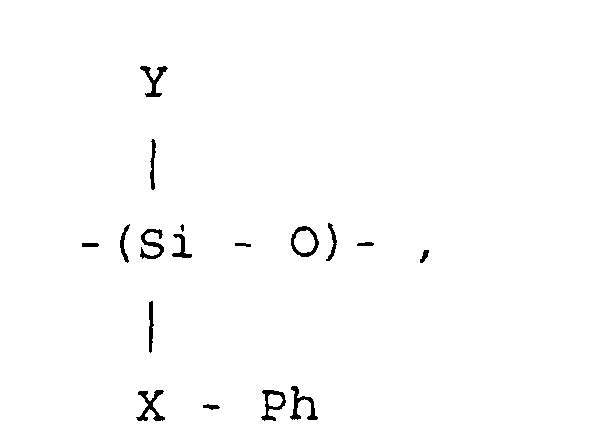
- A foam control agent according to any of Claims 1 to 4, characterised in that the group X is an alkylene group having 2 to 10 carbon atoms and Ph is a phenyl group.
- A foam control agent according to Claim 5, characterised in that the -X-Ph group is 2-phenylpropyl.
- A foam control agent according to any of Claims 4 to 6, characterised in that the group Y' is an alkyl group having 1 to 6 carbon atoms.
- A foam control agent according to any of Claims 1 to 7, characterised in that the organopolysiloxane material (A) contains at least one crosslink between siloxane polymer chains, said crosslink being of the formula -X'- or -X'-Sx-X'-, wherein X' denotes a divalent aliphatic organic group bonded to silicon through a carbon atom and Sx is an organosiloxane group.
- A foam control agent according to any of Claims 1 to 8, characterised in that the organosilicon resin (B) is a non-linear silicone consisting of siloxane units of the formula R'aSiO(4-a)/2 wherein R' denotes a hydroxyl, hydrocarbon or hydrocarbonoxy group and wherein a has an average value of from 0.5 to 2.4.
- A foam control agent according to Claim 9, characterised in that the organosilicon resin (B) is a siloxane resin consisting of monovalent trihydrocarbonsiloxy (M) groups of the formula R"3SiO1/2 and tetrafunctional (Q) groups SiO4/2 wherein R'' denotes an alkyl group and the number ratio of M groups to Q groups is in the range 0.4:1 to 1.1:1
- A foam control agent according to any of Claims 1 to 10, characterised in that the organosilicon resin (B) is dissolved in the organopolysiloxane material (A)
- A foam control agent according to any of Claims 1 to 10, characterised in that the organosilicon resin (B) is not wholly dissolved in the organopolysiloxane material (A).
- A foam control agent according to Claim 12, characterised in that organosilicon resin (B) has an average particle size of from 2 to 50µm when dispersed in organopolysiloxane material (A).
- A foam control agent according to any of Claims 1 to 13, characterised in that the organosilicon resin (B) has been contacted with a base in the presence of the organopolysiloxane material (A).
- A foam control agent according to any of Claims 1 to 14, characterised in that hydrophobic filler (C) is selected from the group consisting of silica, titania, ground quartz, alumina, aluminosilicates, polyethylene waxes, microcrystalline waxes, zinc oxide, magnesium oxide, salts of aliphatic carboxylic acids, cyclohexylamine, alkyl amides and SiO2.
- A foam control agent according to Claim 15, characterised in that filler (C) is a silica filler with an average particle size of from 0.5 to 30µm.
- A foam control agent according to Claim 16, characterised in that the organosilicon resin (B) has been contacted with a base in the presence of silica filler (C).
- A foam control agent according to any of Claims 1 to 17, characterised in that organosilicon resin (B) is present at 2 to 30% by weight based on organopolysiloxane material (A).
- A foam control agent according to any of Claims 1 to 18, characterised in that hydrophobic filler (C) is present at 1 to 10% by weight based on organopolysiloxane material (A).
- A foam control agent according to any of Claims 1 to 19, which is provided in the form of an oil-in-water emulsion.
- A water-dispersible foam control composition comprising a foam control agent according to any of Claims 1 to 19 dispersed in a water-dispersible carrier.
- A foam control agent according to any of Claims 1 to 19, which is provided in particulate form.
- A foam control agent according to Claim 22, characterised in that the particulate foam control agent additionally comprises a binder or encapsulant and a carrier or support.
- A foam control agent according to Claim 23, characterised in that the binder is a polyoxyalkylene polymer, a polycarboxylate polymer or a cellulose ether.
- A foam control agent according to Claim 23, characterised in that the binder is an organic compound having a melting point of from about 40 to 80°C and which in its liquid form is miscible with the organopolysiloxane (A) so as to form a homogeneous liquid which upon cooling forms a monophasic wax-like substance.
- A foam control agent according to any of Claims 23 to 25 characterised in that the carrier is a zeolite, sodium tripolyphosphate, sodium sulphate, sodium perborate, or sodium carbonate.
- A detergent composition characterised in that it contains 0.01 to 5% by weight of a foam control agent according to any one of the preceding claims based on the detergent component.
- A detergent composition containing an organopolysiloxane material to control foam, wherein the organopolysiloxane material has at least one silicon-bonded substituent of the formula X-Ph, wherein X denotes a divalent aliphatic organic group bonded to silicon through a carbon atom and Ph denotes an aromatic group, characterised in that the detergent composition also contains an organosilicon resin and a hydrophobic filler, the detergent based composition being free from polydimethylsiloxane or containing less than 20% by weight polydimethylsiloxane based on the said organopolysiloxane material having at least one silicon-bonded substituent of the formula X-Ph.
Applications Claiming Priority (4)
| Application Number | Priority Date | Filing Date | Title |
|---|---|---|---|
| GBGB9919096.9A GB9919096D0 (en) | 1999-08-13 | 1999-08-13 | Silicone foam control agent |
| GB9919096 | 1999-08-13 | ||
| GBGB9930179.8A GB9930179D0 (en) | 1999-12-22 | 1999-12-22 | Silicone foam control agent |
| GB9930179 | 1999-12-22 |
Publications (3)
| Publication Number | Publication Date |
|---|---|
| EP1075864A2 EP1075864A2 (en) | 2001-02-14 |
| EP1075864A3 EP1075864A3 (en) | 2001-11-28 |
| EP1075864B1 true EP1075864B1 (en) | 2005-01-05 |
Family
ID=26315845
Family Applications (1)
| Application Number | Title | Priority Date | Filing Date |
|---|---|---|---|
| EP00306547A Expired - Lifetime EP1075864B1 (en) | 1999-08-13 | 2000-08-01 | Silicone foam control agent |
Country Status (9)
| Country | Link |
|---|---|
| US (1) | US6521586B1 (en) |
| EP (1) | EP1075864B1 (en) |
| JP (1) | JP4612162B2 (en) |
| KR (1) | KR100737709B1 (en) |
| CN (1) | CN1168810C (en) |
| AT (1) | ATE286422T1 (en) |
| CA (1) | CA2315590C (en) |
| DE (1) | DE60017223T2 (en) |
| ES (1) | ES2231122T3 (en) |
Cited By (3)
| Publication number | Priority date | Publication date | Assignee | Title |
|---|---|---|---|---|
| DE102005040273B4 (en) * | 2005-08-24 | 2007-08-30 | Henkel Kgaa | Use of foam regulator granules as deposit prevention in machine textile washing |
| US9506015B2 (en) | 2014-11-21 | 2016-11-29 | Ecolab Usa Inc. | Compositions to boost fabric softener performance |
| US9968866B2 (en) | 2013-06-10 | 2018-05-15 | Wacker Chemie Ag | Process for defoaming aqueous compositions containing surfactants |
Families Citing this family (68)
| Publication number | Priority date | Publication date | Assignee | Title |
|---|---|---|---|---|
| GB0110863D0 (en) * | 2001-05-03 | 2001-06-27 | Dow Corning Sa | Granulation process |
| EA008170B1 (en) * | 2002-04-19 | 2007-04-27 | Циба Спешиалти Кемикэлз Холдинг Инк. | Foam control agents |
| GB0219073D0 (en) * | 2002-08-16 | 2002-09-25 | Dow Corning | Silicone foam control compositions |
| GB0219089D0 (en) | 2002-08-16 | 2002-09-25 | Dow Corning | Silicone foam control compositions |
| GB0329192D0 (en) * | 2003-12-17 | 2004-01-21 | Dow Corning | Foam control compositions |
| GB0329190D0 (en) * | 2003-12-17 | 2004-01-21 | Dow Corning | Foam control compositions |
| DE102004004722A1 (en) * | 2004-01-29 | 2005-08-18 | Basf Ag | Method of treating textile |
| DE102004035709A1 (en) | 2004-07-23 | 2006-03-16 | Wacker Chemie Ag | defoamer |
| DE102004051897A1 (en) * | 2004-10-26 | 2006-04-27 | Wacker Chemie Ag | defoamer |
| EP1819763B1 (en) * | 2004-12-10 | 2012-07-18 | Hercules Incorporated | Defoamer emulsion compositions for pulp mill applications |
| ES2444511T3 (en) * | 2004-12-10 | 2014-02-25 | Hercules Incorporated | Defoamers for pulp and paper processing applications |
| DE102005040274B3 (en) * | 2005-08-24 | 2007-04-12 | Henkel Kgaa | Foam regulator granulate |
| GB0518059D0 (en) | 2005-09-06 | 2005-10-12 | Dow Corning | Delivery system for releasing active ingredients |
| US20070112078A1 (en) * | 2005-11-15 | 2007-05-17 | Ian Procter | Silicone antifoam composition |
| DE102005055839A1 (en) * | 2005-11-23 | 2007-05-31 | Wacker Chemie Ag | Composition useful as a defoamer especially in detergents comprises a carrier oil (especially an organopolysiloxane) and a particulate filler |
| GB0610622D0 (en) * | 2006-05-31 | 2006-07-05 | Dow Corning | Process for making and using foam control compositions |
| CA2686129C (en) | 2007-06-15 | 2015-03-31 | Ecolab Inc. | Liquid fabric conditioner composition and method of use |
| US8030363B2 (en) | 2008-01-25 | 2011-10-04 | Momentive Performance Materials Inc. | Polyorganosiloxane demulsifier compositions and methods of making the same |
| GB0901662D0 (en) * | 2009-02-04 | 2009-03-11 | Dow Corning | Foam control composition |
| CN101757804B (en) * | 2010-01-12 | 2012-12-19 | 南京四新科技应用研究所有限公司 | Preparation of antifoaming agent for sugar industry |
| US8492325B2 (en) | 2010-03-01 | 2013-07-23 | The Procter & Gamble Company | Dual-usage liquid laundry detergents comprising a silicone anti-foam |
| RU2013118020A (en) | 2010-12-10 | 2015-01-20 | Дау Корнинг Корпорейшн | GRANULAR COMPOSITION FOR FOAM CONTROL |
| WO2012075611A1 (en) | 2010-12-10 | 2012-06-14 | The Procter & Gamble Company | Laundry detergents |
| GB201021170D0 (en) | 2010-12-10 | 2011-01-26 | Dow Corning | Granulated organopolysiloxane products |
| GB201102750D0 (en) * | 2011-02-16 | 2011-03-30 | Dow Corning | Foam control composition |
| US8551533B2 (en) * | 2011-05-09 | 2013-10-08 | Momentive Performance Materials Inc. | Adjuvant composition and agrochemical formulation containing same |
| CN102407033B (en) | 2011-06-29 | 2013-09-25 | 南京四新科技应用研究所有限公司 | Preparation method of particle defoaming agent |
| DE102011089374A1 (en) * | 2011-12-21 | 2013-06-27 | Wacker Chemie Ag | Process for the preparation of antifoam compositions |
| RU2615144C2 (en) | 2012-02-16 | 2017-04-04 | Дау Корнинг Корпорейшн | Granular substances to control foaming for rinsing cycle using siloxane wax |
| US20150247053A1 (en) * | 2012-04-24 | 2015-09-03 | Celanese Emulsions Gmbh | Vinyl ester-based copolymer dispersions from a continuous tubular emulsion polymerization process |
| EP2859046A1 (en) * | 2012-06-08 | 2015-04-15 | Dow Corning Toray Co., Ltd | Carboxy silicone containing composition and process for preparing the composition |
| CN102921200A (en) * | 2012-11-27 | 2013-02-13 | 天津惠邦同成科技发展有限公司 | Organic silicon compound de-foaming agent |
| JP6092683B2 (en) * | 2013-03-27 | 2017-03-08 | 株式会社フジタ | Turbid water treatment method |
| GB201314284D0 (en) | 2013-08-09 | 2013-09-25 | Dow Corning | Cosmetic compositions containing silicones |
| EP3033160B1 (en) | 2013-08-13 | 2018-11-07 | Dow Silicones Corporation | Method of forming an antifoam granule |
| JP6342508B2 (en) * | 2014-02-26 | 2018-06-13 | ザ プロクター アンド ギャンブル カンパニー | Antifoam composition |
| US9845445B2 (en) * | 2014-05-12 | 2017-12-19 | The Procter & Gamble Company | Cleaning compositions comprising alkoxylated polyalkyleneimine, organomodified silicone and silixane-based diluent |
| RU2017102215A (en) | 2014-08-07 | 2018-09-13 | Дзе Проктер Энд Гэмбл Компани | A soluble unit dose capsule containing a laundry detergent composition |
| HUE042647T2 (en) | 2014-08-07 | 2019-07-29 | Procter & Gamble | Detergent Composition |
| PL2982737T3 (en) | 2014-08-07 | 2018-11-30 | The Procter & Gamble Company | Laundry detergent composition |
| HUE042641T2 (en) | 2014-08-07 | 2019-07-29 | Procter & Gamble | Laundry detergent composition |
| US9688945B2 (en) | 2014-11-21 | 2017-06-27 | Ecolab Usa Inc. | Compositions to boost fabric softener performance |
| US9725679B2 (en) | 2014-11-21 | 2017-08-08 | Ecolab Usa Inc. | Compositions to boost fabric softener performance |
| JP6455970B2 (en) * | 2014-12-24 | 2019-01-23 | 旭化成ワッカーシリコーン株式会社 | Oil-in-water silicone emulsion composition for die casting release agent |
| US9815003B2 (en) | 2015-09-28 | 2017-11-14 | Wacker Chemical Corporation | Silicone defoamer compositions |
| DE102016203346A1 (en) | 2016-03-01 | 2017-09-07 | Wacker Chemie Ag | Defoamer compositions for detergents |
| WO2017155678A1 (en) | 2016-03-10 | 2017-09-14 | Kindheart, Inc | Fake blood for use in simulated surgical procedures |
| DE102016205737A1 (en) | 2016-04-06 | 2017-10-12 | Henkel Ag & Co. Kgaa | Use encapsulated foam inhibitors to reduce the amount of foam in the rinse |
| JP6993676B2 (en) * | 2017-10-23 | 2022-01-13 | サンノプコ株式会社 | Defoamer |
| JP6784657B2 (en) | 2017-11-10 | 2020-11-11 | 信越化学工業株式会社 | Defoamer and method of manufacturing defoamer |
| CN112638490B (en) * | 2018-06-15 | 2023-01-03 | 格雷斯公司 | Defoaming agent active material, method for producing same, and defoaming agent |
| BR112020025480A2 (en) * | 2018-06-15 | 2021-03-16 | W. R. Grace & Co.-Conn | FOAM ELIMINATING ACTIVE, METHOD OF MANUFACTURING THE SAME AND DEFUMERATING FORMULATION |
| US20200306408A1 (en) | 2019-03-28 | 2020-10-01 | The Procter & Gamble Company | Cyclodextrin containing freshening composition |
| JP7248826B2 (en) | 2019-06-24 | 2023-03-29 | ダウ シリコーンズ コーポレーション | silicone polyether foam control agent |
| CN110280051B (en) * | 2019-07-09 | 2021-07-09 | 四川省蜀爱新材料有限公司 | Low-silicon defoaming agent |
| KR102432456B1 (en) | 2020-07-07 | 2022-08-17 | 주식회사 프록스엔렘 | Apparatus for producting biosurfactants and method for efficient production of biosurfactants using the same |
| KR102240151B1 (en) | 2019-07-25 | 2021-04-14 | 주식회사 프록스엔렘 | Apparatus for producting biosurfactants and method for efficient production of biosurfactants using the same |
| WO2021015587A1 (en) * | 2019-07-25 | 2021-01-28 | 주식회사 프록스엔렘 | Biosurfactant production apparatus and biosurfactant production method using same |
| CN114585427A (en) * | 2019-08-14 | 2022-06-03 | 埃肯有机硅美国公司 | Process for preparing a foam control composition in granular or powder form |
| WO2021062404A1 (en) | 2019-09-26 | 2021-04-01 | Colonial Chemical, Inc. | Blends of functionalized poly alkyl glucosides for laundry soil removal |
| US12404478B2 (en) * | 2019-10-15 | 2025-09-02 | The Procter & Gamble Company | Detergent compositions |
| US12325773B2 (en) * | 2019-12-19 | 2025-06-10 | Wacker Chemie Ag | Antifoam compositions comprising branched siloxanes formed by treating linear siloxanes with high-energy radiation |
| PT4106899T (en) | 2020-02-20 | 2024-07-24 | Dow Silicones Corp | FOAM CONTROL COMPOSITION |
| CN113480853B (en) * | 2021-08-20 | 2022-09-16 | 凤阳加松新型材料科技有限公司 | Composite vulcanized silica gel gasket and preparation method thereof |
| CN118139960A (en) * | 2021-10-28 | 2024-06-04 | 美国陶氏有机硅公司 | Solid laundry detergent filter aid composition |
| AR127415A1 (en) * | 2021-10-28 | 2024-01-24 | Dow Silicones Corp | FABRIC SOFTENER FORMULATION |
| US20260159649A1 (en) | 2023-02-07 | 2026-06-11 | Dow Silicones Corporation | Linear silicone - polyether copolymer and processes for preparation and use of the copolymer |
| JP2026523948A (en) | 2023-07-06 | 2026-07-16 | ダウ シリコーンズ コーポレーション | Silicone-polyether copolymer for use in foam control formulations |
Family Cites Families (69)
| Publication number | Priority date | Publication date | Assignee | Title |
|---|---|---|---|---|
| GB1051687A (en) * | 1963-05-06 | |||
| NL135116C (en) | 1967-04-14 | |||
| US3666681A (en) | 1970-03-16 | 1972-05-30 | Dow Corning | Antifoam preparation for aqueous systems |
| GB1378874A (en) * | 1971-07-01 | 1974-12-27 | Dow Corning Ltd | Foam control substance |
| GB1407997A (en) | 1972-08-01 | 1975-10-01 | Procter & Gamble | Controlled sudsing detergent compositions |
| GB1492939A (en) | 1974-03-11 | 1977-11-23 | Procter & Gamble Ltd | Controlled-sudsing detergent compositions |
| US4075118A (en) * | 1975-10-14 | 1978-02-21 | The Procter & Gamble Company | Liquid detergent compositions containing a self-emulsified silicone suds controlling agent |
| GB1523957A (en) | 1976-06-12 | 1978-09-06 | Dow Corning Ltd | Compositions containing foam control substance |
| DE2753680C2 (en) | 1977-12-02 | 1986-06-26 | Henkel KGaA, 4000 Düsseldorf | Process for the production of powdered detergents containing organic silicon polymers with improved dissolving properties |
| DE2900063A1 (en) | 1979-01-02 | 1980-07-17 | Henkel Kgaa | DETERGENT WITH A CONTENT OF FOAM-ABSORBING POLYDIMETHYLSILOXANE AND METHOD FOR THE PRODUCTION THEREOF |
| DE2952287A1 (en) * | 1979-12-24 | 1981-07-02 | Henkel KGaA, 4000 Düsseldorf | METHOD FOR PRODUCING A POLYSILOXANE BLOCK POLYMERISATE AND THE USE THEREOF AS A FOAM INHIBITOR |
| JPS5858126B2 (en) | 1980-03-31 | 1983-12-23 | 信越化学工業株式会社 | Self-emulsifying antifoaming agent |
| FR2481942B1 (en) | 1980-05-12 | 1988-04-22 | Unilever Nv | ANTI-MOSS GRANULES, THEIR MANUFACTURING PROCESS AND THEIR USE IN DETERGENT COMPOSITIONS |
| EP0071481B1 (en) | 1981-07-31 | 1986-06-11 | Unilever Plc | Suds control agents and detergent compositions containing them |
| GB8323131D0 (en) | 1983-08-27 | 1983-09-28 | Procter & Gamble Ltd | Detergent compositions |
| JPS60156513A (en) * | 1984-01-27 | 1985-08-16 | Shin Etsu Chem Co Ltd | Antifoaming agent composition |
| JPS60251906A (en) * | 1984-05-30 | 1985-12-12 | Dow Corning Kk | Preparation of silicone defoaming composition |
| JPS61197007A (en) | 1985-02-25 | 1986-09-01 | Shin Etsu Chem Co Ltd | Silicon defoaming composition |
| GB8513074D0 (en) | 1985-05-23 | 1985-06-26 | Unilever Plc | Antifoam ingredient |
| GB8518871D0 (en) | 1985-07-25 | 1985-08-29 | Dow Corning Ltd | Detergent foam control agents |
| FR2624128B1 (en) * | 1987-12-08 | 1990-07-20 | Rhone Poulenc Chimie | ANTI-MOUSSE COMPRISING AN MQ RESIN |
| DE3805624A1 (en) | 1988-02-24 | 1989-08-31 | Degussa | POWDERED DETERGENT DEFOAMER |
| US4894177A (en) | 1988-04-07 | 1990-01-16 | Dow Corning Corporation | Agglomerated granules for the delayed release of antifoaming agents in laundering systems |
| US5380464A (en) * | 1988-05-09 | 1995-01-10 | Dow Corning Corporation | Silicone foam control composition |
| US4978471A (en) * | 1988-08-04 | 1990-12-18 | Dow Corning Corporation | Dispersible silicone wash and rinse cycle antifoam formulations |
| JPH0665365B2 (en) | 1989-08-22 | 1994-08-24 | 花王株式会社 | Defoamer granules for laundry detergent, method for producing the same, and detergent composition containing the same |
| US5275822A (en) | 1989-10-19 | 1994-01-04 | Valentine Enterprises, Inc. | Defoaming composition |
| EP0459512A2 (en) | 1990-06-01 | 1991-12-04 | UNION CARBIDE CHEMICALS AND PLASTICS COMPANY INC. (a New York corporation) | Organosilicone antifoam composition |
| GB9023674D0 (en) | 1990-10-31 | 1990-12-12 | Unilever Plc | Anti-foam granules |
| EP0495345B1 (en) | 1991-01-16 | 1994-11-02 | The Procter & Gamble Company | Foam control agents in granular form |
| US5262088A (en) * | 1991-01-24 | 1993-11-16 | Dow Corning Corporation | Emulsion gelled silicone antifoams |
| DE4117032A1 (en) | 1991-05-24 | 1992-11-26 | Henkel Kgaa | SILICONE-CONTAINING DECORATIVE GRANULATE |
| ES2104810T3 (en) | 1991-06-03 | 1997-10-16 | Procter & Gamble | GRANULAR FOAM CONTROL AGENTS. |
| GB9114195D0 (en) | 1991-07-01 | 1991-08-21 | Unilever Plc | Antifoam ingredient |
| GB9115590D0 (en) | 1991-07-18 | 1991-09-04 | Dow Corning Sa | Improved silicone antifoam |
| GB9214569D0 (en) * | 1992-07-09 | 1992-08-19 | Dow Corning Sa | Method of controlling foam |
| GB9214567D0 (en) * | 1992-07-09 | 1992-08-19 | Dow Corning Sa | Foam control agents |
| US6136917A (en) * | 1993-07-22 | 2000-10-24 | Dow Corning Corporation | Stable dispersible silicone compositions |
| US5648327A (en) | 1993-07-22 | 1997-07-15 | The Procter & Gamble Company | Stable liquid detergent compositions comprising a dispersible silicone-based suds suppressor system |
| GB9315671D0 (en) | 1993-07-29 | 1993-09-15 | Dow Corning Sa | Foam control agents and their use |
| GB9315675D0 (en) | 1993-07-29 | 1993-09-15 | Dow Corning Sa | Particulate foam control agents |
| JPH09501703A (en) | 1993-08-02 | 1997-02-18 | ヘンケル・コマンディットゲゼルシャフト・アウフ・アクチェン | Granular foam control agent and method for producing the same |
| NO308363B1 (en) | 1993-12-28 | 2000-09-04 | Dow Corning | Use of a composition as a foam control agent |
| JPH07323204A (en) | 1994-05-30 | 1995-12-12 | Toray Dow Corning Silicone Co Ltd | Foam suppressor composition |
| GB9412178D0 (en) * | 1994-06-17 | 1994-08-10 | Dow Corning Sa | Foam control agent |
| GB9412179D0 (en) * | 1994-06-17 | 1994-08-10 | Dow Corning Sa | Foam control agent |
| GB9417355D0 (en) | 1994-08-26 | 1994-10-19 | Unilever Plc | Foam control granule for particulate detergent compositions |
| GB9417371D0 (en) | 1994-08-26 | 1994-10-19 | Unilever Plc | Foam control granule for particulate detergent compositions |
| JPH08108008A (en) * | 1994-10-14 | 1996-04-30 | Toshiba Silicone Co Ltd | Antifoam composition |
| JPH08126801A (en) * | 1994-10-28 | 1996-05-21 | Toray Dow Corning Silicone Co Ltd | Antifoam composition |
| GB9426236D0 (en) * | 1994-12-24 | 1995-02-22 | Dow Corning Sa | Particulate foam control agents and their use |
| GB9501509D0 (en) | 1995-01-26 | 1995-03-15 | Dow Corning Sa | Particulate foam control agents and their use |
| GB9509114D0 (en) | 1995-05-04 | 1995-06-28 | Colin Stewart Minchem Ltd | Granular materials |
| US5908891A (en) | 1996-04-19 | 1999-06-01 | Dow Corning Corporation | Dispersible silicone compositions |
| AU3270097A (en) | 1996-07-02 | 1998-01-21 | Rhone-Poulenc, Inc. | Aqueous silicone defoaming agent |
| GB2315757B (en) | 1996-07-31 | 2000-03-29 | Gen Electric | Dilution stable antifoam emulsion concentrates |
| DE19636206A1 (en) | 1996-09-06 | 1998-03-12 | Henkel Kgaa | Process for the production of paraffin-containing foam regulators |
| GB9619627D0 (en) | 1996-09-19 | 1996-10-30 | Dow Corning Sa | Particulate foam control agents and their use |
| FR2755878B1 (en) | 1996-11-15 | 1999-02-12 | Rhodia Chimie Sa | PROCESS FOR THE PREPARATION OF SILICONE AND POLYVINYL ALCOHOL ANTI-MOUS EMULSIONS |
| JP3676042B2 (en) * | 1997-06-27 | 2005-07-27 | 信越化学工業株式会社 | Foam suppressant composition |
| FR2770151B1 (en) | 1997-10-28 | 2001-06-22 | Atochem Elf Sa | METHOD AND DEVICE FOR THE CONTINUOUS MICROMIXING OF FLUIDS AND THEIR USE, IN PARTICULAR FOR POLYMERIZATION REACTIONS |
| GB9725986D0 (en) | 1997-12-08 | 1998-02-04 | Unilever Plc | Foam control granule for particulate laundry detergent compositions |
| DE19828080A1 (en) | 1998-06-24 | 1999-12-30 | Henkel Kgaa | Production of silicone antifoam granules for solid detergents |
| DE19837195A1 (en) | 1998-08-17 | 2000-02-24 | Cognis Deutschland Gmbh | Producing defoaming granulate, for solid detergent, by spraying aqueous silicone emulsion onto pre-product mixture, while drying and granulating |
| DE19837196A1 (en) | 1998-08-17 | 2000-02-24 | Cognis Deutschland Gmbh | Producing defoaming granulate, for solid detergents, by spraying aqueous silicone emulsion onto pre-product mixture, while drying and granulating |
| GB9823259D0 (en) | 1998-10-24 | 1998-12-16 | Dow Corning Sa | Particulate foam control agents |
| GB9823765D0 (en) | 1998-10-30 | 1998-12-23 | Dow Corning Sa | Particulate foam control agent |
| JP2000189710A (en) * | 1998-12-31 | 2000-07-11 | Dow Corning Corp | Defoaming composition containing ultra-high-molecular- weight resin |
| GB0001021D0 (en) * | 2000-01-14 | 2000-03-08 | Dow Corning Sa | Foam control agents |
-
2000
- 2000-08-01 AT AT00306547T patent/ATE286422T1/en not_active IP Right Cessation
- 2000-08-01 ES ES00306547T patent/ES2231122T3/en not_active Expired - Lifetime
- 2000-08-01 EP EP00306547A patent/EP1075864B1/en not_active Expired - Lifetime
- 2000-08-01 DE DE60017223T patent/DE60017223T2/en not_active Expired - Lifetime
- 2000-08-09 JP JP2000241593A patent/JP4612162B2/en not_active Expired - Lifetime
- 2000-08-10 KR KR1020000046372A patent/KR100737709B1/en not_active Expired - Lifetime
- 2000-08-11 CA CA002315590A patent/CA2315590C/en not_active Expired - Fee Related
- 2000-08-11 CN CNB001227394A patent/CN1168810C/en not_active Expired - Lifetime
- 2000-08-11 US US09/636,799 patent/US6521586B1/en not_active Expired - Lifetime
Cited By (3)
| Publication number | Priority date | Publication date | Assignee | Title |
|---|---|---|---|---|
| DE102005040273B4 (en) * | 2005-08-24 | 2007-08-30 | Henkel Kgaa | Use of foam regulator granules as deposit prevention in machine textile washing |
| US9968866B2 (en) | 2013-06-10 | 2018-05-15 | Wacker Chemie Ag | Process for defoaming aqueous compositions containing surfactants |
| US9506015B2 (en) | 2014-11-21 | 2016-11-29 | Ecolab Usa Inc. | Compositions to boost fabric softener performance |
Also Published As
| Publication number | Publication date |
|---|---|
| EP1075864A3 (en) | 2001-11-28 |
| ATE286422T1 (en) | 2005-01-15 |
| CA2315590A1 (en) | 2001-02-13 |
| US6521586B1 (en) | 2003-02-18 |
| KR20010050043A (en) | 2001-06-15 |
| ES2231122T3 (en) | 2005-05-16 |
| CN1168810C (en) | 2004-09-29 |
| EP1075864A2 (en) | 2001-02-14 |
| DE60017223D1 (en) | 2005-02-10 |
| DE60017223T2 (en) | 2005-12-08 |
| JP2001087602A (en) | 2001-04-03 |
| KR100737709B1 (en) | 2007-07-11 |
| CA2315590C (en) | 2005-07-05 |
| CN1284545A (en) | 2001-02-21 |
| JP4612162B2 (en) | 2011-01-12 |
Similar Documents
| Publication | Publication Date | Title |
|---|---|---|
| US6521586B1 (en) | Silicone foam control agent | |
| EP1075863B1 (en) | Silicone foam control agent | |
| EP2393909B1 (en) | Foam control composition | |
| US4983316A (en) | Dispersible silicone antifoam formulations | |
| EP1528954B1 (en) | Silicone foam control compositions | |
| US4978471A (en) | Dispersible silicone wash and rinse cycle antifoam formulations | |
| EP0636685B1 (en) | Particulate foam control agents and their use | |
| EP1534403B1 (en) | Silicone foam control compositions | |
| JP4664511B2 (en) | Foam regulator | |
| CA2128799A1 (en) | Particulate foam control agents | |
| EP1016442A2 (en) | Antifoam compositions containing ultra high molecular weight resins | |
| WO2003089108A1 (en) | Foam control agents | |
| US5589449A (en) | Particulate foam control agents | |
| EP0997180A1 (en) | Particulate foam control agent |
Legal Events
| Date | Code | Title | Description |
|---|---|---|---|
| PUAI | Public reference made under article 153(3) epc to a published international application that has entered the european phase |
Free format text: ORIGINAL CODE: 0009012 |
|
| AK | Designated contracting states |
Kind code of ref document: A2 Designated state(s): AT BE CH CY DE DK ES FI FR GB GR IE IT LI LU MC NL PT SE |
|
| AX | Request for extension of the european patent |
Free format text: AL;LT;LV;MK;RO;SI |
|
| PUAL | Search report despatched |
Free format text: ORIGINAL CODE: 0009013 |
|
| AK | Designated contracting states |
Kind code of ref document: A3 Designated state(s): AT BE CH CY DE DK ES FI FR GB GR IE IT LI LU MC NL PT SE |
|
| AX | Request for extension of the european patent |
Free format text: AL;LT;LV;MK;RO;SI |
|
| RIC1 | Information provided on ipc code assigned before grant |
Free format text: 7B 01D 19/04 A, 7C 11D 3/16 B, 7C 11D 3/37 B |
|
| 17P | Request for examination filed |
Effective date: 20020521 |
|
| R17P | Request for examination filed (corrected) |
Effective date: 20020516 |
|
| AKX | Designation fees paid |
Free format text: AT BE CH CY DE DK ES FI FR GB GR IE IT LI LU MC NL PT SE |
|
| GRAP | Despatch of communication of intention to grant a patent |
Free format text: ORIGINAL CODE: EPIDOSNIGR1 |
|
| GRAS | Grant fee paid |
Free format text: ORIGINAL CODE: EPIDOSNIGR3 |
|
| GRAA | (expected) grant |
Free format text: ORIGINAL CODE: 0009210 |
|
| AK | Designated contracting states |
Kind code of ref document: B1 Designated state(s): AT BE CH CY DE DK ES FI FR GB GR IE IT LI LU MC NL PT SE |
|
| PG25 | Lapsed in a contracting state [announced via postgrant information from national office to epo] |
Ref country code: NL Free format text: LAPSE BECAUSE OF FAILURE TO SUBMIT A TRANSLATION OF THE DESCRIPTION OR TO PAY THE FEE WITHIN THE PRESCRIBED TIME-LIMIT Effective date: 20050105 Ref country code: CH Free format text: LAPSE BECAUSE OF FAILURE TO SUBMIT A TRANSLATION OF THE DESCRIPTION OR TO PAY THE FEE WITHIN THE PRESCRIBED TIME-LIMIT Effective date: 20050105 Ref country code: LI Free format text: LAPSE BECAUSE OF FAILURE TO SUBMIT A TRANSLATION OF THE DESCRIPTION OR TO PAY THE FEE WITHIN THE PRESCRIBED TIME-LIMIT Effective date: 20050105 Ref country code: FI Free format text: LAPSE BECAUSE OF FAILURE TO SUBMIT A TRANSLATION OF THE DESCRIPTION OR TO PAY THE FEE WITHIN THE PRESCRIBED TIME-LIMIT Effective date: 20050105 Ref country code: AT Free format text: LAPSE BECAUSE OF FAILURE TO SUBMIT A TRANSLATION OF THE DESCRIPTION OR TO PAY THE FEE WITHIN THE PRESCRIBED TIME-LIMIT Effective date: 20050105 |
|
| REG | Reference to a national code |
Ref country code: GB Ref legal event code: FG4D |
|
| REG | Reference to a national code |
Ref country code: CH Ref legal event code: EP |
|
| REG | Reference to a national code |
Ref country code: IE Ref legal event code: FG4D |
|
| REF | Corresponds to: |
Ref document number: 60017223 Country of ref document: DE Date of ref document: 20050210 Kind code of ref document: P |
|
| PG25 | Lapsed in a contracting state [announced via postgrant information from national office to epo] |
Ref country code: SE Free format text: LAPSE BECAUSE OF FAILURE TO SUBMIT A TRANSLATION OF THE DESCRIPTION OR TO PAY THE FEE WITHIN THE PRESCRIBED TIME-LIMIT Effective date: 20050405 Ref country code: DK Free format text: LAPSE BECAUSE OF FAILURE TO SUBMIT A TRANSLATION OF THE DESCRIPTION OR TO PAY THE FEE WITHIN THE PRESCRIBED TIME-LIMIT Effective date: 20050405 Ref country code: GR Free format text: LAPSE BECAUSE OF FAILURE TO SUBMIT A TRANSLATION OF THE DESCRIPTION OR TO PAY THE FEE WITHIN THE PRESCRIBED TIME-LIMIT Effective date: 20050405 |
|
| REG | Reference to a national code |
Ref country code: ES Ref legal event code: FG2A Ref document number: 2231122 Country of ref document: ES Kind code of ref document: T3 |
|
| NLV1 | Nl: lapsed or annulled due to failure to fulfill the requirements of art. 29p and 29m of the patents act | ||
| REG | Reference to a national code |
Ref country code: CH Ref legal event code: PL |
|
| PG25 | Lapsed in a contracting state [announced via postgrant information from national office to epo] |
Ref country code: LU Free format text: LAPSE BECAUSE OF NON-PAYMENT OF DUE FEES Effective date: 20050801 Ref country code: CY Free format text: LAPSE BECAUSE OF FAILURE TO SUBMIT A TRANSLATION OF THE DESCRIPTION OR TO PAY THE FEE WITHIN THE PRESCRIBED TIME-LIMIT Effective date: 20050801 |
|
| PG25 | Lapsed in a contracting state [announced via postgrant information from national office to epo] |
Ref country code: IE Free format text: LAPSE BECAUSE OF NON-PAYMENT OF DUE FEES Effective date: 20050802 |
|
| PG25 | Lapsed in a contracting state [announced via postgrant information from national office to epo] |
Ref country code: MC Free format text: LAPSE BECAUSE OF NON-PAYMENT OF DUE FEES Effective date: 20050831 |
|
| PLBE | No opposition filed within time limit |
Free format text: ORIGINAL CODE: 0009261 |
|
| STAA | Information on the status of an ep patent application or granted ep patent |
Free format text: STATUS: NO OPPOSITION FILED WITHIN TIME LIMIT |
|
| ET | Fr: translation filed | ||
| 26N | No opposition filed |
Effective date: 20051006 |
|
| REG | Reference to a national code |
Ref country code: GB Ref legal event code: FG4D |
|
| REG | Reference to a national code |
Ref country code: IE Ref legal event code: MM4A |
|
| PG25 | Lapsed in a contracting state [announced via postgrant information from national office to epo] |
Ref country code: PT Free format text: LAPSE BECAUSE OF NON-PAYMENT OF DUE FEES Effective date: 20050605 |
|
| REG | Reference to a national code |
Ref country code: DE Ref legal event code: R082 Ref document number: 60017223 Country of ref document: DE Representative=s name: FLEISCHER, ENGELS & PARTNER MBB, PATENTANWAELT, DE |
|
| REG | Reference to a national code |
Ref country code: FR Ref legal event code: PLFP Year of fee payment: 17 |
|
| REG | Reference to a national code |
Ref country code: FR Ref legal event code: PLFP Year of fee payment: 18 |
|
| REG | Reference to a national code |
Ref country code: FR Ref legal event code: PLFP Year of fee payment: 19 |
|
| PGFP | Annual fee paid to national office [announced via postgrant information from national office to epo] |
Ref country code: BE Payment date: 20190617 Year of fee payment: 20 Ref country code: FR Payment date: 20190619 Year of fee payment: 20 |
|
| PGFP | Annual fee paid to national office [announced via postgrant information from national office to epo] |
Ref country code: IT Payment date: 20190821 Year of fee payment: 20 Ref country code: DE Payment date: 20190716 Year of fee payment: 20 Ref country code: ES Payment date: 20190902 Year of fee payment: 20 |
|
| PGFP | Annual fee paid to national office [announced via postgrant information from national office to epo] |
Ref country code: GB Payment date: 20190731 Year of fee payment: 20 |
|
| REG | Reference to a national code |
Ref country code: DE Ref legal event code: R071 Ref document number: 60017223 Country of ref document: DE |
|
| REG | Reference to a national code |
Ref country code: GB Ref legal event code: PE20 Expiry date: 20200731 |
|
| REG | Reference to a national code |
Ref country code: BE Ref legal event code: MK Effective date: 20200801 |
|
| PG25 | Lapsed in a contracting state [announced via postgrant information from national office to epo] |
Ref country code: GB Free format text: LAPSE BECAUSE OF EXPIRATION OF PROTECTION Effective date: 20200731 |
|
| REG | Reference to a national code |
Ref country code: ES Ref legal event code: FD2A Effective date: 20220103 |
|
| PG25 | Lapsed in a contracting state [announced via postgrant information from national office to epo] |
Ref country code: ES Free format text: LAPSE BECAUSE OF EXPIRATION OF PROTECTION Effective date: 20200802 |