EP1075036A2 - Electrolyte for electrochemical device - Google Patents
Electrolyte for electrochemical device Download PDFInfo
- Publication number
- EP1075036A2 EP1075036A2 EP00115579A EP00115579A EP1075036A2 EP 1075036 A2 EP1075036 A2 EP 1075036A2 EP 00115579 A EP00115579 A EP 00115579A EP 00115579 A EP00115579 A EP 00115579A EP 1075036 A2 EP1075036 A2 EP 1075036A2
- Authority
- EP
- European Patent Office
- Prior art keywords
- group
- electrolyte
- ion
- alkyl group
- halogenated
- Prior art date
- Legal status (The legal status is an assumption and is not a legal conclusion. Google has not performed a legal analysis and makes no representation as to the accuracy of the status listed.)
- Granted
Links
- 0 C*C1(C(F)(F)F)O*(OC2(*)*)(OC2=O)OC1=O Chemical compound C*C1(C(F)(F)F)O*(OC2(*)*)(OC2=O)OC1=O 0.000 description 1
Classifications
-
- H—ELECTRICITY
- H01—ELECTRIC ELEMENTS
- H01M—PROCESSES OR MEANS, e.g. BATTERIES, FOR THE DIRECT CONVERSION OF CHEMICAL ENERGY INTO ELECTRICAL ENERGY
- H01M10/00—Secondary cells; Manufacture thereof
- H01M10/05—Accumulators with non-aqueous electrolyte
- H01M10/056—Accumulators with non-aqueous electrolyte characterised by the materials used as electrolytes, e.g. mixed inorganic/organic electrolytes
- H01M10/0564—Accumulators with non-aqueous electrolyte characterised by the materials used as electrolytes, e.g. mixed inorganic/organic electrolytes the electrolyte being constituted of organic materials only
- H01M10/0566—Liquid materials
- H01M10/0567—Liquid materials characterised by the additives
-
- C—CHEMISTRY; METALLURGY
- C07—ORGANIC CHEMISTRY
- C07F—ACYCLIC, CARBOCYCLIC OR HETEROCYCLIC COMPOUNDS CONTAINING ELEMENTS OTHER THAN CARBON, HYDROGEN, HALOGEN, OXYGEN, NITROGEN, SULFUR, SELENIUM OR TELLURIUM
- C07F5/00—Compounds containing elements of Groups 3 or 13 of the Periodic Table
- C07F5/02—Boron compounds
- C07F5/025—Boronic and borinic acid compounds
-
- C—CHEMISTRY; METALLURGY
- C07—ORGANIC CHEMISTRY
- C07F—ACYCLIC, CARBOCYCLIC OR HETEROCYCLIC COMPOUNDS CONTAINING ELEMENTS OTHER THAN CARBON, HYDROGEN, HALOGEN, OXYGEN, NITROGEN, SULFUR, SELENIUM OR TELLURIUM
- C07F5/00—Compounds containing elements of Groups 3 or 13 of the Periodic Table
- C07F5/02—Boron compounds
- C07F5/027—Organoboranes and organoborohydrides
-
- H—ELECTRICITY
- H01—ELECTRIC ELEMENTS
- H01G—CAPACITORS; CAPACITORS, RECTIFIERS, DETECTORS, SWITCHING DEVICES, LIGHT-SENSITIVE OR TEMPERATURE-SENSITIVE DEVICES OF THE ELECTROLYTIC TYPE
- H01G11/00—Hybrid capacitors, i.e. capacitors having different positive and negative electrodes; Electric double-layer [EDL] capacitors; Processes for the manufacture thereof or of parts thereof
- H01G11/54—Electrolytes
- H01G11/56—Solid electrolytes, e.g. gels; Additives therein
-
- H—ELECTRICITY
- H01—ELECTRIC ELEMENTS
- H01G—CAPACITORS; CAPACITORS, RECTIFIERS, DETECTORS, SWITCHING DEVICES, LIGHT-SENSITIVE OR TEMPERATURE-SENSITIVE DEVICES OF THE ELECTROLYTIC TYPE
- H01G11/00—Hybrid capacitors, i.e. capacitors having different positive and negative electrodes; Electric double-layer [EDL] capacitors; Processes for the manufacture thereof or of parts thereof
- H01G11/54—Electrolytes
- H01G11/58—Liquid electrolytes
- H01G11/62—Liquid electrolytes characterised by the solute, e.g. salts, anions or cations therein
-
- H—ELECTRICITY
- H01—ELECTRIC ELEMENTS
- H01M—PROCESSES OR MEANS, e.g. BATTERIES, FOR THE DIRECT CONVERSION OF CHEMICAL ENERGY INTO ELECTRICAL ENERGY
- H01M10/00—Secondary cells; Manufacture thereof
- H01M10/05—Accumulators with non-aqueous electrolyte
- H01M10/052—Li-accumulators
-
- H—ELECTRICITY
- H01—ELECTRIC ELEMENTS
- H01M—PROCESSES OR MEANS, e.g. BATTERIES, FOR THE DIRECT CONVERSION OF CHEMICAL ENERGY INTO ELECTRICAL ENERGY
- H01M10/00—Secondary cells; Manufacture thereof
- H01M10/05—Accumulators with non-aqueous electrolyte
- H01M10/056—Accumulators with non-aqueous electrolyte characterised by the materials used as electrolytes, e.g. mixed inorganic/organic electrolytes
- H01M10/0564—Accumulators with non-aqueous electrolyte characterised by the materials used as electrolytes, e.g. mixed inorganic/organic electrolytes the electrolyte being constituted of organic materials only
- H01M10/0566—Liquid materials
- H01M10/0568—Liquid materials characterised by the solutes
-
- H—ELECTRICITY
- H01—ELECTRIC ELEMENTS
- H01M—PROCESSES OR MEANS, e.g. BATTERIES, FOR THE DIRECT CONVERSION OF CHEMICAL ENERGY INTO ELECTRICAL ENERGY
- H01M10/00—Secondary cells; Manufacture thereof
- H01M10/05—Accumulators with non-aqueous electrolyte
- H01M10/052—Li-accumulators
- H01M10/0525—Rocking-chair batteries, i.e. batteries with lithium insertion or intercalation in both electrodes; Lithium-ion batteries
-
- H—ELECTRICITY
- H01—ELECTRIC ELEMENTS
- H01M—PROCESSES OR MEANS, e.g. BATTERIES, FOR THE DIRECT CONVERSION OF CHEMICAL ENERGY INTO ELECTRICAL ENERGY
- H01M10/00—Secondary cells; Manufacture thereof
- H01M10/05—Accumulators with non-aqueous electrolyte
- H01M10/056—Accumulators with non-aqueous electrolyte characterised by the materials used as electrolytes, e.g. mixed inorganic/organic electrolytes
- H01M10/0564—Accumulators with non-aqueous electrolyte characterised by the materials used as electrolytes, e.g. mixed inorganic/organic electrolytes the electrolyte being constituted of organic materials only
- H01M10/0565—Polymeric materials, e.g. gel-type or solid-type
-
- H—ELECTRICITY
- H01—ELECTRIC ELEMENTS
- H01M—PROCESSES OR MEANS, e.g. BATTERIES, FOR THE DIRECT CONVERSION OF CHEMICAL ENERGY INTO ELECTRICAL ENERGY
- H01M2300/00—Electrolytes
- H01M2300/0017—Non-aqueous electrolytes
- H01M2300/002—Inorganic electrolyte
-
- H—ELECTRICITY
- H01—ELECTRIC ELEMENTS
- H01M—PROCESSES OR MEANS, e.g. BATTERIES, FOR THE DIRECT CONVERSION OF CHEMICAL ENERGY INTO ELECTRICAL ENERGY
- H01M2300/00—Electrolytes
- H01M2300/0017—Non-aqueous electrolytes
- H01M2300/0025—Organic electrolyte
-
- H—ELECTRICITY
- H01—ELECTRIC ELEMENTS
- H01M—PROCESSES OR MEANS, e.g. BATTERIES, FOR THE DIRECT CONVERSION OF CHEMICAL ENERGY INTO ELECTRICAL ENERGY
- H01M2300/00—Electrolytes
- H01M2300/0017—Non-aqueous electrolytes
- H01M2300/0065—Solid electrolytes
- H01M2300/0082—Organic polymers
-
- Y—GENERAL TAGGING OF NEW TECHNOLOGICAL DEVELOPMENTS; GENERAL TAGGING OF CROSS-SECTIONAL TECHNOLOGIES SPANNING OVER SEVERAL SECTIONS OF THE IPC; TECHNICAL SUBJECTS COVERED BY FORMER USPC CROSS-REFERENCE ART COLLECTIONS [XRACs] AND DIGESTS
- Y02—TECHNOLOGIES OR APPLICATIONS FOR MITIGATION OR ADAPTATION AGAINST CLIMATE CHANGE
- Y02E—REDUCTION OF GREENHOUSE GAS [GHG] EMISSIONS, RELATED TO ENERGY GENERATION, TRANSMISSION OR DISTRIBUTION
- Y02E60/00—Enabling technologies; Technologies with a potential or indirect contribution to GHG emissions mitigation
- Y02E60/10—Energy storage using batteries
-
- Y—GENERAL TAGGING OF NEW TECHNOLOGICAL DEVELOPMENTS; GENERAL TAGGING OF CROSS-SECTIONAL TECHNOLOGIES SPANNING OVER SEVERAL SECTIONS OF THE IPC; TECHNICAL SUBJECTS COVERED BY FORMER USPC CROSS-REFERENCE ART COLLECTIONS [XRACs] AND DIGESTS
- Y02—TECHNOLOGIES OR APPLICATIONS FOR MITIGATION OR ADAPTATION AGAINST CLIMATE CHANGE
- Y02E—REDUCTION OF GREENHOUSE GAS [GHG] EMISSIONS, RELATED TO ENERGY GENERATION, TRANSMISSION OR DISTRIBUTION
- Y02E60/00—Enabling technologies; Technologies with a potential or indirect contribution to GHG emissions mitigation
- Y02E60/13—Energy storage using capacitors
Definitions
- the present invention relates to an electrolyte including an ionic metal complex having a novel chemical structure, an ionic conductor including the electrolyte, and electrochemical devices including the electrolyte, such as lithium cells, lithium ion cells, electrical double-layer capacitors.
- electrochemical devices utilizing electrochemical phenomena, such as cells for use as their power supplies and capacitors.
- electrochromic devices in which a color change occurs due to an electrochemical reaction, are examples of electrochemical devices for uses other than power supplies.
- electrochemical devices are typically composed of a pair of electrodes and an ionic conductor filled between them.
- the ionic conductor contains a salt (AB) as an electrolyte, which is dissolved in a solvent, polymer or mixture thereof such that the salt is dissociated into cations (A + ) and anions (B - ), resulting in ionic conduction.
- AB salt
- a + cations
- B - anions
- electrolytes having sufficient solubility for use in lithium cells are only LiClO 4 , LiPF 6 , LiBF 4 , LiAsF 6 , LiN(CF 3 SO 2 ) 2 and LiCF 3 SO 3 .
- the cation type of the electrolyte is frequently limited by the device as is the case with the lithium ion of lithium cells, any anion can be used for the electrolyte provided it satisfies the condition of having high solubility.
- an electrolyte for an electrochemical device comprises an ionic metal complex represented by the general formula (1): wherein M is a transition metal selected from the group consisting of elements of groups 3-11 of the periodic table, or an element selected from the group consisting of elements of groups 12-15 of the periodic table; A a+ represents a metal ion, onium ion or proton; a represents a number from 1 to 3; b represents a number from 1 to 3; p is b/a; m represents a number from 1 to 3; n represents a number from 0 to 4; q is 0 or 1; X 1 represents O, S or NR 5 R 6 ; each of R 1 and R 2 independently represents H, a halogen, a C 1 -C 10 alkyl group or C 1 -C 10 halogenated alkyl group; R 3 represents a C 1 -C 10 alkylene group, C 1 -C 10 halogenated alkylene
- an ion conductor for an electrochemical device comprises the electrolyte; and a member selected from the group consisting of a nonaqueous solvent, a polymer and a mixture thereof, said member dissolving therein said electrolyte.
- an electrochemical device comprising (a) first and second electrodes; and (b) the ion conductor receiving therein said first and second electrodes.
- An electrolyte according to the present invention has high heat resistance and hydrolysis resistance as compared with conventional electrolytes.
- the electrolyte can advantageously be used for electrochemical devices such as lithium cell, lithium ion cell and electrical double-layer capacitor.
- the alkyl groups, halogenated alkyl groups, aryl groups and halogenated aryl groups, which are contained in the ionic metal complex and the raw materials for synthesizing the same, may be branched and/or may have other functional groups such as hydroxyl groups and ether bonds.
- lithium ion is indicated as an example of A a+ of the general formula (1)
- examples of other cations that can be used other than lithium ion include sodium ion, potassium ion, magnesium ion, calcium ion, barium ion, cesium ion, silver ion, zinc ion, copper ion, cobalt ion, iron ion, nickel ion, manganese ion, titanium ion, lead ion, chromium ion, vanadium ion, ruthenium ion, yttrium ion, lanthanoid ion, actinoid ion, tetrabutylammonium ion, tetraethylammonium ion, tetramethylammonium ion, triethylmethylammonium ion, triethylammonium ion, pyridinium ion, imidazolium ion, proto
- the valency (valence) of the A a+ cation is preferably from 1 to 3. If the valency is larger than 3, the problem occurs in which it becomes difficult to dissolve the ionic metal complex in solvent due to the increase in crystal lattice energy. Consequently, in the case of requiring solubility of the ionic metal complex, a valency of 1 is preferable. As shown in the general formula (1), the valency (b - ) of the anion is similarly preferably from 1 to 3, and a valency of 1 is particularly preferable.
- the constant p expresses the ratio of the valency of the anion to the valency of the cation, namely b/a.
- M at the center of the ionic metal complex of the present invention is selected from elements of groups 3-15 of the periodic table. It is preferably Al, B, V, Ti, Si, Zr, Ge, Sn, Cu, Y, Zn, Ga, Nb, Ta, Bi, P, As, Sc, Hf or Sb, and more preferably Al, B or P. Although it is possible to use various elements for the M other than these preferable examples, synthesis is relatively easy in the case of using Al, B, V, Ti, Si, Zr, Ge, Sn, Cu, Y, Zn, Ga, Nb, Ta, Bi, P, As, Sc, Hf or Sb. In addition to ease of synthesis, the ionic metal complex has excellent properties in terms of low toxicity, stability and production cost in the case of using Al, B or P.
- the organic or inorganic portion bonded to M is referred to as the ligand.
- X 1 in the general formula (1) represents O, S or NR 5 R 6 , and is bonded to M through its hetero atom (O, S or N).
- O, S or N hetero atom
- the ionic metal complex represented by the general formula (1) is characterized by these ligands forming a chelate structure with M since there is bonding with M by a carboxyl group (-COO-) other than X 1 within the same ligand. As a result of this chlelation, the heat resistance, chemical stability and hydrolysis resistance of the ionic metal complex are improved.
- each of R 1 and R 2 is independently selected from H, halogen, C 1 -C 10 alkyl groups and C 1 -C 10 halogenated alkyl groups. At least one of either R 1 and R 2 is preferably a fluorinated alkyl group, and more preferably, at least one of R 1 and R 2 is a trifluoromethyl group. Due to the presence of an electron-attracting halogen and/or a halogenated alkyl group for R 1 and R 2 , the negative charge of the central M is dissipated. This results in an increase of the anion of the general formula (1) in electrical stability.
- R 3 is selected from C 1 -C 10 alkylene groups, C 1 -C 10 halogenated alkylene groups, C 4 -C 20 aryl groups and C 4 -C 20 halogenated aryl groups.
- R 3 is preferably one which forms a 5 to 10-membered ring when a chelate ring is formed with the central M.
- the case of a ring having more than 10 members is not preferable, since chelating advantageous effects are reduced.
- R 3 has a portion of hydroxyl group or carboxyl group, it is possible to form a bond between the central M and this portion.
- R 4 is selected from halogens, C 1 -C 10 alkyl groups, C 1 -C 10 halogenated alkyl groups, C 4 -C 20 aryl groups, C 4 -C 20 halogenated aryl groups and X 2 R 7 .
- fluorine is preferable.
- X 2 represents O, S or NR 5 R 6 and bonds to M through one of these heteroatoms (O, S and N). Although the bonding of an atom other than O, S or N is not impossible, the synthesis becomes extremely bothersome.
- Each of R 5 and R 6 is selected from H and C 1 -C 10 alkyl groups.
- R 5 and R 6 differs from other groups (e.g., R 1 and R 2 ) in that the former is not required to be an electron attracting group.
- R 7 is selected from C 1 -C 10 alkyl groups, C 1 -C 10 halogenated alkyl groups, C 4 -C 20 aryl groups and C 4 -C 20 halogenated aryl groups. Of these, a C 1 -C 10 fluorinated alkyl groups is preferable.
- the values of the constants m and n relating to the number of the above-mentioned ligands depend on the type of the central M.
- m is preferably from 1 to 3
- n is preferably from 0 to 4.
- This is extremely important in the case of using as the electrolyte of an electrochemical device.
- electrolytes Although there are an almost infinite number of salts referred to as electrolytes, the majority dissolve and dissociate in water, and thereby are ion conductive. Many of such salts do not even dissolve in organic solvents and so forth other than water. Such aqueous solutions are used as an electrolytic solution of electrochemical devices.
- Complexes of organic substances and metals are typically susceptible to hydrolysis and there are many that are chemically unstable. Since the electrolyte of the present invention, however, has a chelate structure, it is extremely stable and resistant to hydrolysis and so forth.
- that having fluorine within the chemical structure represented by the general formula (1) is particularly preferable since it further increases chemical stability such as oxidation resistance due to the effect of the fluorine.
- electrolyte of the present invention is used as the electrolyte of electrochemical devices such as lithium cells (cells), lithium ion cells (cells) and electrical double-layer capacitors
- electrochemical devices such as lithium cells (cells), lithium ion cells (cells) and electrical double-layer capacitors
- examples of its other applications include catalysts of organic synthesis reactions, polymerization catalysts and co-catalysts (auxiliary catalysts) of olefin polymerization.
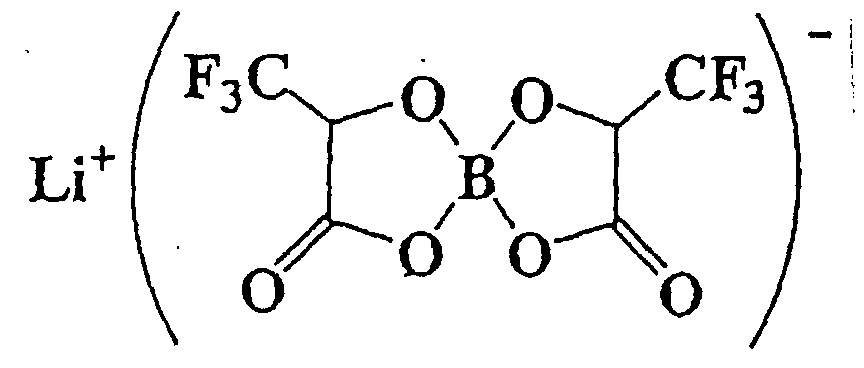
- an ionic metal complex having the following formula can be synthesized by reacting LiB(OCH 3 ) 4 with a stoichiometric amount of HOC(CF 3 ) 2 COOH.
- a mixture of electrolyte and non-aqueous solvent or polymer is used as the ion conductor. If a non-aqueous solvent is used, the resulting ion conductor is typically referred to as an electrolytic solution, while if a polymer is used, it is typically referred to as a polymer solid electrolyte. Non-aqueous solvents may also be contained as plasticizer in polymer solid electrolytes. It is possible to use one type or a mixture of two or more types of an electrolyte of the present invention.
- electrolyte of the present invention it is necessary that one type be an electrolyte of the present invention, while examples of other electrolytes that can be used include lithium salts such as LiClO 4 , LiPF 6 , LiBF 4 , LiCF 3 SO 3 , LiN(CF 3 SO 2 ) 2 and LiSbF 6 .
- lithium salts such as LiClO 4 , LiPF 6 , LiBF 4 , LiCF 3 SO 3 , LiN(CF 3 SO 2 ) 2 and LiSbF 6 .
- non-aqueous solvent is an aprotic solvent that is able to dissolve an electrolyte of the present invention
- examples of this non-aqueous solvent that can be used include carbonates, esters, ethers, lactones, nitriles, amides and sulfones.
- the solvent can either be used alone or in the form of a mixture of two or more types of solvent.
- the solvent include propylene carbonate, ethylene carbonate, diethyl carbonate, dimethyl carbonate, methylethyl carbonate, dimethoxyethane, acetonitrile, propionitrile, tetrahydrofuran, 2-methyltetrahydrofuran, dioxane, nitromethane, N,N- dimethylformamide, dimethylsulfoxide, sulfolane and ⁇ -butyrolactone.
- the polymer to be mixed with the electrolyte of the invention is an aprotic polymer that can dissolve the electrolyte.
- examples of such polymer include polymers having polyethylene oxide on their main chain or side chain, homopolymers or copolymers of polyvinylidene fluoride, methacrylate polymers and polyacrylonitrile.
- the above-mentioned aprotic non-aqueous solvent can be used.
- the concentration of the electrolyte of the present invention in these ion conductors is preferably 0.1 mol/dm 3 or more up to the saturated concentration, and more preferably from 0.5 mol/dm 3 to 1.5 mol/dm 3 . If the concentration is lower than 0.1 mol/dm 3 , ion conductivity may become too low.
- the negative electrode material for preparing an electrochemical device there are no particular restrictions on the negative electrode material for preparing an electrochemical device.
- lithium cell lithium metal (metallic lithium) or an alloy of lithium and another metal can be used.
- a lithium ion cell it is possible to use an intercalation compound containing lithium atoms in a matrix of another material, such as carbon, natural graphite or metal oxide. This carbon can be obtained by baking polymer, organic substance, pitch or the like.
- electrical double-layer capacitor it is possible to use activated carbon, porous metal oxide, porous metal, conductive polymer and so forth.
- lithium-containing oxides such as LiCoO 2 , LiNiO 2 , LiMnO 2 and LiMn 2 O 4 ; oxides such as TiO 2 , V 2 O 5 and MoO 3 ; sulfides such as TiS 2 and FeS; and electrically conductive polymers such as polyacetylene, polyparaphenylene, polyaniline or polypyrrole can be used.
- electrical double-layer capacitor activated carbon, porous metal oxide, porous metal, electrically conductive polymer and so forth can be used.
- EC ethylene carbonate
- DMC dimethyl carbonate
- the ion conductivity was 7.0 mS/cm.
- the above-mentioned electrolyte was placed in a container made of fluororesin. When stored for 1 month at 100°C as a heat resistance test, there was no discoloration or other deterioration of the electrolytic solution. In addition, when water was added to this electrolytic solution, it was found by NMR that the electrolytic solution had not been subjected to hydrolysis at all.
- a corrosion test of an aluminum collector was performed using the above-mentioned electrolytic solution.
- a beaker type cell was used for the test cell, using aluminum for the working electrode, and lithium metal (metallic lithium) for the counter electrode and reference electrode.
- the working electrode was held at 5 V (Li/Li + ), there was no flow of current whatsoever.
- SEM surface of the working electrode was observed by SEM, there were no changes observed in comparison with that before testing.
- a charging and discharging test of an actual cell was performed using the above-mentioned electrolytic solution.
- the test cell was prepared in the manner described below.
- the positive electrode was prepared by mixing 5 parts by weight of polyvinylidene fluoride (PVDF) as a binder and 5 parts by weight of acetylene black as a conductor with 90 parts by weight of an LiCoO 2 powder followed by the addition of N,N-dimethylformamide to form a paste. This paste was applied to an aluminum foil and allowed to dry to obtain the test positive electrode. Lithium metal was used for the negative electrode.
- a glass fiber filter as a separator was impregnated with the electrolytic solution, thereby assembling the cell.
- EC ethylene carbonate
- DMC dimethyl carbonate
- a charging and discharging test of an actual cell was conducted using the above-mentioned electrolytic solution.
- the test cell (half cell) was prepared in the manner described below. 10 parts by weight of polyvinylidene fluoride (PVDF) as a binder were mixed with 90 parts by weight of natural graphite powder followed by the addition of N,N-dimethylformamide to prepare a slurry. This slurry was applied to a nickel mesh and allowed to dry for 12 hours at 150°C to prepare a test negative electrode. Lithium metal was used for a counter electrode. A glass fiber filter as a separator was impregnated with the above-mentioned electrolytic solution, thereby assembling the half cell.
- PVDF polyvinylidene fluoride
- EC ethylene carbonate
- DMC dimethyl carbonate
- a charging and discharging test of an actual cell was conducted using the above-mentioned electrolyte.
- a test cell (half cell) was prepared in the manner described below. 10 parts by weight of polyvinylidene fluoride (PVDF) as a binder were mixed with 90 parts by weight of natural graphite powder followed by the addition of N,N-dimethylformamide to prepare a slurry. This slurry was applied to a nickel mesh and allowed to dry for 12 hours at 150°C to prepare a test negative electrode. Lithium metal was used for a counter electrode. A glass fiber filter as a separator was impregnated with the above-mentioned electrolytic solution, thereby assembling the half cell.
- PVDF polyvinylidene fluoride
- EC ethylene carbonate
- DMC dimethyl carbonate
- a charging and discharging test of an actual cell was conducted using the above-mentioned electrolyte.
- a test cell (half cell) was prepared in the manner described below. 10 parts by weight of polyvinylidene fluoride (PVDF) as a binder were mixed with 90 parts by weight of natural graphite powder followed by the addition of N,N-dimethylformamide to prepare a slurry. This slurry was applied to a nickel mesh and allowed to dry for 12 hours at 150°C to prepare a test negative electrode. Lithium metal was used for a counter electrode. A glass fiber filter as a separator was impregnated with the above-mentioned electrolytic solution, thereby assembling the half cell.
- PVDF polyvinylidene fluoride
- this electrolytic solution was placed in a fluororesin container, and, when subjected to a heat resistance test by storing for 1 month at 100°C, the electrolytic solution changed to have a yellow color.
- EC ethylene carbonate
- DMC dimethyl carbonate
- a corrosion test of an aluminum separator was conducted using this electrolyte.
- a beaker type cell was used for the test cell, using aluminum for the working electrode, and lithium metal for the counter electrode and reference electrode. When the working electrode was held at 5 V (Li/Li + ), current flowed and the current value increased with time. Following testing, when the surface of the working electrode was observed by SEM, severe corrosion pits were found in the aluminum surface.
Landscapes
- Chemical & Material Sciences (AREA)
- Engineering & Computer Science (AREA)
- Chemical Kinetics & Catalysis (AREA)
- Electrochemistry (AREA)
- Power Engineering (AREA)
- Organic Chemistry (AREA)
- Manufacturing & Machinery (AREA)
- General Chemical & Material Sciences (AREA)
- Microelectronics & Electronic Packaging (AREA)
- General Physics & Mathematics (AREA)
- Inorganic Chemistry (AREA)
- Condensed Matter Physics & Semiconductors (AREA)
- Physics & Mathematics (AREA)
- Secondary Cells (AREA)
- Electric Double-Layer Capacitors Or The Like (AREA)
- Conductive Materials (AREA)
- Primary Cells (AREA)
Abstract

Description



Claims (16)
- An electrolyte for an electrochemical device, said electrolyte comprising an ionic metal complex represented by the general formula (1):wherein M is a transition metal selected from the group consisting of elements of groups 3-11 of the periodic table, or an element selected from the group consisting of elements of groups 12-15 of the periodic table; Aa+ represents a metal ion, onium ion or proton; a represents a number from 1 to 3; b represents a number from 1 to 3; p is b/a; m represents a number from 1 to 3; n represents a number from 0 to 4; q is 0 or 1; X1 represents O, S or NR5R6; each of R1 and R2 independently represents H, a halogen, a C1-C10 alkyl group or C1-C10 halogenated alkyl group; R3 represents a C1-C10 alkylene group, C1-C10 halogenated alkylene group, C4-C20 aryl group or C4-C20 halogenated aryl group; R4 represents a halogen, C1-C10 alkyl group, C1-C10 halogenated alkyl group, C4-C20 aryl group, C4-C20 halogenated aryl group or X2R7; X2 represents O, S or NR5R6; each of R5 and R6 represents H or a C1-C10 alkyl group; and R7 represents a C1-C10 alkyl group, C1-C10 halogenated alkyl group, C4-C20 aryl group or C4-C20 halogenated aryl group.

- An electrolyte according to claim 1, wherein said M is an element selected from the group consisting of Al, B, V, Ti, Si, Zr, Ge, Sn, Cu, Y, Zn, Ga, Nb, Ta, Bi, P, As, Sc, Hf, and Sb.
- An electrolyte according to claim 2, wherein said M is an element selected from the group consisting of Al, B and P.
- An electrolyte according to claim 1, wherein said Aa+ is a lithium ion, quaternary ammonium ion or proton.
- An ionic metal complex according to claim 1, wherein at least one of said R1 and said R2 is a fluorinated alkyl group.
- An ionic metal complex according to claim 5, wherein said fluorinated alkyl group is trifluoromethyl group.
- An ionic metal complex according to claim 1, wherein said R3 is such that a chelate ring containing said M in the general formula (1) is a closed loop of bonded atoms of 5-10 in number.
- An ionic metal complex according to claim 1, wherein said R7 is a C1-C10 fluorinated alkyl group.
- An ion conductor for an electrochemical device, said ion conductor comprising:an electrolyte according to claim 1; anda member selected from the group consisting of a nonaqueous solvent, a polymer and a mixture thereof, said member dissolving therein said electrolyte.
- An ion conductor according to claim 9, wherein said nonaqueous solvent is an aprotic solvent.
- An ion conductor according to claim 9, wherein said polymer is an aprotic polymer.
- An ion conductor according to claim 9, which has a concentration of said electrolyte within a range of from 0.1 mol/dm3 to a saturated concentration.
- An ion conductor according to claim 12, wherein said concentration is within a range of from 0.5 mol/dm3 to 1.5 mol/dm3.
- An electrochemical device comprising:(a) first and second electrodes; and(b) an ion conductor receiving therein said first and second electrodes, said ion conductor comprising:(1) an electrolyte according to claim 1; and(2) a member selected from the group consisting of a nonaqueous solvent, a polymer and a mixture thereof, said member dissolving therein said electrolyte.
- An electrochemical device according to claim 14, which is a cell or an electrical double-layer capacitor.
- An electrochemical device according to claim 15, wherein said cell is a lithium cell or a lithium ion cell.
Applications Claiming Priority (4)
| Application Number | Priority Date | Filing Date | Title |
|---|---|---|---|
| JP21904499 | 1999-08-02 | ||
| JP21904499 | 1999-08-02 | ||
| JP2000069202 | 2000-03-13 | ||
| JP2000069202A JP3498905B2 (en) | 1999-08-02 | 2000-03-13 | Electrolyte for electrochemical devices |
Publications (3)
| Publication Number | Publication Date |
|---|---|
| EP1075036A2 true EP1075036A2 (en) | 2001-02-07 |
| EP1075036A3 EP1075036A3 (en) | 2005-08-24 |
| EP1075036B1 EP1075036B1 (en) | 2010-09-15 |
Family
ID=26522885
Family Applications (1)
| Application Number | Title | Priority Date | Filing Date |
|---|---|---|---|
| EP00115579A Expired - Lifetime EP1075036B1 (en) | 1999-08-02 | 2000-07-19 | Electrolyte for electrochemical device |
Country Status (8)
| Country | Link |
|---|---|
| US (1) | US6485868B1 (en) |
| EP (1) | EP1075036B1 (en) |
| JP (1) | JP3498905B2 (en) |
| KR (1) | KR100361273B1 (en) |
| CN (1) | CN1173429C (en) |
| CA (1) | CA2314740C (en) |
| DE (1) | DE60044964D1 (en) |
| TW (1) | TW471193B (en) |
Cited By (13)
| Publication number | Priority date | Publication date | Assignee | Title |
|---|---|---|---|---|
| WO2001099209A3 (en) * | 2000-06-16 | 2002-05-23 | Univ Arizona | Electrolytic salts for lithium batteries |
| EP1106617A3 (en) * | 1999-12-10 | 2002-08-28 | MERCK PATENT GmbH | Alkyl-spiroborate salts and their use in electrochemical cells |
| US6461773B1 (en) | 2000-05-08 | 2002-10-08 | Central Glass Company, Limited | Electrolyte for electrochemical device |
| EP1308449A3 (en) * | 2001-11-05 | 2003-09-24 | Central Glass Company, Limited | Process for synthesizing ionic metal complex |
| WO2003017409A3 (en) * | 2001-08-17 | 2004-01-22 | Merck Patent Gmbh | Polymer electrolyte and the use thereof in galvanic cells |
| US6783896B2 (en) | 2000-10-03 | 2004-08-31 | Central Glass Company, Limited | Electrolyte for electrochemical device |
| US6787267B2 (en) | 2000-11-28 | 2004-09-07 | Central Glass Company, Limited | Electrolyte for electrochemical device |
| US7527899B2 (en) | 2000-06-16 | 2009-05-05 | Arizona Board Of Regents For And On Behalf Of Arizona State University | Electrolytic orthoborate salts for lithium batteries |
| EP2827430A1 (en) * | 2013-07-19 | 2015-01-21 | Basf Se | Use of lithium alkoxyborates and lithium alkoxyaluminates as conducting salts in electrolytes of lithium ion batteries |
| EP3061757A1 (en) * | 2008-04-29 | 2016-08-31 | Basf Se | Reactive ionic liquids |
| DE102021118811A1 (en) | 2021-07-21 | 2023-01-26 | Bayerische Motoren Werke Aktiengesellschaft | Liquid electrolyte composition and an electrochemical cell containing the electrolyte composition |
| WO2024156915A1 (en) | 2023-01-27 | 2024-08-02 | Cambridge Display Technology Limited | Gel electrolyte |
| WO2024156914A1 (en) | 2023-01-27 | 2024-08-02 | Cambridge Display Technology Limited | Organometallic compound for use in metal ion battery |
Families Citing this family (40)
| Publication number | Priority date | Publication date | Assignee | Title |
|---|---|---|---|---|
| WO2001098396A1 (en) * | 2000-06-16 | 2001-12-27 | Arizona Board Of Regents, Acting On Behalf Of Arizona State University | Solid polymeric electrolytes for lithium batteries |
| DE602005017837D1 (en) * | 2004-01-15 | 2010-01-07 | Panasonic Corp | Non-aqueous electrolyte for electrochemical devices |
| JP5211422B2 (en) | 2005-01-24 | 2013-06-12 | セントラル硝子株式会社 | Synthesis of ionic complexes |
| KR20070057405A (en) * | 2005-12-02 | 2007-06-07 | 주식회사 엘지화학 | Electrolyte for lithium secondary battery containing chelating agent and lithium secondary battery using same |
| US7820323B1 (en) | 2006-09-07 | 2010-10-26 | The United States Of America As Represented By The Secretary Of The Army | Metal borate synthesis process |
| US7721229B2 (en) * | 2006-11-14 | 2010-05-18 | Microsoft Corporation | Displaying overlaid calendars |
| JP2008166342A (en) * | 2006-12-27 | 2008-07-17 | Fuji Heavy Ind Ltd | Lithium ion capacitor |
| US20120328939A1 (en) * | 2011-06-09 | 2012-12-27 | Bhat Vinay V | Materials for Battery Electrolytes and Methods for Use |
| US8703344B2 (en) | 2011-06-09 | 2014-04-22 | Asahi Kasei Kabushiki Kaisha | Materials for battery electrolytes and methods for use |
| US8734668B2 (en) | 2011-06-09 | 2014-05-27 | Asahi Kasei Kabushiki Kaisha | Materials for battery electrolytes and methods for use |
| US9559374B2 (en) | 2012-07-27 | 2017-01-31 | Lockheed Martin Advanced Energy Storage, Llc | Electrochemical energy storage systems and methods featuring large negative half-cell potentials |
| US9692077B2 (en) | 2012-07-27 | 2017-06-27 | Lockheed Martin Advanced Energy Storage, Llc | Aqueous redox flow batteries comprising matched ionomer membranes |
| US8753761B2 (en) | 2012-07-27 | 2014-06-17 | Sun Catalytix Corporation | Aqueous redox flow batteries comprising metal ligand coordination compounds |
| US9865893B2 (en) | 2012-07-27 | 2018-01-09 | Lockheed Martin Advanced Energy Storage, Llc | Electrochemical energy storage systems and methods featuring optimal membrane systems |
| US8691413B2 (en) | 2012-07-27 | 2014-04-08 | Sun Catalytix Corporation | Aqueous redox flow batteries featuring improved cell design characteristics |
| US9899694B2 (en) | 2012-07-27 | 2018-02-20 | Lockheed Martin Advanced Energy Storage, Llc | Electrochemical energy storage systems and methods featuring high open circuit potential |
| US9382274B2 (en) | 2012-07-27 | 2016-07-05 | Lockheed Martin Advanced Energy Storage, Llc | Aqueous redox flow batteries featuring improved cell design characteristics |
| US10164284B2 (en) | 2012-07-27 | 2018-12-25 | Lockheed Martin Energy, Llc | Aqueous redox flow batteries featuring improved cell design characteristics |
| US9768463B2 (en) | 2012-07-27 | 2017-09-19 | Lockheed Martin Advanced Energy Storage, Llc | Aqueous redox flow batteries comprising metal ligand coordination compounds |
| DK3224266T3 (en) | 2014-11-26 | 2021-04-26 | Lockheed Martin Energy Llc | Metal complexes of substituted catecholates and redox flow batteries containing these |
| US10253051B2 (en) | 2015-03-16 | 2019-04-09 | Lockheed Martin Energy, Llc | Preparation of titanium catecholate complexes in aqueous solution using titanium tetrachloride or titanium oxychloride |
| CN105244541A (en) * | 2015-09-10 | 2016-01-13 | 天津金牛电源材料有限责任公司 | Electrolyte for nonaqueous electrochemical device and nonaqueous electrolyte employing electrolyte |
| US10644342B2 (en) | 2016-03-03 | 2020-05-05 | Lockheed Martin Energy, Llc | Coordination complexes containing monosulfonated catecholate ligands and methods for producing the same |
| US10316047B2 (en) | 2016-03-03 | 2019-06-11 | Lockheed Martin Energy, Llc | Processes for forming coordination complexes containing monosulfonated catecholate ligands |
| US9938308B2 (en) | 2016-04-07 | 2018-04-10 | Lockheed Martin Energy, Llc | Coordination compounds having redox non-innocent ligands and flow batteries containing the same |
| US10343964B2 (en) | 2016-07-26 | 2019-07-09 | Lockheed Martin Energy, Llc | Processes for forming titanium catechol complexes |
| US10377687B2 (en) | 2016-07-26 | 2019-08-13 | Lockheed Martin Energy, Llc | Processes for forming titanium catechol complexes |
| WO2018044884A1 (en) | 2016-08-30 | 2018-03-08 | Wildcat Discovery Technologies, Inc. | Electrolyte formulations for electrochemical cells containing a silicon electrode |
| US10065977B2 (en) | 2016-10-19 | 2018-09-04 | Lockheed Martin Advanced Energy Storage, Llc | Concerted processes for forming 1,2,4-trihydroxybenzene from hydroquinone |
| US10930937B2 (en) | 2016-11-23 | 2021-02-23 | Lockheed Martin Energy, Llc | Flow batteries incorporating active materials containing doubly bridged aromatic groups |
| US10497958B2 (en) | 2016-12-14 | 2019-12-03 | Lockheed Martin Energy, Llc | Coordinatively unsaturated titanium catecholate complexes and processes associated therewith |
| US10741864B2 (en) | 2016-12-30 | 2020-08-11 | Lockheed Martin Energy, Llc | Aqueous methods for forming titanium catecholate complexes and associated compositions |
| US10320023B2 (en) | 2017-02-16 | 2019-06-11 | Lockheed Martin Energy, Llc | Neat methods for forming titanium catecholate complexes and associated compositions |
| US11322778B2 (en) | 2018-05-29 | 2022-05-03 | Wildcat Discovery Technologies, Inc. | High voltage electrolyte additives |
| CN109467539A (en) * | 2018-10-31 | 2019-03-15 | 蒋玉贵 | A kind of preparation method and purification process of the compound containing at least one cyclic ligand structure |
| CN111934006B (en) * | 2020-07-23 | 2021-09-21 | 深圳技术大学 | Intrinsically microporous polyaluminum/borate solid electrolytes and batteries |
| EP4037051B1 (en) * | 2021-01-29 | 2026-03-25 | Innolith Technology AG | Rechargeable battery cell |
| CN113078360B (en) * | 2021-03-25 | 2022-10-21 | 宁德新能源科技有限公司 | Electrolyte and electrochemical device containing same |
| KR102520076B1 (en) * | 2021-03-30 | 2023-04-10 | 에스케이씨 주식회사 | Electrochromic device, electrolyte used therein and preparation method thereof |
| CN119092807A (en) * | 2024-08-27 | 2024-12-06 | 浙江山高新能源有限公司 | A method for preparing all-solid-state lithium metal battery composite electrolyte using PVB additive |
Family Cites Families (5)
| Publication number | Priority date | Publication date | Assignee | Title |
|---|---|---|---|---|
| US3539614A (en) * | 1966-02-07 | 1970-11-10 | Sprague Electric Co | Quaternary ammonium diorganoboron compounds |
| GB2143228A (en) * | 1983-07-13 | 1985-02-06 | Standard Telephones Cables Ltd | Electrolytes |
| DE4316104A1 (en) * | 1993-05-13 | 1994-11-17 | Manfred Wuehr | Electrolyte for use in a galvanic cell |
| JP2000173343A (en) * | 1998-12-02 | 2000-06-23 | Japan Carlit Co Ltd:The | Ion conductive polymer electrolyte |
| JP3824465B2 (en) * | 1999-08-02 | 2006-09-20 | セントラル硝子株式会社 | Synthesis of ionic complexes |
-
2000
- 2000-03-13 JP JP2000069202A patent/JP3498905B2/en not_active Expired - Fee Related
- 2000-07-17 TW TW089114252A patent/TW471193B/en not_active IP Right Cessation
- 2000-07-19 DE DE60044964T patent/DE60044964D1/en not_active Expired - Lifetime
- 2000-07-19 EP EP00115579A patent/EP1075036B1/en not_active Expired - Lifetime
- 2000-07-25 US US09/625,353 patent/US6485868B1/en not_active Expired - Lifetime
- 2000-07-31 CA CA002314740A patent/CA2314740C/en not_active Expired - Fee Related
- 2000-08-01 KR KR1020000044552A patent/KR100361273B1/en not_active Expired - Fee Related
- 2000-08-02 CN CNB001224670A patent/CN1173429C/en not_active Expired - Fee Related
Cited By (18)
| Publication number | Priority date | Publication date | Assignee | Title |
|---|---|---|---|---|
| EP1106617A3 (en) * | 1999-12-10 | 2002-08-28 | MERCK PATENT GmbH | Alkyl-spiroborate salts and their use in electrochemical cells |
| US6461773B1 (en) | 2000-05-08 | 2002-10-08 | Central Glass Company, Limited | Electrolyte for electrochemical device |
| EP1154450A3 (en) * | 2000-05-08 | 2005-10-05 | Central Glass Company, Limited | Electrolyte for electrochemical device |
| US7504473B2 (en) | 2000-06-16 | 2009-03-17 | Arizona Board Of Regents For And On Behalf Of Arizona State University | Conductive polymeric compositions for lithium batteries |
| EP1289979A4 (en) * | 2000-06-16 | 2003-06-25 | Univ Arizona State | Electrolytic salts for lithium batteries |
| US7527899B2 (en) | 2000-06-16 | 2009-05-05 | Arizona Board Of Regents For And On Behalf Of Arizona State University | Electrolytic orthoborate salts for lithium batteries |
| WO2001099209A3 (en) * | 2000-06-16 | 2002-05-23 | Univ Arizona | Electrolytic salts for lithium batteries |
| US6783896B2 (en) | 2000-10-03 | 2004-08-31 | Central Glass Company, Limited | Electrolyte for electrochemical device |
| US6787267B2 (en) | 2000-11-28 | 2004-09-07 | Central Glass Company, Limited | Electrolyte for electrochemical device |
| WO2003017409A3 (en) * | 2001-08-17 | 2004-01-22 | Merck Patent Gmbh | Polymer electrolyte and the use thereof in galvanic cells |
| US6849752B2 (en) | 2001-11-05 | 2005-02-01 | Central Glass Company, Ltd. | Process for synthesizing ionic metal complex |
| EP1308449A3 (en) * | 2001-11-05 | 2003-09-24 | Central Glass Company, Limited | Process for synthesizing ionic metal complex |
| EP3061757A1 (en) * | 2008-04-29 | 2016-08-31 | Basf Se | Reactive ionic liquids |
| EP2827430A1 (en) * | 2013-07-19 | 2015-01-21 | Basf Se | Use of lithium alkoxyborates and lithium alkoxyaluminates as conducting salts in electrolytes of lithium ion batteries |
| DE102021118811A1 (en) | 2021-07-21 | 2023-01-26 | Bayerische Motoren Werke Aktiengesellschaft | Liquid electrolyte composition and an electrochemical cell containing the electrolyte composition |
| DE102022130388A1 (en) | 2021-07-21 | 2024-01-18 | Bayerische Motoren Werke Aktiengesellschaft | Liquid electrolyte composition with a salt, electrochemical cell with the electrolyte composition, salt and use of the salt in the electrochemical cell |
| WO2024156915A1 (en) | 2023-01-27 | 2024-08-02 | Cambridge Display Technology Limited | Gel electrolyte |
| WO2024156914A1 (en) | 2023-01-27 | 2024-08-02 | Cambridge Display Technology Limited | Organometallic compound for use in metal ion battery |
Also Published As
| Publication number | Publication date |
|---|---|
| CN1173429C (en) | 2004-10-27 |
| JP2001110450A (en) | 2001-04-20 |
| CN1282989A (en) | 2001-02-07 |
| EP1075036B1 (en) | 2010-09-15 |
| JP3498905B2 (en) | 2004-02-23 |
| CA2314740A1 (en) | 2001-02-02 |
| EP1075036A3 (en) | 2005-08-24 |
| CA2314740C (en) | 2005-12-27 |
| TW471193B (en) | 2002-01-01 |
| DE60044964D1 (en) | 2010-10-28 |
| KR100361273B1 (en) | 2002-11-18 |
| US6485868B1 (en) | 2002-11-26 |
| KR20010067049A (en) | 2001-07-12 |
Similar Documents
| Publication | Publication Date | Title |
|---|---|---|
| US6485868B1 (en) | Electrolyte for electrochemical device | |
| US6783896B2 (en) | Electrolyte for electrochemical device | |
| US6787267B2 (en) | Electrolyte for electrochemical device | |
| JP3722685B2 (en) | Electrolyte for electrochemical device and battery using the same | |
| US7713658B2 (en) | Material for electrolytic solutions and use thereof | |
| JP5544748B2 (en) | Electrolytes for electrochemical devices, electrolytes using the same, and nonaqueous electrolyte batteries | |
| JP3463926B2 (en) | Electrolyte for electrochemical devices | |
| JP4579588B2 (en) | Lithium ion secondary battery | |
| JP4020561B2 (en) | Electrolyte for electrochemical devices | |
| JP7676564B2 (en) | SO2-based electrolyte for rechargeable battery cells and rechargeable battery cells | |
| US6461773B1 (en) | Electrolyte for electrochemical device | |
| JP4728598B2 (en) | Lithium ion secondary battery | |
| JP4795654B2 (en) | Lithium ion secondary battery | |
| JP3730861B2 (en) | Electrolytes for electrochemical devices, electrolytes or solid electrolytes thereof, and batteries | |
| JP2001325989A (en) | Electrolyte for electrochemistry device, its electrolyte solution, and cell | |
| JP2004146071A (en) | Electrolyte for electrochemical device, its electrolyte solution or solid electrolyte and battery | |
| JP4190207B2 (en) | Electrolytes for electrochemical devices, electrolytes or solid electrolytes thereof, and batteries | |
| JP3712358B2 (en) | Electrolyte for electrochemical device, electrolyte or solid electrolyte thereof, and battery | |
| JP3730856B2 (en) | Electrolytes for electrochemical devices, electrolytes or solid electrolytes thereof, and batteries | |
| JP2005032713A (en) | Lithium ion secondary battery | |
| JP4190206B2 (en) | Electrolytes for electrochemical devices, electrolytes or solid electrolytes thereof, and batteries | |
| JP2002063935A (en) | Electrolyte for electrochemical device, its electrolytic solution or solid electrolyte and battery | |
| JP2003151637A (en) | Electrolyte for electrochemical device, electrolytic solution or solid electrolyte thereof, and battery | |
| JP2002313421A (en) | Electrolyte for electrochemical device, electrolytic solution thereof or solid electrolyte, and battery | |
| JP2002033126A (en) | Electrolyte for electrochemical device, electrolytic solution or solid electrolyte and battery |
Legal Events
| Date | Code | Title | Description |
|---|---|---|---|
| PUAI | Public reference made under article 153(3) epc to a published international application that has entered the european phase |
Free format text: ORIGINAL CODE: 0009012 |
|
| AK | Designated contracting states |
Kind code of ref document: A2 Designated state(s): AT BE CH CY DE DK ES FI FR GB GR IE IT LI LU MC NL PT SE |
|
| AX | Request for extension of the european patent |
Free format text: AL;LT;LV;MK;RO;SI |
|
| PUAL | Search report despatched |
Free format text: ORIGINAL CODE: 0009013 |
|
| AK | Designated contracting states |
Kind code of ref document: A3 Designated state(s): AT BE CH CY DE DK ES FI FR GB GR IE IT LI LU MC NL PT SE |
|
| AX | Request for extension of the european patent |
Extension state: AL LT LV MK RO SI |
|
| 17P | Request for examination filed |
Effective date: 20060201 |
|
| AKX | Designation fees paid |
Designated state(s): DE FR GB IT |
|
| 17Q | First examination report despatched |
Effective date: 20070125 |
|
| GRAP | Despatch of communication of intention to grant a patent |
Free format text: ORIGINAL CODE: EPIDOSNIGR1 |
|
| RIC1 | Information provided on ipc code assigned before grant |
Ipc: H01M 10/0565 20100101ALI20100211BHEP Ipc: H01M 10/052 20100101AFI20100211BHEP Ipc: H01M 10/056 20100101ALN20100211BHEP Ipc: H01M 10/0525 20100101ALN20100211BHEP Ipc: C07F 5/02 20060101ALI20100211BHEP Ipc: H01G 9/038 20060101ALI20100211BHEP |
|
| GRAS | Grant fee paid |
Free format text: ORIGINAL CODE: EPIDOSNIGR3 |
|
| GRAA | (expected) grant |
Free format text: ORIGINAL CODE: 0009210 |
|
| AK | Designated contracting states |
Kind code of ref document: B1 Designated state(s): DE FR GB IT |
|
| REG | Reference to a national code |
Ref country code: GB Ref legal event code: FG4D |
|
| REF | Corresponds to: |
Ref document number: 60044964 Country of ref document: DE Date of ref document: 20101028 Kind code of ref document: P |
|
| PLBE | No opposition filed within time limit |
Free format text: ORIGINAL CODE: 0009261 |
|
| STAA | Information on the status of an ep patent application or granted ep patent |
Free format text: STATUS: NO OPPOSITION FILED WITHIN TIME LIMIT |
|
| 26N | No opposition filed |
Effective date: 20110616 |
|
| REG | Reference to a national code |
Ref country code: DE Ref legal event code: R097 Ref document number: 60044964 Country of ref document: DE Effective date: 20110616 |
|
| PGFP | Annual fee paid to national office [announced via postgrant information from national office to epo] |
Ref country code: IT Payment date: 20130726 Year of fee payment: 14 |
|
| PGFP | Annual fee paid to national office [announced via postgrant information from national office to epo] |
Ref country code: GB Payment date: 20140721 Year of fee payment: 15 Ref country code: FR Payment date: 20140721 Year of fee payment: 15 |
|
| PG25 | Lapsed in a contracting state [announced via postgrant information from national office to epo] |
Ref country code: IT Free format text: LAPSE BECAUSE OF NON-PAYMENT OF DUE FEES Effective date: 20140719 |
|
| PGFP | Annual fee paid to national office [announced via postgrant information from national office to epo] |
Ref country code: DE Payment date: 20150929 Year of fee payment: 16 |
|
| GBPC | Gb: european patent ceased through non-payment of renewal fee |
Effective date: 20150719 |
|
| PG25 | Lapsed in a contracting state [announced via postgrant information from national office to epo] |
Ref country code: GB Free format text: LAPSE BECAUSE OF NON-PAYMENT OF DUE FEES Effective date: 20150719 |
|
| REG | Reference to a national code |
Ref country code: FR Ref legal event code: ST Effective date: 20160331 |
|
| PG25 | Lapsed in a contracting state [announced via postgrant information from national office to epo] |
Ref country code: FR Free format text: LAPSE BECAUSE OF NON-PAYMENT OF DUE FEES Effective date: 20150731 |
|
| REG | Reference to a national code |
Ref country code: DE Ref legal event code: R119 Ref document number: 60044964 Country of ref document: DE |
|
| PG25 | Lapsed in a contracting state [announced via postgrant information from national office to epo] |
Ref country code: DE Free format text: LAPSE BECAUSE OF NON-PAYMENT OF DUE FEES Effective date: 20170201 |