EP1073593B1 - Two-compartment container for and method of admixing an additive to a beverage - Google Patents
Two-compartment container for and method of admixing an additive to a beverage Download PDFInfo
- Publication number
- EP1073593B1 EP1073593B1 EP99920694A EP99920694A EP1073593B1 EP 1073593 B1 EP1073593 B1 EP 1073593B1 EP 99920694 A EP99920694 A EP 99920694A EP 99920694 A EP99920694 A EP 99920694A EP 1073593 B1 EP1073593 B1 EP 1073593B1
- Authority
- EP
- European Patent Office
- Prior art keywords
- compartment
- container
- beverage
- side wall
- beverage container
- Prior art date
- Legal status (The legal status is an assumption and is not a legal conclusion. Google has not performed a legal analysis and makes no representation as to the accuracy of the status listed.)
- Expired - Lifetime
Links
- 235000013361 beverage Nutrition 0.000 title claims abstract description 94
- 239000000654 additive Substances 0.000 title claims description 12
- 230000000996 additive effect Effects 0.000 title claims description 12
- 238000000034 method Methods 0.000 title claims description 4
- 239000007788 liquid Substances 0.000 claims abstract description 39
- 238000011067 equilibration Methods 0.000 claims abstract description 13
- 239000000203 mixture Substances 0.000 claims abstract description 7
- 239000007789 gas Substances 0.000 claims description 24
- IJGRMHOSHXDMSA-UHFFFAOYSA-N Atomic nitrogen Chemical compound N#N IJGRMHOSHXDMSA-UHFFFAOYSA-N 0.000 claims description 16
- 239000012528 membrane Substances 0.000 claims description 15
- 229910052757 nitrogen Inorganic materials 0.000 claims description 8
- 230000007423 decrease Effects 0.000 claims description 6
- 238000002156 mixing Methods 0.000 claims description 5
- 239000004743 Polypropylene Substances 0.000 claims description 3
- 230000001939 inductive effect Effects 0.000 claims description 3
- -1 polypropylene Polymers 0.000 claims description 3
- 229920001155 polypropylene Polymers 0.000 claims description 3
- 238000004826 seaming Methods 0.000 claims description 3
- 239000004033 plastic Substances 0.000 claims description 2
- 229920003023 plastic Polymers 0.000 claims description 2
- 229920001281 polyalkylene Polymers 0.000 claims description 2
- 230000007613 environmental effect Effects 0.000 claims 1
- 238000011010 flushing procedure Methods 0.000 claims 1
- 239000003292 glue Substances 0.000 claims 1
- 238000007789 sealing Methods 0.000 claims 1
- 239000000796 flavoring agent Substances 0.000 abstract description 13
- 235000019634 flavors Nutrition 0.000 abstract description 13
- 239000008187 granular material Substances 0.000 abstract description 4
- 239000002775 capsule Substances 0.000 description 32
- 238000004891 communication Methods 0.000 description 8
- CURLTUGMZLYLDI-UHFFFAOYSA-N Carbon dioxide Chemical compound O=C=O CURLTUGMZLYLDI-UHFFFAOYSA-N 0.000 description 6
- 235000013405 beer Nutrition 0.000 description 5
- 239000000463 material Substances 0.000 description 5
- 235000020357 syrup Nutrition 0.000 description 5
- 101100476962 Drosophila melanogaster Sirup gene Proteins 0.000 description 4
- GZCGUPFRVQAUEE-SLPGGIOYSA-N aldehydo-D-glucose Chemical compound OC[C@@H](O)[C@@H](O)[C@H](O)[C@@H](O)C=O GZCGUPFRVQAUEE-SLPGGIOYSA-N 0.000 description 4
- 230000001965 increasing effect Effects 0.000 description 4
- 239000000843 powder Substances 0.000 description 4
- 229910002092 carbon dioxide Inorganic materials 0.000 description 3
- 239000001569 carbon dioxide Substances 0.000 description 3
- 244000258271 Galium odoratum Species 0.000 description 2
- 235000008526 Galium odoratum Nutrition 0.000 description 2
- 240000007651 Rubus glaucus Species 0.000 description 2
- 235000011034 Rubus glaucus Nutrition 0.000 description 2
- 235000009122 Rubus idaeus Nutrition 0.000 description 2
- 235000015203 fruit juice Nutrition 0.000 description 2
- 238000003780 insertion Methods 0.000 description 2
- 230000037431 insertion Effects 0.000 description 2
- 238000004519 manufacturing process Methods 0.000 description 2
- XLYOFNOQVPJJNP-UHFFFAOYSA-N water Substances O XLYOFNOQVPJJNP-UHFFFAOYSA-N 0.000 description 2
- 235000020023 weizenbier Nutrition 0.000 description 2
- 235000020020 Berliner weiße Nutrition 0.000 description 1
- 239000004809 Teflon Substances 0.000 description 1
- 229920006362 Teflon® Polymers 0.000 description 1
- 230000015572 biosynthetic process Effects 0.000 description 1
- 230000009172 bursting Effects 0.000 description 1
- 239000003638 chemical reducing agent Substances 0.000 description 1
- 230000000295 complement effect Effects 0.000 description 1
- 238000011109 contamination Methods 0.000 description 1
- 230000000694 effects Effects 0.000 description 1
- 230000002349 favourable effect Effects 0.000 description 1
- 238000005429 filling process Methods 0.000 description 1
- 239000012530 fluid Substances 0.000 description 1
- 235000011389 fruit/vegetable juice Nutrition 0.000 description 1
- 230000002209 hydrophobic effect Effects 0.000 description 1
- 230000000977 initiatory effect Effects 0.000 description 1
- 239000000314 lubricant Substances 0.000 description 1
- 238000012856 packing Methods 0.000 description 1
- 238000009928 pasteurization Methods 0.000 description 1
- 238000002360 preparation method Methods 0.000 description 1
- 238000000926 separation method Methods 0.000 description 1
- 239000007787 solid Substances 0.000 description 1
- 239000006188 syrup Substances 0.000 description 1
Images


Classifications
-
- B—PERFORMING OPERATIONS; TRANSPORTING
- B65—CONVEYING; PACKING; STORING; HANDLING THIN OR FILAMENTARY MATERIAL
- B65D—CONTAINERS FOR STORAGE OR TRANSPORT OF ARTICLES OR MATERIALS, e.g. BAGS, BARRELS, BOTTLES, BOXES, CANS, CARTONS, CRATES, DRUMS, JARS, TANKS, HOPPERS, FORWARDING CONTAINERS; ACCESSORIES, CLOSURES, OR FITTINGS THEREFOR; PACKAGING ELEMENTS; PACKAGES
- B65D85/00—Containers, packaging elements or packages, specially adapted for particular articles or materials
- B65D85/70—Containers, packaging elements or packages, specially adapted for particular articles or materials for materials not otherwise provided for
- B65D85/72—Containers, packaging elements or packages, specially adapted for particular articles or materials for materials not otherwise provided for for edible or potable liquids, semiliquids, or plastic or pasty materials
- B65D85/73—Containers, packaging elements or packages, specially adapted for particular articles or materials for materials not otherwise provided for for edible or potable liquids, semiliquids, or plastic or pasty materials with means specially adapted for effervescing the liquids, e.g. for forming bubbles or beer head
-
- B—PERFORMING OPERATIONS; TRANSPORTING
- B65—CONVEYING; PACKING; STORING; HANDLING THIN OR FILAMENTARY MATERIAL
- B65D—CONTAINERS FOR STORAGE OR TRANSPORT OF ARTICLES OR MATERIALS, e.g. BAGS, BARRELS, BOTTLES, BOXES, CANS, CARTONS, CRATES, DRUMS, JARS, TANKS, HOPPERS, FORWARDING CONTAINERS; ACCESSORIES, CLOSURES, OR FITTINGS THEREFOR; PACKAGING ELEMENTS; PACKAGES
- B65D81/00—Containers, packaging elements, or packages, for contents presenting particular transport or storage problems, or adapted to be used for non-packaging purposes after removal of contents
- B65D81/32—Containers, packaging elements, or packages, for contents presenting particular transport or storage problems, or adapted to be used for non-packaging purposes after removal of contents for packaging two or more different materials which must be maintained separate prior to use in admixture
- B65D81/3216—Rigid containers disposed one within the other
- B65D81/3222—Rigid containers disposed one within the other with additional means facilitating admixture
Definitions
- the present invention is directed to a twin-compartment container or two-compartment container for use in a beverage container whereby two products will remain separate until the moment that the customer wishes to consume the mixture thereof. This ensures that the mixture is fresh and in the ideal condition to drink.
- Bubbles may be initiated as follows: During the filling process of the beverage container, a drop of liquid nitrogen or the like is deposited in the container before it is rapidly closed. The liquid nitrogen evaporates and, together with the carbon dioxide present, an over-pressure is created in the container, e.g. by the said nitrogen.
- the capsule inside the container which is fixed to the bottom of the container or close thereto, has at least one opening which is very small.
- the container Immediately upon closure of the container, the latter is placed upside down such that the small opening of the capsule comes into communication with the headspace above the beverage in the container. Now, pressure equilibration between the inside of the capsule and the headspace above the beverage occurs. The gas under pressure enters the capsule until the inside pressure and the outside pressure are equal. Subsequently, the container is brought into its "normal" upright position. Due to the surface tension of the beverage, no or only few liquid may enter the capsule. Upon opening the beverage container, the pressure within the container drops immediately to ambient pressure thereby inducing a pressure difference between the inside and the outside of the capsule. This causes release of small bubbles through the small opening(s) which assist in the formation of the desired head of the beverage.
- the capsule may be provided with different valve means which respond to the mentioned pressure difference upon opening the beverage container. In such cases, positioning of the container into “upside down” is not required; however, production costs are increased. Moreover, these capsules are to be filled with gas and closed under over-pressure.
- such a capsule is disclosed. It is in the form of a closed hollow insert (for insertion into a container) having means responsive to opening of the container to provide communication between the inside of the insert and beverage contained in the body of the container upon opening of the container.
- the orifice in the wall of the capsule is in the lower half of the capsule and is suitably in a lower wall, suitably at or near the lowest point(s) in the capsule.
- the capsule comprises closure means, e. g. a burst disk which, upon subjecting the burst disk to the pressure difference between the inside of the capsule and the atmosphere pressure in the container as or after it is opened, bursts to provide the orifice.
- the closure means may alternatively comprise a manually openable valve or puncturing device connected to the container closure.
- the closure means may comprise a pressure responsive valve which, when exposed to the pressure difference between the inside of the capsule and the atmospheric pressure in the container after opening, opens.
- the valve may suitably consist of a bore terminating in an orifice and a clock on the outside of the capsule which fits inside the bore and which, when subjected to the pressure difference created on opening the container, is blown out of the bore. Additional embodiments of the valve are also described.
- the said capsule is preferably precharged to a pressure above atmospheric. When this is the case, it may be held under this pressure whilst it is inserted into the container and the entire container and capsule held under this pressure whilst it is filled with a primary liquid. Due to the presence of a valve resisting to the step of pre-pressurizing the interior of the capsule, costs to provide such a capsule are very high.
- a two-compartment device in the form of a rigid container enabling a material to be stored separately within a pressurized beverage can and to be released immediately after opening the beverage can.
- the compartments are fitted together by means of two ribs and are separated by a flexible membrane located transversally to the axis of the container: the deformation of the membrane is used to push the container open upon a pressure differential.
- the present invention provides a container for receiving an additive for the mixture thereof with a first beverage liquid in a beverage container immediately after opening the beverage container according to claim 1. It is a two-compartment container which does not need to be pre-pressurized before its insertion into the beverage container.
- One of the two compartments (“first compartment") is intended to be completely filled with the additive, while the other one (“second compartment”) is intended to be filled only with gas.
- the additive may be a second beverage liquid, a syrup, or may be in a solid state, e.g. a powder or granulate. That compartment which contains gas (second compartment) is in communication with the outside, i.e. the so called primary chamber of the beverage container.
- This communication is provided by at least one orifice being of any shape provided that the gas flow is restricted sufficiently so that, on one hand, a gas flow slowly equilibrates the pressure difference inside and outside the compartment after closure of the beverage container within a considerable period of time, e.g. in the range of from some seconds to half an hour or one hour, while, on the other hand, upon a sudden pressure decrease in the primary chamber of the beverage container (i.e. after opening it), the gas cannot escape sufficiently fast to equilibrate the pressure decrease in the same magnitude of time as it appears on opening the beverage container (i.e. in the range of about 1/100 to 1/10 of a second).
- first compartment of the two-compartment container There is no communication between the additive containing, first compartment of the two-compartment container and the primary chamber of the beverage container.
- This first compartment is completely sealed. Preferably, it is completely filled with the second liquid, powder, granulate or the like.
- the two-compartment container is characterised in that it has a surrounding outer side wall and an inner side wall and comprises a base part and a top part, at least one of which having such side walls which extend such that
- the two-compartment container of the present invention consists of at least two parts, a top part and a base part, at least one of which having side walls extending to the other part, such that upon connecting both parts, the said two compartments are provided. Two different kinds of side walls exist.
- the surrounding outer side wall of the two-compartment container at least partly defines the outer wall of the gas containing compartment (second compartment) and is connectable or connected to the opposite base part or top part via closure means.
- This closure means must be such that it opens or breaks upon the sudden pressure difference which appears as soon as the seal of the beverage container is opened and the container is vented, whereby the over-pressure decreases to ambient pressure.
- the orifice(s) in the gas containing compartment provided for slow equilibration of pressure is/are restricted such that during the sudden pressure decrease, the gas is not able to exit this orifice(s) in order to equilibrate the pressure. Therefore, the pressure difference upon opening the beverage container fully rests on the said closure means. Because it cannot withstand the force caused by the pressure difference, the closure means opens or breaks.
- the inner side wall which separates the two different compartments inside the two-compartment container is a continuous wall which fits tightly to the opposite part (base part or top part), as long as both parts of the two-compartment container are connected. Due to this, the two compartments are completely separated without the possibility that gas or other fluid escapes from its compartment and introduces into the other compartment.
- there is no closure means or only a rather weak one between the said inner side wall and the respective opposite part of the two-compartment container so that upon opening or rupture of the connection between the outer side wall and the opposite base part or top part, the inner side wall does no longer tightly fit to the opposite part of the said container but is released therefrom. Consequently, the additive can freely escape from its compartment.
- the at least one small orifice for merely slow equilibration of pressure between the inside of the gas containing compartment of the two-compartment container and the outside thereof may be one upper restricted orifice provided in an upper part of the outer wall or in the top thereof.
- This restricted orifice is of such a size that, being in communication with the liquid in the container, no or only few liquid may enter. This is due to the "bubble point effect" caused by surface tension forces.
- the restriced orifice allows slow equilibration of pressure between the inside and outside, as detailed above.
- “Slow equilibration” means equilibration during a time period of from about a few seconds up to half an hour or one hour: It is assumed that a drop of liquid nitrogen added immediately before the beverage container is sealed will evaporate during about 15 seconds. As an example, it may take about the same time to equilibrate about 80% of the pressure difference if the restricted orifice is in communication with the gaseous headspace of the beverage container (e.g. in upside down position of the beverage container if the two-compartment container is sealed to the bottom thereof). Full equilibration will normally almost or fully be completed after the - optional - pasteurization has been finished (e.g. within 0.5 - 1 hour).
- the restricted orifice may be a small hole extending through the wall or top of the respective part of the two-compartment container.
- it may consist e.g. of the following elements: around the orifice, the top part surface is restricted forming an almost cylindrical recess from whose base the frusto-conically tapered portion extends upwards towards or reaching height of the top part surface.
- the restricted orifice is provided at the top of the said frustoconically tapered part.
- the inside of the top part is provided with a small cylindrical body made of the same material. Extending through this cylinder and through the top part, a small hole extends providing the orifice at the surface of the top part.
- the closure means of the surrounding outer wall may e. g. be a snap-fit connection, an interference fit connection or a membrane.
- the snap-fit must be tightly fitting; however, it must be sufficiently weak that the forces to be overcome when the snap-fit is opened (i. e. friction forces and shape changing forces) are less than the forces caused by the pressure difference upon opening the beverage container.
- the two-compartment container is made from a material which is sufficiently flexible to provide small shape changing forces, e. g. a polyalkylene, preferably polypropylene. This material may advantageously be used for preparation of the complete two-compartment container because it is hydrophobic, providing the desired surface tension characteristics.
- the surface of those parts of the two-compartment container providing the snap-fit are coated with a friction-reducing agent or lubricant.
- the closure means is an interference fit
- the base part of the two-compartment container comprises a lower part of the outer side wall (i.e. integrally or inseparably mounted or connected), and the top part thereof likely comprises an upper part of the outer side wall.
- the fit is provided by overlapping upper and lower side wall parts.
- the forces to open the interference fit between both side wall parts must be sufficiently weak and less than the forces caused by the aforementioned pressure difference upon opening the beverage container.
- the seal of the interference fit may either be provided only by the area of overlapping walls or additionally by a gasket or packing ring.
- the closure means is a thin membrane.
- This membrane may e.g. constitute the top part or the base part of the two-compartment container which may be weakly sealed to the respective outer wall ends. It must be sufficiently strong such that in case the seal to the outer wall ends bursts or breaks due to the sudden pressure difference, the fitting with the inner wall is also opened.
- the inner wall which tightly fits to the opposite part of the two-compartment container may be without any closure means. Upon opening the connection between the outer side wall and the opposite part, liquid or powder or the like can therefore freely escape from its compartment.
- closure means are provided in order to form the tight fitting.
- these closure means must be weak and must open together with the disconnection of the closure means of the outer side wall. For example, it may be an interference fit the overlapping distance of which is lower than that of an interference fit between parts of the surrounding outer wall. If the forces of the pressure difference upon opening the beverage container urge the interference fit between the outer wall parts to open, the lower length of interference of the inner wall necessarily provides opening thereof.
- the two-compartment container consists of the top part comprising the top, the inner wall and the surrounding outer wall.
- the lower ends of the walls fit with the base part, and the surrounding outer wall thereof comprises means for a snap-fit, as well as the bottom part of the two-compartment container. In order to fill such a container, it is brought in an upside down position.
- the two-compartment container has a substantially cylindrical form, the bottom having the shape of a circular plate (or dome) extending outwardly therefrom.
- the outer wall and the bottom (or, in another embodiment, the top) are provided with closure means, and the closure extends roundabout the bottom of the two-compartment container.
- the first compartment of the two-compartment container which is intended to be filled with a flavour may be inside the second compartment.
- an inner wall (which may consist of four walls arranged in a rectangular form or the like, however, has preferably a circular shape) is provided.
- the inner wall separating a first and a second compartment does not extend to the outer wall so that the second compartment intended to receive the gas completely surrounds the first compartment.
- This latter embodiment is preferred, and specifically, an embodiment comprising circular inner and outer walls is preferred.
- Such containers may be advantageously prepared with low costs. There is no need that the outer or second compartment has the same height as the inner compartment. It may be favorable that it is lower. In this case, the tops of the two compartments are separated by a step or shoulder.
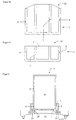
- a base part 1 of a two-compartment container is seen which is connected to the top part 10 thereof which has a top 2, outer walls 3 and inner walls 4.
- Closure means 5 are provided in the form of a snap-fit.
- the base part is slightly domed in order to fit to the bottom of the respective beverage container.
- Walls 4 separate an inner first compartment 6 to be filled with the flavour.
- the dark bars shall represent the said flavour.
- the second or outer compartment 7 surrounding the first or inner compartment is intended to be filled with gas.
- That part of the top which constitutes the top of the outer, second compartment comprises a restricted orifice 8 through which pressure equilibration between inside and outside may occur.
- 9 depicts a folded edge, a feature not necessary for performing the present invention.
- Figure 1b the circular shape of the inner wall 4 and the outer wall 3 is depicted. Please note that outer wall 3 is only indicated as a circular line.
- Figure 2 shows the same two-compartment container after a rapid pressure decrease in the beverage container has taken place due to opening the seal thereof.
- the closure means in form of the snap-fit between the end of wall 3 (5a) and respective parts provided on the base part 1 of the two-compartment container (5b) have been opened. Because there is no seal or closure between the inner wall 4 and the base part 1, flavour may freely escape into the beverage environment.
- Figure 3a shows a two-compartment container made of two parts of plastics, preferably polypropylene.
- the top part 10 consists of a top 2 integrally connected to the inner side wall 4 and the upper part of the outer side wall 3.
- the base part 1 consists of a bottom 12 having an increased thickness in the area of the inner (first) compartment and providing a respective step 13, and lower outer side walls 3'.
- the ends of the surrounding outer side wall parts 3 and 3' overlap at 11 providing an interference fit. Friction forces are the only forces which keep the inteference in the overlapping range.
- the inner side wall 4 overlaps the step 13 of the base part so that the inner side wall is tightly fitted to bottom 12 providing an interference fit having about 1/3 the length of that of the outer wall parts. Therefore, if the interference fit between the outer wall parts 3, 3' is opened, the flavour inside the inner compartment may freely escape.
- a restrictive orifice 8 is to be seen.
- Figure 3b differs from Figur 3a in that an additional O-ring 16 is provided inside the interference fit.
- This ring may e.g. be prepared from rubber or Teflon.
- Figure 4a depicts an embodiment of the invention in which the top part 10 of the two-compartment container consists of a membrane which is sealed to the upper end of inner side wall 3 and outer side wall 4 so that the top 2 has a frustoconically tapered form. Due to this form, the membrane tightly fits to the ends of inner wall 3 without any additional seal.
- the membrane is sealed to the outer side wall 4, e.g. via a gasket.
- the membrane may be a flexible or a hard membrane.
- Figure 4b shows another two-compartment container having a membrane in which the length of side walls 3 and 4 is equal.
- the membrane should be sufficiently stiff so that rupture of the seal 14 provides also opening of the inner compartment 6.
- the membrane is sealed to both wall ends 3 and 4.
- Figure 5 like Figure 1, shows a two-compartment comtainer consisting of a base part 1 and a top part 10.
- the inner or first compartment 6 is enlarged, the second or outer compartment 7 is reduced, as compared to the container of Figure 1.
- the side wall of the inner compartment is partly the inner side wall 4 separating the two compartments, and partly an outer side wall 3 (in its upper part).
- the base part 1 has a recessed middle part, the connection of the bottom 12 to the bottom of the beverage container 13 being provided by its outer parts 13.
- Step 14 provided by the recess is sealed to inner side wall 4 giving an interference fit.
- An outer interference fit 15 consists of the lower end of outer wall 3 and a respective structure on bottom 12. The length of interference of fit 15 is increased as compared to that of the fit at 14.
- any flavour may be filled into the inner compartment of the two-compartment container which is intended to be mixed with the outer or main liquid immediately before the beverage is consumed.
- the main beverage may be beer, water with or without carbon dioxide, optionally carbonated juice or the like.
- the main beverage is beer, e. g. German "Weissbier", and the flavour may be a flavoured sirup, e. g. sirup flavoured with woodruff or raspberry.
- the two-compartment container is designed such that the common amount of this flavour may be contained.
- the present invention is also useful for mixing e. g. concentrated fruit juice or another, optionally strongly coloured, flavoured sirup into water.
- the obtained beverage is called “Berliner Weisse” which is characterized in that parts of the beverage should taste almost like beer alone, while other parts are strongly sweetened by the woodruff or raspberry flavour.
- the first compartment is filled with a flavouring powder or granulate or the like.
- the two-compartment container is normally produced in two parts, the top part and the base part. In some instances, only one of these parts has the inner and outer walls (i.e. the walls are integrally or inseparately connected or mounted thereto). Instead, it is possible that one of the said parts has the outer wall, and the other one has the inner wall.
- the top part may have the upper part of either or both of inner and/or outer side walls, and the base part may have the complementary lower wall parts.
- the respectively suitable part is filled with the flavour, followed by connecting both parts via the closure means. This may be done in a nitrogen or other protecting gas atmosphere, thus providing the second or outer compartment filled with the said gas.
- the two-compartment container may be placed into the beverage container. It may be brought into it before the container is filled with the first beverage liquid and may be glued or otherwise adhered at the inside e. g. of the bottom of the said container. Adherence may be performed using respective structures in the bottom of the beverage container and the base part of the two-compartment container, e. g. a snap-fit or the like. Subsequently, the container is filled with the beverage. In an alternative embodiment, the beverage container is filled with the beverage liquid first, and afterwards the two-compartment container will be introduced. In this case, it will freely float or move in the beverage, and, depending e.g. on its specific weight, sink or swim.
- the beverage container is closed. This may be performed in a known manner, e. g. seaming a double seam after providing a drop of liquid nitrogen or another means for increasing the pressure inside the beverage container.
- the second or outer compartment of the two-compartment container should be brought into contact with the gaseous headspace of the beverage container e.g. by bringing the beverage container in an upside down position if the two-compartment container is fixed to the bottom thereof. Consequently, gas from the head space will migrate into the said second or outer compartment of the two-compartment container. The gas will be introduced through the restricted orifice. Equilibration of pressure inside and outside will be slow as described above, due to the restricted orifice.
- liquid is at least mostly prohibited to be introduced due to the surface tension and the shape of the orifice.
- the pressure inside the outer compartment of the two-compartment container will be above ambient pressure.
- the container is "primed". This is similar to the charging of the gas container for inducing a head of bubbles in a beer container. Due to the fact that the inner wall fits tightly to the opposite base part or top part, the inner and the outer compartment are completely separated without exchange of liquid or gas, thus keeping the flavouring separate from the product within the container.
- the beverage container On opening, the beverage container will immediately vent and the pressure within the container will suddenly drop to ambient pressure. However, the pressure within the two-compartment container will still remain at or near that of the container prior to opening as the gas struggles to escape through the restricted orifice. This pressure will generate sufficient force to break or open the mechanical closure, e.g. snap-fit, interference fit or membrane-wall-connection. Upon opening, bursting or breaking, the two parts of the container are separated. Because there is no or only weak closure between the inner side wall and the opposite top or base part, flavouring may freely escape from the respective compartment and will enter the first liquid beverage.
- both the container base and top should be larger than the end aperture of the beverage container, it is not possible for any part of the container to be swallowed by the consumer.
- the top part thereof becomes loose upon break or opening of the closure in response to opening the seal of the beverage container. This could be used as an audible signal for the consumer that the mixing was successful.
Landscapes
- Mechanical Engineering (AREA)
- Engineering & Computer Science (AREA)
- Packging For Living Organisms, Food Or Medicinal Products That Are Sensitive To Environmental Conditiond (AREA)
- Packages (AREA)
- Closures For Containers (AREA)
- Package Specialized In Special Use (AREA)
- Dairy Products (AREA)
- Non-Alcoholic Beverages (AREA)
- Devices For Dispensing Beverages (AREA)
- Details Of Rigid Or Semi-Rigid Containers (AREA)
- Apparatus For Making Beverages (AREA)
- Beverage Vending Machines With Cups, And Gas Or Electricity Vending Machines (AREA)
- Beans For Foods Or Fodder (AREA)
- Containers Having Bodies Formed In One Piece (AREA)
Priority Applications (1)
| Application Number | Priority Date | Filing Date | Title |
|---|---|---|---|
| EP99920694A EP1073593B1 (en) | 1998-04-22 | 1999-04-16 | Two-compartment container for and method of admixing an additive to a beverage |
Applications Claiming Priority (4)
| Application Number | Priority Date | Filing Date | Title |
|---|---|---|---|
| EP98107357 | 1998-04-22 | ||
| EP98107357 | 1998-04-22 | ||
| PCT/EP1999/002592 WO1999054229A1 (en) | 1998-04-22 | 1999-04-16 | Two-compartment container for and method of admixing a flavour to a beverage |
| EP99920694A EP1073593B1 (en) | 1998-04-22 | 1999-04-16 | Two-compartment container for and method of admixing an additive to a beverage |
Publications (2)
| Publication Number | Publication Date |
|---|---|
| EP1073593A1 EP1073593A1 (en) | 2001-02-07 |
| EP1073593B1 true EP1073593B1 (en) | 2003-12-17 |
Family
ID=8231802
Family Applications (1)
| Application Number | Title | Priority Date | Filing Date |
|---|---|---|---|
| EP99920694A Expired - Lifetime EP1073593B1 (en) | 1998-04-22 | 1999-04-16 | Two-compartment container for and method of admixing an additive to a beverage |
Country Status (18)
| Country | Link |
|---|---|
| US (1) | US6620444B1 (cs) |
| EP (1) | EP1073593B1 (cs) |
| JP (1) | JP4240513B2 (cs) |
| CN (1) | CN1114550C (cs) |
| AT (1) | ATE256611T1 (cs) |
| AU (1) | AU747215B2 (cs) |
| BR (1) | BR9909755A (cs) |
| CA (1) | CA2329483C (cs) |
| CZ (1) | CZ20003888A3 (cs) |
| DE (1) | DE69913682T2 (cs) |
| EA (1) | EA002301B1 (cs) |
| ES (1) | ES2214025T3 (cs) |
| HR (1) | HRP20000713B1 (cs) |
| HU (1) | HUP0101495A2 (cs) |
| NO (1) | NO20005246L (cs) |
| PL (1) | PL196243B1 (cs) |
| RS (1) | RS49678B (cs) |
| WO (1) | WO1999054229A1 (cs) |
Cited By (3)
| Publication number | Priority date | Publication date | Assignee | Title |
|---|---|---|---|---|
| DE102009048233A1 (de) | 2008-10-06 | 2010-04-08 | Volkswagen Ag | Vorrichtung zur Zubereitung von flüssigen Lebensmitteln, inbesondere zur Zubereitung von Heißgetränken, Suppen oder dergleichen |
| DE202013008357U1 (de) | 2013-09-13 | 2013-11-18 | Ball Europe Gmbh | Behälterdose und Halteeinrichtung |
| WO2014009136A2 (de) | 2012-07-13 | 2014-01-16 | Ball Europe Gmbh | Behälterdose, halteeinrichtung und verfahren zum bereitstellen einer behälterdose |
Families Citing this family (23)
| Publication number | Priority date | Publication date | Assignee | Title |
|---|---|---|---|---|
| DE20106836U1 (de) * | 2001-04-19 | 2001-09-27 | RPC Bramlage GmbH, 49393 Lohne | Einsatz für unter Druck stehende Flüssigkeitsbehälter, insbesondere Getränkebehälter |
| DE10152108B4 (de) * | 2001-10-19 | 2004-02-05 | Schmalbach-Lubeca Ag | Mehrkammer-Innenbehälter für einen unter Gasdruck stehenden Flüssigkeitsbehälter und Verfahren zu seiner Herstellung |
| GB0126692D0 (en) * | 2001-11-07 | 2002-01-02 | Britvic Soft Drinks Ltd | Improvements in or relating to beverages |
| DE10258791B4 (de) | 2002-12-16 | 2007-03-22 | Ball Packaging Europe Gmbh | Flüssigkeitsbehälter-Einsatz mit zeitdeterminierter Positionierung in einer unter Gasdruck stehenden Flüssigkeit |
| DE102004013270A1 (de) * | 2004-03-18 | 2005-09-29 | Robert Schumacher | Flüssigkeitsbehälter mit Anschlußstück |
| EP1614638A1 (de) | 2004-07-09 | 2006-01-11 | Ball Packaging Europe GmbH | Schwimmfähiger, mehrkammeriger Einsatz für Flüssigkeitsbehälter |
| EP1876901B1 (en) * | 2005-04-29 | 2011-11-09 | Ipifini, Inc. | Programmable liquid containers |
| US20060280845A1 (en) * | 2005-05-24 | 2006-12-14 | Conagra Grocery Products Company | Flavor gradient container and packaged liquid-based food item |
| US20070075079A1 (en) * | 2005-10-05 | 2007-04-05 | Harlan Stokes | Flavored container lid |
| DE102005059000A1 (de) | 2005-12-08 | 2007-06-14 | Noack, Andreas, Dr. | Verfahren und Vorrichtung zur kontaktfreien und sequenziellen Dispergierung von Makrokomponenten, insbesondere von aktiven Mikronährstoffen |
| KR100971612B1 (ko) | 2005-12-19 | 2010-07-20 | 이선희 | 이종물질을 수용한 배출장치의 이종물질 혼합구조 |
| US20070102306A1 (en) * | 2006-05-12 | 2007-05-10 | Lantos Emery J | Closure for Dispensing Additive |
| WO2007137387A1 (en) * | 2006-05-30 | 2007-12-06 | New Cell Formulations Ltd. | Dietary supplement having improved efficacy at time of consumption |
| US7786073B2 (en) * | 2006-05-30 | 2010-08-31 | Gardiner Paul T | Container for dietary supplement having improved efficacy at time of consumption |
| EP2129593B1 (en) | 2007-02-20 | 2015-12-09 | Jeong-Min Lee | Cap assembly having storage chamber for secondary material with movable working member |
| US8393465B2 (en) * | 2007-05-07 | 2013-03-12 | Philip Morris Usa Inc. | Pocket-size hybrid container for consumer items |
| US20090130261A1 (en) * | 2007-11-20 | 2009-05-21 | Rich Gary D | Vit-A-Cup |
| CN102442484A (zh) * | 2010-10-13 | 2012-05-09 | 王智毅 | 浓度/口味调整方法 |
| WO2014123492A1 (en) * | 2013-02-11 | 2014-08-14 | Ozsoy Organik Temizlik Urunler Pazarlama Sanayi Ve Ticaret Limited Sirketi | Carrier system |
| FR3062378B1 (fr) * | 2017-01-27 | 2021-12-17 | Michel Camilleri | Recipient de peinture comportant un organe d'obturation optimise |
| CN108438539A (zh) * | 2018-04-09 | 2018-08-24 | 陈浩宇 | 一种饮料包装 |
| US10966440B2 (en) * | 2019-01-05 | 2021-04-06 | Foremost Technologies and Products, Inc. | High pressure processing of foods and food supplements |
| US20240083670A1 (en) * | 2022-09-07 | 2024-03-14 | Universal City Studios Llc | Tilt-activated beverage effects |
Family Cites Families (13)
| Publication number | Priority date | Publication date | Assignee | Title |
|---|---|---|---|---|
| US2753990A (en) * | 1953-07-02 | 1956-07-10 | Chalfin Philip | Container |
| US4627986A (en) * | 1982-01-04 | 1986-12-09 | General Foods Corporation | Pressurized container providing for the separate storage of a plurality of materials |
| GB2183592B (en) * | 1985-11-29 | 1989-10-04 | Guinness Son & Co Ltd A | A beverage package and a method of packaging a beverage containing gas in solution |
| IE70665B1 (en) | 1989-11-22 | 1996-12-11 | Whitbread & Co Plc | Carbonated beverage container |
| WO1993024384A1 (en) * | 1992-06-04 | 1993-12-09 | Edward Roger Costello | Inserts for drinks containers |
| GB2268151B (en) * | 1992-06-30 | 1996-01-31 | Guinness Brewing Worldwide | A beverage package and a method of packaging a beverage |
| EP0747298B1 (en) * | 1992-12-23 | 1999-06-02 | Scottish & Newcastle plc | Method of inserting a gas-jetting capsule into a beverage can having a reduced diameter neck |
| GB9316317D0 (en) | 1993-08-06 | 1993-09-22 | Smithkline Beecham Plc | Novel container |
| GB9410493D0 (en) * | 1994-05-25 | 1994-07-13 | Metal Box Plc | Beverage container |
| FR2730218B1 (fr) * | 1995-02-06 | 1997-03-21 | Jean Marc Francois Torrollion | Dispositif pour stocker isoler un produit dans un emballage pressurise et le liberer au moment de son ouverture |
| DE29810354U1 (de) * | 1998-06-12 | 1999-10-21 | RPC Bramlage GmbH, 49393 Lohne | Wirkstoffbehälter |
| JP2000335652A (ja) * | 1999-05-25 | 2000-12-05 | Kazuto Horikawa | 缶製飲料の缶内で飲料の味覚を変えることの出来る缶 |
| US6250346B1 (en) * | 1999-05-28 | 2001-06-26 | James Anzai Castillo | Device for maintaining separate ingredients in liquid food products |
-
1999
- 1999-04-16 RS YUP-645/00A patent/RS49678B/sr unknown
- 1999-04-16 CN CN99805203A patent/CN1114550C/zh not_active Expired - Fee Related
- 1999-04-16 CZ CZ20003888A patent/CZ20003888A3/cs unknown
- 1999-04-16 DE DE69913682T patent/DE69913682T2/de not_active Expired - Lifetime
- 1999-04-16 JP JP2000544582A patent/JP4240513B2/ja not_active Expired - Fee Related
- 1999-04-16 AT AT99920694T patent/ATE256611T1/de not_active IP Right Cessation
- 1999-04-16 EP EP99920694A patent/EP1073593B1/en not_active Expired - Lifetime
- 1999-04-16 ES ES99920694T patent/ES2214025T3/es not_active Expired - Lifetime
- 1999-04-16 HU HU0101495A patent/HUP0101495A2/hu unknown
- 1999-04-16 PL PL343468A patent/PL196243B1/pl not_active IP Right Cessation
- 1999-04-16 US US09/674,019 patent/US6620444B1/en not_active Expired - Fee Related
- 1999-04-16 AU AU38181/99A patent/AU747215B2/en not_active Ceased
- 1999-04-16 WO PCT/EP1999/002592 patent/WO1999054229A1/en not_active Ceased
- 1999-04-16 BR BR9909755-9A patent/BR9909755A/pt not_active IP Right Cessation
- 1999-04-16 HR HR20000713A patent/HRP20000713B1/xx not_active IP Right Cessation
- 1999-04-16 CA CA002329483A patent/CA2329483C/en not_active Expired - Fee Related
- 1999-04-16 EA EA200001089A patent/EA002301B1/ru not_active IP Right Cessation
-
2000
- 2000-10-18 NO NO20005246A patent/NO20005246L/no not_active Application Discontinuation
Cited By (6)
| Publication number | Priority date | Publication date | Assignee | Title |
|---|---|---|---|---|
| DE102009048233A1 (de) | 2008-10-06 | 2010-04-08 | Volkswagen Ag | Vorrichtung zur Zubereitung von flüssigen Lebensmitteln, inbesondere zur Zubereitung von Heißgetränken, Suppen oder dergleichen |
| DE102009048233B4 (de) | 2008-10-06 | 2018-12-13 | Volkswagen Ag | Vorrichtung zur Zubereitung von flüssigen Lebensmitteln, inbesondere zur Zubereitung von Heißgetränken, Suppen oder dergleichen und Mehrkammerbehälter, insbesondere zur Verwendung in der Vorrichtung |
| WO2014009136A2 (de) | 2012-07-13 | 2014-01-16 | Ball Europe Gmbh | Behälterdose, halteeinrichtung und verfahren zum bereitstellen einer behälterdose |
| DE102012212359A1 (de) | 2012-07-13 | 2014-01-16 | Ball Packaging Europe Gmbh | Behälterdose, Halteeinrichtung und Verfahren zum Bereitstellen einer Behälterdose |
| US9975671B2 (en) | 2012-07-13 | 2018-05-22 | Ball Europe Gmbh | Can, holding device and method for providing a can |
| DE202013008357U1 (de) | 2013-09-13 | 2013-11-18 | Ball Europe Gmbh | Behälterdose und Halteeinrichtung |
Also Published As
| Publication number | Publication date |
|---|---|
| EA200001089A1 (ru) | 2001-04-23 |
| CZ20003888A3 (cs) | 2001-12-12 |
| RS49678B (sr) | 2007-11-15 |
| ES2214025T3 (es) | 2004-09-01 |
| AU747215B2 (en) | 2002-05-09 |
| EP1073593A1 (en) | 2001-02-07 |
| JP2002512161A (ja) | 2002-04-23 |
| AU3818199A (en) | 1999-11-08 |
| JP4240513B2 (ja) | 2009-03-18 |
| BR9909755A (pt) | 2000-12-19 |
| NO20005246D0 (no) | 2000-10-18 |
| NO20005246L (no) | 2000-11-28 |
| YU64500A (sh) | 2003-01-31 |
| CA2329483C (en) | 2007-08-07 |
| HRP20000713B1 (hr) | 2007-04-30 |
| DE69913682T2 (de) | 2004-09-30 |
| PL196243B1 (pl) | 2007-12-31 |
| WO1999054229A1 (en) | 1999-10-28 |
| HUP0101495A2 (hu) | 2001-08-28 |
| CA2329483A1 (en) | 1999-10-28 |
| CN1297415A (zh) | 2001-05-30 |
| CN1114550C (zh) | 2003-07-16 |
| US6620444B1 (en) | 2003-09-16 |
| HRP20000713A2 (en) | 2001-02-28 |
| EA002301B1 (ru) | 2002-02-28 |
| DE69913682D1 (de) | 2004-01-29 |
| PL343468A1 (en) | 2001-08-13 |
| ATE256611T1 (de) | 2004-01-15 |
Similar Documents
| Publication | Publication Date | Title |
|---|---|---|
| US6620444B1 (en) | Two-compartment container for and method of admixing a flavour to a beverage | |
| US4627986A (en) | Pressurized container providing for the separate storage of a plurality of materials | |
| US4399158A (en) | Pressurized container providing for the separate storage of a plurality of materials | |
| JP2002512161A5 (cs) | ||
| EP0739300B1 (en) | Beverage container | |
| US4524078A (en) | Pressurized container providing for the separate storage of a plurality of materials | |
| US20010001196A1 (en) | Container for separately storing flowable materials but allowing mixing of materials when required | |
| US20030148003A1 (en) | Beverage package | |
| WO1995004689A1 (en) | Beverage container | |
| WO1998056678A1 (en) | A container for separately storing flowable materials but allowing mixing of materials when required | |
| US8007880B2 (en) | Insert for a pressurized container of liquid | |
| EP0828669B1 (en) | Beverage container | |
| CA2153484A1 (en) | Carbonated beverage container with means for frothing the beverage | |
| AU773430B2 (en) | A container for separately storing flowable materials but allowing mixing of materials when required | |
| EP0828668B1 (en) | Beverage container | |
| AU747223B2 (en) | A container for separately storing flowable materials but allowing mixing of materials when required | |
| GB2282792A (en) | Liquid container and method of manufacture thereof. | |
| GB2285792A (en) | Beverage container with insert |
Legal Events
| Date | Code | Title | Description |
|---|---|---|---|
| PUAI | Public reference made under article 153(3) epc to a published international application that has entered the european phase |
Free format text: ORIGINAL CODE: 0009012 |
|
| 17P | Request for examination filed |
Effective date: 20001013 |
|
| AK | Designated contracting states |
Kind code of ref document: A1 Designated state(s): AT DE DK ES FI GB LU PT SE |
|
| AX | Request for extension of the european patent |
Free format text: RO PAYMENT 20001113 |
|
| 17Q | First examination report despatched |
Effective date: 20011205 |
|
| GRAH | Despatch of communication of intention to grant a patent |
Free format text: ORIGINAL CODE: EPIDOS IGRA |
|
| RTI1 | Title (correction) |
Free format text: TWO-COMPARTMENT CONTAINER FOR AND METHOD OF ADMIXING AN ADDITIVE TO A BEVERAGE |
|
| GRAS | Grant fee paid |
Free format text: ORIGINAL CODE: EPIDOSNIGR3 |
|
| RAP1 | Party data changed (applicant data changed or rights of an application transferred) |
Owner name: BALL PACKAGING EUROPE GMBH |
|
| GRAA | (expected) grant |
Free format text: ORIGINAL CODE: 0009210 |
|
| AK | Designated contracting states |
Kind code of ref document: B1 Designated state(s): AT DE DK ES FI GB LU PT SE |
|
| AX | Request for extension of the european patent |
Extension state: RO |
|
| PG25 | Lapsed in a contracting state [announced via postgrant information from national office to epo] |
Ref country code: FI Free format text: LAPSE BECAUSE OF FAILURE TO SUBMIT A TRANSLATION OF THE DESCRIPTION OR TO PAY THE FEE WITHIN THE PRESCRIBED TIME-LIMIT Effective date: 20031217 |
|
| REG | Reference to a national code |
Ref country code: GB Ref legal event code: FG4D |
|
| REF | Corresponds to: |
Ref document number: 69913682 Country of ref document: DE Date of ref document: 20040129 Kind code of ref document: P |
|
| REG | Reference to a national code |
Ref country code: SE Ref legal event code: TRGR |
|
| PG25 | Lapsed in a contracting state [announced via postgrant information from national office to epo] |
Ref country code: DK Free format text: LAPSE BECAUSE OF FAILURE TO SUBMIT A TRANSLATION OF THE DESCRIPTION OR TO PAY THE FEE WITHIN THE PRESCRIBED TIME-LIMIT Effective date: 20040317 |
|
| PG25 | Lapsed in a contracting state [announced via postgrant information from national office to epo] |
Ref country code: LU Free format text: LAPSE BECAUSE OF NON-PAYMENT OF DUE FEES Effective date: 20040416 |
|
| REG | Reference to a national code |
Ref country code: ES Ref legal event code: FG2A Ref document number: 2214025 Country of ref document: ES Kind code of ref document: T3 |
|
| PLBE | No opposition filed within time limit |
Free format text: ORIGINAL CODE: 0009261 |
|
| STAA | Information on the status of an ep patent application or granted ep patent |
Free format text: STATUS: NO OPPOSITION FILED WITHIN TIME LIMIT |
|
| 26N | No opposition filed |
Effective date: 20040920 |
|
| PGFP | Annual fee paid to national office [announced via postgrant information from national office to epo] |
Ref country code: SE Payment date: 20070417 Year of fee payment: 9 |
|
| PG25 | Lapsed in a contracting state [announced via postgrant information from national office to epo] |
Ref country code: PT Free format text: LAPSE BECAUSE OF NON-PAYMENT OF DUE FEES Effective date: 20040517 |
|
| PGFP | Annual fee paid to national office [announced via postgrant information from national office to epo] |
Ref country code: AT Payment date: 20080423 Year of fee payment: 10 |
|
| EUG | Se: european patent has lapsed | ||
| PG25 | Lapsed in a contracting state [announced via postgrant information from national office to epo] |
Ref country code: AT Free format text: LAPSE BECAUSE OF NON-PAYMENT OF DUE FEES Effective date: 20090416 |
|
| PG25 | Lapsed in a contracting state [announced via postgrant information from national office to epo] |
Ref country code: SE Free format text: LAPSE BECAUSE OF NON-PAYMENT OF DUE FEES Effective date: 20080417 |
|
| PGFP | Annual fee paid to national office [announced via postgrant information from national office to epo] |
Ref country code: ES Payment date: 20120423 Year of fee payment: 14 |
|
| PGFP | Annual fee paid to national office [announced via postgrant information from national office to epo] |
Ref country code: DE Payment date: 20130508 Year of fee payment: 15 Ref country code: GB Payment date: 20130422 Year of fee payment: 15 |
|
| REG | Reference to a national code |
Ref country code: DE Ref legal event code: R119 Ref document number: 69913682 Country of ref document: DE |
|
| GBPC | Gb: european patent ceased through non-payment of renewal fee |
Effective date: 20140416 |
|
| PG25 | Lapsed in a contracting state [announced via postgrant information from national office to epo] |
Ref country code: DE Free format text: LAPSE BECAUSE OF NON-PAYMENT OF DUE FEES Effective date: 20141101 Ref country code: GB Free format text: LAPSE BECAUSE OF NON-PAYMENT OF DUE FEES Effective date: 20140416 |
|
| REG | Reference to a national code |
Ref country code: DE Ref legal event code: R119 Ref document number: 69913682 Country of ref document: DE Effective date: 20141101 |
|
| PG25 | Lapsed in a contracting state [announced via postgrant information from national office to epo] |
Ref country code: ES Free format text: LAPSE BECAUSE OF NON-PAYMENT OF DUE FEES Effective date: 20140417 |