EP1071229A1 - Procédé de transmission de communications à travers deux réseaux téléphoniques numériques - Google Patents
Procédé de transmission de communications à travers deux réseaux téléphoniques numériques Download PDFInfo
- Publication number
- EP1071229A1 EP1071229A1 EP00402109A EP00402109A EP1071229A1 EP 1071229 A1 EP1071229 A1 EP 1071229A1 EP 00402109 A EP00402109 A EP 00402109A EP 00402109 A EP00402109 A EP 00402109A EP 1071229 A1 EP1071229 A1 EP 1071229A1
- Authority
- EP
- European Patent Office
- Prior art keywords
- frame
- network
- rhythm
- time
- dect
- Prior art date
- Legal status (The legal status is an assumption and is not a legal conclusion. Google has not performed a legal analysis and makes no representation as to the accuracy of the status listed.)
- Granted
Links
- 238000004891 communication Methods 0.000 title claims abstract description 24
- 238000000034 method Methods 0.000 title claims abstract description 11
- 230000033764 rhythmic process Effects 0.000 claims description 39
- 230000005540 biological transmission Effects 0.000 claims description 14
- 108091006146 Channels Proteins 0.000 description 40
- 238000012937 correction Methods 0.000 description 5
- 230000001360 synchronised effect Effects 0.000 description 5
- 230000015556 catabolic process Effects 0.000 description 3
- 238000006731 degradation reaction Methods 0.000 description 3
- 238000001514 detection method Methods 0.000 description 3
- 125000004122 cyclic group Chemical group 0.000 description 2
- 235000021183 entrée Nutrition 0.000 description 2
- 230000010354 integration Effects 0.000 description 2
- 230000011664 signaling Effects 0.000 description 2
- 230000006978 adaptation Effects 0.000 description 1
- 230000000903 blocking effect Effects 0.000 description 1
- 230000003111 delayed effect Effects 0.000 description 1
- 230000002441 reversible effect Effects 0.000 description 1
- 238000012163 sequencing technique Methods 0.000 description 1
- 230000008054 signal transmission Effects 0.000 description 1
- 230000002123 temporal effect Effects 0.000 description 1
Images

Classifications
-
- H—ELECTRICITY
- H04—ELECTRIC COMMUNICATION TECHNIQUE
- H04J—MULTIPLEX COMMUNICATION
- H04J3/00—Time-division multiplex systems
- H04J3/02—Details
- H04J3/06—Synchronising arrangements
- H04J3/0635—Clock or time synchronisation in a network
- H04J3/0638—Clock or time synchronisation among nodes; Internode synchronisation
-
- H—ELECTRICITY
- H04—ELECTRIC COMMUNICATION TECHNIQUE
- H04W—WIRELESS COMMUNICATION NETWORKS
- H04W56/00—Synchronisation arrangements
- H04W56/001—Synchronization between nodes
- H04W56/002—Mutual synchronization
-
- H—ELECTRICITY
- H04—ELECTRIC COMMUNICATION TECHNIQUE
- H04M—TELEPHONIC COMMUNICATION
- H04M1/00—Substation equipment, e.g. for use by subscribers
- H04M1/72—Mobile telephones; Cordless telephones, i.e. devices for establishing wireless links to base stations without route selection
- H04M1/725—Cordless telephones
- H04M1/72502—Cordless telephones with one base station connected to a single line
-
- H—ELECTRICITY
- H04—ELECTRIC COMMUNICATION TECHNIQUE
- H04M—TELEPHONIC COMMUNICATION
- H04M2250/00—Details of telephonic subscriber devices
- H04M2250/08—Details of telephonic subscriber devices home cordless telephone systems using the DECT standard
Definitions
- the present invention relates to the transmission of communications over two digital telephone networks, for, by example, send email between two terminals respective of these networks.
- a digital telephone network has the advantage over a network analog telephone, to transmit telephone signals without degradation of quality, since digitization allows to overcome the degradation of the signal / noise ratio. So that network terminals can exchange digital signals they are all synchronized by the central offices of the network.
- the base For communications from DECT handsets with terminals of a external digital telephone network, such as the network digital ISDN service integration, the base is connected to a line ISDN, thus serving as a gateway and constitutes a network terminal ISDN.
- the ISDN network synchronizes its terminals, but only if a terminal is active.
- US-5,666,366 teaches to maintain the synchronization of a frame DECT on another by adjusting the duration of the slave frame in a time range of guard bits at end of frame, with bit counting frame time intervals to locate the current time.
- DE-196 30 048 has a teaching substantially identical to that of document above.
- the base receives no signal from this line. It then works so autonomous and transmits its radio frames, handset synchronization, rhythm of an internal clock circuit.
- the gateway base must then, on the one hand, at the level of the line, use this ISDN rhythm to receive these signals and send them back and, on the other hand, send the frame local DECT must also be synchronized to this rhythm to run the entire ISDN signal flow to the handsets and, in turn, to supply the ISDN line at the ISDN rate with signal flow from combined.
- the base clock circuit is therefore adjustable in frequency and controlled by a servo circuit which detects any sliding of the frame rate relative to ISDN rate.
- the clock circuit left free to drift as long as the ISDN line is idle, is abruptly readjusted in frequency at each start of communication.
- Such a registration causes, in the frame of the base, a time jump which modifies the duration of the current time channel of the DECT network and which shifts the following time paths by as much, compared to what was expected in the absence of registration. It may even happen that the base truncates the current frame, immediately resetting a time channel counting, which manages the allocation of channels to various combined.
- the handsets perform a similar synchronized count on that of the base by synchronization signals which are not transmitted that from time to time from the base, the handsets do not perceive immediately the registration of the base frame and are therefore desynchronized. They can no longer recognize their time path as long that they have not detected the arrival of new synchronization signals of frame rhythm coming from the base and, meanwhile, this results in a disruption in the form of a temporary cut in communications, external and even local.
- the present invention aims to transmit communications through two digital telephone networks, radio or not, by limiting the disturbances related to the problem of synchronization of rhythms exposed above.
- the digital telephone network 8, here radio and local, of FIG. 1 is here to the DECT standard and includes a base 1 connected by radio to handsets 2, 3 and connected by line 9 to the telephone network digital ISDN service integration.
- the base 1 comprises a clock circuit 10, with controlled rhythm, connected to a central unit 11 which manages the various circuits of base 1.
- Base 1 is connected to line 9 by link circuits 12 which ensure the adaptation and synchronization and exchange of signal frames digital communications (voice or computer data) and signage.
- the circuits 12 detect at the input, by a Digital phase locked rocker oscillator, sensitive to online logic state changes, the rate of transmission of signals from ISDN and supply to a circuit 14 of base synchronization belonging to central unit 11, a signal representing this rhythm.
- the synchronization circuit 14 controls a clock circuit 10 rhythm servo input, as well as a reset input of a counter 15 of the central processing unit 11, which passes by 24 different states (0 to 23), advancing at the rate of a clock signal H supplied by the clock circuits 10.
- the counter 15 controls the sequencing of radio circuits 13 of local link with the handsets 2, 3, by providing a cyclic frame, here of 24 time channels at the DECT standard. Circuits 12 and 13 are connected by a link to time-division multiplexing of communication bits, controlled by the central unit 11, for exchanging bytes between channels lines of line 9 and time channels of the DECT frame.
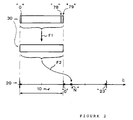
- Figure 2 illustrates, as a function of time t, the transmission format of data on the ISDN line 9 and in the DECT frame.
- bytes from ISDN line 9 are temporarily stored (block 30 of bytes pointed by arrow F1) in a register not shown circuits 12 over the duration of a DECT frame 20 and then transmitted (arrow F2) in block (30) in a time channel of rank "N" DECT, at an instantaneous flow accelerated by 24 times compared to the average flow of 8 k bytes / s.
- the incoming stream of ISDN bytes is thus divided into sections or blocks of 80 bytes, referenced 30, representing the duration of a frame DECT 20.
- Transmissions to ISDN 9 from a handset 2, 3 are carried out according to the reverse operations thereof, that is to say in emptying, byte every 125 ⁇ s, a buffer register supplied by the DECT time channel considered.
- circuits 12 do not receive no timing signal and 10 clock circuits are working independently, with an oscillator operating at a rate substantially equal to that of ISDN 9 but which may, however, deviate from it somewhat, without this having any drawback, the handsets 2, 3 being controlled by base 1.
- the synchronization circuit 14 When the synchronization circuit 14 detects by itself that the rhythm of the clock signal H drifts with respect to the ISDN rhythm, or that a synchronization command reaches him, he must bring a correction to the setting of clock circuits 10 to reset the rhythm of the clock signal H on that of the ISDN. As such a registration causes a time jump in the DECT frame 20 in progress, the handsets 2, 3, which likewise include a time channel counter synchronous with the counter 15, lose their synchronization since these counters continue to advance at the initial rate, before readjustment. Furthermore, as in this example, counter 15 is reset, the loss synchronization is not limited to a simple phase jump in a time channel but corresponds to the loss of time channels between the instant of synchronization and the end of the current DECT 20 frame.
- the synchronization circuit 14 receives, in addition to the signal clock H, the outputs of counter 15 and thus captures the rhythm of start of transmission of DECT 20 frames, corresponding to the period global of the counter 15, defining the DECT frame 20.
- the reception period of 80 bytes from ISDN represents a 10 ms setpoint on which must be subject to the period of the DECT 20 frame.
- the transmission rate of DECT 20 frames which is 100 frames / s (and therefore also the 24 times higher rhythm of the time channels DECT) is linked to the ISDN transmission rate of one byte: 8 k bytes / s, by a fixed ratio representing the set value.
- the current instant is entered, in this example, in a quantified manner, at across the rank of the current time channel in its DECT 20 frame.
- This rank can be determined, knowing the rate of transmission of the frames DECT 20, by counting to the rhythm of the time channels, i.e. by meter reading 15.
- the synchronization range includes the entire last time channel, from row 23.
- the counter 15 is then reset to zero at the same time as the clock circuit 10 is reset in frequency.
- the real time adjustment can for example intervene during the two last ISDN time channels, ranks 78 and 79, which leaves 250 ⁇ s to synchronize, i.e. more than half the last DECT time channel, rank 23.
- base 1 transmits frame synchronization signals in a time channel, here that of rank 0, of the DECT frame 20. Otherwise, the terminals 2, 3 slide, on the received frame 20, a reception time window, of equal duration to that of a time channel, until correctly receiving the signals intended for them.
- the "frame" phase jump during a resynchronization is limited, because it occurs at the end of DECT 20 frame, so moving the window above represents a limited duration and therefore a task.
- the allocation to communications is inhibited DECT time zones located in the synchronization range, here therefore the single lane of rank 23, which makes it possible to avoid using this one, which is strongly disturbed by frequency readjustments.
Landscapes
- Engineering & Computer Science (AREA)
- Computer Networks & Wireless Communication (AREA)
- Signal Processing (AREA)
- Synchronisation In Digital Transmission Systems (AREA)
- Mobile Radio Communication Systems (AREA)
Abstract
Description
- on saisit le rythme du premier réseau,
- on saisit le rythme de la trame du second réseau,
- on détermine la position de l'instant courant dans la trame,
- on recherche une dérive du rythme de la trame par rapport à une valeur de consigne liée au rythme du premier réseau et, en cas de dérive,
- on règle le rythme de la base si l'instant courant est dans une plage temporelle prédéterminée de synchronisation en fin de trame, sinon on diffère le réglage jusqu'à son entrée dans la plage, procédé étant caractérisé par le fait qu'on utilise toute la dernière voie temporelle de la trame comme plage de synchronisation.
- la figure 1 représente un réseau téléphonique numérique relié au réseau téléphonique RNIS, et
- la figure 2 représente, en fonction du temps t, des trames temporelles de signaux numériques de communication transmis d'un réseau à l'autre.
- on saisit le rythme du réseau RNIS 9, par le circuit 12, comme expliqué,
- on saisit le rythme H de la trame 20 du réseau DECT,
- on détermine la position de l'instant courant dans la trame DECT 20,
- on détecte une dérive du rythme des trames DECT 20 par rapport à une valeur de consigne liée au rythme du réseau RNIS 9 et, en cas de dérive,
- on règle le rythme de la base 1 si l'instant courant est dans une plage temporelle prédéterminée de synchronisation en fin de trame DECT, sinon on diffère le réglage jusqu'à l'entrée dans la plage,
- et on utilise toute la dernière voie temporelle de la trame 20 comme plage de synchronisation.
Claims (4)
- Procédé de transmission de communications à travers deux réseaux téléphoniques numériques, dont un premier réseau (9) présente un rythme déterminé de transmission de signaux de communication et dont le second réseau comporte une base (1) émettant cycliquement, à un rythme réglable, une trame (20) de voies temporelles de communication avec des terminaux (2, 3), qui se synchronisent sur la trame (20), procédé dans lequelprocédé caractérisé par le fait qu'on utilise toute la dernière voie temporelle de la trame (20) comme plage de synchronisation.on saisit le rythme du premier réseau (9),on saisit le rythme de la trame du second réseau (8),on détermine la position de l'instant courant dans la trame (20),on recherche une dérive du rythme de la trame (20) par rapport à une valeur de consigne liée au rythme du premier réseau (9) et, en cas de dérive,on règle le rythme de la base (1) si l'instant courant est dans une plage temporelle prédéterminée de synchronisation (23) en fin de trame (20), sinon on diffère le réglage jusqu'à son entrée dans la plage (23),
- Procédé selon la revendication 1, dans lequel, le premier réseau (9) transmettant les communications dans des voies temporelles, on règle le rythme du second réseau (8) à une valeur telle que la trame (20) du second réseau (8) ait une durée correspondant à un nombre entier de voies temporelles du premier réseau (9) et on compte cycliquement ces dernières pour déterminer la position de l'instant courant dans la trame (20) du second réseau (8).
- Procédé selon l'une des revendications 1 et 2, dans lequel on inhibe l'attribution, aux communications, des voies temporelles (23) du second réseau (8) situées dans la plage de synchronisation.
- Procédé selon l'une des revendications 1 à 3, dans lequel on émet des signaux de synchronisation trame dans la première voie temporelle de la trame (20) du second réseau (8).
Applications Claiming Priority (2)
| Application Number | Priority Date | Filing Date | Title |
|---|---|---|---|
| FR9909591A FR2796791B1 (fr) | 1999-07-23 | 1999-07-23 | Procede de transmission de communications a travers deux reseaux telephoniques numeriques |
| FR9909591 | 1999-07-23 |
Publications (2)
| Publication Number | Publication Date |
|---|---|
| EP1071229A1 true EP1071229A1 (fr) | 2001-01-24 |
| EP1071229B1 EP1071229B1 (fr) | 2006-03-08 |
Family
ID=9548454
Family Applications (1)
| Application Number | Title | Priority Date | Filing Date |
|---|---|---|---|
| EP00402109A Expired - Lifetime EP1071229B1 (fr) | 1999-07-23 | 2000-07-24 | Procédé de transmission de communications à travers deux réseaux téléphoniques numériques |
Country Status (3)
| Country | Link |
|---|---|
| EP (1) | EP1071229B1 (fr) |
| DE (1) | DE60026480T2 (fr) |
| FR (1) | FR2796791B1 (fr) |
Citations (4)
| Publication number | Priority date | Publication date | Assignee | Title |
|---|---|---|---|---|
| DE19630048C1 (de) * | 1996-07-25 | 1997-04-17 | Siemens Ag | Verfahren und Anordnung zum Betrieb von TDMA-Funksystemen |
| US5666366A (en) * | 1996-05-24 | 1997-09-09 | National Semiconductor Corporation | Inter-base synchronization technique for a TDMA communication system |
| EP0802693A2 (fr) * | 1996-04-15 | 1997-10-22 | DeTeWe - Deutsche Telephonwerke Aktiengesellschaft & Co. | Procédé de connexion de radio mobile opérant suivant le standard DECT à un autocommutateur privé RNIS |
| EP0903873A1 (fr) * | 1996-12-26 | 1999-03-24 | Kabushiki Kaisha Toshiba | Systeme de synchronisation de trame entre stations de base d'un systeme de radiocommunication mobile et un dispositif de station de base utilisant ce systeme |
-
1999
- 1999-07-23 FR FR9909591A patent/FR2796791B1/fr not_active Expired - Fee Related
-
2000
- 2000-07-24 EP EP00402109A patent/EP1071229B1/fr not_active Expired - Lifetime
- 2000-07-24 DE DE60026480T patent/DE60026480T2/de not_active Expired - Lifetime
Patent Citations (4)
| Publication number | Priority date | Publication date | Assignee | Title |
|---|---|---|---|---|
| EP0802693A2 (fr) * | 1996-04-15 | 1997-10-22 | DeTeWe - Deutsche Telephonwerke Aktiengesellschaft & Co. | Procédé de connexion de radio mobile opérant suivant le standard DECT à un autocommutateur privé RNIS |
| US5666366A (en) * | 1996-05-24 | 1997-09-09 | National Semiconductor Corporation | Inter-base synchronization technique for a TDMA communication system |
| DE19630048C1 (de) * | 1996-07-25 | 1997-04-17 | Siemens Ag | Verfahren und Anordnung zum Betrieb von TDMA-Funksystemen |
| EP0903873A1 (fr) * | 1996-12-26 | 1999-03-24 | Kabushiki Kaisha Toshiba | Systeme de synchronisation de trame entre stations de base d'un systeme de radiocommunication mobile et un dispositif de station de base utilisant ce systeme |
Also Published As
| Publication number | Publication date |
|---|---|
| FR2796791B1 (fr) | 2002-10-25 |
| DE60026480D1 (de) | 2006-05-04 |
| FR2796791A1 (fr) | 2001-01-26 |
| EP1071229B1 (fr) | 2006-03-08 |
| DE60026480T2 (de) | 2006-10-12 |
Similar Documents
| Publication | Publication Date | Title |
|---|---|---|
| US5790538A (en) | System and method for voice Playout in an asynchronous packet network | |
| US8718213B2 (en) | Clock synchronization method, apparatus, and system | |
| US7483450B1 (en) | Method and system for link-based clock synchronization in asynchronous networks | |
| US5408507A (en) | Extended range enhanced skew controller | |
| EP0487428A1 (fr) | Dispositif pour la transmission d'informations synchrones par un réseau asynchrone, notamment un réseau ATM | |
| US20130173950A1 (en) | Method and apparatus for communicating time information between time aware devices | |
| FR2730888A1 (fr) | Procede et appareil pour synchroniser des ports radio dans un systeme de communication | |
| WO2000016509A8 (fr) | Procede pour l'estimation de dephasage relatif des impulsions d'horloge entre horloges, dans des reseaux a commutation de paquets | |
| CA2328437A1 (fr) | Procede et appareil de communication de donnees isochrones | |
| AU2068201A (en) | Synchronized transport across non-synchronous networks | |
| WO2004036341A3 (fr) | Systeme et procede de synchronisation de communication entre des terminaux de reseaux asynchrones au moyen d'estampilles | |
| CN102640454A (zh) | 通信系统、通信装置以及时刻同步方法 | |
| EP1006686B1 (fr) | Procédé et système pour asservir une fréquence via un réseau de transmission asynchrone et réseau radiotéléphonique incluant ce système | |
| US7519750B2 (en) | Linear burst mode synchronizer for passive optical networks | |
| JPH0851451A (ja) | 同期方法および同期装置、端末、交換装置 | |
| EP1071229B1 (fr) | Procédé de transmission de communications à travers deux réseaux téléphoniques numériques | |
| EP0717575B1 (fr) | Système de radio-communication avec station radio deportée | |
| US6625209B1 (en) | Short synchronization time data modem | |
| DE69918656D1 (de) | Bidirektionales kommunikationsprotokoll | |
| CN111181677B (zh) | 时间同步方法、网络设备及存储介质 | |
| EP1467507B1 (fr) | Procédé et dispositif de conservation de synchronisation dans un système de communication | |
| CN100479363C (zh) | 移动通信系统保密话音通信的一种密码同步快速恢复方法 | |
| CN100499404C (zh) | 多业务传输平台组网方式下基站时钟同步的系统和方法 | |
| KR20080112589A (ko) | 영상 전화에서의 영상과 음성의 동기화 방법 및 장치 | |
| JP3690069B2 (ja) | 光リピータ |
Legal Events
| Date | Code | Title | Description |
|---|---|---|---|
| PUAI | Public reference made under article 153(3) epc to a published international application that has entered the european phase |
Free format text: ORIGINAL CODE: 0009012 |
|
| AK | Designated contracting states |
Kind code of ref document: A1 Designated state(s): DE FR GB |
|
| AX | Request for extension of the european patent |
Free format text: AL;LT;LV;MK;RO;SI |
|
| 17P | Request for examination filed |
Effective date: 20010714 |
|
| AKX | Designation fees paid |
Free format text: DE FR GB |
|
| GRAP | Despatch of communication of intention to grant a patent |
Free format text: ORIGINAL CODE: EPIDOSNIGR1 |
|
| GRAS | Grant fee paid |
Free format text: ORIGINAL CODE: EPIDOSNIGR3 |
|
| GRAA | (expected) grant |
Free format text: ORIGINAL CODE: 0009210 |
|
| AK | Designated contracting states |
Kind code of ref document: B1 Designated state(s): DE FR GB |
|
| REG | Reference to a national code |
Ref country code: GB Ref legal event code: FG4D Free format text: NOT ENGLISH |
|
| RAP2 | Party data changed (patent owner data changed or rights of a patent transferred) |
Owner name: SAGEM COMMUNICATION |
|
| REF | Corresponds to: |
Ref document number: 60026480 Country of ref document: DE Date of ref document: 20060504 Kind code of ref document: P |
|
| GBT | Gb: translation of ep patent filed (gb section 77(6)(a)/1977) |
Effective date: 20060817 |
|
| PLBE | No opposition filed within time limit |
Free format text: ORIGINAL CODE: 0009261 |
|
| STAA | Information on the status of an ep patent application or granted ep patent |
Free format text: STATUS: NO OPPOSITION FILED WITHIN TIME LIMIT |
|
| 26N | No opposition filed |
Effective date: 20061211 |
|
| REG | Reference to a national code |
Ref country code: GB Ref legal event code: 732E Free format text: REGISTERED BETWEEN 20090326 AND 20090401 |
|
| REG | Reference to a national code |
Ref country code: FR Ref legal event code: TP |
|
| REG | Reference to a national code |
Ref country code: FR Ref legal event code: TP Owner name: SAGEMCOM BROADBAND SAS, FR Effective date: 20111215 |
|
| REG | Reference to a national code |
Ref country code: DE Ref legal event code: R082 Ref document number: 60026480 Country of ref document: DE Representative=s name: ZENZ PATENT- UND RECHTSANWAELTE GBR, DE |
|
| REG | Reference to a national code |
Ref country code: DE Ref legal event code: R082 Ref document number: 60026480 Country of ref document: DE Representative=s name: ZENZ PATENT- UND RECHTSANWAELTE, DE Effective date: 20120507 Ref country code: DE Ref legal event code: R081 Ref document number: 60026480 Country of ref document: DE Owner name: SAGEMCOM SAS, FR Free format text: FORMER OWNER: SAGEM COMMUNICATION, PARIS, FR Effective date: 20120507 Ref country code: DE Ref legal event code: R082 Ref document number: 60026480 Country of ref document: DE Representative=s name: ZENZ PATENTANWAELTE PARTNERSCHAFT MBB, DE Effective date: 20120507 |
|
| REG | Reference to a national code |
Ref country code: DE Ref legal event code: R082 Ref document number: 60026480 Country of ref document: DE Representative=s name: ZENZ PATENT- UND RECHTSANWAELTE, DE |
|
| REG | Reference to a national code |
Ref country code: DE Ref legal event code: R082 Ref document number: 60026480 Country of ref document: DE Representative=s name: ZENZ PATENT- UND RECHTSANWAELTE, DE Effective date: 20130129 Ref country code: DE Ref legal event code: R081 Ref document number: 60026480 Country of ref document: DE Owner name: SAGEMCOM SAS, FR Free format text: FORMER OWNER: SAGEM TELECOMMUNICATIONS S. A., PARIS, FR Effective date: 20130129 Ref country code: DE Ref legal event code: R082 Ref document number: 60026480 Country of ref document: DE Representative=s name: ZENZ PATENTANWAELTE PARTNERSCHAFT MBB, DE Effective date: 20130129 |
|
| REG | Reference to a national code |
Ref country code: FR Ref legal event code: PLFP Year of fee payment: 16 |
|
| REG | Reference to a national code |
Ref country code: FR Ref legal event code: PLFP Year of fee payment: 17 |
|
| REG | Reference to a national code |
Ref country code: FR Ref legal event code: TP Owner name: SAGEMCOM BROADBAND SAS, FR Effective date: 20160727 Ref country code: FR Ref legal event code: CD Owner name: SAGEMCOM BROADBAND SAS, FR Effective date: 20160727 |
|
| REG | Reference to a national code |
Ref country code: FR Ref legal event code: PLFP Year of fee payment: 18 |
|
| REG | Reference to a national code |
Ref country code: FR Ref legal event code: PLFP Year of fee payment: 19 |
|
| PGFP | Annual fee paid to national office [announced via postgrant information from national office to epo] |
Ref country code: FR Payment date: 20180621 Year of fee payment: 19 |
|
| PGFP | Annual fee paid to national office [announced via postgrant information from national office to epo] |
Ref country code: GB Payment date: 20180621 Year of fee payment: 19 Ref country code: DE Payment date: 20180620 Year of fee payment: 19 |
|
| REG | Reference to a national code |
Ref country code: DE Ref legal event code: R119 Ref document number: 60026480 Country of ref document: DE |
|
| GBPC | Gb: european patent ceased through non-payment of renewal fee |
Effective date: 20190724 |
|
| PG25 | Lapsed in a contracting state [announced via postgrant information from national office to epo] |
Ref country code: DE Free format text: LAPSE BECAUSE OF NON-PAYMENT OF DUE FEES Effective date: 20200201 Ref country code: GB Free format text: LAPSE BECAUSE OF NON-PAYMENT OF DUE FEES Effective date: 20190724 |
|
| PG25 | Lapsed in a contracting state [announced via postgrant information from national office to epo] |
Ref country code: FR Free format text: LAPSE BECAUSE OF NON-PAYMENT OF DUE FEES Effective date: 20190731 |