EP1069774A1 - Encoding device, encoding method, decoding device, decoding method, coding system and coding method - Google Patents
Encoding device, encoding method, decoding device, decoding method, coding system and coding method Download PDFInfo
- Publication number
- EP1069774A1 EP1069774A1 EP00902103A EP00902103A EP1069774A1 EP 1069774 A1 EP1069774 A1 EP 1069774A1 EP 00902103 A EP00902103 A EP 00902103A EP 00902103 A EP00902103 A EP 00902103A EP 1069774 A1 EP1069774 A1 EP 1069774A1
- Authority
- EP
- European Patent Office
- Prior art keywords
- video data
- data
- encoded streams
- encoding
- input video
- Prior art date
- Legal status (The legal status is an assumption and is not a legal conclusion. Google has not performed a legal analysis and makes no representation as to the accuracy of the status listed.)
- Withdrawn
Links
Images











Classifications
-
- H—ELECTRICITY
- H04—ELECTRIC COMMUNICATION TECHNIQUE
- H04N—PICTORIAL COMMUNICATION, e.g. TELEVISION
- H04N7/00—Television systems
- H04N7/08—Systems for the simultaneous or sequential transmission of more than one television signal, e.g. additional information signals, the signals occupying wholly or partially the same frequency band, e.g. by time division
-
- H—ELECTRICITY
- H04—ELECTRIC COMMUNICATION TECHNIQUE
- H04N—PICTORIAL COMMUNICATION, e.g. TELEVISION
- H04N21/00—Selective content distribution, e.g. interactive television or video on demand [VOD]
- H04N21/20—Servers specifically adapted for the distribution of content, e.g. VOD servers; Operations thereof
- H04N21/23—Processing of content or additional data; Elementary server operations; Server middleware
- H04N21/234—Processing of video elementary streams, e.g. splicing of video streams or manipulating encoded video stream scene graphs
- H04N21/2343—Processing of video elementary streams, e.g. splicing of video streams or manipulating encoded video stream scene graphs involving reformatting operations of video signals for distribution or compliance with end-user requests or end-user device requirements
- H04N21/234309—Processing of video elementary streams, e.g. splicing of video streams or manipulating encoded video stream scene graphs involving reformatting operations of video signals for distribution or compliance with end-user requests or end-user device requirements by transcoding between formats or standards, e.g. from MPEG-2 to MPEG-4 or from Quicktime to Realvideo
-
- G—PHYSICS
- G11—INFORMATION STORAGE
- G11B—INFORMATION STORAGE BASED ON RELATIVE MOVEMENT BETWEEN RECORD CARRIER AND TRANSDUCER
- G11B27/00—Editing; Indexing; Addressing; Timing or synchronising; Monitoring; Measuring tape travel
- G11B27/02—Editing, e.g. varying the order of information signals recorded on, or reproduced from, record carriers
- G11B27/031—Electronic editing of digitised analogue information signals, e.g. audio or video signals
-
- H—ELECTRICITY
- H04—ELECTRIC COMMUNICATION TECHNIQUE
- H04N—PICTORIAL COMMUNICATION, e.g. TELEVISION
- H04N21/00—Selective content distribution, e.g. interactive television or video on demand [VOD]
- H04N21/20—Servers specifically adapted for the distribution of content, e.g. VOD servers; Operations thereof
- H04N21/23—Processing of content or additional data; Elementary server operations; Server middleware
- H04N21/235—Processing of additional data, e.g. scrambling of additional data or processing content descriptors
-
- H—ELECTRICITY
- H04—ELECTRIC COMMUNICATION TECHNIQUE
- H04N—PICTORIAL COMMUNICATION, e.g. TELEVISION
- H04N21/00—Selective content distribution, e.g. interactive television or video on demand [VOD]
- H04N21/20—Servers specifically adapted for the distribution of content, e.g. VOD servers; Operations thereof
- H04N21/23—Processing of content or additional data; Elementary server operations; Server middleware
- H04N21/236—Assembling of a multiplex stream, e.g. transport stream, by combining a video stream with other content or additional data, e.g. inserting a URL [Uniform Resource Locator] into a video stream, multiplexing software data into a video stream; Remultiplexing of multiplex streams; Insertion of stuffing bits into the multiplex stream, e.g. to obtain a constant bit-rate; Assembling of a packetised elementary stream
- H04N21/23602—Multiplexing isochronously with the video sync, e.g. according to bit-parallel or bit-serial interface formats, as SDI
-
- H—ELECTRICITY
- H04—ELECTRIC COMMUNICATION TECHNIQUE
- H04N—PICTORIAL COMMUNICATION, e.g. TELEVISION
- H04N21/00—Selective content distribution, e.g. interactive television or video on demand [VOD]
- H04N21/40—Client devices specifically adapted for the reception of or interaction with content, e.g. set-top-box [STB]; Operations thereof
- H04N21/43—Processing of content or additional data, e.g. demultiplexing additional data from a digital video stream; Elementary client operations, e.g. monitoring of home network or synchronising decoder's clock; Client middleware
- H04N21/434—Disassembling of a multiplex stream, e.g. demultiplexing audio and video streams, extraction of additional data from a video stream; Remultiplexing of multiplex streams; Extraction or processing of SI; Disassembling of packetised elementary stream
- H04N21/4342—Demultiplexing isochronously with video sync, e.g. according to bit-parallel or bit-serial interface formats, as SDI
-
- H—ELECTRICITY
- H04—ELECTRIC COMMUNICATION TECHNIQUE
- H04N—PICTORIAL COMMUNICATION, e.g. TELEVISION
- H04N21/00—Selective content distribution, e.g. interactive television or video on demand [VOD]
- H04N21/40—Client devices specifically adapted for the reception of or interaction with content, e.g. set-top-box [STB]; Operations thereof
- H04N21/43—Processing of content or additional data, e.g. demultiplexing additional data from a digital video stream; Elementary client operations, e.g. monitoring of home network or synchronising decoder's clock; Client middleware
- H04N21/435—Processing of additional data, e.g. decrypting of additional data, reconstructing software from modules extracted from the transport stream
-
- H—ELECTRICITY
- H04—ELECTRIC COMMUNICATION TECHNIQUE
- H04N—PICTORIAL COMMUNICATION, e.g. TELEVISION
- H04N7/00—Television systems
- H04N7/24—Systems for the transmission of television signals using pulse code modulation
Definitions
- the present invention relates to an encoding system for encoding input video data and a decoding system for decoding encoded streams.
- MPEG Motion Picture Experts Group
- ISO/IEC 13818 the MPEG (Moving Picture Experts Group) technology standardized as ISO/IEC 13818 has come into common use at broadcasting stations that produce and broadcast television programs.
- MPEG is becoming the de facto standard especially for recording video data generated by video cameras or the like, on tape, disks, or other recording media that can be accessed randomly or for transmitting video programs produced at broadcasting stations, via cables or satellites.
- the MPEG technology is an encoding technology that can improve compression efficiency by means of predictive coding of pictures. More particularly, the MPEG standard employs a plurality of predictive coding systems that combine intra-frame prediction and inter-frame prediction, and each picture is encoded by means of either of the following picture types: I-picture (Intra Picture), P-picture (Predictive Picture), and B-picture (Bidirectionally Predictive Picture) according to the prediction system.
- the I-picture which is not predicted from other pictures, is a picture encoded within the frame.
- the P-picture is a picture subjected to inter-frame forward predictive coding by a preceding (past) I-picture or P-picture.
- the B-picture is a picture subjected to bidirectionally predictive coding both by a preceding (past) I-picture or P-picture and by a following (future) I-picture or P-picture.
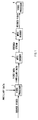
- Figure 1 shows an example of a video processing system used within a broadcasting station or between broadcasting stations. As described above, it has been proposed to use a MPEG encoder and MPEG decoder as shown in Figure 1 to transmit source video data from a first video processor 1 provided as a sending system to a second video processor 4 provided as a receiving system within or between broadcasting stations.
- a MPEG encoder and MPEG decoder as shown in Figure 1 to transmit source video data from a first video processor 1 provided as a sending system to a second video processor 4 provided as a receiving system within or between broadcasting stations.
- the first video processor 1 receives source video data such as component-type base-band video of the D1 format and performs edit processing, special-effects processing, synthesis processing or the like on the source video data.
- the video processor 1 also receives ancillary data such as closed captions and teletext data and adds the ancillary data to the blanking intervals of the source video data. Therefore, ancillary data has been embedded in the blanking intervals of the video data output from the video processor 1.
- the MPEG encoder 2 receives the video data from the video processor 1 and encodes it to generate an encoded stream.
- Such an encoded stream is also known as an elementary stream.
- television signals have vertical and horizontal blanking intervals on four sides of the actual video data area called the active video area and the ancillary data described above has been inserted in the blanking intervals.
- the MPEG standard specifies that only the active video area where pixels actually exist must be encoded.
- the encoded stream is the data obtained by encoding only the active video area of input video data, but it does not contain ancillary data superimposed on the blanking intervals. In other words, when the input video data is encoded by the MPEG encoder 2, the ancillary data superimposed on the input video data is lost.
- the MPEG decoder 3 receives the encoded stream from the MPEG encoder and decodes it to generate decoded video data, which is then supplied to the second video processor 4. Since the encoded stream supplied to the MPEG decoder 3 does not contain information on the ancillary data, naturally the decoded video data does not contain information on the ancillary data.
- MPEG encoding and MPEG decoding performed when video data is transmitted from the sending system to the receiving system have the problem that the ancillary data added to the blanking intervals of the video data by the first video processor 1 is not transmitted from the sender or first video processor 1 to the receiver or second video processor 4 although the video data that corresponds to the active area can be transmitted.
- the fact that only the active video data is transmitted if MPEG encoding and MPEG decoding are performed when video data is transmitted from the sending system to the receiving system means that the information inherent to the source video data is not transmitted to the receiving system either.
- the information inherent to the source video data is the information possessed by the source video data itself, including the location of the blank areas or the location of the active video area with respect to the full pixel area. Specifically, this is the information as to from which vertical line in the full pixel area of the source video data the active video lines start and as to at which pixel in the horizontal direction of the full pixel area the active video area starts.
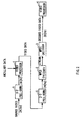
- FIG. 2 shows an example of a video processing system used within or between broadcasting stations to process both video data with a 24-Hz frame frequency and video data with a 30-Hz frame frequency.
- the 3:2 pull-down circuit 5 receives video data that has a frame rate of 24 Hz (24 frames per second) and generates video data with a frame rate of 30 Hz (30 frames per second).
- the film material used at movie theaters and the like is recorded on optical films at a frame rate of 24 Hz (24 frames per second), which is entirely different from the 29.97-Hz frame rate of NTSC television signals.
- 30 frames are generated from 24 frames.
- Figure 3A shows source video data with a frame rate of 24 Hz
- Figure 3B shows the 30-Hz video data after a 3:2 pull-down conversion.
- the 3:2 pull-down process generates a repeat field t1' by repeating the top field t1 in the first frame F1 and generates a repeat field b3' by repeating the bottom field b3 in the third frame F3.
- the 3:2 pull-down process converts video data with a frame rate of 24 Hz into video data with a frame rate of 30 Hz by converting 2 fields into 3 fields in a predetermined sequence.
- the first video processor 1 receives 30-Hz source video data and performs edit, special-effects, synthesis, and/or other operations on it.
- the video processor 1 also receives ancillary data such as closed captions and teletext data and adds it to the blanking intervals of the source video data.
- This addition of ancillary data is performed with respect to video data having a frame frequency of 30 Hz and the ancillary data is added to all the fields contained in the 30-Hz video data. That is, the ancillary data is added not only to the top fields (t1, t2, ...) and bottom fields (b1, b2, ...), but also to the repeat fields t1' and b3'.
- the 2:3 pull-down circuit 6 receives the 30-Hz video data generated by the 3:2 pull-down process described above and converts it into video data with a frame rate of 24 Hz. Specifically, as shown in Figure 3C, the 2:3 pull-down circuit 6 is used to remove the repeat fields t1' and b3' inserted by the 3:2 pull-down process. The 2:3 pull-down process must be performed before MPEG encoding. This is because these repeat fields are the redundant fields inserted by the 3:2 pull-down process and can be deleted without any degradation in image quality,
- the MPEG encoder which is the same as the MPEG encoder 2 described with reference to Figure 1, receives 24-Hz video data from the 2:3 pull-down circuit 6 and encodes it to generate an encoded stream.
- the MPEG standard specifies that only the active video area where pixels actually exist must be encoded.
- the encoded stream is the data obtained by encoding only the active video area of input video data, but it does not contain ancillary data superimposed on the blanking intervals. In other words, when the input video data is encoded by the MPEG encoder 2, the ancillary data superimposed on the input video data is lost.
- the MPEG decoder 3 which is the same as the MPEG decoder 3 described with reference to Figure 1, receives the encoded stream from the MPEG encoder and decodes it to generate decoded video data.
- the Repeat_first_field and Top_field_first flags are set in encoded streams as information about the frame structure. Since MPEG decoders process data based on these flags, the decoded video data has a frame rate of 30 Hz.
- the repeat fields are removed from the 30-Hz video data after the 2:3 pull-down process necessary for MPEG encoding. That is, the ancillary data is removed together with the repeat fields to which it has been added. Therefore, if a 2:3 pull-down process is performed when video data is transmitted from the sending system to the receiving system, the information about the ancillary data added to the repeat fields is not transmitted from the sender or first video processor 1 to the receiver or second video processor 4 because the repeat fields themselves are removed by the 2:3 pull-down process.
- the present invention relates to an encoding system for encoding input video data and a decoding system for decoding the encoded streams. More particularly, it proposes a system and method for sending the ancillary data added to video data and the information inherent to the video data together with encoded streams in such a way that they will not be lost even if MPEG encoding and MPEG decoding are repeated.
- the MPEG encoder extracts the ancillary data from the video data, inserts the extracted ancillary data into encoded streams as Ancillary_data, and thereby sends the ancillary data together with the encoded streams.
- the MPEG decoder extracts the ancillary data from the encoded streams and adds it to the base-band video data generated by MPEG decoding.
- An encoding apparatus for encoding input video data extracts ancillary data that are added in the blanking intervals of the input video data from the input video data, encodes the input video data to generate encoded streams, and controls the above described encoding means so as to insert the above described ancillary data into the encoded streams.
- a decoding apparatus for decoding the encoded streams generated by encoding input video data extracts ancillary data from the encoded streams, decodes the encoded streams to generate decoded video data, and multiplexes the ancillary data onto the blanking intervals of the decoded video data.
- a decoding apparatus for decoding the encoded streams generated by encoding input video data parses the syntax of the encoded streams to obtain the ancillary data contained in the encoded streams, decodes the encoded streams to generate decoded video data, and multiplexes the ancillary data onto the decoded video data so that the input video data and decoded video data will have the same ancillary data.
- a decoding apparatus for decoding the encoded streams generated by encoding input video data obtains the ancillary data contained in the picture area of the encoded streams, decodes the encoded streams to generate decoded video data, and multiplexes the decoded video data and ancillary data to generate the same data as the input video data.
- a coding system comprises encoding means for encoding input video data and decoding means for receiving and decoding the encoded streams encoded by the encoding means to generate decoded video data; wherein the encoding means comprises means for encoding the above described input video data to generate encoded streams and means for inserting the ancillary data contained in the input video data into the encoded streams, and the decoding means comprises means for decoding the encoded streams to generate decoded video data and means for multiplexing the ancillary data transmitted with the encoded streams onto the decoded video data.
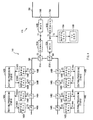
- Figure 4 shows a broadcasting system consisting of a main broadcasting station 141 and local broadcasting station 171.
- the main broadcasting station 141 comprises a plurality of editing/processing studios 145A to 145D, a plurality of MPEG encoders 142A to 142D, a plurality of MPEG decoders 144A to 144D, at least one multiplexer 162A, and at least one demultiplexer 161A.
- the broadcasting station 141 also includes an SDTI-CP (serial data transfer interface-content package) network 150 defined as SMPTE305M, through which each MPEG encoder, each MPEG decoder, the multiplexer 162A, and the demultiplexer 161A can send and receive elementary streams.
- SDTI-CP which is a communications format proposed for transmission of elementary streams of MPEG, is defined as SMPTE305M.
- the elementary stream transferred over the SDTI-CP network 150 is expressed as ES_over_SDTI-CP.
- the editing/processing studios 145A to 145D comprise video servers, video editors, special-effects devices, video switchers. They receive decoded base-band video data from the MPEG decoders, edit it or subject it to image processing, and output it to the MPEG encoders. In other words, editing/processing studios 145A to 145D perform editing and image-processing operations on base-band video signals rather than performing stream processing operations on encoded streams.
- the MPEG encoders 142A to 142D receive base-band input video signals from the editing/processing studios 145A to 145D, and encode them according to the MPEG standard described above to generate elementary streams (ES).
- the elementary streams generated by the MPEG encoders are supplied to either of the MPEG decoders 144A to 144D or the multiplexer 162A through the SDTI-CP network 150.
- the MPEG decoders 144A to 144D receive the elementary streams supplied by the MPEG encoders 142A to 142D or the demultiplexer 161A through the SDTI-CP network 150, and decode them according to the MPEG standard.
- the multiplexer 162A is a circuit for multiplexing the plurality of video programs produced at the main broadcasting station 141 into one transport stream to distribute them to the local broadcasting station 171 or individual households. Specifically, it receives a plurality of elementary streams corresponding to the plurality of video programs through the SDTI-CP network 150, generates packetized elementary streams by packetizing the elementary streams, and then generates transport stream packets from the packetized elementary streams.
- the multiplexer 162A generates a multiplexed transport stream by multiplexing the transport stream packets generated from the plurality of video programs. The configuration and processes of the multiplexer 162A will be described later.
- the multiplexed transport stream generated by the multiplexer 162A is supplied to the demultiplexer 161B of the local broadcasting station 171 through a network such as an ATM (asynchronous transfer mode) network or satellite line.
- the local broadcasting station 171 has exactly the same system configuration as the main broadcasting station 141 although they differ in scale, and thus detailed description will be omitted.
- the multiplexed transport stream generated by the multiplexer 162A is supplied to the MPEG decoder 170A contained in the set-top box at each household through a network such as an ATM (asynchronous transfer mode) network or satellite line, and decoded video data is supplied to the TV set.
- a network such as an ATM (asynchronous transfer mode) network or satellite line
- Figure 5 illustrates the differences between an elementary stream transmitted via an SDTI-CP network within a broadcasting station and a transport stream transferred via a public network.
- the elementary stream is transmitted via an SDTI-CP network.
- the SDTI-CP network 150 which uses a communications format based on the SDI (serial data interface) standardized by SMPTE259M and capable of a transfer rate of 270 Mbps, can transmit elementary streams (ES) in MPEG format directly and is suitable for closed networks such as studios. Specifically, video data "V” and audio data "A” are packed in each frame and the stream can be edited easily along the frame boundaries defined by a frame sync (dotted line) as shown in Figure 5A.
- video data is transmitted in the form of a transport stream.
- a transport stream all contents including video data and audio data are encapsulated into 188-byte packets, as shown in Figure 5B, to allow data transmission even through a public network with a limited data-transmission capacity.
- V indicates a transport stream packet of video data
- A indicates a transport stream packet of audio data while a blank indicates a null packet.
- the MPEG encoders 142A to 142D will be described with reference to Figure 6.
- the input video data is 30-Hz video data generated by 3:2 pull-down conversion from source video data having a frame rate of 24 Hz.
- the original source video data with a frame rate of 24 Hz consists of the frames F1, F2, and so on, each of which has two fields (top field t1, t2, ... and bottom field b1, b2, ).
- the 3:2 pull-down process generates a repeat field t1' by repeating the top field t1 in the first frame F1 -- where the top field should appear first -- to form one frame from three fields, and generates a repeat field b3' by repeating the bottom field b3 in the third frame F3 where the bottom field should appear first.
- the 3:2 pull-down process can convert source video data with a frame rate of 24 Hz into video data with a frame rate of 30 Hz, as shown in Figure 7A, by alternating 3-field frames and 2-field frames.
- input video data is generated by 3:2 pull-down
- the present invention is not limited to video data whose input video data has undergone 3:2 pull-down. It can also be applied to video data that has not undergone 3:2 pull-down, provided the original source video has a frame rate of 30 Hz.
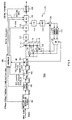
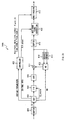
- the MPEG encoder shown in Figure 6 comprises an ancillary data separating circuit 101, a field counter 102, a 2:3 pull-down circuit 103, an encoding controller 104, a motion vector detector 105, a switching circuit 111, a DCT circuit 112, a quantizing circuit 113, an inverse quantizing circuit 114, an inverse DCT circuit 115, an adding circuit 116, memories 117 and 118, a motion compensating circuit 119, arithmetic circuits 120, 121, and 122, a variable-length coding circuit 125, and a send buffer 126.
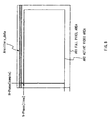
- the ancillary data separating circuit 101 extracts ancillary data from the blanking interval of input video data. More particularly, as shown in Figure 8, it extracts the ancillary data inserted in the vertical blanking interval of input video data and the line number of the ancillary data.
- ancillary data includes, but is not limited to, text data, closed-captioning data, VITC (vertical interval time code) defined by SMPTE RP164, and LTC (linear time code) defined by RP196.
- information about the extracted ancillary data is supplied to the controller 104 as Ancillary_data while information about the line number is supplied to the controller 104 as Line_number.
- information about VITC is supplied to the controller 104 as Time_code_1 and information about LTC is supplied to the controller 104 as Time_code_2.
- the ancillary data separating circuit 101 extracts the unique information possessed by input video data.
- unique information may be, for example, data about the location of the active video area AR2 with respect to the full pixel area AR1 of input video data as shown in Figure 8. Specifically, it may include the number of lines that represents the vertical start position of the active video area and the number of samples that represents the horizontal start position.
- the information about the vertical and horizontal positions of the active video area are supplied to the controller 104 as V-phase and H-phase, respectively.
- Other examples of the unique information includes the source name given to the input video data and the location and time of photo shooting.
- the video data output from the ancillary data separating circuit 101 is supplied to the field counter 102 that follows.
- the field counter 102 is the circuit for counting the fields that compose each frame of the input video data. Then the field counter 102 supplies the count information of each frame to the controller 104 as Field_ID. If, for example, the video data shown in Figure 7A is supplied to the field counter 102, Field_ID of "0,” “1,” and “2" are output as the count information for frame F1, which has three fields, and Field_ID of "0" and "1" are output as the count information for frame F2, which has two fields.
- the field counter 102 further comprises two counters that count the fields in the input video data and outputs the count information to the controller 104 as PTS_counter and DTS_counter.
- PTS_counter is used to generate presentation time stamps (PTSs)
- DTS_counter is used to generate decoding time stamps (DTSs).
- Figure 9 shows the frame structure of each frame in the input video data as well as the relationship between PTS_counter and DTS_counter in each frame.
- a supplementary explanation will be given about the Repeat_first_field and Top_field_first flags. If the Repeat_first_field flag is set to "1,” it indicates that a repeat field must be created during MPEG decoding and if the Repeat_first_field flag is set to "0,” it indicates that a repeat field need not be created during MPEG decoding.
- the Top_field_first flag indicates whether the first field of the frame is the top field or bottom field: the value "1" indicates that the top field appears earlier than the bottom field in the frame while the value "0" indicates that the bottom field appears earlier than the top field in the frame.
- Figure 9A illustrates the frame structure in the input video data described in Figure 7A. Specifically, the decoding of the first frame F1 does not involve simply generating a frame consisting of a top field and bottom field, but it involves generating a frame consisting of three fields by creating a repeat field by copying the top field. Accordingly, the corresponding Repeat_first_field flag becomes "1" and the Top_field_first flag becomes "1.”
- the Repeat_first_field flag is set to "0" because there is no need to generate a repeat field
- the Top_field_first flag is set to "0" because the bottom field appears earlier than the top field.
- the bottom field In decoding frame F3, the bottom field must be copied to create a repeat field and the coded frame must be converted into a three-field frame. Therefore, the Repeat_first_field flag is set to "1" and the Top_field_first flag is set to "0.” In decoding frame F4, there is no need to create a repeat field, so the Repeat_first_field flag is set to "0" and the Top_field_first flag is set to 1. Since PTS_counter is the time stamp information underlying the PTS as described above, it must agree with the frame order of input video data. Specifically, PTS_counter is the value generated by a counter that increases from 0 to 127 and then returns to 0 again. The value of the counter PTS_counter changes in the manner shown in Figure 9B.
- the value of PTS_counter is "0."
- PTS_counter for the fifth frame F5 and subsequent frames are calculated in a similar manner.
- DTS_counter is the time stamp information underlying the DTS, it must agree with the order of pictures in encoded streams rather than with the frame order of input video data. Now this will be described in more concrete terms with reference to Figure 9C. Since the first frame F1 is an I-picture, it must be decoded one frame earlier than it is displayed.
- DTS_counter is equal to the value of PTS_counter, which is equal to "3.”
- frame F3 encoded next is a B-picture, and thus the value of DTS_counter is equal to the value of PTS_counter, which is equal to "5.”
- the values of DTS_counter for frame F7 and subsequent frames are calculated similarly and the description thereof will be omitted herein.
- the field counter 102 generates PTS_counter and DTS_counter and supplies them to the controller 104 according to the rules described above.
- the 2:3 pull-down circuit 103 receives the video data output from the field counter 102 and performs 2:3 pull-down.
- the 2:3 pull-down circuit 103 receives the video data with a frame rate of 30 Hz that has undergone 3:2 pull-down as shown in Figure 7A and generates video data with a frame rate of 24 Hz. More particularly, as shown in Figure 7B, the 2:3 pull-down circuit 103 converts video data with a frame rate of 30 Hz into video data with a frame rate of 24 Hz by removing the repeat fields t1' and b3' inserted by 3:2 pull-down.
- the 2:3 pull-down circuit 103 analyzes the frame structure of the supplied video data and removes only the repeat fields that are found to occur at certain intervals. Thus, when analyzing the frame structure of video data, the 2:3 pull-down circuit 103 generates Repeat_first_field and Top_field_first flags as information about the frame structure and supplies them to the controller 104.
- the motion vector detector 105 receives, in macroblocks, the video data output from the 2:3 pull-down circuit 103 and processes the image data in each frame as an I-picture, P-picture, or B-picture according to a predetermined sequence.
- the question as to how to process the image of each frame -- as an I-picture, P-picture, or B-picture -- has been predetermined according to the GOP structure specified by the operator.
- Any motion vector MV detected is supplied to the controller 104 and motion compensating circuit 119.
- the switching circuit 111 closes the contact a.
- the macroblock data is transmitted to the transmission path through the DCT circuit 112, quantizing circuit 113, variable-length coding circuit 125, and send buffer 126, as is the case with I-picture data.
- the quantized data is also supplied to the frame memory 117 for backward predictive pictures through the inverse quantizing circuit 114, inverse DCT circuit 115, and arithmetic unit 116.
- the switch 111 closes the contact b, the image data (the image data of the I-picture in this case) stored in the frame memory 118 for forward predictive pictures is read out, and compensation is made by the motion compensating circuit 119 based on the motion vector MV supplied by the motion vector detector 105.
- the motion compensating circuit 119 when instructed to activate the forward prediction mode, the motion compensating circuit 119 reads data to generate predicted picture data, by offsetting the read address of the frame memory 118 for forward predictive pictures from the location that corresponds to the location of the macroblock currently output by the motion vector detector 105 by the amount equivalent to the motion vector.
- the predicted picture data output by the motion compensating circuit 119 is supplied to the arithmetic unit 120.
- the arithmetic unit 120 subtracts the predicted picture data supplied by the motion compensating circuit 119 and corresponding to the macroblock, and outputs the difference (prediction error).
- This differential data is transmitted to the transmission path through the DCT circuit 112, quantizing circuit 113, variable-length coding circuit 125, and send buffer 126. Also, this differential data is decoded locally by the quantizing circuit 114 and inverse DCT circuit 115, and is input to the arithmetic unit 116. The arithmetic unit 116 has also been supplied with the same data as the predicted picture data supplied to the arithmetic unit 120. The arithmetic unit 116 adds the predicted picture data output by the motion compensating circuit 119, to the differential data output by the inverse DCT circuit 115. This produces the image data of the original (decoded) P-picture.
- the image data of the P-picture is supplied to the backward predictive picture section of the frame memory 117, where it is stored.
- the motion vector detector 105 processes the next picture, B-picture.
- intra-picture prediction mode or forward prediction mode the switch 111 closes the contacts a or b, respectively.
- the picture is processed in the same manner as P-pictures and the data is transmitted.
- switch 111 closes the contact c or d, respectively.
- the image data (images of the P-picture in this case) stored in the backward predictive picture section 117 is read out and has its motion compensated by the motion compensating circuit 119 according to the motion picture output by the motion vector 105.
- the motion compensating circuit 119 reads data to generate predicted picture data, by offsetting the read address of the backward predictive picture section 117 from the location that corresponds to the location of the macroblock currently output by the motion vector detector 105 by the amount equivalent to the motion vector.
- the predicted picture data output by the motion compensating circuit 119 is supplied to the computing unit 121.
- the computing unit 121 subtracts the predicted picture data supplied by the motion compensating circuit 119, from the data in the macroblock of the reference image and outputs the difference.
- This differential data is transmitted to the transmission path through the DCT circuit 112, quantizing circuit 113, variable-length coding circuit 125, and send buffer 126.
- the image data (images of the I-picture in this case) stored in the forward predictive picture section 118 and image data (images of the P-picture in this case) stored in the backward predictive picture section 117 are read out and have their motions compensated by the motion compensating circuit 119 according to the motion picture output by the motion vector detector 105.
- the motion compensating circuit 119 reads data to generate predicted picture data, by offsetting the read addresses of the forward predictive picture section 118 and backward predictive picture section 117 from the locations that correspond to the locations of the macroblock currently output by the motion vector detector 105 by the amount equivalent to the motion vectors (for both forward predictive picture and backward predictive picture, in this case).
- the predicted picture data output by the motion compensating circuit 119 is supplied to the computing unit 122.
- the computing unit 122 subtracts the average of the predicted picture data supplied by the motion compensating circuit 119, from the data in the macroblock of the reference image supplied by the motion vector detector 105 and outputs the difference.
- This differential data is transmitted to the transmission path through the DCT circuit 112, quantizing circuit 113, variable-length coding circuit 125, and send buffer 126.
- the images of B-pictures are not stored in the frame memories 117 and 118 because they are not used as predicted pictures for other pictures.
- the controller 104 controls all the circuits involved in the prediction mode processing, DCT mode processing, and quantization processing described above. Besides, the controller 104 supplies all the coding parameters, including motion vectors, picture types, prediction modes, DCT modes, quantizing steps, generated during the encoding of pictures to the variable-length coding circuit 125.
- the controller 104 receives V-phase, H-phase, Time_code1, Time_code2, Ancillary_data, and Line_number information from the ancillary data separating circuit 101 and receives DTS_counter, PTS_counter, and Field_ID information from the field counter 102. Then it supplies the received V-phase, H-phase, Time_code1, Time_code2, Ancillary_data, Line_number, DTS_counter, PTS_counter, and Field_ID information to the variable-length coding circuit 125 as MPEG_ES_editing_information (i).
- variable-length coding circuit 125 converts the quantized DCT coefficient received from the quantizing circuit 113 and coding parameters received from the controller 104 into variable-length codes to generate an encoded stream according to the syntax of elementary streams specified by the MPEG standard.
- variable-length coding circuit 125 also converts the information supplied from the controller 104 as MPEG_ES_editing_information (i) into variable-length codes and inserts them into the encoded stream.
- the syntax of encoded streams and the syntax of MPEG_ES_editing_information (i) will be described in detail later.
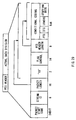
- Figure 26 is an explanatory drawing illustrating the data structure of an MPEG encoded stream in an easy-to-understand form while Figures 10 to 25 describe the syntax in detail.
- Figure 10 shows the syntax of a video stream of MPEG.
- the MPEG encoder 42 generates encoded elementary streams according to the syntax shown in Figure 10.
- functions and conditional statements are shown in lightface while data elements are shown in boldface.
- Data items are expressed in mnemonic form that represents their name, bit length, type, and transmission order.
- the syntax shown in Figure 10 is used by the MPEG encoder 44 to extract meaningful data elements from the encoded bit stream received.
- the syntax used by the MPEG encoder 42 is the syntax obtained by omitting the conditional statements such as if and while statements from the syntax shown in Figure 10.
- next_start_code() described first in video_sequence() is designed to search a bit stream for a start code.
- sequence_header() is used to define header data for the sequence layer of an MPEG bit stream
- sequence_extension() function is used to define extension data for the sequence layer of the MPEG bit stream.
- the "do ⁇ ⁇ while" syntax placed next to the sequence_extension() function indicates that the data elements described based on the function in the braces ⁇ ⁇ of the do statement will remain in the encoded data stream while the condition defined by the while statement is true.
- nextbits() function contained in the while statement is used to compare the bits or bit string described in the bit stream with the data elements referenced.
- the nextbits() function compares the bit string in the bit stream with sequence_end_code that indicates the end of the video sequence, and if they do not match, the condition in the while statement holds true. Therefore, the "do ⁇ ⁇ while" syntax placed next to the sequence_extension() function indicates that the data elements defined by the function in the do statement will remain in the encoded bit stream until sequence_end_code that indicates the end of the video sequence is encountered.
- sequence extension() function following the data elements defined by the sequence extension() function, the data elements defined by extension_and_user_data(0) have been described.
- extension_and_user_data(0) function is used to define extension data and user data for the sequence layer of an MPEG bit stream.
- the "do ⁇ ⁇ while" syntax placed next to extension_and_user_data(0) indicates that the data elements described based on the function in the braces ⁇ ⁇ of the do statement will remain in the bit stream while the condition defined by the while statement is true.
- the nextbits() function contained in the while statement is used to determine the match between the bits or bit string in the bit stream and picture_start_code or group_start_code. If the bits or bit string in the bit stream and picture_start_code or group_start_code match, the condition defined by the while statement holds true.
- the "do ⁇ ⁇ while" syntax indicates that if picture_start_code or group_start_code appears in the encoded bit stream, the data element codes defined by the function in the do statement are described next to the start code.
- the if statement described at the beginning of the do statement specifies the condition that group_start_code appears in the encoded bit stream. If the condition presented by the if statement is true, the data elements defined by group_of_picture_header() and extension_and_user_data (1) are described in sequence next to group_start_code in the encoded bit stream.
- the group_of_picture_header() function is used to define header data for the GOP layer of an MPEG encoded bit stream while the extension_and_user_data(1) function is used to define extension data and user data for the GOP layer of the MPEG encoded bit stream.
- the extension_and_user_data(1) function is used to define extension data and user data for the GOP layer of the MPEG encoded bit stream.
- the data elements defined by group_of_picture_header() and extension_and_user_data(1) are not described, and thus next to the data elements defined by extension_and_user_data(0), the data elements defined by picture_header(), picture_coding_extension() and extension_and_user_data(2) are described.
- the picture_header() function is used to define header data for the picture layer of an MPEG encoded bit stream while the picture_coding_extension() function is used to define first extension data for the picture layer of the MPEG encoded bit stream.
- the extension_and_user_data(2) function is used to define extension data and user data for the picture layer of the MPEG encoded bit stream.
- the user data defined by extension_and_user_data(2) has been defined in the picture layer and can be defined for each picture.
- the picture_data() function is used to describe data elements associated with a slice layer and macroblock layer.
- the while statement described next to the picture_data() function is the function used to judge the condition of the next if statement while the condition defined by the while statement is true.
- the nextbits() function contained in the while statement is used to determine whether picture_start_code or group_start_code has been described in the encoded bit stream. If picture_start_code or group_start_code has been described in the encoded bit stream, the condition defined by the while statement holds true.
- sequence_end_code is the code that indicates the end of the sequence of an encoded video stream
- sequence_header() and sequence_extension() should remain in the encoded video stream unless the encoded video stream has ended.
- sequence_header() and sequence_extension() are exactly the same as the data elements described by sequence_header() and sequence_extension() at the beginning of the sequence of the video stream.
- sequence_header() sequence_extension()
- extension_and_user_data(0) group_of_picture_header()
- picture_header() picture_coding_extension()
- picture_data picture_data
- sequence_header() The data elements defined by sequence_header() include sequence_header_code, horizontal_size_value, vertical_size_value, aspect_ratio_information, frame_rate_code, bit_rate_value, marker_bit, vbv_buffer_size_value, constrained_parameter_flag, load_intra_quantizer_matrix, intra_quantizer_matrix[64], load_non_intra_quantizer_matrix, non_intra_quantizer_matrix, etc.
- sequence_header_code is the data that represents the start synchronization code of the sequence layer.
- horizontal_size_value is the data that consists of the low-order 12 bits of the horizontal pixel count of an image.
- vertical_size_value is the data that consists of the low-order 12 bits of the vertical line count of an image.
- aspect_ratio_information is the data that represents the aspect ratio of a pixel or a display screen.
- frame_rate_code is the data that represents the display cycle of an image.
- bit_rate_value is the data that consists of the low-order 18 bits (rounded up to the nearest multiple of 400 bps) of the bit rate used to limit the amount of bits generated.
- marker_bit is the bit data that is inserted to avoid start code emulation.
- vbv_buffer_size_value represents the low-order 10 bits of the value that determines the size of the virtual buffer (video buffer verifier) for controlling the amount of codes generated.
- constrained_parameter_flag is the data which indicates that parameters fall within limits.
- load_intra_quantizer_matrix is the data that indicates the existence of quantization matrix data for intra MB.
- intra_quantizer_matrix[64] is the data that represents the value of the quantization matrix for intra MB.
- load_non_intra_quantizer_matrix is the data that indicates the existence of quantization matrix data for non-intra MB.
- non_intra_quantizer_matrix is the data that represents the value of the quantization matrix for non-intra MB.
- Figure 12 illustrates the syntax of sequence_extension().
- sequence_extension() includes extension_start_code, extension_start_code_identifier, profile_and_level_indication, progressive_sequence, chroma_format, horizontal_size_extension, vertical_size_extension, bit_rate_extension, vbv_buffer_size_extension, low_delay, frame_rate_extension_n, frame_rate_extension_d, etc.
- extension_start_code is the data that represents the start synchronization code of extension data.
- extension_start_code_identifier is the data that indicates which extension data will be sent.
- profile_and_level_indication is the data used to specify the profile and level of video data.
- progressive_sequence is the data which indicates that video data is to be scanned sequentially.
- chroma_format is the data used to specify the color difference format of video data.
- horizontal_size_extension represents the high-order 2 bits of the data to be added to horizontal_size_value in the sequence header.
- vertical_size_extension represents the high-order 2 bits of the data to be added to vertical_size_value in the sequence header.
- bit_rate_extension represents the high-order 12 bits of the data to be added to bit_rate__value in the sequence header.
- vbv_buffer_size_extension represents the high-order 8 bits of the data to be added to vbv_buffer_size_value in the sequence header.
- low_delay is the data which indicates that no B-picture is included.
- frame_rate_extension_n is used in conjunction with frame_rate_code in the sequence header to obtain the frame rate.
- frame_rate_extension_d is used in conjunction with frame_rate_code in the sequence header to obtain the frame rate.
- Figure 13 illustrates the syntax of extension_and_user_data(i).
- extension_and_user_data(i) describes only the data elements defined by user_data(), and not the data elements defined by extension_data(). Therefore, extension_and_user_data (0) describes only the data elements defined by user_data().
- nextbits() is used to compare the bits or bit string in the bit stream with the data element to be decoded next.
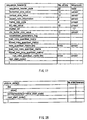
- user_data() in Figure 14 illustrates the characteristic features of this embodiment.
- user_data_start_code is the start code used to indicate the start of the user data area in the picture layer of an MPEG bit stream. The if statement described next to this code specifies to run the while syntax that follows if i in user_data(i) is "0.” The while syntax remains true unless 24-bit data consisting of twenty-three "0's" and accompanying "1" appears in the bit stream.
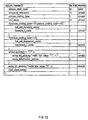
- V-Phase() 220 and H-Phase() 221 have been described in the user data area of the sequence layer as shown in Figure 26.
- Data_ID of V-Phase is a bit string representing "01."
- Data_ID of H-Phase is a bit string representing "02."
- Data_ID is the 8-bit data which indicates that the data elements of the next bit string is V-Phase, i.e., the value "01" shown in Figure 15.
- V-Phase is the 16-bit data that indicates the first line to be encoded in a video signal frame. In other words, V-Phase is the data that indicates the vertical line number of the active video area.
- H-Phase is the 8-bit data which indicates that the data elements of the next bit string is H-Phase, i.e., the value "02" shown in Figure 15.
- H-Phase is the 8-bit data that indicates the first sample to be encoded in a video signal frame. In other words, H-Phase is the data that indicates the horizontal pixel sample position of the active video area.
- next Else if statement executes the next while syntax if i in extension_and_user_data(i) is 2. Description of the while syntax will be omitted because it has the same meaning as the while syntaxes described above.
- the nextbits() function in the next if statement knows that the subsequent bits describe the time code data elements indicated by Time_code(). This means that if i in extension_and_user_data(i) is 2, this user data is contained in the picture layer. That is, the data elements represented by Time_code() 241 have been described in the user data area of the picture layer as shown in Figure 26.
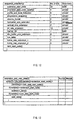
- Time code1 data is a bit string representing "03" as shown in Figure 15.
- Time code1 data is the VITC (vertical interval time code) that represents the time code inserted in the vertical blanking interval of an image.
- Data_ID of Time code2 is a bit string representing "04" as shown in Figure 15.
- Time code2 data is the LTC (longitudinal time code or linear time code) that represents the time code recorded on the time code track of the recording medium.
- Figures 18 and 19 show the syntax of Time_code (). As shown in Figure 18, the time code consists of 72-bit data. Figure 19 shows the concrete data structure.
- color_frame_flag represents the control flag of color frame information while Drop_frame_flag that follows represents the control flag of dropped frames.
- the six bits from the third bit to the eighth bit represent the 'frame' section of the time code: field_phase represents the control flag of phase correction.
- the seven bits from the 10th bit to the 16th bit represent the 'seconds' section of the time code.
- the '1' in the 17th, 34th, 51st, and 68th bits is a marker bit used to prevent 0 from occurring 23 times successively. The insertion of the marker bit at certain intervals can prevent start code emulation.
- binary_group in the 18th, 26th, and 27th bits represents a control flag for binary groups.
- the seven bits from the 19th bit to the 25th bit represent the 'minutes' section of the time code while the six bits from the 28th bit to the 33rd bit represent the 'hours' section of the time code.
- the nextbits() function in the Else knows that the subsequent bits describe the picture order data elements indicated by Picture_Order().
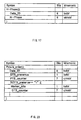
- Data_ID of Picture_Order() is a bit string representing "05" as shown in Figure 15. Now the syntax of Picture_Order() inserted actually into the elementary stream (ES) by the encoder will be described with reference to Figure 20.
- Data_ID is the 8-bit data which indicates that the subsequent data is the Picture_Order data and its value is "05.”
- PTS_counter is the value generated by the field counter 102 in the MPEG encoder. It is the 7-bit data which represents the presentation order and which is incremented by 1 each time one field of the input video data is filled. This 7-bit data is given as the remainder of modulo division and takes on values from 0 to 127. The if statement indicates that DTS_counter is incremented if the bit of DTS_presence is 1, i.e., in the case of a P-picture and I-picture.
- Marker_bits is inserted every 16 bits to prevent start code emulation, a phenomenon in which a described bit string of user data accidentally matches the start code described above leading to a high possibility of image corruption.
- DTS_counter is the value generated by the field counter 102 in the MPEG encoder. It is the 7-bit data which represents the coding order and which is incremented by 1 each time one field of the input video data is encoded. This 7-bit data is given as the remainder of modulo division and takes on values from 0 to 127.
- the while syntax has the same meaning as the while syntaxes described above, and thus description thereof will be omitted.
- Ancillary_data() which is inserted as user data in the picture layer, includes a field identifier (Field_ID), a line number (Line_number), and ancillary data.
- Data_ID is 8-bit data which is an ancillary data in the user data area, having a value of "07" as shown in Figure 15.
- Field_ID is the 2-bit data that is added to each field in coded frames when the value of progressive_sequence_flag, which indicates whether the input video data is progressive video, is "0," i.e., when the input video data is interlaced video data.
- Frame F1 of this encoded stream contains 0, 1, and 2 as Field_ID.
- Field_ID ancillary data "0" about that field is described in the stream
- Field_ID 1, ancillary data "1" about that field is described in the stream
- Field_ID is added for each coded frame when the value of progressive_sequence_flag, is "1," i.e., when the input video data is 1. If both repeat_first_field and Top_field_first contain Field_ID of "0,” the given coded frame has one progressive frame and thus “0" is set. If repeat_first_field contains “1" and Top_field_first contains “0,” the given coded frame has two progressive frames and thus "0” and “1” are set. If both repeat_first_field and Top_field_first contain “1,” the given coded frame has three progressive frames and thus "0" to “2” is set.
- Line_number is 14-bit data which represents the line number of the line where the ancillary data of each frame is described.
- Ancillary_data_length is the 16-bit data which represents the data length of ancillary_data_payload.
- Ancillary_data_payload represents the content of 22-bit ancillary data. If the value of Ancillary_data_length for Ancillary_data_payload is larger than the value j (default of 0), the value j (data length of Ancillary_data_length) is incremented by 1 and description starts from the bit string of the value j.
- the While syntax that follows shows the syntax of bytealigned().
- Data_ID of History_data() is a bit string representing "08" as shown in Figure 15.
- the data represented by Data_ID of "08” represents history data that includes the history information of coding parameters. History_data() is described in detail in U.S. patent application Ser. No. 09/265,723, and thus description thereof is omitted herein.
- nextbits() function in the final if statement knows that the subsequent bits describe the user_data data elements indicated by user_data().
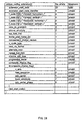
- the bit strings from which the nextbits() functions in Figure 14 know that the subsequent bits describe appropriate data elements are described as Data_ID shown in Figure 15. However, the use of "00" as Data_ID is prohibited.
- the data represented by Data_ID of "80" represents a control flag while the data represented by Data_ID of "FF" represents user data.
- Figure 22 illustrates the syntax of group_of_picture_header().
- the data element defined by group_of_picture_header() consists of group_start_code, time_code, closed_gop, and broken_link.
- group_start_code is the data that represents the start synchronization code of the GOP layer.
- time_code represents the time from the beginning of the sequence of the first picture in the GOP.
- closed_gop is the flag which indicates that the images in the GOP can be played back independent of other GOPs.
- broken_link is the flag which indicates that the B-picture at the beginning of GOP cannot be played back correctly due to editing.
- extension_and_user_data(1) function is used to describe only the data elements defined by user_data(), as is the case with extension_and_user_data(0).
- picture_header() picture_coding_extension()
- picture_data() used to describe data elements associated with the picture layer of encoded streams.
- Figure 23 illustrates the syntax of picture_header().
- the data elements defined by picture_header() include picture_start_code, temporal_reference, picture_coding_type, vbv_delay, full_pel_forward_vector, forward_f_code, full_pel_backward_vector, backward_f_code, extra_bit_picture, and extra_information_picture.
- picture_start_code is the data that represents the start synchronization code of the picture layer.
- temporal_reference is the number that indicates the presentation order of pictures and is reset at the beginning of a GOP.
- picture_coding_type is the data that represents a picture type.
- vbv_delay is the data that represents the initial state of a VBV buffer and is set for each picture. The pictures in the encoded elementary stream transmitted from the sending system to the receiving system is placed in the VBV buffer provided in the receiving system, fetched (read out) from this VBV buffer at the time specified by the DTS (decoding time stamp), and supplied to the decoder.
- vbv_delay is the period from the moment the picture to be decoded is started to be placed in the VBV buffer until the picture to be encoded is read out from the VBV buffer, i.e., until the time defined by the DTS.
- vbv_delay stored in the picture header allows seamless splicing avoiding discontinuity in the occupancy of the VBV buffer.
- full_pel_forward_vector is the data that indicates whether the accuracy of forward motion vectors should be expressed in integers or half-pixels.
- forward_f_code is the data that indicates the search range of forward motion vectors.
- full_pel_backward_vector is the data that indicates whether the accuracy of backward motion vectors should be expressed in integers or half-pixels.
- backward_f_code is the data that indicates the search range of backward motion vectors.
- extra_bit_picture is the flag that indicates the existence of subsequent additional information. If extra_bit_picture is "1," extra_information_picture follows. If extra_bit_picture is "0", no subsequent data exists. extra_information_picture is the information reserved by the standard.
- Figure 24 illustrates the syntax of picture_coding_extension().
- picture_coding_extension() includes extension_start_code, extension_start_code_identifier, f_code[0][0], f_code[0][1], f_code[1][0], f_code[1][1], intra_dc_precision, picture_structure, top_field_first, frame_predictive_frame_dct, concealment_motion_vectors, q_scale_type, intra_vlc_format, alternate_scan, repeat_first_field, chroma_420_type, progressive_frame, composite_display_flag, v_axis, field_sequence, sub_carrier, burst_amplitude, and sub_carrier_phase
- extension_start_code indicates the start of extension data in the picture layer.
- extension_start_code_identifier is the code that indicates what extension data is sent.
- f_code[0][0] is the data that indicates the search range of forward horizontal motion vectors.
- f_code[0][1] is the data that indicates the search range of forward vertical motion vectors.
- f_code[1][0] is the data that indicates the search range of backward horizontal motion vectors.
- f_code[1][1] is the data that indicates the search range of backward vertical motion vectors.
- intra_dc_precision is the data that represents the accuracy of the DC coefficient.
- picture_structure is the data that indicates whether the picture has a frame structure or field structure.
- top_field_first is the flag that indicates whether the first field is the top field or bottom field in the case of the frame structure.
- frame_predictive_frame_dct is the data which indicates that the frame mode DCT prediction is only in the frame mode in the case of the frame structure.
- concealment_motion_vectors is the data which indicates that intra-macroblocks are provided with motion vectors for hiding transmission errors.
- q_scale_type is the data that indicates which quantization scale to use, linear or non-linear.
- intra_vlc_format is the data that indicates whether to use another two-dimensional VLC (variable-length code) for intra-macroblocks.
- alternate_scan is the data that indicates which scan to use, zigzag scan or alternate scan.
- repeat_first_field is the flag that indicates whether to generate a repeat field during decoding. If this flag is set to "1," a repeat field is generated during decoding. If this flag is set to "0,” no repeat field is generated during decoding.
- chroma_420_type is the data that indicates the same value as progressive_frame if the signal format is 4:2:0, and indicates 0 otherwise.
- progressive_frame is the data that indicates whether the picture can be scanned progressively
- composite_display_flag is the data that indicates whether the source signal was a composite signal.
- v_axis is data used when the source signal is a PAL signal.
- field_sequence is data used when the source signal is a PAL signal.
- sub_carrier is data used when the source signal is a PAL signal.
- burst_amplitude is data used when the source signal is a PAL signal.
- sub_carrier_phase is data used when the source signal is a PAL signal.
- Figure 25 illustrates the syntax of picture_data().
- the data elements defined by picture_data() is the data elements defined by slice(). However, if slice_start_code that indicates the start code of slice() does not exist in the bit stream, the data elements defined by slice() have not been described in the bit stream.
- the slice() function is used to describe the data elements associated with a slice layer. Specifically, it is used to describe data elements such as slice_start_code, slice_quantiser_scale_code, intra_slice_flag, intra_slice, reserved_bits, extra_bit_slice, and extra_information_slice as well as the data elements defined by macroblock ().
- slice_start_code indicates the start of the data elements defined by slice().
- slice_quantiser_scale_code is the data that indicates the size of the quantizing step specified for the macroblocks in the slice layer. If quantiser_scale_code has been specified for each macroblock, however, the macroblock_quantiser_scale_code takes precedence.
- intra_slice_flag indicates the presence or absence of intra_slice and reserved_bits in the bit stream.
- intra_slice is the data that indicates the presence or absence of a non-intra macroblock in the slice layer.
- intra_slice is set to "0.” If all the macroblocks in the slice layer are non-intra macroblocks, intra_slice is set to "1.” reserved_bits is 7-bit data which takes on the value of "0.” extra_bit_slice is the flag that indicates the presence of additional information as an encoded stream. It is set to "1” if extra_information_slice follows. It is set to "0” if no additional information exists.
- the macroblock () function is used to describe the data elements associated with a macroblock layer.
- macroblock_escape is the fixed bit string that indicates whether the horizontal difference between the reference macroblock and previous macroblock is equal to or more than 34. If the horizontal difference is 34 or larger, 33 is added to the value of macroblock_address_increment.
- macroblock_address_increment is the data that represents the horizontal difference between the reference macroblock and previous macroblock.
- macroblock_quantiser_scale_code represents the size of the quantization step specified for each macroblock. Although slice_quantiser_scale_code has been specified for each slice layer to indicate the quantization step size of the slice layer, the quantization step size of the reference macroblock is selected if macroblock_quantiser_scale_code has been specified for the reference macroblock.
- the multiplexer 162A comprises a plurality of packetizers 301 to 309, a plurality of transport stream generators (TS Gen.) 311 to 319, a plurality of system target decoder buffers (STD buffers) 321 to 329, a multiplexing circuit 330, and a multiplexing controller 300.
- TS Gen. transport stream generators
- STD buffers system target decoder buffers
- the packetizers 301 to 309 receive the respective elementary streams output by MPEG encoders and packetize the elementary streams to generate packetized elementary streams (PES).
- PES packetized elementary streams
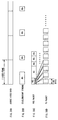
- Figure 28 illustrates the relationship among an elementary stream (ES), a packetized elementary stream (PES), and transport stream packets.
- ES elementary stream
- PES packetized elementary stream
- Figure 28B When source video data is encoded, an elementary stream, such as the one shown in Figure 28B, consisting of access units AU1, AU2, ... is generated.
- Figure 28C illustrates packetization performed by a packetizer. The packetizer packetizes a plurality of access units and adds a PES header to the beginning of the packet.
- FIG 29 illustrates the PES header.
- the PES header consists of Packet Start Code, Stream ID, Packet Length, symbol "10," Flag Control Code, PES Header Length, and Conditional Coding.
- the MPEG standard stipulates that the conditional coding must contain presentation time stamp (PTS) and decoding time stamp (DTS) information.
- TTS presentation time stamp
- DTS decoding time stamp
- Each of the transport stream generators (TS Gen.) 311 to 319 generate a transport stream consisting of 188-byte transport stream packets from the packetized elementary streams output by the packetizers 301 to 309, as shown in Figure 28D.
- the system target decoder buffers (STD buffers) 321 to 329 receive the transport streams output by the transport stream generators 311 to 319 and buffer them.
- the STD buffers are fixed-capacity buffers specified by the MPEG standard and are provided for the purpose of simulation to prevent receive buffer from overflowing and underflowing on the MPEG decoder side.
- the multiplexing circuit 330 receives a transport stream from each of the system target decoder buffers 321 to 329 and multiplexes the transport streams according to the schedule set by the controller 300.
- Each of the packetizer comprises a buffer 341 for buffering the elementary streams received, a parsing circuit 342 for parsing the syntax of the elementary streams received, and packetizing circuit 343 for packetizing the elementary streams output from the buffer.
- the parsing circuit 342 extracts PTS_counter and DTS_counter described in the elementary stream and supplies them to the packetizing circuit 343. More particularly, the parsing circuit 342 converts the received elementary stream into variable-length codes and searches the elementary stream for start codes and other special data elements. Since the purpose of this parsing process is to extract PTS_counter and DTS_counter, the parsing process searches for the start code of the picture layer, ignoring the start code of the sequence and GOP layers. Next, the parsing process can find out the user data area of the picture layer by finding out 32-bit user_data_start_code from the stream. Then it searches for Data_ID of "05" to find out data elements associated with Picture_order() in this user data area.
- the parsing circuit 342 extracts PTS_counter and DTS_counter described in the 10th to 16th bits and 17th to 23rd bits of this Picture_order() function, respectively, and supplies them to the packetizing circuit 343.
- the packetizing circuit 343 receives PTS_counter and DTS_counter from the parsing circuit 342 and based on this PTS_counter and DTS_counter information, generates PTS and DTS anew. This embodiment uses the value of PTS_counter itself as the PTS value and uses the value of DTS_counter as the DTS value.
- Figure 30 illustrates the minimum delay produced when the packetizer of this embodiment is used.
- Figure 30A shows input video data
- Figure 30B shows the elementary stream obtained when the input video data is encoded
- Figure 30C shows the packetized elementary stream obtained by using the encoded stream generated by the MPEG encoder of this embodiment and packetizer of this embodiment.
- Figures 30A and 30B are almost the same as Figures 2A and 2B.
- conventional methods generate a packetized elementary stream that determines PTS.
- N the number of B-pictures existing between an I-picture and P-pictures
- the encoding method and packetizing method of this embodiment can limit the delay produced in the process of determining PTS from an encoded stream, to one frame time. Furthermore, regardless of the number of B-pictures existing between an I-picture and P-pictures, the delay can be kept to the minimum delay of one frame. Besides, when designing a 9-channel packetizer such as the one shown in Figure 27, this embodiment has an extremely great advantage of allowing to implement such a packetizer with nine frame memories.
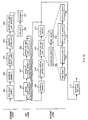
- Each of the MPEG decoders comprises a receive buffer 401, a variable-length decoding circuit 402, an inverse quantizing circuit 403, an inverse DCT circuit 404, a controller 405, an arithmetic unit 411, a motion compensating circuit 412, memories 413 and 414, a send buffer 415, a base-band video generation circuit 416, and a multiplexing circuit 417.
- the variable-length decoding circuit 402 receives an elementary stream from the receive buffer and performs a variable-length decoding operation on it to generate a stream consisting of data elements with a predetermined data length. Then, the variable-length decoding circuit 402 parses the syntax of the data stream that has been subjected to variable-length decoding, thereby extracting all coding parameters from the data stream, and supplies them to the controller 405. Examples of the coding parameters that are required by the MPEG standard to be superimposed in the stream include picture type, motion vector, prediction mode, DCT mode, quantization scale code, quantization table information, etc. Basically, they are the parameters produced during the encoding process for generating the encoded stream.
- variable-length decoding circuit 402 extracts the information described as MPEG_ES_Editing_information() in the user data area of elementary streams in addition to the coding parameters specified by the MPEG standard as described above. Specifically, information about V-phase() and H-phase() is described as MPEG_ES_Editing_information() in the user data area in the sequence layer of encoded streams, and information about Time_code(), Picture_order(), Ancillary_data(), and History_data() is described as MPEG_ES_Editing_information() in the user data area in the picture layer of encoded streams.
- the variable-length encoding circuit 402 extracts the information about V-phase(), H-phase(), Time_code(), Picture_order(), Ancillary_data(), and History_data() from the streams and supplies it to the controller 405.
- the inverse quantizing circuit 403 inverse-quantizes the DCT coefficient data supplied by the variable-length decoding circuit 402 after variable-length decoding, based on the quantization scale supplied also by the variable-length decoding circuit 402 and supplies it to the inverse DCT circuit 404.
- the inverse DCT circuit 404 performs an inverse DCT (discrete cosine transform) process on the quantized DCT coefficient supplied by the inverse quantizing circuit 403 and supplies it as image data subjected to inverse DCT to the arithmetic unit 411. If the image data supplied to the arithmetic unit 411 by the inverse DCT circuit 404 is an I-picture, it is output from the arithmetic unit 411, supplied to the forward predictive picture section of the frame memory 414, and stored there for use to generate predictive picture data of the image data (P-picture or B-picture data) to be input later into the arithmetic unit 411.
- inverse DCT discrete cosine transform
- the image data supplied by the inverse DCT circuit 404 is P-picture data that uses the image data of the immediately preceding frame as predictive picture data and if it is data in forward prediction mode, the image data (I-picture data) of the immediately preceding frame is read out from the forward predictive picture section of the frame memory 414 and subjected to motion compensation in the motion compensating circuit 412 corresponding to the motion vector output from the variable-length decoding circuit 402. Then the P-picture data is output after the image data (differential data) supplied by the inverse DCT circuit 404 is added to it in the arithmetic unit 411.
- the sum data i.e., the decoded P-picture is supplied to the backward predictive picture section of the frame memory 413, and stored there for use to generate predictive picture data of the image data (B-picture or P-picture data) to be input later into the arithmetic unit 411.
- Intra-picture prediction mode data is not processed in the arithmetic unit 411 and stored as it is in the backward predictive picture section 413 as is the case with I-picture data even if it is P-picture data.
- this P-picture is to be displayed after the B-picture that follows, it is not output to a format conversion circuit 32 at this time (as described above, the P-picture input later than the B-picture is processed and transmitted before the B-picture).
- the image data supplied by the inverse DCT circuit 404 is B-picture data
- the image data of the I-picture stored in the forward predictive picture section of the frame memory 414 in the case of forward prediction mode
- image data of the P-picture stored in the backward predictive picture section 413 in the case of backward prediction mode
- both image data in the case of bidirectional backward prediction mode
- the image data is then subjected to motion compensation in the motion compensating circuit 412 according to the motion vector output from the variable-length decoding circuit 402, to generate a predictive picture.
- no predictive picture is generated if no motion compensation is necessary (in the case of intra-picture prediction mode).
- the data that has thus been subjected to motion compensation by the motion compensating circuit 412 has the output from the inverse DCT circuit 404 added to it in the arithmetic unit 411.
- the sum output is supplied to the base-band video generation circuit 416 via the buffer 415.
- the video data output from this send buffer 415 contains only the video data for the active video area, but is not provided with ancillary data for the blanking interval or the like.
- the controller 405 controls the operation of the circuits described above, based on the information about picture type, motion vector, prediction mode, DCT mode, quantization scale, quantization table information, and other coding parameters supplied by the variable-length decoding circuit 402.
- the controller 405 controls the base-band video generation circuit 416, based on the V-phase and H-phase information supplied from the variable-length decoding circuit 402 as MPEG_ES_Editing_information().
- the V-phase extracted from the encoded stream represents the vertical position of the active video area in the full pixel area of the input video data while the H-phase represents the horizontal position of the active video area in the full pixel area of the input video data.
- the controller 405 controls the base-band video generation circuit, in such a way that the decoded video data output from the buffer 415 will be mapped to the vertical and horizontal positions represented by V-phase and H-phase, on the full pixel area with the blanking image, or in such a way as to synthesize the decoded video data in the active area and blanking image in the full pixel area based on the vertical and horizontal positions represented by V-phase and H-phase. Consequently, the video data output from the base-band video generation circuit 416 has exactly the same blanking interval as the blanking interval in the input video data supplied to the MPEG encoder.
- the controller 405 supplies Ancillary_data, Line_number, Field_ID, Time_code_1, and Time_code_2 extracted from the encoded stream or controls the multiplexing process of the multiplexing circuit 417 for Ancillary_data, Time_code_1, and Time_code_2, based on Field_ID. Specifically, as described with reference to Figure 7C, since Field_ID is associated with Ancillary_data assigned to each field, the multiplexing circuit 417 superimposes Ancillary_data associated with Field_ID during the blanking interval identified by Field_ID. For example, if Field_ID is "2," it can be seen that this is the third field in the frame.
- Ancillary_data received as ancillary data associated with Field_ID of "2" is superimposed on the blanking interval of the third field with Field_ID of "2."
- the multiplexing circuit 417 superimposes Ancillary_data at the line number specified by Line_number transmitted with Ancillary_data.
- the video data output from the multiplexing circuit 417 has exactly the same ancillary data at exactly the same line number, in the active video area of exactly the same location, in exactly the same blanking interval as the input video data supplied to the MPEG encoder.
- any MPEG encoding or decoding performed during the transmission of video data from the sending system to the receiving system will not cause the information inherent to the input video data or the ancillary data added to the input video data to be lost.
- the present invention can be used at broadcasting stations and the like where video data is encoded and decoded frequently.
Landscapes
- Engineering & Computer Science (AREA)
- Multimedia (AREA)
- Signal Processing (AREA)
- Compression Or Coding Systems Of Tv Signals (AREA)
Abstract
The present invention relates to an encoding system for encoding
input video data and a decoding system for decoding the encoded streams.
More particularly, it proposes a system and method for sending the
ancillary data added to video data and the information inherent to the
video data together with encoded streams in such a way that they will
not be lost even if MPEG encoding and MPEG decoding are repeated. The
MPEG encoder extracts the ancillary data from the video data, inserts
the extracted ancillary data into encoded streams as Ancillary_data,
and thereby sends the ancillary data together with the encoded streams.
The MPEG decoder extracts ancillary data from the encoded streams and
adds the extracted ancillary data to the base-band video data generated
by MPEG decoding.
Description
The present invention relates to an encoding system for encoding
input video data and a decoding system for decoding encoded streams.
Recently, in order to compress/encode video data, the MPEG (Moving
Picture Experts Group) technology standardized as ISO/IEC 13818 has
come into common use at broadcasting stations that produce and broadcast
television programs. MPEG is becoming the de facto standard especially
for recording video data generated by video cameras or the like, on
tape, disks, or other recording media that can be accessed randomly
or for transmitting video programs produced at broadcasting stations,
via cables or satellites.
The MPEG technology is an encoding technology that can improve
compression efficiency by means of predictive coding of pictures. More
particularly, the MPEG standard employs a plurality of predictive
coding systems that combine intra-frame prediction and inter-frame
prediction, and each picture is encoded by means of either of the
following picture types: I-picture (Intra Picture), P-picture
(Predictive Picture), and B-picture (Bidirectionally Predictive
Picture) according to the prediction system. The I-picture, which is
not predicted from other pictures, is a picture encoded within the frame.
The P-picture is a picture subjected to inter-frame forward predictive
coding by a preceding (past) I-picture or P-picture. The B-picture
is a picture subjected to bidirectionally predictive coding both by
a preceding (past) I-picture or P-picture and by a following (future)
I-picture or P-picture.
Figure 1 shows an example of a video processing system used within
a broadcasting station or between broadcasting stations. As described
above, it has been proposed to use a MPEG encoder and MPEG decoder as
shown in Figure 1 to transmit source video data from a first video
processor 1 provided as a sending system to a second video processor
4 provided as a receiving system within or between broadcasting
stations.
The first video processor 1 receives source video data such as
component-type base-band video of the D1 format and performs edit
processing, special-effects processing, synthesis processing or the
like on the source video data. The video processor 1 also receives
ancillary data such as closed captions and teletext data and adds the
ancillary data to the blanking intervals of the source video data.
Therefore, ancillary data has been embedded in the blanking intervals
of the video data output from the video processor 1.
The MPEG encoder 2 receives the video data from the video processor
1 and encodes it to generate an encoded stream. Such an encoded stream
is also known as an elementary stream. As everyone knows, television
signals have vertical and horizontal blanking intervals on four sides
of the actual video data area called the active video area and the
ancillary data described above has been inserted in the blanking
intervals.
However, the MPEG standard specifies that only the active video
area where pixels actually exist must be encoded. Thus, the encoded
stream is the data obtained by encoding only the active video area of
input video data, but it does not contain ancillary data superimposed
on the blanking intervals. In other words, when the input video data
is encoded by the MPEG encoder 2, the ancillary data superimposed on
the input video data is lost.
The MPEG decoder 3 receives the encoded stream from the MPEG encoder
and decodes it to generate decoded video data, which is then supplied
to the second video processor 4. Since the encoded stream supplied
to the MPEG decoder 3 does not contain information on the ancillary
data, naturally the decoded video data does not contain information
on the ancillary data.
Thus, MPEG encoding and MPEG decoding performed when video data
is transmitted from the sending system to the receiving system have
the problem that the ancillary data added to the blanking intervals
of the video data by the first video processor 1 is not transmitted
from the sender or first video processor 1 to the receiver or second
video processor 4 although the video data that corresponds to the active
area can be transmitted.
Moreover, the fact that only the active video data is transmitted
if MPEG encoding and MPEG decoding are performed when video data is
transmitted from the sending system to the receiving system means that
the information inherent to the source video data is not transmitted
to the receiving system either. The information inherent to the source
video data is the information possessed by the source video data itself,
including the location of the blank areas or the location of the active
video area with respect to the full pixel area. Specifically, this
is the information as to from which vertical line in the full pixel
area of the source video data the active video lines start and as to
at which pixel in the horizontal direction of the full pixel area the
active video area starts.
Now the processing of video data that has undergone 3:2 pull-down
will be described with reference to Figure 2. The figure shows
an example of a video processing system used within or between
broadcasting stations to process both video data with a 24-Hz frame
frequency and video data with a 30-Hz frame frequency.
The 3:2 pull-down circuit 5 receives video data that has a frame
rate of 24 Hz (24 frames per second) and generates video data with a
frame rate of 30 Hz (30 frames per second). The film material used
at movie theaters and the like is recorded on optical films at a frame
rate of 24 Hz (24 frames per second), which is entirely different from
the 29.97-Hz frame rate of NTSC television signals. Thus, to convert
film material to television signals, 30 frames are generated from 24
frames.
The 3:2 pull-down process will be described with reference to
Figures 3A and 3B. Figure 3A shows source video data with a frame rate
of 24 Hz while Figure 3B shows the 30-Hz video data after a 3:2 pull-down
conversion. As shown in Figures 3A and 3B, the 3:2 pull-down process
generates a repeat field t1' by repeating the top field t1 in the first
frame F1 and generates a repeat field b3' by repeating the bottom field
b3 in the third frame F3. Thus, the 3:2 pull-down process converts
video data with a frame rate of 24 Hz into video data with a frame rate
of 30 Hz by converting 2 fields into 3 fields in a predetermined sequence.
As described with reference to Figure 1, the first video processor
1 receives 30-Hz source video data and performs edit, special-effects,
synthesis, and/or other operations on it. The video processor 1 also
receives ancillary data such as closed captions and teletext data and
adds it to the blanking intervals of the source video data. This
addition of ancillary data is performed with respect to video data having
a frame frequency of 30 Hz and the ancillary data is added to all the
fields contained in the 30-Hz video data. That is, the ancillary data
is added not only to the top fields (t1, t2, ...) and bottom fields
(b1, b2, ...), but also to the repeat fields t1' and b3'.
The 2:3 pull-down circuit 6 receives the 30-Hz video data generated
by the 3:2 pull-down process described above and converts it into video
data with a frame rate of 24 Hz. Specifically, as shown in Figure 3C,
the 2:3 pull-down circuit 6 is used to remove the repeat fields t1'
and b3' inserted by the 3:2 pull-down process. The 2:3 pull-down
process must be performed before MPEG encoding. This is because these
repeat fields are the redundant fields inserted by the 3:2 pull-down
process and can be deleted without any degradation in image quality,
The MPEG encoder 2, which is the same as the MPEG encoder 2 described
with reference to Figure 1, receives 24-Hz video data from the 2:3
pull-down circuit 6 and encodes it to generate an encoded stream.
However, the MPEG standard specifies that only the active video
area where pixels actually exist must be encoded. Thus, the encoded
stream is the data obtained by encoding only the active video area of
input video data, but it does not contain ancillary data superimposed
on the blanking intervals. In other words, when the input video data
is encoded by the MPEG encoder 2, the ancillary data superimposed on
the input video data is lost.
The MPEG decoder 3, which is the same as the MPEG decoder 3 described
with reference to Figure 1, receives the encoded stream from the MPEG
encoder and decodes it to generate decoded video data. According to
the MPEG standard, the Repeat_first_field and Top_field_first flags
are set in encoded streams as information about the frame structure.
Since MPEG decoders process data based on these flags, the decoded video
data has a frame rate of 30 Hz.
As can be seen from the above description, even if ancillary data
is added to 30-Hz video data by the processor in the sending system,
the repeat fields are removed from the 30-Hz video data after the 2:3
pull-down process necessary for MPEG encoding. That is, the ancillary
data is removed together with the repeat fields to which it has been
added. Therefore, if a 2:3 pull-down process is performed when video
data is transmitted from the sending system to the receiving system,
the information about the ancillary data added to the repeat fields
is not transmitted from the sender or first video processor 1 to the
receiver or second video processor 4 because the repeat fields
themselves are removed by the 2:3 pull-down process.
The present invention relates to an encoding system for encoding
input video data and a decoding system for decoding the encoded streams.
More particularly, it proposes a system and method for sending the
ancillary data added to video data and the information inherent to the
video data together with encoded streams in such a way that they will
not be lost even if MPEG encoding and MPEG decoding are repeated.
The MPEG encoder extracts the ancillary data from the video data,
inserts the extracted ancillary data into encoded streams as
Ancillary_data, and thereby sends the ancillary data together with the
encoded streams. The MPEG decoder extracts the ancillary data from
the encoded streams and adds it to the base-band video data generated
by MPEG decoding.
An encoding apparatus for encoding input video data extracts
ancillary data that are added in the blanking intervals of the input
video data from the input video data, encodes the input video data to
generate encoded streams, and controls the above described encoding
means so as to insert the above described ancillary data into the encoded
streams.
A decoding apparatus for decoding the encoded streams generated
by encoding input video data extracts ancillary data from the encoded
streams, decodes the encoded streams to generate decoded video data,
and multiplexes the ancillary data onto the blanking intervals of the
decoded video data.
A decoding apparatus for decoding the encoded streams generated
by encoding input video data parses the syntax of the encoded streams
to obtain the ancillary data contained in the encoded streams, decodes
the encoded streams to generate decoded video data, and multiplexes
the ancillary data onto the decoded video data so that the input video
data and decoded video data will have the same ancillary data.
A decoding apparatus for decoding the encoded streams generated
by encoding input video data obtains the ancillary data contained in
the picture area of the encoded streams, decodes the encoded streams
to generate decoded video data, and multiplexes the decoded video data
and ancillary data to generate the same data as the input video data.
A coding system comprises encoding means for encoding input video
data and decoding means for receiving and decoding the encoded streams
encoded by the encoding means to generate decoded video data; wherein
the encoding means comprises means for encoding the above described
input video data to generate encoded streams and means for inserting
the ancillary data contained in the input video data into the encoded
streams, and the decoding means comprises means for decoding the encoded
streams to generate decoded video data and means for multiplexing the
ancillary data transmitted with the encoded streams onto the decoded
video data.
Figure 4 shows a broadcasting system consisting of a main
broadcasting station 141 and local broadcasting station 171.
The main broadcasting station 141 comprises a plurality of
editing/processing studios 145A to 145D, a plurality of MPEG encoders
142A to 142D, a plurality of MPEG decoders 144A to 144D, at least one
multiplexer 162A, and at least one demultiplexer 161A. The
broadcasting station 141 also includes an SDTI-CP (serial data transfer
interface-content package) network 150 defined as SMPTE305M, through
which each MPEG encoder, each MPEG decoder, the multiplexer 162A, and
the demultiplexer 161A can send and receive elementary streams.
SDTI-CP, which is a communications format proposed for transmission
of elementary streams of MPEG, is defined as SMPTE305M. The elementary
stream transferred over the SDTI-CP network 150 is expressed as
ES_over_SDTI-CP.
The editing/processing studios 145A to 145D comprise video servers,
video editors, special-effects devices, video switchers. They receive
decoded base-band video data from the MPEG decoders, edit it or subject
it to image processing, and output it to the MPEG encoders. In other
words, editing/processing studios 145A to 145D perform editing and
image-processing operations on base-band video signals rather than
performing stream processing operations on encoded streams.
The MPEG encoders 142A to 142D receive base-band input video
signals from the editing/processing studios 145A to 145D, and encode
them according to the MPEG standard described above to generate
elementary streams (ES). The elementary streams generated by the MPEG
encoders are supplied to either of the MPEG decoders 144A to 144D or
the multiplexer 162A through the SDTI-CP network 150.
The MPEG decoders 144A to 144D receive the elementary streams
supplied by the MPEG encoders 142A to 142D or the demultiplexer 161A
through the SDTI-CP network 150, and decode them according to the MPEG
standard. The multiplexer 162A is a circuit for multiplexing the
plurality of video programs produced at the main broadcasting station
141 into one transport stream to distribute them to the local
broadcasting station 171 or individual households. Specifically, it
receives a plurality of elementary streams corresponding to the
plurality of video programs through the SDTI-CP network 150, generates
packetized elementary streams by packetizing the elementary streams,
and then generates transport stream packets from the packetized
elementary streams. The multiplexer 162A generates a multiplexed
transport stream by multiplexing the transport stream packets generated
from the plurality of video programs. The configuration and processes
of the multiplexer 162A will be described later.
If the destination of the plurality of video programs is the local
broadcasting station 171, the multiplexed transport stream generated
by the multiplexer 162A is supplied to the demultiplexer 161B of the
local broadcasting station 171 through a network such as an ATM
(asynchronous transfer mode) network or satellite line. The local
broadcasting station 171 has exactly the same system configuration as
the main broadcasting station 141 although they differ in scale, and
thus detailed description will be omitted.
If the destination of the plurality of video programs is the local
broadcasting station 171, the multiplexed transport stream generated
by the multiplexer 162A is supplied to the MPEG decoder 170A contained
in the set-top box at each household through a network such as an ATM
(asynchronous transfer mode) network or satellite line, and decoded
video data is supplied to the TV set.
Figure 5 illustrates the differences between an elementary stream
transmitted via an SDTI-CP network within a broadcasting station and
a transport stream transferred via a public network.
Within the broadcasting station, the elementary stream is
transmitted via an SDTI-CP network. The SDTI-CP network 150, which
uses a communications format based on the SDI (serial data interface)
standardized by SMPTE259M and capable of a transfer rate of 270 Mbps,
can transmit elementary streams (ES) in MPEG format directly and is
suitable for closed networks such as studios. Specifically, video data
"V" and audio data "A" are packed in each frame and the stream can be
edited easily along the frame boundaries defined by a frame sync (dotted
line) as shown in Figure 5A.
Between broadcasting stations or over public networks, video data
is transmitted in the form of a transport stream. In a transport stream,
all contents including video data and audio data are encapsulated into
188-byte packets, as shown in Figure 5B, to allow data transmission
even through a public network with a limited data-transmission capacity.
As is the case with elementary streams, "V" indicates a transport stream
packet of video data and "A" indicates a transport stream packet of
audio data while a blank indicates a null packet.
Now the MPEG encoders 142A to 142D will be described with reference
to Figure 6. First, a supplementary explanation will be given about
the input video data supplied to the MPEG encoders. In this embodiment,
the input video data is 30-Hz video data generated by 3:2 pull-down
conversion from source video data having a frame rate of 24 Hz.
Specifically, the original source video data with a frame rate of 24
Hz consists of the frames F1, F2, and so on, each of which has two fields
(top field t1, t2, ... and bottom field b1, b2, ...). As shown in Figure
7A, the 3:2 pull-down process generates a repeat field t1' by repeating
the top field t1 in the first frame F1 -- where the top field should
appear first -- to form one frame from three fields, and generates a
repeat field b3' by repeating the bottom field b3 in the third frame
F3 where the bottom field should appear first. In this way, the 3:2
pull-down process can convert source video data with a frame rate of
24 Hz into video data with a frame rate of 30 Hz, as shown in Figure
7A, by alternating 3-field frames and 2-field frames.
Although in this embodiment input video data is generated by 3:2
pull-down, the present invention is not limited to video data whose
input video data has undergone 3:2 pull-down. It can also be applied
to video data that has not undergone 3:2 pull-down, provided the original
source video has a frame rate of 30 Hz.
The MPEG encoder shown in Figure 6 comprises an ancillary data
separating circuit 101, a field counter 102, a 2:3 pull-down circuit
103, an encoding controller 104, a motion vector detector 105, a
switching circuit 111, a DCT circuit 112, a quantizing circuit 113,
an inverse quantizing circuit 114, an inverse DCT circuit 115, an adding
circuit 116, memories 117 and 118, a motion compensating circuit 119,
arithmetic circuits 120, 121, and 122, a variable-length coding circuit
125, and a send buffer 126.
The ancillary data separating circuit 101 extracts ancillary data
from the blanking interval of input video data. More particularly,
as shown in Figure 8, it extracts the ancillary data inserted in the
vertical blanking interval of input video data and the line number of
the ancillary data. Such ancillary data includes, but is not limited
to, text data, closed-captioning data, VITC (vertical interval time
code) defined by SMPTE RP164, and LTC (linear time code) defined by
RP196. In this embodiment, information about the extracted ancillary
data is supplied to the controller 104 as Ancillary_data while
information about the line number is supplied to the controller 104
as Line_number. Also, information about VITC is supplied to the
controller 104 as Time_code_1 and information about LTC is supplied
to the controller 104 as Time_code_2.
Besides, the ancillary data separating circuit 101 extracts the
unique information possessed by input video data. Such unique
information may be, for example, data about the location of the active
video area AR2 with respect to the full pixel area AR1 of input video
data as shown in Figure 8. Specifically, it may include the number
of lines that represents the vertical start position of the active video
area and the number of samples that represents the horizontal start
position. In this embodiment, the information about the vertical and
horizontal positions of the active video area are supplied to the
controller 104 as V-phase and H-phase, respectively. Other examples
of the unique information includes the source name given to the input
video data and the location and time of photo shooting.
The video data output from the ancillary data separating circuit
101 is supplied to the field counter 102 that follows. The field counter
102 is the circuit for counting the fields that compose each frame of
the input video data. Then the field counter 102 supplies the count
information of each frame to the controller 104 as Field_ID. If, for
example, the video data shown in Figure 7A is supplied to the field
counter 102, Field_ID of "0," "1," and "2" are output as the count
information for frame F1, which has three fields, and Field_ID of "0"
and "1" are output as the count information for frame F2, which has
two fields.
The field counter 102 further comprises two counters that count
the fields in the input video data and outputs the count information
to the controller 104 as PTS_counter and DTS_counter. When generating
an ES header, PTS_counter is used to generate presentation time stamps
(PTSs) and DTS_counter is used to generate decoding time stamps (DTSs).
Now PTS_counter and DTS_counter will be described in detail with
reference to Figure 9. Figure 9 shows the frame structure of each frame
in the input video data as well as the relationship between PTS_counter
and DTS_counter in each frame. Before going into details on Figure
9, a supplementary explanation will be given about the
Repeat_first_field and Top_field_first flags. If the
Repeat_first_field flag is set to "1," it indicates that a repeat field
must be created during MPEG decoding and if the Repeat_first_field flag
is set to "0," it indicates that a repeat field need not be created
during MPEG decoding. The Top_field_first flag indicates whether the
first field of the frame is the top field or bottom field: the value
"1" indicates that the top field appears earlier than the bottom field
in the frame while the value "0" indicates that the bottom field appears
earlier than the top field in the frame. Figure 9A illustrates the
frame structure in the input video data described in Figure 7A.
Specifically, the decoding of the first frame F1 does not involve simply
generating a frame consisting of a top field and bottom field, but it
involves generating a frame consisting of three fields by creating a
repeat field by copying the top field. Accordingly, the corresponding
Repeat_first_field flag becomes "1" and the Top_field_first flag
becomes "1."
In decoding frame F2, the Repeat_first_field flag is set to "0"
because there is no need to generate a repeat field, and the
Top_field_first flag is set to "0" because the bottom field appears
earlier than the top field.
In decoding frame F3, the bottom field must be copied to create
a repeat field and the coded frame must be converted into a three-field
frame. Therefore, the Repeat_first_field flag is set to "1" and
the Top_field_first flag is set to "0." In decoding frame F4, there
is no need to create a repeat field, so the Repeat_first_field flag
is set to "0" and the Top_field_first flag is set to 1. Since
PTS_counter is the time stamp information underlying the PTS as
described above, it must agree with the frame order of input video data.
Specifically, PTS_counter is the value generated by a counter that
increases from 0 to 127 and then returns to 0 again. The value of the
counter PTS_counter changes in the manner shown in Figure 9B. More
particularly, since the first frame F1 in input video data is an
I-picture and must be presented first, the value of PTS_counter is "0."
The value of PTS_counter for the second frame F2 is the value "0" of
PTS_counter for frame F1 plus the number "3" of fields contained in
frame F1, and thus is "3" (= 0 + 3) . The value of PTS_counter for the
third frame F3 is the value "3" of PTS_counter for frame F2 plus the
number "2" of fields contained in frame F2, and thus is "5" (= 3 + 2).
The value of PTS_counter for the fourth frame F4 is the value "5" of
PTS_counter for frame F3 plus the number "3" of fields contained in
frame F3, and thus is "8" (= 5 + 3). The value of PTS_counter for the
fifth frame F5 and subsequent frames are calculated in a similar manner.
Besides, since DTS_counter is the time stamp information underlying
the DTS, it must agree with the order of pictures in encoded streams
rather than with the frame order of input video data. Now this will
be described in more concrete terms with reference to Figure 9C. Since
the first frame F1 is an I-picture, it must be decoded one frame earlier
than it is displayed. In other words, since frame F0 preceding the
frame F1 consists of two fields, the value of DTS_counter must be three
fields ahead of the reference time "0," i.e., it must be "125," if the
presentation time stamp PTS_counter = 0 is used as the reference time.
DTS_counter is given as a value modulo 27 (= 128), and thus it cycles
between 0 and 127. The value of DTS_counter for frame F4 encoded after
frame F1 is equal to "0" (= 128 = 125 + 3), which is given as the value
"125" of DTS_counter for frame F1 plus the number "3" of fields in frame
F1. Since frame F2 encoded next is a B-picture, the value of DTS_counter
is equal to the value of PTS_counter, which is equal to "3." Similarly,
frame F3 encoded next is a B-picture, and thus the value of DTS_counter
is equal to the value of PTS_counter, which is equal to "5." The values
of DTS_counter for frame F7 and subsequent frames are calculated
similarly and the description thereof will be omitted herein. The field
counter 102 generates PTS_counter and DTS_counter and supplies them
to the controller 104 according to the rules described above.
The 2:3 pull-down circuit 103 receives the video data output from
the field counter 102 and performs 2:3 pull-down. The 2:3 pull-down
circuit 103 receives the video data with a frame rate of 30 Hz that
has undergone 3:2 pull-down as shown in Figure 7A and generates video
data with a frame rate of 24 Hz. More particularly, as shown in Figure
7B, the 2:3 pull-down circuit 103 converts video data with a frame rate
of 30 Hz into video data with a frame rate of 24 Hz by removing the
repeat fields t1' and b3' inserted by 3:2 pull-down. In removing repeat
fields, the 2:3 pull-down circuit 103 analyzes the frame structure of
the supplied video data and removes only the repeat fields that are
found to occur at certain intervals. Thus, when analyzing the frame
structure of video data, the 2:3 pull-down circuit 103 generates
Repeat_first_field and Top_field_first flags as information about the
frame structure and supplies them to the controller 104.
The motion vector detector 105 receives, in macroblocks, the video
data output from the 2:3 pull-down circuit 103 and processes the image
data in each frame as an I-picture, P-picture, or B-picture according
to a predetermined sequence. The question as to how to process the
image of each frame -- as an I-picture, P-picture, or B-picture -- has
been predetermined according to the GOP structure specified by the
operator. Any motion vector MV detected is supplied to the controller
104 and motion compensating circuit 119. When the intra-picture
prediction mode is activated, the switching circuit 111 closes the
contact a. Therefore, the macroblock data is transmitted to the
transmission path through the DCT circuit 112, quantizing circuit 113,
variable-length coding circuit 125, and send buffer 126, as is the case
with I-picture data. The quantized data is also supplied to the frame
memory 117 for backward predictive pictures through the inverse
quantizing circuit 114, inverse DCT circuit 115, and arithmetic unit
116. On the other hand, when the forward prediction mode is activated,
the switch 111 closes the contact b, the image data (the image data
of the I-picture in this case) stored in the frame memory 118 for forward
predictive pictures is read out, and compensation is made by the motion
compensating circuit 119 based on the motion vector MV supplied by the
motion vector detector 105. In other words, when instructed to activate
the forward prediction mode, the motion compensating circuit 119 reads
data to generate predicted picture data, by offsetting the read address
of the frame memory 118 for forward predictive pictures from the location
that corresponds to the location of the macroblock currently output
by the motion vector detector 105 by the amount equivalent to the motion
vector. The predicted picture data output by the motion compensating
circuit 119 is supplied to the arithmetic unit 120. Then, from the
data in the macroblock of the reference image, the arithmetic unit 120
subtracts the predicted picture data supplied by the motion
compensating circuit 119 and corresponding to the macroblock, and
outputs the difference (prediction error). This differential data is
transmitted to the transmission path through the DCT circuit 112,
quantizing circuit 113, variable-length coding circuit 125, and send
buffer 126. Also, this differential data is decoded locally by the
quantizing circuit 114 and inverse DCT circuit 115, and is input to
the arithmetic unit 116. The arithmetic unit 116 has also been supplied
with the same data as the predicted picture data supplied to the
arithmetic unit 120. The arithmetic unit 116 adds the predicted picture
data output by the motion compensating circuit 119, to the differential
data output by the inverse DCT circuit 115. This produces the image
data of the original (decoded) P-picture. The image data of the
P-picture is supplied to the backward predictive picture section of
the frame memory 117, where it is stored. After the data of the
I-picture and P-picture is stored in the forward predictive picture
section 118 and the backward predictive picture section 117,
respectively, the motion vector detector 105 processes the next picture,
B-picture. In intra-picture prediction mode or forward prediction mode,
the switch 111 closes the contacts a or b, respectively. The picture
is processed in the same manner as P-pictures and the data is transmitted.
On the other hand, when the backward prediction mode or bidirectional
prediction mode is activated, switch 111 closes the contact c or d,
respectively. In backward prediction mode with the contact c in the
switch 111 closed, the image data (images of the P-picture in this case)
stored in the backward predictive picture section 117 is read out and
has its motion compensated by the motion compensating circuit 119
according to the motion picture output by the motion vector 105. In
other words, when the backward prediction mode is activated, the motion
compensating circuit 119 reads data to generate predicted picture data,
by offsetting the read address of the backward predictive picture
section 117 from the location that corresponds to the location of the
macroblock currently output by the motion vector detector 105 by the
amount equivalent to the motion vector. The predicted picture data
output by the motion compensating circuit 119 is supplied to the
computing unit 121. Then the computing unit 121 subtracts the predicted
picture data supplied by the motion compensating circuit 119, from the
data in the macroblock of the reference image and outputs the difference.
This differential data is transmitted to the transmission path through
the DCT circuit 112, quantizing circuit 113, variable-length coding
circuit 125, and send buffer 126. In bidirectional prediction mode
with the contact d in the switch 111 closed, the image data (images
of the I-picture in this case) stored in the forward predictive picture
section 118 and image data (images of the P-picture in this case) stored
in the backward predictive picture section 117 are read out and have
their motions compensated by the motion compensating circuit 119
according to the motion picture output by the motion vector detector
105. In other words, when the bidirectional prediction mode is
activated, the motion compensating circuit 119 reads data to generate
predicted picture data, by offsetting the read addresses of the forward
predictive picture section 118 and backward predictive picture section
117 from the locations that correspond to the locations of the macroblock
currently output by the motion vector detector 105 by the amount
equivalent to the motion vectors (for both forward predictive picture
and backward predictive picture, in this case). The predicted picture
data output by the motion compensating circuit 119 is supplied to the
computing unit 122. Then the computing unit 122 subtracts the average
of the predicted picture data supplied by the motion compensating
circuit 119, from the data in the macroblock of the reference image
supplied by the motion vector detector 105 and outputs the difference.
This differential data is transmitted to the transmission path through
the DCT circuit 112, quantizing circuit 113, variable-length coding
circuit 125, and send buffer 126. The images of B-pictures are not
stored in the frame memories 117 and 118 because they are not used as
predicted pictures for other pictures. The controller 104 controls
all the circuits involved in the prediction mode processing, DCT mode
processing, and quantization processing described above. Besides, the
controller 104 supplies all the coding parameters, including motion
vectors, picture types, prediction modes, DCT modes, quantizing steps,
generated during the encoding of pictures to the variable-length coding
circuit 125.
Furthermore, the controller 104 receives V-phase, H-phase,
Time_code1, Time_code2, Ancillary_data, and Line_number information
from the ancillary data separating circuit 101 and receives DTS_counter,
PTS_counter, and Field_ID information from the field counter 102. Then
it supplies the received V-phase, H-phase, Time_code1, Time_code2,
Ancillary_data, Line_number, DTS_counter, PTS_counter, and Field_ID
information to the variable-length coding circuit 125 as
MPEG_ES_editing_information (i).
The variable-length coding circuit 125 converts the quantized DCT
coefficient received from the quantizing circuit 113 and coding
parameters received from the controller 104 into variable-length codes
to generate an encoded stream according to the syntax of elementary
streams specified by the MPEG standard.
A characteristic feature of this embodiment is that the
variable-length coding circuit 125 also converts the information
supplied from the controller 104 as MPEG_ES_editing_information (i)
into variable-length codes and inserts them into the encoded stream.
The syntax of encoded streams and the syntax of
MPEG_ES_editing_information (i) will be described in detail later.
Now the syntax of bit streams will be described with reference
to Figures 10 to 26. Incidentally, Figure 26 is an explanatory drawing
illustrating the data structure of an MPEG encoded stream in an
easy-to-understand form while Figures 10 to 25 describe the syntax in
detail. Figure 10 shows the syntax of a video stream of MPEG. The MPEG
encoder 42 generates encoded elementary streams according to the syntax
shown in Figure 10. In the descriptions of syntaxes that follow,
functions and conditional statements are shown in lightface while data
elements are shown in boldface. Data items are expressed in mnemonic
form that represents their name, bit length, type, and transmission
order. First the functions used in the syntax shown in Figure 10 will
be described. Actually, the syntax shown in Figure 10 is used by the
MPEG encoder 44 to extract meaningful data elements from the encoded
bit stream received. The syntax used by the MPEG encoder 42 is the
syntax obtained by omitting the conditional statements such as if and
while statements from the syntax shown in Figure 10.
next_start_code() described first in video_sequence() is designed
to search a bit stream for a start code. In any encoded stream generated
according to the syntax shown in Figure 10, the data element defined
by sequence_header() and sequence_extension() are described first.
The sequence_header() function is used to define header data for the
sequence layer of an MPEG bit stream while the sequence_extension()
function is used to define extension data for the sequence layer of
the MPEG bit stream. The "do { } while" syntax placed next to the
sequence_extension() function indicates that the data elements
described based on the function in the braces { } of the do statement
will remain in the encoded data stream while the condition defined by
the while statement is true. The nextbits() function contained in the
while statement is used to compare the bits or bit string described
in the bit stream with the data elements referenced. In the example
shown in Figure 10, the nextbits() function compares the bit string
in the bit stream with sequence_end_code that indicates the end of the
video sequence, and if they do not match, the condition in the while
statement holds true. Therefore, the "do { } while" syntax placed next
to the sequence_extension() function indicates that the data elements
defined by the function in the do statement will remain in the encoded
bit stream until sequence_end_code that indicates the end of the video
sequence is encountered. In the encoded bit stream, following the data
elements defined by the sequence extension() function, the data
elements defined by extension_and_user_data(0) have been described.
The extension_and_user_data(0) function is used to define extension
data and user data for the sequence layer of an MPEG bit stream. The
"do { } while" syntax placed next to extension_and_user_data(0)
indicates that the data elements described based on the function in
the braces { } of the do statement will remain in the bit stream while
the condition defined by the while statement is true. The nextbits()
function contained in the while statement is used to determine the match
between the bits or bit string in the bit stream and picture_start_code
or group_start_code. If the bits or bit string in the bit stream and
picture_start_code or group_start_code match, the condition defined
by the while statement holds true. Therefore, the "do { } while" syntax
indicates that if picture_start_code or group_start_code appears in
the encoded bit stream, the data element codes defined by the function
in the do statement are described next to the start code. The if
statement described at the beginning of the do statement specifies the
condition that group_start_code appears in the encoded bit stream. If
the condition presented by the if statement is true, the data elements
defined by group_of_picture_header() and extension_and_user_data (1)
are described in sequence next to group_start_code in the encoded bit
stream. The group_of_picture_header() function is used to define
header data for the GOP layer of an MPEG encoded bit stream while the
extension_and_user_data(1) function is used to define extension data
and user data for the GOP layer of the MPEG encoded bit stream. Besides,
in this encoded bit stream, next to the data elements defined by
group_of_picture_header() and extension_and_user_data(1), data
elements defined by picture_header() and picture_coding_extension()
have been described. Of course, if the condition of the if statement
described above does not hold true, the data elements defined by
group_of_picture_header() and extension_and_user_data(1) are not
described, and thus next to the data elements defined by
extension_and_user_data(0), the data elements defined by
picture_header(), picture_coding_extension() and
extension_and_user_data(2) are described. The picture_header()
function is used to define header data for the picture layer of an MPEG
encoded bit stream while the picture_coding_extension() function is
used to define first extension data for the picture layer of the MPEG
encoded bit stream. The extension_and_user_data(2) function is used
to define extension data and user data for the picture layer of the
MPEG encoded bit stream. The user data defined by
extension_and_user_data(2) has been defined in the picture layer and
can be defined for each picture. In the encoded bit stream, next to
the user data in the picture layer, the data elements defined by
picture_data() have been described. The picture_data() function is
used to describe data elements associated with a slice layer and
macroblock layer. The while statement described next to the
picture_data() function is the function used to judge the condition
of the next if statement while the condition defined by the while
statement is true. The nextbits() function contained in the while
statement is used to determine whether picture_start_code or
group_start_code has been described in the encoded bit stream. If
picture_start_code or group_start_code has been described in the
encoded bit stream, the condition defined by the while statement holds
true. The if statement that appears next is the conditional statement
used to determine whether sequence_end_code has been described in the
encoded bit stream. It indicates that if sequence_end_code has not
been described, the data elements defined by sequence_header() and
sequence_extension() have been described. Since sequence_end_code is
the code that indicates the end of the sequence of an encoded video
stream, the data elements defined by sequence_header() and
sequence_extension() should remain in the encoded video stream unless
the encoded video stream has ended. The data elements described here
by sequence_header() and sequence_extension() are exactly the same as
the data elements described by sequence_header() and
sequence_extension() at the beginning of the sequence of the video
stream. In this way, the same data is described in a stream more than
once to avoid cases in which it will become impossible to receive
sequence layer data and decode the stream when the data stream is
received from the middle (e.g., the part of the bit stream that
corresponds to the picture layer) by the bit stream receiver. After
the data elements defined by the last sequence_header() and
sequence_extension(), i.e., at the end of the data stream, two-bit
sequence_end_code is described indicating the end of the sequence. Now
detailed description will be given of sequence_header(),
sequence_extension(), extension_and_user_data(0),
group_of_picture_header(), picture_header(),
picture_coding_extension(), and picture_data. Figure 11 illustrates
the syntax of sequence_header(). The data elements defined by
sequence_header() include sequence_header_code,
horizontal_size_value, vertical_size_value,
aspect_ratio_information, frame_rate_code, bit_rate_value,
marker_bit, vbv_buffer_size_value, constrained_parameter_flag,
load_intra_quantizer_matrix, intra_quantizer_matrix[64],
load_non_intra_quantizer_matrix, non_intra_quantizer_matrix, etc.
sequence_header_code is the data that represents the start
synchronization code of the sequence layer. horizontal_size_value is
the data that consists of the low-order 12 bits of the horizontal pixel
count of an image. vertical_size_value is the data that consists of
the low-order 12 bits of the vertical line count of an image.
aspect_ratio_information is the data that represents the aspect ratio
of a pixel or a display screen. frame_rate_code is the data that
represents the display cycle of an image. bit_rate_value is the data
that consists of the low-order 18 bits (rounded up to the nearest
multiple of 400 bps) of the bit rate used to limit the amount of bits
generated. marker_bit is the bit data that is inserted to avoid start
code emulation. vbv_buffer_size_value represents the low-order 10
bits of the value that determines the size of the virtual buffer (video
buffer verifier) for controlling the amount of codes generated.
constrained_parameter_flag is the data which indicates that parameters
fall within limits. load_intra_quantizer_matrix is the data that
indicates the existence of quantization matrix data for intra MB.
intra_quantizer_matrix[64] is the data that represents the value of
the quantization matrix for intra MB.
load_non_intra_quantizer_matrix is the data that indicates the
existence of quantization matrix data for non-intra MB.
non_intra_quantizer_matrix is the data that represents the value of
the quantization matrix for non-intra MB. Figure 12 illustrates the
syntax of sequence_extension(). The data elements defined by
sequence_extension() include extension_start_code,
extension_start_code_identifier, profile_and_level_indication,
progressive_sequence, chroma_format, horizontal_size_extension,
vertical_size_extension, bit_rate_extension,
vbv_buffer_size_extension, low_delay, frame_rate_extension_n,
frame_rate_extension_d, etc.
extension_start_code is the data that represents the start
synchronization code of extension data.
extension_start_code_identifier is the data that indicates which
extension data will be sent. profile_and_level_indication is the data
used to specify the profile and level of video data.
progressive_sequence is the data which indicates that video data is
to be scanned sequentially. chroma_format is the data used to specify
the color difference format of video data. horizontal_size_extension
represents the high-order 2 bits of the data to be added to
horizontal_size_value in the sequence header.
vertical_size_extension represents the high-order 2 bits of the data
to be added to vertical_size_value in the sequence header.
bit_rate_extension represents the high-order 12 bits of the data to
be added to bit_rate__value in the sequence header.
vbv_buffer_size_extension represents the high-order 8 bits of the data
to be added to vbv_buffer_size_value in the sequence header. low_delay
is the data which indicates that no B-picture is included.
frame_rate_extension_n is used in conjunction with frame_rate_code in
the sequence header to obtain the frame rate. frame_rate_extension_d
is used in conjunction with frame_rate_code in the sequence header to
obtain the frame rate. Figure 13 illustrates the syntax of
extension_and_user_data(i). When "i" is other than 1,
extension_and_user_data(i) describes only the data elements defined
by user_data(), and not the data elements defined by extension_data().
Therefore, extension_and_user_data (0) describes only the data elements
defined by user_data(). First, the functions used by the syntax shown
in Figure 13 will be described. The nextbits() function is used to
compare the bits or bit string in the bit stream with the data element
to be decoded next. user_data() in Figure 14 illustrates the
characteristic features of this embodiment. As shown in Figure 14,
the user_data() function is used to describe the data elements
associated with user_data_start_code, V-phase(), H-phase(),
Time_code(), Picture_order(), Ancillary_data(), history_data(), and
user_data(). user_data_start_code is the start code used to indicate
the start of the user data area in the picture layer of an MPEG bit
stream. The if statement described next to this code specifies to run
the while syntax that follows if i in user_data(i) is "0." The while
syntax remains true unless 24-bit data consisting of twenty-three "0's"
and accompanying "1" appears in the bit stream. The 24-bit data
consisting of twenty-three "0's" and accompanying "1" is added to the
beginning of all start codes, allowing the nextbits() function to find
the location of each of the start codes in the bit stream. If the while
statement is true, it follows that i in user_data(i) is "0," and thus
there should be extension_and_user_data(0) in the sequence layer. This
means that in the sequence layer in Figure 26, data elements associated
with extension_and_user_data(0) 205 have been described. If a bit
string (Data_ID) representing V-Phase is detected, the nextbits()
function in the next if statement knows that the subsequent bits describe
the V-Phase data elements indicated by V-Phase(). If a bit string
(Data_ID) representing H-Phase is detected, the nextbits() function
in the next Else if statement knows that the subsequent bits describe
the H-Phase data elements indicated by H-Phase().
This means that the data elements associated with V-Phase() 220
and H-Phase() 221 have been described in the user data area of the
sequence layer as shown in Figure 26. As shown in Figure 15, Data_ID
of V-Phase is a bit string representing "01." Data_ID of H-Phase is
a bit string representing "02." Now the syntax of V-Phase() described
in the bit stream will be explained with reference to Figure 16. As
described above, Data_ID is the 8-bit data which indicates that the
data elements of the next bit string is V-Phase, i.e., the value "01"
shown in Figure 15. V-Phase is the 16-bit data that indicates the first
line to be encoded in a video signal frame. In other words, V-Phase
is the data that indicates the vertical line number of the active video
area.
Now the syntax of H-Phase() described in the bit stream will be
explained with reference to Figure 17. As described above, Data_ID
is the 8-bit data which indicates that the data elements of the next
bit string is H-Phase, i.e., the value "02" shown in Figure 15. H-Phase
is the 8-bit data that indicates the first sample to be encoded in a
video signal frame. In other words, H-Phase is the data that indicates
the horizontal pixel sample position of the active video area.
Returning to Figure 14, the next Else if statement executes the
next while syntax if i in extension_and_user_data(i) is 2. Description
of the while syntax will be omitted because it has the same meaning
as the while syntaxes described above. When the while syntax is true,
if a bit string indicating Time codel or Time code2 is detected, the
nextbits() function in the next if statement knows that the subsequent
bits describe the time code data elements indicated by Time_code().
This means that if i in extension_and_user_data(i) is 2, this user data
is contained in the picture layer. That is, the data elements
represented by Time_code() 241 have been described in the user data
area of the picture layer as shown in Figure 26.
Data_ID of Time code1 is a bit string representing "03" as shown
in Figure 15. Time code1 data is the VITC (vertical interval time code)
that represents the time code inserted in the vertical blanking interval
of an image. Data_ID of Time code2 is a bit string representing "04"
as shown in Figure 15. Time code2 data is the LTC (longitudinal time
code or linear time code) that represents the time code recorded on
the time code track of the recording medium.
Figures 18 and 19 show the syntax of Time_code (). As shown in
Figure 18, the time code consists of 72-bit data. Figure 19 shows the
concrete data structure.
In Figure 19, color_frame_flag represents the control flag of color
frame information while Drop_frame_flag that follows represents the
control flag of dropped frames. The six bits from the third bit to
the eighth bit represent the 'frame' section of the time code:
field_phase represents the control flag of phase correction. The seven
bits from the 10th bit to the 16th bit represent the 'seconds' section
of the time code. The '1' in the 17th, 34th, 51st, and 68th bits is
a marker bit used to prevent 0 from occurring 23 times successively.
The insertion of the marker bit at certain intervals can prevent start
code emulation.
binary_group in the 18th, 26th, and 27th bits represents a control
flag for binary groups. The seven bits from the 19th bit to the 25th
bit represent the 'minutes' section of the time code while the six bits
from the 28th bit to the 33rd bit represent the 'hours' section of the
time code. In Figure 14, if a bit string indicating a picture order
is detected, the nextbits() function in the Else if statement knows
that the subsequent bits describe the picture order data elements
indicated by Picture_Order(). Data_ID of Picture_Order() is a bit
string representing "05" as shown in Figure 15. Now the syntax of
Picture_Order() inserted actually into the elementary stream (ES) by
the encoder will be described with reference to Figure 20. As described
above, Data_ID is the 8-bit data which indicates that the subsequent
data is the Picture_Order data and its value is "05." DTS_presence
is the 1-bit data that indicates the presence or absence of the coding
order DTS_counter. For example, if DTS_counter = PTS_counter as in
the case of B-pictures, only the presentation order PTS_counter exists
and the bit of DTS_presence becomes "0." Conversely, in case of
P-pictures and I-pictures, the coding order DTS_counter and
presentation order PTS_counter are not equal, so both coding order
DTS_counter and presentation order PTS_counter exist and the bit of
DTS_presence becomes 1. As described in Figure 26, the data elements
associated with Picture_Order() are described in the user data area
of the picture layer as is the case with Time_Code(). As described
above, PTS_counter is the value generated by the field counter 102 in
the MPEG encoder. It is the 7-bit data which represents the
presentation order and which is incremented by 1 each time one field
of the input video data is filled. This 7-bit data is given as the
remainder of modulo division and takes on values from 0 to 127. The
if statement indicates that DTS_counter is incremented if the bit of
DTS_presence is 1, i.e., in the case of a P-picture and I-picture.
Marker_bits is inserted every 16 bits to prevent start code emulation,
a phenomenon in which a described bit string of user data accidentally
matches the start code described above leading to a high possibility
of image corruption. DTS_counter is the value generated by the field
counter 102 in the MPEG encoder. It is the 7-bit data which represents
the coding order and which is incremented by 1 each time one field of
the input video data is encoded. This 7-bit data is given as the
remainder of modulo division and takes on values from 0 to 127.
Returning to Figure 14, the while syntax has the same meaning as the
while syntaxes described above, and thus description thereof will be
omitted. When the while syntax is true, if a bit string indicating
ancillary data is detected, the nextbits() function in the next if
statement knows that the subsequent bits describe the ancillary data
elements indicated by Ancillary_data(). Data_ID of Ancillary_data()
is a bit string representing "07" as shown in Figure 15. As shown in
Figure 26, the data elements associated with Ancillary_data() have been
described in the user data area of the picture layer as is the case
with Picture_Order() and Time_Code(). Now the syntax of
Ancillary_data() that adds identifiers to ancillary data will be
described with reference to Figure 21. Ancillary_data(), which is
inserted as user data in the picture layer, includes a field identifier
(Field_ID), a line number (Line_number), and ancillary data. Data_ID
is 8-bit data which is an ancillary data in the user data area, having
a value of "07" as shown in Figure 15. Field_ID is the 2-bit data that
is added to each field in coded frames when the value of
progressive_sequence_flag, which indicates whether the input video
data is progressive video, is "0," i.e., when the input video data is
interlaced video data.
Now Field_ID will be described with reference to Figure 7.
If repeat_first_field contains "0," the given frame has two fields:
Field_ID of the first field is set to "0" and Field_ID of the second
field is set to "1." If repeat_first_field contains "1," the given
frame has three fields: Field_ID of the first, second, and third fields
is set to "0," "1," and "2," respectively. Now more detailed
description will be provided with reference to Figure 7C. The encoded
stream shown in Figure 7C is obtained when the input video data shown
in Figure 7B is encoded. This encoded stream is an elementary stream
consisting of a plurality of access units (AU1, AU2, ...) . Figure 7C
shows the ancillary data and Field_ID information described in the
elementary stream.
Frame F1 of this encoded stream contains 0, 1, and 2 as Field_ID.
In other words, when Field_ID = 0, ancillary data "0" about that field
is described in the stream, when Field_ID = 1, ancillary data "1" about
that field is described in the stream, and when Field_ID = 2, ancillary
data "2" about that field is described in the stream. This means that
in the picture of frame F1, the data elements associated with
Ancillary_data() 243 are repeated as many times as the number of the
fields in frame F1, as shown in Figure 26.
Field_ID is added for each coded frame when the value of
progressive_sequence_flag, is "1," i.e., when the input video data is
1. If both repeat_first_field and Top_field_first contain Field_ID
of "0," the given coded frame has one progressive frame and thus "0"
is set. If repeat_first_field contains "1" and Top_field_first
contains "0," the given coded frame has two progressive frames and thus
"0" and "1" are set. If both repeat_first_field and Top_field_first
contain "1," the given coded frame has three progressive frames and
thus "0" to "2" is set. Line_number is 14-bit data which represents
the line number of the line where the ancillary data of each frame is
described. This line number has been specified by ITU-R, BT.656-3,
SMPTE274M, SMPTE293M, and SMPTE296M. Ancillary_data_length is the
16-bit data which represents the data length of ancillary_data_payload.
Ancillary_data_payload represents the content of 22-bit ancillary data.
If the value of Ancillary_data_length for Ancillary_data_payload is
larger than the value j (default of 0), the value j (data length of
Ancillary_data_length) is incremented by 1 and description starts from
the bit string of the value j. The While syntax that follows shows
the syntax of bytealigned(). It describes Zero_bit (1-bit data "0")
when the next data is not bytealigned() (when the While syntax is true).
Returning to Figure 14, if a bit string indicating history data is
detected, the nextbits() function in the next Else if statement knows
that the subsequent bits describe the data elements of history data
indicated by History_data(). Data_ID of History_data() is a bit string
representing "08" as shown in Figure 15. The data represented by
Data_ID of "08" represents history data that includes the history
information of coding parameters. History_data() is described in
detail in U.S. patent application Ser. No. 09/265,723, and thus
description thereof is omitted herein. If a bit string indicating user
data is detected, the nextbits() function in the final if statement
knows that the subsequent bits describe the user_data data elements
indicated by user_data(). The bit strings from which the nextbits()
functions in Figure 14 know that the subsequent bits describe
appropriate data elements are described as Data_ID shown in Figure 15.
However, the use of "00" as Data_ID is prohibited. The data represented
by Data_ID of "80" represents a control flag while the data represented
by Data_ID of "FF" represents user data. Figure 22 illustrates the
syntax of group_of_picture_header(). The data element defined by
group_of_picture_header() consists of group_start_code, time_code,
closed_gop, and broken_link. group_start_code is the data that
represents the start synchronization code of the GOP layer. time_code
represents the time from the beginning of the sequence of the first
picture in the GOP. closed_gop is the flag which indicates that the
images in the GOP can be played back independent of other GOPs.
broken_link is the flag which indicates that the B-picture at the
beginning of GOP cannot be played back correctly due to editing.
The extension_and_user_data(1) function is used to describe only
the data elements defined by user_data(), as is the case with
extension_and_user_data(0). Now, with reference to Figures 23 to 25,
description will be given of picture_header(),
picture_coding_extension(), and picture_data() used to describe data
elements associated with the picture layer of encoded streams. Figure
23 illustrates the syntax of picture_header(). The data elements
defined by picture_header() include picture_start_code,
temporal_reference, picture_coding_type, vbv_delay,
full_pel_forward_vector, forward_f_code, full_pel_backward_vector,
backward_f_code, extra_bit_picture, and extra_information_picture.
Specifically, picture_start_code is the data that represents the start
synchronization code of the picture layer. temporal_reference is the
number that indicates the presentation order of pictures and is reset
at the beginning of a GOP. picture_coding_type is the data that
represents a picture type. vbv_delay is the data that represents the
initial state of a VBV buffer and is set for each picture. The pictures
in the encoded elementary stream transmitted from the sending system
to the receiving system is placed in the VBV buffer provided in the
receiving system, fetched (read out) from this VBV buffer at the time
specified by the DTS (decoding time stamp), and supplied to the decoder.
The time defined by vbv_delay is the period from the moment the picture
to be decoded is started to be placed in the VBV buffer until the picture
to be encoded is read out from the VBV buffer, i.e., until the time
defined by the DTS. The use of vbv_delay stored in the picture header
allows seamless splicing avoiding discontinuity in the occupancy of
the VBV buffer. full_pel_forward_vector is the data that indicates
whether the accuracy of forward motion vectors should be expressed in
integers or half-pixels. forward_f_code is the data that indicates
the search range of forward motion vectors. full_pel_backward_vector
is the data that indicates whether the accuracy of backward motion
vectors should be expressed in integers or half-pixels.
backward_f_code is the data that indicates the search range of backward
motion vectors. extra_bit_picture is the flag that indicates the
existence of subsequent additional information. If extra_bit_picture
is "1," extra_information_picture follows. If extra_bit_picture is
"0", no subsequent data exists. extra_information_picture is the
information reserved by the standard. Figure 24 illustrates the syntax
of picture_coding_extension(). The data elements defined by
picture_coding_extension() include extension_start_code,
extension_start_code_identifier, f_code[0][0], f_code[0][1],
f_code[1][0], f_code[1][1], intra_dc_precision, picture_structure,
top_field_first, frame_predictive_frame_dct,
concealment_motion_vectors, q_scale_type, intra_vlc_format,
alternate_scan, repeat_first_field, chroma_420_type,
progressive_frame, composite_display_flag, v_axis, field_sequence,
sub_carrier, burst_amplitude, and sub_carrier_phase
extension_start_code indicates the start of extension data in the
picture layer. extension_start_code_identifier is the code that
indicates what extension data is sent. f_code[0][0] is the data that
indicates the search range of forward horizontal motion vectors.
f_code[0][1] is the data that indicates the search range of forward
vertical motion vectors. f_code[1][0] is the data that indicates the
search range of backward horizontal motion vectors. f_code[1][1] is
the data that indicates the search range of backward vertical motion
vectors. intra_dc_precision is the data that represents the accuracy
of the DC coefficient. picture_structure is the data that indicates
whether the picture has a frame structure or field structure. In the
case of the field structure, it also indicates whether the field is
an upper field or lower field. top_field_first is the flag that
indicates whether the first field is the top field or bottom field in
the case of the frame structure. frame_predictive_frame_dct is the
data which indicates that the frame mode DCT prediction is only in the
frame mode in the case of the frame structure.
concealment_motion_vectors is the data which indicates that intra-macroblocks
are provided with motion vectors for hiding transmission
errors. q_scale_type is the data that indicates which quantization
scale to use, linear or non-linear. intra_vlc_format is the data that
indicates whether to use another two-dimensional VLC (variable-length
code) for intra-macroblocks. alternate_scan is the data that indicates
which scan to use, zigzag scan or alternate scan. repeat_first_field
is the flag that indicates whether to generate a repeat field during
decoding. If this flag is set to "1," a repeat field is generated during
decoding. If this flag is set to "0," no repeat field is generated
during decoding. chroma_420_type is the data that indicates the same
value as progressive_frame if the signal format is 4:2:0, and indicates
0 otherwise. progressive_frame is the data that indicates whether the
picture can be scanned progressively, composite_display_flag is the
data that indicates whether the source signal was a composite signal.
v_axis is data used when the source signal is a PAL signal.
field_sequence is data used when the source signal is a PAL signal.
sub_carrier is data used when the source signal is a PAL signal.
burst_amplitude is data used when the source signal is a PAL signal.
sub_carrier_phase is data used when the source signal is a PAL signal.
Figure 25 illustrates the syntax of picture_data(). The data elements
defined by picture_data() is the data elements defined by slice().
However, if slice_start_code that indicates the start code of slice()
does not exist in the bit stream, the data elements defined by slice()
have not been described in the bit stream.
The slice() function is used to describe the data elements
associated with a slice layer. Specifically, it is used to describe
data elements such as slice_start_code, slice_quantiser_scale_code,
intra_slice_flag, intra_slice, reserved_bits, extra_bit_slice, and
extra_information_slice as well as the data elements defined by
macroblock ().
slice_start_code indicates the start of the data elements defined
by slice(). slice_quantiser_scale_code is the data that indicates the
size of the quantizing step specified for the macroblocks in the slice
layer. If quantiser_scale_code has been specified for each macroblock,
however, the macroblock_quantiser_scale_code takes precedence.
intra_slice_flag indicates the presence or absence of intra_slice and
reserved_bits in the bit stream. intra_slice is the data that indicates
the presence or absence of a non-intra macroblock in the slice layer.
If any of the macroblocks in the slice layer is a non-intra macroblock,
intra_slice is set to "0." If all the macroblocks in the slice layer
are non-intra macroblocks, intra_slice is set to "1." reserved_bits
is 7-bit data which takes on the value of "0." extra_bit_slice is the
flag that indicates the presence of additional information as an encoded
stream. It is set to "1" if extra_information_slice follows. It is
set to "0" if no additional information exists. The macroblock ()
function is used to describe the data elements associated with a
macroblock layer. Specifically, it is used to describe data elements
such as macroblock_escape, macroblock_address_increment, and
macroblock_quantiser_scale_code as well as the data elements defined
by macroblock_modes() and macroblock_vectors(s). macroblock_escape
is the fixed bit string that indicates whether the horizontal difference
between the reference macroblock and previous macroblock is equal to
or more than 34. If the horizontal difference is 34 or larger, 33 is
added to the value of macroblock_address_increment.
macroblock_address_increment is the data that represents the
horizontal difference between the reference macroblock and previous
macroblock. If macroblock_address_increment is preceded by one
macroblock_escape string, the actual horizontal difference between the
reference macroblock and previous macroblock is the value of
macroblock_address_increment plus 33.
macroblock_quantiser_scale_code represents the size of the
quantization step specified for each macroblock. Although
slice_quantiser_scale_code has been specified for each slice layer to
indicate the quantization step size of the slice layer, the quantization
step size of the reference macroblock is selected if
macroblock_quantiser_scale_code has been specified for the reference
macroblock.
Now the multiplexer 162A will be described with reference to Figure
27.
The multiplexer 162A comprises a plurality of packetizers 301 to
309, a plurality of transport stream generators (TS Gen.) 311 to 319,
a plurality of system target decoder buffers (STD buffers) 321 to 329,
a multiplexing circuit 330, and a multiplexing controller 300.
The packetizers 301 to 309 receive the respective elementary
streams output by MPEG encoders and packetize the elementary streams
to generate packetized elementary streams (PES).
Figure 28 illustrates the relationship among an elementary stream
(ES), a packetized elementary stream (PES), and transport stream
packets.
When source video data is encoded, an elementary stream, such as
the one shown in Figure 28B, consisting of access units AU1, AU2, ...
is generated. Figure 28C illustrates packetization performed by a
packetizer. The packetizer packetizes a plurality of access units and
adds a PES header to the beginning of the packet.
Figure 29 illustrates the PES header. As shown in the figure, the
PES header consists of Packet Start Code, Stream ID, Packet Length,
symbol "10," Flag Control Code, PES Header Length, and Conditional
Coding. The MPEG standard stipulates that the conditional coding must
contain presentation time stamp (PTS) and decoding time stamp (DTS)
information. Each of the transport stream generators (TS Gen.) 311
to 319 generate a transport stream consisting of 188-byte transport
stream packets from the packetized elementary streams output by the
packetizers 301 to 309, as shown in Figure 28D.
The system target decoder buffers (STD buffers) 321 to 329 receive
the transport streams output by the transport stream generators 311
to 319 and buffer them. The STD buffers are fixed-capacity buffers
specified by the MPEG standard and are provided for the purpose of
simulation to prevent receive buffer from overflowing and underflowing
on the MPEG decoder side. The multiplexing circuit 330 receives a
transport stream from each of the system target decoder buffers 321
to 329 and multiplexes the transport streams according to the schedule
set by the controller 300.
Next, the configuration and processes of the packetizers will be
described in detail with reference to Figures 27 and 30.
Each of the packetizer comprises a buffer 341 for buffering the
elementary streams received, a parsing circuit 342 for parsing the
syntax of the elementary streams received, and packetizing circuit 343
for packetizing the elementary streams output from the buffer.
The parsing circuit 342 extracts PTS_counter and DTS_counter
described in the elementary stream and supplies them to the packetizing
circuit 343. More particularly, the parsing circuit 342 converts the
received elementary stream into variable-length codes and searches the
elementary stream for start codes and other special data elements.
Since the purpose of this parsing process is to extract PTS_counter
and DTS_counter, the parsing process searches for the start code of
the picture layer, ignoring the start code of the sequence and GOP layers.
Next, the parsing process can find out the user data area of the picture
layer by finding out 32-bit user_data_start_code from the stream. Then
it searches for Data_ID of "05" to find out data elements associated
with Picture_order() in this user data area. The parsing circuit 342
extracts PTS_counter and DTS_counter described in the 10th to 16th bits
and 17th to 23rd bits of this Picture_order() function, respectively,
and supplies them to the packetizing circuit 343. The packetizing
circuit 343 receives PTS_counter and DTS_counter from the parsing
circuit 342 and based on this PTS_counter and DTS_counter information,
generates PTS and DTS anew. This embodiment uses the value of
PTS_counter itself as the PTS value and uses the value of DTS_counter
as the DTS value.
Figure 30 illustrates the minimum delay produced when the
packetizer of this embodiment is used. Figure 30A shows input video
data, Figure 30B shows the elementary stream obtained when the input
video data is encoded, and Figure 30C shows the packetized elementary
stream obtained by using the encoded stream generated by the MPEG encoder
of this embodiment and packetizer of this embodiment. Figures 30A and
30B are almost the same as Figures 2A and 2B. However, as can be seen
by comparing Figure 2C and Figure 30C, conventional methods generate
a packetized elementary stream that determines PTS. Thus, as described
earlier, if the number of B-pictures existing between an I-picture and
P-pictures is denoted as N, there is a delay of (N + 2) frames in the
PTS determination process.
The encoding method and packetizing method of this embodiment can
limit the delay produced in the process of determining PTS from an
encoded stream, to one frame time. Furthermore, regardless of the
number of B-pictures existing between an I-picture and P-pictures, the
delay can be kept to the minimum delay of one frame. Besides, when
designing a 9-channel packetizer such as the one shown in Figure 27,
this embodiment has an extremely great advantage of allowing to
implement such a packetizer with nine frame memories.
Now the MPEG decoders 144A to 144D will be described with reference
to Figure 31. Each of the MPEG decoders comprises a receive buffer
401, a variable-length decoding circuit 402, an inverse quantizing
circuit 403, an inverse DCT circuit 404, a controller 405, an arithmetic
unit 411, a motion compensating circuit 412, memories 413 and 414, a
send buffer 415, a base-band video generation circuit 416, and a
multiplexing circuit 417.
The variable-length decoding circuit 402 receives an elementary
stream from the receive buffer and performs a variable-length decoding
operation on it to generate a stream consisting of data elements with
a predetermined data length. Then, the variable-length decoding
circuit 402 parses the syntax of the data stream that has been subjected
to variable-length decoding, thereby extracting all coding parameters
from the data stream, and supplies them to the controller 405. Examples
of the coding parameters that are required by the MPEG standard to be
superimposed in the stream include picture type, motion vector,
prediction mode, DCT mode, quantization scale code, quantization table
information, etc. Basically, they are the parameters produced during
the encoding process for generating the encoded stream.
A unique feature of this embodiment is that the variable-length
decoding circuit 402 extracts the information described as
MPEG_ES_Editing_information() in the user data area of elementary
streams in addition to the coding parameters specified by the MPEG
standard as described above. Specifically, information about V-phase()
and H-phase() is described as MPEG_ES_Editing_information()
in the user data area in the sequence layer of encoded streams, and
information about Time_code(), Picture_order(), Ancillary_data(), and
History_data() is described as MPEG_ES_Editing_information() in the
user data area in the picture layer of encoded streams. The
variable-length encoding circuit 402 extracts the information about
V-phase(), H-phase(), Time_code(), Picture_order(), Ancillary_data(),
and History_data() from the streams and supplies it to the controller
405.
The inverse quantizing circuit 403 inverse-quantizes the DCT
coefficient data supplied by the variable-length decoding circuit 402
after variable-length decoding, based on the quantization scale
supplied also by the variable-length decoding circuit 402 and supplies
it to the inverse DCT circuit 404.
The inverse DCT circuit 404 performs an inverse DCT (discrete
cosine transform) process on the quantized DCT coefficient supplied
by the inverse quantizing circuit 403 and supplies it as image data
subjected to inverse DCT to the arithmetic unit 411. If the image data
supplied to the arithmetic unit 411 by the inverse DCT circuit 404 is
an I-picture, it is output from the arithmetic unit 411, supplied to
the forward predictive picture section of the frame memory 414, and
stored there for use to generate predictive picture data of the image
data (P-picture or B-picture data) to be input later into the arithmetic
unit 411. If the image data supplied by the inverse DCT circuit 404
is P-picture data that uses the image data of the immediately preceding
frame as predictive picture data and if it is data in forward prediction
mode, the image data (I-picture data) of the immediately preceding frame
is read out from the forward predictive picture section of the frame
memory 414 and subjected to motion compensation in the motion
compensating circuit 412 corresponding to the motion vector output from
the variable-length decoding circuit 402. Then the P-picture data is
output after the image data (differential data) supplied by the inverse
DCT circuit 404 is added to it in the arithmetic unit 411. The sum
data, i.e., the decoded P-picture is supplied to the backward predictive
picture section of the frame memory 413, and stored there for use to
generate predictive picture data of the image data (B-picture or
P-picture data) to be input later into the arithmetic unit 411.
Intra-picture prediction mode data is not processed in the arithmetic
unit 411 and stored as it is in the backward predictive picture section
413 as is the case with I-picture data even if it is P-picture data.
Since this P-picture is to be displayed after the B-picture that follows,
it is not output to a format conversion circuit 32 at this time (as
described above, the P-picture input later than the B-picture is
processed and transmitted before the B-picture). If the image data
supplied by the inverse DCT circuit 404 is B-picture data, the image
data of the I-picture stored in the forward predictive picture section
of the frame memory 414 (in the case of forward prediction mode), image
data of the P-picture stored in the backward predictive picture section
413 (in the case of backward prediction mode), or both image data (in
the case of bidirectional backward prediction mode) are read out
according to the prediction mode supplied from the variable-length
decoding circuit 402. The image data is then subjected to motion
compensation in the motion compensating circuit 412 according to the
motion vector output from the variable-length decoding circuit 402,
to generate a predictive picture. However, no predictive picture is
generated if no motion compensation is necessary (in the case of
intra-picture prediction mode). The data that has thus been subjected
to motion compensation by the motion compensating circuit 412 has the
output from the inverse DCT circuit 404 added to it in the arithmetic
unit 411. The sum output is supplied to the base-band video generation
circuit 416 via the buffer 415. The video data output from this send
buffer 415 contains only the video data for the active video area, but
is not provided with ancillary data for the blanking interval or the
like.
The controller 405 controls the operation of the circuits described
above, based on the information about picture type, motion vector,
prediction mode, DCT mode, quantization scale, quantization table
information, and other coding parameters supplied by the variable-length
decoding circuit 402.
Furthermore, the controller 405 controls the base-band video
generation circuit 416, based on the V-phase and H-phase information
supplied from the variable-length decoding circuit 402 as
MPEG_ES_Editing_information(). The V-phase extracted from the
encoded stream represents the vertical position of the active video
area in the full pixel area of the input video data while the H-phase
represents the horizontal position of the active video area in the full
pixel area of the input video data. Therefore, the controller 405
controls the base-band video generation circuit, in such a way that
the decoded video data output from the buffer 415 will be mapped to
the vertical and horizontal positions represented by V-phase and
H-phase, on the full pixel area with the blanking image, or in such
a way as to synthesize the decoded video data in the active area and
blanking image in the full pixel area based on the vertical and
horizontal positions represented by V-phase and H-phase. Consequently,
the video data output from the base-band video generation circuit 416
has exactly the same blanking interval as the blanking interval in the
input video data supplied to the MPEG encoder.
The controller 405 supplies Ancillary_data, Line_number, Field_ID,
Time_code_1, and Time_code_2 extracted from the encoded stream or
controls the multiplexing process of the multiplexing circuit 417 for
Ancillary_data, Time_code_1, and Time_code_2, based on Field_ID.
Specifically, as described with reference to Figure 7C, since Field_ID
is associated with Ancillary_data assigned to each field, the
multiplexing circuit 417 superimposes Ancillary_data associated with
Field_ID during the blanking interval identified by Field_ID. For
example, if Field_ID is "2," it can be seen that this is the third field
in the frame. Thus, in the encoded stream, Ancillary_data received
as ancillary data associated with Field_ID of "2" is superimposed on
the blanking interval of the third field with Field_ID of "2." When
superimposing Ancillary_data on the blanking interval, the
multiplexing circuit 417 superimposes Ancillary_data at the line number
specified by Line_number transmitted with Ancillary_data.
Therefore, the video data output from the multiplexing circuit
417 has exactly the same ancillary data at exactly the same line number,
in the active video area of exactly the same location, in exactly the
same blanking interval as the input video data supplied to the MPEG
encoder.
Thus, according to this embodiment, any MPEG encoding or decoding
performed during the transmission of video data from the sending system
to the receiving system will not cause the information inherent to the
input video data or the ancillary data added to the input video data
to be lost.
The present invention can be used at broadcasting stations and
the like where video data is encoded and decoded frequently.
Claims (47)
1. An encoding apparatus for encoding input video data, characterized
by comprising:
extraction means for extracting ancillary data that are added in
the blanking intervals of said input video data from the input video
data;
encoding means for encoding said input video data to generate
encoded streams; and
control means for controlling said encoding means so as to insert
said ancillary data into the encoded streams.
2. The encoding apparatus according to claim 1, characterized in that
said control means describes said ancillary data in the user data area
in the picture layer of said encoded streams.
3. The encoding apparatus according to claim 1, characterized in that
said control means describes said ancillary data in
extension_and_user_data(i) in the picture layer of said encoded
streams.
3. The encoding apparatus according to claim 1, characterized in that
said control means controls said encoding means so as to describe said
ancillary data for each field or frame in the user data area, in the
picture layer of said encoded streams.
4. The encoding apparatus according to claim 1, characterized in that
said control means controls said encoding means so as to describe said
ancillary data in said picture layer by associating said ancillary data
with a field ID that is the field into which said ancillary data are
inserted in said input video data.
5. The encoding apparatus according to claim 1, characterized in that
said control means controls said encoding means so as to describe said
ancillary data in said picture layer by associating said ancillary data
with a field ID that is the field into which said ancillary data are
inserted and the line number of the line into which said ancillary data
are inserted in said input video data.
6. The encoding apparatus according to claim 1, characterized in that
one frame of said input video data comprises a plurality of fields and
that said control means describes said ancillary data for each field,
in the picture layer of said encoded streams.
7. The encoding apparatus according to claim 1, characterized in that
said ancillary data described in said encoded streams is a data stream
which has been coded by variable-length coding.
8. The encoding apparatus according to claim 1, characterized in that
said ancillary data is closed-caption data and/or teletext data.
9. The encoding apparatus according to claim 1, characterized in that
said ancillary data is described in the picture layer of said encoded
streams, based on the syntax represented by Ancillary_data().
10. The encoding apparatus according to claim 1, in which said input
video data is 30-Hz video data that has undergone a 3:2 pull-down
process,
characterized by further comprising 2:3 pull-down means, connected between said extraction means and encoding means, for performing a 2:3 pull-down process on said input video data to generate video data subjected to a 2:3 pull-down process.
characterized by further comprising 2:3 pull-down means, connected between said extraction means and encoding means, for performing a 2:3 pull-down process on said input video data to generate video data subjected to a 2:3 pull-down process.
11. An encoding method for encoding input video data, characterized
by comprising the steps of:
extracting ancillary data that are added in the blanking intervals
of said input video data from the input video data;
encoding said input video data to generate encoded streams; and
controlling said encoding means so as to insert said ancillary
data into the encoded streams.
12. An encoding apparatus for encoding input video data, characterized
by comprising:
means for extracting ancillary data that are added in the blanking
intervals of said input video data from the data input video data;
means for encoding said input video data to generate encoded
streams; and
means for inserting said ancillary data into said encoded streams
so that said ancillary data will be transmitted with said encoded
streams.
13. An encoding method for encoding input video data, characterized
by comprising the steps of:
extracting ancillary data that are added in the blanking intervals
of said input video data from the input video data;
encoding said input video data to generate encoded streams; and
inserting said ancillary data into said encoded streams so that
said ancillary data will be transmitted with said encoded streams.
14. An encoding apparatus for encoding input video data, characterized
by comprising:
means for extracting ancillary data that are added in the blanking
intervals of said input video data from the input video data;
means for generating encoded streams by encoding the active area
of said input video data; and
means for transmitting said ancillary data together with said
encoded streams by describing said ancillary data in said encoded
streams.
15. An encoding apparatus for encoding input video data, characterized
by comprising the steps of:
extracting ancillary data that are added in the blanking intervals
of said input video data from the input video data;
generating encoded streams by encoding the active area of said
input video data; and
transmitting said ancillary data together with said encoded
streams by describing said ancillary data in said encoded streams.
16. An encoding apparatus for encoding input video data, characterized
by comprising:
means for extracting the information inherent to said video data;
means for encoding said input video data to generate encoded
streams; and
means for inserting said inherent information into said encoded
streams so that said inherent information will be transmitted with said
encoded streams.
17. The encoding apparatus according to claim 16, characterized in
that said inherent information is inserted into the user data area in
the sequence layer of said encoded streams.
18. The encoding apparatus according to claim 16, characterized in
that:
said inherent information indicates the start position of the
active video in said input video data; and
said encoding means encodes the video data in said active video
data.
19. The encoding apparatus according to claim 16, characterized in
that said inherent information is described in the sequence layer of
said encoded streams, based on the syntax represented by V_phase () and
H_phase().
20. An encoding method for encoding input video data, characterized
by comprising the steps of:
extracting, from said input video data, the information inherent
to said input video data;
encoding said input video data to generate encoded streams; and
inserting said inherent information into said encoded streams so
that said ancillary data will be transmitted with said encoded streams.
21. An encoding apparatus for encoding input video data, characterized
by comprising:
means for obtaining, from said input video data, information about
the phase of active video with respect to said input video data;
means for encoding said input video data to generate encoded
streams; and
adding said phase information to said encoded streams so that said
phase information will be transmitted with said encoded streams.
22. An encoding method for encoding input video data, characterized
by comprising the steps of:
obtaining, from said input video data, information about the phase
of active video with respect to said input video data;
encoding said input video data to generate encoded streams; and
adding said phase information to said encoded streams so that said
phase information will be transmitted with said encoded streams.
23. An encoding apparatus for encoding input video data, characterized
by comprising:
means for obtaining, from said input video data, information about
the phase of active video with respect to said input video data;
means for encoding said input video data to generate encoded
streams; and
means for describing said phase information in the sequence layer
of said encoded streams.
24. An encoding method for encoding input video data, characterized
by comprising the steps of:
obtaining, from said input video data, information about the phase
of active video with respect to said input video data;
encoding said input video data to generate encoded streams; and
describing said phase information in the sequence layer of said
encoded streams.
25. A decoding apparatus for decoding the encoded streams generated
by encoding input video data, characterized by comprising:
extraction means for extracting ancillary data from said encoded
streams;
decoding means for decoding the encoded streams to generate decoded
video data;
multiplexing means for multiplexing said ancillary data onto the
blanking intervals of said decoded video data.
26. The decoding apparatus according to claim 25, characterized in
that said extraction means extracts said ancillary data from the user
data area in the picture layer of said encoded streams by parsing the
syntax of said encoded streams.
27. The decoding apparatus according to claim 25, characterized in
that:
a field ID that is the field into which said ancillary data are
inserted in said input video data is described by being associated with
said ancillary data, in said encoded streams; and
said multiplexing means multiplexes said ancillary data onto the
field specified by said field ID.
28. The decoding apparatus according to claim 25, characterized in
that:
the line number of the line into which said ancillary data are
inserted is in said input video data described in said encoded streams
by being associated with said ancillary data; and
said multiplexing means multiplexes said ancillary data onto the
lines specified by said line number.
29. The decoding apparatus according to claim 25, characterized in
that said ancillary data has been described in Ancillary_data() of said
picture layer.
30. A decoding method for decoding the encoded streams generated by
encoding input video data, characterized by comprising the steps of:
extracting ancillary data from said encoded streams;
decoding said encoded streams to generate decoded video data; and
multiplexing said ancillary data onto the blanking intervals of
said decoded video data.
31. A decoding apparatus for decoding the encoded streams generated
by encoding input video data, characterized by comprising:
means for obtaining said ancillary data from said encoded streams
by parsing the syntax of said encoded streams.
decoding means for decoding said encoded streams to generate
decoded video data; and
means for multiplexing said ancillary data onto said decoded video
data so that said input video data and said decoded video data will
have the same ancillary data.
32. A decoding method for decoding the encoded streams generated by
encoding input video data, characterized by comprising the steps of:
obtaining said ancillary data from said encoded streams by parsing
the syntax of said encoded streams.
decoding said encoded streams to generate decoded video data; and
multiplexing said ancillary data onto said decoded video data so
that said input video data and said encoded video data will have the
same ancillary data.
33. A decoding apparatus for decoding the encoded streams generated
by encoding input video data, characterized by comprising:
means for obtaining, from said encoded streams, the ancillary data
contained in the picture layer of said encoded streams.
decoding means for decoding said encoded streams to generate
decoded video data; and
means for multiplexing said decoded video data and said ancillary
data to generate the same data as said input video data.
34. A decoding method for decoding the encoded streams generated by
encoding input video data, characterized by comprising the steps of:
obtaining, from said encoded streams, the ancillary data contained
in the picture layer of said encoded streams.
decoding said encoded streams to generate decoded video data; and
multiplexing said decoded video data and said ancillary data to
generate the same data as said input video data.
35. A decoding apparatus for decoding encoded streams generated by
encoding input video data, characterized by comprising:
extraction means for extracting the information inherent to said
input video data, that is the information contained in the encoded
streams, from said encoded streams;
decoding means for decoding said encoded streams to generate
decoded video data; and
generating means for generating base-band video data from said
decoded video data based on said inherent information.
36. The decoding apparatus according to claim 35, characterized in
that said extraction means extracts said inherent information from the
user data area in the sequence layer of said encoded streams by parsing
the syntax of said encoded streams.
37. The decoding apparatus according to claim 35, characterized in
that said inherent information represents the location of active video
in said input video data and is described in the sequence layer of said
encoded streams, based on the syntax represented by V_phase() and
H_phase().
38. The decoding apparatus according to claim 35, characterized in
that:
said inherent information represents the location of active video
in said input video data; and
said generating means generates base-band video data by mapping
said decoded video data to the same location as the active video in
said input video data, based on said inherent information.
39. The decoding apparatus according to claim 35, characterized in
that:
said inherent information represents the location of active video
in said input video data; and
said generating means generates base-band video data by adding
blanking intervals to said decoded video data, based on said inherent
information.
40. A decoding method for decoding the encoded streams generated by
encoding input video data, characterized by comprising the steps of:
extracting the information inherent to said input video data, that
is the information contained in the encoded streams, from said encoded
streams;
decoding said encoded streams to generate decoded video data; and
generating base-band video data from said decoded video data, based
on said inherent information.
41. A decoding apparatus for decoding the encoded streams generated
by encoding input video data, characterized by comprising:
extraction means for extracting the information inherent to said
input video data, that is the information contained in the encoded
streams, from said encoded streams;
means for decoding said encoded streams to generate decoded video
data; and
means for processing said decoded video data, based on said
inherent information.
42. A decoding method for decoding the encoded streams generated by
encoding input video data, characterized by comprising the steps of:
extracting the information inherent to said input video data, that
is the information contained in the encoded streams, from said encoded
streams;
decoding said encoded streams to generate decoded video data; and
processing said decoded video data, based on said inherent
information.
43. A coding system comprising encoding means for encoding input video
data as well as decoding means for receiving the encoded streams encoded
by said encoding means and decoding said encoded streams to generate
decoded video data, characterized in that:
said encoding means comprises,
encoding means for encoding said input video data to generate
said encoded streams, and
means for inserting the ancillary data contained in said input
video data into said encoded streams; and
said decoding means comprises,
means for decoding said encoded streams to generate said decoded
video data, and
means for multiplexing the ancillary data transmitted with said
encoded streams onto said decoded video data.
44. A coding method for encoding and decoding input video data by using
an encoding process for encoding said input video data and a decoding
process for receiving and decoding the encoded streams encoded by said
encoding process, characterized in that:
said encoding process comprises,
a step of encoding said input video data to generate said encoded
streams and a step of inserting ancillary data related to said input
video data into said encoded streams; and
said decoding process comprises,
a step of decoding said encoded streams to generate said decoded
video data and a step of multiplexing the ancillary data transmitted
with said encoded streams onto said decoded video data.
45. A coding system comprising encoding means for encoding input video
data as well as decoding means for receiving the encoded streams encoded
by said encoding means and decoding said encoded streams to generate
decoded video data, characterized in that:
said encoding means comprises,
encoding means for encoding said input video data to generate said
encoded streams and means for inserting the information inherent to
said video data into said encoded streams; and
said decoding means comprises,
means for decoding said encoded streams to generate said decoded
video data and means for processing said decoded video data based on
the inherent information transmitted with said encoded streams.
46. A coding method for encoding and decoding input video data by using
an encoding process for encoding said input video data and a decoding
process for receiving and decoding the encoded streams encoded by said
encoding process, characterized in that:
said encoding process comprises,
a step of encoding said input video data to generate said encoded
streams and a step of inserting inherent information related to said
video data into said encoded streams; and
said decoding process comprises,
a step of decoding said encoded streams to generate said decoded
video data and a step of processing said decoded video data based on
the inherent information transmitted with said encoded streams.
Applications Claiming Priority (3)
| Application Number | Priority Date | Filing Date | Title |
|---|---|---|---|
| JP2937899 | 1999-02-05 | ||
| JP2937899 | 1999-02-05 | ||
| PCT/JP2000/000628 WO2000046989A1 (en) | 1999-02-05 | 2000-02-04 | Encoding device, encoding method, decoding device, decoding method, coding system and coding method |
Publications (2)
| Publication Number | Publication Date |
|---|---|
| EP1069774A1 true EP1069774A1 (en) | 2001-01-17 |
| EP1069774A4 EP1069774A4 (en) | 2008-09-17 |
Family
ID=12274495
Family Applications (1)
| Application Number | Title | Priority Date | Filing Date |
|---|---|---|---|
| EP00902103A Withdrawn EP1069774A4 (en) | 1999-02-05 | 2000-02-04 | CODING AND DECODING DEVICES AND CORRESPONDING METHODS, ENCODING SYSTEM, AND CORRESPONDING METHOD |
Country Status (6)
| Country | Link |
|---|---|
| US (1) | US6671323B1 (en) |
| EP (1) | EP1069774A4 (en) |
| KR (1) | KR100420740B1 (en) |
| CN (1) | CN100393128C (en) |
| BR (1) | BR0004370A (en) |
| WO (1) | WO2000046989A1 (en) |
Cited By (1)
| Publication number | Priority date | Publication date | Assignee | Title |
|---|---|---|---|---|
| WO2002021845A1 (en) * | 2000-09-06 | 2002-03-14 | Sony United Kingdom Limited | Combining video material and data |
Families Citing this family (63)
| Publication number | Priority date | Publication date | Assignee | Title |
|---|---|---|---|---|
| WO1999016196A1 (en) * | 1997-09-25 | 1999-04-01 | Sony Corporation | Device and method for generating encoded stream, system and method for transmitting data, and system and method for edition |
| US6563953B2 (en) * | 1998-11-30 | 2003-05-13 | Microsoft Corporation | Predictive image compression using a single variable length code for both the luminance and chrominance blocks for each macroblock |
| US7284064B1 (en) | 2000-03-21 | 2007-10-16 | Intel Corporation | Method and apparatus to determine broadcast content and scheduling in a broadcast system |
| KR100463764B1 (en) * | 2000-07-21 | 2004-12-29 | 마츠시타 덴끼 산교 가부시키가이샤 | Signal transmission system |
| JP2002237973A (en) * | 2001-02-07 | 2002-08-23 | Canon Inc | Recording device, recording method, and imaging device |
| US7982796B2 (en) * | 2001-03-21 | 2011-07-19 | Apple Inc. | Track for improved video compression |
| JP4038996B2 (en) * | 2001-04-27 | 2008-01-30 | 松下電器産業株式会社 | Signal processing apparatus and signal processing method |
| US20030005465A1 (en) * | 2001-06-15 | 2003-01-02 | Connelly Jay H. | Method and apparatus to send feedback from clients to a server in a content distribution broadcast system |
| US7646816B2 (en) * | 2001-09-19 | 2010-01-12 | Microsoft Corporation | Generalized reference decoder for image or video processing |
| US8943540B2 (en) | 2001-09-28 | 2015-01-27 | Intel Corporation | Method and apparatus to provide a personalized channel |
| US7750973B2 (en) * | 2001-11-12 | 2010-07-06 | Panasonic Corporation | Image pickup apparatus with frame rate conversion information output |
| AU2002351389A1 (en) | 2001-12-17 | 2003-06-30 | Microsoft Corporation | Skip macroblock coding |
| US20030135553A1 (en) * | 2002-01-11 | 2003-07-17 | Ramesh Pendakur | Content-based caching and routing of content using subscription information from downstream nodes |
| EP2403262A3 (en) | 2002-04-26 | 2012-01-25 | Sony Corporation | Encoding device and method, decoding device and method, editing device and method, recoding medium, and program |
| US9948977B2 (en) | 2003-01-09 | 2018-04-17 | Avago Technologies General Ip (Singapore) Pte. Ltd. | System, method, and apparatus for determining presentation time for picture without presentation time stamp |
| US7519615B2 (en) * | 2002-08-07 | 2009-04-14 | Intel Corporation | Characterization of content based on the associated serialized data |
| US6891421B2 (en) * | 2002-12-17 | 2005-05-10 | Intel Corporation | Method and apparatus for on die clock shrink burst mode |
| US7940799B2 (en) * | 2003-02-04 | 2011-05-10 | Panasonic Corporation | Code conversion method and device thereof |
| JP3912536B2 (en) * | 2003-03-25 | 2007-05-09 | ソニー株式会社 | RECORDING METHOD, RECORDING DEVICE, RECORDING MEDIUM, IMAGING DEVICE, AND IMAGING METHOD |
| JP4324435B2 (en) * | 2003-04-18 | 2009-09-02 | 三洋電機株式会社 | Stereoscopic video providing method and stereoscopic video display device |
| EP1619892B1 (en) * | 2003-04-10 | 2010-06-23 | Panasonic Corporation | Information recording medium, device and method for recording information in information recording medium |
| US8175154B2 (en) * | 2003-06-03 | 2012-05-08 | General Instrument Corporation | Method for restructuring a group of pictures to provide for random access into the group of pictures |
| US7499495B2 (en) * | 2003-07-18 | 2009-03-03 | Microsoft Corporation | Extended range motion vectors |
| US20050013498A1 (en) | 2003-07-18 | 2005-01-20 | Microsoft Corporation | Coding of motion vector information |
| US7599438B2 (en) | 2003-09-07 | 2009-10-06 | Microsoft Corporation | Motion vector block pattern coding and decoding |
| US7724827B2 (en) | 2003-09-07 | 2010-05-25 | Microsoft Corporation | Multi-layer run level encoding and decoding |
| US8107531B2 (en) * | 2003-09-07 | 2012-01-31 | Microsoft Corporation | Signaling and repeat padding for skip frames |
| US7620106B2 (en) * | 2003-09-07 | 2009-11-17 | Microsoft Corporation | Joint coding and decoding of a reference field selection and differential motion vector information |
| US8582659B2 (en) | 2003-09-07 | 2013-11-12 | Microsoft Corporation | Determining a decoding time stamp from buffer fullness |
| US8345754B2 (en) * | 2003-09-07 | 2013-01-01 | Microsoft Corporation | Signaling buffer fullness |
| US7606308B2 (en) | 2003-09-07 | 2009-10-20 | Microsoft Corporation | Signaling macroblock mode information for macroblocks of interlaced forward-predicted fields |
| US7616692B2 (en) * | 2003-09-07 | 2009-11-10 | Microsoft Corporation | Hybrid motion vector prediction for interlaced forward-predicted fields |
| US7961786B2 (en) * | 2003-09-07 | 2011-06-14 | Microsoft Corporation | Signaling field type information |
| US7623574B2 (en) * | 2003-09-07 | 2009-11-24 | Microsoft Corporation | Selecting between dominant and non-dominant motion vector predictor polarities |
| US8064520B2 (en) | 2003-09-07 | 2011-11-22 | Microsoft Corporation | Advanced bi-directional predictive coding of interlaced video |
| US7567617B2 (en) | 2003-09-07 | 2009-07-28 | Microsoft Corporation | Predicting motion vectors for fields of forward-predicted interlaced video frames |
| US7590059B2 (en) * | 2004-05-21 | 2009-09-15 | Broadcom Corp. | Multistandard video decoder |
| JP4262139B2 (en) * | 2004-06-01 | 2009-05-13 | キヤノン株式会社 | Signal processing device |
| US20050276548A1 (en) * | 2004-06-10 | 2005-12-15 | Jiang Fu | Transcoding closed captioning data from broadcast DTV onto DVD |
| CN101005620B (en) * | 2004-09-03 | 2011-08-10 | 微软公司 | Innovations in coding and decoding macroblock and motion information for interlaced and progressive video |
| US20060104356A1 (en) * | 2004-11-15 | 2006-05-18 | Microsoft Corporation | Timing for decoder buffer examination |
| US8280233B2 (en) * | 2005-01-28 | 2012-10-02 | Panasonic Corporation | Reproduction device, program, reproduction method |
| KR101170799B1 (en) | 2005-05-21 | 2012-08-02 | 삼성전자주식회사 | Image compression method and apparatus therefor and image restoring method and apparatus therefor |
| US9077960B2 (en) | 2005-08-12 | 2015-07-07 | Microsoft Corporation | Non-zero coefficient block pattern coding |
| JP2007081813A (en) * | 2005-09-14 | 2007-03-29 | Canon Inc | Recording device |
| US8184660B2 (en) * | 2005-09-15 | 2012-05-22 | Lsi Corporation | Transparent methods for altering the video decoder frame-rate in a fixed-frame-rate audio-video multiplex structure |
| US20070092149A1 (en) * | 2005-10-24 | 2007-04-26 | Sung Chih-Ta S | Method and apparatus of high quality video compression |
| JP4221676B2 (en) * | 2006-09-05 | 2009-02-12 | ソニー株式会社 | Information processing apparatus, information processing method, recording medium, and program |
| JP5062031B2 (en) * | 2008-05-19 | 2012-10-31 | ソニー株式会社 | Signal processing apparatus, signal processing method, and signal processing program |
| US20090295987A1 (en) * | 2008-05-30 | 2009-12-03 | Mediatek Inc. | Apparatus and Method for Processing a Vertical Blanking Interval Signal |
| US8879895B1 (en) | 2009-03-28 | 2014-11-04 | Matrox Electronic Systems Ltd. | System and method for processing ancillary data associated with a video stream |
| WO2010151785A1 (en) | 2009-06-25 | 2010-12-29 | Visible World Inc. | Time compressing video content |
| TWI398159B (en) * | 2009-06-29 | 2013-06-01 | Silicon Integrated Sys Corp | Apparatus and method of frame rate up-conversion with dynamic quality control |
| CN102148958B (en) * | 2010-02-08 | 2016-04-20 | 北京中星微电子有限公司 | A kind of method and system embedding monitoring additional information in analog video data |
| US20110202509A1 (en) * | 2010-02-16 | 2011-08-18 | Microsoft Corporation | Efficient extraction and compression of data |
| JP5583439B2 (en) * | 2010-03-17 | 2014-09-03 | パナソニック株式会社 | Image encoding apparatus and camera system |
| KR101803970B1 (en) * | 2011-03-16 | 2017-12-28 | 삼성전자주식회사 | Method and apparatus for composing content |
| CN102298953B (en) | 2011-06-03 | 2014-04-30 | 武汉纺织大学 | Codec with protection word and limited and restrained two dimension run length, and application method thereof |
| US8929290B2 (en) * | 2011-08-26 | 2015-01-06 | Qualcomm Incorporated | In-band signaling to indicate end of data stream and update user context |
| US9088805B2 (en) * | 2012-02-08 | 2015-07-21 | Vixs Systems, Inc. | Encrypted memory device and methods for use therewith |
| US20180109816A1 (en) * | 2015-03-31 | 2018-04-19 | Realnetworks, Inc. | Accompanying message data inclusion in compressed video bitsreams systems and methods |
| US10127398B2 (en) | 2015-09-18 | 2018-11-13 | Rovi Guides, Inc. | Methods and systems for implementing parental controls |
| JP2023044846A (en) * | 2021-09-21 | 2023-04-03 | キオクシア株式会社 | Data decompression device, data compression device, and memory system |
Family Cites Families (23)
| Publication number | Priority date | Publication date | Assignee | Title |
|---|---|---|---|---|
| US574184A (en) | 1896-12-29 | Compound tube | ||
| EP0492528B1 (en) | 1990-12-27 | 1996-10-09 | Kabushiki Kaisha Toshiba | Recording/reproducing apparatus |
| JP3196906B2 (en) | 1992-08-21 | 2001-08-06 | 富士ゼロックス株式会社 | Image signal encoding device |
| JPH0686250A (en) * | 1992-09-02 | 1994-03-25 | Nec Corp | Tv signal transmitter |
| US5493339A (en) | 1993-01-21 | 1996-02-20 | Scientific-Atlanta, Inc. | System and method for transmitting a plurality of digital services including compressed imaging services and associated ancillary data services |
| JP3163830B2 (en) | 1993-03-29 | 2001-05-08 | ソニー株式会社 | Image signal transmission method and apparatus |
| NL9301358A (en) | 1993-08-04 | 1995-03-01 | Nederland Ptt | Transcoder. |
| US5745184A (en) * | 1993-08-20 | 1998-04-28 | Thomson Consumer Electronics, Inc. | Closed caption system for use with compressed digital video transmission |
| US5715009A (en) | 1994-03-29 | 1998-02-03 | Sony Corporation | Picture signal transmitting method and apparatus |
| US5940130A (en) | 1994-04-21 | 1999-08-17 | British Telecommunications Public Limited Company | Video transcoder with by-pass transfer of extracted motion compensation data |
| JPH07298212A (en) * | 1994-04-26 | 1995-11-10 | Sony Corp | Telecine device, image rate conversion device, and image compression device |
| TW377935U (en) * | 1994-08-10 | 1999-12-21 | Gen Instrument Corp | Dram mapping for a digital video decompression processor |
| GB9501736D0 (en) | 1995-01-30 | 1995-03-22 | Snell & Wilcox Ltd | Video signal processing |
| JPH08298649A (en) * | 1995-04-27 | 1996-11-12 | Oki Electric Ind Co Ltd | Video encoding/decoding system, video encoding device and video decoding device |
| US5699124A (en) * | 1995-06-28 | 1997-12-16 | General Instrument Corporation Of Delaware | Bandwidth efficient communication of user data in digital television data stream |
| US5598415A (en) * | 1995-08-04 | 1997-01-28 | General Instrument Corporation Of Delaware | Transmission of high rate isochronous data in MPEG-2 data streams |
| JP3191630B2 (en) * | 1995-08-01 | 2001-07-23 | 松下電器産業株式会社 | Digital data transmission method |
| JP3674726B2 (en) * | 1996-03-25 | 2005-07-20 | ソニー株式会社 | Transmission device, reception device, and transmission / reception device |
| US6278733B1 (en) * | 1996-07-30 | 2001-08-21 | Tiernan Communications, Inc. | System and method for digitally encoding and compressing analog signals carried in the vertical blanking interval of television signal |
| JP3164020B2 (en) * | 1996-09-18 | 2001-05-08 | 日本ビクター株式会社 | Digital disk playback device |
| US5844615A (en) * | 1997-01-16 | 1998-12-01 | General Instrument Corporation | Communication of VBI data in digital television data streams |
| US6160587A (en) * | 1997-01-16 | 2000-12-12 | Motorola, Inc. | Waveform generator for insertion of data into digital television signals |
| WO1999016196A1 (en) * | 1997-09-25 | 1999-04-01 | Sony Corporation | Device and method for generating encoded stream, system and method for transmitting data, and system and method for edition |
-
2000
- 2000-02-04 EP EP00902103A patent/EP1069774A4/en not_active Withdrawn
- 2000-02-04 US US09/647,656 patent/US6671323B1/en not_active Expired - Lifetime
- 2000-02-04 KR KR10-2000-7011036A patent/KR100420740B1/en not_active Expired - Fee Related
- 2000-02-04 CN CNB008001073A patent/CN100393128C/en not_active Expired - Fee Related
- 2000-02-04 WO PCT/JP2000/000628 patent/WO2000046989A1/en not_active Ceased
- 2000-02-04 BR BR0004370-2A patent/BR0004370A/en not_active IP Right Cessation
Cited By (1)
| Publication number | Priority date | Publication date | Assignee | Title |
|---|---|---|---|---|
| WO2002021845A1 (en) * | 2000-09-06 | 2002-03-14 | Sony United Kingdom Limited | Combining video material and data |
Also Published As
| Publication number | Publication date |
|---|---|
| WO2000046989A1 (en) | 2000-08-10 |
| EP1069774A4 (en) | 2008-09-17 |
| KR20010042441A (en) | 2001-05-25 |
| KR100420740B1 (en) | 2004-03-02 |
| US6671323B1 (en) | 2003-12-30 |
| CN1293868A (en) | 2001-05-02 |
| BR0004370A (en) | 2000-12-19 |
| CN100393128C (en) | 2008-06-04 |
Similar Documents
| Publication | Publication Date | Title |
|---|---|---|
| US6671323B1 (en) | Encoding device, encoding method, decoding device, decoding method, coding system and coding method | |
| US8160134B2 (en) | Encoding system and method, decoding system and method, multiplexing apparatus and method, and display system and method | |
| EP0944249B1 (en) | Encoded stream splicing device and method, and an encoded stream generating device and method | |
| CN1332565C (en) | Transcoding system using encoding history information | |
| JP3672185B2 (en) | CODING SYSTEM, DEVICE USING THE SAME, AND RECORDING MEDIUM | |
| US7126993B2 (en) | Information processing apparatus, information processing method and recording medium | |
| US6654421B2 (en) | Apparatus, method and computer program product for transcoding a coded multiplexed sound and moving picture sequence | |
| CA2179322C (en) | Bandwidth efficient communication of user data in digital television data stream | |
| RU2678149C2 (en) | Encoding device, encoding method, transfer device, decoding device, decoding method and receiving device | |
| US9497452B2 (en) | System and method of transmission and reception of video using compressed differential time stamps | |
| US20030103765A1 (en) | MPEG recording apparatus, recording medium and transmission method | |
| JP3874153B2 (en) | Re-encoding device and re-encoding method, encoding device and encoding method, decoding device and decoding method, and recording medium | |
| CN1882092B (en) | Transcoding system using encoding history information | |
| US7269839B2 (en) | Data distribution apparatus and method, and data distribution system | |
| JP2004328771A (en) | Encoding device and method, decoding device and method, and recording medium | |
| JP3584460B2 (en) | Bitstream conversion apparatus and method, and provided medium | |
| JP2000228768A (en) | Digital signal transmission apparatus and method, and providing medium | |
| US9219930B1 (en) | Method and system for timing media stream modifications | |
| CA2390904A1 (en) | Methods and apparatus for dynamically adjusting f-codes for a digital picture header | |
| JPWO2000046995A1 (en) | Encoding system, encoding method, decoding system, decoding method, multiplexing device, multiplexing method, display system and display method | |
| JP2000228769A (en) | Digital signal transmission device and method, digital signal reception device and method, and providing medium | |
| JPWO2000046989A1 (en) | Encoding device, encoding method, decoding device, decoding method, coding system, coding method | |
| Sang-Yoon et al. | Fast forward and fast rewind play system based on the MPEG system stream with new concept | |
| JP2006109513A (en) | Encoding apparatus and method, and recording medium | |
| WO2003063464A2 (en) | System and method of transmission and reception of video using compressed differential time stamps |
Legal Events
| Date | Code | Title | Description |
|---|---|---|---|
| PUAI | Public reference made under article 153(3) epc to a published international application that has entered the european phase |
Free format text: ORIGINAL CODE: 0009012 |
|
| 17P | Request for examination filed |
Effective date: 20001013 |
|
| AK | Designated contracting states |
Kind code of ref document: A1 Designated state(s): DE FR GB IT NL |
|
| A4 | Supplementary search report drawn up and despatched |
Effective date: 20080819 |
|
| 17Q | First examination report despatched |
Effective date: 20090218 |
|
| STAA | Information on the status of an ep patent application or granted ep patent |
Free format text: STATUS: THE APPLICATION IS DEEMED TO BE WITHDRAWN |
|
| 18D | Application deemed to be withdrawn |
Effective date: 20140902 |