EP1069466A1 - Production of silver halide emulsions - Google Patents
Production of silver halide emulsions Download PDFInfo
- Publication number
- EP1069466A1 EP1069466A1 EP00202553A EP00202553A EP1069466A1 EP 1069466 A1 EP1069466 A1 EP 1069466A1 EP 00202553 A EP00202553 A EP 00202553A EP 00202553 A EP00202553 A EP 00202553A EP 1069466 A1 EP1069466 A1 EP 1069466A1
- Authority
- EP
- European Patent Office
- Prior art keywords
- mol
- alkyl
- iodide
- denotes
- silver
- Prior art date
- Legal status (The legal status is an assumption and is not a legal conclusion. Google has not performed a legal analysis and makes no representation as to the accuracy of the status listed.)
- Withdrawn
Links
- 239000000839 emulsion Substances 0.000 title claims abstract description 83
- -1 silver halide Chemical class 0.000 title claims abstract description 33
- 239000004332 silver Substances 0.000 title claims abstract description 30
- 229910052709 silver Inorganic materials 0.000 title claims abstract description 30
- 238000004519 manufacturing process Methods 0.000 title abstract description 13
- XMBWDFGMSWQBCA-UHFFFAOYSA-N hydrogen iodide Chemical compound I XMBWDFGMSWQBCA-UHFFFAOYSA-N 0.000 claims abstract description 33
- 239000002244 precipitate Substances 0.000 claims abstract description 24
- 238000000034 method Methods 0.000 claims abstract description 19
- 238000001556 precipitation Methods 0.000 claims abstract description 16
- 125000003118 aryl group Chemical group 0.000 claims abstract description 14
- 150000002391 heterocyclic compounds Chemical class 0.000 claims abstract description 6
- BQCADISMDOOEFD-UHFFFAOYSA-N Silver Chemical compound [Ag] BQCADISMDOOEFD-UHFFFAOYSA-N 0.000 claims abstract description 5
- OIPQUBBCOVJSNS-UHFFFAOYSA-L bromo(iodo)silver Chemical compound Br[Ag]I OIPQUBBCOVJSNS-UHFFFAOYSA-L 0.000 claims abstract description 4
- VEXZGXHMUGYJMC-UHFFFAOYSA-M Chloride anion Chemical compound [Cl-] VEXZGXHMUGYJMC-UHFFFAOYSA-M 0.000 claims abstract description 3
- IEIREBQISNYNTN-UHFFFAOYSA-K [Ag](I)(Br)Cl Chemical compound [Ag](I)(Br)Cl IEIREBQISNYNTN-UHFFFAOYSA-K 0.000 claims abstract description 3
- 125000000217 alkyl group Chemical group 0.000 claims description 23
- 238000000151 deposition Methods 0.000 claims description 17
- ADZWSOLPGZMUMY-UHFFFAOYSA-M silver bromide Chemical compound [Ag]Br ADZWSOLPGZMUMY-UHFFFAOYSA-M 0.000 claims description 11
- 150000004820 halides Chemical class 0.000 claims description 5
- 125000001072 heteroaryl group Chemical group 0.000 claims description 5
- 229910021607 Silver chloride Inorganic materials 0.000 claims description 2
- 150000003378 silver Chemical class 0.000 claims description 2
- HKZLPVFGJNLROG-UHFFFAOYSA-M silver monochloride Chemical compound [Cl-].[Ag+] HKZLPVFGJNLROG-UHFFFAOYSA-M 0.000 claims description 2
- 239000000463 material Substances 0.000 abstract description 14
- SQGYOTSLMSWVJD-UHFFFAOYSA-N silver(1+) nitrate Chemical compound [Ag+].[O-]N(=O)=O SQGYOTSLMSWVJD-UHFFFAOYSA-N 0.000 description 86
- 239000010410 layer Substances 0.000 description 66
- 239000001828 Gelatine Substances 0.000 description 30
- 229920000159 gelatin Polymers 0.000 description 30
- 235000019322 gelatine Nutrition 0.000 description 30
- 239000000243 solution Substances 0.000 description 28
- 229910001961 silver nitrate Inorganic materials 0.000 description 22
- XLYOFNOQVPJJNP-UHFFFAOYSA-N water Substances O XLYOFNOQVPJJNP-UHFFFAOYSA-N 0.000 description 22
- 150000001875 compounds Chemical class 0.000 description 19
- 239000010408 film Substances 0.000 description 18
- NLKNQRATVPKPDG-UHFFFAOYSA-M potassium iodide Chemical compound [K+].[I-] NLKNQRATVPKPDG-UHFFFAOYSA-M 0.000 description 18
- YSMRWXYRXBRSND-UHFFFAOYSA-N TOTP Chemical compound CC1=CC=CC=C1OP(=O)(OC=1C(=CC=CC=1)C)OC1=CC=CC=C1C YSMRWXYRXBRSND-UHFFFAOYSA-N 0.000 description 12
- 230000008021 deposition Effects 0.000 description 12
- 238000006243 chemical reaction Methods 0.000 description 11
- 238000009826 distribution Methods 0.000 description 11
- 238000001953 recrystallisation Methods 0.000 description 11
- IOLCXVTUBQKXJR-UHFFFAOYSA-M potassium bromide Chemical compound [K+].[Br-] IOLCXVTUBQKXJR-UHFFFAOYSA-M 0.000 description 10
- OKKJLVBELUTLKV-UHFFFAOYSA-N Methanol Chemical compound OC OKKJLVBELUTLKV-UHFFFAOYSA-N 0.000 description 9
- 239000000470 constituent Substances 0.000 description 6
- 230000035945 sensitivity Effects 0.000 description 6
- 230000003595 spectral effect Effects 0.000 description 6
- 239000000126 substance Substances 0.000 description 6
- 239000002253 acid Substances 0.000 description 5
- 239000013078 crystal Substances 0.000 description 5
- 238000003756 stirring Methods 0.000 description 5
- 229910021612 Silver iodide Inorganic materials 0.000 description 4
- 239000011230 binding agent Substances 0.000 description 4
- 239000002612 dispersion medium Substances 0.000 description 4
- 239000000975 dye Substances 0.000 description 4
- 239000000047 product Substances 0.000 description 4
- 239000003513 alkali Substances 0.000 description 3
- SWLVFNYSXGMGBS-UHFFFAOYSA-N ammonium bromide Chemical compound [NH4+].[Br-] SWLVFNYSXGMGBS-UHFFFAOYSA-N 0.000 description 3
- 239000007864 aqueous solution Substances 0.000 description 3
- 238000010168 coupling process Methods 0.000 description 3
- 238000005859 coupling reaction Methods 0.000 description 3
- 239000006185 dispersion Substances 0.000 description 3
- 125000000623 heterocyclic group Chemical group 0.000 description 3
- 230000003647 oxidation Effects 0.000 description 3
- 238000007254 oxidation reaction Methods 0.000 description 3
- 239000002245 particle Substances 0.000 description 3
- 239000004848 polyfunctional curative Substances 0.000 description 3
- 239000002516 radical scavenger Substances 0.000 description 3
- 239000002904 solvent Substances 0.000 description 3
- GGZHVNZHFYCSEV-UHFFFAOYSA-N 1-Phenyl-5-mercaptotetrazole Chemical compound SC1=NN=NN1C1=CC=CC=C1 GGZHVNZHFYCSEV-UHFFFAOYSA-N 0.000 description 2
- JKFYKCYQEWQPTM-UHFFFAOYSA-N 2-azaniumyl-2-(4-fluorophenyl)acetate Chemical compound OC(=O)C(N)C1=CC=C(F)C=C1 JKFYKCYQEWQPTM-UHFFFAOYSA-N 0.000 description 2
- INVVMIXYILXINW-UHFFFAOYSA-N 5-methyl-1h-[1,2,4]triazolo[1,5-a]pyrimidin-7-one Chemical compound CC1=CC(=O)N2NC=NC2=N1 INVVMIXYILXINW-UHFFFAOYSA-N 0.000 description 2
- WSFSSNUMVMOOMR-UHFFFAOYSA-N Formaldehyde Chemical compound O=C WSFSSNUMVMOOMR-UHFFFAOYSA-N 0.000 description 2
- 239000004133 Sodium thiosulphate Substances 0.000 description 2
- QAOWNCQODCNURD-UHFFFAOYSA-N Sulfuric acid Chemical compound OS(O)(=O)=O QAOWNCQODCNURD-UHFFFAOYSA-N 0.000 description 2
- 239000006096 absorbing agent Substances 0.000 description 2
- 238000009835 boiling Methods 0.000 description 2
- 238000001816 cooling Methods 0.000 description 2
- 230000002209 hydrophobic effect Effects 0.000 description 2
- 239000002609 medium Substances 0.000 description 2
- 230000007935 neutral effect Effects 0.000 description 2
- 239000003960 organic solvent Substances 0.000 description 2
- ZNNZYHKDIALBAK-UHFFFAOYSA-M potassium thiocyanate Chemical compound [K+].[S-]C#N ZNNZYHKDIALBAK-UHFFFAOYSA-M 0.000 description 2
- 229940116357 potassium thiocyanate Drugs 0.000 description 2
- 238000002360 preparation method Methods 0.000 description 2
- 231100000489 sensitizer Toxicity 0.000 description 2
- 229940045105 silver iodide Drugs 0.000 description 2
- AKHNMLFCWUSKQB-UHFFFAOYSA-L sodium thiosulfate Chemical compound [Na+].[Na+].[O-]S([O-])(=O)=S AKHNMLFCWUSKQB-UHFFFAOYSA-L 0.000 description 2
- 235000019345 sodium thiosulphate Nutrition 0.000 description 2
- 239000001117 sulphuric acid Substances 0.000 description 2
- 235000011149 sulphuric acid Nutrition 0.000 description 2
- ZFVJLNKVUKIPPI-UHFFFAOYSA-N triphenyl(selanylidene)-$l^{5}-phosphane Chemical compound C=1C=CC=CC=1P(C=1C=CC=CC=1)(=[Se])C1=CC=CC=C1 ZFVJLNKVUKIPPI-UHFFFAOYSA-N 0.000 description 2
- 125000002941 2-furyl group Chemical group O1C([*])=C([H])C([H])=C1[H] 0.000 description 1
- 101001053401 Arabidopsis thaliana Acid beta-fructofuranosidase 3, vacuolar Proteins 0.000 description 1
- 229920002284 Cellulose triacetate Polymers 0.000 description 1
- GRYLNZFGIOXLOG-UHFFFAOYSA-N Nitric acid Chemical compound O[N+]([O-])=O GRYLNZFGIOXLOG-UHFFFAOYSA-N 0.000 description 1
- BUGBHKTXTAQXES-UHFFFAOYSA-N Selenium Chemical compound [Se] BUGBHKTXTAQXES-UHFFFAOYSA-N 0.000 description 1
- 206010070834 Sensitisation Diseases 0.000 description 1
- NINIDFKCEFEMDL-UHFFFAOYSA-N Sulfur Chemical compound [S] NINIDFKCEFEMDL-UHFFFAOYSA-N 0.000 description 1
- 239000005864 Sulphur Substances 0.000 description 1
- NNLVGZFZQQXQNW-ADJNRHBOSA-N [(2r,3r,4s,5r,6s)-4,5-diacetyloxy-3-[(2s,3r,4s,5r,6r)-3,4,5-triacetyloxy-6-(acetyloxymethyl)oxan-2-yl]oxy-6-[(2r,3r,4s,5r,6s)-4,5,6-triacetyloxy-2-(acetyloxymethyl)oxan-3-yl]oxyoxan-2-yl]methyl acetate Chemical compound O([C@@H]1O[C@@H]([C@H]([C@H](OC(C)=O)[C@H]1OC(C)=O)O[C@H]1[C@@H]([C@@H](OC(C)=O)[C@H](OC(C)=O)[C@@H](COC(C)=O)O1)OC(C)=O)COC(=O)C)[C@@H]1[C@@H](COC(C)=O)O[C@@H](OC(C)=O)[C@H](OC(C)=O)[C@H]1OC(C)=O NNLVGZFZQQXQNW-ADJNRHBOSA-N 0.000 description 1
- 238000010521 absorption reaction Methods 0.000 description 1
- 239000013543 active substance Substances 0.000 description 1
- 239000000654 additive Substances 0.000 description 1
- 159000000013 aluminium salts Chemical class 0.000 description 1
- 229910000329 aluminium sulfate Inorganic materials 0.000 description 1
- 239000003963 antioxidant agent Substances 0.000 description 1
- 235000006708 antioxidants Nutrition 0.000 description 1
- GIXWDMTZECRIJT-UHFFFAOYSA-N aurintricarboxylic acid Chemical compound C1=CC(=O)C(C(=O)O)=CC1=C(C=1C=C(C(O)=CC=1)C(O)=O)C1=CC=C(O)C(C(O)=O)=C1 GIXWDMTZECRIJT-UHFFFAOYSA-N 0.000 description 1
- 239000002585 base Substances 0.000 description 1
- 239000003139 biocide Substances 0.000 description 1
- 229920002301 cellulose acetate Polymers 0.000 description 1
- 239000003795 chemical substances by application Substances 0.000 description 1
- 230000008878 coupling Effects 0.000 description 1
- 125000004122 cyclic group Chemical group 0.000 description 1
- 238000009792 diffusion process Methods 0.000 description 1
- 230000029087 digestion Effects 0.000 description 1
- 230000000694 effects Effects 0.000 description 1
- 239000011888 foil Substances 0.000 description 1
- PCHJSUWPFVWCPO-UHFFFAOYSA-N gold Chemical compound [Au] PCHJSUWPFVWCPO-UHFFFAOYSA-N 0.000 description 1
- 229910052737 gold Inorganic materials 0.000 description 1
- 239000010931 gold Substances 0.000 description 1
- 125000001475 halogen functional group Chemical group 0.000 description 1
- 238000010438 heat treatment Methods 0.000 description 1
- CBOIHMRHGLHBPB-UHFFFAOYSA-N hydroxymethyl Chemical group O[CH2] CBOIHMRHGLHBPB-UHFFFAOYSA-N 0.000 description 1
- 239000003112 inhibitor Substances 0.000 description 1
- 229920000126 latex Polymers 0.000 description 1
- 239000004611 light stabiliser Substances 0.000 description 1
- 125000002816 methylsulfanyl group Chemical group [H]C([H])([H])S[*] 0.000 description 1
- 125000000896 monocarboxylic acid group Chemical group 0.000 description 1
- AJDUTMFFZHIJEM-UHFFFAOYSA-N n-(9,10-dioxoanthracen-1-yl)-4-[4-[[4-[4-[(9,10-dioxoanthracen-1-yl)carbamoyl]phenyl]phenyl]diazenyl]phenyl]benzamide Chemical compound O=C1C2=CC=CC=C2C(=O)C2=C1C=CC=C2NC(=O)C(C=C1)=CC=C1C(C=C1)=CC=C1N=NC(C=C1)=CC=C1C(C=C1)=CC=C1C(=O)NC1=CC=CC2=C1C(=O)C1=CC=CC=C1C2=O AJDUTMFFZHIJEM-UHFFFAOYSA-N 0.000 description 1
- 229910017604 nitric acid Inorganic materials 0.000 description 1
- 125000003854 p-chlorophenyl group Chemical group [H]C1=C([H])C(*)=C([H])C([H])=C1Cl 0.000 description 1
- 125000001997 phenyl group Chemical group [H]C1=C([H])C([H])=C(*)C([H])=C1[H] 0.000 description 1
- 239000004033 plastic Substances 0.000 description 1
- 229920003023 plastic Polymers 0.000 description 1
- 239000004014 plasticizer Substances 0.000 description 1
- 230000001681 protective effect Effects 0.000 description 1
- 239000011241 protective layer Substances 0.000 description 1
- 150000003254 radicals Chemical class 0.000 description 1
- 230000001105 regulatory effect Effects 0.000 description 1
- 230000005070 ripening Effects 0.000 description 1
- 229910052711 selenium Inorganic materials 0.000 description 1
- 239000011669 selenium Substances 0.000 description 1
- 238000000926 separation method Methods 0.000 description 1
- 238000001179 sorption measurement Methods 0.000 description 1
- 125000006850 spacer group Chemical group 0.000 description 1
- 230000006641 stabilisation Effects 0.000 description 1
- 239000003381 stabilizer Substances 0.000 description 1
- 238000003860 storage Methods 0.000 description 1
- 238000006467 substitution reaction Methods 0.000 description 1
- 230000008961 swelling Effects 0.000 description 1
- 125000000999 tert-butyl group Chemical group [H]C([H])([H])C(*)(C([H])([H])[H])C([H])([H])[H] 0.000 description 1
- 239000010409 thin film Substances 0.000 description 1
- 238000005406 washing Methods 0.000 description 1
- 239000001043 yellow dye Substances 0.000 description 1
- 238000004383 yellowing Methods 0.000 description 1
Classifications
-
- G—PHYSICS
- G03—PHOTOGRAPHY; CINEMATOGRAPHY; ANALOGOUS TECHNIQUES USING WAVES OTHER THAN OPTICAL WAVES; ELECTROGRAPHY; HOLOGRAPHY
- G03C—PHOTOSENSITIVE MATERIALS FOR PHOTOGRAPHIC PURPOSES; PHOTOGRAPHIC PROCESSES, e.g. CINE, X-RAY, COLOUR, STEREO-PHOTOGRAPHIC PROCESSES; AUXILIARY PROCESSES IN PHOTOGRAPHY
- G03C1/00—Photosensitive materials
- G03C1/005—Silver halide emulsions; Preparation thereof; Physical treatment thereof; Incorporation of additives therein
- G03C1/06—Silver halide emulsions; Preparation thereof; Physical treatment thereof; Incorporation of additives therein with non-macromolecular additives
- G03C1/07—Substances influencing grain growth during silver salt formation
-
- G—PHYSICS
- G03—PHOTOGRAPHY; CINEMATOGRAPHY; ANALOGOUS TECHNIQUES USING WAVES OTHER THAN OPTICAL WAVES; ELECTROGRAPHY; HOLOGRAPHY
- G03C—PHOTOSENSITIVE MATERIALS FOR PHOTOGRAPHIC PURPOSES; PHOTOGRAPHIC PROCESSES, e.g. CINE, X-RAY, COLOUR, STEREO-PHOTOGRAPHIC PROCESSES; AUXILIARY PROCESSES IN PHOTOGRAPHY
- G03C1/00—Photosensitive materials
- G03C1/005—Silver halide emulsions; Preparation thereof; Physical treatment thereof; Incorporation of additives therein
- G03C1/0051—Tabular grain emulsions
-
- G—PHYSICS
- G03—PHOTOGRAPHY; CINEMATOGRAPHY; ANALOGOUS TECHNIQUES USING WAVES OTHER THAN OPTICAL WAVES; ELECTROGRAPHY; HOLOGRAPHY
- G03C—PHOTOSENSITIVE MATERIALS FOR PHOTOGRAPHIC PURPOSES; PHOTOGRAPHIC PROCESSES, e.g. CINE, X-RAY, COLOUR, STEREO-PHOTOGRAPHIC PROCESSES; AUXILIARY PROCESSES IN PHOTOGRAPHY
- G03C1/00—Photosensitive materials
- G03C1/005—Silver halide emulsions; Preparation thereof; Physical treatment thereof; Incorporation of additives therein
- G03C1/0051—Tabular grain emulsions
- G03C2001/0055—Aspect ratio of tabular grains in general; High aspect ratio; Intermediate aspect ratio; Low aspect ratio
-
- G—PHYSICS
- G03—PHOTOGRAPHY; CINEMATOGRAPHY; ANALOGOUS TECHNIQUES USING WAVES OTHER THAN OPTICAL WAVES; ELECTROGRAPHY; HOLOGRAPHY
- G03C—PHOTOSENSITIVE MATERIALS FOR PHOTOGRAPHIC PURPOSES; PHOTOGRAPHIC PROCESSES, e.g. CINE, X-RAY, COLOUR, STEREO-PHOTOGRAPHIC PROCESSES; AUXILIARY PROCESSES IN PHOTOGRAPHY
- G03C1/00—Photosensitive materials
- G03C1/005—Silver halide emulsions; Preparation thereof; Physical treatment thereof; Incorporation of additives therein
- G03C1/015—Apparatus or processes for the preparation of emulsions
- G03C2001/0153—Fine grain feeding method
-
- G—PHYSICS
- G03—PHOTOGRAPHY; CINEMATOGRAPHY; ANALOGOUS TECHNIQUES USING WAVES OTHER THAN OPTICAL WAVES; ELECTROGRAPHY; HOLOGRAPHY
- G03C—PHOTOSENSITIVE MATERIALS FOR PHOTOGRAPHIC PURPOSES; PHOTOGRAPHIC PROCESSES, e.g. CINE, X-RAY, COLOUR, STEREO-PHOTOGRAPHIC PROCESSES; AUXILIARY PROCESSES IN PHOTOGRAPHY
- G03C2200/00—Details
- G03C2200/33—Heterocyclic
Definitions
- This invention relates to a process for producing tabular silver bromide-iodide emulsions and silver bromide-chloride-iodide emulsions with an aspect ratio ⁇ 2, an iodide content from 1 to 40 mol % and a chloride content from 0 to 20 mol %, by the process steps of (a) silver halide nucleus precipitation, and (b) at least one further precipitation of silver halide, in order to achieve an improved speed/grain size ratio and in order to achieve a higher stability of a photographic material which contains an emulsion produced in this manner.
- the aspect ratio of a tabular silver halide emulsion is the ratio of the average diameter of the projected area of the equivalent circle to the average thickness of the grains.
- the techniques described above are not capable of improving the speed/grain size ratio, or in other words of improving the speed whilst the grain size remains constant.
- the object of the present invention was to eliminate this disadvantage.
- This object is achieved by the addition of at least one aromatic five- or six-membered, heterocyclic compound, which is free from -SH-, -SSO 2 H- and -SSO 2 R groups, in an amount from 10 -9 to 10 -4 mol/mol silver, during nucleus precipitation or during the precipitation of an inner zone of the silver halide grain which is different from the nucleus precipitate.
- the present invention thus relates to the process cited at the outset, characterised in that the aforementioned measure is carried out.
- silver halide precipitations which follow the precipitation of nuclei can be effected by adding soluble silver salts and soluble halides or by adding and depositing a fine-grained micrate emulsion.
- the heterocyclic compound can also be a constituent of a condensed ring system.
- alkyl, aryl and hetaryl groups can be unsubstituted or substituted, wherein SH groups, SSO 2 H groups and SSO 2 -R groups are excluded.
- Examples include:
- the silver halide emulsions which are produced according to the invention are used in particular in photographic films, preferably in colour negative films.
- Photographic films consist of a support on which at least one light-sensitive silver halide emulsion layer is deposited. Thin films and foils are particularly suitable as supports. A review of support materials and of the auxiliary layers which are deposited on the front and back thereof is given in Research Disclosure 37254, Part 1 (1995), page 285 and in Research Disclosure 38957, Part XV (1996), page 627.
- Photographic films usually contain at least one red-sensitive, at least one green-sensitive and at least one blue-sensitive silver halide emulsion layer, and optionally contain intermediate layers and protective layers also.
- these layers may be arranged differently. This will be illustrated for the most important products:
- Colour photographic films such as colour negative films and colour reversal films comprise, in the following sequence on their support: 2 or 3 red-sensitive, cyan-coupling silver halide emulsion layers, 2 or 3 green-sensitive, magenta coupling silver halide emulsion layers, and 2 or 3 blue-sensitive, yellow-coupling silver halide emulsion layers.
- the layers of identical spectral sensitivity differ as regards their photographic speed, wherein the less sensitive partial layers are generally disposed nearer the support than are the more highly sensitive partial layers.
- a yellow filter layer is usually provided between the green-sensitive and blue-sensitive layers, to prevent blue light from reaching the layers underneath.
- Departures from the number and arrangement of the light-sensitive layers may be effected in order to achieve defined results. For example, all the high-sensitivity layers may be combined to form a layer stack and all the low-sensitivity layers may be combined to form another layer stack in a photographic film, in order to increase the sensitivity (DE-25 30 645).
- the essential constituents of the photographic emulsion layers are binders, silver halide grains and colour couplers.
- Photographic materials which exhibit camera-sensitivity usually contain silver bromide-iodide emulsions, which may also optionally contain small proportions of silver chloride.
- the maximum absorption of the dyes formed from the couplers and from the colour developer oxidation product preferably falls within the following ranges: yellow couplers 430 to 460 nm, magenta couplers 540 to 560 nm, cyan couplers 630 to 700 nm.
- the colour couplers which are mostly hydrophobic, and other hydrophobic constituents of the layers also, are usually dissolved or dispersed in high-boiling organic solvents. These solutions or dispersions are then emulsified in an aqueous binder solution (usually a gelatine solution), and after the layers have been dried are present as fine droplets (0.05 to 0.8 ⁇ m diameter) in the layers.
- aqueous binder solution usually a gelatine solution
- the light-insensitive intermediate layers which are generally disposed between layers of different spectral sensitivity may contain media which prevent the unwanted diffusion of developer oxidation products from one light-sensitive layer into another light-sensitive layer which has a different spectral sensitivity.
- Suitable compounds are described in Research Disclosure 37254, Part 7 (1995), page 292, in Research Disclosure 37038, Part II (1995), page 84, and in Research Disclosure 38957, Part X.D (1996), page 621 et seq.
- the photographic material may additionally contain compounds which absorb UV light, brighteners, spacers, filter dyes, formalin scavengers, light stabilisers, anti-oxidants, D Min dyes, plasticisers (latices), biocides, additives for improving the coupler-and dye stability, to reduce colour fogging and to reduce yellowing, and other substances.
- Suitable compounds are given in Research Disclosure 37254, Part 8 (1995), page 292, in Research Disclosure 37038, Parts IV, V, VI, VII, X, XI and XIII (1995), pages 84 et seq., and in Research Disclosure 38957, Parts VI, VIII, IX, X (1996), pages 607, 610 et seq.
- the layers of colour photographic materials are usually hardened, i.e. the binder used, preferably gelatine, is crosslinked by suitable chemical methods.
- Suitable hardener substances are described in Research Disclosure 37254, Part 9 (1995), page 294, in Research Disclosure 37038, Part XII (1995), page 86, and in Research Disclosure 38957, Part II.B (1996), page 599.
- a solution of 110 g inert gelatine and 85 g potassium bromide was made up in 7 kg water, with stirring.
- aqueous silver nitrate solution 36 g silver nitrate in 400 g water
- an aqueous halide solution 26 g potassium bromide in 400 g water
- a third double inflow was effected at 65°C.
- an aqueous silver nitrate solution (1020 g silver nitrate in 2.5 kg water) and an aqueous halide solution (607 g potassium bromide in 2.5 kg water) were added over 15 minutes.
- the pBr in the dispersion medium was held constant at the initial value of 1.7 during this stage.
- the emulsion was cooled to 25°C and was flocculated by the addition of polystyrenesulphonic acid at pH 3.5, followed by washing at a temperature of 20°C.
- the flocculate was re-dispersed by the addition of 59 g inert gelatine in 2.6 kg water at pH 6.5 and at a temperature of 50°C.
- the AgBrI emulsion consisted of more than 80 %, with respect to the projected area of the crystals, of hexagonal tab grains with an aspect ratio of 6 and a side length ratio between 1.0 and 1.5.
- the grain size was 0.45 ⁇ m, the breadth of distribution was 19 % and the iodide content was 2.8 mol %.
- solution 1 and solution 3 were metered in as a double inflow over 15 minutes at 79°C.
- solution 2 was added over 6 minutes at 79°C.
- the emulsion was flocculated by adding PSS at pH 3.3 and was subsequently washed at 20°C. Thereafter, the flocculate was re-dispersed by adding 10 kg water at pH 6.5 and at a temperature of 50°C.
- the emulsion had a high content of hexagonal tabular crystals.
- the mean particle size by volume was 0.45 ⁇ m, the iodide content was 32 % and the breadth of distribution was 25 %.
- a micrate emulsion was produced in a separate vessel by a pAg-controlled double inflow.
- the emulsion consisted of 100 % silver bromide and contained 1.25 mol AgBr/kg and 28 g gelatine/kg.
- the average particle size by volume was 0.05 ⁇ m.
- the micrate emulsion and the preliminary precipitate were mixed in a ratio of 5:1 (with respect to their Ag contents) and were digested at 65°C, at pH 7.0 and at a UAg of -60 mV until deposition was complete.
- the batch was subsequently coagulated, washed, and re-dispersed by adding water and gelatine.
- the emulsion which was obtained had a high content of hexagonal, tabular crystals with an aspect ratio of 6.
- the average particle size by volume was 0.85 ⁇ m, the iodide content was 5.3 % and the breadth of distribution was 30 %.
- the yield was 58.5 mol silver iodide.
- 3420 g of a 27 % by weight aqueous gelatine solution were added, and the emulsion was subsequently desalinated.
- the emulsion contained 240 g AgNO 3 /kg and had a gelatine/silver nitrate ratio of 0.12.
- the resulting emulsion had a grain size of 0.32 ⁇ m.
- the crystals consisted of 100 % silver iodide and were of simple pyramidal habit.
- the gelatine/silver nitrate ratio was 0.2, and the average grain size was 0.46 ⁇ m.
- the resulting emulsion had an iodide content of 25 mol % and consisted of lamellar crystals with an aspect ratio of about 4.
- Emulsions Em-4 to Em-22 were prepared as was Em-1, except that at the start of the production step given in Table 1 the compounds listed in Table 1 were added in the amounts which are also given there.
- the aspect ratio and iodide content of the emulsions remained substantially unchanged.
- the solvent for the compounds had water as its main constituent, the solubility being improved if necessary by adding a little methanol or alkali.
- ST-1 was 4-hydroxy-6-methyl-1,3,3a,7-tetra-azaindene.
- Emulsions Em-23 to Em-41 were prepared as was Em-2, except that at the start of the production step given in Table 2 the compounds listed in Table 2 were added in the amounts which are also given there.
- the aspect ratio and iodide content of the emulsions remained substantially unchanged.
- the solvent for the compounds had water as its main constituent, the solubility being improved if necessary by adding a little methanol or alkali.
- Emulsions Em-42 to Em-60 were prepared as was Em-3, except that at the start of the production step given in Table 3 the compounds listed in Table 3 were added in the amounts which are also given there.
- the aspect ratio and iodide content of the emulsions remained substantially unchanged.
- the solvent for the compounds had water as its main constituent, the solubility being improved if necessary by adding a little methanol or alkali.
- Emulsion Em-1 as well as emulsions Em-4 to Em-22, were each chemically ripened in the optimum manner, at 52°C, at a UAg of 90 mV and at pH 6.0, with 550 ⁇ mol potassium thiocyanate, 5.0 ⁇ mol tetrachloroauric acid, 10 ⁇ mol sodium thiosulphate and 4 ⁇ mol triphenylphosphine selenide, per mol Ag in each case, and were subsequently spectrally sensitised with 520 ⁇ mol GS-1, 150 ⁇ mol GS-2 and 120 ⁇ mol GS-3, per mol Ag in each case.
- Emulsions Em-1 to Em-60 were each cast, together with an emulsion comprising the magenta coupler M-1, 4 mmol 4-hydroxy-6-methyl-1,3,3a,7-tetraazaindene and 80 ⁇ mol 1-phenyl-5-mercaptotetrazole (ST-2) per mol Ag, on to a cellulose triacetate film of thickness 120 ⁇ m, with following amounts being deposited per m 2 :
- the hardened, dried film samples were exposed to daylight behind a graduated neutral wedge filter. Thereafter, the materials were processed by the process described in The British Journal of Photography 1974, page 597.
- the speed (S) and fogging (F) were determined.
- the speed data are given with respect to a density of 0.2 above fogging, with relative values being quoted, and with the speed of emulsion Em-1 being arbitrarily given the numerical value 100.
- the photographic layers comprising the emulsions according to the invention exhibited a significantly higher speed with low fogging, as well as very good stability in their packed state.
- a colour photographic recording material for colour negative colour development was produced (layer structure 2A) by depositing the following layers in the given sequence on a transparent film base made of cellulose acetate.
- the quantitative data are given with respect to 1 m 2 in each case.
- the corresponding amounts of AgNO 3 are quoted for silver halide deposition.
- the silver halides were stabilised with 4 mmol ST-1 and 80 ⁇ mol ST-2 per mol AgNO 3 . All the emulsions were chemically ripened in the optimum manner with sulphur, selenium and gold.
- the overall layer structure had a swelling factor ⁇ 3.5.
- Layer structures 2B to 2N were produced as for 2A, except that emulsion Em-2 in the 8th layer was replaced by the emulsions listed in Table 7.
- the dried film samples were exposed to daylight behind a graduated neutral wedge filter. Thereafter, the materials were processed by the process described in The British Journal of Photography 1974, page 597.
- the speed (S), fogging (F) and ⁇ S(pack) were determined (see Example 1).
- the speed data are given with respect to a density of 0.2 above fogging, with relative values being quoted, and with the speed of emulsion Em-1 being arbitrarily given the numerical value of 100.
- the film samples comprising the emulsions according to the invention exhibited a significantly higher speed with low fogging, as well as very good thermal stability in their packed state.
Landscapes
- Chemical & Material Sciences (AREA)
- Physics & Mathematics (AREA)
- Chemical Kinetics & Catalysis (AREA)
- Engineering & Computer Science (AREA)
- Materials Engineering (AREA)
- General Physics & Mathematics (AREA)
- Spectroscopy & Molecular Physics (AREA)
- Silver Salt Photography Or Processing Solution Therefor (AREA)
Abstract
The production of tabular silver bromide-iodide emulsions and silver bromide-chloride-iodide
emulsions with an aspect ratio 3 2, an iodide content from 1 to 40 mol %
and a chloride content from 0 to 20 mol %, by the process steps of (a) silver halide
nucleus precipitation, and (b) at least one further precipitation of silver halide, wherein
at least one aromatic five- or six-membered, heterocyclic compound, which is
free from -SH-, -SSO2H- and -SSO2R groups, is added in an amount from 10-9 to 10-4
mol/mol silver during nucleus precipitation or during the precipitation of an inner
zone of the silver halide grain which is different from the nucleus precipitate, results
in an improved speed/grain size ratio and in an increased stability of a photographic
material which contains an emulsion produced in this manner.
Description
This invention relates to a process for producing tabular silver bromide-iodide emulsions
and silver bromide-chloride-iodide emulsions with an aspect ratio ≥2, an iodide
content from 1 to 40 mol % and a chloride content from 0 to 20 mol %, by the process
steps of (a) silver halide nucleus precipitation, and (b) at least one further precipitation
of silver halide, in order to achieve an improved speed/grain size ratio and
in order to achieve a higher stability of a photographic material which contains an
emulsion produced in this manner.
The aspect ratio of a tabular silver halide emulsion is the ratio of the average diameter
of the projected area of the equivalent circle to the average thickness of the grains.
It is known from US 5,482,825 that a higher film speed and a reduced pressure sensitivity
can be achieved by the addition of condensed dihydropyrimidines during the
production of the emulsion.
In order to obtain a high speed/fogging ratio and good latent image stability, it is
advantageous, during the production of the emulsion, to employ heterocycles which
reduce fogging due to their substitution, as is described in JN 3,196,138 for thiosulphonate
and as is described in JN 3,039,946 for mercapto-substituted heterocycles.
It is known from EP 337,370 that a silver halide zone with a low iodide content can
be precipitated on to a silver halide zone with a high iodide content after the adsorption
of surface-active substances (spectral sensitisers, stabilisers comprising SH
groups, anti-fogging agents).
It is known from EP 462,579 that a silver halide zone with a higher iodide content
can be formed in the presence of 5- or 6-membered ring heterocycles comprising an
-SH group, in order to achieve a higher speed, low fogging, reduced granularity and
good stability on storage.
The techniques described above are not capable of improving the speed/grain size
ratio, or in other words of improving the speed whilst the grain size remains constant.
The object of the present invention was to eliminate this disadvantage.
This object is achieved by the addition of at least one aromatic five- or six-membered,
heterocyclic compound, which is free from -SH-, -SSO2H- and -SSO2R groups,
in an amount from 10-9 to 10-4 mol/mol silver, during nucleus precipitation or during
the precipitation of an inner zone of the silver halide grain which is different from the
nucleus precipitate.
The present invention thus relates to the process cited at the outset, characterised in
that the aforementioned measure is carried out.
Further silver halide precipitations which follow the precipitation of nuclei can be
effected by adding soluble silver salts and soluble halides or by adding and depositing
a fine-grained micrate emulsion.
Other preferred embodiments of the invention are given in the subsidiary claims.
The heterocyclic compound can also be a constituent of a condensed ring system.
Suitable compounds correspond to formulae I to VII given below:
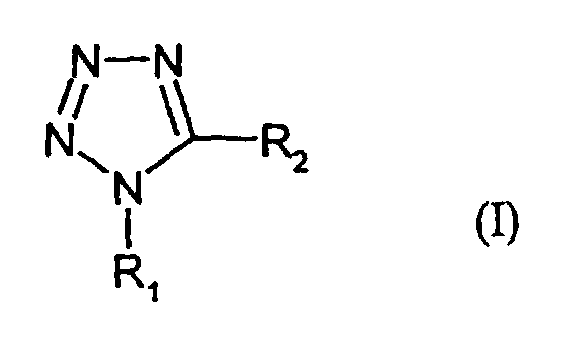 wherein
- R1
- denotes H, alkyl or aryl,
- R2
- denotes -SR3 or -NHCOR3, and
- R3
- denotes alkyl;
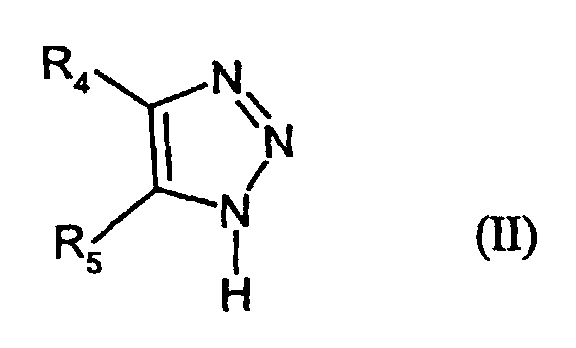
- R4
- denotes H, alkyl, aryl or -S-R3
- R5
- denotes H, alkyl, aryl, -SR3, -COR6, -COOR6, CN or hetaryl,
- R6
- denotes alkyl or aryl, and
- R3
- has the given meaning;
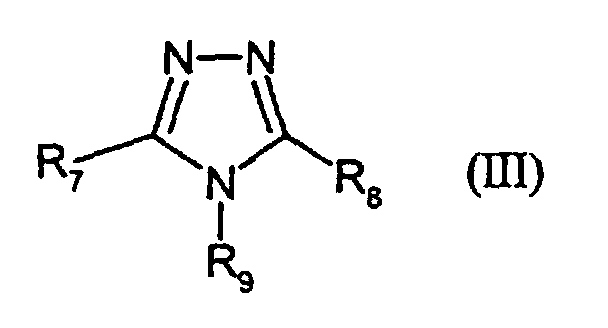
- R7 and R8,
- independently of each other, denote H, alkyl, -SR3, aryl or hetaryl,
- R9
- denotes H or alkyl, and
- R3
- has the given meaning;
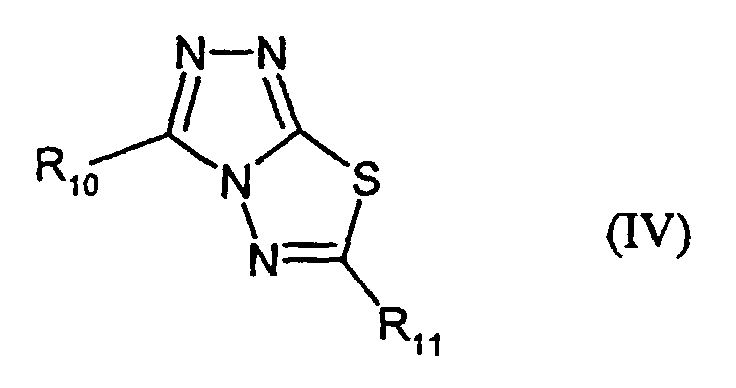
- R10 and R11,
- independently of each other, denote H, alkyl or -SR3 and
- R3
- has the given meaning;
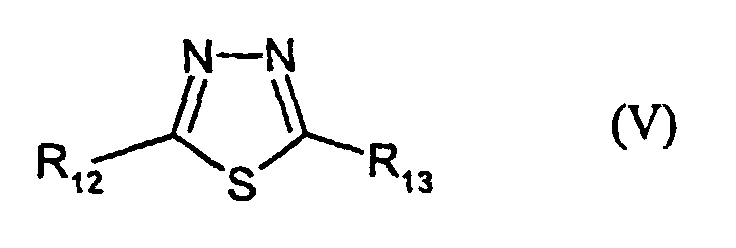
- R12 and R13 are identical or different and denote H, alkyl, -NH2 or -SR3, wherein R3 has the given meaning;

- R3 and R7 have the given meanings;

- R14
- denotes H, alkyl, -SR3 or NHCOR3,
- R15
- denotes H, alkyl, NH2 or OH, and
- R3, R9 and R12
- have the given meanings.
The alkyl, aryl and hetaryl groups can be unsubstituted or substituted, wherein SH
groups, SSO2H groups and SSO2-R groups are excluded.
Examples include:
- I-1:
- R1 = phenyl; R2 = -S-CH2-COOH
- I-2:
- R1 = H; R2 = -S-CH2-COOH
- I-3:
- R1 = H; R2 = -NHCOCH3
- II-1:
- R4 = -S-C5H11; R5 = phenoxycarbonyl
- II-2
- R4 = CH3; R5 = 4-ethoxycarbonylphenoxycarbonyl
- II-3:
- R4 = CH3; R5 = -COOC9H19
- II-4:
- R4 = -C(CH3)3; R5 = -CN
- II-5:
- R4 = 4-chlorophenyl; R5 = 4-methyl-1,3-thiazolyl-2-
- II-6:
- R4 = H; R5 = 1-(2-tolyloxycarbonyl)-propylmercapto
- II-7:
- R4 = H; R5 = -S-CH(C4H9)COOCH2CF3
- II-8:
- R4 = H; R5 = -S-CH2COOC6H13
- II-9:
- R4 = CH3; R5 = -COOC6H13
- III-1:
- R9 = H; R7 = -S-C6H13; R8 = 2-furyl
- III-2:
- R9 = H; R7 = -SCH2COOH; R8 = H
- III-3:
- R9 = H; R7 = -SCH(CH3)COOH; R8 = H
- III-4:
- R9 = CH2OH; R7 = H; R8 = H
- III-5:
- R9 = CH2COOH; R7 = -SCH3, R8 = -CH3
- IV-1:
- R10 = H; R11 = C2H5
- IV-2:
- R10 = SCH2COOH; R11 = CH2CH2COOC5H11
- V-1:
- R12 = NH2; R13 = SCH2COOH
- V-2:
- R12 = SC2H5; R13 = SCH2COOH
- V-3:
- R12 = H; R13 = SCH2COOH
- V-4:
- R12 = SCH2COOH; R13 = SCH2COOH
- V-5:
- R12 = SC2H5; R13 = S-CH2COOC5H11
- VI-1:
- R7 = H
- VI-2:
- R7 = SCH2COOH
- VI-3:
- R7 = SC6H13
- VII-1:
- R14 = SCH2COOH; R15 = CH3; R9 = H; R12 = SCH2COOH
- VII-2:
- R14 = SCH2COOH; R15 = OH; R9 = H; R12 = NH2
- VII-3:
- R14 = NHCOCH2CH2COOH; R15 = CH3 R9 = H: R12 = H
- VII-4:
- R14 = SCH2COOH; R15 = CH3; R9 = H; R12 = H
The following were tested as comparison compounds:

The silver halide emulsions which are produced according to the invention are used
in particular in photographic films, preferably in colour negative films.
Photographic films consist of a support on which at least one light-sensitive silver
halide emulsion layer is deposited. Thin films and foils are particularly suitable as
supports. A review of support materials and of the auxiliary layers which are deposited
on the front and back thereof is given in Research Disclosure 37254, Part 1
(1995), page 285 and in Research Disclosure 38957, Part XV (1996), page 627.
Photographic films usually contain at least one red-sensitive, at least one green-sensitive
and at least one blue-sensitive silver halide emulsion layer, and optionally
contain intermediate layers and protective layers also.
Depending on the type of photographic film, these layers may be arranged differently.
This will be illustrated for the most important products:
Colour photographic films such as colour negative films and colour reversal films
comprise, in the following sequence on their support: 2 or 3 red-sensitive, cyan-coupling
silver halide emulsion layers, 2 or 3 green-sensitive, magenta coupling silver
halide emulsion layers, and 2 or 3 blue-sensitive, yellow-coupling silver halide emulsion
layers. The layers of identical spectral sensitivity differ as regards their photographic
speed, wherein the less sensitive partial layers are generally disposed nearer
the support than are the more highly sensitive partial layers.
A yellow filter layer is usually provided between the green-sensitive and blue-sensitive
layers, to prevent blue light from reaching the layers underneath.
The options for different layer arrangements and their effects on photographic properties
are described in J. Inf. Rec. Mats., 1994, Vol. 22, pages 183 - 193, and in Research
Disclosure 38957, Part XI (1996), page 624.
Departures from the number and arrangement of the light-sensitive layers may be
effected in order to achieve defined results. For example, all the high-sensitivity layers
may be combined to form a layer stack and all the low-sensitivity layers may be
combined to form another layer stack in a photographic film, in order to increase the
sensitivity (DE-25 30 645).
The essential constituents of the photographic emulsion layers are binders, silver
halide grains and colour couplers.
Information on suitable binders is given in Research Disclosure 37254, Part 2 (1995),
page 286, and in Research Disclosure 38957, Part II.A (1996), page 598.
Information on suitable silver halide emulsions, their production, ripening, stabilisation
and spectral sensitisation, including suitable spectral sensitisers, is given in Research
Disclosure 37254, Part 3 (1995), page 286, in Research Disclosure 37038,
Part XV (1995), page 89, and in Research Disclosure 38957, Part V.A (1996), page
603.
Photographic materials which exhibit camera-sensitivity usually contain silver bromide-iodide
emulsions, which may also optionally contain small proportions of silver
chloride.
Information on colour couplers is to be found in Research Disclosure 37254, Part 4
(1995), page 288, in Research Disclosure 37038, Part II (1995), page 80, and in Research
Disclosure 38957, Part X.B (1996), page 616. The maximum absorption of the
dyes formed from the couplers and from the colour developer oxidation product preferably
falls within the following ranges: yellow couplers 430 to 460 nm, magenta
couplers 540 to 560 nm, cyan couplers 630 to 700 nm.
In order to improve sensitivity, granularity, sharpness and colour separation, compounds
are frequently used in colour photographic films which on reaction with the
developer oxidation product release compounds which are photographically active,
e.g. DIR couplers, which release a development inhibitor.
Information on compounds such as these, particularly couplers, is to be found in Research
Disclosure 37254, Part 5 (1995), page 290, in Research Disclosure 37038,
Part XIV (1995), page 86, and in Research Disclosure 38957, Part X.C (1996), page
618.
The colour couplers, which are mostly hydrophobic, and other hydrophobic constituents
of the layers also, are usually dissolved or dispersed in high-boiling organic solvents.
These solutions or dispersions are then emulsified in an aqueous binder solution
(usually a gelatine solution), and after the layers have been dried are present as
fine droplets (0.05 to 0.8 µm diameter) in the layers.
Suitable high-boiling organic solvents, methods of introduction into the layers of a
photographic material, and other methods of introducing chemical compounds into
photographic layers, are described in Research Disclosure 37254, Part 6 (1995), page
292.
The light-insensitive intermediate layers which are generally disposed between layers
of different spectral sensitivity may contain media which prevent the unwanted diffusion
of developer oxidation products from one light-sensitive layer into another light-sensitive
layer which has a different spectral sensitivity.
Suitable compounds (white couplers, scavengers or DOP scavengers) are described
in Research Disclosure 37254, Part 7 (1995), page 292, in Research Disclosure
37038, Part II (1995), page 84, and in Research Disclosure 38957, Part X.D (1996),
page 621 et seq.
The photographic material may additionally contain compounds which absorb UV
light, brighteners, spacers, filter dyes, formalin scavengers, light stabilisers, anti-oxidants,
DMin dyes, plasticisers (latices), biocides, additives for improving the coupler-and
dye stability, to reduce colour fogging and to reduce yellowing, and other substances.
Suitable compounds are given in Research Disclosure 37254, Part 8 (1995),
page 292, in Research Disclosure 37038, Parts IV, V, VI, VII, X, XI and XIII (1995),
pages 84 et seq., and in Research Disclosure 38957, Parts VI, VIII, IX, X (1996),
pages 607, 610 et seq.
The layers of colour photographic materials are usually hardened, i.e. the binder
used, preferably gelatine, is crosslinked by suitable chemical methods.
Suitable hardener substances are described in Research Disclosure 37254, Part 9
(1995), page 294, in Research Disclosure 37038, Part XII (1995), page 86, and in
Research Disclosure 38957, Part II.B (1996), page 599.
After image-by-image exposure, colour photographic materials are processed by different
methods corresponding to their character. Details on the procedures used and
the chemicals required therefor are published in Research Disclosure 37254, Part 10
(1995), page 294, in Research Disclosure 37038, Parts XVI to XXIII (1995), page 95
et seq., and in Research Disclosure 38957, Parts XVIII, XIX, XX (1996), together
with examples of materials.
A solution of 110 g inert gelatine and 85 g potassium bromide was made up in 7 kg
water, with stirring.
An aqueous silver nitrate solution (36 g silver nitrate in 400 g water) and an aqueous
halide solution (26 g potassium bromide in 400 g water) were metered in as a double
inflow at 40°C over 2 minutes.
This was followed by the addition of 220 g inert gelatine in 880 g water. After heating
to 60°C, an aqueous silver nitrate solution (89 g silver nitrate in 300 g water)
was added over 4 minutes, in order to obtain a pBr of 2.0 in the dispersion medium.
Thereafter, the batch was heated to 65°C again, followed by a second double inflow,
in which an aqueous silver nitrate solution (150 g silver nitrate in 900 g water) and an
aqueous halide solution (35 g potassium iodide and 64 g potassium bromide in 900 g
water) were added over 8 minutes. During the addition, the pBr in the dispersion medium
was held constant at the initial value of 2.0.
After an interval of 2 minutes, a third double inflow was effected at 65°C. After adjusting
the pBr in the dispersion medium to 1.7 with aqueous 2 N KBr solution, an
aqueous silver nitrate solution (1020 g silver nitrate in 2.5 kg water) and an aqueous
halide solution (607 g potassium bromide in 2.5 kg water) were added over 15 minutes.
The pBr in the dispersion medium was held constant at the initial value of 1.7
during this stage. After the last inflow, the emulsion was cooled to 25°C and was
flocculated by the addition of polystyrenesulphonic acid at pH 3.5, followed by washing
at a temperature of 20°C. Thereafter, the flocculate was re-dispersed by the
addition of 59 g inert gelatine in 2.6 kg water at pH 6.5 and at a temperature of 50°C.
The AgBrI emulsion consisted of more than 80 %, with respect to the projected area
of the crystals, of hexagonal tab grains with an aspect ratio of 6 and a side length
ratio between 1.0 and 1.5. The grain size was 0.45 µm, the breadth of distribution
was 19 % and the iodide content was 2.8 mol %.
A solution of 2880 g inert gelatine and 586 g potassium iodide in 130 kg water was
introduced into the batch container with stirring. The pH of this starting solution was
adjusted to 4.0 with 3 N HNO3 at 70°C.
Thereafter, solution 1 and solution 3 were metered in as a double inflow over 15 minutes
at 79°C.
After a digestion interval of 10 minutes, solution 2 was added over 6 minutes at
79°C.
After cooling to 25°C, the emulsion was flocculated by adding PSS at pH 3.3 and
was subsequently washed at 20°C. Thereafter, the flocculate was re-dispersed by
adding 10 kg water at pH 6.5 and at a temperature of 50°C.
The emulsion had a high content of hexagonal tabular crystals. The mean particle
size by volume was 0.45 µm, the iodide content was 32 % and the breadth of distribution
was 25 %.
A micrate emulsion was produced in a separate vessel by a pAg-controlled double
inflow. The emulsion consisted of 100 % silver bromide and contained 1.25 mol
AgBr/kg and 28 g gelatine/kg. The average particle size by volume was 0.05 µm.
The micrate emulsion and the preliminary precipitate were mixed in a ratio of 5:1
(with respect to their Ag contents) and were digested at 65°C, at pH 7.0 and at a UAg
of -60 mV until deposition was complete. The batch was subsequently coagulated,
washed, and re-dispersed by adding water and gelatine. The emulsion which was
obtained had a high content of hexagonal, tabular crystals with an aspect ratio of 6.
The average particle size by volume was 0.85 µm, the iodide content was 5.3 % and
the breadth of distribution was 30 %.
2600 ml of a 9.6 % by weight aqueous solution of an inert gelatine were placed
at 40°C, with stirring, in a batch container. The pI was adjusted to 1 with
about 53 ml of a 4.7 molar potassium iodide solution.
4.7 molar aqueous solutions of silver nitrate and potassium iodide were then
run into the initial batch with stirring, with the rate of inflow of the silver nitrate
solution being linearly increased from 20 to 33 ml/min, until a total of 1.6
litres had been added over 65 minutes.
Further volumes of these solutions were then added, with the rate of inflow being linearly increased from 50 to 90 ml/min, until a total of 10.8 litres of silver nitrate solution had been added over 162 minutes. During the addition, the pI of the emulsion was maintained at a value of 1 ± 0.05 by regulating the addition of the potassium iodide solution. The temperature was maintained at 40°C.
The yield was 58.5 mol silver iodide.
3420 g of a 27 % by weight aqueous gelatine solution were added, and the emulsion was subsequently desalinated.
The emulsion contained 240 g AgNO3/kg and had a gelatine/silver nitrate ratio of 0.12.
The resulting emulsion had a grain size of 0.32 µm.
The crystals consisted of 100 % silver iodide and were of simple pyramidal habit.
Further volumes of these solutions were then added, with the rate of inflow being linearly increased from 50 to 90 ml/min, until a total of 10.8 litres of silver nitrate solution had been added over 162 minutes. During the addition, the pI of the emulsion was maintained at a value of 1 ± 0.05 by regulating the addition of the potassium iodide solution. The temperature was maintained at 40°C.
The yield was 58.5 mol silver iodide.
3420 g of a 27 % by weight aqueous gelatine solution were added, and the emulsion was subsequently desalinated.
The emulsion contained 240 g AgNO3/kg and had a gelatine/silver nitrate ratio of 0.12.
The resulting emulsion had a grain size of 0.32 µm.
The crystals consisted of 100 % silver iodide and were of simple pyramidal habit.
9.16 kg of the emulsion prepared in I) were heated to 40°C with stirring and
were treated with 1496 g gelatine and 5.03 kg water. The batch was then
heated to 70°C and a 1.5 molar silver nitrate solution together with a 1.7 molar
ammonium bromide solution were added as a double inflow at a constant
rate of 460 ml/mm and at a pH of 5.6.
The batch was subsequently cooled to 30°C, its pH was adjusted to 3.5 with sulphuric acid, and it was flocculated by polystyrenesulphonic acid and then washed.
After re-dispersion, the silver nitrate content was adjusted to 200 g silver nitrate/kg by adding water. The gelatine/silver nitrate ratio was 0.2, and the average grain size was 0.46 µm. The resulting emulsion had an iodide content of 25 mol % and consisted of lamellar crystals with an aspect ratio of about 4.
The batch was subsequently cooled to 30°C, its pH was adjusted to 3.5 with sulphuric acid, and it was flocculated by polystyrenesulphonic acid and then washed.
After re-dispersion, the silver nitrate content was adjusted to 200 g silver nitrate/kg by adding water. The gelatine/silver nitrate ratio was 0.2, and the average grain size was 0.46 µm. The resulting emulsion had an iodide content of 25 mol % and consisted of lamellar crystals with an aspect ratio of about 4.
25.24 kg of the tab emulsion produced in II) were digested at 40°C together
with 100 kg of a fine-grained AgBr emulsion with a grain size of about
40 nm, a gelatine/silver nitrate ratio of 0.133 and 210 g silver nitrate/kg.
After adding 21.18 mol ammonium bromide as an aqueous solution, the fine-grained AgBr emulsion was deposited at 65°C on to the AgBrI preliminary precipitate at pH 7.2 and UAg = -70 mV for 30 minutes.
After subsequent cooling to 30°C, its pH was adjusted with sulphuric acid, and it was flocculated by polystyrenesulphonic acid and then washed.
Re-dispersion was effected at pH 6.8. The gelatine/silver nitrate ratio was adjusted to 0.2 with gelatine, and the silver nitrate content was adjusted to 200 g silver nitrate/kg with water.
The resulting tab emulsion, which contained 5 mol % iodide, had an aspect ratio of 7 at a breadth of distribution of 25 % and a grain size of 0.80 µm.
After adding 21.18 mol ammonium bromide as an aqueous solution, the fine-grained AgBr emulsion was deposited at 65°C on to the AgBrI preliminary precipitate at pH 7.2 and UAg = -70 mV for 30 minutes.
After subsequent cooling to 30°C, its pH was adjusted with sulphuric acid, and it was flocculated by polystyrenesulphonic acid and then washed.
Re-dispersion was effected at pH 6.8. The gelatine/silver nitrate ratio was adjusted to 0.2 with gelatine, and the silver nitrate content was adjusted to 200 g silver nitrate/kg with water.
The resulting tab emulsion, which contained 5 mol % iodide, had an aspect ratio of 7 at a breadth of distribution of 25 % and a grain size of 0.80 µm.
Emulsions Em-4 to Em-22 were prepared as was Em-1, except that at the start of the
production step given in Table 1 the compounds listed in Table 1 were added in the
amounts which are also given there. The aspect ratio and iodide content of the emulsions
remained substantially unchanged. The solvent for the compounds had water as
its main constituent, the solubility being improved if necessary by adding a little
methanol or alkali. ST-1 was 4-hydroxy-6-methyl-1,3,3a,7-tetra-azaindene.
| Emulsion | Step | Compound | Amount [mol/mol Ag] | Place of addition | |
| Em-1 | - | - | comparison | ||
| Em-4 | b) | III-2 | 0.61 | nucleus precipitate | comparison |
| Em-5 | d) | III-2 | 0.08 | high-iodide zone | comparison |
| Em-6 | e) | III-2 | 0.017 | AgBr shell | comparison |
| Em-7 | d) | X-1 | 1*10-6 | high-iodide zone | comparison |
| Em-8 | d) | X-2 | 1*10-6 | high-iodide zone | comparison |
| Em-9 | d) | X-3 | 1*10-6 | high-iodide zone | comparison |
| Em-10 | d) | ST-1 | 1*10-6 | high-iodide zone | comparison |
| Em-11 | b) | III-2 | 1*10-6 | nucleus precipitate | invention |
| Em-12 | d) | III-2 | 1*10-6 | high-iodide zone | invention |
| Em-13 | e) | III-2 | 1*10-6 | AgBr shell | invention |
| Em-14 | d) | III-2 | 1*10-4 | high-iodide zone | invention |
| Em-15 | d) | III-2 | 1*10-8 | high-iodide zone | invention |
| Em-16 | b) | II-9 | 1*10-7 | nucleus precipitate | invention |
| Em-17 | d) | II-9 | 1*10-7 | high-iodide zone | invention |
| Em-18 | e) | II-9 | 1*10-7 | AgBr shell | invention |
| Em-19 | b) | V-3 | 1*10-7 | nucleus precipitate | invention |
| Em-20 | d) | V-3 | 1*10-7 | high-iodide zone | invention |
| Em-21 | e) | V-3 | 1*10-7 | AgBr shell | invention |
| Em-22 | e) | V-3 | 1*10-6 | AgBr shell | invention |
Emulsions Em-23 to Em-41 were prepared as was Em-2, except that at the start of
the production step given in Table 2 the compounds listed in Table 2 were added in
the amounts which are also given there. The aspect ratio and iodide content of the
emulsions remained substantially unchanged. The solvent for the compounds had
water as its main constituent, the solubility being improved if necessary by adding a
little methanol or alkali.
| Emulsion | Step | Compound | Amount [mol/mol Ag] | Place of addition | |
| Em-2 | - | comparison | |||
| Em-23 | b) | III-2 | 0.61 | nucleus precipitate | comparison |
| Em-24 | c) | III-2 | 0.08 | iodide conversion | comparison |
| Em-25 | d) | III-2 | 0.017 | AgBr-micrate deposition | comparison |
| Em-26 | c) | X-1 | 1*10-6 | iodide conversion | comparison |
| Em-27 | c) | X-2 | 1*10-6 | iodide conversion | comparison |
| Em-28 | c) | X-3 | 1*10-6 | iodide conversion | comparison |
| Em-29 | c) | ST-1 | 1*10-6 | iodide conversion | comparison |
| Em-30 | b) | III-2 | 1*10-6 | nucleus precipitate | invention |
| Em-31 | c) | III-2 | 1*10-6 | iodide conversion | invention |
| Em-32 | d) | III-2 | 1*10-6 | AgBr-micrate deposition | invention |
| Em-33 | c) | III-2 | 1*10-4 | iodide conversion | invention |
| Em-34 | c) | III-2 | 1*10-8 | iodide conversion | invention |
| Em-35 | b) | II-9 | 1*10-7 | nucleus precipitate | invention |
| Em-36 | c) | II-9 | 1*10-7 | iodide conversion | invention |
| Em-37 | d) | II-9 | 1*10-7 | AgBr-micrate deposition | invention |
| Em-38 | b) | V-3 | 1*10-7 | nucleus precipitate | invention |
| Em-39 | c) | V-3 | 1*10-7 | iodide conversion | invention |
| Em-40 | d) | V-3 | 1*10-7 | AgBr-micrate deposition | invention |
| Em-41 | d) | V-3 | 1*10-6 | AgBr-micrate deposition | invention |
Emulsions Em-42 to Em-60 were prepared as was Em-3, except that at the start of
the production step given in Table 3 the compounds listed in Table 3 were added in
the amounts which are also given there. The aspect ratio and iodide content of the
emulsions remained substantially unchanged. The solvent for the compounds had
water as its main constituent, the solubility being improved if necessary by adding a
little methanol or alkali.
| Emulsion | Step | Compound | Amount [mol/mol Ag] | Place of addition | |
| Em-3 | - | - | comparison | ||
| Em-42 | b) | III-2 | 0.61 | nucleus precipitate | comparison |
| Em-43 | c) | III-2 | 0.08 | recrystallisation | comparison |
| Em-44 | d) | III-2 | 0.017 | AgBr-micrate deposition | comparison |
| Em-45 | c) | X-1 | 1*10-6 | recrystallisation | comparison |
| Em-46 | c) | X-2 | 1*10-6 | recrystallisation | comparison |
| Em-47 | c) | X-3 | 1*10-6 | recrystallisation | comparison |
| Em-48 | c) | ST-1 | 1*10-6 | recrystallisation | comparison |
| Em-49 | b) | III-2 | 1*10-6 | nucleus precipitate | invention |
| Em-50 | c) | III-2 | 1*10-6 | recrystallisation | invention |
| Em-51 | d) | III-2 | 1*10-6 | AgBr-micrate deposition | invention |
| Em-52 | c) | III-2 | 1*10-4 | recrystallisation | invention |
| Em-53 | c) | III-2 | 1*10-8 | recrystallisation | invention |
| Em-54 | b) | II-9 | 1*10-7 | nucleus precipitate | invention |
| Em-55 | c) | II-9 | 1*10-7 | recrystallisation | invention |
| Em-56 | d) | II-9 | 1*10-7 | AgBr-micrate deposition | invention |
| Em-57 | b) | V-3 | 1*10-7 | nucleus precipitate | invention |
| Em-58 | c) | V-3 | 1*10-7 | recrystallisation | invention |
| Em-59 | d) | V-3 | 1*10-7 | AgBr-micrate deposition | invention |
| Em-60 | d) | V-3 | 1*10-6 | AgBr-micrate deposition | invention |
Emulsion Em-1, as well as emulsions Em-4 to Em-22, were each chemically ripened
in the optimum manner, at 52°C, at a UAg of 90 mV and at pH 6.0, with 550 µmol
potassium thiocyanate, 5.0 µmol tetrachloroauric acid, 10 µmol sodium thiosulphate
and 4 µmol triphenylphosphine selenide, per mol Ag in each case, and were subsequently
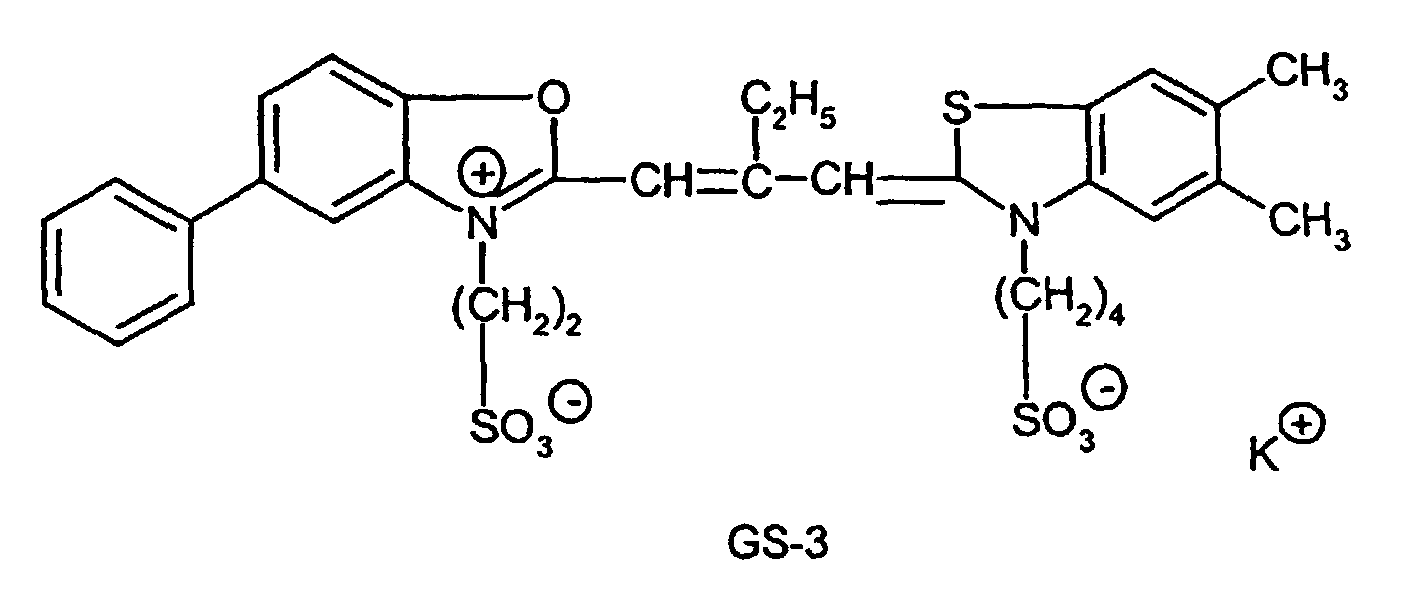
spectrally sensitised with 520 µmol GS-1, 150 µmol GS-2 and 120 µmol GS-3,
per mol Ag in each case.
Emulsions Em-2, as well as emulsions Em-23 to Em-60, were each chemically ripened
in the optimum manner, at 40°C, at a UAg of 90 mV and at pH 6.0, with
450 µmol potassium thiocyanate, 3.5 µmol tetrachloroauric acid, 12.3 µmol sodium
thiosulphate and 4.4 µmol triphenylphosphine selenide, per mol Ag in each case, and
were subsequently spectrally sensitised with 390 µmol GS-1, 110 µmol GS-2 and
90 µmol GS-3, per mol Ag in each case.

Emulsions Em-1 to Em-60 were each cast, together with an emulsion comprising the
magenta coupler M-1, 4 mmol 4-hydroxy-6-methyl-1,3,3a,7-tetraazaindene and
80 µmol 1-phenyl-5-mercaptotetrazole (ST-2) per mol Ag, on to a cellulose triacetate
film of thickness 120 µm, with following amounts being deposited per m2:
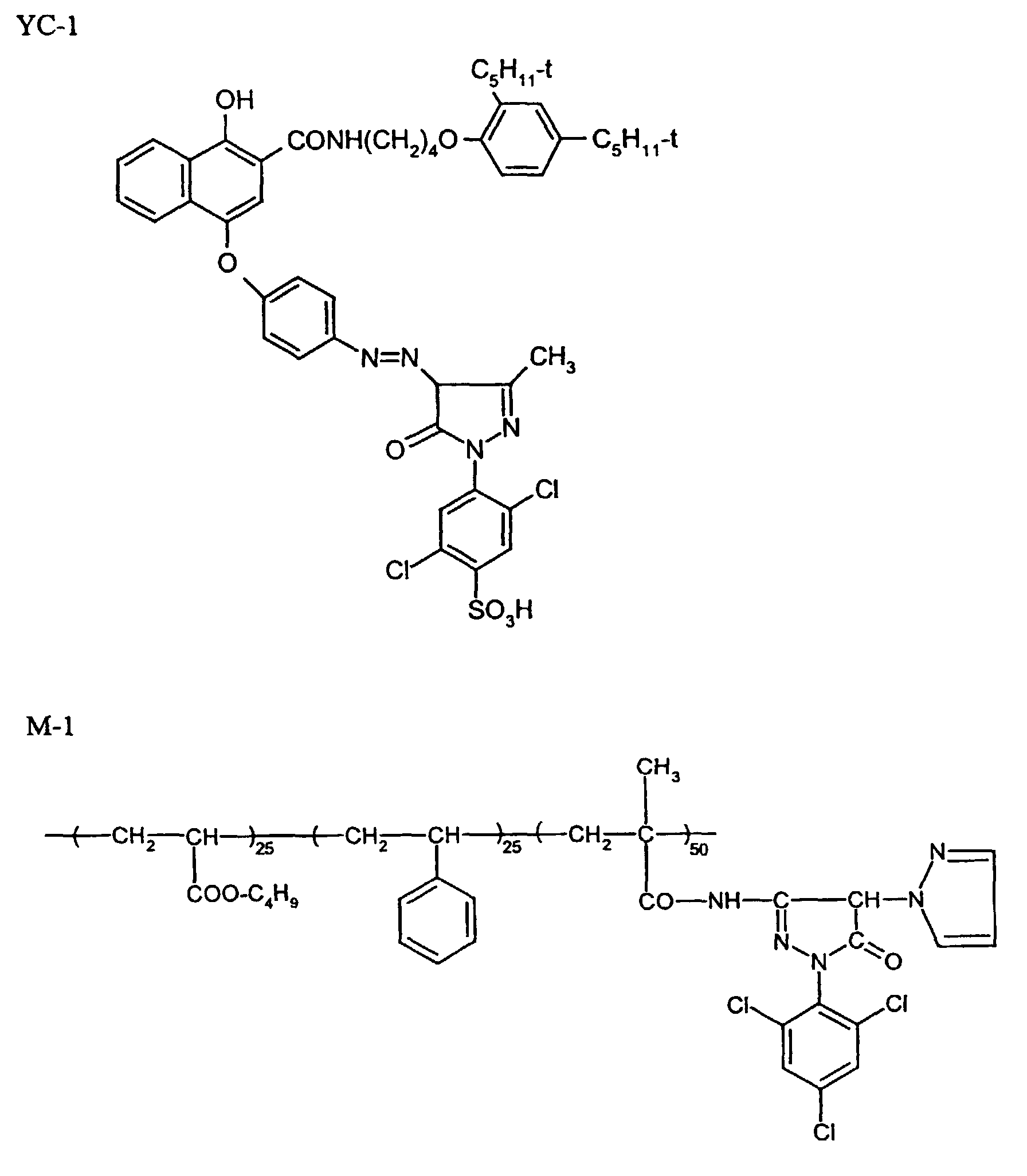
The chemical structural formula of M-1 is given in Example 2.
The hardened, dried film samples were exposed to daylight behind a graduated neutral
wedge filter. Thereafter, the materials were processed by the process described in
The British Journal of Photography 1974, page 597. The speed (S) and fogging (F)
were determined. The speed data are given with respect to a density of 0.2 above
fogging, with relative values being quoted, and with the speed of emulsion Em-1
being arbitrarily given the numerical value 100.
To check their stability in their packaged state (ΔS(pack)), the film samples were
drawn into a miniature cassette and the latter was sealed in an air-tight plastics container
of conventional size. After storing this container for 10 days at 50°C, the speed
of the stored material was determined as described above. The ΔS(pack) values were
calculated from the formula: S(stored) - S(fresh). Even for individual layers, these
values constitute a good measure of the thermal stability of the emulsions in the finished,
packed film material.
The results are given in Tables 4, 5 and 6.
The results are given in Tables 4, 5 and 6.
| rel. S | F | ΔS(pack) | |
| Em-1 | 100 | 36 | -15 |
| Em-4 | 99 | 35 | -13 |
| Em-5 | 97 | 36 | -14 |
| Em-6 | 131 | 34 | -17 |
| Em-7 | 102 | 35 | -12 |
| Em-8 | 104 | 33 | -11 |
| Em-9 | 98 | 34 | -13 |
| Em-10 | 102 | 34 | -15 |
| Em-11 | 139 | 36 | -5 |
| Em-12 | 144 | 34 | -4 |
| Em-13 | 137 | 32 | -5 |
| Em-14 | 141 | 33 | -4 |
| Em-15 | 145 | 34 | -3 |
| Em-16 | 147 | 33 | -3 |
| Em-17 | 152 | 34 | -4 |
| Em-18 | 149 | 32 | -5 |
| Em-19 | 135 | 35 | -6 |
| Em-20 | 142 | 34 | -4 |
| Em-21 | 139 | 31 | -4 |
| Em-22 | 137 | 32 | -5 |
| rel. S | F | ΔS(pack) | |
| Em-2 | 100 | 34 | -18 |
| Em-23 | 102 | 35 | -15 |
| Em-24 | 99 | 34 | -14 |
| Em-25 | 101 | 35 | -13 |
| Em-26 | 100 | 36 | -15 |
| Em-27 | 98 | 34 | -14 |
| Em-28 | 97 | 34 | -17 |
| Em-29 | 103 | 35 | -14 |
| Em-30 | 145 | 34 | -5 |
| Em-31 | 151 | 35 | -6 |
| Em-32 | 143 | 35 | -5 |
| Em-33 | 150 | 36 | -4 |
| Em-34 | 152 | 34 | -5 |
| Em-35 | 138 | 35 | -5 |
| Em-36 | 147 | 34 | -6 |
| Em-37 | 141 | 34 | -4 |
| Em-38 | 142 | 33 | -4 |
| Em-39 | 145 | 34 | -5 |
| Em-40 | 142 | 35 | -4 |
| Em-41 | 143 | 34 | -6 |
| rel. S | F | ΔS(pack) | |
| Em-3 | 100 | 38 | -21 |
| Em-42 | 103 | 36 | -18 |
| Em-43 | 99 | 37 | -22 |
| Em-44 | 100 | 37 | -19 |
| Em-45 | 102 | 36 | -21 |
| Em-46 | 104 | 36 | -17 |
| Em-47 | 97 | 35 | -15 |
| Em-48 | 98 | 35 | -19 |
| Em-49 | 136 | 36 | -6 |
| Em-50 | 134 | 35 | -7 |
| Em-51 | 140 | 37 | -4 |
| Em-52 | 132 | 37 | -7 |
| Em-53 | 133 | 36 | -5 |
| Em-54 | 141 | 35 | -6 |
| Em-55 | 144 | 36 | -6 |
| Em-56 | 149 | 35 | -7 |
| Em-57 | 132 | 34 | -5 |
| Em-58 | 135 | 35 | -4 |
| Em-59 | 140 | 37 | -5 |
| Em-60 | 141 | 36 | -6 |
It can be seen that the photographic layers comprising the emulsions according to the
invention exhibited a significantly higher speed with low fogging, as well as very
good stability in their packed state.
A colour photographic recording material for colour negative colour development
was produced (layer structure 2A) by depositing the following layers in the given
sequence on a transparent film base made of cellulose acetate. The quantitative data
are given with respect to 1 m2 in each case. The corresponding amounts of AgNO3
are quoted for silver halide deposition. The silver halides were stabilised with 4
mmol ST-1 and 80 µmol ST-2 per mol AgNO3. All the emulsions were chemically
ripened in the optimum manner with sulphur, selenium and gold.
- 0.3 g
- black colloidal silver
- 1.2 g
- gelatine
- 0.3 g
- UV absorber UV-1
- 0.2 g
- DOP scavenger SC-1
- 0.02 g
- tricresyl phosphate (TCP)
- 0.7 g
- AgNO3 of an AgBrI emulsion, spectrally sensitised to red, 4 mol % iodide, average grain diameter 0.42 µm, aspect ratio 5, breadth of distribution 25 %
- 1 g
- gelatine
- 0.35 g
- colourless coupler C-1
- 0.05 g
- coloured coupler RC-1
- 0.03 g
- coloured coupler YC-1
- 0.36 g
- TCP
- 0.8 g
- AgNO3 of an AgBrI emulsion, spectrally sensitised to red, 5 mol % iodide, average grain diameter 0.53 µm, aspect ratio 6, breadth of distribution 23 %
- 0.6 g
- gelatine
- 0.15 g
- colourless coupler C-2
- 0.03 g
- coloured coupler RC-1
- 0.02 g
- DIR coupler D-1
- 0.18 g
- TCP
- 1 g
- AgNO3 of an AgBrI emulsion, spectrally sensitised to red, 6 mol % iodide, average grain diameter 0.85 µm, aspect ratio 9, breadth of distribution 20 %
- 1 g
- gelatine
- 0.1 g
- colourless coupler C-2
- 0.005 g
- DIR coupler D-2
- 0.11 g
- TCP
- 0.8 g
- gelatine
- 0.07 g
- DOP scavenger SC-2
- 0.06 g
- aluminium salt of aurin-tricarboxylic acid
- 0.7 g
- AgNO3 of an AgBrI emulsion, spectrally sensitised to green, 4 mol % iodide, average grain diameter 0.35 µm, aspect ratio 5, breadth of distribution 20 %
- 0.8 g
- gelatine
- 0.22 g
- colourless coupler M-1
- 0.065 g
- coloured coupler YM-1
- 0.02 g
- DIR coupler D-3
- 0.2 g
- TCP
- 0.9 g
- AgNO3 of Em-1
- 1 g
- gelatine
- 0.16 g
- colourless coupler M-1
- 0.04 g
- coloured coupler YM-1
- 0.015 g
- DIR coupler D-4
- 0.14 g
- TCP
- 0.6 g
- AgNO3 of Em-2
- 1.1 g
- gelatine
- 0.05 g
- colourless coupler M-2
- 0.01 g
- coloured coupler YM-2
- 0.02 g
- DIR coupler D-5
- 0.08 g
- TCP
- 0.09 g
- yellow dye GF-1
- 1 g
- gelatine
- 0.08 g
- DOP scavenger SC-2
- 0.26 g
- TCP
- 0.3 g
- AgNO3 of an AgBrI emulsion, spectrally sensitised to blue, 6 mol % iodide, average grain diameter 0.44 µm, aspect ratio 4, breadth of distribution 20 %,
- 0.5 g
- AgNO3 of an AgBrI emulsion, spectrally sensitised to blue, 6 mol % iodide, average grain diameter 0.50 µm, aspect ratio 5, breadth of distribution 18 %,
- 1.9 g
- gelatine
- 1.1 g
- colourless coupler Y-1
- 0.037 g
- DIR coupler D-6
- 0.6 g
- TCP
- 0.6 g
- AgNO3 of an AgBrI emulsion, spectrally sensitised to blue, 6 mol % iodide, average grain diameter 0.82 µm, aspect ratio 12, breadth of distribution 22 %,
- 1.2 g
- gelatine
- 0.1 g
- colourless coupler Y-1
- 0.006 g
- DIR coupler D-7
- 0.11 g
- TCP
- 0.1 g
- AgNO3 of a micrate-AgBrI emulsion, 0.5 mol % iodide, average grain diameter 0.06 µm,
- 1 g
- gelatine
- 0.004 mg
- K2[PdCl4]
- 0.4 g
- UV absorber UV-2
- 0.3 g
- TCP
- 0.25 g
- gelatine
- 0.75 g
- hardener H-1
After hardening, the overall layer structure had a swelling factor ≤ 3.5.
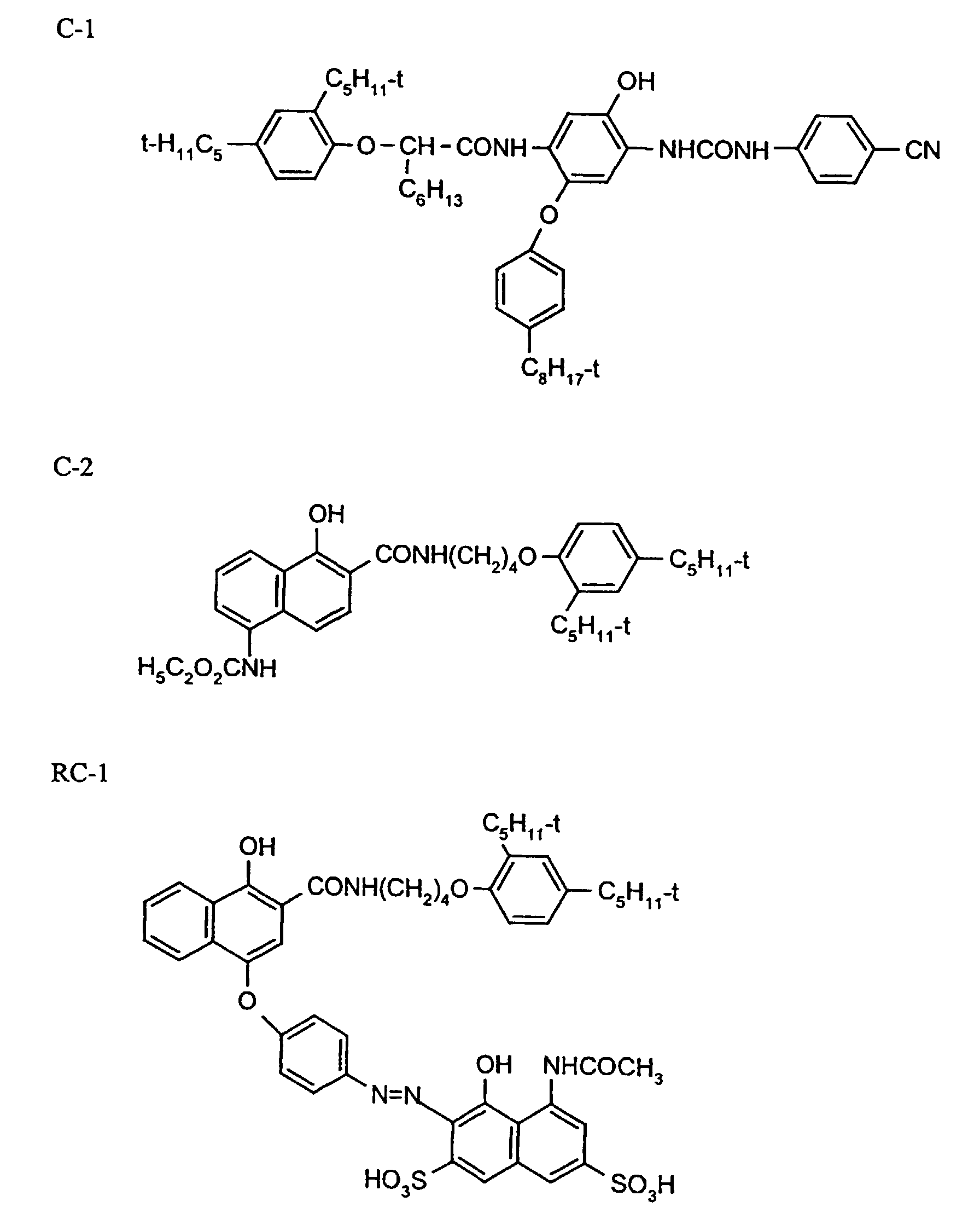
Substances used in Example 1:

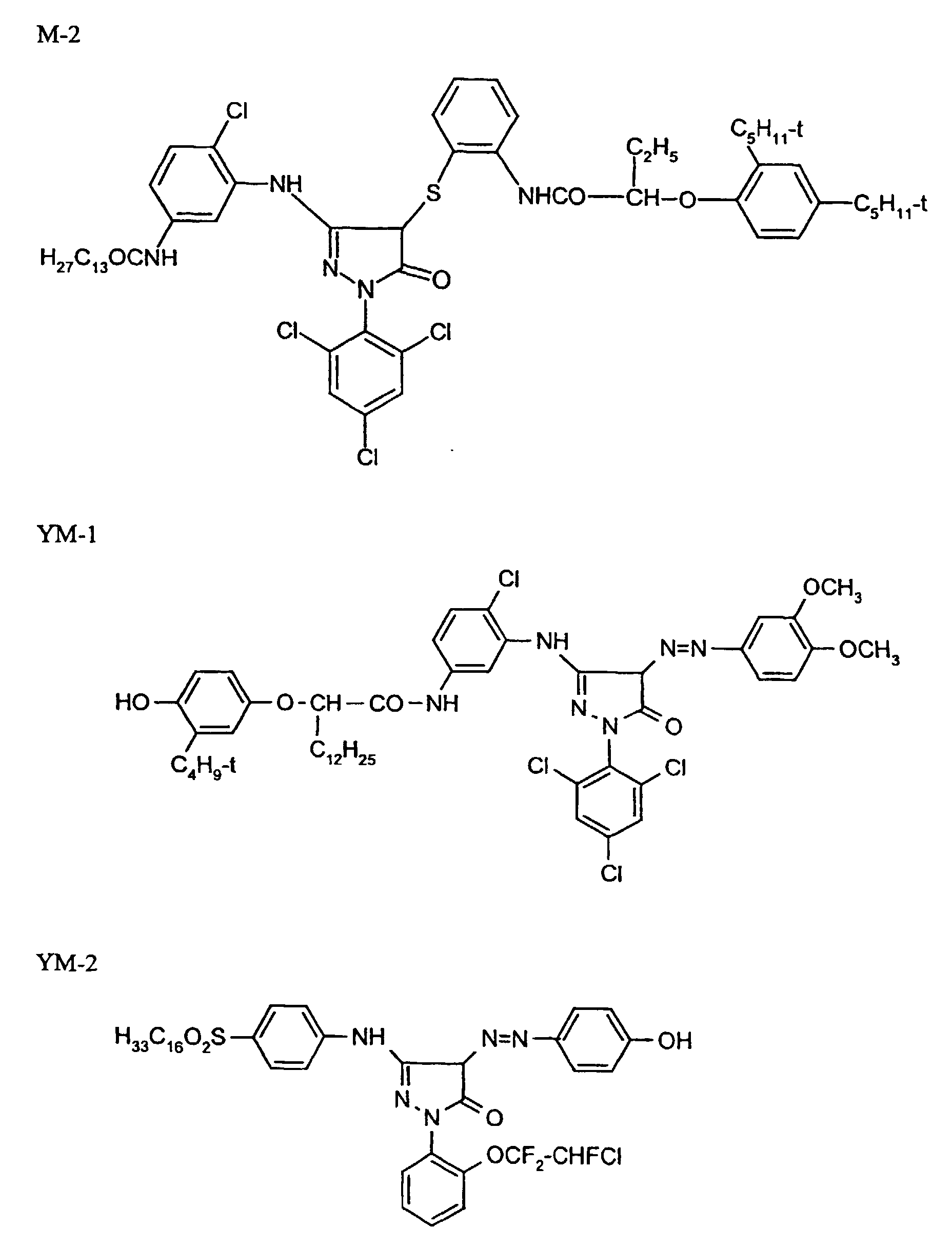
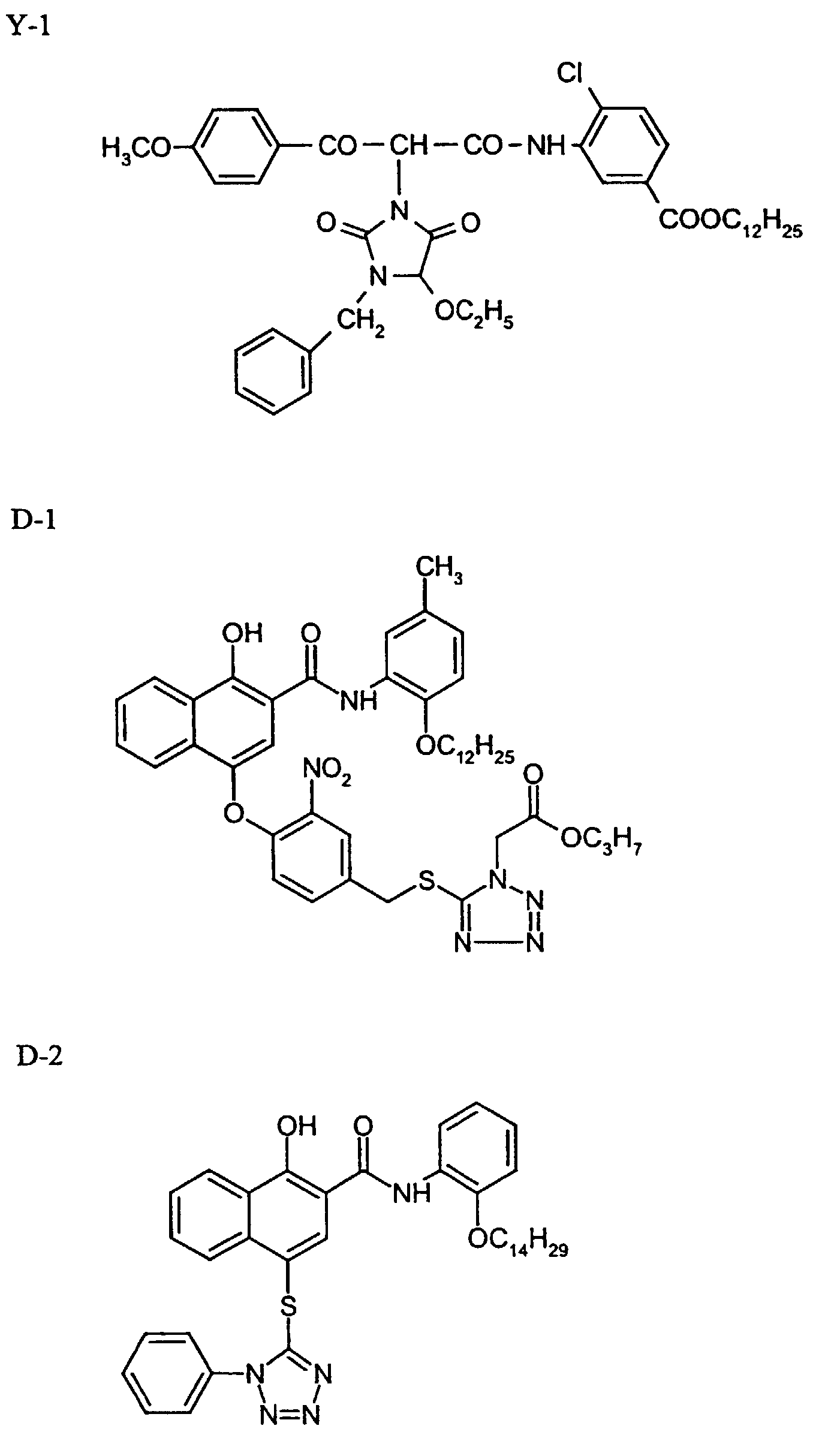
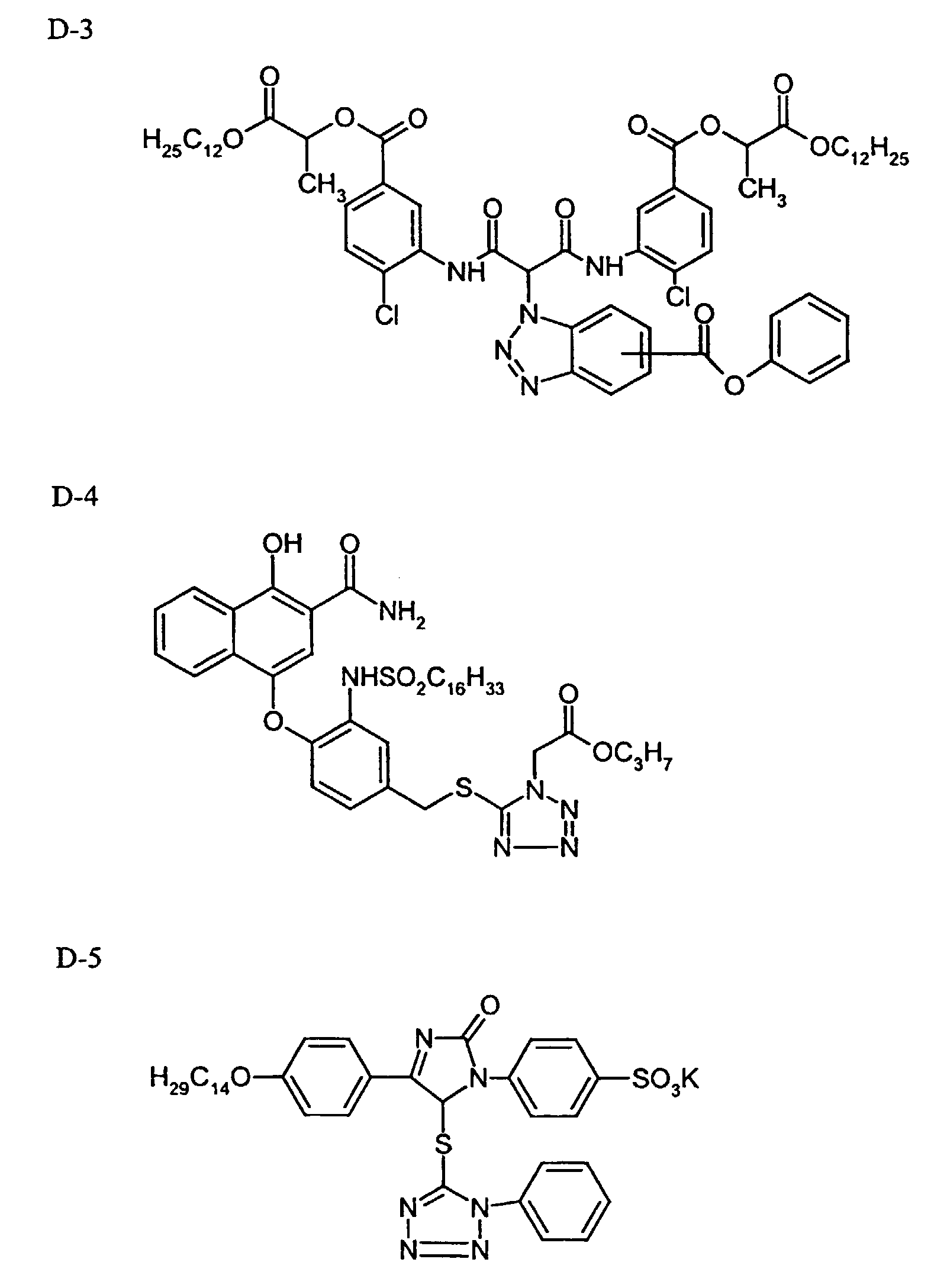
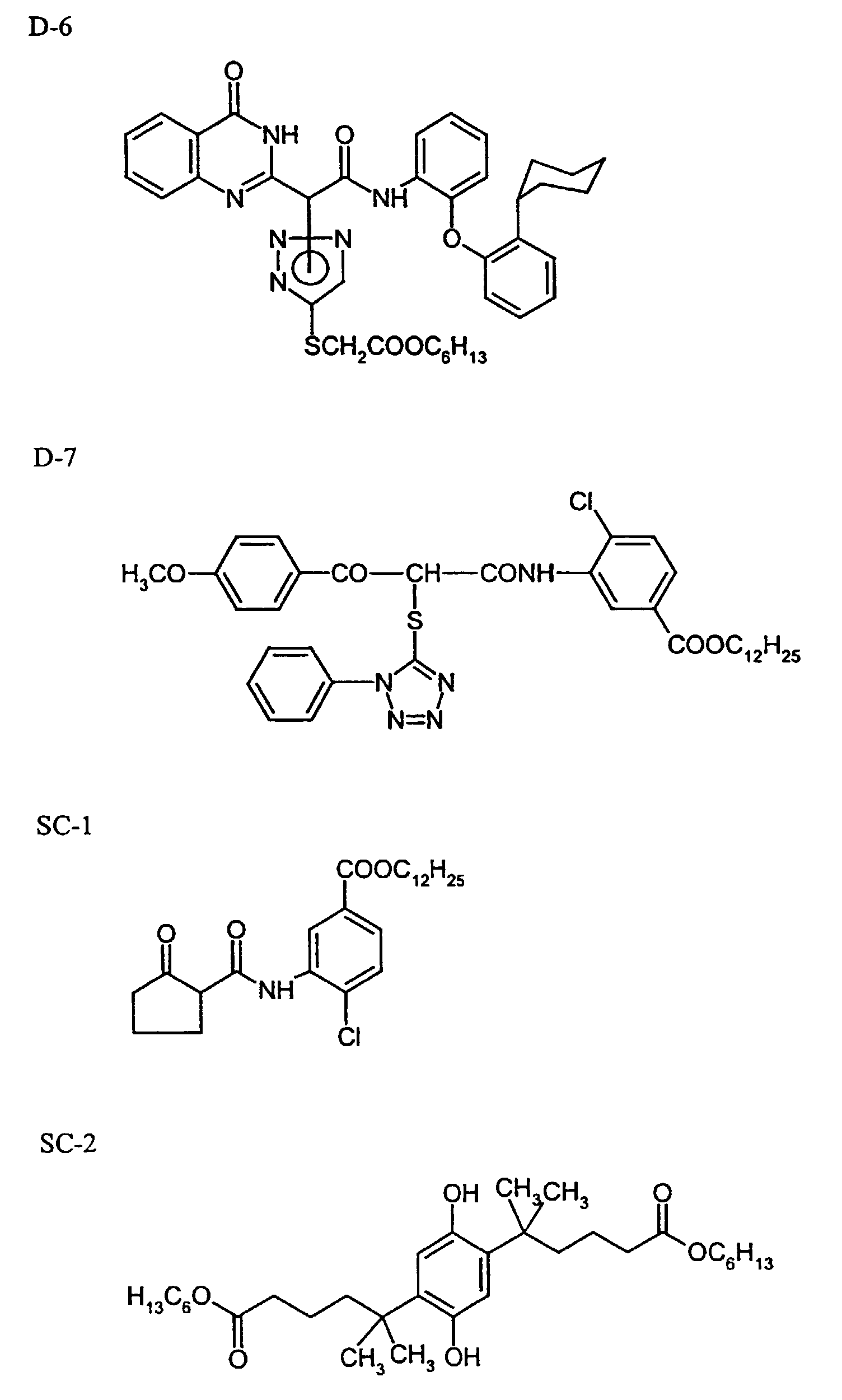
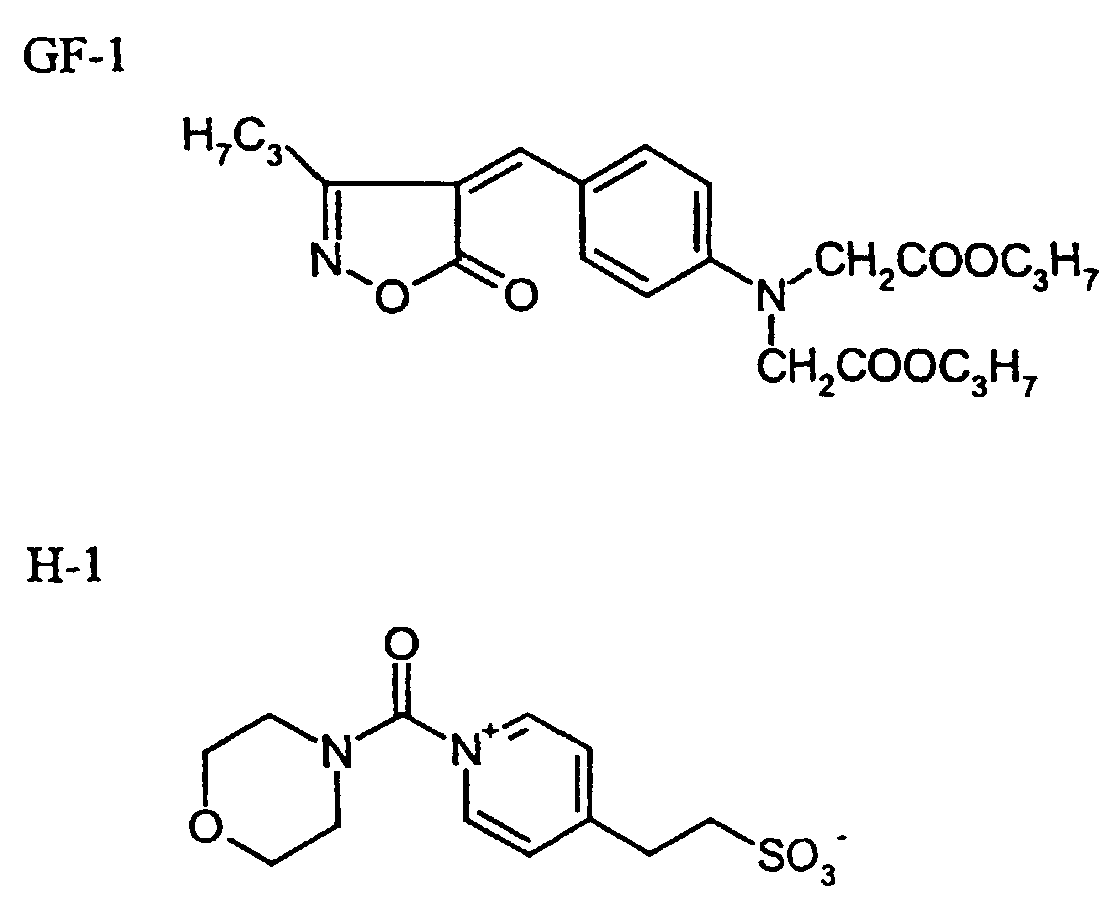
Layer structures 2B to 2N were produced as for 2A, except that emulsion Em-2 in the
8th layer was replaced by the emulsions listed in Table 7.
The dried film samples were exposed to daylight behind a graduated neutral wedge
filter. Thereafter, the materials were processed by the process described in The British
Journal of Photography 1974, page 597. The speed (S), fogging (F) and
ΔS(pack) were determined (see Example 1). The speed data are given with respect to
a density of 0.2 above fogging, with relative values being quoted, and with the speed
of emulsion Em-1 being arbitrarily given the numerical value of 100.
The results are given in Table 7.
| Layer structure | Emulsion in the 8th layer | S (magenta) | F (magenta) | ΔS(pack) (magenta) | |
| 2A | Em-2 | 100 | 60 | -15 | comparison |
| 2B | Em-23 | 101 | 61 | -14 | comparison |
| 2C | Em-24 | 100 | 59 | -13 | comparison |
| 2D | Em-25 | 102 | 60 | -14 | comparison |
| 2E | Em-30 | 121 | 61 | -3 | invention |
| 2F | Em-31 | 123 | 60 | -4 | invention |
| 2G | Em-32 | 120 | 59 | -3 | invention |
| 2H | Em-33 | 125 | 59 | -4 | invention |
| 2I | Em-34 | 125 | 60 | -5 | invention |
| 2J | Em-35 | 119 | 59 | -3 | invention |
| 2K | Em-36 | 123 | 60 | -5 | invention |
| 2L | Em-37 | 120 | 61 | -3 | invention |
| 2M | Em-38 | 119 | 59 | -5 | invention |
| 2N | Em-39 | 121 | 59 | -4 | invention |
| 2O | Em-40 | 120 | 61 | -5 | invention |
| 2P | Em-41 | 120 | 60 | -4 | invention |
It can be seen that the film samples comprising the emulsions according to the invention
exhibited a significantly higher speed with low fogging, as well as very good
thermal stability in their packed state.
Claims (6)
- A process for producing tabular silver bromide-iodide and silver bromide-chloride-iodide emulsions with an aspect ratio ≥2, an iodide content from 1 to 40 mol % and a chloride content from 0 to 20 mol %, by the process steps of (a) silver halide nucleus precipitation, and (b) at least one further precipitation of silver halide, characterised in that at least one aromatic five- or six-membered, heterocyclic compound, which is free from -SH-, -SSO2H- and - SSO2R groups, is added in an amount from 10-9 to 10-4 mol/mol silver during nucleus precipitation or during the precipitation of an inner zone of the silver halide grain which is different from the nucleus precipitate.
- A process according to claim 1, characterised in that further silver halide precipitations following nucleus precipitation are effected by adding soluble silver salts and soluble halides or by adding and depositing a fine-grained micrate emulsion.
- A process according to claim 1, characterised in that the aspect ratio is 4 to 30 and the iodide content is 3 to 20 mol %.
- A process according to claim 1, characterised in that the nucleus precipitate is an AgCl, AgBr, AgI, AgClBr, AgBrI or AgClBrI emulsion.
- A process according to claim 1, characterised in that the at least one heterocyclic compound is used in an amount from 10-8 to 10-5 mol/mol silver.
- A process according to claim 1, characterised in that the at least one heterocyclic compound corresponds to one of formulae I to VIIwherein

- R1
- denotes H, alkyl or aryl,
- R2
- denotes -SR3 or -NHCOR3, and
- R3
- denotes alkyl;
wherein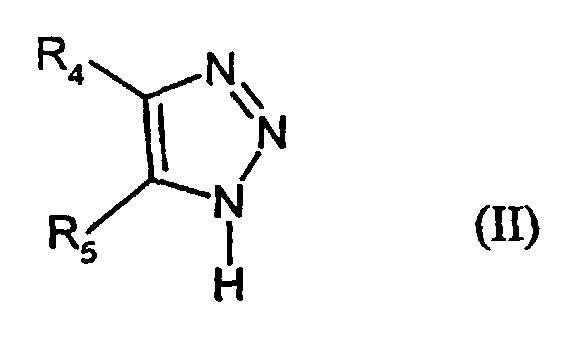
- R4
- denotes H, alkyl, aryl or -S-R3
- R5
- denotes H, alkyl, aryl, -SR3, -COR6, -COOR6, CN or hetaryl,
- R6
- denotes alkyl or aryl, and
- R3
- has the given meaning;
wherein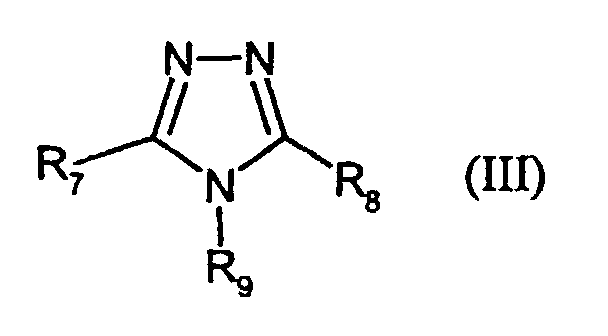
- R7 and R8,
- independently of each other, denote H, alkyl, -SR3, aryl or hetaryl,
- R9
- denotes H or alkyl, and
- R3
- has the given meaning;
wherein
- R10 and R11,
- independently of each other, denote H, alkyl or -SR3 and
- R3
- has the given meaning;
wherein the radicals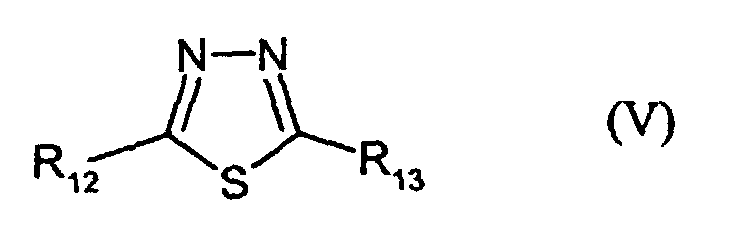 R12 and R13 are identical or different and denote H, alkyl, -NH2 or -SR3, wherein R3 has the given meaning;wherein
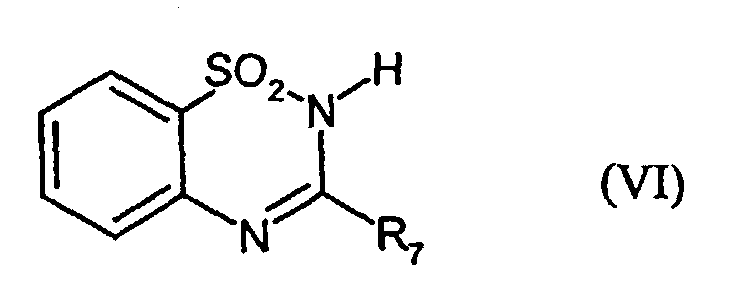 R3 and R7 have the given meanings;wherein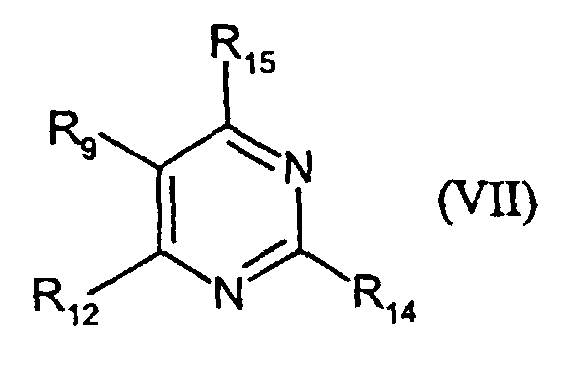
- R14
- denotes H, alkyl, -SR3 or NHCOR3,
- R15
- denotes H, alkyl, NH2 or OH, and
- R3, R9 and R12
- have the given meanings.
Applications Claiming Priority (2)
| Application Number | Priority Date | Filing Date | Title |
|---|---|---|---|
| DE19933258A DE19933258A1 (en) | 1999-07-15 | 1999-07-15 | Preparation of silver halide emulsions |
| DE19933258 | 1999-07-15 |
Publications (1)
| Publication Number | Publication Date |
|---|---|
| EP1069466A1 true EP1069466A1 (en) | 2001-01-17 |
Family
ID=7914934
Family Applications (1)
| Application Number | Title | Priority Date | Filing Date |
|---|---|---|---|
| EP00202553A Withdrawn EP1069466A1 (en) | 1999-07-15 | 2000-07-14 | Production of silver halide emulsions |
Country Status (3)
| Country | Link |
|---|---|
| US (1) | US6261758B1 (en) |
| EP (1) | EP1069466A1 (en) |
| DE (1) | DE19933258A1 (en) |
Citations (3)
| Publication number | Priority date | Publication date | Assignee | Title |
|---|---|---|---|---|
| EP0369235A1 (en) * | 1988-11-12 | 1990-05-23 | Agfa-Gevaert AG | Photographic-recording material |
| DE4233714A1 (en) * | 1992-10-07 | 1994-04-14 | Agfa Gevaert Ag | Process for the preparation of silver halide emulsions |
| DE19831281A1 (en) * | 1998-07-13 | 2000-01-20 | Agfa Gevaert Ag | Production of a silver bromide-iodide emulsion with core-shell grains useful in color negative film uses 5-ring heterocycle with no mercapto or thiosulfonate substituents during double-jet precipitation of high bromide shell |
Family Cites Families (6)
| Publication number | Priority date | Publication date | Assignee | Title |
|---|---|---|---|---|
| BE758242A (en) * | 1969-11-06 | 1971-04-30 | Agfa Gevaert Nv | PHOTOGRAPHIC FINE GRAINY SILVER HALOGENIDE EMULSIONS |
| BE792093A (en) * | 1971-12-09 | 1973-05-30 | Agfa Gevaert Nv | VOOR PROCESS OF BEREIDING VAN FOTOGRAFISCHE FIJNKORRELIGE ZILVERHALOGENIDE-EMULSIES |
| JPS60163042A (en) * | 1984-02-03 | 1985-08-24 | Fuji Photo Film Co Ltd | Photosensitive material |
| US5468602A (en) * | 1993-11-10 | 1995-11-21 | Konica Corporation | Method for producing silver halide photographic light-sensitive material |
| US5411851A (en) * | 1994-02-14 | 1995-05-02 | Eastman Kodak Company | Grain growth process for the preparation of high bromide ultrathin tabular grain emulsions |
| US5491056A (en) * | 1994-08-26 | 1996-02-13 | Eastman Kodak Company | Process of forming a photographic emulsion |
-
1999
- 1999-07-15 DE DE19933258A patent/DE19933258A1/en not_active Withdrawn
-
2000
- 2000-07-14 EP EP00202553A patent/EP1069466A1/en not_active Withdrawn
- 2000-07-14 US US09/616,445 patent/US6261758B1/en not_active Expired - Fee Related
Patent Citations (3)
| Publication number | Priority date | Publication date | Assignee | Title |
|---|---|---|---|---|
| EP0369235A1 (en) * | 1988-11-12 | 1990-05-23 | Agfa-Gevaert AG | Photographic-recording material |
| DE4233714A1 (en) * | 1992-10-07 | 1994-04-14 | Agfa Gevaert Ag | Process for the preparation of silver halide emulsions |
| DE19831281A1 (en) * | 1998-07-13 | 2000-01-20 | Agfa Gevaert Ag | Production of a silver bromide-iodide emulsion with core-shell grains useful in color negative film uses 5-ring heterocycle with no mercapto or thiosulfonate substituents during double-jet precipitation of high bromide shell |
Also Published As
| Publication number | Publication date |
|---|---|
| DE19933258A1 (en) | 2001-01-18 |
| US6261758B1 (en) | 2001-07-17 |
Similar Documents
| Publication | Publication Date | Title |
|---|---|---|
| US4298683A (en) | Light-sensitive photographic material | |
| US4472496A (en) | Process for preparing silver halide emulsion | |
| US4985351A (en) | Photographic recording material | |
| US4939077A (en) | Photographic recording material containing polyester compounds having free acid groups | |
| US5200301A (en) | Color photographic recording material | |
| US5108883A (en) | Color photographic recording material | |
| US6261758B1 (en) | Production of silver halide emulsions | |
| USH583H (en) | Silver halide color photographic material | |
| US5455154A (en) | Photographic recording material | |
| US5158864A (en) | Color photographic material | |
| EP0369235B1 (en) | Photographic-recording material | |
| US5120638A (en) | Silver halide emulsion and a photographic material | |
| US5134059A (en) | Color photographic recording material containing color couplers | |
| US6280921B1 (en) | Color photographic silver halide material | |
| JP3145841B2 (en) | Silver halide materials for color photography | |
| US4810627A (en) | Photographic recording material | |
| JPH01270051A (en) | Silver halide color photographic sensitive material | |
| EP0447657B1 (en) | Photographic recording material | |
| JP2678610B2 (en) | Silver halide photographic fog suppressant | |
| DE3838467A1 (en) | Photographic recording material | |
| WO1991010165A1 (en) | Improved performance of photographic emulsions at high silver ion activities | |
| EP0616256A1 (en) | Colour photographic recording material | |
| JPH0391735A (en) | Silver halide photographic sensitive material | |
| DE4008067A1 (en) | Colour photographic recording material - uses specific di:keto sec. amine yellow couplers and 1-phenyl-3-anilino-pyrazolone deriv. magenta couplersy acid treatment | |
| JPH08254786A (en) | Silver halide photographic emulsion and silver halide photographic sensitive material |
Legal Events
| Date | Code | Title | Description |
|---|---|---|---|
| PUAI | Public reference made under article 153(3) epc to a published international application that has entered the european phase |
Free format text: ORIGINAL CODE: 0009012 |
|
| AK | Designated contracting states |
Kind code of ref document: A1 Designated state(s): DE FR GB |
|
| AX | Request for extension of the european patent |
Free format text: AL;LT;LV;MK;RO;SI |
|
| 17P | Request for examination filed |
Effective date: 20010717 |
|
| AKX | Designation fees paid |
Free format text: DE FR GB |
|
| RAP1 | Party data changed (applicant data changed or rights of an application transferred) |
Owner name: AGFA-GEVAERT |
|
| 17Q | First examination report despatched |
Effective date: 20040420 |
|
| STAA | Information on the status of an ep patent application or granted ep patent |
Free format text: STATUS: THE APPLICATION IS DEEMED TO BE WITHDRAWN |
|
| 18D | Application deemed to be withdrawn |
Effective date: 20041103 |