EP1069126B1 - Triazolopurine derivatives, medicinal composition containing the derivatives, adenosine a3 receptor compatibilizing agent, and asthmatic remedy - Google Patents
Triazolopurine derivatives, medicinal composition containing the derivatives, adenosine a3 receptor compatibilizing agent, and asthmatic remedy Download PDFInfo
- Publication number
- EP1069126B1 EP1069126B1 EP99909349A EP99909349A EP1069126B1 EP 1069126 B1 EP1069126 B1 EP 1069126B1 EP 99909349 A EP99909349 A EP 99909349A EP 99909349 A EP99909349 A EP 99909349A EP 1069126 B1 EP1069126 B1 EP 1069126B1
- Authority
- EP
- European Patent Office
- Prior art keywords
- group
- phenyl
- compound
- butyl
- substituent
- Prior art date
- Legal status (The legal status is an assumption and is not a legal conclusion. Google has not performed a legal analysis and makes no representation as to the accuracy of the status listed.)
- Expired - Lifetime
Links
Classifications
-
- C—CHEMISTRY; METALLURGY
- C07—ORGANIC CHEMISTRY
- C07D—HETEROCYCLIC COMPOUNDS
- C07D487/00—Heterocyclic compounds containing nitrogen atoms as the only ring hetero atoms in the condensed system, not provided for by groups C07D451/00 - C07D477/00
- C07D487/12—Heterocyclic compounds containing nitrogen atoms as the only ring hetero atoms in the condensed system, not provided for by groups C07D451/00 - C07D477/00 in which the condensed system contains three hetero rings
- C07D487/14—Ortho-condensed systems
-
- A—HUMAN NECESSITIES
- A61—MEDICAL OR VETERINARY SCIENCE; HYGIENE
- A61P—SPECIFIC THERAPEUTIC ACTIVITY OF CHEMICAL COMPOUNDS OR MEDICINAL PREPARATIONS
- A61P11/00—Drugs for disorders of the respiratory system
- A61P11/06—Antiasthmatics
-
- A—HUMAN NECESSITIES
- A61—MEDICAL OR VETERINARY SCIENCE; HYGIENE
- A61P—SPECIFIC THERAPEUTIC ACTIVITY OF CHEMICAL COMPOUNDS OR MEDICINAL PREPARATIONS
- A61P11/00—Drugs for disorders of the respiratory system
- A61P11/10—Expectorants
-
- A—HUMAN NECESSITIES
- A61—MEDICAL OR VETERINARY SCIENCE; HYGIENE
- A61P—SPECIFIC THERAPEUTIC ACTIVITY OF CHEMICAL COMPOUNDS OR MEDICINAL PREPARATIONS
- A61P11/00—Drugs for disorders of the respiratory system
- A61P11/14—Antitussive agents
-
- A—HUMAN NECESSITIES
- A61—MEDICAL OR VETERINARY SCIENCE; HYGIENE
- A61P—SPECIFIC THERAPEUTIC ACTIVITY OF CHEMICAL COMPOUNDS OR MEDICINAL PREPARATIONS
- A61P17/00—Drugs for dermatological disorders
- A61P17/04—Antipruritics
-
- A—HUMAN NECESSITIES
- A61—MEDICAL OR VETERINARY SCIENCE; HYGIENE
- A61P—SPECIFIC THERAPEUTIC ACTIVITY OF CHEMICAL COMPOUNDS OR MEDICINAL PREPARATIONS
- A61P25/00—Drugs for disorders of the nervous system
- A61P25/04—Centrally acting analgesics, e.g. opioids
-
- A—HUMAN NECESSITIES
- A61—MEDICAL OR VETERINARY SCIENCE; HYGIENE
- A61P—SPECIFIC THERAPEUTIC ACTIVITY OF CHEMICAL COMPOUNDS OR MEDICINAL PREPARATIONS
- A61P29/00—Non-central analgesic, antipyretic or antiinflammatory agents, e.g. antirheumatic agents; Non-steroidal antiinflammatory drugs [NSAID]
-
- A—HUMAN NECESSITIES
- A61—MEDICAL OR VETERINARY SCIENCE; HYGIENE
- A61P—SPECIFIC THERAPEUTIC ACTIVITY OF CHEMICAL COMPOUNDS OR MEDICINAL PREPARATIONS
- A61P35/00—Antineoplastic agents
- A61P35/02—Antineoplastic agents specific for leukemia
-
- A—HUMAN NECESSITIES
- A61—MEDICAL OR VETERINARY SCIENCE; HYGIENE
- A61P—SPECIFIC THERAPEUTIC ACTIVITY OF CHEMICAL COMPOUNDS OR MEDICINAL PREPARATIONS
- A61P37/00—Drugs for immunological or allergic disorders
- A61P37/08—Antiallergic agents
-
- A—HUMAN NECESSITIES
- A61—MEDICAL OR VETERINARY SCIENCE; HYGIENE
- A61P—SPECIFIC THERAPEUTIC ACTIVITY OF CHEMICAL COMPOUNDS OR MEDICINAL PREPARATIONS
- A61P43/00—Drugs for specific purposes, not provided for in groups A61P1/00-A61P41/00
-
- A—HUMAN NECESSITIES
- A61—MEDICAL OR VETERINARY SCIENCE; HYGIENE
- A61P—SPECIFIC THERAPEUTIC ACTIVITY OF CHEMICAL COMPOUNDS OR MEDICINAL PREPARATIONS
- A61P9/00—Drugs for disorders of the cardiovascular system
- A61P9/10—Drugs for disorders of the cardiovascular system for treating ischaemic or atherosclerotic diseases, e.g. antianginal drugs, coronary vasodilators, drugs for myocardial infarction, retinopathy, cerebrovascula insufficiency, renal arteriosclerosis
-
- A—HUMAN NECESSITIES
- A61—MEDICAL OR VETERINARY SCIENCE; HYGIENE
- A61P—SPECIFIC THERAPEUTIC ACTIVITY OF CHEMICAL COMPOUNDS OR MEDICINAL PREPARATIONS
- A61P9/00—Drugs for disorders of the cardiovascular system
- A61P9/12—Antihypertensives
-
- C—CHEMISTRY; METALLURGY
- C07—ORGANIC CHEMISTRY
- C07F—ACYCLIC, CARBOCYCLIC OR HETEROCYCLIC COMPOUNDS CONTAINING ELEMENTS OTHER THAN CARBON, HYDROGEN, HALOGEN, OXYGEN, NITROGEN, SULFUR, SELENIUM OR TELLURIUM
- C07F9/00—Compounds containing elements of Groups 5 or 15 of the Periodic Table
- C07F9/02—Phosphorus compounds
- C07F9/547—Heterocyclic compounds, e.g. containing phosphorus as a ring hetero atom
- C07F9/6561—Heterocyclic compounds, e.g. containing phosphorus as a ring hetero atom containing systems of two or more relevant hetero rings condensed among themselves or condensed with a common carbocyclic ring or ring system, with or without other non-condensed hetero rings
Definitions
- the present invention relates to a novel triazolopurine derivative which exhibits an adenosine A3 receptor affinity, a pharmaceutical composition containing the derivative, an adenosine A3 receptor ligand, and a remedy for asthma.
- J. Heterocyclic Chem., 31 , 1171 (1994) discloses that 2-aryl-8-fluorobenzyl-1,2,4-triazolo[5,1-i]purine is useful as an adenosine A2 receptor ligand.
- An object of the present invention is to provide a novel compound having an affinity to an adenosine A3 receptor.
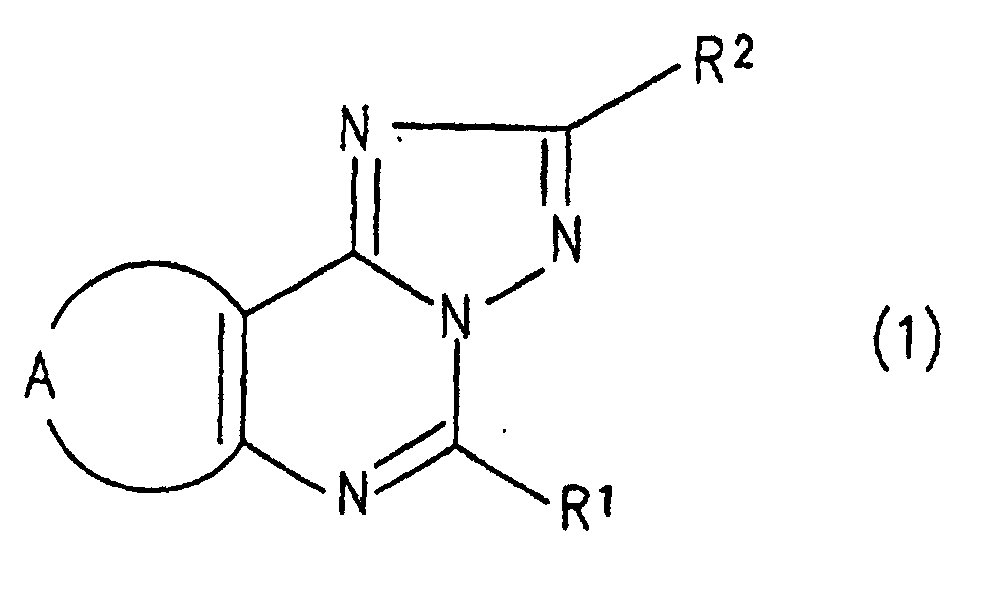
- the triazolopurine derivative of the present invention is represented by the general formula (1): wherein R 1 represents an alkyl group, or a phenyl group which is optionally substituted with a lower alkyl group; R 2 represents a pyridyl group, a furyl group, a thienyl group, a lower alkyl group, a phenyl lower alkyl group which optionally has 1 to 3 lower alkoxy groups as a substituent, a styryl group which optionally has 1 to 3 lower alkoxy groups as a substituent, a naphthyl group which optionally has a hydroxy groups as a substituent, or a phenyl group which optionally has 1 to 3 groups selected from lower alkyl group, lower alkoxy group, nitro group, hydroxyl group, amino group, N-lower alkylamino group, N,N-di lower alkylamino group, N-phenyl lower alkylamino group, N,N-bispheny
- the triazolopurine derivative of the present invention is a novel compound which has never been described in reference documents.
- R 2 is preferably a pyridyl group, a furyl group, a styryl group, a naphthyl group which optionally has a hydroxyl group as a substituent, a phenyl group which optionally has a group selected from lower alkyl group, N-lower alkylamino group, N,N-di lower alkylamino group, N-phenyl lower alkylamino group, N,N-bisphenyl lower alkylamino group, phenyl group, phenoxy group, phenyl lower alkoxy group, halogen-substituted lower alkyl group, halogen-substituted lower alkoxy group, di lower alkylphosphorylmethyl group, lower alkylthio group, hydroxyl group and halogen atom as a substituent, a phenyl group substituted with
- Particularly preferable compound is a compound selected from the group of the following compounds (a), (b) and (c):
- More preferable compound is a compound selected from the group of the following compounds (i) and (ii):
- the compound of the present invention is preferably a compound selected from 5-n-butyl-8-(3,4,5-trimethoxyphenyl)-1H-1,2,4-triazolo[5,1-i]purine, 5-n-butyl-8-(4-chlorophenyl)-1H-1,2,4-triazolo[5,1-i]purine, 5-n-butyl-8-(4-methoxyphenyl)-1H-1,2,4-triazolo[5,1-i]purine, 5-n-butyl-8-[4-(N,N-dimethylamino)phenyl]-1H-1,2,4-triazolo[5,1-i]purine, 5-n-butyl-8-(4-propoxyphenyl)-1H-1,2,4-triazolo[5,1-i]purine, 5-n-butyl-8-(4-ethoxyphenyl)-1H-1,2,4-triazolo[5,1-i]purine, 8-
- the triazolopurine derivative of the present invention is applied to antihypertensive, antiallergic agent, anti-inflammatory agent, remedy for ischemic heart disease, remedy for leukemia, antipruritic, expectorant, cough medicine, remedy for asthma, and analgesic as a compound capable of binding with an adenosine A3 receptor because of its excellent affinity to an adenosine A3 receptor.
- the present invention also provides a pharmaceutical composition
- a pharmaceutical composition comprising the triazolopurine derivative described above and a pharmaceutically acceptable carrier.
- the present invention provides an adenosine A3 receptor ligand comprising the triazolopurine derivative described above as an active ingredient, and a remedy for asthma, comprising triazolopurine derivative as an active ingredient.
- the lower alkyl group includes , for example, straight-chain or branched lower alkyl groups having 1 to 6 carbon atoms, such as methyl, ethyl, propyl, butyl, isobutyl, tert-butyl, pentyl, and hexyl.
- the alkyl group includes, for example, alkyl groups having 7 to 8 carbon atoms, such as heptyl and octyl, in addition to the lower alkyl groups described above.
- the lower alkoxy group includes, for example, straight-chain or branched lower alkoxy groups having 1 to 6 carbon atoms, such as methoxy, ethoxy, propoxy, butoxy, tert-butoxy, pentyloxy, and hexyloxy.
- the halogen atom includes fluorine, chlorine, bromine, or iodine.
- the pyridyl group includes 2-pyridyl, 3-pyridyl and 4-pyridyl.
- the furyl group includes 2-furyl and 3-furyl.
- the thienyl group includes 2-thienyl group and 3-thienyl group.
- the naphthyl group which optionally has a hydroxyl group as a substituent includes, for example, 1-naphthyl, 2-naphthyl, 1-hydroxy-2-naphthyl, 3-hydroxy-2-naphthyl, 4-hydroxy-2-naphthyl, 5-hydroxy-2-naphthyl, 6-hydroxy-2-naphthyl, 7-hydroxy-2-naphthyl, 8-hydroxy-2-naphthyl, 2-hydroxy-1-naphthyl, 3-hydroxy-1-naphthyl, 4-hydroxy-1-naphthyl, 5-hydroxy-1-naphthyl, 6-hydroxy-1-naphthyl, 7-hydroxy-1-naphthyl, and 8-hydroxy-1-naphthyl.
- the phenyl which optionally has a group selected from lower alkyl group, lower alkoxy group, nitro group, hydroxyl group, amino group, N-lower alkylamino group, N,N-di lower alkylamino group, N-phenyl lower alkylamino group, N,N-bisphenyl lower alkylamino group, phenyl group, phenoxy group, phenyl lower alkoxy group, halogen-substituted lower alkyl group, halogen-substituted lower alkoxy group, di lower alkylphosphorylmethyl group, lower alkylthio group, lower alkoxy lower alkyl group, phenyl lower alkoxy lower alkyl group and halogen atom as a substituent includes, for example, phenyl groups which optionally have 1 to 3 substituents, such as 2-methylphenyl, 3-methylphenyl, 4-methylphenyl, 4-ethylphenyl, 4-propylphenyl, 4-
- the phenyl group which is optionally substituted with a lower alkyl group includes, for example, 2-methylphenyl, 3-methylphenyl, 4-methylphenyl, 2,4-dimethylphenyl, 3,4-dimethylphenyl, 3,5-dimethylphenyl, 3,4,5-trimethylphenyl, 4-ethylphenyl, 4-propylphenyl, 4-butylphenyl, 4-pentylphenyl, and 4-hexylphenyl, in addition to the phenyl group.
- the phenyl lower alkyl group includes, for example, benzyl, 2-phenylethyl, 1-phenylethyl, 3-phenylpropyl, 4-phenylbutyl, 5-phenylpentyl, or 6-phenylhexyl.
- the phenyl lower alkyl group which optionally has 1 to 3 lower alkoxy groups as a substituent includes, for example, 2-methoxybenzyl, 3-methoxybenzyl, 4-methoxybenzyl, 2,4-dimethoxybenzyl, 3,4-dimethoxybenzyl, 3,5-dimethoxybenzyl, 3,4,5-trimethoxybenzyl, 4-ethoxybenzyl, 4-propoxybenzyl, 4-butoxybenzyl, 4-pentyloxybenzyl, 4-hexyloxybenzyl, 2-(4-methoxyphenyl)ethyl, 3-(4-methoxyphenyl)propyl, 4- (4-methoxyphenyl)butyl, 5-(4-methoxyphenyl)pentyl, 6-(4-methoxyphenyl)hexyl, 2-(3,4,5-trimethoxyphenyl)ethyl, 3-(3,4,5-trimethoxyphenyl)propyl, 4-
- the styryl group which optionally has 1 to 3 lower alkyl groups as a substituent includes, for example, 2-methoxystyryl, 3-methoxystyryl, 4-methoxystyryl, 2,4-dimethoxystyryl, 3,4-dimethoxystyryl, 3,5-dimethoxystyryl, 3,4,5-trimethoxystyryl, 4-ethoxystyryl, 4-propoxystyryl, 4-butoxystyryl, 4-pentyloxystyryl, or 4-hexyloxystyryl, in addition to the styryl group.
- This reaction is carried out by adding the orthoester derivative (3) in an equimolar amount or more relative to the amount of the compound (2) and heating at a temperature within a range from 50°C to reflux temperature for about 10 minutes to 5 hours in the absence of a solvent, or in an inert solvent.
- the inert solvent for example, N,N-dimethylformamide (DMF), N,N-dimethylacetamide (DMA), dimethyl sulfoxide (DMSO), methanol, diphenyl ether, xylene, and diethylene glycol dimethyl ether can be used.
- the resulting imino ester derivative (4) is reacted with an acyl hydrazine derivative (5), after the ester derivative is purified according to a conventional method or not, to obtain the compounds (1) of the present invention.
- This reaction is carried out by adding the acyl hydrazine derivative (5) in an equimolar amount or more relative to the amount of the imino ester derivative (4) in an inert solvent, optionally adding a catalytic amount of 1,8-diazabicyclo[5,4,0]-7-undecene and heating at a temperature within a range from 50°C to reflux temperature for about 1 to 50 hours.
- the inert solvent includes the same solvents as those described above.
- the reaction solution may be alkalified by adding an aqueous sodium hydroxide solution and an aqueous potassium hydroxide solution and reacted furthermore at a temperature within a range from 0°C to room temperature for about 10 minutes to 5 hours after the completion of the heating reaction.
- R 1 of the compound (1) of the present invention can be converted into another one by the reaction shown in the following reaction scheme-2.
- R 1 , R 2 and A are as defined above, and R 1a represents a substituent different from R 1 within the same definition range as in R 1 .
- the compound (1) is converted into an amine compound (6) by refluxing in an aqueous solution of mineral acid such as hydrochloric acid or sulfuric acid for 5 minutes to 1 hour.
- mineral acid such as hydrochloric acid or sulfuric acid
- the amine compound (6) is acylated.
- This acylation can be carried out by reacting the amine compound (6) with a carboxylic acid chloride (7) in an amine-based inert solvent such as pyridine, lutidine, triethylamine, or 4-(N,N-dimethylamino)pyridine.
- the carboxylic acid chloride (7) is used in an equimolar amount or more and the reaction is completed within about 10 minutes to 3 hours at a temperature within a range from 0°C to room temperature.
- a compound substituted with a plurality of acyl groups may be included sometime in the acylation reaction, the inclusion can optionally be converted into a desired monoacyl compound (8) by refluxing the product, together with a catalytic amount of an alkaline such as anhydrous potassium carbonate or anhydrous sodium carbonate, in an inert solvent such as methanol or ethanol for about 10 minutes to 2 hours.
- an alkaline such as anhydrous potassium carbonate or anhydrous sodium carbonate
- the monoacyl compound (8) thus obtained is converted into a compound (1a) by the cyclization reaction.
- the cyclization reaction is carried out by reacting the monoacyl comound (8) with a halogenated trialkylsilane in an inert solvent in the presence of a base.
- the inert solvent for example, aromatic and aliphatic hydrocarbons such as toluene, xylene, and petroleum ether; ethers such as diethyl ether and tetrahydrofuran; and halogenated hydrocarbons such as dichloromethane, chloroform, carbon tetrachloride, and 1,2-dichloroethane can be used.
- the base for example, tertiary amine such as triethylamine, N,N-diethylaniline, N-methyl morpholine, pyridine, or 4-(N,N-dimethylamino)pyridine can be preferably used.
- chlorotrialkylsilane such as chloromethylsilane, chlorotriethylsilane, chlorotriethyldimethylsilane, chlorodimethylpropylsilane, chlorobutyldimethylsilane, chlorotripropylsilane, tributylchlorosilane, or chloroethylmethylpropylsilane can be preferably used.
- the amount of the halogenated trialkylsilane and base to be used is not specifically limited, but is generally controlled to an equal equivalent weight or more, and preferably from 3- to 20-fold equivalent weight relative to the amount of the monoacyl compound (8).
- the cyclization reaction is usually completed within about 0.5 to 30 hours at a temperature within a range from 0 to 100°C.
- the desired object in each process of the reaction scheme can be easily isolated and purified by a conventional separation means.
- the separation means includes adsorption chromatography, preparative thin-layer chromatography, recrystallization, solvent extraction or the like.
- a compound wherein R 2 is a styryl group which optionally has 1 to 3 lower alkoxy groups as a substituent, among the compounds (1) of the present invention, includes geometrical isomers such as E- and Z-isomers.
- geometrical isomers such as E- and Z-isomers.
- any of both isomers and a mixture thereof may be included.
- both isomers can be separated by employing the separation means described above.
- the compounds (1) of the present invention can be formed into pharmaceutically acceptable acid addition salts, and these salts are also included in the present invention.
- the acid capable of forming these acid salts includes, for example, inorganic acids such as hydrochloric acid, hydrobromic acid, and sulfuric acid; and organic acids such as oxalic acid, fumaric acid, maleic acid, tartaric acid, citric acid, and p-toluenesulfonic acid.
- the acid addition salts can be formed by a conventional method.
- the compounds of the present invention can be formed into alkaline metal salts such as sodium salt and potassium salt; alkaline earth metal salts such as calcium salt and magnesium salt; and copper salts, and these salts can also be included in the present invention.
- the compounds (1) of the present invention are used in the form of a general pharmaceutical preparation by using, together with a suitable non-toxic preparation carrier.
- the preparation carrier include diluents and excipients, such as fillers, extenders, binders, humectants, disintegrators, surfactants, and lubricants, which are usually used according to the service form of the preparation, and these are appropriately selected and used according to the unit dosage form of the resulting preparation.
- various forms can be selected according to the therapeutic purposes and typical examples thereof include tablets, pills, powders, liquid preparations, suspensions, emulsions, granules, capsules, suppositories, injections (e.g. liquid preparations, suspensions, etc.), and ointments.
- excipients such as lactose, sucrose, sodium chloride, glucose, urea, starch, calcium carbonate, kaolin, crystalline cellulose, silicic acid, and potassium phosphate
- binders such as water, ethanol, propanol, simple syrup, glucose solution, starch solution, gelatin solution, carboxymethylcellulose, hydroxypropylcellulose, methylcellulose, and polyvinyl pyrrolidone
- disintegrators such as sodium carboxymethylcellulose, calcium carboxymethylcellulose, low substituted hydroxypropylcellulose, dried starch, sodium alginate, agar powder, laminaran powder, sodium hydrogencarbonate, and calcium carbonate
- surfactants such as polyoxyethylene sorbitan fatty acid esters, sodium lauryl sulfate, and monoglyceride stearate
- disintegration inhibitors such as sucrose, stearin, cacao butter, and hydrogenated oil
- absorption accelerators such as
- tablets can be formed into tablets coated with a common coating, for example, sugar-coated tablets, gelatin-coated tablets, enteric coated tablets, film coating tablets, double layered tablets, or mutilayer tablets.
- excipients such as glucose, lactose, starch, cacao butter, hardened vegetable oil, kaolin, and talc
- binders such as gum arabic, powdered tragacanth, gelatin, and ethanol
- disintegrators such as laminaran and agar.
- suppositories there can be used, as the preparation carrier, polyethylene glycol, cacao butter, higher alcohol, esters of higher alcohol, gelatin, and semi-synthesized glyceride.
- Capsules are usually prepared by mixing the compound (1) of the present invention with various pharmaceutical preparations and filling a hard gelatin capsule or a soft gelatin capsule with the mixture.
- injections such as liquid preparations, emulsions or suspension
- these are preferably sterilized and are isotonic with blood.
- the diluent water, ethyl alcohol, propylene glycol, ethoxylated isostearyl alcohol, polyoxylated isostearyl alcohol, or polyoxyethylene sorbitan fatty acid esters.
- salt, glucose or glycerin may be contained in an enough amount to prepare an isotonic solution and common solubilizers, buffer agents or soothing agents may also be added.
- the pharmaceutical preparation further contains colorants, preservatives, perfumes, flavors, sweeteners, or other drugs.
- the amount of the compound (1) of the present invention to be incorporated in the pharmaceutical preparation is not specifically limited and appropriately selected from a wide range, but is preferably within a range from about 1 to 85% by weight based on the pharmaceutical preparation.
- the administration method of the pharmaceutical preparation is not specifically limited, but is appropriately decided according to the form of preparations, age of patients, sex and other conditions, or conditions of diseases.
- tablets, pills, liquid preparations, suspensions, granules and capsules are orally administered, while injections are intravenously administered alone or in comnination with a conventional replenisher such as glucose or amino acid, or intramascularly, intracutaneously, subctaneously or intraperitoneally administered alone, if necessary.
- suppositories are intrarectally administered.
- the dose of the pharmaceutical preparation varies depending on the administration method, age of patients, sex and other conditions, or conditions of diseases, but a dairy dose of the compound (1) of the present invention is usually within a range from about 0.5 to 20 mg/kg, and preferably from about 1 to 10 mg/kg.
- the pharmaceutical preparation can be administered 1 to 4 times per day.
- the triazolopurine derivative of the present invention is applied to antihypertensive, antiallergic agent, anti-inflammatory agent, remedy for ischemic heart disease, remedy for leukemia, antipruritic, expectorant, cough medicine, remedy for asthma, and analgesic because of its affinity to an adenosine A3 receptor.
- Example 9 In the same manner as in Example 1, except for using any one of the respective compounds obtained in Reference Examples 1 to 3 described above and a predetermined acyl hydrazine derivative, the respective compounds having the structures and melting points shown in Tables 9 and 10 were prepared.
- Tables 9 and 10 Me denotes a methyl group, n-Bu denotes a n-butyl group and Ph denotes a phenyl group, respectively.
- Example 2 In the same manner as in Example 1, except for using any one of the respective compounds obtained in Reference Examples 1 to 4 described above and a predetermined acyl hydrazine derivative, the respective compounds having the structures and melting points shown in Tables 11 and 12 were prepared.
- Example 2 4.4 g of the compound obtained in Example 1 was added to a solution of 20 mL of concentrated hydrochloric acid in 50 mL of water, and then the solution was heated at reflux for 30 minutes. The reaction solution was cooled to room temperature and aqueous 25% ammonia was added thereby to adjust the pH to 8. The deposited crystal was collected by filtration and recrystallized from 75% ethanol to obtain 2.58 g of 3-(4-aminopyrazol-5-yl)-5-phenyl-1,2,4-triazole as a crystal.
- Me denotes a methyl group
- Et denotes an ethyl group
- n-Pr denotes a n-propyl group
- n-Bu denotes a n-butyl group
- n-Pe denotes a n-pentyl group
- n-Hx denotes a n-hexyl group
- n-Hp denotes a n-heptyl group
- Ph denotes a phenyl group
- Bn denotes a benzyl group, respectively.
- Example 2 In the same manner as in Example 1, except for using any one of the respective compounds obtained in Reference Examples 1 to 5 described above and a predetermined acyl hydrazine derivative, the respective compounds having the structures and melting points shown in Tables 13 to 15 were prepared.
- Me denotes a methyl group
- Et denotes an ethyl group
- n-Pr denotes a n-propyl group
- i-Pr denotes an isopropyl group
- n-Bu denotes a n-butyl group
- t-Bu denotes a t-butyl group
- n-Pe denotes a n-pentyl group
- Ph denotes a phenyl group
- Bn denotes a benzyl group, respectively.
- a cell membrane of human renal endothelial cells HEK-293 transformed with plasmid coding an adenosine A3 receptor was isolated in a Tris-hydrochloric acid buffer (pH 7.7) in accordance with a conventional method, and then the cell membrane was treated with N 6 -(4-aminobenzyl)-9-[5-(methylcarbonyl)- ⁇ -D-ribofuranosyl]adenine (AB-MECA) labelled with 125 I to prepare a cell membrane bound with the compound.
- AB-MECA N 6 -(4-aminobenzyl)-9-[5-(methylcarbonyl)- ⁇ -D-ribofuranosyl]adenine
- this cell membrane and a test compound were incubated and the amount of [ 125 I]AB-MECA liberated was measured.
- concentration of the test compound when 50% of [ 125 I]AB-MECA is liberated, IC 50 was determined from the measured value of the test compound at each concentration.
- adenosine A1 receptor binding capacity and adenosine A2 receptor binding capacity of the test compound were measured according to the method described in Archives of Pharmacology, 336, 204 (1987) and The Journal of Pharmacology and Experimental Therapeutics, 251 (3), 888 (1989) and then evaluated as IC 50 .
- Receptor binding capacity (IC 50 ) (nM) Adenosine A1 Adenosine A2 Adenosine A3 36 ⁇ 7.8 ⁇ 10 3 2..2 37 ⁇ 3.7 ⁇ 10 3 9.0 42 ⁇ > 1 ⁇ 10 4 ⁇ 1 45 ⁇ > 1 ⁇ 10 4 ⁇ 1 48 ⁇ 3.8 ⁇ 10 3 ⁇ 1 49 ⁇ > 1 ⁇ 10 4 1.7 50 ⁇ > 1 ⁇ 10 4 5.0 51 ⁇ > 1 ⁇ 10 4 1.6 54 ⁇ > 1 ⁇ 10 4 7.8 58 ⁇ > 1 ⁇ 10 4 5.8 59 ⁇ > 1 ⁇ 10 4 ⁇ 1 60 ⁇ > 1 ⁇ 10 4 15 61 ⁇ 1.8 ⁇ 10 3 ⁇ 1 62 ⁇ > 1 ⁇ 10 4 6.6 63 ⁇ 2.4 ⁇ 10 3 1.0 64 ⁇ 716 ⁇ 1 65 ⁇ > 1 ⁇ 10 4 3.7 66 ⁇ > 1 ⁇ 10 4 3.3 67 ⁇ 1.8 ⁇ 10 3 5.4 68
- Two-thousands tablets each of which contains 300 mg of the compound (5-methyl-8-phenyl-1H-1,2,4-triazolo[5,1-i]purine) obtained in Example 1 as an active ingredient, were prepared according to the following formulation.
- Compound obtained in Example 1 600 g Lactose (Japanese Pharmacopoeia) 67 g Cornstarch (Japanese Pharmacopoeia) 33 g Calcium carboxymethylcellulose (Japanese Pharmacopoeia) 25 g Methylcellulose (Japanese Pharmacopoeia) 12 g Magnesium stearate (Japanese Pharmacopoeia) 3 g
- desired tablets were obtained by sufficiently mixing the compound obtained in Example 1, lactose, cornstarch and calcium carboxymethylcellulose, granulating the resulting mixture using an aqueous methylcellulose, passing the granules through a #24 mesh sieve, admixing the granules with magnesium stearate and compressing the admixture into tablets.
- Two-thousands hard gelatin capsules each of which contains 200 mg of the compound (5-n-butyl-8-(3,4,5-trimethoxyphenyl)-1H-1,2,4-triazolo[5,1-i]purine) obtained in Example 12 as an active ingredient, were prepared according to the following formulation.
- Compound obtained in Example 12 400 g Crystalline cellulose (Japanese Pharmacopoeia) 60 g Cornstarch (Japanese Pharmacopoeia) 34 g Talc (Japanese Pharmacopoeia) 4 g Magnesium stearate (Japanese Pharmacopoeia) 2 g
- desired capsules were obtained by pulverizing the respective ingredients to form powders, mixing the powders to obtain an uniform mixture and filling a gelatin capsule for oral administration having a desired size with the mixture.
Landscapes
- Health & Medical Sciences (AREA)
- Chemical & Material Sciences (AREA)
- Organic Chemistry (AREA)
- General Health & Medical Sciences (AREA)
- Life Sciences & Earth Sciences (AREA)
- Public Health (AREA)
- Nuclear Medicine, Radiotherapy & Molecular Imaging (AREA)
- Animal Behavior & Ethology (AREA)
- Veterinary Medicine (AREA)
- Pharmacology & Pharmacy (AREA)
- Chemical Kinetics & Catalysis (AREA)
- General Chemical & Material Sciences (AREA)
- Medicinal Chemistry (AREA)
- Engineering & Computer Science (AREA)
- Bioinformatics & Cheminformatics (AREA)
- Pulmonology (AREA)
- Molecular Biology (AREA)
- Biochemistry (AREA)
- Heart & Thoracic Surgery (AREA)
- Pain & Pain Management (AREA)
- Cardiology (AREA)
- Neurosurgery (AREA)
- Neurology (AREA)
- Rheumatology (AREA)
- Hematology (AREA)
- Oncology (AREA)
- Immunology (AREA)
- Urology & Nephrology (AREA)
- Vascular Medicine (AREA)
- Biomedical Technology (AREA)
- Dermatology (AREA)
- Pharmaceuticals Containing Other Organic And Inorganic Compounds (AREA)
- Nitrogen Condensed Heterocyclic Rings (AREA)
Abstract
Description
- The present invention relates to a novel triazolopurine derivative which exhibits an adenosine A3 receptor affinity, a pharmaceutical composition containing the derivative, an adenosine A3 receptor ligand, and a remedy for asthma.
- J. Heterocyclic Chem., 31, 1171 (1994) discloses that 2-aryl-8-fluorobenzyl-1,2,4-triazolo[5,1-i]purine is useful as an adenosine A2 receptor ligand.
- An object of the present invention is to provide a novel compound having an affinity to an adenosine A3 receptor.
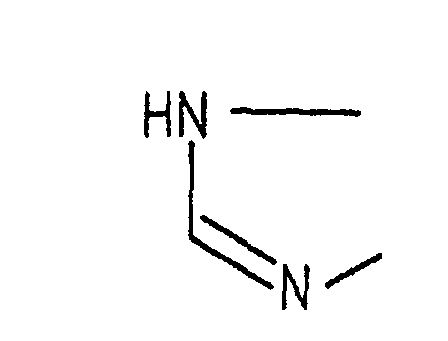
- The triazolopurine derivative of the present invention is represented by the general formula (1):wherein R1 represents an alkyl group, or a phenyl group which is optionally substituted with a lower alkyl group; R2 represents a pyridyl group, a furyl group, a thienyl group, a lower alkyl group, a phenyl lower alkyl group which optionally has 1 to 3 lower alkoxy groups as a substituent, a styryl group which optionally has 1 to 3 lower alkoxy groups as a substituent, a naphthyl group which optionally has a hydroxy groups as a substituent, or a phenyl group which optionally has 1 to 3 groups selected from lower alkyl group, lower alkoxy group, nitro group, hydroxyl group, amino group, N-lower alkylamino group, N,N-di lower alkylamino group, N-phenyl lower alkylamino group, N,N-bisphenyl lower alkylamino group, phenyl group, phenoxy group, phenyl lower alkoxy group, halogen-substituted lower alkyl group, halogen-substituted lower alkoxy group, di lower alkylphosphorylmethyl group, lower alkylthio group, lower alkoxy lower alkyl group, phenyl lower alkoxy lower alkyl group and halogen atom as a substituent; and A represents a group:
 wherein R3 represents a lower alkyl group or a phenyl lower alkyl group.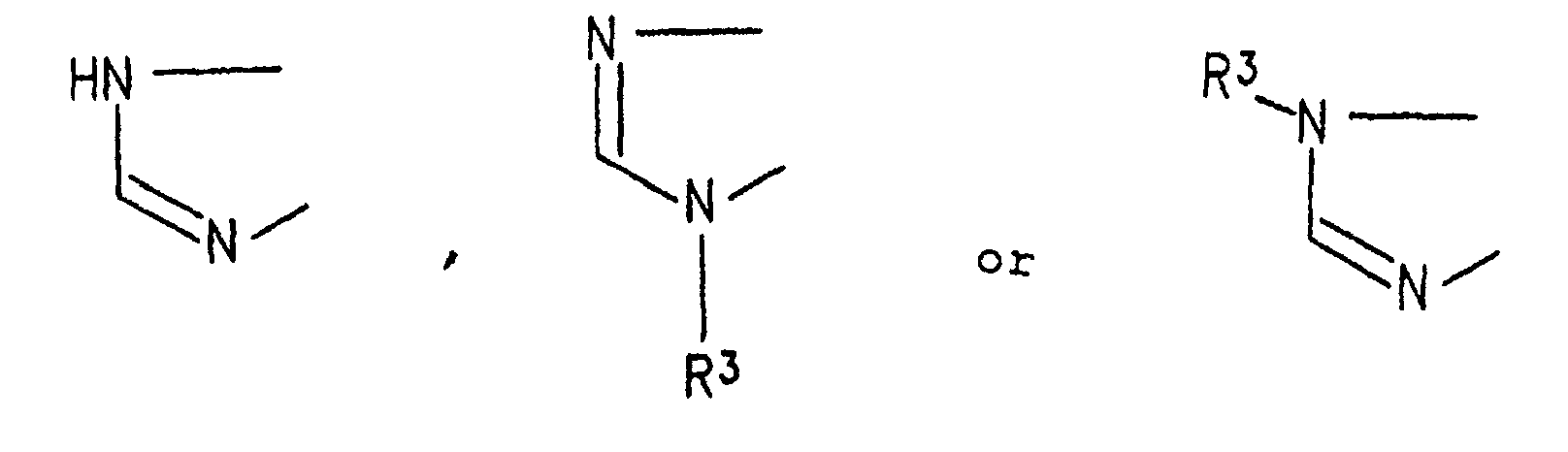
- The triazolopurine derivative of the present invention is a novel compound which has never been described in reference documents.
- In the present invention, a triazolopurine derivative wherein A is a group:is particularly preferable. In that case, R2 is preferably a pyridyl group, a furyl group, a styryl group, a naphthyl group which optionally has a hydroxyl group as a substituent, a phenyl group which optionally has a group selected from lower alkyl group, N-lower alkylamino group, N,N-di lower alkylamino group, N-phenyl lower alkylamino group, N,N-bisphenyl lower alkylamino group, phenyl group, phenoxy group, phenyl lower alkoxy group, halogen-substituted lower alkyl group, halogen-substituted lower alkoxy group, di lower alkylphosphorylmethyl group, lower alkylthio group, hydroxyl group and halogen atom as a substituent, a phenyl group substituted with a hydroxyl group and a halogen atom, or a phenyl group having 1 to 3 lower alkoxy groups as a substituent.
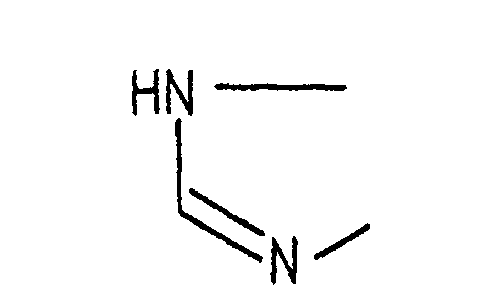
- Particularly preferable compound is a compound selected from the group of the following compounds (a), (b) and (c):
- (a) compound wherein R1 is an alkyl group or a lower alkyl-substituted phenyl group and R2 is a phenyl group,
- (b) compound wherein R1 is a n-butyl group and R2 is a pyridyl group, a furyl group, a styryl group, a naphthyl group which optionally has a hydroxy groups as a substituent, a phenyl group which optionally has a group selected from lower alkyl group, N-lower alkylamino group, N,N-di lower alkylamino group, N-phenyl lower alkylamino group, N,N-bisphenyl lower alkylamino group, phenyl group, phenoxy group, phenyl lower alkoxy group, halogen-substituted lower alkyl group, halogen-substituted lower alkoxy group, di lower alkylphosphorylmethyl group, lower alkylthio group, hydroxyl group and halogen atom as a substituent, a phenyl group substituted with a hydroxyl group and a halogen atom, or a phenyl group having 1 to 3 lower alkoxy groups as a substituent, and
- (c) compound wherein R1 is a phenyl group and R2 is a phenyl group having 3 lower alkoxy groups.
-
- More preferable compound is a compound selected from the group of the following compounds (i) and (ii):
- (i) compound wherein R1 is a lower alkyl group and R2 is a phenyl group, and
- (ii) compound wherein R1 is a n-butyl group and R2 is a naphthyl group which optionally has a hydroxy group as a substituent, a phenyl group which optionally has a group selected from lower alkyl group, N,N-di lower alkylamino group, N-phenyl lower alkylamino group, phenyl group, phenoxy group, phenyl lower alkoxy group, halogen-substituted lower alkyl group, halogen-substituted lower alkoxy group, di lower alkylphosphorylmethyl group, lower alkylthio group and halogen atom as a substituent, a phenyl group substituted with a hydroxyl group and a halogen atom, or a phenyl group having 1 to 3 lower alkoxy groups as a substituent.
-
- The compound of the present invention is preferably a compound selected from 5-n-butyl-8-(3,4,5-trimethoxyphenyl)-1H-1,2,4-triazolo[5,1-i]purine, 5-n-butyl-8-(4-chlorophenyl)-1H-1,2,4-triazolo[5,1-i]purine, 5-n-butyl-8-(4-methoxyphenyl)-1H-1,2,4-triazolo[5,1-i]purine, 5-n-butyl-8-[4-(N,N-dimethylamino)phenyl]-1H-1,2,4-triazolo[5,1-i]purine, 5-n-butyl-8-(4-propoxyphenyl)-1H-1,2,4-triazolo[5,1-i]purine, 5-n-butyl-8-(4-ethoxyphenyl)-1H-1,2,4-triazolo[5,1-i]purine, 8-(4-biphenylyl)-5-n-butyl-1H-1,2,4-triazolo[5,1-i]purine, 5-n-butyl-8-(4-trifluoromethylphenyl)-1H-1,2,4-triazolo[5,1-i]purine and 5-n-pentyl-8-phenyl-1H-1,2,4-triazolo[5,1-i]purine, and is particularly preferably a compound selected from 5-n-butyl-8-(4-methoxyphenyl)-1H-1,2,4-triazolo[5,1-i]purine, 5-n-butyl-8-(3,4,5-trimethoxyphenyl)-1H-1,2,4-triazolo[5,1-i]purine and 8-(4-biphenylyl)-5-n-butyl-1H-1,2,4-triazolo[5,1-i]purine.
- It is expected that the triazolopurine derivative of the present invention is applied to antihypertensive, antiallergic agent, anti-inflammatory agent, remedy for ischemic heart disease, remedy for leukemia, antipruritic, expectorant, cough medicine, remedy for asthma, and analgesic as a compound capable of binding with an adenosine A3 receptor because of its excellent affinity to an adenosine A3 receptor.
- Accordingly, the present invention also provides a pharmaceutical composition comprising the triazolopurine derivative described above and a pharmaceutically acceptable carrier.
- Specifically, the present invention provides an adenosine A3 receptor ligand comprising the triazolopurine derivative described above as an active ingredient, and a remedy for asthma, comprising triazolopurine derivative as an active ingredient.
- In the present invention, the lower alkyl group includes , for example, straight-chain or branched lower alkyl groups having 1 to 6 carbon atoms, such as methyl, ethyl, propyl, butyl, isobutyl, tert-butyl, pentyl, and hexyl.
- The alkyl group includes, for example, alkyl groups having 7 to 8 carbon atoms, such as heptyl and octyl, in addition to the lower alkyl groups described above.
- The lower alkoxy group includes, for example, straight-chain or branched lower alkoxy groups having 1 to 6 carbon atoms, such as methoxy, ethoxy, propoxy, butoxy, tert-butoxy, pentyloxy, and hexyloxy.
- The halogen atom includes fluorine, chlorine, bromine, or iodine.
- The pyridyl group includes 2-pyridyl, 3-pyridyl and 4-pyridyl.
- The furyl group includes 2-furyl and 3-furyl.
- The thienyl group includes 2-thienyl group and 3-thienyl group.
- The naphthyl group which optionally has a hydroxyl group as a substituent includes, for example, 1-naphthyl, 2-naphthyl, 1-hydroxy-2-naphthyl, 3-hydroxy-2-naphthyl, 4-hydroxy-2-naphthyl, 5-hydroxy-2-naphthyl, 6-hydroxy-2-naphthyl, 7-hydroxy-2-naphthyl, 8-hydroxy-2-naphthyl, 2-hydroxy-1-naphthyl, 3-hydroxy-1-naphthyl, 4-hydroxy-1-naphthyl, 5-hydroxy-1-naphthyl, 6-hydroxy-1-naphthyl, 7-hydroxy-1-naphthyl, and 8-hydroxy-1-naphthyl.
- The phenyl which optionally has a group selected from lower alkyl group, lower alkoxy group, nitro group, hydroxyl group, amino group, N-lower alkylamino group, N,N-di lower alkylamino group, N-phenyl lower alkylamino group, N,N-bisphenyl lower alkylamino group, phenyl group, phenoxy group, phenyl lower alkoxy group, halogen-substituted lower alkyl group, halogen-substituted lower alkoxy group, di lower alkylphosphorylmethyl group, lower alkylthio group, lower alkoxy lower alkyl group, phenyl lower alkoxy lower alkyl group and halogen atom as a substituent includes, for example, phenyl groups which optionally have 1 to 3 substituents, such as 2-methylphenyl, 3-methylphenyl, 4-methylphenyl, 4-ethylphenyl, 4-propylphenyl, 4-isopropylphenyl, 4-butylphenyl, 4-t-butylphenyl, 4-pentylphenyl, 4-hexylphenyl, 2,3-dimethylphenyl, 2,4-dimethylphenyl, 2,5-dimethylphenyl, 2,6-dimethylphenyl, 3,4-dimethylphenyl, 3,5-dimethylphenyl, 3,4-diethylphenyl, 3,4-dipropylphenyl, 3,4-dibutylphenyl, 3,4-dipentylphenyl, 3,4-dihexylphenyl, 3,4,5-trimethylphenyl, 2,3,4-trimethylphenyl, 2,3,5-trimethylphenyl, 2,3,6-trimethylphenyl, 2,4,6-trimethylphenyl, 2,4,5-trimethylphenyl, 3,4,5-triethylphenyl, 3,4,5-tripropylphenyl, 3,4,5-tributylphenyl, 3,4,5-tripentylphenyl, 3,4,5-trihexylphenyl, 2-methoxyphenyl, 3-methoxyphenyl, 4-methoxyphenyl, 4-ethoxyphenyl, 4-propoxyphenyl, 4-butoxyphenyl, 4-pentyloxyphenyl, 4-hexyloxyphenyl, 2,3-dimethoxyphenyl, 2,4-dimethoxyphenyl, 2,5-dimethoxyphenyl, 2,6-dimethoxyphenyl, 3,4-dimethoxyphenyl, 3,5-dimethoxyphenyl, 3,4-diethoxyphenyl, 3,4-dipropoxyphenyl, 3,4-dibutoxyphenyl, 3,4-dipentyloxyphenyl, 3,4-dihexyloxyphenyl, 3,4,5-trimethoxyphenyl, 2,3,4-trimethoxyphenyl, 2,3,5-trimethoxyphenyl, 2,3,6-trimethoxyphenyl, 2,4,6-trimethoxyphenyl, 2,4,5-trimethoxyphenyl, 3,4,5-triethoxyphenyl, 3,4,5-tripropoxyphenyl, 3,4,5-tributoxyphenyl, 3,4,5-tripentyloxyphenyl, 3,4,5-trihexyloxyphenyl, 2-hydroxyphenyl, 3-hydroxyphenyl, 4-hydroxyphenyl, 2,3-dihydroxyphenyl, 2,4-dihydroxyphenyl, 2,5-dihydroxyphenyl, 2,6-dihydroxyphenyl, 3,4-dihydroxyphenyl, 3,5-dihydroxyphenyl, 3,4,5-trihydroxyphenyl, 2,3,4-trihydroxyphenyl, 2,3,5-trihydroxyphenyl, 2,3,6-trihydroxyphenyl, 2,4,6-trihydroxyphenyl, 2,4,5-trihydroxyphenyl, 2-nitrophenyl, 3-nitrophenyl, 4-nitrophenyl, 2,3-dinitrophenyl, 2,4-dinitrophenyl, 2,5-dinitrophenyl, 2,6-dinitrophenyl, 3,4-dinitrophenyl, 3,5-dinitrophenyl, 3,4,5-trinitrophenyl, 2,3,4-trinitrophenyl, 2,3,5-trinitrophenyl, 2,3,6-trinitrophenyl, 2,4,6-trinitrophenyl, 2,4,5-trinitrophenyl, 2-aminophenyl, 3-aminophenyl, 4-aminophenyl, 3,4-diaminophenyl, 2-chlorophenyl, 3-chlorophenyl, 4-chlorophenyl, 2-bromophenyl, 3-bromophenyl, 4-bromophenyl, 2-iodophenyl, 3-iodophenyl, 4-iodophenyl, 2-fluorophenyl, 3-fluorophenyl, 4-fluorophenyl, 2,4-dichlorophenyl, 2,3-dichlorophenyl, 3,5-dichlorophenyl, 3,4-dichlorophenyl, 2,5-dichlorophenyl, 2,6-dichlorophenyl, 2,4-difluorophenyl, 2,4-dibromophenyl, 2,4-diiodorophenyl, 3,4,5-trichlorophenyl, 2,4,6-trichlorophenyl, 4-methoxy-3-methylphenyl, 4-methoxy-2-methylphenyl, 3-methoxy-2-methylphenyl, 4-methoxy-3,5-dimethylphenyl, 4-hydroxy-3-methylphenyl, 4-hydroxy-2-methylphenyl, 3-hydroxy-2-methylphenyl, 2-hydroxy-4-methylphenyl, 2-hydroxy-4-methoxyphenyl, 4-hydroxy-3,5-dimethylphenyl, 3,5-di-t-butyl-4-hydroxyphenyl, 4-hydroxy-3,5-dimethoxyphenyl, 3,5-dihydroxy-4-methoxyphenyl, 4-chloro-3-methoxyphenyl, 3-chloro-4-methoxyphenyl, 4-chloro-2-hydroxyphenyl, 4-chloro-3-hydroxyphenyl, 4-chloro-3-methylphenyl, 3-chloro-4-methylphenyl, 4-chloro-3,5-dimethoxyphenyl, 4-chloro-3,5-dimethylphenyl, 4-(N-methylamino)phenyl, 4-(N-ethylamino)phenyl, 4-(N-propylamino)phenyl, 4-(N-butylamino)phenyl, 4-(N-pentylamino)phenyl, 4-(N-hexyiamino)phenyl, 3-(N-methylamino)phenyl, 2-(N-methylamino)phenyl, 4-(N,N-dimethylamino)phenyl, 4-(N,N-diethylamino)phenyl, 4-(N,N-dipropylamino)phenyl, 4-(N,N-dibutylamino)phenyl, 4-(N,N-dipentylamino)phenyl, 4-(N,N-dihexylamino)phenyl, 3-(N,N-dimethylamino)phenyl, 2-(N,N-dimethylamino)phenyl, 4- (N-benzylamino)phenyl, 4-[(N-(2-phenylethyl)amino]phenyl, 4-[(N-(3-phenylpropyl)amino]phenyl, 4-[(N-(4-phenylbutyl)amino]phenyl, 4-[(N-(5-phenylpentyl)amino]phenyl, 4-[(N-(6-phenylhexyl)amino]phenyl, 3-(N-benzylamino)phenyl, 2-(N-benzylamino)phenyl, 4-(N,N-dibenzylamino)phenyl, 4-[N,N-bis (2-phenylethyl)amino]phenyl, 4-[N,N-bis(3-phenylpropyl)amino]phenyl, 4-[N,N-bis(4-phenylbutyl)aminolphenyl, 4-[N,N-bis(5-phenylpentyl)amino]phenyl, 4-[N,N-bis(6-phenylhexyl)amino]phenyl, 3-(N,N-dibenzylamino)phenyl, 2-(N,N-dibenzylamino)phenyl, 4-biphenylyl, 3-biphenylyl, 2-biphenylyl, 4-phenoxyphenyl, 3-phenoxyphenyl, 2-phenoxyphenyl, 4-benzyloxyphenyl, 4-(2-phenylethoxy)phenyl, 4-(3-phenylpropoxy)phenyl, 4-(4-phenylbutoxy)phenyl, 4-(5-phenylpentyloxy)phenyl, 4-(6-phenylhexyloxy)phenyl, 3-benzyloxyphenyl, 2-benzyloxyphenyl, 4-trifluoromethylphenyl, 4-pentafluoroethylphenyl, 4-heptafluoropropylphenyl, 4-nonafluorobutylphenyl, 4-undecafluoropentylphenyl, 4-tridecafluorohexylphenyl, 3-trifluoromethylphenyl, 2-trifluoromethylphenyl, 4-trifluoromethoxyphenyl, 4-pentafluoroethoxyphenyl, 4-heptafluoropropoxyphenyl, 4-nonafluorobutoxyphenyl, 4-undecafluoropentyloxyphenyl, 4-tridecafluorohexyloxyphenyl, 3-trifluoromethoxyphenyl, 2-trifluoromethoxyphenyl, 4-dimethoxyphosphorylmethylphenyl, 4-diethoxyphosphorylmethylphenyl, 4-dipropoxyphosphorylmethylphenyl, 4-dibutoxyphosphorylmethylphenyl, 4-dipentyloxyphosphorylmethylphenyl, 4-dihexyloxyphosphorylmethylphenyl, 3-diethoxyphosphorylmethylphenyl, 2-diethoxyphosphorylmethylphenyl, 4-methylthiophenyl, 4-ethylthiophenyl, 4-propylthiophenyl, 4-butylthiophenyl, 4-pentylthiophenyl, 4-hexylthiophenyl, 3-methylthiophenyl, 2-methylthiophenyl, 4-methoxymethylphenyl, 3-methoxymethylphenyl, 2-methoxymethylphenyl, 4-ethoxymethylphenyl, 4-propoxymethylphenyl, 4-butoxymethylphenyl, 4-pentyloxymethylphenyl, 4-hexyloxymethylphenyl, 4-(2-methoxyethyl)phenyl, 4-(3-methoxypropyl)phenyl, 4-(4-methoxybutyl)phenyl, 4-(5-methoxypentyl)phenyl, 4-(6-methoxyhexyl)phenyl, 4-benzyloxymethylphenyl, 3-benzyloxymethylphenyl, 2-benzyloxymethylphenyl, 4-(2-benzyloxyethyl)phenyl, 4-(3-benzyloxypropyl)phenyl, 4-(4-benzyloxybutyl)phenyl, 4-(5-benzyloxypentyl)phenyl, 4-(6-benzyloxyhexyl)phenyl, 4-(2-phenylethoxymethyl)phenyl, 4-(3-phenylpropoxymethyl)phenyl, 4-(4-phenylbutoxymethyl)phenyl, 4-(5-phenylpentyloxymethyl)phenyl, and 4-(6-phenylhexyloxymethyl)phenyl.
- The phenyl group which is optionally substituted with a lower alkyl group includes, for example, 2-methylphenyl, 3-methylphenyl, 4-methylphenyl, 2,4-dimethylphenyl, 3,4-dimethylphenyl, 3,5-dimethylphenyl, 3,4,5-trimethylphenyl, 4-ethylphenyl, 4-propylphenyl, 4-butylphenyl, 4-pentylphenyl, and 4-hexylphenyl, in addition to the phenyl group.
- The phenyl lower alkyl group includes, for example, benzyl, 2-phenylethyl, 1-phenylethyl, 3-phenylpropyl, 4-phenylbutyl, 5-phenylpentyl, or 6-phenylhexyl.
- The phenyl lower alkyl group which optionally has 1 to 3 lower alkoxy groups as a substituent includes, for example, 2-methoxybenzyl, 3-methoxybenzyl, 4-methoxybenzyl, 2,4-dimethoxybenzyl, 3,4-dimethoxybenzyl, 3,5-dimethoxybenzyl, 3,4,5-trimethoxybenzyl, 4-ethoxybenzyl, 4-propoxybenzyl, 4-butoxybenzyl, 4-pentyloxybenzyl, 4-hexyloxybenzyl, 2-(4-methoxyphenyl)ethyl, 3-(4-methoxyphenyl)propyl, 4- (4-methoxyphenyl)butyl, 5-(4-methoxyphenyl)pentyl, 6-(4-methoxyphenyl)hexyl, 2-(3,4,5-trimethoxyphenyl)ethyl, 3-(3,4,5-trimethoxyphenyl)propyl, 4-(3,4,5-trimethoxyphenyl)butyl, 5-(3,4,5-trimethoxyphenyl)pentyl, and 6-(3,4,5-trimethoxyphenyl)hexyl, in addition to the phenyl lower alkyl group described above.
- The styryl group which optionally has 1 to 3 lower alkyl groups as a substituent includes, for example, 2-methoxystyryl, 3-methoxystyryl, 4-methoxystyryl, 2,4-dimethoxystyryl, 3,4-dimethoxystyryl, 3,5-dimethoxystyryl, 3,4,5-trimethoxystyryl, 4-ethoxystyryl, 4-propoxystyryl, 4-butoxystyryl, 4-pentyloxystyryl, or 4-hexyloxystyryl, in addition to the styryl group.
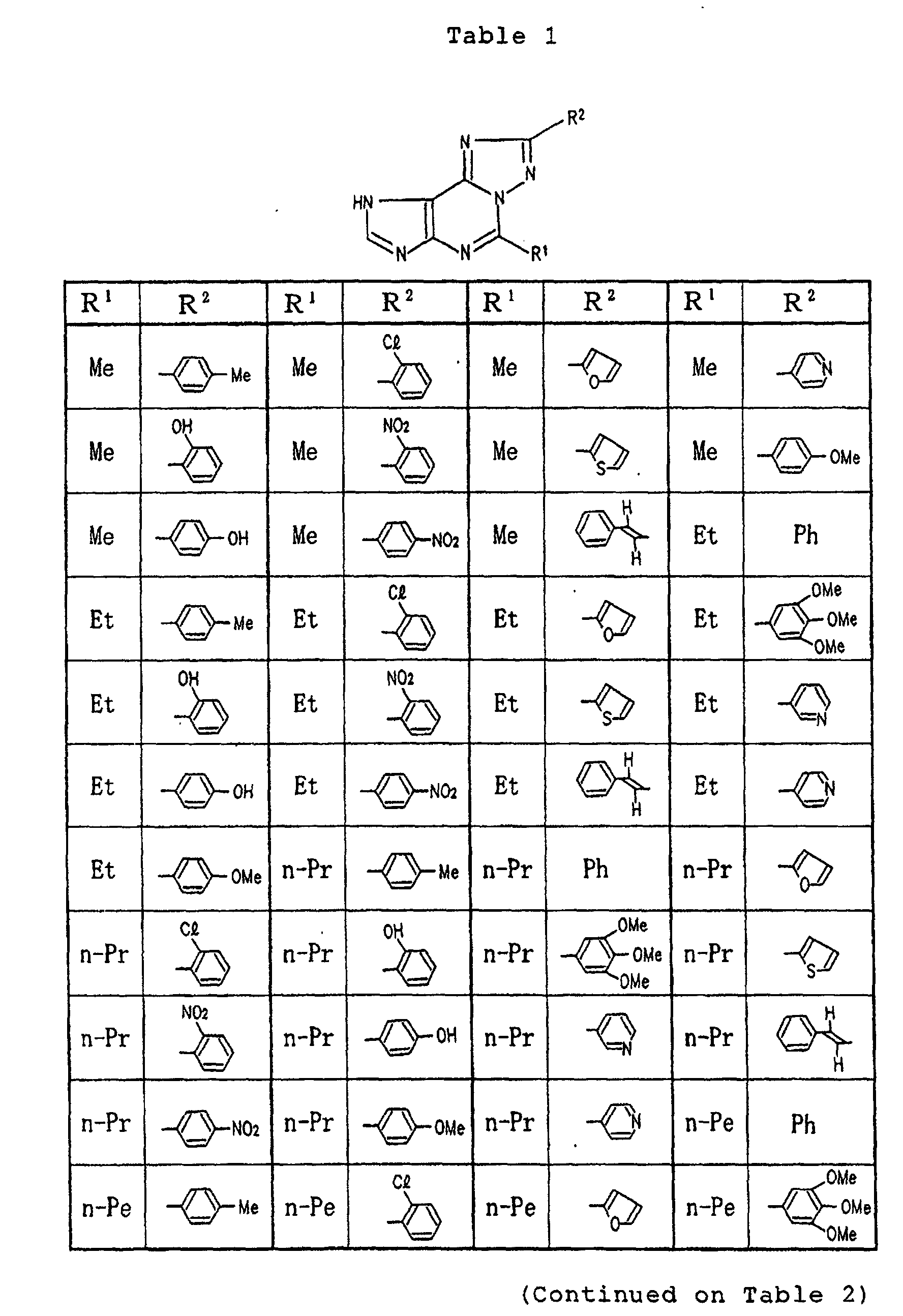
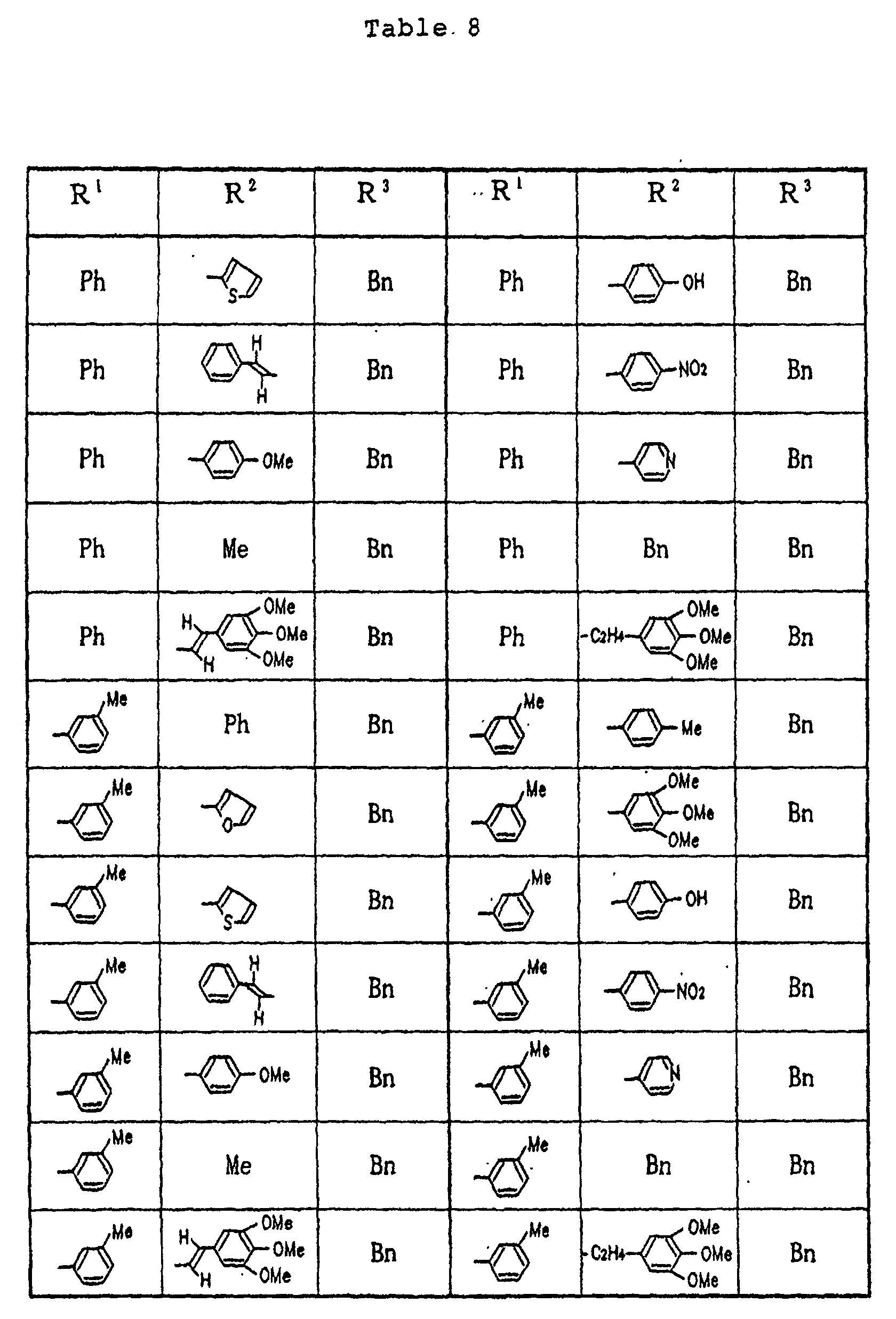
- Specific examples of the compounds (1) of the present invention are shown in Tables 1 to 8. In the respective tables, Me denotes a methyl group, Et denotes an ethyl group, n-Pr denotes a n-propyl group, n-Bu denotes a n-butyl group, n-Pe denotes a n-pentyl group, n-Hx denotes a n-hexyl group, n-Hp denotes a n-heptyl group, n-Oc denotes a n-octyl group, Ph denotes a phenyl group and Bn denotes a benzyl group, respectively.
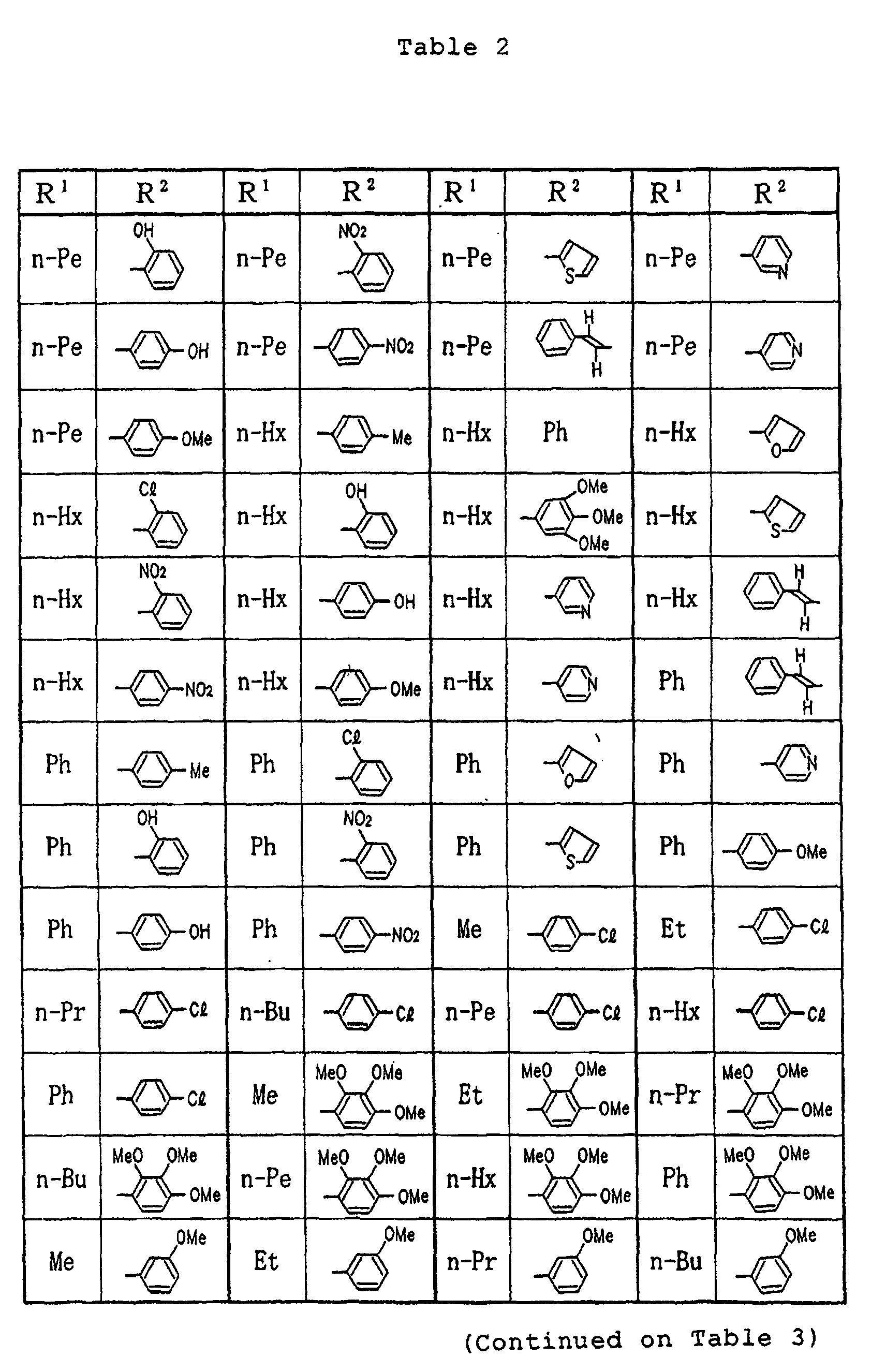
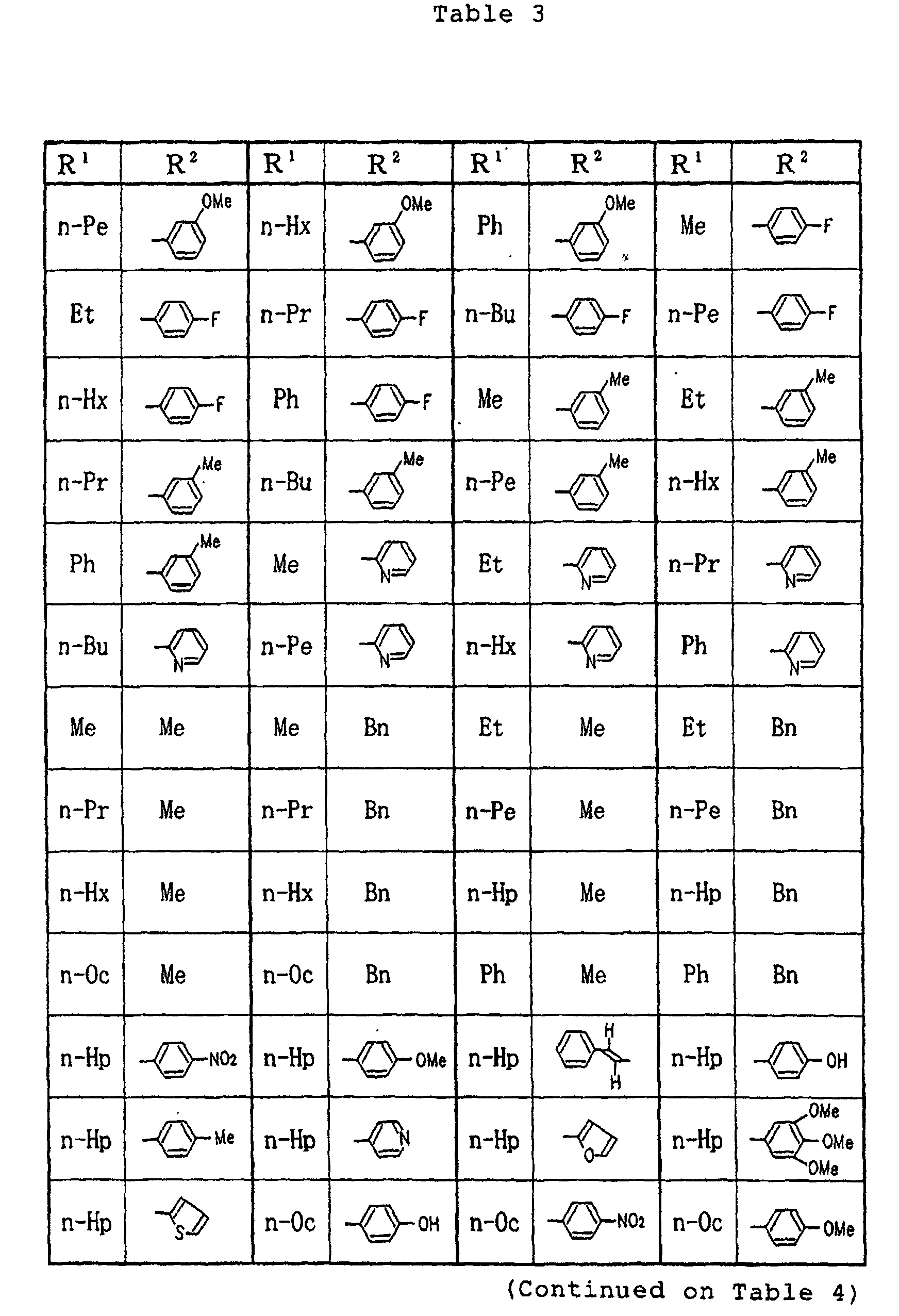
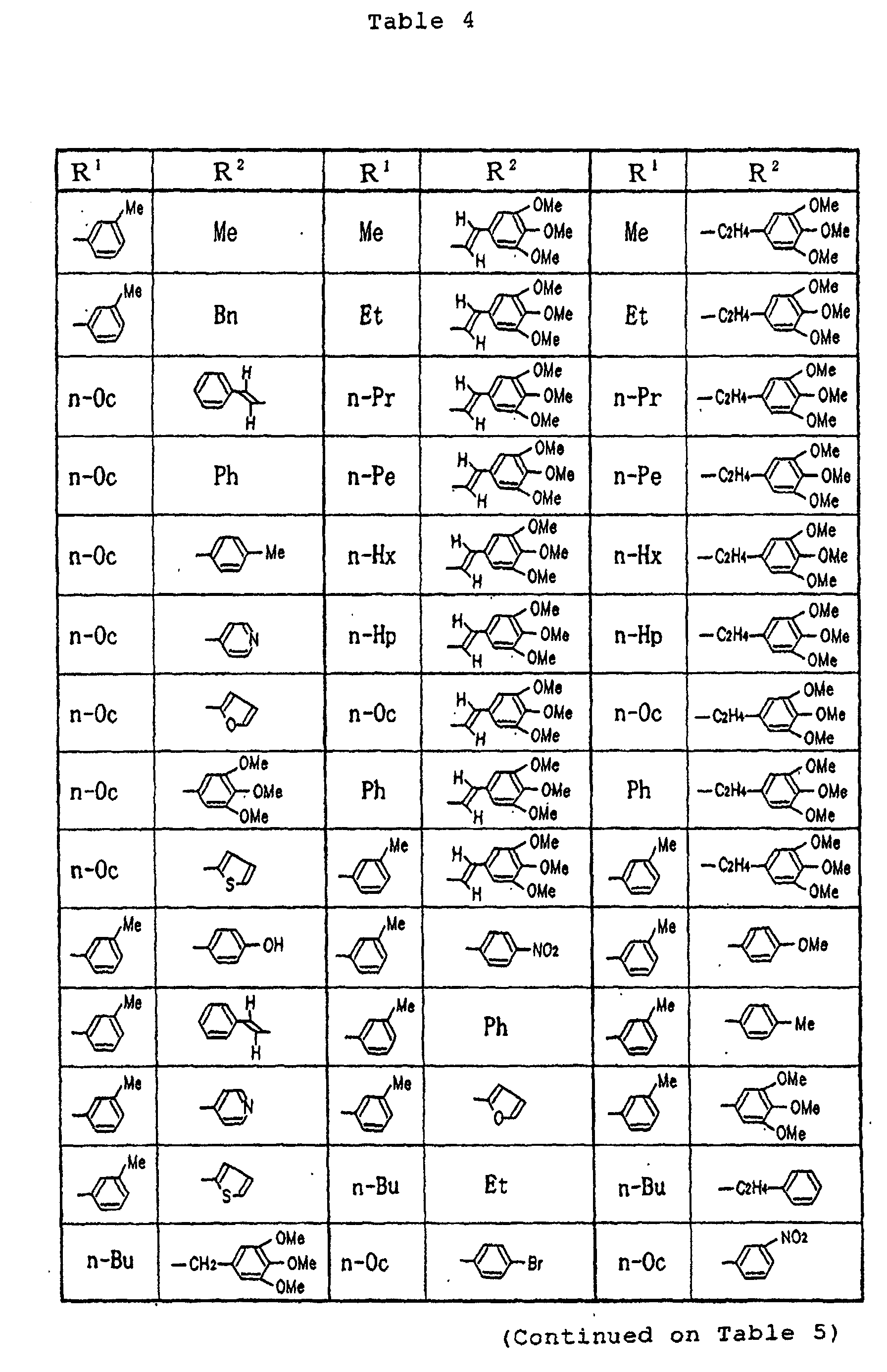

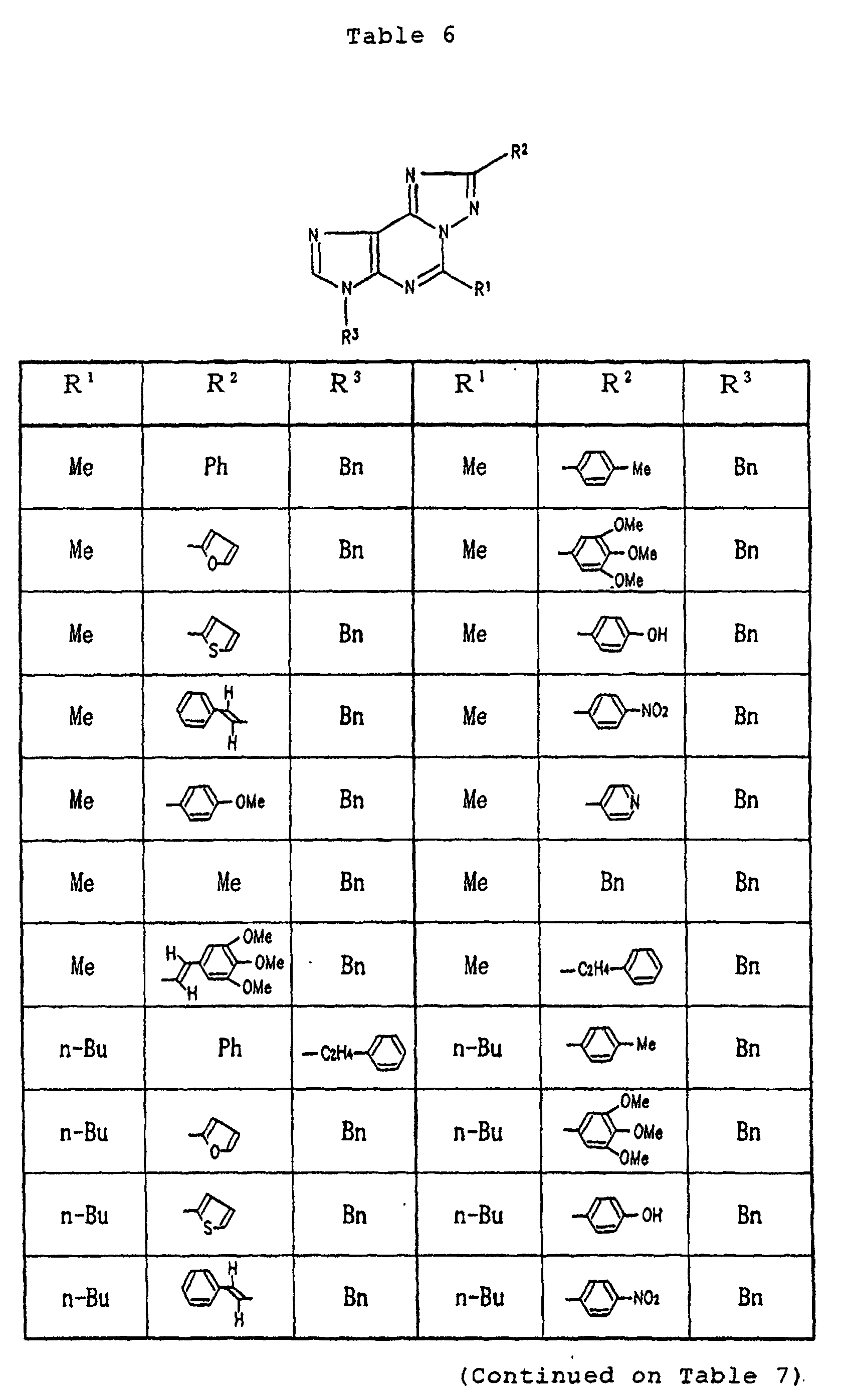
 The compound (1) of the present invention can be prepared by the following reaction scheme-1.
 wherein R1, R2 and A are as defined above, and Z represents a lower alkyl group.
- First, a compound represented by the formula (2) is reacted with an orthoester derivative represented by the formula (3) to obtain an imino ester represented by the formula (4).
- This reaction is carried out by adding the orthoester derivative (3) in an equimolar amount or more relative to the amount of the compound (2) and heating at a temperature within a range from 50°C to reflux temperature for about 10 minutes to 5 hours in the absence of a solvent, or in an inert solvent. As the inert solvent, for example, N,N-dimethylformamide (DMF), N,N-dimethylacetamide (DMA), dimethyl sulfoxide (DMSO), methanol, diphenyl ether, xylene, and diethylene glycol dimethyl ether can be used.
- The resulting imino ester derivative (4) is reacted with an acyl hydrazine derivative (5), after the ester derivative is purified according to a conventional method or not, to obtain the compounds (1) of the present invention.
- This reaction is carried out by adding the acyl hydrazine derivative (5) in an equimolar amount or more relative to the amount of the imino ester derivative (4) in an inert solvent, optionally adding a catalytic amount of 1,8-diazabicyclo[5,4,0]-7-undecene and heating at a temperature within a range from 50°C to reflux temperature for about 1 to 50 hours. The inert solvent includes the same solvents as those described above. If necessary, the reaction solution may be alkalified by adding an aqueous sodium hydroxide solution and an aqueous potassium hydroxide solution and reacted furthermore at a temperature within a range from 0°C to room temperature for about 10 minutes to 5 hours after the completion of the heating reaction.
- The substituent represented by R1 of the compound (1) of the present invention can be converted into another one by the reaction shown in the following reaction scheme-2.wherein R1, R2 and A are as defined above, and R1a represents a substituent different from R1 within the same definition range as in R1.

- First, the compound (1) is converted into an amine compound (6) by refluxing in an aqueous solution of mineral acid such as hydrochloric acid or sulfuric acid for 5 minutes to 1 hour.
- Then, the amine compound (6) is acylated. This acylation can be carried out by reacting the amine compound (6) with a carboxylic acid chloride (7) in an amine-based inert solvent such as pyridine, lutidine, triethylamine, or 4-(N,N-dimethylamino)pyridine. In this reaction, the carboxylic acid chloride (7) is used in an equimolar amount or more and the reaction is completed within about 10 minutes to 3 hours at a temperature within a range from 0°C to room temperature. Since a compound substituted with a plurality of acyl groups may be included sometime in the acylation reaction, the inclusion can optionally be converted into a desired monoacyl compound (8) by refluxing the product, together with a catalytic amount of an alkaline such as anhydrous potassium carbonate or anhydrous sodium carbonate, in an inert solvent such as methanol or ethanol for about 10 minutes to 2 hours.
- Subsequently, the monoacyl compound (8) thus obtained is converted into a compound (1a) by the cyclization reaction. The cyclization reaction is carried out by reacting the monoacyl comound (8) with a halogenated trialkylsilane in an inert solvent in the presence of a base.
- As the inert solvent, for example, aromatic and aliphatic hydrocarbons such as toluene, xylene, and petroleum ether; ethers such as diethyl ether and tetrahydrofuran; and halogenated hydrocarbons such as dichloromethane, chloroform, carbon tetrachloride, and 1,2-dichloroethane can be used. As the base, for example, tertiary amine such as triethylamine, N,N-diethylaniline, N-methyl morpholine, pyridine, or 4-(N,N-dimethylamino)pyridine can be preferably used. As the halogenated trialkylsilane, for example, chlorotrialkylsilane such as chloromethylsilane, chlorotriethylsilane, chlorotriethyldimethylsilane, chlorodimethylpropylsilane, chlorobutyldimethylsilane, chlorotripropylsilane, tributylchlorosilane, or chloroethylmethylpropylsilane can be preferably used.
- The amount of the halogenated trialkylsilane and base to be used is not specifically limited, but is generally controlled to an equal equivalent weight or more, and preferably from 3- to 20-fold equivalent weight relative to the amount of the monoacyl compound (8). The cyclization reaction is usually completed within about 0.5 to 30 hours at a temperature within a range from 0 to 100°C.
- The desired object in each process of the reaction scheme can be easily isolated and purified by a conventional separation means. The separation means includes adsorption chromatography, preparative thin-layer chromatography, recrystallization, solvent extraction or the like.
- In case of a compound wherein A is a group:among the compounds (1) of the present invention prepared as described above, it is considered that the compound includes the following four structural formulas as a tautomer and the tautomer can be represented by any of the structural formulas.
 wherein R1 and R2 are as defined above.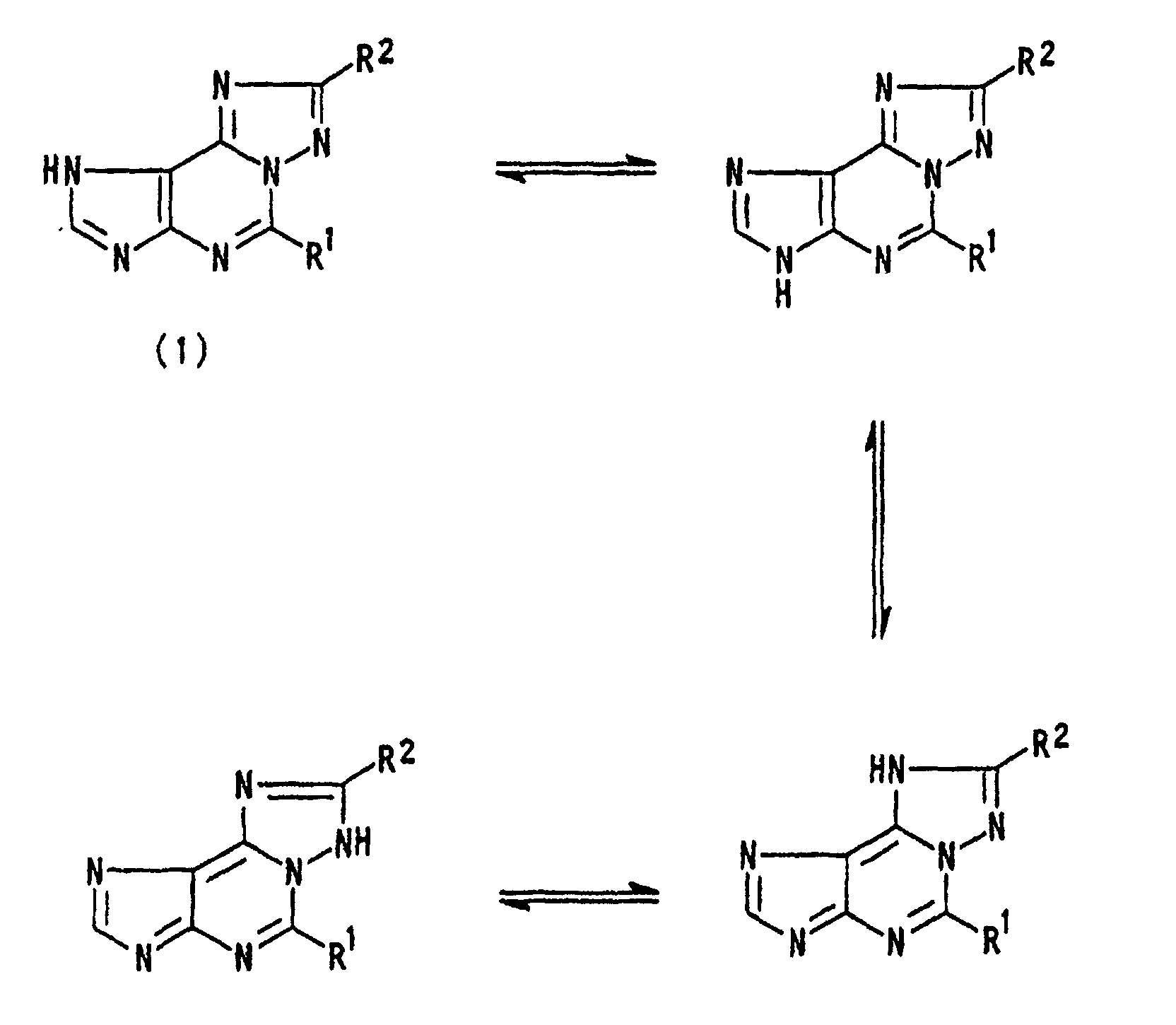
- A compound wherein R2 is a styryl group which optionally has 1 to 3 lower alkoxy groups as a substituent, among the compounds (1) of the present invention, includes geometrical isomers such as E- and Z-isomers. In the present invention, any of both isomers and a mixture thereof may be included. Furthermore, both isomers can be separated by employing the separation means described above.
- The compounds (1) of the present invention can be formed into pharmaceutically acceptable acid addition salts, and these salts are also included in the present invention. The acid capable of forming these acid salts includes, for example, inorganic acids such as hydrochloric acid, hydrobromic acid, and sulfuric acid; and organic acids such as oxalic acid, fumaric acid, maleic acid, tartaric acid, citric acid, and p-toluenesulfonic acid. The acid addition salts can be formed by a conventional method.
- The compounds of the present invention can be formed into alkaline metal salts such as sodium salt and potassium salt; alkaline earth metal salts such as calcium salt and magnesium salt; and copper salts, and these salts can also be included in the present invention.
- The compounds (1) of the present invention are used in the form of a general pharmaceutical preparation by using, together with a suitable non-toxic preparation carrier. The preparation carrier include diluents and excipients, such as fillers, extenders, binders, humectants, disintegrators, surfactants, and lubricants, which are usually used according to the service form of the preparation, and these are appropriately selected and used according to the unit dosage form of the resulting preparation.
- As the unit dosage form of the pharmaceutical preparation using the compound (1), various forms can be selected according to the therapeutic purposes and typical examples thereof include tablets, pills, powders, liquid preparations, suspensions, emulsions, granules, capsules, suppositories, injections (e.g. liquid preparations, suspensions, etc.), and ointments.
- In case of forming into the form of tablets, there can be used, as the preparation carrier, excipients such as lactose, sucrose, sodium chloride, glucose, urea, starch, calcium carbonate, kaolin, crystalline cellulose, silicic acid, and potassium phosphate; binders such as water, ethanol, propanol, simple syrup, glucose solution, starch solution, gelatin solution, carboxymethylcellulose, hydroxypropylcellulose, methylcellulose, and polyvinyl pyrrolidone; disintegrators such as sodium carboxymethylcellulose, calcium carboxymethylcellulose, low substituted hydroxypropylcellulose, dried starch, sodium alginate, agar powder, laminaran powder, sodium hydrogencarbonate, and calcium carbonate; surfactants such as polyoxyethylene sorbitan fatty acid esters, sodium lauryl sulfate, and monoglyceride stearate; disintegration inhibitors such as sucrose, stearin, cacao butter, and hydrogenated oil; absorption accelerators such as quaternary ammonium base and sodium lauryl sulfate; humectants such as glycerin and starch; adsorbents such as starch, lactose, kaolin, bentonite, and colloidal silicic acid; and lubricants such as purified talc, stearate, powdered boric acid, and polyethylene glycol.
- If necessary, tablets can be formed into tablets coated with a common coating, for example, sugar-coated tablets, gelatin-coated tablets, enteric coated tablets, film coating tablets, double layered tablets, or mutilayer tablets.
- In case of forming into the form of pills, there can be used, as the preparation carrier, excipients such as glucose, lactose, starch, cacao butter, hardened vegetable oil, kaolin, and talc; binders such as gum arabic, powdered tragacanth, gelatin, and ethanol; and disintegrators such as laminaran and agar.
- In case of forming into the form of suppositories, there can be used, as the preparation carrier, polyethylene glycol, cacao butter, higher alcohol, esters of higher alcohol, gelatin, and semi-synthesized glyceride.
- Capsules are usually prepared by mixing the compound (1) of the present invention with various pharmaceutical preparations and filling a hard gelatin capsule or a soft gelatin capsule with the mixture.
- In case of preparing as injections such as liquid preparations, emulsions or suspension, these are preferably sterilized and are isotonic with blood. In case of forming into the form of injections, there can be used, as the diluent, water, ethyl alcohol, propylene glycol, ethoxylated isostearyl alcohol, polyoxylated isostearyl alcohol, or polyoxyethylene sorbitan fatty acid esters. In this case, salt, glucose or glycerin may be contained in an enough amount to prepare an isotonic solution and common solubilizers, buffer agents or soothing agents may also be added.
- If necessary, the pharmaceutical preparation further contains colorants, preservatives, perfumes, flavors, sweeteners, or other drugs.
- In case of forming into the form such as paste, cream, or gel, there can be used, as the diluent, white soft paraffin, paraffin, glycerin, cellulose derivative, polyethylene glycol, silicon, and bentonite.
- The amount of the compound (1) of the present invention to be incorporated in the pharmaceutical preparation is not specifically limited and appropriately selected from a wide range, but is preferably within a range from about 1 to 85% by weight based on the pharmaceutical preparation.
- The administration method of the pharmaceutical preparation is not specifically limited, but is appropriately decided according to the form of preparations, age of patients, sex and other conditions, or conditions of diseases. For example, tablets, pills, liquid preparations, suspensions, granules and capsules are orally administered, while injections are intravenously administered alone or in comnination with a conventional replenisher such as glucose or amino acid, or intramascularly, intracutaneously, subctaneously or intraperitoneally administered alone, if necessary. Furthermore, suppositories are intrarectally administered.
- The dose of the pharmaceutical preparation varies depending on the administration method, age of patients, sex and other conditions, or conditions of diseases, but a dairy dose of the compound (1) of the present invention is usually within a range from about 0.5 to 20 mg/kg, and preferably from about 1 to 10 mg/kg. The pharmaceutical preparation can be administered 1 to 4 times per day.
- It is expected that the triazolopurine derivative of the present invention is applied to antihypertensive, antiallergic agent, anti-inflammatory agent, remedy for ischemic heart disease, remedy for leukemia, antipruritic, expectorant, cough medicine, remedy for asthma, and analgesic because of its affinity to an adenosine A3 receptor.
- The following Reference Examples, Examples, Experiment and Preparation Examples further illustrate the compounds of the present invention in detail.
- 5 g of 4-amino-5-cyanoimidazole was suspended in 10 mL of DMF and 10 mL of trimethyl orthoacetate was added, followed by stirring at 90°C for 30 minutes. The reaction solution was concentrated under reduced pressure and the residue was dilute with ethyl acetate, and then 4.2 g of desired compound deposited as a crystal was collected by filtration. The solution was concentrated and the residue was purified by silica gel column chromatograpy (eluent: ethyl acetate) and then recrystallized from ethyl acetate-n-hexane to obtain 2.9 g of a desired compound as a crystal.
Melting point: 147-149°C. - In the same manner as in Reference Example 1, methyl N-(5-cyanoimidazol-4-yl)pentanimidate was prepared.
Melting point: 114-116°C. - In the same manner as in Reference Example 1, methyl N-(5-cyanoimidazol-4-yl)benzimidate was prepared.
Melting point: 157-159°C. - In the same manner as in Reference Example 1, the following compounds could be prepared.
- -Methyl N-(5-cyanoimidazol-4-yl)propionimidate
- -Methyl N- (5-cyanoimidazol-4-yl) butyrimidate
- -Methyl N-(5-cyanoimidazol-4-yl)hexanimidate
- -Methyl N-(5-cyanoimidazol-4-yl)heptanimidate
- -Methyl N-(5-cyanoimidazol-4-yl)octanimidate
- -Methyl N-(5-cyanoimidazol-4-yl)nonanimidate
- -Methyl N-(5-cyanoimidazol-4-yl)-3-methylbenzimidate
-
- In the same manner as in Reference Example 1, except for using 5-amino-1-benzyl-4-cyanoimidazole as a starting material, the following respective compounds were prepared.
- -Methyl N-(1-benzyl-4-cyanoimidazol-5-yl)acetimidate
- -Methyl N-(1-benzyl-4-cyanoimidazol-5-yl)propionimidate
- -Methyl N-(1-benzyl-4-cyanoimidazol-5-yl)butyrimidate
- -Methyl N-(1-benzyl-4-cyanoimidazol-5-yl)pentanimidate
- -Methyl N-(1-benzyl-4-cyanoimidazol-5-yl)hexanimidate
- -Methyl N-(1-benzyl-4-cyanoimidazol-5-yl)heptanimidate
- -Methyl N-(1-benzyl-4-cyanoimidazol-5-yl)octanimidate
- -Methyl N-(1-benzyl-4-cyanoimidazol-5-yl)nonanimidate
- -Methyl N-(1-benzyl-4-cyanoimidazol-5-yl)benzimidate
- -Methyl N-(1-benzyl-4-cyanoimidazol-5-yl)-3-methylbenzimidate
-
- In the same manner as in Reference Example 1, except for using 4-amino-1-benzyl-5-cyanoimidazole, 5-amino-4-cyano-1-methylimidazole, 4-amino-5-cyano-1-methylimidazole, 5-amino-4-cyano-1-ethylimidazole and 4-amino-5-cyano-1-ethylimidazole as a starting material, the following respective compounds were prepared.
- -Methyl N-(1-benzyl-5-cyanoimidazol-4-yl)heptanimidate
- -Methyl N-(5-cyano-l-methylimidazol-4-yl)heptanimidate
- -Methyl N-(4-cyano-1-methylimidazol-5-yl)heptanimidate
- -Methyl N- (5-cyano-1-ethylimidazol-4-yl)heptanimidate
- -Methyl N-(4-cyano-1-ethylimidazol-5-yl)heptanimidate
-
- 4.0 g of methyl N-(5-cyanoimidazol-4-yl)acetimidate obtained in Reference Example 1 and 3.65 g of N-benzoylhydrazine were dissolved in 40 mL of DMF, followed by stirring at 80°C for one hour and further stirring at 150°C for 15 hours. The reaction solution was air-cooled to room temperature and the pH of the solution was adjusted within a range from 9 to 10 by adding dropwise 13 mL of an aqueous 10% sodium hydroxide solution, followed by stirring at room temperature for one hour. After the completion of the reaction, 10% hydrochloric acid and water were added in turn thereby to adjust the pH to 3. The deposited crystal was collected by filtration and washed with hot ethanol to obtain 5.5 g of a desired compound as a crystal. The structure and melting point of the resulting desired compound are shown in Table 9.
- In the same manner as in Example 1, except for using any one of the respective compounds obtained in Reference Examples 1 to 3 described above and a predetermined acyl hydrazine derivative, the respective compounds having the structures and melting points shown in Tables 9 and 10 were prepared. In Tables 9 and 10, Me denotes a methyl group, n-Bu denotes a n-butyl group and Ph denotes a phenyl group, respectively.


- The measurement results of NMR of the resulting respective compounds are shown below.
- 1H-NMR(DMSO-d6) δ :3.03 (3H, s) , 7.5-7.7 (3H, m) , 8.3-8.4 (2H, m), 8.48 (1H, s), 13.6-14.1 (1H, brs)
- 1H-NMR(DMSO-d6) δ :2.98 (3H, s), 3.76 (3H, s) , 3.92 (6 H, s), 7.56 (2H, s), 8.42 (1H, s), 13.6-14.1 (1H,brs)
- 1H-NMR(DMSO-d6) δ : 3.05 (3H, s) , 7.69 (1H, dd, J=4.9, 7.9), 8.50 (1H, s), 8.65 (1H, d, J=7.9), 8.81 (1H, d, J=4. 9), 9.49(1H, s), 13.5-14.1 (1H, brs)
- 1H-NMR(DMSO-d6) δ :1.05 (3H, t, J=7.4), 1.5-1.6 (2H, m), 1.9-2.1 (2H, m), 3.43 (2H, t, J=7.4), 7.6-7.7 (3H, m) , 8.3-8.4 (2H, m), 8.50 (1H, s), 13.6-14.2 (1H, brs)
- 1H-NMR(DMSO-d6) δ :0.98 (3H, t, J=7.4), 1.4-1.6 (2H, m), 1.8-2.0 (2H, m), 2.40 (3H, s), 3.35 (2H, t, J=7.4), 7.3 8 (2H, d, J=7.9), 8.16 (2H, d, J=7.9), 8.42 (1H, s), 13.5-1 4.0 (1H, brs)
- 1H-NMR(DMSO-d6) δ :0.98 (3H, t, J=7.2), 1.4-1.6 (2H, m), 1.8-2.0 (2H, m), 3.36 (2H, t, J=7.7), 7.0-7.1 (2H, m), 7.42 (1H, t, J=8.2), 8.17 (1H, d, J=7.9), 8.48 (1H, s), 11. 21 (1H, s), 13.7-14.1 (1H, brs)
- 1H-NMR(DMSO-d6) δ : 0.98 (3H, t, J=7.4), 1.4-1.6 (2H, m), 1.9-2.0 (2H, m), 3.34 (2H, t, J=6.9), 6.94 (2H, d, J=8. 9), 8.11 (2H, d, J=8.9), 8.40 (1H, s), 9.7-10.2 (1H, brs), 13.3-14.2 (1H, brs)
- 1H-NMR(DMSO-d6) δ :1.04 (3H, t, J=7.4), 1.4-1.6 (2H, m), 1.9-2.1 (2H, m), 3.37 (2H, t, J=7.4), 3.92 (3H, s), 7.1 7 (2H, d, J=7.9), 8.17 (1H, s), 8.27 (2H, d, J=7.9)
- 1H-NMR(DMSO-d6) δ :0.96 (3H, t, J=7.4), 1.4-2.5 (2H, m), 1.9-2.0 (2H, m), 3.36 (2H, t, J=7.5), 7.5-7.7 (3H, m), 8.0-8.2 (1H, m), 8.47 (1H, s)
- 1H-NMR(DMSO-d6) δ :0.96 (3H, t, J=6.9), 1.4-1.5 (2H, m), 1.8-2.0 (2H, m), 3.30 (2H, t, J=7.4), 7.81 (1H, t, J=7. 9), 7.89 (1H, t, J=7.9), 8.03 (1H, d, J=7.9), 8.21 (1H, d, J=7.9), 8.46 (1H, s), 13.7-14.1 (1H, brs)
- 1H-NMR(DMSO-d6) δ :0.99 (3H, t, J=6.9), 1.4-1.6 (2H, m) , 1.8-2.0 (2H, m), 3.33 (2H, t, J=7.9), 8.37 (2H, d, J=8. 9), 8.43 (1H, s), 8.45 (2H, d, J=8.9)
- 1H-NMR(DMSO-d6) δ :1.04 (3H, t, J=7.4), 1.5-1.6 (2H, m), 2.0-2.1 (2H, m), 3.48 (2H, t, J=7.4), 3.95 (3H, s), 4.0 0 (6H, s), 7.65 (2H, s), 8.19 (1H, s)
- 1H-NMR(DMSO-d6) δ : 0.98 (3H, t, J=7.4), 1.4-1.6 (2H, m) , 1.8-2.0 (2H, m) , 3.38 (2H, t, J=7.4), 7.62 (1H, dd, J=5. 0, 7.9), 8.44 (1H, s), 8.59 (1H, d, J=7.9), 8.75 (1H, d, J= 5.0) , 9.42 (1H, s)
- 1H-NMR(DMSO-d6) δ :0.99 (3H, t, J=6.9), 1.4-1.6 (2H, m), 1.9-2.0 (2H, m), 3.38 (2H, t, J=7.4), 8.18 (2H, d, J=5. 9), 8.46 (1H, s), 8.81 (2H, d, J=5.9)
- 1H-NMR(DMSO-d6) δ :0.97 (3H, t, J=7.4), 1.4-1.5 (2H, m), 1.8-2.0 (2H, m), 3.33 (2H, t, J=7.4), 6.75 (1H, dd, J=2. 0, 3.5), 7.29 (1H, brd, J=3.5), 7.97 (1H, brs), 8.43 (1H, s), 13.6-14.0 (1H, brs)
- 1H-NMR(DMSO-d6) δ :0.98 (3H, t, J=6.9), 1.4-1.6 (2H, m), 1.8-2.0 (2H, m), 3.32 (2H, t, J=7.4), 7.27 (1H, dd, J=3. 5, 4.9), 7.80 (1H, dd, J=1.0, 4.9), 7.92 (1H, dd, J=1.0, 3. 5), 8.43 (1H, s), 13.5-14.1 (1H, brs)
- 1H-NMR(DMSO-d6) δ :0.96 (3H, t, J=7.4), 1.4-1.5 (2H, m) , 1.8-2.0 (2H, m), 3.30 (2H, t, J=7.8), 7.3-7.5 (4H, m), 7.7-7.8 (2H, m), 7.87 (1H, d, J=16.3), 8.41 (1H, s), 13.5-14.0 (1H, brs)
- 1H-NMR(DMSO-d6) δ :7.5-7.6 (3H, m) , 7.6-7.7 (3H, m) , 8. 2-8.3 (2H, m) , 8.4-8.5 (2H, m) , 8.54 (1H, s), 13.7-14.2 (1 H,brs)
- 1H-NMR(DMSO-d6) δ :3.84 (3H, s), 3.97 (6H, s), 7.59 (2 H, s), 7.7-7.8 (3H, m) , 8.5-8.6 (2H, m), 8.58 (1H, s)
- 1H-NMR(DMSO-d6) δ :7.6-7.7 (4H, m) , 8.5-8.6 (4H, m), 8. 7-8.8 (1H, m), 9.43 (1H, s)
- In the same manner as in Example 1, except for using any one of the respective compounds obtained in Reference Examples 1 to 4 described above and a predetermined acyl hydrazine derivative, the respective compounds having the structures and melting points shown in Tables 11 and 12 were prepared.
- 4.4 g of the compound obtained in Example 1 was added to a solution of 20 mL of concentrated hydrochloric acid in 50 mL of water, and then the solution was heated at reflux for 30 minutes. The reaction solution was cooled to room temperature and aqueous 25% ammonia was added thereby to adjust the pH to 8. The deposited crystal was collected by filtration and recrystallized from 75% ethanol to obtain 2.58 g of 3-(4-aminopyrazol-5-yl)-5-phenyl-1,2,4-triazole as a crystal.
- 2 g of the crystal thus obtained was dissolved in 20 mL of pyridine and 4.16 g of hexanoyl chloride was added dropwise at 0°C, followed by stirring at 0°C for 30 minutes and further stirring at room temperature for 30 minutes. The reaction solution was diluted with ethyl acetate, washed in turn with aqueous citric acid, aqueous sodium hydrogencarbonate and saturated saline, dried over anhydrous magnesium sulfate, and then dried under reduced pressure. The residue was purified by silica gel column chromatography (as an eluent, chloroform was used and then a mixture of chloroform and methanol (30:1) was used) to obtain 5 g of an oily substance. This oily substance was dissolved in 40 mL of ethanol and 10 mg of anhydrous potassium carbonate was added, followed by heating at reflux for 30 minutes. After cooling the reaction solution to room temperature, the deposited crystal was collected by filtration, washed with ethanol and dried to obtain 1.9 g of 3-[4-(N-hexanoylamino)pyrazol-5-yl]-5-phenyl-1,2,4-triazole as a crystal.
- Subsequently, 0.4 g of the crystal thus obtained was suspended in 8 mL of tetrahydrofuran and 1.77 mL of triethylamine and 0.63 mL of chlorotrimethylsilane were added, followed by heating at reflux for 20 hours. After the completion of the reaction, iced water and 2 g of citric acid were added in turn and the reaction solution was extracted with ethyl acetate. The organic layer was collected, washed in turn with water and saturate saline, dried over anhydrous magnesium sulfate, and then concentrated under reduced pressure. The residue was purified by silica gel column chromatography (as an eluent, chloroform was used and then a mixture of chloroform and methanol (25:1) was used) and recrystallized from methanol-water to obtain 0.15 g of a desired compound as a crystal. The structure and melting point of the resulting desired compound are shown in Table 12.
- In the same manner as in Example 34, the respective compounds having the structures and melting points shown in Table 12 were prepared.
- In Tables 11 and 12, Me denotes a methyl group, Et denotes an ethyl group, n-Pr denotes a n-propyl group, n-Bu denotes a n-butyl group, n-Pe denotes a n-pentyl group, n-Hx denotes a n-hexyl group, n-Hp denotes a n-heptyl group, Ph denotes a phenyl group and Bn denotes a benzyl group, respectively.


- The measurement results of NMR of the resulting respective compounds are shown below.
- 1H-NMR(DMSO-d6) δ :0.98 (3H, t, J=6.9), 1.4-1.6 (2H, m) , 1.8-2.0 (2H, m) , 3.35 (2H, t, J=7.4), 7.64 (2H, d, J=8.4), 8.27 (2H, d, J=8.4), 8.43 (1H, s), 13.6-14.0 (1H, s, brs)
- 1H-NMR(DMSO-d6) δ :1.46 (3H, t, J=7.4), 3.39 (2H, q, J=7.4), 7.5-7.7 (3H, m) , 8.2-8.3 (2H, m) , 8.43 (1H, s) , 13.6-14.0 (1H, brs)
- 1H-NMR(DMSO-d6) δ :1.07 (3H, t, J=7.4), 1.9-2.1 (2H, m) , 3.33 (2H, t, J=7.7), 7.5-7.7 (3H, m), 8.2-8.3 (2H, m), 8.43 (1H, s)
- 1H-NMR(DMSO-d6) δ :1.46 (3H, t, J=7.4), 3.40 (2H, q, J=7.4), 3.76 (3H, s), 3.92 (6H, s), 7.56 (2H, s), 8.43 (1H, s) , 13.6-14.0 (1H, brs)
- 1H-NMR(DMSO-d6) δ : 0.98 (3H, t, J=7.2) , 1.4-1.6 (2H, m) , 1.8-2.0 (2H, m), 3.34 (2H, t, J=7.7), 7.6-7.7 (2H, m) , 8.2-8.3 (2H, m), 8.43 (1H, s)
- 1H-NMR(DMSO-d6) δ :0.98 (3H, t, J=7.2), 1.4-1.6 (2H, m), 1.9-2.0 (2H, m) , 3.36 (2H, t, J=7.9), 3.88 (3H, s), 7.1 2 (1H, d, J=8.4), 7.49 (1H, dd, J=7.7, 8.4), 7.79 (1H, s), 7.86 (1H, d, J=7.7), 8.43 (1H, s), 13.6-14.0 (1H, brs)
- 1H-NMR(DMSO-d6) δ :0.98 (3H, t, J=7.4), 1.4-1.6 (2H, m), 1.8-2.0 (2H, m) , 3.34 (2H, t, J=7.4), 3.86 (3H, s), 7.1 1 (2H, d, J=8.9), 8.20 (2H, d, J=8.9), 8.41 (1H, s)
- 1H-NMR(DMSO-d6) δ :0.98 (3H, t, J=7.2), 1.4-1.6 (2H, m), 1.8-2.0 (2H, m), 2.43 (3H, s), 3.34 (2H, t, J=7.7), 7.3 5 (1H, d, J=7.7), 7.45 (1H, t, J=7.7), 8.07 (1H, d, J=7.7), 8.08 (1H, s), 8.42 (1H, s), 13.5-14.0 (1H, brs)
- 1H-NMR(DMSO-d6) δ : 0.95 (3H, t, J=7.2), 1.3-1.5 (2H, m) , 1.8-2.0 (2H, m) , 2.54 (3H, s), 3.25 (2H, t, J=7.9), 8.3 8 (1H, s)
- 1H-NMR(DMSO-d6) δ : 0.95 (3H, t, J=7.2), 1.3-1.5 (2H, m), 1.8-2.0 (2H, m), 3.28 (2H, t, J=7.9), 4.25 (2H, s), 7.2 -7.5 (5H, m), 8.38 (1H, s)
- 1H-NMR(DMSO-d6) δ :0.96 (3H, t, J=7.4), 1.3-1.6 (2H, m), 1.8-2.0 (2H, m), 3.29 (3H, t, J=7.4), 3.71 (3H, s), 3.8 7 (6H, s), 7.13 (2H, s), 7.46 (1H, d, J=16.3), 7.81 (1H, d, J=16.3), 8.41 (1H, s), 13.5-14.0 (1H, brs)
- 1H-NMR(DMSO-d6) δ :0.94 (3H, t, J=7.2), 1.4-1.5 (2H, m) , 1.8-2.0 (2H, m) , 3.0-3.4 (6H, m) , 3.61 (3H, s), 3.73 (6 H, s), 6.61 (2H, s), 8.39 (1H, s)
- 1H-NMR(CDCl3) δ : 1.02 (3H, t, J=7.2), 1.5-1.6 (2H, m), 2.0-2.1 (2H, m) , 3.44 (2H, t, J=7.4), 5.78 (2H, s), 7.3-7. 4 (3H, m), 7.5-7.6 (5H, m) , 8.04 (1H, s), 8.3-8.4 (2H, m)
- 1H-NMR(DMSO-d6) δ :0.91 (3H, t, J=6.9), 1.3-1.5 (4H, m), 1.9-2.0 (2H, m) , 3.36 (2H, t, J=7.4), 7.5-7.6 (3H, m), 8.2-8.3 (2H, m), 8.43 (1H, s)
- 1H-NMR(DMSO-d6) δ :2.49 (3H, s), 7.4-7.6 (5H, m) , 8.2-8.4 (4H, m), 8.54 (1H, s)
- 1H-NMR(DMSO-d6) δ :0.88 (3H, t, J=7.2), 1.2-1.6 (6H, m), 1.9-2.0 (2H, m), 3.36 (2H, t, J=7.7), 7.4-7.7 (3H, m), 8.2-8.3 (2H, m), 8.43 (1H, s), 13.6-14.1 (1H, brs)
- 1H-NMR(DMSO-d6) δ :0.86 (3H, t, J=6.9), 1.2-1.5 (8H, m), 1.8-2.0 (2H, m), 3.34 (2H, t, J=7.9), 7.5-7.6 (3H, m), 8.2-8.3 (2H, m), 8.43 (1H, s)
- 1H-NMR(DMSO-d6) δ : 0.98 (3H, t, J=7.4), 1.4-1.6 (2H, m), 1.9-2.0 (2H, m), 3.36 (2H, t, J=7.7), 7.41 (2H, t, J=8. 9), 8.31 (2H, dd, J=6.4, 8.9), 8.43 (1H, s)
- 1H-NMR(DMSO-d6) δ : 0.98 (3H, t, J=7.4), 1.4-1.6 (2H, m) , 1.9-2.0 (2H, m) , 3.35 (2H, t, J=7.4), 7.78 (2H, d, J=8. 4), 8.21 (2H, d, J=8.4), 8.43 (1H, s)
- 1H-NMR(DMSO-d6) δ : 1.04 (3H, t, J=7.2), 1.4-1.6 (2H, m), 1.9-2.1 (2H, m), 3.39 (2H, t, J=7.2), 5.70 (2H, s), 6.7 6 (2H, d, J=8.7),8.02 (2H, d, J=8.7), 8.44 (1H, s)
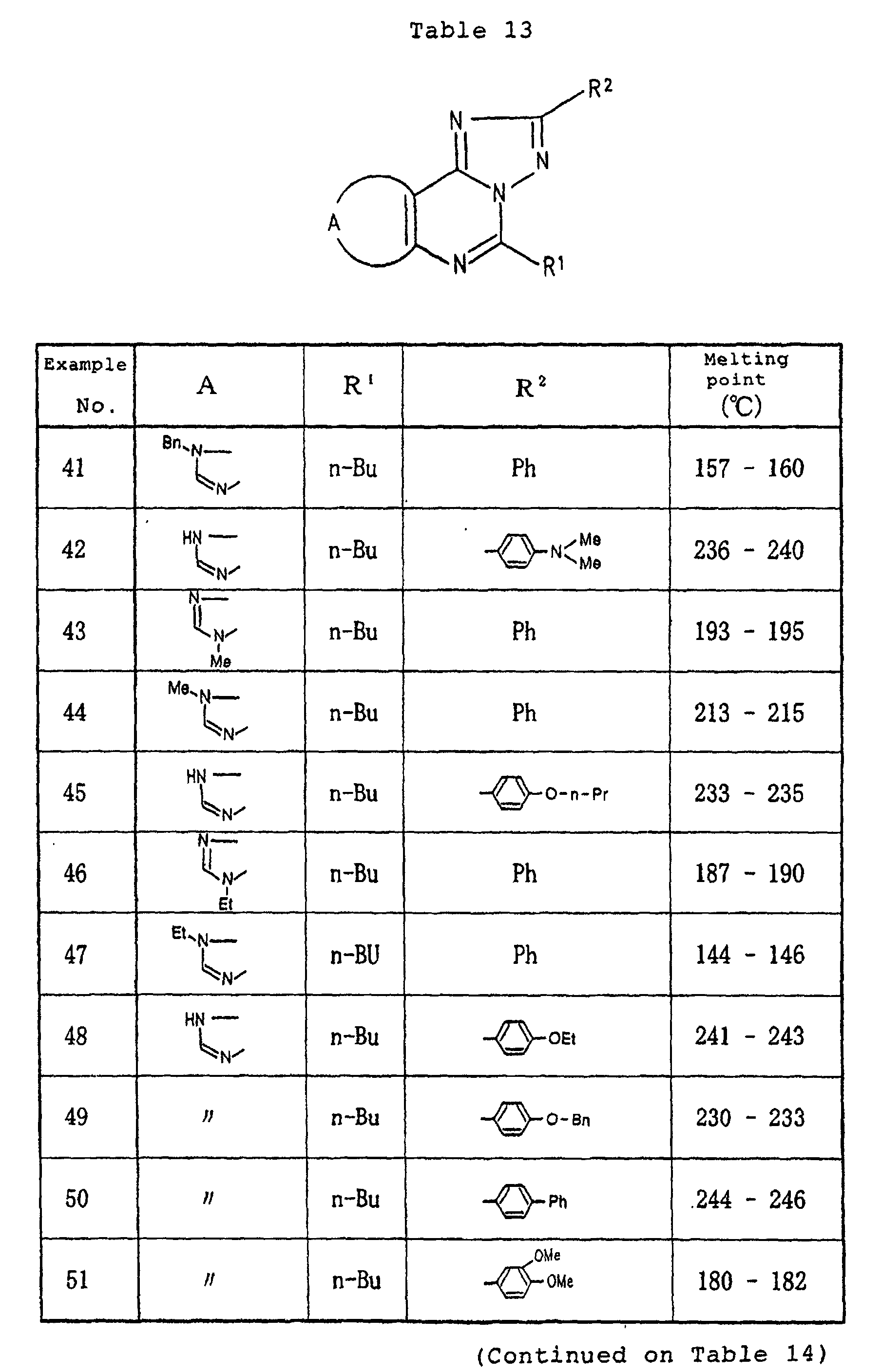
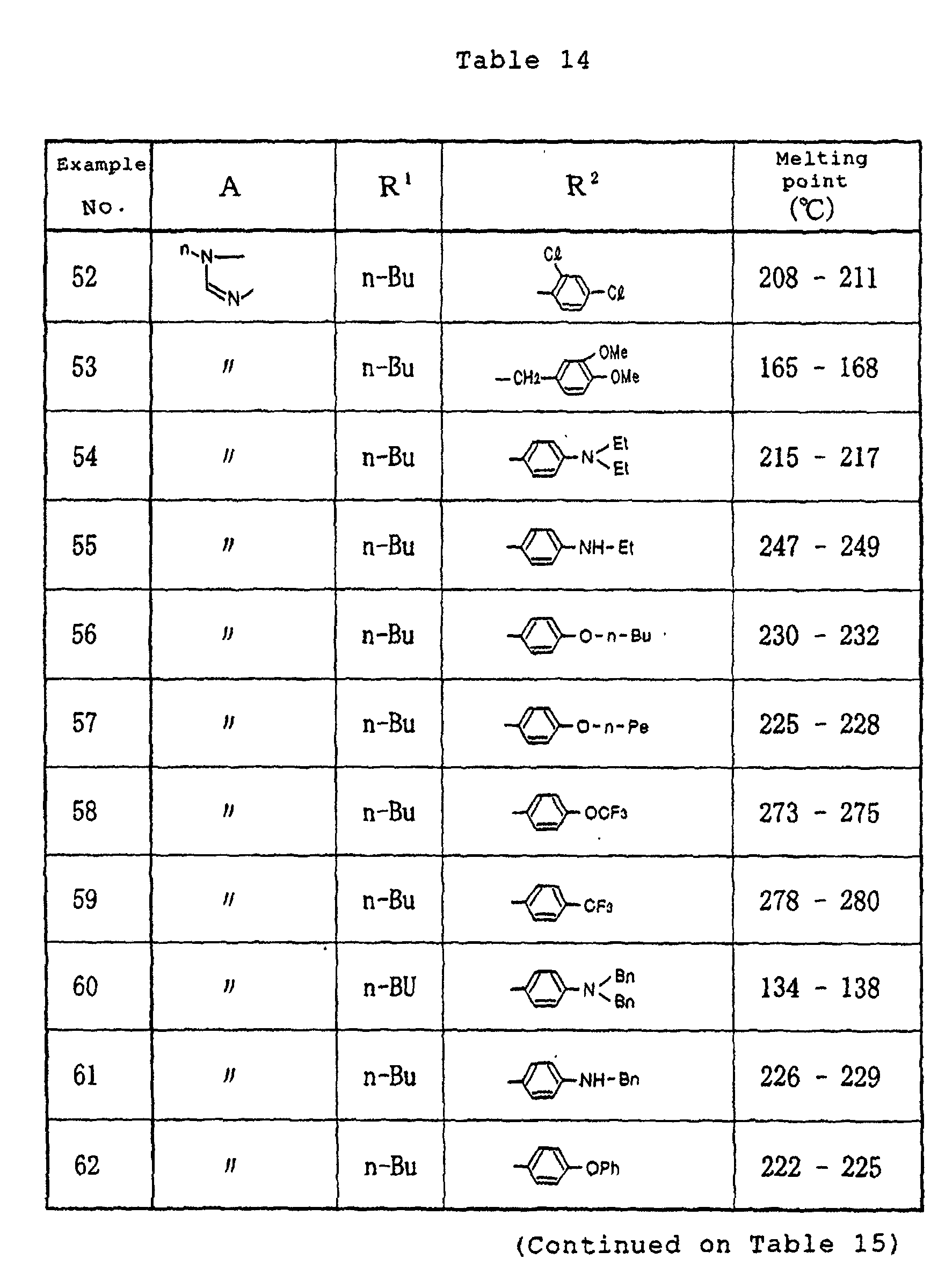
- In the same manner as in Example 1, except for using any one of the respective compounds obtained in Reference Examples 1 to 5 described above and a predetermined acyl hydrazine derivative, the respective compounds having the structures and melting points shown in Tables 13 to 15 were prepared.
- In Tables 13 to 15, Me denotes a methyl group, Et denotes an ethyl group, n-Pr denotes a n-propyl group, i-Pr denotes an isopropyl group, n-Bu denotes a n-butyl group, t-Bu denotes a t-butyl group, n-Pe denotes a n-pentyl group, Ph denotes a phenyl group and Bn denotes a benzyl group, respectively.

- The measurement results of NMR of the resulting respective compounds are shown below.
- 1H-NMR(CDCl3) δ :1.03 (3H, t, J=7.2), 1.5-1.6 (2H, m), 1.9-2.1 (2H,m), 3.45 (2H, t, J=7.4), 5.49 (2H, s), 7.3-7. 4 (5H, m) , 7.5-7.6 (3H, m) , 7.97 (1H, s), 8.4-8.5 (2H, m) .
- 1H-NMR(DMSO-d6) δ :1.04 (3H, t, J=7.2), 1.4-1.6 (2H, m), 1.9-2.1 (2H, m), 3.07 (6H, s), 3.40 (2H, t, J=7.4), 6.9 1 (2H, d, J=8.7), 8.15 (2H, d, J=8.7), 8.45 (1H, s).
- 1H-NMR(CDCl3) δ :1.02 (3H, t, J=7.2), 1.5-1.6 (2H, m), 2.0-2.1 (2H,m), 3.44 (2H, t, J=7.4), 4.30 (3H, s), 7.5-7. 6 (3H, m), 7.99 (1H, s), 8.3-8.4 (2H, m).
- 1H-NMR(CDCl3) δ :1.04 (3H, t, J=7.4), 1.5-1.6 (2H, m) , 2.0-2.1 (2H, m), 3.45 (2H, t, J=7.4), 3.97 (3H, s), 7.5-7. 6 (3H, m), 7.97 (1H, s), 8.4-8.5 (2H, m).
- 1H-NMR(DMSO-d6) δ :0.9-1.1 (6H, m), 1.4-1.6 (2H, m) , 1. 7-1.8 (2H, m), 1.9-2.0 (2H, m), 3.34 (2H, t, J=7.7), 4.02 (2H, t, J=6.4), 7.11 (2H, d, J=8.4), 8.19 (2H, d, J=8.4), 8. 41 (1H, s).
- 1H-NMR(CDCl3) δ :1.02 (3H, t, J=7.4), 1.5-1.6 (2H, m) , 1.74(3H, t, J=7.4), 2.0-2.1 (2H, m) , 3.44 (2H, t, J=7.7), 4.63 (2H, q, J=7.4), 7.5-7.6 (3H, m) , 8.04 (1H, s), 8.3-8. 4 (2H, m) .
- 1H-NMR(CDCl3) δ :1.04 (3H, t, J=7.4), 1.5-1.6 (2H,m), 1.61 (3H, t, J=7.4), 1.9-2.1 (2H,m), 3.44 (2H, t, J=7.4), 4.39 (2H, q, J=7.4), 7.4-7.6 (3H, m), 8.00 (1H, s), 8.4-8. 5 (2H, m) .
- 1H-NMR(DMSO-d6) δ :0.98 (3H, t, J=7.2), 1.38 (3H, t, J =6.9), 1.4-1.6 (2H, m), 1.9-2.0 (2H, m), 3.34 (2H, t, J=7. 4), 4.12 (2H, q, J=6.9), 7.09 (2H, d, J=8.7), 8.19 (2H, d, J=8.7), 8.41 (1H, s).
- 1H-NMR(DMSO-d6) δ :0.98 (3H, t, J=6.9), 1.4-1.6 (2H, m), 1.8-2.0 (2H, m), 3.34 (2H, t, J=7.4), 5.20 (2H, s), 7. 20 (2H, d, J=8.9), 7.3-7.5 (5H,m), 8.21 (2H, d, J=8.9), 8. 41 (1H, s).
- 1H-NMR(DMSO-d6) δ : 0.99 (3H, t, J=7.2), 1.4-1.6 (2H, m), 1.8-2.0 (2H, m), 3.38 (2H, t, J=7.7), 7.3-7.6 (3H, m), 7.78 (2H, d, J=8.2), 7.89 (2H, d, J=7.7), 8.36 (2H, d, J=7. 7), 8.43 (1H, s).
- 1H-NMR(DMSO-d6) δ :0.98 (3H, t, J=7.2), 1.4-1.6 (2H, m), 1.9-2.0 (2H, m), 3.36 (2H, t, J=6.9), 3.86 (3H, s), 3.9 0 (3H, s), 7.15 (1H, d, J=8.2), 7.78 (1H, s), 7.86 (1H, d, J=8.2), 8.41 (1H, s) .
- 1H-NMR(DMSO-d6) δ :0.96 (3H, t, J=7.2), 1.4-1.6 (2H, m), 1.9-2.1 (2H, m), 3.35 (2H, t, J=7.4), 7.65 (1H, dd, J=2. 0, 8.4), 7.86 (1H, d, J=2.0), 8.15 (1H, d, J=8.4), 8.45 (1H, s) .
- 1H-NMR(DMSO-d6) δ :0.95 (3H, t, J=7.4), 1.5-1.6 (2H, m) , 1.8-2.0 (2H, m), 3.28 (2H, t, J=7.4), 3.72 (3H, s), 3.7 3 (3H, s), 4.18 (2H, s), 6.89 (2H, s), 7.01 (1H, s), 8.37 (1H, s).
- 1H-NMR(DMSO-d6) δ :0.98 (3H, t, J=7.2), 1.15 (6H, t, J =6.9), 1.4-1.6 (2H, m), 1.9-2.0 (2H, m), 3.33 (2H, t, J=7. 4), 3.42 (4H, q, J=6.9), 6.80 (2H, d, J=8.9), 8.06 (2H, d, J=8.9), 8.38 (1H, s).
- 1H-NMR(DMSO-d6) δ :0.97 (3H, t, J=6.9), 1.20 (3H, t, J =6.9), 1.4-1.5 (2H, m), 1.8-2.0 (2H, m), 3.0-3.2 (2H, m), 3.32 (2H, t, J=7.9), 6.13 (1H, brs), 6.69 (2H, d, J=7.4), 8. 00 (2H, d, J=7.4), 8.38 (1H, s), 13.5-13.9 (1H, brs).
- 1H-NMR(DMSO-d6) δ : :0.9-1.0 (6H, m) , 1.4-1.6 (4H, m) , 1. 7-1.8 (2H, m), 1.8-2.0 (2H, m), 3.35 (2H, t, J=7.4), 4.07 (2H, t, J=6.4), 7.11 (2H, d, J=8.9), 8.20 (2H, d, J=8.9), 8. 40 (1H, s), 13.5-14.0 (1H, brs).
- 1H-NMR(DMSO-d6) δ :0.91 (3H, t, J=6.9), 0.98 (3H, t, J =7.4), 1.3-1.6 (6H, m) , 1.7-1.8 (2H, m), 1.8-2.0 (2H, m), 3.34 (2H, t, J=7.4), 4.05 (2H, t, J=6.4), 7.10 (2H, d, J=8. 9), 8.19 (2H, d, J=8.9), 8.41 (1H, s), 13.5-14.0 (1H, br s) .
- 1H-NMR(DMSO-d6) δ :0.98 (3H, t, J=7.4), 1.4-1.6 (2H, m), 1.9-2.0 (2H, m) , 3.36 (2H, t, J=7.4), 7.58 (2H, d, J=8. 6), 8.39 (2H, d, J=8.6), 8.44 (1H, s), 13.6-14.0 (1H, br s).
- 1H-NMR(DMSO-d6) δ :0.98 (3H, t, J=7.2), 1.4-1.6 (2H, m), 1.8-2.0 (2H, m), 3.33 (2H, t, J=7.7), 7.92 (2H, d, J=7. 9), 8.43 (1H, s), 8.44 (2H, d, J=7.9).
- 1H-NMR(DMSO-d6) δ : 0.95 (3H, t, J=7.2), 1.3-1.5 (2H, m), 1.8-2.0 (2H, m), 3.30 (2H, t, J=7.7), 4.80 (4H, s), 6.8 5 (2H, d, J=8.4), 7.2-7.4 (10H, m), 8.00 (2H, d, J=8.4), 8. 37 (1H, s).
- 1H-NMR(DMSO-d6) δ :0.97 (3H, t, J=7.2), 1.3-1.5 (2H, m), 1.8-2.0 (2H, m) , 3.31 (2H, t, J=7.4), 4.37 (2H, d, J=5. 9), 6.74 (2H, d, J=8.7), 6.82 (1H, t, J=5.9), 7.2-7.4 (5H, m), 7.98 (2H, d, J=8.7), 8.38 (1H, s), 13.5-14.0 (1H, br s).
- 1H-NMR(DMSO-d6) δ : 0.97 (3H, t, J=7.2), 1.4-1.6 (2H, m), 1.8-2.0 (2H, m), 3.35 (2H, t, J=7.4), 7.0-7.3 (5H, m) , 7.46 (2H, t, J=7.4), 8.27 (2H, d, J=7.7), 8.42 (1H, s).
- 1H-NMR(DMSO-d6) δ :0.97 (3H, t, J=7.4), 1.4-1.6 (2H, m), 1.8-2.0 (2H, m), 2.76 (3H, d, J=5.0), 3.32 (2H, t, J=7. 4), 6.22 (1H, d, J=5.0), 6.68 (2H, d, J=8.4), 8.02 (2H, d, J=8.4), 8.38 (1H, s), 13.5-14.0 (1H, brs).
- 1H-NMR(DMSO-d6) δ :1.00 (3H, t, J=7.2) 1.4-1.6 (2H, m), 1.9-2.0 (2H, m), 3.40 (2H, t, J=7.7), 7.5-7.7 (2H, m), 8.0-8.1 (1H, m), 8.10 (1H, d, J=8.4), 8.1-8.2 (1H, m), 8.3 7 (1H, d, J=8.4), 8.44 (1H, s), 8.88 (1H, s).
- 1H-NMR(DMSO-d6) δ :0.98 (3H, t, J=7.2), 1.1-1.2 (6H, m), 1.4-1.6 (2H, m), 1.9-2.0 (2H, m), 3.2-3.4 (4H, m) , 3.9 -4.1 (4H, m), 7.48(2H, d, J=7.9), 8.22 (2H, d, J=7.9), 8.4 3 (1H, s), 13.6-14.0 (1H, brs).
- 1H-NMR(DMSO-d6) δ :0.98 (3H, t, J=7.2), 1.4-1.6 (2H, m), 1.9-2.0 (2H, m), 2.56 (3H, s), 3.35 (2H, t, J=7.4), 7.4 4 (2H, d, J=8.7), 8.19 (2H, d, J=8.7), 8.41 (1H, s).
- 1H-NMR(DMSO-d6) δ :0.98 (3H, t, J=7.2), 1.24 (3H, t, J =7.4), 1.4-1.6 (2H, m), 1.9-2.0 (2H, m), 2.70 (2H, q, J=7. 4), 3.35 (2H, t, J=7.9), 7.41 (2H, d, J=7.9), 8.19 (2H, d, J=7.9), 8.42 (1H, s).
- 1H-NMR(DMSO-d6) δ :0.98 (3H, t, J=7.4), 1.26 (6H, d, J =6.9), 1.4-1.6 (2H, m), 1.9-2.0 (2H, m), 2.99 (1H, quint., J=6.9), 3.36 (2H, t, J=7.4), 7.44 (2H, d, J=7.9), 8.20 (2H, d, J=7.9), 8.42 (1H, s).
- 1H-NMR(DMSO-d6) δ : 0.98 (3H, t, J=7.2), 1.35 (9H, s), 1.4-1.5 (2H, m) , 1.9-2.0 (2H, m) , 3.36 (2H, t, J=7.7), 7.6 0 (2H, d, J=8.2), 8.21 (2H, d, J=8.2), 8.42 (1H, s).
- 1H-NMR(DMSO-d6) δ :0.98 (3H, t, J=6.9), 1.4-1.6 (2H, m), 1.9-2.0 (2H, m), 3.35 (2H, t, J=6.9), 3.36 (3H, s), 4.5 1 (2H, s), 7.50 (2H, d, J=8.4), 8.25 (2H, d, J=8.4), 8.42 (1H, s).
- 1H-NMR(DMSO-d6) δ :0.98 (3H, t, J=7.2), 1.4-1.6 (2H, m), 1.9-2.0 (2H, m) , 3.38 (2H, t, J=7.7), 4.60 (2H, s), 4.6 4 (2H, s), 7.2-7.4 (5H, m), 7.56 (2H, d, J=8.2), 8.28 (2H, d, J=8.2), 8.42 (1H, s), 13.6-14.0 (1H, brs).
- 1H-NMR(DMSO-d6) δ :0.98 (3H, t, J=7.2), 1.4-1.6 (2H, m), 1.9-2.0 (2H, m) , 3.36 (2H, t, J=8.2), 7.11 (1H, dd, J=2. 0, 8.4), 7.16 (1H, d, J=2.0), 8.16 (1H, d, J=8.4), 8.49 (1 H, s), 11.49 (1H, brs).
- 1H-NMR(DMSO-d6) δ : 1.00 (3H, t, J=7.2), 1.4-1.6 (2H, m) , 1.9-2.0 (2H, m), 3.42 (2H, t, J=7.7), 7.3-7.6 (3H, m) , 7.79 (1H, d, J=7.9), 8.03 (1H, d, J=8.7), 8.50 (1H, s), 8.8 3 (1H, s), 11.14 (1H, brs), 13.7-14.1 (1H, brs).
- According to the method described in Molecular Pharmacology, 45, 978 (1994), an adenosine A3 receptor binding capacity test was performed.
- A cell membrane of human renal endothelial cells HEK-293 transformed with plasmid coding an adenosine A3 receptor was isolated in a Tris-hydrochloric acid buffer (pH 7.7) in accordance with a conventional method, and then the cell membrane was treated with N6-(4-aminobenzyl)-9-[5-(methylcarbonyl)- β -D-ribofuranosyl]adenine (AB-MECA) labelled with 125I to prepare a cell membrane bound with the compound.
- Then, this cell membrane and a test compound were incubated and the amount of [125I]AB-MECA liberated was measured. The concentration of the test compound when 50% of [125I]AB-MECA is liberated, IC50, was determined from the measured value of the test compound at each concentration.
- The adenosine A1 receptor binding capacity and adenosine A2 receptor binding capacity of the test compound were measured according to the method described in Archives of Pharmacology, 336, 204 (1987) and The Journal of Pharmacology and Experimental Therapeutics, 251 (3), 888 (1989) and then evaluated as IC50.
- The measurement results are shown in the following tables.
Example No. Receptor binding capacity (IC50) (nM) Adenosine A1 Adenosine A2 Adenosine A3 1 101 551 2.1 2 N.D. N.D. 96 3 2.6 × 10³ 3 × 10³ 95 4 22 71 < 1 5 ― 184 < 1 6 178 247 < 1 7 ― 58 1.8 9 ― 28 < 1 12 1 × 10³ 2.5 × 10³ < 1 13 228 899 1.2 15 42 208 < 1 17 1.3 × 10³ 723 1.1 18 6.4 23 < 1 19 93 546 1.5 20 21 31 7.4 21 ― 2.6 × 10³ < 1 22 ― 361 < 1 23 ― 115 < 1 25 ― 56 1.1 26 ― 37 < 1 27 ― 1.6 × 10³ < 1 28 ― 188 < 1 34 ― 205 < 1 35 ― 111 < 1 Example No. Receptor binding capacity (IC50) (nM) Adenosine A1 Adenosine A2 Adenosine A3 36 ― 7.8 × 10³ 2..2 37 ― 3.7 × 10³ 9.0 42 ― > 1 × 10⁴ < 1 45 ― > 1× 10⁴ < 1 48 ― 3.8 × 10³ < 1 49 ― > 1 × 10⁴ 1.7 50 ― > 1 × 10⁴ 5.0 51 ― > 1 × 10⁴ 1.6 54 ― > 1 × 10⁴ 7.8 58 ― > 1 × 10⁴ 5.8 59 ― > 1 × 10⁴ < 1 60 ― > 1 × 10⁴ 15 61 ― 1.8 × 10³ < 1 62 ― > 1 × 10⁴ 6.6 63 ― 2.4 × 10³ 1.0 64 ― 716 < 1 65 ― > 1 × 10⁴ 3.7 66 ― > 1 × 10⁴ 3.3 67 ― 1.8 × 10³ 5.4 68 ― > 1 × 10⁴ 5.1 69 ― > 1 × 10⁴ 1.2 - Two-thousands tablets, each of which contains 300 mg of the compound (5-methyl-8-phenyl-1H-1,2,4-triazolo[5,1-i]purine) obtained in Example 1 as an active ingredient, were prepared according to the following formulation.
Compound obtained in Example 1 600 g Lactose (Japanese Pharmacopoeia) 67 g Cornstarch (Japanese Pharmacopoeia) 33 g Calcium carboxymethylcellulose (Japanese Pharmacopoeia) 25 g Methylcellulose (Japanese Pharmacopoeia) 12 g Magnesium stearate (Japanese Pharmacopoeia) 3 g - According to the formulation described above, desired tablets were obtained by sufficiently mixing the compound obtained in Example 1, lactose, cornstarch and calcium carboxymethylcellulose, granulating the resulting mixture using an aqueous methylcellulose, passing the granules through a #24 mesh sieve, admixing the granules with magnesium stearate and compressing the admixture into tablets.
- Two-thousands hard gelatin capsules, each of which contains 200 mg of the compound (5-n-butyl-8-(3,4,5-trimethoxyphenyl)-1H-1,2,4-triazolo[5,1-i]purine) obtained in Example 12 as an active ingredient, were prepared according to the following formulation.
Compound obtained in Example 12 400 g Crystalline cellulose (Japanese Pharmacopoeia) 60 g Cornstarch (Japanese Pharmacopoeia) 34 g Talc (Japanese Pharmacopoeia) 4 g Magnesium stearate (Japanese Pharmacopoeia) 2 g - According to the formulation described above, desired capsules were obtained by pulverizing the respective ingredients to form powders, mixing the powders to obtain an uniform mixture and filling a gelatin capsule for oral administration having a desired size with the mixture.
Claims (11)
- A triazolopurine derivative represented by the general formula (1):wherein R1 represents an alkyl group, or a phenyl group which is optionally substituted with a C1-6- alkyl group; R2 represents a pyridyl group, a furyl group, a thienyl group, a C1-6- alkyl group, a phenyl C1-6- alkyl group which optionally has 1 to 3 C1-6- alkoxy groups as a substituent, a styryl group which optionally has 1 to 3 C1-6- alkoxy groups as a substituent, a naphthyl group which optionally has a hydroxy group as a substituent, or a phenyl group which optionally has 1 to 3 groups selected from C1-6- alkyl group, C1-6- alkoxy group, nitro group, hydroxyl group, amino group, N-C1-6- alkylamino group, N,N-di C1-6- alkylamino group, N-phenyl C1-6- alkylamino group, N,N-bisphenyl C1-6-alkylamino group, phenyl group, phenoxy group, phenyl C1-6-alkoxy group, halogen-substituted C1-6- alkyl group, halogen-substituted C1-6- alkoxy group, di C1-6-alkylphosphorylmethyl group, C1-6- alkylthio group, C1-6-alkoxy C1-6- alkyl group, phenyl C1-6- alkoxy C1-6- alkyl group and halogen atom as a substituent; and A represents a group:
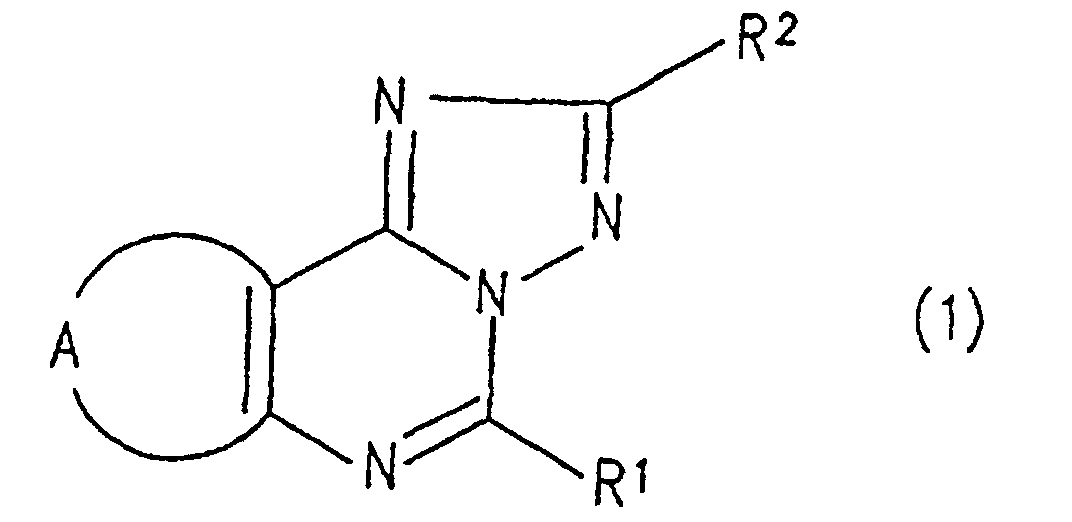 wherein R3 represents a C1-6- alkyl group or a phenyl C1-6-alkyl group.
- The triazolopurine derivative according to claim 1, wherein A is a group:
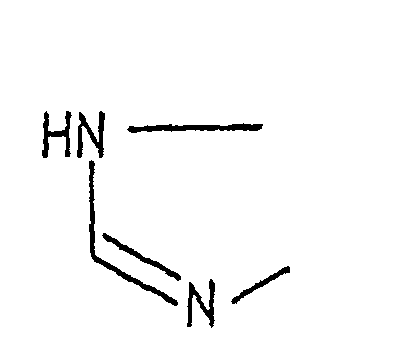
- The triazolopurine derivative according to claim 2, wherein R2 is a pyridyl group, a furyl group, a styryl group, a naphthyl group which optionally has a hydroxyl group as a substituent, a phenyl group which optionally has a group selected from C1-6- alkyl group, N-C1-6- alkylamino group, N,N-di C1-6- alkylamino group, N-phenyl C1-6- alkylamino group, N,N-bisphenyl C1-6- alkylamino group, phenyl group, phenoxy group, phenyl C1-6- alkoxy group, halogen-substituted C1-6- alkyl group, halogen-substituted C1-6-alkoxy group, di C1-6- alkylphosphorylmethyl group, C1-6-alkylthio group, hydroxyl group and halogen atom as a substituent, a phenyl group substituted with a hydroxyl group and a halogen atom, or a phenyl group having 1 to 3 C1-6- alkoxy groups as a substituent.
- The triazolopurine derivative according to claim 3, which is selected from the group of the following compounds (a) , (b) and (c):(a) compound wherein R1 is an alkyl group or a C1-6-alkyl-substituted phenyl group and R2 is a phenyl group,(b) compound wherein R1 is a n-butyl group and R2 is a pyridyl group, a furyl group, a styryl group, a naphthyl group which optionally has a hydroxy group as a substituent, a phenyl group which optionally has a group selected from C1-6-alkyl group, N-C1-6- alkylamino group, N, N-di C1-6- alkylamino group, N-phenyl C1-6- alkylamino group, N,N-bisphenyl C1-6-alkylamino group, phenyl group, phenoxy group, phenyl C1-6-alkoxy group, halogen-substituted C1-6- alkyl group, halogen-substituted C1-6- alkoxy group, di C1-6-alkylphosphorylmethyl group, C1-6- alkylthio group, hydroxyl group and halogen atom as a substituent, a phenyl group substituted with a hydroxyl group and a halogen atom, or a phenyl group having 1 to 3 C1-6- alkoxy groups as a substituent, and(c) compound wherein R1 is a phenyl group and R2 is a phenyl group having 3 C1-6- alkoxy groups.
- The triazolopurine derivative according to claim 4, which is selected from the group of the following compounds (i) and (ii):(i) compound wherein R1 is a C1-6- alkyl group and R2 is a phenyl group, and(ii) compound wherein R1 is a n-butyl group and R2 is a naphthyl group which optionally has a hydroxy group as a substituent, a phenyl group which optionally has a group selected from C1-6- alkyl group, N,N-di C1-6- alkylamino group, N-phenyl C1-6- alkylamino group, phenyl group, phenoxy group, phenyl C1-6- alkoxy group, halogen-substituted C1-6-alkyl group, halogen-substituted C1-6- alkoxy group, di C1-6-alkylphosphorylmethyl group, C1-6- alkylthio group and halogen atom as a substituent, a phenyl group substituted with a hydroxyl group and a halogen atom, or a phenyl group having 1 to 3 C1-6- alkoxy groups as a substituent.
- The triazolopurine derivative according to claim 5, which is selected from 5-n-butyl-8-(3,4,5-trimethoxyphenyl)-1H-1,2,4-triazolo[5,1-i]purine, 5-n-butyl-8-(4-chlorophenyl)-1H-1,2,4-triazolo[5,1-i]purine, 5-n-butyl-8-(4-methoxyphenyl)-1H-1,2,4-triazolo[5,1-i]purine, 5-n-butyl-8-[4-(N,N-dimethylamino)phenyl]-1H-1,2,4-triazolo[5,1-i]purine, 5-n-butyl-8-(4-propoxyphenyl)-1H-1,2,4-triazolo[5,1-i]purine, 5-n-butyl-8-(4-ethoxyphenyl)-1H-1,2,4-triazolo[5,1-i]purine, 8-(4-biphenylyl)-5-n-butyl-1H-1,2,4-triazolo[5,1-i]purine, 5-n-butyl-8-(4-trifluoromethylphenyl)-1H-1,2,4-triazolo[5,1-i]purine and 5-n-pentyl-8-phenyl-1H-1,2,4-triazolo[5,1-i]purine.
- The triazolopurine derivative according to claim 6, which is selected from 5-n-butyl-8-(4-methoxyphenyl)-1H-1,2,4-triazolo[5,1-i]purine, 5-n-butyl-8-(3,4,5-trimethoxyphenyl)-1H-1,2,4-triazolo[5,1-i]purine and 8-(4-biphenylyl)-5-n-butyl-1H-1,2,4-triazolo[5,1-i]purine.
- A pharmaceutical composition comprising the triazolopurine derivative of any one of claims 1 to 7 and a pharmaceutically acceptable carrier.
- A A3 receptor ligand comprising the triazolopurine derivative of any one of claims 1 to 7 as an active ingredient.
- Remedy for asthma, comprising the triazolopurine derivative of any one of claims 1 to 7 as an active ingredient.
- Use of the triazolopurine derivative of any one of claims 1 to 7 for the manufacture of a medicament for blocking or stimulating an adenosine A3 receptor.
Applications Claiming Priority (5)
| Application Number | Priority Date | Filing Date | Title |
|---|---|---|---|
| JP9136798 | 1998-04-03 | ||
| JP9136798 | 1998-04-03 | ||
| JP28919498 | 1998-10-12 | ||
| JP28919498 | 1998-10-12 | ||
| PCT/JP1999/001592 WO1999051606A1 (en) | 1998-04-03 | 1999-03-26 | Triazolopurine derivatives, medicinal composition containing the derivatives, adenosine a3 receptor compatibilizing agent, and asthmatic remedy |
Publications (3)
| Publication Number | Publication Date |
|---|---|
| EP1069126A1 EP1069126A1 (en) | 2001-01-17 |
| EP1069126A4 EP1069126A4 (en) | 2002-03-27 |
| EP1069126B1 true EP1069126B1 (en) | 2003-05-28 |
Family
ID=26432810
Family Applications (1)
| Application Number | Title | Priority Date | Filing Date |
|---|---|---|---|
| EP99909349A Expired - Lifetime EP1069126B1 (en) | 1998-04-03 | 1999-03-26 | Triazolopurine derivatives, medicinal composition containing the derivatives, adenosine a3 receptor compatibilizing agent, and asthmatic remedy |
Country Status (13)
| Country | Link |
|---|---|
| US (1) | US6288070B1 (en) |
| EP (1) | EP1069126B1 (en) |
| JP (1) | JP4077155B2 (en) |
| KR (1) | KR100513062B1 (en) |
| CN (1) | CN1122033C (en) |
| AT (1) | ATE241629T1 (en) |
| AU (1) | AU760399B2 (en) |
| CA (1) | CA2326716C (en) |
| DE (1) | DE69908335T2 (en) |
| ES (1) | ES2195545T3 (en) |
| NO (1) | NO317709B1 (en) |
| TW (1) | TW553945B (en) |
| WO (1) | WO1999051606A1 (en) |
Families Citing this family (6)
| Publication number | Priority date | Publication date | Assignee | Title |
|---|---|---|---|---|
| JP4077198B2 (en) * | 1999-09-28 | 2008-04-16 | 株式会社大塚製薬工場 | Triazolopurine derivative, pharmaceutical composition containing the derivative, and adenosine A3 receptor affinity agent |
| WO2002062801A1 (en) * | 2001-02-05 | 2002-08-15 | Otsuka Pharmaceutical Factory, Inc. | Triazoloquinazoline and pyrazolotriazolopyrimidine derivatives, medicinal compositions, adenosine a3 receptor affinity agents, ocular tension lowering agents, preparations for preventing and treating glaucoma and method of lowering ocular tension |
| JP4545437B2 (en) | 2001-10-15 | 2010-09-15 | シェーリング コーポレイション | Imidazo (4,3-E) -1,2,4-triazolo (1,5-C) pyrimidine as an adenosine A2A receptor antagonist |
| US9199102B2 (en) | 2009-07-21 | 2015-12-01 | Oradin Pharmaceutical Ltd. | A3 adenosine receptor ligands for modulation of pigmentation |
| AU2019205661B2 (en) | 2018-01-04 | 2022-06-30 | Impetis Biosciences Ltd. | Tricyclic compounds, compositions and medicinal applications thereof |
| US11718622B2 (en) | 2020-03-16 | 2023-08-08 | Exelixis Inc. | Heterocyclic adenosine receptor antagonists |
Family Cites Families (4)
| Publication number | Priority date | Publication date | Assignee | Title |
|---|---|---|---|---|
| DE3677445D1 (en) * | 1985-09-30 | 1991-03-14 | Ciba Geigy Ag | 2-SUBSTITUTED-E-CONDENSED (1,5-C) -PYRIMIDINE, PHARMACEUTICAL PREPARATIONS AND THEIR USE. |
| DE3781080T2 (en) * | 1986-09-30 | 1992-12-24 | Ciba Geigy Ag | 2-SUBSTITUTED-E-CONDENSED (1,2,4) TRIAZOLO- (1,5-C) PYRIMIDINE, PHARMACEUTICAL PREPARATIONS AND THEIR USE. |
| IT1277392B1 (en) * | 1995-07-28 | 1997-11-10 | Schering Plough S P A | HEROCYCLIC ANALOGS OF 1,2,4-TRIAZOLE (1,5-C] PYRIMIDINE WITH ANTAGONIST ACTIVITY FOR THE A2A RECEPTOR OF ADENOSINE |
| EP0884318A4 (en) * | 1996-10-07 | 2002-10-23 | Kyowa Hakko Kogyo Kk | MOLTEN PURINE DERIVATIVES |
-
1999
- 1999-03-26 CA CA002326716A patent/CA2326716C/en not_active Expired - Fee Related
- 1999-03-26 US US09/647,613 patent/US6288070B1/en not_active Expired - Lifetime
- 1999-03-26 JP JP2000542327A patent/JP4077155B2/en not_active Expired - Fee Related
- 1999-03-26 WO PCT/JP1999/001592 patent/WO1999051606A1/en not_active Ceased
- 1999-03-26 ES ES99909349T patent/ES2195545T3/en not_active Expired - Lifetime
- 1999-03-26 AT AT99909349T patent/ATE241629T1/en not_active IP Right Cessation
- 1999-03-26 EP EP99909349A patent/EP1069126B1/en not_active Expired - Lifetime
- 1999-03-26 AU AU28568/99A patent/AU760399B2/en not_active Ceased
- 1999-03-26 DE DE69908335T patent/DE69908335T2/en not_active Expired - Lifetime
- 1999-03-26 CN CN99806269A patent/CN1122033C/en not_active Expired - Fee Related
- 1999-03-26 KR KR10-2000-7010769A patent/KR100513062B1/en not_active Expired - Fee Related
- 1999-03-31 TW TW088105086A patent/TW553945B/en not_active IP Right Cessation
-
2000
- 2000-10-02 NO NO20004953A patent/NO317709B1/en not_active IP Right Cessation
Also Published As
| Publication number | Publication date |
|---|---|
| CN1301266A (en) | 2001-06-27 |
| NO20004953L (en) | 2000-11-28 |
| ATE241629T1 (en) | 2003-06-15 |
| AU2856899A (en) | 1999-10-25 |
| CA2326716A1 (en) | 1999-10-14 |
| EP1069126A1 (en) | 2001-01-17 |
| TW553945B (en) | 2003-09-21 |
| CA2326716C (en) | 2006-12-12 |
| KR100513062B1 (en) | 2005-09-05 |
| DE69908335T2 (en) | 2004-04-29 |
| CN1122033C (en) | 2003-09-24 |
| KR20010042240A (en) | 2001-05-25 |
| NO20004953D0 (en) | 2000-10-02 |
| ES2195545T3 (en) | 2003-12-01 |
| NO317709B1 (en) | 2004-12-06 |
| US6288070B1 (en) | 2001-09-11 |
| WO1999051606A1 (en) | 1999-10-14 |
| DE69908335D1 (en) | 2003-07-03 |
| EP1069126A4 (en) | 2002-03-27 |
| JP4077155B2 (en) | 2008-04-16 |
| AU760399B2 (en) | 2003-05-15 |
Similar Documents
| Publication | Publication Date | Title |
|---|---|---|
| DE69609602T2 (en) | PYRAZOLE DERIVATIVES AND METHOD FOR THE PRODUCTION THEREOF | |
| DE69523864T2 (en) | PYRAZOLO [1,5-a] PYRIMIDINE DERIVATIVES | |
| JP5701608B2 (en) | Organic compounds | |
| DE69930120T2 (en) | ANNEXED AZEPINONE AS INHIBITORS CYCLIN-DEPENDENT KINASES | |
| DE69717453T2 (en) | AMID DERIVATIVES | |
| KR20130083389A (en) | Heterocyclic compounds as janus kinase inhibitors | |
| JPH0469155B2 (en) | ||
| HU204052B (en) | Process for producing imidazopyridazines and pharmaceutical comprising such compounds | |
| US6288070B1 (en) | Triazolopurine derivatives, medicinal composition containing the derivatives, adenosine A3 receptor compatibilizing agent, and asthmatic remedy | |
| JPWO1999051606A1 (en) | Triazolopurine derivative, pharmaceutical composition containing said derivative, adenosine A3 receptor affinity agent and asthma treatment agent | |
| US6156787A (en) | Substituted thienlycyclohexanone derivatives for enhancing cognition | |
| DE69614102T2 (en) | PYRAZOLE [1,5-A] PYRIMIDINE DERIVATIVES | |
| EA005071B1 (en) | NOVEL SUBSTITUTED PYRAZOLO[4,3-e]DIAZEPINES, PHARMACEUTICAL COMPOSITIONS CONTAINING THEM, USE AS MEDICAL PRODUCTS AND PROCESSES FOR PREPARING THEM | |
| US20040142952A1 (en) | Triazoloquinazoline and pyrazolotriazolopyrimidine derivatives, medicinal compositions, adenosine a3 receptor affinity agents, ocular tension lowering agents, preparations for preventing and treating glaucoma and method of lowering ocular tension | |
| EP0997463A1 (en) | Naphthyridine derivatives | |
| EP1227098B1 (en) | Triazolopurine derivatives, drug compositions containing the same and adenosine a3 receptor affinitive agents | |
| JP3163413B2 (en) | Painkillers | |
| JP3163412B2 (en) | Pyrazolo [1,5-a] pyrimidine derivatives | |
| JP2009519279A (en) | Three-membered lactam derivatives, methods for their production and use as pharmaceutical agents | |
| JPWO2001023391A1 (en) | Triazolopurine derivative, pharmaceutical composition containing said derivative, and adenosine A3 receptor affinity agent | |
| JPH06316578A (en) | Pyrazolotriazine derivative and xanthine oxidase inhibitor containing the derivative |
Legal Events
| Date | Code | Title | Description |
|---|---|---|---|
| PUAI | Public reference made under article 153(3) epc to a published international application that has entered the european phase |
Free format text: ORIGINAL CODE: 0009012 |
|
| 17P | Request for examination filed |
Effective date: 20001025 |
|
| AK | Designated contracting states |
Kind code of ref document: A1 Designated state(s): AT BE CH CY DE DK ES FI FR GB GR IE IT LI LU MC NL PT SE |
|
| A4 | Supplementary search report drawn up and despatched |
Effective date: 20020207 |
|
| AK | Designated contracting states |
Kind code of ref document: A4 Designated state(s): AT BE CH CY DE DK ES FI FR GB GR IE IT LI LU MC NL PT SE |
|
| GRAH | Despatch of communication of intention to grant a patent |
Free format text: ORIGINAL CODE: EPIDOS IGRA |
|
| GRAH | Despatch of communication of intention to grant a patent |
Free format text: ORIGINAL CODE: EPIDOS IGRA |
|
| GRAA | (expected) grant |
Free format text: ORIGINAL CODE: 0009210 |
|
| AK | Designated contracting states |
Designated state(s): AT BE CH CY DE DK ES FI FR GB GR IE IT LI LU MC NL PT SE |
|
| PG25 | Lapsed in a contracting state [announced via postgrant information from national office to epo] |
Ref country code: FI Free format text: LAPSE BECAUSE OF FAILURE TO SUBMIT A TRANSLATION OF THE DESCRIPTION OR TO PAY THE FEE WITHIN THE PRESCRIBED TIME-LIMIT Effective date: 20030528 Ref country code: CY Free format text: LAPSE BECAUSE OF FAILURE TO SUBMIT A TRANSLATION OF THE DESCRIPTION OR TO PAY THE FEE WITHIN THE PRESCRIBED TIME-LIMIT Effective date: 20030528 Ref country code: AT Free format text: LAPSE BECAUSE OF FAILURE TO SUBMIT A TRANSLATION OF THE DESCRIPTION OR TO PAY THE FEE WITHIN THE PRESCRIBED TIME-LIMIT Effective date: 20030528 |
|
| REG | Reference to a national code |
Ref country code: GB Ref legal event code: FG4D |
|
| REG | Reference to a national code |
Ref country code: CH Ref legal event code: EP |
|
| REG | Reference to a national code |
Ref country code: IE Ref legal event code: FG4D |
|
| REF | Corresponds to: |
Ref document number: 69908335 Country of ref document: DE Date of ref document: 20030703 Kind code of ref document: P |
|
| REG | Reference to a national code |
Ref country code: CH Ref legal event code: NV Representative=s name: NOVAGRAAF INTERNATIONAL SA |
|
| PG25 | Lapsed in a contracting state [announced via postgrant information from national office to epo] |
Ref country code: PT Free format text: LAPSE BECAUSE OF FAILURE TO SUBMIT A TRANSLATION OF THE DESCRIPTION OR TO PAY THE FEE WITHIN THE PRESCRIBED TIME-LIMIT Effective date: 20030828 Ref country code: GR Free format text: LAPSE BECAUSE OF FAILURE TO SUBMIT A TRANSLATION OF THE DESCRIPTION OR TO PAY THE FEE WITHIN THE PRESCRIBED TIME-LIMIT Effective date: 20030828 Ref country code: DK Free format text: LAPSE BECAUSE OF FAILURE TO SUBMIT A TRANSLATION OF THE DESCRIPTION OR TO PAY THE FEE WITHIN THE PRESCRIBED TIME-LIMIT Effective date: 20030828 |
|
| REG | Reference to a national code |
Ref country code: SE Ref legal event code: TRGR |
|
| ET | Fr: translation filed | ||
| PG25 | Lapsed in a contracting state [announced via postgrant information from national office to epo] |
Ref country code: LU Free format text: LAPSE BECAUSE OF NON-PAYMENT OF DUE FEES Effective date: 20040326 Ref country code: IE Free format text: LAPSE BECAUSE OF NON-PAYMENT OF DUE FEES Effective date: 20040326 |
|
| PG25 | Lapsed in a contracting state [announced via postgrant information from national office to epo] |
Ref country code: MC Free format text: LAPSE BECAUSE OF NON-PAYMENT OF DUE FEES Effective date: 20040331 |
|
| PLBE | No opposition filed within time limit |
Free format text: ORIGINAL CODE: 0009261 |
|
| STAA | Information on the status of an ep patent application or granted ep patent |
Free format text: STATUS: NO OPPOSITION FILED WITHIN TIME LIMIT |
|
| 26N | No opposition filed |
Effective date: 20040302 |
|
| REG | Reference to a national code |
Ref country code: IE Ref legal event code: MM4A |
|
| PGFP | Annual fee paid to national office [announced via postgrant information from national office to epo] |
Ref country code: ES Payment date: 20100324 Year of fee payment: 12 Ref country code: CH Payment date: 20100323 Year of fee payment: 12 |
|
| PGFP | Annual fee paid to national office [announced via postgrant information from national office to epo] |
Ref country code: IT Payment date: 20100320 Year of fee payment: 12 Ref country code: FR Payment date: 20100324 Year of fee payment: 12 |
|
| PGFP | Annual fee paid to national office [announced via postgrant information from national office to epo] |
Ref country code: GB Payment date: 20100322 Year of fee payment: 12 Ref country code: BE Payment date: 20100215 Year of fee payment: 12 |
|
| PGFP | Annual fee paid to national office [announced via postgrant information from national office to epo] |
Ref country code: NL Payment date: 20100316 Year of fee payment: 12 Ref country code: DE Payment date: 20100429 Year of fee payment: 12 |
|
| PGFP | Annual fee paid to national office [announced via postgrant information from national office to epo] |
Ref country code: SE Payment date: 20100310 Year of fee payment: 12 |
|
| REG | Reference to a national code |
Ref country code: CH Ref legal event code: PFA Owner name: OTSUKA PHARMACEUTICAL FACTORY, INC. Free format text: OTSUKA PHARMACEUTICAL FACTORY, INC.#115, AZA KUGUHARA TATEIWA, MUYA-CHO#NARUTO-SHI, TOKUSHIMA 772-8601 (JP) -TRANSFER TO- OTSUKA PHARMACEUTICAL FACTORY, INC.#115, AZA KUGUHARA TATEIWA, MUYA-CHO#NARUTO-SHI, TOKUSHIMA 772-8601 (JP) |
|
| BERE | Be: lapsed |
Owner name: *OTSUKA PHARMACEUTICAL FACTORY INC. Effective date: 20110331 |
|
| REG | Reference to a national code |
Ref country code: NL Ref legal event code: V1 Effective date: 20111001 |
|
| REG | Reference to a national code |
Ref country code: CH Ref legal event code: PL |
|
| REG | Reference to a national code |
Ref country code: SE Ref legal event code: EUG |
|
| GBPC | Gb: european patent ceased through non-payment of renewal fee |
Effective date: 20110326 |
|
| REG | Reference to a national code |
Ref country code: FR Ref legal event code: ST Effective date: 20111130 |
|
| PG25 | Lapsed in a contracting state [announced via postgrant information from national office to epo] |
Ref country code: BE Free format text: LAPSE BECAUSE OF NON-PAYMENT OF DUE FEES Effective date: 20110331 |
|
| PG25 | Lapsed in a contracting state [announced via postgrant information from national office to epo] |
Ref country code: DE Free format text: LAPSE BECAUSE OF NON-PAYMENT OF DUE FEES Effective date: 20111001 Ref country code: CH Free format text: LAPSE BECAUSE OF NON-PAYMENT OF DUE FEES Effective date: 20110331 Ref country code: LI Free format text: LAPSE BECAUSE OF NON-PAYMENT OF DUE FEES Effective date: 20110331 Ref country code: NL Free format text: LAPSE BECAUSE OF NON-PAYMENT OF DUE FEES Effective date: 20111001 Ref country code: FR Free format text: LAPSE BECAUSE OF NON-PAYMENT OF DUE FEES Effective date: 20110331 |
|
| REG | Reference to a national code |
Ref country code: DE Ref legal event code: R119 Ref document number: 69908335 Country of ref document: DE Effective date: 20111001 |
|
| PG25 | Lapsed in a contracting state [announced via postgrant information from national office to epo] |
Ref country code: GB Free format text: LAPSE BECAUSE OF NON-PAYMENT OF DUE FEES Effective date: 20110326 Ref country code: IT Free format text: LAPSE BECAUSE OF NON-PAYMENT OF DUE FEES Effective date: 20110326 |
|
| REG | Reference to a national code |
Ref country code: ES Ref legal event code: FD2A Effective date: 20120424 |
|
| PG25 | Lapsed in a contracting state [announced via postgrant information from national office to epo] |
Ref country code: ES Free format text: LAPSE BECAUSE OF NON-PAYMENT OF DUE FEES Effective date: 20110327 |
|
| PG25 | Lapsed in a contracting state [announced via postgrant information from national office to epo] |
Ref country code: SE Free format text: LAPSE BECAUSE OF NON-PAYMENT OF DUE FEES Effective date: 20110327 |