EP1069124B1 - 2-Benzimidazolylamine compounds as ORL1-receptor agonists - Google Patents
2-Benzimidazolylamine compounds as ORL1-receptor agonists Download PDFInfo
- Publication number
- EP1069124B1 EP1069124B1 EP00305981A EP00305981A EP1069124B1 EP 1069124 B1 EP1069124 B1 EP 1069124B1 EP 00305981 A EP00305981 A EP 00305981A EP 00305981 A EP00305981 A EP 00305981A EP 1069124 B1 EP1069124 B1 EP 1069124B1
- Authority
- EP
- European Patent Office
- Prior art keywords
- alkyl
- amino
- halo
- independently selected
- alkoxy
- Prior art date
- Legal status (The legal status is an assumption and is not a legal conclusion. Google has not performed a legal analysis and makes no representation as to the accuracy of the status listed.)
- Expired - Lifetime
Links
Classifications
-
- C—CHEMISTRY; METALLURGY
- C07—ORGANIC CHEMISTRY
- C07D—HETEROCYCLIC COMPOUNDS
- C07D401/00—Heterocyclic compounds containing two or more hetero rings, having nitrogen atoms as the only ring hetero atoms, at least one ring being a six-membered ring with only one nitrogen atom
- C07D401/02—Heterocyclic compounds containing two or more hetero rings, having nitrogen atoms as the only ring hetero atoms, at least one ring being a six-membered ring with only one nitrogen atom containing two hetero rings
- C07D401/04—Heterocyclic compounds containing two or more hetero rings, having nitrogen atoms as the only ring hetero atoms, at least one ring being a six-membered ring with only one nitrogen atom containing two hetero rings directly linked by a ring-member-to-ring-member bond
-
- A—HUMAN NECESSITIES
- A61—MEDICAL OR VETERINARY SCIENCE; HYGIENE
- A61P—SPECIFIC THERAPEUTIC ACTIVITY OF CHEMICAL COMPOUNDS OR MEDICINAL PREPARATIONS
- A61P1/00—Drugs for disorders of the alimentary tract or the digestive system
- A61P1/14—Prodigestives, e.g. acids, enzymes, appetite stimulants, antidyspeptics, tonics, antiflatulents
-
- A—HUMAN NECESSITIES
- A61—MEDICAL OR VETERINARY SCIENCE; HYGIENE
- A61P—SPECIFIC THERAPEUTIC ACTIVITY OF CHEMICAL COMPOUNDS OR MEDICINAL PREPARATIONS
- A61P11/00—Drugs for disorders of the respiratory system
- A61P11/06—Antiasthmatics
-
- A—HUMAN NECESSITIES
- A61—MEDICAL OR VETERINARY SCIENCE; HYGIENE
- A61P—SPECIFIC THERAPEUTIC ACTIVITY OF CHEMICAL COMPOUNDS OR MEDICINAL PREPARATIONS
- A61P11/00—Drugs for disorders of the respiratory system
- A61P11/14—Antitussive agents
-
- A—HUMAN NECESSITIES
- A61—MEDICAL OR VETERINARY SCIENCE; HYGIENE
- A61P—SPECIFIC THERAPEUTIC ACTIVITY OF CHEMICAL COMPOUNDS OR MEDICINAL PREPARATIONS
- A61P13/00—Drugs for disorders of the urinary system
- A61P13/02—Drugs for disorders of the urinary system of urine or of the urinary tract, e.g. urine acidifiers
-
- A—HUMAN NECESSITIES
- A61—MEDICAL OR VETERINARY SCIENCE; HYGIENE
- A61P—SPECIFIC THERAPEUTIC ACTIVITY OF CHEMICAL COMPOUNDS OR MEDICINAL PREPARATIONS
- A61P25/00—Drugs for disorders of the nervous system
-
- A—HUMAN NECESSITIES
- A61—MEDICAL OR VETERINARY SCIENCE; HYGIENE
- A61P—SPECIFIC THERAPEUTIC ACTIVITY OF CHEMICAL COMPOUNDS OR MEDICINAL PREPARATIONS
- A61P25/00—Drugs for disorders of the nervous system
- A61P25/04—Centrally acting analgesics, e.g. opioids
-
- A—HUMAN NECESSITIES
- A61—MEDICAL OR VETERINARY SCIENCE; HYGIENE
- A61P—SPECIFIC THERAPEUTIC ACTIVITY OF CHEMICAL COMPOUNDS OR MEDICINAL PREPARATIONS
- A61P25/00—Drugs for disorders of the nervous system
- A61P25/06—Antimigraine agents
-
- A—HUMAN NECESSITIES
- A61—MEDICAL OR VETERINARY SCIENCE; HYGIENE
- A61P—SPECIFIC THERAPEUTIC ACTIVITY OF CHEMICAL COMPOUNDS OR MEDICINAL PREPARATIONS
- A61P25/00—Drugs for disorders of the nervous system
- A61P25/08—Antiepileptics; Anticonvulsants
-
- A—HUMAN NECESSITIES
- A61—MEDICAL OR VETERINARY SCIENCE; HYGIENE
- A61P—SPECIFIC THERAPEUTIC ACTIVITY OF CHEMICAL COMPOUNDS OR MEDICINAL PREPARATIONS
- A61P25/00—Drugs for disorders of the nervous system
- A61P25/14—Drugs for disorders of the nervous system for treating abnormal movements, e.g. chorea, dyskinesia
-
- A—HUMAN NECESSITIES
- A61—MEDICAL OR VETERINARY SCIENCE; HYGIENE
- A61P—SPECIFIC THERAPEUTIC ACTIVITY OF CHEMICAL COMPOUNDS OR MEDICINAL PREPARATIONS
- A61P25/00—Drugs for disorders of the nervous system
- A61P25/14—Drugs for disorders of the nervous system for treating abnormal movements, e.g. chorea, dyskinesia
- A61P25/16—Anti-Parkinson drugs
-
- A—HUMAN NECESSITIES
- A61—MEDICAL OR VETERINARY SCIENCE; HYGIENE
- A61P—SPECIFIC THERAPEUTIC ACTIVITY OF CHEMICAL COMPOUNDS OR MEDICINAL PREPARATIONS
- A61P25/00—Drugs for disorders of the nervous system
- A61P25/18—Antipsychotics, i.e. neuroleptics; Drugs for mania or schizophrenia
-
- A—HUMAN NECESSITIES
- A61—MEDICAL OR VETERINARY SCIENCE; HYGIENE
- A61P—SPECIFIC THERAPEUTIC ACTIVITY OF CHEMICAL COMPOUNDS OR MEDICINAL PREPARATIONS
- A61P25/00—Drugs for disorders of the nervous system
- A61P25/22—Anxiolytics
-
- A—HUMAN NECESSITIES
- A61—MEDICAL OR VETERINARY SCIENCE; HYGIENE
- A61P—SPECIFIC THERAPEUTIC ACTIVITY OF CHEMICAL COMPOUNDS OR MEDICINAL PREPARATIONS
- A61P25/00—Drugs for disorders of the nervous system
- A61P25/24—Antidepressants
-
- A—HUMAN NECESSITIES
- A61—MEDICAL OR VETERINARY SCIENCE; HYGIENE
- A61P—SPECIFIC THERAPEUTIC ACTIVITY OF CHEMICAL COMPOUNDS OR MEDICINAL PREPARATIONS
- A61P25/00—Drugs for disorders of the nervous system
- A61P25/28—Drugs for disorders of the nervous system for treating neurodegenerative disorders of the central nervous system, e.g. nootropic agents, cognition enhancers, drugs for treating Alzheimer's disease or other forms of dementia
-
- A—HUMAN NECESSITIES
- A61—MEDICAL OR VETERINARY SCIENCE; HYGIENE
- A61P—SPECIFIC THERAPEUTIC ACTIVITY OF CHEMICAL COMPOUNDS OR MEDICINAL PREPARATIONS
- A61P25/00—Drugs for disorders of the nervous system
- A61P25/30—Drugs for disorders of the nervous system for treating abuse or dependence
-
- A—HUMAN NECESSITIES
- A61—MEDICAL OR VETERINARY SCIENCE; HYGIENE
- A61P—SPECIFIC THERAPEUTIC ACTIVITY OF CHEMICAL COMPOUNDS OR MEDICINAL PREPARATIONS
- A61P25/00—Drugs for disorders of the nervous system
- A61P25/30—Drugs for disorders of the nervous system for treating abuse or dependence
- A61P25/32—Alcohol-abuse
-
- A—HUMAN NECESSITIES
- A61—MEDICAL OR VETERINARY SCIENCE; HYGIENE
- A61P—SPECIFIC THERAPEUTIC ACTIVITY OF CHEMICAL COMPOUNDS OR MEDICINAL PREPARATIONS
- A61P27/00—Drugs for disorders of the senses
- A61P27/16—Otologicals
-
- A—HUMAN NECESSITIES
- A61—MEDICAL OR VETERINARY SCIENCE; HYGIENE
- A61P—SPECIFIC THERAPEUTIC ACTIVITY OF CHEMICAL COMPOUNDS OR MEDICINAL PREPARATIONS
- A61P29/00—Non-central analgesic, antipyretic or antiinflammatory agents, e.g. antirheumatic agents; Non-steroidal antiinflammatory drugs [NSAID]
-
- A—HUMAN NECESSITIES
- A61—MEDICAL OR VETERINARY SCIENCE; HYGIENE
- A61P—SPECIFIC THERAPEUTIC ACTIVITY OF CHEMICAL COMPOUNDS OR MEDICINAL PREPARATIONS
- A61P3/00—Drugs for disorders of the metabolism
- A61P3/08—Drugs for disorders of the metabolism for glucose homeostasis
- A61P3/10—Drugs for disorders of the metabolism for glucose homeostasis for hyperglycaemia, e.g. antidiabetics
-
- A—HUMAN NECESSITIES
- A61—MEDICAL OR VETERINARY SCIENCE; HYGIENE
- A61P—SPECIFIC THERAPEUTIC ACTIVITY OF CHEMICAL COMPOUNDS OR MEDICINAL PREPARATIONS
- A61P31/00—Antiinfectives, i.e. antibiotics, antiseptics, chemotherapeutics
- A61P31/04—Antibacterial agents
-
- A—HUMAN NECESSITIES
- A61—MEDICAL OR VETERINARY SCIENCE; HYGIENE
- A61P—SPECIFIC THERAPEUTIC ACTIVITY OF CHEMICAL COMPOUNDS OR MEDICINAL PREPARATIONS
- A61P37/00—Drugs for immunological or allergic disorders
- A61P37/08—Antiallergic agents
-
- A—HUMAN NECESSITIES
- A61—MEDICAL OR VETERINARY SCIENCE; HYGIENE
- A61P—SPECIFIC THERAPEUTIC ACTIVITY OF CHEMICAL COMPOUNDS OR MEDICINAL PREPARATIONS
- A61P43/00—Drugs for specific purposes, not provided for in groups A61P1/00-A61P41/00
-
- A—HUMAN NECESSITIES
- A61—MEDICAL OR VETERINARY SCIENCE; HYGIENE
- A61P—SPECIFIC THERAPEUTIC ACTIVITY OF CHEMICAL COMPOUNDS OR MEDICINAL PREPARATIONS
- A61P7/00—Drugs for disorders of the blood or the extracellular fluid
- A61P7/08—Plasma substitutes; Perfusion solutions; Dialytics or haemodialytics; Drugs for electrolytic or acid-base disorders, e.g. hypovolemic shock
-
- A—HUMAN NECESSITIES
- A61—MEDICAL OR VETERINARY SCIENCE; HYGIENE
- A61P—SPECIFIC THERAPEUTIC ACTIVITY OF CHEMICAL COMPOUNDS OR MEDICINAL PREPARATIONS
- A61P9/00—Drugs for disorders of the cardiovascular system
-
- A—HUMAN NECESSITIES
- A61—MEDICAL OR VETERINARY SCIENCE; HYGIENE
- A61P—SPECIFIC THERAPEUTIC ACTIVITY OF CHEMICAL COMPOUNDS OR MEDICINAL PREPARATIONS
- A61P9/00—Drugs for disorders of the cardiovascular system
- A61P9/02—Non-specific cardiovascular stimulants, e.g. drugs for syncope, antihypotensives
-
- A—HUMAN NECESSITIES
- A61—MEDICAL OR VETERINARY SCIENCE; HYGIENE
- A61P—SPECIFIC THERAPEUTIC ACTIVITY OF CHEMICAL COMPOUNDS OR MEDICINAL PREPARATIONS
- A61P9/00—Drugs for disorders of the cardiovascular system
- A61P9/14—Vasoprotectives; Antihaemorrhoidals; Drugs for varicose therapy; Capillary stabilisers
Definitions
- This invention relates to novel 1-(substituted-piperidin-4-yl)-2-benzimidazolylamine compounds, and their salts, pharmaceutical compositions containing them and their medical uses.
- the compounds of this invention have activity as selective ORL1-receptor agonists, and as such are useful in treating or preventing disorders or medical conditions selected from pain, inflammatory diseases and the like.
- the agonist compounds for ORL1-receptor be effective in neurogenic inflammation ( Tips , Vol. 18, pp. 293-300, August 1997). It is also suggested that the agonist compounds be potent analgesics having less psychological side effects and addiction (D. Julius, Nature, Vol. 377, p. 476, October 12,1995).
- Schering Corporation's WO 00/06545 discloses use of a nociceptin receptor ORL1-agonist, alone or in combination with a second agent for treating pain, anxiety, asthma, depression, alcohol abuse, cough or allergy.
- the present invention provides a compound of the following formula: or a salt thereof wherein
- This invention also relates to a method of treating a disorder or condition, or anesthetizing a mammal including a human, the treatment and anesthetization of which can be effected or facilitated by agonising ORL1-receptor in a mammal including a human, comprising administering to a mammal in need of such treatment an effective amount of a compound of formula (I) or a pharmaceutically acceptable salt thereof.
- heteroaryl refers to a monocyclic aromatic hydrocarbon group having five to six ring atoms comprising one to four heteroatoms each independently selected from N, O and S.
- heteroaryl include furyl, thiophenyl, pyrrolyl, pyrazolyl, imidazolyl, triazolyl, tetrazolyl, isoxazolyl, oxazolyl, thiazolyl, isothiazolyl, oxadiazolyl, pyridyl, pyridazinyl, pyrimidinyl, pyrazinyl, triazinyl, indolyl, benzofuranyl, benzothiophenyl, isoindolyl and isobenzofuranyl.
- More preferred compounds of this invention are those compounds of formula (I), wherein
- a specific preferred compound of this invention is N-cyclohexyl-1-[1-(cyclooctylmethyl)-4-piperidinyl]-1 H -benzimidazol-2-amine, or a salt thereof.
- More preferred compounds of this invention are those compounds of formula (I), wherein
- More preferred compounds of this invention are those compounds of formula (I), wherein R 1 and R 2 are both hydrogen; R 3 and R 4 , together with the nitrogen atom to which they are attached, form piperazinyl substituted with (C 1 -C 4 )alkyl; and R 5 is unsubstituted (C 5 -C 8 )cycloalkyl.
- this invention relates to a pharmaceutical composition for the treatment of a disorder or condition selected from the group consisting of inflammatory diseases, inflammation-related hyperalgesia, eating disorders, arterial blood pressure disorders, tolerance to narcotic analgesics, dependence on narcotic analgesics, anxiety, stress disorders, psychic trauma, schizophrenia, Parkinson's disease, chorea, depressant, Alzheimer's disease, dementias, epilepsy, convulsions, migraine, non insulin dependent diabetes mellitus (type II diabetes), sepsis, incontinence, vasomotor disturbances including the peripheral vasomotor including hot flushes, alleviating symptoms of drug withdrawal including abstinence symptoms occurring during withdrawal from abusive drugs, anxiety, asthma, alcohol abuse, cough and allegy; useful as analgesics, anesthetics, neuroprotective agents or analgesic enhancers; or useful for controlling water balance, hearing regulation, controlling sodium ion excretion or ameliorating brain function, comprising an amount of a compound of formula (I), or a
- This invention also relates to a pharmaceutical composition
- a pharmaceutical composition comprising a compound of formula (I) or a salt thereof in combination with a second agent for treating cough, allergy or asthma symptoms, specifically cough.
- ORL1 agonist compounds of Formula (I) of this invention may be prepared according to the following methods.
- amino protections and removal of the amino protecting groups with reactants and reagents used may be carried out according to known procedures such as those described in Protective Groups in Organic Synthesis edited by T. W. Greene et al. (John Wiely & Sons, 1991).
- Typical amino protecting groups include benzyl, C 2 H 5 CO 2 - and t-But CO 2 - represented as t-Boc or Boc.
- Scheme 1 illustrates an embodiment of preparation process for a compound of formula (I).
- a compound of formula (I) via a compound of formula (Ia), wherein L represents a leaving group such as halo may be obtained from benzimidazolylpiperidine compound of formula (II) via intermediate compound of formula (IV).
- a compound formula (II) may be subjected to a reductive amination with an aldehyde compound of formula (III) to give the compound of formula (IV).
- the compound of formula (IV) may be reacted with a suitable nucleophilic reagent to yield the compound of formula (Ia) by introducing a leaving group to the compound of formula (IV) in the presence or absence of a catalyst.
- the compound of formula (Ia) may be subjected to a nucleophilic aromatic substitution reaction with an amino nucleophile to give the compound of formula (I).
- Suitable reaction inert solvents include alcohols such as methanol, ethanol, isopropyl alcohol, tert-butyl alcohol, and N,N-dimethylformamide (DMF) and the like. If appropriate, this reaction may be carried out in a suitable reaction chamber such as an autoclave.
- a substitution reaction of a compound of formula (Ia) wherein L is Cl with an imide may also be carried out according to the procedures reported by C. H. Senanayake, et al., Tetrahedron Lett. , Vol. 38, pp. 5607-5610, 1997. In the report, Pd-catalyst is used in the presence of a base in toluene with heating.
- the piperidine group in a compound of formula (II) may be masked with a suitable amino-protecting group represented by Z.
- Suitable amino-protecting groups are benzyl-type protecting groups such as benzyl group.
- Benzyl group may conveniently be introduced to the compounds of formula (II) in the presence of NaBH(OAc) 3 or K 2 CO 3 in DMF and removed by hydrogenolysis over Pd/C. Subsequent steps comprising leaving group introduction, enamine formation and reductive amination may be carried out according to the procedures illustrated in Scheme 1.
- a compound of formula (II) may be coupled with a carbonyl chloride compound of formula (IIIb) to give the amide compound of formula (If) then reduced to the compound of formula (IV).
- the former coupling reaction may be carried out in the presence of a base such as triethylamine in a reaction inert solvent such as dichloromethane (CH 2 Cl 2 ).
- a reaction inert solvent such as dichloromethane (CH 2 Cl 2 ).
- Suitable reaction temperature ranges from 0° to 40°C, preferably at about 0°C.
- Suitable reaction time ranges from about 30 minutes to about 48 hours, preferably from about 1 to about 24 hours.
- the latter reduction may be carried out in the presence of a reducing reagent such as LiAlH 4 in a reaction inert solvent such as THF.
- Suitable reaction temperature ranges from about -78° to about 20°C, preferably from about -30° to about 0°C.
- a compound of formula (II) may be prepared via carbonylation of an intermediate diamine compound of formula (V) according to the procedures illustrated in Scheme 4.
- benzyl-type amino protecting groups may conveniently be introduced to or removed from the compound according to the similar conditions illustrated with Scheme 2.
- a compound of formula (IX) may be subjected to a coupling reaction with an isothiocyanate compound and a subsequent desulfurization under known conditions to give a compound of formula (I) wherein either R 3 or R 4 is hydrogen.
- the first coupling reaction may be carried out in a reaction inert solvent such as an alcohol (e.g., ethanol) at from about room temperature to 100° C from 30 minutes to 48 hours under stirring.
- the desulfurization may be carried out in the presence of an alkyl halide under reflux for from about 30 minutes to 48 hours.
- a compound of formula (I) wherein (R 3 )(R 4 )N-group has an amino or an imino group (e.g., piperidinyl, piperazinyl and the like) at its terminal position may be further reacted with a desired reactant under known conditions to modify the Y.
- these amine or imine compounds may be reacted with an alkylcarbonyl halide at about room temperature in a basic solvent to give an amide compound.
- the amine or imine compounds may be reacted with an amino acid, or an amino acid sulfone or sulfoxide in the presence or absence of a coupling reagent known to those skilled in the art in peptide synthesis.
- Suitable coupling reagents are those typically used in peptide synthesis including WSC, dicyclohexylcarbodiimide (DCC), N,N'-carbonyldiimidazole (CDI), POCl 3 , TiCl 4 , SO 2 ClF, benzotriazol-1-yl diethyl phosphate, Ti(Obu) 4 , molecular sieves, N,N,N',N'-tetramethyl(succinimido)uronium tetrafluoroborate, CBMIT, Lawesson's reagent, chlorosulfonyl isocyanate, P 2 I 4 , pyridinium salts-Bu 3 N, and a mixture of Bu 3 P and PhCNO.
- WSC dicyclohexylcarbodiimide
- CDI N,N'-carbonyldiimidazole
- POCl 3 TiCl 4 , SO 2 ClF
- the amine or imine compounds may be also reacted with a guanidine compound under known conditions.
- a suitable reaction condition comprises reaction with an amino-protected guanidine compound in a reaction inert solvent such as THF at about room temperature (see M.S. Bernatowicz, et al.,Tetrahedron Lett. , Vol. 34,
- the starting materials (III), (IIIb), (V) and (IIV) and the other reactants are known or commercially available compounds, or may be prepared according to known procedures for a person skilled in the art.
- reaction pressure is not critical. Generally, the reactions will be conducted at a pressure of about one to about three atmospheres, preferably at ambient pressure (about one atmosphere).
- the subject invention also includes isotopically-labelled compounds, which are identical to those recited in formula (I), but for the fact that one or more atoms are replaced by an atom having an atomic mass or mass number different from the atomic mass or mass number usually found in nature.
- isotopes that can be incorporated into compounds of the invention include isotopes of hydrogen, carbon, nitrogen, oxygen, phosphorus, fluorine and chlorine, such as 2 H, 3 H, 13 C, 14 C, 15 N, 18 O, 17 O, 31 P, 32 P, 35 S, 18 F, and 36 Cl, respectively.
- Isotopically labelled compounds of formula (I) of this invention and prodrugs thereof can generally be prepared by carrying out the procedure disclosed in above-disclosed Schemes and/or Examples and Preparations below, by submitting a readily available isotopically labelled reagent for a non-isotopically labelld reagent.
- the compounds of Formula (I) of this invention are basic, therefore they will form acid-addition salts. All such salts are within the scope of this invention. However, it is necessary to use an acid addition salts which is pharmaceutically-acceptable for administration to a mammal.
- the acid-addition salts can be prepared by standard methods. For example, the salts may be prepared by contacting the basic compounds with acid in substantially equivalent proportions in water or an organic solvent such as methanol or ethanol, or a mixture thereof. The salts can be isolated by crystallization from or evaporation of the solvent.
- Typical salts which can be formed are the hydrochloride, nitrate, sulfate, bisulfate, phosphate, acetate, lactate, citrate, tartrate, succinate, maleate, fumarate, gluconate, saccharate, benzoate, methanesulfonate, ethanesulfonate, benzenesulfonate, p-toluenesulfonate, oxalate and pamoate (1,1'-methylene-bis-(2-hydroxy-3-naphtoate)) salts.
- the compounds of Formula (I) have been found to possess selective affinity for ORL1-receptors and ORL-1 receptor agonist activity.
- these compounds are useful as an analgesic, anti-inflammatory, diuretic, anesthetic, neuroprotective, antihypertensive and anti-anxiety agent, and the like, in mammalian subjects, especially humans in need of such agents.
- the affinity, agonist activities and analgesic activity can be demonstrated by the following tests respectively.
- the ORL1 receptor binding affinity of the compounds of this invention are determined by the following procedures. Human ORL1 receptor transfected HEK-293 cell membranes and wheat-germ agglutinin coated SPA beads are combined with 0.4nM[ 3 H]nociceptin and unlabeled test compounds in 200 ⁇ l of 50mM Hepes buffer pH7.4 containing 10mM MgCl 2 and 1mM EDTA. This mixture is incubated at room temperature (abbreviated as rt) for 30min to 60min. Non specific binding is determined by the addition of 1 ⁇ M nociceptin. Radioactivity is counted by Wallac 1450 MicroBeta.
- the mu ( ⁇ ) opioid receptor binding affinity of the compounds of this invention are determined by the following procedures. Human-mu opioid receptor transfected CHO-K1 cell membranes and wheat-germ agglutinin coated SPA beads are combined with 1.0nM[ 3 H]DAMGO and unlabeled test compounds in 200 ⁇ l of 50mM Hepes buffer pH7.4 containing 10mM MgCl 2 and 1mM EDTA. This mixture is incubated at rt for 30min to 60min. Non specific binding is determined by the addition of 1 ⁇ M DAMGO. Radioactivity was counted by Wallac 1450 MicroBeta.
- the kappa ( ⁇ ) opioid receptor binding affinity of the compounds of this invention are determined by the following procedures. Human kappa-opioid receptor transfected CHO-K1 cell membranes and wheat-germ agglutinin coated SPA beads are combined with 0.5nM[ 3 H]CI-977 and unlabeled test compounds in 200 ⁇ l of 50mM Hepes buffer pH7.4 containing 10mM MgCl 2 and 1mM EDTA. This mixture is incubated at rt for 30min to 60min. Non specific binding is determined by the addition of 1 ⁇ M CI-977. Radio activity is counted by Wallac 1450 MicroBeta.
- the delta ( ⁇ ) opioid receptor binding affinity of the compounds of this invention are determined by the following procedures. Human delta opioid receptor transfected CHO-K1 cell membranes and wheat-germ agglutinin coated SPA beads are combined with 2.0nM[ 3 H]DPDPE and unlabeled test compounds in 200 ⁇ l of 50mM Hepes buffer pH7.4 containing 10mM MgCl 2 and 1mM EDTA. The assay is incubated at room temperature for 30min to 60min. Non specific binding are determined by the addition of 1 ⁇ M of each non-labeled ligands. Radioactivity is counted by Wallac 1450 MicroBeta.
- Each percent non specific binding thus obtained is graphed as a function of compound concentration.
- a sigmoidal curve is used to determine 50% bindings (i.e., IC 50 values).
- each opioid receptor can be determined in 35S-GTP S binding system according to the procedures reported by L. J. Sim, R. Xiao and S. Childers Neuroreort Vol. 7, pp. 729-733, 1996.
- Each human ORL1-, mu-, kappa- and delta- receptor transfected CHO-K1 or HEK cell membranes are used.
- the membranes are suspended in ice-cold 20mM HEPES buffer pH 7.4, containing 100 mM NaCl, 10 mM MgCl 2 and 1mM EDTA. 0.17 mg/ml of Dithiothreitol (DTT) is added to this buffer prior to use.
- DTT Dithiothreitol
- Membranes are incubated at 25°C for 30 minutes with the appropriate concentration of test compounds in the presence of 5 ⁇ M GDP, 0.4 nM of 35S-GTP ⁇ S and Wheat-germ agglutinin (WGA) coated SPA bead (1.5 mg) in a 0.2 ml total volume. Basal binding is assessed in the absence of agonist, and non-specific binding is determined with 10 ⁇ M GTP ⁇ S. Radio activity is counted by Wallac 1450 MicroBeta. Some compounds of this invention prepared in Examples exhibited good ORL1 agonists activity in this assay.
- mice Male ICR mice, 4 weeks old and weighing 19-25g, are used. The training sessions are performed until mice can flick their tails within 4.0 sec by using Analgesia Meter MK-330A (Muromachi Kikai, Japan). Selected mice are used in this experiment. The latency time is recorded twice at 0.5, 1.0, and 2.0h after administration of the compound. The intensity of the beam is set to 80. Cut-off time is set to 8.0 sec. A compound of this invention is subcutaneously administered 30 min before the test. The ED 50 value is defined as the dose of a compound tested which halves the tail flicking observed in a control group.
- mice Male ICR mice, 4 weeks old and weighing 21-26g, are used. They are fasted the day before use. Acetic acid is diluted with saline to the concentration of 0.7%(v/v) and injected intraperitoneally (0.2ml/10g of body weight) to mice with a 26 gauge needle. A compound of this invention is dissolved in 0.1% methyl cellulose(MC)-saline and subcutaneously administered to mice 0.5h before acetic acid injection. After the acetic acid injection, each animal is placed in a 1L beaker and recorded by a video tape recorder. Number of writhing is counted from 5 to 15 min after acetic acid injection. The ED 50 value, defined as the dose of the compounds tested which halves the writhing is observed in the control group. Some compounds of this invention demonstrated good analgesic activity in this test.
- mice Male SD rats (80-100 g) are injected subcutaneously with a test compound dissolved in 0.1% methyl cellulose(MC)-saline or vehicle. After 30 min, 50 ⁇ l of a 2 % formalin are injected into a hind paw. The number of licking the injected paw per observation period is measured from 15 to 30 min. after the injection of formalin and expressed as % inhibition compared to the respective vehicle group.
- This testing method is described in, for example, (1) R.L. Follieri, et.al., Br. J. Pharmacol. 93, 85-92 (1988); (2) H. Rogers, et.al., Br. J. Pharmacol. 106, 783-789 (1992); and (3) H. Wheeler-Aceto, et al., Psychopharmacology, 104, 35-44 (1991).
- the compounds of Formula (I) of this invention can be administered by conventional pharmaceutical practice via either the oral, parenteral or topical routes to mammals, for the treatment of the indicated diseases.
- the dosage is in the range of about 0.01mg/kg to about 3000mg/kg body weight of the patient per day, preferably about 0.01mg/kg to about 1000mg/kg body weight per day administered singly or as a divided dose.
- variations will necessarily occur depending upon the weight and condition of the subject being treated, compound employed, the disease state being treated and the particular route of administration chosen.
- the compounds of the present invention may be administered alone or in combination with pharmaceutically acceptable carriers by either of the above routes previously indicated, and such administration can be carried out in single or multiple doses.
- the compounds can be combined with various pharmaceutically acceptable carriers in the form of tablets, powders, capsules, lozenges, trochees, hard candies, powders, sprays, creams, salves, suppositories, jellies, gels, pastes, lotions, ointments, suspensions, solutions, elixirs, syrups or the like.
- Such pharmaceutical carriers include solvents, excipients, coating agents, bases, binders, lubricants, disintegrants, solubilizing agents, suspending agents, emulsifing agents, stabilizers, buffering agents, tonicity agents, preservatives, flavorating agents, aromatics, coloring agents and the like.
- the tablets can contain various excipients such as starch, lactose, glucose, microcrystalline cellulose, calcium sulfate, calcium carbonate, talc, titanium oxide and the like, coating agents such as gelatin, hydroxypropylcellulose and the like, binding agents such as gelatin, gum arabic, methylcellulose and the like, and the disintegrating agents such as starch, agar, gelatine, sodium hydrogencarbonate and the like. Additionally, lubricating agents such as magnesium stearate and talc are often very useful for tabletting purposes. Solid compositions of a similar type may also be employed as fillers in gelatine capsules; preferred materials in this connection also include lactose as well as high molecular weight polyethylene glycols.
- excipients such as starch, lactose, glucose, microcrystalline cellulose, calcium sulfate, calcium carbonate, talc, titanium oxide and the like
- coating agents such as gelatin, hydroxypropylcellulose and the like, binding agents such as gelatin, gum arabic
- the active ingredient may be combined with various sweetening or flavoring agents, coloring matter or dyes, and, if so desired, emulsifying and/or suspending agents as well, together with diluents such as water, ethanol, propylene glycol, glycerin and various like combinations thereof.
- the therapeutically-effective compounds of this invention are present in such oral dosage forms at concentration levels ranging 5% to 70% by weight, preferably 10% to 50% by weight.
- the compounds of the present invention in the form of a solution may be injected parenterlly such as intradermaly, subcutaneously, intravenously or intramuscularly.
- the solutions are sterile aqueous solutions, aqueous suspensions and an edible oil solutions.
- the aqueous solutions may be suitably buffered (preferably pH>8), and may contain enough salts or glucose to make the solution isotonic with blood.
- the aqueous solutions are suitable for intravenous injection purposes.
- the aqueous suspensions may contain a suitable dispersing or suspending agents such as sodium carboxymethylcellulose, methylcellulose, polyvinylpyrrolidone or gelatin.
- the aqueous suspensions can be used for subcutaneous or intramuscular injections.
- the edible oil such as cottonseed oil, sesame oil, coconut oil or peanut oil can be employed for the edible oil solutions.
- the oil solutions are suitable for intra-articular, intra-muscular and subcutaneous injection. The preparation of all these solutions under sterile conditions is readily accomplished by standard pharmaceutical techniques well-known to those skilled in the art.
- a compound of this invention or a salt thereof may be administered to a mammal including a human in an aerosol formulation.
- the formulation may be prepared according to a method known to those skilled in the art.
- a compound of this invention in combination with a second agent disclosed above may also be administered to a mammal including a human by a formulation described in this specification.
- Those formulation may be prepared according to a method known to those skilled in the art (e.g., WO 00/06545).
Landscapes
- Health & Medical Sciences (AREA)
- Chemical & Material Sciences (AREA)
- Organic Chemistry (AREA)
- Engineering & Computer Science (AREA)
- Bioinformatics & Cheminformatics (AREA)
- Chemical Kinetics & Catalysis (AREA)
- Public Health (AREA)
- General Chemical & Material Sciences (AREA)
- Medicinal Chemistry (AREA)
- Nuclear Medicine, Radiotherapy & Molecular Imaging (AREA)
- Veterinary Medicine (AREA)
- Pharmacology & Pharmacy (AREA)
- Life Sciences & Earth Sciences (AREA)
- Animal Behavior & Ethology (AREA)
- General Health & Medical Sciences (AREA)
- Neurosurgery (AREA)
- Neurology (AREA)
- Biomedical Technology (AREA)
- Psychiatry (AREA)
- Pain & Pain Management (AREA)
- Pulmonology (AREA)
- Cardiology (AREA)
- Diabetes (AREA)
- Heart & Thoracic Surgery (AREA)
- Addiction (AREA)
- Psychology (AREA)
- Hematology (AREA)
- Communicable Diseases (AREA)
- Obesity (AREA)
- Oncology (AREA)
- Vascular Medicine (AREA)
- Hospice & Palliative Care (AREA)
- Emergency Medicine (AREA)
- Endocrinology (AREA)
- Rheumatology (AREA)
- Immunology (AREA)
- Urology & Nephrology (AREA)
- Nutrition Science (AREA)
- Pharmaceuticals Containing Other Organic And Inorganic Compounds (AREA)
- Plural Heterocyclic Compounds (AREA)
Abstract
Description
- This invention relates to novel 1-(substituted-piperidin-4-yl)-2-benzimidazolylamine compounds, and their salts, pharmaceutical compositions containing them and their medical uses. The compounds of this invention have activity as selective ORL1-receptor agonists, and as such are useful in treating or preventing disorders or medical conditions selected from pain, inflammatory diseases and the like.
- In spite of their usefulness as analgesics, usage of opioids such as morphine and heroin are strictly limited. This is because these drugs induce side effects such as euphoria, respiratory failure, depression or constipation. Further, multiple dosage of the drugs may cause addiction. Thus, there has been a long-felt need to provide analgesics with reduced side effects.
- From the above point of view, considerable pharmacological and biochemical studies have been carried out to identify opioid receptors and their endogenous ligands to prepare peptide and non-peptide opioid ligands for the receptors. In the recent past, amino acid sequences of mu- (µ-), delta (δ-) and kappa (κ-) opioid receptor subtypes have been identified and reported. Subsequently, a novel receptor subtype was identified and termed ORL1-receptor, and Meunier, J.-C et al. reported the isolation and structure of the endogenous agonist of the receptor (Nature, Vol. 377, pp. 532-535, October 12, 1995). It is suggested that the agonist compounds for ORL1-receptor be effective in neurogenic inflammation (Tips, Vol. 18, pp. 293-300, August 1997). It is also suggested that the agonist compounds be potent analgesics having less psychological side effects and addiction (D. Julius, Nature, Vol. 377, p. 476, October 12,1995).
- Neurosearch's WO 97/40035 discloses a 2-substituted 1-piperidyl benzimidazolyl compound substituted with a cycloalkyl group at the nitrogen atom of the piperidine group.
- Novo Nordisk's WO 99/59997 discloses use of a small organic compound as an opioid receptor ligand for the treatment of a disease selected from migraine, non insulin dependent diabetes mellitus (type II diabetes), sepsis, inflammation, incontinence, vasomotor disturbances including the peripheral vasomotor effects such as hot flushes, and alleviating symptoms of drug withdrawal such as abstinence symptoms occurring during withdrawal from abusive drugs.
- Schering Corporation's WO 00/06545 discloses use of a nociceptin receptor ORL1-agonist, alone or in combination with a second agent for treating pain, anxiety, asthma, depression, alcohol abuse, cough or allergy.
- The present invention provides a compound of the following formula:or a salt thereof wherein

- R1 and R2
- are independently selected from hydrogen; halo; hydroxy; (C1-C4)alkyl (C2-C4)alkenyl; (C2-C4)alkynyl; halo (C1-C4)alkyl; (C1-C4)alkoxy; (C1-C4)alkylsulfonyl; (C1-C4)alkyl-C(=O)-; carboxy; (C1-C4)alkyl-C(=O)O-; amino; NH2-C(=O)-; (C1-C4)alkyl-C(=O)-NH-; (C1-C4)alkyl-SO2-NH-; phenyl and naphthyl;
- R3 and R4
- are independently selected from
hydrogen;
halo(C1-C10)alkyl;
(C1-C6)alkyl optionally substituted with one to two substituents independently selected from hydroxy, (C1-C4)alkoxy, (C1-C4)alkyl-S-, phenoxy, amino, oxo, mono[(C1-C4)alkyl]amino, di[(C1-C4)alkyl]amino, N-[(C7-C9)cycloalkyl-(C1-C4)alkyl]-N-(C1-C4)alkyl-amino, (C1-C4)alkoxy-C(=O)-, aryl selected from phenyl and naphtyl wherein the aryl is optionally substituted with one to three substituents independently selected from halo, hydroxy, (C1-C4)alkoxy and trifluoro(C1-C4)alkoxy, and heterocyclyl selected from pyrrolidyl and piperidinyl wherein the heterocyclyl is optionally substituted with (C1-C4)alkyl;
(C3-C8)cycloalkyl optionally substituted with (C1-C4)alkyl;
(C3-C8)cycloalkenyl optionally substituted with (C1-C4)alkoxy-C(=O)-;
5- to 6-membered-heterocyclyl, 5- to 6-membered-heterocyclyl-C(=O)- and 5- to 6-membered-heterocyclyl-(C1-C4)alkyl, wherein each heterocyclyl contains in the ring one to three heteroatoms independently selected from oxygen, nitrogen and sulfur, is optionally fused to a phenyl ring, and is optionally substituted with one to two substituents independently selected from halo, (C1-C4)alkyl, benzyl and oxo;
phenyl optionally substituted with one to three substituents independently selected from halo, (C1-C4)alkyl, halo(C1-C4)alkyl and (C1-C4)alkoxy; and
5- to 6-membered heteroaryl-(C1-C4)alkyl wherein said heteroaryl contains one to four ring atoms independently selected from oxygen, nitrogen and sulfur and is optionally fused to a phenyl ring; or - R3 and R4,
- together with the nitrogen atom to which they are attached, form a fully saturated, partially saturated or fully unsaturated 5- to 8-membered nitrogen containing heterocyclic ring wherein said heterocyclic ring optionally contains in the ring one or two additional heteroatoms independently selected from nitrogen, oxygen and sulfur, optionally contains in the ring a group CR6R7 wherein R6 and R7 taken together form an oxo group or a cyclic acetal, and optionally fused to a phenyl, naphthalene or (C5-C8)cycloalkyl ring, and optionally substituted with one to two substituents independently selected from halo; (C1-C4)alkyl; halo(C1-C4)alkyl; (C1-C4)alkoxy; hydroxy; carbonyl; benzhydryl; hydroxy-(C1-C4)alkyl; (C1-C4)alkoxy-(C1-C4)alkyl-; amino; amino(C1-C4)alkyl-amino-; mercapto; (C1-C4)alkoxy-C(=O)-; pyrrolidino-(C1-C4)alkyl; amino-C(=O)-; (C1-C4)alkyl-C(=O)-; (C1-C4)alkoxy-C(=O)-amino-; piperidinyl optionally substituted with one or two substituents independently selected from amino, mono[(C1-C4)alkyl)amino-, di[(C1-C4)alkyl]amino-, benzylamino and di-(benzyl)amino; phenyl optionally substituted with one to three substituents independently selected from halo and (C1-C4)alkoxy, phenyl-(C1-C4)alkyl; phenyl-(C1-C4)alkenyl; phenyl-(C1-C4)alkoxy-C(=O)-; 1,3-benzodioxolyl-(C1-C4)alkyl-; trifluoromethyl; nitro; pyridyl optionally substituted with one to three substituents independently selected from halo and trifluoromethyl; quinolinyl optionally substituted with one to three substituents independently selected from halo and trifluoromethyl; pyrrolidinyl-(C1-C4)alkyl; and pyrrolidinyl-(CH2)m-CR8R9-(CH2)n- wherein m and n are independently 1, 2, 3 or 4, and R8 and R9, taken together with the carbon atom to which they are attached, form (C3-C6)cycloalkyl; and
- R5
- is phenyl or (C4-C11)cycloalkyl optionally substituted with one to three substituents independently selected from the group consisting of hydrogen, halo, hydroxy, (C1-C4)alkyl, halo (C1-C4)alkyl, (C1-C4)alkoxy, (C1-C4)alkylsulfonyl, (C1-C4)alkyl-C(=O)-, carboxy, (C1-C4)alkyl-C(=O)O-, amino, NH2-C(=O)-, (C1-C4)alkyl-C(=O)-NH-, (C1-C4)alkyl-SO2-NH-, phenyl and naphthyl.
- This invention also relates to a pharmaceutical composition for the treatment of a disorder or condition mediated by ORL1-receptor and its endogenous ligands in a mammal including a human, or for anesthetizing a mammal including a human, which comprises an effective amount of the compound of formula (I) as defined above, or a pharmaceutically acceptable salt thereof, and a pharmaceutically acceptable carrier.
- This invention also relates to a method of treating a disorder or condition, or anesthetizing a mammal including a human, the treatment and anesthetization of which can be effected or facilitated by agonising ORL1-receptor in a mammal including a human, comprising administering to a mammal in need of such treatment an effective amount of a compound of formula (I) or a pharmaceutically acceptable salt thereof.
- The term "alkyl", as used herein, means a straight or branched saturated monovalent hydrocarbon radical including, but not limited to, methyl, ethyl, propyl, isopropyl, n-butyl, sec-butyl, tert-butyl and the like.
- The term "cycloalkyl", as used herein, means a saturated carbocyclic radical including, but not limited to, cyclopropyl, cyclobutyl, cyclohexyl, cycloheptyl, cyclooctyl, cyclononyl, cyclodecyl and the like.
- The term "alkoxy", as used herein, means an O-alkyl group wherein "alkyl" is defined above.
- The term "halo", as used herein, refers to F, Cl, Br or I, preferably F or Cl.
- The term "heterocyclyl", as used herein, unless otherwise indicated, includes a non-aromatic and optionally bridged heterocyclic-group having 5 to 8 atoms comprising 1 to 4 heteroatoms each selected from oxygen (O), sulfur (S) and nitrogen (N). Examples of the heterocyclic include pyrrolidino, piperidino, morpholino, piperazinyl, homopiperidinyl and homopiperazinyl.
- The term "heteroaryl", as used herein, unless otherwise indicated, refers to a monocyclic aromatic hydrocarbon group having five to six ring atoms comprising one to four heteroatoms each independently selected from N, O and S. Examples of the heteroaryl include furyl, thiophenyl, pyrrolyl, pyrazolyl, imidazolyl, triazolyl, tetrazolyl, isoxazolyl, oxazolyl, thiazolyl, isothiazolyl, oxadiazolyl, pyridyl, pyridazinyl, pyrimidinyl, pyrazinyl, triazinyl, indolyl, benzofuranyl, benzothiophenyl, isoindolyl and isobenzofuranyl.
- The term "treating", as used herein, refers to reversing, alleviating, inhibiting the progress of, or preventing the disorder or condition to which such term applies, or one or more symptoms of such disorder or condition. The term "treatment" as used herein refers to the act of treating, as "treating" is defined immediately above.
- A preferred group of compounds of the present invention includes those compounds of formula (I) wherein
- R1 and R2
- are independently selected from hydrogen, halo, (C1-C4)alkyl, (C2-C4)alkenyl, (C2-C4)alkynyl, halo(C1-C4)alkyl and (C1-C4)alkoxy;
- R3 and R4
- are independently selected from hydrogen; halo(C1-C10)alkyl; (C1-C6)alkyl optionally substituted with one to two substituents independently selected from hydroxy, (C1-C4)alkoxy, phenoxy, amino, mono[(C1-C4)alkyl]amino, di[(C1-C4)alkyl]amino, phenyl and naphthyl; (C3-C8)cycloalkyl; 5- to 6-membered heterocyclyl-(C1-C4)alkyl wherein said heterocyclyl is selected from pyrrolidino, piperidino, morpholino, piperazinyl and homopiperazinyl, and optionally substituted with one to two substituents independently selected from halo and oxo; phenyl optionally substituted with one to three substituents independently selected from halo, (C1-C4)alkyl, halo(C1-C4)alkyl and (C1-C4)alkoxy; and heteroaryl-(C1-C4)alkyl wherein said heteroaryl is selected from furyl, thiophenyl, pyrrolyl, pyrazolyl, imidazolyl, triazolyl, tetrazolyl, isoxazolyl, oxazolyl, thiazolyl, isothiazolyl, oxadiazolyl, pyridyl, pyridazinyl, pyrimidinyl, pyrazinyl, triazinyl, indolyl, benzofuranyl, benzothiophenyl, isoindolyl and isobenzofuranyl; and
- R5
- is unsubstituted (C4 C11)cycloalkyl.
- More preferred compounds of this invention are those compounds of formula (I), wherein
- R1 and R2
- are independently selected from hydrogen; halo; (C1-C4)alkyl; (C2-C4)alkenyl; (C2-C4)alkynyl; halo(C1-C4)alkyl and (C1-C4)alkoxy;
- R3 and R4
- are independently selected from hydrogen; halo(C1-C10)alkyl; (C1-C6)alkyl optionally substituted with one to two substituents independently selected from hydroxy, (C1-C4)alkoxy, phenoxy, amino, mono[(C1-C4)alkyl]amino, di[(C1-C4)alkyl]amino, phenyl and naphthyl; (C3-C8)cycloalkyl; heterocyclyl-(C1-C4)alkyl wherein said heterocyclyl is selected from pyrrolidino, piperidino, morpholino, piperazinyl and homopiperazinyl, and optionally substituted with one to two substituents independently selected from halo and oxo; phenyl optionally substituted with one to three substituents independently selected from halo, (C1-C4)alkyl, halo(C1-C4)alkyl and (C1-C4)alkoxy; and heteroaryl-(C1-C4)alkyl wherein said heteroaryl is selected from furyl, thiophenyl, pyrrolyl, pyrazolyl, imidazolyl, triazolyl, tetrazolyl, isoxazolyl, oxazolyl, thiazolyl, isothiazolyl, oxadiazolyl, pyridyl, pyridazinyl, pyrimidinyl, pyrazinyl, triazinyl, indolyl, benzofuranyl, benzothiophenyl, isoindolyl and isobenzofuranyl; and
- R5
- is unsubstituted (C4-C11)cycloalkyl.
- More preferred compounds of this invention are those compounds of formula (I), wherein
- R1 and R2
- are both hydrogen;
- R3 and R4
- are independently selected from hydrogen, (C1-C6)alkyl optionally substituted with one to three substituents independently selected from hydroxy, (C1-C4)alkoxy, phenoxy, di[(C1-C4)alkyl]amino, phenyl and naphthyl; (C3-C8)cycloalkyl; heterocyclyl-(C1-C4)alkyl wherein said heterocyclyl is selected from pyrrolidino, piperidino, morpholino and piperazinyl, and optionally substituted with one to two substituents independently selected from halo and oxo; phenyl optionally substituted with one to three halo; and heteroaryl-(C1-C4)alkyl wherein said heteroaryl is selected from furyl, pyridyl and indolyl; and
- R5
- is unsubstituted (C5-C8)cycloalkyl.
- More preferred compounds of this invention are those compounds of formula (I), wherein R1 and R2 are both hydrogen; R3 and R4 are independently selected from hydrogen and (C1-C6)alkyl optionally substituted with one to three substituents independently selected from hydroxy, (C1-C4)alkoxy, phenoxy, di-[(C1-C4)alkyl]amino, phenyl and naphtyl; and R5 is unsubstituted (C5-C8)cycloalkyl.
- A specific preferred compound of this invention is N-cyclohexyl-1-[1-(cyclooctylmethyl)-4-piperidinyl]-1H-benzimidazol-2-amine, or a salt thereof.
- Another preferred group of compounds of the present invention includes compounds of formula (I) wherein,
- R1 and R2
- are independently selected from hydrogen, halo, (C1-C4)alkyl; (C2-C4)alkenyl, (C2-C4)alkynyl, halo(C1-C4)alkyl and (C1-C4)alkoxy;
- R3 and R4,
- together with the nitrogen atom to which they are attached, form a 5- to 6-membered heterocyclic ring selected from pyrrolidino; piperidino; morpholino; piperazinyl and homopiperazinyl, and optionally substituted with one to two substituents independently selected from (C1-C4)alkyl, hydroxy, hydroxy-(C1-C4)alkyl, amino, amino-(C1-C4)alkyl, and piperidinyl optionally substituted with one or two substituents independently selected from amino, benzylamino, di-(benzyl)amino, (C1-C4)alkyl-C(=O)- and pyrrolidino-(CH2)m-CR7R8-(CH2)n-, wherein m and n are independently 1, 2, 3 or 4, and R7 and R8, taken together with the carbon atom to which they are attached, form (C3-C6)cycloalkyl; and
- R5
- is unsubstituted (C4-C11)cycloalkyl.
- More preferred compounds of this invention are those compounds of formula (I), wherein
- R1 and R2
- are both hydrogen;
- R3 and R4,
- together with the nitrogen atom to which they are attached, form a 5- to 6-membered heterocyclic ring selected from pyrrolidino; piperidino; morpholino; and piperazinyl optionally substituted with one to two substituents independently selected from (C1-C4)alkyl, hydroxy, hydroxy-(C1-C4)alkyl, amino, amino-(C1-C4)alkyl, (C1-C4)alkyl-C(=O)- and piperidinyl optionally substituted with one or two substituents independently selected from amino, benzylamino, di-(benzyl)amino and pyrrolidino-(CH2)m-CR7R8-(CH2)n-, wherein m and n are independently 1, 2, 3 or 4, and R7 and R8, taken together with the carbon atom to which they are attached, form (C3-C6)cycloalkyl; and
- R5
- is unsubstituted (C5-C8)cycloalkyl.
- More preferred compounds of this invention are those compounds of formula (I), wherein R1 and R2 are both hydrogen; R3 and R4, together with the nitrogen atom to which they are attached, form piperazinyl substituted with (C1-C4)alkyl; and R5 is unsubstituted (C5-C8)cycloalkyl.
- Specific preferred compounds of this invention include 1-(1-cyclooctylmethyl-4-pipendinyl)-2-(4-methylpiperazinyl)-1H-benzimidazole, 1-(1-cyclohexylmethyl-4-piperidinyl)-2-(4-methylpiperazinyl)-1H-benzimidazole; and 1-(1-Cycloheptylmethyl-4-piperidinyl)-2-(4-methylpiperazinyl)-1H-benzimidazole; or a salt thereof.
- Accordingly, this invention relates to a pharmaceutical composition for the treatment of a disorder or condition mediated by ORL1-receptor and its endogenous ligands in a mammal including a human, or for anesthetizing a mammal including a human, which comprises an effective amount of the compound of formula (I), or a pharmaceutically acceptable salt thereof, and a pharmaceutically acceptable carrier.
- More specifically, this invention relates to a pharmaceutical composition for the treatment of a disorder or condition selected from the group consisting of inflammatory diseases, inflammation-related hyperalgesia, eating disorders, arterial blood pressure disorders, tolerance to narcotic analgesics, dependence on narcotic analgesics, anxiety, stress disorders, psychic trauma, schizophrenia, Parkinson's disease, chorea, depressant, Alzheimer's disease, dementias, epilepsy, convulsions, migraine, non insulin dependent diabetes mellitus (type II diabetes), sepsis, incontinence, vasomotor disturbances including the peripheral vasomotor including hot flushes, alleviating symptoms of drug withdrawal including abstinence symptoms occurring during withdrawal from abusive drugs, anxiety, asthma, alcohol abuse, cough and allegy; useful as analgesics, anesthetics, neuroprotective agents or analgesic enhancers; or useful for controlling water balance, hearing regulation, controlling sodium ion excretion or ameliorating brain function, comprising an amount of a compound of formula (I), or a pharmaceutically acceptable salt thereof that is effective in treating such disorder or condition, or effective in the use in a mammal including a human, and a pharmaceutically acceptable carrier.
- This invention also relates to a method of treating a disorder or condition, or anesthetizing a mammal including human, where the treatment or anesthetization of which can be effected or facilitated by agonising ORL1-receptor in a mammal, including a human, comprising administering to a mammal in need of such treatment an effective amount of a compound of formula (I) or a pharmaceutically acceptable salt thereof.
- More specifically, this invention relates to a method for treating a disorder or condition in a mammal including a human, where the disorder or condition is selected from the group consisting of inflammatory diseases, inflammation-related hyperalgesia, eating disorder (e.g., in obesity), arterial blood pressure disorders (i.e., hypertension or hypotension), tolerance to narcotic analgesics such as morphine, dependence on narcotic analgesics such as morphine, anxiety, stress disorders, psychic trauma, schizophrenia, Parkinson's disease, chorea, depressant, Alzheimer's disease, dementias, epilepsy and convulsions, or for anesthetizing a mammal including a human, or for alleviating pain (e.g., acute, chronic and neuropathic pain), producing a neuroprotective effect, enhancing analgesic, controlling water balance (e.g., in diabetes insipidus and polyuria), hearing regulation, controlling sodium ion excretion or ameliorating brain function in a mammal including a human, comprising administering to said mammal an effective amount of a compound of formula (I) or a pharmaceutically acceptable salt thereof and a pharmaceutically acceptable carrier.
- This invention also relates to a pharmaceutical composition comprising a compound of formula (I) or a salt thereof in combination with a second agent for treating cough, allergy or asthma symptoms, specifically cough.
- Examples of the second agent are antihistamines such as astemizole, azatadine, azelastin, acrivastin, brompheniramine, certirizine, cjloropheniramine, clemastine, cyclizine, carebastine, cypropheptadine, carbinoxamine, descarboethoxyloratadine, doxylamine, dimethindene, ebastine, epinastin, efletirizine, fexofenadine, hydroxyzine, ketotifen, lorotadine, levocabastine, mizolastine, equitazine, mianserin, noberastine, meclizine, norastemizole, picumast, pyrilamine, promethazine, terfenadine, tripelennamine, temelastine, trimeplazine and triprolidine; histamine H3-receptor antagonists such as thioperamide, impromidine, burimamide, clobenpropit, impentamine, mifetidine, S-sopromidine, R-sopromidine, SKF-91486, GR-175737, GT-2016, UCL-1199 and clozapine; leukotriene inhibitors such as montelkast[R-(E)]-1[[[1-[3-[2-(7-chloro-2-quinolyl)-ethenyl]phenyl)-3-[2-(1-hydroxy-1-methylethyl)phenyl)propyl)thio)methyl)cyclopropaneacetic acid and its sodium salt, 1-((R)-(3-(2-(6,7-difluoro-2-quinolinyl)ethenyl)phenyl)-3-(2-(2-hydroxy-2-propyl)phenyl)thio)methylchclopropaneacetic acid and its sodium salt, 1-(((1(R)-3-(2-(2,3-dichlorothieno(3 ,2-b ]pyridin-5-yl)-(E)-ethenyl)phenyl-3-(2-(1-hydroxy-1-methylethyl)phenyl)propyl)thio)methyl)cyclopropaneacetic acid and its sodium salt, pranlukast, N-[4-oxo-2-(1H-tetrazol-5-yl)-4H-benzopyran-8-yl]-p-(4-phenylbutoxy)benzamide), zafirlukast, (cyclopentyl-3-[2-methoxy-4-[(o-tolylsulfonyl)carbamoyl]benzyl]-1-methylindole-5-carbamate, and [2-[[2(4-tert-butyl-2-thiazolyl)-5-benzofuranyl]oxymethyl]phenyl]acetic acid; 5-lipoxygenase inhibitors such as zileuton, docebenone, pripost, ICI-D2318 and ABT761; β-adrenergic receptor agonists such as albuterol, bitolterol, isoetharine, mataproterenol, perbuterol, salmeterol, terbutaline, isoproterenol, ephedrine and epinephrine; a xanthine derivative such as theophylline; α-adrenergic receptor agonists such as arylalkylamines (e.g., phenylpropanolamine and pseudephedrine), imidazoles (e.g., naphazoline, oxymetazoline, tetrahydrozoline and xylometazoline) and cycloalkylamines (e.g., propylhexedrine); a mast sell stabilizer such as nedocromil sodium; anti-tussive agents such as codeine, dextromethorphan, benzonatate, chlophedianol and noscapine; an expectorant such as guaifenesin; NK1-, NK2- or NK3-tachykinin receptor antagonists such as CP-99,994 and SR 48968; and GABAB agonists such as baclofen and 3-aminopropyl-phosphinic acid.
- The following reaction Schemes illustrate the preparation of the compounds of the present invention. Unless otherwise indicated R1 to R8 in the reaction Schemes and discussion that follow are defined as above.
- The ORL1 agonist compounds of Formula (I) of this invention may be prepared according to the following methods.
- In a desired reaction step of the processes described hereafter, amino protections and removal of the amino protecting groups with reactants and reagents used may be carried out according to known procedures such as those described in Protective Groups in Organic Synthesis edited by T. W. Greene et al. (John Wiely & Sons, 1991). Typical amino protecting groups include benzyl, C2H5CO2- and t-But CO2- represented as t-Boc or Boc.
- Scheme 1 illustrates an embodiment of preparation process for a compound of formula (I).

- As shown in Scheme 1, a compound of formula (I) via a compound of formula (Ia), wherein L represents a leaving group such as halo, may be obtained from benzimidazolylpiperidine compound of formula (II) via intermediate compound of formula (IV).
- First, a compound formula (II) may be subjected to a reductive amination with an aldehyde compound of formula (III) to give the compound of formula (IV). Second, the compound of formula (IV) may be reacted with a suitable nucleophilic reagent to yield the compound of formula (Ia) by introducing a leaving group to the compound of formula (IV) in the presence or absence of a catalyst. Then, the compound of formula (Ia) may be subjected to a nucleophilic aromatic substitution reaction with an amino nucleophile to give the compound of formula (I).
- The reductive amination of a compound of formula (II) may be carried out using a suitable hydride reagent to give the compound of formula (IV). A suitable hydride reagent is a boron-based mild reducing reagent such as NaBH(OAc)3 or NaBH3CN. This reaction can be carried out in a reaction inert solvent such as THF, ClCH2CH2Cl or CH2Cl2 at about room temperature for from about 1 to about 48 hours.
- The compound of formula (IV) thus obtained may be refluxed with a suitable nucleophilic reagent to give the compound of formula (Ia). In case of L is Cl, a suitable chlorinating reagent is, for example, phosphoryl chloride (POCl3), phosphorus pentachloride (PCl5) or phosgene (COCl2)-triphenylphosphine (Ph3P). In case of L is Br, a suitable bromination reagent is, for example, Br2-Ph3P. The brominaton may be carried out in a reaction inert solvent such as acetonitrile or DMF. The chlorination may be carried out under conditions for example reported by R. Iemura et al. J. Med. Chem. Vol. 29, pp. 1178-1183, 1986.
- The nucleophilic aromatic substitution reaction of the compound of formula (Ia) to give the compound of formula (I) may be carried out according to a known enamine formation procedure in the presence or absence of a base. Suitable bases include Hünig base (i.e., diisopropylethylamine) and inorganic bases such as K2CO3. This reaction may be carried out in a reaction inert solvent at from about 0° to about 200°C (preferably from 0° to 150°C) for about 1 to about 24 hours (preferably from about 2 to about 12 hours). Suitable reaction inert solvents include alcohols such as methanol, ethanol, isopropyl alcohol, tert-butyl alcohol, and N,N-dimethylformamide (DMF) and the like. If appropriate, this reaction may be carried out in a suitable reaction chamber such as an autoclave.
- A substitution reaction of a compound of formula (Ia) wherein L is Cl with an imide may also be carried out according to the procedures reported by C. H. Senanayake, et al., Tetrahedron Lett., Vol. 38, pp. 5607-5610, 1997. In the report, Pd-catalyst is used in the presence of a base in toluene with heating.
- A compound of formula (I) may be also prepared by subjecting a compound of formula (II) according to the preparation process illustrated in Scheme 2 comprising introduction of a leaving group, enamine formation and reductive amination.

- In the preparation process, first the piperidine group in a compound of formula (II) may be masked with a suitable amino-protecting group represented by Z. Suitable amino-protecting groups are benzyl-type protecting groups such as benzyl group. Benzyl group may conveniently be introduced to the compounds of formula (II) in the presence of NaBH(OAc)3 or K2CO3 in DMF and removed by hydrogenolysis over Pd/C. Subsequent steps comprising leaving group introduction, enamine formation and reductive amination may be carried out according to the procedures illustrated in Scheme 1.
- An intermediate compound of formula (IV) may be also prepared according to the procedure illustrated in Scheme 3.
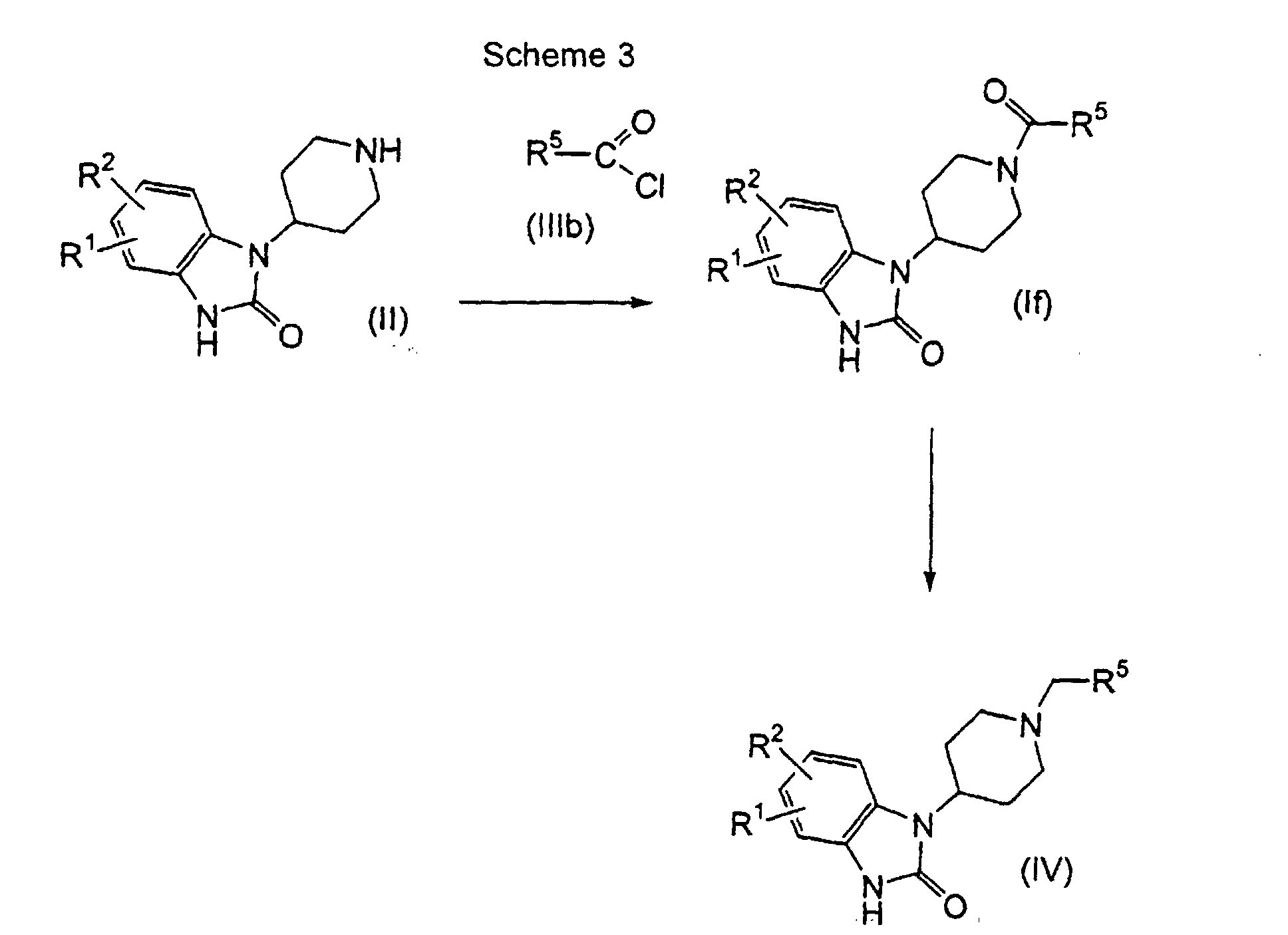
- A compound of formula (II) may be coupled with a carbonyl chloride compound of formula (IIIb) to give the amide compound of formula (If) then reduced to the compound of formula (IV). The former coupling reaction may be carried out in the presence of a base such as triethylamine in a reaction inert solvent such as dichloromethane (CH2Cl2). Suitable reaction temperature ranges from 0° to 40°C, preferably at about 0°C. Suitable reaction time ranges from about 30 minutes to about 48 hours, preferably from about 1 to about 24 hours. The latter reduction may be carried out in the presence of a reducing reagent such as LiAlH4 in a reaction inert solvent such as THF. Suitable reaction temperature ranges from about -78° to about 20°C, preferably from about -30° to about 0°C.
- Starting from an amino-protected piperidine-4-one compound of formula (V), a compound of formula (II) may be prepared via carbonylation of an intermediate diamine compound of formula (V) according to the procedures illustrated in Scheme 4.

- As shown in Scheme 4, compounds of formula (II) may be prepared through the process comprising:
- (a) reductive amination of a protected piperidine-4-one compound of formula (V) wherein Z represents an amino-protecting group to give the 4-aminopiperidine compound of formula (VI);
- (b) coupling reaction of the compound of formula (VI) with a nitrobenzene compound of formula (VII) wherein L is a leaving group such as halo to give the nitroaniline compound of formula (VIII);
- (c) reduction of the resulting nitroaniline compound of formula (VIII) to give the diamine compound of formula (IX); and
- (d) carbonylation of the compound of formula (IX) followed by removal of the amino protecting group to give the compound of formula (II)
-
- Each reaction step is described more specifically in the following.
- (a) The reductive amination may be conducted by an oximation of an amino-protected piperidine-4-one compound of formula (V) followed by reduction. Both of the reactions may be conducted under conditions for oximation of carbonyl compounds known to those skilled in the art. For example, the oximation may be carried out by reacting the piperidine compound with hydroxylamine in the presence or absence of a base in a reaction inert solvent such as alcohol at about room temperature for about 0.5 to 48 hours. The resulting oxime compound may be extracted and subjected to reduction under known conditions to give the amine compound of formula (VI). The reduction may be carried out in the presence of a reducing reagent such as lithium aluminum hydride in a reaction inert solvent such as THF at about 0 °C to room temperature for from about 0.5 to 48 hours.
- (b) & (C) Steps (b) and (c) may be carried out under conditions known to those skilled in the art (e.g., B. de Costa et al., J. Chem. Soc. Perkin. Trans., Vol. 1, pp. 1671-1680, 1992 and N. A. Meanwell et al., Bioorganic & Medicinal Chemistry Letters, Vol. 6, No. 14, pp. 1641-1646, 1996). For example, coupling reaction (b) may be carried out in the presence of a base such as K2CO3 and triethylamine (NEt3) in a reaction inert solvent such as acetonitrile under reflux for about 0.5 to 48 hours. Then, the resulting compound of formula (VIII) may be extracted and subjected to reduction to give the diamine compound of formula (IX). The reduction may be carried out in the presence of a suitable reducing reagent such as SnCl2, zinc and iron in a reaction inert solvent such as ethanol at a temperature in the range from room temperature to the reflux temperature of the reaction mixture (preferably under reflux) for from about 0.5 to about 48 hours. The reduction may also be carried out under known hydrogenation conditions such as in the presence of a metal catalyst such as Raney nickel catalysts, palladium catalysts and platinum catalysts at a temperature in the range from about 0° to 100°C (preferably at about room temperature) under hydrogen atmosphere in a reaction inert solvent such as ethanol or THF for from about 0.5 hours to 2 days.
- (d) The carbonylation of the compound of formula (IX) may be carried out using a suitable carbonylating agent such as carbonyldiimidazole, trichloromethyl chloroformate, triphosgene or urea, in a reaction inert solvent such as THF, benzene, toluene or chloroform, at the temperature in the range of from about 0° to about 120°C for from about 0.5 to about 24 hours. The reaction may be conducted according to the procedures described in WO 98/54168. Then, removal of the protecting group may be carried out according to procedures known to those skilled in the art to give the compound of formula (II).
-
- In the above preparation process, benzyl-type amino protecting groups may conveniently be introduced to or removed from the compound according to the similar conditions illustrated with Scheme 2.
- Alternatively, a compound of formula (IX) may be subjected to a coupling reaction with an isothiocyanate compound and a subsequent desulfurization under known conditions to give a compound of formula (I) wherein either R3 or R4 is hydrogen. For example, the first coupling reaction may be carried out in a reaction inert solvent such as an alcohol (e.g., ethanol) at from about room temperature to 100° C from 30 minutes to 48 hours under stirring. The desulfurization may be carried out in the presence of an alkyl halide under reflux for from about 30 minutes to 48 hours.
- A compound of formula (I) wherein (R3)(R4)N-group has an amino or an imino group (e.g., piperidinyl, piperazinyl and the like) at its terminal position may be further reacted with a desired reactant under known conditions to modify the Y. For example, these amine or imine compounds may be reacted with an alkylcarbonyl halide at about room temperature in a basic solvent to give an amide compound. The amine or imine compounds may be reacted with an amino acid, or an amino acid sulfone or sulfoxide in the presence or absence of a coupling reagent known to those skilled in the art in peptide synthesis. Suitable coupling reagents include WSC and the like. The amino or imino compound may be coupled with an amino acid, an amino acid sulfone or sulfoxide, or a phthalimido alkyl sulfonyl halide under conventional amide formation conditions in the presence of a coupling reagent in a reaction inert solvent such as acetonitrile at about room temperature. These amino acids include isoleucine, alanine, methionine, proline, phenylalanine, valine, and the like. Suitable coupling reagents are those typically used in peptide synthesis including WSC, dicyclohexylcarbodiimide (DCC), N,N'-carbonyldiimidazole (CDI), POCl3, TiCl4, SO2ClF, benzotriazol-1-yl diethyl phosphate, Ti(Obu)4, molecular sieves, N,N,N',N'-tetramethyl(succinimido)uronium tetrafluoroborate, CBMIT, Lawesson's reagent, chlorosulfonyl isocyanate, P2I4, pyridinium salts-Bu3N, and a mixture of Bu3P and PhCNO. The amine or imine compounds may be also reacted with a guanidine compound under known conditions. A suitable reaction condition comprises reaction with an amino-protected guanidine compound in a reaction inert solvent such as THF at about room temperature (see M.S. Bernatowicz, et al.,Tetrahedron Lett., Vol. 34,
- The starting materials (III), (IIIb), (V) and (IIV) and the other reactants are known or commercially available compounds, or may be prepared according to known procedures for a person skilled in the art.
- Compounds of formula (I) of this invention may be prepared by either General Procedure A or B below.
- A mixture of 2-chloro-1-(1-cyclooctylmethyl-4-piperidinyl)-1H-benzimidazole (36 mg, 0.1 mmol) and an appropriate amine compound (about 0.6 mmol) in DMSO (about 0.5 ml) is heated at about 135°C for about 5 hrs. The volatiles are removed by N2 blow. The residue is dissolved in CH2Cl2-EtOH (about 1 ml) and loaded onto a 0.2 g/2 ml Bond Elute (silica gel) eluting with CH2Cl2. The eluent is evaporated to dryness to give the product (judged by LC-MS). If necessary, the crude product is purified by LC-MS or preparative TLC (CH2Cl2-EtOH).
- A mixture of 2-chlorobenzimidazole (18 mg, 0.05 mmol), an appropriate amine compound (about 0.3 mmol), and diisopropylethylamine (about 0.3 mmol) in toluene (about 0.3 ml) is heated at about 135°C for about 5 hrs. Merrifield resin and piperazinomethyl resin are added to scavenge excess reagents. The filtrate is evaporated to give the product in good yield and purity (judged by LC-MS). If necessary, the crude product is purified by LC-MS or preparative TLC.
- In the each reaction described above, unless indicated otherwise, the reaction pressure is not critical. Generally, the reactions will be conducted at a pressure of about one to about three atmospheres, preferably at ambient pressure (about one atmosphere).
- The subject invention also includes isotopically-labelled compounds, which are identical to those recited in formula (I), but for the fact that one or more atoms are replaced by an atom having an atomic mass or mass number different from the atomic mass or mass number usually found in nature. Examples of isotopes that can be incorporated into compounds of the invention include isotopes of hydrogen, carbon, nitrogen, oxygen, phosphorus, fluorine and chlorine, such as 2H, 3H, 13C, 14C, 15N, 18O, 17O, 31P, 32P, 35S, 18F, and 36Cl, respectively. Compounds of the present invention, prodrugs thereof, and pharmaceutically acceptable salts of said compounds or of said prodrugs which contain the aforementioned isotopes and/or other isotopes of other atoms are within the scope of this invention. Certain isotopically-labelled compounds of the present invention, for example those into which radioactive isotopes such as 3H and 14C are incorporated, are useful in drug and/or substrate tissue distribution assay. Tritiated, i.e., 3H, and carbon-14, i.e., 14C, isotopes are particularly preferred for their ease of presentation and detectability. Further, substitution with heavier isotopes such as deutrium, i.e., 2H, can afford therapeutic advantage resulting from greater metabolic stability, for example increased in vivo half-life or reduced dosage requirement and, hence, may be preferred in some circumstances. Isotopically labelled compounds of formula (I) of this invention and prodrugs thereof can generally be prepared by carrying out the procedure disclosed in above-disclosed Schemes and/or Examples and Preparations below, by submitting a readily available isotopically labelled reagent for a non-isotopically labelld reagent.
- The compounds of Formula (I) of this invention are basic, therefore they will form acid-addition salts. All such salts are within the scope of this invention. However, it is necessary to use an acid addition salts which is pharmaceutically-acceptable for administration to a mammal. The acid-addition salts can be prepared by standard methods. For example, the salts may be prepared by contacting the basic compounds with acid in substantially equivalent proportions in water or an organic solvent such as methanol or ethanol, or a mixture thereof. The salts can be isolated by crystallization from or evaporation of the solvent. Typical salts which can be formed are the hydrochloride, nitrate, sulfate, bisulfate, phosphate, acetate, lactate, citrate, tartrate, succinate, maleate, fumarate, gluconate, saccharate, benzoate, methanesulfonate, ethanesulfonate, benzenesulfonate, p-toluenesulfonate, oxalate and pamoate (1,1'-methylene-bis-(2-hydroxy-3-naphtoate)) salts.
- In addition, when the compounds of this invention form hydrates or solvates they are also within the scope of this invention.
- The compounds of Formula (I) have been found to possess selective affinity for ORL1-receptors and ORL-1 receptor agonist activity. Thus, these compounds are useful as an analgesic, anti-inflammatory, diuretic, anesthetic, neuroprotective, antihypertensive and anti-anxiety agent, and the like, in mammalian subjects, especially humans in need of such agents. The affinity, agonist activities and analgesic activity can be demonstrated by the following tests respectively.
- The ORL1 receptor binding affinity of the compounds of this invention are determined by the following procedures. Human ORL1 receptor transfected HEK-293 cell membranes and wheat-germ agglutinin coated SPA beads are combined with 0.4nM[3H]nociceptin and unlabeled test compounds in 200µl of 50mM Hepes buffer pH7.4 containing 10mM MgCl2 and 1mM EDTA. This mixture is incubated at room temperature (abbreviated as rt) for 30min to 60min. Non specific binding is determined by the addition of 1µM nociceptin. Radioactivity is counted by Wallac 1450 MicroBeta.
- The mu (µ) opioid receptor binding affinity of the compounds of this invention are determined by the following procedures. Human-mu opioid receptor transfected CHO-K1 cell membranes and wheat-germ agglutinin coated SPA beads are combined with 1.0nM[3H]DAMGO and unlabeled test compounds in 200µl of 50mM Hepes buffer pH7.4 containing 10mM MgCl2 and 1mM EDTA. This mixture is incubated at rt for 30min to 60min. Non specific binding is determined by the addition of 1µM DAMGO. Radioactivity was counted by Wallac 1450 MicroBeta.
- The kappa (κ) opioid receptor binding affinity of the compounds of this invention are determined by the following procedures. Human kappa-opioid receptor transfected CHO-K1 cell membranes and wheat-germ agglutinin coated SPA beads are combined with 0.5nM[3H]CI-977 and unlabeled test compounds in 200µl of 50mM Hepes buffer pH7.4 containing 10mM MgCl2 and 1mM EDTA. This mixture is incubated at rt for 30min to 60min. Non specific binding is determined by the addition of 1µM CI-977. Radio activity is counted by Wallac 1450 MicroBeta.
- The delta (δ) opioid receptor binding affinity of the compounds of this invention are determined by the following procedures. Human delta opioid receptor transfected CHO-K1 cell membranes and wheat-germ agglutinin coated SPA beads are combined with 2.0nM[3H]DPDPE and unlabeled test compounds in 200µl of 50mM Hepes buffer pH7.4 containing 10mM MgCl2 and 1mM EDTA. The assay is incubated at room temperature for 30min to 60min. Non specific binding are determined by the addition of 1µM of each non-labeled ligands. Radioactivity is counted by Wallac 1450 MicroBeta.
- Each percent non specific binding thus obtained is graphed as a function of compound concentration. A sigmoidal curve is used to determine 50% bindings (i.e., IC50 values).
- In this testing, most of the compounds prepared in the working examples appearing hereafter demonstrated higher affinity for ORL1-receptors than for mu-receptors.
- The functional activity of the compounds of this invention in each opioid receptor can be determined in 35S-GTP S binding system according to the procedures reported by L. J. Sim, R. Xiao and S. Childers Neuroreort Vol. 7, pp. 729-733, 1996. Each human ORL1-, mu-, kappa- and delta- receptor transfected CHO-K1 or HEK cell membranes are used. The membranes are suspended in ice-cold 20mM HEPES buffer pH 7.4, containing 100 mM NaCl, 10 mM MgCl2 and 1mM EDTA. 0.17 mg/ml of Dithiothreitol (DTT) is added to this buffer prior to use. Membranes are incubated at 25°C for 30 minutes with the appropriate concentration of test compounds in the presence of 5 µM GDP, 0.4 nM of 35S-GTPγS and Wheat-germ agglutinin (WGA) coated SPA bead (1.5 mg) in a 0.2 ml total volume. Basal binding is assessed in the absence of agonist, and non-specific binding is determined with 10 µM GTPγS. Radio activity is counted by Wallac 1450 MicroBeta. Some compounds of this invention prepared in Examples exhibited good ORL1 agonists activity in this assay.
- Male ICR mice, 4 weeks old and weighing 19-25g, are used. The training sessions are performed until mice can flick their tails within 4.0 sec by using Analgesia Meter MK-330A (Muromachi Kikai, Japan). Selected mice are used in this experiment. The latency time is recorded twice at 0.5, 1.0, and 2.0h after administration of the compound. The intensity of the beam is set to 80. Cut-off time is set to 8.0 sec. A compound of this invention is subcutaneously administered 30 min before the test. The ED50 value is defined as the dose of a compound tested which halves the tail flicking observed in a control group.
- Male ICR mice, 4 weeks old and weighing 21-26g, are used. They are fasted the day before use. Acetic acid is diluted with saline to the concentration of 0.7%(v/v) and injected intraperitoneally (0.2ml/10g of body weight) to mice with a 26 gauge needle. A compound of this invention is dissolved in 0.1% methyl cellulose(MC)-saline and subcutaneously administered to mice 0.5h before acetic acid injection. After the acetic acid injection, each animal is placed in a 1L beaker and recorded by a video tape recorder. Number of writhing is counted from 5 to 15 min after acetic acid injection. The ED50 value, defined as the dose of the compounds tested which halves the writhing is observed in the control group. Some compounds of this invention demonstrated good analgesic activity in this test.
- Male SD rats (80-100 g) are injected subcutaneously with a test compound dissolved in 0.1% methyl cellulose(MC)-saline or vehicle. After 30 min, 50 µl of a 2 % formalin are injected into a hind paw. The number of licking the injected paw per observation period is measured from 15 to 30 min. after the injection of formalin and expressed as % inhibition compared to the respective vehicle group. This testing method is described in, for example, (1) R.L. Follenfant, et.al., Br. J. Pharmacol. 93, 85-92 (1988); (2) H. Rogers, et.al., Br. J. Pharmacol. 106, 783-789 (1992); and (3) H. Wheeler-Aceto, et al., Psychopharmacology, 104, 35-44 (1991).
- The compounds of Formula (I) of this invention can be administered by conventional pharmaceutical practice via either the oral, parenteral or topical routes to mammals, for the treatment of the indicated diseases. For administration to human patient by either route, the dosage is in the range of about 0.01mg/kg to about 3000mg/kg body weight of the patient per day, preferably about 0.01mg/kg to about 1000mg/kg body weight per day administered singly or as a divided dose. However, variations will necessarily occur depending upon the weight and condition of the subject being treated, compound employed, the disease state being treated and the particular route of administration chosen.
- The compounds of the present invention may be administered alone or in combination with pharmaceutically acceptable carriers by either of the above routes previously indicated, and such administration can be carried out in single or multiple doses. Generally, the compounds can be combined with various pharmaceutically acceptable carriers in the form of tablets, powders, capsules, lozenges, trochees, hard candies, powders, sprays, creams, salves, suppositories, jellies, gels, pastes, lotions, ointments, suspensions, solutions, elixirs, syrups or the like. Such pharmaceutical carriers include solvents, excipients, coating agents, bases, binders, lubricants, disintegrants, solubilizing agents, suspending agents, emulsifing agents, stabilizers, buffering agents, tonicity agents, preservatives, flavorating agents, aromatics, coloring agents and the like.
- For example, the tablets can contain various excipients such as starch, lactose, glucose, microcrystalline cellulose, calcium sulfate, calcium carbonate, talc, titanium oxide and the like, coating agents such as gelatin, hydroxypropylcellulose and the like, binding agents such as gelatin, gum arabic, methylcellulose and the like, and the disintegrating agents such as starch, agar, gelatine, sodium hydrogencarbonate and the like. Additionally, lubricating agents such as magnesium stearate and talc are often very useful for tabletting purposes. Solid compositions of a similar type may also be employed as fillers in gelatine capsules; preferred materials in this connection also include lactose as well as high molecular weight polyethylene glycols. When aqueous suspensions and/or elixirs are desired for oral administration, the active ingredient may be combined with various sweetening or flavoring agents, coloring matter or dyes, and, if so desired, emulsifying and/or suspending agents as well, together with diluents such as water, ethanol, propylene glycol, glycerin and various like combinations thereof.
- In general, the therapeutically-effective compounds of this invention are present in such oral dosage forms at concentration levels ranging 5% to 70% by weight, preferably 10% to 50% by weight.
- The compounds of the present invention in the form of a solution may be injected parenterlly such as intradermaly, subcutaneously, intravenously or intramuscularly. For example the solutions are sterile aqueous solutions, aqueous suspensions and an edible oil solutions. The aqueous solutions may be suitably buffered (preferably pH>8), and may contain enough salts or glucose to make the solution isotonic with blood. The aqueous solutions are suitable for intravenous injection purposes. The aqueous suspensions may contain a suitable dispersing or suspending agents such as sodium carboxymethylcellulose, methylcellulose, polyvinylpyrrolidone or gelatin. The aqueous suspensions can be used for subcutaneous or intramuscular injections. The edible oil such as cottonseed oil, sesame oil, coconut oil or peanut oil can be employed for the edible oil solutions. The oil solutions are suitable for intra-articular, intra-muscular and subcutaneous injection. The preparation of all these solutions under sterile conditions is readily accomplished by standard pharmaceutical techniques well-known to those skilled in the art.
- It is also possible to administer the compounds of the present invention topically when treating inflammatory conditions of the skin and this may preferably be done by way of creams, jellies, gels, pastes, ointments and the like, in accordance with standard pharmaceutical practice.
- For treating a respiratory disease or symptom such as cough, a compound of this invention or a salt thereof may be administered to a mammal including a human in an aerosol formulation. The formulation may be prepared according to a method known to those skilled in the art. A compound of this invention in combination with a second agent disclosed above may also be administered to a mammal including a human by a formulation described in this specification. Those formulation may be prepared according to a method known to those skilled in the art (e.g., WO 00/06545).
- The present invention is illustrated by the following examples and preparation. However, it should be understood that the invention is not limited to the specific details of these examples and preparations. Melting points were taken with a Buchi micro melting point apparatus and is not corrected. Infrared Ray absorption spectra (IR) were measured by a Shimadzu infrared spectrometer (IR-470). 1H and 13C nuclear magnetic resonance spectra (NMR) were measured in CDCl3 by a JEOL NMR spectrometer (JNM-GX270, 270MHz) unless otherwise indicated and peak positions are expressed in parts per million (ppm) downfield from tetramethylsilane. The peak shapes are denoted as follows: s, singlet; d, doublet; t, triplet; m, multiplet; br, broad.
- Analytical data of compounds, which can be prepared according to General Procedures A and B or were prepared in Examples hereinafter disclosed, can be taken by utilizing Waters LC-MS system (LC as 2690, ZMD as MS).
Analytical condition for LC-MS: Column YMC CombiScreen basic 4.6 mm x 50 mm, Flow rate 1 mL/min.; Mobile phase 20% MeOH/ 80% 0.1%HCO2H in H2O programmed over 5min to 90% MeOH/10% 0.1%HCO2H in H2O. Hold for 5 min.; Wave length 220-400 nm. MS detector ApcI Cone 30 Volts. - To a stirred suspension mixture of 4-(2-keto-1-benzimidazolinyl)piperidine(17.38 g, 80 mmol) and cyclooctanecarboxaldehyde (15.39 g, 110 mmol) in CH2Cl2 (200 ml) was added NaBH(OAc)3 (21 g, 99 mmol) by portions at room temperature. After overnight reaction, the reaction mixture was diluted with CH2Cl2(200 ml), washed with saturated NaHCO3 solution and brine, and dried(Na2SO4). After filtration, the filtrate was concentrated to give 41.97 g of pale yellow solid. This solid was suspended in Et2O and solid was collected byfiltration to give 24.10 g of white solid. The filtrate was concentrated to give yellow solid which was suspended in Et2O/hexane. The solid' was collected by filtration to give 2.60 g of white solid. Total 26.7 g of desired product was obtained. A mixture of this solid(26.7 g, 78.18 mmol) and POCl3 (73 ml, 788 mmol) was refluxed for 4 days. After evaporation of excess POCl3, the residue was dissolved in AcOEt(200 ml). Then this solution was added dropweise to a stirred mixture of NH4OH(200 ml of 25 % NH4OH) and ice(100 g). The organic layer was separated and dried(Na2SO4). After filtration, the filtrate was concentrated to give 29.05 g of dark brown viscous oil. This oil was purified by column chromatography (silica gel: 300 g, hexane/AcOEt: 4/1 as eluent) to afford 8.05 g of title compound and 18.56 g of the mixture included desired product mainly. This mixture was purified by column chromatography(silica gel: 300 g, hexane/AcOEt: 4/1 as eluent) to afford 12.44 g of desired product. Total 20.49 g(72.8 %) of title compound was obtained.
1H NMR (CDCl3) δ 7.44-7.39(1H, m), 7.19-7.14(1H, m), 7.08(1H, dt, J=1.3, 7.4Hz), 6.98(1H, dt, J=1.2, 7.4 Hz), 4.70-4.60(1H, m), 3.76-3.28(6H, m), 2.48-1.96(4H, m), 1.86-1.25(15H, m). - A mixture of 2-chloro-1-(1-cyclooctylmethyl-4-piperidinyl)-1H-benzimidazole (470 mg, 1.3 mmol) and N-methylpiperazine(260 mg, 2.6 mmol) was stirred at 120°C for 6 h. Then this was purified by column chromatography (silica gel: 100 g, CH2Cl2/MeOH:10/1) to give 84 mg(14.9 %) of title compound.
1H NMR (CDCl3) δ 7.66-7.50(2H, m), 7.20-7.10(2H, m), 4.24-4.07(1H, m), 3.30-3.24(4H, m), 3.05(2H, br.d J=11.4 Hz), 2.66-2.60(4H, m), 2.60-2.47(2H, m), 2.38(3H, s), 2.17-1.20(21H, m).
MS(EI direct) m/z : 423(M+), 353, 338, 206(100%), 96.
This free amine(84 mg) was treated with HCl solution in MeOH(1 ml). Then this mixture was concentrated to give yellow viscous oil which was solidified by adding Et2O. The solid appeared was collected by filtration to afford 89 mg of light brown solid.
Anal. Calcd for C26H41N5-3HCl-2H2O: C, 54.88; H, 8.50; N, 12.31. Found: C, 55.10; H, 8.82; N, 12.04. - This was prepared according to the procedure described in preparation 1 using cyclohexanecarboxaldehyde instead of cyclooctanecarboxaldehyde. Overall yield was 19.5 %.
1H NMR (CDCl3) δ 7.72-7.58(2H, m), 7.32-7.21(2H, m), 4.52-4.38(1H, m), 3.10-3.02(2H, m), 2.65-2.49(2H, m), 2.26-2.04(4H, m), 1.89-1.71(7H, m), 1.56-1.43(1H, m), 1.31-1.15(3H, m), 0.97-0.84(2H, m). - This was prepared according to the procedure described in Example 1 using 2-chloro-1-(1-cyclohexylmethyl-4-piperidinyl)-1H-benzimidazole instead of 2-chloro-1-(1-cyclooctylmethyl-4-piperidinyl)-1H-benzimidazole. Yield was 97.3 %.
1H NMR (CDCl3) δ 7.66-7.60(1H, m), 7.55-7.49(1H, m), 7.20-7.09(2H, m), 4.21-4.08(1H, m), 3.30-3.25(4H, m), 3.10-3.01 (2H, m), 2.65-2.61(4H, m), 2.56-2.49(2H, m), 2.38(3H, s), 2.21-2.16(2H, m), 2.09-2.00(4H,m), 1.86-1.66(5H, m), 1.58-1.42(1H, m), 1.29-1.14(3H, m), 0.99-0.83(2H, m).
MS(ESI positive) m/z : 396(M+H)+.
This free amine was converted to HCl salt, mp 206-210°C.
IR(KBr): 3385, 2930, 2671, 1595, 1458 cm-1
Anal. Calcd for C24H37N5-3HCl-3H2O: C, 51.57; H, 8.29; N, 12.53. Found: C, 51.47; H, 8.62; N, 12.50. - This was prepared according to the procedure described in preparation 1 using cycloheptanecarboxaldehyde instead of cyclooctanecarboxaldehyde. Overall yield was 77 %.
1H NMR (CDCl3) δ 7.70-7.60(2H, m), 7.27-7.23(2H, m), 4.54-4.37(1H, m), 3.15-2.95(2H, m), 2.67-2.47(2H, m), 2.25-2.00(4H, m), 1.95-1.35(13H, m), 1.35-1.10(2H, m). - This was prepared according to the procedure described in Example 1 using 2-chloro-1-(1-cycloheptylmethyl-4-piperidinyl)-1H-benzimidazole instead of 2-chloro-1-(1-cyclooctylmethyl-4-piperidinyl)-1H-benzimidazole. Yield was 73 %.
1H NMR (CDCl3) δ 7.67-7.58(1H, m), 7.55-7.48(1H, m), 7.20-7.08(2H, m), 4.23-4.06(1H, m), 3.33-3.21(4H, m), 3.12-2.97(2H, m), 2.71-2.30(9H, m, including 3H, s, at 2.38 ppm), 2.16(2H, d, J=7.3Hz), 2.11-1.98(2H, m), 1.90-1.36(13H, m), 1..26-1.07(2H,m).
MS(EI direct) m/z : 409(M)+, 327, 227, 163, 99. - To a stirred solution of 4-(2-keto-1-benzimidazolinyl)piperidine(217.3 mg, 1 mmol) and Et3N 11.13 g, 110 mmol) in CH2Cl2(5 ml) was added cyclopentanecarbonyl chloride 0.146 ml, 1.2 mmol) dropwise at 0°C. After 2 h stirring, the reaction mixture was diluted with CH2Cl2, washed with saturated NaHCO3 solution and brine, and dried(Na2SO4). After filtration, the filtrate was concentrated. The residue was purified by preparative TLC (1mm thick plate x 2, CH2Cl2/MeOH:12/1) to give 291 mg (93 %) of amide compound as white solid. To a stirred suspension of LiAlH4(53 mg, 1.394 mmol) in THF(5 ml) was added a solution of the above amide derivative(291 mg, 0.929 mmol) in THF(5 ml) at -78°C. The reaction mixture was stirred at -78°C to -20°C for 4 h. The reaction mixture was quenched with Na2SO4-10H2O and diluted with CH2Cl2. The solid appeared was removed by filtration and the filtrate was concentrated to give oil, which was purified by preparative TLC (1mm thick plate x 2, CH2Cl2/MeOH:12/1) to give 202 mg (73 %) as colorless amorphous solid.
1H NMR (CDCl3) δ 10.30 (1H, br. s), 7.34-7.26(1H, m), 7.16-7.00(3H, m), 4.45-4.30(1H, m), 3.18-3.06(2H, m), 2.60-2.40(2H, m), 2.35(2H, d, J=7.2 Hz), 2.22-2.00(3H, m), 1.87-1.45(8H, m), 1.35-1.15(2H, m). - The mixture of 1-(1-cyclopentylmethyl-4-piperidinyl)-1, 3-dihydro-2H-benzimidazole-2-one(202 mg) and POCl3(5 ml) was heated at 120°C for 2h. After cooling down to room temperature, the reaction mixture was poured into NH4OH solution, and extracted with CH2Cl2. The extracts combined were washed with water, and dried (Na2SO4). After filtration, the filtrate was concentrated to give oil, which was purified by preparative TLC (1mm thick plate x 2, CH2Cl2/MeOH:15/l) to give 148 mg (69 %) of 2-chloro-1-(1-cyclopentylmethyl-4-piperidinyl)-1H-benzimidazole as colorless amorphous solid. To a solution of 2-chloro-1-(1-cyclopentylmethyl-4-piperidinyl)-1H-benzimidazole(148 mg, 0.466 mmol) in MeOH(5 ml) was added N-methylpiperazine(1 ml) and the resulting mixture was heated at 120°C in a sealed tube for 2 days. After concentration, the residue was purified by preparative TLC (1mm thick plate x 2, CH2Cl2/MeOH:12/1, 2 developed) to give 161 mg of colorless amorphous solid. This was purified again by column chromatography(basic silica gel: 50 g; CH2Cl2/MeOH:200/1 to 50/1) to afford 52 mg (29 %) of title compound as colorless amorphous solid.
1H NMR (CDCl3) δ 7.66-7.58(1H, m), 7.57-7.49(1H, m), 7.20-7.08(2H, m), 4.22-4.08(1H, m), 3.32-3.24(4H, m), 3.16-3.07(2H, m), 2.66-2.30(11H, m, including 3H, s, at 2.38 ppm, and 2H, d, J=7.3Hz at 2.33 ppm), 2.18-2.00(3H, m), 1.96-1.50(8H, m), 1.34-1.16(2H,m).
MS(EI direct) m/z: 381(M)+, 311, 296, 217, 164(100%), 96. - This was prepared according to the procedure described in Preparation 1 using benzaldehyde instead of cyclooctanecarboxaldehyde. Total yield was 23.1 %.
1H NMR (CDCl3) δ 7.70-7.60(2H, m), 7.40-7.20(7H, m), 4.52-4.42(1H, m), 3.61(2H, s), 3.20-3.07(2H, m), 2.65-2.50(2H, m), 2.25-2.15(2H, m), 1.90-1.85(2H, m). - This was prepared according to the procedure described in Example 1. Total yield was 76%.
1H NMR (CDCl3) δ 7.64-7.50(2H, m), 7.40-7.10(7H, m), 4.24-4.14(1H, m), 3.59(2H, s), 3.30-3.24(4H, m), 3.12-3.05(2H, m), 2.70-2.50(6H, m), 2.38(3H, s), 2.20-2.13(2H, m), 1.80-1.75(2H, m).
MS(EI direct) m/z : 389(M+), 306, 217, 172, 91 (100%). - A suspension mixture of 1-(1-benzyl-4-piperidinyl)-2-(4-methylpiperazinyl)-1H-benzimidazole (4.62 g, 11.86 mmol) and Pd(OH)2/C (2.35 g) in MeOH(100 ml) was stirred under hydrogen atmosphere at room temperature for 23 h. The catalyst was removed by filtration and the filtrate was concentrated to give 3.10 g (87 %) of title compound as white solid.
1H NMR (CDCl3) δ 7.65-7.57(2H, m), 7.20-7.10(2H, m), 4.40-4.25(1H, m), 3.50-3.40(2H, m), 3.40-3.25(4H, m), 2.90-2.82(2H, m), 2.80-2.50(7H, m), 2.40(3H, s), 1.91-1.85(2H, m). - A mixture of 2-(4-methylpiperazinyl)-1-(4-piperidinyl)-1H-benzimidazole (300 mg, 1 mmol), K2CO3 (165.9 mg, 1.2 mmol), and (bromomethyl)cyclobutane (178.8 mg, 1.2 mmol) in DMF (4 ml) was stirred at room temperature for 17 h. Then K2CO3 (110 mg, 0.8 mmol), and (bromomethyl)cyclobutane (119 mg, 0.8 mmol) were added to the reaction mixture. After 16 h stirring, the reaction mixture was poured into water and extracted with CH2Cl2. The extracts combined were dried (MgSO4), filtered, and concentrated in vacuo to give 369 mg of oil which was purified by preparative TLC (1 mm thick plate, CH2Cl2/MeOH:10/1 2 developped) to afford 147.6 mg (40 %) of title compound as light brown solid.
1H NMR (CDCl3) δ 7.66-7.50(2H, m), 7.20-7.08(2H, m), 4.25-4.08(1H, m), 3.35-3.20(4H, m), 3.10-2.80(3H, m), 2.70-2.45(8H, m), 2.38(3H, s), 2.20-2.05(4H, m), 2.00- 1.65(6H, m).
MS(EI direct) m/z: 367(M+), 341, 311, 282, 256, 217, 150(100%), 96. - The chemical structures of the compounds of Formula (I), prepared in Examples 1 to 6, are summarized in Table 1.
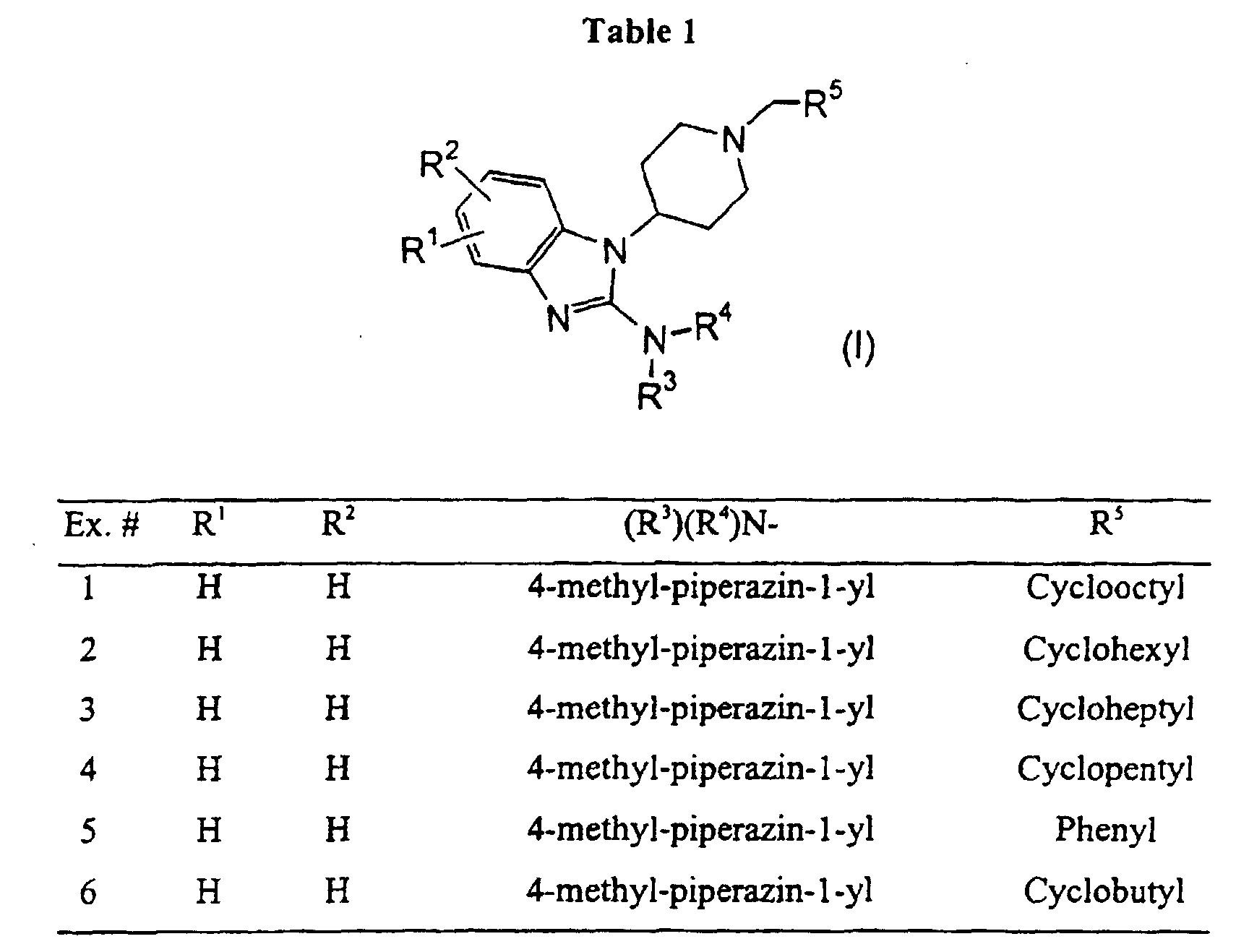
- Also, compounds of formula (I), wherein both R1 and R2 are hydrogen and R5 is cyclooctyl, were prepared according to General Procedure A or B described in this specification using appropriate starting materials. Those compounds are summarized in the following table.
Example # General Procedure (R3)(R4)N- M+1 (APCI) 7 A Piperidino 409 8 A 3-hydroxy-pyrrolidin-1-yl 412 9 A 3-hydroxymethyl-piperidino 440 10 A Morpholino 412 11a A 4-(2-aminoethyl)piperazin-1-yl 454 23 B 4-phenylpiperazinyl 487 24 B 4-acetylpiperazinyl 453 25 B 4-[4-(N,N-dibenzylamino)piperidino]piperidino 688 26 B 1-{[1-(1-pyrrolidinylmethyl)cyclopentyl]methyl}piperazinyl 576 33 azocan-1-yl 437.5 34 pyrrolidinyl 395.5 35 2-(S)-(hydroxymethyl)pyrronidinyl 425.5 36 4-(1,3-benzodioxol-5-ylmethyl)piperazinyl 544.5 37 1,2,3,6-tetrahydropyridin-1-yl 407.5 38 4-(2-metoxyphenyl)piperazinyl 516.6 39 4-(4-fluorophenyl)piperazinyl 504.6 40 4-benzylpiperazinyl 500.3 41 4-(2-hydroxyethyl)piperazinyl 454.5 42 1,4-dioxa-8-azaspiro[4.5]decan-8-yl 467.5 43 piperidino 409.5 44 3-(ethoxycarbonyl)piperidino 481.5 45 3-methylpiperidino 423.5 46 3,5-dimethylpiperidino 437.5 47 3-(hydroxymethyl)piperidino 48 4-hydroxy-4-phenylpiperidino 501.5 49 4-methylpiperidino 423.5 50 4-benzylpiperizino 51 decahydroisoquinolin-2-yl 463.5 52 1,2,3,4-tetrahydroisoquinolin-2-yl 457.3 53 homopiperidino 423.5 54 2-(S)-(methoxymethyl)pyrronidinyl 439.3 55 2-(S)-(pyrrolidinylmethyl)pyrroridinyl 478.5 56 4-(2-fluorophenyl)piperazinyl 504.4 57 4-methylhomopiperazinyl 438.5 58 trans-1-cinnamylpiperazinyl 526.5 59 2-(S)-(hydroxymethyl)pyrroridinyl 425.5 60 4-t-buthoxycarbonylpiperazinyl 510.4 61 4-benzyloxycarbonylpiperazinyl 544.5 62 3,5-dimethylmorpholino 439.5 63 2-methyl-5-ethylpiperidino 451.5 64 4-hydroxymethylpiperidino 439.5 65 4-(2-metoxyphenyl)piperidino 515.5 66 N-methyl-N-2-hydroxy-2-phenylethylamino 475.5 67 3-carbamoylpiperidino 452.5 68 N-methyl-N-propylamino 397.3 69 N-methyl-N-3-hydroxy-3-phenylpropylamino 489.5 70 2-(S)-methoxymethylpyrrolidinyl 71 3-t-buthoxycarbonylaminopyrrolidinyl 510.1 72 N-methyl-N-(1-naphthyl)methylamino 495.5 73 4-(4-trifluoromethylpyridin-2-yl)piperazinyl 555.5 74 4-(3-trifluoromethylpyridin-2-yl)piperazinyl 555.5 75 4-(3-chloro-5-trifluoromethylpyridin-2-yl)piperazinyl 589.5 76 4-(2-trifluoromethylquinolin-4-yl)piperazinyl 605.6 77 1,3,3-trimethyl-6-azabicyclo[3.2. 1]octan-6-yl 477.4 78 N-n-hexyl-N-methylamino 439.4 79 N-2-(N,N-dimethylaminoethyl)-N-methylamino 426.3 80 3-(N,N-diethylaminocarbonyl)piperidino 508.4 81 4-(4-fluorophenyl)piperazin-1-yl 504.4 82 4-(2-nitro-4-trifluorophenyl)piperazin-1-yl 599.4 83 3-pyrrolin-1-yl 84 4-formylpiperazin-1-yl 438.4 85 1,3,4,6,7,8-hexahydro-2H-pyrimido[1,2-a]pyrimidin-1-yl 463.4 86 4-acetylpiperazin-1-yl 87 4-ethylpiperazin-1-yl 438.4 88 4-ethoxy-3-hydroxyethyl-piperazin-1-yl 498.4 89 2,3-dihydro-1H-benzo[de]isoquinolin-2-yl 493.4 90 N-(2-hydroxyethyl)-N-n-butylamino 441.3 91 N, N-bis(2-pyridinylmethyl)amino 523.4 92 N-(1-benzyl-3-pyrrolidinyl)-N-methylamino 514.4 93 2,6-dimethylmorpholino 439.5 94 4-(2-ethoxyphenyl)piperazin-1-yl 530.5 95 4-(3,4-dichlorophenyl)piperazin-1-yl 554.5 96 4-(3, 5-dimethylphenyl)piperazin-1-yl 514.5 97 4-benzhydrylpiperazin-1-yl 576.5 98 4-(2-chlorophenyl)piperazin-1-yl 520.5 99 N-cyclohexyl-N-methylamino 437.5 100 N-isobutyl-N-methylamino 411.3 101 N-(2-hydroxyethyl)-N-n-pentylamino 455.4 102 N-(1,3-dioxolan-2-ylmethyl)-N-methylamino 441.3 103 N-benzyl-N-methylamino 445.3 104 2,4-dimethyl-4,5-dihydro-1H-imidazol-1-yl 422.3 105 N-(2-phenylethyl)-N-methylamino 459.3 108 N-benzyl-N-2-hydroxyethylamino 475.3 109 N-n-Butyl-N-4-hydroxybutylamino 469.3 110 N-(2-hydroxyphenyl)methyl-N-methylamino 461.1 111 4-ethoxycarbonylpiperazin-1-yl 482.3 118 N-ethoxycarbonyl-N-phenylamino 123 N-(2-ethoxy)ethyl-N-methylamino 413.3 131 N,N-bis-2-(N',N'-diethylaminoethyl)amino 539.3
Claims (15)
- A compound of the following formula:or a salt thereof, wherein

- R1 and R2
- are independently selected from hydrogen; halo; hydroxy; (C1-C4)alkyl; (C2-C4)alkenyl; (C2-C4)alkynyl); halo (C1-C4)alkyl; (C1-C4)alkoxy; (C1-C4)alkylsulfonyl; (C1-C4)alkyl-C(=O)-; carboxy; (C1-C4)alkyl-C(=O)O-; amino; NH2-C(=O)-; (C1-C4)alkyl-C(=O)-NH-; (C1-C4)alkyl-SO2-NH-; phenyl and naphthyl;
- R3 and R4
- are independently selected from
halo(C1-C10)alkyl;
(C1-C6)alkyl substituted with one to two substituents independently selected from hydroxy, (C1-C4)alkoxy, (C1-C4)alkyl-S-, phenoxy, amino, oxo, mono[(C1-C4)alkyl]amino, di[(C1-C4)alkyl]amino, N-[(C7-C9)cycloalkyl-(C1-C4)allcyl)-N-(C1-C4)alkyl-amino, (C1-C4)alkoxy-C(=O)-, aryl selected from phenyl and naphtyl wherein the aryl is optionally substituted with one to three substituents independently selected from halo, hydroxy, (C1-C4)alkoxy and trifluoro(C1-C4)alkoxy, and heterocyclyl selected from pyrrolidyl and piperidinyl wherein the heterocyclyl is optionally substituted with (C1-C4)alkyl;
(C3-C8)cycloalkyl optionally substituted with (C1-C4)alkyl;
(C3-C8)cycloalkenyl optionally substituted with (C1-C4)alkoxy-C(=O)-;
5- to 6-membered-heterocyclyl, 5- to 6-membered-heterocyclyl-C(=O)- and 5- to 6-membered-heterocyclyl-(C1-C4)alkyl, wherein each heterocyclyl contains in the ring one to three heteroatoms independently selected from oxygen, nitrogen and sulfur, is optionally fused to a phenyl ring, and is optionally substituted with one to two substituents independently selected from halo, (C1-C4)alkyl, benzyl and oxo;
phenyl optionally substituted with one to three substituents independently selected from halo, (C1-C4)alkyl, halo(C1-C4)alkyl and (C1-C4)alkoxy; and
5- to 6-membered heteroaryl-(C1-C4)alkyl wherein said heteroaryl contains one to four ring atoms independently selected from oxygen, nitrogen and sulfur and is optionally fused to a phenyl ring; or - R3 and R4,
- together with the nitrogen atom to which they are attached, form a fully saturated, partially saturated or fully unsaturated 5- to 8-membered nitrogen containing heterocyclic ring wherein said heterocyclic ring optionally contains in the ring one or two additional heteroatoms independently selected from nitrogen, oxygen and sulfur, optionally contains in the ring a group CR6R7 wherein R6 and R7 taken together form an oxo group or a cyclic acetal, and is optionally fused to a phenyl, naphthalene or (C5-C8)cycloalkyl ring, and optionally substituted with one to two substituents independently selected from halo; (C1-C4)alkyl; halo(C1-C4)alkyl; (C1-C4)alkoxy; hydroxy; carbonyl; benzhydryl; hydroxy-(C1-C4)alkyl; (C1-C4)alkoxy-(C1-C4)alkyl-; amino; amino(C1-C4)alkyl-amino-; mercapto; (C1-C4)alkoxy-C(=O)-; pyrrolidino-(C1-C4)alkyl; amino-C(=O)-; (C1-C4)alkyl-C(=O)-; (C1-C4)alkoxy-C(=O)-amino-; piperidinyl optionally substituted with one or two substituents independently selected from amino, mono[(C1-C4)alkyl]amino-, di[(C1-C4)alkyl]amino-, benzylamino and di-(benzyl)amino; phenyl optionally substituted with one to three substituents independently selected from halo and (C1-C4)alkoxy; phenyl-(C1-C4)alkyl; phenyl-(C1-C4)alkenyl; phenyl-(C1-C4)alkoxy-C(=O)-; 1,3-benzodioxolyl-(C1-C4)alkyl-; trifluoromethyl; nitro; pyridyl optionally substituted with one to three substituents independently selected from halo and trifluoromethyl; quinolinyl optionally substituted with one to three substituents independently selected from halo and trifluoromethyl; pyrrolidinyl-(C1-C4)alkyl; and pyrrolidinyl-(CH2)m-CR8R9-(CH2)n- wherein m and n are independently 1, 2, 3 or 4, and R8 and R9, taken together with the carbon atom to which they are attached, form (C3-C6)cycloalkyl; and
- R5
- is phenyl or (C4-C11)cycloalkyl optionally substituted with one to three substituents independently selected from the group consisting of hydrogen, halo, hydroxy, (C1-C4)alkyl, halo (C1-C4)alkyl, (C1-C4)alkoxy, (C1-C4)alkylsulfonyl, (C1-C4)alkyl-C(=O)-, carboxy, (C1-C4)alkyl-C(=O)O-, amino, NH2-C(=O)-, (C1-C4)alkyl-C(=O)-NH-, (C1-C4)alkyl-SO2-NH-, phenyl and naphthyl.
- A compound according to Claim 1, wherein
- R1 and R2
- are independently selected from hydrogen, halo, (C1-C4)alkyl, (C2-C4)alkenyl, (C2-C4)alkynyl, halo(C1-C4)alkyl and (C1-C4)alkoxy;
- R3 and R4
- are independently selected from halo(C1-C10)alkyl; (C1-C6)alkyl substituted with one to two substituents independently selected from hydroxy, (C1-C4)alkoxy, phenoxy, amino, mono[(C1-C4)alkyl]amino, di[(C1-C4)alkyl]amino, phenyl and naphthyl; (C3-C8)cycloalkyl; 5- to 6-membered heterocyclyl-(C1-C4)alkyl wherein said heterocyclyl is selected from pyrrolidino, piperidino, morpholino, piperazinyl and homopiperazinyl and optionally substituted with one to two substituents independently selected from halo and oxo; phenyl optionally substituted with one to three substituents independently selected from halo, (C1-C4)alkyl, halo(C1-C4)alkyl and (C1-C4)alkoxy; and heteroaryl-(C1-C4)alkyl wherein said heteroaryl is selected from furyl, thiophenyl, pyrrolyl, pyrazolyl, imidazolyl, triazolyl, tetrazolyl, isoxazolyl, oxazolyl, thiazolyl, isothiazolyl, oxadiazolyl, pyridyl, pyridazinyl, pyrimidinyl, pyrazinyl, triazinyl, indolyl, benzofuranyl, benzothiophenyl, isoindolyl and isobenzofuranyl; or
- R3 and R4,
- together with the nitrogen atom to which they are attached, form a fully saturated, partially saturated or fully unsaturated heterocyclic ring wherein said heterocyclic ring is selected from pyrrolidinyl, piperidinyl, morpholinyl, piperazinyl, homopiperidinyl, homopiperazinyl, azocanyl, tetrahydropyridinyl, octahydroquinolyl, quinolyl, tetrahydroquinolyl, isoquinolyl, tetrahydroisoquinolyl and octahydroisoquinolyl and optionally substituted with one to two substituents independently selected from halo; (C1-C4)alkyl; halo(C1-C4)alkyl; (C1-C4)alkoxy; hydroxy; hydroxy-(C1-C4)alkyl; (C1-C4)alkoxy-(C1-C4)alkyl-; amino; amino-(C1-C4)alkyl-; mercapto; (C1-C4)alkoxy-C(=O)-; pyrrolidino-(C1-C4)alkyl; amino-C(=O)-; (C1-C4)alkyl-C(=O)-; (C1-C4)alkoxy-C(=O)-amino-; piperidinyl optionally substituted with one or two substituents independently selected from amino, mono[(C1-C4)alkyl]amino, di[(C1-C4)alkyl]amino-, benzylamino and di-(benzyl)amino; phenyl optionally substituted with one to three substituents selected from halo and (C1-C4)alkoxy; phenyl-(C1-C4)alkyl; phenyl-(C1-C4)alkenyl; phenyl-(C1-C4)alkoxy-C(=O)-; 1,3-benzodioxolyl-(C1-C4)alkyl-; pyridyl optionally substituted with one to three substituents independently selected from halo and trifluoromethyl; quinolinyl optionally substituted with one to three substituents independently selected from halo and trifluoromethyl; pyrrolidinyl-(C1-C4)alkyl and pyrrolidinyl-(CH2)m-CR8R9-(CH2)n-, wherein m and n are independently 1, 2, 3 or 4, and R8 and R9, taken together with the carbon atom to which they are attached, form (C3-C6)cycloalkyl; and
- R5
- is unsubstituted (C4-C11)cycloalkyl.
- A compound according to Claim 2, wherein
- R1 and R2
- are independently selected from hydrogen, halo, (C1-C4)alkyl, (C2-C4)alkenyl, (C2-C4)alkynyl, halo(C1-C4)alkyl and (C1-C4)alkoxy;
- R3 and R4
- are independently selected from halo(C1-C10)alkyl; (C1-C6)alkyl substituted with one to two substituents independently selected from hydroxy, (C1-C4)alkoxy, phenoxy, amino, mono[(C1-C4)alkyl]amino, di[(C1-C4)alkyl]amino, phenyl and naphthyl; (C3-C8)cycloalkyl; heterocyclyl-(C1-C4)alkyl wherein said heterocyclyl is selected from pyrrolidino, piperidino, morpholino, piperazinyl and homopiperazinyl and optionally substituted with one to two substituents independently selected from halo and oxo; phenyl optionally substituted with one to three substituents independently selected from halo, (C1-C4)alkyl, halo(C1-C4)alkyl and (C1-C4)alkoxy; and heteroaryl-(C1-C4)alkyl wherein said heteroaryl is selected from furyl, thiophenyl, pyrrolyl, pyrazolyl, imidazolyl, triazolyl, tetrazolyl, isoxazolyl, oxazolyl, thiazolyl, isothiazolyl, oxadiazolyl, pyridyl, pyridazinyl, pyrimidinyl, pyrazinyl, triazinyl, indolyl, benzofuranyl, benzothiophenyl, isoindolyl and isobenzofuranyl; and
- R5
- is unsubstituted (C4-C11)cycloalkyl.
- A compound according to Claim 3, wherein
- R1 and R2
- are both hydrogen;
- R3 and R4
- are independently selected from (C1-C6)alkyl substituted with one to three substituents independently selected from hydroxy, (C1-C4)alkoxy, phenoxy, di[(C1-C4)alkyl]amino, phenyl and naphthyl; (C3-C8)cycloalkyl; heterocyclyl-(C1-C4)alkyl wherein said heterocyclyl is selected from pyrrolidino, piperidino, morpholino and piperazinyl and optionally substituted with one to two substituents independently selected from halo and oxo; phenyl optionally substituted with one to three halo; and heteroaryl-(C1-C4)alkyl wherein said heteroaryl is selected from furyl, pyridyl and indolyl; and
- R5
- is unsubstituted (C5-C8)cycloalkyl.
- A compound according to Claim 4, wherein R1 and R2 are both hydrogen; R3 and R4 are independently (C1-C6)alkyl substituted with one to three substituents independently selected from hydroxy, (C1-C4)alkoxy, phenoxy, di[(C1-C4)alkyl]amino, phenyl and naphthyl; and R5 is unsubstituted (C5-C8) cycloalkyl.
- A compound according to Claim 2, wherein
- R1 and R2
- are independently selected from hydrogen, halo, (C1-C4)alkyl, (C2-C4)alkenyl, (C2-C4)alkynyl, halo(C1-C4)alkyl and (C1-C4)alkoxy;
- R3 and R4,
- together with the nitrogen atom to which they are attached, form a 5- to 6-membered heterocyclic ring selected from pyrrolidino, piperidino, morpholino, piperazinyl and homopiperazinyl, and optionally substituted with one to two substituents independently selected from (C1-C4)alkyl, hydroxy, hydroxy-(C1-C4)alkyl, amino, amino-(C1-C4)alkyl and piperidinyl optionally substituted with one or two substituents independently selected from amino, benzylamino, di-(benzyl)amino, (C1-C4)alkyl-C(=O)- and pyrrolidino-(CH2)m-CR7R8-(CH2)n-, wherein m and n are independently 1, 2, 3 or 4, and R7 and R8, taken together with the carbon atom to which they are attached, form (C3-C6)cycloalkyl; and
- R5
- is unsubstituted (C4-C11)cycloalkyl.
- A compound according to Claim 7, wherein
- R1 and R2
- are both hydrogen;
- R3 and R4,
- together with the nitrogen atom to which they are attached, form a 5- to 6-membered heterocyclic ring selected from pyrrolidino, piperidino, morpholino and piperazinyl, and optionally substituted with one to two substituents independently selected from (C1-C4)alkyl, hydroxy, hydroxy-(C1-C4)alkyl, amino, amino-(C1-C4)alkyl, (C1-C4)alkyl-C(=O)- and piperidinyl optionally substituted with one or two substituents independently selected from amino, benzylamino, di-(benzyl)amino and pyrrolidino-(CH2)m-CR7R8-(CH2)n-, wherein m and n are independently 1, 2, 3 or 4, and R7 and R8, taken together with the carbon atom to which they are attached, form (C3-C6)cycloalkyl; and
- R5
- is unsubstituted (C5-C8)cycloalkyl.
- A compound of Claim 8, wherein R1 and R2 are both hydrogen; R3 and R4, together with the nitrogen atom to which they are attached, form piperazinyl substituted with (C1-C4)alkyl; and R5 is unsubstituted (C5-C8)cycloalkyl.
- A compound of Claim 9 selected from the group consisting of 1-(1-cyclooctylmethyl-4-piperidinyl)-2-(4-methylpiperazinyl)-1H-benzimidazole; 1-(1-cyclohexylmethyl-4-piperidinyl)-2-(4-methylpiperazinyl)-1H-benzimidazole; and 1-(1-Cycloheptylmethyl-4-piperidinyl)-2-(4-methylpiperazinyl)-1H-benzimidazole; or a salt thereof.
- A pharmaceutical composition for the treatment of a disorder or condition mediated by ORL1-receptor and its endogenous ligands in a mammal including a human, or for anesthetizing a mammal including a human, which comprises an effective amount of the compound of Claim 1, or a pharmaceutically acceptable salt thereof, and a pharmaceutically acceptable carrier.
- A pharmaceutical composition for the treatment of a disorder or condition selected from the group consisting of inflammatory diseases, inflammation-related hyperalgesia, eating disorders, arterial blood pressure disorders, tolerance to narcotic analgesics, dependence on narcotic analgesics, anxiety, stress disorders, psychic trauma, schizophrenia, Parkinson's disease, chorea, depressant, Alzheimer's disease, dementias, epilepsy, convulsions, migraine, non insulin dependent diabetes mellitus (type II diabetes), sepsis, incontinence, vasomotor disturbances including the peripheral vasomotor including hot flushes, alleviating symptoms of drug withdrawal including abstinence symptoms occurring during withdrawal from abusive drugs, anxiety, asthma, alcohol abuse, cough and allegy; userful as analgesics, anesthetics, neuroprotective agents or analgesic enhancers; or useful for controlling water balance, hearing regulation, controlling sodium ion excretion or ameliorating brain function, comprising an amount of a compound of Claim 1, or a pharmaceutically acceptable salt thereof that is effective in treating such disorder or condition, or effective in the use in a mammal including a human, and a pharmaceutically acceptable carrier.
- The use of an effective amount of a compound according to Claim 1 or a pharmaceutically acceptable salt thereof for the preparation of a medicament for the treatment of a disorder or condition, or anesthetization of an animal including a human, the treatment or anesthetization of which is effected or facilitated by agonising an ORL1-receptor in a mammal including a human.
- The use of an effective amount of a compound according to Claim 1 for the preparation of a medicament for the treatment of a disorder or condition, where the disorder or condition is selected from the group consisting of inflammatory diseases, inflammation-related hyperalgesia, eating disorders, arterial blood pressure disorders, tolerance to narcotic analgesics, dependence on narcotic analgesics, anxiety, stress disorders, psychic trauma, schizophrenia, Parkinson's disease, chorea, depressant, Alzheimer's disease, dementias, epilepsy, convulsions, migraine, non insulin dependent diabetes mellitus (type II diabetes), sepsis, incontinence, vasomotor disturbances including the peripheral vasomotor including hot flushes, alleviating symptoms of drug withdrawal including abstinence symptoms occurring during withdrawal from abusive drugs, anxiety, asthma, alcohol abuse, cough and allegy; or which is useful as an analgesic, an anesthetic, a neuroprotective agent or an analgesic enhancer; or is useful for controlling water balance, hearing regulation, controlling sodium ion excretion or ameliorating brain function in a mammal including a human.
- A pharmaceutical composition comprising a compound according to Claim 1 or a salt thereof in combination with a second agent for treating cough, allergy or asthma symptoms, wherein the second agent is selected from the group consisting of antihistamines; 5-lipoxygenase inhibitors; leukotriene inhibitors; H3 inhibitors; β-adrenergic receptor agonists; xanthiane delivertives; α-adrenergic receptor agonists; mast cell stabilizers; anti-tussives; expectorants; NK1, NK2 or NK3-receptor antagonists; and GABAB agonists.
- The use of a compound according to Claim 1 or a salt thereof in combination with a second agent selected from the group consisting of antihistamines; 5-lipoxygenase inhibitors, leukotriene inhibitors; H3 inhibitors; β-adrenergic receptor agonists; xanthiane delivertives; α-adrenergic receptor agonists; mast cell stabilizers; anti-tussives; expectorants; NK1, NK2 or NK3-receptor antagonists; and GABAB agonists for the preparation of a medicament for the treatment of cough, allergy or asthma symptoms in a mammal including a human.
Applications Claiming Priority (2)
| Application Number | Priority Date | Filing Date | Title |
|---|---|---|---|
| WOPCT/IB99/01290 | 1999-07-16 | ||
| IBPCT/IB99/01290 | 1999-07-16 |
Publications (2)
| Publication Number | Publication Date |
|---|---|
| EP1069124A1 EP1069124A1 (en) | 2001-01-17 |
| EP1069124B1 true EP1069124B1 (en) | 2004-05-12 |
Family
ID=11004878
Family Applications (1)
| Application Number | Title | Priority Date | Filing Date |
|---|---|---|---|
| EP00305981A Expired - Lifetime EP1069124B1 (en) | 1999-07-16 | 2000-07-14 | 2-Benzimidazolylamine compounds as ORL1-receptor agonists |
Country Status (10)
| Country | Link |
|---|---|
| US (1) | US6340681B1 (en) |
| EP (1) | EP1069124B1 (en) |
| JP (2) | JP3276111B2 (en) |
| AT (1) | ATE266657T1 (en) |
| BR (1) | BR0002796A (en) |
| CA (1) | CA2314008A1 (en) |
| DE (1) | DE60010585T2 (en) |
| DK (1) | DK1069124T3 (en) |
| ES (1) | ES2219272T3 (en) |
| PT (1) | PT1069124E (en) |
Cited By (8)
| Publication number | Priority date | Publication date | Assignee | Title |
|---|---|---|---|---|
| US6949643B2 (en) | 2001-04-12 | 2005-09-27 | Astrazeneca Ab | Thiazolopytimidines and their use as modulators of chemokine receptor activity |
| US6958343B2 (en) | 2000-02-11 | 2005-10-25 | Astrazeneca, Ab | Thiazolopyrimidines and their use as modulators of chemokine receptor activity |
| US7071193B2 (en) | 2000-10-20 | 2006-07-04 | Astrazeneca Ab | 7-amino-2-alkylthiopteridin-4-yl-amines for the treatment of chemokine-related diseases |
| US7579342B2 (en) | 2000-02-23 | 2009-08-25 | Astrazeneca | Pteridine compounds for the treatment of psoriasis |
| US7585867B2 (en) | 2002-09-20 | 2009-09-08 | Astrazeneca Ab | Substituted thiazolo[4,5-d]pyrimidin-2(3H)-one |
| US7790883B2 (en) | 2003-12-05 | 2010-09-07 | Astrazeneca Ab | Process for the preparation of thiazolopyrimidines |
| US9440957B2 (en) | 2012-06-06 | 2016-09-13 | Novartis Ag | Compounds and compositions for modulating EGFR Activity |
| US9931347B2 (en) | 2013-12-03 | 2018-04-03 | Iomet Pharma Ltd. | Pharmaceutical compound |
Families Citing this family (43)
| Publication number | Priority date | Publication date | Assignee | Title |
|---|---|---|---|---|
| EP1418175A1 (en) * | 1999-06-28 | 2004-05-12 | Janssen Pharmaceutica N.V. | Respiratory syncytial virus replication inhibitors |
| SE9903544D0 (en) | 1999-10-01 | 1999-10-01 | Astra Pharma Prod | Novel compounds |
| GB2359078A (en) | 2000-02-11 | 2001-08-15 | Astrazeneca Uk Ltd | Pharmaceutically active pyrimidine derivatives |
| GB0005642D0 (en) | 2000-03-10 | 2000-05-03 | Astrazeneca Uk Ltd | Chemical compounds |
| BR0209129A (en) | 2001-04-18 | 2005-12-20 | Euro Celtique Sa | Compounds, pharmaceutical compositions, methods for treating pain, methods for modulating a pharmacological response and uses of compounds. |
| US20030040479A1 (en) * | 2001-07-02 | 2003-02-27 | Omeros Corporation | Rotational intrathecal analgesia method and device |
| EP1406629A1 (en) * | 2001-07-02 | 2004-04-14 | Omeros Corporation | Method for inducing analgesia comprising administration alternatively of an opioid receptor agonist and an opioid receptor like receptor 1 agonist for and an implantable infusion pump |
| PT1491212E (en) | 2002-03-29 | 2012-11-16 | Mitsubishi Tanabe Pharma Corp | Remedy for sleep disturbance |
| US7332508B2 (en) * | 2002-12-18 | 2008-02-19 | Novo Nordisk A/S | Substituted homopiperidine, piperidine or pyrrolidine derivatives |
| US7582635B2 (en) * | 2002-12-24 | 2009-09-01 | Purdue Pharma, L.P. | Therapeutic agents useful for treating pain |
| CN1784226A (en) * | 2003-05-09 | 2006-06-07 | 麦克公司 | Benzimidazole compounds, compositions containing benzimidazole compounds, and methods of use |
| US7439241B2 (en) | 2003-05-27 | 2008-10-21 | Galderma Laboratories, Inc. | Compounds, formulations, and methods for treating or preventing rosacea |
| AR045843A1 (en) * | 2003-10-03 | 2005-11-16 | Solvay Pharm Bv | DERIVATIVES OF BENCIMIDAZOLONAS AND QUINAZOLINONES REPLACED WITH HYDRONOPOL AS AGONISTS IN 1 HUMAN ENT RECEPTORS |
| US20050228023A1 (en) * | 2003-12-19 | 2005-10-13 | Sri International | Agonist and antagonist ligands of the nociceptin receptor |
| AU2005274927B2 (en) | 2004-07-15 | 2011-11-03 | Albany Molecular Research, Inc. | Aryl-and heteroaryl-substituted tetrahydroisoquinolines and use thereof to block reuptake of norepinephrine, dopamine, and serotonin |
| DE102005012874A1 (en) * | 2005-03-19 | 2006-09-21 | Sanofi-Aventis Deutschland Gmbh | Amide-substituted 8-N-benzimidazoles, process for their preparation and their use as pharmaceuticals |
| DE102005012873B4 (en) | 2005-03-19 | 2007-05-03 | Sanofi-Aventis Deutschland Gmbh | Aminocarbonyl-substituted 8-N-benzimidazoles, process for their preparation and their use as pharmaceuticals |
| DE102005012875B4 (en) | 2005-03-19 | 2006-11-16 | Sanofi-Aventis Deutschland Gmbh | Use of amino-substituted 8-N-benzimidazoles |
| WO2007039462A2 (en) | 2005-09-30 | 2007-04-12 | F. Hoffmann-La Roche Ag | Indane derivatives as mch receptor antagonists |
| GB0526042D0 (en) | 2005-12-21 | 2006-02-01 | Syngenta Participations Ag | Chemical compounds |
| KR20140139125A (en) | 2007-08-31 | 2014-12-04 | 퍼듀 퍼머 엘피 | Substituted-quinoxaline-type piperidine compounds and the uses thereof |
| US9156812B2 (en) | 2008-06-04 | 2015-10-13 | Bristol-Myers Squibb Company | Crystalline form of 6-[(4S)-2-methyl-4-(2-naphthyl)-1,2,3,4-tetrahydroisoquinolin-7-yl]pyridazin-3-amine |
| UY32138A (en) | 2008-09-25 | 2010-04-30 | Boehringer Ingelheim Int | SUBSTITUTED AMIDES 2- (2,6-DICLORO-PHENYLAMINE) -6-FLUORO-1-METHYL-1H-BENCIMIDAZOL-5-CARBOXYL AND ITS PHARMACEUTICALLY ACCEPTABLE SALTS |
| UY32470A (en) | 2009-03-05 | 2010-10-29 | Boehringer Ingelheim Int | DERIVATIVES OF 2- {2-CHLORINE-5 - [(REPLACED) METHYL] PHENYLAMINE} -1-METHYL] PHENYLAMINE} -1-METHYLBENCIMIDAZOL-5-CARBOXAMIDES-N- (SUBSTITUTED) AND ITS PHYSIOLOGICALLY ACCEPTABLE SALTS, COMPOSITIONS AND APPLIANCE |
| US8802696B2 (en) * | 2009-05-12 | 2014-08-12 | Albany Molecular Research, Inc. | 7-([1,2,4]triazolo[1,5-a]pyridin-6-yl)-4-(3,4-dichlorophenyl)-1,2,3,4-tetrahydroisoqu inoli and use thereof |
| CN102458123A (en) * | 2009-05-12 | 2012-05-16 | 阿尔巴尼分子研究公司 | Aryl, heteroaryl, and heterocycle substituted tetrahydroisoquinolines and use thereof |
| WO2010132487A1 (en) | 2009-05-12 | 2010-11-18 | Bristol-Myers Squibb Company | CRYSTALLINE FORMS OF (S)-7-([1,2,4]TRIAZOLO[1,5-a]PYRIDIN-6-YL)-4-(3,4-DICHLOROHPHENYL)-1,2,3,4-TETRAHYDROISOQUINOLINE AND USE THEREOF |
| TW201105681A (en) | 2009-06-10 | 2011-02-16 | Janssen Pharmaceutica Nv | Benzimidazole derivatives useful as TRPM8 channel modulators |
| MX2013001313A (en) | 2010-08-05 | 2013-06-13 | Amgen Inc | Benzimidazole and azabenzimidazole compounds that inhibit anaplastic lymphoma kinase. |
| US8759537B2 (en) | 2010-08-20 | 2014-06-24 | Boehringer Ingelheim International Gmbh | 3H-imidazo [4, 5-C] pyridine-6-carboxamides as anti-inflammatory agents |
| US8586604B2 (en) | 2010-08-20 | 2013-11-19 | Boehringer Ingelheim International Gmbh | Inhibitors of the microsomal prostaglandin E2 synthase-1 |
| UY33779A (en) | 2010-12-10 | 2012-07-31 | Boehringer Ingelheim Int | ? 2- (Phenylamino) -1H-benzimidazol-5-carboxamides novel? |
| US8466186B2 (en) | 2010-12-10 | 2013-06-18 | Boehringer Ingelheim International Gmbh | Compounds |
| US8486968B2 (en) | 2010-12-10 | 2013-07-16 | Boehringer Ingelheim International Gmbh | Compounds |
| WO2014102594A2 (en) | 2012-12-27 | 2014-07-03 | Purdue Pharma L.P. | Substituted benzimidazole-type piperidine compounds and uses thereof |
| US9656994B2 (en) * | 2013-03-22 | 2017-05-23 | The Scripps Research Institute | Substituted benzimidazoles as nociceptin receptor modulators |
| EP3010912A4 (en) * | 2013-06-20 | 2016-12-07 | Novasaid Ab | Novel piperidinyl benzoimidazole derivatives as mpges-1 inhibitors |
| BR112016018604A2 (en) | 2014-02-11 | 2017-08-08 | Bayer Pharma AG | BENZIMIDAZOL-2-AMINE AS MIDH1 INHIBITORS |
| CA2939021C (en) | 2014-02-11 | 2022-07-12 | Bayer Pharma Aktiengesellschaft | Benzimidazol-2-amines as midh1 inhibitors |
| WO2016062677A1 (en) | 2014-10-23 | 2016-04-28 | Bayer Pharma Aktiengesellschaft | Benzimidazol-2-amines as midh1 inhibitors |
| EP3209660B1 (en) | 2014-10-23 | 2020-06-17 | Deutsches Krebsforschungszentrum Stiftung des öffentlichen Rechts | 1-cyclohexyl-2-phenylaminobenzimidazoles as midh1 inhibitors for the treatment of tumors |
| EP3303302B1 (en) * | 2015-06-08 | 2019-03-20 | Bayer Pharma Aktiengesellschaft | N-menthylbenzimidazoles as midh1 inhibitors |
| US10414734B2 (en) | 2015-07-16 | 2019-09-17 | Bayer Pharma Aktiengesellschaft | 5-hydroxyalkylbenzimidazoles as mIDH1 inhibitors |
Family Cites Families (5)
| Publication number | Priority date | Publication date | Assignee | Title |
|---|---|---|---|---|
| US4048058A (en) | 1975-08-13 | 1977-09-13 | Standard Oil Company (Indiana) | Methods to be used in reforming processes employing multi-metallic catalysts |
| US6180649B1 (en) | 1996-04-19 | 2001-01-30 | Nerosearch A/S | 1-(4-piperidyl)-benzimidazoles having neurotrophic activity |
| US6258825B1 (en) * | 1997-05-30 | 2001-07-10 | Banyu Pharmaceutical Co., Ltd. | 2-oxoimidazole derivatives |
| ID29137A (en) * | 1998-07-27 | 2001-08-02 | Schering Corp | HIGH AFINITY LIGANS FOR ORL-1 NOSISEPTIN RECEPTORS |
| MA26659A1 (en) * | 1998-08-06 | 2004-12-20 | Pfizer | NOVEL BENZIMIDAZOLE DERIVATIVES, PHARMACEUTICAL COMPOSITIONS CONTAINING THEM AND PROCESS FOR THEIR PREPARATION. |
-
2000
- 2000-06-29 US US09/606,921 patent/US6340681B1/en not_active Expired - Fee Related
- 2000-07-11 JP JP2000209374A patent/JP3276111B2/en not_active Expired - Fee Related
- 2000-07-12 JP JP2000211264A patent/JP2001039974A/en active Pending
- 2000-07-14 PT PT00305981T patent/PT1069124E/en unknown
- 2000-07-14 AT AT00305981T patent/ATE266657T1/en not_active IP Right Cessation
- 2000-07-14 EP EP00305981A patent/EP1069124B1/en not_active Expired - Lifetime
- 2000-07-14 ES ES00305981T patent/ES2219272T3/en not_active Expired - Lifetime
- 2000-07-14 DE DE60010585T patent/DE60010585T2/en not_active Expired - Fee Related
- 2000-07-14 BR BR0002796-0A patent/BR0002796A/en not_active IP Right Cessation
- 2000-07-14 DK DK00305981T patent/DK1069124T3/en active
- 2000-07-17 CA CA002314008A patent/CA2314008A1/en not_active Abandoned
Cited By (8)
| Publication number | Priority date | Publication date | Assignee | Title |
|---|---|---|---|---|
| US6958343B2 (en) | 2000-02-11 | 2005-10-25 | Astrazeneca, Ab | Thiazolopyrimidines and their use as modulators of chemokine receptor activity |
| US7579342B2 (en) | 2000-02-23 | 2009-08-25 | Astrazeneca | Pteridine compounds for the treatment of psoriasis |
| US7071193B2 (en) | 2000-10-20 | 2006-07-04 | Astrazeneca Ab | 7-amino-2-alkylthiopteridin-4-yl-amines for the treatment of chemokine-related diseases |
| US6949643B2 (en) | 2001-04-12 | 2005-09-27 | Astrazeneca Ab | Thiazolopytimidines and their use as modulators of chemokine receptor activity |
| US7585867B2 (en) | 2002-09-20 | 2009-09-08 | Astrazeneca Ab | Substituted thiazolo[4,5-d]pyrimidin-2(3H)-one |
| US7790883B2 (en) | 2003-12-05 | 2010-09-07 | Astrazeneca Ab | Process for the preparation of thiazolopyrimidines |
| US9440957B2 (en) | 2012-06-06 | 2016-09-13 | Novartis Ag | Compounds and compositions for modulating EGFR Activity |
| US9931347B2 (en) | 2013-12-03 | 2018-04-03 | Iomet Pharma Ltd. | Pharmaceutical compound |
Also Published As
| Publication number | Publication date |
|---|---|
| JP2001048879A (en) | 2001-02-20 |
| BR0002796A (en) | 2001-04-03 |
| ES2219272T3 (en) | 2004-12-01 |
| DK1069124T3 (en) | 2004-09-13 |
| ATE266657T1 (en) | 2004-05-15 |
| JP3276111B2 (en) | 2002-04-22 |
| EP1069124A1 (en) | 2001-01-17 |
| DE60010585T2 (en) | 2005-05-19 |
| PT1069124E (en) | 2004-09-30 |
| US6340681B1 (en) | 2002-01-22 |
| JP2001039974A (en) | 2001-02-13 |
| CA2314008A1 (en) | 2001-01-16 |
| DE60010585D1 (en) | 2004-06-17 |
Similar Documents
| Publication | Publication Date | Title |
|---|---|---|
| US6340681B1 (en) | 2-benzimidazolylamine compounds as ORL-1-receptor agonists | |
| EP1102762B1 (en) | 2-substituted-1-piperidyl benzimidazole compounds as orl1-receptor agonists | |
| US6423725B1 (en) | 4-(2-keto-1-benzimidazolinyl)piperidine compounds as ORL1-receptor agonists | |
| US6200978B1 (en) | Compounds as delta opioid agonists | |
| US5574044A (en) | Muscarine antagonists | |
| US20030078279A1 (en) | Spiropiperidine compounds as ligands for ORL-1receptor | |
| EP1122257B1 (en) | Benzimidazole compounds as ORL1-receptor agonists | |
| ES2334517T3 (en) | TRIAZOL DERIVATIVES SUBSTITUTED AS AN OXITOCINE ANTAGONISTS. | |
| SK286917B6 (en) | 4-Substituted N-acylated piperidine derivatives, pharmaceutical composition containing thereof and their use | |
| KR20140124398A (en) | Substituted Prolines / Piperidines as Orexin Receptor Antagonists | |
| CA2242579A1 (en) | Benzimidzolyl neuropeptide y receptor antagonists | |
| EP3381913B1 (en) | 2-(((pyrrolidin-3-yl)carbonyl)amino)-1h-imidazole derivatives as melanocortin receptor 1 (mcr1) agonists for treating rheumatoid arthritis | |
| EP1716135B1 (en) | Piperidinylcarbonyl-pyrrolidines and their use as melanocortin agonists | |
| CN100516040C (en) | Nitrogenous heterocyclic derivative having 2,6-disubstituted styryl | |
| EP3512832B1 (en) | Tetrahydroisoquinoline kappa opioid antagonists | |
| AU2004246817A1 (en) | Substituted 1, 4-di-piperidin-4-yl-piperazine derivative combined with an opioid analgesic and their use for the treatment of pain and side-effects associated with opioid-based treatments | |
| US20050148583A1 (en) | Phenoxyalkylamine derivatives useful as opioid delta receptor ligands | |
| EP2587919B1 (en) | Methods for treating post traumatic stress disorder | |
| CN121335897A (en) | 1,3-thiazole and 1,2,4-thiadiazole are CD38 inhibitors used to treat CNS conditions. | |
| US6333326B1 (en) | Quinoxalinediones | |
| US20030109549A1 (en) | 2-Substituted-1-piperidyl benzimidazole compounds as ORL1-receptor agonists | |
| US11613547B2 (en) | G-protein biased opioid receptor agonist/analgesics with reduced arrestin recruitment | |
| HK1258668B (en) | Compounds for use in the treatment of intermittent explosive disorder | |
| HK1184640A (en) | Methods for treating post traumatic stress disorder | |
| HK1184640B (en) | Methods for treating post traumatic stress disorder |
Legal Events
| Date | Code | Title | Description |
|---|---|---|---|
| PUAI | Public reference made under article 153(3) epc to a published international application that has entered the european phase |
Free format text: ORIGINAL CODE: 0009012 |
|
| 17P | Request for examination filed |
Effective date: 20000727 |
|
| AK | Designated contracting states |
Kind code of ref document: A1 Designated state(s): AT BE CH CY DE DK ES FI FR GB GR IE IT LI LU MC NL PT SE |
|
| AX | Request for extension of the european patent |
Free format text: AL;LT;LV;MK;RO;SI |
|
| 17Q | First examination report despatched |
Effective date: 20010622 |
|
| AKX | Designation fees paid |
Free format text: AT BE CH CY DE DK ES FI FR GB GR IE IT LI LU MC NL PT SE |
|
| GRAH | Despatch of communication of intention to grant a patent |
Free format text: ORIGINAL CODE: EPIDOS IGRA |
|
| GRAS | Grant fee paid |
Free format text: ORIGINAL CODE: EPIDOSNIGR3 |
|
| GRAA | (expected) grant |
Free format text: ORIGINAL CODE: 0009210 |
|
| AK | Designated contracting states |
Kind code of ref document: B1 Designated state(s): AT BE CH CY DE DK ES FI FR GB GR IE IT LI LU MC NL PT SE |
|
| REG | Reference to a national code |
Ref country code: GB Ref legal event code: FG4D |
|
| REG | Reference to a national code |
Ref country code: CH Ref legal event code: EP |
|
| REG | Reference to a national code |
Ref country code: IE Ref legal event code: FG4D |
|
| REF | Corresponds to: |
Ref document number: 60010585 Country of ref document: DE Date of ref document: 20040617 Kind code of ref document: P |
|
| REG | Reference to a national code |
Ref country code: GR Ref legal event code: EP Ref document number: 20040402305 Country of ref document: GR |
|
| REG | Reference to a national code |
Ref country code: SE Ref legal event code: TRGR |
|
| REG | Reference to a national code |
Ref country code: DK Ref legal event code: T3 |
|
| REG | Reference to a national code |
Ref country code: CH Ref legal event code: NV Representative=s name: E. BLUM & CO. PATENTANWAELTE |
|
| REG | Reference to a national code |
Ref country code: PT Ref legal event code: SC4A Free format text: AVAILABILITY OF NATIONAL TRANSLATION Effective date: 20040810 |
|
| REG | Reference to a national code |
Ref country code: ES Ref legal event code: FG2A Ref document number: 2219272 Country of ref document: ES Kind code of ref document: T3 |
|
| ET | Fr: translation filed | ||
| PLBE | No opposition filed within time limit |
Free format text: ORIGINAL CODE: 0009261 |
|
| STAA | Information on the status of an ep patent application or granted ep patent |
Free format text: STATUS: NO OPPOSITION FILED WITHIN TIME LIMIT |
|
| 26N | No opposition filed |
Effective date: 20050215 |
|
| PGFP | Annual fee paid to national office [announced via postgrant information from national office to epo] |
Ref country code: AT Payment date: 20050614 Year of fee payment: 6 |
|
| PGFP | Annual fee paid to national office [announced via postgrant information from national office to epo] |
Ref country code: DK Payment date: 20050615 Year of fee payment: 6 |
|
| PGFP | Annual fee paid to national office [announced via postgrant information from national office to epo] |
Ref country code: NL Payment date: 20050616 Year of fee payment: 6 |
|
| PGFP | Annual fee paid to national office [announced via postgrant information from national office to epo] |
Ref country code: PT Payment date: 20050627 Year of fee payment: 6 |
|
| PGFP | Annual fee paid to national office [announced via postgrant information from national office to epo] |
Ref country code: IE Payment date: 20050630 Year of fee payment: 6 |
|
| PGFP | Annual fee paid to national office [announced via postgrant information from national office to epo] |
Ref country code: MC Payment date: 20050701 Year of fee payment: 6 |
|
| PGFP | Annual fee paid to national office [announced via postgrant information from national office to epo] |
Ref country code: SE Payment date: 20050704 Year of fee payment: 6 |
|
| PGFP | Annual fee paid to national office [announced via postgrant information from national office to epo] |
Ref country code: ES Payment date: 20050721 Year of fee payment: 6 |
|
| PGFP | Annual fee paid to national office [announced via postgrant information from national office to epo] |
Ref country code: FR Payment date: 20050722 Year of fee payment: 6 |
|
| PGFP | Annual fee paid to national office [announced via postgrant information from national office to epo] |
Ref country code: GR Payment date: 20050726 Year of fee payment: 6 |
|
| PGFP | Annual fee paid to national office [announced via postgrant information from national office to epo] |
Ref country code: FI Payment date: 20050727 Year of fee payment: 6 |
|
| PGFP | Annual fee paid to national office [announced via postgrant information from national office to epo] |
Ref country code: BE Payment date: 20050728 Year of fee payment: 6 |
|
| PGFP | Annual fee paid to national office [announced via postgrant information from national office to epo] |
Ref country code: DE Payment date: 20050729 Year of fee payment: 6 |
|
| PGFP | Annual fee paid to national office [announced via postgrant information from national office to epo] |
Ref country code: GB Payment date: 20050802 Year of fee payment: 6 |
|
| PGFP | Annual fee paid to national office [announced via postgrant information from national office to epo] |
Ref country code: CH Payment date: 20050826 Year of fee payment: 6 |
|
| PGFP | Annual fee paid to national office [announced via postgrant information from national office to epo] |
Ref country code: LU Payment date: 20050916 Year of fee payment: 6 |
|
| PGFP | Annual fee paid to national office [announced via postgrant information from national office to epo] |
Ref country code: CY Payment date: 20051010 Year of fee payment: 6 |
|
| PG25 | Lapsed in a contracting state [announced via postgrant information from national office to epo] |
Ref country code: GB Free format text: LAPSE BECAUSE OF NON-PAYMENT OF DUE FEES Effective date: 20060714 Ref country code: FI Free format text: LAPSE BECAUSE OF NON-PAYMENT OF DUE FEES Effective date: 20060714 Ref country code: IE Free format text: LAPSE BECAUSE OF NON-PAYMENT OF DUE FEES Effective date: 20060714 Ref country code: AT Free format text: LAPSE BECAUSE OF NON-PAYMENT OF DUE FEES Effective date: 20060714 |
|
| PG25 | Lapsed in a contracting state [announced via postgrant information from national office to epo] |
Ref country code: SE Free format text: LAPSE BECAUSE OF NON-PAYMENT OF DUE FEES Effective date: 20060715 |
|
| PG25 | Lapsed in a contracting state [announced via postgrant information from national office to epo] |
Ref country code: LI Free format text: LAPSE BECAUSE OF NON-PAYMENT OF DUE FEES Effective date: 20060731 Ref country code: BE Free format text: LAPSE BECAUSE OF NON-PAYMENT OF DUE FEES Effective date: 20060731 Ref country code: MC Free format text: LAPSE BECAUSE OF NON-PAYMENT OF DUE FEES Effective date: 20060731 Ref country code: CH Free format text: LAPSE BECAUSE OF NON-PAYMENT OF DUE FEES Effective date: 20060731 Ref country code: DK Free format text: LAPSE BECAUSE OF NON-PAYMENT OF DUE FEES Effective date: 20060731 |
|
| PGFP | Annual fee paid to national office [announced via postgrant information from national office to epo] |
Ref country code: IT Payment date: 20060731 Year of fee payment: 7 |
|
| PG25 | Lapsed in a contracting state [announced via postgrant information from national office to epo] |
Ref country code: PT Free format text: LAPSE BECAUSE OF NON-PAYMENT OF DUE FEES Effective date: 20070115 |
|
| PG25 | Lapsed in a contracting state [announced via postgrant information from national office to epo] |
Ref country code: DE Free format text: LAPSE BECAUSE OF NON-PAYMENT OF DUE FEES Effective date: 20070201 Ref country code: NL Free format text: LAPSE BECAUSE OF NON-PAYMENT OF DUE FEES Effective date: 20070201 |
|
| REG | Reference to a national code |
Ref country code: PT Ref legal event code: MM4A Free format text: LAPSE DUE TO NON-PAYMENT OF FEES Effective date: 20070115 |
|
| REG | Reference to a national code |
Ref country code: DK Ref legal event code: EBP |
|
| REG | Reference to a national code |
Ref country code: CH Ref legal event code: PL |
|
| EUG | Se: european patent has lapsed | ||
| GBPC | Gb: european patent ceased through non-payment of renewal fee |
Effective date: 20060714 |
|
| NLV4 | Nl: lapsed or anulled due to non-payment of the annual fee |
Effective date: 20070201 |
|
| REG | Reference to a national code |
Ref country code: IE Ref legal event code: MM4A |
|
| REG | Reference to a national code |
Ref country code: FR Ref legal event code: ST Effective date: 20070330 |
|
| REG | Reference to a national code |
Ref country code: ES Ref legal event code: FD2A Effective date: 20060715 |
|
| BERE | Be: lapsed |
Owner name: *PFIZER INC. Effective date: 20060731 |
|
| PG25 | Lapsed in a contracting state [announced via postgrant information from national office to epo] |
Ref country code: ES Free format text: LAPSE BECAUSE OF NON-PAYMENT OF DUE FEES Effective date: 20060715 |
|
| PG25 | Lapsed in a contracting state [announced via postgrant information from national office to epo] |
Ref country code: FR Free format text: LAPSE BECAUSE OF NON-PAYMENT OF DUE FEES Effective date: 20060731 |
|
| PG25 | Lapsed in a contracting state [announced via postgrant information from national office to epo] |
Ref country code: CY Free format text: LAPSE BECAUSE OF NON-PAYMENT OF DUE FEES Effective date: 20060714 |
|
| PG25 | Lapsed in a contracting state [announced via postgrant information from national office to epo] |
Ref country code: LU Free format text: LAPSE BECAUSE OF NON-PAYMENT OF DUE FEES Effective date: 20060714 |
|
| PG25 | Lapsed in a contracting state [announced via postgrant information from national office to epo] |
Ref country code: GR Free format text: LAPSE BECAUSE OF NON-PAYMENT OF DUE FEES Effective date: 20070202 |
|
| PG25 | Lapsed in a contracting state [announced via postgrant information from national office to epo] |
Ref country code: IT Free format text: LAPSE BECAUSE OF NON-PAYMENT OF DUE FEES Effective date: 20070714 |