EP1067101A2 - Process for preparation of crystallized glass for information recording disk - Google Patents
Process for preparation of crystallized glass for information recording disk Download PDFInfo
- Publication number
- EP1067101A2 EP1067101A2 EP00114609A EP00114609A EP1067101A2 EP 1067101 A2 EP1067101 A2 EP 1067101A2 EP 00114609 A EP00114609 A EP 00114609A EP 00114609 A EP00114609 A EP 00114609A EP 1067101 A2 EP1067101 A2 EP 1067101A2
- Authority
- EP
- European Patent Office
- Prior art keywords
- glass
- crystallized glass
- mol
- temperature
- crystallized
- Prior art date
- Legal status (The legal status is an assumption and is not a legal conclusion. Google has not performed a legal analysis and makes no representation as to the accuracy of the status listed.)
- Granted
Links
Images


Classifications
-
- C—CHEMISTRY; METALLURGY
- C03—GLASS; MINERAL OR SLAG WOOL
- C03B—MANUFACTURE, SHAPING, OR SUPPLEMENTARY PROCESSES
- C03B32/00—Thermal after-treatment of glass products not provided for in groups C03B19/00, C03B25/00 - C03B31/00 or C03B37/00, e.g. crystallisation, eliminating gas inclusions or other impurities; Hot-pressing vitrified, non-porous, shaped glass products
- C03B32/02—Thermal crystallisation, e.g. for crystallising glass bodies into glass-ceramic articles
-
- C—CHEMISTRY; METALLURGY
- C03—GLASS; MINERAL OR SLAG WOOL
- C03C—CHEMICAL COMPOSITION OF GLASSES, GLAZES OR VITREOUS ENAMELS; SURFACE TREATMENT OF GLASS; SURFACE TREATMENT OF FIBRES OR FILAMENTS MADE FROM GLASS, MINERALS OR SLAGS; JOINING GLASS TO GLASS OR OTHER MATERIALS
- C03C10/00—Devitrified glass ceramics, i.e. glass ceramics having a crystalline phase dispersed in a glassy phase and constituting at least 50% by weight of the total composition
- C03C10/0036—Devitrified glass ceramics, i.e. glass ceramics having a crystalline phase dispersed in a glassy phase and constituting at least 50% by weight of the total composition containing SiO2, Al2O3 and a divalent metal oxide as main constituents
- C03C10/0045—Devitrified glass ceramics, i.e. glass ceramics having a crystalline phase dispersed in a glassy phase and constituting at least 50% by weight of the total composition containing SiO2, Al2O3 and a divalent metal oxide as main constituents containing SiO2, Al2O3 and MgO as main constituents
-
- G—PHYSICS
- G11—INFORMATION STORAGE
- G11B—INFORMATION STORAGE BASED ON RELATIVE MOVEMENT BETWEEN RECORD CARRIER AND TRANSDUCER
- G11B5/00—Recording by magnetisation or demagnetisation of a record carrier; Reproducing by magnetic means; Record carriers therefor
- G11B5/84—Processes or apparatus specially adapted for manufacturing record carriers
- G11B5/8404—Processes or apparatus specially adapted for manufacturing record carriers manufacturing base layers
-
- Y—GENERAL TAGGING OF NEW TECHNOLOGICAL DEVELOPMENTS; GENERAL TAGGING OF CROSS-SECTIONAL TECHNOLOGIES SPANNING OVER SEVERAL SECTIONS OF THE IPC; TECHNICAL SUBJECTS COVERED BY FORMER USPC CROSS-REFERENCE ART COLLECTIONS [XRACs] AND DIGESTS
- Y10—TECHNICAL SUBJECTS COVERED BY FORMER USPC
- Y10S—TECHNICAL SUBJECTS COVERED BY FORMER USPC CROSS-REFERENCE ART COLLECTIONS [XRACs] AND DIGESTS
- Y10S428/00—Stock material or miscellaneous articles
- Y10S428/90—Magnetic feature
-
- Y—GENERAL TAGGING OF NEW TECHNOLOGICAL DEVELOPMENTS; GENERAL TAGGING OF CROSS-SECTIONAL TECHNOLOGIES SPANNING OVER SEVERAL SECTIONS OF THE IPC; TECHNICAL SUBJECTS COVERED BY FORMER USPC CROSS-REFERENCE ART COLLECTIONS [XRACs] AND DIGESTS
- Y10—TECHNICAL SUBJECTS COVERED BY FORMER USPC
- Y10T—TECHNICAL SUBJECTS COVERED BY FORMER US CLASSIFICATION
- Y10T428/00—Stock material or miscellaneous articles
- Y10T428/24—Structurally defined web or sheet [e.g., overall dimension, etc.]
- Y10T428/24355—Continuous and nonuniform or irregular surface on layer or component [e.g., roofing, etc.]
Definitions
- the present invention relates to a process for preparation of crystallized glass having high stiffness suitable for information recording disks such as magnetic disk substrates or the like and obtaining high surface smoothness and high surface flatness.
- the present invention further relates to crystallized glass, obtained by the process for preparation according to the present invention, having excellent surface smoothness and surface flatness, to a substrate for information recording medium composed of the crystallized glass, and to a magnetic disk using the substrate.
- Magnetic recording medium Major structural components of magnetic storage apparatuses such as computers and the like are a magnetic recording medium and a magnetic head for magnetic recording and reproducing.
- Flexible disks and hard disks have been known as magnetic recording media.
- aluminum alloy is mainly utilized as a material of a substrate for the hard disk.
- a flying amount of magnetic heads is markedly reduced along with higher densification of recording of personal computers or hard disk drives for servers (lower flying of the magnetic heads). Accordingly, extremely high precision has been demanded for the surface smoothness of the magnetic disk substrates.
- U.S. Patent No. 5,476,821 discloses crystallized glass for disks comprising oxide components, indicated in terms of % by weight, of SiO 2 : 35 -60 %, Al 2 O 3 : 20 -35 %, MgO: 0 -25 %, ZnO: 0 -25 %, provided that MgO + ZnO is more than 10 % (MgO + ZnO > 10 %), TiO 2 0 - 20 %, ZrO 2 : 0-10 %, Li 2 O: 0-2 %, and NiO: 0-8 %, provided that TiO 2 + ZrO 2 + NiO is more than 5 % (TiO 2 + ZrO 2 + NiO > 5 %), the crystallized glass containing spinel crystal particles as a main crystal.
- oxide components indicated in terms of % by weight, of SiO 2 : 35 -60 %, Al 2 O 3 : 20 -35 %, MgO: 0 -25
- U.S.Patent No. 5,491,116 discloses crystallized glass for disks comprising oxide components, indicated in terms of % by weight, of SiO 2 : 35 - 60 %, Al 2 O 3 : 10 - 30 %, MgO: 12 - 30 %, ZnO: 0 - 10 %, TiO 2 : 5 - 20 %, NiO: 0 - 8 % and the like, the crystallized glass containing spinel crystal particles or enstatite crystal particles as main crystals.
- these crystallized glasses have a higher Young's modulus of approximately 140 GPa, crystal particles thus contained are larger, so there occurs such a defect that controlling a surface roughness to be 0.5 nm or lower in Ra (JIS B0601) is difficult. Even if the Young's modulus is higher, such as approximately 140 GPa, it is impossible to control the head-flying amount, thereby being incapable of responding to higher recording densification.
- crystallized glass which is suitable as substrates for information recording media having a high Young's modulus of 140 GPa or higher and a surface roughness of 0.5 nm or lower in Ra (JIS B0601) can be obtained by subjecting glass containing TiO 2 as a crystal nucleating agent to heat treatment at a temperature in a range from a temperature 30 °C lower than the glass transition temperature, or Tg, to a temperature 60 °C higher than the glass transition temperature, or Tg, thus to be homogeneously phase-separated and then by crystallizing the resulting glass, and consequently, the present invention has been completed.
- the present inventors found that it is preferable, for providing the crystallized glass suitable as substrates for information recording media having the higher Young's modulus of 140 GPa or higher as well as the surface roughness of 0.5 nm or lower in Ra (JIS B0601), to heat up the aforementioned phase-separated glass to a temperature for crystallization (for example, 850 °C to 1150 °C; more preferably, 900 °C to 1100 °C) at a heating rate of 10 °C/min or less.
- a temperature for crystallization for example, 850 °C to 1150 °C; more preferably, 900 °C to 1100 °C
- the present invention relates to a process for preparation of crystallized glass obtained by making a glass containing TiO 2 subjected to a phase separation step and a crystallization step, where the phase separation step has heat treatment of the glass at a temperature in a range from a temperature 30 °C lower than the glass transition temperature Tg of the glass (Tg - 30 °C) to a temperature 60 °C higher than the glass transition temperature Tg (Tg + 60 °C), more preferably from the glass transition temperature Tg to a temperature 60 °C higher than the glass transition temperature.
- the present invention relates to crystallized glass obtainable by making a starting glass containing TiO 2 subjected to a phase separation step and a crystallization step, where the phase separation step has heat treatment of the glass at a temperature in a range from a temperature 30 °C lower than the glass transition temperature of the glass to a temperature 60 °C higher than the glass transition temperature.
- a plate-shaped crystallized glass especially, a disk-shaped crystallized glass plate can be obtained.
- the present invention further comprises: a substrate for information recording medium, composed of a disk-shaped crystallized glass plate, characterized in that a mean particle size of the crystal particles is in the range of equal to or less than 100 nm; a substrate for information recording medium, composed of a disk-shaped crystallized glass plate, characterized in that a transparency at a wavelength of 600 nm is 40 % or higher; and a substrate for information recording medium, composed of a disk-shaped crystallized glass plate, characterized in that a polished surface having a surface roughness Ra (JIS B0601) of 1 nm or lower are provided.
- a substrate for information recording medium composed of a disk-shaped crystallized glass plate, characterized in that a mean particle size of the crystal particles is in the range of equal to or less than 100 nm
- a substrate for information recording medium composed of a disk-shaped crystallized glass plate, characterized in that a transparency at a wavelength of 600 nm is 40 % or higher
- the present invention relates to a process for preparation of a magnetic disk having a magnetic layer at least as a recording layer formed on a disk-shaped crystallized glass plate, and to a magnetic disk having a magnetic layer at least as a recording layer on the substrate for information recording medium.
- the present invention relates to a process of crystallized glass by subjecting glass containing TiO 2 to a phase separation step and a crystallization step, and to a crystallized glass obtainable by the process.
- TiO 2 contained in a starting glass is a component serving as a crystal nucleating agent in a process of the preparation of the crystallized glass.
- a content of TiO 2 is adequately 8 mol % or higher from the viewpoint of that the glass can be sufficiently phase-separated in the heat treatment (phase separation step) at a temperature or lower of a temperature 60 °C higher than the Tg of the glass (a temperature or lower of the temperature of Tg + 60 °C) which is a characteristic of the present invention, and that the crystal particles of the crystallized glass obtained in the crystallization step can have desired relatively small sizes.
- the content of TiO 2 is preferably 8.5 mol% or higher.
- An upper limit of the content of TiO 2 is 15 mol%, and the content should be 12 mol% or less from the viewpoint of that the stable melted glass which is moldable can obtain in the preparation process.
- crystals to be deposited include enstatite and its solid solution, ⁇ -quartz, cordierite, titanate, spinel, lithium disilicate, gahnite and the like.
- enstatite and its solid solution are preferable as crystals to be contained in a crystallized glass used for the substrate for information recording medium, because the enstatite and its solid solution can provide higher Young's modulus even if the crystal particles are small.
- the starting glass containing TiO 2 may be, for example, MgO-Al 2 O 3 -SiO 2 based glass or MgO-RO-Al 2 O 3 -SiO 2 (R is at least one selected from a group consisting of alkaline-earth metal (e.g., at least one selected from a group consisting of Ca, Sr and Ba), Zn and Ni) based glass, the glasses containing TiO 2 and having a total content of MgO, Al 2 O 3 and SiO 2 of 80 mol% or higher.
- R is at least one selected from a group consisting of alkaline-earth metal (e.g., at least one selected from a group consisting of Ca, Sr and Ba), Zn and Ni) based glass
- the glasses containing TiO 2 and having a total content of MgO, Al 2 O 3 and SiO 2 of 80 mol% or higher the glasses containing TiO 2 and having a total content of MgO, Al 2 O 3 and SiO 2
- Such MgO-Al 2 O 3 -SiO 2 based glass and MgO-(RO)-Al 2 O 3 -SiO 2 based glass as containing TiO 2 as a crystal nucleating agent are extremely easy to be phase-separated at around the Tg. Therefore, these glasses are suitable for preparation of the crystallized glass having a micro-crystal structure utilizing micro- phase separations at a lower temperature as in the present invention.
- As starting glasses containing TiO 2 there can be exemplified glasses described in the aforementioned U.S. Patent No. 5,476,821 and the U.S. Patent No.
- the starting glass containing TiO 2 may contain components, in an extent not damaging the desired characteristics of the crystallized glass, such as alkali metal oxides (for example, Li 2 O, Na 2 O, K 2 O or the like) and/or alkaline-earth metal oxides (for example, CaO, SrO, BaO, or the like).
- alkali metal oxides for example, Li 2 O, Na 2 O, K 2 O or the like
- alkaline-earth metal oxides for example, CaO, SrO, BaO, or the like.
- an alkali metal oxide and/or an alkali-earth metal oxide can be additionally contained.
- the starting glass containing TiO 2 is the aforementioned MgO-RO-Al 2 O 3 -SiO 2 based glass which contains TiO 2
- an alkali metal oxide can be additionally contained.
- two or more kinds of the respective alkali metal oxides and alkaline-earth metal oxides can be used concurrently.
- the preparation process of the present invention can be applied to the preparation of a crystallized glass as follows.
- the crystallized glass comprises
- nitrate can be used as a starting glass.
- Sb 2 O 3 is used as a degassing agent during the glass preparation, platinum from a platinum crucible for melting glasses is easily mixed with the glass, so using nitrate as a starting glass can inhibit the platinum from being mixed with the glass.
- the content of the alkali metal oxide and the alkaline-earth metal oxide is respectively 0.1 mol% or higher, from the viewpoint of obtaining the above advantage. It is to be noted that, in the case of containing alkali metal oxide, the content of the alkali metal oxide is adequately 5 mol% or less since the alkali metal oxide tends to lower the Young's modulus.
- the content of the alkaline-earth metal oxide is adequately 5 mol% or less since the alkaline-earth metal oxide tends to make the crystal particles larger.
- K 2 O of 0.1 to 5 mol%, preferably 0.1 to 2 mol%, further preferably 0.1 to 1 mol% is desirable.
- SrO of 0.1 to 5 mol%, preferably 0.1 to 2 mol% is desirable.
- the crystallized glass prepared using the aforementioned glass in the process according to the present invention contains at least enstatite or its solid solution as a principal crystal phase.
- MgO-(RO)-Aal 2 O 3 -SiO 2 (R alkaline-earth metal (e.g., Ca, Sr, Ba, Zn and Ni)) based glass containing a certain amount of TiO 2 is separated into two phases, a phase abounding with TiO 2 and a phase abounding with SiO 2 . That is, the glass shows, what we called, phase separation (phase separation step). Such phase separation of the glass has a great influence on kinds and particle sizes of the crystals in the crystallized glass.
- the phases abounding with TiO 2 are dispersed, in forms of microparticles, among the glass matrix phases abounding with SiO 2 .
- a size of the final crystal particle formed from the micro-phase separated particle as a core is made smaller. How to deposit the smaller micro-phase separated particle is the key point in producing crystallized glass containing fine crystal particles.
- the glass was heated up to 1000 °C at a heating rate of 5 °C/min, and then subjected to crystallization treatment for four hours at the temperature.
- the glass after subjected to the crystallized treatment was then cut and processed into a disk having a diameter of 95 mm, and thereafter abrasively polished with the use of CeO 2 or SiO 2 .
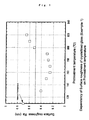
- FIG. 1 shows relation between a surface roughness of the crystallized glass thus obtained and a treatment temperature for phase separation.
- surface was observed using an atomic force microscope (AFM).
- the arithmetical average roughness in a field of view of 5 ⁇ 5 ⁇ m was calculated with respect to 3 to 5 portions on the surface of respective samples.
- FIG. 1 it was found that the surface roughness of the crystallized glass which was subjected to the heat treatment for phase separation in the temperature range from the temperature of the Tg (732 °C) to a temperature 60 °C higher than the Tg was 0.5 nm or less.
- the heat treatment for phase separation is made in a temperature range from a temperature 30 °C lower than the Tg to a temperature 60 °C higher than the Tg, preferably from the Tg to a temperature 60 °C higher than the Tg, more preferably from a temperature 10 °C higher than Tg to a temperature 50 °C higher than Tg, further preferably from a temperature 20 °C higher than Tg to a temperature 40 °C higher than the Tg.
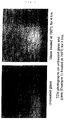
- FIG. 3 shows TEM photographs of these glasses.
- micro-phase separated particles are not seen in the untreated glass; on the other hand, the micro-phase separated particles abounding with TiO 2 are clearly seen in the glass subjected to the heat treatment at a temperature of Tg plus 25 °C (760 °C).
- FIG. 4 shows TEM photographs of the glass without being subjected to the phase separation treatment and the glass obtained by being subjected to the phase separation treatment for four hours at a temperature of Tg plus 25 °C (760 °C) and thereafter by being subjected to heat treatment for four hours at a temperature of 1000 °C.
- TEM photographs in FIG. 4 shows that the crystal particles of the crystallized glass subjected to the pretreatment for four hours at a temperature of the Tg plus 25 °C (760 °C) are smaller than those of the crystallized glass without being subjected to the phase separation treatment.
- the glass obtained through the phase separation step up to a temperature in the crystallization step at a heating rate of 10 °C/min or less.
- the reason for controlling the heating rate, at which a temperature is elevated from a treatment temperature in the phase separation step to a treatment temperature in the treatment temperature for crystallization, to be 10 °C/min or less is to avoid the deformation of the glass.
- Ordinary crystallized glass is subjected to the heat treatment for phase separation at a temperature higher than the temperature used in the present invention, so the glass is already partially crystallized during the treatment. Therefore, even if the heating rate is faster, deformation hardly occurs.
- the glass subjected to the heat treatment for phase separation in the process according to the present invention substantially does not contain crystal particles, and consequently, the glass might be deformed when the heating rate is faster.
- the glass is heated up at a slower rate of 10 °C/min or less, crystal particles are gradually deposited while being heated up, thus to suppress the deformation of the glass.
- the heating rate as mentioned above is preferably in the range from 1 °C/min to 7 °C/min. Slower heating rate is highly advantageous to homogenous formation of the crystal particles.
- Heating for crystallization is suitably determined in consideration of the characteristics such as a size of the glass crystal particle, crystallinity, Young's modulus and the like; for example, heating can be performed for about 1 to 10 hours at a temperature ranging from 850 °C to 1100 °C.
- crystallized glass in which a mean particle size of the crystal particle is in the range of equal to or less than 100 nm, can be obtained.
- a mean particle size of the crystal particle is in the range of equal to or less than 100 nm, but preferably, the mean particle size of the crystal particle is in the range of from 10 to 70 nm.
- the mean particle size of the crystal particle can be measured with the use of, for example, a transmission electron microscope (TEM).
- a transparency at a wavelength of 600 nm can be 40 % or higher, preferably 50 % or higher.
- this transparency can function as an index for estimating an approximate size of the crystal particle.
- using a plate-shaped molded glass as a starting glass can provide a plate-shaped crystallized glass.
- the glass obtained from the phase separation step is preferably heated up to a temperature for the heat treatment in the crystallization step at a heating rate of 10 °C/min or less.
- the plate-shaped molded glass as a starting glass can be prepared in the usual manner.
- using a disk-shaped starting glass as the aforementioned plate-shaped molded glass can provide a disk-shaped crystallized glass plate; or a disk-shaped crystallized glass plate can also be obtained by processing a crystallized glass plate, which is prepared with a starting glass of the plate-shaped molded glass, into a disk-shaped glass.
- a polishing method described later can be used for processing the glass into a disk-shaped glass.
- the glass is first molded into a desired shape and then the surface of the glass is further polished.
- the polishing method is not particularly limited, and polishing can be performed by a known polishing method using synthetic grinding grains such as synthetic diamond, silicon carbide, aluminum oxide, boron carbide or the like, or natural grinding grains such as natural diamond, cerium oxide or the like.
- a surface roughness (Ra (JIS B0601)) of the polished surface can be in the range of from 0.1 to 0.5 nm.
- the disk-shaped crystallized glass plate obtained by the preparation process according to the present invention has, for example, a mean particle size of the crystal particle in the range of equal to or less than 100 nm, and this is preferable as a substrate for information recording medium.
- the disk-shaped crystallized glass plate obtained by the preparation process according to the present invention may have, for example, 40 % or higher of a transparency at a wavelength of 600 nm, and this is also preferable as a substrate for information recording medium.
- the disk-shaped crystallized glass plate obtained by the preparation process according to the present invention may have a polished surface having a surface roughness Ra (JIS B0601) of 1 nm or less, and this is preferable as a substrate for information recording medium.
- Ra surface roughness
- the crystallized glass produced by the preparation process according to the present invention, having a polished surface with a surface roughness (Ra (JIS B0601)) in a range from 0.1 to 0.5 nm can satisfy all of surface smoothness, flatness and the like which are required as a magnetic disk substrate.
- Ra surface roughness
- the crystallized glass according to the present invention has a higher Young's modulus as approximately twice or more as that of the conventional glass, deflexion due to higher revolution of the disk can be reduced to be smaller, so the glass is preferable as substrate material for realizing a high TPI and high BPI hard disk.
- a magnetic disk can be prepared by forming at least a magnetic layer as a recording layer on the disk-shaped crystallized glass plate obtained by the preparation process according to the present invention.
- the usual method can be used for forming the magnetic layer on the crystallized glass plate.
- the present invention comprises a magnetic disk having at least a magnetic layer as a recording layer on the substrate obtained by the preparation process according to the present invention.
- An information recording medium is characterized in comprising a substrate of the present invention and a recording layer formed on the substrate.
- a magnetic disk (hard disk) comprising a substrate composed of the glass of the present invention and at least a magnetic layer formed on a main surface of the substrate will be explained hereinafter.
- layers other than the magnetic layer underlying layer, protective layer, lubricating layer, unevenness control layer and the like are optionally formed depending on functions of the disk.
- the respective layers can be formed by various thin film-forming techniques.
- Material for the magnetic layer is not particularly limited. For example, in addition to Co based magnetic layers, ferrite based magnetic layers, iron-rare earth metal based magnetic layers and the like can be mentioned.
- the magnetic layer may be either for horizontal magnetic recording or vertical magnetic recording.
- the magnetic thin layer include, for example, those containing Co as a main component such as CoPt, CoCr, CoNi, CoNiCr, CoCrTa and CoPtCr, and CoNiCrPt, CoNiCrTa, CoCrPtTa, CoCrPtSiO and the like.
- the magnetic layer may be consisted of multiple layers comprising a non-magnetic layer for noise reduction by separating magnetic layers.
- the underlying layer of the magnetic layer may be selected depending on the magnetic layer.
- the underlying layer may be those comprising at least one or more of non-magnetic metals such as Cr, Mo, Ta, Ti, W, V, B and Al, oxides, nitride, carbides and the like of those metals.
- a magnetic layer comprising Co as the main component an underlying layer of pure Cr or Cr alloy is preferred from the viewpoint of improving magnetic characteristics.
- the underlying layer is not limited to a monolayer, and may be composed of multiple layers consisting of multiple identical or different layers.
- the underlying layer may be a multi-layer underlying layer such as Al/Cr/CrMo and Al/Cr/Cr.
- the unevenness control layer for preventing absorption of magnetic disk to magnetic head may be provided between the substrate and the magnetic layer or on the magnetic layer. Because surface roughness of the magnetic disk is properly controlled by the unevenness control layer, the magnetic disk is prevented from being absorbed to the magnetic head and hence a highly reliable magnetic disk can be provided.
- the material of the unevenness control layer may be at least one or more metals selected from Al, Ag, Ti, Nb, Ta, Bi, Si, Zr, Cr, Cu, Au, Sn, Pd, Sb, Ge, Mg and the like, alloys thereof, oxides, nitrides, carbides thereof and the like.
- metals containing Al as a main component such as pure Al, Al alloys, Al oxides and Al nitrides are preferred.
- surface roughness of the unevenness-forming layer is preferably Rmax of 50-300 angstroms, more preferably Rmax of 100-200 angstroms.
- Rmax is less than 50 angstroms, the disk surface is nearly flat, and hence the magnetic head and the disk are absorbed to each other. This is not preferred because the absorption with each other may disadvantageously cause damage of the magnetic head and the magnetic disk, and head crash.
- the Rmax exceeds 300 angstroms, glide height becomes larger and recording density is disadvantageously lowered, so this is not preferred.
- Unevenness may be provided on the surface of the glass substrate by a texturing treatment such as etching treatment and irradiation of laser lights instead of providing the unevenness control layer.
- the protective layer may be, for example, a Cr layer, Cr alloy layer, carbon layer, zirconia layer, silica layer or the like. These protective layers can be successively formed by an inline sputtering apparatus together with the underlying layer, the magnetic layer and the like. These protective layers may have either monolayer structure or multilayer structure comprising identical or different layers.
- a silicon oxide (SiO 2 ) layer may be formed on the protective layer mentioned above by applying tetraalkoxysilane diluted in an alcoholic solvent, in which colloidal silica microparticles are further dispersed, and sintering the applied layer.
- This layer functions as a protective layer and as an unevenness control layer.
- the lubricating layer is generally formed by applying perfluoropolyether, a liquid lubricating agent, diluted in a solvent such as freons by dipping, spin coating, spraying or the like and subjecting the coated layer to a heat treatment as required.
- the preparation process according to the present invention provides a crystallized glass capable of providing a magnetic disk substrate composed of the crystallized glass having a polished surface with surface roughness (Ra (JIS B0601)) in the range of from 0.1 to 0.5 nm, the roughness in the range capable of realizing lower head flying. Furthermore, since the magnetic disk composed of the crystallized glass prepared by the preparation process according to the present invention has excellent surface smoothness, lower flying of the magnetic head, that is, higher density recording can be accomplished. In addition, since the magnetic disk composed of the crystallized glass prepared by the preparation process according to the present invention has higher Young's modulus and higher relative elastic modulus, thinner magnetic disk and higher revolution of the magnetic disk can be accomplished.
- Ra surface roughness
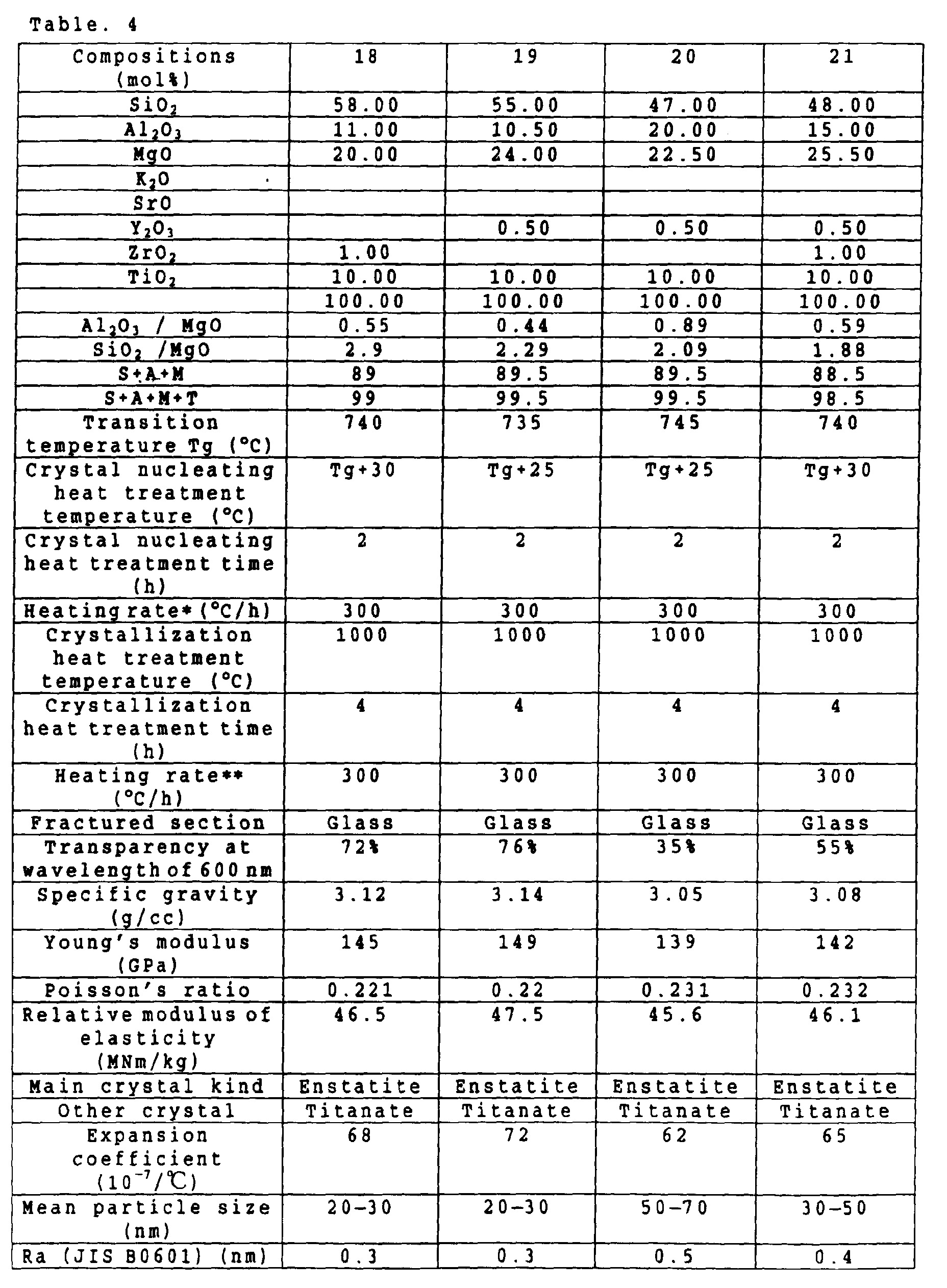
- Glass compositions of Examples 1 to 25 are shown in Tables 2 to 4 in mol% (or % by weight). It is to be noted that, although the compositions described in Tables 2 to 4 are compositions of the raw materials, the result of analytical comparison between the raw material compositions and the crystallized glass compositions of Examples 1 to 15 showed that the difference of the both compositions was within ⁇ 0.1 mol%. Thus, the starting glass compositions shown in Tables 2 to 4 are substantially the same as the crystallized glass compositions.
- the materials thus weighed were mixed sufficiently to provide formulated batches, and each of them was placed in a platinum crucible and melted in air for 6 hours at 1570 °C while being stirred. After the melting in the crucible, the glass melt was cast into a mold, left to cool to the glass transition temperature, immediately transferred into an annealing furnace, annealed in the glass transition temperature range for about 1 hour and left to cool to room temperature in the furnace. The resulting glasses did not contain deposited crystals which can be observed by a microscope.
- the glasses thus obtained were molded into rectangular samples and disks of ⁇ 100 ⁇ 1 mm and then further polished.
- the obtained glasses were placed in a furnace for heat treatment, heated up to a heat treatment temperature, shown in Tables 2 to 4, for phase separation at a heating rate of 3-10 °C/min, and kept at the temperature for about 4 hours, thereby being subjected to the heat treatment for phase separation (pretreatment)
- the glasses were heated up to the heat treatment temperature(second treatment), shown in Tables 2 to 4, for crystallization at a heating rate of 5 °C/min, kept at the temperature for about 4 hours, and then cooled down to room temperature in the furnace, thereby crystallized glasses were prepared.
- the rectangular crystallized glasses thus obtained were further polished into the glasses having a length of 90 mm and used as samples for measurements of Young's modulus and specific gravity.
- Disc-shaped crystallized glasses of ⁇ 100 ⁇ 1 mm were further precisely polished into the disks of ⁇ 95 ⁇ 0.8 mm and used as samples for measurement of surface roughness.
- the measurement of Young's modulus was achieved by the ultrasonic method using samples of 90 ⁇ 10 ⁇ 10 mm.
- the data obtained in the measurements are shown in Tables 2 to 4, together with the glass compositions.
- a mean particle size of the crystal particles in the crystallized glasses of Examples 1 to 4 was measured by using a transmission electron microscope (TEM), and the measured value was 20 to 30 nm. Also, a mean particle size of the crystal particles in the crystallized glass of Example 5 was measured by using a transmission electron microscope (TEM), and the measured value was 50 to 70 nm.
- TEM transmission electron microscope
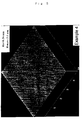
- FIG. 5 shows an AFM photograph of the crystallized glass of Example 4 which has been polished in a polishing process used for preparation of an optical glass, after subjected to the heat treatment under the conditions for heat treatment shown in Table 2.
- Example 4 has small surface roughness of about 0.21 nm in Ra (JIS B0601), so this can sufficiently meet the demand for surface smoothness of future magnetic disks.
- the crystallized glass of the present invention in the case of a thickness of 1 mm, had 50 % or higher of transparency at a wavelength of 600 nm, and there was provided transparence to some extent. Such the transparence can be an indicator for deciding whether or not desired kinds and particle sizes of crystals are obtained.
- the aforementioned transparency may be, for example, 20 % or higher, further 40 % to 90 %, or still further 60 % to 90 %.
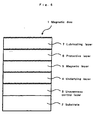
- a magnetic disk 1 of the present invention comprises a glass substrate 2 made of the crystallized glass of the above Example 1, on which unevenness control layer 3, underlying layer 4, magnetic layer 5, protective layer 6 and lubricating layer 7 are provided in this order.
- the substrate 2 was a disk having an outer circular periphery radius of 32.5 mm, inner circular periphery radius of 10.0 mm and thickness of 0.43 mm, whose both main surfaces were subjected to precision polishing so that they should have surface roughness Ra (JIS B0601) of 4 angstroms and Rmax of 40 angstroms.
- Ra surface roughness
- the unevenness control layer is a thin AlN layer of 5-35% nitrogen content having average roughness of 50 angstroms and surface roughness Rmax of 150 angstroms.
- the underlying layer is a thin layer of CrV composed of Cr: 83 at% and V: 17 at% having a thickness of about 600 ⁇ .
- the magnetic layer is a thin layer of CoPtCr composed of Co: 76 at%, Pt: 6.6 at%, Cr: 17.4 at% having a thickness of about 300 ⁇ .
- the protective layer is a carbon thin layer having a thickness of about 100 angstroms.
- the lubricating layer is a layer having a thickness of 8 angstroms, which was formed by applying perfluoropolyether on the carbon protective layer by spin coating method.
- the crystallized glass of Example 1 was cut into a disk having an outer circular periphery radius of 32.5 mm, inner circular periphery radius of 10.0 mm and thickness of 0.5 mm and the both main surfaces were subjected to precision polishing so that they should have surface roughness Ra (JIS B0601) of 4 angstroms and Rmax of 40 angstroms to afford a glass substrate for magnetic recording medium.
- Ra surface roughness
- the holder on which the crystallized glass substrate having the formed AlN layer was set was then transferred into a second chamber provided with a CrV target (Cr: 83 at%, V: 17 at%) and a third chamber provided with a CoPtCr target (Co: 76 at%, Pt: 6.6 at%, Cr: 17.4 at%) successively, and thin layers were formed on the substrate.
- Sputtering was performed at a pressure of 2 mtorr and substrate temperature of 350 °C in an Ar atmosphere, with the result that a CrV underlying layer having a thickness of about 600 angstroms and a CoPtCr magnetic layer having a thickness of about 300 angstroms were formed.
- the multilayer substrate having the formed unevenness control layer, underlying layer and magnetic layer was then transferred to a fourth chamber provided with a heater for heat treatment.
- the fourth chamber had an inner atmosphere of Ar gas (pressure: 2 mtorr) and the heat treatment was performed by changing the temperature for heat treatment.
- the substrate after forming the carbon protective layer was taken out from the above inline sputtering apparatus, and a lubricating layer having a thickness of 8 angstroms was formed by applying perfluoropolyether on the carbon protective layer by the dipping method, thereby affording a magnetic disk.
Landscapes
- Chemical & Material Sciences (AREA)
- Engineering & Computer Science (AREA)
- Materials Engineering (AREA)
- Ceramic Engineering (AREA)
- Crystallography & Structural Chemistry (AREA)
- Organic Chemistry (AREA)
- Dispersion Chemistry (AREA)
- Thermal Sciences (AREA)
- Physics & Mathematics (AREA)
- Life Sciences & Earth Sciences (AREA)
- Chemical Kinetics & Catalysis (AREA)
- General Chemical & Material Sciences (AREA)
- Geochemistry & Mineralogy (AREA)
- Manufacturing & Machinery (AREA)
- Glass Compositions (AREA)
- Re-Forming, After-Treatment, Cutting And Transporting Of Glass Products (AREA)
- Manufacturing Of Magnetic Record Carriers (AREA)
Abstract
Description
The crystallized glass comprises
The crystallized glass comprises
- SiO2 : 44 - 52 % by weight
- MgO : 16 - 25 % by weight
- Al2O3 : 13 - 20 % by weight
- TiO2 : 10 - 15 % by weight
- ZrO : 1 - 8 % by weight
- ZrO2 : 0 - 5 % by weight
- Li2O : 0 - 3 % by weight
- B2O3 : 0 - 3 % by weight
- P2O5 : 0 - 5 % by weight, and
- Sb2O3 : 0 - 2 % by weight
The crystallized glass comprises
- SiO2 : 40 - 60 % by weight
- MgO : 10 - 20 % by weight
- Al2O3 : less than 10 - 20 % by weight
- P2O5 : 0 - 4 % by weight
- B2O3 : 0 - 4 % by weight
- CaO : 0.5 - 4 % by weight
- BaO : 0 - 5 % by weight
- ZrO2 : 0 - 5 % by weight
- TiO2 : 2.5 - 8 % by weight
- Sb2O3 : 0 - 1 % by weight
- As2O3 : 0 - 1 % by weight
- F : 0 - 3 % by weight
- SnO2 : 0 - 5 % by weight
- MoO3 : 0 - 3 % by weight
- CeO : 0 - 5 % by weight, and
- Fe2O3 : 0 - 5 % by weight
The crystallized glass comprises
- SiO2 : 40 - 60 % by weight
- MgO : 10 - 20 % by weight
- Al2O3 : less than 10 - 20 % by weight
- P2O5 : 0.5 - 2.5 % by weight
- B2O3 : 1 - 4 % by weight
- Li2O : 0.5 - 4 % by weight
- CaO : 0.5 - 4 % by weight
- ZrO2 : 0.5 - 5 % by weight
- TiO2 : 2.5 - 8 % by weight
- Sb2O3 : 0.01 - 0.5 % by weight
- As2O3 : 0 - 0.5 % by weight
- SnO2 : 0 - 5 % by weight
- MoO3 : 0 - 3 % by weight
- CeO : 0 - 5 % by weight, and
- Fe2O3 : 0 - 8 % by weight
| Pretreatment temperature dependency of Young's modulus and thermal expansion coefficient of Example 1 | |||||
| Heating rate (°C /h) | 300 | 300 | 300 | 300 | 300 |
| Pretreatment temperature (°C) | Untreated | 730 | 740 | 750 | 760 |
| Pretreatment time (h) | 4 | 4 | 4 | 4 | 4 |
| Heating rate (°C/h) | 300 | 300 | 300 | 300 | 300 |
| Second treatment temperature (°C) | 1000 | 1000 | 1000 | 1000 | 1000 |
| Second treatment time (h) | 4 | 4 | 4 | 4 | 4 |
| Young's modulus (GPa) | 148.8 | 147.2 | 147.1 | 147 | 147 |
| Thermal expansion coefficient (10-7/°C) | 73.8 | 73 | 72.8 | 73.2 | 72.1 5 |
| Heating rate (°C /h) | 300 | 300 | 300 | 300 | 300 |
| Pretreatment temperature (°C) | 770 | 780 | 790 | 800 | 820 |
| Pretreatment time (h) | 4 | 4 | 4 | 4 | 4 |
| Heating rate (°C/h) | 300 | 300 | 300 | 300 | 300 |
| Second treatment temperature (°C) | 1000 | 1000 | 1000 | 1000 | 1000 |
| Second treatment time (h) | 4 | 4 | 4 | 4 | 4 |
| Young's modulus (GPa) | 147.5 | 147.9 | 148.5 | 148.8 | 148.8 |
| Thermal expansion coefficient (10-7/°C) | 72.8 | 72.33 | 73.9 | 72.4 | 73.1 |
| Pretreatment: Heat treatment for production of crystal nucleus Second treatment: Heat treatment for growth of crystal particles |


| Compositions (mol%) | 11 | 12 | 13 | 14 | 15 | 16 | 17 |
| SiO2 | 46.00 | 46.00 | 46.00 | 46.00 | 46.00 | 46.00 | 46.00 |
| Al2O3 | 10.50 | 10.50 | 10.50 | 10.50 | 10.50 | 10.50 | 10.50 |
| MgO | 30.50 | 30.00 | 30.00 | 31.00 | 30.00 | 31.00 | 31.00 |
| K2O | 0.5 | 0.5 | |||||
| SrO | 1.00 | 1.50 | 1.00 | 0.50 | |||
| Y2O3 | 0.50 | 0.50 | 0.50 | 0.50 | 0.50 | 0.50 | |
| ZrO2 | 2.00 | 2.00 | 2.00 | 2.00 | 2.00 | 2.00 | 2.00 |
| TiO2 | 10.00 | 10.00 | 9.00 | 9.00 | 10.00 | 10.00 | 10.00 |
| Al2O3 / MgO | 0.34 | 0.35 | 0.35 | 0.34 | 0.34 | 0.34 | 0.34 |
| S+A+M | 87 | 86.5 | 86.5 | 87.5 | 86.5 | 87.5 | 87.5 |
| Transition temperature Tg (°C) | 726 | 728 | 726 | 725 | 727 | 732 | 732 |
| Crystal nucleating heat treatment temperature (°C) | Tg+30 | Tg+30 | Tg+30 | Tg+30 | Tg+30 | Tg | Tg-32 |
| Crystal nucleating heat treatment time (h) | 4 | 4 | 4 | 4 | 4 | 4 | 4 |
| Heating rate (°C/h) | 300 | 300 | 300 | 300 | 300 | 300 | 300 |
| Crystallization heat treatment temperature (°C) | 1000 | 1000 | 1000 | 1000 | 1000 | 1000 | 1000 |
| Crystallization heat treatment time (h) | 4 | 4 | 4 | 4 | 4 | 4 | 4 |
| Heating rate (°C/h) | 240 | 240 | 240 | 240 | 240 | 240 | 240 |
| Fractured-section kind | Glass | Glass | Glass | Glass | Glass | Glass | Glass |
| Transparency at wavelength of 600 nm | 82% | 70% | 67% | 80% | 80% | 80% | 78% |
| Specific gravity (g/cm3) | 3.127 | 3.172 | 3.175 | 3.124 | 3.15 | 3.158 | 3.156 |
| Young's modulus (GPa) | 149.2 | 151.8 | 152.1 | 147.1 | 148.2 | 153.0 | 152.1 |
| Poisson's ratio | 0.232 | 0.234 | 0.234 | 0.231 | 0.232 | 0.231 | 0.232 |
| Relative modulus of elasticity (MNm/kg) | 47.7 | 47.9 | 47.9 | 47.1 | 47.0 | 48.5 | 48.2 |
| Expansion coefficient (10-7/°C) | 77.9 | 75.1 | 74.7 | 79.2 | 78.1 | 74.5 | 72.3 |
| Mean particle size (nm) | 20-30 | 30-50 | 30-50 | 20-30 | 20-30 | 20-30 | 20-30 |
| S + A + M = SiO2 + Al2O3 + MgO |


Claims (26)
- A process for preparation of a crystallized glass comprising a step of phase separation of a starting glass containing TiO2 and a step of crystallization of the resulting phase-separated glass, wherein the phase separation step comprises a heat treatment of the starting glass at a temperature in a range from a temperature 30 °C lower than a glass transition temperature (Tg) of the glass to a temperature 60 °C higher than the glass transition temperature (Tg).
- The process for preparation according to Claim 1, wherein the phase separation step comprises a heat treatment of the starting glass at a temperature in a range from the glass transition temperature (Tg) of the glass to a temperature 60 °C higher than the glass transition temperature (Tg).
- The process for preparation according to Claim 1 or Claim 2, wherein the heat treatment is carried out so as to control a mean particle size of the crystal particles contained in the crystallized glass in a range of equal to or less than 100nm.
- The process for preparation according to any one of Claims from 1 to 3, wherein the crystallized glass contains TiO2 in an amount equal to or more than 8 mol%.
- The process for preparation according to any one of Claims 1 to 4, wherein the crystallized glass is a SiO2-Al2O3-MgO based glass.
- The process for preparation according to any one of Claims 1 to 4, wherein the starting glass containing TiO2 is an MgO-Al2O3- SiO2 based glass or an MgO-RO-Al2O3-SiO2 (wherein R is at least one kind selected from a group consisting of alkaline-earth metals (Ba, Ca and Sr), Zn and Ni) based glass, and a total content of MgO, Al2O3 and SiO2 is equal to or more than 80 mol%.
- The process for preparation according to any one of Claims 1 to 6, wherein the crystallized glass contains enstatite in its crystal phase.
- The process for preparation according to any one of Claims 1 to 6, wherein the crystallized glass contains enstatite as a main crystal.
- The process for preparation according to any one of Claims 1 to 8, wherein the crystallized glass comprisesSiO2: 35-65 mol%Al2O3: 5-25 mol%MgO: 10-40 mol%TiO2: 5-15 mol%Y2O3: 0-10 mol%ZrO2: 0-6 mol%R2O: 0-5 mol% (wherein R is at least one kind selected from a group consisting of Li, Na and K)RO: 0-5 mol% (wherein R is at least one kind selected from a group consisting of Ca, Sr and Ba)As2O3+Sb2O3: 0-2 mol% andSiO2 + Al2O3 + MgO + TiO2: 92mol% or more, and a main crystal is enstatite and/or its solid solution.
- The process for preparation according to any one of Claims 1 to 9,
wherein the starting glass is a plate-shaped molded glass and a crystallized glass in a plate shape is prepared therefrom, and
wherein the glass obtained in the phase separation step is heated up to a temperature of the heat treatment in the crystallization step at a heating rate of 10°C/min or less. - The process for preparation according to Claim 10, wherein the plate- shaped molded glass is in a disk shape, or the plate-shaped molded glass not in a disk shape is processed, after the crystallization step, to be in a disk shape, thus to obtain a crystallized glass plate in a disk shape.
- A crystallized glass prepared by a process comprising a step of phase separation of a starting glass containing TiO2 and a step of crystallization of the resulting phase-separated glass, wherein the phase separation step comprises a heat treatment of the starting glass at a temperature in a range from a temperature 30 °C lower than a glass transition temperature (Tg) of the glass to a temperature 60 °C higher than the glass transition temperature (Tg).
- The crystallized glass according to Claim 12, wherein the phase separation step comprises a heat treatment of the starting glass at a temperature of the glass transition temperature (Tg) of the glass to a temperature 60 °C higher than the glass transition temperature (Tg).
- The crystallized glass according to Claim 12 or Claim 13, wherein the heat treatment is carried out so as to control a mean particle size of the crystal particles contained in the crystallized glass in a range of equal to or less than 100nm.
- The crystallized glass according to any one of Claims 12 to 14, wherein the crystallized glass contains TiO2 in an amount equal to or more than 8 mol%.
- The crystallized glass according to any one of Claims 12 to 15, wherein the crystallized glass is an SiO2-Al2O3-MgO based glass.
- The crystallized glass according to any one of Claims 12 to 16, wherein the starting glass containing TiO2 is an MgO-Al2O3- SiO2 based glass or an MgO-RO-Al2O3-SiO2 (wherein R is at least one kind selected from a group consisting of alkaline-earth metals (Ba, Ca, and Sr), Zn and Ni) based glass, and a total content of MgO, Al2O3 and SiO2 is equal to or more than 80 mol%.
- The crystallized glass according to any one of Claims 12 to 17, wherein the crystallized glass contains enstatite in its crystal phase.
- The crystallized glass according to any one of Claims 12 to 17, wherein the crystallized glass contains enstatite as a main crystal.
- The crystallized glass according to any one of Claims 12 to 19, wherein said crystallized glass comprisesSiO2: 35-65 mol%Al2O3: 5-25 mol%MgO: 10-40 mol%TiO2: 5-15 mol%Y2O3: 0-10 mol%ZrO2: 0-6 mol%R2O: 0-5 mol% (wherein R is at least one kind selected from a group consisting of Li, Na and K)RO: 0-5 mol% (wherein R is at least one kind selected from a group consisting of Ca, Sr and Ba)As2O3+Sb2O3: 0-2 mol% andSiO2 + Al2O3 + MgO + TiO2: 92mol% or more, and a main crystal is enstatite and/or its solid solution.
- The crystallized glass according to any one of Claims 12 to 20, wherein the crystallized glass is in a plate shape and in a disk shape.
- A substrate for information recording medium, composed of a disk-shaped crystallized glass plate obtained by the process for preparation according to Claim 11 or composed of the disk-shaped crystallized glass plate according to Claim 21, wherein a mean particle size of crystal particles is in a range of equal to or less than 100nm.
- A substrate for information recording medium, composed of a disk-shaped crystallized glass plate obtained by the process for preparation according to Claim 11 or composed of the disk-shaped crystallized glass plate according to Claim 21, wherein a transparency at a wavelength of 600 nm is equal to or more than 40%.
- A substrate for information recording medium, composed of a disk-shaped crystallized glass plate obtained by the process for preparation according to Claim 11 or composed of the disk-shaped crystallized glass plate according to Claim 21, wherein a polished surface having a surface roughness Ra (JIS B0601) equal to or less than 1 nm is included.
- A process for preparation of a magnetic disk comprising at least a magnetic layer, as a recording layer, formed on a disk-shaped crystallized glass plate obtained by the process for preparation according to Claim 11 or on the disk-shaped crystallized glass plate according to Claim 21.
- A magnetic disk comprising at least a magnetic layer, as a recording layer, formed on the substrate according to any one of Claims from 22 to 24.
Applications Claiming Priority (4)
| Application Number | Priority Date | Filing Date | Title |
|---|---|---|---|
| JP19357099 | 1999-07-07 | ||
| JP19357099 | 1999-07-07 | ||
| JP29982799 | 1999-10-21 | ||
| JP29982799 | 1999-10-21 |
Publications (3)
| Publication Number | Publication Date |
|---|---|
| EP1067101A2 true EP1067101A2 (en) | 2001-01-10 |
| EP1067101A3 EP1067101A3 (en) | 2001-11-28 |
| EP1067101B1 EP1067101B1 (en) | 2008-08-13 |
Family
ID=26507950
Family Applications (1)
| Application Number | Title | Priority Date | Filing Date |
|---|---|---|---|
| EP00114609A Expired - Lifetime EP1067101B1 (en) | 1999-07-07 | 2000-07-07 | Process for preparation of crystallized glass for information recording disk |
Country Status (6)
| Country | Link |
|---|---|
| US (1) | US6599606B1 (en) |
| EP (1) | EP1067101B1 (en) |
| CN (1) | CN1289419C (en) |
| AT (1) | ATE404504T1 (en) |
| DE (1) | DE60039821D1 (en) |
| SG (1) | SG98415A1 (en) |
Cited By (2)
| Publication number | Priority date | Publication date | Assignee | Title |
|---|---|---|---|---|
| DE10245234A1 (en) * | 2002-09-27 | 2004-04-08 | Schott Glas | Crystallizable glass and its use for the production of a highly rigid, break-resistant glass ceramic with a surface that can be easily polished |
| DE10346197A1 (en) * | 2003-09-30 | 2005-04-28 | Schott Ag | Glass ceramic and method for producing such |
Families Citing this family (17)
| Publication number | Priority date | Publication date | Assignee | Title |
|---|---|---|---|---|
| US7264894B2 (en) * | 1998-03-13 | 2007-09-04 | Hoya Corporation | Crystallized glass for information recording medium, crystallized glass substrate, and information recording medium using the crystallized glass substrate |
| SG97155A1 (en) * | 1999-07-07 | 2003-07-18 | Hoya Corp | Substrate for information recording medium and magnetic recording medium composed of crystallized glass |
| JP4282273B2 (en) * | 2002-06-07 | 2009-06-17 | コニカミノルタオプト株式会社 | Glass substrate |
| AU2003280597A1 (en) * | 2002-11-07 | 2004-06-07 | Hoya Corporation | Substrate for information recording medium, information recording medium and method for manufacturing same |
| US7875565B1 (en) * | 2006-05-31 | 2011-01-25 | Corning Incorporated | Transparent glass-ceramic armor |
| JP5241108B2 (en) * | 2007-01-31 | 2013-07-17 | Hoya株式会社 | Method for manufacturing glass substrate for magnetic disk, method for manufacturing magnetic disk, magnetic disk, and system for manufacturing glass substrate for magnetic disk |
| US9241879B2 (en) * | 2008-04-11 | 2016-01-26 | James R. Glidewell Dental Ceramics, Inc. | Lithium silicate glass ceramic for fabrication of dental appliances |
| EP2314551A1 (en) * | 2009-10-26 | 2011-04-27 | AGC Glass Europe | Phase separated soda-lime glass |
| WO2014058054A1 (en) * | 2012-10-12 | 2014-04-17 | 旭硝子株式会社 | Manufacturing method for phase-separated glass, and phase-separated glass |
| RU2660672C1 (en) * | 2017-08-14 | 2018-07-09 | Акционерное общество "Научно-производственное объединение Государственный оптический институт им. С.И. Вавилова" (АО "НПО ГОИ им. С.И. Вавилова") | Glass-ceramic material with a high elastic modulus and method for production thereof |
| MY207080A (en) | 2019-07-22 | 2025-01-29 | Hoya Corp | Glass for magnetic recording medium substrates, magnetic recording medium substrate, magnetic recording medium, glass spacer for magnetic recording and reproducing apparatus, and magnetic recording and reproducing apparatus |
| CN112939471A (en) * | 2021-03-15 | 2021-06-11 | 武汉理工大学 | High-thermal-conductivity low-expansion low-dielectric microcrystalline glass and preparation method thereof |
| EP4417585A3 (en) * | 2022-02-14 | 2024-11-13 | Corning Incorporated | Precursor glasses and glass-ceramics comprising a crystalline phase having a jeffbenite crystalline structure |
| CN115784616A (en) * | 2022-11-15 | 2023-03-14 | 常熟佳合显示科技有限公司 | MAS microcrystalline glass and preparation method thereof |
| CN116444140B (en) * | 2023-04-04 | 2024-08-16 | 武汉理工大学 | Method for regulating crystallization of microcrystalline glass and product thereof |
| US12378149B2 (en) | 2023-08-11 | 2025-08-05 | Corning Incorporated | Precursor glasses and glass-ceramics comprising a crystalline phase having a jeffbenite crystalline structure |
| CN118005286A (en) * | 2024-02-20 | 2024-05-10 | 河北光兴半导体技术有限公司 | Ultra-thin glass-ceramics and preparation method and application thereof |
Family Cites Families (10)
| Publication number | Priority date | Publication date | Assignee | Title |
|---|---|---|---|---|
| DD127795B1 (en) * | 1976-08-26 | 1981-01-28 | Werner Vogel | TITANIUM-DIOXIDE-BASED GLASS CERAMICS OF HIGH MECHANICAL STRENGTH |
| US5476821A (en) * | 1994-11-01 | 1995-12-19 | Corning Incorporated | High modulus glass-ceramics containing fine grained spinel-type crystals |
| US5491116A (en) * | 1995-04-03 | 1996-02-13 | Corning Incorporated | Fine-grained glass-ceramics |
| US5910459A (en) * | 1995-10-31 | 1999-06-08 | Corning Incorporated | Glass-ceramic containing a stabilized hexacelsian crystal structure |
| US5691256A (en) * | 1995-12-28 | 1997-11-25 | Yamamura Glass Co., Ltd. | Glass composition for magnetic disk substrates and magnetic disk substrate |
| KR20000057173A (en) * | 1996-11-21 | 2000-09-15 | 알프레드 엘. 미첼슨 | Beta-quartz-based glass-ceramics |
| JPH10287444A (en) * | 1997-04-10 | 1998-10-27 | Toshiba Glass Co Ltd | Crystallized glass substrate for magnetic disk, and its production |
| US6294490B1 (en) * | 1998-03-13 | 2001-09-25 | Hoya Corporation | Crystallized glass for information recording medium, crystallized glass substrate, and information recording medium using the crystallized glass substrate |
| JPH11278865A (en) * | 1998-03-30 | 1999-10-12 | Ngk Insulators Ltd | Crystallized glass for magnetic disk substrate, magnetic disk substrate, magnetic disk and production of crystallized glass for magnetic disk substrate |
| JP4680347B2 (en) * | 1999-06-01 | 2011-05-11 | 株式会社オハラ | High rigidity glass ceramic substrate |
-
2000
- 2000-07-05 SG SG200003752A patent/SG98415A1/en unknown
- 2000-07-07 US US09/612,629 patent/US6599606B1/en not_active Expired - Fee Related
- 2000-07-07 AT AT00114609T patent/ATE404504T1/en not_active IP Right Cessation
- 2000-07-07 CN CN00131675.3A patent/CN1289419C/en not_active Expired - Fee Related
- 2000-07-07 DE DE60039821T patent/DE60039821D1/en not_active Expired - Lifetime
- 2000-07-07 EP EP00114609A patent/EP1067101B1/en not_active Expired - Lifetime
Cited By (6)
| Publication number | Priority date | Publication date | Assignee | Title |
|---|---|---|---|---|
| DE10245234A1 (en) * | 2002-09-27 | 2004-04-08 | Schott Glas | Crystallizable glass and its use for the production of a highly rigid, break-resistant glass ceramic with a surface that can be easily polished |
| WO2004031089A1 (en) | 2002-09-27 | 2004-04-15 | Schott Ag | Crystallisable glass and the use thereof for producing extremely solid and break-resistant glass-ceramics having an easily polished surface |
| US7291571B2 (en) | 2002-09-27 | 2007-11-06 | Schott Ag | Crystallizable glass and the use thereof for producing extremely solid and break resistant glass-ceramics having an easily polished surface |
| DE10245234B4 (en) * | 2002-09-27 | 2011-11-10 | Schott Ag | Crystallisable glass, its use for producing a highly rigid, break-resistant glass ceramic with a good polishable surface and use of the glass ceramic |
| DE10346197A1 (en) * | 2003-09-30 | 2005-04-28 | Schott Ag | Glass ceramic and method for producing such |
| DE10346197B4 (en) * | 2003-09-30 | 2006-02-16 | Schott Ag | Glass-ceramic, process for producing such and use |
Also Published As
| Publication number | Publication date |
|---|---|
| EP1067101B1 (en) | 2008-08-13 |
| US6599606B1 (en) | 2003-07-29 |
| CN1289419C (en) | 2006-12-13 |
| DE60039821D1 (en) | 2008-09-25 |
| SG98415A1 (en) | 2003-09-19 |
| EP1067101A3 (en) | 2001-11-28 |
| ATE404504T1 (en) | 2008-08-15 |
| CN1295983A (en) | 2001-05-23 |
Similar Documents
| Publication | Publication Date | Title |
|---|---|---|
| EP0941973B1 (en) | Crystallized glass substrate, and information recording medium using the crystallized glass substrate | |
| US6599606B1 (en) | Process for preparation of crystallized glass for information recording disk | |
| US6214429B1 (en) | Disc substrates for information recording discs and magnetic discs | |
| EP1125901B1 (en) | Glass-ceramics | |
| JP3996294B2 (en) | Substrate for information recording medium made of crystallized glass and information recording medium | |
| US6063470A (en) | Substrate for information recording media and magnetic disc | |
| US5626935A (en) | Magnetic disk substrate and method for manufacturing the same | |
| US6905988B2 (en) | Substrate for information recording medium and magnetic recording medium composed of crystallized glass | |
| JP3311308B2 (en) | Glass ceramic substrate for perpendicular magnetic recording media | |
| EP0858974B1 (en) | Glass for information recording medium substrate and glass substrate | |
| JP3420192B2 (en) | Glass ceramics | |
| JP4072275B2 (en) | Substrate for information recording medium made of crystallized glass and information recording medium | |
| US6627565B1 (en) | Crystallized glass substrate for information recording medium | |
| JP4074027B2 (en) | Substrate for information recording medium made of crystallized glass and information recording medium | |
| US7264894B2 (en) | Crystallized glass for information recording medium, crystallized glass substrate, and information recording medium using the crystallized glass substrate | |
| JP4266095B2 (en) | Glass ceramics | |
| JP4323597B2 (en) | Crystallized glass for information recording disk and method for producing the same | |
| JP3793401B2 (en) | Substrate for information recording medium made of crystallized glass and information recording medium | |
| JP4043171B2 (en) | Method for producing crystallized glass for information recording disk | |
| JP4323598B2 (en) | Crystallized glass for information recording disks | |
| JP2005119963A (en) | Process for preparation of crystallized glass for information recording disk | |
| JP2001325718A (en) | Substrate for information recording medium and information recording medium | |
| JP2001189008A (en) | Crystallized glass substrate for information recording medium |
Legal Events
| Date | Code | Title | Description |
|---|---|---|---|
| PUAI | Public reference made under article 153(3) epc to a published international application that has entered the european phase |
Free format text: ORIGINAL CODE: 0009012 |
|
| AK | Designated contracting states |
Kind code of ref document: A2 Designated state(s): AT BE CH CY DE DK ES FI FR GB GR IE IT LI LU MC NL PT SE |
|
| AX | Request for extension of the european patent |
Free format text: AL;LT;LV;MK;RO;SI |
|
| PUAL | Search report despatched |
Free format text: ORIGINAL CODE: 0009013 |
|
| AK | Designated contracting states |
Kind code of ref document: A3 Designated state(s): AT BE CH CY DE DK ES FI FR GB GR IE IT LI LU MC NL PT SE |
|
| AX | Request for extension of the european patent |
Free format text: AL;LT;LV;MK;RO;SI |
|
| 17P | Request for examination filed |
Effective date: 20020418 |
|
| AKX | Designation fees paid |
Free format text: AT BE CH CY DE DK ES FI FR GB GR IE IT LI LU MC NL PT SE |
|
| 17Q | First examination report despatched |
Effective date: 20040920 |
|
| 17Q | First examination report despatched |
Effective date: 20040920 |
|
| GRAP | Despatch of communication of intention to grant a patent |
Free format text: ORIGINAL CODE: EPIDOSNIGR1 |
|
| GRAS | Grant fee paid |
Free format text: ORIGINAL CODE: EPIDOSNIGR3 |
|
| GRAA | (expected) grant |
Free format text: ORIGINAL CODE: 0009210 |
|
| RIN1 | Information on inventor provided before grant (corrected) |
Inventor name: ZOU, XUELU |
|
| AK | Designated contracting states |
Kind code of ref document: B1 Designated state(s): AT BE CH CY DE DK ES FI FR GB GR IE IT LI LU MC NL PT SE |
|
| REG | Reference to a national code |
Ref country code: GB Ref legal event code: FG4D |
|
| REG | Reference to a national code |
Ref country code: CH Ref legal event code: EP |
|
| REG | Reference to a national code |
Ref country code: IE Ref legal event code: FG4D |
|
| REF | Corresponds to: |
Ref document number: 60039821 Country of ref document: DE Date of ref document: 20080925 Kind code of ref document: P |
|
| PG25 | Lapsed in a contracting state [announced via postgrant information from national office to epo] |
Ref country code: NL Free format text: LAPSE BECAUSE OF FAILURE TO SUBMIT A TRANSLATION OF THE DESCRIPTION OR TO PAY THE FEE WITHIN THE PRESCRIBED TIME-LIMIT Effective date: 20080813 Ref country code: ES Free format text: LAPSE BECAUSE OF FAILURE TO SUBMIT A TRANSLATION OF THE DESCRIPTION OR TO PAY THE FEE WITHIN THE PRESCRIBED TIME-LIMIT Effective date: 20081124 |
|
| PG25 | Lapsed in a contracting state [announced via postgrant information from national office to epo] |
Ref country code: FI Free format text: LAPSE BECAUSE OF FAILURE TO SUBMIT A TRANSLATION OF THE DESCRIPTION OR TO PAY THE FEE WITHIN THE PRESCRIBED TIME-LIMIT Effective date: 20080813 Ref country code: AT Free format text: LAPSE BECAUSE OF FAILURE TO SUBMIT A TRANSLATION OF THE DESCRIPTION OR TO PAY THE FEE WITHIN THE PRESCRIBED TIME-LIMIT Effective date: 20080813 |
|
| PG25 | Lapsed in a contracting state [announced via postgrant information from national office to epo] |
Ref country code: BE Free format text: LAPSE BECAUSE OF FAILURE TO SUBMIT A TRANSLATION OF THE DESCRIPTION OR TO PAY THE FEE WITHIN THE PRESCRIBED TIME-LIMIT Effective date: 20080813 |
|
| PG25 | Lapsed in a contracting state [announced via postgrant information from national office to epo] |
Ref country code: DK Free format text: LAPSE BECAUSE OF FAILURE TO SUBMIT A TRANSLATION OF THE DESCRIPTION OR TO PAY THE FEE WITHIN THE PRESCRIBED TIME-LIMIT Effective date: 20080813 |
|
| PG25 | Lapsed in a contracting state [announced via postgrant information from national office to epo] |
Ref country code: PT Free format text: LAPSE BECAUSE OF FAILURE TO SUBMIT A TRANSLATION OF THE DESCRIPTION OR TO PAY THE FEE WITHIN THE PRESCRIBED TIME-LIMIT Effective date: 20090113 |
|
| PLBE | No opposition filed within time limit |
Free format text: ORIGINAL CODE: 0009261 |
|
| STAA | Information on the status of an ep patent application or granted ep patent |
Free format text: STATUS: NO OPPOSITION FILED WITHIN TIME LIMIT |
|
| 26N | No opposition filed |
Effective date: 20090514 |
|
| PG25 | Lapsed in a contracting state [announced via postgrant information from national office to epo] |
Ref country code: IT Free format text: LAPSE BECAUSE OF FAILURE TO SUBMIT A TRANSLATION OF THE DESCRIPTION OR TO PAY THE FEE WITHIN THE PRESCRIBED TIME-LIMIT Effective date: 20080813 |
|
| PG25 | Lapsed in a contracting state [announced via postgrant information from national office to epo] |
Ref country code: SE Free format text: LAPSE BECAUSE OF FAILURE TO SUBMIT A TRANSLATION OF THE DESCRIPTION OR TO PAY THE FEE WITHIN THE PRESCRIBED TIME-LIMIT Effective date: 20081113 |
|
| PG25 | Lapsed in a contracting state [announced via postgrant information from national office to epo] |
Ref country code: MC Free format text: LAPSE BECAUSE OF NON-PAYMENT OF DUE FEES Effective date: 20090731 |
|
| REG | Reference to a national code |
Ref country code: CH Ref legal event code: PL |
|
| REG | Reference to a national code |
Ref country code: IE Ref legal event code: MM4A |
|
| PG25 | Lapsed in a contracting state [announced via postgrant information from national office to epo] |
Ref country code: CH Free format text: LAPSE BECAUSE OF NON-PAYMENT OF DUE FEES Effective date: 20090731 Ref country code: LI Free format text: LAPSE BECAUSE OF NON-PAYMENT OF DUE FEES Effective date: 20090731 |
|
| PG25 | Lapsed in a contracting state [announced via postgrant information from national office to epo] |
Ref country code: IE Free format text: LAPSE BECAUSE OF NON-PAYMENT OF DUE FEES Effective date: 20090707 |
|
| PG25 | Lapsed in a contracting state [announced via postgrant information from national office to epo] |
Ref country code: GR Free format text: LAPSE BECAUSE OF FAILURE TO SUBMIT A TRANSLATION OF THE DESCRIPTION OR TO PAY THE FEE WITHIN THE PRESCRIBED TIME-LIMIT Effective date: 20081114 |
|
| PG25 | Lapsed in a contracting state [announced via postgrant information from national office to epo] |
Ref country code: LU Free format text: LAPSE BECAUSE OF NON-PAYMENT OF DUE FEES Effective date: 20090707 |
|
| PG25 | Lapsed in a contracting state [announced via postgrant information from national office to epo] |
Ref country code: CY Free format text: LAPSE BECAUSE OF FAILURE TO SUBMIT A TRANSLATION OF THE DESCRIPTION OR TO PAY THE FEE WITHIN THE PRESCRIBED TIME-LIMIT Effective date: 20080813 |
|
| PGFP | Annual fee paid to national office [announced via postgrant information from national office to epo] |
Ref country code: GB Payment date: 20130703 Year of fee payment: 14 Ref country code: FR Payment date: 20130724 Year of fee payment: 14 |
|
| REG | Reference to a national code |
Ref country code: DE Ref legal event code: R082 Ref document number: 60039821 Country of ref document: DE Representative=s name: GODEMEYER BLUM LENZE PARTNERSCHAFT, PATENTANWA, DE Ref country code: DE Ref legal event code: R082 Ref document number: 60039821 Country of ref document: DE Representative=s name: GODEMEYER BLUM LENZE PATENTANWAELTE, PARTNERSC, DE |
|
| GBPC | Gb: european patent ceased through non-payment of renewal fee |
Effective date: 20140707 |
|
| REG | Reference to a national code |
Ref country code: FR Ref legal event code: ST Effective date: 20150331 |
|
| PG25 | Lapsed in a contracting state [announced via postgrant information from national office to epo] |
Ref country code: GB Free format text: LAPSE BECAUSE OF NON-PAYMENT OF DUE FEES Effective date: 20140707 Ref country code: FR Free format text: LAPSE BECAUSE OF NON-PAYMENT OF DUE FEES Effective date: 20140731 |
|
| PGFP | Annual fee paid to national office [announced via postgrant information from national office to epo] |
Ref country code: DE Payment date: 20160722 Year of fee payment: 17 |
|
| REG | Reference to a national code |
Ref country code: DE Ref legal event code: R119 Ref document number: 60039821 Country of ref document: DE |
|
| PG25 | Lapsed in a contracting state [announced via postgrant information from national office to epo] |
Ref country code: DE Free format text: LAPSE BECAUSE OF NON-PAYMENT OF DUE FEES Effective date: 20180201 |