EP1065578A1 - Fault diagnosis in a complex system, such as a nuclear plant, using probabilistic reasoning - Google Patents
Fault diagnosis in a complex system, such as a nuclear plant, using probabilistic reasoning Download PDFInfo
- Publication number
- EP1065578A1 EP1065578A1 EP00109869A EP00109869A EP1065578A1 EP 1065578 A1 EP1065578 A1 EP 1065578A1 EP 00109869 A EP00109869 A EP 00109869A EP 00109869 A EP00109869 A EP 00109869A EP 1065578 A1 EP1065578 A1 EP 1065578A1
- Authority
- EP
- European Patent Office
- Prior art keywords
- complex system
- fault
- diagnosis
- network
- real time
- Prior art date
- Legal status (The legal status is an assumption and is not a legal conclusion. Google has not performed a legal analysis and makes no representation as to the accuracy of the status listed.)
- Withdrawn
Links
- 238000003745 diagnosis Methods 0.000 title claims abstract description 36
- 238000000034 method Methods 0.000 claims abstract description 24
- 230000008569 process Effects 0.000 claims abstract description 5
- 230000001364 causal effect Effects 0.000 claims description 12
- 238000012549 training Methods 0.000 claims description 9
- 238000005259 measurement Methods 0.000 claims description 8
- 238000009826 distribution Methods 0.000 claims description 6
- 230000004044 response Effects 0.000 claims description 4
- 238000012544 monitoring process Methods 0.000 claims 2
- 238000004088 simulation Methods 0.000 claims 2
- 238000000605 extraction Methods 0.000 claims 1
- 238000013459 approach Methods 0.000 description 10
- 238000010586 diagram Methods 0.000 description 4
- 238000012360 testing method Methods 0.000 description 4
- 230000008901 benefit Effects 0.000 description 3
- 230000002159 abnormal effect Effects 0.000 description 2
- 230000009471 action Effects 0.000 description 2
- 239000002826 coolant Substances 0.000 description 2
- 230000007423 decrease Effects 0.000 description 2
- 230000000694 effects Effects 0.000 description 2
- 238000012986 modification Methods 0.000 description 2
- 230000004048 modification Effects 0.000 description 2
- 238000007792 addition Methods 0.000 description 1
- 230000002411 adverse Effects 0.000 description 1
- 238000013528 artificial neural network Methods 0.000 description 1
- 230000033228 biological regulation Effects 0.000 description 1
- 238000005266 casting Methods 0.000 description 1
- 238000004040 coloring Methods 0.000 description 1
- 230000003750 conditioning effect Effects 0.000 description 1
- 238000013461 design Methods 0.000 description 1
- 238000002474 experimental method Methods 0.000 description 1
- 239000012530 fluid Substances 0.000 description 1
- 238000013101 initial test Methods 0.000 description 1
- 239000011159 matrix material Substances 0.000 description 1
- 238000013139 quantization Methods 0.000 description 1
- 238000011084 recovery Methods 0.000 description 1
- 238000012502 risk assessment Methods 0.000 description 1
- 208000024891 symptom Diseases 0.000 description 1
- 238000013024 troubleshooting Methods 0.000 description 1
- XLYOFNOQVPJJNP-UHFFFAOYSA-N water Substances O XLYOFNOQVPJJNP-UHFFFAOYSA-N 0.000 description 1
Images




Classifications
-
- G—PHYSICS
- G05—CONTROLLING; REGULATING
- G05B—CONTROL OR REGULATING SYSTEMS IN GENERAL; FUNCTIONAL ELEMENTS OF SUCH SYSTEMS; MONITORING OR TESTING ARRANGEMENTS FOR SUCH SYSTEMS OR ELEMENTS
- G05B23/00—Testing or monitoring of control systems or parts thereof
- G05B23/02—Electric testing or monitoring
- G05B23/0205—Electric testing or monitoring by means of a monitoring system capable of detecting and responding to faults
- G05B23/0218—Electric testing or monitoring by means of a monitoring system capable of detecting and responding to faults characterised by the fault detection method dealing with either existing or incipient faults
- G05B23/0224—Process history based detection method, e.g. whereby history implies the availability of large amounts of data
- G05B23/024—Quantitative history assessment, e.g. mathematical relationships between available data; Functions therefor; Principal component analysis [PCA]; Partial least square [PLS]; Statistical classifiers, e.g. Bayesian networks, linear regression or correlation analysis; Neural networks
-
- G—PHYSICS
- G05—CONTROLLING; REGULATING
- G05B—CONTROL OR REGULATING SYSTEMS IN GENERAL; FUNCTIONAL ELEMENTS OF SUCH SYSTEMS; MONITORING OR TESTING ARRANGEMENTS FOR SUCH SYSTEMS OR ELEMENTS
- G05B23/00—Testing or monitoring of control systems or parts thereof
- G05B23/02—Electric testing or monitoring
- G05B23/0205—Electric testing or monitoring by means of a monitoring system capable of detecting and responding to faults
- G05B23/0259—Electric testing or monitoring by means of a monitoring system capable of detecting and responding to faults characterized by the response to fault detection
- G05B23/0267—Fault communication, e.g. human machine interface [HMI]
- G05B23/0272—Presentation of monitored results, e.g. selection of status reports to be displayed; Filtering information to the user
Definitions
- This invention relates to fault diagnosis in a complex system, such as a nuclear plant, using probabilistic reasoning techniques.
- a Bayesian network is utilized.
- the technique provides a way to capture knowledge and reach rational decisions in uncertain domains by casting the decision-making process as computation with a discrete probability distribution represented by a causal network. This technique also allow multiple hypotheses and/or diagnoses to be presented simultaneously to the operator.
- Intelligent approaches to various diagnostic problems in the nuclear plant domain have been developed.
- One approach uses Probabilistic Risk Assessment that focus mainly on modeling the potential response of a reactor to an abnormal condition and its consequences.
- Other work explores AI and learning techniques such as artificial neural network and expert systems. With these approaches, it is difficult to explain how the system arrived at its decision to the user.
- Some expert systems are easier to explain, but do not correspond well to the probabilistic relationships between causes and effects that occur in complex systems due to the large number of degrees of freedom which are not observed.
- Bayesien networks may also be used. Exemplary Bayesien networks are shown in Figs. 1 and 2.
- the network of Fig. 1 is constructed using an automated system, many of which are known to those of skill in the art. Although efficient, these systems often do not account for dependence between variables that only an expert would know.
- Bayesien networks such as that of Fig. 2 may be constructed by hand. Although such networks may more accurately reflect underlying interrelationships, the manual method requires highly skilled engineers and is extremely time consuming.
- a graph of a casual network is constructed by hand based on the knowledge of an expert, and conditional probability tables are generated through automation. Additionally, a user interface is provided to conveniently display results.
- the graph of the network is a relatively simple object, well suited for human design.
- the conditional probability tables may contain very many numbers. Thus automation is appropriate.
- a further advantage of designing the graph by hand is that when adjustments to the probability tables by hand are unavoidable, due to inadequacies of the available data set, it is easier to adjust the tables in a manually created graph than one produced automatically. If the graph is constructed automatically, correcting a data problem may require the adjustment of certain conditional probabilities that seem unnatural and cannot be readily calculated.
- Another aspect of the invention includes using the probabilistic graph which is trained to provide a diagnosis based upon input of the extracted features from real line measurement values and outputting simultaneously multiple hypotheses through the graphical user interface.
- Fig. 3 illustrates the on-line diagnostic scheme as well as the off line training scheme.
- the simulator produces nearly fifteen hundred sensor measurements of which only less than 30 are being used.
- the feature extractor will transform these selected sensor values to produce the features.
- these features are then compiled, formatted and compressed to an acceptable form for training the Bayesian network.
- the Bayesian network is then trained using the data produced by the training data constructor.
- the training process is off-line, however, in future on-site application, a semi-on-line process can be provided to periodically update the Bayesian network with new data.
- the trained Bayesian network is then installed in the Bayesian fault diagnosis module.
- the outputs from the diagnostic module are basically the probability distribution for all query (fault) nodes. This result is transformed by the Human Machine Interface module to a more acceptable display for guiding the operator.
- the initial version of the display is traffic-light style, where red indicates fault(s) with highest (with respect to predefined threshold settings) probability. It is possible to have more than one red or a combination with yellow, as this condition is caused by multiple faults.
- the human-machine interface scenario may eventually include a series of displays following the needs of the user.
- One display includes a graphical explanation of which observations trigger (or do not trigger) the diagnosis. This will allow the users to reason about and validate the diagnostic quickly. Furthermore, the user can simply point and click on any parameter to get full access of its probability distributions and history
- the diagnostic module In the following step we are expanding the coverage of the diagnostic module to include four initial conditions (100%, 60%, 30%, and missing loop 3).
- Six additional fault types are added to the diagnostic scheme, i.e., volume regulation system hot leak (VRHL), pressurizer safety valve open (PSVO), run up run down line feedwater supply leak (RURDLFSL), containment steam line rupture (CSLR), between-valve steam line rupture (BVSLR) and before-steam-generator feedwater supply leak (BSGFSL). Similar to the previous cases, five fault sizes are simulated for each of the new fault types.
- VRHL volume regulation system hot leak
- PSVO pressurizer safety valve open
- RURDLFSL run up run down line feedwater supply leak
- CSLR containment steam line rupture
- BVSLR before-steam-generator feedwater supply leak
- BSGFSL before-steam-generator feedwater supply leak
- Two network architectures are considered: a slightly engineered na ⁇ ve network (Fig.7) and an automatically learned general DAG.
- the GUI of the complex system is a graphical representation of the information we want to convey to the operator.
- the GUI may be a simple information display (i.e. no input is solicited from the operator). This document is intended to assist discussions about the initial version of the GUI as well as about a more ideal version to be produced in the future.
- the interface for the diagnostic module should, to the greatest extent possible, have the following properties.
- the most probable diagnosis is that ordered set of values, one for each fault, which is most probable given the evidence, i.e arg min P(F 1 and F 2 and ... and F n
- the advantage of this approach is that the best simultaneous set of values for each diagnosis is displayed regardless of how many diagnoses are valid.
- One weakness is that the magnitude of the probability of the most probable diagnosis is not very significant in the case where many explanations have similar probability.
- Another weakness is that it is not easy to calculate or display more than one, the most probable, explanation when there are many individual diagnoses (obviously, when there are N diagnoses there are 2 N explanations).
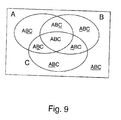
- A, B, and C are taken to be the names of single faults.
- Each of the atomic subsets of the diagram corresponds to one possible diagnosis.
- the diagnosis that consists of the assertion that faults A and C are simultaneously present is labeled A B C (any diagnosis that is underlined is not present---note that the underlining is only visible when this document is viewed in printed form or viewed at high resolution on a monitor!).
- the single-fault option displays only P(A), P(B), and P(C) (we are neglecting conditioning on the evidence).
- P(A) P(A BC )+P(AB C )+P(ABC)+P(A B C) , etc.
- the fault-pair option would display P(A only), P(B only), P(C only), P(AB), P(AC), and P(BC).
- P(A only) P(A BC )
- P(AB) P(ABC)+P(AB C )
- the most probable diagnosis option would display the probabilities of the most probable atomic subsets. If we take the size of the subsets to correspond to their probability, the three most probable diagnoses in Fig. 9 appear to be A BC , A B C , and AB C.
- Example one shows the simplest possible interface. Single-fault probabilities are displayed in three quantization levels, green (low), yellow (moderate), and red (high).
- Example two is a straightforward presentation of event-pair probabilities.
- the two simultaneous faults are arbitrarily labeled "Fault 1" and "Fault 2".
- the case where only one fault is present is handled by the inclusion of a null fault, labeled "No fault” in the list for Fault 2.
- No fault a null fault
- the result is an upper-triangular matrix of probabilities.
- Gray-level shading is used to represent the relative probability of an event pair with black being relatively high and white being nearly zero. This display technique may be weak in that under some circumstances it may be difficult for the eye to detect the difference between various levels of gray. Note that the total probability for all event pairs must sum to one.
- the most probable pair of faults i.e. the most probable diagnosis
- Example three uses every possible display element with the exception of fault-pair probabilities. The specific choices for each element are given in the list below.
- This example displays fault-pair probabilities in a different way than example 2.
- the probability is given only for the most probable pairs.
- Fault 2 would have been "No fault” in Example 2, here the entry for Fault 2 is simply left blank.
- Each fault name has been assigned a particular color to make obvious how many times each specific fault appears on the list (e.g. "STR Loop 3" can be assigned dark green, "Small LOCA” black, "Prim. Mini-Leak” blue).
- the third column displays the relative probability information in color and words as above.
- the fourth displays the probability information a third time as bars.
- the four most probable diagnoses are displayed. While not shown in this example, in principle any number of simultaneous faults could be detected and displayed with this approach.
- Each row represents a single complete diagnosis, which may consist of an assertion that multiple faults are present. The presence of a fault is indicated by coloring the corresponding box red. At the far right, bars indicate the relative probability of each diagnosis.
Landscapes
- Engineering & Computer Science (AREA)
- Physics & Mathematics (AREA)
- General Physics & Mathematics (AREA)
- Automation & Control Theory (AREA)
- Artificial Intelligence (AREA)
- Evolutionary Computation (AREA)
- Mathematical Physics (AREA)
- Human Computer Interaction (AREA)
- Monitoring And Testing Of Nuclear Reactors (AREA)
- Testing And Monitoring For Control Systems (AREA)
Applications Claiming Priority (4)
| Application Number | Priority Date | Filing Date | Title |
|---|---|---|---|
| US522884 | 1983-08-12 | ||
| US13415999P | 1999-05-14 | 1999-05-14 | |
| US134159P | 1999-05-14 | ||
| US09/522,884 US6785636B1 (en) | 1999-05-14 | 2000-03-10 | Fault diagnosis in a complex system, such as a nuclear plant, using probabilistic reasoning |
Publications (1)
| Publication Number | Publication Date |
|---|---|
| EP1065578A1 true EP1065578A1 (en) | 2001-01-03 |
Family
ID=26832030
Family Applications (1)
| Application Number | Title | Priority Date | Filing Date |
|---|---|---|---|
| EP00109869A Withdrawn EP1065578A1 (en) | 1999-05-14 | 2000-05-10 | Fault diagnosis in a complex system, such as a nuclear plant, using probabilistic reasoning |
Country Status (3)
| Country | Link |
|---|---|
| US (1) | US6785636B1 (enExample) |
| EP (1) | EP1065578A1 (enExample) |
| JP (1) | JP2000356696A (enExample) |
Cited By (5)
| Publication number | Priority date | Publication date | Assignee | Title |
|---|---|---|---|---|
| GB2377513A (en) * | 2001-07-05 | 2003-01-15 | Motorola Inc | Using a Bayesian Belief Network to model system reliability |
| WO2008025059A1 (en) * | 2006-08-28 | 2008-03-06 | E-Nose Pty Ltd | A method of determining the probability that data is associated with a source of a plurality of sources |
| WO2012044197A1 (ru) * | 2010-09-28 | 2012-04-05 | Закрытое Акционерное Общество "Диаконт" | Устройство для мониторинга риска и способ мониторинга риска для использования с объектом атомной энергетики |
| CN106054859A (zh) * | 2016-05-30 | 2016-10-26 | 宁波大学 | 基于修正型独立元分析的双层集成式工业过程故障检测方法 |
| CN107301884A (zh) * | 2017-07-24 | 2017-10-27 | 哈尔滨工程大学 | 一种混合式核电站故障诊断方法 |
Families Citing this family (23)
| Publication number | Priority date | Publication date | Assignee | Title |
|---|---|---|---|---|
| GB0127551D0 (en) * | 2001-11-16 | 2002-01-09 | Abb Ab | Analysing events |
| US7191108B2 (en) * | 2002-06-20 | 2007-03-13 | General Electric Company | Structured approach for risk-informing deterministic safety analyses |
| US7146231B2 (en) * | 2002-10-22 | 2006-12-05 | Fisher-Rosemount Systems, Inc.. | Smart process modules and objects in process plants |
| JP2004351184A (ja) * | 2003-05-28 | 2004-12-16 | Yasuo Fujii | ユビキタス式健康管理支援システム |
| US7650272B2 (en) * | 2003-10-23 | 2010-01-19 | Hrl Laboratories, Llc | Evaluation of Bayesian network models for decision support |
| US7440862B2 (en) * | 2004-05-10 | 2008-10-21 | Agilent Technologies, Inc. | Combining multiple independent sources of information for classification of devices under test |
| CA2510556C (en) * | 2004-07-01 | 2013-02-19 | Cae Inc. | Method and system for simulation-based troubleshooting and fault verification in operator-controlled complex systems |
| US7426458B2 (en) * | 2004-12-30 | 2008-09-16 | Global Nuclear Fuel - Americas, Llc | Nuclear reactor reload licensing analysis system and method |
| JP2009505270A (ja) * | 2005-08-19 | 2009-02-05 | コーニンクレッカ フィリップス エレクトロニクス エヌ ヴィ | 健康管理データの管理システム |
| JP4711077B2 (ja) * | 2006-06-09 | 2011-06-29 | 富士ゼロックス株式会社 | 故障診断システム、画像形成装置および故障診断プログラム |
| CN102298978A (zh) * | 2011-05-17 | 2011-12-28 | 哈尔滨工程大学 | 船用核动力装置基于多层流模型的不确定性故障诊断方法 |
| CN106155035B (zh) * | 2015-04-02 | 2018-09-07 | 中国商用飞机有限责任公司 | 基于维修类数据的故障诊断方法及故障诊断系统 |
| CN108594788B (zh) * | 2018-03-27 | 2020-09-22 | 西北工业大学 | 一种基于深度随机森林算法的飞机作动器故障检测与诊断方法 |
| CN109298706A (zh) * | 2018-11-02 | 2019-02-01 | 中国航空工业集团公司西安飞机设计研究所 | 一种基于贝叶斯网络的飞控系统故障诊断方法 |
| CN109324268B (zh) * | 2018-12-14 | 2021-02-12 | 国网山东省电力公司电力科学研究院 | 基于贝叶斯推理的配电网早期故障检测方法及装置 |
| CN111664083B (zh) * | 2020-05-29 | 2024-06-11 | 中核武汉核电运行技术股份有限公司 | 一种基于贝叶斯网络的核电主泵故障诊断方法 |
| US11416326B2 (en) | 2020-08-28 | 2022-08-16 | Sap Se | Systems and methods for failure diagnosis using fault tree |
| JP7365307B2 (ja) | 2020-09-14 | 2023-10-19 | 株式会社日立製作所 | 使用環境に基づく故障要因優先順位算出装置および方法 |
| CN113592111A (zh) * | 2021-07-30 | 2021-11-02 | 上海健康医学院 | 一种核电设备故障智能化处理方法及系统 |
| CN116205627A (zh) * | 2023-02-28 | 2023-06-02 | 厦门科灿信息技术有限公司 | 故障诊断的引导方法、电子设备和存储介质 |
| US20240404718A1 (en) * | 2023-06-05 | 2024-12-05 | King Faisal University | Method for performing real-time probabilistic safety assessments for nuclear power plants |
| CN117663353A (zh) * | 2023-12-18 | 2024-03-08 | 中国原子能科学研究院 | 核电通风空调系统的故障检测与诊断方法 |
| CN120850173B (zh) * | 2025-09-19 | 2025-11-28 | 大连科华热力管道有限公司 | 直埋蒸汽管道压力异常智能诊断方法 |
Citations (2)
| Publication number | Priority date | Publication date | Assignee | Title |
|---|---|---|---|---|
| US5133046A (en) * | 1991-01-03 | 1992-07-21 | Pickard, Lowe And Carrick (Plc) | Computer-based diagnostic expert system organized according to Bayesian theory |
| WO1998024010A1 (de) * | 1996-11-27 | 1998-06-04 | Siemens Aktiengesellschaft | Verfahren zur neuronalen modellierung der abhängigkeiten von einflussgrössen eines technischen systems |
Family Cites Families (6)
| Publication number | Priority date | Publication date | Assignee | Title |
|---|---|---|---|---|
| JPH06101079B2 (ja) * | 1988-11-09 | 1994-12-12 | 三菱電機株式会社 | プラント異常診断装置 |
| US5581459A (en) * | 1990-09-26 | 1996-12-03 | Hitachi, Ltd. | Plant operation support system |
| US5293323A (en) * | 1991-10-24 | 1994-03-08 | General Electric Company | Method for fault diagnosis by assessment of confidence measure |
| US5528516A (en) * | 1994-05-25 | 1996-06-18 | System Management Arts, Inc. | Apparatus and method for event correlation and problem reporting |
| US6076083A (en) * | 1995-08-20 | 2000-06-13 | Baker; Michelle | Diagnostic system utilizing a Bayesian network model having link weights updated experimentally |
| US6807537B1 (en) * | 1997-12-04 | 2004-10-19 | Microsoft Corporation | Mixtures of Bayesian networks |
-
2000
- 2000-03-10 US US09/522,884 patent/US6785636B1/en not_active Expired - Lifetime
- 2000-05-10 EP EP00109869A patent/EP1065578A1/en not_active Withdrawn
- 2000-05-15 JP JP2000142431A patent/JP2000356696A/ja active Pending
Patent Citations (2)
| Publication number | Priority date | Publication date | Assignee | Title |
|---|---|---|---|---|
| US5133046A (en) * | 1991-01-03 | 1992-07-21 | Pickard, Lowe And Carrick (Plc) | Computer-based diagnostic expert system organized according to Bayesian theory |
| WO1998024010A1 (de) * | 1996-11-27 | 1998-06-04 | Siemens Aktiengesellschaft | Verfahren zur neuronalen modellierung der abhängigkeiten von einflussgrössen eines technischen systems |
Non-Patent Citations (2)
| Title |
|---|
| KLUWE M ET AL: "BERATUNGSSYTEM FUR DIE OPERATIVE PROZESSFUHRUNG DECISION SUUPORT SYSTEM FOR SUPERVISORY CONTROL", AUTOMATISIERUNGSTECHNISCHE PRAXIS - ATP,DE,OLDENBOURG VERLAG. MUNCHEN, vol. 36, no. 8, 1 August 1994 (1994-08-01), pages 11 - 16, XP000460737, ISSN: 0178-2320 * |
| MIAO A X ET AL: "A COMPUTATIONAL SITUATION ASSESSMENT MODEL FOR NUCLEAR POWER PLANT OPERATIONS", IEEE TRANSACTIONS ON SYSTEMS, MAN AND CYBERNETICS. PART A: SYSTEMS AND HUMANS,US,IEEE SERVICE CENTER, vol. 27, no. 6, 1 November 1997 (1997-11-01), pages 728 - 742, XP000723876, ISSN: 1083-4427 * |
Cited By (9)
| Publication number | Priority date | Publication date | Assignee | Title |
|---|---|---|---|---|
| GB2377513A (en) * | 2001-07-05 | 2003-01-15 | Motorola Inc | Using a Bayesian Belief Network to model system reliability |
| WO2008025059A1 (en) * | 2006-08-28 | 2008-03-06 | E-Nose Pty Ltd | A method of determining the probability that data is associated with a source of a plurality of sources |
| AU2007291928B2 (en) * | 2006-08-28 | 2012-05-31 | Iomniscient Pty Ltd | A method of determining the probability that data is associated with a source of a plurality of sources |
| US8255354B2 (en) | 2006-08-28 | 2012-08-28 | E-Nose Pty Ltd | Method of determining the probability that data is associated with a source of a plurality of sources |
| WO2012044197A1 (ru) * | 2010-09-28 | 2012-04-05 | Закрытое Акционерное Общество "Диаконт" | Устройство для мониторинга риска и способ мониторинга риска для использования с объектом атомной энергетики |
| CN106054859A (zh) * | 2016-05-30 | 2016-10-26 | 宁波大学 | 基于修正型独立元分析的双层集成式工业过程故障检测方法 |
| CN106054859B (zh) * | 2016-05-30 | 2018-08-17 | 宁波大学 | 基于修正型独立元分析的双层集成式工业过程故障检测方法 |
| CN107301884A (zh) * | 2017-07-24 | 2017-10-27 | 哈尔滨工程大学 | 一种混合式核电站故障诊断方法 |
| CN107301884B (zh) * | 2017-07-24 | 2019-07-16 | 哈尔滨工程大学 | 一种混合式核电站故障诊断方法 |
Also Published As
| Publication number | Publication date |
|---|---|
| JP2000356696A (ja) | 2000-12-26 |
| US6785636B1 (en) | 2004-08-31 |
Similar Documents
| Publication | Publication Date | Title |
|---|---|---|
| US6785636B1 (en) | Fault diagnosis in a complex system, such as a nuclear plant, using probabilistic reasoning | |
| Gonzalez et al. | On-line diagnosis of turbine-generators using artificial intelligence | |
| AU2009299602A1 (en) | Assisting with updating a model for diagnosing failures in a system | |
| Garg et al. | Human reliability analysis studies from simulator experiments using Bayesian inference | |
| Kim et al. | SACADA and HuREX part 2: The use of SACADA and HuREX data to estimate human error probabilities | |
| JP3068091B1 (ja) | 異常診断装置 | |
| EP2028609A2 (en) | Methods for optimizing diagnostic reasoner models | |
| Lee et al. | Design of an integrated operator support system for advanced NPP MCRs: issues and perspectives | |
| Kim et al. | A data-informed dependency assessment of human reliability | |
| KR20250019983A (ko) | 원자력 발전소의 비정상 운전 지원을 위한 운전지원 시스템 및 방법 | |
| Galliers et al. | An impact analysis method for safety-critical user interface design | |
| Thomas et al. | A computerized operator support system prototype | |
| Santoso et al. | Nuclear plant fault diagnosis using probabilistic reasoning | |
| US5195173A (en) | Integrated multi-visual expert system maintenance advisor | |
| Kim et al. | Investigation on applicability of information theory to prediction of operator performance in diagnosis tasks at nuclear power plants | |
| Levine | Expanding the Causal Logic Foundations of Human Reliability Analysis | |
| Ulrich et al. | Dynamic human-in-the-loop simulated nuclear power plant thermal dispatch system demonstration and evaluation study | |
| KR20200001913A (ko) | 발전소 고장 예측 및 진단시스템의 화면표시방법 | |
| Woods et al. | Cognitive environment simulation: a tool for modeling intention formation for human reliability analysis | |
| Martin et al. | Deep knowledge expert system for diagnosis of multiple-failure severe transients in nuclear power plant | |
| Dubois | ALARM MANAGEMENT AND FAULT DETECTION | |
| Sheppard et al. | Incorporating model-based reasoning in interactive maintenance aids | |
| Abad et al. | Using supervised learning techniques for diagnosis of dynamic systems | |
| KR102385534B1 (ko) | 데이터 간 상호 유사도에 기반한 가상수명데이터 생성장치 및 방법 | |
| Lauber et al. | Autonomous agents for online diagnosis of a safety-critical system based on probabilistic causal reasoning |
Legal Events
| Date | Code | Title | Description |
|---|---|---|---|
| PUAI | Public reference made under article 153(3) epc to a published international application that has entered the european phase |
Free format text: ORIGINAL CODE: 0009012 |
|
| AK | Designated contracting states |
Kind code of ref document: A1 Designated state(s): DE FR SE |
|
| AX | Request for extension of the european patent |
Free format text: AL;LT;LV;MK;RO;SI |
|
| 17P | Request for examination filed |
Effective date: 20010409 |
|
| 17Q | First examination report despatched |
Effective date: 20010523 |
|
| AKX | Designation fees paid |
Free format text: DE FR SE |
|
| GRAH | Despatch of communication of intention to grant a patent |
Free format text: ORIGINAL CODE: EPIDOS IGRA |
|
| STAA | Information on the status of an ep patent application or granted ep patent |
Free format text: STATUS: THE APPLICATION IS DEEMED TO BE WITHDRAWN |
|
| 18D | Application deemed to be withdrawn |
Effective date: 20030611 |