EP1065238A2 - Rubber composition, hose of low fuel permeation and electroconductive hose of low fuel permeation - Google Patents
Rubber composition, hose of low fuel permeation and electroconductive hose of low fuel permeation Download PDFInfo
- Publication number
- EP1065238A2 EP1065238A2 EP00113585A EP00113585A EP1065238A2 EP 1065238 A2 EP1065238 A2 EP 1065238A2 EP 00113585 A EP00113585 A EP 00113585A EP 00113585 A EP00113585 A EP 00113585A EP 1065238 A2 EP1065238 A2 EP 1065238A2
- Authority
- EP
- European Patent Office
- Prior art keywords
- rubber composition
- nbr
- pvc
- hose
- plasticizer
- Prior art date
- Legal status (The legal status is an assumption and is not a legal conclusion. Google has not performed a legal analysis and makes no representation as to the accuracy of the status listed.)
- Granted
Links
Images

Classifications
-
- C—CHEMISTRY; METALLURGY
- C08—ORGANIC MACROMOLECULAR COMPOUNDS; THEIR PREPARATION OR CHEMICAL WORKING-UP; COMPOSITIONS BASED THEREON
- C08K—Use of inorganic or non-macromolecular organic substances as compounding ingredients
- C08K3/00—Use of inorganic substances as compounding ingredients
- C08K3/02—Elements
- C08K3/04—Carbon
-
- C—CHEMISTRY; METALLURGY
- C08—ORGANIC MACROMOLECULAR COMPOUNDS; THEIR PREPARATION OR CHEMICAL WORKING-UP; COMPOSITIONS BASED THEREON
- C08L—COMPOSITIONS OF MACROMOLECULAR COMPOUNDS
- C08L27/00—Compositions of homopolymers or copolymers of compounds having one or more unsaturated aliphatic radicals, each having only one carbon-to-carbon double bond, and at least one being terminated by a halogen; Compositions of derivatives of such polymers
- C08L27/02—Compositions of homopolymers or copolymers of compounds having one or more unsaturated aliphatic radicals, each having only one carbon-to-carbon double bond, and at least one being terminated by a halogen; Compositions of derivatives of such polymers not modified by chemical after-treatment
- C08L27/04—Compositions of homopolymers or copolymers of compounds having one or more unsaturated aliphatic radicals, each having only one carbon-to-carbon double bond, and at least one being terminated by a halogen; Compositions of derivatives of such polymers not modified by chemical after-treatment containing chlorine atoms
- C08L27/06—Homopolymers or copolymers of vinyl chloride
-
- C—CHEMISTRY; METALLURGY
- C08—ORGANIC MACROMOLECULAR COMPOUNDS; THEIR PREPARATION OR CHEMICAL WORKING-UP; COMPOSITIONS BASED THEREON
- C08L—COMPOSITIONS OF MACROMOLECULAR COMPOUNDS
- C08L9/00—Compositions of homopolymers or copolymers of conjugated diene hydrocarbons
- C08L9/02—Copolymers with acrylonitrile
-
- F—MECHANICAL ENGINEERING; LIGHTING; HEATING; WEAPONS; BLASTING
- F16—ENGINEERING ELEMENTS AND UNITS; GENERAL MEASURES FOR PRODUCING AND MAINTAINING EFFECTIVE FUNCTIONING OF MACHINES OR INSTALLATIONS; THERMAL INSULATION IN GENERAL
- F16L—PIPES; JOINTS OR FITTINGS FOR PIPES; SUPPORTS FOR PIPES, CABLES OR PROTECTIVE TUBING; MEANS FOR THERMAL INSULATION IN GENERAL
- F16L11/00—Hoses, i.e. flexible pipes
- F16L11/04—Hoses, i.e. flexible pipes made of rubber or flexible plastics
-
- F—MECHANICAL ENGINEERING; LIGHTING; HEATING; WEAPONS; BLASTING
- F16—ENGINEERING ELEMENTS AND UNITS; GENERAL MEASURES FOR PRODUCING AND MAINTAINING EFFECTIVE FUNCTIONING OF MACHINES OR INSTALLATIONS; THERMAL INSULATION IN GENERAL
- F16L—PIPES; JOINTS OR FITTINGS FOR PIPES; SUPPORTS FOR PIPES, CABLES OR PROTECTIVE TUBING; MEANS FOR THERMAL INSULATION IN GENERAL
- F16L11/00—Hoses, i.e. flexible pipes
- F16L11/04—Hoses, i.e. flexible pipes made of rubber or flexible plastics
- F16L11/12—Hoses, i.e. flexible pipes made of rubber or flexible plastics with arrangements for particular purposes, e.g. specially profiled, with protecting layer, heated, electrically conducting
- F16L11/127—Hoses, i.e. flexible pipes made of rubber or flexible plastics with arrangements for particular purposes, e.g. specially profiled, with protecting layer, heated, electrically conducting electrically conducting
-
- F—MECHANICAL ENGINEERING; LIGHTING; HEATING; WEAPONS; BLASTING
- F16—ENGINEERING ELEMENTS AND UNITS; GENERAL MEASURES FOR PRODUCING AND MAINTAINING EFFECTIVE FUNCTIONING OF MACHINES OR INSTALLATIONS; THERMAL INSULATION IN GENERAL
- F16L—PIPES; JOINTS OR FITTINGS FOR PIPES; SUPPORTS FOR PIPES, CABLES OR PROTECTIVE TUBING; MEANS FOR THERMAL INSULATION IN GENERAL
- F16L11/00—Hoses, i.e. flexible pipes
- F16L11/04—Hoses, i.e. flexible pipes made of rubber or flexible plastics
- F16L2011/047—Hoses, i.e. flexible pipes made of rubber or flexible plastics with a diffusion barrier layer
Definitions
- This invention relates to a rubber composition, a hose of low fuel permeation, and an electroconductive hose of low fuel permeation. More particularly, it relates to a rubber composition of good fuel impermeability and low-temperature flexibility, and a hose of low fuel permeation utilizing this rubber composition, and also to a rubber composition of good fuel impermeability, low-temperature flexibility and electroconductivity, and an electroconductive hose of low fuel permeation utilizing this rubber composition.
- NBR acrylonitrile-butadiene rubber
- PVC polyvinyl chloride
- FKM fluororubber
- resin is used for the inner layer of a hose
- NBR-PVC blend rubber of NBR and PVC
- ECO epichlorohydrin rubber
- CSM chlorosulfonated polyethylene rubber
- the inventors have further found that increasing the AN content of NBR to a range falling between 43 to 50 % by weight or so realizes good fuel impermeability of NBR which is comparable to that of FKM.
- fuel hoses have electroconductivity. While an automobile is driven or refueled, fuel flows in the fuel hose to generate static electricity. If kept charged with static electricity, the fuel hose will give sparks dangerous to fuel when it is contacted with a metallic refueling gun or the like. To avoid the dangerous trouble, for example, an earth wire may be disposed between a filler hose and the body of an automobile thereby to remove static electricity through it, which, however, requires some specific members and an additional step for fitting it. It will be rather reasonable to use a filler or breather hose having electroconductivity. However, FKM and fluororesins essentially have large electric resistance, and hoses having the inner layer formed of these materials could hardly have electroconductivity.
- the inventors of this invention have evaluated fuel impermeability and electroconductivity of various types of inexpensive NBR-PVC-based rubber compositions using gasoline for practical use.
- the gasoline for practical use includes Phase-II gasoline for evaporation control evaluation in the United States, and gasoline for evaporation control evaluation in Europe.
- a first aspect of this invention resides in a rubber composition for hoses of low fuel permeation, which comprises NBR having a combined acrylonitrile content (AN content) of from 43 to 50 % by weight, PVC blended with the NBR, and a plasticizer having a solubility parameter (SP) value of at least 8.8 and a molecular weight of at most 550 added to the NBR-PVC blend.
- NBR acrylonitrile content
- SP solubility parameter
- the AN content of NBR in the NBR-PVC blend is controlled to fall between 43 and 50 % by weight, and therefore the fuel impermeability of the NBR-PVC blend is comparable to that of FKM.
- a plasticizer having an SP value of at least 8.8 and a molecular weight of at most 550 is added to the NBR-PVC blend.
- the plasticizer having a molecular weight of at most 550 has low viscosity at low temperatures, and therefore significantly improves the low-temperature properties of the NBR-PVC blend.
- the plasticizer having an SP value of at least 8.8 is highly miscible with the NBR-PVC blend in which NBR has a high AN content, hardly affecting the fuel impermeability of the rubber composition. Accordingly, adding the plasticizer as above to the NBR-PVC blend improves the low-temperature properties of the rubber composition, effectively maintaining the fuel impermeability thereof.
- the AN content of smaller than 43 % by weight will give the rubber composition of insufficient fuel impermeability; and the AN content of larger than 50 % by weight will decrease the low-temperature properties of the rubber composition to such a degree that they cannot be improved even by the addition of a plasticizer.
- a plasticizer having an SP value of smaller than 8.8 is poorly miscible with NBR-PVC and will bleed out of the rubber composition, which makes it difficult to improve low-temperature properties.
- a plasticizer having a molecular weight of larger than 550 increases the low-temperature viscosity of the rubber composition, which also makes it difficult to improve low-temperature properties.
- the amount of the vulcanizing agent and its reaction product to be released from the rubber composition when dipped in fuel is small. Therefore, hoses formed of the rubber composition are free from the troubles to be caused by the released ingredients that may corrode the metallic members of fuel pumps and may clog the valves in fuel piping.
- a second aspect of the invention resides in a hose of low fuel permeation, which comprises the rubber composition of the first aspect.
- the advantages of the hose of the second aspect are that it is inexpensive and impermeable to fuel and has good low-temperature properties, and the amount of the vulcanizing agent and its reaction product to be released from it is small.
- the hose is especially suitable for automobiles.
- a third aspect of the invention resides in a rubber composition for electroconductive hoses of low fuel permeation, which comprises NBR having an AN content of from 43 to 50 % by weight, PVC blended with the NBR, a plasticizer having an SP value of at least 8.8 and a molecular weight of at most 550 added to the NBR-PVC blend, and carbon black (CB) added to the NBR-PVC blend to lower the volume specific resistance of the blend to at most 10 8 ⁇ cm.
- NBR having an AN content of from 43 to 50 % by weight
- PVC blended with the NBR
- a plasticizer having an SP value of at least 8.8 and a molecular weight of at most 550 added to the NBR-PVC blend
- CB carbon black
- the AN content of NBR in the NBR-PVC blend is controlled to fall between 43 and 50 % by weight, like in the first aspect, and therefore the fuel impermeability of the NBR-PVC blend is comparable to that of FKM.
- the plasticizer having an SP value of at least 8.8 and a molecular weight of at most 550 added to the NBR-PVC blend improves the low-temperature properties of the rubber composition, and effectively maintains the fuel impermeability thereof.
- another advantage of the rubber composition is that the amount of the vulcanizing agent and its reaction product to be released from it into fuel is small. Therefore, hoses formed of the rubber composition are free from the troubles to be caused by the released ingredients that may corrode the metallic members of fuel pumps and may clog the valves in fuel piping.
- CB is added to the rubber composition to thereby lower the volume specific resistance of the composition to at most 10 8 ⁇ cm. Therefore, the rubber composition is hardly charged with static electricity.
- a fourth aspect of the invention resides in an electroconductive hose of low fuel permeation, which comprises the rubber composition of the third aspect.
- the advantages of the electroconductive hose of the fourth aspect are that it is inexpensive and impermeable to fuel and has good low-temperature properties, and the amount of the vulcanizing agent and its reaction product to be released from it is small.
- the hose is thus especially suitable for automobiles.
- since the hose is hardly charged with static electricity, it will not give sparks dangerous to fuel when it is contacted with a metallic refueling gun or the like.
- the rubber composition of the invention comprises a base of NBR-PVC.
- the rubber composition of the first aspect contains at least a specific plasticizer, and is used for producing hoses of low fuel permeation, especially those for automobiles.
- the rubber composition of the third aspect contains at least a specific plasticizer, and has a volume specific resistance controlled to be not higher than a predetermined value.
- the rubber composition is used for producing electroconductive hoses of low fuel permeation, especially those for automobiles.
- the rubber composition of the first aspect contains a specific plasticizer and may contain reinforcing CB. Further, any known vulcanizing agents, vulcanization accelerators, antioxidant agents and others may be added.
- the amount of CB that may be in the rubber composition of the first aspect is not specifically defined. However, for the rubber composition for fuel hoses, it is preferable that the amount of the plasticizer and that of CB therein is balanced to thereby control the hardness (JIS K6253 or ISO 48) of the rubber composition to be within a range falling between 55 and 75 degrees. Therefore, the amount of CB in the rubber composition may vary, depending on the amount of the plasticizer therein, the type of CB used and even the combination of the two, and cannot be defined regularly. For example, it may be from 30 to 100 phr (parts per hundred parts of rubber) or so.
- Any ordinary vulcanizing agent for NBR-PVC is employable herein, but preferred are low-sulfur vulcanizing agents.
- White reinforcing agents such as silica, calcium carbonate and the like may decrease the fuel impermeability of the rubber composition.
- Tabular crystalline white reinforcing agents such as talc, mica and the like may improve the fuel impermeability of the rubber composition, but will adversely affect the low-temperature properties thereof. Therefore, the addition of these white reinforcing agents to the rubber composition is not preferable.
- the rubber composition of the third aspect contains at least a specific plasticizer and CB to give good fuel impermeability, low-temperature properties and electroconductivity. If desired, any known vulcanizing agents, vulcanization accelerators, antioxidant agents and others may be added thereto. The matters specifically mentioned hereinabove for the vulcanizing agents and the white reinforcing agents in the first aspect also applies to the rubber composition of the third aspect.
- the rubber composition of the third aspect has a volume specific resistance of at most 10 8 ⁇ cm.
- the type and the formulation of CB to be used are not specifically defined, but preferred is CB having a relatively small particle size and a large structure and having a high degree of electroconductivity.
- any other electroconductive carbon such as acetylene black, Ketchen black or the like may be added to the rubber composition, if desired.
- an electroconductive agent except CB may also be added thereto, if it dose not decrease the impermeability of the rubber composition.
- the base of the rubber composition of the first and third aspects is NBR-PVC.
- the AN content of NBR in NBR-PVC falls between 43 and 50 % by weight. Preferably, it falls between 45 and 48 % by weight. Except for the definition of its AN content, NBR and PVC are not specifically defined for their types. Any types of ordinarily used NBR and PVC may be blended to form the rubber composition.
- the amount of PVC in NBR-PVC for use herein is not specifically defined. In view of ordinary ozone resistance, it is preferable that PVC accounts for from 25 to 40 % by weight of the NBR-PVC blend. The amount of PVC smaller than 25 % by weight will give poor ozone resistance; and the amount of PVC larger than 40 % by weight will affect the workability or the like.
- the amount of the plasticizer to be added to NBR-PVC may fall between 15 and 35 phr, and preferably between 20 and 30 phr. In the third aspect, it may fall between 20 and 35 phr, and preferably between 25 and 30 phr.
- the plasticizer to be added to the blend has an SP value of at least 8.8, preferably at least 9.0, and has a molecular weight of at most 550, preferably at most 450.
- Preferred examples of the plasticizer include ether-ester plasticizers such as Asahi Denka Kogyo's ADEKA CIZER RS-107® and ADEKA CIZER RS-540®, which, however, are not limitative. Any plasticizer satisfying the requirements as above is employable herein.
- the hose of low fuel permeation of the second aspect is formed of the rubber composition of the first aspect.
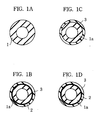
- One embodiment of the hose is a single-layered hose 1 as in FIG. 1A.
- Other embodiments thereof are multi-layered hoses comprising an inner layer 1a of the rubber composition and an outer layer 3 disposed outside the inner layer 1a via or not via a reinforcing yarn layer 2 therebetween, as in FIGS. 1B to 1D.
- the outer layer 3 is a single layer in the illustrated embodiments, but may have a multi-layered structure.
- the outer layer 3 and the inner layer 1a are formed of the same rubber composition.
- the outer layer 3 is formed of a weather-resistant rubber material such as CSM, ECO or the like.
- the material of the inner layer 1a is NBR-PVC having a PVC content of at least 25 % by weight.
- the hose of low fuel permeation is usable, for example, in fuel piping in automobiles, etc., and is especially suitable for filler hoses, breather hoses and evaporation hoses.
- the shape of the hose is not specifically defined, including, for example, straight hoses, bending hoses, and hoses having a bellows configuration in at least a part thereof.
- Straight hoses are often used for breather hoses
- hoses having a bellows configuration are often used for filler hoses.
- the diameter of the hose is not specifically defined, either.
- the hose may be so constituted that its inner diameter falls between 3 and 20 mm and its wall thickness falls between 2 and 4 mm; or its inner diameter falls between 20 and 50 mm and its wall thickness falls between 3 and 5 mm.
- the breather hose has an inner diameter of from 3 to 20 mm and a wall thickness of from 2 to 4 mm; and the filler hose has an inner diameter of from 20 to 50 mm and a wall thickness of from 3 to 5 mm.
- the electroconductive hose of low fuel permeation of the fourth aspect is favorably used for automobiles, especially for filler hoses and breather hoses for automobiles.
- Its structure may be as shown in FIGS. 1A to 1D, like the hose of low fuel permeation of the second aspect.
- the difference between the two is that the rubber composition of the first aspect is substituted by that of the third aspect.
- the shape of the hose is not specifically defined, and may be the same as that of the hose of the second aspect.
- the hose of low fuel permeation of the second aspect and the electroconductive hose of low fuel permeation of the fourth aspect can be manufactured by vulcanizing the rubber composition followed by shaping it into hoses under any ordinary conditions.
- employable is extrusion molding or injection molding.
- first and second methods will be preferably employed.
- the first method is used for manufacturing straight or bending, single-layered or multi-layered hoses, in which a single-layered or multi-layered, unvulcanized hose is first produced through extrusion molding. Next, a straight or bending thin mandrel is inserted into the unvulcanized hose, or the unvulcanized hose is fitted into a straight or bending groove in a heating die. Being kept in that condition, the straight or bending hose is vulcanized. This method is especially suitable for forming breather hoses.
- the second method is used for manufacturing straight or bending hoses or hoses having a bellows configuration at least in a part thereof.
- a straight, bending or partly bellows-configured tubular cavity (with a mandrel inserted therein) is formed in a mold capable of being heated.
- An unvulcanized rubber material is then injected into the cavity, and then thermally vulcanized by heating the mold.
- the hose is removed from the mold, and it may be further heated in any desired manner to promote its vulcanization.
- This method is especially suitable for forming filer hoses.
- the polymer is NBR-PVC.
- NBR-PVC the content of PVC and the AN content of NBR are varied as shown in Tables 1 to 4.
- the polymer is 3M(Dyneon)'s FLUOREL FE5731Q® which is FKM having a fluorine content of 69 %.
- the plasticizer in Examples 1 to 5, 7 and 8 and in Comparative Examples 3 to 7 and 10 to 17 is Asahi Denka Kogyo's ADEKA CIZER RS107®, and it has an SP value of 9.2 and a molecular weight of 434.
- Example 6 used is Asahi Denka Kogyo's ADEKA CIZER RS700® having an SP value of 8.9 and a molecular weight of 550.
- Comparative Example 2 used is DOP having an SP value of 9.0 and a molecular weight of 391.
- Comparative Example 8 used is DOA having an SP value of 8.5 and a molecular weight of 371.
- Comparative Example 9 used is Asahi Denka Kogyo's ADEKA CIZER RS735® having an SP value of 9.2 and a molecular weight of 850.
- the amount of each plasticizer used is shown in the following Tables in terms of phr.
- CB used is indicated in the Tables, in which HAF is Showa Cabot's SHOW BLACK N330®; FEF is Tokai Carbon's SEAST SO®; and SRF is Tokai Carbon's SEAST S®.
- the amount of each CB used is shown in the Tables in terms of phr.
- a white reinforcing agent As in Table 4.
- the amount of the white reinforcing agent added is also shown in Table 4 in terms of phr.
- silica for the white reinforcing agent is Nippon Silica's NIPSIL ER®
- calcium carbonate is Shiraishi Calcium's HAKUENKA CC®
- mica is KMG Minerals' CANADA MICA M-200®
- talc 1 is Nippon Talc's MICRO ACE K-1®
- talc 2 is Sierra Talc's MISTRON VAPOR®.
- the antioxidant agent used is Seiko Chemical's OZONON 3C®, NONFLEX RD®, etc.
- the unvulcanized NBR-PVC was mixed with the other ingredients and milled in a Banbury mixer and an open roll mill.
- the resulting, unvulcanized rubber composition was press-vulcanized at 150°C for 30 minutes to form sheet-like test pieces having a thickness of 2 mm.
- test pieces were tested for their physical properties in an ordinary state, the tensile strength (MPa), the elongation (%) and the hardness, according to JIS K6251 and K6253, or ISO 37 and 48.
- the data obtained are given in Tables 1 to 4.
- the tensile strength is at least 10.0 MPa
- the elongation is at least 300 %
- the hardness falls between 55 and 75 degrees.
- test pieces were tested for gasoline permeation according to a CUP method. The method is described concretely with reference to FIG. 2.
- a cup 5 having an external thread 4 around its outer periphery was set with its opening upward (i.e. opposite to its situation illustrated), and 100 ml of Phase-II gasoline 6 was put into it.
- the opening of the cup 5 was covered with a test piece 7, and a metal ring 8 for protecting the test piece was laid over the test piece 7 along its periphery.
- a metal mesh 9 for supporting the test piece was laid over it.
- a fastening cap 11 having an internal thread 10 around its inner periphery was screwed over the opening of the cup 5. Accordingly, the metal mesh 9, the metal ring 8 and the test piece 7 were tightly pressed against the periphery of the opening of the cup 5 at the step 12, and the opening of the cup 5 was completely sealed. In that condition, the test equipment was turned upside down, as shown in Fig. 2, and kept static as it was.
- the test piece was dipped in gasoline at 40°C for 7 days in the manner as above (one surface dipping).
- the gasoline in the cup was exchanged for a fresh one, and immediately the total weight W0 (mg) of the test equipment was measured.
- the test piece was further dipped in gasoline at 40°C for 3 days, and the total weight W1 (mg) of the test equipment was again measured. From the thus-measured data W0 and W1, the permeation coefficient (mg ⁇ mm/cm 2 /day) of the test piece was calculated according to the following formula (1).
- t indicates the thickness (mm) of the test piece; and A indicates the contact area (cm 2 ) of the test piece to gasoline, or that is, the area of the test piece through which gasoline has permeated.
- Permeation Coefficient [(W0 - W1) ⁇ t/3A]
- the permeation coefficient of each test piece thus obtained is given in Tables 1 to 4.
- the permeation coefficient should preferably be at most 10.
- test pieces were tested for gasoline permeation using gasoline for evaporation control evaluation in Europe.
- the permeation coefficient of each test piece is given in Tables 1 to 4.
- the permeation coefficient should preferably be at most 30.
- Table 5 shown are the details of the Phase-II gasoline for evaluation in the United States and the gasoline for evaluation in Europe.
- the low-temperature impact test according to JIS K6261 or ISO 812 was carried out to measure the brittle temperature (°C) of each test piece.
- the data obtained are given in Tables 1 to 4.
- the brittle temperature should preferably be not higher than -20°C.
- test pieces were tested for their ozone resistance, bleeding resistance and workability. Briefly, for their bleeding resistance, the test pieces were, after having been vulcanized, left at room temperature for one week, and their surfaces were checked for the presence or absence of bleeding thereout. For their workability, the test pieces were checked as to how the constituent ingredients could be readily mixed and milled in the Banbury mixer or in the roll mill and how the blends could be readily extrusion-molded into hoses. The test data obtained are given in Tables 1 to 4.
- the test pieces were tested in the manner mentioned below, according to JIS K6259 or ISO 1431. Concretely, the test pieces were first dipped in Fuel C at 40°C for 48 hours, and then dried in vacuum at 40°C for 48 hours. Then, they were stretched to 140 % in length; exposed to air containing 50 pphm of ozone for 168 hours; and checked as to whether or not they had cracks.
- test pieces of Examples and Comparative Examples 1 to 3 were tested for their extraction in fuel. Briefly, 20 g of each test piece was cut into chips of 2 mm ⁇ 2 mm, and the chips were dipped in 200 ml of Fuel B (JIS K6258, ISO 1817) at 40°C for 168 hours. The Fuel B (in which the chips were thus dipped) was concentrated to be 10 ml in volume, and then centrifuged in a centrifugal tube. The resulting supernatant liquid was removed, and the residue was dried up to be a solid. The weight of the solid residue was measured, and its ratio (wt.%) to the sample (20 g) was obtained. The data are given in the following Tables.
- the residue should preferably be up to 0.2 % by weight.
- 1 2 3 4 5 6 7 8 Amount of ACN 46 43 50 46 46 46 46 46 Amount of PVC 30 30 30 30 25 40 30 30 30 Plasticizer, SP value 9.2 9.2 9.2 9.2 8.9 9.2 9.2 Plasticizer, molecular weight 434 434 434 434 550 434 434 Plasticizer, amount added (phr) 25 25 25 25 25 25 15 35 Carbon Grade HAF HAF HAF HAF HAF HAF HAF HAF Amount of Carbon added (phr) 35 35 35 35 35 35 35 35 35 25 55 White Reinforcing Agent - - - - - - - - - Amount of White Reinforcing Agent added 0 0 0 0 0 0 0 0 0 Physical Properties in ordinary state Tensile Strength (MPa) 16.0 14.5 18.5 16.5 15.5 15.8 18.8 14.5 Elongation (%) 500 500 380 520 470 480 350 520 Hardness 70 65 75
- the polymer is NBR-PVC.
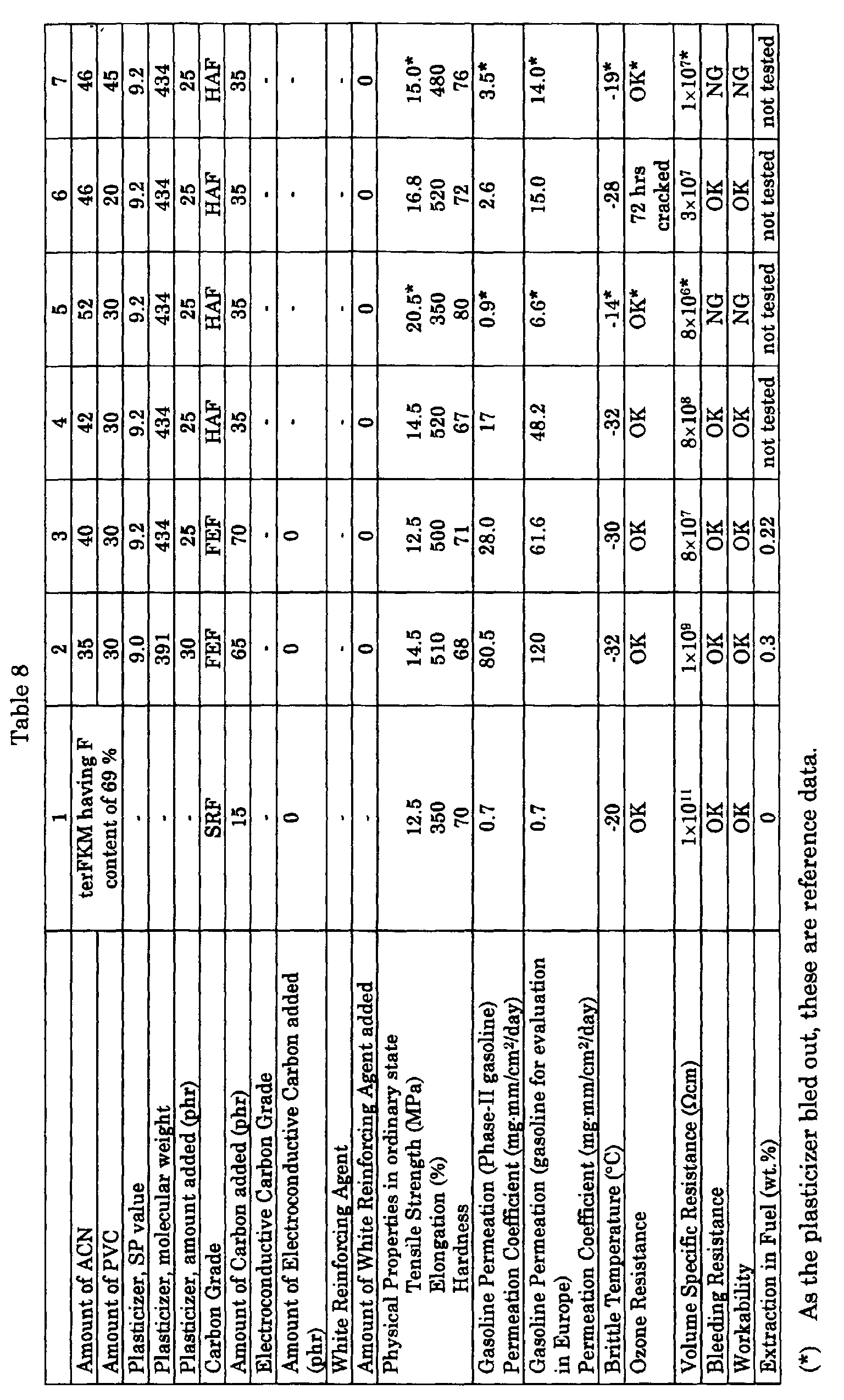
- NBR-PVC the content of PVC and the AN content of NBR are varied, as in Tables 6 to 10.
- the vulcanization accelerators are Ouchi Shinko Chemical's NOCCELER TT-G® and NOCCELLER CZ-G®
- the plasticizer in Examples 1 to 5, 7 to 13 and in Comparative Examples 3 to 7 and 10 to 20 is Asahi Denka Kogyo's ADEKA. CIZER RS107®, and it has an SP value of 9.2 and a molecular weight of 434.
- Example 6 used is Asahi Denka Kogyo's ADEKA CIZER RS700® having an SP value of 8.9 and a molecular weight of 550.
- Comparative Example 2 used is DOP having an SP value of 9.0 and a molecular weight of 391.
- sued is DOA having an SP value of 8.5 and a molecular weight of 371.
- Comparative Example 9 used is Asahi Denka Kogyo's ADEKA CIZER RS735® having an SP value of 9.2 and a molecular weight of 850.
- the amount of each plasticizer used is shown in the following Tables in terms of phr.
- CB used is indicated in the Tables, in which HAF is Showa Cabot's SHOW BLACK N330®; FEF is Tokai Carbon's SEAST SO®; and FT is Asahi Carbon's ASAHI THERMAL®. The amount of each CB used is shown in the Tables in terms of phr.
- acetylene black or Ketchen black as electroconductive carbon, in place of or in addition to CB.
- Denki Kagaku Kogyo's ACETYLENE BLACK® is added to the samples of Examples 8, 9, 11 and 12, added.
- Denki Kagaku Kogyo's ACETYLENE BLACK® is added to the samples of Examples 8, 9, 11 and 12, added.
- Ketchen International's KETCHEN BLACK EC® is added to the samples of Examples 10 and 13 and Comparative Example 19, added. This is expressed as Ketchen in the Tables, and its amount is in terms of phr therein.
- Example 13 To the samples of Examples 1 to 12 and Comparative Examples 1 to 11 and 18 to 20, no white reinforcing agent is added. To those of Example 13, and Comparative Examples 12 to 17, added is a white reinforcing agent, as in Table 9. The amount of the white reinforcing agent added is also shown in Table 9 in terms of phr.
- silica for the white reinforcing agent is Nippon Silica's NIPSIL ER®; calcium carbonate is Shiraishi Calcium's HAKUENKA CC®; mica is KMG Minerals' CANADA MICA M-200®; talc 1 is Nippon Talc's MICRO ACE K-1®; and talc 2 is Sierra Talc's MISTRON VAPOR®.
- the antioxidant agent used is Seiko Chemical's OZONON 3C®, NONFLEX RD®, etc.
- the unvulcanized NBR-PVC was mixed with the other ingredients and milled in a Banbury mixer and an open roll mill.
- the resulting, unvulcanized rubber composition was press-vulcanized at 150°C for 30 minutes to form sheet-like test pieces having a thickness of 2 mm.
- test pieces were tested for their physical properties in an ordinary state, the tensile strength (MPa), the elongation (%) and the hardness, according to JIS K6251 and K6253, or ISO 37 and 48.
- the data obtained are given in Tables 6 to 10.
- the tensile strength is at least 10.0 MPa
- the elongation is at least 300 %
- the hardness falls between 55 and 75 degrees.
- test pieces were tested for gasoline permeation according to a CUP method in which was used Phase-II gasoline.
- the details of the test method and those for calculating the permeation coefficient are the same as in the previous section 1, Embodiments of Hoses of Low Fuel Permeation.
- the permeation coefficient of each test piece thus obtained is given in Tables 6 to 10.
- the permeation coefficient should preferably be at most 10.
- test pieces were tested for gasoline permeation using gasoline for evaporation control evaluation in Europe.
- the permeation coefficient of each test piece is given in Tables 6 to 10.
- the permeation coefficient should preferably be at most 30.
- the brittle temperature (°C) of the test pieces was measured.
- the data obtained are given in Tables 6 to 10.
- the brittle temperature should preferably be not higher than -20°C.
- volume specific resistance ( ⁇ cm) of the test pieces was measured.
- the voltage applied to each test piece was one V.
- the data obtained are given in Tables 6 to 10.
- the volume specific resistance should preferably be at most 10 8 ⁇ cm.
- test pieces were tested for their ozone resistance, bleeding resistance and workability.
- the test methods are the same as in the previous section 1, Embodiments of Hoses of Low Fuel Permeation.
- the test data obtained are given in Tables 6 to 10.
- test pieces of Examples and Comparative Examples 1 to 3 were tested for their extraction in fuel, according to the same method as in the previous section 1, Embodiments of Hoses of Low Fuel Permeation.
- the data obtained are given in the following Tables.
- the residue should preferably be up to 0.2 % by weight.
Landscapes
- Chemical & Material Sciences (AREA)
- Engineering & Computer Science (AREA)
- General Engineering & Computer Science (AREA)
- Health & Medical Sciences (AREA)
- Chemical Kinetics & Catalysis (AREA)
- Medicinal Chemistry (AREA)
- Polymers & Plastics (AREA)
- Organic Chemistry (AREA)
- Mechanical Engineering (AREA)
- Compositions Of Macromolecular Compounds (AREA)
- Rigid Pipes And Flexible Pipes (AREA)
- Laminated Bodies (AREA)
Abstract
Description
| Polymer | 100 wt.pts. |
| |
5 wt.pts. |
| |
1 wt.pts. |
| |
2 wt.pts. |
| CB | variable |
| Plasticizer | variable |
| Sulfur | 0.5 wt.pts. |
| Thiuram-type vulcanization accelerator | 1.5 wt.pts. |
| Sulfenamide-type vulcanization accelerator | 1.5 wt.pts. |
| Polymer | 100 wt.pts. |
| |
3 wt.pts. |
| |
6 wt.pts. |
| CB | variable |
| 1 | 2 | 3 | 4 | 5 | 6 | 7 | 8 | |
| Amount of ACN | 46 | 43 | 50 | 46 | 46 | 46 | 46 | 46 |
| Amount of PVC | 30 | 30 | 30 | 25 | 40 | 30 | 30 | 30 |
| Plasticizer, SP value | 9.2 | 9.2 | 9.2 | 9.2 | 9.2 | 8.9 | 9.2 | 9.2 |
| Plasticizer, molecular weight | 434 | 434 | 434 | 434 | 434 | 550 | 434 | 434 |
| Plasticizer, amount added (phr) | 25 | 25 | 25 | 25 | 25 | 25 | 15 | 35 |
| Carbon Grade | HAF | HAF | HAF | HAF | HAF | HAF | HAF | HAF |
| Amount of Carbon added (phr) | 35 | 35 | 35 | 35 | 35 | 35 | 25 | 55 |
| White Reinforcing Agent | - | - | - | - | - | - | - | - |
| Amount of White Reinforcing Agent added | 0 | 0 | 0 | 0 | 0 | 0 | 0 | 0 |
| Physical Properties in ordinary state | ||||||||
| Tensile Strength (MPa) | 16.0 | 14.5 | 18.5 | 16.5 | 15.5 | 15.8 | 18.8 | 14.5 |
| Elongation (%) | 500 | 500 | 380 | 520 | 470 | 480 | 350 | 520 |
| Hardness | 70 | 65 | 75 | 71 | 72 | 68 | 73 | 72 |
| Gasoline Permeation (Phase-II gasoline) | 3.0 | 9.8 | 1.2 | 2.8 | 3.2 | 4.1 | 1.8 | 8.7 |
| Permeation Coefficient (mg·mm/cm2/day) | ||||||||
| Gasoline Permeation (gasoline for evaluation in Europe) | 14.5 | 29.1 | 8.4 | 14.2 | 15.9 | 18.8 | 11.7 | 27.0 |
| Permeation Coefficient (mg·mm/cm2/day) | ||||||||
| Brittle Temperature (°C) | -27 | -30 | -21 | -27 | -23 | -21 | -22 | -30 |
| Ozone Resistance | OK | OK | OK | OK | OK | OK | OK | OK |
| Bleeding Resistance | OK | OK | OK | OK | OK | OK | OK | OK |
| Workability | OK | OK | OK | OK | OK | OK | OK | OK |
| Extraction in Fuel (wt.%) | 0.05 | 0.13 | 0.02 | 0.05 | 0.04 | 0.05 | 0.04 | 0.04 |
| 1 | 2 | 3 | |
| Amount of ACN | terFKM having F content of 69 % | 35 | 40 |
| Amount of PVC | 30 | 30 | |
| Plasticizer, SP value | - | 9.0 | 9.2 |
| Plasticizer, molecular weight | - | 391 | 434 |
| Plasticizer, amount added (phr) | - | 30 | 25 |
| Carbon Grade | SRF | FEF | FEF |
| Amount of Carbon added (phr), FEF | 15 | 65 | 70 |
| White Reinforcing Agent | - | - | - |
| Amount of White Reinforcing Agent added | - | 0 | 0 |
| Physical Properties in ordinary state | |||
| Tensile Strength (MPa) | 12.5 | 14.5 | 12.5 |
| Elongation (%) | 350 | 510 | 500 |
| Hardness | 70 | 68 | 71 |
| Gasoline Permeation (Phase-II gasoline) | 0.7 | 80.5 | 28.0 |
| Permeation Coefficient (mg·mm/cm2/day) | |||
| Gasoline Permeation (gasoline for evaluation in Europe) | 0.7 | 120 | 61.6 |
| Permeation Coefficient (mg·mm/cm2/day) | |||
| Brittle Temperature (°C) | -20 | -32 | -30 |
| Ozone Resistance | OK | OK | OK |
| Bleeding Resistance | OK | OK | OK |
| Workability | OK | OK | OK |
| Extraction in Fuel (wt.%) | 0 | 0.3 | 0.22 |
| 4 | 5 | 6 | 7 | 8 | 9 | 10 | 11 | ||
| Amount of ACN | 42 | 52 | 46 | 46 | 46 | 46 | 46 | 46 | |
| Amount of PVC | 30 | 30 | 20 | 45 | 30 | 30 | 30 | 30 | |
| Plasticizer, SP value | 9.2 | 9.2 | 9.2 | 9.2 | 8.5 | 9.2 | 9.2 | 9.2 | |
| Plasticizer, molecular weight | 434 | 434 | 434 | 434 | 371 | 850 | 434 | 434 | |
| Plasticizer, amount added (phr) | 25 | 25 | 25 | 25 | 25 | 25 | 10 | 40 | |
| Carbon Grade | HAF | HAF | HAF | HAF | HAF | HAF | HAF | HAF | |
| Amount of Carbon added (phr), FEF | 35 | 35 | 35 | 35 | 35 | 35 | 20 | 60 | |
| White Reinforcing Agent | - | - | - | - | - | - | - | - | |
| Amount of White Reinforcing Agent added | 0 | 0 | 0 | 0 | 0 | 0 | 0 | 0 | |
| Physical Properties in ordinary state | |||||||||
| Tensile Strength (MPa) | 14.5 | 20.5 | 16.8 | 15.0 | 20.3 | 18.5 | 19.5 | 12.9 | |
| Elongation (%) | 520 | 350 | 520 | 480 | 350 | 400 | 370 | 510 | |
| Hardness | 67 | 80 | 72 | 76 | 82 | 76 | 75 | 75 | |
| Gasoline Permeation (Phase-II gasoline) | 17 | 0.9 | 2.6 | 3.5 | 1.5 | 6.0 | 1.3 | 14.1 | |
| Permeation Coefficient (mg·mm/cm2/day) | |||||||||
| Gasoline Permeation (gasoline for evaluation in Europe) | 48.2 | 6.6 | 15.0 | 14.0 | 9.5 | 25.3 | 8.8 | 36.7 | |
| Permeation Coefficient (mg·mm/cm2/day) | |||||||||
| Brittle Temperature (°C) | -32 | -14 | -28 | -19 | -12 | -15 | -16 | -32 | |
| Ozone Resistance | OK | OK | 72 hrs cracked | OK | OK | OK | OK | OK | |
| Bleeding Resistance | OK | NG | OK | NG | NG | NG | OK | NG | |
| Workability | OK | NG | OK | NG | NG | | OK | NG |
| 12 | 13 | 14 | 15 | 16 | 17 | ||
| Amount of ACN | 46 | 46 | 46 | 46 | 46 | 46 | |
| Amount of PVC | 30 | 30 | 30 | 30 | 30 | 30 | |
| Plasticizer, SP value | 9.2 | 9.2 | 9.2 | 9.2 | 9.2 | 9.2 | |
| Plasticizer, molecular weight | 434 | 434 | 434 | 434 | 434 | 434 | |
| Plasticizer, amount added (phr) | 25 | 25 | 25 | 25 | 25 | 25 | |
| Carbon Grade | HAF | HAF | HAF | HAF | HAF | HAF | |
| Amount of Carbon added (phr), FEF | 20 | 20 | 20 | 20 | 20 | 10 | |
| White Reinforcing Agent | silica | calcium | mica | talc | 1 | | |
| Amount of White Reinforcing Agent added | 20 | 30 | 30 | 30 | 30 | 50 | |
| Physical Properties in ordinary state | |||||||
| Tensile Strength (MPa) | 14.2 | 12.0 | 10.8 | 13.2 | 13.5 | 10.2 | |
| Elongation (%) | 450 | 420 | 450 | 380 | 420 | 360 | |
| Hardness | 70 | 68 | 68 | 69 | 68 | 73 | |
| Gasoline Permeation (Phase-II gasoline) | 12.0 | 20.5 | 2.1 | 2.7 | 2.8 | 1.8 | |
| Permeation Coefficient (mg·mm/cm2/day) | |||||||
| Gasoline Permeation (gasoline for evaluation in Europe) | 40.0 | 51.2 | 12.0 | 16.3 | 16.5 | 11.4 | |
| Permeation Coefficient (mg·mm/cm2/day) | |||||||
| Brittle Temperature (°C) | -18 | -14 | -12 | -15 | -16 | -10 | |
| Ozone Resistance | OK | OK | OK | OK | OK | OK | |
| Bleeding Resistance | OK | OK | OK | OK | OK | OK | |
| Workability | OK | OK | NG | OK | OK | NG |

| Polymer | 100 wt.pts. |
| |
5 wt.pts. |
| |
1 wt.pts. |
| |
2 wt.pts. |
| CB | variable |
| Plasticizer | variable |
| Sulfur | 0.5 wt.pts. |
| Thiuram-type vulcanization accelerator | 1.5 wt.pts. |
| Sulfenamide-type vulcanization accelerator | 1.5 wt.pts. |
| 1 | 2 | 3 | 4 | 5 | 6 | 7 | 8 | |
| Amount of ACN | 46 | 43 | 50 | 46 | 46 | 46 | 46 | 46 |
| Amount of PVC | 30 | 30 | 30 | 25 | 40 | 30 | 30 | 30 |
| Plasticizer, SP value | 9.2 | 9.2 | 9.2 | 9.2 | 9.2 | 8.9 | 9.2 | 9.2 |
| Plasticizer, molecular weight | 434 | 434 | 434 | 434 | 434 | 550 | 434 | 434 |
| Plasticizer, amount added (phr) | 25 | 25 | 25 | 25 | 25 | 25 | 35 | 25 |
| Carbon Grade | HAF | HAF | HAF | HAF | HAF | HAF | FEF | - |
| Amount of Carbon added (phr) | 35 | 35 | 35 | 35 | 35 | 35 | 55 | - |
| Electroconductive Carbon Grade | - | - | - | - | - | - | - | acetylene |
| Amount of Electroconductive | - | - | - | - | - | - | - | 35 |
| Carbon added (phr) | ||||||||
| White Reinforcing Agent | - | - | - | - | - | - | - | - |
| Amount of White Reinforcing Agent added | 0 | 0 | 0 | 0 | 0 | 0 | 0 | 0 |
| Physical Properties in ordinary state | ||||||||
| Tensile Strength (MPa) | 16.0 | 14.5 | 18.5 | 16.5 | 15.5 | 15.8 | 14.2 | 16.5 |
| Elongation (%) | 500 | 500 | 380 | 520 | 470 | 480 | 550 | 510 |
| Hardness | 70 | 65 | 75 | 71 | 72 | 68 | 69 | 68 |
| Gasoline Permeation (Phase-II gasoline) | 3.0 | 9.8 | 1.2 | 2.8 | 3.2 | 4.1 | 9.1 | 3.1 |
| Permeation Coefficient (mg·mm/cm2/day) | ||||||||
| Gasoline Permeation (gasoline for evaluation in Europe) | 14.5 | 29.1 | 8.4 | 14.2 | 15.9 | 18.8 | 28.2 | 14.6 |
| Permeation Coefficient (mg·mm/cm2/day) | ||||||||
| Brittle Temperature (°C) | -27 | -30 | -21 | -27 | -23 | -21 | -30 | -25 |
| Ozone Resistance | OK | OK | OK | OK | OK | OK | OK | OK |
| Volume Specific Resistance (Ωcm) | 1×10⁷ | 5×10⁷ | 7×10⁶ | 3×10⁷ | 8×10⁶ | 1×10⁷ | 1×10⁶ | 3×10⁶ |
| Bleeding Resistance | OK | OK | OK | OK | OK | OK | OK | OK |
| Workability | OK | OK | OK | OK | OK | OK | OK | OK |
| Extraction in Fuel (wt.%) | 0.05 | 0.13 | 0.02 | 0.05 | 0.04 | 0.05 | 0.13 | 0.05 |
| 9 | 10 | 11 | 12 | 13 | |
| Amount of ACN | 46 | 46 | 46 | 46 | 46 |
| Amount of PVC | 30 | 30 | 30 | 30 | 30 |
| Plasticizer, SP value | 9.2 | 9.2 | 9.2 | 9.2 | 9.2 |
| Plasticizer, molecular weight | 434 | 434 | 434 | 434 | 434 |
| Plasticizer, amount added (phr) | 25 | 25 | 20 | 25 | 25 |
| Carbon Grade | HAF | HAF | HAF | FEF | HAF |
| Amount of Carbon added (phr) | 25 | 25 | 20 | 25 | 20 |
| Electroconductive Carbon Grade | acetylene | ketchen | acetylene | acetylene | ketchen |
| Amount of Electroconductive Carbon added (phr) | 10 | 5 | 10 | 10 | 5 |
| White Reinforcing Agent | - | - | - | - | talc 2 |
| Amount of White Reinforcing Agent added | 0 | 0 | 0 | 0 | 10 |
| Physical Properties in ordinary state | |||||
| Tensile Strength (MPa) | 16.2 | 15.5 | 16.5 | 15.2 | 13.4 |
| Elongation (%) | 780 | 510 | 420 | 520 | 450 |
| Hardness | 71 | 72 | 73 | 71 | 71 |
| Gasoline Permeation (Phase-II gasoline) | 2.9 | 2.9 | 1.8 | 3.2 | 2.6 |
| Permeation Coefficient (mg·mm/cm2/day) | |||||
| Gasoline Permeation (gasoline for evaluation in Europe) | 14.2 | 14.2 | 11.4 | 15.8 | 14.9 |
| Permeation Coefficient (mg·mm/cm2/day) | |||||
| Brittle Temperature (°C) | -25 | -24 | -22 | -26 | -21 |
| Ozone Resistance | OK | OK | OK | OK | OK |
| Volume Specific Resistance (Ωcm) | 7×10⁶ | 2×10⁶ | 7×10⁷ | 1×10⁸ | 8×10⁷ |
| Bleeding Resistance | OK | OK | OK | OK | OK |
| Workability | OK | OK | OK | OK | OK |
| Extraction in Fuel (wt.%) | 0.05 | 0.05 | 0.05 | 0.05 | 0.05 |

| 16 | 17 | 18 | 19 | 20 | ||
| Amount of ACN | 46 | 46 | 46 | 46 | 46 | |
| Amount of PVC | 30 | 30 | 30 | 30 | 30 | |
| Plasticizer, SP value | 9.2 | 9.2 | 9.2 | 9.2 | 9.2 | |
| Plasticizer, molecular weight | 434 | 434 | 434 | 434 | 434 | |
| Plasticizer, amount added (phr) | 25 | 25 | 25 | 25 | 25 | |
| Carbon Grade | HAF | HAF | FT | HAF | FEF | |
| Amount of Carbon added (phr) | 20 | 10 | 50 | 10 | 35 | |
| Electroconductive Carbon Grade | - | - | - | ketchen | - | |
| Amount of Electroconductive Carbon added (phr) | - | - | - | 15 | - | |
| White Reinforcing | talc | 2 | talc 2 | - | - | - |
| Amount of White Reinforcing Agent added | 30 | 50 | - | - | - | |
| Physical Properties in ordinary state | ||||||
| Tensile Strength (MPa) | 13.5 | 10.2 | 11.5 | 18.5 | 16.2 | |
| Elongation (%) | 420 | 360 | 380 | 240 | 540 | |
| Hardness | 68 | 73 | 68 | 82 | 70 | |
| Gasoline Permeation (Phase-II gasoline) | 2.8 | 1.8 | 2.2 | 3.5 | 3.1 | |
| Permeation Coefficient (mg·mm/cm2/day) | ||||||
| Gasoline Permeation (gasoline for evaluation in Europe) | 16.5 | 11.4 | 12.2 | 14.3 | 14.0 | |
| Permeation Coefficient (mg·mm/cm2/day) | ||||||
| Brittle Temperature (°C) | -16 | -10 | -23 | -17 | -27 | |
| Ozone Resistance | OK | OK | OK | OK | OK | |
| Volume Specific Resistance (Ωcm) | 2×10¹⁰ | 5×10¹⁰ | 5×10⁹ | 8×10⁵ | 4×10⁸ | |
| Bleeding Resistance | OK | OK | OK | OK | OK | |
| Workability | OK | NG | OK | NG | OK |
Claims (10)
- A rubber composition for hoses of low fuel permeation, which comprises NBR having a combined acrylonitrile content (AN content) of from 43 to 50 % by weight, PVC blended with the NBR, and a plasticizer having a solubility parameter (SP) value of at least 8.8 and a molecular weight of at most 550 added to the NBR-PVC blend.
- The rubber composition as claimed in claim 1, wherein the amount of the plasticizer is from 15 to 35 parts by weight relative to 100 parts by weight of the polymer component of the rubber composition.
- The rubber composition as claimed in claim 1 or 2, wherein the content of the PVC is from 25 to 40 % by weight of the NBR-PVC blend.
- A hose of low fuel permeation, which comprises the rubber composition of claim 1, 2 or 3.
- A rubber composition for electroconductive hoses of low fuel permeation, which comprises NBR having a combined acrylonitrile content (AN content) of from 43 to 50 % by weight, PVC blended with the NBR, a plasticizer having a solubility parameter (SP) value of at least 8.8 and a molecular weight of at most 550 added to the NBR-PVC blend, and CB added to the NBR-PVC blend to lower the volume specific resistance of the blend to at most 108 Ω·cm.
- The rubber composition as claimed in claim 5, wherein the amount of the plasticizer is from 20 to 35 parts by weight relative to 100 parts by weight of the polymer component of the rubber composition.
- The rubber composition as claimed in claim 5 or 6, wherein the content of the PVC is from 25 to 40 % by weight of the NBR-PVC blend.
- An electroconductive hose of low fuel permeation, which comprises the rubber composition of claim 5, 6 or 7.
- The electroconductive hose as claimed in claim 8, which comprises an inner layer of the rubber composition of claim 5 where the content of the PVC is at least 25 % by weight of the NBR-PVC blend, and a single-layered or multi-layered outer layer disposed outside the inner layer via or not via a reinforcing yarn layer therebetween.
- The electroconductive hose as claimed in claim 8 or 9, which is a filler hose, a breather hose or an evaporation hose for fuel transportation in automobiles.
Applications Claiming Priority (4)
| Application Number | Priority Date | Filing Date | Title |
|---|---|---|---|
| JP18247699 | 1999-06-28 | ||
| JP18246399 | 1999-06-28 | ||
| JP18247699 | 1999-06-28 | ||
| JP18246399 | 1999-06-28 |
Publications (3)
| Publication Number | Publication Date |
|---|---|
| EP1065238A2 true EP1065238A2 (en) | 2001-01-03 |
| EP1065238A3 EP1065238A3 (en) | 2002-05-08 |
| EP1065238B1 EP1065238B1 (en) | 2005-04-27 |
Family
ID=26501259
Family Applications (1)
| Application Number | Title | Priority Date | Filing Date |
|---|---|---|---|
| EP00113585A Revoked EP1065238B1 (en) | 1999-06-28 | 2000-06-27 | Rubber composition, hose of low fuel permeation and electroconductive hose of low fuel permeation |
Country Status (3)
| Country | Link |
|---|---|
| EP (1) | EP1065238B1 (en) |
| KR (1) | KR100366874B1 (en) |
| DE (1) | DE60019683T2 (en) |
Cited By (2)
| Publication number | Priority date | Publication date | Assignee | Title |
|---|---|---|---|---|
| EP1156079A4 (en) * | 1999-11-08 | 2002-11-13 | Tokai Rubber Ind Ltd | RUBBER COMPOSITION AND FUEL DELIVERY HOSE FOR AUTOMOBILE |
| RU2476460C2 (en) * | 2011-02-24 | 2013-02-27 | Федеральное государственное бюджетное образовательное учреждение высшего профессионального образования "Кабардино-Балкарский государственный университет им. Х.М. Бербекова" (КБГУ) | Polymer composition |
Families Citing this family (2)
| Publication number | Priority date | Publication date | Assignee | Title |
|---|---|---|---|---|
| CN106113810B (en) * | 2016-06-30 | 2018-01-16 | 五行科技股份有限公司 | A kind of preparation technology of flexible butyronitrile two-sided adhesive fire-fighting |
| JP2024108820A (en) * | 2023-01-31 | 2024-08-13 | 住友理工株式会社 | Fluid Hose |
Family Cites Families (5)
| Publication number | Priority date | Publication date | Assignee | Title |
|---|---|---|---|---|
| US4486480A (en) * | 1981-12-30 | 1984-12-04 | Toyoda Gosei Co., Ltd. | Rubber hose comprising a liquid nitrile-butadiene copolymer incorporated into a partially hydrogenated unsaturated acrylonitrile-butadiene copolymer |
| JPS60155247A (en) * | 1984-01-24 | 1985-08-15 | Denki Kagaku Kogyo Kk | Flexible hose |
| JPH04171381A (en) * | 1990-10-31 | 1992-06-18 | Toyoda Gosei Co Ltd | Hose for fuel system |
| US6340511B1 (en) * | 1999-10-27 | 2002-01-22 | Tokai Rubber Industries, Ltd. | Fuel hose |
| JP2001131347A (en) * | 1999-11-08 | 2001-05-15 | Tokai Rubber Ind Ltd | Rubber composition and automotive fuel transfer hose |
-
2000
- 2000-06-27 EP EP00113585A patent/EP1065238B1/en not_active Revoked
- 2000-06-27 DE DE60019683T patent/DE60019683T2/en not_active Expired - Fee Related
- 2000-06-27 KR KR10-2000-0035614A patent/KR100366874B1/en not_active Expired - Fee Related
Cited By (2)
| Publication number | Priority date | Publication date | Assignee | Title |
|---|---|---|---|---|
| EP1156079A4 (en) * | 1999-11-08 | 2002-11-13 | Tokai Rubber Ind Ltd | RUBBER COMPOSITION AND FUEL DELIVERY HOSE FOR AUTOMOBILE |
| RU2476460C2 (en) * | 2011-02-24 | 2013-02-27 | Федеральное государственное бюджетное образовательное учреждение высшего профессионального образования "Кабардино-Балкарский государственный университет им. Х.М. Бербекова" (КБГУ) | Polymer composition |
Also Published As
| Publication number | Publication date |
|---|---|
| EP1065238A3 (en) | 2002-05-08 |
| DE60019683T2 (en) | 2006-03-02 |
| DE60019683D1 (en) | 2005-06-02 |
| EP1065238B1 (en) | 2005-04-27 |
| KR20010049631A (en) | 2001-06-15 |
| KR100366874B1 (en) | 2003-01-09 |
Similar Documents
| Publication | Publication Date | Title |
|---|---|---|
| EP1156079B1 (en) | Rubber composition and automotive fuel transport hose | |
| US6333386B1 (en) | Rubber composition, hose of low fuel permeation, and electroconductive hose of low fuel permeation | |
| EP1096190B1 (en) | Fuel hose | |
| US4486480A (en) | Rubber hose comprising a liquid nitrile-butadiene copolymer incorporated into a partially hydrogenated unsaturated acrylonitrile-butadiene copolymer | |
| US9815960B2 (en) | Rubber mixture and hose containing the rubber mixture | |
| CN103249772B (en) | Rubber composition and automobile fuel system part using same | |
| US6759109B2 (en) | Process for manufacturing a multilayer rubber hose and a product thereof | |
| EP1065238B1 (en) | Rubber composition, hose of low fuel permeation and electroconductive hose of low fuel permeation | |
| JP2001072804A (en) | Rubber composition and automotive fuel transfer hose | |
| EP4536473B1 (en) | Low extraction hnbr material with adhesion to polyamides | |
| US20010051241A1 (en) | Fuel transporting hose | |
| JP2001072805A (en) | Rubber composition and conductive fuel low permeation hose for automobile | |
| JP2016216549A (en) | Rubber composition and hose using the same | |
| JPH11304058A (en) | Rubber hose for fuel | |
| JP2001146540A (en) | Rubber composition and fuel-transport hose for automobile | |
| EP3822315B1 (en) | Thermoplastic resin composition and method for producing same | |
| JP2001151946A (en) | Rubber composition and fuel transport hose for automobile | |
| JP4151456B2 (en) | Automotive fuel pipe connector | |
| JPH07229584A (en) | Fuel piping hose for automobile | |
| US20020147260A1 (en) | Ethylene-propylene copolymer rubber compositions | |
| JPH06286061A (en) | Hose for automobile fuel tube | |
| KR101267942B1 (en) | Rubber components of O-ring for refrigerant compressor | |
| JP3860689B2 (en) | Gas hose | |
| JP2006234125A (en) | Fuel system rubber hose | |
| JP7382213B2 (en) | Rubber composition for fuel hose and fuel hose obtained using the same |
Legal Events
| Date | Code | Title | Description |
|---|---|---|---|
| PUAI | Public reference made under article 153(3) epc to a published international application that has entered the european phase |
Free format text: ORIGINAL CODE: 0009012 |
|
| AK | Designated contracting states |
Kind code of ref document: A2 Designated state(s): AT BE CH CY DE DK ES FI FR GB GR IE IT LI LU MC NL PT SE |
|
| AX | Request for extension of the european patent |
Free format text: AL;LT;LV;MK;RO;SI |
|
| PUAL | Search report despatched |
Free format text: ORIGINAL CODE: 0009013 |
|
| RIC1 | Information provided on ipc code assigned before grant |
Free format text: 7C 08L 15/00 A, 7F 16L 11/04 B, 7F 16L 11/127 B, 7C 08L 9/02 B, 7B 32B 1/08 B |
|
| AK | Designated contracting states |
Kind code of ref document: A3 Designated state(s): AT BE CH CY DE DK ES FI FR GB GR IE IT LI LU MC NL PT SE |
|
| AX | Request for extension of the european patent |
Free format text: AL;LT;LV;MK;RO;SI |
|
| 17P | Request for examination filed |
Effective date: 20020507 |
|
| 17Q | First examination report despatched |
Effective date: 20020708 |
|
| AKX | Designation fees paid |
Designated state(s): DE FR GB IT |
|
| GRAP | Despatch of communication of intention to grant a patent |
Free format text: ORIGINAL CODE: EPIDOSNIGR1 |
|
| GRAS | Grant fee paid |
Free format text: ORIGINAL CODE: EPIDOSNIGR3 |
|
| GRAA | (expected) grant |
Free format text: ORIGINAL CODE: 0009210 |
|
| AK | Designated contracting states |
Kind code of ref document: B1 Designated state(s): DE FR GB IT |
|
| PG25 | Lapsed in a contracting state [announced via postgrant information from national office to epo] |
Ref country code: IT Free format text: LAPSE BECAUSE OF FAILURE TO SUBMIT A TRANSLATION OF THE DESCRIPTION OR TO PAY THE FEE WITHIN THE PRESCRIBED TIME-LIMIT;WARNING: LAPSES OF ITALIAN PATENTS WITH EFFECTIVE DATE BEFORE 2007 MAY HAVE OCCURRED AT ANY TIME BEFORE 2007. THE CORRECT EFFECTIVE DATE MAY BE DIFFERENT FROM THE ONE RECORDED. Effective date: 20050427 |
|
| REG | Reference to a national code |
Ref country code: GB Ref legal event code: FG4D |
|
| REG | Reference to a national code |
Ref country code: IE Ref legal event code: FG4D |
|
| REF | Corresponds to: |
Ref document number: 60019683 Country of ref document: DE Date of ref document: 20050602 Kind code of ref document: P |
|
| PG25 | Lapsed in a contracting state [announced via postgrant information from national office to epo] |
Ref country code: GB Free format text: LAPSE BECAUSE OF NON-PAYMENT OF DUE FEES Effective date: 20050727 |
|
| PLBI | Opposition filed |
Free format text: ORIGINAL CODE: 0009260 |
|
| PLAX | Notice of opposition and request to file observation + time limit sent |
Free format text: ORIGINAL CODE: EPIDOSNOBS2 |
|
| ET | Fr: translation filed | ||
| 26 | Opposition filed |
Opponent name: BISMANNS H. Effective date: 20060126 |
|
| GBPC | Gb: european patent ceased through non-payment of renewal fee |
Effective date: 20050727 |
|
| PGFP | Annual fee paid to national office [announced via postgrant information from national office to epo] |
Ref country code: DE Payment date: 20060622 Year of fee payment: 7 |
|
| PLAF | Information modified related to communication of a notice of opposition and request to file observations + time limit |
Free format text: ORIGINAL CODE: EPIDOSCOBS2 |
|
| PLBB | Reply of patent proprietor to notice(s) of opposition received |
Free format text: ORIGINAL CODE: EPIDOSNOBS3 |
|
| PG25 | Lapsed in a contracting state [announced via postgrant information from national office to epo] |
Ref country code: DE Free format text: LAPSE BECAUSE OF NON-PAYMENT OF DUE FEES Effective date: 20080101 |
|
| PGFP | Annual fee paid to national office [announced via postgrant information from national office to epo] |
Ref country code: FR Payment date: 20080617 Year of fee payment: 9 |
|
| RDAF | Communication despatched that patent is revoked |
Free format text: ORIGINAL CODE: EPIDOSNREV1 |
|
| RDAG | Patent revoked |
Free format text: ORIGINAL CODE: 0009271 |
|
| STAA | Information on the status of an ep patent application or granted ep patent |
Free format text: STATUS: PATENT REVOKED |
|
| 27W | Patent revoked |
Effective date: 20081126 |