BACKGROUND OF THE INVENTION
Our invention relates to the field of perfumery and, more
particularly, to improved fragranced detergents and fabric
softeners.
The use of enzymes in fabric detergents in order to improve
their efficiency has been known for a number of years. Among
such enzymes, lipases are particularly preferred as a result of
the capacity to hydrolyze the fat materials on the dirty linen
and thus to facilitate its cleaning. However, it is known that
malodor problems can occasionally occur after certain
application conditions and in order to solve these malodor
problems, techniques exist for carefully choosing the perfume
ingredients incorporated in the detergents and which, following
a washing, are deposited on the fabrics, for example, European
Patent No. 430,315. Accordingly, appropriate perfuming of such
detergents appears to be extremely important.
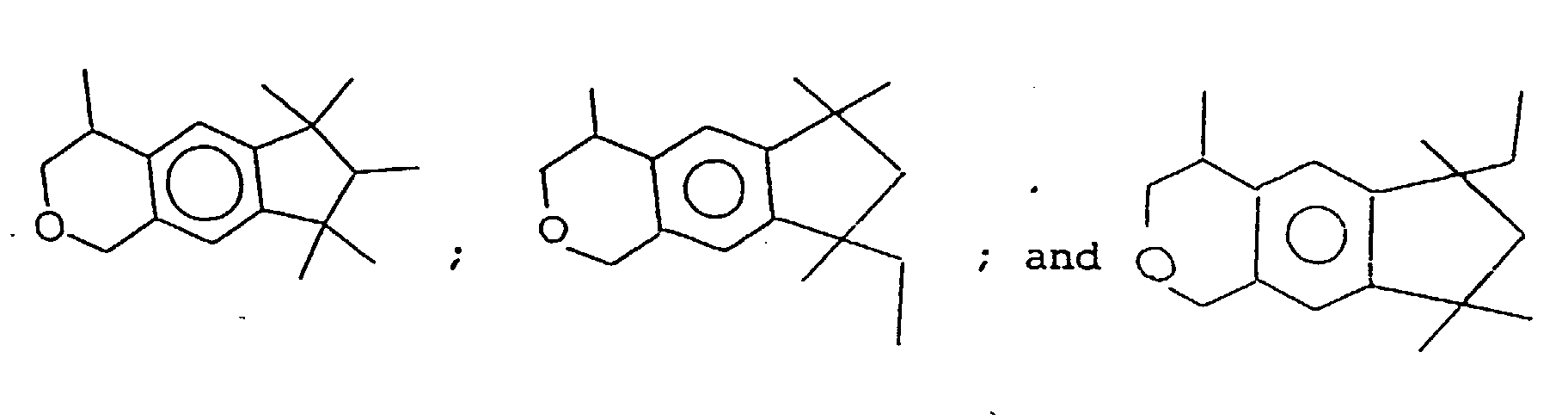
A substantive fragrance ingredient that is desired to be
incorporated into such fabric detergents for fragrancing same
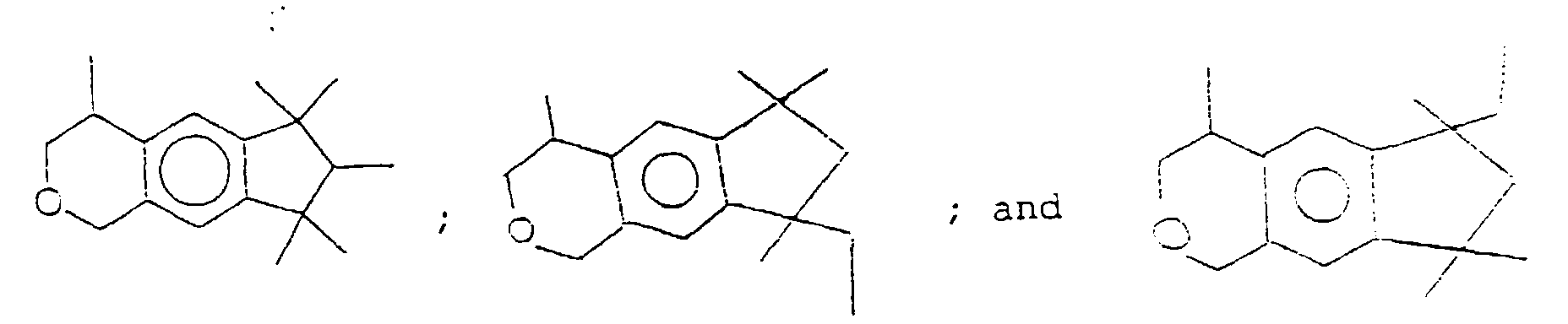
and such fabric softeners for fragrancing same is the tricyclic
isochroman known as GALAXOLIDE® (trademark of International
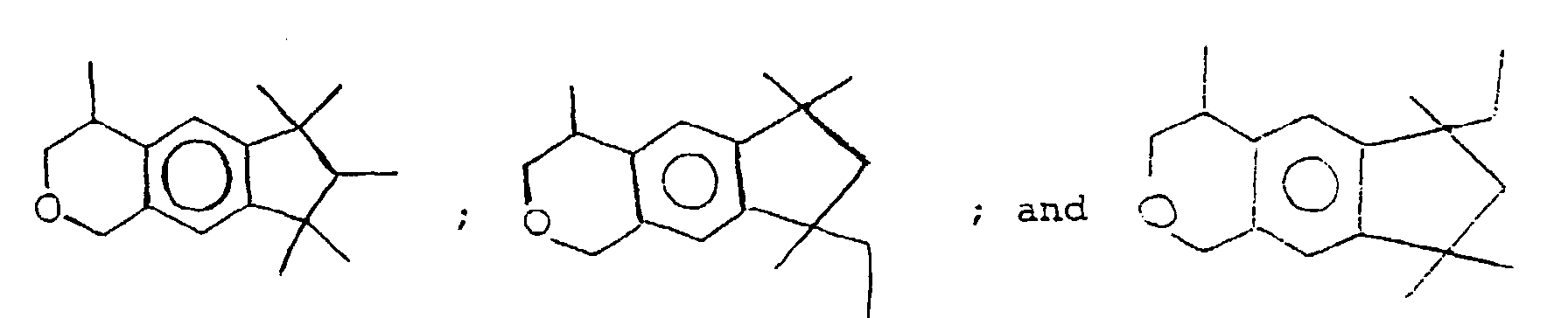
Flavors & Fragrances Inc. of New York, New York) which is a
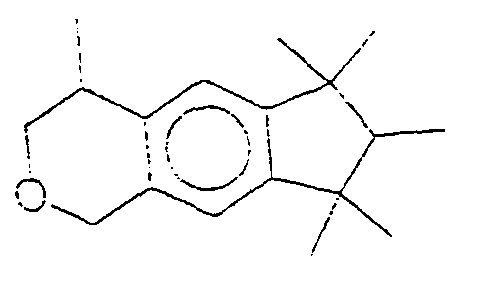
mixture of compounds having the structures:
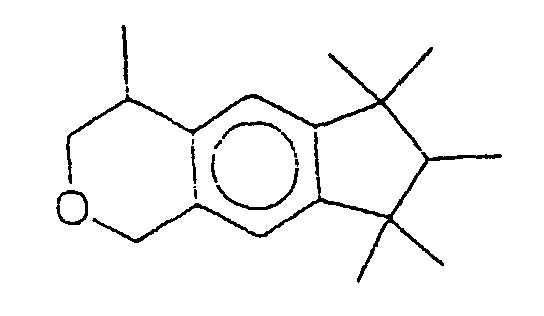
with the majority of the isomers being the compound having the
structure:
However, in very high concentrations (e.g., greater than 50%),
GALAXOLIDE® has extremely high viscosity and at lower
temperatures exists in the crystalline state making it difficult
for incorporation into fragrances. In the prior art, the
GALAXOLIDE® has been combined with other materials in order to
form "eutectic" compositions containing GALAXOLIDE® and other
materials, for example, benzophenone.
However, a need exists for creating a low viscosity, high
concentration form of GALAXOLIDE® in fragrances which are used in
fabric detergents and fabric softeners, particularly where the
detergent and softener systems involve the use of enzymes such
as lipase.
There is a need for such detergents and fabric softeners to
be able to impart to the fabrics a long lasting odor as stated,
supra, such the user perceives this odor for a considerable time
after the textiles have been washed and subsequently dried. To
this end, it has been known to use in the fabric detergents and
softeners perfuming ingredients which have a good tenacity on
the fabric, i.e., ingredients whose odor once imparted to the
textiles upon the washing can be perceived by the consumer for
several days. However, there are many perfuming substances
known for their extremely pleasant odors and, namely, a quality
of "freshness" often associated with the notion of cleanliness,
which substances are unfortunately not very tenacious or even
not tenacious at all on fabrics such as their perfuming effect
can only be perceived very briefly, at the most, for a few hours
following the washing and drying operations. In general, U.S.
Letters Patent No. 5,649,979 issued on July 22, 1997 indicates
that the fragrance effect of such substances is prolonged and
thus the "freshness" of the fabrics has been prolonged. Thus,
U.S. Letters Patent No. 5,649,979 indicates that a "novel"
solution to the problem has been achieved where a process for
perfuming textiles washed with detergents containing lipases has
been discovered. U.S. Letters Patent No. 5,649,979 establishes
that by adding particular ingredients to the fabric detergent
and/or fabric softener that is subsequently applied, one could
distinctly improve the odor of the fabrics treated with these
products and prolong the fragrance of the fabrics after drying.
U.S. Letters Patent No. 5,649,979 provides a process for
perfuming fabrics washed in the presence of a lipase-containing
detergent and, optionally, subsequently treated with a fabric
softener with the process being characterized in that the
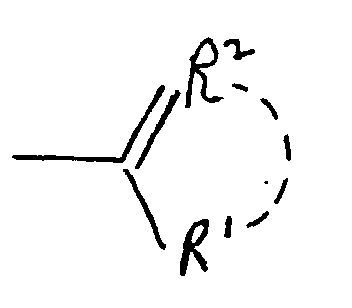
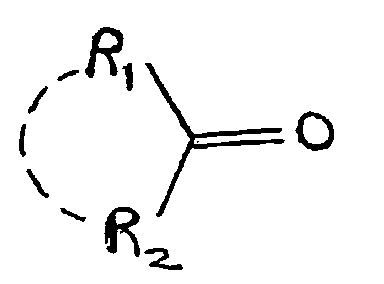
detergent and/or fabric softener contains a compound of the
formula:
wherein:
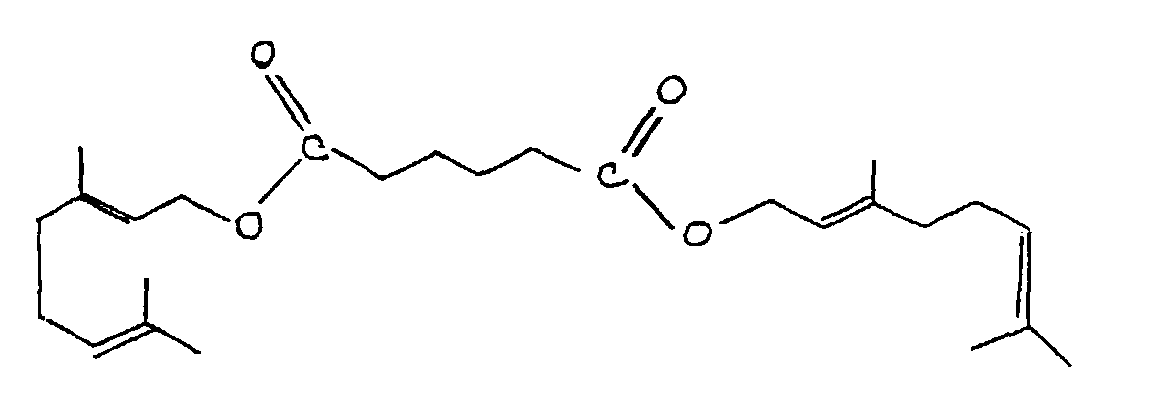
Examples relevant to our invention as set forth in U.S. Letters
Patent No. 5,649,979 are:
- the compound having the structure:
(at column 12, line 3) and the compound having the
structure:
(at column 12, line 57), both compounds being adipic acid
esters.
However, nothing in U.S. Letters Patent No. 5,649,979 and
nothing in the prior art indicates the creation of the
synergistic effect of formation of the mixture of the two
fragrant materials in situ, 2-ethyl hexanol and the mixture of
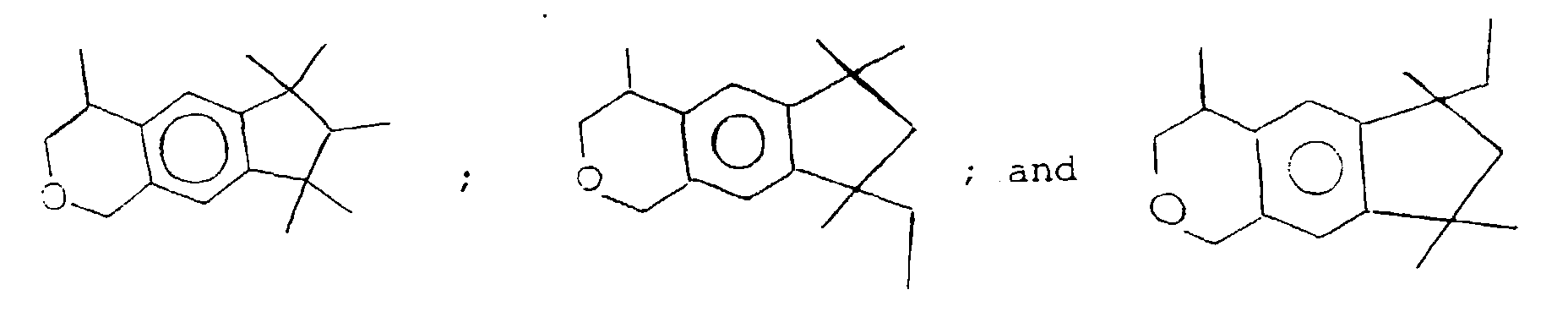
tricyclic isochromans having the structures:
(GALAXOLIDE®) as a result of admixing in proportions of from
about 1:1 up to about 3:1 (weight:weight) of di(2-ethyl hexyl)
adipate and GALAXOLIDE® and nothing in the prior art indicates
that as a result of the discovery of such a mixture the
concentration of pure GALAXOLIDE® can be greatly increased,
particularly when used with fabric detergent and fabric softener
systems which use enzymes.
Our invention concerns a process for the creation of a
liquid fragrance composition that is easily used in forming
still further liquid fragrance compositions, containing
GALAXOLIDE®, a mixture of compounds having the structures:
comprising the steps of admixing a sufficient quantity of
di(2-ethyl hexyl) adipate with substantially pure GALAXOLIDE®,
thereby creating a composition in the liquid phase having a
viscosity in the range of from about 180 centipoises (cps) up to
about 250 cps at 25°C.
More specifically, our invention is directed to a mixture
consisting essentially of:
More preferably, the foregoing mixture of tricyclic isochroman
and di(2-ethyl hexyl) adipate is 2:1 and the viscosity thereof
is about 210 cps at 25°C.
Our invention is further directed to a laundry detergent or
fabric softener comprising the above-identified perfuming
composition as an active perfume ingredient. Our invention is
further directed to a method for perfuming fabrics which
comprises washing the fabrics in the presence of a lipase-containing
detergent and, optionally, subsequently treating the
fabric with a fabric softener wherein the detergent or fabric
softener comprises as an active perfume ingredient the above-identified
range of mixtures of tricyclic isochroman compounds
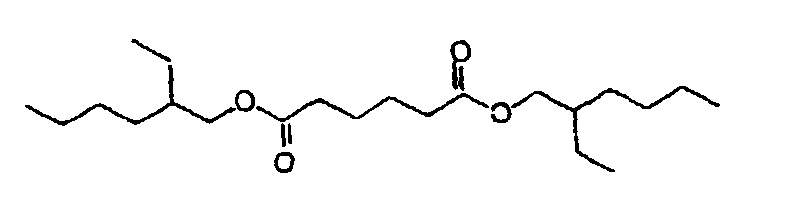
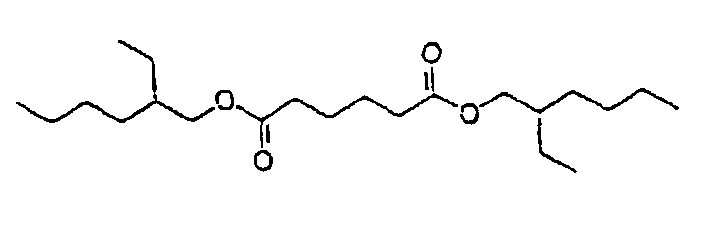
having the structures:
and di(2-ethyl hexyl) adipate having the structure:
with the range of weight ratios of tricyclic isochroman:di(2-ethyl
hexyl) adipate being from about 1:1 up to about 3:1.
Relevant to the uniqueness of the mixture of GALAXOLIDE® and
the di(2-ethyl hexyl) adipate of our invention is the fact that
the calculated log10[n-octanol/water partition coefficient]
(hereinafter referred to as "C log10P" is in the range of from
about 4.4 up to about 7.0 with the low part of the C log10P
range being for the mixture have the ratio of GALAXOLIDE®:di(2-ethyl
hexyl) adipate of 3:1, and the high part of the range
(7.0) being for the ratio of GALAXOLIDE®:di(2-ethyl hexyl)
adipate of 1:1. Accordingly, for the di(2-ethyl hexyl) adipate
- GALAXOLIDE® compositions of matter of our invention, the
following inequality applies:
4 · 4 ≤ log10P ≤ 7 · 0 .
The C log10P of the most preferred composition of our invention,
the composition wherein the ratio of GALAXOLIDE®:di(2-ethyl
hexyl) adipate is 2:1, is 6.61.
The standard for the optimum GALAXOLIDE® aroma is for the
main peak of the GALAXOLIDE® (that is for the presence of the
compound having the structure:
to be between 52% and 56% by weight of all components obtained
in a GLC (liquid chromatography) sample. Thus, when using a
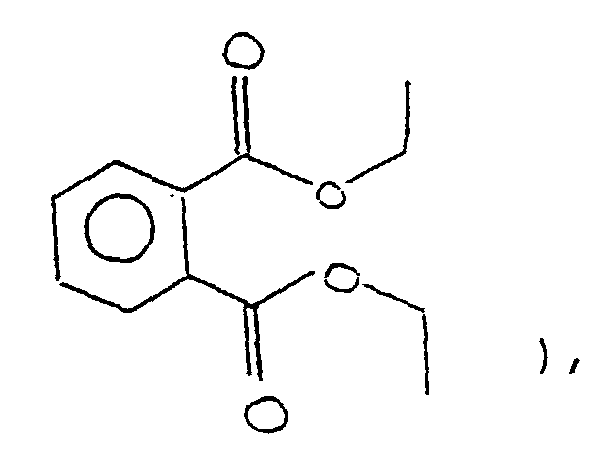
diethyl phthalate solvent (with diethyl phthalate having the
structure:
the equation of
G vs.
W is:
G = 0 · 7143 W + 6 · 29. On the
other hand, when using in place of the di(2-ethyl hexyl)
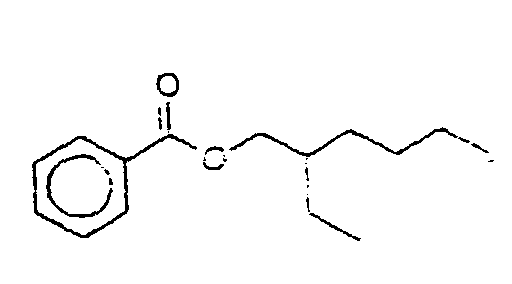
adipate, octyl benzoate having the structure:
the equation of
G vs.
W is:
G = 0 · 7 W + 3.
When using di(2-ethyl hexyl) adipate (the mixture of our
invention), the equation is: G = 0 · 7059 W + 4 · 71.
Thus, the mixture of GALAXOLIDE® and di(2-ethyl hexyl)
adipate in combination provides a new aroma containing notes of
both 2-ethyl hexanol and GALAXOLIDE®, but also enables the
GALAXOLIDE® to be used in much greater proportions than has been
used before, for example, with diethyl phthalate.
In addition, the process of our invention is advantageous
whenever other fragrance compounds are also used which show a
weak tenacity on fabrics and which are compatible from an
olfactory standpoint with GALAXOLIDE® and 2-ethyl hexanol.
The GALAXOLIDE® - di(2-ethyl hexyl) adipate of our invention
can be added to detergents and fabric softeners either as such
or in admixture with other perfuming ingredients, solvents or
adjuvants of current use in perfumery. The concentrations in
which they can be added to the detergents and fabric softeners
according to the inventions have the values usual in the art for
this type of product. The skilled person in the art is quite
able to select such values as a function of the nature of the
product to be perfumed and of the desired olfactive effect. By
way of example, concentrations of the order of from about 0.005
up to about 7% by weight of the mixture of GALAXOLIDE® and di(2-ethyl
hexyl) adipate relative to the weight of detergent and/or
fabric softener composition are useful.
The fabric detergents and softeners, according to our
invention, can take the form of powders or granular solids,
bars, pastes as well as aqueous or non-aqueous liquids and
contain the usual ingredients for this type of product. Thus
the detergents can typically contain, in addition to the lipase
enzyme (as specifically disclosed in European Patent No.
430,315) active anionic, cationic, nonionic or zwitterionic
surfactants as well as filling agents, bleaching agents,
confining agents and other ingredients of current use in the
detergent bases intended for washing cloth such as linen. Many
examples of such compositions are found in the art and in
literature, for example, European Patent No. 397,245. By way of
example, a base detergent of this type to which there is added
the lipase in the desired concentrations can have the following
composition (origin: Henkel KGaA of Düsseldorf, Germany):
| Ingredients | Parts by Weight |
| Linear sodium alkyl benzene sulfonate (average length of the alkyl chain: C11.5) | 8.0 |
| Ethoxylated tallow alcohol | 2.9 |
| Sodium triphosphate | 43.8 |
| Sodium silicate | 7.5 |
| Magnesium silicate | 1.9 |
| Carboxymethylcellulose | 1.2 |
| Sodium ethylenediaminetetraacetate | 0.2 |
| Sodium sulfate | 21.2 |
| Water | 13.3 |
| Total | 100.0 |
Similar considerations apply to the fabric softener bases
useful in the practice in our invention which typically contain
cationic softening ingredients as cited in European Patent No.
397, 245.
BRIEF DESCRIPTION OF THE DRAWINGS
Figure 1 is the GLC profile for a mixture of two parts
GALAXOLIDE® (a mixture of compounds having the structures:
and one part di(2-ethyl hexyl) adipate having the structure:
(conditions: 250 mm capillary silica column programmed from 50
up to 250°C at 10°C per minute).
Figure 2 is another GLC profile for the 2:1 mixture of
GALAXOLIDE® di(2-ethyl hexyl) adipate (conditions: 200 mm CARBOWAX®
20M column programmed from 50 up to 250°C at 10°C per minute).
Figure 3 is a graph showing on the Y axis the GLC percent
main peak for GALAXOLIDE® (the main peak being for the compound
having the structure:
vs. weight percent GALAXOLIDE® undiluted in the mixture on the X axis.
DETAILED DESCRIPTION OF THE DRAWINGS
Referring to Figure 1, the peak indicated by
reference
numeral 10 is the peak for the compound having the structure:
The peak indicated by
reference numeral 12 is the peak for the
di(2-ethyl hexyl) adipate.
Referring to Figure 2, the peak indicated by
reference
numeral 20 is the peak for the compound having the structure:
The peak indicated by
reference numeral 22 is the peak for the
di(2-ethyl hexyl) adipate
Referring to Figure 3, the
Y axis for the GLC percent for
the main peak of GALAXOLIDE® is indicated by
reference numeral 36
and the weight percent GALAXOLIDE® (undiluted) on the
X axis is
indicated by
reference numeral 35. The graph indicated by
reference numeral 30 is the graph for the mixtures of GALAXOLIDE®
and diethyl phthalate having the structure:
The graph indicated by
reference numeral 32 is the graph for
mixtures of GALAXOLIDE® and di(2-ethyl hexyl) adipate. The graph
indicated by
reference numeral 34 is the graph for mixtures of
GALAXOLIDE® and 2-ethyl hexyl benzoate having the structure:
The use of the di(2-ethyl hexyl) adipate with the tricyclic
isochroman:
EXAMPLE I
TEST ON FABRICS
A number of tests were carried out on fabrics under a
variety of conditions, with the fabrics having been treated
according to the following method:
A standard cotton swatch of 32 grams is placed in a
LINITEST® type vessel containing 1.3 grams of a standard powder
detergent base comprising 1% by weight of lipase (LIPOLASE® 100T
manufactured by Novo Nordisk S.A. of Denmark) and 260 ml water.
The cotton swatch is washed for 30 minutes at 40°C. It is then
taken out of the vessel and rinsed with 3 x 200 ml portions of
water. It is then plunged for 5 minutes in 200 ml water
containing 0.6 grams of a fabric softener base which contains a
certain percentage by weight comprised between 0.5 and 1% of a
mixture of GALAXOLIDE® and di(2-ethyl hexyl) adipate or, when
applicable, of the corresponding alcohol which is 2-ethyl
hexanol-1. The cotton swatch is then spin-dried without having
been used and dried on a clothes line.
This method is equivalent to a washing in a real machine
for washing 5 kg of linen in approximately 20 liters of water
with a rinsing of 4 x 20 liters of water, the fabric softener
being applied in the last rinsing water. The fabric softener
base used has the following compositions:
| Ingredients | Parts by Weight |
| ARQUAD® 2HT (75%) (trademark of Akzo Corporation of the Netherlands) | 5.00 |
| Formalin (40%) | 0.20 |
| Demineralized water | 94.80 |
| Total | 100.00 |
In two separate tests, the cotton swatches were treated
according to this general method, using as an additive to the
fabric softener, respectively, (i) a 2:1 mixture of
GALAXOLIDE®:di(2-ethyl hexyl) adipate, 1% in test A; and (ii) a
2:1 weight:weight mixture of GALAXOLIDE®:2-ethyl hexanol-1 in
test B.
The two swatches were submitted for a blind panel test
evaluation 24 hours after having been taken out of the LINITEST®
apparatus. Each member of the panel is then requested to smell
a strip which had been dipped into 2-ethyl hexanol-1 in order to
cause them to be familiar with the odor of this particular
component. Each member of the panel was then asked to smell the
two cotton swatches as set forth above and state whether they
detect the nuances of (i) 2-ethyl hexanol-1 and (ii) GALAXOLIDE®.
With the swatches of tests A and B, all members of the
panel detected all nuances of GALAXOLIDE®.
Seventy percent of the panel members detected all of the
nuances of 2-ethyl hexanol-1 in test A. Twenty-five percent of
the panel members detected all of the nuances of 2-ethyl
hexanol-1 in test B.
A further evaluation of the two swatches was carried out by
the same panel under identical conditions 24 hours later, that
is, 48 hours after taking the swatches out of the LINITEST®
apparatus. None of the panel members could identify the aroma
of 2-ethyl hexanol-1 on the swatch of test B, whereas 50% of the
panel members identified all of the nuances of 2-ethyl hexanol-1
on the swatch coming out of test A.
Similar results are obtained when the above-mentioned
mixture of GALAXOLIDE® and di(2-ethyl hexyl) adipate were present
in the fabric softener at a rate of 0.5% by weight.
EXAMPLE II
FABRICS TREATED IN A WASHING MACHINE
A base perfume composition is prepared by admixing the
following ingredients:
| Ingredients | Percent by Weight |
| Vetiver Venezuela |
| | 30 |
| Phenylethyl alcohol | 25 |
| Benzylpropionate | 20 |
| 10-Undecenal | 8 |
| Hexylcinnamic aldehyde | 80 |
| Methyl anthranilate | 20 |
| Verdyl acetate | 30 |
| Trans, trans-δ-damascone | 12 |
| Eugenol | 8 |
| Isoeugenol | 20 |
| Orange essential oil | 25 |
| Benzylsalicylate | 40 |
| Phenylsalicylate | 25 |
| α-Terpeniol | 20 |
Two compositions are prepared with the aforementioned base
as follows:
500 parts by weight of fragrance composition and 150 parts
by weight of the mixture of GALAXOLIDE®:di(2_ethyl hexyl)
adipate, in a weight ratio of 2:1; and Composition B:
500 parts by weight of the fragrance as set forth, supra,
and 150 parts by weight of a 2:1 mixture of GALAXOLIDE®
(100%) and 2-ethyl hexanol-1 (2:1).
The resulting compositions are then each added at the rate
of 0.7% by weight to a non-perfumed fabric softener base to
prepare two samples: A and B of a perfumed softener.
In two identical washing machines, two standard batches of
1,400 grams each of cotton textiles were treated. Each machine
was charged with 130 grams of a standard, unperfumed detergent
base containing 1% of lipase (LIPOLASE® 100T of the Novo Nordisk
S.A. of Denmark).
To one machine, 100 grams of the perfumed softener A was
added. To the second machine, 100 grams of the perfumed
softener B was added.
After washing, each batch of textiles was sampled by a
blind panel of 25 individuals. Each member of the blind panel
identified the aroma of the batch treated with perfumed softener
samples A and B.
As a result of this test, 20 panelists indicated a distinct
difference between the quality, intensity and substantivity of
the aroma created in a textile batch when using sample
A
compared to using sample
B as follows (on a scale of 1-100):
| Sample | Intensity | Substantivity | Quality |
| A | 8 | 9 | 9 |
| B | 3 | 4 | 8 |
When the evaluation was repeated after 48 hours of air
drying, 50% of the panelists detected a distinction and that
distinction is as follows:
| Sample | Intensity | Substantivity | Quality |
| A | 6 | 8 | 9 |
| B | 1 | 2 | 7 |
The features disclosed in the foregoing description, in the
following claims and/or in the accompanying drawings may, both
separately and in any combination thereof, be material for
realising the invention in diverse forms thereof.
In the present specification "comprise" means "includes or
consists of" and "comprising" means "including or consisting
of".














 with the range of weight ratios of tricyclic isochroman:di(2-ethyl hexyl) adipate being from about 1:1 up to about 3:1.
 with the range of weight ratios of tricyclic isochroman:di(2-ethyl hexyl) adipate being from about 1:1 up to about 3:1 and, in addition, a fragrance composition containing components other than tricyclic isochromans, 2-ethyl hexanol-1 or di(2-ethyl hexyl) adipate.
 with the range of weight ratios of tricyclic isochroman:di(2-ethyl hexyl) adipate being 2:1 and the viscosity of the tricyclic isochroman:di(2-ethyl hexyl) adipate being about 210 cps at 25°C.