EP1059637A2 - Verfahren zur Erweiterung der Bandbreite von analog gespeicherten Sprachsignalen für ein Diktiergerät - Google Patents
Verfahren zur Erweiterung der Bandbreite von analog gespeicherten Sprachsignalen für ein Diktiergerät Download PDFInfo
- Publication number
- EP1059637A2 EP1059637A2 EP00111728A EP00111728A EP1059637A2 EP 1059637 A2 EP1059637 A2 EP 1059637A2 EP 00111728 A EP00111728 A EP 00111728A EP 00111728 A EP00111728 A EP 00111728A EP 1059637 A2 EP1059637 A2 EP 1059637A2
- Authority
- EP
- European Patent Office
- Prior art keywords
- frequency
- memory
- speech
- signal
- stored
- Prior art date
- Legal status (The legal status is an assumption and is not a legal conclusion. Google has not performed a legal analysis and makes no representation as to the accuracy of the status listed.)
- Granted
Links
Images


Classifications
-
- G—PHYSICS
- G11—INFORMATION STORAGE
- G11B—INFORMATION STORAGE BASED ON RELATIVE MOVEMENT BETWEEN RECORD CARRIER AND TRANSDUCER
- G11B20/00—Signal processing not specific to the method of recording or reproducing; Circuits therefor
- G11B20/10—Digital recording or reproducing
- G11B20/10527—Audio or video recording; Data buffering arrangements
-
- G—PHYSICS
- G10—MUSICAL INSTRUMENTS; ACOUSTICS
- G10L—SPEECH ANALYSIS TECHNIQUES OR SPEECH SYNTHESIS; SPEECH RECOGNITION; SPEECH OR VOICE PROCESSING TECHNIQUES; SPEECH OR AUDIO CODING OR DECODING
- G10L15/00—Speech recognition
- G10L15/26—Speech to text systems
-
- G—PHYSICS
- G11—INFORMATION STORAGE
- G11C—STATIC STORES
- G11C7/00—Arrangements for writing information into, or reading information out from, a digital store
- G11C7/16—Storage of analogue signals in digital stores using an arrangement comprising analogue/digital [A/D] converters, digital memories and digital/analogue [D/A] converters
-
- G—PHYSICS
- G11—INFORMATION STORAGE
- G11C—STATIC STORES
- G11C2207/00—Indexing scheme relating to arrangements for writing information into, or reading information out from, a digital store
- G11C2207/16—Solid state audio
Definitions
- the invention relates to a method and a dictation machine for recording Speech signals, which is particularly suitable for speech signals of a to provide later language analysis.
- Dictation machines are already known and are used by many companies on the market offered.
- a dictation machine from Philips was under the designation "390 POCKET MEMO” and by the Grundig company under the Description “Dh 2220” sold.
- voice signals recorded by the microphone after processing in a Recording circuit on the magnetic tape one in the dictation machine inserted dictation cassette can be recorded.
- voice signals recorded by the microphone after processing in a Recording circuit on the magnetic tape one in the dictation machine inserted dictation cassette can be recorded.
- voice signals recorded by the microphone after processing in a Recording circuit on the magnetic tape one in the dictation machine inserted dictation cassette can be recorded.
- voice signals recorded by the microphone after processing in a Recording circuit on the magnetic tape one in the dictation machine inserted dictation cassette can be recorded.
- voice signals recorded by means of of these known dictation machines also on a dictation machine cassette recorded signals after processing into a playback circuit played the speaker of the dictation machine and one Head
- From DE 4214053-A is a dictation machine with a magnetic tape memory and a digital memory for storing voice signals known.
- the storage capacity of digital storage is significantly less than that of Magnetic tape storage.
- a dictation machine which has a dictation machine housing, in which a Microphone, a speaker, and a recording / reproducing signal processing circuit provided is known.
- the dictation machine housing is equipped with a headphone output socket which during playback from a signal storage medium recorded signals are made available on the output side.
- the Dictation machine housing is provided with an additional connection socket which in a first operating mode from the microphone of the dictation machine derived signals and in a second mode from Signal storage medium derived signals are provided.
- DE 197 04 009 A is a speech recognition system for implementation injected electronic voice signals in too electronic Suitable data processing known signals.
- the one Speech recognition system upstream level adjustment device for Adjusting the levels of the electronic voice signals to a predetermined one Bandwidth reached.
- a level adjustment device is optionally selected Microphone or a sound carrier player connected.
- the object of the invention Reason to specify a method and a dictation machine, which on the Needs further language processing one by one recorded dictations is adapted and an inexpensive storage which enables speech signals.
- the method uses in particular the technical characteristics of analog Magnetic tape cassettes and the well-known magnetic Recording methods of dictation machines, such as from the prior art known. These dictation machines have a bandwidth of up to 4 kHz. At the voice signal becomes a low-pass filtering subjected to high-frequency signal components are lost. These signal components but are necessary for further processing in the speech recognition system. Therefore, the voice signal picked up via the microphone is initially on stored on a tape storage medium.
- the voice signal is also routed through a high pass, whereby the low-frequency signal components already stored on the tape storage medium are suppressed.
- the high-frequency speech signal is digitized via an analog-digital converter, taking into account the sampling theorem. The sampling takes place with a sampling frequency of more than 22 kHz. This fulfills the requirements for later speech recognition. Data compression is then carried out via the Mel scaling, which leads to a data reduction.
- the basis of this function is the knowledge that the entire frequency range that can be recorded by the human ear is divided into a number of frequency groups.
- the center frequency of these frequency groups is almost linear up to 1000 Hz and logarithmic over 1000 Hz.
- these frequency bands can be approximately calculated from the band rates z c in Bark. This means that a coarse frequency resolution in the higher frequency range is sufficient to obtain a good feature analysis in speech recognition.
- the digitized speech signal is then compressed in order to further reduce the memory requirement.
- Huffman compression has proven to be particularly suitable for lossless data reduction. It is therefore grouped into frequency ranges with high energy (low frequency ranges) and frequency ranges with low energy (high frequency ranges). Due to a stronger grouping of the frequency ranges with high energy, the information to be recorded is less in the frequency ranges with low energy.
- the low-frequency ranges are recorded on the first storage medium of the dictation machine. As already mentioned above, this results in low-pass filtering with a cut-off frequency of 4 kHz.
- the high-frequency signal components are determined using high-pass filtering and then digitized. In order not to lose any information, the high-pass filtering is carried out with a cut-off frequency which is adapted to the cut-off frequency of the low-pass filtering when the low-frequency signal components are recorded on the tape storage medium.
- the information from the high-frequency signal components is now contained in the digitized signal. As stated, these have a lower information content for speech recognition and can therefore be highly compressed, taking into account the mel scaling.
- the digitized and compressed speech signal must be synchronized with the low-frequency speech signal in order to bring it together again later with the low-frequency speech signal.
- synchronization signals are stored in a digital memory together with the compressed speech signal.
- the synchronization signals can be obtained in various ways. One way to do this is to punch a clock signal into the speech signal before recording and compression, which is also recorded. Another possibility is to record a counter reading of the tape storage medium for recording the low-frequency signal components and to save them together with the high-frequency signal components.
- the speech recognition system When playing back the recorded voice signals and entering in The speech recognition system becomes digitized and compressed high frequency speech signal decompressed and analogized and roughly on the low-frequency voice signal synchronized and both signals one Speech recognition system supplied.
- the feed takes the form of two Voice channels, the low-frequency voice signal in one channel and others the high-frequency voice signal is transmitted.
- Another advantageous embodiment of the method according to the invention is that there is no need to decompress the high-frequency speech signal.
- the speech recognition system is modified in such a way that the high-frequency speech signal components can be further processed in compressed form. These are only analogized before being transmitted to the speech recognition system.
- the low-frequency speech signal is fed to the speech recognition system via one of the two channels, in particular the use of the inputs of the stereo channels of a sound card present in the speech processing system has proven to be advantageous; the high-frequency compressed speech signal, which is synchronized with the low-frequency speech signal, is fed via the second stereo channel.
- the speech recognition system is able to analyze the speech from both signal components. A fine synchronization between the two signals is generated by a cross correlation. By cross correlation, both signals can be exactly synchronized to each other.
- Both signals are advantageously synchronized in two steps.
- This Coarse synchronization takes place, for example, by the data of a Bandstand counter drive of the tape storage medium of the analog Storage medium for high-frequency, digitized and compressed Voice signal can be saved. Based on this data, both can be Roughly synchronize the signal. Then there is a fine synchronization between the two signals by cross correlation.
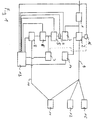
- FIG. 1 shows a block diagram of a dictation machine after a first one Embodiment in which the signals in analog form on a Magnetic tape of a dictation machine cassette can be recorded.
- the dictation machine shown has a microphone 1, an analog one Tape memory 2, a high-pass filter 3, an analog-digital converter 4, one Compression unit 5, a digital memory 6, a Synchronization unit 7, a digital-to-analog converter 8, one Microprocessor unit 13, a playback circuit 14, a loudspeaker 15, a tape level counter 16, lines 9 and 10, and a 1-channel connection socket 12 and a 2-channel connection socket 11
- the microphone 1 can record Signals after a signal processing on the recording on the Magnetic tape of the tape storage 2, in particular a dictation machine cassette, to be recorded. Furthermore, by means of such a dictation machine signals recorded on the magnetic tape of the tape storage 2 after a playback-side signal processing via a loudspeaker 15, which on the line 9 is connected to be given again. At the same time these signals at the 1-channel connection socket 12, in particular one Headphone jack, which is also connected to line 9, are reproduced.
- the voice signal entered via the microphone 1 is synchronized with the Recorded on the tape storage 2 on the high pass 3.
- the low-frequency signal components are filtered out.
- the digitized signal in the compression unit 5 compressed.
- the compression takes place without data loss, especially via a Huffman compression, taking into account the Mel scaling.
- the voice signals are processed in such a way that the same from one subsequent speech recognition system can be optimally evaluated can, provided that after Mel scaling the feature analysis of Carries out speech signals.
- the compressed data is then stored in digital memory 6 saved.
- the digital memory 6 is advantageously a flash memory designed.
- This synchronization unit 7 provides Signals ready, by means of which the compressed and digitized Voice signals synchronized to the analog stored voice signal can be.
- a simple way of synchronization is that Tape stand counter 16 of the tape store 2 to evaluate and as To use synchronization signals.
- the synchronization based on the Determine tape runtime. This is carried out by the microprocessor unit 13 carried out.
- the digitized Voice signal from the digital memory 6 is via the digital-to-analog converter 8 converted into an analog signal and the speech signal from the Tape storage 2 synchronized.
- the speech signal from the tape store 2 is via line 9 to the first connection for the first channel of the 2-channel connection socket 11 headed.
- the high-frequency synchronized for this Speech signal is via line 10 to the connection for the second channel the 2-channel connection socket 11 passed.
- the analog low-frequency voice signal is on the first channel and the high-frequency speech signal is present on the second channel.
- the digital Memory 6 integrated on or in the tape storage 2. In this way, a Change of the Ban aside 2 take place without the high-frequency Signal components and the synchronization data are lost.
Landscapes
- Engineering & Computer Science (AREA)
- Multimedia (AREA)
- Human Computer Interaction (AREA)
- Computational Linguistics (AREA)
- Health & Medical Sciences (AREA)
- Audiology, Speech & Language Pathology (AREA)
- Signal Processing (AREA)
- Physics & Mathematics (AREA)
- Acoustics & Sound (AREA)
- Signal Processing Not Specific To The Method Of Recording And Reproducing (AREA)
- Compression, Expansion, Code Conversion, And Decoders (AREA)
- Electrically Operated Instructional Devices (AREA)
- Indexing, Searching, Synchronizing, And The Amount Of Synchronization Travel Of Record Carriers (AREA)
Abstract
Description
Anschließend wird eine Datenkompression über die Mel-Skalierung durhgeführt, was zu einer Datenreduzierung führt. Diese mel-skalierten Frequenbänder lassen sich analytisch mittels der Formel
Es erfolgt daher eine Gruppierung in Frequenzbereiche mit hoher Energie (niedere Freuquenzbereiche) und in Frequenzbereiche mit niedriger Energie (hohe Frequenzbereiche). Durch eine stärkere Gruppierung der Frequenzbereiche mit hoher Energie, ist die zu erfassende Information in den Frequenzbereichen mit niedriger Energie geringer. Die niederfrequenten Frequenzbereiche werden auf das erste Speichermedium des Diktiergerätes aufgezeichnet. Wie oben bereits aufgeführt erfolgt hierdurch eine Tiefpaßfilterung mit einer Grenzfrequenz von 4 KHz. Die hochfrequenten Signalanteile werden, wie bereits beschrieben, über eine Hochpaßfilterung ermittelt und anschließend digitalisiert. Um keine Informationen zu verlieren wird die Hochpaßfilterung mit einer Grenzfrequenz durchgeführt, welche auf die Grenzfrequenz der Tiefpaßfilterung bei der Aufzeichnung der niederfrequenten Signalanteile auf dem Bandspeichermedium angepaßt ist.
Die Synchronisationssignale können auf verschiedene Weise gewonnen werden. Ein Weg hierzu ist, in das Sprachsignal vor der Aufzeichnung und Komprimierung ein Taktsignal einzustanzen, welches mit aufgezeichnet wird. Eine weitere Möglichkeit besteht darin, einen Zählerstand des Bandspeichermediums zur Aufzeichnung der niederfrequenten Signalanteile zu erfassen und zusammen mit dem hochfrequenten Signalanteilen abzuspeichern.
Eine Feinsynchronisation zwischen beiden Signalen wird durch eine Kreuzkorrelation erzeugt. Durch Kreuzkorrelation können beide Signale zueinander exakt synchronisiert werden.
- FIG 1
- ein Blockschaltbild eines Diktiergerätes nach einem ersten Ausführungsbeispiel;
- FIG 2
- eine ausgewählte Charakteristik des Hochpaßfilters und des Tielpaßfllter; und
- FIG 3
- eine Skizze zur Veranschaulichung der durchzuführenden Mel-Skalierung.
- 1
- Mikrofon
- 2
- erster Speicher
- 3
- Hochpaß
- 4
- Analog-Digital-Umsetzer
- 5
- Datenkompressionseinheit
- 6
- zweiter Speicher
- 7
- Synchronisierungseinheit
- 8
- Digital-Analog-Umsetzer
- 9
- Leitung
- 10
- Leitung
- 11
- 2-Kanal-Anschlußbuchse
- 12
- 1 -Kanal-Anschlußbuchse
- 13
- Mikroprozessoreinheit
- 14
- Wiedergabeschaltung
- 15
- Lautsprecher
- 16
- Bandstandszähler
Claims (10)
- Verfahren zur Aufzeichnung und Wiedergabe eines Sprachsignals mittels eines Diktiergerätes zur späteren Spracherkennung in einem Spracherkennungssystem
wobei bei der Aufzeichnungdas Sprachsignal von einem Mikrofon aufgenommen wird, das Sprachsignal in einen niederfrequenten und einen hochfrequenten Anteil aufgespalten wird, der niederfrequente Anteil des Sprachsignals gespeichert wird, der hochfrequente Anteil des Sprachsignals digitalisiert wird, der hochfrequente digitalisierte Anteil des Sprachsignales komprimiert wird, dieser hochfrequente digitalisierte und komprimierte Anteil des Sprachsignales zum niederfrequenten Sprachsignal synchronisiert und gespeichert wird, undbei der Wiedergabeder gespeicherte hochfrequente digitalisierter und komprimierte Anteil des Sprachsignals in ein analoges Sprachsignal rückgewandelt wird und über die gespeicherten Synchronisationsdaten zum niederfrequenten analogen Sprachsignal exakt synchronisiert und einem Spracherkennungssystem zugeleitet wird. - Verfahren nach Anspruch 1,
dadurch gekennzeichnet daß,das hochfrequente digitalisierte Sprachsignal über eine verlustlose Datenkompression, insbesondere eine Huffman Daten-Kompression, und unter Berücksichtigung der Mel-Skalierung, komprimiert wird. - Verfahren nach Anspruch 1 oder 2,
dadurch gekennzeichnet, daßdie Grobsynchronisation anhand von Daten, welche zusammen mit den niederfrequenten und dem hochfrequenten Datensignal gespeichert werden erfolgt. - Verfahren nach einem oder mehreren der vorangegangenen Ansprüche,
dadurch gekennzeichnet daß,die Feinsychronisation zwischen dem niederfrequenten und dem hochfrequenten Sprachsignal über eine Kreuzkorrelation beider Signale erfolgt und/oder die Abtastung des hochfrequenten Sprachsignals mit mindestens 16 bis 22 kHz erfolgt. - Diktiergerät mit einer Mikroprozessoreinheit (13), einem Mikrofon (1), einem ersten Speicher (2), einem zweiten Speicher (6), einem Analog-Digital-Umsetzer (4), einem Digital-Analog-Umsetzer (8), einer 1-Kanal-Anschlußbuchse (12), einer 2-Kanal-Anschlußbuchse (11) und einem Lautsprecher (15), wobei das Mikrofon (1) Sprachsignale erfaßt und die Mikroprozessoreinheit (13) diese Sprachsignale in den Speicher (2) speichert,
dadurch gekennzeichnet, daßdie Mikroprozessoreinheit (13) das Sprachsignal einem Hochpaßfilter (3) zuführt, das hochpassgefilterte Sprachsignal über den Analog-Digital-Umsetzer (8) digitalisiert und an die Kompressionseinheit (5) leitet, die Kompressionseinheit (5) das digitalisierte Signal komprimiert, der Mikroprozessor (13) über die Synchronisierungseinheit (7) Synchronisierungsignale zum komprimierten Sprachsignal zufügt und im zweiten Speicher (6) speichert. - Diktiergerät nach Anspruch 5,
dadurch gekennzeichnet, daßdie Mikroprozessoreinheit (13) bei der Wiedergabe der gespeicherten Sprachsignale über den Lautsprecher (15) die im ersten Speicher (2) gespeicherten Sprachsignale über eine Wiedergabeschaltung (14) über die Leitung (9) an den Lautsprecher (15) leitet und/oder die Mikroprozessoreinheit (13) bei der Wiedergabe der gespeicherten Sprachsignale an die 1-Kanal-Anschlußbuchse (12) die im ersten Speicher (2) gespeicherten Sprachsignale über eine Wiedergabeschaltung (14) über die Leitung (9) an die 1-Kanal-Anschlußbuchse (12) leitet. - Diktiergerät nach Anspruch 5,
dadurch gekennzeichnet, daßdie Mikroprozessoreinheit (13) bei der Wiedergabe der gespeicherten Sprachsignale an eine Spracherkennungseinrichtung zur Sprache-in-Text-Umsetzung die im ersten Speicher (2) gespeicherten Sprachsignale über die Leitung (9) an die 2-Kanal-Anschlußbuchse (11) an deren ersten Anschluß leitet und die im zweiten Speicher (6) gespeicherten hochfrequenten digitalisierten und komprimierten Sprachsignale über den Digital-Analog-Umsetzer (8) in ein analoges Signal umwandelt und über die Leitung (10) an die 2-Kanal-Anschlußbuchse (11) an deren zweiten Anschluß leitet und die Mikroprozessoreinheit (13) beide Sprachsignale zueinander synchronisiert. - Diktiergerät nach einem der Ansprüche 5 bis 7,
dadurch gekennzeichnet, daßder erste Speicher (2) ein analoger Bandspeicher ist und/oder der analoge Bandspeicher eine Diktiergeräte-Kassette ist und/oder der zweite Speicher (6) ein digitaler Speicher ist und/oder der digitale Speicher ein Flash-Speicher ist. - Diktiergerät nach einem der Ansprüche 5 bis 8,
dadurch gekennzeichnet, daßder zweite Speicher (6) im und/oder am ersten Speicher (2) angeordnet ist. - Diktiergerät nach einem der Ansprüche 5 bis 9,
dadurch gekennzeichnet, daßdie Mikroprozessoreinheit (13) eine exakte Synchronisation beider gespeicherter Sprachsignale mittel einer Kreuzkorrelation durchführt und/oder am oder im Gehäuse der Diktiergeräte-Kassette ein digitaler Speicher, insbesondere ein Flash-Speicher, angeordnet ist.
Applications Claiming Priority (2)
| Application Number | Priority Date | Filing Date | Title |
|---|---|---|---|
| DE19926360 | 1999-06-10 | ||
| DE19926360A DE19926360A1 (de) | 1999-06-10 | 1999-06-10 | Verfahren und Aufzeichnung und Wiedergabe eines Sprachsignals sowie Diktiergerät zur Umsetzung des Verfahrens |
Publications (3)
| Publication Number | Publication Date |
|---|---|
| EP1059637A2 true EP1059637A2 (de) | 2000-12-13 |
| EP1059637A3 EP1059637A3 (de) | 2006-12-06 |
| EP1059637B1 EP1059637B1 (de) | 2008-02-27 |
Family
ID=7910717
Family Applications (1)
| Application Number | Title | Priority Date | Filing Date |
|---|---|---|---|
| EP00111728A Expired - Lifetime EP1059637B1 (de) | 1999-06-10 | 2000-06-02 | Verfahren zur Erweiterung der Bandbreite von analog gespeicherten Sprachsignalen für ein Diktiergerät |
Country Status (3)
| Country | Link |
|---|---|
| EP (1) | EP1059637B1 (de) |
| AT (1) | ATE387711T1 (de) |
| DE (2) | DE19926360A1 (de) |
Family Cites Families (3)
| Publication number | Priority date | Publication date | Assignee | Title |
|---|---|---|---|---|
| DE4214053C1 (de) * | 1992-04-29 | 1993-09-23 | Grundig E.M.V. Elektro-Mechanische Versuchsanstalt Max Grundig Hollaend. Stiftung & Co Kg, 90762 Fuerth, De | |
| DE4434255A1 (de) * | 1994-09-24 | 1996-03-28 | Sel Alcatel Ag | Vorrichtung zur Sprachaufzeichnung mit anschließender Texterstellung |
| DE19808470A1 (de) * | 1998-03-02 | 1999-09-09 | Grundig Ag | Diktiergerät |
-
1999
- 1999-06-10 DE DE19926360A patent/DE19926360A1/de not_active Withdrawn
-
2000
- 2000-06-02 DE DE50014987T patent/DE50014987D1/de not_active Expired - Lifetime
- 2000-06-02 EP EP00111728A patent/EP1059637B1/de not_active Expired - Lifetime
- 2000-06-02 AT AT00111728T patent/ATE387711T1/de not_active IP Right Cessation
Also Published As
| Publication number | Publication date |
|---|---|
| EP1059637B1 (de) | 2008-02-27 |
| DE50014987D1 (de) | 2008-04-10 |
| EP1059637A3 (de) | 2006-12-06 |
| DE19926360A1 (de) | 1999-10-21 |
| ATE387711T1 (de) | 2008-03-15 |
Similar Documents
| Publication | Publication Date | Title |
|---|---|---|
| DE102004036154B3 (de) | Vorrichtung und Verfahren zur robusten Klassifizierung von Audiosignalen sowie Verfahren zu Einrichtung und Betrieb einer Audiosignal-Datenbank sowie Computer-Programm | |
| EP0712131B1 (de) | Vorrichtung zur Sprachaufzeichnung mit anschliessender Texterstellung | |
| DE69816221T2 (de) | Sprachschnellheitsveränderungsverfahren und vorrichtung | |
| DE69431622T2 (de) | Verfahren und gerät zum kodieren von mit mehreren bits kodiertem digitalem ton durch subtraktion eines adaptiven zittersignals, einfügen von versteckten kanalbits und filtrierung, sowie kodiergerät zur verwendung bei diesem verfahren | |
| DE102019200954A1 (de) | Signalverarbeitungseinrichtung, System und Verfahren zur Verarbeitung von Audiosignalen | |
| DE60020663T2 (de) | Verfahren zur Formatierung eines Audiodatenstroms | |
| DE69836472T2 (de) | Tonverarbeitungsverfahren, tonprozessor und aufzeichnungs-/wiedergabevorrichtung | |
| DE19720651C2 (de) | Hörgerät mit verschiedenen Baugruppen zur Aufnahme, Weiterverarbeitung sowie Anpassung eines Schallsignals an das Hörvermögen eines Schwerhörigen | |
| DE68922016T2 (de) | Einrichtung zur Sprachverarbeitung. | |
| DE69721404T2 (de) | Diktiersystem | |
| EP0508547A2 (de) | Schaltungsanordnung zur Spracherkennung | |
| DE68911470T2 (de) | Elektronisches Gerät zur Verarbeitung eines Schallsignals. | |
| DE4001747C2 (de) | Digitales Audiofrequenz-Signalverarbeitungssystem | |
| DE69001908T2 (de) | Akustisches Analysegerät und ein dabei verwendetes Frequenzumwandlungsgerät. | |
| EP1316955A1 (de) | Zwischenspeichereinrichtung | |
| DE69614799T2 (de) | Übertragungssystem und -verfahren für die sprachkodierung mit verbesserter detektion der grundfrequenz | |
| EP1059637B1 (de) | Verfahren zur Erweiterung der Bandbreite von analog gespeicherten Sprachsignalen für ein Diktiergerät | |
| DE102008013762B4 (de) | Datenwiedergabevorrichtung und Datenwiedergabeverfahren | |
| DE2854601A1 (de) | Ton-synthesizer und verfahren zur ton-aufbereitung | |
| DE69720324T2 (de) | System zur Aufzeichnung und/oder Wiedergabe eines digitalen Audiopulskodemodulationssignals | |
| DE19820814B4 (de) | Diktiersystem | |
| DE60016633T2 (de) | Verfahren und anordnung zur analog/digital-wandlung eines signals mit einer niederfrequenz-komponente | |
| EP0940816B1 (de) | Diktiergerät | |
| WO2002047085A1 (de) | Verfahren zum abspeichern von akustischen informationen und verfahren zum auswahlen einer nach diesem verfahren abgespeicherten information | |
| DE3343027C2 (de) |
Legal Events
| Date | Code | Title | Description |
|---|---|---|---|
| PUAI | Public reference made under article 153(3) epc to a published international application that has entered the european phase |
Free format text: ORIGINAL CODE: 0009012 |
|
| AK | Designated contracting states |
Kind code of ref document: A2 Designated state(s): AT BE CH CY DE DK ES FI FR GB GR IE IT LI LU MC NL PT SE |
|
| AX | Request for extension of the european patent |
Free format text: AL;LT;LV;MK;RO;SI |
|
| RAP1 | Party data changed (applicant data changed or rights of an application transferred) |
Owner name: GBS HOLDING GMBH |
|
| PUAL | Search report despatched |
Free format text: ORIGINAL CODE: 0009013 |
|
| AK | Designated contracting states |
Kind code of ref document: A3 Designated state(s): AT BE CH CY DE DK ES FI FR GB GR IE IT LI LU MC NL PT SE |
|
| AX | Request for extension of the european patent |
Extension state: AL LT LV MK RO SI |
|
| RIC1 | Information provided on ipc code assigned before grant |
Ipc: G11B 21/10 20060101ALN20061031BHEP Ipc: G11B 27/024 20060101ALI20061031BHEP Ipc: G10L 15/26 20060101AFI20061031BHEP Ipc: G11B 21/02 20060101ALN20061031BHEP |
|
| 17P | Request for examination filed |
Effective date: 20070606 |
|
| AKX | Designation fees paid |
Designated state(s): AT BE CH CY DE DK ES FI FR GB GR IE IT LI LU MC NL PT SE |
|
| GRAP | Despatch of communication of intention to grant a patent |
Free format text: ORIGINAL CODE: EPIDOSNIGR1 |
|
| RIC1 | Information provided on ipc code assigned before grant |
Ipc: G11B 21/02 20060101ALI20071009BHEP Ipc: G11B 21/10 20060101AFI20071009BHEP |
|
| GRAS | Grant fee paid |
Free format text: ORIGINAL CODE: EPIDOSNIGR3 |
|
| GRAA | (expected) grant |
Free format text: ORIGINAL CODE: 0009210 |
|
| AK | Designated contracting states |
Kind code of ref document: B1 Designated state(s): AT BE CH CY DE DK ES FI FR GB GR IE IT LI LU MC NL PT SE |
|
| REG | Reference to a national code |
Ref country code: GB Ref legal event code: FG4D Free format text: NOT ENGLISH |
|
| REG | Reference to a national code |
Ref country code: CH Ref legal event code: EP |
|
| REG | Reference to a national code |
Ref country code: IE Ref legal event code: FG4D Free format text: LANGUAGE OF EP DOCUMENT: GERMAN |
|
| REF | Corresponds to: |
Ref document number: 50014987 Country of ref document: DE Date of ref document: 20080410 Kind code of ref document: P |
|
| REG | Reference to a national code |
Ref country code: SE Ref legal event code: TRGR |
|
| PG25 | Lapsed in a contracting state [announced via postgrant information from national office to epo] |
Ref country code: ES Free format text: LAPSE BECAUSE OF FAILURE TO SUBMIT A TRANSLATION OF THE DESCRIPTION OR TO PAY THE FEE WITHIN THE PRESCRIBED TIME-LIMIT Effective date: 20080607 Ref country code: FI Free format text: LAPSE BECAUSE OF FAILURE TO SUBMIT A TRANSLATION OF THE DESCRIPTION OR TO PAY THE FEE WITHIN THE PRESCRIBED TIME-LIMIT Effective date: 20080227 |
|
| NLV1 | Nl: lapsed or annulled due to failure to fulfill the requirements of art. 29p and 29m of the patents act | ||
| REG | Reference to a national code |
Ref country code: IE Ref legal event code: FD4D |
|
| ET | Fr: translation filed | ||
| PG25 | Lapsed in a contracting state [announced via postgrant information from national office to epo] |
Ref country code: IE Free format text: LAPSE BECAUSE OF FAILURE TO SUBMIT A TRANSLATION OF THE DESCRIPTION OR TO PAY THE FEE WITHIN THE PRESCRIBED TIME-LIMIT Effective date: 20080227 Ref country code: NL Free format text: LAPSE BECAUSE OF FAILURE TO SUBMIT A TRANSLATION OF THE DESCRIPTION OR TO PAY THE FEE WITHIN THE PRESCRIBED TIME-LIMIT Effective date: 20080227 Ref country code: PT Free format text: LAPSE BECAUSE OF FAILURE TO SUBMIT A TRANSLATION OF THE DESCRIPTION OR TO PAY THE FEE WITHIN THE PRESCRIBED TIME-LIMIT Effective date: 20080721 Ref country code: DK Free format text: LAPSE BECAUSE OF FAILURE TO SUBMIT A TRANSLATION OF THE DESCRIPTION OR TO PAY THE FEE WITHIN THE PRESCRIBED TIME-LIMIT Effective date: 20080227 |
|
| BERE | Be: lapsed |
Owner name: GBS HOLDING G.M.B.H. Effective date: 20080630 |
|
| PLBE | No opposition filed within time limit |
Free format text: ORIGINAL CODE: 0009261 |
|
| STAA | Information on the status of an ep patent application or granted ep patent |
Free format text: STATUS: NO OPPOSITION FILED WITHIN TIME LIMIT |
|
| PG25 | Lapsed in a contracting state [announced via postgrant information from national office to epo] |
Ref country code: MC Free format text: LAPSE BECAUSE OF NON-PAYMENT OF DUE FEES Effective date: 20080630 |
|
| REG | Reference to a national code |
Ref country code: CH Ref legal event code: PL |
|
| 26N | No opposition filed |
Effective date: 20081128 |
|
| PG25 | Lapsed in a contracting state [announced via postgrant information from national office to epo] |
Ref country code: BE Free format text: LAPSE BECAUSE OF NON-PAYMENT OF DUE FEES Effective date: 20080630 |
|
| PG25 | Lapsed in a contracting state [announced via postgrant information from national office to epo] |
Ref country code: CH Free format text: LAPSE BECAUSE OF NON-PAYMENT OF DUE FEES Effective date: 20080630 Ref country code: LI Free format text: LAPSE BECAUSE OF NON-PAYMENT OF DUE FEES Effective date: 20080630 |
|
| PG25 | Lapsed in a contracting state [announced via postgrant information from national office to epo] |
Ref country code: CY Free format text: LAPSE BECAUSE OF FAILURE TO SUBMIT A TRANSLATION OF THE DESCRIPTION OR TO PAY THE FEE WITHIN THE PRESCRIBED TIME-LIMIT Effective date: 20080227 |
|
| PG25 | Lapsed in a contracting state [announced via postgrant information from national office to epo] |
Ref country code: IT Free format text: LAPSE BECAUSE OF FAILURE TO SUBMIT A TRANSLATION OF THE DESCRIPTION OR TO PAY THE FEE WITHIN THE PRESCRIBED TIME-LIMIT Effective date: 20080227 |
|
| PG25 | Lapsed in a contracting state [announced via postgrant information from national office to epo] |
Ref country code: LU Free format text: LAPSE BECAUSE OF NON-PAYMENT OF DUE FEES Effective date: 20080602 |
|
| PGFP | Annual fee paid to national office [announced via postgrant information from national office to epo] |
Ref country code: AT Payment date: 20100622 Year of fee payment: 11 |
|
| PG25 | Lapsed in a contracting state [announced via postgrant information from national office to epo] |
Ref country code: GR Free format text: LAPSE BECAUSE OF FAILURE TO SUBMIT A TRANSLATION OF THE DESCRIPTION OR TO PAY THE FEE WITHIN THE PRESCRIBED TIME-LIMIT Effective date: 20080528 |
|
| PG25 | Lapsed in a contracting state [announced via postgrant information from national office to epo] |
Ref country code: AT Free format text: LAPSE BECAUSE OF NON-PAYMENT OF DUE FEES Effective date: 20110602 |
|
| REG | Reference to a national code |
Ref country code: AT Ref legal event code: MM01 Ref document number: 387711 Country of ref document: AT Kind code of ref document: T Effective date: 20110602 |
|
| PGFP | Annual fee paid to national office [announced via postgrant information from national office to epo] |
Ref country code: GB Payment date: 20130626 Year of fee payment: 14 Ref country code: SE Payment date: 20130626 Year of fee payment: 14 |
|
| PGFP | Annual fee paid to national office [announced via postgrant information from national office to epo] |
Ref country code: DE Payment date: 20130731 Year of fee payment: 14 |
|
| PGFP | Annual fee paid to national office [announced via postgrant information from national office to epo] |
Ref country code: FR Payment date: 20130715 Year of fee payment: 14 |
|
| REG | Reference to a national code |
Ref country code: DE Ref legal event code: R119 Ref document number: 50014987 Country of ref document: DE |
|
| PG25 | Lapsed in a contracting state [announced via postgrant information from national office to epo] |
Ref country code: SE Free format text: LAPSE BECAUSE OF NON-PAYMENT OF DUE FEES Effective date: 20140603 |
|
| REG | Reference to a national code |
Ref country code: SE Ref legal event code: EUG |
|
| GBPC | Gb: european patent ceased through non-payment of renewal fee |
Effective date: 20140602 |
|
| REG | Reference to a national code |
Ref country code: DE Ref legal event code: R119 Ref document number: 50014987 Country of ref document: DE Effective date: 20150101 |
|
| REG | Reference to a national code |
Ref country code: FR Ref legal event code: ST Effective date: 20150227 |
|
| PG25 | Lapsed in a contracting state [announced via postgrant information from national office to epo] |
Ref country code: DE Free format text: LAPSE BECAUSE OF NON-PAYMENT OF DUE FEES Effective date: 20150101 |
|
| PG25 | Lapsed in a contracting state [announced via postgrant information from national office to epo] |
Ref country code: GB Free format text: LAPSE BECAUSE OF NON-PAYMENT OF DUE FEES Effective date: 20140602 Ref country code: FR Free format text: LAPSE BECAUSE OF NON-PAYMENT OF DUE FEES Effective date: 20140630 |