EP1058151A1 - Silver halide photothermographic material - Google Patents
Silver halide photothermographic material Download PDFInfo
- Publication number
- EP1058151A1 EP1058151A1 EP00111693A EP00111693A EP1058151A1 EP 1058151 A1 EP1058151 A1 EP 1058151A1 EP 00111693 A EP00111693 A EP 00111693A EP 00111693 A EP00111693 A EP 00111693A EP 1058151 A1 EP1058151 A1 EP 1058151A1
- Authority
- EP
- European Patent Office
- Prior art keywords
- group
- formula
- silver halide
- same
- photothermographic material
- Prior art date
- Legal status (The legal status is an assumption and is not a legal conclusion. Google has not performed a legal analysis and makes no representation as to the accuracy of the status listed.)
- Withdrawn
Links
Classifications
-
- G—PHYSICS
- G03—PHOTOGRAPHY; CINEMATOGRAPHY; ANALOGOUS TECHNIQUES USING WAVES OTHER THAN OPTICAL WAVES; ELECTROGRAPHY; HOLOGRAPHY
- G03C—PHOTOSENSITIVE MATERIALS FOR PHOTOGRAPHIC PURPOSES; PHOTOGRAPHIC PROCESSES, e.g. CINE, X-RAY, COLOUR, STEREO-PHOTOGRAPHIC PROCESSES; AUXILIARY PROCESSES IN PHOTOGRAPHY
- G03C1/00—Photosensitive materials
- G03C1/494—Silver salt compositions other than silver halide emulsions; Photothermographic systems ; Thermographic systems using noble metal compounds
- G03C1/498—Photothermographic systems, e.g. dry silver
- G03C1/49836—Additives
- G03C1/49845—Active additives, e.g. toners, stabilisers, sensitisers
-
- G—PHYSICS
- G03—PHOTOGRAPHY; CINEMATOGRAPHY; ANALOGOUS TECHNIQUES USING WAVES OTHER THAN OPTICAL WAVES; ELECTROGRAPHY; HOLOGRAPHY
- G03C—PHOTOSENSITIVE MATERIALS FOR PHOTOGRAPHIC PURPOSES; PHOTOGRAPHIC PROCESSES, e.g. CINE, X-RAY, COLOUR, STEREO-PHOTOGRAPHIC PROCESSES; AUXILIARY PROCESSES IN PHOTOGRAPHY
- G03C1/00—Photosensitive materials
- G03C1/005—Silver halide emulsions; Preparation thereof; Physical treatment thereof; Incorporation of additives therein
- G03C1/06—Silver halide emulsions; Preparation thereof; Physical treatment thereof; Incorporation of additives therein with non-macromolecular additives
- G03C1/08—Sensitivity-increasing substances
- G03C1/10—Organic substances
- G03C1/12—Methine and polymethine dyes
- G03C1/14—Methine and polymethine dyes with an odd number of CH groups
- G03C1/20—Methine and polymethine dyes with an odd number of CH groups with more than three CH groups
-
- G—PHYSICS
- G03—PHOTOGRAPHY; CINEMATOGRAPHY; ANALOGOUS TECHNIQUES USING WAVES OTHER THAN OPTICAL WAVES; ELECTROGRAPHY; HOLOGRAPHY
- G03C—PHOTOSENSITIVE MATERIALS FOR PHOTOGRAPHIC PURPOSES; PHOTOGRAPHIC PROCESSES, e.g. CINE, X-RAY, COLOUR, STEREO-PHOTOGRAPHIC PROCESSES; AUXILIARY PROCESSES IN PHOTOGRAPHY
- G03C1/00—Photosensitive materials
- G03C1/005—Silver halide emulsions; Preparation thereof; Physical treatment thereof; Incorporation of additives therein
- G03C1/06—Silver halide emulsions; Preparation thereof; Physical treatment thereof; Incorporation of additives therein with non-macromolecular additives
- G03C1/08—Sensitivity-increasing substances
- G03C1/10—Organic substances
- G03C1/12—Methine and polymethine dyes
- G03C1/22—Methine and polymethine dyes with an even number of CH groups
-
- G—PHYSICS
- G03—PHOTOGRAPHY; CINEMATOGRAPHY; ANALOGOUS TECHNIQUES USING WAVES OTHER THAN OPTICAL WAVES; ELECTROGRAPHY; HOLOGRAPHY
- G03C—PHOTOSENSITIVE MATERIALS FOR PHOTOGRAPHIC PURPOSES; PHOTOGRAPHIC PROCESSES, e.g. CINE, X-RAY, COLOUR, STEREO-PHOTOGRAPHIC PROCESSES; AUXILIARY PROCESSES IN PHOTOGRAPHY
- G03C1/00—Photosensitive materials
- G03C1/005—Silver halide emulsions; Preparation thereof; Physical treatment thereof; Incorporation of additives therein
- G03C1/06—Silver halide emulsions; Preparation thereof; Physical treatment thereof; Incorporation of additives therein with non-macromolecular additives
- G03C1/08—Sensitivity-increasing substances
- G03C1/10—Organic substances
- G03C1/12—Methine and polymethine dyes
- G03C1/26—Polymethine chain forming part of a heterocyclic ring
-
- G—PHYSICS
- G03—PHOTOGRAPHY; CINEMATOGRAPHY; ANALOGOUS TECHNIQUES USING WAVES OTHER THAN OPTICAL WAVES; ELECTROGRAPHY; HOLOGRAPHY
- G03C—PHOTOSENSITIVE MATERIALS FOR PHOTOGRAPHIC PURPOSES; PHOTOGRAPHIC PROCESSES, e.g. CINE, X-RAY, COLOUR, STEREO-PHOTOGRAPHIC PROCESSES; AUXILIARY PROCESSES IN PHOTOGRAPHY
- G03C1/00—Photosensitive materials
- G03C1/494—Silver salt compositions other than silver halide emulsions; Photothermographic systems ; Thermographic systems using noble metal compounds
- G03C1/498—Photothermographic systems, e.g. dry silver
-
- G—PHYSICS
- G03—PHOTOGRAPHY; CINEMATOGRAPHY; ANALOGOUS TECHNIQUES USING WAVES OTHER THAN OPTICAL WAVES; ELECTROGRAPHY; HOLOGRAPHY
- G03C—PHOTOSENSITIVE MATERIALS FOR PHOTOGRAPHIC PURPOSES; PHOTOGRAPHIC PROCESSES, e.g. CINE, X-RAY, COLOUR, STEREO-PHOTOGRAPHIC PROCESSES; AUXILIARY PROCESSES IN PHOTOGRAPHY
- G03C1/00—Photosensitive materials
- G03C1/494—Silver salt compositions other than silver halide emulsions; Photothermographic systems ; Thermographic systems using noble metal compounds
- G03C1/498—Photothermographic systems, e.g. dry silver
- G03C1/49818—Silver halides
-
- G—PHYSICS
- G03—PHOTOGRAPHY; CINEMATOGRAPHY; ANALOGOUS TECHNIQUES USING WAVES OTHER THAN OPTICAL WAVES; ELECTROGRAPHY; HOLOGRAPHY
- G03C—PHOTOSENSITIVE MATERIALS FOR PHOTOGRAPHIC PURPOSES; PHOTOGRAPHIC PROCESSES, e.g. CINE, X-RAY, COLOUR, STEREO-PHOTOGRAPHIC PROCESSES; AUXILIARY PROCESSES IN PHOTOGRAPHY
- G03C1/00—Photosensitive materials
- G03C1/494—Silver salt compositions other than silver halide emulsions; Photothermographic systems ; Thermographic systems using noble metal compounds
- G03C1/498—Photothermographic systems, e.g. dry silver
- G03C1/49836—Additives
- G03C1/49845—Active additives, e.g. toners, stabilisers, sensitisers
- G03C1/49854—Dyes or precursors of dyes
-
- G—PHYSICS
- G03—PHOTOGRAPHY; CINEMATOGRAPHY; ANALOGOUS TECHNIQUES USING WAVES OTHER THAN OPTICAL WAVES; ELECTROGRAPHY; HOLOGRAPHY
- G03C—PHOTOSENSITIVE MATERIALS FOR PHOTOGRAPHIC PURPOSES; PHOTOGRAPHIC PROCESSES, e.g. CINE, X-RAY, COLOUR, STEREO-PHOTOGRAPHIC PROCESSES; AUXILIARY PROCESSES IN PHOTOGRAPHY
- G03C1/00—Photosensitive materials
- G03C1/005—Silver halide emulsions; Preparation thereof; Physical treatment thereof; Incorporation of additives therein
- G03C1/035—Silver halide emulsions; Preparation thereof; Physical treatment thereof; Incorporation of additives therein characterised by the crystal form or composition, e.g. mixed grain
- G03C2001/03558—Iodide content
-
- G—PHYSICS
- G03—PHOTOGRAPHY; CINEMATOGRAPHY; ANALOGOUS TECHNIQUES USING WAVES OTHER THAN OPTICAL WAVES; ELECTROGRAPHY; HOLOGRAPHY
- G03C—PHOTOSENSITIVE MATERIALS FOR PHOTOGRAPHIC PURPOSES; PHOTOGRAPHIC PROCESSES, e.g. CINE, X-RAY, COLOUR, STEREO-PHOTOGRAPHIC PROCESSES; AUXILIARY PROCESSES IN PHOTOGRAPHY
- G03C2200/00—Details
- G03C2200/39—Laser exposure
-
- Y—GENERAL TAGGING OF NEW TECHNOLOGICAL DEVELOPMENTS; GENERAL TAGGING OF CROSS-SECTIONAL TECHNOLOGIES SPANNING OVER SEVERAL SECTIONS OF THE IPC; TECHNICAL SUBJECTS COVERED BY FORMER USPC CROSS-REFERENCE ART COLLECTIONS [XRACs] AND DIGESTS
- Y10—TECHNICAL SUBJECTS COVERED BY FORMER USPC
- Y10S—TECHNICAL SUBJECTS COVERED BY FORMER USPC CROSS-REFERENCE ART COLLECTIONS [XRACs] AND DIGESTS
- Y10S430/00—Radiation imagery chemistry: process, composition, or product thereof
- Y10S430/145—Infrared
Definitions
- the present invention relates to thermally developable silver halide photothermographic materials, and an image recording method and image forming method by use thereof, and in particular spectrally sensitized silver halide photothermographic materials exhibiting enhanced sensitivity, reduced variation in sensitivity after pre-exposure storage and improved silver image tone, and an image recording method and an image forming method by use thereof.
- JP-A means an unexamined and published Japanese Patent Application
- JP-A discloses a technique of using specified infrared sensitizing dyes in combination with a heteroatom containing macrocyclic compound.
- JP-A it is not only insufficient in improving effects but also concerns conventional silver halide photographic materials, and further nothing is described therein with respect to thermally developable photosensitive materials.
- the preferred silver halide composition is taught to be silver chlorobromide. Therefore, when such techniques are applied to thermally developable silver halide photothermographic materials, problems were produced such as:
- Binders used in thermally developable photosensitive materials are different from those used in conventional silver halide photographic materials, and therefore adsorption of spectrally sensitizing dyes used in the thermally developable photosensitive materials are also different from the binder matrix of gelatin in conventional silver halide photographic materials. Therefore, it is necessary to apply a method suitable thereto and to realize that the technique described above is not applicable as such. Although such phenomena are marked in infrared-sensitizing dyes, similar problems are likely produced in sensitizing dyes in the visible region.
- the thermally developable photosensitive material comprises silver halide grains, together with organic silver salt grains, dispersed in a thermosoftening binder, which is more hydrophobic than gelatin (such as polyvinyl butyral).
- a thermosoftening binder which is more hydrophobic than gelatin (such as polyvinyl butyral).
- a sensitizing dye adsorbed to silver halide is apparently disadvantageous for the adsorption equilibrium, as compared to conventional silver halide photographic materials comprising gelatin matrix.
- a spectral-sensitizing dye itself was varied, an infrared sensitizing dye exhibiting strong adsorption, enhanced sensitivity and not so marked desensitization was explored, and a compound promoting adsorption by the combined use with the sensitizing dye, which is effective to enhance sensitivity and improve raw stock stability, was also explored.
- a heteroatom-containing macrocyclic compound led to improvements in the defects of the thermally developable photosensitive materials, as described above.
- the heteroatom-containing macrocyclic compound contained in thermally developable photosensitive materials is more effective when used with an infrared sensitizing dye, leading to enhanced sensitivity and an improvement in desensitization during storage. Specifically, the use in combination with the infrared sensitizing dyes represented by the formulas (1) to (3) described above is furthermore effective.
- the heteroatom-containing macrocyclic compound refers to a nine- or more-membered macrocyclic compound containing at least a heteroatom selected from a nitrogen atom, an oxygen atom, a sulfur atom and a selenium atom.
- the macrocyclic compound is preferably a 12- to 24-membered ring and more preferably a 15- to 21-membered ring.
- Representative compounds thereof include compounds commonly known as a crown ether, which was synthesized by Pederson in 1967 and a number of which have been synthesized since its specific report. The compounds are detailed in C.J. Pederson, Journal of American Chemical Society vol. 86 (2495), 7017-7036 (1967); G.W. Gokel & S.H.
- heteroatom containing macrocyclic compounds used in the invention are shown below, but are not limited to these examples.
- the thermally developable photosensitive layer contains a silver source other than silver halide (such as organic silver salts or toning agent silver complex salts), so that it is supposed that adsorption of a sensitizing dye to silver halide is easily deteriorated, as compared to the conventional silver halide photographic materials. It is also contemplated that the heteroatom containing macrocyclic compound acts onto it, promoting adsorption of the dye to silver halide.
- a silver source other than silver halide such as organic silver salts or toning agent silver complex salts
- the heteroatom containing macrocyclic compound may be added at any stage after forming silver halide and until preparing a coating solution, and is added preferably prior to adding the sensitizing dye.
- the heteroatom containing macrocyclic compounds are generally incorporated into the thermally developable photosensitive layer through solution in organic solvents such as methanol, ethanol or fluorinated alcohols, or water.
- dissolution-promoting agent may be used in combination, including potassium acetate, potassium iodide, potassium fluoride, potassium p-toluenesulfonate, KBF4, KPF6, NH4BF4 and NH4PF6.
- Any compound containing an ion capable of forming an inclusion compound together with the heteroatom containing macrocyclic compound, which is able to improve solubility may be usable as the dissolution-promoting agent.
- a silver halide photothermographic material used in the invention contains a spectral-sensitizing dye having the wavelength of maximum sensitivity of 600 nm or more
- the wavelength of maximum sensitivity of 600 nm or more indicates that the maximum sensitivity is at a wavelength of 600 or more in the sensitivity distribution provided by a silver halide photothermographic material in which a sensitizing dye is incorporated and allowed to adsorb onto silver halide.
- the wavelength of maximum sensitivity is preferably 600 to 1100 nm, and more preferably 600 to 900 nm.
- a sensitizing dye exhibiting the maximum sensitivity at a wavelength of 600 nm or more and the heteroatom-containing macrocyclic compound described above are used in combination.
- Preferred sensitizing dyes exhibiting the maximum sensitivity at a wavelength of 600 nm or more include those represented by formulas (1), (2) and (3).
- those represented by formulas (2) and (3) are preferred, and those represented by formula (2) are more preferred, in which methylthio group(s) enhancing adsorption onto silver halide can be introduced.
- Z 1 is an atomic group necessary to form a 5- or 6-membered nitrogen-containing heterocyclic ring; D and D' each represent an atomic group necessary to form a cyclic acidic nucleus;
- R 1 represents an alkyl group;
- L 1 , L 2 , L 3 , L 4 , L 5 , L 6 , L 7 , L 8 , L 9 and L 10 each represent a methine group, provided that each may form a ring together with the other L's (i.e., one of the other methine groups) or may form a ring with an auxochrome;
- n1, n2, n3, n4 and n5 are each 0 or 1;
- M 1 represents a counter ion necessary to neutralize charge; and
- ml is the number of 0 or more, which is necessary to counterbalance intramolecular charge.
- Zi represents an atomic group necessary to form a 5- or 6-membered nitrogen-containing heterocyclic ring.
- a nucleus formed by Z 1 include a thiazole nucleus (e.g., thiazole, 4-methylthiazole, 4-phenylthiazole, , 4,5-dimethylthiazole, 4,5-diphenylthiazole), benzthiazole nucleus (e.g., benzthiazole, 4-chlorobenzthiazole, 5-chlorobenzthiazole, 6-chlorobenzthiazole, 5-nitrobenzthiazole, 4-methylbenzthiazole, 5-methylbenzthiazole, 6-methylbenzthiazole, 5-bromobenzothiazole, 6-bromobenzthiazole, 5-iodobenzthiazole, 5-phenylbenzthiazole, 5-methoxybenzthiazole, 6-methoxybenzthiazole, 5-ethoxybenzthiazole, 5-ethoxycarbonylbenzthiazo
- benzoxazole nucleus naphthothiazole nucleus, benzoxazole nucleus, naphthoxazole nucleus, benzimidazole nucleus, 2-quinoline nucleus and 4-quinoline nucleus.
- D and D' each represent an atomic group necessary to form a cyclic, acidic nucleus, including any form of an acidic nucleus of commonly known merocyanine dyes.
- D is a thicarbonyl group or carbonyl group
- D' is a group of residual atom(s) necessary to form an acidic nucleus.
- the acidic nucleus is referred to as an acidic (or electron donating) heterocyclic nucleus, as is commonly known in the art [e.g., T.H. James, The Theory of the Photographic Process, 4th ed. (Macmillan, 1977) page 198]
- D and D' can combine together with each other to form a 5- or 6-membered heterocyclic ring comprising a carbon atom, a nitrogen atom and a chalcogen atom (such as oxygen, sulfur, selenium, or tellurium).
- a chalcogen atom such as oxygen, sulfur, selenium, or tellurium
- Preferred nuclei include 2-pyrazoline-5-one, pyrazolidine-3,5-dione, imidazolidine-5-one, hydantoin, 2- or 4-thiohydantoin, 2-iminooxazolidine-4-one, 2-oxazoline-5-one, 2-thiooxazolidine-2,4-dione, isooxazoline-5-one, 2-thiazoline-4-one, thiazoline-4-one, thiazoline-2,4-dione, rhodanine, thiazolidine2,4-dithione, isorhodanine, indane-1,3-dione, thiophene-3-one, thiophene-3-one-1,1-dioxide, indoline-2-one, indoline-3-one, indazoline-3-one, 2-oxoindazolinium, 3-oxoindazolinium, 5,7-dioxo-6,7-dihy
- 3-alkylrhodanine 3-alkyl-2-thiooxazoline-2,4-dione and 3-alkyl-2-thiohydantoin, and is still more preferred a nucleus containing a carboxy group in its molecule.
- a group attached to the nitrogen atom contained in the nucleus is preferably a hydrogen atom, an alkyl group preferably having 1 to 18 carbon atoms, more preferably 1 to 7 carbon atoms and still more preferably 1 to 4 carbon atoms (e.g., methyl ethyl propyl, isopropyl, butyl, isobutyl, hexyl octyl, dodecyl octadecyl); substituted alkyl group such as aralkyl (e.g., benzyl, 2-phenylethyl), hydroxyalkyl (e.g., 2-hyroxyethyl, 3-hydroxypropyl),a mercaptoalkyl (e.g., 2-mercaptoethyl), carboxyalkyl (e.g., 2-carboxyethyl, 3-carboxypropyl, 4-carboxybutyl, carboxymethyl), alkoxyalkyl (e.g.
- an unsubstituted alkyl group e.g., methyl, ethyl, n-propyl, n-butyl, n-pentyl, n-hexyl
- a carboxyalkyl group e.g., carboxymethyl, 2-carboxyethyl
- a sulfoalkyl group (2-sulfoethyl).
- L 1 , L 2 , L 3 , L 4 , L 5 , L 6 , L 7 , L 8 , L 9 and L 10 each represent a methine group or a substituted methine group substituted by a substituted or unsubstituted alkyl group (e.g., methyl ethyl, caboxyethyl), a substituted or unsubstituted aryl group (e.g., phenyl, o-carboxyphenyl), a heterocyclic group (e.g., thienyl, barbituric acid), a halogen atom (e.g., chlorine atom, bromine atom), an alkoxy group (e.g., methoxy, ethoxy), amino group (N,N-dipenylamino, N-methyl-N-phenylamino, N-methylpiperadino) and an alkylthio group (e.g., methylthio, ethyl
- the auxochrome refers to a functional group of atoms (or a substituent group) which, by affecting the spectral regions of strong absorption in a chromophore, enhance the ability of the chromogen to act as a dye.
- substituent group examples thereof include groups containing a lone pair such as -OH, -OR, -SH, -NH2, -NHR, NR2, halogen, in which R is a hydrocarbon group; electron-donating groups such as an alkyl group; and electron-withdrawing groups such as a carboxy group and sulfonic acid group.
- L 2 and L 4 , or L 3 and L 5 preferably form a ring.
- ring formed by L 2 and L 4 include:
- Preferred examples of the ring formed by L 3 and L 5 include:
- L 4 is preferably an unsubstituted methine group, a methine group substituted with an unsubstituted alkyl group (e.g., methyl), an alkoxy group (e.g., methoxy), an amino group (e.g., N,N-diphenylamino), a halogen atom (e.g., chlorine) or an acidic nucleus represented by D and D'.
- an unsubstituted methine group e.g., methyl
- an alkoxy group e.g., methoxy
- an amino group e.g., N,N-diphenylamino
- a halogen atom e.g., chlorine
- Ls each are preferably an unsubstituted methine group.
- n 1 , n 2 , n 3 , n 4 and n 5 is 0 or 1.
- R1 is an alkyl group.
- Preferred examples of the alkyl group are an unsubstituted alkyl group having 1 to 18 carbon atoms (e.g., methyl, ethyl, propyl, pentyl, octyl, decyl, dodecyl, octadecyl) and a substituted alkyl group having not more than 18 carbon atoms.
- the substituent includes carboxy group, sulfo group, cyano, a halogen atom (e.g., fluorine, chlorine, bromine), hydroxy, alkoxycarbonyl group having 8 or less carbon atoms, which may be substituted (e.g., methoxycarbonyl, ethoxycarbonyl, phenoxycarbonyl, benzyloxycarbonyl), alkoxy group having 8 or less carbon atoms, which may be substituted (methoxy, ethoxy, benzyloxy, phenetyloxy), aryloxy group having 20 or less carbon atoms (e.g., phenoxy, p-tolyloxy, 1-naphthyloxy, 2-naphthyloxy,, 6-methoxy-1-naphthyloxy), acyloxy group having 3 or less carbon atoms, which may be substituted (e.g., acetyloxy, propionyloxy), acyl group having
- an unsubstituted alkyl group having 1 to 18 carbon atoms e.g., methyl, ethyl, n-propyl, n-butyl, n-pentyl, n-hexyl
- a carboxyalkyl group e.g., 2-carboxyethyl, carboxymethyl
- a sulfoalkyl group e.g., 2-sulfoethyl, 3-sulfopropyl, 4-sulfobutyl, 3-sulfobutyl.
- M 1 is a counter ion to neutralize charge and ml is a number of 0 or more, which is necessary to neutralize an intramolecular charge.
- (M1)m1 is included in the formula to indicate the presence or absence of a cation or an anion, when it is needed to neutralize ionic charge of a dye. Whether a dye is a cation or anion, or whether the dye has a net ionic charge depends of an auxochrome or a substituent. Representative cations are a inorganic or organic ammonium ion and an alkali metal ion.
- Anions may be inorganic or organic anions, including a halide anion (e.g., fluoride ion, chloride ion, bromide ion, iodide ion), a substituted arylsulfonate ion (e.g., p-toluenesulfonate ion, p-chlorobenzenesulfonate ion), an aryldisulfonate ion (e.g., 3-naphthalendisulfonate ion), an alkyl sulfate ion (e.g., methylsulfate ion), sulfate ion, thicyanate ion, perchlorate ion, tetrafluorobarate ion, picrate ion, acetate ion, and trifluoromethansulfonate ion.
- a halide anion e.g., flu
- sensitizing dyes represented by formula (1) are shown below, but are not limited to these examples.
- the sensitizing dyes represented by formula (1) i.e., merocyanine dyes can be synthesized in accordance with methods described in the following literatures; (a) F.M. Hamer, "Cyanine Dyes and Related Compounds” in The Chemistry of Heterocyclic Compounds Vol. 18 (Interscience, New York, 1964), (b) D.M. Sturmer, "Heterocyclic Compounds, Special Topic in The Chemistry of Heterocyclic Compounds" Chapter 8, Sect. 4 pages 482-515 (John Wirey & Sons, New York, 1977) (c) Zh. Org. Khim. Vol.17 (1) page 167-169 (1981), ibid Vol.
- sensitizing dyes represented by formulas (2) and (3) will now be described. Of sensitizing dyes represented by formula (2) is more preferred a methine dye represented by formula (4) described above.
- 5- or 6-membered nitrogen-containing heterocyclic rings represented by Z 1 , Z 3 , Z 4 and Z 7 include a thiazole nucleus, thiazole nucleus, benzothiazole nucleus, oxazoline nucleus, oxazole nucleus, benzoxazole nucleus, selenazoline nucleus, selenazole nucleus, benzoselenazole nucleus, 3,3-dialkylindolenine nucleus (e.g., 3,3-dimethylindolenine), imidazoline nucleus, imidazole nucleus, benzimidazole nucleus, 2-pyridine nucleus, 4-pyridine nucleus, 2-quinoline nucleus, 1-isoquinoline nucleus, 3-isoquinoline v, imidazo[4,5-b]quinoxaline nucleus, oxadiazole nucleus, thiadiazole nucleus, t
- a benzoxazole nucleus, thiazole nucleus, benzothiazole nucleus, benzoselenazole nucleus and benzoimidazole nucleus are preferred, benzooxazole nucleus, thiazole nucleus and benzothiazole nucleus are more preferred, and benzothiazole nucleus specifically preferred.
- a pyridine and quinoline nuclei are preferred as a heterocyclic group substituted by a thioether group.
- V When a substituent onto Z 1 , Z 3 , Z 4 or Z 7 is denoted as "V", examples of the substituent, V include a halogen atom (e.g., fluorine, chlorine, bromine, iodine); mercapto group; a carboxy group; a phosphoric acid group; a sulfo group; hydroxy group; a carbamoyl group (hereinafter "carbamoyl group” means a carbamoyl group, which may be substituted, e.g., a carbamoyl group preferably having 1 to 10 carbon atoms, more preferably 2 to 8 carbon atoms, and still more preferably 2 to 5 carbon atoms, such as methylcarbamoyl, ethylcarbamoyl, and morpholinocarbamoyl); a sulfamoyl group (which may be substituted), e.g., preferably having 10 or less carbon atoms, more
- substituents may be further substituted with substituent V.
- substituent V an alkyl group, aryl group, alkoxy group, alkylthio group, halogen atom, acyl group, cyano group, sulfonyl group and benzene ring-condensed group; and an alkyl group, aryl group, alkylthio group, halogen atom, acyl group, sulfonyl group and benzene ring-condensed group are more preferred.
- methyl, phenyl, methoxy, methylthio, chlorine atom, bromine atom, iodine atom and benzene ring-condensed group are still more preferred, and phenyl, methylthio, chlorine atom, bromine atom, iodine atom and benzene ring-condensed group are optimum.
- the methine groups represented by L 1 , L 2 , L 8 , L 9 , L 10 , L 11 , L 16 and L 17 each may be substituted, and examples of substituents include those as defined in V described above. An unsubstituted methine group is preferred.
- p1, p2, p3 and p4 are each 0 or 1, and preferably 0.
- Z 9 is an oxygen atom, a sulfur atom and a selenium atom, preferably an oxygen atom or sulfur atom, and more preferably a sulfur atom.
- Z 6 represents an atomic group necessary to form an acidic nucleus and may take any form of acidic nuclei of commonly known merocyanine dyes.
- the acidic nucleus (or acidic heterocycles) is defined in T.H. James, The Theory of the Photographic Process, 4th ed. (Macmillan, 1977) page 198 and exemplarily detailed in U.S. Patent 3,567,719, 3,575,869, 3,804,634, 3,837,862, 4,002,480 and 4,925,777; and JP-A 3-167546.
- the acidic nucleus is preferably a 5- or 6-membered nitrogen-containing heterocyclic ring comprised of a carbon atom, nitrogen atom and chalcogen atom (exemplarily, oxygen, sulfur, selenium and tellurium), including the following nuclei: 2-pyrazoline-5-one, pyrazolidine-3,5-dione, imidazoline-5-one, hydantoin, 2- or 4-thiohydantoin, 2-iminooxazolidine, 2-oxazoline-5-one, 2-thiooxazoline-2,4-dione, isorhodanine, indane-1,3-dione, thiophene3-one, thiophene-3-one-1,1-dioxide, indoline-2-one, indoline-3-one, 2-oxoindazolinium, 3-oxoindazolinium, 5,7-dioxo-6,7-dihydrothiazolo[3,2-a]pyr
- Z 6 is preferably hydantoin, 2- or 4-thiohydantoin, 2-oxazoline-5-one, 2-thiooxazoline-2,4-dione, thiazolidine-2,4-dione, rhodanine, thiazolidine-2,4-dithione, barbituric acid and 2-thiobarbituric acid; more preferably hydantoin, 2- or 4-thiohydantoin, 2-oxazoline-5-one, rhodanine, barbituric acid and 2-thiobarbituric acid; and still more preferably 2- or 4-thiohydantoin, 2-oxazoline-5-one and rhodanine.
- 5- or 6-membered nitrogen-containing heterocyclic rings represented by Z 2 , Z 5 , and Z 8 are those in which an oxo or thioxo group is excluded from the heterocycle represented by Z 6 .
- these heterocyclic rings are preferably those in which an oxo or thioxo group is excluded from hydantoin, 2-or 4-thiohydantoin, 2-oxazoline-5-one, 2-thiooxazoline-2,4-dione, thiazolidine-2,4-dione, rhodanine, thiazolidine-2,4-dithione, barbituric acid and 2-thiobarbituric acid; more preferably those in which an oxo or thioxo group is excluded from hydantoin, 2- or 4-thiohydantoin, 2-oxazoline-5-one, rhodanine, barbituric acid and 2-thiobarbituric acid, and still more preferably those in which an o
- R1, R3, R4, R7 and R9 each are an alkyl group, including an unsubstituted alkyl group preferably having 1 to 18 carbon atoms, more preferably 1 to 7, and still more preferably 1 to 4 carbon atoms (e.g., methyl, ethyl, propyl, isopropyl, butyl, isobutyl, hexyl, octyl, dodecyl, octadecyl); and a substituted alkyl group preferably having 1 to 18 carbon atoms, more preferably 1 to 7, and still more preferably 1 to 4 carbon atoms, in which substituents include those as defined in V described above.
- substituents include those as defined in V described above.
- substituted alkyl group examples include an aralkyl group (e.g., benzyl, 2-phenylethyl), unsaturated hydrocarbon group (e.g., allyl), hydroxyalkyl group (e.g., 2-hydroxyethyl, 3-hydroxypropyl), carboxyalkyl group (e.g., 2-carboxyethyl, 3-carboxypropyl, 4-carboxybutyl, carboxymethyl), alkoxyalkyl group (e.g., 2-methoxyethyl, 2-(2-methoxyethoxy)ethyl), aryloxyalkyl group (e.g., 2-phenoxyethyl, 2-(1-naphthoxy)ethyl), alkylthioalkyl group (e.g., 2-methylthioethyl, 2-(2-methylthioethylthio)ethyl), arylthioalkyl group (e.g., 2-phenyl, 2-
- carboxyalkyl group sulfoalkyl group, sulfoalkenyl group, unsubstituted alkyl group, alkylthioalkyl group, arylthioalkyl group and heterocyclylthioalkyl group are preferred.
- the alkyl group represented by R 2 , R 5 , R 6 and R 8 include unsubstituted alkyl group and substituted alkyl groups as defined in R 1 described above.
- the aryl group include an unsubstituted aryl group preferably having 6 to 20 carbon atoms, more preferably 6 to 10, and still more preferably 6 to 8 carbon atoms (e.g., phenyl, 1-naphthyl) and substituted aryl group preferably having 6 to 20 carbon atoms, more preferably 6 to 10, and still more preferably 6 to 8 carbon atoms (e.g., aryl groups substituted by V as defined as a substituent in Z 1 , such as p-methoxyphenyl, p-methylphenyl, or p-chlorophenyl).
- the heterocyclic group include an unsubstituted heterocyclic group having preferably 1 to 20 carbon atoms, more preferably 3 to 10 carbon atoms, and still more preferably 4 to 8 carbon atoms (e.g., 2-furyl, 2-thienyl, 2-pyridyl, 3-pyrazolyl, 3-isooxazolyl, 3-isothiazolyl, 2-imidazolyl, 2-oxazolyl, 2-thiazolyl, 2-pyridadyl,2-pyrimidyl, 3-pyrazyl, 2-(1,3,5-triazolyl), 3-(1,2,4-triazolyl), 5-tetrazolyl) and substituted heterocyclic groups having preferably 1 to 20 carbon atoms, more preferably 3 to 10 carbon atoms, and still more preferably 4 to 8 carbon atoms (e.g., heterocyclic groups substituted by V as defined as a substituent in Z 1 , such as 5-methyl-2-thienyl, 4-methoxy-2-pyrid
- R 2 , R 5 , R 6 and R 8 are preferably methyl, ethyl, 2-sulfoethyl, 3-sulfopropyl, 3-sulfobutyl, 4-sulfobutyl, carboxymethyl, 2-methylthioethyl, 2-phenylthioethyl, phenyl, 2-pyridyl and 2-thiazolyl.
- L 3 , L 4 , L 5 , L 6 , L 7 , L 12 , L 13 , L 14 , L 15 , L 18 , L 19 , L 20 , L 21 and L 22 are each a methine group, which may be substituted.
- substituents include an unsubstituted or substituted alkyl group having preferably 1 to 15 carbon atoms, more preferably 1 to 10 carbon atoms, and still more preferably 1 to 5 carbon atoms; an unsubstituted or substituted aryl group having preferably 6 to 20 carbon atoms, more preferably 6 to 15 carbon atoms, and still more preferably 6 to 10 carbon atoms (e.g., phenyl, o-carboxyphenyl); an unsubstituted or substituted heterocyclic group having preferably 3 to 20 carbon atoms, more preferably 4 to 15 carbon atoms, and still more preferably 6 to 10 carbon atoms (e.g., N,N-diethylbarbituric acid); a halogen atom (fluorine, chlorine, bromine, iodine); an alkoxy group having preferably 1 to 15 carbon atoms, more preferably 1 to 10 carbon atoms, and still more preferably 1 to 5 carbon atoms (
- the methine group defined above may form a ring together with other methine group or may form a ring together with Z 1 , Z 3 , Z 4 , Z 7 , R 1 , R 3 , R 4 , R 7 , or R 9 .
- n1, n2, n3, n4, n5 and n6 are each 0, 1, 2, 3 or 4; n1, n3 and n5 are preferably 0, 1, 2 or 3, more preferably 0 or 1, and still more preferably 1; n2, n4 and n6 are preferably 0,1, 2 or 3, preferably 0 or 1, and still more preferably 0.
- n1, n2, n3, n4, n5 and n6 are 2 or more, a methine group is repeated but is not necessarily the same.
- cations include a hydrogen ion (H+), inorganic cations such as an alkali metal ion (e.g., sodium ion, potassium ion, lithium ion) and alkali earth metal ion (e.g., calcium ion), and organic ions such as ammonium ion (e.g., ammonium ion, tetraalkylammonium ion, pyridinium ion and ethylpyridinium ion).
- H+ hydrogen ion
- inorganic cations such as an alkali metal ion (e.g., sodium ion, potassium ion, lithium ion) and alkali earth metal ion (e.g., calcium ion)
- organic ions such as ammonium
- Anions include inorganic anions and organic anions, such as halogen anions (e.g., fluoride ion, chloride ion, iodide ion), substituted arylsulfonate ions (p-toluenesulfonate ion, p-chlorobenzenesulfonate ion), aryldisulfonate ions (e.g., 1,3-benzenedisulfonate ion, 1,5-naphthalenedisulfonate ion, 2,6-naphthalenedisulfonate ion)alkylsulfate ions (e.g., methylsulfate ion), sulfate ion, thiocyanate ion, perchlorate ion, tetrafluoroborate ion, picrinate ion, acetate ion, and trifluoromethanesulfonate ion.
- ionic polymers or another dye having a charge opposite to that of the sensitizing dye may be employed.
- a sulfo group is denoted as SO 3 - , or may also be denoted as SO 3 H when it contains a hydrogen ion as a counter ion.
- m1, m2 and m3 each represent a number necessary to counterbalance a charge in the dye molecule, which is 0 when forming an intramolecular salt, and preferably 0 to 4.
- At least one of Z 1 , Z 2 , Z 3 , R 1 , R 2 , R 3 , and L 1 through L 9 of formula (2), or at least one of Z 4 , Z 5 , Z 6 , R 5 , R 6 and L 10 through L 15 of formula (3) is substituted preferably by a thio-ether group.
- the thio-ether group include any types of thio-ether groups. In this case, an alkylthio group, arylthio group or heterocycle-thio group may be attached to one of Z 1 to Z 6 or L 1 to L 15 .
- the thioether group may be represented by the following formula (X): wherein A 1 represents an alkylene group, an alkenylene group, an alkynylene group or a heterocyclic bivalent group; k2 is 0 or 1; Q1 is the same as defined in Q.
- a 1 include alkylenes(e.g., methylene, ethylene, propylene, butylenes, pentylene), arylenes (e.g., phenylene, naphthylene), alkenylenes (e.g., ethenylene, propenylene), alkynylenes (e.g., ethynylene, propionylene) and bivalent heterocyclic groups (e.g., 6-chloro-1,3,5-triazine-2,4-diyl, pyrimidine-2,4-diyl, quinoxaline-2,3-diyl).
- the se groups may be substituted, for example, by a substituent such as V described above.
- Q or Q 1 is the same as defined in R 2 , including an unsubstituted alkyl group preferably having 1 to 18 carbon atoms, more preferably 1 to 7, and still more preferably 1 to 4 carbon atoms (e.g., methyl, ethyl, propyl, isopropyl, butyl, isobutyl, hexyl, octyl, dodecyl, octadecyl); and a substituted alkyl group preferably having 1 to 18 carbon atoms, more preferably 1 to 7, and still more preferably 1 to 4 carbon atoms, in which substituents include those as defined in V described above.
- an unsubstituted alkyl group preferably having 1 to 18 carbon atoms, more preferably 1 to 7, and still more preferably 1 to 4 carbon atoms (e.g., methyl, ethyl, propyl, isopropyl, butyl, isobutyl, hexyl
- substituted alkyl group examples include an aralkyl group (e.g., benzyl, 2-phenylethyl), unsaturated hydrocarbon group (e.g., allyl), hydroxyalkyl group (e.g., 2-hydroxyethyl, 3-hydroxypropyl), carboxyalkyl group (e.g., 2-carboxyethyl, 3-carboxypropyl, 4-carboxybutyl, carboxymethyl), alkoxyalkyl group (e.g., 2-methoxyethyl, 2-(2-methoxyethoxy)ethyl), aryloxyalkyl group (e.g., 2-phenoxyethyl, 2-(1-naphthoxy)ethyl), alkylthioalkyl group (e.g., 2-methylthioethyl, 2-(2-methylthioethylthio)ethyl), arylthioalkyl group (e.g., 2-phenyl, 2-
- the aryl group include an unsubstituted aryl group preferably having 6 to 20 carbon atoms, more preferably 6 to 10, and still more preferably 6 to 8 carbon atoms (e.g., phenyl, 1-naphthyl) and substituted aryl group preferably having 6 to 20 carbon atoms, more preferably 6 to 10, and still more preferably 6 to 8 carbon atoms (e.g., aryl groups substituted by V as defined as a substituent in Z 1 , such as p-methoxyphenyl, p-methylphenyl, or p-chlorophenyl).
- aryl groups substituted by V as defined as a substituent in Z 1 , such as p-methoxyphenyl, p-methylphenyl, or p-chlorophenyl.
- the heterocyclic group include an unsubstituted heterocyclic group having preferably 1 to 20 carbon atoms, more preferably 3 to 10 carbon atoms, and still more preferably 4 to 8 carbon atoms (e.g., 2-furyl, 2-thienyl, 2-pyridyl, 3-pyrazolyl, 3-isooxazolyl, 3-isothiazolyl, 2-imidazolyl, 2-oxazolyl, 2-thiazolyl, 2-pyridadyl,2-pyrimidyl, 3-pyrazyl, 2-(1,3,5-triazolyl), 3-(1,2,4-triazolyl), 5-tetrazolyl) and substituted heterocyclic groups having preferably 1 to 20 carbon atoms, more preferably 3 to 10 carbon atoms, and still more preferably 4 to 8 carbon atoms (e.g., heterocyclic groups substituted by V as defined as a substituent in Z 1 , such as 5-methyl-2-thienyl, 4-methoxy-2-pyrid
- alkyl groups and aryl groups described above are preferred, and an unsubstituted alkyl group (e.g., methyl, ethyl) and an unsubstituted aryl group (e.g., phenyl, naphthyl) are specifically preferred.
- an unsubstituted alkyl group e.g., methyl, ethyl
- an unsubstituted aryl group e.g., phenyl, naphthyl
- the substituting position of the thioether group represented by formula (X) is preferably Z 1 , Z 2 , Z 3 , R 1 , R 2 , R 3 , Z 4 , Z 5 , Z 6 , R 4 , R 5 or R 6 , more preferably Z 1 , Z 2 , Z 3 , Z 4 , Z 5 or Z 6 , and still more preferably Z 1 , Z 2 or Z 3 ; and k1 is preferably 1 or 2.
- heterocyclic ring represented by Z 9 or S-Q is preferably represented as follows:
- a sensitizing dye represented by the following formula (5) is preferred: wherein Q 2 is the same as defined in Q; k3 is the same as defoned in k1; R 10 is the same as defined in R 1 of formula (2); R 11 is the same as defined in R 2 of formula (2); R 12 is the same as R 3 of formula (2); L 23 is the same as L 3 in formula (2); L24 is the same as defined in L4 of formula (2); L 25 is the same as defined in L 5 of formula (2); M 4 is the same as defined in M 1 of formula (2); m4 is the same as defined in m1 of formula (2); and V 1 represents a substituent, including the same one as defined in V.
- Spectral sensitizing dye D-31 can be synthesized according to the following scheme:
- Silver halide photothermographic material comprises a support having one side thereof a light-sensitive layer containing light-sensitive silver halide, which is spectrally sensitized with a sensitizing dye represented by formula (1), (2) or (3), exhibiting superior photographic performance with high sensitivity and reduced fog, little lowering of photographic performance after storage and improved image lasting quality and image tone.
- a sensitizing dye represented by formula (1), (2) or (3) represented by formula (1), (2) or (3)
- Effects of the invention can be further enhanced by incorporating the sensitizing dye of formula (1), (2) or (3) into a light-sensitive silver halide emulsion.
- Spectral sensitizing dyes of formulas (1), (2), (3), (4) and (5) can be used alone or in combination thereof.
- the total amount of the dye(s) is preferably 1x10 -6 to 5x10 -3 mol, preferably 1x10 -5 to 2.5x10 -3 mol, and still more preferably 4x10 -5 to 1x10 -3 mol per mol of silver halide of a silver halide emulsion.
- the dyes can be incorporated in any proportion.
- the dye may be directly dispersed in a silver halide emulsion.
- Ultrasonic can also be employed.
- the dyes can be independently or in the form of a mixture dispersed in a silver halide emulsion. Together with the dye(s), a visible region-absorbing dye capable of exhibiting supersensitization, a dye not exhibiting supersensitization, or a compound having no absorption in the visible region may be incorporated into the emulsion.
- RD Research Disclosure
- Photosensitive silver halide emulsions usable in the thermally developable photosensitive materials according to the invention can be prepared according to the methods commonly known in the photographic art, such as single jet or double jet addition, or ammoniacal, neutral or acidic precipitation.
- the silver halide emulsion is prepared in advance and then the emulsion is mixed with other components of the invention to be incorporated into the composition used in the invention.
- polymers other than gelatin, such as polyvinyl acetal are employed as a protective colloid in the formation of photosensitive silver halide, as described in U.S.
- Patent 3,706,564, 3,706,5653,713,833 and 3,748,143 British Patent 1,362,970; gelatin contained in a photosensitive silver halide emulsion is degraded with an enzyme, as described in British Patent 1,354,186; or photosensitive silver halide grains are prepared in the presence of a surfactant to save the use of a protective polymer, as described in U.S. Patent 4,076,539.
- Silver halide used in the invention functions as light sensor.
- Silver halide grains are preferably small in size to prevent milky-whitening after image formation and obtain superior images.
- the grain size is preferably not more than 0.1 ⁇ m, more preferably, 0.01 to 0.1 ⁇ m, and still more preferably, 0.02 to 0.08 ⁇ m.
- the form of silver halide grains is not specifically limited, including cubic or octahedral, regular crystals and non-regular crystal grains in a spherical, bar-like or tabular form.
- Halide composition thereof is not specifically limited, including any one of silver chloride, silver chlorobromide, silver iodochlorobromide, silver bromide, silver iodobromide, and silver iodide.
- the halide composition of the grains may be homogeneous, or stepwise or continuously varied in the interior of the grain.
- Silver halide grains used in the photothermographic material are preferably contain iodide, in the vicinity of the grain surface, of 0.1 to 10 mol% on the average, based on the total grains.
- Light-sensitive silver halide used in the photothermographic material of the invention can be formed simultaneously with the formation of organic silver salt by allowing a halide component such as a halide ion to concurrently be present together with organic silver salt-forming components and further introducing a silver ion thereinto during the course of preparing the organic silver salt.
- a halide component such as a halide ion
- a silver halide-forming component is allowed to act onto a pre-formed organic silver salt solution or dispersion or a sheet material containing an organic silver salt to convert a part of the organic silver salt to light-sensitive silver halide.
- the thus formed silver halide is effectively in contact with the organic silver salt, exhibiting favorable actions.
- the silver halide-forming component refers to a compound capable of forming silver salt upon reaction with the organic silver salt.
- Such a compound can be distinguished by the following simple test.
- a compound to be tested is to be mixed with the organic silver salt, and if necessary, the presence of a peal specific to silver halide can be confirmed by the X-ray diffractometry, after heating.
- Compounds that have been confirmed to be effective as a silver halide-forming component include inorganic halide compounds, onium halides, halogenated hydrocarbons, N-halogeno compounds and other halogen containing compounds. These compounds are detailed in U.S. Patent 4,009,039, 3,457,075 and 4,003,749, British Patent 1,498,956 and JP-A 53-27027 and 53-25420. Exemplary examples thereof are shown below:
- the silver halide forming component is used stoichiometrically in a small amount per organic silver salt. Thus, it is preferably 0.001 to 0.7 mol, and more preferably 0.03 to 0.5 mol per mol of organic silver salt.
- the silver halide-forming component may be used in combination.
- Conditions including a reaction temperature, reaction time and reaction pressure during the process of converting a part of the organic silver salt to silver halide using the silver halide forming component can be appropriately set in accordance with the purpose of preparation.
- the reaction temperature is preferably -20° C to 70° C
- the reaction time is preferably 0.1 sec to 72 hrs.
- the reaction pressure is preferably atmospheric pressure.
- the reaction is performed preferably in the presence of polymer as a binder, wherein the polymer to be used is preferably 0.01 to 100 weight parts, and more preferably 0.1 to 10 weight parts per 1 weight part of an organic silver salt.
- the thus formed light-sensitive silver halide can be chemically sensitized with a sulfur containing compound, gold compound, platinum compound, palladium compound, silver compound, tin compound, chromium compound or their combination.
- a sulfur containing compound gold compound, platinum compound, palladium compound, silver compound, tin compound, chromium compound or their combination.
- the method and procedure for chemical sensitization are described in U.S. Patent 4,036,650, British Patent 1,518,850, JP-A 51-22430, 51-78319 and 51-81124.
- a low molecular weight amide compound may be concurrently present to enhance sensitivity at the time of converting a part of the organic silver salt to photosensitive silver halide.
- the photosensitive silver halide may be contained with metal ions of the 6th group to 10th group in the periodical table, such as Rh, Ru, Re, Ir, Os, Fe and their complexes and complex ions.
- metal ions of the 6th group to 10th group in the periodical table such as Rh, Ru, Re, Ir, Os, Fe and their complexes and complex ions.
- complex ions are preferred, e.g., Ir complex ions such as IrCl 6 2- are preferably contained to improve reciprocity law failure.
- the light-sensitive layer of the photothermographic material used in the invention preferably contains binder, which is mainly comprised of polymeric latex.
- the polymeric latex is a water-insoluble polymeric material which is dispersed in an aqueous dispersing medium in the form of fine particles.
- the dispersion form thereof may be any one of a form in which a polymer is emulsified in a dispersing medium, a form of being emulsion-polymerized, being dispersed in the form of a micell and a form in which a polymer has a hydrophilic partial structure and its molecular chain is in the form of a molecular dispersion.
- the polymeric latexes are described in "Synthetic Resin Emulsion” (edited by T. Okuda and h. Inagaki, published by KOBUNSHI-KANKOKAI, 1978), "Application of Synthetic Latex” (edited by Sugimura et al., published by KOBUNSHI-KANKOKAI, 1993), and "Chemistry of Synthetic Latex” (S. Muroi, published by KOBUNSHI-KANKOKAI, 1970).
- the mean particle size of dispersing particles is 1 to 50,000 nm, and preferably 5 to 1,000 nm.
- the particle size distribution thereof is not specifically limited and may be polydisperse or monodisperse.
- the polymeric latexes used in the invention may be those having a uniform structure as well as core/shell type latexes. In this case, it is sometimes preferred that the glass transition temperature is different between the core and shell.
- the minimum forming (or tarnishing) temperature (MFT) of the polymeric latexes is preferably -30° C to 90° C, and more preferably 0° C to 70° C.
- a tarnishing aid is also called a plasticizer, which is an organic compound (conventionally, an organic solvent) capable of lowering the MFT of a polymeric latex and described in "Chemistry of Synthetic Latex" (S. Muroi, published by KOBUNSHI-KANKOKAI, 1970).
- Polymers used for polymeric latexes include acryl resin, vinyl acetate resin, polyester resin, polyurethane resin, rubber type resin, vinyl chloride resin, vinylidene chloride resin, polyolefin resin and their copolymers.
- Polymers may be a straight-chained polymer or branched polymer, or a cross-linked polymer, including homopolymers and copolymers.
- the copolymer may be a random copolymer or a block copolymer.
- the number-averaged molecular weight of the copolymer is preferably 5,000 to 1000,000, and more preferably 10,000 to 100,000.
- Polymers used for polymeric latexes preferably has an equilibrium moisture content of not more than 2 wt%, and more preferably 1 wt% or less at 25° C and 60% RH.
- the lower limit of the equilibrium moisture content is not specifically limited, but preferably 0.01 wt%, and more preferably 0.03 wt%. Definition and measurement of the equilibrium moisture content is detailed in "Polymer Material Testing Method" in Polymer Engineering Series vol.14 (edited by KOBUNSHI-GAKKAI, published by CHJINSHOKAN).
- Exemplary examples of polymeric latexes used as binder include a latex of methylmethacrylate/ethylmethacrylate/ methacrylic acid copolymer, a latex of methylmethacrylate/2-ethylhexylacrylate/styrene/acrylic acid copolymer, a latex of styrene/butadiene/acrylic acid copolymer, a latex of styrene/butadiene/divinylbenzene/methacrylic acid copolymer, a latex of methylmethacrylate/vinyl chloride/acrylic acid copolymer, and a latex of vinylidene chloride/ethylacrylate/acrylonitrile/methacrylic acid copolymer.
- Such polymers are commercially available, and examples of commercially available acryl resin include Sevian A-4635, 46583, and 4601 (available from DAISEL CHEMICAL INd. Ltd.)Nipol Lx811, 814, 821, 820, and 857 (available from NIHON ZEON Co. Ltd.
- polyester rein include FINETEX ES650, 611, 675, 850 (available from DAINIPPON INK CHEMICAL Co. Ltd.), and WD-size WMS (available from Eastman Kodak Corp.).
- polyurethane resin include HYDRAN AP10, 20, 30, 40 (available from DAINIPPON INK CHEMICAL Co. Ltd.).
- Examples of rubber resin include LACSTAR 7310K, 3307, 4700H, 7132C (available from DAINIPPON INK CHEMICAL Co. Ltd.); and Nipol Lx416, 410, 438C and 2507 (available from NIHON ZEON Co. Ltd.).
- Examples of vinylidene chloride resin include L502, L513 (available from ASAHI CHEMICAL IND. Co. Ltd.).
- Examples of olefin resin include CHEMIPAL s120, SA100 (available from MITSUI PETROLEUM CHEMICAL IND. Co. Ltd.).
- the main binder in the light-sensitive layer alternatively, the expression of the binder, which is mainly comprised of polymeric latex means that preferably, at least 50 wt%, and more preferably at least 70 wt% of the whole binder in the light-sensitive layer is accounted for by the polymer, i.e., polymeric latex used in the invention.
- the binder may be a polymer alone or blended polymers.
- hydrophilic polymers such as gelatin polyvinyl alcohol, methyl cellulose or hydroxypropyl cellulose may be optionally incorporated into the light-sensitive layer (or emulsion layer).
- the hydrophilic polymer is incorporated preferably in an amount of not more than 30 wt%, and more preferably not more than 20 wt% of the whole binder.
- the ratio by weight of the whole binder to silver halide in the light-sensitive layer is preferably 5 to 400, and more preferably 10 to 200.
- Organic silver salts used in the invention are reducible silver source, and silver salts of organic acids or organic heteroacids are preferred and silver salts of long chain fatty acid (preferably having 10 to 30 carbon atom and more preferably 15 to 25 carbon atoms) or nitrogen containing heterocyclic compounds are more preferred.
- organic or inorganic complexes, ligand of which have a total stability constant to a silver ion of 4.0 to 10.0 are preferred.
- Exemplary preferred complex salts are described in RD17029 and RD29963, including organic acid salts (for example, salts of gallic acid, oxalic acid, behenic acid, stearic acid, palmitic acid, lauric acid, etc.); carboxyalkylthiourea salts (for example, 1-(3-carboxypropyl)thiourea, 1-(3-caroxypropyl)-3,3-dimethylthiourea, etc.); silver complexes of polymer reaction products of aldehyde with hydroxy-substituted aromatic carboxylic acid (for example, aldehydes (formaldehyde, acetaldehyde, butylaldehyde, etc.), hydroxy-substituted acids (for example, salicylic acid, benzoic acid, 3,5-dihydroxybenzoic acid, 5,5-thiodisalicylic acid, silver salts or complexes of thiones (for example, 3-(2-car
- the organic silver salt compound can be obtained by mixing an aqueous-soluble silver compound with a compound capable of forming a complex. Normal precipitation, reverse precipitation, double jet precipitation and controlled double jet precipitation described in JP-A 9-127643 are preferably employed.
- an alkali metal hydroxide e.g., sodium hydroxide, potassium hydroxide, etc.
- an alkali metal salt soap of the organic acid e.g., sodium behenate, sodium arachidinate, etc.
- the soap and silver nitrate are mixed by the controlled double jet method to form organic silver salt crystals.
- silver halide grains may be concurrently present.
- organic silver salts have an average grain size of 2 ⁇ m or less and are monodispersed.
- the average size of the organic silver salt as described herein is, when the grain of the organic salt is, for example, a spherical, cylindrical, or tabular grain, a diameter of the sphere having the same volume as each of these grains, i.e., a sphere-equivalent diameter.
- the average grain size is preferably between 0.05 and 1.5 ⁇ m, more preferably between 0.05 and 1.0 ⁇ m and still more preferably between 0.05 and 0.5 ⁇ m.
- the monodisperse as described herein is the same as silver halide grains and preferred monodispersibility is between 1 and 30%.
- AR average diameter ( ⁇ m) / thickness ( ⁇ m)
- the silver salts used in the invention may be employed in the form of powder or wet cake.
- the total amount of silver halide and organic silver salt is preferably 0.5 to 2.2 g in equivalent converted to silver per m 2 , leading to high contrast images.
- the amount of silver halide is preferably 50% by weight or less, more preferably 25% by weight or less, and still more preferably 0.1 to 15% by weight, based on the total silver amount.
- reducing agents are used in phtothermographic materials, including phenols, polyphenols having two or more phenols, naphthols, bisnaphthols, polyhydoxybenzenes having two or more hydroxy groups, polyhydoxynaphthalenes having two or more hydroxy groups, ascorbic acids, 3-pyrazolidones, pyrazoline-5-ones, pyrazolines, phenylenediamines, hydroxyamines, hydroquinone monoethers, hydrooxamic acids, hydrazides, amidooximes, and N-hydroxyureas. Further, exemplary examples thereof are described in U.S.
- preferred reducing agents are polyphenols in which two or more phenols are linked through an alkylene group or a sulfur atom, specifically, polyphenols in which two or more phenols are linked through an alkylene group or a sulfur atom and the phenol(s) are substituted at least a position adjacent to a hydroxy group by an alkyl group (e.g., methyl, ethyl, propyl, t-butyl, cyclohexyl) or an acyl group (e.g., acetyl, propionyl).
- an alkyl group e.g., methyl, ethyl, propyl, t-butyl, cyclohexyl
- an acyl group e.g., acetyl, propionyl
- polyphenols compounds such as 1,1-bis(2-hydroxy-3,5-dimethylphenyl)-3,5,5-trimethylhexane, 1,1-bis(2-hydroxy-3-t-butyl-5-methyphenyl)methane, 1,1-bis(2-hydroxy-3,5-di-t-butylphenyl)methane, 2-hydroxy-3-t-butyl-5-methylphenyl)-(2-hydroxy-5-methylphenyl)methane, 6,6'-benzylidene-bis(2,4-di-t-butylphenol), 6,6'-benzylidene-bis(2-t-butyl-4-methylphenol), 6,6'-benzylidene-bis(2,4-dimethylphenol), 1,1-bis(2-hydroxy-3,5-dimethylphenyl)-2-methylpropane, 1,1,5,5-tetrakis(2-hydroxy-3,5-dimethylphenyl)-2,4-ethylpentane, 2,2-
- Patent 3,589,903 and 4,021,249 British Patent 1,486,148, JP-A 51-51933, 50-36110 and 52-84727 and JP-B 51-35727; bisnaphthols described in U.S. Patent 3,672,904, such as 2,2'dihydoxy-1,1'-binaphthyl, 6,6'-dibromo-2,2'-dihydroxy-1,1'-binaphthyl, 6,6'-dinitro-2,2'-dihydroxy-1,1'-binaphtyl, bis(2-hydroxy-1-naphthyl)methane, 4,4'-dimethoxy-1,1'-dihydroxy-2,2'-binaphthyl; sulfonamidophenols or sulfonamidonaphthols described in U.S.
- Patent 3,801,321 such as 4-benzenesulfonamidophenol, 2-benzenesulfonamidophenol, 2,6-dichloro-4-benzenesulfonamidophenol and 4-benzenesulfonamidonaphthol.
- the amount of the reducing agent to be used in the thermally developable photosensitive material is preferably 0.05 to 10 mol, and more preferably 0.1 to 3 mol per mol of organic silver salt. Two or more kinds of reducing agents may be used in combination within the amount described above. It is also preferred to add the reducing agent to a photosensitive coating solution immediately before coating, in terms of reduced variation in photographic performance occurred during standing.
- Thermally developable photothermographic materials form images through thermal development and comprise a reducible silver source (organic silver salt), a light-sensitive silver halide, a reducing agent and optionally a toning agent for silver images, which are preferably dispersed in a (organic) binder matrix.
- the thermally developable photosensitive material according to the invention which is stable at ordinary temperatures, is exposed and then heated at a high temperature (e.g., 80-140° C) to undergo development.
- a high temperature e.g. 80-140° C
- silver is formed on heating through oxidation-reduction reaction between an organic silver salt (functioning as an oxidizing agent) and a reducing agent.
- the oxidation-reduction reaction is catalytically accelerated by a latent image produced in silver halide upon exposure.
- Silver formed through reaction of the organic silver salt in exposed areas provides black images contrasting to non-exposed areas, performing image formation. This reaction process proceeds without supplying a processing solution such as water from the outside.
- Image toning agents are preferably incorporated into the thermally developable photosensitive material used in the present invention.
- preferred image toning agents include the following: imides (for example, phthalimide), cyclic imides, pyrazoline-5-one, and quinazolinone (for example, succinimide, 3-phenyl-2-pyrazoline-5-on, 1-phenylurazole, quinazoline and 2,4-thiazolidione); naphthalimides (for example, N-hydroxy-1,8-naphthalimide); cobalt complexes (for example, cobalt hexaminetrifluoroacetate), mercaptans (for example, 3-mercapto-1,2,4-triazole); N-(aminomethyl)aryldicarboxyimides (for example, N-(dimethylaminomethyl)phthalimide); blocked pyrazoles, isothiuronium derivatives and combinations of certain types of light-bleaching agents (
- An antifogging halogenated compound is preferably incorporated to bleach silver microcluster causing fog during preparation or storage of the thermally developable photosensitive material.
- Commonly known compounds bleaching silver microcluster are applicable to the present invention.
- an aromatic compound substituted with at least one halogenated group is preferred, as represented by the following formula: formula (a) Ar-(SO 2 )y-CH 3-n (X)n where y is 0 or 1, X is a halogen atom, n is 1,2 or 3 and Ar is an aromatic hydrocarbon group or an aromatic heterocyclic group.
- the compounds represented by formula (a) are exemplarily detailed in U.S. Patent 4,546,075, 4,756,999, 4,452,885, 3,874,946 and 3,955,982.
- halogenated antifogging compounds such as di-halogenated compounds are also described in JP-A 59-57234.
- the antifogging halogenated compound is preferably incorporated into a silver layer or top layer in an amount of 5x10 -4 to 0.5 mol, and more preferably 5x10 -3 to 5x10 -2 mol per mol of total silver.
- a compound capable of deactivating a reducing agent to inhibit reduction of an organic silver salt to silver by the reducing agent are preferred compounds releasing a labile species other than a halogen atom.
- these compounds may be used in combination with a compound capable of releasing a halogen atom as a labile species.
- the compound capable of releasing a halogen atom as a labile species is used preferably in an amount of 0.001 to 0.1 mol/m 2 and more preferably 0.005 to 0.05 mol/m 2 .
- the aryl group represented by Q may be a monocyclic group or condensed ring group and is preferably a monocyclic or di-cyclic aryl group having 6 to 30 carbon atoms (e.g., phenyl, naphthyl), more preferably a phenyl or naphthyl group, and still more preferably a phenyl group.
- the heterocyclic group represented by Q is a 3- to 10-membered, saturated or unsaturated heterocyclic group containing at least one of N, O and S, which may be a monocyclic or condensed with another ring to a condensed ring.
- the heterocyclic group is preferably a 5- or 6-membered unsaturated heterocyclic group, which may be condensed, more preferably a 5- or 6-membered aromatic heterocyclic group, which may be condensed, still more preferably a N-containing 5- or 6-membered aromatic heterocyclic group, which may be condensed, and optimally a 5- or 6-membered aromatic heterocyclic group containing one to four N atoms, which may be condensed.
- heterocyclic rings included in the heterocyclic group include imidazole, pyrazole, pyridine, pyrimidine, pyrazine, pyridazine, triazole, triazines, indole, indazole, purine, thiazole, oxadiazole, quinoline, phthalazine, naphthyridine, quinoxaline, quinazoline, cinnoline, pteridine, acrydine, phenanthroline, phenazine, tetrazole, thiazole, oxazole, benzimidazole, benzoxazole, benzthiazole, indolenine and tetrazaindene.
- imidazole pyridine, pyrimidine, pyrazine, pyridazine, triazole, triazines, thiadiazole, oxadiazole, quinoline, phthalazine, naphthylizine, quinoxaline, quinazoline, cinnoline, tetrazole, thiazole, oxazole, benzimidazole, and tetrazaindene; more preferably imidazole, pyrimidine, pyridine, pyrazine, pyridazine, triazole, triazines, thiadiazole, quinoline, phthalazine, naphthyridine, quinoxaline, quinazoline, cinnoline, tetrazole, thiazole, benzimidazole, and benzthiazole; and still more preferably pyridine, thiazole, quinoline and benzthiazole.
- the aryl group or heterocyclic group represented by Q may be substituted by a substituent, in addition to -Y-C(X 1 ) (X 2 ) (X 3 ).
- substituents include an alkyl group, an alkenyl group, an aryl group, an alkoxyl group, an aryloxyl group, an acyloxy group, an acyl group, an alkoxycarbonyl group, an aryloxycarbonyl group, an acyloxy group, an acylamino group, an alkoxycarbonylamino group, an aryloxycarbonylamino group, a sulfonylamino group, a sulfamoyl group, a carbamoyl group, a sulfonyl group, a ureido group, phosphoramido group, a halogen atom, cyano group, sulfo group, carboxy group, nitro group and heterocyclic group.
- an alkyl group an aryl group, an alkoxyl group, an aryloxyl group, an acyl group, an acylamino group, an aryloxyl group, acyl group, an acylamino group, an alkoxycarbonyl group, an aryloxycarbonylamino group, a sulfonylamino group, a sulfamoyl group, a carbamoyl group, a ureido group, phosphoramido group, a halogen atom, cyano group, nitro group, and a heterocyclic group; and more preferably an alkyl group, an aryl group, an alkoxyl group, an aryloxyl group, an acyl group, an acylamino group, a sulfonylamino group, a sulfamoyl group, a carbamoyl group, a halogen group, cyano group, cyano group,
- X 1 , X 2 and X 3 are preferably a halogen atom, a haloalkyl group, an acyl group, an alkoxycarbonyl group, an aryloxycarbonyl group, a carbamoyl group, a sulfamoyl group, a sulfonyl group, and a heterocyclic group, more preferably a halogen atom, a haloalkyl group, an acyl group, an alkoxycarbonyl group, an aryloxycarbonyl group, and a sulfonyl group; and still more preferably a halogen atom and trihalomethyl group; and most preferably a halogen atom.
- halogen atoms are preferably chlorine atom, bromine and iodine atom, and more preferably chlorine atom and bromine atom, and still more preferably bromine atom.
- the photothermographic material comprises a) a non-photosensitive organic silver salt, b) a photosensitive silver halide, c) a reducing agent capable of reducing a silver ion of the organic silver salt when activated upon heating, d) a binder and e) a cross-linking agent for the binder.
- Concurrent presence of silver halide as a photoreceptor, the organic silver salt as a silver source and the reducing agent deteriorates pre-exposure storage stability of the photothermographic material. No fixation subsequent to development produces disadvantages in stability after being developed, such as occurrence of marked print-out when exposed to light.
- Such disadvantages are contemplated to be due to the fact that the presence of a reducing agent in the photosensitive material easily causes thermal fogging upon reaction with an organic silver salt and the reducing agent functions not only as reduction of a silver ion but also as a hole trap when exposed, after development, to light in the wavelength region different from that of the image recording light, promoting print-out of silver halide and the organic silver salt.
- a compound capable of generating a labile species which deactivated the reducing agent on exposure to ultraviolet or visible radiation after thermal development to inhibit reduction of the silver halide and the organic silver salt.
- reducing agents containing a proton such as bisphenols and sulfonamidophenols.
- a compound generating a labile species which is capable of abstracting a proton to deactivate the reducing agent is preferred.
- a compound as a non-colored photooxidizing substance which is capable of generating a free radical as a labile species on exposure. Any compound having such a function is applicable.
- a halogen radical which easily forms silver halide is not preferred.
- An organic free radical composed of plural atoms is preferred. Any compound having such a function and exhibiting no adverse effect on the photothermographic material is usable irrespective of its structure.
- a compound containing an aromatic, and carbocyclic or heterocyclic group is preferred, which provides stability to the generated free radical so as to be in contact with the reducing agent for a period sufficient to react with the reducing agent to deactivate it.
- Representative examples of such compounds include biimidazolyl compounds and iodonium compounds.
- the imidazolyl compounds generate two imidazolyl radicals as a free radical upon exposure to ultraviolet or visible radiation, which are capable of oxidizing a reducing agent remaining after development, thereby inhibiting reduction of silver salts. It is surprising that the imidazolyl compound is photo-active and capable of oxidizing a reducing agent effective in heat-promoted reduction of a substantially non-photosensitive organic silver salt.
- R 1 , R 2 and R 3 (which may be the same or different) each are an alkyl group (e.g., methyl, ethyl, hexyl), an alkenyl group (e.g., vinyl, allyl), an alkoxyl group (e.g., methoxy, ethoxy, octyloxy), an aryl group (e.g., phenyl, naphthyl, tolyl), hydroxy, a hydrogen atom, a halogen atom, an aryloxyl (e.g., phenoxy), an alkylthio group (e.g., methylthio, butylthio), an arylthio group (e.g., phenylthio), a heterocyclic group (e.g., pyridyl, triazyl), an acyl group (e.g.
- the biimidazolyl compounds can be synthesized in accordance with the methods described in U.S. Patent 3,734,733 and British Patent 1,271,177. Preferred Examples thereof are shown below.
- the antifogging halogenated compound may be used in combination with an isocyanate compound described in JP-A 6-208193, an aziridine compound described in U.S. Patent 3,017,280 and JP-A 9-5916, and an epoxy compound described in JP-A 10-186561 and 9-5916, thereby enhancing antifogging effects.
- the combined use of a carbodiimide compound described in U.S. Patent 3,100,704 is also effective, though its effect is less than that of the compounds described above.
- the antifogging compounds such as the isocyanate or epoxy compound is used preferably in an amount of 0.002 to 2 mol, and more preferably 0.03 to 0.3 mol per mol of silver.
- hydrazine derivatives are preferably incorporated into the photosensitive material.
- Exemplary preferred hydrazine compounds are described in RD23515 (November, 1983, page 346), U.S.
- JP-B Japanese Patent Publication
- JP-B Japanese Patent Publication
- general formula (I) in JP-B No. 6-93082, specifically, compounds 1 through 38 described on pages 8 to 18 of the Publication
- compounds represented by general formula (4), general formula (5), and general formula (6) in JP-A No. 6-230497 specifically, compounds 4-1 through 4-10 on pages 25 and 26, compounds 5-1 through 5-42 on pages 28 to 36, and compounds 6-1 through 6-7 on pages 39 and 40 of the Publication
- a matting agent is preferably incorporated into the image forming layer side.
- the matting agent is provided on the surface of a photosensitive material and the matting agent is preferably incorporated in an amount of 0.5 to 30 per cent in weight ratio with respect to the total binder in the emulsion layer side.
- a matting agent into at least one of the light-insensitive layer (and more preferably, into the surface layer) in an amount of 0.5 to 40% by weight, based on the total binder on the opposite side to the photosensitive layer.
- Materials of the matting agents employed in the present invention may be either organic substances or inorganic substances.
- the inorganic substances include silica described in Swiss Patent No. 330,158, etc.; glass powder described in French Patent No. 1,296,995, etc.; and carbonates of alkali earth metals or cadmium, zinc, etc. described in U.K. Patent No. 1.173,181, etc.
- the organic substances include starch described in U.S. Pat. No. 2,322,037, etc.; starch derivatives described in Belgian Patent No. 625,451, U.K. Patent No. 981,198, etc.; polyvinyl alcohols described in Japanese Patent Publication No.
- the shape of the matting agent may be crystalline or amorphous. However, a crystalline and spherical shape is preferably employed.
- the size of a matting agent is expressed in the diameter of a sphere having the same volume as the matting agent.
- the particle diameter of the matting agent in the present invention is referred to the diameter of a spherical converted volume.
- the matting agent employed in the present invention preferably has an average particle diameter of 0.5 to 10 ⁇ m, and more preferably of 1.0 to 8.0 ⁇ m.
- the variation coefficient of the size distribution is preferably not more than 50 percent, is more preferably not more than 40 percent, and is most preferably not more than 30 percent.
- the variation coefficient of the size distribution as described herein is a value represented by the formula described below: (Standard deviation of particle diameter) / (average particle diameter) ⁇ 100
- the matting agent according to the present invention can be incorporated into any layer.
- the matting agent is preferably incorporated into the layer other than the photosensitive layer layer, and is more preferably incorporated into the farthest layer from the support.
- Addition methods of the matting agent include those in which a matting agent is previously dispersed into a coating composition and is then coated, and prior to the completion of drying, a matting agent is sprayed. When plural matting agents are added, both methods may be employed in combination.
- hydrazine derivatives are preferably incorporated into the photosensitive material.
- Exemplary preferred hydrazine compounds are described in RD23515 (November, 1983, page 346), U.S.
- JP-B 6-77138 compounds described on pages 3 and 4 of the Publication
- the thermally developable photothermographic material according to the invention comprises a support having thereon a photosensitive layer, and preferably further on the photosensitive layer having a light-insensitive layer.
- a protective layer is provided on the light-sensitive layer to protect the light-sensitive layer and that a back coating layer is provided on the opposite side of the support to the light-sensitive layer to prevent adhesion between photosensitive materials or sticking of the photosensitive material to a roller.
- a filter layer on the same side or opposite side to the photosensitive layer to control the amount or wavelengths of light transmitting the thermally developable photosensitive layer.
- a dye or pigment may be incorporated into the photosensitive layer.
- the photosensitive layer may be comprised of plural layers.
- a high speed layer and low speed layer may be provided in combination.
- Various adjuvants may be incorporated into the light-sensitive layer, light-insensitive layer or other component layer(s).
- a surfactant, antioxidant, stabilizer, plasticizer, UV absorbent, and coating aid in the photothermographic materials There may be employed a surfactant, antioxidant, stabilizer, plasticizer, UV absorbent, and coating aid in the photothermographic materials.
- any light source within the infrared region is applicable to exposure of the thermally developable photosensitive material, and Kr laser or infrared semiconductor lasers (780 nm, 820 nm) are preferred in terms of high power and transmission capability through the photosensitive material.
- exposure is preferably conducted by laser scanning exposure. It is also preferred to use a laser exposure apparatus, in which a scanning laser light is not exposed at an angle substantially vertical to the exposed surface of the photosensitive material.
- laser light is not exposed at an angle substantially vertical to the exposed surface means that laser light is exposed preferably at an angle of 55 to 88°, more preferably 60 to 86°, still more preferably 65 to 84°, and optimally 70 to 82°.
- the beam spot diameter on the surface of the photosensitive material is preferably not more than 200 ⁇ m, and more preferably not more than 100 ⁇ m.
- a smaller spot diameter preferably reduces the angle displacing from verticality of the laser incident angle.
- the lower limit of the beam spot diameter is 10 ⁇ m.
- Exposure applicable in the invention is conducted preferably using a laser scanning exposure apparatus producing longitudinally multiple scanning laser beams, whereby deterioration in image quality such as occurrence of interference fringe-like unevenness is reduced, as compared to a scanning laser beam of the longitudinally single mode.
- Longitudinal multiplication can be achieved by a technique of employing backing light with composing waves or a technique of high frequency overlapping.
- the expression "longitudinally multiple" means that the exposure wavelength is not a single wavelength.
- the exposure wavelength distribution is usually not less than 5 nm and not more than 10 nm.
- the upper limit of the exposure wavelength distribution is not specifically limited but is usually about 60 nm.
- the thermally developable photosensitive material which is stable at ordinary temperatures, is exposed and heated at a high temperature (preferably 80 to 200° C, and more preferably 100 to 150° C) to undergo development.
- a high temperature preferably 80 to 200° C, and more preferably 100 to 150° C
- a binder melts and is transferred to a roller, adversely affecting not only images but also transportability and a developing machine.
- the organic silver salt (functioning as an oxidant) and the reducing agent undergo oxidation-reduction reaction upon heating to form silver images.
- the reaction process proceeds without supplying any processing solution such as water.
- the moisture is preferably 0.01 to 5.0% by weight immediately before thermal processing.
- the higher moisture content tends to increase fogging, and the commercially-acceptable upper limit thereof is contemplated to be 5.0% by weight.
- the subbing coating composition a-1 descried below was applied so as to form a dried layer thickness of 0.8 ⁇ m, which was then dried.
- the resulting coating was designated Subbing Layer A-1.
- the subbing coating composition b-1 described below was applied to form a dried layer thickness of 0.8 ⁇ m.
- the resulting coating was designated Subbing Layer B-1.
- Subbing Layers A-1 and B-1 were subjected to corona discharging with 8 w/m 2 ⁇ minute.
- the upper subbing layer coating composition a-2 described below was applied so as to form a dried layer thickness of 0.8 ⁇ m, which was designated Subbing Layer A-2
- the upper subbing layer coating composition b-2 was applied so at to form a dried layer thickness of 0.8 ⁇ m, having a static preventing function, which was designated Subbing Upper Layer B-2.
- the subbed support was dried at 140° C in the process of subbing and drying a support.
- the thus prepared coating composition for a backing layer was coated on upper sublayer B-2 by an extrusion coater and dried so as to have dry thickness of 3.5 ⁇ m and dried at a dry-bulb temperature of 100° C and a wet-bulb temperature of 10° C over a period of 5 min.
- the thus obtained light-sensitive emulsion grains were measured with respect to the average iodide content in the vicinity of the grain surface and it was proved to be 4.0 mol%. Then, temperature was raised to 40° C, and 350 mg of sensitizing dye Dye-C, 4.65 g of 2-chlorobenzoic acid, 19.30 g of benzoic acid and 2.14 g of 5-methyl-2-mercaptobenzimidazole were dissolved in 73.4 ml of methanol in the darkroom. The thus prepared sensitizing dye solution was added to the emulsion as prepared above, in an amount of 5x10 -4 mol/mol AgX, stirred for 30 min. and rapidly cooled to 25° C to obtain light-sensitive silver halide emulsion a.
- the obtained slurry was added into a vessel together with 840 g of zirconia beads of 0.5 mm in diameter and dispersed by means of a dispersing machine (1/4G sand grinder mill, available from Imex Co. Ltd.) for a period of 5 hr. to obtain an organic silver salt dispersion 1.
- the dispersion was comprised of needle-like, microcrystals having an average particle size of 0.04 ⁇ m, an average long diameter of 0.8 ⁇ m and a variation coefficient of particle size distribution, based on projected area, of 30%.
- Laxter 3307B available from DAINIPPON INK Co. Ltd.
- the prepared organic silver salt dispersion equivalent to 1 mole, based on silver
- the following additives were added thereto to prepare an emulsified coating solution, while being sufficiently stirred at a temperature of 21° C, in which a light-sensitive silver halide emulsion a was represented by equivalent converted to silver.
- the additives each were prepared in advance according to the following manner. Thus, each of the additives was optimally obtained in the form of a solid particle dispersion, in which 70 wt% was accounted for by particles of 0.1 ⁇ m in diameter.
- tetrachlorophthalic acid for example, hydroxypropylmethylphenylsulfon was stirred with water to form slurry; after being allowed to stand for 12 hr., the slurry was added into a vessel together with 100 g of zirconia beads of an average size of 0.5 mm and dispersed by a dispersing machine for 6 hr. to obtain a solid particle dispersion.
- Antifoggant 1 9.0 g Calcium bromide dihydrate 6.0 g Silver halide emulsion a, equivalent to 5 mol% of silver of organic silver salt Developer [1,1-bis(2-hydroxy-3,5-dimethylphenyl)-2-methylpropane] 15 g Desmodu N3300 (aliphatic isocyanate, available from Movey Corp.) 1.10 g Phthalazine 1.5 g Tetrachlorophthalic acid 0.5 g 4-Methylphthalic acid 0.5 g
- Laxter 3307B was a latex of styrene-butadiene copolymer, in which an average size of dispersed particles was 0.1 to 0.15 ⁇ m and the equilibrium moisture content was 0.6%.
- the moisture content was determined in the following manner.
- the prepared coating composition for the light-sensitive layer was maintained at a temperature of 13° C and coated according to the following procedure to obtain Sample 1.
- Samples 2 through 24 were also prepared similarly to Sample 1, except that sensitizing dyes and macrocyclic compounds were varied as shown in Table 1. In this case, the macrocyclic compound was added prior to addition of the sensitizing dye.
- the light-sensitive layer coating composition and the protective layer coating composition described above were simultaneously coated by means of an extrusion coater at a speed of 20 m/min so that the silver coverage of the photosensitive layer was 2.0 g/m 2 and dry thickness of the protective layer was 2.5 ⁇ m. Thereafter, drying was conducted using hot-air at a dry-bulb temperature of 75° C and a wet-bulb temperature of 10° C over a period of 10 min.
- aged samples were each subjected to laser scanning exposure from the emulsion side using an exposure apparatus having a light source of 800 to 820 nm semiconductor laser of longitudinal multi-mode, which was made by means of high frequency overlapping.
- exposure was conducted at an angle between the exposed surface and exposing laser light was 75° and in an atmosphere at a temperature of 23° C and 50% RH (and as a result, images with superior sharpness were unexpectedly obtained, as compared to exposure at an angle of 90°).
- an automatic processor provided with a heated drum, thereafter, exposed samples were subjected to thermal development at 110° C for 15 sec., while bringing the protective layer surface of the photothermographic material into contact with the drum surface.
- the thermal development was conducted in an atmosphere at 23° C and 50% RH. Thermally developed samples each were subjected to sensitometry using a densitometer and evaluated with respect to a fog density (i.e., minimum density, denoted as Dmin) and sensitivity.
- the sensitivity was represented by a relative value of reciprocal of exposure necessary to give a density of Dmin plus 1.0, based on the sensitivity of Sample 1 being 100. Results thereof are shown in Table 1.
- photothermographic material samples were evaluated with light stability and heat stability.
- sample were aged under the condition (A) and thermally developed similarly as described above.
- the thus developed samples were allowed to stand under the following condition (C) or (E):
- Silver halide emulsions b, c and d were prepared in a manner similar to silver halide emulsion a of Example 1, except that the overall iodide content of the grain was varied by varying the amounts of KBr and KI to be added in the grain formation, as shown in Table 2.
- Photothermographic material Samples 25 through 27 were prepared in a manner similar to Sample 17 in Example 1, except that silver halide emulsion a was replaced by emulsion b, c or d.
- Sample 28 through 30 were prepared similarly to Sample 18 in Example 1. The thus obtained samples were evaluated and results thereof are shown in Table 2.
- Photothermographic material Samples 31 to 33 were prepared in a manner similar to Sample 18 of example 1, except that after, coating, a drying time was varied, exhibiting the solvent content as shown in Table 3. These samples were evaluated similarly to Example 1. Results thereof are shown in Table 3.
- Sample No. Moisture Content Aging A Fog S Light Stability Heat Stability 31 0.005 0.2 139 0.012 0.020 6 0.1 0.22 160 0.014 0.023 32 2.0 0.23 162 0.015 0.025 33 20 0.26 165 0.032 0.042
Landscapes
- Chemical & Material Sciences (AREA)
- Engineering & Computer Science (AREA)
- Materials Engineering (AREA)
- Physics & Mathematics (AREA)
- General Physics & Mathematics (AREA)
- Non-Silver Salt Photosensitive Materials And Non-Silver Salt Photography (AREA)
Abstract
A silver halide photothermographic material is disclosed, comprising a support having thereon a light-sensitive layer and light-insensitive layer, wherein the light-sensitive layer or the light-insensitive layer comprises a heteroatom-containing macrocyclic compound, and the light-sensitive layer comprising a sensitizing dye exhibiting maximum sensitivity at a wavelength of 600 nm or more.
Description
The present invention relates to thermally developable
silver halide photothermographic materials, and an image
recording method and image forming method by use thereof, and
in particular spectrally sensitized silver halide
photothermographic materials exhibiting enhanced sensitivity,
reduced variation in sensitivity after pre-exposure storage
and improved silver image tone, and an image recording method
and an image forming method by use thereof.
Spectrally infrared-sensitizing dyes in general are
inferior in adsorption to silver halide grains, compared to
spectral sensitizing dyes in the visible region, producing
problems such as low sensitivity and marked reduction of
sensitivity following storage. As a means for overcoming
such problems,
JP-A (hereinafter, the term, JP-A means an unexamined and published Japanese Patent Application) discloses a technique of using specified infrared sensitizing dyes in combination with a heteroatom containing macrocyclic compound. However, it is not only insufficient in improving effects but also concerns conventional silver halide photographic materials, and further nothing is described therein with respect to thermally developable photosensitive materials. Further, the preferred silver halide composition is taught to be silver chlorobromide. Therefore, when such techniques are applied to thermally developable silver halide photothermographic materials, problems were produced such as:
JP-A (hereinafter, the term, JP-A means an unexamined and published Japanese Patent Application) discloses a technique of using specified infrared sensitizing dyes in combination with a heteroatom containing macrocyclic compound. However, it is not only insufficient in improving effects but also concerns conventional silver halide photographic materials, and further nothing is described therein with respect to thermally developable photosensitive materials. Further, the preferred silver halide composition is taught to be silver chlorobromide. Therefore, when such techniques are applied to thermally developable silver halide photothermographic materials, problems were produced such as:
Accordingly, it is difficult to apply this technique to
thermally developable photosensitive materials.
Binders used in thermally developable photosensitive materials are different from those used in conventional silver halide photographic materials, and therefore adsorption of spectrally sensitizing dyes used in the thermally developable photosensitive materials are also different from the binder matrix of gelatin in conventional silver halide photographic materials. Therefore, it is necessary to apply a method suitable thereto and to realize that the technique described above is not applicable as such. Although such phenomena are marked in infrared-sensitizing dyes, similar problems are likely produced in sensitizing dyes in the visible region.
Binders used in thermally developable photosensitive materials are different from those used in conventional silver halide photographic materials, and therefore adsorption of spectrally sensitizing dyes used in the thermally developable photosensitive materials are also different from the binder matrix of gelatin in conventional silver halide photographic materials. Therefore, it is necessary to apply a method suitable thereto and to realize that the technique described above is not applicable as such. Although such phenomena are marked in infrared-sensitizing dyes, similar problems are likely produced in sensitizing dyes in the visible region.
On the other hand, the need for infrared-sensitive
thermally developable photosensitive materials is strong and
thermally developable photosensitive materials improved in
defects described above are highly desired.
Accordingly, it is a first object of the present
invention to provide a thermally developable silver halide
photothermographic material with enhanced sensitivity and
which exhibits reduced desensitization during pre-exposure
storage.
It is a second object of the invention to provide a
thermally developable silver halide photothermographic
material giving images improved in silver image tone, light
stability and heat stability.
Further, it is a third object of the invention to
provide an image recording method and an image forming method
by use of the silver halide photothermographic materials
described above.
The above problems can be accomplished by the following
items 1. through 8.:
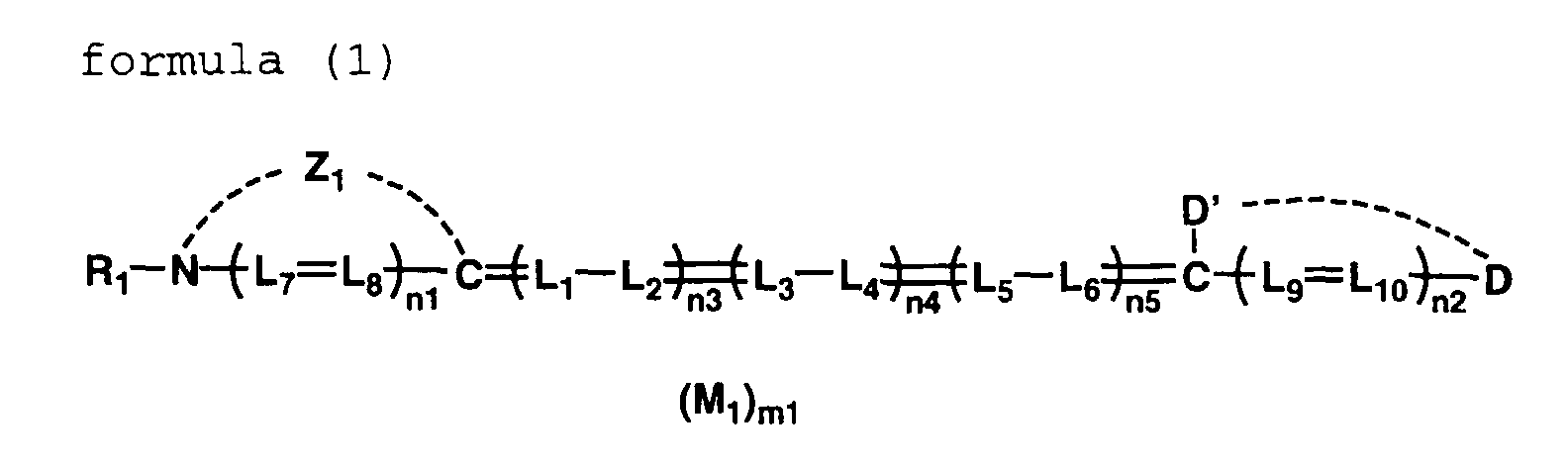


Infrared sensitizing dyes, as described above, are
generally weak in adsorption and inferior in storage
stability after spectral sensitization of photothermographic
materials, producing problems such that sufficient
sensitivity is not obtained and desensitization is rather
prominent when the photographic materials are stocked. The
thermally developable photosensitive material comprises
silver halide grains, together with organic silver salt
grains, dispersed in a thermosoftening binder, which is more
hydrophobic than gelatin (such as polyvinyl butyral). When
heated, the organic silver salt is reduced with a reducing
agent incorporated into the same layer or an adjacent layer
to form images through solution physical development in the
heated and softened binder. Accordingly, it is supposed that
a sensitizing dye adsorbed to silver halide is apparently
disadvantageous for the adsorption equilibrium, as compared
to conventional silver halide photographic materials
comprising gelatin matrix. To improve these defects, it was
attempted that the structure of a spectral-sensitizing dye
itself was varied, an infrared sensitizing dye exhibiting
strong adsorption, enhanced sensitivity and not so marked
desensitization was explored, and a compound promoting
adsorption by the combined use with the sensitizing dye,
which is effective to enhance sensitivity and improve raw
stock stability, was also explored. As a result of these
investigations by the inventor of the present invention, it
was proved that the use of a heteroatom-containing
macrocyclic compound led to improvements in the defects of
the thermally developable photosensitive materials, as
described above.
The heteroatom-containing macrocyclic compound
contained in thermally developable photosensitive materials
is more effective when used with an infrared sensitizing dye,
leading to enhanced sensitivity and an improvement in
desensitization during storage. Specifically, the use in
combination with the infrared sensitizing dyes represented by
the formulas (1) to (3) described above is furthermore
effective. The heteroatom-containing macrocyclic compound
refers to a nine- or more-membered macrocyclic compound
containing at least a heteroatom selected from a nitrogen
atom, an oxygen atom, a sulfur atom and a selenium atom. The
macrocyclic compound is preferably a 12- to 24-membered ring
and more preferably a 15- to 21-membered ring.
Representative compounds thereof include compounds commonly known as a crown ether, which was synthesized by Pederson in 1967 and a number of which have been synthesized since its specific report. The compounds are detailed in C.J. Pederson, Journal of American Chemical Society vol. 86 (2495), 7017-7036 (1967); G.W. Gokel & S.H. Korzeniowski, "Macrocyclic Polyether Synthesis", Springer-Vergal (1982); "Chemistry of Crown Ether" edited by Oda, Shono & Tabuse, published by Kyoritsu Shuppan (1978); "Host-Guest" edited by Tabuse, published by Kyoritsu Shuppan (1979); and Suzuki & Koga, Yuki Gosei Kagaku (Journal of Organic Synthetic Chemistry) vol. 45 (6) 571-582 (1987).
Representative compounds thereof include compounds commonly known as a crown ether, which was synthesized by Pederson in 1967 and a number of which have been synthesized since its specific report. The compounds are detailed in C.J. Pederson, Journal of American Chemical Society vol. 86 (2495), 7017-7036 (1967); G.W. Gokel & S.H. Korzeniowski, "Macrocyclic Polyether Synthesis", Springer-Vergal (1982); "Chemistry of Crown Ether" edited by Oda, Shono & Tabuse, published by Kyoritsu Shuppan (1978); "Host-Guest" edited by Tabuse, published by Kyoritsu Shuppan (1979); and Suzuki & Koga, Yuki Gosei Kagaku (Journal of Organic Synthetic Chemistry) vol. 45 (6) 571-582 (1987).
Exemplary examples of the heteroatom containing
macrocyclic compounds used in the invention are shown below,
but are not limited to these examples.


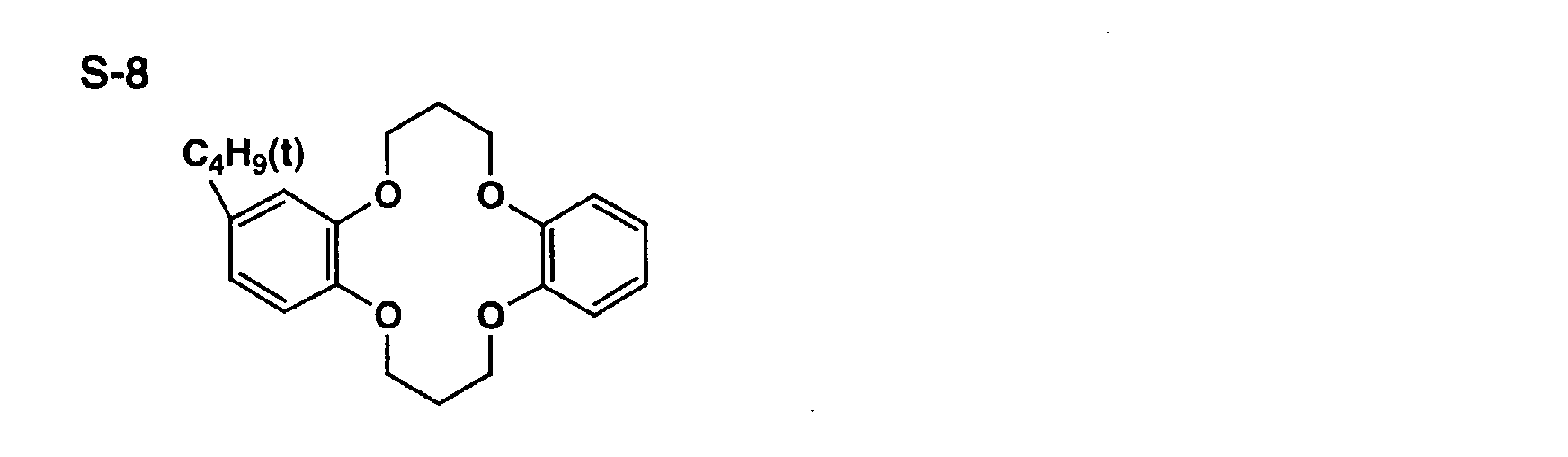


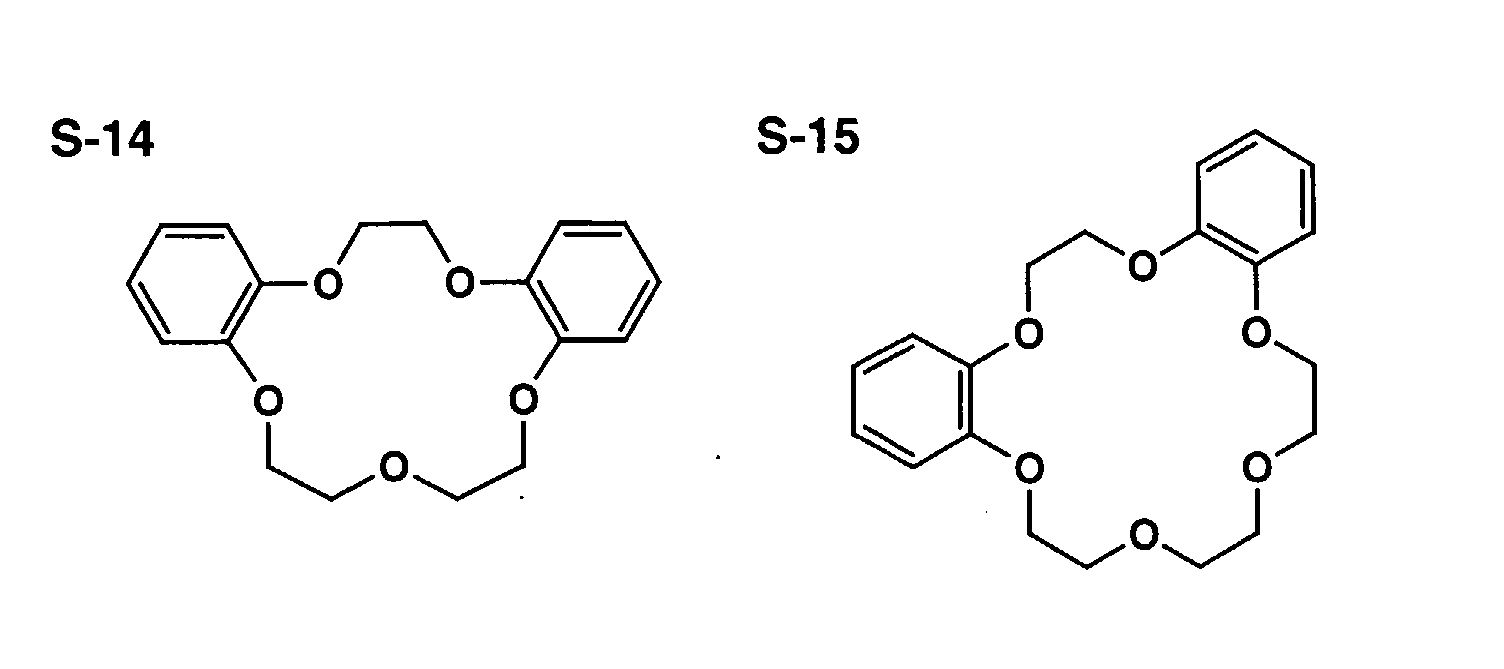
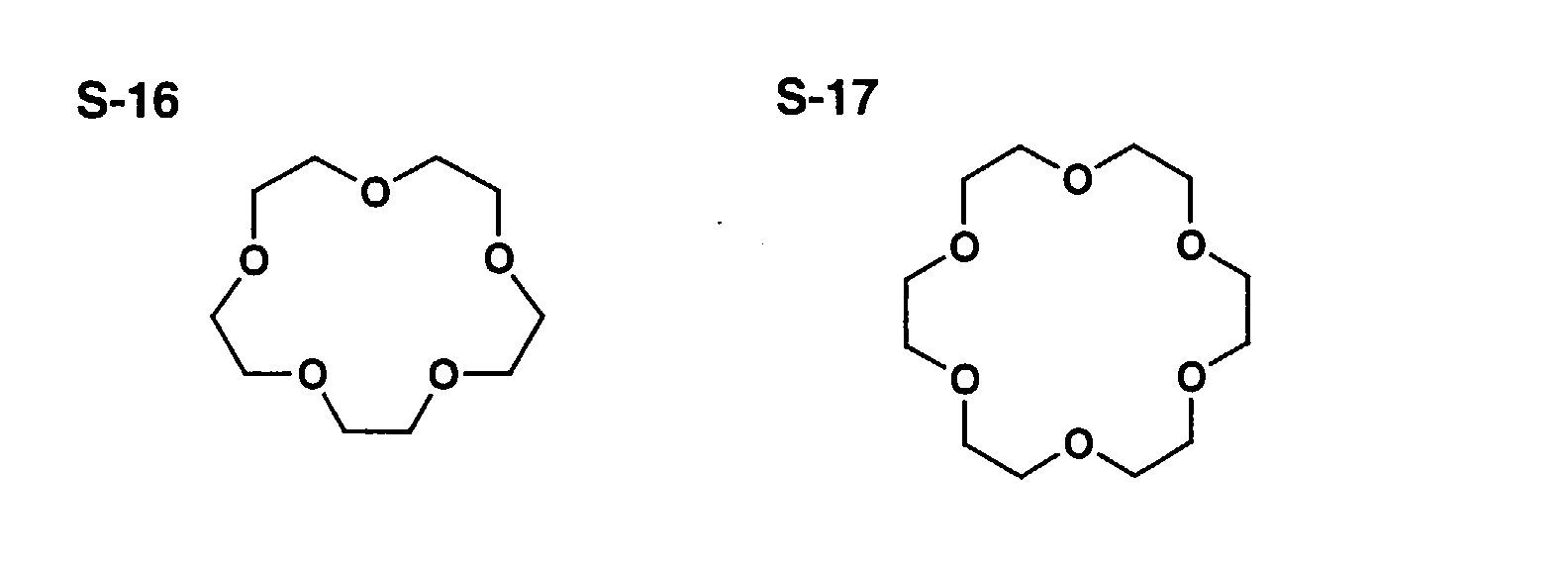
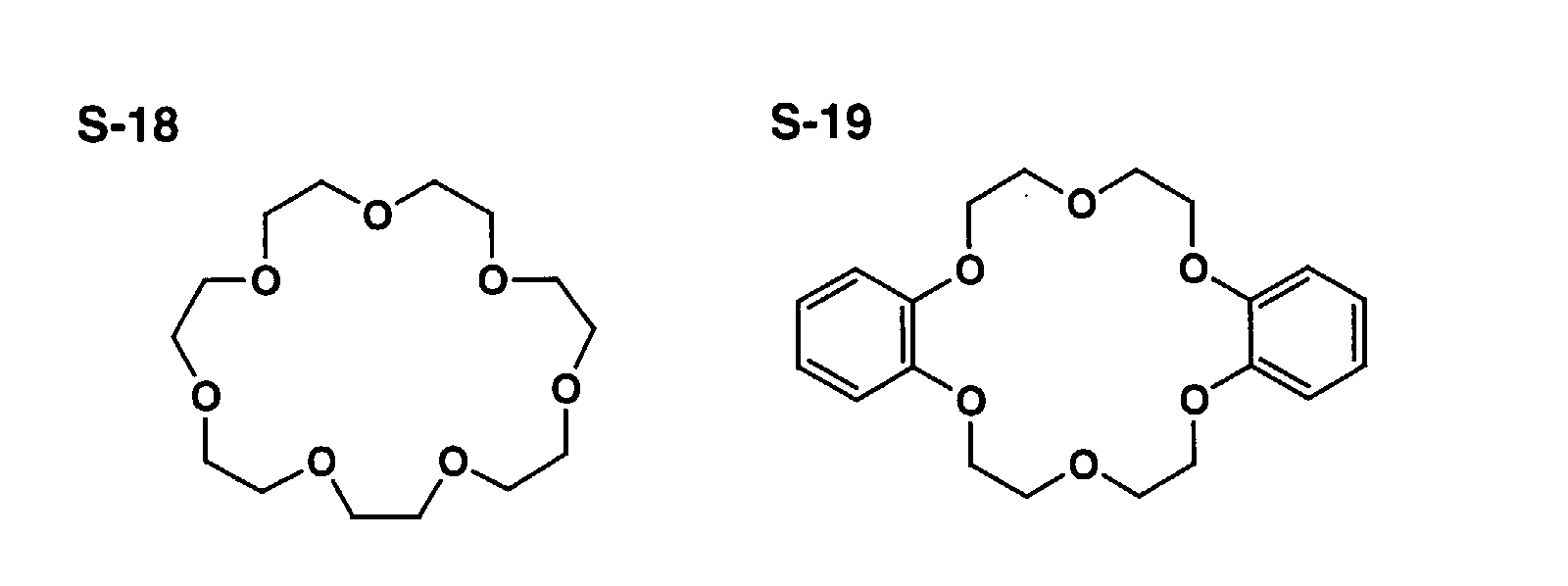

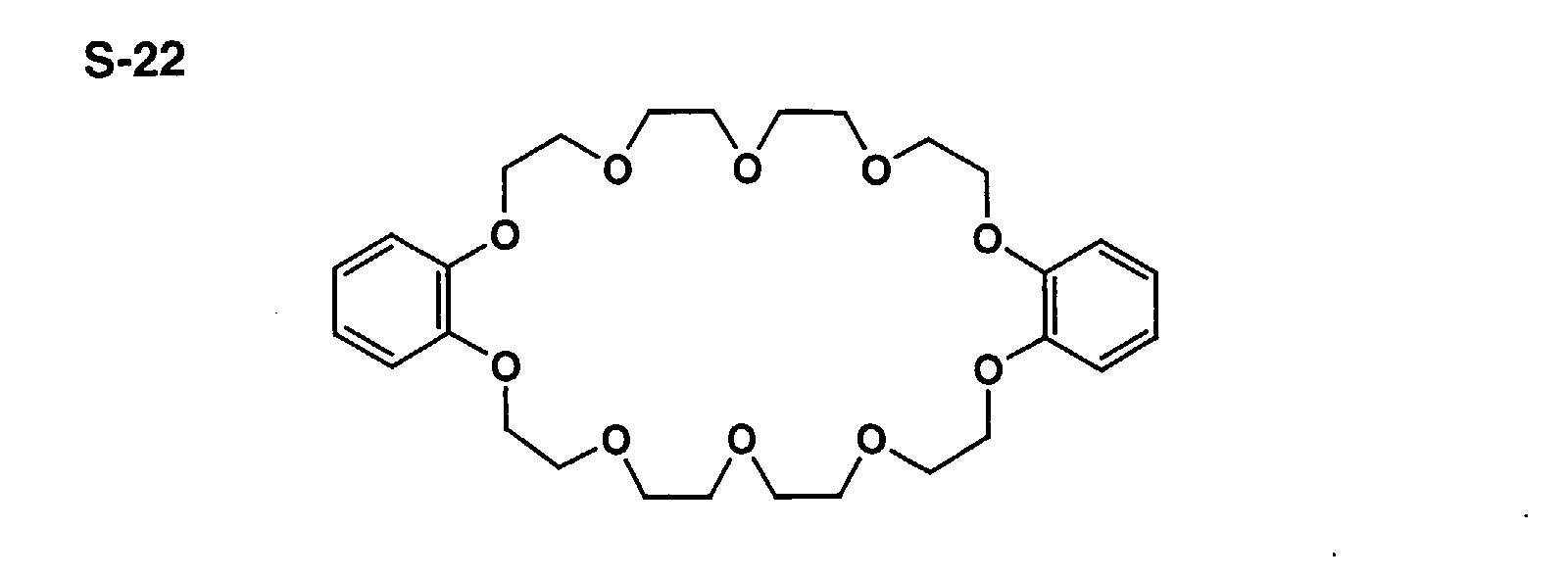

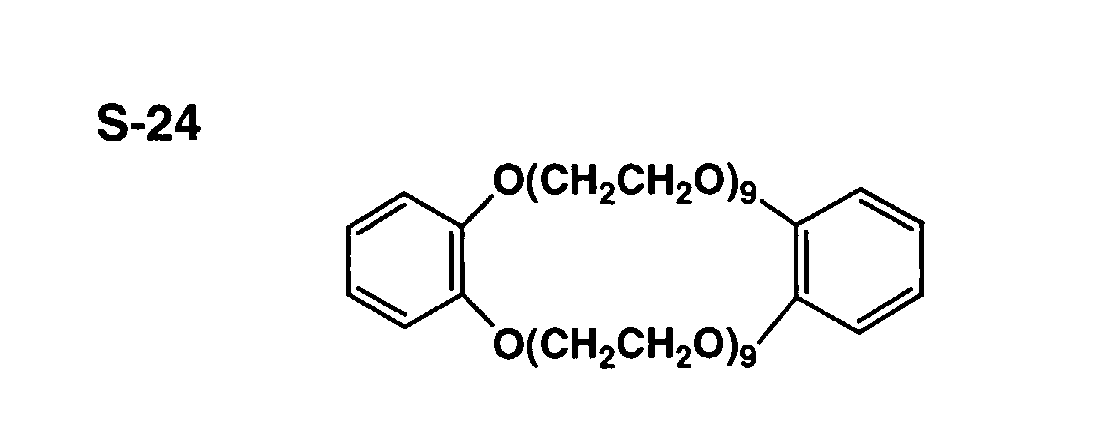

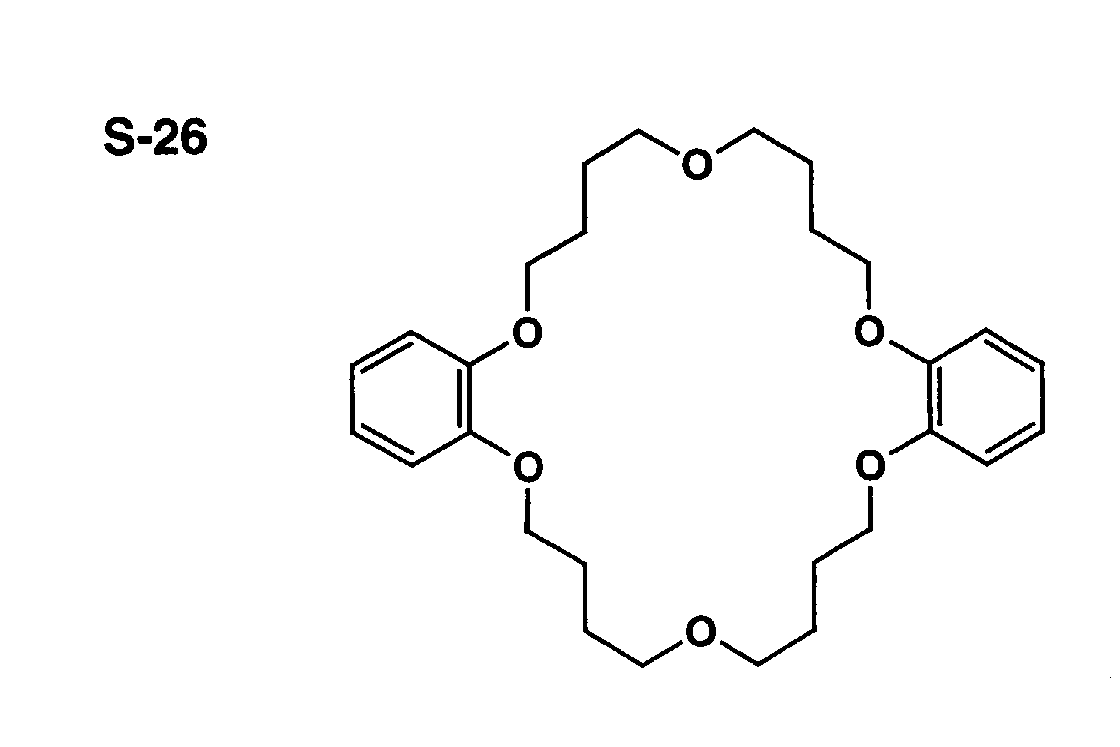

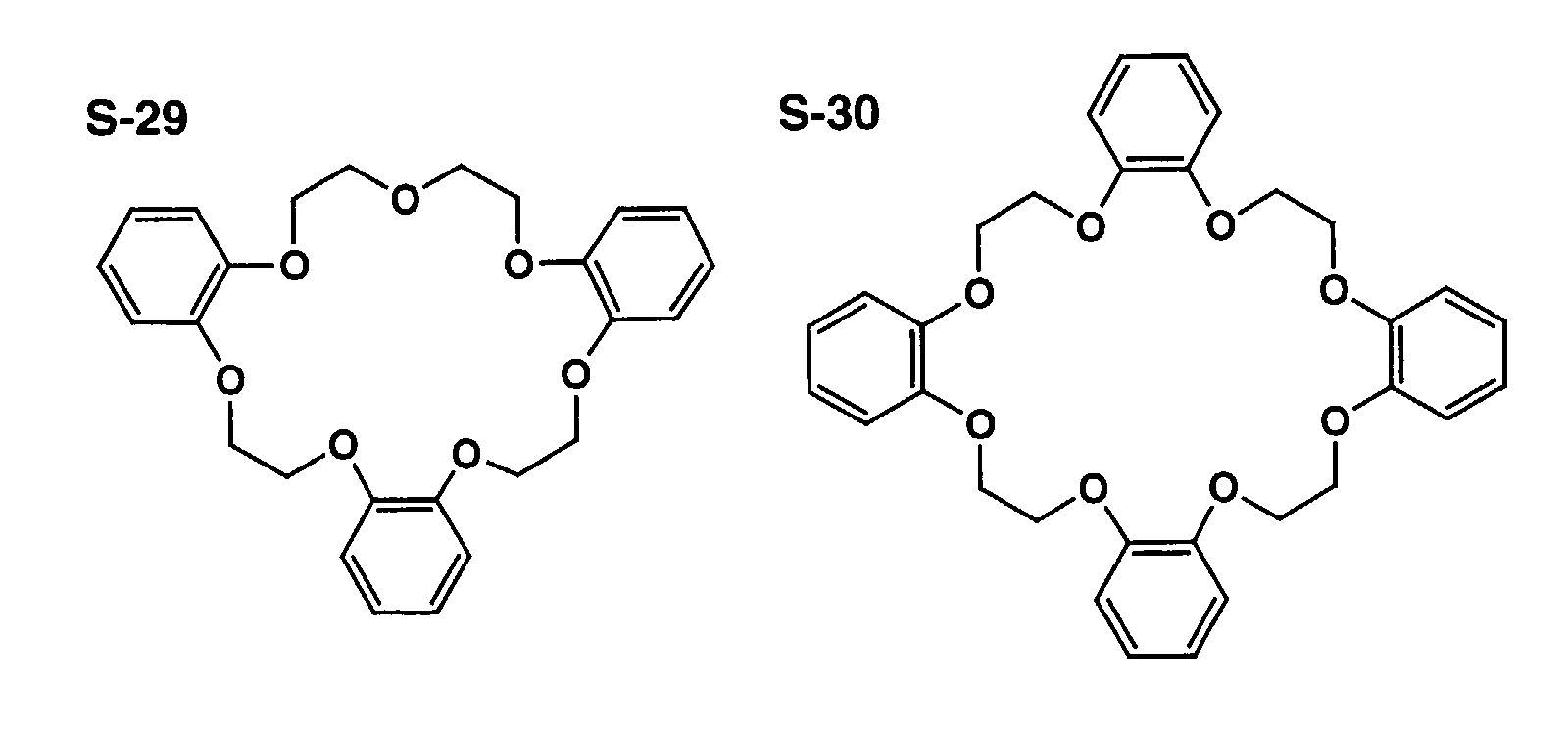

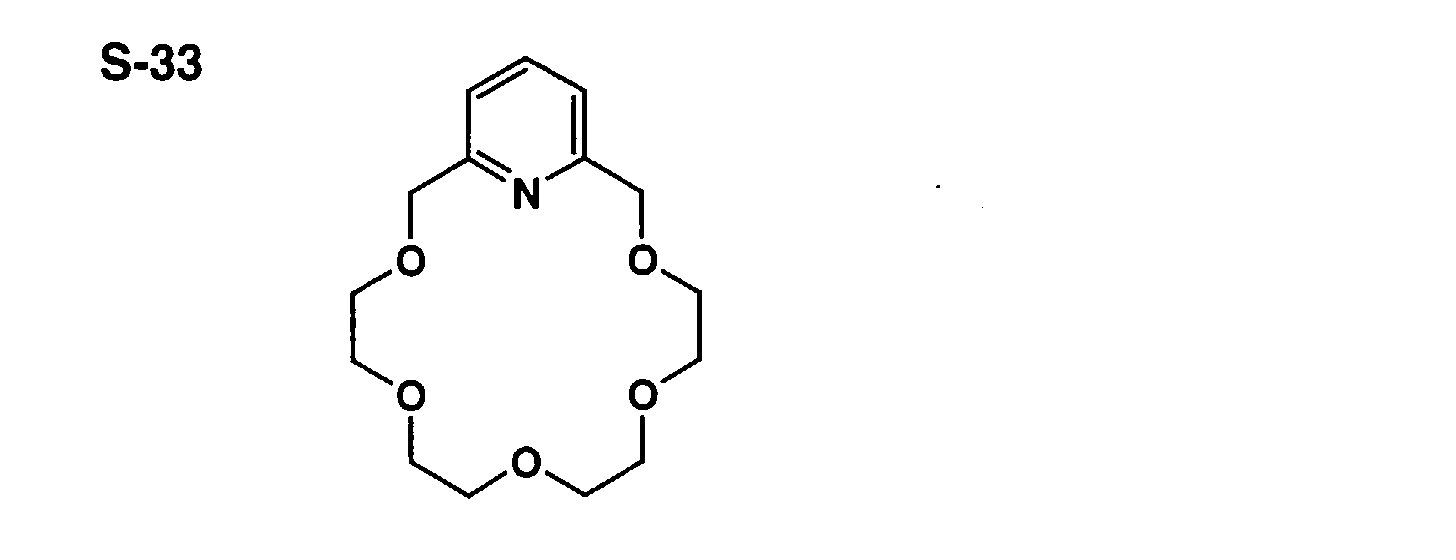


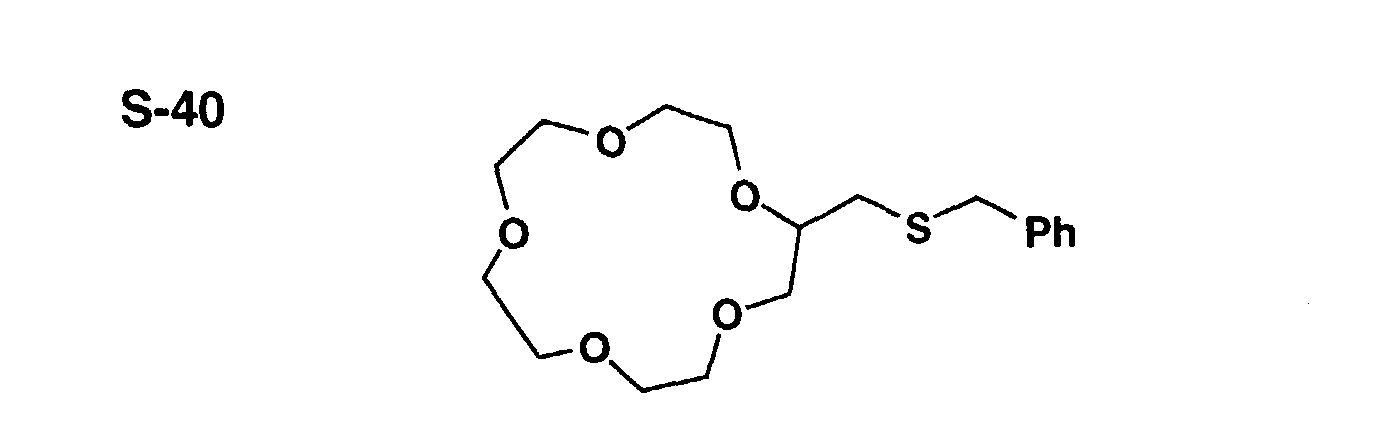

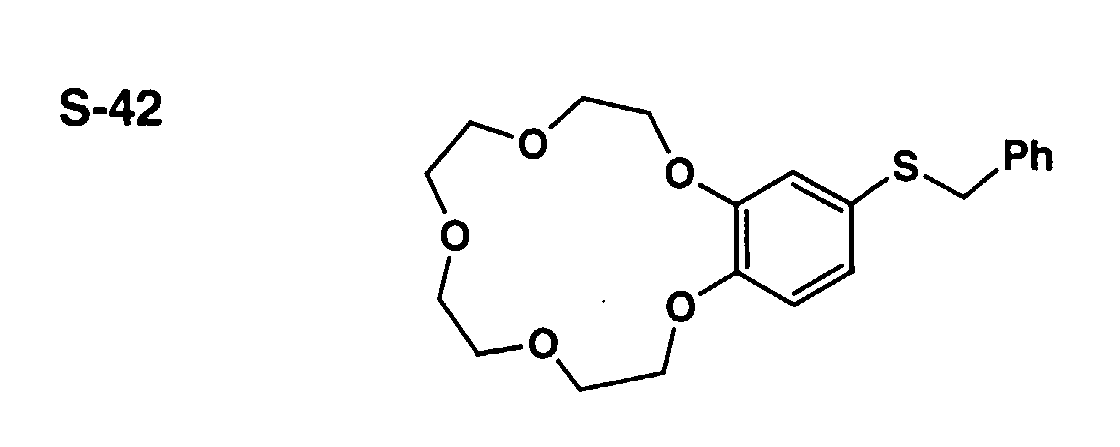


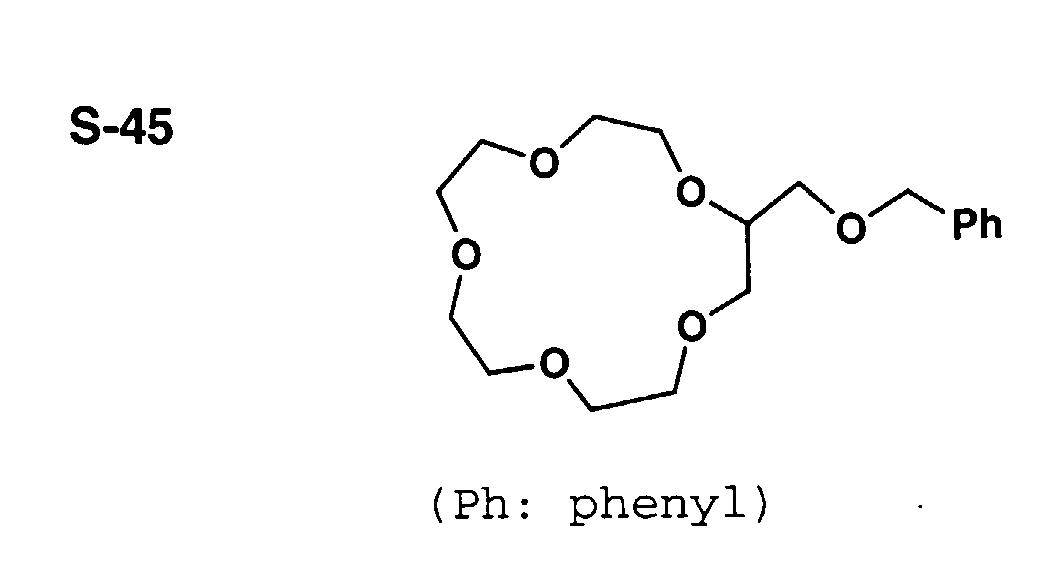
Effects of incorporation of these compounds into
conventional silver halide photographic materials are
described in the literature described above. However, it is
surprising that unexpected effects were found even in the
thermally developable photosensitive materials, which are
entirely different in condition from the conventional silver
halide photographic materials. It is not definitely cleared
why these compounds exhibited advantageous effects
specifically in the thermally developable photographic
material. Unlike the photosensitive layer of the
conventional silver halide photographic material, the
thermally developable photosensitive layer contains a silver
source other than silver halide (such as organic silver salts
or toning agent silver complex salts), so that it is supposed
that adsorption of a sensitizing dye to silver halide is
easily deteriorated, as compared to the conventional silver
halide photographic materials. It is also contemplated that
the heteroatom containing macrocyclic compound acts onto it,
promoting adsorption of the dye to silver halide.
The heteroatom containing macrocyclic compound may be
added at any stage after forming silver halide and until
preparing a coating solution, and is added preferably prior
to adding the sensitizing dye. To enhance effects of the
compound in the thermally developable photosensitive
material, as will be described later, it is preferred to
introduce an iodide into the region of the surface of silver
halide grains used in the thermally developable
photosensitive material. It is necessary to further
strengthen the adsorption, as compared to conventional
systems using gelatin. The heteroatom containing macrocyclic
compounds are generally incorporated into the thermally
developable photosensitive layer through solution in organic
solvents such as methanol, ethanol or fluorinated alcohols,
or water. In cases where solubility is not sufficient,
dissolution-promoting agent may be used in combination,
including potassium acetate, potassium iodide, potassium
fluoride, potassium p-toluenesulfonate, KBF4, KPF6, NH4BF4 and
NH4PF6. Any compound containing an ion capable of forming an
inclusion compound together with the heteroatom containing
macrocyclic compound, which is able to improve solubility may
be usable as the dissolution-promoting agent.
A silver halide photothermographic material used in the
invention contains a spectral-sensitizing dye having the
wavelength of maximum sensitivity of 600 nm or more The
wavelength of maximum sensitivity of 600 nm or more indicates
that the maximum sensitivity is at a wavelength of 600 or
more in the sensitivity distribution provided by a silver
halide photothermographic material in which a sensitizing dye
is incorporated and allowed to adsorb onto silver halide.
The wavelength of maximum sensitivity is preferably 600 to
1100 nm, and more preferably 600 to 900 nm.
In the invention, a sensitizing dye exhibiting the
maximum sensitivity at a wavelength of 600 nm or more and the
heteroatom-containing macrocyclic compound described above
are used in combination. Preferred sensitizing dyes
exhibiting the maximum sensitivity at a wavelength of 600 nm
or more include those represented by formulas (1), (2) and
(3). Of the sensitizing dyes, those represented by formulas
(2) and (3) are preferred, and those represented by formula
(2) are more preferred, in which methylthio group(s)
enhancing adsorption onto silver halide can be introduced.
In formula (1), Z1 is an atomic group necessary to form
a 5- or 6-membered nitrogen-containing heterocyclic ring; D
and D' each represent an atomic group necessary to form a
cyclic acidic nucleus; R1 represents an alkyl group; L1, L2,
L3, L4, L5, L6, L7, L8, L9 and L10 each represent a methine
group, provided that each may form a ring together with the
other L's (i.e., one of the other methine groups) or may form
a ring with an auxochrome; n1, n2, n3, n4 and n5 are each 0
or 1; M1 represents a counter ion necessary to neutralize
charge; and ml is the number of 0 or more, which is necessary
to counterbalance intramolecular charge.
The compound represented by formula (1) will be
detailed. Zi represents an atomic group necessary to form a
5- or 6-membered nitrogen-containing heterocyclic ring.
Examples of a nucleus formed by Z1 include a thiazole nucleus
(e.g., thiazole, 4-methylthiazole, 4-phenylthiazole, , 4,5-dimethylthiazole,
4,5-diphenylthiazole), benzthiazole nucleus
(e.g., benzthiazole, 4-chlorobenzthiazole, 5-chlorobenzthiazole,
6-chlorobenzthiazole, 5-nitrobenzthiazole,
4-methylbenzthiazole, 5-methylbenzthiazole,
6-methylbenzthiazole, 5-bromobenzothiazole,
6-bromobenzthiazole, 5-iodobenzthiazole,
5-phenylbenzthiazole, 5-methoxybenzthiazole, 6-methoxybenzthiazole,
5-ethoxybenzthiazole, 5-ethoxycarbonylbenzthiazole,
5-carboxybenzthiazole, 5-phenethylbenzthiazole,
5-fluorobenzthiazole, 5-chloro-6-methylbenzthiazole,
5,6-dimethylbenzthiazole, 5,6-dimethoxybenzthiazole,
5-hydroxy-6methylbenzthiazole,
tetrahydroxybenzthiazole, 5-phenylbenzthiazole),
naththothiazole nucleus (e.g., naphtha[2,1-d]thiazole,
naphtha[1,2-d]thiazole, naphtha[2,3-d]thiazole, 5-methoxynaphtho[1,2-d]thiazole,
7-ethoxynaphtho[2,1-d]thiazole,
8-methoxynaphtho[2,1-d]thiazole, 5-methoxynaphtho[2,3-d]thiazole),
thiazoline nucleus (e.g.,
thiazoline, 4-methylthiazoline, 4-nitrothiazoline), oxazole
nucleus (e.g., oxazole, 4-methyloxazole, 4-nitrooxazole, 5-methyloxazole,
4-phenyloxazole, 4,5-diphenyloxazole, 4-ethyloxazole),
benzoxazole (benzoxazole, 5-phenylbenzoxazole,
5-methoxybenzoxazole, 5-bromobenzoxazole, 5-fluorobenzoxazole,
5-phenylbenzoxazole, 5-methoxybenzoxazole,
5-nitrobenzoxazole, 5-trifluoromethylbenzoxazole, 5-hydroxybenzoxazole,
5-carboxybenzoxazole, 6-methylbenzoxazole,
6-chlorobenzoxazole, 6-nitrobenzoxazole,
6-methoxybenzoxazole, 6-hydroxybenzoxazole, 5,6-dimethylbenzoxazole,
4,6-dimethylbenzoxazole, 5-ethoxybenzoxazole),
naphthooxazole nucleus (e.g.,
naphtha[2,1-d]oxazole, naphtha[1,2-d]oxazole, naphtha[1,2-d]oxazole,,
naphtha[2,3-d]oxazole, 5-nitronaphtho[2,1-d]oxazole),
oxazoline (e.g., 4,4-dimethyloxazoline),
selenazole nucleus (e.g., 4-methlselenazole, 4-nitroselenazole,
4-phenylselenazole), benzselenazole nucleus
(e.g., benzselenazole, 5-chlorobenzselenazole, 5-nitrobenzselenazole,
5-methoxybenzselenazole, 5-hydroxybenzselenazole,
6-nitrobenzselenazole, 5-chloro-6-nitrobenzselenazole,
5,6-dimethylbenzselenazole),
naphthoselenazole nucleus (e.g., naphtha[2,1-d]selenazole,
naphtha[1,2-d]selenazole), selenazoline nucleus (e.g.,
selenazoline, 4-methylselenazoline), tellurazole nucleus
(e.g., tellurazole, 4-methyltellurazole, 4-phenyltellurazole),
benztellurazole nucleus (e.g.,
benztellurazole, 5-chlorobenztellurazole, 5-methylbenztellurazole,
5,6-dimethylbenztellurazole, 6-methoxybenztellurazole),
naphthotellurazole nucleus (e.g.,
naphtha[2,1-d]tellurazole, naphtha[2,1-d]tellurazole), 3,3-dialkylindolenine
(e.g., 3,3-dimethylindolenine, 3,3-diethylindolenine,
3,3-dimethyl-5-cyanoindolenine, 3,3-dimethyl-6-nitroindolenine,
3,3-dimethyl-5-methoxyindolenine,
3,3-dimethyl-5chloroindolenine), imidazole nucleus (e.g., 1-alkylimidazole,
1-alkyl-4-phenylimdazole, 1-alkyl-5,6-dichloroimidazole,
1-alkyl-5-methoxybenzimidazole, 1-alkyl-5-cyanobenzimidazole,
1-alkyl5-fluorobenzimidazole, 1-alkyl-5-trifluoromethylbenzimidazole,
1-alkyl-6-chlorocyanobenzimidazole,
1-alkyl-6-chloro5-trifluorobenzimidazole,
1-allyl-5,6-dichlorobenzimidazole, 1-allyl-5-chlorobenzimidazole,
1-aryl-benzimidazole, 1-aryl-5-chlorobenzimidazole,
1-aryl-5,6-dichlorobenzimidazole, 1-aryl-5-methoxybenzimidazole,
1-aryl-5-cyanobenzimidazole),
naphthoimidazole nucleus (e.g., alkylnaphtho[1,2-d]imidazole,
1-arylnaphtho[1,2-d]imidazole), in which the alkyl group
described above is preferably one having 1 to 8 carbon atoms
such as methyl, ethyl, propyl, isopropyl, butyl or
hydroxyalkyl group such as 2-hydroxyethyl 3-hydroxypropyl;
the aryl group described above is preferably phenyl, a
halogen-substituted (e,g., chloro-substituted) phenyl, alkylsubstituted
(e.g., methyl-substituted) phenyl and alkoxy-substituted
(e.g., methoxy-substituted) phenyl; pyridine
nucleus (e.g., 2-pyridine, 4-pyridine, 5-methyl-2-pyridine,
3-methyl-4-pyridine), a quinoline nucleus (e.g., 2-quinoline,
3-methyl-2-quinoline, 5-ethyl-2-quinoline, 6-methyl-2-quinoline,
6-nitro-2-quinoline, 8-fluoro-2-quinoline, 6-methoxy-2-quinoline,
6-hydroxy-2-quinoline, 8-chloro-2-quinoline,
4-quinoline, 6-ethoxy-4-quinoline, 6-phenyl-4-quinoline,
8-chloro4-quinoline, 8-fluoro-4-quinoline, 8-methyl-4-quinoline,
8-methoxy-4-quinoline, 6-methyl-4-quinoline,
6-methoxy-4-quinoline, 6-chloro4-quinoline), an
isoquinoline nucleus (e.g., 6-nitro-1-isoquinoline, 3,4-dihydro-1-isoquinoline,
6-nitro-3-isoquinoline), an
imidazo[4,5-b]quinoxaline nucleus (e.g., 1,3-diethylimidazo[4,5-b]quinoxaline,
6-chloro-1,3-diallylimidazo[4,5-b]quinoxaline),
an oxadiazole nucleus, a
thiadiazole nucleus, a tetrazole nucleus and a pyrimidine
nucleus. Of these are preferred a benzoxazole nucleus,
naphthothiazole nucleus, benzoxazole nucleus, naphthoxazole
nucleus, benzimidazole nucleus, 2-quinoline nucleus and 4-quinoline
nucleus.
D and D' each represent an atomic group necessary to
form a cyclic, acidic nucleus, including any form of an
acidic nucleus of commonly known merocyanine dyes. In a
preferred form, D is a thicarbonyl group or carbonyl group,
and D' is a group of residual atom(s) necessary to form an
acidic nucleus. Herein, the acidic nucleus is referred to as
an acidic (or electron donating) heterocyclic nucleus, as is
commonly known in the art [e.g., T.H. James, The Theory of
the Photographic Process, 4th ed. (Macmillan, 1977) page 198]
Thus, D and D' can combine together with each other to
form a 5- or 6-membered heterocyclic ring comprising a carbon
atom, a nitrogen atom and a chalcogen atom (such as oxygen,
sulfur, selenium, or tellurium). Preferred nuclei include 2-pyrazoline-5-one,
pyrazolidine-3,5-dione, imidazolidine-5-one,
hydantoin, 2- or 4-thiohydantoin, 2-iminooxazolidine-4-one,
2-oxazoline-5-one, 2-thiooxazolidine-2,4-dione,
isooxazoline-5-one, 2-thiazoline-4-one, thiazoline-4-one,
thiazoline-2,4-dione, rhodanine, thiazolidine2,4-dithione,
isorhodanine, indane-1,3-dione, thiophene-3-one, thiophene-3-one-1,1-dioxide,
indoline-2-one, indoline-3-one, indazoline-3-one,
2-oxoindazolinium, 3-oxoindazolinium, 5,7-dioxo-6,7-dihydothiazolo[3,2-a]pyrimidine,
cyclohexane-1,3-dione, 3,4-dihydroisoquinoline-4one,
1,3-dioxane-4,6-dione, barbituric
acid, 2-thiobarbituric acid, chromane-2,4-dione, indazoline-2-one,
and pyrido[1,2-a]pyrimidine-1,3-dione nuclei; and a
nucleus having an exomethylene structure, in which a carbonyl
group or thiocarbonyl group is substituted by an active
methylene compound having a ketomethylene of cyanomethylene
structure at the active methylene-position. Of these are
more preferred 3-alkylrhodanine, 3-alkyl-2-thiooxazoline-2,4-dione
and 3-alkyl-2-thiohydantoin, and is still more
preferred a nucleus containing a carboxy group in its
molecule.
A group attached to the nitrogen atom contained in the
nucleus is preferably a hydrogen atom, an alkyl group
preferably having 1 to 18 carbon atoms, more preferably 1 to
7 carbon atoms and still more preferably 1 to 4 carbon atoms
(e.g., methyl ethyl propyl, isopropyl, butyl, isobutyl, hexyl
octyl, dodecyl octadecyl); substituted alkyl group such as
aralkyl (e.g., benzyl, 2-phenylethyl), hydroxyalkyl (e.g., 2-hyroxyethyl,
3-hydroxypropyl),a mercaptoalkyl (e.g., 2-mercaptoethyl),
carboxyalkyl (e.g., 2-carboxyethyl, 3-carboxypropyl,
4-carboxybutyl, carboxymethyl), alkoxyalkyl
(e.g., 2-methoxyethyl, 2-(2-hydroxyethoxy)ethyl, 2-(2-methoxyethoxy)ethyl),
aryloxyalkyl (e.g., 1-naphthyloxy),
sulfoalkyl (e.g., 2-sulfoethyl, 3-sulfopropyl, 3-sulfobutyl,
4-sulfobutyl,, 2-(3-sulfopropoxy)ethyl, 2-hydroxy-3-sulfopropyl,
3-sulfopropoxyethoxyethyl), arylthioalkyl (e.g.,
phenylthioethyl), heterocyclic ring-substituted alkyl (e.g.,
2-(pyrrolidine-2-one-1-yl)ethyl, tetrahydrofurfuryl, 2-morpholinoethyl),
2-acetoxyethyl, carbomethoxymethyl, 2-methanesulfonylaminoethyl);
an aryl group such as aryl (e.g.,
phenyl, 2-naphthyl) and substituted aryl (4-carboxyphenyl, 4-sulfophenyl,
3-chlorophenyl3-methylphenyl); and a
heterocycric group (e.g., 2-pyridyl, 2-thiazolyl, 5-pyrazolyl,
3-methyl-5-pyrazolyl). Of these are more
preferred an unsubstituted alkyl group (e.g., methyl, ethyl,
n-propyl, n-butyl, n-pentyl, n-hexyl), a carboxyalkyl group
(e.g., carboxymethyl, 2-carboxyethyl) and a sulfoalkyl group
(2-sulfoethyl).
Substitution at the carbon atom contained in the
nucleus is feasible with substituent groups which are defined
as a substituent for polycyclic nuclei of Z1.
L1, L2, L3, L4, L5, L6, L7, L8, L9 and L10 each represent
a methine group or a substituted methine group substituted by
a substituted or unsubstituted alkyl group (e.g., methyl
ethyl, caboxyethyl), a substituted or unsubstituted aryl
group (e.g., phenyl, o-carboxyphenyl), a heterocyclic group
(e.g., thienyl, barbituric acid), a halogen atom (e.g.,
chlorine atom, bromine atom), an alkoxy group (e.g., methoxy,
ethoxy), amino group (N,N-dipenylamino, N-methyl-N-phenylamino,
N-methylpiperadino) and an alkylthio group
(e.g., methylthio, ethylthio), provided that each may form a
ring together with one of the other L's or one of the other
methine groups, or form a ring with an auxochrome. Herein,
the auxochrome, as is commonly known in the art, refers to a
functional group of atoms (or a substituent group) which, by
affecting the spectral regions of strong absorption in a
chromophore, enhance the ability of the chromogen to act as a
dye. Examples thereof include groups containing a lone pair
such as -OH, -OR, -SH, -NH2, -NHR, NR2, halogen, in which R
is a hydrocarbon group; electron-donating groups such as an
alkyl group; and electron-withdrawing groups such as a
carboxy group and sulfonic acid group.
Further, either L2 and L4, or L3 and L5 preferably form
a ring. Specifically preferred examples of the ring formed
by L2 and L4 include:

Preferred examples of the ring formed by L3 and L5
include:
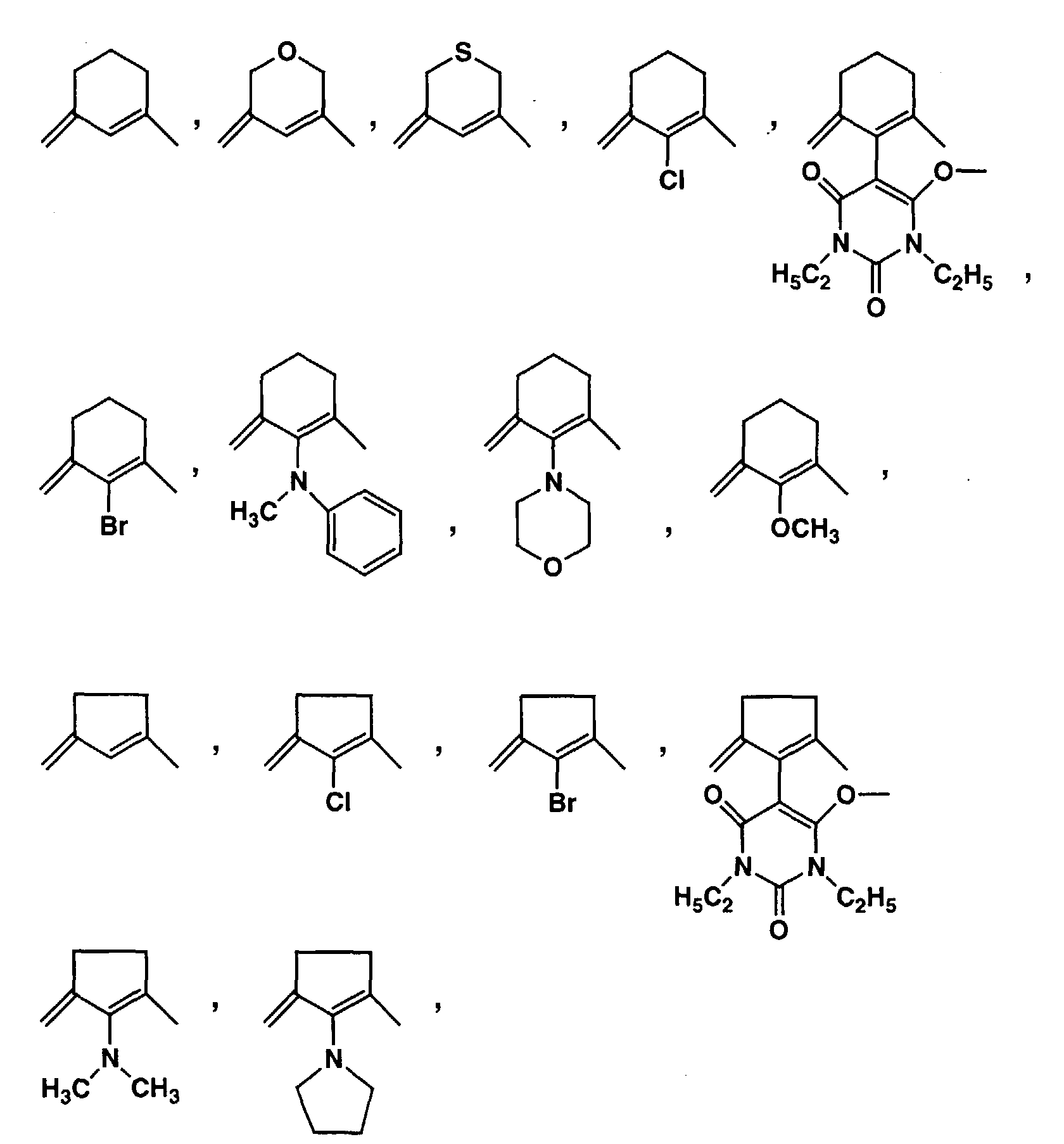
L4 is preferably an unsubstituted methine group, a
methine group substituted with an unsubstituted alkyl group
(e.g., methyl), an alkoxy group (e.g., methoxy), an amino
group (e.g., N,N-diphenylamino), a halogen atom (e.g.,
chlorine) or an acidic nucleus represented by D and D'.
Other Ls each are preferably an unsubstituted methine
group.
Each of n1, n2, n3, n4 and n5 is 0 or 1.
R1 is an alkyl group. Preferred examples of the alkyl
group are an unsubstituted alkyl group having 1 to 18 carbon
atoms (e.g., methyl, ethyl, propyl, pentyl, octyl, decyl,
dodecyl, octadecyl) and a substituted alkyl group having not
more than 18 carbon atoms. The substituent includes carboxy
group, sulfo group, cyano, a halogen atom (e.g., fluorine,
chlorine, bromine), hydroxy, alkoxycarbonyl group having 8 or
less carbon atoms, which may be substituted (e.g.,
methoxycarbonyl, ethoxycarbonyl, phenoxycarbonyl,
benzyloxycarbonyl), alkoxy group having 8 or less carbon
atoms, which may be substituted (methoxy, ethoxy, benzyloxy,
phenetyloxy), aryloxy group having 20 or less carbon atoms
(e.g., phenoxy, p-tolyloxy, 1-naphthyloxy, 2-naphthyloxy,, 6-methoxy-1-naphthyloxy),
acyloxy group having 3 or less carbon
atoms, which may be substituted (e.g., acetyloxy,
propionyloxy), acyl group having 8 or less carbon atoms
(e.g., acetyl, propionyl, benzoyl, mesyl), acylamino group
having 10 or less carbon atoms, which may be substituted
(e.g., acetylamino, 2-mercapto-6-benzimidazolylcarbonylamino),
carbamoyl group having 8 or
less carbon atoms, which may be substituted (e.g., carbamoyl,
N,N-dimethylcarbamoyl, morpholinocarbonyl,
piperidinocarbonyl), sulfamoyl group having 8 or less carbon
atoms (e.g., sulfamoyl, N,N-dimethylsulfamoyl,
morpholinosulfonyl, piperidinosulfonyl), and aryl group
having 10 or less carbon atoms, which may be substituted
(e.g., phenyl, 4-chlorophenyl, 4-methylphenyl, α-naphthyl).
Of these are more preferred an unsubstituted alkyl group
having 1 to 18 carbon atoms (e.g., methyl, ethyl, n-propyl,
n-butyl, n-pentyl, n-hexyl), a carboxyalkyl group (e.g., 2-carboxyethyl,
carboxymethyl), and a sulfoalkyl group (e.g.,
2-sulfoethyl, 3-sulfopropyl, 4-sulfobutyl, 3-sulfobutyl).
M1 is a counter ion to neutralize charge and ml is a
number of 0 or more, which is necessary to neutralize an
intramolecular charge. (M1)m1 is included in the formula to
indicate the presence or absence of a cation or an anion,
when it is needed to neutralize ionic charge of a dye.
Whether a dye is a cation or anion, or whether the dye has a
net ionic charge depends of an auxochrome or a substituent.
Representative cations are a inorganic or organic ammonium
ion and an alkali metal ion. Anions may be inorganic or
organic anions, including a halide anion (e.g., fluoride ion,
chloride ion, bromide ion, iodide ion), a substituted
arylsulfonate ion (e.g., p-toluenesulfonate ion, p-chlorobenzenesulfonate
ion), an aryldisulfonate ion (e.g., 3-naphthalendisulfonate
ion), an alkyl sulfate ion (e.g.,
methylsulfate ion), sulfate ion, thicyanate ion, perchlorate
ion, tetrafluorobarate ion, picrate ion, acetate ion, and
trifluoromethansulfonate ion. Of these are preferred
ammonium ion, iodide ion and p-toluenesulfonate ion.
Exemplary examples of sensitizing dyes represented by
formula (1) are shown below, but are not limited to these
examples.


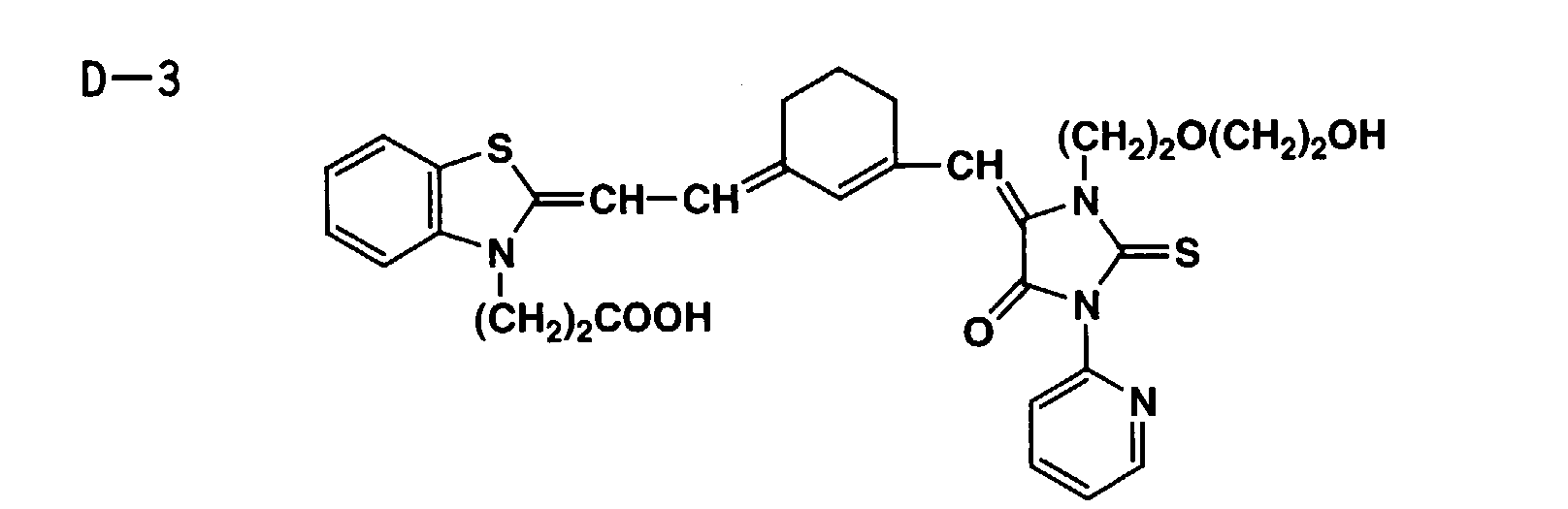


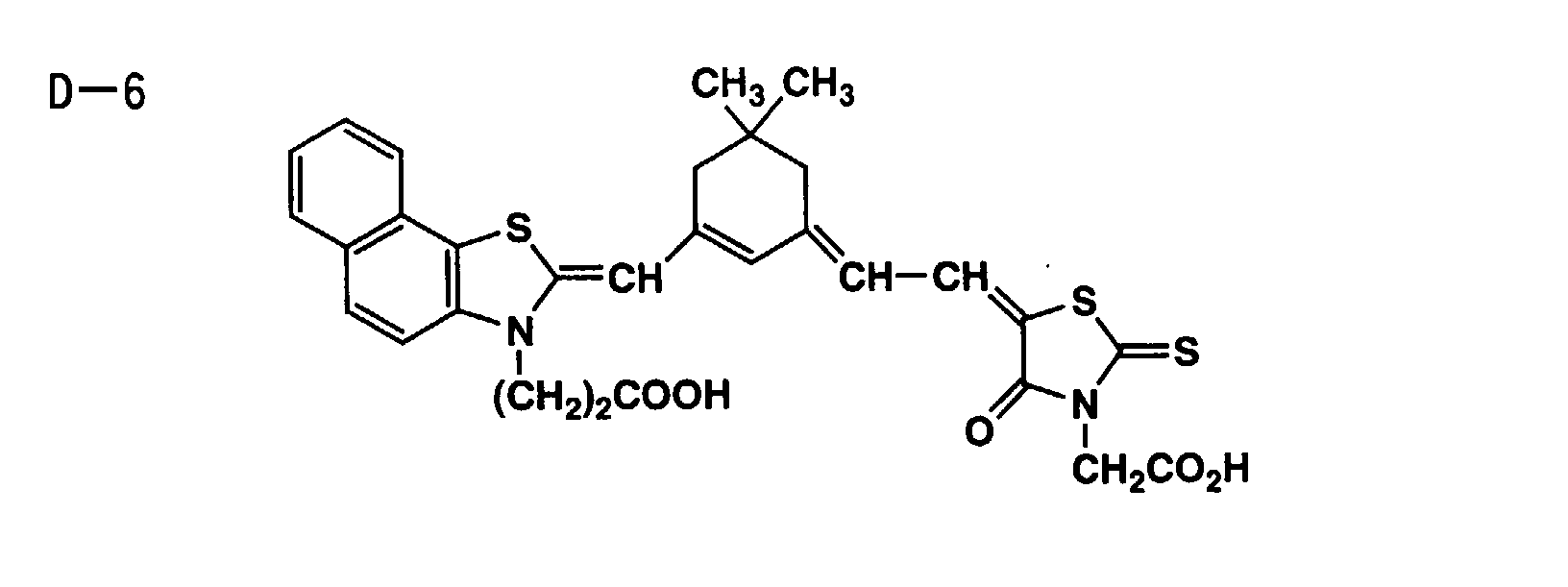


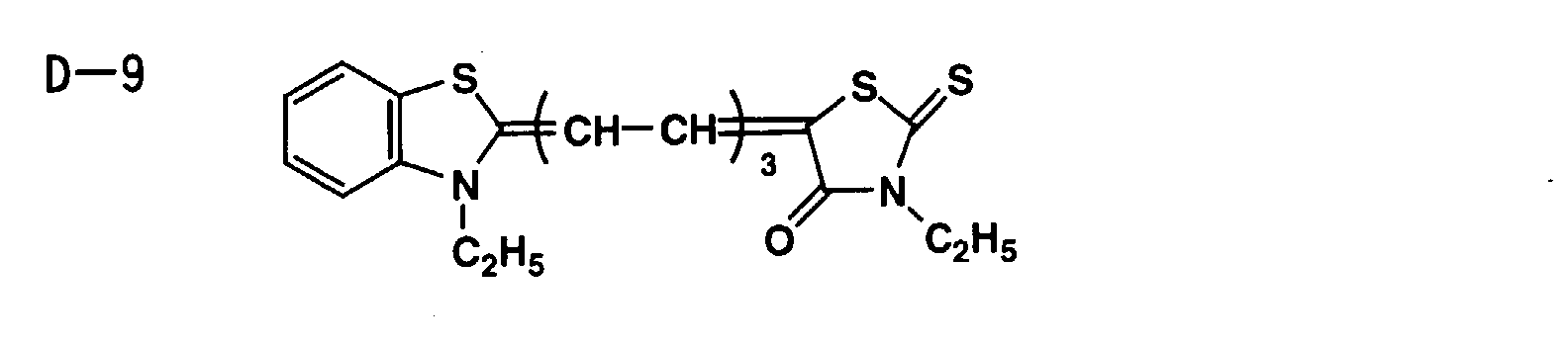

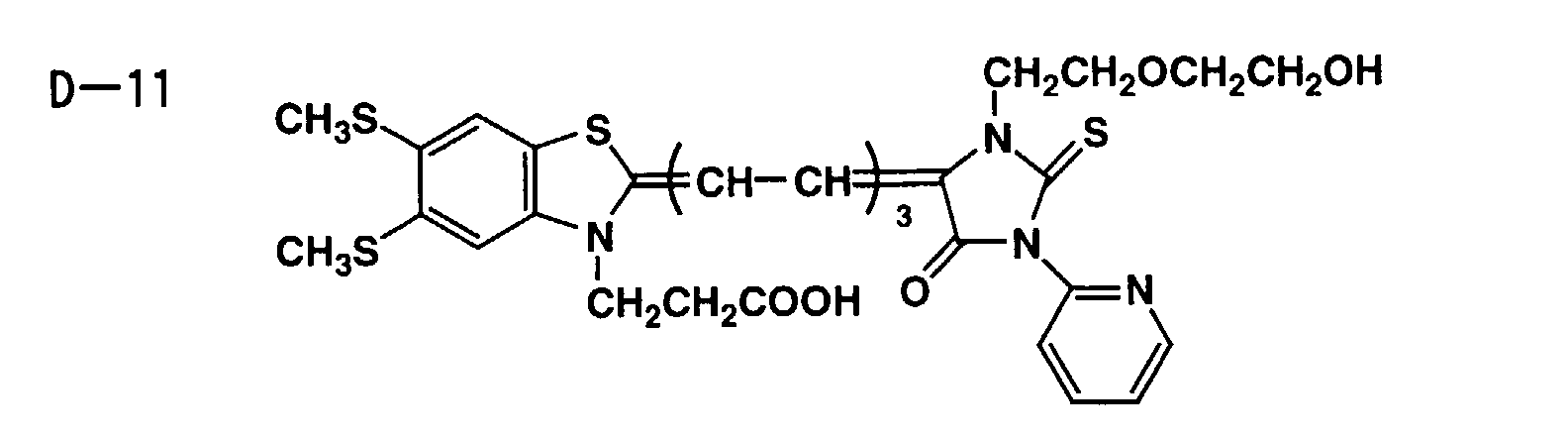
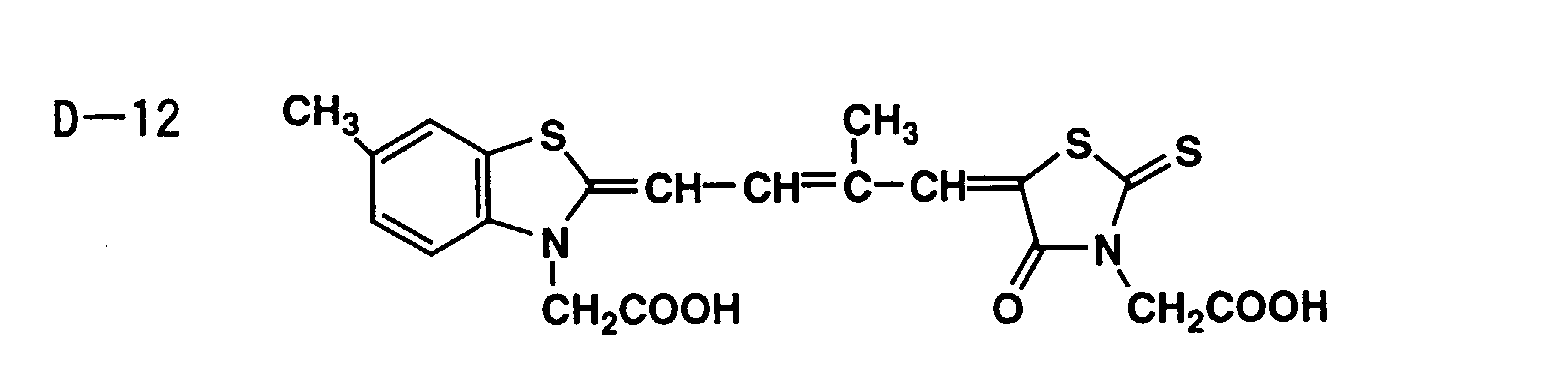
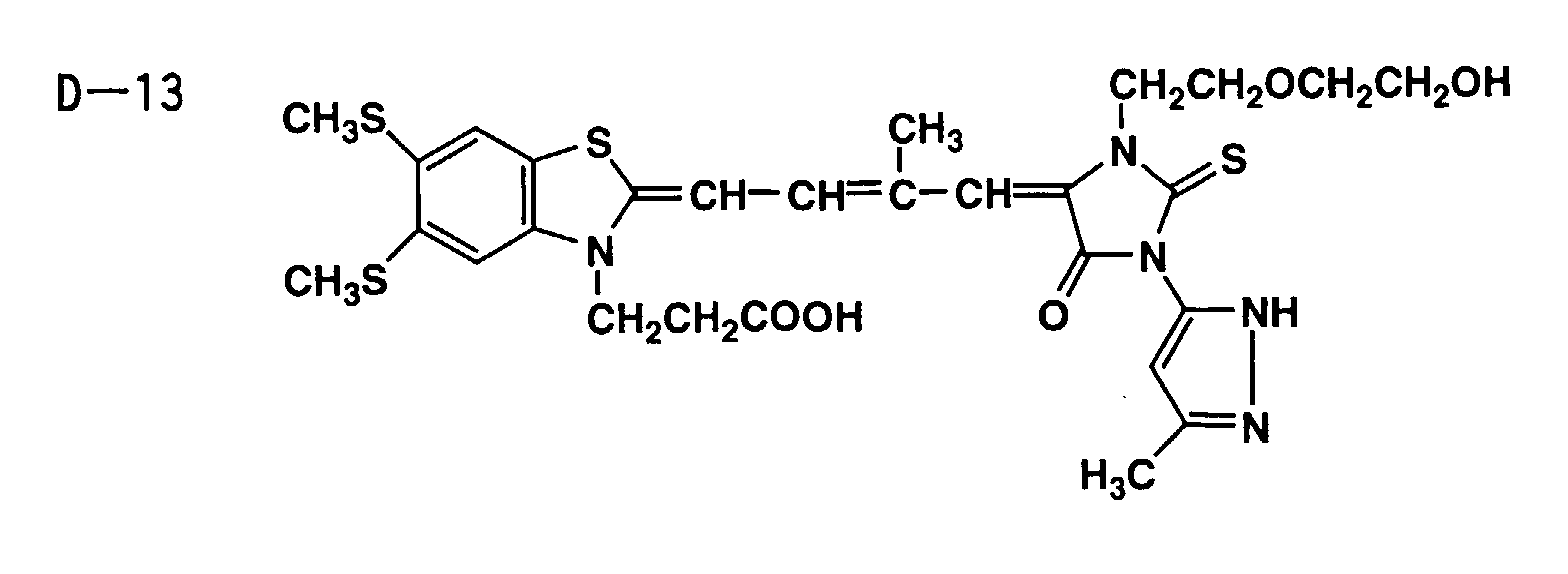
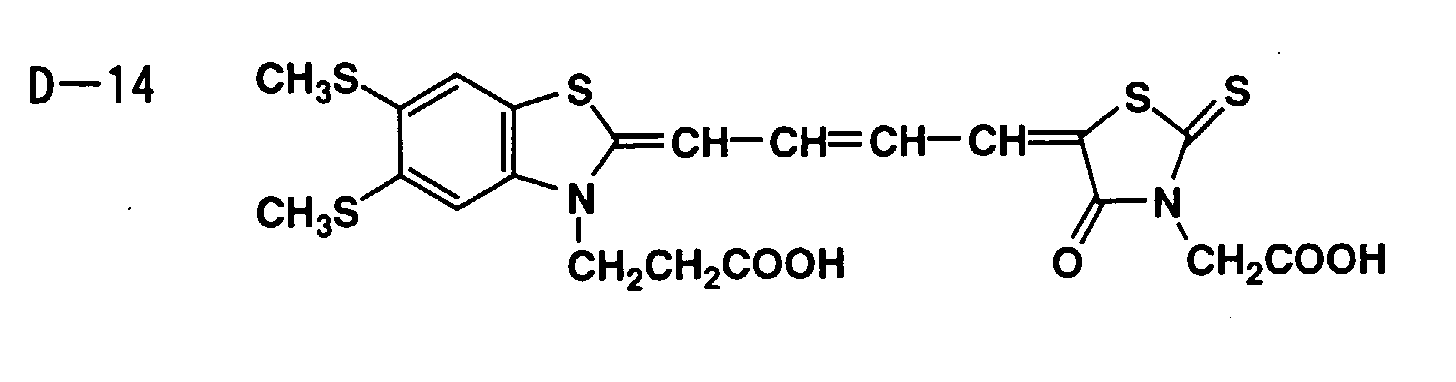
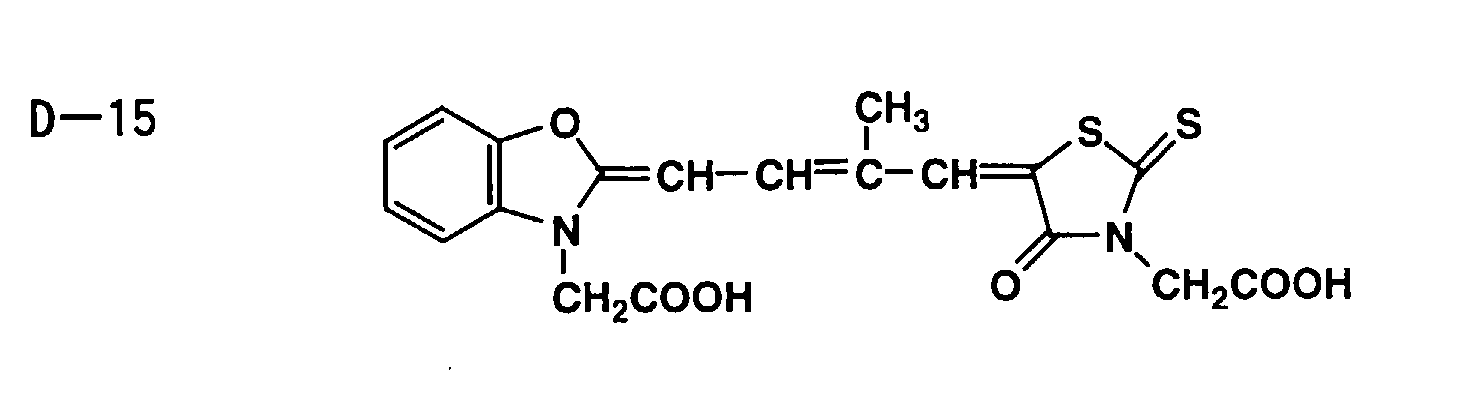


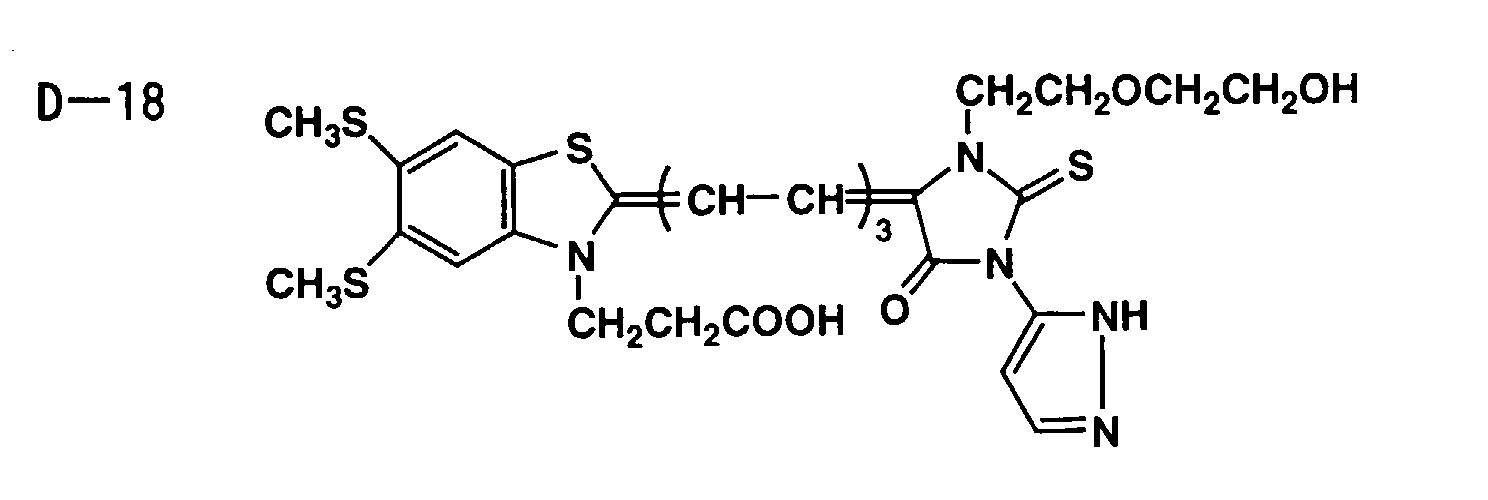

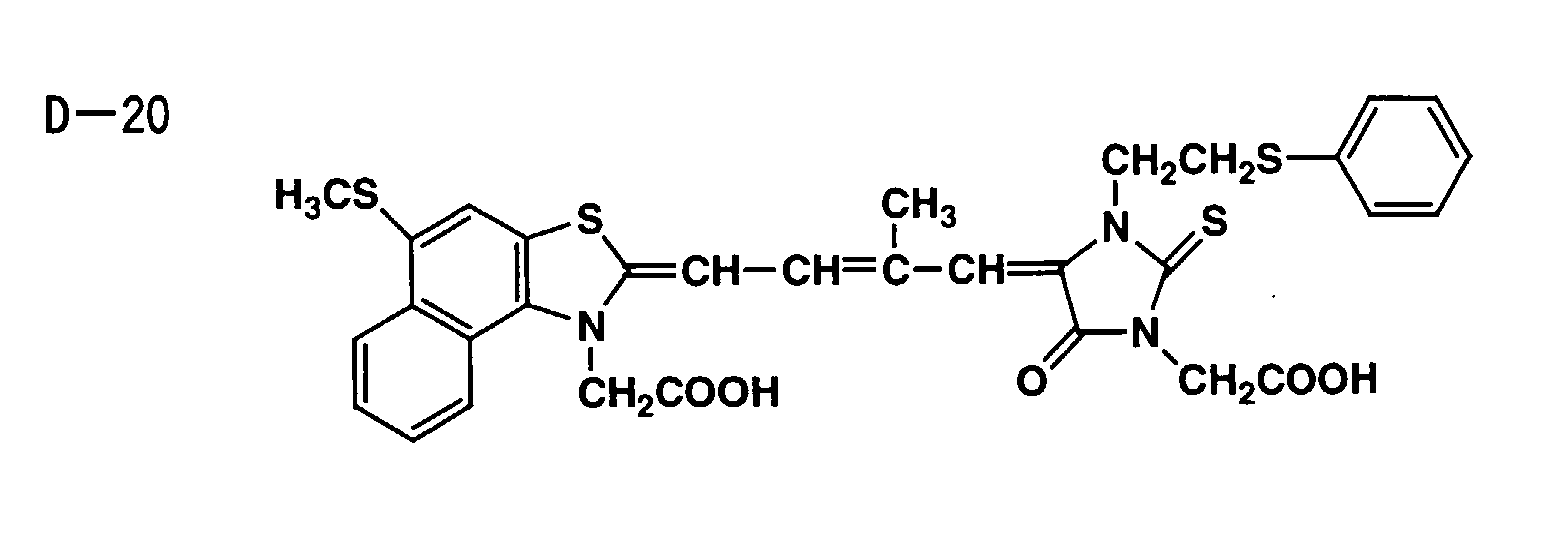


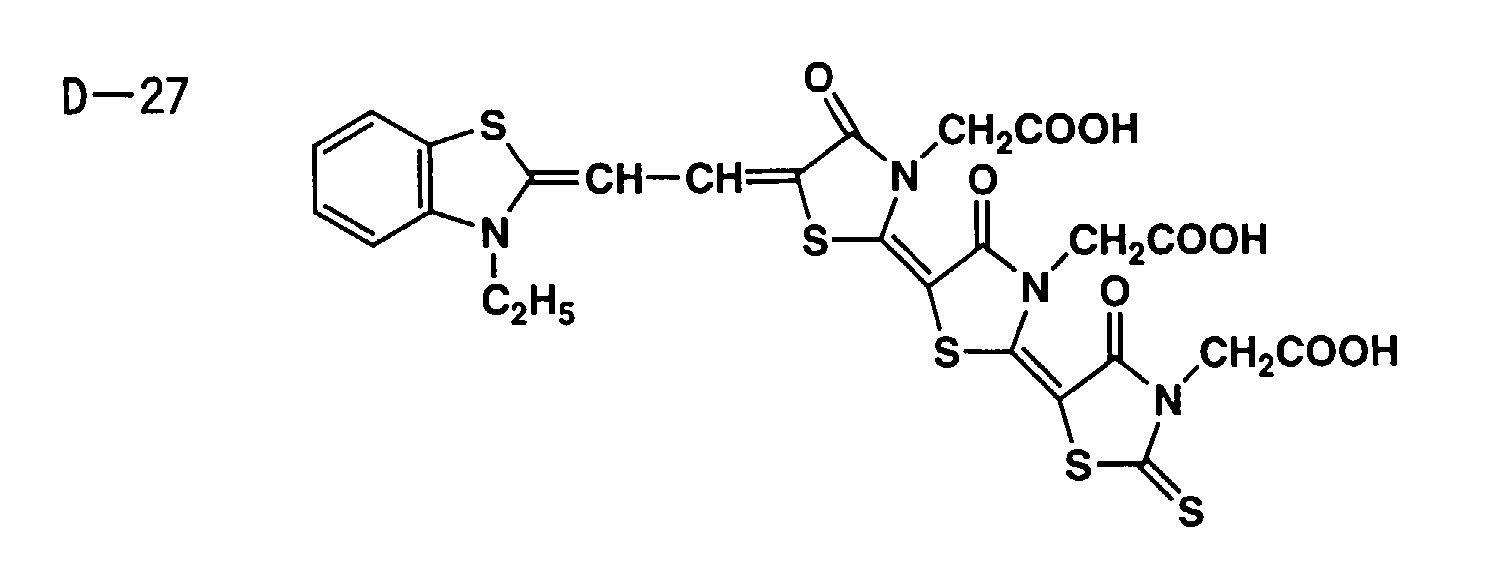

The sensitizing dyes represented by formula (1), i.e.,
merocyanine dyes can be synthesized in accordance with
methods described in the following literatures; (a) F.M.
Hamer, "Cyanine Dyes and Related Compounds" in The Chemistry
of Heterocyclic Compounds Vol. 18 (Interscience, New York,
1964), (b) D.M. Sturmer, "Heterocyclic Compounds, Special
Topic in The Chemistry of Heterocyclic Compounds" Chapter 8,
Sect. 4 pages 482-515 (John Wirey & Sons, New York, 1977) (c)
Zh. Org. Khim. Vol.17 (1) page 167-169 (1981), ibid Vol. 15
(2) page 400-407 (1979), ibid Vol. 14 (10) page 2214-2221
(1978), ibid Vol. 13 (11) page 2440-2443 (1977),ibid Vol. 19
(10) page 2134-2142 (1982); Ukr. Khim. Zh. Vol. 40 (6) page
625-629 (1974); Khim. Geterotsiki. Soedin. Vol. 2 page 175-178
(1976); Russian Patent Nos. 420643 and 341823; JP-A 59-217761;
U.S. Patent 4,334,000, 3,671,648, 3,623,881, and
3,573,921; European Patent 288261A1, 102781A2, 730008A2; JP-A
49-46930 and 3-243944.
Spectral-sensitizing dyes represented by formulas (2)
and (3) will now be described. Of sensitizing dyes
represented by formula (2) is more preferred a methine dye
represented by formula (4) described above.
In formulas (2), (3) and (4), 5- or 6-membered
nitrogen-containing heterocyclic rings represented by Z1, Z3,
Z4 and Z7 include a thiazole nucleus, thiazole nucleus,
benzothiazole nucleus, oxazoline nucleus, oxazole nucleus,
benzoxazole nucleus, selenazoline nucleus, selenazole
nucleus, benzoselenazole nucleus, 3,3-dialkylindolenine
nucleus (e.g., 3,3-dimethylindolenine), imidazoline nucleus,
imidazole nucleus, benzimidazole nucleus, 2-pyridine nucleus,
4-pyridine nucleus, 2-quinoline nucleus, 1-isoquinoline
nucleus, 3-isoquinoline v, imidazo[4,5-b]quinoxaline nucleus,
oxadiazole nucleus, thiadiazole nucleus, tetrazole v and
pyrimidine nucleus. Of these, a benzoxazole nucleus,
thiazole nucleus, benzothiazole nucleus, benzoselenazole
nucleus and benzoimidazole nucleus are preferred,
benzooxazole nucleus, thiazole nucleus and benzothiazole
nucleus are more preferred, and benzothiazole nucleus
specifically preferred. Of nuclei described above, a
pyridine and quinoline nuclei are preferred as a heterocyclic
group substituted by a thioether group.
When a substituent onto Z1, Z3, Z4 or Z7 is denoted as
"V", examples of the substituent, V include a halogen atom
(e.g., fluorine, chlorine, bromine, iodine); mercapto group;
a carboxy group; a phosphoric acid group; a sulfo group;
hydroxy group; a carbamoyl group (hereinafter "carbamoyl
group" means a carbamoyl group, which may be substituted,
e.g., a carbamoyl group preferably having 1 to 10 carbon
atoms, more preferably 2 to 8 carbon atoms, and still more
preferably 2 to 5 carbon atoms, such as methylcarbamoyl,
ethylcarbamoyl, and morpholinocarbamoyl); a sulfamoyl group
(which may be substituted), e.g., preferably having 10 or
less carbon atoms, more preferably 2 to 8 carbon atoms, and
still more preferably 2 to 5 carbon atoms, such as
methylsulfamoyl, ethylsulfamoyl and piperidinosulfamoyl;
nitro group; an alkoxy group (which may be substituted) e.g.,
preferably having 1 to 20 carbon atoms, more preferably 1 to
10 carbon atom, and still more preferably 1 to 8 carbon atoms
(e.g., methoxy, ethoxy, 2-methoxethoxy, 2-phenylethoxy); an
aryloxy group (which may be substituted), e.g., preferably
having 6 to 20 carbon atoms, more preferably 6 to 12 carbon
atom, and still more preferably 6 to 10 carbon atoms
(e.g.,phenoxy, p-methylphenoxy, p-chlorophenoxy, naphthoxy);
an acyl group (which may be substituted), e.g., preferably
having 1 to 20 carbon atoms, more preferably 2 to 12 carbon
atom, and still more preferably 2 to 8 carbon atoms (e.g.,
acetylamino); a sulfonyl group (which may be substituted),
e.g., preferably having 1 to 20 carbon atoms, more preferably
1 to 10 carbon atom, and still more preferably 1 to 8 carbon
atoms (e.g., methanesulfonyl, ethanesulfonyl,
benzenesulfonyl); a sulfinyl group (which may be substituted,
e.g., preferably having 1 to 20 carbon atoms, more preferably
1 to 10 carbon atom, and still more preferably 1 to 8 carbon
atoms (e.g., methanesulfinyl, bebzenesulfinyl); a
sulfonylamino group (which may be substituted), e.g.,
preferably having 1 to 20 carbon atoms, more preferably 1 to
10 carbon atom, and still more preferably 1 to 8 carbon atoms
(e.g., methanesulfonylamino, ethanesulfonylamino,
benzenesulfonylamino); amino and a substituted amino group
(which may be substituted), e.g., preferably having 1 to 20
carbon atoms, more preferably 1 to 10 carbon atom, and still
more preferably 1 to 8 carbon atoms (e.g., methylamino,
dimethylamino, benzylamino, anilino, diphenylamino); an
ammonium group (which may be substituted), preferably having
20 or less carbon atoms, more preferably 3 to 10 carbon atom,
and still more preferably 3 to 6 carbon atoms (e.g.,
trimethylammonium, triethylammonium); a hydrazine group
(e/g., trimethylhydrazino); a ureido group (which may be
substituted), e.g., preferably having 1 to 15 carbon atoms,
more preferably 1 to 10 carbon atom, and still more
preferably 1 to 6 carbon atoms (e.g., ureido, N,N-dimethylureido);
an imino group (which may be substituted),
e.g., preferably having 1 to 15 carbon atoms, more preferably
1 to 10 carbon atom, and still more preferably 1 to 6 carbon
atoms (e.g., succinimido); alkyl- or aryl-thio group (which
may be substituted), e.g., preferably having 1 to 20, carbon
atoms, more preferably 1 to 12 carbon atom, and still more
preferably 1 to 8 carbon atoms; an alkoxycarbonyl group
(which may be substituted), e.g., preferably having 2 to 20
carbon atoms, more preferably 2 to 12 carbon atom, and still
more preferably 2 to 6 carbon atoms (e.g., methoxycarbonyl,
ethoxycarbonyl, benzylcarbonyl); an aryloxycarbonyl group
(which may be substituted), e.g., preferably having 6 to 20
carbon atoms, more preferably 6 to 12 carbon atom, and still
more preferably 6 to 8 carbon atoms (e.g., phenoxycarbonyl);
an alkyl group, e.g., preferably having 1 to 18 carbon atoms,
more preferably 1 to 10 carbon atom, and still more
preferably 1 to 5 carbon atoms (e.g., methyl, ethyl, propyl,
butyl); a substituted alkyl preferably having 1 to 18 carbon
atoms, more preferably 1 to 10 carbon atom, and still more
preferably 1 to 5 carbon atoms (e.g., hydroxymethyl,
trifluoromethyl, benzyl, carboxymethyl, ethoxycarbonylmethyl,
acetylaminomethyl); unsaturated hydrocarbon group preferably
having 2 to 18 carbon atoms, more preferably 3 to 10 carbon
atom, and still more preferably 3 to 5 carbon atoms (e.g.,
vinyl, ethynyl, 1-cyclohexenyl); an aryl group (which may be
substituted), e.g., substituted or unsubstituted aryl group
preferably having 6 to 20 carbon atoms, more preferably 6 to
15 carbon atom, and still more preferably 6 to 10 carbon
atoms (e.g., phenyl, naphthyl, p-carboxyphenyl, p-nitrophenyl,
3,5-dichlorophenyl, p-cyanophenyl, m-fluorophenyl,
p-tolyl); and a heterocyclic group (which may
be substituted), e.g., preferably having 1 to 20 carbon
atoms, more preferably 2 to 10 carbon atom, and still more
preferably 4 to 6 carbon atoms (e.g., pyridyl, 5-methylpyridyl,
thienyl, furyl, morpholino,
tetrahydrofurfuryl), which may be condensed with a benzene
ring, naphthalene ring, or antrecene ring. These
substituents may be further substituted with substituent V.
Of these are preferred an alkyl group, aryl group, alkoxy
group, alkylthio group, halogen atom, acyl group, cyano
group, sulfonyl group and benzene ring-condensed group; and
an alkyl group, aryl group, alkylthio group, halogen atom,
acyl group, sulfonyl group and benzene ring-condensed group
are more preferred. Specifically, methyl, phenyl, methoxy,
methylthio, chlorine atom, bromine atom, iodine atom and
benzene ring-condensed group are still more preferred, and
phenyl, methylthio, chlorine atom, bromine atom, iodine atom
and benzene ring-condensed group are optimum.
The methine groups represented by L1, L2, L8, L9, L10,
L11, L16 and L17 each may be substituted, and examples of
substituents include those as defined in V described above.
An unsubstituted methine group is preferred.
p1, p2, p3 and p4 are each 0 or 1, and preferably 0.
Z9 is an oxygen atom, a sulfur atom and a selenium
atom, preferably an oxygen atom or sulfur atom, and more
preferably a sulfur atom.
Z6 represents an atomic group necessary to form an
acidic nucleus and may take any form of acidic nuclei of
commonly known merocyanine dyes. Herein, the acidic nucleus
(or acidic heterocycles) is defined in T.H. James, The Theory
of the Photographic Process, 4th ed. (Macmillan, 1977) page
198 and exemplarily detailed in U.S. Patent 3,567,719,
3,575,869, 3,804,634, 3,837,862, 4,002,480 and 4,925,777; and
JP-A 3-167546. The acidic nucleus is preferably a 5- or 6-membered
nitrogen-containing heterocyclic ring comprised of a
carbon atom, nitrogen atom and chalcogen atom (exemplarily,
oxygen, sulfur, selenium and tellurium), including the
following nuclei:
2-pyrazoline-5-one, pyrazolidine-3,5-dione, imidazoline-5-one, hydantoin, 2- or 4-thiohydantoin, 2-iminooxazolidine, 2-oxazoline-5-one, 2-thiooxazoline-2,4-dione, isorhodanine, indane-1,3-dione, thiophene3-one, thiophene-3-one-1,1-dioxide, indoline-2-one, indoline-3-one, 2-oxoindazolinium, 3-oxoindazolinium, 5,7-dioxo-6,7-dihydrothiazolo[3,2-a]pyrimidine, cyclohexane-1,3-dione, 3,4-dihydroisoquinoline-4-one, 1,3-dioxane-4,6-dione, barbituric acid, 2-thiobarbituric acid, chromene2,4-dione, indazoline-2-one, pyrido[1,2-a]pyrimidine-1,3-dione, pyrazolo[1,5-b]quinazolone, pyrazolo[1,5-a]benzimidazole, pyrazolopyridonel,2,3,4-tetrahydroquinoline-2,4-dione, 3-oxo-2,3-dihydrobenzo[d]thiophene-1,1-dioxide, 3-dicyanomethine-2,3-dihydrobenzo[d]thiophene-1,1-dioxide, 3-dicyanomethine-2,3-dihydrobenzo[d]thiophene-1,1-dioxide. Of these nuclei, Z6 is preferably hydantoin, 2- or 4-thiohydantoin, 2-oxazoline-5-one, 2-thiooxazoline-2,4-dione, thiazolidine-2,4-dione, rhodanine, thiazolidine-2,4-dithione, barbituric acid and 2-thiobarbituric acid; more preferably hydantoin, 2- or 4-thiohydantoin, 2-oxazoline-5-one, rhodanine, barbituric acid and 2-thiobarbituric acid; and still more preferably 2- or 4-thiohydantoin, 2-oxazoline-5-one and rhodanine.
2-pyrazoline-5-one, pyrazolidine-3,5-dione, imidazoline-5-one, hydantoin, 2- or 4-thiohydantoin, 2-iminooxazolidine, 2-oxazoline-5-one, 2-thiooxazoline-2,4-dione, isorhodanine, indane-1,3-dione, thiophene3-one, thiophene-3-one-1,1-dioxide, indoline-2-one, indoline-3-one, 2-oxoindazolinium, 3-oxoindazolinium, 5,7-dioxo-6,7-dihydrothiazolo[3,2-a]pyrimidine, cyclohexane-1,3-dione, 3,4-dihydroisoquinoline-4-one, 1,3-dioxane-4,6-dione, barbituric acid, 2-thiobarbituric acid, chromene2,4-dione, indazoline-2-one, pyrido[1,2-a]pyrimidine-1,3-dione, pyrazolo[1,5-b]quinazolone, pyrazolo[1,5-a]benzimidazole, pyrazolopyridonel,2,3,4-tetrahydroquinoline-2,4-dione, 3-oxo-2,3-dihydrobenzo[d]thiophene-1,1-dioxide, 3-dicyanomethine-2,3-dihydrobenzo[d]thiophene-1,1-dioxide, 3-dicyanomethine-2,3-dihydrobenzo[d]thiophene-1,1-dioxide. Of these nuclei, Z6 is preferably hydantoin, 2- or 4-thiohydantoin, 2-oxazoline-5-one, 2-thiooxazoline-2,4-dione, thiazolidine-2,4-dione, rhodanine, thiazolidine-2,4-dithione, barbituric acid and 2-thiobarbituric acid; more preferably hydantoin, 2- or 4-thiohydantoin, 2-oxazoline-5-one, rhodanine, barbituric acid and 2-thiobarbituric acid; and still more preferably 2- or 4-thiohydantoin, 2-oxazoline-5-one and rhodanine.
5- or 6-membered nitrogen-containing heterocyclic rings
represented by Z2, Z5, and Z8 are those in which an oxo or
thioxo group is excluded from the heterocycle represented by
Z6. Thus, these heterocyclic rings are preferably those in
which an oxo or thioxo group is excluded from hydantoin, 2-or
4-thiohydantoin, 2-oxazoline-5-one, 2-thiooxazoline-2,4-dione,
thiazolidine-2,4-dione, rhodanine, thiazolidine-2,4-dithione,
barbituric acid and 2-thiobarbituric acid; more
preferably those in which an oxo or thioxo group is excluded
from hydantoin, 2- or 4-thiohydantoin, 2-oxazoline-5-one,
rhodanine, barbituric acid and 2-thiobarbituric acid, and
still more preferably those in which an oxo or thioxo group
is excluded from 2- or 4-thiohydantoin, 2-oxazoline-5-one and
rhodanine.
R1, R3, R4, R7 and R9 each are an alkyl group,
including an unsubstituted alkyl group preferably having 1 to
18 carbon atoms, more preferably 1 to 7, and still more
preferably 1 to 4 carbon atoms (e.g., methyl, ethyl, propyl,
isopropyl, butyl, isobutyl, hexyl, octyl, dodecyl,
octadecyl); and a substituted alkyl group preferably having 1
to 18 carbon atoms, more preferably 1 to 7, and still more
preferably 1 to 4 carbon atoms, in which substituents include
those as defined in V described above. Preferred examples of
the substituted alkyl group include an aralkyl group (e.g.,
benzyl, 2-phenylethyl), unsaturated hydrocarbon group (e.g.,
allyl), hydroxyalkyl group (e.g., 2-hydroxyethyl, 3-hydroxypropyl),
carboxyalkyl group (e.g., 2-carboxyethyl, 3-carboxypropyl,
4-carboxybutyl, carboxymethyl), alkoxyalkyl
group (e.g., 2-methoxyethyl, 2-(2-methoxyethoxy)ethyl),
aryloxyalkyl group (e.g., 2-phenoxyethyl, 2-(1-naphthoxy)ethyl),
alkylthioalkyl group (e.g., 2-methylthioethyl,
2-(2-methylthioethylthio)ethyl),
arylthioalkyl group (e.g., 2-phenylthioethyl, 2-(1-naphthyl)ethyl),
heterocyclylthioalkyl group (e.g., 2-pyridylthioethyl,
2-thienylthioethyl), alkoxycarbonylalkyl
group (e.g., ethoxycarbonylmethyl, 2-benzyloxycarbonylethyl),
aryloxycarbonylalkyl group (e.g., 3-phenoxycarbonylpropyl),
acyloxyalkyl group (e.g., 2-acetyloxyethyl), acylalkyl group
(e.g., 2-acetylethyl), carbamoylalkyl group (e.g., 2-morpholinocarbonylethyl),
sulfamoylalkyl group (e.g., 2-sulfoethyl,
3-sulfopropyl, 3-sulfobutyl, 4-sulfobutyl, 2-(3-sulfopropoxy)ethyl,
2-hydroxy-3-sulfopropyl, 3-sulfopropoxyethoxyethyl),
sulfoalkenyl group (e.g.,
sulfopropenyl), sulfatoalkyl group (e.g., 2-sulfatoethyl, 3-sulfatopropyl,
4-sulfatobutyl), heterocycle-substituted alkyl
group (e.g., 2-pyrolidine-2-one-1-yl)ethyl,
tetrahydrofurfuryl), and alkylsulfonylcarbamoylmethyl group
(e.g., methanesulfonylcarbamoylmethyl). Of these,
carboxyalkyl group, sulfoalkyl group, sulfoalkenyl group,
unsubstituted alkyl group, alkylthioalkyl group,
arylthioalkyl group and heterocyclylthioalkyl group are
preferred.
The alkyl group represented by R2, R5, R6 and R8 include
unsubstituted alkyl group and substituted alkyl groups as
defined in R1 described above. The aryl group include an
unsubstituted aryl group preferably having 6 to 20 carbon
atoms, more preferably 6 to 10, and still more preferably 6
to 8 carbon atoms (e.g., phenyl, 1-naphthyl) and substituted
aryl group preferably having 6 to 20 carbon atoms, more
preferably 6 to 10, and still more preferably 6 to 8 carbon
atoms (e.g., aryl groups substituted by V as defined as a
substituent in Z1, such as p-methoxyphenyl, p-methylphenyl,
or p-chlorophenyl). The heterocyclic group include an
unsubstituted heterocyclic group having preferably 1 to 20
carbon atoms, more preferably 3 to 10 carbon atoms, and still
more preferably 4 to 8 carbon atoms (e.g., 2-furyl, 2-thienyl,
2-pyridyl, 3-pyrazolyl, 3-isooxazolyl, 3-isothiazolyl,
2-imidazolyl, 2-oxazolyl, 2-thiazolyl, 2-pyridadyl,2-pyrimidyl,
3-pyrazyl, 2-(1,3,5-triazolyl), 3-(1,2,4-triazolyl),
5-tetrazolyl) and substituted heterocyclic
groups having preferably 1 to 20 carbon atoms, more
preferably 3 to 10 carbon atoms, and still more preferably 4
to 8 carbon atoms (e.g., heterocyclic groups substituted by V
as defined as a substituent in Z1, such as 5-methyl-2-thienyl,
4-methoxy-2-pyridyl). Of these, R2, R5, R6 and R8
are preferably methyl, ethyl, 2-sulfoethyl, 3-sulfopropyl, 3-sulfobutyl,
4-sulfobutyl, carboxymethyl, 2-methylthioethyl,
2-phenylthioethyl, phenyl, 2-pyridyl and 2-thiazolyl.
L3, L4, L5, L6, L7, L12, L13, L14, L15, L18, L19, L20, L21 and
L22 are each a methine group, which may be substituted.
Examples of substituents include an unsubstituted or
substituted alkyl group having preferably 1 to 15 carbon
atoms, more preferably 1 to 10 carbon atoms, and still more
preferably 1 to 5 carbon atoms; an unsubstituted or
substituted aryl group having preferably 6 to 20 carbon
atoms, more preferably 6 to 15 carbon atoms, and still more
preferably 6 to 10 carbon atoms (e.g., phenyl, o-carboxyphenyl);
an unsubstituted or substituted heterocyclic
group having preferably 3 to 20 carbon atoms, more preferably
4 to 15 carbon atoms, and still more preferably 6 to 10
carbon atoms (e.g., N,N-diethylbarbituric acid); a halogen
atom (fluorine, chlorine, bromine, iodine); an alkoxy group
having preferably 1 to 15 carbon atoms, more preferably 1 to
10 carbon atoms, and still more preferably 1 to 5 carbon
atoms (e.g., methoxy, ethoxy); an alkylthio group having
preferably 1 to 15 carbon atoms, 1 to 10 carbon atoms and
still more preferably 1 to 5 carbon atoms (e.g., methylthio,
ethylthio); an arylthio group having 6 to 20 carbon atoms,
more preferably 6 to 15 carbon atoms, and still more
preferably 6 to 10 carbon atoms (e.g., phenylthio); and an
amino group having preferably 0 to 15 carbon atoms, more
preferably 2 to 10 carbon atoms, and still more preferably 4
to 10 carbon atoms (e.g., N,N-diphenylamino, N-methyl-N-phenylamino,
N-methylpiperadino). The methine group defined
above may form a ring together with other methine group or
may form a ring together with Z1, Z3, Z4, Z7, R1, R3, R4, R7,
or R9.
n1, n2, n3, n4, n5 and n6 are each 0, 1, 2, 3 or 4; n1,
n3 and n5 are preferably 0, 1, 2 or 3, more preferably 0 or
1, and still more preferably 1; n2, n4 and n6 are preferably
0,1, 2 or 3, preferably 0 or 1, and still more preferably 0.
When n1, n2, n3, n4, n5 and n6 are 2 or more, a methine group
is repeated but is not necessarily the same.
M1, M2 and M3, which is to be necessary to
counterbalance a charge of a dye, is contained in the formula
to indicate the presence of a cation or anion. Exemplary
examples of cations include a hydrogen ion (H+), inorganic
cations such as an alkali metal ion (e.g., sodium ion,
potassium ion, lithium ion) and alkali earth metal ion (e.g.,
calcium ion), and organic ions such as ammonium ion (e.g.,
ammonium ion, tetraalkylammonium ion, pyridinium ion and
ethylpyridinium ion). Anions include inorganic anions and
organic anions, such as halogen anions (e.g., fluoride ion,
chloride ion, iodide ion), substituted arylsulfonate ions (p-toluenesulfonate
ion, p-chlorobenzenesulfonate ion),
aryldisulfonate ions (e.g., 1,3-benzenedisulfonate ion, 1,5-naphthalenedisulfonate
ion, 2,6-naphthalenedisulfonate
ion)alkylsulfate ions (e.g., methylsulfate ion), sulfate ion,
thiocyanate ion, perchlorate ion, tetrafluoroborate ion,
picrinate ion, acetate ion, and trifluoromethanesulfonate
ion. Further, ionic polymers or another dye having a charge
opposite to that of the sensitizing dye may be employed. In
the invention, a sulfo group is denoted as SO3 -, or may also
be denoted as SO3H when it contains a hydrogen ion as a
counter ion.
In the formulas, m1, m2 and m3 each represent a number
necessary to counterbalance a charge in the dye molecule,
which is 0 when forming an intramolecular salt, and
preferably 0 to 4.
At least one of Z1, Z2, Z3, R1, R2, R3, and L1 through L9
of formula (2), or at least one of Z4, Z5, Z6, R5, R6 and L10
through L15 of formula (3) is substituted preferably by a
thio-ether group. The thio-ether group include any types of
thio-ether groups. In this case, an alkylthio group,
arylthio group or heterocycle-thio group may be attached to
one of Z1 to Z6 or L1 to L15.
The thioether group may be represented by the following
formula (X):
 wherein A1 represents an alkylene group, an alkenylene group,
an alkynylene group or a heterocyclic bivalent group; k2 is 0
or 1; Q1 is the same as defined in Q. Exemplarily, A1
include alkylenes(e.g., methylene, ethylene, propylene,
butylenes, pentylene), arylenes (e.g., phenylene,
naphthylene), alkenylenes (e.g., ethenylene, propenylene),
alkynylenes (e.g., ethynylene, propionylene) and bivalent
heterocyclic groups (e.g., 6-chloro-1,3,5-triazine-2,4-diyl,
pyrimidine-2,4-diyl, quinoxaline-2,3-diyl). The se groups
may be substituted, for example, by a substituent such as V
described above.
wherein A1 represents an alkylene group, an alkenylene group,
an alkynylene group or a heterocyclic bivalent group; k2 is 0
or 1; Q1 is the same as defined in Q. Exemplarily, A1
include alkylenes(e.g., methylene, ethylene, propylene,
butylenes, pentylene), arylenes (e.g., phenylene,
naphthylene), alkenylenes (e.g., ethenylene, propenylene),
alkynylenes (e.g., ethynylene, propionylene) and bivalent
heterocyclic groups (e.g., 6-chloro-1,3,5-triazine-2,4-diyl,
pyrimidine-2,4-diyl, quinoxaline-2,3-diyl). The se groups
may be substituted, for example, by a substituent such as V
described above.
Q or Q1 is the same as defined in R2, including an
unsubstituted alkyl group preferably having 1 to 18 carbon
atoms, more preferably 1 to 7, and still more preferably 1 to
4 carbon atoms (e.g., methyl, ethyl, propyl, isopropyl,
butyl, isobutyl, hexyl, octyl, dodecyl, octadecyl); and a
substituted alkyl group preferably having 1 to 18 carbon
atoms, more preferably 1 to 7, and still more preferably 1 to
4 carbon atoms, in which substituents include those as
defined in V described above. Preferred examples of the
substituted alkyl group include an aralkyl group (e.g.,
benzyl, 2-phenylethyl), unsaturated hydrocarbon group (e.g.,
allyl), hydroxyalkyl group (e.g., 2-hydroxyethyl, 3-hydroxypropyl),
carboxyalkyl group (e.g., 2-carboxyethyl, 3-carboxypropyl,
4-carboxybutyl, carboxymethyl), alkoxyalkyl
group (e.g., 2-methoxyethyl, 2-(2-methoxyethoxy)ethyl),
aryloxyalkyl group (e.g., 2-phenoxyethyl, 2-(1-naphthoxy)ethyl),
alkylthioalkyl group (e.g., 2-methylthioethyl,
2-(2-methylthioethylthio)ethyl),
arylthioalkyl group (e.g., 2-phenylthioethyl, 2-(1-naphthyl)ethyl),
heterocyclylthioalkyl group (e.g., 2-pyridylthioethyl,
2-thienylthioethyl), alkoxycarbonylalkyl
group (e.g., ethoxycarbonylmethyl, 2-benzyloxycarbonylethyl),
aryloxycarbonylalkyl group (e.g., 3-phenoxycarbonylpropyl),
acyloxyalkyl group (e.g., 2-acetyloxyethyl), acylalkyl group
(e.g., 2-acetylethyl), carbamoylalkyl group (e.g., 2-morpholinocarbonylethyl),
sulfamoylalkyl group (e.g., 2-sulfoethyl,
3-sulfopropyl, 3-sulfobutyl, 4-sulfobutyl, 2-(3-sulfopropoxy)ethyl,
2-hydroxy-3-sulfopropyl, 3-sulfopropoxyethoxyethyl),
sulfoalkenyl group (e.g.,
sulfopropenyl), sulfatoalkyl group (e.g., 2-sulfatoethyl, 3-sulfatopropyl,
4-sulfatobutyl), heterocycle-substituted alkyl
group (e.g., 2-pyrolidine-2-one-1-yl)ethyl,
tetrahydrofurfuryl).
The aryl group include an unsubstituted aryl group
preferably having 6 to 20 carbon atoms, more preferably 6 to
10, and still more preferably 6 to 8 carbon atoms (e.g.,
phenyl, 1-naphthyl) and substituted aryl group preferably
having 6 to 20 carbon atoms, more preferably 6 to 10, and
still more preferably 6 to 8 carbon atoms (e.g., aryl groups
substituted by V as defined as a substituent in Z1, such as
p-methoxyphenyl, p-methylphenyl, or p-chlorophenyl). The
heterocyclic group include an unsubstituted heterocyclic
group having preferably 1 to 20 carbon atoms, more preferably
3 to 10 carbon atoms, and still more preferably 4 to 8 carbon
atoms (e.g., 2-furyl, 2-thienyl, 2-pyridyl, 3-pyrazolyl, 3-isooxazolyl,
3-isothiazolyl, 2-imidazolyl, 2-oxazolyl, 2-thiazolyl,
2-pyridadyl,2-pyrimidyl, 3-pyrazyl, 2-(1,3,5-triazolyl),
3-(1,2,4-triazolyl), 5-tetrazolyl) and
substituted heterocyclic groups having preferably 1 to 20
carbon atoms, more preferably 3 to 10 carbon atoms, and still
more preferably 4 to 8 carbon atoms (e.g., heterocyclic
groups substituted by V as defined as a substituent in Z1,
such as 5-methyl-2-thienyl, 4-methoxy-2-pyridyl).
Of these, the alkyl groups and aryl groups described
above are preferred, and an unsubstituted alkyl group (e.g.,
methyl, ethyl) and an unsubstituted aryl group (e.g., phenyl,
naphthyl) are specifically preferred. The substituting
position of the thioether group represented by formula (X) is
preferably Z1, Z2, Z3, R1, R2, R3, Z4, Z5, Z6, R4, R5 or R6, more
preferably Z1, Z2, Z3, Z4, Z5 or Z6, and still more preferably
Z1, Z2 or Z3; and k1 is preferably 1 or 2.
The heterocyclic ring represented by Z9 or S-Q is
preferably represented as follows:

Of methine dyes represented by formula (4), a
sensitizing dye represented by the following formula (5) is
preferred:
 wherein Q2 is the same as defined in Q; k3 is the same as
defoned in k1; R10 is the same as defined in R1 of formula
(2); R11 is the same as defined in R2 of formula (2); R12 is
the same as R3 of formula (2); L23 is the same as L3 in
formula (2); L24 is the same as defined in L4 of formula (2);
L25 is the same as defined in L5 of formula (2); M4 is the
same as defined in M1 of formula (2); m4 is the same as
defined in m1 of formula (2); and V1 represents a
substituent, including the same one as defined in V.
wherein Q2 is the same as defined in Q; k3 is the same as
defoned in k1; R10 is the same as defined in R1 of formula
(2); R11 is the same as defined in R2 of formula (2); R12 is
the same as R3 of formula (2); L23 is the same as L3 in
formula (2); L24 is the same as defined in L4 of formula (2);
L25 is the same as defined in L5 of formula (2); M4 is the
same as defined in M1 of formula (2); m4 is the same as
defined in m1 of formula (2); and V1 represents a
substituent, including the same one as defined in V.
Exemplary examples of compounds represented by formulas
(2), (3), (4) and (5) are shown below, but are not limited to
these.
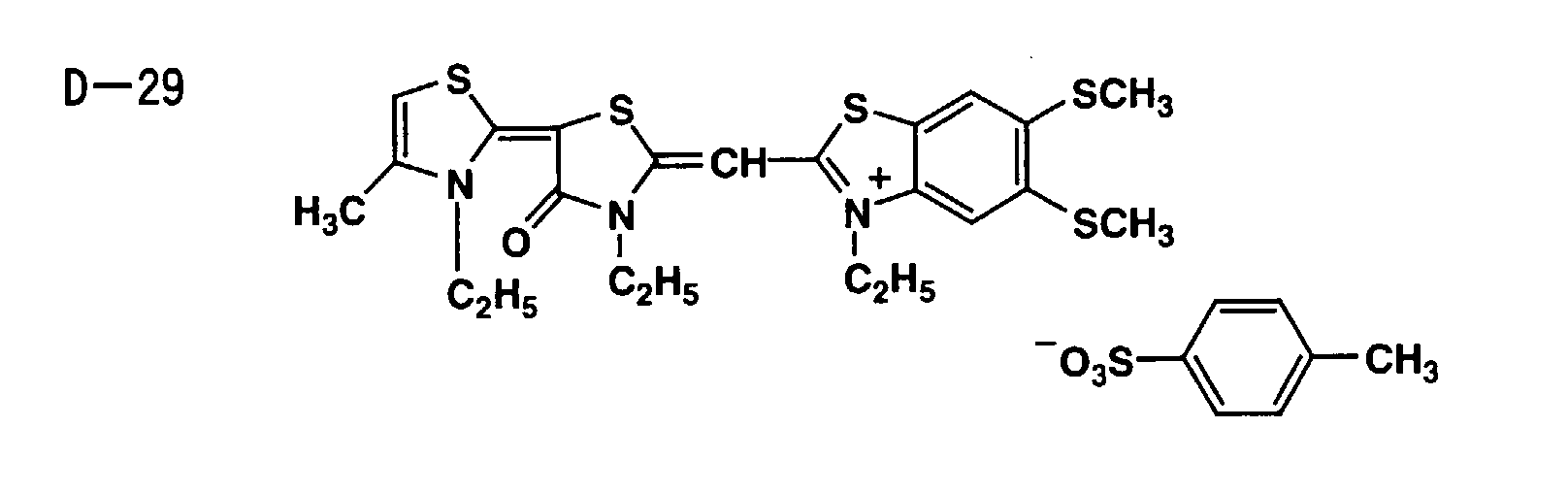
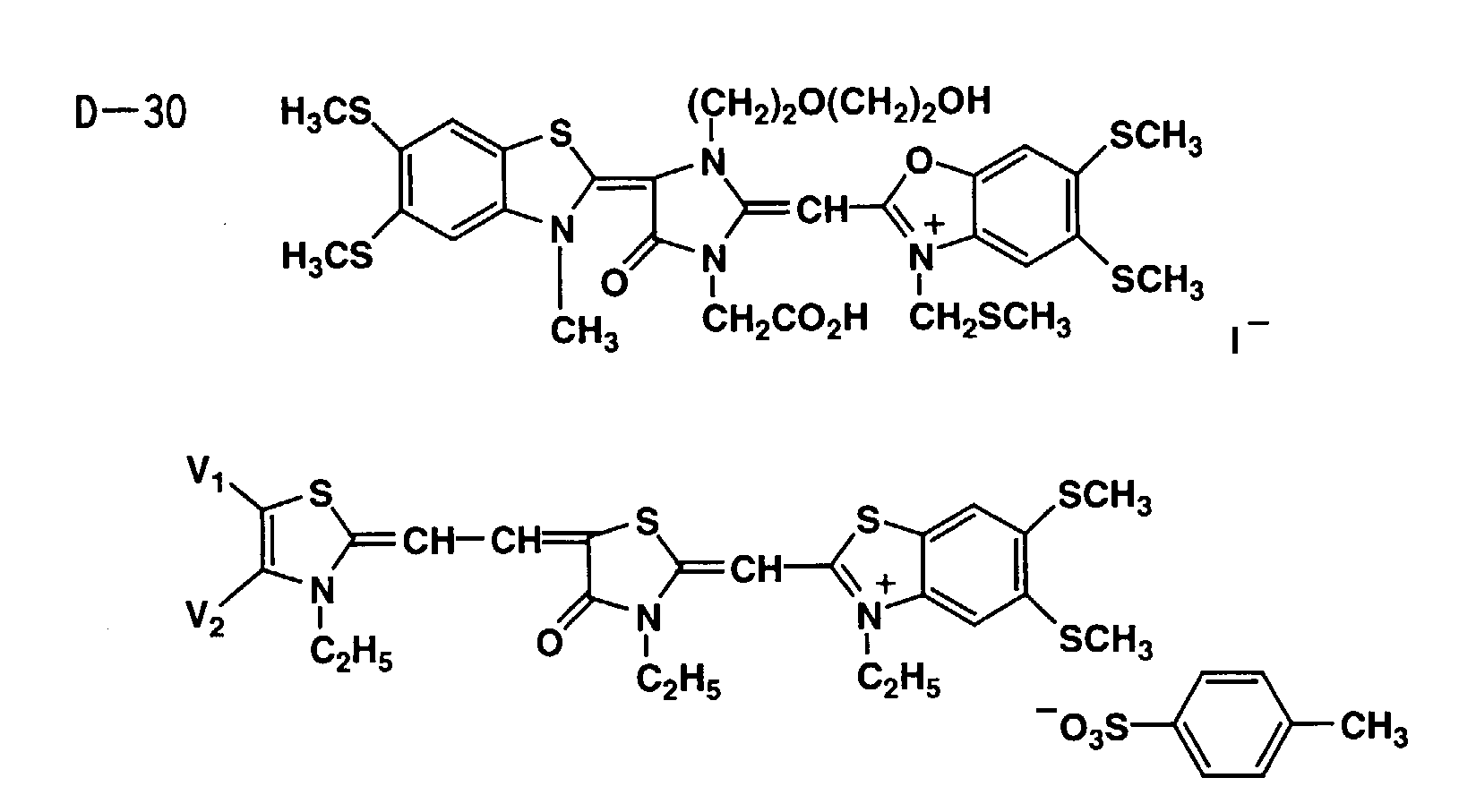
D-31 V1=H, V2=CH3
D-32 V1,V2= -(CH2)4-
D-33 V1,V2= -(CH2)3-
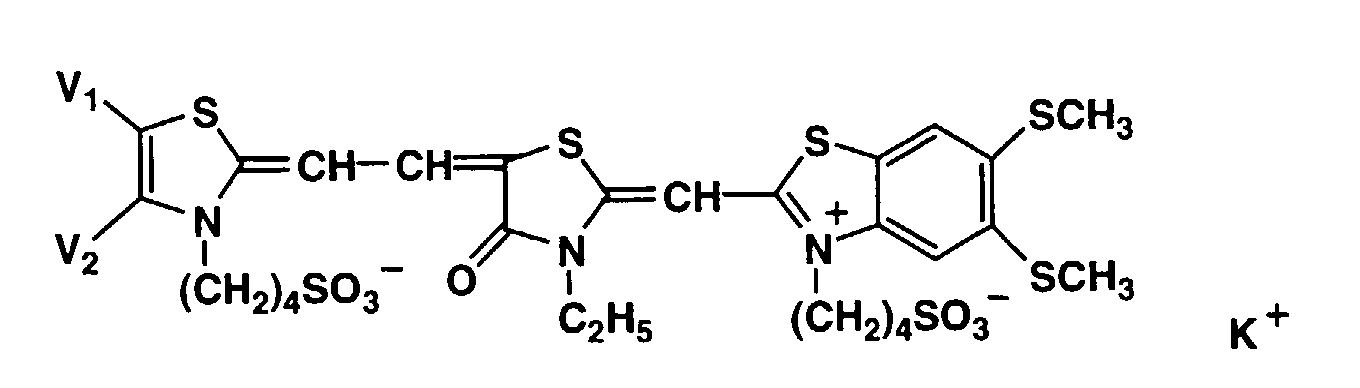
D-34 V1=H, V2=CH3
D-35 V1,V2= -(CH2)4-
D-36 V1,V2= -(CH2)3-
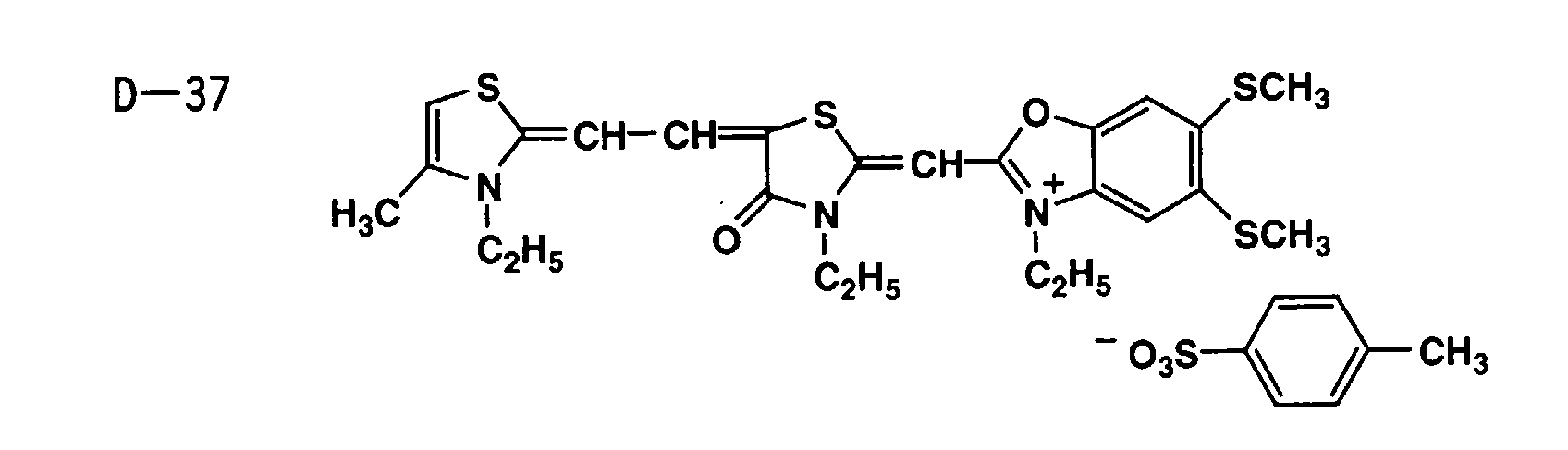

D-39 R= -(CH2)2SCH3

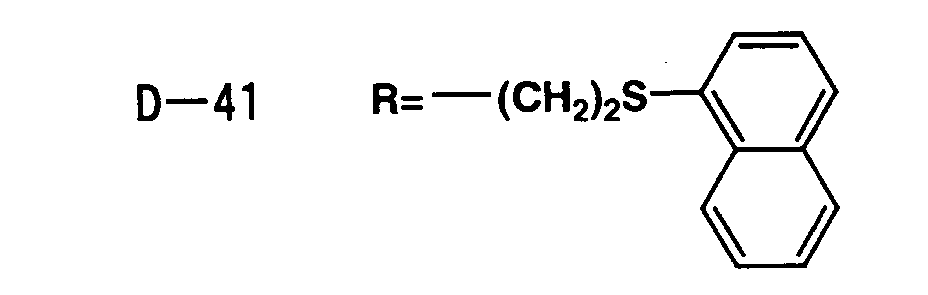
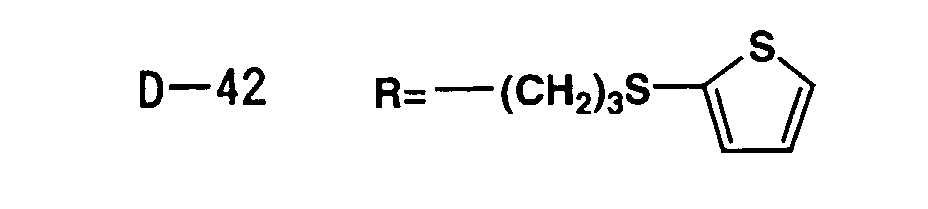

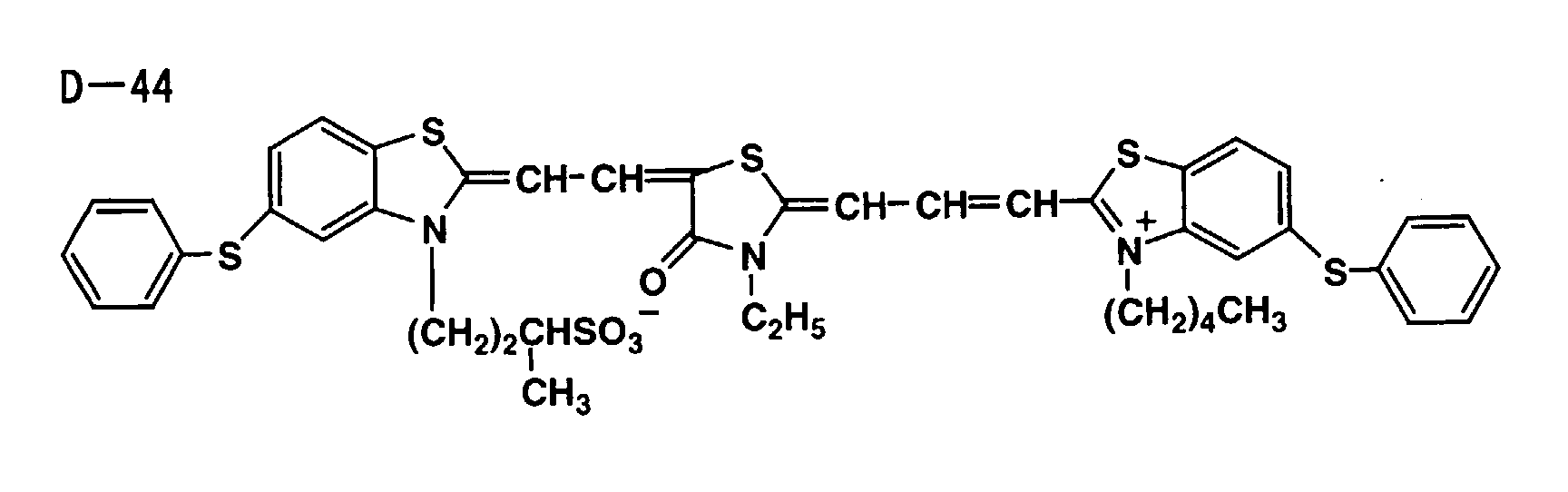
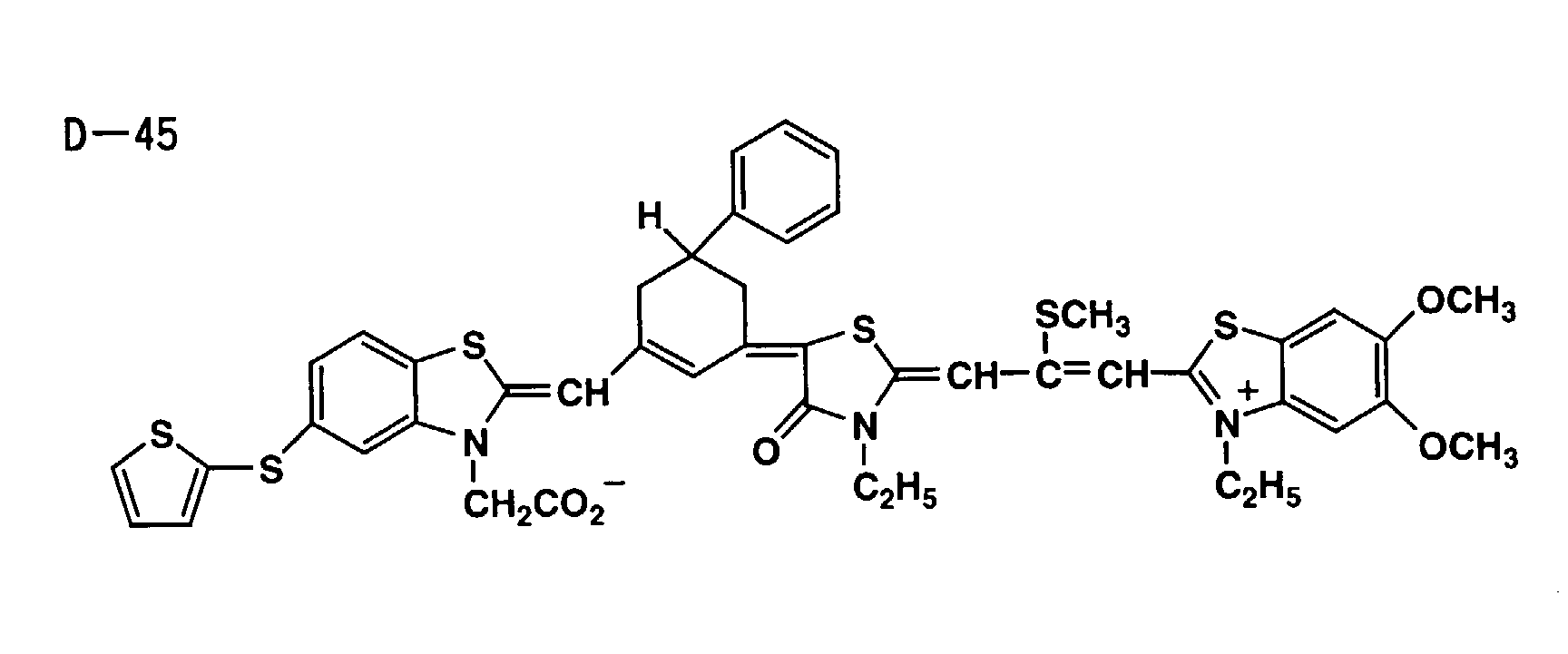

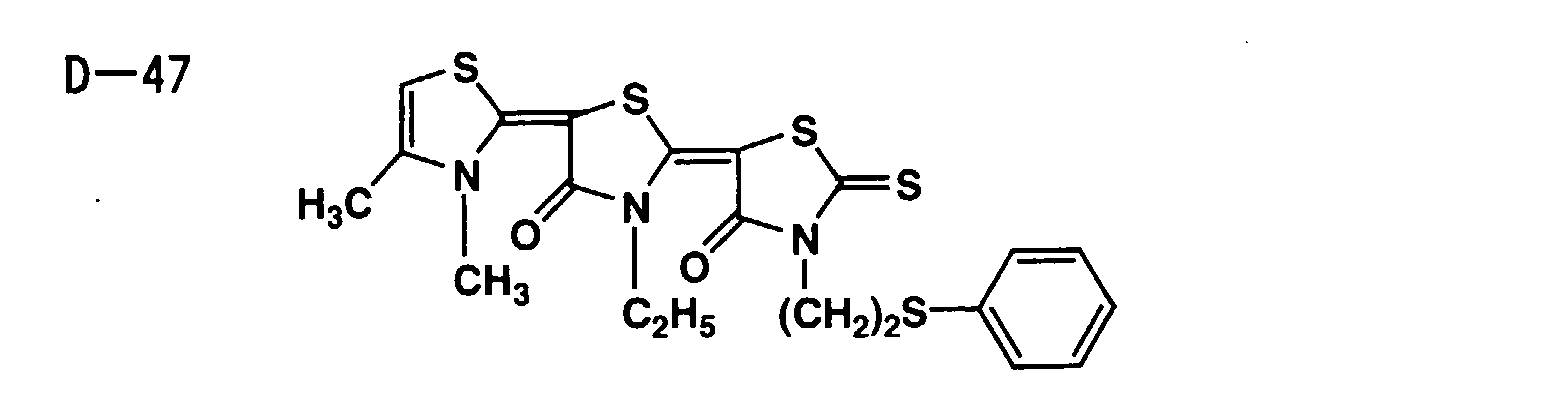
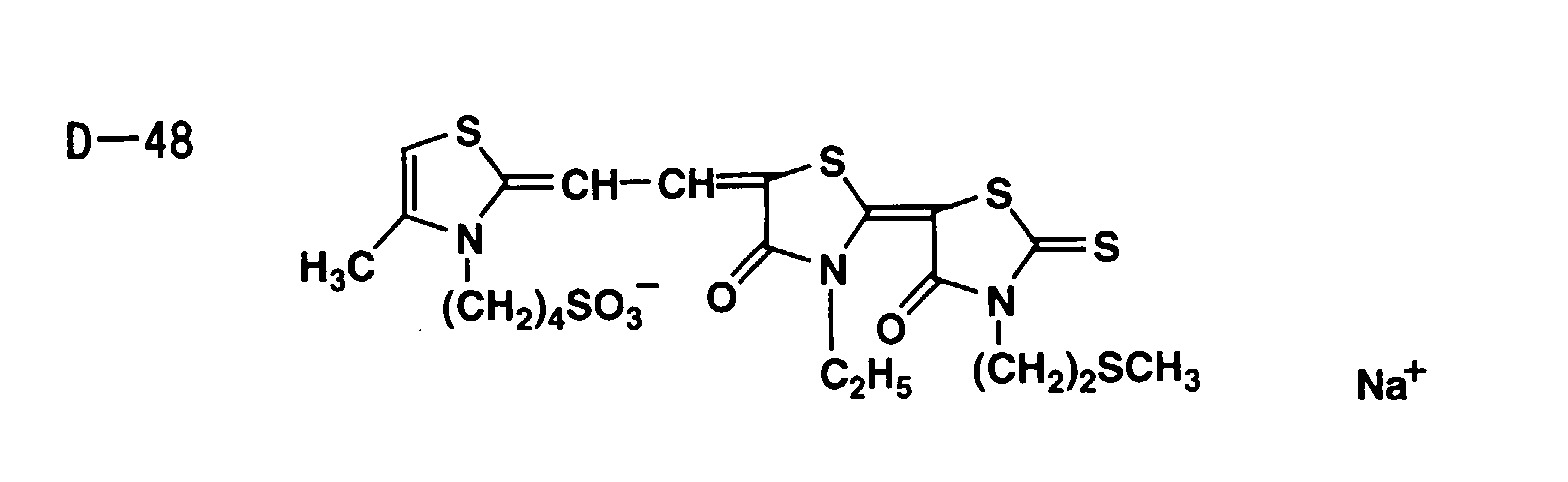
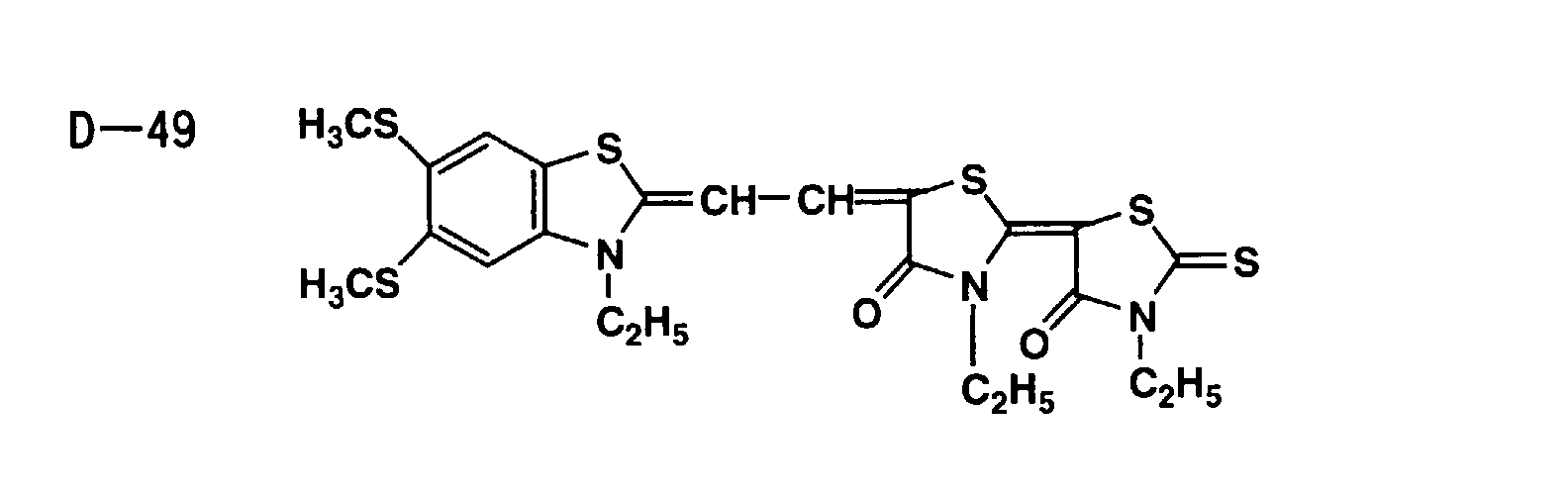
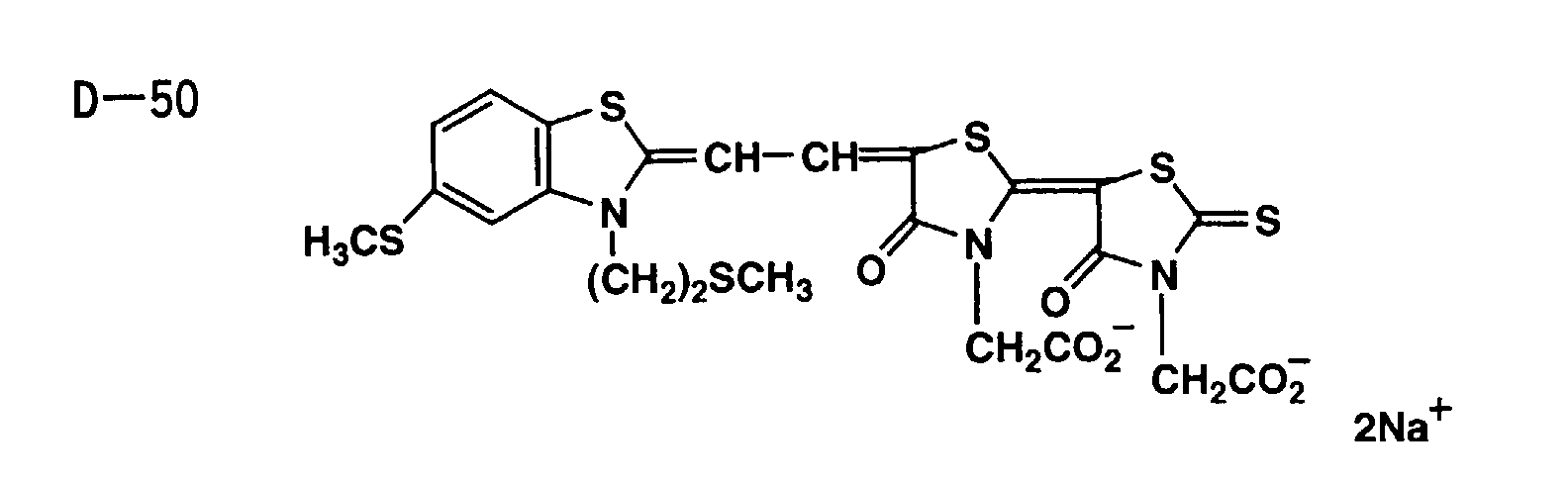

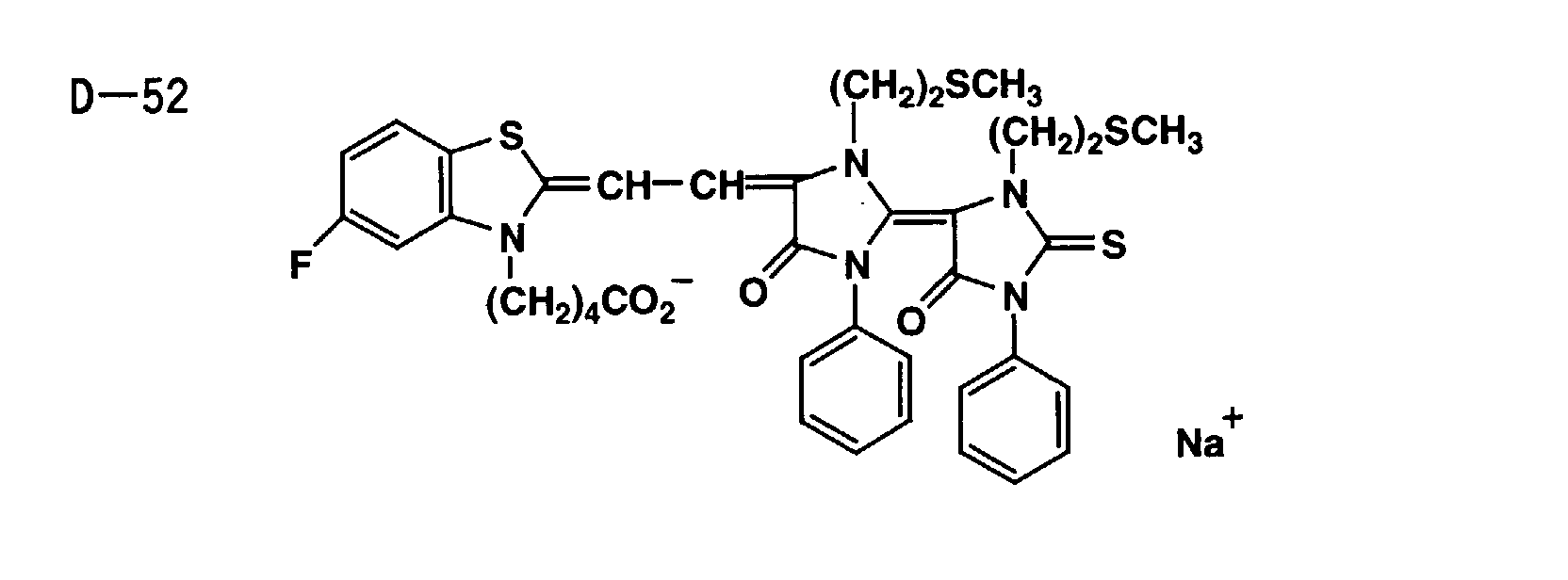
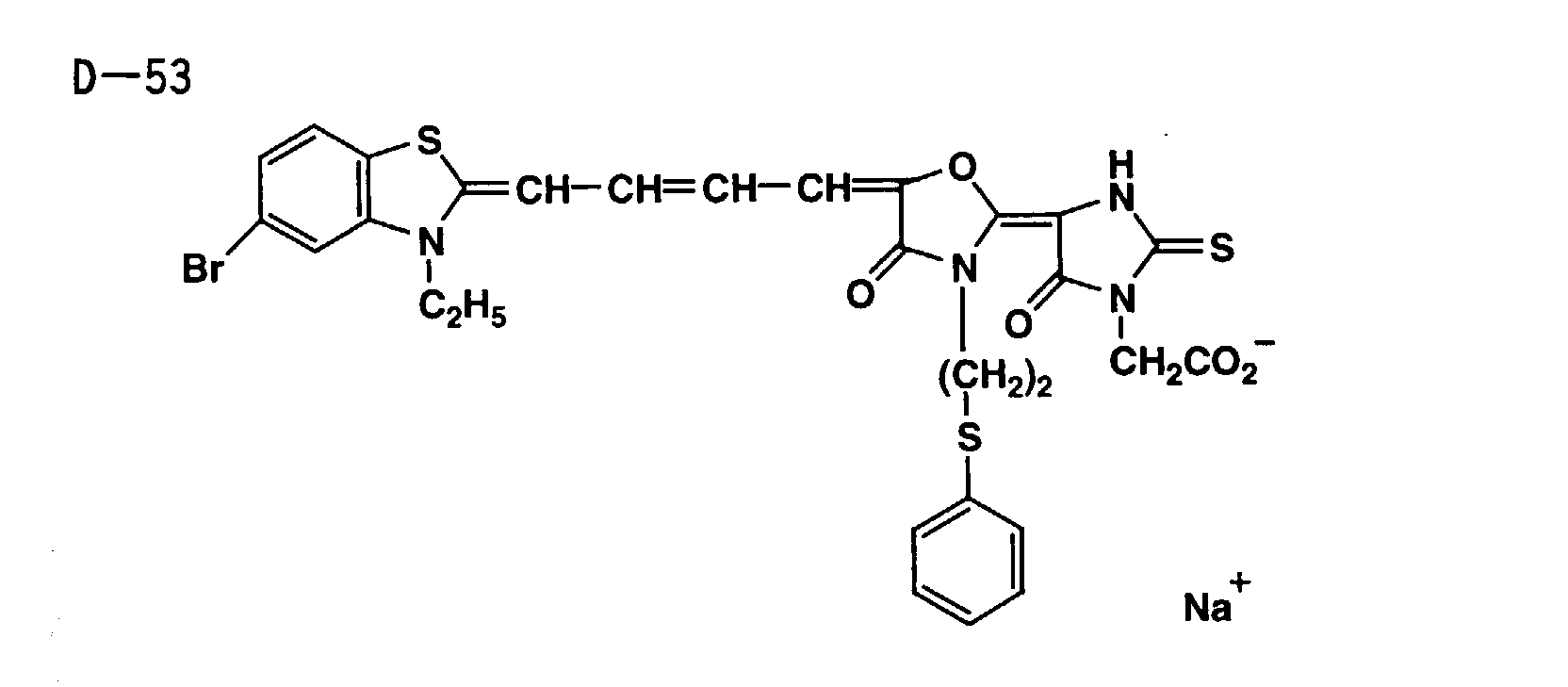

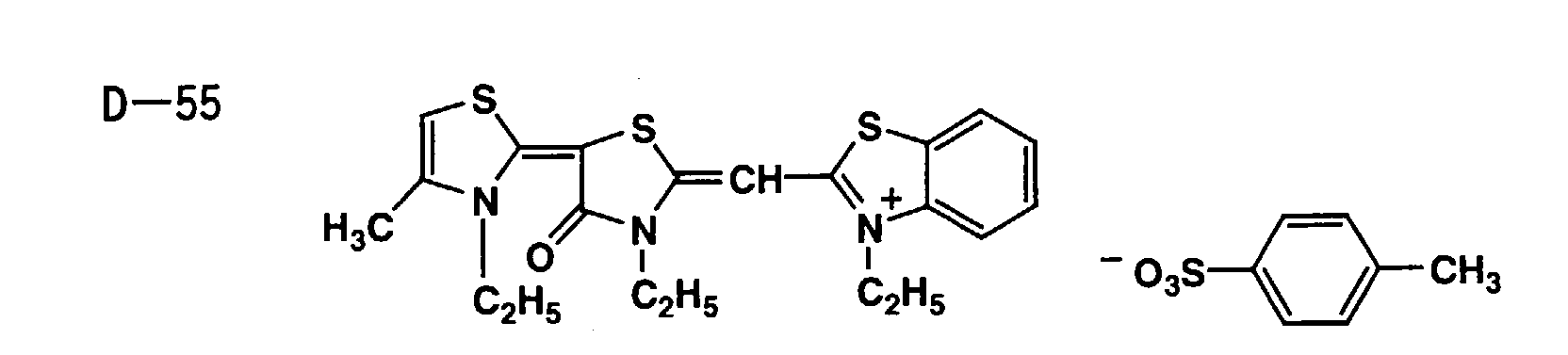

D=57 V1=H,V2=CH3
D-58 V1,V2= -(CH2)4-
D-59 V1,V2= -(CH2)3-

D-60 V1=H, V2=CH3
D-61 V1,V2= -(CH2)4-
D-62 V1,V2= -(CH2)3-

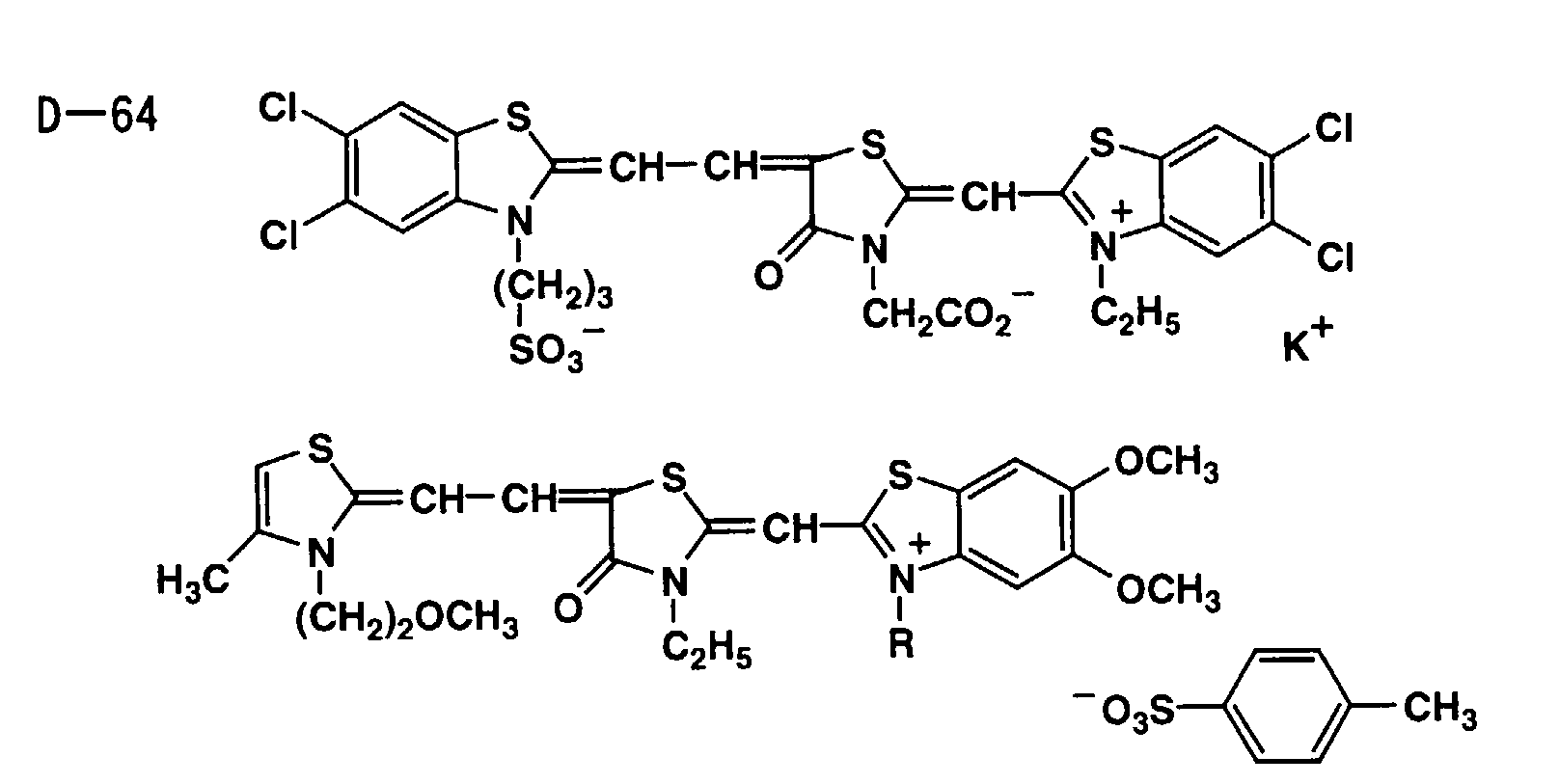
D-65 R= -(CH2)2OCH3
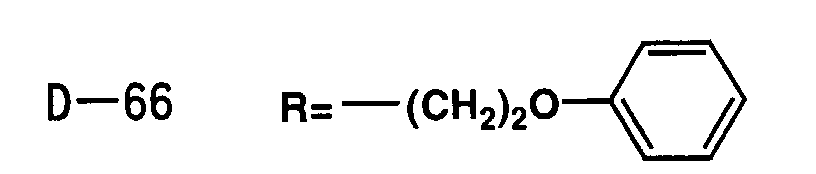
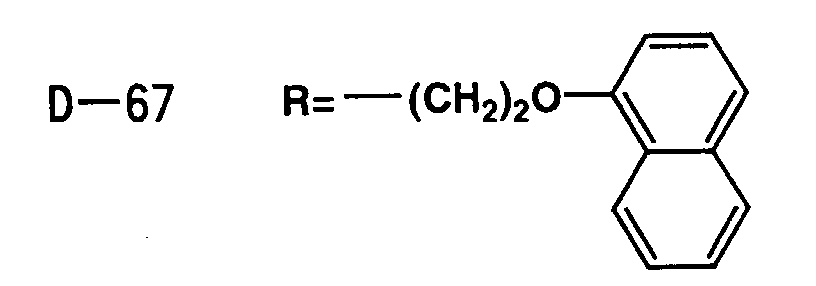

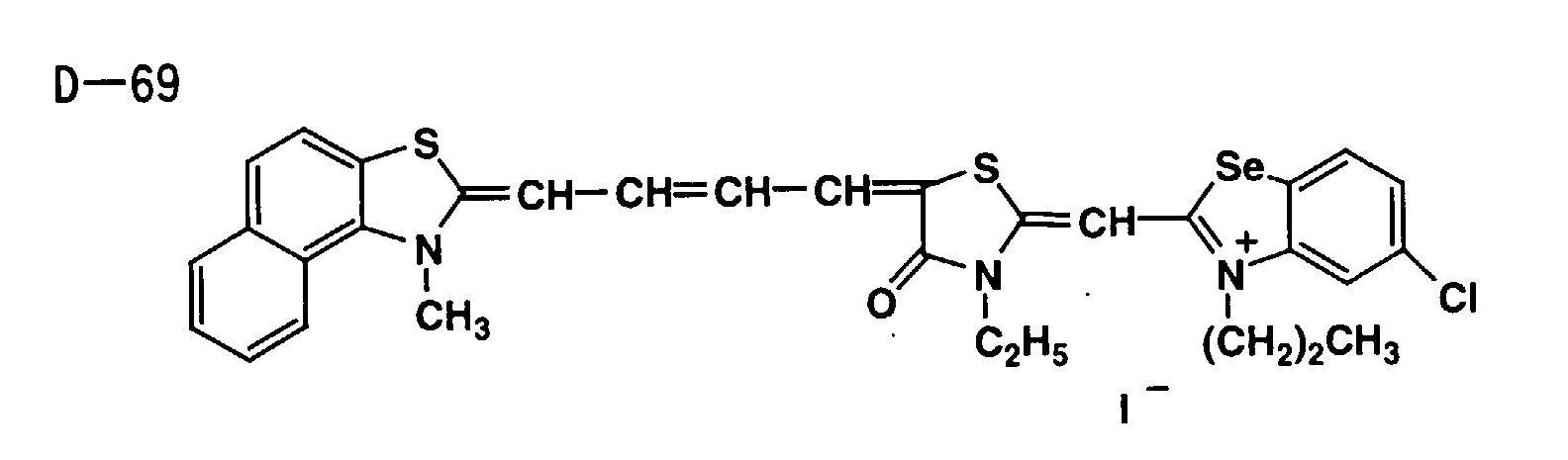
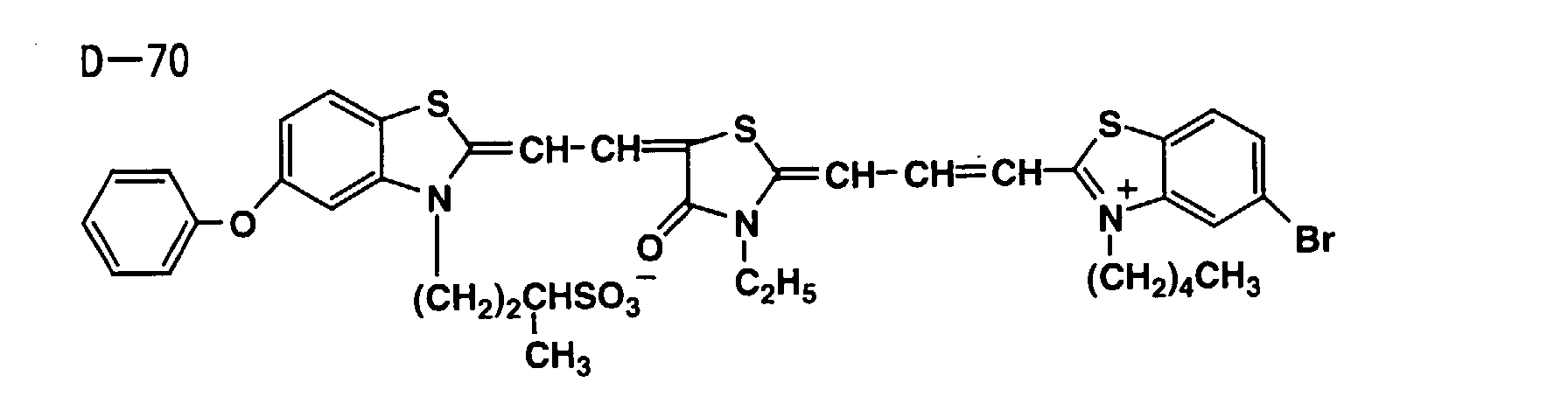

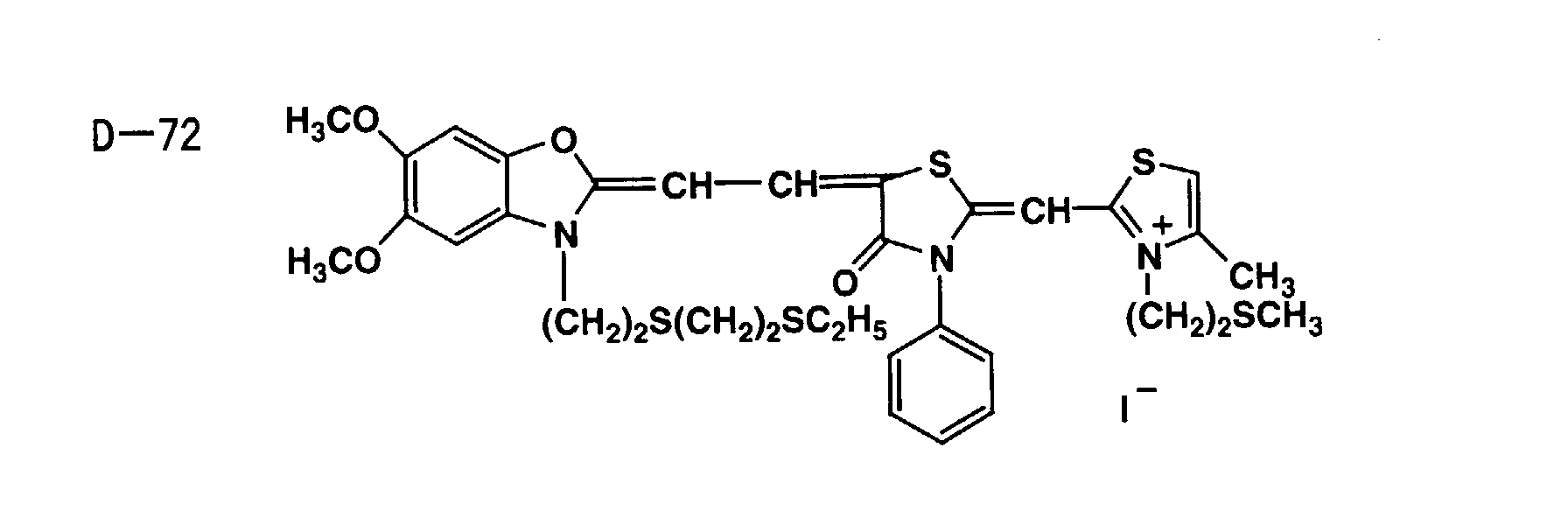
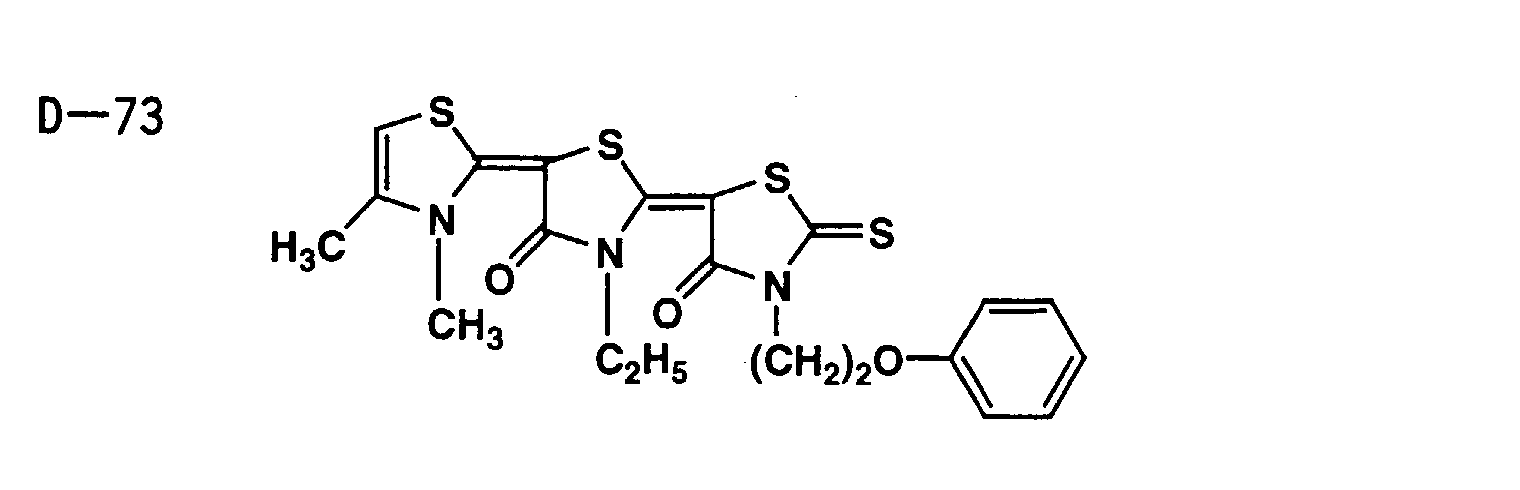
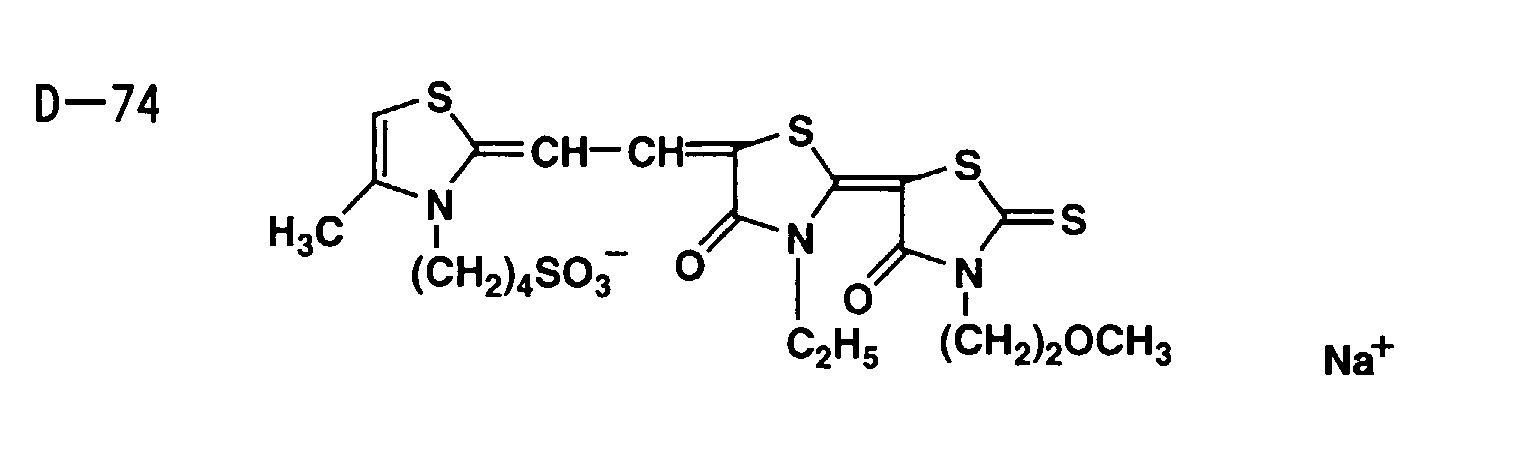


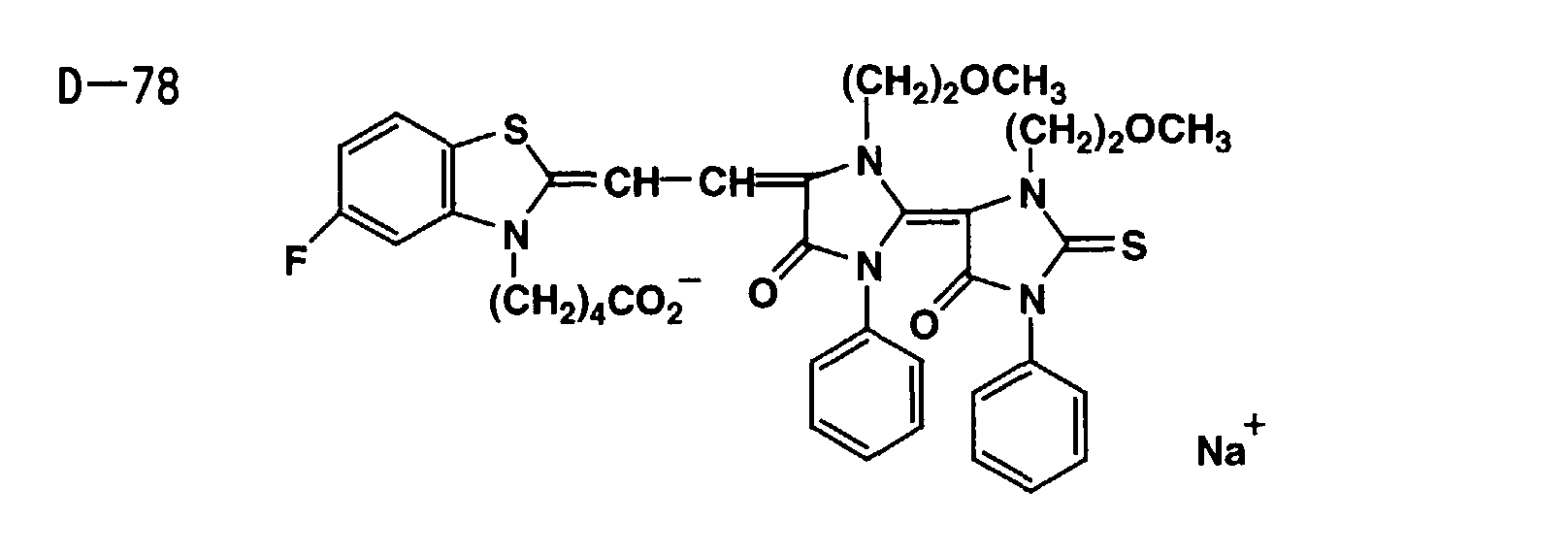
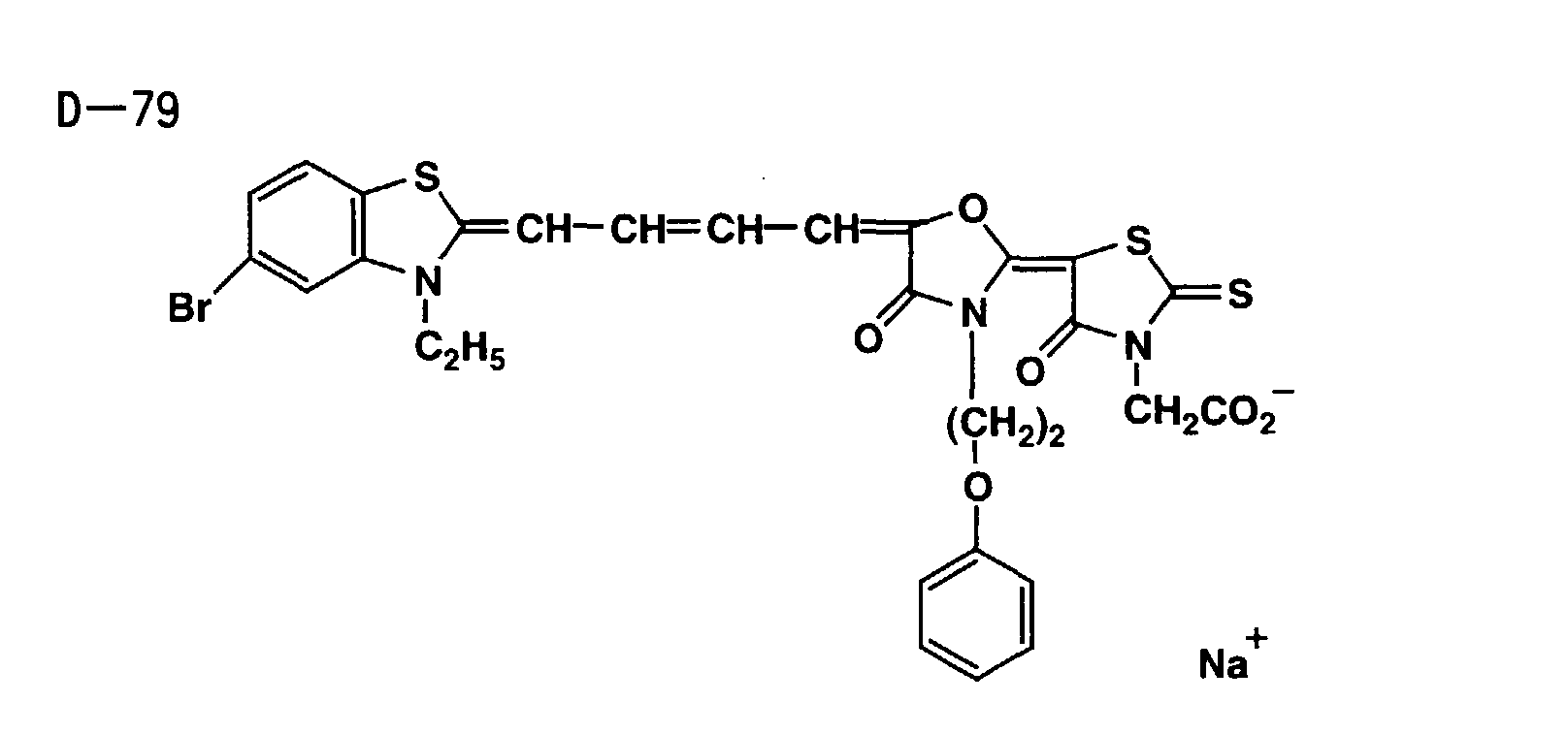

The compounds represented by formulas (2), (3), (4) and
(5) can be synthesized with reference to F.M. Hamer, "Cyanine
Dyes and Related Compounds" in The Chemistry of Heterocyclic
Compounds Vol. 18 (Interscience, New York, 1964); D.M.
Sturmer, "Heterocyclic Compounds, Special Topic in The
Chemistry of Heterocyclic Compounds" Chapter 18, Sect. 14
pages 482-515 (John Wirey & Sons, New York, 1977); Rodd's
Chemistry of Carbon Compounds, 2nd ed. Vol. 5, part B, 1977,
Chapter 15, page 369-422, (published by Elsevier Science
Publishing Company Inc., New York).
Spectral sensitizing dye D-31 can be synthesized
according to the following scheme:
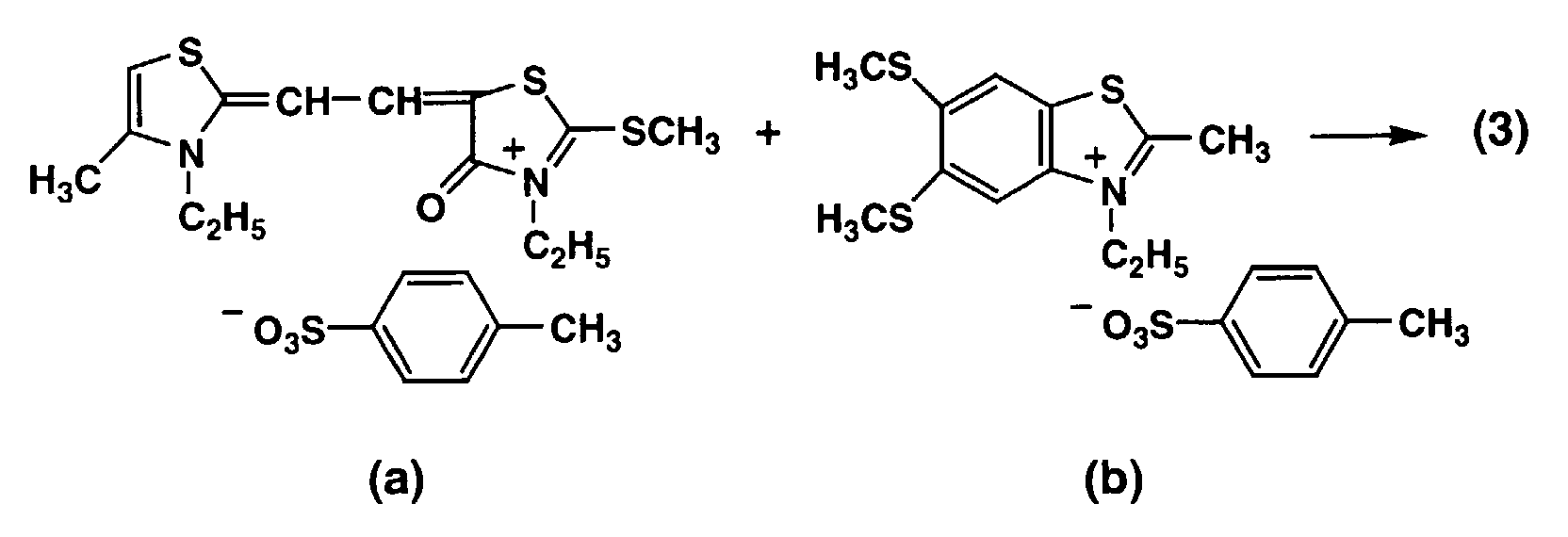
To a mixture of (a) of 0.9 g (0.0018 mol), (b) of 0.8 g
(0.0018 mole) and acetonitrile of 20 ml was added 0.5 ml of
ethylamine and heated on a water bath for 30 min. with
stirring. The reaction mixture was cooled with water, while
stirring and the resulting precipitates were filtered through
suction filtration. The precipitates were refluxed in 50 ml
methanol/50 ml chroloform with heating. After filtration, 50
ml of the solvent was distilled out. After being allowed to
stand, precipitated crystals were filtered through suction
filtration and dried under reduced pressure: D-31 (blue
powder, yield of 0.87 g (67%), λmax=661 nm, ε=94300
(methanol), and m.p. of higher than 250° C).
Silver halide photothermographic material according to
the invention comprises a support having one side thereof a
light-sensitive layer containing light-sensitive silver
halide, which is spectrally sensitized with a sensitizing dye
represented by formula (1), (2) or (3), exhibiting superior
photographic performance with high sensitivity and reduced
fog, little lowering of photographic performance after
storage and improved image lasting quality and image tone.
When a water-resistant protective layer was not
provided, deteriorated photographic performance such as
increased fogging and reduced sensitivity was marked.
Further, lowering of photographic performance after aging,
such as reduced sensitivity after aging was marked, leading
to deteriorated image lasting quality and deteriorated image
tone.
Effects of the invention can be further enhanced by
incorporating the sensitizing dye of formula (1), (2) or (3)
into a light-sensitive silver halide emulsion. Spectral
sensitizing dyes of formulas (1), (2), (3), (4) and (5) can
be used alone or in combination thereof. In cases when used
alone or in combination, the total amount of the dye(s) is
preferably 1x10⁻⁶ to 5x10⁻³ mol, preferably 1x10⁻⁵ to 2.5x10⁻³
mol, and still more preferably 4x10⁻⁵ to 1x10⁻³ mol per mol of
silver halide of a silver halide emulsion.
In cases when dyes are used in combination, the dyes
can be incorporated in any proportion. The dye may be
directly dispersed in a silver halide emulsion.
Alternatively, the may be dissolved in an appropriate solvent
such as methanol, ethanol, n-propanol, methyl cellosolve,
acetone, water, pyridine, or a mixture thereof and added to
the emulsion in the form of a solution. Ultrasonic can also
be employed.
In cases when used in combination, the dyes can be
independently or in the form of a mixture dispersed in a
silver halide emulsion. Together with the dye(s), a visible
region-absorbing dye capable of exhibiting
supersensitization, a dye not exhibiting supersensitization,
or a compound having no absorption in the visible region may
be incorporated into the emulsion. Usable sensitizing dyes
and substances exhibiting supersensitization in combination
with the dye are described in Research Disclosure
(hereinafter, also denoted as "RD") vol. 176, item 17643
(December, 1978) page 23, section IV-J; JP-B 49-15500 and 43-4933;
and JP-A 59-19032, 3-15049 and 62-123454.
Photosensitive silver halide emulsions usable in the
thermally developable photosensitive materials according to
the invention can be prepared according to the methods
commonly known in the photographic art, such as single jet or
double jet addition, or ammoniacal, neutral or acidic
precipitation. Thus, the silver halide emulsion is prepared
in advance and then the emulsion is mixed with other
components of the invention to be incorporated into the
composition used in the invention. To sufficiently bring the
photosensitive silver halide into contact with an organic
silver salt, there can be applied such techniques that
polymers other than gelatin, such as polyvinyl acetal are
employed as a protective colloid in the formation of
photosensitive silver halide, as described in U.S. Patent
3,706,564, 3,706,5653,713,833 and 3,748,143, British Patent
1,362,970; gelatin contained in a photosensitive silver
halide emulsion is degraded with an enzyme, as described in
British Patent 1,354,186; or photosensitive silver halide
grains are prepared in the presence of a surfactant to save
the use of a protective polymer, as described in U.S. Patent
4,076,539.
Silver halide used in the invention functions as light
sensor. Silver halide grains are preferably small in size to
prevent milky-whitening after image formation and obtain
superior images. The grain size is preferably not more than
0.1 µm, more preferably, 0.01 to 0.1 µm, and still more
preferably, 0.02 to 0.08 µm. The form of silver halide
grains is not specifically limited, including cubic or
octahedral, regular crystals and non-regular crystal grains
in a spherical, bar-like or tabular form. Halide composition
thereof is not specifically limited, including any one of
silver chloride, silver chlorobromide, silver
iodochlorobromide, silver bromide, silver iodobromide, and
silver iodide. The halide composition of the grains may be
homogeneous, or stepwise or continuously varied in the
interior of the grain. Silver halide grains used in the
photothermographic material are preferably contain iodide, in
the vicinity of the grain surface, of 0.1 to 10 mol% on the
average, based on the total grains.
Light-sensitive silver halide used in the
photothermographic material of the invention can be formed
simultaneously with the formation of organic silver salt by
allowing a halide component such as a halide ion to
concurrently be present together with organic silver salt-forming
components and further introducing a silver ion
thereinto during the course of preparing the organic silver
salt.
Alternatively, a silver halide-forming component is
allowed to act onto a pre-formed organic silver salt solution
or dispersion or a sheet material containing an organic
silver salt to convert a part of the organic silver salt to
light-sensitive silver halide. The thus formed silver halide
is effectively in contact with the organic silver salt,
exhibiting favorable actions. In this case, the silver
halide-forming component refers to a compound capable of
forming silver salt upon reaction with the organic silver
salt. Such a compound can be distinguished by the following
simple test. Thus, a compound to be tested is to be mixed
with the organic silver salt, and if necessary, the presence
of a peal specific to silver halide can be confirmed by the
X-ray diffractometry, after heating. Compounds that have
been confirmed to be effective as a silver halide-forming
component include inorganic halide compounds, onium halides,
halogenated hydrocarbons, N-halogeno compounds and other
halogen containing compounds. These compounds are detailed
in U.S. Patent 4,009,039, 3,457,075 and 4,003,749, British
Patent 1,498,956 and JP-A 53-27027 and 53-25420. Exemplary
examples thereof are shown below:
The silver halide forming component is used
stoichiometrically in a small amount per organic silver salt.
Thus, it is preferably 0.001 to 0.7 mol, and more preferably
0.03 to 0.5 mol per mol of organic silver salt. The silver
halide-forming component may be used in combination.
Conditions including a reaction temperature, reaction time
and reaction pressure during the process of converting a part
of the organic silver salt to silver halide using the silver
halide forming component can be appropriately set in
accordance with the purpose of preparation. The reaction
temperature is preferably -20° C to 70° C, the reaction time
is preferably 0.1 sec to 72 hrs. and the reaction pressure is
preferably atmospheric pressure. The reaction is performed
preferably in the presence of polymer as a binder, wherein
the polymer to be used is preferably 0.01 to 100 weight
parts, and more preferably 0.1 to 10 weight parts per 1
weight part of an organic silver salt.
The thus formed light-sensitive silver halide can be
chemically sensitized with a sulfur containing compound, gold
compound, platinum compound, palladium compound, silver
compound, tin compound, chromium compound or their
combination. The method and procedure for chemical
sensitization are described in U.S. Patent 4,036,650, British
Patent 1,518,850, JP-A 51-22430, 51-78319 and 51-81124. As
described in U.S. Patent 3,980,482, a low molecular weight
amide compound may be concurrently present to enhance
sensitivity at the time of converting a part of the organic
silver salt to photosensitive silver halide.
To improve reciprocity law failure or adjust contrast,
the photosensitive silver halide may be contained with metal
ions of the 6th group to 10th group in the periodical table,
such as Rh, Ru, Re, Ir, Os, Fe and their complexes and
complex ions. Specifically, complex ions are preferred,
e.g., Ir complex ions such as IrCl6 2- are preferably contained
to improve reciprocity law failure.
The light-sensitive layer of the photothermographic
material used in the invention preferably contains binder,
which is mainly comprised of polymeric latex. Herein, the
polymeric latex is a water-insoluble polymeric material which
is dispersed in an aqueous dispersing medium in the form of
fine particles. The dispersion form thereof may be any one
of a form in which a polymer is emulsified in a dispersing
medium, a form of being emulsion-polymerized, being dispersed
in the form of a micell and a form in which a polymer has a
hydrophilic partial structure and its molecular chain is in
the form of a molecular dispersion. The polymeric latexes
are described in "Synthetic Resin Emulsion" (edited by T.
Okuda and h. Inagaki, published by KOBUNSHI-KANKOKAI, 1978),
"Application of Synthetic Latex" (edited by Sugimura et al.,
published by KOBUNSHI-KANKOKAI, 1993), and "Chemistry of
Synthetic Latex" (S. Muroi, published by KOBUNSHI-KANKOKAI,
1970).
The mean particle size of dispersing particles is 1 to
50,000 nm, and preferably 5 to 1,000 nm. The particle size
distribution thereof is not specifically limited and may be
polydisperse or monodisperse. The polymeric latexes used in
the invention may be those having a uniform structure as well
as core/shell type latexes. In this case, it is sometimes
preferred that the glass transition temperature is different
between the core and shell. The minimum forming (or
tarnishing) temperature (MFT) of the polymeric latexes is
preferably -30° C to 90° C, and more preferably 0° C to 70°
C. A tarnishing aid is also called a plasticizer, which is
an organic compound (conventionally, an organic solvent)
capable of lowering the MFT of a polymeric latex and
described in "Chemistry of Synthetic Latex" (S. Muroi,
published by KOBUNSHI-KANKOKAI, 1970).
Polymers used for polymeric latexes include acryl
resin, vinyl acetate resin, polyester resin, polyurethane
resin, rubber type resin, vinyl chloride resin, vinylidene
chloride resin, polyolefin resin and their copolymers.
Polymers may be a straight-chained polymer or branched
polymer, or a cross-linked polymer, including homopolymers
and copolymers. The copolymer may be a random copolymer or a
block copolymer. The number-averaged molecular weight of the
copolymer is preferably 5,000 to 1000,000, and more
preferably 10,000 to 100,000. In cases where the molecular
weight is excessively small, mechanical strength of an image
forming layer such as a light-sensitive layer is
insufficient, excessively large molecular weight results in
deterioration in film forming property. Polymers used for
polymeric latexes preferably has an equilibrium moisture
content of not more than 2 wt%, and more preferably 1 wt% or
less at 25° C and 60% RH. The lower limit of the equilibrium
moisture content is not specifically limited, but preferably
0.01 wt%, and more preferably 0.03 wt%. Definition and
measurement of the equilibrium moisture content is detailed
in "Polymer Material Testing Method" in Polymer Engineering
Series vol.14 (edited by KOBUNSHI-GAKKAI, published by
CHJINSHOKAN).
Exemplary examples of polymeric latexes used as binder
include a latex of methylmethacrylate/ethylmethacrylate/
methacrylic acid copolymer, a latex of methylmethacrylate/2-ethylhexylacrylate/styrene/acrylic
acid copolymer, a latex of
styrene/butadiene/acrylic acid copolymer, a latex of
styrene/butadiene/divinylbenzene/methacrylic acid copolymer,
a latex of methylmethacrylate/vinyl chloride/acrylic acid
copolymer, and a latex of vinylidene
chloride/ethylacrylate/acrylonitrile/methacrylic acid
copolymer. Such polymers are commercially available, and
examples of commercially available acryl resin include Sevian
A-4635, 46583, and 4601 (available from DAISEL CHEMICAL INd.
Ltd.)Nipol Lx811, 814, 821, 820, and 857 (available from
NIHON ZEON Co. Ltd. Examples of polyester rein include
FINETEX ES650, 611, 675, 850 (available from DAINIPPON INK
CHEMICAL Co. Ltd.), and WD-size WMS (available from Eastman
Kodak Corp.). Examples of polyurethane resin include HYDRAN
AP10, 20, 30, 40 (available from DAINIPPON INK CHEMICAL Co.
Ltd.). Examples of rubber resin include LACSTAR 7310K, 3307,
4700H, 7132C (available from DAINIPPON INK CHEMICAL Co.
Ltd.); and Nipol Lx416, 410, 438C and 2507 (available from
NIHON ZEON Co. Ltd.). Examples of vinylidene chloride resin
include L502, L513 (available from ASAHI CHEMICAL IND. Co.
Ltd.). Examples of olefin resin include CHEMIPAL s120,
SA100 (available from MITSUI PETROLEUM CHEMICAL IND. Co.
Ltd.).
These polymers can be used alone or may be blended. In
the invention, the main binder in the light-sensitive layer,
alternatively, the expression of the binder, which is mainly
comprised of polymeric latex means that preferably, at least
50 wt%, and more preferably at least 70 wt% of the whole
binder in the light-sensitive layer is accounted for by the
polymer, i.e., polymeric latex used in the invention. The
binder may be a polymer alone or blended polymers. In
addition to the polymeric latex, hydrophilic polymers such as
gelatin polyvinyl alcohol, methyl cellulose or hydroxypropyl
cellulose may be optionally incorporated into the light-sensitive
layer (or emulsion layer). The hydrophilic polymer
is incorporated preferably in an amount of not more than 30
wt%, and more preferably not more than 20 wt% of the whole
binder. The ratio by weight of the whole binder to silver
halide in the light-sensitive layer is preferably 5 to 400,
and more preferably 10 to 200.
Organic silver salts used in the invention are
reducible silver source, and silver salts of organic acids or
organic heteroacids are preferred and silver salts of long
chain fatty acid (preferably having 10 to 30 carbon atom and
more preferably 15 to 25 carbon atoms) or nitrogen containing
heterocyclic compounds are more preferred. Specifically,
organic or inorganic complexes, ligand of which have a total
stability constant to a silver ion of 4.0 to 10.0 are
preferred. Exemplary preferred complex salts are described
in RD17029 and RD29963, including organic acid salts (for
example, salts of gallic acid, oxalic acid, behenic acid,
stearic acid, palmitic acid, lauric acid, etc.);
carboxyalkylthiourea salts (for example, 1-(3-carboxypropyl)thiourea,
1-(3-caroxypropyl)-3,3-dimethylthiourea,
etc.); silver complexes of polymer reaction
products of aldehyde with hydroxy-substituted aromatic
carboxylic acid (for example, aldehydes (formaldehyde,
acetaldehyde, butylaldehyde, etc.), hydroxy-substituted acids
(for example, salicylic acid, benzoic acid, 3,5-dihydroxybenzoic
acid, 5,5-thiodisalicylic acid, silver salts
or complexes of thiones (for example, 3-(2-carboxyethyl)-4-hydroxymethyl-4-(thiazoline-2-thione
and 3-carboxymethyl-4-thiazoline-2-thione),
complexes of silver with nitrogen acid
selected from imidazole, pyrazole, urazole, 1.2,4-thiazole,
and 1H-tetrazole, 3-amino-5-benzylthio-1,2,4-triazole and
benztriazole or salts thereof; silver salts of saccharin, 5-chlorosalicylaldoxime,
etc.; and silver salts of mercaptides.
Of these organic silver salts, silver salts of fatty acids
are preferred, and silver salts of behenic acid, arachidic
acid and stearic acid are specifically preferred.
The organic silver salt compound can be obtained by
mixing an aqueous-soluble silver compound with a compound
capable of forming a complex. Normal precipitation, reverse
precipitation, double jet precipitation and controlled double
jet precipitation described in JP-A 9-127643 are preferably
employed. For example, to an organic acid is added an alkali
metal hydroxide (e.g., sodium hydroxide, potassium hydroxide,
etc.) to form an alkali metal salt soap of the organic acid
(e.g., sodium behenate, sodium arachidinate, etc.),
thereafter, the soap and silver nitrate are mixed by the
controlled double jet method to form organic silver salt
crystals. In this case, silver halide grains may be
concurrently present.
In the present invention, organic silver salts have an
average grain size of 2 µm or less and are monodispersed.
The average size of the organic silver salt as described
herein is, when the grain of the organic salt is, for
example, a spherical, cylindrical, or tabular grain, a
diameter of the sphere having the same volume as each of
these grains, i.e., a sphere-equivalent diameter. The
average grain size is preferably between 0.05 and 1.5 µm,
more preferably between 0.05 and 1.0 µm and still more
preferably between 0.05 and 0.5 µm. Furthermore, the
monodisperse as described herein is the same as silver halide
grains and preferred monodispersibility is between 1 and 30%.
It is also preferred that at least 60% of the total of
the organic silver salt is accounted for by tabular grains.
The tabular grains refer to grains having a ratio of an
average grain diameter to grain thickness, i.e., aspect ratio
(denoted as AR) of 3 or more:
AR = average diameter (µm) / thickness (µm)
To obtain such tabular organic silver salts, organic silver
salt crystals are pulverized together with a binder or
surfactant, using a ball mill. Thus, using these tabular
grains, photosensitive materials exhibiting high density and
superior image fastness are obtained.
The silver salts used in the invention may be employed
in the form of powder or wet cake.
To prevent hazing of the photosensitive material, the
total amount of silver halide and organic silver salt is
preferably 0.5 to 2.2 g in equivalent converted to silver per
m2, leading to high contrast images. The amount of silver
halide is preferably 50% by weight or less, more preferably
25% by weight or less, and still more preferably 0.1 to 15%
by weight, based on the total silver amount.
Commonly known reducing agents are used in
phtothermographic materials, including phenols, polyphenols
having two or more phenols, naphthols, bisnaphthols,
polyhydoxybenzenes having two or more hydroxy groups,
polyhydoxynaphthalenes having two or more hydroxy groups,
ascorbic acids, 3-pyrazolidones, pyrazoline-5-ones,
pyrazolines, phenylenediamines, hydroxyamines, hydroquinone
monoethers, hydrooxamic acids, hydrazides, amidooximes, and
N-hydroxyureas. Further, exemplary examples thereof are
described in U.S. Patent 3,615,533, 3,679,426, 3,672,904,
3,51,252, 3,782,949, 3,801,321, 3,794,488, 3,893,863,
3,887,376, 3,770,448, 3,819,382, 3,773,512, 3,839,048,
3,887,378, 4,009,039, and 4,021,240; British Patent
1,486,148; Belgian Patent 786,086; JP-A 50-36143, 50-36110,
50-116023, 50-99719, 50-140113, 51-51933, 51-23721, 52-84727;
and JP-B 51-35851.
Of these reducing agents, in cases where fatty acid
silver salts are used as an organic silver salt, preferred
reducing agents are polyphenols in which two or more phenols
are linked through an alkylene group or a sulfur atom,
specifically, polyphenols in which two or more phenols are
linked through an alkylene group or a sulfur atom and the
phenol(s) are substituted at least a position adjacent to a
hydroxy group by an alkyl group (e.g., methyl, ethyl, propyl,
t-butyl, cyclohexyl) or an acyl group (e.g., acetyl,
propionyl). Examples thereof include polyphenols compounds
such as 1,1-bis(2-hydroxy-3,5-dimethylphenyl)-3,5,5-trimethylhexane,
1,1-bis(2-hydroxy-3-t-butyl-5-methyphenyl)methane,
1,1-bis(2-hydroxy-3,5-di-t-butylphenyl)methane,
2-hydroxy-3-t-butyl-5-methylphenyl)-(2-hydroxy-5-methylphenyl)methane,
6,6'-benzylidene-bis(2,4-di-t-butylphenol),
6,6'-benzylidene-bis(2-t-butyl-4-methylphenol),
6,6'-benzylidene-bis(2,4-dimethylphenol), 1,1-bis(2-hydroxy-3,5-dimethylphenyl)-2-methylpropane,
1,1,5,5-tetrakis(2-hydroxy-3,5-dimethylphenyl)-2,4-ethylpentane,
2,2-bis(4-hydroxy-3,5-dimethylphenyl)propane,
2,2-bis(4-hydroxy-3,5-di-t-butylphenyl)propane,
as described in U.S. Patent
3,589,903 and 4,021,249, British Patent 1,486,148, JP-A 51-51933,
50-36110 and 52-84727 and JP-B 51-35727; bisnaphthols
described in U.S. Patent 3,672,904, such as 2,2'dihydoxy-1,1'-binaphthyl,
6,6'-dibromo-2,2'-dihydroxy-1,1'-binaphthyl,
6,6'-dinitro-2,2'-dihydroxy-1,1'-binaphtyl, bis(2-hydroxy-1-naphthyl)methane,
4,4'-dimethoxy-1,1'-dihydroxy-2,2'-binaphthyl;
sulfonamidophenols or sulfonamidonaphthols
described in U.S. Patent 3,801,321, such as 4-benzenesulfonamidophenol,
2-benzenesulfonamidophenol, 2,6-dichloro-4-benzenesulfonamidophenol
and 4-benzenesulfonamidonaphthol.
The amount of the reducing agent to be used in the
thermally developable photosensitive material, depending on
the kind of an organic silver salt or reducing agent is
preferably 0.05 to 10 mol, and more preferably 0.1 to 3 mol
per mol of organic silver salt. Two or more kinds of
reducing agents may be used in combination within the amount
described above. It is also preferred to add the reducing
agent to a photosensitive coating solution immediately before
coating, in terms of reduced variation in photographic
performance occurred during standing.
Thermally developable photothermographic materials form
images through thermal development and comprise a reducible
silver source (organic silver salt), a light-sensitive silver
halide, a reducing agent and optionally a toning agent for
silver images, which are preferably dispersed in a (organic)
binder matrix. The thermally developable photosensitive
material according to the invention, which is stable at
ordinary temperatures, is exposed and then heated at a high
temperature (e.g., 80-140° C) to undergo development. Thus,
silver is formed on heating through oxidation-reduction
reaction between an organic silver salt (functioning as an
oxidizing agent) and a reducing agent. The oxidation-reduction
reaction is catalytically accelerated by a latent
image produced in silver halide upon exposure. Silver formed
through reaction of the organic silver salt in exposed areas
provides black images contrasting to non-exposed areas,
performing image formation. This reaction process proceeds
without supplying a processing solution such as water from
the outside.
Image toning agents are preferably incorporated into
the thermally developable photosensitive material used in the
present invention. Examples of preferred image toning agents
are disclosed in Research Disclosure Item 17029, and include
the following:
imides (for example, phthalimide), cyclic imides, pyrazoline-5-one, and quinazolinone (for example, succinimide, 3-phenyl-2-pyrazoline-5-on, 1-phenylurazole, quinazoline and 2,4-thiazolidione); naphthalimides (for example, N-hydroxy-1,8-naphthalimide); cobalt complexes (for example, cobalt hexaminetrifluoroacetate), mercaptans (for example, 3-mercapto-1,2,4-triazole); N-(aminomethyl)aryldicarboxyimides (for example, N-(dimethylaminomethyl)phthalimide); blocked pyrazoles, isothiuronium derivatives and combinations of certain types of light-bleaching agents (for example, combination of N,N'-hexamethylene(1-carbamoyl-3,5-dimethylpyrazole), 1,8-(3,6-dioxaoctane)bis-(isothiuroniumtrifluoroacetate), and 2-(tribromomethyl-sulfonyl)benzothiazole; merocyanine dyes (for example, 3-ethyl-5-((3-etyl-2-benzothiazolinylidene(benzothiazolinylidene))-1-methylethylidene-2-thio-2,4-oxazolidinedione); phthalazinone, phthalazinone derivatives or metal salts thereof (for example, 4-(1-naphthyl)phthalazinone, 6-chlorophthalazinone, 5,7-dimethylphthalazinone, and 2,3-dihydro-1,4-phthalazinedione); combinations of phthalazinone and sulfinic acid derivatives (for example, 6-chlorophthalazinone and benzenesulfinic acid sodium, or 8-methylphthalazinone and p-trisulfonic acid sodium); combinations of phthalazine and phthalic acid; combinations of phthalazine (including phthalazine addition products) with at least one compound selected from maleic acid anhydride, and phthalic acid, 2,3-naphthalenedicarboxylic acid or o-phenylenic acid derivatives and anhydrides thereof (for example, phthalic acid, 4-methylphthalic acid, 4-nitrophthalic acid, and tetrachlorophthalic acid anhydride); quinazolinediones, benzoxazine, naphthoxazine derivatives, benzoxazine-2,4-diones (for example, 1,3-benzoxazine-2,4-dione); pyrimidines and asymmetry-triazines (for example, 2,4-dihydroxypyrimidine), and tetraazapentalene derivatives (for example, 3,6-dimercapto-1,4-diphenyl-1H,4H-2,3a,5,6a-tatraazapentalene). Preferred image color control agents include phthalazone or phthalazine.
imides (for example, phthalimide), cyclic imides, pyrazoline-5-one, and quinazolinone (for example, succinimide, 3-phenyl-2-pyrazoline-5-on, 1-phenylurazole, quinazoline and 2,4-thiazolidione); naphthalimides (for example, N-hydroxy-1,8-naphthalimide); cobalt complexes (for example, cobalt hexaminetrifluoroacetate), mercaptans (for example, 3-mercapto-1,2,4-triazole); N-(aminomethyl)aryldicarboxyimides (for example, N-(dimethylaminomethyl)phthalimide); blocked pyrazoles, isothiuronium derivatives and combinations of certain types of light-bleaching agents (for example, combination of N,N'-hexamethylene(1-carbamoyl-3,5-dimethylpyrazole), 1,8-(3,6-dioxaoctane)bis-(isothiuroniumtrifluoroacetate), and 2-(tribromomethyl-sulfonyl)benzothiazole; merocyanine dyes (for example, 3-ethyl-5-((3-etyl-2-benzothiazolinylidene(benzothiazolinylidene))-1-methylethylidene-2-thio-2,4-oxazolidinedione); phthalazinone, phthalazinone derivatives or metal salts thereof (for example, 4-(1-naphthyl)phthalazinone, 6-chlorophthalazinone, 5,7-dimethylphthalazinone, and 2,3-dihydro-1,4-phthalazinedione); combinations of phthalazinone and sulfinic acid derivatives (for example, 6-chlorophthalazinone and benzenesulfinic acid sodium, or 8-methylphthalazinone and p-trisulfonic acid sodium); combinations of phthalazine and phthalic acid; combinations of phthalazine (including phthalazine addition products) with at least one compound selected from maleic acid anhydride, and phthalic acid, 2,3-naphthalenedicarboxylic acid or o-phenylenic acid derivatives and anhydrides thereof (for example, phthalic acid, 4-methylphthalic acid, 4-nitrophthalic acid, and tetrachlorophthalic acid anhydride); quinazolinediones, benzoxazine, naphthoxazine derivatives, benzoxazine-2,4-diones (for example, 1,3-benzoxazine-2,4-dione); pyrimidines and asymmetry-triazines (for example, 2,4-dihydroxypyrimidine), and tetraazapentalene derivatives (for example, 3,6-dimercapto-1,4-diphenyl-1H,4H-2,3a,5,6a-tatraazapentalene). Preferred image color control agents include phthalazone or phthalazine.
An antifogging halogenated compound is preferably
incorporated to bleach silver microcluster causing fog during
preparation or storage of the thermally developable
photosensitive material. Commonly known compounds bleaching
silver microcluster are applicable to the present invention.
Specifically, an aromatic compound substituted with at least
one halogenated group is preferred, as represented by the
following formula:
formula (a)
Ar-(SO2)y-CH3-n(X)n
where y is 0 or 1, X is a halogen atom, n is 1,2 or 3 and Ar
is an aromatic hydrocarbon group or an aromatic heterocyclic
group. The compounds represented by formula (a) are
exemplarily detailed in U.S. Patent 4,546,075, 4,756,999,
4,452,885, 3,874,946 and 3,955,982. Other useful halogenated
antifogging compounds, such as di-halogenated compounds are
also described in JP-A 59-57234. The antifogging halogenated
compound is preferably incorporated into a silver layer or
top layer in an amount of 5x10⁻⁴ to 0.5 mol, and more
preferably 5x10⁻³ to 5x10⁻² mol per mol of total silver.
Ar-(SO2)y-CH3-n(X)n
As a compound capable of deactivating a reducing agent
to inhibit reduction of an organic silver salt to silver by
the reducing agent are preferred compounds releasing a labile
species other than a halogen atom. However, these compounds
may be used in combination with a compound capable of
releasing a halogen atom as a labile species. The compound
capable of releasing a halogen atom as a labile species is
used preferably in an amount of 0.001 to 0.1 mol/m2 and more
preferably 0.005 to 0.05 mol/m2. Exemplary examples of the
compound releasing an active halogen atom include a compound
represented by the following formula (6):
 wherein Q is an aryl group or a heterocyclic group; X1, X2
and X3 are each a hydrogen atom, a halogen atom, a haloalkyl
group, an acyl group, an alkoxycarbonyl group, an
aryloxycarbonyl group, a sulfonyl group, an aryl group or a
heterocyclic group, provided that at least of them a halogen
atom; Y is -C(=O)-, -SO- or -SO2-. The aryl group
represented by Q may be a monocyclic group or condensed ring
group and is preferably a monocyclic or di-cyclic aryl group
having 6 to 30 carbon atoms (e.g., phenyl, naphthyl), more
preferably a phenyl or naphthyl group, and still more
preferably a phenyl group. The heterocyclic group
represented by Q is a 3- to 10-membered, saturated or
unsaturated heterocyclic group containing at least one of N,
O and S, which may be a monocyclic or condensed with another
ring to a condensed ring. The heterocyclic group is
preferably a 5- or 6-membered unsaturated heterocyclic group,
which may be condensed, more preferably a 5- or 6-membered
aromatic heterocyclic group, which may be condensed, still
more preferably a N-containing 5- or 6-membered aromatic
heterocyclic group, which may be condensed, and optimally a
5- or 6-membered aromatic heterocyclic group containing one
to four N atoms, which may be condensed. Exemplary examples
of heterocyclic rings included in the heterocyclic group
include imidazole, pyrazole, pyridine, pyrimidine, pyrazine,
pyridazine, triazole, triazines, indole, indazole, purine,
thiazole, oxadiazole, quinoline, phthalazine, naphthyridine,
quinoxaline, quinazoline, cinnoline, pteridine, acrydine,
phenanthroline, phenazine, tetrazole, thiazole, oxazole,
benzimidazole, benzoxazole, benzthiazole, indolenine and
tetrazaindene. Of these are preferred imidazole, pyridine,
pyrimidine, pyrazine, pyridazine, triazole, triazines,
thiadiazole, oxadiazole, quinoline, phthalazine,
naphthylizine, quinoxaline, quinazoline, cinnoline,
tetrazole, thiazole, oxazole, benzimidazole, and
tetrazaindene; more preferably imidazole, pyrimidine,
pyridine, pyrazine, pyridazine, triazole, triazines,
thiadiazole, quinoline, phthalazine, naphthyridine,
quinoxaline, quinazoline, cinnoline, tetrazole, thiazole,
benzimidazole, and benzthiazole; and still more preferably
pyridine, thiazole, quinoline and benzthiazole.
wherein Q is an aryl group or a heterocyclic group; X1, X2
and X3 are each a hydrogen atom, a halogen atom, a haloalkyl
group, an acyl group, an alkoxycarbonyl group, an
aryloxycarbonyl group, a sulfonyl group, an aryl group or a
heterocyclic group, provided that at least of them a halogen
atom; Y is -C(=O)-, -SO- or -SO2-. The aryl group
represented by Q may be a monocyclic group or condensed ring
group and is preferably a monocyclic or di-cyclic aryl group
having 6 to 30 carbon atoms (e.g., phenyl, naphthyl), more
preferably a phenyl or naphthyl group, and still more
preferably a phenyl group. The heterocyclic group
represented by Q is a 3- to 10-membered, saturated or
unsaturated heterocyclic group containing at least one of N,
O and S, which may be a monocyclic or condensed with another
ring to a condensed ring. The heterocyclic group is
preferably a 5- or 6-membered unsaturated heterocyclic group,
which may be condensed, more preferably a 5- or 6-membered
aromatic heterocyclic group, which may be condensed, still
more preferably a N-containing 5- or 6-membered aromatic
heterocyclic group, which may be condensed, and optimally a
5- or 6-membered aromatic heterocyclic group containing one
to four N atoms, which may be condensed. Exemplary examples
of heterocyclic rings included in the heterocyclic group
include imidazole, pyrazole, pyridine, pyrimidine, pyrazine,
pyridazine, triazole, triazines, indole, indazole, purine,
thiazole, oxadiazole, quinoline, phthalazine, naphthyridine,
quinoxaline, quinazoline, cinnoline, pteridine, acrydine,
phenanthroline, phenazine, tetrazole, thiazole, oxazole,
benzimidazole, benzoxazole, benzthiazole, indolenine and
tetrazaindene. Of these are preferred imidazole, pyridine,
pyrimidine, pyrazine, pyridazine, triazole, triazines,
thiadiazole, oxadiazole, quinoline, phthalazine,
naphthylizine, quinoxaline, quinazoline, cinnoline,
tetrazole, thiazole, oxazole, benzimidazole, and
tetrazaindene; more preferably imidazole, pyrimidine,
pyridine, pyrazine, pyridazine, triazole, triazines,
thiadiazole, quinoline, phthalazine, naphthyridine,
quinoxaline, quinazoline, cinnoline, tetrazole, thiazole,
benzimidazole, and benzthiazole; and still more preferably
pyridine, thiazole, quinoline and benzthiazole.
The aryl group or heterocyclic group represented by Q
may be substituted by a substituent, in addition to
-Y-C(X1) (X2) (X3). Preferred examples of the substituent
include an alkyl group, an alkenyl group, an aryl group, an
alkoxyl group, an aryloxyl group, an acyloxy group, an acyl
group, an alkoxycarbonyl group, an aryloxycarbonyl group, an
acyloxy group, an acylamino group, an alkoxycarbonylamino
group, an aryloxycarbonylamino group, a sulfonylamino group,
a sulfamoyl group, a carbamoyl group, a sulfonyl group, a
ureido group, phosphoramido group, a halogen atom, cyano
group, sulfo group, carboxy group, nitro group and
heterocyclic group. Of these are preferred an alkyl group,
an aryl group, an alkoxyl group, an aryloxyl group, an acyl
group, an acylamino group, an aryloxyl group, acyl group, an
acylamino group, an alkoxycarbonyl group, an
aryloxycarbonylamino group, a sulfonylamino group, a
sulfamoyl group, a carbamoyl group, a ureido group,
phosphoramido group, a halogen atom, cyano group, nitro
group, and a heterocyclic group; and more preferably an alkyl
group, an aryl group, an alkoxyl group, an aryloxyl group, an
acyl group, an acylamino group, a sulfonylamino group, a
sulfamoyl group, a carbamoyl group, a halogen group, cyano
group, nitro group and a heterocyclic group; and still more
preferably an alkyl group, an aryl group and a halogen atom.
X1, X2 and X3 are preferably a halogen atom, a haloalkyl
group, an acyl group, an alkoxycarbonyl group, an
aryloxycarbonyl group, a carbamoyl group, a sulfamoyl group,
a sulfonyl group, and a heterocyclic group, more preferably a
halogen atom, a haloalkyl group, an acyl group, an
alkoxycarbonyl group, an aryloxycarbonyl group, and a
sulfonyl group; and still more preferably a halogen atom and
trihalomethyl group; and most preferably a halogen atom. Of
halogen atoms are preferably chlorine atom, bromine and
iodine atom, and more preferably chlorine atom and bromine
atom, and still more preferably bromine atom. Y is -C(=O)-,
-SO-, and -SO2-, and preferably -SO2-.
The photothermographic material comprises a) a non-photosensitive
organic silver salt, b) a photosensitive
silver halide, c) a reducing agent capable of reducing a
silver ion of the organic silver salt when activated upon
heating, d) a binder and e) a cross-linking agent for the
binder. Concurrent presence of silver halide as a
photoreceptor, the organic silver salt as a silver source and
the reducing agent deteriorates pre-exposure storage
stability of the photothermographic material. No fixation
subsequent to development produces disadvantages in stability
after being developed, such as occurrence of marked print-out
when exposed to light. Such disadvantages are contemplated
to be due to the fact that the presence of a reducing agent
in the photosensitive material easily causes thermal fogging
upon reaction with an organic silver salt and the reducing
agent functions not only as reduction of a silver ion but
also as a hole trap when exposed, after development, to light
in the wavelength region different from that of the image
recording light, promoting print-out of silver halide and the
organic silver salt.
It was discovered that problems such as described above
could be solved by incorporating a compound capable of
generating a labile species, which deactivated the reducing
agent on exposure to ultraviolet or visible radiation after
thermal development to inhibit reduction of the silver halide
and the organic silver salt. As a reducing agent used in
photothermographic materials are employed reducing agents
containing a proton, such as bisphenols and
sulfonamidophenols. Accordingly, a compound generating a
labile species which is capable of abstracting a proton to
deactivate the reducing agent is preferred. More preferred
is a compound as a non-colored photooxidizing substance,
which is capable of generating a free radical as a labile
species on exposure. Any compound having such a function is
applicable. However, a halogen radical, which easily forms
silver halide is not preferred. An organic free radical
composed of plural atoms is preferred. Any compound having
such a function and exhibiting no adverse effect on the
photothermographic material is usable irrespective of its
structure.
Of such free radical generation compounds, a compound
containing an aromatic, and carbocyclic or heterocyclic group
is preferred, which provides stability to the generated free
radical so as to be in contact with the reducing agent for a
period sufficient to react with the reducing agent to
deactivate it. Representative examples of such compounds
include biimidazolyl compounds and iodonium compounds. The
imidazolyl compounds generate two imidazolyl radicals as a
free radical upon exposure to ultraviolet or visible
radiation, which are capable of oxidizing a reducing agent
remaining after development, thereby inhibiting reduction of
silver salts. It is surprising that the imidazolyl compound
is photo-active and capable of oxidizing a reducing agent
effective in heat-promoted reduction of a substantially non-photosensitive
organic silver salt.
Of such imidazolyl compounds, a compound represented by
the following formula (7) is preferred:
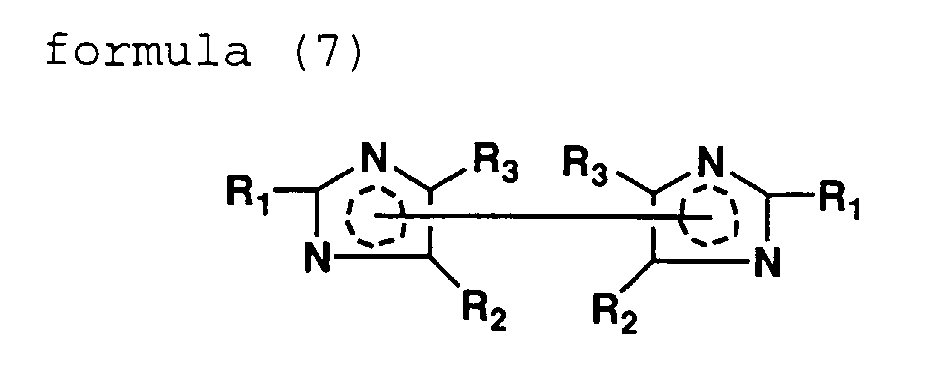 wherein R1, R2 and R3 (,which may be the same or different)
each are an alkyl group (e.g., methyl, ethyl, hexyl), an
alkenyl group (e.g., vinyl, allyl), an alkoxyl group (e.g.,
methoxy, ethoxy, octyloxy), an aryl group (e.g., phenyl,
naphthyl, tolyl), hydroxy, a hydrogen atom, a halogen atom,
an aryloxyl (e.g., phenoxy), an alkylthio group (e.g.,
methylthio, butylthio), an arylthio group (e.g., phenylthio),
a heterocyclic group (e.g., pyridyl, triazyl), an acyl group
(e.g., acetyl, propionyl, butylyl, valeryl), a sulfonyl group
(e.g., methylsulfonyl, phenylsulfonyl), an acylamino group,
sulfonylamino group, an acyloxy group (e.g., acetoxy,
benzoxy), carboxy, cyano, a sulfo group, or an amino group.
Of these groups are preferred an aryl group, a heterocyclic
group, an alkenyl group and cyano group.
wherein R1, R2 and R3 (,which may be the same or different)
each are an alkyl group (e.g., methyl, ethyl, hexyl), an
alkenyl group (e.g., vinyl, allyl), an alkoxyl group (e.g.,
methoxy, ethoxy, octyloxy), an aryl group (e.g., phenyl,
naphthyl, tolyl), hydroxy, a hydrogen atom, a halogen atom,
an aryloxyl (e.g., phenoxy), an alkylthio group (e.g.,
methylthio, butylthio), an arylthio group (e.g., phenylthio),
a heterocyclic group (e.g., pyridyl, triazyl), an acyl group
(e.g., acetyl, propionyl, butylyl, valeryl), a sulfonyl group
(e.g., methylsulfonyl, phenylsulfonyl), an acylamino group,
sulfonylamino group, an acyloxy group (e.g., acetoxy,
benzoxy), carboxy, cyano, a sulfo group, or an amino group.
Of these groups are preferred an aryl group, a heterocyclic
group, an alkenyl group and cyano group.
The biimidazolyl compounds can be synthesized in
accordance with the methods described in U.S. Patent
3,734,733 and British Patent 1,271,177. Preferred Examples
thereof are shown below.
The antifogging halogenated compound may be used in
combination with an isocyanate compound described in JP-A 6-208193,
an aziridine compound described in U.S. Patent
3,017,280 and JP-A 9-5916, and an epoxy compound described in
JP-A 10-186561 and 9-5916, thereby enhancing antifogging
effects. The combined use of a carbodiimide compound
described in U.S. Patent 3,100,704 is also effective, though
its effect is less than that of the compounds described
above. The antifogging compounds such as the isocyanate or
epoxy compound is used preferably in an amount of 0.002 to 2
mol, and more preferably 0.03 to 0.3 mol per mol of silver.
In cases where the thermally developable photosensitive
material is specifically employed for the output of a
printing image setter with an oscillation wavelength of 600
to 800 nm, hydrazine derivatives are preferably incorporated
into the photosensitive material. Exemplary preferred
hydrazine compounds are described in RD23515 (November, 1983,
page 346), U.S. Patents 4,080,207, 4,269,929, 4,276,364,
4,278,748, 4,385,108, 4,459,347, 4,478,928, 4,560,638,
4,686,167, 4,912,016, 4,988,604, 4,994,365, 5,041,355, and
5,104,769; British Patent 2,011,391B; European Patents
217,310, 301,799 and 356,898; JP-A 60-179734, 61-170733, 61-270744,
62-178246, 62-270948, 63-29751, 63-32538, 63-104047,
63-121838, 63-129337, 63-22374, 63-234244, 63-234245, 63-234246,
63-294552, 63-306438, 64-10233, 1-90439, 1-100530, 1-105041,
1-105943, 1-276128, 1-280747, 1-283548, 1-283549, 1-285940,
2-2541, 2-7057, 2-13958, 2-196234, 2-196235, 2-198440,
2-198441,2-198442, 2-220042, 2-221953, 2-221954, 2-285342,
2-285343, 2-289843, 2-302750, 2-304550, 3-37642, 3-54549,
3-125134, 3-184039, 3-240036, 3-240037, 3-259240, 3-280038,
3-282536, 4-51143, 4-56842, 4-84134, 2-230233, 4-96053,
4-216544, 5-45761, 5-45762, 5-45763, 5-45764, 5-45765,
6-289524, and 9-160164.
Furthermore, other than those, employed can be compounds described in (Ka 1) of Japanese Patent Publication (hereinafter, denoted as JP-B) No. 6-77138, specifically, compounds described on pages 3 and 4 of the Publication; compounds represented by general formula (I) in JP-B No. 6-93082, specifically, compounds 1 through 38 described on pages 8 to 18 of the Publication; compounds represented by general formula (4), general formula (5), and general formula (6) in JP-A No. 6-230497, specifically, compounds 4-1 through 4-10 on pages 25 and 26, compounds 5-1 through 5-42 on pages 28 to 36, and compounds 6-1 through 6-7 on pages 39 and 40 of the Publication; compounds represented by general formula (I) and general formula (2) in JP-A No. 6-289520, specifically, compounds 1-1) through 1-17) and 2-1) on pages 5 to 7 of the Publication; compounds described in (Ka 2) and (Ka 3) of JP-A No. 6-313936, specifically, compounds described on pages 6 to 19 of the Publication; compounds described in (Ka 1) of JP-A No. 6-313951, specifically, compounds described on pages 3 to 5 of the Publication; compounds represented by general formula (I) in JP-A No. 7-5610, specifically, compounds I-1 through I-38 described on pages 5 to 10 of the Publication; compounds represented by general formula (II) in JP-A No. 7-77783, specifically, compounds II-1 through II-102 described on pages 10 to 27 of the Publication; and compounds represented by general formula (H) and general formula (Ha) in JP-A No. 7-104426, specifically, compounds H-1 through H-44 described on pages 8 to 15 of the Publication.
Furthermore, other than those, employed can be compounds described in (Ka 1) of Japanese Patent Publication (hereinafter, denoted as JP-B) No. 6-77138, specifically, compounds described on pages 3 and 4 of the Publication; compounds represented by general formula (I) in JP-B No. 6-93082, specifically, compounds 1 through 38 described on pages 8 to 18 of the Publication; compounds represented by general formula (4), general formula (5), and general formula (6) in JP-A No. 6-230497, specifically, compounds 4-1 through 4-10 on pages 25 and 26, compounds 5-1 through 5-42 on pages 28 to 36, and compounds 6-1 through 6-7 on pages 39 and 40 of the Publication; compounds represented by general formula (I) and general formula (2) in JP-A No. 6-289520, specifically, compounds 1-1) through 1-17) and 2-1) on pages 5 to 7 of the Publication; compounds described in (Ka 2) and (Ka 3) of JP-A No. 6-313936, specifically, compounds described on pages 6 to 19 of the Publication; compounds described in (Ka 1) of JP-A No. 6-313951, specifically, compounds described on pages 3 to 5 of the Publication; compounds represented by general formula (I) in JP-A No. 7-5610, specifically, compounds I-1 through I-38 described on pages 5 to 10 of the Publication; compounds represented by general formula (II) in JP-A No. 7-77783, specifically, compounds II-1 through II-102 described on pages 10 to 27 of the Publication; and compounds represented by general formula (H) and general formula (Ha) in JP-A No. 7-104426, specifically, compounds H-1 through H-44 described on pages 8 to 15 of the Publication.
In the present invention, a matting agent is preferably
incorporated into the image forming layer side. In order to
minimize the image abrasion after thermal development, the
matting agent is provided on the surface of a photosensitive
material and the matting agent is preferably incorporated in
an amount of 0.5 to 30 per cent in weight ratio with respect
to the total binder in the emulsion layer side.
In cases where a light-insensitive layer is provided on
the opposite side of the support to the light-sensitive
layer, it is preferred to incorporate a matting agent into at
least one of the light-insensitive layer (and more
preferably, into the surface layer) in an amount of 0.5 to
40% by weight, based on the total binder on the opposite side
to the photosensitive layer.
Materials of the matting agents employed in the present
invention may be either organic substances or inorganic
substances. Examples of the inorganic substances include
silica described in Swiss Patent No. 330,158, etc.; glass
powder described in French Patent No. 1,296,995, etc.; and
carbonates of alkali earth metals or cadmium, zinc, etc.
described in U.K. Patent No. 1.173,181, etc. Examples of the
organic substances include starch described in U.S. Pat. No.
2,322,037, etc.; starch derivatives described in Belgian
Patent No. 625,451, U.K. Patent No. 981,198, etc.; polyvinyl
alcohols described in Japanese Patent Publication No. 44-3643,
etc.; polystyrenes or polymethacrylates described in
Swiss Patent No. 330,158, etc.; polyacrylonitriles described
in U.S. Pat. No. 3,079,257, etc.; and polycarbonates
described in U.S. Pat. No. 3,022,169.
The shape of the matting agent may be crystalline or
amorphous. However, a crystalline and spherical shape is
preferably employed. The size of a matting agent is
expressed in the diameter of a sphere having the same volume
as the matting agent. The particle diameter of the matting
agent in the present invention is referred to the diameter of
a spherical converted volume. The matting agent employed in
the present invention preferably has an average particle
diameter of 0.5 to 10 µm, and more preferably of 1.0 to 8.0
µm. Furthermore, the variation coefficient of the size
distribution is preferably not more than 50 percent, is more
preferably not more than 40 percent, and is most preferably
not more than 30 percent. The variation coefficient of the
size distribution as described herein is a value represented
by the formula described below:
(Standard deviation of particle diameter) / (average
particle diameter) × 100
The matting agent according to the present invention can be
incorporated into any layer. In order to accomplish the
object of the present invention, the matting agent is
preferably incorporated into the layer other than the
photosensitive layer layer, and is more preferably
incorporated into the farthest layer from the support.
Addition methods of the matting agent include those in which
a matting agent is previously dispersed into a coating
composition and is then coated, and prior to the completion
of drying, a matting agent is sprayed. When plural matting
agents are added, both methods may be employed in
combination.
In cases where the thermally developable
photosensitive material is specifically employed for the
output of a printing image setter with an oscillation
wavelength of 600 to 800 nm, hydrazine derivatives are
preferably incorporated into the photosensitive material.
Exemplary preferred hydrazine compounds are described in
RD23515 (November, 1983, page 346), U.S. Patents 4,080,207,
4,269,929, 4,276,364, 4,278,748, 4,385,108, 4,459,347,
4,478,928, 4,560,638, 4,686,167, 4,912,016, 4,988,604,
4,994,365, 5,041,355, and 5,104,769; British Patent
2,011,391B; European Patents 217,310, 301,799 and 356,898;
JP-A 60-179734, 61-170733, 61-270744, 62-178246, 62-270948,
63-29751, 63-32538, 63-104047, 63-121838, 63-129337, 63-22374,
63-234244, 63-234245, 63-234246, 63-294552, 63-306438,
64-10233, 1-90439, 1-100530, 1-105041, 1-105943, 1-276128, 1-280747,
1-283548, 1-283549, 1-285940, 2-2541, 2-7057, 2-13958,
2-196234, 2-196235, 2-198440, 2-198441,2-198442, 2-220042,
2-221953, 2-221954, 2-285342, 2-285343, 2-289843, 2-302750,
2-304550, 3-37642, 3-54549, 3-125134, 3-184039, 3-240036,
3-240037, 3-259240, 3-280038, 3-282536, 4-51143, 4-56842,
4-84134, 2-230233, 4-96053, 4-216544, 5-45761, 5-45762,
5-45763, 5-45764, 5-45765, 6-289524, and 9-160164.
Furthermore, other than those, employed can be
compounds described in (Ka 1) of Japanese Patent Publication
(hereinafter, denoted as JP-B 6-77138, specifically,
compounds described on pages 3 and 4 of the Publication;
compounds represented by general formula (I) in JP-B 6-93082,
specifically, compounds 1 through 38 described on pages 8 to
18 of the Publication; compounds represented by general
formula (4), general formula (5), and general formula (6) in
JP-A No. 6-230497, specifically, compounds 4-1 through 4-10
on pages 25 and 26, compounds 5-1 through 5-42 on pages 28 to
36, and compounds 6-1 through 6-7 on pages 39 and 40 of the
Publication; compounds represented by general formula (I) and
general formula (2) in JP-A 6-289520, specifically, compounds
1-1) through 1-17) and 2-1) on pages 5 to 7 of the
Publication; compounds described in (Ka 2) and (Ka 3) of JP-A
6-313936, specifically, compounds described on pages 6 to 19
of the Publication; compounds described in (Ka 1) of JP-A 6-313951,
specifically, compounds described on pages 3 to 5 of
the Publication; compounds represented by general formula (I)
in JP-A No. 7-5610, specifically, compounds I-1 through I-38
described on pages 5 to 10 of the Publication; compounds
represented by general formula (II) in JP-A 7-77783,
specifically, compounds II-1 through II-102 described on
pages 10 to 27 of the Publication; and compounds represented
by general formula (H) and general formula (Ha) in JP-A 7-104426,
specifically, compounds H-1 through H-44 described on
pages 8 to 15 of the Publication.
The thermally developable photothermographic material
according to the invention comprises a support having thereon
a photosensitive layer, and preferably further on the
photosensitive layer having a light-insensitive layer. For
example, it is preferred that a protective layer is provided
on the light-sensitive layer to protect the light-sensitive
layer and that a back coating layer is provided on the
opposite side of the support to the light-sensitive layer to
prevent adhesion between photosensitive materials or sticking
of the photosensitive material to a roller. Further, there
may be provided a filter layer on the same side or opposite
side to the photosensitive layer to control the amount or
wavelengths of light transmitting the thermally developable
photosensitive layer. Alternatively, a dye or pigment may be
incorporated into the photosensitive layer. In this case,
dyes described in JP-A 8-201959 are preferably used therein.
The photosensitive layer may be comprised of plural layers.
To adjust contrast, a high speed layer and low speed layer
may be provided in combination. Various adjuvants may be
incorporated into the light-sensitive layer, light-insensitive
layer or other component layer(s). There may be
employed a surfactant, antioxidant, stabilizer, plasticizer,
UV absorbent, and coating aid in the photothermographic
materials.
Any light source within the infrared region is
applicable to exposure of the thermally developable
photosensitive material, and Kr laser or infrared
semiconductor lasers (780 nm, 820 nm) are preferred in terms
of high power and transmission capability through the
photosensitive material.
In the invention, exposure is preferably conducted by
laser scanning exposure. It is also preferred to use a laser
exposure apparatus, in which a scanning laser light is not
exposed at an angle substantially vertical to the exposed
surface of the photosensitive material. The expression
"laser light is not exposed at an angle substantially
vertical to the exposed surface" means that laser light is
exposed preferably at an angle of 55 to 88°, more preferably
60 to 86°, still more preferably 65 to 84°, and optimally 70
to 82°. When the photosensitive material is scanned with
laser light, the beam spot diameter on the surface of the
photosensitive material is preferably not more than 200 µm,
and more preferably not more than 100 µm. Thus, a smaller
spot diameter preferably reduces the angle displacing from
verticality of the laser incident angle. The lower limit of
the beam spot diameter is 10 µm. The thus laser scanning
exposure can reduce deterioration in image quality due to
reflected light, resulting in occurrence such as interference
fringe-like unevenness.
Exposure applicable in the invention is conducted
preferably using a laser scanning exposure apparatus
producing longitudinally multiple scanning laser beams,
whereby deterioration in image quality such as occurrence of
interference fringe-like unevenness is reduced, as compared
to a scanning laser beam of the longitudinally single mode.
Longitudinal multiplication can be achieved by a technique of
employing backing light with composing waves or a technique
of high frequency overlapping. The expression
"longitudinally multiple" means that the exposure wavelength
is not a single wavelength. The exposure wavelength
distribution is usually not less than 5 nm and not more than
10 nm. The upper limit of the exposure wavelength
distribution is not specifically limited but is usually about
60 nm.
The thermally developable photosensitive material,
which is stable at ordinary temperatures, is exposed and
heated at a high temperature (preferably 80 to 200° C, and
more preferably 100 to 150° C) to undergo development. In
cases when heated at a temperature of lower than 80° C,
sufficient image density can be obtained within a short time.
Further, in cases when heated at a temperature of higher than
200° C, a binder melts and is transferred to a roller,
adversely affecting not only images but also transportability
and a developing machine. The organic silver salt
(functioning as an oxidant) and the reducing agent undergo
oxidation-reduction reaction upon heating to form silver
images. The reaction process proceeds without supplying any
processing solution such as water. The moisture is
preferably 0.01 to 5.0% by weight immediately before thermal
processing. The higher moisture content tends to increase
fogging, and the commercially-acceptable upper limit thereof
is contemplated to be 5.0% by weight.
The present invention will be further described based
on examples but embodiments of the invention are by no means
limited to these examples.
Both surfaces of a biaxially stretched thermally fixed
100 µm PET film, available on the market, was subjected to
corona discharging at 8 w/m2·min. Onto the surface of one
side , the subbing coating composition a-1 descried below was
applied so as to form a dried layer thickness of 0.8 µm,
which was then dried. The resulting coating was designated
Subbing Layer A-1. Onto the opposite surface, the subbing
coating composition b-1 described below was applied to form a
dried layer thickness of 0.8 µm. The resulting coating was
designated Subbing Layer B-1.
| Subbing Coating Composition a-1 | |
| Latex solution (solid 30%) of a copolymer consisting of butyl acrylate (30 weight %), t-butyl acrylate (20 weight %) styrene (25 weight%) and 2-hydroxy ethyl acrylate (25 weight %) | 270 g |
| (C-1) | 0.6 g |
| Hexamethylene-1,6-bis(ethyleneurea) | 0.8 g |
| Water to make | 1 liter |
| Subbing Coating Composition b-1 | |
| Latex liquid (solid portion of 30%) of a copolymer consisting of butyl acrylate (40 weight %) styrene (20 weight %) glycidyl acrylate (25 weight %) | 270 g |
| (C-1) | 0.6 g |
| Hexamethylene-1,6-bis(ethyleneurea) | 0.8 g |
| Water to make | 1 liter |
Subsequently, the surfaces of Subbing Layers A-1 and B-1
were subjected to corona discharging with 8 w/m2·minute.
Onto the Subbing Layer A-1, the upper subbing layer coating
composition a-2 described below was applied so as to form a
dried layer thickness of 0.8 µm, which was designated Subbing
Layer A-2, while onto the Subbing Layer B-1, the upper
subbing layer coating composition b-2 was applied so at to
form a dried layer thickness of 0.8 µm, having a static
preventing function, which was designated Subbing Upper Layer
B-2.


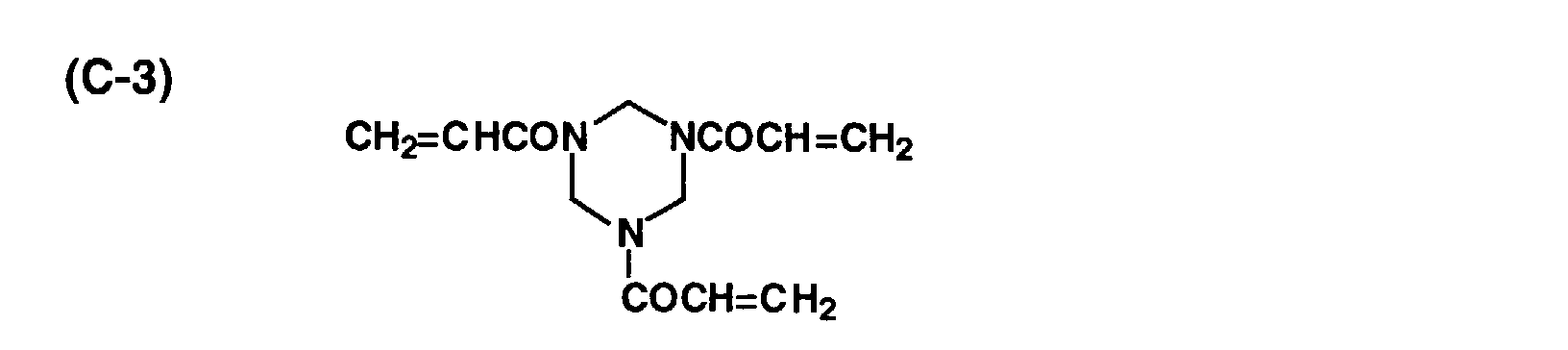
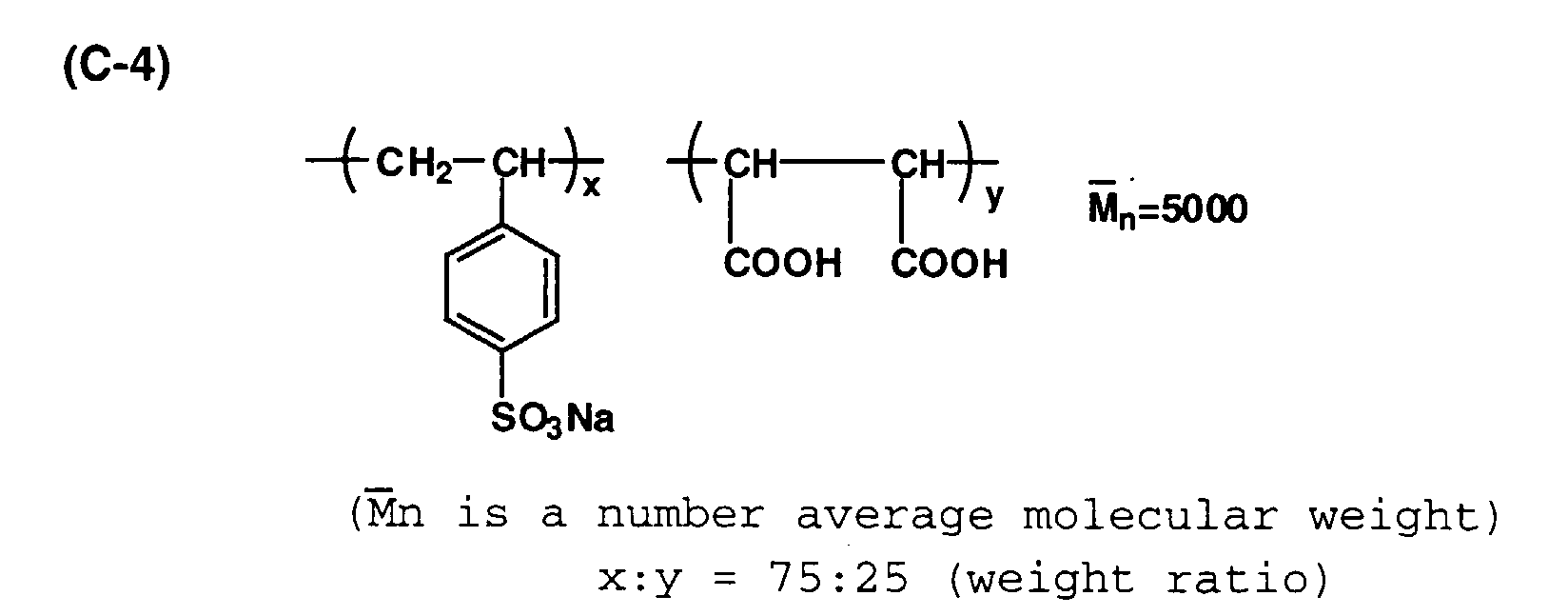

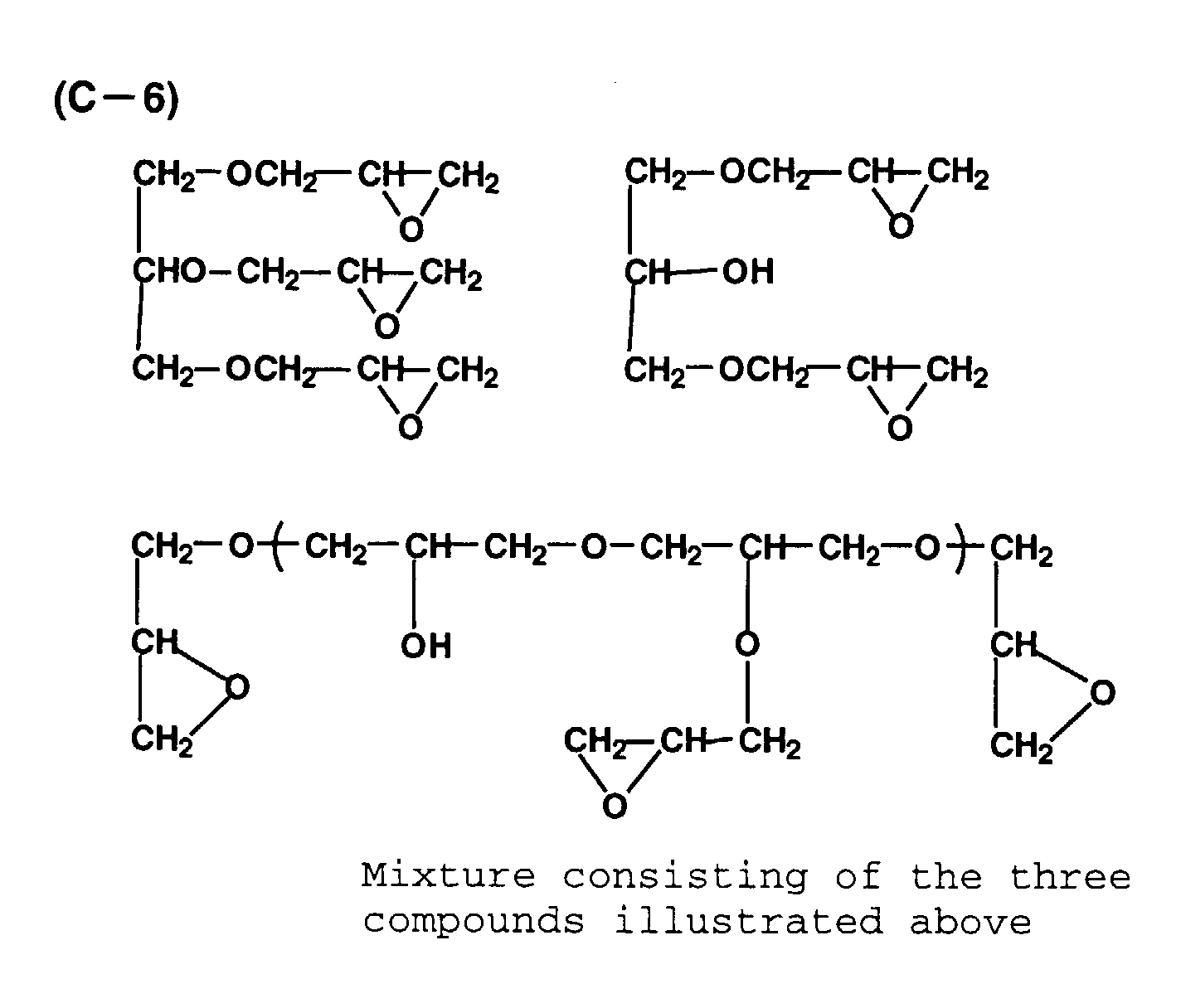
| Upper Subbing Layer Coating Composition a-2 | |
| Gelatin in an amount (weight) to make 0.4 g/m2 | |
| (C-1) | 0.2 g |
| (C-2) | 0.2 g |
| (C-3) | 0.1 g |
| Silica particles (av. size 3 µm) | 0.1 g |
| Water to make | 1 liter |
| Upper Subbing Layer Coating Composition b-2 | |
| (C-4) | 60 g |
| Latex solution (solid 20% comprising) (C-5) as a substituent | 80 g |
| Ammonium sulfate | 0.5 g |
| (C-6) | 12 g |
| Polyethylene glycol (average molecular weight of 600) | 6 g |
| Water to make | 1 liter |
The subbed support was dried at 140° C in the process
of subbing and drying a support.
To 35 g of ethyl acetate, 2.5 g of Dye-1 and 7.5 g of
Dye-adjusting agent 1 were added and dissolved with stirring.
Further thereto, 50 g of an aqueous 10 wt% polyvinyl alcohol
solution was added and stirred with a homogenizer.
Thereafter, ethyl acetate was distilled out and the mixture was diluted with water to prepare a colorant dispersion. Then, 50 g of the thus prepared colorant dispersion, 20 g of Dye-adjusting agent 2, 250 g water and 1.8 g of Sildex H121 (silica spherical particles having an average size of 12 µm, available from DOKAI KAGAKU Corp.), each per 30 g of polyvinyl alcohol, were added thereto to prepare a back coat composition.
Thereafter, ethyl acetate was distilled out and the mixture was diluted with water to prepare a colorant dispersion. Then, 50 g of the thus prepared colorant dispersion, 20 g of Dye-adjusting agent 2, 250 g water and 1.8 g of Sildex H121 (silica spherical particles having an average size of 12 µm, available from DOKAI KAGAKU Corp.), each per 30 g of polyvinyl alcohol, were added thereto to prepare a back coat composition.
The thus prepared coating composition for a backing
layer was coated on upper sublayer B-2 by an extrusion coater
and dried so as to have dry thickness of 3.5 µm and dried at
a dry-bulb temperature of 100° C and a wet-bulb temperature
of 10° C over a period of 5 min.
In 900 ml of deionized water were dissolved 7.5 g of
gelatin having an average molecular weight of 100,000 and 10
mg of potassium bromide. After adjusting the temperature and
the pH to 35 °C and 3.0, respectively, 370 ml of an aqueous
solution containing 74 g silver nitrate and an equimolar
aqueous solution containing potassium bromide, potassium
iodide (in a molar ratio of 98 to 2) and 1x10⁻⁴ mol/mol Ag of
iridium chloride were added over a period of 10 minutes by
the controlled double-jet method, while the pAg was
maintained at 7.7. Thereafter, 4-hydroxy-6-methyl-1,3,3a,7-tetraazaindene
was added and the pH was adjusted to 5 using
NaOH. There was obtained cubic silver iodobromide grains
having an average grain size of 0.06 µm, a variation
coefficient of the projection area equivalent diameter of 10
percent, and the proportion of the {100} face of 87 percent.
The resulting emulsion was flocculated to remove soluble
salts, employing a flocculating agent and after desalting,
0.1 g of phenoxyethanol was added and the pH and pAg were
adjusted to 5.9 and 7.5, respectively to obtain silver halide
emulsion a. The thus obtained light-sensitive emulsion
grains were measured with respect to the average iodide
content in the vicinity of the grain surface and it was
proved to be 4.0 mol%. Then, temperature was raised to 40°
C, and 350 mg of sensitizing dye Dye-C, 4.65 g of 2-chlorobenzoic
acid, 19.30 g of benzoic acid and 2.14 g of 5-methyl-2-mercaptobenzimidazole
were dissolved in 73.4 ml of
methanol in the darkroom. The thus prepared sensitizing dye
solution was added to the emulsion as prepared above, in an
amount of 5x10⁻⁴ mol/mol AgX, stirred for 30 min. and rapidly
cooled to 25° C to obtain light-sensitive silver halide
emulsion a.
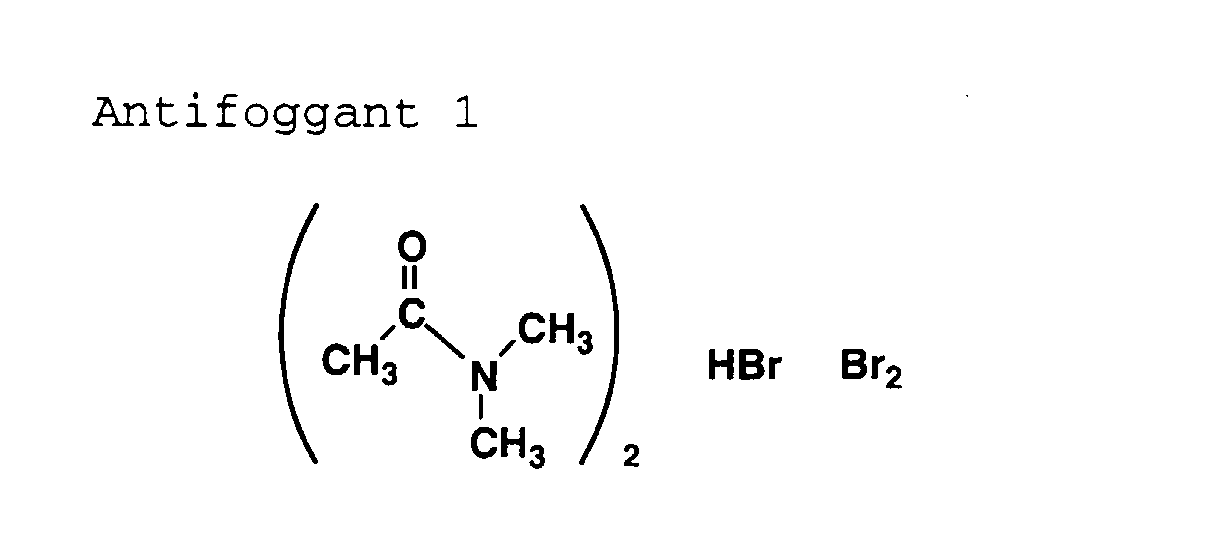

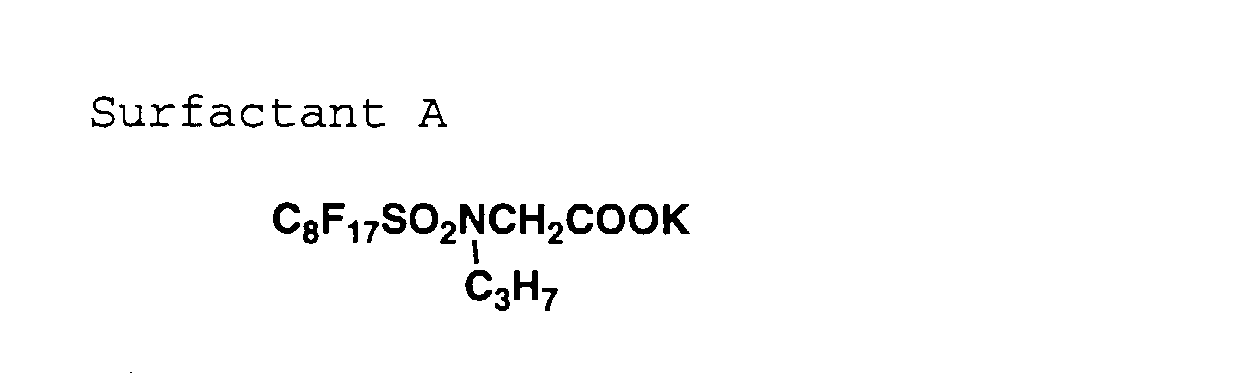
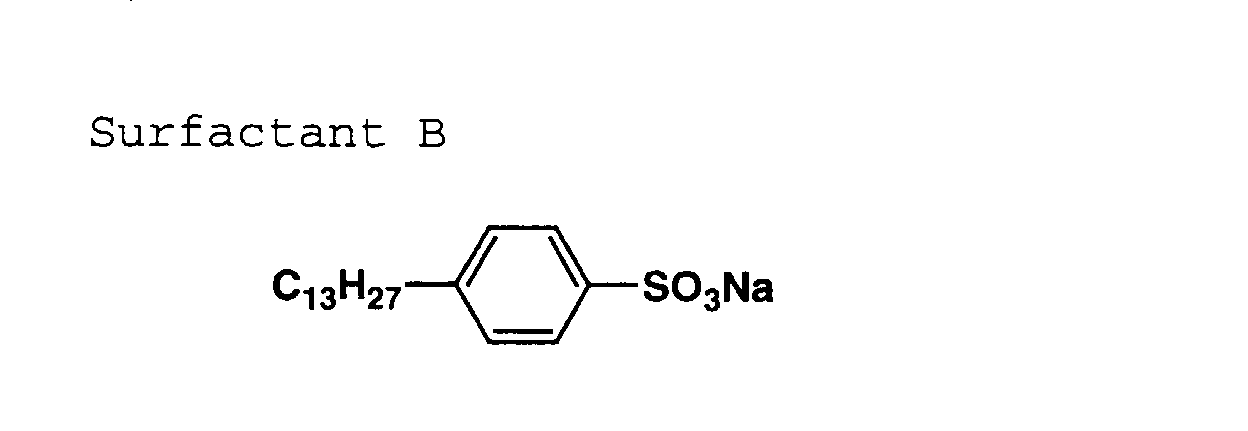


In 4720 ml water at 80° C were dissolved 111.4 g of
behenic acid, 83.8 g of arachidic acid and 54.9 g of stearic
acid. Further thereto was added 540.2 ml of aqueous 1.5M
sodium hydroxide solution with stirring at a high-speed and
after adding 6.9 ml of concentrated nitric acid, the mixture
was cooled to 55° C to obtain an aqueous fatty acid sodium
salt solution. Then, 450 ml water was added thereto, 760.6
ml of aqueous 1M silver nitrate solution was added in 2 min.,
and after stirring for 20 min., the reaction mixture was
filtered to remove soluble salts and washed with deionized
water until the filtrate reached a conductivity of 2 µS/cm.
The thus obtained solid product was treated in the form of
wet cake, without being dried and 12 g of polyvinyl alcohol
and 150 ml water, each per 34.8 g of the solid product, were
added with stirring to obtain slurry. The obtained slurry
was added into a vessel together with 840 g of zirconia beads
of 0.5 mm in diameter and dispersed by means of a dispersing
machine (1/4G sand grinder mill, available from Imex Co.
Ltd.) for a period of 5 hr. to obtain an organic silver salt
dispersion 1. As a result of microscopic observation, the
dispersion was comprised of needle-like, microcrystals having
an average particle size of 0.04 µm, an average long diameter
of 0.8 µm and a variation coefficient of particle size
distribution, based on projected area, of 30%.
To 500 g of polymeric latex, Laxter 3307B (available
from DAINIPPON INK Co. Ltd.) was added the prepared organic
silver salt dispersion (equivalent to 1 mole, based on
silver) and the following additives were added thereto to
prepare an emulsified coating solution, while being
sufficiently stirred at a temperature of 21° C, in which a
light-sensitive silver halide emulsion a was represented by
equivalent converted to silver. The additives each were
prepared in advance according to the following manner. Thus,
each of the additives was optimally obtained in the form of a
solid particle dispersion, in which 70 wt% was accounted for
by particles of 0.1 µm in diameter. In the case of
tetrachlorophthalic acid, for example,
hydroxypropylmethylphenylsulfon was stirred with water to
form slurry; after being allowed to stand for 12 hr., the
slurry was added into a vessel together with 100 g of
zirconia beads of an average size of 0.5 mm and dispersed by
a dispersing machine for 6 hr. to obtain a solid particle
dispersion.
| Antifoggant 1 | 9.0 g |
| Calcium bromide dihydrate | 6.0 g |
| Silver halide emulsion a, equivalent to 5 mol% of silver of organic silver salt | |
| Developer [1,1-bis(2-hydroxy-3,5-dimethylphenyl)-2-methylpropane] | 15 g |
| Desmodu N3300 (aliphatic isocyanate, available from Movey Corp.) | 1.10 g |
| Phthalazine | 1.5 g |
| Tetrachlorophthalic acid | 0.5 g |
| 4-Methylphthalic acid | 0.5 g |
Laxter 3307B was a latex of styrene-butadiene
copolymer, in which an average size of dispersed particles
was 0.1 to 0.15 µm and the equilibrium moisture content was
0.6%. The moisture content was determined in the following
manner.
A polymer solution (or dispersion) was coated on a
glass plate and dried at 50° C for 1 hr. to obtain a polymer
model membrane of ca. 100 µm thick. The thus obtained
polymer model membrane was peeled off from the glass plate
and after being allowed to stand in an atmosphere at 25° C
and 60% RH for a period of 3 days, the weight thereof (W1)
was measured. Separately, after being allowed to stand in
vacuo at 25° C for 3 days, the membrane was weighed in a
weighing bottle (W0 = W3 - W2, in which W3 was weight of
polymer model membrane and a weighing bottle, and W2 was a
weight of the weighing bottle). From W0 and W1, the moisture
content at 25° C and 60% RH was determined according to the
following equation:
Equilibrium moisture content = {(W1 -W0 ) / W0 } x 100
To 10 g of inert gelatin, 0.26 g of surfactant A, 0.09
g of surfactant B, 0.9 g of fine silica particles, 0.3 g of
1,2-(bisvinylsulfonylacetoamido)ethane and 64 g of water were
added to prepare a coating composition for a surface
protective layer.
The prepared coating composition for the light-sensitive
layer was maintained at a temperature of 13° C and
coated according to the following procedure to obtain Sample
1. Samples 2 through 24 were also prepared similarly to
Sample 1, except that sensitizing dyes and macrocyclic
compounds were varied as shown in Table 1. In this case, the
macrocyclic compound was added prior to addition of the
sensitizing dye. Thus, the light-sensitive layer coating
composition and the protective layer coating composition
described above were simultaneously coated by means of an
extrusion coater at a speed of 20 m/min so that the silver
coverage of the photosensitive layer was 2.0 g/m2 and dry
thickness of the protective layer was 2.5 µm. Thereafter,
drying was conducted using hot-air at a dry-bulb temperature
of 75° C and a wet-bulb temperature of 10° C over a period of
10 min.
The thus prepared photothermographic material samples
each were cut to a size of 3.5 cm x 15 cm and allowed to
stand under the following condition (A) or (B):
Thereafter, aged samples were each subjected to laser
scanning exposure from the emulsion side using an exposure
apparatus having a light source of 800 to 820 nm
semiconductor laser of longitudinal multi-mode, which was
made by means of high frequency overlapping. In this case,
exposure was conducted at an angle between the exposed
surface and exposing laser light was 75° and in an atmosphere
at a temperature of 23° C and 50% RH (and as a result, images
with superior sharpness were unexpectedly obtained, as
compared to exposure at an angle of 90°). Using an automatic
processor provided with a heated drum, thereafter, exposed
samples were subjected to thermal development at 110° C for
15 sec., while bringing the protective layer surface of the
photothermographic material into contact with the drum
surface. The thermal development was conducted in an
atmosphere at 23° C and 50% RH. Thermally developed samples
each were subjected to sensitometry using a densitometer and
evaluated with respect to a fog density (i.e., minimum
density, denoted as Dmin) and sensitivity. The sensitivity
was represented by a relative value of reciprocal of exposure
necessary to give a density of Dmin plus 1.0, based on the
sensitivity of Sample 1 being 100. Results thereof are shown
in Table 1.
Further, photothermographic material samples were
evaluated with light stability and heat stability. Thus,
sample were aged under the condition (A) and thermally
developed similarly as described above. The thus developed
samples were allowed to stand under the following condition
(C) or (E):
| Sample No. | Sensitizing Dye | Macrocyclic Compd. | Aging A | Aging B | Light Stability | Heat Stability | Silver Tone | Remark | ||
| Dmin | S | Dmin | S | |||||||
| 1 | Dye-C | - | 0.25 | 100 | 0.31 | 64 | 0.020 | 0.030 | C | Comp. |
| 2 | Dye-C | S-19 | 0.25 | 116 | 0.33 | 83 | 0.013 | 0.022 | B | Inv. |
| 3 | Dye-C | S-27 | 0.26 | 112 | 0.35 | 82 | 0.014 | 0.023 | B | Inv. |
| 4 | Dye-C | S-35 | 0.26 | 112 | 0.34 | 83 | 0.013 | 0.023 | B | Inv. |
| 5 | D-16 | - | 0.22 | 121 | 0.26 | 96 | 0.018 | 0.033 | B | Comp. |
| 6 | D-16 | S-19 | 0.22 | 159 | 0.26 | 152 | 0.014 | 0.023 | A | Inv. |
| 7 | D-16 | S-27 | 0.22 | 154 | 0.27 | 150 | 0.015 | 0.025 | A | Inv. |
| 8 | D-16 | S-35 | 0.23 | 153 | 0.28 | 145 | 0.013 | 0.024 | A | Inv. |
| 9 | D-19 | - | 0.23 | 109 | 0.27 | 85 | 0.019 | 0.033 | B | Comp. |
| 10 | D-19 | S-19 | 0.23 | 150 | 0.27 | 141 | 0.015 | 0.024 | A | Inv. |
| 11 | D-19 | S-27 | 0.23 | 144 | 0.27 | 139 | 0.015 | 0.025 | A | Inv. |
| 12 | D-19 | S-35 | 0.24 | 141 | 0.28 | 140 | 0.015 | 0.025 | A | Inv. |
| 13 | D-24 | - | 0.23 | 114 | 0.27 | 88 | 0.019 | 0.035 | B | Comp. |
| 14 | D-24 | S-19 | 0.23 | 155 | 0.27 | 146 | 0.014 | 0.026 | A | Inv. |
| 15 | D-24 | S-27 | 0.24 | 149 | 0.27 | 142 | 0.015 | 0.026 | A | Inv. |
| 16 | D-24 | S-35 | 0.24 | 144 | 0.27 | 140 | 0.014 | 0.026 | A | Inv. |
| 17 | D-37 | - | 0.22 | 122 | 0.26 | 95 | 0.020 | 0.034 | B | Comp. |
| 18 | D-37 | S-19 | 0.22 | 159 | 0.26 | 153 | 0.013 | 0.025 | A | Inv. |
| 19 | D-37 | S-27 | 0.23 | 152 | 0.27 | 151 | 0.014 | 0.025 | A | Inv. |
| 20 | D-37 | S-35 | 0.23 | 154 | 0.27 | 146 | 0.014 | 0.026 | A | Inv. |
| 21 | D-45 | - | 0.23 | 111 | 0.27 | 89 | 0.019 | 0.034 | B | Comp. |
| 22 | D-45 | S-19 | 0.23 | 148 | 0.27 | 135 | 0.014 | 0.024 | A | Inv. |
| 23 | D-45 | S-27 | 0.23 | 149 | 0.28 | 134 | 0.015 | 0.026 | A | Inv. |
| 24 | D-45 | S-35 | 0.24 | 142 | 0.27 | 132 | 0.014 | 0.026 | A | Inv. |
As can be seen from Table 1, it was proved that the use
of sensitizing dyes according to the invention in combination
with nitrogen containing macrocyclic compound led to enhanced
sensitivity and improved storage stability, and synergetic
effects by the combined use were apparent.
Silver halide emulsions b, c and d were prepared in a
manner similar to silver halide emulsion a of Example 1,
except that the overall iodide content of the grain was
varied by varying the amounts of KBr and KI to be added in
the grain formation, as shown in Table 2. Photothermographic
material Samples 25 through 27 were prepared in a manner
similar to Sample 17 in Example 1, except that silver halide
emulsion a was replaced by emulsion b, c or d. Sample 28
through 30 were prepared similarly to Sample 18 in Example 1.
The thus obtained samples were evaluated and results thereof
are shown in Table 2.

As can be seen from Table 2, synergetic effects such as
markedly enhanced storage stability and superior silver image
tone were unexpectedly obtained in the presence of a
macrocyclic compound.
Photothermographic material Samples 31 to 33 were
prepared in a manner similar to Sample 18 of example 1,
except that after, coating, a drying time was varied,
exhibiting the solvent content as shown in Table 3. These
samples were evaluated similarly to Example 1. Results
thereof are shown in Table 3.
| Sample No. | Moisture Content | Aging A Fog | S | Light Stability | Heat Stability |
| 31 | 0.005 | 0.2 | 139 | 0.012 | 0.020 |
| 6 | 0.1 | 0.22 | 160 | 0.014 | 0.023 |
| 32 | 2.0 | 0.23 | 162 | 0.015 | 0.025 |
| 33 | 20 | 0.26 | 165 | 0.032 | 0.042 |
As can be seen from Table 3, it was proved that the
moisture content within the preferred range exhibited
enhanced sensitivity and reduced fog.
Claims (15)
- A silver halide photothermographic material comprising a support having thereon a light-sensitive layer and light-insensitive layer, wherein the light-sensitive layer or the light-insensitive layer comprises a heteroatom-containing macrocyclic compound, and the light-sensitive layer comprising a sensitizing dye exhibiting maximum sensitivity at a wavelength of 600 nm or more.
- The silver halide photothermographic material of claim 1, wherein said sensitizing dye is represented by the following formula (1), (2) or (3):wherein Z1 is an atomic group necessary to form a 5- or 6-membered nitrogen-containing heterocyclic ring; D and D' are each an atomic group necessary to form an acyclic or cyclic acidic nucleus; R1 is an alkyl group; L1, L2, L3, L4, L5, L6, L7, L8, L9 and L10 are each a methine group, provided that each may form a ring together with one of the other methine groups or with an auxochrome; n1, n2, n3, n4 and n5 are each 0 or 1; M1 is a counter ion necessary to neutralize charge; and m1 is an integer of 0 or more, which is necessary to counterbalance intramolecular charge;
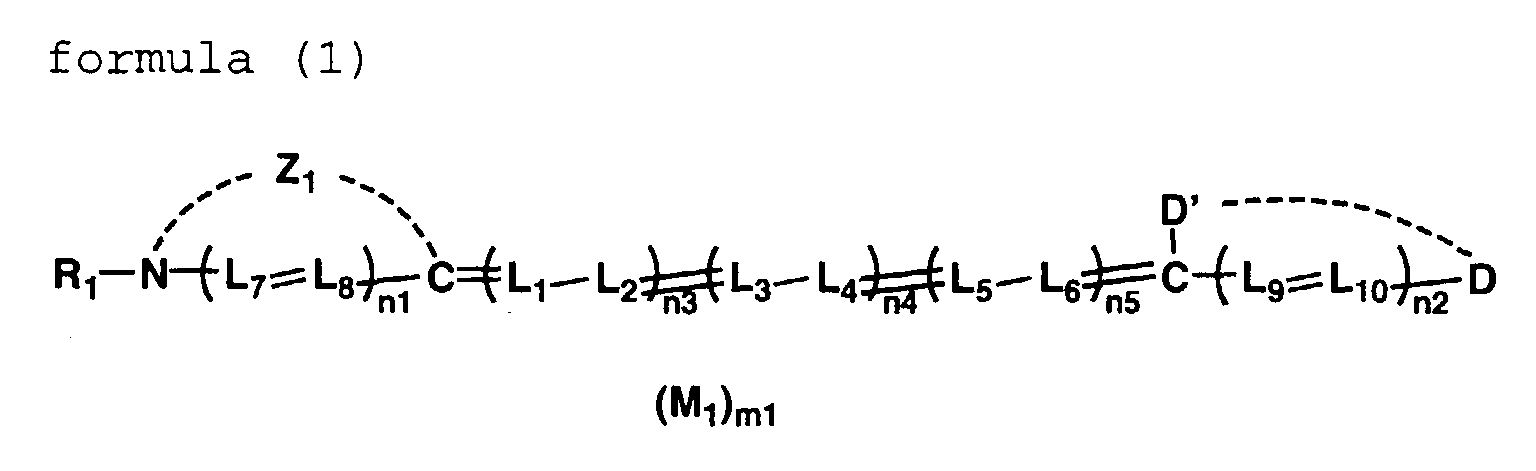 wherein Z1, Z2 and Z3 are each an atomic group necessary to form a 5- or 6-membered nitrogen-containing heterocyclic ring; R1 and R3 are each an alkyl group; R2 is a hydrogen atom, an alkyl group, an aryl group or a heterocyclic group; L1, L2, L3, L4, L5, L6, L7, L8, and L9 are each a methine group; p1 and p2 are each 0 or 1; n1 and n2 are each 0, 1, 2, 3 or 4; M1 represents a charge balancing counter ion; and ml is an integer of 0 or more, which is necessary to counterbalance intramolecular charge;
 wherein Z4, Z5 and Z6 are each an atomic group necessary to form a 5- or 6-membered nitrogen-containing heterocyclic ring; R4 is an alkyl group; R5 and R6 are each a hydrogen atom, an alkyl group, an aryl group or a heterocyclic group; L10, L11, L12, L13, L14 and L15 are each a methine group; p3 is 0 or 1; n3 and n4 are each 0, 1, 2, 3 or 4; M2 is a charge balancing counter ion; and m2 is an integer of 0 or more, which is necessary to counterbalance intramolecular charge.
- The silver halide photothermographic material of claim 2, wherein said sensitizing dye represented by formula (2) is represented by the following formula (4):wherein Z7 is the same as defined in Z1 of formula (2), Z8 is the same as defined in Z2 of formula (2) and Z9 is an oxygen atom, a sulfur atom or a selenium atom; R7 is the same as defined in R1 of formula (2), R8 is the same as defined in R2 of formula (2) and R9 is the same as defined in R3 of formula (2); L16 is the same as defined in L1 of formula (2), L17 is the same as defined in L2 of formula (2), L18 is the same as defined in L3 of formula (2), L19 is the same as defined in L4 of formula (2), L20 is the same as defined in L5 of formula (2), L21 is the same as defined in L6 of formula (2), and L22 is the same as defined in L7 of formula (2); p4 is the same as defined in p1 of formula (2); n5 is the same as defined in n1 of formula (2) and n6 is the same as defined in n2 of formula (2); M3 is the same as defined in M1 of formula (2); m3 is the same as defined in ml of formula (2); Q is an alkyl group, an aryl group or a heterocyclic group; k1 is 1, 2, 3 or 4.
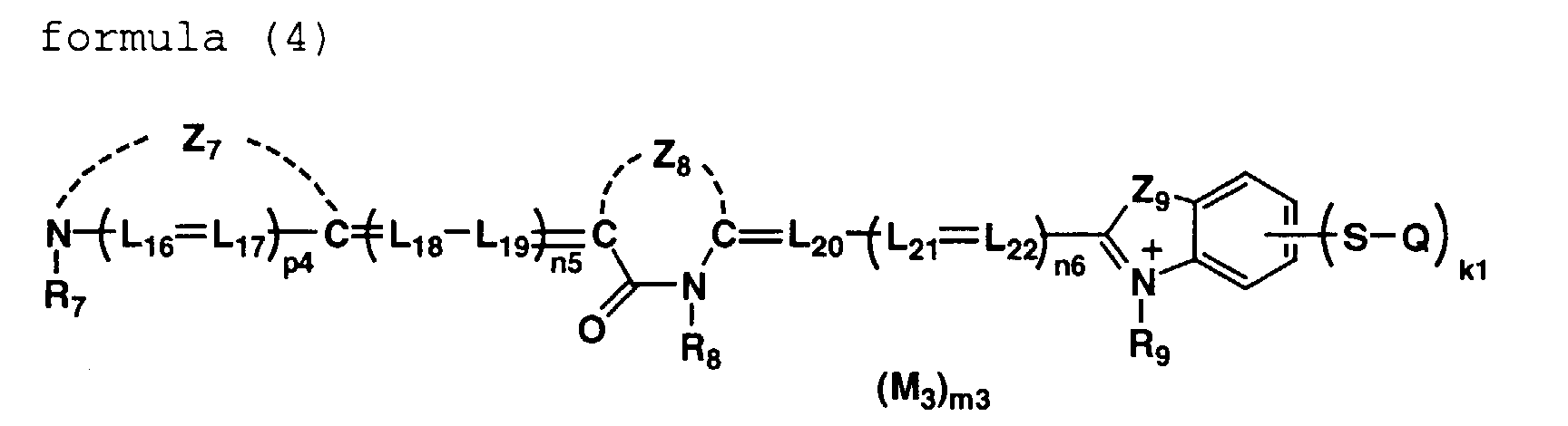
- The silver halide photothermographic material of claim 3, wherein said sensitizing dye represented by formula (4) is represented by the following formula (5):wherein Q2 is the same as defined in Q of formula (4); k3 is the same as defined in k1 of formula (4); R10 is the same as defined in R1 of formula (2); R11 is the same as defined in R2 of formula (2); R12 is the same as defined in R3 of formula (2); L23 is the same as defined in L3 of formula (2); L24 is the same as defined in L4 of formula (2); L25 is the same as defined in L5 of formula (2); M4 is the same as defined in M1 of formula (2); m4 is the same as defined in m1 of formula (2); and V1 represents a substituent.

- The silver halide photothermographic material of any one of the preceding claims, wherein the light-sensitive layer comprises said sensitizing dye of 1x10⁻⁶ to 5x10⁻³ mole/AgX mole.
- The silver halide photothermographic material of any one of the preceding claims, wherein said macrocyclic compound is a nine- or more-membered ring compound containing a heteroatom selected from the group consisting of a nitrogen atom, oxygen atom, sulfur atom and selenium atom.
- The silver halide photothermographic material of claim 6, wherein said macrocyclic compound is a 12- to 24-membered ring compound.
- The silver halide photothermographic material of any one of the preceding claims, wherein the light-sensitive layer comprises light-sensitive silver halide having an average iodide content of 0.01 to 10 mol%.
- The silver halide photothermographic material of any one of the preceding claims, wherein the light-sensitive layer further comprises an organic silver salt which is comprised of grains having an average size of not more than 2 µm.
- The silver halide photothermographic material of any one of the preceding claims, wherein the total amount of the silver halide and the organic silver salt is 0.5 to 2.2 g in equivalent converted to silver per m2 of the photothermographic material.
- The silver halide photothermographic material of any one of the preceding claims, wherein the light-sensitive layer further comprises binder which is mainly comprised of a polymeric latex.
- The silver halide photothermographic material of any one of the preceding claims, wherein the ratio by weigh of binder to silver halide is 5 to 400.
- The silver halide photothermographic material of any one of the preceding claims, wherein said sensitizing dye exhibits maximum sensitivity at a wavelength of 600 to 900 nm.
- The silver halide photothermographic material of claim 11, wherein said polymeric latex is contained in an amount of at least 50% by weight of the total binder contained in the light-sensitive layer.
- Use of a silver halide photothermographic material as claimed in any one of the preceding claims 1 to 14 for image formation by laser exposure apparatus.
Applications Claiming Priority (2)
| Application Number | Priority Date | Filing Date | Title |
|---|---|---|---|
| JP15633599 | 1999-06-03 | ||
| JP15633599A JP3736204B2 (en) | 1999-06-03 | 1999-06-03 | Heat-developable silver halide photographic material, image recording method and image forming method |
Publications (1)
| Publication Number | Publication Date |
|---|---|
| EP1058151A1 true EP1058151A1 (en) | 2000-12-06 |
Family
ID=15625536
Family Applications (1)
| Application Number | Title | Priority Date | Filing Date |
|---|---|---|---|
| EP00111693A Withdrawn EP1058151A1 (en) | 1999-06-03 | 2000-05-31 | Silver halide photothermographic material |
Country Status (3)
| Country | Link |
|---|---|
| US (1) | US6329135B1 (en) |
| EP (1) | EP1058151A1 (en) |
| JP (1) | JP3736204B2 (en) |
Families Citing this family (4)
| Publication number | Priority date | Publication date | Assignee | Title |
|---|---|---|---|---|
| EP1126315B1 (en) * | 2000-02-16 | 2005-02-02 | Konica Corporation | Photothermographic material and image forming method |
| US6582892B2 (en) * | 2001-06-29 | 2003-06-24 | Eastman Kodak Company | Heat-stabilized IR-sensitive thermally developable imaging materials |
| JP3930290B2 (en) * | 2001-09-12 | 2007-06-13 | 富士フイルム株式会社 | Photothermographic material and thermal development method using the same |
| US7267935B1 (en) | 2006-06-19 | 2007-09-11 | Carestream Health, Inc. | Thermally developable materials stabilized with crown ethers |
Citations (5)
| Publication number | Priority date | Publication date | Assignee | Title |
|---|---|---|---|---|
| JPH06230507A (en) * | 1993-01-29 | 1994-08-19 | Konica Corp | Silver halide photographic sensitive material |
| EP0798129A1 (en) * | 1996-03-29 | 1997-10-01 | Konica Corporation | Image forming method |
| JPH10186572A (en) * | 1996-12-26 | 1998-07-14 | Fuji Photo Film Co Ltd | Heat-developable photosensitive material |
| JPH112880A (en) * | 1997-06-11 | 1999-01-06 | Fuji Photo Film Co Ltd | Heat-developable photosensitive material |
| EP1033618A1 (en) * | 1999-03-01 | 2000-09-06 | Konica Corporation | Thermally developable photosensitive material |
Family Cites Families (6)
| Publication number | Priority date | Publication date | Assignee | Title |
|---|---|---|---|---|
| HU206781B (en) * | 1990-01-15 | 1992-12-28 | Forte Fotokemiai Ipar | Method for chemical sensibilizing silver-halogenide photo emulsion |
| EP0559101A1 (en) * | 1992-03-02 | 1993-09-08 | Canon Kabushiki Kaisha | Heat-developable photosensitive material and image forming method which uses the same |
| DE4433637A1 (en) * | 1994-09-21 | 1996-03-28 | Agfa Gevaert Ag | Color photographic silver halide material |
| JP3679207B2 (en) * | 1996-09-12 | 2005-08-03 | 富士写真フイルム株式会社 | Silver halide photographic material |
| JPH10260493A (en) * | 1997-03-18 | 1998-09-29 | Fuji Photo Film Co Ltd | Silver halide photographic sensitive material |
| JP3783989B2 (en) * | 1997-09-09 | 2006-06-07 | 富士写真フイルム株式会社 | Thermally developed image recording material |
-
1999
- 1999-06-03 JP JP15633599A patent/JP3736204B2/en not_active Expired - Fee Related
-
2000
- 2000-05-31 EP EP00111693A patent/EP1058151A1/en not_active Withdrawn
- 2000-06-02 US US09/586,496 patent/US6329135B1/en not_active Expired - Fee Related
Patent Citations (5)
| Publication number | Priority date | Publication date | Assignee | Title |
|---|---|---|---|---|
| JPH06230507A (en) * | 1993-01-29 | 1994-08-19 | Konica Corp | Silver halide photographic sensitive material |
| EP0798129A1 (en) * | 1996-03-29 | 1997-10-01 | Konica Corporation | Image forming method |
| JPH10186572A (en) * | 1996-12-26 | 1998-07-14 | Fuji Photo Film Co Ltd | Heat-developable photosensitive material |
| JPH112880A (en) * | 1997-06-11 | 1999-01-06 | Fuji Photo Film Co Ltd | Heat-developable photosensitive material |
| EP1033618A1 (en) * | 1999-03-01 | 2000-09-06 | Konica Corporation | Thermally developable photosensitive material |
Non-Patent Citations (1)
| Title |
|---|
| PAUL W. LAUF: "Photothermographic Silver Halide Systems", RESEARCH DISCLOSURE., vol. 299, no. 63, March 1989 (1989-03-01), INDUSTRIAL OPPORTUNITIES LTD. HAVANT., GB, pages 208 - 214, XP000073364, ISSN: 0374-4353 * |
Also Published As
| Publication number | Publication date |
|---|---|
| JP3736204B2 (en) | 2006-01-18 |
| US6329135B1 (en) | 2001-12-11 |
| JP2000347343A (en) | 2000-12-15 |
Similar Documents
| Publication | Publication Date | Title |
|---|---|---|
| JP4031077B2 (en) | Photothermographic material | |
| EP0821811B1 (en) | Photothermographic elements with spectral sensitizing dyes | |
| EP1033618B1 (en) | Thermally developable photosensitive material | |
| US6245499B1 (en) | Photothermographic material | |
| US5763153A (en) | Photothermographic material | |
| US6297001B1 (en) | Photothermographic material | |
| EP1111451A2 (en) | Photothermographic material | |
| US5965346A (en) | Photothermographic material | |
| JP2001056528A (en) | Silver halide emulsion, silver halide photographic sensitive material containing same and heat developable photographic sensitive material | |
| US6329135B1 (en) | Silver halide photothermographic material | |
| JP3838527B2 (en) | Photothermographic material | |
| JP2001013617A (en) | Silver halide emulsion, silver halide photosensitive material and heat developable photosensitive material | |
| JP2001064527A (en) | Silver halide photograph photosensitive material, heat developing silver halide photograph photosensitive material and methine pigment | |
| JP3948184B2 (en) | Silver halide emulsion, silver halide photosensitive material, photothermographic material | |
| JP3846815B2 (en) | Photothermographic material for heat development | |
| JPH09160166A (en) | Heat-developable photosensitive material | |
| JP2001290238A (en) | Heat developable photosensitive material | |
| JPH1130833A (en) | Heat-developable photosensitive material and image forming method | |
| JPH11119374A (en) | Heat developable photosensitive material | |
| JP2001330918A (en) | Silver halide emulsion, heat developable photosensitive material, its image recording method and image forming method | |
| JP2000112055A (en) | Silver halide photographic sensitive material | |
| JPH112880A (en) | Heat-developable photosensitive material | |
| JP2000241932A (en) | Heat developable photosensitive material, production of nonphotosensitive silver salt compound and method for formation of image | |
| JP2000147709A (en) | Heat-developable photographic sensitive material. method for recording image and method for forming image | |
| JP2001235832A (en) | Heat developable photosensitive material having high sensitivity and excellent in preservability |
Legal Events
| Date | Code | Title | Description |
|---|---|---|---|
| PUAI | Public reference made under article 153(3) epc to a published international application that has entered the european phase |
Free format text: ORIGINAL CODE: 0009012 |
|
| AK | Designated contracting states |
Kind code of ref document: A1 Designated state(s): DE FR GB IT NL |
|
| AX | Request for extension of the european patent |
Free format text: AL;LT;LV;MK;RO;SI |
|
| 17P | Request for examination filed |
Effective date: 20010606 |
|
| AKX | Designation fees paid |
Free format text: DE FR GB IT NL |
|
| 17Q | First examination report despatched |
Effective date: 20040108 |
|
| STAA | Information on the status of an ep patent application or granted ep patent |
Free format text: STATUS: THE APPLICATION IS DEEMED TO BE WITHDRAWN |
|
| 18D | Application deemed to be withdrawn |
Effective date: 20041020 |