EP1058113A2 - Method and apparatus for quantifying molybdate in absorption refrigeration system brines - Google Patents
Method and apparatus for quantifying molybdate in absorption refrigeration system brines Download PDFInfo
- Publication number
- EP1058113A2 EP1058113A2 EP00201783A EP00201783A EP1058113A2 EP 1058113 A2 EP1058113 A2 EP 1058113A2 EP 00201783 A EP00201783 A EP 00201783A EP 00201783 A EP00201783 A EP 00201783A EP 1058113 A2 EP1058113 A2 EP 1058113A2
- Authority
- EP
- European Patent Office
- Prior art keywords
- sample
- molybdate
- brine
- inhibitor
- characteristic color
- Prior art date
- Legal status (The legal status is an assumption and is not a legal conclusion. Google has not performed a legal analysis and makes no representation as to the accuracy of the status listed.)
- Granted
Links
Images

Classifications
-
- G—PHYSICS
- G01—MEASURING; TESTING
- G01F—MEASURING VOLUME, VOLUME FLOW, MASS FLOW OR LIQUID LEVEL; METERING BY VOLUME
- G01F23/00—Indicating or measuring liquid level or level of fluent solid material, e.g. indicating in terms of volume or indicating by means of an alarm
-
- G—PHYSICS
- G01—MEASURING; TESTING
- G01N—INVESTIGATING OR ANALYSING MATERIALS BY DETERMINING THEIR CHEMICAL OR PHYSICAL PROPERTIES
- G01N31/00—Investigating or analysing non-biological materials by the use of the chemical methods specified in the subgroup; Apparatus specially adapted for such methods
- G01N31/22—Investigating or analysing non-biological materials by the use of the chemical methods specified in the subgroup; Apparatus specially adapted for such methods using chemical indicators
-
- G—PHYSICS
- G01—MEASURING; TESTING
- G01N—INVESTIGATING OR ANALYSING MATERIALS BY DETERMINING THEIR CHEMICAL OR PHYSICAL PROPERTIES
- G01N21/00—Investigating or analysing materials by the use of optical means, i.e. using sub-millimetre waves, infrared, visible or ultraviolet light
- G01N21/75—Systems in which material is subjected to a chemical reaction, the progress or the result of the reaction being investigated
- G01N21/77—Systems in which material is subjected to a chemical reaction, the progress or the result of the reaction being investigated by observing the effect on a chemical indicator
- G01N21/78—Systems in which material is subjected to a chemical reaction, the progress or the result of the reaction being investigated by observing the effect on a chemical indicator producing a change of colour
Definitions
- This invention relates generally to absorption refrigeration systems. More particularly, the invention relates to diagnostics for absorption refrigeration systems. More particularly still, the invention relates to a method and apparatus for performing diagnostics on a corrosion inhibitor present in absorption refrigeration systems.
- One such pair is water and a halogen salt of lithium, such as lithium bromide, lithium chloride or lithium iodide mixed to form a concentrated aqueous solution of the lithium salt.
- a halogen salt of lithium such as lithium bromide, lithium chloride or lithium iodide mixed to form a concentrated aqueous solution of the lithium salt.
- Another such pair is water and ammonia.
- Iron and iron alloys like steel and copper and copper alloys are typical construction materials used in absorption refrigeration systems. Corrosion of these materials can cause difficulties. Not only is metal loss of concern but also the oxidation of ferrous metal can be accompanied by evolution of gaseous hydrogen. If not purged, the hydrogen can interfere with the proper operation of the system. Corrosion is of particular concern in systems that use halogen salts of lithium. And regardless of the refrigerant/absorbent pair used in a particular system, metal corrosion rates increase as system temperatures increase.
- Absorption refrigeration systems are, of course, closed systems, but a certain amount of working fluid from the system can become exposed to the atmosphere through the taking of samples, the manufacturing process and spills during handling and filling. And, at the end of the service life of a system, the system charge will necessarily require disposal of the working fluid, including the chromium compounds that it contains.
- a chromium-free aqueous solution typically of a halogen salt of lithium
- the solution also contains a compound containing a molybdate, a compound containing a borate and perhaps also, a compound containing a silicate.
- the added constituents act as effective corrosion inhibitors, with the inhibiting performance of the fluids being superior to lithium chromate inhibitors.
- This improved system of corrosion inhibitors is described in greater detail in US Patent 5,547,660 for Absorption Refrigeration System working Fluid with Molybdate, Borate, Silicate Inhibitor Blend by Downey and assigned to Carrier Corporation, which patent is incorporated herein by reference.
- this improved system of corrosion inhibitors is employed in the WB-1 inhibited LiBr absorption chillers manufactured and sold by Carrier Corporation.
- the aforementioned WB-1 inhibited LiBr absorption chiller of the Carrier Corporation uses an aqueous solution of water and a lithium halide, specifically lithium bromide (LiBr), as the working fluid (sometimes termed “brine"), and employ a further solution of lithium molybdate (Li 2 MoO 4 ), lithium borate and lithium silicate as the corrosion inhibitor.
- a lithium halide specifically lithium bromide (LiBr)
- Li 2 MoO 4 lithium molybdate
- the lithium molybdate is only sparingly soluble in the LiBr brine, and must be maintained in the 100-200 ppm range to assure the desired action as a corrosion inhibitor.
- the molybdate inhibitor may become sufficiently depleted as to take it below the preferred concentration range and thus expose the system to corrosion problems.
- the present invention provides a method and apparatus for making a rapid and accurate analysis of the concentration of molybdate inhibitor in a lithium halide brine at the site of a refrigeration system containing the brine.
- the analysis may be performed using relatively standard, portable equipment in a non-complex manner.
- a method and apparatus for quantitatively analyzing molybdate inhibitor in a lithium halide brine typically at the site of a refrigeration system containing the brine.
- the system comprises reagent means and a means for determining molybdate concentration based on color analysis.
- the reagent means is mixed with a sample of the lithium halide brine having an unknown concentration of molybdate inhibitor, and is selected to create a characteristic color of the sample caused by the presence of the molybdate inhibitor, the intensity of that color also being a function of the concentration of molybdate inhibitor.
- the reagent means may be an acidified reducing agent or a separate acid and reducing agent, selected to produce a stable color change, and does so through a pH adjustment and a redox reaction.
- a spectrophotometer responsive to the optical wavelength of the characteristic color of the sample is a preferred means for indicating the presence of molybdate inhibitor in the brine sample.
- the spectrophotometer is also responsive to the intensity of that color to provide an indication of the concentration of the molybdate inhibitor in the sample.
- a color comparator provides an alternate means for determining the molybdate concentration.
- the selected reagent is stannous chloride Sn(II)Cl 2 in hydrochloric acid HCl ( ag ), and the resulting characteristic color of the sample containing the molybdate inhibitor absorbs visible light in the range of 520-580 nm, and more particularly is a pink color which absorbs visible light with a maximum near about 550-560 nm.
- the spectrophotometer may be a hand-held colorimeter operative only near about 550 nm.
- the process of the invention includes obtaining a sample of the lithium halide brine containing the unknown quantity of molybdate inhibitor, mixing a selected reagent with that sample to provide a characteristic color, analyzing the sample to determine the presence and optical intensity of that characteristic color, and providing an indication of the concentration of molybdate inhibitor in the brine sample as a function of the determined presence and intensity of the characteristic color.
- the analysis of the sample is conducted spectrophotometrically, preferably using a portable spectrophotometer or colorimeter responsive to the optical wavelength of the characteristic color.
- the spectrophotometer is field calibrated using a brine sample having a known concentration of molybdate inhibitor, typically zero, to establish a reference.
- the selected reagent is stannous chloride in hydrochloric acid, and the resulting characteristic color corresponds to a wavelength in the range of 520-580 nm, typically pink with a maximum near 550-560 nm.
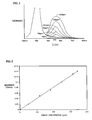
- Fig. 1 is a spectral plot of the absorbance spectrum of a lithium bromide brine, treated with a reagent, for differing concentrations of included lithium molybdate inhibitor.
- Fig. 2 is a graphical plot of the spectral absorbance at 550 nm for different concentrations of lithium molybdate in lithium bromide brine, showing the generally linear relationship.
- Fig. 3 is a generalized functional block diagram of a spectrophotometer for use in the analytical system and process of the invention.
- the present invention recognizes that a particular reagent, when mixed with a lithium halide brine, particularly lithium bromide, containing a lithium molybdate corrosion inhibitor, will provide a particular colorimetric response which is accurately indicative of the concentration of the molybdate inhibitor. This recognition is extended and applied to the utilization of portable, economical diagnostic equipment for making on-site determinations of molybdate inhibitor concentrations in absorption refrigeration systems.
- a representative refrigeration system employs an aqueous solution of water and a lithium halide, typically lithium bromide LiBr, as the working fluid, or brine, in the absorption chiller.
- a lithium halide typically lithium bromide LiBr
- LiCl may be the halide of lithium.
- the concentration of LiBr in the brines is typically in the range of 50-60%, and in the present embodiment about 55 %.
- the refrigeration system further employs a solution of lithium molybdate Li 2 MoO 4 , lithium borate and lithium silicate as the corrosion inhibitor.
- the lithium molybdate is only sparingly soluble in the LiBr brine and must be maintained in the 100-200 ppm range to assure the desired function as a corrosion inhibitor.
- the reaction occurs at room temperature and reaches completion within 10 minutes. Moreover, the developed color remains stable for at least 48 hours at room temperature, provided the reducing agent, SnCl 2 or SnBr 2 has not been depleted.
- soluble copper a common contaminant in used brine, does not interfere at concentrations up to about 500 ppm. The concentrations of copper in used brine are typically less than 500 ppm. Similarly, no other contaminants in used brines were found to interfere with the desirable characteristics of this particular reagent and its reaction with molybdates.
- Fig. 1 depicts the (optical) absorbance of the LiBr brine and the included lithium molybdate, lithium borate and lithium silicate inhibitors of the WB-1 inhibitor complex that has been treated with the reagent.
- the maximum absorbance occasioned by the presence of molybdate appears in the region of about 550 to 560 nm, and is characterized as a pink color.
- Fig. 1 in the spectral region between about 500 and 600 nm, there is depicted the absorbance of the LiBr brine for various concentrations of lithium molybdate inhibitor reacted with the SnCl 2 in HCl ( ag ).
- concentrations of molybdate range from 0 ppm to 200 ppm, as indicated on the several spectral scans in that region. It will be noted that the presence of molybdate is readily discernible, even in relatively small concentrations, by the characteristic rise in the absorbance in the region of 520 to 580 nm, and particularly at the maximum region of about 550 to 560 nm.
- a spectrophotometric instrument capable of making the analytical measurements of the present invention.
- the spectrophotometric instrument typically a spectrophotometer or colorimeter 10 , includes a radiation source 12 ; a dispersive device or a filter 14 ; a sample holder, or cell, 16 ; a detector 18 , such as a photo detector and amplifier; and a readout system 20 .
- the sample 16 as represented in broken line 16' , may be prepared separately and subsequently inserted into the spectrophotometer 10 .
- the spectrophotometer 10 is preferably and typically portable, and may be hand-held during use on-site.
- the HACH Generic Pocket Portable Colorimeter manufactured and sold by HACH Company of Loveland, Colorado is relatively small and portable, thus being readily useable for on-site analysis of molybdate concentrations in absorption refrigeration systems.
- the HACH colorimeter 10 affords the accuracy and economy required or desired of such an instrument.
- the colorimeter 10 is selected to be responsive substantially only in the optical range of interest, in this instance about 550 or 560 nm wavelength.
- the colorimeter 10 used herein was responsive at the 550 nm wavelength.
- the range of variation between the techniques is acceptable in monitoring the concentrations of molybdate inhibitor in the chiller brines to assure that concentrations in the 100-200 ppm range can be maintained.
- the preferred embodiment has described the use of a colorimeter 10 for determining the concentration of molybdate in a sample, to obtain the accuracy, objectivity, and repeatability of such an instrument in making colorimetric determinations.
- a colorimeter 10 for determining the concentration of molybdate in a sample
- other means may be used for determining molybdate concentration based on the intensity of the characteristic color of the reacted sample.
- another technique which may be used for on-site analysis comprises the use of a color comparator system in which the user is provided with an array of reference color indicia or charts correlated to respective concentrations of molybdate in the reacted sample. By visually comparing the color of the reacted sample to the reference color indicia, the user can determine the closest color match and an associated value of molybdate concentration.
- This technique is inexpensive but typically less objective and accurate than the colorimeter.
Landscapes
- Life Sciences & Earth Sciences (AREA)
- Physics & Mathematics (AREA)
- Chemical & Material Sciences (AREA)
- Health & Medical Sciences (AREA)
- General Physics & Mathematics (AREA)
- Immunology (AREA)
- Biochemistry (AREA)
- General Health & Medical Sciences (AREA)
- Analytical Chemistry (AREA)
- Pathology (AREA)
- Chemical Kinetics & Catalysis (AREA)
- Plasma & Fusion (AREA)
- Engineering & Computer Science (AREA)
- Molecular Biology (AREA)
- Biophysics (AREA)
- Fluid Mechanics (AREA)
- Investigating Or Analysing Materials By The Use Of Chemical Reactions (AREA)
- Investigating Or Analyzing Non-Biological Materials By The Use Of Chemical Means (AREA)
- Investigating Or Analysing Materials By Optical Means (AREA)
- Sorption Type Refrigeration Machines (AREA)
Abstract
Description
- Use a 5 or 10 mL syringe to measure 10 mL of uninhibited LiBr brine into a sample bottle (cell). Name this solution as "blank."
- Use a 5 or 10 mL syringe, with a 1.0 µm filter attached, to deliver 10 mL of each sample solution of "unknown" molybdate concentration into a separate cell. The filter removes particulate to provide a clear solution.
- Add 1 mL of molybdate reagent into the cells containing blank and unknown sample solutions.
- Cap each cell tightly and mix.
- Wait for 10 min to allow the color to fully develop.
- Insert the cell containing blank solution (uninhibited LiBr) into the sample cell compartment of the HACH colorimeter with the diamond mark facing the keyboard.
- Cover the cell with the instrument cap. Orient the cap's curved surface toward the keyboard to match the grooves in the instrument case.
- Zero the instrument by pressing the ZERO key.
- Measure Li2MoO4 concentration in each unknown sample by inserting the unknown sample cell, covering the cell compartment and pressing the READ key.
- Multiply the number displayed in the instrument readout by 100 to obtain Li2MoO4 concentration in PPM.
Claims (20)
- A system for the quantitative analysis of molybdate inhibitor in lithium halide brine at the site of a refrigeration system containing the brine, characterized byreagent means for mixing with a sample of lithium halide brine having an unknown concentration of molybdate inhibitor, the reagent being selected to create a characteristic color of the sample in reaction with molybdate inhibitor, the intensity of the characteristic color being a function of the concentration of molybdate inhibitor; andmeans for optically determining the concentration of molybdate inhibitor in the lithium halide brine sample as a function of the intensity of the characteristic color of the sample following reaction of molybdate with the reagent means.
- The system of claim 1 wherein the halide in the lithium halide brine is bromide.
- The system of claim 2 further comprising a vessel for containing the sample of LiBr brine having the unknown concentration of molybdate inhibitor, the vessel being suited for optical inspection of the sample by the optical determining means at least with respect to said characteristic color.
- The system of claim 1 wherein the reagent means is an acidified reducing agent chosen to provide said characteristic color of the sample when molybdate is present, without interfering with the optical detection of said characteristic color.
- The system of claim 2 wherein the reagent comprises SnCl2 in HCl (ag) and the characteristic color of the sample when mixed with the reagent corresponds to a wavelength in the region of 520-580 nm.
- The system of claim 5 wherein the optical determining means comprises a spectrophotometer.
- The system of claim 6 wherein the spectrophotometer is responsive substantially only to light in the wavelength region near 550 nm.
- The system of claim 7 wherein the spectrophotometer is a hand-held colorimeter.
- The system of claim 1 wherein the characteristic color corresponds to a wavelength near 550 nm and the optical determining means is a hand-held colorimeter operative only near 550 nm.
- The system of claim 7 further comprising first and second vessels, the first vessel for containing the sample of lithium bromide brine having the unknown concentration of molybdate inhibitor and the second vessel for containing a reference sample of lithium bromide brine having substantially no molybdate inhibitor for use in " zeroing" the spectrophotometer, each of said first and second vessels being suited for optical inspection of a sample therein by the spectrophotometer at least with respect to said characteristic color.
- The system of claim 1 wherein the optical determining means comprises a color comparator system for visual comparison by a user of the characteristic color of the sample with a plurality of reference color indicia.
- A method of quantitatively analyzing molybdate inhibitor present in lithium halide brine, characterized by the steps of:obtaining a sample of the lithium halide brine containing an unknown quantity of molybdate inhibitor;mixing a selected reagent with the sample to create a characteristic color of the sample in the presence of molybdate inhibitor, the intensity of the characteristic color being a function of the concentration of molybdate inhibitor;analyzing the sample to determine the presence and the intensity of the characteristic color; andproviding an indication of the concentration of molybdate inhibitor in the lithium halide brine of the sample as a function of the presence and intensity of the characteristic color.
- The method of claim 12 wherein the halide in the lithium halide brine is bromide.
- The method of claim 12 wherein the sample is analyzed and an indication of molybdate concentration is provided using a spectrophotometer, and further characterized by the step of calibrating the spectrophotometer.
- The method of Claim 14 wherein the step of calibrating the spectrophotometer characterized by the steps of:mixing the selected reagent with a reference sample of lithium halide brine which contains a known amount of molybdate inhibitor;analyzing the reference sample to determine the intensity of the characteristic color;establishing the determined intensity of the characteristic color for the reference sample as a reference indication of a known concentration of molybdate inhibitor, anddetermining the concentration of the unknown sample of molybdate inhibitor in the lithium halide brine as a substantially linear function of the indication provided by the spectrophotometer.
- The method of Claim 15 wherein the known amount of molybdate inhibitor in the lithium halide brine of the reference sample is zero.
- The method of Claim 16 wherein the halide in the lithium halide brine is bromide and the selected reagent comprises SnCl2 in HCl (ag), the characteristic color of the sample containing molybdate inhibitor when mixed with the reagent corresponds to a wavelength in the region near 550 nm, and the step of analyzing the sample comprises spectrophotometrically analyzing the sample substantially in an optical wavelength region near 550 nm.
- The method of Claim 17 wherein the step of spectrophotometrically analyzing the sample containing molybdate inhibitor is performed on a hand-held colorimeter.
- The method of claim 12 wherein the step of obtaining a sample of lithium halide brine containing an unknown quantity of molybdate inhibitor further includes the step of filtering said sample to remove suspended particulate.
- The method of claim 12 wherein the sample is analyzed and an indication of molybdate concentration is provided by a user of a color comparator system, the user determining molybdate concentration by comparing the characteristic color and intensity of the sample with color references correlated with and indicating differing molybdate concentrations.
Applications Claiming Priority (2)
| Application Number | Priority Date | Filing Date | Title |
|---|---|---|---|
| US09/324,376 US6358747B1 (en) | 1999-06-02 | 1999-06-02 | Method and apparatus for quantifying molybdate in absorption refrigeration system brines |
| US324376 | 1999-06-02 |
Publications (3)
| Publication Number | Publication Date |
|---|---|
| EP1058113A2 true EP1058113A2 (en) | 2000-12-06 |
| EP1058113A3 EP1058113A3 (en) | 2001-05-02 |
| EP1058113B1 EP1058113B1 (en) | 2009-03-18 |
Family
ID=23263326
Family Applications (1)
| Application Number | Title | Priority Date | Filing Date |
|---|---|---|---|
| EP00201783A Expired - Lifetime EP1058113B1 (en) | 1999-06-02 | 2000-05-19 | Method for quantifying molybdate in absorption refrigeration system brines |
Country Status (7)
| Country | Link |
|---|---|
| US (1) | US6358747B1 (en) |
| EP (1) | EP1058113B1 (en) |
| JP (1) | JP3645153B2 (en) |
| KR (1) | KR100381485B1 (en) |
| CN (1) | CN1183381C (en) |
| BR (1) | BR0002559A (en) |
| DE (1) | DE60041798D1 (en) |
Cited By (1)
| Publication number | Priority date | Publication date | Assignee | Title |
|---|---|---|---|---|
| CN114660002A (en) * | 2022-03-21 | 2022-06-24 | 厦门大学 | Method for measuring molybdate radical by using tetra-sulfo nickel phthalocyanine-lead (II) optical probe |
Families Citing this family (2)
| Publication number | Priority date | Publication date | Assignee | Title |
|---|---|---|---|---|
| DE202018001439U1 (en) | 2018-03-17 | 2018-04-03 | Institut für Luft- und Kältetechnik gemeinnützige Gesellschaft mbH | Analysis kit for condition monitoring of an absorption refrigeration plant |
| US12553872B2 (en) * | 2020-11-06 | 2026-02-17 | Northern Technologies International Corporation | Colorimetric quantification of corrosion inhibitor compounds in industrial fluids |
Family Cites Families (5)
| Publication number | Priority date | Publication date | Assignee | Title |
|---|---|---|---|---|
| US5550061A (en) * | 1989-02-02 | 1996-08-27 | Hybrivet Systems, Inc. | Test swab and method of using same |
| US5106581A (en) * | 1991-05-30 | 1992-04-21 | Industrial Test Systems, Inc. | Test device for detection of molybdate, vanadate and ferric ions |
| JPH08105835A (en) * | 1994-10-05 | 1996-04-23 | Nippon Chem Ind Co Ltd | Method for measuring MoO42- in refrigerant for refrigerator |
| US5547600A (en) | 1995-05-05 | 1996-08-20 | Carrier Corporation | Absorption refrigeration system working fluid with molybdate, borate, silicate inhibitor blend |
| US5744365A (en) * | 1997-03-18 | 1998-04-28 | Texaco Inc. | Method for measuring the level of carboxylate anion in engine coolant |
-
1999
- 1999-06-02 US US09/324,376 patent/US6358747B1/en not_active Expired - Fee Related
-
2000
- 2000-05-19 DE DE60041798T patent/DE60041798D1/en not_active Expired - Lifetime
- 2000-05-19 EP EP00201783A patent/EP1058113B1/en not_active Expired - Lifetime
- 2000-05-29 JP JP2000158133A patent/JP3645153B2/en not_active Expired - Fee Related
- 2000-06-01 BR BR0002559-3A patent/BR0002559A/en not_active IP Right Cessation
- 2000-06-01 KR KR10-2000-0029882A patent/KR100381485B1/en not_active Expired - Fee Related
- 2000-06-02 CN CNB001180223A patent/CN1183381C/en not_active Expired - Fee Related
Cited By (1)
| Publication number | Priority date | Publication date | Assignee | Title |
|---|---|---|---|---|
| CN114660002A (en) * | 2022-03-21 | 2022-06-24 | 厦门大学 | Method for measuring molybdate radical by using tetra-sulfo nickel phthalocyanine-lead (II) optical probe |
Also Published As
| Publication number | Publication date |
|---|---|
| BR0002559A (en) | 2000-12-26 |
| KR100381485B1 (en) | 2003-04-26 |
| EP1058113A3 (en) | 2001-05-02 |
| US6358747B1 (en) | 2002-03-19 |
| EP1058113B1 (en) | 2009-03-18 |
| CN1276523A (en) | 2000-12-13 |
| DE60041798D1 (en) | 2009-04-30 |
| CN1183381C (en) | 2005-01-05 |
| KR20010007161A (en) | 2001-01-26 |
| JP2001013078A (en) | 2001-01-19 |
| JP3645153B2 (en) | 2005-05-11 |
Similar Documents
| Publication | Publication Date | Title |
|---|---|---|
| Morelli | Determination of iron (III) and copper (II) by zeroth, first and second derivative spectrophotometry with 2-thiobarbituric acid (4, 6-dihydroxy-2-mercaptopyrimidine) as reagent | |
| Jungreis | Spot test analysis | |
| LaCoste et al. | Colorimetric estimation of various metal derivatives of sodium diethyldithiocarbamate | |
| Moliner-Martínez et al. | Improved detection limit for ammonium/ammonia achieved by Berthelot's reaction by use of solid-phase extraction coupled to diffuse reflectance spectroscopy | |
| CN110987918A (en) | Detection reagent and rapid detection method for total nitrogen in water | |
| US20150198540A1 (en) | Dry reagent based water analyzer | |
| Miller et al. | Chemical oxygen demand analysis of wastewater using trivalent manganese oxidant with chloride removal by sodium bismuthate pretreatment | |
| G/Mariam et al. | Spectroscopic determination of fluoride using eriochrome black T (EBT) as a spectrophotometric reagent from groundwater | |
| EP1058113B1 (en) | Method for quantifying molybdate in absorption refrigeration system brines | |
| CN108680541A (en) | A kind of fluorescence molybdenum oxide quantum dot measurement determination of trace uranium(Ⅵ)Method | |
| Grunder et al. | Evaluation of zinc protoporphyrin in an occupational environment | |
| Unger-Heumann | Strategy of analytical test kits | |
| CN115308181B (en) | A ratiometric fluorescent paper-based sensor for in situ visual detection of soil ammonium nitrogen | |
| MXPA00005399A (en) | Method and apparatus for quantifying molybdate in absorption refrigeration system brines | |
| Zhang et al. | Determination of trace thiocyanate in body fluids by a kinetic fluorimetric method | |
| RU2105289C1 (en) | Method of indication and quantitative determination of ammonia vapors in air | |
| JP3545928B2 (en) | Magnesium ion concentration measurement device | |
| Miller et al. | Fiber Opt Ic Chemical Sensors For Industrial And Process Control | |
| Salinas et al. | Determination of aluminium with 8-hydroxyquinoline-5-sulfonic acid in presence of a cationic surfactant by first and second derivative synchronous fluorimetry | |
| CN207779891U (en) | Copper ion colorimetric method sensor | |
| Hemmes et al. | Test Strips for Rapid On-Site Analysis of Engine Coolants | |
| US20250283802A1 (en) | Systems, kits, and methods for determining corrosion tendencies of an aqueous sample on metal alloys exposed thereto | |
| Sadeghi et al. | Uranyl ion-selective optical test strip | |
| Buzoianu | Measurement uncertainty and its meaning in legal metrology of environmental chemistry and public health | |
| Nygaard et al. | Side line indexing for peak search in scanning inductively coupled plasma emission spectrometry |
Legal Events
| Date | Code | Title | Description |
|---|---|---|---|
| PUAI | Public reference made under article 153(3) epc to a published international application that has entered the european phase |
Free format text: ORIGINAL CODE: 0009012 |
|
| AK | Designated contracting states |
Kind code of ref document: A2 Designated state(s): DE ES FR GB IT |
|
| AX | Request for extension of the european patent |
Free format text: AL;LT;LV;MK;RO;SI |
|
| PUAL | Search report despatched |
Free format text: ORIGINAL CODE: 0009013 |
|
| AK | Designated contracting states |
Kind code of ref document: A3 Designated state(s): AT BE CH CY DE DK ES FI FR GB GR IE IT LI LU MC NL PT SE |
|
| AX | Request for extension of the european patent |
Free format text: AL;LT;LV;MK;RO;SI |
|
| 17P | Request for examination filed |
Effective date: 20010928 |
|
| AKX | Designation fees paid |
Free format text: DE ES FR GB IT |
|
| RAP1 | Party data changed (applicant data changed or rights of an application transferred) |
Owner name: CARRIER CORPORATION |
|
| GRAP | Despatch of communication of intention to grant a patent |
Free format text: ORIGINAL CODE: EPIDOSNIGR1 |
|
| RTI1 | Title (correction) |
Free format text: METHOD FOR QUANTIFYING MOLYBDATE IN ABSORPTION REFRIGERATION SYSTEM BRINES |
|
| GRAS | Grant fee paid |
Free format text: ORIGINAL CODE: EPIDOSNIGR3 |
|
| GRAA | (expected) grant |
Free format text: ORIGINAL CODE: 0009210 |
|
| AK | Designated contracting states |
Kind code of ref document: B1 Designated state(s): DE ES FR GB IT |
|
| REG | Reference to a national code |
Ref country code: GB Ref legal event code: FG4D |
|
| REF | Corresponds to: |
Ref document number: 60041798 Country of ref document: DE Date of ref document: 20090430 Kind code of ref document: P |
|
| PG25 | Lapsed in a contracting state [announced via postgrant information from national office to epo] |
Ref country code: ES Free format text: LAPSE BECAUSE OF FAILURE TO SUBMIT A TRANSLATION OF THE DESCRIPTION OR TO PAY THE FEE WITHIN THE PRESCRIBED TIME-LIMIT Effective date: 20090629 |
|
| PLBE | No opposition filed within time limit |
Free format text: ORIGINAL CODE: 0009261 |
|
| STAA | Information on the status of an ep patent application or granted ep patent |
Free format text: STATUS: NO OPPOSITION FILED WITHIN TIME LIMIT |
|
| 26N | No opposition filed |
Effective date: 20091221 |
|
| GBPC | Gb: european patent ceased through non-payment of renewal fee |
Effective date: 20090618 |
|
| REG | Reference to a national code |
Ref country code: FR Ref legal event code: ST Effective date: 20100129 |
|
| PG25 | Lapsed in a contracting state [announced via postgrant information from national office to epo] |
Ref country code: FR Free format text: LAPSE BECAUSE OF NON-PAYMENT OF DUE FEES Effective date: 20090602 |
|
| PG25 | Lapsed in a contracting state [announced via postgrant information from national office to epo] |
Ref country code: GB Free format text: LAPSE BECAUSE OF NON-PAYMENT OF DUE FEES Effective date: 20090618 |
|
| PGFP | Annual fee paid to national office [announced via postgrant information from national office to epo] |
Ref country code: DE Payment date: 20120516 Year of fee payment: 13 |
|
| PGFP | Annual fee paid to national office [announced via postgrant information from national office to epo] |
Ref country code: IT Payment date: 20120519 Year of fee payment: 13 |
|
| PG25 | Lapsed in a contracting state [announced via postgrant information from national office to epo] |
Ref country code: DE Free format text: LAPSE BECAUSE OF NON-PAYMENT OF DUE FEES Effective date: 20131203 |
|
| REG | Reference to a national code |
Ref country code: DE Ref legal event code: R119 Ref document number: 60041798 Country of ref document: DE Effective date: 20131203 |
|
| PG25 | Lapsed in a contracting state [announced via postgrant information from national office to epo] |
Ref country code: IT Free format text: LAPSE BECAUSE OF NON-PAYMENT OF DUE FEES Effective date: 20130519 |