EP1057871A1 - Polyarylene sulfide resin composition for electronic part encapsulation - Google Patents
Polyarylene sulfide resin composition for electronic part encapsulation Download PDFInfo
- Publication number
- EP1057871A1 EP1057871A1 EP99961302A EP99961302A EP1057871A1 EP 1057871 A1 EP1057871 A1 EP 1057871A1 EP 99961302 A EP99961302 A EP 99961302A EP 99961302 A EP99961302 A EP 99961302A EP 1057871 A1 EP1057871 A1 EP 1057871A1
- Authority
- EP
- European Patent Office
- Prior art keywords
- weight
- parts
- polyarylene sulfide
- sulfide resin
- composition
- Prior art date
- Legal status (The legal status is an assumption and is not a legal conclusion. Google has not performed a legal analysis and makes no representation as to the accuracy of the status listed.)
- Granted
Links
Classifications
-
- H—ELECTRICITY
- H10—SEMICONDUCTOR DEVICES; ELECTRIC SOLID-STATE DEVICES NOT OTHERWISE PROVIDED FOR
- H10W—GENERIC PACKAGES, INTERCONNECTIONS, CONNECTORS OR OTHER CONSTRUCTIONAL DETAILS OF DEVICES COVERED BY CLASS H10
- H10W74/00—Encapsulations, e.g. protective coatings
- H10W74/40—Encapsulations, e.g. protective coatings characterised by their materials
- H10W74/47—Encapsulations, e.g. protective coatings characterised by their materials comprising organic materials, e.g. plastics or resins
- H10W74/476—Organic materials comprising silicon
-
- C—CHEMISTRY; METALLURGY
- C08—ORGANIC MACROMOLECULAR COMPOUNDS; THEIR PREPARATION OR CHEMICAL WORKING-UP; COMPOSITIONS BASED THEREON
- C08K—Use of inorganic or non-macromolecular organic substances as compounding ingredients
- C08K3/00—Use of inorganic substances as compounding ingredients
- C08K3/34—Silicon-containing compounds
- C08K3/36—Silica
-
- C—CHEMISTRY; METALLURGY
- C08—ORGANIC MACROMOLECULAR COMPOUNDS; THEIR PREPARATION OR CHEMICAL WORKING-UP; COMPOSITIONS BASED THEREON
- C08K—Use of inorganic or non-macromolecular organic substances as compounding ingredients
- C08K5/00—Use of organic ingredients
- C08K5/54—Silicon-containing compounds
- C08K5/541—Silicon-containing compounds containing oxygen
- C08K5/5435—Silicon-containing compounds containing oxygen containing oxygen in a ring
-
- C—CHEMISTRY; METALLURGY
- C08—ORGANIC MACROMOLECULAR COMPOUNDS; THEIR PREPARATION OR CHEMICAL WORKING-UP; COMPOSITIONS BASED THEREON
- C08L—COMPOSITIONS OF MACROMOLECULAR COMPOUNDS
- C08L23/00—Compositions of homopolymers or copolymers of unsaturated aliphatic hydrocarbons having only one carbon-to-carbon double bond; Compositions of derivatives of such polymers
- C08L23/02—Compositions of homopolymers or copolymers of unsaturated aliphatic hydrocarbons having only one carbon-to-carbon double bond; Compositions of derivatives of such polymers not modified by chemical after-treatment
- C08L23/04—Homopolymers or copolymers of ethene
- C08L23/08—Copolymers of ethene
- C08L23/0846—Copolymers of ethene with unsaturated hydrocarbons containing atoms other than carbon or hydrogen
- C08L23/0869—Copolymers of ethene with unsaturated hydrocarbons containing atoms other than carbon or hydrogen with unsaturated acids, e.g. [meth]acrylic acid; with unsaturated esters, e.g. [meth]acrylic acid esters
-
- C—CHEMISTRY; METALLURGY
- C08—ORGANIC MACROMOLECULAR COMPOUNDS; THEIR PREPARATION OR CHEMICAL WORKING-UP; COMPOSITIONS BASED THEREON
- C08L—COMPOSITIONS OF MACROMOLECULAR COMPOUNDS
- C08L81/00—Compositions of macromolecular compounds obtained by reactions forming in the main chain of the macromolecule a linkage containing sulfur with or without nitrogen, oxygen or carbon only; Compositions of polysulfones; Compositions of derivatives of such polymers
- C08L81/02—Polythioethers; Polythioether-ethers
-
- C—CHEMISTRY; METALLURGY
- C08—ORGANIC MACROMOLECULAR COMPOUNDS; THEIR PREPARATION OR CHEMICAL WORKING-UP; COMPOSITIONS BASED THEREON
- C08L—COMPOSITIONS OF MACROMOLECULAR COMPOUNDS
- C08L2201/00—Properties
- C08L2201/02—Flame or fire retardant/resistant
Definitions
- the present invention relates to a polyarylene sulfide resin composition for sealing electronic parts. Precisely, it relates to a polyarylene sulfide (hereinafter often referred to as PAS) resin composition suitable for sealing semiconductors such as diodes, transistors, LSIs, CCD devices, ICs, etc.; as well as capacitors, resistors, coils, micro switches, dip switches, etc.
- PAS polyarylene sulfide
- Polyarylene sulfide resins are engineering plastics having good heat resistance, good flame resistance and good electric and mechanical properties, and are known to be widely usable in the field of electronic parts, electric parts, etc., especially as sealants for electronic parts (for example, Japanese Patent Laid-Open Nos. 266461/1986, 296062/1986, 150752/1987, 45560/1992, 202245/1993, etc.) .
- sealants for electronic parts for example, Japanese Patent Laid-Open Nos. 266461/1986, 296062/1986, 150752/1987, 45560/1992, 202245/1993, etc.
- polyarylene sulfide resins are problematic in that the driving reliability of the devices with parts sealed with them is not good after heat cycles.
- electronic parts to be sealed include silicon chips, lead frames and others, and are so fabricated that the lead wires therein are electrically connected with aluminium circuits via bonding wires.
- resin such as PAS
- PCT pressure cooker test
- TCT thermal cycle test
- the object of the invention is to provide a PAS resin composition which has good PCT and TCT acceptable quality and good fluidity, naturally having good properties intrinsic to ordinary PAS resin, and which, when used for sealing electronic parts, does not cause deformation of bonding wires and other elements, and does not cause package breakdown as its strength is not lowered. Therefore, the PAS resin composition which the invention is to provide is specifically favorable to materials for sealing electronic parts.
- the invention provides the following:
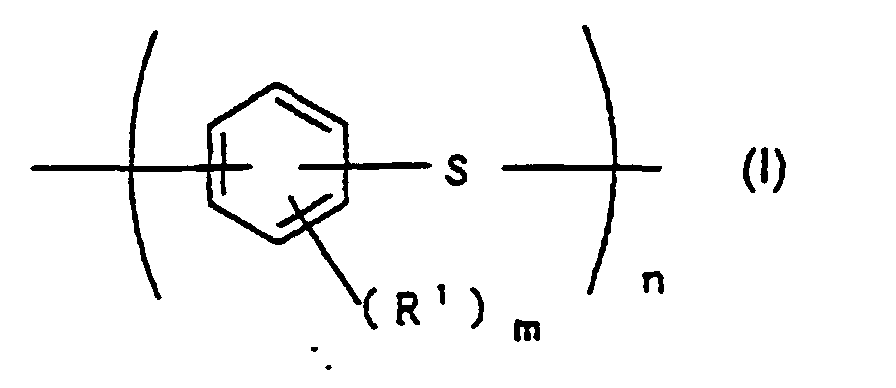
- the polyarylene sulfide (PAS) (A) for use in the invention is a polymer having repetitive units of a structural formula, -Ar-S- wherein Ar indicates an arylene group, in an amount of at least 70 mol%.
- PPS polyphenylene sulfide
- I chemical formula
- R 1 indicates a substituent selected from an alkyl or alkoxy group having at most 6 carbon atoms, a phenyl group, a group of a carboxylic acid or its metal salt, a nitro group, or a halogen atom including fluorine, chlorine and bromine atoms;
- m indicates an integer of from 0 to 4; and
- n indicates a degree of polymerization falling between 1.3 and 30.
- PAS includes two types, one having a substantially linear molecular structure with neither branches or crosslinks, and the other having a branched or crosslinked molecular structure. Any type of PAS is usable in the invention with no specific limitation.
- Preferred PAS for use in the invention is a homopolymer or a copolymer having at least 70 mol%, more preferably at least 80 mol% of repetitive paraphenylene sulfide units.
- PAS of which the repetitive paraphenylene sulfide unit content is smaller than 70 mol% is unfavorable, as it will lose its intrinsic crystallinity characteristic of crystalline polymer and its mechanical properties will be poor.
- the comonomer units for the copolymer polyarylene sulfide include, for example, metaphenylene sulfide units, orthophenylene sulfide units, p,p'-diphenyleneketone sulfide units, p,p'-diphenylenesulfone sulfide units, p,p'-biphenylene sulfide units, p,p'-diphenyleneether sulfide units, p,p'-diphenylenemethylene sulfide units, p,p'-diphenylenecumenyl sulfide units, naphthyl sulfide units, etc.
- the PAS resin can be obtained in any per-se known method of, for example, polycondensation of a dihaloaromatic compound with a sulfur source in an organic polar solvent.
- the melt viscosity of the PAS resin for use in the invention is not specifically defined, but preferably falls between 5 and 100 Pa ⁇ s at 300°C at 200 sec -1 .
- Silica has a small linear expansion coefficient, and is used herein for the purpose of improving the adhesiveness of the composition to chips and lead frames of electronic parts and also to bonding wires.
- silica to be used in the invention is not specifically defined.
- amorphous silica such as broken silica, as well as spherical silica such as fused silica or synthetic silica.
- Plural types of silica may be blended for use herein.
- the grain size and the grain size distribution of silica for use herein are not also specifically defined.
- Preferably used is silica having a mean grain size of at most 50 ⁇ m.
- Silica for use herein may be previously treated on its surface with a silane coupling agent or the like.
- the coupling agent for the surface treatment is any known one.
- it includes aminosilanes and epoxysilanes such as ⁇ -aminopropyltrimethoxysilane, N- ⁇ -(aminoethyl)- ⁇ -aminopropyltrimethoxysilane, ⁇ -glycidoxypropyltrimethoxysilane, ⁇ -(3,4-epoxycyclohexyl)ethyltrimethoxysilane, etc.; and also vinylsilanes, mercaptosilanes, etc.
- the elastomer for use in the invention is not specifically defined, including, for example, olefinic elastomers, polyamide elastomers, polyester elastomers, vinyl copolymer elastomers, dienic elastomers, silicone elastomers, etc.
- the olefinic elastomers include graft copolymers that may be prepared by grafting ⁇ -olefinic stem polymers with unsaturated carboxylic acids or their anhydrides.
- the ⁇ -olefins include polymers and copolymers of ethylene, propylene, butene-1, isobutene, pentene-1, 4-methyl-pentene-1, etc.
- the unsaturated carboxylic acids and their anhydrides include maleic acid, fumaric acid, itaconic acid, methylmaleic acid, acrylic acid, methacrylic acid, crotonic acid, citraconic acid, maleic anhydride, methylmaleic anhydride, glycidyl acrylate, etc.
- the olefinic elastomers include ethylenic copolymers from monomers of ethylene, an alkyl ⁇ , ⁇ -unsaturated carboxylate, and maleic anhydride, with the repetitive monomer units being from 50 to 90 % by weight, from 5 to 49 % by weight, and from 0.5 to 10 % by weight, respectively, preferably from 60 to 85 % by weight, from 7 to 45 % by weight, and from 1 to 8 % by weight, respectively.
- the alkyl ⁇ , ⁇ -unsaturated carboxylate includes alkyl esters of unsaturated C3-8 carboxylic acids, for example, methyl acrylate, ethyl acrylate, n-propyl acrylate, isopropyl acrylate, n-butyl acrylate, isobutyl acrylate, t-butyl acrylate, methyl methacrylate, ethyl methacrylate, n-propyl methacrylate, isopropyl methacrylate, n-butyl methacrylate, isobutyl methacrylate, t-butyl methacrylate, etc.
- the ethylenic copolymers have MI (as measured at 190°C under a load of 2.16 kg) of from 0.1 to 1000, more preferably from 0.2 to 500, even more preferably from 1 to 100.
- the polyamide elastomers include polyamide block copolymers comprising polyamide hard segments coupled with other soft segments.
- the soft segments are, for example, from polyalkylene oxides (in which the alkyl group has from 2 to 6 carbon atoms).
- the polyamide component for the hard segments includes, for example, polyamides such as polyamide 6, polyamide 66, polyamide 6-12, polyamide 11, polyamide 12, etc.
- the polyether component for the soft segments includes, for example, polyoxyethylene glycol, polyoxypropylene glycol, polyoxytetramethylene glycol, etc.
- the polyester elastomers include multi-block polymers comprising hard segments from high-crystalline aromatic polyesters and soft segments from amorphous polyethers or aliphatic polyesters.
- the hard segments include, for example, those from terephthalate-type crystalline polyesters such as polyethylene terephthalate, polybutylene terephthalate, polycyclohexanedimethylene terephthalate, etc.
- the soft segments include, for example, those from aliphatic polyethers such as polytetramethylene ether glycol, polypropylene glycol, polyethylene glycol, etc.; and aliphatic polyesters to be prepared from aliphatic dicarboxylic acids such as oxalic acid, malonic acid, succinic acid, glutaric acid, adipic acid, pyromellitic acid, suberic acid, azelaic acid, sebacic acid and the like, and glycols such as ethylene glycol, propylene glycol, butanediol, pentanediol, neopentyl glycol, hexanediol, octanediol, decanediol and the like.
- aliphatic polyethers such as polytetramethylene ether glycol, polypropylene glycol, polyethylene glycol, etc.
- aliphatic polyesters to be prepared from aliphatic dicarbox
- the dienic elastomers include, for example, natural rubbers, polybutadienes, polyisoprenes, polyisobutylenes, neoprenes, polysulfide rubbers, Thiokol rubbers, acrylic rubbers, urethane rubbers, silicone rubbers, epichlorohydrin rubbers, styrene-butadiene block copolymers (SBR), hydrogenated styrene-butadiene block copolymers (SEB, SEBC), styrene-butadiene-styrene block copolymers (SBS), hydrogenated styrene-butadiene-styrene block copolymers (SEBS), styrene-isoprene block copolymers (SIR), hydrogenated styrene-isoprene block copolymers (SEP), styrene-isoprene-styrene block copolymers (SIS), hydrogenated
- polyorganosiloxane rubbers examples include polyorganosiloxane rubbers, and preferred are copolymers as prepared by copolymerizing polyorganosiloxanes with crosslinking agents.
- the polyorganosiloxanes include, for example, hexamethylcyclotrisiloxane, octamethylcyclotetrasiloxane, decamethylcyclopentasiloxane, dodecamethylcyclohexasiloxane, trimethyltriphenylcyclotrisiloxane, tetramethyltetraphenylcyclotetrasiloxane, etc.
- the crosslinking agents include, for example, trifunctional or tetrafunctional siloxane-type crosslinking agents such as trimethoxymethylsilane, triethoxyphenylsilane, tetramethoxysilane, tetraethoxysilane, tetrabutoxysilane, etc.
- the epoxysilane is meant to indicate an epoxy group-having silane compound.
- silane compounds having at least one epoxy group and at least one Si-OR group (where R indicates an alkyl group) in one molecule.
- R may be an alkyl group having from 1 to 20 carbon atoms, and is preferably an alkyl group having from 1 to 10 carbon atoms.
- the epoxysilane includes ⁇ -glycidoxypropyltrimethoxysilane, ⁇ -(3,4-epoxycyclohexyl) ethyltrimethoxysilane, ⁇ -glycidoxypropyltriethoxysilane, etc.
- the method of adding the epoxysilane to the composition of the invention is not specifically defined. For example, it may be added to the composition through integral blending or the like.
- the epoxy resin has one or more epoxy groups, and may be liquid or solid. It includes glycidylepoxy resins, for example, glycidyl ethers of bisphenols such as bisphenol A, resorcinol, hydroquinone, pyrocatechol, bisphenol F, 1,3,5-trihydroxybenzene, trihydroxydiphenyldimethylmethane, 4,4'-dihydroxybiphenyl, etc., diglycidyl ethers of halogenobisphenol-butanediols but not bisphenols, glycidyl esters such as glycidyl phthalate, etc., glycidylamines such as N-glycidylaniline, etc.; cyclic non-glycidyl epoxy resins such as epoxypolyolefins, dicyclopentadiene-dioxide, etc.; novolak epoxy resins to be prepared by reacting novolak phenolic resins with epichloro
- the PAS resin composition of the invention may optionally contain any other components, in addition to the components mentioned above, so far as the additional components do not interfere with the object of the invention.
- the additional components include, for example, various additives such as inorganic fillers, antioxidants, heat stabilizers, lubricants, colorants, plasticizers, electroconductive agents, etc.; thermoplastic or thermosetting resins such as polyamides, silicone resins, silicone oils, silicone soils having various functional groups, polyolefins, polyether sulfones, polyphenylene ethers, etc.; pigments, etc.
- the inorganic fillers may be granular or powdery ones, and even any others.
- the granular or powdery inorganic fillers include talc, titanium dioxide, silica not corresponding to the component (B) in the invention, mica, calcium carbonate, calcium sulfate, barium carbonate, magnesium carbonate, magnesium sulfate, barium sulfate, oxysulfates, tin oxide, alumina, kaolin, silicon carbide, glass powder, glass flakes, glass beads, etc.
- the inorganic fillers for use herein may be treated on their surfaces with a coupling agent or the like, for improving their adhesiveness to resin.
- the coupling agent to be used for that purpose may be selected from silane coupling agents, titanium coupling agents, and other known coupling agents.
- the amount of the additional components that may be in the composition may be suitably determined, without interfering with the object of the invention.
- Blend ratio of the components constituting the PAS resin composition of the invention :
- the blend ratio of the components constituting the PAS resin composition of the invention is as follows:
- the amount of (A) polyarylene sulfide resin falls between 20 and 35 % by weight, preferably between 20 and 30 % by weight
- that of (B) silica falls between 60 and 75 % by weight, preferably between 62 and 73 % by weight
- that of (C) elastomer falls between 1 and 10 % by weight, preferably between 2 and 8 % by weight
- the amount of (D) epoxysilane falls between 0.05 and 1.2 parts by weight, preferably between 0.1 and 1.2 parts by weight, relative to 100 parts by weight of the total amount of the components (A), (B) and (C).
- the amount of (A) polyarylene sulfide resin falls between 20 and 35 % by weight, preferably between 20 and 30 % by weight, that of (B) silica falls between 60 and 75 % by weight, preferably between 62 and 73 % by weight, and that of (C) elastomer falls between 1 and 10 % by weight, preferably between 2 and 8 % by weight; and the amount of (E) epoxy resin falls between 0.1 and 3 parts by weight, preferably between 0.3 and 2.5 parts by weight, relative to 100 parts by weight of the total amount of the components (A), (B) and (C).
- composition may contain both the components (D) and (E).
- the amount of the polyarylene sulfide resin (A) is smaller than 20 % by weight, the fluidity of the composition will be low. If so, the composition will deform wires when used for sealing electronic parts. On the other hand, if the amount of (A) is larger than 35 % by weight, the fraction defective in PCT and TCT of the composition will increase. If the amount of the component (B) silica is smaller than 60 % by weight, the fraction defective in PCT and TCT of the composition will increase. On the other hand, if the amount of (B) is larger than 75 % by weight, the fluidity of the composition will be low. If so, the composition will deform wires when used for sealing electronic parts.
- the amount of the elastomer (C) is smaller than 1 % by weight, the fraction defective in PCT and TCT of the composition will also increase. On the other hand, if the amount of (C) is larger than 10 % by weight, the strength of the composition will be low. If the amount of the epoxysilane (D) is smaller than 0.05 parts by weight, the strength of the composition will be low, often causing package breakdown when the composition is used for sealing electronic parts. If, on the other hand, the amount of (D) is larger than 1.2 parts by weight, the fluidity of the composition will be low, often causing wire deformation when the composition is used for sealing electronic parts.
- the amount of the epoxy resin (E) is smaller than 0.1 parts by weight, the strength of the composition will be also low, often causing package breakdown when the composition is used for sealing electronic parts. If, on the other hand, the amount of (E) is larger than 3 parts by weight, the fluidity of the composition will be also low, often causing wire deformation when the composition is used for sealing electronic parts.
- the PAS resin composition may be prepared by blending the constituent components mentioned above, optionally along with the additional components that may be selectively added to the composition.
- the components may be kneaded in melt to prepare the composition.
- Kneading the components in melt may be effected in any ordinary known manner. Anyhow, the components shall be uniformly mixed and dispersed in the resin to prepare the intended resin composition. For kneading the components in melt, favorably used is a double-screw extruder, a single-screw extruder or the like.
- the conditions for kneading the components in melt are not specifically defined. Preferably, however, too high temperatures or too long residence time shall be evaded so as to prevent the optional components from being decomposed or foamed. Concretely, the temperature may fall generally between 280 and 350°C, but preferably between 285 and 330°C.
- the PAS resin composition thus prepared in the manner as above is generally granulated or pelletized into pellets or others having desired shapes or sizes suitable for secondary processing, before it is applied to molding, especially injection molding.
- the PAS resin composition of the invention is favorably used for electronic parts or for sealing electronic parts.
- the type of the electronic parts to which the composition is applied is not specifically defined.
- the composition is applicable to various electronic devices such as integrated circuit devices including, for example, diodes, transistors, LSIs, CCD devices, ICs, etc., and also to capacitors, resistors, coils, micro switches, dip switches, etc.
- PAS resin composition of the invention is described more concretely with reference to the following Examples.
- the amount of each component is designated as follows: For the components (A), (B), (C), (F) and (G), the amount of each component is in terms of % by weight relative to 100 % by weight of the total amount of all these components. For the components (D) and (E), the amount of each component is in terms of parts by weight relative to 100 parts by weight of the total amount of the components (A), (B), (C), (F) and (G). The blanks indicate 0 (zero).
- the melt viscosity of PPS-1 was 12 Pa ⁇ s at 300°C at 200 sec -1 .
- PPS-2 was prepared in the same manner as above for preparing PPS-1, except that the polymerization time and the number of washing operations were varied.
- melt viscosity was 40 Pa ⁇ s at 300°C at 200 sec -1 .
- melt viscosity was 11 Pa ⁇ s at 300°C at 200 sec -1 .
- melt viscosity was 12 Pa ⁇ s at 300°C at 200 sec -1 .
- Component (B) (Silica):
- Silica 1 was treated on its surface with an epoxysilane (D) mentioned below to prepare Silica 2.
- Admafine SO-C2 from Admatex having a mean grain size of 0.5 ⁇ m.
- Component (C) (Elastomer) :
- sample strips having a thickness of 1 mm for which the cylinder temperature was 320°C, a mold temperature was 135°C and the injection pressure was 1000 kg/cm 2 .
- the length (mm) of the sample flow having been injected in that condition was measured, and this indicates the spiral flow length of the sample tested.
- the spiral flow length is an index of the fluidity of the sample to be molded through injection molding. Samples having a larger spiral flow length have better fluidity.
- a resin composition to be tested was applied to a chip with a 250 mm ⁇ aluminium bonding wire being attached to the chip vertically to the resin flow, and the chip with the bonding wire was molded through insert molding whereupon the condition of the wire was macroscopically checked.
- Chip samples with no wire deformation were designated by OO; those with minor wire deformation were by O; those with significant wire deformation were by ⁇ ; and those with great wire deformation were by X.
- PCT was conducted according to JIS C5030. Precisely, chip samples sealed with a resin composition to be tested were processed with hot pressure steam in a pressure cooker at a temperature of 121°C and a relative humidity of 100 % and under a pressure of 2.02 atmospheres for 500 hours, and the defective chips were counted to obtain the percent defective (%) . For evaluating them, the tested chips were immersed in red ink at 90°C for 3 hours, and then dried in air for 24 hours, and their package was opened. The chips stained with red ink were evaluated "bad". The percent defective in PCT indicates the wet heat resistance of the resin composition tested.
- TCT was conducted according to JIS C5030. Precisely, chip samples sealed with a resin composition to be tested were subjected to 300 heat cycles, one heat cycle comprising heating the ship samples at 130°C for 1 hour followed by cooling them at -40°C for 1 hour, and the defective chips were counted to obtain the percent defective (%). For evaluating them, the tested chips were immersed in red ink at 90°C for 3 hours, and then dried in air for 24 hours, and their package was opened. The chips stained with red ink were evaluated "bad". The percent defective in TCT indicates the heat shock resistance of the resin composition tested.
- test data are shown in Table 1 and Table 2.
- PAS resin composition which has good PCT and TCT acceptable quality and good fluidity, naturally having good properties intrinsic to ordinary PAS resin, and which, when used for sealing electronic parts, causes neither deformation of bonding wires and other elements nor package breakdown, and is therefore specifically favorable to materials for sealing electronic parts.
Landscapes
- Chemical & Material Sciences (AREA)
- Health & Medical Sciences (AREA)
- Chemical Kinetics & Catalysis (AREA)
- Medicinal Chemistry (AREA)
- Polymers & Plastics (AREA)
- Organic Chemistry (AREA)
- Compositions Of Macromolecular Compounds (AREA)
- Structures Or Materials For Encapsulating Or Coating Semiconductor Devices Or Solid State Devices (AREA)
Abstract
Description


Claims (7)
- A polyarylene sulfide resin composition for sealing electronic parts, which comprises (A) from 20 to 35 % by weight of a polyarylene sulfide resin, (B) from 60 to 75 % by weight of silica, and (C) from 1 to 10 % by weight of an elastomer, and further contains (D) from 0.05 to 1.2 parts by weight, relative to 100 parts by weight of the total amount of the components (A), (B) and (C), of an epoxysilane.
- A polyarylene sulfide resin composition for sealing electronic parts, which comprises (A) from 20 to 35 % by weight of a polyarylene sulfide resin, (B) from 60 to 75 % by weight of silica, and (C) from 1 to 10 % by weight of an elastomer, and further contains (E) from 0.1 to 3 parts by weight, relative to 100 parts by weight of the total amount of the components (A), (B) and (C), of an epoxy resin.
- A polyarylene sulfide resin composition for sealing electronic parts, which comprises (A) from 20 to 35 % by weight of a polyarylene sulfide resin, (B) from 60 to 75 % by weight of silica, and (C) from 1 to 10 % by weight of an elastomer, and further contains (D) from 0.05 to 1.2 parts by weight of an epoxysilane and (E) from 0.1 to 3 parts by weight of an epoxy resin, both relative to 100 parts by weight of the total amount of the components (A), (B) and (C).
- The polyarylene sulfide resin composition for sealing electronic parts as claimed in any one of claims 1 to 3, wherein the elastomer (C) is an ethylenic copolymer of ethylene, an alkyl α,β-unsaturated carboxylate, and maleic anhydride, with the repetitive units being from 50 to 90 % by weight, from 5 to 49 % by weight, and from 0.5 to 10 % by weight, respectively.
- A method for sealing electronic parts with a polyarylene sulfide resin composition, in which the composition comprises (A) from 20 to 35 % by weight of a polyarylene sulfide resin, (B) from 60 to 75 % by weight of silica, and (C) from 1 to 10 % by weight of an elastomer, and further contains (D) from 0.05 to 1.2 parts by weight, relative to 100 parts by weight of the total amount of the components (A), (B) and (C), of an epoxysilane.
- A method for sealing electronic parts with a polyarylene sulfide resin composition, in which the composition comprises (A) from 20 to 35 % by weight of a polyarylene sulfide resin, (B) from 60 to 75 % by weight of silica, and (C) from 1 to 10 % by weight of an elastomer, and further contains (E) from 0.1 to 3 parts by weight, relative to 100 parts by weight of the total amount of the components (A), (B) and (C), of an epoxy resin.
- A method for sealing electronic parts with a polyarylene sulfide resin composition, in which the composition comprises (A) from 20 to 35 % by weight of a polyarylene sulfide resin, (B) from 60 to 75 % by weight of silica, and (C) from 1 to 10 % by weight of an elastomer, and further contains (D) from 0.05 to 1.2 parts by weight of an epoxysilane and (E) from 0.1 to 3 parts by weight of an epoxy resin, both relative to 100 parts by weight of the total amount of the components (A), (B) and (C).
Applications Claiming Priority (3)
| Application Number | Priority Date | Filing Date | Title |
|---|---|---|---|
| JP36620698A JP4295848B2 (en) | 1998-12-24 | 1998-12-24 | Polyarylene sulfide resin composition for sealing electronic parts |
| JP36620698 | 1998-12-24 | ||
| PCT/JP1999/007200 WO2000039219A1 (en) | 1998-12-24 | 1999-12-22 | Polyarylene sulfide resin composition for electronic part encapsulation |
Publications (3)
| Publication Number | Publication Date |
|---|---|
| EP1057871A1 true EP1057871A1 (en) | 2000-12-06 |
| EP1057871A4 EP1057871A4 (en) | 2002-01-16 |
| EP1057871B1 EP1057871B1 (en) | 2003-04-16 |
Family
ID=18486195
Family Applications (1)
| Application Number | Title | Priority Date | Filing Date |
|---|---|---|---|
| EP99961302A Expired - Lifetime EP1057871B1 (en) | 1998-12-24 | 1999-12-22 | Polyarylene sulfide resin composition for electronic part encapsulation |
Country Status (8)
| Country | Link |
|---|---|
| US (1) | US6476106B1 (en) |
| EP (1) | EP1057871B1 (en) |
| JP (1) | JP4295848B2 (en) |
| KR (1) | KR20010041196A (en) |
| CN (1) | CN1165584C (en) |
| DE (1) | DE69906951T2 (en) |
| TW (1) | TWI225082B (en) |
| WO (1) | WO2000039219A1 (en) |
Cited By (4)
| Publication number | Priority date | Publication date | Assignee | Title |
|---|---|---|---|---|
| EP1988137A4 (en) * | 2006-02-21 | 2012-02-22 | Nihon Yamamura Glass Co Ltd | Water-base coating composition and glasswork |
| EP1873895A4 (en) * | 2005-04-22 | 2013-09-25 | Idemitsu Kosan Co | EAR COIL DEVICE FOR MAGNETIC SUSPENSION PATH AND METHOD OF MANUFACTURING THE SAME |
| EP2843001A4 (en) * | 2012-04-27 | 2016-01-20 | Toray Industries | Polyarylene sulfide resin composition, method for manufacturing same and molded article thereof |
| EP3257899A4 (en) * | 2015-02-09 | 2018-08-01 | Initz Co., Ltd. | Polyarylene sulfide composition having excellent adhesiveness with metal |
Families Citing this family (30)
| Publication number | Priority date | Publication date | Assignee | Title |
|---|---|---|---|---|
| WO2002000794A1 (en) * | 2000-06-29 | 2002-01-03 | Idemitsu Petrochemical Co., Ltd. | Polyarylene sulfide resin composition |
| US20040116586A1 (en) * | 2001-04-13 | 2004-06-17 | Tomoyoshi Murakami | Polyarylene sulfide resin composition for optical communication part |
| KR100567401B1 (en) * | 2004-04-02 | 2006-04-04 | 제일모직주식회사 | Polyphenylene sulfide thermoplastic resin composition |
| JP4600745B2 (en) * | 2004-10-26 | 2010-12-15 | Dic株式会社 | Polycarbonate resin molded product |
| JP4658735B2 (en) * | 2005-08-18 | 2011-03-23 | 信越化学工業株式会社 | Adhesive composition and adhesive film |
| US20070106050A1 (en) * | 2005-11-08 | 2007-05-10 | Sokolowski Alex D | Crosslinked poly(arylene ether) composition, method, and article |
| JP5156772B2 (en) * | 2010-02-16 | 2013-03-06 | 東レ株式会社 | Low-swelling resin molding having a welded portion |
| JP5918855B2 (en) | 2011-09-20 | 2016-05-18 | ティコナ・エルエルシー | Polyarylene sulfide / liquid crystal polymer alloy and composition containing the same |
| EP2758463A2 (en) | 2011-09-20 | 2014-07-30 | Ticona LLC | Low chlorine filled melt processed polyarylene sulfide composition |
| JP6504817B2 (en) | 2011-09-20 | 2019-04-24 | ティコナ・エルエルシー | Low halogen content disulfide washed polyarylene sulfide |
| KR20140063838A (en) | 2011-09-20 | 2014-05-27 | 티코나 엘엘씨 | Overmolded composite structure for an electronic device |
| CN103987758B (en) | 2011-09-20 | 2016-06-08 | 提克纳有限责任公司 | Cases for portable electronic devices |
| US9394430B2 (en) | 2012-04-13 | 2016-07-19 | Ticona Llc | Continuous fiber reinforced polyarylene sulfide |
| US20130269977A1 (en) * | 2012-04-13 | 2013-10-17 | Ticona Llc | Polyarylene Sulfide Composition Including a Functionalized Siloxane Polymer and a Non-Aromatic Impact Modifier |
| KR101944898B1 (en) * | 2012-06-11 | 2019-02-01 | 에스케이케미칼 주식회사 | Polyarylene sulfide resin composition and a preparation method thereof |
| CN103849146A (en) * | 2012-12-04 | 2014-06-11 | 东丽先端材料研究开发(中国)有限公司 | Polyphenylene sulfide composite material with high welding mark strength and preparation method of composite material |
| JP6132669B2 (en) * | 2013-06-11 | 2017-05-24 | ポリプラスチックス株式会社 | Metal resin composite molded body and method for producing the same |
| JP6626444B2 (en) * | 2013-08-27 | 2019-12-25 | ティコナ・エルエルシー | Heat resistant reinforced thermoplastic composition for injection molding |
| JP6315255B2 (en) * | 2014-05-08 | 2018-04-25 | Dic株式会社 | Polyarylene sulfide resin composition and molded article thereof |
| CN108026370B (en) | 2015-12-11 | 2021-08-06 | 提克纳有限责任公司 | Cross-linkable polyarylene sulfide composition |
| TW201731960A (en) | 2015-12-11 | 2017-09-16 | 堤康那責任有限公司 | Polyarylene sulfide composition |
| JP2017132869A (en) * | 2016-01-27 | 2017-08-03 | 東ソー株式会社 | Polyarylene sulfide composition |
| CN108883600B (en) | 2016-03-24 | 2021-08-06 | 提克纳有限责任公司 | composite structure |
| JP2017125215A (en) * | 2017-04-25 | 2017-07-20 | Dic株式会社 | Polyarylene sulfide resin composition and molded article thereof |
| JP6943730B2 (en) * | 2017-11-14 | 2021-10-06 | 帝人株式会社 | Polyarylene sulfide resin composition |
| CN109694575A (en) * | 2018-11-28 | 2019-04-30 | 江苏欧瑞达新材料科技有限公司 | A kind of good PPS of epoxy resin caking property |
| JP6901530B2 (en) | 2019-08-07 | 2021-07-14 | 株式会社フジクラ | Resin composition for optical communication parts and optical communication parts using this |
| CN111073528B (en) * | 2019-12-31 | 2021-09-17 | 宁波大榭开发区综研化学有限公司 | Thermosetting adhesive, adhesive tape and preparation method of thermosetting adhesive |
| KR20240087703A (en) * | 2021-09-28 | 2024-06-19 | 도레이 카부시키가이샤 | Polyarylene sulfide resin compositions and molded products |
| EP4410897A4 (en) * | 2021-09-28 | 2025-10-08 | Toray Industries | POLYARYLENE SULFIDE RESIN COMPOSITION AND MOLDED PRODUCT |
Family Cites Families (14)
| Publication number | Priority date | Publication date | Assignee | Title |
|---|---|---|---|---|
| JPS5717153A (en) * | 1980-07-04 | 1982-01-28 | Asahi Glass Co Ltd | Sealing method of electronic parts |
| US4337182A (en) * | 1981-03-26 | 1982-06-29 | Phillips Petroleum Company | Poly (arylene sulfide) composition suitable for use in semi-conductor encapsulation |
| JPS61266461A (en) * | 1985-05-22 | 1986-11-26 | Dainippon Ink & Chem Inc | Polyphenylene sulfide resin composition |
| CA2028574A1 (en) * | 1989-10-26 | 1991-04-27 | Shinobu Yamao | Polyarylene sulfide resin compositions |
| JP2736279B2 (en) | 1990-04-25 | 1998-04-02 | ポリプラスチックス株式会社 | Polyarylene sulfide resin composition |
| US5214083A (en) * | 1991-08-15 | 1993-05-25 | General Electric Company | Poly(phenylene sulfide) resin compositions |
| JPH0693180A (en) * | 1992-07-28 | 1994-04-05 | Dainippon Ink & Chem Inc | Thermoplastic resin composition |
| EP0704490B1 (en) * | 1994-03-17 | 2002-11-20 | Idemitsu Petrochemical Co., Ltd. | Polyarylene sulfide resin composition |
| JPH0881631A (en) * | 1994-09-13 | 1996-03-26 | Idemitsu Petrochem Co Ltd | Polyarylene sulfide resin composition |
| JP3578288B2 (en) | 1995-04-28 | 2004-10-20 | 出光石油化学株式会社 | Polyarylene sulfide resin composition |
| KR20000064264A (en) | 1996-07-22 | 2000-11-06 | 히라이 가쯔히꼬 | Polyphenylene Sulphide Resin Composition |
| US6042910A (en) | 1998-01-29 | 2000-03-28 | Idemitsu Petrochemical Co., Ltd. | Polyarylene sulfide resin composition |
| JPH11349813A (en) * | 1998-06-05 | 1999-12-21 | Idemitsu Petrochem Co Ltd | Polyarylene sulfide resin composition for sealing electronic component |
| JP4019508B2 (en) * | 1998-07-17 | 2007-12-12 | 松下電工株式会社 | Resin composition for encapsulating electronic components, method for producing the same, and encapsulated electronic component using the resin composition for encapsulating electronic components |
-
1998
- 1998-12-24 JP JP36620698A patent/JP4295848B2/en not_active Expired - Fee Related
-
1999
- 1999-12-21 TW TW088122580A patent/TWI225082B/en not_active IP Right Cessation
- 1999-12-22 US US09/622,054 patent/US6476106B1/en not_active Expired - Fee Related
- 1999-12-22 DE DE69906951T patent/DE69906951T2/en not_active Expired - Lifetime
- 1999-12-22 CN CNB998032808A patent/CN1165584C/en not_active Expired - Fee Related
- 1999-12-22 KR KR1020007009268A patent/KR20010041196A/en not_active Ceased
- 1999-12-22 EP EP99961302A patent/EP1057871B1/en not_active Expired - Lifetime
- 1999-12-22 WO PCT/JP1999/007200 patent/WO2000039219A1/en not_active Ceased
Cited By (6)
| Publication number | Priority date | Publication date | Assignee | Title |
|---|---|---|---|---|
| EP1873895A4 (en) * | 2005-04-22 | 2013-09-25 | Idemitsu Kosan Co | EAR COIL DEVICE FOR MAGNETIC SUSPENSION PATH AND METHOD OF MANUFACTURING THE SAME |
| EP1988137A4 (en) * | 2006-02-21 | 2012-02-22 | Nihon Yamamura Glass Co Ltd | Water-base coating composition and glasswork |
| EP2843001A4 (en) * | 2012-04-27 | 2016-01-20 | Toray Industries | Polyarylene sulfide resin composition, method for manufacturing same and molded article thereof |
| US9796850B2 (en) | 2012-04-27 | 2017-10-24 | Toray Industries, Inc. | Polyarylene sulfide resin composition, manufacturing method of resin composition and molded product of resin composition |
| EP3257899A4 (en) * | 2015-02-09 | 2018-08-01 | Initz Co., Ltd. | Polyarylene sulfide composition having excellent adhesiveness with metal |
| US10294368B2 (en) | 2015-02-09 | 2019-05-21 | Initz Co., Ltd. | Polyarylene sulfide composition having excellent adhesiveness with metal |
Also Published As
| Publication number | Publication date |
|---|---|
| WO2000039219A1 (en) | 2000-07-06 |
| JP4295848B2 (en) | 2009-07-15 |
| EP1057871A4 (en) | 2002-01-16 |
| TWI225082B (en) | 2004-12-11 |
| DE69906951T2 (en) | 2004-01-29 |
| JP2000186209A (en) | 2000-07-04 |
| CN1292019A (en) | 2001-04-18 |
| DE69906951D1 (en) | 2003-05-22 |
| US6476106B1 (en) | 2002-11-05 |
| KR20010041196A (en) | 2001-05-15 |
| CN1165584C (en) | 2004-09-08 |
| EP1057871B1 (en) | 2003-04-16 |
Similar Documents
| Publication | Publication Date | Title |
|---|---|---|
| EP1057871B1 (en) | Polyarylene sulfide resin composition for electronic part encapsulation | |
| JPS6148544B2 (en) | ||
| US20050080204A1 (en) | Silicone resin composition, curable resin composition, and curable resin | |
| WO1995025142A1 (en) | Polyarylene sulfide resin composition | |
| JPWO1995025142A1 (en) | Polyarylene sulfide resin composition | |
| JP2003176410A (en) | Insert molded products | |
| US6521354B1 (en) | Epoxy resin composition and semiconductor device | |
| JPH11349813A (en) | Polyarylene sulfide resin composition for sealing electronic component | |
| JP4502476B2 (en) | Polyarylene sulfide resin composition and electrical / electronic device parts | |
| JPH0881631A (en) | Polyarylene sulfide resin composition | |
| JP2001114994A (en) | Epoxy resin composition and semiconductor device | |
| JP2002326252A (en) | Metal insert polyphenylene sulfide resin molded part | |
| JP3237757B2 (en) | Resin composition for sealing electronic parts and sealed electronic parts | |
| JP2991849B2 (en) | Epoxy resin composition | |
| JP2002097344A (en) | Epoxy resin composition and semiconductor device | |
| JP2002301737A (en) | Method of manufacturing metal insert resin molded article and semiconductor device | |
| JPH10182941A (en) | Epoxy resin composition | |
| JP2002097258A (en) | Epoxy resin composition | |
| JP3018585B2 (en) | Epoxy resin composition | |
| JPH10287731A (en) | Epoxy resin composition containing polyalkylphenol resin and / or polyalkylphenol epoxy resin | |
| JP2593518B2 (en) | Epoxy resin molding compound for semiconductor encapsulation | |
| JPH05186688A (en) | Method for producing resin composition | |
| JPH11189719A (en) | Resin composition for sealing electronic part, its production and sealed electronic part using the composition | |
| JP2004155841A (en) | Sealing resin composition and semiconductor sealing device | |
| JP2001310930A (en) | Epoxy resin composition and semiconductor device |
Legal Events
| Date | Code | Title | Description |
|---|---|---|---|
| PUAI | Public reference made under article 153(3) epc to a published international application that has entered the european phase |
Free format text: ORIGINAL CODE: 0009012 |
|
| AK | Designated contracting states |
Kind code of ref document: A1 Designated state(s): AT BE CH CY DE DK ES FI FR GB GR IE IT LI LU MC NL PT SE |
|
| 17P | Request for examination filed |
Effective date: 20001211 |
|
| A4 | Supplementary search report drawn up and despatched |
Effective date: 20011130 |
|
| AK | Designated contracting states |
Kind code of ref document: A4 Designated state(s): AT BE CH CY DE DK ES FI FR GB GR IE IT LI LU MC NL PT SE |
|
| 17Q | First examination report despatched |
Effective date: 20020422 |
|
| GRAH | Despatch of communication of intention to grant a patent |
Free format text: ORIGINAL CODE: EPIDOS IGRA |
|
| GRAH | Despatch of communication of intention to grant a patent |
Free format text: ORIGINAL CODE: EPIDOS IGRA |
|
| GRAA | (expected) grant |
Free format text: ORIGINAL CODE: 0009210 |
|
| AK | Designated contracting states |
Designated state(s): DE FR GB |
|
| REG | Reference to a national code |
Ref country code: GB Ref legal event code: FG4D |
|
| REF | Corresponds to: |
Ref document number: 69906951 Country of ref document: DE Date of ref document: 20030522 Kind code of ref document: P |
|
| ET | Fr: translation filed | ||
| PGFP | Annual fee paid to national office [announced via postgrant information from national office to epo] |
Ref country code: FR Payment date: 20031217 Year of fee payment: 5 |
|
| PGFP | Annual fee paid to national office [announced via postgrant information from national office to epo] |
Ref country code: GB Payment date: 20031222 Year of fee payment: 5 |
|
| PLBE | No opposition filed within time limit |
Free format text: ORIGINAL CODE: 0009261 |
|
| STAA | Information on the status of an ep patent application or granted ep patent |
Free format text: STATUS: NO OPPOSITION FILED WITHIN TIME LIMIT |
|
| 26N | No opposition filed |
Effective date: 20040119 |
|
| PG25 | Lapsed in a contracting state [announced via postgrant information from national office to epo] |
Ref country code: GB Free format text: LAPSE BECAUSE OF NON-PAYMENT OF DUE FEES Effective date: 20041222 |
|
| REG | Reference to a national code |
Ref country code: GB Ref legal event code: 732E |
|
| REG | Reference to a national code |
Ref country code: FR Ref legal event code: TP |
|
| GBPC | Gb: european patent ceased through non-payment of renewal fee |
Effective date: 20041222 |
|
| PG25 | Lapsed in a contracting state [announced via postgrant information from national office to epo] |
Ref country code: FR Free format text: LAPSE BECAUSE OF NON-PAYMENT OF DUE FEES Effective date: 20050831 |
|
| REG | Reference to a national code |
Ref country code: FR Ref legal event code: ST |
|
| PGFP | Annual fee paid to national office [announced via postgrant information from national office to epo] |
Ref country code: DE Payment date: 20121219 Year of fee payment: 14 |
|
| REG | Reference to a national code |
Ref country code: DE Ref legal event code: R119 Ref document number: 69906951 Country of ref document: DE |
|
| REG | Reference to a national code |
Ref country code: DE Ref legal event code: R119 Ref document number: 69906951 Country of ref document: DE Effective date: 20140701 |
|
| PG25 | Lapsed in a contracting state [announced via postgrant information from national office to epo] |
Ref country code: DE Free format text: LAPSE BECAUSE OF NON-PAYMENT OF DUE FEES Effective date: 20140701 |