EP1056143A2 - Rechargeable spinel lithium batteries with improved elevated temperature cycle life - Google Patents
Rechargeable spinel lithium batteries with improved elevated temperature cycle life Download PDFInfo
- Publication number
- EP1056143A2 EP1056143A2 EP00111435A EP00111435A EP1056143A2 EP 1056143 A2 EP1056143 A2 EP 1056143A2 EP 00111435 A EP00111435 A EP 00111435A EP 00111435 A EP00111435 A EP 00111435A EP 1056143 A2 EP1056143 A2 EP 1056143A2
- Authority
- EP
- European Patent Office
- Prior art keywords
- spinel
- foreign metal
- manganese oxide
- aqueous
- metal compound
- Prior art date
- Legal status (The legal status is an assumption and is not a legal conclusion. Google has not performed a legal analysis and makes no representation as to the accuracy of the status listed.)
- Granted
Links
Images




Classifications
-
- C—CHEMISTRY; METALLURGY
- C01—INORGANIC CHEMISTRY
- C01G—COMPOUNDS CONTAINING METALS NOT COVERED BY SUBCLASSES C01D OR C01F
- C01G45/00—Compounds of manganese
- C01G45/12—Complex oxides containing manganese and at least one other metal element
- C01G45/1221—Manganates or manganites with trivalent manganese, tetravalent manganese or mixtures thereof
- C01G45/1242—Manganates or manganites with trivalent manganese, tetravalent manganese or mixtures thereof of the type (Mn2O4)-, e.g. LiMn2O4 or Li(MxMn2-x)O4
-
- H—ELECTRICITY
- H01—ELECTRIC ELEMENTS
- H01M—PROCESSES OR MEANS, e.g. BATTERIES, FOR THE DIRECT CONVERSION OF CHEMICAL ENERGY INTO ELECTRICAL ENERGY
- H01M10/00—Secondary cells; Manufacture thereof
- H01M10/05—Accumulators with non-aqueous electrolyte
- H01M10/056—Accumulators with non-aqueous electrolyte characterised by the materials used as electrolytes, e.g. mixed inorganic/organic electrolytes
- H01M10/0564—Accumulators with non-aqueous electrolyte characterised by the materials used as electrolytes, e.g. mixed inorganic/organic electrolytes the electrolyte being constituted of organic materials only
- H01M10/0566—Liquid materials
-
- H—ELECTRICITY
- H01—ELECTRIC ELEMENTS
- H01M—PROCESSES OR MEANS, e.g. BATTERIES, FOR THE DIRECT CONVERSION OF CHEMICAL ENERGY INTO ELECTRICAL ENERGY
- H01M4/00—Electrodes
- H01M4/02—Electrodes composed of, or comprising, active material
- H01M4/13—Electrodes for accumulators with non-aqueous electrolyte, e.g. for lithium-accumulators; Processes of manufacture thereof
- H01M4/139—Processes of manufacture
- H01M4/1391—Processes of manufacture of electrodes based on mixed oxides or hydroxides, or on mixtures of oxides or hydroxides, e.g. LiCoOx
-
- H—ELECTRICITY
- H01—ELECTRIC ELEMENTS
- H01M—PROCESSES OR MEANS, e.g. BATTERIES, FOR THE DIRECT CONVERSION OF CHEMICAL ENERGY INTO ELECTRICAL ENERGY
- H01M4/00—Electrodes
- H01M4/02—Electrodes composed of, or comprising, active material
- H01M4/36—Selection of substances as active materials, active masses, active liquids
- H01M4/48—Selection of substances as active materials, active masses, active liquids of inorganic oxides or hydroxides
- H01M4/50—Selection of substances as active materials, active masses, active liquids of inorganic oxides or hydroxides of manganese
- H01M4/505—Selection of substances as active materials, active masses, active liquids of inorganic oxides or hydroxides of manganese of mixed oxides or hydroxides containing manganese for inserting or intercalating light metals, e.g. LiMn2O4 or LiMn2OxFy
-
- C—CHEMISTRY; METALLURGY
- C01—INORGANIC CHEMISTRY
- C01P—INDEXING SCHEME RELATING TO STRUCTURAL AND PHYSICAL ASPECTS OF SOLID INORGANIC COMPOUNDS
- C01P2002/00—Crystal-structural characteristics
- C01P2002/30—Three-dimensional structures
- C01P2002/32—Three-dimensional structures spinel-type (AB2O4)
-
- C—CHEMISTRY; METALLURGY
- C01—INORGANIC CHEMISTRY
- C01P—INDEXING SCHEME RELATING TO STRUCTURAL AND PHYSICAL ASPECTS OF SOLID INORGANIC COMPOUNDS
- C01P2002/00—Crystal-structural characteristics
- C01P2002/50—Solid solutions
- C01P2002/52—Solid solutions containing elements as dopants
- C01P2002/54—Solid solutions containing elements as dopants one element only
-
- C—CHEMISTRY; METALLURGY
- C01—INORGANIC CHEMISTRY
- C01P—INDEXING SCHEME RELATING TO STRUCTURAL AND PHYSICAL ASPECTS OF SOLID INORGANIC COMPOUNDS
- C01P2006/00—Physical properties of inorganic compounds
- C01P2006/40—Electric properties
-
- H—ELECTRICITY
- H01—ELECTRIC ELEMENTS
- H01M—PROCESSES OR MEANS, e.g. BATTERIES, FOR THE DIRECT CONVERSION OF CHEMICAL ENERGY INTO ELECTRICAL ENERGY
- H01M10/00—Secondary cells; Manufacture thereof
- H01M10/05—Accumulators with non-aqueous electrolyte
- H01M10/052—Li-accumulators
- H01M10/0525—Rocking-chair batteries, i.e. batteries with lithium insertion or intercalation in both electrodes; Lithium-ion batteries
-
- H—ELECTRICITY
- H01—ELECTRIC ELEMENTS
- H01M—PROCESSES OR MEANS, e.g. BATTERIES, FOR THE DIRECT CONVERSION OF CHEMICAL ENERGY INTO ELECTRICAL ENERGY
- H01M10/00—Secondary cells; Manufacture thereof
- H01M10/05—Accumulators with non-aqueous electrolyte
- H01M10/058—Construction or manufacture
- H01M10/0587—Construction or manufacture of accumulators having only wound construction elements, i.e. wound positive electrodes, wound negative electrodes and wound separators
-
- Y—GENERAL TAGGING OF NEW TECHNOLOGICAL DEVELOPMENTS; GENERAL TAGGING OF CROSS-SECTIONAL TECHNOLOGIES SPANNING OVER SEVERAL SECTIONS OF THE IPC; TECHNICAL SUBJECTS COVERED BY FORMER USPC CROSS-REFERENCE ART COLLECTIONS [XRACs] AND DIGESTS
- Y02—TECHNOLOGIES OR APPLICATIONS FOR MITIGATION OR ADAPTATION AGAINST CLIMATE CHANGE
- Y02E—REDUCTION OF GREENHOUSE GAS [GHG] EMISSIONS, RELATED TO ENERGY GENERATION, TRANSMISSION OR DISTRIBUTION
- Y02E60/00—Enabling technologies; Technologies with a potential or indirect contribution to GHG emissions mitigation
- Y02E60/10—Energy storage using batteries
-
- Y—GENERAL TAGGING OF NEW TECHNOLOGICAL DEVELOPMENTS; GENERAL TAGGING OF CROSS-SECTIONAL TECHNOLOGIES SPANNING OVER SEVERAL SECTIONS OF THE IPC; TECHNICAL SUBJECTS COVERED BY FORMER USPC CROSS-REFERENCE ART COLLECTIONS [XRACs] AND DIGESTS
- Y02—TECHNOLOGIES OR APPLICATIONS FOR MITIGATION OR ADAPTATION AGAINST CLIMATE CHANGE
- Y02P—CLIMATE CHANGE MITIGATION TECHNOLOGIES IN THE PRODUCTION OR PROCESSING OF GOODS
- Y02P70/00—Climate change mitigation technologies in the production process for final industrial or consumer products
- Y02P70/50—Manufacturing or production processes characterised by the final manufactured product
-
- Y—GENERAL TAGGING OF NEW TECHNOLOGICAL DEVELOPMENTS; GENERAL TAGGING OF CROSS-SECTIONAL TECHNOLOGIES SPANNING OVER SEVERAL SECTIONS OF THE IPC; TECHNICAL SUBJECTS COVERED BY FORMER USPC CROSS-REFERENCE ART COLLECTIONS [XRACs] AND DIGESTS
- Y10—TECHNICAL SUBJECTS COVERED BY FORMER USPC
- Y10T—TECHNICAL SUBJECTS COVERED BY FORMER US CLASSIFICATION
- Y10T29/00—Metal working
- Y10T29/49—Method of mechanical manufacture
- Y10T29/49002—Electrical device making
- Y10T29/49108—Electric battery cell making
Definitions
- This invention pertains to non-aqueous rechargeable lithium manganese oxide batteries with greatly improved cycling performance at elevated temperatures, and methods of producing such batteries. Specifically, the invention pertains to using deposits of certain metal compounds, particularly ones containing Y, Bi, Pb and La, on the surface of a spinel cathode as means to stabilize the spinel surface, thereby avoiding the capacity loss.
- Lithium ion batteries use two different insertion compounds for the active cathode and anode materials.
- Presently available lithium ion batteries are high voltage systems based on LiCoO 2 cathode and coke or graphite anode electrochemistries.
- many other lithium transition metal oxide compounds are suitable for use as the cathode material, including LiNiO 2 and LiMn 2 O 4 .
- carbonaceous compounds is suitable for use as the anode material.
- These batteries employ non-aqueous electrolytes comprising LiBF 4 or LiPF 6 salts and solvent mixtures of ethylene carbonate, propylene carbonate, diethyl carbonate, and the like. Again, numerous options for the choice of salts and/or solvents in such batteries are known to exist in the art.
- LiMn 2 O 4 can be a more desirable cathode material than LiCoO 2 , because of its low cost and its relative harmless effect on the environment. Therefore, research efforts to use LiMn 2 O 4 as the cathode material of choice have increased.
- LiMn 2 O 4 based batteries have good performance at room temperature. However, at elevated temperatures they suffer a gradual loss of delivered capacity with cycle number, herein referred to as capacity fade or the capacity fade rate.
- capacity fade or the capacity fade rate.
- researchers in the art have devoted substantial effort to reducing this loss in capacity.
- the cathodes here are made from powder obtained from simply mixing spinel powder with metal oxide powder. The mixed powders are not heat treated before they are made into a slurry for cathode coating. This is definitely not a surface coating technique.
- Non-aqueous rechargeable lithium manganese oxide batteries having greatly improved capacity fade rates at elevated temperatures and methods for achieving the improved capacity fade rate.
- lithium-ion cells tend to produce alcohols such as methanol or ethanol as a result of reactions between trace amounts of H 2 O and the materials forming the Solid Electrolyte Interface (SEI) layer on the anode (Aurbach et. al., J. Electrochem. Soc. 141, L1 (1994), ibid. 142, 1746 (1995), ibid. 142, 2873 (1995)).
- SEI Solid Electrolyte Interface
- the alcohol in turn oxidizes on the surface of the charged or de-lithiated cathode, and produces more water. Water then reacts irreversibly with more SEI material and possibly with some intercalated lithium in the anode.
- the rate of methanol reaction can be used to gauge whether specific treatments of ready-made spinel powder will improve the capacity fade of spinel batteries at elevated temperatures. That is, the charged or de-lithiated spinel, henceforth known herein as ⁇ -MnO 2 , in question can be soaked in a known amount of methanol, and then the water produced from the oxidation reaction of methanol and the cathode can be measured over time. The less water produced by a surface treated cathode relative to a reference cathode of untreated spinel, the lower the capacity fade rate is expected when the lithium-ion battery is cycled at elevated temperatures.
- the foreign metal compounds that are able to achieve a significant capacity fade improvement contain either bismuth (Bi), lead (Pb), lanthanum (La), barium (Ba), zirconium (Zr), yttrium (Y), strontium (Sr), zinc (Zn) or magnesium (Mg).
- One of the preferred methods for obtaining the surface treated cathode powder is to dissolve a suitable amount of one or more of certain foreign metal compounds into water and then mix it with ready-made spinel powder for less than an hour. After drying at about 95°C for an hour, the resulting mixture is further heated at above the decomposition temperature of the foreign metal compound, and less than or equal to 750°C, for 2 to 4 hours. Preferably the heating temperature is 350°C. Heating removes the moisture and forms the foreign metal product on the surface of the spinel. This method will henceforth be called aqueous treatment or aqueous treated.
- Another preferred method is to dry mix the foreign metal compound with the ready-made spinel, then heat the mixture initially at above the decomposition of the foreign metal compound for about 1 hour, then further heat it at about 600°C and up to 750°C for 1.5 hours.
- this method is called dry-mix treatment.
- the prepared powders are then ready for cathode making and subsequently for battery assembling.
- the amount of foreign metals used for the surface treatment will be expressed in terms of the number of foreign metal atoms per spinel formula unit and will be referred to as mole% foreign metal: wherein M is the foreign metal and N M is the number of the foreign metal atoms compared to the number of spinel formula units. It has been discovered that adding an amount of one or more certain foreign metal compounds to the ready-made spinel in the range from 0.01 to less than about 5 mole% of the foreign metal, then heating the mixture, can be effective in improving capacity fade rate at elevated temperature. A preferred range is from about 0.05% to less than 2 mole% of the foreign metal. Preferably only a small amount of capacity fade reducing foreign metal compound is employed.
- inventive treatments result in the foreign metal products being distributed on the surface of the spinel structure rather than being embedded in the spinel structure, as in the case of doping. That is, the foreign metal species do not enter the bulk of the spinel particles or the crystal structure. Therefore, the spinel structure and its lattice constant remain essentially unchanged.
- the cathode comprises a surface treated spinel made by heating a mixture of one or more certain foreign metal compounds (bismuth, lead, lanthanum, barium, zirconium, yttrium, strontium, zinc or magnesium compounds) with ready-made lithium manganese oxide.
- the anode can be a carbonaceous insertion compound anode, in particular graphite.
- the electrolyte can contain LiPF 6 salt dissolved in an organic carbonate solvent, in particular mixtures containing ethylene carbonate, propylene carbonate, ethyl methyl carbonate, and/or diethyl carbonate solvents.
- the invention is directed to a non-aqueous rechargeable lithium manganese oxide battery having reduced capacity fade rate during cycling at elevated temperature, the said battery comprising: a lithium insertion compound cathode, a lithium compound anode, a separator, and a non-aqueous electrolyte including a lithium salt dissolved in a non-aqueous solvent, wherein the cathode comprises a spinel structure composed of a mildly heated mixture of a ready-made spinel and one or more foreign metal compounds, the foreign metals having atomic number greater than 11; the foreign metal products being distributed on the surface of the spinel structure and not substantially entering the bulk of the spinel structure or substantially extracting lithium from the spinel structure, the surface distributed foreign metal compound reducing capacity fade rate of the battery during cycling at elevated temperature.
- the invention is also directed to a method for reducing the capacity fade rate during cycling at elevated temperature of a non-aqueous rechargeable lithium manganese oxide battery, the battery comprising a lithium insertion compound cathode, a lithium compound anode, a separator, a non-aqueous electrolyte including a lithium salt dissolved in a non-aqueous solvent, wherein the lithium insertion compound cathode is formed of a mildly heated mixture of a ready-made spinel and one or more foreign metal compounds, the foreign metals having atomic number greater than 11; the foreign metal products being distributed on the surface of the spinel structure and not entering the bulk of the spinel structure.
- the spinel capacity fade rate at elevated temperature can be greatly improved by mildly heating a mixture of ready-made spinel with one or more of certain foreign metal compounds to form foreign metal products on the surface of the spinel.
- Various methods endeavoring to improve the capacity fade rate of spinel, such as doping foreign metals into spinel, have been tried in the art. However, none of these methods show a significant improvement in capacity fade without simultaneously introducing a significant loss in initial capacity.
- the subject invention is distinct and unique in that a significant improvement in capacity fade is achieved, with only an insignificant corresponding loss in initial capacity caused by the small extra mass of the foreign metal product.
- One of the preferred methods for obtaining this cathode powder is simply to dissolve a suitable amount of a certain foreign metal compound into water and then mix it with ready-made spinel powder for less than an hour. Subsequently, the resulting slurry is dried at about 95° C for an hour, then heated at above the decomposition temperature of the foreign metal compound, and less than or equal to 750°C, for 2 to 4 hours. Preferably the heating temperature is 350°C. This step removes the moisture and forms the desired foreign metal products on the surface of the spinel. This method will henceforth be called aqueous treatment or aqueous treated.
- Another preferred method is to dry mix the foreign metal compound with the ready-made spinel, then heat the mixed powders initially at a temperature above the decomposition temperature of the foreign metal compound for about 1 hour, then further heat the mixture to a temperature of about 600°C and up to 750°C for 1.5 hours.
- this method is called dry-mix with heating.
- Foreign metal compounds that are able to achieve a significant capacity fade improvement comprise either bismuth, lead, lanthanum, barium, zirconium, yttrium, strontium, zinc or magnesium.
- the compounds are lead acetate, lead basic carbonate, lead stearate, lead nitrate, bismuth nitrate, bismuth hydroxide, bismuth oxycarbonate, bismuth acetate, bismuth oxide, lanthanum carbonate, lanthanum nitrate, barium nitrate, zirconium di-nitrate oxide, yttrium nitrate, strontium nitrate, zinc acetate and magnesium nitrate.
- any foreign metal compounds that can form a stable product on the surface of spinel without substantially entering the bulk of the spinel structure or extracting substantial Li can potentially achieve the capacity fade reduction at elevated temperature. It has been further observed that the inventive surface treatments of spinel do not interfere with the normal functioning of the battery.
- the type of battery according to the invention employs lithium manganese oxide (Li 1+x Mn 2-x O 4 ) as the cathode and either coke or graphite as the anode.
- lithium manganese oxide Li 1+x Mn 2-x O 4
- LiPF 6 salt dissolved in a mixture of non-aqueous organic carbonate solvents (such as ethylene carbonate, propylene carbonate, ethyl methyl carbonate, and/or diethyl carbonate).
- non-aqueous organic carbonate solvents such as ethylene carbonate, propylene carbonate, ethyl methyl carbonate, and/or diethyl carbonate.
- the invention relates to battery constructions with one or more of the aforementioned foreign metal compounds mixed with ready-made spinel and heated at moderate temperaturesas the cathode material.
- Various battery configurations are suitable, including prismatic formats or miniature coin cells.
- a preferred conventional construction for a lithium ion type product is depicted in the cross-sectional view of a spiral-wound battery in Figure 1.
- a jelly roll 4 is created by spirally winding a cathode foil 1, an anode foil 2, and two micro porous polyolefin sheets 3 that act as separators.
- Cathode foils are prepared by applying a mixture of either an aqueous-treated or a dry-mixed treated cathode powder material, a binder, and a conductive dilutant onto a thin aluminum foil (typically about 20 microns in thickness).
- the application method first involves dissolving the binder in a suitable liquid carrier. Then, a slurry is prepared using this solution plus the other powdered solid components. The slurry is then coated uniformly onto the substrate foil. Afterwards, the carrier solvent is evaporated away. Often, both sides of the aluminum foil substrate are coated in this manner and subsequently the cathode foil is calendered.
- Anode foils are prepared in a like manner except that a powdered carbonaceous insertion compound is used instead of the cathode material and thin copper foil (typically about 10 micron thickness) is usually used instead of aluminum.
- Anode foils are typically slightly wider in width than the cathode foils in order to ensure that anode foil is always opposite cathode foil.
- the jelly roll 4 is inserted into a conventional battery can 10.
- a header 11 and gasket 12 are used to seal the battery 15.
- the header may include safety devices if desired such as a combination safety vent and pressure operated disconnect device. Additionally, a positive thermal coefficient device (PTC) may be incorporated into the header to limit the short circuit current capability of the battery.
- PTC positive thermal coefficient device
- the external surface of the header 11 is used as the positive terminal, while the external surface of the can 10 serves as the negative terminal.
- Appropriate cathode tab 6 and anode tab 7 connections are made to connect the internal electrodes to the external terminals.
- Appropriate insulating pieces 8 and 9 may be inserted to prevent the possibility of internal shorting.
- the electrolyte 5 is added to fill the porous spaces in the jelly roll 4.
- an electrical conditioning step involving at least a single complete recharge of the battery, is performed as part of the overall assembly.
- an electrical conditioning step involving at least a single complete recharge of the battery, is performed as part of the overall assembly.
- some initial irreversible processes take place on this first recharge. For instance, a small amount of lithium is irreversibly lost during the first lithiation of the carbonaceous anode.
- Cathodes 1 comprised a mixture of combination metal oxides powder, a carbonaceous conductive dilutant, and polyvinylidene fluoride (PVDF) binder that was uniformly coated on both sides of a thin aluminum foil.
- Anodes 2 were made using a mixture of a spherical graphitic powder plus Super S (trademark of Ensagri) carbon black and PVDF binder that was uniformly coated on thin copper foil.
- Celgard 2300® micro porous polyolefin film was used as the separator 3.
- the electrolyte 5 employed was a solution of 1M LiPF 6 salt dissolved in a solvent mixture of ethylene carbonate (EC), propylene carbonate (PC), ethyl methyl carbonate (EMC) solvents in a volume ratio of 30/10/60 respectively.
- EC ethylene carbonate
- PC propylene carbonate
- EMC ethyl methyl carbonate
- the header of these batteries included a pressure operated electrical disconnect device.
- inventive treatments yield foreign metal products on the surface of the spinel structure, unlike doped spinel where the foreign metal is embedded in the spinel structure.
- Samples of the inventive treated spinel cathode powders were prepared as described above. They were then washed in 0.025M EDTA (from ethylene diamine tetra acetic acid disodium salt) and the supernatant was collected and analyzed by ICP-AES (Inductive Coupled Plasma-Atomic Emission Spectroscopy).
- the foreign metal products are in the form of oxides, but other products may also exist.
- the foreign metal products in the examples are hereafter known as foreign metal oxides.
- For each of the examples below one distinct batch of ready-made spinel powder was used to prepare all the treated spinel powders described within that example and for the control cells containing untreated spinel. Different examples may use different batches of ready-made spinel.
- Example I Spinel 18650 batteries with different foreign metal oxides in the cathode
- a series of spinel batteries were constructed with the same components except for their cathodes.
- the cathodes comprised 350°C-aqueous treated spinel powders: Li 1+x Mn 2-x O 4 , Li 1+x Mn 2-x O 4 +Mo(0.75 mole%), Li 1+x Mn 2-x O 4 +Pb(0.75 mole%), and Li 1+x Mn 2-x O 4 +Bi(0.36 mole%).
- the foreign metal compounds used were (NH 4 ) 6 Mo 7 O 24 .4H 2 O Pb(C 2 H 3 O 2 ) 2 .3H 2 O, Bi(NO 3 ) 3 .5H 2 O.
- Each cathode powder material was prepared by first dissolving the foreign metal compound in 0.4mL of water per gram of ready-made spinel, then adding the spinel powder to the solution. Next the mixture was dried at about 95°C for an hour, then heated in a furnace (Thermcraft Incorporated) at 350°C for 2 hours under extra dry air, the furnace having a ramping rate of 10 to 15°C/minute. The cathode powder was then allowed to cool slowly until reaching below 100°C. It was then used to make the lithium ion batteries, which were cycled at 40° C as described above.
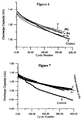
- Figure 2 shows the capacity versus cycle number data for these batteries.
- the capacity fade of spinel with either Pb or Bi oxides was greatly improved at elevated temperature compared to the control.
- the battery with Mo in the cathode shows worse capacity fade than the control. This indicates that not all foreign metal oxides in combination with Li 1+x Mn 2-x O 4 will give improved elevated temperature cycle life.
- FIG. 3 shows the capacity versus cycle number data for batteries of cathodes with Li 1+x Mn 2-x O 4 , Li 1+x Mn 2-x O 4 + Zn(0.8 mole %), Li 1+x Mn 2-x O 4 + Zr(0.375 mole %), Li 1+x Mn 2-x O 4 +Nb(0.374mole%), and Li 1+x Mn 2-x O 4 +Ta(0.352 mole%).
- the corresponding foreign metal compounds were Zn(C 2 H 3 O 2 ) 2 .2H 2 O, ZrO(NO 3 ) 2 .xH 2 O, NbCl 5 , and TaCl 5 It was found that Zn and Zr improved the cycle life of spinel at elevated temperature. On the other hand, Nb and Ta did not.
- FIG. 4 shows batteries with Li 1+x Mn 2-x O 4 +La(0.75 mole %), which was prepared made by aqueous treatment at 350°C as described earlier, except the foreign metal compound was dissolved in 0.3mL of water per gram of ready-made spinel.
- the foreign metal compound here was La(ClO 4 ) 3 .
- La-containing batteries had better capacity fade at elevated temperature than the control.
- Example II Spinel 18650 batteries with inventive cathodes made by the dry-mix treatment
- a series of spinel 18650 batteries were constructed with the same components except for their cathodes.
- the cathodes comprised of 600°C dry-mix treated spinel powders: Li 1+x Mn 2-x O 4 , Li 1+x Mn 2-x O 4 +La(0.75 mole %), Li 1+x Mn 2-x O 4 +Pb(0.75 mole%), and Li 1+x Mn 2-x O 4 +Bi(0.75 mole %).
- the foreign metal compounds used were La(NO 3 ) 3 .6H 2 O, (PbCO 3 ) 2 .Pb(OH) 2 , and Bi(NO 3 ) 3 .5H 2 O.
- Each cathode powder material was prepared by blending the foreign metal compound with the ready-made spinel for about 20 to 30 minutes. The blended powder is then heated in a furnace (Thermcraft Incorporated) under extra dry air at 200°C for 1 hour, the furnace having a ramping rate of 2°C/min. The blended powder is further heated at 600°C for an additional 1.5 hours. The cathode powder was then allowed to cool slowly until reaching below 100°C. It was then used to make the lithium ion batteries, which cycled at 45°C as described above.
- the batteries containing La, Pb or Bi improved in capacity fade rate compared to the control batteries as illustrated in Figure 5.
- FIG. 6 shows improved capacity fade rate of spinel 18650 batteries with cathodes made from Li 1+x Mn 2-x O 4 , Li 1+x Mn 2-x O 4 +Mg (1.5 mole %), Li 1+x Mn 2-x O 4 +Sr (1.5 mole%), Li 1+x Mn 2-x O 4 +Y (1.5 mole %) and Li 1+x Mn 2-x O 4 +Ba (1.5 mole %).
- Each cathode powder material was prepared by blending the foreign metal compound with the ready-made spinel for about 20 to 30 minutes. The blended powder is then heated in a furnace (Thermcraft Incorporated) under extra dry air at 200°C for 1 hour, the furnace having a ramping rate of 2°C/min.
- the blended powder is further heated at 600°C for an additional 1.5 hours.
- the cathode powder was then allowed to cool slowly until reaching below 100°C. It was then used to make the lithium ion batteries, which cycled at 45°C as described above.
- the foreign metal compounds used were nitrates of Mg, Sr, Y or Ba. Batteries with Mg, Sr, Y or Ba showed better fade than the control batteries at elevated temperature.
- Examples I and II show that both the aqueous and the dry-mix spinel treatments improve the capacity fade rate of spinel batteries at elevated temperature.
- These spinel batteries contained Bi, Pb, La, Ba, Zr, Y, Sr, Zn or Mg.
- Example III Spinel 18650 batteries with different amounts of foreign metal oxides in the cathode
- Two series of 350°C, aqueous treated spinel cathodes for 18650 batteries were constructed having various amounts of either Bi or Pb oxides.
- the two sets of cathode powders were prepared in a like manner as in Example I, except this time the foreign metal compound was dissolved in 0.5mL of water per gram of ready-made spinel using either Bi(NO 3 ) 3 .5H 2 O or Pb(C 2 H 3 O 2 ) 2 .3H 2 O as the precursor foreign metal compound.
- One of the series had Li 1+x Mn 2-x O 4 + Pb with amounts ranging from 0 to 1.875 mole%, and the other series had Li 1+x Mn 2-x O 4 + Bi with amounts ranging from 0 to 1.5 mole %.
- the batteries were then cycled at 40°C as described above.
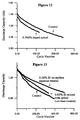
- Figures 7 and 8 show respectively the capacity versus cycle number data for batteries with Pb and with Bi.
- Example IV Spinel 18650 batteries with higher heating temperatures for both the aqueous treated and the dry-mix cathode materials
- batteries with Li 1+x Mn 2-x O 4 +Bi(1.5 mole %), Bi from Bi(NO 3 ) 3 .5H 2 O was prepared by using the dry-mix method as described in Example II, except the blended powder is heated in extra dry air at 750°C for four hours.
- 18650 batteries were constructed with cathodes having the dry-mix spinel treated powder, and cycled at 40°C as described above. Figure 10 shows these batteries also had better capacity fade than the control.
- precursors heated at 750°C (as opposed to heating at 350°C or 600°C) by either the aqueous treatment or by the dry-mix treatment also improved the capacity fade of spinel at elevated temperature.
- Pb doped spinel with 0.3% molar lead relative to spinel, was also synthesized in the same manner as the Bi-doped spinel, except the precursors were EMD-MnO 2 , Li 2 CO 3 . and Pb(C 2 H 3 O 2 ) 2 .3H 2 O.
- Two 18650 batteries with 0.3% molar Pb-doped spinel were constructed and cycled at 40°C as shown in Figure 12. Once again, there was not any improvement in the capacity fade rate.
- 18650 batteries were prepared using cathodes comprising a mixture of ready-made spinel and 1% by weight of Bi 2 O 3 relative to spinel (equivalent to 0.85 %mole Bi) , where the blended powder was not heated.
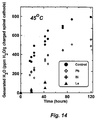
- the batteries were cycled at 44°C as described above. As shown in Figure 13, the capacity fade rate of these batteries were no better than the control battery.
- 18650 batteries with cathodes made from aqueous treated Li 1+x Mn 2-x O 4 +Bi(0.36 mole %), as prepared in Example I is also shown in Figure 13.
- the aqueous-treated spinel batteries have better capacity fade than either the control or the spinel blended with Bi 2 O 3 without-heating-batteries.
- Example V correlation between lithium ion battery capacity fade rate and methanol oxidation rate
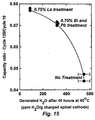
- This reaction rate can be measured by removing the cathode from a charged spinel lithium ion battery, rinsing it in dimethyl carbonate and then submersing it in methanol at 45°C to monitor the generation of H 2 O as a function of time. Promptly after submerging the ⁇ -MnO 2 , a background moisture reading is taken, which is then subtracted from all subsequent readings.
- the ppm of H 2 O generated in the methanol reaction referred to in Figures 14 and 15 is defined as H 2 O generated ( ⁇ g)/methanol (g), which must be further normalized by the quantity of charged spinel.
- H 2 O generated ( ⁇ g)/methanol (g) which must be further normalized by the quantity of charged spinel.
- g methanol
- the error bars in Figure 15 represent the standard deviation obtained from the five control samples in Figure 14, about 40 hours after the methanol reaction at 45°C.
- k to be the ppm amount of H 2 O generated per gram of charged-treated spinel in methanol after 40 hours at 45°C
- ko to be the ppm amount of H 2 O generated per gram of charged-untreated spinel in methanol after 40 hours at 45°C. Therefore, if k/k o ⁇ 0.9 (one minus one standard deviation of the control samples), then a significantly improved fade rate at elevated temperature is obtained for the lithium manganese oxide battery with that cathode.
Landscapes
- Chemical & Material Sciences (AREA)
- General Chemical & Material Sciences (AREA)
- Engineering & Computer Science (AREA)
- Inorganic Chemistry (AREA)
- Chemical Kinetics & Catalysis (AREA)
- Electrochemistry (AREA)
- Organic Chemistry (AREA)
- Manufacturing & Machinery (AREA)
- Materials Engineering (AREA)
- Physics & Mathematics (AREA)
- Condensed Matter Physics & Semiconductors (AREA)
- General Physics & Mathematics (AREA)
- Battery Electrode And Active Subsutance (AREA)
- Secondary Cells (AREA)
- Inorganic Compounds Of Heavy Metals (AREA)
- Carbon And Carbon Compounds (AREA)
Abstract
Description


Claims (32)
- A non-aqueous rechargeable lithium manganese oxide battery having reduced capacity fade rate during cycling at elevated temperature, the said battery comprising:a lithium insertion compound cathode,a lithium compound anode,a separator, anda non-aqueous electrolyte including a lithium salt dissolved in a non-aqueous solvent, wherein:the cathode comprises a spinel structure composed of a mildly heated mixture of a ready-made spinel and one or more foreign metal compounds, the foreign metals having atomic number greater than 11; the foreign metal products being distributed on the surface of the spinel structure and not substantially entering the bulk of the spinel structure or substantially extracting lithium from the spinel structure, said surface distributed foreign metal products reducing the capacity fade rate of the battery during cycling at elevated temperature.
- A non-aqueous rechargeable lithium manganese oxide battery as claimed in claim 1 wherein a methanol reaction of charged or de-lithiated spinel cathode (λ-MnO2) material yields k/ko <0.9 (one minus one standard deviation of ppm amount H2O of the untreated spinel after 40 hours at 45°C), where k is the ppm amount of H2O generated per gram of charged-treated spinel structure in methanol after 40 hours at 45°C and ko is the ppm amount of H2O generated per gram of charged-untreated spinel in methanol after 40 hours at 45°C.
- A non-aqueous rechargeable lithium manganese oxide battery as claimed in claim 1 wherein the foreign metal compound is selected from one or more compounds incorporating Bi, Pb, La, Ba, Zr, Y, Sr, Zn and Mg.
- A non-aqueous rechargeable lithium manganese oxide battery as claimed in claim 1 wherein the foreign metal compound is selected from one or more compounds incorporating Bi, Pb, La and Y.
- A non-aqueous rechargeable lithium manganese oxide battery as claimed in claim 1 wherein the foreign metal compound is selected from one or more compounds incorporating La.
- A non-aqueous rechargeable lithium manganese oxide battery as claimed in claim 1 wherein the concentration of foreign metal compound is greater than about 0.01 but less than about 5 mole%foreign metal.
- A non-aqueous rechargeable lithium manganese oxide battery as claimed in claim 1 wherein the concentration of the foreign metal compound is greater than about 0.05 but less than 2 mole%foreign metal.
- A non-aqueous rechargeable lithium manganese oxide battery as claimed in claim 1 wherein the foreign metal compound is dissolved in water, then mixed with ready-made spinel; subsequently the mixture is dried then heated to distribute the foreign metal product on the surface of the spinel.
- A non-aqueous rechargeable lithium manganese oxide battery as claimed in claim 8 wherein the heating is at above the decomposition temperature of the foreign metal compound and less than or equal to 750°C.
- A non-aqueous rechargeable lithium manganese oxide battery as claimed in claim 1 wherein the foreign metal compound is dry-mixed with ready-made spinel; the mixture is subsequently heated to distribute the foreign metal product on the surface of the spinel.
- A non-aqueous rechargeable lithium manganese oxide battery as claimed in claim 10 wherein the heating is initially at above the decomposition temperature of the foreign metal compound, then further heated to between about 600°C and 750°C.
- A non-aqueous rechargeable lithium manganese oxide battery as claimed in claim 1 wherein the anode comprises a carbonaceous insertion compound.
- A non-aqueous rechargeable lithium manganese oxide battery as claimed in claim 12 wherein the carbonaceous insertion compound is graphite.
- A non-aqueous rechargeable lithium manganese oxide battery as claimed in claim 1 wherein the lithium salt is LiPF6.
- A non-aqueous rechargeable lithium manganese oxide battery as claimed in claim 1 wherein the non-aqueous solvent is an organic carbonate.
- A non-aqueous rechargeable lithium manganese oxide battery as claimed in claim 1 wherein the non-aqueous solvent is a mixture of ethylene carbonate, propylene carbonate, ethyl methyl carbonate and/or diethyl carbonate.
- A method for reducing the capacity fade rate during cycling at elevated temperature of a non-aqueous rechargeable lithium manganese oxide battery, the battery comprising a lithium insertion compound cathode, a lithium compound anode, a separator, a non- aqueous electrolyte including a lithium salt dissolved in a non-aqueous solvent, wherein the lithium insertion compound cathode is formed of a mildly heated mixture of a ready- made spinel and one or more foreign metal compounds, the foreign metals having atomic number greater than 11; the foreign metal products being distributed on the surface of the spinel structure and not entering the bulk of the spinel structure.
- A method as claimed m claim 17 wherein the methanol reaction of the charged or de-lithiated spinel cathode (λ-MnO2) material yields k/ko <0.9 (one minus one standard deviation of ppm amount H2O of the untreated spinel after 40 hours at 45° C), where k is the ppm amount of H2O generated per gram of charged-treated spinel in methanol after 40 hours at 45°C and ko is the ppm amount of H2O generated per gram of charged-untreated spinel in methanol after 40 hours at 45°C.
- A method as claimed in claim 17 wherein the foreign metal compound is one or more compounds containing Bi, Pb, La, Ba, Zr, Y, Sr, Zn or Mg.
- A method as claimed in claim 17 wherein the foreign metal compound is one or more compounds containing Bi, Pb, La or Y.
- A method as chimed in claim 17 wherein the foreign metal compound is one or more compounds containing La.
- A method as claimed in claim 17 wherein the concentration of the foreign metal compound is greater than about 0.01 but less than about 5 mole% foreign metal.
- A method as claimed in claim 17 wherein the concentration of the foreign metal compound is greater than about 0.05 but less than about 2 mole% foreign metal.
- A method as claimed in claim 17 wherein the foreign metal compound is first dissolved in water then mixed with ready-made spinel; subsequently the mixture is dried, then heated to distribute the foreign metal product on the surface of the spinel.
- A method as claimed in claim 24 wherein heating is conducted at a temperature above the decomposition temperature of the foreign metal compound and less than or equal to 750°C.
- A method as claimed in claim 17 wherein the foreign metal compound is dry-mixed with ready-made spinel; the mixture is subsequently heated to distribute the foreign metal product on the surface of the spinel.
- A method as claimed in claim 26 wherein heating is initially at above the decomposition temperature of the foreign metal compound , then further heated to between about 600°C and 750°C.
- A method as claimed in claim 17 wherein the anode comprises a carbonaceous insertion compound.
- A method as claimed in claim 28 wherein the carbonaceous insertion compound is graphite.
- A method as claimed in claim 17 wherein the lithium salt is LiPF6.
- A method as claimed in claim 17 wherein the non-aqueous solvent comprises an organic carbonate.
- A method as claimed in claim 17 wherein the non-aqueous solvent is a mixture of ethylene carbonate, propylene carbonate, ethyl methyl carbonate and/or diethyl carbonate.
Applications Claiming Priority (4)
| Application Number | Priority Date | Filing Date | Title |
|---|---|---|---|
| US31885499A | 1999-05-26 | 1999-05-26 | |
| US318854 | 1999-05-26 | ||
| US09/484,399 US6489060B1 (en) | 1999-05-26 | 2000-01-14 | Rechargeable spinel lithium batteries with greatly improved elevated temperature cycle life |
| US484399 | 2000-01-14 |
Publications (3)
| Publication Number | Publication Date |
|---|---|
| EP1056143A2 true EP1056143A2 (en) | 2000-11-29 |
| EP1056143A3 EP1056143A3 (en) | 2004-07-28 |
| EP1056143B1 EP1056143B1 (en) | 2007-08-29 |
Family
ID=26981705
Family Applications (1)
| Application Number | Title | Priority Date | Filing Date |
|---|---|---|---|
| EP00111435A Expired - Lifetime EP1056143B1 (en) | 1999-05-26 | 2000-05-26 | Rechargeable spinel lithium batteries with improved elevated temperature cycle life |
Country Status (5)
| Country | Link |
|---|---|
| US (1) | US6489060B1 (en) |
| EP (1) | EP1056143B1 (en) |
| JP (1) | JP3498947B2 (en) |
| CA (1) | CA2308404C (en) |
| DE (1) | DE60036154T2 (en) |
Cited By (2)
| Publication number | Priority date | Publication date | Assignee | Title |
|---|---|---|---|---|
| DE10209477A1 (en) * | 2002-03-05 | 2003-09-18 | Chemetall Gmbh | Electrochemical cell for a lithium ion battery with improved high temperature stability |
| DE102014220504A1 (en) | 2014-10-09 | 2016-04-14 | Bayerische Motoren Werke Aktiengesellschaft | Additive for alkali metal-based, especially lithium-based energy storage |
Families Citing this family (35)
| Publication number | Priority date | Publication date | Assignee | Title |
|---|---|---|---|---|
| US7138209B2 (en) * | 2000-10-09 | 2006-11-21 | Samsung Sdi Co., Ltd. | Positive active material for rechargeable lithium battery and method of preparing same |
| US7049031B2 (en) * | 2002-01-29 | 2006-05-23 | The University Of Chicago | Protective coating on positive lithium-metal-oxide electrodes for lithium batteries |
| US7714538B2 (en) | 2002-11-22 | 2010-05-11 | Milwaukee Electric Tool Corporation | Battery pack |
| US7253585B2 (en) | 2002-11-22 | 2007-08-07 | Milwaukee Electric Tool Corporation | Battery pack |
| US7026069B1 (en) * | 2003-01-02 | 2006-04-11 | The United States Of America As Represented By The Secretary Of The Army. | Lithium manganese bismuth mixed metal oxide for rechargeable electrochemicals systems |
| US7294435B2 (en) * | 2003-05-15 | 2007-11-13 | Nichia Corporation | Positive electrode active material for nonaqueous electrolyte secondary battery, positive electrode mixture for nonaqueous electrolyte secondary battery, and nonaqueous electrolyte secondary battery |
| JP4770113B2 (en) * | 2003-12-04 | 2011-09-14 | 日本電気株式会社 | Positive electrode active material for secondary battery, positive electrode for secondary battery, and secondary battery |
| JP4967217B2 (en) * | 2003-12-08 | 2012-07-04 | 日本電気株式会社 | Positive electrode active material for secondary battery, positive electrode for secondary battery and secondary battery using the same |
| JP4876371B2 (en) * | 2004-01-29 | 2012-02-15 | 日亜化学工業株式会社 | Positive electrode active material for non-aqueous electrolyte secondary battery, positive electrode mixture for non-aqueous electrolyte secondary battery, and non-aqueous electrolyte secondary battery |
| US8563174B2 (en) * | 2006-03-13 | 2013-10-22 | Farasis Energy, Inc. | Secondary battery material and synthesis method |
| US7718319B2 (en) | 2006-09-25 | 2010-05-18 | Board Of Regents, The University Of Texas System | Cation-substituted spinel oxide and oxyfluoride cathodes for lithium ion batteries |
| CN102077396A (en) | 2008-07-09 | 2011-05-25 | 三洋电机株式会社 | Positive electrode active material for non-aqueous electrolyte secondary battery, method for production of positive electrode active material for non-aqueous electrolyte secondary battery, positive electrode for non-aqueous electrolyte secondary batt |
| US8916294B2 (en) * | 2008-09-30 | 2014-12-23 | Envia Systems, Inc. | Fluorine doped lithium rich metal oxide positive electrode battery materials with high specific capacity and corresponding batteries |
| US8389160B2 (en) * | 2008-10-07 | 2013-03-05 | Envia Systems, Inc. | Positive electrode materials for lithium ion batteries having a high specific discharge capacity and processes for the synthesis of these materials |
| US8465873B2 (en) | 2008-12-11 | 2013-06-18 | Envia Systems, Inc. | Positive electrode materials for high discharge capacity lithium ion batteries |
| EP2447215A2 (en) * | 2009-06-25 | 2012-05-02 | NGK Insulators, Ltd. | Positive electrode active material and lithium secondary battery using same |
| CN102482117A (en) * | 2009-06-25 | 2012-05-30 | 日本碍子株式会社 | Positive electrode active material and lithium secondary battery |
| JPWO2010150626A1 (en) * | 2009-06-25 | 2012-12-10 | 日本碍子株式会社 | Method for producing spinel type lithium manganate and method for producing positive electrode active material for lithium secondary battery |
| EP2471134B1 (en) | 2009-08-27 | 2022-01-05 | Zenlabs Energy, Inc. | Layer-layer lithium rich complex metal oxides with high specific capacity and excellent cycling |
| TWI437753B (en) * | 2009-08-27 | 2014-05-11 | 安維亞系統公司 | Metal oxide coated positive electrode material for lithium-based batteries |
| US20110003206A1 (en) * | 2009-09-29 | 2011-01-06 | Ngk Insulators, Ltd. | Positive electrode active element and lithium secondary battery |
| US8142933B2 (en) | 2009-09-30 | 2012-03-27 | Conocophillips Company | Anode material for high power lithium ion batteries |
| US9843041B2 (en) * | 2009-11-11 | 2017-12-12 | Zenlabs Energy, Inc. | Coated positive electrode materials for lithium ion batteries |
| US8741484B2 (en) | 2010-04-02 | 2014-06-03 | Envia Systems, Inc. | Doped positive electrode active materials and lithium ion secondary battery constructed therefrom |
| US8928286B2 (en) | 2010-09-03 | 2015-01-06 | Envia Systems, Inc. | Very long cycling of lithium ion batteries with lithium rich cathode materials |
| US8663849B2 (en) | 2010-09-22 | 2014-03-04 | Envia Systems, Inc. | Metal halide coatings on lithium ion battery positive electrode materials and corresponding batteries |
| JP5316567B2 (en) * | 2011-02-25 | 2013-10-16 | 日本電気株式会社 | The manufacturing method of the positive electrode active material for secondary batteries, and the manufacturing method of a secondary battery. |
| US9246174B2 (en) | 2011-08-17 | 2016-01-26 | Nec Corporation | Lithium ion battery |
| US10170762B2 (en) | 2011-12-12 | 2019-01-01 | Zenlabs Energy, Inc. | Lithium metal oxides with multiple phases and stable high energy electrochemical cycling |
| US9070489B2 (en) | 2012-02-07 | 2015-06-30 | Envia Systems, Inc. | Mixed phase lithium metal oxide compositions with desirable battery performance |
| US9552901B2 (en) | 2012-08-17 | 2017-01-24 | Envia Systems, Inc. | Lithium ion batteries with high energy density, excellent cycling capability and low internal impedance |
| US10115962B2 (en) | 2012-12-20 | 2018-10-30 | Envia Systems, Inc. | High capacity cathode material with stabilizing nanocoatings |
| KR101956355B1 (en) | 2018-01-17 | 2019-03-11 | 에스케이이노베이션 주식회사 | Method of preparing lithium metal oxide and method of manufacturing lithium secondary battery |
| JP7493364B2 (en) * | 2020-03-26 | 2024-05-31 | Dowaエレクトロニクス株式会社 | Hexagonal ferrite magnetic powder and its manufacturing method |
| CN113839092B (en) * | 2021-08-30 | 2024-06-18 | 上海大学 | A dopable positive electrode metal salt-lithium salt composite additive and its application |
Family Cites Families (21)
| Publication number | Priority date | Publication date | Assignee | Title |
|---|---|---|---|---|
| IL53611A (en) | 1977-12-14 | 1982-12-31 | Scientific Res Foundation | Separators for secondary cells |
| JPH0732017B2 (en) | 1989-10-06 | 1995-04-10 | 松下電器産業株式会社 | Non-aqueous electrolyte secondary battery |
| JP3111324B2 (en) | 1991-08-12 | 2000-11-20 | 松下電器産業株式会社 | Non-aqueous electrolyte secondary battery |
| US5424145A (en) | 1992-03-18 | 1995-06-13 | Battery Technologies Inc. | High capacity rechargeable cell having manganese dioxide electrode |
| US5478673A (en) | 1992-10-29 | 1995-12-26 | Fuji Photo Film Co., Ltd. | Nonaqueous secondary battery |
| CA2147578C (en) | 1995-04-21 | 2002-04-16 | Jan Naess Reimers | Lithium manganese oxide insertion compounds and use in rechargeable batteries |
| US6365299B1 (en) * | 1995-06-28 | 2002-04-02 | Fuji Photo Film Co., Ltd. | Nonaqueous secondary battery |
| JPH09134723A (en) | 1995-11-07 | 1997-05-20 | Nippon Telegr & Teleph Corp <Ntt> | Non-aqueous electrolyte secondary battery |
| WO1997023918A1 (en) * | 1995-12-26 | 1997-07-03 | Kao Corporation | Anode active material and nonaqueous secondary battery |
| JPH09293512A (en) | 1996-02-23 | 1997-11-11 | Fuji Photo Film Co Ltd | Lithium ion secondary battery and positive pole active material precursor |
| US5705291A (en) | 1996-04-10 | 1998-01-06 | Bell Communications Research, Inc. | Rechargeable battery cell having surface-treated lithiated intercalation positive electrode |
| CA2175755A1 (en) | 1996-05-03 | 1997-11-04 | Huanyu Mao | Use of b2o3 additive in non-aqueous rechargeable lithium batteries |
| US5733685A (en) * | 1996-07-12 | 1998-03-31 | Duracell Inc. | Method of treating lithium manganese oxide spinel |
| US6183718B1 (en) * | 1996-12-09 | 2001-02-06 | Valence Technology, Inc. | Method of making stabilized electrochemical cell active material of lithium manganese oxide |
| CA2196493C (en) | 1997-01-31 | 2002-07-16 | Huanyu Mao | Additives for improving cycle life of non-aqueous rechargeable lithium batteries |
| JPH10302767A (en) * | 1997-04-24 | 1998-11-13 | Mitsubishi Cable Ind Ltd | Cathode activating material of lithium secondary battery and production thereof |
| EP0883199B1 (en) | 1997-06-03 | 2003-05-07 | Matsushita Electric Industrial Co., Ltd. | Negative electrode materials for non-aqueous electrolyte secondary batteries and said batteries employing the same materials |
| US5759720A (en) | 1997-06-04 | 1998-06-02 | Bell Communications Research, Inc. | Lithium aluminum manganese oxy-fluorides for Li-ion rechargeable battery electrodes |
| CA2216898C (en) | 1997-09-26 | 2005-03-22 | Moli Energy (1990) Limited | Improved additives for overcharge protection in non-aqueous rechargeable lithium batteries |
| DE19922522A1 (en) * | 1999-05-15 | 2000-11-16 | Merck Patent Gmbh | Lithium based composite oxide particles for battery cathode, which are coated with one or more metal oxides |
| US6248477B1 (en) * | 1999-09-29 | 2001-06-19 | Kerr-Mcgee Chemical Llc | Cathode intercalation compositions, production methods and rechargeable lithium batteries containing the same |
-
2000
- 2000-01-14 US US09/484,399 patent/US6489060B1/en not_active Expired - Lifetime
- 2000-05-10 CA CA2308404A patent/CA2308404C/en not_active Expired - Lifetime
- 2000-05-25 JP JP2000155499A patent/JP3498947B2/en not_active Expired - Fee Related
- 2000-05-26 EP EP00111435A patent/EP1056143B1/en not_active Expired - Lifetime
- 2000-05-26 DE DE60036154T patent/DE60036154T2/en not_active Expired - Lifetime
Cited By (3)
| Publication number | Priority date | Publication date | Assignee | Title |
|---|---|---|---|---|
| DE10209477A1 (en) * | 2002-03-05 | 2003-09-18 | Chemetall Gmbh | Electrochemical cell for a lithium ion battery with improved high temperature stability |
| DE102014220504A1 (en) | 2014-10-09 | 2016-04-14 | Bayerische Motoren Werke Aktiengesellschaft | Additive for alkali metal-based, especially lithium-based energy storage |
| US10297863B2 (en) | 2014-10-09 | 2019-05-21 | Bayerische Motoren Werke Aktiengesellschaft | Electrolyte additive and metal included in composite electrode containing Mg, Al, Cu, and Cr for alkali metal storage system |
Also Published As
| Publication number | Publication date |
|---|---|
| DE60036154T2 (en) | 2008-05-21 |
| US6489060B1 (en) | 2002-12-03 |
| CA2308404C (en) | 2011-03-29 |
| EP1056143A3 (en) | 2004-07-28 |
| CA2308404A1 (en) | 2000-11-26 |
| EP1056143B1 (en) | 2007-08-29 |
| DE60036154D1 (en) | 2007-10-11 |
| JP2001006678A (en) | 2001-01-12 |
| JP3498947B2 (en) | 2004-02-23 |
Similar Documents
| Publication | Publication Date | Title |
|---|---|---|
| US6489060B1 (en) | Rechargeable spinel lithium batteries with greatly improved elevated temperature cycle life | |
| US11316151B2 (en) | Positive electrode active material for lithium secondary battery, method of preparing the same, and positive electrode for lithium secondary battery and lithium secondary battery which include the positive electrode active material | |
| US6372385B1 (en) | Active material for positive electrode used in lithium secondary battery and method of manufacturing same | |
| US7314682B2 (en) | Lithium metal oxide electrodes for lithium batteries | |
| US7666551B2 (en) | Positive electrode active material for non-aqueous electrolyte secondary battery, production method thereof, and non-aqueous electrolyte secondary battery using the same | |
| TWI508357B (en) | Cathode composite material and lithium ion battery | |
| US8236449B2 (en) | Lithium ion secondary battery with improved electrode stability and safety | |
| CN104979547B (en) | Stoichiometric lithium cobalt oxide and method for its preparation | |
| US6458487B1 (en) | Positive active material and non-aqueous secondary cell made by using the same | |
| EP3840089A1 (en) | Positive electrode active material for lithium secondary battery, method for manufacturing same, and lithium secondary battery including same | |
| US20130130095A1 (en) | Surface stabilized electrodes for lithium batteries | |
| KR20120099375A (en) | Metal oxide coated positive electrode materials for lithium-based batteries | |
| EP3974391A1 (en) | Cathode active material for lithium secondary battery and method of manufacturing the same | |
| EP3868714A1 (en) | Octahedral lithium manganese-based positive electrode active material, and positive electrode and lithium secondary battery including same | |
| US11437609B2 (en) | Method of preparing positive electrode active material for secondary battery and secondary battery using the same | |
| KR20120089845A (en) | Layer-layer lithium rich complex metal oxides with high specific capacity and excellent cycling | |
| KR20130108620A (en) | Lithium ion batteries with supplemental lithium | |
| EP4174026A1 (en) | Cathode active material and preparation method therefor | |
| KR100797099B1 (en) | Cathode active material for lithium secondary battery, preparation method thereof, and lithium secondary battery comprising same | |
| US6274273B1 (en) | Positive active material for rechargeable lithium battery and method of preparing same | |
| EP4181234A1 (en) | Cathode active material for sulfide-based all-solid-state battery, method of preparing the same, cathode complex including the same and method of fabricating the cathode complex | |
| US20220029156A1 (en) | Cobalt-free lithiated spinel cathode materials for use in lithium cells and batteries | |
| EP1237212B1 (en) | Use of lithium borate on non-aqueous rechargeable lithium batteries | |
| KR101130318B1 (en) | Positive active material for lithium secondary battery, method of preparing the same, and lithium secondary battery comprising the same | |
| EP4166507A1 (en) | Cathode active material preparation method |
Legal Events
| Date | Code | Title | Description |
|---|---|---|---|
| PUAI | Public reference made under article 153(3) epc to a published international application that has entered the european phase |
Free format text: ORIGINAL CODE: 0009012 |
|
| AK | Designated contracting states |
Kind code of ref document: A2 Designated state(s): AT BE CH CY DE DK ES FI FR GB GR IE IT LI LU MC NL PT SE |
|
| AX | Request for extension of the european patent |
Free format text: AL;LT;LV;MK;RO;SI |
|
| 17P | Request for examination filed |
Effective date: 20010608 |
|
| RAP1 | Party data changed (applicant data changed or rights of an application transferred) |
Owner name: E-ONE MOLI ENERGY (CANADA) LIMITED |
|
| PUAL | Search report despatched |
Free format text: ORIGINAL CODE: 0009013 |
|
| AK | Designated contracting states |
Kind code of ref document: A3 Designated state(s): AT BE CH CY DE DK ES FI FR GB GR IE IT LI LU MC NL PT SE |
|
| AX | Request for extension of the european patent |
Extension state: AL LT LV MK RO SI |
|
| AKX | Designation fees paid |
Designated state(s): DE FR GB |
|
| GRAP | Despatch of communication of intention to grant a patent |
Free format text: ORIGINAL CODE: EPIDOSNIGR1 |
|
| GRAS | Grant fee paid |
Free format text: ORIGINAL CODE: EPIDOSNIGR3 |
|
| GRAA | (expected) grant |
Free format text: ORIGINAL CODE: 0009210 |
|
| AK | Designated contracting states |
Kind code of ref document: B1 Designated state(s): DE FR GB |
|
| REG | Reference to a national code |
Ref country code: GB Ref legal event code: FG4D |
|
| REF | Corresponds to: |
Ref document number: 60036154 Country of ref document: DE Date of ref document: 20071011 Kind code of ref document: P |
|
| ET | Fr: translation filed | ||
| PLBE | No opposition filed within time limit |
Free format text: ORIGINAL CODE: 0009261 |
|
| STAA | Information on the status of an ep patent application or granted ep patent |
Free format text: STATUS: NO OPPOSITION FILED WITHIN TIME LIMIT |
|
| 26N | No opposition filed |
Effective date: 20080530 |
|
| REG | Reference to a national code |
Ref country code: FR Ref legal event code: PLFP Year of fee payment: 16 |
|
| PGFP | Annual fee paid to national office [announced via postgrant information from national office to epo] |
Ref country code: DE Payment date: 20150528 Year of fee payment: 16 Ref country code: GB Payment date: 20150527 Year of fee payment: 16 |
|
| PGFP | Annual fee paid to national office [announced via postgrant information from national office to epo] |
Ref country code: FR Payment date: 20150519 Year of fee payment: 16 |
|
| REG | Reference to a national code |
Ref country code: DE Ref legal event code: R119 Ref document number: 60036154 Country of ref document: DE |
|
| GBPC | Gb: european patent ceased through non-payment of renewal fee |
Effective date: 20160526 |
|
| REG | Reference to a national code |
Ref country code: FR Ref legal event code: ST Effective date: 20170131 |
|
| PG25 | Lapsed in a contracting state [announced via postgrant information from national office to epo] |
Ref country code: DE Free format text: LAPSE BECAUSE OF NON-PAYMENT OF DUE FEES Effective date: 20161201 Ref country code: FR Free format text: LAPSE BECAUSE OF NON-PAYMENT OF DUE FEES Effective date: 20160531 |
|
| PG25 | Lapsed in a contracting state [announced via postgrant information from national office to epo] |
Ref country code: GB Free format text: LAPSE BECAUSE OF NON-PAYMENT OF DUE FEES Effective date: 20160526 |