EP1055660A1 - Process for producing highly pure aromatic polycarboxylic acid - Google Patents
Process for producing highly pure aromatic polycarboxylic acid Download PDFInfo
- Publication number
- EP1055660A1 EP1055660A1 EP00110299A EP00110299A EP1055660A1 EP 1055660 A1 EP1055660 A1 EP 1055660A1 EP 00110299 A EP00110299 A EP 00110299A EP 00110299 A EP00110299 A EP 00110299A EP 1055660 A1 EP1055660 A1 EP 1055660A1
- Authority
- EP
- European Patent Office
- Prior art keywords
- amine
- salt
- aromatic polycarboxylic
- water
- crystals
- Prior art date
- Legal status (The legal status is an assumption and is not a legal conclusion. Google has not performed a legal analysis and makes no representation as to the accuracy of the status listed.)
- Granted
Links
- 239000002253 acid Substances 0.000 title claims abstract description 107
- 125000003118 aryl group Chemical group 0.000 title claims abstract description 103
- 238000000034 method Methods 0.000 title claims abstract description 59
- -1 alicyclic amine Chemical class 0.000 claims abstract description 137
- XLYOFNOQVPJJNP-UHFFFAOYSA-N water Substances O XLYOFNOQVPJJNP-UHFFFAOYSA-N 0.000 claims abstract description 94
- 239000002904 solvent Substances 0.000 claims abstract description 57
- ZBCBWPMODOFKDW-UHFFFAOYSA-N diethanolamine Chemical compound OCCNCCO ZBCBWPMODOFKDW-UHFFFAOYSA-N 0.000 claims abstract description 6
- ZMANZCXQSJIPKH-UHFFFAOYSA-N Triethylamine Chemical group CCN(CC)CC ZMANZCXQSJIPKH-UHFFFAOYSA-N 0.000 claims description 138
- 150000003839 salts Chemical class 0.000 claims description 70
- CSCPPACGZOOCGX-UHFFFAOYSA-N Acetone Chemical compound CC(C)=O CSCPPACGZOOCGX-UHFFFAOYSA-N 0.000 claims description 64
- 230000015572 biosynthetic process Effects 0.000 claims description 55
- OKTJSMMVPCPJKN-UHFFFAOYSA-N Carbon Chemical compound [C] OKTJSMMVPCPJKN-UHFFFAOYSA-N 0.000 claims description 39
- 238000000354 decomposition reaction Methods 0.000 claims description 22
- 239000003960 organic solvent Substances 0.000 claims description 19
- WEVYAHXRMPXWCK-UHFFFAOYSA-N Acetonitrile Chemical compound CC#N WEVYAHXRMPXWCK-UHFFFAOYSA-N 0.000 claims description 15
- KYTZHLUVELPASH-UHFFFAOYSA-N naphthalene-1,2-dicarboxylic acid Chemical compound C1=CC=CC2=C(C(O)=O)C(C(=O)O)=CC=C21 KYTZHLUVELPASH-UHFFFAOYSA-N 0.000 claims description 15
- JUJWROOIHBZHMG-UHFFFAOYSA-N Pyridine Chemical compound C1=CC=NC=C1 JUJWROOIHBZHMG-UHFFFAOYSA-N 0.000 claims description 14
- BSKHPKMHTQYZBB-UHFFFAOYSA-N 2-methylpyridine Chemical compound CC1=CC=CC=N1 BSKHPKMHTQYZBB-UHFFFAOYSA-N 0.000 claims description 13
- ZMXDDKWLCZADIW-UHFFFAOYSA-N N,N-Dimethylformamide Chemical compound CN(C)C=O ZMXDDKWLCZADIW-UHFFFAOYSA-N 0.000 claims description 12
- 239000012046 mixed solvent Substances 0.000 claims description 12
- 150000001298 alcohols Chemical class 0.000 claims description 11
- HSSYVKMJJLDTKZ-UHFFFAOYSA-N 3-phenylphthalic acid Chemical compound OC(=O)C1=CC=CC(C=2C=CC=CC=2)=C1C(O)=O HSSYVKMJJLDTKZ-UHFFFAOYSA-N 0.000 claims description 10
- 238000010438 heat treatment Methods 0.000 claims description 10
- GETQZCLCWQTVFV-UHFFFAOYSA-N trimethylamine Chemical compound CN(C)C GETQZCLCWQTVFV-UHFFFAOYSA-N 0.000 claims description 10
- 238000002156 mixing Methods 0.000 claims description 8
- 150000003222 pyridines Chemical class 0.000 claims description 8
- FXHOOIRPVKKKFG-UHFFFAOYSA-N N,N-Dimethylacetamide Chemical compound CN(C)C(C)=O FXHOOIRPVKKKFG-UHFFFAOYSA-N 0.000 claims description 7
- UMJSCPRVCHMLSP-UHFFFAOYSA-N pyridine Natural products COC1=CC=CN=C1 UMJSCPRVCHMLSP-UHFFFAOYSA-N 0.000 claims description 7
- 125000004432 carbon atom Chemical group C* 0.000 claims description 3
- 150000003512 tertiary amines Chemical class 0.000 claims description 3
- 239000013078 crystal Substances 0.000 abstract description 123
- 150000007513 acids Chemical class 0.000 abstract description 50
- 238000004519 manufacturing process Methods 0.000 abstract description 6
- 238000005755 formation reaction Methods 0.000 description 50
- 238000011084 recovery Methods 0.000 description 48
- 239000000203 mixture Substances 0.000 description 38
- 239000000126 substance Substances 0.000 description 37
- LFQSCWFLJHTTHZ-UHFFFAOYSA-N Ethanol Chemical compound CCO LFQSCWFLJHTTHZ-UHFFFAOYSA-N 0.000 description 36
- 150000001412 amines Chemical class 0.000 description 36
- 238000003756 stirring Methods 0.000 description 34
- 238000000746 purification Methods 0.000 description 31
- 239000012535 impurity Substances 0.000 description 27
- 239000000243 solution Substances 0.000 description 24
- 239000007864 aqueous solution Substances 0.000 description 23
- 239000011521 glass Substances 0.000 description 20
- 238000001953 recrystallisation Methods 0.000 description 19
- 238000007254 oxidation reaction Methods 0.000 description 15
- IAZDPXIOMUYVGZ-UHFFFAOYSA-N Dimethylsulphoxide Chemical compound CS(C)=O IAZDPXIOMUYVGZ-UHFFFAOYSA-N 0.000 description 14
- 238000006243 chemical reaction Methods 0.000 description 14
- 230000003647 oxidation Effects 0.000 description 14
- 239000002994 raw material Substances 0.000 description 14
- OKKJLVBELUTLKV-UHFFFAOYSA-N Methanol Chemical compound OC OKKJLVBELUTLKV-UHFFFAOYSA-N 0.000 description 12
- 239000002002 slurry Substances 0.000 description 12
- KFZMGEQAYNKOFK-UHFFFAOYSA-N Isopropanol Chemical compound CC(C)O KFZMGEQAYNKOFK-UHFFFAOYSA-N 0.000 description 10
- 238000004821 distillation Methods 0.000 description 10
- VKYKSIONXSXAKP-UHFFFAOYSA-N hexamethylenetetramine Chemical class C1N(C2)CN3CN1CN2C3 VKYKSIONXSXAKP-UHFFFAOYSA-N 0.000 description 10
- 238000010992 reflux Methods 0.000 description 10
- QTBSBXVTEAMEQO-UHFFFAOYSA-N Acetic acid Chemical compound CC(O)=O QTBSBXVTEAMEQO-UHFFFAOYSA-N 0.000 description 9
- 239000003054 catalyst Substances 0.000 description 9
- 238000001914 filtration Methods 0.000 description 9
- 150000001408 amides Chemical class 0.000 description 8
- 238000001816 cooling Methods 0.000 description 8
- HPNMFZURTQLUMO-UHFFFAOYSA-N diethylamine Chemical compound CCNCC HPNMFZURTQLUMO-UHFFFAOYSA-N 0.000 description 8
- 230000000694 effects Effects 0.000 description 8
- 238000001179 sorption measurement Methods 0.000 description 8
- 238000004090 dissolution Methods 0.000 description 7
- 230000001965 increasing effect Effects 0.000 description 7
- 239000007788 liquid Substances 0.000 description 7
- 239000002245 particle Substances 0.000 description 7
- 230000001376 precipitating effect Effects 0.000 description 7
- 238000000926 separation method Methods 0.000 description 7
- OISVCGZHLKNMSJ-UHFFFAOYSA-N 2,6-dimethylpyridine Chemical compound CC1=CC=CC(C)=N1 OISVCGZHLKNMSJ-UHFFFAOYSA-N 0.000 description 6
- FKNQCJSGGFJEIZ-UHFFFAOYSA-N 4-methylpyridine Chemical compound CC1=CC=NC=C1 FKNQCJSGGFJEIZ-UHFFFAOYSA-N 0.000 description 6
- PEDCQBHIVMGVHV-UHFFFAOYSA-N Glycerine Chemical compound OCC(O)CO PEDCQBHIVMGVHV-UHFFFAOYSA-N 0.000 description 6
- HEMHJVSKTPXQMS-UHFFFAOYSA-M Sodium hydroxide Chemical compound [OH-].[Na+] HEMHJVSKTPXQMS-UHFFFAOYSA-M 0.000 description 6
- WYURNTSHIVDZCO-UHFFFAOYSA-N Tetrahydrofuran Chemical compound C1CCOC1 WYURNTSHIVDZCO-UHFFFAOYSA-N 0.000 description 6
- 229910052751 metal Inorganic materials 0.000 description 6
- 239000002184 metal Substances 0.000 description 6
- 239000012452 mother liquor Substances 0.000 description 6
- MYMOFIZGZYHOMD-UHFFFAOYSA-N Dioxygen Chemical compound O=O MYMOFIZGZYHOMD-UHFFFAOYSA-N 0.000 description 5
- VEXZGXHMUGYJMC-UHFFFAOYSA-N Hydrochloric acid Chemical compound Cl VEXZGXHMUGYJMC-UHFFFAOYSA-N 0.000 description 5
- GDTBXPJZTBHREO-UHFFFAOYSA-N bromine Substances BrBr GDTBXPJZTBHREO-UHFFFAOYSA-N 0.000 description 5
- 229910052794 bromium Inorganic materials 0.000 description 5
- 229910001882 dioxygen Inorganic materials 0.000 description 5
- 229910001385 heavy metal Inorganic materials 0.000 description 5
- 230000001590 oxidative effect Effects 0.000 description 5
- 229920000728 polyester Polymers 0.000 description 5
- DNIAPMSPPWPWGF-VKHMYHEASA-N (+)-propylene glycol Chemical compound C[C@H](O)CO DNIAPMSPPWPWGF-VKHMYHEASA-N 0.000 description 4
- PUPZLCDOIYMWBV-UHFFFAOYSA-N (+/-)-1,3-Butanediol Chemical compound CC(O)CCO PUPZLCDOIYMWBV-UHFFFAOYSA-N 0.000 description 4
- DNIAPMSPPWPWGF-GSVOUGTGSA-N (R)-(-)-Propylene glycol Chemical compound C[C@@H](O)CO DNIAPMSPPWPWGF-GSVOUGTGSA-N 0.000 description 4
- YPFDHNVEDLHUCE-UHFFFAOYSA-N 1,3-propanediol Substances OCCCO YPFDHNVEDLHUCE-UHFFFAOYSA-N 0.000 description 4
- 229940035437 1,3-propanediol Drugs 0.000 description 4
- JYYNAJVZFGKDEQ-UHFFFAOYSA-N 2,4-Dimethylpyridine Chemical compound CC1=CC=NC(C)=C1 JYYNAJVZFGKDEQ-UHFFFAOYSA-N 0.000 description 4
- LYCAIKOWRPUZTN-UHFFFAOYSA-N Ethylene glycol Chemical compound OCCO LYCAIKOWRPUZTN-UHFFFAOYSA-N 0.000 description 4
- ZHNUHDYFZUAESO-UHFFFAOYSA-N Formamide Chemical compound NC=O ZHNUHDYFZUAESO-UHFFFAOYSA-N 0.000 description 4
- 229920000106 Liquid crystal polymer Polymers 0.000 description 4
- OFOBLEOULBTSOW-UHFFFAOYSA-N Malonic acid Chemical compound OC(=O)CC(O)=O OFOBLEOULBTSOW-UHFFFAOYSA-N 0.000 description 4
- LRHPLDYGYMQRHN-UHFFFAOYSA-N N-Butanol Chemical compound CCCCO LRHPLDYGYMQRHN-UHFFFAOYSA-N 0.000 description 4
- ATHHXGZTWNVVOU-UHFFFAOYSA-N N-methylformamide Chemical compound CNC=O ATHHXGZTWNVVOU-UHFFFAOYSA-N 0.000 description 4
- 239000004952 Polyamide Substances 0.000 description 4
- KKEYFWRCBNTPAC-UHFFFAOYSA-N Terephthalic acid Chemical compound OC(=O)C1=CC=C(C(O)=O)C=C1 KKEYFWRCBNTPAC-UHFFFAOYSA-N 0.000 description 4
- 150000004945 aromatic hydrocarbons Chemical class 0.000 description 4
- 235000010290 biphenyl Nutrition 0.000 description 4
- WERYXYBDKMZEQL-UHFFFAOYSA-N butane-1,4-diol Chemical compound OCCCCO WERYXYBDKMZEQL-UHFFFAOYSA-N 0.000 description 4
- 125000003178 carboxy group Chemical group [H]OC(*)=O 0.000 description 4
- 238000005119 centrifugation Methods 0.000 description 4
- 230000000052 comparative effect Effects 0.000 description 4
- 229940113088 dimethylacetamide Drugs 0.000 description 4
- 239000000543 intermediate Substances 0.000 description 4
- 239000000463 material Substances 0.000 description 4
- 150000002739 metals Chemical class 0.000 description 4
- DNIAPMSPPWPWGF-UHFFFAOYSA-N monopropylene glycol Natural products CC(O)CO DNIAPMSPPWPWGF-UHFFFAOYSA-N 0.000 description 4
- RXOHFPCZGPKIRD-UHFFFAOYSA-N naphthalene-2,6-dicarboxylic acid Chemical compound C1=C(C(O)=O)C=CC2=CC(C(=O)O)=CC=C21 RXOHFPCZGPKIRD-UHFFFAOYSA-N 0.000 description 4
- KSOCVFUBQIXVDC-FMQUCBEESA-N p-azophenyltrimethylammonium Chemical class C1=CC([N+](C)(C)C)=CC=C1\N=N\C1=CC=C([N+](C)(C)C)C=C1 KSOCVFUBQIXVDC-FMQUCBEESA-N 0.000 description 4
- 229920002647 polyamide Polymers 0.000 description 4
- 229920000166 polytrimethylene carbonate Polymers 0.000 description 4
- 239000000047 product Substances 0.000 description 4
- BDERNNFJNOPAEC-UHFFFAOYSA-N propan-1-ol Chemical compound CCCO BDERNNFJNOPAEC-UHFFFAOYSA-N 0.000 description 4
- 229960004063 propylene glycol Drugs 0.000 description 4
- 235000013772 propylene glycol Nutrition 0.000 description 4
- 239000007858 starting material Substances 0.000 description 4
- 229940086542 triethylamine Drugs 0.000 description 4
- ARCGXLSVLAOJQL-UHFFFAOYSA-N trimellitic acid Chemical compound OC(=O)C1=CC=C(C(O)=O)C(C(O)=O)=C1 ARCGXLSVLAOJQL-UHFFFAOYSA-N 0.000 description 4
- 238000005406 washing Methods 0.000 description 4
- ZWEHNKRNPOVVGH-UHFFFAOYSA-N 2-Butanone Chemical compound CCC(C)=O ZWEHNKRNPOVVGH-UHFFFAOYSA-N 0.000 description 3
- ITQTTZVARXURQS-UHFFFAOYSA-N 3-methylpyridine Chemical compound CC1=CC=CN=C1 ITQTTZVARXURQS-UHFFFAOYSA-N 0.000 description 3
- UHOVQNZJYSORNB-UHFFFAOYSA-N Benzene Chemical compound C1=CC=CC=C1 UHOVQNZJYSORNB-UHFFFAOYSA-N 0.000 description 3
- WKBOTKDWSSQWDR-UHFFFAOYSA-N Bromine atom Chemical class [Br] WKBOTKDWSSQWDR-UHFFFAOYSA-N 0.000 description 3
- 239000004977 Liquid-crystal polymers (LCPs) Substances 0.000 description 3
- SUAKHGWARZSWIH-UHFFFAOYSA-N N,N‐diethylformamide Chemical compound CCN(CC)C=O SUAKHGWARZSWIH-UHFFFAOYSA-N 0.000 description 3
- KWYUFKZDYYNOTN-UHFFFAOYSA-M Potassium hydroxide Chemical compound [OH-].[K+] KWYUFKZDYYNOTN-UHFFFAOYSA-M 0.000 description 3
- RWRDLPDLKQPQOW-UHFFFAOYSA-N Pyrrolidine Chemical compound C1CCNC1 RWRDLPDLKQPQOW-UHFFFAOYSA-N 0.000 description 3
- 229910052782 aluminium Inorganic materials 0.000 description 3
- XAGFODPZIPBFFR-UHFFFAOYSA-N aluminium Chemical compound [Al] XAGFODPZIPBFFR-UHFFFAOYSA-N 0.000 description 3
- 150000004074 biphenyls Chemical class 0.000 description 3
- 238000009835 boiling Methods 0.000 description 3
- WKDNYTOXBCRNPV-UHFFFAOYSA-N bpda Chemical compound C1=C2C(=O)OC(=O)C2=CC(C=2C=C3C(=O)OC(C3=CC=2)=O)=C1 WKDNYTOXBCRNPV-UHFFFAOYSA-N 0.000 description 3
- 238000002425 crystallisation Methods 0.000 description 3
- UAOMVDZJSHZZME-UHFFFAOYSA-N diisopropylamine Chemical compound CC(C)NC(C)C UAOMVDZJSHZZME-UHFFFAOYSA-N 0.000 description 3
- 150000007524 organic acids Chemical class 0.000 description 3
- 238000001556 precipitation Methods 0.000 description 3
- 239000011541 reaction mixture Substances 0.000 description 3
- 239000007787 solid Substances 0.000 description 3
- YLQBMQCUIZJEEH-UHFFFAOYSA-N tetrahydrofuran Natural products C=1C=COC=1 YLQBMQCUIZJEEH-UHFFFAOYSA-N 0.000 description 3
- PAMIQIKDUOTOBW-UHFFFAOYSA-N 1-methylpiperidine Chemical compound CN1CCCCC1 PAMIQIKDUOTOBW-UHFFFAOYSA-N 0.000 description 2
- YGYNBBAUIYTWBF-UHFFFAOYSA-N 2,6-dimethylnaphthalene Chemical compound C1=C(C)C=CC2=CC(C)=CC=C21 YGYNBBAUIYTWBF-UHFFFAOYSA-N 0.000 description 2
- WQFZWQFTPVEXQQ-UHFFFAOYSA-N 2-formylnaphthalene-1-carboxylic acid Chemical compound C1=CC=C2C(C(=O)O)=C(C=O)C=CC2=C1 WQFZWQFTPVEXQQ-UHFFFAOYSA-N 0.000 description 2
- XWKFPIODWVPXLX-UHFFFAOYSA-N 2-methyl-5-methylpyridine Natural products CC1=CC=C(C)N=C1 XWKFPIODWVPXLX-UHFFFAOYSA-N 0.000 description 2
- ILYSAKHOYBPSPC-UHFFFAOYSA-N 2-phenylbenzoic acid Chemical class OC(=O)C1=CC=CC=C1C1=CC=CC=C1 ILYSAKHOYBPSPC-UHFFFAOYSA-N 0.000 description 2
- ROSDSFDQCJNGOL-UHFFFAOYSA-N Dimethylamine Chemical compound CNC ROSDSFDQCJNGOL-UHFFFAOYSA-N 0.000 description 2
- QUSNBJAOOMFDIB-UHFFFAOYSA-N Ethylamine Chemical compound CCN QUSNBJAOOMFDIB-UHFFFAOYSA-N 0.000 description 2
- BAVYZALUXZFZLV-UHFFFAOYSA-N Methylamine Chemical compound NC BAVYZALUXZFZLV-UHFFFAOYSA-N 0.000 description 2
- OHLUUHNLEMFGTQ-UHFFFAOYSA-N N-methylacetamide Chemical compound CNC(C)=O OHLUUHNLEMFGTQ-UHFFFAOYSA-N 0.000 description 2
- UFWIBTONFRDIAS-UHFFFAOYSA-N Naphthalene Chemical compound C1=CC=CC2=CC=CC=C21 UFWIBTONFRDIAS-UHFFFAOYSA-N 0.000 description 2
- ALQSHHUCVQOPAS-UHFFFAOYSA-N Pentane-1,5-diol Chemical compound OCCCCCO ALQSHHUCVQOPAS-UHFFFAOYSA-N 0.000 description 2
- NQRYJNQNLNOLGT-UHFFFAOYSA-N Piperidine Chemical compound C1CCNCC1 NQRYJNQNLNOLGT-UHFFFAOYSA-N 0.000 description 2
- QAOWNCQODCNURD-UHFFFAOYSA-N Sulfuric acid Chemical compound OS(O)(=O)=O QAOWNCQODCNURD-UHFFFAOYSA-N 0.000 description 2
- 239000003463 adsorbent Substances 0.000 description 2
- HQABUPZFAYXKJW-UHFFFAOYSA-N butan-1-amine Chemical compound CCCCN HQABUPZFAYXKJW-UHFFFAOYSA-N 0.000 description 2
- OWBTYPJTUOEWEK-UHFFFAOYSA-N butane-2,3-diol Chemical compound CC(O)C(C)O OWBTYPJTUOEWEK-UHFFFAOYSA-N 0.000 description 2
- 230000008025 crystallization Effects 0.000 description 2
- 238000010908 decantation Methods 0.000 description 2
- JQVDAXLFBXTEQA-UHFFFAOYSA-N dibutylamine Chemical compound CCCCNCCCC JQVDAXLFBXTEQA-UHFFFAOYSA-N 0.000 description 2
- XBDQKXXYIPTUBI-UHFFFAOYSA-N dimethylselenoniopropionate Natural products CCC(O)=O XBDQKXXYIPTUBI-UHFFFAOYSA-N 0.000 description 2
- ZUOUZKKEUPVFJK-UHFFFAOYSA-N diphenyl Chemical compound C1=CC=CC=C1C1=CC=CC=C1 ZUOUZKKEUPVFJK-UHFFFAOYSA-N 0.000 description 2
- QQVIHTHCMHWDBS-UHFFFAOYSA-N isophthalic acid Chemical compound OC(=O)C1=CC=CC(C(O)=O)=C1 QQVIHTHCMHWDBS-UHFFFAOYSA-N 0.000 description 2
- 125000002496 methyl group Chemical group [H]C([H])([H])* 0.000 description 2
- KVQQRFDIKYXJTJ-UHFFFAOYSA-N naphthalene-1,2,3-tricarboxylic acid Chemical class C1=CC=C2C(C(O)=O)=C(C(O)=O)C(C(=O)O)=CC2=C1 KVQQRFDIKYXJTJ-UHFFFAOYSA-N 0.000 description 2
- 150000002790 naphthalenes Chemical class 0.000 description 2
- 235000005985 organic acids Nutrition 0.000 description 2
- 150000002894 organic compounds Chemical class 0.000 description 2
- XNGIFLGASWRNHJ-UHFFFAOYSA-N phthalic acid Chemical compound OC(=O)C1=CC=CC=C1C(O)=O XNGIFLGASWRNHJ-UHFFFAOYSA-N 0.000 description 2
- WGYKZJWCGVVSQN-UHFFFAOYSA-N propylamine Chemical compound CCCN WGYKZJWCGVVSQN-UHFFFAOYSA-N 0.000 description 2
- RKBCYCFRFCNLTO-UHFFFAOYSA-N triisopropylamine Chemical compound CC(C)N(C(C)C)C(C)C RKBCYCFRFCNLTO-UHFFFAOYSA-N 0.000 description 2
- YFTHZRPMJXBUME-UHFFFAOYSA-N tripropylamine Chemical compound CCCN(CCC)CCC YFTHZRPMJXBUME-UHFFFAOYSA-N 0.000 description 2
- IAUKWGFWINVWKS-UHFFFAOYSA-N 1,2-di(propan-2-yl)naphthalene Chemical class C1=CC=CC2=C(C(C)C)C(C(C)C)=CC=C21 IAUKWGFWINVWKS-UHFFFAOYSA-N 0.000 description 1
- UUCHLIAGHZJJER-UHFFFAOYSA-N 1,2-diethylnaphthalene Chemical class C1=CC=CC2=C(CC)C(CC)=CC=C21 UUCHLIAGHZJJER-UHFFFAOYSA-N 0.000 description 1
- QNLZIZAQLLYXTC-UHFFFAOYSA-N 1,2-dimethylnaphthalene Chemical class C1=CC=CC2=C(C)C(C)=CC=C21 QNLZIZAQLLYXTC-UHFFFAOYSA-N 0.000 description 1
- RYHBNJHYFVUHQT-UHFFFAOYSA-N 1,4-Dioxane Chemical compound C1COCCO1 RYHBNJHYFVUHQT-UHFFFAOYSA-N 0.000 description 1
- XZWYAMYRMMMHKM-UHFFFAOYSA-N 1-(2-phenylphenyl)ethanone Chemical group CC(=O)C1=CC=CC=C1C1=CC=CC=C1 XZWYAMYRMMMHKM-UHFFFAOYSA-N 0.000 description 1
- NCSYADOGPPUQKI-UHFFFAOYSA-N 1-(2-phenylphenyl)propan-1-one Chemical group CCC(=O)C1=CC=CC=C1C1=CC=CC=C1 NCSYADOGPPUQKI-UHFFFAOYSA-N 0.000 description 1
- UMSGIWAAMHRVQI-UHFFFAOYSA-N 1-ethyl-4-(4-ethylphenyl)benzene Chemical group C1=CC(CC)=CC=C1C1=CC=C(CC)C=C1 UMSGIWAAMHRVQI-UHFFFAOYSA-N 0.000 description 1
- RZTDESRVPFKCBH-UHFFFAOYSA-N 1-methyl-4-(4-methylphenyl)benzene Chemical group C1=CC(C)=CC=C1C1=CC=C(C)C=C1 RZTDESRVPFKCBH-UHFFFAOYSA-N 0.000 description 1
- HRKGXSSNSJAHNQ-UHFFFAOYSA-N 1-naphthalen-1-ylpentan-2-one Chemical class C1=CC=C2C(CC(=O)CCC)=CC=CC2=C1 HRKGXSSNSJAHNQ-UHFFFAOYSA-N 0.000 description 1
- LNETULKMXZVUST-UHFFFAOYSA-N 1-naphthoic acid Chemical compound C1=CC=C2C(C(=O)O)=CC=CC2=C1 LNETULKMXZVUST-UHFFFAOYSA-N 0.000 description 1
- AMBHHSBRXZAGDZ-UHFFFAOYSA-N 1-phenyl-2,3-di(propan-2-yl)benzene Chemical group CC(C)C1=CC=CC(C=2C=CC=CC=2)=C1C(C)C AMBHHSBRXZAGDZ-UHFFFAOYSA-N 0.000 description 1
- LTHNHFOGQMKPOV-UHFFFAOYSA-N 2-ethylhexan-1-amine Chemical compound CCCCC(CC)CN LTHNHFOGQMKPOV-UHFFFAOYSA-N 0.000 description 1
- WIAZTPUQHUFMQA-UHFFFAOYSA-N 2-methylnaphthalene-1-carbaldehyde Chemical class C1=CC=CC2=C(C=O)C(C)=CC=C21 WIAZTPUQHUFMQA-UHFFFAOYSA-N 0.000 description 1
- RVWQQWLVMYGMRH-UHFFFAOYSA-N 2-propan-2-ylnaphthalene-1-carbaldehyde Chemical class C1=CC=CC2=C(C=O)C(C(C)C)=CC=C21 RVWQQWLVMYGMRH-UHFFFAOYSA-N 0.000 description 1
- NEQFBGHQPUXOFH-UHFFFAOYSA-N 4-(4-carboxyphenyl)benzoic acid Chemical compound C1=CC(C(=O)O)=CC=C1C1=CC=C(C(O)=O)C=C1 NEQFBGHQPUXOFH-UHFFFAOYSA-N 0.000 description 1
- BKSIRMWDRXUHEK-UHFFFAOYSA-N 4-(4-ethylphenyl)benzaldehyde Chemical group C1=CC(CC)=CC=C1C1=CC=C(C=O)C=C1 BKSIRMWDRXUHEK-UHFFFAOYSA-N 0.000 description 1
- IJGRMHOSHXDMSA-UHFFFAOYSA-N Atomic nitrogen Chemical compound N#N IJGRMHOSHXDMSA-UHFFFAOYSA-N 0.000 description 1
- NOWKCMXCCJGMRR-UHFFFAOYSA-N Aziridine Chemical compound C1CN1 NOWKCMXCCJGMRR-UHFFFAOYSA-N 0.000 description 1
- GRYLNZFGIOXLOG-UHFFFAOYSA-N Nitric acid Chemical compound O[N+]([O-])=O GRYLNZFGIOXLOG-UHFFFAOYSA-N 0.000 description 1
- CTQNGGLPUBDAKN-UHFFFAOYSA-N O-Xylene Chemical compound CC1=CC=CC=C1C CTQNGGLPUBDAKN-UHFFFAOYSA-N 0.000 description 1
- 229910021536 Zeolite Inorganic materials 0.000 description 1
- 125000002777 acetyl group Chemical group [H]C([H])([H])C(*)=O 0.000 description 1
- 150000001299 aldehydes Chemical class 0.000 description 1
- 239000012670 alkaline solution Substances 0.000 description 1
- 125000000217 alkyl group Chemical group 0.000 description 1
- 238000004458 analytical method Methods 0.000 description 1
- 239000003125 aqueous solvent Substances 0.000 description 1
- ZSIQJIWKELUFRJ-UHFFFAOYSA-N azepane Chemical compound C1CCCNCC1 ZSIQJIWKELUFRJ-UHFFFAOYSA-N 0.000 description 1
- 239000004305 biphenyl Substances 0.000 description 1
- 238000007664 blowing Methods 0.000 description 1
- 150000001735 carboxylic acids Chemical class 0.000 description 1
- 239000004927 clay Substances 0.000 description 1
- 150000001875 compounds Chemical class 0.000 description 1
- 230000003247 decreasing effect Effects 0.000 description 1
- 230000002950 deficient Effects 0.000 description 1
- 238000003795 desorption Methods 0.000 description 1
- 229940043279 diisopropylamine Drugs 0.000 description 1
- 229910001873 dinitrogen Inorganic materials 0.000 description 1
- HNPSIPDUKPIQMN-UHFFFAOYSA-N dioxosilane;oxo(oxoalumanyloxy)alumane Chemical compound O=[Si]=O.O=[Al]O[Al]=O HNPSIPDUKPIQMN-UHFFFAOYSA-N 0.000 description 1
- WEHWNAOGRSTTBQ-UHFFFAOYSA-N dipropylamine Chemical compound CCCNCCC WEHWNAOGRSTTBQ-UHFFFAOYSA-N 0.000 description 1
- 238000004993 emission spectroscopy Methods 0.000 description 1
- 230000002708 enhancing effect Effects 0.000 description 1
- 230000032050 esterification Effects 0.000 description 1
- 238000005886 esterification reaction Methods 0.000 description 1
- HVXOGTNICDNKQF-UHFFFAOYSA-N ethanamine;naphthalene-1,2-dicarboxylic acid Chemical compound CCN.CCN.C1=CC=CC2=C(C(O)=O)C(C(=O)O)=CC=C21 HVXOGTNICDNKQF-UHFFFAOYSA-N 0.000 description 1
- 125000001495 ethyl group Chemical group [H]C([H])([H])C([H])([H])* 0.000 description 1
- 239000000835 fiber Substances 0.000 description 1
- 239000000706 filtrate Substances 0.000 description 1
- 125000002485 formyl group Chemical group [H]C(*)=O 0.000 description 1
- 238000004817 gas chromatography Methods 0.000 description 1
- 229910000041 hydrogen chloride Inorganic materials 0.000 description 1
- 239000011261 inert gas Substances 0.000 description 1
- WFKAJVHLWXSISD-UHFFFAOYSA-N isobutyramide Chemical compound CC(C)C(N)=O WFKAJVHLWXSISD-UHFFFAOYSA-N 0.000 description 1
- 125000001449 isopropyl group Chemical group [H]C([H])([H])C([H])(*)C([H])([H])[H] 0.000 description 1
- JJWLVOIRVHMVIS-UHFFFAOYSA-N isopropylamine Chemical compound CC(C)N JJWLVOIRVHMVIS-UHFFFAOYSA-N 0.000 description 1
- 150000002576 ketones Chemical class 0.000 description 1
- 150000007522 mineralic acids Chemical class 0.000 description 1
- 150000002763 monocarboxylic acids Chemical class 0.000 description 1
- AJFDBNQQDYLMJN-UHFFFAOYSA-N n,n-diethylacetamide Chemical compound CCN(CC)C(C)=O AJFDBNQQDYLMJN-UHFFFAOYSA-N 0.000 description 1
- ZZPRGCAPZAEWOX-UHFFFAOYSA-N n,n-diethylethanamine;3-phenylphthalic acid Chemical compound CCN(CC)CC.CCN(CC)CC.OC(=O)C1=CC=CC(C=2C=CC=CC=2)=C1C(O)=O ZZPRGCAPZAEWOX-UHFFFAOYSA-N 0.000 description 1
- KZOSLEKMRKBIFQ-UHFFFAOYSA-N n,n-diethylethanamine;naphthalene-1,2-dicarboxylic acid Chemical compound CCN(CC)CC.CCN(CC)CC.C1=CC=CC2=C(C(O)=O)C(C(=O)O)=CC=C21 KZOSLEKMRKBIFQ-UHFFFAOYSA-N 0.000 description 1
- OPHLKVPHHSUINV-UHFFFAOYSA-N n-ethylethanamine;naphthalene-1,2-dicarboxylic acid Chemical compound CCNCC.CCNCC.C1=CC=CC2=C(C(O)=O)C(C(=O)O)=CC=C21 OPHLKVPHHSUINV-UHFFFAOYSA-N 0.000 description 1
- QJQAMHYHNCADNR-UHFFFAOYSA-N n-methylpropanamide Chemical compound CCC(=O)NC QJQAMHYHNCADNR-UHFFFAOYSA-N 0.000 description 1
- 125000001624 naphthyl group Chemical group 0.000 description 1
- 238000006386 neutralization reaction Methods 0.000 description 1
- 229910017604 nitric acid Inorganic materials 0.000 description 1
- 230000003287 optical effect Effects 0.000 description 1
- 230000035515 penetration Effects 0.000 description 1
- 230000000704 physical effect Effects 0.000 description 1
- 239000011112 polyethylene naphthalate Substances 0.000 description 1
- 230000000379 polymerizing effect Effects 0.000 description 1
- 239000000843 powder Substances 0.000 description 1
- OVARTBFNCCXQKS-UHFFFAOYSA-N propan-2-one;hydrate Chemical compound O.CC(C)=O OVARTBFNCCXQKS-UHFFFAOYSA-N 0.000 description 1
- 235000019260 propionic acid Nutrition 0.000 description 1
- 239000010453 quartz Substances 0.000 description 1
- IUVKMZGDUIUOCP-BTNSXGMBSA-N quinbolone Chemical compound O([C@H]1CC[C@H]2[C@H]3[C@@H]([C@]4(C=CC(=O)C=C4CC3)C)CC[C@@]21C)C1=CCCC1 IUVKMZGDUIUOCP-BTNSXGMBSA-N 0.000 description 1
- 230000008929 regeneration Effects 0.000 description 1
- 238000011069 regeneration method Methods 0.000 description 1
- 238000011160 research Methods 0.000 description 1
- 229920005989 resin Polymers 0.000 description 1
- 239000011347 resin Substances 0.000 description 1
- 239000011369 resultant mixture Substances 0.000 description 1
- VYPSYNLAJGMNEJ-UHFFFAOYSA-N silicon dioxide Inorganic materials O=[Si]=O VYPSYNLAJGMNEJ-UHFFFAOYSA-N 0.000 description 1
- 239000011877 solvent mixture Substances 0.000 description 1
- 229910001220 stainless steel Inorganic materials 0.000 description 1
- 239000010935 stainless steel Substances 0.000 description 1
- 125000001424 substituent group Chemical group 0.000 description 1
- IMFACGCPASFAPR-UHFFFAOYSA-N tributylamine Chemical compound CCCCN(CCCC)CCCC IMFACGCPASFAPR-UHFFFAOYSA-N 0.000 description 1
- 150000003673 urethanes Chemical class 0.000 description 1
- 239000002699 waste material Substances 0.000 description 1
- 239000008096 xylene Substances 0.000 description 1
- 239000010457 zeolite Substances 0.000 description 1
Classifications
-
- C—CHEMISTRY; METALLURGY
- C07—ORGANIC CHEMISTRY
- C07C—ACYCLIC OR CARBOCYCLIC COMPOUNDS
- C07C51/00—Preparation of carboxylic acids or their salts, halides or anhydrides
- C07C51/42—Separation; Purification; Stabilisation; Use of additives
- C07C51/487—Separation; Purification; Stabilisation; Use of additives by treatment giving rise to chemical modification
-
- C—CHEMISTRY; METALLURGY
- C07—ORGANIC CHEMISTRY
- C07C—ACYCLIC OR CARBOCYCLIC COMPOUNDS
- C07C51/00—Preparation of carboxylic acids or their salts, halides or anhydrides
- C07C51/41—Preparation of salts of carboxylic acids
- C07C51/412—Preparation of salts of carboxylic acids by conversion of the acids, their salts, esters or anhydrides with the same carboxylic acid part
Definitions
- the present invention relates to a process for producing highly pure aromatic polycarboxylic acids useful as raw materials for polyesters, polyamides and liquid crystal polymers, particularly useful for highly pure naphthalenedicarboxylic acids and highly pure biphenyldicarboxylic acids which are difficult to purify by known methods.
- Aromatic polycarboxylic acids are commercially important as chemical intermediates, and have been widely used in the production of polyesters or polyamides particularly for use in manufacturing fibers, bottles and films.
- 2,6-naphthalenedicarboxylic acid is particularly useful as raw materials of polyethylene naphthalate (PEN) and wholly aromatic liquid crystal polymers having excellent physical properties and mechanical properties. Therefore, the demand for 2,6-naphthalenedicarboxylic acid is rapidly increasing in recent years.
- PEN polyethylene naphthalate
- aromatic polycarboxylic acids presently used in wide industrial applications include terephthalic acid, isophthalic acid, phthalic acid, 2,6-naphthalenedicarboxylic acid, 4,4'-biphenyldicarboxylic acid, etc.
- aromatic polycarboxylic acids are produced by oxidizing polyalkyl aromatic hydrocarbons such as xylene, dialkylnaphthalene and dialkylbiphenyl with molecular oxygen in a solvent such as acetic acid in the presence of heavy metal such as Co and Mn and a bromine compound under high-temperature and high-pressure conditions.
- the aromatic polycarboxylic acids produced by the oxidation reaction contain oxidation intermediates such as monocarboxylic acids and aldehydes and impurities such as bromine adducts derived from catalysts, colored components with undefined structure and metals such as Co and Mn derived from the oxidation catalyst.
- aromatic polycarboxylic acids containing these impurities are unsuitable as raw materials of polyesters or polyamides, because resins produced by polymerizing such aromatic polycarboxylic acids with alcohols or amines are deteriorated in physical or mechanical properties such as heat resistance, mechanical strength and dimensional stability.
- crude aromatic dicarboxylic acids produced by oxidizing di-substituted aromatic hydrocarbons by molecular oxygen are usually colored yellow or black, and therefore, cannot be used directly in the applications requiring high-transparency such as bottles and films. Under these circumstances, continuous studies have been made over a long period of time to develop industrially useful processes for producing highly pure aromatic polycarboxylic acids with less coloration.
- Organic compounds are purified generally by distillation, recrystallization, adsorption or combination thereof.
- aromatic polycarboxylic acids have self-decomposition temperatures lower than their boiling points, it is impossible to purify aromatic polycarboxylic acids by distillation.
- aromatic polycarboxylic acids are less soluble in solvents widely used in industrial purpose, it is not easy to purify aromatic polycarboxylic acids by recrystallization.
- naphthalenedicarboxylic acids and biphenyldicarboxylic acids are substantially insoluble in various solvents. For these reasons, no industrially advantageous process for the production of highly pure naphthalenedicarboxylic acids or highly pure biphenyldicarboxylic acids have been developed until now.
- aromatic polycarboxylic acids themselves are difficult to purify by recrystallization
- an alternative method has been proposed, in which aromatic polycarboxylic acids are first reacted with amines to form amine salts having increased solubility, and then the amine salts are purified by crystallization or treatment with activated carbon, followed by decomposing the amine salts to obtain purified aromatic polycarboxylic acids.
- Japanese Patent Application Laid-Open No. 50-135062 discloses a process in which crude naphthalenedicarboxylic acid are dissolved in an aqueous aliphatic amine solution, and the resultant solution is cooled or concentrated to crystallize amine salts;
- Japanese Patent Application Laid-Open No. 7-118200 discloses a process in which crude naphthalenedicarboxylic acids are dissolved in a mixed solvent of amine, alcohol and water, and the resultant solution is cooled to crystallize amine salts; Japanese Patent Application Laid-Open No.
- 5-294891 discloses a process in which crude biphenyldicarboxylic acids are dissolved in a mixed solvent of amine and alcohol, and the resultant solution is cooled to crystallize amine salts;
- U.S. Patent No. 5,565,609 discloses a process in which amine salts of aromatic dicarboxylic acids are dissolved in water and then purified by adsorption with activated carbon, and the purified amine salts are thermally decomposed in the presence of water;
- U.S. Patent No. 5,481,033 discloses a process in which salts of aromatic dicarboxylic acid and aliphatic diamine are formed in an aqueous solvent, and then crystallized to obtain purified salts.
- purified crystalline amine salt of an aromatic polycarboxylic acid is obtained by the salt-forming reaction in which a crude aromatic polycarboxylic acid is mixed with an aliphatic amine and/or an alicyclic amine in the presence of a solvent under conditions which allow a substantial part of the amine salt being formed to precipitate immediately after the amine salt-formation, thereby preventing the amine salt from completely dissolving into the solvent.
- the present invention has been accomplished on the basis of this finding.
- the present invention relates to a process for producing a highly pure aromatic polycarboxylic add, the process comprising a salt formation step of forming a crystalline amine salt by mixing an aromatic polycarboxylic acid with an aliphatic amine and/or an alicyclic amine in the presence of a solvent under conditions which allow a substantial part of the amine salt being formed to precipitate, thereby preventing the amine salt from completely dissolving into the solvent.
- the inventors have found that all organic acid components in crude aromatic polycarboxylic acids are convened into salts merely by mixing crude aromatic polycarboxylic acids with amines in an appropriate solvent without heating, and that a substantial part of the amine salt of aromatic polycarboxylic acids, i.e., excess amine salts of aromatic polycarboxylic acids exceeding the solubility to the solvent are allowed to precipitate as purified crystals immediately after the formation, while the amine salts of impurities remain dissolved in the solvent.
- the amine salts are purified without creating complete dissolution state as employed in the conventional purification methods, so that highly pure aromatic polycarboxylic acid are produced in extremely simple manner.
- the crude aromatic polycarboxylic acids to be purified in the present invention are polycarboxylic acids having one or more aromatic rings, for example, aromatic rings of aromatic hydrocarbons such as benzene, naphthalene and biphenyl, to which two or more carboxyl groups are bonded.
- the crude aromatic polycarboxylic acids used as raw materials in the present invention are produced, but not critical, by oxidizing the above aromatic hydrocarbons having two or more carboxyl group-forming substituents by oxidation, such as alkyl groups, e.g., methyl, ethyl and isopropyl, formyl group and acetyl group, with molecular oxygen in the presence of an oxidation catalyst composed mainly of a heavy metal such as Co and Mn, and bromine.
- oxidation catalyst composed mainly of a heavy metal such as Co and Mn, and bromine.
- disubstituted naphthalenes as raw materials of naphthalenedicarboxylic acid, to which the present invention is preferably applicable, include dimethylnaphthalenes, diethylnaphthalenes, diisopropylnaphthalenes, methylnaphthaldehydes, isopropylnaphthaldehydes and butyrylmethylnaphthalenes.
- 2,6-, 2,7- and 1,5-isomers are especially useful as raw materials of polyesters, urethanes or liquid crystalline polymers.
- Crude naphthalenedicarboxylic acids particularly produced by oxidizing dialkylnaphthalene with molecular oxygen in the presence of an oxidation catalyst contains, in addition to colored components and metals of oxidation catalyst of heavy metal and bromine, organic impurities such as formylnaphthoic acid as an oxidation intermediate, trimellitic acid as a decomposed product of naphthalene ring, brominated naphthalenedicarboxylic acid as brominated products, and naphthalenetricarboxylic acids derived from raw materials.
- disubstituted biphenyls as raw materials of biphenyldicarboxylic acids include dimethylbiphenyl, diethylbiphenyl, diisopropylbiphenyl, methylformylbiphenyl and ethylformylbiphenyl.
- 4,4'-isomers are especially useful as raw materials of polyesters, polyamides and liquid crystal polymers.
- Crude aromatic dicarboxylic acid produced by oxidizing disubstituted biphenyls with molecular oxygen in the presence of an oxidation catalyst usually contains, in addition to colored components and metals of oxidation catalyst, organic impurities such as formylbiphenylcarboxylic acid as oxidation intermediate, alkylbiphenyl carboxylic acids, and biphenylmonocarboxylic acids derived from the raw materials.
- the process for the purification of crude aromatic polycarboxylic acids of the present invention basically comprises two steps of precipitating crystalline amine salts of aromatic dicarboxylic acids by mixing the crude aromatic polycarboxylic acids with amines in the presence of a solvent (hereinafter referred to merely as “salt formation step”), and decomposing the precipitated amine salts (hereinafter referred to merely as “salt decomposition step").
- tertiary amines such as trimethylamine, triethylamine, tripropylamine and triisopropylamine are preferred in view of high decomposition speed of their salts with aromatic polycarboxylic acids and easiness of their recovery.
- Triethylamine and trimethylamine are more preferred in view of easiness of handling and availability.
- the amine may be used in equivalent amount to carboxyl groups of the crude aromatic polycarboxylic acids or more.
- the economical amount for industrial use is preferably 1.0 to 1.2 equivalents to one equivalent of carboxyl group.
- the crude aromatic polycarboxylic acids rapidly forms amine salts when reacted with the amines in the presence of a solvent having a dissolving power to the amine salts, such as water, alcohols, pyridines, amides and dimethyl sulfoxide. From the finding by the inventors, only the amine salts of aromatic polycarboxylic acids can be precipitated as purified crystals while retaining the amine salts of impurities dissolved in the solvent by appropriately selecting kind, composition and amount of the solvent to be used.
- a solvent having a dissolving power to the amine salts such as water, alcohols, pyridines, amides and dimethyl sulfoxide.
- the purification via the salt-forming reaction between the crude aromatic polycarboxylic acid and the amine is carried out in the presence of a solvent having a dissolving power to the amine salt, such as water, alcohols, pyridines, amides and dimethyl sulfoxide.
- a solvent having a dissolving power to the amine salt such as water, alcohols, pyridines, amides and dimethyl sulfoxide.
- the amine salts usually have high solubility to water.
- di(triethyl amine) salt of 2,6-naphthalenedicarboxylic acid exhibits a solubility of 100g amine salt/100g water or higher even at 25°C.
- the purification when only water is used as the solvent for the salt formation, the purification must be carried out at extremely low temperatures to achieve a high recovery of the amine salt, because a large amount of the amine salt is dissolved therein at ordinary temperature.
- the salt formation using only a specific organic solvents such as alcohols, pyridines, amides and dimethyl sulfoxide gives industrially acceptable recovery of the purified amine salt, because the solubility of the amine salt to these solvents is generally small as compared with the solubility to water.
- the amine salts of aromatic polycarboxylic acids are substantially insoluble in some water-soluble organic solvents such as acetone, acetonitrile and tetrahydrofuran. Therefore, the sole use of such a water-soluble organic solvent fails to form the amine salt, and even if formed, since all components including impurities are precipitated together.
- organic solvents for the salt formation step usable under water-free conditions include alcohols such as methanol, ethanol, propanol, isopropanol, butanol, 1,2-ethanediol, 1,2-propanediol, 1,3-propanediol, 1,3-butanediol, 1,4-butanediol, 2,3-butanediol, 1,5-pentanediol and glycerol; pyridines such as pyridine, ⁇ -picoline, ⁇ -picoline, ⁇ -picoline, 2,4-lutidine and 2,6-lutidine; amides such as formamide, N-methylformamide, N,N-dimethylformamide, N,N-diethylformamide, N-methylacetamide, N,N-dimethylacetamide and N-methylpropionamide; and dimethyl sulfoxide.
- alcohols such as methanol, ethanol, propan
- organic solvents may be used singly or in combination of two or more.
- alcohols having 3 or less carbon atoms such as methanol, ethanol, propanol, isopropanol, 1,2-ethane diol, 1,2-propane diol and 1,3-propane diol, pyridines such as ⁇ -picoline, ⁇ -picoline, ⁇ -picoline, and amides such as N,N-diethylacetamide and N,N-diethylformamide.
- amine salts of aromatic polycarboxylic acids are obtained in the form of granular crystals having a relatively large particle size with high purification effect.
- the purification effect of the amine salts can be further enhanced.
- water-soluble organic solvents usable in combination with water in the salt formation step include, but not critical, alcohols such as methanol, ethanol, propanol, isopropanol, butanol, 1,2-ethanediol, 1,2-propanediol, 1,3-propanediol, 1,3-butanediol, 1,4-butanediol, 2,3-butanediol, 1,5-pentanediol and glycerol; ketones such as acetone and methyl ethyl ketone; amides such as formamide, methylformamide, dimethylformamide, diethylformamide, methylacetamide, dimethylacetamide and methylpropionamide; pyridines such as pyridine, ⁇ -picoline, ⁇ -picoline, ⁇ -picoline, 2,4-lutidine and 2,6-lutidine; acetonitrile; tetrahydro
- acetone In view of purification effect and recovery of crystals, preferred are acetone, acetonitrile, pyridine, picoline, alcohols having 3 or less carbon atoms such as methanol, ethanol, propanol, isopropanol, 1,2-ethanediol, 1,2-propanediol and 1,3-propanediol, amides such as dimethylacetamide and dimethylformamide, and more preferred are acetone, pyridine and picoline.
- alcohols having 3 or less carbon atoms such as methanol, ethanol, propanol, isopropanol, 1,2-ethanediol, 1,2-propanediol and 1,3-propanediol
- amides such as dimethylacetamide and dimethylformamide
- acetone pyridine and picoline.
- the purification via the salt formation without forming complete solution is novel purification different from the known methods such as distillation, recrystallization and adsorption ordinarily employed in purifying organic compounds. Any of the purification methods by distillation, recrystallization and adsorption must include a complete solution state in the course of the purification treatment.
- the purification via the salt formation according to the present invention is performed without bring about a complete solution state and always performed in a slurry state containing as solid matters crude aromatic polycarboxylic acid as raw material and the amine salt of aromatic polycarboxylic acid precipitated by the salt formation.
- the purification effect may be somewhat comparable to that of recrystallization.
- a high recovery of purified amine salts is achievable by mere mixing under stirring at ordinary temperature under ordinary pressure, and therefore, is more excellent in many points than the conventional recrystallization methods.
- the purification via the salt formation according to the present invention does not need a complete dissolution of the reaction system.
- the solubility of the amine salt varies depending upon kinds of aromatic polycarboxylic acid and amine, kind and amount of solvent, water content of a mixed solvent of water and water-soluble organic solvent, if used, and the salt-forming temperature.
- the recovery of the amine salt in the salt formation step is determined only by charge ratio between the raw materials and solvent, and the solubility of the amine salt to the solvent at the salt formation temperature. This enables the use of a variety of solvents even when a high recovery of the amine salt is required.
- the amine salt can be purified only by mixing under stirring at ordinary temperature under ordinary pressure, the purification is done by easy operations using simple apparatus. To achieve a high recovery in the known purification by recrystallization, only a limited number of solvents are usable because the solubility is required to have a large temperature-dependency. In addition, heating for dissolution and cooling for crystallization increase the purification costs and complicate apparatuses and operations.
- the amount of the solvent used in the salt formation step is usually about 1 to 100 parts by weight, preferably about 3 to 30 parts by weight based on one part by weight of the crude aromatic polycarboxylic acid, though it varies depending on kinds of crude aromatic polycarboxylic acids and amines, kinds of the solvents, etc.
- An excessively large amount of the solvent reduces the recovery of amine salts. Too small an amount of the solvent results in low purification effect.
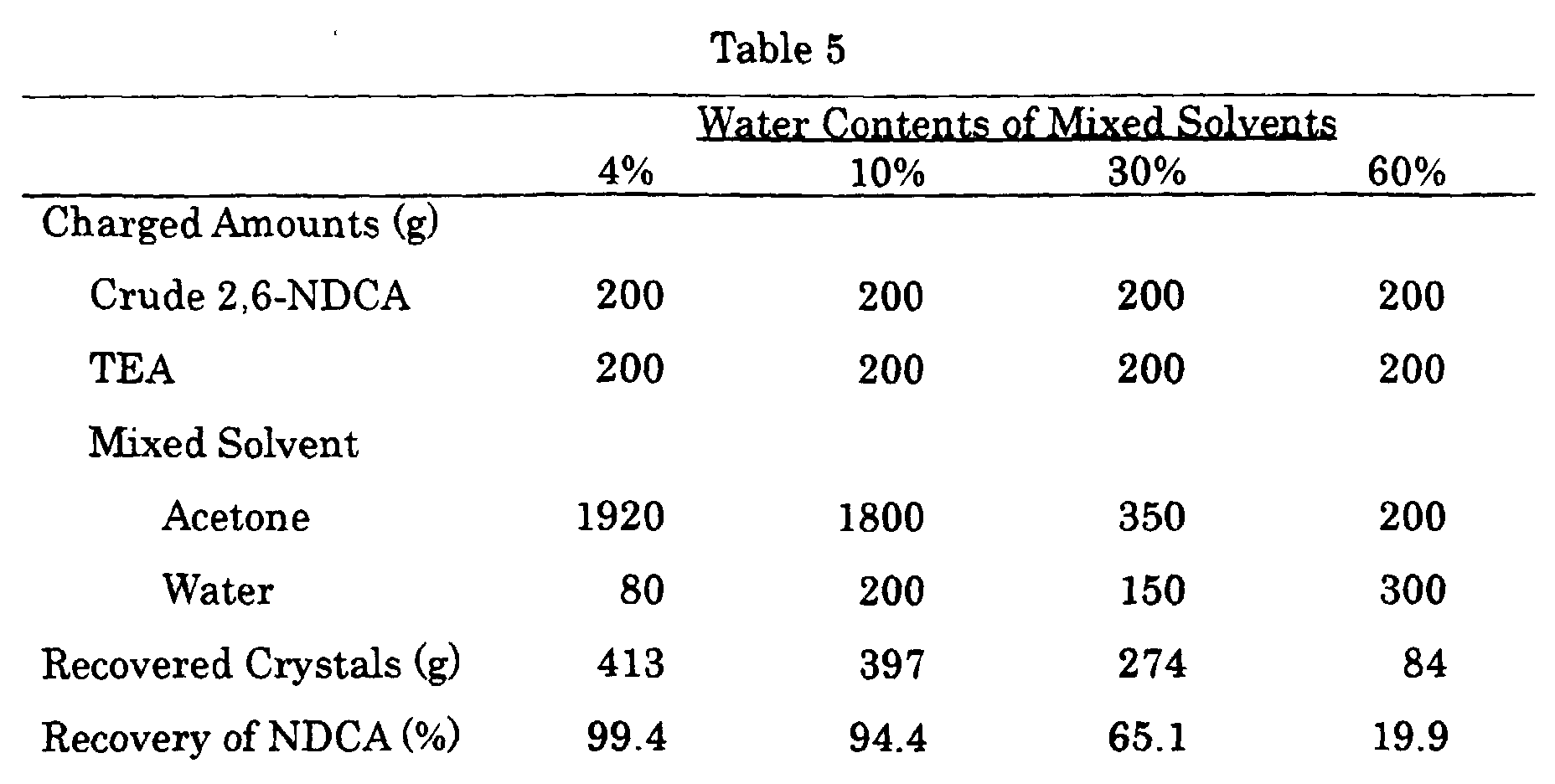
- the water content of the mixed solvent of water and the water-soluble organic solvent is 1 to 80% by weight, preferably 5 to 50% by weight. When the water content is too large, the recovery of amine salts is reduced. When the water content is too small, no expected purification effect by using water is obtained. Accordingly, the amount of the solvent based on the aromatic polycarboxylic acid is selected from the above range in view of the recovery and purification degree of the amine salt as well as the operability of solid-liquid separation and the recovery of solvent.
- the salt formation step may be carried out in either batch-wise or continuous manners.
- the crude aromatic polycarboxylic acid and the amine may be added under stirring in any order to water, the organic solvent or the mixed solvent comprising water and the water-soluble organic solvent.
- the amine salt is readily formed when the crude aromatic polycarboxylic acid is contacted with the amine in the solvent.
- a mixed solvent with a deficient water content is used, a sufficient purification is not achieve as mentioned above.
- a high recovery can be attained by completing the salt formation in a mixed solvent having a high water content and subsequently adding a water-soluble organic solvent to allow the amine salt dissolved in the solvent to precipitate.
- the temperature and pressure of the salt formation step varies depending upon the kind, composition and amount of the solvent used and the intended recovery of the amine salt. Since the temperature is raised due to the neutralization heat of the crude aromatic polycarboxylic acid and the amine during the salt formation, the evolved heat may be dissipated, if required. Further, since the complete dissolution is avoided in the salt formation according to the present invention, heat and pressure are not needed unless otherwise required.
- the salt formation is usually conducted at 0 to 200°C, preferably 0 to 70°C, and more preferably 10 to 50°C in view of easiness of industrial applications, and under a pressure of 0 to 10 MPa ⁇ G, preferably from atmospheric pressure or 1 MPa ⁇ G or less.
- the slurry produced in the salt formation step contains amine salt crystals and is then subjected to solid-liquid separation such as filtration, centrifugation and decantation to separate the slurry into amine salt crystals acid and a mother liquor containing concentrated impurities.
- the separated crystals are rinsed or washed after reslurried with a poor solvent to the amine salt, preferably with the organic solvent used in the salt formation step, to remove the mother liquor remaining on the crystals.
- the purity of crystals can be further increased by dissolving off only the outer portion of crystals at which impurities are concentrated.
- the mother liquor and the washings of crystals obtained in the salt formation step contain, in addition to the solvent used, non-recovered amine salt of aromatic polycarboxylic acid and impurities.
- the remaining amine salt may be partly or completely recovered to increase the overall recovery by adding a poor solvent to the amine salt or by cooling to temperatures lower than the salt formation temperature, thereby decreasing the solubility of the amine salt enough to precipitate.
- a part or whole of the amine or organic solvent contained in the mother liquor and the washings may be separated from impurities by distillation or liquid-liquid separation method, and may be recycled to the salt formation step for reuse.
- the colored components and the organic impurities can be removed more sufficiently by treating the amine salt with a solid adsorbent or re-crystallization.
- the solid adsorbents may include activated carbon, activated clay, zeolite, etc., and activated carbon is most preferred due to its large decoloring power and high ability of removing the organic impurities.
- the treatment by activated carbon powder may be carried out simultaneously with the salt formation or after the salt formation by contacting the powder with a solution of the amine salt in a solvent such as water.
- a continuous flow method using granular activated carbon is advantageous, in which an aqueous solution of purified amine salt from the salt formation step is filtered to remove the insolubles and introduced into an adsorption column filled with granular activated carbon where the colored components and the organic impurities are removed by adsorption.
- acid or alkaline solutions containing amines, NaOH, KOH, HCl, HNO 3 , etc. are allowed to pass through the adsorption column for desorption and regeneration, thereby using the activated carbon repeatedly.
- the purified amine salt of aromatic polycarboxylic acid obtained in the salt formation step may be recrystallized for further purification.
- the recrystallization may be performed by dissolving the amine salt into a solvent under heating and then cooling or concentrating the resultant solution to precipitate crystals of the amine salt, or by dissolving the amine salt in a good solvent for the amine salt such as water and then adding a poor solvent for the amine salt such as acetone and alcohols, thereby precipitating crystals of the amine salt.
- the solvent usable for the recrystallization are not necessarily the same as those used in the salt formation step, the organic solvent or the mixed solvent of water and the water-soluble organic solvent used in the salt formation step is advantageous in industrial applications.
- the object compounds, aromatic polycarboxylic acids are obtained from aqueous solutions of corresponding amine salts by a method where an acid, such as acetic acid and hydrochloric acid, having an acidity higher than that of the object aromatic polycarboxylic acid is added to the aqueous solution of the amine slat, thereby precipitating the object aromatic polycarboxylic acid; a method where the aqueous solution is directly heated to completely distill off water and amine; or a method where the amine salt is thermally decomposed in the presence of water, thereby precipitating the object aromatic polycarboxylic acid from the aqueous solution.
- an acid such as acetic acid and hydrochloric acid
- organic acids such as acetic acid and propionic acid or inorganic acids such as sulfuric acid and hydrochloric acid may be added to the aqueous solution dissolving the amine salt to precipitate the object aromatic polycarboxylic acid. Since this method is likely to precipitate fine crystals, it is preferred to increase the grain size by conducting the precipitation at elevated temperatures of 100°C or higher, preferably about 150°C, or by prolonging the residence time of the crystals in the reaction system. The precipitated crystals are recovered by solid-liquid separation such as filtration and centrifugation, washed with water, the organic acids used, etc., and then dried, thereby obtaining highly pure aromatic polycarboxylic acids.
- the aqueous solution is heated while stirring to decompose the amine salt and completely distill off amine concomitantly with water, thereby obtaining highly pure aromatic polycarboxylic acids.
- the aqueous solution is heated in the presence of water to decompose the amine salt and then water and amine are distilled off, thereby precipitating the aromatic polycarboxylic acid from the aqueous solution.
- the decomposition of the amine salt by this method is advantageous, because the resultant aromatic polycarboxylic acids have a large particle size and are excellent in flowability and easiness of filtering.
- an aqueous solution of the amine salt is charged into a reaction vessel where the amine salt is heated to its decomposition temperature or higher to decompose, thereby obtaining a distillate containing the evolved amine while precipitating the aromatic polycarboxylic acid in the reaction vessel.
- the amount of water in the reaction vessel is preferably kept at a predetermined level or higher by feeding water thereinto.
- the decomposition of the amine salt is stopped when a predetermined amount or higher, preferably 50% or higher, more preferably 90% or higher of the amine salt is decomposed.
- the amount of water used in the salt decomposition step varies depending upon kinds of the aromatic polycarboxylic acid and amine being evolved, and is preferably 0.2 to 20 parts by weight, more preferably 0.5 to 5 parts by weight based on one part of the amine salt of aromatic polycarboxylic acid.
- the temperature of the salt decomposition step is 50 to 250°C, preferably 120 to 210°C.
- the pressure in the salt decomposition step varies depending upon the proportions of contents in the reaction vessel at the heating temperature, and is usually -0.1 to 5 MPa ⁇ G, preferably 0 to 2 MPa ⁇ G.
- the heat supply can be reduced by decomposing the amine salt while blowing an inert gas such as a nitrogen gas into the reaction vessel.
- the amine salt of aromatic polycarboxylic acid is decomposed and the evolved amine is collected by cooling, thereby recovering whole amine used.
- the recovered amine is purified, if desired, and reused in the salt formation step.
- the liberated aromatic polycarboxylic acid is precipitated in the solution.
- the precipitated aromatic polycarboxylic acid is separated and recovered from the solution by solid-liquid separation methods such as filtration and centrifugation.
- the recovered crystals may be washed with water to remove impurities attached thereto.
- the mother liquor and the washings of crystals after the solid-liquid separation may be recycled to the salt formation step to remove the concentrated impurities out of the reaction system.
- the obtained crystals are dried to obtain a highly pure aromatic polycarboxylic acid.
- organic impurities such as aromatic tricarboxylic acids and brominated aromatic carboxylic acids, which are relatively difficult to remove in the salt formation step, are almost completely removed. Also, the resultant aromatic polycarboxylic acid is less colored and has increased particle size.
- the organic impurities in the raw materials, the amine salts of aromatic dicarboxylic acids and crystals of highly pure aromatic dicarboxylic acids were analyzed by gas chromatography after methyl esterification, and the metal impurities were analyzed by ICP emission spectrometry after wet decomposition.
- the degree of coloration was evaluated by 400nm optical density (OD 400 ) measured on an aqueous solution of one gram of sample naphthalenedicarboxylic acid or biphenyldicarboxylic acid in 10 ml aqueous solution of 1N sodium hydroxide using a quartz cell with 10mm penetration distance.
- the degree of coloration of the amine salt was evaluated in the same manner as above after vacuum dry at 100°C for 3 hours.
- the mean particle diameter was measured by a laser diffraction particle-size analyzer.
- the recovery was expressed by the ratio of the amount of aromatic dicarboxylic acid in crystals based on the amount of crude aromatic dicarboxylic acid charged as the raw material.
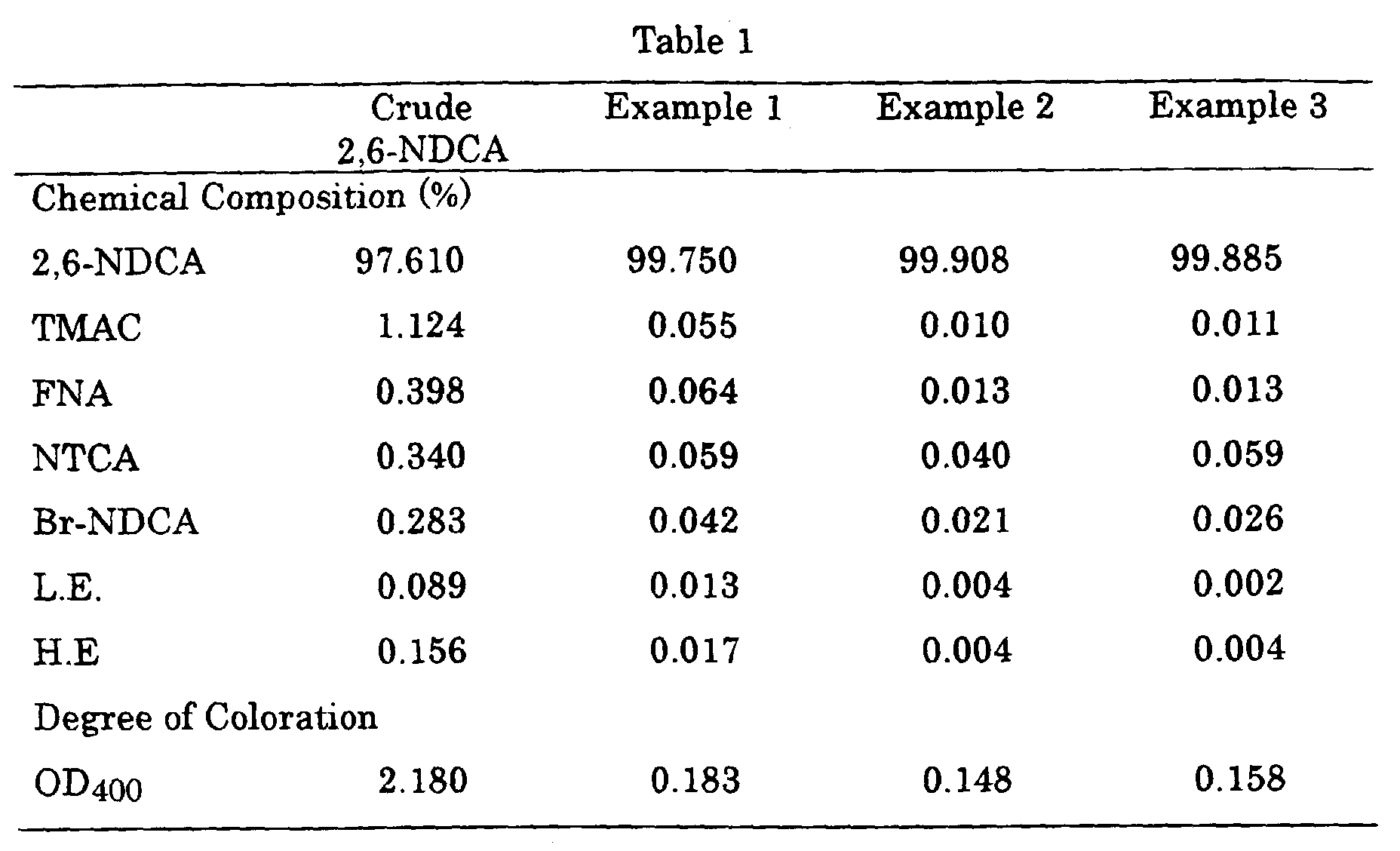
- the oxidation product of 2,6-dimethylnaphthalene in the presence of an oxidation catalyst containing a heavy metal and a bromine compound was filtered, washed and then dried to produce a crude 2,6-NDCA shown in Table 1 as a starting material.
- the crude 2,6-NDCA contained 540 ppm of Co and 2,500 ppm of Mn.
- the resultant slurry containing purified 2,6-NDCA ⁇ TEA crystals was filtered through a G2 glass filter, and the crystals on the filter were rinsed with 200 g of acetone to obtain 334 g of 2,6-NDCA ⁇ TEA crystals (79.5 % recovery).
- the chemical composition and the degree of coloration of the obtained crystals are shown in Table 1.
- Example 1 In the same manner as in Example 1 except that 1,000 g of 20% water-containing acetone were used instead of 500 g of 10% water-containing ethanol, 328 g of 2,6-NDCA ⁇ TEA crystals were obtained (78.0 % recovery). The chemical composition and the degree of coloration of the obtained crystals are shown in Table 1.
- Example 1 In the same manner as in Example 1 except that 1,000 g of 20% water-containing acetonitrile were used instead of 500 g of 10% water-containing ethanol, 235 g of 2,6-NDCA ⁇ TEA crystals were obtained (55.9 % recovery). The chemical composition and the degree of coloration of the obtained crystals are shown in Table 1.
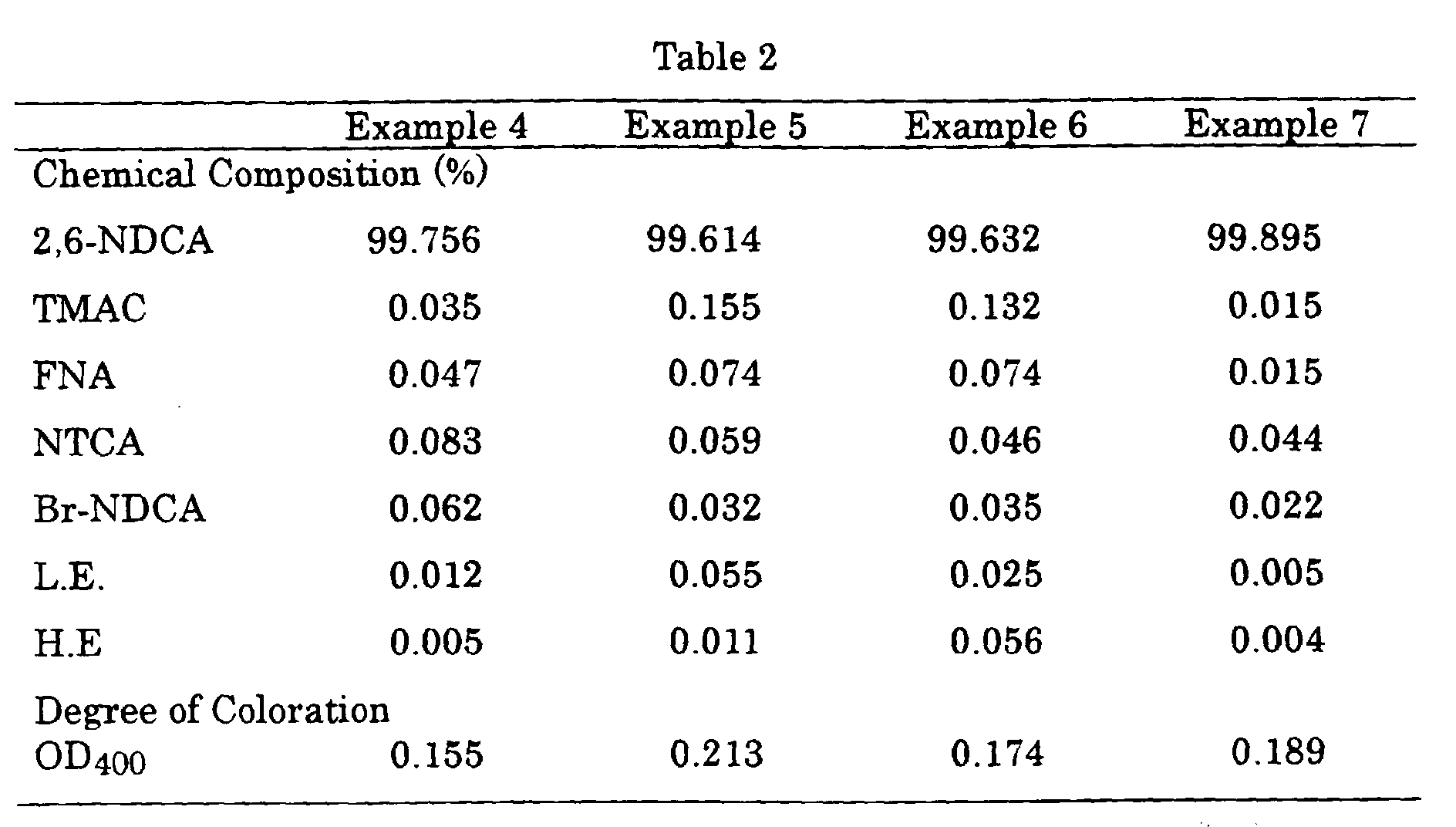
- Example 2 In the same manner as in Example 1 except that 1,000 g of 10% water-containing pyridine were used instead of 500 g of 10% water-containing ethanol, 372 g of 2,6-NDCA ⁇ TEA crystals were obtained (88.5 % recovery). The chemical composition and the degree of coloration of the obtained crystals are shown in Table 2.
- Example 2 In the same manner as in Example 1 except that 1,000 g of 10% water-containing tetrahydrofuran were used instead of 500 g of 10% water-containing ethanol, 382 g of 2,6-NDCA ⁇ TEA crystals were obtained (90.9 % recovery). The chemical composition and the degree of coloration of the obtained crystals are shown in Table 2.
- Example 2 In the same manner as in Example 1 except that 1,000 g of 10% water-containing dimethylacetamide were used instead of 500 g of 10% water-containing ethanol, 356 g of 2,6-NDCA ⁇ TEA crystals were obtained (84.7 % recovery). The chemical composition and the degree of coloration of the obtained crystals are shown in Table 2.
- Example 2 In the same manner as in Example 1 except that 500 g of 20% water-containing isopropanol were used instead of 500 g of 10% water-containing ethanol, 355 g of 2,6-NDCA ⁇ TEA crystals were obtained (84.4% recovery). The chemical composition and the degree of coloration of the obtained crystals are shown in Table 2.
- Example 8 In the same manner as in Example 8 except that 500 g of ⁇ -picoline were used instead of 400 g of ethanol, 340 g of 2,6-NDCA ⁇ TEA crystals were obtained (80.9 % recovery). The chemical composition and the degree of coloration of the obtained crystals are shown in Table 3.
- Example 8 In the same manner as in Example 8 except that 400 g of dimethylsulfoxide were used instead of 400 g of ethanol, 328 g of 2,6-NDCA ⁇ TEA crystals were obtained (78.0 % recovery). The chemical composition and the degree of coloration of the obtained crystals are shown in Table 3.
- Example 8 In the same manner as in Example 8 except that 200 g of water were used instead of 400 g of ethanol and the salt formation, filtration and rinsing were performed at 0°C while cooling with ice, 123 g of 2,6-NDCA ⁇ TEA crystals were obtained (29.3 % recovery). The chemical composition and the degree of coloration of the obtained crystals are shown in Table 3. Since only water was used as the solvent for the salt formation, the recovery was lowered.
- the resultant slurry containing 2,6-NDCA ⁇ TMA crystals was filtered through a G2 glass filter, and the crystals on the filter were rinsed with 200 g of acetone to obtain 228 g of 2,6-NDCA ⁇ TMA crystals (73.7 % recovery).
- the chemical composition and the degree of coloration of the obtained crystals are shown in Table 4.
- the resultant slurry containing 2,6-NDCA ⁇ DEA crystals was filtered through a G2 glass filter, and the crystals on the filter were rinsed with 200 g of acetone to obtain 256 g of 2,6-NDCA ⁇ DEA crystals (76.3 % recovery).
- the chemical composition and the degree of coloration of the obtained crystals are shown in Table 4.
- the resultant slurry containing 2,6-NDCA ⁇ EA crystals was filtered through a G2 glass filter, and the crystals on the filter were rinsed with 200 g of acetone to obtain 222 g of 2,6-NDCA ⁇ EA crystals (73.9 % recovery).
- the chemical composition and the degree of coloration of the obtained crystals are shown in Table 4.
- Example 2 Into a 2-liter SUS autoclave equipped with a stirring device, a temperature-measuring tube, a pressure filter and a heating medium circulator, were charged the same starting materials in the same charged amounts as in Example 1. The contents of the autoclave were heated to 120°C and stirred at that temperature for 30 minutes, thereby completely dissolving the contents. At this time, the inner pressure of the autoclave was 0.35 MPa. Then, the resultant solution was cooled to 25°C over 3 hours and stirred for 30 minutes. The resultant mixture was pressure-filtered at 25°C and the collected crystals were rinsed with 200 g of acetone, thereby obtaining 316 g of 2,6-NDCA ⁇ TEA crystals (75.2 % recovery). The chemical composition and the degree of coloration of the obtained crystals are shown in Table 4.
- the filtrate was evaporated to dryness by an evaporator, and the crystals obtained were vacuum-dried at 100°C for 3 hours.
- the chemical composition and the degree of coloration of the obtained crystals are shown in Table 4. Irrespective of using a large amount of activated carbon, the decoloration was unsatisfactory and the removal of organic impurities was insufficient.
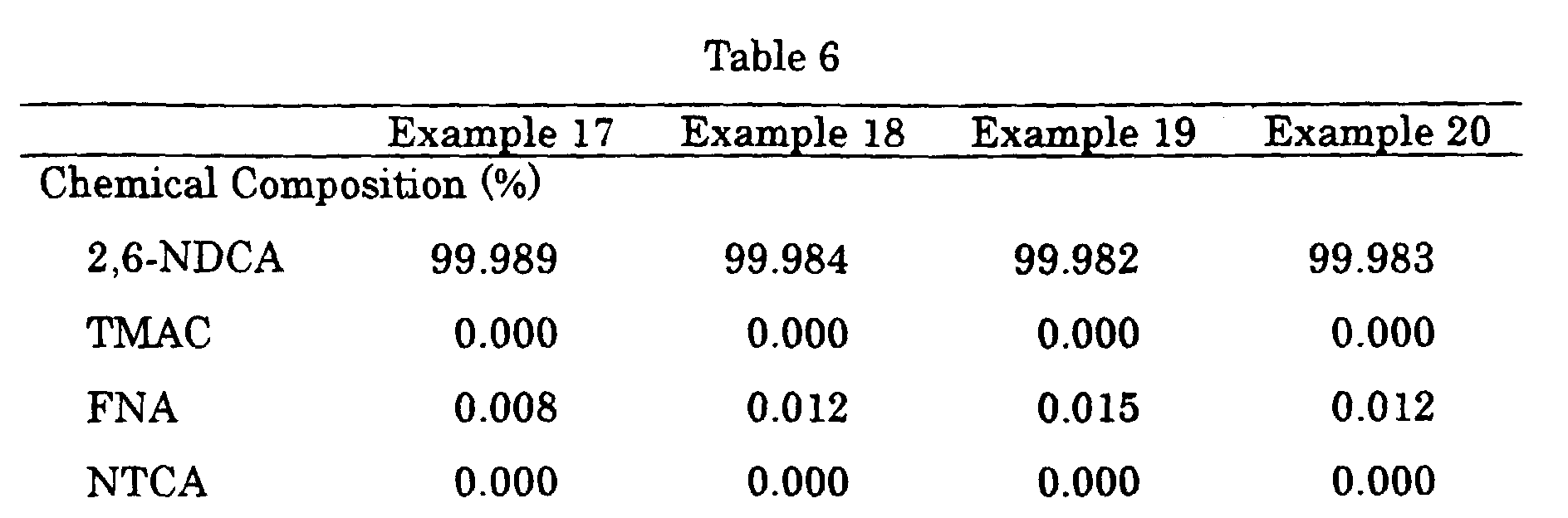
- Example 17 In the same manner as in Example 17 except for using 200 g of the purified 2,6-NDCA ⁇ TMA obtained in Example 13 in place of 200 g of 2,6-NDCA ⁇ TEA, 110.5 g of highly pure 2,6-NDCA were obtained.
- the chemical composition and the degree of coloration of the obtained crystals are shown in Table 6.
- Example 17 In the same manner as in Example 17 except for using 200 g of the purified 2,6-NDCA ⁇ DEA obtained in Example 14 in place of 200 g of the purified 2,6-NDCA ⁇ TEA, 60.6 g of highly pure 2,6-NDCA were obtained.
- the chemical composition and the degree of coloration of the obtained crystals are shown in Table 6.
- the yield was lower than those of Examples 17 and 18 using the TEA and TMA salts due to slow decomposition of the amine salt.
- theparticle size was slightly smaller than those using the TEA and TMA salts.
- Example 17 In the same manner as in Example 17 except for using 200 g of the purified 2,6-NDCA ⁇ EA obtained in Example 15 in place of 200 g of the purified 2,6-NDCA ⁇ TEA, 50.9 g of highly pure 2,6-NDCA were obtained.
- the chemical composition and the degree of coloration of the obtained crystals are shown in Table 6.
- the yield was lower than those of Examples 17 and 18 using the TEA and TMA salts due to slow decomposition of the amine salt.
- the particle size was slightly smaller than those using the TEA and TMA salts.
- the resultant slurry containing 2,6-NDCA ⁇ TEA crystals was filtered through a G2 glass filter, and the crystals on the filter were rinsed with 300 g of acetone, thereby obtaining 412 g of purified 2,6-NDCA ⁇ TEA crystals (98.0% recovery).
- the chemical composition and the degree of coloration of the obtained crystals are shown in Table 7.
- the formation of amine salt was completed by using the solvent having a high water content and the crystals were precipitated by the addition of acetone. The precipitated crystals were less colored although the recovery was high.
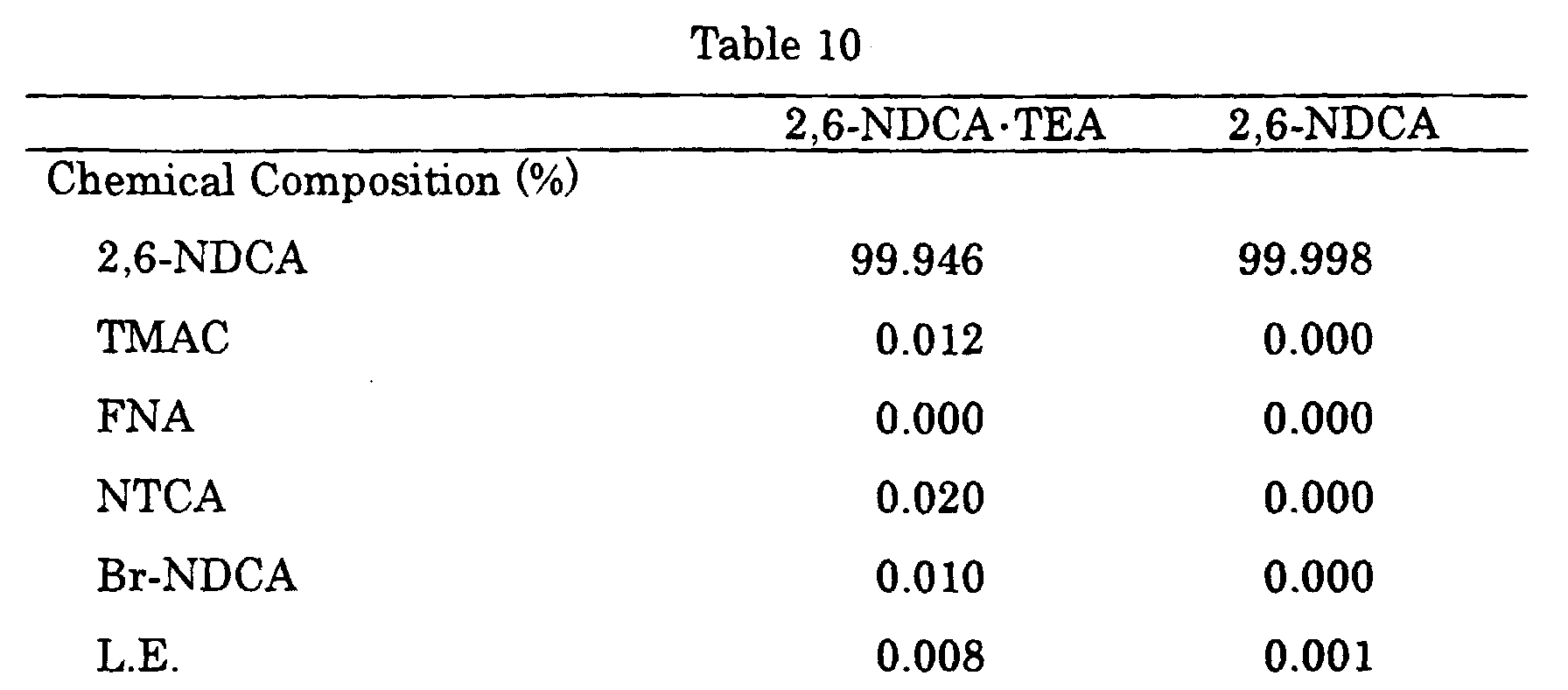
- Example 9 In the same manner as in Example 2 except for adding 2.0 g of powdery activated carbon (produced by Wako Junyaku Co., Ltd.), 328 g of 2,6-NDCA ⁇ TEA were obtained (78.0% recovery). The chemical composition and the degree of coloration of the obtained crystals are shown in Table 9.
- the resultant slurry containing purified 4,4'-BPDA ⁇ TEA crystals was filtered through a G2 glass filter, and the crystals on the filter were rinsed with 200 g of acetone to obtain 298 g of 4,4'-BPDA ⁇ TEA crystals (78.0 % recovery).
- the chemical composition and the degree of coloration of the obtained crystals are shown in Table 11.
- Example 25 In the same manner as in Example 25 except that 5wt.% water-containing pyridine was used instead of 500 g of 5wt.% water-containing acetone, 246 g of 4,4'-BPDA ⁇ TEA crystals were obtained (64.4 % recovery). The chemical composition and the degree of coloration of the obtained crystals are shown in Table 11.
- Example 25 In the same manner as in Example 25 except that 500 g of N,N-dimethyl acetamide were used instead of 500 g of 5wt.% water-containing acetone, 321 g of 4,4'-BPDA ⁇ TEA crystals were obtained (84.0 % recovery). The chemical composition and the degree of coloration of the obtained crystals are shown in Table 11.
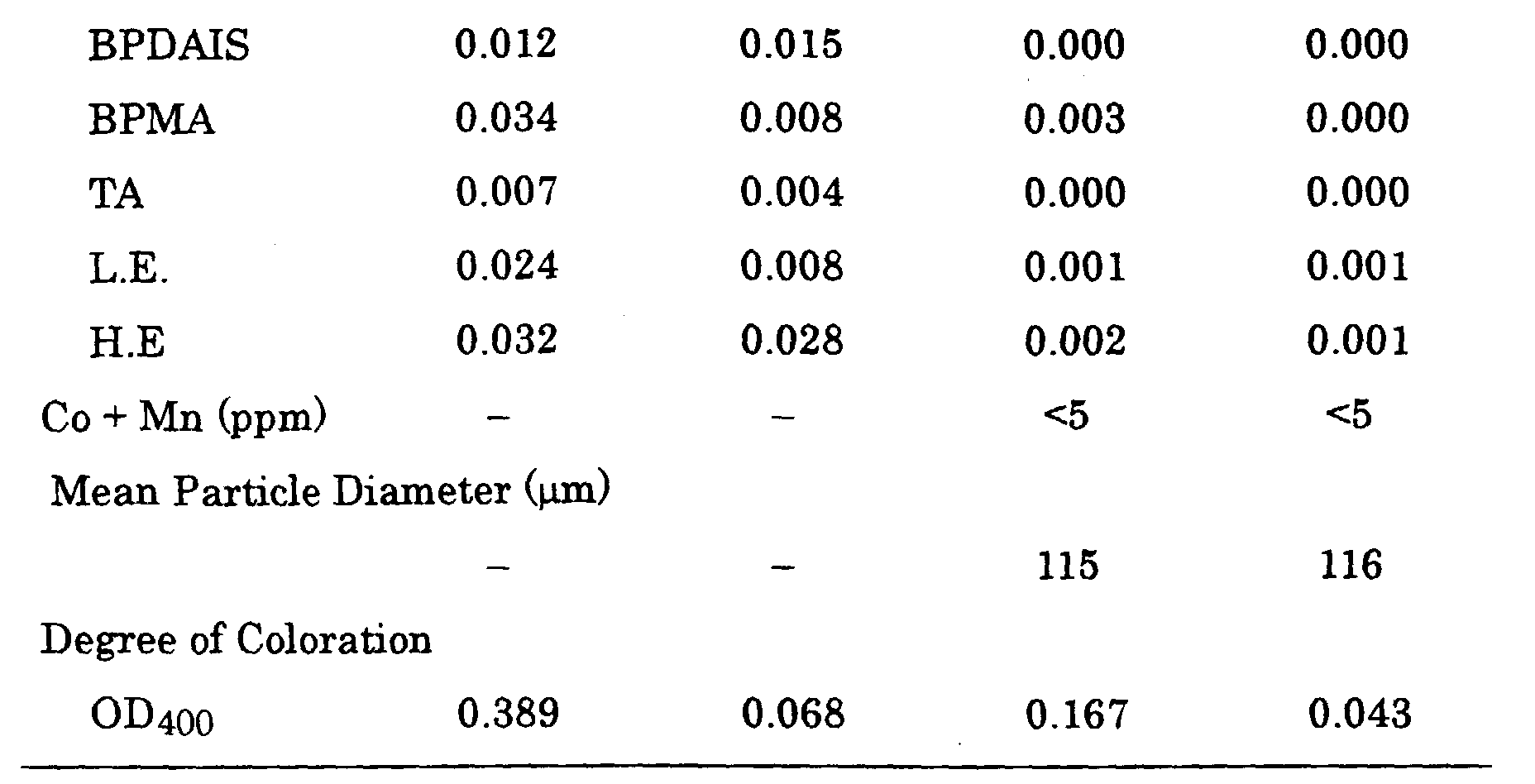
- Example 25 In the same manner as in Example 25 except that 400 g of ⁇ -picoline were used instead of 500 g of 5wt.% water-containing acetone, 245 g of 4,4'-BPDA ⁇ TEA crystals were obtained (64.1 % recovery). The chemical composition and the degree of coloration of the obtained crystals are shown in Table 12.
- Example 12 In the same manner as in Example 25 except that 2 g of powdered activated carbon (Wako Junyaku Co., Ltd.) were added together with the solvent in the salt formation step, 302 g of 4,4'-BPDA ⁇ TEA crystals were obtained (79.1 % recovery). The chemical composition and the degree of coloration of the obtained crystals are shown in Table 12.
- Example 25 Into 200 g of water, 200 g of purified 4,4'-BPDA ⁇ TEA crystals produced in Example 25 were dissolved, and the resultant solution was subjected to precision filtration using a 1 ⁇ m filter to remove foreign materials and insoluble metals.
- Example 29 Using 200 g of the 4,4'-BPDA ⁇ TEA obtained in Example 29, the same procedures as in Example 30 were repeated to obtain 98.8 g of 4,4'-BPDA. The chemical composition and the degree of coloration of the obtained crystals are shown in Table 12. 4,4'-BPDA with much higher purity was obtained by the treatment with activated carbon.
- purified amine salts of aromatic polycarboxylic acids are obtained in the form of crystals by simply mixing crude aromatic polycarboxylic acids with amines in a solvent at ordinary temperature under ordinary pressure.
- aqueous solutions of the amine salts By subjecting aqueous solutions of the amine salts to decomposition, corresponding highly pure aromatic polycarboxylic acids with less coloration are obtained.
- the process of the present invention is effectively applicable, in particular, to naphthalenedicarboxylic acids and biphenyldicarboxylic acids which are sparingly soluble in water.
- the process for the production of highly pure aromatic polycarboxylic acid according to the present invention has the following advantages.
Landscapes
- Chemical & Material Sciences (AREA)
- Organic Chemistry (AREA)
- Engineering & Computer Science (AREA)
- Oil, Petroleum & Natural Gas (AREA)
- Chemical Kinetics & Catalysis (AREA)
- General Chemical & Material Sciences (AREA)
- Organic Low-Molecular-Weight Compounds And Preparation Thereof (AREA)
Abstract
Description








Claims (14)
- A process for producing a highly pure aromatic polycarboxylic acid, the process comprising a salt formation step of forming a crystalline amine salt by mixing an aromatic polycarboxylic acid with an aliphatic amine and/or an alicyclic amine in the presence of a solvent under conditions which allow a substantial part of the amine salt being formed to precipitate, thereby preventing the amine salt from completely dissolving into the solvent.
- The process according to claim 1, further comprising a salt decomposition step of dissolving the amine salt of aromatic polycarboxylic acid into water and subsequently decomposing the amine salt of aromatic polycarboxylic acid into aromatic polycarboxylic acid.
- The process according to claim 2, the amine salt is decomposed under heating.
- The process according to any one of claims 1 to 3, wherein the aromatic polycarboxylic acid is naphthalenedicarboxylic acid or biphenyldicarboxylic acid.
- The process according to any one of claims 1 to 4, wherein the aliphatic amine is a tertiary amine.
- The process according to claim 5, wherein the tertiary amine is triethylamine and/or trimethylamine.
- The process according to any one of claims 1 to 6, wherein the solvent used in the salt formation step is a mixed solvent comprising water and a water-soluble organic solvent.
- The process according to claim 7, wherein the water-soluble organic solvent is at least one solvent selected from the group consisting of acetone, acetonitrile, pyridines, alcohols having 3 or less carbon atoms, dimethylacetamide and dimethylformamide.
- The process according to claim 8, wherein the water-soluble organic solvent is at least one solvent selected from the group consisting of acetone, pyridine and picoline.
- The process according to claim 7 or 8, wherein the water content of the mixed solvent is 1 to 80% by weight.
- The process according to any one of claims 1 to 10, wherein the salt formation step is carried out at 0 to 70°C.
- The process according to any one of claims 1 to 11, wherein the amine salt is treated with activated carbon in the salt formation step.
- The process according to any one of claims 1 to 12, wherein the amine salt precipitated in the salt formation step is recrystallized from a solvent.
- The process according to any one of claims 1 to 13, wherein the amine salt precipitated in the salt formation step is dissolved in water, treated with activated carbon, and subjected to the salt decomposition step.
Applications Claiming Priority (2)
| Application Number | Priority Date | Filing Date | Title |
|---|---|---|---|
| JP14661399 | 1999-05-26 | ||
| JP14661399 | 1999-05-26 |
Publications (2)
| Publication Number | Publication Date |
|---|---|
| EP1055660A1 true EP1055660A1 (en) | 2000-11-29 |
| EP1055660B1 EP1055660B1 (en) | 2003-05-21 |
Family
ID=15411706
Family Applications (1)
| Application Number | Title | Priority Date | Filing Date |
|---|---|---|---|
| EP00110299A Expired - Lifetime EP1055660B1 (en) | 1999-05-26 | 2000-05-24 | Process for producing highly pure aromatic polycarboxylic acid |
Country Status (4)
| Country | Link |
|---|---|
| US (1) | US6452047B1 (en) |
| EP (1) | EP1055660B1 (en) |
| JP (1) | JP2011116792A (en) |
| DE (1) | DE60002782T2 (en) |
Cited By (4)
| Publication number | Priority date | Publication date | Assignee | Title |
|---|---|---|---|---|
| EP1157981A3 (en) * | 2000-05-25 | 2003-10-15 | Mitsubishi Gas Chemical Company, Inc. | Process for producing a high purity aromatic polycarboxylic acid |
| WO2004013071A3 (en) * | 2002-08-01 | 2004-09-10 | Sk Chemicals Co Ltd | Method for refining 2,6-naphthalene dicarboxylic acid |
| CN102887902A (en) * | 2012-10-10 | 2013-01-23 | 北京莱瑞森医药科技有限公司 | Preparation process for synthesizing high-purity Pemedolac |
| US8993799B2 (en) | 2011-05-30 | 2015-03-31 | Mitsubishi Gas Chemical Company, Inc. | Method for producing a purified naphthalene dicarboxylic acid |
Families Citing this family (2)
| Publication number | Priority date | Publication date | Assignee | Title |
|---|---|---|---|---|
| EP1591435A3 (en) * | 2004-03-26 | 2007-11-28 | Kabushiki Kaisha Ueno Seiyaku Oyo Kenkyujo | Method for preparing 2,6-Naphtalene dicarboxyclic acid |
| US20180371358A1 (en) * | 2017-06-23 | 2018-12-27 | Pure, Llc | Cannabis extract filtration methods and systems |
Citations (2)
| Publication number | Priority date | Publication date | Assignee | Title |
|---|---|---|---|---|
| JPH05294891A (en) * | 1992-04-22 | 1993-11-09 | Mitsubishi Petrochem Co Ltd | Production of biphenyldicarboxylic acid |
| EP0787712A1 (en) * | 1996-02-05 | 1997-08-06 | Mitsubishi Gas Chemical Company, Inc. | Process for the production of high-purity naphthalenedicarboxylic acid |
Family Cites Families (4)
| Publication number | Priority date | Publication date | Assignee | Title |
|---|---|---|---|---|
| JPS5648498B2 (en) | 1974-04-15 | 1981-11-16 | ||
| EP0636600B1 (en) * | 1993-02-12 | 1998-05-20 | Mitsui Chemicals, Inc. | Method of purifying aromatic dicarboxylic acid |
| JPH07118200A (en) | 1993-10-19 | 1995-05-09 | Mitsubishi Chem Corp | Method for producing naphthalenedicarboxylic acid |
| US5481033A (en) | 1994-12-22 | 1996-01-02 | E. I. Du Pont De Nemours And Company | Purification process for aromatic dicarboxylic acids |
-
2000
- 2000-05-24 US US09/577,153 patent/US6452047B1/en not_active Expired - Lifetime
- 2000-05-24 EP EP00110299A patent/EP1055660B1/en not_active Expired - Lifetime
- 2000-05-24 DE DE60002782T patent/DE60002782T2/en not_active Expired - Lifetime
-
2011
- 2011-03-18 JP JP2011061300A patent/JP2011116792A/en active Pending
Patent Citations (2)
| Publication number | Priority date | Publication date | Assignee | Title |
|---|---|---|---|---|
| JPH05294891A (en) * | 1992-04-22 | 1993-11-09 | Mitsubishi Petrochem Co Ltd | Production of biphenyldicarboxylic acid |
| EP0787712A1 (en) * | 1996-02-05 | 1997-08-06 | Mitsubishi Gas Chemical Company, Inc. | Process for the production of high-purity naphthalenedicarboxylic acid |
Non-Patent Citations (1)
| Title |
|---|
| DATABASE WPI Derwent World Patents Index; AN 1993-392609, XP002147912, IWANE HIROSHI ET AL: "Production fo bi-phenyl-di-carboxylic acids with improved yield" * |
Cited By (6)
| Publication number | Priority date | Publication date | Assignee | Title |
|---|---|---|---|---|
| EP1157981A3 (en) * | 2000-05-25 | 2003-10-15 | Mitsubishi Gas Chemical Company, Inc. | Process for producing a high purity aromatic polycarboxylic acid |
| EP2194037A1 (en) * | 2000-05-25 | 2010-06-09 | Mitsubishi Gas Chemical Company, Inc. | Process for producing a high purity aromatic polycarboxylic acid |
| WO2004013071A3 (en) * | 2002-08-01 | 2004-09-10 | Sk Chemicals Co Ltd | Method for refining 2,6-naphthalene dicarboxylic acid |
| US7153998B2 (en) | 2002-08-01 | 2006-12-26 | Sk Chemical Co., Ltd. | Method for refining 2,6-naphthalene dicarboxylic acid |
| US8993799B2 (en) | 2011-05-30 | 2015-03-31 | Mitsubishi Gas Chemical Company, Inc. | Method for producing a purified naphthalene dicarboxylic acid |
| CN102887902A (en) * | 2012-10-10 | 2013-01-23 | 北京莱瑞森医药科技有限公司 | Preparation process for synthesizing high-purity Pemedolac |
Also Published As
| Publication number | Publication date |
|---|---|
| US6452047B1 (en) | 2002-09-17 |
| EP1055660B1 (en) | 2003-05-21 |
| DE60002782D1 (en) | 2003-06-26 |
| DE60002782T2 (en) | 2004-03-25 |
| JP2011116792A (en) | 2011-06-16 |
Similar Documents
| Publication | Publication Date | Title |
|---|---|---|
| EP0562105B1 (en) | Process for preparing 2,6-naphthalenedicarboxylic acid | |
| KR100642625B1 (en) | Process for Purifying and Producing High Purity Aromatic Polycarboxylic Acids and Derivatives thereof | |
| US6114575A (en) | Process for preparing 2,6-naphthalenedicarboxylic acid | |
| US6642407B2 (en) | Production, purification and polymerization of aromatic dicarboxylic acids | |
| JP2011116792A (en) | Method for producing highly pure aromatic polycarboxylic acid | |
| JP4839501B2 (en) | Method for producing high purity aromatic polycarboxylic acid | |
| EP1389609B1 (en) | Method of purifying aromatic polycarboxylic acid | |
| JP2002097168A (en) | Method for producing aromatic tetracarboxylic acid | |
| EP1157981B1 (en) | Process for producing a high purity aromatic polycarboxylic acid | |
| JPH07118200A (en) | Method for producing naphthalenedicarboxylic acid | |
| US5840970A (en) | Process for the purification of naphthalenedicarboxylic acid | |
| KR20030033958A (en) | Method for making high-purity naphthalenedicarboxylic acid | |
| JPH1053557A (en) | Method for producing high-purity 2,6-naphthalenedicarboxylic acid | |
| JPH07173100A (en) | Method for producing high-purity 2,6-naphthalenedicarboxylic acid | |
| JPH07238051A (en) | Method for producing high-purity naphthalenedicarboxylic acid | |
| JP4238214B2 (en) | Method for purifying 2,6-naphthalenedicarboxylic acid | |
| JP5030321B2 (en) | Method for producing high purity aromatic polycarboxylic acid | |
| JP3757989B2 (en) | Method for purifying naphthalenedicarboxylic acid | |
| JPS62212340A (en) | Simultaneous production of 2,6-naphthalene-dicarboxylic acid and trimellitic acid | |
| JPH1180074A (en) | Process for producing high-purity 2,6-naphthalenedicarboxylic acid | |
| WO1999018059A1 (en) | Preparation of 2,6-naphthalenedicarboxylic acid | |
| US20150099898A1 (en) | Process for removing amide impurities in aromatic carboxylic acids | |
| US20020173673A1 (en) | Production, purification and polymerization of aromatic dicarboxylic acids | |
| JP2000297059A (en) | Production of 2,6-naphthalenedicarboxylic acid |
Legal Events
| Date | Code | Title | Description |
|---|---|---|---|
| PUAI | Public reference made under article 153(3) epc to a published international application that has entered the european phase |
Free format text: ORIGINAL CODE: 0009012 |
|
| AK | Designated contracting states |
Kind code of ref document: A1 Designated state(s): BE DE FR GB IT |
|
| AX | Request for extension of the european patent |
Free format text: AL;LT;LV;MK;RO;SI |
|
| 17P | Request for examination filed |
Effective date: 20010507 |
|
| AKX | Designation fees paid |
Free format text: BE DE FR GB IT |
|
| 17Q | First examination report despatched |
Effective date: 20020319 |
|
| GRAH | Despatch of communication of intention to grant a patent |
Free format text: ORIGINAL CODE: EPIDOS IGRA |
|
| GRAH | Despatch of communication of intention to grant a patent |
Free format text: ORIGINAL CODE: EPIDOS IGRA |
|
| GRAA | (expected) grant |
Free format text: ORIGINAL CODE: 0009210 |
|
| AK | Designated contracting states |
Designated state(s): BE DE FR GB IT |
|
| REG | Reference to a national code |
Ref country code: GB Ref legal event code: FG4D |
|
| REF | Corresponds to: |
Ref document number: 60002782 Country of ref document: DE Date of ref document: 20030626 Kind code of ref document: P |
|
| ET | Fr: translation filed | ||
| PLBE | No opposition filed within time limit |
Free format text: ORIGINAL CODE: 0009261 |
|
| STAA | Information on the status of an ep patent application or granted ep patent |
Free format text: STATUS: NO OPPOSITION FILED WITHIN TIME LIMIT |
|
| 26N | No opposition filed |
Effective date: 20040224 |
|
| REG | Reference to a national code |
Ref country code: FR Ref legal event code: PLFP Year of fee payment: 17 |
|
| REG | Reference to a national code |
Ref country code: FR Ref legal event code: PLFP Year of fee payment: 18 |
|
| PGFP | Annual fee paid to national office [announced via postgrant information from national office to epo] |
Ref country code: DE Payment date: 20170516 Year of fee payment: 18 Ref country code: GB Payment date: 20170524 Year of fee payment: 18 Ref country code: FR Payment date: 20170413 Year of fee payment: 18 |
|
| PGFP | Annual fee paid to national office [announced via postgrant information from national office to epo] |
Ref country code: IT Payment date: 20170522 Year of fee payment: 18 Ref country code: BE Payment date: 20170413 Year of fee payment: 18 |
|
| REG | Reference to a national code |
Ref country code: DE Ref legal event code: R119 Ref document number: 60002782 Country of ref document: DE |
|
| GBPC | Gb: european patent ceased through non-payment of renewal fee |
Effective date: 20180524 |
|
| REG | Reference to a national code |
Ref country code: BE Ref legal event code: MM Effective date: 20180531 |
|
| PG25 | Lapsed in a contracting state [announced via postgrant information from national office to epo] |
Ref country code: GB Free format text: LAPSE BECAUSE OF NON-PAYMENT OF DUE FEES Effective date: 20180524 Ref country code: IT Free format text: LAPSE BECAUSE OF NON-PAYMENT OF DUE FEES Effective date: 20180524 Ref country code: DE Free format text: LAPSE BECAUSE OF NON-PAYMENT OF DUE FEES Effective date: 20181201 Ref country code: FR Free format text: LAPSE BECAUSE OF NON-PAYMENT OF DUE FEES Effective date: 20180531 |
|
| PG25 | Lapsed in a contracting state [announced via postgrant information from national office to epo] |
Ref country code: BE Free format text: LAPSE BECAUSE OF NON-PAYMENT OF DUE FEES Effective date: 20180531 |