EP1053919A1 - Système et procédé de démarrage assisté d'un véhicule - Google Patents
Système et procédé de démarrage assisté d'un véhicule Download PDFInfo
- Publication number
- EP1053919A1 EP1053919A1 EP00401408A EP00401408A EP1053919A1 EP 1053919 A1 EP1053919 A1 EP 1053919A1 EP 00401408 A EP00401408 A EP 00401408A EP 00401408 A EP00401408 A EP 00401408A EP 1053919 A1 EP1053919 A1 EP 1053919A1
- Authority
- EP
- European Patent Office
- Prior art keywords
- engine
- badge
- vehicle
- button
- driver
- Prior art date
- Legal status (The legal status is an assumption and is not a legal conclusion. Google has not performed a legal analysis and makes no representation as to the accuracy of the status listed.)
- Granted
Links
- 238000000034 method Methods 0.000 title claims description 26
- 239000007858 starting material Substances 0.000 claims abstract description 11
- 238000003825 pressing Methods 0.000 claims description 8
- 238000013475 authorization Methods 0.000 claims description 3
- 238000001514 detection method Methods 0.000 claims description 3
- 230000000694 effects Effects 0.000 claims description 2
- 230000000903 blocking effect Effects 0.000 claims 1
- 238000010586 diagram Methods 0.000 description 7
- 241001393742 Simian endogenous retrovirus Species 0.000 description 6
- GNFTZDOKVXKIBK-UHFFFAOYSA-N 3-(2-methoxyethoxy)benzohydrazide Chemical compound COCCOC1=CC=CC(C(=O)NN)=C1 GNFTZDOKVXKIBK-UHFFFAOYSA-N 0.000 description 5
- 230000007935 neutral effect Effects 0.000 description 5
- 230000006870 function Effects 0.000 description 4
- FGUUSXIOTUKUDN-IBGZPJMESA-N C1(=CC=CC=C1)N1C2=C(NC([C@H](C1)NC=1OC(=NN=1)C1=CC=CC=C1)=O)C=CC=C2 Chemical compound C1(=CC=CC=C1)N1C2=C(NC([C@H](C1)NC=1OC(=NN=1)C1=CC=CC=C1)=O)C=CC=C2 FGUUSXIOTUKUDN-IBGZPJMESA-N 0.000 description 2
- YTAHJIFKAKIKAV-XNMGPUDCSA-N [(1R)-3-morpholin-4-yl-1-phenylpropyl] N-[(3S)-2-oxo-5-phenyl-1,3-dihydro-1,4-benzodiazepin-3-yl]carbamate Chemical compound O=C1[C@H](N=C(C2=C(N1)C=CC=C2)C1=CC=CC=C1)NC(O[C@H](CCN1CCOCC1)C1=CC=CC=C1)=O YTAHJIFKAKIKAV-XNMGPUDCSA-N 0.000 description 2
- 238000004378 air conditioning Methods 0.000 description 1
- 238000002485 combustion reaction Methods 0.000 description 1
- 230000000994 depressogenic effect Effects 0.000 description 1
- 230000006386 memory function Effects 0.000 description 1
- 230000001681 protective effect Effects 0.000 description 1
- 230000011664 signaling Effects 0.000 description 1
- 230000002747 voluntary effect Effects 0.000 description 1
Images




Classifications
-
- B—PERFORMING OPERATIONS; TRANSPORTING
- B60—VEHICLES IN GENERAL
- B60R—VEHICLES, VEHICLE FITTINGS, OR VEHICLE PARTS, NOT OTHERWISE PROVIDED FOR
- B60R25/00—Fittings or systems for preventing or indicating unauthorised use or theft of vehicles
- B60R25/20—Means to switch the anti-theft system on or off
- B60R25/23—Means to switch the anti-theft system on or off using manual input of alphanumerical codes
-
- B—PERFORMING OPERATIONS; TRANSPORTING
- B60—VEHICLES IN GENERAL
- B60R—VEHICLES, VEHICLE FITTINGS, OR VEHICLE PARTS, NOT OTHERWISE PROVIDED FOR
- B60R25/00—Fittings or systems for preventing or indicating unauthorised use or theft of vehicles
- B60R25/20—Means to switch the anti-theft system on or off
- B60R25/24—Means to switch the anti-theft system on or off using electronic identifiers containing a code not memorised by the user
-
- B—PERFORMING OPERATIONS; TRANSPORTING
- B60—VEHICLES IN GENERAL
- B60R—VEHICLES, VEHICLE FITTINGS, OR VEHICLE PARTS, NOT OTHERWISE PROVIDED FOR
- B60R25/00—Fittings or systems for preventing or indicating unauthorised use or theft of vehicles
- B60R25/20—Means to switch the anti-theft system on or off
- B60R25/24—Means to switch the anti-theft system on or off using electronic identifiers containing a code not memorised by the user
- B60R25/248—Electronic key extraction prevention
Definitions
- the invention relates to a start and stop system. assisted by a motor vehicle, in particular a motor vehicle with internal combustion engine, petrol or diesel. It also relates to a process starting and stopping the engine using a such system.
- Another current solution is to use a key without metallic part which one introduces in a rotary switch located on the dashboard, the steering column being unlocked by a device electromechanical.
- the object of the invention is to replace the key traditional by a format identifier close to that of a credit card for example, and the rotary anti-theft switch by card reader, impulse button and an electro-mechanical device steering lock in one version particular.
- the assisted start function consists in starting the engine from a short press on the start button, whatever either the type of gearbox fitted to the vehicle, whether petrol or diesel.
- the assisted starting system includes a badge 1 or card, held by the user of the vehicle and containing an identification function coded, such as an encrypted transponder.
- This badge 1 can be fitted with a radio frequency transmitter for locking and unlocking doors. It is associated with a badge reader 2, intended for identify it and located for example on the board on board the vehicle. It contains the equivalent of the antenna transponder, with a reading of the identifier without contact.
- the reader When badge 1 has a remote control doors opened by a radio frequency transmitter, the reader will contain a radio frequency receiver. It is supplied from the voltage of the battery 20, for example with 12 volts permanently.
- the badge is introduced in the player and in another version it is simply worn by the user in front of the reader.
- the impulse button 3, on which the driver must press to start and stop the engine, is equipped two indicator lights; witness 30 considered main is an invitation to start, it indicates the position of the button and signals that it is authorized to start the engine because the conditions of required security are present.
- the second witness light 31, called secondary is on when the engine is running and has two functions, one being tell the driver that the engine is running and the other used to locate the button to stop the engine. For this, the lighting of the secondary indicator must be visible during the day, even by strong sunshine, but noticeably reduced when is dark and the parking lights are on.
- the assisted start system also includes a set of several sensors 15 for detecting safety conditions necessary for starting the engine.
- sensors are in particular a point sensor dead and a clutch pedal position sensor in the case of a mechanical gearbox, and in the case of an automatic gearbox, it's a gear lever position sensor which must be in the "Parking" position or in the "Neutral” position.
- the engine is of the Diesel type, it is necessary to add a condition on the preheating which must be finished to allow startup.
- the system includes a speed sensor 16 of the vehicle, this information can also be delivered by the anti-lock braking system control unit ABS.
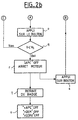
- step a When the vehicle user has entered the passenger compartment, while the electrical ignition of the vehicle is not made, the relay "+ APC" being deactivated and the engine is stopped (step a), it presents his badge 1, opposite the reader 2 which must detect (step b). He can also introduce his badge in a receptacle provided for this purpose on the board board and containing the badge reader. As soon as the badge is detected, the service relay 7 "+ SERV" is activated, allowing the seat position to be adjusted open the windows or listen to the radio in particular (step c). This relay is then cut off during the start-up phase and disabled during withdrawal of the card.
- step d the central unit 4 for controlling the interior, via the reader, seeks to authenticate the identifier coded in the card to authorize the electric unlocking of the steering column vehicle and switch it on, 5 "+ APC" relay toggling to ON state (step e).
- the main invitation to start indicator light remains still off and the engine is stopped.
- step d If the reader did not recognize the badge in step d, the process returns to step a.
- step e the driver withdraws his badge at step z
- the process also returns to step a.
- the central unit 4 cockpit allows the engine to be started, for example the button's main indicator light comes on pulse 3, the service relays "+ SERV" and power supply "+ APC” being activated and the engine still stopped (step g).
- step e of placing under voltage If the security conditions are not all fulfilled, the process returns to step e of placing under voltage.
- step g of invitation to start the driver can press the impulse button 3.
- step h the boot sequence is started.
- step y if at a stage y, the conditions of are no longer met, the process returns still in step e, and if in step z, the driver remove the badge and return to step a.
- step i the computer 4 for controlling the passenger compartment controls the starting relay 13, which goes to ON state to drive the motor up to the instant when the engine control computer 6 gives the information "autonomous engine running".
- the secondary indicator light of the impulse button 3 is then on, signaling that the engine is running (step j).
- step k If the cockpit control computer 4 detects loss of security conditions or failure of motor, it does not run independently after a fixed time delay, in step k, then it cut the start relay in step l and the process returns to step e.
- step j of recognition of the running engine the central control unit 4 for the passenger compartment cuts the start relay 13 ("+ DEM” on OFF) while leaving relay 5 according to contact "+ APC” and the service relay 7 "+ SERV" activated (step m), the vehicle is in running condition.
- the driver can decide to stop the engine by pressing the impulse button 3 (step o), and in a second case, the engine may stall (step n).
- the method considers the speed of the vehicle and compare it to a threshold.
- step o the cabin control unit 4 compares the speed V of the vehicle, delivered by a speed sensor or the anti-lock braking system ABS, at a predetermined threshold V s (step q). If the speed V is greater than the threshold, pressing the button has no effect and the process returns to step m, the engine continuing to run.
- the cabin control computer 4 cuts the electrical supply by deactivating the relay 5 "+ APC" which returns to the OFF state, which stops the engine . At this stage r, the secondary "engine running” warning light is then off.
- step s If the driver presses the button again impulse 3 (step s), the process returns to step e.
- step t the driver removes his badge from reader or the reader environment in the variant in which the badge is recognized at a certain distance by the reader, the service relay 7 "+ SERV" is deactivated by the passenger compartment control computer 4 (step u) which, from plus, triggers the column lock direction if it is present in the variant of realization of the system.
- the computer 6 control sends the information "engine stalled" to the passenger compartment computer, which returns to step e, turns off the button's secondary indicator light pulse 3 and turn on the other indicator light invitation to start (step g) if the conditions for safety are present in the next step f.
- the driver can press the button again button 3 in step g.
- the driver remove the badge in step z following step g, permission to start is no longer given and the process returns to the starting step a.
- FIG. 3 is a chronogram of the states of the various elements of the assisted starting system according to the invention, for a normal operating cycle of the process.
- the first line at the top of the timing diagram, represents the information on the detection of the badge 1 by the reader 2, which goes from 0 to 1 when the reader has correctly detected the presence of a badge at time t 0 .
- the second line represents the state of relay 5 for controlling the electrical supply "+ APC" which goes from 0 to 1 when it is activated at t 1 .
- the third line concerns the information on the safety conditions delivered by the sensors, this information being at high level 1 when the conditions are met at t 2 .
- the fourth line concerns the state of the invitation to start indicator light, which is 1 when it is on.
- the fifth line represents the pressing of the impulse button 3, when the signal goes from 0 to 1, at t 3 .
- the first press A 1 starts the engine starting and the second press A 2 at t 5 stops the engine and cuts the electrical supply by the relay "+ APC" whose state goes from 1 to 0.
- the start relay 13 goes from state 0 to state 1 when it is activated, on the sixth line.
- the information delivered by the engine control computer 6 on the engine is equal to 1 when the engine is running at time t 4 , on the seventh line, and the indicator light for button 3 informing the driver of this engine condition is also 1 when lit, on the eighth line.
- the timing diagram in Figure 4 represents the different states of the elements constituting the system of assisted start in the event of a voluntary cessation of engine by the driver, followed by a command restart without removing the badge from the reader.
- the lines of the timing diagram represent the same elements as those of FIG. 3.
- the first press A 1 on the impulse button 3 at t 3 starts the engine starting, the second press A 2 orders its stopping and the third press A 3 at t 6 restarts its start.
- a fourth press A 4 again stops the engine at t 7 .
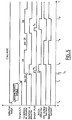
- the engine stalling case is shown on the seventh line of the third timing diagram in FIG. 5, where the engine control computer 6 delivers information on the engine running from state 1 to low state 0 to t 8 , which turns off the secondary indicator light, its state then going from 1 to 0 on the eighth line.
- the driver presses a second time, A 6 , after stalling the engine at t 9 to start it again at t 9 .
- the unit passenger compartment central unit 4 has a memory function the start request by pressing the button impulse, during preheating, but with a delay beyond which the memorization of support is canceled.
- the driver identification badge can be blocked in the reader as soon as the engine is running. It is released under two conditions: when the engine stopped and vehicle speed is below a threshold. In some versions of realization of the system with a gearbox automatic, an additional condition may apply in the "Parking" position of the gear lever.
- the locking and unlocking of the badge is controlled by the passenger compartment central unit 4, which sends its command messages to the badge reader who executed.
- Each card or badge has a number unique identification, which is communicated to the cockpit computer 4 during authentication by transponder.
- An interesting advantage is recognition of the card used by the cockpit calculator, which controls for example the following equipment, such as the seat, the position is memorized, automatic air conditioning and even favorite radio stations.
- the cabin calculator can store several identification numbers, according to the different vehicle users.
- the central unit 4 passenger compartment has a function for memorizing the start request made by pressing the impulse button 3. Taking this into account memorization is materialized by the flashing of the "invitation to start" indicator light on the button impulse. The storage of the support is canceled after a fixed time delay, if the conditions security pulses are not actually filled, such as the position of the gearbox lever speed and preheating conditions in the case of a Diesel engine where this memorization is particularly interesting. It's important to choose a new press on the impulse button, while the memorization is active, does not cancel this memorization in progress.
- the vehicle is equipped with a locking device for the column steering, electromechanical type called “lock electric ". It receives commands from the cockpit calculator 4, taking into account information provided by the anti-blocking system ABS wheels on vehicle speed and Airbag on a possible accident.
- the cabin computer controls the unlocking the electric lock after authentication of the card, and controls its locking when the reader detects the absence of the card while the engine is stopped.
Landscapes
- Engineering & Computer Science (AREA)
- Mechanical Engineering (AREA)
- Combined Controls Of Internal Combustion Engines (AREA)
- Lock And Its Accessories (AREA)
- Control Of Vehicle Engines Or Engines For Specific Uses (AREA)
Abstract
Description
- un badge porté par l'utilisateur du véhicule et contenant un identifiant codé d'autorisation du démarrage ;
- un lecteur de badge destiné à identifier le badge ;
- un bouton impulsionnel de mise en marche et d'arrêt du moteur ;
- une unité centrale d'habitacle, d'une part reliée au lecteur de badge et au bouton impulsionnel et d'autre part assurant la distribution de l'alimentation électrique au moyen d'un relais après contact vers l'unité de contrôle moteur notamment, au moyen d'un relais de servitude pour différents éléments de l'habitacle et au moyen d'un relais de commande du démarreur, qui reçoit une information sur l'état du moteur tournant ou arrêté par l'unité de contrôle moteur ;
- des capteurs détectant des conditions de sécurité nécessaires au démarrage ;
- un capteur d'information sur la vitesse du véhicule.
- après détection du badge détenu par le conducteur, le démarrage du moteur est autorisé si l'identifiant codé dans le badge est authentifié et si les conditions de sécurité délivrées par les capteurs sont remplies, le témoin d'invitation à démarrer du bouton impulsionnel étant alors allumé ;
- si le conducteur appuie sur ledit bouton, l'unité centrale de contrôle de l'habitacle active le relais de commande du démarreur jusqu'à ce que l'unité centrale de contrôle moteur lui donne l'information que le moteur tourne de façon autonome, ce qui allume le témoin "moteur tournant" du bouton ;
- lorsque le conducteur veut l'arrêt du moteur, il appuie à nouveau sur le bouton et l'unité centrale de contrôle de l'habitacle coupe le relais de commande de l'alimentation électrique si la vitesse du véhicule est inférieure à un seuil Vs prédéfini ;
- un nouvel appui sur le bouton sans retrait du badge relance la séquence de démarrage.
- la figure 1 : un schéma fonctionnel d'un système de démarrage assisté de véhicule, selon l'invention ;
- la figure 2 : un diagramme de déroulement du procédé de démarrage assisté selon l'invention ;
- la figure 3 : un chronogramme des états pour un cycle de fonctionnement normal du procédé selon l'invention ;
- la figure 4 : un chronogramme des états pour un cycle de fonctionnement normal du procédé selon l'invention avec arrêt du moteur et redémarrage sans enlever le badge de l'utilisateur ;
- la figure 5 : un chronogramme des états illustrant un calage du moteur.
- un relais 5 de commande du circuit d'alimentation électrique du moteur, dit relais après contact "+APC" alimentant l'unité 6 de contrôle du moteur, l'air-bag, le tableau de bord entre autres ;
- un deuxième relais 7 de servitude "+SERV", pour l'alimentation notamment de la radio 8, des lève-vitres 9, du groupe moto-ventilateur 10 GMV de l'habitacle, du siège électrique 11, etc. Il alimente également l'antivol électrique 12 pouvant être installé ;
- un troisième relais 13 de démarrage "+DEM" pour l'alimentation du solénoïde du démarreur 14 du moteur 17. L'unité 6 de contrôle moteur communique à l'unité 4 de contrôle de l'habitacle une information sur l'état du moteur tournant ou arrêté.
- aucune vitesse n'est enclenchée, donc le levier de la boíte de vitesse mécanique est au point mort, OU la pédale d'embrayage est enfoncée, et celui de la boíte automatique est en position "Parking" ou "neutre" ; ET
- la colonne de direction est débloquée, ET
- le préchauffage du moteur est terminé dans le cas d'un moteur alimenté en Diesel.
Claims (16)
- Système de démarrage assisté d'un véhicule dont le moteur est piloté par une unité de contrôle, reliée à un démarreur et à un capteur de vitesse du véhicule notamment, caractérisé en ce qu'il comporte :un badge (1), porté par le conducteur du véhicule, et contenant une fonction d'identification codée d'autorisation du démarrage ;un lecteur (2) de badge destiné à identifier ledit badge (1) ;un bouton impulsionnel (3) de mise en marche et d'arrêt du moteur, directement accessible par le conducteur ;une unité centrale (4) de contrôle de l'habitacle, d'une part reliée au lecteur (2) de badge et au bouton impulsionnel (3) et d'autre part, assurant la distribution de l'alimentation électrique au moyen d'un relais (5) après contact vers l'unité (6) de contrôle moteur notamment et d'un relais (13) de commande du démarreur (14) du moteur, qui reçoit une information sur l'état du moteur arrêté ou tournant par l'unité (6) de contrôle moteur ;des capteurs (15) détectant des conditions de sécurité nécessaires au démarrage ;un capteur (16) d'informations sur la vitesse du véhicule.
- Système de démarrage assisté selon la revendication 1, caractérisé en ce que le bouton impulsionnel (3) est alimenté par la tension électrique de la batterie (20) du véhicule et est équipé de deux témoins lumineux :un premier témoin principal (30), qui est une invitation à démarrer pour le conducteur à qui il indique la position du bouton et à qui il signale qu'il est autorisé à mettre en route le moteur, les conditions de sécurité requises étant remplies ;un second témoin (31), qui est allumé quand le moteur tourne et qui indique au conducteur la localisation du bouton pour arrêter le moteur.
- Système de démarrage assisté selon la revendication 1, caractérisé en ce que le badge (1) d'identification du conducteur autorisé à faire démarrer le véhicule contient des moyens codés d'autorisation du démarrage de type transpondeur crypté.
- Système de démarrage assisté selon la revendication 1, caractérisé en ce que le lecteur (2) de badge est situé sur la planche de bord du véhicule, est alimenté par la tension électrique de la batterie (20) et contient l'équivalent de l'antenne transpondeur, avec une lecture de l'identifiant sans contact.
- Système de démarrage assisté selon les revendications 1 à 4, caractérisé en ce que l'unité centrale (4) de contrôle de l'habitacle est également reliée à un relais (7) de service pour l'alimentation électrique de la radio (8), des lève-vitres (9), du groupe motoventilateur (10) GMV de l'habitacle, du siège électrique (11).
- Système de démarrage assisté selon la revendication 1, caractérisé en ce que le véhicule étant équipé d'un dispositif antivol électrique, il est commandé par l'unité centrale (4) de contrôle de l'habitacle, par l'intermédiaire du relais (7) de service.
- Système de démarrage assisté selon la revendication 1, caractérisé en ce que les capteurs (15), détectant si les conditions de sécurité nécessaires au démarrage sont remplies, sont notamment des capteurs de position du levier de la boíte de vitesse, de pédale d'embrayage, du frein de parking, un capteur sur la colonne de direction et un capteur de préchauffage dans le cas d'un moteur Diesel.
- Système de démarrage assisté selon la revendication 1, caractérisé en ce que le capteur (16) délivrant une information sur la vitesse de déplacement du véhicule est intégré au système d'antiblocage de roues ABS, quand le véhicule en est équipé.
- Procédé de fonctionnement d'un système de démarrage assisté d'un véhicule selon l'une des revendications 1 à 8, caractérisé en ce que :après détection du badge (1) détenu par la conducteur, le démarrage du moteur est autorisé si l'identifiant codé dans le badge est authentifié et si les conditions de sécurité requises délivrées par les capteurs (15) sont remplies, le témoin (30) d'invitation à démarrer du bouton impulsionnel (3) étant alors allumé ;si le conducteur appuie sur ledit bouton (3), l'unité centrale (4) de contrôle de l'habitacle active le relais (13) de commande du démarreur (14) jusqu'à ce que l'unité (6) de contrôle moteur lui donne l'information que le moteur tourne de façon autonome, ce qui allume le témoin (31) "moteur tournant" du bouton (3) ;lorsque le conducteur veut l'arrêt du moteur, il appuie à nouveau sur le bouton (3) et l'unité centrale (4) de contrôle de l'habitacle coupe le relais (5) de commande de l'alimentation électrique si la vitesse du véhicule est intérieure à un seuil (Vs) prédéfini ;un nouvel appui sur le bouton (3) sans retrait de la carte (1) relance la séquence de démarrage.
- Procédé de démarrage assisté selon la revendication 9, caractérisé en ce que, en cas de calage du moteur, l'unité (6) de contrôle moteur envoie l'information "moteur calé" à l'unité centrale (4) de contrôle de l'habitacle, qui éteint le témoin lumineux secondaire (31) du bouton impulsionnel (3) et allume le témoin (30) d'invitation à démarrer si les conditions de sécurité requises sont remplies, et en ce que le conducteur, sans retirer son badge (1), appuie à nouveau sur le bouton (3) pour redémarrer le moteur du véhicule.
- Procédé de démarrage assisté selon l'une des revendications 9 ou 10, caractérisé en ce que tout retrait du badge (1) de l'environnement du lecteur (2), lorsque le moteur du véhicule est arrêté, annule l'autorisation de démarrage du moteur.
- Procédé de démarrage assisté selon l'une des revendications 9 ou 10, caractérisé en ce que tout retrait du badge (1) de l'environnement du lecteur (2), alors que le moteur tourne de façon autonome, est sans effet sur le fonctionnement du moteur.
- Procédé de démarrage assisté selon l'une des revendications 9 ou 10, caractérisé en ce que dans le cas où le badge (1) du conducteur doit être introduit dans le lecteur (2) pour être détecté, le badge est bloqué dans le lecteur dès que le moteur tourne et est débloqué à condition que le moteur soit arrêté et que la vitesse du véhicule soit inférieure à un seuil, le bloquage et le débloquage du badge carte étant commandés par l'unité centrale (4) de contrôle de l'habitacle et exécutés par le lecteur (2).
- Procédé de démarrage assisté selon la revendication 13, caractérisé en ce qu'il comporte de plus un moyen d'avertissement sonore indiquant au conducteur que le badge (1) est resté dans le lecteur (2), alors qu'il quitte son véhicule.
- Procédé de démarrage assisté selon l'une des revendications 9 ou 10, caractérisé en ce que l'unité centrale (4) de contrôle de l'habitacle a une fonction de mémorisation de la demande de démarrage effectuée par un appui du conducteur sur le bouton impulsionnel (3), cette mémorisation étant d'une part annulée après une temporisation fixée si les conditions impulsionnelles de sécurité requises ne sont pas remplies mais étant d'autre part maintenue lors d'un second nouvel appui sur le bouton.
- Procédé de démarrage assisté selon l'une des revendications 9 à 15, caractérisé en ce que, le véhicule étant équipé d'un dispositif électro-magnétique de blocage de la colonne de direction, l'unité centrale (4) de contrôle de l'habitacle commande son déverrouillage après l'authentification du badge (1) d'identification du conducteur et commande son verrouillage quand le lecteur (2) de badge détecte l'absence de badge, le moteur étant à l'arrêt.
Applications Claiming Priority (2)
| Application Number | Priority Date | Filing Date | Title |
|---|---|---|---|
| FR9906498A FR2793742B1 (fr) | 1999-05-21 | 1999-05-21 | Systeme et procede de demarrage assiste d'un vehicule |
| FR9906498 | 1999-05-21 |
Publications (2)
| Publication Number | Publication Date |
|---|---|
| EP1053919A1 true EP1053919A1 (fr) | 2000-11-22 |
| EP1053919B1 EP1053919B1 (fr) | 2005-08-31 |
Family
ID=9545885
Family Applications (1)
| Application Number | Title | Priority Date | Filing Date |
|---|---|---|---|
| EP20000401408 Expired - Lifetime EP1053919B1 (fr) | 1999-05-21 | 2000-05-22 | Système et procédé de démarrage assisté d'un véhicule |
Country Status (4)
| Country | Link |
|---|---|
| EP (1) | EP1053919B1 (fr) |
| DE (1) | DE60022259T2 (fr) |
| ES (1) | ES2248027T3 (fr) |
| FR (1) | FR2793742B1 (fr) |
Cited By (3)
| Publication number | Priority date | Publication date | Assignee | Title |
|---|---|---|---|---|
| FR2824943A1 (fr) * | 2001-05-21 | 2002-11-22 | Siemens Automotive Sa | Procede de communication entre un badge et un vehicule automobile |
| EP1225106A3 (fr) * | 2001-01-19 | 2004-01-02 | Grundig Car InterMedia System GmbH | Dispositif pour bloquer ou libérer l'utilisation des sous-ensembles d'un véhicule à moteur |
| EP1384882A3 (fr) * | 2002-07-09 | 2004-04-21 | Kabushiki Kaisha Tokai Rika Denki Seisakusho | Système de contrôle de démarrage et d'arrêt du moteur |
Citations (4)
| Publication number | Priority date | Publication date | Assignee | Title |
|---|---|---|---|---|
| WO1988003884A1 (fr) * | 1986-11-26 | 1988-06-02 | Ove Andersson | Dispositif antivol pour vehicule a moteur |
| DE4435894A1 (de) * | 1994-10-07 | 1996-04-11 | Telefunken Microelectron | Verfahren und Sicherungssystem zur Sicherung eines Kraftfahrzeuges |
| DE19604206A1 (de) * | 1996-02-06 | 1997-08-07 | Martin Ulrich | Transponder zum Übertragen insbesondere sicherheitstechnisch relevanter Daten zu einem Basisgerät |
| EP0893315A2 (fr) * | 1997-07-23 | 1999-01-27 | Toyota Jidosha Kabushiki Kaisha | Système à clé électronique pour véhicules |
-
1999
- 1999-05-21 FR FR9906498A patent/FR2793742B1/fr not_active Expired - Lifetime
-
2000
- 2000-05-22 ES ES00401408T patent/ES2248027T3/es not_active Expired - Lifetime
- 2000-05-22 EP EP20000401408 patent/EP1053919B1/fr not_active Expired - Lifetime
- 2000-05-22 DE DE2000622259 patent/DE60022259T2/de not_active Expired - Lifetime
Patent Citations (4)
| Publication number | Priority date | Publication date | Assignee | Title |
|---|---|---|---|---|
| WO1988003884A1 (fr) * | 1986-11-26 | 1988-06-02 | Ove Andersson | Dispositif antivol pour vehicule a moteur |
| DE4435894A1 (de) * | 1994-10-07 | 1996-04-11 | Telefunken Microelectron | Verfahren und Sicherungssystem zur Sicherung eines Kraftfahrzeuges |
| DE19604206A1 (de) * | 1996-02-06 | 1997-08-07 | Martin Ulrich | Transponder zum Übertragen insbesondere sicherheitstechnisch relevanter Daten zu einem Basisgerät |
| EP0893315A2 (fr) * | 1997-07-23 | 1999-01-27 | Toyota Jidosha Kabushiki Kaisha | Système à clé électronique pour véhicules |
Cited By (6)
| Publication number | Priority date | Publication date | Assignee | Title |
|---|---|---|---|---|
| EP1225106A3 (fr) * | 2001-01-19 | 2004-01-02 | Grundig Car InterMedia System GmbH | Dispositif pour bloquer ou libérer l'utilisation des sous-ensembles d'un véhicule à moteur |
| FR2824943A1 (fr) * | 2001-05-21 | 2002-11-22 | Siemens Automotive Sa | Procede de communication entre un badge et un vehicule automobile |
| WO2002095690A1 (fr) * | 2001-05-21 | 2002-11-28 | Siemens Vdo Automotive S.A.S. | Procede de communication entre un badge et un vehicule automobile |
| US6958682B2 (en) | 2001-05-21 | 2005-10-25 | Siemens Vdo Automotive | Communication method between a badge and a motor vehicle |
| EP1384882A3 (fr) * | 2002-07-09 | 2004-04-21 | Kabushiki Kaisha Tokai Rika Denki Seisakusho | Système de contrôle de démarrage et d'arrêt du moteur |
| US6900552B2 (en) | 2002-07-09 | 2005-05-31 | Kabushiki Kaisha Tokai Rika Denki Seisakusho | System for controlling starting and stopping of engine |
Also Published As
| Publication number | Publication date |
|---|---|
| FR2793742A1 (fr) | 2000-11-24 |
| DE60022259T2 (de) | 2006-06-14 |
| EP1053919B1 (fr) | 2005-08-31 |
| DE60022259D1 (de) | 2005-10-06 |
| ES2248027T3 (es) | 2006-03-16 |
| FR2793742B1 (fr) | 2001-07-06 |
Similar Documents
| Publication | Publication Date | Title |
|---|---|---|
| EP2332768B1 (fr) | Système de démarrage de bouton poussoir pour équipement d'alimentation en extérieurs | |
| EP0770749B1 (fr) | Système mains libres de déverrouillage et/ou d'ouverture d'ouvrant de véhicule automobile | |
| EP0785380B1 (fr) | Véhicule automobile à boíte de vitesses automatique équipé d'une logique de commande à fonction de verrouillage du levier de vitesses en position parking et fonction de verrouillage de la clef contact | |
| EP1717117B1 (fr) | Système et dispositif antivol pour véhicule | |
| US7730752B2 (en) | Theft prevention apparatus for leisure vehicle | |
| FR2740414A1 (fr) | Systeme de communication prevu entre une cle de contact et un vehicule et protege contre les fausses manoeuvres | |
| FR2837766A1 (fr) | Appareil de commande de demarrage du moteur thermique d'un vehicule | |
| JP4603928B2 (ja) | 車両用盗難防止システム | |
| EP1041228B1 (fr) | Dispositif de déverrouillage d'urgence pour coffre d'automobile, système et méthode d'avertissement | |
| FR2784066A1 (fr) | Procede et dispositif de mise en service d'un moteur d'entrainement d'un vehicule automobile | |
| JP4126224B2 (ja) | エンジン始動制御装置 | |
| FR2781446A1 (fr) | Systeme antivol pour vehicule automobile | |
| US6802574B2 (en) | Electronic control unit and method for the automatic activation of the parking brake in motor vehicles | |
| CA3006193C (fr) | Systeme de demarrage a distance d'un vehicule equipe d'une transmission manuelle | |
| FR2576568A1 (fr) | Dispositif antivol notamment pour vehicules automobiles | |
| FR2790238A1 (fr) | Procede permettant de faire demarrer un vehicule automobile et dispositif de mise en marche d'allumage | |
| JP3857383B2 (ja) | 車両用ステアリングロックシステム | |
| EP1053919B1 (fr) | Système et procédé de démarrage assisté d'un véhicule | |
| FR2759109A1 (fr) | Procede de commande de l'acces a un vehicule automobile et dispositif correspondant | |
| US20080252438A1 (en) | Warning System and Method of Providing a Warning | |
| US7011377B2 (en) | Electronic control unit for automatically activating a parking brake and method for preventing the automatic activation of the parking brake in motor vehicles | |
| EP1886885B1 (fr) | Appareil de contrôle de véhicule et véhicule équipé avec celui-ci | |
| JPH112051A (ja) | 車両用エントリ制御システム | |
| FR2768676A1 (fr) | Antivol pour un vehicule automobile comportant des identifiants secondaires | |
| KR200448031Y1 (ko) | 리모콘키를 이용한 자동차 도어 오픈시 시동장치 |
Legal Events
| Date | Code | Title | Description |
|---|---|---|---|
| PUAI | Public reference made under article 153(3) epc to a published international application that has entered the european phase |
Free format text: ORIGINAL CODE: 0009012 |
|
| AK | Designated contracting states |
Kind code of ref document: A1 Designated state(s): DE ES GB IT |
|
| AX | Request for extension of the european patent |
Free format text: AL;LT;LV;MK;RO;SI |
|
| 17P | Request for examination filed |
Effective date: 20010426 |
|
| AKX | Designation fees paid |
Free format text: DE ES GB IT |
|
| RIN1 | Information on inventor provided before grant (corrected) |
Inventor name: BENOIT, ISABELLE Inventor name: BLONDEL, ANNIE Inventor name: LOUVEL, PHILIPPE Inventor name: MORILLON, JACQUES |
|
| RAP1 | Party data changed (applicant data changed or rights of an application transferred) |
Owner name: RENAULT Owner name: VALEO SECURITE HABITACLE |
|
| RAP1 | Party data changed (applicant data changed or rights of an application transferred) |
Owner name: VALEO SECURITE HABITACLE Owner name: RENAULT S.A.S. |
|
| 17Q | First examination report despatched |
Effective date: 20030930 |
|
| GRAP | Despatch of communication of intention to grant a patent |
Free format text: ORIGINAL CODE: EPIDOSNIGR1 |
|
| GRAS | Grant fee paid |
Free format text: ORIGINAL CODE: EPIDOSNIGR3 |
|
| GRAA | (expected) grant |
Free format text: ORIGINAL CODE: 0009210 |
|
| AK | Designated contracting states |
Kind code of ref document: B1 Designated state(s): DE ES GB IT |
|
| REG | Reference to a national code |
Ref country code: GB Ref legal event code: FG4D Free format text: NOT ENGLISH |
|
| REF | Corresponds to: |
Ref document number: 60022259 Country of ref document: DE Date of ref document: 20051006 Kind code of ref document: P |
|
| GBT | Gb: translation of ep patent filed (gb section 77(6)(a)/1977) | ||
| REG | Reference to a national code |
Ref country code: ES Ref legal event code: FG2A Ref document number: 2248027 Country of ref document: ES Kind code of ref document: T3 |
|
| PLBE | No opposition filed within time limit |
Free format text: ORIGINAL CODE: 0009261 |
|
| STAA | Information on the status of an ep patent application or granted ep patent |
Free format text: STATUS: NO OPPOSITION FILED WITHIN TIME LIMIT |
|
| 26N | No opposition filed |
Effective date: 20060601 |
|
| PGFP | Annual fee paid to national office [announced via postgrant information from national office to epo] |
Ref country code: DE Payment date: 20180522 Year of fee payment: 19 Ref country code: ES Payment date: 20180625 Year of fee payment: 19 |
|
| PGFP | Annual fee paid to national office [announced via postgrant information from national office to epo] |
Ref country code: IT Payment date: 20180530 Year of fee payment: 19 |
|
| PGFP | Annual fee paid to national office [announced via postgrant information from national office to epo] |
Ref country code: GB Payment date: 20180518 Year of fee payment: 19 |
|
| REG | Reference to a national code |
Ref country code: DE Ref legal event code: R119 Ref document number: 60022259 Country of ref document: DE |
|
| GBPC | Gb: european patent ceased through non-payment of renewal fee |
Effective date: 20190522 |
|
| PG25 | Lapsed in a contracting state [announced via postgrant information from national office to epo] |
Ref country code: GB Free format text: LAPSE BECAUSE OF NON-PAYMENT OF DUE FEES Effective date: 20190522 Ref country code: DE Free format text: LAPSE BECAUSE OF NON-PAYMENT OF DUE FEES Effective date: 20191203 Ref country code: IT Free format text: LAPSE BECAUSE OF NON-PAYMENT OF DUE FEES Effective date: 20190522 |
|
| REG | Reference to a national code |
Ref country code: ES Ref legal event code: FD2A Effective date: 20200928 |
|
| PG25 | Lapsed in a contracting state [announced via postgrant information from national office to epo] |
Ref country code: ES Free format text: LAPSE BECAUSE OF NON-PAYMENT OF DUE FEES Effective date: 20190523 |